Periods and Groups 
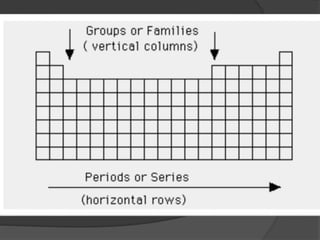
Periods 
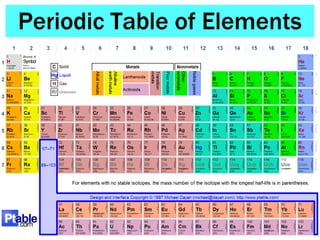
 Rows of elements are called periods. 
 The period number of an element 
signifies the highest unexcited energy 
level for an electron in that element. 
 The number of elements in a period 
increases as you move down the 
periodic table because there are more 
sublevels per level as the energy level of 
the atom increases
Groups 
 Columns of elements help define element 
groups. 
 Groups of elements have the same outer 
electron arrangement. 
 The outer electrons are called valence 
electrons. 
 Because they have the same number of 
valence electrons, elements in a group share 
similar chemical properties.
Representative vs. Transition 
Elements 
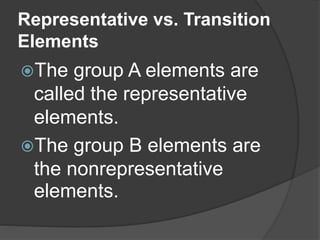
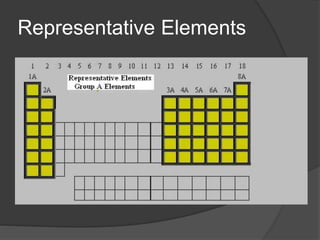
The group A elements are 
called the representative 
elements. 
The group B elements are 
the nonrepresentative 
elements.
Representative Elements
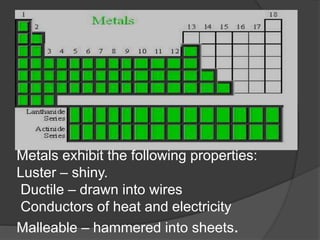
Metals exhibit the following properties: 
Luster – shiny. 
Ductile – drawn into wires 
Conductors of heat and electricity 
Malleable – hammered into sheets.
Group 1: Alkali Metals 
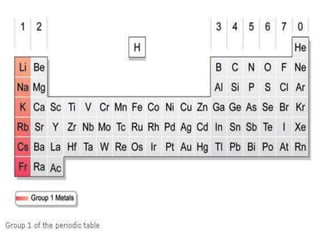
 The alkali metals are located in Group IA 
(first column) of the periodic table. 
 Alkali metals form salts and many other 
compounds. 
 These elements are less dense than 
other metals, form ions with a +1 
charge, and have the largest atom sizes 
of elements in their periods. 
 The alkali metals are highly reactive.
Group 2: Alkaline Earth 
Metals 
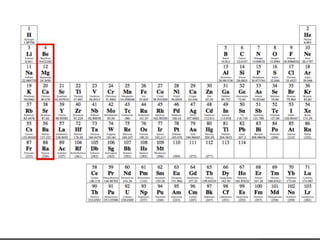
 The alkaline earths are located in Group 
IIA (second column) of the periodic 
table. 
 Calcium and magnesium are examples 
of alkaline earths. 
 These metals form many compounds. 
They have ions with a +2 charge. 
 Their atoms are smaller than those of 
the alkali metals.
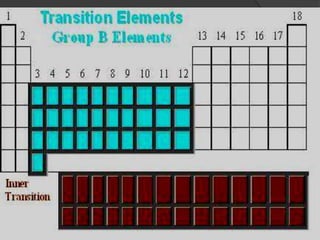
Groups 3-12: Transition 
 The transition elements are located in 
groups IB to VIIIB. 
 These elements are very hard, with high 
melting points and boiling points. 
 The transition metals are good electrical 
conductors and are very malleable. 
 They form positively charged ions.
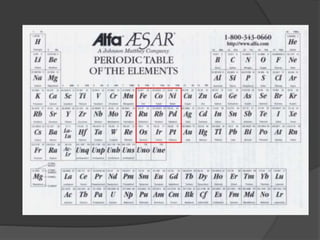
Metal Triads 
 The iron triad consists of iron, cobalt, 
and nickel. 
 Just under iron, cobalt, and nickel is the 
palladium triad of ruthenium, rhodium, 
and palladium, 
 While under them is the platinum triad of 
osmium, iridium, and platinum.
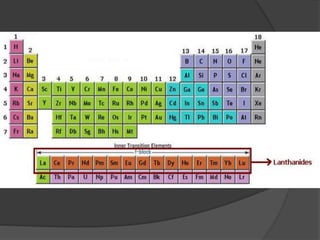
Lanthanides 
 The lanthanides are silvery metals that 
tarnish easily. 
 They are relatively soft metals, with high 
melting and boiling points. 
 The lanthanides react to form many 
different compounds. 
 These elements are used in lamps, 
magnets, lasers, and to improve the 
properties of other metals.
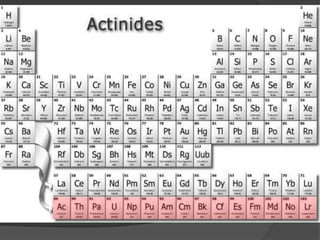
Actinides 
 The actinides are in the row below the 
lanthanides. 
 Their atomic numbers follow actinium. 
All of the actinides are radioactive, with 
positively charged ions. 
 They are reactive metals that form 
compounds with most nonmetals. 
 The actinides are used in medicines and 
nuclear devices.
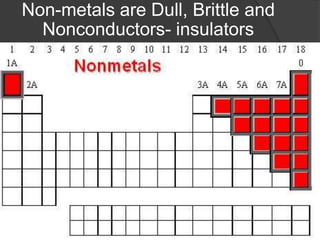
Non-metals are Dull, Brittle and 
Nonconductors- insulators
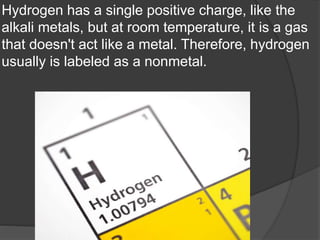
Hydrogen has a single positive charge, like the 
alkali metals, but at room temperature, it is a gas 
that doesn't act like a metal. Therefore, hydrogen 
usually is labeled as a nonmetal.
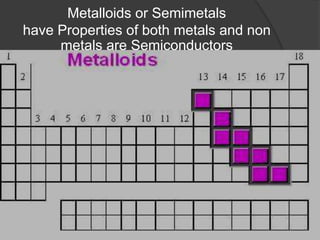
Metalloids or Semimetals 
have Properties of both metals and non 
metals are Semiconductors
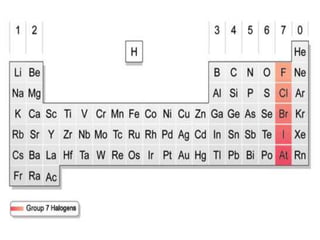
Group 17: Halogens 
 The halogens are located in Group VIIA 
of the periodic table. You find these 
elements in bleaches, disinfectants, and 
salts. 
 These nonmetals form ions with a -1 
charge. The physical properties of the 
halogens vary. The halogens are highly 
reactive.
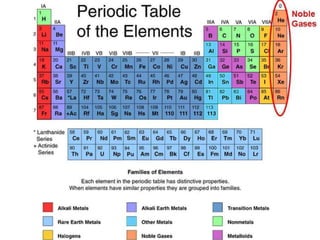
Group 18: Noble Gases 
 The noble gases are located in Group 
VIII of the periodic table. 
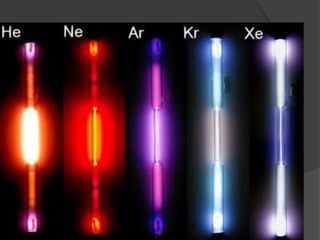
 These elements are used to make 
lighted signs, refrigerants, and lasers. 
 The noble gases are not reactive. 
 This is because they have little 
tendency to gain or lose electrons.
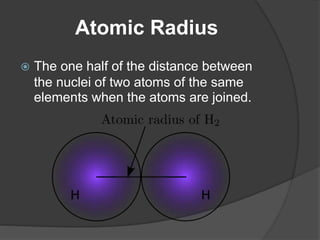
Atomic Radius 
 The one half of the distance between 
the nuclei of two atoms of the same 
elements when the atoms are joined.
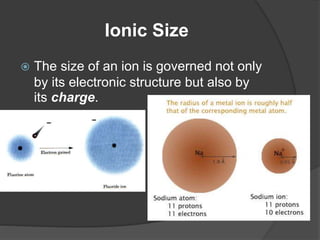
Ionic Size 
 The size of an ion is governed not only 
by its electronic structure but also by 
its charge.
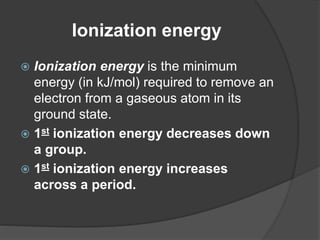
Ionization energy 
 Ionization energy is the minimum 
energy (in kJ/mol) required to remove an 
electron from a gaseous atom in its 
ground state. 
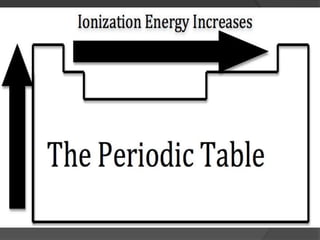
 1st ionization energy decreases down 
a group. 
 1st ionization energy increases 
across a period.
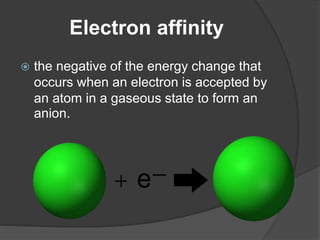
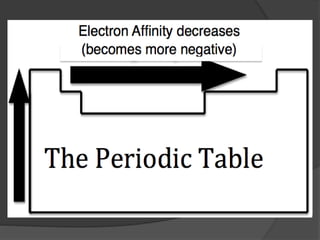
Electron affinity 
 the negative of the energy change that 
occurs when an electron is accepted by 
an atom in a gaseous state to form an 
anion.
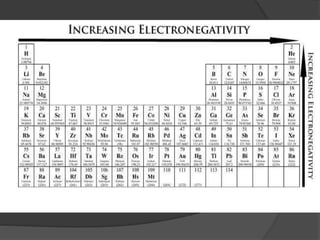
Electronegativity 
 The ability of an atom to attract toward 
itself the electrons in a chemical bond. 
 Elements with high electronegativity 
have a greater tendency to attract 
electrons than do elements with low 
electronegativity
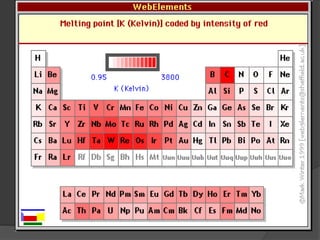
Melting 
 When a substance melts, some of the 
attractive forces holding the particles 
together are broken or loosened so that 
the particles can move freely around 
each other but are still close together. 
The stronger these forces are, the more 
energy is needed to overcome them and 
the higher the melting temperature.
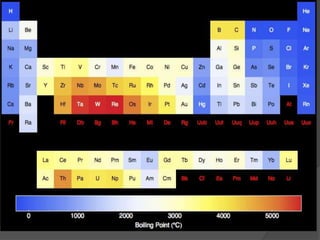
Boiling 
 When a substance boils, most of the 
remaining attractive forces are broken 
so the particles can move freely and far 
apart. The stronger the attractive forces 
are, the more energy is needed to 
overcome them and the higher the 
boiling temperature
The periodic table

The periodic table

  • 3.
    Periods and Groups Periods  Rows of elements are called periods.  The period number of an element signifies the highest unexcited energy level for an electron in that element.  The number of elements in a period increases as you move down the periodic table because there are more sublevels per level as the energy level of the atom increases
  • 4.
    Groups  Columnsof elements help define element groups.  Groups of elements have the same outer electron arrangement.  The outer electrons are called valence electrons.  Because they have the same number of valence electrons, elements in a group share similar chemical properties.
  • 6.
    Representative vs. Transition Elements The group A elements are called the representative elements. The group B elements are the nonrepresentative elements.
  • 7.
  • 8.
    Metals exhibit thefollowing properties: Luster – shiny. Ductile – drawn into wires Conductors of heat and electricity Malleable – hammered into sheets.
  • 9.
    Group 1: AlkaliMetals  The alkali metals are located in Group IA (first column) of the periodic table.  Alkali metals form salts and many other compounds.  These elements are less dense than other metals, form ions with a +1 charge, and have the largest atom sizes of elements in their periods.  The alkali metals are highly reactive.
  • 11.
    Group 2: AlkalineEarth Metals  The alkaline earths are located in Group IIA (second column) of the periodic table.  Calcium and magnesium are examples of alkaline earths.  These metals form many compounds. They have ions with a +2 charge.  Their atoms are smaller than those of the alkali metals.
  • 13.
    Groups 3-12: Transition  The transition elements are located in groups IB to VIIIB.  These elements are very hard, with high melting points and boiling points.  The transition metals are good electrical conductors and are very malleable.  They form positively charged ions.
  • 15.
    Metal Triads The iron triad consists of iron, cobalt, and nickel.  Just under iron, cobalt, and nickel is the palladium triad of ruthenium, rhodium, and palladium,  While under them is the platinum triad of osmium, iridium, and platinum.
  • 17.
    Lanthanides  Thelanthanides are silvery metals that tarnish easily.  They are relatively soft metals, with high melting and boiling points.  The lanthanides react to form many different compounds.  These elements are used in lamps, magnets, lasers, and to improve the properties of other metals.
  • 19.
    Actinides  Theactinides are in the row below the lanthanides.  Their atomic numbers follow actinium. All of the actinides are radioactive, with positively charged ions.  They are reactive metals that form compounds with most nonmetals.  The actinides are used in medicines and nuclear devices.
  • 21.
    Non-metals are Dull,Brittle and Nonconductors- insulators
  • 22.
    Hydrogen has asingle positive charge, like the alkali metals, but at room temperature, it is a gas that doesn't act like a metal. Therefore, hydrogen usually is labeled as a nonmetal.
  • 23.
    Metalloids or Semimetals have Properties of both metals and non metals are Semiconductors
  • 24.
    Group 17: Halogens  The halogens are located in Group VIIA of the periodic table. You find these elements in bleaches, disinfectants, and salts.  These nonmetals form ions with a -1 charge. The physical properties of the halogens vary. The halogens are highly reactive.
  • 26.
    Group 18: NobleGases  The noble gases are located in Group VIII of the periodic table.  These elements are used to make lighted signs, refrigerants, and lasers.  The noble gases are not reactive.  This is because they have little tendency to gain or lose electrons.
  • 30.
    Atomic Radius The one half of the distance between the nuclei of two atoms of the same elements when the atoms are joined.
  • 32.
    Ionic Size The size of an ion is governed not only by its electronic structure but also by its charge.
  • 33.
    Ionization energy Ionization energy is the minimum energy (in kJ/mol) required to remove an electron from a gaseous atom in its ground state.  1st ionization energy decreases down a group.  1st ionization energy increases across a period.
  • 35.
    Electron affinity the negative of the energy change that occurs when an electron is accepted by an atom in a gaseous state to form an anion.
  • 37.
    Electronegativity  Theability of an atom to attract toward itself the electrons in a chemical bond.  Elements with high electronegativity have a greater tendency to attract electrons than do elements with low electronegativity
  • 39.
    Melting  Whena substance melts, some of the attractive forces holding the particles together are broken or loosened so that the particles can move freely around each other but are still close together. The stronger these forces are, the more energy is needed to overcome them and the higher the melting temperature.
  • 41.
    Boiling  Whena substance boils, most of the remaining attractive forces are broken so the particles can move freely and far apart. The stronger the attractive forces are, the more energy is needed to overcome them and the higher the boiling temperature