The document focuses on stress and strain in materials under axial loading, detailing concepts such as normal strain, elastic vs. plastic behavior, and fatigue failure. It introduces Hooke's law and discusses the effects of alloying and temperature on material properties, along with methods for resolving statically indeterminate problems. The document also addresses generalized Hooke's law for multi-axial loading and relationships among normal and shear stresses and strains.
This slide introduces the topic of Mechanics of Materials, focusing on stress and strain under axial loading.
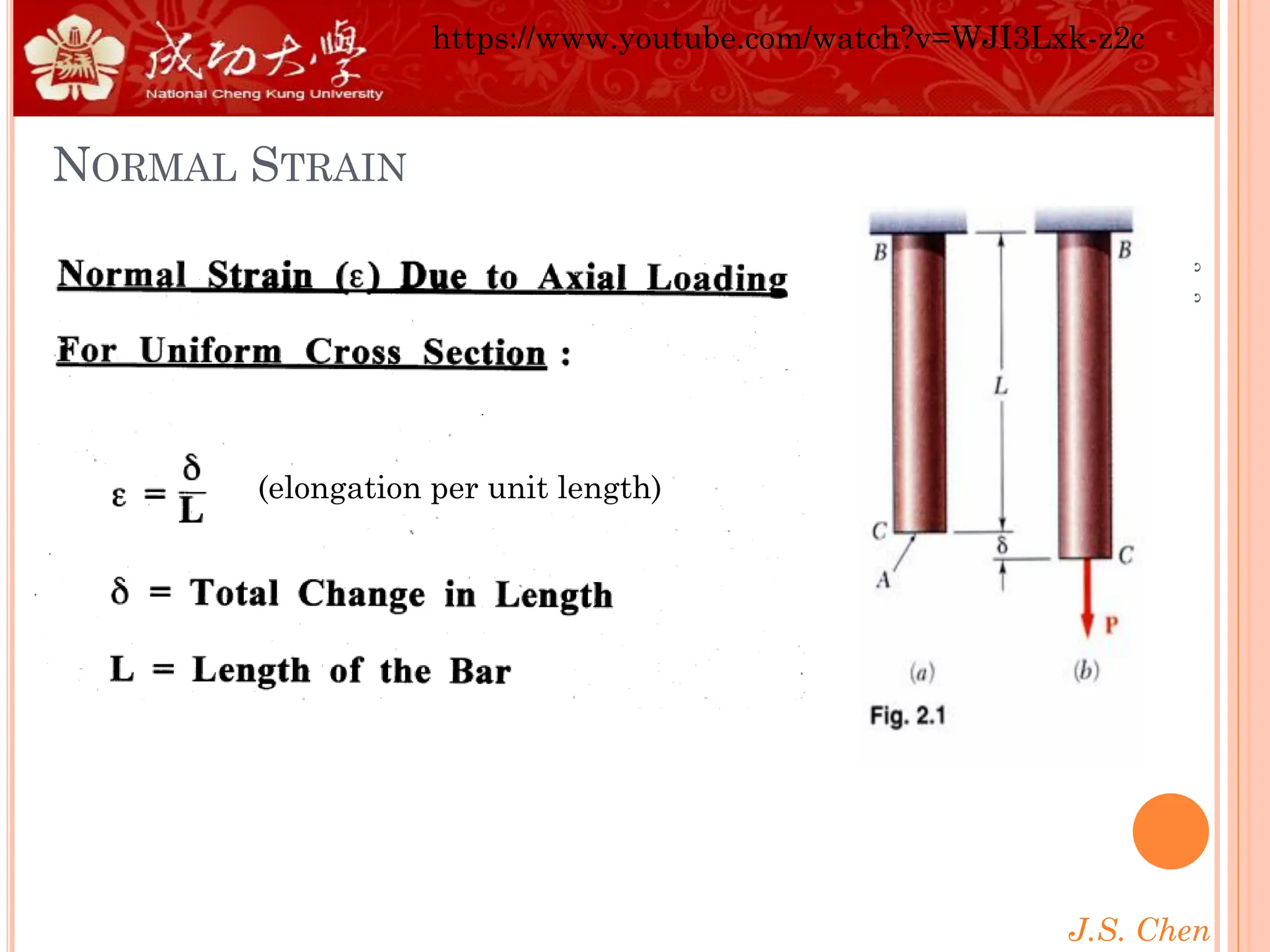
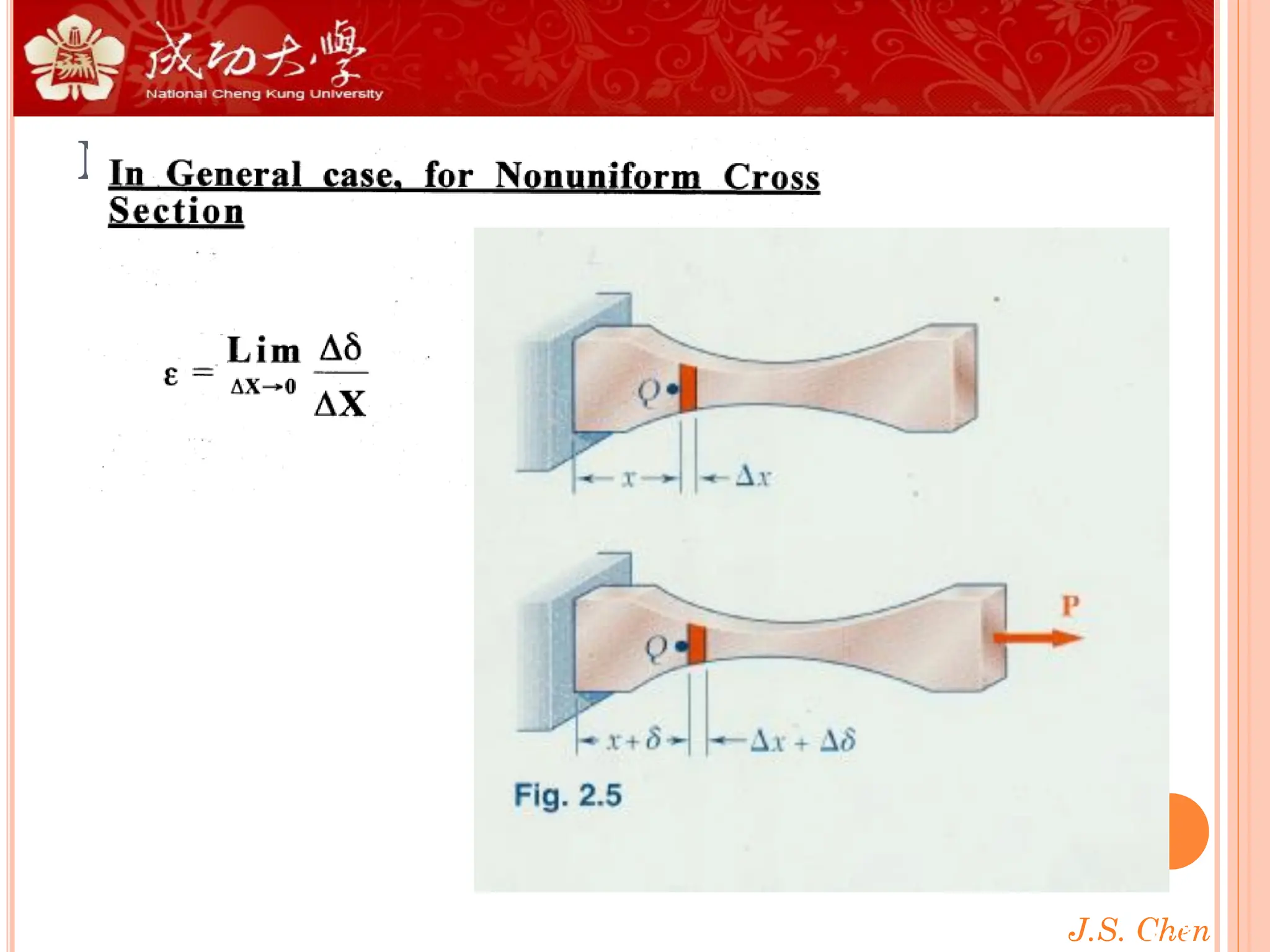
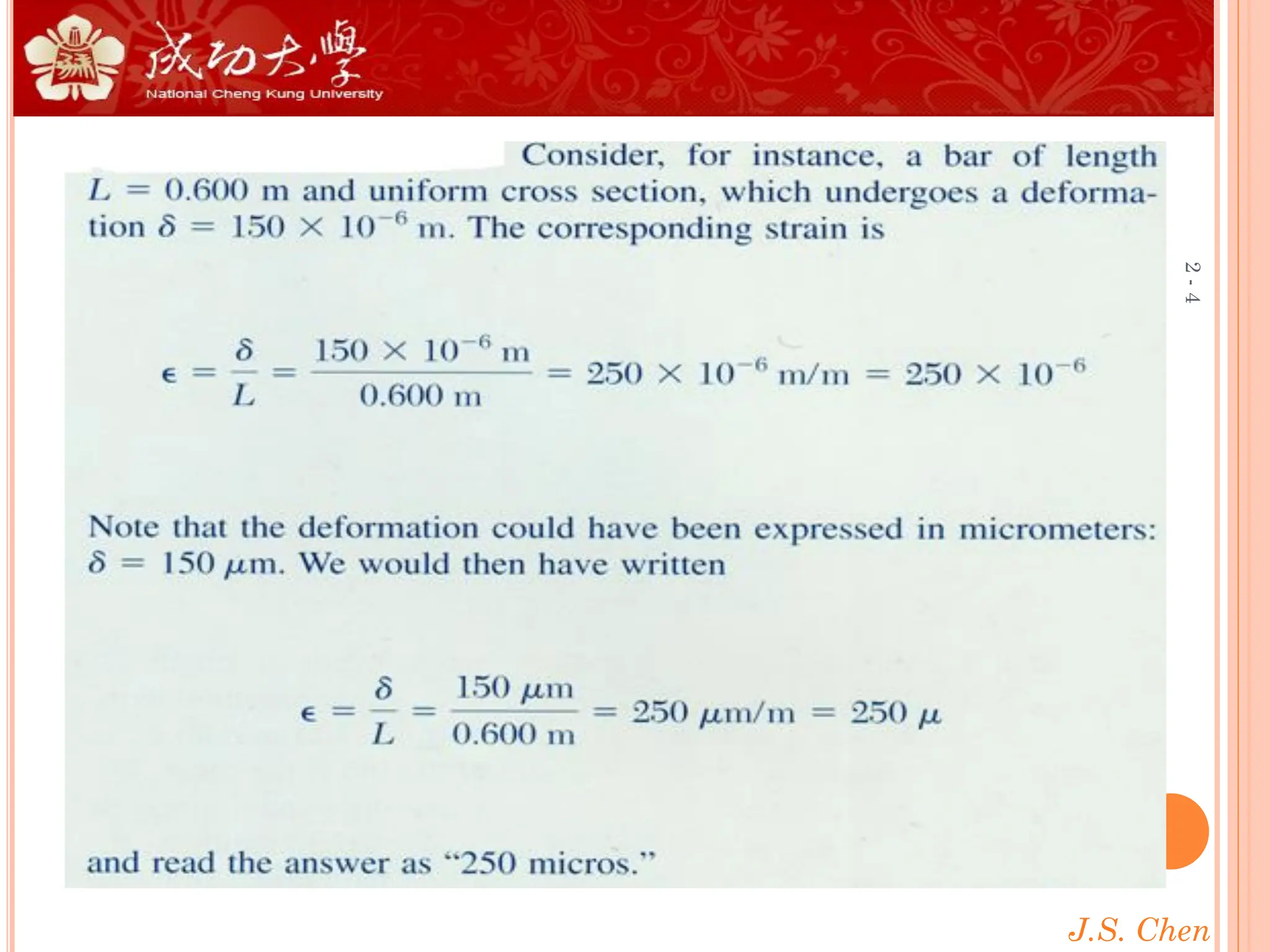
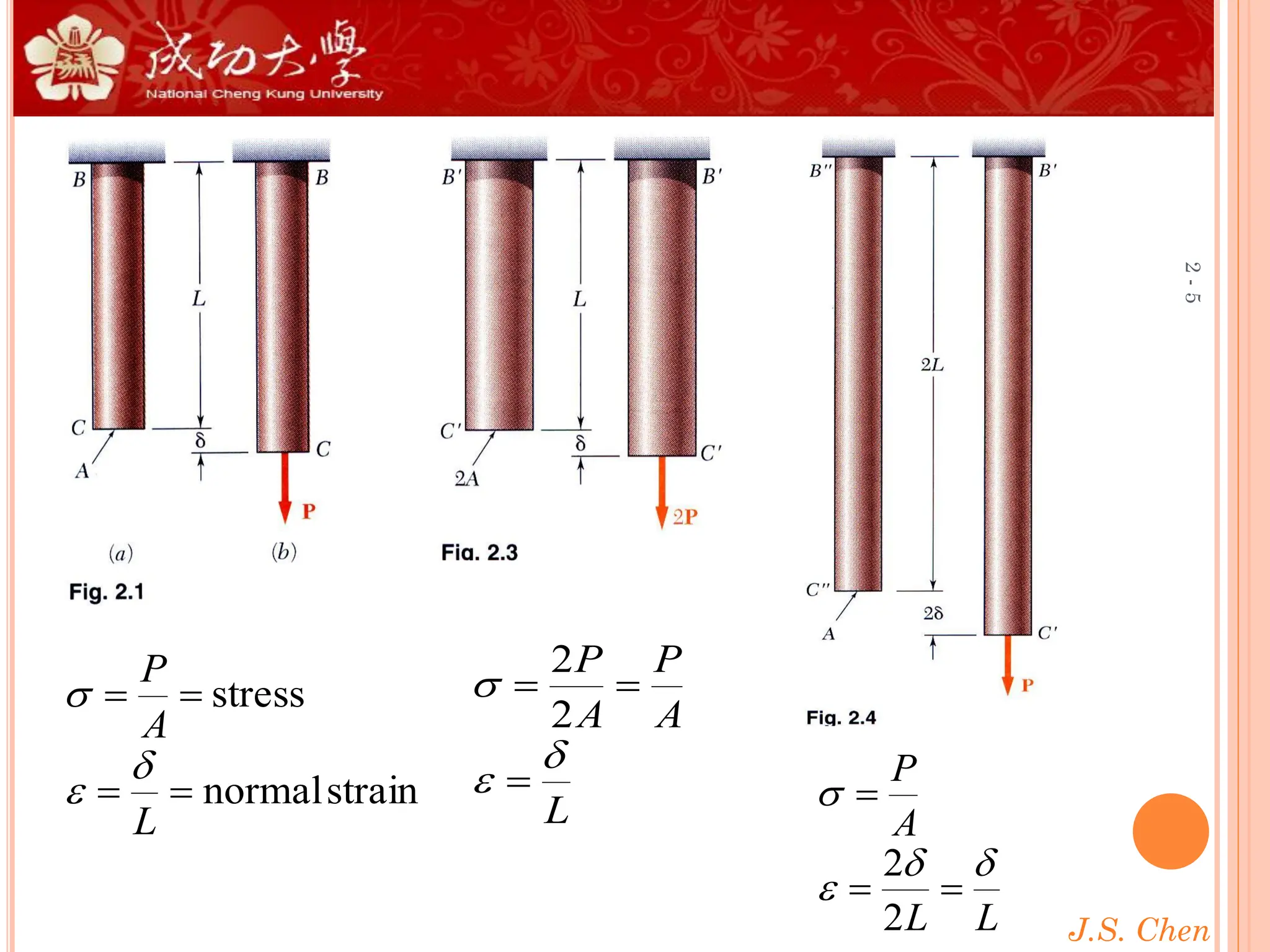
These slides define normal strain (elongation per unit length). The concept is illustrated without numerical examples.
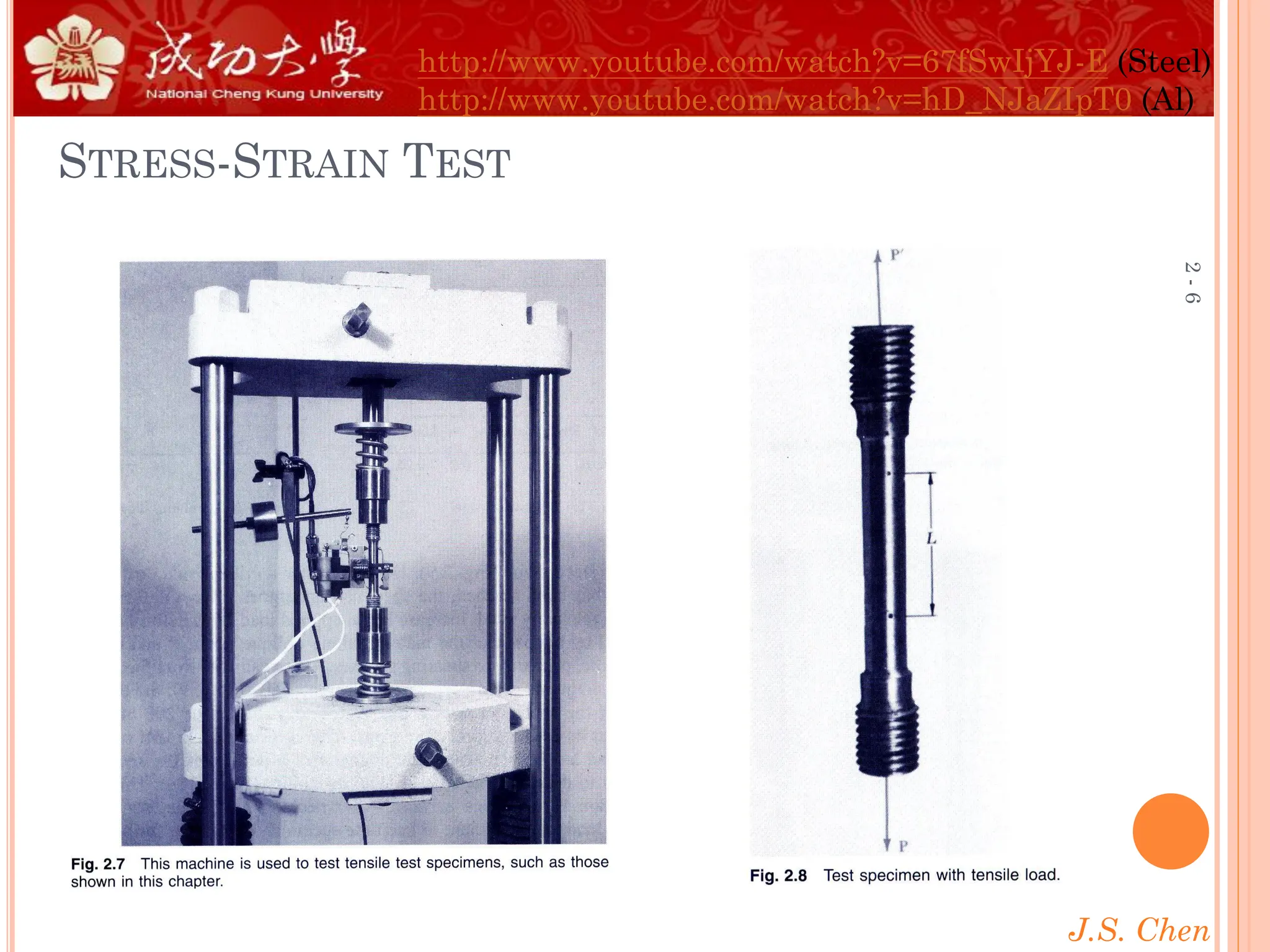
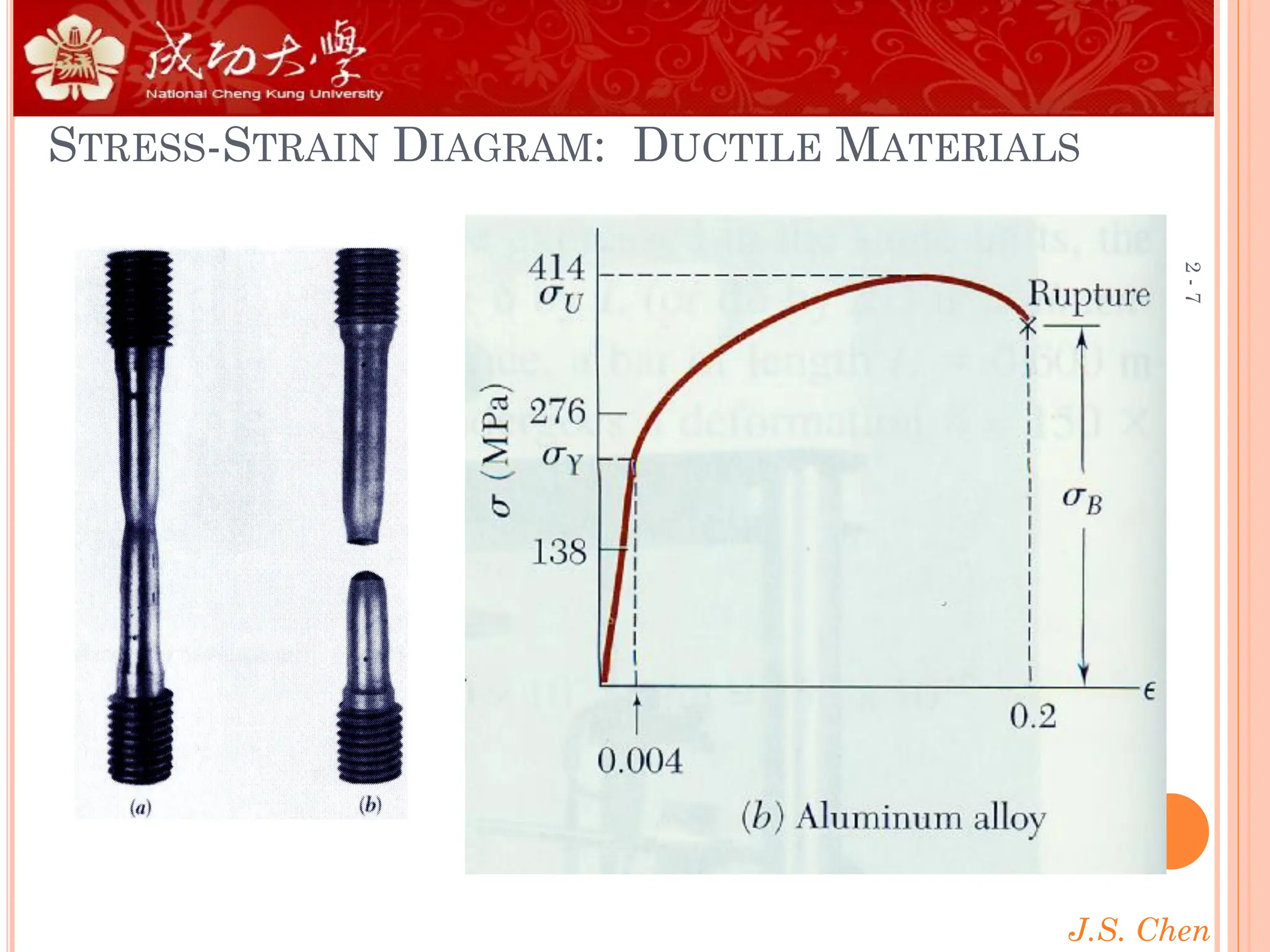
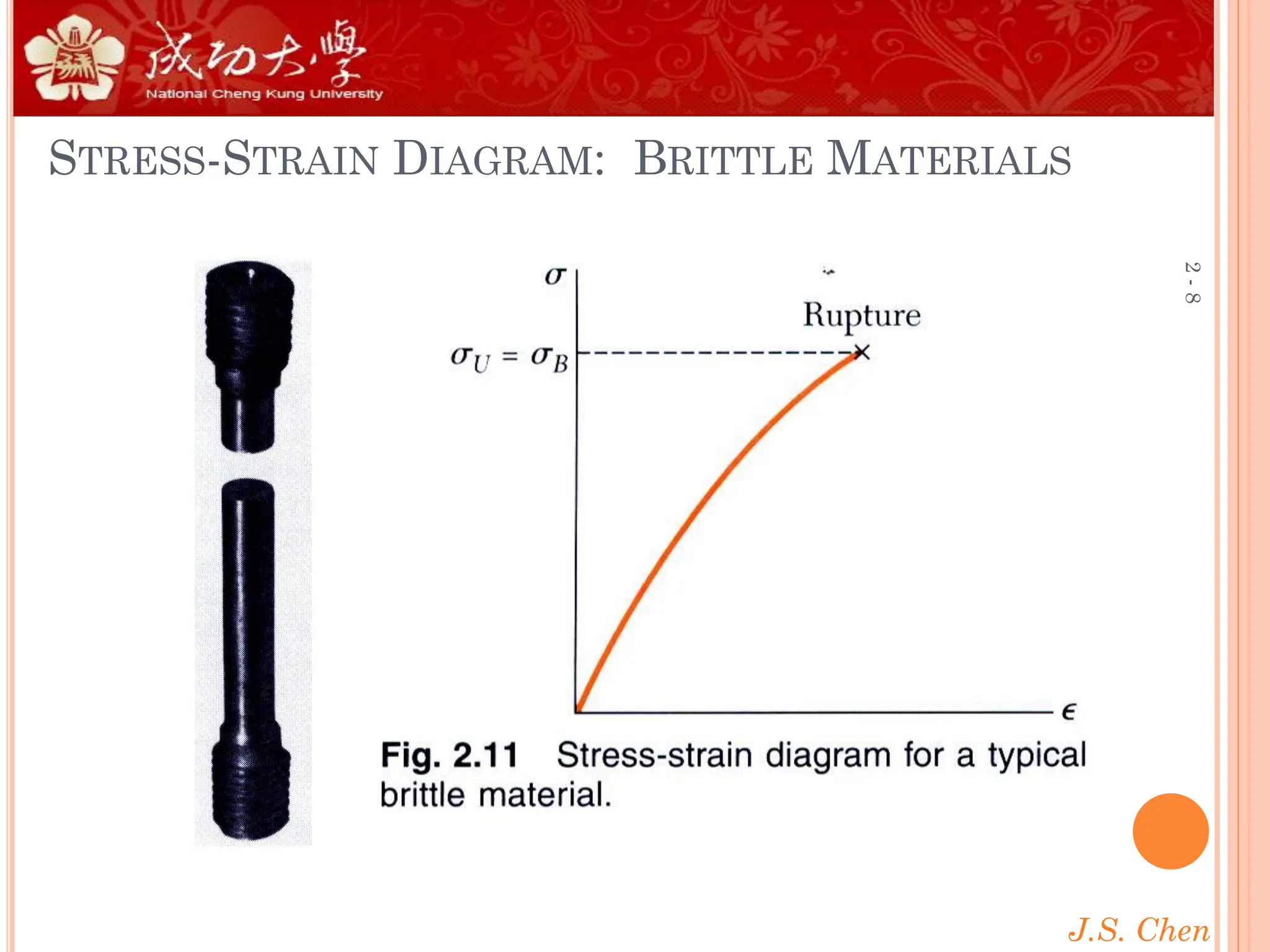
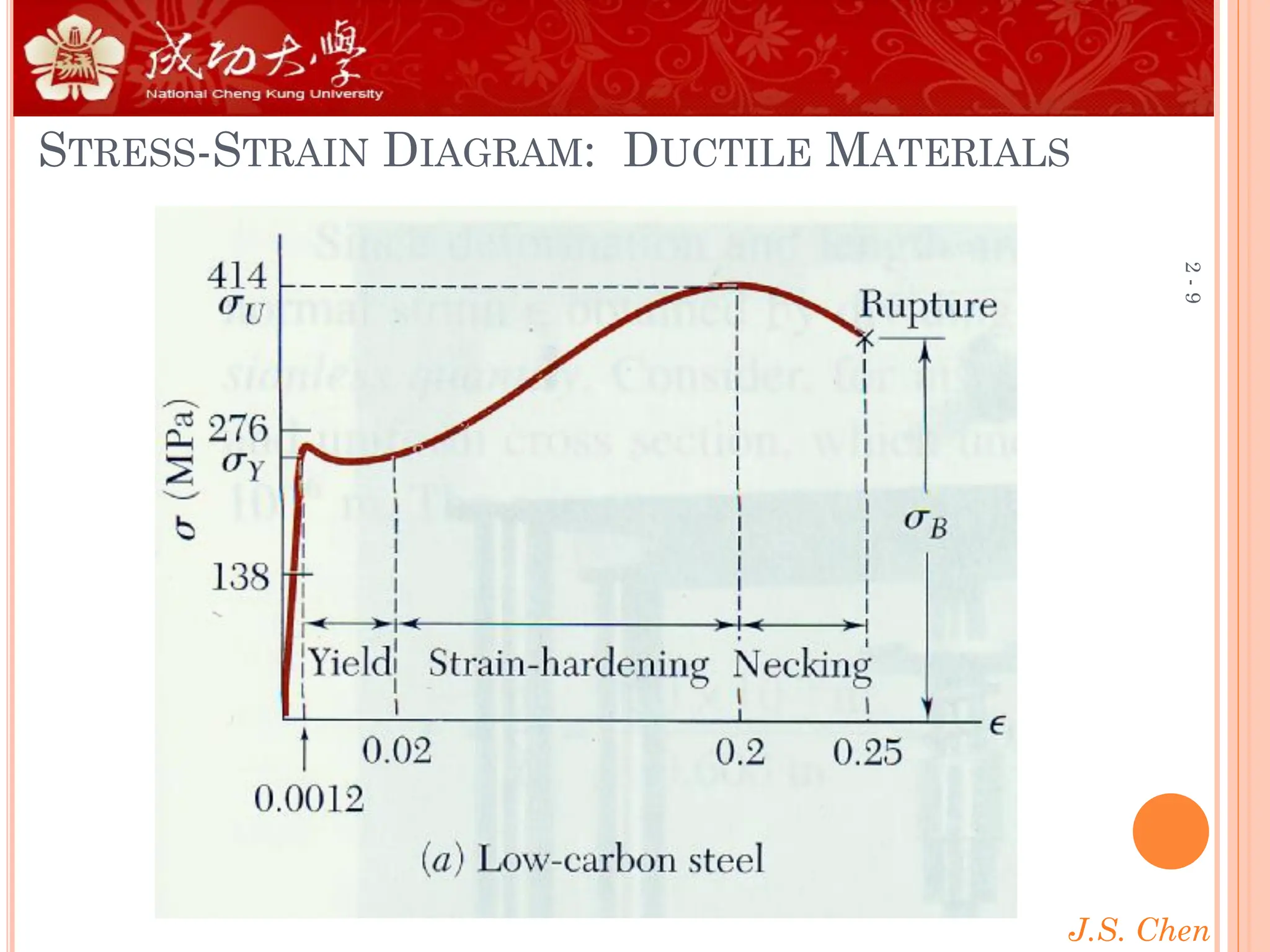
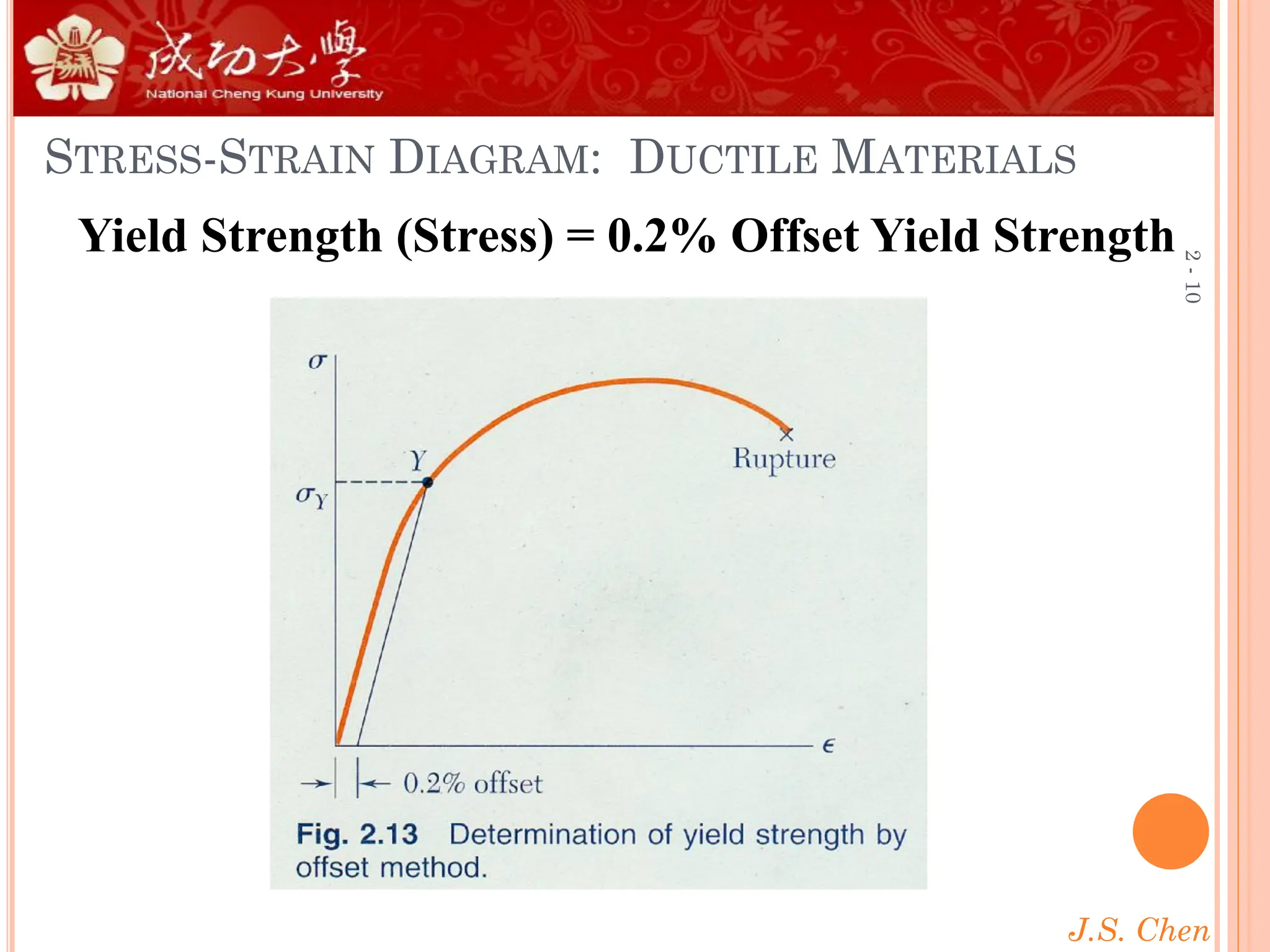
Discussion on stress-strain tests for materials, including diagrams for ductile and brittle materials, yielding and the significance of yield strength.
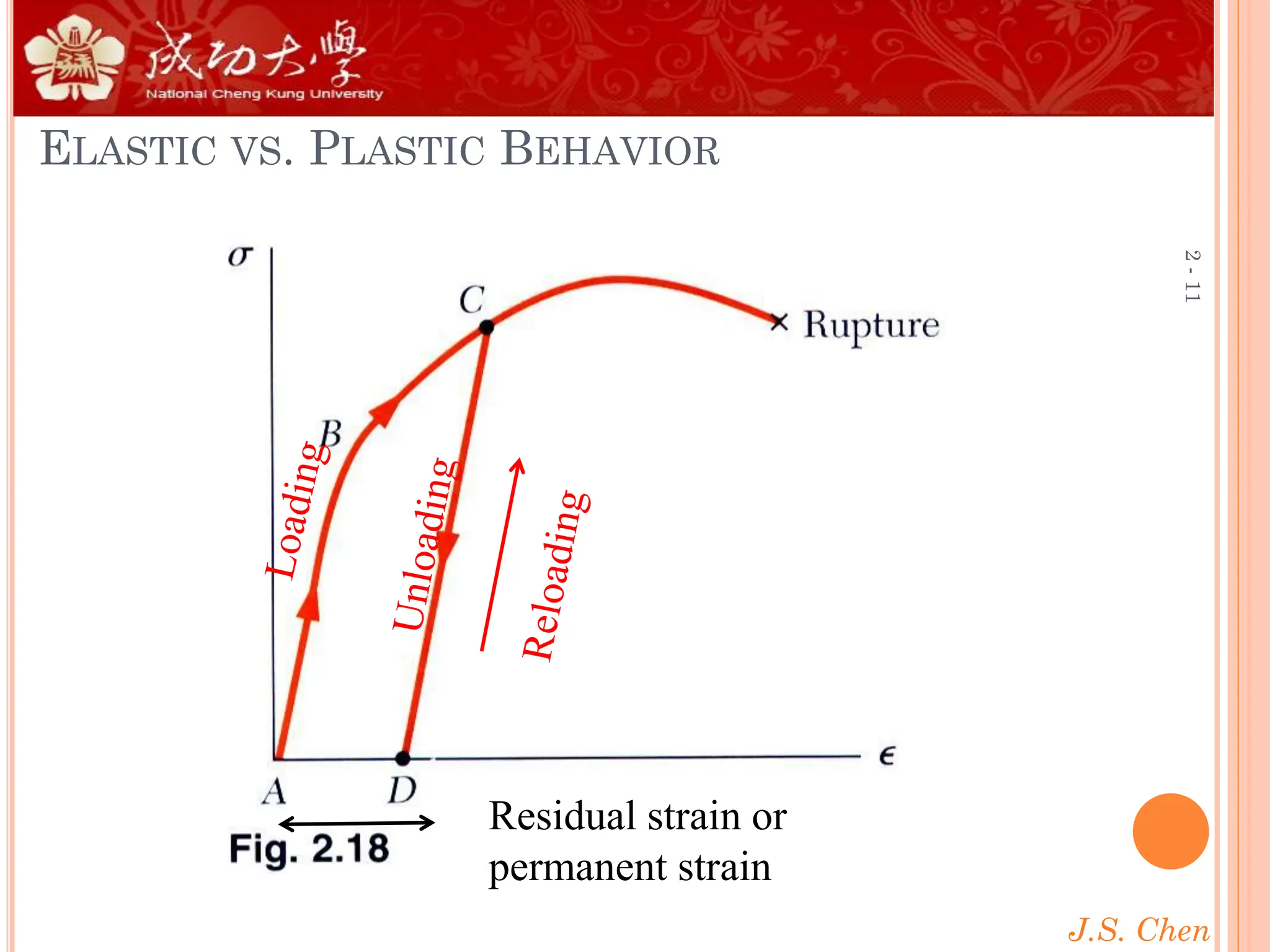
Differentiates between elastic and plastic behavior of materials under stress and strain with definitions for elastic limit.
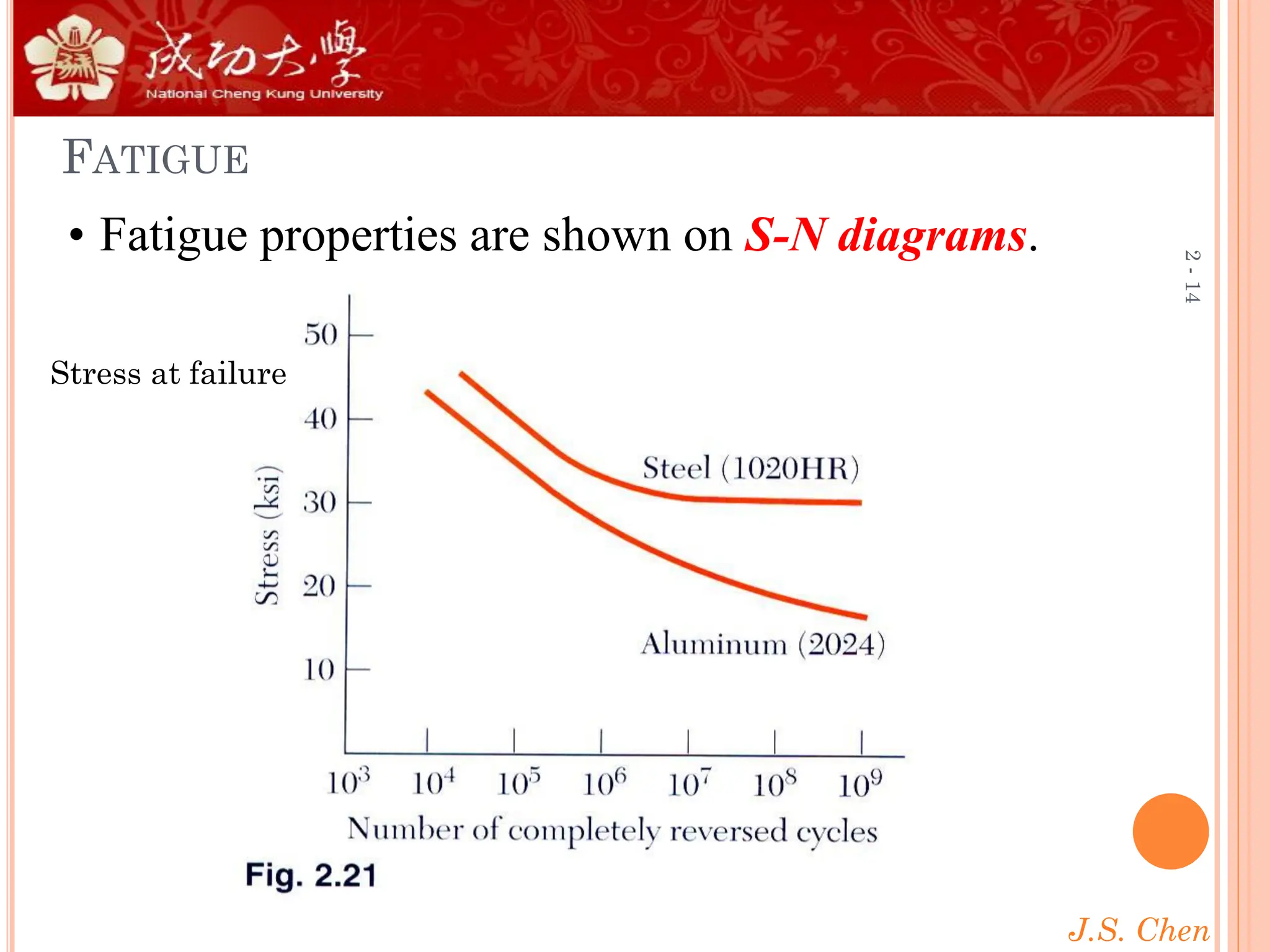
Concept of fatigue in materials, endurance limits, and how repeated loading cycles affect material integrity.
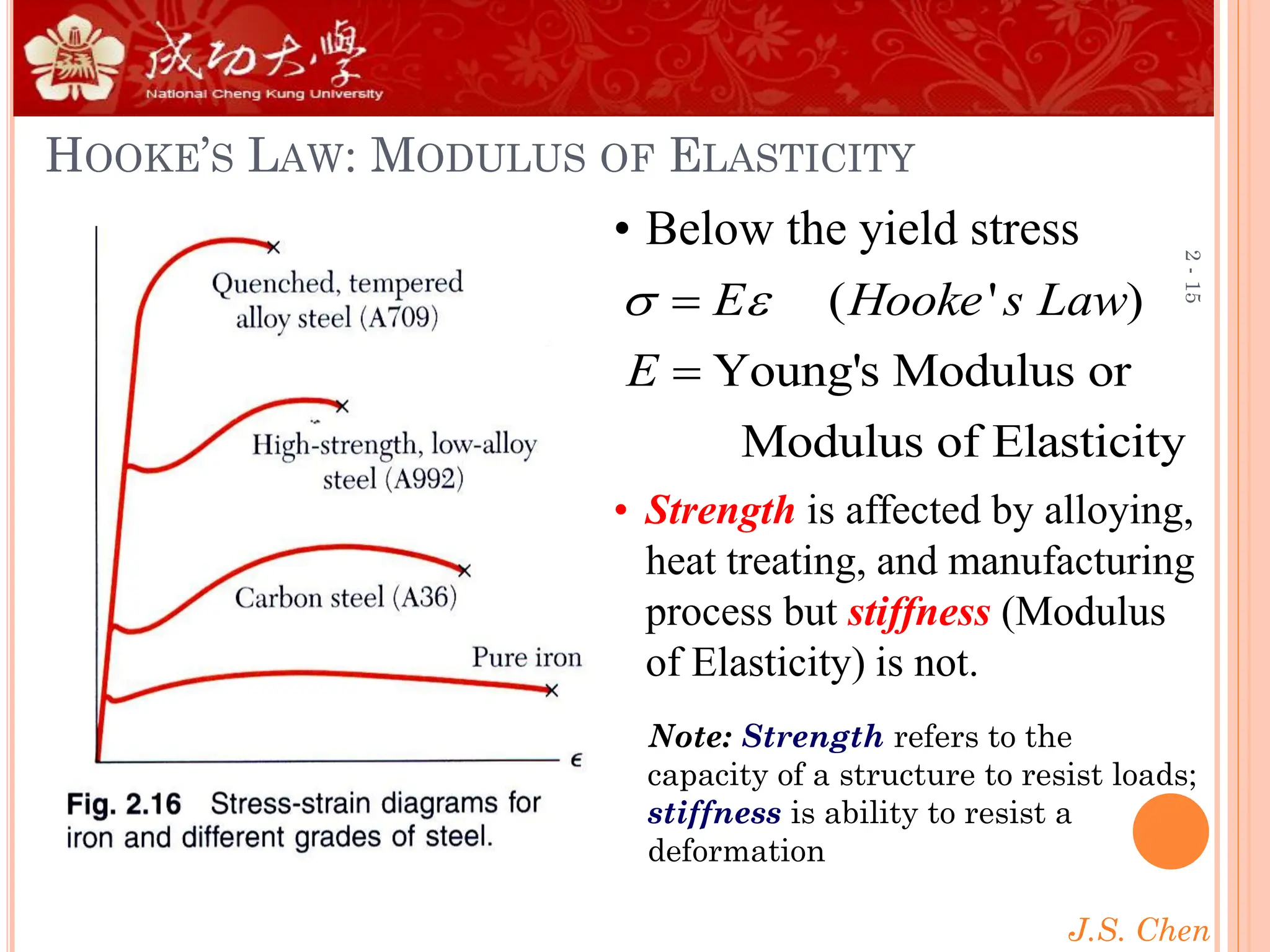
Introduces Hooke's Law, modulus of elasticity for materials, and distinctions between strength and stiffness.
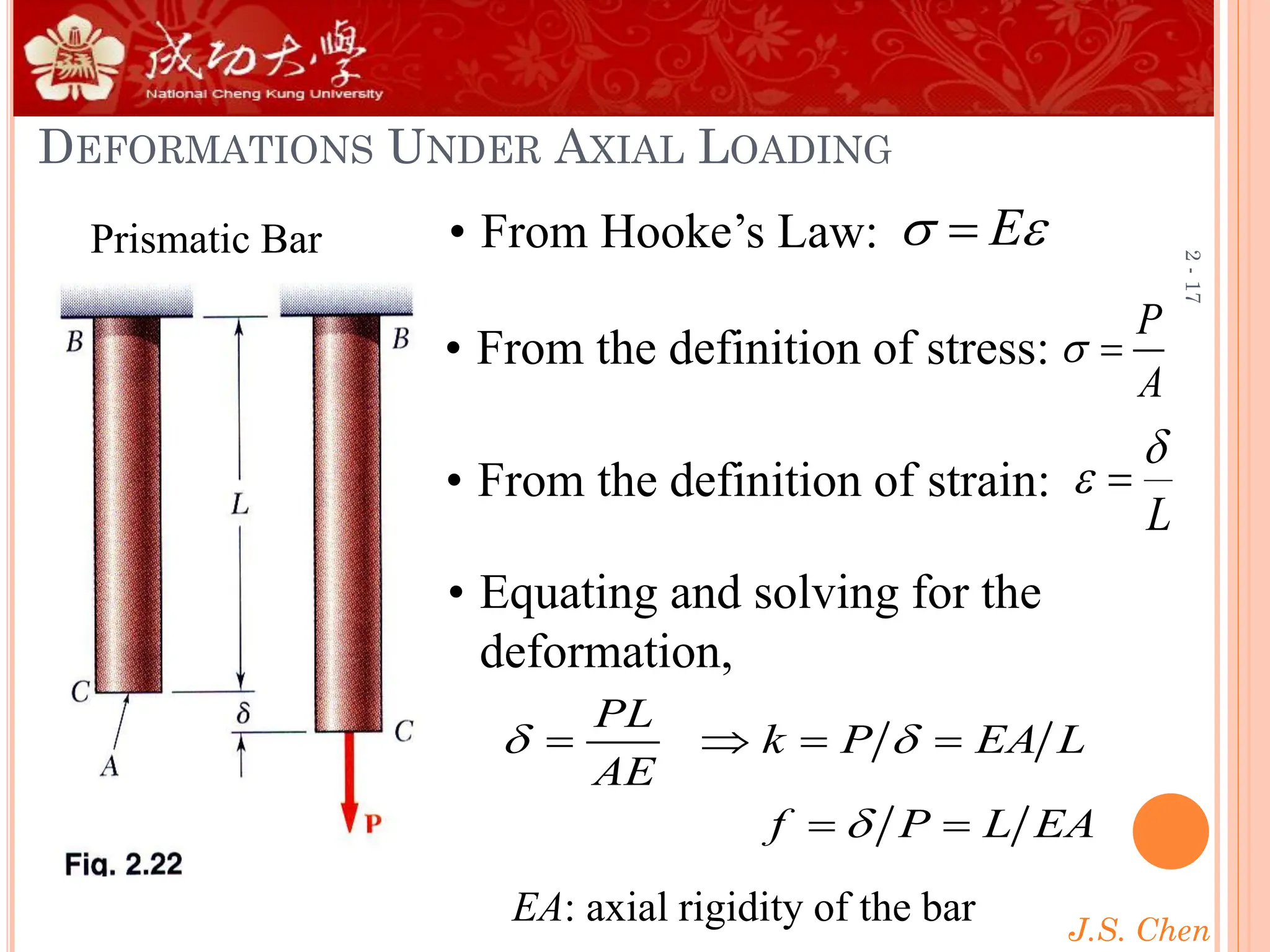
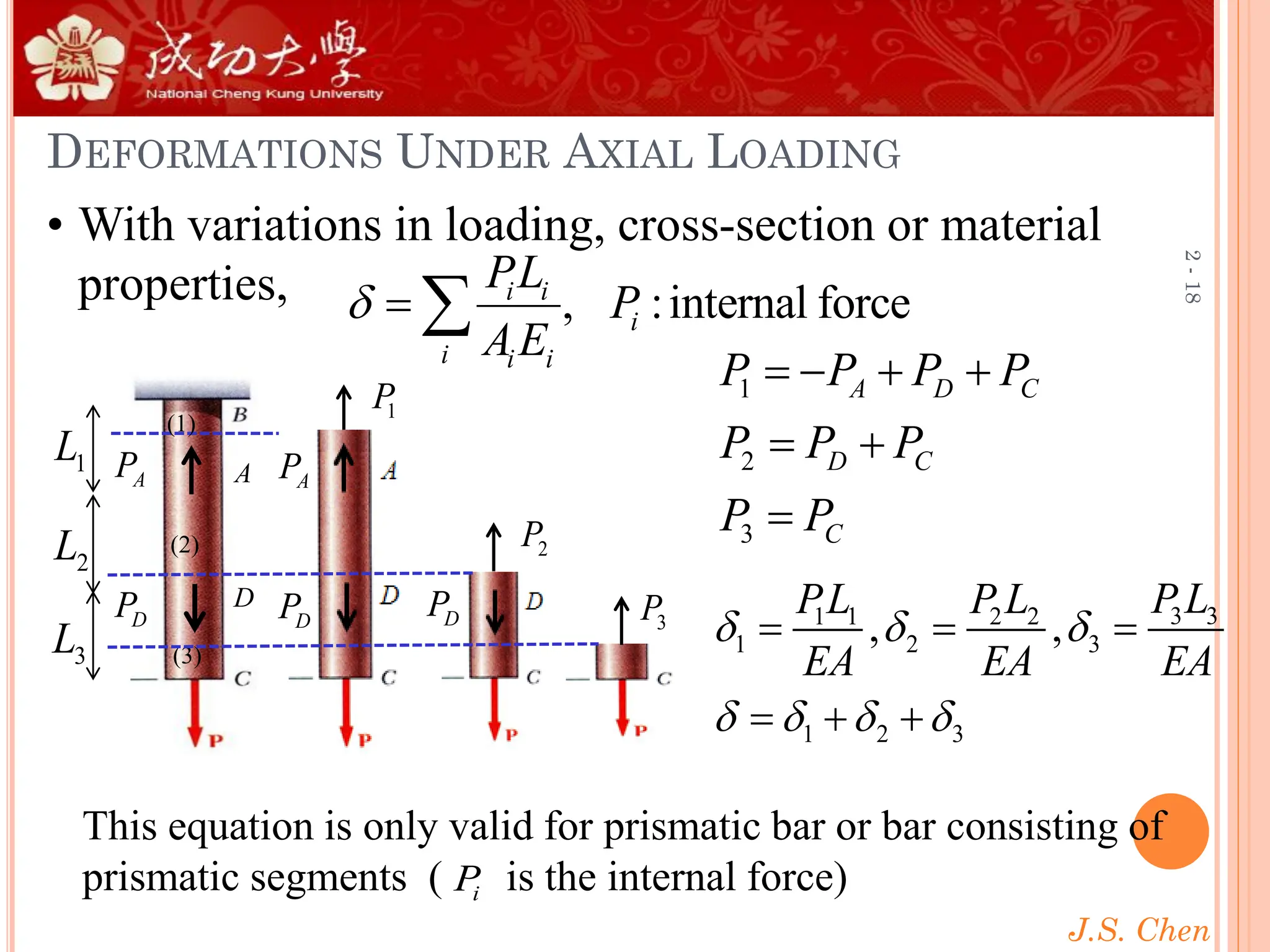
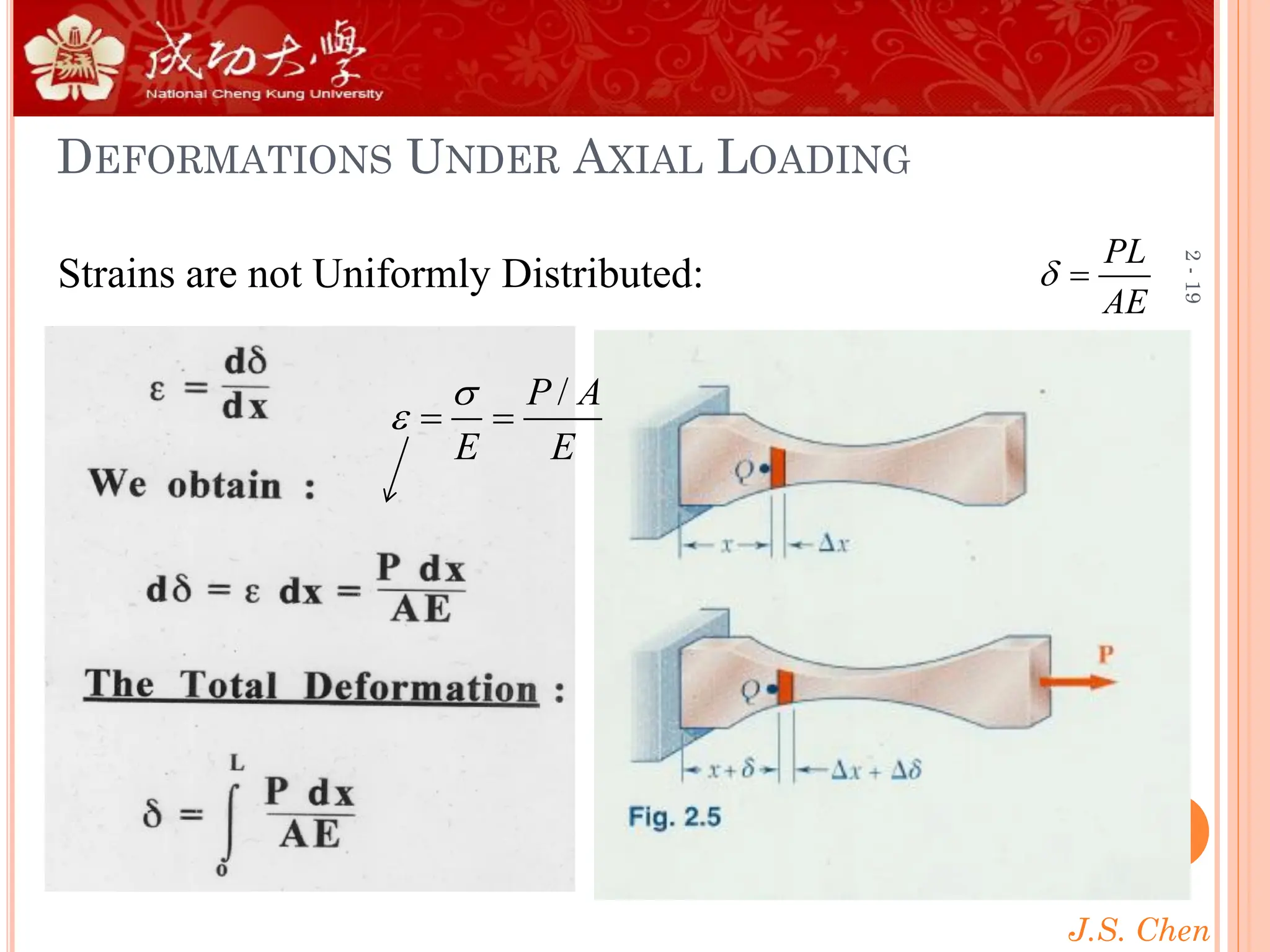
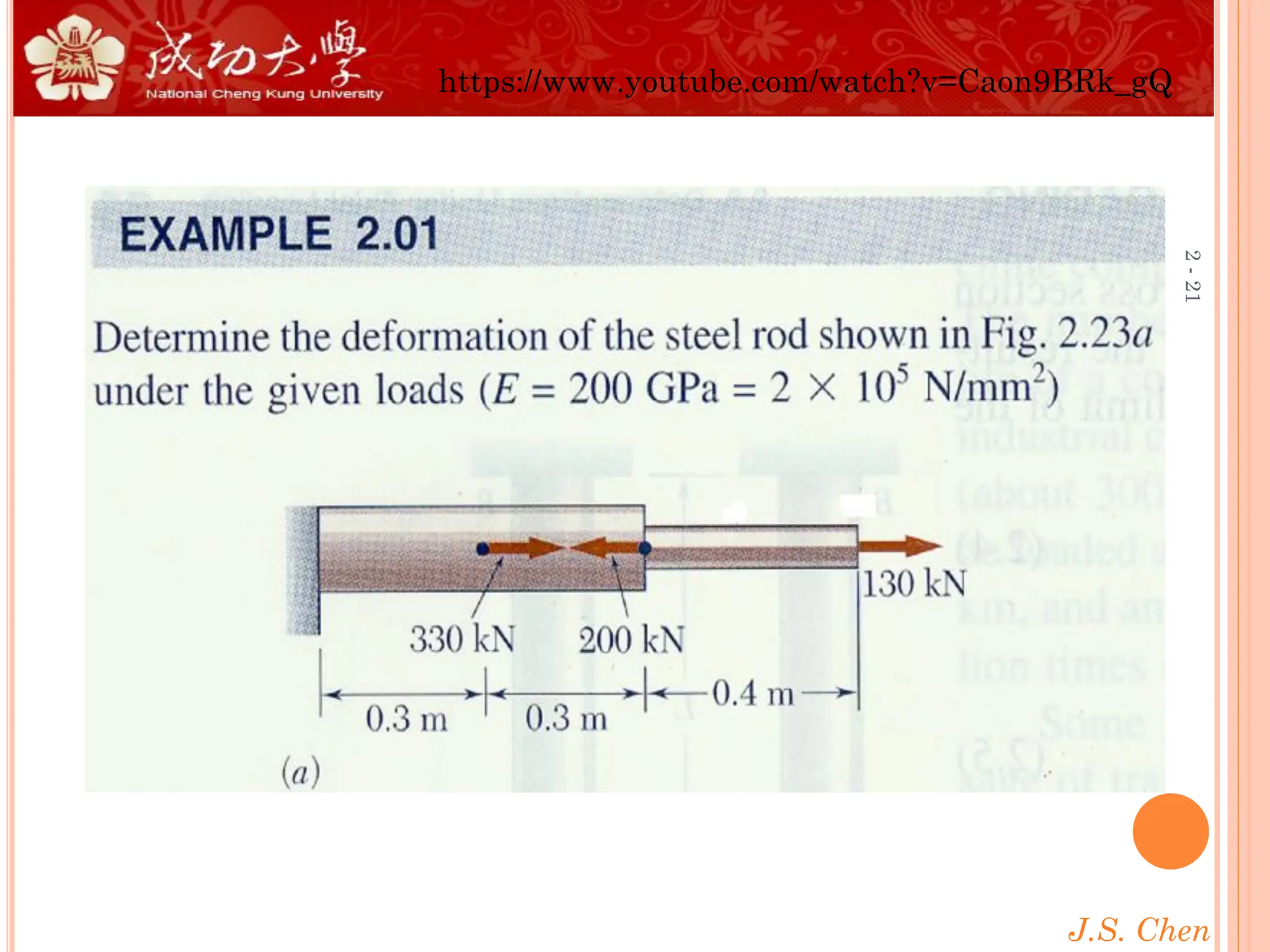
Details on deformations of axially loaded members, defining relationships of stress, strain, and their distributions.
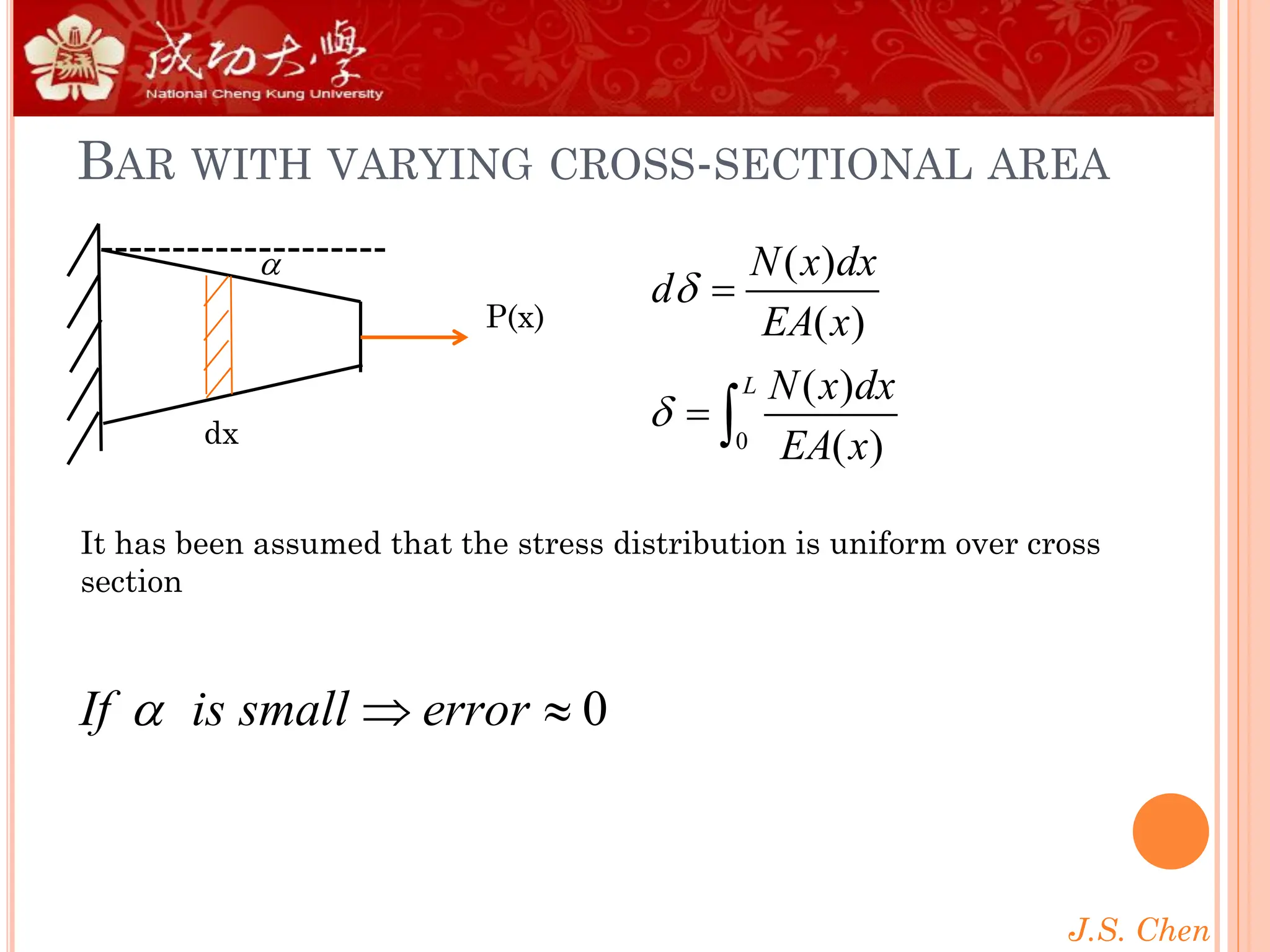
Explains handling stress distribution in bars with varying cross-sectional areas in axial loading.
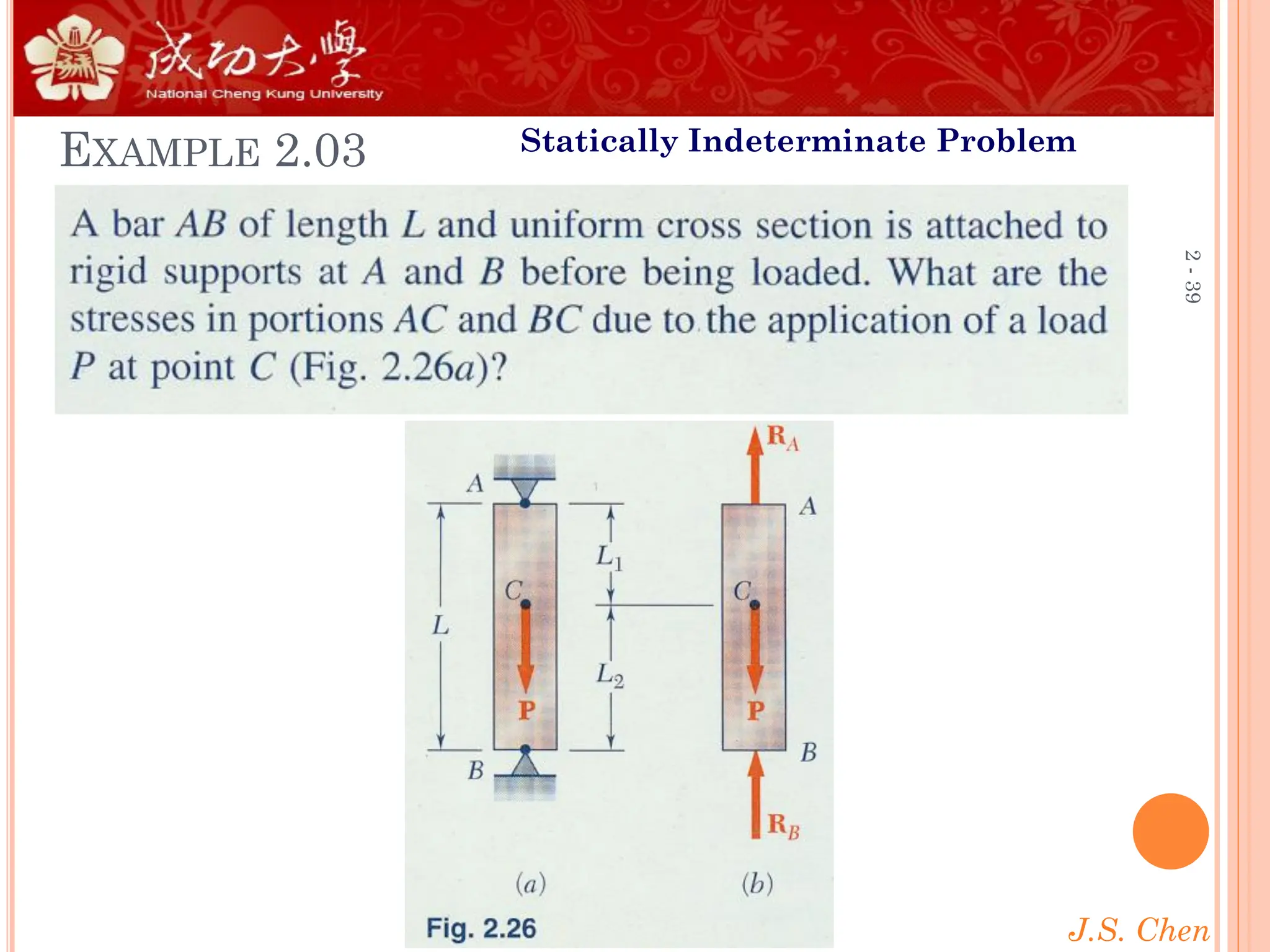
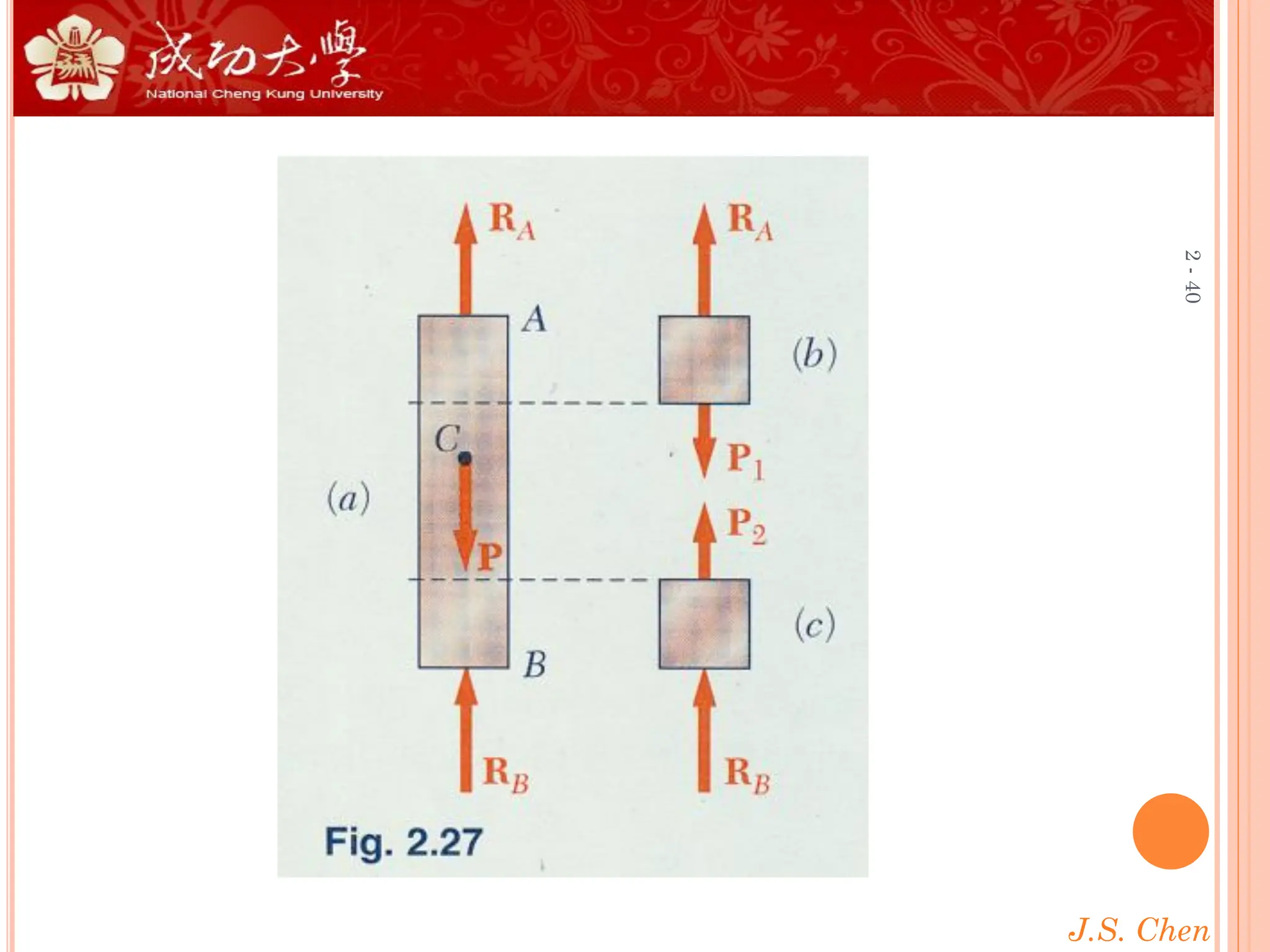
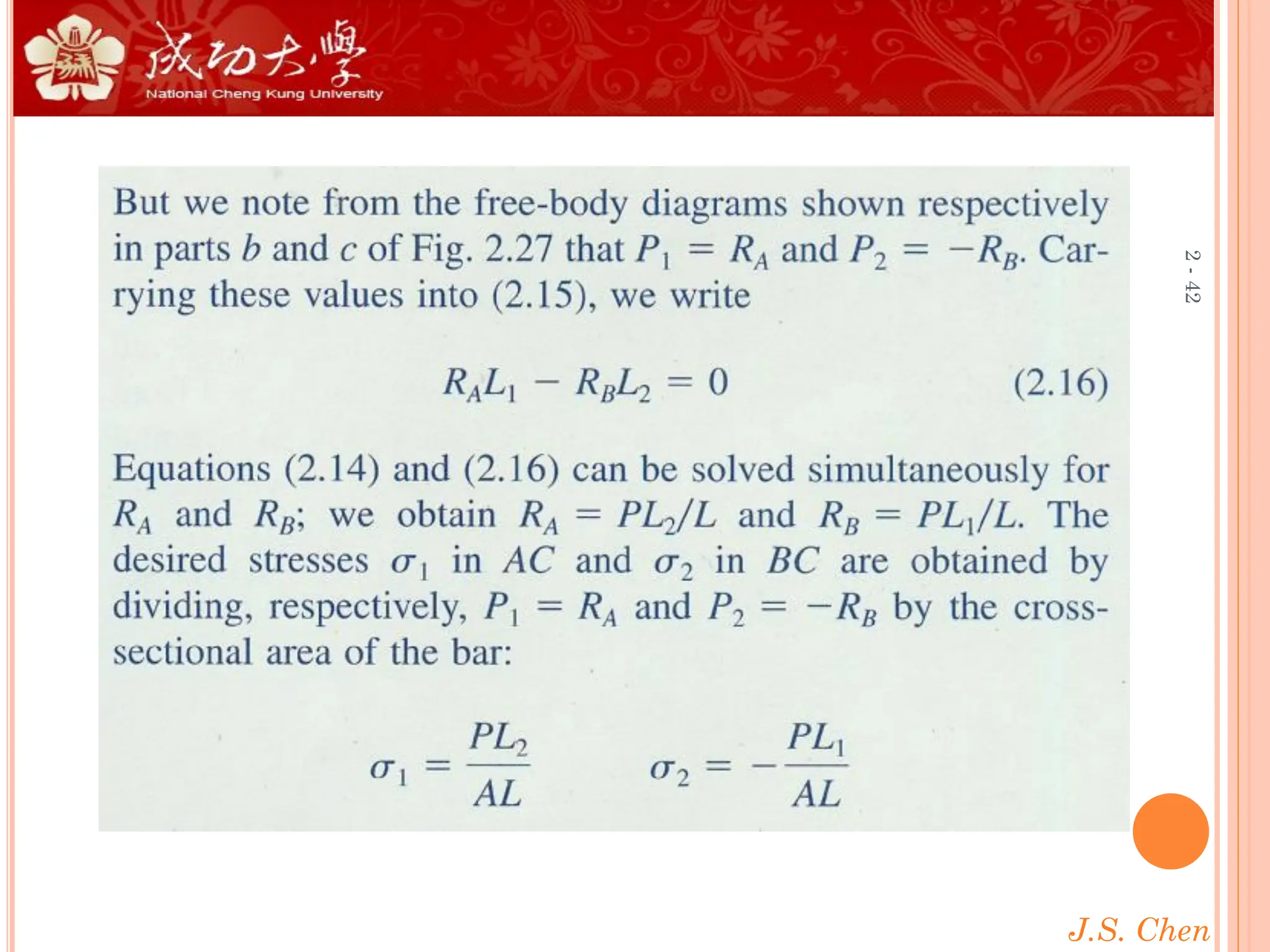
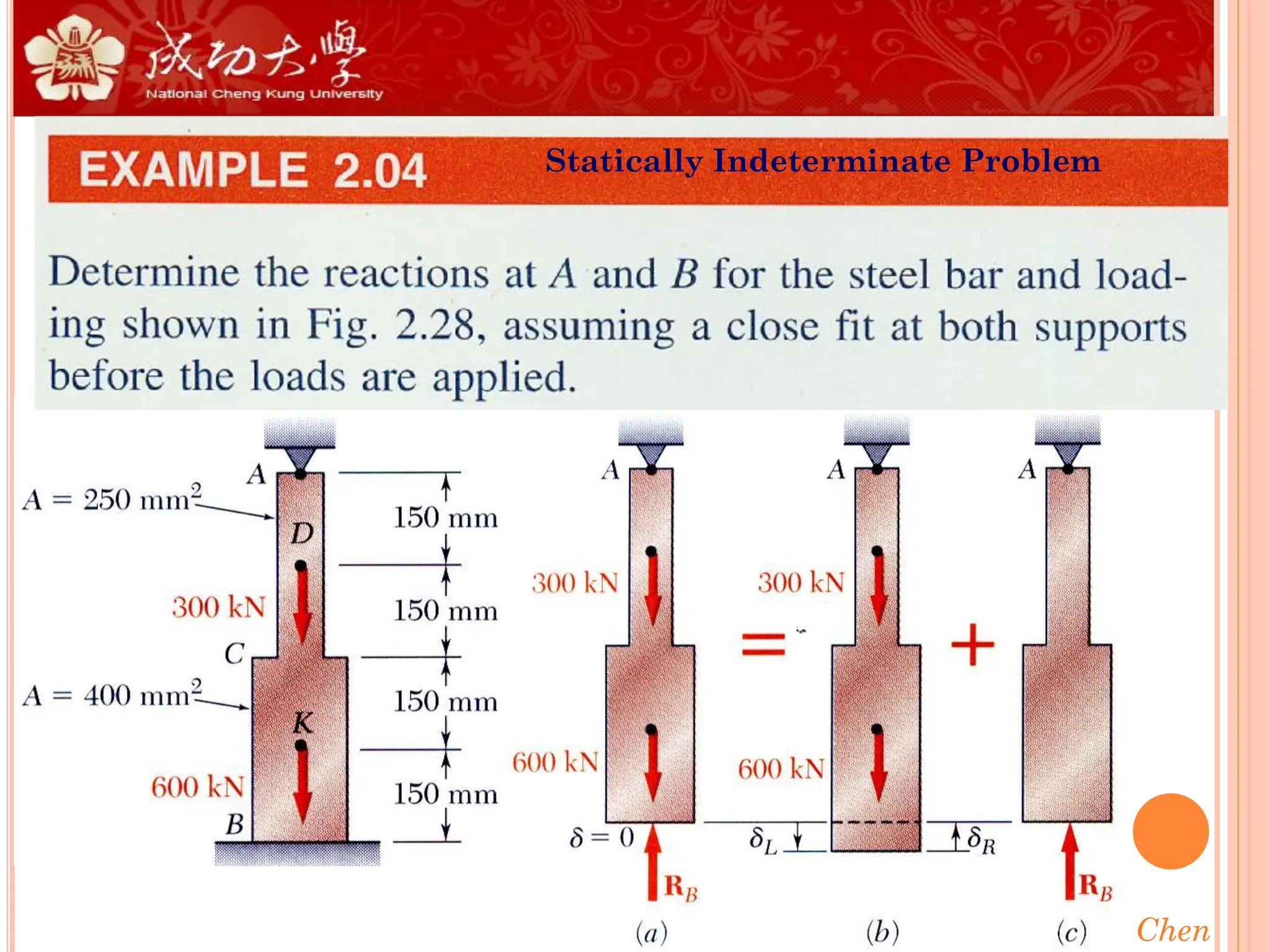
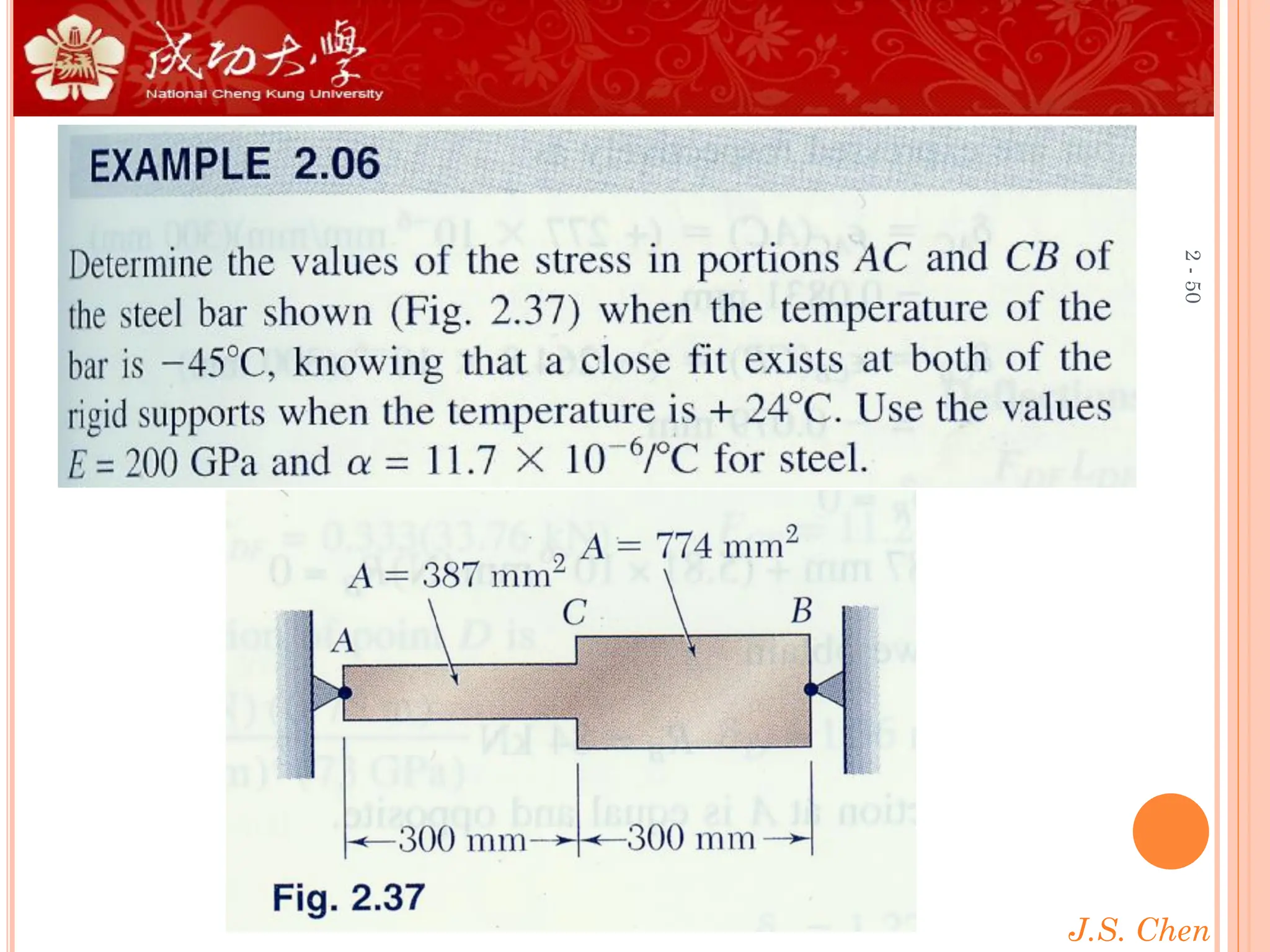
Introduces statically indeterminate structures, explaining how they differ from determinate structures.
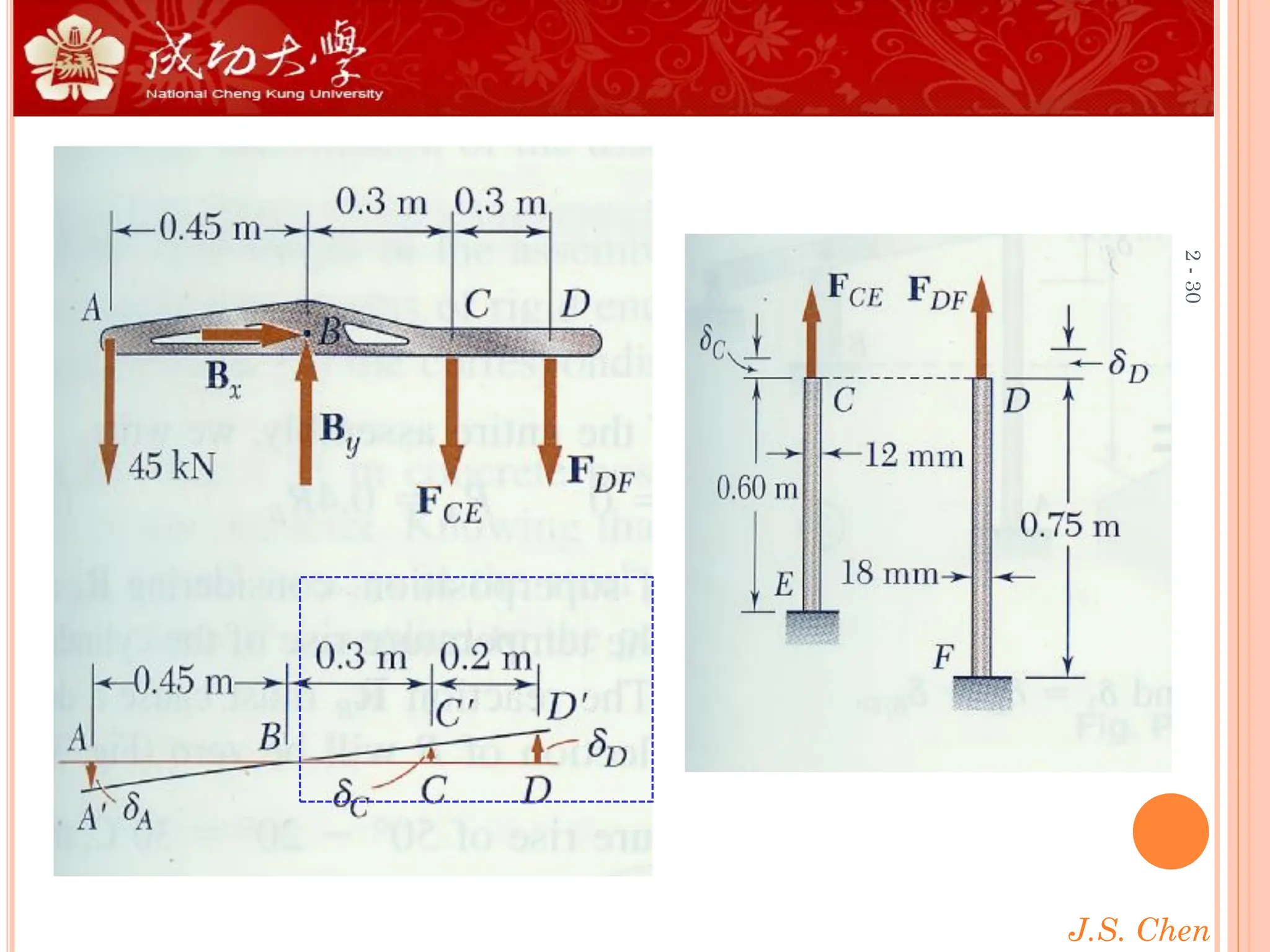
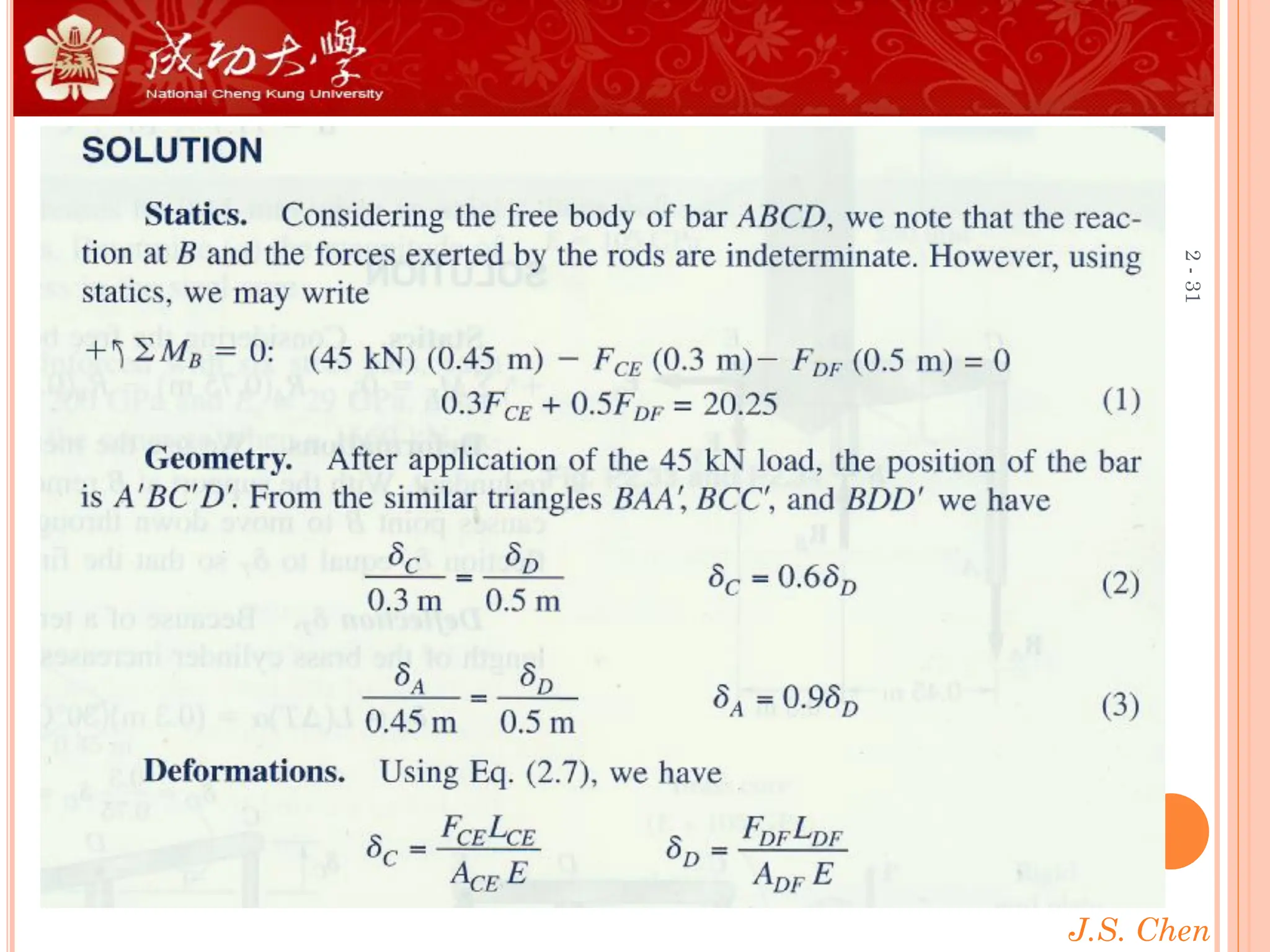
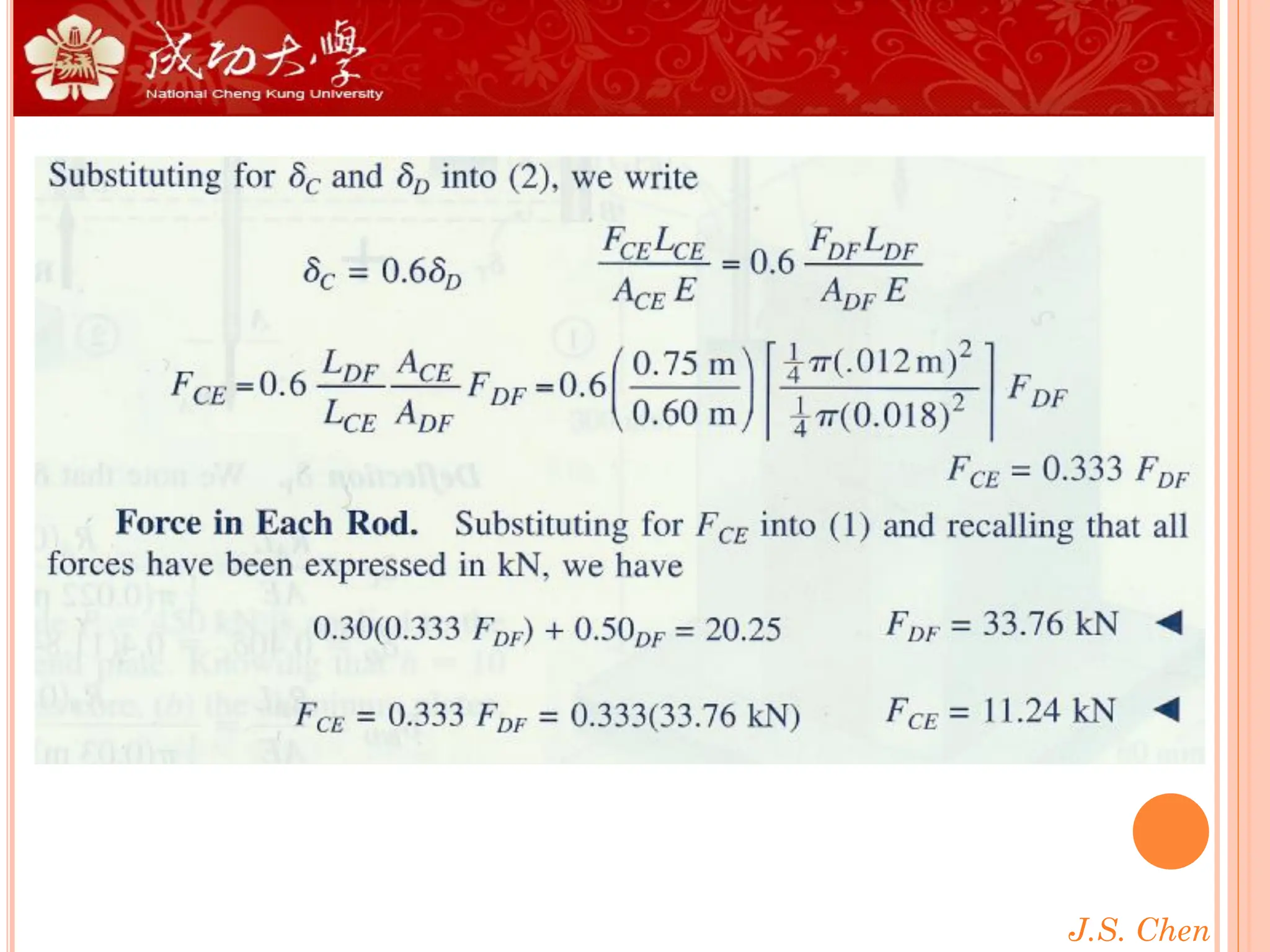
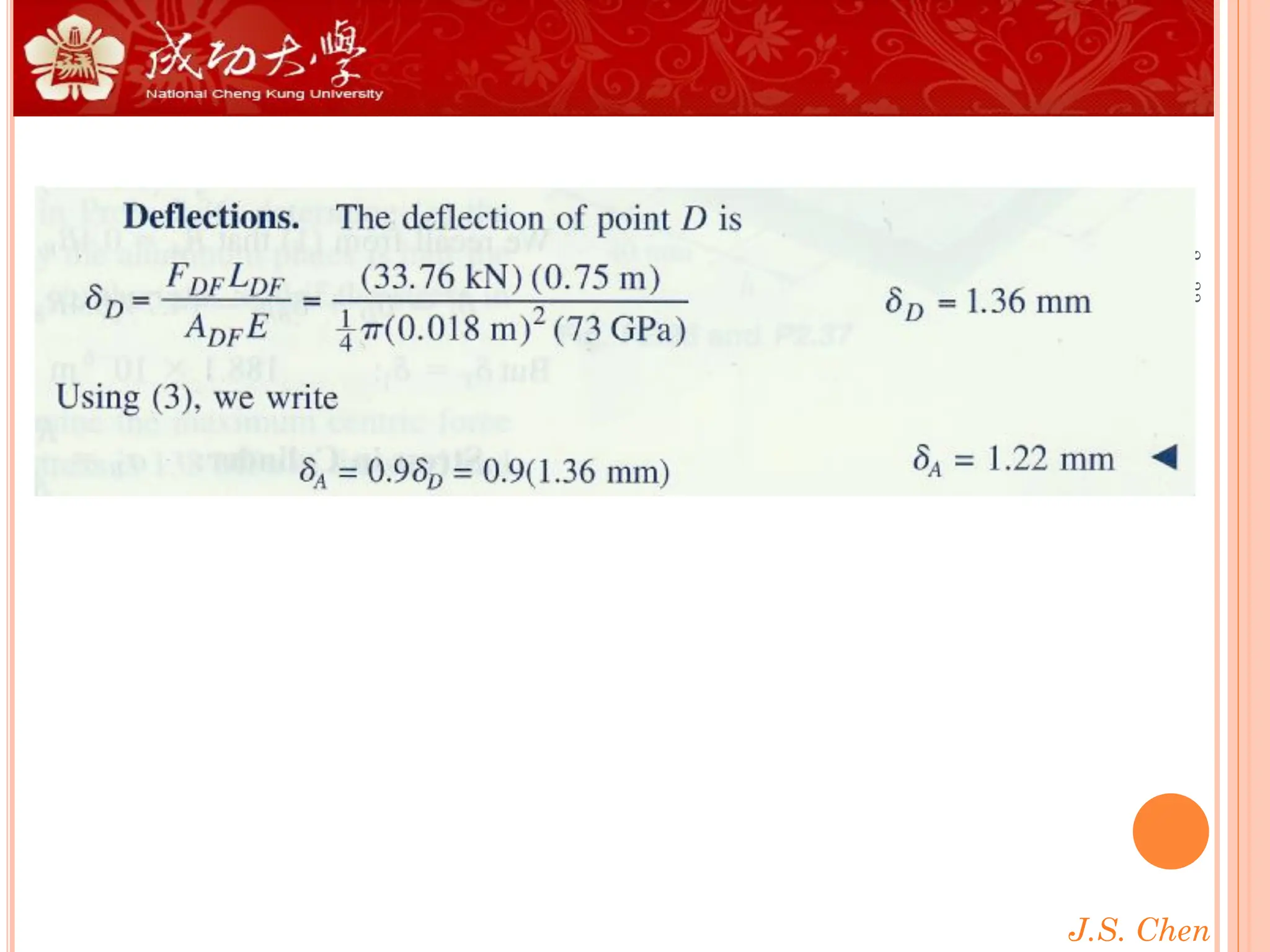
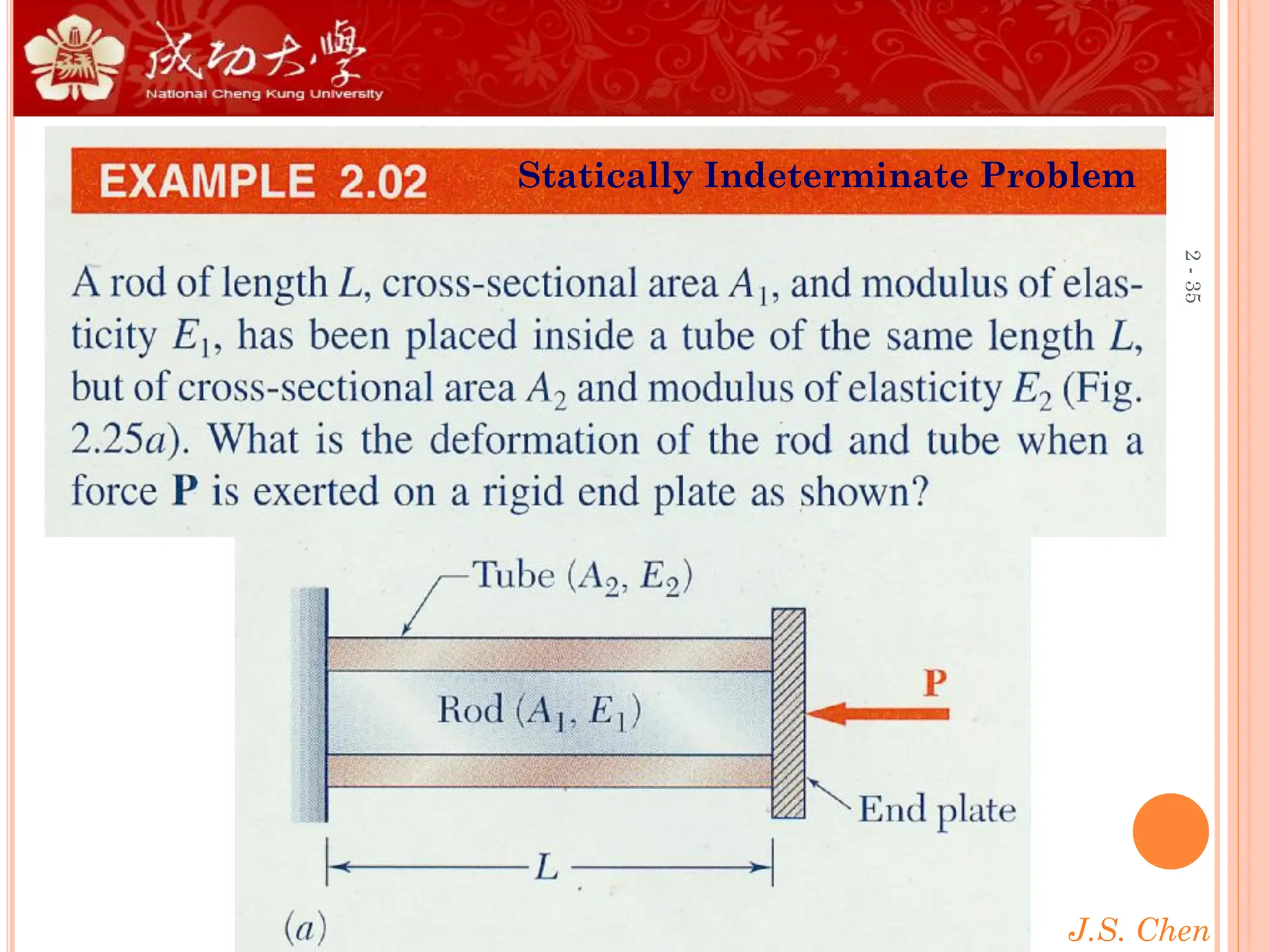
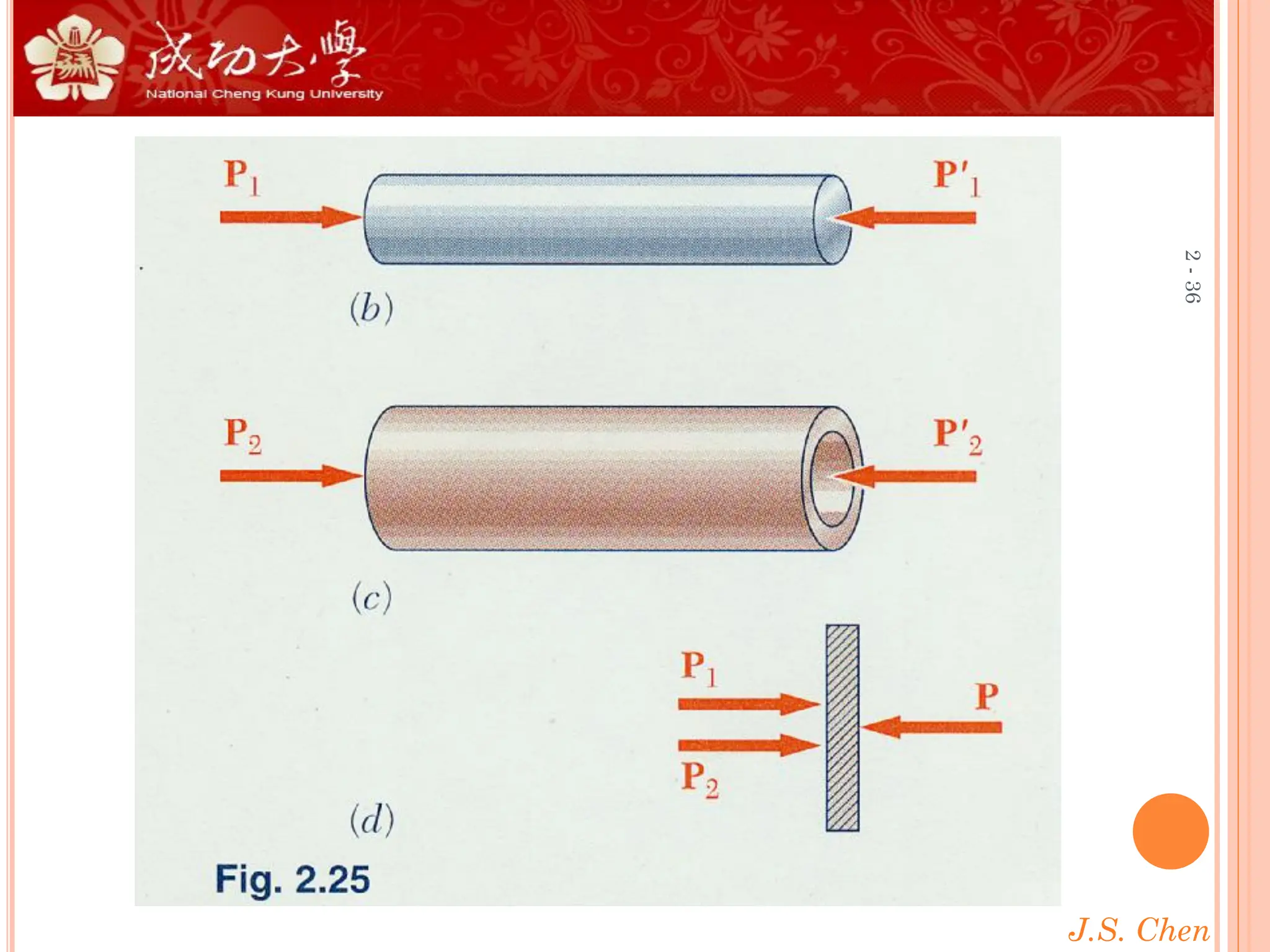
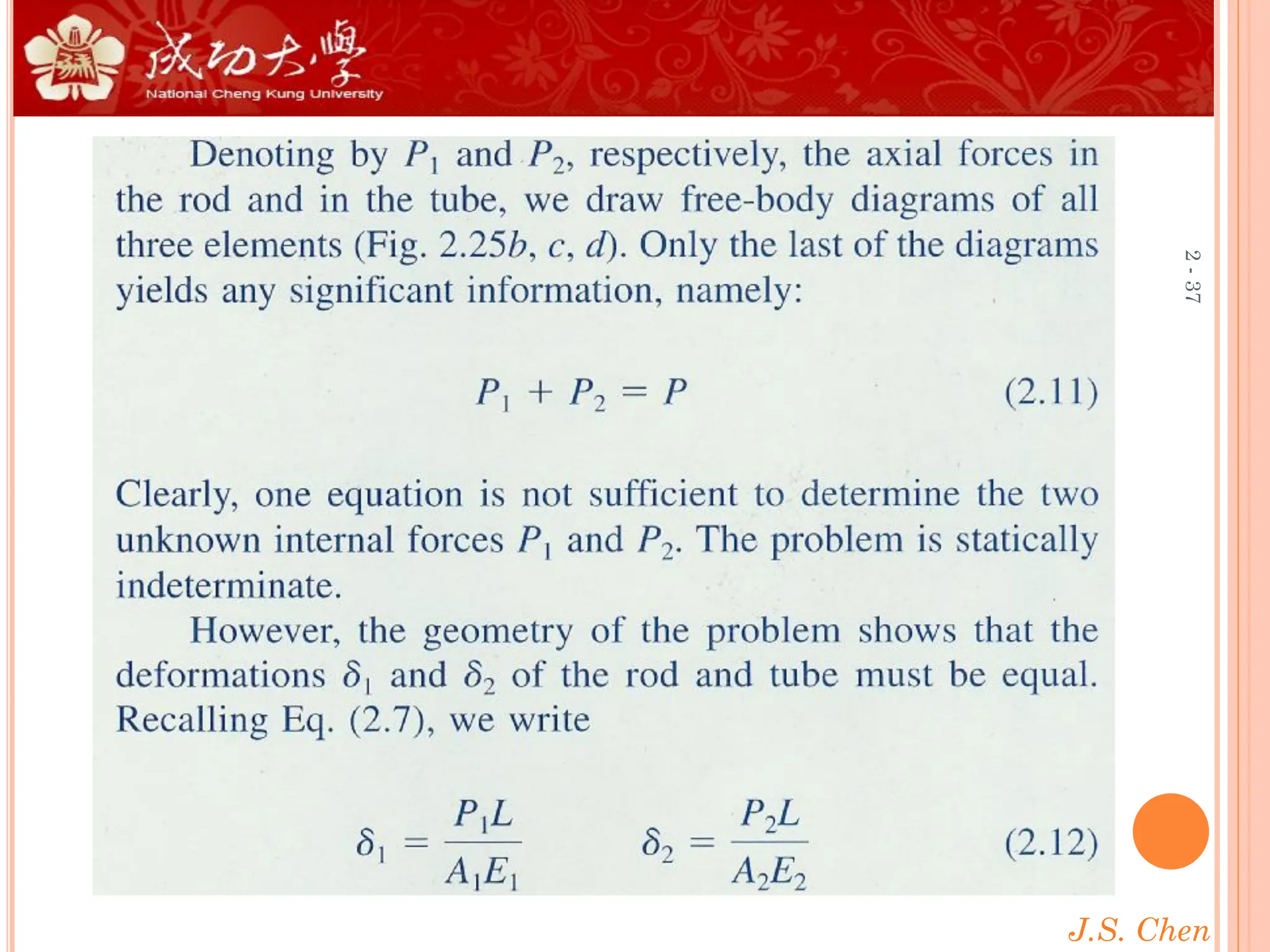
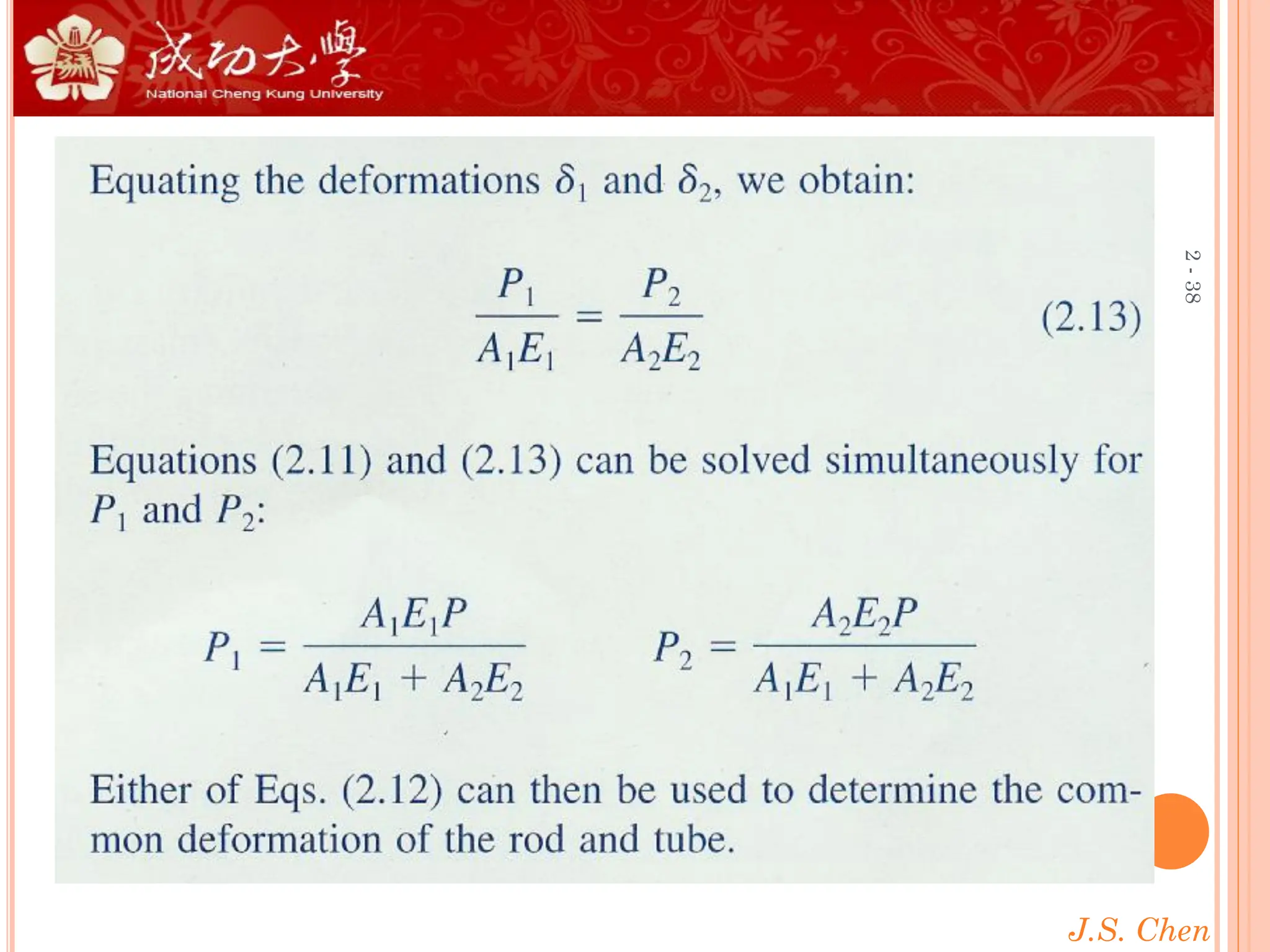
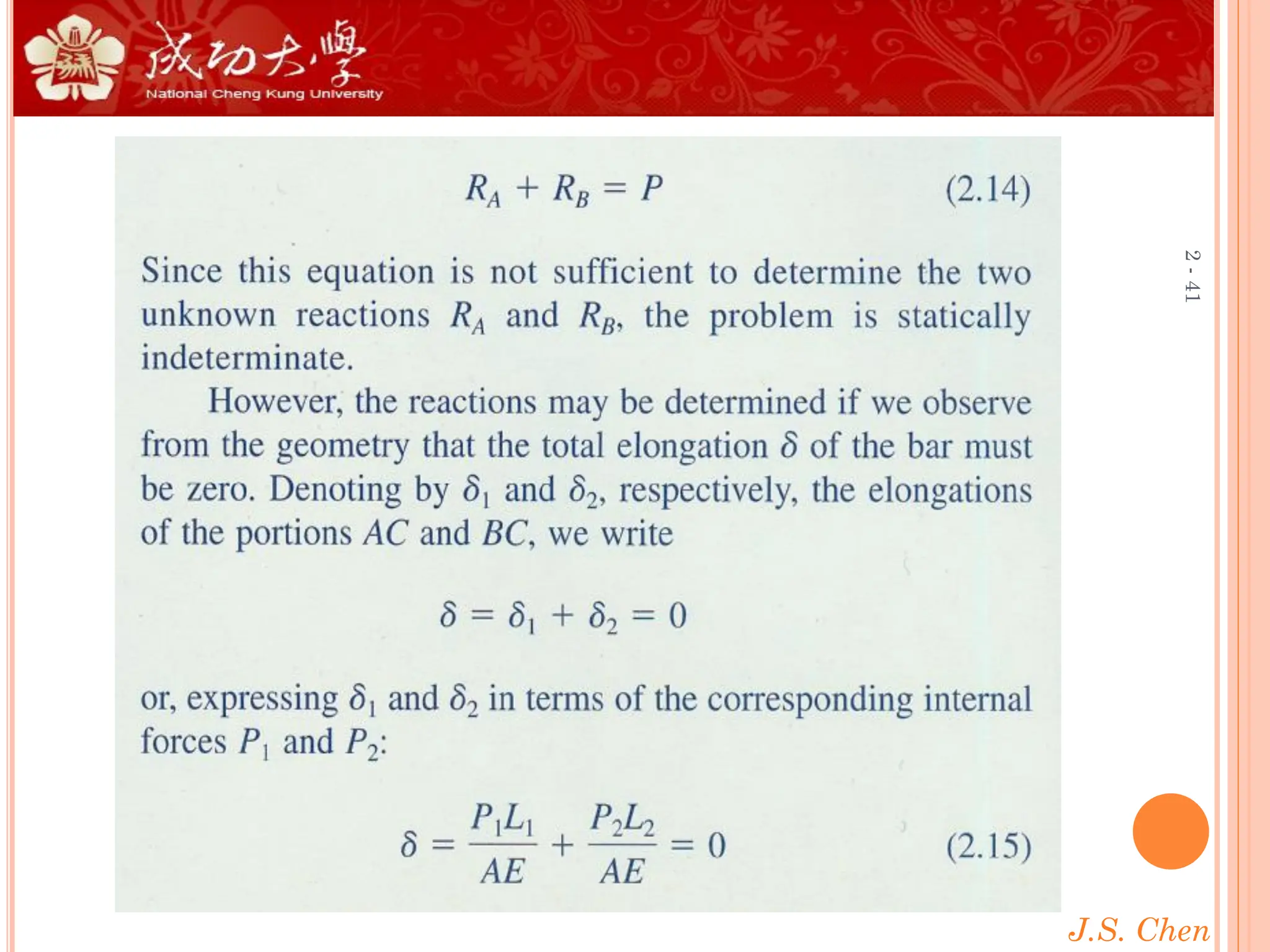
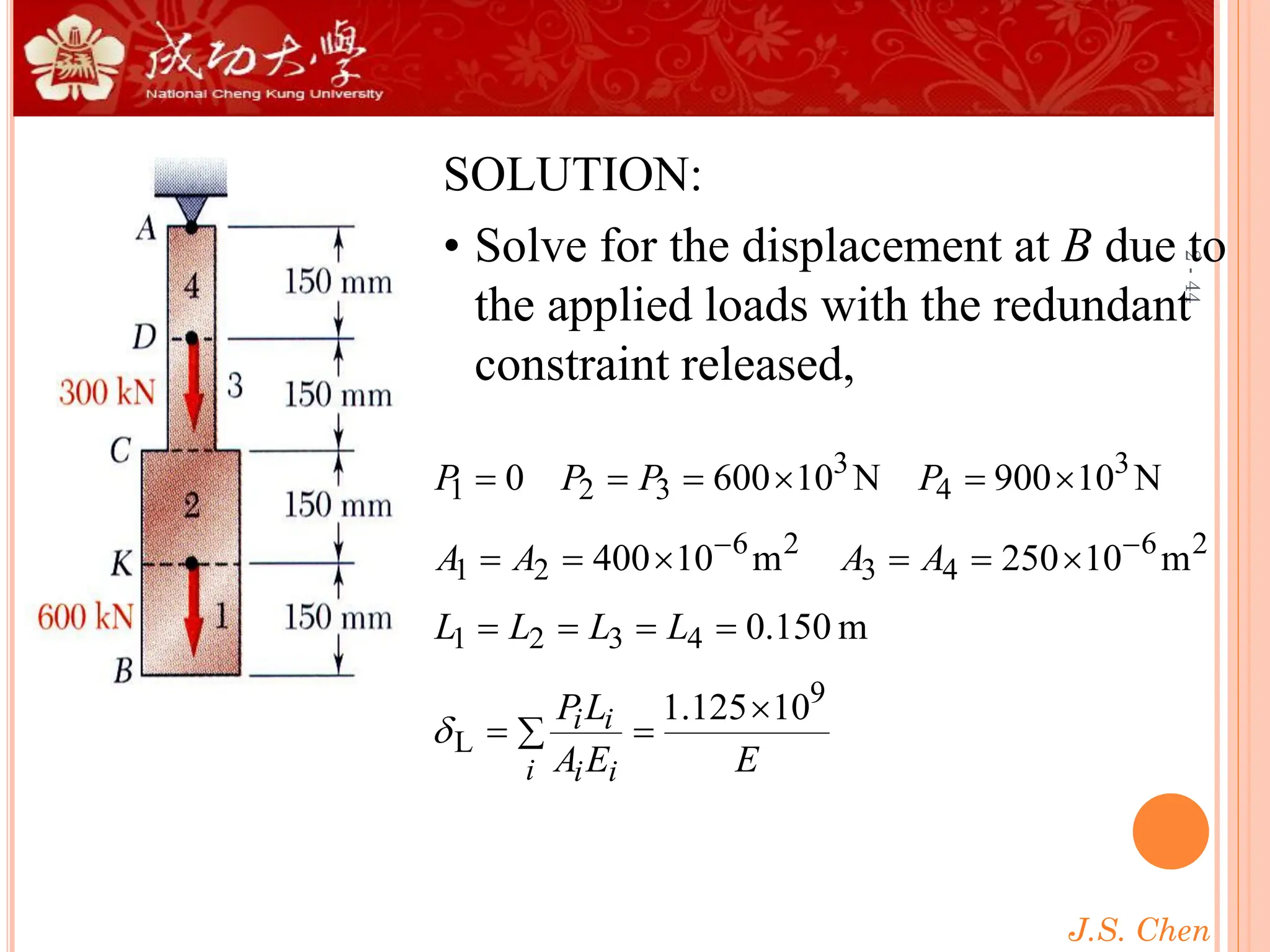
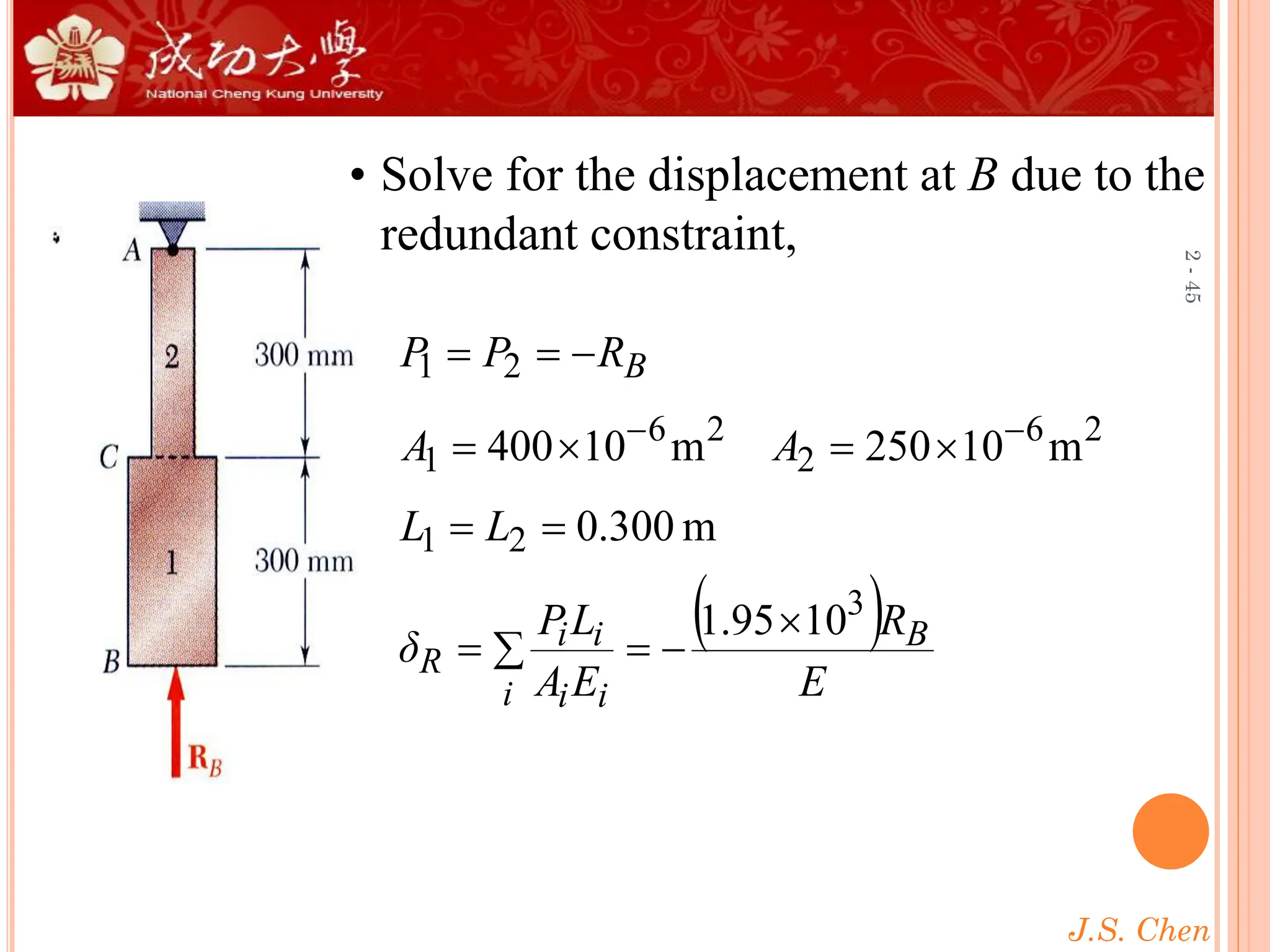
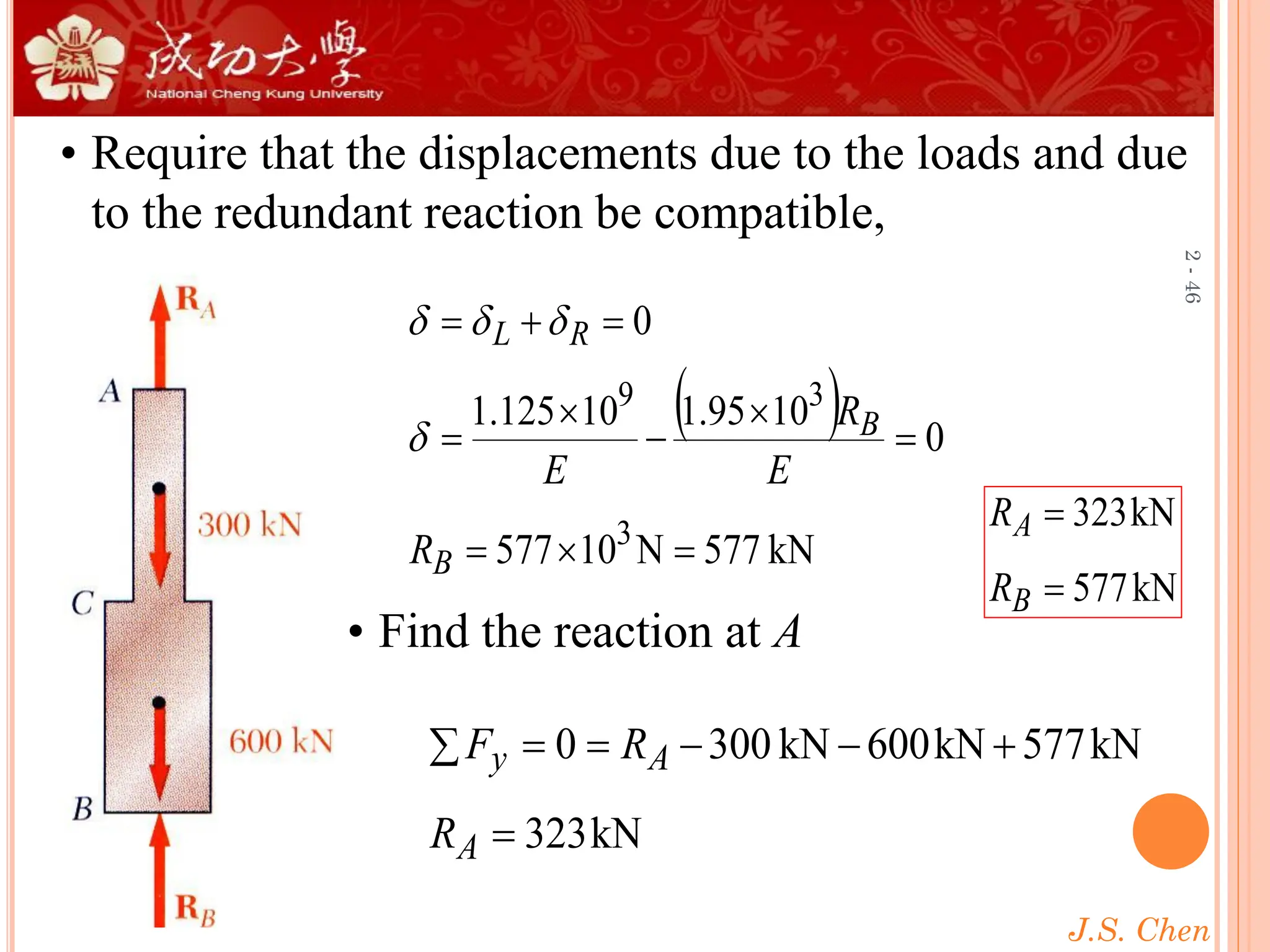
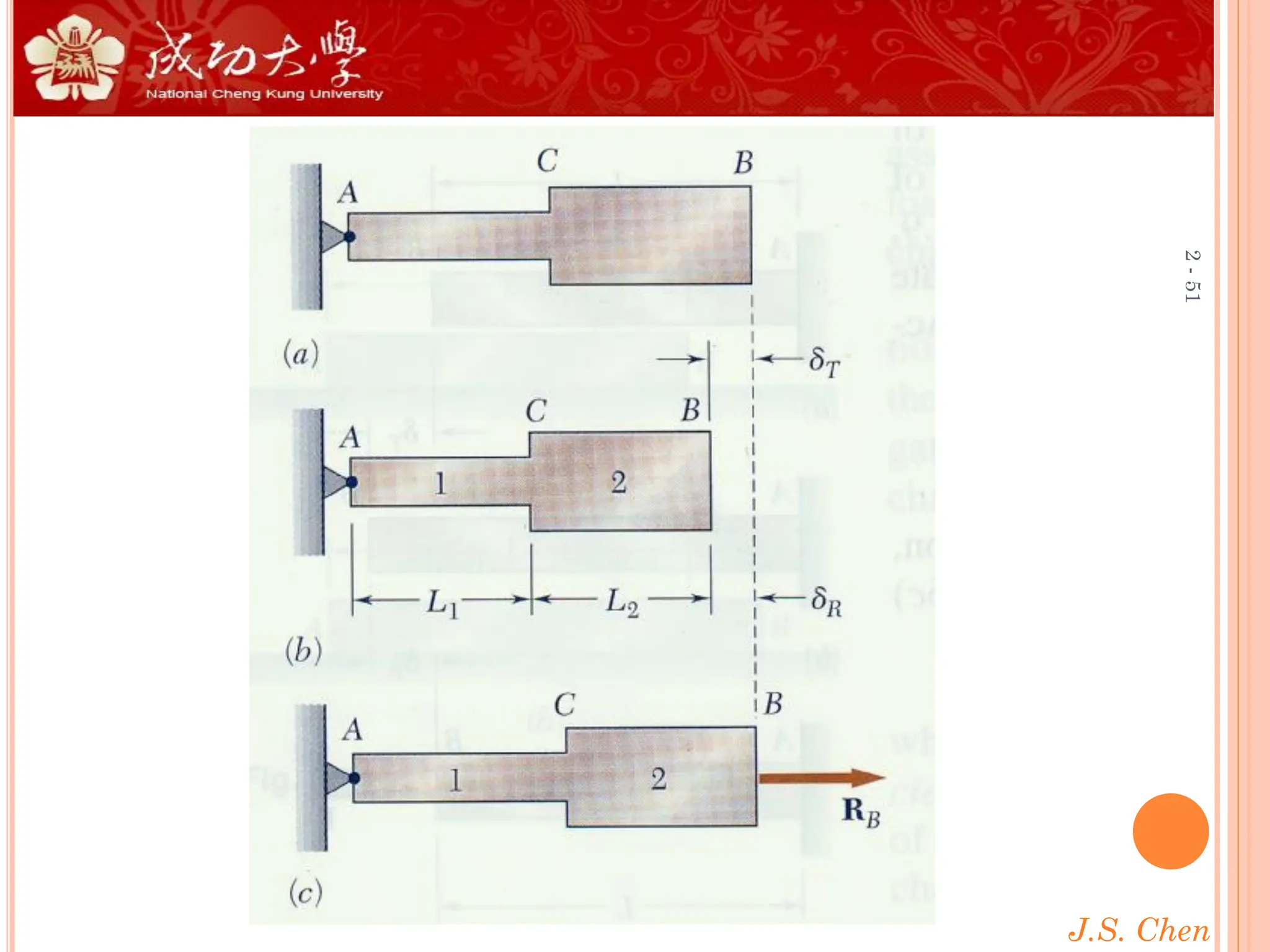
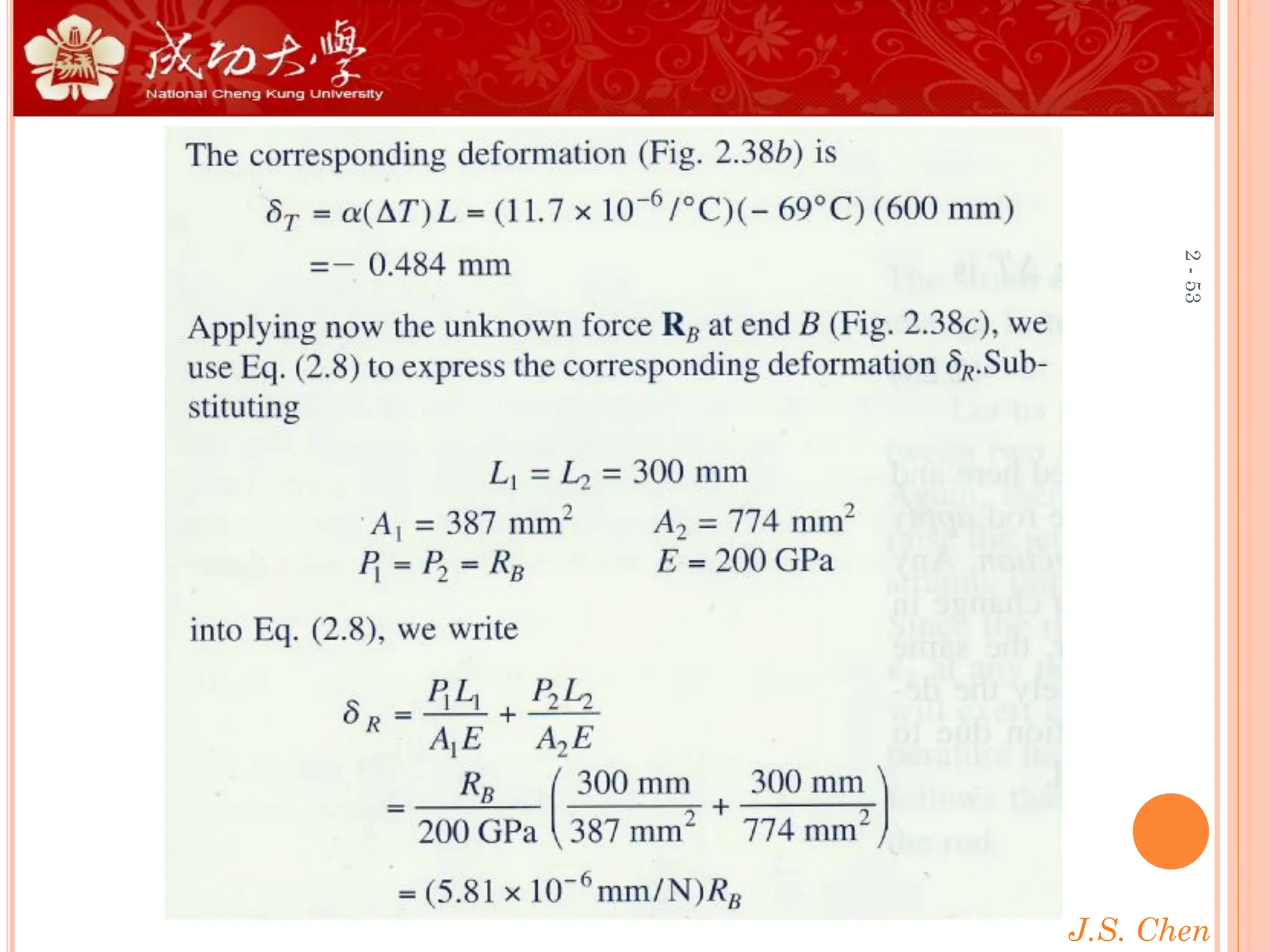
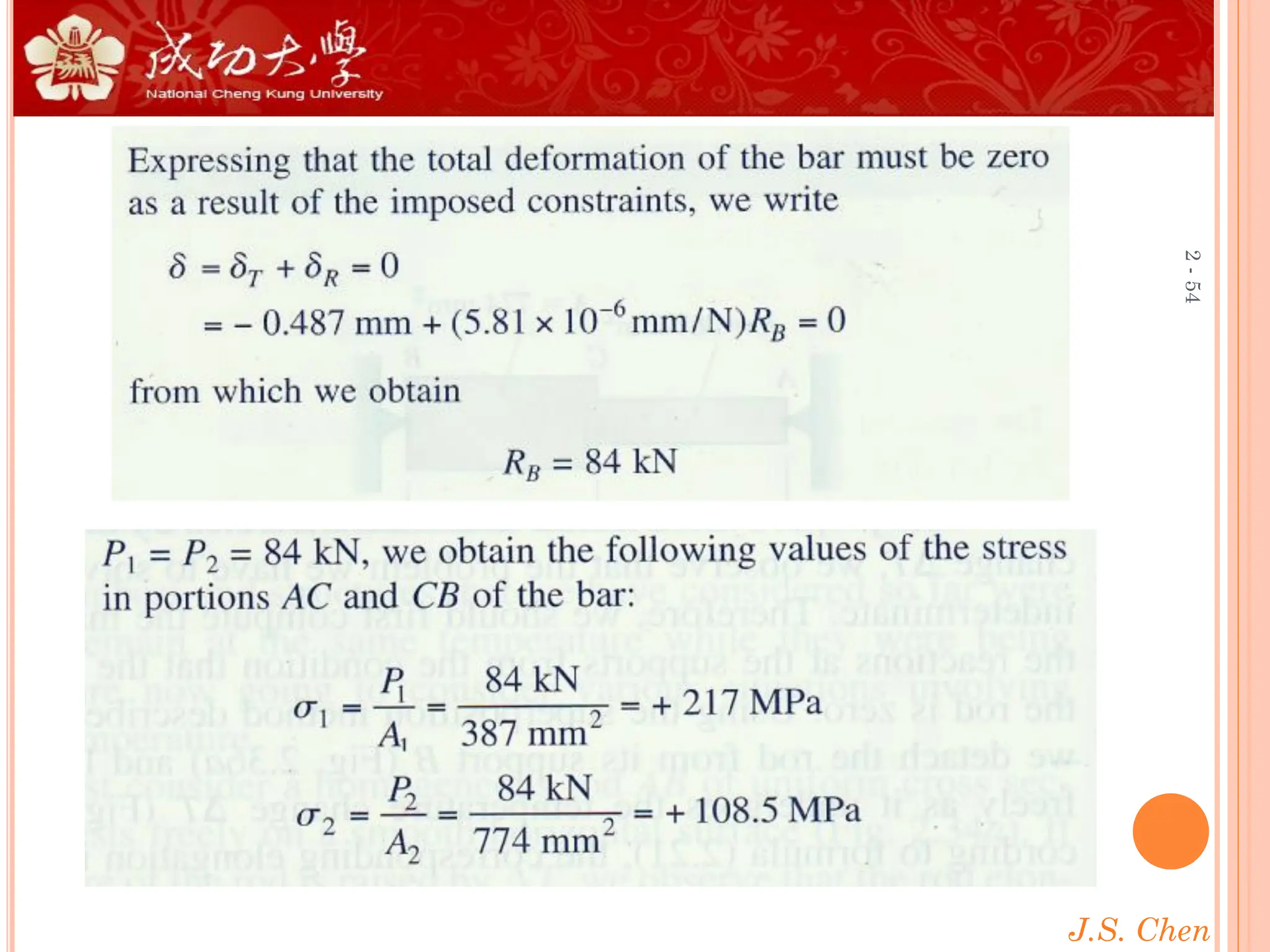
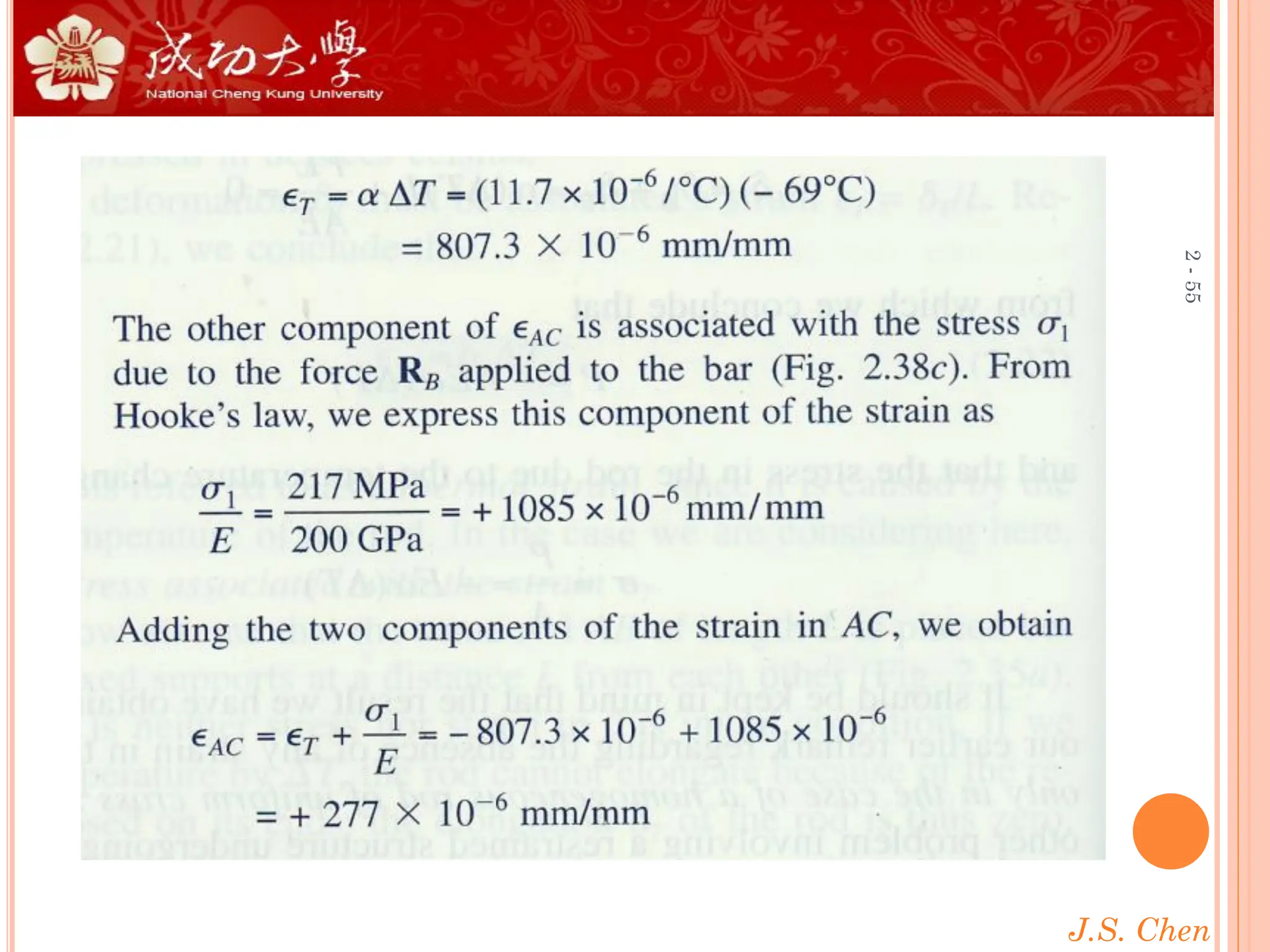
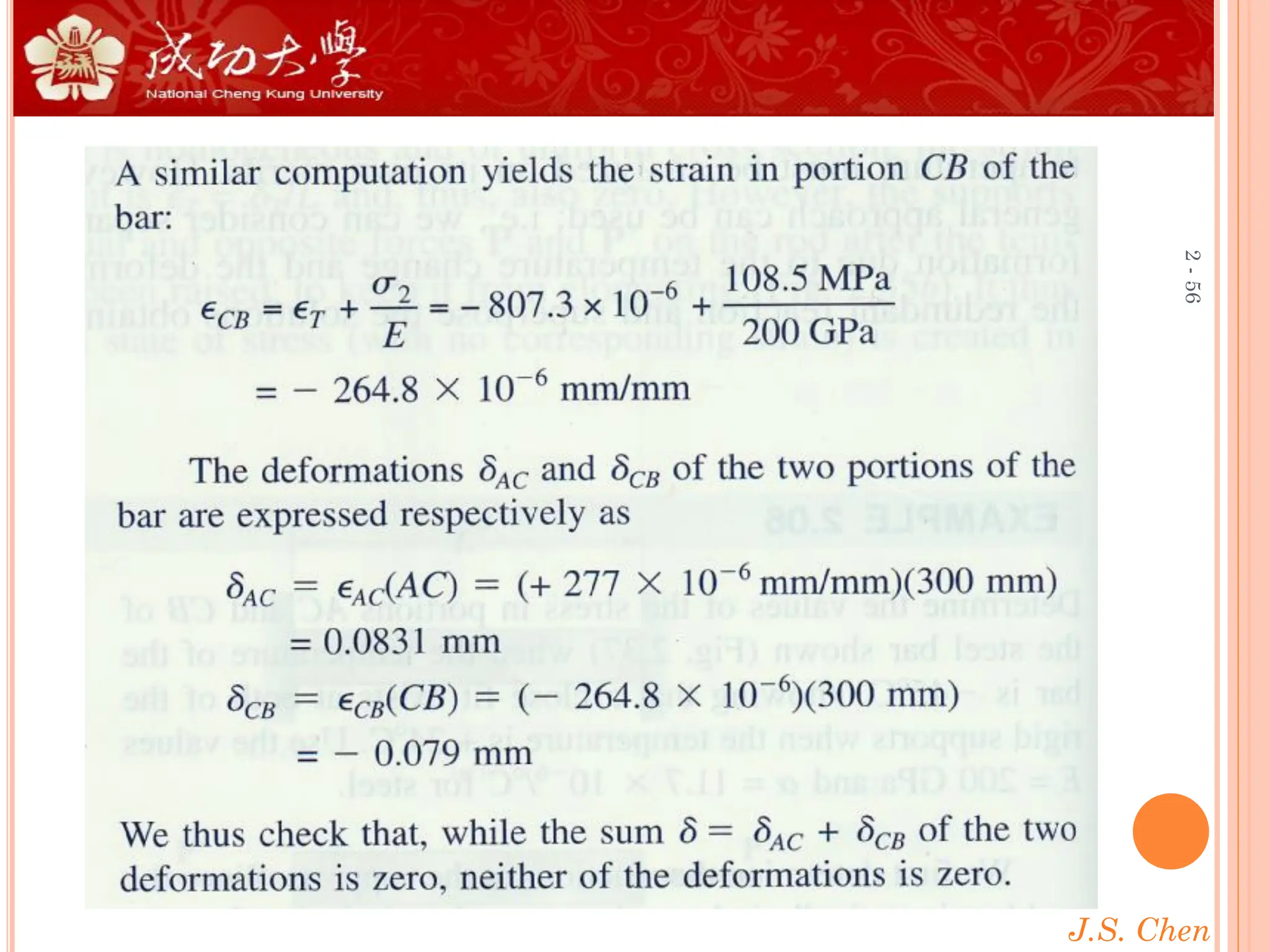
Provides solutions for a statically indeterminate problem, detailing how to calculate displacements and forces.
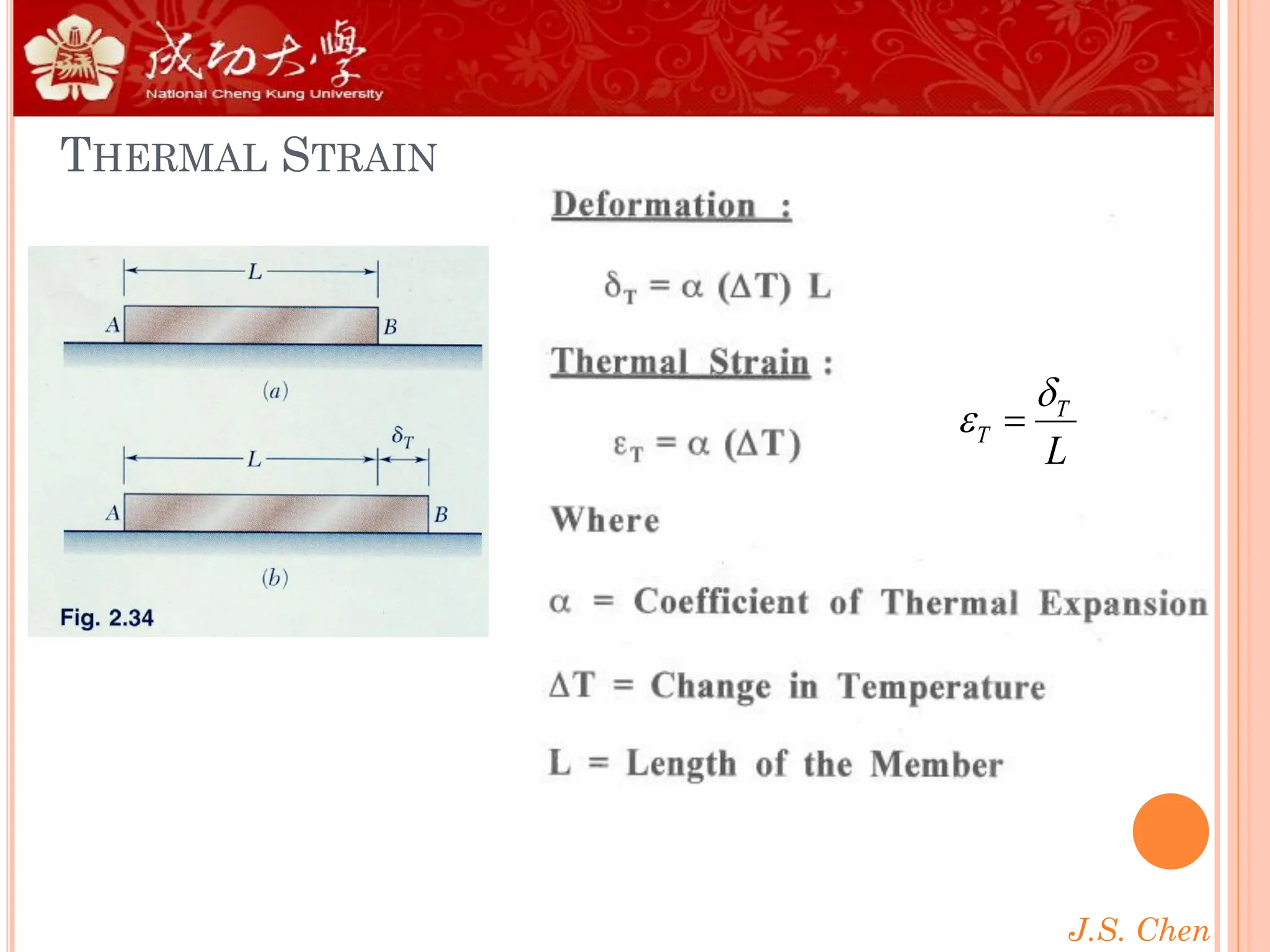
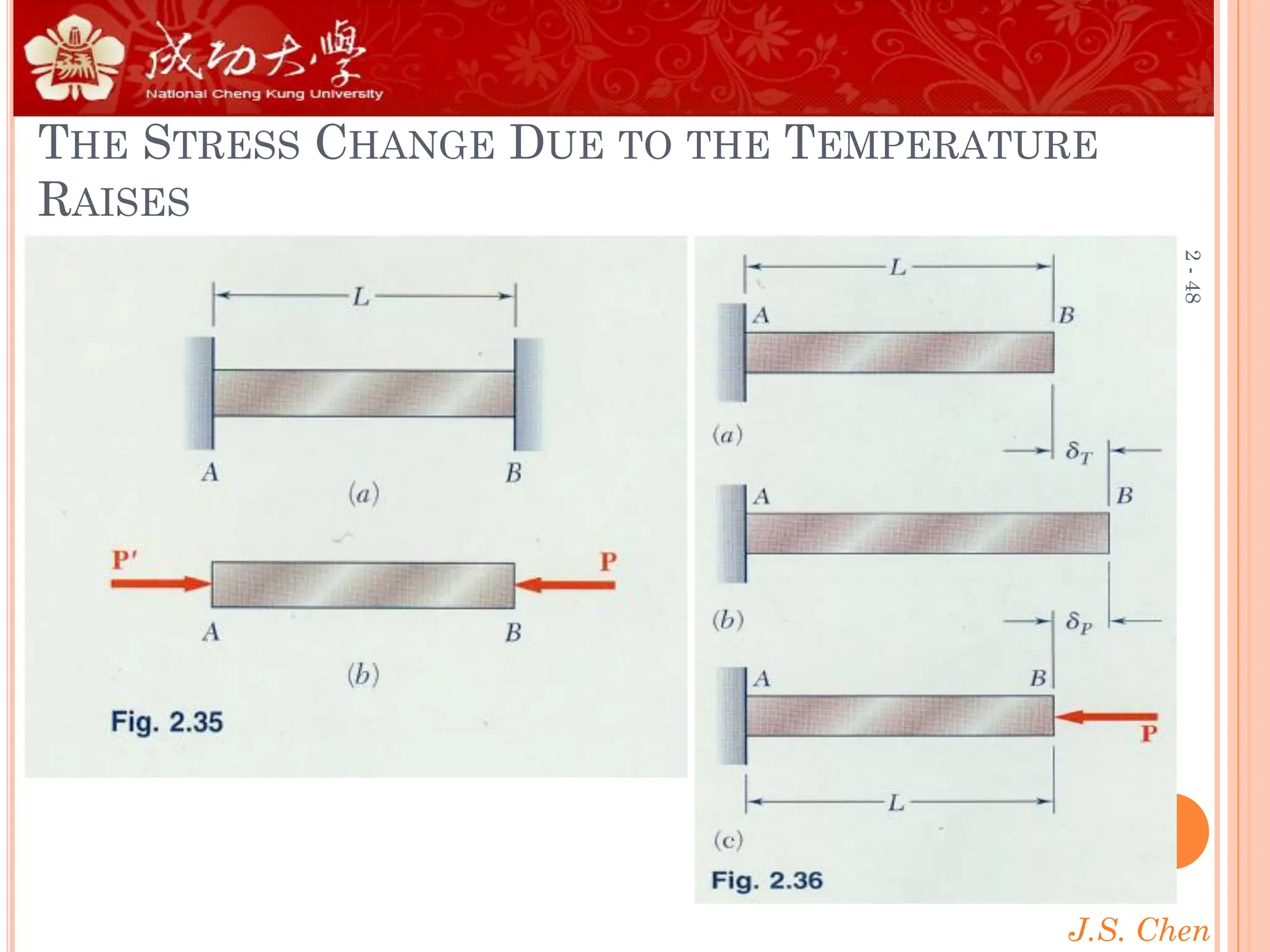
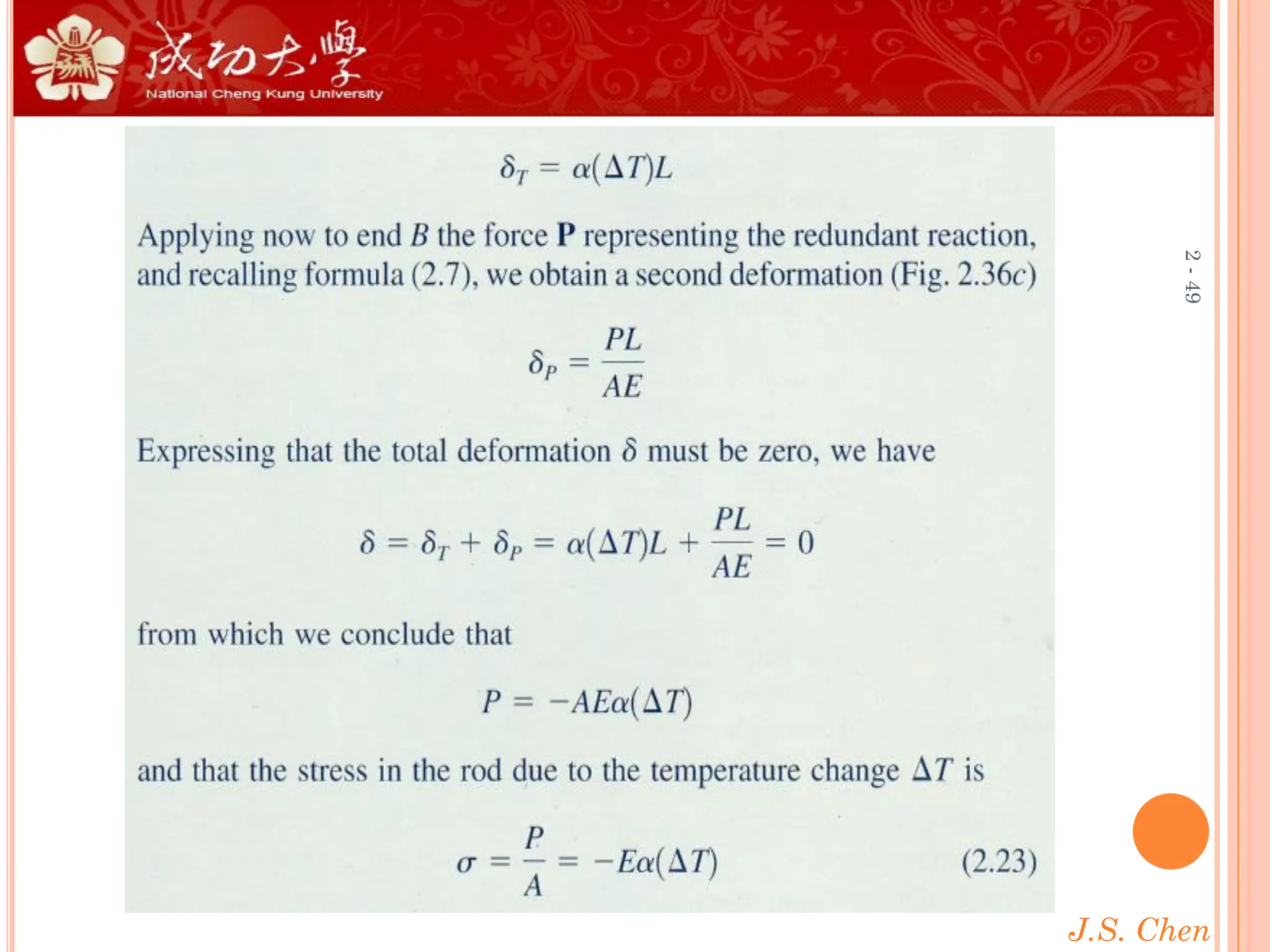
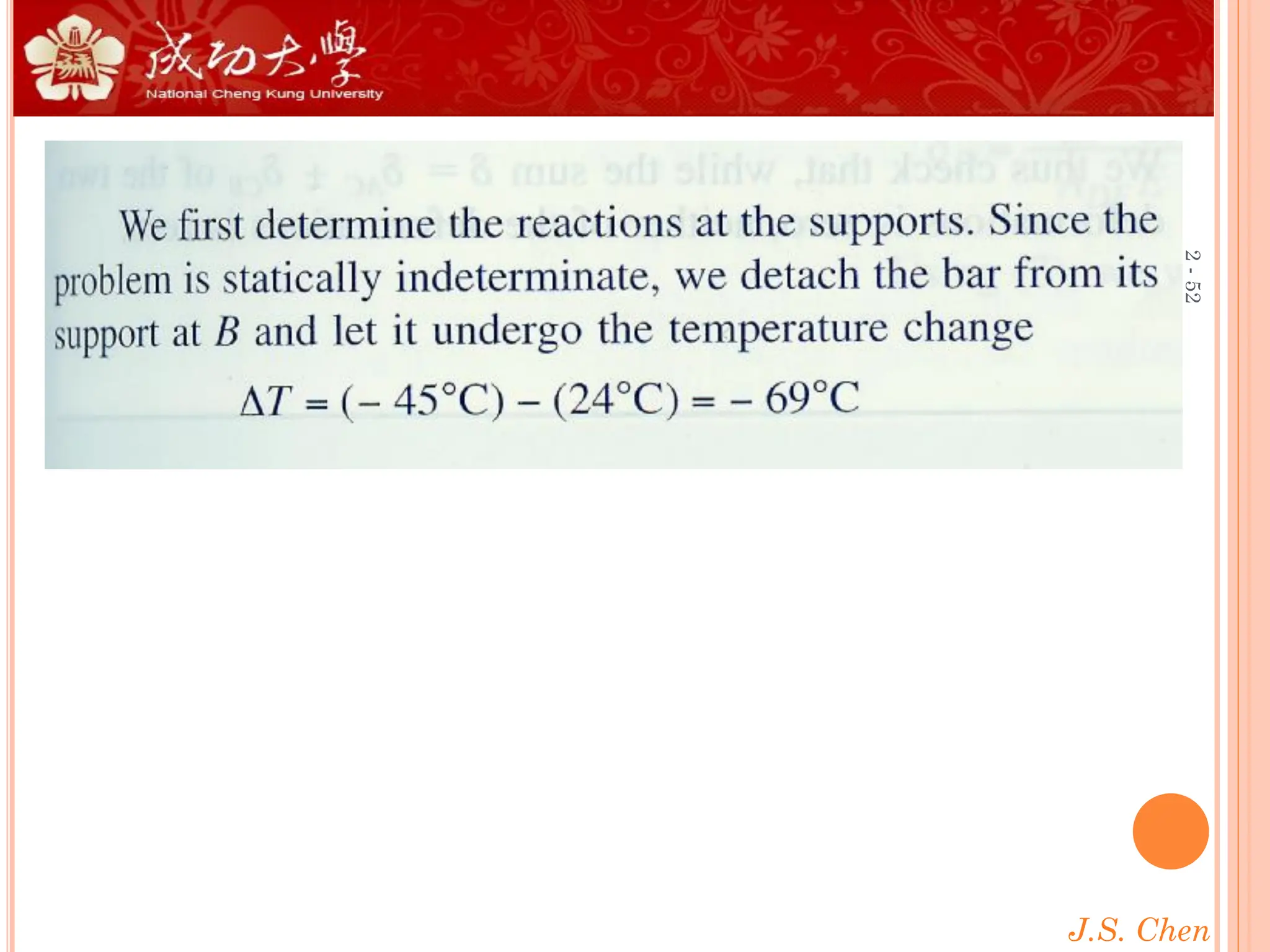
Introduces thermal strain due to temperature change and its effect on material stress.
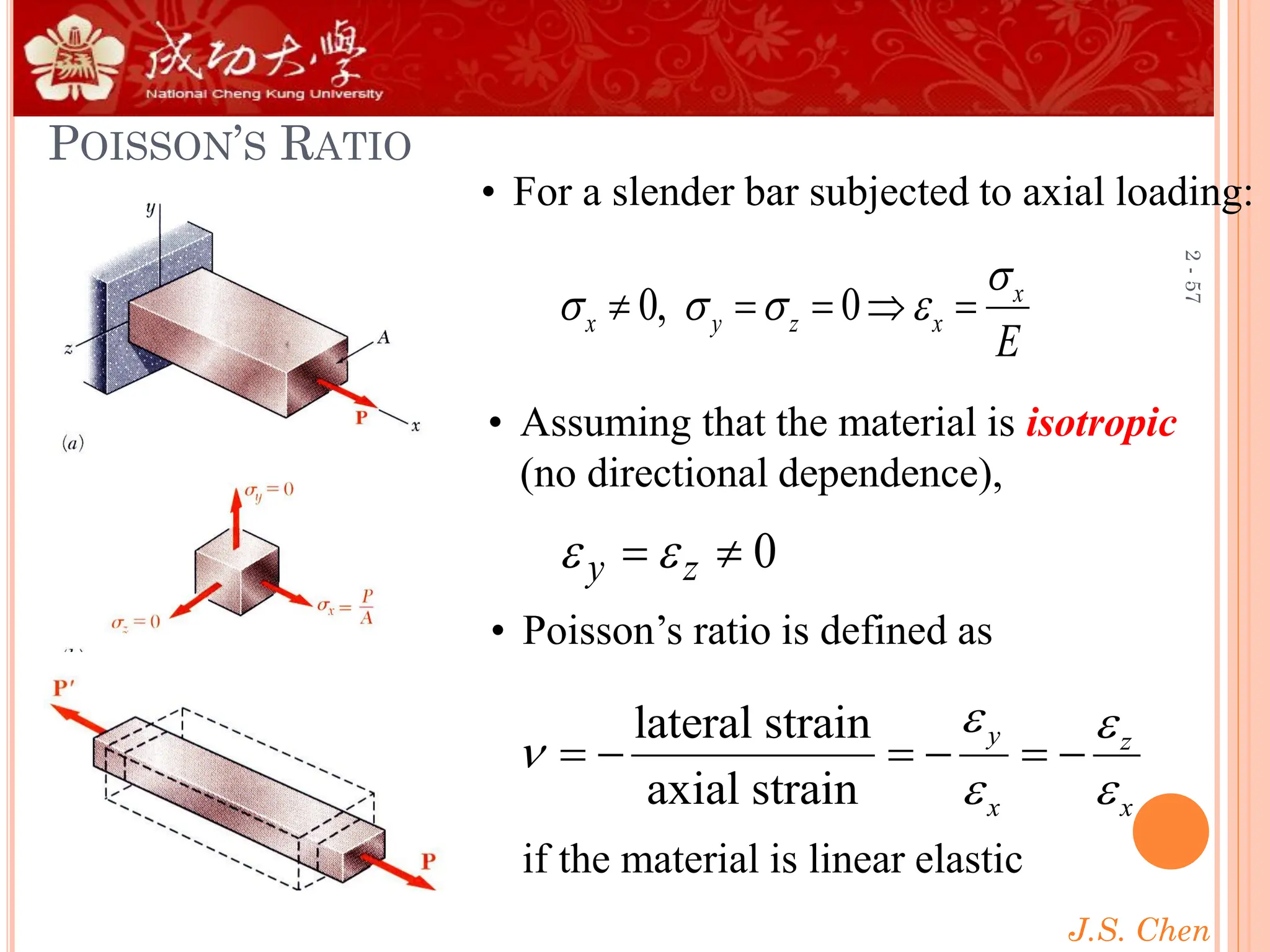
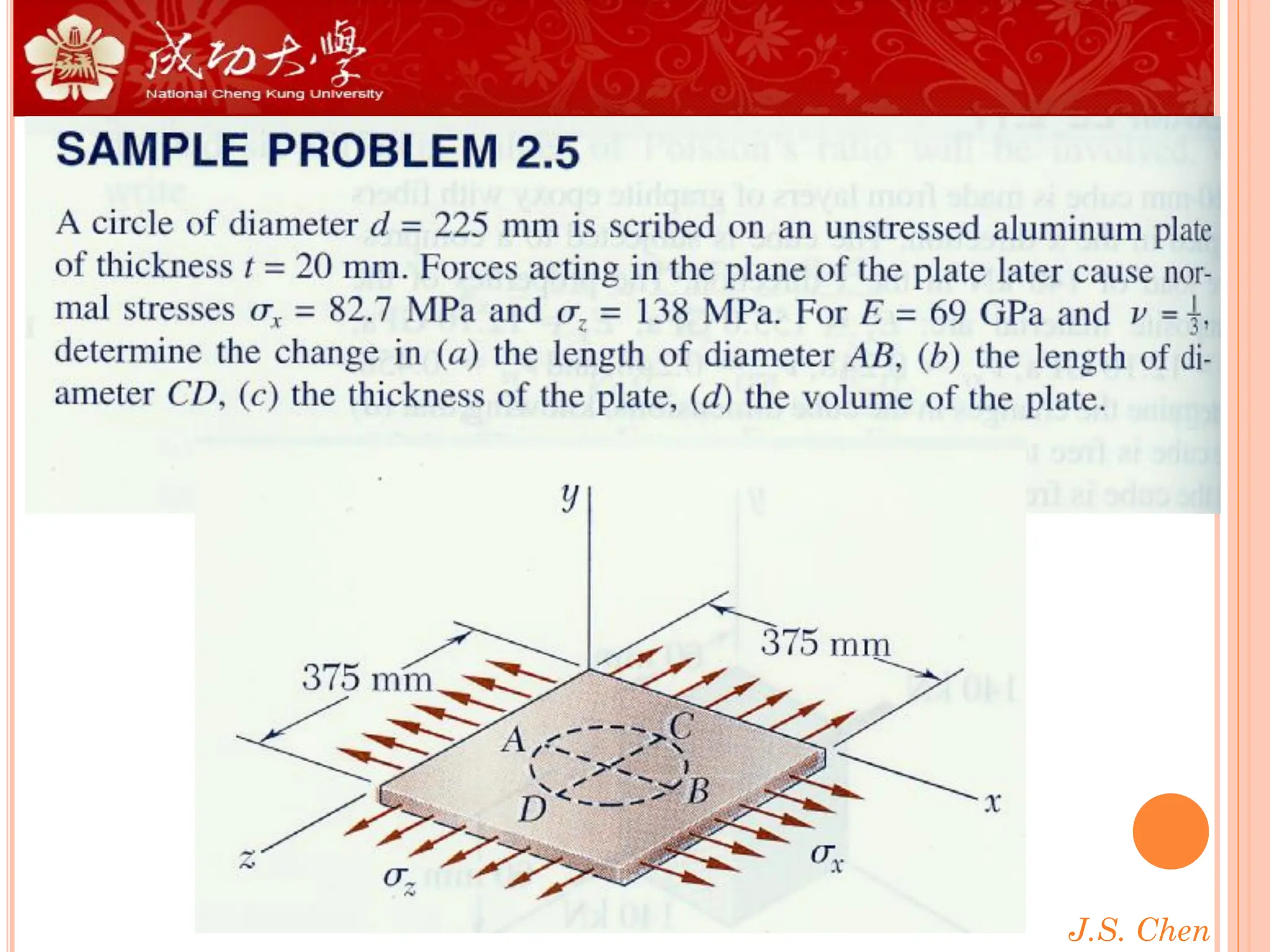
Defines Poisson's ratio and its significance in understanding the material behavior under axial loading.
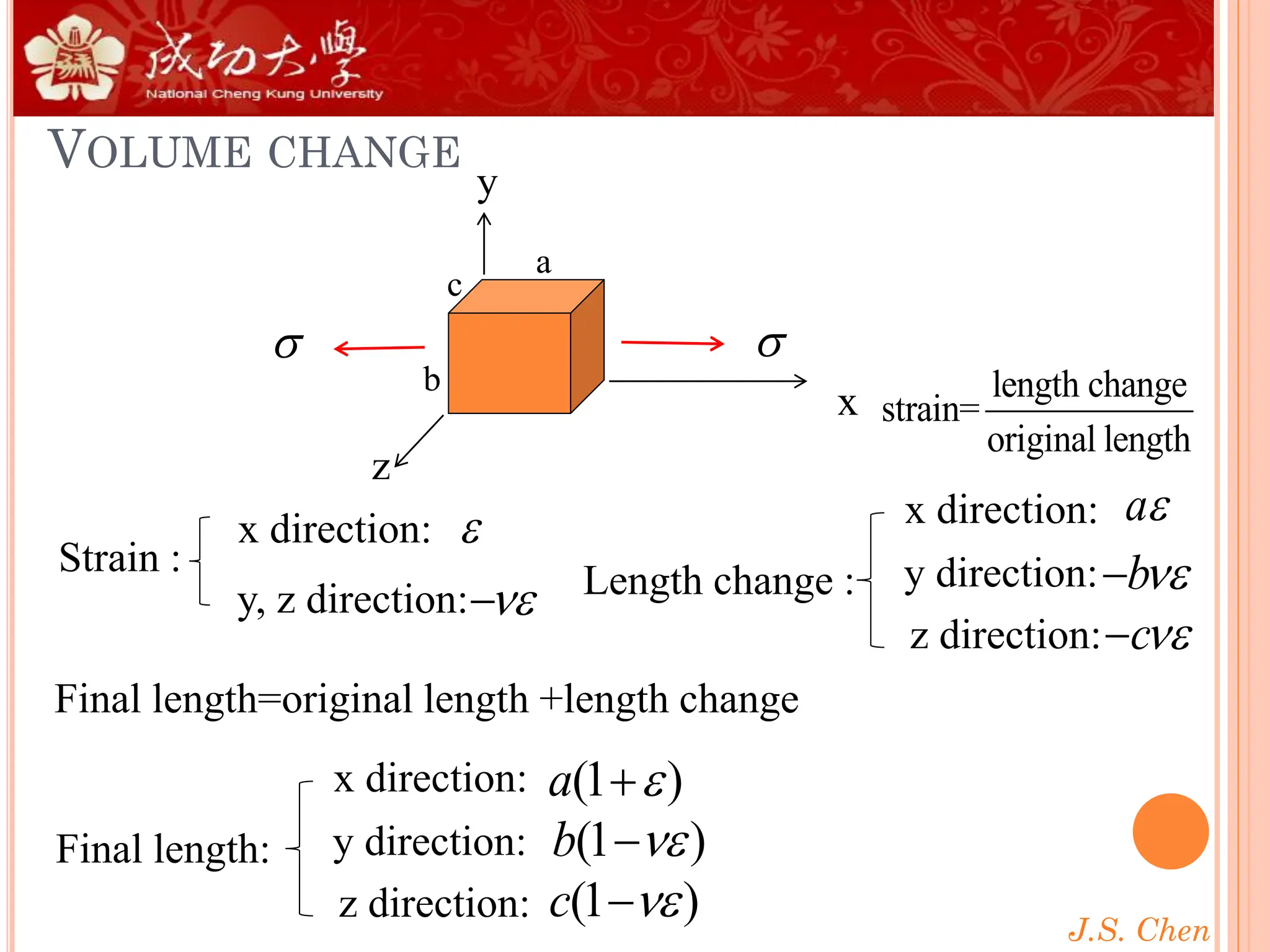
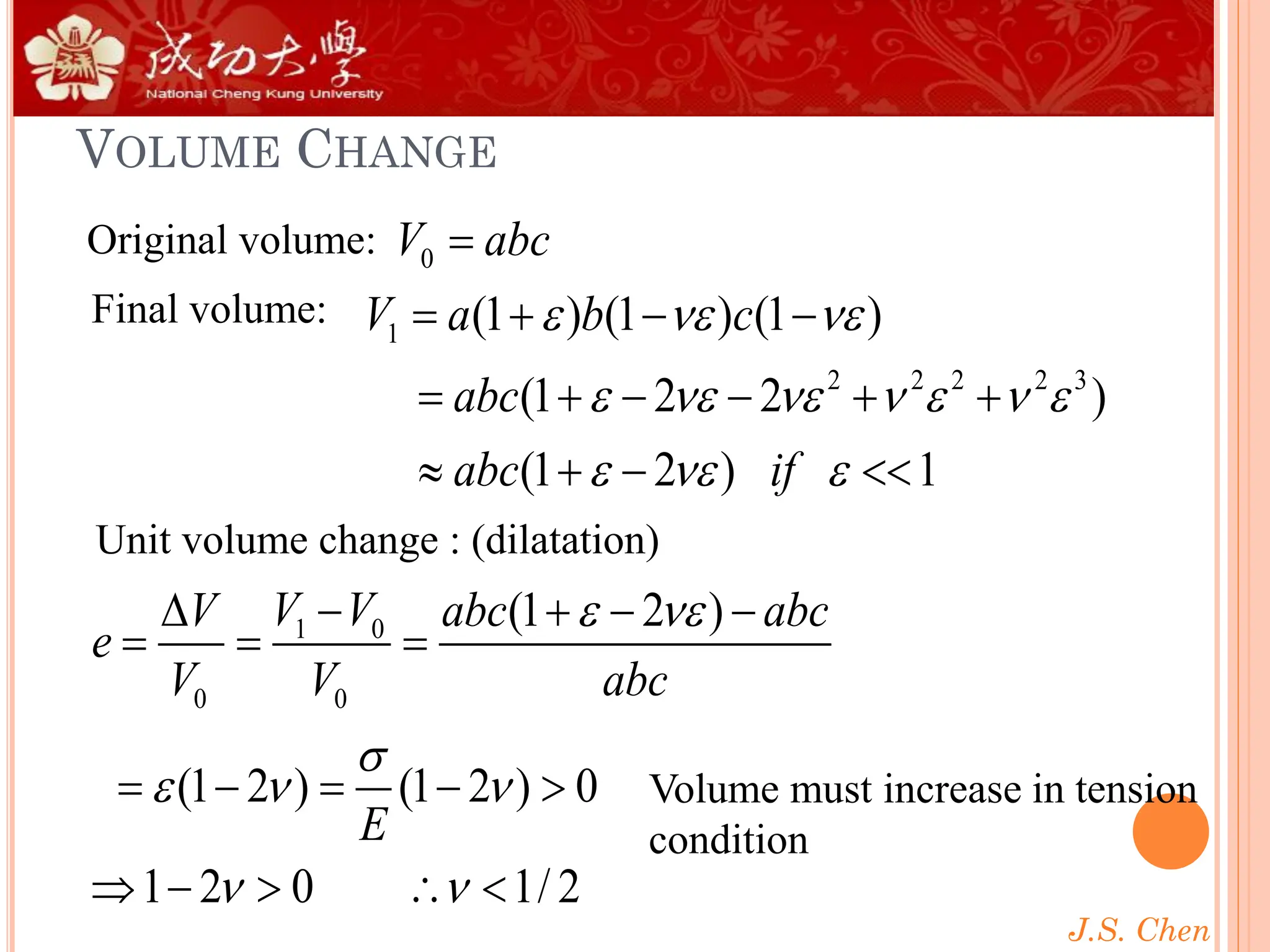
Discusses how volume changes under strain conditions, including equations for calculating volume change.
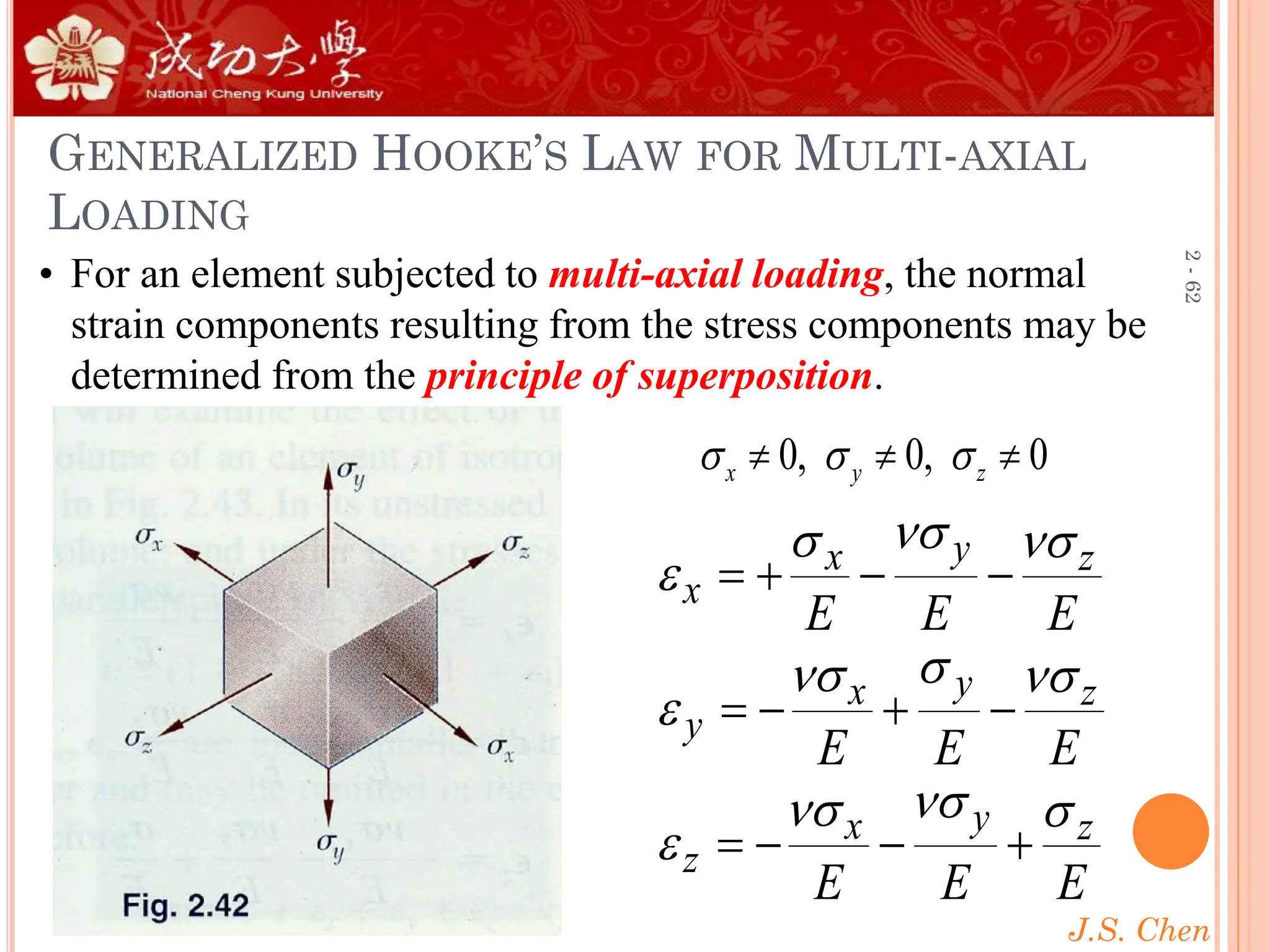
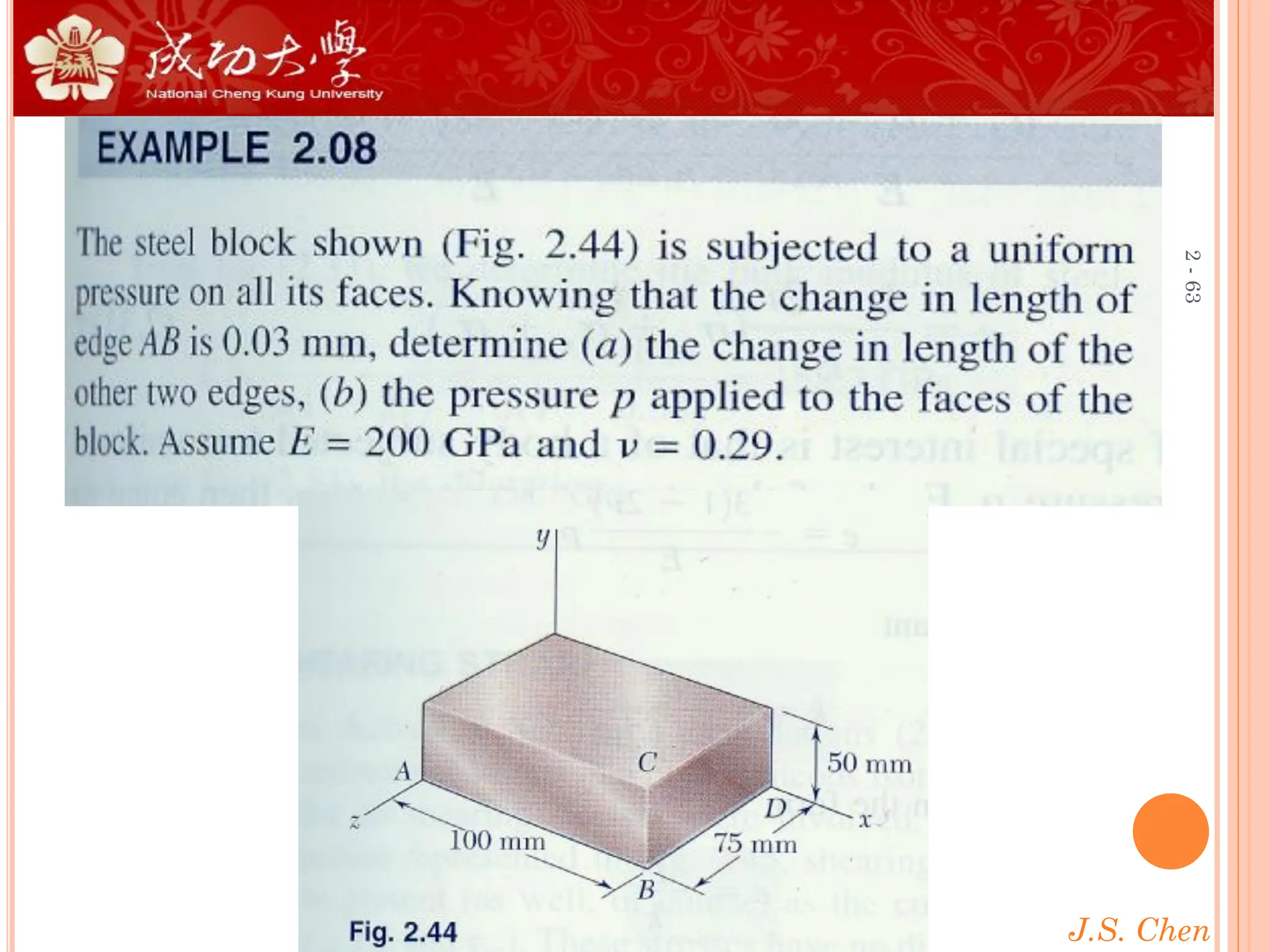
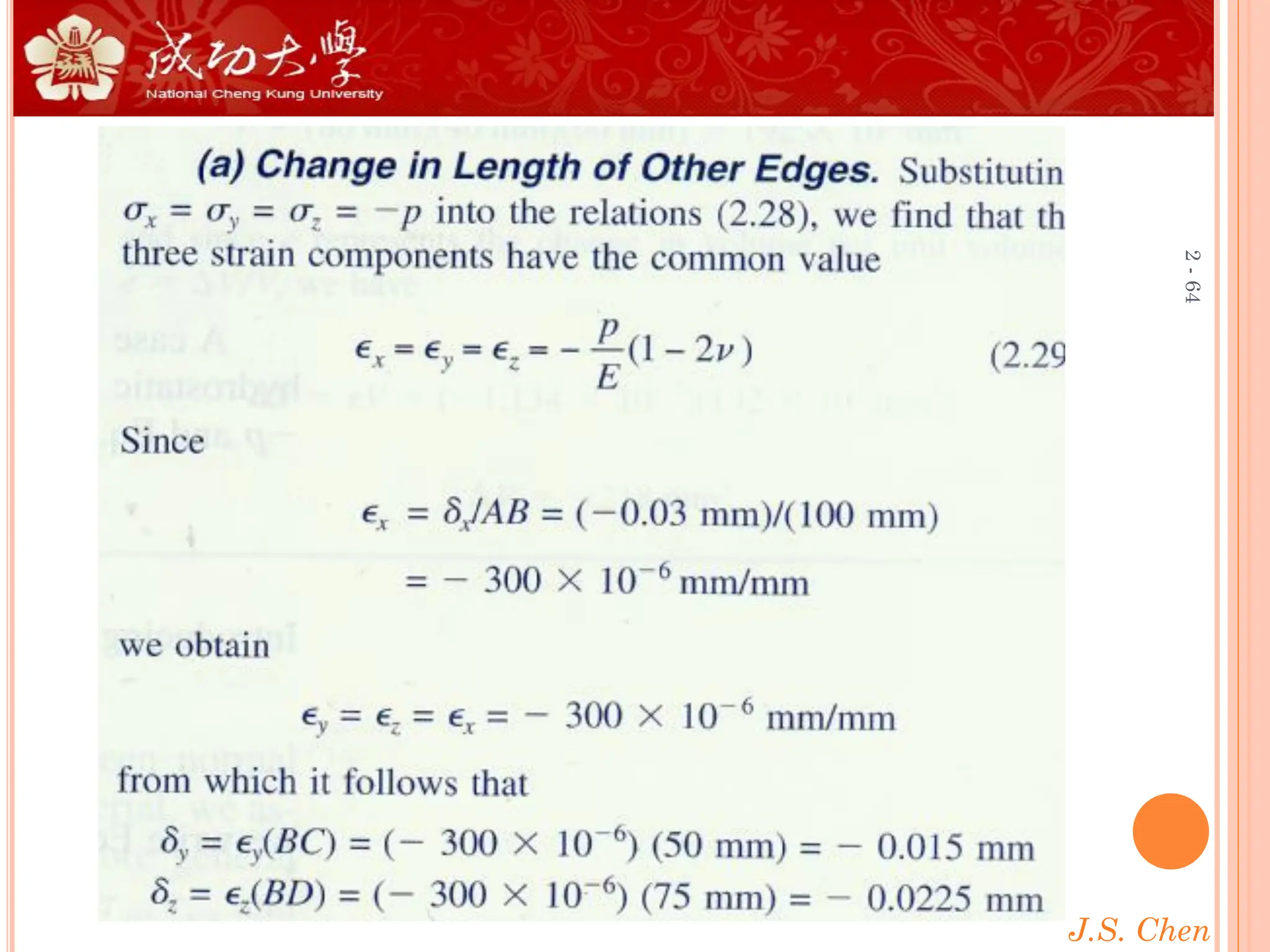
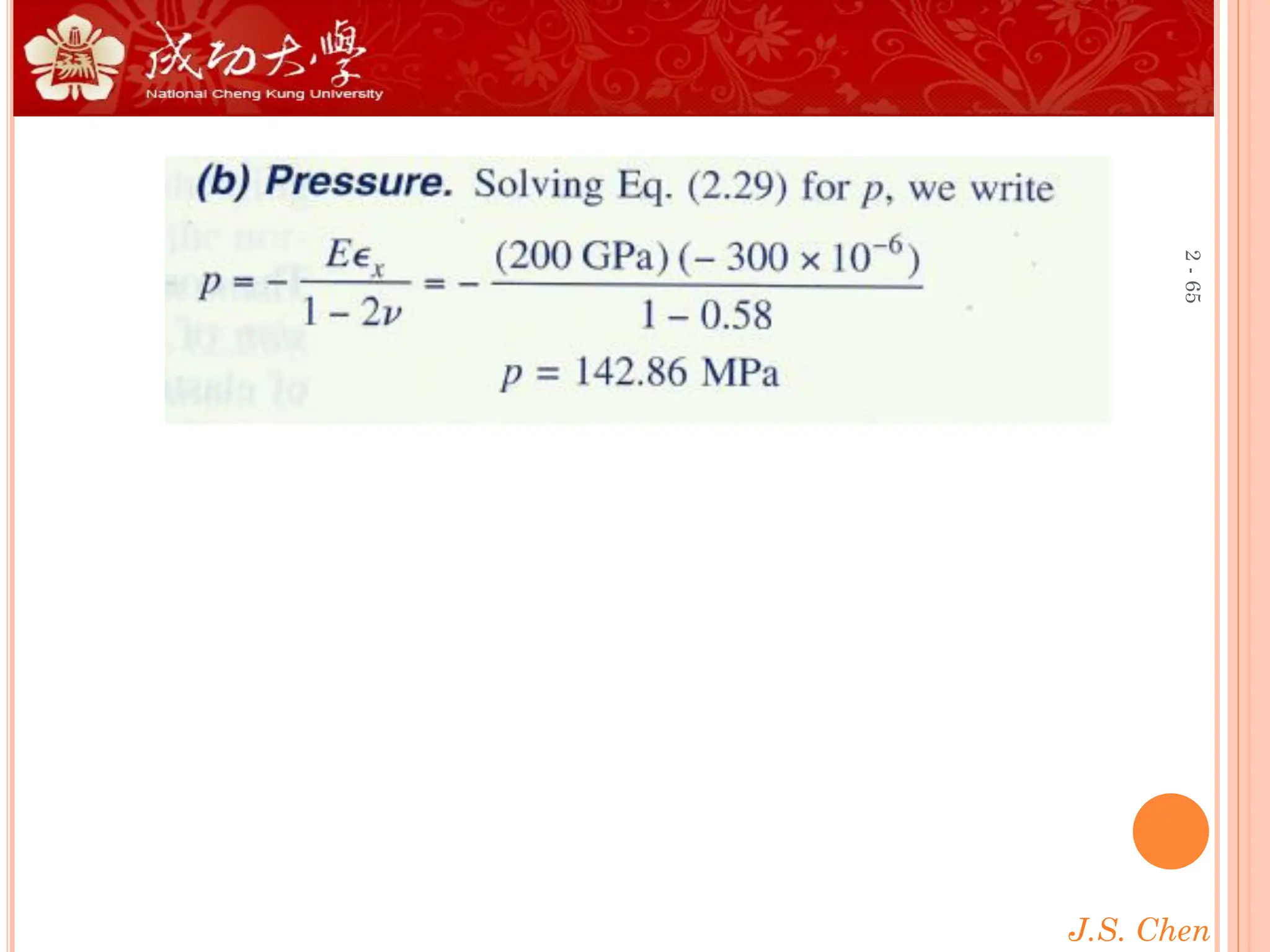
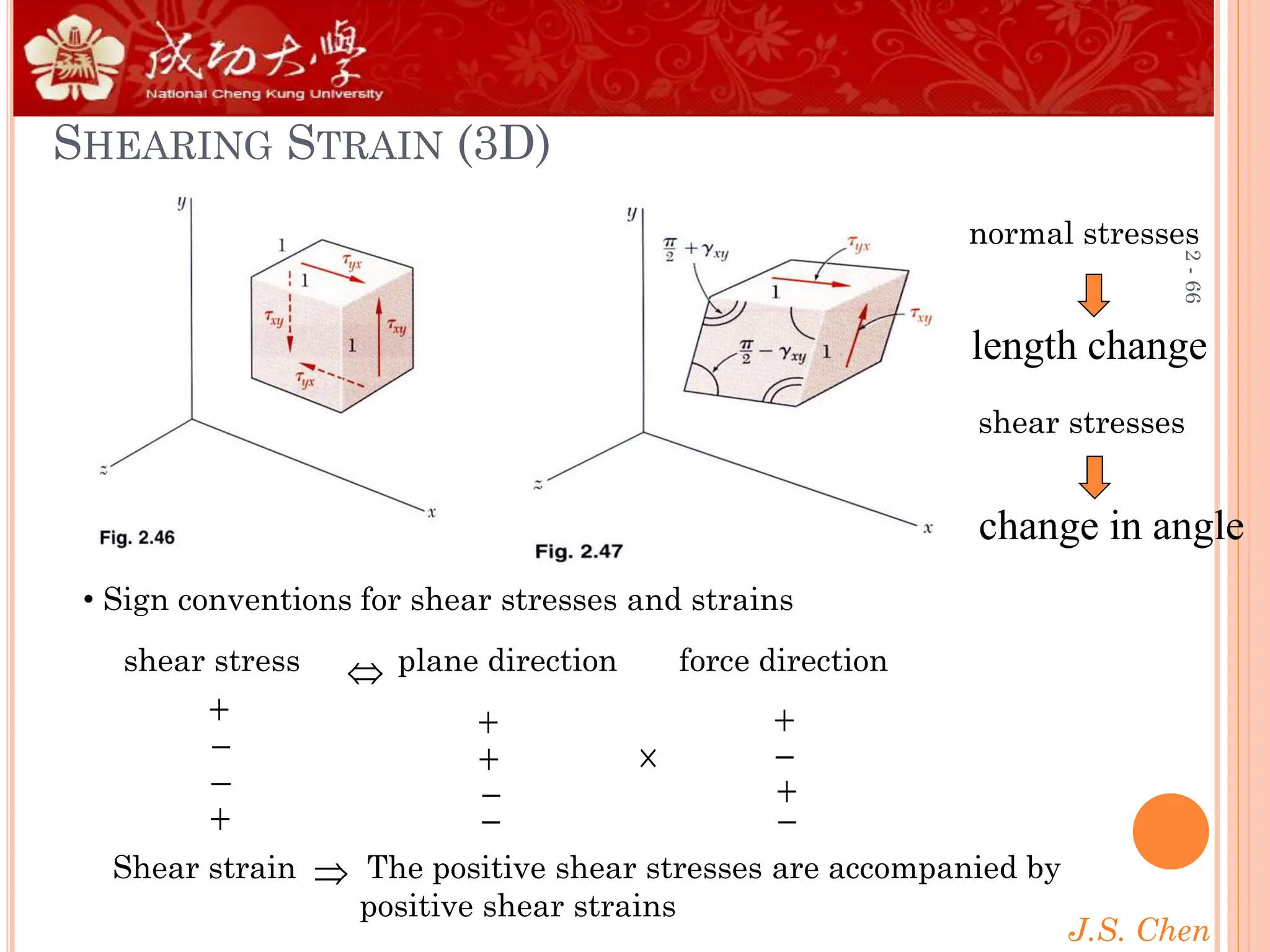
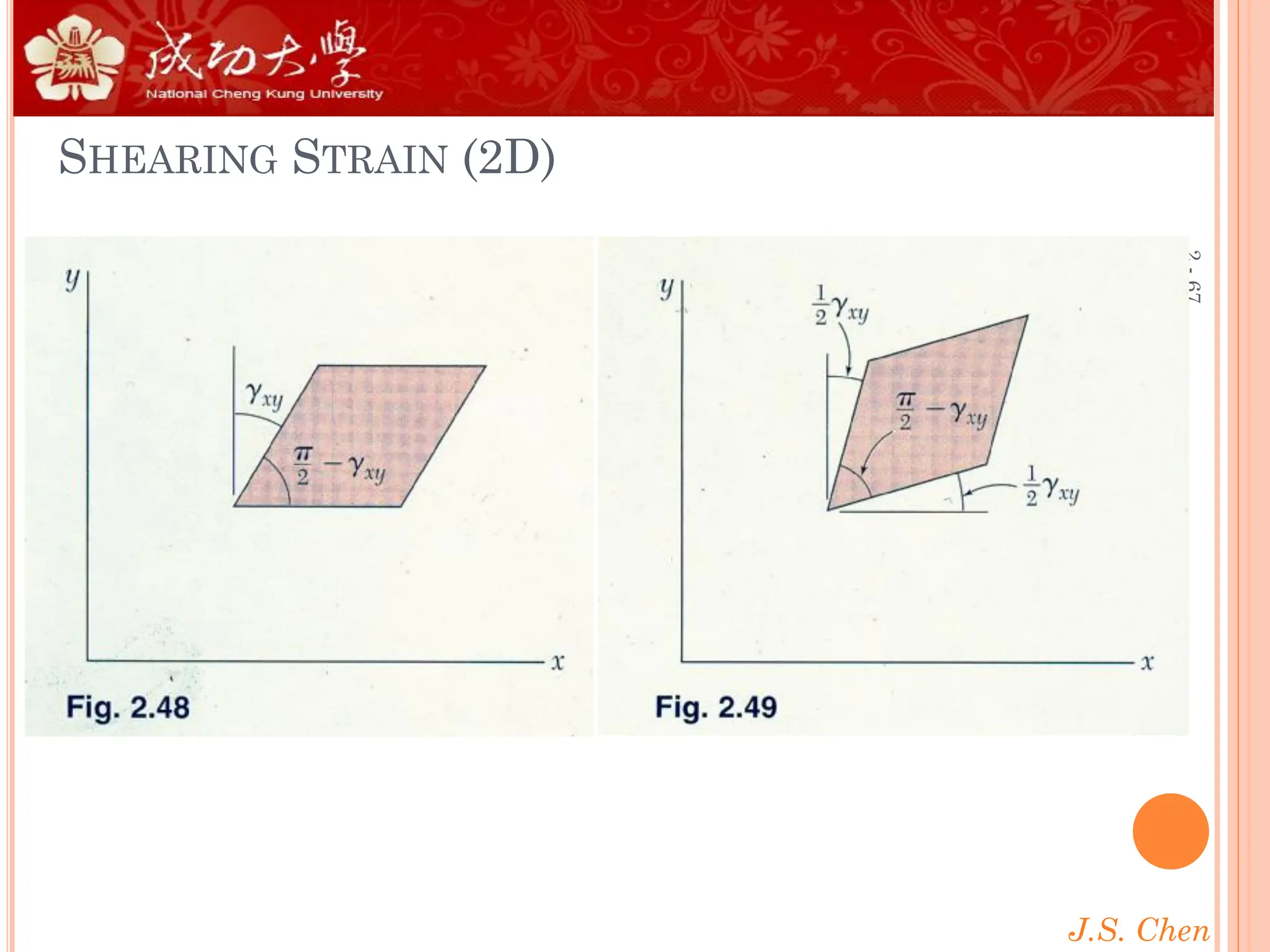
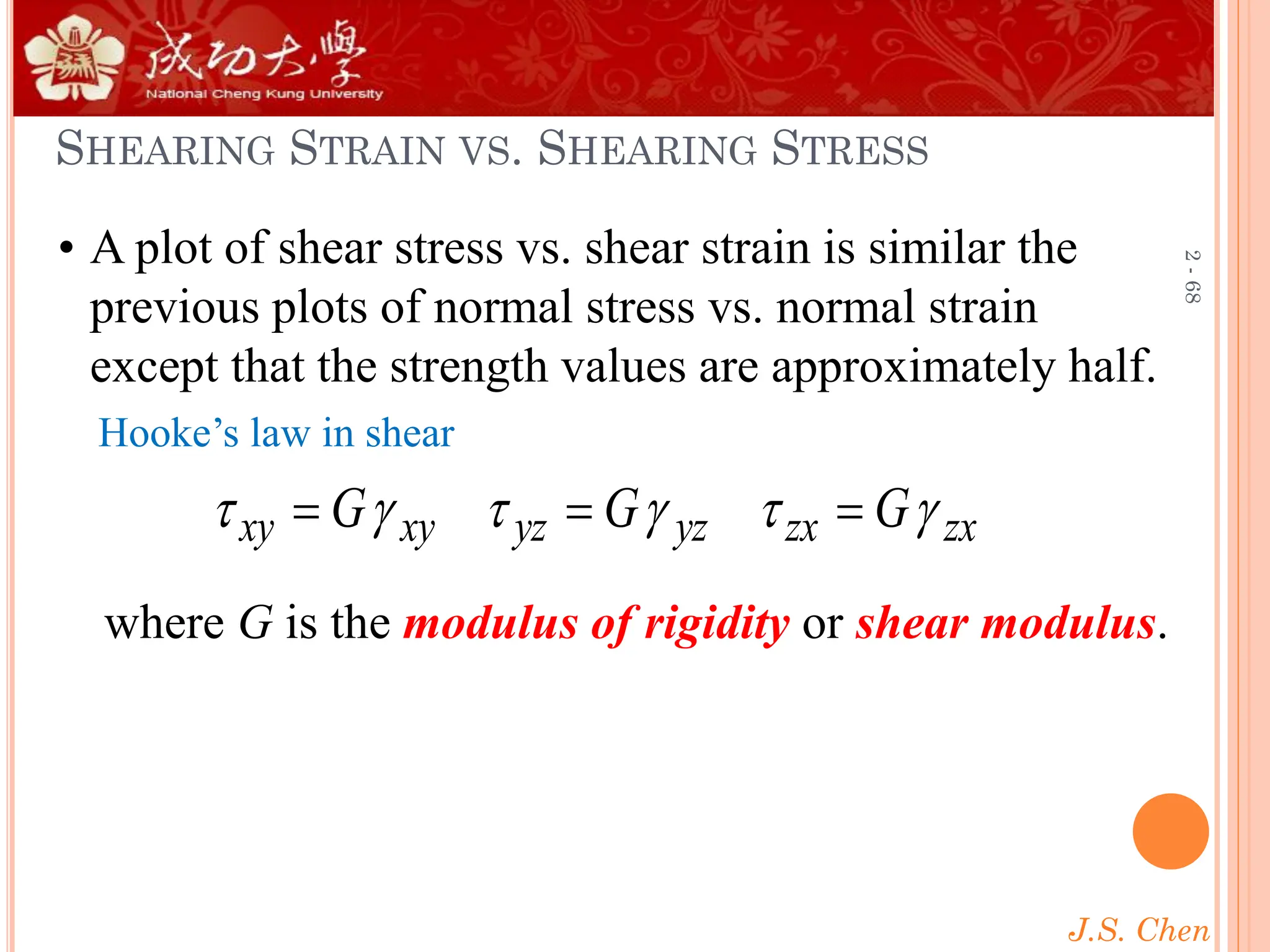
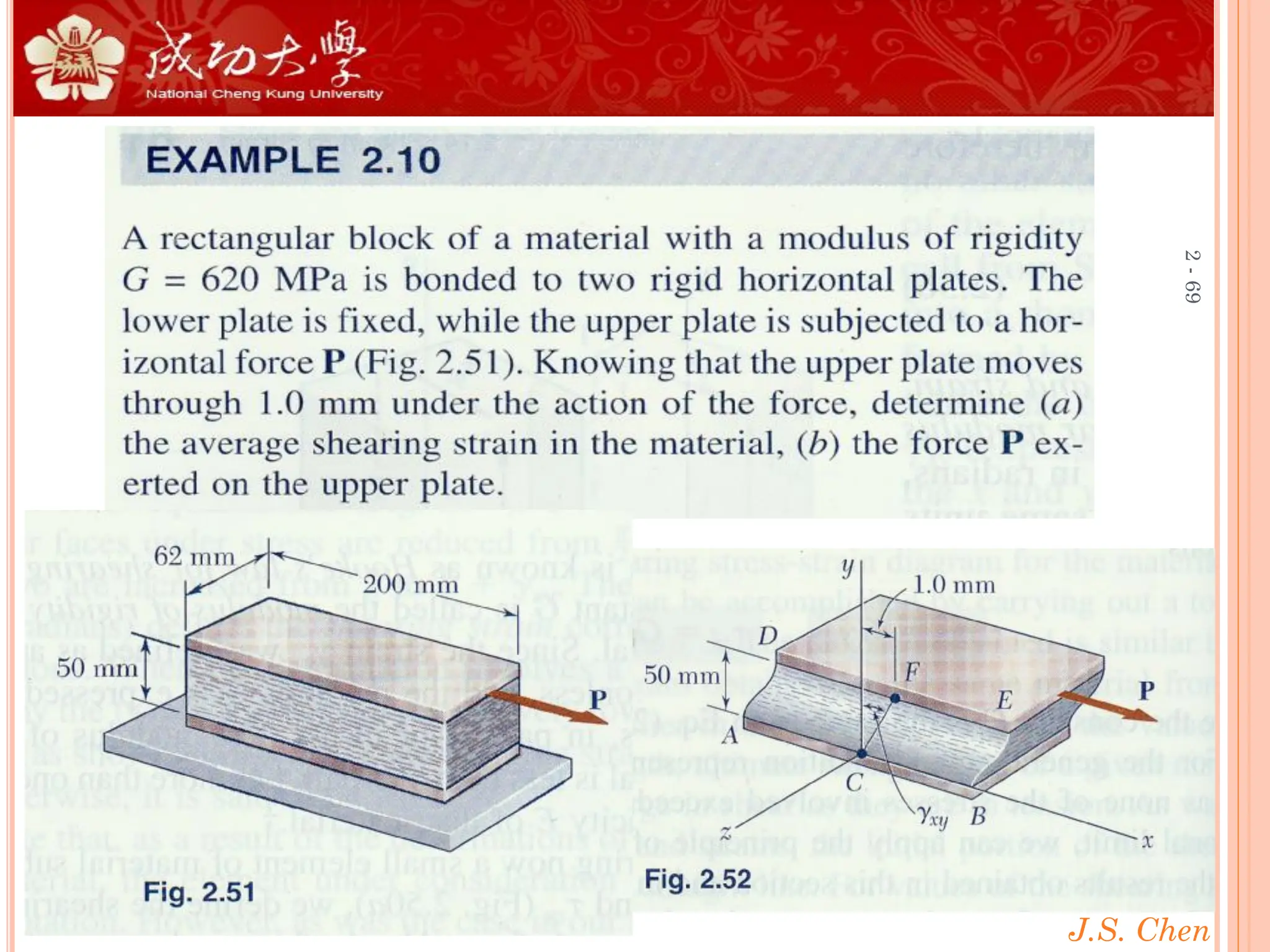
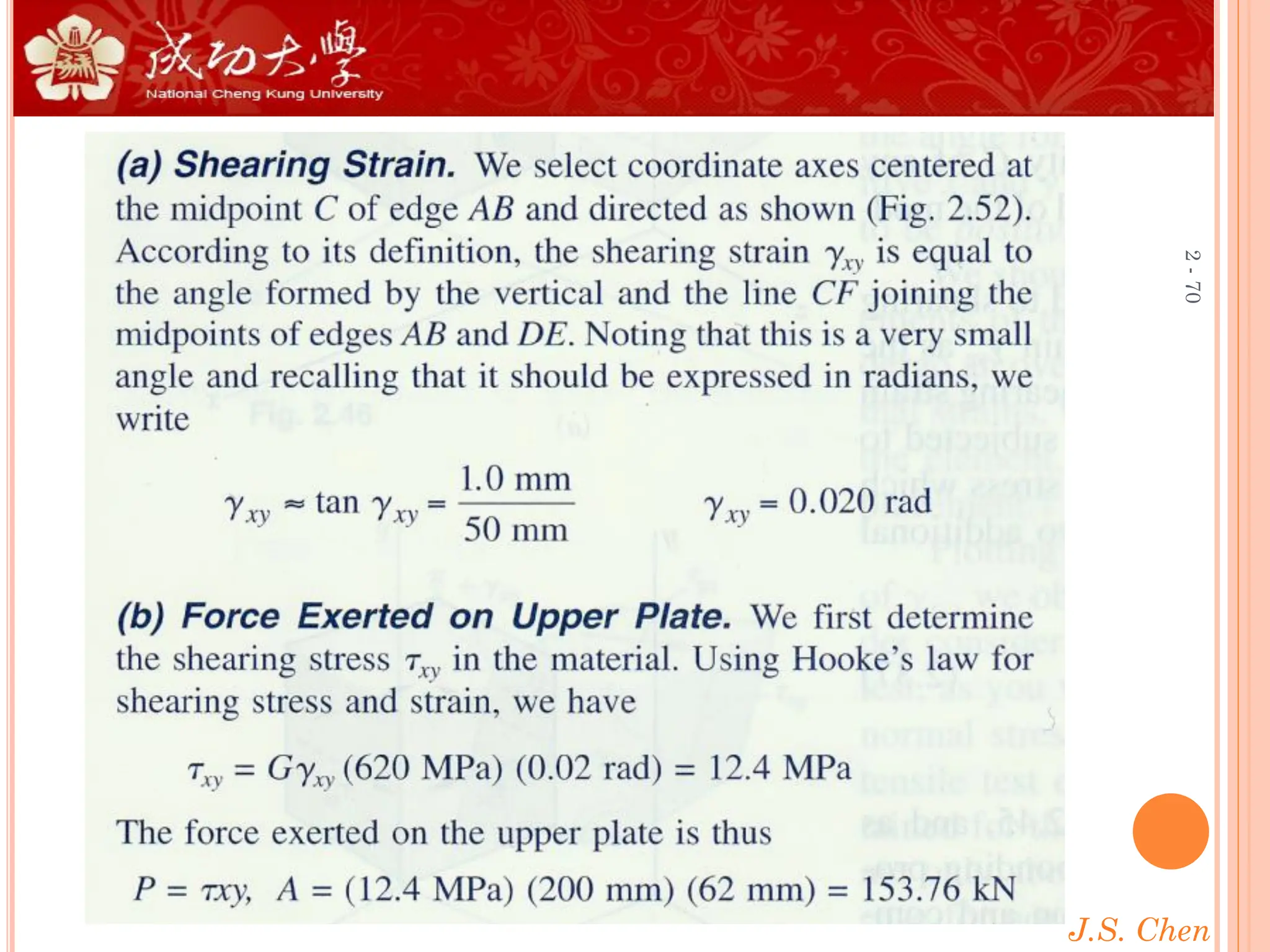
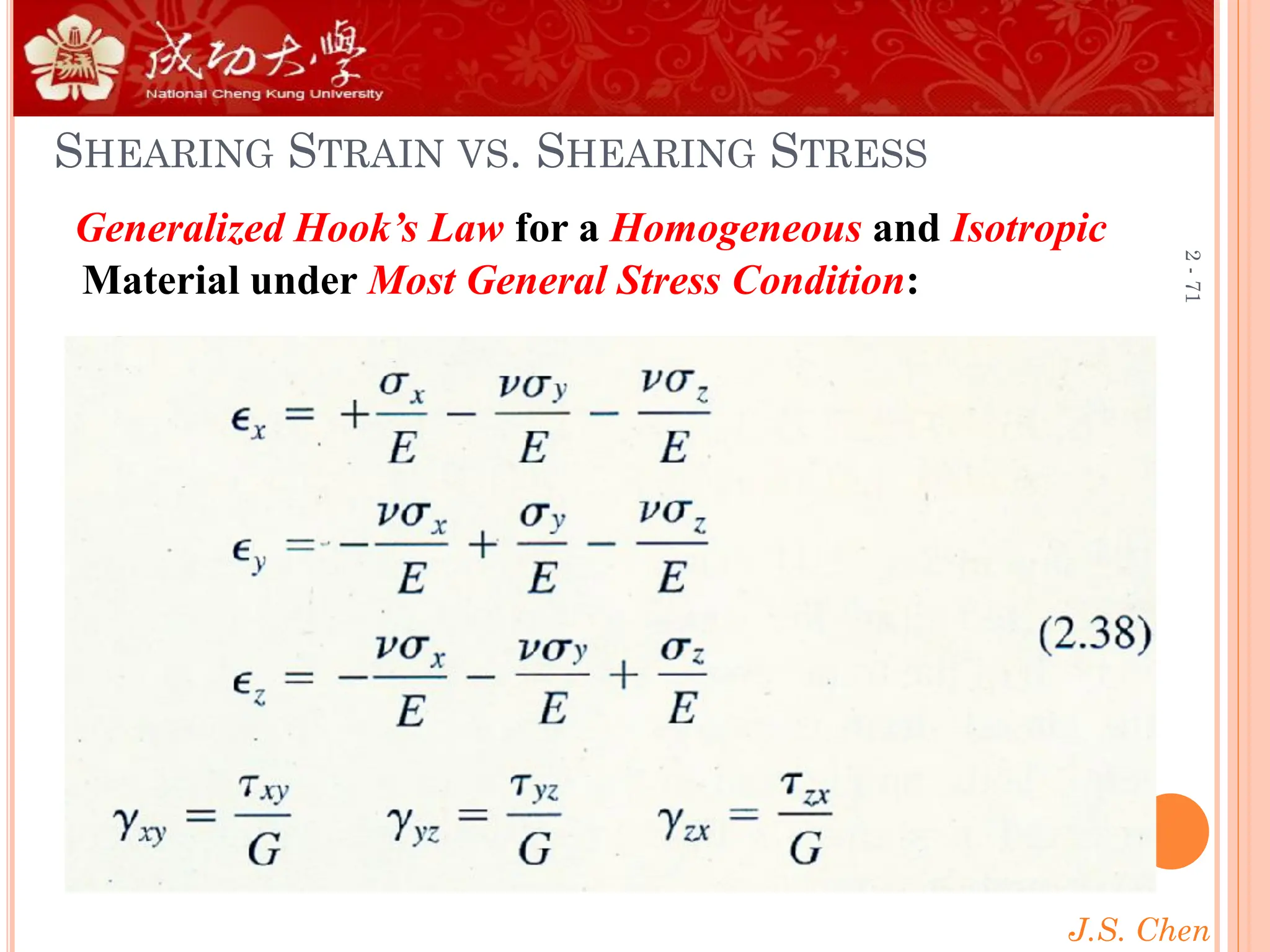
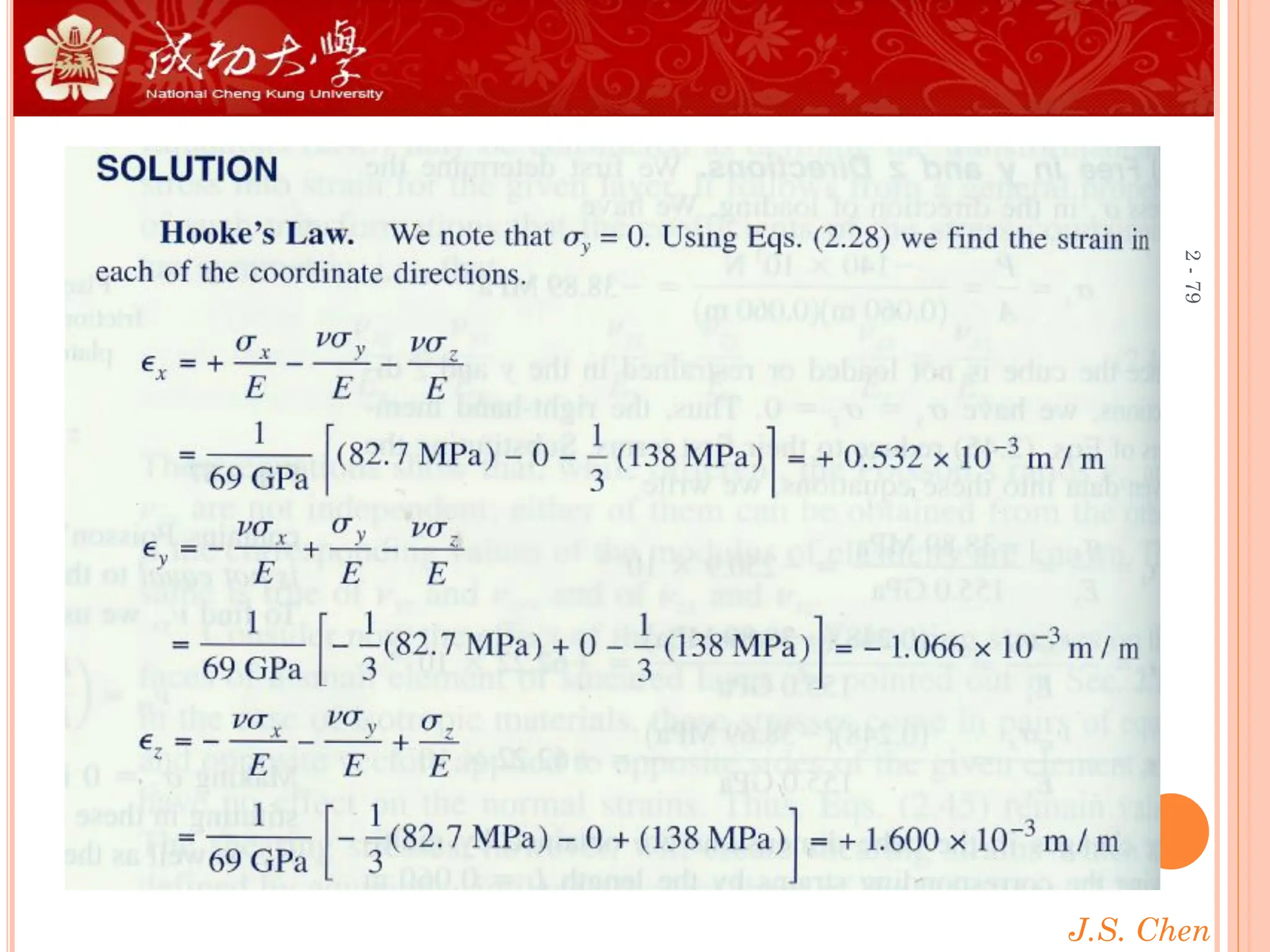
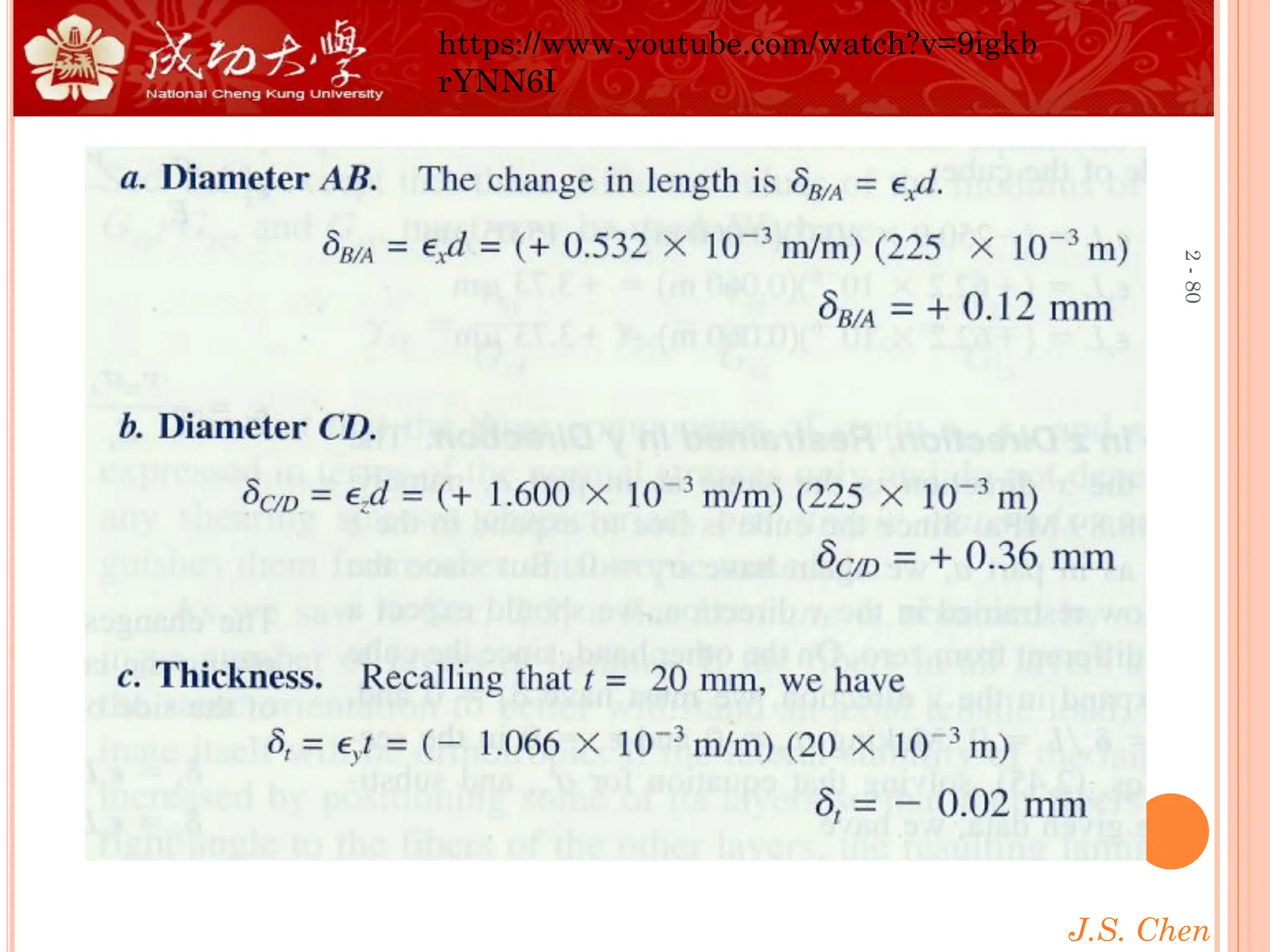
Presents generalized Hooke's Law for multi-axial loading, connecting different strain components.Discusses relationships between shear stress and shear strain, including Hooke's law for shear.
J.S. Chen
2
-
12
ELASTIC VS.PLASTIC BEHAVIOR
• If the strain disappears when the stress is removed,
the material is said to behave elastically. (before
point B)
• When the strain does not return to zero after the stress
is removed, the material is said to behave plastically.
• The largest stress for which this occurs is called the
elastic limit. (=proportional limit)
13.
J.S. Chen
2
-
13
FATIGUE
• Whenthe stress is reduced below the endurance limit,
fatigue failures do not occur for any number of cycles.
• A member may fail due to fatigue at stress levels
significantly below the ultimate strength if subjected to
many loading cycles.
• Fatigue failure is of a brittle nature, even for materials
that are normally ductile.
[Note] : endurance limit is the stress for which failure
does not occur, even for an indefinitely large number
of loading cycles.
J.S. Chen
2
-
15
HOOKE’S LAW:MODULUS OF ELASTICITY
• Strength is affected by alloying,
heat treating, and manufacturing
process but stiffness (Modulus
of Elasticity) is not.
• Below the yield stress
( ' )
Young's Modulus or
Modulus of Elasticity
E Hooke s Law
E
=
=
Note: Strength refers to the
capacity of a structure to resist loads;
stiffness is ability to resist a
deformation
16.
J.S. Chen
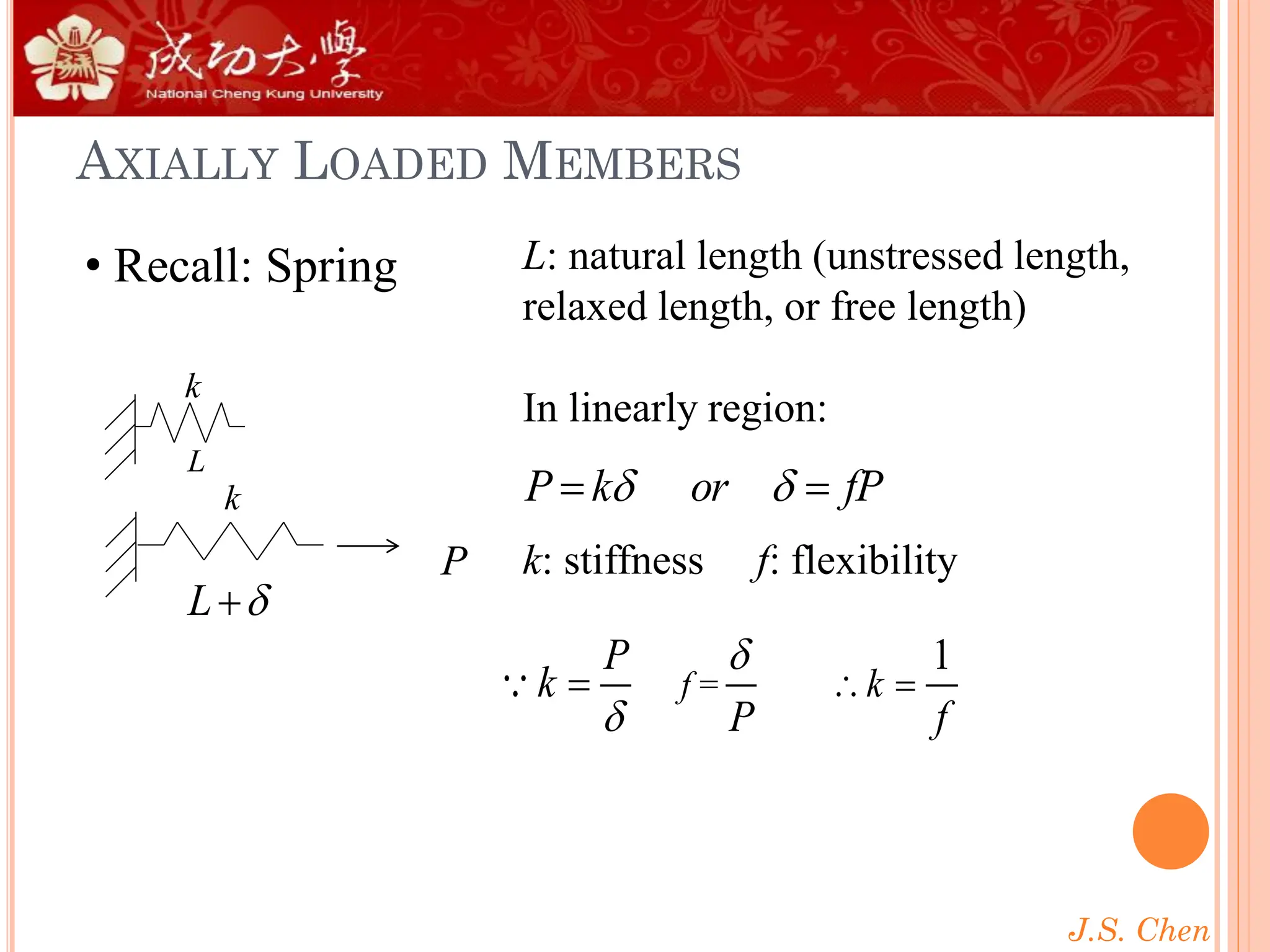
AXIALLY LOADEDMEMBERS
• Recall: Spring L: natural length (unstressed length,
relaxed length, or free length)
In linearly region:
k: stiffness f: flexibility
P k or fP
= =
=
1
f k
P
k
P f
=
=
L
P
L
+
k
k
17.
J.S. Chen
2
-
17
DEFORMATIONS UNDERAXIAL LOADING
E
=
• From Hooke’s Law:
• From the definition of strain:
L
=
• Equating and solving for the
deformation,
PL
k P EA L
AE
f P L EA
= = =
= =
• From the definition of stress:
P
A
=
Prismatic Bar
EA: axial rigidity of the bar
18.
J.S. Chen
2
-
18
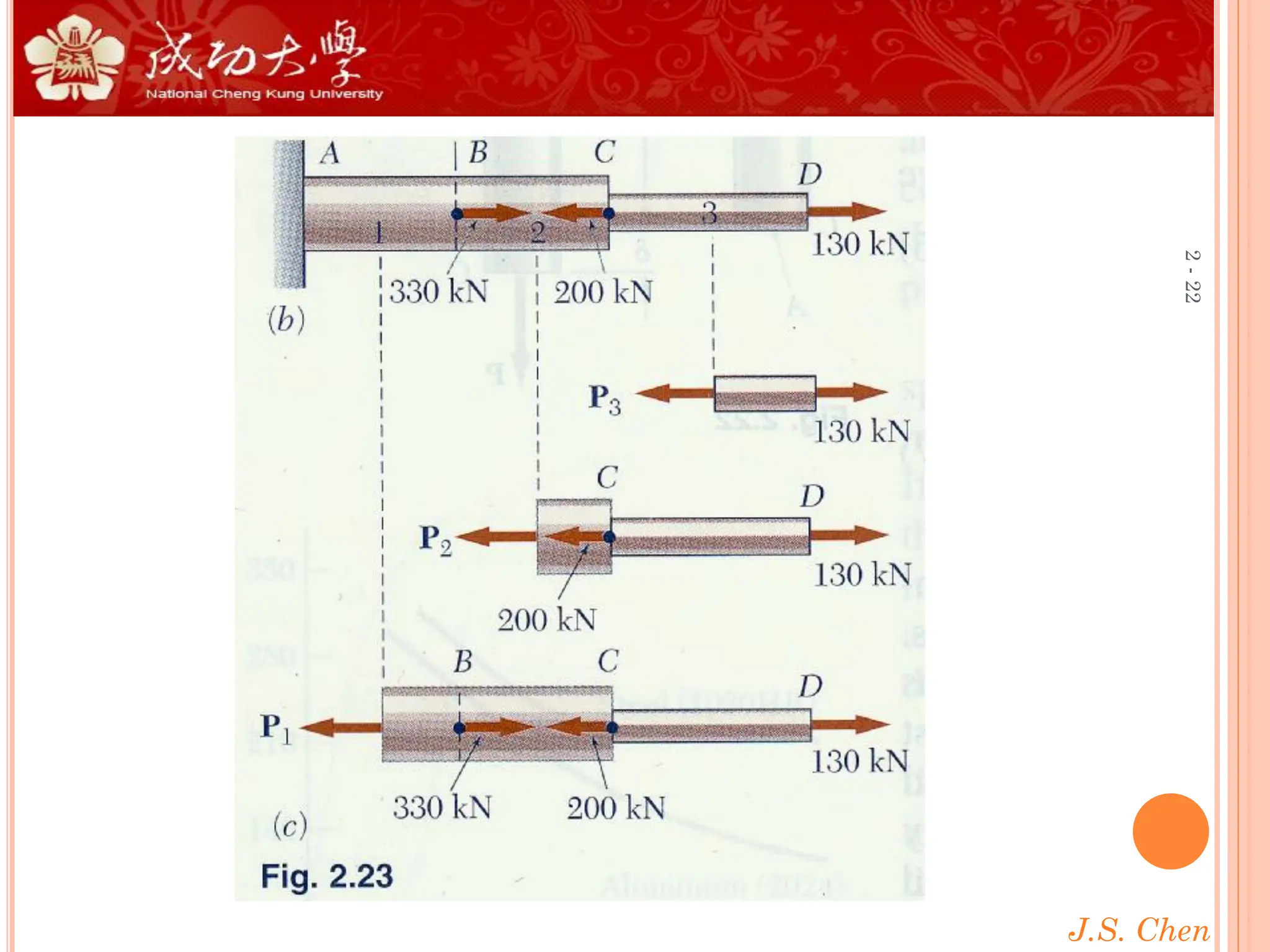
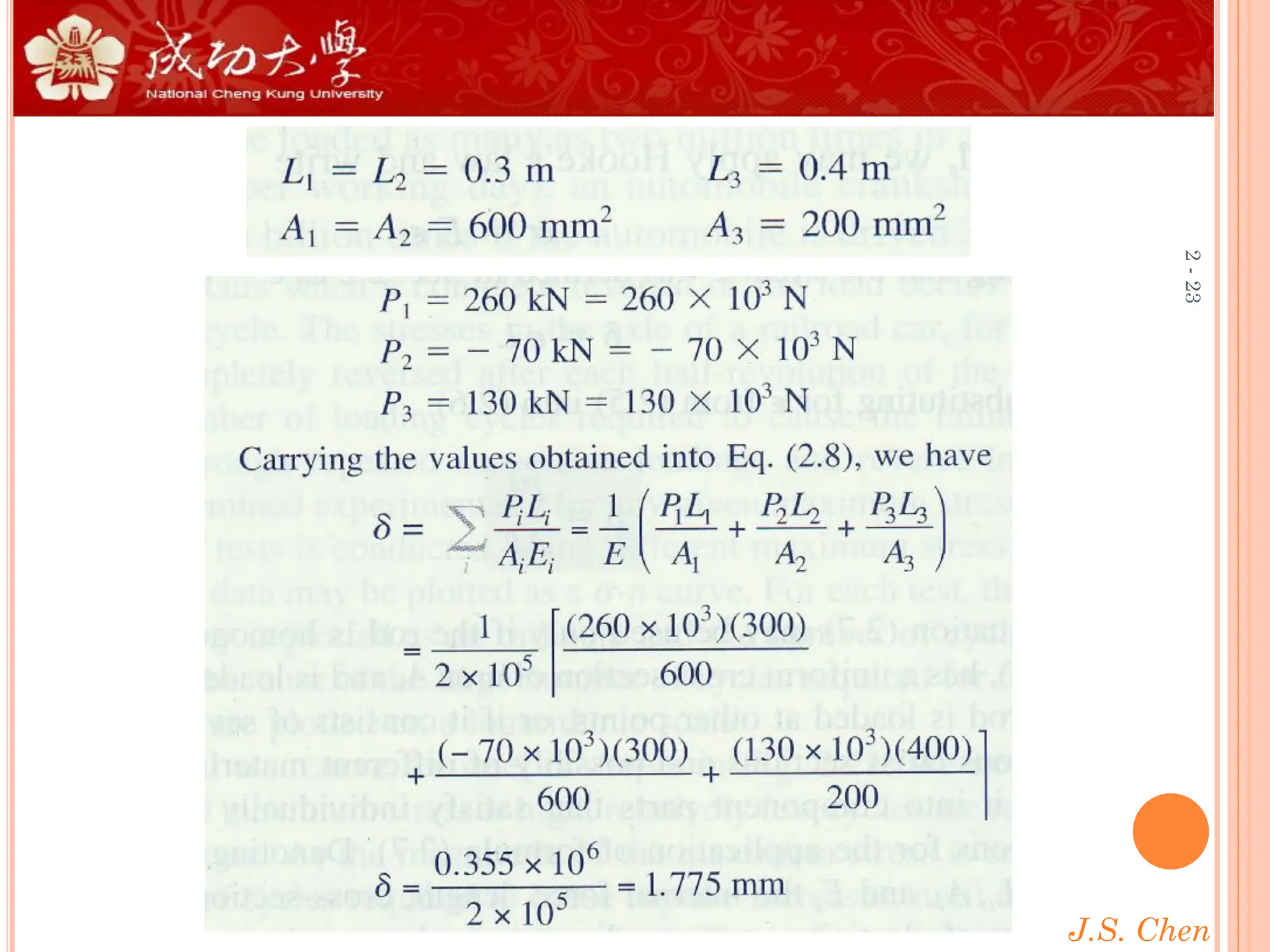
DEFORMATIONS UNDERAXIAL LOADING
• With variations in loading, cross-section or material
properties, , :internal force
i i
i
i i i
PL
P
AE
=
1
2
3
A D C
D C
C
P P P P
P P P
P P
= − + +
= +
=
A
D
1
P
2
P
3
P
A
P
D
P
A
P
D
P D
P 3 3
1 1 2 2
1 2 3
1 2 3
, ,
P L
PL P L
EA EA EA
= = =
= + +
1
L
2
L
3
L
This equation is only valid for prismatic bar or bar consisting of
prismatic segments ( is the internal force)
i
P
(1)
(2)
(3)
J.S. Chen
BAR WITHVARYING CROSS-SECTIONAL AREA
P(x)
dx 0
( )
( )
( )
( )
L
N x dx
d
EA x
N x dx
EA x
=
=
0
If is small error
It has been assumed that the stress distribution is uniform over cross
section
J.S. Chen
2
-
34
STATIC INDETERMINATE
StaticallyDeterminate Problems:
The reaction and internal forces can be obtained
from the equilibrium equations.
Statically Indeterminate Problems:
The reaction and internal forces can not be
obtained from the equilibrium equations. It has to
consider the deformation geometry (boundary
condition).
J.S. Chen
2
-
44
SOLUTION:
• Solvefor the displacement at B due to
the applied loads with the redundant
constraint released,
E
E
A
L
P
L
L
L
L
A
A
A
A
P
P
P
P
i i
i
i
i
9
L
4
3
2
1
2
6
4
3
2
6
2
1
3
4
3
3
2
1
10
125
.
1
m
150
.
0
m
10
250
m
10
400
N
10
900
N
10
600
0
=
=
=
=
=
=
=
=
=
=
=
=
=
=
−
−
45.
J.S. Chen
2
-
45
• Solvefor the displacement at B due to the
redundant constraint,
( )
−
=
=
=
=
=
=
−
=
=
−
−
i
B
i
i
i
i
R
B
E
R
E
A
L
P
δ
L
L
A
A
R
P
P
3
2
1
2
6
2
2
6
1
2
1
10
95
.
1
m
300
.
0
m
10
250
m
10
400
46.
J.S. Chen
2
-
46
• Requirethat the displacements due to the loads and due
to the redundant reaction be compatible,
( )
kN
577
N
10
577
0
10
95
.
1
10
125
.
1
0
3
3
9
=
=
=
−
=
=
+
=
B
B
R
L
R
E
R
E
• Find the reaction at A
kN
323
kN
577
kN
600
kN
300
0
=
+
−
−
=
=
A
A
y
R
R
F
kN
577
kN
323
=
=
B
A
R
R
J.S. Chen
2
-
57
POISSON’S RATIO
•For a slender bar subjected to axial loading:
0, 0 x
x y z x
E
= = =
• Assuming that the material is isotropic
(no directional dependence),
0
= z
y
• Poisson’s ratio is defined as
if the material is linear elastic
lateral strain
axial strain
y z
x x
= − = − = −
58.
J.S. Chen
VOLUME CHANGE
Strain:
x direction:
y, z direction:
−
y
x
z
a
b
c
Length change :
x direction: a
y direction: b
−
z direction: c
−
Final length:
x direction:
y direction:
z direction:
(1 )
a
+
(1 )
b
−
(1 )
c
−
length change
strain=
original length
Final length=original length +length change
59.
J.S. Chen
VOLUME CHANGE
1
22 2 2 3
(1 ) (1 ) (1 )
(1 2 2 )
(1 2 ) 1
V a b c
abc
abc if
= + − −
= + − − + +
+ −
Original volume: 0
V abc
=
Final volume:
Unit volume change : (dilatation)
1 0
0 0
(1 2 )
(1 2 ) (1 2 ) 0
1 2 0 1/ 2
V V
V abc abc
e
V V abc
E
−
+ − −
= = =
= − = −
−
Volume must increase in tension
condition
J.S. Chen
2
-
62
GENERALIZED HOOKE’SLAW FOR MULTI-AXIAL
LOADING
• For an element subjected to multi-axial loading, the normal
strain components resulting from the stress components may be
determined from the principle of superposition.
E
E
E
E
E
E
E
E
E
z
y
x
z
z
y
x
y
z
y
x
x
+
−
−
=
−
+
−
=
−
−
+
=
0, 0, 0
x y z
J.S. Chen
2
-
68
SHEARING STRAINVS. SHEARING STRESS
• A plot of shear stress vs. shear strain is similar the
previous plots of normal stress vs. normal strain
except that the strength values are approximately half.
zx
zx
yz
yz
xy
xy G
G
G
=
=
=
where G is the modulus of rigidity or shear modulus.
Hooke’s law in shear
J.S. Chen
2
-
71
SHEARING STRAINVS. SHEARING STRESS
Generalized Hook’s Law for a Homogeneous and Isotropic
Material under Most General Stress Condition:
72.
J.S. Chen
2
-
72
RELATION AMONGE, , AND G
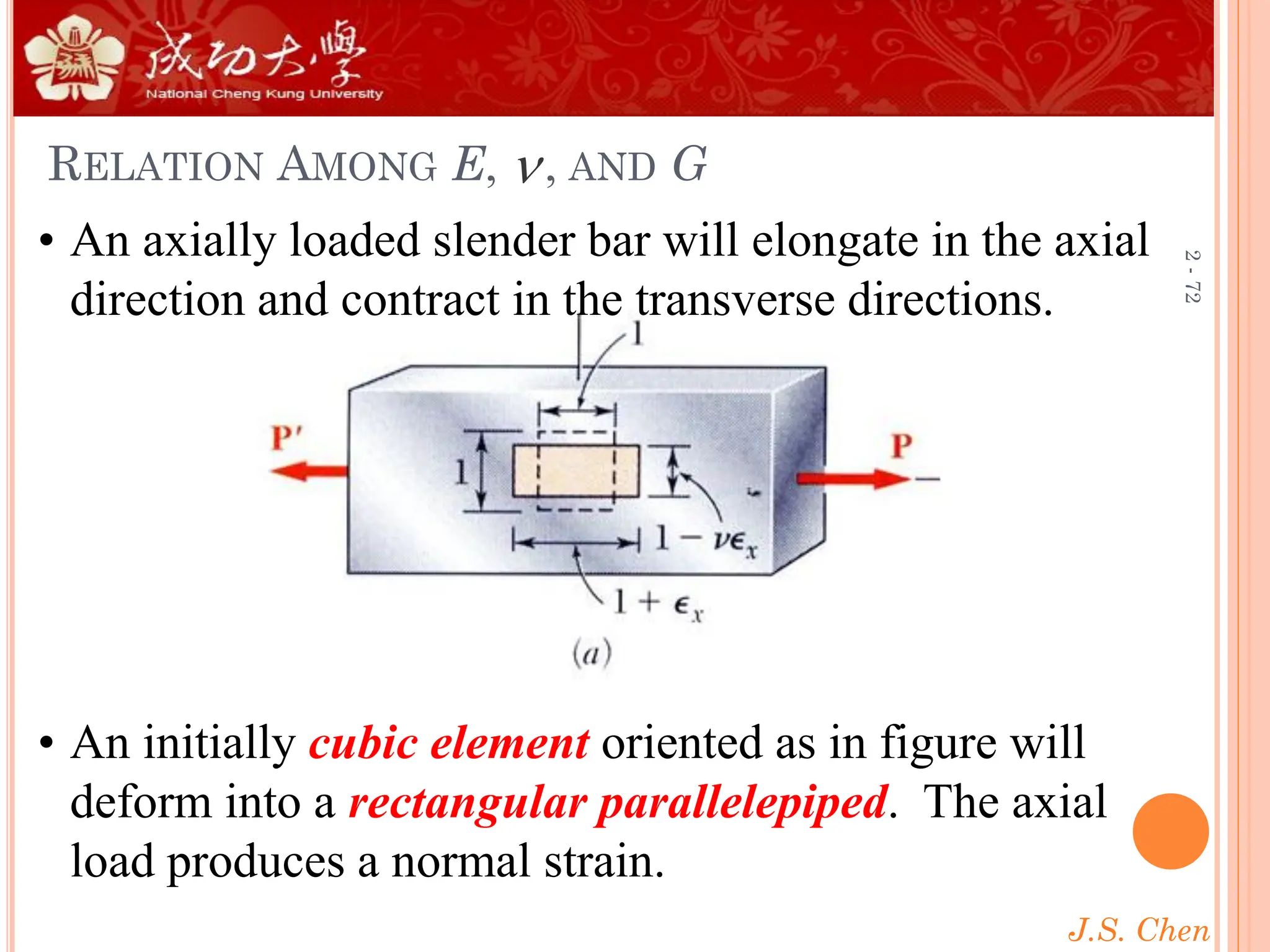
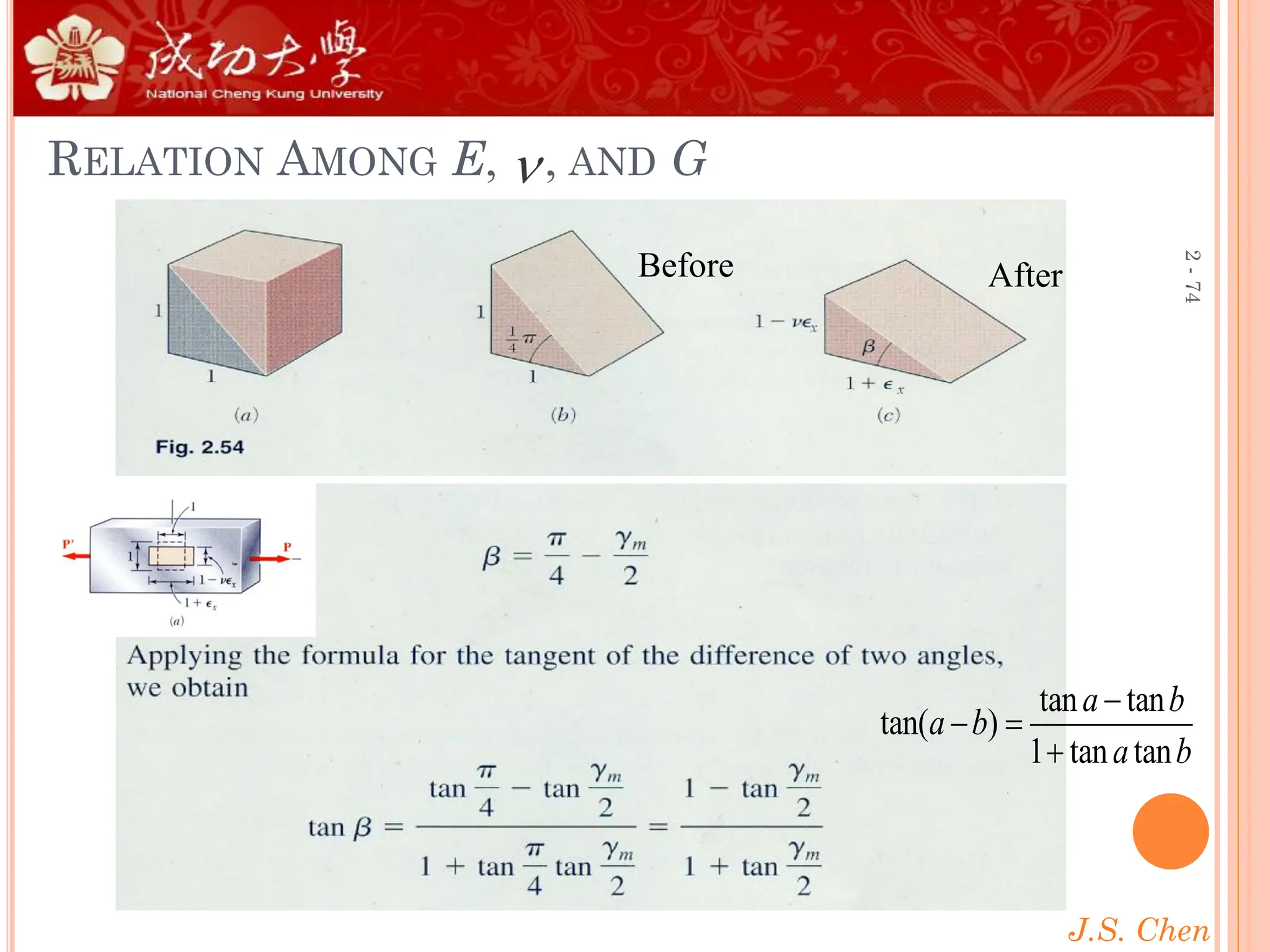
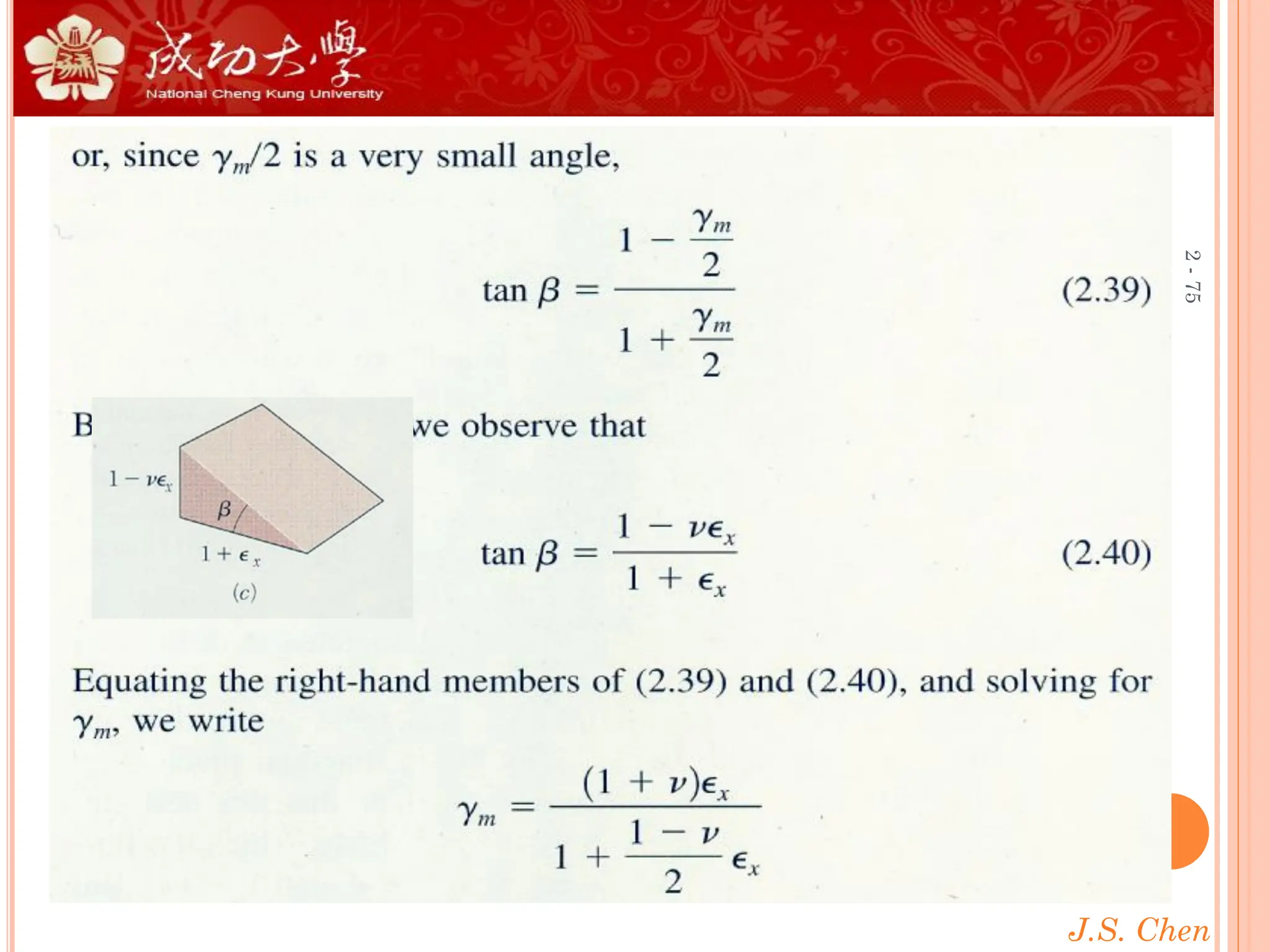
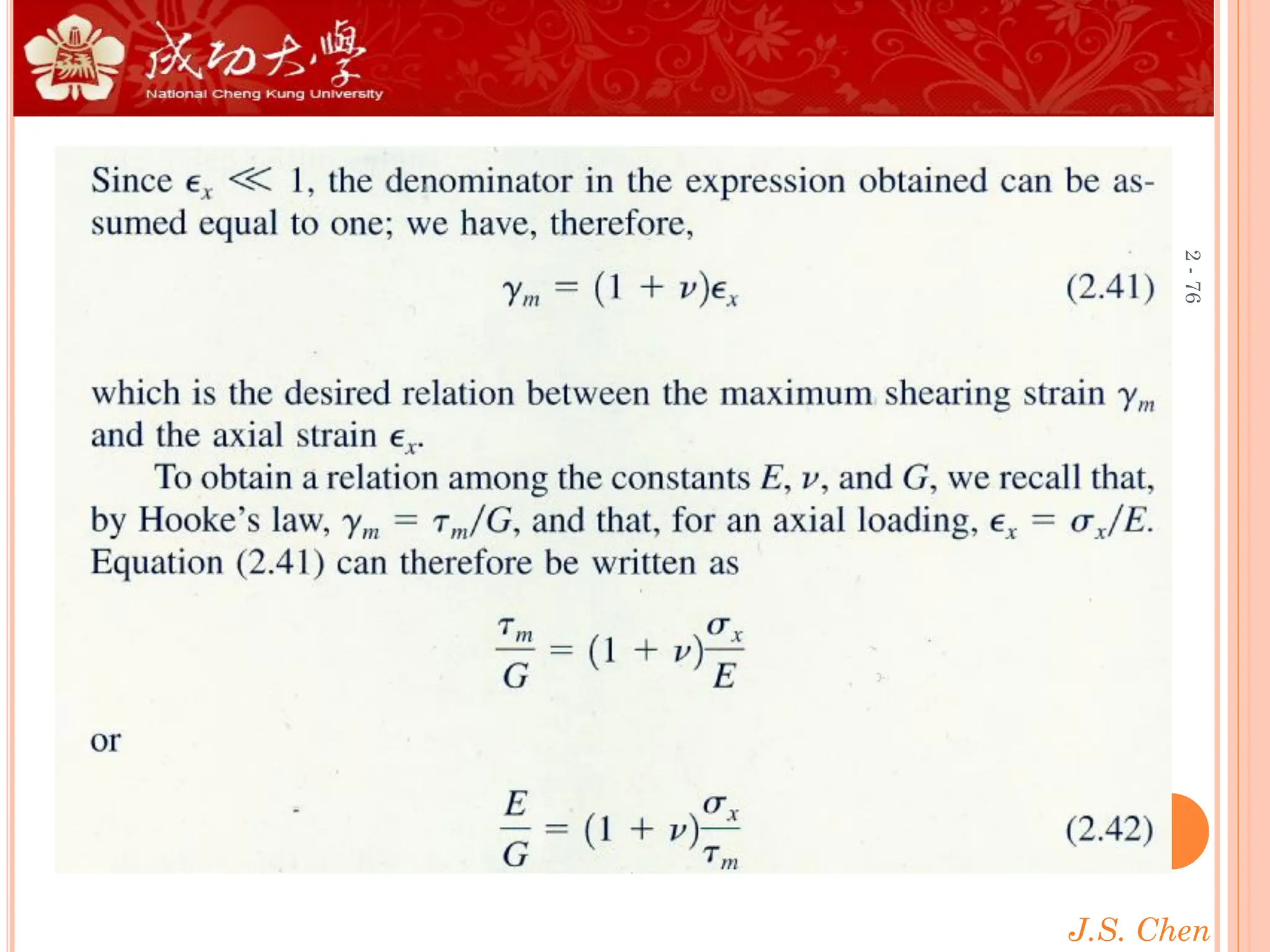
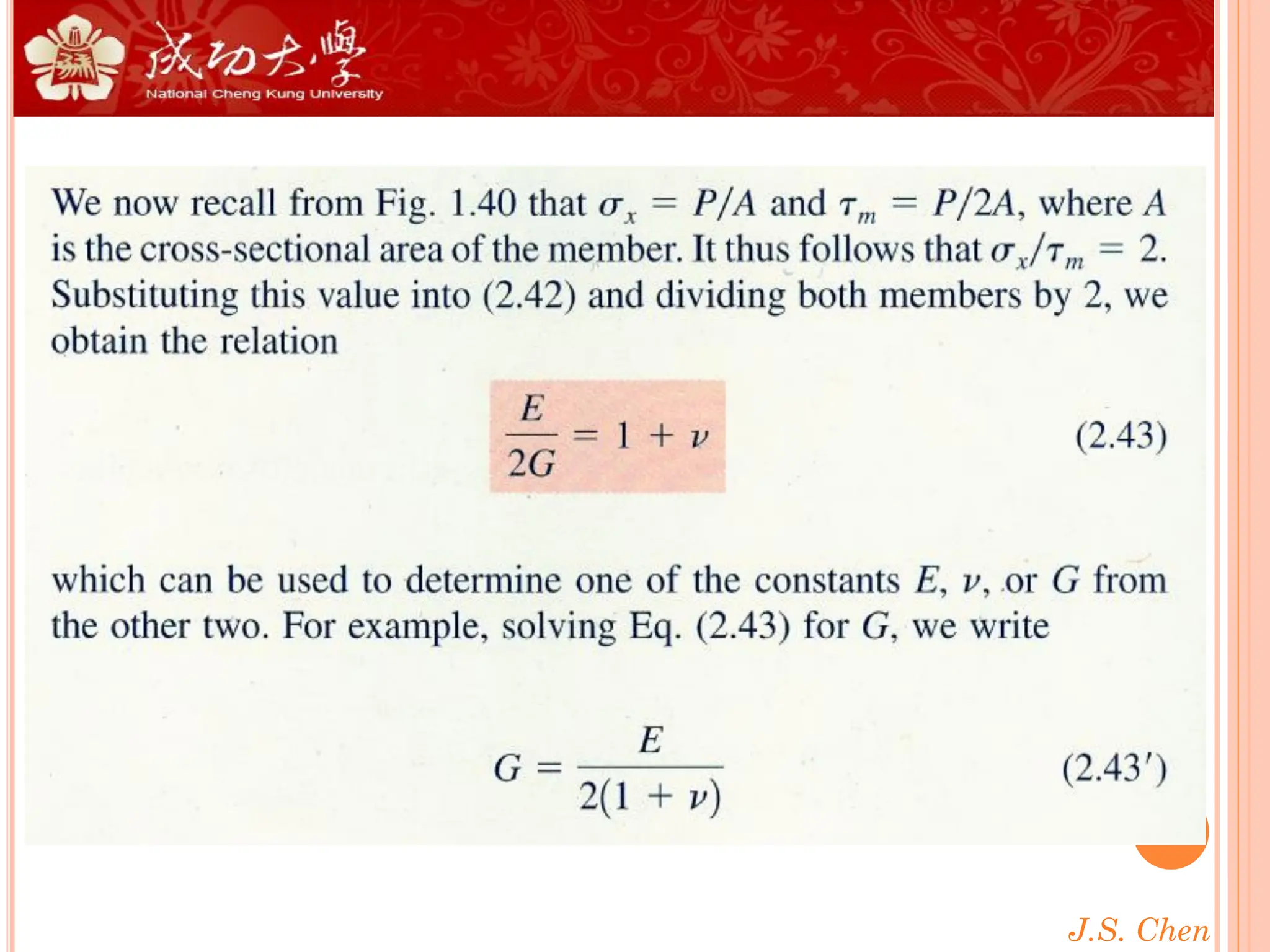
• An axially loaded slender bar will elongate in the axial
direction and contract in the transverse directions.
• An initially cubic element oriented as in figure will
deform into a rectangular parallelepiped. The axial
load produces a normal strain.
73.
J.S. Chen
2
-
73
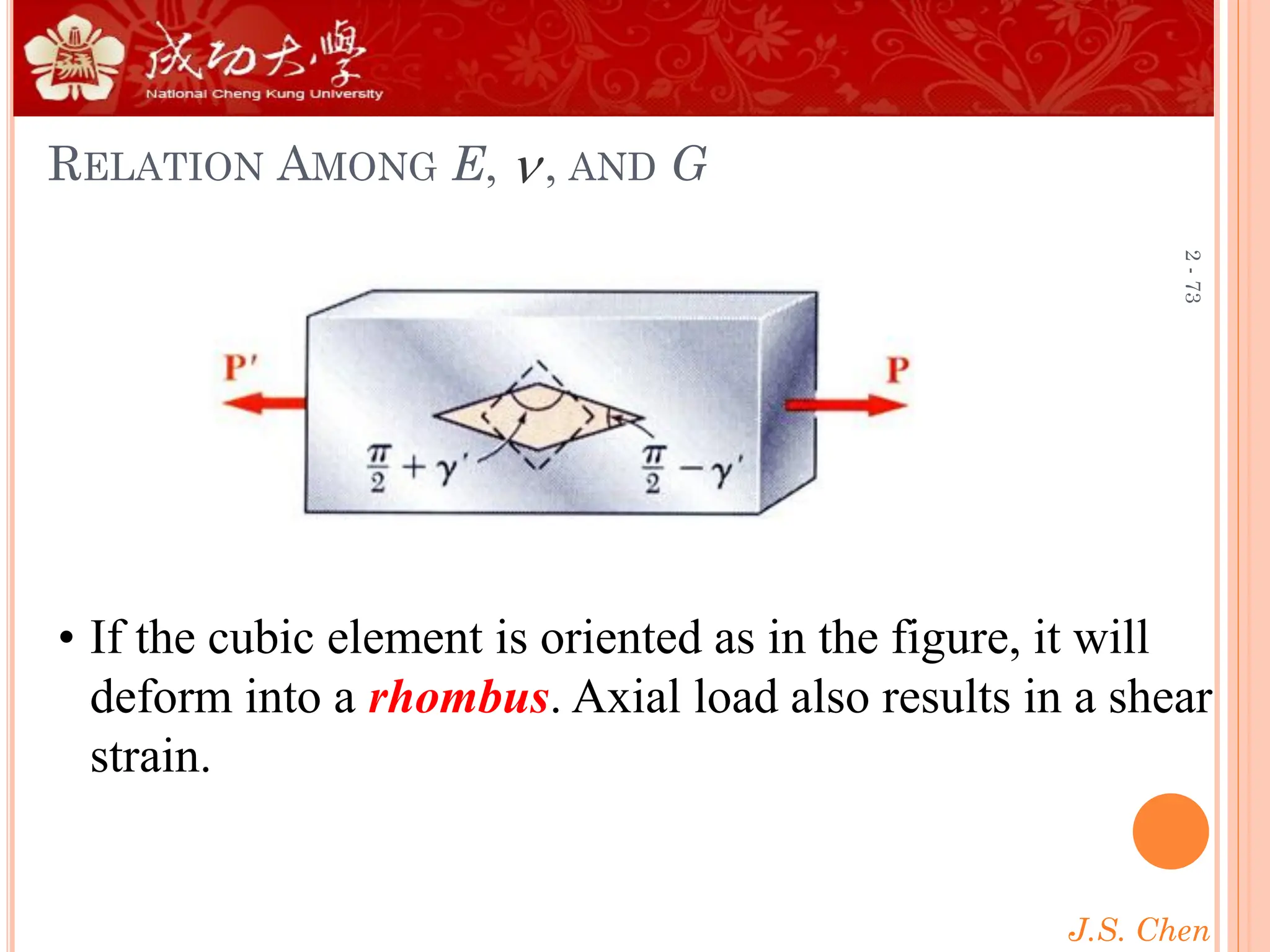
• Ifthe cubic element is oriented as in the figure, it will
deform into a rhombus. Axial load also results in a shear
strain.
RELATION AMONG E, , AND G
![J.S. Chen
2
-
13
FATIGUE
• When the stress is reduced below the endurance limit,
fatigue failures do not occur for any number of cycles.
• A member may fail due to fatigue at stress levels
significantly below the ultimate strength if subjected to
many loading cycles.
• Fatigue failure is of a brittle nature, even for materials
that are normally ductile.
[Note] : endurance limit is the stress for which failure
does not occur, even for an indefinitely large number
of loading cycles.](https://image.slidesharecdn.com/axialloading-240309122942-4fee2193/75/the-note-of-axial-loading-using-in-NCKU-course-13-2048.jpg)