

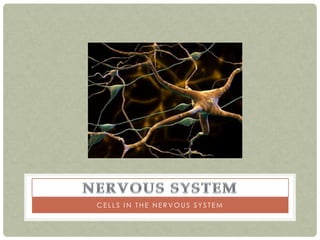
CELLS IN THE NERVOUS SYSTEM
NEURONS VS. OTHER CELLS IN THE BODY


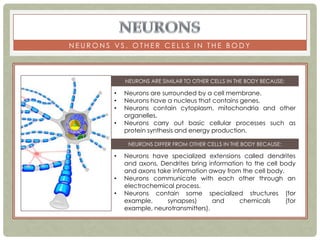
            NEURONS ARE SIMILAR TO OTHER CELLS IN THE BODY BECAUSE:

        •   Neurons are surrounded by a cell membrane.
        •   Neurons have a nucleus that contains genes.
        •   Neurons contain cytoplasm, mitochondria and other
            organelles.
        •   Neurons carry out basic cellular processes such as
            protein synthesis and energy production.

             NEURONS DIFFER FROM OTHER CELLS IN THE BODY BECAUSE:

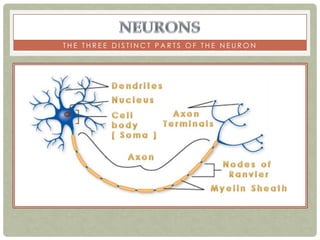
        •   Neurons have specialized extensions called dendrites
            and axons. Dendrites bring information to the cell body
            and axons take information away from the cell body.
        •   Neurons communicate with each other through an
            electrochemical process.
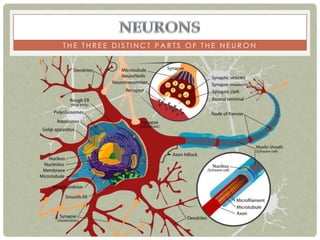
        •   Neurons contain some specialized structures (for
            example,     synapses)       and     chemicals      (for
            example, neurotransmitters).
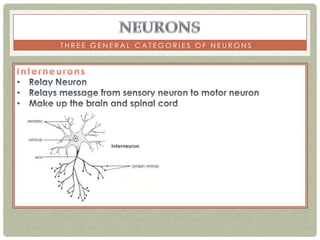
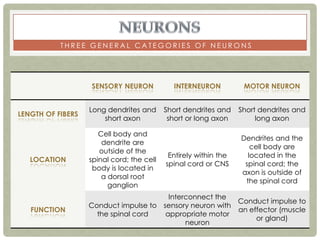
THREE GENERAL CATEGORIES OF NEURONS


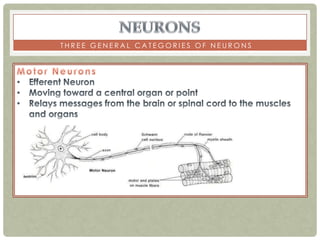
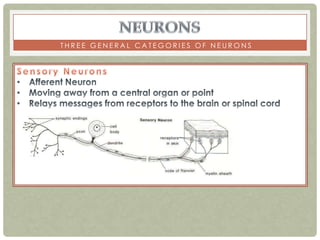
                   SENSORY NEURON            INTERNEURON           MOTOR NEURON


                   Long dendrites and      Short dendrites and    Short dendrites and
LENGTH OF FIBERS
                       short axon           short or long axon         long axon

                      Cell body and
                                                                  Dendrites and the
                       dendrite are
                                                                     cell body are
                      outside of the
                                            Entirely within the     located in the
   LOCATION        spinal cord; the cell
                                           spinal cord or CNS      spinal cord; the
                    body is located in
                                                                  axon is outside of
                       a dorsal root
                                                                   the spinal cord
                         ganglion
                                        Interconnect the
                                                          Conduct impulse to
                   Conduct impulse to sensory neuron with
   FUNCTION                                               an effector (muscle
                     the spinal cord   appropriate motor
                                                               or gland)
                                             neuron
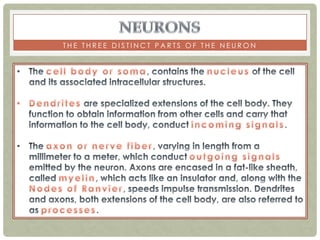
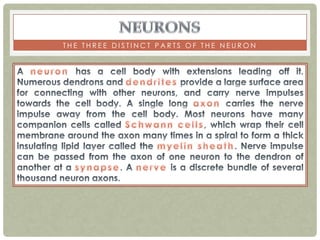
THE THREE DISTINCT PARTS OF THE NEURON
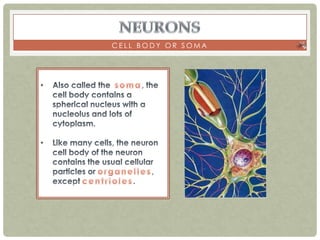
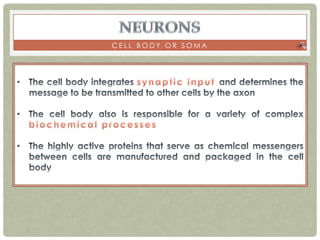
CELL BODY OR SOMA
CELL BODY OR SOMA
CELL BODY OR SOMA
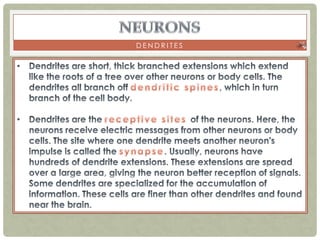
DENDRITES
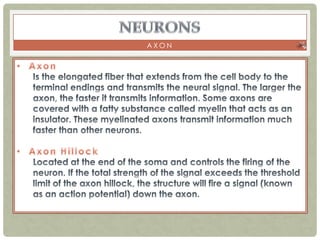
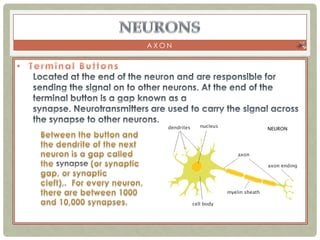
AXON
AXON
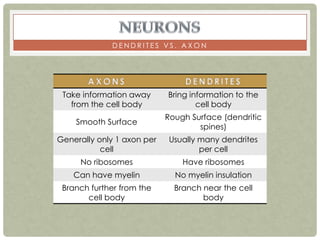
DENDRITES VS. AXON


 Take information away      Bring information to the
   from the cell body               cell body
                            Rough Surface (dendritic
    Smooth Surface
                                    spines)
Generally only 1 axon per   Usually many dendrites
           cell                     per cell
     No ribosomes               Have ribosomes
    Can have myelin           No myelin insulation
 Branch further from the      Branch near the cell
       cell body                     body
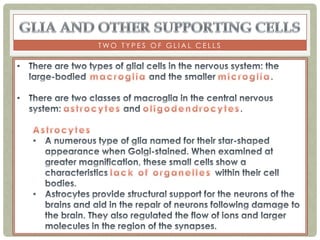
TWO TYPES OF GLIAL CELLS
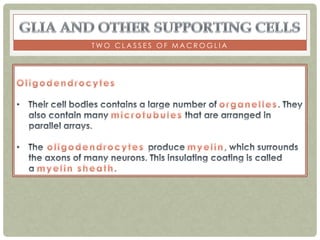
TWO CLASSES OF MACROGLIA
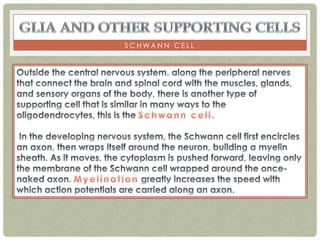
SCHWANN CELL
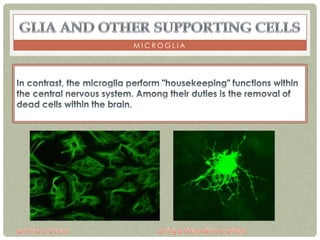
MICROGLIA
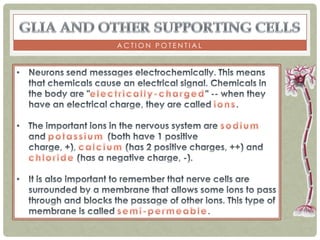
ACTION POTENTIAL
ACTION POTENTIAL
ACTION POTENTIAL
ACTION POTENTIAL
ACTION POTENTIAL
ACTION POTENTIAL
ACTION POTENTIAL
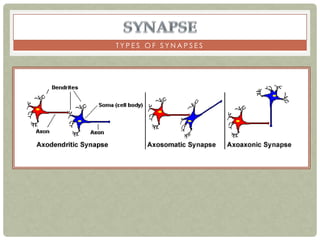
TYPES OF SYNAPSES
http://library.thinkquest.org/2935/Natures_Best/Nat_Best_Low_Level/Nervous_page.L.html

http://www.biology-online.org/8/1_nervous_system.htm

http://webschoolsolutions.com/patts/systems/nervous.htm

http://www.innerbody.com/image/nerv06.html

http://learn.genetics.utah.edu/content/addiction/reward/

http://faculty.washington.edu/chudler/ap.html

http://www.albany.edu/faculty/cafrye/apsy601/Ch.02cellsofthenervoussystem.html

http://www.biologymad.com/nervoussystem/nervoussystemintro.htm

http://psychology.about.com/od/biopsychology/ss/neuronanat.htm

http://webspace.ship.edu/cgboer/actionpot.html

http://webspace.ship.edu/cgboer/theneuron.html

http://www.mind.ilstu.edu/curriculum/neurons_intro/neurons_intro.php
CELLS IN THE NERVOUS SYSTEM

The nervous system

Editor's Notes

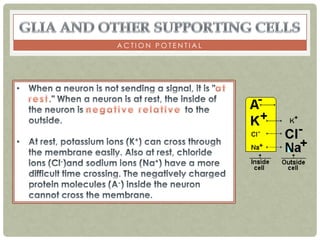
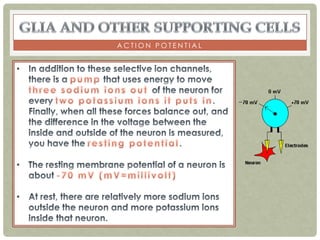
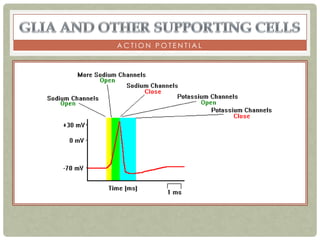
  • #29 When a neuron is not sending a signal, it is "at rest." When a neuron is at rest, the inside of the neuron is negative relative to the outside. Although the concentrations of the different ions attempt to balance out on both sides of the membrane, they cannot because the cell membrane allows only some ions to pass through channels (ion channels).
  • #30 The resting membrane potential of a neuron is about -70 mV (mV=millivolt) - this means that the inside of the neuron is 70 mV less than the outside.
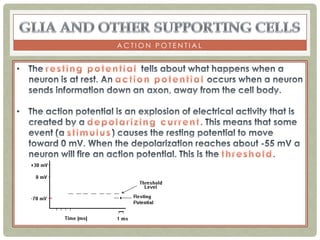
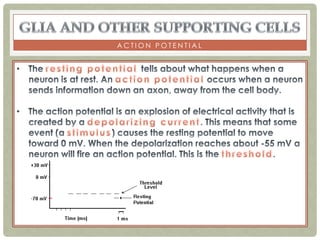
  • #31 The resting potential tells about what happens when a neuron is at rest. An action potential occurs when a neuron sends information down an axon, away from the cell body. Neuroscientists use other words, such as a "spike" or an "impulse" for the action potential.
  • #32 The resting potential tells about what happens when a neuron is at rest. An action potential occurs when a neuron sends information down an axon, away from the cell body. Neuroscientists use other words, such as a "spike" or an "impulse" for the action potential. If the neuron does not reach this critical threshold level, then no action potential will fire. Also, when the threshold level is reached, an action potential of a fixed sized will always fire...for any given neuron, the size of the action potential is always the same. There are no big or small action potentials in one nerve cell - all action potentials are the same size. Therefore, the neuron either does not reach the threshold or a full action potential is fired - this is the "ALL OR NONE" principle.
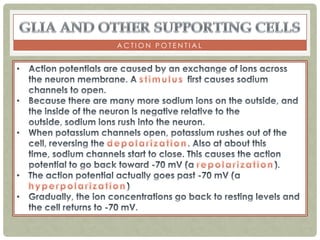
  • #33 Because there are many more sodium ions on the outside, and the inside of the neuron is negative relative to the outside, sodium ions rush into the neuron. Remember, sodium has a positive charge, so the neuron becomes more positive and becomes depolarized.The action potential actually goes past -70 mV (a hyperpolarization) because the potassium channels stay open a bit too long.
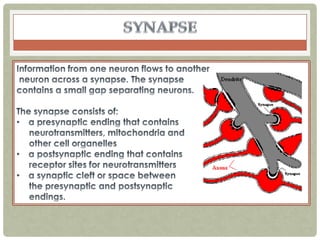
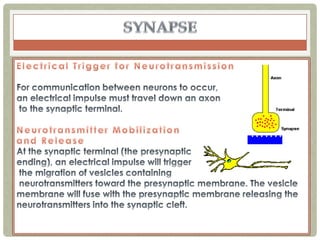
  • #36 The vesicle membrane will fuse with the presynaptic membrane releasing the neurotransmitters into the synaptic cleft. Until recently, it was thought that a neuron produced and released only one type of neurotransmitter. This was called "Dale's Law." However, there is now evidence that neurons can contain and release more than one kind of neurotransmitter.
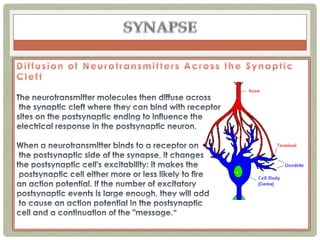
  • #37 Diffusion of Neurotransmitters Across the Synaptic CleftThe neurotransmitter molecules then diffuse across the synaptic cleft where they can bind with receptor sites on the postsynaptic ending to influence the electrical response in the postsynaptic neuron. In the figure on the right, the postsynaptic ending is a dendrite (axodendritic synapse), but synapses can occur on axons (axoaxonic synapse) and cell bodies (axosomatic synapse).When a neurotransmitter binds to a receptor on the postsynaptic side of the synapse, it changes the postsynaptic cell's excitability: it makes the postsynaptic cell either more or less likely to fire an action potential. If the number of excitatory postsynaptic events is large enough, they will add to cause an action potential in the postsynaptic cell and a continuation of the "message."
  • #38 Diffusion of Neurotransmitters Across the Synaptic CleftThe neurotransmitter molecules then diffuse across the synaptic cleft where they can bind with receptor sites on the postsynaptic ending to influence the electrical response in the postsynaptic neuron. In the figure on the right, the postsynaptic ending is a dendrite (axodendritic synapse), but synapses can occur on axons (axoaxonic synapse) and cell bodies (axosomatic synapse).When a neurotransmitter binds to a receptor on the postsynaptic side of the synapse, it changes the postsynaptic cell's excitability: it makes the postsynaptic cell either more or less likely to fire an action potential. If the number of excitatory postsynaptic events is large enough, they will add to cause an action potential in the postsynaptic cell and a continuation of the "message."
  • #39 Diffusion of Neurotransmitters Across the Synaptic CleftThe neurotransmitter molecules then diffuse across the synaptic cleft where they can bind with receptor sites on the postsynaptic ending to influence the electrical response in the postsynaptic neuron. In the figure on the right, the postsynaptic ending is a dendrite (axodendritic synapse), but synapses can occur on axons (axoaxonic synapse) and cell bodies (axosomatic synapse).When a neurotransmitter binds to a receptor on the postsynaptic side of the synapse, it changes the postsynaptic cell's excitability: it makes the postsynaptic cell either more or less likely to fire an action potential. If the number of excitatory postsynaptic events is large enough, they will add to cause an action potential in the postsynaptic cell and a continuation of the "message."