The Nervous System
Unit 4
Structures of the Nervous
System
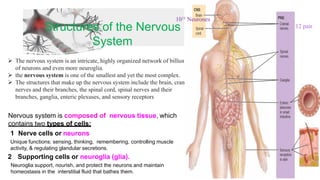
➢ The nervous system is an intricate, highly organized network of billions
of neurons and even more neuroglia.
➢ the nervous system is one of the smallest and yet the most complex.
➢ The structures that make up the nervous system include the brain, cranial
nerves and their branches, the spinal cord, spinal nerves and their
branches, ganglia, enteric plexuses, and sensory receptors
1011 Neurones
12 pair
Nervous system is composed of nervous tissue, which
contains two types of cells:
1 Nerve cells or neurons
Unique functions: sensing, thinking, remembering, controlling muscle
activity, & regulating glandular secretions.
2 Supporting cells or neuroglia (glia).
Neuroglia support, nourish, and protect the neurons and maintain
homeostasis in the interstitial fluid that bathes them.
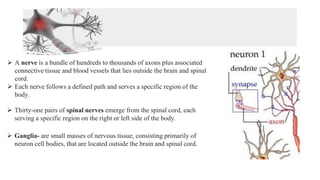
➢ A nerve is a bundle of hundreds to thousands of axons plus associated
connective tissue and blood vessels that lies outside the brain and spinal
cord.
➢ Each nerve follows a defined path and serves a specific region of the
body.
➢ Thirty-one pairs of spinal nerves emerge from the spinal cord, each
serving a specific region on the right or left side of the body.
➢ Ganglia- are small masses of nervous tissue, consisting primarily of
neuron cell bodies, that are located outside the brain and spinal cord.
Nervous System: Consists of all the nerve cells. It is the body’s speedy, electrochemical communication
system.
❖ Sensory function : detect internal and external stimuli,
The major controlling, regulatory & communicating system in the body.
❖ Integrative function
The centre of all mental activity including: Thought, Learning, Behaviour & Memory.
❖ Motor function
Stimulation of the effectors causes muscles to contract and glands to secrete
❖ Together with the endocrine system, the nervous system is responsible for regulating and
maintaining homeostasis.
.
Central Nervous System (CNS): the brain and spinal cord.
Peripheral Nervous System (PNS): the sensory and motor neurons that connect the CNS to the
rest of the body.
Parts of a Neuron
• Cell Body
– perikaryon or soma
– Largest part; contains nucleus and most of cytoplasm and organelles
– contain free ribosomes and prominent clusters of rough endoplasmic reticulum, termed Nissl
bodies
– Most metabolic activities occur here
– The cytoskeleton includes both neurofibrils, composed of bundles of intermediate filaments
that provide the cell shape and support, and microtubules, which assist in moving materials
between the cell body and axon.
– lipofuscin, a pigment that occurs as clumps of yellowish brown granules in the cytoplasm
– Lipofuscin is a product of neuronal lysosomes that accumulates as the neuron ages, but does not
seem to harm the neuron.
• Dendrites
– Short, branched extensions
– Carry impulses from environment or other neuron toward cell
body, are the receiving or input portions of a neuron.
– Neurons can have several dendrite
Cell body
Dendrites
A nerve fiber is a general term for any neuronal process (extension)
that emerges from the cell body of a neuron.
- Dendrites & Axon Axon
• Axon
– Long fiber which carries impulses away from cell body
– propagates nerve impulses toward another neuron
– Ends in axon terminals, located a distance away from
cell body
– Neurons only have one axon
– cone-shaped elevation called the axon hillock
– trigger zone: junction of the axon hillock and the initial
segment
– cytoplasm of an axon, called axoplasm: Mitochondria
present, ER absent
– plasma membrane known as the axolemma
Axon
Axon
Hillock
Axon
Collaterals
Axolemma
Axoplasm
axon terminals (telodendria)
Synaptic end Bulb
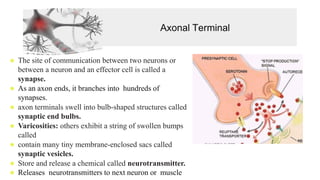
Axonal Terminal
⚫ The site of communication between two neurons or
between a neuron and an effector cell is called a
synapse.
⚫ As an axon ends, it branches into hundreds of
synapses.
⚫ axon terminals swell into bulb-shaped structures called
synaptic end bulbs.
⚫ Varicosities: others exhibit a string of swollen bumps
called
⚫ contain many tiny membrane-enclosed sacs called
synaptic vesicles.
⚫ Store and release a chemical called neurotransmitter.
⚫ Releases neurotransmitters to next neuron or muscle
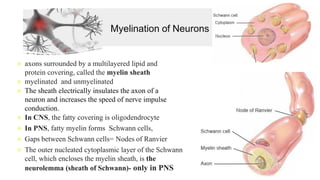
Myelination of Neurons
❖ axons surrounded by a multilayered lipid and
protein covering, called the myelin sheath
❖ myelinated and unmyelinated
❖ The sheath electrically insulates the axon of a
neuron and increases the speed of nerve impulse
conduction.
❖ In CNS, the fatty covering is oligodendrocyte
❖ In PNS, fatty myelin forms Schwann cells,
❖ Gaps between Schwann cells= Nodes of Ranvier
❖ The outer nucleated cytoplasmic layer of the Schwann
cell, which encloses the myelin sheath, is the
neurolemma (sheath of Schwann)- only in PNS
FUNCTIONAL CLASSIFICATION
❖ Sensory or afferent neurons:
❖ contain sensory receptors at their distal ends
❖ Carry impulses from sense organs (eyes, ears, etc) to the spinal cord and
brain.
❖ Most sensory neurons are unipolar in structure
❖ Motor or efferent neurons:
❖ convey action potentials away from the CNS to effectors [to muscles and
glands.]
❖ Most motor neurons are multipolar in structure
❖ Interneurons or association neurons:
❖ connect sensory and motor neurons and carry impulses between them.
❖ Most interneurons are multipolar in structure
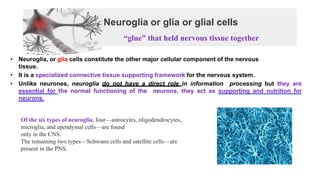
Neuroglia or glia or glial cells
• Neuroglia, or glia cells constitute the other major cellular component of the nervous
tissue.
• It is a specialized connective tissue supporting framework for the nervous system.
• Unlike neurones, neuroglia do not have a direct role in information processing but they are
essential for the normal functioning of the neurons, they act as supporting and nutrition for
neurons.
“glue” that held nervous tissue together
Of the six types of neuroglia, four—astrocytes, oligodendrocytes,
microglia, and ependymal cells—are found
only in the CNS.
The remaining two types—Schwann cells and satellite cells—are
present in the PNS.
Neuroglia of the CNS
1. Astrocytes
1) Astrocytes – anchor neurons to capillaries. Star shaped cells, largest & most
numerous of the neuroglia.
Protoplasmic astrocytes have many short branching processes & are found in gray matter.
Fibrous astrocytes have many long unbranched processes and are located mainly in white
matter.
Functions:
(1)Contain microfilaments that give them considerable strength, which enables them to
support neurons.
(2)Processes of astrocytes wrapped around blood capillaries isolate neurons of the CNS
from various potentially harmful substances. [BBB]
(3)In the embryo, astrocytes secrete chemicals that appear to regulate the growth,
migration, and interconnection among neurons in the brain.
(4)help to maintain the appropriate chemical environment for the generation of nerve
impulses.
(5)Play a role in learning and memory by influencing the formation of neural synapses
Neuroglia of the CNS
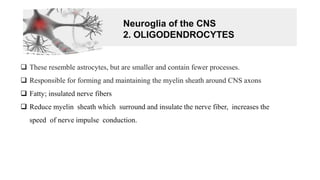
2. OLIGODENDROCYTES
❑ These resemble astrocytes, but are smaller and contain fewer processes.
❑ Responsible for forming and maintaining the myelin sheath around CNS axons
❑ Fatty; insulated nerve fibers
❑ Reduce myelin sheath which surround and insulate the nerve fiber, increases the
speed of nerve impulse conduction.
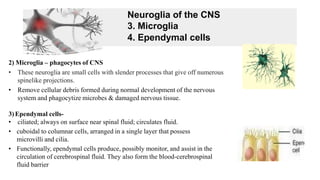
2) Microglia – phagocytes of CNS
• These neuroglia are small cells with slender processes that give off numerous
spinelike projections.
• Remove cellular debris formed during normal development of the nervous
system and phagocytize microbes & damaged nervous tissue.
3)Ependymal cells-
• ciliated; always on surface near spinal fluid; circulates fluid.
• cuboidal to columnar cells, arranged in a single layer that possess
microvilli and cilia.
• Functionally, ependymal cells produce, possibly monitor, and assist in the
circulation of cerebrospinal fluid. They also form the blood-cerebrospinal
fluid barrier
Neuroglia of the CNS
3. Microglia
4. Ependymal cells
Neuroglia of the PNS
SCHWANN CELLS:
• encircle PNS axons.
• Each Schwann cell myelinates
a single axon
• A single Schwann cell can also
enclose as many as 20 or more
unmyelinated axons
• axon regeneration
SATELLITE CELLS
• These flat cells surround the cell
bodies of neurons of PNS
• Besides providing structural support,
satellite cells regulate the exchanges
of materials between neuronal cell bodies
and interstitial fluid.
Neuroglia of the PNS
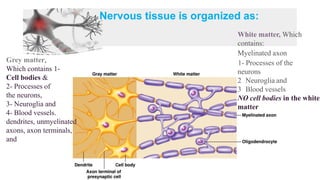
Nervous tissue is organized as:
Grey matter,
Which contains 1-
Cell bodies &
2- Processes of
the neurons,
3- Neuroglia and
4- Blood vessels.
dendrites, unmyelinated
axons, axon terminals,
and
White matter, Which
contains:
Myelinated axon
1- Processes of the
neurons
2 Neuroglia and
3 Blood vessels
NO cell bodies in the white
matter
ORGANIZATION OF
THE NERVOUS
SYSTEM
CNS
Brain Spinal Cord
PNS
Somatic Nervous
System [SNS] Autonomic Nervous
System [ANS]
Enteric Nervous
System [ENS]
It is also the source of thoughts,
emotions, and memories
Muscle contraction & Gland
Secretion
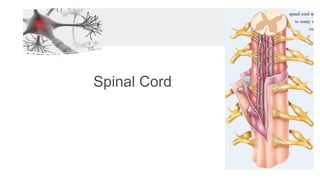
Spinal Cord
External Anatomy of the Spinal Cord
• Roughly cylindrical, is flattened slightly
anteriorly and posteriorly.
• It extends from the medulla oblongata, the
inferior part of the brain, to the superior border
of the second lumbar vertebra.
• Elongation of the spinal cord stops around age
4 or 5, but growth of the vertebral column
continues.
• Length: 42 to 45 cm
• D: 2cm
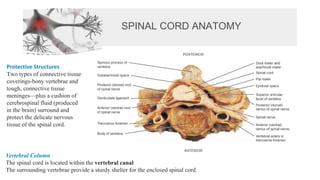
SPINAL CORD ANATOMY
Protective Structures
Two types of connective tissue
coverings-bony vertebrae and
tough, connective tissue
meninges—plus a cushion of
cerebrospinal fluid (produced
in the brain) surround and
protect the delicate nervous
tissue of the spinal cord.
Vertebral Column
The spinal cord is located within the vertebral canal
The surrounding vertebrae provide a sturdy shelter for the enclosed spinal cord.
Meninge
• The spinal meninges surround the spinal cord.
• the dura mater: is composed of dense, irregular connective tissue
• The spinal cord is also protected by a cushion of fat and
connective tissue located in the epidural space –[a space between
the dura mater and the wall of the vertebral canal ]
• The innermost meninx is the pia mater: a thin transparent
connective tissue layer that adheres to the surface of the spinal cord
and brain
• Within the pia mater are many blood vessels
Subarachnoid: Contains CSF and blood vessels
within web-like strands of arachnoid tissue
Subdural: Contains serous fluid
Space
Epidural: Contains blood
vessels, connective tissue
and fat.
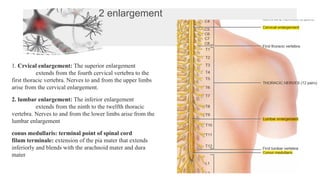
2 enlargement
1. Crvical enlargement: The superior enlargement
extends from the fourth cervical vertebra to the
first thoracic vertebra. Nerves to and from the upper limbs
arise from the cervical enlargement.
2. lumbar enlargement: The inferior enlargement
extends from the ninth to the twelfth thoracic
vertebra. Nerves to and from the lower limbs arise from the
lumbar enlargement
conus medullaris: terminal point of spinal cord
filum terminale: extension of the pia mater that extends
inferiorly and blends with the arachnoid mater and dura
mater
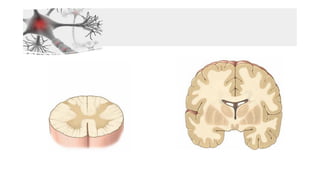
CROSS SECTION OF SPINAL CORD
[Internal Anatomy]
❑ Divided into two equal parts, anteriorly by a short,
shallow median fissure and posteriorly by a deep
narrow septum, the posterior median sulcus.
❑ Composed of grey matter in the center surrounded
by white matter supported by neuroglia.
❑ Commissures: connections between left and right
halves
❑ central canal: In the center of the gray commissure
is a small space called the central canal
GREY MATTER
❑ Having Horn:
▪ two posterior: contain cell bodies and axons of
interneurons as well as axons of incoming sensory
neurons
▪ two anterior: contain somatic motor nuclei
▪ two lateral horns/columns: contain autonomic
motor nuclei
▪ which are present only in thoracic and upper
lumbar segments of the spinal cord
❑ Consists of:
▪ nerve cell bodies and their processes
▪ neuroglia
▪ blood vessels
shaped like the letter H or a butterfly
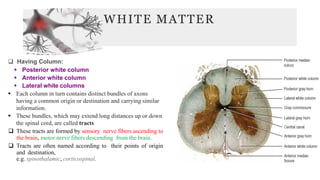
WHITE MATTER
Depending on their function,
the spinal tracts are divided
into ascending and
descending tracts
❑ Having Column:
▪ Posterior white column
▪ Anterior white column
▪ Lateral white columns
▪ Each column in turn contains distinct bundles of axons
having a common origin or destination and carrying similar
information.
▪ These bundles, which may extend long distances up or down
the spinal cord, are called tracts
❑ These tracts are formed by sensory nerve fibers ascending to
the brain, motor nerve fibers descending from the brain.
❑ Tracts are often named according to their points of origin
and destination,
e.g. spinothalamic, corticospinal.
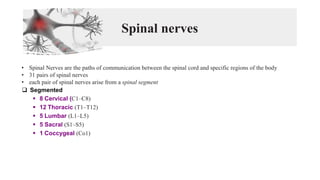
Spinal nerves
• Spinal Nerves are the paths of communication between the spinal cord and specific regions of the body
• 31 pairs of spinal nerves
• each pair of spinal nerves arise from a spinal segment
❑ Segmented
▪ 8 Cervical (C1–C8)
▪ 12 Thoracic (T1–T12)
▪ 5 Lumbar (L1–L5)
▪ 5 Sacral (S1–S5)
▪ 1 Coccygeal (Co1)
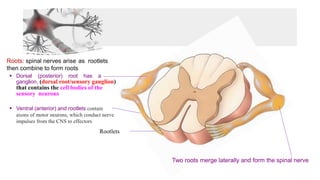
Roots: spinal nerves arise as rootlets
then combine to form roots
▪ Dorsal (posterior) root has a
ganglion, (dorsal root/sensory ganglion)
that contains the cell bodies of the
sensory neurons
▪ Ventral (anterior) and rootlets contain
axons of motor neurons, which conduct nerve
impulses from the CNS to effectors
Two roots merge laterally and form the spinal nerve
Rootlets
Connective Tissue Coverings of Spinal Nerves
Individual axons within a nerve, whether myelinated or unmyelinated, are wrapped in endoneurium [the innermost
layer].
Arranged in bundles called fascicles, each of which is
wrapped in perineurium
The outermost covering
over the entire nerve is
the epineurium
BRANCHES OF SPINAL NERVES
❑ Dorsal Ramus: innervate deep muscles of the trunk responsible for movements of the vertebral column
and skin near the midline of the back.
❑ Ventral Ramus: serves the muscles and structures of the upper and lower limbs and the skin of the lateral and
anterior
❑ Plaxuses
▪ Remaining spinal nerve[T2-T12] ventral rami (roots of the plexus): they form networks on both the left and
right sides of the body by joining with various numbers of axons from anterior rami of adjacent nerves. Such a
network of axons is called a plexus
o Ventral rami of C1-C4= cervical plexus
o Ventral rami of C5-T1= brachial plexus
o Ventral rami of L1-L5= lumbar plexus
o Ventral rami of L4-S4= sacral plexus
o Ventral rami of S4 & S5= coccygeal plexus
o Communicating Rami: communicate with sympathetic chain of ganglia.
Intercostal Nerves
▪ Thoracic region: form intercostal nerves that innervate the intercostal muscles and
the skin over the thorax –directly enter to body structure
SPINAL CORD
PHYSIOLOGY
• nerve impulse propagation and integration of information.
• The white matter tracts in the spinal cord are highways for nerve impulse propagation.
• The gray matter of the spinal cord receives and integrates incoming and outgoing
information.
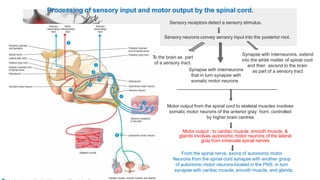
Processing of sensory input and motor output by the spinal cord.
Sensory receptors detect a sensory stimulus.
Sensory neurons convey sensory input into the posterior root.
Synapse with interneurons, extend
into the white matter of spinal cord
and then ascend to the brain
as part of a sensory tract
Motor output from the spinal cord to skeletal muscles involves
somatic motor neurons of the anterior gray horn, controlled
by higher brain centres
Motor output : to cardiac muscle, smooth muscle, &
glands involves autonomic motor neurons of the lateral
gray horn innervate spinal nerves
From the spinal nerve, axons of autonomic motor
Neurons from the spinal cord synapse with another group
of autonomic motor neurons located in the PNS. in turn
synapse with cardiac muscle, smooth muscle, and glands.
Synapse with interneurons
that in turn synapse with
somatic motor neurons
T
o the brain as part
of a sensory tract.
REFLEX & REFLEX ARC
Reflex: A fast autonomic, unplanned sequence of
action, occur in response to a sensory stimulus
When integration
takes place in the
spinal cord gray
matter, the reflex is a
spinal reflex
A neural pathway mediating the reflex actions is called reflex arc.
If integration occurs
in the brain stem
rather than the
spinal cord, the
reflex is called a
cranial reflex.
somatic reflexes
autonomic (visceral) reflexes
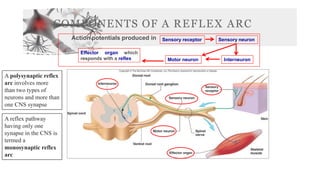
COMPONENTS OF A REFLEX ARC
Sensory receptor Sensory neuron
Interneuron
Motor neuron
Action potentials produced in
Effector organ which
responds with a reflex
A reflex pathway
having only one
synapse in the CNS is
termed a
monosynaptic reflex
arc
A polysynaptic reflex
arc involves more
than two types of
neurons and more than
one CNS synapse
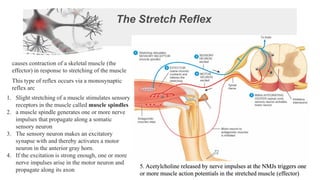
The Stretch Reflex
causes contraction of a skeletal muscle (the
effector) in response to stretching of the muscle
This type of reflex occurs via a monosynaptic
reflex arc
1. Slight stretching of a muscle stimulates sensory
receptors in the muscle called muscle spindles
2. a muscle spindle generates one or more nerve
impulses that propagate along a somatic
sensory neuron
3. The sensory neuron makes an excitatory
synapse with and thereby activates a motor
neuron in the anterior gray horn.
4. If the excitation is strong enough, one or more
nerve impulses arise in the motor neuron and
propagate along its axon
5. Acetylcholine released by nerve impulses at the NMJs triggers one
or more muscle action potentials in the stretched muscle (effector)
Features of stretch reflex arc
sensory nerve impulses enter the spinal cord on the same side from which motor nerve impulses
leave it.
This arrangement is called an ipsilateral reflex
All monosynaptic reflexes are ipsilateral.
When the stretched muscle contracts during a stretch reflex, antagonistic muscles that oppose the
contraction relax. This type of arrangement, in which the components of a neural circuit
simultaneously cause contraction of one muscle and relaxation of its antagonists, is termed
reciprocal innervation.
• The stretch reflex can also help maintain posture.
• Reciprocal innervation prevents conflict between opposing muscles and is vital in coordinating body
movements.

U4-Neurone System.pdf

  • 1.
  • 2.
    Structures of theNervous System ➢ The nervous system is an intricate, highly organized network of billions of neurons and even more neuroglia. ➢ the nervous system is one of the smallest and yet the most complex. ➢ The structures that make up the nervous system include the brain, cranial nerves and their branches, the spinal cord, spinal nerves and their branches, ganglia, enteric plexuses, and sensory receptors 1011 Neurones 12 pair Nervous system is composed of nervous tissue, which contains two types of cells: 1 Nerve cells or neurons Unique functions: sensing, thinking, remembering, controlling muscle activity, & regulating glandular secretions. 2 Supporting cells or neuroglia (glia). Neuroglia support, nourish, and protect the neurons and maintain homeostasis in the interstitial fluid that bathes them.
  • 3.
    ➢ A nerveis a bundle of hundreds to thousands of axons plus associated connective tissue and blood vessels that lies outside the brain and spinal cord. ➢ Each nerve follows a defined path and serves a specific region of the body. ➢ Thirty-one pairs of spinal nerves emerge from the spinal cord, each serving a specific region on the right or left side of the body. ➢ Ganglia- are small masses of nervous tissue, consisting primarily of neuron cell bodies, that are located outside the brain and spinal cord.
  • 4.
    Nervous System: Consistsof all the nerve cells. It is the body’s speedy, electrochemical communication system. ❖ Sensory function : detect internal and external stimuli, The major controlling, regulatory & communicating system in the body. ❖ Integrative function The centre of all mental activity including: Thought, Learning, Behaviour & Memory. ❖ Motor function Stimulation of the effectors causes muscles to contract and glands to secrete ❖ Together with the endocrine system, the nervous system is responsible for regulating and maintaining homeostasis. . Central Nervous System (CNS): the brain and spinal cord. Peripheral Nervous System (PNS): the sensory and motor neurons that connect the CNS to the rest of the body.
  • 5.
    Parts of aNeuron • Cell Body – perikaryon or soma – Largest part; contains nucleus and most of cytoplasm and organelles – contain free ribosomes and prominent clusters of rough endoplasmic reticulum, termed Nissl bodies – Most metabolic activities occur here – The cytoskeleton includes both neurofibrils, composed of bundles of intermediate filaments that provide the cell shape and support, and microtubules, which assist in moving materials between the cell body and axon. – lipofuscin, a pigment that occurs as clumps of yellowish brown granules in the cytoplasm – Lipofuscin is a product of neuronal lysosomes that accumulates as the neuron ages, but does not seem to harm the neuron.
  • 6.
    • Dendrites – Short,branched extensions – Carry impulses from environment or other neuron toward cell body, are the receiving or input portions of a neuron. – Neurons can have several dendrite Cell body Dendrites A nerve fiber is a general term for any neuronal process (extension) that emerges from the cell body of a neuron. - Dendrites & Axon Axon
  • 7.
    • Axon – Longfiber which carries impulses away from cell body – propagates nerve impulses toward another neuron – Ends in axon terminals, located a distance away from cell body – Neurons only have one axon – cone-shaped elevation called the axon hillock – trigger zone: junction of the axon hillock and the initial segment – cytoplasm of an axon, called axoplasm: Mitochondria present, ER absent – plasma membrane known as the axolemma Axon Axon Hillock Axon Collaterals Axolemma Axoplasm axon terminals (telodendria) Synaptic end Bulb
  • 8.
    Axonal Terminal ⚫ Thesite of communication between two neurons or between a neuron and an effector cell is called a synapse. ⚫ As an axon ends, it branches into hundreds of synapses. ⚫ axon terminals swell into bulb-shaped structures called synaptic end bulbs. ⚫ Varicosities: others exhibit a string of swollen bumps called ⚫ contain many tiny membrane-enclosed sacs called synaptic vesicles. ⚫ Store and release a chemical called neurotransmitter. ⚫ Releases neurotransmitters to next neuron or muscle
  • 9.
    Myelination of Neurons ❖axons surrounded by a multilayered lipid and protein covering, called the myelin sheath ❖ myelinated and unmyelinated ❖ The sheath electrically insulates the axon of a neuron and increases the speed of nerve impulse conduction. ❖ In CNS, the fatty covering is oligodendrocyte ❖ In PNS, fatty myelin forms Schwann cells, ❖ Gaps between Schwann cells= Nodes of Ranvier ❖ The outer nucleated cytoplasmic layer of the Schwann cell, which encloses the myelin sheath, is the neurolemma (sheath of Schwann)- only in PNS
  • 10.
    FUNCTIONAL CLASSIFICATION ❖ Sensoryor afferent neurons: ❖ contain sensory receptors at their distal ends ❖ Carry impulses from sense organs (eyes, ears, etc) to the spinal cord and brain. ❖ Most sensory neurons are unipolar in structure ❖ Motor or efferent neurons: ❖ convey action potentials away from the CNS to effectors [to muscles and glands.] ❖ Most motor neurons are multipolar in structure ❖ Interneurons or association neurons: ❖ connect sensory and motor neurons and carry impulses between them. ❖ Most interneurons are multipolar in structure
  • 11.
    Neuroglia or gliaor glial cells • Neuroglia, or glia cells constitute the other major cellular component of the nervous tissue. • It is a specialized connective tissue supporting framework for the nervous system. • Unlike neurones, neuroglia do not have a direct role in information processing but they are essential for the normal functioning of the neurons, they act as supporting and nutrition for neurons. “glue” that held nervous tissue together Of the six types of neuroglia, four—astrocytes, oligodendrocytes, microglia, and ependymal cells—are found only in the CNS. The remaining two types—Schwann cells and satellite cells—are present in the PNS.
  • 12.
    Neuroglia of theCNS 1. Astrocytes 1) Astrocytes – anchor neurons to capillaries. Star shaped cells, largest & most numerous of the neuroglia. Protoplasmic astrocytes have many short branching processes & are found in gray matter. Fibrous astrocytes have many long unbranched processes and are located mainly in white matter. Functions: (1)Contain microfilaments that give them considerable strength, which enables them to support neurons. (2)Processes of astrocytes wrapped around blood capillaries isolate neurons of the CNS from various potentially harmful substances. [BBB] (3)In the embryo, astrocytes secrete chemicals that appear to regulate the growth, migration, and interconnection among neurons in the brain. (4)help to maintain the appropriate chemical environment for the generation of nerve impulses. (5)Play a role in learning and memory by influencing the formation of neural synapses
  • 13.
    Neuroglia of theCNS 2. OLIGODENDROCYTES ❑ These resemble astrocytes, but are smaller and contain fewer processes. ❑ Responsible for forming and maintaining the myelin sheath around CNS axons ❑ Fatty; insulated nerve fibers ❑ Reduce myelin sheath which surround and insulate the nerve fiber, increases the speed of nerve impulse conduction.
  • 14.
    2) Microglia –phagocytes of CNS • These neuroglia are small cells with slender processes that give off numerous spinelike projections. • Remove cellular debris formed during normal development of the nervous system and phagocytize microbes & damaged nervous tissue. 3)Ependymal cells- • ciliated; always on surface near spinal fluid; circulates fluid. • cuboidal to columnar cells, arranged in a single layer that possess microvilli and cilia. • Functionally, ependymal cells produce, possibly monitor, and assist in the circulation of cerebrospinal fluid. They also form the blood-cerebrospinal fluid barrier Neuroglia of the CNS 3. Microglia 4. Ependymal cells
  • 15.
    Neuroglia of thePNS SCHWANN CELLS: • encircle PNS axons. • Each Schwann cell myelinates a single axon • A single Schwann cell can also enclose as many as 20 or more unmyelinated axons • axon regeneration
  • 16.
    SATELLITE CELLS • Theseflat cells surround the cell bodies of neurons of PNS • Besides providing structural support, satellite cells regulate the exchanges of materials between neuronal cell bodies and interstitial fluid. Neuroglia of the PNS
  • 17.
    Nervous tissue isorganized as: Grey matter, Which contains 1- Cell bodies & 2- Processes of the neurons, 3- Neuroglia and 4- Blood vessels. dendrites, unmyelinated axons, axon terminals, and White matter, Which contains: Myelinated axon 1- Processes of the neurons 2 Neuroglia and 3 Blood vessels NO cell bodies in the white matter
  • 19.
    ORGANIZATION OF THE NERVOUS SYSTEM CNS BrainSpinal Cord PNS Somatic Nervous System [SNS] Autonomic Nervous System [ANS] Enteric Nervous System [ENS] It is also the source of thoughts, emotions, and memories Muscle contraction & Gland Secretion
  • 20.
  • 21.
    External Anatomy ofthe Spinal Cord • Roughly cylindrical, is flattened slightly anteriorly and posteriorly. • It extends from the medulla oblongata, the inferior part of the brain, to the superior border of the second lumbar vertebra. • Elongation of the spinal cord stops around age 4 or 5, but growth of the vertebral column continues. • Length: 42 to 45 cm • D: 2cm
  • 22.
    SPINAL CORD ANATOMY ProtectiveStructures Two types of connective tissue coverings-bony vertebrae and tough, connective tissue meninges—plus a cushion of cerebrospinal fluid (produced in the brain) surround and protect the delicate nervous tissue of the spinal cord. Vertebral Column The spinal cord is located within the vertebral canal The surrounding vertebrae provide a sturdy shelter for the enclosed spinal cord.
  • 23.
    Meninge • The spinalmeninges surround the spinal cord. • the dura mater: is composed of dense, irregular connective tissue • The spinal cord is also protected by a cushion of fat and connective tissue located in the epidural space –[a space between the dura mater and the wall of the vertebral canal ] • The innermost meninx is the pia mater: a thin transparent connective tissue layer that adheres to the surface of the spinal cord and brain • Within the pia mater are many blood vessels
  • 24.
    Subarachnoid: Contains CSFand blood vessels within web-like strands of arachnoid tissue Subdural: Contains serous fluid Space Epidural: Contains blood vessels, connective tissue and fat.
  • 25.
    2 enlargement 1. Crvicalenlargement: The superior enlargement extends from the fourth cervical vertebra to the first thoracic vertebra. Nerves to and from the upper limbs arise from the cervical enlargement. 2. lumbar enlargement: The inferior enlargement extends from the ninth to the twelfth thoracic vertebra. Nerves to and from the lower limbs arise from the lumbar enlargement conus medullaris: terminal point of spinal cord filum terminale: extension of the pia mater that extends inferiorly and blends with the arachnoid mater and dura mater
  • 26.
    CROSS SECTION OFSPINAL CORD [Internal Anatomy] ❑ Divided into two equal parts, anteriorly by a short, shallow median fissure and posteriorly by a deep narrow septum, the posterior median sulcus. ❑ Composed of grey matter in the center surrounded by white matter supported by neuroglia. ❑ Commissures: connections between left and right halves ❑ central canal: In the center of the gray commissure is a small space called the central canal
  • 27.
    GREY MATTER ❑ HavingHorn: ▪ two posterior: contain cell bodies and axons of interneurons as well as axons of incoming sensory neurons ▪ two anterior: contain somatic motor nuclei ▪ two lateral horns/columns: contain autonomic motor nuclei ▪ which are present only in thoracic and upper lumbar segments of the spinal cord ❑ Consists of: ▪ nerve cell bodies and their processes ▪ neuroglia ▪ blood vessels shaped like the letter H or a butterfly
  • 28.
    WHITE MATTER Depending ontheir function, the spinal tracts are divided into ascending and descending tracts ❑ Having Column: ▪ Posterior white column ▪ Anterior white column ▪ Lateral white columns ▪ Each column in turn contains distinct bundles of axons having a common origin or destination and carrying similar information. ▪ These bundles, which may extend long distances up or down the spinal cord, are called tracts ❑ These tracts are formed by sensory nerve fibers ascending to the brain, motor nerve fibers descending from the brain. ❑ Tracts are often named according to their points of origin and destination, e.g. spinothalamic, corticospinal.
  • 29.
    Spinal nerves • SpinalNerves are the paths of communication between the spinal cord and specific regions of the body • 31 pairs of spinal nerves • each pair of spinal nerves arise from a spinal segment ❑ Segmented ▪ 8 Cervical (C1–C8) ▪ 12 Thoracic (T1–T12) ▪ 5 Lumbar (L1–L5) ▪ 5 Sacral (S1–S5) ▪ 1 Coccygeal (Co1)
  • 30.
    Roots: spinal nervesarise as rootlets then combine to form roots ▪ Dorsal (posterior) root has a ganglion, (dorsal root/sensory ganglion) that contains the cell bodies of the sensory neurons ▪ Ventral (anterior) and rootlets contain axons of motor neurons, which conduct nerve impulses from the CNS to effectors Two roots merge laterally and form the spinal nerve Rootlets
  • 31.
    Connective Tissue Coveringsof Spinal Nerves Individual axons within a nerve, whether myelinated or unmyelinated, are wrapped in endoneurium [the innermost layer]. Arranged in bundles called fascicles, each of which is wrapped in perineurium The outermost covering over the entire nerve is the epineurium
  • 32.
    BRANCHES OF SPINALNERVES ❑ Dorsal Ramus: innervate deep muscles of the trunk responsible for movements of the vertebral column and skin near the midline of the back. ❑ Ventral Ramus: serves the muscles and structures of the upper and lower limbs and the skin of the lateral and anterior ❑ Plaxuses ▪ Remaining spinal nerve[T2-T12] ventral rami (roots of the plexus): they form networks on both the left and right sides of the body by joining with various numbers of axons from anterior rami of adjacent nerves. Such a network of axons is called a plexus o Ventral rami of C1-C4= cervical plexus o Ventral rami of C5-T1= brachial plexus o Ventral rami of L1-L5= lumbar plexus o Ventral rami of L4-S4= sacral plexus o Ventral rami of S4 & S5= coccygeal plexus o Communicating Rami: communicate with sympathetic chain of ganglia.
  • 33.
    Intercostal Nerves ▪ Thoracicregion: form intercostal nerves that innervate the intercostal muscles and the skin over the thorax –directly enter to body structure
  • 34.
    SPINAL CORD PHYSIOLOGY • nerveimpulse propagation and integration of information. • The white matter tracts in the spinal cord are highways for nerve impulse propagation. • The gray matter of the spinal cord receives and integrates incoming and outgoing information.
  • 35.
    Processing of sensoryinput and motor output by the spinal cord. Sensory receptors detect a sensory stimulus. Sensory neurons convey sensory input into the posterior root. Synapse with interneurons, extend into the white matter of spinal cord and then ascend to the brain as part of a sensory tract Motor output from the spinal cord to skeletal muscles involves somatic motor neurons of the anterior gray horn, controlled by higher brain centres Motor output : to cardiac muscle, smooth muscle, & glands involves autonomic motor neurons of the lateral gray horn innervate spinal nerves From the spinal nerve, axons of autonomic motor Neurons from the spinal cord synapse with another group of autonomic motor neurons located in the PNS. in turn synapse with cardiac muscle, smooth muscle, and glands. Synapse with interneurons that in turn synapse with somatic motor neurons T o the brain as part of a sensory tract.
  • 36.
    REFLEX & REFLEXARC Reflex: A fast autonomic, unplanned sequence of action, occur in response to a sensory stimulus When integration takes place in the spinal cord gray matter, the reflex is a spinal reflex A neural pathway mediating the reflex actions is called reflex arc. If integration occurs in the brain stem rather than the spinal cord, the reflex is called a cranial reflex. somatic reflexes autonomic (visceral) reflexes
  • 37.
    COMPONENTS OF AREFLEX ARC Sensory receptor Sensory neuron Interneuron Motor neuron Action potentials produced in Effector organ which responds with a reflex A reflex pathway having only one synapse in the CNS is termed a monosynaptic reflex arc A polysynaptic reflex arc involves more than two types of neurons and more than one CNS synapse
  • 38.
    The Stretch Reflex causescontraction of a skeletal muscle (the effector) in response to stretching of the muscle This type of reflex occurs via a monosynaptic reflex arc 1. Slight stretching of a muscle stimulates sensory receptors in the muscle called muscle spindles 2. a muscle spindle generates one or more nerve impulses that propagate along a somatic sensory neuron 3. The sensory neuron makes an excitatory synapse with and thereby activates a motor neuron in the anterior gray horn. 4. If the excitation is strong enough, one or more nerve impulses arise in the motor neuron and propagate along its axon 5. Acetylcholine released by nerve impulses at the NMJs triggers one or more muscle action potentials in the stretched muscle (effector)
  • 39.
    Features of stretchreflex arc sensory nerve impulses enter the spinal cord on the same side from which motor nerve impulses leave it. This arrangement is called an ipsilateral reflex All monosynaptic reflexes are ipsilateral. When the stretched muscle contracts during a stretch reflex, antagonistic muscles that oppose the contraction relax. This type of arrangement, in which the components of a neural circuit simultaneously cause contraction of one muscle and relaxation of its antagonists, is termed reciprocal innervation. • The stretch reflex can also help maintain posture. • Reciprocal innervation prevents conflict between opposing muscles and is vital in coordinating body movements.