Multimedia
REVOLUTION OF THE
CENTURY
WHAT IS MULTIMEDIA ??
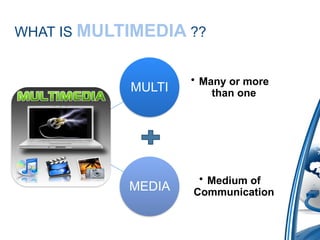
MULTI
• Many or more
than one
MEDIA
• Medium of
Communication
MULTIMEDIA..
 Multimedia is media and content that uses a
combination of different content forms.
 A form of communication that uses a combination of
different content forms such as text, audio, images,
animations, or video into a single interactive
presentation
 Multimedia includes a combination of
 Text
 Audio
 Still images
 Animation video
 Interactivity content forms.
 Multimedia presentations can be viewed in
person on stage, projected, transmitted, or
played locally with a media player.
 Broadcasts and recordings can be either analog
or digital electronic media technology.
 The various formats of technological or digital
multimedia may be intended to enhance the
users' experience.
 Online multimedia is increasingly becoming
object-oriented and data-driven, enabling
applications with collaborative end-user
innovation and personalization on multiple
forms of content over time.
FEATURES OF
MULTIMEDIA
 Text
 Audio
 Pictures
 Video
 Animation
 Interactivity
TEXT
 Text is the most widely used and
flexible means of presenting
information on screen and
conveying ideas.
 Text is an essential aspect of
presenting the information.
 Like each element of the
multimedia design, effective use
of text can either direct
users/readers attention or divert
it.
AUDIO
 Audio refers to sound. Multimedia can include files which
contain sounds.
 Audio songs also come under the heading multimedia.
 Multimedia presentations often have some audio tracks
which makes it easier for people to understand.
 Multimedia phones have music players to run audio
music.
 Various audio software include VLC media player, real
player, etc.
PICTURES
 Pictures(images) is a two-dimensional screen
display, and as well as a three-dimensional,
such as a statue or hologram.
 Graphs, pie-charts, painting etc. all come
under images.
 Images are a very useful feature of multimedia.
Multimedia presentation uses pictures or clip-
art to make people understand.
 Various file formats of images
are .jpg, .png, .gif etc.
VIDEO
 A video is unedited material as it had been originally
filmed by movie camera or recorded by a video camera.
 The embedding of video in multimedia applications is a
powerful way to convey information which can
incorporate a personal element which other media lack.
 Video enhances, dramatizes, and gives impact to your
multimedia application.
 The advantage of integrating video into a multimedia
presentation is the capacity to effectively convey a great
deal of information in the least amount of time.
ANIMATION
Animation is the rapid display of a sequence
of images of 2-D or 3-D artwork or model
positions in order to create an illusion of
movement.
The effect is an optical illusion of motion due to
the phenomenon of persistence of vision.
Animation adds visual impact to the multimedia
project.
Animation are used in cartoons, scientific
visualization.
INTERACTIVITY
 Interactivity can be termed as the dialog that
occurs between an individual and a computer
program.
 Interactive multimedia refers to the multimedia
applications that allow users to actively
participate rather than being passive recipients of
information.
 Technologies such as DVDs and digital TV are
classic examples of interactive media devices,
where a user can control what they watch and
when.
USES
 COMMERCIAL
 Much of the electronic old and new
media used by commercial artists is
multimedia.
 Exciting presentations are used to grab and
keep attention in advertising.
 ENTERTAINMENT AND FINE ARTS
 Multimedia is heavily used in the entertainment
industry, especially to develop special
effects in movies and animations.
 Multimedia games are also very popular.
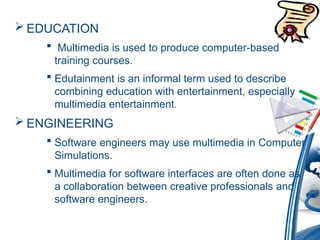
 EDUCATION
 Multimedia is used to produce computer-based
training courses.
 Edutainment is an informal term used to describe
combining education with entertainment, especially
multimedia entertainment.
 ENGINEERING
 Software engineers may use multimedia in Computer
Simulations.
 Multimedia for software interfaces are often done as
a collaboration between creative professionals and
software engineers.
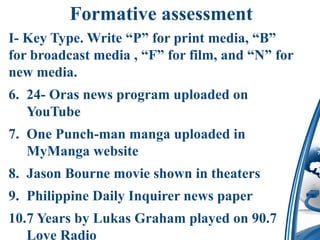
Formative assessment
I- Key Type. Write “P” for print media, “B”
for broadcast media , “F” for film, and “N” for
new media.
6. 24- Oras news program uploaded on
YouTube
7. One Punch-man manga uploaded in
MyManga website
8. Jason Bourne movie shown in theaters
9. Philippine Daily Inquirer news paper
10.7 Years by Lukas Graham played on 90.7
Love Radio
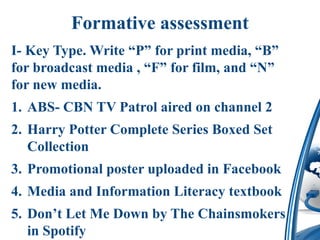
Formative assessment
I- Key Type. Write “P” for print media, “B”
for broadcast media , “F” for film, and “N”
for new media.
1. ABS- CBN TV Patrol aired on channel 2
2. Harry Potter Complete Series Boxed Set
Collection
3. Promotional poster uploaded in Facebook
4. Media and Information Literacy textbook
5. Don’t Let Me Down by The Chainsmokers
in Spotify
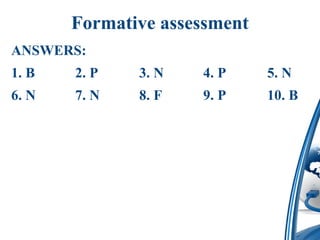
Formative assessment
ANSWERS:
1. B 2. P 3. N 4. P 5. N
6. N 7. N 8. F 9. P 10. B

MUTIMEDIA in empowerment technologies.pptx

  • 1.
  • 2.
    WHAT IS MULTIMEDIA?? MULTI • Many or more than one MEDIA • Medium of Communication
  • 3.
    MULTIMEDIA..  Multimedia ismedia and content that uses a combination of different content forms.  A form of communication that uses a combination of different content forms such as text, audio, images, animations, or video into a single interactive presentation  Multimedia includes a combination of  Text  Audio  Still images  Animation video  Interactivity content forms.
  • 4.
     Multimedia presentationscan be viewed in person on stage, projected, transmitted, or played locally with a media player.  Broadcasts and recordings can be either analog or digital electronic media technology.  The various formats of technological or digital multimedia may be intended to enhance the users' experience.  Online multimedia is increasingly becoming object-oriented and data-driven, enabling applications with collaborative end-user innovation and personalization on multiple forms of content over time.
  • 5.
  • 6.
     Text  Audio Pictures  Video  Animation  Interactivity
  • 7.
    TEXT  Text isthe most widely used and flexible means of presenting information on screen and conveying ideas.  Text is an essential aspect of presenting the information.  Like each element of the multimedia design, effective use of text can either direct users/readers attention or divert it.
  • 8.
    AUDIO  Audio refersto sound. Multimedia can include files which contain sounds.  Audio songs also come under the heading multimedia.  Multimedia presentations often have some audio tracks which makes it easier for people to understand.  Multimedia phones have music players to run audio music.  Various audio software include VLC media player, real player, etc.
  • 9.
    PICTURES  Pictures(images) isa two-dimensional screen display, and as well as a three-dimensional, such as a statue or hologram.  Graphs, pie-charts, painting etc. all come under images.  Images are a very useful feature of multimedia. Multimedia presentation uses pictures or clip- art to make people understand.  Various file formats of images are .jpg, .png, .gif etc.
  • 10.
    VIDEO  A videois unedited material as it had been originally filmed by movie camera or recorded by a video camera.  The embedding of video in multimedia applications is a powerful way to convey information which can incorporate a personal element which other media lack.  Video enhances, dramatizes, and gives impact to your multimedia application.  The advantage of integrating video into a multimedia presentation is the capacity to effectively convey a great deal of information in the least amount of time.
  • 11.
    ANIMATION Animation is therapid display of a sequence of images of 2-D or 3-D artwork or model positions in order to create an illusion of movement. The effect is an optical illusion of motion due to the phenomenon of persistence of vision. Animation adds visual impact to the multimedia project. Animation are used in cartoons, scientific visualization.
  • 12.
    INTERACTIVITY  Interactivity canbe termed as the dialog that occurs between an individual and a computer program.  Interactive multimedia refers to the multimedia applications that allow users to actively participate rather than being passive recipients of information.  Technologies such as DVDs and digital TV are classic examples of interactive media devices, where a user can control what they watch and when.
  • 13.
  • 14.
     COMMERCIAL  Muchof the electronic old and new media used by commercial artists is multimedia.  Exciting presentations are used to grab and keep attention in advertising.  ENTERTAINMENT AND FINE ARTS  Multimedia is heavily used in the entertainment industry, especially to develop special effects in movies and animations.  Multimedia games are also very popular.
  • 15.
     EDUCATION  Multimediais used to produce computer-based training courses.  Edutainment is an informal term used to describe combining education with entertainment, especially multimedia entertainment.  ENGINEERING  Software engineers may use multimedia in Computer Simulations.  Multimedia for software interfaces are often done as a collaboration between creative professionals and software engineers.
  • 17.
    Formative assessment I- KeyType. Write “P” for print media, “B” for broadcast media , “F” for film, and “N” for new media. 6. 24- Oras news program uploaded on YouTube 7. One Punch-man manga uploaded in MyManga website 8. Jason Bourne movie shown in theaters 9. Philippine Daily Inquirer news paper 10.7 Years by Lukas Graham played on 90.7 Love Radio
  • 18.
    Formative assessment I- KeyType. Write “P” for print media, “B” for broadcast media , “F” for film, and “N” for new media. 1. ABS- CBN TV Patrol aired on channel 2 2. Harry Potter Complete Series Boxed Set Collection 3. Promotional poster uploaded in Facebook 4. Media and Information Literacy textbook 5. Don’t Let Me Down by The Chainsmokers in Spotify
  • 19.
    Formative assessment ANSWERS: 1. B2. P 3. N 4. P 5. N 6. N 7. N 8. F 9. P 10. B