Download to read offline

![2 Signals and Systems: Part I Recommended Problems
P2.1
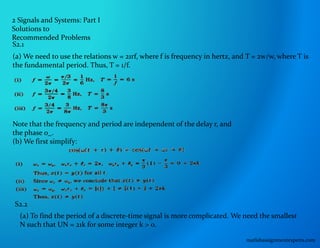
Let x(t) = cos(wx(t + rx) + Ox). (a) Determine the frequency in hertz and the period of x(t)
for each of the following three cases:
:(i) r/3 0 21r
(ii) 3r/4 1/2 7r/4
(iii) 3/4 1/2 1/4
(b) With x(t) = cos(wx(t + rx) + Ox) and y(t) = sin(w,(t + -r,)+ 0,), determine for which of
the following combinations x(t) and y(t) are identically equal for all t.
WX T 0x WY TY Oy
(i) r/3 0 2r ir/3 1 - r/3
(ii) 3-r/4 1/2 7r/4 11r/4 1 37r/8
(iii) 3/4 1/2 1/4 3/4 1 3/8
P2.2
Let x[n] = cos(Qx(n + Px) + Ox).
(a) Determine the period of x[n] for each of the following three cases:
Ox PX Ox (i) r/3 0 27r (ii) 3-r/4 2 r/4 (iii) 3/4 1 1/4 (b) With x[n] = cos(Q,(n + PX) + Ox)
and y[n] = cos(g,(n + Py) + 6,), determine for which of the following combinations
x[n] and y[n] are identically equal for all n.
matlabassignmentexperts.com](https://image.slidesharecdn.com/matlabassignmentexperts-211224072945/85/Signals-Processing-Homework-Help-2-320.jpg)
![QX PX OxX, Q, PO
(i) r/3 0 27 8r/3 0 0
(ii) 37r/4 2 w/ 4 3r/4 1 -ir
(iii) 3/4 1 1/4 3/4 0 1
(b) With x[n] = cos(Q,(n + PX) + Ox) and y[n] = cos(g,(n + Py) + 6,), determine for which of
the following combinations x[n] and y[n] are identically equal for all n.
QX PX OxX, Q, PO
(i) r/3 0 27 8r/3 0 0
(ii) 37r/4 2 w/ 4 3r/4 1 -ir
(iii) 3/4 1 1/4 3/4 0 1
P2.3 (a) A discrete-time signal x[n] is shown in Figure P2.3.
Sketch and carefully label each of the following signals:
(i) x[n - 2]
(ii) (ii) x[4 - n]
(iii) (iii) x[2n]
(b) What difficulty arises when we try to define a signal as.x[n/2]?
matlabassignmentexperts.com](https://image.slidesharecdn.com/matlabassignmentexperts-211224072945/85/Signals-Processing-Homework-Help-3-320.jpg)
![P2.5
Consider the signal y[n] in Figure P2.5.
(a) Find the signal x[n] such that Ev{x[n]} = y[n] for n > 0, and Od(x[n]} = y[n] for n <
0.
(b) (b) Suppose that Ev{w[n]} = y[n] for all n. Also assume that w[n] = 0 for n < 0. Find
w[n]. matlabassignmentexperts.com](https://image.slidesharecdn.com/matlabassignmentexperts-211224072945/85/Signals-Processing-Homework-Help-5-320.jpg)
![P2.6
(a) Sketch x[n] = a"for a typical a in the range -1 < a < 0.
(b) Assume that a = -e-' and define y(t) as y(t) = eO'. Find a complex number # such that y(t),
when evaluated at t equal to an integer n, is described by (-e- )".
(c) For y(t) found in part (b), find an expression for Re{y(t)} and Im{y(t)}. Plot Re{y(t)} and
Im{y(t)} for t equal to an integer. P2.7
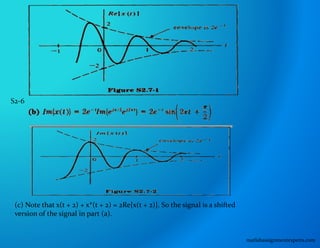
Let x(t) = /2(1 + j)ej"14 e(-i+2 ,). Sketch and label the following:
(a) Re{x(t)}
(b) Im{x(t)}
(c) x(t + 2) + x*(t + 2)
P2-4
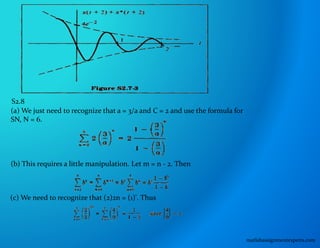
Evaluate the following sums:
Hint:Convert each sum to the form
and use the formulas
matlabassignmentexperts.com](https://image.slidesharecdn.com/matlabassignmentexperts-211224072945/85/Signals-Processing-Homework-Help-6-320.jpg)
![P2.9
(a) Let x(t) and y(t) be periodic signals with fundamental periods Ti and T2, respectively.
Under what conditions is the sum x(t) + y(t) periodic, and what is the fundamental
period of this signal if it is periodic?
(b) Let x[n] and y[n] be periodic signals with fundamental periods Ni and N 2, respectively.
Under what conditions is the sum x[n] + y[n] periodic, and what is the fundamental
period of this signal if it is periodic?
(c) Consider the signals
Show that z(t) = x(t)y(t) is periodic, and write z(t) as a linear combination of harmonically
related complex exponentials. That is, find a number T and complex numbers Ck such
that
P2.10
In this problem we explore several of the properties of even and odd signals.
(a) Show that if x[n] is an odd signal, then
(b) Show that if xi[n] is an odd signal and x2[n] is an even signal, then x,[n]x 2[n]
is an odd signal.
matlabassignmentexperts.com](https://image.slidesharecdn.com/matlabassignmentexperts-211224072945/85/Signals-Processing-Homework-Help-7-320.jpg)
![(c) Let x[n] be an arbitrary signal with even and odd parts denoted by
Show that
(d) Although parts (a)-(c) have been stated in terms of discrete-time signals, the analogous
properties are also valid in continuous time. To demonstrate this, show that
where xe(t) and x,(t) are, respectively, the even and odd parts of x(t).
P2.11
Let x(t) be the continuous-time complex exponential signal x(t) = ei0O' with fundamental
frequency wo and fundamental period To = 27r/wo. Consider the discretetime signal
obtained by taking equally spaced samples of x(t). That is, x[n] = x(nT) = eswonr
(a) Show that x[n] is periodic if and only if T/TO is a rational number, that is, if and only if
some multiple of the sampling interval exactly equals a multiple of the period x(t).
(b) Suppose that x[n] is periodic, that is, that
where p and q are integers. What are the fundamental period and fundamental frequency
of x[n]? Express the fundamental frequency as a fraction of woT.
(a) Again assuming that T/TO satisfies eq. (P2.11-1), determine precisely how many periods
of x(t) are needed to obtain the samples that form a single period of x[n]matlabassignmentexperts.com](https://image.slidesharecdn.com/matlabassignmentexperts-211224072945/85/Signals-Processing-Homework-Help-8-320.jpg)
![S2-2
S2.3
(a) (i) This is just a shift to the right by two units.
(ii) x[4 - n] = x[-(n - 4)], so we flip about the n = 0 axis and then shift
to the right by 4.
matlabassignmentexperts.com](https://image.slidesharecdn.com/matlabassignmentexperts-211224072945/85/Signals-Processing-Homework-Help-10-320.jpg)
![(iii) x[2n] generates a new signal with x[n] for even values of n.
(b) The difficulty arises when we try to evaluate x[n/2] at n = 1, for example (or generally
for n an odd integer). Since x[i] is not defined, the signal x[n/2] does not exist.
S2.4
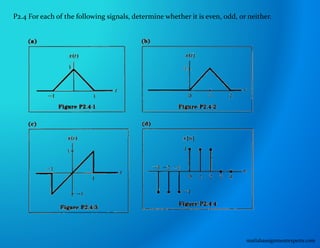
By definition a signal is even if and only if x(t) = x(-t) or x[n] = x[-n], while a signal is odd
if and only if x(t) = -x(- t) or x[n] = -x[-n].
(a) Since x(t) is symmetric about t = 0, x(t) is even.
(b) (b) It is readily seen that x(t) # x(- t) for all t, and x(t) K -x(- t) for all t; thus x(t) is
neither even nor odd.
(c) Since x(t) = -x(- t), x(t) is odd in this case.
(d) Here x[n] seems like an odd signal at first glance. However, note that x[n] = -x[-n]
evaluated at n = 0 implies that x[O] = -x[O] or x[O] = 0. The analogous result applies
to continuous-time signals. The signal is therefore neither even nor odd. (e) In similar
manner to part (a), we deduce that x[n] is even. (f) x[n] is odd.
S2.5
(a) Let Ev{x[n]} = x[n] and Od{x[n]} = x[n]. Since xe[n] = y[n] for n >_ 0 and xe[n] = x[
-fn], x,[n] must be as shown in Figure S2.5-1.
matlabassignmentexperts.com](https://image.slidesharecdn.com/matlabassignmentexperts-211224072945/85/Signals-Processing-Homework-Help-11-320.jpg)
![Since x[n] = y[n] for n < 0 andx[n] = -x,[-n], along with the property that x0[O] = 0, x[n]
is as shown in Figure S2.5-2.
Finally, from the definition of Ev{x[n]} and Od{x[n]}, we see that x[n] = x,[n] + x[n].
Thus, x[n] is as shown in Figure S2.5-3.
matlabassignmentexperts.com](https://image.slidesharecdn.com/matlabassignmentexperts-211224072945/85/Signals-Processing-Homework-Help-12-320.jpg)
![(b) In order for w[n] S2.5-4. to equal 0 for n < 0, Od{w[n]} must be given as in Figure
S2.5-4.
Thus, w[n] is as in Figure S2.5-5.
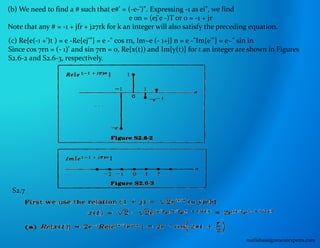
S2.6
(a) For a = -ia"is as shown in Figure S2.6-1.
matlabassignmentexperts.com](https://image.slidesharecdn.com/matlabassignmentexperts-211224072945/85/Signals-Processing-Homework-Help-13-320.jpg)
![S2.9
(a) The sum x(t) + y(t) will be periodic if there exist integers n and k such that nT1 = kT 2, that
is, if x(t) and y(t) have a common (possibly not fundamental) period. The fundamental
period of the combined signal will be nT1 for the smallest allowable n.
(b) Similarly, x[n] + y[n] will be periodic if there exist integers n and k such that nN = kN2. But
such integers always exist, a trivial example being n = N2 and k = N1 . So the sum is always
periodic with period nN, for n the smallest allowable integer.
(c) We first decompose x(t) and y(t) into sums of exponentials. Thus,
Multiplying x(t) and y(t), we get
We see that all complex exponentials are powers of e j(/3). Thus, the fundamental
period is 2 7r/(7r/3) = 6 s.
S2.10
matlabassignmentexperts.com](https://image.slidesharecdn.com/matlabassignmentexperts-211224072945/85/Signals-Processing-Homework-Help-17-320.jpg)
![But from part (b), x,[nxo[n] is an odd signal. Thus, using part (a) we find
that the second sum is zero, proving the assertion.
S2-8
S2.11
The two sides of the equation will be equal only if 27rN(T/TO) = 27rk for some
integer k. Therefore, TITO must be a rational number.
(b)The fundamental period of x[n] is the smallest N such that N(T/TO) = N(p/q) = k.
The smallest N such that Np has a divisor q is the least common multiple (LCM) of p
and q, divided by p. Thus,
(c) Q = 2 = = WT = q T N kT,, k LCM(p, q) 0 We need to find a value of m such that x[n + N]
= x(nT + mT). Therefore, N = m(T./T), where m(T./T) must be an integer, or m(q/p) must
be an integer. Thus, mq = LCM(p, q), m = LCM(p, q)/q. matlabassignmentexperts.com](https://image.slidesharecdn.com/matlabassignmentexperts-211224072945/85/Signals-Processing-Homework-Help-18-320.jpg)

The document provides homework problems and solutions related to signals processing. It includes problems on determining the frequency and period of signals, properties of even and odd signals, sampling of continuous signals, and periodicity of sums of signals. It also provides detailed solutions and explanations to each problem.


