The Legislative Branch
Chapter Five
Key Words
• bicameral legislature
• session
• census
• Reapportionment
• Redistrict
• Gerrymander
• at-large
• censure
• incumbent
• constituents
• caucus
• majority leader
• whips
• bill
• calendars
• Quorum
• president pro tempore
• filibuster
• cloture
Key Words
• standing committee
• subcommittee
• select committee
• joint committee
• conference committee
• seniority system
• personal staff
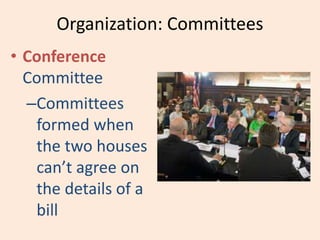
• committee staff
• administrative assistant
• legislative assistant
• caseworker
• expressed powers
• necessary and proper
clause
• implied powers
• revenue bill
• appropriations bill
• interstate commerce
• impeachment
• subpoena
• perjury
• contempt
• immunity
• legislative veto
Key Words
• national budget
• Impoundment
• private bill
• public bill
• simple resolution
• rider
• hearing
• veto
• pocket veto
• tax
• closed rule
• Appropriation
• authorization bill
• Entitlement
• Lobbyist
• Lobbying
• Casework
• Pork-Barrel legislation
• logrolling
Objective
• Members of Congress
• Organization of Congress
• Powers of Congress
• Passing a Bill
Structure of Congress
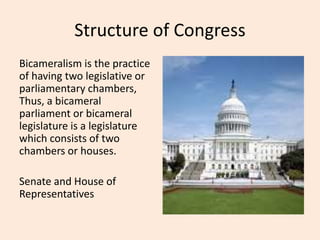
Bicameralism is the practice
of having two legislative or
parliamentary chambers,
Thus, a bicameral
parliament or bicameral
legislature is a legislature
which consists of two
chambers or houses.
Senate and House of
Representatives
Members: House of Representatives
• 435 members
– Limit on members
• 1789 = 65 Representatives
• Each member represents a
Congressional District
– Area of a state that includes
about 600,000 people
– Number of districts depend on a
state’s population
Members: House of Representatives
• Congressional elections
are held on even years
– 2010, 2012…
• Each term is two years
• If a representative dies,
the state governor calls
a special election
Members: House of Representatives
• Qualifications according to Article I of
Constitution:
• Must be at least 25 years old
• United States citizen for at least 7 years
• Resident of the state represented
Members: House of Representatives
• Every 10 years, Congress
decides how districts will be
apportioned or distributed
by using the Census.
• If a state’s population
increases
– State will gain seats
• If a state’s population
decreases
– State will lose seats
Members: House of Representatives
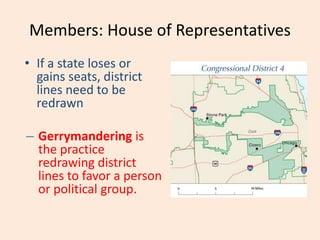
• If a state loses or
gains seats, district
lines need to be
redrawn
– Gerrymandering is
the practice
redrawing district
lines to favor a person
or political group.
Members: Senate
• 100 members
– 2 per state
• 1789 = 26 Senators
• Senators represent
whole state
Members: Senate
• Elections are held on
even numbered years
– 2010, 2012…
• Each term is 6 years
• If a Senator dies, the
governor appoints a
replacement until the
next election
Members: Senate
• Qualifications according to Article I of the
Constitution:
• Must be at least 30 years old
• United States citizen for at least 9 years
• Resident of the state represented
Members: Salary and Benefits
• Annual salary of $165,200.
• Members have offices in the Capitol building
and receive an allowance to pay staff
• Member perks:
– Free trips of their home state
– Mail official letters and packages for free
(Franking Privilege)
Members: Rules of Conduct
• Rules of Conduct
– Each house has its own written rules for
conducting business
– Constitution – Article I
– The House Rules and Manual and The Senate
Manual
• Example: In the Senate Manual, it talks about a
filibuster, or a method of delaying action on a bill by
making long speeches
Members: Rules of Conduct
• Expulsion
– If a member commits a serious
offense, the member could be
expelled from office.
–Expulsion means that a person must
give up their seat.
Members: Rules of Conduct
• Censure
– Less serious offenses
may bring a vote of
censure, or formal
disapproval of a
member’s actions.
– A censured member
must stand alone at
the front of the House
or Senate and listen as
their charges are read.
Organization: House of
Representatives
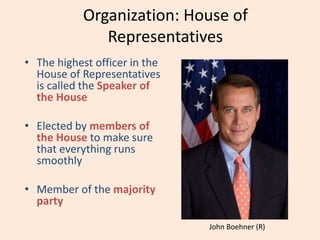
• The highest officer in the
House of Representatives
is called the Speaker of
the House
• Elected by members of
the House to make sure
that everything runs
smoothly
• Member of the majority
party
John Boehner (R)
Organization: House of
Representatives
• Duties of the Speaker of the House
– Assign legislation to committees for discussion
and preparation
– Decide the legislative agenda for a session of the
House
– Decide when and who can speak on an issue
Organization: Senate
• Constitution states that the
Vice President is the
presiding officer over the
Senate.
• When the Vice President
cannot make it, the
President Pro Tempore
presides.
• Members of the Senate
vote for the President Pro
Tempore.
Organization: Party Leaders and Whips
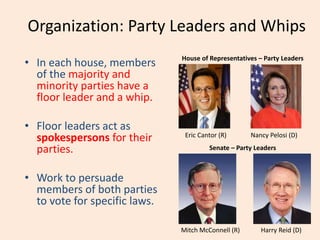
• In each house, members
of the majority and
minority parties have a
floor leader and a whip.
• Floor leaders act as
spokespersons for their
parties.
• Work to persuade
members of both parties
to vote for specific laws.
House of Representatives – Party Leaders
Senate – Party Leaders
Eric Cantor (R) Nancy Pelosi (D)
Mitch McConnell (R) Harry Reid (D)
Organization: Party Leaders and Whips
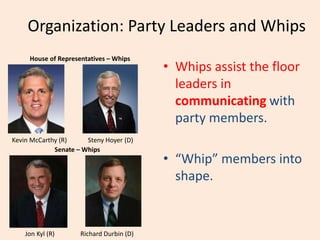
• Whips assist the floor
leaders in
communicating with
party members.
• “Whip” members into
shape.
House of Representatives – Whips
Kevin McCarthy (R) Steny Hoyer (D)
Senate – Whips
Jon Kyl (R) Richard Durbin (D)
Organization: Committees
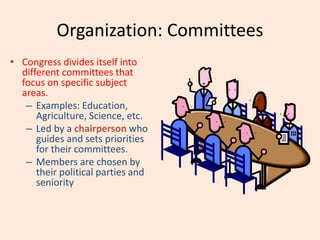
• Congress divides itself into
different committees that
focus on specific subject
areas.
– Examples: Education,
Agriculture, Science, etc.
– Led by a chairperson who
guides and sets priorities
for their committees.
– Members are chosen by
their political parties and
seniority
Organization: Committees
• Committees have 3 main roles
– Research specific subjects – holding hearings to
get advice from experts
– Write legislation – write laws that are related to
their specific subject areas
– Decide whether to send legislation to the floor –
important enough for a vote
Organization: Committees
• There are four
types of
committees:
1. Standing
2. Joint
3. Select
4. Conference
Organization: Committees
• Standing Committee
– Permanent groups set
up that are responsible
for specific subject
areas.
– Divided into sub-
committees
– Examples
• Veterans Affairs
• Homeland Security
• Agriculture
• Education
Organization: Committees
• Joint Committee
– Permanent
committees made up
of members of both
houses
– They investigate issues
and make
recommendations but
don’t write bills.
Organization: Committees
Select Committee
Committees
created to study
an issue or event
Examples:
Energy
Independence and
Global Warming
Organization: Committees
• Conference
Committee
–Committees
formed when
the two houses
can’t agree on
the details of a
bill
Powers of Congress: Expressed Powers
• Expressed Powers
– Powers specifically stated in Article I of the
Constitution
– Examples
• Decide how to raise money by setting taxes and borrowing
funds
• Decide how to spend money for the benefit of the nation
• Regulate commerce among states and foreign nations
• Declare war
• Coin money
• Regulate process of becoming a citizen
• Create post offices
• Create an army/navy
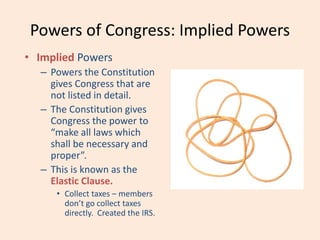
Powers of Congress: Implied Powers
• Implied Powers
– Powers the Constitution
gives Congress that are
not listed in detail.
– The Constitution gives
Congress the power to
“make all laws which
shall be necessary and
proper”.
– This is known as the
Elastic Clause.
• Collect taxes – members
don’t go collect taxes
directly. Created the IRS.
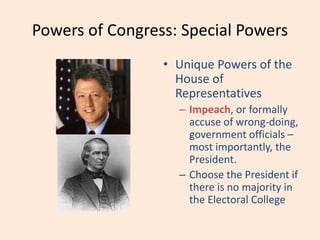
Powers of Congress: Special Powers
• Unique Powers of the
House of
Representatives
– Impeach, or formally
accuse of wrong-doing,
government officials –
most importantly, the
President.
– Choose the President if
there is no majority in
the Electoral College
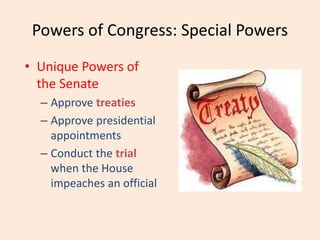
Powers of Congress: Special Powers
• Unique Powers of
the Senate
– Approve treaties
– Approve presidential
appointments
– Conduct the trial
when the House
impeaches an official
Passing a Bill: Introduction
• Introduction of a Bill
– Any member of
either house can
introduce a bill
– Ideas for bills come
from the President,
businessmen,
farmers, and ordinary
citizens.
Passing a Bill: Introduction
• Bills can be introduced in
both houses.
– The only exception to this
rule is an Appropriations
Bill, or one approving the
spending of money,
which must begin in the
House of
Representatives.
Passing a Bill: Committees
• Bill is sent to Committee
– The Bill is sent to a standing
committee. The subject of
the bill determines which
committee will receive the
bill.
– The committee can decide to:
• Make no changes to the
bill
• Rewrite the bill
• Ignore the bill which
“kills” the chance of it
becoming a law
• Send it to a
subcommittee for more
study and investigation
Passing a Bill: Committees
• If a bill is sent to a subcommittee:
– The subcommittee then reports back to the larger
committee and decides what to do with the bill.
– The larger committee then votes to send it to the
floor to be debated
– If the floor votes “no”, the bill is sent back to the
committees. If it votes “yes”, it is sent to the
other house of Congress.
Passing a Bill
• Once it is in the other house of Congress, it
goes through the committee process again.
• After the committee approves the bill, it will
be debated and voted on.
– If the vote is “no”, the bill is sent back to the
committees. If the vote is “yes”, the bill is sent to
a Conference Committee.
Passing a Bill
• The Conference
Committee resolves
any differences
between the House
and Senate versions of
the bill
• The Bill is sent back to
both houses for a final
vote
Types of Voting
• The Senate has three methods of voting: a
voice vote, a standing vote, and a roll.
• Standing-You must stand to vote
• Voice Vote-You must speak.
• Roll Call Vote- All Senators are called
alphabetically and say “Yye or No” Their vote
is kept on record.
Passing a Bill
• Approved bills are sent to
the President who can
sign the bill into law or
veto it.
– If the President vetoes
the bill, it is sent back to
the House and Senate
where they can vote to
override the veto with a
2/3 vote.
• Finally the bill becomes a
law
Passing a Bill
• Representatives listen to:
– Visits home / face-to-face meetings
– Letters, faxes, e-mails, form letters
– Surveys
– Polls
– Key supporters
• Why? Reelection!
• Constituents expect politicians to defer
to the district’s needs more than the
“good of the nation”
Constituents
• President
• Special interest groups / lobbyists
• PAC’s (Political Action Committees)
• Lobbyists or PAC’s may represent:
– Businesses
– Labor unions
– Professions (doctors, educators, etc.)
– Non-profits (environmental groups, etc.)
Other Influences
Personal Staff
 Work directly for
individual senators ad
representatives.
 Many work back in
the home state, well
some work in D.C.
 The bigger the state
the more people and
money you get.
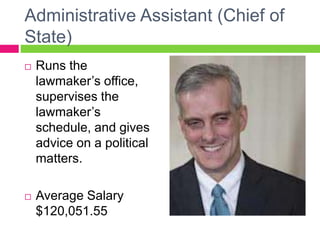
Administrative Assistant (Chief of
State)
 Runs the
lawmaker’s office,
supervises the
lawmaker’s
schedule, and gives
advice on a political
matters.
 Average Salary
$120,051.55
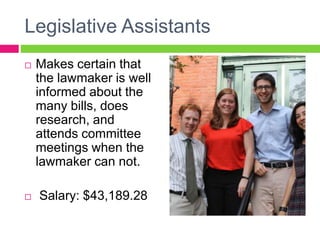
Legislative Assistants
 Makes certain that
the lawmaker is well
informed about the
many bills, does
research, and
attends committee
meetings when the
lawmaker can not.
 Salary: $43,189.28
Library of Congress
One of the largest
libraries in the world.
Contains more than
100 million items.
Receives two copies
of any copyrighted
material.

Chapter Five

  • 1.
  • 2.
    Key Words • bicamerallegislature • session • census • Reapportionment • Redistrict • Gerrymander • at-large • censure • incumbent • constituents • caucus • majority leader • whips • bill • calendars • Quorum • president pro tempore • filibuster • cloture
  • 3.
    Key Words • standingcommittee • subcommittee • select committee • joint committee • conference committee • seniority system • personal staff • committee staff • administrative assistant • legislative assistant • caseworker • expressed powers • necessary and proper clause • implied powers • revenue bill • appropriations bill • interstate commerce • impeachment • subpoena • perjury • contempt • immunity • legislative veto
  • 4.
    Key Words • nationalbudget • Impoundment • private bill • public bill • simple resolution • rider • hearing • veto • pocket veto • tax • closed rule • Appropriation • authorization bill • Entitlement • Lobbyist • Lobbying • Casework • Pork-Barrel legislation • logrolling
  • 5.
    Objective • Members ofCongress • Organization of Congress • Powers of Congress • Passing a Bill
  • 6.
    Structure of Congress Bicameralismis the practice of having two legislative or parliamentary chambers, Thus, a bicameral parliament or bicameral legislature is a legislature which consists of two chambers or houses. Senate and House of Representatives
  • 7.
    Members: House ofRepresentatives • 435 members – Limit on members • 1789 = 65 Representatives • Each member represents a Congressional District – Area of a state that includes about 600,000 people – Number of districts depend on a state’s population
  • 8.
    Members: House ofRepresentatives • Congressional elections are held on even years – 2010, 2012… • Each term is two years • If a representative dies, the state governor calls a special election
  • 9.
    Members: House ofRepresentatives • Qualifications according to Article I of Constitution: • Must be at least 25 years old • United States citizen for at least 7 years • Resident of the state represented
  • 10.
    Members: House ofRepresentatives • Every 10 years, Congress decides how districts will be apportioned or distributed by using the Census. • If a state’s population increases – State will gain seats • If a state’s population decreases – State will lose seats
  • 11.
    Members: House ofRepresentatives • If a state loses or gains seats, district lines need to be redrawn – Gerrymandering is the practice redrawing district lines to favor a person or political group.
  • 12.
    Members: Senate • 100members – 2 per state • 1789 = 26 Senators • Senators represent whole state
  • 13.
    Members: Senate • Electionsare held on even numbered years – 2010, 2012… • Each term is 6 years • If a Senator dies, the governor appoints a replacement until the next election
  • 14.
    Members: Senate • Qualificationsaccording to Article I of the Constitution: • Must be at least 30 years old • United States citizen for at least 9 years • Resident of the state represented
  • 15.
    Members: Salary andBenefits • Annual salary of $165,200. • Members have offices in the Capitol building and receive an allowance to pay staff • Member perks: – Free trips of their home state – Mail official letters and packages for free (Franking Privilege)
  • 16.
    Members: Rules ofConduct • Rules of Conduct – Each house has its own written rules for conducting business – Constitution – Article I – The House Rules and Manual and The Senate Manual • Example: In the Senate Manual, it talks about a filibuster, or a method of delaying action on a bill by making long speeches
  • 17.
    Members: Rules ofConduct • Expulsion – If a member commits a serious offense, the member could be expelled from office. –Expulsion means that a person must give up their seat.
  • 18.
    Members: Rules ofConduct • Censure – Less serious offenses may bring a vote of censure, or formal disapproval of a member’s actions. – A censured member must stand alone at the front of the House or Senate and listen as their charges are read.
  • 19.
    Organization: House of Representatives •The highest officer in the House of Representatives is called the Speaker of the House • Elected by members of the House to make sure that everything runs smoothly • Member of the majority party John Boehner (R)
  • 20.
    Organization: House of Representatives •Duties of the Speaker of the House – Assign legislation to committees for discussion and preparation – Decide the legislative agenda for a session of the House – Decide when and who can speak on an issue
  • 21.
    Organization: Senate • Constitutionstates that the Vice President is the presiding officer over the Senate. • When the Vice President cannot make it, the President Pro Tempore presides. • Members of the Senate vote for the President Pro Tempore.
  • 22.
    Organization: Party Leadersand Whips • In each house, members of the majority and minority parties have a floor leader and a whip. • Floor leaders act as spokespersons for their parties. • Work to persuade members of both parties to vote for specific laws. House of Representatives – Party Leaders Senate – Party Leaders Eric Cantor (R) Nancy Pelosi (D) Mitch McConnell (R) Harry Reid (D)
  • 23.
    Organization: Party Leadersand Whips • Whips assist the floor leaders in communicating with party members. • “Whip” members into shape. House of Representatives – Whips Kevin McCarthy (R) Steny Hoyer (D) Senate – Whips Jon Kyl (R) Richard Durbin (D)
  • 24.
    Organization: Committees • Congressdivides itself into different committees that focus on specific subject areas. – Examples: Education, Agriculture, Science, etc. – Led by a chairperson who guides and sets priorities for their committees. – Members are chosen by their political parties and seniority
  • 25.
    Organization: Committees • Committeeshave 3 main roles – Research specific subjects – holding hearings to get advice from experts – Write legislation – write laws that are related to their specific subject areas – Decide whether to send legislation to the floor – important enough for a vote
  • 26.
    Organization: Committees • Thereare four types of committees: 1. Standing 2. Joint 3. Select 4. Conference
  • 27.
    Organization: Committees • StandingCommittee – Permanent groups set up that are responsible for specific subject areas. – Divided into sub- committees – Examples • Veterans Affairs • Homeland Security • Agriculture • Education
  • 28.
    Organization: Committees • JointCommittee – Permanent committees made up of members of both houses – They investigate issues and make recommendations but don’t write bills.
  • 29.
    Organization: Committees Select Committee Committees createdto study an issue or event Examples: Energy Independence and Global Warming
  • 30.
    Organization: Committees • Conference Committee –Committees formedwhen the two houses can’t agree on the details of a bill
  • 31.
    Powers of Congress:Expressed Powers • Expressed Powers – Powers specifically stated in Article I of the Constitution – Examples • Decide how to raise money by setting taxes and borrowing funds • Decide how to spend money for the benefit of the nation • Regulate commerce among states and foreign nations • Declare war • Coin money • Regulate process of becoming a citizen • Create post offices • Create an army/navy
  • 32.
    Powers of Congress:Implied Powers • Implied Powers – Powers the Constitution gives Congress that are not listed in detail. – The Constitution gives Congress the power to “make all laws which shall be necessary and proper”. – This is known as the Elastic Clause. • Collect taxes – members don’t go collect taxes directly. Created the IRS.
  • 33.
    Powers of Congress:Special Powers • Unique Powers of the House of Representatives – Impeach, or formally accuse of wrong-doing, government officials – most importantly, the President. – Choose the President if there is no majority in the Electoral College
  • 34.
    Powers of Congress:Special Powers • Unique Powers of the Senate – Approve treaties – Approve presidential appointments – Conduct the trial when the House impeaches an official
  • 35.
    Passing a Bill:Introduction • Introduction of a Bill – Any member of either house can introduce a bill – Ideas for bills come from the President, businessmen, farmers, and ordinary citizens.
  • 36.
    Passing a Bill:Introduction • Bills can be introduced in both houses. – The only exception to this rule is an Appropriations Bill, or one approving the spending of money, which must begin in the House of Representatives.
  • 37.
    Passing a Bill:Committees • Bill is sent to Committee – The Bill is sent to a standing committee. The subject of the bill determines which committee will receive the bill. – The committee can decide to: • Make no changes to the bill • Rewrite the bill • Ignore the bill which “kills” the chance of it becoming a law • Send it to a subcommittee for more study and investigation
  • 38.
    Passing a Bill:Committees • If a bill is sent to a subcommittee: – The subcommittee then reports back to the larger committee and decides what to do with the bill. – The larger committee then votes to send it to the floor to be debated – If the floor votes “no”, the bill is sent back to the committees. If it votes “yes”, it is sent to the other house of Congress.
  • 39.
    Passing a Bill •Once it is in the other house of Congress, it goes through the committee process again. • After the committee approves the bill, it will be debated and voted on. – If the vote is “no”, the bill is sent back to the committees. If the vote is “yes”, the bill is sent to a Conference Committee.
  • 40.
    Passing a Bill •The Conference Committee resolves any differences between the House and Senate versions of the bill • The Bill is sent back to both houses for a final vote
  • 41.
    Types of Voting •The Senate has three methods of voting: a voice vote, a standing vote, and a roll. • Standing-You must stand to vote • Voice Vote-You must speak. • Roll Call Vote- All Senators are called alphabetically and say “Yye or No” Their vote is kept on record.
  • 42.
    Passing a Bill •Approved bills are sent to the President who can sign the bill into law or veto it. – If the President vetoes the bill, it is sent back to the House and Senate where they can vote to override the veto with a 2/3 vote. • Finally the bill becomes a law
  • 43.
  • 44.
    • Representatives listento: – Visits home / face-to-face meetings – Letters, faxes, e-mails, form letters – Surveys – Polls – Key supporters • Why? Reelection! • Constituents expect politicians to defer to the district’s needs more than the “good of the nation” Constituents
  • 45.
    • President • Specialinterest groups / lobbyists • PAC’s (Political Action Committees) • Lobbyists or PAC’s may represent: – Businesses – Labor unions – Professions (doctors, educators, etc.) – Non-profits (environmental groups, etc.) Other Influences
  • 46.
    Personal Staff  Workdirectly for individual senators ad representatives.  Many work back in the home state, well some work in D.C.  The bigger the state the more people and money you get.
  • 47.
    Administrative Assistant (Chiefof State)  Runs the lawmaker’s office, supervises the lawmaker’s schedule, and gives advice on a political matters.  Average Salary $120,051.55
  • 48.
    Legislative Assistants  Makescertain that the lawmaker is well informed about the many bills, does research, and attends committee meetings when the lawmaker can not.  Salary: $43,189.28
  • 49.
    Library of Congress Oneof the largest libraries in the world. Contains more than 100 million items. Receives two copies of any copyrighted material.