The Legislative Branch


  Article I
  Congress
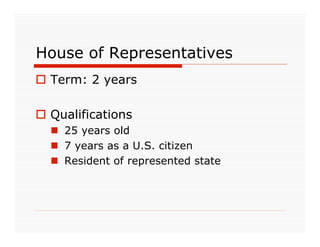
House of Representatives
 Term: 2 years

 Qualifications
   25 years old
   7 years as a U.S. citizen
   Resident of represented state
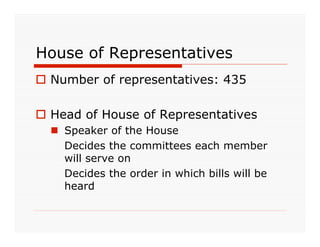
House of Representatives
 Number of representatives: 435

 Head of House of Representatives
   Speaker of the House
    Decides the committees each member
    will serve on
    Decides the order in which bills will be
    heard
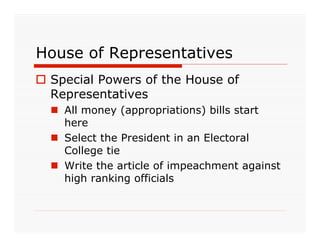
House of Representatives
 Special Powers of the House of
  Representatives
   All money (appropriations) bills start
    here
   Select the President in an Electoral
    College tie
   Write the article of impeachment against
    high ranking officials
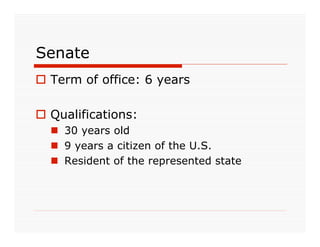
Senate
 Term of office: 6 years

 Qualifications:
   30 years old
   9 years a citizen of the U.S.
   Resident of the represented state
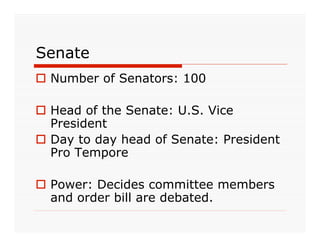
Senate
 Number of Senators: 100

 Head of the Senate: U.S. Vice
  President
 Day to day head of Senate: President
  Pro Tempore

 Power: Decides committee members
  and order bill are debated.
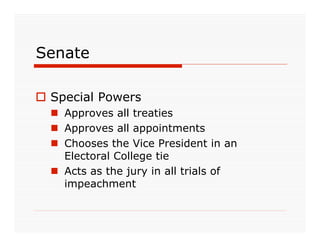
Senate

 Special Powers
   Approves all treaties
   Approves all appointments
   Chooses the Vice President in an
    Electoral College tie
   Acts as the jury in all trials of
    impeachment
Congress
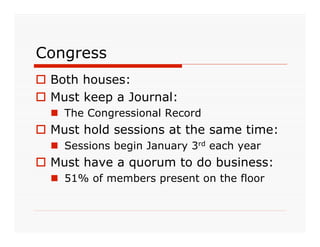
 Both houses:
 Must keep a Journal:
   The Congressional Record
 Must hold sessions at the same time:
   Sessions begin January 3rd each year
 Must have a quorum to do business:
   51% of members present on the floor
Congress
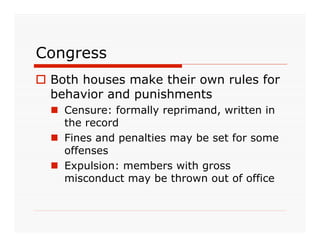
 Both houses make their own rules for
  behavior and punishments
   Censure: formally reprimand, written in
    the record
   Fines and penalties may be set for some
    offenses
   Expulsion: members with gross
    misconduct may be thrown out of office
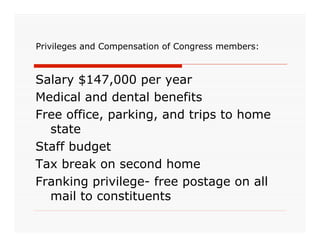
Privileges and Compensation of Congress members:


Salary $147,000 per year
Medical and dental benefits
Free office, parking, and trips to home
  state
Staff budget
Tax break on second home
Franking privilege- free postage on all
  mail to constituents
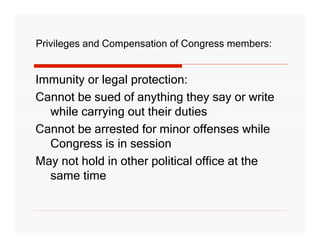
Privileges and Compensation of Congress members:


Immunity or legal protection:
Cannot be sued of anything they say or write
  while carrying out their duties
Cannot be arrested for minor offenses while
  Congress is in session
May not hold in other political office at the
  same time
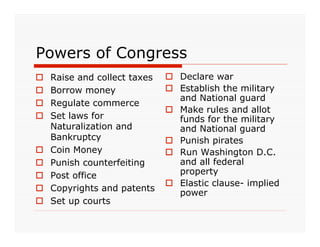
Powers of Congress
   Raise and collect taxes    Declare war
   Borrow money               Establish the military
                                and National guard
   Regulate commerce
                               Make rules and allot
   Set laws for                funds for the military
    Naturalization and          and National guard
    Bankruptcy                 Punish pirates
   Coin Money                 Run Washington D.C.
   Punish counterfeiting       and all federal
   Post office                 property
                               Elastic clause- implied
   Copyrights and patents
                                power
   Set up courts
ELASTIC CLAUSE
 The necessary and proper clause
  gives Congress the power to make
  laws “necessary and proper” to carry
  out the delegated duties
 Also known as the ‘elastic clause’ it
  stretches the power given Congress
Powers denied Congress
 Congress cannot make laws
  concerning slave trade until 1808
 Cannot suspend the writ of Habeas
  Corpus- must show cause for holding
  a suspect except in wartime
 No ex post facto law- cannot punish a
  person for an act committed before
  there was a law against it.
Powers denied Congress
 No direct tax- the 16th amendment
  allows income tax
 No tax on exports
 All states must be treated the same
 Congress must approve all
  expenditures of the President through
  laws
 No titles of nobility
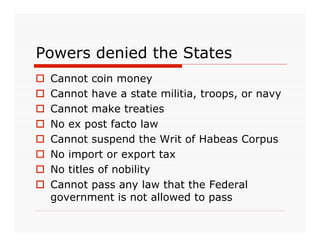
Powers denied the States
   Cannot coin money
   Cannot have a state militia, troops, or navy
   Cannot make treaties
   No ex post facto law
   Cannot suspend the Writ of Habeas Corpus
   No import or export tax
   No titles of nobility
   Cannot pass any law that the Federal
    government is not allowed to pass

Congress Powerpoint

  • 1.
    The Legislative Branch Article I Congress
  • 2.
    House of Representatives Term: 2 years  Qualifications  25 years old  7 years as a U.S. citizen  Resident of represented state
  • 3.
    House of Representatives Number of representatives: 435  Head of House of Representatives  Speaker of the House Decides the committees each member will serve on Decides the order in which bills will be heard
  • 4.
    House of Representatives Special Powers of the House of Representatives  All money (appropriations) bills start here  Select the President in an Electoral College tie  Write the article of impeachment against high ranking officials
  • 5.
    Senate  Term ofoffice: 6 years  Qualifications:  30 years old  9 years a citizen of the U.S.  Resident of the represented state
  • 6.
    Senate  Number ofSenators: 100  Head of the Senate: U.S. Vice President  Day to day head of Senate: President Pro Tempore  Power: Decides committee members and order bill are debated.
  • 7.
    Senate  Special Powers  Approves all treaties  Approves all appointments  Chooses the Vice President in an Electoral College tie  Acts as the jury in all trials of impeachment
  • 8.
    Congress  Both houses: Must keep a Journal:  The Congressional Record  Must hold sessions at the same time:  Sessions begin January 3rd each year  Must have a quorum to do business:  51% of members present on the floor
  • 9.
    Congress  Both housesmake their own rules for behavior and punishments  Censure: formally reprimand, written in the record  Fines and penalties may be set for some offenses  Expulsion: members with gross misconduct may be thrown out of office
  • 10.
    Privileges and Compensationof Congress members: Salary $147,000 per year Medical and dental benefits Free office, parking, and trips to home state Staff budget Tax break on second home Franking privilege- free postage on all mail to constituents
  • 11.
    Privileges and Compensationof Congress members: Immunity or legal protection: Cannot be sued of anything they say or write while carrying out their duties Cannot be arrested for minor offenses while Congress is in session May not hold in other political office at the same time
  • 12.
    Powers of Congress  Raise and collect taxes  Declare war  Borrow money  Establish the military and National guard  Regulate commerce  Make rules and allot  Set laws for funds for the military Naturalization and and National guard Bankruptcy  Punish pirates  Coin Money  Run Washington D.C.  Punish counterfeiting and all federal  Post office property  Elastic clause- implied  Copyrights and patents power  Set up courts
  • 13.
    ELASTIC CLAUSE  Thenecessary and proper clause gives Congress the power to make laws “necessary and proper” to carry out the delegated duties  Also known as the ‘elastic clause’ it stretches the power given Congress
  • 14.
    Powers denied Congress Congress cannot make laws concerning slave trade until 1808  Cannot suspend the writ of Habeas Corpus- must show cause for holding a suspect except in wartime  No ex post facto law- cannot punish a person for an act committed before there was a law against it.
  • 15.
    Powers denied Congress No direct tax- the 16th amendment allows income tax  No tax on exports  All states must be treated the same  Congress must approve all expenditures of the President through laws  No titles of nobility
  • 16.
    Powers denied theStates  Cannot coin money  Cannot have a state militia, troops, or navy  Cannot make treaties  No ex post facto law  Cannot suspend the Writ of Habeas Corpus  No import or export tax  No titles of nobility  Cannot pass any law that the Federal government is not allowed to pass