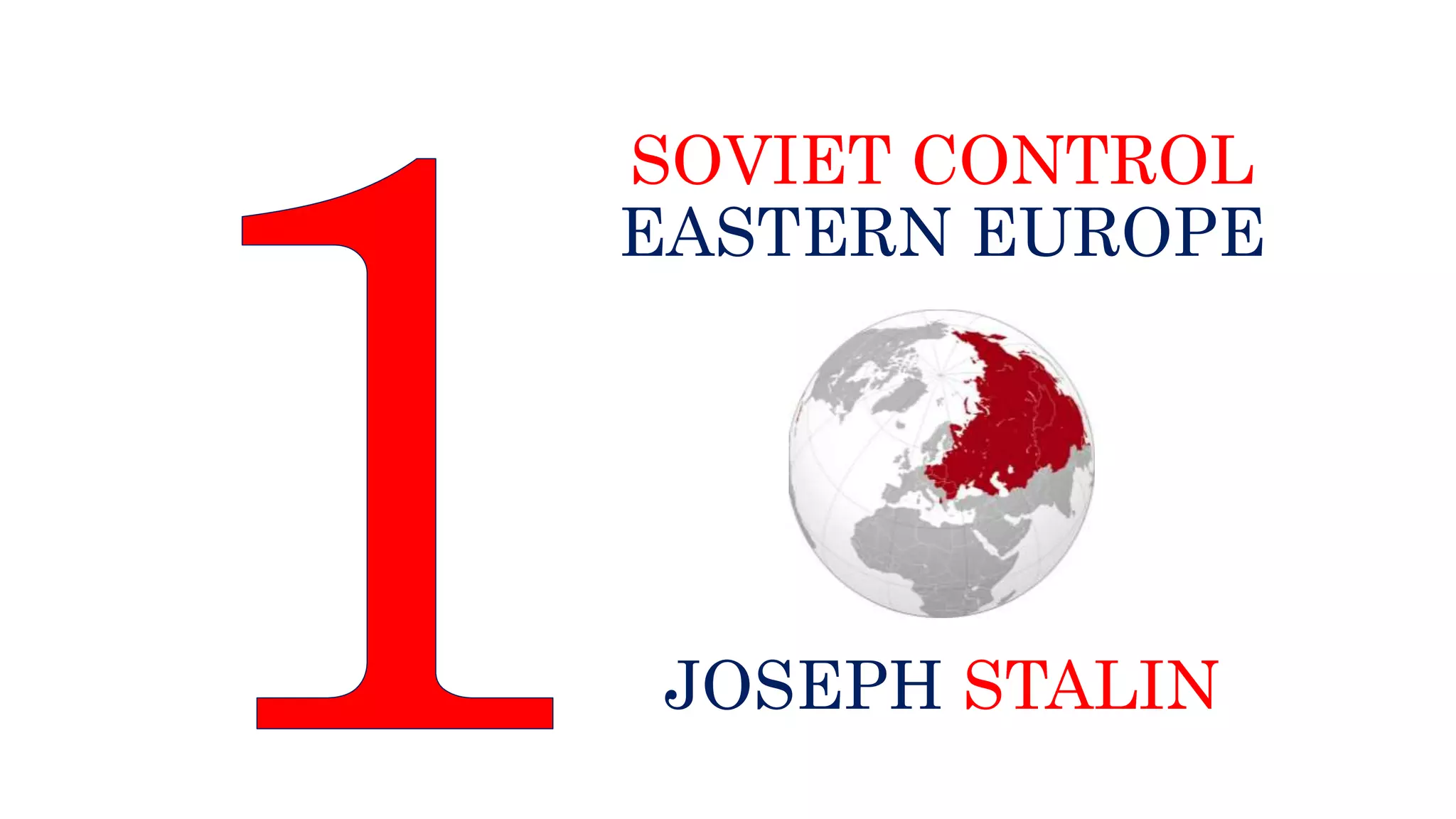
SOVIET CONTROL
EASTERN EUROPE
JOSEPH STALIN
Bibliography – Cambridge Approved
• Allan Todd. The European Dictatorships. Hitler, Stalin, Mussolini (2002).
• Allsopp John. Challenge and Response (1980).
• Andrew Heywood. Politics (1997).
• Ben Walsh. Modern World History (2001).
• Colin Pearce. Representations of 20th Century History (1995).
• John Martell. The Twentieth-Century World (1980).
• Philip Ingram. Russia and the USSR, 1905-1991 (1997).
• Ralph Levering. Debating the Origins of the Cold War. American and Russian Perspectives
(2001).
• Robert Gellately. Lenin, Stalin and Hitler (2008).
• Tony McAleavy. Twentieth Century History. International Relations Since 1919 (2002).
• Steve Phillips. Lenin and the Russian Revolution (2000).
Stalin Biography
Link
https://www.youtube.com/watch?v=TUlwALrh0Ak&ab_channel=TheLifeGuide
Stalin
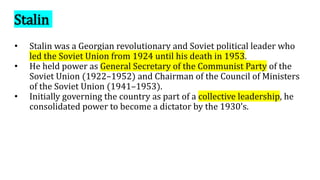
• Stalin was a Georgian revolutionary and Soviet political leader who
led the Soviet Union from 1924 until his death in 1953.
• He held power as General Secretary of the Communist Party of the
Soviet Union (1922–1952) and Chairman of the Council of Ministers
of the Soviet Union (1941–1953).
• Initially governing the country as part of a collective leadership, he
consolidated power to become a dictator by the 1930’s.
The Man of Steel
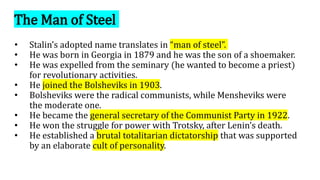
• Stalin’s adopted name translates in “man of steel”.
• He was born in Georgia in 1879 and he was the son of a shoemaker.
• He was expelled from the seminary (he wanted to become a priest)
for revolutionary activities.
• He joined the Bolsheviks in 1903.
• Bolsheviks were the radical communists, while Mensheviks were
the moderate one.
• He became the general secretary of the Communist Party in 1922.
• He won the struggle for power with Trotsky, after Lenin’s death.
• He established a brutal totalitarian dictatorship that was supported
by an elaborate cult of personality.
Socialism in One Country
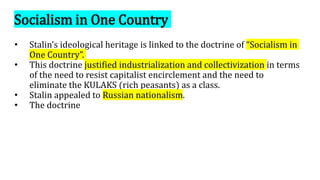
• Stalin’s ideological heritage is linked to the doctrine of “Socialism in
One Country”.
• This doctrine justified industrialization and collectivization in terms
of the need to resist capitalist encirclement and the need to
eliminate the KULAKS (rich peasants) as a class.
• Stalin appealed to Russian nationalism.
• The doctrine
Stalin’s Ideology
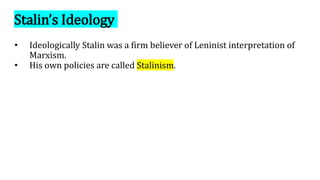
• Ideologically Stalin was a firm believer of Leninist interpretation of
Marxism.
• His own policies are called Stalinism.
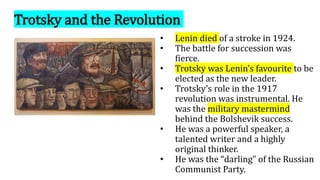
Trotsky and the Revolution
• Lenin died of a stroke in 1924.
• The battle for succession was
fierce.
• Trotsky was Lenin’s favourite to be
elected as the new leader.
• Trotsky’s role in the 1917
revolution was instrumental. He
was the military mastermind
behind the Bolshevik success.
• He was a powerful speaker, a
talented writer and a highly
original thinker.
• He was the “darling” of the Russian
Communist Party.
Stalin and the Revolution
• Stalin played an obscure part in the
Revolution.
• In 1922 he was elected to the position of
General Secretary of the Communist Party.
• This entitled him to be part of the
Politburo.
• Stalin was an excellent administrator, but
he had no charisma.
• He inspired no one and he was called by
his colleagues “Comrade Filling-Card” or
the “Grey Blur”.
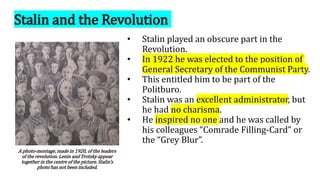
A photo-montage, made in 1920, of the leaders
of the revolution. Lenin and Trotsky appear
together in the centre of the picture. Stalin’s
photo has not been included.
Stalin and his 8 Steps to Power
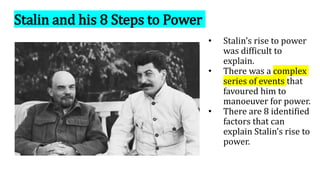
• Stalin’s rise to power
was difficult to
explain.
• There was a complex
series of events that
favoured him to
manoeuver for power.
• There are 8 identified
factors that can
explain Stalin’s rise to
power.
Step 1: Differences in Personality
• Stalin’s personality was
better suited to the
situation in which the party
leadership found itself after
1924.
• He was a very good
administrator.
• All his rivals were easily
fooled by Stalin: Trotsky,
Kamenev, Zinoviev, Tomsky
and Bukharin.
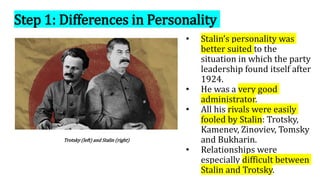
• Relationships were
especially difficult between
Stalin and Trotsky.
Trotsky (left) and Stalin (right)
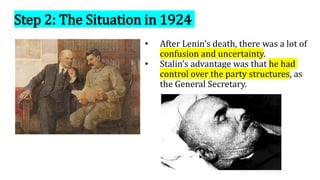
Step 2: The Situation in 1924
• After Lenin’s death, there was a lot of
confusion and uncertainty.
• Stalin’s advantage was that he had
control over the party structures, as
the General Secretary.
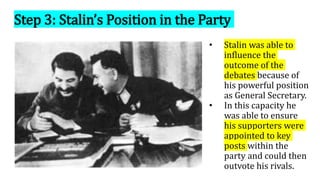
Step 3: Stalin’s Position in the Party
• Stalin was able to
influence the
outcome of the
debates because of
his powerful position
as General Secretary.
• In this capacity he
was able to ensure
his supporters were
appointed to key
posts within the
party and could then
outvote his rivals.
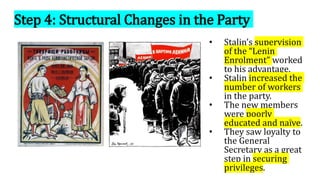
Step 4: Structural Changes in the Party
• Stalin’s supervision
of the “Lenin
Enrolment” worked
to his advantage.
• Stalin increased the
number of workers
in the party.
• The new members
were poorly
educated and naïve.
• They saw loyalty to
the General
Secretary as a great
step in securing
privileges.
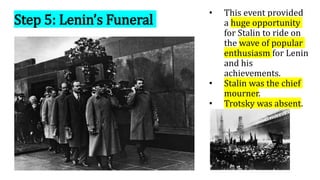
Step 5: Lenin’s Funeral
• This event provided
a huge opportunity
for Stalin to ride on
the wave of popular
enthusiasm for Lenin
and his
achievements.
• Stalin was the chief
mourner.
• Trotsky was absent.
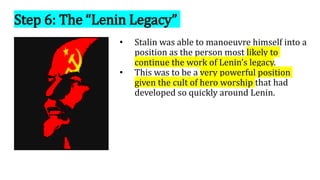
Step 6: The “Lenin Legacy”
• Stalin was able to manoeuvre himself into a
position as the person most likely to
continue the work of Lenin’s legacy.
• This was to be a very powerful position
given the cult of hero worship that had
developed so quickly around Lenin.
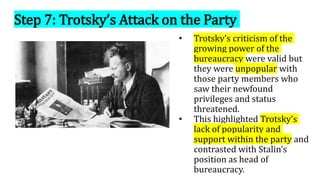
Step 7: Trotsky’s Attack on the Party
• Trotsky’s criticism of the
growing power of the
bureaucracy were valid but
they were unpopular with
those party members who
saw their newfound
privileges and status
threatened.
• This highlighted Trotsky’s
lack of popularity and
support within the party and
contrasted with Stalin’s
position as head of
bureaucracy.
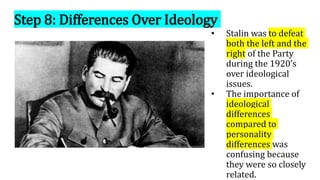
Step 8: Differences Over Ideology
• Stalin was to defeat
both the left and the
right of the Party
during the 1920’s
over ideological
issues.
• The importance of
ideological
differences
compared to
personality
differences was
confusing because
they were so closely
related.
Readings
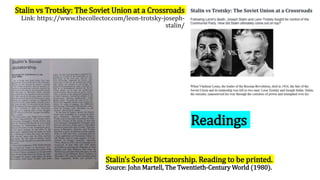
Stalin vs Trotsky: The Soviet Union at a Crossroads
Link: https://www.thecollector.com/leon-trotsky-joseph-
stalin/
Stalin’s Soviet Dictatorship. Reading to be printed.
Source: John Martell, The Twentieth-Century World (1980).

01. SOVIET CONTROL OF EASTERN EUROPE: Stalin

  • 1.
  • 2.
    Bibliography – CambridgeApproved • Allan Todd. The European Dictatorships. Hitler, Stalin, Mussolini (2002). • Allsopp John. Challenge and Response (1980). • Andrew Heywood. Politics (1997). • Ben Walsh. Modern World History (2001). • Colin Pearce. Representations of 20th Century History (1995). • John Martell. The Twentieth-Century World (1980). • Philip Ingram. Russia and the USSR, 1905-1991 (1997). • Ralph Levering. Debating the Origins of the Cold War. American and Russian Perspectives (2001). • Robert Gellately. Lenin, Stalin and Hitler (2008). • Tony McAleavy. Twentieth Century History. International Relations Since 1919 (2002). • Steve Phillips. Lenin and the Russian Revolution (2000).
  • 3.
  • 4.
    Stalin • Stalin wasa Georgian revolutionary and Soviet political leader who led the Soviet Union from 1924 until his death in 1953. • He held power as General Secretary of the Communist Party of the Soviet Union (1922–1952) and Chairman of the Council of Ministers of the Soviet Union (1941–1953). • Initially governing the country as part of a collective leadership, he consolidated power to become a dictator by the 1930’s.
  • 5.
    The Man ofSteel • Stalin’s adopted name translates in “man of steel”. • He was born in Georgia in 1879 and he was the son of a shoemaker. • He was expelled from the seminary (he wanted to become a priest) for revolutionary activities. • He joined the Bolsheviks in 1903. • Bolsheviks were the radical communists, while Mensheviks were the moderate one. • He became the general secretary of the Communist Party in 1922. • He won the struggle for power with Trotsky, after Lenin’s death. • He established a brutal totalitarian dictatorship that was supported by an elaborate cult of personality.
  • 6.
    Socialism in OneCountry • Stalin’s ideological heritage is linked to the doctrine of “Socialism in One Country”. • This doctrine justified industrialization and collectivization in terms of the need to resist capitalist encirclement and the need to eliminate the KULAKS (rich peasants) as a class. • Stalin appealed to Russian nationalism. • The doctrine
  • 7.
    Stalin’s Ideology • IdeologicallyStalin was a firm believer of Leninist interpretation of Marxism. • His own policies are called Stalinism.
  • 8.
    Trotsky and theRevolution • Lenin died of a stroke in 1924. • The battle for succession was fierce. • Trotsky was Lenin’s favourite to be elected as the new leader. • Trotsky’s role in the 1917 revolution was instrumental. He was the military mastermind behind the Bolshevik success. • He was a powerful speaker, a talented writer and a highly original thinker. • He was the “darling” of the Russian Communist Party.
  • 9.
    Stalin and theRevolution • Stalin played an obscure part in the Revolution. • In 1922 he was elected to the position of General Secretary of the Communist Party. • This entitled him to be part of the Politburo. • Stalin was an excellent administrator, but he had no charisma. • He inspired no one and he was called by his colleagues “Comrade Filling-Card” or the “Grey Blur”. A photo-montage, made in 1920, of the leaders of the revolution. Lenin and Trotsky appear together in the centre of the picture. Stalin’s photo has not been included.
  • 10.
    Stalin and his8 Steps to Power • Stalin’s rise to power was difficult to explain. • There was a complex series of events that favoured him to manoeuver for power. • There are 8 identified factors that can explain Stalin’s rise to power.
  • 11.
    Step 1: Differencesin Personality • Stalin’s personality was better suited to the situation in which the party leadership found itself after 1924. • He was a very good administrator. • All his rivals were easily fooled by Stalin: Trotsky, Kamenev, Zinoviev, Tomsky and Bukharin. • Relationships were especially difficult between Stalin and Trotsky. Trotsky (left) and Stalin (right)
  • 12.
    Step 2: TheSituation in 1924 • After Lenin’s death, there was a lot of confusion and uncertainty. • Stalin’s advantage was that he had control over the party structures, as the General Secretary.
  • 13.
    Step 3: Stalin’sPosition in the Party • Stalin was able to influence the outcome of the debates because of his powerful position as General Secretary. • In this capacity he was able to ensure his supporters were appointed to key posts within the party and could then outvote his rivals.
  • 14.
    Step 4: StructuralChanges in the Party • Stalin’s supervision of the “Lenin Enrolment” worked to his advantage. • Stalin increased the number of workers in the party. • The new members were poorly educated and naïve. • They saw loyalty to the General Secretary as a great step in securing privileges.
  • 15.
    Step 5: Lenin’sFuneral • This event provided a huge opportunity for Stalin to ride on the wave of popular enthusiasm for Lenin and his achievements. • Stalin was the chief mourner. • Trotsky was absent.
  • 16.
    Step 6: The“Lenin Legacy” • Stalin was able to manoeuvre himself into a position as the person most likely to continue the work of Lenin’s legacy. • This was to be a very powerful position given the cult of hero worship that had developed so quickly around Lenin.
  • 17.
    Step 7: Trotsky’sAttack on the Party • Trotsky’s criticism of the growing power of the bureaucracy were valid but they were unpopular with those party members who saw their newfound privileges and status threatened. • This highlighted Trotsky’s lack of popularity and support within the party and contrasted with Stalin’s position as head of bureaucracy.
  • 18.
    Step 8: DifferencesOver Ideology • Stalin was to defeat both the left and the right of the Party during the 1920’s over ideological issues. • The importance of ideological differences compared to personality differences was confusing because they were so closely related.
  • 19.
    Readings Stalin vs Trotsky:The Soviet Union at a Crossroads Link: https://www.thecollector.com/leon-trotsky-joseph- stalin/ Stalin’s Soviet Dictatorship. Reading to be printed. Source: John Martell, The Twentieth-Century World (1980).