Bell Ringer
• Determine if each modern day example would be supported by Federalists
or Democratic-Republicans. If you believe the Federalists would have
supported the concept, write an “F” beside it. If you believe the Democratic-
Republicans would have supported it, write a “DR” next to the concept.
• Socialized Medicine (Obamacare)
• Common Core
• State speed limit laws
The Jefferson
Era
ESSENTIAL QUESTIONS:
WHAT DID THE ELECTION OF 1800 SHOW ABOUT THE NATURE OF POLITICS?
WHAT DID JEFFERSON WANT TO ACCOMPLISH DURING HIS PRESIDENCY?
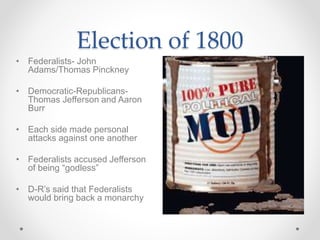
Election of 1800
• Federalists- John
Adams/Thomas Pinckney
• Democratic-Republicans-
Thomas Jefferson and Aaron
Burr
• Each side made personal
attacks against one another
• Federalists accused Jefferson
of being “godless”
• D-R’s said that Federalists
would bring back a monarchy
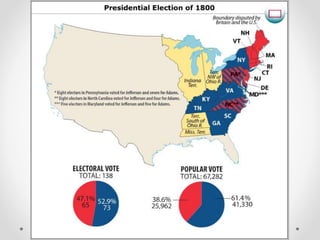
The Vote Is Tied
• Electoral College- Voters in a presidential election are really
electing a group of people called “electors.”
• At this time, electors casted two ballots: one for president and
one for vice president
• 73 electors cast their ballots for Jefferson and Burr
• This tie meant the House of Representatives had to decide
the election
• In the House, Federalists supported Burr to try and keep
Jefferson from becoming president
• In 1803, Congress passed the 12th Amendment to prevent a
future tie between a presidential and vice presidential
candidate.
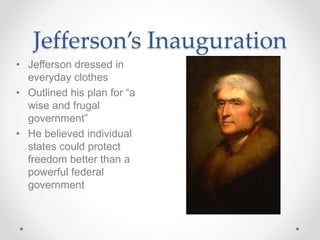
Jefferson’s Inauguration
• Jefferson dressed in
everyday clothes
• Outlined his plan for “a
wise and frugal
government”
• He believed individual
states could protect
freedom better than a
powerful federal
government
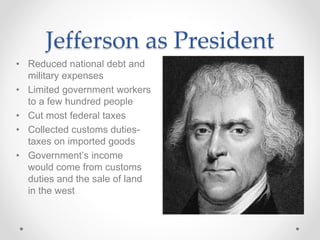
Jefferson as President
• Reduced national debt and
military expenses
• Limited government workers
to a few hundred people
• Cut most federal taxes
• Collected customs duties-
taxes on imported goods
• Government’s income
would come from customs
duties and the sale of land
in the west
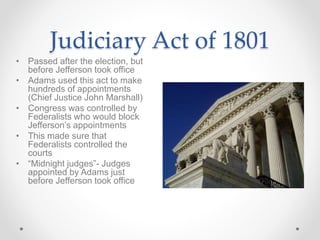
Judiciary Act of 1801
• Passed after the election, but
before Jefferson took office
• Adams used this act to make
hundreds of appointments
(Chief Justice John Marshall)
• Congress was controlled by
Federalists who would block
Jefferson’s appointments
• This made sure that
Federalists controlled the
courts
• “Midnight judges”- Judges
appointed by Adams just
before Jefferson took office
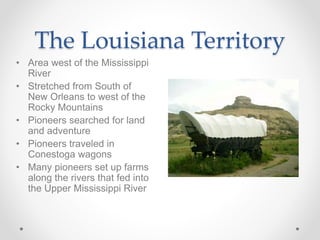
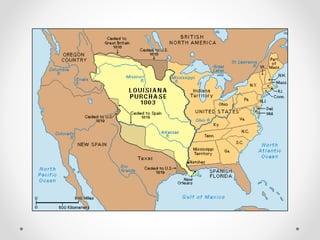
• Area west of the Mississippi
River
• Stretched from South of
New Orleans to west of the
Rocky Mountains
• Pioneers searched for land
and adventure
• Pioneers traveled in
Conestoga wagons
• Many pioneers set up farms
along the rivers that fed into
the Upper Mississippi River
The Louisiana Territory
• Spain had allowed Americans to
move through their territory
• In 1802, they changed their
policy
• Spain and France made a secret
agreement to transfer the
Louisiana Territory to France
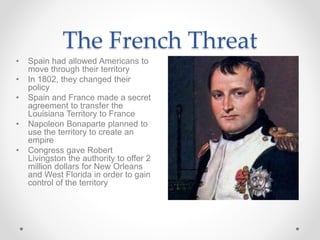
• Napoleon Bonaparte planned to
use the territory to create an
empire
• Congress gave Robert
Livingston the authority to offer 2
million dollars for New Orleans
and West Florida in order to gain
control of the territory
The French Threat
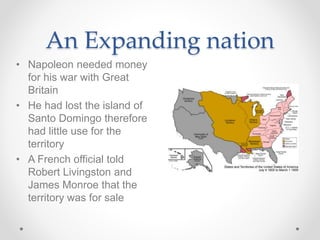
• Napoleon needed money
for his war with Great
Britain
• He had lost the island of
Santo Domingo therefore
had little use for the
territory
• A French official told
Robert Livingston and
James Monroe that the
territory was for sale
An Expanding nation
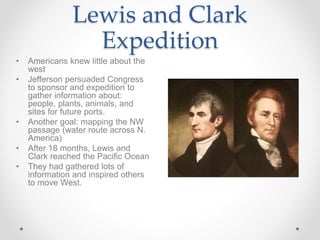
Lewis and Clark
Expedition
• Americans knew little about the
west
• Jefferson persuaded Congress
to sponsor and expedition to
gather information about:
people, plants, animals, and
sites for future ports.
• Another goal: mapping the NW
passage (water route across N.
America)
• After 18 months, Lewis and
Clark reached the Pacific Ocean
• They had gathered lots of
information and inspired others
to move West.
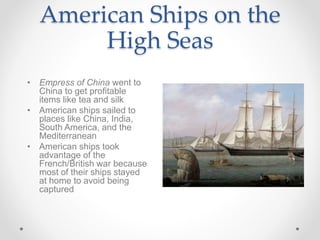
American Ships on the
High Seas
• Empress of China went to
China to get profitable
items like tea and silk
• American ships sailed to
places like China, India,
South America, and the
Mediterranean
• American ships took
advantage of the
French/British war because
most of their ships stayed
at home to avoid being
captured
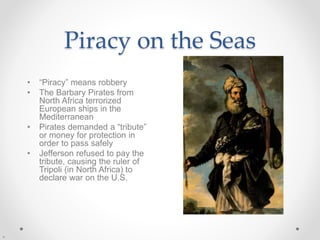
Piracy on the Seas
• “Piracy” means robbery
• The Barbary Pirates from
North Africa terrorized
European ships in the
Mediterranean
• Pirates demanded a “tribute”
or money for protection in
order to pass safely
• Jefferson refused to pay the
tribute, causing the ruler of
Tripoli (in North Africa) to
declare war on the U.S.
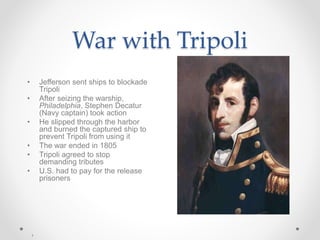
War with Tripoli
• Jefferson sent ships to blockade
Tripoli
• After seizing the warship,
Philadelphia, Stephen Decatur
(Navy captain) took action
• He slipped through the harbor
and burned the captured ship to
prevent Tripoli from using it
• The war ended in 1805
• Tripoli agreed to stop
demanding tributes
• U.S. had to pay for the release
prisoners
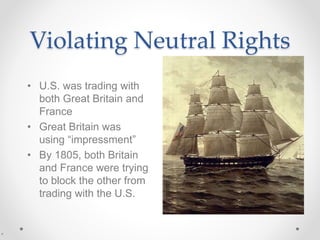
Violating Neutral Rights
• U.S. was trading with
both Great Britain and
France
• Great Britain was
using “impressment”
• By 1805, both Britain
and France were trying
to block the other from
trading with the U.S.
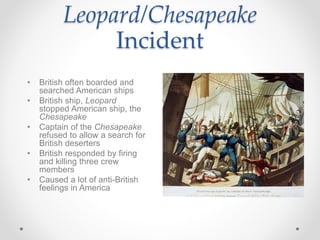
Leopard/Chesapeake
Incident
• British often boarded and
searched American ships
• British ship, Leopard
stopped American ship, the
Chesapeake
• Captain of the Chesapeake
refused to allow a search for
British deserters
• British responded by firing
and killing three crew
members
• Caused a lot of anti-British
feelings in America
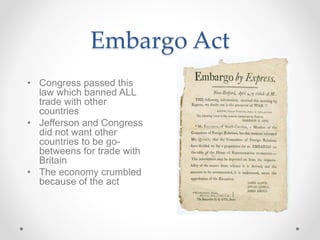
Embargo Act
• Congress passed this
law which banned ALL
trade with other
countries
• Jefferson and Congress
did not want other
countries to be go-
betweens for trade with
Britain
• The economy crumbled
because of the act

The Jefferson Era

  • 1.
    Bell Ringer • Determineif each modern day example would be supported by Federalists or Democratic-Republicans. If you believe the Federalists would have supported the concept, write an “F” beside it. If you believe the Democratic- Republicans would have supported it, write a “DR” next to the concept. • Socialized Medicine (Obamacare) • Common Core • State speed limit laws
  • 2.
    The Jefferson Era ESSENTIAL QUESTIONS: WHATDID THE ELECTION OF 1800 SHOW ABOUT THE NATURE OF POLITICS? WHAT DID JEFFERSON WANT TO ACCOMPLISH DURING HIS PRESIDENCY?
  • 3.
    Election of 1800 •Federalists- John Adams/Thomas Pinckney • Democratic-Republicans- Thomas Jefferson and Aaron Burr • Each side made personal attacks against one another • Federalists accused Jefferson of being “godless” • D-R’s said that Federalists would bring back a monarchy
  • 5.
    The Vote IsTied • Electoral College- Voters in a presidential election are really electing a group of people called “electors.” • At this time, electors casted two ballots: one for president and one for vice president • 73 electors cast their ballots for Jefferson and Burr • This tie meant the House of Representatives had to decide the election • In the House, Federalists supported Burr to try and keep Jefferson from becoming president • In 1803, Congress passed the 12th Amendment to prevent a future tie between a presidential and vice presidential candidate.
  • 6.
    Jefferson’s Inauguration • Jeffersondressed in everyday clothes • Outlined his plan for “a wise and frugal government” • He believed individual states could protect freedom better than a powerful federal government
  • 7.
    Jefferson as President •Reduced national debt and military expenses • Limited government workers to a few hundred people • Cut most federal taxes • Collected customs duties- taxes on imported goods • Government’s income would come from customs duties and the sale of land in the west
  • 8.
    Judiciary Act of1801 • Passed after the election, but before Jefferson took office • Adams used this act to make hundreds of appointments (Chief Justice John Marshall) • Congress was controlled by Federalists who would block Jefferson’s appointments • This made sure that Federalists controlled the courts • “Midnight judges”- Judges appointed by Adams just before Jefferson took office
  • 9.
    • Area westof the Mississippi River • Stretched from South of New Orleans to west of the Rocky Mountains • Pioneers searched for land and adventure • Pioneers traveled in Conestoga wagons • Many pioneers set up farms along the rivers that fed into the Upper Mississippi River The Louisiana Territory
  • 10.
    • Spain hadallowed Americans to move through their territory • In 1802, they changed their policy • Spain and France made a secret agreement to transfer the Louisiana Territory to France • Napoleon Bonaparte planned to use the territory to create an empire • Congress gave Robert Livingston the authority to offer 2 million dollars for New Orleans and West Florida in order to gain control of the territory The French Threat
  • 11.
    • Napoleon neededmoney for his war with Great Britain • He had lost the island of Santo Domingo therefore had little use for the territory • A French official told Robert Livingston and James Monroe that the territory was for sale An Expanding nation
  • 13.
    Lewis and Clark Expedition •Americans knew little about the west • Jefferson persuaded Congress to sponsor and expedition to gather information about: people, plants, animals, and sites for future ports. • Another goal: mapping the NW passage (water route across N. America) • After 18 months, Lewis and Clark reached the Pacific Ocean • They had gathered lots of information and inspired others to move West.
  • 14.
    American Ships onthe High Seas • Empress of China went to China to get profitable items like tea and silk • American ships sailed to places like China, India, South America, and the Mediterranean • American ships took advantage of the French/British war because most of their ships stayed at home to avoid being captured
  • 15.
    Piracy on theSeas • “Piracy” means robbery • The Barbary Pirates from North Africa terrorized European ships in the Mediterranean • Pirates demanded a “tribute” or money for protection in order to pass safely • Jefferson refused to pay the tribute, causing the ruler of Tripoli (in North Africa) to declare war on the U.S.
  • 16.
    War with Tripoli •Jefferson sent ships to blockade Tripoli • After seizing the warship, Philadelphia, Stephen Decatur (Navy captain) took action • He slipped through the harbor and burned the captured ship to prevent Tripoli from using it • The war ended in 1805 • Tripoli agreed to stop demanding tributes • U.S. had to pay for the release prisoners
  • 17.
    Violating Neutral Rights •U.S. was trading with both Great Britain and France • Great Britain was using “impressment” • By 1805, both Britain and France were trying to block the other from trading with the U.S.
  • 18.
    Leopard/Chesapeake Incident • British oftenboarded and searched American ships • British ship, Leopard stopped American ship, the Chesapeake • Captain of the Chesapeake refused to allow a search for British deserters • British responded by firing and killing three crew members • Caused a lot of anti-British feelings in America
  • 19.
    Embargo Act • Congresspassed this law which banned ALL trade with other countries • Jefferson and Congress did not want other countries to be go- betweens for trade with Britain • The economy crumbled because of the act