Theories of Practice:Theories of Practice:
The Human Resources FrameThe Human Resources Frame
© www.asia-masters.com
People are the heart of any organization. When
people feel the organization is responsive to their
needs and supportive of their goals, managers and
leaders can count on their followers’ commitment
and loyalty. Managers and leaders who are
authoritarian or insensitive, who don’t communicate
effectively, or who simply don’t care about their
people can never be effective managers and leaders.
The human resource manager and leader works on
behalf of both the organization and its people,
seeking to serve the best interests of both.
A HUMAN RESOURCES SCENARIO
© www.asia-masters.com
The job of the manager and leader is one of support and
empowerment. Support takes a variety of forms: letting people
know that they are important and that managers and leaders are
concerned about them; listening to find out about their followers’
aspirations and goals; and, communicating personal warmth and
openness. Human resource managers and leaders empower their
followers through participation and openness as well as by
making sure that they have the autonomy and the resources they
need to do their jobs well. Human resource managers and leaders
emphasize honest, two-way communication as a way to identify
issues and resolve differences. They are willing to confront
others when it is appropriate, but they try to do so in a spirit of
openness and caring.
Bolman & Deal (1991, p. 359)
MANAGEMENT AND LEADERSHIP
IN A HUMAN RESOURCES SCENARIO
© www.asia-masters.com
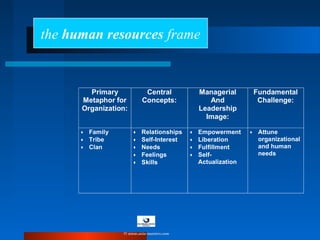
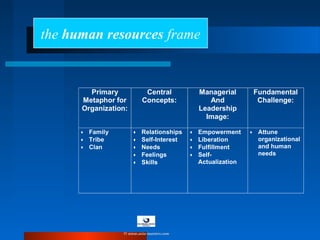
Primary
Metaphor for
Organization:
Central
Concepts:
Managerial
And
Leadership
Image:
Fundamental
Challenge:
• Family
• Tribe
• Clan
• Relationships
• Self-Interest
• Needs
• Feelings
• Skills
• Empowerment
• Liberation
• Fulfillment
• Self-
Actualization
• Attune
organizational
and human
needs
the human resources frame
© www.asia-masters.com
If the principles of scientific
management were considered
“revolutionary,” the assertions of the
early human resources theorists
were “radical”...
© www.asia-masters.com
…as their hypotheses challenged the
antecedents and theories of practice
governing how managers viewed
workers for the new Industrial era.
© www.asia-masters.com
One of the earliest precursors ofOne of the earliest precursors of
human resources theory...human resources theory...
David Owen
18th century mercantilist
owned spinning mills throughout
Scotland
believed that worker productivity
could be improved by being attentive
to their basic human needs
© www.asia-masters.com
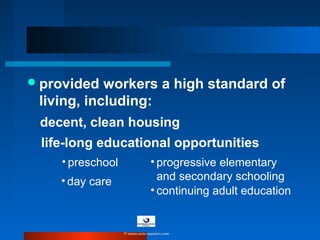
provided workers a high standard of
living, including:
life-long educational opportunities
decent, clean housing
• preschool
• day care
• progressive elementary
and secondary schooling
• continuing adult education
© www.asia-masters.com
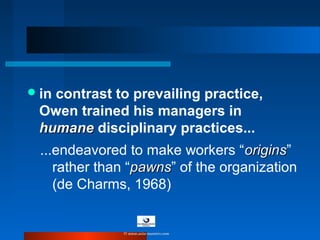
in contrast to prevailing practice,
Owen trained his managers in
humanehumane disciplinary practices...
...endeavored to make workers “originsorigins”
rather than “pawnspawns” of the organization
(de Charms, 1968)
© www.asia-masters.com
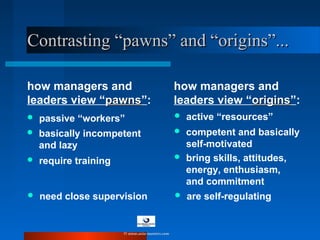
Contrasting “pawns” and “origins”...Contrasting “pawns” and “origins”...
 passive “workers”
 basically incompetent
and lazy
 need close supervision
 require training
 active “resources”
 competent and basically
self-motivated
 are self-regulating
 bring skills, attitudes,
energy, enthusiasm,
and commitment
how managers and
leaders view “pawnspawns”:
how managers and
leaders view “originsorigins”:
© www.asia-masters.com
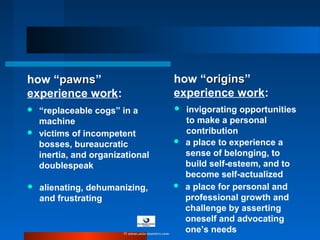
 “replaceable cogs” in a
machine
 alienating, dehumanizing,
and frustrating
 victims of incompetent
bosses, bureaucratic
inertia, and organizational
doublespeak
 invigorating opportunities
to make a personal
contribution
 a place for personal and
professional growth and
challenge by asserting
oneself and advocating
one’s needs
 a place to experience a
sense of belonging, to
build self-esteem, and to
become self-actualized
how “pawnspawns”
experience work:
how “originsorigins”
experience work:
© www.asia-masters.com
The issue raised by the human
resources theories of practice is
that of better aligning people andand
organizations not people oror
organizations...
© www.asia-masters.com
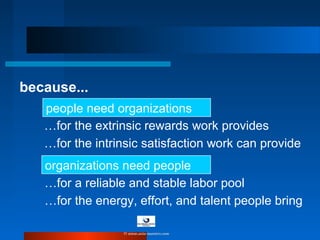
because...
people need organizations
…for the extrinsic rewards work provides
organizations need people
…for the intrinsic satisfaction work can provide
…for a reliable and stable labor pool
…for the energy, effort, and talent people bring
© www.asia-masters.com
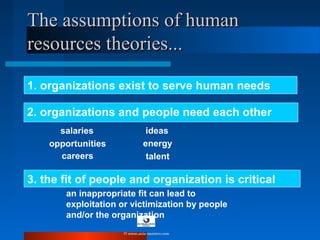
The assumptions of humanThe assumptions of human
resources theories...resources theories...
1. organizations exist to serve human needs
3. the fit of people and organization is critical
2. organizations and people need each other
ideas
energy
talent
salaries
opportunities
careers
an inappropriate fit can lead to
exploitation or victimization by people
and/or the organization
© www.asia-masters.com
The rise of industrial/organizational
psychology in the 20th century,
especially human needs theories,
provided a theoretical focus to
consider the fit of people and
organization...
© www.asia-masters.com
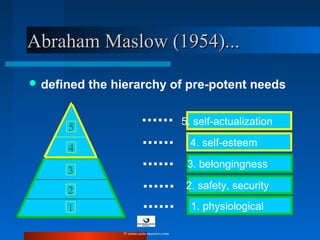
Abraham Maslow (1954)...Abraham Maslow (1954)...
 defined the hierarchy of pre-potent needs
5. self-actualization
4. self-esteem
3. belongingness
2. safety, security
1. physiological1
2
3
4
5
© www.asia-masters.com
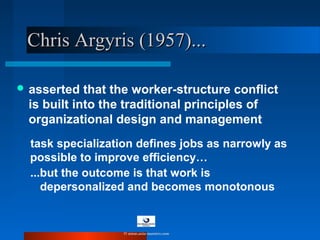
 asserted that the worker-structure conflict
is built into the traditional principles of
organizational design and management
task specialization defines jobs as narrowly as
possible to improve efficiency…
Chris Argyris (1957)...Chris Argyris (1957)...
...but the outcome is that work is
depersonalized and becomes monotonous
© www.asia-masters.com
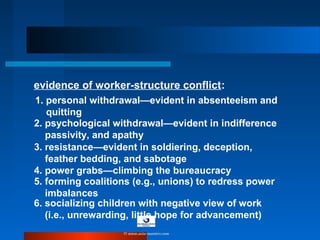
1. personal withdrawal—evident in absenteeism and
quitting
2. psychological withdrawal—evident in indifference
passivity, and apathy
3. resistance—evident in soldiering, deception,
feather bedding, and sabotage
4. power grabs—climbing the bureaucracy
5. forming coalitions (e.g., unions) to redress power
imbalances
evidence of worker-structure conflict:
6. socializing children with negative view of work
(i.e., unrewarding, little hope for advancement)
© www.asia-masters.com
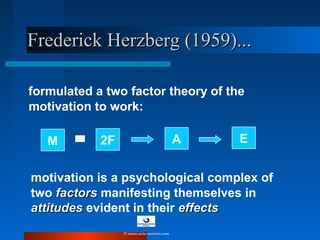
formulated a two factor theory of the
motivation to work:
Frederick Herzberg (1959)...Frederick Herzberg (1959)...
M 2F A E
motivation is a psychological complex of
two factorsfactors manifesting themselves in
attitudesattitudes evident in their effectseffects
© www.asia-masters.com
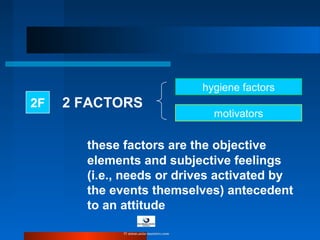
2 FACTORS2F
these factors are the objective
elements and subjective feelings
(i.e., needs or drives activated by
the events themselves) antecedent
to an attitude
hygiene factors
motivators
© www.asia-masters.com
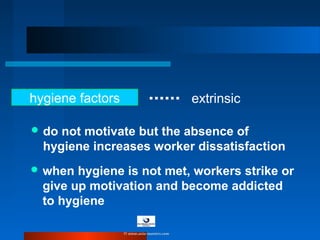
 do not motivate but the absence of
hygiene increases worker dissatisfaction
hygiene factors
 when hygiene is not met, workers strike or
give up motivation and become addicted
to hygiene
extrinsic
© www.asia-masters.com
hygiene factors
Good organizational hygiene provides the
foundation for higher motivation in the
workplace...
© www.asia-masters.com
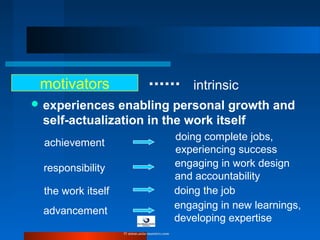
 experiences enabling personal growth and
self-actualization in the work itself
motivators intrinsic
achievement
responsibility
the work itself
advancement
doing complete jobs,
experiencing success
engaging in work design
and accountability
doing the job
engaging in new learnings,
developing expertise
© www.asia-masters.com
hygiene factors
motivators
...motivators build on hygiene factors...
© www.asia-masters.com
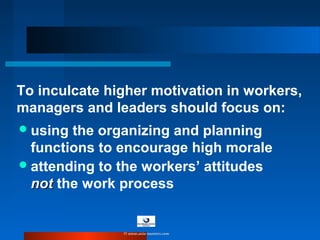
To inculcate higher motivation in workers,
managers and leaders should focus on:
attending to the workers’ attitudes
notnot the work process
using the organizing and planning
functions to encourage high morale
© www.asia-masters.com
While attending to worker morale and
attitudes, managers and leaders recognize:
that motivation to work is a psychological
process not a matter of a worker’s interest in
the job
that workplace hygiene is primary providing
the foundation for motivation
that salary is a hygiene factor not a motivator
© www.asia-masters.com
According to Herzberg’s two-factor theory of
motivation, the worst of all motivators is…
…an across-the-board salary increase
© www.asia-masters.com
posited a theory of management,
Theory X and Theory Y
…asserting that a manager’s assumptions
about people become self-fulfilling
prophecies evident in organizational
behavior
Douglas McGregor (1960)...Douglas McGregor (1960)...
© www.asia-masters.com
Theory X...people are inherently:
lazy
passive
possess little ambition
prefer to be led
resist change
© www.asia-masters.com
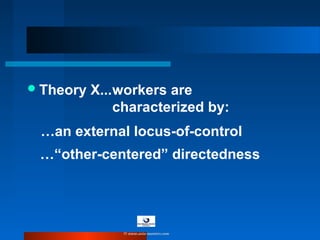
Theory X...workers are
characterized by:
…an external locus-of-control
…“other-centered” directedness
© www.asia-masters.com
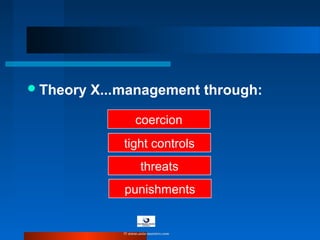
Theory X...management through:
coercion
tight controls
threats
punishments
© www.asia-masters.com
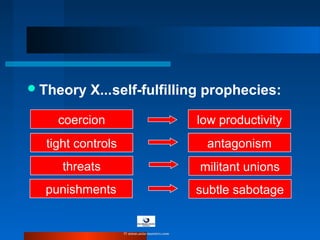
Theory X...self-fulfilling prophecies:
coercion
tight controls
threats
punishments
low productivity
antagonism
militant unions
subtle sabotage
© www.asia-masters.com
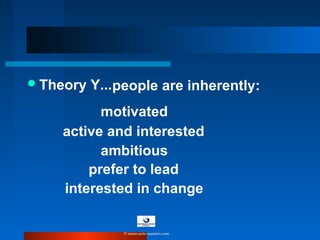
Theory Y...people are inherently:
motivated
active and interested
ambitious
prefer to lead
interested in change
© www.asia-masters.com
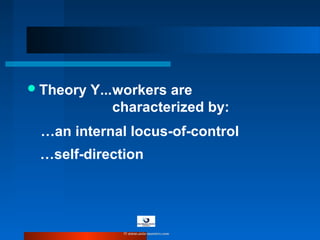
Theory Y...workers are
characterized by:
…an internal locus-of-control
…self-direction
© www.asia-masters.com
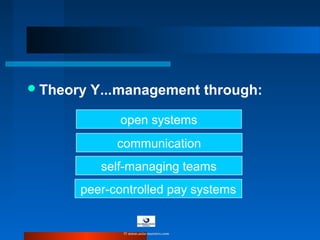
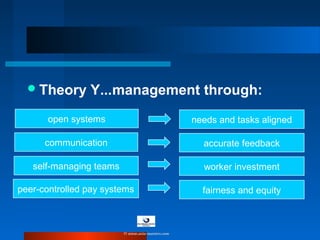
Theory Y...management through:
open systems
communication
self-managing teams
peer-controlled pay systems
© www.asia-masters.com
Theory Y...management through:
open systems
communication
self-managing teams
peer-controlled pay systems
needs and tasks aligned
accurate feedback
worker investment
fairness and equity
© www.asia-masters.com
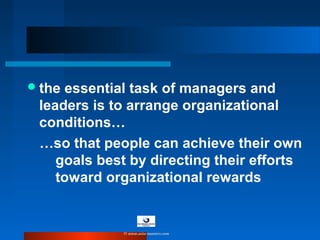
the essential task of managers and
leaders is to arrange organizational
conditions…
…so that people can achieve their own
goals best by directing their efforts
toward organizational rewards
© www.asia-masters.com
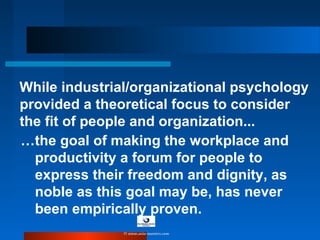
While industrial/organizational psychology
provided a theoretical focus to consider
the fit of people and organization...
…the goal of making the workplace and
productivity a forum for people to
express their freedom and dignity, as
noble as this goal may be, has never
been empirically proven.
© www.asia-masters.com
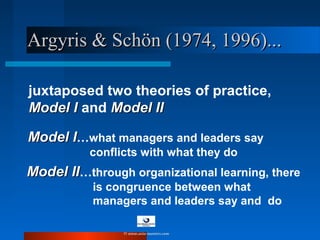
juxtaposed two theories of practice,
Model IModel I and Model IIModel II
Model IModel I…what managers and leaders say
conflicts with what they do
Argyris & Schön (1974, 1996)...Argyris & Schön (1974, 1996)...
Model IIModel II…through organizational learning, there
is congruence between what
managers and leaders say and do
© www.asia-masters.com
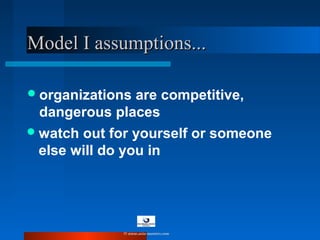
Model I assumptions...Model I assumptions...
organizations are competitive,
dangerous places
watch out for yourself or someone
else will do you in
© www.asia-masters.com
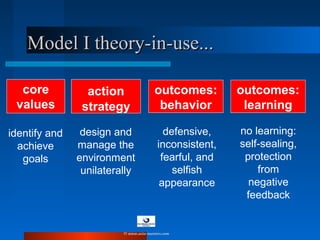
Model I theory-in-use...Model I theory-in-use...
core
values
action
strategy
outcomes:
behavior
outcomes:
learning
identify and
achieve
goals
design and
manage the
environment
unilaterally
defensive,
inconsistent,
fearful, and
selfish
appearance
no learning:
self-sealing,
protection
from
negative
feedback
© www.asia-masters.com
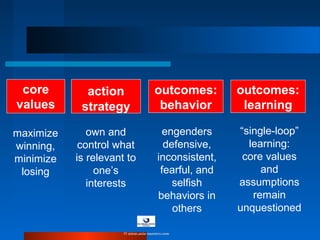
core
values
action
strategy
outcomes:
behavior
outcomes:
learning
maximize
winning,
minimize
losing
own and
control what
is relevant to
one’s
interests
engenders
defensive,
inconsistent,
fearful, and
selfish
behaviors in
others
“single-loop”
learning:
core values
and
assumptions
remain
unquestioned
© www.asia-masters.com
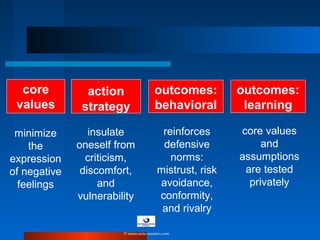
core
values
action
strategy
outcomes:
behavioral
outcomes:
learning
minimize
the
expression
of negative
feelings
insulate
oneself from
criticism,
discomfort,
and
vulnerability
reinforces
defensive
norms:
mistrust, risk
avoidance,
conformity,
and rivalry
core values
and
assumptions
are tested
privately
© www.asia-masters.com
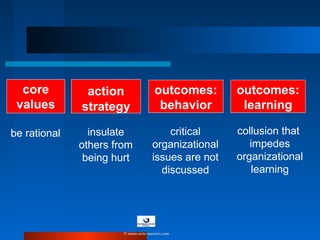
core
values
action
strategy
outcomes:
behavior
outcomes:
learning
be rational insulate
others from
being hurt
critical
organizational
issues are not
discussed
collusion that
impedes
organizational
learning
© www.asia-masters.com
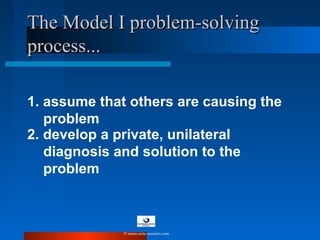
The Model I problem-solvingThe Model I problem-solving
process...process...
1. assume that others are causing the
problem
2. develop a private, unilateral
diagnosis and solution to the
problem
© www.asia-masters.com
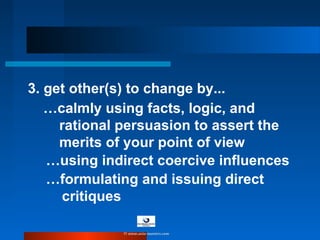
…calmly using facts, logic, and
rational persuasion to assert the
merits of your point of view
…using indirect coercive influences
…formulating and issuing direct
critiques
3. get other(s) to change by...
© www.asia-masters.com
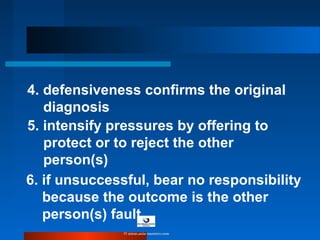
4. defensiveness confirms the original
diagnosis
5. intensify pressures by offering to
protect or to reject the other
person(s)
6. if unsuccessful, bear no responsibility
because the outcome is the other
person(s) fault
© www.asia-masters.com
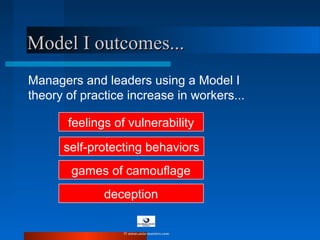
Model I outcomes...Model I outcomes...
feelings of vulnerability
Managers and leaders using a Model I
theory of practice increase in workers...
self-protecting behaviors
games of camouflage
deception
© www.asia-masters.com
organizational
catastrophe
…and increase the probability of...
© www.asia-masters.com
Model II problem-solvingModel II problem-solving
process...process...
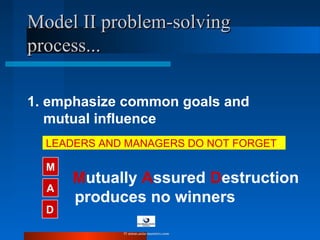
1. emphasize common goals and
mutual influence
Mutually Assured Destruction
produces no winners
M
A
D
LEADERS AND MANAGERS DO NOT FORGET:
© www.asia-masters.com
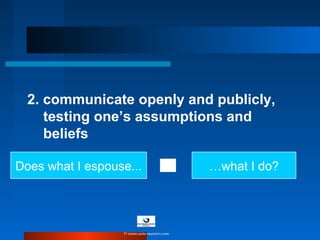
2. communicate openly and publicly,
testing one’s assumptions and
beliefs
Does what I espouse... …what I do?
© www.asia-masters.com
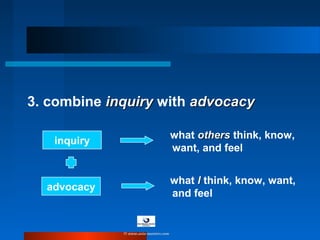
3. combine inquiryinquiry with advocacyadvocacy
what othersothers think, know,
want, and feel
inquiry
advocacy
what II think, know, want,
and feel
© www.asia-masters.com
 a fundamental competence in relating with
diverse individuals effectively
Human resources theory requires thatHuman resources theory requires that
managers and leaders possess...managers and leaders possess...
sufficiently good interpersonal skills:
 the refined ability to inquire in a non-threatening
way:
 What is going on here?
 Why are people behaving as they are?
 What can I do about it?
© www.asia-masters.com
 is not afraid of conflict
sufficiently good intrapersonal skills:
 in arguments, is able to distance oneself from the
passion of the moment and to construct how
other individuals are making sense of things
 is able to confront conflict
 “complicates” (rather than simplifies) one’s
understanding of how the organization really
works
© www.asia-masters.com
 negotiates the fit between the individual and the
organization
sufficiently good group skills:
 is comfortable with plurality, diversity, and
ambiguity
 directs conflict towards productive ends
 while solving problems, resolves organizational
issues
© www.asia-masters.com
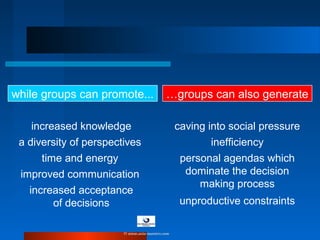
while groups can promote... …groups can also generate
increased knowledge
a diversity of perspectives
time and energy
improved communication
increased acceptance
of decisions
caving into social pressure
inefficiency
personal agendas which
dominate the decision
making process
unproductive constraints
© www.asia-masters.com
to increase group productivity
managers and leaders must be able
to address:
other’s personal interests
the requirements of various task roles
the requirements of various personal roles
informal group norms
interpersonal conflict
© www.asia-masters.com
Basic human resourcesBasic human resources
strategies...strategies...
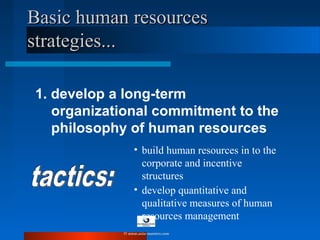
1. develop a long-term
organizational commitment to the
philosophy of human resources
• build human resources in to the
corporate and incentive
structures
• develop quantitative and
qualitative measures of human
resources management
© www.asia-masters.com
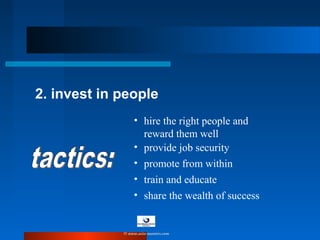
2. invest in people
• hire the right people and
reward them well
• provide job security
• promote from within
• train and educate
• share the wealth of success
© www.asia-masters.com
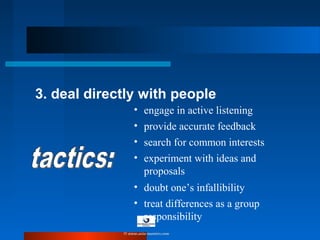
3. deal directly with people
• engage in active listening
• provide accurate feedback
• search for common interests
• experiment with ideas and
proposals
• doubt one’s infallibility
• treat differences as a group
responsibility
© www.asia-masters.com
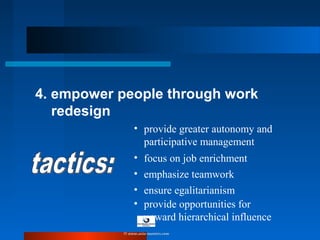
4. empower people through work
redesign
• provide greater autonomy and
participative management
• focus on job enrichment
• emphasize teamwork
• ensure egalitarianism
• provide opportunities for
upward hierarchical influence
© www.asia-masters.com
Because change causes people to
feel incompetent, needy, and
powerless, providing for the
development of new skills, creating
opportunities for involvement, and
providing psychological support are
essential managerial/leadership
tasks.
© www.asia-masters.com
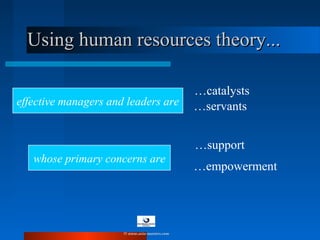
effective managers and leaders are
…catalysts
Using human resources theory...Using human resources theory...
whose primary concerns are
…support
…empowerment
…servants
© www.asia-masters.com
Human resources tasks forHuman resources tasks for
managers and leaders...managers and leaders...
1. help individuals and group
develop a shared sense of
direction and purpose
2. balance task and process goals
3. endeavor to make group work
both satisfying and efficient
© www.asia-masters.com
4. keep on top of a large, complex
set of activities
5. get support from bosses
6. get support from corporate staff
and other constituents
7. motivate, coordinate, and control
large, diverse group of subordinates
© www.asia-masters.com
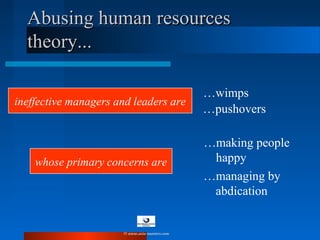
ineffective managers and leaders are
…wimps
Abusing human resourcesAbusing human resources
theory...theory...
whose primary concerns are
…making people
happy
…managing by
abdication
…pushovers
© www.asia-masters.com
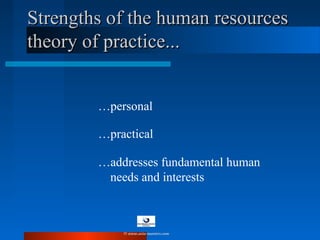
…personal
Strengths of the human resourcesStrengths of the human resources
theory of practice...theory of practice...
…practical
…addresses fundamental human
needs and interests
© www.asia-masters.com
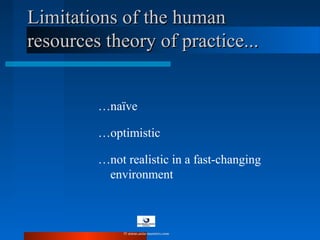
…naïve
Limitations of the humanLimitations of the human
resources theory of practice...resources theory of practice...
…optimistic
…not realistic in a fast-changing
environment
© www.asia-masters.com
Integrating reflective practice, conceptualIntegrating reflective practice, conceptual
pluralism, and organizational analysis...pluralism, and organizational analysis...
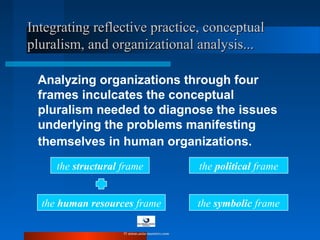
Analyzing organizations through four
frames inculcates the conceptual
pluralism needed to diagnose the issues
underlying the problems manifesting
themselves in human organizations.
the structural frame
the human resources frame
the political frame
the symbolic frame
© www.asia-masters.com
This module has focused on...This module has focused on...
the human resources theorieshuman resources theories that
managers and leaders can utilize in
practice episodes
© www.asia-masters.com
the human resources frame
as these theories of practice provide
managers a frame of reference to inform
decision making, the
offers managers and leaders guidance
about the strengths and limits of human
resources theory
© www.asia-masters.com
People are the heart of any organization. When
people feel the organization is responsive to their
needs and supportive of their goals, managers and
leaders can count on their followers’ commitment and
loyalty. Managers and leaders who are authoritarian
or insensitive, who don’t communicate effectively, or
who simply don’t care about their people can never be
effective managers and leaders. The human resource
manager and leader works on behalf of both the
organization and its people, seeking to serve the best
interests of both.
A HUMAN RESOURCES SCENARIO
© www.asia-masters.com
The job of the manager and leader is one of support and
empowerment. Support takes a variety of forms: letting people
know that they are important and that managers and leaders are
concerned about them; listening to find out about their followers’
aspirations and goals; and, communicating personal warmth and
openness. Human resource managers and leaders empower their
followers through participation and openness as well as by
making sure that they have the autonomy and the resources they
need to do their jobs well. Human resource managers and leaders
emphasize honest, two-way communication as a way to identify
issues and resolve differences. They are willing to confront
others when it is appropriate, but they try to do so in a spirit of
openness and caring.
Bolman & Deal (1991, p. 359)
MANAGEMENT AND LEADERSHIP
IN A HUMAN RESOURCES SCENARIO
© www.asia-masters.com
Primary
Metaphor for
Organization:
Central
Concepts:
Managerial
And
Leadership
Image:
Fundamental
Challenge:
• Family
• Tribe
• Clan
• Relationships
• Self-Interest
• Needs
• Feelings
• Skills
• Empowerment
• Liberation
• Fulfillment
• Self-
Actualization
• Attune
organizational
and human
needs
the human resources frame
© www.asia-masters.com
The next module will focus on...The next module will focus on...
and the political science theories that
managers and leaders can utilize in
practice episodes
the political frame
© www.asia-masters.com
Managers and leaders have to recognize
political reality and know how to deal
with it. Inside and outside any
organization, there are always a variety of
different interest groups, each with its own
agenda. There are not enough resources to
give everyone what he or she wants, and
there is always going to be conflict.
A POLITICAL SCENARIO
© www.asia-masters.com
The job of managers and leaders is to recognize the major
constituencies, to develop ties to their leadership, and to manage
conflict as productively as possible. Above all, they need to build
power bases and use power carefully. They cannot give every
group everything it wants, although they can try to create arenas
for negotiating differences and coming up with reasonable
compromises. Managers and leaders also have to work hard at
articulating what everyone in their organizations possesses in
common. Managers and leaders must tell the people that it is a
waste of time to fight each other when there are plenty of enemies
outside that they can all fight together. Groups that fail to work
well together internally tend to get trounced by outsiders who
have their own agendas.
Bolman & Deal (1991, p. 361)
MANAGEMENT AND LEADERSHIP
IN A POLITICAL SCENARIO
© www.asia-masters.com
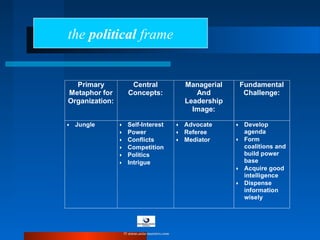
the political frame
Primary
Metaphor for
Organization:
Central
Concepts:
Managerial
And
Leadership
Image:
Fundamental
Challenge:
• Jungle • Self-Interest
• Power
• Conflicts
• Competition
• Politics
• Intrigue
• Advocate
• Referee
• Mediator
• Develop
agenda
• Form
coalitions and
build power
base
• Acquire good
intelligence
• Dispense
information
wisely
© www.asia-masters.com
ReferencesReferences
 Argyris, C. (1960). Individual actualization in complex
organizations. Mental Hygiene, 44(2), 226 37.‑
 Argyris, C. (1986, Sept.-Oct.). Double loop learning in
organizations, Harvard Business Review, 64(5), 74-79.
 Argyris, C. (1977, Sept-Oct). Skilled incompetence.
Harvard Business Review, 55(5), 115-25.
 Argyris, C. (1991). Teaching smart people how to learn.
Harvard Business Review, 69(3), 99-109.
 Argyris, C., & Schön, D. A. (1974). Theory in Practice:
Increasing Professional Effectiveness. San Francisco:
Jossey-Bass.
© www.asia-masters.com
 Barnard, C. I. (1938/1968). The functions of the
executive. Cambridge, MA: Harvard University Press.
 Bolman, L. G., & Deal, T. E. (1997). Reframing
organizations: Artistry, choice and leadership (2nd
edition).
San Francisco: Jossey-Bass.
 DeCharms, P. (1968). Personal causation. New York:
Academic Press.
 Festinger, L. (1957). A theory of cognitive dissonance.
Stanford, CA: Stanford University Press.
 Herzberg, F., Mausner, B., & Snyderman, B. B.
(1959/1993). The motivation to work. New Brunswick,
NJ: Transaction Publishers.
© www.asia-masters.com
 Maslow, A. H. (1943). A theory of human motivation.
Psychological Review, 50, 370-396.
 McGregor, D. (1960). The human side of organization.
New York: McGraw Hill.
 Sergiovanni, T. J. (1989). Informing professional practice in
educational administration. Journal of Educational
Administration, 27(2), p. 186.
 Weick, K. E. (1995). Sensemaking in organizations.
Thousand Oaks, CA: Sage Publications, Inc.
© www.asia-masters.com

The Human Resource Frame - Presentation Slides

  • 1.
    Theories of Practice:Theoriesof Practice: The Human Resources FrameThe Human Resources Frame © www.asia-masters.com
  • 2.
    People are theheart of any organization. When people feel the organization is responsive to their needs and supportive of their goals, managers and leaders can count on their followers’ commitment and loyalty. Managers and leaders who are authoritarian or insensitive, who don’t communicate effectively, or who simply don’t care about their people can never be effective managers and leaders. The human resource manager and leader works on behalf of both the organization and its people, seeking to serve the best interests of both. A HUMAN RESOURCES SCENARIO © www.asia-masters.com
  • 3.
    The job ofthe manager and leader is one of support and empowerment. Support takes a variety of forms: letting people know that they are important and that managers and leaders are concerned about them; listening to find out about their followers’ aspirations and goals; and, communicating personal warmth and openness. Human resource managers and leaders empower their followers through participation and openness as well as by making sure that they have the autonomy and the resources they need to do their jobs well. Human resource managers and leaders emphasize honest, two-way communication as a way to identify issues and resolve differences. They are willing to confront others when it is appropriate, but they try to do so in a spirit of openness and caring. Bolman & Deal (1991, p. 359) MANAGEMENT AND LEADERSHIP IN A HUMAN RESOURCES SCENARIO © www.asia-masters.com
  • 4.
    Primary Metaphor for Organization: Central Concepts: Managerial And Leadership Image: Fundamental Challenge: • Family •Tribe • Clan • Relationships • Self-Interest • Needs • Feelings • Skills • Empowerment • Liberation • Fulfillment • Self- Actualization • Attune organizational and human needs the human resources frame © www.asia-masters.com
  • 5.
    If the principlesof scientific management were considered “revolutionary,” the assertions of the early human resources theorists were “radical”... © www.asia-masters.com
  • 6.
    …as their hypotheseschallenged the antecedents and theories of practice governing how managers viewed workers for the new Industrial era. © www.asia-masters.com
  • 7.
    One of theearliest precursors ofOne of the earliest precursors of human resources theory...human resources theory... David Owen 18th century mercantilist owned spinning mills throughout Scotland believed that worker productivity could be improved by being attentive to their basic human needs © www.asia-masters.com
  • 8.
    provided workers ahigh standard of living, including: life-long educational opportunities decent, clean housing • preschool • day care • progressive elementary and secondary schooling • continuing adult education © www.asia-masters.com
  • 9.
    in contrast toprevailing practice, Owen trained his managers in humanehumane disciplinary practices... ...endeavored to make workers “originsorigins” rather than “pawnspawns” of the organization (de Charms, 1968) © www.asia-masters.com
  • 10.
    Contrasting “pawns” and“origins”...Contrasting “pawns” and “origins”...  passive “workers”  basically incompetent and lazy  need close supervision  require training  active “resources”  competent and basically self-motivated  are self-regulating  bring skills, attitudes, energy, enthusiasm, and commitment how managers and leaders view “pawnspawns”: how managers and leaders view “originsorigins”: © www.asia-masters.com
  • 11.
     “replaceable cogs”in a machine  alienating, dehumanizing, and frustrating  victims of incompetent bosses, bureaucratic inertia, and organizational doublespeak  invigorating opportunities to make a personal contribution  a place for personal and professional growth and challenge by asserting oneself and advocating one’s needs  a place to experience a sense of belonging, to build self-esteem, and to become self-actualized how “pawnspawns” experience work: how “originsorigins” experience work: © www.asia-masters.com
  • 12.
    The issue raisedby the human resources theories of practice is that of better aligning people andand organizations not people oror organizations... © www.asia-masters.com
  • 13.
    because... people need organizations …forthe extrinsic rewards work provides organizations need people …for the intrinsic satisfaction work can provide …for a reliable and stable labor pool …for the energy, effort, and talent people bring © www.asia-masters.com
  • 14.
    The assumptions ofhumanThe assumptions of human resources theories...resources theories... 1. organizations exist to serve human needs 3. the fit of people and organization is critical 2. organizations and people need each other ideas energy talent salaries opportunities careers an inappropriate fit can lead to exploitation or victimization by people and/or the organization © www.asia-masters.com
  • 15.
    The rise ofindustrial/organizational psychology in the 20th century, especially human needs theories, provided a theoretical focus to consider the fit of people and organization... © www.asia-masters.com
  • 16.
    Abraham Maslow (1954)...AbrahamMaslow (1954)...  defined the hierarchy of pre-potent needs 5. self-actualization 4. self-esteem 3. belongingness 2. safety, security 1. physiological1 2 3 4 5 © www.asia-masters.com
  • 17.
     asserted thatthe worker-structure conflict is built into the traditional principles of organizational design and management task specialization defines jobs as narrowly as possible to improve efficiency… Chris Argyris (1957)...Chris Argyris (1957)... ...but the outcome is that work is depersonalized and becomes monotonous © www.asia-masters.com
  • 18.
    1. personal withdrawal—evidentin absenteeism and quitting 2. psychological withdrawal—evident in indifference passivity, and apathy 3. resistance—evident in soldiering, deception, feather bedding, and sabotage 4. power grabs—climbing the bureaucracy 5. forming coalitions (e.g., unions) to redress power imbalances evidence of worker-structure conflict: 6. socializing children with negative view of work (i.e., unrewarding, little hope for advancement) © www.asia-masters.com
  • 19.
    formulated a twofactor theory of the motivation to work: Frederick Herzberg (1959)...Frederick Herzberg (1959)... M 2F A E motivation is a psychological complex of two factorsfactors manifesting themselves in attitudesattitudes evident in their effectseffects © www.asia-masters.com
  • 20.
    2 FACTORS2F these factorsare the objective elements and subjective feelings (i.e., needs or drives activated by the events themselves) antecedent to an attitude hygiene factors motivators © www.asia-masters.com
  • 21.
     do notmotivate but the absence of hygiene increases worker dissatisfaction hygiene factors  when hygiene is not met, workers strike or give up motivation and become addicted to hygiene extrinsic © www.asia-masters.com
  • 22.
    hygiene factors Good organizationalhygiene provides the foundation for higher motivation in the workplace... © www.asia-masters.com
  • 23.
     experiences enablingpersonal growth and self-actualization in the work itself motivators intrinsic achievement responsibility the work itself advancement doing complete jobs, experiencing success engaging in work design and accountability doing the job engaging in new learnings, developing expertise © www.asia-masters.com
  • 24.
    hygiene factors motivators ...motivators buildon hygiene factors... © www.asia-masters.com
  • 25.
    To inculcate highermotivation in workers, managers and leaders should focus on: attending to the workers’ attitudes notnot the work process using the organizing and planning functions to encourage high morale © www.asia-masters.com
  • 26.
    While attending toworker morale and attitudes, managers and leaders recognize: that motivation to work is a psychological process not a matter of a worker’s interest in the job that workplace hygiene is primary providing the foundation for motivation that salary is a hygiene factor not a motivator © www.asia-masters.com
  • 27.
    According to Herzberg’stwo-factor theory of motivation, the worst of all motivators is… …an across-the-board salary increase © www.asia-masters.com
  • 28.
    posited a theoryof management, Theory X and Theory Y …asserting that a manager’s assumptions about people become self-fulfilling prophecies evident in organizational behavior Douglas McGregor (1960)...Douglas McGregor (1960)... © www.asia-masters.com
  • 29.
    Theory X...people areinherently: lazy passive possess little ambition prefer to be led resist change © www.asia-masters.com
  • 30.
    Theory X...workers are characterizedby: …an external locus-of-control …“other-centered” directedness © www.asia-masters.com
  • 31.
    Theory X...management through: coercion tightcontrols threats punishments © www.asia-masters.com
  • 32.
    Theory X...self-fulfilling prophecies: coercion tightcontrols threats punishments low productivity antagonism militant unions subtle sabotage © www.asia-masters.com
  • 33.
    Theory Y...people areinherently: motivated active and interested ambitious prefer to lead interested in change © www.asia-masters.com
  • 34.
    Theory Y...workers are characterizedby: …an internal locus-of-control …self-direction © www.asia-masters.com
  • 35.
    Theory Y...management through: opensystems communication self-managing teams peer-controlled pay systems © www.asia-masters.com
  • 36.
    Theory Y...management through: opensystems communication self-managing teams peer-controlled pay systems needs and tasks aligned accurate feedback worker investment fairness and equity © www.asia-masters.com
  • 37.
    the essential taskof managers and leaders is to arrange organizational conditions… …so that people can achieve their own goals best by directing their efforts toward organizational rewards © www.asia-masters.com
  • 38.
    While industrial/organizational psychology provideda theoretical focus to consider the fit of people and organization... …the goal of making the workplace and productivity a forum for people to express their freedom and dignity, as noble as this goal may be, has never been empirically proven. © www.asia-masters.com
  • 39.
    juxtaposed two theoriesof practice, Model IModel I and Model IIModel II Model IModel I…what managers and leaders say conflicts with what they do Argyris & Schön (1974, 1996)...Argyris & Schön (1974, 1996)... Model IIModel II…through organizational learning, there is congruence between what managers and leaders say and do © www.asia-masters.com
  • 40.
    Model I assumptions...ModelI assumptions... organizations are competitive, dangerous places watch out for yourself or someone else will do you in © www.asia-masters.com
  • 41.
    Model I theory-in-use...ModelI theory-in-use... core values action strategy outcomes: behavior outcomes: learning identify and achieve goals design and manage the environment unilaterally defensive, inconsistent, fearful, and selfish appearance no learning: self-sealing, protection from negative feedback © www.asia-masters.com
  • 42.
    core values action strategy outcomes: behavior outcomes: learning maximize winning, minimize losing own and control what isrelevant to one’s interests engenders defensive, inconsistent, fearful, and selfish behaviors in others “single-loop” learning: core values and assumptions remain unquestioned © www.asia-masters.com
  • 43.
  • 44.
    core values action strategy outcomes: behavior outcomes: learning be rational insulate othersfrom being hurt critical organizational issues are not discussed collusion that impedes organizational learning © www.asia-masters.com
  • 45.
    The Model Iproblem-solvingThe Model I problem-solving process...process... 1. assume that others are causing the problem 2. develop a private, unilateral diagnosis and solution to the problem © www.asia-masters.com
  • 46.
    …calmly using facts,logic, and rational persuasion to assert the merits of your point of view …using indirect coercive influences …formulating and issuing direct critiques 3. get other(s) to change by... © www.asia-masters.com
  • 47.
    4. defensiveness confirmsthe original diagnosis 5. intensify pressures by offering to protect or to reject the other person(s) 6. if unsuccessful, bear no responsibility because the outcome is the other person(s) fault © www.asia-masters.com
  • 48.
    Model I outcomes...ModelI outcomes... feelings of vulnerability Managers and leaders using a Model I theory of practice increase in workers... self-protecting behaviors games of camouflage deception © www.asia-masters.com
  • 49.
    organizational catastrophe …and increase theprobability of... © www.asia-masters.com
  • 50.
    Model II problem-solvingModelII problem-solving process...process... 1. emphasize common goals and mutual influence Mutually Assured Destruction produces no winners M A D LEADERS AND MANAGERS DO NOT FORGET: © www.asia-masters.com
  • 51.
    2. communicate openlyand publicly, testing one’s assumptions and beliefs Does what I espouse... …what I do? © www.asia-masters.com
  • 52.
    3. combine inquiryinquirywith advocacyadvocacy what othersothers think, know, want, and feel inquiry advocacy what II think, know, want, and feel © www.asia-masters.com
  • 53.
     a fundamentalcompetence in relating with diverse individuals effectively Human resources theory requires thatHuman resources theory requires that managers and leaders possess...managers and leaders possess... sufficiently good interpersonal skills:  the refined ability to inquire in a non-threatening way:  What is going on here?  Why are people behaving as they are?  What can I do about it? © www.asia-masters.com
  • 54.
     is notafraid of conflict sufficiently good intrapersonal skills:  in arguments, is able to distance oneself from the passion of the moment and to construct how other individuals are making sense of things  is able to confront conflict  “complicates” (rather than simplifies) one’s understanding of how the organization really works © www.asia-masters.com
  • 55.
     negotiates thefit between the individual and the organization sufficiently good group skills:  is comfortable with plurality, diversity, and ambiguity  directs conflict towards productive ends  while solving problems, resolves organizational issues © www.asia-masters.com
  • 56.
    while groups canpromote... …groups can also generate increased knowledge a diversity of perspectives time and energy improved communication increased acceptance of decisions caving into social pressure inefficiency personal agendas which dominate the decision making process unproductive constraints © www.asia-masters.com
  • 57.
    to increase groupproductivity managers and leaders must be able to address: other’s personal interests the requirements of various task roles the requirements of various personal roles informal group norms interpersonal conflict © www.asia-masters.com
  • 58.
    Basic human resourcesBasichuman resources strategies...strategies... 1. develop a long-term organizational commitment to the philosophy of human resources • build human resources in to the corporate and incentive structures • develop quantitative and qualitative measures of human resources management © www.asia-masters.com
  • 59.
    2. invest inpeople • hire the right people and reward them well • provide job security • promote from within • train and educate • share the wealth of success © www.asia-masters.com
  • 60.
    3. deal directlywith people • engage in active listening • provide accurate feedback • search for common interests • experiment with ideas and proposals • doubt one’s infallibility • treat differences as a group responsibility © www.asia-masters.com
  • 61.
    4. empower peoplethrough work redesign • provide greater autonomy and participative management • focus on job enrichment • emphasize teamwork • ensure egalitarianism • provide opportunities for upward hierarchical influence © www.asia-masters.com
  • 62.
    Because change causespeople to feel incompetent, needy, and powerless, providing for the development of new skills, creating opportunities for involvement, and providing psychological support are essential managerial/leadership tasks. © www.asia-masters.com
  • 63.
    effective managers andleaders are …catalysts Using human resources theory...Using human resources theory... whose primary concerns are …support …empowerment …servants © www.asia-masters.com
  • 64.
    Human resources tasksforHuman resources tasks for managers and leaders...managers and leaders... 1. help individuals and group develop a shared sense of direction and purpose 2. balance task and process goals 3. endeavor to make group work both satisfying and efficient © www.asia-masters.com
  • 65.
    4. keep ontop of a large, complex set of activities 5. get support from bosses 6. get support from corporate staff and other constituents 7. motivate, coordinate, and control large, diverse group of subordinates © www.asia-masters.com
  • 66.
    ineffective managers andleaders are …wimps Abusing human resourcesAbusing human resources theory...theory... whose primary concerns are …making people happy …managing by abdication …pushovers © www.asia-masters.com
  • 67.
    …personal Strengths of thehuman resourcesStrengths of the human resources theory of practice...theory of practice... …practical …addresses fundamental human needs and interests © www.asia-masters.com
  • 68.
    …naïve Limitations of thehumanLimitations of the human resources theory of practice...resources theory of practice... …optimistic …not realistic in a fast-changing environment © www.asia-masters.com
  • 69.
    Integrating reflective practice,conceptualIntegrating reflective practice, conceptual pluralism, and organizational analysis...pluralism, and organizational analysis... Analyzing organizations through four frames inculcates the conceptual pluralism needed to diagnose the issues underlying the problems manifesting themselves in human organizations. the structural frame the human resources frame the political frame the symbolic frame © www.asia-masters.com
  • 70.
    This module hasfocused on...This module has focused on... the human resources theorieshuman resources theories that managers and leaders can utilize in practice episodes © www.asia-masters.com
  • 71.
    the human resourcesframe as these theories of practice provide managers a frame of reference to inform decision making, the offers managers and leaders guidance about the strengths and limits of human resources theory © www.asia-masters.com
  • 72.
    People are theheart of any organization. When people feel the organization is responsive to their needs and supportive of their goals, managers and leaders can count on their followers’ commitment and loyalty. Managers and leaders who are authoritarian or insensitive, who don’t communicate effectively, or who simply don’t care about their people can never be effective managers and leaders. The human resource manager and leader works on behalf of both the organization and its people, seeking to serve the best interests of both. A HUMAN RESOURCES SCENARIO © www.asia-masters.com
  • 73.
    The job ofthe manager and leader is one of support and empowerment. Support takes a variety of forms: letting people know that they are important and that managers and leaders are concerned about them; listening to find out about their followers’ aspirations and goals; and, communicating personal warmth and openness. Human resource managers and leaders empower their followers through participation and openness as well as by making sure that they have the autonomy and the resources they need to do their jobs well. Human resource managers and leaders emphasize honest, two-way communication as a way to identify issues and resolve differences. They are willing to confront others when it is appropriate, but they try to do so in a spirit of openness and caring. Bolman & Deal (1991, p. 359) MANAGEMENT AND LEADERSHIP IN A HUMAN RESOURCES SCENARIO © www.asia-masters.com
  • 74.
    Primary Metaphor for Organization: Central Concepts: Managerial And Leadership Image: Fundamental Challenge: • Family •Tribe • Clan • Relationships • Self-Interest • Needs • Feelings • Skills • Empowerment • Liberation • Fulfillment • Self- Actualization • Attune organizational and human needs the human resources frame © www.asia-masters.com
  • 75.
    The next modulewill focus on...The next module will focus on... and the political science theories that managers and leaders can utilize in practice episodes the political frame © www.asia-masters.com
  • 76.
    Managers and leadershave to recognize political reality and know how to deal with it. Inside and outside any organization, there are always a variety of different interest groups, each with its own agenda. There are not enough resources to give everyone what he or she wants, and there is always going to be conflict. A POLITICAL SCENARIO © www.asia-masters.com
  • 77.
    The job ofmanagers and leaders is to recognize the major constituencies, to develop ties to their leadership, and to manage conflict as productively as possible. Above all, they need to build power bases and use power carefully. They cannot give every group everything it wants, although they can try to create arenas for negotiating differences and coming up with reasonable compromises. Managers and leaders also have to work hard at articulating what everyone in their organizations possesses in common. Managers and leaders must tell the people that it is a waste of time to fight each other when there are plenty of enemies outside that they can all fight together. Groups that fail to work well together internally tend to get trounced by outsiders who have their own agendas. Bolman & Deal (1991, p. 361) MANAGEMENT AND LEADERSHIP IN A POLITICAL SCENARIO © www.asia-masters.com
  • 78.
    the political frame Primary Metaphorfor Organization: Central Concepts: Managerial And Leadership Image: Fundamental Challenge: • Jungle • Self-Interest • Power • Conflicts • Competition • Politics • Intrigue • Advocate • Referee • Mediator • Develop agenda • Form coalitions and build power base • Acquire good intelligence • Dispense information wisely © www.asia-masters.com
  • 79.
    ReferencesReferences  Argyris, C.(1960). Individual actualization in complex organizations. Mental Hygiene, 44(2), 226 37.‑  Argyris, C. (1986, Sept.-Oct.). Double loop learning in organizations, Harvard Business Review, 64(5), 74-79.  Argyris, C. (1977, Sept-Oct). Skilled incompetence. Harvard Business Review, 55(5), 115-25.  Argyris, C. (1991). Teaching smart people how to learn. Harvard Business Review, 69(3), 99-109.  Argyris, C., & Schön, D. A. (1974). Theory in Practice: Increasing Professional Effectiveness. San Francisco: Jossey-Bass. © www.asia-masters.com
  • 80.
     Barnard, C.I. (1938/1968). The functions of the executive. Cambridge, MA: Harvard University Press.  Bolman, L. G., & Deal, T. E. (1997). Reframing organizations: Artistry, choice and leadership (2nd edition). San Francisco: Jossey-Bass.  DeCharms, P. (1968). Personal causation. New York: Academic Press.  Festinger, L. (1957). A theory of cognitive dissonance. Stanford, CA: Stanford University Press.  Herzberg, F., Mausner, B., & Snyderman, B. B. (1959/1993). The motivation to work. New Brunswick, NJ: Transaction Publishers. © www.asia-masters.com
  • 81.
     Maslow, A.H. (1943). A theory of human motivation. Psychological Review, 50, 370-396.  McGregor, D. (1960). The human side of organization. New York: McGraw Hill.  Sergiovanni, T. J. (1989). Informing professional practice in educational administration. Journal of Educational Administration, 27(2), p. 186.  Weick, K. E. (1995). Sensemaking in organizations. Thousand Oaks, CA: Sage Publications, Inc. © www.asia-masters.com