

Behavioral InterviewingBehavioral Interviewing
Selecting QualitySelecting Quality
Employees for a QualityEmployees for a Quality
OrganizationOrganization
© www.asia-masters.com
How Do You IdentifyHow Do You Identify
the Best People?the Best People?
© www.asia-masters.com
Behavioral InterviewingBehavioral Interviewing
Using Past Behavior toUsing Past Behavior to
Predict Future BehaviorPredict Future Behavior
© www.asia-masters.com
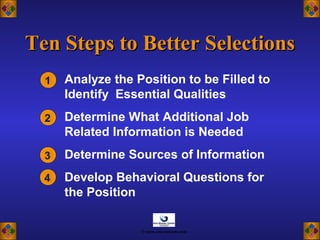
Ten Steps to Better SelectionsTen Steps to Better Selections
2
3
1 Analyze the Position to be Filled to
Identify Essential Qualities
Determine What Additional Job
Related Information is Needed
Determine Sources of Information
Develop Behavioral Questions for
the Position
4
© www.asia-masters.com
Review Questions/Applications and
Resumes
Determine Interview Format: Who &
How
Interview Candidates
Interview Supervisors
6
7
5
8
Ten Steps to Better SelectionsTen Steps to Better Selections
© www.asia-masters.com
Decide Which Candidate Best
Meets the Established Criteria
Select the Best Candidate
9
10
Ten Steps to Better SelectionsTen Steps to Better Selections
Analyze the PositionAnalyze the Position
to be Filledto be Filled
 SkillsSkills
 KnowledgeKnowledge
 AbilitiesAbilities
 AttitudesAttitudes
 ExperienceExperience
© www.asia-masters.com
SkillsSkills
 PersuasivePersuasive
 Able to Handle Difficult PeopleAble to Handle Difficult People
 Computer SkillsComputer Skills
 What Skills AreWhat Skills Are YouYou Looking?Looking?
Use the position description and your knowledge of the
job to identify the 4 or 5 most important skills needed to
be outstanding in this position.
© www.asia-masters.com
KnowledgeKnowledge
 Formal EducationFormal Education
High School, BA, MA, PhD.?
 Discipline SpecificDiscipline Specific
EKG interpretation, contracting warrant, CNA?
 OrganizationalOrganizational
Performance improvement, ethical-legal issues?
 What Knowledge AreWhat Knowledge Are YouYou Looking?Looking?
Use the position description and your knowledge of the job toUse the position description and your knowledge of the job to
identify the 4 to 5 most important areas of knowledge needed to beidentify the 4 to 5 most important areas of knowledge needed to be
outstanding in this position.outstanding in this position.
© www.asia-masters.com
AbilitiesAbilities
 LeadershipLeadership
Mentoring, Facilitation
 Self DirectedSelf Directed
 CreativeCreative
 OrganizedOrganized
Able to establish priorities
Use the position description and your knowledge of the job to
identify the 2 to 3 most important abilities needed to be outstanding
in this position.
AttitudesAttitudes
 PositivePositive
 TolerantTolerant
 FriendlyFriendly
 ResponsibleResponsible
Use the position description and your knowledge of
the job to identify the 2 to 3 most important abilities
needed to be outstanding in this position.
What Attitudes AreWhat Attitudes Are YouYou Looking?Looking?
ExperienceExperience
 Previously Done the WorkPreviously Done the Work
 Previously Performed Critical Aspects of thePreviously Performed Critical Aspects of the
WorkWork
 No Experience - Can Provide Necessary OJTNo Experience - Can Provide Necessary OJT
 What Experience AreWhat Experience Are YouYou Looking?Looking?
Use the position description and your knowledge of the job to identify
the level of experience necessary to be outstanding in this position
OR decide if you can support the learning process necessary to
become outstanding.
© www.asia-masters.com
Determine What AdditionalDetermine What Additional
Job-Related Information is NeededJob-Related Information is Needed
 Education RecordsEducation Records
 Licensure/CertificationLicensure/Certification
 Special AwardsSpecial Awards
 ReferencesReferences
What information in additional to skills, knowledge, abilities, attitude,
and experience do you need to select the applicant most likely to be
a superior employee? Identify 3 to 4 items that are most important.
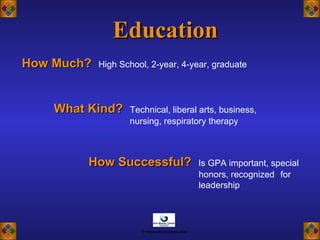
EducationEducation
How Much?How Much? High School, 2-year, 4-year, graduate
What Kind?What Kind? Technical, liberal arts, business,
nursing, respiratory therapy
How Successful?How Successful? Is GPA important, special
honors, recognized for
leadership
© www.asia-masters.com
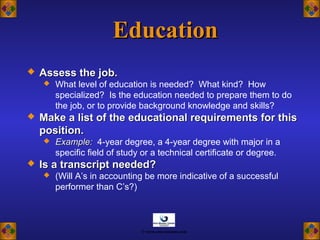
EducationEducation
 Assess the job.Assess the job.
 What level of education is needed? What kind? How
specialized? Is the education needed to prepare them to do
the job, or to provide background knowledge and skills?
 Make a list of the educational requirements for thisMake a list of the educational requirements for this
position.position.
 Example:Example: 4-year degree, a 4-year degree with major in a
specific field of study or a technical certificate or degree.
 Is a transcript needed?Is a transcript needed?
 (Will A’s in accounting be more indicative of a successful
performer than C’s?)
© www.asia-masters.com
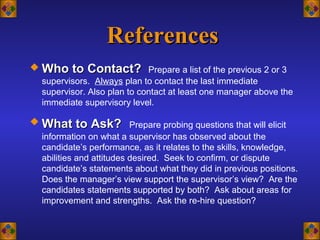
ReferencesReferences
 Who to Contact?Who to Contact? Prepare a list of the previous 2 or 3
supervisors. Always plan to contact the last immediate
supervisor. Also plan to contact at least one manager above the
immediate supervisory level.
 What to Ask?What to Ask? Prepare probing questions that will elicit
information on what a supervisor has observed about the
candidate’s performance, as it relates to the skills, knowledge,
abilities and attitudes desired. Seek to confirm, or dispute
candidate’s statements about what they did in previous positions.
Does the manager’s view support the supervisor’s view? Are the
candidates statements supported by both? Ask about areas for
improvement and strengths. Ask the re-hire question?
ReferencesReferences
 When to Ask?When to Ask?
Contact references on top 2 to 3
candidates after the interviews
are completed.
© www.asia-masters.com
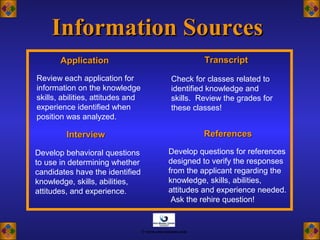
Information SourcesInformation Sources
Review each application for
information on the knowledge
skills, abilities, attitudes and
experience identified when
position was analyzed.
Check for classes related to
identified knowledge and
skills. Review the grades for
these classes!
Develop behavioral questions
to use in determining whether
candidates have the identified
knowledge, skills, abilities,
attitudes, and experience.
ReferencesReferences
Develop questions for references
designed to verify the responses
from the applicant regarding the
knowledge, skills, abilities,
attitudes and experience needed.
Ask the rehire question!
ApplicationApplication
InterviewInterview
TranscriptTranscript
© www.asia-masters.com
Develop Behavioral QuestionsDevelop Behavioral Questions
 Premise:Premise:
Past performance can be the bestPast performance can be the best
predictor of future performancepredictor of future performance
© www.asia-masters.com
 Objective:Objective:
 Ask applicant to describe specific pastAsk applicant to describe specific past
performanceperformance
 In specific areas you have identified asIn specific areas you have identified as
important to success in the positionimportant to success in the position
Develop Behavioral QuestionsDevelop Behavioral Questions
© www.asia-masters.com
Behavioral Questions Ask For:Behavioral Questions Ask For:
 Specific SituationsSpecific Situations
 ExperiencesExperiences
 Specific ActionsSpecific Actions
 OutcomesOutcomes
Develop Behavioral QuestionsDevelop Behavioral Questions
© www.asia-masters.com
 WhatWhat
 WhenWhen
 WhereWhere
 WhyWhy
 HowHow
 WhoWho
Questions Focus On:Questions Focus On:
Develop Behavioral QuestionsDevelop Behavioral Questions
© www.asia-masters.com
Select a skill, knowledge, ability,Select a skill, knowledge, ability,
attitude or experience about which toattitude or experience about which to
write the question.write the question.
From your analysis of the position you have a list of
skills, knowledge, abilities, attitudes and experience that
you identified as important to success in the position.
You will be writing questions for each of those areas.
Develop Behavioral QuestionsDevelop Behavioral Questions
© www.asia-masters.com
Phrase a question that begins:Phrase a question that begins:
 Tell me about a specific situation . . .
OROR
 Explain your experience in . . .
OROR
 Give an example to illustrate how you . . .
Develop Behavioral QuestionsDevelop Behavioral Questions
© www.asia-masters.com
Next, add a phrase to:Next, add a phrase to:
Elicit past performance specific to the knowledge,
skill, ability, and attitude identified as important to
the position.
Example:Example:
“Tell me about a specific situation where you had to
be persuasive.””
Develop Behavioral QuestionsDevelop Behavioral Questions
© www.asia-masters.com
Finally, ask for:Finally, ask for:
 Specific CircumstancesSpecific Circumstances
 ActionsActions
 OutcomesOutcomes
Example:Example:
“Tell me about a specific situation where you had to
be persuasive. Who was involved in the situation?
What actions did you take? What was the outcome?”
Develop Behavioral QuestionsDevelop Behavioral Questions
© www.asia-masters.com
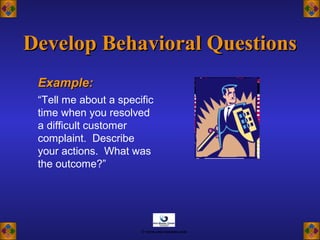
Example:Example:
“Tell me about a specific
time when you resolved
a difficult customer
complaint. Describe
your actions. What was
the outcome?”
Develop Behavioral QuestionsDevelop Behavioral Questions
© www.asia-masters.com
Practice writing questions for each:Practice writing questions for each:
Write 2 or 3 questions for each identified skill, knowledge, ability and
attitude. Select 1 or 2 of the questions you think will best get the
information you need from each area. The most important areas
might merit as many as 3 questions.
Develop BehavioralDevelop Behavioral
QuestionsQuestions
 SkillSkill
 KnowledgeKnowledge
 AbilityAbility
 AttitudeAttitude
© www.asia-masters.com
Review Questions/Review Questions/
Applications & ResumesApplications & Resumes
Select Best QuestionsSelect Best Questions
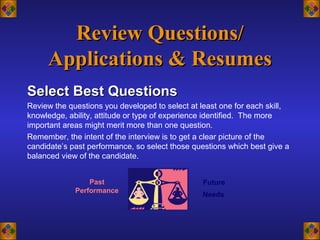
Review the questions you developed to select at least one for each skill,
knowledge, ability, attitude or type of experience identified. The more
important areas might merit more than one question.
Remember, the intent of the interview is to get a clear picture of the
candidate’s past performance, so select those questions which best give a
balanced view of the candidate.
Past
Performance
Future
Needs
Review Questions/Review Questions/
Applications & ResumesApplications & Resumes
Decide if the Question is LegalDecide if the Question is Legal
Questions about family, child care, marital status, age, race, religious
preferences or practices, arrests (as opposed to felony convictions
which you can ask about), and clubs or social organizations are likely to
result in discrimination charges from unsuccessful candidates. Review
your questions to insure they do not impinge on these protected areas.
© www.asia-masters.com
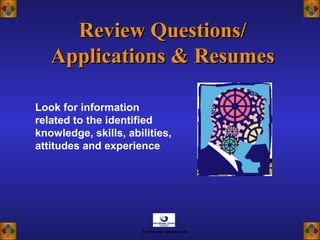
Look for information
related to the identified
knowledge, skills, abilities,
attitudes and experience
Review Questions/Review Questions/
Applications & ResumesApplications & Resumes
© www.asia-masters.com
 Make notes on any
experience that may relate to
experience you want.
 Look for information on skills
you need. It may be
mentioned in a description of
a previous job, it may be
listed under an educational
experience.
 Knowledge you want may be
indicated by a class attended
or presented. Formulate a
question that tests whether
that knowledge has been
used recently, and how
successfully they have been
using it.
 If not used, some skills and
knowledge tends to fade, and
be less useful.
Review Questions/Review Questions/
Applications & ResumesApplications & Resumes
Look for gaps in
employment history
Review Questions/Review Questions/
Applications & ResumesApplications & Resumes
Review Questions/Review Questions/
Applications & ResumesApplications & Resumes
 Time to complete an education.
 Time to spend with a sick relative, have a family, or do full-time
volunteer work.
 Serious illness, or prison time.
 An inability to find work due to various reasons.
Gaps in employment history can
indicate several things:
© www.asia-masters.com
Review Questions/Review Questions/
Applications & ResumesApplications & Resumes
Identify each employment gap and formulate
questions addressing those gaps. Look for
“job hopping,” a succession of jobs, of
relatively short duration, which needs to be
addressed in the interview.
© www.asia-masters.com
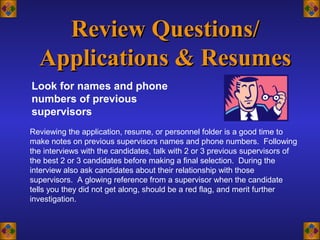
Look for names and phone
numbers of previous
supervisors
Review Questions/Review Questions/
Applications & ResumesApplications & Resumes
Reviewing the application, resume, or personnel folder is a good time to
make notes on previous supervisors names and phone numbers. Following
the interviews with the candidates, talk with 2 or 3 previous supervisors of
the best 2 or 3 candidates before making a final selection. During the
interview also ask candidates about their relationship with those
supervisors. A glowing reference from a supervisor when the candidate
tells you they did not get along, should be a red flag, and merit further
investigation.
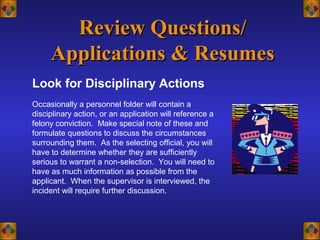
Look for Disciplinary Actions
Review Questions/Review Questions/
Applications & ResumesApplications & Resumes
Occasionally a personnel folder will contain a
disciplinary action, or an application will reference a
felony conviction. Make special note of these and
formulate questions to discuss the circumstances
surrounding them. As the selecting official, you will
have to determine whether they are sufficiently
serious to warrant a non-selection. You will need to
have as much information as possible from the
applicant. When the supervisor is interviewed, the
incident will require further discussion.
Look for Awards
Review Questions/Review Questions/
Applications & ResumesApplications & Resumes
Look for awards, letters of appreciation,
participation in special projects, and other
indications of excellence. Make note for
future reference. You may want to ask
specific questions about the
circumstances that led to some of the
awards or letters of appreciation.
© www.asia-masters.com
Look for Safety History
Review Questions/Review Questions/
Applications & ResumesApplications & Resumes
Look for documentation of accidents in the personnel folder. Evaluate the
seriousness of the accidents . . . some applicants may have had several
accidents, but all are of a minor nature, indicating they are careful to
document. Others may have had numerous accidents of a more serious
nature, perhaps indicating failure to remain focused while working. Are they
appropriate to the positions they have held?
© www.asia-masters.com
Decide Which Candidate BestDecide Which Candidate Best
Meets the Established CriteriaMeets the Established Criteria
Review all of the informationReview all of the information
gathered from:gathered from:
 Applications/resumes
 Transcripts
 Interviews
 Supervisors
Decide if you have a suitable candidate.Decide if you have a suitable candidate.
If so . . .If so . . .
Decide Which Candidate BestDecide Which Candidate Best
Meets the Established CriteriaMeets the Established Criteria
© www.asia-masters.com
Select the BestSelect the Best
Select the BestSelect the Best
 Orient and Train ThemOrient and Train Them
 Mentor and GrowMentor and Grow
ThemThem
 They WillThey Will
SucceedSucceed
. . . and so will you!!. . . and so will you!!
© www.asia-masters.com

Behavioral Interview - Selecting Quality Employees for a Quality Organization

  • 1.
    Behavioral InterviewingBehavioral Interviewing SelectingQualitySelecting Quality Employees for a QualityEmployees for a Quality OrganizationOrganization © www.asia-masters.com
  • 2.
    How Do YouIdentifyHow Do You Identify the Best People?the Best People? © www.asia-masters.com
  • 3.
    Behavioral InterviewingBehavioral Interviewing UsingPast Behavior toUsing Past Behavior to Predict Future BehaviorPredict Future Behavior © www.asia-masters.com
  • 4.
    Ten Steps toBetter SelectionsTen Steps to Better Selections 2 3 1 Analyze the Position to be Filled to Identify Essential Qualities Determine What Additional Job Related Information is Needed Determine Sources of Information Develop Behavioral Questions for the Position 4 © www.asia-masters.com
  • 5.
    Review Questions/Applications and Resumes DetermineInterview Format: Who & How Interview Candidates Interview Supervisors 6 7 5 8 Ten Steps to Better SelectionsTen Steps to Better Selections © www.asia-masters.com
  • 6.
    Decide Which CandidateBest Meets the Established Criteria Select the Best Candidate 9 10 Ten Steps to Better SelectionsTen Steps to Better Selections
  • 7.
    Analyze the PositionAnalyzethe Position to be Filledto be Filled  SkillsSkills  KnowledgeKnowledge  AbilitiesAbilities  AttitudesAttitudes  ExperienceExperience © www.asia-masters.com
  • 8.
    SkillsSkills  PersuasivePersuasive  Ableto Handle Difficult PeopleAble to Handle Difficult People  Computer SkillsComputer Skills  What Skills AreWhat Skills Are YouYou Looking?Looking? Use the position description and your knowledge of the job to identify the 4 or 5 most important skills needed to be outstanding in this position. © www.asia-masters.com
  • 9.
    KnowledgeKnowledge  Formal EducationFormalEducation High School, BA, MA, PhD.?  Discipline SpecificDiscipline Specific EKG interpretation, contracting warrant, CNA?  OrganizationalOrganizational Performance improvement, ethical-legal issues?  What Knowledge AreWhat Knowledge Are YouYou Looking?Looking? Use the position description and your knowledge of the job toUse the position description and your knowledge of the job to identify the 4 to 5 most important areas of knowledge needed to beidentify the 4 to 5 most important areas of knowledge needed to be outstanding in this position.outstanding in this position. © www.asia-masters.com
  • 10.
    AbilitiesAbilities  LeadershipLeadership Mentoring, Facilitation Self DirectedSelf Directed  CreativeCreative  OrganizedOrganized Able to establish priorities Use the position description and your knowledge of the job to identify the 2 to 3 most important abilities needed to be outstanding in this position.
  • 11.
    AttitudesAttitudes  PositivePositive  TolerantTolerant FriendlyFriendly  ResponsibleResponsible Use the position description and your knowledge of the job to identify the 2 to 3 most important abilities needed to be outstanding in this position. What Attitudes AreWhat Attitudes Are YouYou Looking?Looking?
  • 12.
    ExperienceExperience  Previously Donethe WorkPreviously Done the Work  Previously Performed Critical Aspects of thePreviously Performed Critical Aspects of the WorkWork  No Experience - Can Provide Necessary OJTNo Experience - Can Provide Necessary OJT  What Experience AreWhat Experience Are YouYou Looking?Looking? Use the position description and your knowledge of the job to identify the level of experience necessary to be outstanding in this position OR decide if you can support the learning process necessary to become outstanding. © www.asia-masters.com
  • 13.
    Determine What AdditionalDetermineWhat Additional Job-Related Information is NeededJob-Related Information is Needed  Education RecordsEducation Records  Licensure/CertificationLicensure/Certification  Special AwardsSpecial Awards  ReferencesReferences What information in additional to skills, knowledge, abilities, attitude, and experience do you need to select the applicant most likely to be a superior employee? Identify 3 to 4 items that are most important.
  • 14.
    EducationEducation How Much?How Much?High School, 2-year, 4-year, graduate What Kind?What Kind? Technical, liberal arts, business, nursing, respiratory therapy How Successful?How Successful? Is GPA important, special honors, recognized for leadership © www.asia-masters.com
  • 15.
    EducationEducation  Assess thejob.Assess the job.  What level of education is needed? What kind? How specialized? Is the education needed to prepare them to do the job, or to provide background knowledge and skills?  Make a list of the educational requirements for thisMake a list of the educational requirements for this position.position.  Example:Example: 4-year degree, a 4-year degree with major in a specific field of study or a technical certificate or degree.  Is a transcript needed?Is a transcript needed?  (Will A’s in accounting be more indicative of a successful performer than C’s?) © www.asia-masters.com
  • 16.
    ReferencesReferences  Who toContact?Who to Contact? Prepare a list of the previous 2 or 3 supervisors. Always plan to contact the last immediate supervisor. Also plan to contact at least one manager above the immediate supervisory level.  What to Ask?What to Ask? Prepare probing questions that will elicit information on what a supervisor has observed about the candidate’s performance, as it relates to the skills, knowledge, abilities and attitudes desired. Seek to confirm, or dispute candidate’s statements about what they did in previous positions. Does the manager’s view support the supervisor’s view? Are the candidates statements supported by both? Ask about areas for improvement and strengths. Ask the re-hire question?
  • 17.
    ReferencesReferences  When toAsk?When to Ask? Contact references on top 2 to 3 candidates after the interviews are completed. © www.asia-masters.com
  • 18.
    Information SourcesInformation Sources Revieweach application for information on the knowledge skills, abilities, attitudes and experience identified when position was analyzed. Check for classes related to identified knowledge and skills. Review the grades for these classes! Develop behavioral questions to use in determining whether candidates have the identified knowledge, skills, abilities, attitudes, and experience. ReferencesReferences Develop questions for references designed to verify the responses from the applicant regarding the knowledge, skills, abilities, attitudes and experience needed. Ask the rehire question! ApplicationApplication InterviewInterview TranscriptTranscript © www.asia-masters.com
  • 19.
    Develop Behavioral QuestionsDevelopBehavioral Questions  Premise:Premise: Past performance can be the bestPast performance can be the best predictor of future performancepredictor of future performance © www.asia-masters.com
  • 20.
     Objective:Objective:  Askapplicant to describe specific pastAsk applicant to describe specific past performanceperformance  In specific areas you have identified asIn specific areas you have identified as important to success in the positionimportant to success in the position Develop Behavioral QuestionsDevelop Behavioral Questions © www.asia-masters.com
  • 21.
    Behavioral Questions AskFor:Behavioral Questions Ask For:  Specific SituationsSpecific Situations  ExperiencesExperiences  Specific ActionsSpecific Actions  OutcomesOutcomes Develop Behavioral QuestionsDevelop Behavioral Questions © www.asia-masters.com
  • 22.
     WhatWhat  WhenWhen WhereWhere  WhyWhy  HowHow  WhoWho Questions Focus On:Questions Focus On: Develop Behavioral QuestionsDevelop Behavioral Questions © www.asia-masters.com
  • 23.
    Select a skill,knowledge, ability,Select a skill, knowledge, ability, attitude or experience about which toattitude or experience about which to write the question.write the question. From your analysis of the position you have a list of skills, knowledge, abilities, attitudes and experience that you identified as important to success in the position. You will be writing questions for each of those areas. Develop Behavioral QuestionsDevelop Behavioral Questions © www.asia-masters.com
  • 24.
    Phrase a questionthat begins:Phrase a question that begins:  Tell me about a specific situation . . . OROR  Explain your experience in . . . OROR  Give an example to illustrate how you . . . Develop Behavioral QuestionsDevelop Behavioral Questions © www.asia-masters.com
  • 25.
    Next, add aphrase to:Next, add a phrase to: Elicit past performance specific to the knowledge, skill, ability, and attitude identified as important to the position. Example:Example: “Tell me about a specific situation where you had to be persuasive.”” Develop Behavioral QuestionsDevelop Behavioral Questions © www.asia-masters.com
  • 26.
    Finally, ask for:Finally,ask for:  Specific CircumstancesSpecific Circumstances  ActionsActions  OutcomesOutcomes Example:Example: “Tell me about a specific situation where you had to be persuasive. Who was involved in the situation? What actions did you take? What was the outcome?” Develop Behavioral QuestionsDevelop Behavioral Questions © www.asia-masters.com
  • 27.
    Example:Example: “Tell me abouta specific time when you resolved a difficult customer complaint. Describe your actions. What was the outcome?” Develop Behavioral QuestionsDevelop Behavioral Questions © www.asia-masters.com
  • 28.
    Practice writing questionsfor each:Practice writing questions for each: Write 2 or 3 questions for each identified skill, knowledge, ability and attitude. Select 1 or 2 of the questions you think will best get the information you need from each area. The most important areas might merit as many as 3 questions. Develop BehavioralDevelop Behavioral QuestionsQuestions  SkillSkill  KnowledgeKnowledge  AbilityAbility  AttitudeAttitude © www.asia-masters.com
  • 29.
    Review Questions/Review Questions/ Applications& ResumesApplications & Resumes Select Best QuestionsSelect Best Questions Review the questions you developed to select at least one for each skill, knowledge, ability, attitude or type of experience identified. The more important areas might merit more than one question. Remember, the intent of the interview is to get a clear picture of the candidate’s past performance, so select those questions which best give a balanced view of the candidate. Past Performance Future Needs
  • 30.
    Review Questions/Review Questions/ Applications& ResumesApplications & Resumes Decide if the Question is LegalDecide if the Question is Legal Questions about family, child care, marital status, age, race, religious preferences or practices, arrests (as opposed to felony convictions which you can ask about), and clubs or social organizations are likely to result in discrimination charges from unsuccessful candidates. Review your questions to insure they do not impinge on these protected areas. © www.asia-masters.com
  • 31.
    Look for information relatedto the identified knowledge, skills, abilities, attitudes and experience Review Questions/Review Questions/ Applications & ResumesApplications & Resumes © www.asia-masters.com
  • 32.
     Make noteson any experience that may relate to experience you want.  Look for information on skills you need. It may be mentioned in a description of a previous job, it may be listed under an educational experience.  Knowledge you want may be indicated by a class attended or presented. Formulate a question that tests whether that knowledge has been used recently, and how successfully they have been using it.  If not used, some skills and knowledge tends to fade, and be less useful. Review Questions/Review Questions/ Applications & ResumesApplications & Resumes
  • 33.
    Look for gapsin employment history Review Questions/Review Questions/ Applications & ResumesApplications & Resumes
  • 34.
    Review Questions/Review Questions/ Applications& ResumesApplications & Resumes  Time to complete an education.  Time to spend with a sick relative, have a family, or do full-time volunteer work.  Serious illness, or prison time.  An inability to find work due to various reasons. Gaps in employment history can indicate several things: © www.asia-masters.com
  • 35.
    Review Questions/Review Questions/ Applications& ResumesApplications & Resumes Identify each employment gap and formulate questions addressing those gaps. Look for “job hopping,” a succession of jobs, of relatively short duration, which needs to be addressed in the interview. © www.asia-masters.com
  • 36.
    Look for namesand phone numbers of previous supervisors Review Questions/Review Questions/ Applications & ResumesApplications & Resumes Reviewing the application, resume, or personnel folder is a good time to make notes on previous supervisors names and phone numbers. Following the interviews with the candidates, talk with 2 or 3 previous supervisors of the best 2 or 3 candidates before making a final selection. During the interview also ask candidates about their relationship with those supervisors. A glowing reference from a supervisor when the candidate tells you they did not get along, should be a red flag, and merit further investigation.
  • 37.
    Look for DisciplinaryActions Review Questions/Review Questions/ Applications & ResumesApplications & Resumes Occasionally a personnel folder will contain a disciplinary action, or an application will reference a felony conviction. Make special note of these and formulate questions to discuss the circumstances surrounding them. As the selecting official, you will have to determine whether they are sufficiently serious to warrant a non-selection. You will need to have as much information as possible from the applicant. When the supervisor is interviewed, the incident will require further discussion.
  • 38.
    Look for Awards ReviewQuestions/Review Questions/ Applications & ResumesApplications & Resumes Look for awards, letters of appreciation, participation in special projects, and other indications of excellence. Make note for future reference. You may want to ask specific questions about the circumstances that led to some of the awards or letters of appreciation. © www.asia-masters.com
  • 39.
    Look for SafetyHistory Review Questions/Review Questions/ Applications & ResumesApplications & Resumes Look for documentation of accidents in the personnel folder. Evaluate the seriousness of the accidents . . . some applicants may have had several accidents, but all are of a minor nature, indicating they are careful to document. Others may have had numerous accidents of a more serious nature, perhaps indicating failure to remain focused while working. Are they appropriate to the positions they have held? © www.asia-masters.com
  • 40.
    Decide Which CandidateBestDecide Which Candidate Best Meets the Established CriteriaMeets the Established Criteria Review all of the informationReview all of the information gathered from:gathered from:  Applications/resumes  Transcripts  Interviews  Supervisors
  • 41.
    Decide if youhave a suitable candidate.Decide if you have a suitable candidate. If so . . .If so . . . Decide Which Candidate BestDecide Which Candidate Best Meets the Established CriteriaMeets the Established Criteria © www.asia-masters.com
  • 42.
    Select the BestSelectthe Best Select the BestSelect the Best  Orient and Train ThemOrient and Train Them  Mentor and GrowMentor and Grow ThemThem  They WillThey Will SucceedSucceed . . . and so will you!!. . . and so will you!! © www.asia-masters.com