HUMAN
GENOME
PROJECT
Carol Zubiría for SCW 2012-13
Human genome: more than 3M "letters" A,C, T & G
First mapped and sequenced: from 1990 to 2003.
The Human Genome Project (HGP) international initiative
Sequencing the human genome:
●identify important genes and regulatory regions.
●better understand their role in disease.
●investigate our origins using variations in the DNA
sequence.
Introduction
Introduction
Like 200 yellow pages books.
●HGP aim: sequence the entire human genome
and provide the data free to the world.
●First major global collaboration of its kind and the
largest biological research project ever
undertaken, involving thousands of staff in
institutes across the globe.
●By assigning different portions of the genome to
different research groups in a coordinated and
efficient way, the HGP researchers were able to
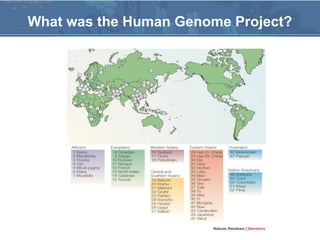
What was the Human Genome Project?
Twenty institutes from six different countries
(China, France, Germany, Japan, UK and USA)
●Wellcome Trust Sanger Institute
●Washington University School of Medicine
●Whitehead Institute/MIT centre for Genome
research
●The DOE’s Joint Genome Institute
●Baylor College of Medicine
Who took part in the project?
●Sequencing technology: only a few hundred
base pairs of DNA at a time.
●It had to be broken up into small pieces for
sequencing → giant jigsaw puzzle.
●First 200,000 base pair sections (clones)
●Inserted into bacterial DNA, living libraries of
the DNA clones.
●Shipped between collaborating institutes.
●Clones then broken into smaller pieces
(4000-6000 base pairs).
How was the human genome sequenced?
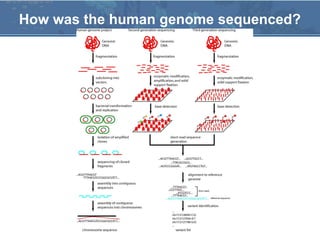
●Clones then broken into smaller pieces
(4000-6000 base pairs)
●Re-inserted into bacteria
●Cultured to make enough DNA for
sequencing.
●Bacterial colonies transferred to tubes →
lysed → DNA extracted.
●Sanger sequencing method.
●Resulting data pieced together to form the
whole genome sequence.
How was the human genome sequenced?
●HGP took 13 years.
●Expected more than 15 years.
●Started: October 1990
●First “draft”: June 2000
●Finished sequence: April 2003
●Published: 2004.
●Work continues to refine the “reference”
human genome sequence.
How long did the HGP take?
●Put simply, everyone.
●Provide free and open access to the data
for everyone in the scientific community and
the public domain.
●Deposited in freely available, online public
databases.
●Genome browsers: www.ensembl.org
●Access to more than 50 species’ genomes.
Who has access to the human genome data?
●Officially finished.
●Research continues on the human reference
sequence.
●Filling in the “gaps” in the sequence.
●SNPs (single nucleotide polymorphisms):
Genetic variation differences in single bases.
What happened after the HGP was finished?
●HapMap project: 3 year → chart the patterns of
genetic variation common in the world’s population.
●Results 2005 simplify studies to understand how
genetic variation contributes to health and disease.
What happened after the HGP was finished?
●International research consortium.
●Launched in January 2008.
●Aim: to sequence the genomes of at least a
thousand people from around the world, to
identify very clearly those variations
between individuals that are medically
important and map these on the genome.
1000 Genomes Project
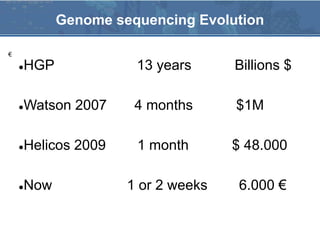
●HGP 13 years Billions $
●Watson 2007 4 months $1M
●Helicos 2009 1 month $ 48.000
●Now 1 or 2 weeks 6.000 €
Genome sequencing Evolution
€
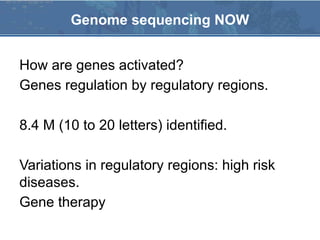
How are genes activated?
Genes regulation by regulatory regions.
8.4 M (10 to 20 letters) identified.
Variations in regulatory regions: high risk
diseases.
Gene therapy
Genome sequencing NOW

HUMAN GENOME PROJECT.ppt.pdf

  • 1.
  • 2.
    Human genome: morethan 3M "letters" A,C, T & G First mapped and sequenced: from 1990 to 2003. The Human Genome Project (HGP) international initiative Sequencing the human genome: ●identify important genes and regulatory regions. ●better understand their role in disease. ●investigate our origins using variations in the DNA sequence. Introduction
  • 3.
  • 4.
    ●HGP aim: sequencethe entire human genome and provide the data free to the world. ●First major global collaboration of its kind and the largest biological research project ever undertaken, involving thousands of staff in institutes across the globe. ●By assigning different portions of the genome to different research groups in a coordinated and efficient way, the HGP researchers were able to What was the Human Genome Project?
  • 5.
    What was theHuman Genome Project?
  • 6.
    Twenty institutes fromsix different countries (China, France, Germany, Japan, UK and USA) ●Wellcome Trust Sanger Institute ●Washington University School of Medicine ●Whitehead Institute/MIT centre for Genome research ●The DOE’s Joint Genome Institute ●Baylor College of Medicine Who took part in the project?
  • 7.
    ●Sequencing technology: onlya few hundred base pairs of DNA at a time. ●It had to be broken up into small pieces for sequencing → giant jigsaw puzzle. ●First 200,000 base pair sections (clones) ●Inserted into bacterial DNA, living libraries of the DNA clones. ●Shipped between collaborating institutes. ●Clones then broken into smaller pieces (4000-6000 base pairs). How was the human genome sequenced?
  • 8.
    ●Clones then brokeninto smaller pieces (4000-6000 base pairs) ●Re-inserted into bacteria ●Cultured to make enough DNA for sequencing. ●Bacterial colonies transferred to tubes → lysed → DNA extracted. ●Sanger sequencing method. ●Resulting data pieced together to form the whole genome sequence. How was the human genome sequenced?
  • 9.
    How was thehuman genome sequenced?
  • 10.
    ●HGP took 13years. ●Expected more than 15 years. ●Started: October 1990 ●First “draft”: June 2000 ●Finished sequence: April 2003 ●Published: 2004. ●Work continues to refine the “reference” human genome sequence. How long did the HGP take?
  • 11.
    ●Put simply, everyone. ●Providefree and open access to the data for everyone in the scientific community and the public domain. ●Deposited in freely available, online public databases. ●Genome browsers: www.ensembl.org ●Access to more than 50 species’ genomes. Who has access to the human genome data?
  • 12.
    ●Officially finished. ●Research continueson the human reference sequence. ●Filling in the “gaps” in the sequence. ●SNPs (single nucleotide polymorphisms): Genetic variation differences in single bases. What happened after the HGP was finished?
  • 13.
    ●HapMap project: 3year → chart the patterns of genetic variation common in the world’s population. ●Results 2005 simplify studies to understand how genetic variation contributes to health and disease. What happened after the HGP was finished?
  • 14.
    ●International research consortium. ●Launchedin January 2008. ●Aim: to sequence the genomes of at least a thousand people from around the world, to identify very clearly those variations between individuals that are medically important and map these on the genome. 1000 Genomes Project
  • 15.
    ●HGP 13 yearsBillions $ ●Watson 2007 4 months $1M ●Helicos 2009 1 month $ 48.000 ●Now 1 or 2 weeks 6.000 € Genome sequencing Evolution €
  • 16.
    How are genesactivated? Genes regulation by regulatory regions. 8.4 M (10 to 20 letters) identified. Variations in regulatory regions: high risk diseases. Gene therapy Genome sequencing NOW