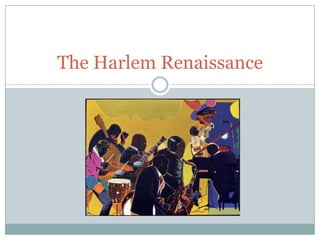
The Harlem Renaissance
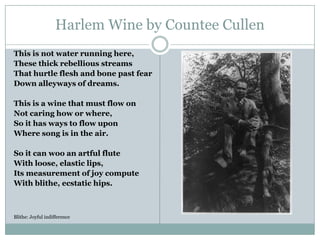
Harlem Wine by Countee CullenThis is not water running here,These thick rebellious streamsThat hurtle flesh and bone past fearDown alleyways of dreams.This is a wine that must flow onNot caring how or where,So it has ways to flow uponWhere song is in the air.So it can woo an artful fluteWith loose, elastic lips,Its measurement of joy computeWith blithe, ecstatic hips.Blithe: Joyful indifference
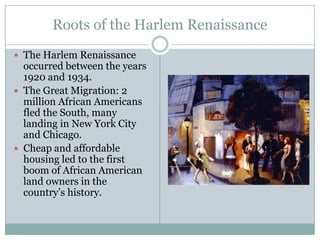
Roots of the Harlem RenaissanceThe Harlem Renaissance occurred between the years 1920 and 1934.The Great Migration: 2 million African Americans fled the South, many landing in New York City and Chicago.Cheap and affordable housing led to the first boom of African American land owners in the country’s history.
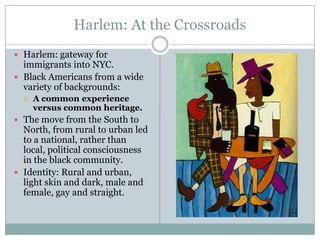
Harlem: At the CrossroadsHarlem: gateway for immigrants into NYC.Black Americans from a wide variety of backgrounds: A common experience versus common heritage.The move from the South to North, from rural to urban led to a national, rather than local, political consciousness in the black community. Identity: Rural and urban, light skin and dark, male and female, gay and straight.
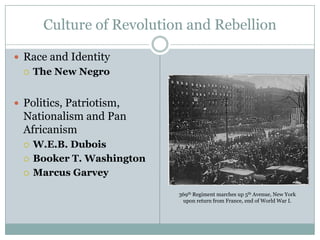
Culture of Revolution and RebellionRace and IdentityThe New NegroPolitics, Patriotism, Nationalism and Pan AfricanismW.E.B. DuboisBooker T. WashingtonMarcus Garvey369th Regiment marches up 5th Avenue, New York  upon return from France, end of World War I.
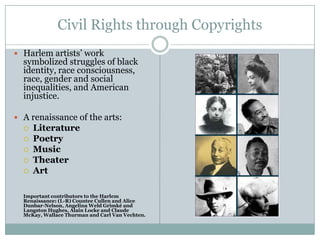
Civil Rights through CopyrightsHarlem artists’ work symbolized struggles of black identity, race consciousness, race, gender and social inequalities, and American injustice. A renaissance of the arts:LiteraturePoetry Music Theater ArtImportant contributors to the Harlem Renaissance: (L-R) Countee Cullen and Alice Dunbar-Nelson, Angelina Weld Grimké and Langston Hughes, Alain Locke and Claude McKay, Wallace Thurman and Carl Van Vechten.
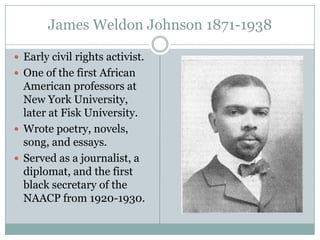
James Weldon Johnson 1871-1938Early civil rights activist.One of the first African American professors at New York University, later at Fisk University.Wrote poetry, novels, song, and essays.Served as a journalist, a diplomat, and the first black secretary of the NAACP from 1920-1930.
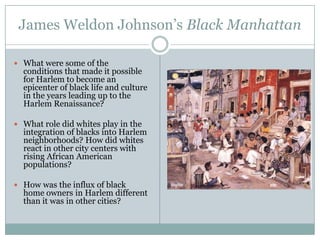
James Weldon Johnson’s Black ManhattanWhat were some of the conditions that made it possible for Harlem to become an epicenter of black life and culture in the years leading up to the Harlem Renaissance?What role did whites play in the integration of blacks into Harlem neighborhoods? How did whites react in other city centers with rising African American populations?How was the influx of black home owners in Harlem different than it was in other cities?

The harlem renaissance

  • 1.
  • 2.
    Harlem Wine byCountee CullenThis is not water running here,These thick rebellious streamsThat hurtle flesh and bone past fearDown alleyways of dreams.This is a wine that must flow onNot caring how or where,So it has ways to flow uponWhere song is in the air.So it can woo an artful fluteWith loose, elastic lips,Its measurement of joy computeWith blithe, ecstatic hips.Blithe: Joyful indifference
  • 3.
    Roots of theHarlem RenaissanceThe Harlem Renaissance occurred between the years 1920 and 1934.The Great Migration: 2 million African Americans fled the South, many landing in New York City and Chicago.Cheap and affordable housing led to the first boom of African American land owners in the country’s history.
  • 4.
    Harlem: At theCrossroadsHarlem: gateway for immigrants into NYC.Black Americans from a wide variety of backgrounds: A common experience versus common heritage.The move from the South to North, from rural to urban led to a national, rather than local, political consciousness in the black community. Identity: Rural and urban, light skin and dark, male and female, gay and straight.
  • 5.
    Culture of Revolutionand RebellionRace and IdentityThe New NegroPolitics, Patriotism, Nationalism and Pan AfricanismW.E.B. DuboisBooker T. WashingtonMarcus Garvey369th Regiment marches up 5th Avenue, New York upon return from France, end of World War I.
  • 6.
    Civil Rights throughCopyrightsHarlem artists’ work symbolized struggles of black identity, race consciousness, race, gender and social inequalities, and American injustice. A renaissance of the arts:LiteraturePoetry Music Theater ArtImportant contributors to the Harlem Renaissance: (L-R) Countee Cullen and Alice Dunbar-Nelson, Angelina Weld Grimké and Langston Hughes, Alain Locke and Claude McKay, Wallace Thurman and Carl Van Vechten.
  • 7.
    James Weldon Johnson1871-1938Early civil rights activist.One of the first African American professors at New York University, later at Fisk University.Wrote poetry, novels, song, and essays.Served as a journalist, a diplomat, and the first black secretary of the NAACP from 1920-1930.
  • 8.
    James Weldon Johnson’sBlack ManhattanWhat were some of the conditions that made it possible for Harlem to become an epicenter of black life and culture in the years leading up to the Harlem Renaissance?What role did whites play in the integration of blacks into Harlem neighborhoods? How did whites react in other city centers with rising African American populations?How was the influx of black home owners in Harlem different than it was in other cities?