DUE TODAY: N/A
THE HARLEM RENAISSANCE
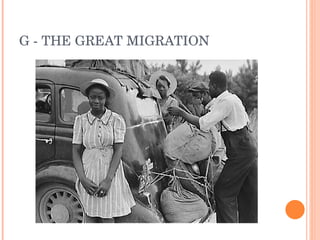
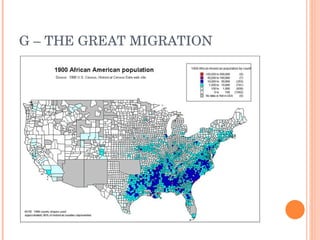
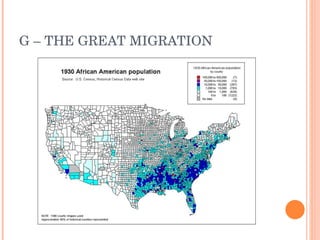
G – THE GREAT MIGRATION Great Migration – major relocation of African Americans to northern cities from 1910 into the 1920’s Began 1910 – Harlem (New York, NY) – a favorite destination for black Americans migrating from the South Life in the South = difficult Hoping to find freedom, economic opportunity WWI  Huge demand for war supplies    Created many jobs    Opportunities for African Americans    Moved North
G - THE GREAT MIGRATION
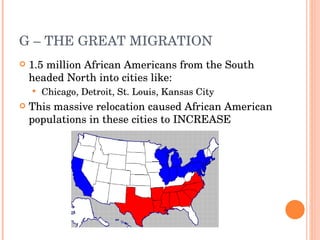
G – THE GREAT MIGRATION 1.5 million African Americans from the South headed North into cities like: Chicago, Detroit, St. Louis, Kansas City This massive relocation caused African American populations in these cities to INCREASE
G – THE GREAT MIGRATION
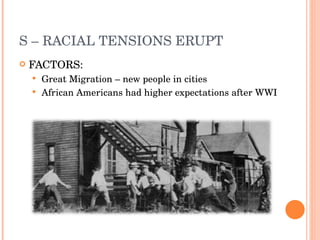
S – RACIAL TENSIONS ERUPT FACTORS: Great Migration – new people in cities African Americans had higher expectations after WWI
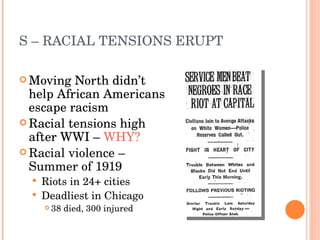
S – RACIAL TENSIONS ERUPT Moving North didn’t help African Americans escape racism Racial tensions high after WWI –  WHY? Racial violence – Summer of 1919 Riots in 24+ cities Deadliest in Chicago 38 died, 300 injured
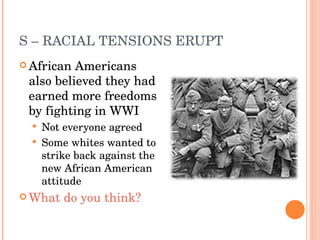
S – RACIAL TENSIONS ERUPT African Americans also believed they had earned more freedoms by fighting in WWI Not everyone agreed Some whites wanted to strike back against the new African American attitude What do you think?
LET’S REVIEW: WHY DID AFRICAN AMERICANS MOVE NORTH BETWEEN 1900 AND 1920?
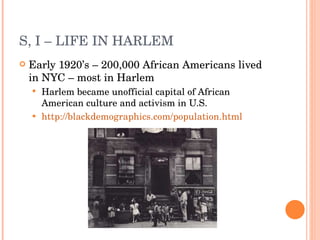
S, I – LIFE IN HARLEM Early 1920’s – 200,000 African Americans lived in NYC – most in Harlem Harlem became unofficial capital of African American culture and activism in U.S. http://blackdemographics.com/population.html
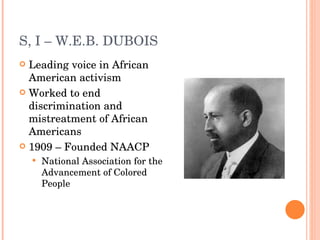
S, I – W.E.B. DUBOIS Leading voice in African American activism Worked to end discrimination and mistreatment of African Americans 1909 – Founded NAACP National Association for the Advancement of Colored People
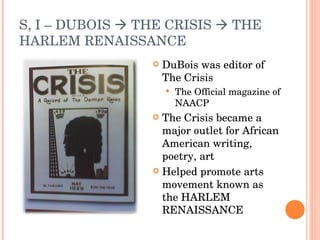
S, I – DUBOIS    THE CRISIS    THE HARLEM RENAISSANCE DuBois was editor of The Crisis The Official magazine of NAACP The Crisis became a major outlet for African American writing, poetry, art Helped promote arts movement known as the HARLEM RENAISSANCE
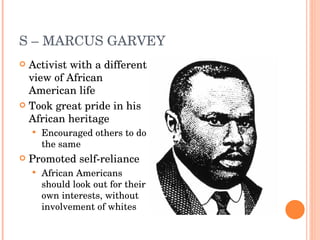
S – MARCUS GARVEY Activist with a different view of African American life Took great pride in his African heritage Encouraged others to do the same Promoted self-reliance African Americans should look out for their own interests, without involvement of whites
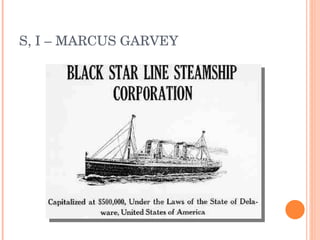
S, I – MARCUS GARVEY  Started UNIA Universal Negro Improvement Association UNIA Slogan: “ Back to Africa” - A day when Africans would return and create a new empire Believed that to achieve that goal African Americans needed economic success Started businesses including Black Star Line
S, I – MARCUS GARVEY
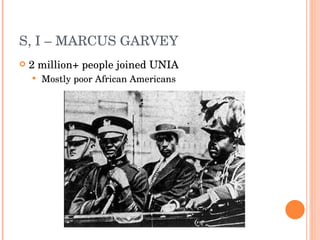
S, I – MARCUS GARVEY  2 million+ people joined UNIA Mostly poor African Americans
S – CLASH OF GARVEY AND DUBOIS Garvey criticized DuBois and NAACP Discouraged African American pride, self-confidence Attempts to break down barrier between blacks and whites threatened racial purity DuBois and NAACP suspicious of Garvey and UNIA The Crisis published an investigation FBI watched UNIA closely 1923 – charged Garvey with mail fraud UNIA collapsed
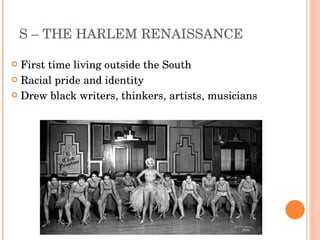
S – THE HARLEM RENAISSANCE  First time living outside the South Racial pride and identity Drew black writers, thinkers, artists, musicians
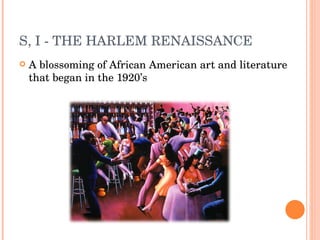
S, I - THE HARLEM RENAISSANCE A blossoming of African American art and literature that began in the 1920’s
WRITERS AND POETS Before 1920’s, little African American literature had been published 1924 – National Urban League sponsored a dinner brining together publishers, editors and up and coming writers Propelled African American writers into the mainstream The Crisis – outlet for African American writers, artists and poets  I - THE HARLEM RENAISSANCE
I – THE HARLEM RENAISSANCE - WRITERS Common themes: Black identity Common heritage Exploring a new world Resistance in the face of white prejudice Hope
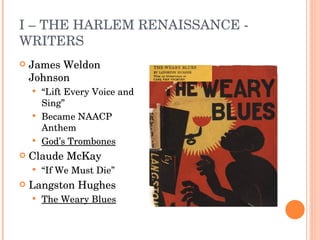
I – THE HARLEM RENAISSANCE - WRITERS James Weldon Johnson “ Lift Every Voice and Sing” Became NAACP Anthem God’s Trombones Claude McKay “ If We Must Die” Langston Hughes The Weary Blues
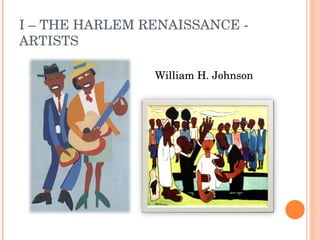
I – THE HARLEM RENAISSANCE - ARTISTS William H. Johnson
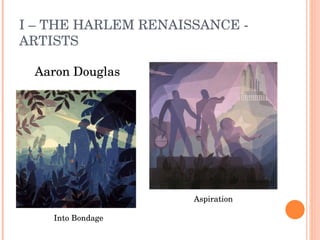
I – THE HARLEM RENAISSANCE - ARTISTS Into Bondage Aspiration Aaron Douglas
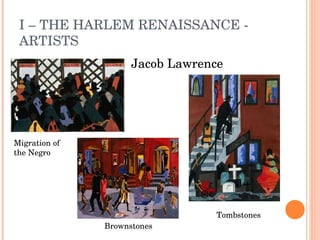
I – THE HARLEM RENAISSANCE - ARTISTS Brownstones Tombstones Migration of the Negro Jacob Lawrence
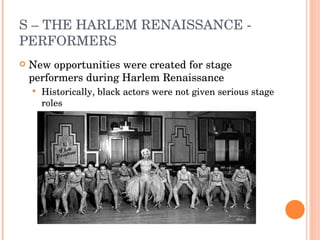
New opportunities were created for stage performers during Harlem Renaissance Historically, black actors were not given serious stage roles S – THE HARLEM RENAISSANCE - PERFORMERS
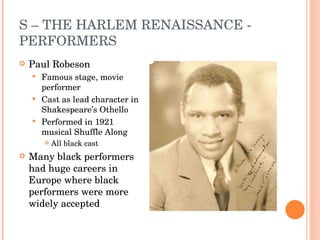
S – THE HARLEM RENAISSANCE - PERFORMERS Paul Robeson Famous stage, movie performer Cast as lead character in Shakespeare’s Othello Performed in 1921 musical Shuffle Along  All black cast Many black performers had huge careers in Europe where black performers were more widely accepted
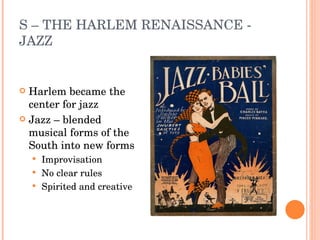
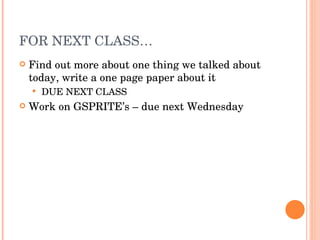
S – THE HARLEM RENAISSANCE - JAZZ Harlem became the center for jazz Jazz – blended musical forms of the South into new forms Improvisation No clear rules Spirited and creative
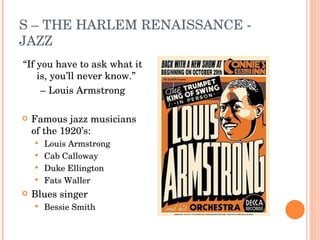
S – THE HARLEM RENAISSANCE - JAZZ “ If you have to ask what it is, you’ll never know.”  –  Louis Armstrong Famous jazz musicians of the 1920’s: Louis Armstrong Cab Calloway Duke Ellington Fats Waller Blues singer Bessie Smith
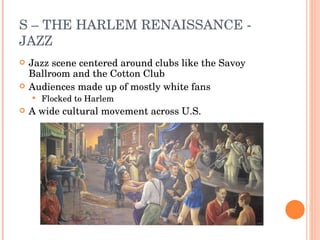
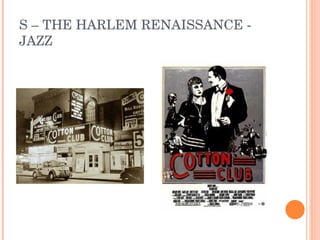
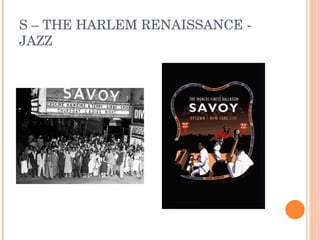
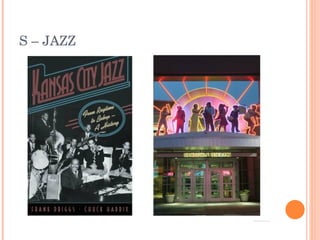
S – THE HARLEM RENAISSANCE - JAZZ Jazz scene centered around clubs like the Savoy Ballroom and the Cotton Club Audiences made up of mostly white fans Flocked to Harlem A wide cultural movement across U.S.
S – THE HARLEM RENAISSANCE - JAZZ
S – JAZZ
FOR NEXT CLASS… Find out more about one thing we talked about today, write a one page paper about it DUE NEXT CLASS Work on GSPRITE’s – due next Wednesday

1920s Lecture 5 Harlem Renaissance

  • 1.
  • 2.
  • 3.
    G – THEGREAT MIGRATION Great Migration – major relocation of African Americans to northern cities from 1910 into the 1920’s Began 1910 – Harlem (New York, NY) – a favorite destination for black Americans migrating from the South Life in the South = difficult Hoping to find freedom, economic opportunity WWI Huge demand for war supplies  Created many jobs  Opportunities for African Americans  Moved North
  • 4.
    G - THEGREAT MIGRATION
  • 5.
    G – THEGREAT MIGRATION 1.5 million African Americans from the South headed North into cities like: Chicago, Detroit, St. Louis, Kansas City This massive relocation caused African American populations in these cities to INCREASE
  • 6.
    G – THEGREAT MIGRATION
  • 7.
    G – THEGREAT MIGRATION
  • 8.
    S – RACIALTENSIONS ERUPT FACTORS: Great Migration – new people in cities African Americans had higher expectations after WWI
  • 9.
    S – RACIALTENSIONS ERUPT Moving North didn’t help African Americans escape racism Racial tensions high after WWI – WHY? Racial violence – Summer of 1919 Riots in 24+ cities Deadliest in Chicago 38 died, 300 injured
  • 10.
    S – RACIALTENSIONS ERUPT African Americans also believed they had earned more freedoms by fighting in WWI Not everyone agreed Some whites wanted to strike back against the new African American attitude What do you think?
  • 11.
    LET’S REVIEW: WHYDID AFRICAN AMERICANS MOVE NORTH BETWEEN 1900 AND 1920?
  • 12.
    S, I –LIFE IN HARLEM Early 1920’s – 200,000 African Americans lived in NYC – most in Harlem Harlem became unofficial capital of African American culture and activism in U.S. http://blackdemographics.com/population.html
  • 13.
    S, I –W.E.B. DUBOIS Leading voice in African American activism Worked to end discrimination and mistreatment of African Americans 1909 – Founded NAACP National Association for the Advancement of Colored People
  • 14.
    S, I –DUBOIS  THE CRISIS  THE HARLEM RENAISSANCE DuBois was editor of The Crisis The Official magazine of NAACP The Crisis became a major outlet for African American writing, poetry, art Helped promote arts movement known as the HARLEM RENAISSANCE
  • 15.
    S – MARCUSGARVEY Activist with a different view of African American life Took great pride in his African heritage Encouraged others to do the same Promoted self-reliance African Americans should look out for their own interests, without involvement of whites
  • 16.
    S, I –MARCUS GARVEY Started UNIA Universal Negro Improvement Association UNIA Slogan: “ Back to Africa” - A day when Africans would return and create a new empire Believed that to achieve that goal African Americans needed economic success Started businesses including Black Star Line
  • 17.
    S, I –MARCUS GARVEY
  • 18.
    S, I –MARCUS GARVEY 2 million+ people joined UNIA Mostly poor African Americans
  • 19.
    S – CLASHOF GARVEY AND DUBOIS Garvey criticized DuBois and NAACP Discouraged African American pride, self-confidence Attempts to break down barrier between blacks and whites threatened racial purity DuBois and NAACP suspicious of Garvey and UNIA The Crisis published an investigation FBI watched UNIA closely 1923 – charged Garvey with mail fraud UNIA collapsed
  • 20.
    S – THEHARLEM RENAISSANCE First time living outside the South Racial pride and identity Drew black writers, thinkers, artists, musicians
  • 21.
    S, I -THE HARLEM RENAISSANCE A blossoming of African American art and literature that began in the 1920’s
  • 22.
    WRITERS AND POETSBefore 1920’s, little African American literature had been published 1924 – National Urban League sponsored a dinner brining together publishers, editors and up and coming writers Propelled African American writers into the mainstream The Crisis – outlet for African American writers, artists and poets I - THE HARLEM RENAISSANCE
  • 23.
    I – THEHARLEM RENAISSANCE - WRITERS Common themes: Black identity Common heritage Exploring a new world Resistance in the face of white prejudice Hope
  • 24.
    I – THEHARLEM RENAISSANCE - WRITERS James Weldon Johnson “ Lift Every Voice and Sing” Became NAACP Anthem God’s Trombones Claude McKay “ If We Must Die” Langston Hughes The Weary Blues
  • 25.
    I – THEHARLEM RENAISSANCE - ARTISTS William H. Johnson
  • 26.
    I – THEHARLEM RENAISSANCE - ARTISTS Into Bondage Aspiration Aaron Douglas
  • 27.
    I – THEHARLEM RENAISSANCE - ARTISTS Brownstones Tombstones Migration of the Negro Jacob Lawrence
  • 28.
    New opportunities werecreated for stage performers during Harlem Renaissance Historically, black actors were not given serious stage roles S – THE HARLEM RENAISSANCE - PERFORMERS
  • 29.
    S – THEHARLEM RENAISSANCE - PERFORMERS Paul Robeson Famous stage, movie performer Cast as lead character in Shakespeare’s Othello Performed in 1921 musical Shuffle Along All black cast Many black performers had huge careers in Europe where black performers were more widely accepted
  • 30.
    S – THEHARLEM RENAISSANCE - JAZZ Harlem became the center for jazz Jazz – blended musical forms of the South into new forms Improvisation No clear rules Spirited and creative
  • 31.
    S – THEHARLEM RENAISSANCE - JAZZ “ If you have to ask what it is, you’ll never know.” – Louis Armstrong Famous jazz musicians of the 1920’s: Louis Armstrong Cab Calloway Duke Ellington Fats Waller Blues singer Bessie Smith
  • 32.
    S – THEHARLEM RENAISSANCE - JAZZ Jazz scene centered around clubs like the Savoy Ballroom and the Cotton Club Audiences made up of mostly white fans Flocked to Harlem A wide cultural movement across U.S.
  • 33.
    S – THEHARLEM RENAISSANCE - JAZZ
  • 34.
    S – THEHARLEM RENAISSANCE - JAZZ
  • 35.
  • 36.
    FOR NEXT CLASS…Find out more about one thing we talked about today, write a one page paper about it DUE NEXT CLASS Work on GSPRITE’s – due next Wednesday