The OWASP Foundation
http://www.owasp.org
Copyright © The OWASP Foundation
Permission is granted to copy, distribute and/or modify this document under the terms of the OWASP License.
OWASP AppSec
Europe 2011
An Introduction to ZAP
The OWASP Zed Attack Proxy
Simon Bennetts
Sage UK Ltd
OWASP ZAP Project Lead
psiinon@gmail.com
2
The Introduction
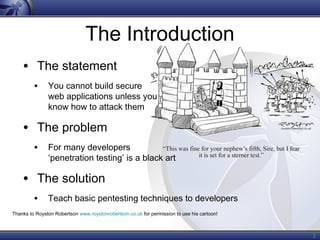
• The statement
• You cannot build secure
web applications unless you
know how to attack them
• The problem
• For many developers
‘penetration testing’ is a black art
• The solution
• Teach basic pentesting techniques to developers
Thanks to Royston Robertson www.roystonrobertson.co.uk for permission to use his cartoon!
3
The Caveat
This is in addition to:
• Teaching secure coding techniques
• Teaching about common vulnerabilities
(e.g. OWASP top 10)
• Secure Development Software Lifecycle
• Static source code analysis
• Code reviews
• Professional pentesting
• …
4
The Zed Attack Proxy
• Released September 2010
• Ease of use a priority
• Comprehensive help pages
• Free, Open source
• Cross platform
• A fork of the well regarded Paros Proxy
• Involvement actively encouraged
• Adopted by OWASP October 2010
5
9 months later…
• Version 1.2.0 downloaded > 6300 times
• Version 1.3.0 just released
• 5 main coders, 15 contributors
• Fully internationalized
• Translated into 9 languages:
Brazilian Portuguese, Chinese, French,
German, Greek, Indonesian, Japanese, Polish,
Spanish
• Mostly used by Professional Pentesters?
• Paros code: ~55% Zap Code: ~45%
6
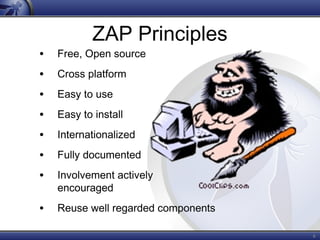
ZAP Principles
• Free, Open source
• Cross platform
• Easy to use
• Easy to install
• Internationalized
• Fully documented
• Involvement actively
encouraged
• Reuse well regarded components
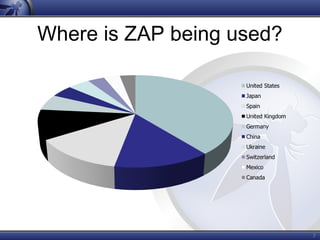
Where is ZAP being used?
7
8
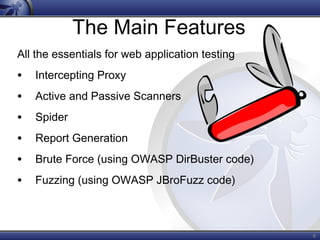
The Main Features
All the essentials for web application testing
• Intercepting Proxy
• Active and Passive Scanners
• Spider
• Report Generation
• Brute Force (using OWASP DirBuster code)
• Fuzzing (using OWASP JBroFuzz code)
9
The Additional Features
• Auto tagging
• Port scanner
• Smart card support
• Session comparison
• Invoke external apps
• BeanShell integration
• API + Headless mode
• Dynamic SSL Certificates
• Anti CSRF token handling
10
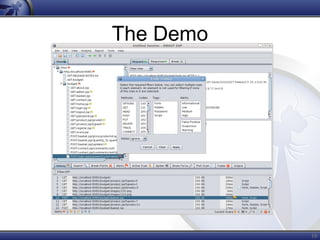
The Demo
11
The Future
• Enhance scanners to detect more vulnerabilities
• Extend API, better integration
• Fuzzing analysis
• Easier to use, better help
• More localization
(all offers gratefully received!)
• Parameter analysis?
• Technology detection?
• What do you want?? 
Summary and Conclusion 1
• ZAP is:
• Easy to use (for a web app pentest tool;)
• Ideal for appsec newcomers
• Ideal for training courses
• Being used by Professional Pen Testers
• Easy to contribute to (and please do!)
• Improving rapidly
12
Summary and Conclusion 2
• ZAP has:
• An active development community
• An international user base
• The potential to reach people new to
OWASP and appsec, especially
developers and functional testers
• ZAP is a key OWASP project
13
Any Questions?
http://www.owasp.org/index.php/OWASP_Zed_Attack_Proxy_Project

AppSec EU 2011 - An Introduction to ZAP by Simon Bennetts

  • 1.
    The OWASP Foundation http://www.owasp.org Copyright© The OWASP Foundation Permission is granted to copy, distribute and/or modify this document under the terms of the OWASP License. OWASP AppSec Europe 2011 An Introduction to ZAP The OWASP Zed Attack Proxy Simon Bennetts Sage UK Ltd OWASP ZAP Project Lead psiinon@gmail.com
  • 2.
    2 The Introduction • Thestatement • You cannot build secure web applications unless you know how to attack them • The problem • For many developers ‘penetration testing’ is a black art • The solution • Teach basic pentesting techniques to developers Thanks to Royston Robertson www.roystonrobertson.co.uk for permission to use his cartoon!
  • 3.
    3 The Caveat This isin addition to: • Teaching secure coding techniques • Teaching about common vulnerabilities (e.g. OWASP top 10) • Secure Development Software Lifecycle • Static source code analysis • Code reviews • Professional pentesting • …
  • 4.
    4 The Zed AttackProxy • Released September 2010 • Ease of use a priority • Comprehensive help pages • Free, Open source • Cross platform • A fork of the well regarded Paros Proxy • Involvement actively encouraged • Adopted by OWASP October 2010
  • 5.
    5 9 months later… •Version 1.2.0 downloaded > 6300 times • Version 1.3.0 just released • 5 main coders, 15 contributors • Fully internationalized • Translated into 9 languages: Brazilian Portuguese, Chinese, French, German, Greek, Indonesian, Japanese, Polish, Spanish • Mostly used by Professional Pentesters? • Paros code: ~55% Zap Code: ~45%
  • 6.
    6 ZAP Principles • Free,Open source • Cross platform • Easy to use • Easy to install • Internationalized • Fully documented • Involvement actively encouraged • Reuse well regarded components
  • 7.
    Where is ZAPbeing used? 7
  • 8.
    8 The Main Features Allthe essentials for web application testing • Intercepting Proxy • Active and Passive Scanners • Spider • Report Generation • Brute Force (using OWASP DirBuster code) • Fuzzing (using OWASP JBroFuzz code)
  • 9.
    9 The Additional Features •Auto tagging • Port scanner • Smart card support • Session comparison • Invoke external apps • BeanShell integration • API + Headless mode • Dynamic SSL Certificates • Anti CSRF token handling
  • 10.
  • 11.
    11 The Future • Enhancescanners to detect more vulnerabilities • Extend API, better integration • Fuzzing analysis • Easier to use, better help • More localization (all offers gratefully received!) • Parameter analysis? • Technology detection? • What do you want?? 
  • 12.
    Summary and Conclusion1 • ZAP is: • Easy to use (for a web app pentest tool;) • Ideal for appsec newcomers • Ideal for training courses • Being used by Professional Pen Testers • Easy to contribute to (and please do!) • Improving rapidly 12
  • 13.
    Summary and Conclusion2 • ZAP has: • An active development community • An international user base • The potential to reach people new to OWASP and appsec, especially developers and functional testers • ZAP is a key OWASP project 13
  • 14.