Test-Driven Security

  Louis Nyffenegger
        @snyff
About Me


• Security consultant working for Securus Global in
  Melbourne


• 2 side projects:
   – PentesterLab (.com): cool (web) training
   – PNTSTR (.com): easy first round for interviews

• And today… I’m going to talk about Secure
  Development… in a way ;)
Too often
  when people talk about
secure development
      they explain…
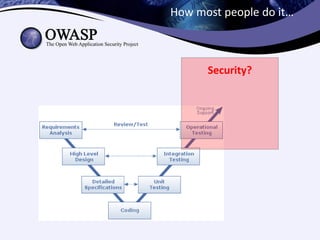
How most people do it…


      Security?
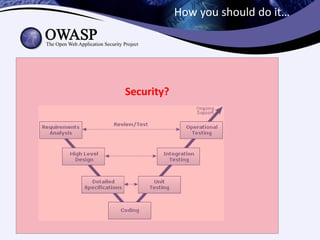
How you should do it…


Security?
Agile??
Agile


    Agile software development is a group of software
development methods based on iterative and incremental
 development, where requirements and solutions evolve
  through collaboration between self-organizing, cross-
     functional teams. It promotes adaptive planning,
  evolutionary development and delivery, a time-boxed
  iterative approach, and encourages rapid and flexible
  response to change. It is a conceptual framework that
      promotes foreseen interactions throughout the
                    development cycle.
TL; DR;


• Projects evolved with clients’ needs, not based on
  project managers’ fantasy ;)

• No formal list of functionality

• New code is push to production “all the time”
   – Etsy: 20 times a day

• No predefined milestones
WHAT???
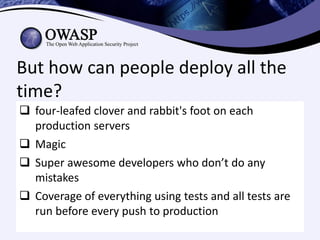
But how can people deploy all the
time?
 four-leafed clover and rabbit's foot on each
  production servers
 Magic
 Super awesome developers who don’t do any
  mistakes
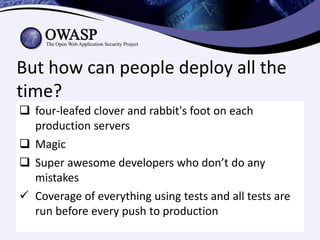
 Coverage of everything using tests and all tests are
  run before every push to production
But how can people deploy all the
time?
 four-leafed clover and rabbit's foot on each
  production servers
 Magic
 Super awesome developers who don’t do any
  mistakes
 Coverage of everything using tests and all tests are
  run before every push to production
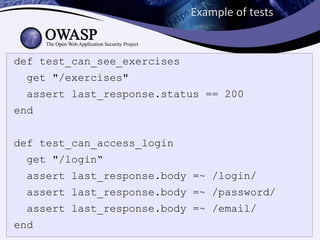
Example of tests


def test_can_see_exercises
  get "/exercises"
  assert last_response.status == 200
end


def test_can_access_login
  get "/login“
  assert last_response.body =~ /login/
  assert last_response.body =~ /password/
  assert last_response.body =~ /email/
end
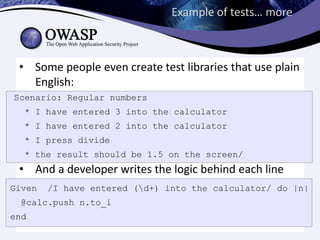
Example of tests… more


 • Some people even create test libraries that use plain
   English:
Scenario: Regular numbers
  * I have entered 3 into the calculator
  * I have entered 2 into the calculator
  * I press divide
  * the result should be 1.5 on the screen/
 • And a developer writes the logic behind each line
Given   /I have entered (d+) into the calculator/ do |n|
 @calc.push n.to_i
end
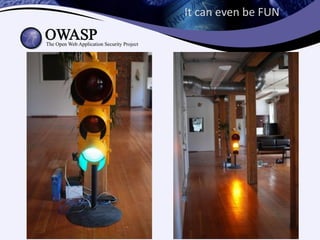
It can even be FUN
Summary


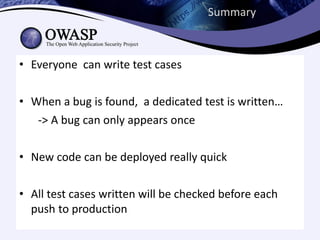
• Everyone can write test cases

• When a bug is found, a dedicated test is written…
   -> A bug can only appears once

• New code can be deployed really quick

• All test cases written will be checked before each
  push to production
As a security person, I can only say
             one thing

                        10 points for
                         Gryffindor
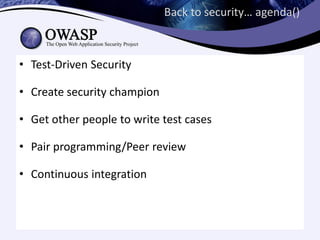
Back to security… agenda()


• Test-Driven Security

• Create security champion

• Get other people to write test cases

• Pair programming/Peer review

• Continuous integration
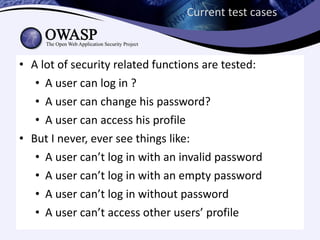
Current test cases


• A lot of security related functions are tested:
   • A user can log in ?
   • A user can change his password?
   • A user can access his profile
• But I never, ever see things like:
   • A user can’t log in with an invalid password
   • A user can’t log in with an empty password
   • A user can’t log in without password
   • A user can’t access other users’ profile
Functions needed


def login(user,password)
  creds   = {   :email => user,
                :password => password }
  post("/login", creds)
end

def assert_redirect_to_login
 assert last_response.header["Location"] =~ //login$/
 assert last_response.status == 302
end
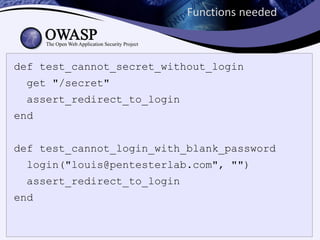
Functions needed


def test_cannot_secret_without_login
  get "/secret"
  assert_redirect_to_login
end


def test_cannot_login_with_blank_password
  login("louis@pentesterlab.com", "")
  assert_redirect_to_login
end
Functions needed


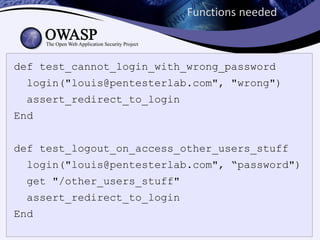
def test_cannot_login_with_wrong_password
  login("louis@pentesterlab.com", "wrong")
  assert_redirect_to_login
End


def test_logout_on_access_other_users_stuff
  login("louis@pentesterlab.com", “password")
  get "/other_users_stuff"
  assert_redirect_to_login
End
It’s pretty simple and
straightforward, but not many
     people are doing it :/

   You can even go further…
and create more security checks
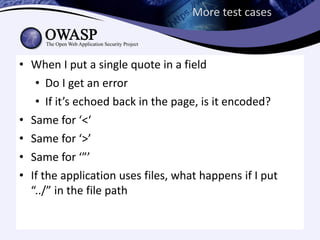
More test cases


• When I put a single quote in a field
   • Do I get an error
   • If it’s echoed back in the page, is it encoded?
• Same for ‘<‘
• Same for ‘>’
• Same for ‘”’
• If the application uses files, what happens if I put
  “../” in the file path
But to do that you need developers
      with security training…
Not necessarily,
 Half of the test cases should be
     based on business logic…
Modern frameworks take care of
           the other half.
But it’s always good to have some
        security champions.
FIRST RECIPE


• Steps:
   • Take a developer
   • Teach him everything about security: Top 10,
     Detection, Exploitation, …
   • Put him back in the development team
• Pros:
   • You have now a good security person
• Cons:
   • Likely to go away to do pentesting
SECOND RECIPE


• Steps:
   • Take a developer
   • Teach him how to detect potential bugs
   • Put him back in the development team
• Pro:
   • You don’t have a wannabe hacker in your team
   • You have someone who can find and fix bugs
     quickly
• Cons:
   • The training was probably less interesting
Detecting potential bugs?


• Forget everything you know about security

• Aside from business logic bugs… most security issues
  are based on: “Breaking the syntax”
   • XSS: breaking JS or HTML syntax
   • Code injection: breaking code syntax
   • SQL injection: breaking SQL syntax
   • …

• You just need to explain that correctly
Get non-devs involved


• Project managers:
   • They are close to the business
   • They can now write test cases in plain English

• Security people:
   • Most of them should be able to write test cases
   • They understand security
   • Every time a bug is found they can write a test
     case to make sure it will never happen again
As a process…


• Perform sensibility training when the project starts:
   • To avoid things like SQL built on the client side
   • Introduction to test driven security
   • Architecture review (SSL, Session mgmt…)
• If you perform penetration test, write issues as new
  test cases…
• Get a security person to review the “security test
  cases”
• Get a project manager to review the “business logic”
  security checks
Peer review


• Pair programming and security:
   • junior/senior team
   • dev/security team

• Peer review and security:
   • Bug spotted earlier
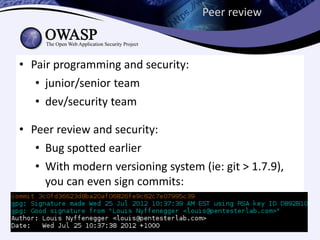
   • With modern versioning system (ie: git > 1.7.9),
     you can even sign commits:
Continuous integration


• You can automatically setup code review tools to
  scan your application
• You can automatically setup (free) web scanners to
  scan your application
• Cons:
   • Lot of time spent setting that up
   • Need to filter all possible false positive
• Pros:
   • Sleep like a baby
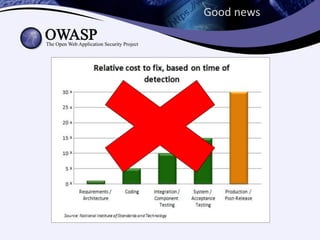
Good news
Limitations


• Production vs Testing

• You can’t prevent things like:
   • Weak crypto
   • Weak PRNG
   • Cookies related issues (“user=admin”)

• Or can you?
   • More testing…
   • This is when security people should start writing
     test cases.
Conclusion


• No rocket science here…
   … Just simple things to test

• If your developers don’t use tests… I guess you have
  other problems than security to take care of :/

• Reliable and simple way to increase your
  applications’ security
Questions?

Owasp tds

  • 1.
    Test-Driven Security Louis Nyffenegger @snyff
  • 2.
    About Me • Securityconsultant working for Securus Global in Melbourne • 2 side projects: – PentesterLab (.com): cool (web) training – PNTSTR (.com): easy first round for interviews • And today… I’m going to talk about Secure Development… in a way ;)
  • 3.
    Too often when people talk about secure development they explain…
  • 4.
    How most peopledo it… Security?
  • 5.
    How you shoulddo it… Security?
  • 6.
  • 7.
    Agile Agile software development is a group of software development methods based on iterative and incremental development, where requirements and solutions evolve through collaboration between self-organizing, cross- functional teams. It promotes adaptive planning, evolutionary development and delivery, a time-boxed iterative approach, and encourages rapid and flexible response to change. It is a conceptual framework that promotes foreseen interactions throughout the development cycle.
  • 8.
    TL; DR; • Projectsevolved with clients’ needs, not based on project managers’ fantasy ;) • No formal list of functionality • New code is push to production “all the time” – Etsy: 20 times a day • No predefined milestones
  • 9.
  • 10.
    But how canpeople deploy all the time?  four-leafed clover and rabbit's foot on each production servers  Magic  Super awesome developers who don’t do any mistakes  Coverage of everything using tests and all tests are run before every push to production
  • 11.
    But how canpeople deploy all the time?  four-leafed clover and rabbit's foot on each production servers  Magic  Super awesome developers who don’t do any mistakes  Coverage of everything using tests and all tests are run before every push to production
  • 12.
    Example of tests deftest_can_see_exercises get "/exercises" assert last_response.status == 200 end def test_can_access_login get "/login“ assert last_response.body =~ /login/ assert last_response.body =~ /password/ assert last_response.body =~ /email/ end
  • 13.
    Example of tests…more • Some people even create test libraries that use plain English: Scenario: Regular numbers * I have entered 3 into the calculator * I have entered 2 into the calculator * I press divide * the result should be 1.5 on the screen/ • And a developer writes the logic behind each line Given /I have entered (d+) into the calculator/ do |n| @calc.push n.to_i end
  • 14.
  • 15.
    Summary • Everyone canwrite test cases • When a bug is found, a dedicated test is written… -> A bug can only appears once • New code can be deployed really quick • All test cases written will be checked before each push to production
  • 16.
    As a securityperson, I can only say one thing 10 points for Gryffindor
  • 17.
    Back to security…agenda() • Test-Driven Security • Create security champion • Get other people to write test cases • Pair programming/Peer review • Continuous integration
  • 18.
    Current test cases •A lot of security related functions are tested: • A user can log in ? • A user can change his password? • A user can access his profile • But I never, ever see things like: • A user can’t log in with an invalid password • A user can’t log in with an empty password • A user can’t log in without password • A user can’t access other users’ profile
  • 19.
    Functions needed def login(user,password) creds = { :email => user, :password => password } post("/login", creds) end def assert_redirect_to_login assert last_response.header["Location"] =~ //login$/ assert last_response.status == 302 end
  • 20.
    Functions needed def test_cannot_secret_without_login get "/secret" assert_redirect_to_login end def test_cannot_login_with_blank_password login("louis@pentesterlab.com", "") assert_redirect_to_login end
  • 21.
    Functions needed def test_cannot_login_with_wrong_password login("louis@pentesterlab.com", "wrong") assert_redirect_to_login End def test_logout_on_access_other_users_stuff login("louis@pentesterlab.com", “password") get "/other_users_stuff" assert_redirect_to_login End
  • 22.
    It’s pretty simpleand straightforward, but not many people are doing it :/ You can even go further… and create more security checks
  • 23.
    More test cases •When I put a single quote in a field • Do I get an error • If it’s echoed back in the page, is it encoded? • Same for ‘<‘ • Same for ‘>’ • Same for ‘”’ • If the application uses files, what happens if I put “../” in the file path
  • 24.
    But to dothat you need developers with security training…
  • 25.
    Not necessarily, Halfof the test cases should be based on business logic… Modern frameworks take care of the other half. But it’s always good to have some security champions.
  • 26.
    FIRST RECIPE • Steps: • Take a developer • Teach him everything about security: Top 10, Detection, Exploitation, … • Put him back in the development team • Pros: • You have now a good security person • Cons: • Likely to go away to do pentesting
  • 27.
    SECOND RECIPE • Steps: • Take a developer • Teach him how to detect potential bugs • Put him back in the development team • Pro: • You don’t have a wannabe hacker in your team • You have someone who can find and fix bugs quickly • Cons: • The training was probably less interesting
  • 28.
    Detecting potential bugs? •Forget everything you know about security • Aside from business logic bugs… most security issues are based on: “Breaking the syntax” • XSS: breaking JS or HTML syntax • Code injection: breaking code syntax • SQL injection: breaking SQL syntax • … • You just need to explain that correctly
  • 29.
    Get non-devs involved •Project managers: • They are close to the business • They can now write test cases in plain English • Security people: • Most of them should be able to write test cases • They understand security • Every time a bug is found they can write a test case to make sure it will never happen again
  • 30.
    As a process… •Perform sensibility training when the project starts: • To avoid things like SQL built on the client side • Introduction to test driven security • Architecture review (SSL, Session mgmt…) • If you perform penetration test, write issues as new test cases… • Get a security person to review the “security test cases” • Get a project manager to review the “business logic” security checks
  • 31.
    Peer review • Pairprogramming and security: • junior/senior team • dev/security team • Peer review and security: • Bug spotted earlier • With modern versioning system (ie: git > 1.7.9), you can even sign commits:
  • 32.
    Continuous integration • Youcan automatically setup code review tools to scan your application • You can automatically setup (free) web scanners to scan your application • Cons: • Lot of time spent setting that up • Need to filter all possible false positive • Pros: • Sleep like a baby
  • 33.
  • 34.
    Limitations • Production vsTesting • You can’t prevent things like: • Weak crypto • Weak PRNG • Cookies related issues (“user=admin”) • Or can you? • More testing… • This is when security people should start writing test cases.
  • 35.
    Conclusion • No rocketscience here… … Just simple things to test • If your developers don’t use tests… I guess you have other problems than security to take care of :/ • Reliable and simple way to increase your applications’ security
  • 36.