Technical Centre for Agricultural and Rural Cooperation (CTA) Sharing Knowledge, Improving Rural Livelihoods www.cta.int The Future is mobile: ICTs empowering local communities in developing countries Kevin Painting WITFOR 2009
Outline Introduction e-agriculture: a mind map Mobile phone services The rise of mobile devices A hybrid environment
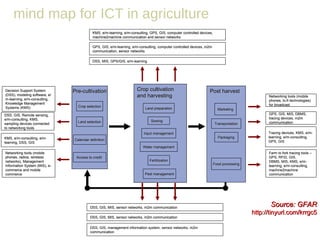
mind map for ICT in agriculture Crop cultivation  and harvesting Input management Water management Fertilization Pest management Post harvest Transportation Food processing Marketing Sowing Pre-cultivation Crop selection Calendar definition Access to credit Land preparation Packaging Land selection DSS, GIS, Remote sensing,  e/m-consulting, KMS, sampling devices connected to networking tools KMS, e/m-consulting, e/m-learning, DSS, GIS Networking tools (mobile phones, radios, wireless networks), Management Information System (MIS), e-commerce and mobile commerce Decision Support System (DSS), modeling software, e/m-learning, e/m-consulting, Knowledge Management Systems (KMS) KMS, e/m-learning, e/m-consulting, GPS, GIS, computer controlled devices, machine2machine communication and sensor networks GPS, GIS, e/m-learning, e/m-consulting, computer controlled devices, m2m communication, sensor networks DSS, MIS, GPS/GIS, e/m-learning Networking tools (mobile phones, lo-fi technologies) for broadcast  GPS, GIS, MIS, DBMS, tracing devices, m2m communication Tracing devices, KMS, e/m-learning, e/m-consulting, GPS, GIS Farm to fork tracing tools – GPS, RFID, GIS, DBMS, MIS, KMS, e/m-learning, e/m-consulting, machine2machine communication DSS, GIS, MIS, sensor networks, m2m communication DSS, GIS, MIS, sensor networks, m2m communication DSS, GIS, management information system, sensor networks, m2m communication Source: GFAR  http://tinyurl.com/krrgc5
The unstoppable rise of mobile phones A few statistics 3.4 billion subscribers worldwide (> 574 million in China) New mobile phone subscriptions 2006 – 2008: 70% were in developing countries Ghana (pop. 23.5 million): 7 million mobile phones users in 2008; only 200,000 in 2000 Globally, mobile financial services are predicted to be worth US$ 5 billion in 2010 Kenya: over 1 million people currently use the mobile banking system m-Pesa Mobile phones are  “...the single most powerful way to extend economic opportunities and key services to millions of people”  (World Bank)
Mobile services for farmers Market information (SMS) Manobi (Senegal) KACE (Kenya) “ e-Bay for farmers”: Esoko/Tradenet (Ghana); ANOPACI (C ô te d’Ivoire) Grameen Foundation Applabs (Uganda – BROSDI) Nokia Life Tools FoodNet (also FM broadcasts) Marketing/financial  DrumNet (Kenya) – network of info-kiosks FICOM – Farmers’ Information Communication Management (Uganda)
How did this situation arise? Lightweight, portable, easy to use, easy to share Can be used in areas of poor infrastructure Once just used for making calls, now a versatile, multipurpose tool “computer in a pocket” Texting device, camera, music player, calculator, web browser, GPS... Growing number of applications Generally falling prices,  but still not cheap cheaper handsets, lower operating costs, lower taxation Wildly popular “ Out of the box” – no training required
Mobile phone services – a paradox Majority of e-services are SMS based Easy to use, cheap, low bandwidth, free to receive messages ... but... Each service is a  walled garden  comprising a network provider plus phone manufacturer (unlike web services).  Potential conflict: public good vs. private profit? Services not easy to find No standards for SMS application development Very limited interactions possible with SMS Problems of scalability
Mobile phones and web services Web technologies show the most promise Low cost, easy to deploy, scalable, many F/OSS applications, cheap web hosting possibilities ... But Lack of useable content Format, bandwidth Lack of high capacity networks Lack of suitable handsets and web browsers Paradox: biggest growth area in services based on an inherently limited technology (SMS)
Mobile devices (and the web) make a comeback Appearance of XO (“$100”) laptop from OLPC Triggered an avalanche of cheap, slimmed down laptops and netbooks Impact of web2.0 and cloud computing Free (or low cost) applications available on-line – little local infrastructure required More applications for working on/off-line (Google Gears, Adobe Air...) Blurring of distinctions Laptops, netbooks, smartphones, mobile internet devices, geo-location devices Not mobiles vs. laptops !
Infrastructure developments Wireless technologies extend connectivity WiFi, Bluetooth, mesh networking Broadband internet access (cable) replacing expensive VSAT connections East Africa: Seacom (July), EASSy (2010) Mobile broadband (WiMAX, 3G) More expensive than cable
A hybrid environment Not mobiles vs laptops ! Many ways of communicating/connecting OLPC – mesh networking (no phone, no Internet) Village Telco Project (SA) “mesh potato” Telephone (landline) -> router -> wireless network Where there is no mobile, can set up local telephone network Fantsuam foundation (Nigeria): ZittNet For rural areas “ VoIP in a box” (PC) – plug and play, call on ZittNet for free Store/forward (even for VoIP)
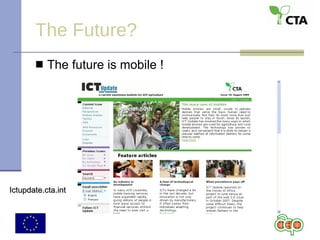
The Future? The future is mobile !  Ictupdate.cta.int
Thank you ? ? ? Any questions?

The future is mobile: ICTs empowering local communities in developing countries

  • 1.
    Technical Centre forAgricultural and Rural Cooperation (CTA) Sharing Knowledge, Improving Rural Livelihoods www.cta.int The Future is mobile: ICTs empowering local communities in developing countries Kevin Painting WITFOR 2009
  • 2.
    Outline Introduction e-agriculture:a mind map Mobile phone services The rise of mobile devices A hybrid environment
  • 3.
    mind map forICT in agriculture Crop cultivation and harvesting Input management Water management Fertilization Pest management Post harvest Transportation Food processing Marketing Sowing Pre-cultivation Crop selection Calendar definition Access to credit Land preparation Packaging Land selection DSS, GIS, Remote sensing, e/m-consulting, KMS, sampling devices connected to networking tools KMS, e/m-consulting, e/m-learning, DSS, GIS Networking tools (mobile phones, radios, wireless networks), Management Information System (MIS), e-commerce and mobile commerce Decision Support System (DSS), modeling software, e/m-learning, e/m-consulting, Knowledge Management Systems (KMS) KMS, e/m-learning, e/m-consulting, GPS, GIS, computer controlled devices, machine2machine communication and sensor networks GPS, GIS, e/m-learning, e/m-consulting, computer controlled devices, m2m communication, sensor networks DSS, MIS, GPS/GIS, e/m-learning Networking tools (mobile phones, lo-fi technologies) for broadcast GPS, GIS, MIS, DBMS, tracing devices, m2m communication Tracing devices, KMS, e/m-learning, e/m-consulting, GPS, GIS Farm to fork tracing tools – GPS, RFID, GIS, DBMS, MIS, KMS, e/m-learning, e/m-consulting, machine2machine communication DSS, GIS, MIS, sensor networks, m2m communication DSS, GIS, MIS, sensor networks, m2m communication DSS, GIS, management information system, sensor networks, m2m communication Source: GFAR http://tinyurl.com/krrgc5
  • 4.
    The unstoppable riseof mobile phones A few statistics 3.4 billion subscribers worldwide (> 574 million in China) New mobile phone subscriptions 2006 – 2008: 70% were in developing countries Ghana (pop. 23.5 million): 7 million mobile phones users in 2008; only 200,000 in 2000 Globally, mobile financial services are predicted to be worth US$ 5 billion in 2010 Kenya: over 1 million people currently use the mobile banking system m-Pesa Mobile phones are “...the single most powerful way to extend economic opportunities and key services to millions of people” (World Bank)
  • 5.
    Mobile services forfarmers Market information (SMS) Manobi (Senegal) KACE (Kenya) “ e-Bay for farmers”: Esoko/Tradenet (Ghana); ANOPACI (C ô te d’Ivoire) Grameen Foundation Applabs (Uganda – BROSDI) Nokia Life Tools FoodNet (also FM broadcasts) Marketing/financial DrumNet (Kenya) – network of info-kiosks FICOM – Farmers’ Information Communication Management (Uganda)
  • 6.
    How did thissituation arise? Lightweight, portable, easy to use, easy to share Can be used in areas of poor infrastructure Once just used for making calls, now a versatile, multipurpose tool “computer in a pocket” Texting device, camera, music player, calculator, web browser, GPS... Growing number of applications Generally falling prices, but still not cheap cheaper handsets, lower operating costs, lower taxation Wildly popular “ Out of the box” – no training required
  • 7.
    Mobile phone services– a paradox Majority of e-services are SMS based Easy to use, cheap, low bandwidth, free to receive messages ... but... Each service is a walled garden comprising a network provider plus phone manufacturer (unlike web services). Potential conflict: public good vs. private profit? Services not easy to find No standards for SMS application development Very limited interactions possible with SMS Problems of scalability
  • 8.
    Mobile phones andweb services Web technologies show the most promise Low cost, easy to deploy, scalable, many F/OSS applications, cheap web hosting possibilities ... But Lack of useable content Format, bandwidth Lack of high capacity networks Lack of suitable handsets and web browsers Paradox: biggest growth area in services based on an inherently limited technology (SMS)
  • 9.
    Mobile devices (andthe web) make a comeback Appearance of XO (“$100”) laptop from OLPC Triggered an avalanche of cheap, slimmed down laptops and netbooks Impact of web2.0 and cloud computing Free (or low cost) applications available on-line – little local infrastructure required More applications for working on/off-line (Google Gears, Adobe Air...) Blurring of distinctions Laptops, netbooks, smartphones, mobile internet devices, geo-location devices Not mobiles vs. laptops !
  • 10.
    Infrastructure developments Wirelesstechnologies extend connectivity WiFi, Bluetooth, mesh networking Broadband internet access (cable) replacing expensive VSAT connections East Africa: Seacom (July), EASSy (2010) Mobile broadband (WiMAX, 3G) More expensive than cable
  • 11.
    A hybrid environmentNot mobiles vs laptops ! Many ways of communicating/connecting OLPC – mesh networking (no phone, no Internet) Village Telco Project (SA) “mesh potato” Telephone (landline) -> router -> wireless network Where there is no mobile, can set up local telephone network Fantsuam foundation (Nigeria): ZittNet For rural areas “ VoIP in a box” (PC) – plug and play, call on ZittNet for free Store/forward (even for VoIP)
  • 12.
    The Future? Thefuture is mobile ! Ictupdate.cta.int
  • 13.
    Thank you ?? ? Any questions?

Editor's Notes