Theme 4 Integrated information systems Report IAALD 13 th  Congress Montpellier, France, 26-29 April 2010
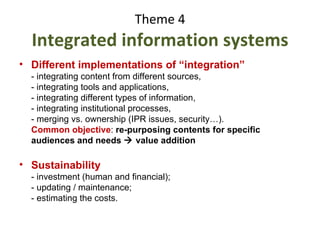
Theme 4 - Integrated information systems Slide for plenary – 2 points Different implementations of “integration” - integrating content from different sources, - integrating tools and applications, - integrating different types of information, - integrating institutional processes,  - merging vs. ownership (IPR issues, security…). Common objective :  re-purposing contents for specific audiences and needs    value addition  Sustainability - investment (human and financial); - updating / maintenance;  - estimating the costs.
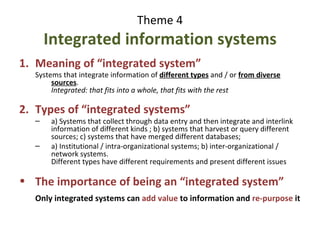
Theme 4 : 10 points Integrated information systems Meaning of “integrated system” Systems that integrate information of  different types  and / or  from diverse sources . Integrated: that fits into a whole, that fits with the rest    Different types of “integrated systems” a) Systems that collect through data entry and then integrate and interlink information of different kinds ; b) systems that harvest or query different sources; c) systems that have merged different databases; a) Institutional / intra-organizational systems; b) inter-organizational / network systems. Different types have different requirements and present different issues The value of being an “integrated system”  What all the integrated systems presented have in common is that  they  add value  to information and allow to  re-package and re-purpose  it according to the needs of their audience
Theme 4 : 10 points Integrated information systems Common issue: sustainability   - Financial sustainability - Content update - Difficulty of measuring the cost of integration The importance of classifications In order to integrate and present the collected information in a coherent and targeted manner, all systems presented use classifications of different kinds. Very important: geo indexing The importance of protocols and standards to export/import, harvest, query Common issue: validation of the information
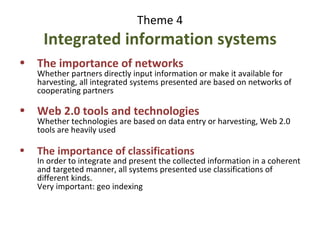
Theme 4 : 10 points Integrated information systems The importance of the purpose Purpose as the main criterion for rationale and assessment. To support decision making; early-warning; monitoring; surveillance. Common issue: identification and integration of sources The importance of knowing which sources are available, where, and how they can be integrated (sources are difficult to find and “disconnected”) Common issue: acknowledgment of sources, IPR The importance of networks Whether partners directly input information or make it available for harvesting, all integrated systems presented are based on networks of cooperating partners
Summary of presented systems Crop Genebank Knowledge Base of CGIAR :  Geert Claessens, Bioversity CERISA, VeliSA of INRA :  Marie-Colette Faure, INRA SIDALC of IICA :  Federico Sancho, IICA SIIS of CIFOR :  Sufiet Erlita, CGIAR USDA/CABI global database on invasive species :  Elizabeth Dodsworth, CABI Vigicultures   Mehdi Sine Linnaeus Link Project  Gina Douglas, Linnean Society of London   EMPRES of FAO/CIRAD :  Jean-Michel Vassal, CIRAD CIARD RING ;  Valeria Pesce, GFAR Global Plant Health Centre of CABI :  Philip Abrahams, CABI LIMS of SADC :  Pascal Bonnet (SADC)

IAALD 2010 Closing Session Report: Integrated information systems

  • 1.
    Theme 4 Integratedinformation systems Report IAALD 13 th Congress Montpellier, France, 26-29 April 2010
  • 2.
    Theme 4 -Integrated information systems Slide for plenary – 2 points Different implementations of “integration” - integrating content from different sources, - integrating tools and applications, - integrating different types of information, - integrating institutional processes, - merging vs. ownership (IPR issues, security…). Common objective : re-purposing contents for specific audiences and needs  value addition Sustainability - investment (human and financial); - updating / maintenance; - estimating the costs.
  • 3.
    Theme 4 :10 points Integrated information systems Meaning of “integrated system” Systems that integrate information of different types and / or from diverse sources . Integrated: that fits into a whole, that fits with the rest  Different types of “integrated systems” a) Systems that collect through data entry and then integrate and interlink information of different kinds ; b) systems that harvest or query different sources; c) systems that have merged different databases; a) Institutional / intra-organizational systems; b) inter-organizational / network systems. Different types have different requirements and present different issues The value of being an “integrated system” What all the integrated systems presented have in common is that they add value to information and allow to re-package and re-purpose it according to the needs of their audience
  • 4.
    Theme 4 :10 points Integrated information systems Common issue: sustainability - Financial sustainability - Content update - Difficulty of measuring the cost of integration The importance of classifications In order to integrate and present the collected information in a coherent and targeted manner, all systems presented use classifications of different kinds. Very important: geo indexing The importance of protocols and standards to export/import, harvest, query Common issue: validation of the information
  • 5.
    Theme 4 :10 points Integrated information systems The importance of the purpose Purpose as the main criterion for rationale and assessment. To support decision making; early-warning; monitoring; surveillance. Common issue: identification and integration of sources The importance of knowing which sources are available, where, and how they can be integrated (sources are difficult to find and “disconnected”) Common issue: acknowledgment of sources, IPR The importance of networks Whether partners directly input information or make it available for harvesting, all integrated systems presented are based on networks of cooperating partners
  • 6.
    Summary of presentedsystems Crop Genebank Knowledge Base of CGIAR : Geert Claessens, Bioversity CERISA, VeliSA of INRA : Marie-Colette Faure, INRA SIDALC of IICA : Federico Sancho, IICA SIIS of CIFOR : Sufiet Erlita, CGIAR USDA/CABI global database on invasive species : Elizabeth Dodsworth, CABI Vigicultures Mehdi Sine Linnaeus Link Project Gina Douglas, Linnean Society of London EMPRES of FAO/CIRAD : Jean-Michel Vassal, CIRAD CIARD RING ; Valeria Pesce, GFAR Global Plant Health Centre of CABI : Philip Abrahams, CABI LIMS of SADC : Pascal Bonnet (SADC)

Editor's Notes

  • #4 Data entry: the Crop Genebank Knowledge Base (CGKB) of the CGIAR, CERISA?, CABI open access database, EMPRES of CIRAD, LIMS of SADC Harvesting/queries: VeliSA, SIDALC, Linnaeus Link Project?, Vigicultures, Merging: SIIS CIFOR, Network: most Organizational: SIIS CIFOR
  • #5 Networks: SIDALC, CERISA, VeliSA on animal health, USDA/CABI global db of invasive species (consortium), Vigicultures (crop bioagressors), libraries for Linnaeus Link project, EMPRES Locust control units, LIMS of SADC for livestock Organizational “network”: Crop genebank of the CGIAR, CABI Global Plant Health Center (Global Plant Clinics) Intra-organitional: SIIS of CIFOR
  • #6 Purpose Decision making: Crop Genebank Knowledge Base of GIAR: LIMS for livestock Intra-organizational synergies: SIIS of CIFOR Reference: USDA/CABI global db on invasive species, Linnaeus Link Project Early warning systems: Vigicultures on crop bioaggressors; Monitoring system for preventive control: EMPRES for desert locusts Diognostic: Global Plant Health Centre of CABI