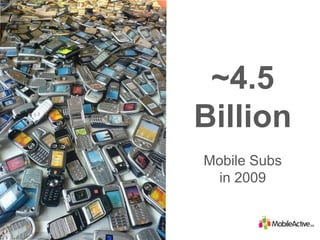
~4.5 BillionMobile Subs in 2009
Source: TomiAhonen Almanac
The cell phone is the single most transformative technology for development.Jeffrey Sachs
The Hype CycleSource: Gartner Group
1. Pioneer2. Breakout3. Consolidation4. MaturityPhases of Markets
A global volunteer network of NGOs, activists, technologists, academics, mediaA community of practice for knowledge and skill sharingAn onlinemDirectory of apps, case studies, research, how-to materialsAn innovation channel
The Use of MobilesDisasters and ReliefEarly warningsUrgent alertsRefugee coordinationSupply chain managementEnvironmental MonitoringGPRS individual and crowd dataOrganizing/AdvocacyConstituency engagementLegislative advocacyMobilization Getting Out the VoteInformation disseminationPolitical campaigns/candidates/partiesEconomic Development/LivelihoodsPaymentsMicro loan managementMarket data/informationSmall enterprises (SMEs)Health:Disease surveillance and mappingPatient managementPublic health education (HIV, TB, STDs)Supply chain management (drugs, food)TelemedicineAccountability/TransparencyElection monitoringHuman rights monitoringCorruption monitoringBudget tracking/participatory budgetingMedia and (Citizen) ReportingIncidence/news mappingIncident photo/video footageNews dissemination in restricted environments
FunctionalityVoice/AudioSMS Mobile WebMobile ApplicationsData CollectionSupply ChainMedical records/Imaging  etcUSSDLocation-based apps and servicesBluetoothPhotos and Video/Life-stream
1. It’s all very exciting2. Are we there? If not, what do we need?…with a dose of realism
It’s all really exciting…Computing is not at the margins anymore, (though people still are.)Communications is now in the hands of people who have not had it beforeInnovation is happening everywhere
“God Sends Mobiles”(Schmitt 2002)"The cell phone is the single most transformative technology for development” (Jeffrey Sachs)“A 10% increase in mobile penetration boosts annual GDP by 1.2%” (Deloitte 2007)“Making lives better”
Mobiles…A Wonderful World?(Positive) ExternalitiesCell Phone Services and Development Projects
Empirical Research on the Impact of Mobile PhonesFisheries in India (Abraham 2007, Jensen 2007)Grain markets in Niger (Aker 2008)Farmer participation in Uganda (Muto 2009)Internet kiosks and soybean prices in India (Goyal 2009)Labor markets in South Africa (Klonner and Nolen 2009)
Mobile Phones and Fish Price Dispersion (Jensen 2007)
Cell Phones and WelfareWelfare improves with market efficiency, but how welfare is distributed among consumers, producers and traders is ambiguousIncrease in fisherman’s profits and a reduction in waste (Jensen 2007)Traders’ profits increase (higher prices) and consumer prices decrease (Aker 2008)Increase in monthly wholesale price of soybeans (Goyal 2008)
2. Are we there? If not, what do we need?
The Mobile Eco SystemSource: Rudy de Waele
Key IssuesIncredibly promising and excitingCommercial, competitive, very fluid fieldPrivacy and securityFragmented platformsMany pilots, no scale Impact unclear. Much trial and errorFocus on apps but not on an enabling environmentLack of open platforms and applications
Key IssuesSignificant capacity issues (NGOs and Gov) Lack of capable intermediaries Little knowledge of what works in what settingData alone may be largely useless unless it provides the right information delivered through the right channel in the right form at the right time.
Towards a framework	Additive versus transformativeContextual and user-focusedSustainable (unsolved)Driven by demandBuild it and they will come does usually not workLocalized but shareableBuilt on open standards?Built on existing knowledge
 Applicable channel?
 In what context?

Rutgers

  • 1.
  • 2.
  • 3.
    The cell phoneis the single most transformative technology for development.Jeffrey Sachs
  • 4.
  • 5.
    1. Pioneer2. Breakout3.Consolidation4. MaturityPhases of Markets
  • 6.
    A global volunteernetwork of NGOs, activists, technologists, academics, mediaA community of practice for knowledge and skill sharingAn onlinemDirectory of apps, case studies, research, how-to materialsAn innovation channel
  • 7.
    The Use ofMobilesDisasters and ReliefEarly warningsUrgent alertsRefugee coordinationSupply chain managementEnvironmental MonitoringGPRS individual and crowd dataOrganizing/AdvocacyConstituency engagementLegislative advocacyMobilization Getting Out the VoteInformation disseminationPolitical campaigns/candidates/partiesEconomic Development/LivelihoodsPaymentsMicro loan managementMarket data/informationSmall enterprises (SMEs)Health:Disease surveillance and mappingPatient managementPublic health education (HIV, TB, STDs)Supply chain management (drugs, food)TelemedicineAccountability/TransparencyElection monitoringHuman rights monitoringCorruption monitoringBudget tracking/participatory budgetingMedia and (Citizen) ReportingIncidence/news mappingIncident photo/video footageNews dissemination in restricted environments
  • 8.
    FunctionalityVoice/AudioSMS Mobile WebMobileApplicationsData CollectionSupply ChainMedical records/Imaging etcUSSDLocation-based apps and servicesBluetoothPhotos and Video/Life-stream
  • 10.
    1. It’s allvery exciting2. Are we there? If not, what do we need?…with a dose of realism
  • 11.
    It’s all reallyexciting…Computing is not at the margins anymore, (though people still are.)Communications is now in the hands of people who have not had it beforeInnovation is happening everywhere
  • 12.
    “God Sends Mobiles”(Schmitt2002)"The cell phone is the single most transformative technology for development” (Jeffrey Sachs)“A 10% increase in mobile penetration boosts annual GDP by 1.2%” (Deloitte 2007)“Making lives better”
  • 13.
    Mobiles…A Wonderful World?(Positive)ExternalitiesCell Phone Services and Development Projects
  • 14.
    Empirical Research onthe Impact of Mobile PhonesFisheries in India (Abraham 2007, Jensen 2007)Grain markets in Niger (Aker 2008)Farmer participation in Uganda (Muto 2009)Internet kiosks and soybean prices in India (Goyal 2009)Labor markets in South Africa (Klonner and Nolen 2009)
  • 15.
    Mobile Phones andFish Price Dispersion (Jensen 2007)
  • 16.
    Cell Phones andWelfareWelfare improves with market efficiency, but how welfare is distributed among consumers, producers and traders is ambiguousIncrease in fisherman’s profits and a reduction in waste (Jensen 2007)Traders’ profits increase (higher prices) and consumer prices decrease (Aker 2008)Increase in monthly wholesale price of soybeans (Goyal 2008)
  • 34.
    2. Are wethere? If not, what do we need?
  • 37.
    The Mobile EcoSystemSource: Rudy de Waele
  • 38.
    Key IssuesIncredibly promisingand excitingCommercial, competitive, very fluid fieldPrivacy and securityFragmented platformsMany pilots, no scale Impact unclear. Much trial and errorFocus on apps but not on an enabling environmentLack of open platforms and applications
  • 39.
    Key IssuesSignificant capacityissues (NGOs and Gov) Lack of capable intermediaries Little knowledge of what works in what settingData alone may be largely useless unless it provides the right information delivered through the right channel in the right form at the right time.
  • 40.
    Towards a framework Additiveversus transformativeContextual and user-focusedSustainable (unsolved)Driven by demandBuild it and they will come does usually not workLocalized but shareableBuilt on open standards?Built on existing knowledge
  • 41.
  • 42.
    In whatcontext?

Editor's Notes

  • #13 When you read an article about mobile phones in Africa today, you can’t help but notice the claims – that « mobile phones revolutionalize people’s lives Now, while GSM stands for Global Systems for Mobile Communcations, Schmitt found another meeting: God Sends Mobiles.» A 10 percent increase in mobile penetration boosts GDP by 1.2 percent.Even the cell phone companies themselves have promised to « make life better ». But is this true?
  • #14 The introduction of telecommunications infrastructure – and primarily mobile phones – can have important impacts upon market performance and welfare in developing countries. In general, there are two primary mechanisms through which mobile phones could have a positive economic impact:As a positive externality of the mobile phone industry – ie, investment in the IT sector has spillover effects on other economic sectors.Via specific services provided by cell phone companies in Africa, or development projects using cell phones in an attempt to improve the development outcomes of the poor.An externality is a cost or benefit arising from an activity, which does not accrue to the person or organization carrying out the activity. The well-being of a consumer or production capability of a firm are directly affected by actions of other consumers or firms, rather than indirectly through prices.Also known as spillover effects
  • #15 That’s the theory. Now, we know that theory is fine, but what about reality? An emerging body of literature suggests that this theory is indeed happening. I wanted to highlight some of the economic literature in this area – not exhaustive – in both Asia and Africa. This is mainly in two categories – first, those in agro-food markets; and second, those in labor markets. Fisheries in India (Jensen 2007)Grain markets in Niger (Aker 2008)Farmer participation in Uganda (Muto 2009)Internet kiosks and soybean prices in India (Goyal 2009)Labor markets in South Africa (Klonner and Nolen 2009Also, Donner, J. 2005. The Use of Mobile Phones by Microentrepreneurs in Kigali, Rwanda: Changes to Social and Business NetworksInformation Technology and International Development, Winter 2005, Volume 3, Number 2“Mobiles are enabling people to invest in and draw on social capital”Goodman, J. 2005.Linking Mobile Phone Ownership and Use to Social Capital in Rural South Africa and TanzaniaFeatured in Vodafone Policy Paper Series, Number 2, March 2005.
  • #16 Comparing cell phone and non-cell phone regions in India, Jensen finds that cell phone coverage is associated with a strong reductionin price dispersion across markets, as these graphs show. If we look at the second graph, we see that prices across fish markets in the region vary widely before the introduction of cell phones. Once cell phones are introduced, as is seen by the red line, dispersion across these markets goes down – they are harmonized.
  • #17 But what does this mean for welfare – the well-being of the poor? Here the theoretical predictions are ambiguous. While improvements in efficiency