Information and
Communication
Technologies for
Development and
Poverty Reduction

Maximo Torero
m.torero@cgiar.org
IFPRI

Geneva 2nd of October 2013
Page 2
Page 3
Page 4
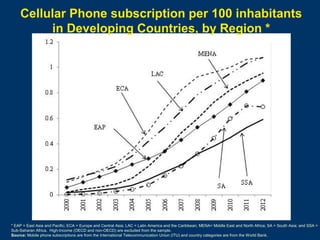
Cellular Phone subscription per 100 inhabitants
in Developing Countries, by Region *

* EAP = East Asia and Pacific; ECA = Europe and Central Asia; LAC = Latin America and the Caribbean; MENA= Middle East and North Africa; SA = South Asia; and SSA =
Page 5
Sub-Saharan Africa. High-Income (OECD and non-OECD) are excluded from the sample.
Source: Mobile phone subscriptions are from the International Telecommunication Union (ITU) and country categories are from the World Bank.
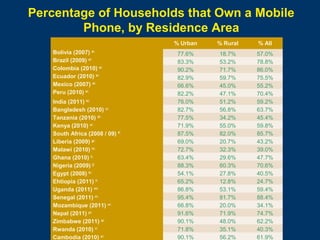
Percentage of Households that Own a Mobile
Phone, by Residence Area
% Urban
Bolivia (2007) a/.
Brazil (2009) a/.
Colombia (2010) a/.
Ecuador (2010) a/.
Mexico (2007) a/.
Peru (2010) a/.
India (2011) b/.
Bangladesh (2010) c/.
Tanzania (2010) d/.
Kenya (2010) e/.
South Africa (2008 / 09) f/.
Liberia (2009) g/.
Malawi (2010) h/.
Ghana (2010) i/.
Nigeria (2009) j/.
Egypt (2008) k/.
Ehtiopia (2011) l/.
Uganda (2011) m/.
Senegal (2011) n/.
Mozambique (2011) o/.
Nepal (2011) p/.
Zimbabwe (2011) q/.
Rwanda (2010) r/.
Cambodia (2010) s/.

% Rural

% All

77.6%
83.3%
90.2%
82.9%
66.6%
82.2%
76.0%
82.7%
77.5%
71.9%
87.5%
69.0%
72.7%
63.4%
88.3%
54.1%
65.2%
86.8%
95.4%
66.8%
91.6%
90.1%
71.8%
90.1%

18.7%
53.2%
71.7%
59.7%
45.0%
47.1%
51.2%
56.8%
34.2%
55.0%
82.0%
20.7%
32.3%
29.6%
60.3%
27.8%
12.8%
53.1%
81.7%
20.0%
71.9%
48.0%
35.1%
56.2%

57.0%
78.8%
86.0%
75.5%
55.2%
70.4%
59.2%
63.7%
45.4%
59.8%
85.7%
43.2%
39.0%
47.7%
70.6%
40.5%
24.7%
59.4%
88.4%
34.1%
74.7%
62.2%
40.3%
61.9%

Page 6
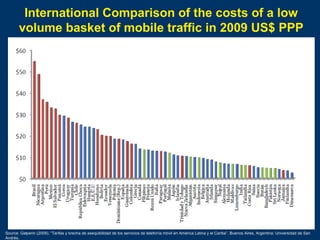
International Comparison of the costs of a low
volume basket of mobile traffic in 2009 US$ PPP

Page 7

Source: Galperin (2009). “Tarifas y brecha de asequibilidad de los servicios de telefonía móvil en América Latina y el Caribe”. Buenos Aires, Argentina: Universidad de San
Andrés.
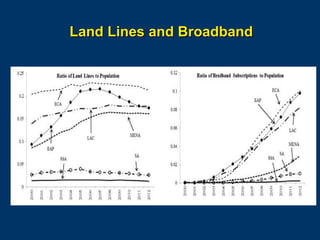
Land Lines and Broadband

Page 8
Four Questions
 What link exists between ICT growth and
economic growth?
 Do weak institutions block effective use of
ICTs?
 Have ICTs been adapted to low-income
countries, and have they had an impact?
 Can ICTs play a role in providing pro-poor
public goods and services?
Page 9
Four Questions
 What link exists between ICT growth and
economic growth?
 Do weak institutions block effective use of
ICTs?
 Have ICTs been adapted to low-income
countries, and have they had an impact?
 Can ICTs play a role in providing pro-poor
public goods and services?
Page 10
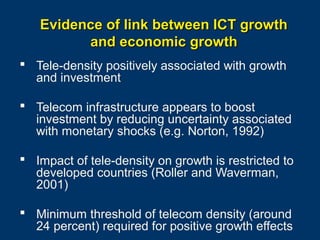
Evidence of link between ICT growth
and economic growth
 Tele-density positively associated with growth
and investment
 Telecom infrastructure appears to boost
investment by reducing uncertainty associated
with monetary shocks (e.g. Norton, 1992)
 Impact of tele-density on growth is restricted to
developed countries (Roller and Waverman,
2001)
 Minimum threshold of telecom density (around
24 percent) required for positive growth effects

Page 11
Evidence of link between ICT growth
and economic growth
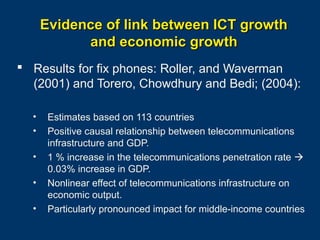
 Results for fix phones: Roller, and Waverman
(2001) and Torero, Chowdhury and Bedi; (2004):
•
•
•
•
•

Estimates based on 113 countries
Positive causal relationship between telecommunications
infrastructure and GDP.
1 % increase in the telecommunications penetration rate 
0.03% increase in GDP.
Nonlinear effect of telecommunications infrastructure on
economic output.
Particularly pronounced impact for middle-income countries
Page 12
Evidence of link between ICT growth
and economic growth
 Results for Mobile Phones: Waverman, Meschi
and Fuss (2007):
• All else equal, in the “low income” sample, a
country with an average of 10 more mobile phones
for every 100 people would have enjoyed a per
capita GDP growth higher by 0.59 percent.

Page 13
Four Questions
 What link exists between ICT growth and
economic growth?
 Do weak institutions block effective use of
ICTs?
 Have ICTs been adapted to low-income
countries, and have they had an impact?
 Can ICTs play a role in providing pro-poor
public goods and services?
Page 14
Do weak institutions block effective use
of ICTs?
Importance of specific characteristics of ICTs:
• High fix cost and low marginal cost
• Complementarities
• Network externalities
• Pervasive
Page 15
Do weak institutions block effective use
of ICTs?
• Natural Monopoly versus Access pricing
• Natural Monopoly framework implies that a
multi-firm industry is inefficient due to a less
than optimal scale of production
• Access pricing seems to be the answer but this
requires initial infrastructure, or what we call
minimum critical mass
Page 16
Dollars

Do weak institutions block effective use
of ICTs?

Average Cost
Utility

n1
Critical
mass point
Growth by
external
subsidy

n2
Private
Optimum

Self-sustained
growth

Source: Noam (2001)

Network Size
n

n3
Exit
Point
Entitlement growth
(directed growth)

Growth by
external
subsidy

Page 17
Do weak institutions block effective use
of ICTs?
 Service shortfalls in some rural and peri-urban areas
can be solved without government subsidies
• regulatory reforms are needed to let the market work
well
 But even in well-working markets service will not be
commercially viable in some peri-urban areas and in
most rural areas
• subsidies may be justified to extend services beyond
the market

Page 18
Do weak institutions block effective use
of ICTs?
• Recommend regulatory changes to enable the
market to work better
• increased competition
• open to new technologies
• open to new business models

• Outline an approach to subsidies to extend
services beyond the market
• using market forces
• minimal regulation
Page 19
Do weak institutions block effective use
of ICTs?
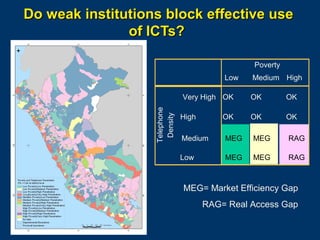
• Distinguish two types of urban service shortfalls:
• market efficiency gap
• real access gap

• For the market efficiency gap:
• identify current regulatory problems that the regulatory agency
can address
• examine new technologies that could help to reduce costs

• For the real access gap:
• draw on best practices developed in rural areas
• complement and extend these for application in urban and periurban areas
Page 20
Do weak institutions block effective use
of ICTs?
Poverty
Low

Telephone
Density

Very High OK
High

OK

Medium High
OK

OK

OK

OK

Medium

MEG

MEG

RAG

Low

MEG

MEG

RAG

MEG= Market Efficiency Gap
RAG= Real Access Gap
Four Questions
 What link exists between ICT growth and
economic growth?
 Do weak institutions block effective use of
ICTs?
 Have ICTs been adapted to low-income
countries, and have they had an impact?
 Can ICTs play a role in providing pro-poor
public goods and services?
Page 22
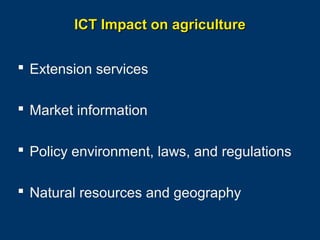
ICT Impact on agriculture
 Extension services
 Market information
 Policy environment, laws, and regulations
 Natural resources and geography
Page 23
Page 24
Have ICTs been adapted to low-income
countries, and have they had an impact?
• Information is an indispensable ingredient in decision
making for livelihood of households.
• Potential gains for rural households:
• time and cost saving
• more and better information, leading to better decisions and reduction of
transaction costs (Stigler, 1961; Stiglitz, 1985 and 2002)
• greater efficiency, productivity, and diversity(Leff, 1984; Tschang et al.,
2002; Andrew et al., 2003).
• lower input costs and higher output prices and information on new
technologies (Gotland, et al, 2004)
• expanded market reach

 Previous work trying to measure the consumer surplus:
Saunder et al. 1983, Bresnahan, 1986, Saunders,
Warford and Wellenius 1994, etc.
Page 25
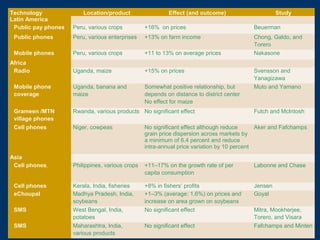
Technology
Latin America
Public pay phones

Location/product

Effect (and outcome)

Study

Peru, various crops

+16% on prices

Beuerman

Public phones

Peru, various enterprises

+13% on farm income

Mobile phones

Peru, various crops

+11 to 13% on average prices

Chong, Galdo, and
Torero
Nakasone

Uganda, maize

+15% on prices

Mobile phone
coverage

Uganda, banana and
maize

Somewhat positive relationship, but
depends on distance to district center
No effect for maize

Grameen /MTN
village phones
Cell phones

Rwanda, various products No significant effect

Africa
Radio

Asia
Cell phones
Cell phones
eChoupal
SMS
SMS

Svensson and
Yanagizawa
Muto and Yamano

Futch and McIntosh

Niger, cowpeas

No significant effect although reduce
Aker and Fafchamps
grain price dispersion across markets by
a minimum of 6.4 percent and reduce
intra-annual price variation by 10 percent

Philippines, various crops

+11–17% on the growth rate of per
capita consumption

Labonne and Chase

Kerala, India, fisheries
Madhya Pradesh, India,
soybeans
West Bengal, India,
potatoes
Maharashtra, India,
various products

+8% in fishers’ profits
+1–3% (average: 1.6%) on prices and
increase on area grown on soybeans
No significant effect

Jensen
Goyal

No significant effect

Mitra, Mookherjee,
Torero, and Visara
Fafchamps and Minten
Page 26
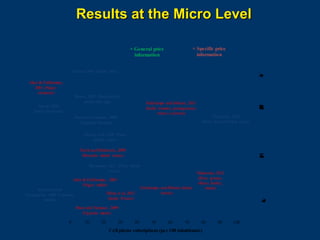
Results at the Micro Level
+ Specific price
information

+ General price
information

Bayes, 2001 (Bangladesh,
paddy and egg)

Goyal, 2010
(India: Soybean)

Fafchamps and Minten, 2011
(India: tomato, pomegranate,
onion, soybean)

Muto and Yamano, 2009
(Uganda: banana)

h
g
H
/
m
u
i
d
e
M

Aker & Fafchamps,
2001 (Niger:
cowpeas)

e
u
l
a
V

Jensen, 2007 (India: fish)

Nakasone, 2012
(Peru: peas and lima beans

Chong et al, 2008 (Peru:
mixed crops)

s
p
o
r
c
d
e
x
i
M

Futch and MaIntosh,, 2009
(Rwanda: mixed crops)

Aker & Fafchamps , 2001
(Niger: millet)

Svensson and
Yanagizawa, 2009 (Uganda:
maize)

Mitra et al, 2012
(India: Potato)

Nakasone, 2012
(Peru: potato,
olluco, barley,
Fafchamps and Minten (India:
maize)
wheat)

w
o
L
e
u
l
a
v

Beuerman, 2011 (Peru: mixed
crops)

Muto and Yamano, 2009
(Uganda: maize)
0

10

20

30

40

50

60

70

80

Cell phone subcriptions (per 100 inhabitants)

90

100

Page 27
Results on extension
 ICT’s can also play a role in reducing the three
main constraints traditional extension services:
• First, poor infrastructure increases the cost of
extension visits,
• Second, the need to follow up information and
feedback
• Finally, traditional extension is plagued by principalagent and institutional problems.

 Aker (2011) also claims that ICTs can also make
farmers better able access to private information
from their own social networks.
Page 28
Results on extension
 Fafchamps and Minten (2012) look at the effect of using SMS
with crop advisory tips (offered for one crop chosen by the
farmer) and local weather forecasts. They found no effect of
the information for any of these outcomes.
 Similarly, Cole and Fernando (2012) conduct an impact
evaluation of the Avaaj Otalo (AO) program among cotton
farmers in Gujarat, India. They find that households who
benefited from AO shift their pesticides from hazardous to
more effective ones. Their results also suggest that
beneficiaries are more likely to harvest cumin (a high-value
cash crop)
 Finally, Fu and Akter (2012) investigate the impact of a
program called “Knowledge Help Extension Technology
Initiative” (KHETI) in Madhya Pradesh, India. Those in the
KHETI group increased their awareness and knowledge
Page 29
towards extension services, compared to a control
Four Questions
 What link exists between ICT growth and
economic growth?
 Do weak institutions block effective use of
ICTs?
 Have ICTs been adapted to low-income
countries, and have they had an impact?
 Can ICTs play a role in providing pro-poor
public goods and services?
Page 30
Can ICTs play a role in providing pro-poor
public goods and services?
• ICTs can be a powerful tool for improving the
quality and efficiency of government social
services.
• Clear gap between the use of ICTs for the
delivery of public goods.
• Most of the cases of use of ICT in delivering
public services are isolated.
Page 31
Barriers to ICT Impact
Harris (2003) identifies the following general
barriers to ICT integration in social and economic
development:
 price and availability
 awareness of how to use ICTs for one’s own
benefit
 skill-relevant human capital (Hargattai, 2003;
Wilson, 1999; Birru et al. 2004).
 attitudes, motivation, encouragement
 equality in access across different social groups
 appropriateness of content.
Page 32
Can ICTs play a role in providing pro-poor
public goods and services?
• On agriculture
• On health:
• telemedicine centers in Alto Amazonas, and in Andhra Pradesh,
India,
• HealthNet
• ProCAARE discussion forum and the WorldSpace Foundation
(WSF)-Africare HIV/AIDS initiative

• On education:
• education as the African Virtual University
• the distance learning university in India
Page 33
ICT Impact on health
 The relevant barriers to ICT impact on health is at
this stage speculative.
 In order to fully identify barriers to the
effectiveness of ICT-based health promotion,
rigorous empirical studies are needed.
 Where barriers are important, rural ICT expansion
may require complementary measures such as:
• providing web skills training,
• designing web pages to direct users towards locally
relevant and scientifically reliable content,
• or targeting access to specific groups of individuals.
Page 34
Final Comments
• ICTs- not a panacea
• ICTs can have an important impact at the macro level
once a critical mass is achieved.
• ICTs can have an important impact in linking smallholders
and SMEs to markets
• Need to differentiate market efficiency gap from real
access gap
• Government should play a major role in the real access
gap.
• ICT can play an important role as a provider of pro-poor
public goods and services
Page 35
Final Comments (ctd.)
• Minimal conditions necessary for success:
• prompt deregulation
• effective competition among service providers
• free movement and adoption of technologies
• targeted and competitive subsidies to reduce access
gap
• institutional arrangements to increase the use of ICTs
in the provision of public goods.

Page 36
Final Comments (ctd.)
• Two important things to keep in mind:
• Three C’s of ICTs: Connectivity, Capability to use it,
and Content. The latter is crucial specially to link to
markets.
• We need to look to new technologies: wireless
broadband technologies potentially offer a future
platform for delivery of voice telephony and broadband
services to peri-urban and rural areas (leap-frogging).
Page 37
Page 38

Information and Communications Technologies for Development and Poverty Reduction by Maximo Torero

  • 1.
    Information and Communication Technologies for Developmentand Poverty Reduction Maximo Torero m.torero@cgiar.org IFPRI Geneva 2nd of October 2013
  • 2.
  • 3.
  • 4.
  • 5.
    Cellular Phone subscriptionper 100 inhabitants in Developing Countries, by Region * * EAP = East Asia and Pacific; ECA = Europe and Central Asia; LAC = Latin America and the Caribbean; MENA= Middle East and North Africa; SA = South Asia; and SSA = Page 5 Sub-Saharan Africa. High-Income (OECD and non-OECD) are excluded from the sample. Source: Mobile phone subscriptions are from the International Telecommunication Union (ITU) and country categories are from the World Bank.
  • 6.
    Percentage of Householdsthat Own a Mobile Phone, by Residence Area % Urban Bolivia (2007) a/. Brazil (2009) a/. Colombia (2010) a/. Ecuador (2010) a/. Mexico (2007) a/. Peru (2010) a/. India (2011) b/. Bangladesh (2010) c/. Tanzania (2010) d/. Kenya (2010) e/. South Africa (2008 / 09) f/. Liberia (2009) g/. Malawi (2010) h/. Ghana (2010) i/. Nigeria (2009) j/. Egypt (2008) k/. Ehtiopia (2011) l/. Uganda (2011) m/. Senegal (2011) n/. Mozambique (2011) o/. Nepal (2011) p/. Zimbabwe (2011) q/. Rwanda (2010) r/. Cambodia (2010) s/. % Rural % All 77.6% 83.3% 90.2% 82.9% 66.6% 82.2% 76.0% 82.7% 77.5% 71.9% 87.5% 69.0% 72.7% 63.4% 88.3% 54.1% 65.2% 86.8% 95.4% 66.8% 91.6% 90.1% 71.8% 90.1% 18.7% 53.2% 71.7% 59.7% 45.0% 47.1% 51.2% 56.8% 34.2% 55.0% 82.0% 20.7% 32.3% 29.6% 60.3% 27.8% 12.8% 53.1% 81.7% 20.0% 71.9% 48.0% 35.1% 56.2% 57.0% 78.8% 86.0% 75.5% 55.2% 70.4% 59.2% 63.7% 45.4% 59.8% 85.7% 43.2% 39.0% 47.7% 70.6% 40.5% 24.7% 59.4% 88.4% 34.1% 74.7% 62.2% 40.3% 61.9% Page 6
  • 7.
    International Comparison ofthe costs of a low volume basket of mobile traffic in 2009 US$ PPP Page 7 Source: Galperin (2009). “Tarifas y brecha de asequibilidad de los servicios de telefonía móvil en América Latina y el Caribe”. Buenos Aires, Argentina: Universidad de San Andrés.
  • 8.
    Land Lines andBroadband Page 8
  • 9.
    Four Questions  Whatlink exists between ICT growth and economic growth?  Do weak institutions block effective use of ICTs?  Have ICTs been adapted to low-income countries, and have they had an impact?  Can ICTs play a role in providing pro-poor public goods and services? Page 9
  • 10.
    Four Questions  Whatlink exists between ICT growth and economic growth?  Do weak institutions block effective use of ICTs?  Have ICTs been adapted to low-income countries, and have they had an impact?  Can ICTs play a role in providing pro-poor public goods and services? Page 10
  • 11.
    Evidence of linkbetween ICT growth and economic growth  Tele-density positively associated with growth and investment  Telecom infrastructure appears to boost investment by reducing uncertainty associated with monetary shocks (e.g. Norton, 1992)  Impact of tele-density on growth is restricted to developed countries (Roller and Waverman, 2001)  Minimum threshold of telecom density (around 24 percent) required for positive growth effects Page 11
  • 12.
    Evidence of linkbetween ICT growth and economic growth  Results for fix phones: Roller, and Waverman (2001) and Torero, Chowdhury and Bedi; (2004): • • • • • Estimates based on 113 countries Positive causal relationship between telecommunications infrastructure and GDP. 1 % increase in the telecommunications penetration rate  0.03% increase in GDP. Nonlinear effect of telecommunications infrastructure on economic output. Particularly pronounced impact for middle-income countries Page 12
  • 13.
    Evidence of linkbetween ICT growth and economic growth  Results for Mobile Phones: Waverman, Meschi and Fuss (2007): • All else equal, in the “low income” sample, a country with an average of 10 more mobile phones for every 100 people would have enjoyed a per capita GDP growth higher by 0.59 percent. Page 13
  • 14.
    Four Questions  Whatlink exists between ICT growth and economic growth?  Do weak institutions block effective use of ICTs?  Have ICTs been adapted to low-income countries, and have they had an impact?  Can ICTs play a role in providing pro-poor public goods and services? Page 14
  • 15.
    Do weak institutionsblock effective use of ICTs? Importance of specific characteristics of ICTs: • High fix cost and low marginal cost • Complementarities • Network externalities • Pervasive Page 15
  • 16.
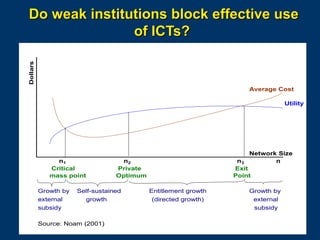
    Do weak institutionsblock effective use of ICTs? • Natural Monopoly versus Access pricing • Natural Monopoly framework implies that a multi-firm industry is inefficient due to a less than optimal scale of production • Access pricing seems to be the answer but this requires initial infrastructure, or what we call minimum critical mass Page 16
  • 17.
    Dollars Do weak institutionsblock effective use of ICTs? Average Cost Utility n1 Critical mass point Growth by external subsidy n2 Private Optimum Self-sustained growth Source: Noam (2001) Network Size n n3 Exit Point Entitlement growth (directed growth) Growth by external subsidy Page 17
  • 18.
    Do weak institutionsblock effective use of ICTs?  Service shortfalls in some rural and peri-urban areas can be solved without government subsidies • regulatory reforms are needed to let the market work well  But even in well-working markets service will not be commercially viable in some peri-urban areas and in most rural areas • subsidies may be justified to extend services beyond the market Page 18
  • 19.
    Do weak institutionsblock effective use of ICTs? • Recommend regulatory changes to enable the market to work better • increased competition • open to new technologies • open to new business models • Outline an approach to subsidies to extend services beyond the market • using market forces • minimal regulation Page 19
  • 20.
    Do weak institutionsblock effective use of ICTs? • Distinguish two types of urban service shortfalls: • market efficiency gap • real access gap • For the market efficiency gap: • identify current regulatory problems that the regulatory agency can address • examine new technologies that could help to reduce costs • For the real access gap: • draw on best practices developed in rural areas • complement and extend these for application in urban and periurban areas Page 20
  • 21.
    Do weak institutionsblock effective use of ICTs? Poverty Low Telephone Density Very High OK High OK Medium High OK OK OK OK Medium MEG MEG RAG Low MEG MEG RAG MEG= Market Efficiency Gap RAG= Real Access Gap
  • 22.
    Four Questions  Whatlink exists between ICT growth and economic growth?  Do weak institutions block effective use of ICTs?  Have ICTs been adapted to low-income countries, and have they had an impact?  Can ICTs play a role in providing pro-poor public goods and services? Page 22
  • 23.
    ICT Impact onagriculture  Extension services  Market information  Policy environment, laws, and regulations  Natural resources and geography Page 23
  • 24.
  • 25.
    Have ICTs beenadapted to low-income countries, and have they had an impact? • Information is an indispensable ingredient in decision making for livelihood of households. • Potential gains for rural households: • time and cost saving • more and better information, leading to better decisions and reduction of transaction costs (Stigler, 1961; Stiglitz, 1985 and 2002) • greater efficiency, productivity, and diversity(Leff, 1984; Tschang et al., 2002; Andrew et al., 2003). • lower input costs and higher output prices and information on new technologies (Gotland, et al, 2004) • expanded market reach  Previous work trying to measure the consumer surplus: Saunder et al. 1983, Bresnahan, 1986, Saunders, Warford and Wellenius 1994, etc. Page 25
  • 26.
    Technology Latin America Public payphones Location/product Effect (and outcome) Study Peru, various crops +16% on prices Beuerman Public phones Peru, various enterprises +13% on farm income Mobile phones Peru, various crops +11 to 13% on average prices Chong, Galdo, and Torero Nakasone Uganda, maize +15% on prices Mobile phone coverage Uganda, banana and maize Somewhat positive relationship, but depends on distance to district center No effect for maize Grameen /MTN village phones Cell phones Rwanda, various products No significant effect Africa Radio Asia Cell phones Cell phones eChoupal SMS SMS Svensson and Yanagizawa Muto and Yamano Futch and McIntosh Niger, cowpeas No significant effect although reduce Aker and Fafchamps grain price dispersion across markets by a minimum of 6.4 percent and reduce intra-annual price variation by 10 percent Philippines, various crops +11–17% on the growth rate of per capita consumption Labonne and Chase Kerala, India, fisheries Madhya Pradesh, India, soybeans West Bengal, India, potatoes Maharashtra, India, various products +8% in fishers’ profits +1–3% (average: 1.6%) on prices and increase on area grown on soybeans No significant effect Jensen Goyal No significant effect Mitra, Mookherjee, Torero, and Visara Fafchamps and Minten Page 26
  • 27.
    Results at theMicro Level + Specific price information + General price information Bayes, 2001 (Bangladesh, paddy and egg) Goyal, 2010 (India: Soybean) Fafchamps and Minten, 2011 (India: tomato, pomegranate, onion, soybean) Muto and Yamano, 2009 (Uganda: banana) h g H / m u i d e M Aker & Fafchamps, 2001 (Niger: cowpeas) e u l a V Jensen, 2007 (India: fish) Nakasone, 2012 (Peru: peas and lima beans Chong et al, 2008 (Peru: mixed crops) s p o r c d e x i M Futch and MaIntosh,, 2009 (Rwanda: mixed crops) Aker & Fafchamps , 2001 (Niger: millet) Svensson and Yanagizawa, 2009 (Uganda: maize) Mitra et al, 2012 (India: Potato) Nakasone, 2012 (Peru: potato, olluco, barley, Fafchamps and Minten (India: maize) wheat) w o L e u l a v Beuerman, 2011 (Peru: mixed crops) Muto and Yamano, 2009 (Uganda: maize) 0 10 20 30 40 50 60 70 80 Cell phone subcriptions (per 100 inhabitants) 90 100 Page 27
  • 28.
    Results on extension ICT’s can also play a role in reducing the three main constraints traditional extension services: • First, poor infrastructure increases the cost of extension visits, • Second, the need to follow up information and feedback • Finally, traditional extension is plagued by principalagent and institutional problems.  Aker (2011) also claims that ICTs can also make farmers better able access to private information from their own social networks. Page 28
  • 29.
    Results on extension Fafchamps and Minten (2012) look at the effect of using SMS with crop advisory tips (offered for one crop chosen by the farmer) and local weather forecasts. They found no effect of the information for any of these outcomes.  Similarly, Cole and Fernando (2012) conduct an impact evaluation of the Avaaj Otalo (AO) program among cotton farmers in Gujarat, India. They find that households who benefited from AO shift their pesticides from hazardous to more effective ones. Their results also suggest that beneficiaries are more likely to harvest cumin (a high-value cash crop)  Finally, Fu and Akter (2012) investigate the impact of a program called “Knowledge Help Extension Technology Initiative” (KHETI) in Madhya Pradesh, India. Those in the KHETI group increased their awareness and knowledge Page 29 towards extension services, compared to a control
  • 30.
    Four Questions  Whatlink exists between ICT growth and economic growth?  Do weak institutions block effective use of ICTs?  Have ICTs been adapted to low-income countries, and have they had an impact?  Can ICTs play a role in providing pro-poor public goods and services? Page 30
  • 31.
    Can ICTs playa role in providing pro-poor public goods and services? • ICTs can be a powerful tool for improving the quality and efficiency of government social services. • Clear gap between the use of ICTs for the delivery of public goods. • Most of the cases of use of ICT in delivering public services are isolated. Page 31
  • 32.
    Barriers to ICTImpact Harris (2003) identifies the following general barriers to ICT integration in social and economic development:  price and availability  awareness of how to use ICTs for one’s own benefit  skill-relevant human capital (Hargattai, 2003; Wilson, 1999; Birru et al. 2004).  attitudes, motivation, encouragement  equality in access across different social groups  appropriateness of content. Page 32
  • 33.
    Can ICTs playa role in providing pro-poor public goods and services? • On agriculture • On health: • telemedicine centers in Alto Amazonas, and in Andhra Pradesh, India, • HealthNet • ProCAARE discussion forum and the WorldSpace Foundation (WSF)-Africare HIV/AIDS initiative • On education: • education as the African Virtual University • the distance learning university in India Page 33
  • 34.
    ICT Impact onhealth  The relevant barriers to ICT impact on health is at this stage speculative.  In order to fully identify barriers to the effectiveness of ICT-based health promotion, rigorous empirical studies are needed.  Where barriers are important, rural ICT expansion may require complementary measures such as: • providing web skills training, • designing web pages to direct users towards locally relevant and scientifically reliable content, • or targeting access to specific groups of individuals. Page 34
  • 35.
    Final Comments • ICTs-not a panacea • ICTs can have an important impact at the macro level once a critical mass is achieved. • ICTs can have an important impact in linking smallholders and SMEs to markets • Need to differentiate market efficiency gap from real access gap • Government should play a major role in the real access gap. • ICT can play an important role as a provider of pro-poor public goods and services Page 35
  • 36.
    Final Comments (ctd.) •Minimal conditions necessary for success: • prompt deregulation • effective competition among service providers • free movement and adoption of technologies • targeted and competitive subsidies to reduce access gap • institutional arrangements to increase the use of ICTs in the provision of public goods. Page 36
  • 37.
    Final Comments (ctd.) •Two important things to keep in mind: • Three C’s of ICTs: Connectivity, Capability to use it, and Content. The latter is crucial specially to link to markets. • We need to look to new technologies: wireless broadband technologies potentially offer a future platform for delivery of voice telephony and broadband services to peri-urban and rural areas (leap-frogging). Page 37
  • 38.

Editor's Notes

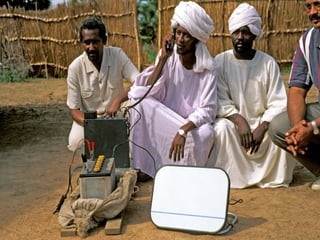
  • #3 Sudan Men -© 2005 John Miles/PANOS: SUDAN Bahr El Ghazal Local Dinka leaders using a satellite phone
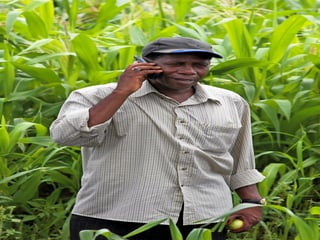
  • #4 Farmer in Burkina de Faso working on were to sell his production
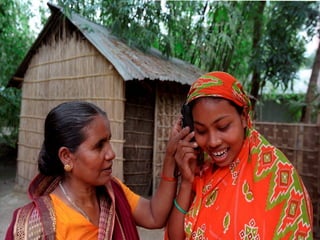
  • #5 Bangladesh Women - © 2006 G.M.B. Akash /PANOS BANGLADESH Tangail A village woman is talking to her husband from the cell phone of Rabia Begum, who runs a small business where she lets villagers use her cell phone for a nomial fee. Grameen Phone, though not related to Grameen Bank, has a wide network all over Bangladesh. Many women run such small businesses. It has transformed the communication system in rural areas of Bangladesh.
  • #6 As Figure 1 shows, total telephone access in South Asia and Sub-Saharan Africa grew by an average of 22 and 17 percent per year, respectively, from 1990 to 2003, but their current levels of access are still just 6.2 and 5.8 percent. Inequality of access is even greater within developing countries, especially between urban and rural areas, where the digital divide continues to widen.
  • #16 High fix cost and low marginal cost – easy to reproduce information Complementarities – ICT will normally be consumed together with other products Network externalities – the number of other people using similar or compatible products affects the utility derived from its consumption
  • #17 Economic literature from the 1950s to early 1980s suggests that network industries like ICT are subject to strong economies of scale, due to significant initial investment and should therefore be termed “natural Monopolies”
  • #18 To understand this process Noam (2001) looks at a network as a cost-sharing arrangement among several users. Since fixed costs are high and marginal costs are low, a new participant helps network users to lower their costs. Also, the new user adds to the utility of the existing users by increasing network externalities. The benefit of joining a network rises, though at a declining rate. In the range, below a “critical mass” (point n1), the development of a network will be infeasible unless supported by external sources. Such sources might be subsidies from the government or from other parts of the network organization, as was the case with early cellular networks, or they could be provided by regulatory means, such as assigned monopolies or advantageous terms of interconnection with other networks. Beyond the point of critical mass (n1), a network’s growth is self-sustaining. But when growth reaches the private optimum (n2), marginal net benefits are zero. Left to themselves, existing network subscribers would not accept new members, but from a societal viewpoint, the optimal network size diverges from the private optimum because social welfare increases beyond n2. The political process, therefore, tends to expand the size of the network beyond the private optimum, to the exit point (n3), through policies of “universal service connectivity.” Beyond that point, the pro-expansion policy creates incentives to form alternative networks: the greater the success of the network policy in achieving universal service connectivity and affordable rates, the greater the pressure of network fracture. In the case of telecommunications, ironically, the breakdown of the network is not caused by the failure of the system but rather by its success (Noam 2001). The traditional fear is that loss of cost-sharing and externalities resulting from the second network reduce social welfare. Where mutual interconnection is assured, however, the externality benefits remain (or even increase).
  • #24 Extension services: agricultural best practices, new varieties, technologies, technical assistance. Market information: prices, quality requirements, credit availability, selling options, labor supply and demand, distribution, and logistics. Policy environment, laws, and regulations: land titling, water access, conflict resolution systems, labor laws, environmental regulations, entrepreneurial rules. Natural resources and geography: weather conditions, water resources, physical infrastructure (roads, irrigation).