






2012
Information and Communications
for Development

Maximizing
Mobile
2012
Information and Communications
for Development
2012
Information and Communications
for Development

Maximizing Mobile
© 2012 International Bank for Reconstruction and Development / The World Bank
1818 H Street NW, Washington DC 20433
Telephone: 202-473-1000; Internet: www.worldbank.org
Some rights reserved
1 2 3 4 15 14 13 12
This work is a product of the staff of The World Bank with external contributions. Note that The World Bank does
not necessarily own each component of the content included in the work. The World Bank therefore does not warrant
that the use of the content contained in the work will not infringe on the rights of third parties. The risk of claims
resulting from such infringement rests solely with you.
The findings, interpretations, and conclusions expressed in this work do not necessarily reflect the views of The
World Bank, its Board of Executive Directors, or the governments they represent. The World Bank does not guarantee the accuracy of the data included in this work. The boundaries, colors, denominations, and other information
shown on any map in this work do not imply any judgment on the part of The World Bank concerning the legal status
of any territory or the endorsement or acceptance of such boundaries.
Nothing herein shall constitute or be considered to be a limitation upon or waiver of the privileges and immunities of The World Bank, all of which are specifically reserved.
Rights and Permissions

This work is available under the Creative Commons Attribution 3.0 Unported license (CC BY 3.0)
http://creativecommons.org/licenses/by/3.0. Under the Creative Commons Attribution license, you are free to copy,
distribute, transmit, and adapt this work, including for commercial purposes, under the following conditions:
Attribution—Please cite the work as follows: World Bank. 2012. Information and Communications for Development
2012: Maximizing Mobile. Washington, DC: World Bank. DOI: 10.1596/978-0-8213-8991-1; website: http://www
.worldbank.org/ict/IC4D2012. License: Creative Commons Attribution CC BY 3.0
Translations—If you create a translation of this work, please add the following disclaimer along with the attribution:
This translation was not created by The World Bank and should not be considered an official World Bank translation. The
World Bank shall not be liable for any content or error in this translation.
All queries on rights and licenses should be addressed to the Office of the Publisher, The World Bank, 1818 H Street
NW, Washington, DC 20433, USA; fax: 202-522-2625; e-mail: pubrights@worldbank.org.
ISBN (paper): 978-0-8213-8991-1
ISBN (electronic): 978-0-8213-9587-5
DOI: 10.1596/978-0-8213-8991-1
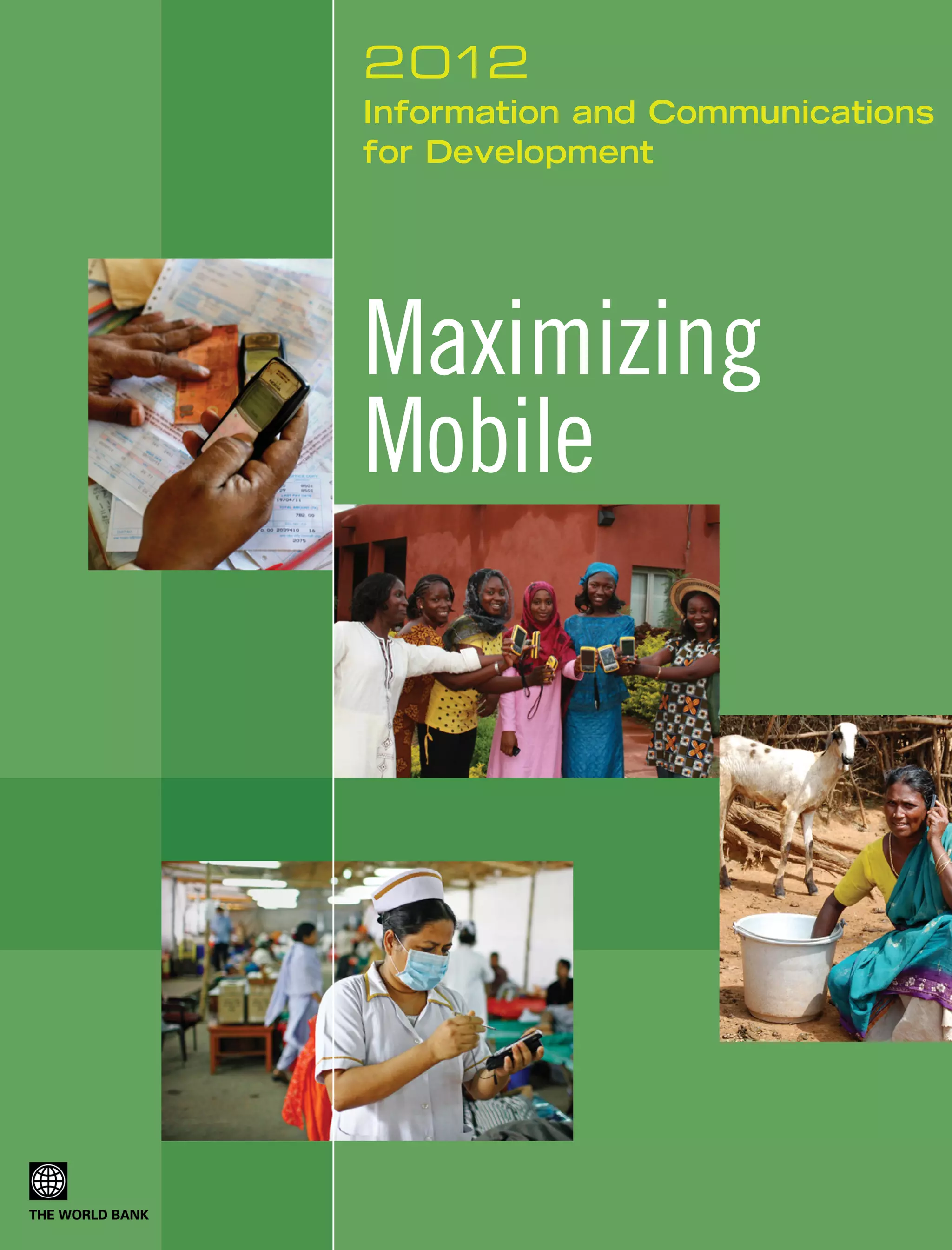
Cover photographs: Top and bottom: G. M. B. Akash / Panos; center: Mr. Pierre C. Sibiry Traore, ICRISAT, AgCommons, a program executed by the Consultative Group on International Agricultural Research (CGIAR); right: The
Commonwealth of Learning
Cover design: Naylor Design
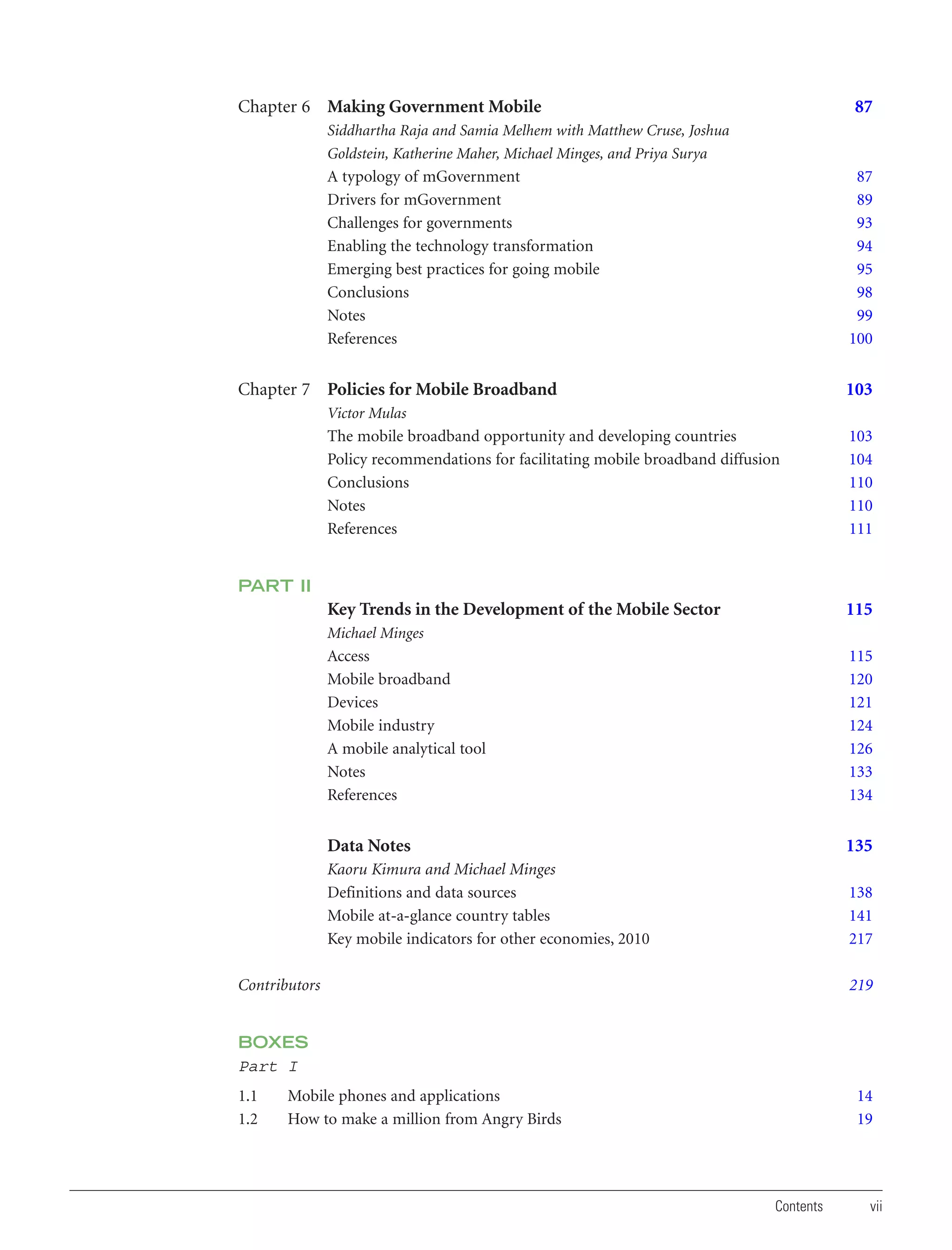
Table of Contents

Foreword
Preface
Acknowledgments
Abbreviations

xi
xiii
xv
xvii

PART I

Executive Summary

3

Tim Kelly and Michael Minges

Main messages
Why are mobile phones now considered indispensable?
A mobile green revolution
Keep using the tablets—how mobile devices are changing health care
Mobile money
Get a phone, get a job, start a business
Using phones to bring governments and citizens closer
Onward and upward to mobile broadband
Appendixes
Infographic: Maximizing Mobile for Development

Chapter 1 Overview

3
4
5
5
6
6
6
7
7
8

11

Michael Minges

How mobile phones are used
Data traffic
The changing mobile ecosystem
Mobile-enabled social and economic trends
Structure of the report
Notes
References

13
18
19
22
27
27
28

v
Chapter 2 Mobilizing the Agricultural Value Chain

31

Naomi J. Halewood and Priya Surya

Making information mobile
Improved access to agricultural information
Improving data visibility for value-chain efficiency
Enhancing access to markets
Policy considerations
Conclusions
Notes
References

Chapter 3 mHealth

31
33
37
39
41
41
42
42

45

Nicolas Friederici, Carol Hullin, and Masatake Yamamichi

Why mHealth? Opportunities and challenges
The potential of mHealth
The mHealth ecosystem
Business models for mHealth
Principles for implementing mHealth applications
Conclusions
Notes
References

Chapter 4 Mobile Money for Financial Inclusion

45
50
52
52
53
57
58
58

61

Kevin Donovan

Mobile money: an ecosystem approach
The financial inclusion imperative
What is the impact of mobile money?
Growing mobile money: challenges
and success stories
Emerging issues in mobile money
Conclusions
Notes
References

Chapter 5 Mobile Entrepreneurship and Employment

61
62
63
65
66
71
72
72

75

Maja Andjelkovic and Saori Imaizumi

Open innovation and mobile entrepreneurship
Mobile incubators
Mobile microwork
Mobiles and recruitment
Conclusions and considerations for policy-makers
Notes
References

vi

Contents

76
79
81
82
83
85
86
Chapter 6 Making Government Mobile

87

Siddhartha Raja and Samia Melhem with Matthew Cruse, Joshua
Goldstein, Katherine Maher, Michael Minges, and Priya Surya

A typology of mGovernment
Drivers for mGovernment
Challenges for governments
Enabling the technology transformation
Emerging best practices for going mobile
Conclusions
Notes
References

87
89
93
94
95
98
99
100

Chapter 7 Policies for Mobile Broadband

103

Victor Mulas

The mobile broadband opportunity and developing countries
Policy recommendations for facilitating mobile broadband diffusion
Conclusions
Notes
References

103
104
110
110
111

Key Trends in the Development of the Mobile Sector

115

PART II
Michael Minges

Access
Mobile broadband
Devices
Mobile industry
A mobile analytical tool
Notes
References

115
120
121
124
126
133
134

Data Notes

135

Kaoru Kimura and Michael Minges
Definitions and data sources
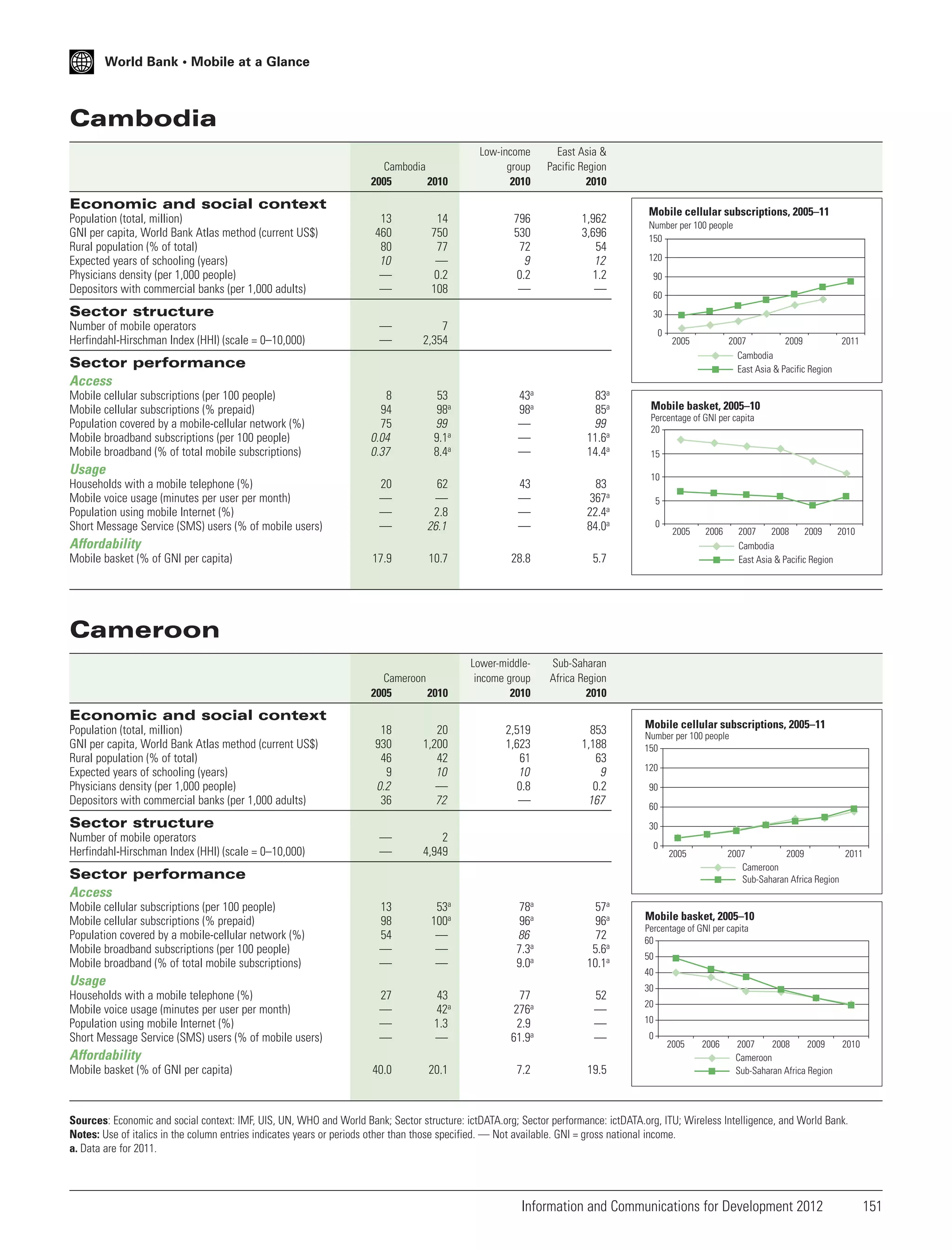
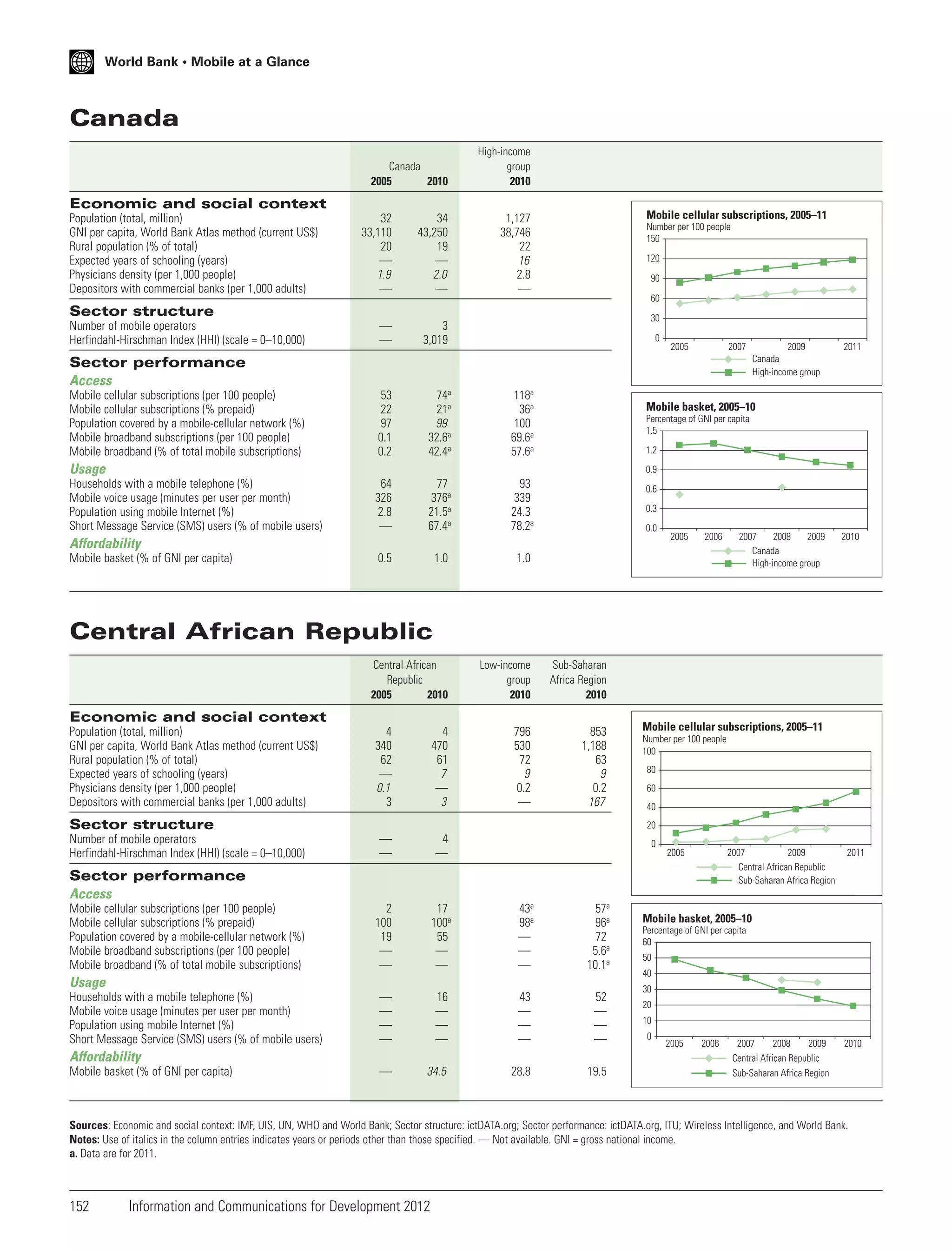
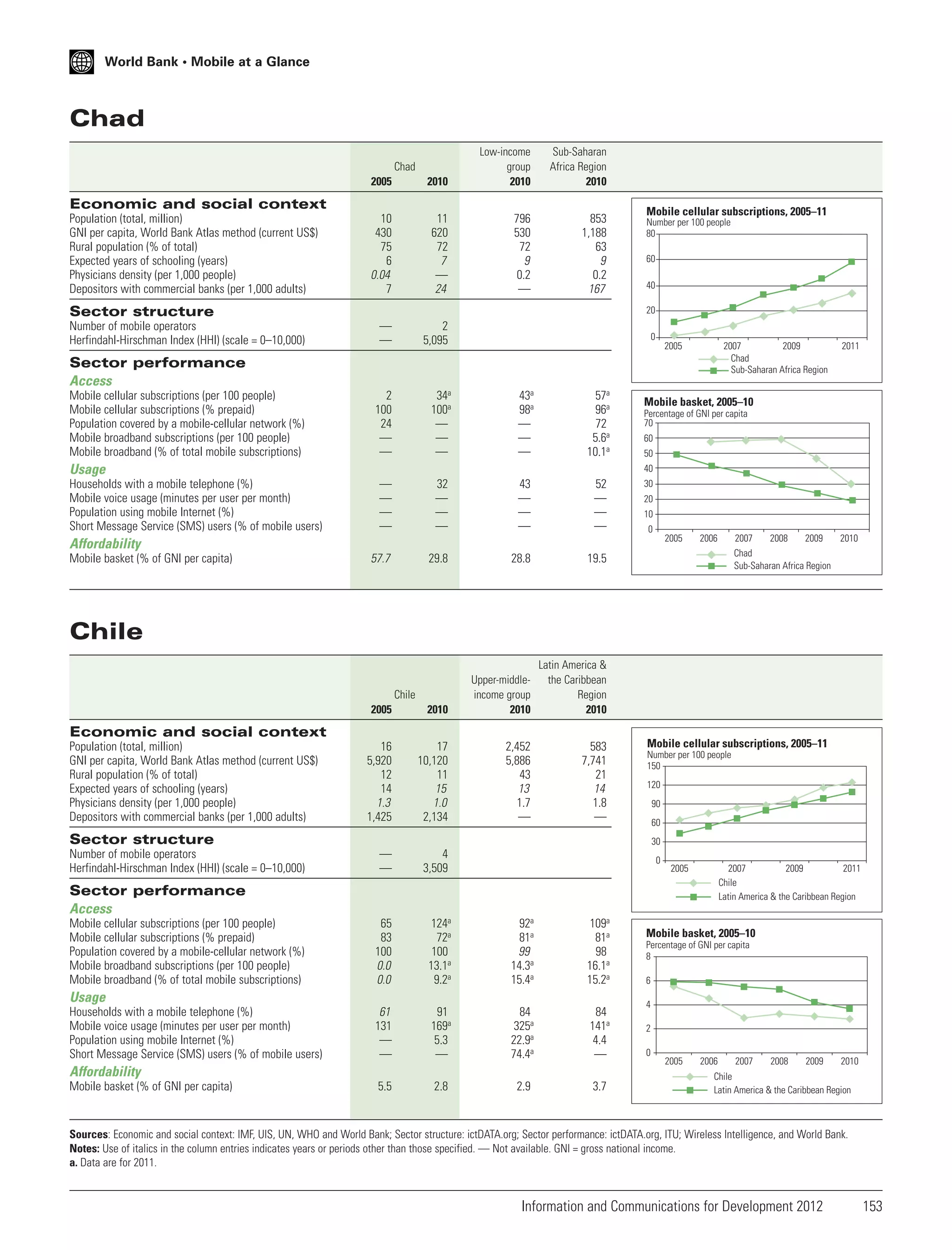
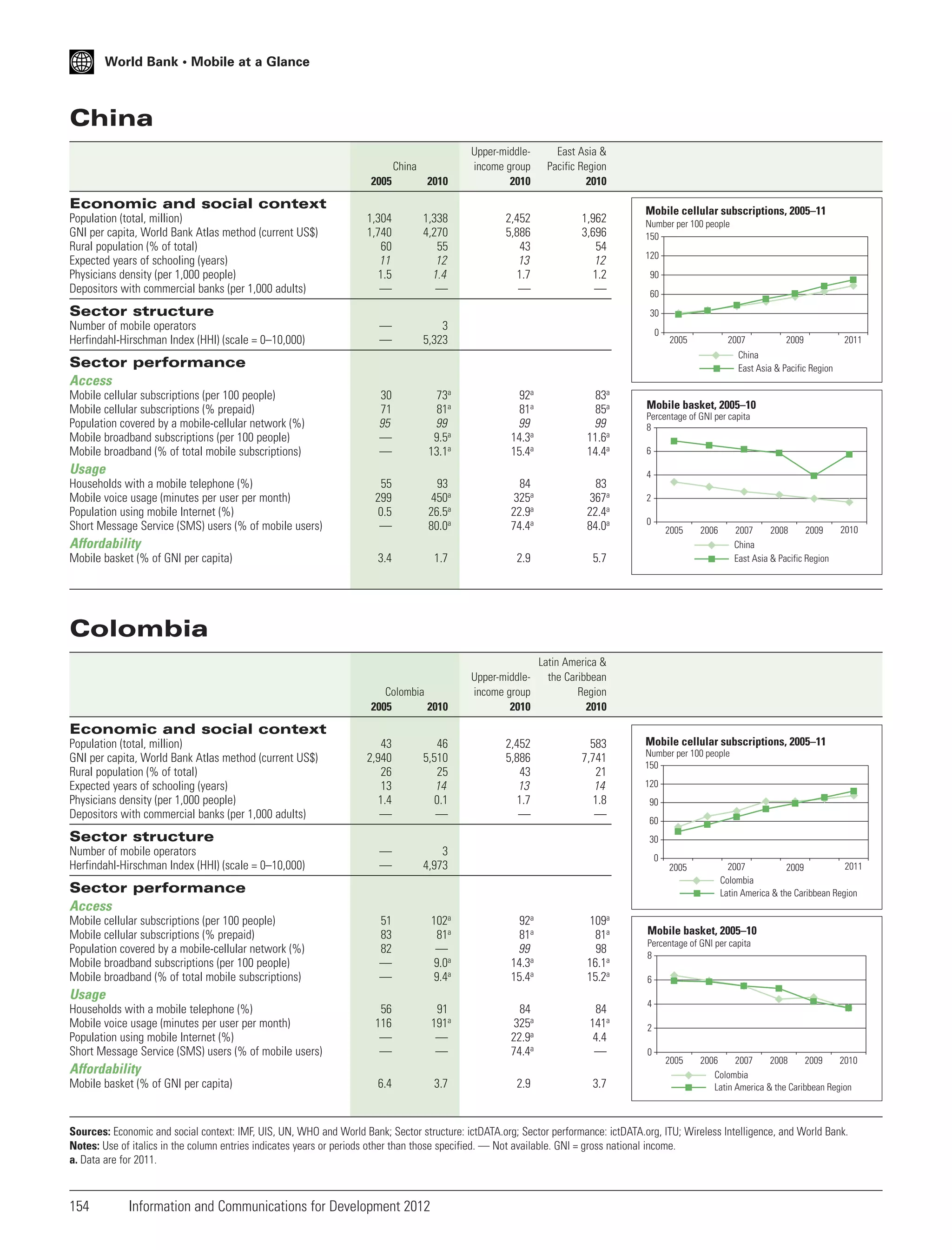
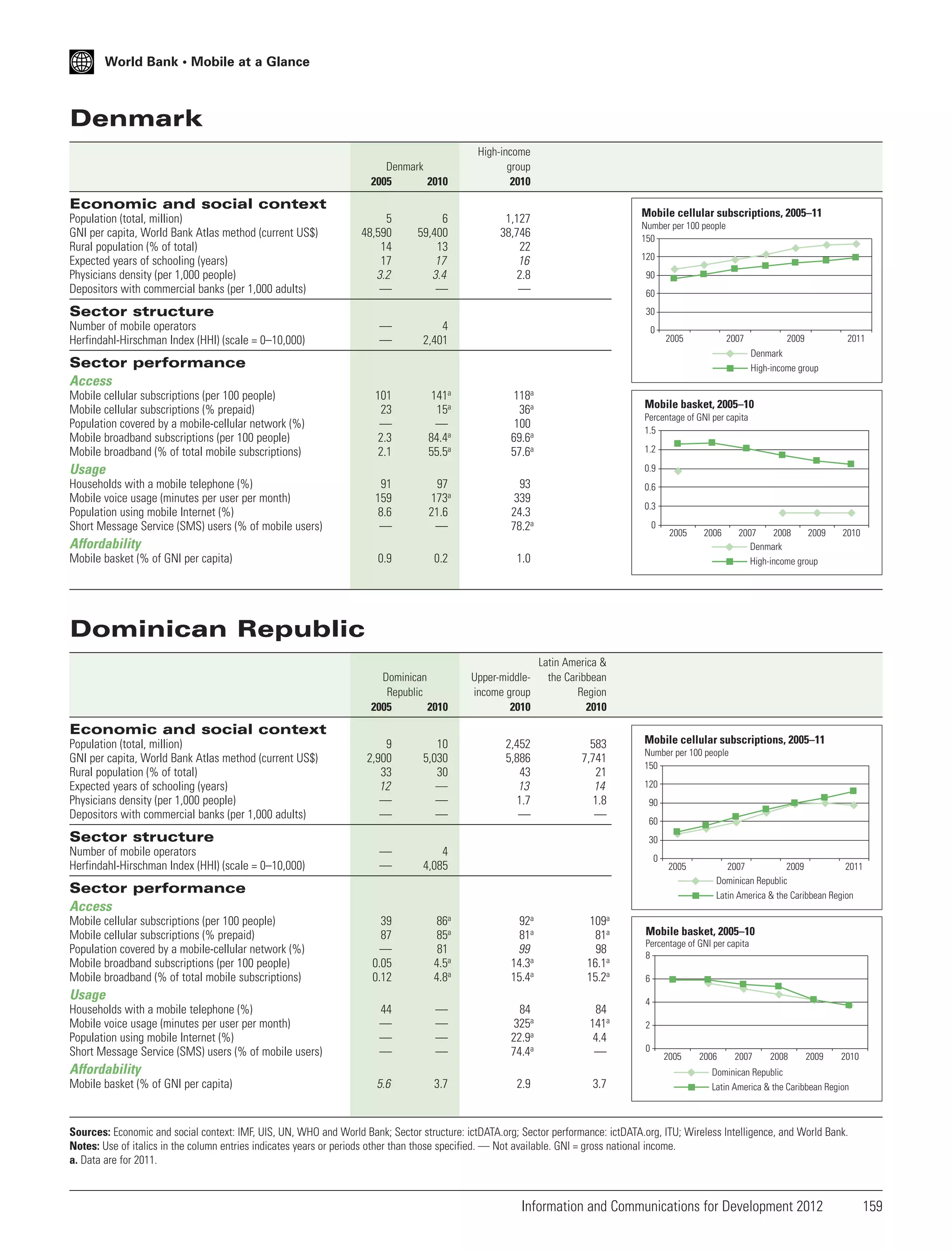
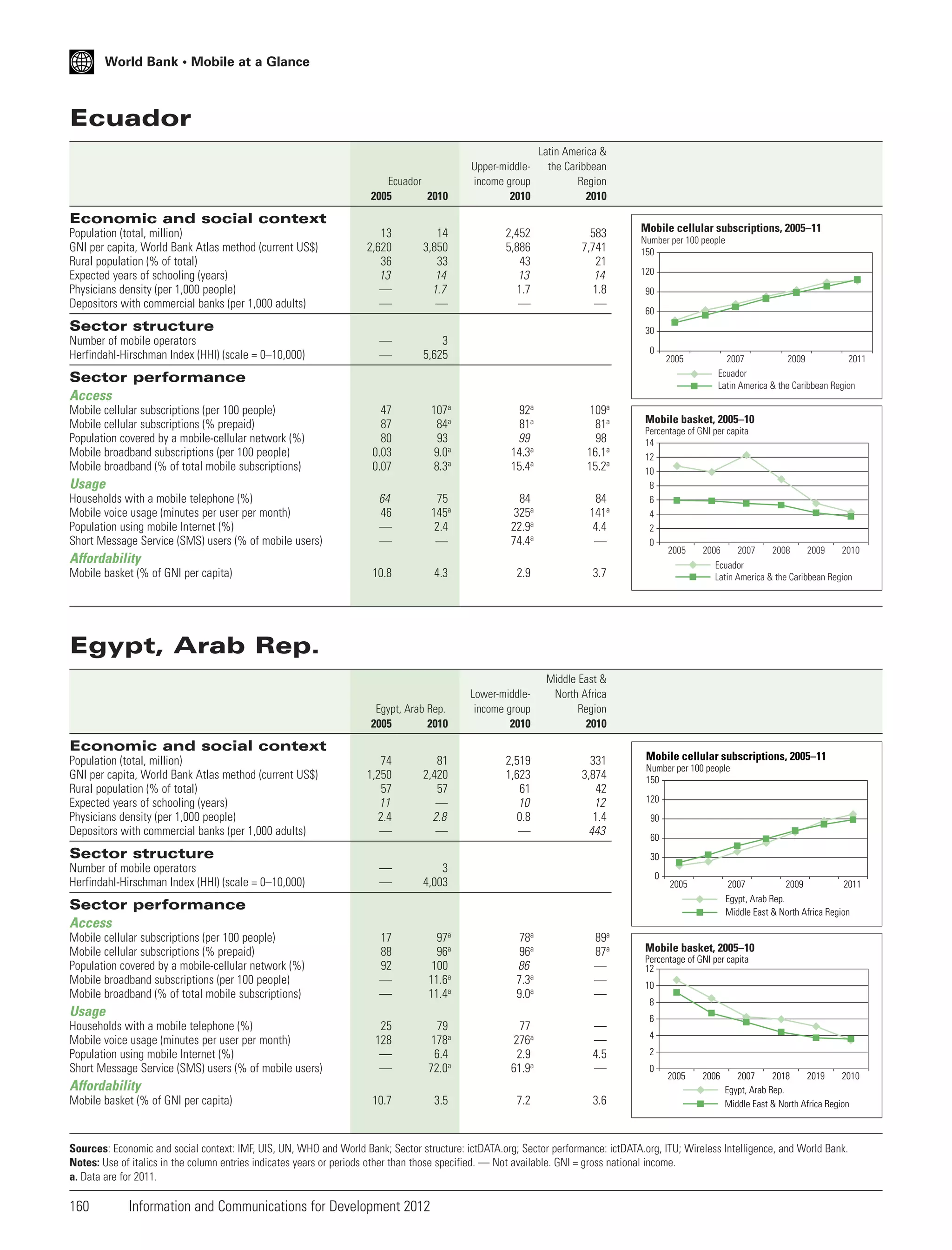
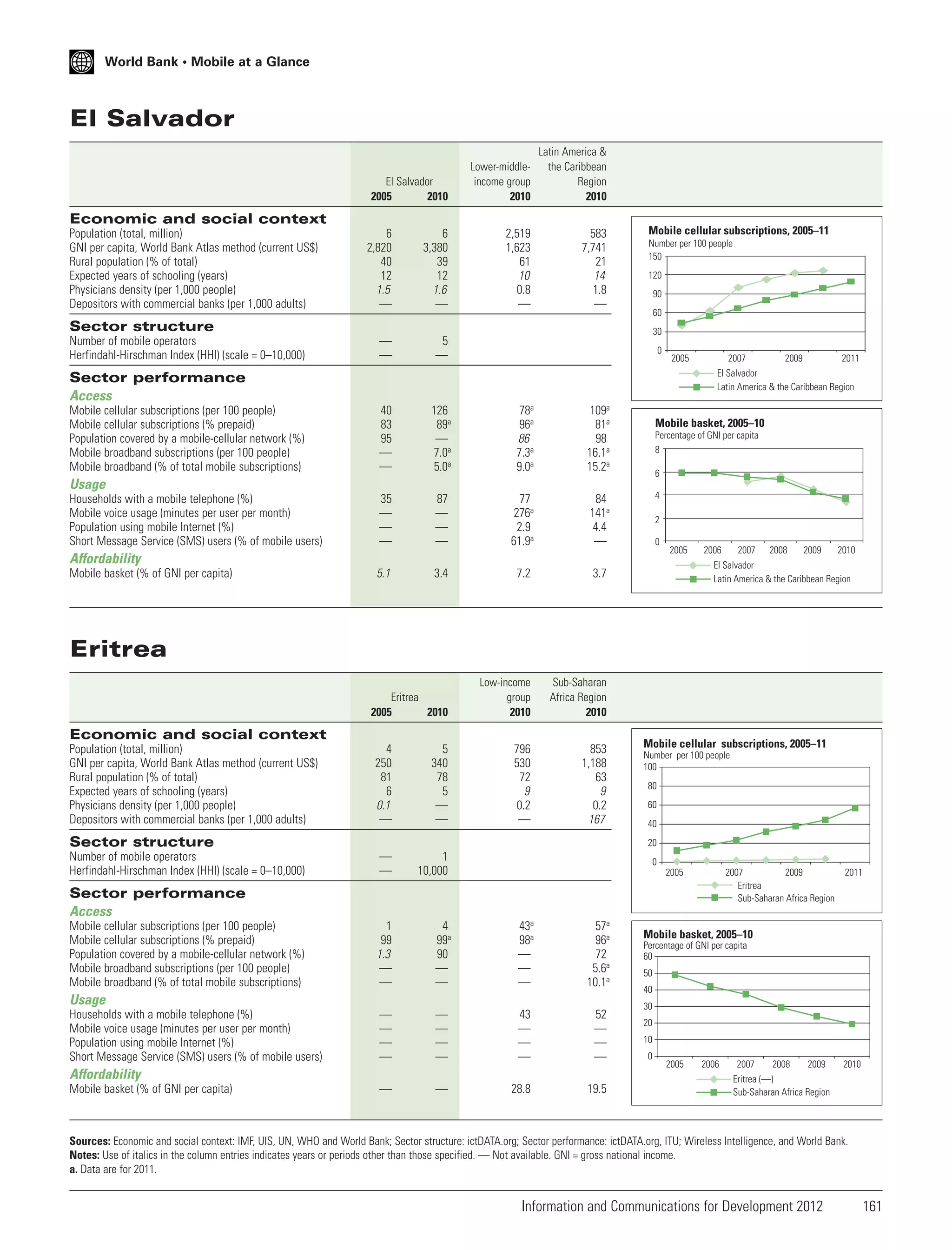
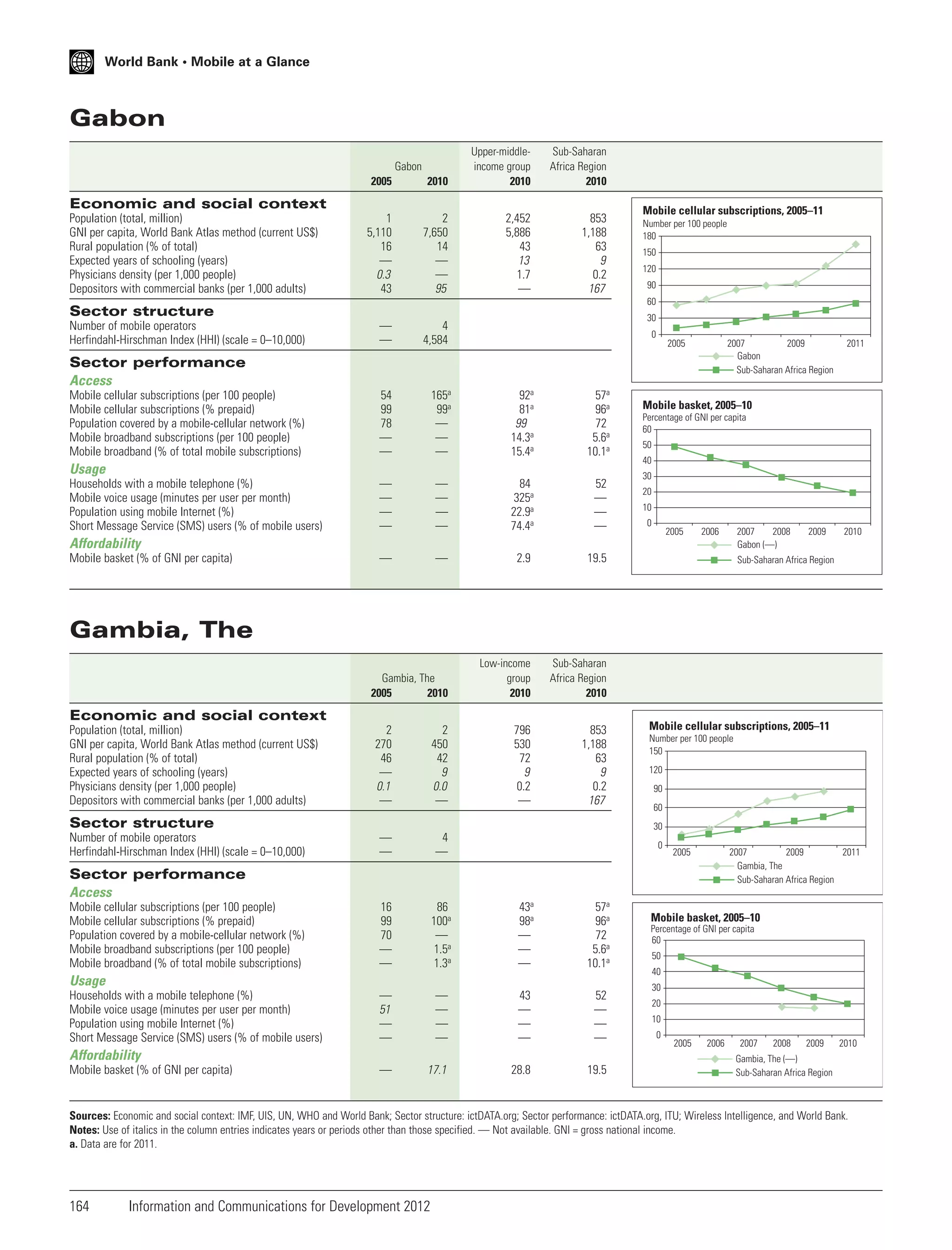
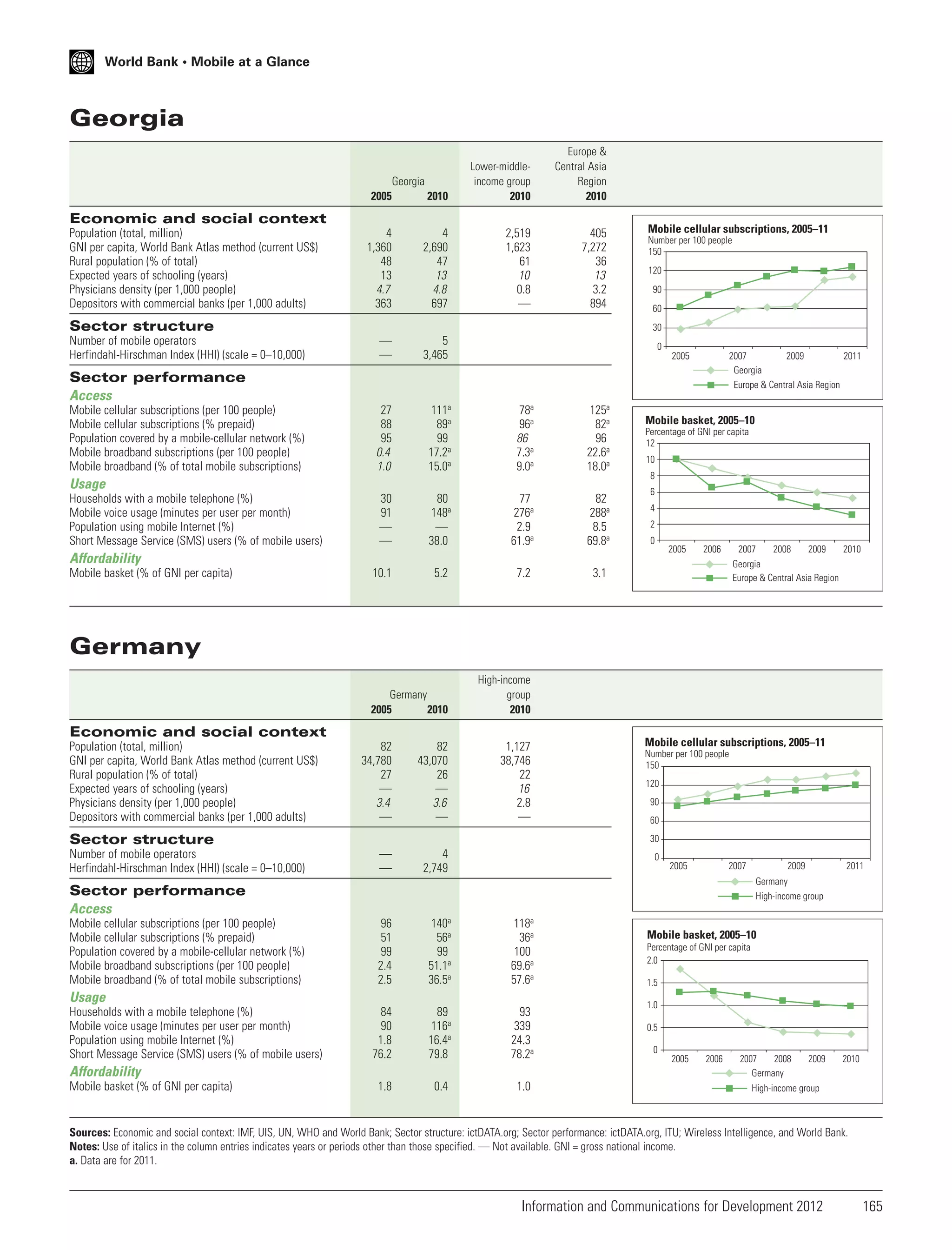
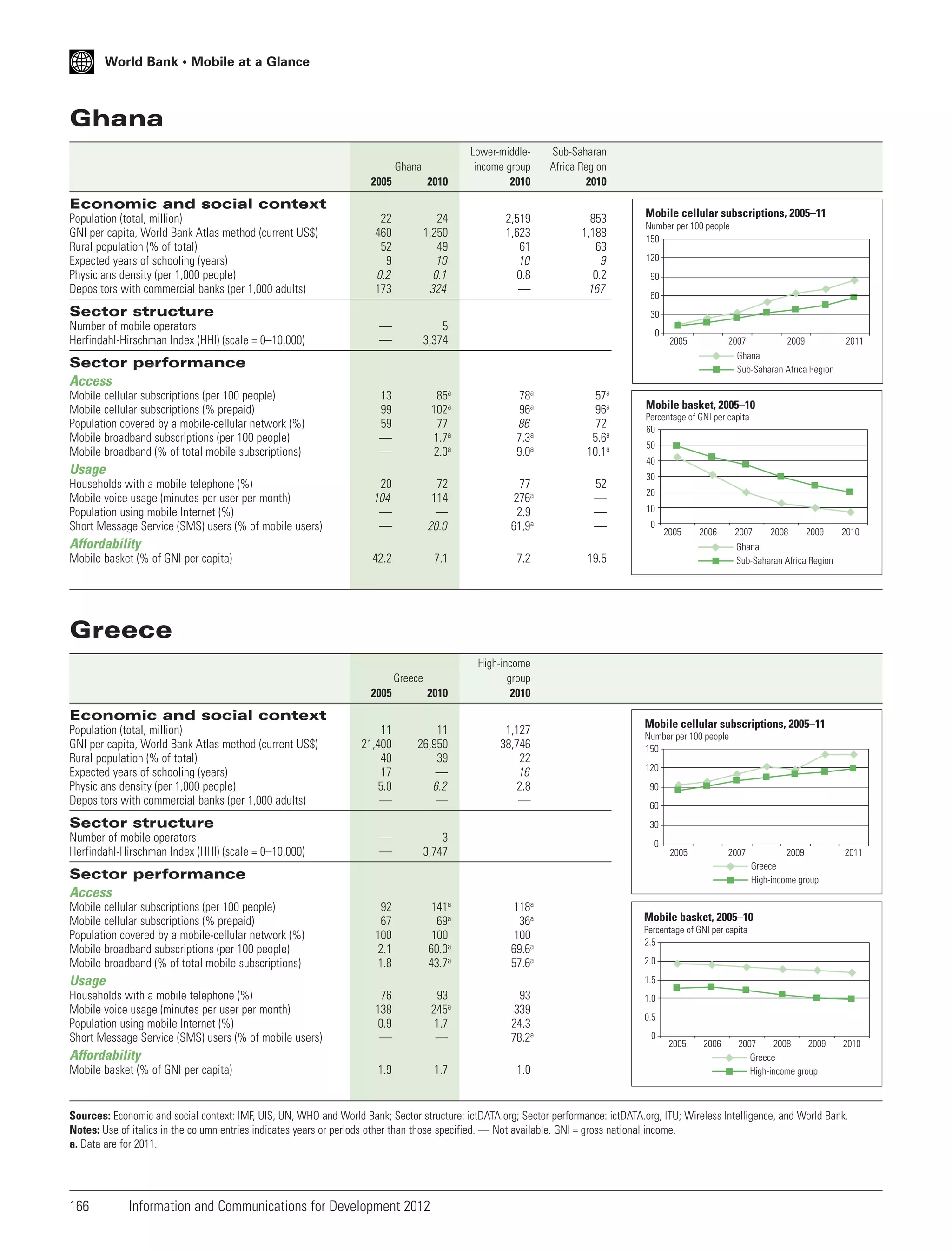
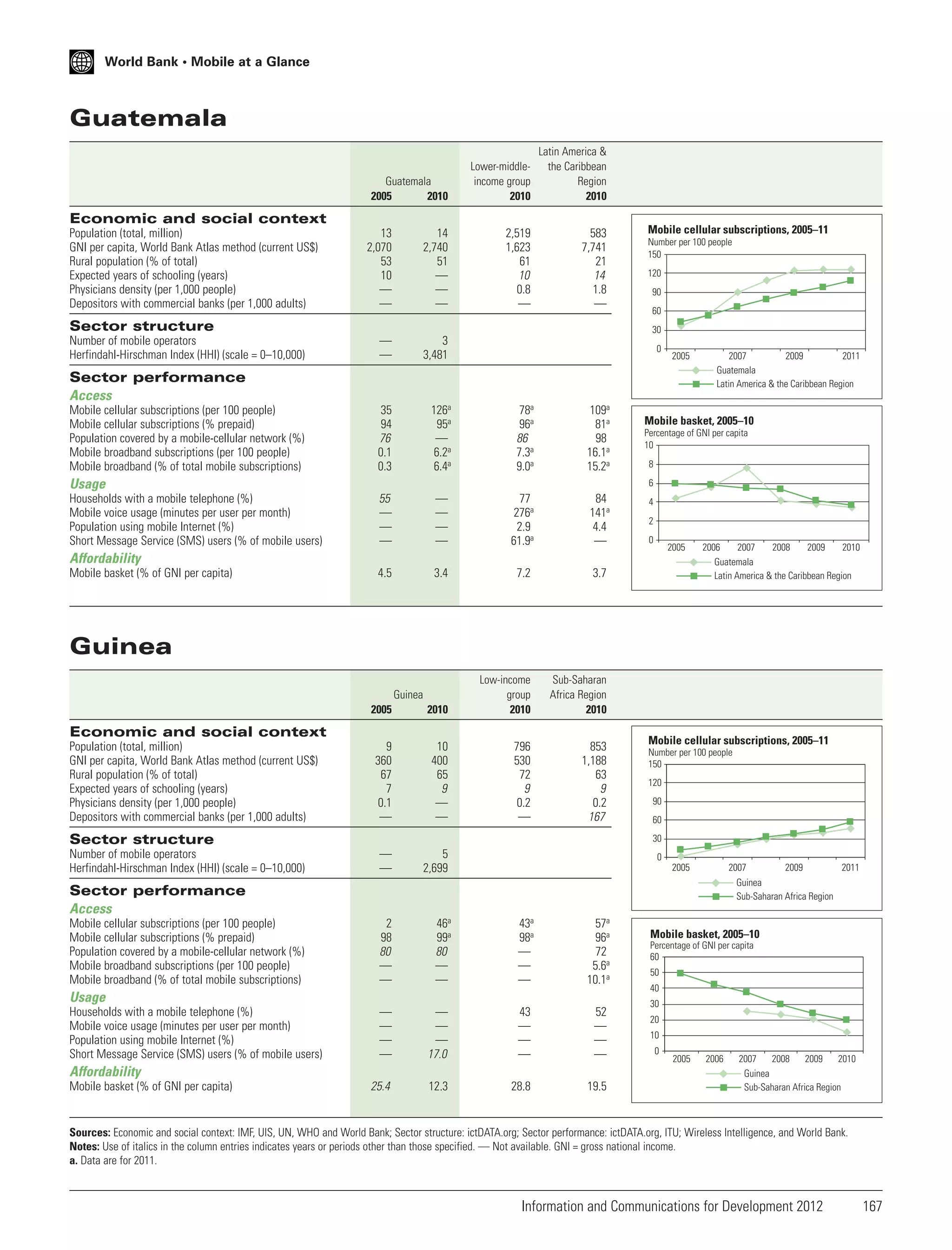
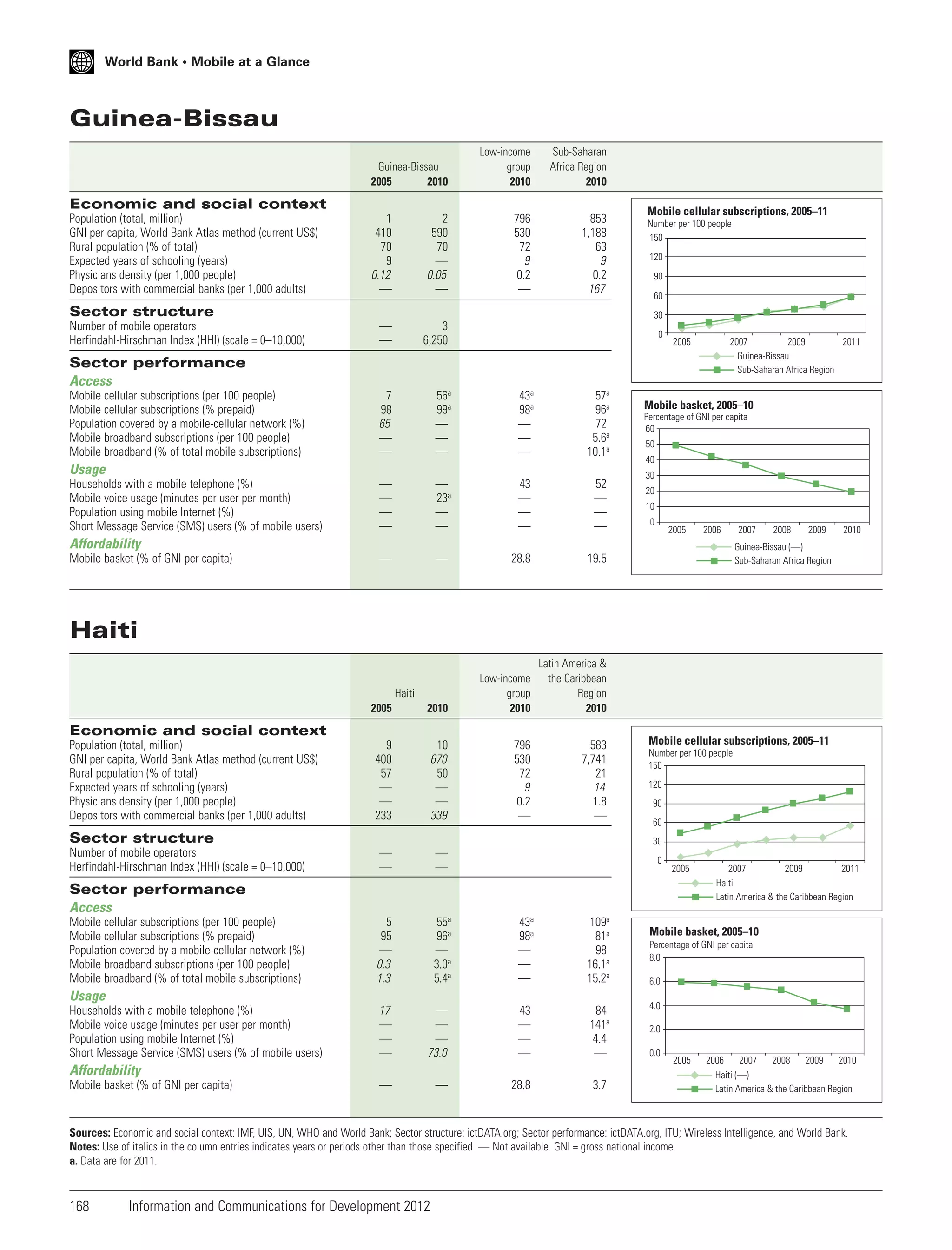
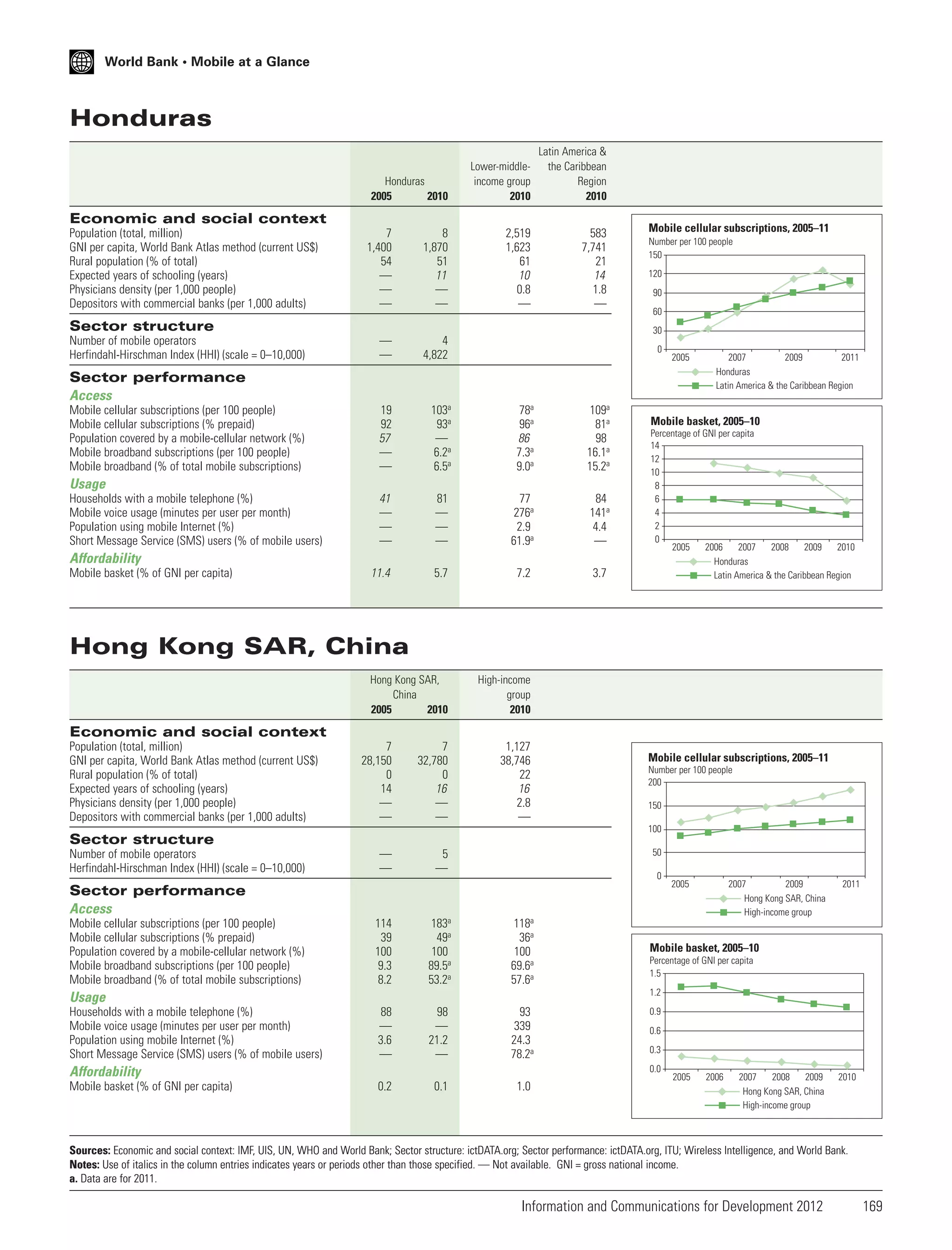
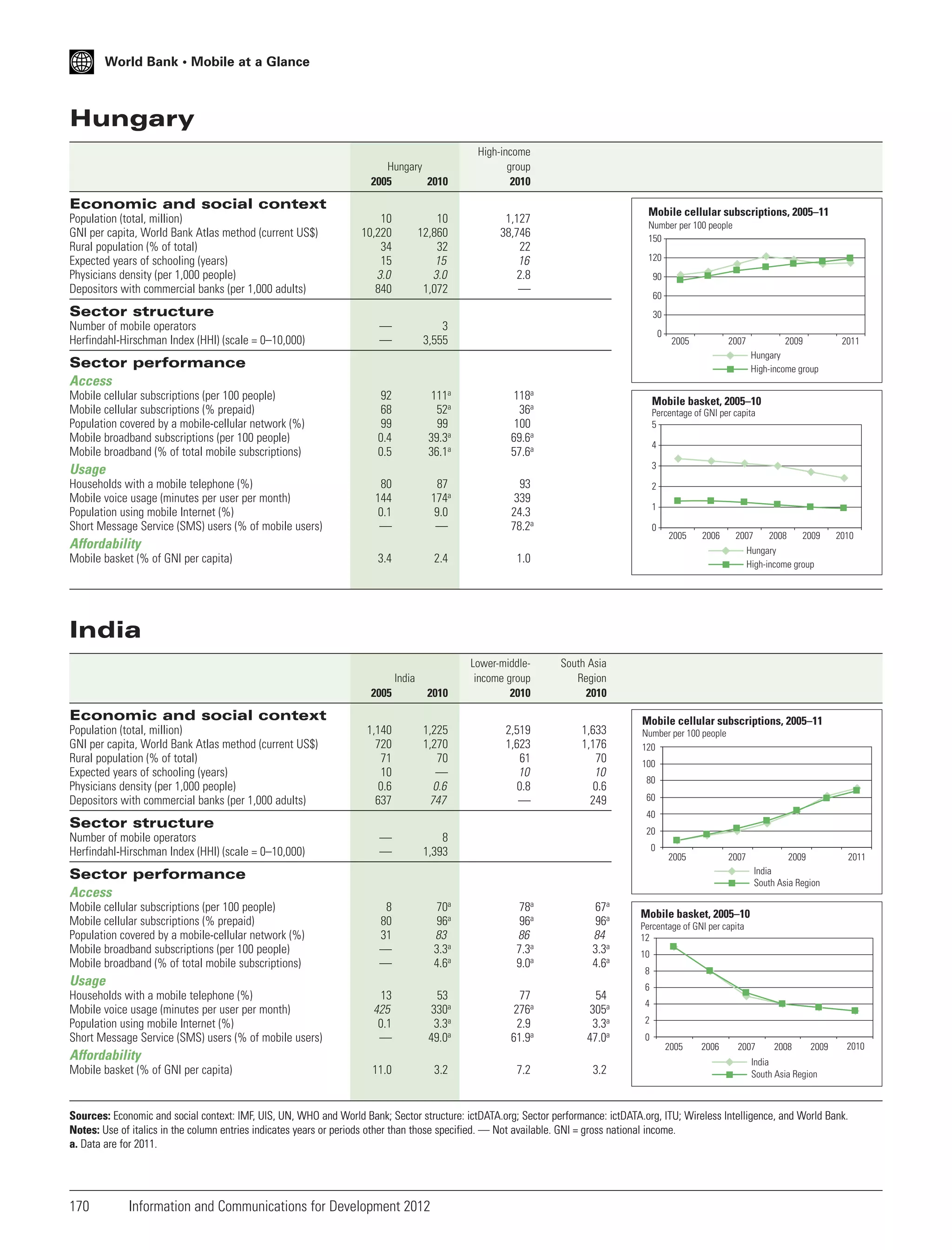
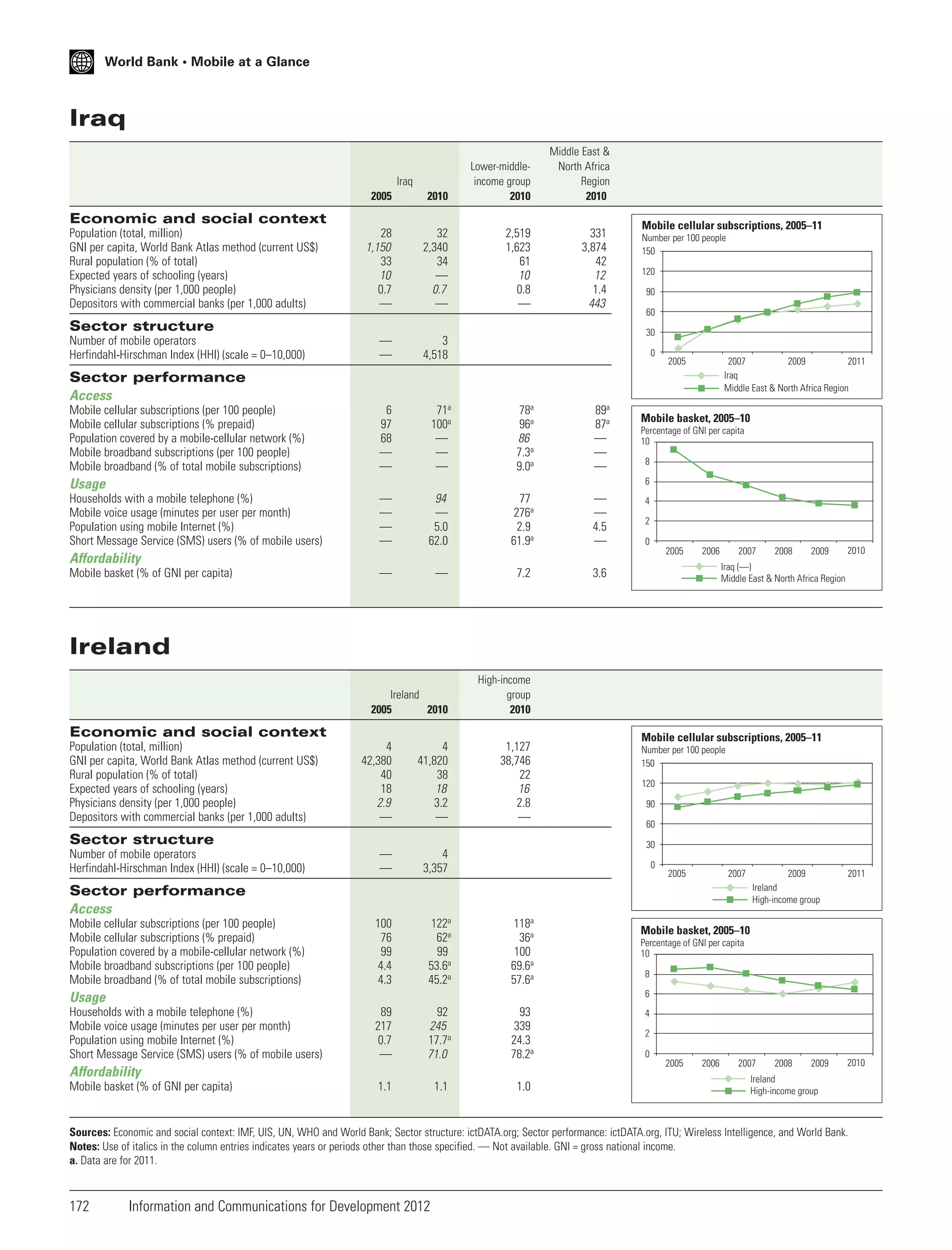
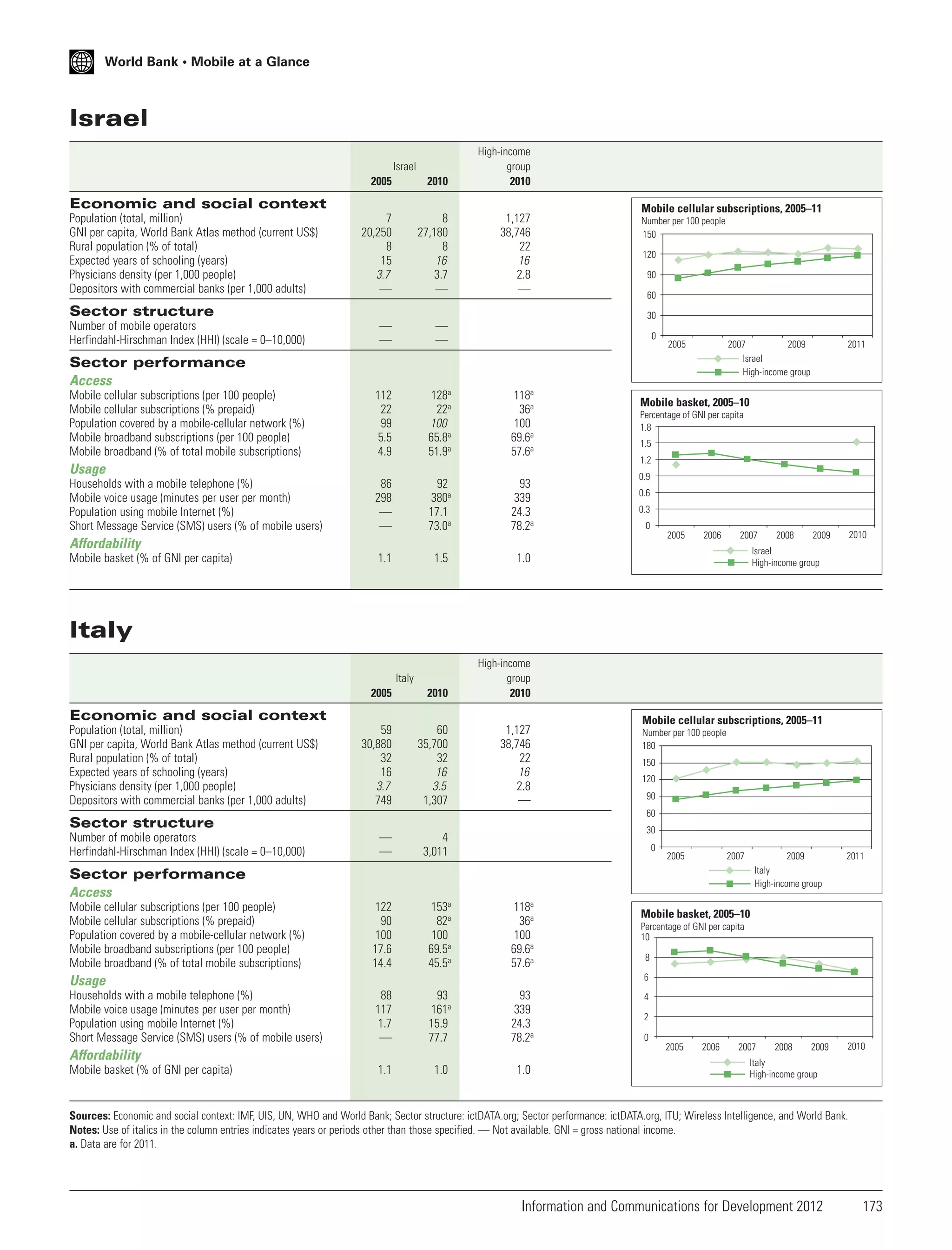
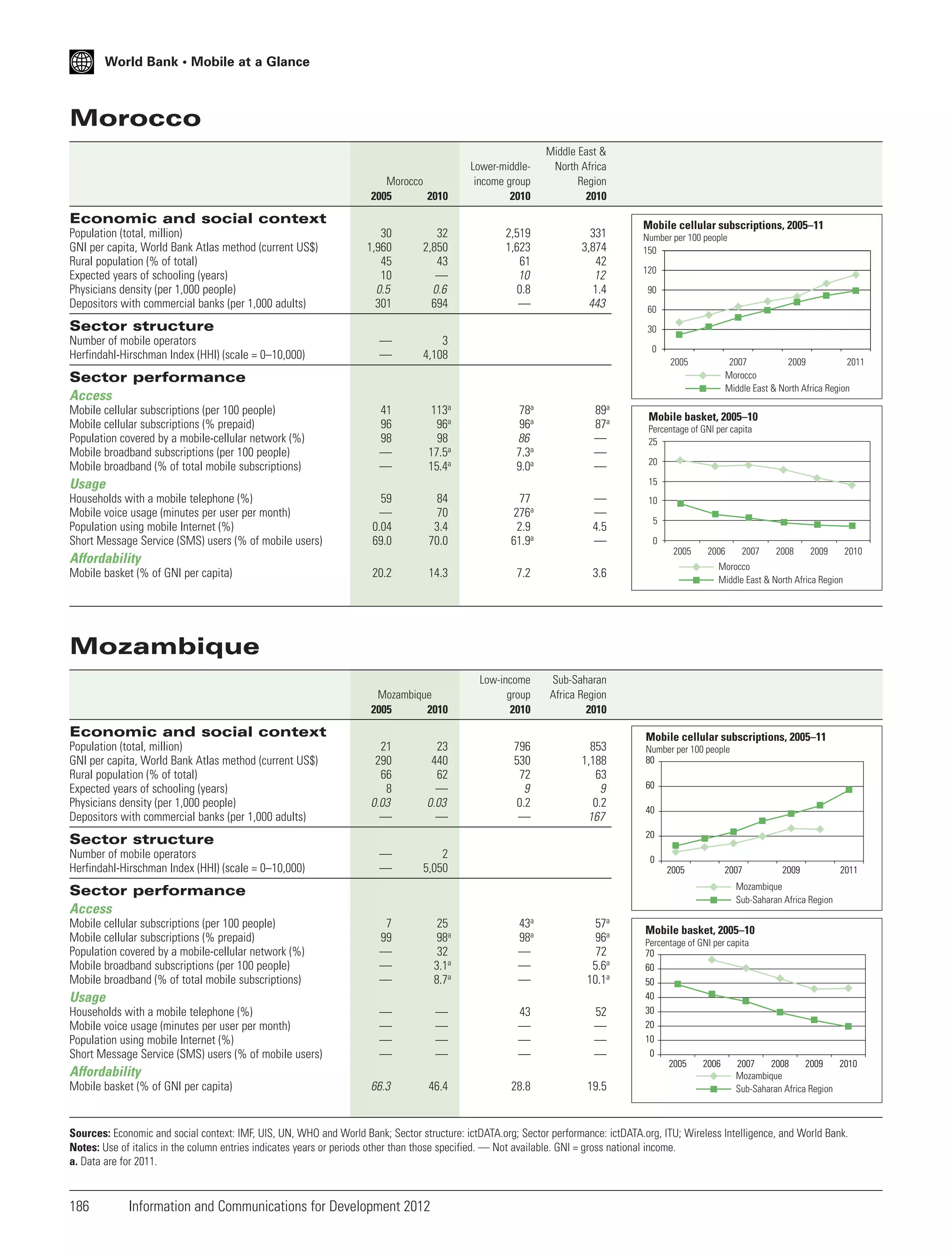
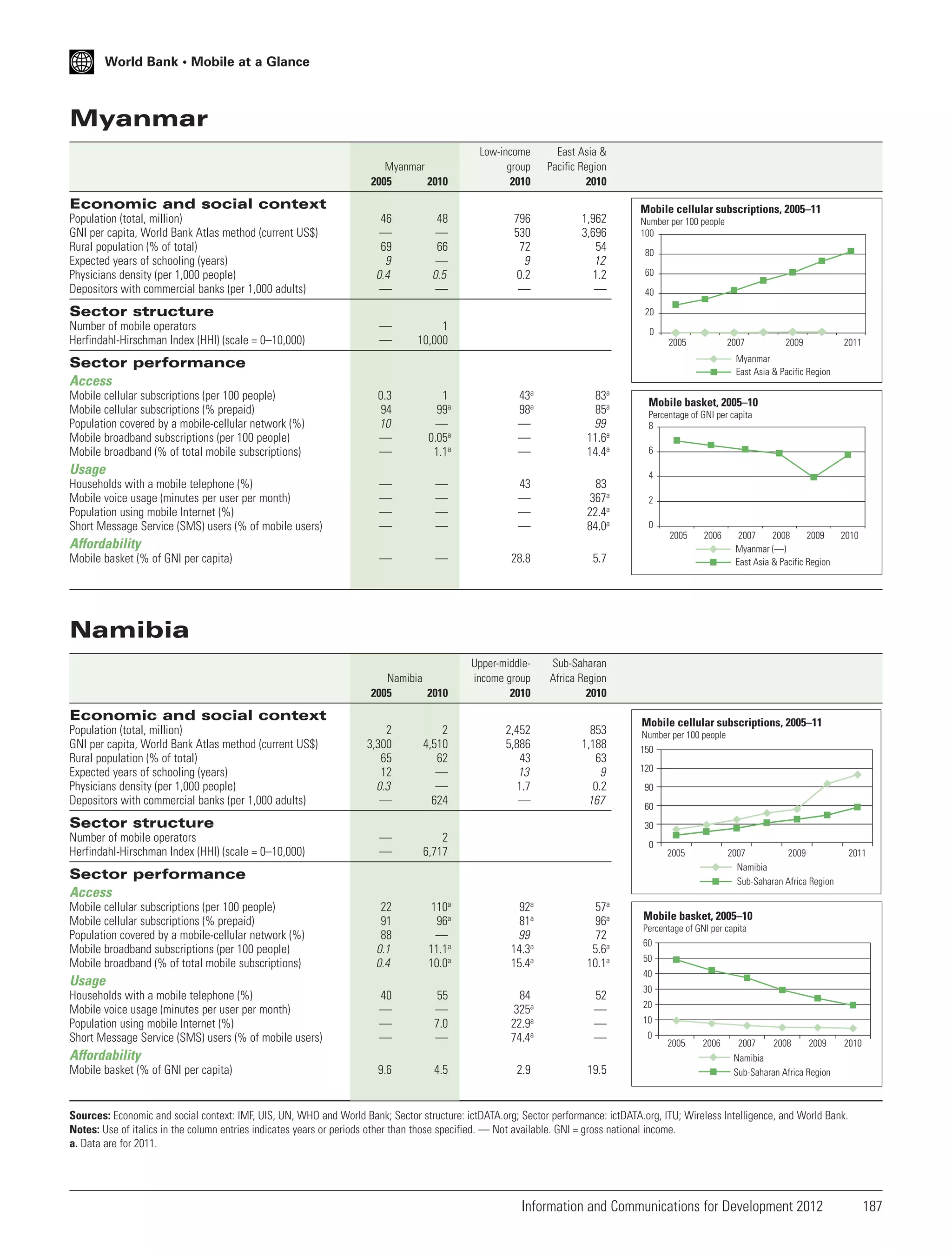
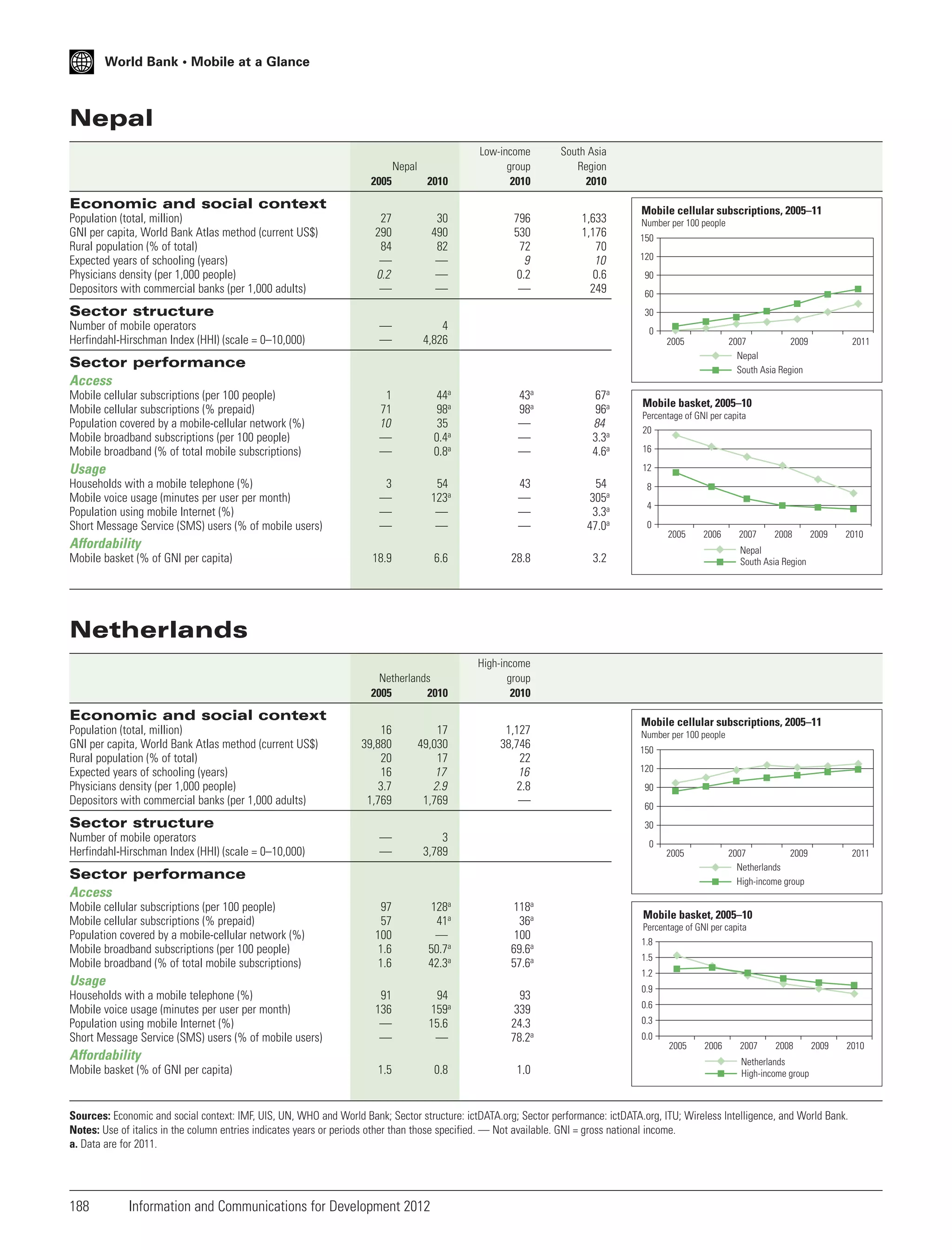
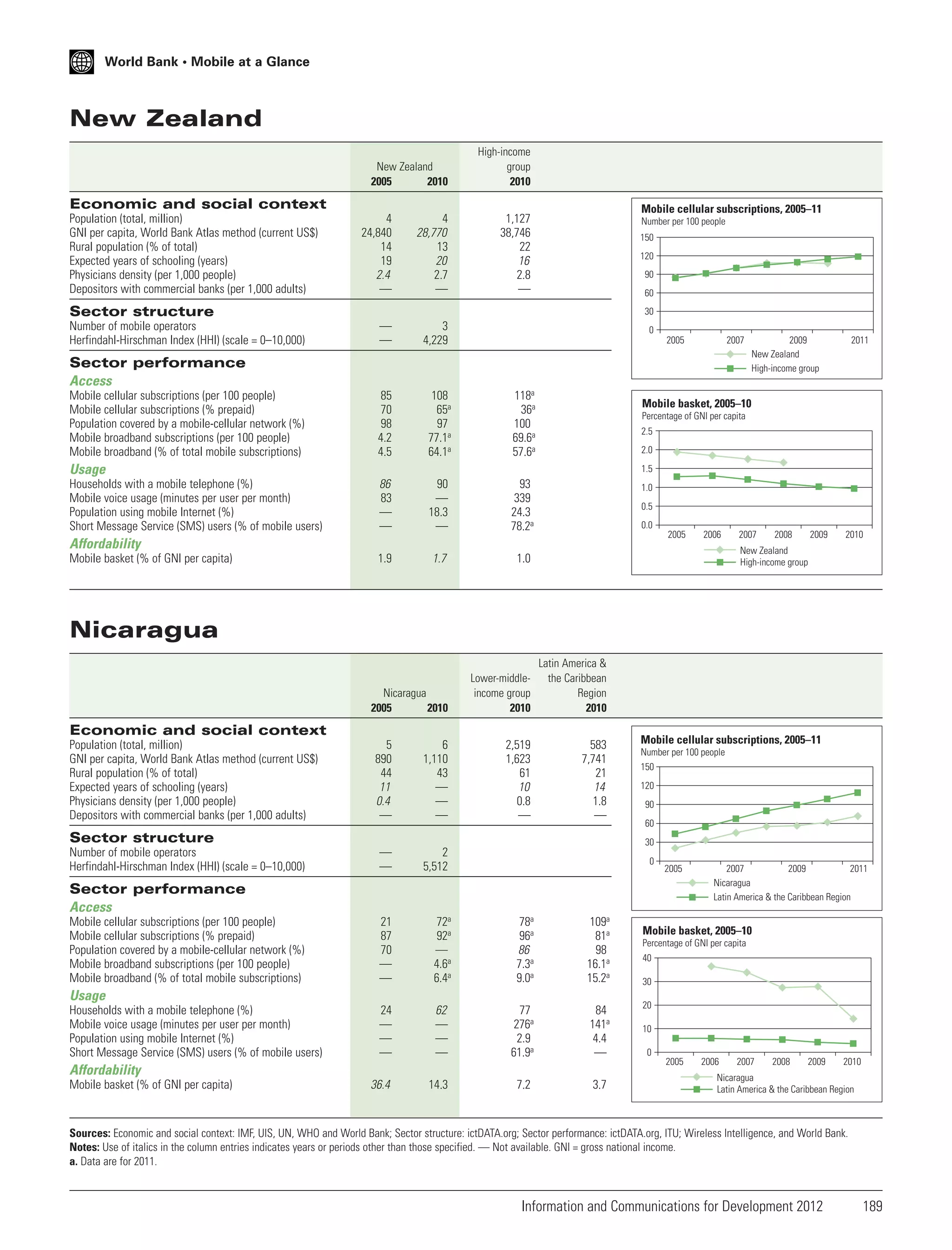
Mobile at-a-glance country tables
Key mobile indicators for other economies, 2010

138
141
217

Contributors

219

BOXES
Part I
1.1
1.2

Mobile phones and applications
How to make a million from Angry Birds

14
19

Contents

vii
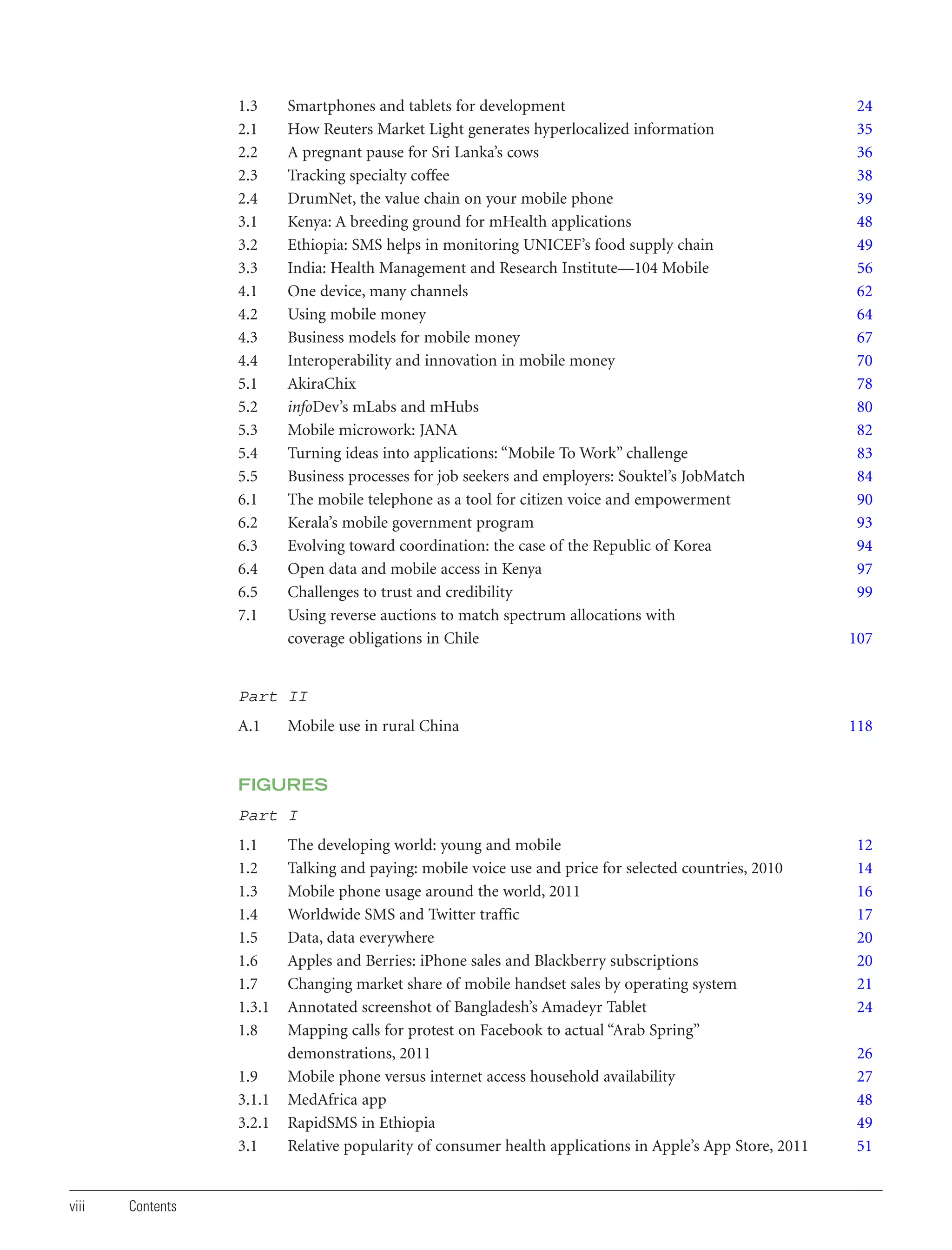
1.3
2.1
2.2
2.3
2.4
3.1
3.2
3.3
4.1
4.2
4.3
4.4
5.1
5.2
5.3
5.4
5.5
6.1
6.2
6.3
6.4
6.5
7.1

Smartphones and tablets for development
How Reuters Market Light generates hyperlocalized information
A pregnant pause for Sri Lanka’s cows
Tracking specialty coffee
DrumNet, the value chain on your mobile phone
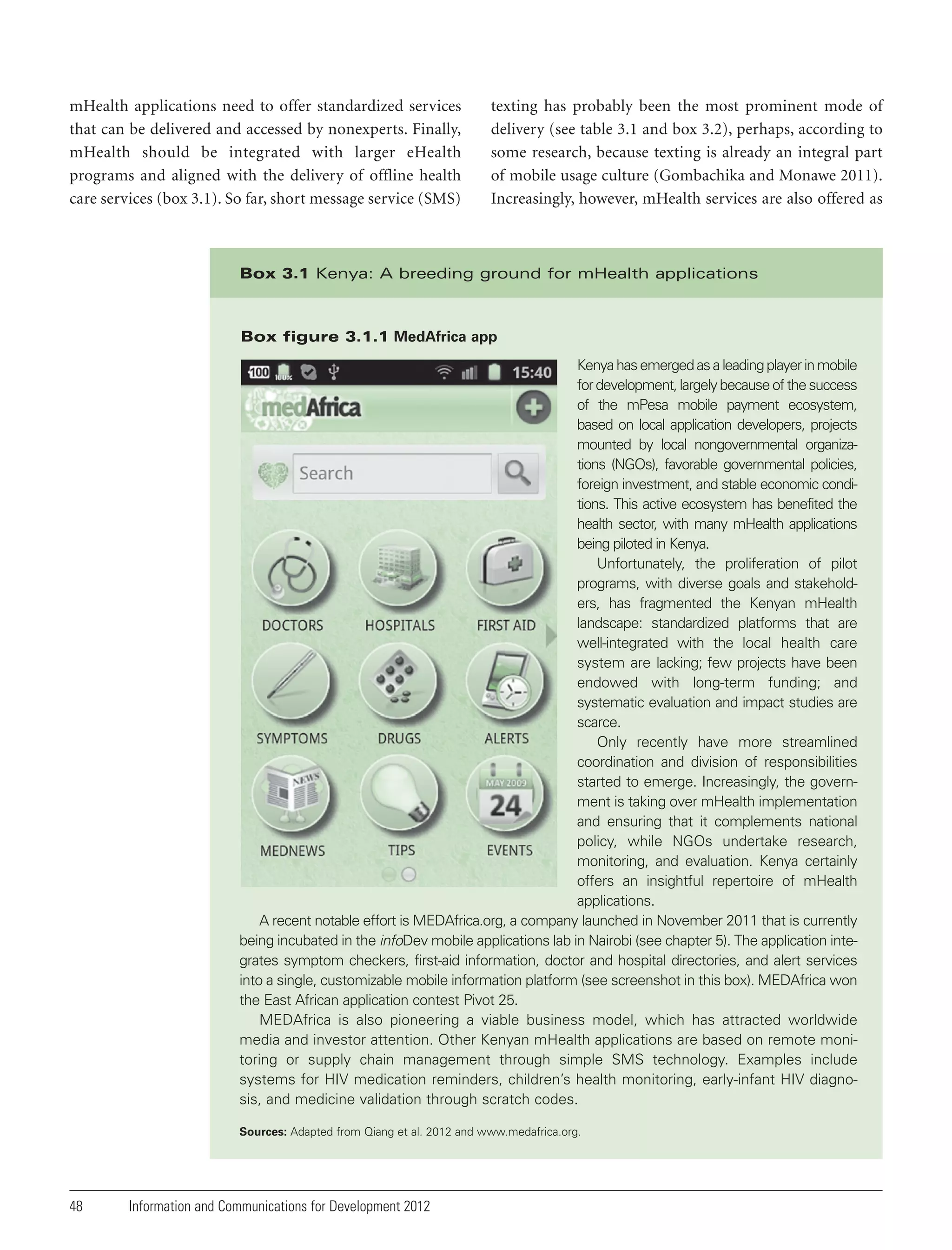
Kenya: A breeding ground for mHealth applications
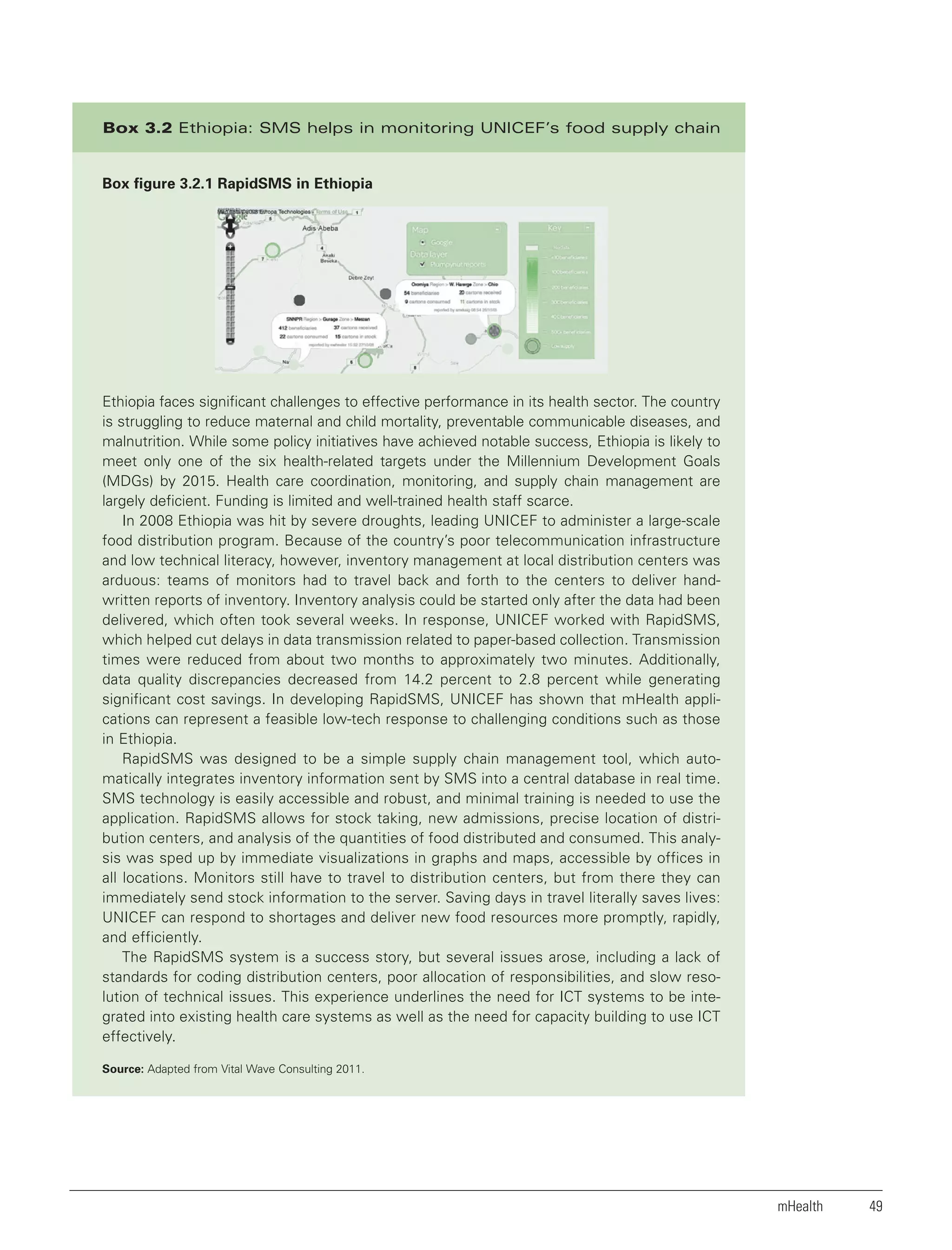
Ethiopia: SMS helps in monitoring UNICEF’s food supply chain
India: Health Management and Research Institute—104 Mobile
One device, many channels
Using mobile money
Business models for mobile money
Interoperability and innovation in mobile money
AkiraChix
infoDev’s mLabs and mHubs
Mobile microwork: JANA
Turning ideas into applications: “Mobile To Work” challenge
Business processes for job seekers and employers: Souktel’s JobMatch
The mobile telephone as a tool for citizen voice and empowerment
Kerala’s mobile government program
Evolving toward coordination: the case of the Republic of Korea
Open data and mobile access in Kenya
Challenges to trust and credibility
Using reverse auctions to match spectrum allocations with
coverage obligations in Chile

24
35
36
38
39
48
49
56
62
64
67
70
78
80
82
83
84
90
93
94
97
99
107

Part II
A.1

Mobile use in rural China

118

FIGURES

Part I
1.1
1.2
1.3
1.4
1.5
1.6
1.7
1.3.1
1.8
1.9
3.1.1
3.2.1
3.1

viii

Contents

The developing world: young and mobile
Talking and paying: mobile voice use and price for selected countries, 2010
Mobile phone usage around the world, 2011
Worldwide SMS and Twitter traffic
Data, data everywhere
Apples and Berries: iPhone sales and Blackberry subscriptions
Changing market share of mobile handset sales by operating system
Annotated screenshot of Bangladesh’s Amadeyr Tablet
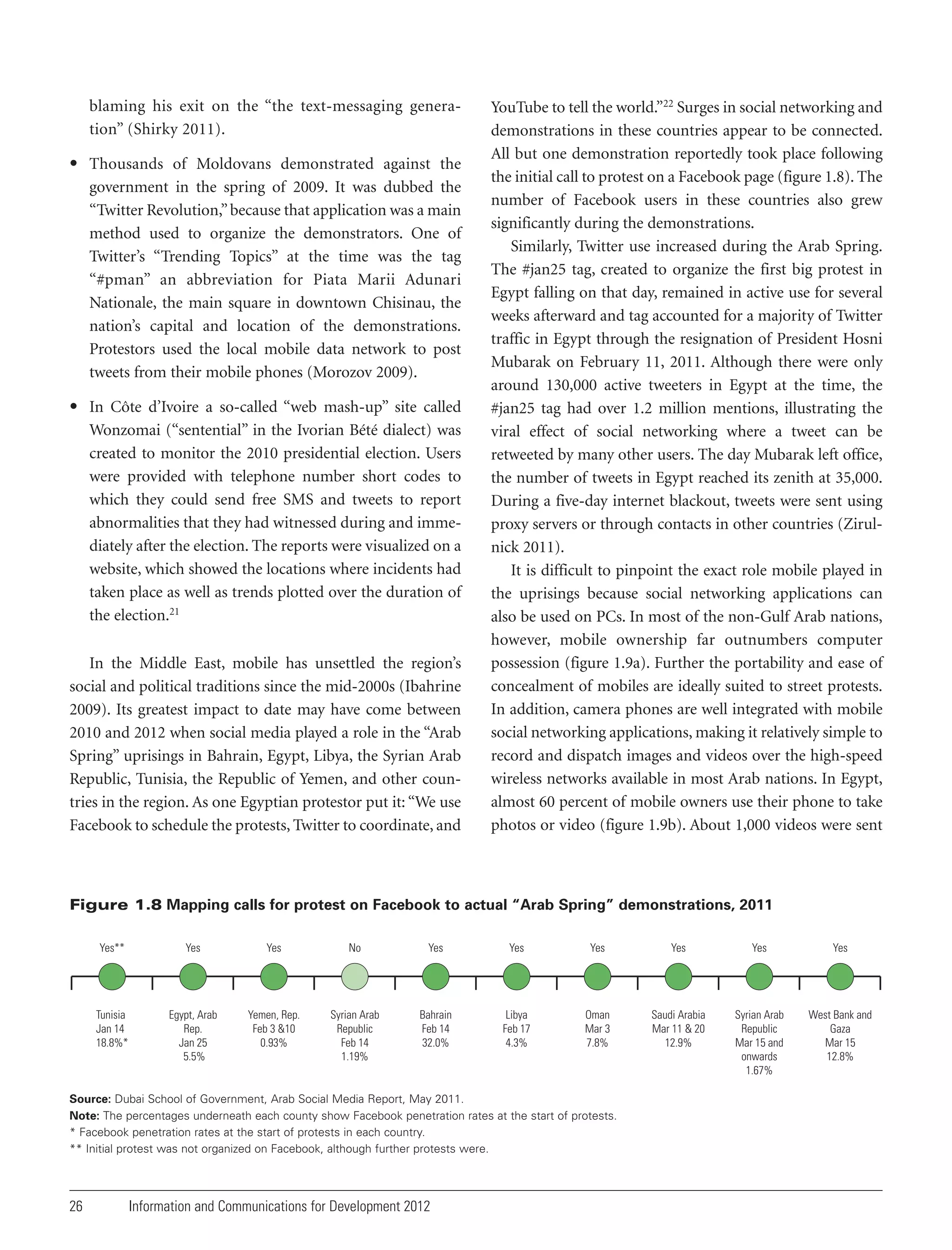
Mapping calls for protest on Facebook to actual “Arab Spring”
demonstrations, 2011
Mobile phone versus internet access household availability
MedAfrica app
RapidSMS in Ethiopia
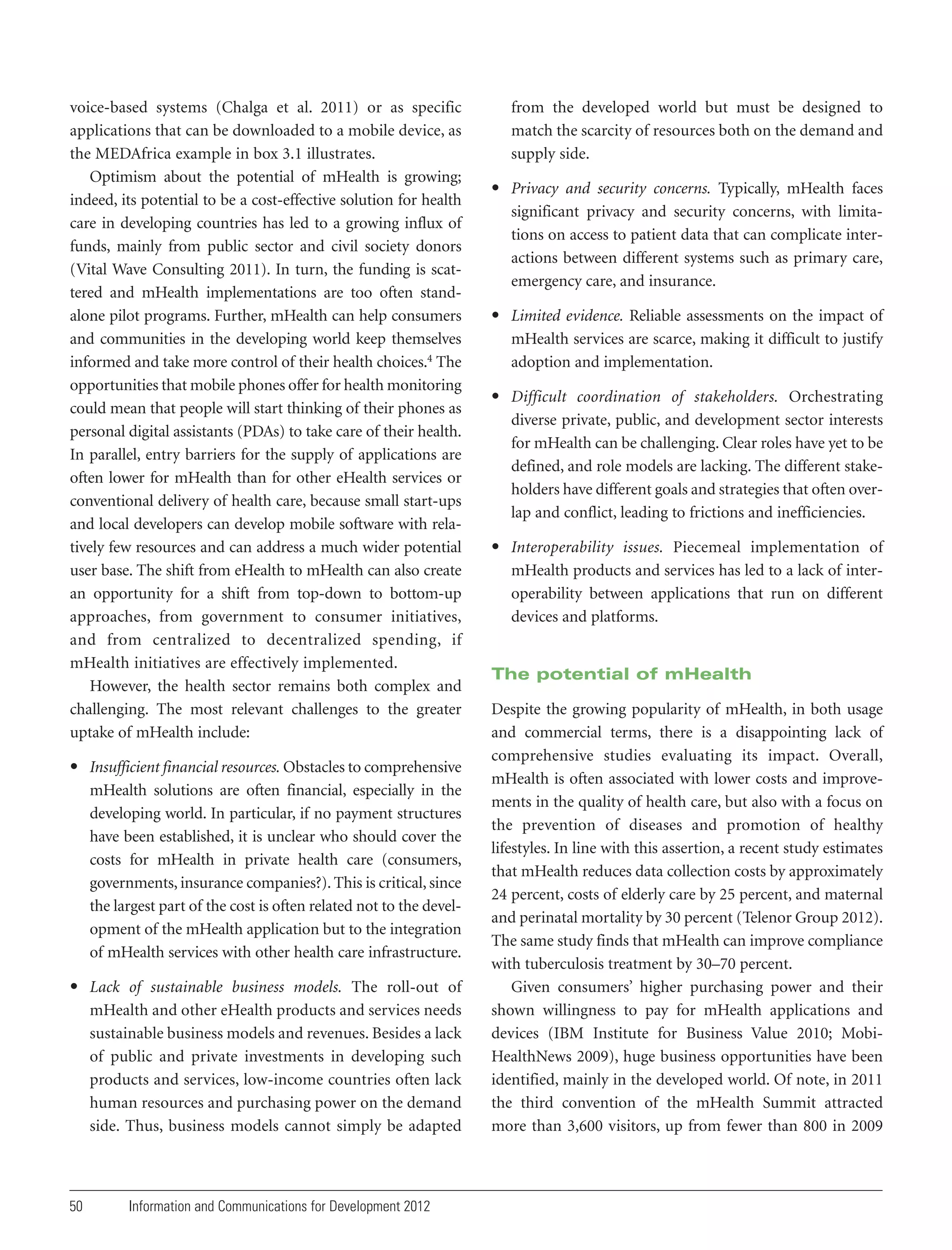
Relative popularity of consumer health applications in Apple’s App Store, 2011

12
14
16
17
20
20
21
24
26
27
48
49
51
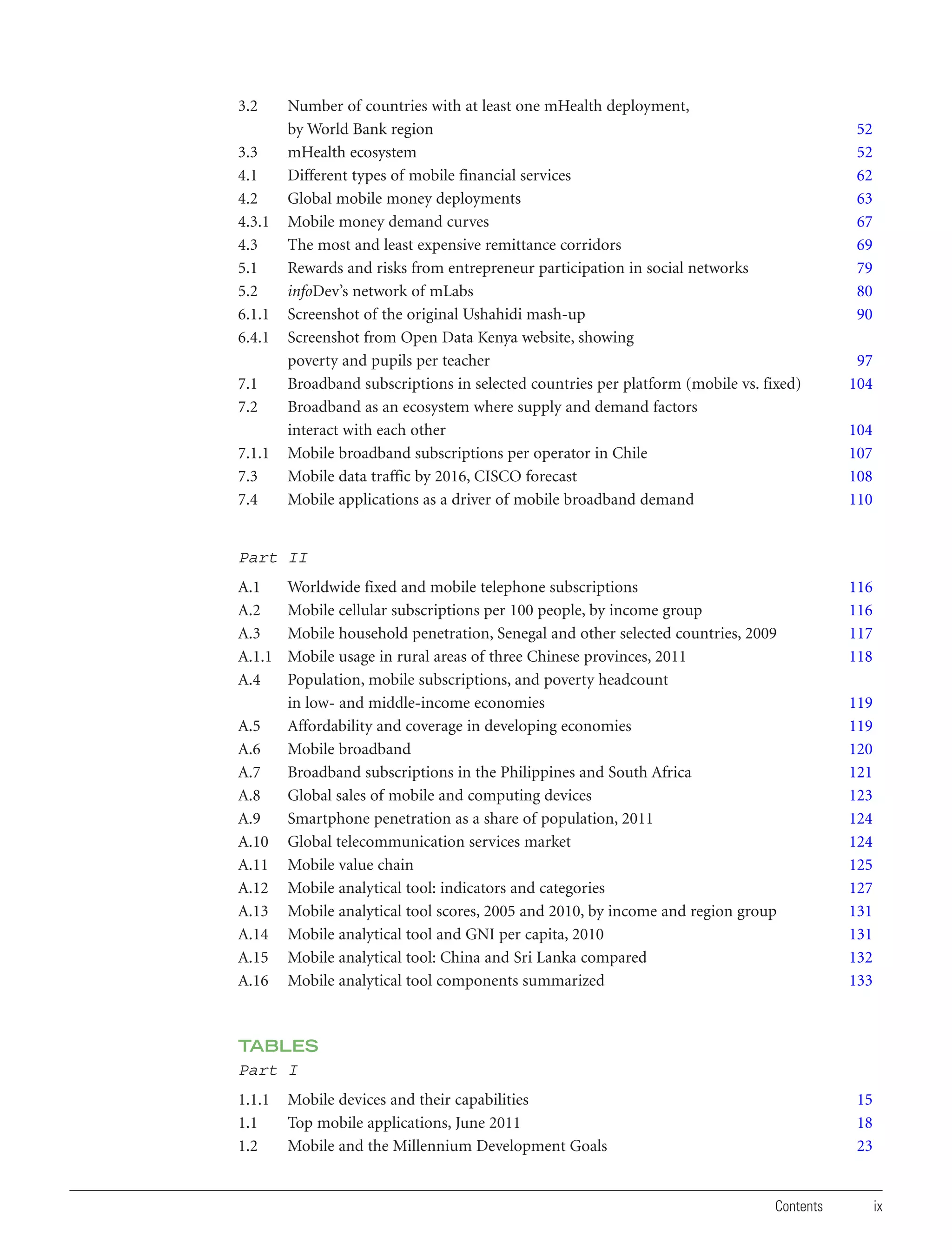
3.2
3.3
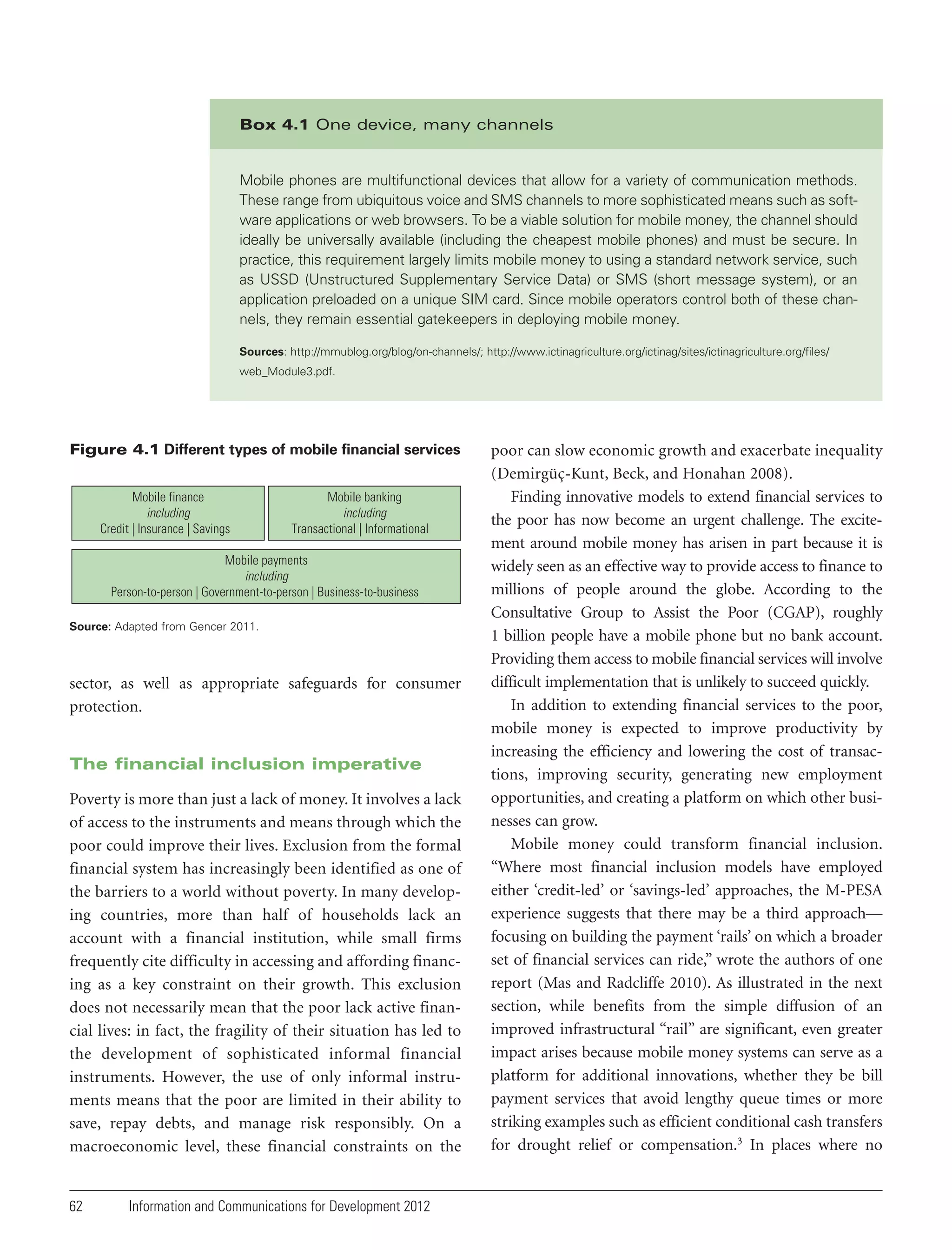
4.1
4.2
4.3.1
4.3
5.1
5.2
6.1.1
6.4.1
7.1
7.2
7.1.1
7.3
7.4

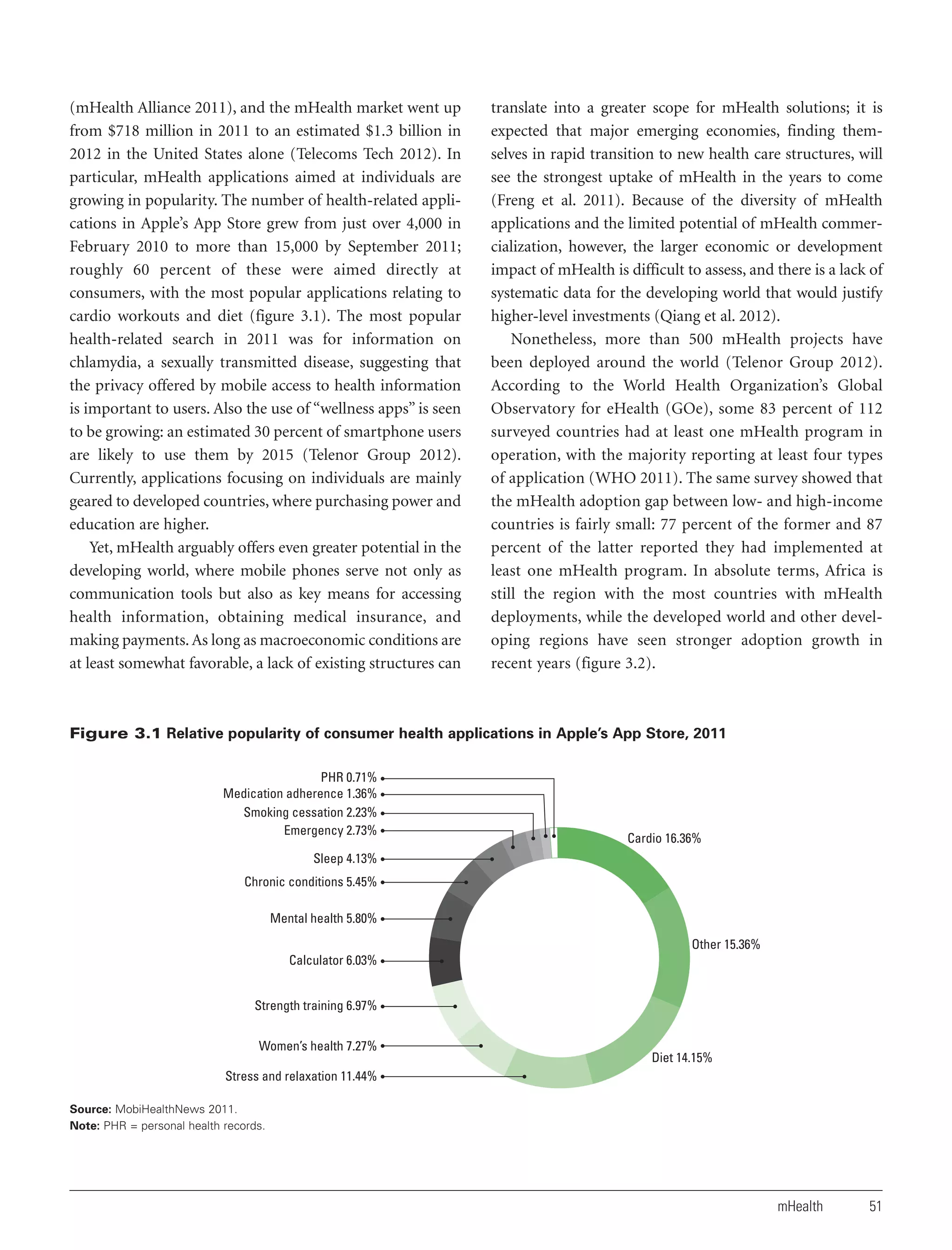
Number of countries with at least one mHealth deployment,
by World Bank region
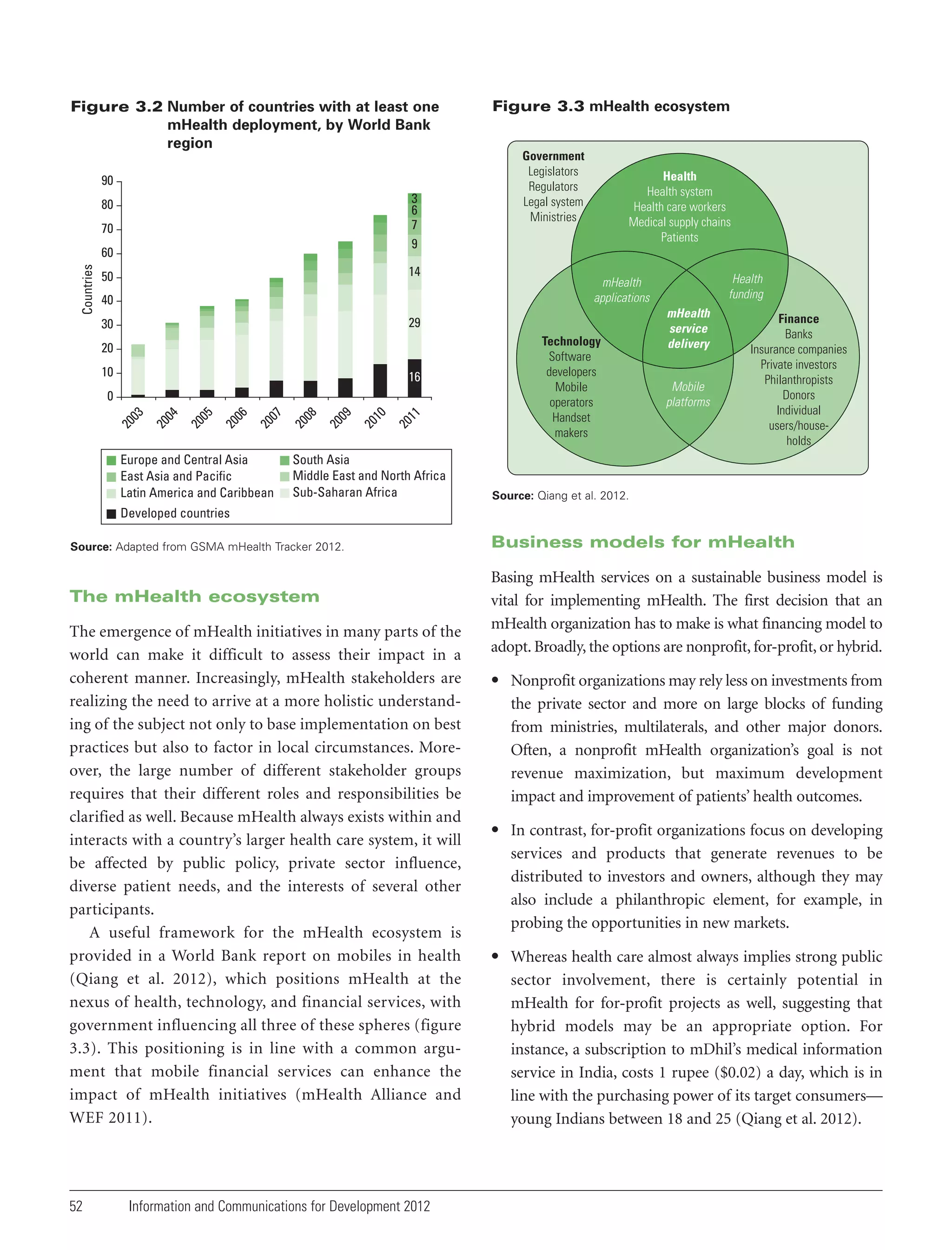
mHealth ecosystem
Different types of mobile financial services
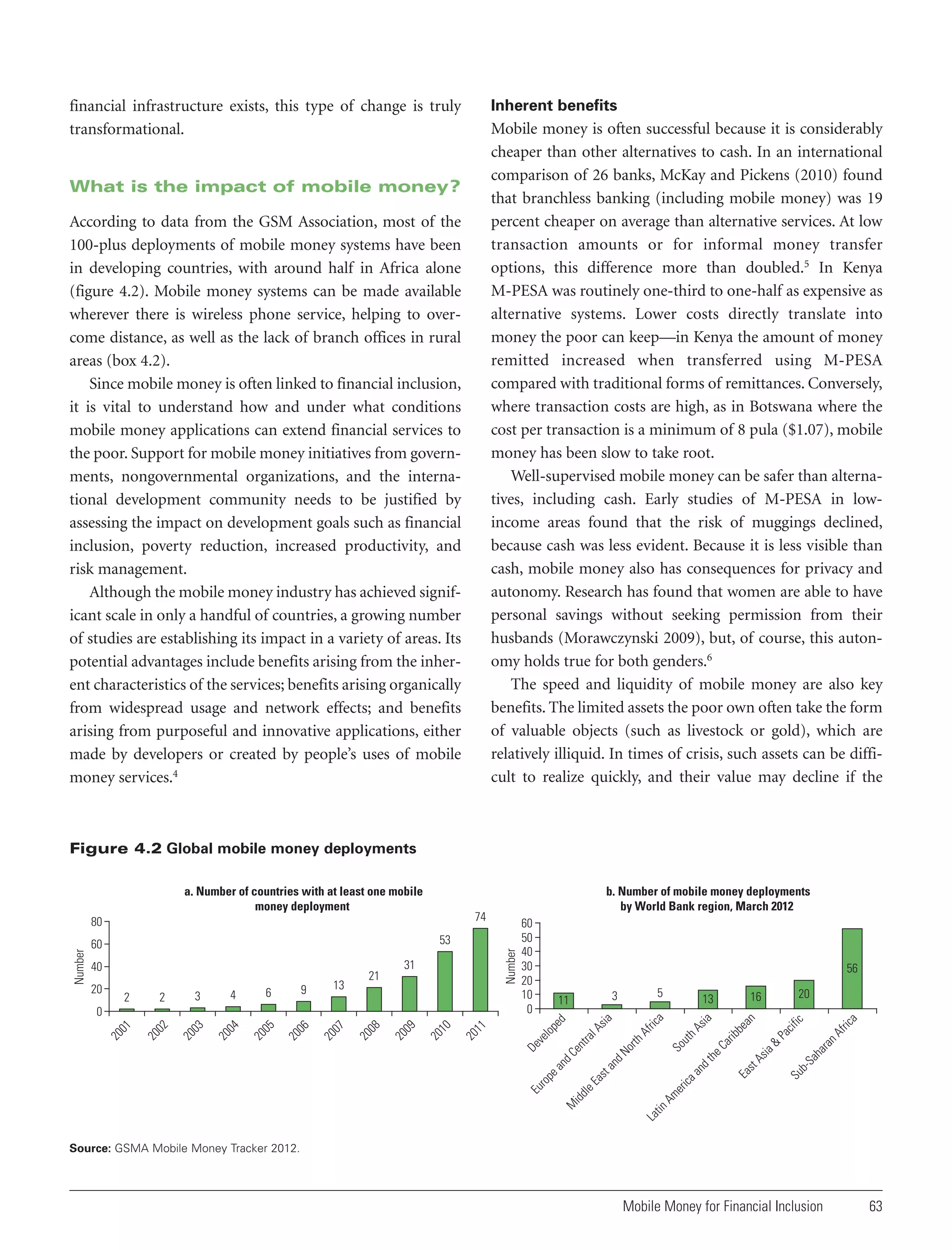
Global mobile money deployments
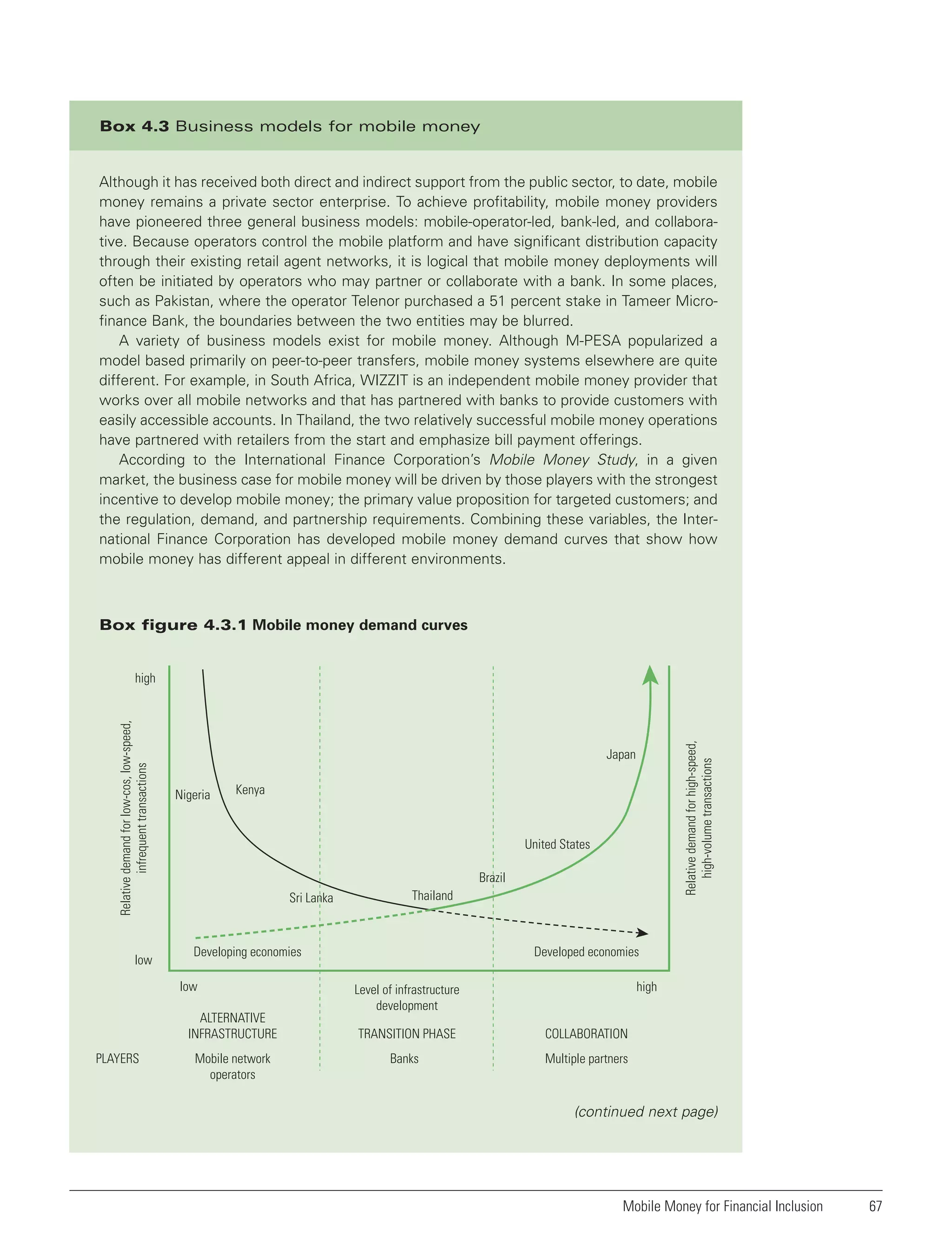
Mobile money demand curves
The most and least expensive remittance corridors
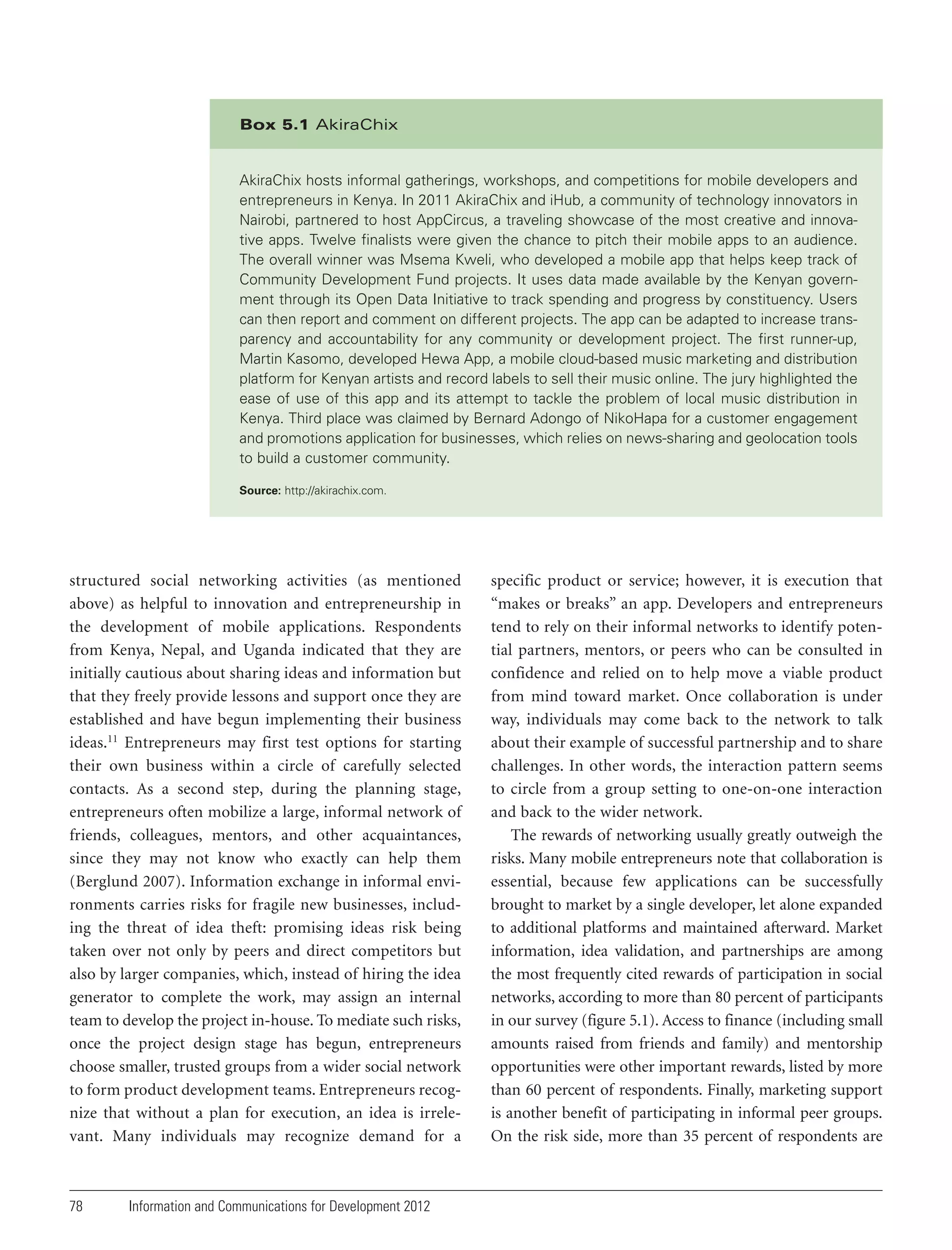
Rewards and risks from entrepreneur participation in social networks
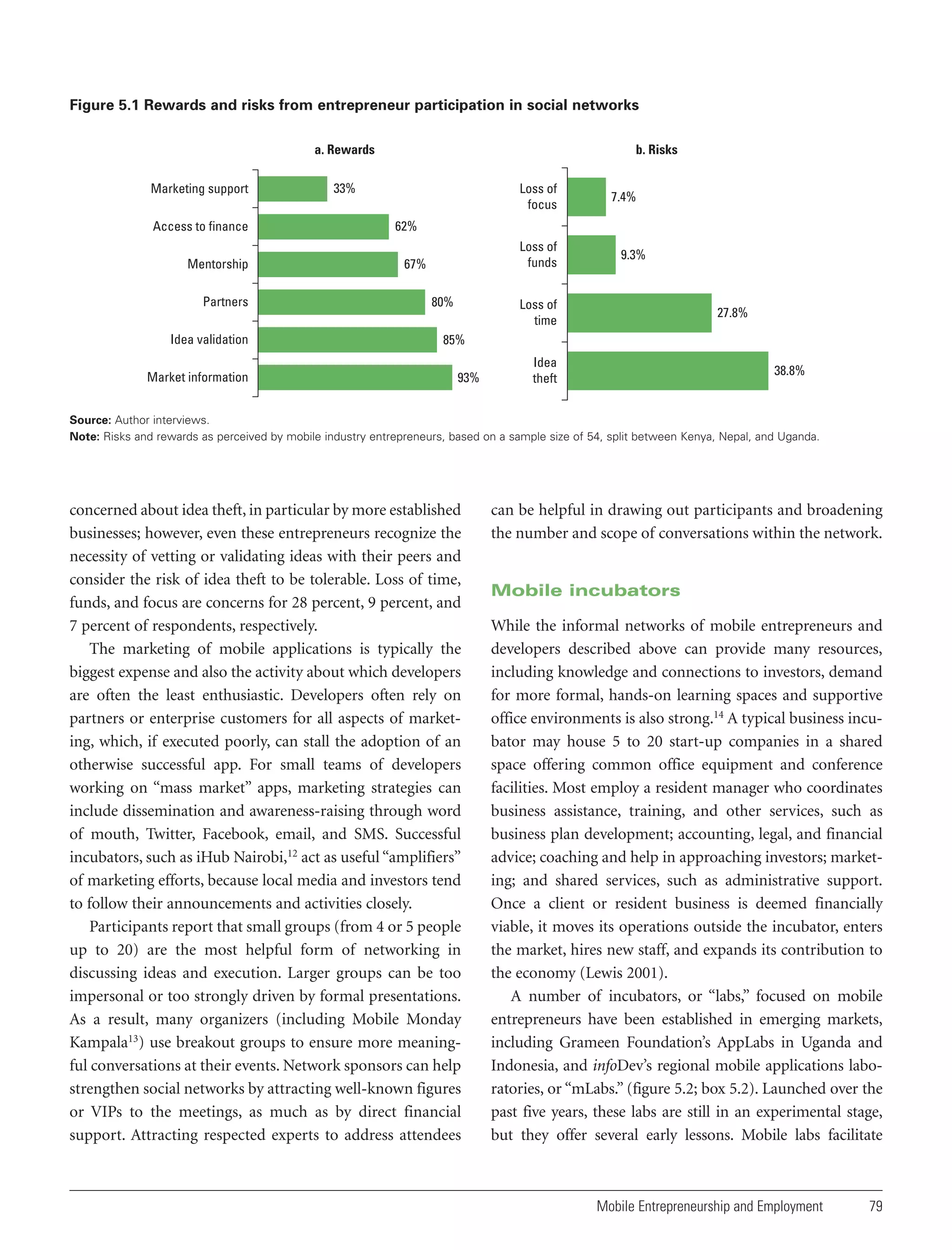
infoDev’s network of mLabs
Screenshot of the original Ushahidi mash-up
Screenshot from Open Data Kenya website, showing
poverty and pupils per teacher
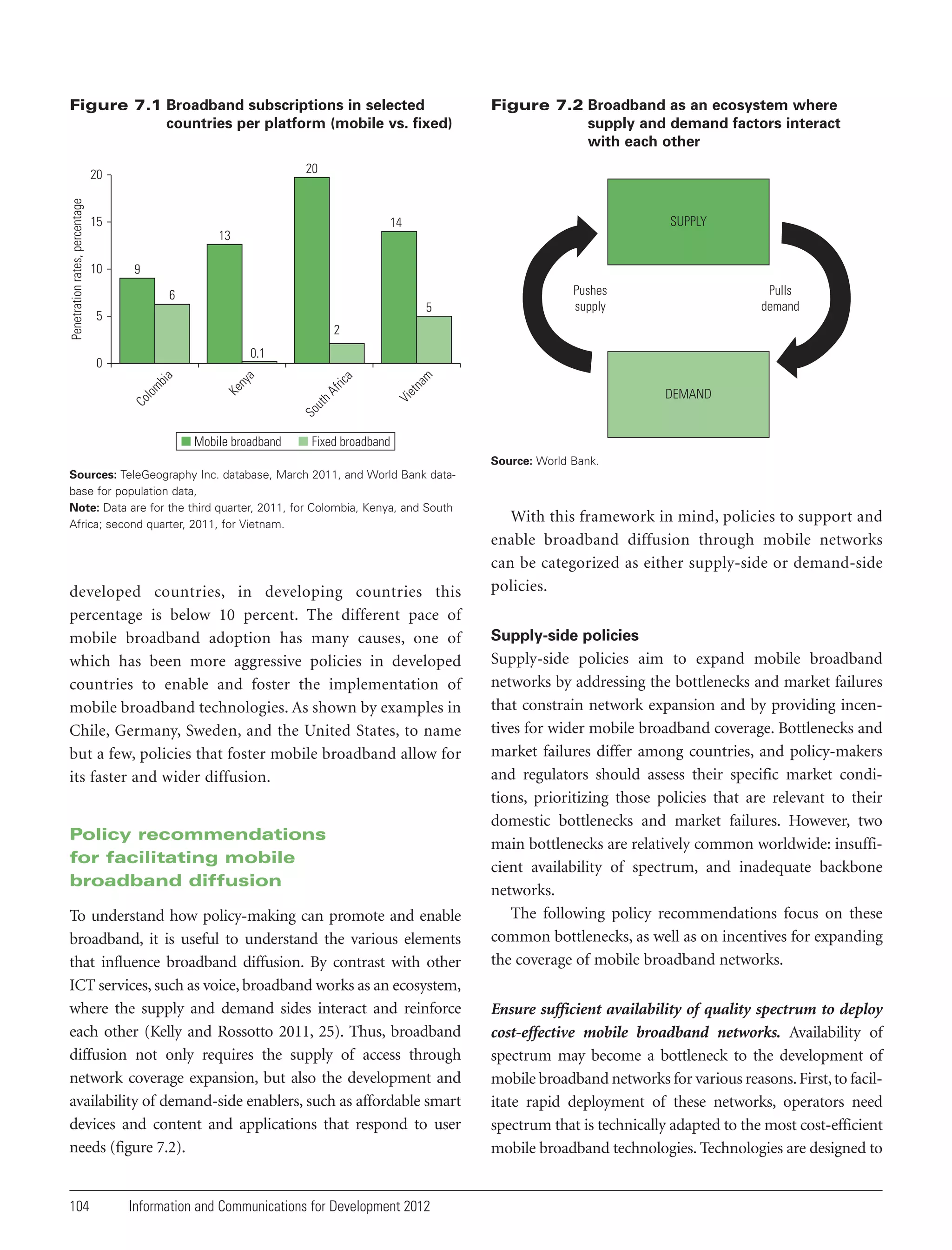
Broadband subscriptions in selected countries per platform (mobile vs. fixed)
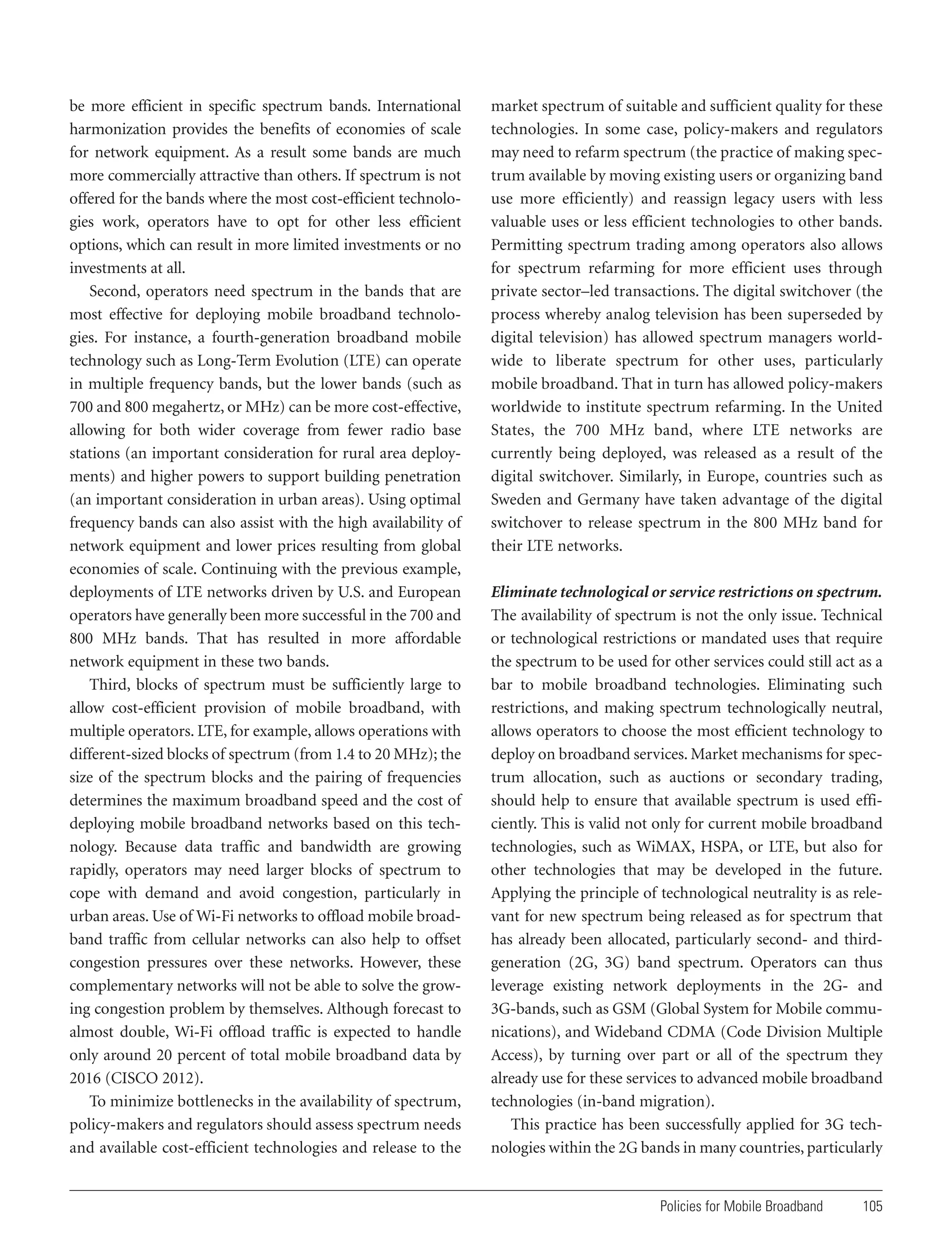
Broadband as an ecosystem where supply and demand factors
interact with each other
Mobile broadband subscriptions per operator in Chile
Mobile data traffic by 2016, CISCO forecast
Mobile applications as a driver of mobile broadband demand

52
52
62
63
67
69
79
80
90
97
104
104
107
108
110

Part II
A.1
A.2
A.3
A.1.1
A.4
A.5
A.6
A.7
A.8
A.9
A.10
A.11
A.12
A.13
A.14
A.15
A.16

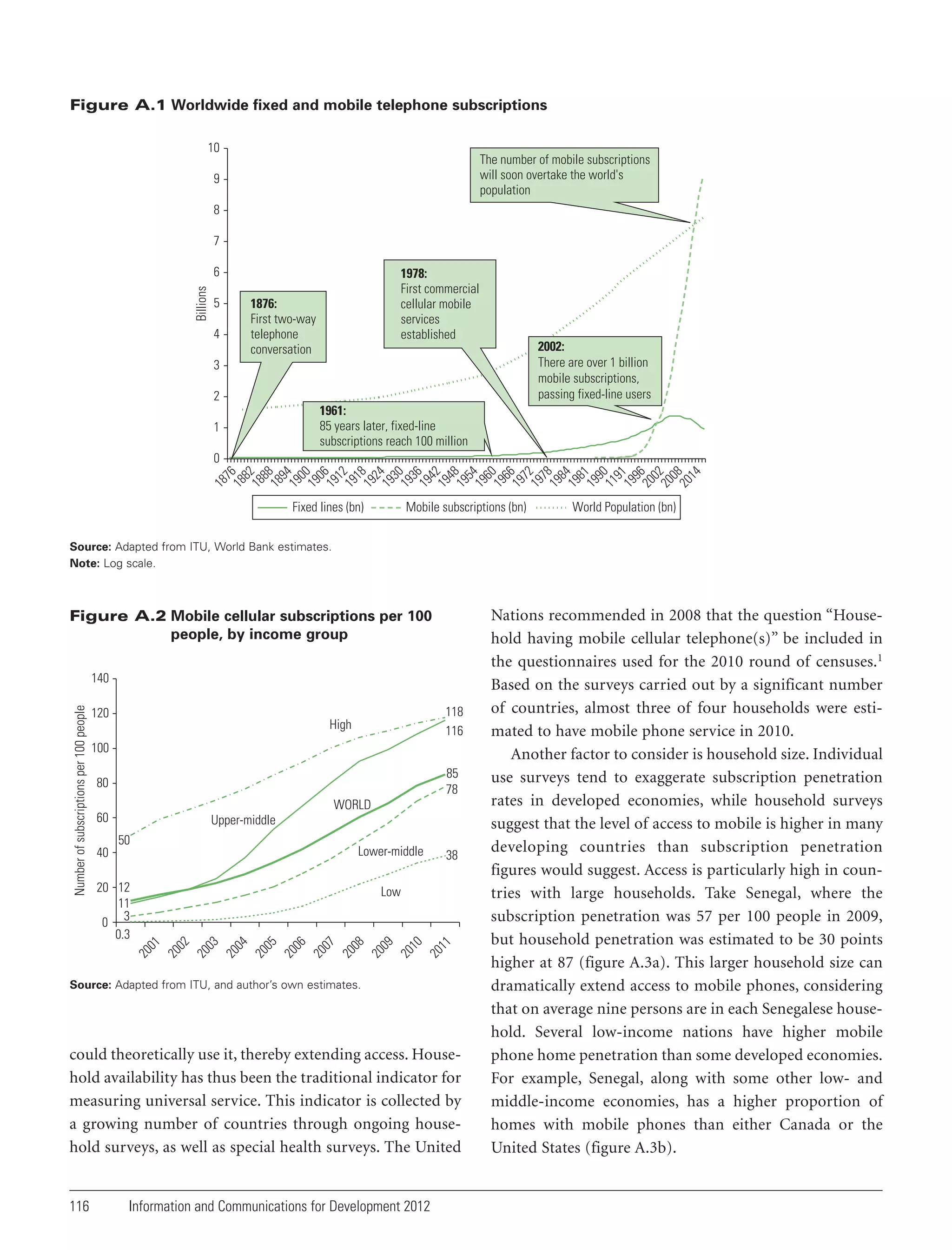
Worldwide fixed and mobile telephone subscriptions
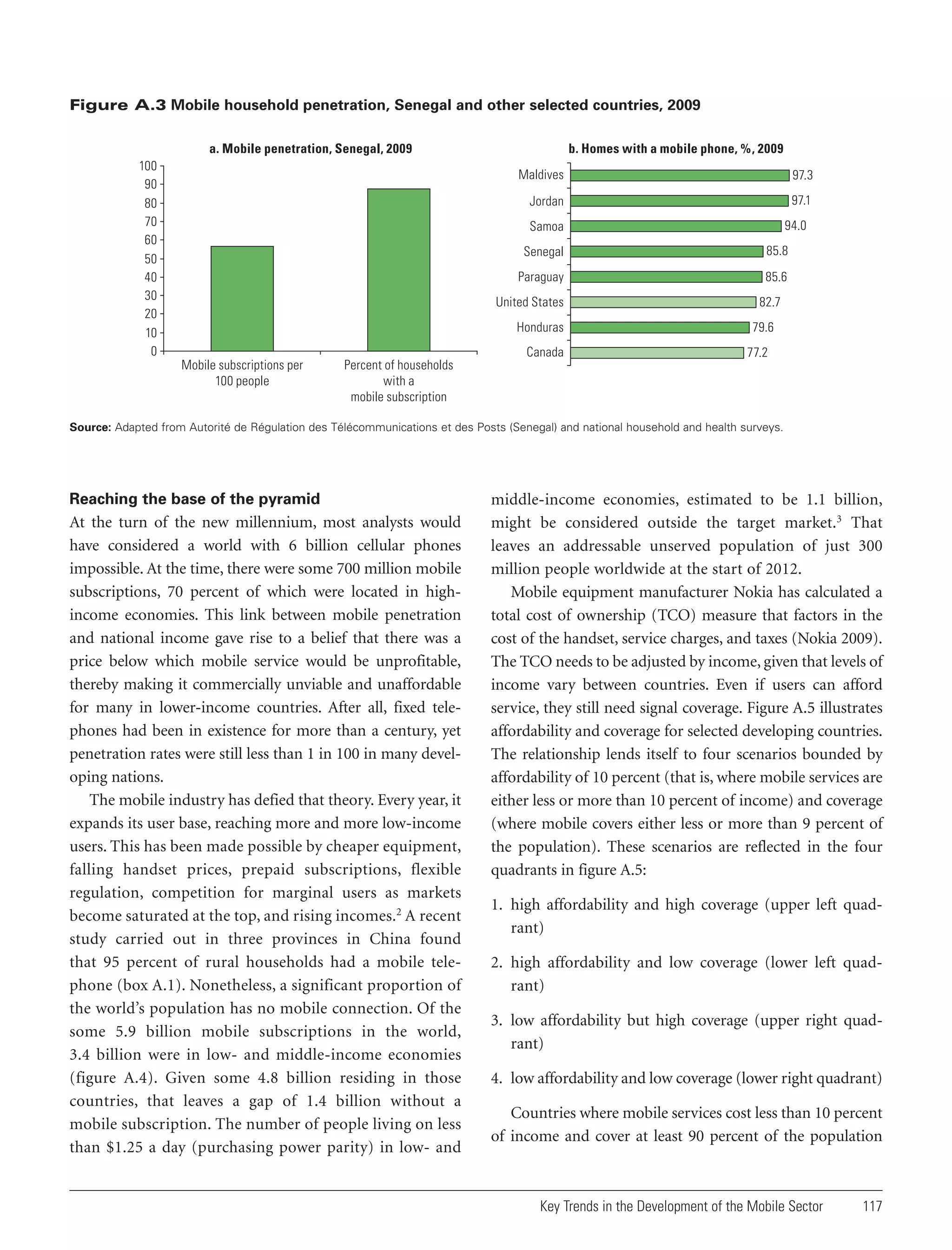
Mobile cellular subscriptions per 100 people, by income group
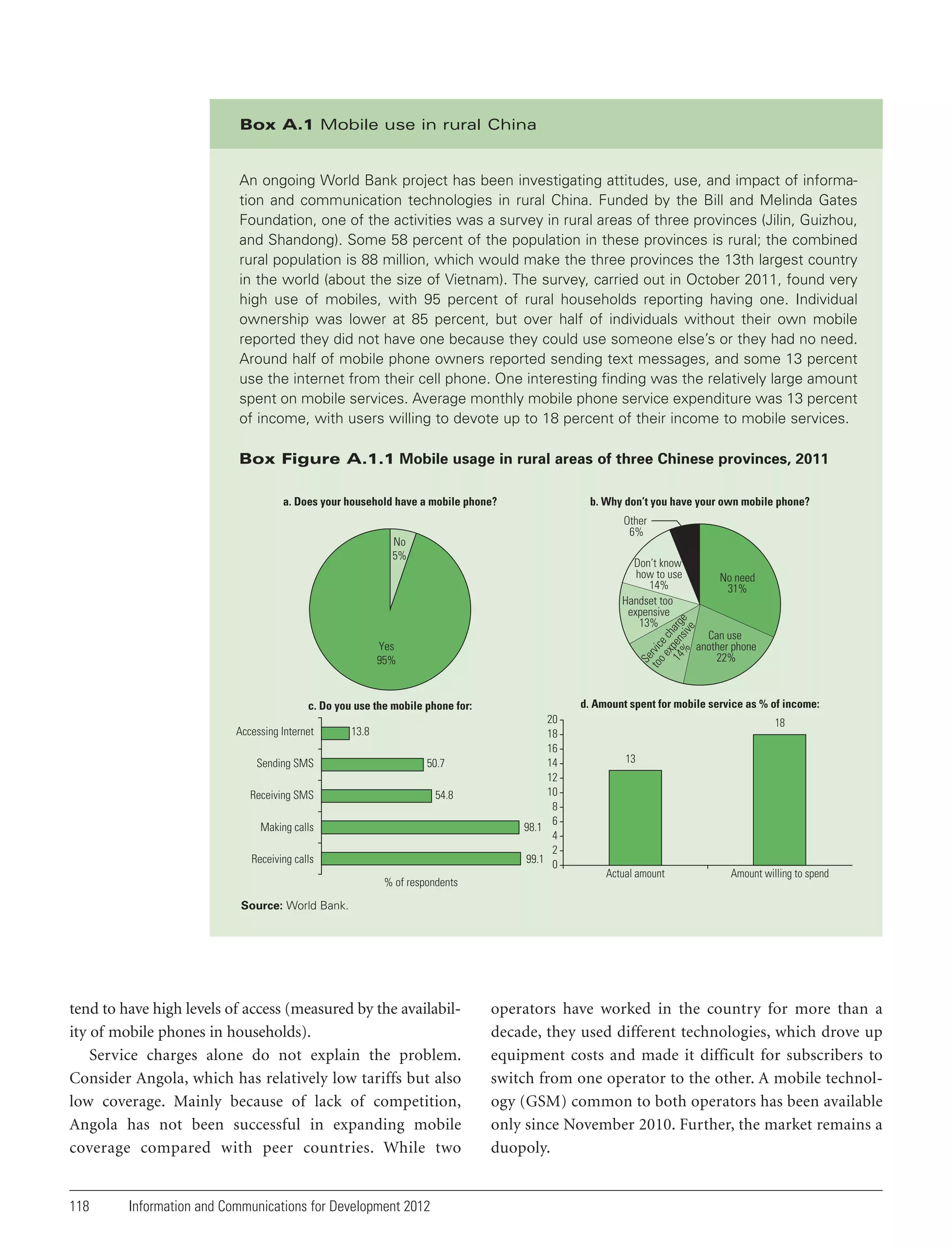
Mobile household penetration, Senegal and other selected countries, 2009
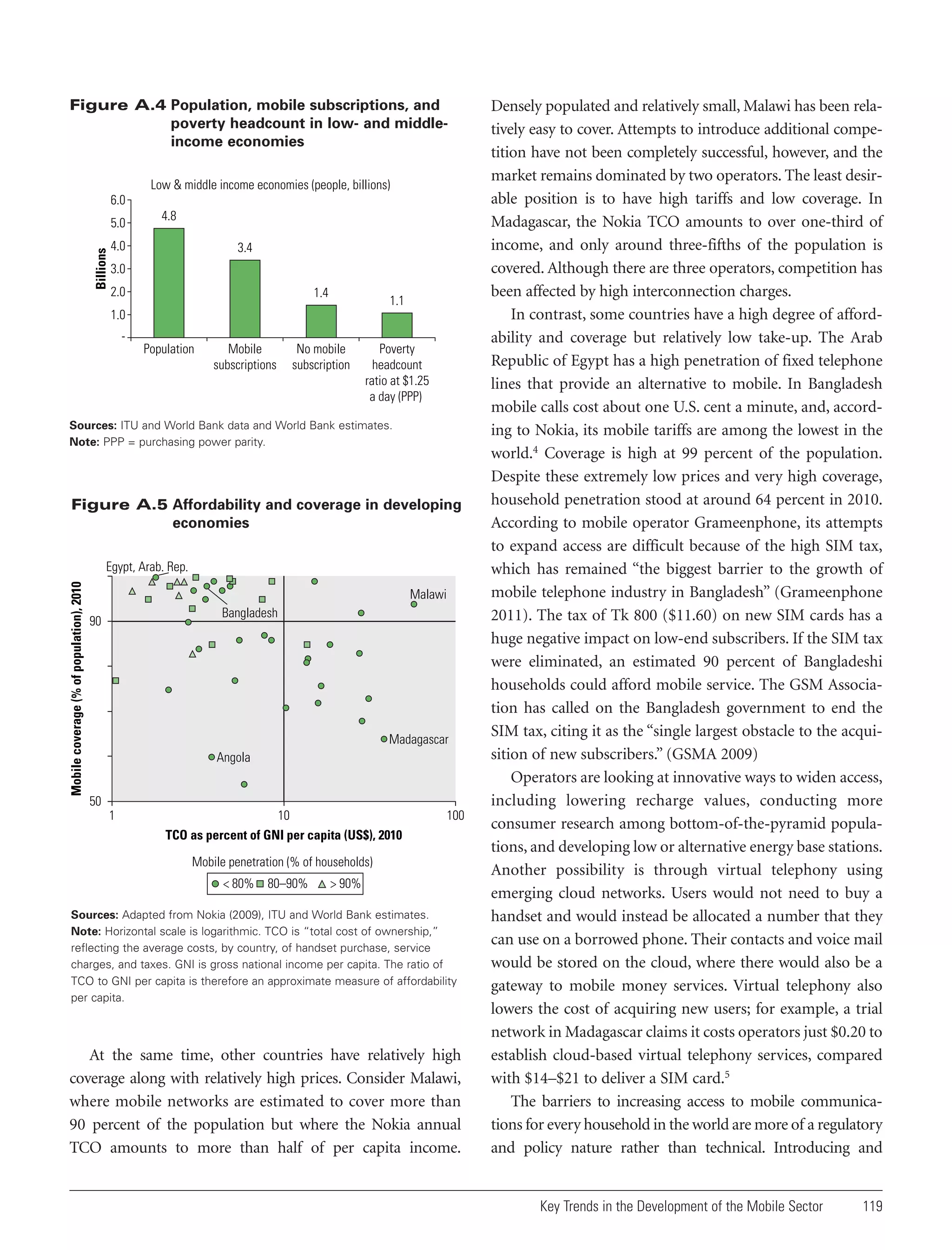
Mobile usage in rural areas of three Chinese provinces, 2011
Population, mobile subscriptions, and poverty headcount
in low- and middle-income economies
Affordability and coverage in developing economies
Mobile broadband
Broadband subscriptions in the Philippines and South Africa
Global sales of mobile and computing devices
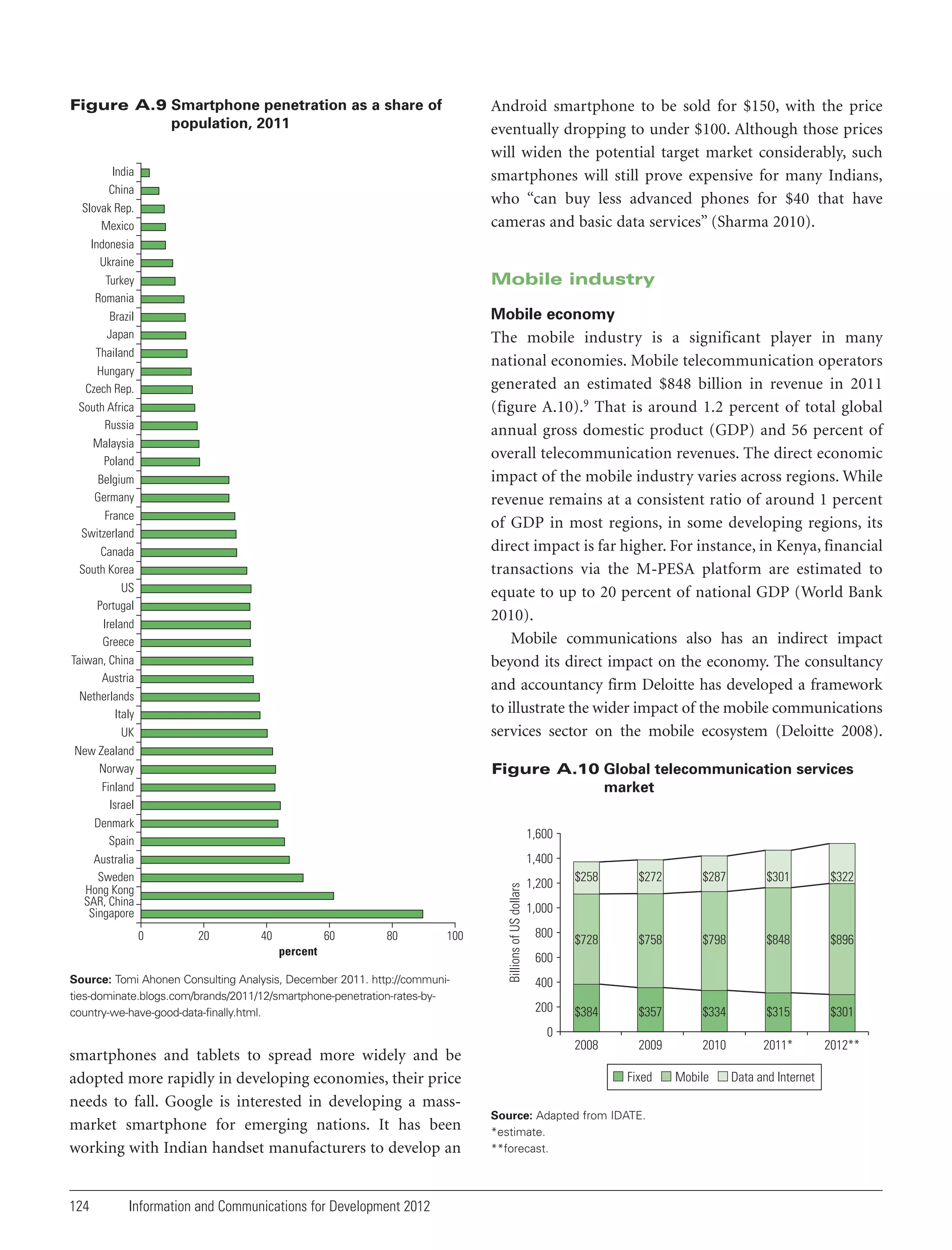
Smartphone penetration as a share of population, 2011
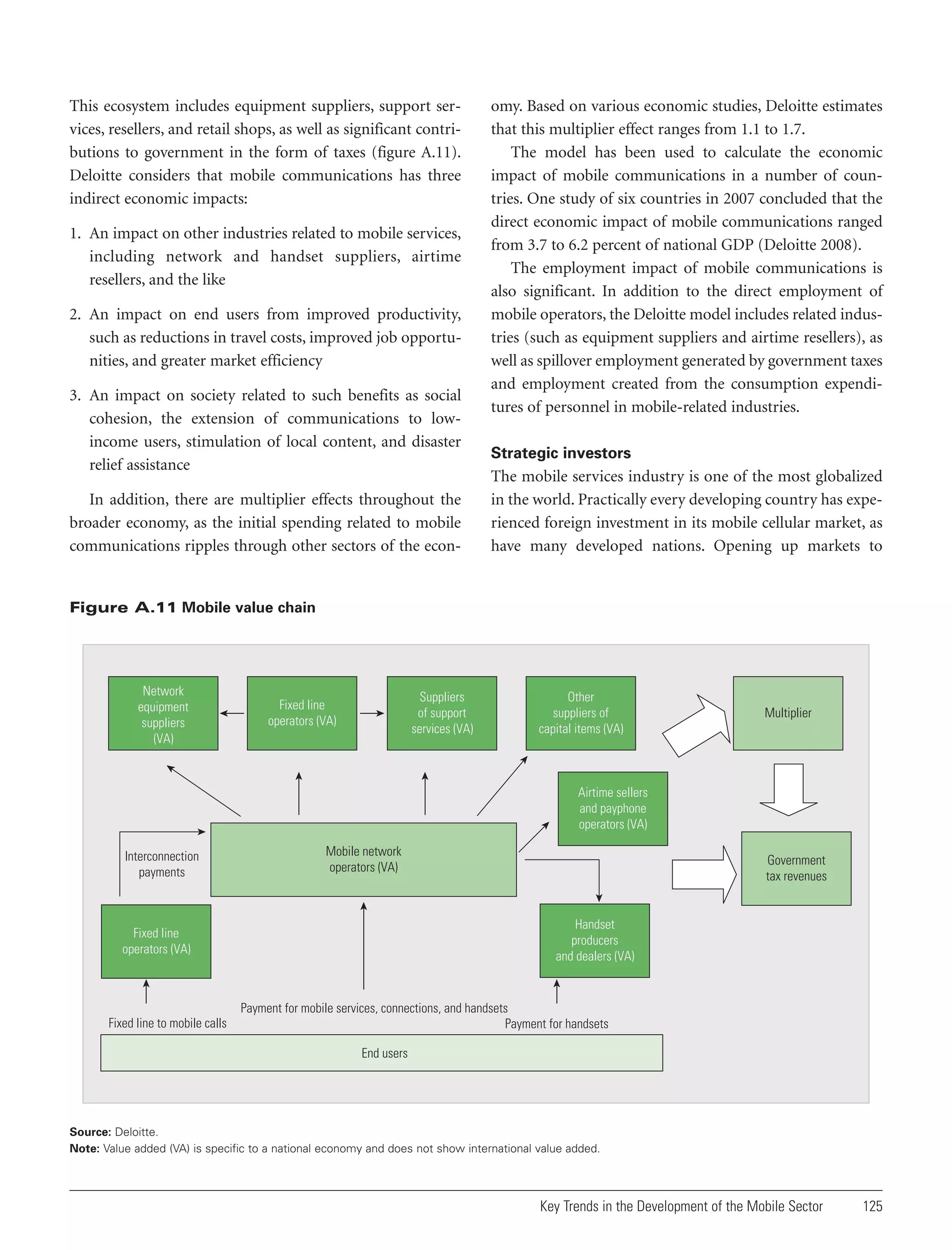
Global telecommunication services market
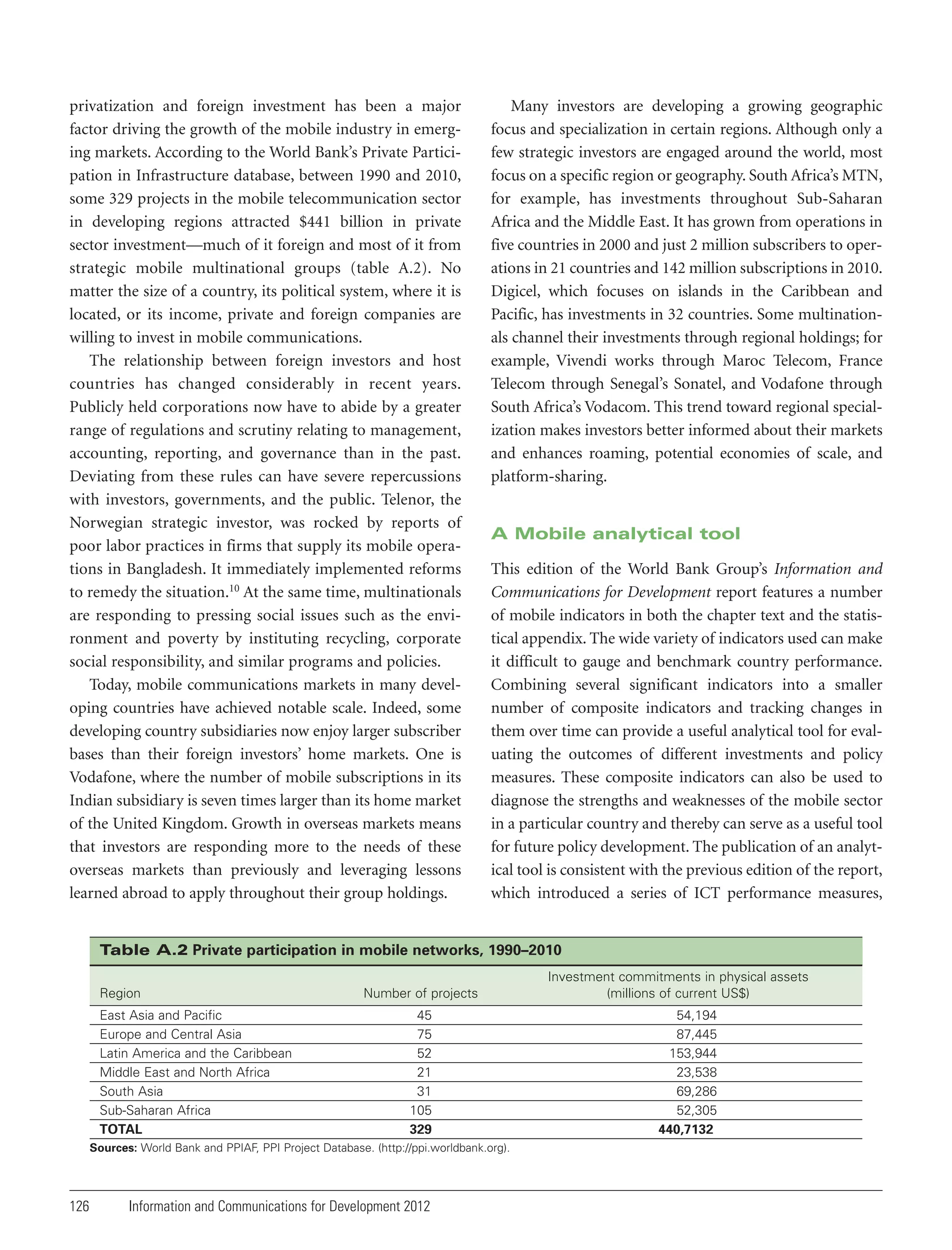
Mobile value chain
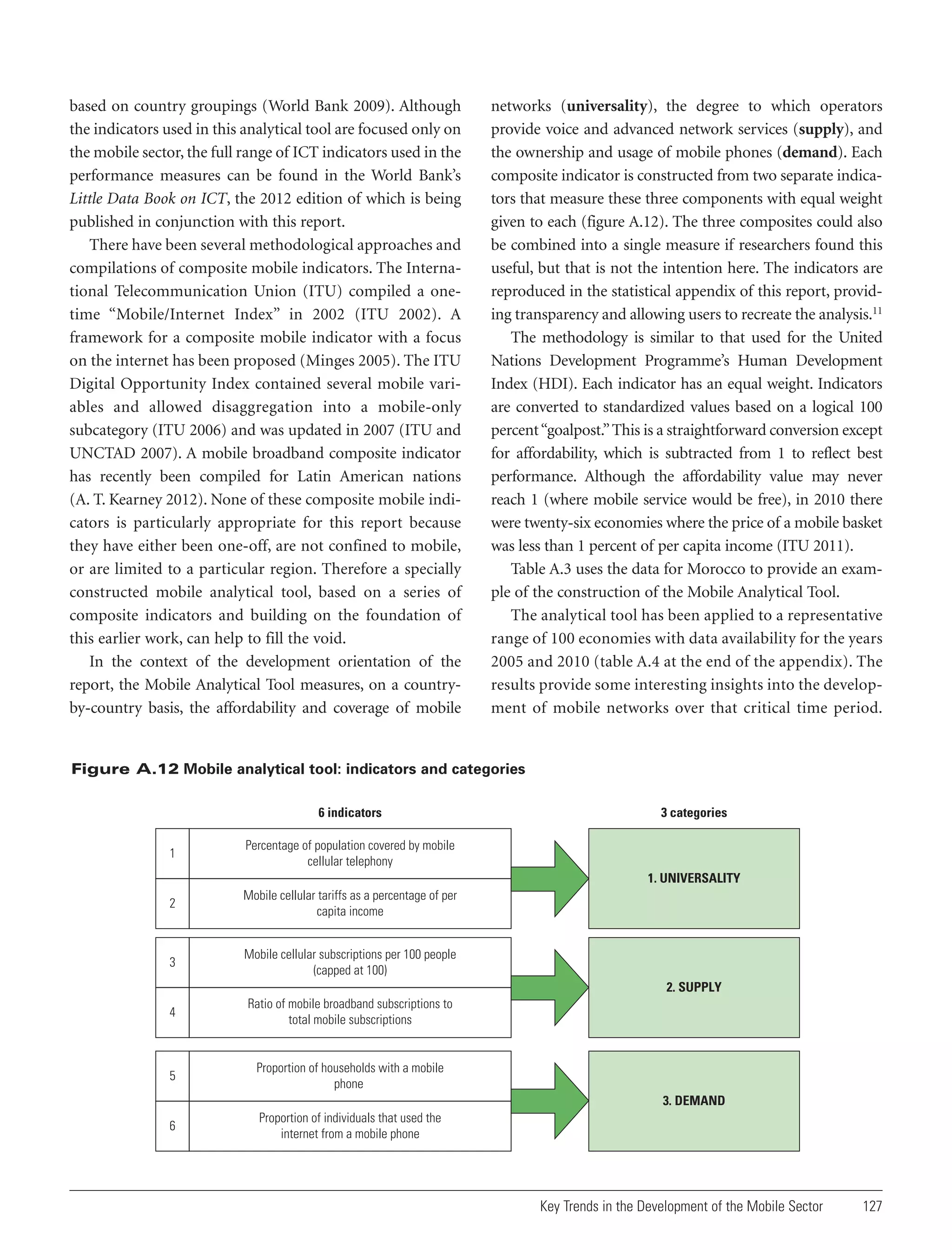
Mobile analytical tool: indicators and categories
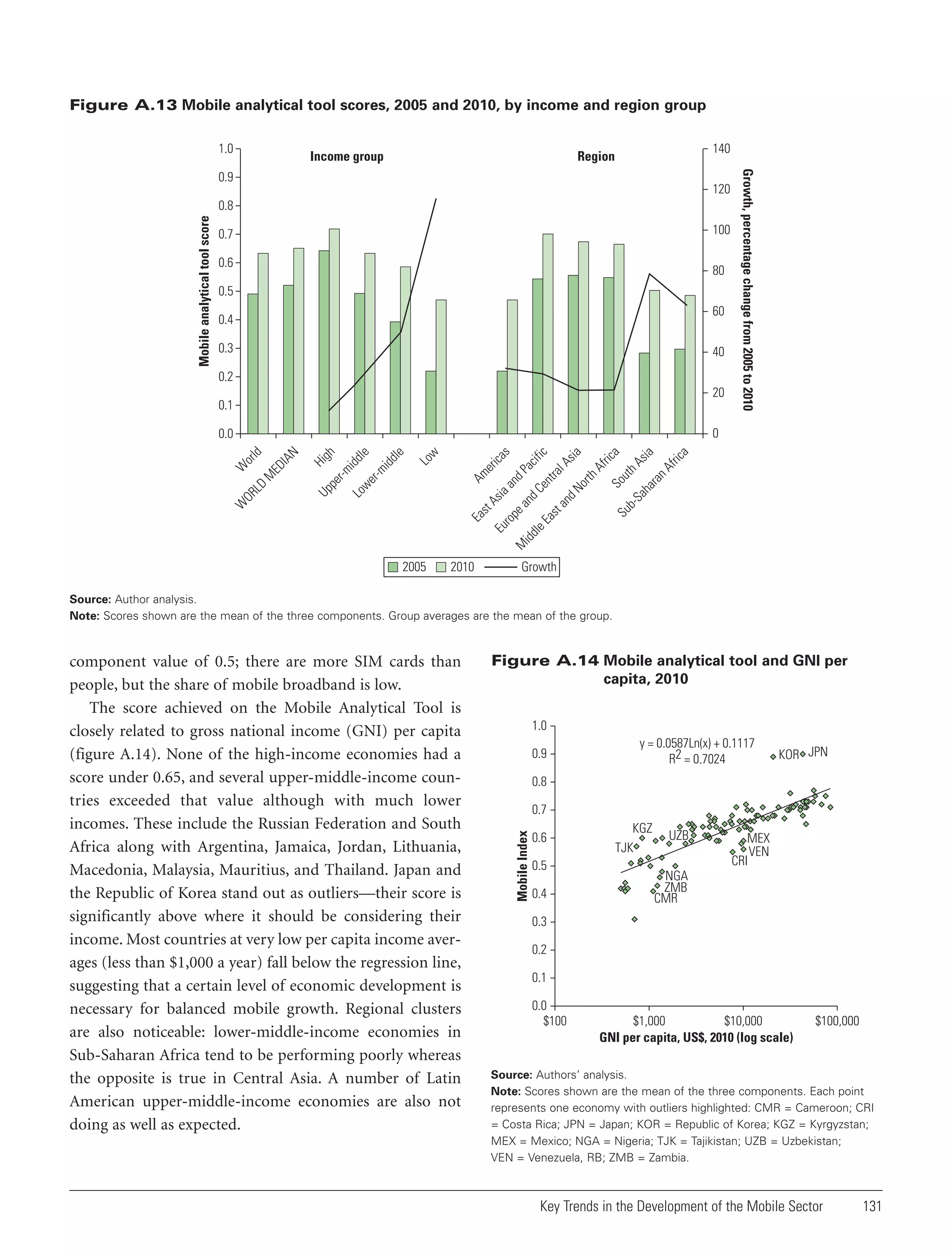
Mobile analytical tool scores, 2005 and 2010, by income and region group
Mobile analytical tool and GNI per capita, 2010
Mobile analytical tool: China and Sri Lanka compared
Mobile analytical tool components summarized

116
116
117
118
119
119
120
121
123
124
124
125
127
131
131
132
133

TABLES
Part I
1.1.1
1.1
1.2

Mobile devices and their capabilities
Top mobile applications, June 2011
Mobile and the Millennium Development Goals

15
18
23

Contents

ix
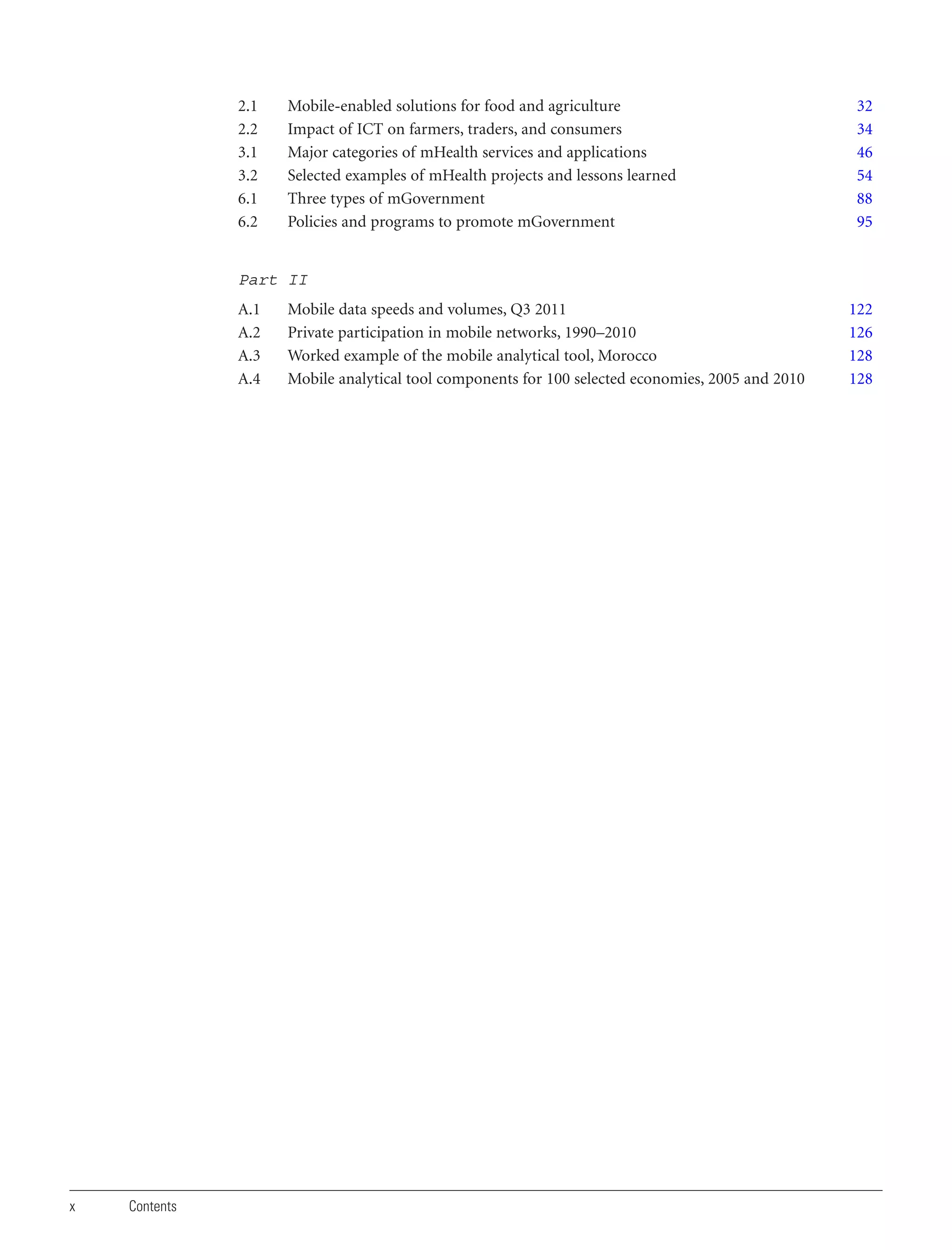
2.1
2.2
3.1
3.2
6.1
6.2

Mobile-enabled solutions for food and agriculture
Impact of ICT on farmers, traders, and consumers
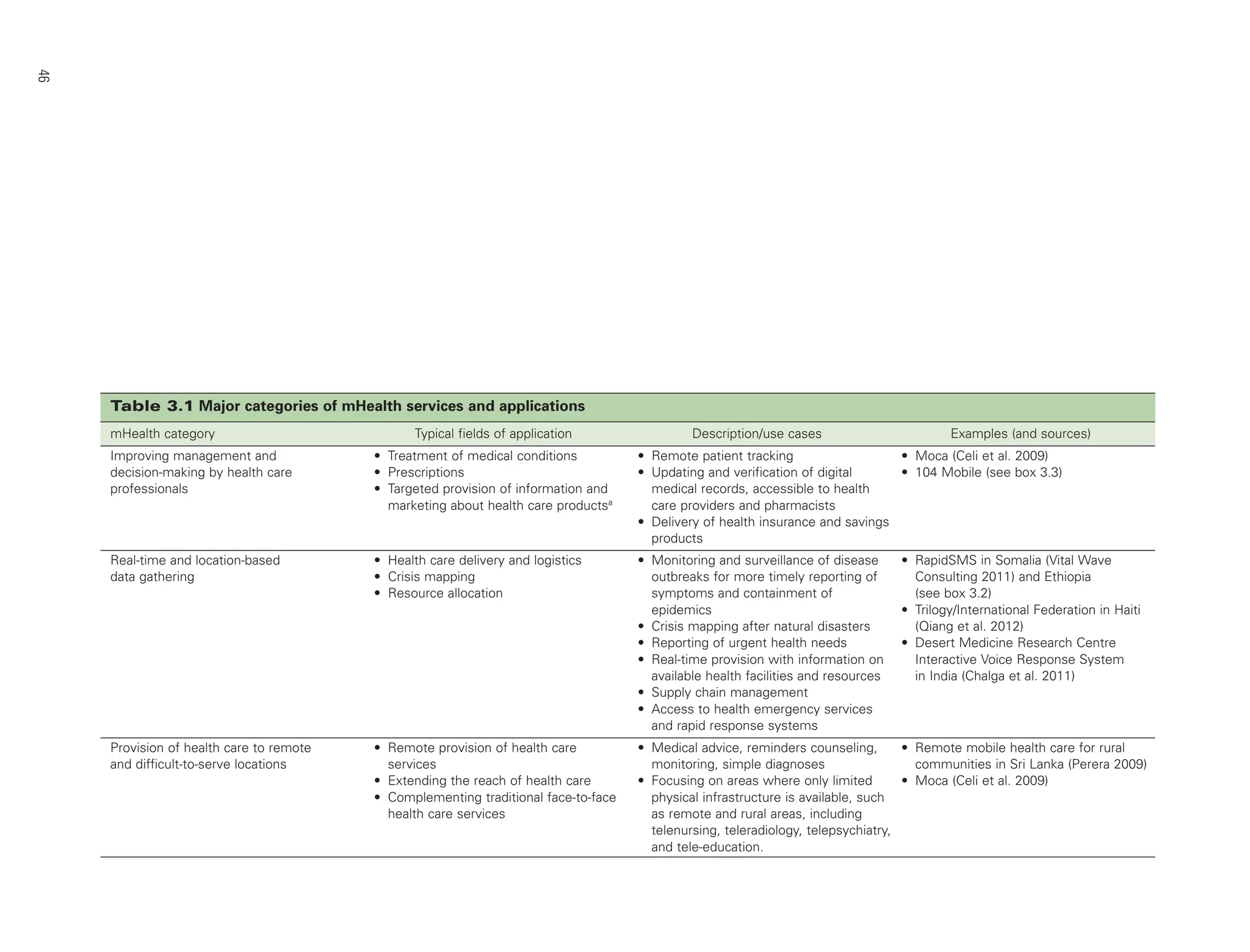
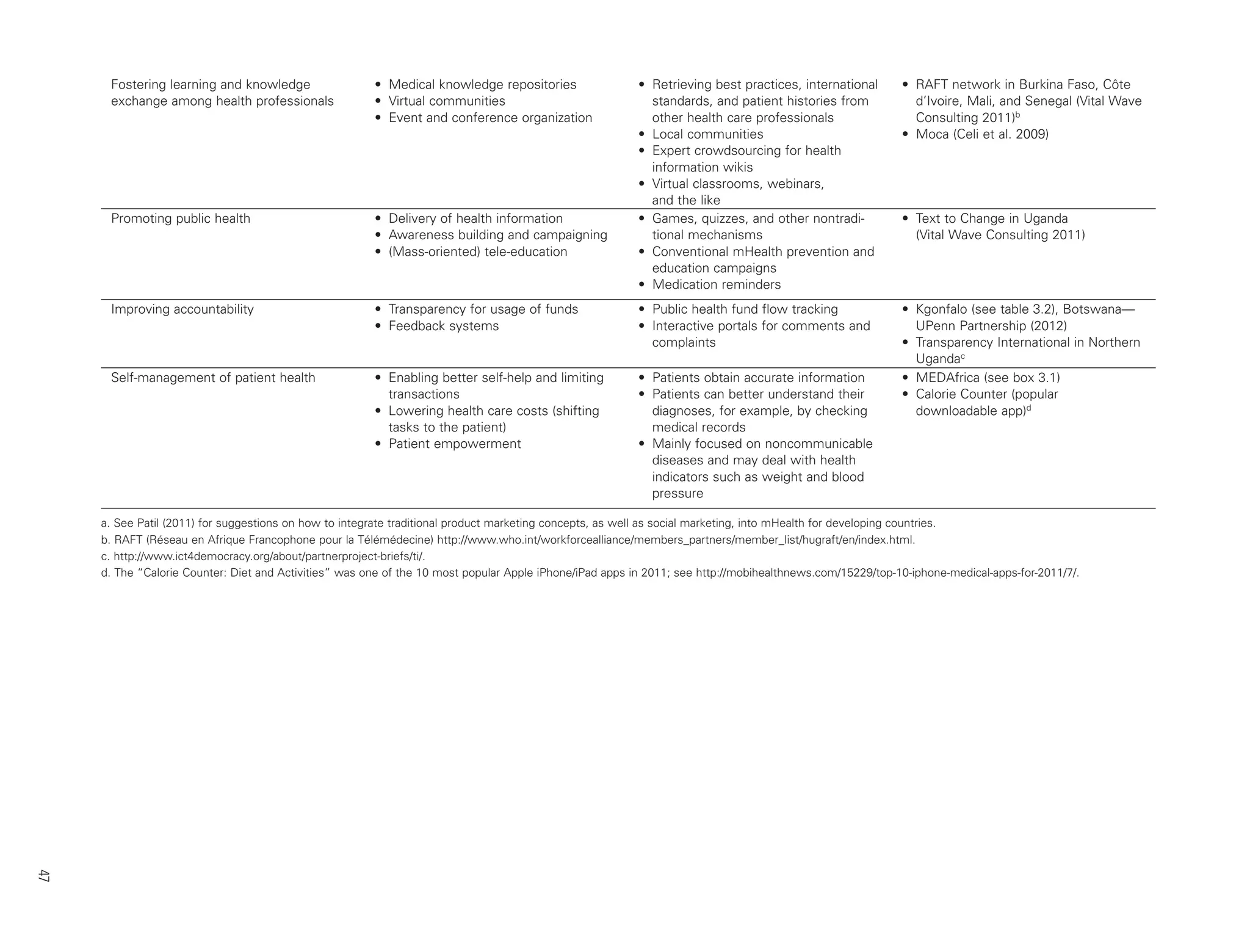
Major categories of mHealth services and applications
Selected examples of mHealth projects and lessons learned
Three types of mGovernment
Policies and programs to promote mGovernment

32
34
46
54
88
95

Part II
A.1
A.2
A.3
A.4

x

Contents

Mobile data speeds and volumes, Q3 2011
Private participation in mobile networks, 1990–2010
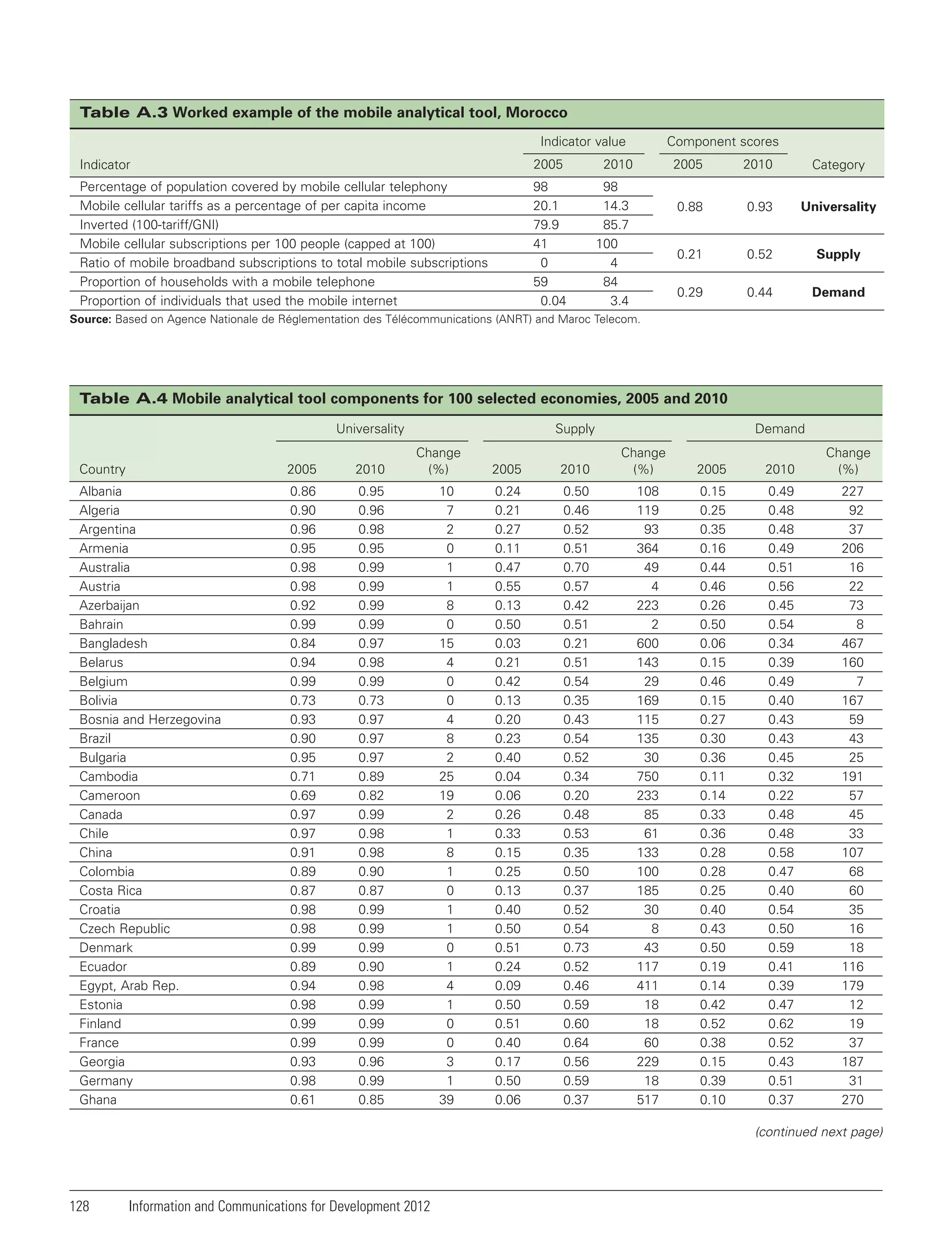
Worked example of the mobile analytical tool, Morocco
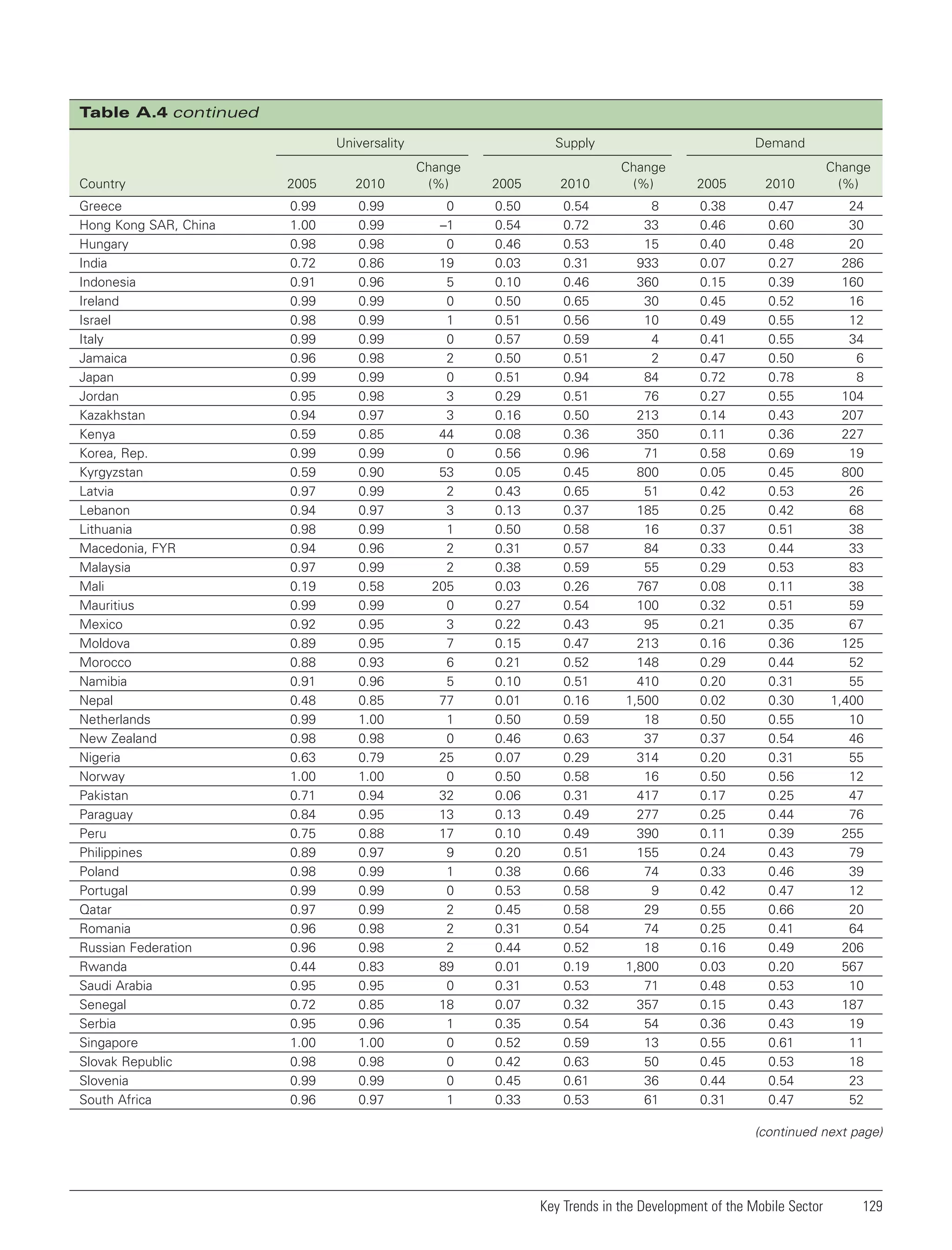
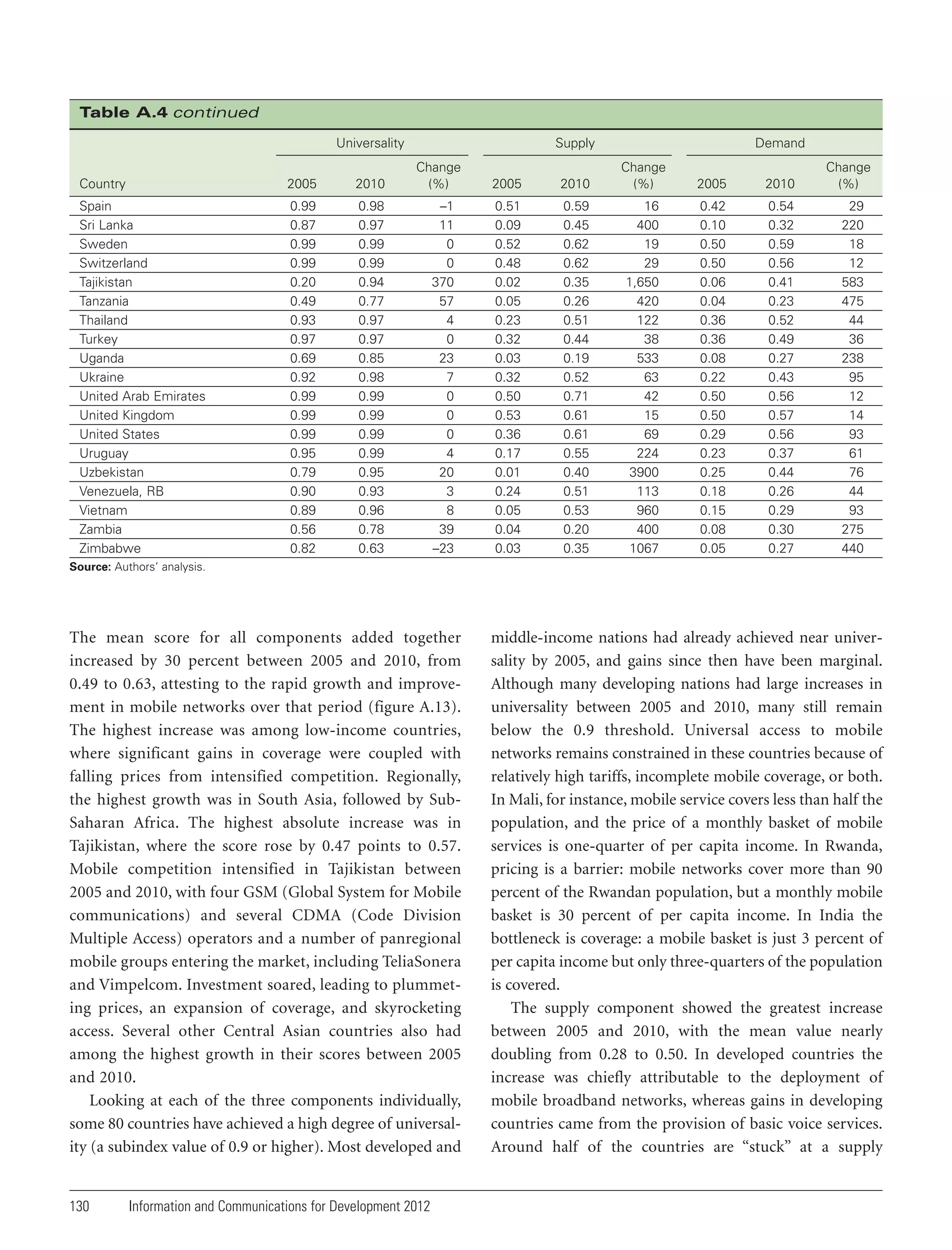
Mobile analytical tool components for 100 selected economies, 2005 and 2010

122
126
128
128
Foreword

Mobile phones, a rarity in many developing countries at the
turn of the century, now seem to be everywhere. Between
2000 and 2012, the number of mobile phones in use worldwide grew from fewer than 1 billion to around 6 billion. The
mobile revolution is transforming livelihoods, helping to
create new businesses, and changing the way we communicate. The mobile phone network is already the biggest
“machine” the world has ever seen, and now that machine is
being used to deliver development opportunities on a scale
never before imagined. During this second decade of the
new millennium, maximizing the potential of mobile
phones is a challenge that will engage governments, the
private sector, and the development community alike.
Information and Communications for Development
2012: Maximizing Mobile is the third report in the World
Bank Group’s series on Information and Communication
Technologies (ICTs) for Development, originally
launched in 2006. This edition focuses on mobile applications and their use in promoting development, especially
in agriculture, health, financial services, and government.
Cross-cutting chapters present an overview of emerging
trends in mobile applications, the ways they are affecting
employment and entrepreneurship opportunities, and the
policy challenges presented by the ongoing shift from
narrowband to broadband mobile networks. The report
features at-a-glance tables for 152 economies showing the
latest available data and indicators for the mobile sector
(year-end 2011, where possible). The report also introduces an analytical tool for examining the relevant
performance indicators for each country’s mobile sector,
so policy-makers can assess their capacities relative to
other countries. A more complete range of ICT indicators

is available in the Little Data Book on Information and
Communication Technology 2012, published alongside this
report.
It is our hope that this new report will provide some
emerging good-practice principles for policy-makers, regulators, and investors in this complex and constantly changing sector. The World Bank Group already supports a wide
range of investment lending programs with an ICT component. According to the report of the Independent Evaluation
Group, Capturing Technology for Development (2011),
around three-quarters of all investment lending projects
from the World Bank Group have an ICT component; in
addition, more than $4 billion has been invested directly in
the ICT sector between 2003 and 2010.
This report marks a shift from the World Bank Group’s
traditional focus on ICT connectivity to a new focus on
applications and on the ways ICTs, especially mobile
phones, are being used to transform different sectors of the
global economy. This change of focus reflects how the
value created by the industry is shifting from networks and
hardware to software and services. The World Bank Group
expects that the theme of transformation will increasingly
guide its investment lending, and this report is aligned with
that new direction. Ultimately, the mission of the World
Bank is to work for a world free of poverty—a goal that is
likely to be achieved more efficiently when ICT investment
is integrated effectively alongside investment in sectors
such as agriculture, health, and government.
Marianne Fay
Chief Economist, Sustainable Development Network
The World Bank
xi
Preface

The World Bank’s new strategy for engagement in the Information and Communication Technologies (ICTs) sector,
which comes into force in 2012, is built around three strategic themes: Innovate—ICT for innovation and ICT-based
services industries; Connect—affordable access to voice, highspeed internet, information and media; and Transform—ICT
applications to transform services for enhanced development
outcomes.
This new flagship report on Information and Communications for Development builds on these three themes. In
particular, the report shows how innovation in the manufacture of mobile handsets—giving them more memory,
faster processing power, and easier-to-use touchscreen
interfaces—married with higher performance and more
affordable broadband networks and services produces transformation throughout economies and societies. Increasingly, that transformation is coming from developing
countries, which are “more mobile” than developed countries in the sense that they are following a “mobile first”
development trajectory. Many mobile innovations (including multi-SIM card phones, low-cost recharges, and mobile
payments) increasingly originate in poorer countries and
spread from there.
Since the last Information and Communications for
Development report was published, almost 2 billion new
mobile phone subscriptions have been added worldwide,
and the majority of these are in the developing world.
This rapid growth does not show the whole picture,
however. Alongside the process of enlarging the network
is an equally important process of improving the quality
and depth of the network as narrowband networks are
upgraded to broadband and as basic phones and feature-

phones are upgraded to smartphones and tablets. The full
range of innovative mobile applications described in this
report is not yet available in all countries and to all
subscribers, but it soon will be. And the expectation is
that developing countries will invent and adapt their own
mobile applications, suited to local circumstances and
needs. For that reason more research is needed on how
mobile applications are used in base of the pyramid
households.
This report, like its predecessors, was researched and
written jointly by the ICT Sector Unit and by infoDev, a
global partnership program of the World Bank Group. It
has been reviewed by a broad range of experts working in
the field, both within and outside the Bank, whose contributions are gratefully acknowledged. Funding is provided
by the World Bank as well as infoDev’s donors, notably the
Ministry for Foreign Affairs of the Government of
Finland, the Korean Trust Fund for ICT4D, and UKaid.
The World Bank Group is committed to continuing its
analytical and lending operations to support progress and
the sharing of best practices and knowledge, as well as
expanding its investments in private ICT companies to
further growth in the sector, competitiveness, and the
availability of better-quality, affordable ICT services to all
the world’s inhabitants.
Juan Navas-Sabater
Acting Sector Manager, ICT Sector Unit
The World Bank
Valerie D’Costa
Program Manager, infoDev
The World Bank
xiii
Acknowledgments

This report was prepared by a team from the ICT Sector
Unit (TWICT), infoDev, and the Development Economics
Data Group (DECDG) of the World Bank Group. The editorial team was led by Tim Kelly and comprised Nicolas
Friederici, Michael Minges, and Masatake Yamamichi. Their
work was overseen by a peer-review team, led by Marianne
Fay, that included Jose Luis Irigoyen, Valerie D’Costa,
Philippe Dongier, Phillippa Biggs (ITU), and Christine
Zhenwei Qiang.
The principal authors of the chapters in Part I of the
report are:
• Tim Kelly and Michael Minges (Executive Summary)
• Michael Minges (Chapter 1)
• Naomi J. Halewood and Priya Surya (Chapter 2)
• Nicolas Friederici, Carol Hullin, and Masatake
Yamamichi (Chapter 3)
• Kevin Donovan (Chapter 4)
• Maja Andjelkovic and Saori Imaizumi (Chapter 5)
• Siddhartha Raja and Samia Melhem, with Matthew
Cruse, Joshua Goldstein, Katherine Maher, Michael
Minges, and Priya Surya (Chapter 6)
• Victor Mulas (Chapter 7)

The principal authors of Part II were Michael Minges
and Kaoru Kimura, and the editorial team for the statistical
tables comprised Neil Fantom, Buyant Erdene Khaltarkhuu,
Kaoru Kimura, Soong Sup Lee, Michael Minges, and
William Prince.
Inputs, comments, guidance, and support at various
stages of the report’s preparation were received from the
following World Bank Group colleagues: Maria Amelina,
Edward Anderson, Elizabeth J. Ashbourne, Seth Ayers, Alan
Carroll, Vikas Choudhary, Toni Eliasz, Tina George, Joshua
Goldstein, Aparajita Goyal, Siou Chew Kuek, Katherine
Maher, Wonki Min, Fernando Montenegro Torres, Arata
Onoguchi, Tiago Peixoto, Mark Pickens, Carlo Maria
Rossotto, Leila Search, and Randeep Sudan, as well as from
the principal authors.
External reviewers, to whom special thanks are owed,
included Phillippa Biggs (ITU), Steve Esselaar (Intelecon),
Shaun Ferris (Catholic Relief Services), Vicky Hausmann
(Dalberg), Janet Hernandez (Telecommunications Management Group), Jake Kendall (Gates Foundation), Vili
Lehdonvirta (London School of Economics), Daniel Leza
(Telecommunications Management Group), Bill Maurer
(University of California, Irvine), Sascha Meinrath (New
America Foundation), Marcha Neethling (Praekelt Foundation), Brooke Partridge (Vital Wave Consulting), Ganesh
Ramanathan (Tiger Party), Michael Riggs (Food and

xv
Agriculture Organization), Stephen Rudgard (Food and Agriculture Organization), Brendan Smith (Vital Wave Consulting), Scott Stefanski (Bazaar Strategies), Heather Thorne
(Grameen Foundation), Katrin Verclas (Mobile Active), and
Anthony Youngblood (New America Foundation).
Special thanks are owed to Phillippa Biggs (ITU), who
provided a thorough and dedicated peer review of all chapters, as well as to Denis Largeron and Marta Priftis from
TWICT, and to Denise Bergeron, Jose De Buerba, Aziz
Gökdemir, Stephen McGroarty, and Santiago PomboBejarano, from the World Bank Office of the Publisher for
oversight of the editorial production, design, printing, and
dissemination of the book. The infographic in the Executive
Summary was prepared by Zack Brisson and Mollie Ruskin
of Reboot (www.thereboot.org), with guidance from the
editorial team.
A report of this nature would be impossible without the
support of our development partners. For this edition of the
report, special thanks are due to:

xvi

Acknowledgments

• The Ministry for Foreign Affairs of the Government of
Finland for its support for the Finland / infoDev / Nokia
program on Creating Sustainable Businesses in the Knowledge Economy, which supported the production of the
report as well as research for chapters 1, 2, 4, and 5.
• The Korean Trust Fund (KTF) on Information and
Communication Technology for Development (ICT4D),
which supported background research for chapters 2, 3,
4, and 5.
• UKaid, which supported background research for chapter
7 through its support for infoDev’s analytical work
program.
The team would also like to thank the many other individuals, firms, and organizations that have contributed
through their continuing support and guidance to the work
of the World Bank Group over the three years since the last
report in this series was published.
Abbreviations

2G

second generation (mobile
communications)
third generation (mobile
communications)
fourth generation (mobile
communications)

GPS
GSM

apps
ATM

applications
automated teller machine

HTML

CDMA

Code Division Multiple Access
(cellular mobile standard)
Consultative Group to Assist the Poor

3G
4G

CGAP
e-payment
e-services
ebook
eCommerce
EDGE

eGovernment
eHealth
EV-DO

GB
GDP
GNI

electronic payment
electronic services
electronic book
electronic commerce
Enhanced Data Rates for GSM
Evolution (cellular mobile
standard)
electronic government
electronic health
Evolution–Data Optimized (cellular
mobile standard)
gigabyte
gross domestic product
gross national income

GTUGS
HSPA

IC4D
ICT
IM
IMF
ISP
ITU

Global Positioning System
Global System for Mobile
communications
Google Technology User Groups
High-Speed Packet Access (cellular
mobile standard)
hypertext mark-up language
Information and Communications
for Development
information and communication
technology
instant messaging
International Monetary Fund
internet service provider
International Telecommunication
Union

kbit/s

kilobits per second

LTE

Long Term Evolution (cellular mobile
standard)

MB
Mbit/s
MDGs
mGovernment
mHealth
mLab

megabyte
Megabits per second
Millennium Development Goals
mobile government
mobile health
mobile applications laboratory
xvii
NFC
NGO

near field communications
nongovernmental organization

OECD

Organisation for Economic
Co-operation and Development

PC
PDA
PPP

personal computer
personal digital assistant
public-private partnership

RFID

radio frequency identification

SAR
SIM
SME
SMS

special autonomous region
subscriber identity module
small and medium enterprise
short message service

TCO
TD-SCDMA

total cost of ownership
Time Division Synchronous Code
Division Multiple Access (cellular
mobile standard)

All dollar amounts are U.S. dollars unless otherwise indicated.

xviii

Abbreviations

UNCTAD
UNDP
UNESCO
UNICEF
USB
USSD

W-CDMA

WHO
WiMAX

United Nations Conference on Trade
and Development
United Nations Development
Programme
United Nations Educational, Scientific
and Cultural Organization
United Nations Children's Fund
universal serial bus
Unstructured Supplementary
Service Data
Wideband Code Division
Multiple Access (cellular
mobile standard)
World Health Organization
Worldwide Interoperability for
Microwave Access (wireless standard)
Part I
Executive Summary

Tim Kelly and Michael Minges

Main messages
ith some 6 billion mobile subscriptions in
use worldwide, around three-quarters of
the world’s inhabitants now have access to a
mobile phone. Mobiles are arguably the most ubiquitous
modern technology: in some developing countries, more
people have access to a mobile phone than to a bank
account, electricity, or even clean water. Mobile communications now offer major opportunities to advance human
development—from providing basic access to education or
health information to making cash payments to stimulating
citizen involvement in democratic processes.
The developing world is “more mobile” than the developed world. In the developed world, mobile communications have added value to legacy communication systems
and have supplemented and expanded existing information
flows. However, the developing world is following a different, “mobile first” development trajectory. Many mobile
innovations—such as multi-SIM card phones, low-value
recharges, and mobile payments—have originated in poorer
countries and are spreading from there. New mobile applications that are designed locally and rooted in the realities of
the developing world will be much better suited to addressing development challenges than applications transplanted
from elsewhere. In particular, locally developed applications
can address developing-country concerns such as digital
literacy and affordability.

W

Mobile applications not only empower individual users,
they enrich their lifestyles and livelihoods, and boost the
economy as a whole. Indeed, mobile applications now make
phones immensely powerful as portals to the online world. A
new wave of “apps,” or smartphone applications, and “mashups” of services, driven by high-speed networks, social
networking, online crowdsourcing, and innovation, is helping mobile phones transform the lives of people in developed
and developing countries alike. The report finds that mobile
applications not only empower individuals but have important cascade effects stimulating growth, entrepreneurship,
and productivity throughout the economy as a whole. Mobile
communications promise to do more than just give the
developing world a voice. By unlocking the genie in the
phone, they empower people to make their own choices and
decisions.
Near ubiquity brings new opportunities. This 2012
edition of the World Bank’s Information and Communications for Development report analyzes the growth and evolution of mobile telephony, and the rise of data-based services
delivered to handheld devices, including apps. The report
explores the consequences for development of the emerging
“app economy.” It summarizes current thinking and seeks to
inform the debate on the use of mobile phones for development. This report looks at key ecosystem-based applications
in agriculture, health, financial services, employment, and
government, with chapters devoted to each. The story is no

3
longer about the phone itself, but about how it is used, and
the content and applications to which mobile phones
provide access.
Engaging mobile applications for development
requires an enabling “ecosystem.” Apps are software
“kernels” that sit on a mobile device (typically a smartphone
or tablet) and that can often interact with internet-based
services to, for instance, access updates. Most apps are used
by individual users, but the applications that may prove
most useful for development are those usually developed
within an ecosystem that involves many different players,
including software developers, content providers, network
operators, device manufacturers, governments, and users.
Although the private sector is driving the market, social
intermediaries, such as nongovernmental organizations
(NGOs) play an important role in customizing applications
to meet the needs of local communities. In many countries,
a ready-made community of developers has already developed services based around short message service (SMS) or
instant messaging (IM) and is now developing applications
for more sophisticated devices. Policy-makers need to create
an environment in which players can collaborate as well as
compete. That will require rethinking regulations governing
specific sectors such as financial services, health, or education. Governments also play a fundamental role in establishing necessary conditions in which mobile communications
can thrive through the allocation of wireless spectrum,
enactment of vital legislation, and leadership in mobile
government, or mGovernment.
The mobile revolution is right at the start of its
growth curve. Devices are becoming more powerful and
cheaper. But the app economy requires economies of scale
to become viable. The report argues that now is the time
to evaluate what works and to move toward the commercialization, replication, and scaling up of those mobile
apps that drive development. Until recently, most services
using mobiles for development were based on text
messaging. Now, the development of inexpensive smartphones and the spread of mobile broadband networks are
transforming the range of possible applications. Several
challenges lie ahead, notably, the fragmentation that
arises from multiple operating systems and platforms. It
is already clear, however, that the key to unleashing the
power of the internet for the developing world lies in the
palm of our hands.

4

Information and Communications for Development 2012

Why are mobile phones now considered indispensable?
The report’s opening chapter provides an overview of the
key trends shaping and transforming the mobile industry as
well as their impact on development. The chapter examines
the evolution of the mobile phone from a simple channel for
voice to one for exchanging text, data, audio, and video
through the internet. Given technological convergence,
mobile handsets can now function as a wallet, camera, television, alarm clock, calculator, address book, calendar, newspaper, gyroscope, and navigational device combined. The
latest smartphones are not just invading the computer space,
they are reinventing it by offering so much more in both
voice and nonvoice services.
Developing countries are increasingly well placed to
exploit the benefits of mobile communications, with levels
of access rising around the world. Chapter 1 explores the
implications of the emergence of high-speed broadband
networks in developing countries, and how the bond
between mobile operators and users is loosening, as
computer and internet companies invade the mobile space,
with a growing number of handset models now offering
Wi-Fi capability.
The chapter also examines the size and nature of the
mobile economy and the emergence of new players in the
mobile ecosystem. The emergence of apps, or special software on handheld devices that interacts with internet-based
data services, means that the major issue for the development community today is no longer basic access to mobile
phones but about what can be done with phones. More than
30 billion apps had been downloaded worldwide by early
2012, and they make for an innovative and diverse mobile
landscape with a potentially large impact on the lives of
people in developed and developing countries alike. Growing opportunities for small-scale software developers and
local information aggregators are allowing them to develop,
invent, and adapt apps to suit their individual needs. Users
themselves are becoming content providers on a global scale.
Indeed, the latest generations of mobile telephony are
sowing social and political as well as economic transformation. Farmers in Africa are accessing pricing information
through text messages, mothers can receive medical reports
on the progression of their pregnancy by phone, migrant
workers can send remittances without banks. Elections are
monitored and unpopular regimes toppled with the help of
mobile phones. Texting and tweeting have become part of
modern vocabulary.
Mobiles are now creating unprecedented opportunities
for employment, education, and entertainment in developing countries. This chapter looks beyond specific examples
to identify the broader trends shaping and redefining our
understanding of the word “mobile.”

A mobile green revolution
Given the dominance of primary commodities in the
economies of many developing countries, chapter 2 explores
the all-important area of mobile applications designed to
improve incomes, productivity, and yields within the agricultural sector, which accounts for about 40 percent of the
workforce and an even greater proportion of exports in
many developing countries.
To date, voice calls and SMS text messages have proven
invaluable in increasing efficiency in smallholder agriculture.
They can, for example, provide real-time price information
and improve the flow of information along the entire value
chain, from producers to processors to wholesalers to retailers to consumers. The basic functions of the mobile phone
will continue to remain important for reaching the widest
number of people, but the focus of applications development
is shifting as the underlying technologies evolve.
Today, increasingly specialized mobile services are fulfilling specific agricultural functions, while multimedia
imagery is being used to overcome illiteracy and provide
complex information regarding weather and climate, pest
control, cultivation practices, and agricultural extension
services to potentially less tech-savvy farmers. This chapter
also examines the emerging uses of remote and satellite technologies that are assisting in food traceability, sensory detection, real-time reporting, and status updates from the field.
It further reviews examples of mobile services in agriculture
to draw key learning points and provide direction on how to
capitalize on successful examples.
Mobile applications for agriculture and rural development have generally not followed any generic blueprint. They
are usually designed locally and for specific target markets,
with localized content specific to the languages, crop types,
and farming methods. Local design offers exciting opportunities for local content and applications development but

may limit the economies of scale realizable from expanding from pilot programs into mass markets, potentially
hindering the spread of new and promising applications
and services.
The full scope and scale of smartphones and tablets for
providing services to agricultural stakeholders have yet to
emerge. An enabling environment that can promote the
development and use of applications in developing countries must be prioritized to meet the information needs of
the agricultural sector.

Keep using the tablets—how mobile
devices are changing health care
Chapter 3 examines some of the key principles and characteristics of mobile for health (mHealth), and how mobiles
are helping transform and enhance the delivery of primary
and secondary health care services in developing countries.
Mobile health can save money and deliver more effective
health care with relatively limited resources; increasingly, it is
associated with a focus on prevention of diseases and
promotion of healthy lifestyles.
This chapter reviews on-the-ground implementations
of medical health care apps to draw key conclusions about
how mHealth can best be implemented to serve the needs
of people in the developing world, as well as identifying
barriers that must be overcome. It considers some of the
unique features of the health care sector and the implications for medical apps in areas such as patient privacy and
confidentiality, public and private provision of care, and
real-time reporting requirements in crisis or emergency
situations.
Modern health care systems are at a tipping point, as
consumers take on greater responsibility for managing their
own health care choices, and mobile phones could enable a
shift in the locus of decision-making away from the state and
health institutions to individual patients.
The most substantial challenge for mHealth, however, is
the establishment of sustainable business models that can be
replicated and scaled up. One step toward addressing this
challenge might be a clearer delineation of roles within the
health ecosystem between public and private health care
providers. Another significant challenge is the effective
monitoring and evaluation of mobiles in health, as pilot
programs continue to proliferate.

Executive Summary

5
Mobile money
This chapter examines the all-important topic of mobile
money as a general platform and critical infrastructure underpinning other economic sectors. Mobile money has transformed the Kenyan economy, where mobile-facilitated
payments now equate to a fifth of the country’s gross domestic
product (GDP). The impact of mobile money is widening elsewhere too, as it is adopted across commerce, health insurance,
agricultural banking, and other sectors. Today, the potential of
mobile payment systems to “bank the unbanked” and empower
the poor through improved access to finance and lower transaction costs is generating growing excitement. Where they
exist, mature mobile money systems have often spun off innovative products and services in insurance, credit, and savings.
When connected on a large scale, evidence suggests that
the poor are able to use mobile money to improve their
livelihoods. Observers remain divided, however, about
whether mobile money systems are fulfilling their true
growth potential. Innovative offerings, old and new, can
succeed only if there is sufficient demand from consumers
and firms—a variable missing in many contexts.
The mobile money industry exists at the intersection of
banking and telecommunications, embracing a diverse set of
stakeholders, including mobile operators, financial services
companies, and new entrants (such as payment card firms).
In some countries, mobile money systems may be subject to
different regulatory practices and interoperability issues, not
to mention clashes in culture between banks and mobile
operators, so developing the necessary cross-sectoral partnerships can prove difficult. In other countries, well-developed
alternative legacy systems are strong competitors to the
development of mobile money systems.
This chapter evaluates the benefits and potential impact
of mobile money, especially for promoting financial inclusion in the developing world. It provides an overview of the
key factors driving the growth of mobile money services,
while considering some of the barriers and obstacles hindering their deployment. Finally, it identifies emerging issues
that the industry will face over the coming years.

Get a phone, get a job, start a
business
The global mobile industry is today a major source of
employment opportunities, on both the supply and demand

6

Information and Communications for Development 2012

side. Employment opportunities in the mobile industry can
be categorized as direct jobs, indirect jobs, and jobs on the
demand side. The contribution of the mobile communication sector to employment and entrepreneurship to date is
difficult to assess, however, because the seemingly simple
mobile phone can generate—and occasionally eliminate—
employment opportunities by creating efficiencies and
lowering transaction and information costs.
The recent rapid innovation in the mobile sector has
generated significant disruptive technological change and
uncertainty. This turmoil is also lowering barriers to entry,
however, and generating fresh opportunities for small and
young firms and entrepreneurs to displace legacy systems,
innovate, and grow.
Chapter 5 showcases some of the mechanisms by which
the mobile sector supports entrepreneurship and job
creation. Some share similarities with traditional donor
initiatives, but many are novel ideas, for which the “proof of
concept” has been demonstrated only recently or has yet to be
demonstrated. This chapter considers the use of specialized
business incubators or mobile labs (mLabs) for supporting
entrepreneurial activity in the mobile industry, as well as new
opportunities that are offered in areas such as the virtual
economy (trading goods and services that exist only online)
or mobile microwork (work carried out remotely on a
mobile device, on micro-tasks, such as tagging images).
It also provides suggestions on how to support entrepreneurship and job creation in the mobile industry. In an
industry evolving as quickly as the mobile sector is today, it
is vital to tailor support to local circumstances and to evaluate impact regularly.
Using phones to bring governments
and citizens closer
In the public sphere, mobiles now serve as vehicles for
improved service delivery and greater transparency and
accountability. Today, governments are beginning to embrace
the potential for mobile phones to put public services literally
into the pocket of each citizen, create interactive services, and
promote accountable and transparent governance.
Chapter 6 identifies a range of uses for mobiles in
government (mGovernment) that supplement existing
public services, expand their user base, and generate spinoff services. The revolutionary aspect to mGovernment lies
in making government available, anytime and anywhere, to
anyone. The chapter also provides a range of examples of
mGovernment from around the world as well as a range of
best practices and recommendations. It demonstrates how
countries can play a constructive role in enhancing sustainability and enabling scale, while maximizing the impact of
mGovernment programs.
An important conclusion is that bottom-up ad hoc
approaches to mGovernment may endanger economies of
scale. Top-down coordinated approaches may be preferable,
since they can cut costs in designing, deploying, and operating apps; consolidate demand for communication services
across government, thereby eliminating duplication; and
include focused actions to build capacity and skills.
Emerging best practices suggest that any government
considering the opportunities inherent in mGovernment
should focus on enabling technological transformation and
building the institutional capacity needed to respond to citizens’ demands. Governments looking to adopt mobile tools
to become responsive, accountable, and transparent should
bear in mind that this process will prove successful and truly
transform the government-citizen relationship only when
governments take into account both elements—“mobile”
and “government.”

Onward and upward to mobile
broadband
Chapter 7 distinguishes between supply-side policies (which
seek to promote the expansion of wireless broadband
networks) and demand-side policies (which seek to boost
adoption of wireless broadband services) in the mobile
broadband ecosystem.
Supply-side policies seek to address bottlenecks and market
failures that constrain network expansion and provide incentives for broader wireless broadband coverage. The chapter
reviews the following supply-side policy recommendations:
• Boosting the availability of quality spectrum to deploy
cost-effective wireless broadband networks
• Eliminating technological or service restrictions on spectrum
• Focusing on expanding network coverage rather than on
profiting from spectrum auctions
• Requiring transparency in traffic management and safeguarding competition

• Limiting spectrum hoarding, which could distort
competitive conditions in the market
• Fostering the development of national backbone broadband networks
• Encouraging infrastructure and spectrum sharing
Demand-side policies aim at boosting growth in the
adoption of wireless broadband services by addressing barriers to adoption and fostering the development of innovative
broadband services and applications pulling users’ demand
toward mobile broadband. The chapter reviews the following demand-side policy recommendations:
• Improving the availability and affordability of broadband-enabled devices
• Boosting the affordability of broadband services
• Fostering the development of broadband services and
applications
The chapter concludes that appropriate policy action
requires addressing both the supply- and demand-sides of the
mobile broadband ecosystem. Policy-makers must evaluate
local market conditions before applying specific policies
addressing bottlenecks or market failures. The most common
breakdowns on the supply side are lack of available spectrum
and inadequate backbone networks; on the demand side, the
main constraints are lack of affordable mobile devices and
broadband services, as well as limited local applications and
content. Ultimately, policy-makers must determine which
policies to adopt, and how to implement them, based on
domestic circumstances and the likely effectiveness of the
policy for broadband diffusion in the context of each country.
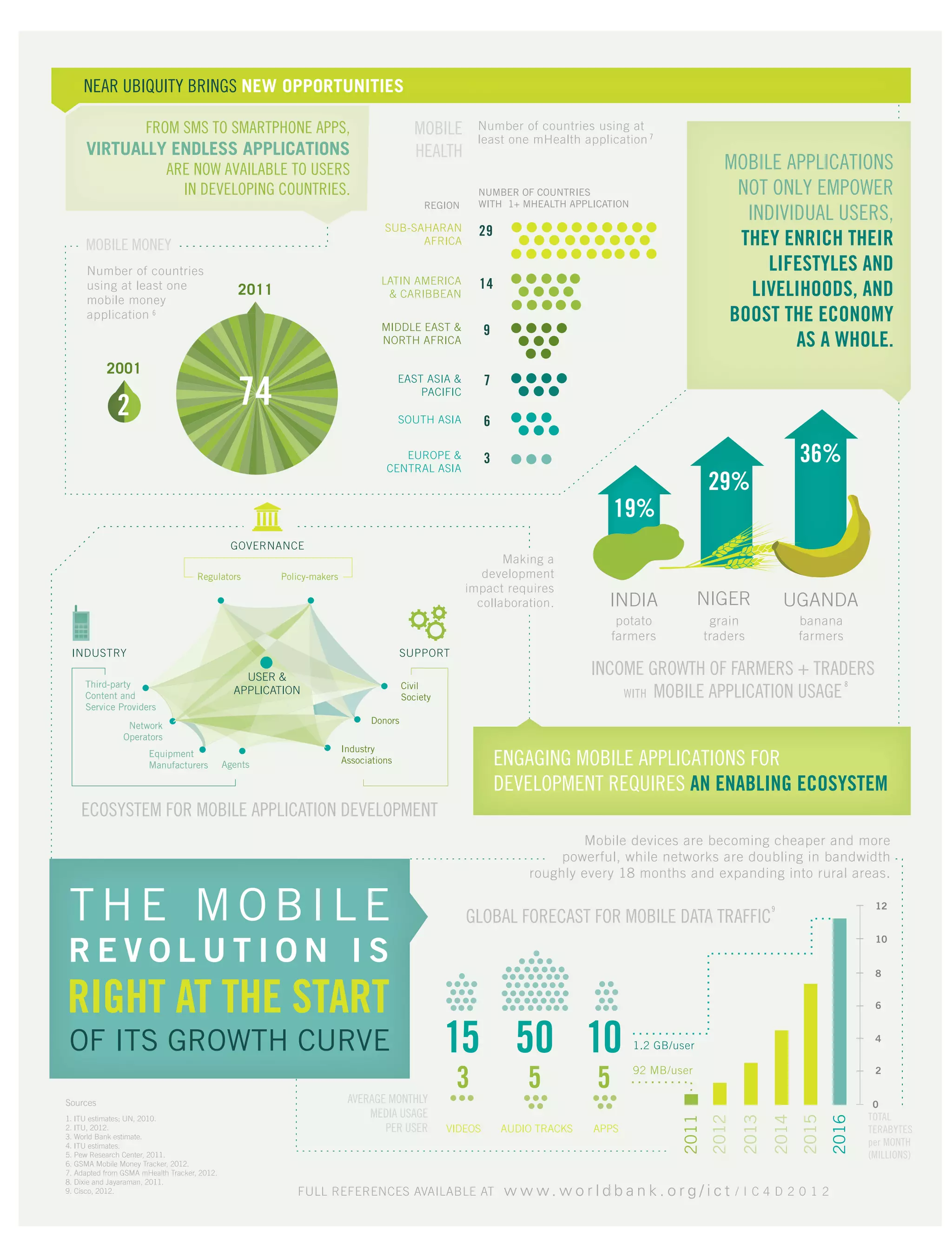
Appendixes
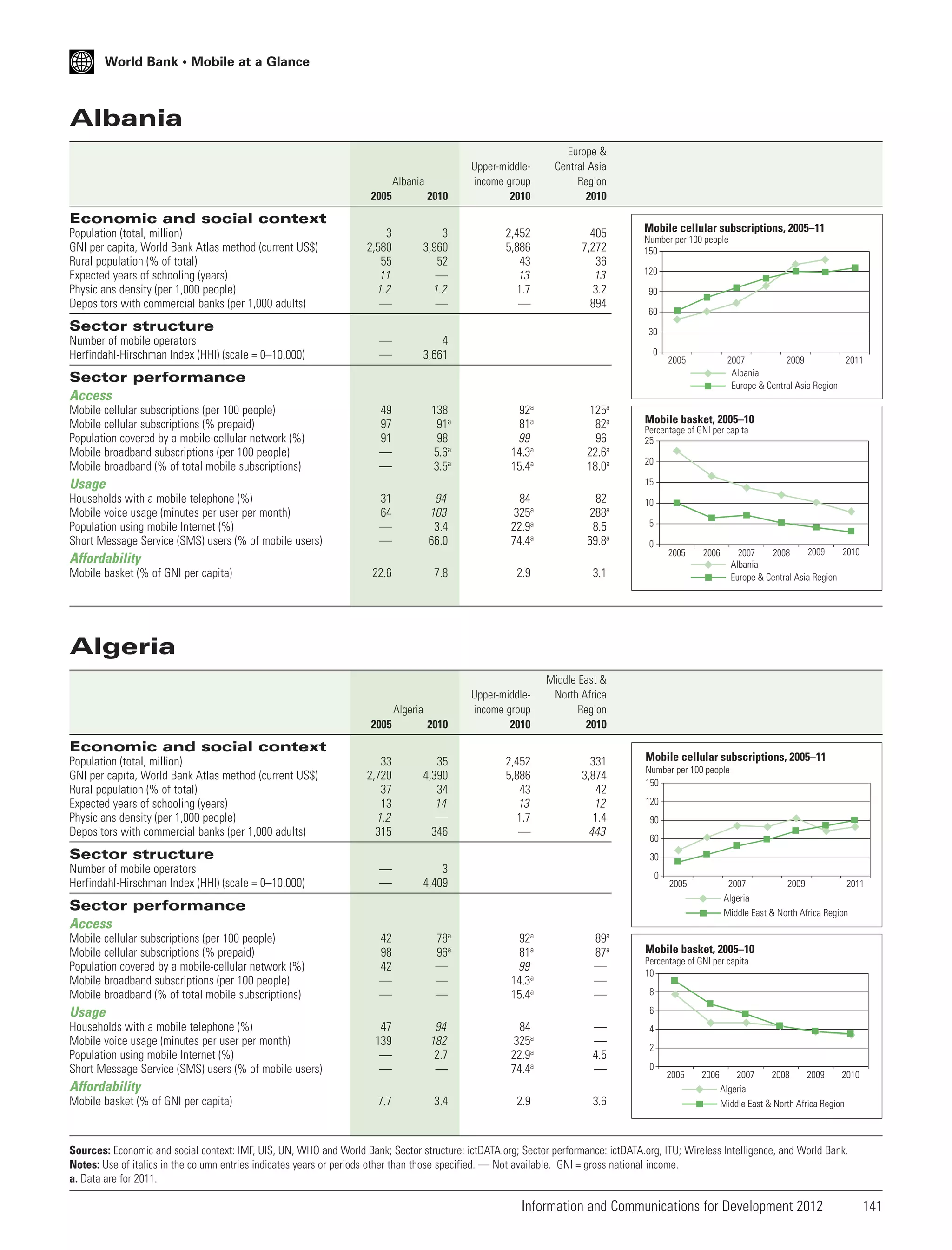
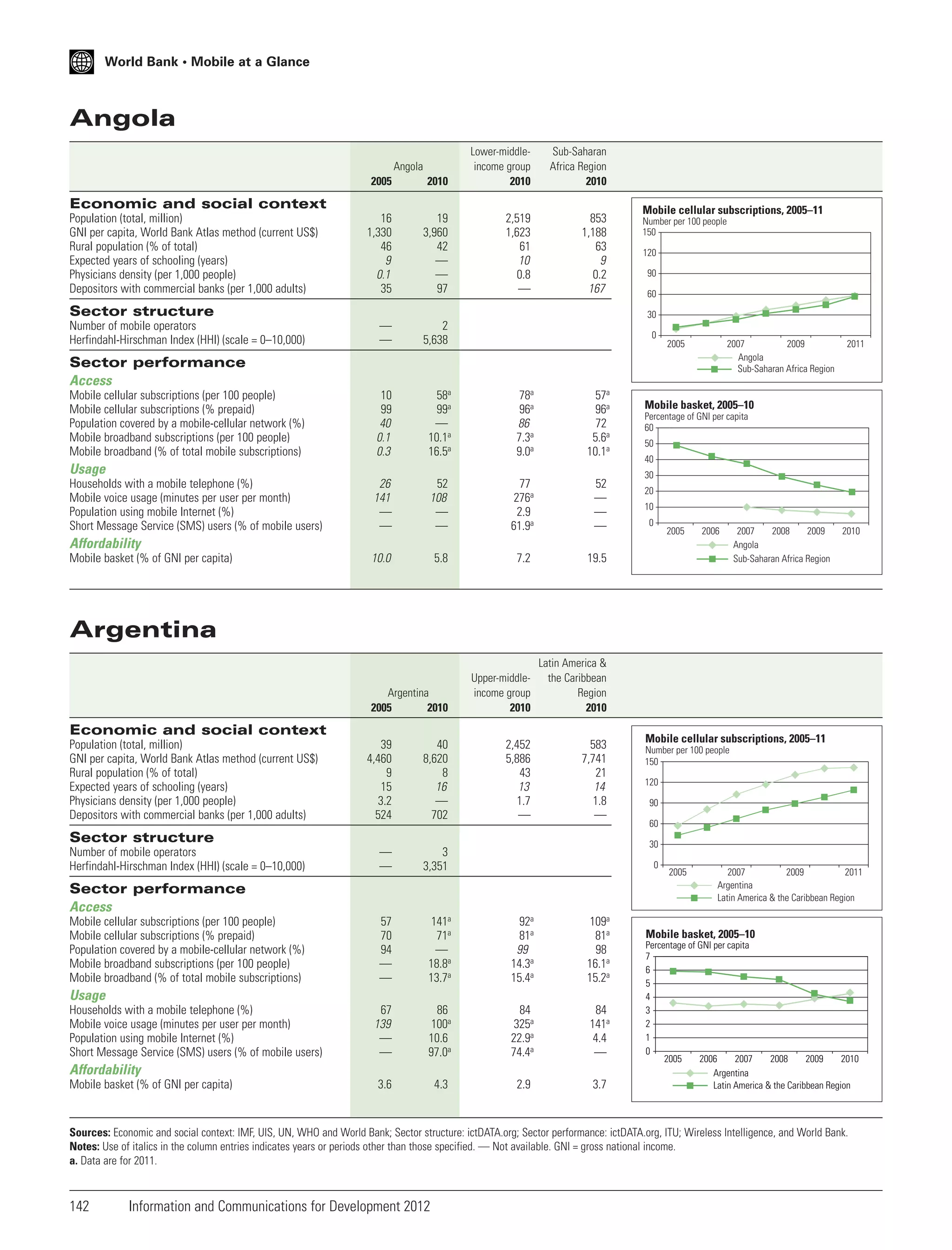
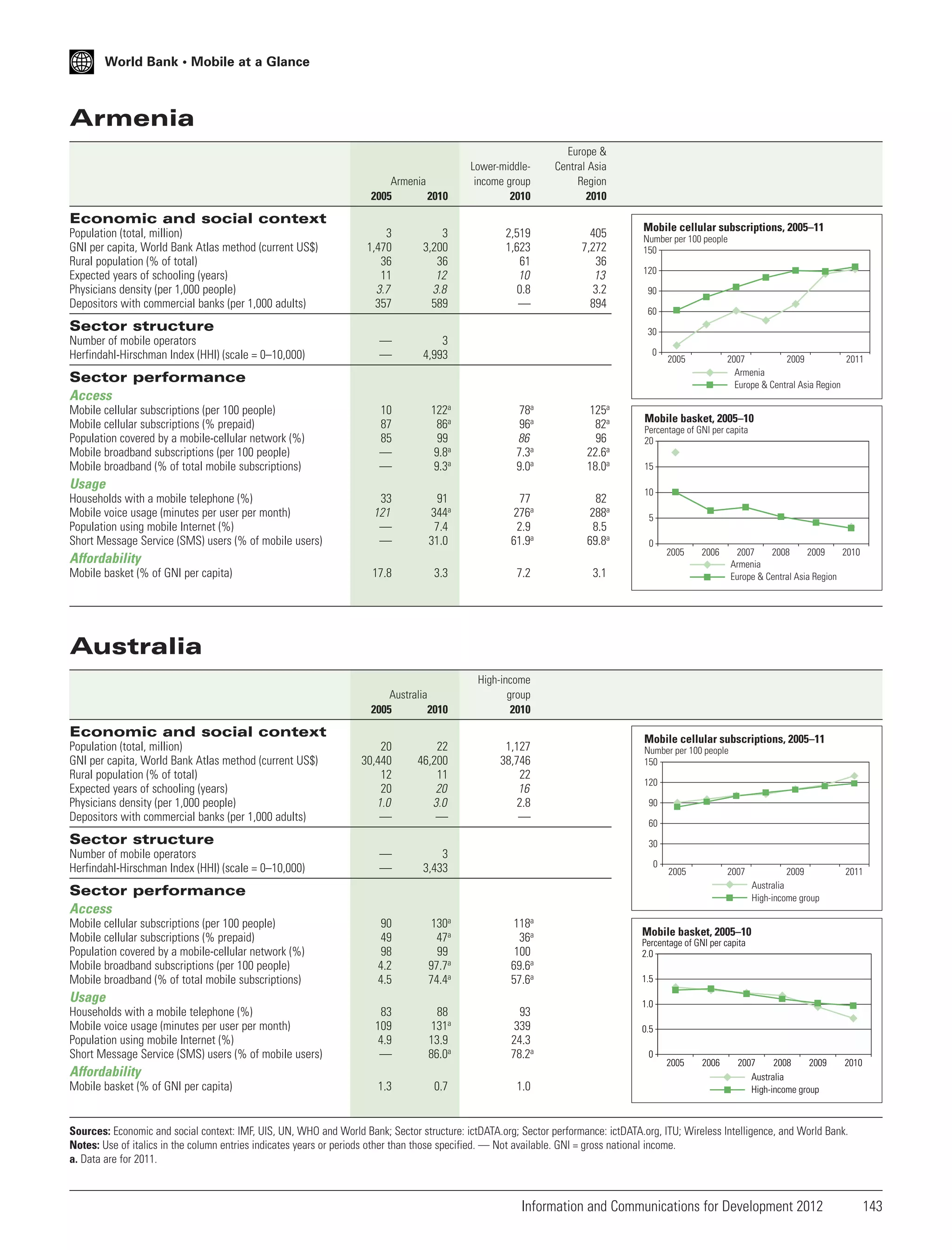
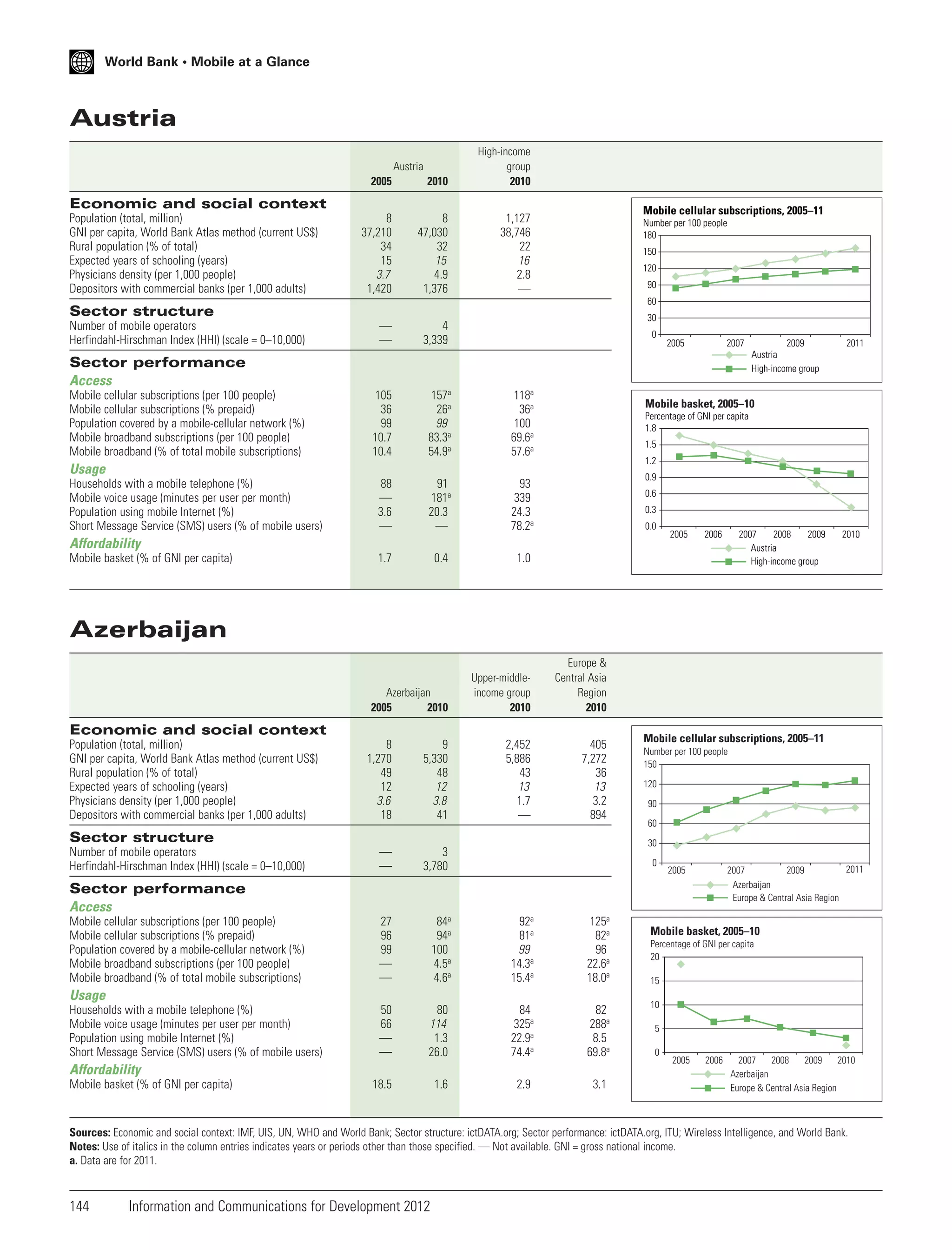
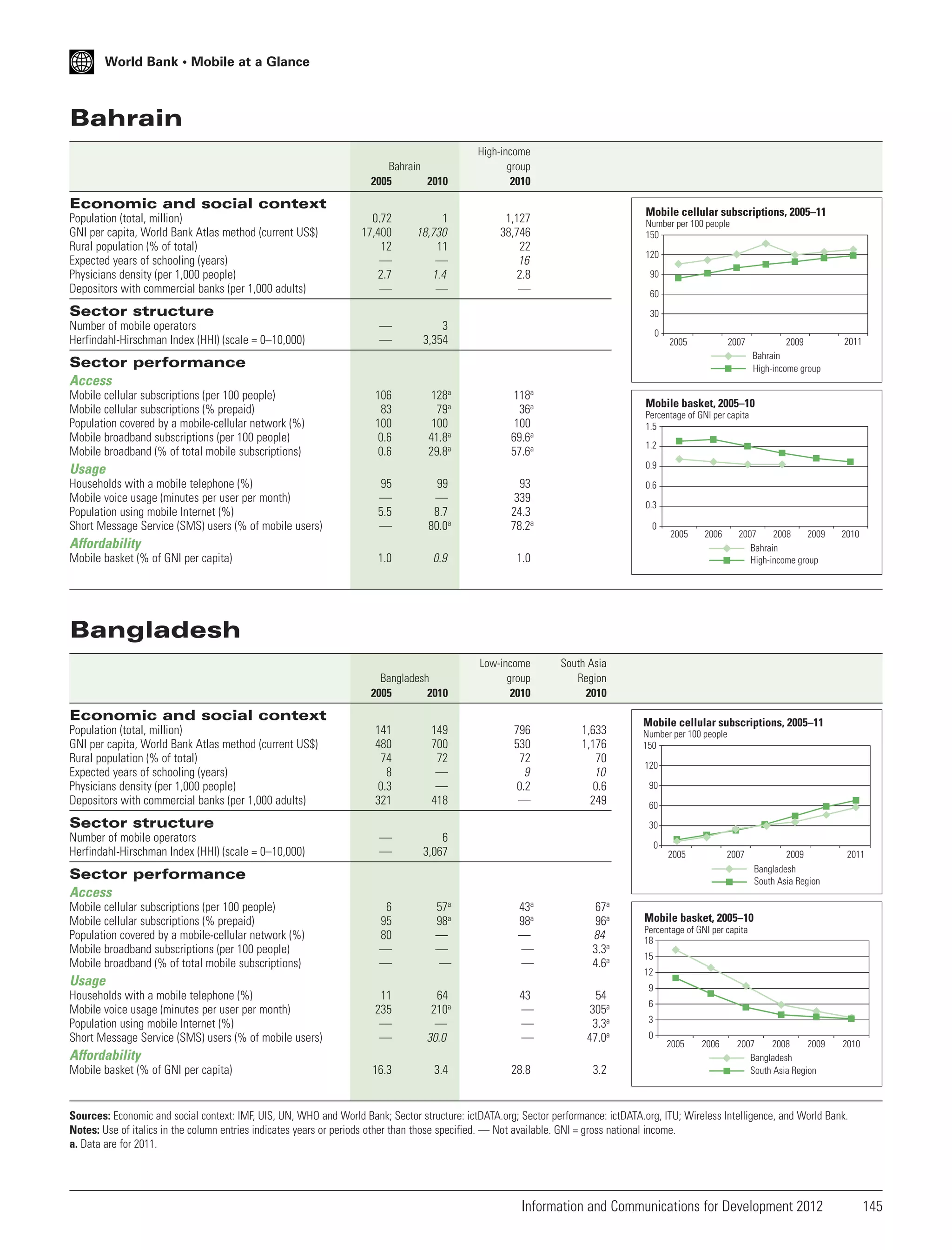
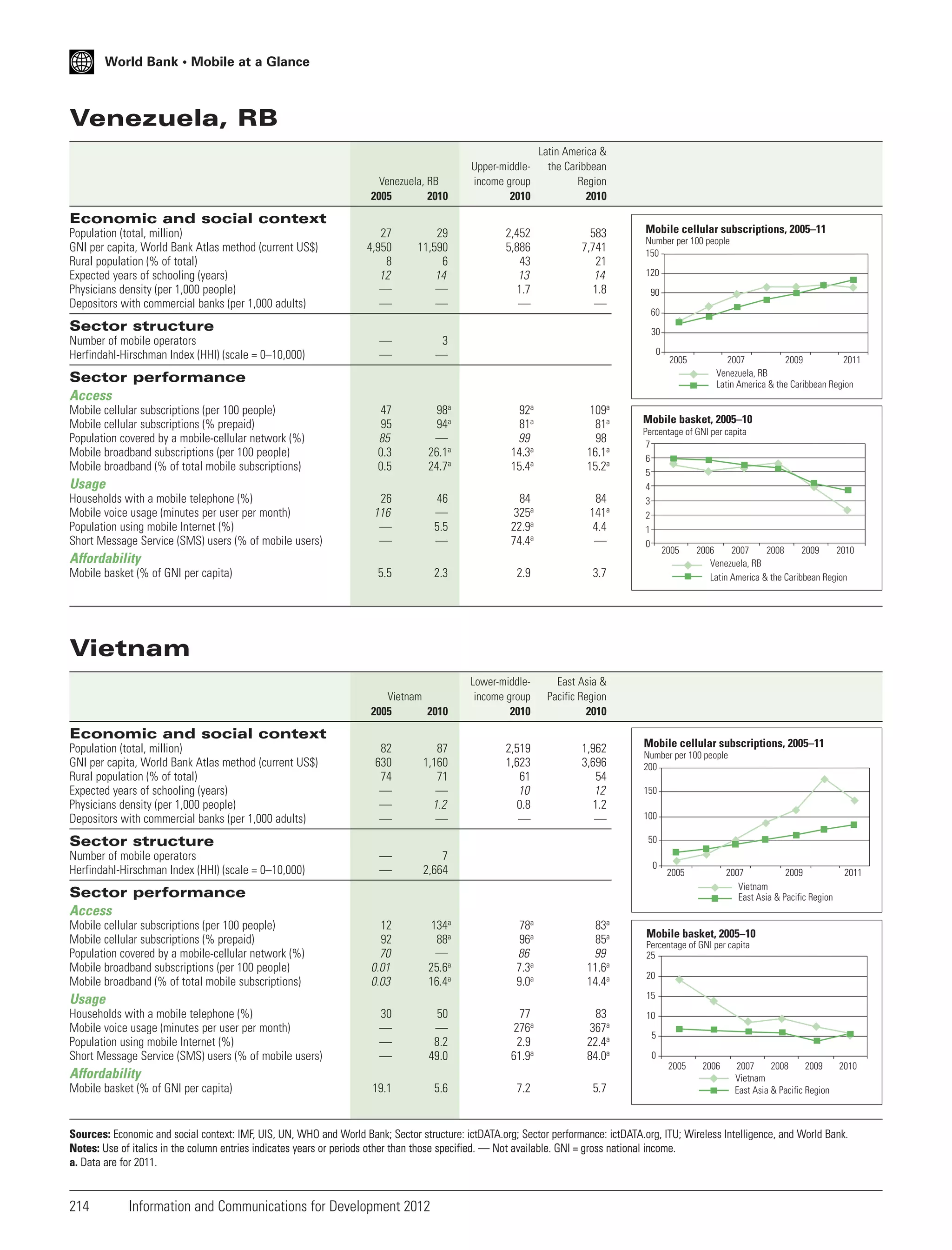
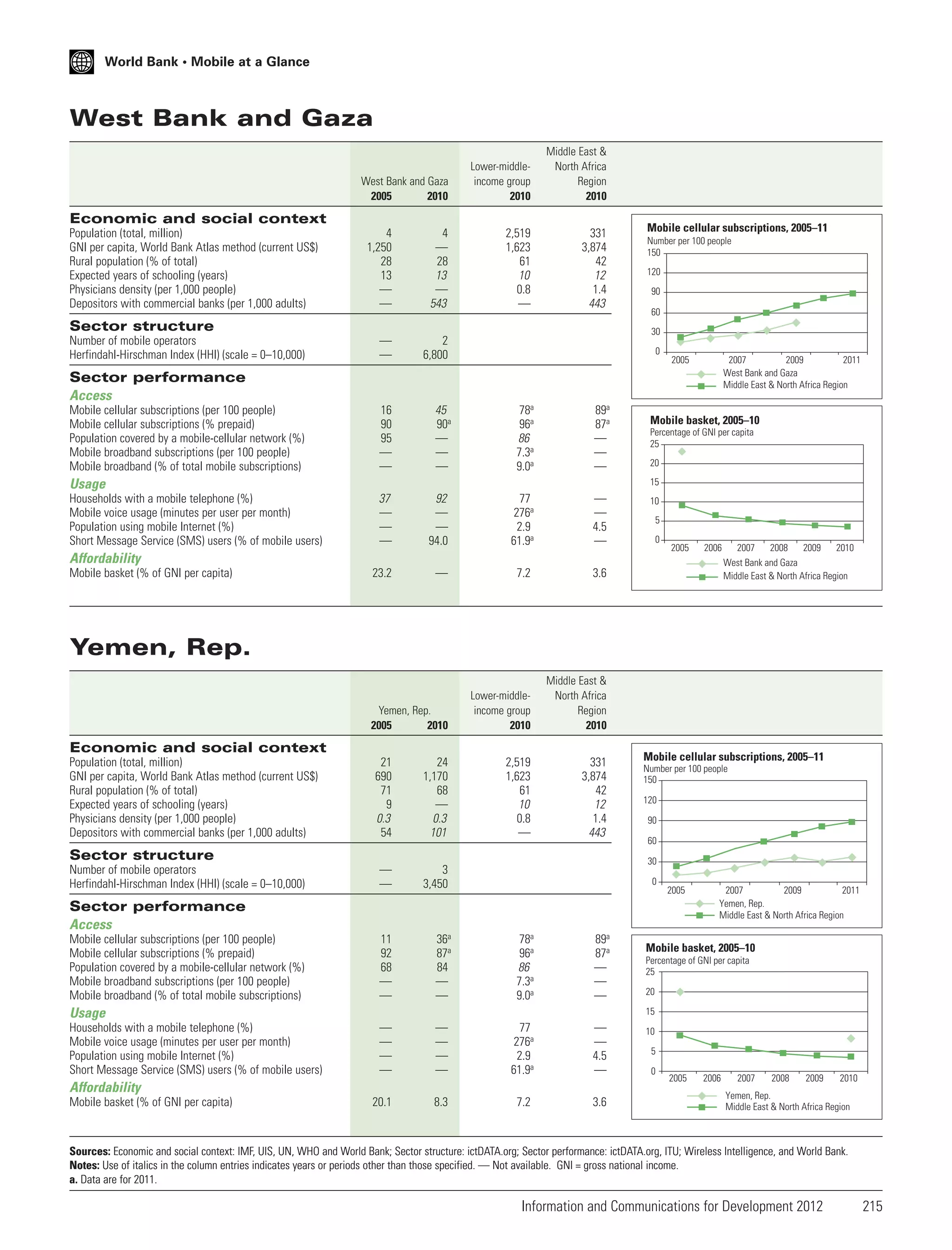
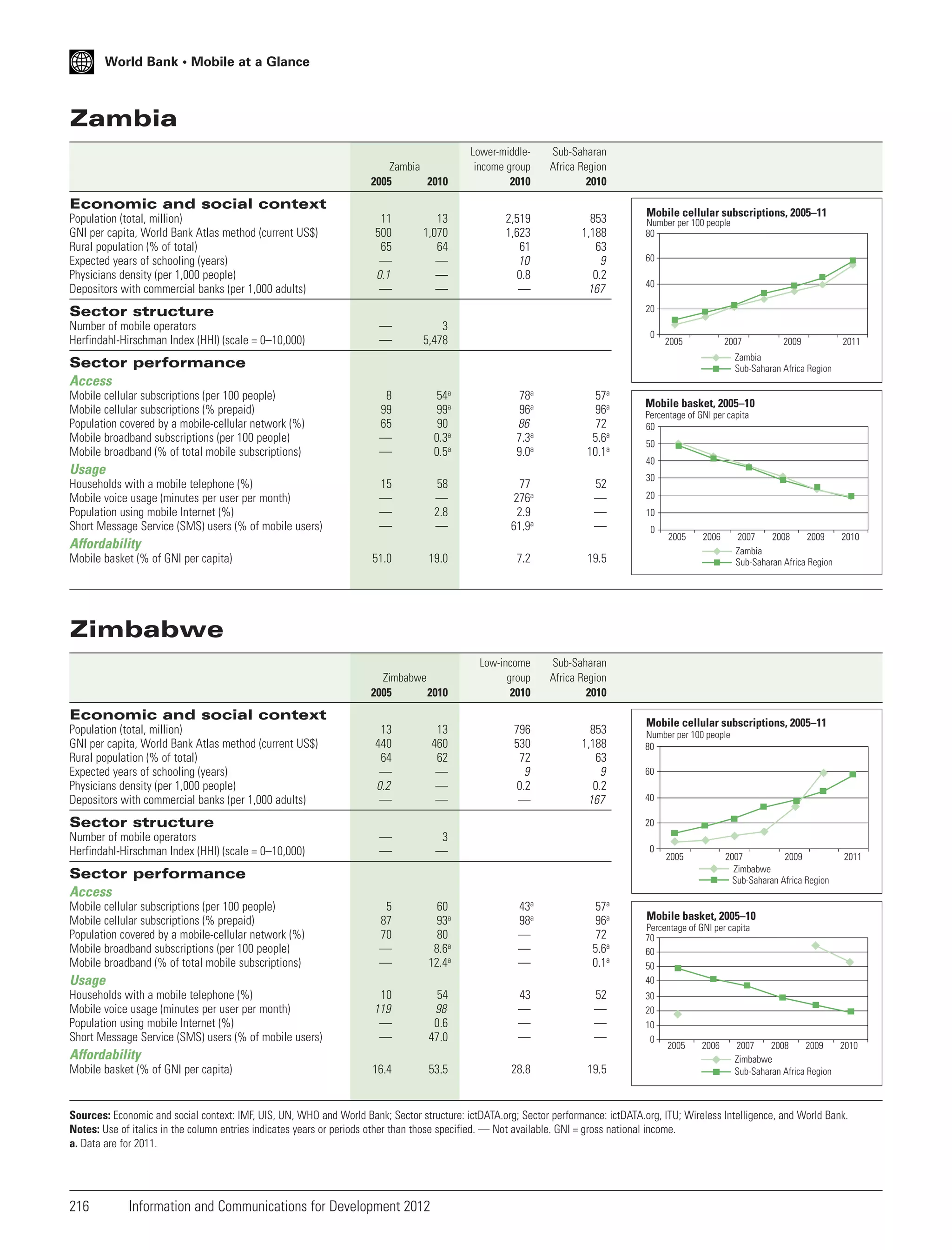
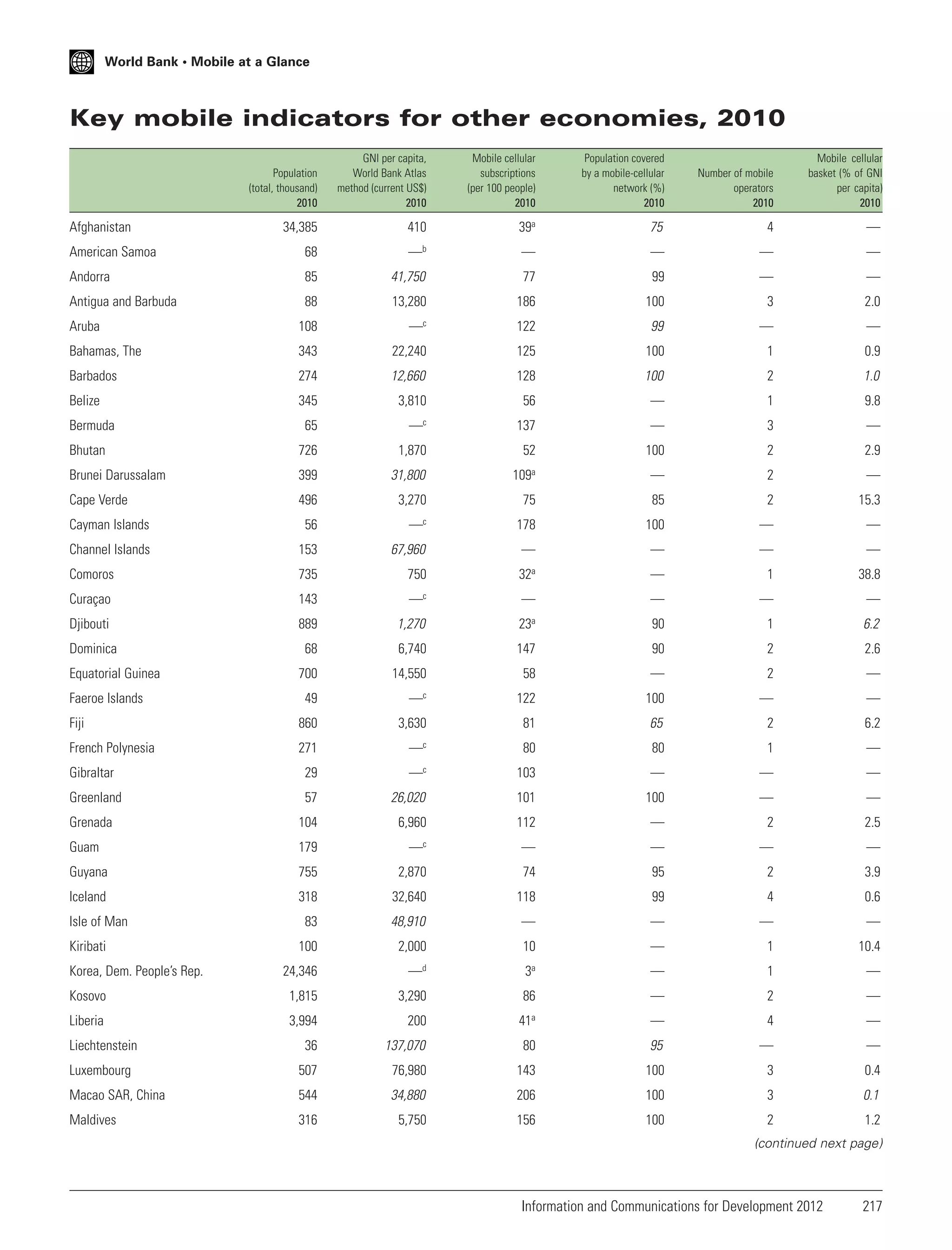
The Country Tables in the appendix to this report provide
comparative data for some 152 economies with populations
of more than 1 million and summary data for others, with
at-a-glance tables focusing on the mobile sector. The report
is complemented by the World Bank’s annual Little Data
Book on Information and Communication Technology, which
presents a wider range of ICT data.
The Statistical Appendix reviews the main trends shaping
the sector and introduces a new analytical tool for tracking
the progress of economies at different levels of economic
development in widening access, improving supply, and
stimulating demand for mobile services.

Executive Summary

7
Chapter 1

Overview

Michael Minges

obile communication has arguably had a
bigger impact on humankind in a shorter
period of time than any other invention in
human history. As noted by Jeffrey Sachs (2008), who
directed the United Nations Millennium Project: “Mobile
phones and wireless internet end isolation, and will therefore prove to be the most transformative technology of
economic development of our time.”
The mobile phone has evolved from a simple voice device
to a multimedia communications tool capable of downloading and uploading text, data, audio, and video—from text
messages to social network updates to breaking news, the
latest hit song, or the latest viral video. A mobile handset can
be used as a wallet, a compass, or a television, as well as an
alarm clock, calculator, address book, newspaper, and camera.
Mobiles are also contributing to social, economic, and
political transformation. Farmers in Africa obtain pricing
information via text messages, saving time and travel and
making them better informed about where to sell their products, thereby raising their incomes (World Bank 2011a, 353).
In India barbers who do not have a bank account can use
mobiles to send money to relatives in villages, saving costs
and increasing security (Adler and Uppal 2008, 25). Elections are monitored and unpopular regimes toppled with
the help of mobile phones (Brisson and Krontiris 2012, 75).
Texting and tweeting have become part of the vocabulary
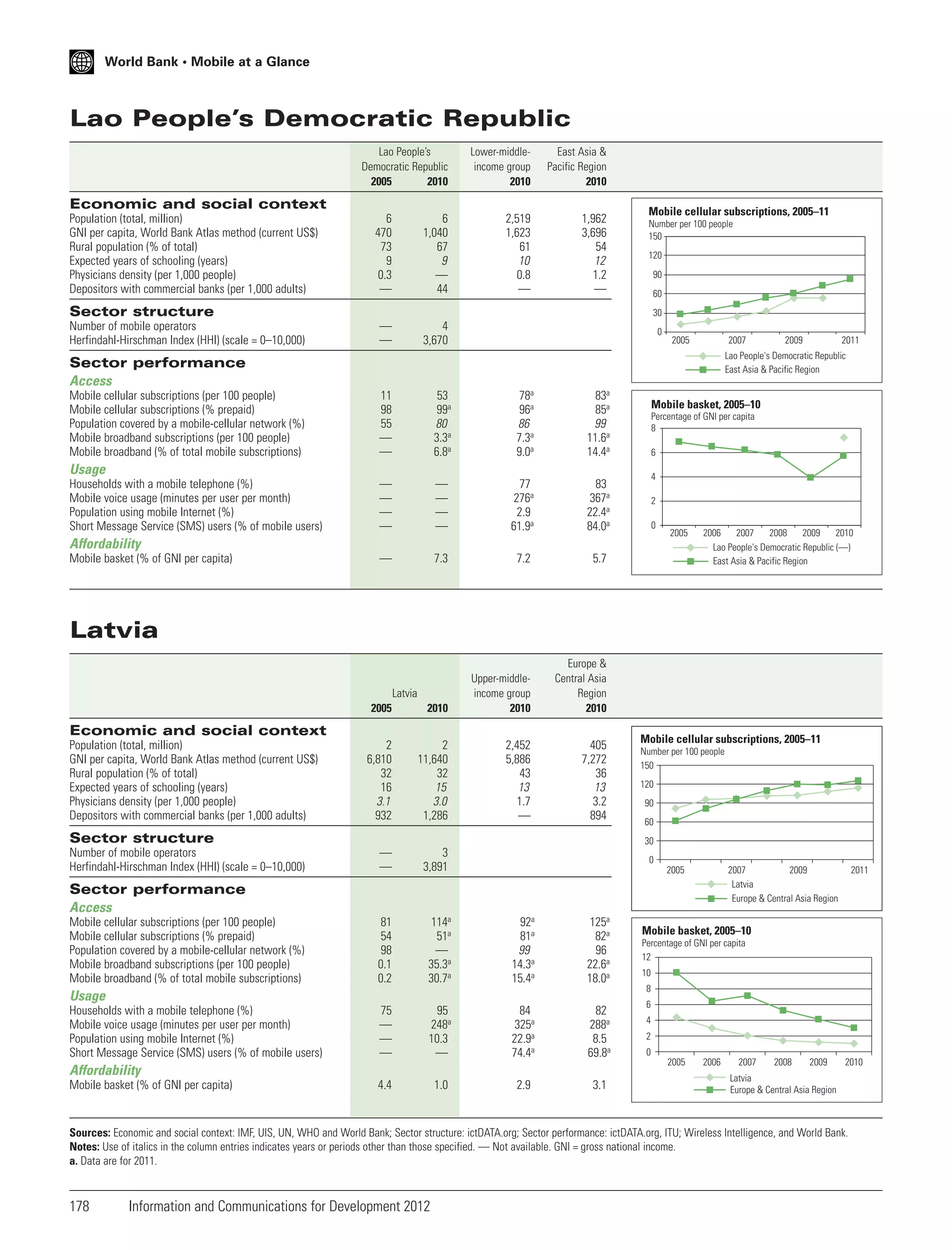
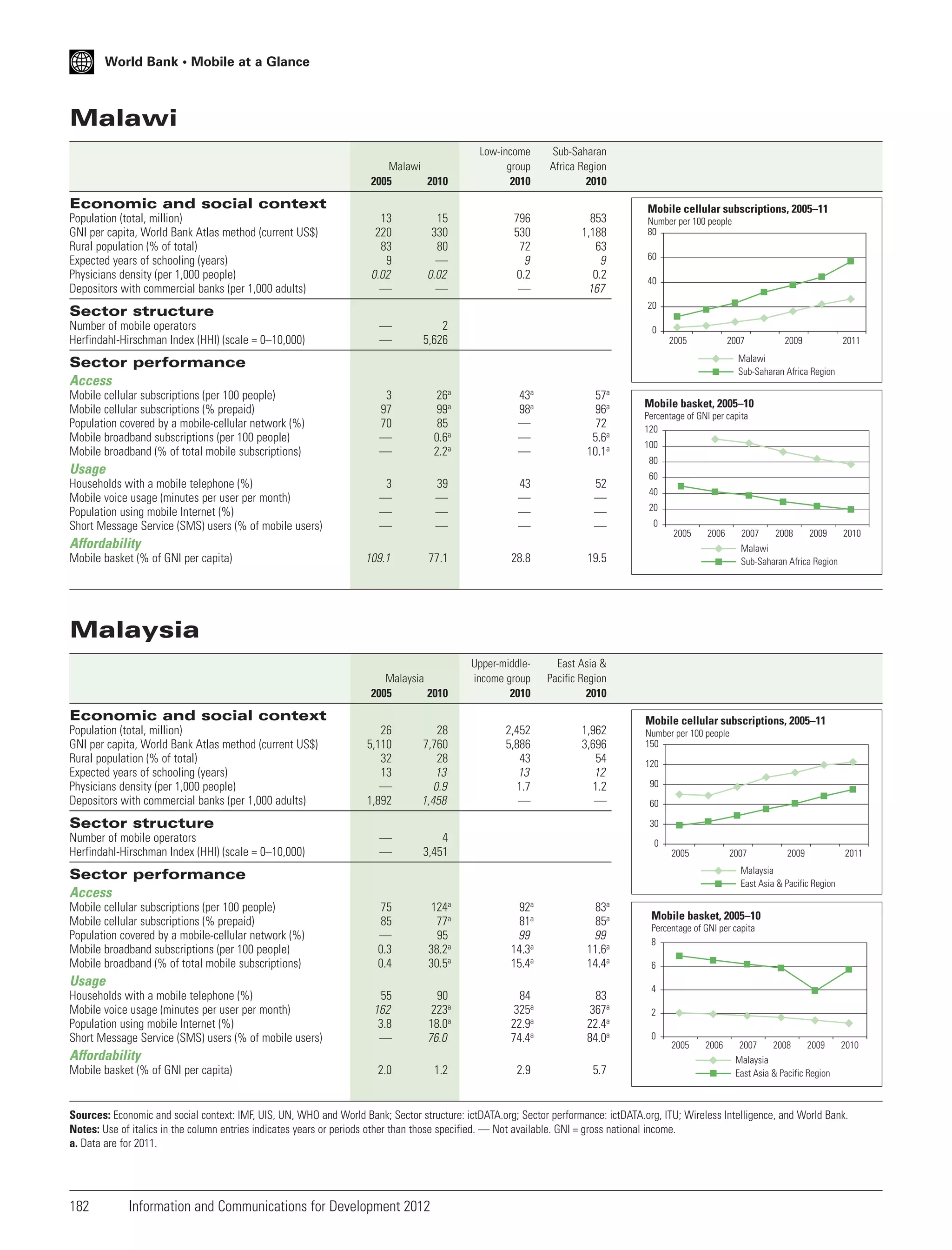
(Glotz, Bertschi, and Locke 2005, 199).

M

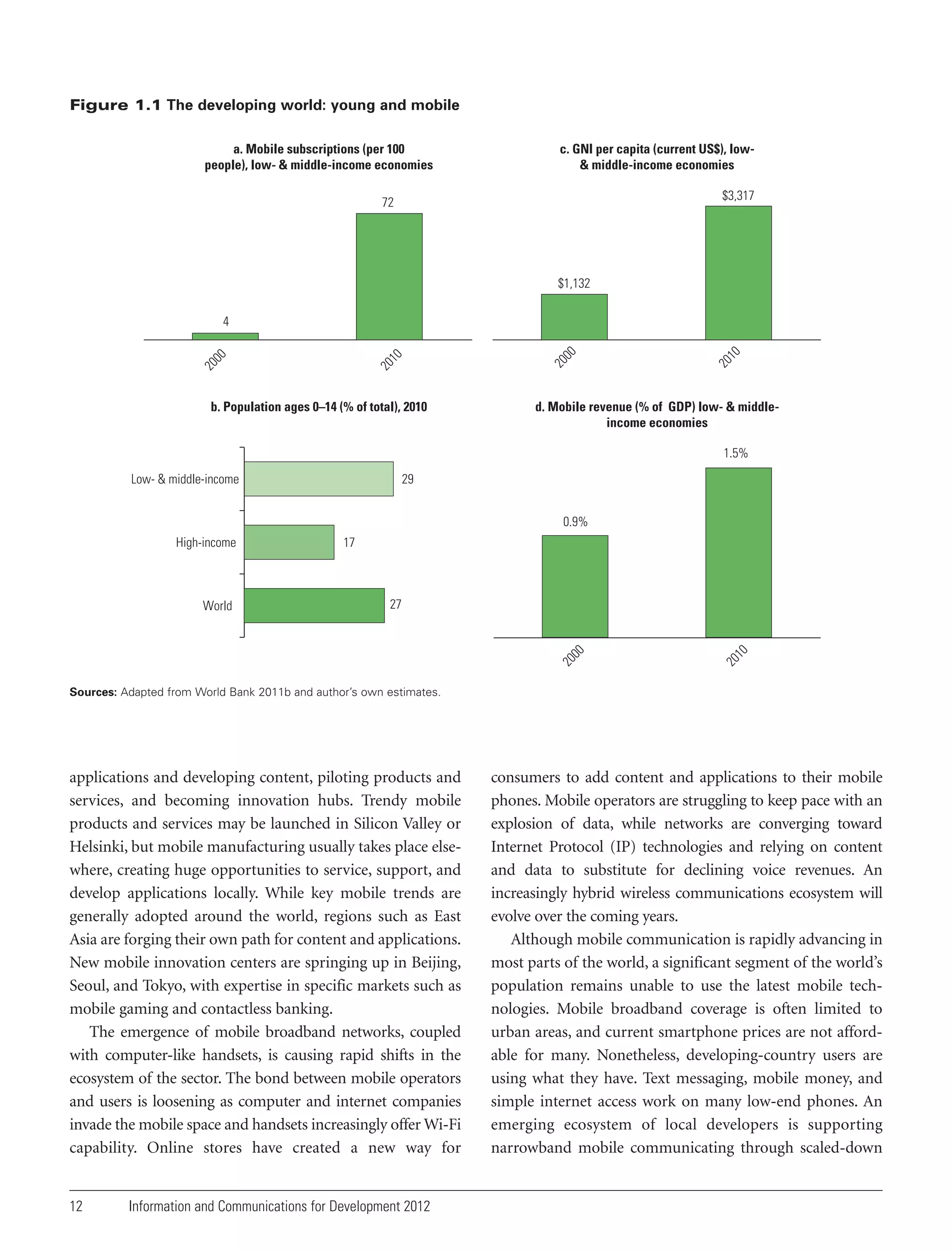
Developing countries are increasingly well situated to
exploit the benefits of mobile communications. First and
foremost, levels of access are high and rising. The number of
mobile subscriptions in low- and middle-income countries
increased by more than 1,500 percent between 2000 and
2010, from 4 to 72 per 100 inhabitants (figure 1.1a). Second,
the age profile of developing nations is younger than in
developed countries, an important advantage in the mobile
world where new trends are first taken up by youth.1 Those
under age 15 make up 29 percent of the population in lowand middle-income economies but just 17 percent in highincome nations (figure 1.1b). Third, developing countries
are growing richer, so more consumers can afford to use
mobile handsets for more than just essential voice calls.
Between 2000 and 2010 incomes in low- and middle-income
nations tripled (figure 1.1c). Fourth, the mobile sector has
become a significant economic force in developing
economies. Mobile revenues as a proportion of gross
national income (GNI) rose from 0.9 percent in 2000 to
1.5 percent in 2010 (figure 1.1d).
These changes are creating unprecedented opportunities
for employment, education, and empowerment in developing countries. Local content portals are springing up to
satisfy the hunger for news and other information that
previously had been difficult to access. The nature of the
mobile industry itself is changing dramatically, opening new
opportunities for developing nations in designing mobile

11
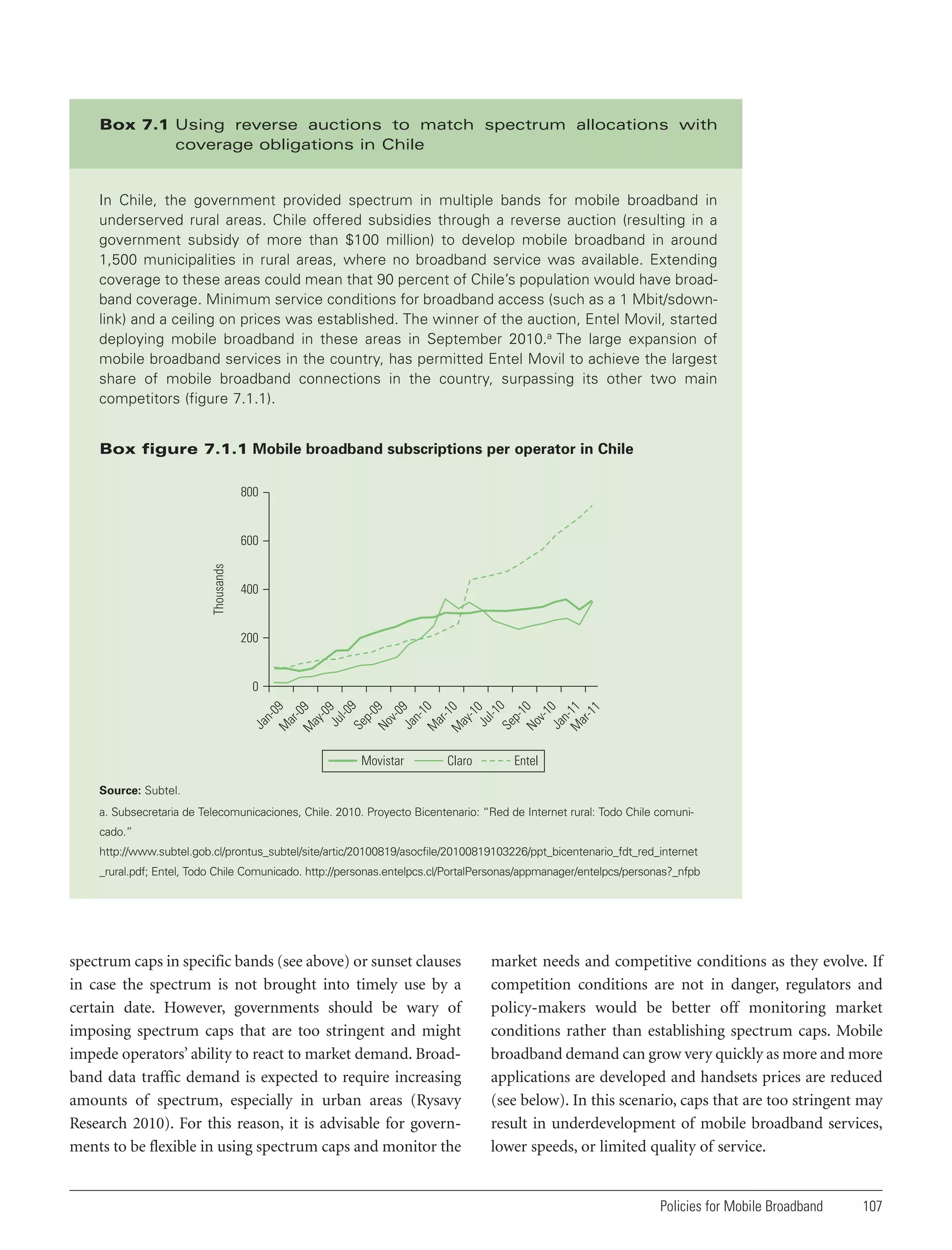
Figure 1.1 The developing world: young and mobile
a. Mobile subscriptions (per 100
people), low- & middle-income economies

c. GNI per capita (current US$), low& middle-income economies
$3,317

72

$1,132

b. Population ages 0–14 (% of total), 2010

20
10

20
00

20
10

20
00

4

d. Mobile revenue (% of GDP) low- & middleincome economies
1.5%

Low- & middle-income

29

0.9%

20

10

27

00

World

17

20

High-income

Sources: Adapted from World Bank 2011b and author’s own estimates.

applications and developing content, piloting products and
services, and becoming innovation hubs. Trendy mobile
products and services may be launched in Silicon Valley or
Helsinki, but mobile manufacturing usually takes place elsewhere, creating huge opportunities to service, support, and
develop applications locally. While key mobile trends are
generally adopted around the world, regions such as East
Asia are forging their own path for content and applications.
New mobile innovation centers are springing up in Beijing,
Seoul, and Tokyo, with expertise in specific markets such as
mobile gaming and contactless banking.
The emergence of mobile broadband networks, coupled
with computer-like handsets, is causing rapid shifts in the
ecosystem of the sector. The bond between mobile operators
and users is loosening as computer and internet companies
invade the mobile space and handsets increasingly offer Wi-Fi
capability. Online stores have created a new way for

12

Information and Communications for Development 2012

consumers to add content and applications to their mobile
phones. Mobile operators are struggling to keep pace with an
explosion of data, while networks are converging toward
Internet Protocol (IP) technologies and relying on content
and data to substitute for declining voice revenues. An
increasingly hybrid wireless communications ecosystem will
evolve over the coming years.
Although mobile communication is rapidly advancing in
most parts of the world, a significant segment of the world’s
population remains unable to use the latest mobile technologies. Mobile broadband coverage is often limited to
urban areas, and current smartphone prices are not affordable for many. Nonetheless, developing-country users are
using what they have. Text messaging, mobile money, and
simple internet access work on many low-end phones. An
emerging ecosystem of local developers is supporting
narrowband mobile communicating through scaled-down
web browsers, text messaging, social networking, and payas-you-go mobile data access. For many users, especially in
rural areas, these changes are happening where finding the
electricity to recharge a phone is more difficult than
purchasing prepaid airtime.
These developments have major implications for the state
of access to information and communication technologies
(ICTs) in the 21st century. Rich countries have the luxury of
both wired and wireless technology, of both personal
computers (PCs) and smartphones. Developing countries
tend to rely mainly on mobile networks, and phones already
vastly outnumber PCs. Applications have to be different to
work on small screens and virtual keyboards, while convergence is happening apace. The developed world is also now
becoming “more mobile,” with average screen size shrinking;
while the developing world is now becoming, “more
connected,” forging ahead with the shift from narrowband
to broadband networks on a mobile rather than a fixed platform. Demography is on the side of the developing world,
and the economies of scale gained from serving these
expanding markets may push the ICT industry as a whole in
the direction of a post-PC, untethered world.
One of the challenges facing a report of this nature is
that the industry is evolving so rapidly. What is written
today is often outdated tomorrow. In addition, given the
novelty of many developments and a lack of stable definitions and concepts, official data are scarce or fail to address
important market trends. Information from secondary
sources is often contradictory, inconsistent, or self-serving.
Information about mobile culture is particularly scarce in
developing countries. Nevertheless, certain trends are visible, and this opening chapter explores key trends shaping
and redefining our understanding of the word “mobile” as
an entrée to the review of different sectors in the chapters
that follow.

How mobile phones are used
Voice

With all the attention given to mobile broadband, smartphones, and mobile applications, it is sometimes easy to forget
that voice communication is still the most significant function
and the primary source of revenue for mobile operators.
Voice usage varies considerably both across and within
countries. For example, the average Chinese user talks on a
mobile phone more than seven times longer per month than

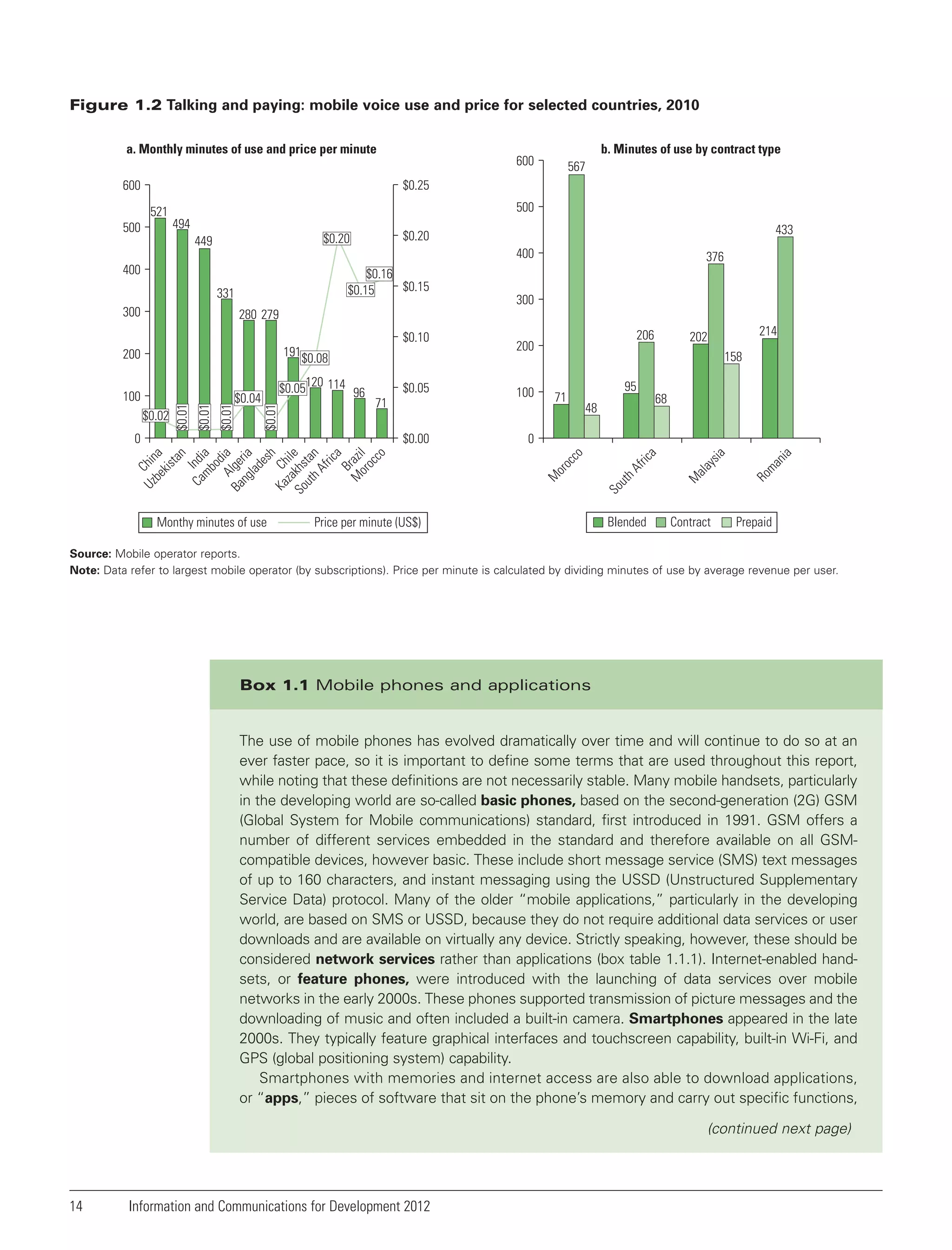
the average Moroccan (figure 1.2a). Price is a major factor in
calling patterns, with a clear relation between monthly
minutes of use and the price per minute. Interconnection
fees between operators are a main determinant of price. In
some countries these wholesale rates do not reflect underlying costs that drive up the price of mobile calls. A second
factor relates to whether the subscriptions are paid in
advance (prepaid) or paid on the basis of a contract (postpaid). Prepaid subscriptions are much more popular in
developing economies, where incomes may be less stable,
but postpaid contracts tend to generate higher usage per
subscriber (figure 1.2b).
As with fixed networks, a growing proportion of traffic
from mobile devices is moving to Voice over Internet Protocol (VoIP), often routed over Wi-Fi rather than the cellular
network, thereby avoiding per-minute usage charges.
According to CISCO, a major supplier of IP networking
equipment, mobile VoIP traffic is forecast to grow
42 percent between 2010 and 2015.2 Although mobile VoIP
accounts for a tiny share of total mobile data traffic, its
value impact on mobile operators is much greater. Skype, a
leading VoIP provider, has reported over 19 million downloads of its iPhone application since its launch in 2009. In
addition to voice and video, Skype processed 84 million
SMS text messages during the first half of 2010.3 One study
forecasts 288 million mobile VoIP users by 2013 (van
Buskirk 2010).
Not just for voice anymore

Although voice is still the main revenue generator, its growth
has slowed (TeleGeography 2012) as data and text-based
applications have grown in popularity, their use made possible by advances in cell phone technology (box 1.1). Mobile
applications are the main theme of this book. For many
people, a mobile phone is one of the most used and useful
appliances they own. Built-in features are indispensable to
many for checking the time, setting an alarm, taking photos,
performing calculations, and a variety of other daily tasks.
Downloadable applications can extend functionalities.
A number of nonvoice applications use wireless networks
on a one-off basis (to download, for example); other applications (such as incoming email notifications) are always on.
Stand-alone features mean that users do not necessarily need
to use a mobile network. For example, downloading of
content or applications can be carried out from a PC and
then transferred to a mobile phone, or such tasks can be

Overview

13
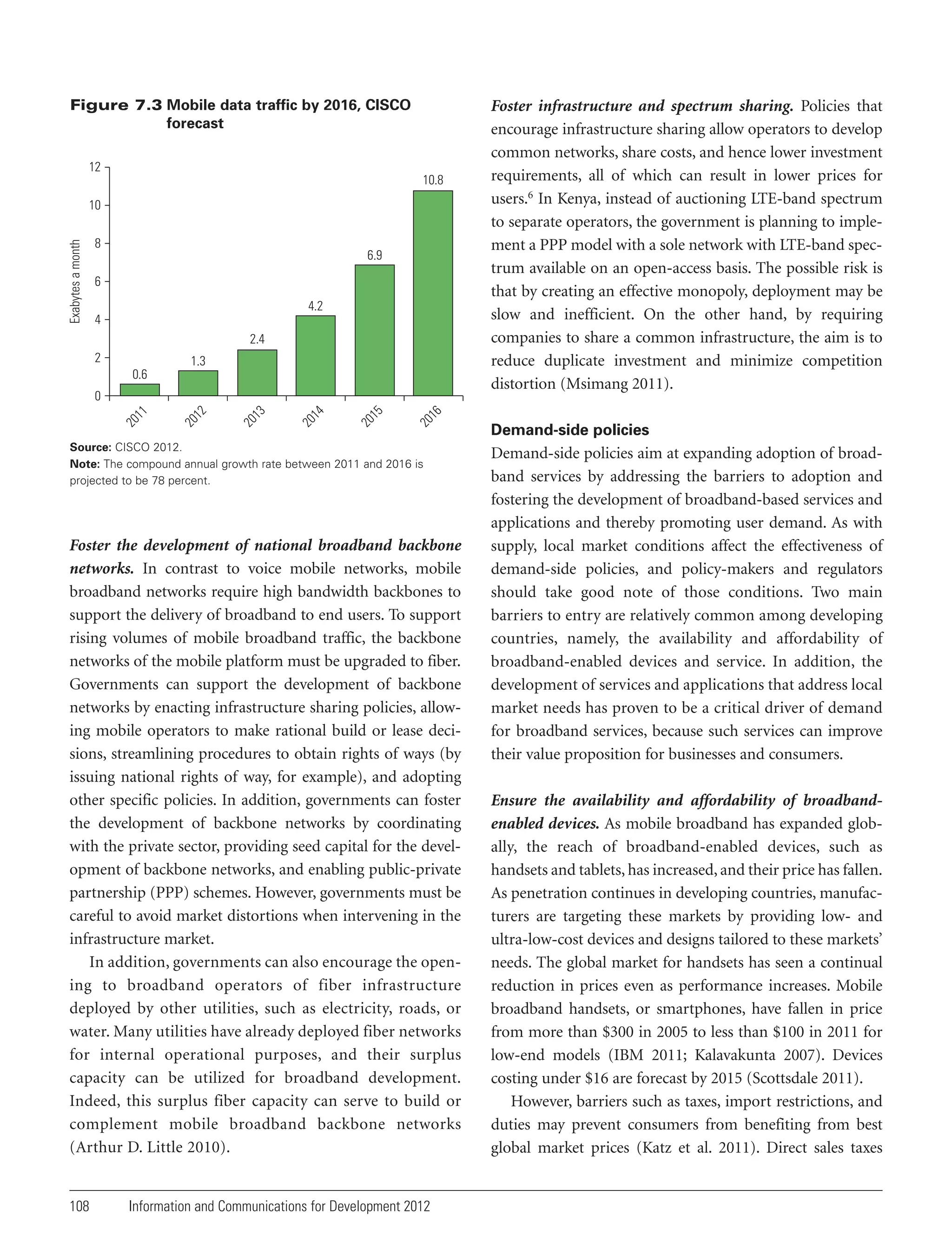
Figure 1.2 Talking and paying: mobile voice use and price for selected countries, 2010
a. Monthly minutes of use and price per minute

b. Minutes of use by contract type

600

567

$0.25

600
521
500

500
494

433

$0.20

$0.20

449

400

400

$0.16
$0.15
$0.15

331
300

376

300

280 279

95

68

48

nia

Prepaid

ma

Contract

M

Ro

ys

ca

Blended

hA

ala

Price per minute (US$)

ia

0
fri

Monthy minutes of use

71

ut

$0.00

Uz Chin
be a
kis
ta
n
Ca Indi
mb a
od
A ia
Ba lge
ng ria
lad
es
h
Ka Ch
za ile
kh
So s
ut tan
hA
fri
ca
Br
M azi
or l
oc
co

0

100

So

$0.05
71

co

$0.05120 114 96

oc

$0.04

$0.01

$0.01

$0.01

$0.02

$0.01

100

214

202
158

or

200

206

200

M

$0.10
191 $0.08

Source: Mobile operator reports.
Note: Data refer to largest mobile operator (by subscriptions). Price per minute is calculated by dividing minutes of use by average revenue per user.

Box 1.1 Mobile phones and applications

The use of mobile phones has evolved dramatically over time and will continue to do so at an
ever faster pace, so it is important to define some terms that are used throughout this report,
while noting that these definitions are not necessarily stable. Many mobile handsets, particularly
in the developing world are so-called basic phones, based on the second-generation (2G) GSM
(Global System for Mobile communications) standard, first introduced in 1991. GSM offers a
number of different services embedded in the standard and therefore available on all GSMcompatible devices, however basic. These include short message service (SMS) text messages
of up to 160 characters, and instant messaging using the USSD (Unstructured Supplementary
Service Data) protocol. Many of the older “mobile applications,” particularly in the developing
world, are based on SMS or USSD, because they do not require additional data services or user
downloads and are available on virtually any device. Strictly speaking, however, these should be
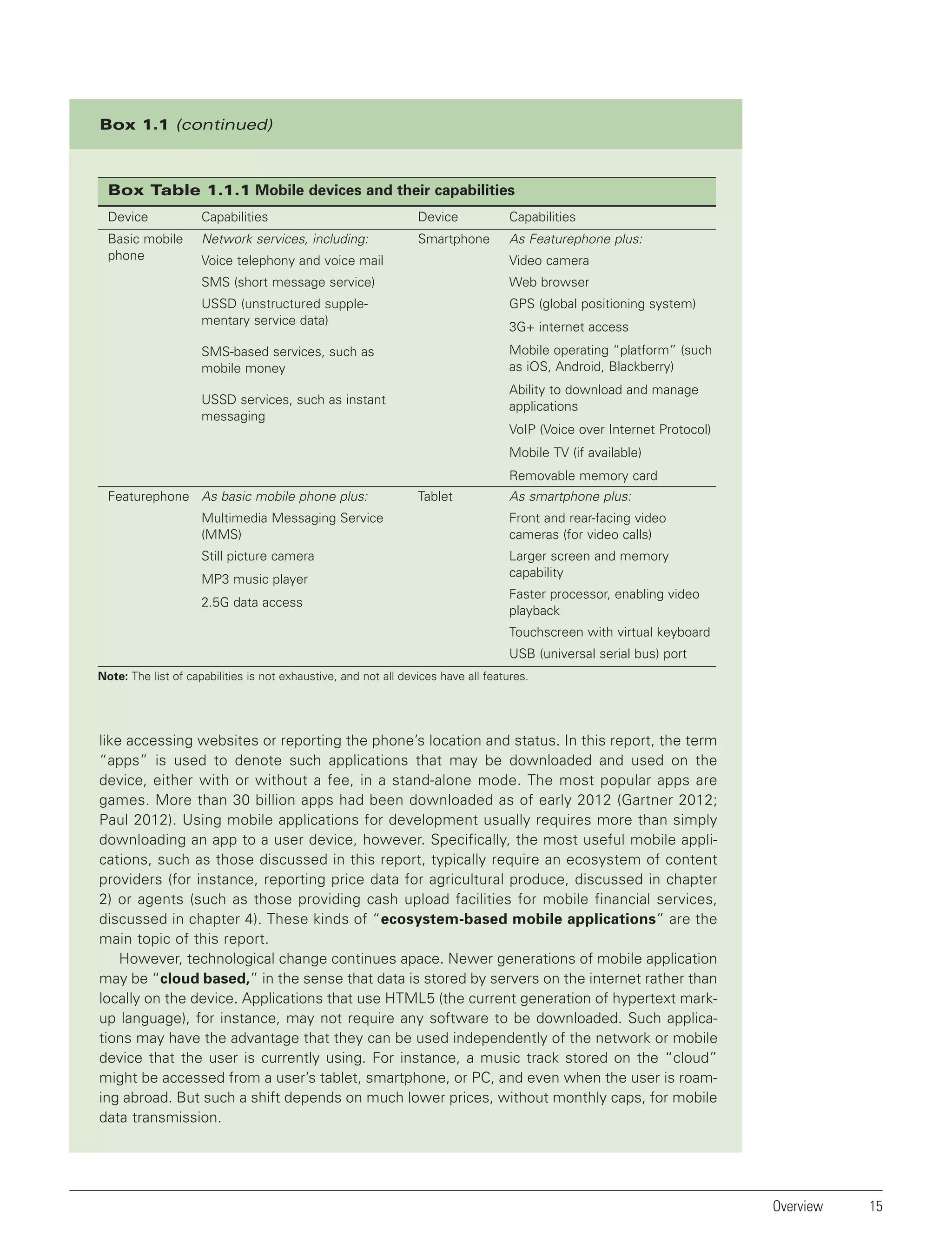
considered network services rather than applications (box table 1.1.1). Internet-enabled handsets, or feature phones, were introduced with the launching of data services over mobile
networks in the early 2000s. These phones supported transmission of picture messages and the
downloading of music and often included a built-in camera. Smartphones appeared in the late
2000s. They typically feature graphical interfaces and touchscreen capability, built-in Wi-Fi, and
GPS (global positioning system) capability.
Smartphones with memories and internet access are also able to download applications,
or “apps,” pieces of software that sit on the phone’s memory and carry out specific functions,

(continued next page)

14

Information and Communications for Development 2012
Box 1.1 (continued)

Box Table 1.1.1 Mobile devices and their capabilities
Device

Capabilities

Device

Capabilities

Basic mobile
phone

Network services, including:

Smartphone

As Featurephone plus:

Voice telephony and voice mail

Video camera

SMS (short message service)

Web browser

USSD (unstructured supplementary service data)

GPS (global positioning system)

SMS-based services, such as
mobile money

Mobile operating “platform” (such
as iOS, Android, Blackberry)

3G+ internet access

Ability to download and manage
applications

USSD services, such as instant
messaging

VoIP (Voice over Internet Protocol)
Mobile TV (if available)
Removable memory card
Featurephone As basic mobile phone plus:

Tablet

As smartphone plus:

Multimedia Messaging Service
(MMS)

Front and rear-facing video
cameras (for video calls)

Still picture camera

Larger screen and memory
capability

MP3 music player
2.5G data access

Faster processor, enabling video
playback
Touchscreen with virtual keyboard
USB (universal serial bus) port

Note: The list of capabilities is not exhaustive, and not all devices have all features.

like accessing websites or reporting the phone’s location and status. In this report, the term
“apps” is used to denote such applications that may be downloaded and used on the
device, either with or without a fee, in a stand-alone mode. The most popular apps are
games. More than 30 billion apps had been downloaded as of early 2012 (Gartner 2012;
Paul 2012). Using mobile applications for development usually requires more than simply
downloading an app to a user device, however. Specifically, the most useful mobile applications, such as those discussed in this report, typically require an ecosystem of content
providers (for instance, reporting price data for agricultural produce, discussed in chapter
2) or agents (such as those providing cash upload facilities for mobile financial services,
discussed in chapter 4). These kinds of “ecosystem-based mobile applications” are the
main topic of this report.
However, technological change continues apace. Newer generations of mobile application
may be “cloud based,” in the sense that data is stored by servers on the internet rather than
locally on the device. Applications that use HTML5 (the current generation of hypertext markup language), for instance, may not require any software to be downloaded. Such applications may have the advantage that they can be used independently of the network or mobile
device that the user is currently using. For instance, a music track stored on the “cloud”
might be accessed from a user’s tablet, smartphone, or PC, and even when the user is roaming abroad. But such a shift depends on much lower prices, without monthly caps, for mobile
data transmission.

Overview

15
carried out over Wi-Fi. Indeed, the “mobile” in “mobile
applications” refers as much to the type of device as the
manner of usage.
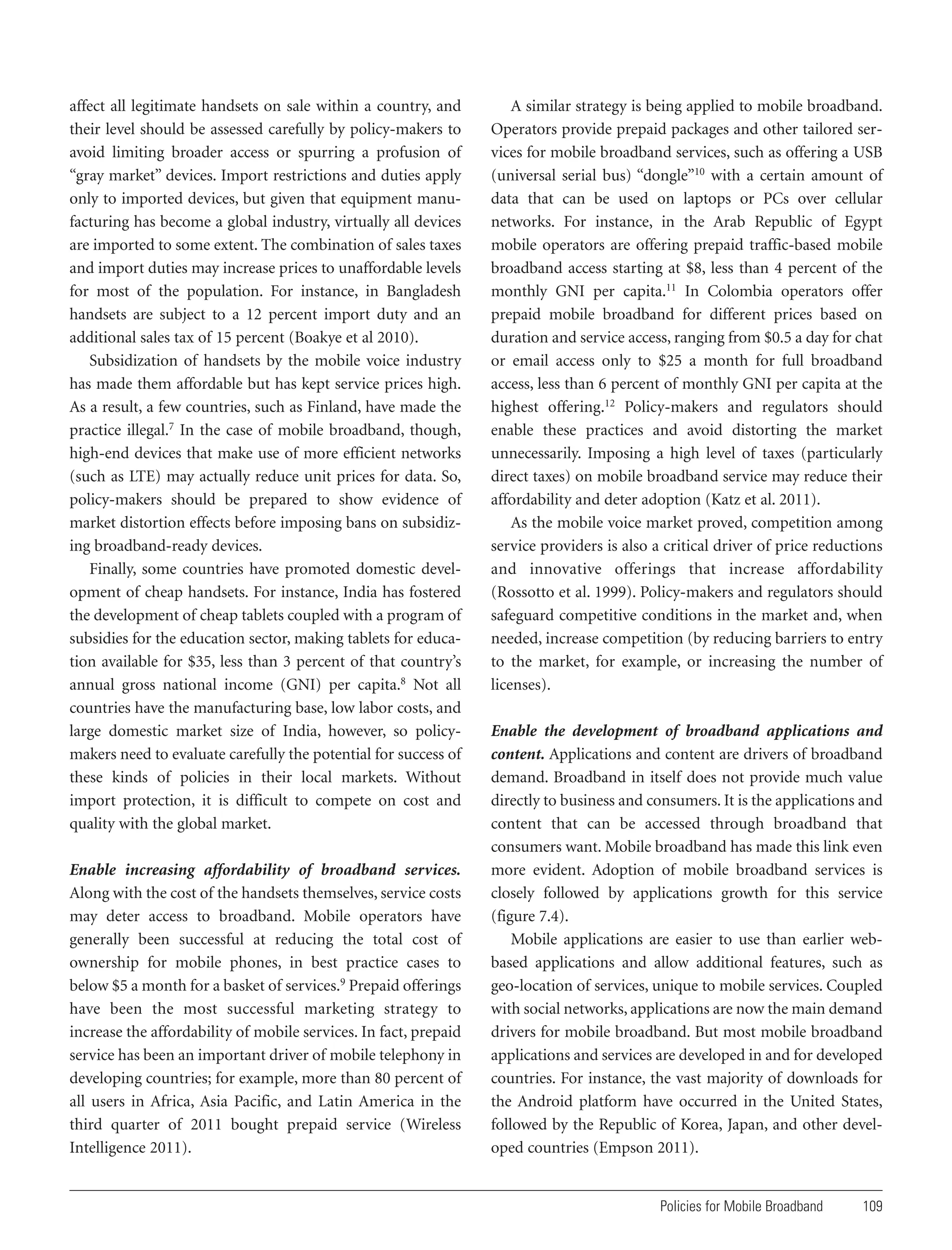
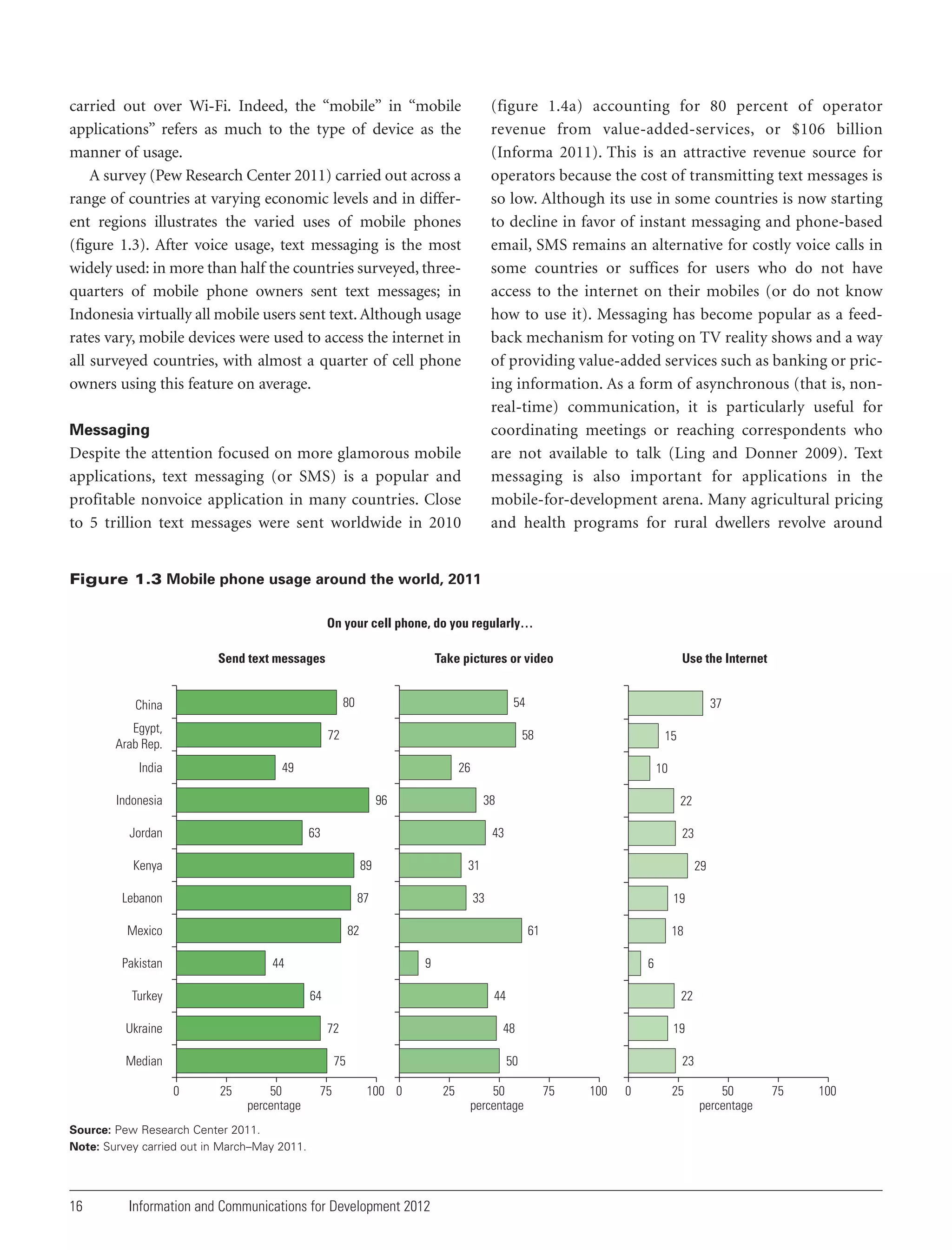
A survey (Pew Research Center 2011) carried out across a
range of countries at varying economic levels and in different regions illustrates the varied uses of mobile phones
(figure 1.3). After voice usage, text messaging is the most
widely used: in more than half the countries surveyed, threequarters of mobile phone owners sent text messages; in
Indonesia virtually all mobile users sent text. Although usage
rates vary, mobile devices were used to access the internet in
all surveyed countries, with almost a quarter of cell phone
owners using this feature on average.

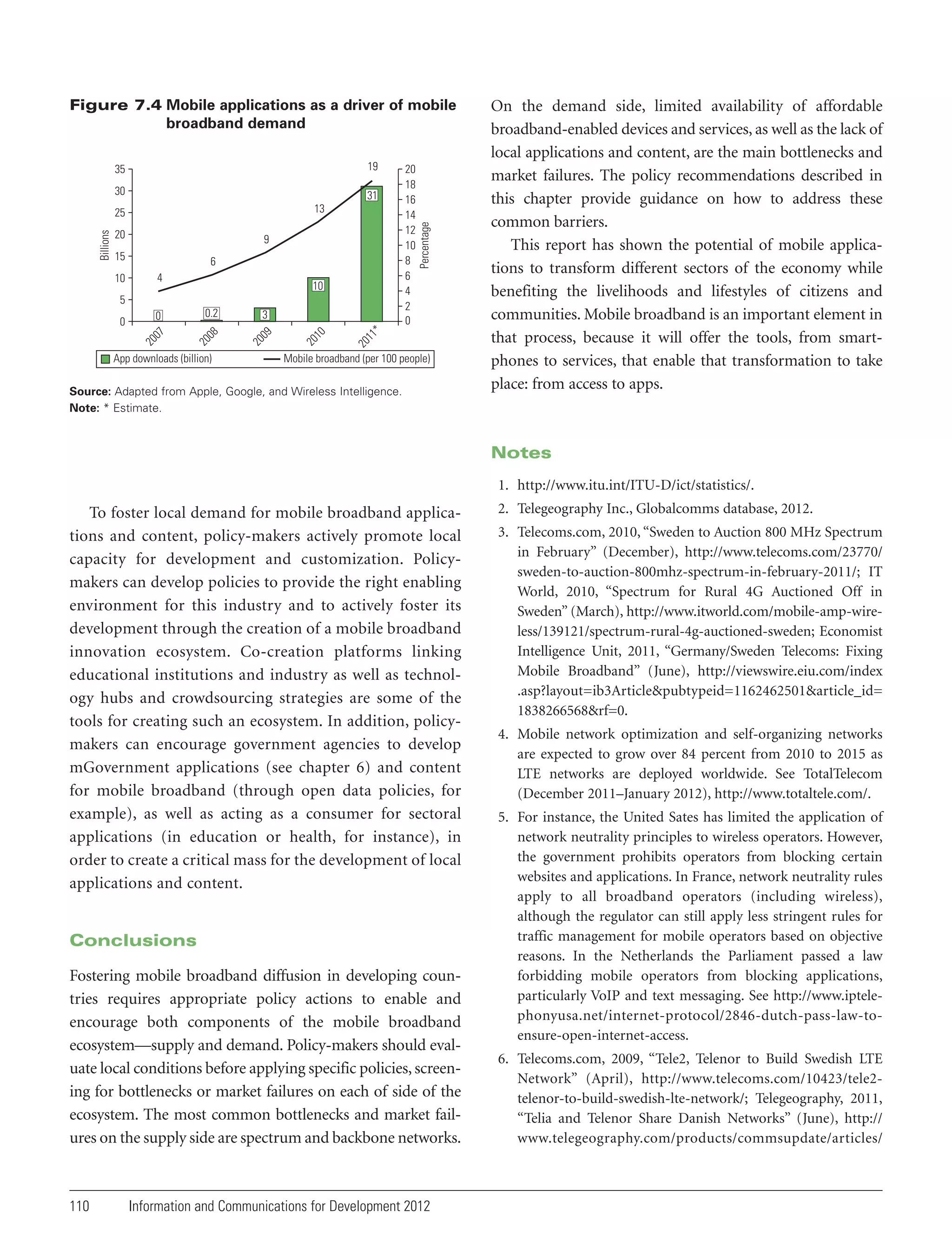
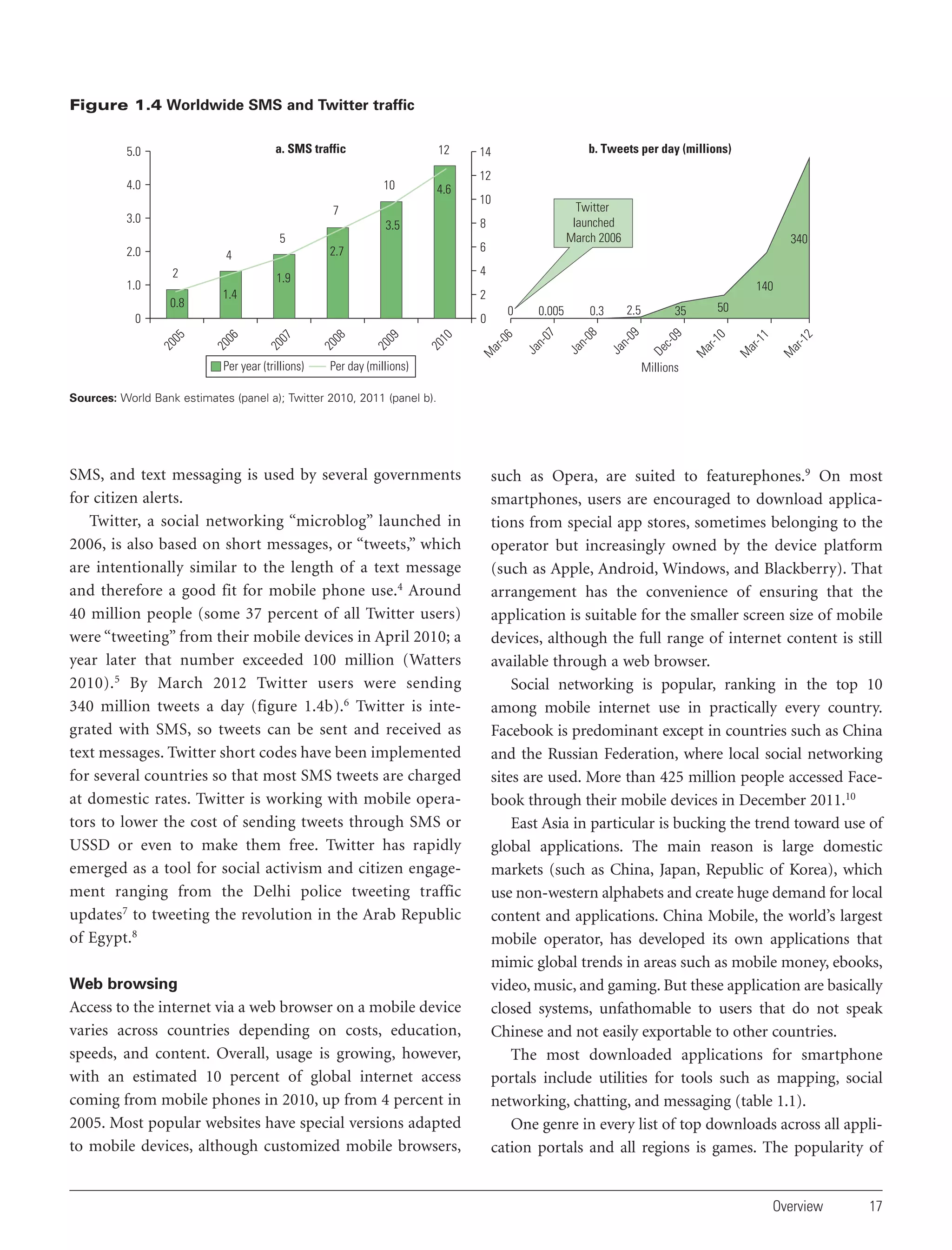
(figure 1.4a) accounting for 80 percent of operator
revenue from value-added-services, or $106 billion
(Informa 2011). This is an attractive revenue source for
operators because the cost of transmitting text messages is
so low. Although its use in some countries is now starting
to decline in favor of instant messaging and phone-based
email, SMS remains an alternative for costly voice calls in
some countries or suffices for users who do not have
access to the internet on their mobiles (or do not know
how to use it). Messaging has become popular as a feedback mechanism for voting on TV reality shows and a way
of providing value-added services such as banking or pricing information. As a form of asynchronous (that is, nonreal-time) communication, it is particularly useful for
coordinating meetings or reaching correspondents who
are not available to talk (Ling and Donner 2009). Text
messaging is also important for applications in the
mobile-for-development arena. Many agricultural pricing
and health programs for rural dwellers revolve around

Messaging

Despite the attention focused on more glamorous mobile
applications, text messaging (or SMS) is a popular and
profitable nonvoice application in many countries. Close
to 5 trillion text messages were sent worldwide in 2010

Figure 1.3 Mobile phone usage around the world, 2011
On your cell phone, do you regularly…
Send text messages

Take pictures or video
80

China
Egypt,
Arab Rep.

54

72

India

38

63

22

43

Kenya

89

Lebanon

87

Mexico

23

31

29

33

19

82

61

44

6
44

72

Median
25

50
percentage

75

22

48

75
0

18

9
64

Ukraine

19

50
100 0

Source: Pew Research Center 2011.
Note: Survey carried out in March–May 2011.

16

10

96

Turkey

15

26

Indonesia

Pakistan

37

58

49

Jordan

Use the Internet

Information and Communications for Development 2012

25

50
percentage

23
75

100

0

25

50
percentage

75

100
Figure 1.4 Worldwide SMS and Twitter traffic
a. SMS traffic

4.0

12

12

10

4.6

7
5

1.4

140

2

Per day (millions)

2.5

35

50

ar
-1
1

0.3

M

ar
-0
6
M

20
10

20
09

20
08

20
07

20
06

20
05

Per year (trillions)

0.005

M
ar
-1
0

0

0

De
c-0
9

0

Ja
n09

0.8

340

4

1.9

Ja
n08

2
1.0

6

2.7

4

Twitter
launched
March 2006

8

3.5

2.0

10

M
ar
-1
2

3.0

b. Tweets per day (millions)

14

Ja
n07

5.0

Millions

Sources: World Bank estimates (panel a); Twitter 2010, 2011 (panel b).

SMS, and text messaging is used by several governments
for citizen alerts.
Twitter, a social networking “microblog” launched in
2006, is also based on short messages, or “tweets,” which
are intentionally similar to the length of a text message
and therefore a good fit for mobile phone use.4 Around
40 million people (some 37 percent of all Twitter users)
were “tweeting” from their mobile devices in April 2010; a
year later that number exceeded 100 million (Watters
2010). 5 By March 2012 Twitter users were sending
340 million tweets a day (figure 1.4b).6 Twitter is integrated with SMS, so tweets can be sent and received as
text messages. Twitter short codes have been implemented
for several countries so that most SMS tweets are charged
at domestic rates. Twitter is working with mobile operators to lower the cost of sending tweets through SMS or
USSD or even to make them free. Twitter has rapidly
emerged as a tool for social activism and citizen engagement ranging from the Delhi police tweeting traffic
updates7 to tweeting the revolution in the Arab Republic
of Egypt.8
Web browsing

Access to the internet via a web browser on a mobile device
varies across countries depending on costs, education,
speeds, and content. Overall, usage is growing, however,
with an estimated 10 percent of global internet access
coming from mobile phones in 2010, up from 4 percent in
2005. Most popular websites have special versions adapted
to mobile devices, although customized mobile browsers,

such as Opera, are suited to featurephones.9 On most
smartphones, users are encouraged to download applications from special app stores, sometimes belonging to the
operator but increasingly owned by the device platform
(such as Apple, Android, Windows, and Blackberry). That
arrangement has the convenience of ensuring that the
application is suitable for the smaller screen size of mobile
devices, although the full range of internet content is still
available through a web browser.
Social networking is popular, ranking in the top 10
among mobile internet use in practically every country.
Facebook is predominant except in countries such as China
and the Russian Federation, where local social networking
sites are used. More than 425 million people accessed Facebook through their mobile devices in December 2011.10
East Asia in particular is bucking the trend toward use of
global applications. The main reason is large domestic
markets (such as China, Japan, Republic of Korea), which
use non-western alphabets and create huge demand for local
content and applications. China Mobile, the world’s largest
mobile operator, has developed its own applications that
mimic global trends in areas such as mobile money, ebooks,
video, music, and gaming. But these application are basically
closed systems, unfathomable to users that do not speak
Chinese and not easily exportable to other countries.
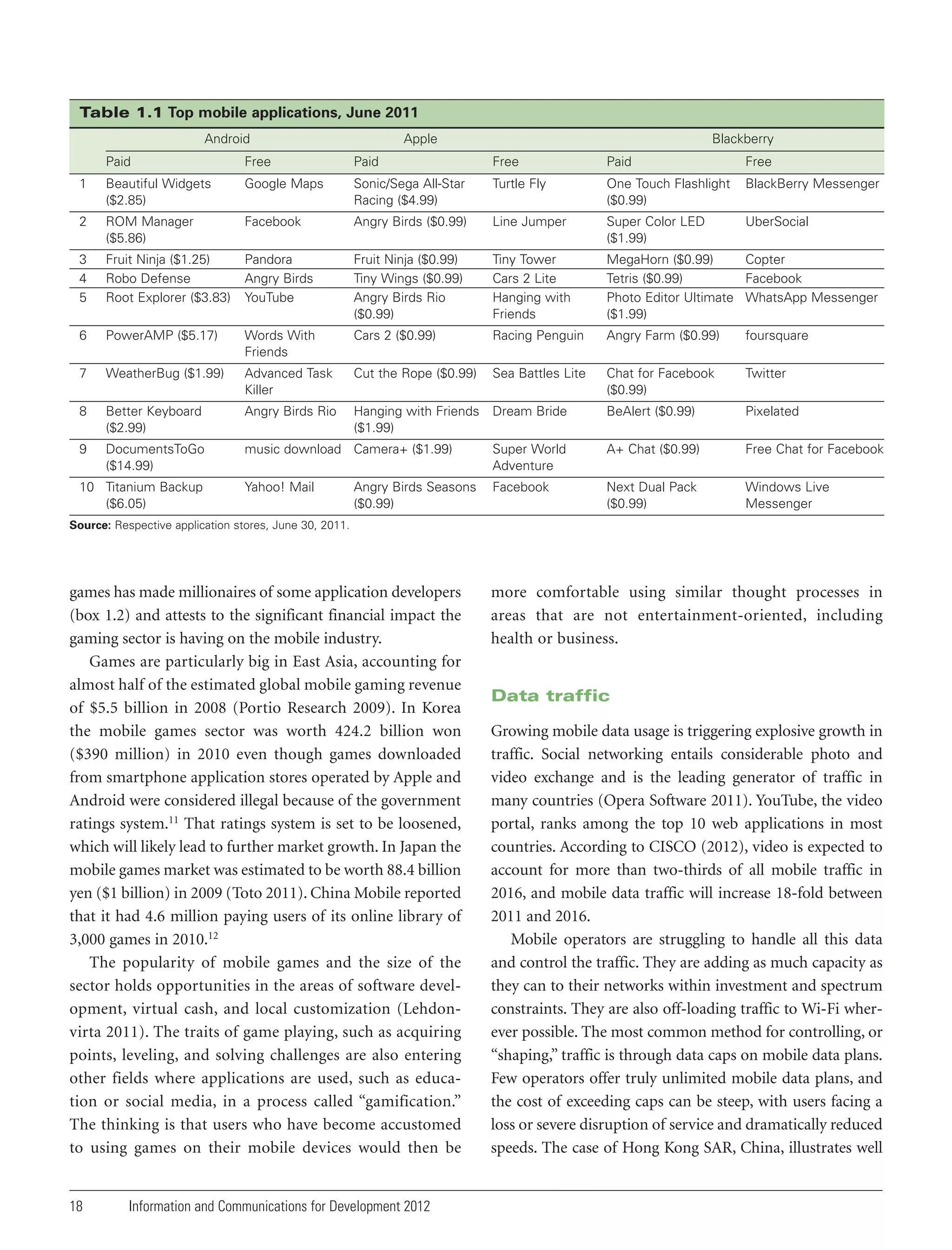
The most downloaded applications for smartphone
portals include utilities for tools such as mapping, social
networking, chatting, and messaging (table 1.1).
One genre in every list of top downloads across all application portals and all regions is games. The popularity of

Overview

17
Table 1.1 Top mobile applications, June 2011
Android

Apple

Blackberry

Paid

Free

Paid

Free

Paid

Free

1

Beautiful Widgets
($2.85)

Google Maps

Sonic/Sega All-Star
Racing ($4.99)

Turtle Fly

One Touch Flashlight
($0.99)

BlackBerry Messenger

2

ROM Manager
($5.86)

Facebook

Angry Birds ($0.99)

Line Jumper

Super Color LED
($1.99)

UberSocial

3
4
5

Fruit Ninja ($1.25)
Robo Defense
Root Explorer ($3.83)

Pandora
Angry Birds
YouTube

Fruit Ninja ($0.99)
Tiny Wings ($0.99)
Angry Birds Rio
($0.99)

Tiny Tower
Cars 2 Lite
Hanging with
Friends

MegaHorn ($0.99)
Copter
Tetris ($0.99)
Facebook
Photo Editor Ultimate WhatsApp Messenger
($1.99)

6

PowerAMP ($5.17)

Words With
Friends

Cars 2 ($0.99)

Racing Penguin

Angry Farm ($0.99)

foursquare

7

WeatherBug ($1.99)

Advanced Task
Killer

Cut the Rope ($0.99)

Sea Battles Lite

Chat for Facebook
($0.99)

Twitter

8

Better Keyboard
($2.99)

Angry Birds Rio

Hanging with Friends Dream Bride
($1.99)

BeAlert ($0.99)

Pixelated

9

DocumentsToGo
($14.99)

music download Camera+ ($1.99)

Super World
Adventure

A+ Chat ($0.99)

Free Chat for Facebook

Yahoo! Mail

Facebook

Next Dual Pack
($0.99)

Windows Live
Messenger

10 Titanium Backup
($6.05)

Angry Birds Seasons
($0.99)

Source: Respective application stores, June 30, 2011.

games has made millionaires of some application developers
(box 1.2) and attests to the significant financial impact the
gaming sector is having on the mobile industry.
Games are particularly big in East Asia, accounting for
almost half of the estimated global mobile gaming revenue
of $5.5 billion in 2008 (Portio Research 2009). In Korea
the mobile games sector was worth 424.2 billion won
($390 million) in 2010 even though games downloaded
from smartphone application stores operated by Apple and
Android were considered illegal because of the government
ratings system.11 That ratings system is set to be loosened,
which will likely lead to further market growth. In Japan the
mobile games market was estimated to be worth 88.4 billion
yen ($1 billion) in 2009 (Toto 2011). China Mobile reported
that it had 4.6 million paying users of its online library of
3,000 games in 2010.12
The popularity of mobile games and the size of the
sector holds opportunities in the areas of software development, virtual cash, and local customization (Lehdonvirta 2011). The traits of game playing, such as acquiring
points, leveling, and solving challenges are also entering
other fields where applications are used, such as education or social media, in a process called “gamification.”
The thinking is that users who have become accustomed
to using games on their mobile devices would then be

18

Information and Communications for Development 2012

more comfortable using similar thought processes in
areas that are not entertainment-oriented, including
health or business.

Data traffic
Growing mobile data usage is triggering explosive growth in
traffic. Social networking entails considerable photo and
video exchange and is the leading generator of traffic in
many countries (Opera Software 2011). YouTube, the video
portal, ranks among the top 10 web applications in most
countries. According to CISCO (2012), video is expected to
account for more than two-thirds of all mobile traffic in
2016, and mobile data traffic will increase 18-fold between
2011 and 2016.
Mobile operators are struggling to handle all this data
and control the traffic. They are adding as much capacity as
they can to their networks within investment and spectrum
constraints. They are also off-loading traffic to Wi-Fi wherever possible. The most common method for controlling, or
“shaping,” traffic is through data caps on mobile data plans.
Few operators offer truly unlimited mobile data plans, and
the cost of exceeding caps can be steep, with users facing a
loss or severe disruption of service and dramatically reduced
speeds. The case of Hong Kong SAR, China, illustrates well
Box 1.2 How to make a million from Angry Birds

Angry Birds has been a worldwide game sensation. It was the number one Apple iPhone
download in countries ranging from Pakistan to Peru and the Philippines to Portugal. Rovio
Mobile, a Finnish firm founded in 2003, developed Angry Birds.a
In 2009 Rovio released Angry Birds for the iPhone. The company’s development of Angry
Birds outlines the relationships between game developers, publishers, and giant gaming
companies. Rovio initially worked with publisher Chillingo to develop the iPhone version of
Angry Birds, keeping the rights for versions on other platforms. Following the sale of Chillingo
to gaming company Electronic Arts in October 2010, Rovio developed its own Angry Birds
versions for other mobile systems such as Android and Nokia. It is also leveraging its Angry
Birds success by expanding into merchandizing with T-shirts and other products.
According to one source, Angry Birds had over 5 million downloads from the Apple app
store during the first six months of 2010 alone (Parker 2010). At $0.99 a download, the game
generated at least $5 million in revenue during that period.
a. http://www.rovio.com.

the impending wave of data usage that will soon be hitting
other countries (figure 1.5a). During 2011 average monthly
mobile data usage increased by more than 70 percent to over
500 megabytes (MB) per 2.5G or 3G user. Although Hong
Kong is an advanced economy, and therefore well ahead of
most developing nations, the same trends can be expected
elsewhere at a later date. CISCO (2012) forecasts monthly
usage to reach more than 10 exabytes (that is, 1 billion gigabytes) in 2016, with smartphones, laptops, tablets, and
mobile broadband networks leading the charge (figure 1.5b).
This subject is developed further in chapter 7.

The changing mobile ecosystem
Before the emergence of smartphones, network operators
had historically controlled the mobile ecosystem. They
were the main point of interface for users regarding devices
and applications. Although users were free to purchase
their own handsets, operators typically subsidized them
where regulation allowed them to do so, at least for the
postpaid segment. Users who wanted to talk, send a
message, or access the internet did so over the mobile operator’s network. Access was often through an operator’s
“walled garden”—a portal where content providers paid
operators to feature their applications. If users went
outside the walled garden, they typically had to pay extra.
Developments such as value-added text messages and

mobile payments widened this ecosystem, but operators
essentially remained the gatekeepers.
The app revolution

Operator control started to break down with the emergence of smartphones and other devices that run specific
mobile operating systems, incorporate built-in Wi-Fi, and
allow users to purchase content and applications through
special online stores. The first kink in the direct relationship between operators and users was the BlackBerry,
introduced by Canadian company Research in Motion
(RIM) in January 1999. Marketed as “wearable wireless
email,”13 the BlackBerry could arguably be called the world’s
first smartphone. Revolutionary at the time, it allowed
subscribers to receive email using RIM’s proprietary Enterprise Server. The BlackBerry was a big hit within the corporate world because it ensured that key personnel could
receive emails anytime, anywhere. RIM later expanded
BlackBerry distribution to reach mass markets, earning $20
billion in revenue in its 2010 fiscal year. RIM has moved
into emerging markets and into social networking through
its BlackBerry Messenger. The company shipped 52 million
devices in its 2010 fiscal year and had some 55 million
subscribers in November 2010 (figure 1.6a).14 BlackBerry
App World launched in 2009, but having been an early
trendsetter, it is now struggling to keep up with developments elsewhere.

Overview

19
Figure 1.5 Data, data everywhere
a. Monthly mobile data usage in Hong Kong SAR, China

b. Forecast global totals by origin device, 2011–16
Exabytes a month

Hong Kong SAR, China

Mobile data (GB)

Other portable devices (2.2%)
Home gateways (4.8%)
Tablets (10.0%)
Smartphones (48.3%)

16
20

15
20

14
20

20

20

11

Per user (MB)

13

0

20

10
20

09
20

08
20

07
20

06
20

05
20

04
20

03
20

20

02

0

12

500

Forecast data shares

20

1,000

2

0

1,500

4

100

2,000

6

200

2,500

8

300

3,000

10

400

3,500

12

500

4,000

11

600

4,500

M2M (4.7%)
Non-smartphones (5.7%)
Laptops and netbooks (24.2%)

Sources: OFTA 2012 (panel a); CISCO 2012 (panel b).
Note: The compounded annual growth rate for mobile data usage is projected to be 78 percent between 2011 and 2016.

Figure 1.6 Apples and Berries: iPhone sales and Blackberry subscriptions
b. BlackBerry subscribers

a. iPhone units sold
80

60

55

72
70

50
41

40

50

Millions

40

40
30
12

2.5

1

8

4.9

10
20

09
20

08
20

07
20

06
20

05
20

04

11
20

10
20

09
20

08

0

20

07
20

14

10

10
0

25

20

21

20

30

20

Millions

60

Sources: Apple and RIM operating reports.
Note: Data for Apple refer to fiscal years ending September 25. Data for Blackberry refer to fiscal years ending March.

The industry changed dramatically with the introduction
of Apple’s touchscreen iPhone in June 2007, followed by the
launch of its App Store in July 2008.15 The exclusive agreements that Apple initially made with mobile operators have
now largely ended. In January 2010 the company crossed
another milestone, introducing the iPad, its tablet computer.
All Apple mobile devices (such as iPhone, iPad, and the iPod
music player) are powered by the iOS mobile operating
system. The iPhone is distributed through Apple’s retail and

20

Information and Communications for Development 2012

online stores and also by mobile carriers. In addition to the
App Store, iPhone users can download music and video
from the iTunes store and ebooks from the iBookstore.
By simplifying and taking ownership of the application
platform, handset vendors were able to exert control over the
quality of applications on offer and also to create a market for
purchasing them. Although the majority of downloaded applications are still free, users are urged to upgrade to paid content
or subscriptions, if only to get rid of advertising. By February
2011 Apple had downloaded more than 25 billion applications
from the App Store. Sales of the iPhone grew from 1.4 million
in 2007 to 72 million in 2011 (figure 1.6b). Revenues from the
iPhone and related products and services grew to $47 billion in
2011, accounting for 44 percent of Apple’s total sales.16 An
equipment-selling business is rapidly becoming a softwareand-services industry, with operators scrambling to provide
the spectrum bandwidth to carry the heavy volumes of data
traffic while plotting their own applications portals.
Android, Inc., was founded in 2003 to develop mobile
phone operating systems and then purchased by search giant
Google in 2005. Google made the Android software open
source to encourage programmers and handset manufacturers to develop applications and products. The first Android
handset, the HTC Dream, was launched in October 2008.
Google itself has self-branded several Android phones and
developed Android Market (now called Google Play), a
portal for obtaining Android applications. By the fourth
quarter of 2011 Android had captured just over half the
market for smartphone operating systems (Gartner 2012).
Google Play offers more than 400,000 applications with over
10 billion downloaded by January 2012 (Paul 2012).
Another significant player is mobile equipment manufacturer Nokia. It has traditionally had a large market share of
the handset market, especially in the developing world
(figure 1.7). Nokia’s mobile operating system, Symbian, is
installed on most of these handsets. Thus far, however, Nokia
has failed to capture a large share of the smartphone market.

In 2011 it forged an agreement with Microsoft to begin offering the Windows operating system on its smartphones.17
The rise of smartphones thus sparked tremendous shifts
in the mobile ecosystem. A user can now bypass mobile
networks completely by downloading content and programs
through application stores using Wi-Fi. One survey reported
that half the respondents used Wi-Fi to download applications to their mobile phones (In-Stat 2011). Second, users
can use VoIP or other applications to communicate instead
of the operator’s mobile voice service. Third, most handset
manufacturers are essentially constrained to using the
Android or Windows mobile operating systems for their
handsets because RIM and Apple brand their own devices.
As a result of the rise of the smartphone, operators have
much less control over the mobile ecosystem. They risk being
“genericized,” where users do not care about the mobile
network brand but instead whether it has the fastest speed,
best coverage, cheapest prices, highest quality, or biggest
subsidy for popular handsets. Prepaid users, in particular,
have little brand loyalty, with high rates of churn in markets
where mobile number portability is a regulatory obligation.
In some ways, this process is a repeat of the one that occurred
in the early 2000s when the rise of the internet threatened to
commoditize the “dumb pipes” of telecom operators, only
now it is the mobile operators that are under pressure. At the
same time, the emergence of HTML5 could cause another
disruption in the industry. With the HTML5 standard, apps
can be run directly from web browsers, freeing users from

Figure 1.7 Changing market share of mobile handset sales by operating system
2008

2011
Microsoft 2%

iOS (Apple) 11%

Microsoft 12%
iOS (Apple) 24%

Research In
Motion 20%

Other 3%
Symbian
(Nokia) 12%

Other 10%

Android 0%

Research In
Motion 9%
Android 50%
Symbian (Nokia) 47%

Sources: Adapted from Gartner 2012.

Overview

21
being locked in to a proprietary operating system and creating a new distribution channel for application developers
(A.T. Kearney 2011).
Mobile content

The evolution of handsets has driven content providers and
aggregators to the mobile industry. In the early days, content
largely consisted of ringtones and screen pictures downloaded to customize simple mobile phones. As handsets
become more sophisticated and included internet access,
more and more of the “big” internet can be reformatted to
mobile content, making the “third” screen (after television
and PCs) a desirable outlet for the content industry. Content
providers have also been aided by the rise of application
stores, which allow users to navigate easily to online supermarkets to satisfy their content cravings.
While big technology and media companies dominate
content distribution and to some extent content creation,
there are opportunities for small software developers and
local information aggregators. Examples of these aggregators include:
• Seven out of ten Brazilian internet users visit Brazil’s
UOL internet portal, formerly Universo Online. It created
a mobile version, UOL Celular, with more than 1,000
daily news, weather, and traffic reports. It ranks as the
10th most visited site by Brazilian Opera mobile browser
users and the second-leading local site.
• Detikcom is the third most visited site by Indonesian
Opera users. It was launched in 1998 and introduced a
mobile version in 2002, significantly contributing to
growth. It envisions itself as a new media company with
partnerships for content and relationships with the country’s mobile operators to ensure distribution across the
country’s mobile networks.
• In South Africa, News24 is a leading portal with updated
breaking news. It has a dedicated WAP (wireless access
protocol) version for mobile phones. It had more than
500,000 unique visitors to its mobile site in December
2010, up 200 percent over the previous year.18
The emergence of cloud computing and multiple types
of devices (PCs, tablets, mobile handsets) is creating different distribution markets. On the one hand, companies like
Apple produce content only for their own brand. Apple’s
iBooks, for example, can be read only on Apple devices.

22

Information and Communications for Development 2012

This approach ties users to the brand because they cannot
use the content they have purchased if they switch brands.
On the other hand, companies like Amazon, which makes
the Kindle ebook reader, sell software applications that
allow Kindle ebooks to be read on multiple platforms.
Similarly, Netflix movie streaming is available across a
number of platforms. As cloud computing invades the
mobile space, it will be possible to run applications
remotely instead of having to purchase and download
them to the device. This development will create more
subscription-like services rather than single downloads.
This is good news for developing nations because it lowers
the cost of applications and content. But to take advantage
of the cloud, users will need good mobile broadband
connectivity.

Mobile-enabled social and economic
trends
Research shows that mobile networks are having a growing
impact on the economy. One of the earliest and frequently
cited studies on the subject was carried out by three consultants from the Law and Economics Consulting Group. Using
data from 92 countries between 1980 and 2003, they found
that an increase of 10 mobile subscriptions per 100 people
raised GDP growth by 0.6 percent (Waverman, Meschi, and
Fuss 2005). A similar study using data through 2006 found
that a 10 percent increase in mobile penetration in developing countries was correlated to a 0.8 percent increase in
economic growth (Qiang and Rossotto 2009). Several studies also find that growth in mobile networks is positively
correlated to foreign direct investment (Lane et al. 2006;
Williams 2005).
Mounting evidence also shows the microeconomic
impact of mobile in specific countries and industries. The
benefits typically accrue from better access to information
brought about through mobile and are typically related to
lower transactions costs, savings in travel costs and time
spent traveling, better market information, and opportunities to improve one’s livelihood (Jensen 2007; Salahuddin et al. 2003; Aker 2008; see also tables 1.2 and 2.1 and
box 1.3).
Mobile for development

As noted by the United Nations Development Programme
“Mobile phones can enhance pro-poor development . . .
Table 1.2 Mobile and the Millennium Development Goals
MDG

Example

Poverty and hunger

A study on grain traders in Niger found that cell phones improved consumer welfare (Aker 2008). Access to
cell phones allowed traders to obtain better information about grain prices across the country without incurring the high cost of having to travel to different markets. On average grain traders with cell phones had 29
percent higher profits than those without cell phones. In the Niger example, demand sprang up organically
rather than through a specific program.

Universal education

According to a survey of teachers in villages in four African countries, one-quarter reported that the use of
mobile phones helped increase student attendance. A main factor was that teachers could contact parents to
enquire about their child’s whereabouts (Puri et al, n.d.). Mobile phones have also been used in Uganda to
track school attendance so that school administrators can see patterns in attendance, for instance by village,
by day of the week, and by season. Tracking attendance for pupils indirectly also tracks absenteeism among
teachers (Twaweza 2010)

Gender equality

A study looking at gender differences in the availability and use of mobile phones in developing countries
reported that 93 percent of the women who had mobiles felt safer because of the phone, 85 percent felt
more independent, and 41 percent had increased income or professional opportunities (GSM Association
2011). The report found that closing the mobile gender gap would increase revenues for mobile operators by
$13 billion.
A program using text messaging to identify malnutrition among rural children in Malawi is notable for its
impact on the speed and quality of the data flows.a Using a system called RapidSMS, health workers in rural
areas were able to transmit weight and height information in two minutes instead of the two months needed
under the previous system. The data entry error rate was significantly improved to just 2.8 percent from
14.2 percent in the old system. The improved information flow enabled experts to analyze data more quickly
and accurately, identify children at risk, and provide treatment information to the health staff in the field.

Child health

Maternal health

One of the earliest uses of mobile technology to improve maternal health took place in rural districts of
Uganda in the late 1990s. Traditional birth attendants were provided walkie-talkies, allowing them to stay in
contact with health centers and obtain advice. An assessment of the program found that it led to roughly a
50 percent reduction in the maternal mortality rate (Musoke 2002).

HIV/AIDS

In Kenya weekly text messages were sent to AIDS patients to remind them to take their antiretroviral drugs
(Lester et al. 2010). Those who received the text messages had significantly higher rates of taking the drugs
than those who did not receive them. The study noted that SMS intervention was less expensive than inperson community adherence interventions on the basis of travel costs alone and could theoretically translate
into huge health and economic benefits if scaled up.

Environment

According to one forecast, mobile technology could lower greenhouse gas emissions 2 percent by the year
2020 (GSM Association 2009). This reduction can be met through, among other things, widespread adoption
of various mobile-enabled technologies such as smart transportation and logistics, smart grids and meters,
smart buildings, and “dematerialization” (replacing the physical movement of goods and services with online
transmission). Mobile phones can also be used as tools for environmental monitoring. In Ghana, for example,
cab drivers in Accra were outfitted with mobile phones with GPS and a tube containing a carbon monoxide
sensor to test pollution levels.b

Partnership?

MDG target 8F states: “In cooperation with the private sector, make available benefits of new technologies,
especially information and communications.” Mobile phone penetration in low-income economies has grown
from less than one per 100 people in 2000 to almost one per every three by 2010—largely as a result of
private sector investment. Of some 800 telecom projects in developing countries with private sector participation between 1990 and 2009, almost three-quarters involved greenfield operations primarily in mobile teleph-

a. “Malawi – Nutritional Surveillance” on the RapidSMS web site: http://www.rapidsms.org/case-studies/malawi-nutritional-surviellence/.
b. http://www.globalproblems-globalsolutions-files.org/unf_website/PDF/vodafone/tech_social_change/Environmental_Conservation_case3.pdf
c. World Bank and PPIAF, PPI Project Database. http://ppi.worldbank.org.

in sectors such as health, education, agriculture, employment, crisis prevention and the environment . . . that
are helping to improve human development efforts
around the world” (UNDP 2012). The Millennium
Development Goals (MDGs) provide a useful framework

for assessing the development impact of mobile phones.
The MDGs highlight eight priority areas. Examples of the
ways mobile phones are being used to address each of
the MDGs are given in table 1.2 and throughout this
report.

Overview

23
Box 1.3 Smartphones and tablets for development

The introduction of Box figure 1.3.1 Annotated screenshot of Bangladesh's
Amadeyr Tablet
smartphones and lightweight tablet computers has revolutionized
Volume button
Menu
the way people access
the
internet
from
Speaker
mobile devices. These Power
powerful touchscreen on/off
devices have popularized
downloadable
Back button
apps that can do
anything from recogPower cord
nize a song to turn the
device into a flashlight.
Speaker
Scaled-down versions
Update
of popular office applibutton
cations
for
word
processing,
spread- Source: http://amadeyr.org/en/content/amadeyr-tablets.
sheets, and presentations are available for
smartphones and tablets as well as ebook software. These devices support internet access
over cellular broadband networks and Wi-Fi and often include built-in GPS and still and video
cameras.
The graphical user interfaces and touchscreens make them ideal for many developing
nations particularly those with non-western alphabets and sizable illiterate populations.
Smartphone and tablet penetration is rising rapidly in urban areas of developing countries.
Several initiatives are under way that feature low-cost tablets and investigate the feasibility
of devices for rural areas:
• In Bangladesh, the Digits to All (DTA) project distributed custom developed tablets (see
screenshot) to over 100 households in a rural village to test their feasibility. The $100
Amadeyr tablet uses the Android operating system with software specifically designed
and customized for use by semiliterate, illiterate, and bottom-of-the-pyramid users. The
tablet uses a touchscreen operated by seeing pictures and hearing instructions given in
Bengali, making it user-friendly for illiterate villagers. The project found that villagers
who had never used PCs, let alone the internet, were able to use the tablets within a
few days and noted: "It is not the rural population who needs to be trained to have
access to information but it is the next generation communication technologies that can
be tailored to meet the local needs and be made easily accessible by rural communities"
(Quadri et al. 2011).
• India launched its locally manufactured Aakash tablet in October 2011(Tuli 2011). Priced at
around $35 the tablet is aimed for widespread distribution in schools. Apart from its low
cost, the Aakash tablet has other features suitable for the Indian environment including data
compression techniques that lower consumption and hence reduce Internet access
charges. One of the organizations involved in the project forecasts that some 5 million of the
tablets will be shipped in 2012, around half of the equivalent PC figure.

(continued next page)

24

Information and Communications for Development 2012
Box 1.3 (continued)

• A project in Tanzania has been familiarizing farmers with smartphones to introduce them to
the features and potential uses (Banks 2011). Although most farmers already had cell
phones, they had never used the internet. The smartphones have been used for geotagging
climate information and to make videos of farmers offering advice on techniques. The information is uploaded to the internet to share with other farmers. The visually oriented information helped one maize grower to learn from planting mistakes and a few months later he
had his first successful harvest.
Governments, the private sector, academia, and the development community all have a role
to play in promoting smartphones and tablets for development. Governments in particular can
be encouraged by the potential of these devices to take ICT for development to another level
through easy-to-use graphical interfaces with Internet connectivity over wireless networks.
Just as the One Laptop per Child program helped trigger a reduction in low-end computers, a
“One Smartphone/Tablet per Citizen” initiative could help generate mass availability.

Social networking and democracy

Electronic communication has increasingly become twoway: examples include participation through feedback in
comments, discussions in forums, and active contribution to
applications such as Wikipedia or Mozilla. In addition, the
tools for users to generate content have been simplified—
not only can most people master text messaging and tweeting but a growing number can also create social networking
pages and blogs. Often driven by youth, participation is
reaching up the age ladder as these tools and their impact
become publicized and popularized.
The increasing availability of these tools and applications
on mobile phones is enhancing their popularity. Operators
in developing countries are working around the limitations
of low-end handsets that do not have internet capabilities by
providing ways of interacting with social networking applications through instant messaging, such as MXit in South
Africa.19 Safaricom in Kenya offers special SMS functions
allowing users to send and receive Twitter tweets and to
update their status and send messages to Facebook.20
The diffusion of mobile phones coupled with social
networking creates a new space for citizens around the
globe to engage in political action concerning democracy,
freedom, and human rights. There is disagreement about
the extent to which these tools affect appeals for freedom
and democracy. Some observers argue that social network-

ing tools empower people to defend freedom and that Twitter should be nominated for a Nobel Peace Prize (Gladwell
2010). Others argue that, while these applications make it
easier for people to express themselves, it is “harder for that
expression to have any impact.” In other words, applications
like Facebook and Twitter make it possible for large
numbers of people to voice their opinion, but they do so
virtually, and these tools are not substitutes for physical
participation.
Regardless, recent history has demonstrated that social
media along with messages, videos, and pictures sent from
mobile phones are useful tools for organizing protests and
monitoring democracy and freedom. Examples include:
• One of the first uses of text messaging for social change
took place in the Philippines in January 2001. Political
activists sent SMS text messages urging Filipinos to
assemble at Epifanio de los Santos Avenue (EDSA) in
Manila to demonstrate for the impeachment of thenpresident Joseph Estrada. The message, typically
reforwarded by recipients, read: “Go 2 EDSA. Wear
blk.” During the next few days more than a million
people showed up and some 7 million SMS were sent.
It is argued that this giant outburst concerned legislators, who allowed evidence in the impeachment trial to
be presented. By January 20 Estrada had resigned,

Overview

25
blaming his exit on the “the text-messaging generation” (Shirky 2011).
• Thousands of Moldovans demonstrated against the
government in the spring of 2009. It was dubbed the
“Twitter Revolution,” because that application was a main
method used to organize the demonstrators. One of
Twitter’s “Trending Topics” at the time was the tag
“#pman” an abbreviation for Piata Marii Adunari
Nationale, the main square in downtown Chisinau, the
nation’s capital and location of the demonstrations.
Protestors used the local mobile data network to post
tweets from their mobile phones (Morozov 2009).
• In Côte d’Ivoire a so-called “web mash-up” site called
Wonzomai (“sentential” in the Ivorian Bété dialect) was
created to monitor the 2010 presidential election. Users
were provided with telephone number short codes to
which they could send free SMS and tweets to report
abnormalities that they had witnessed during and immediately after the election. The reports were visualized on a
website, which showed the locations where incidents had
taken place as well as trends plotted over the duration of
the election.21
In the Middle East, mobile has unsettled the region’s
social and political traditions since the mid-2000s (Ibahrine
2009). Its greatest impact to date may have come between
2010 and 2012 when social media played a role in the “Arab
Spring” uprisings in Bahrain, Egypt, Libya, the Syrian Arab
Republic, Tunisia, the Republic of Yemen, and other countries in the region. As one Egyptian protestor put it: “We use
Facebook to schedule the protests, Twitter to coordinate, and

YouTube to tell the world.”22 Surges in social networking and
demonstrations in these countries appear to be connected.
All but one demonstration reportedly took place following
the initial call to protest on a Facebook page (figure 1.8). The
number of Facebook users in these countries also grew
significantly during the demonstrations.
Similarly, Twitter use increased during the Arab Spring.
The #jan25 tag, created to organize the first big protest in
Egypt falling on that day, remained in active use for several
weeks afterward and tag accounted for a majority of Twitter
traffic in Egypt through the resignation of President Hosni
Mubarak on February 11, 2011. Although there were only
around 130,000 active tweeters in Egypt at the time, the
#jan25 tag had over 1.2 million mentions, illustrating the
viral effect of social networking where a tweet can be
retweeted by many other users. The day Mubarak left office,
the number of tweets in Egypt reached its zenith at 35,000.
During a five-day internet blackout, tweets were sent using
proxy servers or through contacts in other countries (Zirulnick 2011).
It is difficult to pinpoint the exact role mobile played in
the uprisings because social networking applications can
also be used on PCs. In most of the non-Gulf Arab nations,
however, mobile ownership far outnumbers computer
possession (figure 1.9a). Further the portability and ease of
concealment of mobiles are ideally suited to street protests.
In addition, camera phones are well integrated with mobile
social networking applications, making it relatively simple to
record and dispatch images and videos over the high-speed
wireless networks available in most Arab nations. In Egypt,
almost 60 percent of mobile owners use their phone to take
photos or video (figure 1.9b). About 1,000 videos were sent

Figure 1.8 Mapping calls for protest on Facebook to actual “Arab Spring” demonstrations, 2011
Yes**

Yes

Yes

No

Yes

Yes

Yes

Yes

Yes

Yes

Tunisia
Jan 14
18.8%*

Egypt, Arab
Rep.
Jan 25
5.5%

Yemen, Rep.
Feb 3 &10
0.93%

Syrian Arab
Republic
Feb 14
1.19%

Bahrain
Feb 14
32.0%

Libya
Feb 17
4.3%

Oman
Mar 3
7.8%

Saudi Arabia
Mar 11 & 20
12.9%

Syrian Arab
Republic
Mar 15 and
onwards
1.67%

West Bank and
Gaza
Mar 15
12.8%

Source: Dubai School of Government, Arab Social Media Report, May 2011.
Note: The percentages underneath each county show Facebook penetration rates at the start of protests.
* Facebook penetration rates at the start of protests in each country.
** Initial protest was not organized on Facebook, although further protests were.

26

Information and Communications for Development 2012
Figure 1.9 Mobile phone versus internet access household availability
a. Household availability, 2009
100

97

b. Mobile phone usage, Egypt, 2011

95

90

Send text
messages

80

80

Percent

70

72

64

64

60

55
Take pictures or
video

50

58

40
30

23

21

20

15

Use the Internet

9

10

3

Mobile phone

Ye
me
n

t
Eg
yp

ria
Sy

a
Tu
nis
i

Ba
hr
a

in

0
0

20

40

60

80

Internet access

Sources: Gallup 2009; Pew Research Center 2011.

from cell phones to the Al-Jazeera news organization during
the Egyptian protests.23
Although governments can try to restrict access to the
internet and mobile networks, they may pay a heavy price.
The Organisation for Economic Co-operation and Development (OECD 2011) estimated that the direct costs to the
Egyptian government of shutting down the internet and
mobile phone networks during demonstrations was
$18 million a day, with a much wider economic impact when
factoring in industries such as eCommerce, tourism, and business process outsourcing. Restricting access also tends to have
a reverse effect: according to a survey of Egyptian and
Tunisian citizens, blocking networks causes “people to be more
active, [and] decisive and to find ways to be more creative
about communicating and organizing even more” (Dubai
School of Government 2011). Short of a complete shutdown,
users can find workarounds to blocked applications by using
proxies; if close enough, they can also pick up cellular signals
from neighboring countries. Intriguingly, some of the countries identified as having the heaviest internet restrictions were
also those where social-media-driven demonstrations have
taken place (Reporters Without Borders 2009).

Structure of the report
The rest of this report explores these themes in more detail.
The report distills work carried out by the World Bank
Group and its development partners since the last edition of

this report, in 2009, with a particular focus on mobile applications for development. Chapters 2, 3, and 4 have a sectoral
focus on the use of mobile applications in agriculture and
rural development, health, and financial services respectively. Chapters 5 and 6 are cross-cutting, looking at how
mobile communications are contributing to entrepreneurship and employment and how they are being used to bring
citizens and government closer together. Finally, chapter 7
looks at the shift from narrowband to broadband mobile
networks and the policy implications involved. The Statistical Appendix provides an overview of recent trends in the
mobile sector and introduces a new analytical tool. The
Country Tables at the end of the report provide an at-aglance view of the status of mobile communications in
World Bank member countries.

Notes
1. “[Y]oung people around the world are more immersed in
mobile technology than any previous generation.” See Nielsen
2010.
2. http://www.cisco.com/en/US/solutions/collateral/ns341/
ns525/ns537/ns705/ns827/white_paper_c11-520862.html.
3. h t t p : / / w w w. s e c . g ov / Arch ive s / e d g a r / d a t a / 1 4 9 8 2 0 9 /
000119312510182561/ds1.htm.
4. A “tweet” is 140 characters (compared to 160 characters for an
SMS).
5. For mobile users of Twitter growth in 2010, see http://blog
.twitter.com/2011/03/numbers.html.

Overview

27
6. http://blog.twitter.com/2012/03/twitter-turns-six.html.
7. http://trak.in/tags/business/2010/05/24/facebook-twitterdelhi-police/.
8. http://globalvoicesonline.org/2011/01/25/egypt-tweetingthe-day-of-revolution/.
9. http://www.opera.com.
10. “Statistics,” http://newsroom.fb.com/content/default.aspx?
NewsAreaId=22.
11. In Korea, games must be reviewed and rated by the Games
Ratings Board before they can come on the market. See “‘Big
Bang’ of Mobile Games.” JoongAng Daily, May 17, 2011.
http://koreajoongangdaily.joinsmsn.com/news/article/article.aspx?aid=2936279
12. http://www.chinamobileltd.com.
13. RIM (Research in Motion). 1999. Annual Report. p. 2.
14. “Research in Motion Reports Third Quarter Results.” Press
release. December 16, 2010. http://press.rim.com/financial/.
15. Information on the iPhone is adapted from Apple annual
operating reports at http://investor.apple.com/sec.cfm#filings.
16. Apple Inc, 2011 10-K Annual Report, filed Oct. 26, 2011, at:
http://files.shareholder.com/downloads/AAPL/1664072048x0
xS1193125-11-282113/320193/filing.pdf.

http://www.aspeninstitute.org/sites/default/files/content/docs/
pubs/M-Powering_India.pdf.
Aker, J. 2008. “Does Digital Divide or Provide? The Impact of Cell
Phones on Grain Markets in Niger.” http://www.cgdev
.org/doc/experts/Aker%20Cell%20Phone.pdf.
Anderson, J., and Kupp, M. 2008. “Serving the Poor: Drivers of
Business Model Innovation in Mobile.” info. 10: 5–12. http://
www.emeraldinsight.com/journals.htm?articleid=1650888&
show=abstract.
Banks, K. 2011. “From Smart Phones to Smart Farming: Indigenous Knowledge Sharing in Tanzania.” National Geographic
News Watch, Nov. 30, 2011. http://newswatch.nationalgeographic.com/2011/11/30/smart-phones-meet-smart-farmingindigenous-knowledge-sharing-in-tanzania/.
Brisson, Z., and K. Krontiris. 2012. “Tunisia: From Revolutions to
Institutions.” infoDev. http://www.infodev.org/en/Article.814
.html.
CISCO. 2012. “Cisco Visual Networking Index: Global Mobile
Data Traffic Forecast Update, 2011–2016.” http://www.cisco
.com/en/US/solutions/collateral/ns341/ns525/ns537/ns705/ns
827/white_paper_c11-520862.html.
Dubai School of Government. 2011. “Arab Social Media Report”
(May). http://www.dsg.ae/en/ASMR3/.

17. “Nokia and Microsoft Announce Plans for a Broad Strategic
Partnership to Build a New Global Ecosystem.” Nokia Stock
Exchange Release, February 11, 2011.

Gallup. 2009. “Cell Phones Outpace Internet Access in Middle East.”
http://www.gallup.com/poll/121652/cell-phones-outpaceinternet-access-middle-east.aspx.

18. “News24’s Mobile Site Hits the Half-a-Million Unique Users
Mark.” Press release, January 20, 2011. http://www.news24.com/
xArchive/PressReleases/News24-mobile-hits-500-000-users20110120.

Gartner Inc. 2012. “Gartner Says Worldwide Smartphone Sales
Soared in Fourth Quarter of 2011 with 47 Per Cent Growth.”
http://www.gartner.com/it/page.jsp?id=1924314.

19. http://www.mxit.com.
20. http://www.safaricom.co.ke/index.php?id=1265.
21. “Wonzomai: plateforme d’alertes citoyennes pour les élections
présidentielles en Côte d’Ivoire.” Internet Sans Frontières,
October 29, 2010. http://www.internetsansfrontieres.com/
Wonzomai-plateforme-d-alertes-citoyennes-pour-les-elec
tions-presidentielles-en-Cote-d-Ivoire_a243.html.

Gladwell, M. 2010. “Small Change: Why the Revolution Will Not
Be Tweeted.” New Yorker (October 4). http://www.newyorker
.com/reporting/2010/10/04/101004fa_fact_gladwell?currentPage=all.
Glotz, P., S. Bertschi, and C. Locke, eds. 2005. Thumb Culture: The
Meaning of Mobile Phones for Society. Bielefeld. http://thumbculture.loginb.com/.

22. http://www.miller-mccune.com/politics/the-cascadingeffects-of-the-arab-spring-28575/.

GSM Association. 2009. “Mobile’s Green Manifesto” (November).
http://www.gsmworld.com/our-work/mobile_planet/
mobile_environment/green_manifesto.htm.

23. http://www.guardian.co.uk/world/2011/dec/29/arab-springcaptured-on-cameraphones.

———. 2011. “Women & Mobile: A Global Opportunity.”
http://www.vitalwaveconsulting.com/pdf/Women-Mobile.pdf.

References
A. T. Kearney. 2011. “The App Frenzy—Just a Short-Lived Fad?”
http://www.atkearney.com/index.php/Publications/the-appfrenzyjust-a-short-lived-fad.html.
Adler, R., and M. Uppal, eds. 2008. “mPowering India: Mobile
Communications for Inclusive Growth.” Aspen Institute.

28

Information and Communications for Development 2012

Ibahrine, M. 2009. “Mobile Communication and Sociopolitical
Change in the Arab World.” Quaderns de la Mediterrània no.
11. http://www.iemed.org/publicacions-en/historic-de-publicacions/quaderns-de-la-mediterrania/sumaris/sumariquaderns-de-la-mediterrania-11?set_language=en.
Informa. 2011. “Global SMS Traffic to Reach 8.7 Trillion in 2015.”
Press release, January 26. http://www.informatm.com/itmgcontent/icoms/whats-new/20017843617.html.
In-Stat. 2011. “Mobile Application Downloads to Approach 48
Billion in 2015.” Press Release, June 7. http://www.instat
.com/press.asp?ID=3155&sku=IN1104930MCM.

Portio Research. 2009. “Market Notes: Mobile Games in South Korea.”
http://www.portioresearch.com/Market%20Notes%20Mobile%
20Games%20In%20South%20Korea.pdf.

Jensen, R. 2007. “The Digital Provide: Information (Technology),
Market Performance, and Welfare in the South Indian Fisheries
Sector.” Quarterly Journal of Economics 122 (3): 879–924.
doi:10.1162/qjec.122.3.879. http://qje.oxfordjournals.org/
content/122/3/879.abstract.

Puri, J., et al. n.d. “A Study of Connectivity in Millennium Villages
in Africa.” http://www.mobileactive.org/files/file_uploads/
ICTD2010%20Puri%20et%20al.pdf.

Lane, B., S. Sweet, D. Lewin, J. Sephton, and I. Petini. 2006. The
Economic and Social Benefits of Mobile Services in
Bangladesh.
Lehdonvirta, V. 2011. “Knowledge Map of the Virtual Economy.”
infoDev. http://www.infodev.org/en/Publication.1056.html.
Lester, R., P. Ritvo, E. Mills, A. Kariri, S. Karanja, M. Chung, J.
William, et al. 2010. “Effects of a Mobile Phone Short
Message Service on Antiretroviral Treatment Adherence in
Kenya (WelTel Kenya1): A Randomised Trial.” The Lancet
376, no. 9755 (November): 1838–45. doi:10.1016/S01406736(10)61997-6. http://linkinghub.elsevier.com/retrieve/pii/
S0140673610619976.
Ling, R., and J. Donner, J. 2009. “Mobile Communication.”
http://www.polity.co.uk/book.asp?ref=9780745644134.
Morozov, E. 2009. “Moldova’s Twitter Revolution.” Foreign Policy,
April 7. http://neteffect.foreignpolicy.com/posts/2009/04/07/
moldovas_twitter_revolution.

Qiang C., and C. Rossotto. 2009. “Economic Impacts of Broadband.” In Information and Communication for Development
Report: Extending Reach and Increasing Impact, ch. 3. Washington, DC: World Bank. www.worldbank.org/ic4d.
Quadri, A., K. M. Hasan, M. Farhan, E. A. Ali, and A. Ahmed. 2011.
“Next Generation Communication Technologies: Wireless
Mesh Network For Rural Connectivity.” IEEE Globecom 2011
Workshop on Rural Communications-Technologies, Applications, Strategies and Policies (RuralComm 2011). http://ieeexplore.ieee.org/xpl/login.jsp?tp=&arnumber=6162331&url=
http%3A%2F%2Fieeexplore.ieee.org%2Fxpls%2Fabs_all.jsp%
3Farnumber%3D6162331.
Reporters Without Borders. 2009. “Internet Enemies.” http://
www.rsf.org/IMG/pdf/Internet_enemies_2009_2_.pdf.
Sachs, J. 2008. “The Digital War on Poverty.” The Guardian, August
21. http://www.guardian.co.uk/commentisfree/2008/aug/21/
digitalmedia.mobilephones.

Nielsen. 2010. Mobile Youth around the World.

Salahuddin, A., H. Baldersheim, and I. Jamil. 2003. “Talking Back!
Empowerment and Mobile Phones in Rural Bangladesh: A
Study of the Village Phone Scheme of Grameen Bank.”
Contemporary South Asia 12, no. 3 (September): 327–48.
doi:10.1080/0958493032000175879. http://www.tandfonline
.com/doi/abs/10.1080/0958493032000175879#preview.

OECD (Organisation for Economic Co-operation and Development). 2011. “The Economic Impact of Shutting Down
Internet and Mobile Phone Services in Egypt” (February 4).
http://www.oecd.org/document/19/0,3746,en_2649_201185
_47056659_1_1_1_1,00.html.

Samarajiva, R. 2011. “Challenges of Broadband for Small Pacific
Nations.” Presentation made at launch of Pacific Islands Regulatory Research Centre, Nov. 10–11. http://www.pirrc.org/
home/index.php?option=com_edocman&task=document.vie
wdoc&id=6&lang=en.

OFTA (Office of the Telecommunications Authority, Hong Kong
SAR, China). 2012. “Key Statistics for Telecommunications in
Hong Kong: Wireless Services.” http://www.ofta.gov.hk/en/
datastat/eng_wireless.pdf.

Shirky, C. 2011. “The Political Power of Social Media.” Foreign
Affairs (February). http://www.foreignaffairs.com/articles/
67038/clay-shirky/the-political-power-of-social-media.

Musoke, M. 2002. “Maternal Health Care in Uganda: Leveraging
Traditional and Modern Knowledge Systems.” IK Notes, January.

Opera Software. 2011. “State of the Mobile Web” (April). http://
www.opera.com/smw/2011/04/.
Parker, J. 2010. “Rovio: Angry Birds at 60,000 Downloads a Day.”
CNET (August 11). http://reviews.cnet.com/8301-19512_720013385-233.html.
Paul, I. 2012. “Android Market Tops 400,000 Apps.” PC World
(January 4). http://www.pcworld.com/article/247247/android
_market_tops_400000_apps.html.
Pew Research Center. 2011. “Global Digital Communication:
Texting, Social Networking Popular Worldwide.” http://www
.pewglobal.org/2011/12/20/global-digital-communicationtexting-social-networking-popular-worldwide/.

TeleGeography Inc. 2012. “International Market Trends.”
Presentation at PTC, January 15, 2012. http://www.telegeog
raphy.com/page_attachments/products/website/telecomresources/telegeography-presentations/0002/7639/PTC_2012
_Workshop.pdf.
Toto, S. 2011. “How Big Is Japan’s Social Gaming Market?” February 20. http://www.serkantoto.com/2011/02/20/japan-socialgaming-market-stats/.
Tuli, S. 2011. “The Internet Revolution: Act 2.” Presentation given
at the World Bank on the Askash tablet, December 8.
http://go.worldbank.org/0RIXUMDMU0.
Twaweza. 2010. “CU Tracking School Attendance in Uganda.”
http://twaweza.org/index.php?i=221.

Overview

29
Twitter. 2010. “Measuring Tweets.” Twitter Blog (February 20).
http://blog.twitter.com/2010/02/measuring-tweets.html.
———. 2011. “200 million Tweets per day.” Twitter Blog (June 30).
http://blog.twitter.com/2011/06/200-million-tweets-perday.html.

Waverman, L., M. Meschi, and M. Fuss. 2005. “The Impact of
Telecoms on Economic Growth in Developing Countries.”
Vodafone Policy Paper Series 2 (March). http://info.
worldbank.org/etools/docs/library/152872/Vodafone%20
Survey.pdf.

UNDP (United Nations Development Programme). 2012. “Mobile
Technologies and Empowerment: Enhancing Human Development through Participation and Innovation.” http://www
.undpegov.org/mgov-primer.html.

Williams, M. 2005. “Mobile Networks and Foreign Direct Investment in Developing Countries.” Vodafone Policy Paper Series.

Van Buskirk, E. 2010. “Five Reasons Cellphones and Mobile VoIP
Are Forging an Unlikely Truce.” Wired (April 23). http://
www.wired.com/epicenter/2010/04/mobile-voip-truce/.

———. 2011b. World Development Indicators, 2011. http://data
.worldbank.org/data-catalog/world-development-indicators.

Watters, Audrey. 2010. “Just the Facts: Statistics from Twitter
Chirp.” ReadWriteWeb (April 14). http://www.readwriteweb
.com/archives/just_the_facts_statistics_from_twitter_chirp.php.

30

Information and Communications for Development 2012

World Bank. 2011a. ICT in Agriculture eSourcebook. www.ictina
griculture.org.

Zirulnick, A. 2011. “Egypt’s Protests, Told by #Jan25.” http://www
.csmonitor.com/World/Global-News/2011/0125/Egypt-sprotests-told-by-Jan25.
Chapter 2

Mobilizing the Agricultural Value Chain

Naomi J. Halewood and Priya Surya

n many developing countries the agricultural sector
plays a significant role in the national economy. The
sector employs about 40 percent of the total labor force
in countries with annual per capita incomes ranging from
$400 to $1,800 (World Bank 2008). Developing countries
will continue to rely heavily on the agricultural sector to
ensure employment for the rural poor and food security for
growing populations as well as to meet challenges brought
on by climate change and spikes in global food prices.
Improving efficiencies in the agricultural value chain is
central to addressing these challenges. Increasing productivity in agriculture is also critical to reducing poverty. Greater
productivity can boost farmers’ income, especially for smallholder farmers and fishers, who have limited resources to
leverage in growing and marketing their produce. Creating a
more efficient value chain also requires engaging many
stakeholders, from farmers growing crops and raising cattle
to input suppliers to distributors.
The potential benefits of using mobile phones to connect
these diverse stakeholders along the agricultural value chain
speak for themselves. For rural populations, geographically
dispersed and isolated from knowledge centers, the information and communication capabilities of the mobile phone
can be even more valuable. Close to 6 billion phones are in
use today and are accessible to the 70 percent or so of the
world’s poor whose main source of income and employment
comes from the agricultural sector (World Bank 2012).

I

The mobile revolution in agriculture is not driven by
mobile phones alone. Other mobile devices such as smartphones and tablets have already begun to have an impact as
information delivery channels. These devices can carry
applications that are much more sophisticated than those
available in the basic mobile phone. As the cost of these
devices declines, they will increasingly be adopted in developing contexts.
This chapter examines how services provided on mobile
phones and other mobile devices have begun to change the
way stakeholders across the agricultural value chain make
decisions regarding inputs, production, marketing, processing, and distribution—decisions that can potentially lead to
greater efficiencies, reduced transaction costs, and increased
incomes. The chapter also examines the key challenges
mobile service providers are facing in scaling up their operations to reach critical mass and to ensure sustainability for
the development of a whole ecosystem of different stakeholders. Based on this analysis, the chapter concludes by
drawing key policy considerations.

Making information mobile
Among the numerous technological developments in the
information and communication technology (ICT) sector,
mobile phones have had the most pronounced impact in
developing countries. As detailed in chapter 1, adoption has

31
been driven by improved accessibility and affordability
made possible through the expansion of mobile networks
that are cheaper to deploy than fiber-optic cable infrastructure. The capacity or bandwidth available on mobile
networks continues to increase as the technology evolves,
enabling more data-intensive services to be delivered
through sophisticated devices such as smartphones and
tablets.
The most common device in developing countries is still
the basic mobile phone, and hence most of the examples
cited in this chapter are for mobile services provided
through the text-based SMS (short message service) (see
table 1.1). An SMS of up to 160 characters can be sent from
one phone to another. SMS messages can be used to
communicate, inform, and share knowledge on various
aspects of agricultural and rural life. The SMS function is
generally bundled into the price of a subscription or prepaid
package; in many, but not all, developing countries, SMS
costs a small fraction of the price of a voice call and can be
sent asynchronously, that is, without the caller and the called
party having to be online at the same time. Messages sent
using USSD (Unstructured Supplementary Service Data)
have a functionality similar to instant messaging and can be
used when both parties are online, for instance, to access
information from a database; USSD messages are sometimes
cheaper than SMS messages.
As prices continue to decline, data-enabled devices such as
feature phones, smartphones, and tablet computers are
expected to become more accessible to more people. These
devices include an operating system, which means they have
computing capabilities and can carry software applications,
referred to as mobile applications. In the past year tablet

computers have started to revolutionize various entertainment
and knowledge-based industries such as music, videos, books,
newspapers, and magazines. Combining the operational
potential of a computer, the communications capabilities of a
phone, and the versatility of a notepad, companies have already
started selling no-frills tablets for less than the cost of some
mobile phones ($50–$150).
These data-enabled devices, along with their increasing
affordability, can have a range of implications for the development of mobile applications, including ease of use, richer
multimedia that can transform agricultural extension services, and the ability to access relevant information on
demand in local languages. While cost may still be a barrier
for smallholder farmers,1 community knowledge workers,
and local entrepreneurs, users are increasingly able to afford
these mobile devices, incorporating them in their work to
collect and disseminate information. Devices targeted for this
market increasingly use offline technology such as USB
(universal serial bus) media to overcome connectivity issues.2
Mobile and remote wireless sensors and identification
technologies also have an important role to play in gathering
data and information relevant to agricultural production,
such as temperature, soil composition, and water levels.
Illustrative examples of emerging uses of these non-cellular
technologies in developing countries are given throughout
this chapter.
Increasingly, specialized mobile services targeted to
specific agricultural functions are becoming more available
(table 2.1). The basic functions of a mobile phone—sending
and receiving voice calls and text messages—are invaluable
in increasing efficiency in smallholder agriculture by
improving the flow of information along and between

Table 2.1 Mobile-enabled solutions for food and agriculture
Improving access to
financial services*
Provision of agricultural
information
Improving data
visibility for
supply-chain efficiency
Enhancing access to
markets

Mobile payment platform
Micro-insurance system
Microlending platform
Mobile information platform
Farmer helpline
Smart logistics
Traceability and tracking system
Mobile management of supplier networks
Mobile management of distribution networks
Agricultural trading platform
Agricultural tendering platform
Agricultural bartering platform

Source: Vodafone 2011.
* The role of mobiles in finance is discussed in chapter 4.

32

Information and Communications for Development 2012

Increasing access and affordability of financial services
tailored for agricultural purposes
Delivering information relevant to farmers, such as agricultural techniques, commodity prices, and weather forecasts
Optimizing supply-chain management across the sector,
and delivering efficiency improvements for transportation
logistics
Enhancing the link between commodity exchanges traders,
buyers, and sellers of agricultural produce
various stakeholders in the value chain from producer to
processor to wholesaler to retailer to consumer. Furthermore,
mobile phones also enable smallholder farmers to close the
feedback loop by sending information to markets, not just
consuming information from markets.

Improved access to agricultural
information
The expansion of mobile networks provides a unique and
unparalleled opportunity to give rural smallholders access to
information that could transform their livelihoods. This
section explores the role of mobile applications in mitigating
some of the informational costs that producers in developing countries face in obtaining better yields, increasing their
income, and managing uncertainty. The most common uses
of SMS and USSD in the context of agriculture include
access to price information, disease and meteorological
information, and information on growing and marketing
practices (extension services).
Price information

The prevailing market price signals the aggregated
demand and value on any given day and fluctuates over
time. Before the expansion of mobile networks, agricultural producers were often unaware of these prices and
had to rely on information from traders and agents to
determine whether, when, where, or for how much to sell
their crops. Delays in obtaining this data or misinterpretation of second-hand pricing information has serious
consequences for agricultural producers, who may end up
underselling their products, delivering too little or too
much of the product, or having their products wither
away. Further, reliance on traders or agents creates rentseeking opportunities, adding to the agricultural workers’
cost of business.
This “information asymmetry” often results in price
dispersion—drastically different prices for the same products in markets only short distances apart—and thus lost
income for some farmers and higher prices for consumers.
Numerous studies have shown the benefits of ICT in
promoting access to price information, including increases
of up to 24 percent in incomes for farmers and up to 57
percent for traders and price reductions of around 4 percent
for consumers depending on the crop, country, and year of
study (table 2.2).

A study (Aker 2010) conducted in Niger from 2001 to
2006 found that the introduction of mobile phones had
reduced grain price dispersion by 6.4 percent and reduced
price variation by 12 percent over the course of one year.
Further, the study notes that the impact (or benefits) of
mobile phones tends to be greater in markets that are more
remote. Pricing for the agricultural sector requires villagelevel information and generating relevant localized information can be costly and time-consuming. To address this
challenge, and to improve local livelihoods, Grameen AppLab
in Uganda and Reuters Market Light in India (box 2.1) have
collaborated with the government agencies and nongovernmental organizations (NGOs) to employ farmers and extension service providers to collect information.
Feature-enabled phones with camera and GPS (global
positioning system), and smartphones have already begun to
emerge in rural areas, where they are being used by field
workers responsible for collecting data. At volume, the cost
of data can be much cheaper than SMS in some countries.
For example, through the Grameen Foundation’s partnership with a telecommunications operator in Uganda, data is
dramatically less expensive than SMS for the volumes their
Community Knowledge Workers use. A worker can earn $20
a month from disseminating and collecting information and
another $20–$30 from charging farmers’ phones from their
solar charger.
Disease and meteorological information

Disease and meteorological information is also required by
farmers on a frequent basis. Without such information,
farmers may be unable to use timely measures to stem losses
from climate shocks and poor yields caused by crop diseases.
Mobile phones can serve as the backbone for early warning
systems to mitigate these risks and safeguard incomes.
For example, a publicly funded pilot project in Turkey
provides locally relevant information to farmers in Kastamonu province, where producers maintain orchards
susceptible to frost and pests (Donovan 2011). Initially,
nationally aggregated weather data collected in urban areas
was used but proved to be inaccurate and of limited use to
farmers in the provinces, because of differing microclimates
from farm to farm in temperature, humidity, precipitation,
and soil fertility. Five small meteorological stations and
14 small reference farms were then established to collect
data on these variables, enabling accurate pest monitoring.
Given the wide use of mobile phones with SMS capability,

Mobilizing the Agricultural Value Chain

33
Table 2.2 Impact of ICT on farmers, traders, and consumers
Location, product, medium
(study authors)

Farmer
income (%)

Trader
income (%)

Consumer
savings (%)

Comments

Uganda, maize, radio
(Svensson and Yanagizawa 2009)
Peru, range of enterprises,
public phones (Chong, Galdo,
and Torero 2005)

+15

India (West Bengal), potatoes,
SMS (M. Torero, IFPRI, pers.
comm.)

+19

Yet to be published, but both information
through SMS and price ticker boards in markets
shown to be important

+11–17

Commercial farmers, but not subsistence farmers, showed income gains; perceived increase
in producers’ trust of traders was also reported

+1–5 (average: 1.6)

Transfer of margin from traders to farmers,
effect seen shortly after e-Choupal established

Philippines, range of crops,
mobile phones (Labonne
and Chase 2009)
India (Madhya Pradesh),
soybeans, web-based
e-Choupal (Goyal 2008)

Increase in price paid to farmers attributed to
farmers’ improved bargaining power
Farm incomes increased, but incomes for
nonfarm enterprises increased more

+13

Sri Lanka, vegetables, SMS
(Lokanathan and de Silva, pers.
comm.)

+23.4

India (Maharashtra), range of
products, SMS (Fafchamps
and Minten n.d.)

No significant
effect

Morocco, range of crops,
mobile phone (Ilahiane 2007)

+21

India (Kerala), fisheries, mobile
phones (Jensen 2007)

+8

Uganda, range of crops, SMS
and radio (Ferris, Engoru, and
Kaganzi 2008)

Appreciable price advantage over control group
over time, plus benefits such as increased
interaction with traders and exploring alternative
crop options
In this one-year study, quantitative analysis did
not show any overall price benefit, but auction
sales in state were thought to affect this finding;
price benefits of 9 percent were observed at
farm gate sales and among younger farmers

Bananas +36;
beans +16.5; maize
+17; coffee +19

Small sample showed usual behavioral
changes; higher-value enterprises took a more
proactive approach to marketing via mobile
–4

Outlier in the sense that fish catches are highly
variable and fishermen have their own boat
transport
Awareness of market conditions and prices
offers more active farmers opportunities for
economic gain

Niger, grains, mobile phones
(Aker 2008)

+29

Ghana, traders, mobile
phones (Egyir, Al-Hassan,
and Abakah 2010)

+36

Traders using mobile phones tended to sell at
higher prices but also tended to be larger-scale
traders than nonusers

Kenya, wholesale traders,
mobile phones (Okello 2010)

+7

Improved trader margin through combination of
cheaper buying prices and higher sale price

Ghana, maize, groundnut, and
cassava, SMS (Subervie 2011)

+10

–3 to –4.5

Traders increased margin by securing higher
prices through greater capacity to search out
better opportunities

Half of those surveyed receiving market prices
via SMS saw increase in incomes

Source: Updated from Dixie and Jayaraman 2011.

the project supplies timely information so that producers
can apply pesticides as and when needed, resulting in lower
production costs and improved crop yields. Savings
amounted to about $2 a tree, with overall savings estimated
to be as much as $1 million a year. Considering the cost
required to set up this service (around $40,000), this project
may be viewed as a success.

34

Information and Communications for Development 2012

Information on growing and marketing practices

Information shortfalls exist in many areas throughout the
agricultural production cycle. Whether for growing crops,
fishing, or raising livestock, the producer must make decisions on cultivating certain crops or livestock, crop inputs,
pest management, harvest, postharvest, marketing, and
sale.
Box 2.1 How Reuters Market Light generates hyperlocalized information

An international news giant launched Reuters Market Light (RML) in 2007 to provide market
prices and weather and crop advisory services to farmers in India. Invented by a Reuters
employee, this service offers highly customizable market information to farmers through text
messages delivered to mobile phones.
To subscribe, farmers call a toll-free number to activate the service in the local language and
specify the crops and markets in which they have an interest. Farmers receive four to five
SMS alerts with relevant information each day. Initial studies show that farmers who receive
the service typically gain 5–10 percent more income.
RML is one of India’s largest market information services, serving 250,000 customers
across tens of thousands of villages. It delivers customized information to India’s farming
sector covering over 250 crops, 1,000 markets, and 3,000 weather locations across 13 Indian
states in 8 local languages.
The company employs over 300 office staff in eight states to process localized agricultural
information. The teams, organized according to content type, scour media sources for agricultural news (including market prices, pest and disease reports, government programs,
weather reports, and local news). This information is sorted by geography and sent to the
appropriate subscribers. RML’s growth shows that embracing a wide network of people—
including, in this case, price collectors, agricultural institutes, and other information
providers—is a vital success factor for mobile applications ecosystems.
Such detailed processing can involve large sunk costs with relatively high monthly operating costs of $4 a customer. There is a trade-off between the provision of local information and
scalability. Local teams are needed to collect data, and expansion into new areas may involve
additional content provision costs, limiting economies of scale. Costs therefore climb in parallel with new subscribers. Because it relies solely on income from this single service, RML’s
market remains relatively small and is not yet profitable.
RML has sought to reach as many customers as possible through a number of strategies,
including sales offices in postal offices, local shops, input suppliers, and banks. Customers
obtain RML through basic SMS using prepaid scratch cards that give access to the service for
a given amount of time.
RML competes with traditional information services (radio, market intermediaries, newspapers) and other services that use mobile phones. IFFCO Kisan Sanchar Limited (IKSL) offers
similar market information for rural farmers but uses voice messages so illiterate farmers can
use the service. Achieving economies of scale is essential for profitability. In 2009 RML reportedly crossed the $1 million sales mark.
Sources: Adapted from Donovan 2011 and Qiang et al. 2012.

Farming organizations and cooperatives provide farmers
with a broad range of information, as well as institutional
links to large-scale suppliers and distributors. These organizations give farmers a collective voice and more visibility in
the agricultural value chain. Many of these organizations
started out by providing information and services through
leaflets, radio, and internet sites, but they are increasingly
using the mobile platform to provide tailored information to
farmers (box 2.2). These organizations are being used to

supplement and support existing face-to-face trainings for
farmers and livestock owners.
Smallholder farms are often disadvantaged compared
with larger enterprises because of their inability to leverage
economies of scale in procuring inputs, marketing their
goods, and sharing machinery and knowledge. Successful
agricultural cooperatives and farmer groups have solved
this problem by enabling small farmers to pool their
resources and improve their bargaining power vis-à-vis

Mobilizing the Agricultural Value Chain

35
large producers and traders. Cooperatives can also be ideal
networks to launch and manage mobile information services, because they can provide highly relevant and localized
information, and drive farmer adoption through existing
social networks. Coopeumo, a Chilean farming cooperative
with fewer than 400 members, uses text messages to help
small-scale farmers increase productivity. Through the
Mobile Information Project (MIP), nearly 200 farmers
receive daily messages including market prices and weather
forecasts directly from the internet to their mobile phones.
The MIP provides two different services—DatAgro and Yo
Agricultor. DatAgro provides targeted weather updates that
are particularly useful to farmers at critical points such as
planting and harvest. Yo Agricultor is a sophisticated web
portal for farmers supported by the Chilean government
that uses MIP to send messages to further its outreach to
groups that have more limited internet access. The MIP
software works on the basic phones (costing around
$15–$20) that farmers tend to use and is effective over slow
networks.
While many farmer groups have seen success in forming
long-standing cooperatives in Latin America, such cooperatives are less prevalent in Sub-Saharan Africa. Organizations
serving them, and companies operating in the value chain,
thus face different needs and opportunities. In areas where

farmers are less networked, the interventions may need to be
more robust—building up social networks to reach the
poorest—and to ensure the information is relevant and
actionable in order to drive farmer adoption of new technology services.
A recent addition to the kind of information available
to farmers is digital images of agricultural land. The
Seeing Is Believing West Africa (SIBWA) project—started
by scientists at the ICRISAT (International Crops Research
Institute for the Semi-Arid Tropics)—involves local extension service providers and farmers in Burkina Faso,
Ghana, Mali, and Niger, who interpret information from
very high resolution imagery (VHRI) taken from satellites.
The images are used to gauge the relative fertility of the
soil (through light reflectivity) and to measure the size and
shape of fields. Many farmers may not know the precise
size of their land, so the SIBWA team works with the farmers to determine the optimal amounts of fertilizer, pesticide, and seeds needed to cover their land evenly. Knowing
the size and shape of fields can help rural communities
plan for future developments, including investments in
irrigation, for example. The SIBWA team also worked with
local NGOs with expertise in specialized technologies and
extension services to complement their efforts (Deloitte
2012).

Box 2.2 A pregnant pause for Sri Lanka’s cows

The Information and Communication Technology Agency (ICTA) of Sri Lanka discovered that
between 2003 and 2008, more than half of the country’s 560,000 milk cows were not in fact
pregnant at any given time, resulting in a loss of 30–35 days’ worth of milk. Low pregnancy
rates resulted from a lack of timely access to artificial insemination and breeding services. The
eDairy program was introduced in 2009 to enable farmers to request veterinary and extension
services (related to issues such as animal health, artificial insemination, milk prices, and
construction of dairy stalls) through a simple SMS interface or on touchscreen tablets. Farmers type in their personal identification code and the code of the service they need. The
request is then sent to all registered suppliers, so they can contact the farmers directly. Farmers usually obtain feedback within a few hours. So far, 300 farmers have registered for the
service. According to Sri Lanka’s Department of Dairy Foods, milk production could be
increased by 30 percent if artificial insemination services were requested and supplied in a
timely manner. Moreover, the ICTA estimates that farmers could earn an additional $262 per
calf each year.
Source: Adapted from Qiang et al. 2012.

36

Information and Communications for Development 2012
Improving data visibility for
value-chain efficiency
In addition to improved information services for producers,
mobile services can also enable better access to markets and
other value-chain stakeholders such as traders, input suppliers, and end users. Mobiles can help agribusiness companies
and wholesale buyers connect with geographically dispersed
producers. This section explores how mobiles and mobile
applications create value in the value chain by linking
producers to distributors and retailers through better
record-keeping and traceability.

Improving logistics

Transporting produce requires coordination between
producers, truckers, and, at times, warehouse owners and
aggregate traders. Many producers, especially in remote and
rural areas, must carry their produce themselves, often by
foot, to the nearest collection point. Coordinating transportation is also key to larger traders who aggregate produce
for sale in urban areas or for export. Studies show that so far
traders are using their websites to relay information on
transport and logistics. Some of these services, however,
could also be provided on a mobile phone.
The Zambia National Farmers Union operates an SMSbased information service that provides information on
commodity prices to farmers. To complement the service,
the union has also launched an electronic transport system
that allows registered transporters to publicize the arrival
and delivery times of loads or cargo.3 They have three main
services, one through which producers can publicize the size
of their load and where it is located for pickup, the second
for transporters on the way back from the market with an
empty truck that could potentially be used to haul products
from the market to the village, and the third a directory of
transporters that allows producers to contact a transporter
directly. This service is being provided through a website in
Zambia, but in Morocco, a similar service is using mobile
phones. Through the use of voice and SMS, farmers coordinated with local truckers to improve product transport and
identify where to deliver their products. Some farmers developed a two-way trade, bringing products back from the
market to sell in their own rural communities (Dixie and
Jayaraman 2011).
Another example is M-Farm Ltd,4 an agribusiness
company established by a group of women developers, that

emerged from the IPO48 competition, a 48-hour boot-camp
event aimed at giving mobile and web developers a platform
to launch their applications. Besides the staple text-based
service for obtaining price information, M-Farm enables
suppliers to publicize information on special offers to farmers. This format follows a global trend in deal-of-the-day
websites that feature discounted offers at local retailers, such
as the Groupon service in the United States.
Tracing products from farm gate to market

The growing globalized and interdependent nature of food
production and distribution, combined with raised awareness of food-borne diseases, has shed light on the need to
ensure food safety in the global food supply chain.5 These
trends have catalyzed effective technological innovation to
trace the food supply from point of origin to the consumer
(Karippacheril, Rios, and Srivastava 2011)
The International Organization for Standardization
(ISO) defines traceability as the ability to trace the history
or location of the item or product under consideration.
Traceability is therefore a common element of both public
and private systems for monitoring compliance (with regulations on quality environmental, or other product or
process attributes related to food). Traceability is becoming
increasingly relevant to developing countries that want to
gain or expand into new export markets. Smallholder
farms, which often lack resources to keep up with strict and
changing food safety standards on their own, are now
increasingly turning to cooperatives and aggregators who
are leveraging ICTs to improve traceability. By opening up
new specialized market opportunities, the use of ICTs has
led to improved consumer protection and food safety on
the one hand, and better livelihood outcomes for farmers
on the other (box 2.3).
For this challenge, radio frequency identification (RFID)
chips are emerging as a solution for traceability. Placed on a
crate of apples or in the ear of a cow, the chip can collect data
such as motion, temperature, spoilage, density, light, and
other environmental variables though an interface with
wireless sensor networks. Traceability systems for bulk products have been implemented in developing countries, even
among small farmers.
Representing more than 500,000 small farmers, the
National Coffee Growers association in Colombia has
leveraged RFID technology to improve traceability and
recordkeeping on coffee quality standards. At a cost of

Mobilizing the Agricultural Value Chain

37
Box 2.3 Tracking specialty coffee

Lack of traceability during the growing and procurement process is a major constraint for
producers growing for high-value export markets, such as specialty coffee. For the cooperatives and companies that manage the exports, emerging mobile technology—smartphones
and tablets—can play a major role in capturing, tracking, and accessing valuable information
from growing practices to crop quality.
Sustainable Harvest is a coffee importer that works with 200,000 farmers in Latin America
and East Africa. Extending its relationship-based procurement model to the digital platform,
the organization and its farmer training offices have introduced a new coffee traceability
program—called the Relationship Information Tracking System, or RITS—to help coffee growers become more efficient, reliable, and quality-focused through a new mobile or tablet-based
information tracking system.
RITS provides farmer cooperatives with the ability to trace each step of the value chain.
Using a cloud-based application, the cooperative managers can record deliveries of coffee
from each member including details of coffee varieties and quality scores for each lot of coffee
received. The application also tracks the certification status of each delivery, processes farmer
payment, and generates reports on farmer productivity, payments, and samples.
Roaster clients can access videos, photos, quality, and lot information from their supplier
cooperatives. The application has been designed for Apple’s iPad and iPhone, but it can be
used in any smartphone through the web browser. Devices with large touchscreens allow for
easier input of a large variety of information. The application can record information offline, and
then upload to the online database when connectivity is restored.
In 2011 Sustainable Harvest also launched RITS Ed, an iPad app that delivers agricultural
training videos on organic coffee production and quality control that co-op managers can use
to assist their members. Sustainable Harvest also plans to expedite the application process for
third-party certification (organic, for example) through the launch of a new module, RITS
Metrics, that will enable more robust, and customizable reports.
RITS is currently testing the program with two cooperatives in Peru with 500 members and
one cooperative in East Africa with 1,840 members.
Sources: USAID 2011; http://www.sustainableharvest.com/; Annerose 2010.

$0.25 a tag, encased wear-resistant tags with unique farm
identification numbers are distributed to farmers. These
tags are read at each step to market, thus helping to maintain the stringent standards required for this high-value
specialty coffee.6
RFID chips are also commonly used to trace animal
movements, enabling the monitoring of animals from cradle
to grave. The Namibian Livestock Identification and Traceability System (NamLITS) (Collins 2004), implemented in
2005, focuses on nurturing livestock production for export
markets. More than 85 percent of agricultural land in
Namibia is used to raise livestock, and beef production
constitutes 87 percent of agricultural revenue. The objective
of NamLITS is to implement a traceability system to help in

38

Information and Communications for Development 2012

the control, risk management, and eradication of bovine
diseases such as foot-and-mouth disease. The use of RFIDs
to replace traditional paper-based recording, has increased
the accuracy of the data and the speed with which it is
disseminated. It has also contributed to a more vigorous
market: the Namibian livestock market increased approximately $83 million in 2010 (Deloitte 2012).
Mali is a landlocked country with 80 percent of employment in subsistence agriculture and fishing. In the 1990s the
government identified mangoes as having potential for
diversifying the country’s exports. It faced a number of challenges, however, including meeting increasingly stringent
criteria regarding the origin of products, the way they are
grown, the fertilizers and pesticides used, and how they are
packed. With the support of donors and NGOs, Fruit et
Legumes du Mali (Fruilema), an association representing
790 small producers and five exporting companies, launched
a web- and mobile-enabled platform through which potential buyers can track and monitor their mangoes (Annerose
2010). The consumer can type the number shown on a tag
attached to the fruit into a website to get the exact details of
where the mango came from, its producer, and the methods
used to cultivate the mango. To leverage the mobile phone
platform, Fruilema partnered with a Senegalese mobile
operator, Manobi, to pay farmers an additional 9 cents a
pound when they entered data on their produce on the
Manobi website. One of the key challenges Fruilema faces is
to make sure farmers send in all the necessary information
to meet the criteria for exporting (Deloitte 2012).

Enhancing access to markets
Mobile phones, although owned and used by individuals,
can nevertheless have an important impact in linking
markets and key stages of the value chain. A recent study of
farmers conducted in Bangladesh, China, India, and
Vietnam found that 80 percent of farmers in these countries
owned a mobile phone and used them to connect with
agents and traders to estimate market demand and the selling price (Minten, Reardon, and Chen n.d.). More than
50 percent of these farmers would make arrangements for
sale over the phone. Another study (Muto and Yamano 2009)

found that as remote communities in Uganda were provided
with access to a mobile network, the share of bananas sold
rose from 50 to 69 percent of the crop. This effect, however,
was not observed for maize, which is a less perishable crop.
Improved understanding of real-time market dynamics
can help farmers deal with external demand, such as switching to high-demand but riskier (perishable) products (Sen
and Choudhary 2011). Risky products include crops that are
easily ruined if the rainy season arrives too early, for example. The growing sophistication and knowledge of value
chains also means that farmers can work directly with larger
intermediaries, capturing more of the product’s value.
Farmers are able to expand their networks and establish
contacts directly with other buyers in other areas (Shaffril et
al. 2009). Aside from the overall impact of mobile phones on
marketing and market linkages, certain mobile applications
can help aggregate information between buyers and sellers
(box 2.4).
As mobile service and applications providers in agriculture become more knowledgeable about the needs of the
farmers as well as their behavior, they are developing
increasingly sophisticated applications. In 2000 ITC (Indian
Tobacco Company), a large conglomerate in India, broke
new ground by establishing e-Choupal—kiosks with
computers—in rural villages, where farmers are able to
access price, planting, and weather information. Since then,
the company has been working to provide its services over
mobile phones. ITC has been piloting a new virtual

Box 2.4 DrumNet, the value chain on your mobile phone

More than two-thirds of Africans rely on agriculture for a living, yet because of the lack of
complete information, high transaction costs, and inefficient value chains, farmers, intermediaries, and buyers are unable to effectively collaborate in the fragmented market. Pride Africa’s
DrumNet project is an integrated platform that uses various ICTs, including mobile phones, to
provide producers, traders, and financial service providers with an end-to-end solution to
procuring inputs, linking to buyers, and finalizing credit and payments.
Starting with fast-growing horticulture and oilseed industries in Kenya, DrumNet ran a
series of pilots that delivered services to agro-buyers, banks, farm input retailers, and farmers.
The pilots were implemented in five different Kenyan provinces and are reported to have
involved over 4,000 small-scale farmers.
Before farmers plant crops, DrumNet’s network of entrepreneurs negotiates contractual
arrangements between buyers and farmers. These agreements allow farmers to access credit

(continued next page)

Mobilizing the Agricultural Value Chain

39
Box 2.4 (continued)

from partner institutions such as Equity Bank and to purchase inputs from certified retailers.
At harvest, DrumNet franchise representatives coordinate produce aggregation, grading, and
transportation through agreements with local field agents and transporters. DrumNet tracks
and facilitates the entire process through the use of complimentary manual and SMS
applications.
Benefits to the stakeholders include:
• Farmers reduce transaction costs by accessing both credit and markets through DrumNet
and are able to pay off their loans with their farm produce proceeds. Farmer income is
reported to have risen by an average of 32 percent.
• Large-scale buyers are freed from the requirement of managing cumbersome transactions
to ensure reliable supplies of produce from multiple smallholders.
• Input sellers can access new customers without having to sell products on credit.
• Banks and microfinancial institutions are able to tap into a currently inaccessible market for
savings and credit while avoiding high transaction costs.
The process creates an enabling environment for agricultural finance in a number of ways:
• Banks are assured at the time of lending that farmers have a market for their produce and
the means to adequately serve that market, which indicates a healthy revenue stream.
• Banks offer in-kind credit to farmers for inputs.
• Cashless payment transfers reduce strategic default, since farmers cannot obtain revenue
until their outstanding loans are fully paid.
The DrumNet project employs tested value-chain approaches to promote agricultural lending. Its operating cost of about $6.80 a user is high, and DrumNet is facing difficulties because
it has not yet reached a critical mass that would allow it to stand alone without donor funding.
Farmers’ inability to attain sufficient crop yields, because of irregular and insufficient rain and
other factors, has also threatened the success of the project.
Sources: Adapted from Deloitte 2012, Qiang et al. 2012; and http://www.prideafrica.com.

commodity exchange, Tradersnet, that enables the direct
purchase and sale of coffee by producers and wholesale
purchasers over an internet-based trading platform. SMS
messages are sent to users’ mobile phones every morning
with the offers and grades available for purchase on that day.
At the end of the day, users receive a text message with details
of what actually took place (Vodafone 2009).
In Ghana, TradeNet established Esoko to serve as a
central repository of price information to be run by a
centralized agency such as the government. The people
who set up Esoko soon realized that the agricultural sector
consists of many decentralized markets where a single

40

Information and Communications for Development 2012

price cannot suffice. Therefore, Esoko became a mobile
and web-enabled repository of current market prices and
a platform to enable buyers and sellers to make offers and
connect to one another. Using a bronze/silver/gold/platinum subscription model, Esoko has also been able to
offer differentiated service to a diverse customer base. In a
recent study of 600 smallholder farmers in northern
Ghana, the French National Institute for National
Research (INRA) found that farmers have seen a 10
percent revenue increase since they began receiving and
using Esoko SMS market prices (Egyir, al-Hassan, and
Abakah 2010).7
Policy considerations
The examples provided in this chapter demonstrate that
food producers and intermediaries are already able to do
more with their mobile phones to raise farm incomes and
the efficiency of the value chain. Governments have a role to
play in ensuring that innovation in this area continues. An
enabling environment for mobile services, applications, and
other devices, such as RFIDs and remote sensors, includes
three support pillars:
• Business models. Many of the services described in this
chapter rely on public funding and are in pilot stages.
DrumNet and RML, while they provide robust business
models, are still figuring out how to address high per-user
costs, by either scaling up or adding new services to
increase the number of subscribers. Public funding,
applied through pull mechanisms and results-based
financial incentives such as challenge funds, can provide
grants and soft loans to innovators who are experimenting with new technologies and business models until they
can become financially viable. The public sector can also
innovate in its own agricultural programs to create more
client-oriented information and knowledge services that
leverage mobile technology. Finally, governments can
play a catalytic role in facilitating collaboration and
dialogue between various private sector players, public
sector service providers, and academia and knowledge
centers.
• ICT skills. Information needs in developing countries are
highly localized; therefore, nurturing a domestic ICT
skills base in the workforce is crucial to the development
of mobile applications and services in the agricultural
space. Several of the examples cited in this chapter are
from India and Kenya, where the strong presence of
skilled software professionals and entrepreneurs has
significantly helped these countries lead in producing
relevant and high-quality development-focused application services. Governments have a critical role to play in
ensuring that the education curricula at the secondary,
tertiary, and vocational levels properly reflect the needs of
the emerging digital economy. In addition to the pullbased mechanisms and challenge funds described above,
technology hubs and technology incubation programs
can have a crucial role in encouraging entrepreneurship
and emergence of an industry in this space.

• Supporting infrastructure. To make the more powerful
mobile devices, such as smartphones and tablets, more
accessible and affordable, governments will need to
ensure that the private sector is capable of offering
mobile broadband services at affordable prices. That
requires an enabling environment where competition
between telecommunications providers is robust.
In addition to supporting the emergence and growth of
the mobile services industry, governments could also benefit
from the data generated through mobile phone networks
and remote sensors. For example, information on price,
weather, and diseases could potentially be aggregated so that
research institutions and relevant government agencies can
analyze and monitor trends. The highly relevant and up-todate information generated from this type of analysis can
inform higher-level policy dialogue on topics such as
commodity pricing, subsidy effectiveness, climate change,
and trade. Further, by disclosing the aggregated data and
analysis to the public, people who initially provided the data,
such as farmers, input suppliers, and distributors, would
benefit from the analysis—an important component of the
Open Data Initiative that many developing countries are
implementing.

Conclusions
As information becomes more accessible through the use of
mobile devices for stakeholders throughout the agriculture
value chain, people are gradually moving toward more efficient ways of producing agricultural products, increasing
incomes, and capturing more value by linking fragmented
markets. Key benefits include increases in productivity and
income for farmers and efficiency improvements in aggregating and transporting products. Although elements of the
mobile agriculture platform are emerging in developing
countries, the full potential has yet to be realized. The mobile
services cited here are simply tools, and without the proper
supporting pillars such as those described above, the key
challenges that hamper their sustainability will be difficult to
overcome.
Looking forward, governments will need to examine their
role in creating an enabling environment for innovators seeking ways to meet the needs of this information-intensive
sector. Specific ICT strategies for the agriculture sector would
help guide both the public and private sector in creating this

Mobilizing the Agricultural Value Chain

41
enabling environment. These policies should take into
account the need for new business models in specific country
contexts and facilitate inputs such as the supporting infrastructure (broadband services) and the IT industry (IT skills).
Technologists, governments, NGOs, private businesses, and
donor agencies are just starting to work together to leverage
mobile technologies for greater inclusion of rural and poor
communities into their spheres of activity.

Notes
1. The definition of smallholder varies across countries and
regions but generally refers to farmers with limited volumes of
yield and low or uncertain income. According to the Food and
Agriculture Organization (FAO 2004), smallholder farmers
often cultivate less than one hectare of land in favorable areas,
whereas they may cultivate 10 hectares or more in semi-arid
areas, or manage 10 head of livestock.
2. Examples are the new tablets from the Canadian firm
Datawind, which have been much in demand in emerging
markets such as India, Turkey, and Thailand. http://www.bbc
.co.uk/news/technology-17218655.
3. http://www.znfu.org.zm/index.php?option=com_wrapper
&view=wrapper&Itemid=89.
4. http://afrinnovator.com/blog/2010/11/02/video-pitch-ofipo48-winner-m-farm.
5. The main source for this section is Karippacheril, Rios, and
Srivastava 2011.
6. Colombia Coffee: “Finalists Unveiled for the Fourth Annual
RFID Journal Awards,” RFID Journal, March 18, 2010, http://
www.rfidjournal.com/article/view/7467.
7. http://www.esoko.com/about/news.htm.

References
Aker, J. C. 2008. “Does Digital Divide or Provide? The Impact of
Mobile phones on Grain Markets in Niger.” Working Paper
154. Center for Global Development, Washington, DC.
http://www.cgdev.org/content/publications/detail/894410.
———. 2010. “Information from Markets Near and Far: Mobile
Phones and Agricultural Markets in Niger.” American Economic
Journal: Applied Economics 2 (3): 46–59. http://ideas.repec.org/
a/aea/aejapp/v2y2010i3p46-59.html.
Annerose, D. 2010. “Manobi: ICT for Social and Economic Development.” Presentation to the World Bank, Washington, DC,
August 12.
Chong, A., V. Galdo, and M. Torero. 2005. “Does Privatization
Deliver? Access to Telephone Services and Household Income in
Poor Rural Areas Using a Quasi-Natural Experiment in Peru.”

42

Information and Communications for Development 2012

Working Paper 535. Inter-American Development Bank, Washington, DC. http://www.iadb.org/res/publications/pubfiles/
pubwp-535.pdf.
Collins, J. 2004. “African Beef Gets Tracked: Namibia Beef Tracking by Savi Technologies.” RFID Journal, December 10.
http://www.rfidjournal.com/article/articleprint/1281/-1/1/.
Deloitte. 2012. “Agriculture Sector Report.” In TransformationReady: The Strategic Application of Information and Communication Technologies in Africa. World Bank and African
Development Bank. http://www.etransformafrica.org/sector/
agriculture.
Dixie, G., and N. Jayaraman. 2011. “Strengthening Agricultural
Marketing with ICT.” Module 9 in ICT in Agriculture
e-Sourcebook. World Bank, Washington, DC. http://www.ict
inagriculture.org/ictinag/sourcebook/module-9-strength
ening-agricultural-marketing.
Donovan, K. 2011. “Anytime, Anywhere: Mobile Devices and Services and Their Impact on Agriculture and Rural Development.”
Module 3 in ICT in Agriculture e-Sourcebook. http://www.icti
nagriculture.org/ictinag/sites/ictinagriculture.org/files/final_
Module3.pdf.
Egyir, I. S., R. al-Hassan, and J. K. Abakah. 2010. “The Effect of
ICT-Based Market Information Services on the Performance
of Agricultural Markets: Experiences from Ghana.” Unpublished draft report, University of Ghana, Legon.
———. 2011. “ICT-based Market Information Services Show
Modest Gains in Ghana’s Food Commodity Markets.” Paper
presented at a conference on Development on the Margin,
University of Bonn, October 5–7.
Fafchamps, M., and B. Minten. n.d. “Impact of SMS-Based Agricultural Information on Indian Farmers.” Unpublished draft report.
FAO (Food and Agriculture Organization). 2004. “Framework for
Analyzing Impacts of Globalization on Smallholders.” Rome.
http://www.fao.org/docrep/007/y5784e/y5784e02.htm.
Ferris, S., P. Engoru, and E. Kaganzi. 2008. “Making Market Information Services Work Better for the Poor in Uganda.” CAPRi
Working Paper 77. World Bank, CGIAR Systemwide Program
on Collective Action and Property Rights, Washington, DC.
http://www.capri.cgiar.org/pdf/capriwp77.pdf.
Goyal, A. 2008. “Information Technology and Rural Markets:
Theory and Evidence from a Unique Intervention in Central
India.” University of Maryland.
Ilahiane, H. 2007. “Impacts of Information and Communication
Technologies in Agriculture: Farmers and Mobile Phones in
Morocco.” Paper presented at the Annual Meetings of the American Anthropological Association, December 1, Washington, DC.
Jensen, R. 2007. “The Digital Provide: Information (Technology),
Market Performance, and Welfare in the South Indian Fisheries
Sector.” Quarterly Journal of Economics 122 (3): 879–924.
http://qje.oxfordjournals.org/content/122/3/879.abstract.
Karippacheril, T. G., L. D. Rios, and L. Srivastava. 2011. “Global
markets, Global Challenges: Improving Food Safety and Traceability While Empowering Smallholders through ICT.” Module 12
in ICT in Agriculture e-Sourcebook. World Bank, Washington, DC.
http://www.ictinagriculture.org/ictinag/sites/ictinagri
culture.org/files/final_Module12.pdf.
Labonne, J., and R. S. Chase. 2009. “The Power of Information:
The Impact of Mobile Phones on Farmers’ Welfare in the
Philippines.” Policy Research Working Paper 4996, World
Bank, Washington, DC. http://papers.ssrn.com/sol3/papers
.cfm?abstract_id=1435202##.
Minten B., T. Reardon, and K. Chen. n.d. “The Quiet Revolution of
‘Traditional’ Agricultural Value Chains in Asia: Evidence from
Staple Food Value to Four Mega-cities.” Unpublished draft,
International Food Policy Research Institute, Washington, DC.
Muto, M., and T. Yamano. 2009. “The Impact of Mobile Phone
Coverage Expansion on Market Participation: Panel Data
Evidence from Uganda.” World Development 37 (12): 1887–96.
http://www.sciencedirect.com/science/article/pii/S0305750X0
9000965.

Recipe for Success.” European Journal of Scientific Research 36
(1): 41–48. http://www.eurojournals.com/ejsr_36_1_05.pdf.
Subervie, J. 2011. “Evaluation of the Impact of a Ghanian-based
MIS on the First Few Users Using a Quasi-Experimental
Design.” INRA (French National Institute for National
Research). http://www.esoko.com/about/news/pressreleases/
2011_15_12_Esoko_INRA.pdf.
Svensson, J., and D. Yanagizawa. 2009. “Getting Prices Right: The
Impact of the Market Information Service in Uganda.” Journal
of the European Economic Association 7 (2–3): 435–45.
http://onlinelibrary.wiley.com/doi/10.1162/JEEA.2009.7.
2-3.435/abstract.
USAID (U.S. Agency for International Development). 2011.
Sustainable Harvest. ICT and Agriculture Profile. http://
microlinks.kdid.org/sites/microlinks/files/resource/files/
SustainableHarvestProfile.pdf.
Vodafone. 2009. “India: The Impact of Mobile Phones.” http://
www.icrier.org/pdf/public_policy19jan09.pdf.

Okello, J. 2010. “Effect of ICT-based MIS Projects and the Use of
ICT Tools and Services on Transaction Costs and Market
Performance: The Case of Kenya.” Unpublished draft.

———. 2011. “Connected Agriculture: The Role of Mobile in
Driving Efficiency and Sustainability in the Food and Agriculture Value Chain.” http://www.vodafone.com/content/
dam/vodafone/about/sustainability/2011/pdf/connected_
agriculture.pdf.

Qiang, C. Z., S. C. Kuek, A. Dymond, and S. Esselaar. 2012. Mobile
Applications for Agriculture and Rural Development. World Bank.
http://go.worldbank.org/YJPDV8U9L0.

World Bank. 2008. World Development Report 2008: Agriculture in
Development. Washington, DC. http://siteresources.worldbank.org/INTWDR2008/Resources/WDR_00_book.pdf.

Sen, S., and V. Choudhary. 2011. “ICT Applications in Agricultural
Risk Management.” Module 11 in ICT in Agriculture e-Sourcebook. World Bank, Washington, DC. www.ICTinAgriculture.org.

———. 2011. ICT in Agriculture eSourcebook. www.ictinagricul
ture.org.

Shaffril, H. A. M, M. S. Hassan, M. A. Hassan, and J. L. D’Silva.
2009. “Agro-Based Industry, Mobile Phone and Youth: A

World Bank. 2012. “World Development Indicators on Agriculture
and Rural Development.” http://data.worldbank.org/topic/
agriculture-and-rural-development.

Mobilizing the Agricultural Value Chain

43
Chapter 3

mHealth

Nicolas Friederici, Carol Hullin, and Masatake Yamamichi

alling a doctor is a natural response to getting sick
in most of the developed world, but that is not
always an option in many developing countries.
The spread of mobile phones in developing nations promises
to change that, however, by enabling health professionals to
speak directly with their patients, to arrange health care
services such as appointments, and to monitor symptoms.
This chapter is concerned with what happens once
basic communications are widely available. How can
mobile devices be used to enhance health care? How can
mobile devices improve the efficiency and effectiveness of
health care interactions between patients and immediate
health care providers (such as doctors and hospitals), as
well as between patients, providers, and other institutions
involved with health (such as health information portals,
insurance companies, and government agencies)?
Early on, the term mHealth was narrowly defined to
mean wireless telemedicine involving the use of mobile
telecommunications and multimedia technologies and their
integration with mobile health care delivery systems
(Istepanian and Lacal 2003).1 However, this definition does
not do justice to the wide variety of stakeholders and types
of uses that mHealth spans today. In this report, a broader
definition is adopted: “mHealth encompasses any use of
mobile technology to address health care challenges such as
access, quality, affordability, matching of resources, and
behavioral norms [through] the exchange of information”
(Qiang et al. 2012). It is a dynamic field for innovative new

C

services that move health care away from pure public service
delivery toward seeing the patient as a consumer. Mobile
health software and services have proved to be versatile tools
for collecting data at the point of action, potentially resulting in more accountable management of information in
health care delivery, increasingly going beyond telemedicine.2 Table 3.1 summarizes some of the more important
mHealth categories.

Why mHealth? Opportunities and
challenges
How can mobile communications help to achieve public and
private health sector objectives, and what policies can help
facilitate mHealth deployments? On the supply side, mobile
communications can help provide health care services more
quickly and cheaply in many cases, mainly by focusing on
primary, preventive, and self-empowered approaches to
health care. From the demand perspective, mobile phones
can make it easier and more convenient not only to find relevant information quickly but also to enter health data and
engage in interactive services, such as symptom tracking and
online communities of patients.
For mHealth to deliver, mHealth application developers
should ideally consult with medical or health informaticians trained to understand the information flows
involved in health care processes.3 At the same time, to
reach a wider market and to achieve sustainability, many
45
46
Table 3.1 Major categories of mHealth services and applications
mHealth category

Typical fields of application

Description/use cases

Examples (and sources)

Improving management and
decision-making by health care
professionals

• Treatment of medical conditions
• Prescriptions
• Targeted provision of information and
marketing about health care productsa

• Remote patient tracking
• Moca (Celi et al. 2009)
• Updating and verification of digital
• 104 Mobile (see box 3.3)
medical records, accessible to health
care providers and pharmacists
• Delivery of health insurance and savings
products

Real-time and location-based
data gathering

• Health care delivery and logistics
• Crisis mapping
• Resource allocation

• Monitoring and surveillance of disease
outbreaks for more timely reporting of
symptoms and containment of
epidemics
• Crisis mapping after natural disasters
• Reporting of urgent health needs
• Real-time provision with information on
available health facilities and resources
• Supply chain management
• Access to health emergency services
and rapid response systems

Provision of health care to remote
and difficult-to-serve locations

• Remote provision of health care
services
• Extending the reach of health care
• Complementing traditional face-to-face
health care services

• Remote mobile health care for rural
• Medical advice, reminders counseling,
communities in Sri Lanka (Perera 2009)
monitoring, simple diagnoses
• Moca (Celi et al. 2009)
• Focusing on areas where only limited
physical infrastructure is available, such
as remote and rural areas, including
telenursing, teleradiology, telepsychiatry,
and tele-education.

• RapidSMS in Somalia (Vital Wave
Consulting 2011) and Ethiopia
(see box 3.2)
• Trilogy/International Federation in Haiti
(Qiang et al. 2012)
• Desert Medicine Research Centre
Interactive Voice Response System
in India (Chalga et al. 2011)
Fostering learning and knowledge
exchange among health professionals

• Medical knowledge repositories
• Virtual communities
• Event and conference organization

• Retrieving best practices, international
standards, and patient histories from
other health care professionals
• Local communities
• Expert crowdsourcing for health
information wikis
• Virtual classrooms, webinars,
and the like
• Games, quizzes, and other nontraditional mechanisms
• Conventional mHealth prevention and
education campaigns
• Medication reminders

• RAFT network in Burkina Faso, Côte
d’Ivoire, Mali, and Senegal (Vital Wave
Consulting 2011)b
• Moca (Celi et al. 2009)

Promoting public health

• Delivery of health information
• Awareness building and campaigning
• (Mass-oriented) tele-education

Improving accountability

• Transparency for usage of funds
• Feedback systems

• Public health fund flow tracking
• Interactive portals for comments and
complaints

• Enabling better self-help and limiting
transactions
• Lowering health care costs (shifting
tasks to the patient)
• Patient empowerment

• Patients obtain accurate information
• Patients can better understand their
diagnoses, for example, by checking
medical records
• Mainly focused on noncommunicable
diseases and may deal with health
indicators such as weight and blood
pressure

• Kgonfalo (see table 3.2), Botswana—
UPenn Partnership (2012)
• Transparency International in Northern
Ugandac
• MEDAfrica (see box 3.1)
• Calorie Counter (popular
downloadable app)d

Self-management of patient health

• Text to Change in Uganda
(Vital Wave Consulting 2011)

a. See Patil (2011) for suggestions on how to integrate traditional product marketing concepts, as well as social marketing, into mHealth for developing countries.
b. RAFT (Réseau en Afrique Francophone pour la Télémédecine) http://www.who.int/workforcealliance/members_partners/member_list/hugraft/en/index.html.
c. http://www.ict4democracy.org/about/partnerproject-briefs/ti/.
d. The “Calorie Counter: Diet and Activities” was one of the 10 most popular Apple iPhone/iPad apps in 2011; see http://mobihealthnews.com/15229/top-10-iphone-medical-apps-for-2011/7/.

47
mHealth applications need to offer standardized services
that can be delivered and accessed by nonexperts. Finally,
mHealth should be integrated with larger eHealth
programs and aligned with the delivery of offline health
care services (box 3.1). So far, short message service (SMS)

texting has probably been the most prominent mode of
delivery (see table 3.1 and box 3.2), perhaps, according to
some research, because texting is already an integral part
of mobile usage culture (Gombachika and Monawe 2011).
Increasingly, however, mHealth services are also offered as

Box 3.1 Kenya: A breeding ground for mHealth applications

Box figure 3.1.1 MedAfrica app
Kenya has emerged as a leading player in mobile
for development, largely because of the success
of the mPesa mobile payment ecosystem,
based on local application developers, projects
mounted by local nongovernmental organizations (NGOs), favorable governmental policies,
foreign investment, and stable economic conditions. This active ecosystem has benefited the
health sector, with many mHealth applications
being piloted in Kenya.
Unfortunately, the proliferation of pilot
programs, with diverse goals and stakeholders, has fragmented the Kenyan mHealth
landscape: standardized platforms that are
well-integrated with the local health care
system are lacking; few projects have been
endowed with long-term funding; and
systematic evaluation and impact studies are
scarce.
Only recently have more streamlined
coordination and division of responsibilities
started to emerge. Increasingly, the government is taking over mHealth implementation
and ensuring that it complements national
policy, while NGOs undertake research,
monitoring, and evaluation. Kenya certainly
offers an insightful repertoire of mHealth
applications.
A recent notable effort is MEDAfrica.org, a company launched in November 2011 that is currently
being incubated in the infoDev mobile applications lab in Nairobi (see chapter 5). The application integrates symptom checkers, first-aid information, doctor and hospital directories, and alert services
into a single, customizable mobile information platform (see screenshot in this box). MEDAfrica won
the East African application contest Pivot 25.
MEDAfrica is also pioneering a viable business model, which has attracted worldwide
media and investor attention. Other Kenyan mHealth applications are based on remote monitoring or supply chain management through simple SMS technology. Examples include
systems for HIV medication reminders, children’s health monitoring, early-infant HIV diagnosis, and medicine validation through scratch codes.
Sources: Adapted from Qiang et al. 2012 and www.medafrica.org.

48

Information and Communications for Development 2012
Box 3.2 Ethiopia: SMS helps in monitoring UNICEF’s food supply chain

Box figure 3.2.1 RapidSMS in Ethiopia

Ethiopia faces significant challenges to effective performance in its health sector. The country
is struggling to reduce maternal and child mortality, preventable communicable diseases, and
malnutrition. While some policy initiatives have achieved notable success, Ethiopia is likely to
meet only one of the six health-related targets under the Millennium Development Goals
(MDGs) by 2015. Health care coordination, monitoring, and supply chain management are
largely deficient. Funding is limited and well-trained health staff scarce.
In 2008 Ethiopia was hit by severe droughts, leading UNICEF to administer a large-scale
food distribution program. Because of the country’s poor telecommunication infrastructure
and low technical literacy, however, inventory management at local distribution centers was
arduous: teams of monitors had to travel back and forth to the centers to deliver handwritten reports of inventory. Inventory analysis could be started only after the data had been
delivered, which often took several weeks. In response, UNICEF worked with RapidSMS,
which helped cut delays in data transmission related to paper-based collection. Transmission
times were reduced from about two months to approximately two minutes. Additionally,
data quality discrepancies decreased from 14.2 percent to 2.8 percent while generating
significant cost savings. In developing RapidSMS, UNICEF has shown that mHealth applications can represent a feasible low-tech response to challenging conditions such as those
in Ethiopia.
RapidSMS was designed to be a simple supply chain management tool, which automatically integrates inventory information sent by SMS into a central database in real time.
SMS technology is easily accessible and robust, and minimal training is needed to use the
application. RapidSMS allows for stock taking, new admissions, precise location of distribution centers, and analysis of the quantities of food distributed and consumed. This analysis was sped up by immediate visualizations in graphs and maps, accessible by offices in
all locations. Monitors still have to travel to distribution centers, but from there they can
immediately send stock information to the server. Saving days in travel literally saves lives:
UNICEF can respond to shortages and deliver new food resources more promptly, rapidly,
and efficiently.
The RapidSMS system is a success story, but several issues arose, including a lack of
standards for coding distribution centers, poor allocation of responsibilities, and slow resolution of technical issues. This experience underlines the need for ICT systems to be integrated into existing health care systems as well as the need for capacity building to use ICT
effectively.
Source: Adapted from Vital Wave Consulting 2011.

mHealth

49
voice-based systems (Chalga et al. 2011) or as specific
applications that can be downloaded to a mobile device, as
the MEDAfrica example in box 3.1 illustrates.
Optimism about the potential of mHealth is growing;
indeed, its potential to be a cost-effective solution for health
care in developing countries has led to a growing influx of
funds, mainly from public sector and civil society donors
(Vital Wave Consulting 2011). In turn, the funding is scattered and mHealth implementations are too often standalone pilot programs. Further, mHealth can help consumers
and communities in the developing world keep themselves
informed and take more control of their health choices.4 The
opportunities that mobile phones offer for health monitoring
could mean that people will start thinking of their phones as
personal digital assistants (PDAs) to take care of their health.
In parallel, entry barriers for the supply of applications are
often lower for mHealth than for other eHealth services or
conventional delivery of health care, because small start-ups
and local developers can develop mobile software with relatively few resources and can address a much wider potential
user base. The shift from eHealth to mHealth can also create
an opportunity for a shift from top-down to bottom-up
approaches, from government to consumer initiatives,
and from centralized to decentralized spending, if
mHealth initiatives are effectively implemented.
However, the health sector remains both complex and
challenging. The most relevant challenges to the greater
uptake of mHealth include:
• Insufficient financial resources. Obstacles to comprehensive
mHealth solutions are often financial, especially in the
developing world. In particular, if no payment structures
have been established, it is unclear who should cover the
costs for mHealth in private health care (consumers,
governments, insurance companies?). This is critical, since
the largest part of the cost is often related not to the development of the mHealth application but to the integration
of mHealth services with other health care infrastructure.
• Lack of sustainable business models. The roll-out of
mHealth and other eHealth products and services needs
sustainable business models and revenues. Besides a lack
of public and private investments in developing such
products and services, low-income countries often lack
human resources and purchasing power on the demand
side. Thus, business models cannot simply be adapted

50

Information and Communications for Development 2012

from the developed world but must be designed to
match the scarcity of resources both on the demand and
supply side.
• Privacy and security concerns. Typically, mHealth faces
significant privacy and security concerns, with limitations on access to patient data that can complicate interactions between different systems such as primary care,
emergency care, and insurance.
• Limited evidence. Reliable assessments on the impact of
mHealth services are scarce, making it difficult to justify
adoption and implementation.
• Difficult coordination of stakeholders. Orchestrating
diverse private, public, and development sector interests
for mHealth can be challenging. Clear roles have yet to be
defined, and role models are lacking. The different stakeholders have different goals and strategies that often overlap and conflict, leading to frictions and inefficiencies.
• Interoperability issues. Piecemeal implementation of
mHealth products and services has led to a lack of interoperability between applications that run on different
devices and platforms.

The potential of mHealth
Despite the growing popularity of mHealth, in both usage
and commercial terms, there is a disappointing lack of
comprehensive studies evaluating its impact. Overall,
mHealth is often associated with lower costs and improvements in the quality of health care, but also with a focus on
the prevention of diseases and promotion of healthy
lifestyles. In line with this assertion, a recent study estimates
that mHealth reduces data collection costs by approximately
24 percent, costs of elderly care by 25 percent, and maternal
and perinatal mortality by 30 percent (Telenor Group 2012).
The same study finds that mHealth can improve compliance
with tuberculosis treatment by 30–70 percent.
Given consumers’ higher purchasing power and their
shown willingness to pay for mHealth applications and
devices (IBM Institute for Business Value 2010; MobiHealthNews 2009), huge business opportunities have been
identified, mainly in the developed world. Of note, in 2011
the third convention of the mHealth Summit attracted
more than 3,600 visitors, up from fewer than 800 in 2009
(mHealth Alliance 2011), and the mHealth market went up
from $718 million in 2011 to an estimated $1.3 billion in
2012 in the United States alone (Telecoms Tech 2012). In
particular, mHealth applications aimed at individuals are
growing in popularity. The number of health-related applications in Apple’s App Store grew from just over 4,000 in
February 2010 to more than 15,000 by September 2011;
roughly 60 percent of these were aimed directly at
consumers, with the most popular applications relating to
cardio workouts and diet (figure 3.1). The most popular
health-related search in 2011 was for information on
chlamydia, a sexually transmitted disease, suggesting that
the privacy offered by mobile access to health information
is important to users. Also the use of “wellness apps” is seen
to be growing: an estimated 30 percent of smartphone users
are likely to use them by 2015 (Telenor Group 2012).
Currently, applications focusing on individuals are mainly
geared to developed countries, where purchasing power and
education are higher.
Yet, mHealth arguably offers even greater potential in the
developing world, where mobile phones serve not only as
communication tools but also as key means for accessing
health information, obtaining medical insurance, and
making payments. As long as macroeconomic conditions are
at least somewhat favorable, a lack of existing structures can

translate into a greater scope for mHealth solutions; it is
expected that major emerging economies, finding themselves in rapid transition to new health care structures, will
see the strongest uptake of mHealth in the years to come
(Freng et al. 2011). Because of the diversity of mHealth
applications and the limited potential of mHealth commercialization, however, the larger economic or development
impact of mHealth is difficult to assess, and there is a lack of
systematic data for the developing world that would justify
higher-level investments (Qiang et al. 2012).
Nonetheless, more than 500 mHealth projects have
been deployed around the world (Telenor Group 2012).
According to the World Health Organization’s Global
Observatory for eHealth (GOe), some 83 percent of 112
surveyed countries had at least one mHealth program in
operation, with the majority reporting at least four types
of application (WHO 2011). The same survey showed that
the mHealth adoption gap between low- and high-income
countries is fairly small: 77 percent of the former and 87
percent of the latter reported they had implemented at
least one mHealth program. In absolute terms, Africa is
still the region with the most countries with mHealth
deployments, while the developed world and other developing regions have seen stronger adoption growth in
recent years (figure 3.2).

Figure 3.1 Relative popularity of consumer health applications in Apple’s App Store, 2011
PHR 0.71%
Medication adherence 1.36%
Smoking cessation 2.23%
Emergency 2.73%

Cardio 16.36%

Sleep 4.13%
Chronic conditions 5.45%
Mental health 5.80%
Other 15.36%
Calculator 6.03%

Strength training 6.97%
Women’s health 7.27%

Diet 14.15%

Stress and relaxation 11.44%
Source: MobiHealthNews 2011.
Note: PHR = personal health records.

mHealth

51
Figure 3.2 Number of countries with at least one
mHealth deployment, by World Bank
region
90
3
6
7
9

80
70
Countries

60

14

50
40

Figure 3.3 mHealth ecosystem
Government
Legislators
Regulators
Legal system
Ministries

Health
Health system
Health care workers
Medical supply chains
Patients

29

30
20
10

16

Europe and Central Asia
East Asia and Pacific
Latin America and Caribbean

11
20

10
20

09
20

08
20

07
20

06
20

05
20

04
20

20

03

0

South Asia
Middle East and North Africa
Sub-Saharan Africa

Health
funding

mHealth
applications
Technology
Software
developers
Mobile
operators
Handset
makers

mHealth
service
delivery
Mobile
platforms

Finance
Banks
Insurance companies
Private investors
Philanthropists
Donors
Individual
users/households

Source: Qiang et al. 2012.

Developed countries
Source: Adapted from GSMA mHealth Tracker 2012.

The mHealth ecosystem
The emergence of mHealth initiatives in many parts of the
world can make it difficult to assess their impact in a
coherent manner. Increasingly, mHealth stakeholders are
realizing the need to arrive at a more holistic understanding of the subject not only to base implementation on best
practices but also to factor in local circumstances. Moreover, the large number of different stakeholder groups
requires that their different roles and responsibilities be
clarified as well. Because mHealth always exists within and
interacts with a country’s larger health care system, it will
be affected by public policy, private sector influence,
diverse patient needs, and the interests of several other
participants.
A useful framework for the mHealth ecosystem is
provided in a World Bank report on mobiles in health
(Qiang et al. 2012), which positions mHealth at the
nexus of health, technology, and financial services, with
government influencing all three of these spheres (figure
3.3). This positioning is in line with a common argument that mobile financial services can enhance the
impact of mHealth initiatives (mHealth Alliance and
WEF 2011).

52

Information and Communications for Development 2012

Business models for mHealth
Basing mHealth services on a sustainable business model is
vital for implementing mHealth. The first decision that an
mHealth organization has to make is what financing model to
adopt. Broadly, the options are nonprofit, for-profit, or hybrid.
• Nonprofit organizations may rely less on investments from
the private sector and more on large blocks of funding
from ministries, multilaterals, and other major donors.
Often, a nonprofit mHealth organization’s goal is not
revenue maximization, but maximum development
impact and improvement of patients’ health outcomes.
• In contrast, for-profit organizations focus on developing
services and products that generate revenues to be
distributed to investors and owners, although they may
also include a philanthropic element, for example, in
probing the opportunities in new markets.
• Whereas health care almost always implies strong public
sector involvement, there is certainly potential in
mHealth for for-profit projects as well, suggesting that
hybrid models may be an appropriate option. For
instance, a subscription to mDhil’s medical information
service in India, costs 1 rupee ($0.02) a day, which is in
line with the purchasing power of its target consumers—
young Indians between 18 and 25 (Qiang et al. 2012).
For both nonprofits and for-profits, clear value propositions for the still emerging mHealth industry have yet to be
established. Value chains in mHealth can be complicated
even for simple applications (Vital Wave Consulting 2009),
so capturing and monetizing value for only one among many
stakeholders in the chain can be difficult (Freng et al. 2011).
Because demand for mobile applications for health care
delivery is high, however, consumers might be willing to pay
for mHealth, for instance, if the service can help them avoid
disease and the high opportunity costs of suffering from a
medical condition. Cumulative losses in global economic
output from noncommunicable diseases are expected to
amount to $47 trillion, or 5 percent of GDP, by 2030, so
governments also have an interest in promoting better access
to health information (Chand 2012).
For now, however, the main challenge for the mHealth
industry in low-income countries has been to continue to
deliver services once initial funding of pilot projects ends
and to scale up or replicate effective models in large-scale
implementations. This challenge results in part from a
lack of long-term feasible business models. In developed
countries, many mobile apps are offered free of charge,
with revenues derived from advertising. Fee-for-services
is a secondary model (for example, some health apps in
Apple’s App Store cost up to $79). To obtain sustainable
investment in this emerging industry, the private sector
needs to demonstrate effective and robust mobile apps
that address both local and national health needs, especially for low- and middle-income countries, where average per-user revenues are lower. In cases where incentives
for the private sector are not strong enough (that is,
where the market prospects are too uncertain, or
consumers lack purchasing power), the public sector will
have to fill the gap, for example, by directly subsidizing
mHealth services, limiting administrative cost for licensing, or engaging in public-private partnerships.
The business models for mHealth must follow the actual
health care needs of individuals and the public to be
sustainable. As health is considered a public good, the business models should also be aligned with public policy interventions. Investment in mobile applications for public
health issues such as noncommunicable diseases should
help reduce the costs of health care services and guarantee a
healthier population and workforce for developing
economies.

Principles for implementing mHealth
applications
Clearly, the field of mHealth is just beginning to demonstrate its full potential. So far, there have been many pilot
projects and scattered initiatives, with dramatically varying
levels of success (table 3.2). This section briefly outlines
some of the principles that hold across contexts from these
early mHealth initiatives.5
Avoid a one-size-fits-all approach

Mobile health applications must be designed to respond to
people’s needs and suited to their local context. A common
pitfall is that, once an application is working well technically
and is seen to have high potential, there is an immediate
enthusiasm to implement it everywhere regardless of
context. Conducting readiness assessments with users can
help avoid such overextension. Close involvement of health
practitioners in the design and development of mobile app
content can also ensure accuracy for public health programs.
A good example of successful adaptation to various contexts
and sectors is RapidSMS—this system has been used for
food supply chain management in Ethiopia (see box 3.2), as
a citizen outreach system in Senegal (see table 3.2), and as an
emergency response tool in Somalia (Vital Wave Consulting
2011). The success of RapidSMS has also sparked the development of other mHealth tools, such as ChildCount+ (Vital
Wave Consulting 2011).
Maintain flexibility

Policy-makers must be careful not to overregulate mHealth
nor to prescribe, from the top down, how applications are to
be implemented. Because mHealth technology is cheap to
implement and change, it can be a tool for achieving efficiencies and improved flexibility in the health system.
Mobile health can also be combined with other mobile services to enhance its impact. The industry may also evolve
freely, including in ways that the health sector may not anticipate. For example, mHealth and mMoney can be integrated
in a variety of useful ways. A patient might receive a
prescription through an mHealth application and pay for it
using an mMoney transfer or bank account, all using the
same mobile phone. Health care workers who spend most of
their time in the field and transfer information to health
systems through mobile phones could receive their wages in
the same way.

mHealth

53
54
Table 3.2 Selected examples of mHealth projects and lessons learned
Country

Services provided

Scale/location

Key success factors and lessons learned

Botswana

Kgonafalo: A remote diagnosis facility using cameraBotswana-UPenn
equipped mobile handsets
Partnership (2012)
and tablets to send photos
of patients for treatment
advice.

Initially focused on oral health, it now
covers radiology, cervical cancer, and
dermatology. Photos sent from rural
areas are used to determine whether
to transport patients for treatment in
Gaborone.

Initially piloted in 6 locations,
it is now ready to be scaled
up to 25 locations, before
going nationwide, with funding from the government.
The pilot program assessed
230 cases over a 6-month

The initial implementation, using technology from a
Bangladeshi company, was not robust, and was
replaced by an application developed locally by PING
(Positive Innovation for the Next Generation). In
addition, handsets were replaced with Android Tablet
PCs preloaded with medical databases and treatment
guidelines.

Changamka MicroHealth:
Kenya
Changamka (2012) A smart card that enables
payments to be made for
medical services via mPesa,
linking health care providers
with medical insurance
companies.

Smart cards are available (from
supermarkets and the like) to outpatients and pregnant mothers.
Patients can buy health care packages that include consultation, lab
test, and drugs, for example, or top
up credit with amounts as low as
K Sh 100 ($1.20).

Launched in 2008, it now
covers 18 service distributors
and 29 health care facilitators
across Kenya but is mainly
concentrated in Nairobi.

This health application is designed to be user friendly
and to respond to selected high-demand services.

Peru
WawaRed (2012)

Application

WaWaRed: A mobile application providing timely
messages for pregnant
women.

Chile
Centro de
Informatica en
Salud (2012)

Centro de Informatica en
Salud: Provision of health
care to the elderly at home,
in a project called Cuidado
Domiciliario.

Senegal
RapidSMS (2012)

RapidSMS: Implementation
in Senegal through the
Jokko initiative, with UNICEF
and Tostan, an NGO.

South Africa
Cell-Life (2012)

Cell-Life Aftercare: an SMS
alert service for patients
following HIV retroviral
therapy.

Available to all citizens.

SMS messages and basic health
information delivered at different
stages during pregnancy. It also
includes a symptom checker, which
can be accessed and used via SMS.

Launched in 2010, WaWaRed
is available in Ventanilla
Distrito, a vulnerable community of Lima, and serves the
Callao community of 5,000
people. It is now being
scaled up nationally.
Providing health information to and
Launched in 2011 to serve
from mobile devices, such as phones 3,000 elderly people in the
and tablets, Devices store electronic Pedro Aguire Cedra district, it
health records to facilitate care at
is now being scaled up
home.
nationally.
Citizen engagement with health care
providers through an SMS aggregation service, allowing short texts to
be distributed to a large network of
users.
Patients receive SMS alerts when
medication is due, along with other
health tips. Mobile phones are also
used for data capture by nurses
following patients.

Sources: Assembled from diverse sources (see References).

Improved interoperability has created value, especially
in linking many different service providers and
insurance companies.

Involvement of pregnant mothers has been facilitated
by a high adoption rate of mobile phones.
This case has also highlighted that fathers need to be
involved in maternal health education for effective
communication with health care providers.
An assessment of digital literacy among the elderly
was carried out before the project launch.

Awareness raising and training is essential to engage
effectively with health care services when using
mobiles for health care at home.
Significant costs have been saved by using SMS
Launched in mid-2009, the
aggregation to broadcast text messages to multiple
Jokko initiative now serves
800 communities in 8 African recipients for the price of a single message.
countries.
The messaging process may take up to 8 hours
depending on the technology used, so it may not be
effective for emergency alerts.
Begun in 2001 as a research
project at the University of
Cape Town, this initiative
became a company in 2005.
It is currently working in
partnership with over
50 organizations.

In South Africa, the prevalence of HIV and AIDS in
adults is close to 20 percent. Cell-Life has developed
a philosophy of “Dispense, Communicate, Capture.”
Take standards and interoperability into account

Although apps should be adapted to local context, designing
a separate and incompatible application for every stakeholder group or every locale frequently leads to large inefficiencies. Applications often benefit from economies of scale
and reach—the power of singular mHealth services can be
multiplied by their ability to work together, operate on
common platforms, and share information. Making interoperability a prerequisite for new mHealth applications could
help reduce inefficiency or duplication. Accordingly, a lack
of standards is seen as preventing the scaling up of applications and, thus, to be a key obstacle to achieving cost savings
through mHealth (Telenor Group 2012). The perspective
should go beyond the health sector: seamless integration
with other mobile platforms, such as mobile money, can
enhance the value of mHealth applications even more.
A push for more universal platforms can come from the
top (for instance, as part of a national eHealth strategy
that encompasses mHealth) or from the bottom (especially at the point of care through mobile phones). The
greatest value will be realized when both strategies are
used and complement each other. International standards
for hardware and software platforms can ensure interoperability among mHealth applications and other mobile
tools, while also enabling the development of locally relevant applications. International bodies such as the
mHealth Alliance, the Health Metrics Network, and the
Continua Health Alliance are helping to forge cooperation
in the development of globally recognized standards and
metrics. For example, to achieve seamless exchange of data
elements, HL7 and ISO standards have been widely used
for electronic health records. Standards and interoperability must be addressed early on—consolidating many fragmented or incompatible services is hard, as cases like
Kenya (see box 3.1) or Ethiopia (see box 3.2) have shown.

EpiHandy program in Uganda, the IHISM system in
Botswana, and the Dokoza system in South Africa (Vital
Wave Consulting 2011). Accordingly, it is estimated that
mHealth can double the number of rural patients reached by
a physician (Telenor Group 2012).
Poor evaluation of current information systems before
entering the digital arena may result in fragmented or inappropriate health care applications. For example, it is vital for
mHealth applications to be interoperational with eGovernment applications in other sectors. A success story in this
context is Rwanda, which has implemented an overarching
eHealth initiative combining patient record tracking, transmissible disease monitoring, and supply chain management,
as well as mHealth telemedicine apps for health professionals in remote areas (Vital Wave Consulting 2011).
Track key success indicators for monitoring and
evaluation

The need for evaluation does not end once an mHealth
application has been implemented. To move from pilot projects to full-scale implementation, evidence is needed on the
impact of mHealth applications, along with identification of
operational efficiencies and detailed estimates of cost
savings. In short, monitoring and evaluation (including
tracking project-specific success indicators) are necessary
right from the beginning of an mHealth implementation.
However, only 7 percent of low-and lower-middle income
countries report that they evaluate their mHealth initiatives (WHO 2011), and only a few systematic analyses of
nongovernmental projects exist. A rare exception is WelTel
(Lester et al. 2010), an SMS-based tool for tracking
compliance with antiretroviral therapy. Peer-reviewed
evidence confirmed its positive influence on health
outcomes beyond the initial stages, which, in turn, led to
the continuation of funding for the project and its
increased sustainability.

Evaluate existing information systems

Multiple health information systems exist and data are gathered with or without mobile applications. Reliable assessments of these systems are useful to identify where mHealth
is needed and how it can best be implemented. Evaluation of
delivery flows of health services should also be taken into
consideration. Mobile apps may prove complementary to
existing solutions, especially for remote data collection and
telemedicine—for example, in the cases of the Health
Management and Research Institute in India (box 3.3), the

Ensure quality and content of health information

The content and quality of health information must be
tailored to end users and decision-makers. Lack of trust is a
major resistance factor against the use of mobile
applications in health care provision. Similarly, local
languages and cultures often represent major barriers to
adoption. One notable example of the relevance of trust in
health information is the Indian mobile platform mDhil.
While it received significant private sector investment and

mHealth

55
Box 3.3 India: Health Management and Research Institute—104 Mobile

India’s Health Management and Research Institute (HMRI) is a public-private partnership
between the state government of Andhra Pradesh (which bears 95 percent of costs) and the
Satyam Foundation (which bears 5 percent of costs) based in Hyderabad, Andhra Pradesh.
HMRI launched “104 Mobile” in 2008a to improve local health services by replacing the traditional health care system with mHealth applications for disease surveillance, prevention counseling, telemedicine, and supply chain management.
104 Mobile sends medical units (MUs) to habitations more than three kilometers away
from the nearest public health service provider to provide medical care to rural populations.
Each MU circulates on a fixed date every month, ensuring continuity of care. Maternal and
child health are prioritized, along with the diagnosis and management of chronic diseases such
as diabetes, hypertension, asthma, and epilepsy. 104 Mobile deployed 475 MUs to 22 districts
throughout Andhra Pradesh. Generally, treatments at clinics tend to be costly, and more than
half of unmet requests for outpatient care could be treated by phone in rural areas—a potential that 104 Mobile can exploit through its hotline for medical consultations.
HMRI has delivered the following major benefits (partly thanks to the integration of
mHealth applications):
• Expanded the service area covered by 25 percent
• Services may cost as little as one-tenth of those provided by the government
• Up to 55 percent of 600,000 unmet requests for outpatient treatment could be treated by phone
• 1.26 million pregnant women each received an average of three antenatal care check-ups
• 2.9 million people with chronic diseases were screened, tested, and provided with medication
• Over 10 million unique electronic health records were established, making this one of the
largest public electronic health record databases worldwide
Source: Qiang et al. 2012.
a. 104 Mobile has been transitioned back to the government of Andhra Pradesh and the service is currently operated by
the Ministry of Health under the government.

was able to attract a fairly large base of paying customers,
one of its biggest challenges was to establish credibility and
win the trust of its users, given the inaccuracy and lack of
clarity of much of the health information it had to draw on
(Qiang et al. 2012).
Respect privacy and confidentiality

Although awareness of the issue of data privacy is often low
in developing countries, the case can be made that mechanisms guaranteeing some level of privacy and confidentiality
are a universal requirement for mHealth. Evidence from
developed economies shows that privacy and confidentiality
are important success factors in the management of public

56

Information and Communications for Development 2012

and personal data, especially in the case of infectious and
transmissible diseases. For example, the privacy and confidentiality of personal data of patients is vital to prevent
discrimination in the workplace. The dangers of poor privacy
requirements are often visible only after the damage is done
(for example, once security leaks are exploited by hackers),
making this a natural field for government intervention and
regulation (Qiang et al. 2012). However, privacy regulation
should be limited according to context. For instance, health
records on nonstigmatizing infectious diseases (such as dengue
fever) should be shared quickly and widely, while a patient’s
interests in the confidentiality of personal data might triumph,
for example, in cases of sexually transmitted diseases.
Enable public-private partnerships

Policy-makers contemplating mHealth should consider
bringing private sector stakeholders to the table. If administered wisely, public investment and technology partnerships enriched with competitive incentives (through
tenders and challenges, for example) can improve the quality of mHealth apps and services and improve choice.
Often, public-private partnerships (PPPs) can benefit from
a division of labor based on the respective competencies
and resources of the stakeholders. For instance, private
mobile operators and software developers might be better
situated to provide the technological platform and develop
the mHealth applications, while governments can provide a
favorable regulatory environment and integration with the
existing (public) health care system (Qiang et al. 2012).
Governments might also use a PPP approach to spark innovation from a more agile private sector. This approach
seems to be very effective; the largest and most scalable
mHealth initiatives are mostly supported by PPPs (WHO
2011). One notable project is ChildCount+: the Kenyan
government, the Millennium Villages Project, and UNICEF
collaborated with Zain and Sony Ericsson as technology
partners to develop a monitoring and tracking system with
a focus on easily treatable diseases; the new system is
expected to dramatically reduce child and maternal mortality (Qiang et al. 2012).
Offer training and take literacy into account

Mobile health services will have a greater impact on health
outcomes where their users have high levels of literacy (and
for health workers, training) in ICT and health. Proficiency

with mobile devices and computers saves time and reduces
errors. As a result, during mHealth implementation, the
technical literacy of users needs to be factored in, and staff
have to be trained to use the necessary technology. In addition, training in technical and organizational skills is often
needed to launch, scale, and sustain mHealth interventions. For instance, major barriers to adoption of telemedicine in Uganda were lack of knowledge and skills on the
part of health care staff (Isabalija et al. 2011). There are
many ways to achieve improvements in these areas: dedicated training institutions, public information campaigns,
programs in schools, and even software for mobile devices
that trains people in their use and in treatment methods.
All of these may ultimately require oversight to ensure that

the information being conveyed corresponds to best practices and health system priorities.
Ensure the commitment of leaders

The mHealth industry is today at a pivotal moment in its
rapid evolution. To realize the industry’s full potential for
improving health outcomes, long-term leadership is needed
from government and from the health, technology, and
financial sectors. Their leadership will help supply the
industry with better inputs—both tangible (such as handset
technology and financing) and intangible (such as market
regulations, standardization of software, and rules for using
bandwidth). It will also ensure that mHealth services correspond to health sector priorities. The impact of committed
leadership can be magnified by a series of multipliers—
improvements in reach, affordability, quality assurance,
behavioral norms, and matching of resources—that can
boost health outcomes. High-level leadership within
government is especially crucial for forging inter-ministry
partnerships.

Conclusions
As this chapter has argued, mHealth applications have the
potential to transform health care systems in low-income
economies: mHealth can generate cost savings and
provide more effective health care delivery within relatively limited resources. Modern forms of health care are
at a tipping point where consumers are taking on more
responsibility for managing their own health choices, and
mobile phones could contribute greatly to this shift of
decision-making from state and health institutions to the
individual. However, the most substantial challenge for
mHealth is the establishment of viable and sustainable
business models that can be replicated and scaled up. One
step forward could be clearer delineation of roles within
the health ecosystem between public and private health
care providers. Accordingly, for “macro”-focused public
health purposes, the World Health Organization (WHO
2005) recommends that mHealth be integrated into a
country’s broader eHealth strategy. Finally, a missing
component is the effective monitoring and evaluation of
mHealth, which could inform the design of more successful mHealth applications at this critical stage of their
development.

mHealth

57
Notes

Behavior in Malawi.” Journal of Health Informatics in Developing Countries 5 (2).

1. One of the first uses of the term mHealth was in 2008 when
the Rockefeller Foundation engaged global eHealth experts at
Bellagio, Italy; see Mishra and Singh (2008).

GSMA mHealth Tracker. 2012. http://apps.wirelessintelligence
.com/health/tracker/.

2. For a comprehensive review on the provision of telemedicine
in the developing world, see Wooton et al. (2009).

Health Management and Research Institute. 2012. “Our Work,
Mobile Health Services.” Hyderabad, India. http://www.hmri
.in/104-Mobile.aspx.

3. Medical informatics professionals are trained in medicine and
computer sciences and information theory. See www.imia.org
for more details.
4. The role of social intermediaries, including civil society
organizations and community-based organizations, should
not be overlooked. They can focus on health workers, building their capacity and training them in ICT skills. In addition,
they can offer help directly to citizens in poor and isolated
communities who do not possess adequate ICT skills, for
instance by timely provision of necessary information to
minimize information asymmetries, and sometimes by
providing training on how to use mobile applications.
5. We also refer readers to a more detailed list of Calls to Action,
divided by stakeholders, in Vital Wave Consulting (2009).

References
Botswana-UPenn Partnership. 2012. http://www.med.upenn.edu/
botswana/.
Celi, L., L. Sarmenta, J. Rotberg, A. Marcelo, and G. Clifford.
2009. “Mobile Care (Moca) for Remote Diagnosis and
Screening.” Journal of Health Informatics in Developing
Countries 3 (1): 17–21.
Cell-Life. 2012. http://www.cell-life.org/home.
Centro de Informatica en Salud. 2012. http://www.centrodeinformaticaensalud.org/?page_id=24.
Chalga, M. S., A. K. Dixit, B. Shah, and A. S. Bhati. 2011. “Real
Time Health Informatics System for Early Detection and
Monitoring of Malaria in Desert District.” Jaisalmer, India.
Journal of Health Informatics in Developing Countries 5 (2).
Chand, S. 2012. “Silent Killer, Economic Opportunity: Rethinking
Non-Communicable Disease.” Chatham House briefing paper
GH BP 2012/01. London. http://www.chathamhouse.org/
sites/default/files/public/Research/Global%20Health/0112bp
_chand.pdf.
Changamka. 2012. http://www.changamka.co.ke/html/welcome
.html.
Freng, I., S. Sherrington, D. Dicks, N. Gray, and T. Chang. 2011.
“Mobile Communications for Medical Care.” http://www.csap
.cam.ac.uk/media/uploads/files/1/mobile-communicationsfor-medical-care.pdf.
Gombachika, H., and M. Monawe. 2011. “Correlation Analysis of
Attitudes towards SMS Technology and Blood Donation

58

Information and Communications for Development 2012

IBM Institute for Business Value. 2010. “The Future of Connected
Health Devices.” http://public.dhe.ibm.com/common/ssi/ecm/
en/gbe03398usen/GBE03398USEN.PDF.
Isabalija, S. R., K. G. Mayoka, A. S. Rwahana, and V. W. Mbarika.
2011. “Factors Affecting Adoption, Implementation and
Sustainability of Telemedicine Information Systems in Uganda.”
Journal of Health Informatics in Developing Countries 5 (2).
Istepanian, R. S. H., and J. Lacal. 2003. “Emerging Mobile Communication Technologies for Health: Some Imperative Notes on
MHealth.” Proceedings of the 25th Institute of Electrical and
Electronics Engineers Annual International Conference: Engineering in Medicine and Biology Society, Cancun Mexico.
Lester, R., et al. 2010. “Effects of a Mobile Phone Short Message
Service on Antiretroviral Treatment Adherence in Kenya
(WelTel Kenya1): A Randomised Trial.” The Lancet 376 (9755):
1838–45.
mHealth Alliance. 2011. “2011 mHealth Summit Attracted Industry Leaders from Around the Globe.” December 13. http://
www.mhealthsummit.org/pdf/mhs11_wrap_release.pdf.
mHealth Alliance and WEF (World Economic Forum). 2011.
“Amplifying the Impact: Examining the Intersection of Mobile
Health and Mobile Finance.” http://www.mhealthalliance.org/
news/making-connection-between-mobile-health-andmobile-finance.
Mishra, S., and I. P. Singh. 2008. “mHealth: A Developing Country
Perspective.” http://www.ehealth-connection.org/files/conf-mate
rials/mHealth_%20A%20Developing%20Country%20
Perspective_0.pdf.
MobiHealthNews. 2009. “Wireless Health: State of the Industry 2009
Year End Report.” http://mobihealthnews.com/wp-content/
Reports/2009StateoftheIndustry.pdf.
———. 2011. “Consumer Health Apps for Apple’s iPhone.”
http://mobihealthnews.com/13368/report-13k-iphoneconsumer-health-apps-in-2012/.
Patil, D. A. 2011. “Mobile for Health (mHealth) in Developing
Countries: Application of 4 Ps of Social Marketing.” Journal of
Health Informatics in Developing Countries 5 (2): 317–26.
Qiang, C. Z., M. Yamamichi, V. Hausman, R. Miller, and D.
Altman. 2012. “Mobile Applications for the Health Sector.” ICT
Sector Unit, World Bank, Washington, DC. http://siteresources.worldbank.org/INFORMATIONANDCOMMUNICATIONANDTECHNOLOGIES/Resources/mHealth_report_
(Apr_2012).pdf.
Perera, I. 2009. “Implementing Healthcare Information in Rural
Communities in Sri Lanka: A Novel Approach with Mobile
Communication.” Journal of Health Informatics in Developing
Countries 3 (2): 24–29. http://www.jhidc.org/index.php/jhidc
/issue/view/8.
RapidSMS. 2012. “The Jokko Initiative.” http://www.rapidsms.org/
case-studies/senegal-the-jokko-initiative.
Telecoms Tech. 2012. “US$1.3 billion: The Market for mHealth
Applications in 2012.” http://www.telecomstechnews.com/
blog-hub/2012/jan/30/us-13-billion-the-market-for-mhealthapplications-in-2012/.
Telenor Group. 2012. “New Study: The World Is Ready for Mobile
Healthcare.” Press release. http://telenor.com/news-andmedia/press-releases/2012/new-study-the-world-is-ready-formobile-healthcare/.
Vital Wave Consulting. 2009. “mHealth for Development: The
Opportunity of Mobile Technology for Healthcare in the

Developing World.” Washington, DC, and Berkshire, UK: UN
Foundation-Vodafone Foundation Partnership. http://www
.vitalwaveconsulting.com/pdf/mHealth.pdf.
———. 2011. “eTransform Africa Sector Report: Health Sector
Study.” http://www.etransformafrica.org/sites/default/files/
Complete-Report-and-Summary-Health.pdf.
WawaRed. 2012. http://wawared.lamula.pe/.
Wooton, R., N. G. Patil, R. E. Scott, and K. Ho, eds. 2009. Telehealth
in the Developing World. Royal Society of Medicine Press/
IDRC.
WHO (World Health Organization). 2005. “Global eHealth Strategy.” World Health Assembly Resolution 58.58, Geneva. http://
a p p s . w h o. i n t / g b / e bw h a / p d f _ f i l e s / W H A 5 8 / W H A 5 8
_28-en.pdf.
———. 2011. “mHealth: New Horizons for Health through Mobile
Technologies: Second Global Survey on eHealth.” http://whqlibdoc
.who.int/publications/2011/9789241564250_eng.pdf.

mHealth

59
Chapter 4

Mobile Money for Financial Inclusion

Kevin Donovan

obile financial services are among the most
promising mobile applications in the developing world. Mobile money could become a
general platform that transforms entire economies, as it is
adopted across commerce, health care, agriculture, and
other sectors. To date, at least 110 money mobile systems
have been deployed, with more than 40 million users. The
most well-known system, M-PESA, started in Kenya and is
now operational in six countries; it has 20 million users who
transferred $500 million a month during 2011.1 While the
benefits of mobile money payment systems are clear,
observers remain divided over whether mobile money
systems are truly fulfilling their growth potential.
This chapter evaluates the benefits and potential impact of
mobile money, especially for promoting financial inclusion
in the developing world, before providing an overview of the
key factors driving the growth of mobile money services. It
also considers some of the barriers and obstacles hindering
their deployment. Finally, it identifies emerging issues that
the industry will face over the coming years.

M

Mobile money: an ecosystem
approach
At the most basic level, mobile money is the provision of
financial services through a mobile device (box 4.1).2 This
broad definition encompasses a range of services, including

payments (such as peer-to-peer transfers), finance (such as
insurance products), and banking (such as account balance
inquiries). In practice, a variety of means can be used such
as sending text messages to transfer value or accessing bank
account details via the mobile internet (figure 4.1). Special
“contactless” technologies are available that allow phones to
transfer money to contactless cash registers.
Although mobile phones are central to all these uses,
mobile money is more than just technology—it needs a
cash-in, cash-out infrastructure, usually accomplished
through a network of “cash merchants” (or “agents”), who
receive a small commission for turning cash into electronic
value (and vice versa).
Because the mobile money industry exists at the intersection of finance and telecommunications, it has a diverse
set of stakeholders, with players from different fields in
competition. Mobile network operators, banks, and increasingly new entrants, such as payment card firms, continue to
catalyze the industry with innovative offerings, but to be
sustainable, these must be met with sufficient demand from
consumers and firms—a variable missing in many contexts.
A host of supporting businesses, such as agents and liquidity management firms, are also necessary. In areas where it
has proved successful, mobile money has created a platform
for start-ups to build upon (Kendall et al. 2011). Finally, all
of this must happen in an environment with appropriate
government regulations for both finance and the ICT

61
Box 4.1 One device, many channels

Mobile phones are multifunctional devices that allow for a variety of communication methods.
These range from ubiquitous voice and SMS channels to more sophisticated means such as software applications or web browsers. To be a viable solution for mobile money, the channel should
ideally be universally available (including the cheapest mobile phones) and must be secure. In
practice, this requirement largely limits mobile money to using a standard network service, such
as USSD (Unstructured Supplementary Service Data) or SMS (short message system), or an
application preloaded on a unique SIM card. Since mobile operators control both of these channels, they remain essential gatekeepers in deploying mobile money.
Sources: http://mmublog.org/blog/on-channels/; http://www.ictinagriculture.org/ictinag/sites/ictinagriculture.org/files/
web_Module3.pdf.

Figure 4.1 Different types of mobile financial services
Mobile finance
including
Credit | Insurance | Savings

Mobile banking
including
Transactional | Informational

Mobile payments
including
Person-to-person | Government-to-person | Business-to-business
Source: Adapted from Gencer 2011.

sector, as well as appropriate safeguards for consumer
protection.

The financial inclusion imperative
Poverty is more than just a lack of money. It involves a lack
of access to the instruments and means through which the
poor could improve their lives. Exclusion from the formal
financial system has increasingly been identified as one of
the barriers to a world without poverty. In many developing countries, more than half of households lack an
account with a financial institution, while small firms
frequently cite difficulty in accessing and affording financing as a key constraint on their growth. This exclusion
does not necessarily mean that the poor lack active financial lives: in fact, the fragility of their situation has led to
the development of sophisticated informal financial
instruments. However, the use of only informal instruments means that the poor are limited in their ability to
save, repay debts, and manage risk responsibly. On a
macroeconomic level, these financial constraints on the

62

Information and Communications for Development 2012

poor can slow economic growth and exacerbate inequality
(Demirgüç-Kunt, Beck, and Honahan 2008).
Finding innovative models to extend financial services to
the poor has now become an urgent challenge. The excitement around mobile money has arisen in part because it is
widely seen as an effective way to provide access to finance to
millions of people around the globe. According to the
Consultative Group to Assist the Poor (CGAP), roughly
1 billion people have a mobile phone but no bank account.
Providing them access to mobile financial services will involve
difficult implementation that is unlikely to succeed quickly.
In addition to extending financial services to the poor,
mobile money is expected to improve productivity by
increasing the efficiency and lowering the cost of transactions, improving security, generating new employment
opportunities, and creating a platform on which other businesses can grow.
Mobile money could transform financial inclusion.
“Where most financial inclusion models have employed
either ‘credit-led’ or ‘savings-led’ approaches, the M-PESA
experience suggests that there may be a third approach—
focusing on building the payment ‘rails’ on which a broader
set of financial services can ride,” wrote the authors of one
report (Mas and Radcliffe 2010). As illustrated in the next
section, while benefits from the simple diffusion of an
improved infrastructural “rail” are significant, even greater
impact arises because mobile money systems can serve as a
platform for additional innovations, whether they be bill
payment services that avoid lengthy queue times or more
striking examples such as efficient conditional cash transfers
for drought relief or compensation.3 In places where no
Inherent benefits

financial infrastructure exists, this type of change is truly
transformational.

Mobile money is often successful because it is considerably
cheaper than other alternatives to cash. In an international
comparison of 26 banks, McKay and Pickens (2010) found
that branchless banking (including mobile money) was 19
percent cheaper on average than alternative services. At low
transaction amounts or for informal money transfer
options, this difference more than doubled.5 In Kenya
M-PESA was routinely one-third to one-half as expensive as
alternative systems. Lower costs directly translate into
money the poor can keep—in Kenya the amount of money
remitted increased when transferred using M-PESA
compared with traditional forms of remittances. Conversely,
where transaction costs are high, as in Botswana where the
cost per transaction is a minimum of 8 pula ($1.07), mobile
money has been slow to take root.
Well-supervised mobile money can be safer than alternatives, including cash. Early studies of M-PESA in lowincome areas found that the risk of muggings declined,
because cash was less evident. Because it is less visible than
cash, mobile money also has consequences for privacy and
autonomy. Research has found that women are able to have
personal savings without seeking permission from their
husbands (Morawczynski 2009), but, of course, this autonomy holds true for both genders.6
The speed and liquidity of mobile money are also key
benefits. The limited assets the poor own often take the form
of valuable objects (such as livestock or gold), which are
relatively illiquid. In times of crisis, such assets can be difficult to realize quickly, and their value may decline if the

What is the impact of mobile money?
According to data from the GSM Association, most of the
100-plus deployments of mobile money systems have been
in developing countries, with around half in Africa alone
(figure 4.2). Mobile money systems can be made available
wherever there is wireless phone service, helping to overcome distance, as well as the lack of branch offices in rural
areas (box 4.2).
Since mobile money is often linked to financial inclusion,
it is vital to understand how and under what conditions
mobile money applications can extend financial services to
the poor. Support for mobile money initiatives from governments, nongovernmental organizations, and the international development community needs to be justified by
assessing the impact on development goals such as financial
inclusion, poverty reduction, increased productivity, and
risk management.
Although the mobile money industry has achieved significant scale in only a handful of countries, a growing number
of studies are establishing its impact in a variety of areas. Its
potential advantages include benefits arising from the inherent characteristics of the services; benefits arising organically
from widespread usage and network effects; and benefits
arising from purposeful and innovative applications, either
made by developers or created by people’s uses of mobile
money services.4

Figure 4.2 Global mobile money deployments

a
an
A
ha
r

Sa
bSu

tA

sia

&

ar
Ea
s

he
C

fri
c

ic
Pa
cif

ibb

hA
ut
dt
an
er

ica

Ea
st
le
idd
M

ea
n

sia

a
ric

an
d

dC
an
pe
ro
Eu

16

13

So

en

De

20

Am

11
20

10
20

09
20

08
20

07
20

06
20

05
20

04
20

03
20

02
20

01
20

3

11

Af

4

rth

3

0

56
5

La
tin

2

31

sia

2

9

6

21

No

20

13

lA

40

60
50
40
30
20
10
0

tra

60

Number

53

lop
ed

74

80
Number

b. Number of mobile money deployments
by World Bank region, March 2012

ve

a. Number of countries with at least one mobile
money deployment

Source: GSMA Mobile Money Tracker 2012.

Mobile Money for Financial Inclusion

63
Box 4.2 Using mobile money

Mobile money applications are typically small pieces of software embedded on a SIM card or
available over a mobile network. A customer can use an inexpensive mobile to send value to
someone else. To change this digital value into cash, a user simply visits a retail agent who
verifies the user’s identity and makes the switch. In this way, money can cross enormous
distances at the speed of a text message. Consider a young Tanzanian who has moved to Dar
es Salaam to find work. With mobile money, he can send regular, small payments to his family
at their rural home without needing to pay and trust a courier or take it himself. His family can
then exchange the digital value for cash at a local agent.

market floods with other families seeking to convert similar
assets to cash at the same time. Moreover, sending gold
bracelets or cash to a family or friend in need can be a risky
enterprise. Mobile money can be an accessible and convenient medium for the delivery of financial services and more
reliable than traditional, informal methods.
Benefits from scale

In some jurisdictions, mobile money has achieved critical
mass, so nonusers are encouraged to adopt the systems used
by their peers. When the poor are connected on a large scale,
they are able to use mobile money to improve their livelihoods. The best data available on this point comes again
from Kenya, where households with access to mobile money
were better able than those without to manage negative
shocks (including job loss, death of livestock, or problems
with harvests). Whereas households that did not use MPESA saw consumption fall by 6–10 percent on average, MPESA users were often able to fully absorb the shocks,
because they received more remittances and lost less to
transaction costs (Suri and Jack 2011). Evidence of such
“livelihood strategies” was also evident during the violence
following Kenya’s 2007 election, during which M-PESA
“became one of the only means through which [residents of
Nairobi’s informal Kibera settlement] could access cash”
(Morawczynski 2009). Even in less tumultuous times,
mobile money at scale can serve to meet the needs of the
poor: research in Kenya found that M-PESA was a useful
means to access cash. Often the poor lack fungible sources of
exchange such as cash, and through the network of cash
agents and people’s contacts willing to send value, mobile

64

Information and Communications for Development 2012

money allows many to get cash when and where they need it
(Stuart and Cohen 2011).
Mobile money can also prove commercially significant
for service providers, when it reaches scale. Although the
transaction fees that mobile money providers charge are
individually quite small, in total, they can represent an
important revenue source. For example, Safaricom, the
mobile operator that offers M-PESA, reported mobile
money revenues for the first half of 2011 of K Sh 7.9 billion
($90 million). In addition, cash agents may also gain
commercial benefit from the fees they receive.
Benefits from innovation

Improving the ability of the poor to transfer money is
certainly beneficial, but in isolation, mobile transfer ser vices do not capture the full potential of mobile money to
enhance financial inclusion. Early studies of South
African mobile money found that while it had the potential to advance financial inclusion, it had not increased
access to banking, especially compared with nontechnological efforts, such as a particular type of bank account
designed especially for the poor (Porteous 2007). In
Kenya, for example, the predominant use of M-PESA
is still sending money, although some people use it for
savings (Stuart and Cohen 2011). Access and use of more
sophisticated financial services such as savings, credit, and
insurance could prove far more beneficial to the poor. To
develop these services, businesses, governments, and
other institutions must innovate actively on top of the
payment services that are being deployed by mobile
money operators.7
Some organizations are deliberately using mobile money
to enhance their traditional offerings. For example, during a
recent drought in Niger, a set of randomly selected households received cash transfers via mobile money (Aker et al.
2011). In comparison with physical cash, this trial found
lower variable costs for senders, as well as lower costs for
recipients. Over the course of the crisis, recipient households
also enjoyed better diets and depleted fewer assets.
Insurance, credit, and savings services are now being
developed atop mature mobile money systems. Kilimo
Salama is a micro-insurance product that uses M-PESA to
provide payouts to smallholder farmers whose crops fail. In
its second year of operation, 12,000 farmers were insured,
and 10 percent of those received payouts of up to 50 percent
of their insured inputs (Sen and Choudhary 2011). Likewise,
Equity Bank and Safaricom have partnered to offer
M-Kesho, a mobile service that offers microsavings
accounts, credit, and insurance. As individuals develop
financial histories with mobile money, the ability to provide
credit can expand because financial institutions will be able
to analyze those histories and assign credit scores.
The impact of mobile money is also likely to extend to the
public sector through increased efficiency and reach.
Government adoption of mobile money is still in its infancy,
but a study by McKinsey for the Gates Foundation estimates
that connecting poor Indian households to an electronic
payment system for cash transfers would have considerable
impact through reduced leakages, transaction costs, and
overheads (Lochan et al. 2010). It would also improve the
government’s ability to monitor financial flows, collect tax
revenues, and reduce illicit activity. Government use of
mobile money—such as salary disbursements—could prove
to be an enormous driver of the service throughout the
economy on the whole.

Growing mobile money: challenges
and success stories
Despite a growing number of successes, the mobile money
industry faces a number of challenges. Mobile money
deployments in developing countries often target customers
who may be poor, dispersed, and remote. Mobile money also
spans two distinct industries with different business models.
Telecommunications and payments are transaction-based,
with fees collected on transactions; conversely, banking is
float-based, with money earned through holding deposits.

Developing the necessary cross-sectoral partnerships—
including bridging cultures and regulations—may therefore
prove difficult.
Additionally, mobile money services represent a twosided market, and new deployments must convince both
agents (supply) and customers (demand) to sign up for the
service in sufficient quantity to be viable. Building and properly incentivizing the agent network is no small task, and
maintaining the necessary cash liquidity at the outlets can
prove a constant challenge. Winning and retaining the trust
of customers, including those who are poor and new to the
technology, is central to success. Commercial viability in this
industry requires scale, and operators are faced with the
trade-off between higher costs to recoup their investments
or lower costs to reach scale and build a mass market (Mas
and Radcliffe 2010).
Despite these challenges, mobile money has grown in a
variety of markets. Although the International Finance
Corporation (IFC) identified more than 50 factors influencing the growth of mobile money, 3 are especially important
(IFC 2011): regulation, competition with other instruments
of financial access, and user perceptions and skills.
Regulation

Since mobile money straddles finance and telecommunications, it faces regulation originating within two different
sectors. For mobile money to develop, regulations must
encourage inclusiveness, while minimizing fraud and risk.
The uncertainty associated with innovative industries means
that regulations must be incremental and proportional.
Kenya’s initial success with mobile money was arguably
based on a virtual absence of formal regulation in favor of
industry-government engagement (World Bank 2010).
However, since mobile money services manage the limited
capital of the poor, caution is essential (USAID 2010).
Successful regulation is usually marked by collaborative
exchange between industry, government, and civil society.
For example, regulation should allow agents outside of bank
branches to handle financial transactions and develop tiered
anti-money-laundering and know-your-customer (AML/
KYC) requirements. To facilitate more sophisticated service offerings, ongoing regulatory development will be
necessary—for example, most mobile money is regulated
as “payments,” “denying e-money accounts the benefit of
interest payments and deposit insurance” (Ehrbeck and
Tarazi 2011). In considering these new regulatory issues,

Mobile Money for Financial Inclusion

65
protection against fraud and failure, including regular
monitoring by financial regulators, is essential. But it is
also important to remember the goal is to find ways to
provide society’s poor with financial services, and often
mobile is the most promising way.8

money feasible. As mobile telephony continues to evolve
toward more sophisticated devices and services, the range of
feasible mobile money applications will continue to expand.9
Over the coming years, three technological developments will
have a significant impact on mobile money: the rise of smartphones, near field communications, and biometrics.

Existing status of finance and mobile industries

Mobile money is by no means the only instrument for extending access to finance to the poor; cooperatives, savings and
loans groups, and even ATMs (automated teller machines) are
popular throughout the developing world. Among the factors
that will determine whether mobile money will succeed is the
extent to which alternative options are accessible and desirable. In places with sophisticated financial or mobile industries, the commitment of leading firms to mobile money can
do much to drive adoption of the service, but already-existing
alternatives or a limited market size can limit the economies
of scale necessary for mobile money to succeed. On the other
hand, too low a volume of existing financial services can be a
detriment for mobile money because cash agents need a way
to manage their liquidity (such as traveling to bank branches,
for example). In short, mobile money is one part of the solution that also requires other forms of infrastructure and
resources (box 4. 3).
User perceptions, behavior, and skills

The success of mobile money also rests on various factors
relating to end users. There may be considerable distrust of
the formal financial services, or people may be uneasy about
parting with their cash. Mobile money operations need to
create a clear and trustworthy value proposition that fits
within social and cultural practices. For example, mobile
phones are widely available, but they are not universal, and
many people in the developing world share or rent phones.
Designing mobile money requires a careful understanding
of these diverse interactions.
Emerging issues in mobile money
Mobile money is a fast-moving and wide-ranging industry,
but as it matures and evolves, several emerging issues are
worth increased attention. This section flags these issues as a
first step toward finding longer-term solutions.
Technological issues

It was technological change—in the form of less expensive
phones and expanded network coverage—that made mobile

66

Information and Communications for Development 2012

Smartphones. Over the coming years, smartphones will
become more widespread in developing markets. The relatively well-off and young individuals who will adopt them
first will serve as important trendsetters, but adoption will
eventually become more widespread. Already, in Kenya,
Huawei is offering an Android-powered smartphone for
under $100, and when smartphones begin to be sold on the
second- and third-hand market, they will be even more
widely accessible. The enhanced capabilities of smartphones
will mean that mobile money applications will move beyond
channels closely controlled by the mobile operators to platforms that are more open to competition (although SMS
and USSD functionality will remain important for reaching
a broader base of customers). Because smartphones serve as
a gateway to the internet, a broader range of applications will
become available, enhancing the need for interoperability.
These changes will be accompanied by opportunities, such
as the chance to use graphical interfaces with illiterate populations, and challenges, such as the growth in data traffic and
increased burden on network capacities. Smartphones will
also drive home the importance of device-makers to mobile
money.
Near field communications. Near field communications
(NFC) is a technology that allows devices to communicate
through mere proximity, usually by waving a specially
equipped phone or card near a receiving device, as opposed
to having to physically swipe it. NFC could serve to make
transactions more efficient and secure by reducing errors,
such as those that arise from mistyped numbers. In the
coming years, more phones will be equipped with NFC,
which is expected to become more popular for financial
transactions. For mobile money, this means that transactions
can be completed by waving a phone near a receiver, as
opposed to having to text value to a recipient. Since NFC
requires a new infrastructure to receive the payments, it may
be slow to grow, but as wallets become digitized onto phones,
mobile money agents and businesses may start to use their
own NFC-enabled smartphones to receive payments. Already
Box 4.3 Business models for mobile money

Although it has received both direct and indirect support from the public sector, to date, mobile
money remains a private sector enterprise. To achieve profitability, mobile money providers
have pioneered three general business models: mobile-operator-led, bank-led, and collaborative. Because operators control the mobile platform and have significant distribution capacity
through their existing retail agent networks, it is logical that mobile money deployments will
often be initiated by operators who may partner or collaborate with a bank. In some places,
such as Pakistan, where the operator Telenor purchased a 51 percent stake in Tameer Microfinance Bank, the boundaries between the two entities may be blurred.
A variety of business models exist for mobile money. Although M-PESA popularized a
model based primarily on peer-to-peer transfers, mobile money systems elsewhere are quite
different. For example, in South Africa, WIZZIT is an independent mobile money provider that
works over all mobile networks and that has partnered with banks to provide customers with
easily accessible accounts. In Thailand, the two relatively successful mobile money operations
have partnered with retailers from the start and emphasize bill payment offerings.
According to the International Finance Corporation’s Mobile Money Study, in a given
market, the business case for mobile money will be driven by those players with the strongest
incentive to develop mobile money; the primary value proposition for targeted customers; and
the regulation, demand, and partnership requirements. Combining these variables, the International Finance Corporation has developed mobile money demand curves that show how
mobile money has different appeal in different environments.

Box figure 4.3.1 Mobile money demand curves

low

Japan
Nigeria

Kenya

United States
Brazil
Sri Lanka

Thailand

Developing economies
low
ALTERNATIVE
INFRASTRUCTURE

PLAYERS

Relative demand for high-speed,
high-volume transactions

Relative demand for low-cos, low-speed,
infrequent transactions

high

Mobile network
operators

Developed economies
high

Level of infrastructure
development
TRANSITION PHASE

COLLABORATION

Banks

Multiple partners

(continued next page)

Mobile Money for Financial Inclusion

67
Box 4.3 (continued)
The black curve represents mobile money demand for developing economies. As developing countries progress, financial infrastructure develops, and competition from banks, credit
card companies, and other financial institutions increases. The black curve becomes dotted
because demand changes from low-cost, low-speed, and infrequent to high-speed and highvolume as represented by the blue curve. The green curve starts off dotted because developed countries already have substantial financial infrastructure, thus demand for low-cost,
low-speed, infrequent transactions is low. The continuum is divided into three parts: alternative infrastructure, transition phase, and collaboration. In developing economies mobile money
acts as an alternative infrastructure to existing financial services; during the transition phase
mobile money moves from an alternative infrastructure to a complementary one. In the collaboration phase mobile money must fully integrate with the financial infrastructure.
Source: IFC 2011.

at the start of 2012, Absa, a large South African bank, was
testing NFC deployments for its payments.
Biometrics. The Center for Global Development estimates
that over 450 million people in developing countries have had
their biometric data recorded, and this number is expected to
triple over the next five years (Gelb and Decker 2011). The
most ambitious biometric program—India’s Project Aadhaar,
which is aiming to provide a universal ID system for all citizens, including iris scans, ten fingerprints, and a picture of
each face—has been explicitly linked to financial inclusion.10
These identification schemes are typically associated with
security initiatives, but they are also seen as a means of
improving delivery of cash by governments and development
agencies. Many of these programs are in the early stages, and
significant challenges abound. Deploying biometric systems
can be very expensive, and ensuring high accuracy is often out
of reach. Further, it is likely to raise political concerns given
the implications for citizen privacy, so some countries are
opting for less intrusive means of identification.
The changing role of agent networks

Understanding the human dynamics of a growth market is
essential. Building and incentivizing networks that serve as
the cash-in, cash-out point of contact, as well as customers’
primary interface with the brand, is difficult and costly.
Many operators have found that existing airtime resellers are
useful agents, but other intermediaries (such as large-scale
retail chains or post offices) are also likely candidates. This

68

Information and Communications for Development 2012

development is important because increased competition,
not to mention the possibility of digital money lessening the
need for cash, could reduce agents’ profits: in Kenya,
M-PESA agents have already seen daily profits drop from $5
to $4 (Pickens 2011).
As mobile money providers have realized the importance
of agents in their business models, four interlinked problems
have emerged: profitability, proximity, liquidity, and trust
(Maurer, Nelms, and Rea forthcoming). The agent model is
founded on the exchange of cash through a franchise model,
so the profitability of agents is vital for success. If the agent
network grows too quickly and saturates the market,
however, mobile money agents may not have sufficient
transactions to remain in business. If agents’ costs for
managing their cash liquidity are too high, they will also
suffer. Finally, if the agents behave improperly or fail to
develop relationships with their customers, the all-important client trust will not develop.
Internationalization of mobile money

International remittances are one of the largest sources of
external financing in developing countries and often serve as
a lifeline to the poor.11 However, the costs of transmitting
money from abroad are often large and uncertain. For example, according to World Bank data, the cost of sending money
across the Tanzania-Kenya border was nearly 10 times the
price of sending money from the United Kingdom to Pakistan
in 2011 (figure 4.3). Easing and improving international
remittances will have significant development impacts, just
Figure 4.3 The most and least expensive remittance
corridors
60
US dollars

50
40

49.19 49.19 47.20
44.66
36.11

30
20
10

4.40

5.15

5.99

6.33

6.40

Ta
nz

an
ia–
Rw
Ta
an
nz
da
an
ia–
Ug
an
Ta
da
nz
an
So
ia–
uth
Ke
So
ny
Af
uth
a
ric
a–
Af
Za
ric
mb
a–
M
ia
oz
Si
am
ng
Un
ap
biq
ite
or
ue
dA
e–
ra
Un
b E Bang
ite
mi
lad
dA
ra
es
ra
te
h
bE
s–
Pa
mi
kis
ra
te
ta
s–
n
Ph
Si
ilip
ng
ap
pin
or
es
e–
Ph
ilip
pin
es
UK
–P
ak
is t
an

0

Source: World Bank (http://remittanceprices.worldbank.org).
Note: Data is for Q3 2011.

as easing remittance transactions at the domestic level has
done (Maimbo, Saranga, and Strychacz 2011). Prices are
high because of underdeveloped payment systems infrastructure, inappropriate legal frameworks, and the difficulty
many migrants have obtaining identification in order to
access finance; a lack of transparency, competition, and
consumer protection has also kept prices high. Mobile
money could do much to ease this situation, but regulatory
assistance and the creation of the appropriate payment
systems infrastructure will be required.
Policy-makers are justifiably concerned about criminal
and terrorist financing, as well as the monetary policy issues
arising from illegal cross-border remittance flows, but regulators need to give increased attention to easing the policy
constraints on internationalization of mobile money. Because
multinational negotiations are time-consuming, smaller pilot
projects could be implemented to explore how to improve the
regulation of international mobile money remittances.
Regions with currency unions, such as parts of West Africa, or
where existing infrastructure is present, such as between
Mexico and the United States, may lead the way here because
foreign exchange considerations have been eliminated.
Competition and interoperability

Additional regulatory attention is also needed for issues of
competition and interoperability. Like other network
industries, economies of scale and high barriers to entry
could create uncompetitive market outcomes in the mobile

money industry. In cases where a mobile money service is
tied to a dominant mobile network operator (as in the case
of Kenya’s Safaricom, which has 68 percent of the mobile
subscribers market; see Communications Commission of
Kenya 2011), that operator is at an advantage in dictating
the terms of the product.
The appropriate form of regulation is still emerging and
will depend on context. Premature competition regulation
may even stymie the growth of mobile money. As a recent
World Economic Forum report noted, “initial adoption
appears to be driven by constrained access to formal financial services, as opposed to well-developed institutions and
competitive markets”(WEF 2011). On the other hand, waiting too long to curtail anticompetitive practices may incur
social and financial costs to society.
One of the main ways to reduce mobile money market
domination is through interoperability (box 4.4). Interoperability can occur at various levels: in Nigeria, where the
Central Bank has been keen to avoid a dominant market
player, interoperability is required at the level of the bank, the
switch, and the payment channel (IFC 2011). In other countries, mobile money occurs in a “walled garden” because
interoperability is not technically allowed. Consumers wishing to swap between mobile money services must have multiple SIM cards and use cash to exchange between different
digital wallets (incurring time, effort, and extra fees).
Sensing a market opportunity, third-party firms are
beginning to offer interoperability between different mobile
money services. Because these interoperability systems are
often unofficial, however, they remain tenuous. While some
observers are of the opinion that consumer demand will
ultimately pressure providers to allow interoperability in
time (IFC 2011), others detect a potential market failure.
Mobile money operators are often reluctant to allow
formal interoperability because, after investing heavily in
their product, they do not want to make it easy for
customers to move their money to competitors. In fact, in
markets where customers frequently change mobile operators to save money, mobile money services are seen as a key
way of keeping customers locked into an operator’s own
network. However, it has been argued that interoperability
will benefit operators by expanding the pool of customers,
reducing incentives to have multiple SIM cards (and thus to
make calls on competing networks), and minimizing the
need for retail agents to have cash, which is costly to move
around between different agents (Mas 2011). Interoperability

Mobile Money for Financial Inclusion

69
Box 4.4 Interoperability and innovation in mobile money

The excitement surrounding successful mobile money deployments has spurred significant
additional innovative activity. Surveying the landscape in Kenya, Kendall et al. (2011) found that
M-PESA has emerged as a platform for a wide variety of new applications and services. Businesses have started integrating M-PESA into their activities, often to improve efficiencies and
reduce costs. Other entrepreneurial ventures offer entirely new services based on the mobile
phone, such as a medical savings plan from Changamka Microhealth Ltd. Finally, an entirely
new category of businesses is developing; these businesses serve as intermediary bridgebuilders, allowing others to integrate with mobile money. For example, Kopo Kopo is a startup that offers smaller financial institutions and competing mobile money providers the
technical means to integrate with M-PESA.
There is reason to worry that this initial flourishing is tenuous. The lack of seamless interoperability (for example, through an M-PESA application programming interface) is a common
complaint, raising the costs of working with M-PESA. Because it is a proprietary service of
Vodafone, the businesses building on top of the platform are highly dependent upon the
choices of Vodafone and its local affiliate, Safaricom.
Source: http://www.microsave.org/research_paper/analysis-of-financial-institutions-riding-the-m-pesa-rails.

may also benefit mobile money agents who currently have to
maintain redundant infrastructure for each mobile money
deployment they wish to serve, as well as enhancing overall
efficiency gains in the economy. But because premature
interoperability may limit the market’s development, regulators must approach this issue with caution.
Universal access and service

The populations least likely to feel the benefits of mobile
money are societies’ poorest citizens because they have the
least connectivity, ability to pay, and requisite skills.
Both mobile network operators and financial institutions find it commercially infeasible to operate in remote
rural areas. In the realm of telecommunications, this
market failure has led to universal access and service funds
that aim to connect all citizens, and the rationale for
extending those to programs to mobile financial services
should be considered.
Because mobile money has been driven by for-profit entities, most transactions incur a fee that many poor find difficult to pay, even if they are willing to do so because of the
convenience and speed of transfer. Regulators must ensure
that the mobile money industry is competitive to allow wellfunctioning market forces to drive prices down. As

70

Information and Communications for Development 2012

mentioned, interoperability could serve as a primary lever by
which to reduce redundant costs and expand access.
Finally, many would-be mobile money users lack the
necessary skills—including basic and quantitative literacy—
that are necessary to fully realize the benefit of mobile
money. Mobile money providers have an incentive to
educate consumers about their products, and governments
can support this through promoting transparent business
practices.
Product innovation for meaningful
financial inclusion

Today, concerns about excluding the poorest from mobile
money are premature in most developing countries. Despite
the runaway success of a few deployments, in the vast majority of cases, mobile money services have struggled to achieve
the scale at which they might raise distributional concerns.12
Surveying the globe, CGAP found that only one in four
branchless banking services (a broad category that includes
mobile money) had more than 1 million registered
customers, and of those launched since 2007, only 1 in 15
has more than 250,000 active customers (Fathallah, Mino,
and Pickens 2011). Furthermore, customer use of many
mobile money services remains low—often only a couple of
transactions a month. In many cases, the transaction fees
remain too high to enable mobile money to replace cash for
petty purchases.
At the moment, however, a “product gap” exists in most
countries between the financial services the poor are being
offered and the services they want (Morawczynski and
Krepp 2011). The model so successfully pioneered by
M-PESA—starting with peer-to-peer transfers—has been
widely replicated but may not fit well in other contexts. For
example, an extensive ATM network already meets many of
the consumer financial needs in Thailand. By definition,
mobile money will not have a comparative advantage in
every location or for every service, so the business environment must be enabling and open to allow businesses to
pioneer new forms of mobile money tailored to local
circumstances.
Product innovation is also essential to realize the full
potential of mobile money. Currently, only 1 in 8 branchless
banking deployments offer functionality beyond basic peerto-peer transfers and e-wallet services. Indeed, the IFC’s
study of mobile money in Brazil, Nigeria, Sri Lanka, and
Thailand found that the most popular uses for mobile money
were essentially moving money over distance. However,
customers also want the ability to move money over time (in
the form of savings, insurance, and credit). As argued above,
simply formalizing people’s finances onto the mobile platform falls short of meaningful financial inclusion—for that,
the simple “additive” models of mobile money (where mobile
is just another channel) is to move to “transformational”
mobile money (where finance is extended to those previously
unbanked, excluded populations) (Porteous 2007). While a
mobile payment infrastructure is a first step, tailored products and services that enable the poor to better manage and
capitalize on their assets must follow.
Mitigating the growing pains

In celebrating mobile money as a disruptive innovation, it is
important to remember the second half of that phrase. The
introduction of technology into communities can upset
existing practices, sometimes causing stress or worse.
Although humans are adaptive and generally adopt mobile
money willingly, it is worth being on guard for undesirable
disruptions from innovation. For example, ethnographic
work from Kenya suggests that mobile money users in
Nairobi who had previously traveled frequently to family in
rural areas did so less often after they began to use mobile

money, leading to family troubles arising from worries about
their whereabouts, potential infidelity, and financial stress.
Another example might be the use of mobile money in
microfinance. Many microfinance supporters believe that
the social pressures exerted through face-to-face group
meetings are essential for generating the high rates of repayment that make microfinance viable. If they are correct, the
disintermediation created by mobile money could prove
harmful to microfinance. The Gates Foundation argues that
bringing together different models such as banks, co-ops,
savings-led groups, and mobile money could leverage their
respective strengths, instead of “creating a single synthetic
model” (WEF 2011).
Finally, as mobile money matures, people are increasingly
discussing the “cashless society.” Although that is unlikely,
mobile money may displace many uses of cash. Already, the
Central Bank of Nigeria is promoting “cashless Lagos” in an
effort to reduce the amount of cash circulating in the economy in favor of electronic transactions, including direct
credit and debit, payment cards, internet-based services, and
mobile money. The U.S. Agency for International Development, too, is arguing for adopting alternatives that are
“better than cash” (USAID 2010). If this trend toward
replacing cash continues, financial transactions could
become uniquely identified and recorded, introducing
complexities for consumer privacy. Others have suggested
that the provision of money by private companies over
private infrastructure risks undermining an important function of the public sector, namely, that the means of value
transfer are not “owned” by anyone.

Conclusions
Many of the characteristics that make mobile money so
promising—its scale and impact, its varied uses, and the
novelty of its role—are also reasons why achieving these
hopes is so difficult. While exciting, the success of a few
mobile money deployments should not shelter the fact that
those examples remain the exception, not the rule. With this
caution in mind, governments, donors, and industry have
good reason to support the creation of vibrant mobile
money services that include the world’s poor in financial
markets and allow them to manage and use their own
money. Although far from the only mechanism, mobile is
certainly one of the most powerful means by which to realize this promise.

Mobile Money for Financial Inclusion

71
Notes
1. Vodafone Annual Report 2011 (http://www.vodafone.com/
content/annualreport/annual_report11/business-review/strategyin-action/focus-on-key-areas-of-growth-potential/emergingmarkets.html).
2. Mobile money can be considered a subsector of a wider
industry—branchless banking that uses a variety of methods
and technology to extend financial access.

with 64 million people in the surveyed countries not using any
formal remittance instrument.
12. Of course, this is not to say that these subscale examples will
not, in the future, raise those concerns. Indeed the very
purpose of this section is to consider that possibility.

References

3. An example of the latter is the World Bank–funded initiative
to use mobile phones to compensate ex-combatants in the
Democratic Republic of Congo; see http://www.mdrp.org/
PDFs/In_Focus_3.pdf.

Aker, Jenny, Rachid Boumnijel, Amanda McClelland, and Niall
Tierney. 2011. “Zap It to Me: The Short-Term Impacts of a
Mobile Cash Transfer Program.” Working paper 268, Center
for Global Development, Washington, DC.

4. For additional information on the adoption and impact of
mobile money, see Institute for Money, Technology and
Financial Inclusion (http://www.imtfi.uci.edu) and the Financial Services Assessment project (http://www.fsassessment
.umd.edu/).

Chatain, Pierre-Laurent, Andrew Zerzan, Wameek Noor, Najah
Dannaoui, and Louis de Koker. 2011. Protecting Mobile Money
against Financial Crimes: Global Policy Challenges and Solutions. Washington, DC: World Bank.

5. In reality, the savings are likely even greater for mobile money
because this study grouped mobile money with other methods of branchless banking and did not account for the savings
arising from the reduced travel.
6. At the same time, anecdotal evidence suggests that the need to
go to an agent to cash in or cash out can advertise a person’s
relative wealth, perhaps increasing risk.
7. Despite the justifiable promise of such approaches, a word
of caution is worthwhile. Innovation implies the possibility
of failure, and given the precarious situations of the poor,
entities wishing to improve the poor’s financial situation
through mobile money must take every caution to understand the risk involved; see, for example, USAID 2010. As is
evident with other industries working with the poor,
changing incentives and policies can result in disaster.
Furthermore, creating dependencies on private infrastructure can be disastrous in the event of bankruptcy or other
disruptions.
8. For additional information, see the regulatory resources from
the Consultative Group to Assist the Poor and Chatain et al.
(2011).
9. Although device innovation gets the majority of attention,
larger developments, such as cloud computing or network
standard negotiations, could serve as the underlying infrastructure for mobile money.
10. However, high-profile disputes around the program in
December 2011 emphasized the clashes that are likely to
emerge with large-scale biometric programs.
11. Although international remittances are expected to become
increasingly important to the mobile money landscape, it is
essential not to lose sight of the opportunity presented in the
market for domestic remittances. Kendall and Maurer (2012)
document nationally representative surveys of eight African
countries and “a vast and untapped domestic payments market”

72

Information and Communications for Development 2012

Communications Commission of Kenya. 2011. “Quarterly Sector
Statistics Report: Q3 2011.” Nairobi.
Demirgüç-Kunt, Asli, Thorsten Beck, and Patrick Honohan. 2008.
Finance for All?: Policies and Pitfalls in Expanding Access.
Washington, DC: World Bank.
Ehrbeck, Tilman, and Michael Tarazi. 2011. “Putting the Banking
in Branchless Banking: The Case for Interest-Bearing and
Insured E-Money Savings Accounts.” The Mobile Financial
Services Development Report, 37–42. Washington, DC: World
Economic Forum.
Fathallah, Sarah, Toru Mino, and Mark Pickens. 2011. “The Case
for More Product Innovation in Mobile Money and Branchless
Banking.” Consultative Group to Assist the Poor, Web log post.
October 14. http://technology.cgap.org/2011/10/14/the-casefor-more-product-innovation-in-mobile-money-and-branchless-banking/.
Gelb, Alan, and Caroline Decker. 2011. “Cash at Your Fingertips:
Biometric Technology for Transfers in Developing and
Resource-Rich Countries.” Working paper 253, Center for
Global Development, Washington, DC.
Gencer, Menekse. 2011. “The Mobile Money Movement: Catalyst
to Jump-Start Emerging Markets.” Innovations: Technology,
Governance, Globalization 6, no. 1: 101–17.
GSMA Mobile Money Tracker. 2012. “Global Mobile Money
Deployment Tracker.” Available at http://www.wirelessintelligence.com/mobile-money.
IFC (International Finance Corporation). 2011. Mobile Money Study
2011. Washington, DC. http://www.ifc.org/ifcext/globalfm.nsf/
Content/Mobile+Money+Study+2011.
Kendall, Jake, and Bill Maurer. 2012. “Understanding Payment Behavior of African Households: A Vast and Untapped Market.”
http://pymnts.com/commentary/Tips-for-2012-Understanding-Payment-Behavior-of-African-Households-A-Vast-andUntapped-Market/.
Kendall, Jake, Bill Maurer, Phillip Machoka, and Clara Veniard.
2011. “An Emerging Platform: From Money Transfer System to
Mobile Money Ecosystem.” Innovations: Technology, Governance, Globalization 6, no. 4: 49–65.
Lochan, Rajiv, Ignacio Mas, Daniel Radcliffe, Supriyo Sinha, and
Naveen Tahilyani. 2010. “The Benefits to Government of
Connecting Low-Income Households to an E-Payment
System: An Analysis in India.”Lydian Payments Journal no. 2
(December). http://ssrn.com/abstract=1725103.
Maimbo, Samuel, Tania Saranga, and Nicholas Strychacz. 2011.
“Facilitating Cross-Border Mobile Banking in Southern
Africa.”Africa Trade Policy Note 1, World Bank, Washington, DC.
Mas, Ignacio. 2011. “Three Enemies and a Silver Bullet.” Web log
post. Mobile Money for Unbanked. GSM Association (March 9).
http://mmublog.org/blog/three-enemies-and-a-silver-bullet/.
Mas, Ignacio, and Daniel Radcliffe. 2010. “Mobile Payments Go
Viral: M-PESA in Kenya.” In the “Yes Africa Can: Success
Stories from a Dynamic Continent” series. World Bank, Washington, DC (March). http://ssrn.com/abstract=1593388.
Maurer, Bill, Taylor Nelms, and Stephen Rea. Forthcoming.
“Bridges to Cash: Channeling Agency in Mobile Money.” Journal of the Royal Anthropological Institute.
McKay, Claudia, and Mark Pickens. 2010. “Branchless Banking
2010: Who’s Served? At What Price? What’s Next?” Focus Note
66, Consultative Group to Assist the Poor, Washington, DC.
Morawczynski, Olga. 2009. “Examining the Usage and Impact of
Transformational M-Banking in Kenya.” In Internationalization, Design and Global Development, ed. Nurgy Aykin,
495–504. Berlin: Springer.
Morawczynski, Olga, and Sean Krepp. 2011. “Saving on the
Mobile: Developing Innovative Financial Services to Suit Poor
Users.” The Mobile Financial Services Development Report,
51–58. Washington, DC: World Economic Forum.

Pickens, Mark. 2011. “CGAP Releases Agent Management Toolkit.”
CGAP Web log post (February). http://technology.cgap
.org/2011/02/10/cgap-releases-agent-management-toolkit/.
Porteous, David. 2007. “Just How Tranformational Is M-Banking?”
FinMark Trust.
Sen, Soham, and Vikas Choudhary. 2011. “ICT Applications for
Agricultural Risk Management.” ICT in Agriculture Sourcebook,
259–84. Washington, DC: World Bank. http://www
.ictinagriculture.org/ictinag/sites/ictinagriculture.org/files/
final_Module11.pdf.
Stuart, Guy, and Monique Cohen. 2011. Cash-In, Cash-Out: The
Role of M-PESA in the Lives of Low-Income People. Financial
Services Assessment.
Suri, Tavneet, and Billy Jack. 2011. “Risk Sharing and Transaction
Costs: Evidence from Kenya’s Mobile Money Revolution.”
Working paper. Massachusetts Institute of Technology,
Cambridge, MA, and Georgetown University, Washington,
DC. http://www.mit.edu/~tavneet/Jack_Suri.pdf.
USAID (U.S. Agency for International Development). 2010.
Mobile Financial Services Risk Matrix. Washington, DC. http://
www1.ifc.org/wps/wcm/connect/14d0748049585fbaa0aab
519583b6d16/Tool+10.14.+USAID+MFS+Risk+Matrix.pdf?
MOD=AJPERES.
WEF (World Economic Forum). 2011. Mobile Financial Services
Development Report. http://www.weforum.org/issues/mobilefinancial-services-development.
World Bank. 2010. “At the Tipping Point? The Implications of
Kenya’s ICT Revolution.” Kenya Economic Update, Edition 3,
Washington, DC (December). http://siteresources.worldbank.org/KENYAEXTN/Resources/KEU-Dec_2010_Powerpoint.pdf.

Mobile Money for Financial Inclusion

73
Chapter 5

Mobile Entrepreneurship and
Employment

Maja Andjelkovic and Saori Imaizumi

iven its strong recent growth, the global mobile
industry is now a major source of employment
opportunities on both the supply and demand
side. Employment opportunities in the mobile industry can
be categorized into direct jobs and indirect jobs, with a
diverse labor force supplying each category. Direct jobs are
created by mobile operators and manufacturers in professions that range from engineers to managers to sales support
staff. The International Telecommunication Union (ITU)
estimates that around 1.5 million people are directly
employed in the industry worldwide (ITU 2011). The total
number of jobs fitting this narrow “direct” description may
continue to grow slowly but may begin to decline as the
industry becomes commoditized. Indirect jobs, however,
show strong potential for new growth, in professions
broadly associated with the industry such as application
development, content provision, and call center operations.
Indirect jobs can be created by mobile operators and manufacturers as well as by third-party content and device
producers, including entrepreneurs. In some emerging
markets, outsourcing of mobile content development can
also create significant numbers of indirect jobs. In India
alone, the mobile industry is expected to generate around
7 million indirect jobs during 2012 (COAI 2011).
This report argues that faster mobile networks and
more capable smartphones make mobile communications
a platform for innovation across different sectors (such as

G

health, agriculture, and financial services), supporting
overall employment numbers in an economy. The greatest
potential for employment growth therefore derives from
demand for services enabled by mobile phones. For many
entrepreneurs in developing countries and rural areas, a
mobile device is a tool not only for contacting customers
and accessing the internet, but also for making financial
transactions, establishing a client database, or coordinating
just-in-time supply-chain deliveries. Such critical business
functions can enable small firms to thrive in locations
where accessing markets or selling new products would
otherwise be impossible. It is difficult to estimate the
number of people establishing new companies or the
employment generated as small and microenterprises
expand, but mobile phones undoubtedly contribute to this
process.
It is also difficult to say with certainty how much the
mobile communication sector has contributed to employment and entrepreneurship to date, because no global count
exists. It seems clear that the sector is a net generator of jobs,
however, even though it can occasionally eliminate employment opportunities. For example:
• In the United States alone, the mobile app industry
provided an estimated 466,000 jobs in 2011 with annual
growth rates of up to 45 percent from 2010 to 2011
(TechNet 2012).

75
• In Canada a large proportion of mobile apps are used to
deliver games to handheld devices. The gaming sector is
expected to expand by 17 percent over the next two years,
driven by proliferating mobile broadband access; as a
result, mobile games are likely to generate a greater
number of employment opportunities. Of the 348
gaming companies in the country, 77 percent expect to
hire new graduates in 2013 (Secor Consulting 2011).
• Mobile money schemes have generally proved to be net
generators of jobs. Safaricom’s M-PESA system supports
23,000 jobs for agents in Kenya alone.1 Airtel Kenya, the
second-biggest mobile operator, plans to recruit some
25,000 agents for its mobile money service, Airtel
Money.2
• By boosting access to information about market demand
and prices, mobile phones can also improve conditions
for entrepreneurship.3 A number of studies have shown
that cell phones make entrepreneurial ventures less risky,
mainly by reducing information search costs.4
This chapter showcases some of the mechanisms by
which the mobile sector can support entrepreneurship and
job creation, with the aim of informing policy-makers,
investors, and entrepreneurs themselves. Some of these
approaches share similarities with traditional donor initiatives, but many are novel ideas for which the “proof of
concept” has been demonstrated only recently. In an industry evolving as quickly as the mobile sector is today, it is vital
to tailor support to the local circumstances and to evaluate
impact regularly. As a framework for entrepreneurial activities, the chapter examines open innovation, and considers
one particular way of supporting entrepreneurial activity in
the mobile industry, namely, specialized business incubators,
or mobile labs. The chapter reviews mobile microwork and
the potential of the virtual economy, and then reverses the
lens to consider mobile phones as a tool for job seekers.
Finally, it summarizes suggestions to support entrepreneurship and job creation in the mobile industry.

Open innovation and mobile
entrepreneurship
The rapid innovation in the mobile sector is creating uncertainty and disruptive technological change, while lowering
barriers to entry and generating opportunities for small and

76

Information and Communications for Development 2012

young firms and entrepreneurs.5 The rise of entrepreneurship
in the mobile industry is therefore unsurprising. The lack of
vertical integration and direct competition between operators, handset manufacturers, and content providers has
resulted in a complex environment of different technological
standards and innovation in business models, with ample
space for growing new businesses. New information-sharing
and collaboration practices that transcend the closed communication channels are characteristic of newly establishing
markets. Rapid information flow dynamics were present in
the early stages of other high-tech industries, including the
semiconductor industry in the 1970s, PC software in the
1980s, and the internet in the 1990s.
In today’s open innovation model, partners, customers,
researchers, and even competitors are finding new ways to
collaborate in the product development process. The paradigm of open innovation assumes that firms can, and
should, use external as well as internal ideas and paths to
market as they seek to advance their technology.6 Today, in
many sectors there is a need to complement internally
oriented, centralized approaches to research and development (R&D) with more open, networked methods, because
useful knowledge has become more dispersed (both within
and outside firms), while the speed of doing business has
increased. Collaborative approaches to innovation also offer
new ways to create value, especially in fast-changing industries. To capitalize on fresh opportunities, innovators must
find ways to integrate their ideas, expertise, and skills with
those of others outside the organization to deliver the result
to the marketplace (Chesbrough 2003; Aldrich and Zimmer
1986; Teece and Ballinger 1987).
One of the most promising areas for entrepreneurship is
in mobile software applications, where the barriers to
market entry for individual developers and small and
medium enterprises (SMEs) are generally low. Mobile apps
can be written by programmers working for device manufacturers, network operators, content providers, or software
development firms, and they can also be created directly by
individual freelance professionals. In emerging, as in more
developed markets, there is no “natural” place where applications originate; for the most part, network operators and
device manufacturers provide their own apps, with other
apps supplied to market directly by developers. This room
for independence allows developers who also have entrepreneurial ambitions to start their own apps-based businesses.
Many SMEs and individual entrepreneurs in the developing
world offer their services at competitive rates compared with
those in rich countries, but the vast array of choices of platforms and distribution models can be challenging to navigate. For example, most apps for simple, low-end phones are
written for SMS (short message service), while apps for midrange devices often rely on mobile internet access and may
be written in Java or PHP programming languages. Smartphone applications can be written for the proprietary Apple
iOS, BlackBerry, or Windows platforms, or for the open
source Android, among other options. According to one
survey, in 2011 developers used an average of 3.2 platforms
concurrently, which was a 15 percent increase over 2012
(Vision Mobile 2011). While this growth may be interpreted
as an indication of low barriers to entry, it is, rather, a sign of
the necessity for developers to hone skills in multiple platforms, because no one knows which of these platforms—if
any—will become dominant in the future. In other words,
developers choose to diversify their skills because the
market, at the moment, demands variety and flexibility.
Marketing and distributing dilemmas are especially challenging: app stores based on operating systems compete with
those managed by handset manufacturers and major global
brands, and programmers must decide which store, or
stores, will be most effective as a delivery vehicle of apps to
their potential customers.
Informal industry networks for mobile
entrepreneurship

The lack of formal information channels and uncertainty
mean that mobile entrepreneurs must keep up-to-date with
changes in standards and industry developments, resulting
in frequent socializing and informal networking between
mobile entrepreneurs and developers. Informal social
networks, consisting of acquaintances, mentors, investors as
well as other mobile entrepreneurs, or peers, serve three
distinct purposes in the development of new ventures—
discovering opportunities, securing new resources, and
obtaining legitimacy—all of which are necessary for the
survival of a young firm (Elfring and Hulsink 2003). Entrepreneurs may have initiative, an appetite for risk, creative
ideas, and business acumen, but they may also need complementary resources to produce and deliver their goods or
services. Social networks are important sources of support
and knowledge and can provide access to distribution channels, capital, skills, and labor to start new business activities
(Greve and Salaff 2003).

One way to support jobs created through entrepreneurship
in an era of open innovation is through structured social
networking events that can help define business opportunities, identify talent, and draw investment into the mobile
sector in emerging markets. Networking events can also graft
best practice lessons from the ground back into the development and donor communities. An early example of an informal social networking organization is Mobile Monday
(www.mobilemonday.net), an open community platform of
mobile entrepreneurs, developers, investors, and industry
enthusiasts. Mobile Monday fosters business opportunities
through live networking events. It provides a space for entrepreneurs to demonstrate new products, share ideas, and discuss
trends from local and global markets. Founded in 2000, in
Helsinki, the community has grown to more than 100 city
chapters and is managed by 300 volunteers around the world.7
More narrowly focused organizations, such as Google
Technology User Groups (GTUGs) (www.gtugs.org), cater to
participants interested in a particular developer technology.
These groups provide training for developers using the open
Android mobile platform, followed by minimally structured
networking events.8 GTUGs vary in format, from a dozen
people who may get together to watch a corporate video, to
large groups involved in product demos, lectures, and competitions dubbed “code sprints” and “hackathons.” Smaller, local
networks have also been formed in many cities. For instance,
Nairobi-based AkiraChix provides networking and training
for women and girls unfamiliar with software design. It cultivates the careers of young developers of both genders by
providing training in programming and mobile application
development (box 5.1). In Nepal Young Innovations, the
group behind the Kathmandu-based organization Mobile
Nepal, regularly hosts “bar camps”—open conferences where
entrepreneurs and developers give presentations and provide
feedback.9 In Georgia the business social network “mTbilisi”
promotes corporate partnerships, coordinates online and inperson events focused on incubating mobile start-ups, and
provides a space for testing new ideas and designs. This project aims to bridge the gap between online and mobile application concepts—such as eCommerce applications, virtual
guides, informational bases, or search engines.10
Features and dynamics of informal networks of
entrepreneurs

Mobile developers and entrepreneurs interviewed for this
report identified both informal gatherings and more

Mobile Entrepreneurship and Employment

77
Box 5.1 AkiraChix

AkiraChix hosts informal gatherings, workshops, and competitions for mobile developers and
entrepreneurs in Kenya. In 2011 AkiraChix and iHub, a community of technology innovators in
Nairobi, partnered to host AppCircus, a traveling showcase of the most creative and innovative apps. Twelve finalists were given the chance to pitch their mobile apps to an audience.
The overall winner was Msema Kweli, who developed a mobile app that helps keep track of
Community Development Fund projects. It uses data made available by the Kenyan government through its Open Data Initiative to track spending and progress by constituency. Users
can then report and comment on different projects. The app can be adapted to increase transparency and accountability for any community or development project. The first runner-up,
Martin Kasomo, developed Hewa App, a mobile cloud-based music marketing and distribution
platform for Kenyan artists and record labels to sell their music online. The jury highlighted the
ease of use of this app and its attempt to tackle the problem of local music distribution in
Kenya. Third place was claimed by Bernard Adongo of NikoHapa for a customer engagement
and promotions application for businesses, which relies on news-sharing and geolocation tools
to build a customer community.
Source: http://akirachix.com.

structured social networking activities (as mentioned
above) as helpful to innovation and entrepreneurship in
the development of mobile applications. Respondents
from Kenya, Nepal, and Uganda indicated that they are
initially cautious about sharing ideas and information but
that they freely provide lessons and support once they are
established and have begun implementing their business
ideas.11 Entrepreneurs may first test options for starting
their own business within a circle of carefully selected
contacts. As a second step, during the planning stage,
entrepreneurs often mobilize a large, informal network of
friends, colleagues, mentors, and other acquaintances,
since they may not know who exactly can help them
(Berglund 2007). Information exchange in informal environments carries risks for fragile new businesses, including the threat of idea theft: promising ideas risk being
taken over not only by peers and direct competitors but
also by larger companies, which, instead of hiring the idea
generator to complete the work, may assign an internal
team to develop the project in-house. To mediate such risks,
once the project design stage has begun, entrepreneurs
choose smaller, trusted groups from a wider social network
to form product development teams. Entrepreneurs recognize that without a plan for execution, an idea is irrelevant. Many individuals may recognize demand for a

78

Information and Communications for Development 2012

specific product or service; however, it is execution that
“makes or breaks” an app. Developers and entrepreneurs
tend to rely on their informal networks to identify potential partners, mentors, or peers who can be consulted in
confidence and relied on to help move a viable product
from mind toward market. Once collaboration is under
way, individuals may come back to the network to talk
about their example of successful partnership and to share
challenges. In other words, the interaction pattern seems
to circle from a group setting to one-on-one interaction
and back to the wider network.
The rewards of networking usually greatly outweigh the
risks. Many mobile entrepreneurs note that collaboration is
essential, because few applications can be successfully
brought to market by a single developer, let alone expanded
to additional platforms and maintained afterward. Market
information, idea validation, and partnerships are among
the most frequently cited rewards of participation in social
networks, according to more than 80 percent of participants
in our survey (figure 5.1). Access to finance (including small
amounts raised from friends and family) and mentorship
opportunities were other important rewards, listed by more
than 60 percent of respondents. Finally, marketing support
is another benefit of participating in informal peer groups.
On the risk side, more than 35 percent of respondents are
Figure 5.1 Rewards and risks from entrepreneur participation in social networks
a. Rewards
Marketing support
Access to finance
Mentorship
Partners
Idea validation
Market information

b. Risks

33%

Loss of
focus

7.4%

62%
Loss of
funds

67%
80%

9.3%

Loss of
time

27.8%

85%
93%

Idea
theft

38.8%

Source: Author interviews.
Note: Risks and rewards as perceived by mobile industry entrepreneurs, based on a sample size of 54, split between Kenya, Nepal, and Uganda.

concerned about idea theft, in particular by more established
businesses; however, even these entrepreneurs recognize the
necessity of vetting or validating ideas with their peers and
consider the risk of idea theft to be tolerable. Loss of time,
funds, and focus are concerns for 28 percent, 9 percent, and
7 percent of respondents, respectively.
The marketing of mobile applications is typically the
biggest expense and also the activity about which developers
are often the least enthusiastic. Developers often rely on
partners or enterprise customers for all aspects of marketing, which, if executed poorly, can stall the adoption of an
otherwise successful app. For small teams of developers
working on “mass market” apps, marketing strategies can
include dissemination and awareness-raising through word
of mouth, Twitter, Facebook, email, and SMS. Successful
incubators, such as iHub Nairobi,12 act as useful “amplifiers”
of marketing efforts, because local media and investors tend
to follow their announcements and activities closely.
Participants report that small groups (from 4 or 5 people
up to 20) are the most helpful form of networking in
discussing ideas and execution. Larger groups can be too
impersonal or too strongly driven by formal presentations.
As a result, many organizers (including Mobile Monday
Kampala13) use breakout groups to ensure more meaningful conversations at their events. Network sponsors can help
strengthen social networks by attracting well-known figures
or VIPs to the meetings, as much as by direct financial
support. Attracting respected experts to address attendees

can be helpful in drawing out participants and broadening
the number and scope of conversations within the network.

Mobile incubators
While the informal networks of mobile entrepreneurs and
developers described above can provide many resources,
including knowledge and connections to investors, demand
for more formal, hands-on learning spaces and supportive
office environments is also strong.14 A typical business incubator may house 5 to 20 start-up companies in a shared
space offering common office equipment and conference
facilities. Most employ a resident manager who coordinates
business assistance, training, and other services, such as
business plan development; accounting, legal, and financial
advice; coaching and help in approaching investors; marketing; and shared services, such as administrative support.
Once a client or resident business is deemed financially
viable, it moves its operations outside the incubator, enters
the market, hires new staff, and expands its contribution to
the economy (Lewis 2001).
A number of incubators, or “labs,” focused on mobile
entrepreneurs have been established in emerging markets,
including Grameen Foundation’s AppLabs in Uganda and
Indonesia, and infoDev’s regional mobile applications laboratories, or “mLabs.” (figure 5.2; box 5.2). Launched over the
past five years, these labs are still in an experimental stage,
but they offer several early lessons. Mobile labs facilitate

Mobile Entrepreneurship and Employment

79
Figure 5.2 infoDev’s network of mLabs

mLab ECA: EIF
(Armenia)
www.mlabeca.com

mLab East Africa: *iHub_
consortium (Kenya)
www.mlab.co.ke

mLab South Asia:
Pakistan Software Export
Board consortium
(Pakistan)

Five mLabs selected
from 75 applicants

mLab East Asia:
Saigon Hi-Tech
Park consortium
(Vietnam)

mLab Southern Africa:
Meraka consortium
(South Africa)
www.mlab.co.za

Source: infoDev

Box 5.2 infoDev’s mLabs and mHubs

In response to demand by local mobile entrepreneurs, the World Bank Group’s infoDev
program, in collaboration with the Government of Finland and Nokia, has established a
network of five mobile application labs, or mLabs, and eight mobile social networking hubs,
or mHubs. In Armenia, Azerbaijan, Georgia, Moldova, Kenya, Tanzania, South Africa, Uganda,
Nepal, Pakistan, and Vietnam, mLabs and mHubs facilitate demand-driven innovation by
grassroots entrepreneurs, so breakthrough low-cost, high-value applications can be developed. Each mLab is a technology-neutral physical space with testing facilities for developing
the technical skills and business sense needed to build scalable mobile solutions into thriving businesses that address social needs. As well as providing state-of-the-art equipment, the
labs offer technical training and workshops, and they connect developers and entrepreneurs
with potential investors, experts, and public sector leaders. The labs are complemented by
eight mHubs, which focus on bringing together various stakeholder communities in the
mobile industry and providing advice, mentorship, idea and product development competitions, and access to investors through regular informal events and conferences. Both the
mLabs and mHubs are run and used by local communities working to increase the competitiveness of enterprises in mobile content and applications and are part of a wider mobile innovation program, seeking to develop talent and produce successful companies with strong
growth potential.
Sources: Examples of mLab and mHub activities can be found on select websites: mlab.co.ke | mlab.co.za | mobilenepal.net |
akirachix.com.

80

Information and Communications for Development 2012
demand-driven innovation by grassroots entrepreneurs, so
breakthrough low-cost, high-value apps can be brought to
market. Although specialized incubators are not unusual,
those focusing solely on mobile app businesses are a recent
phenomenon. That presents both a challenge and an opportunity, because lessons and best practices can be borrowed
from related ventures, but ample opportunity exists to
develop new formats tailored to the mobile sector. Ideally,
mobile labs should be designed in a way that enables them
to remain open and adaptable to their environment, so
lessons can be incorporated continuously throughout the
lab’s existence.
Mobile lab managers identify their members’ greatest
needs as start-up capital and opportunities to network with
mobile ecosystem players and other technology entrepreneurs. In addition, many mobile app entrepreneurs need
specialized business training to understand the mobile
ecosystem, market demand, or both. Further, because
mobile app development needs a special set of technical abilities, many app developers need specialized technical training to continuously update their programming skills.
Networking with local business professionals can enhance
the incubation experience, providing entrepreneurs with
highly customized advice that can accelerate the growth of
their business. Mobile labs can offer a wide range of services,
including “business accelerators”—intensive training and
direct mentoring meant to quickly increase the value of a
company and to help management develop a viable growth
strategy. In poor or remote areas, virtual incubation—
business training, advice, mentorship, and networking over
a distance and without a dedicated workspace, as well as
links with knowledgeable diaspora members—can be
particularly helpful. The service offerings implemented by
any given lab or incubator should reflect the environment
and characteristics of the region where it is located. These
characteristics often dictate the services that can be offered
and the most likely mix of revenue streams. Incubators may
be instituted as nonprofit organizations, for-profit companies (usually when they do not receive grant funding), or
foundations. The business models and legislation of a given
country usually dictate the most advantageous status for an
incubator. Regardless of the regulatory environment,
however, partners are essential to the ultimate success of a
mobile incubator through their support of the organizations’ development and distribution efforts. That is because,

ideally, the incubator sits near or at the center of the value
chain for mobile content creation and, in its role as an integrator, brokers essential partnerships with all key mobile
ecosystem players (Vital Wave Consulting 2011).
Even in developed countries, mobile incubators are a
recent phenomenon. In the United States the prominent
mobile incubator Tandem Entrepreneurs was launched in
2011 to enable a group of experienced entrepreneurs to
provide resources and mentorship to early-stage mobile
start-ups. The incubator also offers each resident company
seed funds and a collaborative workspace in Silicon Valley.15
As mobile services become more sophisticated and widespread, the potential of mobile entrepreneurs to contribute to
the economies of both developed and developing countries is
likely to grow. Most businesses based around mobile app
technology are at an early stage of development but may offer
enormous employment and economic potential, similar to
that of the software industry in the early 1980s. Supporting
networking and incubation of entrepreneurs in this space is
an important way to ensure such potential is tapped.

Mobile microwork
New employment opportunities in mobile communications
are not restricted to highly skilled developers and entrepreneurs but can also extend to a relatively low-skilled labor
force. “Microwork” refers to small digital tasks (such as transcribing hand-written text or determining whether two
photos show the same building). Typically, such tasks can be
completed in a few seconds by a person without special skills
or training, but they cannot be readily automated. Workers
are paid small amounts of money for completing each task.
For such work to be broadly accessible to workers from
developing countries, it should be performed via mobile
devices as well as PCs. The mobile microwork market is still
very much in its infancy, however (box 5.3).
Currently, microwork employs more than 100,000
people and contributes to a virtual global economy valued
at $3 billion a year, according to a recent infoDev study
(Lehdonvirta and Ernkvist 2011). To understand how a
mobile user may be able to tap into additional sources of
income, consider, for instance, the growing gaming industry, which enables online gamers to become microworkers
compensated in virtual game currency that can often be
cashed in for real monetary gains. Today’s online game

Mobile Entrepreneurship and Employment

81
Box 5.3 Mobile microwork: JANA

JANA, a service developed originally by Nathan Eagle as TxtEagle, relies on SMS to connect
users to a wide range of more complex media and communication technologies. It also acts
as an aggregator of microwork tasks and assigns workers tasks that can be completed on a
mobile phone, including, for example, data entry, translations, and transcriptions. With the help
of partnerships with 220 mobile operators in 80 countries, it then compensates workers with
mobile money or airtime minutes.
Source: www.jana.com.

market is very competitive, with monthly subscription fees
for some games nearing zero. Instead of charging players,
leading online game producers can earn revenue by selling
virtual currency to players. The players buy virtual goods
and value-added services inside the game using virtual
currency. Third parties—monetization service providers—
facilitate the exchange of real money into virtual funds. Two
such monetization services providers, Gambit and TrialPay,
allow gamers to pay for purchases by carrying out microtasks. After completing assigned microwork, the player is
paid in virtual currency, which can be traded for virtual
goods or converted to real money.
Because virtual workers come from a global pool, international microwork aggregators must be able to provide
compensation in foreign countries. This is complex in any
market, but it is especially challenging in developing regions,
where traditional financial infrastructure can be limited.
Mobile money schemes, which are more advanced in developing than developed countries, provide a viable option for
payment for microwork via mobile phones (box 5.4).
Leila Chirayath Janah of Samasource works with refugees
in Dadaab, Kenya, who are paid for performing small tasks
for Samasource’s clients, including Google and CISCO. She
suggests that microwork may be a natural complement to
microfinance, noting that, whereas microfinance can enable
entrepreneurs to operate small businesses serving local needs
(such as producing chickens on a small farm), microwork
allows them to reach beyond the local market and develop a
variety of skills. Samasource now facilitates virtual assistance
via microwork, including for clients from the developed
world. Janah also notes that, while typical microwork tasks
are not necessarily intellectually stimulating, they encourage
interaction with technology and access to global online

82

Information and Communications for Development 2012

social networks, which is “vital to having a voice in the
modern world.”16
Although third-party gaming services have existed for
more than a decade, the general microwork industry
remains relatively new and undeveloped, with mobile
microwork in an even earlier stage of development. And
despite the relative simplicity of tasks required, microwork
faces the challenge of breaking down larger business procedures or analytical problems into smaller components that
can be executed by microworkers. This is a technical, as well
as procedural, problem that warrants further research by the
development and business communities alike. A number of
new ventures are considering potential solutions, in the hope
of entering a market that is likely to grow into billions of
dollars a year over the next five years. Easier-to-use interfaces
and better distribution channels are also needed, if mobile
microwork is to prove a viable employment option for some
of the poorest and least educated workers in developing
countries (Lehdonvirta and Ernkvist 2011).

Mobiles and recruitment
In many countries, coordination and information failures
arise between the demand and supply sides of the labor
market. While the demand for employment exists both in the
formal and informal sectors, information on recruitment is
often limited to those with a strong social network or access to
job postings via the internet. The mobile phone can extend
this access to those job providers or job seekers for whom PCs
are an ineffective or unavailable channel of exchange. A
number of emerging business models are using mobile
communications for improving coordination and information flows in the labor market. At least four such services are
Box 5.4 Turning ideas into applications: “Mobile To Work” challenge

Idea competitions can be an effective way to encourage creativity and identify the most promising product blueprints in a quickly innovating industry. To harness mobile microwork for development, infoDev has organized the Mobile To Work (M2Work) challenge to developers to come
up with fresh thinking on ideas for microwork tasks that could be commissioned remotely to
create employment opportunities in the developing world. The challenge, published online on
February 1, 2012, at www.ideasproject.com/m2work, attracted some 944 proposals by the April
2 deadline. Prizes, sponsored by UKaid and the Department for Foreign Affairs of the Government of Finland and worth up to $40,000, are being awarded to the best ideas. The overall
winning proposal, submitted by Aadhar Bhalinge of India, suggests a smart rickshaw network to
crowdsource maps at a very low cost in developing nations by employing fleets of rickshaw drivers to feed live traffic updates into a subscription service. The regional winners also will benefit
from mentorship and a hackathon designed to turn the best ideas into functional applications.
Source: www.ideasproject.com/m2work.

already up and running: Babajob (India), Assured Labor
(Latin America), LabourNet (India), and Souktel (Middle
East and North Africa, as profiled in box 5.5). Two others,
Pakistan Urban Link and Support (PULS) and Konbit (Haiti),
have developed their systems and will soon start operating.
Skilled, educated workers may already have access to existing web-based job-matching services such as Monster.com,
but job-matching services that are mobile-based will be even
more important for people without access to web-based services. Mobile-to-web technology will be beneficial for people
with a certain level of skills and education (that is, basic literacy) but not enough knowledge to create a marketable
résumé or access online resources. Employers also find it hard
to identify low-skilled workers for entry-level jobs in developing countries, because existing job-matching services
mainly target highly skilled candidates. Mobile-to-web technology promises to bridge some of these gaps.
Building trust among users is the most challenging task
for the job-matching business. Each of the new organizations mentioned above offers additional and customized
services to meet the specific needs of local users, including
interview, résumé writing, and networking skills training for
job seekers, and access to a special database for employers.
Depending on the job seeker’s target market and country of
operation, mobile phones may be used for different aspects
of the job-matching business process. Most of these organizations use mobile phones for registration and job-match
notifications for job seekers. The actual job-matching service is conducted mostly via web-based databases.

Of course, such technology cannot fully replace the traditional interview process. Once employers become interested
in certain candidates, they can access job seekers’ information and then contact them directly for an interview. Use of
SMS text messaging can be popular where its cost is significantly lower than that of voice services; however, in multilingual environments with illiterate populations, calls and
voicemail remain particularly valuable.
Perhaps the greatest impact of mobile communications
on jobs lies not so much on recruitment techniques, but
rather on the structure of employment. Beyond creating
more vacancy notices, mobiles can stimulate entrepreneurial activity, as the demand for mobile industry hubs
and mobile incubators has shown, and it can create many
more opportunities for self-employment, part-time work,
and flexwork. In a mobile-driven economy, second and
third jobs will become much more common—and much
more important.

Conclusions and considerations
for policy-makers
Overall, the rise of mobile technology carries great potential
for employment, but with increased reach of powerful and
affordable mobile devices, jobs may also be lost. Mobile
technology can occasionally eliminate jobs, especially where
efficiencies are created or resources made available that
replace human input. For example, as more individuals
acquire their own mobile phones, the demand for “village

Mobile Entrepreneurship and Employment

83
Box 5.5 Business processes for job seekers and employers: Souktel’s
JobMatch

JobMatch find the perfect match. on your mobile phone.
Job Seekers

Employers

1 Sign Up
Right from your mobile phone, by
texting “register” to 37191.

1 Register
Using your mobile phone or secure
website.

2 Create Mini-CV
Use your phone to create an SMS
“mini-CV” and upload it to our main
database, so hundreds of employers
can find you.

2 Create Mini-job Ad
Create a simple job ad on your phone
or online. Upload to the main Souktel
database, so thousands of job-seekers
can find it and call you.

3 Browse Jobs
Browse thousands of jobs via SMS on
your phone, or find the exact job that
matches your CV info. Get employer
phone numbers for follow-up.

3 Browse CVs
Browse thousands of CVs by phone or
web, or find the exact CV that matches
the criteria of your job. Get job-seeker
details, along with phone numbers for
follow up.

Founded in 2005 by graduate fellows at Harvard University, MIT, and the Arab-American
University of Jenin (West Bank and Gaza), Souktel launched a trial service in 2007. Within a
year, over 100 of the 400 new college graduates who participated in the pilot found work or
internships, and more than three-fifths of employers who used this service cut their recruiting
time and costs by up to half. With a $100,000 grant from the World Bank Group, the service
has been launched at three more college campuses in partnership with the Ministry of Education, then franchised in Morocco, Somalia, and the United Arab Emirates; and it is expected to
launch in the Arab Republic of Egypt and Rwanda.
Leveraging the high penetration rate of mobile phones, Souktel developed a job information software platform to connect job seekers with employers via a mobile device. One of the
unique characteristics of Souktel is its franchise business model. Souktel has used this model
to achieve a rapid growth in new markets. Each country uses a customized version of the
JobMatch platform for a franchise fee and a recurrent annual support fee. In return, per-use
revenue from local user fees charged to job seekers and employers accrue to the franchisee,
helping to ensure each franchise’s long-term cost coverage and sustainability.
As a way of measuring its impact, Souktel uses weekly database tracking of service use
(searches, match requests, job alerts); monthly phone surveys of “matched” job seekers and
employers; and bi-annual “match retention” phone surveys and institutional partner surveys.
Positive outcomes are observed in the reduction of time spent looking for employment (from
an average of 12 weeks to 1 week or less), wage increases (64 percent of matched job seekers in the West Bank and Palestine surveyed in 2009 reported a 50 percent increase in average monthly wages, from $500 a month to $750 a month), and a reduction in hiring costs and
time (70 percent of West Bank and Gaza employers surveyed in 2009 reported a 50 percent
reduction in hiring costs and time, while 75 percent of the same sample confirmed a mean
5 percent increase in annual profits). Challenges have included working with the different
mobile carriers. The cost of SMS, which averages about $0.05 a message in the West Bank
and Gaza, is also a barrier to wider usage.
Sources: Author interview and http://www.slideshare.net/guest923d97/souktel-jobmatch-overview.

84

Information and Communications for Development 2012
phones,” teleshops, and other phone-sharing services may
disappear in many countries (matching the demise of public
payphones in many countries, following the widespread
adoption of mobile phones), taking away with it an important source of jobs. In sum, however, with growing mobile
penetration rates, the mobile industry is widely expected to
produce a net increase in jobs:
• The direct number of jobs in the mobile industry from
1996 to 2011, as reported by governments to the ITU,
shows a clear upward trend in most (although not all)
countries (ITU 2011).
• As the adoption of mobile technology increases, new jobs
are needed to support sales of prepaid cell phone
minutes, mobile money transactions, and other mobilebased services.
• The introduction of mobile broadband is expected to
generate significant revenues and jobs, especially in
related spin-off industries, including the development of
mobile applications.
• Nontraditional business plans (such as those based on
microwork) are another source of potential growth in
jobs enabled by mobile technologies.
• The labor market can benefit from the ability of mobile
apps to improve efficiency and lower costs in matching
job candidates and employers.
This chapter has outlined a number of tools for enabling
growth of employment opportunities in the mobile ecosystem, including:
• Supporting informal community networks and activities
such as business competitions and hackathons to
promote open collaboration, mentorship, and introduction of entrepreneurs and investors, and to identify viable
new business ideas
• Investing in mobile hubs and incubators, or mobile labs,
in order to equip entrepreneurs with updated technical
skills, to provide them with tools necessary for product
prototyping such as testing facilities, and to identify businesses with growth potential through business evaluation
and acceleration programs

• Investing in better mobile platforms for recruiters and
job seekers as well as platforms that extend work beyond
traditional work spaces and times
To capitalize on the potential of mobile technologies to
support entrepreneurship and employment, policy-makers
may consider whether current regulation supports an
enabling environment for mobile broadband and entrepreneurship, whether to provide financial support for entrepreneurs and incubation systems, and whether to incorporate
some of the aforementioned tools in their public service
offerings, such as schools and vocational training institutions, in order to increase employment opportunities in the
mobile ecosystem.

Notes
1. These could be considered part-time or supplementary jobs,
because M-PESA agent tasks are often combined with other
merchant duties. http://www.safaricom.co.ke/index.php?id=252;
http://www.bloomberg.com/news/2010-10-14/safaricom-ofkenya-will-boost-access-to-credit-insurance-for-unbanked.html.
2. Bharti Airtel took over Zain Kenya’s network in 2010. Some of
the Bharti Airtel agents will also be M-PESA agents, but others
will be new.
3. Mobile Entrepreneurs in Ghana. http://www.webfoundation
.org/projects/mobile-entrepreneurs/
4. As but one example, see Aker 2008.
5. This environment can be contrasted with one of stability,
continuity, and homogeneity of the more established economy. The link between entrepreneurship and economic
performance at the individual, firm, and societal levels has
been shown in numerous studies that provide a framework of
dual causality between a strong period of entrepreneurship
and a growing and rapidly innovating economy. See, for
example, Audretsch and Thurik 2000, p 26, and Wennekers,
Uhlaner, and Thurik 2002.
6. The phenomenon of open innovation is explored, among
other things, at Open Innovation Africa Summit, organized
jointly by infoDev and Nokia. The first two Summits were
held in Nairobi in November 2010 and in May 2012; see
http://www.infodev.org/en/Article.640.html.
7. www.mobilemonday.net.
8. www.code.google.com.
9. http://www.younginnovations.com.np/.
10. http://www.facebook.com/mTbilisi.

• Facilitating creation of micro- and virtual work opportunities

11. Nairobi and Kampala interviews conducted by authors. See
also Pfeiffer and Salancik 2003.

Mobile Entrepreneurship and Employment

85
12. www.ihub.co.ke.
13. www.momokla.ug/.
14. Globally, the shortage of employees with information technology skills has persisted in recent years. See, for instance,
http://us.manpower.com/us/en/multimedia/2011-TalentShortage-Survey.pdf.

Greve, A., and J. Salaff. 2003. “Social Networks and Entrepreneurship.” Entrepreneurship, Theory & Practice 28 (1): 1–22. http://
homes.chass.utoronto.ca/~agreve/Greve-Salaff_ET&P.pdf.
ITU (International Telecommunication Union). 2011. Yearbook of
Statistics 2011. http://www.itu.int/ITU-D/ict/publications /yb/
index.html.

15. http://techcrunch.com/2011/11/01/mobile-startup-incubator-tandem-opens-new-”mobilehome”-in-silicon-valleynow-accepting-applicants/.

Lehdonvirta, V., and M. Ernkvist. 2011. “Converting the Virtual
Economy into Development Potential.” infoDev. http://www
.infodev.org/en/Publication.1056.html.

16. http://www.socialedge.org/blogs/samasourcing/archive/2009
/08/25/microwork-and-microfinance.

Lewis, D. 2001. “Does Technology Incubation Work?” Reviews of
Economic Development Literature and Practice (Rutgers University) https://umdrive.memphis.edu/jkwalkr1/public/business
_incubator/do%20business%20incubators%20work.pdf.

References
Aker, J. 2008. “Does Digital Divide or Provide? The Impact of
Cell Phones on Grain Markets in Niger.” http://www
.cgdev.org/ doc/events/2.12.08/Aker_Job_Market_Paper
_15jan08 _2.pdf.
Aldrich, H. E., and C. Zimmer. 1986. “Entrepreneurship through
Social Networks.” http://papers.ssrn.com/sol3/papers.cfm?
abstract_id=1497761.
Audretsch, D. B., and A. R. Thurik. 2000. “Capitalism and Democracy
in the 21st Century: From the Managed to the Entrepreneurial
Economy. Journal of Evolutionary Economics 10 (1): 17–34.
Berglund, H. 2007. “Opportunities as Existing and Created:
A Study of Entrepreneurs in the Swedish Mobile Internet
Industry.” Journal of Enterprising Culture 15 (3): 243–73.
http://www.henrikberglund.com/Opportunities.pdf.
Chesbrough, H. 2003. “The Era of Open Innovation.” MIT Sloan
Management Review 44 (3): 35–41.
COAI (Cellular Operators Association of India). 2011. “Indian
Mobile Services Sector: Struggling to Maintain Sustainable
Growth.” Study commissioned from Price Waterhouse Coopers. http://www.coai.in/docs/FINAL_03102011.pdf.
Elfring, T., and W. Hulsink. 2003. “Networks in Entrepreneurship:
The Case of High-Technology Firms.” Small Business Economics 21 (4): 409–22. http://www.ingentaconnect.com/content
/klu/sbej/2003/00000021/00000004/00403594.

86

Information and Communications for Development 2012

Pfeiffer, J., and G. Salancik. 2003. The External Control of Organizations: A Resource Dependence Perspective. Stanford: Stanford
Business Books.
Secor Consulting 2011. Canada’s Entertainment Software Undustry
in 2011. A report prepared for the Entertainment Software
Association of Canada. http://www.secorgroup.com/files//pdf
/SECOR_ESAC_report_eng.pdf.
TechNet. 2012. “Where the Jobs Are: The App Economy.”
http://www.technet.org/wp-content/uploads/2012/02/TechNet-App-Economy-Jobs-Study.pdf.
Teece, D., and E. Ballinger. 1987. The Competitive Challenge: Strategies for Industrial Innovation and Renewal. Cambridge, MA:
Harper and Row.
Vision Mobile. 2011. “Developer Economics 2011.” http://
www.visionmobile.com/rsc/researchreports/VisionMobileDeveloper_Economics_2011.pdf.
Vital Wave Consulting. 2011. “Mobile Applications Laboratories Business Plan.” infoDev. http://www.infodev.org/en/Publication.1087
.html.
Wennekers, S., L. Uhlaner, and R. Thurik. 2002. “Entrepreneurship
and Its Conditions: A Macro Perspective.” International Journal
of Entrepreneurship and Education 1 (1): 25–68.
http://people.few.eur.nl/thurik/Research/Articles/Entrepreneurship%20and%20its%20Conditions_%20a%20Macro%20
Perspective.pdf.
Chapter 6

Making Government Mobile

Siddhartha Raja and Samia Melhem with Matthew Cruse, Joshua
Goldstein, Katherine Maher, Michael Minges, and Priya Surya

overnments around the world, in varying
stages of economic development and with
diverse technological and institutional capacities, are adopting or investigating mobile government
(mGovernment). Several examples of how civil society, the
private sector, and entrepreneurs are delivering service
improvements using mobile tools have been discussed in
chapters 2–5. This chapter focuses on how mobile tools are
helping governments to deliver public services more
widely and to improve processes of governance.
Yet, the mere introduction of mobile tools cannot
serve as a panacea for structural deficiencies in governments’ capacities or processes. Initial experiences suggest
that the benefits of mGovernment will likely accrue to
those governments that put in place policies and
programs that not only enable technological transformation but also promote needed institutional reforms and
process redesign. The increased demand for services and
governance stimulated by this technological transformation will require an increased capacity to supply those
services and improve governance. Recognizing the rapid
evolution of the field, this chapter identifies some emerging best practice policies and programs that could
support the technological transformation and needed
institutional capacity development to unlock the benefits
of mGovernment.

G

A typology of mGovernment
Mobile government involves using mobile tools to change
either the interactions between users and government or the
processes of government. In 2012 tools in use include mobile
networks (such as broadband, Wi-Fi, and voice-centric),
mobile devices (tablets, smartphones, featurephones), their
associated technologies (voice calling, SMS text messaging,
location detection, internet access), and software in the form
of network services and applications.
Mobile government matters because it has the potential
to liberate users from the physical or location-related
constraints inherent in conventional service delivery and
traditional electronic government (eGovernment) services.
With more than 6 billion mobile telephone subscriptions
worldwide in early 2012, and more than four-fifths of the
world’s population covered by mobile telephone networks,
mGovernment can make public services and processes available and accessible just about anywhere, at anytime, to
almost anyone.
Table 6.1 summarizes three forms of mGovernment.
Typically, governments adopt a combination of these three
types to achieve their service delivery and governance objectives, and in so doing, provide accountability, transparency,
and responsiveness to their citizens. First, mobile tools can
be used to supplement existing eGovernment applications

87
Table 6.1 Three types of mGovernment
mGovernment

Supplement

Expand

Innovate

Definition

Mobile tools add a channel to
existing eGovernment services
and processes.

Mobile tools allow conventional services to reach previously un- or underserved
constituents.

Mobile tools are used to develop
new services for service delivery
and governance.

Example

The Republic of Korea with
widespread e-Government,
has added wireless portals and
interfaces to e-services (such
as transport tickets, renewals,
confirmations).a
Mobile devices, which are
more widespread than traditional computers, connect
more citizens to existing
e-services.

Bangladesh’s Health Line
provides citizens with medical
advice through a telephone
hotline, cutting travel time and
waiting at health centers.b

In the Democratic Republic of
Congo, mobile tools allow citizens
to participate in budgeting, by
voting on how to spend local
budgets.c

Widespread mobile tools allow
conventional services to reach
previously excluded citizens
including the poor, rural populations, and people with
disabilities.
Benefits are limited by the
design and nature of the
conventional service and
institution; do not necessarily
improve the government-citizen
relationship.
Moderate to significant:
government capacity needs to
grow to serve more citizens;
may need process re-engineer-

Combined innovation in technology and government processes
creates new opportunities for citizens to engage with and hold
government accountable.

Opportunities

Limitations

Implications for government

Full advantage is not taken of
unique capabilities of mobile
tools (such as location determination, built-in cameras);
limited to existing eGovernment services.
Marginal: related to being able
to provide any related “physical” service at the needed
location and time.

Extent of innovation depends on
local political, economic, and
capacity constraints; might need
more time to deploy.

Significant: needs changes to
government processes, creating
response capacity.

a. http://www.futuregov.asia/articles/2011/mar/21/korean-city-opens-mobile-app-centre/.
b. http://healthmarketinnovations.org/program/healthline-bangladesh.
c. http://wbi.worldbank.org/wbi/news/2012/02/17/mobile-enhanced-participatory-budgeting-drc.

based on traditional personal computers (PCs), adding a
new channel to reach citizens or manage processes of governance. Supplementary mGovernment adds the dimension of
mobility to existing electronic services.
Second, mobile tools can expand the reach of conventional public services or government processes to citizens
who are unserved or underserved, often because of their
remote location or the nonavailability of PCs and internet
access. Broad mobile coverage and widespread access to and
familiarity with mobile telephones, give governments the
opportunity to reach people who might not otherwise have
easy access to these public services and processes. These two
types—supplementary and expansionary—are also instrumental, focusing more on the “mobile” in mGovernment.
Third, mGovernment can use the introduction of mobile
tools to innovate new ways for governments to interact with
and involve constituents, creating new types of services and
governance processes. Innovative mGovernment programs
intend to change not only the technology of interaction but
also the nature of service delivery or the process. For example,

88

Information and Communications for Development 2012

they allow participatory budgeting1 and community mapping
of infrastructure and services.2 Experiments in mobile-enabled
mapping by urban slum dwellers, for example, suggest that
innovative mGovernment could actually transform governments’ design process for urban development programs by
directly involving beneficiaries.3 Possibilities like these have
profound implications for innovative mGovernment.
Although the specific form of a service will vary depending
on the availability or advancement of technology, governments could use these different types of mobile services
regardless of the technical base or socioeconomic status. In
the case of transformative mGovernment, for example, applications using smartphones or basic devices can allow citizens
to report nonemergency municipal problems, track responsiveness, and participate in virtual social spaces to put pressure on municipalities to address community issues.4
There are some limits on what might be possible to
accomplish on a mobile device with a smaller screen or less
powerful computing capability than a traditional personal
computer has; more traditional eGovernment services will
thus continue to have an important role. Both the design of
mobile devices as well as their (and networks’) capabilities
are constantly evolving, however, and the future might see
more powerful mGovernment services working alongside,
or as replacements for, traditional eGovernment services.
Governments will thus need to consider carefully which
services can make the transition to mobile, weighing the
capabilities of both users and technologies in the process.

Drivers for mGovernment
Why have local, provincial, and national governments and
public agencies around the world become interested in
mGovernment? Experience thus far suggests that two sets of
factors are driving governments to look at mGovernment:
global developments that create the environment for
governments to consider mobile tools, and the opportunity
mGovernment offers to governments seeking to improve
service delivery and promote good governance.
Global developments

Three sets of global developments are creating an environment in which mGovernment has become relevant. These
are the creation of the underlying technology base in the
form of mobile networks and devices, deepening innovation
in mobile applications and services, and shifts in the ability
of citizens to voice their demands using these technologies
combined with increasing pressure on governments to
respond to those demands.
First, as chapter 1 shows, mobile networks are spreading
even as devices become ever more capable. Mobile networks
now have the capacity to deliver a mix of voice, audio-visual,
and data services, creating an opportunity for governments
to reach more citizens and offer new services through other
than conventional means. And while the vast majority of the
world’s population now uses basic mobile telephones, more
powerful mobile devices such as smartphones and tablets are
being increasingly adopted (Hellstrom 2008).
Second, as illustrated in chapters 2–5, there is tremendous growth in innovation in the development of applications and services that use mobile technologies. While
initial innovation focused on commercial and entertainment applications, more recently there has been a rapid
increase in innovative mobile applications and services for
social or economic development (Qiang et al. 2012a, b). A
growing list of individuals, cooperatives, not-for-profit and

nongovernmental organizations, private firms, and public
agencies are experimenting with and using mobile applications and services in interesting ways (OECD and ITU 2011;
UNDP 2012). As the frontier of innovation begins to touch
many public services, it often compels or encourages
governments to experiment with these technologies.
Third, individuals have begun to harness these technologies and applications to voice their demands, mobilize
communities, and engage with various levels of governments (box 6.1). Even if the results of such efforts vary,5
combined with ongoing global political and economic
transformations in recent years, this voiced demand for
responsive services and good governance by citizens through
alternative means has increased pressure on some governments to respond.
Because these developments affect different governments
in different ways, the speed with which governments adopt
mobile tools is certain to vary. Yet, as the subsequent examples illustrate, few governments at any level anywhere in the
world are not interested in going mobile (OECD and ITU
2011, 119–50).
The opportunity of mGovernment

In comparison with the growing volume of evidence on the
benefits of eGovernment (infoDev 2009; Hanna 2010), the
impact of many mGovernment services is still unknown.
Even without clear evidence of the benefits, many governments nonetheless have begun to explore the possibility of
mGovernment if only in low-risk or limited ways. A small
number of governments are undertaking major efforts to
mainstream mobile tools in service delivery and governance.
This section describes some of the more sector- or functionspecific examples first, beginning with a discussion of citizen-facing examples and following with examples of internal
process-oriented tools. It then discusses broader and, in
some cases, government-wide initiatives.
Sector- or function-specific programs. There are many
examples of sector- or function-specific mGovernment
programs. The simplest ones use mobile tools as a means for
government to reach citizens to provide information or
simple services or to coordinate internal processes.
Common examples are emergency notifications for
adverse weather events or for changes to water or energy
supplies. Moldova’s Ministry of Agriculture and Food Industries is working with a local agriculture cooperative to pilot

Making Government Mobile

89
Box 6.1 The mobile telephone as a tool for citizen voice and
empowerment
Mobile devices, especially mobile telephones, have become important tools for citizens to
express their opinions, mobilize groups, and report on events as they unfold (UNDP 2012).
Although mobile telephones and associated applications cannot substitute for community
mobilization and democratic processes, they can and have played a role in organizing citizens,
especially through social media such as Facebook and Twitter (Brisson and Krontiris 2012).
Perhaps the best-known example is the Ushahidi platform, which emerged in Kenya in
response to the violence that erupted after the 2007 election. Ushahidi has now become an
open source platform that anyone
Box figure 6.1.1 Screenshot of the original
may use to create an incidentUshahidi mash-up
reporting system, by crowdsourcing information using multiple
channels such as SMS, email, Twitter, and the web. The information is
used to create a map of events to
give users a visual image of event
hotspots. It has been applied in
circumstances as diverse as election monitoring, disaster recovery,
and crime reporting.
More recently, feature- and smartphones have been used widely in the
ongoing political changes in the
Middle East. Citizens have collected
and disseminated information during
recent events in Egypt, for example,
through mobile-based tools including SMS, and for users with more
sophisticated devices, through Twitter and YouTube (see chapter 1).
Sources: Stauffacher, Hattotuwa, and Weekes 2012; http://ushahidi.com/about-us; UNDP 2012.

an adverse weather alert service for farmers.6 Similar examples come from Malaysia and the United States, where SMS
is used to alert citizens about limited drinking water supplies
or energy blackouts (OECD and ITU 2011). A number of
educational systems use SMS to provide students with
examination results. The state of Kerala in India has used
SMS to send students examination results on request since
2010, reducing the need to wait in queues.7
Mobile tools have also shown potential in cutting out
intermediaries while improving broader economic outcomes.
In Bangladesh, sugarcane farmers now receive an SMS telling
them when they should bring their product to sugar mills. In

90

Information and Communications for Development 2012

the conventional system, a paper notification might either be
misplaced or misdirected by rent-seeking intermediaries.
After a successful trial, this system, e-Purjee, was extended to
about 200,000 farmers and all 15 of the country’s stateowned sugarcane mills, and a feature was added alerting
farmers when their payment was ready. Sugar production
rose 62 percent following the introduction of e-Purjee, and
farmers are benefiting from a more transparent system.8
Integration with mobile-based payment systems offers
consumers of public resources the opportunity to pay for
services anytime and any where and also simplifies revenue
collection for governments. Many cities in Europe and the
United States have integrated payment for parking or transport services into mobile applications. In Bangladesh
students can also apply for their university entrance examinations through SMS, reducing the need for them to travel
to the university to submit an application. Fees are deducted
from the applicant’s mobile phone account. Following a
successful pilot, 28 postsecondary educational institutions
implemented the system in 2010.9 Qatar’s Hukoomi service
allows citizens to access and pay for a range of services
through their smartphone or computer, including utility
bills and parking or traffic fines.10 Complaint reporting
through mobile-based SMS has also been expanding
throughout the world.
Mobile government efforts have made use of mobile’s
potential for wider citizen engagement and participation to
strengthen accountability and transparency in public services and processes. These efforts are typically innovative,
because they often change the delivery or management of a
conventional service or process. For instance, the Department of Education in the Philippines worked with the Affiliated Network for Social Accountability in East Asia and the
Pacific to set up a website called checkmyschool.org. This is a
government-to-citizen online and mobile-based interactive
tool that allows citizens to view pertinent statistics on local
schools. The site includes budget allocations, teacher and
textbook information, and test scores for about one-fifth of
the 44,000 schools in the country. It also gives local teachers
and parents a public place to post areas of concern that they
feel need to be addressed. All users are able to view the
government’s responses to these posts. Seeking to improve
education service delivery through transparent and accountable behavior by school staff, checkmyschool.org has
increased community participation and vigilance and
improved teacher behavior.11
Municipalities and local police departments have begun
to use mobile tools to innovate and encourage citizen
participation in incident and issue reporting and tracking.
Guerrero, Mexico, was able to cut response times to citizen
complaints from 72 hours to 24 hours using Citivox.12 This
service provides real-time report management, crowdsourcing reports from people using mobile telephones to
register complaints or opinions on everything from simple
municipal issues to violent crimes. Follow-up by public
agencies has led to wider citizen participation in the service.13 Similarly, cities across the United States are saving

time and money with SeeClickFix, a citizen-reporting tool
that allows people to geo-tag nonemergency municipal
issues, such as potholes or graffiti, with their mobile
phones.14 With more than 57,000 incidents reported and a
45 percent fix rate between January and October 2010
across multiple cities, this application shows promise for
efficient and streamlined citizen-government interactions.
Public agencies are also using mobile tools to support
internal functions and to improve resource and program
management. For example, electricity companies are beginning to use mobile networks to get real-time consumption
data from wireless-equipped smart meters.15 This will allow
electricity networks and consumers to be better informed
about consumption patterns, enabling new tariff models.
Governments are beginning to use mobile tools to
manage resources more efficiently. Liberia’s water resource
management plan seeks to improve access to the half of the
rural population that does not have access to potable water.
The public works ministry deployed 150 data collectors to
map all of its roughly 7,500 publicly accessible water points
with a mobile geo-tagging and monitoring tool called
FLOW (Field Level Operations Watch). The process gave
the ministry a visualization of the status of water points,
allowing an updated needs assessment and leading to more
effective resource allocation.16
The possibility of using location sensing, either through
global positioning systems (GPS) embedded in devices or by
using mobile networks, has also created new service possibilities. In the city of Cebu, in the Philippines, taxi drivers are
using GPS-enabled mobile phones to receive traffic data and
dispatch information. The data is used to generate maps in
real-time that identify areas with traffic congestion and to
generate traffic volume estimates.17
Cities are also using mobile devices to monitor the status
of ongoing programs. Auckland, New Zealand, piloted a
project with Municipal Reporter, a GPS-based handheld
system that allows the city to monitor its employees and
resources. The handheld monitors are saving the city more
than over 30 person-hours a week on highway maintenance
work. Auckland is currently in the process of shifting all
maintenance management to a GPS-based system. Such
tools also can help monitor programs in difficult security or
climatic conditions. For example, similar technologies, using
GPS-enabled smartphones, have been used in Afghanistan
to monitor the quality and progress of road construction.18

Making Government Mobile

91
It is also possible to embed unique identifiers in physical
objects that mobile phones can recognize (Gartner 2011).
Such tools can allow citizens, for instance, to report a broken
streetlamp or park bench; officials can then use the same
technology to monitor repairs.
Civil society or international agencies have also used platforms to support government service delivery by improving
efficiency and reducing waste. For example, UNICEF created
a mobile-based data collection tool called Rapid SMS (see
box 3.2 in chapter 3).19 In Hong Kong SAR, China, the Mobile
Field Inspection System enables inspectors to use touchscreen PDAs (personal digital assistants) to enter inspection
information at the scene, as well as to review the results of
past inspections. Inspectors can send their reports through
their mobile phones without going to the office. The PDAs
were designed for easy use to shorten the training time.
Some of the benefits include an approximate 10 percent
increase in productivity, a 1.5-hour daily timesaving per
inspection team, and elimination of duplicate work.20
The wide range of countries and sectors covered in this
short list of examples is evidence of the growing interest in
and use of mobile tools by governments at different levels
and in varying stages of economic development. These examples also display a range of implementation arrangements.
In some cases, such as with FLOW in Liberia, projects have
been initiated by single agencies. In other cases, multiple
partners come together to deploy the tool and respond to
citizens’ demands. An example is SeeClickFix, where the
responsibility of complaint registration, traditionally a
government function, is shared between a private organization and the city municipality. Governments adopt these
services because they involve and engage citizens in incident
and problem reporting through a third party, building trust
and credibility. At the same time, such services also build
pressure on governments to perform, opening government
processes to public scrutiny.
Government-wide initiatives. Apart from the many initiatives coming through bottom-up efforts, a few governments have also begun mainstreaming mGovernment in
a larger and more coordinated way, taking a top-down
approach in some cases. Some governments, such as that of
the state of Kerala in India (box 6.2), have started on such
coordination relatively early; others such as the Republic of
Korea have evolved to realize the need for such coordination (box 6.3).

92

Information and Communications for Development 2012

Such government-wide initiatives span the range from
having an overall mGovernment strategy for mobile services
to creating facilities for multiple government agencies to use
to deploy services. Countries as diverse as Afghanistan,
India,21 and the United States22 have been developing
mobile-specific strategies that address issues such as how to
align activities across agencies, encourage innovation within
an overall technical or process framework, and support the
development and delivery of services. Other countries have
incorporated mobility in their overall ICT strategies. For
example, Singapore’s government has already deployed
more than 300 mGovernment services and has plans, as part
of the Singapore eGovernment master plan to create “more
feature-rich and innovative mobile services” between 2011
and 2015.23 Similarly, the U.K. government has identified
mobile technologies as an area for attention in its Government ICT Strategy of 2011.24
Some governments have also begun to create shared facilities that may be used by multiple agencies. These facilities
are similar to those run by private firms that offer news,
entertainment, or information services. A number of
governments have developed shared services platforms that
give citizens access through a common entry point to a range
of services. Such platforms allow costs to be shared across
multiple agencies, consolidate demand for telecommunications services, and focus human capacity. The governments
of Jordan25 and of the state of Kerala in India (see box 6.2),
for example, have implemented shared services platforms
that deliver a wide range of SMS, interactive voice response
(IVR), or simple text-data services that citizens access using
a short code. Among the less developed countries, the
government of Afghanistan is also planning to set up a
government-wide mobile services delivery platform, which
will allow government services to reach the half of all Afghan
households that have mobile phones; for many the phone
would become the first medium for regular interaction with
the government.26
In countries where smartphones are common, governments have begun to create points of entry such as mobile
sites (the United Kingdom’s direct.gov, for example27) or
even government “app stores.” Such facilities allow
citizens easy discovery, access, and use of mGovernment
applications. In 2010 the U.S. government created such
an app store with the intention of making it easy for
citizens to access information and services using their
smartphones.28
Box 6.2 Kerala’s mobile government program

The southern Indian state of Kerala has a population of 33 million. Leveraging the wide use
of mobile telephones, the Kerala State IT Mission (KSITM) leads a province-level mGovernment program. The objective was to allow equitable access and enable social impact by
reaching people with mobile devices, rather than only those who are able to afford and
access computer-based internet services.
The centerpiece in Kerala’s m-Government architecture is a common service delivery platform (SDP) that integrates various channels such as voice, data, and SMS. The KSITM manages
the SDP, supervising a private firm, MobMe, which set up the SDP. All government departments can access the SDP to enable the cost-effective design, development, and deployment
of various mGovernment applications. This arrangement avoids duplication of effort and cuts
capital spending on stand-alone systems. By integrating with all telecommunication companies,
the SDP eliminates the need for individual coordination by government agencies. The KSITM
also provides technical assistance to public departments to design and launch mobile applications.
Services include a common “short code” for the government (citizens dial KERALA or
537252 to access services). The service has created an additional incentive for the government to offer services relevant to consumers, including citizen voting on a social reality show
where village governments present their successes, posting scores for major exams, and
processing movie and bus ticket reservations. The KSITM has also set up an electronic SMS
(eSMS) gateway for various government departments to communicate throughout their own
units and departments and across institutions. An interactive voice response system supports
government customer service call centers and was used to conduct an energy availability
survey. A Mobile Crime and Accident Reporting Platform has been used by Keralan police to
enhance public safety and law and order. Now, the state is looking to adopt a mobile payments
platform, so citizens can pay government fees from their handsets. The state continues to
improve and scale up initial mobile applications, such as multimedia messaging service-based
accident and crime reporting.
Since its launch in December 2010, the program has involved more than 60 government
agencies, facilitated more than 3 million interactions between the government and citizens,
deployed at least 20 mGovernment applications, and captured some 200,000 photos for crime
and accident reporting purposes. As the KSITM sees it, this is a start to shifting governmentcitizen interactions from “red tape” to a “red carpet.”
Yet, the state faces various challenges in using mobile technology to create transformative
change. Successful applications for citizen participatory monitoring and reporting remain elusive.
Other key challenges are the low resource and process capacity of public agencies, which limit
the ability of the state to respond or improve its accountability.

Having such coordinated and broader approaches to
mGovernment does not mean that governments should or
will need to stop bottom-up or innovative application
development. Governments will need to encourage quick
deployment of innovative applications when the demand
arises. Moreover, as the U.S. government’s draft federal
mobile strategy indicates, one size does not fit all, and there
will be a need to accommodate agency-specific programs.
Such coordination should enable innovation by guiding the

choice of technical standards and providing facilities where
needed.

Challenges for governments
Two key challenges for governments seeking to implement
mGovernment are to enable the technology transformation
and to respond increased demand for services and good
governance.

Making Government Mobile

93
Box 6.3 Evolving toward coordination: the case of the Republic of Korea

By 2011 government agencies in the Republic of Korea had launched more than 160 mobile
applications covering internal processes, access to information, and public service delivery.
Problems soon emerged, however, because the applications lacked a common framework. As
a result, there was a redundant development of products, mismatch of technical standards
across ministries and agencies, and the lack of a clear direction for budget priorities around
mGovernment services.
To address these challenges, the government in 2011 launched a five-year, $55 million strategy to integrate mGovernment, focusing on both internal processes and public services. This
strategy establishes a common framework for developing simple mobile websites, hybrid
websites customizable by operating system, and mobile applications. For each of the five years,
the strategy sets priorities ranging from security to quality assurance and authentication, to the
establishment of a mobile common data management system. It also provides a detailed guide
to the user interfaces and experiences with mobile government websites.

Enabling the technology
transformation
Governments that are interested in mGovernment will need
to ensure that mobile tools are widely available to citizens,
that public agencies are ready and able to adopt these technologies, and that the ecosystem of applications and services
developers is in place to deliver needed services.
Simple mobile telephones are now commonplace across
the world, and mobile networks are widespread. However,
governments will need to ensure that the populations or
geographies they wish to target are adequately covered. This
issue is especially important if technology choices are more
sophisticated—using feature- or smartphones, for example—because mismatches could keep citizens from accessing
public services.
Public agencies will also need to have the ability to adopt
these technologies. In many countries, that is likely to
involve closing gaps in technological or human capacity,
ensuring financial sustainability, and overcoming political or
bureaucratic resistance. These considerations are similar to
those seen for eGovernment services in the past, and indeed,
such factors limited the adoption of many of those programs
and reduced their long-term impact.
Many developing country governments are not in a
position to carry out mobile applications development on
their own, so it will be critical for them to work with partners in the private or nonprofit sector. In some cases, countries have local technology companies that could develop

94

Information and Communications for Development 2012

and even manage mGovernment applications. Many
governments might face a shortage of talent in applications
development, however, or might not easily find willing
partners. Such constraints might slow down mGovernment
efforts or increase costs if nonlocal resources have to be
called upon.

Creating institutional capacity

Even if mGovernment gains widespread acceptance,
concerns remain about the increased demand for responsive services and good governance. It is thus important to
match technological progress with increases in institutional capacity and, depending on the scale of change,
possibly to restructure government. Institutional capacity
is a greater issue with mGovernment than eGovernment
because of the wider reach of mobile tools and consequently the larger number of citizens that likely would
use such tools.
True transformation needs governments to pay close
attention to re-engineering processes, reforming institutions, and creating an environment for greater accountability and transparency. Such major shifts often need
significant political leadership and capital to implement,
and they inevitably take time. At the very least, governments
should have the institutional capacity in place to respond to
citizen demands because the move to mobile exponentially
increases the capacity for citizens to demand services and
good governance.
As Ben Berkowitz, the co-founder of SeeClickFix,
explains, “The most important part of the process is the
‘fix.’ Without that, the incentive for participation disappears.”29 Echoing a similar sentiment, Lishoy Bhaskar, vice
president at MobMe—the implementer of the Kerala
shared service delivery platform—finds that many government officials in the developing world understand the
benefits of mGovernment but often hesitate to implement
it because “there is no one to fix the potholes even if they
are reported.”30
The risk in not responding is that citizens will quickly
lose trust and interest in participating in mGovernment
programs. This risk extends not only to those programs that
propose to make governance transparent and accountable
but also to those where technologies are supposed to
improve service quality by reducing wait times or simplifying processes. If a government is unable to follow up on the
expansion of service—for example, by being unable to serve
the increased number of patients that show up at health clinics because of better information on medical conditions—it
risks losing credibility.

Emerging best practices for going
mobile
How might governments respond to the challenges inherent
in going mobile? Emerging best practices—summarized in
this section and in table 6.2—suggest a range of actions
governments could take to boost technological take-up and
improve institutional capacity.

Enabling a sustainable technological
transformation

Create a strategy for mGovernment. A holistic mGovernment strategy or strategic framework can help governments
identify gaps in technology and human capacity, in financial
sustainability, and in the applications development ecosystem. It can also help raise the profile of mGovernment,
potentially leading to high-level political support. And
mGovernment programs should be aligned with broader
national development programs and strategies.31 Such a
strategy could also define needed technology, service, and
data standards; identify common facilities and resources to
be developed within the government; and look for opportunities for partnering with civil society, the private sector,
and entrepreneurs. The strategy could also define ways to
make these programs financially sustainable. It will be
important, however, to avoid restricting innovation and
flexibility. Furthermore, coordination should not imply that
some types of sector- or function-specific systems should
never exist independently; some services (such as in health
or education) will have specific needs and might be justifiably separate in their implementation.
Enable innovation. Much of the development in mobile
applications and services worldwide has come from innovation by nongovernment agencies. Governments are
often late adopters of this technology. Hence, there is
much to gain from allowing such innovation to continue,
with governments encouraging innovation and working
with partners such as mobile networks, applications

Table 6.2 Policies and programs to promote mGovernment
Enabling a sustainable
technological transformation
Policies

Programs

• Create a strategy for mGovernment
• Enable innovation
• Make mobile technology accessible
and affordable
• Enable mobile payments
• Define standards for technologies
and content
• Create shared facilities
• Support content creation and use
in local languages
• Mobilize and train users
• Support public-private partnerships

Strengthening institutional
capacity to respond
• Enable shared responsibility in service
delivery
• Promote efficiencies in resource allocation and management and in processes
• Build trust

• Train government officials on strategic
uses of mGovernment
• Incentivize testing through iterative
processes, user-centric design, and
risk-reduced innovation programs

Making Government Mobile

95
developers, and civil society organizations to design and
pilot applications. At the least, interested agencies within
government should be encouraged to move swiftly toward
implementing “quick wins” that demonstrate the validity
of the approach and hence secure greater support among
other participants. Definition of technology standards
and opening of government facilities (such as data centers
or data sets) will help direct such innovation and avoid
undesirable fragmentation of systems. Governments
could also partner with universities and mobile networks
to develop skills among potential mobile application
developers.
Make mobile technology accessible and affordable. Governments will need to promote universal access and service for
specific user groups where mobile networks have yet to
reach, especially because these groups also tend to be the
unserved for regular government services. Efforts should
also focus on improving the affordability of devices and
services. Some countries may be able to reduce the price of
devices by cutting excessive taxes, duties, or levies. Service
prices might be reduced by consolidating demand across
government, for example, through purchases of bulk SMS or
IVR minutes. The reader is directed to chapter 7 on this
topic (see also Kelly and Rossotto 2012; Muente-Kunigami
and Navas-Sabater 2010).
Enable mobile payments. Many government transactions
involve the transfer of money to citizens or payment of fees
by citizens. Enabling mobile payments will allow citizens to
make and receive payments securely, even if they do not have
bank accounts or cannot securely carry cash, and will
encourage them to use mobile-based services. The reader is
directed to chapter 5 for further discussion.
Adopt standards for technologies and content. Governments can help to enable innovation by adopting standards
for technologies and content. For example, the Open 311
framework is a protocol developed by a combination of
government and civil society organizations and adopted by
municipalities for location-based collaborative issue tracking.32 Adopting Open 311 could help standardize complaint
or issue management applications across government,
making them interoperable. Such standards could also
extend to how government agencies open and share the

96

Information and Communications for Development 2012

information and data they produce. Such information, when
digitized and openly available, could facilitate the creation of
mGovernment services (box 6.4).
Create shared facilities. Some governments, such as those in
Kerala state and Jordan, are creating shared facilities to
develop, deploy, operate, and manage mGovernment services. For citizens, such common facilities would make
access simpler and more organized by enabling “single
windows” (Hellstrom 2008). For the government, these
resources include the hardware and software needed to run
applications as well as the communication services to
connect with users through mobile telecommunications
networks (such as text messages, voice minutes, data services). These facilities could also include commonly used
tools to simplify development and deployment of mGovernment services (such as survey tools, peer-to-peer communication tools, short codes). Such shared facilities for
mGovernment could also link with efforts to create government cloud-computing facilities.33
Support content creation and use in local languages. As
with any technology, cultural context, user capability, and
local relevance will drive adoption and success. Ensuring
that mGovernment services remain focused on beneficiaries is important, especially in the case of service delivery or
information provision. Governments will need to engage
with a wide range of stakeholders—technologists, communities, users, intermediaries, and public service providers—
to design and develop demand driven and user-centric
applications and services. Updated content will have to
be created or kept in local languages, and the content and
the application will need to fit the needs and ICT literacy
levels of users.
Mobilize and train users. Users beyond early adopters need
to understand the benefits of using mGovernment services.
Community-level intermediaries can play a vital role in
educating users and driving adoption of applications.
Critically, however, evidence of government responsiveness
and improved service delivery and governance will be the
most effective means to attract citizens to this platform.
Encourage public-private partnerships to support
mGovernment. Both private and public sector efforts will
Box 6.4 Open data and mobile access in Kenya

Governments are beginning to open public data sets and make them accessible to the public
and civil society. With mobile telephones being more widespread than PCs, it is not surprising to see more open data being made available on mobile platforms with interesting consequences.
In July 2011 Kenya became one of the first African countries to launch an open data
initiative, making some 160 government datasets open to the public, with more on the
way (www.opendata.go.ke). The aim was to lead to a more responsive and citizen
focused-government. Among the initial data sets that were uploaded are poverty surveys
by district, budget by government department, and plans for future changes in electoral
districts and health facilities. A beta site was launched in June 2009 and the public site a
year later.
But in Kenya, as in many other developing nations, mobile ownership far exceeds PC ownership, so to increase transparency and widen access, facilitating mobile access to the data is an
important goal. Kenya’s experience with Ushahidi (see box 6.1) created a local precedent for this.
To support the development of mobile applications that would open up the government data, the
Kenya ICT Board launched the Tandaa Digital Content Grant, offering up to 30 awards totaling
$1.5 million. An early success came
when exam results were made avail- Box figure 6.4.1 Screenshot from Open Data
Kenya website, showing poverty
able on mobile phones.
and pupils per teacher
Providing data to citizens, civil
society, and entrepreneurs will
support their ability to engage with
the government and help develop
new ideas and services. As such,
open data is part of making the
government a platform on which
stakeholders and constituents can
engage, interact, and create.
Source: Adapted from Rahemtulla et al. 2011.

complement and strengthen each other. Initially, the private
sector will focus on commercially viable applications
including media and infotainment, mCommerce, and
advertising- or subscription-based information services.
With the right incentives and given the opportunity,
private entities can supplement state technological capacity
and create and deploy applications that serve public needs
or support program management. The examples of Kerala
(see box 6.2), where the IT Mission has contracted with a
private company, and of SeeClickFix, a private group working with municipalities, suggest such new possibilities.
Such partnerships could also help close technological or
human capacity gaps, with private firms taking on the

responsibility of managing the technology and sharing
some of the financial or political risks.
Strengthening the institutional capacity to respond

Enable shared responsibility in service delivery. A key
consideration is how the nature of service delivery will
change as technology and its use evolves. It is difficult to
predict the extent of transformation in services. However,
governments can begin to prepare by looking for ways to
share responsibility, which can also create the possibility of
increasing capacity. Three options exist: governments could
transfer responsibility for service delivery to the private
sector or civil society, share responsibility for serving citizen

Making Government Mobile

97
demands with other actors, or continue to supply improved
or enhanced services but with the help of private and civil
society actors. These models can exist side by side. For
example, many countries have transferred responsibility for
infrastructure construction and operation (roads, power,
telecommunications) to the private sector while retaining
or sharing responsibility in others areas such as education
or health services. In any case, governments will need to
consider how the re-engineering of processes could open
new models for service delivery and remove any unneeded
legal or regulatory impediments to transferring or sharing
responsibility where such models are valuable.
Promote efficiencies in processes and in resource allocation and management. Governments can encourage the
use of mGovernment tools by creating opportunities for
greater efficiencies within existing workflows and
processes. In an analogous example, the government of
Bhutan encouraged civil servants to use electronic communications technology while cutting office stationery budgets.34 As was the case in Bhutan, adequate training and
capacity building will be needed to support the transition
to the use of mobile tools.
Build trust. One of the most critical, yet often ignored,
aspects in mGovernment is to balance the increased interaction between governments and citizens with the need to
ensure privacy and security. There are three aspects to this—
the security of private information, avoiding the perception
of surveillance, and managing anonymity—which are
discussed in box 6.5. Legal and ethical views on privacy vary
from government to government and also depend on social
context. Yet, in every case, governments must maintain the
expected level of trust through a combination of legal and
technical actions. Infringements must be dealt with quickly.
A related area for consideration is the development of electronic or mobile identification services to protect citizens’
identities in their interactions with governments and to
prevent data leakage and fraud. The government of Moldova
is now developing a system to create a unified way to solve,
for any electronic or mobile application, security-related
tasks such as identity management, authentication, and
transaction authorization.35
Train government officials on strategic uses of mGovernment. Governments will need to undertake some capacity-

98

Information and Communications for Development 2012

building programs to develop skills of government officials
to understand and use mGovernment tools. In Afghanistan,
the Ministry of Communications and IT coordinates
government training of chief information officers (CIOs)
with targeted mGovernment-related training. It is also creating a team of mGovernment advisors—international
experts who could advise on strategic interventions—to
support the cadre of CIOs and officials keen to deploy
mGovernment tools.
Incentivize testing, user-centric design, and innovation.
Governments could consider promoting innovative
approaches to applications development and operation
through innovation challenges or competitions;36 set up
incubators that provide entrepreneurs within and outside
government a physical, social, and intellectual space to
develop innovative services; or support national innovation
policy programs. A forthcoming Innovation Support
Program in Afghanistan explicitly targets the development
of products for improved public service delivery and adoption. Governments should also borrow from techniques
employed in the private sector for the development and
adoption of new technology platforms and services, such as
iterative, pilot-based service rollout, and user-centric design
to ensure relevance and usability.

Conclusions
The ubiquity of the mobile telephone has created an opportunity for governments around the world to improve service delivery and enhance governance. Mobile tools also
create the opportunity for citizens to participate directly
and engage with governments like never before. Already,
examples from a wide range of countries, provinces, and
cities are showing that mGovernment is taking hold and
helping supplement, expand, and innovate services and
governance.
Mobile government is relatively nascent and the potential
of mobile devices continues to evolve, so new ideas are
certain to emerge to help make governments mobile. Based
on experience thus far, however, governments seeking to go
mobile will need to create an enabling environment for technology transformation as well as the institutional capacity to
respond to citizen requests for service.
In closing, any government seeking to adopt mobile
tools should keep in mind that this process will successfully
Box 6.5 Challenges to trust and credibility

As governments find more ways to deliver services using mobile and geo-location technologies, concerns over security and privacy are mounting. If used properly, mGovernment can
promote transparency and accountability of service delivery. However, citizens often express
concern about the security of their private and confidential information, possible surveillance,
and anonymity, among other issues.
It is vital that governments create a legal and technical framework to protect data from
corruption or leakage. Without strong protection or the quick resolution of any breach, citizens
will be wary of sharing their information with the government, and efforts to connect and interact would quickly be undermined. Internet users already face security problems—for example,
so-called “Trojans” or “malware” can compromise personal computers and gather private
data from users illegally.
While location- and context-based services offer powerful opportunities, illegal or unwarranted surveillance must also be avoided. Again, citizens need to be assured that installing
applications or using services will not compromise their privacy. Governments will need to
exercise care in securing their systems and software to avoid any perception of surveillance.
For example, the Data Protection Working Party, an independent European Union advisory
body on data protection and privacy, has suggested that users of smartphones and other
mobile devices give clear and explicit consent and have a clear understanding of how the data
will be used, before location data is collected.
Finally, citizens might seek anonymity (or pseudonymity) as they become more vocal to
avoid the risk of reprisals due to their views. Governments may need to consider which services require identification and which services (anticorruption hotlines, for example) might be
more popular if citizens can remain anonymous when they make a report.
Balancing privacy concerns against the government’s need to ensure that it is dealing with
legitimate users of the service should not be a barrier to exploring mGovernment. Rather, it
should be the catalyst for ongoing conversations regarding the strength of privacy laws and
proper auditing alongside the ability to share information.
Source: http://ec.europa.eu/justice/data-protection/article-29/documentation/opinion-recommendation/files/2011/wp185_
en.pdf.

transform the government-citizen relationship only when
governments enable the transformation of both elements—
“mobile” and “government.”
Notes
1. “Participatory budgeting” implies citizen involvement in the
budgeting and allocation of public resources through direct
democracy; see, for instance, http://www.youtube.com/watch
?v=hZYm0kEvkAo; http://www.tnpp.org/2011/12/mobileparticipatory-budgeting-dr-congo.html.
2. www.mapkibera.org.
3. Initial efforts toward this aim are under way in Dar es
Salaam, for example, where citizens are involved in mapping
community resources as a first step toward improving

resource allocation for urban services. See http://blogs
.worldbank.org/ic4d/node/535.
4. See, for example, http://seeclickfix.com/, http://www.fixmy
street.com/, and http://plus1lab.com/about-cityreporter/.
5. See varying opinions and views on the role of social media
and ICT in recent political events: http://pitpi.org/index
.php/2011/09/11/opening-closed-regimes-what-was-therole-of-social-media-during-the-arab-spring/;
http://www.twq.com/ 11autumn/docs/11autumn_Alterman
.pdf; and http://www .time.com/time/world/article/0,8599,
2104446,00.html.
6. http://www-wds.worldbank.org/external/default/WDSContentServer/WDSP/IB/2010/07/19/000334955_20100719024447
/Rendered/PDF/530500PAD0IDA11B01OFFICIAL0USE01091
.pdf.

Making Government Mobile

99
7. http://www.hindu.com/2010/05/02/stories/2010050255260400
.htm.

34. http://www.bhutanobserver.bt/ministries-try-frugal-stationeryuse/.

8. http://www.epurjee.info/Implementation.php.

35. http://egov.md/upload/CN-mobile-eID-eGC-June-2011.pdf.

9. http://www.ictdata.org/2011/10/going-digital-in-bangladesh
.html.

36. http://whatmatters.mckinseydigital.com/innovation/prizesa-winning-strategy-for-innovation.

10. http://www.ictqatar.qa/en/department/national-programs/
e-government/hukoomi.

References

11. www.checkmyschool.org.
12. http://citivox.com/.
13. http://thanassiscambanis.com/sipa/?p=276; http://www.infor
mationactivism.org/en/citivox.
14. http://seeclickfix.com/.
15. http://www.telenor.com/en/news-and-media/press-releases/
2011/telenor-to-measure-your-electricity-consumption.
16. http://www.wsp.org/wsp/sites/wsp.org/files/publications/WSPFLOW-Liberia-QandA.pdf.
17. http://www.citynet-ap.org/images/uploads/resources/Dhaka
Nov27.pdf (p. 36).

Brisson, Z., and K. Krontiris. 2012. Tunisia: From Revolutions to
Institutions. infoDev. http://www.infodev.org/en/Publication.1141.html.
Gartner. 2011. “Executive Advisory: The Untapped Potential of
Mobile: Connecting the Physical World to the Online World”
(April 27). http://www.gartner.com/id=1656117. Registration
required.
Hanna, N. 2010.Transforming Government and Building the Information Society: Challenges and Opportunities for the Developing
World. New York: Springer.

19. http://www.rapidsms.org/case-studies/malawi-nutritionalsurviellence/.

Hellstrom, J. 2008. “Mobile Phones for Good Governance: Challenges and Way Forward.” Draft discussion paper. http://
mobileactive.org/research/mobile-phones-good-governancechallenges-and-way-forward.

20. http://www.itu.int/ITU-D/asp/CMS/Events/2011/ict-apps/s1
_ITU_souheil.pdf.

infoDev. 2009. “eGovernment Primer: Using ICT for Public Sector
Reform.” http://www.infodev.org/en/Project.39.html.

21. http://www.mit.gov.in/content/framework-mobile-governance.

Kelly T., and C. Rossotto, eds. 2012. Broadband Strategies
Handbook. Washington, DC: World Bank. www.broadbandtoolkit.org.

18. http://aidc.af/aidc/.

22. http://mobility-strategy.ideascale.com/a/pages/draft-outline.
23. http://www.egov.gov.sg/c/document_library/get_file?uuid=4f
9e71be-fe35-432a-9901-ab3279b92342&groupId=10157 (p. 7).
24. http://www.cabinetoffice.gov.uk/content/government-ictstrategy.
25. http://www.jordan.gov.jo/wps/portal/?New_WCM_Context=
/wps/wcm/connect/gov/eGov/Home/e-Government+Program
/E-Services/Shared+Services/SMS+Gateway.
26. http://documents.worldbank.org/curated/en/2011/03/
13995882/afghanistan-ict-sector-development-project
(pp. 24-25).
27. http://www.direct.gov.uk/en/Hl1/Help/YourQuestions/
DG_069492.
28. http://apps.usa.gov/.
29. Interview with Mr. Berkowitz, June 2011.
30. Interview with Mr. Bhaskar, December 2011.
31. This is also noted in the draft mGovernment strategy outline for
the U.S. federal government; see http://mobility-strategy.idea
scale.com/a/pages/draft-outline.
32. http://open311.org/learn/.
33. http://www.cloudbook.net/directories/gov-clouds/governmentcloud-computing.php.

100

Information and Communications for Development 2012

Muente-Kunigami, A., and J. Navas-Sabater. 2010. “Options to
Increase Access to Telecommunication Services in Rural and
Low-Income Areas.” World Bank Working Paper 178, Washington, DC. books.google.com/books?isbn=0821381407.
OECD (Organisation for Economic Co-operation and Development) and ITU (International Telecommunication Union).
2011. “M-Government: Mobile Technologies for Responsive
Governments and Connected Societies.” http://dx.doi.org/
10.1787/9789264118706-en.
Qiang, C. Z., S. C. Kuek, A. Dymond, and S. Esselaar. 2012a.
“Mobile Applications for Agriculture and Rural Development.”
World Bank. http://go.worldbank.org/YJDV8U9L0.
Qiang, C. Z., M. Yamamichi, V. Hausmann, R. Miller, and D.
Altman. 2012b. “Mobile Applications for the Health Sector.”
World Bank. http://siteresources.worldbank.org/INFORMATIONANDCOMMUNICATIONANDTECHNOLOGIES/Reso
urces/mHealth_report_(Apr_2012).pdf.
Rahemtulla, H., J. Kaplan, B-S. Gigler, S. Cluster, J. Kiess, and
C. Brigham. 2011. Open Data Kenya: Case Study of the Underlying Drivers, Principal Objectives and Evolution of One of the First
Open Data Initiatives in Africa. Open Development Technology
Alliance. http://www.scribd.com/WorldBankPublications/d/
75642393-Open-Data-Kenya-Long-Version.
Stauffacher, D., D. Hattotuwa, and B. Weekes. 2012. The Potential and
Challenges of Open Data for Crisis Information Management and
Aid Efficiency: A Preliminary Assessment. ICT for Peace
Foundation.http://ict4peace.org/wp-content/
uploads/2012/03/The-potential-and-challenges-of-open-datafor-crisis-information-management-and-aid-efficiency.pdf.

UNDP (United Nations Development Programme). 2012. “Mobile
Technologies and Empowerment: Enhancing Human Development through Participation and Innovation.” http://www
.undpegov.org/sites/undpegov.org/files/undp_mobile_
technology_primer.pdf.

Making Government Mobile

101
Chapter 7

Policies for Mobile Broadband

Victor Mulas

his final chapter looks to the future and provides
policy recommendations for expanding the range
and uptake of mobile applications for development. In practical terms, that means looking at the shift
toward mobile broadband networks. Broadband has a positive impact on growth and development (Qiang and Xu
forthcoming). Mobile broadband, in particular, is expected to
show an even higher positive effect on economic growth,
especially in developing countries. Thus, mobile broadband
development and diffusion across the economy is a subject of
policy action. Unlike other information and communication
technology (ICT) services, such as fixed-line voice telephony,
broadband (including mobile broadband) behaves as an
ecosystem where the supply and demand sides interact and
mutually reinforce each other. Hence, both aspects of the
ecosystem—supply and demand—need to be addressed by
policy initiatives (Kelly and Rossotto 2011). Supply-side policies aim at promoting and enabling the expansion of mobile
broadband networks; demand-side policies seek to increase
adoption of mobile broadband services. Policy recommendations for both supply and demand are addressed below.

T

The mobile broadband opportunity
and developing countries
As discussed in chapter 1, broadband has an important effect
on economic growth and development. Numerous studies

have found a positive relationship between broadband penetration and economic growth, particularly in developing
countries (Qiang and Rossotto 2009, 45; Friedrich et al. 2009,
4; Katz et al. 2010, 2; Digits 2011). One of the transmission
channels of this growth is linked to the transformational
effect of broadband throughout the sectors of the economy,
raising productivity and efficiency (Kelly and Rossotto 2011).
Mobile broadband has been found to have a higher impact
on GDP growth than fixed broadband, through the reduction of inefficiencies (Thomson et al. 2011).
Mobile telephony has already demonstrated that
networks that use spectrum, such as mobile networks, are
often the most efficient infrastructure for expanding ICT
services worldwide, especially in developing countries,
which generally suffer from a shortage of fixed infrastructure (see Statistical Appendix). Such is the case for broadband, which is now growing faster in developing
countries than in developed ones, with a compound average growth rate of over 200 percent since 2009. In some
countries, such as Colombia, Kenya, South Africa, and
Vietnam, mobile broadband is already the main platform
for broadband access, having surpassed fixed broadband
by over 10 times in the two African countries and almost
3 times in Vietnam (figure 7.1).
Even so, the broadband gap between developing and
developed countries is increasing.1 Whereas around half
of mobile connections provide broadband access in

103
Figure 7.1 Broadband subscriptions in selected
countries per platform (mobile vs. fixed)
20

20

15

SUPPLY

14
13

10

9
6

5

5

Pushes
supply

Pulls
demand

2

et
na

DEMAND

Vi

fri
ca

ny
a
Ke

lom
bia
Co

Mobile broadband

m

0.1

0

So
ut
hA

Penetration rates, percentage

Figure 7.2 Broadband as an ecosystem where
supply and demand factors interact
with each other

Fixed broadband
Source: World Bank.

Sources: TeleGeography Inc. database, March 2011, and World Bank database for population data,
Note: Data are for the third quarter, 2011, for Colombia, Kenya, and South
Africa; second quarter, 2011, for Vietnam.

developed countries, in developing countries this
percentage is below 10 percent. The different pace of
mobile broadband adoption has many causes, one of
which has been more aggressive policies in developed
countries to enable and foster the implementation of
mobile broadband technologies. As shown by examples in
Chile, Germany, Sweden, and the United States, to name
but a few, policies that foster mobile broadband allow for
its faster and wider diffusion.

Policy recommendations
for facilitating mobile
broadband diffusion
To understand how policy-making can promote and enable
broadband, it is useful to understand the various elements
that influence broadband diffusion. By contrast with other
ICT services, such as voice, broadband works as an ecosystem,
where the supply and demand sides interact and reinforce
each other (Kelly and Rossotto 2011, 25). Thus, broadband
diffusion not only requires the supply of access through
network coverage expansion, but also the development and
availability of demand-side enablers, such as affordable smart
devices and content and applications that respond to user
needs (figure 7.2).

104

Information and Communications for Development 2012

With this framework in mind, policies to support and
enable broadband diffusion through mobile networks
can be categorized as either supply-side or demand-side
policies.
Supply-side policies

Supply-side policies aim to expand mobile broadband
networks by addressing the bottlenecks and market failures
that constrain network expansion and by providing incentives for wider mobile broadband coverage. Bottlenecks and
market failures differ among countries, and policy-makers
and regulators should assess their specific market conditions, prioritizing those policies that are relevant to their
domestic bottlenecks and market failures. However, two
main bottlenecks are relatively common worldwide: insufficient availability of spectrum, and inadequate backbone
networks.
The following policy recommendations focus on these
common bottlenecks, as well as on incentives for expanding
the coverage of mobile broadband networks.
Ensure sufficient availability of quality spectrum to deploy
cost-effective mobile broadband networks. Availability of
spectrum may become a bottleneck to the development of
mobile broadband networks for various reasons. First, to facilitate rapid deployment of these networks, operators need
spectrum that is technically adapted to the most cost-efficient
mobile broadband technologies. Technologies are designed to
be more efficient in specific spectrum bands. International
harmonization provides the benefits of economies of scale
for network equipment. As a result some bands are much
more commercially attractive than others. If spectrum is not
offered for the bands where the most cost-efficient technologies work, operators have to opt for other less efficient
options, which can result in more limited investments or no
investments at all.
Second, operators need spectrum in the bands that are
most effective for deploying mobile broadband technologies. For instance, a fourth-generation broadband mobile
technology such as Long-Term Evolution (LTE) can operate
in multiple frequency bands, but the lower bands (such as
700 and 800 megahertz, or MHz) can be more cost-effective,
allowing for both wider coverage from fewer radio base
stations (an important consideration for rural area deployments) and higher powers to support building penetration
(an important consideration in urban areas). Using optimal
frequency bands can also assist with the high availability of
network equipment and lower prices resulting from global
economies of scale. Continuing with the previous example,
deployments of LTE networks driven by U.S. and European
operators have generally been more successful in the 700 and
800 MHz bands. That has resulted in more affordable
network equipment in these two bands.
Third, blocks of spectrum must be sufficiently large to
allow cost-efficient provision of mobile broadband, with
multiple operators. LTE, for example, allows operations with
different-sized blocks of spectrum (from 1.4 to 20 MHz); the
size of the spectrum blocks and the pairing of frequencies
determines the maximum broadband speed and the cost of
deploying mobile broadband networks based on this technology. Because data traffic and bandwidth are growing
rapidly, operators may need larger blocks of spectrum to
cope with demand and avoid congestion, particularly in
urban areas. Use of Wi-Fi networks to offload mobile broadband traffic from cellular networks can also help to offset
congestion pressures over these networks. However, these
complementary networks will not be able to solve the growing congestion problem by themselves. Although forecast to
almost double, Wi-Fi offload traffic is expected to handle
only around 20 percent of total mobile broadband data by
2016 (CISCO 2012).
To minimize bottlenecks in the availability of spectrum,
policy-makers and regulators should assess spectrum needs
and available cost-efficient technologies and release to the

market spectrum of suitable and sufficient quality for these
technologies. In some case, policy-makers and regulators
may need to refarm spectrum (the practice of making spectrum available by moving existing users or organizing band
use more efficiently) and reassign legacy users with less
valuable uses or less efficient technologies to other bands.
Permitting spectrum trading among operators also allows
for spectrum refarming for more efficient uses through
private sector–led transactions. The digital switchover (the
process whereby analog television has been superseded by
digital television) has allowed spectrum managers worldwide to liberate spectrum for other uses, particularly
mobile broadband. That in turn has allowed policy-makers
worldwide to institute spectrum refarming. In the United
States, the 700 MHz band, where LTE networks are
currently being deployed, was released as a result of the
digital switchover. Similarly, in Europe, countries such as
Sweden and Germany have taken advantage of the digital
switchover to release spectrum in the 800 MHz band for
their LTE networks.
Eliminate technological or service restrictions on spectrum.
The availability of spectrum is not the only issue. Technical
or technological restrictions or mandated uses that require
the spectrum to be used for other services could still act as a
bar to mobile broadband technologies. Eliminating such
restrictions, and making spectrum technologically neutral,
allows operators to choose the most efficient technology to
deploy on broadband services. Market mechanisms for spectrum allocation, such as auctions or secondary trading,
should help to ensure that available spectrum is used efficiently. This is valid not only for current mobile broadband
technologies, such as WiMAX, HSPA, or LTE, but also for
other technologies that may be developed in the future.
Applying the principle of technological neutrality is as relevant for new spectrum being released as for spectrum that
has already been allocated, particularly second- and thirdgeneration (2G, 3G) band spectrum. Operators can thus
leverage existing network deployments in the 2G- and
3G-bands, such as GSM (Global System for Mobile communications), and Wideband CDMA (Code Division Multiple
Access), by turning over part or all of the spectrum they
already use for these services to advanced mobile broadband
technologies (in-band migration).
This practice has been successfully applied for 3G technologies within the 2G bands in many countries, particularly

Policies for Mobile Broadband

105
in Latin America where operators could launch 3G services
before 3G licenses where awarded or in bands initially
awarded for 2G services. In Mexico operators launched 3G
services in 2007 and 2008 using both CDMA and Universal
Mobile Telecommunications System (UMTS) technologies,
well before 3G spectrum licenses were awarded in 2009. In
Brazil operators started launching CDMA-3G services in
2004, before 3G licenses were awarded. In addition, the regulator allowed the use of 2G-awarded spectrum for 3G services as 3G spectrum licenses were awarded in 2007.2
Allowing the use of existing spectrum for any technologyneutral use (given that these technologies do not result in
harmful interferences) also enables operators to follow a
phased and scalable approach to transition from 2G/3G
technologies to 4G technologies (such as LTE).
Focus on expansion of network coverage rather than on
spectrum proceeds. High up-front spectrum costs may limit
the capital available for operators to invest in coverage
beyond the most affluent areas (EC 2002; Delian 2001; Bauer
2002). There are several methods for awarding spectrum
rights, the most common ones being auctions, beauty
contests, and hybrid methods of these two. Although
auctions are generally considered more efficient than beauty
contests, auction designs aimed at increasing up-front
revenues for the government do not achieve the highest social
welfare benefits (Hazlett and Munoz 2008, 2010). Indeed,
auctions that extract high rents from operators may result in
delays of investments or in concentration of network coverage in urban and high-income areas, while rural and lowincome areas are not served (Patrick 2001). The results of the
3G auctions in Europe, where high proceeds were achieved,
but 3G network deployment was delayed for several years
and a number of licenses were returned, showed that high
up-front costs may result in low or delayed investment
(Gruber 2006). To encourage coverage in underserved
areas, some governments, such as Chile (box 7.1), Germany
(Brugger and Oliver 2010; Wireless Intelligence 2011), and
Sweden,3 have introduced hybrid methods adding specific
coverage obligations to mobile broadband spectrum
licenses to cover underserved areas, or “white spots.”
Require transparency in traffic management and safeguard competition. Demand for mobile broadband is
growing exponentially. Mobile data traffic, spurred by
mobile broadband growth, is expected to grow more than

106

Information and Communications for Development 2012

26 times in five years (figure 7.3; CISCO 2012). The expansion of data-hungry devices, such as smartphones and
tablets, are already resulting in exponential increases of
traffic in some countries (see figure 1.5).
Unlike fixed broadband technologies that can make use
of the almost unlimited capacity of fiber optics to cope with
growing data traffic, mobile broadband networks must
work with finite allocations of spectrum. Mobile operators
rely on optimization of networks and traffic management
to increase efficiency, at least in the short term.4 However,
operators may also use optimization and traffic management techniques to hinder competition through data caps
and by blocking or “throttling” access to applications. For
instance, mobile network operators may limit the bandwidth available to those applications that threaten to
deprive them of revenue, such as Skype used as a substitute
for voice calls. To avoid such practices, regulators have been
imposing limits on traffic prioritization while permitting
optimization of mobile broadband networks, within the
network neutrality concept.
Network neutrality generally refers to the notion that an
Internet Service Provider (ISP) should treat all traffic
equally, including any content, application, or service
(Atkinson and Weiser 2006). Based on this principle of
nondiscrimination, a growing number of jurisdictions have
adopted regulations that range from barring ISPs from
managing internet traffic in a way that discriminates among
content providers to permitting “best efforts” to deliver
content on equal terms. These regulations have generally not
been applied to mobile networks, however. In some cases,
the justification for the exemption has been to allow mobile
broadband networks to develop. Some governments are now
beginning to regulate certain practices, for example by
requiring full access to certain applications (such as Voice
over IP services, like Skype).5 It is also useful to promote
transparency on the part of operators to explain how they
are applying traffic management.
Limit spectrum hoarding that could distort competitive
conditions in the market. Making spectrum available to the
market is critical for developing mobile broadband, but this
spectrum also must be used efficiently. Operators should use
their spectrum allocations to provide services and not to
distort the market or impede other providers from entering
the market. To avoid these pernicious effects, governments
have introduced limitations in awarding spectrum, such as
Box 7.1 Using reverse auctions to match spectrum allocations with
coverage obligations in Chile

In Chile, the government provided spectrum in multiple bands for mobile broadband in
underserved rural areas. Chile offered subsidies through a reverse auction (resulting in a
government subsidy of more than $100 million) to develop mobile broadband in around
1,500 municipalities in rural areas, where no broadband service was available. Extending
coverage to these areas could mean that 90 percent of Chile’s population would have broadband coverage. Minimum service conditions for broadband access (such as a 1 Mbit/sdownlink) and a ceiling on prices was established. The winner of the auction, Entel Movil, started
deploying mobile broadband in these areas in September 2010.a The large expansion of
mobile broadband services in the country, has permitted Entel Movil to achieve the largest
share of mobile broadband connections in the country, surpassing its other two main
competitors (figure 7.1.1).
Box figure 7.1.1 Mobile broadband subscriptions per operator in Chile
800

Thousands

600

400

200

-0
9
ay
-0
Ju 9
l-0
Se 9
p0
No 9
v-0
Ja 9
n1
M 0
ar
-1
M 0
ay
-1
Ju 0
l-1
Se 0
p1
No 0
v-1
Ja 0
n
M -11
ar
-1
1
M

ar

M

Ja

n-

09

0

Movistar

Claro

Entel

Source: Subtel.
a. Subsecretaria de Telecomunicaciones, Chile. 2010. Proyecto Bicentenario: “Red de Internet rural: Todo Chile comunicado.”
http://www.subtel.gob.cl/prontus_subtel/site/artic/20100819/asocfile/20100819103226/ppt_bicentenario_fdt_red_internet
_rural.pdf; Entel, Todo Chile Comunicado. http://personas.entelpcs.cl/PortalPersonas/appmanager/entelpcs/personas?_nfpb

spectrum caps in specific bands (see above) or sunset clauses
in case the spectrum is not brought into timely use by a
certain date. However, governments should be wary of
imposing spectrum caps that are too stringent and might
impede operators’ ability to react to market demand. Broadband data traffic demand is expected to require increasing
amounts of spectrum, especially in urban areas (Rysavy
Research 2010). For this reason, it is advisable for governments to be flexible in using spectrum caps and monitor the

market needs and competitive conditions as they evolve. If
competition conditions are not in danger, regulators and
policy-makers would be better off monitoring market
conditions rather than establishing spectrum caps. Mobile
broadband demand can grow very quickly as more and more
applications are developed and handsets prices are reduced
(see below). In this scenario, caps that are too stringent may
result in underdevelopment of mobile broadband services,
lower speeds, or limited quality of service.

Policies for Mobile Broadband

107
Figure 7.3 Mobile data traffic by 2016, CISCO
forecast
12
10.8

Exabytes a month

10
8

6.9

6
4.2
4
2.4
2

1.3
0.6

16
20

15
20

14
20

13
20

12
20

20

11

0

Source: CISCO 2012.
Note: The compound annual growth rate between 2011 and 2016 is
projected to be 78 percent.

Foster the development of national broadband backbone
networks. In contrast to voice mobile networks, mobile
broadband networks require high bandwidth backbones to
support the delivery of broadband to end users. To support
rising volumes of mobile broadband traffic, the backbone
networks of the mobile platform must be upgraded to fiber.
Governments can support the development of backbone
networks by enacting infrastructure sharing policies, allowing mobile operators to make rational build or lease decisions, streamlining procedures to obtain rights of ways (by
issuing national rights of way, for example), and adopting
other specific policies. In addition, governments can foster
the development of backbone networks by coordinating
with the private sector, providing seed capital for the development of backbone networks, and enabling public-private
partnership (PPP) schemes. However, governments must be
careful to avoid market distortions when intervening in the
infrastructure market.
In addition, governments can also encourage the opening to broadband operators of fiber infrastructure
deployed by other utilities, such as electricity, roads, or
water. Many utilities have already deployed fiber networks
for internal operational purposes, and their surplus
capacity can be utilized for broadband development.
Indeed, this surplus fiber capacity can serve to build or
complement mobile broadband backbone networks
(Arthur D. Little 2010).

108

Foster infrastructure and spectrum sharing. Policies that
encourage infrastructure sharing allow operators to develop
common networks, share costs, and hence lower investment
requirements, all of which can result in lower prices for
users.6 In Kenya, instead of auctioning LTE-band spectrum
to separate operators, the government is planning to implement a PPP model with a sole network with LTE-band spectrum available on an open-access basis. The possible risk is
that by creating an effective monopoly, deployment may be
slow and inefficient. On the other hand, by requiring
companies to share a common infrastructure, the aim is to
reduce duplicate investment and minimize competition
distortion (Msimang 2011).

Information and Communications for Development 2012

Demand-side policies

Demand-side policies aim at expanding adoption of broadband services by addressing the barriers to adoption and
fostering the development of broadband-based services and
applications and thereby promoting user demand. As with
supply, local market conditions affect the effectiveness of
demand-side policies, and policy-makers and regulators
should take good note of those conditions. Two main
barriers to entry are relatively common among developing
countries, namely, the availability and affordability of
broadband-enabled devices and service. In addition, the
development of services and applications that address local
market needs has proven to be a critical driver of demand
for broadband services, because such services can improve
their value proposition for businesses and consumers.
Ensure the availability and affordability of broadbandenabled devices. As mobile broadband has expanded globally, the reach of broadband-enabled devices, such as
handsets and tablets, has increased, and their price has fallen.
As penetration continues in developing countries, manufacturers are targeting these markets by providing low- and
ultra-low-cost devices and designs tailored to these markets’
needs. The global market for handsets has seen a continual
reduction in prices even as performance increases. Mobile
broadband handsets, or smartphones, have fallen in price
from more than $300 in 2005 to less than $100 in 2011 for
low-end models (IBM 2011; Kalavakunta 2007). Devices
costing under $16 are forecast by 2015 (Scottsdale 2011).
However, barriers such as taxes, import restrictions, and
duties may prevent consumers from benefiting from best
global market prices (Katz et al. 2011). Direct sales taxes
affect all legitimate handsets on sale within a country, and
their level should be assessed carefully by policy-makers to
avoid limiting broader access or spurring a profusion of
“gray market” devices. Import restrictions and duties apply
only to imported devices, but given that equipment manufacturing has become a global industry, virtually all devices
are imported to some extent. The combination of sales taxes
and import duties may increase prices to unaffordable levels
for most of the population. For instance, in Bangladesh
handsets are subject to a 12 percent import duty and an
additional sales tax of 15 percent (Boakye et al 2010).
Subsidization of handsets by the mobile voice industry
has made them affordable but has kept service prices high.
As a result, a few countries, such as Finland, have made the
practice illegal.7 In the case of mobile broadband, though,
high-end devices that make use of more efficient networks
(such as LTE) may actually reduce unit prices for data. So,
policy-makers should be prepared to show evidence of
market distortion effects before imposing bans on subsidizing broadband-ready devices.
Finally, some countries have promoted domestic development of cheap handsets. For instance, India has fostered
the development of cheap tablets coupled with a program of
subsidies for the education sector, making tablets for education available for $35, less than 3 percent of that country’s
annual gross national income (GNI) per capita.8 Not all
countries have the manufacturing base, low labor costs, and
large domestic market size of India, however, so policymakers need to evaluate carefully the potential for success of
these kinds of policies in their local markets. Without
import protection, it is difficult to compete on cost and
quality with the global market.
Enable increasing affordability of broadband services.
Along with the cost of the handsets themselves, service costs
may deter access to broadband. Mobile operators have
generally been successful at reducing the total cost of
ownership for mobile phones, in best practice cases to
below $5 a month for a basket of services.9 Prepaid offerings
have been the most successful marketing strategy to
increase the affordability of mobile services. In fact, prepaid
service has been an important driver of mobile telephony in
developing countries; for example, more than 80 percent of
all users in Africa, Asia Pacific, and Latin America in the
third quarter of 2011 bought prepaid service (Wireless
Intelligence 2011).

A similar strategy is being applied to mobile broadband.
Operators provide prepaid packages and other tailored services for mobile broadband services, such as offering a USB
(universal serial bus) “dongle”10 with a certain amount of
data that can be used on laptops or PCs over cellular
networks. For instance, in the Arab Republic of Egypt
mobile operators are offering prepaid traffic-based mobile
broadband access starting at $8, less than 4 percent of the
monthly GNI per capita.11 In Colombia operators offer
prepaid mobile broadband for different prices based on
duration and service access, ranging from $0.5 a day for chat
or email access only to $25 a month for full broadband
access, less than 6 percent of monthly GNI per capita at the
highest offering.12 Policy-makers and regulators should
enable these practices and avoid distorting the market
unnecessarily. Imposing a high level of taxes (particularly
direct taxes) on mobile broadband service may reduce their
affordability and deter adoption (Katz et al. 2011).
As the mobile voice market proved, competition among
service providers is also a critical driver of price reductions
and innovative offerings that increase affordability
(Rossotto et al. 1999). Policy-makers and regulators should
safeguard competitive conditions in the market and, when
needed, increase competition (by reducing barriers to entry
to the market, for example, or increasing the number of
licenses).
Enable the development of broadband applications and
content. Applications and content are drivers of broadband
demand. Broadband in itself does not provide much value
directly to business and consumers. It is the applications and
content that can be accessed through broadband that
consumers want. Mobile broadband has made this link even
more evident. Adoption of mobile broadband services is
closely followed by applications growth for this service
(figure 7.4).
Mobile applications are easier to use than earlier webbased applications and allow additional features, such as
geo-location of services, unique to mobile services. Coupled
with social networks, applications are now the main demand
drivers for mobile broadband. But most mobile broadband
applications and services are developed in and for developed
countries. For instance, the vast majority of downloads for
the Android platform have occurred in the United States,
followed by the Republic of Korea, Japan, and other developed countries (Empson 2011).

Policies for Mobile Broadband

109
19

35
30

31
13

Billions

25
20

9

15
10

6
4

10

App downloads (billion)

20
11
*

20
10

3

20
09

0.2

20
08

0

0

20
07

5

20
18
16
14
12
10
8
6
4
2
0

Percentage

Figure 7.4 Mobile applications as a driver of mobile
broadband demand

Mobile broadband (per 100 people)

Source: Adapted from Apple, Google, and Wireless Intelligence.
Note: * Estimate.

On the demand side, limited availability of affordable
broadband-enabled devices and services, as well as the lack of
local applications and content, are the main bottlenecks and
market failures. The policy recommendations described in
this chapter provide guidance on how to address these
common barriers.
This report has shown the potential of mobile applications to transform different sectors of the economy while
benefiting the livelihoods and lifestyles of citizens and
communities. Mobile broadband is an important element in
that process, because it will offer the tools, from smartphones to services, that enable that transformation to take
place: from access to apps.

Notes
1. http://www.itu.int/ITU-D/ict/statistics/.

To foster local demand for mobile broadband applications and content, policy-makers actively promote local
capacity for development and customization. Policymakers can develop policies to provide the right enabling
environment for this industry and to actively foster its
development through the creation of a mobile broadband
innovation ecosystem. Co-creation platforms linking
educational institutions and industry as well as technology hubs and crowdsourcing strategies are some of the
tools for creating such an ecosystem. In addition, policymakers can encourage government agencies to develop
mGovernment applications (see chapter 6) and content
for mobile broadband (through open data policies, for
example), as well as acting as a consumer for sectoral
applications (in education or health, for instance), in
order to create a critical mass for the development of local
applications and content.

Conclusions
Fostering mobile broadband diffusion in developing countries requires appropriate policy actions to enable and
encourage both components of the mobile broadband
ecosystem—supply and demand. Policy-makers should evaluate local conditions before applying specific policies, screening for bottlenecks or market failures on each of side of the
ecosystem. The most common bottlenecks and market failures on the supply side are spectrum and backbone networks.

110

Information and Communications for Development 2012

2. Telegeography Inc., Globalcomms database, 2012.
3. Telecoms.com, 2010, “Sweden to Auction 800 MHz Spectrum
in February” (December), http://www.telecoms.com/23770/
sweden-to-auction-800mhz-spectrum-in-february-2011/; IT
World, 2010, “Spectrum for Rural 4G Auctioned Off in
Sweden” (March), http://www.itworld.com/mobile-amp-wireless/139121/spectrum-rural-4g-auctioned-sweden; Economist
Intelligence Unit, 2011, “Germany/Sweden Telecoms: Fixing
Mobile Broadband” (June), http://viewswire.eiu.com/index
.asp?layout=ib3Article&pubtypeid=1162462501&article_id=
1838266568&rf=0.
4. Mobile network optimization and self-organizing networks
are expected to grow over 84 percent from 2010 to 2015 as
LTE networks are deployed worldwide. See TotalTelecom
(December 2011–January 2012), http://www.totaltele.com/.
5. For instance, the United Sates has limited the application of
network neutrality principles to wireless operators. However,
the government prohibits operators from blocking certain
websites and applications. In France, network neutrality rules
apply to all broadband operators (including wireless),
although the regulator can still apply less stringent rules for
traffic management for mobile operators based on objective
reasons. In the Netherlands the Parliament passed a law
forbidding mobile operators from blocking applications,
particularly VoIP and text messaging. See http://www.iptelephonyusa.net/internet-protocol/2846-dutch-pass-law-toensure-open-internet-access.
6. Telecoms.com, 2009, “Tele2, Telenor to Build Swedish LTE
Network” (April), http://www.telecoms.com/10423/tele2telenor-to-build-swedish-lte-network/; Telegeography, 2011,
“Telia and Telenor Share Danish Networks” (June), http://
www.telegeography.com/products/commsupdate/articles/
2011/06/14/telia-and-telenor-share-danish-networks/;
Unwired Insight, 2010, “LTE Leader TeliaSonera Launches 4G
in Denmark” (December), http://www.unwiredinsight.com/
teliasonera-4g.

CISCO. 2012. “CISCO Visual Networking Index: Global Mobile
Data, Traffic Forecast Update 2011–2016.” http://www
.cisco.com/en/US/solutions/collateral/ns341/ns525/ns537/ns705/
ns827/white_paper_c11-520862.pdf.

7. “Market Analysis of Mobile Handset Subsidies,” http://www
.netlab.tkk.fi/tutkimus/lead/leaddocs/Daoud_Haemmaeinen
_slides.pdf.

Delian, A. 2001. “3G Mobile Licensing Policy: From GSM to IMT2000, a Comparative Analysis.” http://www.itu.int/osg/spu/ni/
3G/casestudies/GSM-FINAL.pdf.

8. “India’s Aakasha Tablet Soon to Be Free for Students” (February 2012), http://androidcommunity.com/indias-aakashtablet-soon-to-be-free-for-students-20120208/.

Digits. 2011. “The Facebook App Economy.” Center for Digital Innovation Technology and Strategy, University of Maryland
(September 19). http://www.rhsmith.umd.edu/digits/pdfs_docs/
research/2011/AppEconomyImpact091911.pdf.

9. Nokia and LIRNEasia conduct an annual survey of the total
cost of ownership (TCO) of mobile, covering user prices for
voice, SMS and data, a SIM card, taxes, and local handset
costs in 50 countries. In the June 2011 study, Sri Lanka came
out the cheapest, at $2.91 a month; 10 other countries had a
TCO under $5 a month, excluding data. By contrast, in
Morocco the same basket of services provided in Sri Lanka
would cost $52.14; see: http://lirneasia.net/2011/06/nokiaannual-tco-total-cost-of-ownership-results-show-bangladeshand-sri-lanka-as-cheapest/.
10. A “dongle” or data card is a piece of hardware that plugs into
a PC, tablet, or other computing device to permit it to use
mobile data services. Similar to Wi-Fi cards that proliferated
in the early 2000s, the market for such devices is likely to
disappear once the hardware is increasingly built into the
device itself.
11. See Vodafone Egypt’s offering: http://www.vodafone.com.eg/
vodafoneportalWeb/en/P604978041288690285509.
12. See Movistar’s prepaid offering: http://www.movistar.co/
Personas/Internet_Movil/Planes/Internet_prepago/internet
_para_telefonos/.

References
Arthur D. Little. 2010. “FTTH: Double Squeeze of Incumbents—
Forced to Partner?” http://www.adl.com/uploads/tx_
extthoughtleadership/ADL_Double_Squeeze.pdf.
Atkinson, R., and P. Weiser. 2006. “A ‘Third Way’ on Network
Neutrality.” Information Technology and Innovation Foundation (May 30). http://www.itif.org/files/netneutrality.pdf.
Bauer, J. 2002. “Spectrum Auctions: Pricing and Network Expansion in Wireless Telecommunications.” http://arxiv.org/ftp/cs/
papers/0109/0109108.pdf.
Boakye, K., et al. 2010. “Mobiles for Development.” http://www
.mobileactive.org/files/file_uploads/UNICEF%20Mobiles4Dev
%20Report.pdf.
Brugger, R., and K. Oliver. 2010. “800 MHz Auctions and Implementation of the DD in Germany” (October). http://tech.ebu
.ch/docs/events/ecs10/presentations/ebu_ecs10_workshop_
brugger_kluth.pdf.

The Economist. 2011. “Apps on Tap.” http://www.economist.com/
node/21530920.
EC (European Commission). 2002. “Comparative Assessment of the
Licensing Regimes for 3G Mobile Communications in the European Union and Their Impact on the Mobile Communications
Sector,” http://ec.europa.eu/information_society/topics/telecoms/
radiospec/doc/pdf/mobiles/mckinsey_study/final_report.pdf.
Empson, R. 2011. “Android Global: South Korea Second Only to
US in App Downloads.” http://techcrunch.com/2011/11/16/
android-global-south-korea-second-only-to-u-s-in-appdownloads/.
Friedrich, R., K. Sabbagh, B. El-Darwiche, and M. Singh. 2009.
“Digital Highways: The Role of Government in 21st Century
Infrastructure.” Booz & Company. http://www.booz.com/media/
uploads/Digital_Highways_Role_of_Government.pdf.
Gruber, H. 2006. “3G Mobile Telecommunications Licenses in
Europe: A Critical Review” (November). http://papers.ssrn
.com/sol3/papers.cfm?abstract_id=918003&download=yes.
Hazlett, T., and R. Munoz. 2008. “A Welfare Analysis of Spectrum
Allocation Policies” (December). http://mason.gmu.edu/
~thazlett/pubs/Hazlett.Munoz.RandJournalofEconomics.pdf.
———. 2010. “What Really Matters in Spectrum Allocation
Design” (April). http://businessinnovation.berkeley.edu/
Mobile_Impact/Hazlett-Munoz_Spectrum_Matters.pdf.
IBM. 2011. “Telco 2015: Five Telling Years, for Future Scenarios.”
http://www.ieee-iscc.org/2010/keynoteSlides/Franco%20
Prampolini.pdf.
ITU (International Telecommunication Union). World Telecommunication/ICT Indicators Database. www.itu.int/ti.
Kalavakunta, R. 2007. “Low Cost Mobile Broadband Access.”
http://www.itu.int/ITU-D/afr/events/PPPF/PPPF-Africa2007/
documents/presentations/Session2/Low_Cost_BWA_06_04_
2007.pdf.
Katz, R., et al. 2011. “The Impact of Taxation on the Development
of the Mobile Broadband Sector.” GSM Association. http://
www.gsma.com/documents/the-impact-of-taxation-on-thedevelopment-of-the-mobile-broadband-sector/19669.
Katz, R., S. Vaterlaus, P. Zenhäusern, and S. Suter. 2010. “The Impact
of Broadband on Jobs and the German Economy.” Intereconomics:

Policies for Mobile Broadband

111
Review of European Economic Policy 45 (1, January). http://
www.polynomics.ch/dokumente/Polynomics_Broadband_
Brochure_E.pdf.
Kelly, T., and C. Rossotto. 2011. Broadband Strategies Handbook.
infoDev and World Bank. www.infodev.org/en/Document
.1118.pdf.
Msimang, M. 2011. “Broadband in Kenya: Build It and They Will
Come.” infoDev. http://www.infodev.org/en/Publication.1108
.html.

Rossotto, C., et al. 1999. “Competition in Mobile Telecoms” (April).
http://www-wds.worldbank.org/servlet/WDSContentServer/
WDSP/IB/1999/09/14/000094946_99072807530926/Rendered/
PDF/multi_page.pdf.
Rysavy Research. 2010. “Mobile Broadband Capacity Constraints
and the Need for Optimization” (February). http://rysavy.com/
Articles/2010_02_Rysavy_Mobile_Broadband_Capacity_
Constraints.pdf.

Patrick, X. 2001. “Licensing of Third Generation (3g) Mobile:
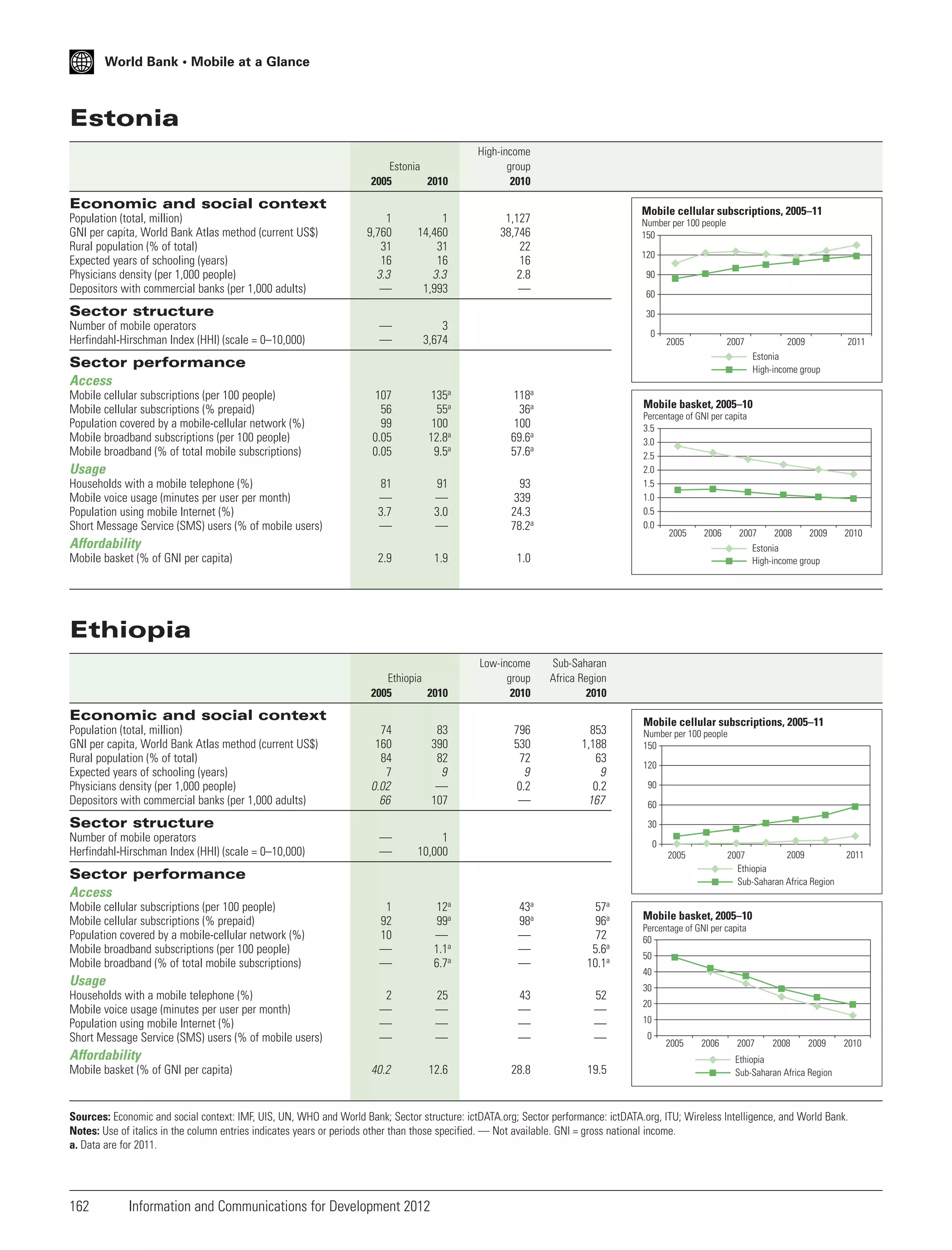
Briefing Paper.” http://www.itu.int/osg/spu/ni/3G/workshop/
Briefing_paper.PDF.

Scottsdale, A. 2011. “Pent-Up Demand and Falling Price Drive
Strong Entry-Level Market Growth.” http://www.abiresearch
.com/press/3573-Pentup+Demand+and+Falling+Prices+
Drive+Strong+Entry-Level+Handset+Market+Growth.

Qiang, C., and C. Rossotto. 2009. “IC4D: Extending Reach and
Increasing Impact.” Economic Impacts of Broadband, ch. 3.
Washington, DC: World Bank.

Thomson, H., et al. 2011. “Economic Impacts of Mobile versus
Fixed Broadband.” Telecommunications Policy. http://www
.sciencedirect.com/science/article/pii/S0308596111001339.

Qiang, C., and L. Xu. Forthcoming. “Telecommunications and
Economic Performance: Macro and Micro Evidence.”
World Bank, Washington, DC.

Wireless Intelligence. 2011. “Germany Rolls Out LTE to Rural
Areas.” https://www.wirelessintelligence.com/analysis/2011/
06/germany-rolls-out-lte-to-rural-areas/.

112

Information and Communications for Development 2012
Part II: Statistical
Appendix
Key Trends in the Development of the
Mobile Sector

Michael Minges

Access
Measuring mobile take-up

Mobile telephony has been one of the most quickly
adopted technologies of all time. While 128 years passed
before fixed telephone lines reached 1 billion users, mobile
networks achieved this milestone in just over two decades
(figure A.1). Even more astounding, mobile networks have
roughly doubled in size every two years since 2002. By the
end of 2011, there were 5.9 billion mobile cellular subscriptions worldwide.
This huge growth in mobile subscriptions has led to a
significant increase in penetration. The traditional measure
of mobile telephony penetration is the number of subscriptions per 100 people. By the end of 2011, more than 8 of
every 10 people around the world had a mobile subscription, up from just over 1 in 10 in 2000, with particularly
strong gains in middle-income countries (figure A.2). Over
the span of a single decade, mobile telephones have changed
from an elitist gadget that was mainly the preserve of highincome countries to a mass-market tool spanning the globe.
Some 90 economies—almost half of the member countries of the World Bank—had a mobile penetration exceeding 100 percent in 2011. Because there are more mobile
subscriptions than inhabitants in these countries, these
statistics do not reflect the number of people who actually
have use of a mobile phone, because the same person may
possess multiple SIM cards (for example, to avail themselves

of lower on-network calling prices or to separate business
from personal calls), and thus have multiple subscriptions.
In the United Arab Emirates in 2010, for example, 28 percent
of subscriptions were duplicates, mainly for these reasons, as
well as for roaming and gaining better coverage in different
parts of the country (UAE 2011).
Another factor skewing the figures in some countries is the
number of mobile cellular subscriptions taken by people residing in bordering nations. Subscriptions can also be inactive,
with the length of time that must pass before the subscription
elapses varying by operator. At the same time, an increasing
number of devices are connected to mobile networks that do
not use voice services or do not interface with humans. These
include laptop computers, as well as equipment such as automated teller machines. In Spain, these types of subscriptions
accounted for 10 percent of the mobile market in 2010.
Although methods other than counting subscriptions
may be more precise for measuring access to mobile phones,
subscription data are most widely available. For example,
another useful measure could be the number of persons
with access to a mobile phone. But gathering that data
requires the use of surveys, which are conducted only infrequently or, in many countries, not conducted at all.
Another measure is the number of households where at
least one household member has a mobile phone. This
metric is useful because it is precise: it cannot exceed 100.
If a mobile phone exists in a household, then all members

115
Figure A.1 Worldwide fixed and mobile telephone subscriptions
10

The number of mobile subscriptions
will soon overtake the world's
population

9
8
7

Billions

6
5

1978:
First commercial
cellular mobile
services
established

1876:
First two-way
telephone
conversation

4

2002:
There are over 1 billion
mobile subscriptions,
passing fixed-line users

3
2
1961:
85 years later, fixed-line
subscriptions reach 100 million

1

18
7
18 6
8
18 2
8
18 8
9
19 4
00
19
0
19 6
1
19 2
1
19 8
24
19
3
19 0
3
19 6
4
19 2
4
19 8
5
19 4
6
19 0
6
19 6
7
19 2
7
19 8
8
19 4
8
19 1
9
11 0
9
19 1
96
20
0
20 2
08
20
14

0

Fixed lines (bn)
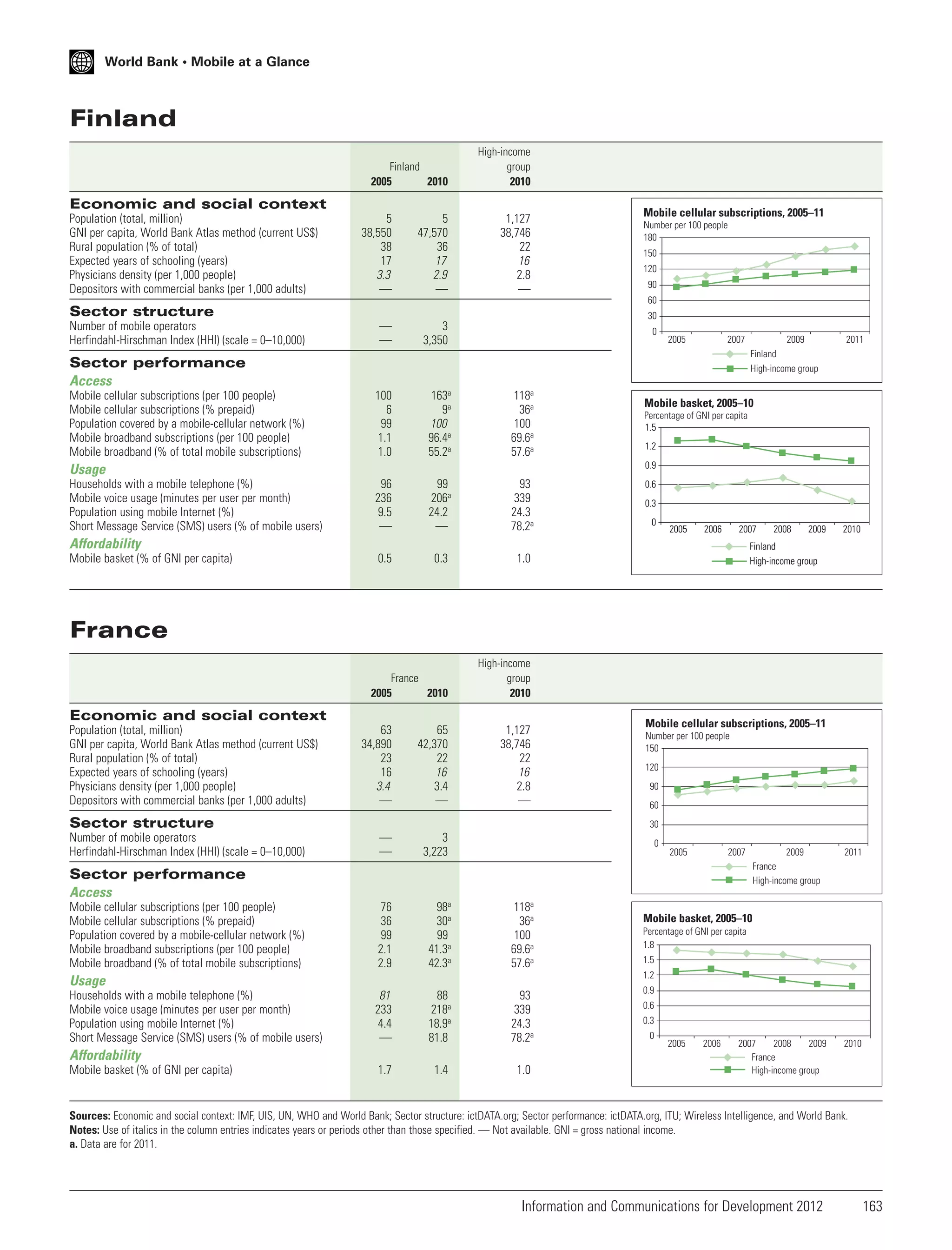
Mobile subscriptions (bn)

World Population (bn)

Source: Adapted from ITU, World Bank estimates.
Note: Log scale.

Figure A.2 Mobile cellular subscriptions per 100
people, by income group

120

118
116

High

100
85
78

80
WORLD
60

Upper-middle
50

Lower-middle

40
20 12
11
0 3
0.3

38

20
11

20
10

20
09

20
08

20
07

20
06

20
05

20
04

20
03

20
02

Low

20
01

Number of subscriptions per 100 people

140

Source: Adapted from ITU, and author’s own estimates.

could theoretically use it, thereby extending access. Household availability has thus been the traditional indicator for
measuring universal service. This indicator is collected by
a growing number of countries through ongoing household surveys, as well as special health surveys. The United

116

Information and Communications for Development 2012

Nations recommended in 2008 that the question “Household having mobile cellular telephone(s)” be included in
the questionnaires used for the 2010 round of censuses.1
Based on the surveys carried out by a significant number
of countries, almost three of four households were estimated to have mobile phone service in 2010.
Another factor to consider is household size. Individual
use surveys tend to exaggerate subscription penetration
rates in developed economies, while household surveys
suggest that the level of access to mobile is higher in many
developing countries than subscription penetration
figures would suggest. Access is particularly high in countries with large households. Take Senegal, where the
subscription penetration was 57 per 100 people in 2009,
but household penetration was estimated to be 30 points
higher at 87 (figure A.3a). This larger household size can
dramatically extend access to mobile phones, considering
that on average nine persons are in each Senegalese household. Several low-income nations have higher mobile
phone home penetration than some developed economies.
For example, Senegal, along with some other low- and
middle-income economies, has a higher proportion of
homes with mobile phones than either Canada or the
United States (figure A.3b).
Figure A.3 Mobile household penetration, Senegal and other selected countries, 2009
b. Homes with a mobile phone, %, 2009

a. Mobile penetration, Senegal, 2009
100
90
80
70
60
50
40
30
20
10
0

Maldives

97.3

Jordan

97.1
94.0

Samoa
Senegal

85.8

Paraguay

85.6

United States
Honduras
Canada
Mobile subscriptions per
100 people

82.7
79.6
77.2

Percent of households
with a
mobile subscription

Source: Adapted from Autorité de Régulation des Télécommunications et des Posts (Senegal) and national household and health surveys.

Reaching the base of the pyramid

At the turn of the new millennium, most analysts would
have considered a world with 6 billion cellular phones
impossible. At the time, there were some 700 million mobile
subscriptions, 70 percent of which were located in highincome economies. This link between mobile penetration
and national income gave rise to a belief that there was a
price below which mobile service would be unprofitable,
thereby making it commercially unviable and unaffordable
for many in lower-income countries. After all, fixed telephones had been in existence for more than a century, yet
penetration rates were still less than 1 in 100 in many developing nations.
The mobile industry has defied that theory. Every year, it
expands its user base, reaching more and more low-income
users. This has been made possible by cheaper equipment,
falling handset prices, prepaid subscriptions, flexible
regulation, competition for marginal users as markets
become saturated at the top, and rising incomes.2 A recent
study carried out in three provinces in China found
that 95 percent of rural households had a mobile telephone (box A.1). Nonetheless, a significant proportion of
the world’s population has no mobile connection. Of the
some 5.9 billion mobile subscriptions in the world,
3.4 billion were in low- and middle-income economies
(figure A.4). Given some 4.8 billion residing in those
countries, that leaves a gap of 1.4 billion without a
mobile subscription. The number of people living on less
than $1.25 a day (purchasing power parity) in low- and

middle-income economies, estimated to be 1.1 billion,
might be considered outside the target market.3 That
leaves an addressable unserved population of just 300
million people worldwide at the start of 2012.
Mobile equipment manufacturer Nokia has calculated a
total cost of ownership (TCO) measure that factors in the
cost of the handset, service charges, and taxes (Nokia 2009).
The TCO needs to be adjusted by income, given that levels of
income vary between countries. Even if users can afford
service, they still need signal coverage. Figure A.5 illustrates
affordability and coverage for selected developing countries.
The relationship lends itself to four scenarios bounded by
affordability of 10 percent (that is, where mobile services are
either less or more than 10 percent of income) and coverage
(where mobile covers either less or more than 9 percent of
the population). These scenarios are reflected in the four
quadrants in figure A.5:
1. high affordability and high coverage (upper left quadrant)
2. high affordability and low coverage (lower left quadrant)
3. low affordability but high coverage (upper right quadrant)
4. low affordability and low coverage (lower right quadrant)
Countries where mobile services cost less than 10 percent
of income and cover at least 90 percent of the population

Key Trends in the Development of the Mobile Sector

117
Box A.1 Mobile use in rural China

An ongoing World Bank project has been investigating attitudes, use, and impact of information and communication technologies in rural China. Funded by the Bill and Melinda Gates
Foundation, one of the activities was a survey in rural areas of three provinces (Jilin, Guizhou,
and Shandong). Some 58 percent of the population in these provinces is rural; the combined
rural population is 88 million, which would make the three provinces the 13th largest country
in the world (about the size of Vietnam). The survey, carried out in October 2011, found very
high use of mobiles, with 95 percent of rural households reporting having one. Individual
ownership was lower at 85 percent, but over half of individuals without their own mobile
reported they did not have one because they could use someone else’s or they had no need.
Around half of mobile phone owners reported sending text messages, and some 13 percent
use the internet from their cell phone. One interesting finding was the relatively large amount
spent on mobile services. Average monthly mobile phone service expenditure was 13 percent
of income, with users willing to devote up to 18 percent of their income to mobile services.
Box Figure A.1.1 Mobile usage in rural areas of three Chinese provinces, 2011
b. Why don’t you have your own mobile phone?

a. Does your household have a mobile phone?

Other
6%

No
5%

Se
too rvic
ex e ch
14 pen arg
% siv e
e

Don’t know
how to use
14%
Handset too
expensive
13%

Yes
95%

Sending SMS

13.8
50.7

Receiving SMS

54.8

Making calls
Receiving calls
% of respondents

Can use
another phone
22%

d. Amount spent for mobile service as % of income:

c. Do you use the mobile phone for:
Accessing Internet

No need
31%

20
18
16
14
12
10
8
6
98.1
4
2
99.1 0

18
13

Actual amount

Amount willing to spend

Source: World Bank.

tend to have high levels of access (measured by the availability of mobile phones in households).
Service charges alone do not explain the problem.
Consider Angola, which has relatively low tariffs but also
low coverage. Mainly because of lack of competition,
Angola has not been successful in expanding mobile
coverage compared with peer countries. While two

118

Information and Communications for Development 2012

operators have worked in the country for more than a
decade, they used different technologies, which drove up
equipment costs and made it difficult for subscribers to
switch from one operator to the other. A mobile technology (GSM) common to both operators has been available
only since November 2010. Further, the market remains a
duopoly.
Figure A.4 Population, mobile subscriptions, and
poverty headcount in low- and middleincome economies
Low & middle income economies (people, billions)
6.0

Billions

5.0

4.8

4.0

3.4

3.0
2.0

1.4

1.1

1.0
Population

Mobile
subscriptions

No mobile
subscription

Poverty
headcount
ratio at $1.25
a day (PPP)

Sources: ITU and World Bank data and World Bank estimates.
Note: PPP = purchasing power parity.

Figure A.5 Affordability and coverage in developing
economies

Mobile coverage (% of population), 2010

Egypt, Arab. Rep.
Malawi
Bangladesh

90

Madagascar
Angola
50
1

10
TCO as percent of GNI per capita (US$), 2010

100

Mobile penetration (% of households)
< 80%

80–90%

> 90%

Sources: Adapted from Nokia (2009), ITU and World Bank estimates.
Note: Horizontal scale is logarithmic. TCO is “total cost of ownership,”
reflecting the average costs, by country, of handset purchase, service
charges, and taxes. GNI is gross national income per capita. The ratio of
TCO to GNI per capita is therefore an approximate measure of affordability
per capita.

At the same time, other countries have relatively high
coverage along with relatively high prices. Consider Malawi,
where mobile networks are estimated to cover more than
90 percent of the population but where the Nokia annual
TCO amounts to more than half of per capita income.

Densely populated and relatively small, Malawi has been relatively easy to cover. Attempts to introduce additional competition have not been completely successful, however, and the
market remains dominated by two operators. The least desirable position is to have high tariffs and low coverage. In
Madagascar, the Nokia TCO amounts to over one-third of
income, and only around three-fifths of the population is
covered. Although there are three operators, competition has
been affected by high interconnection charges.
In contrast, some countries have a high degree of affordability and coverage but relatively low take-up. The Arab
Republic of Egypt has a high penetration of fixed telephone
lines that provide an alternative to mobile. In Bangladesh
mobile calls cost about one U.S. cent a minute, and, according to Nokia, its mobile tariffs are among the lowest in the
world.4 Coverage is high at 99 percent of the population.
Despite these extremely low prices and very high coverage,
household penetration stood at around 64 percent in 2010.
According to mobile operator Grameenphone, its attempts
to expand access are difficult because of the high SIM tax,
which has remained “the biggest barrier to the growth of
mobile telephone industry in Bangladesh” (Grameenphone
2011). The tax of Tk 800 ($11.60) on new SIM cards has a
huge negative impact on low-end subscribers. If the SIM tax
were eliminated, an estimated 90 percent of Bangladeshi
households could afford mobile service. The GSM Association has called on the Bangladesh government to end the
SIM tax, citing it as the “single largest obstacle to the acquisition of new subscribers.” (GSMA 2009)
Operators are looking at innovative ways to widen access,
including lowering recharge values, conducting more
consumer research among bottom-of-the-pyramid populations, and developing low or alternative energy base stations.
Another possibility is through virtual telephony using
emerging cloud networks. Users would not need to buy a
handset and would instead be allocated a number that they
can use on a borrowed phone. Their contacts and voice mail
would be stored on the cloud, where there would also be a
gateway to mobile money services. Virtual telephony also
lowers the cost of acquiring new users; for example, a trial
network in Madagascar claims it costs operators just $0.20 to
establish cloud-based virtual telephony services, compared
with $14–$21 to deliver a SIM card.5
The barriers to increasing access to mobile communications for every household in the world are more of a regulatory
and policy nature rather than technical. Introducing and

Key Trends in the Development of the Mobile Sector

119
strengthening competition and eliminating special “mobile”
taxes could significantly narrow the range of those not served
by mobile communications. The remaining few households
without access could then be captured through universal access
programs. It is also important to ensure that those at the
bottom of the pyramid also enjoy access to value-added services, which requires capacity building to understand how these
services can benefit their lives and how to use them.

Mobile broadband
Using the ITU/OECD definition of broadband—networks
with a minimum download speed of 256 kilobits per second
(kbit/s)—the first mobile broadband networks were launched
in late 2000 in Japan (W-CDMA) and in 2001 in the Republic of Korea (EV-DO). According to industry sources, there
were 939 million mobile broadband subscriptions worldwide
in June 2011 (figure A.6a). This number implies that just over
15 percent of the global subscription base can theoretically
use mobile network services at high speeds.

A number of these subscriptions are not active users of
mobile broadband (that is, they do not use the internet at
mobile broadband speeds, even though they are equipped to
do so). Users could have a theoretical ability to use mobile
broadband by having coverage and a mobile-broadbandenabled device, but they may not necessarily be using highspeed services, perhaps because of high prices. They could
also be subscribing to mobile broadband and using a highspeed mobile service (such as video telephony), but not
necessarily accessing the internet. Alternatively, they could
be using mobile broadband to access the internet over handsets, as well as through laptops or tablets.
This definitional challenge presents analytical difficulties
with interpreting mobile broadband statistics. The issue is
whether to count and include theoretical access, active access
to any high-speed service, active access using internet
browsers, or active access via data cards (figure A.6b). Intergovernmental agencies have called for more clarity on mobile
broadband statistics (OECD 2010). However, most countries
report their mobile broadband statistics in insufficient detail,

Figure A.6 Mobile broadband
a. Estimated mobile broadband subscriptions, June 2011

b. Definitional “layers” of mobile broadband

Mobile
subscriptions

Subscriptions capable of
mobile broadband

EVDO 20%

Subscriptions using mobile
broadband for video calling and
other data but not necessarily Internet

939 Million

W-CDMA/
HSPA 80%

Subscriptions using
mobile broadband to
access Internet

Subscriptions using data
cards to access Internet

Source: Adapted from CDMA Development Group and Global Mobile Suppliers Association (figure A.6a).
Note: Not including LTE (estimated at 2 million subscriptions) or WiMAX (estimated at 20 million).

120

Information and Communications for Development 2012
so data comparability remains limited. Given these definitional issues, some countries have gone with the lowest
common denominator, counting only internet access
through data cards as mobile broadband (denoted by the
innermost circle in figure A.6b).
Despite confusion over statistical definitions, mobile
broadband is already concretely impacting a number of
developing countries, allowing them to leapfrog a lack of
fixed broadband infrastructure. Based on the more certain
yardstick of data cards (arguably the most direct comparison
with wired broadband subscriptions), then mobile broadband far surpasses fixed broadband in nations such as the
Philippines and South Africa (figure A.7). And if the wider
definition for mobile broadband of plain internet access is
applied, then the combination of wireless networks such as
GPRS, EDGE, CDMA2000 1x, mobile broadband, and
WiMAX greatly exceeds wired connections in most developing countries. An estimated 750 million people around the

Figure A.7 Broadband subscriptions in the
Philippines and South Africa
Philippines
3,500

3,190
2,197

2,500
2,000

1,554

1,500

11

10
20

09
20

08
20

South Africa

3,000

Devices
2,500

2,500

1,953

2,000
1,419

1,500
811

Fixed

11

818

20

10
20

09

06
20

08

223

0

725

625

520

20

115

07

500

380
374

20

1,000

20

Thousands

1,149

898

776

433

185 384

20

20

328

07

22
111

05

0

632
122

06

500

20

1,000

20

Thousands

3,000

world accessed the internet from their mobiles in 2010, up
from some 180 million in 2005. Developing countries in Asia
account for over half of this total, with some two out of five
mobile internet users in China alone.
In addition to the statistical challenge of measuring active
mobile broadband users, there are often significant shortfalls
between the theoretical and actual speeds of data throughput. Manufacturers and operators cite ever-increasing bandwidth, but the average speeds fall far short. According to
Akamai’s analysis of 96 mobile networks across 58 economies
carried out in the third quarter of 2011, peak speeds were
around 8.9 megabits per second (Mbit/s), but average speeds
were 1.8 Mbit/s (Akamai 2012). In contrast, Akamai reported
average download speeds of 4.7 Mbit/s for fixed broadband
networks. Further, usage over mobile broadband networks is
generally “capped”; if users exceed a preset amount of data
transfer, then they no longer have access to data services or
their speed may be reduced or they will have to pay overage
charges. Mobile data usage varies tremendously around the
world. In the third quarter of 2011 it averaged 536
megabytes (MBs) per month across networks in 58 countries with a low of 22 MB per month and a high of 4,906 MB
per month (table A.1).
While high-speed wireless holds promise for reducing the
broadband divide, countries need to allocate spectrum and
license operators to provide services. At the end of 2011, 46
World Bank members—almost all developing countries—
had not commercially deployed mobile broadband services.
And in a number of developing countries, a high-speed
wireless service may technically exist, but it is often available
only as a fixed wireless option.

Wireless

Sources: Adapted from Globe Telecom, PLDT, MTN, Telkom, and Vodacom.
Note: “Wireless” refers to data cards only and not to access directly from
handsets. Data are for major operators only. Figures for South Africa have

According to Gartner, global sales of personal computers
(PCs) numbered 353 million in 2011.6 Assuming a PC is
replaced on average every five years,7 an estimated total of
1.6 billion PCs were in use around the world at the end of
2011. In comparison, some 1.8 billion mobile handsets were
sold in 2011 alone (figure A.8a).8 In other words, more
mobile phones were sold in 2011 than the entire base of
installed PCs. Sales of smartphones rose 59 percent in 2011
to more than 470 million units, about one of every four
mobile handsets.
Another entry into the device world came in April
2010. The Apple iPad, which straddles the boundary

Key Trends in the Development of the Mobile Sector

121
Table A.1 Mobile data speeds and volumes, Q3 2011
Economy
Australia
Austria
Belgium
Bulgaria
Canada
Chile
China
Colombia
Czech Republic
Egypt, Arab Rep.
El Salvador
Estonia
France
Germany
Greece
Guam
Guatemala
Hong Kong SAR, China
Hungary
India
Indonesia
Ireland
Israel
Italy
Kuwait
Lithuania
Malaysia
Mexico
Moldova
Morocco
Netherlands
New Caledonia
New Zealand
Nicaragua
Nigeria
Norway
Pakistan
Paraguay
Poland
Portugal
Puerto Rico
Qatar
Romania
Russian Federation
Saudi Arabia
Singapore
Slovakia
Slovenia
South Africa
Spain

Network

Average speed
(kbit/s)

Peak kbit/s

Average data usage
(MB/month)

AU-3
AT-1
BE-2
BG-1
CA-2
CL-3
CN-1
CO-1
CZ-1
EG-1
SV-3
EE-1
FR-2
DE-1
GR-2
GU-1
GT-1
HK-2
HU-1
IN-1
ID-1
IE-1
IL-1
IT-4
KW-1
LT-2
MY-3
MX-1
MD-1
MA-1
NL-1
NC-1
NZ-2
NI-1
NG-1
NO-2
PK-1
PY-1
PL-2
PT-1
PR-1
QA-1
RO-1
RU-3
SA-1
SG-4
SK-1
SI-1
ZA-1
ES-2

1,553
2,903
1,938
1,715
1,171
1,560
1,475
1,003
1,709
575
926
1,401
2,382
967
1,199
957
1,441
1,925
1,863
1,597
475
2,880
1,435
1,413
1,444
1,973
1,024
1,233
1,791
1,256
1,763
1,070
1,880
1,551
254
2,071
691
643
1,511
880
2,639
1,620
884
995
1,672
1,585
327
2,189
438
1,089

7,878
10,722
5,277
7,499
2,923
11,207
3,927
6,541
8,630
3,344
4,782
7,487
8,542
3,720
4,179
4,663
7,379
10,842
8,481
9,443
7,172
14,055
6,419
8,693
6,979
11,945
7,598
6,938
7,183
10,925
4,871
4,757
9,988
7,886
5,024
6,752
4,682
5,850
7,593
4,277
10,975
10,074
4,250
3,990
8,713
9,490
2,077
8,687
1,386
8,648

222
142
22
127
608
133
247
156
87
155
353
264
1,714
93
132
101
411
583
130
274
4,906
725
69
219
252
414
361
94
142
322
36
854
768
754
514
58
332
163
78
200
2,703
281
91
117
357
289
38
54
168
149

(continued next page)

122

Information and Communications for Development 2012
Table A.1 continued
Economy

Average speed
(kbit/s)

Sri Lanka
Thailand
Turkey
Ukraine
United Kingdom
United States
Uruguay
Venezuela, RB
AVERAGE

Peak kbit/s

894
149
1,771
2,227
4,009
1,072
542
911
1,818

Network

7,373
1,412
7,975
7,500
19,334
4,411
4,712
6,146
8,960

LK-1
TH-1
TR-1
UA-1
UK-3
US-2
UY-2
VE-1

Average data usage
(MB/month)
327
135
203
128
81
47
63
178
536

Source: Akamai 2012.

Figure A.8 Global sales of mobile and computing devices
a. Mobile handsets

b. PCs, smartphones, and tablets

2,000

30

1,000

1,800

900
25

1,600

800

1,400

15

800
10

600
400

5

600
Millions

1,000

Percentage

1,200

500
400
300
200
100

Smartphones

20
11

20
10

08

20
09

Year
Mobile handset sales

PCs

20

07

0

20

20
11

20
10

20
09

20
08

07
20

06
20

20
05

0

20
06

0

05

200

20

Millions

700

20

Year
Smartphone %

Tablets

Source: Adapted from Gartner Inc.
Note: In these figures, PC includes desk-based and mobile PCs, including mini-notebooks, but not tablets.

between smartphones and laptop computers, created a
new category of “tablet” computers. Just over 14 million
iPads were sold in 2011. The launch of the iPad has helped
attract more competitors into the tablet arena, and sales
of all brands are expected to be close to 300 million by
2015. Combined global sales of smartphones and tablet
computers exceeded those of PCs in 2011 (figure A.8b).
The outlook for internet connectivity is clearly through a

more portable and convenient device than a personal
computer, with smartphones enjoying stellar growth in
popularity (figure A.9).
Most mobile internet subscribers in developing countries are using low-end mobile handsets with minimal
features, which limits their functionality, particularly for
the development of advanced information and communication technology for development applications. For

Key Trends in the Development of the Mobile Sector

123
Figure A.9 Smartphone penetration as a share of
population, 2011

Android smartphone to be sold for $150, with the price
eventually dropping to under $100. Although those prices
will widen the potential target market considerably, such
smartphones will still prove expensive for many Indians,
who “can buy less advanced phones for $40 that have
cameras and basic data services” (Sharma 2010).

India
China
Slovak Rep.
Mexico
Indonesia
Ukraine
Turkey
Romania
Brazil
Japan
Thailand
Hungary
Czech Rep.
South Africa
Russia
Malaysia
Poland
Belgium
Germany
France
Switzerland
Canada
South Korea
US
Portugal
Ireland
Greece
Taiwan, China
Austria
Netherlands
Italy
UK
New Zealand
Norway
Finland
Israel
Denmark
Spain
Australia
Sweden
Hong Kong
SAR, China
Singapore

Mobile industry
Mobile economy

The mobile industry is a significant player in many
national economies. Mobile telecommunication operators
generated an estimated $848 billion in revenue in 2011
(figure A.10).9 That is around 1.2 percent of total global
annual gross domestic product (GDP) and 56 percent of
overall telecommunication revenues. The direct economic
impact of the mobile industry varies across regions. While
revenue remains at a consistent ratio of around 1 percent
of GDP in most regions, in some developing regions, its
direct impact is far higher. For instance, in Kenya, financial
transactions via the M-PESA platform are estimated to
equate to up to 20 percent of national GDP (World Bank
2010).
Mobile communications also has an indirect impact
beyond its direct impact on the economy. The consultancy
and accountancy firm Deloitte has developed a framework
to illustrate the wider impact of the mobile communications
services sector on the mobile ecosystem (Deloitte 2008).
Figure A.10 Global telecommunication services
market
1,600
1,400

20

40

60

80

100

percent
Source: Tomi Ahonen Consulting Analysis, December 2011. http://communities-dominate.blogs.com/brands/2011/12/smartphone-penetration-rates-bycountry-we-have-good-data-finally.html.

$258

$272

$287

$301

$322

$728

$758

$798

$848

$896

$384

$357

$334

$315

$301

2008

Billions of US dollars

0

1,200

2009

2010

2011*

2012**

1,000
800
600
400
200
0

smartphones and tablets to spread more widely and be
adopted more rapidly in developing economies, their price
needs to fall. Google is interested in developing a massmarket smartphone for emerging nations. It has been
working with Indian handset manufacturers to develop an

124

Information and Communications for Development 2012

Fixed
Source: Adapted from IDATE.
*estimate.
**forecast.

Mobile

Data and Internet
This ecosystem includes equipment suppliers, support services, resellers, and retail shops, as well as significant contributions to government in the form of taxes (figure A.11).
Deloitte considers that mobile communications has three
indirect economic impacts:
1. An impact on other industries related to mobile services,
including network and handset suppliers, airtime
resellers, and the like
2. An impact on end users from improved productivity,
such as reductions in travel costs, improved job opportunities, and greater market efficiency
3. An impact on society related to such benefits as social
cohesion, the extension of communications to lowincome users, stimulation of local content, and disaster
relief assistance
In addition, there are multiplier effects throughout the
broader economy, as the initial spending related to mobile
communications ripples through other sectors of the econ-

omy. Based on various economic studies, Deloitte estimates
that this multiplier effect ranges from 1.1 to 1.7.
The model has been used to calculate the economic
impact of mobile communications in a number of countries. One study of six countries in 2007 concluded that the
direct economic impact of mobile communications ranged
from 3.7 to 6.2 percent of national GDP (Deloitte 2008).
The employment impact of mobile communications is
also significant. In addition to the direct employment of
mobile operators, the Deloitte model includes related industries (such as equipment suppliers and airtime resellers), as
well as spillover employment generated by government taxes
and employment created from the consumption expenditures of personnel in mobile-related industries.
Strategic investors

The mobile services industry is one of the most globalized
in the world. Practically every developing country has experienced foreign investment in its mobile cellular market, as
have many developed nations. Opening up markets to

Figure A.11 Mobile value chain

Network
equipment
suppliers
(VA)

Suppliers
of support
services (VA)

Fixed line
operators (VA)

Other
suppliers of
capital items (VA)

Multiplier

Airtime sellers
and payphone
operators (VA)
Interconnection
payments

Mobile network
operators (VA)

Handset
producers
and dealers (VA)

Fixed line
operators (VA)

Fixed line to mobile calls

Government
tax revenues

Payment for mobile services, connections, and handsets
Payment for handsets
End users

Source: Deloitte.
Note: Value added (VA) is specific to a national economy and does not show international value added.

Key Trends in the Development of the Mobile Sector

125
privatization and foreign investment has been a major
factor driving the growth of the mobile industry in emerging markets. According to the World Bank’s Private Participation in Infrastructure database, between 1990 and 2010,
some 329 projects in the mobile telecommunication sector
in developing regions attracted $441 billion in private
sector investment—much of it foreign and most of it from
strategic mobile multinational groups (table A.2). No
matter the size of a country, its political system, where it is
located, or its income, private and foreign companies are
willing to invest in mobile communications.
The relationship between foreign investors and host
countries has changed considerably in recent years.
Publicly held corporations now have to abide by a greater
range of regulations and scrutiny relating to management,
accounting, reporting, and governance than in the past.
Deviating from these rules can have severe repercussions
with investors, governments, and the public. Telenor, the
Norwegian strategic investor, was rocked by reports of
poor labor practices in firms that supply its mobile operations in Bangladesh. It immediately implemented reforms
to remedy the situation.10 At the same time, multinationals
are responding to pressing social issues such as the environment and poverty by instituting recycling, corporate
social responsibility, and similar programs and policies.
Today, mobile communications markets in many developing countries have achieved notable scale. Indeed, some
developing country subsidiaries now enjoy larger subscriber
bases than their foreign investors’ home markets. One is
Vodafone, where the number of mobile subscriptions in its
Indian subsidiary is seven times larger than its home market
of the United Kingdom. Growth in overseas markets means
that investors are responding more to the needs of these
overseas markets than previously and leveraging lessons
learned abroad to apply throughout their group holdings.

Many investors are developing a growing geographic
focus and specialization in certain regions. Although only a
few strategic investors are engaged around the world, most
focus on a specific region or geography. South Africa’s MTN,
for example, has investments throughout Sub-Saharan
Africa and the Middle East. It has grown from operations in
five countries in 2000 and just 2 million subscribers to operations in 21 countries and 142 million subscriptions in 2010.
Digicel, which focuses on islands in the Caribbean and
Pacific, has investments in 32 countries. Some multinationals channel their investments through regional holdings; for
example, Vivendi works through Maroc Telecom, France
Telecom through Senegal’s Sonatel, and Vodafone through
South Africa’s Vodacom. This trend toward regional specialization makes investors better informed about their markets
and enhances roaming, potential economies of scale, and
platform-sharing.

A Mobile analytical tool
This edition of the World Bank Group’s Information and
Communications for Development report features a number
of mobile indicators in both the chapter text and the statistical appendix. The wide variety of indicators used can make
it difficult to gauge and benchmark country performance.
Combining several significant indicators into a smaller
number of composite indicators and tracking changes in
them over time can provide a useful analytical tool for evaluating the outcomes of different investments and policy
measures. These composite indicators can also be used to
diagnose the strengths and weaknesses of the mobile sector
in a particular country and thereby can serve as a useful tool
for future policy development. The publication of an analytical tool is consistent with the previous edition of the report,
which introduced a series of ICT performance measures,

Table A.2 Private participation in mobile networks, 1990–2010
Region
East Asia and Pacific
Europe and Central Asia
Latin America and the Caribbean
Middle East and North Africa
South Asia
Sub-Saharan Africa
TOTAL

Number of projects
45
75
52
21
31
105
329

Sources: World Bank and PPIAF, PPI Project Database. (http://ppi.worldbank.org).

126

Information and Communications for Development 2012

Investment commitments in physical assets
(millions of current US$)
54,194
87,445
153,944
23,538
69,286
52,305
440,7132
based on country groupings (World Bank 2009). Although
the indicators used in this analytical tool are focused only on
the mobile sector, the full range of ICT indicators used in the
performance measures can be found in the World Bank’s
Little Data Book on ICT, the 2012 edition of which is being
published in conjunction with this report.
There have been several methodological approaches and
compilations of composite mobile indicators. The International Telecommunication Union (ITU) compiled a onetime “Mobile/Internet Index” in 2002 (ITU 2002). A
framework for a composite mobile indicator with a focus
on the internet has been proposed (Minges 2005). The ITU
Digital Opportunity Index contained several mobile variables and allowed disaggregation into a mobile-only
subcategory (ITU 2006) and was updated in 2007 (ITU and
UNCTAD 2007). A mobile broadband composite indicator
has recently been compiled for Latin American nations
(A. T. Kearney 2012). None of these composite mobile indicators is particularly appropriate for this report because
they have either been one-off, are not confined to mobile,
or are limited to a particular region. Therefore a specially
constructed mobile analytical tool, based on a series of
composite indicators and building on the foundation of
this earlier work, can help to fill the void.
In the context of the development orientation of the
report, the Mobile Analytical Tool measures, on a countryby-country basis, the affordability and coverage of mobile

networks (universality), the degree to which operators
provide voice and advanced network services (supply), and
the ownership and usage of mobile phones (demand). Each
composite indicator is constructed from two separate indicators that measure these three components with equal weight
given to each (figure A.12). The three composites could also
be combined into a single measure if researchers found this
useful, but that is not the intention here. The indicators are
reproduced in the statistical appendix of this report, providing transparency and allowing users to recreate the analysis.11
The methodology is similar to that used for the United
Nations Development Programme’s Human Development
Index (HDI). Each indicator has an equal weight. Indicators
are converted to standardized values based on a logical 100
percent “goalpost.” This is a straightforward conversion except
for affordability, which is subtracted from 1 to reflect best
performance. Although the affordability value may never
reach 1 (where mobile service would be free), in 2010 there
were twenty-six economies where the price of a mobile basket
was less than 1 percent of per capita income (ITU 2011).
Table A.3 uses the data for Morocco to provide an example of the construction of the Mobile Analytical Tool.
The analytical tool has been applied to a representative
range of 100 economies with data availability for the years
2005 and 2010 (table A.4 at the end of the appendix). The
results provide some interesting insights into the development of mobile networks over that critical time period.

Figure A.12 Mobile analytical tool: indicators and categories
6 indicators
1

Percentage of population covered by mobile
cellular telephony

2

Mobile cellular tariffs as a percentage of per
capita income

3

Mobile cellular subscriptions per 100 people
(capped at 100)

4

Ratio of mobile broadband subscriptions to
total mobile subscriptions

5

Proportion of households with a mobile
phone

6

3 categories

Proportion of individuals that used the
internet from a mobile phone

1. UNIVERSALITY

2. SUPPLY

3. DEMAND

Key Trends in the Development of the Mobile Sector

127
Table A.3 Worked example of the mobile analytical tool, Morocco
Indicator value
Indicator

2005

Percentage of population covered by mobile cellular telephony
Mobile cellular tariffs as a percentage of per capita income
Inverted (100-tariff/GNI)
Mobile cellular subscriptions per 100 people (capped at 100)
Ratio of mobile broadband subscriptions to total mobile subscriptions
Proportion of households with a mobile telephone
Proportion of individuals that used the mobile internet

98
20.1
79.9
41
0
59
0.04

Component scores

2010
98
14.3
85.7
100
4
84
3.4

2005

2010

Category

0.88

0.93

Universality

0.21

0.52

Supply

0.29

0.44

Demand

Source: Based on Agence Nationale de Réglementation des Télécommunications (ANRT) and Maroc Telecom.

Table A.4 Mobile analytical tool components for 100 selected economies, 2005 and 2010
Universality
Country

2005

2010

Albania
Algeria
Argentina
Armenia
Australia
Austria
Azerbaijan
Bahrain
Bangladesh
Belarus
Belgium
Bolivia
Bosnia and Herzegovina
Brazil
Bulgaria
Cambodia
Cameroon
Canada
Chile
China
Colombia
Costa Rica
Croatia
Czech Republic
Denmark
Ecuador
Egypt, Arab Rep.
Estonia
Finland
France
Georgia
Germany
Ghana

0.86
0.90
0.96
0.95
0.98
0.98
0.92
0.99
0.84
0.94
0.99
0.73
0.93
0.90
0.95
0.71
0.69
0.97
0.97
0.91
0.89
0.87
0.98
0.98
0.99
0.89
0.94
0.98
0.99
0.99
0.93
0.98
0.61

Supply
Change
(%)

0.95
0.96
0.98
0.95
0.99
0.99
0.99
0.99
0.97
0.98
0.99
0.73
0.97
0.97
0.97
0.89
0.82
0.99
0.98
0.98
0.90
0.87
0.99
0.99
0.99
0.90
0.98
0.99
0.99
0.99
0.96
0.99
0.85

10
7
2
0
1
1
8
0
15
4
0
0
4
8
2
25
19
2
1
8
1
0
1
1
0
1
4
1
0
0
3
1
39

2005

2010

0.24
0.21
0.27
0.11
0.47
0.55
0.13
0.50
0.03
0.21
0.42
0.13
0.20
0.23
0.40
0.04
0.06
0.26
0.33
0.15
0.25
0.13
0.40
0.50
0.51
0.24
0.09
0.50
0.51
0.40
0.17
0.50
0.06

0.50
0.46
0.52
0.51
0.70
0.57
0.42
0.51
0.21
0.51
0.54
0.35
0.43
0.54
0.52
0.34
0.20
0.48
0.53
0.35
0.50
0.37
0.52
0.54
0.73
0.52
0.46
0.59
0.60
0.64
0.56
0.59
0.37

Demand
Change
(%)
108
119
93
364
49
4
223
2
600
143
29
169
115
135
30
750
233
85
61
133
100
185
30
8
43
117
411
18
18
60
229
18
517

2005

2010

0.15
0.25
0.35
0.16
0.44
0.46
0.26
0.50
0.06
0.15
0.46
0.15
0.27
0.30
0.36
0.11
0.14
0.33
0.36
0.28
0.28
0.25
0.40
0.43
0.50
0.19
0.14
0.42
0.52
0.38
0.15
0.39
0.10

0.49
0.48
0.48
0.49
0.51
0.56
0.45
0.54
0.34
0.39
0.49
0.40
0.43
0.43
0.45
0.32
0.22
0.48
0.48
0.58
0.47
0.40
0.54
0.50
0.59
0.41
0.39
0.47
0.62
0.52
0.43
0.51
0.37

Change
(%)
227
92
37
206
16
22
73
8
467
160
7
167
59
43
25
191
57
45
33
107
68
60
35
16
18
116
179
12
19
37
187
31
270

(continued next page)

128

Information and Communications for Development 2012
Table A.4 continued
Universality
Country

2005

2010

Greece
Hong Kong SAR, China
Hungary
India
Indonesia
Ireland
Israel
Italy
Jamaica
Japan
Jordan
Kazakhstan
Kenya
Korea, Rep.
Kyrgyzstan
Latvia
Lebanon
Lithuania
Macedonia, FYR
Malaysia
Mali
Mauritius
Mexico
Moldova
Morocco
Namibia
Nepal
Netherlands
New Zealand
Nigeria
Norway
Pakistan
Paraguay
Peru
Philippines
Poland
Portugal
Qatar
Romania
Russian Federation
Rwanda
Saudi Arabia
Senegal
Serbia
Singapore
Slovak Republic
Slovenia
South Africa

0.99
1.00
0.98
0.72
0.91
0.99
0.98
0.99
0.96
0.99
0.95
0.94
0.59
0.99
0.59
0.97
0.94
0.98
0.94
0.97
0.19
0.99
0.92
0.89
0.88
0.91
0.48
0.99
0.98
0.63
1.00
0.71
0.84
0.75
0.89
0.98
0.99
0.97
0.96
0.96
0.44
0.95
0.72
0.95
1.00
0.98
0.99
0.96

0.99
0.99
0.98
0.86
0.96
0.99
0.99
0.99
0.98
0.99
0.98
0.97
0.85
0.99
0.90
0.99
0.97
0.99
0.96
0.99
0.58
0.99
0.95
0.95
0.93
0.96
0.85
1.00
0.98
0.79
1.00
0.94
0.95
0.88
0.97
0.99
0.99
0.99
0.98
0.98
0.83
0.95
0.85
0.96
1.00
0.98
0.99
0.97

Supply
Change
(%)
0
–1
0
19
5
0
1
0
2
0
3
3
44
0
53
2
3
1
2
2
205
0
3
7
6
5
77
1
0
25
0
32
13
17
9
1
0
2
2
2
89
0
18
1
0
0
0
1

Demand

2005

2010

Change
(%)

0.50
0.54
0.46
0.03
0.10
0.50
0.51
0.57
0.50
0.51
0.29
0.16
0.08
0.56
0.05
0.43
0.13
0.50
0.31
0.38
0.03
0.27
0.22
0.15
0.21
0.10
0.01
0.50
0.46
0.07
0.50
0.06
0.13
0.10
0.20
0.38
0.53
0.45
0.31
0.44
0.01
0.31
0.07
0.35
0.52
0.42
0.45
0.33

0.54
0.72
0.53
0.31
0.46
0.65
0.56
0.59
0.51
0.94
0.51
0.50
0.36
0.96
0.45
0.65
0.37
0.58
0.57
0.59
0.26
0.54
0.43
0.47
0.52
0.51
0.16
0.59
0.63
0.29
0.58
0.31
0.49
0.49
0.51
0.66
0.58
0.58
0.54
0.52
0.19
0.53
0.32
0.54
0.59
0.63
0.61
0.53

8
33
15
933
360
30
10
4
2
84
76
213
350
71
800
51
185
16
84
55
767
100
95
213
148
410
1,500
18
37
314
16
417
277
390
155
74
9
29
74
18
1,800
71
357
54
13
50
36
61

2005

2010

Change
(%)

0.38
0.46
0.40
0.07
0.15
0.45
0.49
0.41
0.47
0.72
0.27
0.14
0.11
0.58
0.05
0.42
0.25
0.37
0.33
0.29
0.08
0.32
0.21
0.16
0.29
0.20
0.02
0.50
0.37
0.20
0.50
0.17
0.25
0.11
0.24
0.33
0.42
0.55
0.25
0.16
0.03
0.48
0.15
0.36
0.55
0.45
0.44
0.31

0.47
0.60
0.48
0.27
0.39
0.52
0.55
0.55
0.50
0.78
0.55
0.43
0.36
0.69
0.45
0.53
0.42
0.51
0.44
0.53
0.11
0.51
0.35
0.36
0.44
0.31
0.30
0.55
0.54
0.31
0.56
0.25
0.44
0.39
0.43
0.46
0.47
0.66
0.41
0.49
0.20
0.53
0.43
0.43
0.61
0.53
0.54
0.47

24
30
20
286
160
16
12
34
6
8
104
207
227
19
800
26
68
38
33
83
38
59
67
125
52
55
1,400
10
46
55
12
47
76
255
79
39
12
20
64
206
567
10
187
19
11
18
23
52

(continued next page)

Key Trends in the Development of the Mobile Sector

129
Table A.4 continued
Universality
Country

2005

2010

Spain
Sri Lanka
Sweden
Switzerland
Tajikistan
Tanzania
Thailand
Turkey
Uganda
Ukraine
United Arab Emirates
United Kingdom
United States
Uruguay
Uzbekistan
Venezuela, RB
Vietnam
Zambia
Zimbabwe

0.99
0.87
0.99
0.99
0.20
0.49
0.93
0.97
0.69
0.92
0.99
0.99
0.99
0.95
0.79
0.90
0.89
0.56
0.82

Supply
Change
(%)

0.98
0.97
0.99
0.99
0.94
0.77
0.97
0.97
0.85
0.98
0.99
0.99
0.99
0.99
0.95
0.93
0.96
0.78
0.63

–1
11
0
0
370
57
4
0
23
7
0
0
0
4
20
3
8
39
–23

Demand

2005

2010

Change
(%)

0.51
0.09
0.52
0.48
0.02
0.05
0.23
0.32
0.03
0.32
0.50
0.53
0.36
0.17
0.01
0.24
0.05
0.04
0.03

0.59
0.45
0.62
0.62
0.35
0.26
0.51
0.44
0.19
0.52
0.71
0.61
0.61
0.55
0.40
0.51
0.53
0.20
0.35

16
400
19
29
1,650
420
122
38
533
63
42
15
69
224
3900
113
960
400
1067

2005

2010

0.42
0.10
0.50
0.50
0.06
0.04
0.36
0.36
0.08
0.22
0.50
0.50
0.29
0.23
0.25
0.18
0.15
0.08
0.05

0.54
0.32
0.59
0.56
0.41
0.23
0.52
0.49
0.27
0.43
0.56
0.57
0.56
0.37
0.44
0.26
0.29
0.30
0.27

Change
(%)
29
220
18
12
583
475
44
36
238
95
12
14
93
61
76
44
93
275
440

Source: Authors’ analysis.

The mean score for all components added together
increased by 30 percent between 2005 and 2010, from
0.49 to 0.63, attesting to the rapid growth and improvement in mobile networks over that period (figure A.13).
The highest increase was among low-income countries,
where significant gains in coverage were coupled with
falling prices from intensified competition. Regionally,
the highest growth was in South Asia, followed by SubSaharan Africa. The highest absolute increase was in
Tajikistan, where the score rose by 0.47 points to 0.57.
Mobile competition intensified in Tajikistan between
2005 and 2010, with four GSM (Global System for Mobile
communications) and several CDMA (Code Division
Multiple Access) operators and a number of panregional
mobile groups entering the market, including TeliaSonera
and Vimpelcom. Investment soared, leading to plummeting prices, an expansion of coverage, and skyrocketing
access. Several other Central Asian countries also had
among the highest growth in their scores between 2005
and 2010.
Looking at each of the three components individually,
some 80 countries have achieved a high degree of universality (a subindex value of 0.9 or higher). Most developed and

130

Information and Communications for Development 2012

middle-income nations had already achieved near universality by 2005, and gains since then have been marginal.
Although many developing nations had large increases in
universality between 2005 and 2010, many still remain
below the 0.9 threshold. Universal access to mobile
networks remains constrained in these countries because of
relatively high tariffs, incomplete mobile coverage, or both.
In Mali, for instance, mobile service covers less than half the
population, and the price of a monthly basket of mobile
services is one-quarter of per capita income. In Rwanda,
pricing is a barrier: mobile networks cover more than 90
percent of the Rwandan population, but a monthly mobile
basket is 30 percent of per capita income. In India the
bottleneck is coverage: a mobile basket is just 3 percent of
per capita income but only three-quarters of the population
is covered.
The supply component showed the greatest increase
between 2005 and 2010, with the mean value nearly
doubling from 0.28 to 0.50. In developed countries the
increase was chiefly attributable to the deployment of
mobile broadband networks, whereas gains in developing
countries came from the provision of basic voice services.
Around half of the countries are “stuck” at a supply
Figure A.13 Mobile analytical tool scores, 2005 and 2010, by income and region group
1.0

Income group

140

Region

120

Mobile analytical tool score

0.8
100

0.7
0.6

80

0.5
60

0.4
0.3

40

0.2
20
0.1

Growth, percentage change from 2005 to 2010

0.9

0

ca

ha

ra

nA

fri

sia

a

Sa
bSu

st
Ea

M

idd

le

ro

hA
ut

Af

So

an

an

th
dN

or

en
dC

ia
pe

ric

sia

c
ac

tra

dP

er

an

Am

As
st

Eu

Ea

lA

ifi

s
ica

w
Lo

idd

le

le
idd

r-m

Lo

we

gh
Hi

r-m
pe
Up

W

OR

LD

M

ED

W

or

IA

N

ld

0.0

2005

2010

Growth

Source: Author analysis.
Note: Scores shown are the mean of the three components. Group averages are the mean of the group.

Figure A.14 Mobile analytical tool and GNI per
capita, 2010
1.0
0.9

y = 0.0587Ln(x) + 0.1117
R2 = 0.7024

KOR JPN

0.8
0.7
Mobile Index

component value of 0.5; there are more SIM cards than
people, but the share of mobile broadband is low.
The score achieved on the Mobile Analytical Tool is
closely related to gross national income (GNI) per capita
(figure A.14). None of the high-income economies had a
score under 0.65, and several upper-middle-income countries exceeded that value although with much lower
incomes. These include the Russian Federation and South
Africa along with Argentina, Jamaica, Jordan, Lithuania,
Macedonia, Malaysia, Mauritius, and Thailand. Japan and
the Republic of Korea stand out as outliers—their score is
significantly above where it should be considering their
income. Most countries at very low per capita income averages (less than $1,000 a year) fall below the regression line,
suggesting that a certain level of economic development is
necessary for balanced mobile growth. Regional clusters
are also noticeable: lower-middle-income economies in
Sub-Saharan Africa tend to be performing poorly whereas
the opposite is true in Central Asia. A number of Latin
American upper-middle-income economies are also not
doing as well as expected.

0.6
0.5
0.4

KGZ
TJK

UZB

MEX
VEN

CRI
NGA
ZMB
CMR

0.3
0.2
0.1
0.0
$100

$1,000
$10,000
GNI per capita, US$, 2010 (log scale)

$100,000

Source: Authors’ analysis.
Note: Scores shown are the mean of the three components. Each point
represents one economy with outliers highlighted: CMR = Cameroon; CRI
= Costa Rica; JPN = Japan; KOR = Republic of Korea; KGZ = Kyrgyzstan;
MEX = Mexico; NGA = Nigeria; TJK = Tajikistan; UZB = Uzbekistan;
VEN = Venezuela, RB; ZMB = Zambia.

Key Trends in the Development of the Mobile Sector

131
Figure A.15 Mobile analytical tool: China and Sri Lanka compared
a. Supply and demand

b. Overall values for China and Sri Lanka
Coverage
1.0

0.9
y = 0.8294x + 0.0683
R2 = 0.8185

0.8

0.8

Supply component

0.7
Mobile
Internet %

0.6

0.6

Affordability

0.4
0.2

0.5

Sri Lanka

0

0.4
China

0.3

Household %

0.2

SIM per
100

0.1
0.0
0.0

0.2

0.4
0.6
Demand component

0.8

1.0

Broadband %
China

Sri Lanka

Source: Authors’ analysis.

As might be expected, there is a close relationship
between the supply and demand categories (figure A.15a).
Outliers illustrate mismatches between supply and demand.
For example in China the demand component (0.58) is
higher than the supply component (0.35), suggesting further
room for growth (figure A.15b). Over 90 percent of Chinese
households have a mobile phone, the second-highest level
among the developing countries used in the Mobile Analytical Tool (Jordan has the highest home mobile penetration
among this group). China also has a relatively high level of
internet access through mobile phones. According to a
recent 21-country survey, some 37 percent of Chinese
mobile phone owners use their handset to access the internet, a higher ratio than in France, Germany, or Spain.12 On
the supply side, China’s SIM card penetration is only 64 per
100 people, relatively low because there are few incentives for
multiple SIM card ownership thanks to inexpensive cross
network pricing. China is relatively new to mobile broadband with networks having launched only in 2009. Subscriptions to high-speed mobile networks have grown rapidly,
and by the end of 2010 China had the third-largest number
of mobile broadband users in the world (after Japan and the
United States). Nevertheless, mobile broadband still
accounted for only 5 percent of total mobile subscriptions,
with the result that most Chinese mobile internet users were
accessing the web over narrowband mobile connections.

132

Information and Communications for Development 2012

In contrast, Sri Lanka scores higher on the supply component (0.45) than on the demand one (0.32). On the supply
side, there is a high degree of competition in the Sri Lankan
mobile market with SIM card penetration at 85 per 100
people. Further, Sri Lanka was the first South Asian nation to
launch mobile broadband networks. On the demand side,
however, the penetration of mobile phones in Sri Lankan
homes is only 60 percent and just 5 of every 100 people use
a mobile phone to access the internet (see figure A.15b). The
mismatch suggests that efforts here need to be devoted to
boosting demand.
Figure A.16 illustrates the relationship between the
three composite indicators and underlying indicators of
the Mobile Analytical Tool. The values for high-income
economies are contrasted with the world and low- and
middle-income averages. As noted, high degrees of universality have been achieved with high affordability and
second-generation (2G) coverage. There have also been
large gains in supply of 2G networks and household
demand between 2005 and 2010. However, levels of mobile
broadband networks and internet usage are low, and these
will be the growth areas in the future. Care is needed to
ensure that an advanced mobile digital divide does not
develop as a result of restricted mobile broadband coverage
(such as poor coverage in rural areas) and limited mobile
broadband affordability.
Figure A.16 Mobile analytical tool components summarized
1.00
0.72

0.64

0.75

Global
values

0.49

0.50

0.63

0.58

0.40

0.25
0

0.99

1.00
0.75
0.50
0.25
0

2005

2010

0.99 0.95 0.92

0.88 0.83

0.62

0.47
0.28

0.18
2010

Universality

100

98
88

99 94
82

91

0.55

0.46
0.29

2005

2010

2005

0.50 0.44

2010

2005

Supply

99
88 83

99 95 93

Demand

99

91

88 83

93

84

81

75

74

56

55
50

0.45 0.40

0.20

40

35
25

25

12

4 1 0

0
2005

2010

Coverage

2005

2010

Affordability

2005

2010

Subscriptions
High income

World

2010

2005

7 3
1

5

Broadband

2005

2010

Households

2005

17

10 5

2010
Internet

Low & middle income

Source: Authors’ analysis.
Note: The scores shown at the top are based on the mean of the three components of the Mobile Analytical Tool.

The Mobile Analytical Tool provides different insights
into the availability and demand for mobile communications. It overcomes the limitations of using a single indicator to gauge mobile performance. For example, the
number of mobile subscriptions is often used as a
comparator of development, but it can be misleading
because of underlying variations in multiple SIM card
ownership, which in turn reflects interoperator pricing
strategies. As the case of China and Sri Lanka illustrated,
Sri Lanka has a higher SIM card penetration but much
lower rates of actual mobile ownership and internet
browsing from cell phones. The Mobile Analytical Tool
provides a holistic and integrated perspective of country

mobile network development compared with using single
indicators to measure performance.

Notes
1. “The importance of availability of information communication technology (ICT) devices is increasing significantly in
contemporary society. These devices provide a set of services
that are changing the structure and pattern of major social
and economic phenomena. The housing census provides an
outstanding opportunity to assess the availability of these
devices to the household” (United Nations 2008, 215).
2. A major factor has been the development of low-cost models: “...
the spread of mobile phones in developing countries has been

Key Trends in the Development of the Mobile Sector

133
accompanied by the rise of homegrown mobile operators in
China, India, Africa and the Middle East that rival or exceed the
industry’s Western incumbents in size. These operators have
developed new business models and industry structures that
enable them to make a profit serving low-spending customers
that Western firms would not bother with” (Standage 2009).

ITU (International Telecommunication Union). 2002. “Hong
Kong (China) and Denmark Top ITU Mobile/Internet Index.”
Press release (September 17). http://www.itu.int/newsroom
/press_releases/2002/20.html.

3. This is derived from the 22 percent of the population in
low- and middle-income economies who lived on less than
$1.25 a day in 2008 (at 2005 international prices); see
http://data.worldbank.org/indicator/SI.POV.DDAY.

———. 2011. “Measuring the Information Society.” http://www
.itu.int/ITU-D/ict/publications/idi/index.html.

4. http://lirneasia.net/2011/06/nokia-annual-tco-total-cost-ofownership-results-show-bangladesh-and-sri-lanka-ascheapest/.
5. “Movirtu Rolls Out a Cloud Phone Aimed at Low-Income
Users: First Market Is Madagascar, Others Will Follow.”
Balancing Act, June 24, 2011. http://www.balancingact-africa
.com/news/en/issue-no-560/top-story/movirtu-rolls-outa/en.
6. http://www.gartner.com/it/page.jsp?id=1893523.
7. http://www.c-i-a.com/methodology.htm#computeruse.
8. http://www.gartner.com/it/page.jsp?id=1924314.
9. http://blog.idate.fr/?p=133.
10. “Improving HSSE Standards: The Case of Bangladesh.” http://
www.telenor.com/en/corporate-responsibility/initiativesworldwide/improving-hsse-standards-bangladesh.

———. 2006. “Digital Opportunity Index (DOI).” http://www.itu
.int/ITU-D/ict/doi/index.html.

ITU and UNCTAD (United Nations Conference for Trade and
Development). 2007. “World Information Society Report:
Beyond WSIS.” http://www.itu.int/osg/spu/publications
/worldinformationsociety/2007/.
Minges, M. 2005. “Is the Internet Mobile? Measurements from the
Asia-Pacific Region.” Telecommunications Policy 29 (2–3):
113–125. doi:10.1016/j.telpol.2004.11.002.
Nokia. 2009. “Tailoring Mobile Costs to the Pockets of a Billion
New Customers.” Expanding Horizons. Q2 2009 edition. http://
www.nokiasiemensnetwor ks.com/sites/default/files
/document/Expanding_Horizons_2_2009_0.pdf.
OECD (Organisation for Economic Co-operation and Development). 2010. Wireless Broadband Indicator Methodology. Paris
(March 18). http://www.oecd.org/LongAbstract/0,3425,
en_2649_34225_44930927_119666_1_1_1,00.html.
Sharma, Amol. 2010. “Google Bets on Cheap Smartphones for
India.” WSJ.com, October 12. http://online.wsj.com
/article/SB100014240527487037941045755459631086151
20.html.

11. Note that the Mobile Analytical Tool was calculated prior to
final data updates and the results for some countries would
differ if there were later data revisions.

Standage, T. 2009. “Mobile Marvels.” The Economist, September 26.

12. http://www.pewglobal.org/2011/12/20/global-digital-communi
cation-texting-social-networking-popular-worldwide/.

UAE Telecommunications Regulatory Authority. 2011. ICT in the
UAE: Household Survey, 2010.

References

United Nations. 2008. “Principles and Recommendations for
Population and Housing Censuses, Revision 2.” http://
unstats.un.org/unsd/demographic/sources/census/census3
.htm.

Akamai. 2012. “The State of the Internet: 3rd Quarter, 2011
Report.” http://www.akamai.com/html/about/press/releases/
2012/press_013112.html.
A. T. Kearney. 2012. “Latin American Mobile Observatory 2011.”
GSMA. http://www.gsma.com/documents/download-full-reportenglish-pdf-5-3-mb/21905.
Deloitte. 2008. “Economic Impact of Mobile Communications in
Serbia, Ukraine, Malaysia, Thailand, Bangladesh and Pakistan.”
http://www.telenor.rs/media/TelenorSrbija/fondacija/economic
_impact_of_mobile_communications.pdf.
Grameenphone. 2011. Annual Report 2010. http://investorrelations.grameenphone.com/Annual-Reports.html.
GSMA. 2009. “GSMA Urges Bangladesh Government to Eliminate
SIM Card Tax ~ GSM World.” Press release (July 22). http://www
.gsmworld.com/newsroom/press-releases/2009/3493.htm.

134

Information and Communications for Development 2012

Vodacom. 2011. “Integrated Report for the Year Ended 31 March
2011.”
World Bank. 2009. “ICT Performance Measures: Methodology and
Findings.” In Information and Communication for Development
2009. Extending Reach and Increasing Impact. Washington, DC.
www.worldbank.org/ic4d.
———. 2010. “Kenya Economic Update: Kenya at the Tipping
Point.” No. 3, Washington (December). http://siteresources
.worldbank.org/KENYAEXTN/Resources/KEU-Dec_
2010_with_cover_e-version.pdf.
———. 2011. “Little Data Book on Information and Communication Technology.” http://siteresources.worldbank.org/
INFORMATIONANDCOMMUNICATIONANDTECH
NOLOGIES/Resources/ICT_Little_Data2011.pdf.
Data Notes

Kaoru Kimura and Michael Minges

The World Bank’s Mobile At-a-Glance Country Tables present
in one place the most recent country-specific mobile cellular
data from many sources. The data offer a snapshot of the
economic and social context and the structure and performance of the mobile cellular sector in some 152 economies.
Tables

Economies are presented alphabetically. Data are shown
for 152 economies with populations of more than 1 million
for which timely and reliable information exists. The
table Key Mobile Indicators for Other Economies presents
data for 64 additional economies—those with sparse data,
smaller economies with populations of between 30,000 and
1 million, and others that are not members of the World
Bank Group.
The data in the tables are categorized into three
sections:
• Economic and social context provides a snapshot of the
economy’s macroeconomic and social environment.
Several indicators have been included that relate to the
different sectors discussed in the report.
• Sector structure provides an overview of the competitive
market status in the mobile cellular sector.
• Sector performance provides statistical data on the mobile
cellular sector with indicators for access, usage, and
affordability.

Aggregate measures for income groups
and regions

The aggregate measures for income groups include 216
economies (those economies listed in the At-a-Glance
Country Tables plus those in the Other Economies table)
wherever data are available.
The aggregate measures for regions include only low- and
middle-income economies (note that these measures
include developing economies with populations of less than
1 million, including those listed in the Other Economies
table). The country composition of regions is based on the
World Bank’s analytical regions and may differ from
common geographic usage.
Charts

The Mobile Cellular Subscriptions chart shows the
number of mobile subscribers (per 100 people) from 2005
to 2011. Country and region information is presented
when available.
The mobile basket chart shows the mobile prepaid tariff
basket (% of GNI per capita) in the country from 2005 to
2010. Country and region information is presented when
available.

Data consistency and reliability

Considerable effort has been made to standardize the data
collected. Full comparability of data among countries
135
cannot be ensured, however, and care must be taken in interpreting the indicators.
Many factors affect availability, comparability, and reliability: statistical systems in some developing countries are
weak; statistical methods, coverage, practices, and definitions differ widely among countries; and cross-country and
intertemporal comparisons involve complex technical and
conceptual problems that cannot be unequivocally resolved.
Data coverage may not be complete because of special
circumstances or because economies are experiencing problems (such as those stemming from conflicts) that affect the
collection and reporting of data. For these reasons, although
data are drawn from the sources thought to be most authoritative, they should be construed only as indicating trends
and characterizing major differences among economies
rather than offering precise quantitative measures of those
differences.
Administrative subscription-based data generally refer to
the end of the calendar year. If end-of-year data are not
available, the most recent data for that year are used. Surveybased data refer to the year the survey was carried out. In
some cases estimates have been made when there is sufficient historical data.
The cut-off date for data inclusion was March 31, 2012.
Data sources

Data are drawn from ictDATA.org, International Monetary
Fund (IMF), International Telecommunication Union
(ITU), United Nations; United Nations Educational, Scientific and Cultural Organization (UNESCO), Institute for
Statistics (UIS), Wireless Intelligence, World Health Organization (WHO), and the World Bank.

136

Information and Communications for Development 2012

Classification of economies

For operational and analytical purposes, the World Bank’s
main criterion for classifying economies is GNI (gross
national income) per capita. Every economy is classified as
low income, middle income (these are subdivided into lower
middle and upper middle), or high income. Note that classification by incomes does not necessarily reflect development
status. Because GNI per capita changes over time, the country composition of income groups may change, but one
consistent classification, based on GNI per capita in 2010, is
used throughout this publication.
Low-income economies are those with a GNI per capita
of $1,005 or less in 2010. Middle-income economies are
those with a GNI per capita of more than $1,005 but less
than $12,276. Lower-middle-income and upper-middleincome economies are separated at a GNI per capita of
$3,975. High-income economies are those with a GNI per
capita of $12,276 or more.
For more information on these classifications, see the
Classification of Economies by Income and Region table
below and the World Bank’s country classification website:
http://data.worldbank.org/about/country-classifications.
Symbols

The following symbols are used throughout the At-a-Glance
tables:
— This symbol means that data are not available or that
aggregates cannot be calculated because of missing data in
the year shown.
0 or 0.0 means zero or less than half the unit shown.
$ refers to U.S. dollars, unless otherwise stated.
Classification of Economies by Region and Income, FY 2012
East Asia and the Pacific
American Samoa (UMC)
Cambodia (LIC)
China (UMC)
Fiji (LMC)
Indonesia (LMC)
Kiribati (LMC)
Korea, Dem. Rep. (LIC)
Lao PDR (LMC)
Malaysia (UMC)
Marshall Islands (LMC)
Micronesia, Fed. Sts. (LMC)
Mongolia (LMC)
Myanmar (LIC)
Palau (UMC)
Papua New Guinea (LMC)
Philippines (LMC)
Samoa (LMC)
Solomon Islands (LMC)
Thailand (UMC)
Timor-Leste (LMC)
Tonga (LMC)
Tuvalu (LMC)
Vanuatu (LMC)
Vietnam (LMC)
Europe and Central Asia
Albania (UMC)
Armenia (LMC)
Azerbaijan (UMC)
Belarus (UMC)
Bosnia and Herzegovina (UMC)
Bulgaria (UMC)
Georgia (LMC)
Kazakhstan (UMC)
Kosovo (LMC)
Kyrgyz Republic (LIC)
Latvia (UMC)
Lithuania (UMC)
Macedonia, FYR (UMC)
Moldova (LMC)
Montenegro (UMC)
Romania (UMC)
Russian Federation (UMC)
Serbia (UMC)
Tajikistan (LIC)
Turkey (UMC)
Turkmenistan (LMC)
Ukraine (LMC)
Uzbekistan (LMC)
Latin America and the Caribbean
Antigua and Barbuda (UMC)
Argentina (UMC)
Belize (LMC)
Bolivia (LMC)
Brazil (UMC)
Chile (UMC)
Colombia (UMC)

Costa Rica (UMC)
Cuba (UMC)
Dominica (UMC)
Dominican Republic (UMC)
Ecuador (UMC)
El Salvador (LMC)
Grenada (UMC)
Guatemala (LMC)
Guyana (LMC)
Haiti (LIC)
Honduras (LMC)
Jamaica (UMC)
Mexico (UMC)
Nicaragua (LMC)
Panama (UMC)
Paraguay (LMC)
Peru (UMC)
St. Kitts and Nevis (UMC)
St. Lucia (UMC)
St. Vincent and the Grenadines (UMC)
Suriname (UMC)
Uruguay (UMC)
Venezuela, RB (UMC)
Middle East and North Africa
Algeria (UMC)
Djibouti (LMC)
Egypt, Arab Rep. (LMC)
Iran, Islamic Rep. (UMC)
Iraq (LMC)
Jordan (UMC)
Lebanon (UMC)
Libya (UMC)
Morocco (LMC)
Syrian Arab Republic (LMC)
Tunisia (UMC)
West Bank and Gaza (LMC)
Yemen, Rep. (LMC)
South Asia
Afghanistan (LIC)
Bangladesh (LIC)
Bhutan (LMC)
India (LMC)
Maldives (UMC)
Nepal (LIC)
Pakistan (LMC)
Sri Lanka (LMC)
Sub-Saharan Africa
Angola (LMC)
Benin (LIC)
Botswana (UMC)
Burkina Faso (LIC)
Burundi (LIC)
Cameroon (LMC)
Cape Verde (LMC)
Central African Republic (LIC)
Chad (LIC)

Comoros (LIC)
Congo, Dem. Rep. (LIC)
Congo, Rep. (LMC)
Côte d’Ivoire (LMC)
Eritrea (LIC)
Ethiopia (LIC)
Gabon (UMC)
Gambia, The (LIC)
Ghana (LMC)
Guinea (LIC)
Guinea-Bissau (LIC)
Kenya (LIC)
Lesotho (LMC)
Liberia (LIC)
Madagascar (LIC)
Malawi (LIC)
Mali (LIC)
Mauritania (LMC)
Mauritius (UMC)
Mayotte (UMC)
Mozambique (LIC)
Namibia (UMC)
Niger (LIC)
Nigeria (LMC)
Rwanda (LIC)
São Tomé and Principe (LMC)
Senegal (LMC)
Seychelles (UMC)
Sierra Leone (LIC)
Somalia (LIC)
South Africa (UMC)
South Sudan (LMC)
Sudan (LMC)
Swaziland (LMC)
Tanzania (LIC)
Togo (LIC)
Uganda (LIC)
Zambia (LMC)
Zimbabwe (LIC)
High income OECD
Australia
Austria
Belgium
Canada
Czech Republic
Denmark
Estonia
Finland
France
Germany
Greece
Hungary
Iceland
Ireland
Israel
Italy
Japan

(continued next page)

Data Notes

137
Classification of Economies by Region and Income, FY 2012 continued
Korea, Rep.
Luxembourg
Netherlands
New Zealand
Norway
Poland
Portugal
Slovak Republic
Slovenia
Spain
Sweden
Switzerland
United Kingdom
United States
Other high income
Andorra
Aruba
Bahamas, The

Bahrain
Barbados
Bermuda
Brunei Darussalam
Cayman Islands
Channel Islands
Croatia
Curaçao
Cyprus
Equatorial Guinea
Faeroe Islands
French Polynesia
Gibraltar
Greenland
Guam
Hong Kong SAR, China
Isle of Man
Kuwait
Liechtenstein

Macao SAR, China
Malta
Monaco
New Caledonia
Northern Mariana Islands
Oman
Puerto Rico
Qatar
San Marino
Saudi Arabia
Singapore
Sint Maarten (Dutch part)
St. Martin (French part)
Taiwan, China
Trinidad and Tobago
Turks and Caicos Islands
United Arab Emirates
Virgin Islands (U.S.)

Source: World Bank.
Note: This table classifies all World Bank member economies and all other economies with populations of more than 30,000. Economies are divided among
income groups according to 2010 GNI per capita, calculated using the World Bank Atlas method. The groups are: low-income countries (LIC), $1,005 or less;
lower-middle-income countries (LMC), $1,006–$3,975; upper-middle-income countries (UMC), $3,976–$12,275; and high-income countries, $12,276 or more.

Definitions and data sources
This section provides definitions and sources of the indicators
used in the World Bank’s Mobile At-a-Glance Country Tables.
Economic and social context

Population (total, million) is based on the de facto definition of population, which counts all residents regardless
of legal status or citizenship—except for refugees not
permanently settled in the country of asylum, who are
generally considered part of the population of their country of origin. The values shown are mid-year estimates.
(World Bank)
GNI per capita, World Bank Atlas method (current
US$) is gross national income converted to U.S. dollars using
the World Bank Atlas method, divided by the mid-year
population. GNI is the sum of value added by all resident
producers plus any product taxes (less subsidies) not
included in the valuation of output plus net receipts of
primary income (compensation of employees and property
income) from abroad. (World Bank)
Rural population (% of total) refers to people living in
rural areas as defined by national statistical offices. It is
calculated as the difference between total population and
urban population. (United Nations)

138

Information and Communications for Development 2012

Expected years of schooling (years) are the number of
years a child of school entrance age is expected to spend at
school, or university, including years spent on repetition. It
is the sum of the age-specific enrollment ratios for primary,
secondary, postsecondary nontertiary, and tertiary education. (UNESCO Institute for Statistics)
Physicians density (per 1,000 people) refers to the
number of physicians (including generalists and specialist
medical practitioners) (WHO).
Depositors with commercial banks (per 1,000 adults)
are the reported number of deposit account holders at
commercial banks and other resident banks functioning as
commercial banks that are resident nonfinancial corporations (public and private). For many countries data cover
the total number of deposit accounts because information
on account holders is lacking. The major types of deposits
are checking accounts, savings accounts, and time
deposits. (IMF)
Sector structure

Number of mobile operators refers to licensed mobile cellular
service providers that have their own network infrastructure as
opposed to other mobile service providers who lease it (for
example, Mobile Virtual Network Operators). The data refer to
nationwide operators. (ictDATA.org)
Herfindahl–Hirschman Index (HHI) (scale = 0–10,000)
refers to the level of market concentration. It is calculated on
the basis of the market shares of each company operating in
the industry. The market share for each company is squared;
these are then added up to get the HHI. A monopoly market
would have an HHI of 10,000; a duopoly with each operator
having half the market would have an HHI of 5,000; and a
market with four operators each having the same market
share would have an HHI of 2,500. The HHI is computed for
the mobile market based on the number of subscribers.
(ictDATA.org)
Sector performance

Access
Mobile cellular subscriptions (per 100 people) are
subscriptions to a public mobile telephone service using
cellular technology, which provide access to the public
switched telephone network. Postpaid and prepaid subscriptions are included. Note that data is not strictly comparable
because of differences in the period in which a subscriber is
considered active and whether nonhuman subscriptions
(such as data cards for laptop access or automatic teller
machines) are included. For these reasons and others,
mobile subscriptions do not reflect actual mobile phone
ownership since there can be multiple subscriptions. (ITU,
ictDATA.org)
Mobile cellular subscriptions (% prepaid) refer to the
total number of mobile cellular telephone subscriptions
that use prepaid refills. These are subscriptions where,
instead of paying an ongoing monthly fee, users purchase
blocks of usage time. Only active subscriptions should be
included (those used at least once in the last three months
for making or receiving a call or carrying out a nonvoice
activity such as sending or reading an SMS or accessing the
internet). The number of prepaid subscriptions is divided
by total mobile cellular telephone subscriptions. (Wireless
Intelligence)
Population covered by a mobile-cellular network (%) is
the percentage of people within range of a mobile cellular
signal regardless of whether they are subscribers. (ITU)
Mobile broadband subscriptions (per 100 people) are the
sum of the number of subscriptions using the following

technologies: CDMA2000 1xEV-DO, W-CDMA, TD-SCDMA,
LTE, and mobile WiMAX. (Wireless Intelligence)
Mobile broadband (% of total mobile subscriptions) is
the number of mobile broadband subscribers (defined
above) divided by the total mobile cellular subscriptions in a
country. (Wireless Intelligence)
Usage
Households with a mobile telephone (%) refers to the
percentage of households reporting ownership of a mobile
cellular telephone. (ictDATA.org)
Mobile voice usage (minutes per user per month) measures the minutes of use per mobile user per month.
(Wireless Intelligence)
Population using mobile internet (%) refers to the share
of people using a mobile phone to access the internet
(regardless of speed or technology). The data are derived
from both mobile and internet user surveys and therefore
the figure is shown as a percentage of the total population.
In cases where survey data are not available, subscription
data (that is, mobile internet subscribers) have been used.
(ictDATA.org)
Short message service (SMS) users (% of mobile users)
refers to the percentage of mobile users who send SMS text
messages. (ictDATA.org)
Affordability
Mobile basket (US$ a month) is based on the Organisation
for Economic Co-operation and Development’s updated
basket for low users (retrofitted also for 2005), which
includes the cost of monthly mobile use for 30 outgoing
calls a month spread over the same mobile network, other
mobile networks, and mobile-to-fixed-line calls and during
peak, off-peak, and weekend times as well as 100 text
messages a month. (ictDATA.org for 2005 data, ITU for
2010 data). For more information on the definition, see
ITU, 2011, Measuring the Information Society. Annex Table
2.1, p 144–45, http://www .itu.int/net/pressoffice/backgrounders/general/pdf/5.pdf.
Mobile tariff basket (% of GNI per capita) refers to the
mobile cellular prepaid monthly tariff basket divided by
GNI per capita. (ictDATA.org, ITU, and World Bank)

Data Notes

139
World Bank • Mobile at a Glance

Albania
Europe &
Central Asia
Region
2010

405
7,272
36
13
3.2
894

2005

2010

Upper-middleincome group
2010

3
2,580
55
11
1.2
—

3
3,960
52
—
1.2
—

2,452
5,886
43
13
1.7
—

—
—

4
3,661

49
97
91
—
—

138
91a
98
5.6a
3.5a

92a
81a
99
14.3a
15.4a

125a
82a
96
22.6a
18.0a

31
64
—
—

94
103
3.4
66.0

84
325a
22.9a
74.4a

82
288a
8.5
69.8a

Albania

Economic and social context
Population (total, million)
GNI per capita, World Bank Atlas method (current US$)
Rural population (% of total)
Expected years of schooling (years)
Physicians density (per 1,000 people)
Depositors with commercial banks (per 1,000 adults)

Sector structure
Number of mobile operators
Herfindahl-Hirschman Index (HHI) (scale = 0–10,000)

Mobile cellular subscriptions, 2005–11
Number per 100 people
150
120
90
60
30
0

2005

2007
2009
2011
Albania
Europe & Central Asia Region

Sector performance
Access
Mobile cellular subscriptions (per 100 people)
Mobile cellular subscriptions (% prepaid)
Population covered by a mobile-cellular network (%)
Mobile broadband subscriptions (per 100 people)
Mobile broadband (% of total mobile subscriptions)

20
15

Usage
Households with a mobile telephone (%)
Mobile voice usage (minutes per user per month)
Population using mobile Internet (%)
Short Message Service (SMS) users (% of mobile users)

Mobile basket, 2005–10
Percentage of GNI per capita
25

10
5
0

2005

Affordability
Mobile basket (% of GNI per capita)

22.6

7.8

2.9

3.1

2005

2010

Upper-middleincome group
2010

Middle East &
North Africa
Region
2010

33
2,720
37
13
1.2
315

35
4,390
34
14
—
346

2,452
5,886
43
13
1.7
—

331
3,874
42
12
1.4
443

—
—

3
4,409

42
98
42
—
—

78a
96a
—
—
—

92a
81a
99
14.3a
15.4a

89a
87a
—
—
—

47
139
—
—

94
182
2.7
—

84
325a
22.9a
74.4a

—
—
4.5
—

7.7

3.4

2.9

3.6

2009
2010
2007
2008
Albania
Europe & Central Asia Region

2006

Algeria
Algeria

Economic and social context
Population (total, million)
GNI per capita, World Bank Atlas method (current US$)
Rural population (% of total)
Expected years of schooling (years)
Physicians density (per 1,000 people)
Depositors with commercial banks (per 1,000 adults)

Sector structure
Number of mobile operators
Herfindahl-Hirschman Index (HHI) (scale = 0–10,000)

Mobile cellular subscriptions, 2005–11
Number per 100 people
150
120
90
60
30
0

2005

2007
2009
2011
Algeria
Middle East & North Africa Region

Sector performance
Access
Mobile cellular subscriptions (per 100 people)
Mobile cellular subscriptions (% prepaid)
Population covered by a mobile-cellular network (%)
Mobile broadband subscriptions (per 100 people)
Mobile broadband (% of total mobile subscriptions)

Usage
Households with a mobile telephone (%)
Mobile voice usage (minutes per user per month)
Population using mobile Internet (%)
Short Message Service (SMS) users (% of mobile users)

8
6

Affordability
Mobile basket (% of GNI per capita)

Mobile basket, 2005–10
Percentage of GNI per capita
10

4
2
0

2005

2006

2007
2008
2009
2010
Algeria
Middle East & North Africa Region

Sources: Economic and social context: IMF, UIS, UN, WHO and World Bank; Sector structure: ictDATA.org; Sector performance: ictDATA.org, ITU; Wireless Intelligence, and World Bank.
Notes: Use of italics in the column entries indicates years or periods other than those specified. — Not available. GNI = gross national income.
a. Data are for 2011.

Information and Communications for Development 2012

141
World Bank • Mobile at a Glance

Angola
2005

2010

Lower-middleincome group
2010

16
1,330
46
9
0.1
35

19
3,960
42
—
—
97

2,519
1,623
61
10
0.8
—

—
—

2
5,638

10
99
40
0.1
0.3

58a
99a
—
10.1a
16.5a

78a
96a
86
7.3a
9.0a

57a
96a
72
5.6a
10.1a

26
141
—
—

52
108
—
—

77
276a
2.9
61.9a

52
—
—
—

10.0

5.8

7.2

19.5

Argentina
2005
2010

Upper-middleincome group
2010

Latin America &
the Caribbean
Region
2010

2,452
5,886
43
13
1.7
—

583
7,741
21
14
1.8
—

Angola

Sub-Saharan
Africa Region
2010

853
1,188
63
9
0.2
167

Economic and social context
Population (total, million)
GNI per capita, World Bank Atlas method (current US$)
Rural population (% of total)
Expected years of schooling (years)
Physicians density (per 1,000 people)
Depositors with commercial banks (per 1,000 adults)

Sector structure
Number of mobile operators
Herfindahl-Hirschman Index (HHI) (scale = 0–10,000)

Mobile cellular subscriptions, 2005–11
Number per 100 people
150
120
90
60
30
0

2005

2007
2009
Angola
Sub-Saharan Africa Region

Sector performance
Access
Mobile cellular subscriptions (per 100 people)
Mobile cellular subscriptions (% prepaid)
Population covered by a mobile-cellular network (%)
Mobile broadband subscriptions (per 100 people)
Mobile broadband (% of total mobile subscriptions)

Usage
Households with a mobile telephone (%)
Mobile voice usage (minutes per user per month)
Population using mobile Internet (%)
Short Message Service (SMS) users (% of mobile users)

Mobile basket, 2005–10
Percentage of GNI per capita
60
50
40
30
20
10
0

2005

2006

Affordability
Mobile basket (% of GNI per capita)

2011

2007
2008
2009
Angola
Sub-Saharan Africa Region

2010

Argentina

Economic and social context
Population (total, million)
GNI per capita, World Bank Atlas method (current US$)
Rural population (% of total)
Expected years of schooling (years)
Physicians density (per 1,000 people)
Depositors with commercial banks (per 1,000 adults)

39
4,460
9
15
3.2
524

40
8,620
8
16
—
702

—
—

3
3,351

57
70
94
—
—

141a
71a
—
18.8a
13.7a

92a
81a
99
14.3a
15.4a

109a
81a
98
16.1a
15.2a

67
139
—
—

86
100a
10.6
97.0a

84
325a
22.9a
74.4a

84
141a
4.4
—

3.6

4.3

2.9

3.7

Sector structure
Number of mobile operators
Herfindahl-Hirschman Index (HHI) (scale = 0–10,000)

Affordability
Mobile basket (% of GNI per capita)

90
60

0

Usage
Households with a mobile telephone (%)
Mobile voice usage (minutes per user per month)
Population using mobile Internet (%)
Short Message Service (SMS) users (% of mobile users)

120

30

Sector performance
Access
Mobile cellular subscriptions (per 100 people)
Mobile cellular subscriptions (% prepaid)
Population covered by a mobile-cellular network (%)
Mobile broadband subscriptions (per 100 people)
Mobile broadband (% of total mobile subscriptions)

Mobile cellular subscriptions, 2005–11
Number per 100 people
150

2005

2007
2009
2011
Argentina
Latin America & the Caribbean Region

Mobile basket, 2005–10
Percentage of GNI per capita
7
6
5
4
3
2
1
0
2005
2006
2007
2008
2009
2010
Argentina
Latin America & the Caribbean Region

Sources: Economic and social context: IMF, UIS, UN, WHO and World Bank; Sector structure: ictDATA.org; Sector performance: ictDATA.org, ITU; Wireless Intelligence, and World Bank.
Notes: Use of italics in the column entries indicates years or periods other than those specified. — Not available. GNI = gross national income.
a. Data are for 2011.

142

Information and Communications for Development 2012
World Bank • Mobile at a Glance

Armenia
Armenia
2005
2010

Lower-middleincome group
2010

Europe &
Central Asia
Region
2010

2,519
1,623
61
10
0.8
—

405
7,272
36
13
3.2
894

Economic and social context
Population (total, million)
GNI per capita, World Bank Atlas method (current US$)
Rural population (% of total)
Expected years of schooling (years)
Physicians density (per 1,000 people)
Depositors with commercial banks (per 1,000 adults)

3
1,470
36
11
3.7
357

3
3,200
36
12
3.8
589

—
—

3
4,993

10
87
85
—
—

122a
86a
99
9.8a
9.3a

78a
96a
86
7.3a
9.0a

125a
82a
96
22.6a
18.0a

33
121
—
—

91
344a
7.4
31.0

77
276a
2.9
61.9a

82
288a
8.5
69.8a

Sector structure
Number of mobile operators
Herfindahl-Hirschman Index (HHI) (scale = 0–10,000)

Mobile cellular subscriptions, 2005–11
Number per 100 people
150
120
90
60
30
0

2005

2007
2009
2011
Armenia
Europe & Central Asia Region

Sector performance
Access
Mobile cellular subscriptions (per 100 people)
Mobile cellular subscriptions (% prepaid)
Population covered by a mobile-cellular network (%)
Mobile broadband subscriptions (per 100 people)
Mobile broadband (% of total mobile subscriptions)

Usage
Households with a mobile telephone (%)
Mobile voice usage (minutes per user per month)
Population using mobile Internet (%)
Short Message Service (SMS) users (% of mobile users)

Mobile basket, 2005–10
Percentage of GNI per capita
20
15
10
5
0

Affordability
Mobile basket (% of GNI per capita)

17.8

3.3

7.2

Australia
2005
2010

2005

2006

2007
2008
2009
2010
Armenia
Europe & Central Asia Region

3.1

High-income
group
2010

Australia

Economic and social context
Population (total, million)
GNI per capita, World Bank Atlas method (current US$)
Rural population (% of total)
Expected years of schooling (years)
Physicians density (per 1,000 people)
Depositors with commercial banks (per 1,000 adults)

20
30,440
12
20
1.0
—

22
46,200
11
20
3.0
—

1,127
38,746
22
16
2.8
—

—
—

3
3,433

90
49
98
4.2
4.5

130a
47a
99
97.7a
74.4a

118a
36a
100
69.6a
57.6a

83
109
4.9
—

88
131a
13.9
86.0a

93
339
24.3
78.2a

1.3

0.7

1.0

Sector structure
Number of mobile operators
Herfindahl-Hirschman Index (HHI) (scale = 0–10,000)

Mobile cellular subscriptions, 2005–11
Number per 100 people
150
120
90
60
30
0

2005

2007

Sector performance
Access
Mobile cellular subscriptions (per 100 people)
Mobile cellular subscriptions (% prepaid)
Population covered by a mobile-cellular network (%)
Mobile broadband subscriptions (per 100 people)
Mobile broadband (% of total mobile subscriptions)

Usage
Households with a mobile telephone (%)
Mobile voice usage (minutes per user per month)
Population using mobile Internet (%)
Short Message Service (SMS) users (% of mobile users)

Affordability
Mobile basket (% of GNI per capita)

2009
Australia
High-income group

2011

Mobile basket, 2005–10
Percentage of GNI per capita
2.0
1.5
1.0
0.5
0

2005

2006

2007
2008
2009
Australia
High-income group

2010

Sources: Economic and social context: IMF, UIS, UN, WHO and World Bank; Sector structure: ictDATA.org; Sector performance: ictDATA.org, ITU; Wireless Intelligence, and World Bank.
Notes: Use of italics in the column entries indicates years or periods other than those specified. — Not available. GNI = gross national income.
a. Data are for 2011.

Information and Communications for Development 2012

143
World Bank • Mobile at a Glance

Austria
2005

2010

High-income
group
2010

8
37,210
34
15
3.7
1,420

8
47,030
32
15
4.9
1,376

1,127
38,746
22
16
2.8
—

—
—

4
3,339

105
36
99
10.7
10.4

157a
26a
99
83.3a
54.9a

118a
36a
100
69.6a
57.6a

88
—
3.6
—

91
181a
20.3
—

93
339
24.3
78.2a

1.7

0.4

1.0

Azerbaijan
2005
2010

Upper-middleincome group
2010

Europe &
Central Asia
Region
2010

2,452
5,886
43
13
1.7
—

405
7,272
36
13
3.2
894

Austria

Economic and social context
Population (total, million)
GNI per capita, World Bank Atlas method (current US$)
Rural population (% of total)
Expected years of schooling (years)
Physicians density (per 1,000 people)
Depositors with commercial banks (per 1,000 adults)

Mobile cellular subscriptions, 2005–11
Number per 100 people
180
150
120
90
60

Sector structure
Number of mobile operators
Herfindahl-Hirschman Index (HHI) (scale = 0–10,000)

30
0

2005

2007

Sector performance
Access
Mobile cellular subscriptions (per 100 people)
Mobile cellular subscriptions (% prepaid)
Population covered by a mobile-cellular network (%)
Mobile broadband subscriptions (per 100 people)
Mobile broadband (% of total mobile subscriptions)

Percentage of GNI per capita
1.8
1.5
1.2
0.9
0.6
0.3
0.0

Affordability
Mobile basket (% of GNI per capita)

2011

Mobile basket, 2005–10

Usage
Households with a mobile telephone (%)
Mobile voice usage (minutes per user per month)
Population using mobile Internet (%)
Short Message Service (SMS) users (% of mobile users)

2009
Austria
High-income group

2005

2006

2007
2008
2009
Austria
High-income group

2010

Azerbaijan

Economic and social context
Population (total, million)
GNI per capita, World Bank Atlas method (current US$)
Rural population (% of total)
Expected years of schooling (years)
Physicians density (per 1,000 people)
Depositors with commercial banks (per 1,000 adults)

8
1,270
49
12
3.6
18

9
5,330
48
12
3.8
41

—
—

3
3,780

27
96
99
—
—

84a
94a
100
4.5a
4.6a

92a
81a
99
14.3a
15.4a

125a
82a
96
22.6a
18.0a

50
66
—
—

80
114
1.3
26.0

84
325a
22.9a
74.4a

82
288a
8.5
69.8a

18.5

1.6

2.9

3.1

Sector structure
Number of mobile operators
Herfindahl-Hirschman Index (HHI) (scale = 0–10,000)

Mobile cellular subscriptions, 2005–11
Number per 100 people
150
120
90
60
30
0

2011
2007
2009
Azerbaijan
Europe & Central Asia Region

2005

Sector performance
Access
Mobile cellular subscriptions (per 100 people)
Mobile cellular subscriptions (% prepaid)
Population covered by a mobile-cellular network (%)
Mobile broadband subscriptions (per 100 people)
Mobile broadband (% of total mobile subscriptions)

Usage
Households with a mobile telephone (%)
Mobile voice usage (minutes per user per month)
Population using mobile Internet (%)
Short Message Service (SMS) users (% of mobile users)

Affordability
Mobile basket (% of GNI per capita)

Mobile basket, 2005–10
Percentage of GNI per capita
20
15
10
5
0

2005

2006

2007
2008
2009
2010
Azerbaijan
Europe & Central Asia Region

Sources: Economic and social context: IMF, UIS, UN, WHO and World Bank; Sector structure: ictDATA.org; Sector performance: ictDATA.org, ITU; Wireless Intelligence, and World Bank.
Notes: Use of italics in the column entries indicates years or periods other than those specified. — Not available. GNI = gross national income.
a. Data are for 2011.

144

Information and Communications for Development 2012
World Bank • Mobile at a Glance

Bahrain
Bahrain
2005
2010

High-income
group
2010

Economic and social context
Population (total, million)
GNI per capita, World Bank Atlas method (current US$)
Rural population (% of total)
Expected years of schooling (years)
Physicians density (per 1,000 people)
Depositors with commercial banks (per 1,000 adults)

Mobile cellular subscriptions, 2005–11

0.72
17,400
12
—
2.7
—

1
18,730
11
—
1.4
—

1,127
38,746
22
16
2.8
—

—
—

3
3,354

106
83
100
0.6
0.6

128a
79a
100
41.8a
29.8a

118a
36a
100
69.6a
57.6a

95
—
5.5
—

99
—
8.7
80.0a

93
339
24.3
78.2a

1.0

0.9

1.0

Bangladesh
2005
2010

Low-income
group
2010

South Asia
Region
2010

796
530
72
9
0.2
—

1,633
1,176
70
10
0.6
249

Number per 100 people
150
120
90
60

Sector structure
Number of mobile operators
Herfindahl-Hirschman Index (HHI) (scale = 0–10,000)

30
0

2005

2007

Sector performance
Access
Mobile cellular subscriptions (per 100 people)
Mobile cellular subscriptions (% prepaid)
Population covered by a mobile-cellular network (%)
Mobile broadband subscriptions (per 100 people)
Mobile broadband (% of total mobile subscriptions)

Mobile basket, 2005–10

1.2
0.9
0.6
0.3
0

Affordability
Mobile basket (% of GNI per capita)

2011

Percentage of GNI per capita
1.5

Usage
Households with a mobile telephone (%)
Mobile voice usage (minutes per user per month)
Population using mobile Internet (%)
Short Message Service (SMS) users (% of mobile users)

2009
Bahrain
High-income group

2005

2006

2007
2008
2009
Bahrain
High-income group

2010

Bangladesh

Economic and social context
Population (total, million)
GNI per capita, World Bank Atlas method (current US$)
Rural population (% of total)
Expected years of schooling (years)
Physicians density (per 1,000 people)
Depositors with commercial banks (per 1,000 adults)

141
480
74
8
0.3
321

149
700
72
—
—
418

—
—

6
3,067

6
95
80
—
—

57a
98a
—
—
—

43a
98a
—
—
—

67a
96a
84
3.3a
4.6a

11
235
—
—

64
210a
—
30.0

43
—
—
—

54
305a
3.3a
47.0a

16.3

3.4

28.8

3.2

Sector structure
Number of mobile operators
Herfindahl-Hirschman Index (HHI) (scale = 0–10,000)

Mobile cellular subscriptions, 2005–11
Number per 100 people
150
120
90
60
30
0

2005

2007

Sector performance
Access
Mobile cellular subscriptions (per 100 people)
Mobile cellular subscriptions (% prepaid)
Population covered by a mobile-cellular network (%)
Mobile broadband subscriptions (per 100 people)
Mobile broadband (% of total mobile subscriptions)

Usage
Households with a mobile telephone (%)
Mobile voice usage (minutes per user per month)
Population using mobile Internet (%)
Short Message Service (SMS) users (% of mobile users)

Affordability
Mobile basket (% of GNI per capita)

2009
Bangladesh
South Asia Region

2011

Mobile basket, 2005–10
Percentage of GNI per capita
18
15
12
9
6
3
0

2005

2006

2007
2008
2009
Bangladesh
South Asia Region

2010

Sources: Economic and social context: IMF, UIS, UN, WHO and World Bank; Sector structure: ictDATA.org; Sector performance: ictDATA.org, ITU; Wireless Intelligence, and World Bank.
Notes: Use of italics in the column entries indicates years or periods other than those specified. — Not available. GNI = gross national income.
a. Data are for 2011.

Information and Communications for Development 2012

145
World Bank • Mobile at a Glance

Belarus
Belarus
2005
2010

Upper-middleincome group
2010

Europe &
Central Asia
Region
2010

2,452
5,886
43
13
1.7
—

405
7,272
36
13
3.2
894

Economic and social context
Population (total, million)
GNI per capita, World Bank Atlas method (current US$)
Rural population (% of total)
Expected years of schooling (years)
Physicians density (per 1,000 people)
Depositors with commercial banks (per 1,000 adults)

10
2,780
28
14
4.7
—

9
5,950
26
—
5.2
—

—
—

3
3,889

42
59
90
0.0
0.01

119a
64a
100
20.8a
17.1a

92a
81a
99
14.3a
15.4a

125a
82a
96
22.6a
18.0a

30
450
—
—

76
347a
—
42.0

84
325a
22.9a
74.4a

82
288a
8.5
69.8a

2.3

1.6

2.9

3.1

Belgium
2005
2010

High-income
group
2010

Sector structure
Number of mobile operators
Herfindahl-Hirschman Index (HHI) (scale = 0–10,000)

Mobile cellular subscriptions, 2005–11
Number per 100 people
150
120
90
60
30
0

2005

2007
2009
2011
Belarus
Europe & Central Asia Region

Sector performance
Access
Mobile cellular subscriptions (per 100 people)
Mobile cellular subscriptions (% prepaid)
Population covered by a mobile-cellular network (%)
Mobile broadband subscriptions (per 100 people)
Mobile broadband (% of total mobile subscriptions)

Usage
Households with a mobile telephone (%)
Mobile voice usage (minutes per user per month)
Population using mobile Internet (%)
Short Message Service (SMS) users (% of mobile users)

Mobile basket, 2005–10
Percentage of GNI per capita
12
10
8
6
4
2
0

Affordability
Mobile basket (% of GNI per capita)

2005

2006

2007
2008
2009
2010
Belarus
Europe & Central Asia Region

Belgium

Economic and social context
Population (total, million)
GNI per capita, World Bank Atlas method (current US$)
Rural population (% of total)
Expected years of schooling (years)
Physicians density (per 1,000 people)
Depositors with commercial banks (per 1,000 adults)

10
36,600
3
16
4.2
—

11
45,840
3
16
3.0
—

1,127
38,746
22
16
2.8
—

—
—

3
3,457

92
62
99
0.3
0.3

122a
49a
100
33.8a
27.4a

118a
36a
100
69.6a
57.6a

85
153
—
—

91
147a
7.7
—

93
339
24.3
78.2a

Sector structure
Number of mobile operators
Herfindahl-Hirschman Index (HHI) (scale = 0–10,000)

Mobile cellular subscriptions, 2005–11
Number per 100 people
150
120
90
60
30
0
2005

2007

Sector performance
Access
Mobile cellular subscriptions (per 100 people)
Mobile cellular subscriptions (% prepaid)
Population covered by a mobile-cellular network (%)
Mobile broadband subscriptions (per 100 people)
Mobile broadband (% of total mobile subscriptions)

Usage
Households with a mobile telephone (%)
Mobile voice usage (minutes per user per month)
Population using mobile Internet (%)
Short Message Service (SMS) users (% of mobile users)

Affordability
Mobile basket (% of GNI per capita)

1.6

1.1

1.0

2009
Belgium
High-income group

2011

Mobile basket, 2005–10
Percentage of GNI per capita
1.8
1.5
1.2
0.9
0.6
0.3
0

2005

2006

2007

2008

2009

2010

Belgium
High-income group

Sources: Economic and social context: IMF, UIS, UN, WHO and World Bank; Sector structure: ictDATA.org; Sector performance: ictDATA.org, ITU; Wireless Intelligence, and World Bank.
Notes: Use of italics in the column entries indicates years or periods other than those specified. — Not available. GNI = gross national income.
a. Data are for 2011.

146

Information and Communications for Development 2012
World Bank • Mobile at a Glance

Benin
2005

2010

Low-income
group
2010

8
570
60
9
0.04
—

9
780
58
—
0.1
—

796
530
72
9
0.2
—

—
—

5
2,536

8
98
43
—
—

80
99a
90
—
—

43a
98a
—
—
—

57a
96a
72
5.6a
10.1a

24
—
—
—

—
33
—
—

43
—
—
—

52
—
—
—

47.1

20.0

28.8

19.5

Bolivia
2005
2010

Lower-middleincome group
2010

Latin America &
the Caribbean
Region
2010

2,519
1,623
61
10
0.8
—

583
7,741
21
14
1.8
—

Benin

Sub-Saharan
Africa Region
2010

853
1,188
63
9
0.2
167

Economic and social context
Population (total, million)
GNI per capita, World Bank Atlas method (current US$)
Rural population (% of total)
Expected years of schooling (years)
Physicians density (per 1,000 people)
Depositors with commercial banks (per 1,000 adults)

Sector structure
Number of mobile operators
Herfindahl-Hirschman Index (HHI) (scale = 0–10,000)

Mobile cellular subscriptions, 2005–11
Number per 100 people
150
120
90
60
30
0

2005

2007
2009
Benin
Sub-Saharan Africa Region

Sector performance
Access
Mobile cellular subscriptions (per 100 people)
Mobile cellular subscriptions (% prepaid)
Population covered by a mobile-cellular network (%)
Mobile broadband subscriptions (per 100 people)
Mobile broadband (% of total mobile subscriptions)

Usage
Households with a mobile telephone (%)
Mobile voice usage (minutes per user per month)
Population using mobile Internet (%)
Short Message Service (SMS) users (% of mobile users)

Mobile basket, 2005–10
Percentage of GNI per capita
60
50
40
30
20
10
0

Affordability
Mobile basket (% of GNI per capita)

2011

2005

2006

2007
2008
2009
Benin
Sub-Saharan Africa Region

2010

Bolivia

Economic and social context
Population (total, million)
GNI per capita, World Bank Atlas method (current US$)
Rural population (% of total)
Expected years of schooling (years)
Physicians density (per 1,000 people)
Depositors with commercial banks (per 1,000 adults)

9
1,030
36
14
—
—

10
1,810
34
—
—
—

—
—

3
3,450

Sector structure
Number of mobile operators
Herfindahl-Hirschman Index (HHI) (scale = 0–10,000)

Mobile cellular subscriptions, 2005–11
Number per 100 people
150
120
90
60
30
0

2005

Sector performance
Access
Mobile cellular subscriptions (per 100 people)
Mobile cellular subscriptions (% prepaid)
Population covered by a mobile-cellular network (%)
Mobile broadband subscriptions (per 100 people)
Mobile broadband (% of total mobile subscriptions)

26
90
46
—
—

72
91a
—
3.1a
4.0a

78a
96a
86
7.3a
9.0a

109a
81a
98
16.1a
15.2a

39
—
—
—

74
—
—
—

77
276a
2.9
61.9a

84
141a
4.4
—

14.3

7.5

7.2

3.7

Affordability
Mobile basket (% of GNI per capita)

Mobile basket, 2005–10
Percentage of GNI per capita
18
15
12

Usage
Households with a mobile telephone (%)
Mobile voice usage (minutes per user per month)
Population using mobile Internet (%)
Short Message Service (SMS) users (% of mobile users)

2007
2009
2011
Bolivia
Latin America & the Caribbean Region

9
6
3
0

2005

2006
2007
2008
2009
2010
Bolivia
Latin America & the Caribbean Region

Sources: Economic and social context: IMF, UIS, UN, WHO and World Bank; Sector structure: ictDATA.org; Sector performance: ictDATA.org, ITU; Wireless Intelligence, and World Bank.
Notes: Use of italics in the column entries indicates years or periods other than those specified. — Not available. GNI = gross national income.
a. Data are for 2011.

Information and Communications for Development 2012

147
World Bank • Mobile at a Glance

Bosnia and Herzegovina
2005
2010

Upper-middleincome group
2010

Europe &
Central Asia
Region
2010

2,452
5,886
43
13
1.7
—

405
7,272
36
13
3.2
894

Economic and social context
Population (total, million)
GNI per capita, World Bank Atlas method (current US$)
Rural population (% of total)
Expected years of schooling (years)
Physicians density (per 1,000 people)
Depositors with commercial banks (per 1,000 adults)

4
3,000
54
13
1.4
573

4
4,770
51
14
1.6
914

—
—

3
4,013

Sector structure
Number of mobile operators
Herfindahl-Hirschman Index (HHI) (scale = 0–10,000)

Mobile cellular subscriptions, 2005–11
Number per 100 people
150
120
90
60
30
0

2005

2007

42
86
97
—
—

87
86a
100
20.1a
24.1a

92a
81a
99
14.3a
15.4a

125a
82a
96
22.6a
18.0a

53
—
—
—

82
—
4.5
64.0a

84
325a
22.9a
74.4a

82
288a
8.5
69.8a

7.1

3.9

2.9

3.1

Botswana
2005
2010

Mobile cellular subscriptions (per 100 people)
Mobile cellular subscriptions (% prepaid)
Population covered by a mobile-cellular network (%)
Mobile broadband subscriptions (per 100 people)
Mobile broadband (% of total mobile subscriptions)

Upper-middleincome group
2010

2,452
5,886
43
13
1.7
—

853
1,188
63
9
0.2
167

Mobile basket, 2005–10
Percentage of GNI per capita
12
10
8
6
4
2
0
2005

Affordability
Mobile basket (% of GNI per capita)

2011

Sub-Saharan
Africa Region
2010

Usage
Households with a mobile telephone (%)
Mobile voice usage (minutes per user per month)
Population using mobile Internet (%)
Short Message Service (SMS) users (% of mobile users)

2009

Bosnia and Herzegovina
Europe & Central Asia Region

Sector performance
Access

2006

2008
2010
2007
2009
Bosnia and Herzegovina
Europe & Central Asia Region

Botswana

Economic and social context
Population (total, million)
GNI per capita, World Bank Atlas method (current US$)
Rural population (% of total)
Expected years of schooling (years)
Physicians density (per 1,000 people)
Depositors with commercial banks (per 1,000 adults)

2
5,070
43
12
0.3
345

2
6,740
39
—
—
496

—
—

3
4,079

30
98
99
—
—

144a
98a
99
10.0a
6.8a

92a
81a
99
14.3a
15.4a

57a
96a
72
5.6a
10.1a

—
—
—
—

62
—
—
—

84
325a
22.9a
74.4a

52
—
—
—

3.4

2.4

2.9

19.5

Sector structure
Number of mobile operators
Herfindahl-Hirschman Index (HHI) (scale = 0–10,000)

Mobile cellular subscriptions, 2005–11
Number per 100 people
150
120
90
60
30
0

2005

2007
2009
2011
Botswana
Sub-Saharan Africa Region

Sector performance
Access
Mobile cellular subscriptions (per 100 people)
Mobile cellular subscriptions (% prepaid)
Population covered by a mobile-cellular network (%)
Mobile broadband subscriptions (per 100 people)
Mobile broadband (% of total mobile subscriptions)

Usage
Households with a mobile telephone (%)
Mobile voice usage (minutes per user per month)
Population using mobile Internet (%)
Short Message Service (SMS) users (% of mobile users)

Affordability
Mobile basket (% of GNI per capita)

Mobile basket, 2005–10
Percentage of GNI per capita
60
50
40
30
20
10
0

2005

2006

2007
2008
2009
2010
Botswana
Sub-Saharan Africa Region

Sources: Economic and social context: IMF, UIS, UN, WHO and World Bank; Sector structure: ictDATA.org; Sector performance: ictDATA.org, ITU; Wireless Intelligence, and World Bank.
Notes: Use of italics in the column entries indicates years or periods other than those specified. — Not available. GNI = gross national income.
a. Data are for 2011.

148

Information and Communications for Development 2012
World Bank • Mobile at a Glance

Brazil
Latin America &
the Caribbean
Region
2010

583
7,741
21
14
1.8
—

2005

2010

Upper-middleincome group
2010

186
3,960
16
14
1.7
—

195
9,390
14
14
1.8
—

2,452
5,886
43
13
1.7
—

—
—

4
2,537

46
81
88
0.2
0.3

123a
80a
100
20.9a
16.7a

92a
81a
99
14.3a
15.4a

109a
81a
98
16.1a
15.2a

59
88
1.5
—

92
118a
2.7
49.0

84
325a
22.9a
74.4a

84
141a
4.4
—

Brazil

Economic and social context
Population (total, million)
GNI per capita, World Bank Atlas method (current US$)
Rural population (% of total)
Expected years of schooling (years)
Physicians density (per 1,000 people)
Depositors with commercial banks (per 1,000 adults)

Sector structure
Number of mobile operators
Herfindahl-Hirschman Index (HHI) (scale = 0–10,000)

Mobile cellular subscriptions, 2005–11
Number per 100 people
150
120
90
60
30
0

2005

Sector performance
Access
Mobile cellular subscriptions (per 100 people)
Mobile cellular subscriptions (% prepaid)
Population covered by a mobile-cellular network (%)
Mobile broadband subscriptions (per 100 people)
Mobile broadband (% of total mobile subscriptions)

Usage
Households with a mobile telephone (%)
Mobile voice usage (minutes per user per month)
Population using mobile Internet (%)
Short Message Service (SMS) users (% of mobile users)

Mobile basket, 2005–10
Percentage of GNI per capita
15
12
9
6
3
0

2005

Affordability
Mobile basket (% of GNI per capita)

2007
2009
2011
Brazil
Latin America & the Caribbean Region

11.7

7.3

2.9

Bulgaria
2005
2010

405
7,272
36
13
3.2
894

2008

2009

2010

Europe &
Central Asia
Region
2010

2,452
5,886
43
13
1.7
—

2007

Brazil
Latin America & the Caribbean Region

3.7

Upper-middleincome group
2010

2006

Bulgaria

Economic and social context
Population (total, million)
GNI per capita, World Bank Atlas method (current US$)
Rural population (% of total)
Expected years of schooling (years)
Physicians density (per 1,000 people)
Depositors with commercial banks (per 1,000 adults)

8
3,640
30
13
3.7
1,466

8
6,280
28
14
3.7
1,958

150
120
90
60

Sector structure
Number of mobile operators
Herfindahl-Hirschman Index (HHI) (scale = 0–10,000)

Mobile cellular subscriptions, 2005–11
Number per 100 people
180

30

—
—

3
3,866

81
67
100
0.3
0.4

151a
39a
100
40.8a
25.8a

92a
81a
99
14.3a
15.4a

125a
82a
96
22.6a
18.0a

64
—
—
—

80
118a
—
—

84
325a
22.9a
74.4a

82
288a
8.5
69.8a

10.1

5.9

2.9

3.1

0

2005

2007
2009
2011
Bulgaria
Europe & Central Asia Region

Sector performance
Access
Mobile cellular subscriptions (per 100 people)
Mobile cellular subscriptions (% prepaid)
Population covered by a mobile-cellular network (%)
Mobile broadband subscriptions (per 100 people)
Mobile broadband (% of total mobile subscriptions)

Usage
Households with a mobile telephone (%)
Mobile voice usage (minutes per user per month)
Population using mobile Internet (%)
Short Message Service (SMS) users (% of mobile users)

Affordability
Mobile basket (% of GNI per capita)

Mobile basket, 2005–10
Percentage of GNI per capita
12
9
6
3
0

2005

2006

2007
2008
2009
2010
Bulgaria
Europe & Central Asia Region

Sources: Economic and social context: IMF, UIS, UN, WHO and World Bank; Sector structure: ictDATA.org; Sector performance: ictDATA.org, ITU; Wireless Intelligence, and World Bank.
Notes: Use of italics in the column entries indicates years or periods other than those specified. — Not available. GNI = gross national income.
a. Data are for 2011.

Information and Communications for Development 2012

149
World Bank • Mobile at a Glance

Burkina Faso
Burkina Faso
2005
2010

Low-income
group
2010

Sub-Saharan
Africa Region
2010

796
530
72
9
0.2
—

853
1,188
63
9
0.2
167

Economic and social context
Population (total, million)
GNI per capita, World Bank Atlas method (current US$)
Rural population (% of total)
Expected years of schooling (years)
Physicians density (per 1,000 people)
Depositors with commercial banks (per 1,000 adults)

14
390
82
5
0.1
—

16
550
80
6
0.1
—

—
—

3
4,047

4
99
26
—
—

43a
99a
—
—
—

43a
98a
—
—
—

57a
96a
72
5.6a
10.1a

18
—
—
—

—
—
—
—

43
—
—
—

52
—
—
—

72.8

46.3

28.8

19.5

Burundi
2005
2010

Low-income
group
2010

Sub-Saharan
Africa Region
2010

796
530
72
9
0.2
—

853
1,188
63
9
0.2
167

Sector structure
Number of mobile operators
Herfindahl-Hirschman Index (HHI) (scale = 0–10,000)

Mobile cellular subscriptions, 2005–11
Number per 100 people
150
120
90
60
30
0
2005

2007
2009
Burkina Faso
Sub-Saharan Africa Region

Sector performance
Access
Mobile cellular subscriptions (per 100 people)
Mobile cellular subscriptions (% prepaid)
Population covered by a mobile-cellular network (%)
Mobile broadband subscriptions (per 100 people)
Mobile broadband (% of total mobile subscriptions)

Usage
Households with a mobile telephone (%)
Mobile voice usage (minutes per user per month)
Population using mobile Internet (%)
Short Message Service (SMS) users (% of mobile users)

Mobile basket, 2005–10
Percentage of GNI per capita
80
60
40
20
0

Affordability
Mobile basket (% of GNI per capita)

2011

2005

2006

2007
2008
2009
Burkina Faso
Sub-Saharan Africa Region

2010

Burundi

Economic and social context
Population (total, million)
GNI per capita, World Bank Atlas method (current US$)
Rural population (% of total)
Expected years of schooling (years)
Physicians density (per 1,000 people)
Depositors with commercial banks (per 1,000 adults)

7
100
91
6
0.03
—

8
170
89
10
—
—

—
—

5
—

2
99
82
—
—

25a
100a
83
0.1a
0.4a

43a
98a
—
—
—

57a
96a
72
5.6a
10.1a

—
—
—
—

32
—
0.6
25.0

43
—
—
—

52
—
—
—

90
60
30

Sector structure
Number of mobile operators
Herfindahl-Hirschman Index (HHI) (scale = 0–10,000)

Mobile cellular subscriptions, 2005–11
Number per 100 people
120

0

2005

2007
2009
Burundi
Sub-Saharan Africa Region

Sector performance
Access
Mobile cellular subscriptions (per 100 people)
Mobile cellular subscriptions (% prepaid)
Population covered by a mobile-cellular network (%)
Mobile broadband subscriptions (per 100 people)
Mobile broadband (% of total mobile subscriptions)

Usage
Households with a mobile telephone (%)
Mobile voice usage (minutes per user per month)
Population using mobile Internet (%)
Short Message Service (SMS) users (% of mobile users)

Affordability
Mobile basket (% of GNI per capita)

—

—

28.8

19.5

2011

Mobile basket, 2005–10
Percentage of GNI per capita
60
50
40
30
20
10
0

2005

2006

2007

2008

2009

2010

Burundi (—)
Sub-Saharan Africa Region

Sources: Economic and social context: IMF, UIS, UN, WHO and World Bank; Sector structure: ictDATA.org; Sector performance: ictDATA.org, ITU; Wireless Intelligence, and World Bank.
Notes: Use of italics in the column entries indicates years or periods other than those specified. — Not available. GNI = gross national income.
a. Data are for 2011.

150

Information and Communications for Development 2012
World Bank • Mobile at a Glance

Cambodia
Cambodia
2005
2010

Low-income
group
2010

East Asia &
Pacific Region
2010

796
530
72
9
0.2
—

1,962
3,696
54
12
1.2
—

Economic and social context
Population (total, million)
GNI per capita, World Bank Atlas method (current US$)
Rural population (% of total)
Expected years of schooling (years)
Physicians density (per 1,000 people)
Depositors with commercial banks (per 1,000 adults)

13
460
80
10
—
—

14
750
77
—
0.2
108

—
—

7
2,354

8
94
75
0.04
0.37

53
98a
99
9.1a
8.4a

43a
98a
—
—
—

83a
85a
99
11.6a
14.4a

20
—
—
—

62
—
2.8
26.1

43
—
—
—

83
367a
22.4a
84.0a

17.9

10.7

28.8

5.7

Cameroon
2005
2010

Lower-middleincome group
2010

Sub-Saharan
Africa Region
2010

2,519
1,623
61
10
0.8
—

853
1,188
63
9
0.2
167

Sector structure
Number of mobile operators
Herfindahl-Hirschman Index (HHI) (scale = 0–10,000)

Mobile cellular subscriptions, 2005–11
Number per 100 people
150
120
90
60
30
0

2005

2007
2009
2011
Cambodia
East Asia & Pacific Region

Sector performance
Access
Mobile cellular subscriptions (per 100 people)
Mobile cellular subscriptions (% prepaid)
Population covered by a mobile-cellular network (%)
Mobile broadband subscriptions (per 100 people)
Mobile broadband (% of total mobile subscriptions)

Usage
Households with a mobile telephone (%)
Mobile voice usage (minutes per user per month)
Population using mobile Internet (%)
Short Message Service (SMS) users (% of mobile users)

Mobile basket, 2005–10
Percentage of GNI per capita
20
15
10
5
0

2005

2006

2007
2008
2009
2010
Cambodia
East Asia & Pacific Region

Affordability
Mobile basket (% of GNI per capita)

Cameroon

Economic and social context
Population (total, million)
GNI per capita, World Bank Atlas method (current US$)
Rural population (% of total)
Expected years of schooling (years)
Physicians density (per 1,000 people)
Depositors with commercial banks (per 1,000 adults)

18
930
46
9
0.2
36

20
1,200
42
10
—
72

—
—

2
4,949

13
98
54
—
—

53a
100a
—
—
—

78a
96a
86
7.3a
9.0a

57a
96a
72
5.6a
10.1a

27
—
—
—

43
42a
1.3
—

77
276a
2.9
61.9a

52
—
—
—

40.0

20.1

7.2

19.5

Sector structure
Number of mobile operators
Herfindahl-Hirschman Index (HHI) (scale = 0–10,000)

Mobile cellular subscriptions, 2005–11
Number per 100 people
150
120
90
60
30
0

2005

2007
2009
2011
Cameroon
Sub-Saharan Africa Region

Sector performance
Access
Mobile cellular subscriptions (per 100 people)
Mobile cellular subscriptions (% prepaid)
Population covered by a mobile-cellular network (%)
Mobile broadband subscriptions (per 100 people)
Mobile broadband (% of total mobile subscriptions)

Usage
Households with a mobile telephone (%)
Mobile voice usage (minutes per user per month)
Population using mobile Internet (%)
Short Message Service (SMS) users (% of mobile users)

Affordability
Mobile basket (% of GNI per capita)

Mobile basket, 2005–10
Percentage of GNI per capita
60
50
40
30
20
10
0

2005

2006

2007
2008
2009
2010
Cameroon
Sub-Saharan Africa Region

Sources: Economic and social context: IMF, UIS, UN, WHO and World Bank; Sector structure: ictDATA.org; Sector performance: ictDATA.org, ITU; Wireless Intelligence, and World Bank.
Notes: Use of italics in the column entries indicates years or periods other than those specified. — Not available. GNI = gross national income.
a. Data are for 2011.

Information and Communications for Development 2012

151
World Bank • Mobile at a Glance

Canada
Canada
2005
2010

High-income
group
2010

Economic and social context
Population (total, million)
GNI per capita, World Bank Atlas method (current US$)
Rural population (% of total)
Expected years of schooling (years)
Physicians density (per 1,000 people)
Depositors with commercial banks (per 1,000 adults)

Mobile cellular subscriptions, 2005–11

32
33,110
20
—
1.9
—

34
43,250
19
—
2.0
—

1,127
38,746
22
16
2.8
—

—
—

3
3,019

53
22
97
0.1
0.2

74a
21a
99
32.6a
42.4a

118a
36a
100
69.6a
57.6a

64
326
2.8
—

77
376a
21.5a
67.4a

93
339
24.3
78.2a

0.5

1.0

1.0

Central African
Republic
2005
2010

Low-income
group
2010

Sub-Saharan
Africa Region
2010

796
530
72
9
0.2
—

853
1,188
63
9
0.2
167

Number per 100 people
150
120
90
60

Sector structure
Number of mobile operators
Herfindahl-Hirschman Index (HHI) (scale = 0–10,000)

30
0

2007

2005

Sector performance
Access
Mobile cellular subscriptions (per 100 people)
Mobile cellular subscriptions (% prepaid)
Population covered by a mobile-cellular network (%)
Mobile broadband subscriptions (per 100 people)
Mobile broadband (% of total mobile subscriptions)

2009
Canada
High-income group

2011

Mobile basket, 2005–10
Percentage of GNI per capita
1.5
1.2

Usage

0.9

Households with a mobile telephone (%)
Mobile voice usage (minutes per user per month)
Population using mobile Internet (%)
Short Message Service (SMS) users (% of mobile users)

0.6
0.3
0.0

Affordability
Mobile basket (% of GNI per capita)

2005

2006

2007
2008
2009
Canada
High-income group

2010

Central African Republic

Economic and social context
Population (total, million)
GNI per capita, World Bank Atlas method (current US$)
Rural population (% of total)
Expected years of schooling (years)
Physicians density (per 1,000 people)
Depositors with commercial banks (per 1,000 adults)

4
340
62
—
0.1
3

4
470
61
7
—
3

—
—

4
—

2
100
19
—
—

17
100a
55
—
—

43a
98a
—
—
—

57a
96a
72
5.6a
10.1a

—
—
—
—

16
—
—
—

43
—
—
—

52
—
—
—

—

34.5

28.8

19.5

Sector structure
Number of mobile operators
Herfindahl-Hirschman Index (HHI) (scale = 0–10,000)

Mobile cellular subscriptions, 2005–11
Number per 100 people
100
80
60
40
20
0

2005

2007
2009
Central African Republic
Sub-Saharan Africa Region

Sector performance
Access
Mobile cellular subscriptions (per 100 people)
Mobile cellular subscriptions (% prepaid)
Population covered by a mobile-cellular network (%)
Mobile broadband subscriptions (per 100 people)
Mobile broadband (% of total mobile subscriptions)

Usage
Households with a mobile telephone (%)
Mobile voice usage (minutes per user per month)
Population using mobile Internet (%)
Short Message Service (SMS) users (% of mobile users)

Affordability
Mobile basket (% of GNI per capita)

2011

Mobile basket, 2005–10
Percentage of GNI per capita
60
50
40
30
20
10
0

2005

2006

2007
2008
2009
Central African Republic

2010

Sub-Saharan Africa Region

Sources: Economic and social context: IMF, UIS, UN, WHO and World Bank; Sector structure: ictDATA.org; Sector performance: ictDATA.org, ITU; Wireless Intelligence, and World Bank.
Notes: Use of italics in the column entries indicates years or periods other than those specified. — Not available. GNI = gross national income.
a. Data are for 2011.

152

Information and Communications for Development 2012
World Bank • Mobile at a Glance

Chad
2005

2010

Low-income
group
2010

10
430
75
6
0.04
7

11
620
72
7
—
24

796
530
72
9
0.2
—

—
—

2
5,095

2
100
24
—
—

34a
100a
—
—
—

43a
98a
—
—
—

57a
96a
72
5.6a
10.1a

—
—
—
—

32
—
—
—

43
—
—
—

52
—
—
—

Chad

Sub-Saharan
Africa Region
2010

853
1,188
63
9
0.2
167

Economic and social context
Population (total, million)
GNI per capita, World Bank Atlas method (current US$)
Rural population (% of total)
Expected years of schooling (years)
Physicians density (per 1,000 people)
Depositors with commercial banks (per 1,000 adults)

Sector structure
Number of mobile operators
Herfindahl-Hirschman Index (HHI) (scale = 0–10,000)

Mobile cellular subscriptions, 2005–11
Number per 100 people
80
60
40
20
0

2005

2007
2009
Chad
Sub-Saharan Africa Region

Sector performance
Access
Mobile cellular subscriptions (per 100 people)
Mobile cellular subscriptions (% prepaid)
Population covered by a mobile-cellular network (%)
Mobile broadband subscriptions (per 100 people)
Mobile broadband (% of total mobile subscriptions)

Usage
Households with a mobile telephone (%)
Mobile voice usage (minutes per user per month)
Population using mobile Internet (%)
Short Message Service (SMS) users (% of mobile users)

Mobile basket, 2005–10
Percentage of GNI per capita
70
60
50
40
30
20
10
0

2005

Affordability
Mobile basket (% of GNI per capita)

2011

57.7

29.8

28.8

2005

2010

Latin America &
the Caribbean
Region
2010

16
5,920
12
14
1.3
1,425

17
10,120
11
15
1.0
2,134

2,452
5,886
43
13
1.7
—

583
7,741
21
14
1.8
—

—
—

4
3,509

65
83
100
0.0
0.0

124a
72a
100
13.1a
9.2a

92a
81a
99
14.3a
15.4a

109a
81a
98
16.1a
15.2a

61
131
—
—

91
169a
5.3
—

84
325a
22.9a
74.4a

84
141a
4.4
—

2007
2008
2009
2010
Chad
Sub-Saharan Africa Region

19.5

Upper-middleincome group
2010

2006

Chile
Chile

Economic and social context
Population (total, million)
GNI per capita, World Bank Atlas method (current US$)
Rural population (% of total)
Expected years of schooling (years)
Physicians density (per 1,000 people)
Depositors with commercial banks (per 1,000 adults)

Mobile cellular subscriptions, 2005–11
Number per 100 people
150
120
90
60

Sector structure
Number of mobile operators
Herfindahl-Hirschman Index (HHI) (scale = 0–10,000)

30
0

2005

2007
2009
2011
Chile
Latin America & the Caribbean Region

Sector performance
Access
Mobile cellular subscriptions (per 100 people)
Mobile cellular subscriptions (% prepaid)
Population covered by a mobile-cellular network (%)
Mobile broadband subscriptions (per 100 people)
Mobile broadband (% of total mobile subscriptions)

Usage
Households with a mobile telephone (%)
Mobile voice usage (minutes per user per month)
Population using mobile Internet (%)
Short Message Service (SMS) users (% of mobile users)

Affordability
Mobile basket (% of GNI per capita)

5.5

2.8

2.9

3.7

Mobile basket, 2005–10
Percentage of GNI per capita
8
6
4
2
0

2005

2006

2007

2008

2009

2010

Chile
Latin America & the Caribbean Region

Sources: Economic and social context: IMF, UIS, UN, WHO and World Bank; Sector structure: ictDATA.org; Sector performance: ictDATA.org, ITU; Wireless Intelligence, and World Bank.
Notes: Use of italics in the column entries indicates years or periods other than those specified. — Not available. GNI = gross national income.
a. Data are for 2011.

Information and Communications for Development 2012

153
World Bank • Mobile at a Glance

China
2005

2010

Upper-middleincome group
2010

1,304
1,740
60
11
1.5
—

1,338
4,270
55
12
1.4
—

2,452
5,886
43
13
1.7
—

—
—

3
5,323

China

East Asia &
Pacific Region
2010

1,962
3,696
54
12
1.2
—

Economic and social context
Population (total, million)
GNI per capita, World Bank Atlas method (current US$)
Rural population (% of total)
Expected years of schooling (years)
Physicians density (per 1,000 people)
Depositors with commercial banks (per 1,000 adults)

Sector structure
Number of mobile operators
Herfindahl-Hirschman Index (HHI) (scale = 0–10,000)

Mobile cellular subscriptions, 2005–11
Number per 100 people
150
120
90
60
30
0

2005

2007

Sector performance
Access
30
71
95
—
—

73a
81a
99
9.5a
13.1a

92a
81a
99
14.3a
15.4a

83a
85a
99
11.6a
14.4a

55
299
0.5
—

93
450a
26.5a
80.0a

84
325a
22.9a
74.4a

83
367a
22.4a
84.0a

3.4

1.7

2.9

5.7

Colombia
2005
2010

Mobile cellular subscriptions (per 100 people)
Mobile cellular subscriptions (% prepaid)
Population covered by a mobile-cellular network (%)
Mobile broadband subscriptions (per 100 people)
Mobile broadband (% of total mobile subscriptions)

Upper-middleincome group
2010

2,452
5,886
43
13
1.7
—

583
7,741
21
14
1.8
—

Mobile basket, 2005–10
Percentage of GNI per capita
8
6
4
2
0

2005

2006

2007
2008
2009
China
East Asia & Pacific Region

Affordability
Mobile basket (% of GNI per capita)

2011

Latin America &
the Caribbean
Region
2010

Usage
Households with a mobile telephone (%)
Mobile voice usage (minutes per user per month)
Population using mobile Internet (%)
Short Message Service (SMS) users (% of mobile users)

2009

China
East Asia & Pacific Region

2010

Colombia

Economic and social context
Population (total, million)
GNI per capita, World Bank Atlas method (current US$)
Rural population (% of total)
Expected years of schooling (years)
Physicians density (per 1,000 people)
Depositors with commercial banks (per 1,000 adults)

43
2,940
26
13
1.4
—

46
5,510
25
14
0.1
—

—
—

3
4,973

51
83
82
—
—

102a
81a
—
9.0a
9.4a

92a
81a
99
14.3a
15.4a

109a
81a
98
16.1a
15.2a

56
116
—
—

91
191a
—
—

84
325a
22.9a
74.4a

84
141a
4.4
—

6.4

3.7

2.9

3.7

Sector structure
Number of mobile operators
Herfindahl-Hirschman Index (HHI) (scale = 0–10,000)

Mobile cellular subscriptions, 2005–11
Number per 100 people
150
120
90
60
30
0
2005

Sector performance
Access
Mobile cellular subscriptions (per 100 people)
Mobile cellular subscriptions (% prepaid)
Population covered by a mobile-cellular network (%)
Mobile broadband subscriptions (per 100 people)
Mobile broadband (% of total mobile subscriptions)

Usage
Households with a mobile telephone (%)
Mobile voice usage (minutes per user per month)
Population using mobile Internet (%)
Short Message Service (SMS) users (% of mobile users)

Affordability
Mobile basket (% of GNI per capita)

2011
2007
2009
Colombia
Latin America & the Caribbean Region

Mobile basket, 2005–10
Percentage of GNI per capita
8
6
4
2
0

2005

2006
2007
2008
2009
2010
Colombia
Latin America & the Caribbean Region

Sources: Economic and social context: IMF, UIS, UN, WHO and World Bank; Sector structure: ictDATA.org; Sector performance: ictDATA.org, ITU; Wireless Intelligence, and World Bank.
Notes: Use of italics in the column entries indicates years or periods other than those specified. — Not available. GNI = gross national income.
a. Data are for 2011.

154

Information and Communications for Development 2012
World Bank • Mobile at a Glance

Congo, Dem. Rep.
Congo, Dem. Rep.
2005
2010

Low-income
group
2010

Sub-Saharan
Africa Region
2010

796
530
72
9
0.2
—

853
1,188
63
9
0.2
167

Economic and social context
Population (total, million)
GNI per capita, World Bank Atlas method (current US$)
Rural population (% of total)
Expected years of schooling (years)
Physicians density (per 1,000 people)
Depositors with commercial banks (per 1,000 adults)

57
120
68
8
0.1
—

66
180
65
8
—
—

Sector structure
Number of mobile operators
Herfindahl-Hirschman Index (HHI) (scale = 0–10,000)

Mobile cellular subscriptions, 2005–11

Number per 100 prople
150
120
90
60
30

—
—

5
3,242

5
99
50
—
—

14
99a
50
—
—

43a
98a
—
—
—

57a
96a
72
5.6a
10.1a

21
—
—
—

—
—
—
—

43
—
—
—

52
—
—
—

—

—

28.8

19.5

Congo, Rep.
2005
2010

Lower-middleincome group
2010

Sub-Saharan
Africa Region
2010

2,519
1,623
61
10
0.8
—

853
1,188
63
9
0.2
167

0

2005

2007
2009
Congo, Dem. Rep.
Sub-Saharan Africa Region

Sector performance
Access
Mobile cellular subscriptions (per 100 people)
Mobile cellular subscriptions (% prepaid)
Population covered by a mobile-cellular network (%)
Mobile broadband subscriptions (per 100 people)
Mobile broadband (% of total mobile subscriptions)

Usage
Households with a mobile telephone (%)
Mobile voice usage (minutes per user per month)
Population using mobile Internet (%)
Short Message Service (SMS) users (% of mobile users)

Mobile basket, 2005–10
Percentage of GNI per capita
60
50
40
30
20
10
0

2005

Affordability
Mobile basket (% of GNI per capita)

2011

2006

2007
2008
2009
Congo, Dem. Rep. (—)
Sub-Saharan Africa Region

2010

Congo, Rep.

Economic and social context
Population (total, million)
GNI per capita, World Bank Atlas method (current US$)
Rural population (% of total)
Expected years of schooling (years)
Physicians density (per 1,000 people)
Depositors with commercial banks (per 1,000 adults)

4
980
40
10
0.2
5

4
2,240
38
—
—
20

—
—

3
4,078

16
99
39
—
—

94a
99a
—
0.6a
0.6a

78a
96a
86
7.3a
9.0a

57a
96a
72
5.6a
10.1a

34
—
—
—

77
50a
—
—

77
276a
2.9
61.9a

52
—
—
—

—

—

7.2

19.5

Sector structure
Number of mobile operators
Herfindahl-Hirschman Index (HHI) (scale = 0–10,000)

Mobile cellular subscriptions, 2005–11
Number per 100 people
150
120
90
60
30
0

2005

2007
2009
2011
Congo, Rep.
Sub-Saharan Africa Region

Sector performance
Access
Mobile cellular subscriptions (per 100 people)
Mobile cellular subscriptions (% prepaid)
Population covered by a mobile-cellular network (%)
Mobile broadband subscriptions (per 100 people)
Mobile broadband (% of total mobile subscriptions)

Usage
Households with a mobile telephone (%)
Mobile voice usage (minutes per user per month)
Population using mobile Internet (%)
Short Message Service (SMS) users (% of mobile users)

Affordability
Mobile basket (% of GNI per capita)

Mobile basket, 2005–10
Percentage of GNI per capita
60
50
40
30
20
10
0

2005

2006

2007
2008
2009
2010
Congo, Rep. (—)
Sub-Saharan Africa Region

Sources: Economic and social context: IMF, UIS, UN, WHO and World Bank; Sector structure: ictDATA.org; Sector performance: ictDATA.org, ITU; Wireless Intelligence, and World Bank.
Notes: Use of italics in the column entries indicates years or periods other than those specified. — Not available. GNI = gross national income.
a. Data are for 2011.

Information and Communications for Development 2012

155
World Bank • Mobile at a Glance

Costa Rica
Costa Rica
2005
2010

Upper-middleincome group
2010

Latin America &
the Caribbean
Region
2010

2,452
5,886
43
13
1.7
—

583
7,741
21
14
1.8
—

Economic and social context
Population (total, million)
GNI per capita, World Bank Atlas method (current US$)
Rural population (% of total)
Expected years of schooling (years)
Physicians density (per 1,000 people)
Depositors with commercial banks (per 1,000 adults)

4
4,680
38
12
—
—

5
6,810
36
—
—
—

—
—

Mobile cellular subscriptions, 2005–11

1
10,000

Number per 100 people
150
120
90
60

Sector structure
Number of mobile operators
Herfindahl-Hirschman Index (HHI) (scale = 0–10,000)

30
0

2005

26
—
86
—
—

85a
52a
—
16.5a
19.3a

92a
81a
99
14.3a
15.4a

109a
81a
98
16.1a
15.2a

50
305
—
—

74
—
6.4
—

84
325a
22.9a
74.4a

84
141a
4.4
—

1.6

0.6

2.9

3.7

Côte d’Ivoire
2005
2010

Mobile cellular subscriptions (per 100 people)
Mobile cellular subscriptions (% prepaid)
Population covered by a mobile-cellular network (%)
Mobile broadband subscriptions (per 100 people)
Mobile broadband (% of total mobile subscriptions)

Lower-middleincome group
2010

2011

2,519
1,623
61
10
0.8
—

853
1,188
63
9
0.2
167

Mobile basket, 2005–10
Percentage of GNI per capita
8
6
4
2
0

2005

Affordability
Mobile basket (% of GNI per capita)

2009

Sub-Saharan
Africa Region
2010

Usage
Households with a mobile telephone (%)
Mobile voice usage (minutes per user per month)
Population using mobile Internet (%)
Short Message Service (SMS) users (% of mobile users)

2007

Costa Rica
Latin America & the Caribbean Region

Sector performance
Access

2006
2007
2008
2009
2010
Costa Rica
Latin America & the Caribbean Region

Côte d’Ivoire

Economic and social context
Population (total, million)
GNI per capita, World Bank Atlas method (current US$)
Rural population (% of total)
Expected years of schooling (years)
Physicians density (per 1,000 people)
Depositors with commercial banks (per 1,000 adults)

18
870
53
—
0.1
—

20
1,160
50
—
0.1
—

—
—

5
2,849

13
98
55
—
—

85a
99a
92
—
—

78a
96a
86
7.3a
9.0a

57a
96a
72
5.6a
10.1a

23
—
—
—

—
—
—
—

77
276a
2.9
61.9a

52
—
—
—

62.1

14.1

7.2

19.5

Sector structure
Number of mobile operators
Herfindahl-Hirschman Index (HHI) (scale = 0–10,000)

Mobile cellular subscriptions, 2005–11
Number per 100 people
150
120
90
60
30
0

2005

2007
2009
2011
Côte d'Ivoire
Sub-Saharan Africa Region

Sector performance
Access
Mobile cellular subscriptions (per 100 people)
Mobile cellular subscriptions (% prepaid)
Population covered by a mobile-cellular network (%)
Mobile broadband subscriptions (per 100 people)
Mobile broadband (% of total mobile subscriptions)

Usage
Households with a mobile telephone (%)
Mobile voice usage (minutes per user per month)
Population using mobile Internet (%)
Short Message Service (SMS) users (% of mobile users)

Affordability
Mobile basket (% of GNI per capita)

Mobile basket, 2005–10
Percentage of GNI per capita
80
60
40
20
0

2005

2006

2007
2008
2009
2010
Côte d'Ivoire
Sub-Saharan Africa Region

Sources: Economic and social context: IMF, UIS, UN, WHO and World Bank; Sector structure: ictDATA.org; Sector performance: ictDATA.org, ITU; Wireless Intelligence, and World Bank.
Notes: Use of italics in the column entries indicates years or periods other than those specified. — Not available. GNI = gross national income.
a. Data are for 2011.

156

Information and Communications for Development 2012
World Bank • Mobile at a Glance

Croatia
Croatia
2005
2010

High-income
group
2010

Economic and social context
Population (total, million)
GNI per capita, World Bank Atlas method (current US$)
Rural population (% of total)
Expected years of schooling (years)
Physicians density (per 1,000 people)
Depositors with commercial banks (per 1,000 adults)

4
9,730
44
14
2.5
—

4
13,890
42
14
2.6
—

—
—

Mobile cellular subscriptions, 2005–11

1,127
38,746
22
16
2.8
—

3
4,046

Number per 100 people
150
120
90
60

Sector structure
Number of mobile operators
Herfindahl-Hirschman Index (HHI) (scale = 0–10,000)

30
0

2005

2007

Sector performance
Access
82
81
100
2.0
2.4

117a
61a
100
33.9a
29.0a

118a
36a
100
69.6a
57.6a

79
—
0.7
—

95
114a
13.6
—

93
339
24.3
78.2a

2.8

1.5

1.0

2005

Mobile cellular subscriptions (per 100 people)
Mobile cellular subscriptions (% prepaid)
Population covered by a mobile-cellular network (%)
Mobile broadband subscriptions (per 100 people)
Mobile broadband (% of total mobile subscriptions)

2010

Upper-middleincome group
2010

Latin America &
the Caribbean
Region
2010

11
3,960
24
15
6.4
—

11
5,460
24
18
6.7
—

2,452
5,886
43
13
1.7
—

583
7,741
21
14
1.8
—

—
—

1
10,000

Percentage of GNI per capita
3.0
2.5
2.0
1.5
1.0
0.5
0.0

Affordability
Mobile basket (% of GNI per capita)

2011

Mobile basket, 2005–10

Usage
Households with a mobile telephone (%)
Mobile voice usage (minutes per user per month)
Population using mobile Internet (%)
Short Message Service (SMS) users (% of mobile users)

2009
Croatia
High-income group

2005

2006

2007
2008
2009
Croatia
High-income group

2010

Cuba
Cuba

Economic and social context
Population (total, million)
GNI per capita, World Bank Atlas method (current US$)
Rural population (% of total)
Expected years of schooling (years)
Physicians density (per 1,000 people)
Depositors with commercial banks (per 1,000 adults)

Sector structure
Number of mobile operators
Herfindahl-Hirschman Index (HHI) (scale = 0–10,000)

Mobile cellular subscriptions, 2005–11
Number per 100 people
150
120
90
60
30
0
2005

2007

Sector performance
Access
Mobile cellular subscriptions (per 100 people)
Mobile cellular subscriptions (% prepaid)
Population covered by a mobile-cellular network (%)
Mobile broadband subscriptions (per 100 people)
Mobile broadband (% of total mobile subscriptions)

1
87
71
—
—

9
90a
78
—
—

92a
81a
99
14.3a
15.4a

109a
81a
98
16.1a
15.2a

1
—
—
—

—
—
—
—

84
325a
22.9a
74.4a

84
141a
4.4
—

Usage
Households with a mobile telephone (%)
Mobile voice usage (minutes per user per month)
Population using mobile Internet (%)
Short Message Service (SMS) users (% of mobile users)

Affordability
Mobile basket (% of GNI per capita)

2009

2011

Cuba
Latin America & the Caribbean Region

—

—

2.9

3.7

Mobile basket, 2005–10
Percentage of GNI per capita
8
6
4
2
0

2005

2006

2007

2008

2009

2010

Cuba (—)
Latin America & the Caribbean Region

Sources: Economic and social context: IMF, UIS, UN, WHO and World Bank; Sector structure: ictDATA.org; Sector performance: ictDATA.org, ITU; Wireless Intelligence, and World Bank.
Notes: Use of italics in the column entries indicates years or periods other than those specified. — Not available. GNI = gross national income.
a. Data are for 2011.

Information and Communications for Development 2012

157
World Bank • Mobile at a Glance

Cyprus
Cyprus
2005
2010

High-income
group
2010

Economic and social context
Population (total, million)
GNI per capita, World Bank Atlas method (current US$)
Rural population (% of total)
Expected years of schooling (years)
Physicians density (per 1,000 people)
Depositors with commercial banks (per 1,000 adults)

1
21,490
31
14
2.3
—

1
29,430
30
15
2.6
—

—
—

1,127
38,746
22
16
2.8
—

2
6,429

Sector structure
Number of mobile operators
Herfindahl-Hirschman Index (HHI) (scale = 0–10,000)

Mobile cellular subscriptions, 2005–11
Number per 100 people
150
120
90
60
30
0

2005

2007

2009

Sector performance
Access
76
56
100
0.6
0.6

84a
59a
100
58.6a
42.0a

118a
36a
100
69.6a
57.6a

85
—
—
—

—
—
3.6
—

93
339
24.3
78.2a

1.2

0.3

1.0

Czech Republic
2005
2010

Mobile cellular subscriptions (per 100 people)
Mobile cellular subscriptions (% prepaid)
Population covered by a mobile-cellular network (%)
Mobile broadband subscriptions (per 100 people)
Mobile broadband (% of total mobile subscriptions)

2011

Cyprus
High-income group

High-income
group
2010

Mobile basket, 2005–10
Percentage of GNI per capita
1.5
1.2
0.9

Usage
Households with a mobile telephone (%)
Mobile voice usage (minutes per user per month)
Population using mobile Internet (%)
Short Message Service (SMS) users (% of mobile users)

0.6
0.3
0
2005

Affordability
Mobile basket (% of GNI per capita)

2006

2007
2008
2009
Cyprus
High-income group

2010

Czech Republic

Economic and social context
Population (total, million)
GNI per capita, World Bank Atlas method (current US$)
Rural population (% of total)
Expected years of schooling (years)
Physicians density (per 1,000 people)
Depositors with commercial banks (per 1,000 adults)

10
11,330
27
15
3.6
—

11
17,890
27
16
3.7
—

1,127
38,746
22
16
2.8
—

—
—

3
3,489

115
66
100
0.7
0.7

129a
43a
100
34.7a
26.6a

118a
36a
100
69.6a
57.6a

81
194
—
—

95
141a
4.8
—

93
339
24.3
78.2a

3.3

1.9

1.0

Sector structure
Number of mobile operators
Herfindahl-Hirschman Index (HHI) (scale = 0–10,000)

Mobile cellular subscriptions, 2005–11
Number per 100 people
150
120
90
60
30
0
2005

2007

2009
Czech Republic
High-income group

Sector performance
Access
Mobile cellular subscriptions (per 100 people)
Mobile cellular subscriptions (% prepaid)
Population covered by a mobile-cellular network (%)
Mobile broadband subscriptions (per 100 people)
Mobile broadband (% of total mobile subscriptions)

Usage
Households with a mobile telephone (%)
Mobile voice usage (minutes per user per month)
Population using mobile Internet (%)
Short Message Service (SMS) users (% of mobile users)

Affordability
Mobile basket (% of GNI per capita)

2011

Mobile basket, 2005–10
Percentage of GNI per capita
4
3
2
1
0

2005

2006

2007
2008
2009
Czech Republic

2010

High-income group

Sources: Economic and social context: IMF, UIS, UN, WHO and World Bank; Sector structure: ictDATA.org; Sector performance: ictDATA.org, ITU; Wireless Intelligence, and World Bank.
Notes: Use of italics in the column entries indicates years or periods other than those specified. — Not available. GNI = gross national income.
a. Data are for 2011.

158

Information and Communications for Development 2012
World Bank • Mobile at a Glance

Denmark
Denmark
2005
2010

High-income
group
2010

Economic and social context
Population (total, million)
GNI per capita, World Bank Atlas method (current US$)
Rural population (% of total)
Expected years of schooling (years)
Physicians density (per 1,000 people)
Depositors with commercial banks (per 1,000 adults)

Mobile cellular subscriptions, 2005–11

5
48,590
14
17
3.2
—

6
59,400
13
17
3.4
—

1,127
38,746
22
16
2.8
—

—
—

4
2,401

101
23
—
2.3
2.1

141a
15a
—
84.4a
55.5a

118a
36a
100
69.6a
57.6a

91
159
8.6
—

97
173a
21.6
—

93
339
24.3
78.2a

0.9

0.2

1.0

Dominican
Republic
2005
2010

Upper-middleincome group
2010

Latin America &
the Caribbean
Region
2010

2,452
5,886
43
13
1.7
—

583
7,741
21
14
1.8
—

Number per 100 people
150
120
90
60

Sector structure
Number of mobile operators
Herfindahl-Hirschman Index (HHI) (scale = 0–10,000)

30
0

2005

2007

Sector performance
Access
Mobile cellular subscriptions (per 100 people)
Mobile cellular subscriptions (% prepaid)
Population covered by a mobile-cellular network (%)
Mobile broadband subscriptions (per 100 people)
Mobile broadband (% of total mobile subscriptions)

Mobile basket, 2005–10

1.2
0.9
0.6
0.3
0

Affordability
Mobile basket (% of GNI per capita)

2011

Percentage of GNI per capita
1.5

Usage
Households with a mobile telephone (%)
Mobile voice usage (minutes per user per month)
Population using mobile Internet (%)
Short Message Service (SMS) users (% of mobile users)

2009
Denmark
High-income group

2005

2006

2007
2008
2009
Denmark
High-income group

2010

Dominican Republic

Economic and social context
Population (total, million)
GNI per capita, World Bank Atlas method (current US$)
Rural population (% of total)
Expected years of schooling (years)
Physicians density (per 1,000 people)
Depositors with commercial banks (per 1,000 adults)

9
2,900
33
12
—
—

10
5,030
30
—
—
—

—
—

4
4,085

39
87
—
0.05
0.12

86a
85a
81
4.5a
4.8a

92a
81a
99
14.3a
15.4a

109a
81a
98
16.1a
15.2a

44
—
—
—

—
—
—
—

84
325a
22.9a
74.4a

84
141a
4.4
—

Sector structure
Number of mobile operators
Herfindahl-Hirschman Index (HHI) (scale = 0–10,000)

Mobile cellular subscriptions, 2005–11
Number per 100 people
150
120
90
60
30
0

2005

Sector performance
Access
Mobile cellular subscriptions (per 100 people)
Mobile cellular subscriptions (% prepaid)
Population covered by a mobile-cellular network (%)
Mobile broadband subscriptions (per 100 people)
Mobile broadband (% of total mobile subscriptions)

Usage
Households with a mobile telephone (%)
Mobile voice usage (minutes per user per month)
Population using mobile Internet (%)
Short Message Service (SMS) users (% of mobile users)

Affordability
Mobile basket (% of GNI per capita)

5.6

3.7

2.9

3.7

2007
2009
2011
Dominican Republic
Latin America & the Caribbean Region

Mobile basket, 2005–10
Percentage of GNI per capita
8
6
4
2
0

2005

2006

2007

2008

2009

2010

Dominican Republic
Latin America & the Caribbean Region

Sources: Economic and social context: IMF, UIS, UN, WHO and World Bank; Sector structure: ictDATA.org; Sector performance: ictDATA.org, ITU; Wireless Intelligence, and World Bank.
Notes: Use of italics in the column entries indicates years or periods other than those specified. — Not available. GNI = gross national income.
a. Data are for 2011.

Information and Communications for Development 2012

159
World Bank • Mobile at a Glance

Ecuador
Ecuador
2005
2010

Upper-middleincome group
2010

Latin America &
the Caribbean
Region
2010

2,452
5,886
43
13
1.7
—

583
7,741
21
14
1.8
—

Economic and social context
Population (total, million)
GNI per capita, World Bank Atlas method (current US$)
Rural population (% of total)
Expected years of schooling (years)
Physicians density (per 1,000 people)
Depositors with commercial banks (per 1,000 adults)

13
2,620
36
13
—
—

14
3,850
33
14
1.7
—

—
—

3
5,625

47
87
80
0.03
0.07

107a
84a
93
9.0a
8.3a

92a
81a
99
14.3a
15.4a

109a
81a
98
16.1a
15.2a

64
46
—
—

75
145a
2.4
—

84
325a
22.9a
74.4a

84
141a
4.4
—

10.8

4.3

2.9

3.7

Egypt, Arab Rep.
2005
2010

Lower-middleincome group
2010

Middle East &
North Africa
Region
2010

2,519
1,623
61
10
0.8
—

331
3,874
42
12
1.4
443

Sector structure
Number of mobile operators
Herfindahl-Hirschman Index (HHI) (scale = 0–10,000)

Mobile cellular subscriptions, 2005–11
Number per 100 people
150
120
90
60
30
0

2005

Sector performance
Access
Mobile cellular subscriptions (per 100 people)
Mobile cellular subscriptions (% prepaid)
Population covered by a mobile-cellular network (%)
Mobile broadband subscriptions (per 100 people)
Mobile broadband (% of total mobile subscriptions)

Usage
Households with a mobile telephone (%)
Mobile voice usage (minutes per user per month)
Population using mobile Internet (%)
Short Message Service (SMS) users (% of mobile users)

Affordability
Mobile basket (% of GNI per capita)

2007
2009
2011
Ecuador
Latin America & the Caribbean Region

Mobile basket, 2005–10
Percentage of GNI per capita
14
12
10
8
6
4
2
0
2005
2006
2007
2008
2009
2010
Ecuador
Latin America & the Caribbean Region

Egypt, Arab Rep.

Economic and social context
Population (total, million)
GNI per capita, World Bank Atlas method (current US$)
Rural population (% of total)
Expected years of schooling (years)
Physicians density (per 1,000 people)
Depositors with commercial banks (per 1,000 adults)

74
1,250
57
11
2.4
—

81
2,420
57
—
2.8
—

—
—

3
4,003

17
88
92
—
—

97a
96a
100
11.6a
11.4a

78a
96a
86
7.3a
9.0a

89a
87a
—
—
—

25
128
—
—

79
178a
6.4
72.0a

77
276a
2.9
61.9a

—
—
4.5
—

10.7

3.5

7.2

3.6

Sector structure
Number of mobile operators
Herfindahl-Hirschman Index (HHI) (scale = 0–10,000)

Mobile cellular subscriptions, 2005–11
Number per 100 people
150
120
90
60
30
0

2005

2007
2009
2011
Egypt, Arab Rep.
Middle East & North Africa Region

Sector performance
Access
Mobile cellular subscriptions (per 100 people)
Mobile cellular subscriptions (% prepaid)
Population covered by a mobile-cellular network (%)
Mobile broadband subscriptions (per 100 people)
Mobile broadband (% of total mobile subscriptions)

Usage
Households with a mobile telephone (%)
Mobile voice usage (minutes per user per month)
Population using mobile Internet (%)
Short Message Service (SMS) users (% of mobile users)

Affordability
Mobile basket (% of GNI per capita)

Mobile basket, 2005–10
Percentage of GNI per capita
12
10
8
6
4
2
0

2005

2006

2007
2018
2019
2010
Egypt, Arab Rep.
Middle East & North Africa Region

Sources: Economic and social context: IMF, UIS, UN, WHO and World Bank; Sector structure: ictDATA.org; Sector performance: ictDATA.org, ITU; Wireless Intelligence, and World Bank.
Notes: Use of italics in the column entries indicates years or periods other than those specified. — Not available. GNI = gross national income.
a. Data are for 2011.

160

Information and Communications for Development 2012
World Bank • Mobile at a Glance

El Salvador
El Salvador
2005
2010

Lower-middleincome group
2010

Latin America &
the Caribbean
Region
2010

2,519
1,623
61
10
0.8
—

583
7,741
21
14
1.8
—

Economic and social context
Population (total, million)
GNI per capita, World Bank Atlas method (current US$)
Rural population (% of total)
Expected years of schooling (years)
Physicians density (per 1,000 people)
Depositors with commercial banks (per 1,000 adults)

6
2,820
40
12
1.5
—

6
3,380
39
12
1.6
—

—
—

5
—

40
83
95
—
—

126
89a
—
7.0a
5.0a

78a
96a
86
7.3a
9.0a

109a
81a
98
16.1a
15.2a

35
—
—
—

87
—
—
—

77
276a
2.9
61.9a

Mobile cellular subscriptions, 2005–11

84
141a
4.4
—

Number per 100 people
150
120
90
60

Sector structure
Number of mobile operators
Herfindahl-Hirschman Index (HHI) (scale = 0–10,000)

30
0

2005

Sector performance
Access
Mobile cellular subscriptions (per 100 people)
Mobile cellular subscriptions (% prepaid)
Population covered by a mobile-cellular network (%)
Mobile broadband subscriptions (per 100 people)
Mobile broadband (% of total mobile subscriptions)

Mobile basket, 2005–10
Percentage of GNI per capita
8
6

Usage
Households with a mobile telephone (%)
Mobile voice usage (minutes per user per month)
Population using mobile Internet (%)
Short Message Service (SMS) users (% of mobile users)

4
2
0

Affordability
Mobile basket (% of GNI per capita)

5.1

3.4

7.2

Low-income
group
2010

853
1,188
63
9
0.2
167

2006

2007

2008

2009

2010

El Salvador
Latin America & the Caribbean Region

Sub-Saharan
Africa Region
2010

796
530
72
9
0.2
—

2005

3.7

Eritrea
2005
2010

2011
2007
2009
El Salvador
Latin America & the Caribbean Region

Eritrea

Economic and social context
Population (total, million)
GNI per capita, World Bank Atlas method (current US$)
Rural population (% of total)
Expected years of schooling (years)
Physicians density (per 1,000 people)
Depositors with commercial banks (per 1,000 adults)

4
250
81
6
0.1
—

5
340
78
5
—
—

—
—

1
10,000

1
99
1.3
—
—

4
99a
90
—
—

43a
98a
—
—
—

57a
96a
72
5.6a
10.1a

—
—
—
—

—
—
—
—

43
—
—
—

52
—
—
—

Sector structure
Number of mobile operators
Herfindahl-Hirschman Index (HHI) (scale = 0–10,000)

Mobile cellular subscriptions, 2005–11
Number per 100 people
100
80
60
40
20
0
2005

2007
2009
Eritrea
Sub-Saharan Africa Region

Sector performance
Access
Mobile cellular subscriptions (per 100 people)
Mobile cellular subscriptions (% prepaid)
Population covered by a mobile-cellular network (%)
Mobile broadband subscriptions (per 100 people)
Mobile broadband (% of total mobile subscriptions)

Usage
Households with a mobile telephone (%)
Mobile voice usage (minutes per user per month)
Population using mobile Internet (%)
Short Message Service (SMS) users (% of mobile users)

Affordability
Mobile basket (% of GNI per capita)

—

—

28.8

19.5

2011

Mobile basket, 2005–10
Percentage of GNI per capita
60
50
40
30
20
10
0

2005

2006

2007

2008

2009

2010

Eritrea (—)
Sub-Saharan Africa Region

Sources: Economic and social context: IMF, UIS, UN, WHO and World Bank; Sector structure: ictDATA.org; Sector performance: ictDATA.org, ITU; Wireless Intelligence, and World Bank.
Notes: Use of italics in the column entries indicates years or periods other than those specified. — Not available. GNI = gross national income.
a. Data are for 2011.

Information and Communications for Development 2012

161
World Bank • Mobile at a Glance

Estonia
Estonia
2005
2010

High-income
group
2010

Economic and social context
Population (total, million)
GNI per capita, World Bank Atlas method (current US$)
Rural population (% of total)
Expected years of schooling (years)
Physicians density (per 1,000 people)
Depositors with commercial banks (per 1,000 adults)

Mobile cellular subscriptions, 2005–11

1
9,760
31
16
3.3
—

1
14,460
31
16
3.3
1,993

1,127
38,746
22
16
2.8
—

—
—

3
3,674

107
56
99
0.05
0.05

135a
55a
100
12.8a
9.5a

118a
36a
100
69.6a
57.6a

81
—
3.7
—

91
—
3.0
—

93
339
24.3
78.2a

2.9

1.9

1.0

Ethiopia
2005
2010

Low-income
group
2010

Sub-Saharan
Africa Region
2010

796
530
72
9
0.2
—

853
1,188
63
9
0.2
167

Number per 100 people
150
120
90
60

Sector structure
Number of mobile operators
Herfindahl-Hirschman Index (HHI) (scale = 0–10,000)

30
0

2005

2007

Sector performance
Access
Mobile cellular subscriptions (per 100 people)
Mobile cellular subscriptions (% prepaid)
Population covered by a mobile-cellular network (%)
Mobile broadband subscriptions (per 100 people)
Mobile broadband (% of total mobile subscriptions)

Percentage of GNI per capita
3.5
3.0
2.5
2.0
1.5
1.0
0.5
0.0
2005
2006
2007

Affordability
Mobile basket (% of GNI per capita)

2011

Mobile basket, 2005–10

Usage
Households with a mobile telephone (%)
Mobile voice usage (minutes per user per month)
Population using mobile Internet (%)
Short Message Service (SMS) users (% of mobile users)

2009
Estonia
High-income group

2008

2009

2010

Estonia
High-income group

Ethiopia

Economic and social context
Population (total, million)
GNI per capita, World Bank Atlas method (current US$)
Rural population (% of total)
Expected years of schooling (years)
Physicians density (per 1,000 people)
Depositors with commercial banks (per 1,000 adults)

74
160
84
7
0.02
66

83
390
82
9
—
107

—
—

1
10,000

1
92
10
—
—

12a
99a
—
1.1a
6.7a

43a
98a
—
—
—

57a
96a
72
5.6a
10.1a

2
—
—
—

25
—
—
—

43
—
—
—

52
—
—
—

Sector structure
Number of mobile operators
Herfindahl-Hirschman Index (HHI) (scale = 0–10,000)

Mobile cellular subscriptions, 2005–11
Number per 100 people
150
120
90
60
30
0
2009
2007
Ethiopia
Sub-Saharan Africa Region

2005

Sector performance
Access
Mobile cellular subscriptions (per 100 people)
Mobile cellular subscriptions (% prepaid)
Population covered by a mobile-cellular network (%)
Mobile broadband subscriptions (per 100 people)
Mobile broadband (% of total mobile subscriptions)

Usage
Households with a mobile telephone (%)
Mobile voice usage (minutes per user per month)
Population using mobile Internet (%)
Short Message Service (SMS) users (% of mobile users)

Affordability
Mobile basket (% of GNI per capita)

40.2

12.6

28.8

19.5

2011

Mobile basket, 2005–10
Percentage of GNI per capita
60
50
40
30
20
10
0

2005

2006

2007

2008

2009

2010

Ethiopia
Sub-Saharan Africa Region

Sources: Economic and social context: IMF, UIS, UN, WHO and World Bank; Sector structure: ictDATA.org; Sector performance: ictDATA.org, ITU; Wireless Intelligence, and World Bank.
Notes: Use of italics in the column entries indicates years or periods other than those specified. — Not available. GNI = gross national income.
a. Data are for 2011.

162

Information and Communications for Development 2012
World Bank • Mobile at a Glance

Finland
Finland
2005
2010

High-income
group
2010

Economic and social context
Population (total, million)
GNI per capita, World Bank Atlas method (current US$)
Rural population (% of total)
Expected years of schooling (years)
Physicians density (per 1,000 people)
Depositors with commercial banks (per 1,000 adults)

5
38,550
38
17
3.3
—

5
47,570
36
17
2.9
—

1,127
38,746
22
16
2.8
—

Mobile cellular subscriptions, 2005–11
Number per 100 people
180
150
120
90
60

Sector structure
Number of mobile operators
Herfindahl-Hirschman Index (HHI) (scale = 0–10,000)

30

—
—

3
3,350

100
6
99
1.1
1.0

163a
9a
100
96.4a
55.2a

118a
36a
100
69.6a
57.6a

96
236
9.5
—

99
206a
24.2
—

93
339
24.3
78.2a

0

2005

2007

Sector performance
Access
Mobile cellular subscriptions (per 100 people)
Mobile cellular subscriptions (% prepaid)
Population covered by a mobile-cellular network (%)
Mobile broadband subscriptions (per 100 people)
Mobile broadband (% of total mobile subscriptions)

Mobile basket, 2005–10
Percentage of GNI per capita
1.5
1.2

0.6
0.3
0

2005

2006

2007

Affordability
Mobile basket (% of GNI per capita)

2011

0.9

Usage
Households with a mobile telephone (%)
Mobile voice usage (minutes per user per month)
Population using mobile Internet (%)
Short Message Service (SMS) users (% of mobile users)

2009
Finland
High-income group

0.5

0.3

1.0

France
2005
2010

2008

2009

2010

Finland
High-income group

High-income
group
2010

France

Economic and social context
Population (total, million)
GNI per capita, World Bank Atlas method (current US$)
Rural population (% of total)
Expected years of schooling (years)
Physicians density (per 1,000 people)
Depositors with commercial banks (per 1,000 adults)

63
34,890
23
16
3.4
—

65
42,370
22
16
3.4
—

—
—

98a
30a
99
41.3a
42.3a

Sector structure
Number of mobile operators
Herfindahl-Hirschman Index (HHI) (scale = 0–10,000)

Mobile cellular subscriptions, 2005–11

3
3,223

76
36
99
2.1
2.9

1,127
38,746
22
16
2.8
—

Number per 100 people
150
120
90
60
30
0

2005

2007

Sector performance
Access
Mobile cellular subscriptions (per 100 people)
Mobile cellular subscriptions (% prepaid)
Population covered by a mobile-cellular network (%)
Mobile broadband subscriptions (per 100 people)
Mobile broadband (% of total mobile subscriptions)

118a
36a
100
69.6a
57.6a

81
233
4.4
—

88
218a
18.9a
81.8

93
339
24.3
78.2a

1.7

1.4

1.0

Affordability
Mobile basket (% of GNI per capita)

2011

Mobile basket, 2005–10
Percentage of GNI per capita
1.8
1.5
1.2

Usage
Households with a mobile telephone (%)
Mobile voice usage (minutes per user per month)
Population using mobile Internet (%)
Short Message Service (SMS) users (% of mobile users)

2009
France
High-income group

0.9
0.6
0.3
0

2005

2006

2007
2008
2009
France
High-income group

2010

Sources: Economic and social context: IMF, UIS, UN, WHO and World Bank; Sector structure: ictDATA.org; Sector performance: ictDATA.org, ITU; Wireless Intelligence, and World Bank.
Notes: Use of italics in the column entries indicates years or periods other than those specified. — Not available. GNI = gross national income.
a. Data are for 2011.

Information and Communications for Development 2012

163
World Bank • Mobile at a Glance

Gabon
2005

2010

Upper-middleincome group
2010

1
5,110
16
—
0.3
43

2
7,650
14
—
—
95

2,452
5,886
43
13
1.7
—

—
—

4
4,584

54
99
78
—
—

165a
99a
—
—
—

92a
81a
99
14.3a
15.4a

57a
96a
72
5.6a
10.1a

—
—
—
—

—
—
—
—

84
325a
22.9a
74.4a

52
—
—
—

—

—

2.9

19.5

Gambia, The
2005
2010

Low-income
group
2010

Sub-Saharan
Africa Region
2010

796
530
72
9
0.2
—

853
1,188
63
9
0.2
167

Gabon

Sub-Saharan
Africa Region
2010

853
1,188
63
9
0.2
167

Economic and social context
Population (total, million)
GNI per capita, World Bank Atlas method (current US$)
Rural population (% of total)
Expected years of schooling (years)
Physicians density (per 1,000 people)
Depositors with commercial banks (per 1,000 adults)

150
120
90
60

Sector structure
Number of mobile operators
Herfindahl-Hirschman Index (HHI) (scale = 0–10,000)

Mobile cellular subscriptions, 2005–11
Number per 100 people
180

30
0

2005

2007
2009
Gabon
Sub-Saharan Africa Region

Sector performance
Access
Mobile cellular subscriptions (per 100 people)
Mobile cellular subscriptions (% prepaid)
Population covered by a mobile-cellular network (%)
Mobile broadband subscriptions (per 100 people)
Mobile broadband (% of total mobile subscriptions)

Usage
Households with a mobile telephone (%)
Mobile voice usage (minutes per user per month)
Population using mobile Internet (%)
Short Message Service (SMS) users (% of mobile users)

Mobile basket, 2005–10
Percentage of GNI per capita
60
50
40
30
20
10
0

2005

2006

2007
2008
Gabon (—)

Affordability
Mobile basket (% of GNI per capita)

2011

2009

2010

Sub-Saharan Africa Region

Gambia, The

Economic and social context
Population (total, million)
GNI per capita, World Bank Atlas method (current US$)
Rural population (% of total)
Expected years of schooling (years)
Physicians density (per 1,000 people)
Depositors with commercial banks (per 1,000 adults)

2
270
46
—
0.1
—

2
450
42
9
0.0
—

—
—

4
—

16
99
70
—
—

86
100a
—
1.5a
1.3a

43a
98a
—
—
—

57a
96a
72
5.6a
10.1a

—
51
—
—

—
—
—
—

43
—
—
—

52
—
—
—

Sector structure
Number of mobile operators
Herfindahl-Hirschman Index (HHI) (scale = 0–10,000)

Mobile cellular subscriptions, 2005–11
Number per 100 people
150
120
90
60
30
0

2005

2007
2009
2011
Gambia, The
Sub-Saharan Africa Region

Sector performance
Access
Mobile cellular subscriptions (per 100 people)
Mobile cellular subscriptions (% prepaid)
Population covered by a mobile-cellular network (%)
Mobile broadband subscriptions (per 100 people)
Mobile broadband (% of total mobile subscriptions)

Usage
Households with a mobile telephone (%)
Mobile voice usage (minutes per user per month)
Population using mobile Internet (%)
Short Message Service (SMS) users (% of mobile users)

Affordability
Mobile basket (% of GNI per capita)

—

17.1

28.8

19.5

Mobile basket, 2005–10
Percentage of GNI per capita
60
50
40
30
20
10
0

2005

2006

2007

2008

2009

2010

Gambia, The (—)
Sub-Saharan Africa Region

Sources: Economic and social context: IMF, UIS, UN, WHO and World Bank; Sector structure: ictDATA.org; Sector performance: ictDATA.org, ITU; Wireless Intelligence, and World Bank.
Notes: Use of italics in the column entries indicates years or periods other than those specified. — Not available. GNI = gross national income.
a. Data are for 2011.

164

Information and Communications for Development 2012
World Bank • Mobile at a Glance

Georgia
Europe &
Central Asia
Region
2010

405
7,272
36
13
3.2
894

2005

2010

Lower-middleincome group
2010

4
1,360
48
13
4.7
363

4
2,690
47
13
4.8
697

2,519
1,623
61
10
0.8
—

—
—

5
3,465

27
88
95
0.4
1.0

111a
89a
99
17.2a
15.0a

78a
96a
86
7.3a
9.0a

125a
82a
96
22.6a
18.0a

30
91
—
—

80
148a
—
38.0

77
276a
2.9
61.9a

82
288a
8.5
69.8a

10.1

5.2

7.2

3.1

Germany
2005
2010

High-income
group
2010

Georgia

Economic and social context
Population (total, million)
GNI per capita, World Bank Atlas method (current US$)
Rural population (% of total)
Expected years of schooling (years)
Physicians density (per 1,000 people)
Depositors with commercial banks (per 1,000 adults)

Sector structure
Number of mobile operators
Herfindahl-Hirschman Index (HHI) (scale = 0–10,000)

Mobile cellular subscriptions, 2005–11
Number per 100 people
150
120
90
60
30
0
2005

2007
2009
2011
Georgia
Europe & Central Asia Region

Sector performance
Access
Mobile cellular subscriptions (per 100 people)
Mobile cellular subscriptions (% prepaid)
Population covered by a mobile-cellular network (%)
Mobile broadband subscriptions (per 100 people)
Mobile broadband (% of total mobile subscriptions)

Usage
Households with a mobile telephone (%)
Mobile voice usage (minutes per user per month)
Population using mobile Internet (%)
Short Message Service (SMS) users (% of mobile users)

Mobile basket, 2005–10
Percentage of GNI per capita
12
10
8
6
4
2
0

Affordability
Mobile basket (% of GNI per capita)

2005

2006

2007
2008
2009
2010
Georgia
Europe & Central Asia Region

Germany

Economic and social context
Population (total, million)
GNI per capita, World Bank Atlas method (current US$)
Rural population (% of total)
Expected years of schooling (years)
Physicians density (per 1,000 people)
Depositors with commercial banks (per 1,000 adults)

82
34,780
27
—
3.4
—

82
43,070
26
—
3.6
—

—
—

1,127
38,746
22
16
2.8
—

4
2,749

Sector structure
Number of mobile operators
Herfindahl-Hirschman Index (HHI) (scale = 0–10,000)

Mobile cellular subscriptions, 2005–11
Number per 100 people
150
120
90
60
30
0

2005

2007

Sector performance
Access
Mobile cellular subscriptions (per 100 people)
Mobile cellular subscriptions (% prepaid)
Population covered by a mobile-cellular network (%)
Mobile broadband subscriptions (per 100 people)
Mobile broadband (% of total mobile subscriptions)

96
51
99
2.4
2.5

140a
56a
99
51.1a
36.5a

118a
36a
100
69.6a
57.6a

84
90
1.8
76.2

89
116a
16.4a
79.8

93
339
24.3
78.2a

1.8

0.4

1.0

Usage
Households with a mobile telephone (%)
Mobile voice usage (minutes per user per month)
Population using mobile Internet (%)
Short Message Service (SMS) users (% of mobile users)

Affordability
Mobile basket (% of GNI per capita)

2009

2011

Germany
High-income group

Mobile basket, 2005–10
Percentage of GNI per capita
2.0
1.5
1.0
0.5
0

2005

2006

2007
2008
Germany

2009

2010

High-income group

Sources: Economic and social context: IMF, UIS, UN, WHO and World Bank; Sector structure: ictDATA.org; Sector performance: ictDATA.org, ITU; Wireless Intelligence, and World Bank.
Notes: Use of italics in the column entries indicates years or periods other than those specified. — Not available. GNI = gross national income.
a. Data are for 2011.

Information and Communications for Development 2012

165
World Bank • Mobile at a Glance

Ghana
2005

2010

Lower-middleincome group
2010

22
460
52
9
0.2
173

24
1,250
49
10
0.1
324

2,519
1,623
61
10
0.8
—

—
—

5
3,374

13
99
59
—
—

85a
102a
77
1.7a
2.0a

78a
96a
86
7.3a
9.0a

57a
96a
72
5.6a
10.1a

20
104
—
—

72
114
—
20.0

77
276a
2.9
61.9a

52
—
—
—

Ghana

Sub-Saharan
Africa Region
2010

853
1,188
63
9
0.2
167

Economic and social context
Population (total, million)
GNI per capita, World Bank Atlas method (current US$)
Rural population (% of total)
Expected years of schooling (years)
Physicians density (per 1,000 people)
Depositors with commercial banks (per 1,000 adults)

Sector structure
Number of mobile operators
Herfindahl-Hirschman Index (HHI) (scale = 0–10,000)

Mobile cellular subscriptions, 2005–11
Number per 100 people
150
120
90
60
30
0

2005

2007
2009
Ghana
Sub-Saharan Africa Region

Sector performance
Access
Mobile cellular subscriptions (per 100 people)
Mobile cellular subscriptions (% prepaid)
Population covered by a mobile-cellular network (%)
Mobile broadband subscriptions (per 100 people)
Mobile broadband (% of total mobile subscriptions)

Usage
Households with a mobile telephone (%)
Mobile voice usage (minutes per user per month)
Population using mobile Internet (%)
Short Message Service (SMS) users (% of mobile users)

Mobile basket, 2005–10
Percentage of GNI per capita
60
50
40
30
20
10
0

2005

2006

2007

Affordability
Mobile basket (% of GNI per capita)

42.2

7.1

7.2

2005

2010

11
26,950
39
—
6.2
—

1,127
38,746
22
16
2.8
—

—
—

3
3,747

92
67
100
2.1
1.8

141a
69a
100
60.0a
43.7a

118a
36a
100
69.6a
57.6a

76
138
0.9
—

93
245a
1.7
—

93
339
24.3
78.2a

1.9

1.7

1.0

2008

2009

2010

Ghana
Sub-Saharan Africa Region

High-income
group
2010

11
21,400
40
17
5.0
—

2011

19.5

Greece
Greece

Economic and social context
Population (total, million)
GNI per capita, World Bank Atlas method (current US$)
Rural population (% of total)
Expected years of schooling (years)
Physicians density (per 1,000 people)
Depositors with commercial banks (per 1,000 adults)

Sector structure
Number of mobile operators
Herfindahl-Hirschman Index (HHI) (scale = 0–10,000)

Mobile cellular subscriptions, 2005–11
Number per 100 people
150
120
90
60
30
0

2005

2007

Sector performance
Access
Mobile cellular subscriptions (per 100 people)
Mobile cellular subscriptions (% prepaid)
Population covered by a mobile-cellular network (%)
Mobile broadband subscriptions (per 100 people)
Mobile broadband (% of total mobile subscriptions)

Usage

2009
Greece
High-income group

2011

Mobile basket, 2005–10
Percentage of GNI per capita
2.5
2.0
1.5

Households with a mobile telephone (%)
Mobile voice usage (minutes per user per month)
Population using mobile Internet (%)
Short Message Service (SMS) users (% of mobile users)

Affordability
Mobile basket (% of GNI per capita)

1.0
0.5
0

2005

2006

2007
2008
2009
Greece
High-income group

2010

Sources: Economic and social context: IMF, UIS, UN, WHO and World Bank; Sector structure: ictDATA.org; Sector performance: ictDATA.org, ITU; Wireless Intelligence, and World Bank.
Notes: Use of italics in the column entries indicates years or periods other than those specified. — Not available. GNI = gross national income.
a. Data are for 2011.

166

Information and Communications for Development 2012
World Bank • Mobile at a Glance

Guatemala
Guatemala
2005
2010

Lower-middleincome group
2010

Latin America &
the Caribbean
Region
2010

2,519
1,623
61
10
0.8
—

583
7,741
21
14
1.8
—

Economic and social context
Population (total, million)
GNI per capita, World Bank Atlas method (current US$)
Rural population (% of total)
Expected years of schooling (years)
Physicians density (per 1,000 people)
Depositors with commercial banks (per 1,000 adults)

13
2,070
53
10
—
—

14
2,740
51
—
—
—

—
—

3
3,481

35
94
76
0.1
0.3

126a
95a
—
6.2a
6.4a

78a
96a
86
7.3a
9.0a

109a
81a
98
16.1a
15.2a

55
—
—
—

—
—
—
—

77
276a
2.9
61.9a

84
141a
4.4
—

4.5

3.4

7.2

3.7

2005

2010

Low-income
group
2010

Sub-Saharan
Africa Region
2010

9
360
67
7
0.1
—

10
400
65
9
—
—

796
530
72
9
0.2
—

853
1,188
63
9
0.2
167

—
—

5
2,699

Sector structure
Number of mobile operators
Herfindahl-Hirschman Index (HHI) (scale = 0–10,000)

Mobile cellular subscriptions, 2005–11
Number per 100 people
150
120
90
60
30
0

2005

Sector performance
Access
Mobile cellular subscriptions (per 100 people)
Mobile cellular subscriptions (% prepaid)
Population covered by a mobile-cellular network (%)
Mobile broadband subscriptions (per 100 people)
Mobile broadband (% of total mobile subscriptions)

Usage
Households with a mobile telephone (%)
Mobile voice usage (minutes per user per month)
Population using mobile Internet (%)
Short Message Service (SMS) users (% of mobile users)

Mobile basket, 2005–10
Percentage of GNI per capita
10
8
6
4
2
0

2005

Affordability
Mobile basket (% of GNI per capita)

2007
2009
2011
Guatemala
Latin America & the Caribbean Region

2006
2007
2008
2009
2010
Guatemala
Latin America & the Caribbean Region

Guinea
Guinea

Economic and social context
Population (total, million)
GNI per capita, World Bank Atlas method (current US$)
Rural population (% of total)
Expected years of schooling (years)
Physicians density (per 1,000 people)
Depositors with commercial banks (per 1,000 adults)

Sector structure
Number of mobile operators
Herfindahl-Hirschman Index (HHI) (scale = 0–10,000)

Mobile cellular subscriptions, 2005–11
Number per 100 people
150
120
90
60
30
0
2005

2007

Sector performance
Access
Mobile cellular subscriptions (per 100 people)
Mobile cellular subscriptions (% prepaid)
Population covered by a mobile-cellular network (%)
Mobile broadband subscriptions (per 100 people)
Mobile broadband (% of total mobile subscriptions)

2
98
80
—
—

46a
99a
80
—
—

43a
98a
—
—
—

57a
96a
72
5.6a
10.1a

—
—
—
—

—
—
—
17.0

43
—
—
—

52
—
—
—

25.4

12.3

28.8

19.5

Usage
Households with a mobile telephone (%)
Mobile voice usage (minutes per user per month)
Population using mobile Internet (%)
Short Message Service (SMS) users (% of mobile users)

Affordability
Mobile basket (% of GNI per capita)

2009

2011

Guinea
Sub-Saharan Africa Region

Mobile basket, 2005–10
Percentage of GNI per capita
60
50
40
30
20
10
0

2005

2006

2007
2008
2009
2010
Guinea
Sub-Saharan Africa Region

Sources: Economic and social context: IMF, UIS, UN, WHO and World Bank; Sector structure: ictDATA.org; Sector performance: ictDATA.org, ITU; Wireless Intelligence, and World Bank.
Notes: Use of italics in the column entries indicates years or periods other than those specified. — Not available. GNI = gross national income.
a. Data are for 2011.

Information and Communications for Development 2012

167
World Bank • Mobile at a Glance

Guinea-Bissau
Guinea-Bissau
2005
2010

Low-income
group
2010

Sub-Saharan
Africa Region
2010

796
530
72
9
0.2
—

853
1,188
63
9
0.2
167

Economic and social context
Population (total, million)
GNI per capita, World Bank Atlas method (current US$)
Rural population (% of total)
Expected years of schooling (years)
Physicians density (per 1,000 people)
Depositors with commercial banks (per 1,000 adults)

1
410
70
9
0.12
—

2
590
70
—
0.05
—

—
—

3
6,250

7
98
65
—
—

56a
99a
—
—
—

43a
98a
—
—
—

57a
96a
72
5.6a
10.1a

—
—
—
—

—
23a
—
—

43
—
—
—

52
—
—
—

Sector structure
Number of mobile operators
Herfindahl-Hirschman Index (HHI) (scale = 0–10,000)

Mobile cellular subscriptions, 2005–11
Number per 100 people
150
120
90
60
30
0

2005

2007
2009
2011
Guinea-Bissau
Sub-Saharan Africa Region

Sector performance
Access
Mobile cellular subscriptions (per 100 people)
Mobile cellular subscriptions (% prepaid)
Population covered by a mobile-cellular network (%)
Mobile broadband subscriptions (per 100 people)
Mobile broadband (% of total mobile subscriptions)

Usage
Households with a mobile telephone (%)
Mobile voice usage (minutes per user per month)
Population using mobile Internet (%)
Short Message Service (SMS) users (% of mobile users)

Mobile basket, 2005–10
Percentage of GNI per capita
60
50
40
30
20
10
0

2005

2006

Affordability
Mobile basket (% of GNI per capita)

—

—

28.8

19.5

2005

2010

Low-income
group
2010

10
670
50
—
—
339

796
530
72
9
0.2
—

583
7,741
21
14
1.8
—

—
—

—
—

5
95
—
0.3
1.3

55a
96a
—
3.0a
5.4a

43a
98a
—
—
—

109a
81a
98
16.1a
15.2a

17
—
—
—

—
—
—
73.0

43
—
—
—

84
141a
4.4
—

—

—

28.8

3.7

2008

2009

2010

Latin America &
the Caribbean
Region
2010

9
400
57
—
—
233

2007

Guinea-Bissau (—)
Sub-Saharan Africa Region

Haiti
Haiti

Economic and social context
Population (total, million)
GNI per capita, World Bank Atlas method (current US$)
Rural population (% of total)
Expected years of schooling (years)
Physicians density (per 1,000 people)
Depositors with commercial banks (per 1,000 adults)

Sector structure
Number of mobile operators
Herfindahl-Hirschman Index (HHI) (scale = 0–10,000)

Mobile cellular subscriptions, 2005–11
Number per 100 people
150
120
90
60
30
0

2005

Sector performance
Access
Mobile cellular subscriptions (per 100 people)
Mobile cellular subscriptions (% prepaid)
Population covered by a mobile-cellular network (%)
Mobile broadband subscriptions (per 100 people)
Mobile broadband (% of total mobile subscriptions)

Usage
Households with a mobile telephone (%)
Mobile voice usage (minutes per user per month)
Population using mobile Internet (%)
Short Message Service (SMS) users (% of mobile users)

Affordability
Mobile basket (% of GNI per capita)

2007
2009
2011
Haiti
Latin America & the Caribbean Region

Mobile basket, 2005–10
Percentage of GNI per capita
8.0
6.0
4.0
2.0
0.0

2005

2006
2007
2008
2009
2010
Haiti (—)
Latin America & the Caribbean Region

Sources: Economic and social context: IMF, UIS, UN, WHO and World Bank; Sector structure: ictDATA.org; Sector performance: ictDATA.org, ITU; Wireless Intelligence, and World Bank.
Notes: Use of italics in the column entries indicates years or periods other than those specified. — Not available. GNI = gross national income.
a. Data are for 2011.

168

Information and Communications for Development 2012
World Bank • Mobile at a Glance

Honduras
Honduras
2005
2010

Lower-middleincome group
2010

Latin America &
the Caribbean
Region
2010

2,519
1,623
61
10
0.8
—

583
7,741
21
14
1.8
—

Economic and social context
Population (total, million)
GNI per capita, World Bank Atlas method (current US$)
Rural population (% of total)
Expected years of schooling (years)
Physicians density (per 1,000 people)
Depositors with commercial banks (per 1,000 adults)

7
1,400
54
—
—
—

8
1,870
51
11
—
—

—
—

4
4,822

19
92
57
—
—

103a
93a
—
6.2a
6.5a

78a
96a
86
7.3a
9.0a

109a
81a
98
16.1a
15.2a

41
—
—
—

81
—
—
—

77
276a
2.9
61.9a

84
141a
4.4
—

11.4

5.7

7.2

3.7

Hong Kong SAR,
China
2005
2010

High-income
group
2010

Sector structure
Number of mobile operators
Herfindahl-Hirschman Index (HHI) (scale = 0–10,000)

Mobile cellular subscriptions, 2005–11
Number per 100 people
150
120
90
60
30
0

2005

Sector performance
Access
Mobile cellular subscriptions (per 100 people)
Mobile cellular subscriptions (% prepaid)
Population covered by a mobile-cellular network (%)
Mobile broadband subscriptions (per 100 people)
Mobile broadband (% of total mobile subscriptions)

Usage
Households with a mobile telephone (%)
Mobile voice usage (minutes per user per month)
Population using mobile Internet (%)
Short Message Service (SMS) users (% of mobile users)

Affordability
Mobile basket (% of GNI per capita)

2007
2009
2011
Honduras
Latin America & the Caribbean Region

Mobile basket, 2005–10
Percentage of GNI per capita
14
12
10
8
6
4
2
0
2005
2006
2007
2008
2009
2010
Honduras
Latin America & the Caribbean Region

Hong Kong SAR, China

Economic and social context
Population (total, million)
GNI per capita, World Bank Atlas method (current US$)
Rural population (% of total)
Expected years of schooling (years)
Physicians density (per 1,000 people)
Depositors with commercial banks (per 1,000 adults)

7
28,150
0
14
—
—

7
32,780
0
16
—
—

1,127
38,746
22
16
2.8
—

150
100

Sector structure
Number of mobile operators
Herfindahl-Hirschman Index (HHI) (scale = 0–10,000)

Mobile cellular subscriptions, 2005–11
Number per 100 people
200

—
—

50

5
—

0

Sector performance
Access
Mobile cellular subscriptions (per 100 people)
Mobile cellular subscriptions (% prepaid)
Population covered by a mobile-cellular network (%)
Mobile broadband subscriptions (per 100 people)
Mobile broadband (% of total mobile subscriptions)

114
39
100
9.3
8.2

183a
49a
100
89.5a
53.2a

118a
36a
100
69.6a
57.6a

88
—
3.6
—

98
—
21.2
—

93
339
24.3
78.2a

0.2

0.1

1.0

2011

Mobile basket, 2005–10
Percentage of GNI per capita
1.5

0.9
0.6
0.3
0.0

Affordability
Mobile basket (% of GNI per capita)

2007
2009
Hong Kong SAR, China
High-income group

1.2

Usage
Households with a mobile telephone (%)
Mobile voice usage (minutes per user per month)
Population using mobile Internet (%)
Short Message Service (SMS) users (% of mobile users)

2005

2005

2006

2007
2008
2009
Hong Kong SAR, China
High-income group

2010

Sources: Economic and social context: IMF, UIS, UN, WHO and World Bank; Sector structure: ictDATA.org; Sector performance: ictDATA.org, ITU; Wireless Intelligence, and World Bank.
Notes: Use of italics in the column entries indicates years or periods other than those specified. — Not available. GNI = gross national income.
a. Data are for 2011.

Information and Communications for Development 2012

169
World Bank • Mobile at a Glance

Hungary
Hungary
2005
2010

High-income
group
2010

Economic and social context
Population (total, million)
GNI per capita, World Bank Atlas method (current US$)
Rural population (% of total)
Expected years of schooling (years)
Physicians density (per 1,000 people)
Depositors with commercial banks (per 1,000 adults)

Mobile cellular subscriptions, 2005–11

10
10,220
34
15
3.0
840

10
12,860
32
15
3.0
1,072

1,127
38,746
22
16
2.8
—

—
—

3
3,555

92
68
99
0.4
0.5

111a
52a
99
39.3a
36.1a

118a
36a
100
69.6a
57.6a

80
144
0.1
—

87
174a
9.0
—

93
339
24.3
78.2a

3.4

2.4

1.0

2005

2010

Lower-middleincome group
2010

South Asia
Region
2010

1,140
720
71
10
0.6
637

1,225
1,270
70
—
0.6
747

2,519
1,623
61
10
0.8
—

1,633
1,176
70
10
0.6
249

Number per 100 people
150
120
90
60

Sector structure
Number of mobile operators
Herfindahl-Hirschman Index (HHI) (scale = 0–10,000)

30
0

2005

2007

Sector performance
Access
Mobile cellular subscriptions (per 100 people)
Mobile cellular subscriptions (% prepaid)
Population covered by a mobile-cellular network (%)
Mobile broadband subscriptions (per 100 people)
Mobile broadband (% of total mobile subscriptions)

2009
Hungary
High-income group

2011

Mobile basket, 2005–10
Percentage of GNI per capita
5
4
3

Usage
Households with a mobile telephone (%)
Mobile voice usage (minutes per user per month)
Population using mobile Internet (%)
Short Message Service (SMS) users (% of mobile users)

2
1
0

Affordability
Mobile basket (% of GNI per capita)

2005

2006

2007
2008
2009
Hungary
High-income group

2010

India
India

Economic and social context
Population (total, million)
GNI per capita, World Bank Atlas method (current US$)
Rural population (% of total)
Expected years of schooling (years)
Physicians density (per 1,000 people)
Depositors with commercial banks (per 1,000 adults)

Number per 100 people
120
100
80
60
40

Sector structure
Number of mobile operators
Herfindahl-Hirschman Index (HHI) (scale = 0–10,000)

Mobile cellular subscriptions, 2005–11

20

—
—

8
1,393

8
80
31
—
—

70a
96a
83
3.3a
4.6a

78a
96a
86
7.3a
9.0a

67a
96a
84
3.3a
4.6a

13
425
0.1
—

53
330a
3.3a
49.0a

77
276a
2.9
61.9a

54
305a
3.3a
47.0a

0
2005

2007

Sector performance
Access
Mobile cellular subscriptions (per 100 people)
Mobile cellular subscriptions (% prepaid)
Population covered by a mobile-cellular network (%)
Mobile broadband subscriptions (per 100 people)
Mobile broadband (% of total mobile subscriptions)

Usage
Households with a mobile telephone (%)
Mobile voice usage (minutes per user per month)
Population using mobile Internet (%)
Short Message Service (SMS) users (% of mobile users)

Affordability
Mobile basket (% of GNI per capita)

11.0

3.2

7.2

3.2

2009
India
South Asia Region

2011

Mobile basket, 2005–10
Percentage of GNI per capita
12
10
8
6
4
2
0
2005

2006

2007

2008

2009

2010

India
South Asia Region

Sources: Economic and social context: IMF, UIS, UN, WHO and World Bank; Sector structure: ictDATA.org; Sector performance: ictDATA.org, ITU; Wireless Intelligence, and World Bank.
Notes: Use of italics in the column entries indicates years or periods other than those specified. — Not available. GNI = gross national income.
a. Data are for 2011.

170

Information and Communications for Development 2012
World Bank • Mobile at a Glance

Indonesia
Indonesia
2005
2010

Lower-middleincome group
2010

East Asia &
Pacific Region
2010

2,519
1,623
61
10
0.8
—

1,962
3,696
54
12
1.2
—

Economic and social context
Population (total, million)
GNI per capita, World Bank Atlas method (current US$)
Rural population (% of total)
Expected years of schooling (years)
Physicians density (per 1,000 people)
Depositors with commercial banks (per 1,000 adults)

227
1,220
52
12
0.1
—

240
2,500
46
13
—
—

—
—

5
3,229

21
95
90
0.05
0.17

103a
98a
—
16.1a
15.7a

78a
96a
86
7.3a
9.0a

83a
85a
99
11.6a
14.4a

20
50
0.04
—

72
191a
8.0a
96.0a

77
276a
2.9
61.9a

83
367a
22.4a
84.0a

8.2

3.7

7.2

5.7

Iran, Islamic Rep.
2005
2010

Upper-middleincome group
2010

Middle East &
North Africa
Region
2010

2,452
5,886
43
13
1.7
—

331
3,874
42
12
1.4
443

Sector structure
Number of mobile operators
Herfindahl-Hirschman Index (HHI) (scale = 0–10,000)

Mobile cellular subscriptions, 2005–11
Number per 100 people
150
120
90
60
30
0
2005

2007
2009
Indonesia
East Asia & Pacific Region

Sector performance
Access
Mobile cellular subscriptions (per 100 people)
Mobile cellular subscriptions (% prepaid)
Population covered by a mobile-cellular network (%)
Mobile broadband subscriptions (per 100 people)
Mobile broadband (% of total mobile subscriptions)

Mobile basket, 2005–10
Percentage of GNI per capita
10
8
6

Usage
Households with a mobile telephone (%)
Mobile voice usage (minutes per user per month)
Population using mobile Internet (%)
Short Message Service (SMS) users (% of mobile users)

4
2
0
2005

Affordability
Mobile basket (% of GNI per capita)

2011

2006

2007

2008

2009

2010

Indonesia
East Asia & Pacific Region

Iran, Islamic Rep.

Economic and social context
Population (total, million)
GNI per capita, World Bank Atlas method (current US$)
Rural population (% of total)
Expected years of schooling (years)
Physicians density (per 1,000 people)
Depositors with commercial banks (per 1,000 adults)

70
2,550
33
12
0.9
—

74
4,520
31
13
—
—

—
—

3
—

12
3
75
—
—

103a
64a
—
—
—

Sector structure
Number of mobile operators
Herfindahl-Hirschman Index (HHI) (scale = 0–10,000)

Mobile cellular subscriptions, 2005–11
Number per 100 people
150
120
90
60
30
0

2005

2007
2009
2011
Iran, Islamic Rep.
Middle East & North Africa Region

Sector performance
Access
Mobile cellular subscriptions (per 100 people)
Mobile cellular subscriptions (% prepaid)
Population covered by a mobile-cellular network (%)
Mobile broadband subscriptions (per 100 people)
Mobile broadband (% of total mobile subscriptions)

92a
81a
99
14.3a
15.4a

89a
87a
—
—
—

—
—
—
—

71
—
3.0
56.0

84
325a
22.9a
74.4a

—
—
4.5
—

—

0.9

2.9

3.6

Affordability
Mobile basket (% of GNI per capita)

Percentage of GNI per capita
10
8
6

Usage
Households with a mobile telephone (%)
Mobile voice usage (minutes per user per month)
Population using mobile Internet (%)
Short Message Service (SMS) users (% of mobile users)

Mobile basket, 2005–10

4
2
0
2005

2006

2007

2008

2009

2010

Iran, Islamic Rep. (—)
Middle East & North Africa Region

Sources: Economic and social context: IMF, UIS, UN, WHO and World Bank; Sector structure: ictDATA.org; Sector performance: ictDATA.org, ITU; Wireless Intelligence, and World Bank.
Notes: Use of italics in the column entries indicates years or periods other than those specified. — Not available. GNI = gross national income.
a. Data are for 2011.

Information and Communications for Development 2012

171
World Bank • Mobile at a Glance

Iraq
Middle East &
North Africa
Region
2010

331
3,874
42
12
1.4
443

2005

2010

Lower-middleincome group
2010

28
1,150
33
10
0.7
—

32
2,340
34
—
0.7
—

2,519
1,623
61
10
0.8
—

—
—

3
4,518

6
97
68
—
—

71a
100a
—
—
—

78a
96a
86
7.3a
9.0a

89a
87a
—
—
—

—
—
—
—

94
—
5.0
62.0

77
276a
2.9
61.9a

—
—
4.5
—

Iraq

Economic and social context
Population (total, million)
GNI per capita, World Bank Atlas method (current US$)
Rural population (% of total)
Expected years of schooling (years)
Physicians density (per 1,000 people)
Depositors with commercial banks (per 1,000 adults)

Sector structure
Number of mobile operators
Herfindahl-Hirschman Index (HHI) (scale = 0–10,000)

Mobile cellular subscriptions, 2005–11
Number per 100 people
150
120
90
60
30
0

2005

2007
2009
2011
Iraq
Middle East & North Africa Region

Sector performance
Access
Mobile cellular subscriptions (per 100 people)
Mobile cellular subscriptions (% prepaid)
Population covered by a mobile-cellular network (%)
Mobile broadband subscriptions (per 100 people)
Mobile broadband (% of total mobile subscriptions)

Mobile basket, 2005–10
Percentage of GNI per capita
10
8
6

Usage
Households with a mobile telephone (%)
Mobile voice usage (minutes per user per month)
Population using mobile Internet (%)
Short Message Service (SMS) users (% of mobile users)

4
2
0
2005

Affordability
Mobile basket (% of GNI per capita)

—

—

7.2

Ireland
2005
2010

2006

2007

2008

2009

2010

Iraq (—)
Middle East & North Africa Region

3.6

High-income
group
2010

Ireland

Economic and social context
Population (total, million)
GNI per capita, World Bank Atlas method (current US$)
Rural population (% of total)
Expected years of schooling (years)
Physicians density (per 1,000 people)
Depositors with commercial banks (per 1,000 adults)

4
42,380
40
18
2.9
—

4
41,820
38
18
3.2
—

1,127
38,746
22
16
2.8
—

—
—

4
3,357

100
76
99
4.4
4.3

122a
62a
99
53.6a
45.2a

118a
36a
100
69.6a
57.6a

89
217
0.7
—

92
245
17.7a
71.0

93
339
24.3
78.2a

1.1

1.1

1.0

Sector structure
Number of mobile operators
Herfindahl-Hirschman Index (HHI) (scale = 0–10,000)

Mobile cellular subscriptions, 2005–11
Number per 100 people
150
120
90
60
30
0

2005

2007

Sector performance
Access
Mobile cellular subscriptions (per 100 people)
Mobile cellular subscriptions (% prepaid)
Population covered by a mobile-cellular network (%)
Mobile broadband subscriptions (per 100 people)
Mobile broadband (% of total mobile subscriptions)

2009
Ireland
High-income group

2011

Mobile basket, 2005–10
Percentage of GNI per capita
10
8
6

Usage
Households with a mobile telephone (%)
Mobile voice usage (minutes per user per month)
Population using mobile Internet (%)
Short Message Service (SMS) users (% of mobile users)

Affordability
Mobile basket (% of GNI per capita)

4
2
0
2005

2006

2007

2008

2009

2010

Ireland
High-income group

Sources: Economic and social context: IMF, UIS, UN, WHO and World Bank; Sector structure: ictDATA.org; Sector performance: ictDATA.org, ITU; Wireless Intelligence, and World Bank.
Notes: Use of italics in the column entries indicates years or periods other than those specified. — Not available. GNI = gross national income.
a. Data are for 2011.

172

Information and Communications for Development 2012
World Bank • Mobile at a Glance

Israel
2005

2010

High-income
group
2010

7
20,250
8
15
3.7
—

8
27,180
8
16
3.7
—

1,127
38,746
22
16
2.8
—

—
—

—
—

112
22
99
5.5
4.9

128a
22a
100
65.8a
51.9a

118a
36a
100
69.6a
57.6a

86
298
—
—

92
380a
17.1
73.0a

93
339
24.3
78.2a

1.1

1.5

1.0

2005

2010

High-income
group
2010

59
30,880
32
16
3.7
749

60
35,700
32
16
3.5
1,307

1,127
38,746
22
16
2.8
—

Israel

Economic and social context
Population (total, million)
GNI per capita, World Bank Atlas method (current US$)
Rural population (% of total)
Expected years of schooling (years)
Physicians density (per 1,000 people)
Depositors with commercial banks (per 1,000 adults)

Sector structure
Number of mobile operators
Herfindahl-Hirschman Index (HHI) (scale = 0–10,000)

Mobile cellular subscriptions, 2005–11
Number per 100 people
150
120
90
60
30
0

2005

2007
2009
Israel
High-income group

Sector performance
Access
Mobile cellular subscriptions (per 100 people)
Mobile cellular subscriptions (% prepaid)
Population covered by a mobile-cellular network (%)
Mobile broadband subscriptions (per 100 people)
Mobile broadband (% of total mobile subscriptions)

Usage
Households with a mobile telephone (%)
Mobile voice usage (minutes per user per month)
Population using mobile Internet (%)
Short Message Service (SMS) users (% of mobile users)

Mobile basket, 2005–10
Percentage of GNI per capita
1.8
1.5
1.2
0.9
0.6
0.3
0
2005

Affordability
Mobile basket (% of GNI per capita)

2011

2006

2007

2008

2010

2009

Israel
High-income group

Italy
Italy

Economic and social context
Population (total, million)
GNI per capita, World Bank Atlas method (current US$)
Rural population (% of total)
Expected years of schooling (years)
Physicians density (per 1,000 people)
Depositors with commercial banks (per 1,000 adults)

Number per 100 people
180
150
120
90
60

Sector structure
Number of mobile operators
Herfindahl-Hirschman Index (HHI) (scale = 0–10,000)

Mobile cellular subscriptions, 2005–11

—
—

122
90
100
17.6
14.4

153a
82a
100
69.5a
45.5a

30

4
3,011

0

2005

2007

2009
Italy
High-income group

Sector performance
Access
Mobile cellular subscriptions (per 100 people)
Mobile cellular subscriptions (% prepaid)
Population covered by a mobile-cellular network (%)
Mobile broadband subscriptions (per 100 people)
Mobile broadband (% of total mobile subscriptions)

118a
36a
100
69.6a
57.6a

88
117
1.7
—

93
161a
15.9
77.7

93
339
24.3
78.2a

Affordability
Mobile basket (% of GNI per capita)

Mobile basket, 2005–10
Percentage of GNI per capita
10
8
6

Usage
Households with a mobile telephone (%)
Mobile voice usage (minutes per user per month)
Population using mobile Internet (%)
Short Message Service (SMS) users (% of mobile users)

2011

1.1

1.0

1.0

4
2
0
2005

2006

2007

2008

2009

2010

Italy
High-income group

Sources: Economic and social context: IMF, UIS, UN, WHO and World Bank; Sector structure: ictDATA.org; Sector performance: ictDATA.org, ITU; Wireless Intelligence, and World Bank.
Notes: Use of italics in the column entries indicates years or periods other than those specified. — Not available. GNI = gross national income.
a. Data are for 2011.

Information and Communications for Development 2012

173
World Bank • Mobile at a Glance

Jamaica
Jamaica
2005
2010

Upper-middleincome group
2010

Latin America &
the Caribbean
Region
2010

2,452
5,886
43
13
1.7
—

583
7,741
21
14
1.8
—

Economic and social context
Population (total, million)
GNI per capita, World Bank Atlas method (current US$)
Rural population (% of total)
Expected years of schooling (years)
Physicians density (per 1,000 people)
Depositors with commercial banks (per 1,000 adults)

3
3,910
47
12
0.9
—

3
4,800
46
14
—
—

—
—

3
5,042

75
96
95
0.06
0.07

110
97a
—
13.8a
10.2a

92a
81a
99
14.3a
15.4a

109a
81a
98
16.1a
15.2a

69
—
—
—

92
—
8.5
—

84
25a
22.9a
74.4a

84
141a
4.4
—

Sector structure
Number of mobile operators
Herfindahl-Hirschman Index (HHI) (scale = 0–10,000)

Mobile cellular subscriptions, 2005–11
Number per 100 people
150
120
90
60
30
0

2005

Sector performance
Access
Mobile cellular subscriptions (per 100 people)
Mobile cellular subscriptions (% prepaid)
Population covered by a mobile-cellular network (%)
Mobile broadband subscriptions (per 100 people)
Mobile broadband (% of total mobile subscriptions)

Usage
Households with a mobile telephone (%)
Mobile voice usage (minutes per user per month)
Population using mobile Internet (%)
Short Message Service (SMS) users (% of mobile users)

Affordability
Mobile basket (% of GNI per capita)

4.1

3.0

2.9

2005

2010

127
41,850
33
15
2.1
7,169

1,127
38,746
22
16
2.8
—

—
—

4
3,601

76
3
99
22.8
31.0

95a
1a
100
98.1a
95.3a

118a
36a
100
69.6a
57.6a

90
149
54.2
—

93
134a
61.8
81.0a

93
339
24.3
78.2a

1.3

1.6

1.0

Mobile basket, 2005–10
Percentage of GNI per capita
7
6
5
4
3
2
1
0
2005
2006
2007

2008

2009

2010

Jamaica
Latin America & the Caribbean Region

High-income
group
2010

128
38,950
34
15
2.1
7,827

2011
2007
2009
Jamaica
Latin America & the Caribbean Region

3.7

Japan
Japan

Economic and social context
Population (total, million)
GNI per capita, World Bank Atlas method (current US$)
Rural population (% of total)
Expected years of schooling (years)
Physicians density (per 1,000 people)
Depositors with commercial banks (per 1,000 adults)

Sector structure
Number of mobile operators
Herfindahl-Hirschman Index (HHI) (scale = 0–10,000)

Mobile cellular subscriptions, 2005–11
Number per 100 people
150
120
90
60
30
0

2005

2007

Sector performance
Access
Mobile cellular subscriptions (per 100 people)
Mobile cellular subscriptions (% prepaid)
Population covered by a mobile-cellular network (%)
Mobile broadband subscriptions (per 100 people)
Mobile broadband (% of total mobile subscriptions)

Usage
Households with a mobile telephone (%)
Mobile voice usage (minutes per user per month)
Population using mobile Internet (%)
Short Message Service (SMS) users (% of mobile users)

Affordability
Mobile basket (% of GNI per capita)

2009
Japan
High-income group

2011

Mobile basket, 2005–10
Percentage of GNI per capita
1.8
1.5
1.2
0.9
0.6
0.3
0.0

2005

2006

2007
2008
2009
Japan
High-income group

2010

Sources: Economic and social context: IMF, UIS, UN, WHO and World Bank; Sector structure: ictDATA.org; Sector performance: ictDATA.org, ITU; Wireless Intelligence, and World Bank.
Notes: Use of italics in the column entries indicates years or periods other than those specified. — Not available. GNI = gross national income.
a. Data are for 2011.

174

Information and Communications for Development 2012
World Bank • Mobile at a Glance

Jordan
Jordan
2005
2010

Upper-middleincome group
2010

Middle East &
North Africa
Region
2010

2,452
5,886
43
13
1.7
—

331
3,874
42
12
1.4
443

Economic and social context
Population (total, million)
GNI per capita, World Bank Atlas method (current US$)
Rural population (% of total)
Expected years of schooling (years)
Physicians density (per 1,000 people)
Depositors with commercial banks (per 1,000 adults)

5
2,490
22
13
2.4
—

6
4,340
22
13
2.5
—

—
—

3
3,402

58
87
99
—
—

121a
91a
99
26.0a
20.8a

92a
81a
99
14.3a
15.4a

89a
87a
—
—
—

51
—
—
—

98
—
13.2
63.0a

84
325a
22.9a
74.4a

—
—
4.5
—

Sector structure
Number of mobile operators
Herfindahl-Hirschman Index (HHI) (scale = 0–10,000)

Mobile cellular subscriptions, 2005–11
Number per 100 people
150
120
90
60
30
0

2005

Sector performance
Access
Mobile cellular subscriptions (per 100 people)
Mobile cellular subscriptions (% prepaid)
Population covered by a mobile-cellular network (%)
Mobile broadband subscriptions (per 100 people)
Mobile broadband (% of total mobile subscriptions)

Usage
Households with a mobile telephone (%)
Mobile voice usage (minutes per user per month)
Population using mobile Internet (%)
Short Message Service (SMS) users (% of mobile users)

Mobile basket, 2005–10
Percentage of GNI per capita
10
8
6
4
2
0

Affordability
Mobile basket (% of GNI per capita)

2011
2007
2009
Jordan
Middle East & North Africa Region

7.6

2.9

2.9

Kazakhstan
2005
2010

405
7,272
36
13
3.2
894

2007

2008

2009

2010

Europe &
Central Asia
Region
2010

2,452
5,886
43
13
1.7
—

2006

Jordan
Middle East & North Africa Region

3.6

Upper-middleincome group
2010

2005

Kazakhstan

Economic and social context
Population (total, million)
GNI per capita, World Bank Atlas method (current US$)
Rural population (% of total)
Expected years of schooling (years)
Physicians density (per 1,000 people)
Depositors with commercial banks (per 1,000 adults)

15
2,930
43
15
3.7
831

16
7,580
42
15
4.1
874

—
—

4
4,236

36
80
51
—
—

137a
91a
95
3.4a
2.7a

Sector structure
Number of mobile operators
Herfindahl-Hirschman Index (HHI) (scale = 0–10,000)

Mobile cellular subscriptions, 2005–11
Number per 100 people
150
120
90
60
30
0

2005

2007
2009
2011
Kazakhstan
Europe & Central Asia Region

Sector performance
Access
Mobile cellular subscriptions (per 100 people)
Mobile cellular subscriptions (% prepaid)
Population covered by a mobile-cellular network (%)
Mobile broadband subscriptions (per 100 people)
Mobile broadband (% of total mobile subscriptions)

92a
81a
99
14.3a
15.4a

125a
82a
96
22.6a
18.0a

27
59
—
—

81
157a
4.8
50.0

84
325a
22.9a
74.4a

82
288a
8.5
69.8a

8.4

2.3

2.9

3.1

Affordability
Mobile basket (% of GNI per capita)

Percentage of GNI per capita
12
10
8

Usage
Households with a mobile telephone (%)
Mobile voice usage (minutes per user per month)
Population using mobile Internet (%)
Short Message Service (SMS) users (% of mobile users)

Mobile basket, 2005–10

6
4
2
0

2005

2006

2007
2008
2009
2010
Kazakhstan
Europe & Central Asia Region

Sources: Economic and social context: IMF, UIS, UN, WHO and World Bank; Sector structure: ictDATA.org; Sector performance: ictDATA.org, ITU; Wireless Intelligence, and World Bank.
Notes: Use of italics in the column entries indicates years or periods other than those specified. — Not available. GNI = gross national income.
a. Data are for 2011.

Information and Communications for Development 2012

175
World Bank • Mobile at a Glance

Kenya
2005

2010

Low-income
group
2010

36
520
79
10
0.1
115

41
810
78
11
—
370

796
530
72
9
0.2
—

—
—

4
5,229

Kenya

Sub-Saharan
Africa Region
2010

853
1,188
63
9
0.2
167

Economic and social context
Population (total, million)
GNI per capita, World Bank Atlas method (current US$)
Rural population (% of total)
Expected years of schooling (years)
Physicians density (per 1,000 people)
Depositors with commercial banks (per 1,000 adults)

Sector structure
Number of mobile operators
Herfindahl-Hirschman Index (HHI) (scale = 0–10,000)

Mobile cellular subscriptions, 2005–11
Number per 100 people
150
120
90
60
30
0

2005

2007
2009
2011
Kenya
Sub-Saharan Africa Region

Sector performance
Access
15
98
62
—
—

67a
99a
89
6.9a
10.3a

43a
98a
—
—
—

57a
96a
72
5.6a
10.1a

21
—
0.03
—

65
82
11.3a
89.0a

43
—
—
—

52
—
—
—

48.6

16.0

28.8

19.5

Korea, Rep.
2005
2010

Mobile cellular subscriptions (per 100 people)
Mobile cellular subscriptions (% prepaid)
Population covered by a mobile-cellular network (%)
Mobile broadband subscriptions (per 100 people)
Mobile broadband (% of total mobile subscriptions)

High-income
group
2010

Usage
Households with a mobile telephone (%)
Mobile voice usage (minutes per user per month)
Population using mobile Internet (%)
Short Message Service (SMS) users (% of mobile users)

Mobile basket, 2005–10
Percentage of GNI per capita
60
50
40
30
20
10
0

2005

2006

2007
2008
2009
2010
Kenya
Sub-Saharan Africa Region

Affordability
Mobile basket (% of GNI per capita)

Korea, Rep.

Economic and social context
Population (total, million)
GNI per capita, World Bank Atlas method (current US$)
Rural population (% of total)
Expected years of schooling (years)
Physicians density (per 1,000 people)
Depositors with commercial banks (per 1,000 adults)

48
16,900
19
16
1.7
3,997

49
19,890
18
17
2.0
4,522

1,127
38,746
22
16
2.8
—

—
—

3
3,876

80
1.4
99
26.0
32.4

109a
1.9a
100
97.9a
89.3a

118a
36a
100
69.6a
57.6a

88
274
27.0
—

97
312
40.8
99.8

93
339
24.3
78.2a

1.2

0.9

1.0

Sector structure
Number of mobile operators
Herfindahl-Hirschman Index (HHI) (scale = 0–10,000)

Mobile cellular subscriptions, 2005–11
Number per 100 people
150
120
90
60
30
0

2005

2007

Sector performance
Access
Mobile cellular subscriptions (per 100 people)
Mobile cellular subscriptions (% prepaid)
Population covered by a mobile-cellular network (%)
Mobile broadband subscriptions (per 100 people)
Mobile broadband (% of total mobile subscriptions)

Usage

2009
Korea, Rep.
High-income group

2011

Mobile basket, 2005–10
Percentage of GNI per capita
1.5
1.2
0.9

Households with a mobile telephone (%)
Mobile voice usage (minutes per user per month)
Population using mobile Internet (%)
Short Message Service (SMS) users (% of mobile users)

Affordability
Mobile basket (% of GNI per capita)

0.6
0.3
0

2005

2006

2007
2008
2009
Korea, Rep.
High-income group

2010

Sources: Economic and social context: IMF, UIS, UN, WHO and World Bank; Sector structure: ictDATA.org; Sector performance: ictDATA.org, ITU; Wireless Intelligence, and World Bank.
Notes: Use of italics in the column entries indicates years or periods other than those specified. — Not available. GNI = gross national income.
a. Data are for 2011.

176

Information and Communications for Development 2012
World Bank • Mobile at a Glance

Kuwait
Kuwait
2005
2010

High-income
group
2010

Economic and social context
Population (total, million)
GNI per capita, World Bank Atlas method (current US$)
Rural population (% of total)
Expected years of schooling (years)
Physicians density (per 1,000 people)
Depositors with commercial banks (per 1,000 adults)

Mobile cellular subscriptions, 2005–11

2
34,650
2
12
1.8
—

3
—
2
—
1.8
—

1,127
38,746
22
16
2.8
—

—
—

3
3,746

101
80
100
1.1
1.0

183a
75a
100
94.4a
52.7a

118a
36a
100
69.6a
57.6a

—
—
—
—

—
—
—
95.0

93
339
24.3
78.2a

—

—

1.0

Kyrgyz Republic
2005
2010

Low-income
group
2010

Europe &
Central Asia
Region
2010

796
530
72
9
0.2
—

405
7,272
36
13
3.2
894

Number per 100 people
200
150
100
50

Sector structure
Number of mobile operators
Herfindahl-Hirschman Index (HHI) (scale = 0–10,000)

0

2005

2007

Sector performance
Access
Mobile cellular subscriptions (per 100 people)
Mobile cellular subscriptions (% prepaid)
Population covered by a mobile-cellular network (%)
Mobile broadband subscriptions (per 100 people)
Mobile broadband (% of total mobile subscriptions)

Percentage of GNI per capita
1.5
1.2
0.9
0.6
0.3
0

2005

2006

2007
2008
2009
Kuwait (—)
High-income group

Affordability
Mobile basket (% of GNI per capita)

2011

Mobile basket, 2005–10

Usage
Households with a mobile telephone (%)
Mobile voice usage (minutes per user per month)
Population using mobile Internet (%)
Short Message Service (SMS) users (% of mobile users)

2009
Kuwait
High-income group

2010

Kyrgyz Republic

Economic and social context
Population (total, million)
GNI per capita, World Bank Atlas method (current US$)
Rural population (% of total)
Expected years of schooling (years)
Physicians density (per 1,000 people)
Depositors with commercial banks (per 1,000 adults)

5
450
64
12
2.4
—

5
830
63
12
—
181

—
—

4
4,253

10
91
—
—
—

90
94a
96
3.5a
3.1a

Sector structure
Number of mobile operators
Herfindahl-Hirschman Index (HHI) (scale = 0–10,000)

Mobile cellular subscriptions, 2005–11
Number per 100 people
150
120
90
60
30
0

2005

2007
2009
2011
Kyrgyz Republic
Europe & Central Asia Region

Sector performance
Access
Mobile cellular subscriptions (per 100 people)
Mobile cellular subscriptions (% prepaid)
Population covered by a mobile-cellular network (%)
Mobile broadband subscriptions (per 100 people)
Mobile broadband (% of total mobile subscriptions)

43a
98a
—
—
—

125a
82a
96
22.6a
18.0a

10
—
—
—

88
—
2.6
48.0

43
—
—
—

82
288a
8.5
69.8a

24.1

5.2

28.8

3.1

Affordability
Mobile basket (% of GNI per capita)

Percentage of GNI per capita
30
25
20

Usage
Households with a mobile telephone (%)
Mobile voice usage (minutes per user per month)
Population using mobile Internet (%)
Short Message Service (SMS) users (% of mobile users)

Mobile basket, 2005–10

15
10
5
0

2005

2006

2007
2008
2009
2010
Kyrgyz Republic
Europe & Central Asia Region

Sources: Economic and social context: IMF, UIS, UN, WHO and World Bank; Sector structure: ictDATA.org; Sector performance: ictDATA.org, ITU; Wireless Intelligence, and World Bank.
Notes: Use of italics in the column entries indicates years or periods other than those specified. — Not available. GNI = gross national income.
a. Data are for 2011.

Information and Communications for Development 2012

177
World Bank • Mobile at a Glance

Lao People’s Democratic Republic
Lao People’s
Democratic Republic
2005
2010

Lower-middleincome group
2010

East Asia &
Pacific Region
2010

2,519
1,623
61
10
0.8
—

1,962
3,696
54
12
1.2
—

Economic and social context
Population (total, million)
GNI per capita, World Bank Atlas method (current US$)
Rural population (% of total)
Expected years of schooling (years)
Physicians density (per 1,000 people)
Depositors with commercial banks (per 1,000 adults)

6
470
73
9
0.3
—

6
1,040
67
9
—
44

—
—

Mobile cellular subscriptions, 2005–11

4
3,670

Number per 100 people
150
120
90
60

Sector structure
Number of mobile operators
Herfindahl-Hirschman Index (HHI) (scale = 0–10,000)

30
0

2005

2007

Sector performance
Access
11
98
55
—
—

53
99a
80
3.3a
6.8a

78a
96a
86
7.3a
9.0a

83a
85a
99
11.6a
14.4a

—
—
—
—

—
—
—
—

77
276a
2.9
61.9a

83
367a
22.4a
84.0a

—

7.3

7.2

5.7

2005

Mobile cellular subscriptions (per 100 people)
Mobile cellular subscriptions (% prepaid)
Population covered by a mobile-cellular network (%)
Mobile broadband subscriptions (per 100 people)
Mobile broadband (% of total mobile subscriptions)

2010

Upper-middleincome group
2010

Europe &
Central Asia
Region
2010

2
6,810
32
16
3.1
932

2
11,640
32
15
3.0
1,286

2,452
5,886
43
13
1.7
—

405
7,272
36
13
3.2
894

—
—

3
3,891

81
54
98
0.1
0.2

114a
51a
—
35.3a
30.7a

92a
81a
99
14.3a
15.4a

125a
82a
96
22.6a
18.0a

75
—
—
—

95
248a
10.3
—

84
325a
22.9a
74.4a

82
288a
8.5
69.8a

4.4

1.0

2.9

3.1

Percentage of GNI per capita
8
6
4
2
0

Affordability
Mobile basket (% of GNI per capita)

2011

Mobile basket, 2005–10

Usage
Households with a mobile telephone (%)
Mobile voice usage (minutes per user per month)
Population using mobile Internet (%)
Short Message Service (SMS) users (% of mobile users)

2009

Lao People's Democratic Republic
East Asia & Pacific Region

2005

2006
2007
2008
2009
2010
Lao People's Democratic Republic (—)
East Asia & Pacific Region

Latvia
Latvia

Economic and social context
Population (total, million)
GNI per capita, World Bank Atlas method (current US$)
Rural population (% of total)
Expected years of schooling (years)
Physicians density (per 1,000 people)
Depositors with commercial banks (per 1,000 adults)

Sector structure
Number of mobile operators
Herfindahl-Hirschman Index (HHI) (scale = 0–10,000)

Mobile cellular subscriptions, 2005–11
Number per 100 people
150

120
90
60
30
0
2005

2007
2009
Latvia
Europe & Central Asia Region

Sector performance
Access
Mobile cellular subscriptions (per 100 people)
Mobile cellular subscriptions (% prepaid)
Population covered by a mobile-cellular network (%)
Mobile broadband subscriptions (per 100 people)
Mobile broadband (% of total mobile subscriptions)

Usage
Households with a mobile telephone (%)
Mobile voice usage (minutes per user per month)
Population using mobile Internet (%)
Short Message Service (SMS) users (% of mobile users)

Affordability
Mobile basket (% of GNI per capita)

2011

Mobile basket, 2005–10
Percentage of GNI per capita
12
10
8
6
4
2
0

2005

2006

2007

2008

2009

2010

Latvia
Europe & Central Asia Region

Sources: Economic and social context: IMF, UIS, UN, WHO and World Bank; Sector structure: ictDATA.org; Sector performance: ictDATA.org, ITU; Wireless Intelligence, and World Bank.
Notes: Use of italics in the column entries indicates years or periods other than those specified. — Not available. GNI = gross national income.
a. Data are for 2011.

178

Information and Communications for Development 2012
World Bank • Mobile at a Glance

Lebanon
Lebanon
2005
2010

Upper-middleincome group
2010

Middle East &
North Africa
Region
2010

2,452
5,886
43
13
1.7
—

331
3,874
42
12
1.4
443

Economic and social context
Population (total, million)
GNI per capita, World Bank Atlas method (current US$)
Rural population (% of total)
Expected years of schooling (years)
Physicians density (per 1,000 people)
Depositors with commercial banks (per 1,000 adults)

4
5,710
13
13
2.4
742

4
8,880
13
14
3.5
873

—
—

2
5,015

25
83
100
—
—

68
84a
95
0.8a
1.0a

92a
81a
99
14.3a
15.4a

89a
87a
—
—
—

50
—
—
—

80
—
9.4a
87.0a

84
325a
22.9a
74.4a

—
—
4.5
—

6.9

3.7

2.9

3.6

Lesotho
2005
2010

Lower-middleincome group
2010

Sub-Saharan
Africa Region
2010

2,519
1,623
61
10
0.8
—

853
1,188
63
9
0.2
167

Sector structure
Number of mobile operators
Herfindahl-Hirschman Index (HHI) (scale = 0–10,000)

Mobile cellular subscriptions, 2005–11
Number per 100 people
150
120
90
60
30
0

2005

2007
2009
2011
Lebanon
Middle East & North Africa Region

Sector performance
Access
Mobile cellular subscriptions (per 100 people)
Mobile cellular subscriptions (% prepaid)
Population covered by a mobile-cellular network (%)
Mobile broadband subscriptions (per 100 people)
Mobile broadband (% of total mobile subscriptions)

Usage
Households with a mobile telephone (%)
Mobile voice usage (minutes per user per month)
Population using mobile Internet (%)
Short Message Service (SMS) users (% of mobile users)

Mobile basket, 2005–10
Percentage of GNI per capita
10
8
6
4
2
0

Affordability
Mobile basket (% of GNI per capita)

2005

2006
2007 2008
2009
2010
Lebanon
Middle East & North Africa Region

Lesotho

Economic and social context
Population (total, million)
GNI per capita, World Bank Atlas method (current US$)
Rural population (% of total)
Expected years of schooling (years)
Physicians density (per 1,000 people)
Depositors with commercial banks (per 1,000 adults)

2
760
77
10
0.1
271

2
1,090
73
—
—
291

—
—

2
6,800

12
99
29
—
—

44
99a
—
6.1a
11.1a

78a
96a
86
7.3a
9.0a

57a
96a
72
5.6a
10.1a

—
—
—
—

—
29a
—
—

77
276a
2.9
61.9a

52
—
—
—

Sector structure
Number of mobile operators
Herfindahl-Hirschman Index (HHI) (scale = 0–10,000)

Mobile cellular subscriptions, 2005–11
Number per 100 people
150
120
90
60
30
0

2005

2007
2009
2011
Lesotho
Sub-Saharan Africa Region

Sector performance
Access
Mobile cellular subscriptions (per 100 people)
Mobile cellular subscriptions (% prepaid)
Population covered by a mobile-cellular network (%)
Mobile broadband subscriptions (per 100 people)
Mobile broadband (% of total mobile subscriptions)

Usage
Households with a mobile telephone (%)
Mobile voice usage (minutes per user per month)
Population using mobile Internet (%)
Short Message Service (SMS) users (% of mobile users)

Affordability
Mobile basket (% of GNI per capita)

—

26.5

7.2

19.5

Mobile basket, 2005–10
Percentage of GNI per capita
60
50
40
30
20
10
0

2005

2006

2007
2008
2009
2010
Lesotho (—)
Sub-Saharan Africa Region

Sources: Economic and social context: IMF, UIS, UN, WHO and World Bank; Sector structure: ictDATA.org; Sector performance: ictDATA.org, ITU; Wireless Intelligence, and World Bank.
Notes: Use of italics in the column entries indicates years or periods other than those specified. — Not available. GNI = gross national income.
a. Data are for 2011.

Information and Communications for Development 2012

179
World Bank • Mobile at a Glance

Libya

2005

2010

Upper-middleincome group
2010

6
6,460
23
17
1.3
—

6
12,320
22
—
1.9
—

2,452
5,886
43
13
1.7
—

—
—

Middle East &
North Africa
Region
2010

331
3,874
42
12
1.4
443

2
—

Libya

Economic and social context
Population (total, million)
GNI per capita, World Bank Atlas method (current US$)
Rural population (% of total)
Expected years of schooling (years)
Physicians density (per 1,000 people)
Depositors with commercial banks (per 1,000 adults)

Mobile cellular subscriptions, 2005–11
Number per 100 people
200
150
100

Sector structure
Number of mobile operators
Herfindahl-Hirschman Index (HHI) (scale = 0–10,000)

50
0

2005

2007

Mobile cellular subscriptions (per 100 people)
Mobile cellular subscriptions (% prepaid)
Population covered by a mobile-cellular network (%)
Mobile broadband subscriptions (per 100 people)
Mobile broadband (% of total mobile subscriptions)

2009

2011

Libya
Middle East & North Africa Region

Sector performance
Access
35
99
71
—
—

172
99a
98
49.8a
39.9a

92a
81a
99
14.3a
15.4a

89a
87a
—
—
—

—
—
—
—

—
—
—
—

84
325a
22.9a
74.4a

—
—
4.5
—

Mobile basket, 2005–10
Percentage of GNI per capita
10
8
6

Usage
Households with a mobile telephone (%)
Mobile voice usage (minutes per user per month)
Population using mobile Internet (%)
Short Message Service (SMS) users (% of mobile users)

4
2
0

Affordability
Mobile basket (% of GNI per capita)

—

—

2.9

Lithuania
2005
2010

405
7,272
36
13
3.2
894

2007

2008

2009

2010

Libya (—)
Middle East & North Africa Region

Europe &
Central Asia
Region
2010

2,452
5,886
43
13
1.7
—

2006

3.6

Upper-middleincome group
2010

2005

Lithuania

Economic and social context
Population (total, million)
GNI per capita, World Bank Atlas method (current US$)
Rural population (% of total)
Expected years of schooling (years)
Physicians density (per 1,000 people)
Depositors with commercial banks (per 1,000 adults)

3
7,280
33
16
4.0
—

3
11,510
33
16
3.6
—

—
—

3
3,396

128
68
100
0.5
0.3

151a
56a
100
35.3a
24.1a

92a
81a
99
14.3a
15.4a

125a
82a
96
22.6a
18.0a

73
77
3.2
—

92
174a
15.3a
79.0a

84
325a
22.9a
74.4a

82
288a
8.5
69.8a

Number per 100 people
180

150
120
90
60

Sector structure
Number of mobile operators
Herfindahl-Hirschman Index (HHI) (scale = 0–10,000)

Mobile cellular subscriptions, 2005–11

30
0
2005

2007
2009
Lithuania
Europe & Central Asia Region

Sector performance
Access
Mobile cellular subscriptions (per 100 people)
Mobile cellular subscriptions (% prepaid)
Population covered by a mobile-cellular network (%)
Mobile broadband subscriptions (per 100 people)
Mobile broadband (% of total mobile subscriptions)

2011

Mobile basket, 2005–10
Percentage of GNI per capita
12
10
8

Usage
Households with a mobile telephone (%)
Mobile voice usage (minutes per user per month)
Population using mobile Internet (%)
Short Message Service (SMS) users (% of mobile users)

Affordability
Mobile basket (% of GNI per capita)

2.2

1.0

2.9

3.1

6
4
2
0

2005

2006

2007

2008

2009

2010

Lithuania
Europe & Central Asia Region

Sources: Economic and social context: IMF, UIS, UN, WHO and World Bank; Sector structure: ictDATA.org; Sector performance: ictDATA.org, ITU; Wireless Intelligence, and World Bank.
Notes: Use of italics in the column entries indicates years or periods other than those specified. — Not available. GNI = gross national income.
a. Data are for 2011.

180

Information and Communications for Development 2012
World Bank • Mobile at a Glance

Macedonia, Former Yugoslav Republic of
Macedonia, Former
Yugoslav Republic of
2005
2010

Upper-middleincome group
2010

Europe &
Central Asia
Region
2010

2,452
5,886
43
13
1.7
—

405
7,272
36
13
3.2
894

Economic and social context
Population (total, million)
GNI per capita, World Bank Atlas method (current US$)
Rural population (% of total)
Expected years of schooling (years)
Physicians density (per 1,000 people)
Depositors with commercial banks (per 1,000 adults)

2
2,900
35
12
2.5
—

2
4,570
32
13
2.6
—

—
—

3
4,315

Sector structure
Number of mobile operators
Herfindahl-Hirschman Index (HHI) (scale = 0–10,000)

Mobile cellular subscriptions, 2005–11
Number per 100 people
150
120
90
60
30
0
2005

Mobile cellular subscriptions (per 100 people)
Mobile cellular subscriptions (% prepaid)
Population covered by a mobile-cellular network (%)
Mobile broadband subscriptions (per 100 people)
Mobile broadband (% of total mobile subscriptions)

55
86
99
—
—

110a
62a
100
19.0a
16.8a

92a
81a
99
14.3a
15.4a

125a
82a
96
22.6a
18.0a

71
—
—
—

85
142a
2.9
52.0

84
325a
22.9a
74.4a

82
288a
8.5
69.8a

Usage
Households with a mobile telephone (%)
Mobile voice usage (minutes per user per month)
Population using mobile Internet (%)
Short Message Service (SMS) users (% of mobile users)

2009

2011

Mobile basket, 2005–10
Percentage of GNI per capita
12
10
8
6
4
2
0
2005

Affordability
Mobile basket (% of GNI per capita)

2007

Macedonia, Former Yugoslav Republic of
Europe & Central Asia Region

Sector performance
Access

10.4

6.1

2.9

3.1

Madagascar
2005
2010

Low-income
group
2010

Sub-Saharan
Africa Region
2010

796
530
72
9
0.2
—

853
1,188
63
9
0.2
167

2006
2007
2008
2009
2010
Macedonia, Former Yugoslav Republic of
Europe & Central Asia Region

Madagascar

Economic and social context
Population (total, million)
GNI per capita, World Bank Atlas method (current US$)
Rural population (% of total)
Expected years of schooling (years)
Physicians density (per 1,000 people)
Depositors with commercial banks (per 1,000 adults)

18
300
72
9
0.3
18

21
430
70
11
—
45

—
—

3
3,528

Sector structure
Number of mobile operators
Herfindahl-Hirschman Index (HHI) (scale = 0–10,000)

Mobile cellular subscriptions, 2005–11
Number per 100 people
80
60
40
20
0
2005

Sector performance
Access
Mobile cellular subscriptions (per 100 people)
Mobile cellular subscriptions (% prepaid)
Population covered by a mobile-cellular network (%)
Mobile broadband subscriptions (per 100 people)
Mobile broadband (% of total mobile subscriptions)

3
98
23
—
—

37
99a
—
1.6a
5.4a

43a
98a
—
—
—

57a
96a
72
5.6a
10.1a

4
—
—
—

26
—
—
—

43
—
—
—

52
—
—
—

87.3

43.0

28.8

19.5

Usage
Households with a mobile telephone (%)
Mobile voice usage (minutes per user per month)
Population using mobile Internet (%)
Short Message Service (SMS) users (% of mobile users)

2009

2011

Mobile basket, 2005–10
Percentage of GNI per capita
100
80
60
40
20
0
2005

Affordability
Mobile basket (% of GNI per capita)

2007

Madagascar
Sub-Saharan Africa Region

2006
2007
2008
2009
Madagascar
Sub-Saharan Africa Region

2010

Sources: Economic and social context: IMF, UIS, UN, WHO and World Bank; Sector structure: ictDATA.org; Sector performance: ictDATA.org, ITU; Wireless Intelligence, and World Bank.
Notes: Use of italics in the column entries indicates years or periods other than those specified. — Not available. GNI = gross national income.
a. Data are for 2011.

Information and Communications for Development 2012

181
World Bank • Mobile at a Glance

Malawi
Malawi
2005
2010

Low-income
group
2010

Sub-Saharan
Africa Region
2010

796
530
72
9
0.2
—

853
1,188
63
9
0.2
167

Economic and social context
Population (total, million)
GNI per capita, World Bank Atlas method (current US$)
Rural population (% of total)
Expected years of schooling (years)
Physicians density (per 1,000 people)
Depositors with commercial banks (per 1,000 adults)

13
220
83
9
0.02
—

15
330
80
—
0.02
—

—
—

2
5,626

60
40
20

Sector structure
Number of mobile operators
Herfindahl-Hirschman Index (HHI) (scale = 0–10,000)

Mobile cellular subscriptions, 2005–11
Number per 100 people
80

0
2005

2007

Sector performance
Access
3
97
70
—
—

26a
99a
85
0.6a
2.2a

43a
98a
—
—
—

57a
96a
72
5.6a
10.1a

3
—
—
—

39
—
—
—

43
—
—
—

52
—
—
—

109.1

77.1

28.8

19.5

Malaysia
2005
2010

Mobile cellular subscriptions (per 100 people)
Mobile cellular subscriptions (% prepaid)
Population covered by a mobile-cellular network (%)
Mobile broadband subscriptions (per 100 people)
Mobile broadband (% of total mobile subscriptions)

Upper-middleincome group
2010

2,452
5,886
43
13
1.7
—

1,962
3,696
54
12
1.2
—

Mobile basket, 2005–10
Percentage of GNI per capita
120
100
80
60
40
20
0
2005

Affordability
Mobile basket (% of GNI per capita)

2011

East Asia &
Pacific Region
2010

Usage
Households with a mobile telephone (%)
Mobile voice usage (minutes per user per month)
Population using mobile Internet (%)
Short Message Service (SMS) users (% of mobile users)

2009

Malawi
Sub-Saharan Africa Region

2006

2007

2008

2009

2010

Malawi
Sub-Saharan Africa Region

Malaysia

Economic and social context
Population (total, million)
GNI per capita, World Bank Atlas method (current US$)
Rural population (% of total)
Expected years of schooling (years)
Physicians density (per 1,000 people)
Depositors with commercial banks (per 1,000 adults)

26
5,110
32
13
—
1,892

28
7,760
28
13
0.9
1,458

—
—

4
3,451

Sector structure
Number of mobile operators
Herfindahl-Hirschman Index (HHI) (scale = 0–10,000)

Mobile cellular subscriptions, 2005–11
Number per 100 people
150
120
90
60
30
0
2005

2007

Mobile cellular subscriptions (per 100 people)
Mobile cellular subscriptions (% prepaid)
Population covered by a mobile-cellular network (%)
Mobile broadband subscriptions (per 100 people)
Mobile broadband (% of total mobile subscriptions)

75
85
—
0.3
0.4

124a
77a
95
38.2a
30.5a

92a
81a
99
14.3a
15.4a

83a
85a
99
11.6a
14.4a

55
162
3.8
—

90
223a
18.0a
76.0

84
325a
22.9a
74.4a

83
367a
22.4a
84.0a

2.0

1.2

2.9

5.7

Usage
Households with a mobile telephone (%)
Mobile voice usage (minutes per user per month)
Population using mobile Internet (%)
Short Message Service (SMS) users (% of mobile users)

Affordability
Mobile basket (% of GNI per capita)

2009

2011

Malaysia
East Asia & Pacific Region

Sector performance
Access

Mobile basket, 2005–10
Percentage of GNI per capita
8
6
4
2
0

2005

2006

2007
2008
2009
Malaysia
East Asia & Pacific Region

2010

Sources: Economic and social context: IMF, UIS, UN, WHO and World Bank; Sector structure: ictDATA.org; Sector performance: ictDATA.org, ITU; Wireless Intelligence, and World Bank.
Notes: Use of italics in the column entries indicates years or periods other than those specified. — Not available. GNI = gross national income.
a. Data are for 2011.

182

Information and Communications for Development 2012
World Bank • Mobile at a Glance

Mali
2005

2010

Low-income
group
2010

13
390
70
7
0.08
—

15
600
67
8
0.05
—

796
530
72
9
0.2
—

—
—

2
5,690

Mali

Sub-Saharan
Africa Region
2010

853
1,188
63
9
0.2
167

Economic and social context
Population (total, million)
GNI per capita, World Bank Atlas method (current US$)
Rural population (% of total)
Expected years of schooling (years)
Physicians density (per 1,000 people)
Depositors with commercial banks (per 1,000 adults)

Sector structure
Number of mobile operators
Herfindahl-Hirschman Index (HHI) (scale = 0–10,000)

Mobile cellular subscriptions, 2005–11
Number per 100 people
150
120
90
60
30
0
2005

2007

6
98
20
—
—

69a
100a
—
3.3a
4.9a

43a
98a
—
—
—

57a
96a
72
5.6a
10.1a

15
30
—
—

21
—
—
—

43
—
—
—

52
—
—
—

104.3

28.8

28.8

19.5

Mauritania
2005
2010

Mobile cellular subscriptions (per 100 people)
Mobile cellular subscriptions (% prepaid)
Population covered by a mobile-cellular network (%)
Mobile broadband subscriptions (per 100 people)
Mobile broadband (% of total mobile subscriptions)

Lower-middleincome group
2010

2,519
1,623
61
10
0.8
—

853
1,188
63
9
0.2
167

Mobile basket, 2005–10
Percentage of GNI per capita
120
100
80
60
40
20
0
2005

Affordability
Mobile basket (% of GNI per capita)

2011

Sub-Saharan
Africa Region
2010

Usage
Households with a mobile telephone (%)
Mobile voice usage (minutes per user per month)
Population using mobile Internet (%)
Short Message Service (SMS) users (% of mobile users)

2009

Mali
Sub-Saharan Africa Region

Sector performance
Access

2006

2007
2008
2009
2010
Mali
Sub-Saharan Africa Region

Mauritania

Economic and social context
Population (total, million)
GNI per capita, World Bank Atlas method (current US$)
Rural population (% of total)
Expected years of schooling (years)
Physicians density (per 1,000 people)
Depositors with commercial banks (per 1,000 adults)

3
720
60
8
0.1
—

3
1,000
59
—
0.1
—

—
—

3
—

Sector structure
Number of mobile operators
Herfindahl-Hirschman Index (HHI) (scale = 0–10,000)

Mobile cellular subscriptions, 2005–11
Number per 100 people
150
120
90
60
30
0
2005

2007

Mobile cellular subscriptions (per 100 people)
Mobile cellular subscriptions (% prepaid)
Population covered by a mobile-cellular network (%)
Mobile broadband subscriptions (per 100 people)
Mobile broadband (% of total mobile subscriptions)

24
98
26
—
—

84a
97a
62
—
—

78a
96a
86
7.3a
9.0a

57a
96a
72
5.6a
10.1a

—
—
—
—

—
—
—
—

77
276a
2.9
61.9a

52
—
—
—

19.1

17.5

7.2

19.5

Usage
Households with a mobile telephone (%)
Mobile voice usage (minutes per user per month)
Population using mobile Internet (%)
Short Message Service (SMS) users (% of mobile users)

Affordability
Mobile basket (% of GNI per capita)

2009

2011

Mauritania
Sub-Saharan Africa Region

Sector performance
Access

Mobile basket, 2005–10
Percentage of GNI per capita
60
50
40
30
20
10
0
2005

2006

2007
2008
2009
2010
Mauritania
Sub-Saharan Africa Region

Sources: Economic and social context: IMF, UIS, UN, WHO and World Bank; Sector structure: ictDATA.org; Sector performance: ictDATA.org, ITU; Wireless Intelligence, and World Bank.
Notes: Use of italics in the column entries indicates years or periods other than those specified. — Not available. GNI = gross national income.
a. Data are for 2011.

Information and Communications for Development 2012

183
World Bank • Mobile at a Glance

Mauritius
Mauritius
2005
2010

Upper-middleincome group
2010

Sub-Saharan
Africa Region
2010

2,452
5,886
43
13
1.7
—

853
1,188
63
9
0.2
167

Economic and social context
Population (total, million)
GNI per capita, World Bank Atlas method (current US$)
Rural population (% of total)
Expected years of schooling (years)
Physicians density (per 1,000 people)
Depositors with commercial banks (per 1,000 adults)

1
5,360
58
13
1.1
322

1
7,850
57
14
—
465

—
—

3
4,366

Sector structure
Number of mobile operators
Herfindahl-Hirschman Index (HHI) (scale = 0–10,000)

Mobile cellular subscriptions, 2005–11
Number per 100 people
150
120
90
60
30
0
2005

2007

53
93
97
0.4
0.7

93
93a
99
21.5a
22.2a

92a
81a
99
14.3a
15.4a

57a
96a
72
5.6a
10.1a

60
—
—
—

88
—
—
—

84
325a
22.9a
74.4a

52
—
—
—

1.5

1.0

2.9

19.5

Mexico
2005
2010

Mobile cellular subscriptions (per 100 people)
Mobile cellular subscriptions (% prepaid)
Population covered by a mobile-cellular network (%)
Mobile broadband subscriptions (per 100 people)
Mobile broadband (% of total mobile subscriptions)

Upper-middleincome group
2010

2,452
5,886
43
13
1.7
—

583
7,741
21
14
1.8
—

Mobile basket, 2005–10
Percentage of GNI per capita
60
50
40
30
20
10
0
2005

Affordability
Mobile basket (% of GNI per capita)

2011

Latin America &
the Caribbean
Region
2010

Usage
Households with a mobile telephone (%)
Mobile voice usage (minutes per user per month)
Population using mobile Internet (%)
Short Message Service (SMS) users (% of mobile users)

2009

Mauritius
Sub-Saharan Africa Region

Sector performance
Access

2006

2007
2008
2009
2010
Mauritius
Sub-Saharan Africa Region

Mexico

Economic and social context
Population (total, million)
GNI per capita, World Bank Atlas method (current US$)
Rural population (% of total)
Expected years of schooling (years)
Physicians density (per 1,000 people)
Depositors with commercial banks (per 1,000 adults)

106
7,820
24
13
2.9
—

113
8,930
22
14
2.0
1,205

—
—

3
5,500

Sector structure
Number of mobile operators
Herfindahl-Hirschman Index (HHI) (scale = 0–10,000)

Mobile cellular subscriptions, 2005–11
Number per 100 people
150
120
90
60
30
0
2005

Mobile cellular subscriptions (per 100 people)
Mobile cellular subscriptions (% prepaid)
Population covered by a mobile-cellular network (%)
Mobile broadband subscriptions (per 100 people)
Mobile broadband (% of total mobile subscriptions)

44
91
86
0.03
0.08

82a
85a
93
17.4a
21.3a

92a
81a
99
14.3a
15.4a

109a
81a
98
16.1a
15.2a

42
97
—
—

71
203a
6.4a
82.0a

84
325a
22.9a
74.4a

84
141a
4.4
—

2.5

2.3

2.9

3.7

Usage
Households with a mobile telephone (%)
Mobile voice usage (minutes per user per month)
Population using mobile Internet (%)
Short Message Service (SMS) users (% of mobile users)

2009

2011

Mobile basket, 2005–10
Percentage of GNI per capita
7
6
5
4
3
2
1
0
2005

Affordability
Mobile basket (% of GNI per capita)

2007

Mexico
Latin America & the Caribbean Region

Sector performance
Access

2006
2007
2008
2009
2010
Mexico
Latin America & the Caribbean Region

Sources: Economic and social context: IMF, UIS, UN, WHO and World Bank; Sector structure: ictDATA.org; Sector performance: ictDATA.org, ITU; Wireless Intelligence, and World Bank.
Notes: Use of italics in the column entries indicates years or periods other than those specified. — Not available. GNI = gross national income.
a. Data are for 2011.

184

Information and Communications for Development 2012
World Bank • Mobile at a Glance

Moldova
Lower-middleincome group

2005

2010

2010

Europe &
Central Asia
Region
2010

4
890
57
12
2.7
811

4
1,810
59
12
2.7
1,197

2,519
1,623
61
10
0.8
—

405
7,272
36
13
3.2
894

—
—

3
5,077

Moldova

Economic and social context
Population (total, million)
GNI per capita, World Bank Atlas method (current US$)
Rural population (% of total)
Expected years of schooling (years)
Physicians density (per 1,000 people)
Depositors with commercial banks (per 1,000 adults)

Sector structure
Number of mobile operators
Herfindahl-Hirschman Index (HHI) (scale = 0–10,000)

Mobile cellular subscriptions, 2005–11
Number per 100 people
150
120
90
60
30
0
2005

2007

Mobile cellular subscriptions (per 100 people)
Mobile cellular subscriptions (% prepaid)
Population covered by a mobile-cellular network (%)
Mobile broadband subscriptions (per 100 people)
Mobile broadband (% of total mobile subscriptions)

30
84
97
—
—

106a
84a
—
26.6a
27.2a

78a
96a
86
7.3a
9.0a

125a
82a
96
22.6a
18.0a

31
—
0.3
—

68
—
3.4
33.0

77
276a
2.9
61.9a

82
288a
8.5
69.8a

Usage
Households with a mobile telephone (%)
Mobile voice usage (minutes per user per month)
Population using mobile Internet (%)
Short Message Service (SMS) users (% of mobile users)

2011

Mobile basket, 2005–10
Percentage of GNI per capita
20
15
10
5
0
2005

Affordability
Mobile basket (% of GNI per capita)

2009

Moldova
Europe & Central Asia Region

Sector performance
Access

17.4

8.4

7.2

Lower-middleincome group
2010

1,962
3,696
54
12
1.2
—

2008

2009

2010

East Asia &
Pacific Region
2010

2,519
1,623
61
10
0.8
—

2007

Moldova
Europe & Central Asia Region

3.1

Mongolia
2005
2010

2006

Mongolia

Economic and social context
Population (total, million)
GNI per capita, World Bank Atlas method (current US$)
Rural population (% of total)
Expected years of schooling (years)
Physicians density (per 1,000 people)
Depositors with commercial banks (per 1,000 adults)

3
890
43
13
—
346

3
1,870
43
14
2.8
1,339

—
—

4
3,102

Sector structure
Number of mobile operators
Herfindahl-Hirschman Index (HHI) (scale = 0–10,000)

Mobile cellular subscriptions, 2005–11
Number per 100 people
150
120
90
60
30
0
2005

2007

Sector performance
Access
Mobile cellular subscriptions (per 100 people)
Mobile cellular subscriptions (% prepaid)
Population covered by a mobile-cellular network (%)
Mobile broadband subscriptions (per 100 people)
Mobile broadband (% of total mobile subscriptions)

22
91
29
—
—

92
96a
85
9.3a
11.1a

78a
96a
86
7.3a
9.0a

83a
85a
99
11.6a
14.4a

28
—
—
—

86
—
—
—

77
276a
2.9
61.9a

83
367a
22.4a
84.0a

—

2.4

7.2

5.7

Usage
Households with a mobile telephone (%)
Mobile voice usage (minutes per user per month)
Population using mobile Internet (%)
Short Message Service (SMS) users (% of mobile users)

Affordability
Mobile basket (% of GNI per capita)

2009

2011

Mongolia
East Asia & Pacific Region

Mobile basket, 2005–10
Percentage of GNI per capita
8
6
4
2
0
2005

2006

2007
2008
2009
2010
Mongolia
East Asia & Pacific Region

Sources: Economic and social context: IMF, UIS, UN, WHO and World Bank; Sector structure: ictDATA.org; Sector performance: ictDATA.org, ITU; Wireless Intelligence, and World Bank.
Notes: Use of italics in the column entries indicates years or periods other than those specified. — Not available. GNI = gross national income.
a. Data are for 2011.

Information and Communications for Development 2012

185
World Bank • Mobile at a Glance

Morocco
Morocco
2005
2010

Lower-middleincome group
2010

Middle East &
North Africa
Region
2010

2,519
1,623
61
10
0.8
—

331
3,874
42
12
1.4
443

Economic and social context
Population (total, million)
GNI per capita, World Bank Atlas method (current US$)
Rural population (% of total)
Expected years of schooling (years)
Physicians density (per 1,000 people)
Depositors with commercial banks (per 1,000 adults)

30
1,960
45
10
0.5
301

32
2,850
43
—
0.6
694

—
—

3
4,108

41
96
98
—
—

113a
96a
98
17.5a
15.4a

78a
96a
86
7.3a
9.0a

89a
87a
—
—
—

59
—
0.04
69.0

84
70
3.4
70.0

77
276a
2.9
61.9a

—
—
4.5
—

Sector structure
Number of mobile operators
Herfindahl-Hirschman Index (HHI) (scale = 0–10,000)

Mobile cellular subscriptions, 2005–11
Number per 100 people
150
120
90
60
30
0
2005

Sector performance
Access
Mobile cellular subscriptions (per 100 people)
Mobile cellular subscriptions (% prepaid)
Population covered by a mobile-cellular network (%)
Mobile broadband subscriptions (per 100 people)
Mobile broadband (% of total mobile subscriptions)

2007
2009
2011
Morocco
Middle East & North Africa Region

Mobile basket, 2005–10
Percentage of GNI per capita
25
20
15

Usage
Households with a mobile telephone (%)
Mobile voice usage (minutes per user per month)
Population using mobile Internet (%)
Short Message Service (SMS) users (% of mobile users)

10
5
0
2005

Affordability
Mobile basket (% of GNI per capita)

20.2

14.3

7.2

Low-income
group
2010

853
1,188
63
9
0.2
167

2008

2009

2010

Sub-Saharan
Africa Region
2010

796
530
72
9
0.2
—

2007

Morocco
Middle East & North Africa Region

3.6

Mozambique
2005
2010

2006

Mozambique

Economic and social context
Population (total, million)
GNI per capita, World Bank Atlas method (current US$)
Rural population (% of total)
Expected years of schooling (years)
Physicians density (per 1,000 people)
Depositors with commercial banks (per 1,000 adults)

21
290
66
8
0.03
—

23
440
62
—
0.03
—

—
—

2
5,050

2005

7
99
—
—
—

25
98a
32
3.1a
8.7a

43a
98a
—
—
—

57a
96a
72
5.6a
10.1a

—
—
—
—

—
—
—
—

43
—
—
—

52
—
—
—

66.3

46.4

28.8

19.5

Affordability
Mobile basket (% of GNI per capita)

2007

2009

2011

Mozambique
Sub-Saharan Africa Region

Usage
Households with a mobile telephone (%)
Mobile voice usage (minutes per user per month)
Population using mobile Internet (%)
Short Message Service (SMS) users (% of mobile users)

40

0

Sector performance
Access
Mobile cellular subscriptions (per 100 people)
Mobile cellular subscriptions (% prepaid)
Population covered by a mobile-cellular network (%)
Mobile broadband subscriptions (per 100 people)
Mobile broadband (% of total mobile subscriptions)

60

20

Sector structure
Number of mobile operators
Herfindahl-Hirschman Index (HHI) (scale = 0–10,000)

Mobile cellular subscriptions, 2005–11
Number per 100 people
80

Mobile basket, 2005–10
Percentage of GNI per capita
70
60
50
40
30
20
10
0
2005
2006
2007
2008
2009
2010
Mozambique
Sub-Saharan Africa Region

Sources: Economic and social context: IMF, UIS, UN, WHO and World Bank; Sector structure: ictDATA.org; Sector performance: ictDATA.org, ITU; Wireless Intelligence, and World Bank.
Notes: Use of italics in the column entries indicates years or periods other than those specified. — Not available. GNI = gross national income.
a. Data are for 2011.

186

Information and Communications for Development 2012
World Bank • Mobile at a Glance

Myanmar
Myanmar
2005
2010

Low-income
group
2010

East Asia &
Pacific Region
2010

796
530
72
9
0.2
—

1,962
3,696
54
12
1.2
—

Economic and social context
Population (total, million)
GNI per capita, World Bank Atlas method (current US$)
Rural population (% of total)
Expected years of schooling (years)
Physicians density (per 1,000 people)
Depositors with commercial banks (per 1,000 adults)

46
—
69
9
0.4
—

48
—
66
—
0.5
—

—
—

1
10,000

Sector structure
Number of mobile operators
Herfindahl-Hirschman Index (HHI) (scale = 0–10,000)

Mobile cellular subscriptions, 2005–11
Number per 100 people
100
80
60
40
20
0
2005

2007

0.3
94
10
—
—

1
99a
—
0.05a
1.1a

43a
98a
—
—
—

83a
85a
99
11.6a
14.4a

—
—
—
—

—
—
—
—

43
—
—
—

83
367a
22.4a
84.0a

—

—

28.8

5.7

Namibia
2005
2010

Mobile cellular subscriptions (per 100 people)
Mobile cellular subscriptions (% prepaid)
Population covered by a mobile-cellular network (%)
Mobile broadband subscriptions (per 100 people)
Mobile broadband (% of total mobile subscriptions)

Upper-middleincome group
2010

2,452
5,886
43
13
1.7
—

853
1,188
63
9
0.2
167

Mobile basket, 2005–10
Percentage of GNI per capita
8
6
4
2
0
2005

Affordability
Mobile basket (% of GNI per capita)

2011

Sub-Saharan
Africa Region
2010

Usage
Households with a mobile telephone (%)
Mobile voice usage (minutes per user per month)
Population using mobile Internet (%)
Short Message Service (SMS) users (% of mobile users)

2009

Myanmar
East Asia & Pacific Region

Sector performance
Access

2006

2007
2008
2009
Myanmar (—)
East Asia & Pacific Region

2010

Namibia

Economic and social context
Population (total, million)
GNI per capita, World Bank Atlas method (current US$)
Rural population (% of total)
Expected years of schooling (years)
Physicians density (per 1,000 people)
Depositors with commercial banks (per 1,000 adults)

2
3,300
65
12
0.3
—

2
4,510
62
—
—
624

—
—

2
6,717

22
91
88
0.1
0.4

110a
96a
—
11.1a
10.0a

40
—
—
—

55
—
7.0
—

Sector structure
Number of mobile operators
Herfindahl-Hirschman Index (HHI) (scale = 0–10,000)

Mobile cellular subscriptions, 2005–11
Number per 100 people
150

120
90
60
30
0

2005

2007
2009
Namibia
Sub-Saharan Africa Region

Sector performance
Access
Mobile cellular subscriptions (per 100 people)
Mobile cellular subscriptions (% prepaid)
Population covered by a mobile-cellular network (%)
Mobile broadband subscriptions (per 100 people)
Mobile broadband (% of total mobile subscriptions)

92a
81a
99
14.3a
15.4a

57a
96a
72
5.6a
10.1a

84
325a
22.9a
74.4a

52
—
—
—

Affordability
Mobile basket (% of GNI per capita)

9.6

Mobile basket, 2005–10
Percentage of GNI per capita
60
50
40

Usage
Households with a mobile telephone (%)
Mobile voice usage (minutes per user per month)
Population using mobile Internet (%)
Short Message Service (SMS) users (% of mobile users)

2011

4.5

2.9

19.5

30
20
10
0

2005

2006

2007

2008

2009

2010

Namibia
Sub-Saharan Africa Region

Sources: Economic and social context: IMF, UIS, UN, WHO and World Bank; Sector structure: ictDATA.org; Sector performance: ictDATA.org, ITU; Wireless Intelligence, and World Bank.
Notes: Use of italics in the column entries indicates years or periods other than those specified. — Not available. GNI = gross national income.
a. Data are for 2011.

Information and Communications for Development 2012

187
World Bank • Mobile at a Glance

Nepal
2005

2010

Low-income
group
2010

27
290
84
—
0.2
—

30
490
82
—
—
—

796
530
72
9
0.2
—

—
—

4
4,826

1
71
10
—
—

44a
98a
35
0.4a
0.8a

43a
98a
—
—
—

67a
96a
84
3.3a
4.6a

3
—
—
—

54
123a
—
—

43
—
—
—

54
305a
3.3a
47.0a

18.9

6.6

28.8

3.2

Netherlands
2005
2010

High-income
group
2010

Nepal

South Asia
Region
2010

1,633
1,176
70
10
0.6
249

Economic and social context
Population (total, million)
GNI per capita, World Bank Atlas method (current US$)
Rural population (% of total)
Expected years of schooling (years)
Physicians density (per 1,000 people)
Depositors with commercial banks (per 1,000 adults)

Sector structure
Number of mobile operators
Herfindahl-Hirschman Index (HHI) (scale = 0–10,000)

Mobile cellular subscriptions, 2005–11
Number per 100 people

150
120
90
60
30
0
2005

2007
2009
Nepal
South Asia Region

Sector performance
Access
Mobile cellular subscriptions (per 100 people)
Mobile cellular subscriptions (% prepaid)
Population covered by a mobile-cellular network (%)
Mobile broadband subscriptions (per 100 people)
Mobile broadband (% of total mobile subscriptions)

Usage

2011

Mobile basket, 2005–10
Percentage of GNI per capita
20
16
12

Households with a mobile telephone (%)
Mobile voice usage (minutes per user per month)
Population using mobile Internet (%)
Short Message Service (SMS) users (% of mobile users)

8
4
0

2005

Affordability
Mobile basket (% of GNI per capita)

2006

2007

2008

2009

2010

Nepal
South Asia Region

Netherlands

Economic and social context
Population (total, million)
GNI per capita, World Bank Atlas method (current US$)
Rural population (% of total)
Expected years of schooling (years)
Physicians density (per 1,000 people)
Depositors with commercial banks (per 1,000 adults)

16
39,880
20
16
3.7
1,769

17
49,030
17
17
2.9
1,769

1,127
38,746
22
16
2.8
—

—
—

3
3,789

97
57
100
1.6
1.6

128a
41a
—
50.7a
42.3a

118a
36a
100
69.6a
57.6a

91
136
—
—

94
159a
15.6
—

93
339
24.3
78.2a

Sector structure
Number of mobile operators
Herfindahl-Hirschman Index (HHI) (scale = 0–10,000)

Mobile cellular subscriptions, 2005–11
Number per 100 people

150
120
90
60
30
0

2005

2007
2009
Netherlands
High-income group

Sector performance
Access
Mobile cellular subscriptions (per 100 people)
Mobile cellular subscriptions (% prepaid)
Population covered by a mobile-cellular network (%)
Mobile broadband subscriptions (per 100 people)
Mobile broadband (% of total mobile subscriptions)

Usage
Households with a mobile telephone (%)
Mobile voice usage (minutes per user per month)
Population using mobile Internet (%)
Short Message Service (SMS) users (% of mobile users)

Affordability
Mobile basket (% of GNI per capita)

1.5

0.8

1.0

2011

Mobile basket, 2005–10
Percentage of GNI per capita
1.8
1.5
1.2
0.9
0.6
0.3
0.0

2005

2006

2007

2008

2009

2010

Netherlands
High-income group

Sources: Economic and social context: IMF, UIS, UN, WHO and World Bank; Sector structure: ictDATA.org; Sector performance: ictDATA.org, ITU; Wireless Intelligence, and World Bank.
Notes: Use of italics in the column entries indicates years or periods other than those specified. — Not available. GNI = gross national income.
a. Data are for 2011.

188

Information and Communications for Development 2012
World Bank • Mobile at a Glance

New Zealand
New Zealand
2005
2010

High-income
group
2010

Economic and social context
Population (total, million)
GNI per capita, World Bank Atlas method (current US$)
Rural population (% of total)
Expected years of schooling (years)
Physicians density (per 1,000 people)
Depositors with commercial banks (per 1,000 adults)

4
24,840
14
19
2.4
—

4
28,770
13
20
2.7
—

—
—

3
4,229

85
70
98
4.2
4.5

108
65a
97
77.1a
64.1a

118a
36a
100
69.6a
57.6a

86
83
—
—

90
—
18.3
—

Mobile cellular subscriptions, 2005–11

1,127
38,746
22
16
2.8
—

93
339
24.3
78.2a

Number per 100 people
150
120
90
60

Sector structure
Number of mobile operators
Herfindahl-Hirschman Index (HHI) (scale = 0–10,000)

30
0

2005

2007

Sector performance
Access
Mobile cellular subscriptions (per 100 people)
Mobile cellular subscriptions (% prepaid)
Population covered by a mobile-cellular network (%)
Mobile broadband subscriptions (per 100 people)
Mobile broadband (% of total mobile subscriptions)

Percentage of GNI per capita
2.5
2.0
1.5
1.0
0.5
0.0

2005

Affordability

2006

2007

2008

2009

2010

New Zealand
High-income group

1.7

1.0

Nicaragua
2005
2010

Mobile basket (% of GNI per capita)

2011

Mobile basket, 2005–10

Usage
Households with a mobile telephone (%)
Mobile voice usage (minutes per user per month)
Population using mobile Internet (%)
Short Message Service (SMS) users (% of mobile users)

2009
New Zealand
High-income group

Lower-middleincome group
2010

Latin America &
the Caribbean
Region
2010

2,519
1,623
61
10
0.8
—

583
7,741
21
14
1.8
—

1.9

Nicaragua

Economic and social context
Population (total, million)
GNI per capita, World Bank Atlas method (current US$)
Rural population (% of total)
Expected years of schooling (years)
Physicians density (per 1,000 people)
Depositors with commercial banks (per 1,000 adults)

5
890
44
11
0.4
—

6
1,110
43
—
—
—

—
—

2
5,512

21
87
70
—
—

72a
92a
—
4.6a
6.4a

78a
96a
86
7.3a
9.0a

109a
81a
98
16.1a
15.2a

24
—
—
—

62
—
—
—

77
276a
2.9
61.9a

84
141a
4.4
—

36.4

14.3

7.2

3.7

Sector structure
Number of mobile operators
Herfindahl-Hirschman Index (HHI) (scale = 0–10,000)

Mobile cellular subscriptions, 2005–11
Number per 100 people
150

120
90
60
30
0

2005

Sector performance
Access
Mobile cellular subscriptions (per 100 people)
Mobile cellular subscriptions (% prepaid)
Population covered by a mobile-cellular network (%)
Mobile broadband subscriptions (per 100 people)
Mobile broadband (% of total mobile subscriptions)

Usage
Households with a mobile telephone (%)
Mobile voice usage (minutes per user per month)
Population using mobile Internet (%)
Short Message Service (SMS) users (% of mobile users)

Affordability
Mobile basket (% of GNI per capita)

2007
2009
2011
Nicaragua
Latin America & the Caribbean Region

Mobile basket, 2005–10
Percentage of GNI per capita
40
30
20
10
0

2005

2006

2007

2008

2009

2010

Nicaragua
Latin America & the Caribbean Region

Sources: Economic and social context: IMF, UIS, UN, WHO and World Bank; Sector structure: ictDATA.org; Sector performance: ictDATA.org, ITU; Wireless Intelligence, and World Bank.
Notes: Use of italics in the column entries indicates years or periods other than those specified. — Not available. GNI = gross national income.
a. Data are for 2011.

Information and Communications for Development 2012

189
World Bank • Mobile at a Glance

Niger
2005

2010

Low-income
group
2010

13
260
84
4
0.02
—

16
370
83
5
0.02
—

796
530
72
9
0.2
—

—
—

3
4,890

2
99
15
—
—

24
99a
—
—
—

43a
98a
—
—
—

57a
96a
72
5.6a
10.1a

—
—
—
—

32
—
—
11.0

43
—
—
—

52
—
—
—

Niger

Sub-Saharan
Africa Region
2010

853
1,188
63
9
0.2
167

Economic and social context
Population (total, million)
GNI per capita, World Bank Atlas method (current US$)
Rural population (% of total)
Expected years of schooling (years)
Physicians density (per 1,000 people)
Depositors with commercial banks (per 1,000 adults)

Sector structure
Number of mobile operators
Herfindahl-Hirschman Index (HHI) (scale = 0–10,000)

Mobile cellular subscriptions, 2005–11
Number per 100 people
150
120
90
60
30
0
2005

2007
2009
Niger
Sub-Saharan Africa Region

Sector performance
Access
Mobile cellular subscriptions (per 100 people)
Mobile cellular subscriptions (% prepaid)
Population covered by a mobile-cellular network (%)
Mobile broadband subscriptions (per 100 people)
Mobile broadband (% of total mobile subscriptions)

Usage
Households with a mobile telephone (%)
Mobile voice usage (minutes per user per month)
Population using mobile Internet (%)
Short Message Service (SMS) users (% of mobile users)

Mobile basket, 2005–10
Percentage of GNI per capita
140
120
100
80
60
40
20
0
2005
2006
2007

Affordability
Mobile basket (% of GNI per capita)

125.3

67.5

28.8

Lower-middleincome group
2010

853
1,188
63
9
0.2
167

2009

2010

Sub-Saharan
Africa Region
2010

2,519
1,623
61
10
0.8
—

2008

Niger
Sub-Saharan Africa Region

19.5

Nigeria
2005
2010

2011

Nigeria

Economic and social context
Population (total, million)
GNI per capita, World Bank Atlas method (current US$)
Rural population (% of total)
Expected years of schooling (years)
Physicians density (per 1,000 people)
Depositors with commercial banks (per 1,000 adults)

140
630
54
9
0.3
—

158
1,230
50
—
0.4
—

—
—

5
3,305

13
99
58
0.01
0.06

59a
97a
90
3.9a
6.6a

78a
96a
86
7.3a
9.0a

57a
96a
72
5.6a
10.1a

40
—
—
—

60
—
1.3
26.0

77
276a
2.9
61.9a

52
—
—
—

Number per 100 people
80

60
40
20

Sector structure
Number of mobile operators
Herfindahl-Hirschman Index (HHI) (scale = 0–10,000)

Mobile cellular subscriptions, 2005–11

0
2005

2007
2009
Nigeria
Sub-Saharan Africa Region

Sector performance
Access
Mobile cellular subscriptions (per 100 people)
Mobile cellular subscriptions (% prepaid)
Population covered by a mobile-cellular network (%)
Mobile broadband subscriptions (per 100 people)
Mobile broadband (% of total mobile subscriptions)

Usage
Households with a mobile telephone (%)
Mobile voice usage (minutes per user per month)
Population using mobile Internet (%)
Short Message Service (SMS) users (% of mobile users)

Affordability
Mobile basket (% of GNI per capita)

49.1

13.4

7.2

19.5

2011

Mobile basket, 2005–10
Percentage of GNI per capita
60
50
40
30
20
10
0

2005

2006

2007

2008

2009

2010

Nigeria
Sub-Saharan Africa Region

Sources: Economic and social context: IMF, UIS, UN, WHO and World Bank; Sector structure: ictDATA.org; Sector performance: ictDATA.org, ITU; Wireless Intelligence, and World Bank.
Notes: Use of italics in the column entries indicates years or periods other than those specified. — Not available. GNI = gross national income.
a. Data are for 2011.

190

Information and Communications for Development 2012
World Bank • Mobile at a Glance

Norway
Norway
2005
2010

High-income
group
2010

Economic and social context
Population (total, million)
GNI per capita, World Bank Atlas method (current US$)
Rural population (% of total)
Expected years of schooling (years)
Physicians density (per 1,000 people)
Depositors with commercial banks (per 1,000 adults)

5
62,490
23
17
3.8
422

5
87,350
22
17
4.2
529

1,127
38,746
22
16
2.8
—

—
—

3
4,478

103
37
100
1.9
1.8

115a
32a
100
62.2a
44.5a

118a
36a
100
69.6a
57.6a

94
189
6.5
—

95
246a
16.4
—

93
339
24.3
78.2a

Sector structure
Number of mobile operators
Herfindahl-Hirschman Index (HHI) (scale = 0–10,000)

Mobile cellular subscriptions, 2005–11
Number per 100 people

150
120
90
60
30
0

2005

2007
2009
Norway
High-income group

Sector performance
Access
Mobile cellular subscriptions (per 100 people)
Mobile cellular subscriptions (% prepaid)
Population covered by a mobile-cellular network (%)
Mobile broadband subscriptions (per 100 people)
Mobile broadband (% of total mobile subscriptions)

Usage
Households with a mobile telephone (%)
Mobile voice usage (minutes per user per month)
Population using mobile Internet (%)
Short Message Service (SMS) users (% of mobile users)

Mobile basket, 2005–10
Percentage of GNI per capita
1.4
1.2
1.0
0.8
0.6
0.4
0.2
0

Affordability
Mobile basket (% of GNI per capita)

0.5

0.3

2010

3
18,260
28
12
1.9
1,012

1,127
38,746
22
16
2.8
—

—
—

2
5,072

55
89
92
—
—

169a
80a
98
26.5a
15.9a

118a
36a
100
69.6a
57.6a

80
—
—
—

95
—
—
82.0

93
339
24.3
78.2a

2006

2007

2008

2009

2010

Norway
High-income group

High-income
group
2010

2
11,190
29
11
1.7
—

2005

1.0

2005

2011

Oman
Oman

Economic and social context
Population (total, million)
GNI per capita, World Bank Atlas method (current US$)
Rural population (% of total)
Expected years of schooling (years)
Physicians density (per 1,000 people)
Depositors with commercial banks (per 1,000 adults)

Number per 100 people
200

150
100
50

Sector structure
Number of mobile operators
Herfindahl-Hirschman Index (HHI) (scale = 0–10,000)

Mobile cellular subscriptions, 2005–11

0
2005

2007
2009
Oman
High-income group

Sector performance
Access
Mobile cellular subscriptions (per 100 people)
Mobile cellular subscriptions (% prepaid)
Population covered by a mobile-cellular network (%)
Mobile broadband subscriptions (per 100 people)
Mobile broadband (% of total mobile subscriptions)

Usage
Households with a mobile telephone (%)
Mobile voice usage (minutes per user per month)
Population using mobile Internet (%)
Short Message Service (SMS) users (% of mobile users)

Mobile basket, 2005–10
Percentage of GNI per capita
1.5
1.2
0.9

Affordability
Mobile basket (% of GNI per capita)

2011

0.9

0.6

1.0

0.6
0.3
0.0

2005

2006

2007

2008

2009

2010

Oman
High-income group

Sources: Economic and social context: IMF, UIS, UN, WHO and World Bank; Sector structure: ictDATA.org; Sector performance: ictDATA.org, ITU; Wireless Intelligence, and World Bank.
Notes: Use of italics in the column entries indicates years or periods other than those specified. — Not available. GNI = gross national income.
a. Data are for 2011.

Information and Communications for Development 2012

191
World Bank • Mobile at a Glance

Pakistan
Pakistan
2005
2010

Lower-middleincome group
2010

South Asia
Region
2010

2,519
1,623
61
10
0.8
—

1,633
1,176
70
10
0.6
249

Economic and social context
Population (total, million)
GNI per capita, World Bank Atlas method (current US$)
Rural population (% of total)
Expected years of schooling (years)
Physicians density (per 1,000 people)
Depositors with commercial banks (per 1,000 adults)

159
710
65
6
0.8
131

174
1,050
63
7
0.8
249

—
—

5
2,282

8
97
36
—
—

64a
98a
92
—
—

78a
96a
86
7.3a
9.0a

67a
96a
84
3.3a
4.6a

33
151
—
—

48
205a
1.7
44.0a

77
276a
2.9
61.9a

54
305a
3.3a
47.0a

Sector structure
Number of mobile operators
Herfindahl-Hirschman Index (HHI) (scale = 0–10,000)

Mobile cellular subscriptions, 2005–11
Number per 100 people
150

120
90
60
30
0
2005

2007

Sector performance
Access
Mobile cellular subscriptions (per 100 people)
Mobile cellular subscriptions (% prepaid)
Population covered by a mobile-cellular network (%)
Mobile broadband subscriptions (per 100 people)
Mobile broadband (% of total mobile subscriptions)

Usage
Households with a mobile telephone (%)
Mobile voice usage (minutes per user per month)
Population using mobile Internet (%)
Short Message Service (SMS) users (% of mobile users)

8.5

2.9

7.2

Percentage of GNI per capita
12
10
8
6
4
2
0

2005

Panama
2005
2010

583
7,741
21
14
1.8
—

2007

2008

2009

2010

Pakistan
South Asia Region

Latin America &
the Caribbean
Region
2010

2,452
5,886
43
13
1.7
—

2006

3.2

Upper-middleincome group
2010

2011

Mobile basket, 2005–10

Affordability
Mobile basket (% of GNI per capita)

2009
Pakistan
South Asia Region

Panama

Economic and social context
Population (total, million)
GNI per capita, World Bank Atlas method (current US$)
Rural population (% of total)
Expected years of schooling (years)
Physicians density (per 1,000 people)
Depositors with commercial banks (per 1,000 adults)

3
4,640
29
13
—
—

4
6,970
25
13
—
—

—
—

4
—

54
92
75
—
—

204a
94a
91
5.5a
3.8a

92a
81a
99
14.3a
15.4a

109a
81a
98
16.1a
15.2a

64
—
—
—

84
—
—
—

84
325a
22.9a
74.4a

84
141a
4.4
—

9.6

1.5

2.9

3.7

Sector structure
Number of mobile operators
Herfindahl-Hirschman Index (HHI) (scale = 0–10,000)

Mobile cellular subscriptions, 2005–11
Number per 100 people
250

200
150
100
50
0
2005

Sector performance
Access
Mobile cellular subscriptions (per 100 people)
Mobile cellular subscriptions (% prepaid)
Population covered by a mobile-cellular network (%)
Mobile broadband subscriptions (per 100 people)
Mobile broadband (% of total mobile subscriptions)

Usage
Households with a mobile telephone (%)
Mobile voice usage (minutes per user per month)
Population using mobile Internet (%)
Short Message Service (SMS) users (% of mobile users)

Affordability
Mobile basket (% of GNI per capita)

2007
2009
2011
Panama
Latin America & the Caribbean Region

Mobile basket, 2005–10
Percentage of GNI per capita
12
10
8
6
4
2
0

2005

2006

2007

2008

2009

2010

Panama
Latin America & the Caribbean Region

Sources: Economic and social context: IMF, UIS, UN, WHO and World Bank; Sector structure: ictDATA.org; Sector performance: ictDATA.org, ITU; Wireless Intelligence, and World Bank.
Notes: Use of italics in the column entries indicates years or periods other than those specified. — Not available. GNI = gross national income.
a. Data are for 2011.

192

Information and Communications for Development 2012
World Bank • Mobile at a Glance

Papua New Guinea
Papua New Guinea
2005
2010

Lower-middleincome group
2010

East Asia &
Pacific Region
2010

2,519
1,623
61
10
0.8
—

1,962
3,696
54
12
1.2
—

Economic and social context
Population (total, million)
GNI per capita, World Bank Atlas method (current US$)
Rural population (% of total)
Expected years of schooling (years)
Physicians density (per 1,000 people)
Depositors with commercial banks (per 1,000 adults)

6
680
87
—
—
157

7
1,300
88
—
0.1
178

—
—

2
—

1
98
—
—
—

28
99a
—
—
—

78a
96a
86
7.3a
9.0a

83a
85a
99
11.6a
14.4a

—
—
—
—

—
—
—
—

77
276a
2.9
61.9a

83
367a
22.4a
84.0a

—

21.5

7.2

5.7

Paraguay
2005
2010

Lower-middleincome group
2010

Latin America &
the Caribbean
Region
2010

2,519
1,623
61
10
0.8
—

583
7,741
21
14
1.8
—

Sector structure
Number of mobile operators
Herfindahl-Hirschman Index (HHI) (scale = 0–10,000)

Mobile cellular subscriptions, 2005–11
Number per 100 people

150
120
90
60
30
0
2005

2007
2009
Papua New Guinea
East Asia & Pacific Region

Sector performance
Access
Mobile cellular subscriptions (per 100 people)
Mobile cellular subscriptions (% prepaid)
Population covered by a mobile-cellular network (%)
Mobile broadband subscriptions (per 100 people)
Mobile broadband (% of total mobile subscriptions)

Usage
Households with a mobile telephone (%)
Mobile voice usage (minutes per user per month)
Population using mobile Internet (%)
Short Message Service (SMS) users (% of mobile users)

Mobile basket, 2005–10
Percentage of GNI per capita
25
20
15
10
5
0

2005

Affordability
Mobile basket (% of GNI per capita)

2011

2006

2007

2008

2009

2010

Papua New Guinea (—)
East Asia & Pacific Region

Paraguay

Economic and social context
Population (total, million)
GNI per capita, World Bank Atlas method (current US$)
Rural population (% of total)
Expected years of schooling (years)
Physicians density (per 1,000 people)
Depositors with commercial banks (per 1,000 adults)

6
1,220
42
12
—
—

6
2,720
39
12
—
—

—
—

4
3,655

32
87
—
—
—

96
84a
94
4.5a
4.4a

78a
96a
86
7.3a
9.0a

109a
81a
98
16.1a
15.2a

49
—
—
—

85
—
—
—

77
276a
2.9
61.9a

84
141a
4.4
—

7.7

3.8

7.2

3.7

Sector structure
Number of mobile operators
Herfindahl-Hirschman Index (HHI) (scale = 0–10,000)

Mobile cellular subscriptions, 2005–11
Number per 100 people
150

120
90
60
30
0
2005

Sector performance
Access
Mobile cellular subscriptions (per 100 people)
Mobile cellular subscriptions (% prepaid)
Population covered by a mobile-cellular network (%)
Mobile broadband subscriptions (per 100 people)
Mobile broadband (% of total mobile subscriptions)

Affordability
Mobile basket (% of GNI per capita)

Mobile basket, 2005–10
Percentage of GNI per capita
10
8
6

Usage
Households with a mobile telephone (%)
Mobile voice usage (minutes per user per month)
Population using mobile Internet (%)
Short Message Service (SMS) users (% of mobile users)

2007
2009
2011
Paraguay
Latin America & the Caribbean Region

4
2
0

2005

2006

2007

2008

2009

2010

Paraguay
Latin America & the Caribbean Region

Sources: Economic and social context: IMF, UIS, UN, WHO and World Bank; Sector structure: ictDATA.org; Sector performance: ictDATA.org, ITU; Wireless Intelligence, and World Bank.
Notes: Use of italics in the column entries indicates years or periods other than those specified. — Not available. GNI = gross national income.
a. Data are for 2011.

Information and Communications for Development 2012

193
World Bank • Mobile at a Glance

Peru
Latin America &
the Caribbean
Region
2010

583
7,741
21
14
1.8
—

2005

2010

Upper-middleincome group
2010

28
2,680
29
13
—
237

29
4,700
28
—
0.9
436

2,452
5,886
43
13
1.7
—

—
—

3
5,115

20
82
87
—
—

101a
79a
97
9.1a
10.0a

92a
81a
99
14.3a
15.4a

109a
81a
98
16.1a
15.2a

21
74
—
—

73
109a
5.8
—

84
325a
22.9a
74.4a

84
141a
4.4
—

Peru

Economic and social context
Population (total, million)
GNI per capita, World Bank Atlas method (current US$)
Rural population (% of total)
Expected years of schooling (years)
Physicians density (per 1,000 people)
Depositors with commercial banks (per 1,000 adults)

Sector structure
Number of mobile operators
Herfindahl-Hirschman Index (HHI) (scale = 0–10,000)

Mobile cellular subscriptions, 2005–11
Number per 100 people
150

120
90
60
30
0
2005

Sector performance
Access
Mobile cellular subscriptions (per 100 people)
Mobile cellular subscriptions (% prepaid)
Population covered by a mobile-cellular network (%)
Mobile broadband subscriptions (per 100 people)
Mobile broadband (% of total mobile subscriptions)

Usage
Households with a mobile telephone (%)
Mobile voice usage (minutes per user per month)
Population using mobile Internet (%)
Short Message Service (SMS) users (% of mobile users)

Mobile basket, 2005–10
Percentage of GNI per capita
16
12
8
4
0

2005

Affordability
Mobile basket (% of GNI per capita)

14.9

11.0

2.9

Lower-middleincome group
2010

1,962
3,696
54
12
1.2
—

2007

2008

2009

2010

East Asia &
Pacific Region
2010

2,519
1,623
61
10
0.8
—

2006

Peru
Latin America & the Caribbean Region

3.7

Philippines
2005
2010

2007
2009
2011
Peru
Latin America & the Caribbean Region

Philippines

Economic and social context
Population (total, million)
GNI per capita, World Bank Atlas method (current US$)
Rural population (% of total)
Expected years of schooling (years)
Physicians density (per 1,000 people)
Depositors with commercial banks (per 1,000 adults)

86
1,210
37
12
1.2
370

93
2,060
34
12
—
488

—
—

3
3,931

41
97
99
0.0
0.0

101a
96a
99
23.1a
23.2a

78a
96a
86
7.3a
9.0a

83a
85a
99
11.6a
14.4a

47
—
0.5
—

80
69a
9.8a
97.0

77
276a
2.9
61.9a

83
367a
22.4a
84.0a

Sector structure
Number of mobile operators
Herfindahl-Hirschman Index (HHI) (scale = 0–10,000)

Mobile cellular subscriptions, 2005–11
Number per 100 people

150
120
90
60
30
0

2005

2007
2009
Philippines
East Asia & Pacific Region

Sector performance
Access
Mobile cellular subscriptions (per 100 people)
Mobile cellular subscriptions (% prepaid)
Population covered by a mobile-cellular network (%)
Mobile broadband subscriptions (per 100 people)
Mobile broadband (% of total mobile subscriptions)

Usage
Households with a mobile telephone (%)
Mobile voice usage (minutes per user per month)
Population using mobile Internet (%)
Short Message Service (SMS) users (% of mobile users)

Affordability
Mobile basket (% of GNI per capita)

6.9

5.9

7.2

5.7

2011

Mobile basket, 2005–10
Percentage of GNI per capita
8
6
4
2
0

2005

2006

2007

2008

2009

2010

Philippines
East Asia & Pacific Region

Sources: Economic and social context: IMF, UIS, UN, WHO and World Bank; Sector structure: ictDATA.org; Sector performance: ictDATA.org, ITU; Wireless Intelligence, and World Bank.
Notes: Use of italics in the column entries indicates years or periods other than those specified. — Not available. GNI = gross national income.
a. Data are for 2011.

194

Information and Communications for Development 2012
World Bank • Mobile at a Glance

Poland
Poland
2005
2010

High-income
group
2010

Economic and social context
Population (total, million)
GNI per capita, World Bank Atlas method (current US$)
Rural population (% of total)
Expected years of schooling (years)
Physicians density (per 1,000 people)
Depositors with commercial banks (per 1,000 adults)

38
7,290
39
15
2.0
—

38
12,440
39
15
2.2
—

1,127
38,746
22
16
2.8
—

—
—

5
2,692

76
62
99
0.05
0.06

111a
51a
99
43.4a
33.2a

118a
36a
100
69.6a
57.6a

62
67
—
—

88
148a
3.7
85.0a

93
339
24.3
78.2a

2.3

1.5

1.0

Portugal
2005
2010

High-income
group
2010

Sector structure
Number of mobile operators
Herfindahl-Hirschman Index (HHI) (scale = 0–10,000)

Mobile cellular subscriptions, 2005–11
Number per 100 people
150

120
90
60
30
0
2005

2007

Sector performance
Access
Mobile cellular subscriptions (per 100 people)
Mobile cellular subscriptions (% prepaid)
Population covered by a mobile-cellular network (%)
Mobile broadband subscriptions (per 100 people)
Mobile broadband (% of total mobile subscriptions)

Usage
Households with a mobile telephone (%)
Mobile voice usage (minutes per user per month)
Population using mobile Internet (%)
Short Message Service (SMS) users (% of mobile users)

2011

Mobile basket, 2005–10
Percentage of GNI per capita
2.5
2.0
1.5
1.0
0.5
0

2005

Affordability
Mobile basket (% of GNI per capita)

2009
Poland
High-income group

2006

2007

2008

2009

2010

Poland
High-income group

Portugal

Economic and social context
Population (total, million)
GNI per capita, World Bank Atlas method (current US$)
Rural population (% of total)
Expected years of schooling (years)
Physicians density (per 1,000 people)
Depositors with commercial banks (per 1,000 adults)

11
18,060
42
15
3.4
2,440

11
21,870
39
16
3.9
2,806

1,127
38,746
22
16
2.8
—

Mobile cellular subscriptions, 2005–11
Number per 100 people
180

150
120
90
60

Sector structure
Number of mobile operators
Herfindahl-Hirschman Index (HHI) (scale = 0–10,000)

30

—
—

3
3,718

109
81
99
8.7
7.7

158a
73a
99
90.2a
54.1a

118a
36a
100
69.6a
57.6a

83
118
2.4
—

88
121a
8.3a
—

93
339
24.3
78.2a

0
2005

2007

Sector performance
Access
Mobile cellular subscriptions (per 100 people)
Mobile cellular subscriptions (% prepaid)
Population covered by a mobile-cellular network (%)
Mobile broadband subscriptions (per 100 people)
Mobile broadband (% of total mobile subscriptions)

Usage
Households with a mobile telephone (%)
Mobile voice usage (minutes per user per month)
Population using mobile Internet (%)
Short Message Service (SMS) users (% of mobile users)

Affordability
Mobile basket (% of GNI per capita)

1.3

1.3

1.0

2009
Portugal
High-income group

2011

Mobile basket, 2005–10
Percentage of GNI per capita
1.8
1.5
1.2
0.9
0.6
0.3
0

2005

2006

2007

2008

2009

2010

Portugal
High-income group

Sources: Economic and social context: IMF, UIS, UN, WHO and World Bank; Sector structure: ictDATA.org; Sector performance: ictDATA.org, ITU; Wireless Intelligence, and World Bank.
Notes: Use of italics in the column entries indicates years or periods other than those specified. — Not available. GNI = gross national income.
a. Data are for 2011.

Information and Communications for Development 2012

195
World Bank • Mobile at a Glance

Puerto Rico
Puerto Rico
2005
2010

High-income
group
2010

Economic and social context
Population (total, million)
GNI per capita, World Bank Atlas method (current US$)
Rural population (% of total)
Expected years of schooling (years)
Physicians density (per 1,000 people)
Depositors with commercial banks (per 1,000 adults)

4
14,190
2
—
—
—

4
15,500
1
—
—
—

1,127
38,746
22
16
2.8
—

—
—

—
—

51
10
—
0.4
0.8

74
17a
—
11.7a
15.8a

118a
36a
100
69.6a
57.6a

—
—
—
—

—
—
—
—

93
339
24.3
78.2a

Sector structure
Number of mobile operators
Herfindahl-Hirschman Index (HHI) (scale = 0–10,000)

Mobile cellular subscriptions, 2005–11
Number per 100 people
150

120
90
60
30
0
2005

2007

Sector performance
Access
Mobile cellular subscriptions (per 100 people)
Mobile cellular subscriptions (% prepaid)
Population covered by a mobile-cellular network (%)
Mobile broadband subscriptions (per 100 people)
Mobile broadband (% of total mobile subscriptions)

Usage

2009
Puerto Rico
High-income group

2011

Mobile basket, 2005–10
Percentage of GNI per capita
1.5
1.2
0.9

Households with a mobile telephone (%)
Mobile voice usage (minutes per user per month)
Population using mobile Internet (%)
Short Message Service (SMS) users (% of mobile users)

0.6
0.3
0.0

Affordability
Mobile basket (% of GNI per capita)

—

—

2010

2
—
4
12
—
770

1,127
38,746
22
16
2.8
—

2007

2008

2009

2010

Puerto Rico (—)
High-income group

High-income
group
2010

0.82
—
5
14
2.6
672

2006

1.0

2005

2005

Qatar
Qatar

Economic and social context
Population (total, million)
GNI per capita, World Bank Atlas method (current US$)
Rural population (% of total)
Expected years of schooling (years)
Physicians density (per 1,000 people)
Depositors with commercial banks (per 1,000 adults)

Mobile cellular subscriptions, 2005–11
Number per 100 people
180

150
120
90
60

Sector structure
Number of mobile operators
Herfindahl-Hirschman Index (HHI) (scale = 0–10,000)

30

—
—

2
6,250

87
81
99
0.7
0.7

153a
87a
100
43.5a
28.4a

118a
36a
100
69.6a
57.6a

97
—
—
—

99
—
32.4
—

93
339
24.3
78.2a

0
2005

2007

Sector performance
Access
Mobile cellular subscriptions (per 100 people)
Mobile cellular subscriptions (% prepaid)
Population covered by a mobile-cellular network (%)
Mobile broadband subscriptions (per 100 people)
Mobile broadband (% of total mobile subscriptions)

Usage
Households with a mobile telephone (%)
Mobile voice usage (minutes per user per month)
Population using mobile Internet (%)
Short Message Service (SMS) users (% of mobile users)

Affordability
Mobile basket (% of GNI per capita)

—

—

1.0

2009
Qatar
High-income group

2011

Mobile basket, 2005–10
Percentage of GNI per capita
1.8
1.5
1.2
0.9
0.6
0.3
0

2005

2006

2007

2008

2009

2010

Qatar (—)
High-income group

Sources: Economic and social context: IMF, UIS, UN, WHO and World Bank; Sector structure: ictDATA.org; Sector performance: ictDATA.org, ITU; Wireless Intelligence, and World Bank.
Notes: Use of italics in the column entries indicates years or periods other than those specified. — Not available. GNI = gross national income.
a. Data are for 2011.

196

Information and Communications for Development 2012
World Bank • Mobile at a Glance

Romania
Romania
2005
2010

Upper-middleincome group
2010

Europe &
Central Asia
Region
2010

2,452
5,886
43
13
1.7
—

405
7,272
36
13
3.2
894

Economic and social context
Population (total, million)
GNI per capita, World Bank Atlas method (current US$)
Rural population (% of total)
Expected years of schooling (years)
Physicians density (per 1,000 people)
Depositors with commercial banks (per 1,000 adults)

22
3,920
46
14
1.9
—

21
7,850
45
15
2.3
—

—
—

4
3,130

62
67
97
0.7
1.1

110a
68a
100
38.8a
30.0a

92a
81a
99
14.3a
15.4a

125a
82a
96
22.6a
18.0a

50
—
0.4
—

77
213a
8.0a
—

84
325a
22.9a
74.4a

82
288a
8.5
69.8a

Sector structure
Number of mobile operators
Herfindahl-Hirschman Index (HHI) (scale = 0–10,000)

Mobile cellular subscriptions, 2005–11
Number per 100 people

150
120
90
60
30
0
2005

2007
2009
Romania
Europe & Central Asia Region

Sector performance
Access
Mobile cellular subscriptions (per 100 people)
Mobile cellular subscriptions (% prepaid)
Population covered by a mobile-cellular network (%)
Mobile broadband subscriptions (per 100 people)
Mobile broadband (% of total mobile subscriptions)

Mobile basket, 2005–10
Percentage of GNI per capita
12
10
8

Usage
Households with a mobile telephone (%)
Mobile voice usage (minutes per user per month)
Population using mobile Internet (%)
Short Message Service (SMS) users (% of mobile users)

6
4
2
0

2005

Affordability
Mobile basket (% of GNI per capita)

2011

4.5

3.1

2.9

Upper-middleincome group
2010

405
7,272
36
13
3.2
894

2008

2009

2010

Europe &
Central Asia
Region
2010

2,452
5,886
43
13
1.7
—

2007

Romania
Europe & Central Asia Region

3.1

Russian
Federation
2005
2010

2006

Russian Federation

Economic and social context
Population (total, million)
GNI per capita, World Bank Atlas method (current US$)
Rural population (% of total)
Expected years of schooling (years)
Physicians density (per 1,000 people)
Depositors with commercial banks (per 1,000 adults)

143
4,460
27
14
4.0
—

142
9,900
27
14
—
—

Number per 100 people
180

150
120
90
60

Sector structure
Number of mobile operators
Herfindahl-Hirschman Index (HHI) (scale = 0–10,000)

Mobile cellular subscriptions, 2005–11

30

—
—

6
2,570

84
91
95
0.03
0.03

160a
88a
—
25.0a
15.5a

92a
81a
99
14.3a
15.4a

125a
82a
96
22.6a
18.0a

32
136
0.3
—

90
275a
17.0a
75.0a

84
325a
22.9a
74.4a

82
288a
8.5
69.8a

0
2005

2007
2009
Russian Federation
Europe & Central Asia Region

Sector performance
Access
Mobile cellular subscriptions (per 100 people)
Mobile cellular subscriptions (% prepaid)
Population covered by a mobile-cellular network (%)
Mobile broadband subscriptions (per 100 people)
Mobile broadband (% of total mobile subscriptions)

Affordability
Mobile basket (% of GNI per capita)

Mobile basket, 2005–10
Percentage of GNI per capita
12
10
8

Usage
Households with a mobile telephone (%)
Mobile voice usage (minutes per user per month)
Population using mobile Internet (%)
Short Message Service (SMS) users (% of mobile users)

2011

2.9

1.1

2.9

3.1

6
4
2
0

2005

2006

2007

2008

2009

2010

Russian Federation
Europe & Central Asia Region

Sources: Economic and social context: IMF, UIS, UN, WHO and World Bank; Sector structure: ictDATA.org; Sector performance: ictDATA.org, ITU; Wireless Intelligence, and World Bank.
Notes: Use of italics in the column entries indicates years or periods other than those specified. — Not available. GNI = gross national income.
a. Data are for 2011.

Information and Communications for Development 2012

197
World Bank • Mobile at a Glance

Rwanda
2005

2010

Low-income
group
2010

9
270
83
9
0.02
9

11
520
81
11
—
218

796
530
72
9
0.2
—

—
—

3
5,609

2
99
75
—
—

39a
100a
96
6.2a
16.7a

43a
98a
—
—
—

57a
96a
72
5.6a
10.1a

5
—
—
—

40
96a
0.5
35.0

43
—
—
—

52
—
—
—

97.0

32.1

28.8

19.5

Saudi Arabia
2005
2010

High-income
group
2010

Rwanda

Sub-Saharan
Africa Region
2010

853
1,188
63
9
0.2
167

Economic and social context
Population (total, million)
GNI per capita, World Bank Atlas method (current US$)
Rural population (% of total)
Expected years of schooling (years)
Physicians density (per 1,000 people)
Depositors with commercial banks (per 1,000 adults)

Number per 100 people
80

60
40
20

Sector structure
Number of mobile operators
Herfindahl-Hirschman Index (HHI) (scale = 0–10,000)

Mobile cellular subscriptions, 2005–11

0
2005

2007
2009
Rwanda
Sub-Saharan Africa Region

Sector performance
Access
Mobile cellular subscriptions (per 100 people)
Mobile cellular subscriptions (% prepaid)
Population covered by a mobile-cellular network (%)
Mobile broadband subscriptions (per 100 people)
Mobile broadband (% of total mobile subscriptions)

2011

Mobile basket, 2005–10
Percentage of GNI per capita
120
100
80

Usage
Households with a mobile telephone (%)
Mobile voice usage (minutes per user per month)
Population using mobile Internet (%)
Short Message Service (SMS) users (% of mobile users)

60
40
20
0

2005

Affordability
Mobile basket (% of GNI per capita)

2006

2007

2008

2009

2010

Rwanda
Sub-Saharan Africa Region

Saudi Arabia

Economic and social context
Population (total, million)
GNI per capita, World Bank Atlas method (current US$)
Rural population (% of total)
Expected years of schooling (years)
Physicians density (per 1,000 people)
Depositors with commercial banks (per 1,000 adults)

24
12,230
19
13
1.4
480

27
16,190
16
14
0.9
780

—
—

1,127
38,746
22
16
2.8
—

3
3,802

Sector structure
Number of mobile operators
Herfindahl-Hirschman Index (HHI) (scale = 0–10,000)

Mobile cellular subscriptions, 2005–11
Number per 100 people
250
200
150
100
50
0
2005

2007

Sector performance
Access
Mobile cellular subscriptions (per 100 people)
Mobile cellular subscriptions (% prepaid)
Population covered by a mobile-cellular network (%)
Mobile broadband subscriptions (per 100 people)
Mobile broadband (% of total mobile subscriptions)

59
85
96
0.6
0.7

200a
81a
99
86.2a
42.8a

118a
36a
100
69.6a
57.6a

95
—
—
—

99
—
7.3
—

93
339
24.3
78.2a

Usage
Households with a mobile telephone (%)
Mobile voice usage (minutes per user per month)
Population using mobile Internet (%)
Short Message Service (SMS) users (% of mobile users)

Affordability
Mobile basket (% of GNI per capita)

2009

2011

Saudi Arabia
High-income group

1.7

1.0

1.0

Mobile basket, 2005–10
Percentage of GNI per capita
1.8
1.5
1.2
0.9
0.6
0.3
0.0

2005

2006

2007

2008

2009

2010

Saudi Arabia
High-income group

Sources: Economic and social context: IMF, UIS, UN, WHO and World Bank; Sector structure: ictDATA.org; Sector performance: ictDATA.org, ITU; Wireless Intelligence, and World Bank.
Notes: Use of italics in the column entries indicates years or periods other than those specified. — Not available. GNI = gross national income.
a. Data are for 2011.

198

Information and Communications for Development 2012
World Bank • Mobile at a Glance

Senegal
2005

2010

Lower-middleincome group
2010

11
800
58
7
0.1
—

12
1,080
57
7
0.1
—

2,519
1,623
61
10
0.8
—

—
—

3
4,893

16
98
85
—
—

74a
99a
90
6.9a
8.8a

78a
96a
86
7.3a
9.0a

57a
96a
72
5.6a
10.1a

30
—
—
—

86
—
0.3
—

77
276a
2.9
61.9a

52
—
—
—

Senegal

Sub-Saharan
Africa Region
2010

853
1,188
63
9
0.2
167

Economic and social context
Population (total, million)
GNI per capita, World Bank Atlas method (current US$)
Rural population (% of total)
Expected years of schooling (years)
Physicians density (per 1,000 people)
Depositors with commercial banks (per 1,000 adults)

Sector structure
Number of mobile operators
Herfindahl-Hirschman Index (HHI) (scale = 0–10,000)

Mobile cellular subscriptions, 2005–11
Number per 100 people
150
120
90
60
30
0
2005

2007
2009
Senegal
Sub-Saharan Africa Region

Sector performance
Access
Mobile cellular subscriptions (per 100 people)
Mobile cellular subscriptions (% prepaid)
Population covered by a mobile-cellular network (%)
Mobile broadband subscriptions (per 100 people)
Mobile broadband (% of total mobile subscriptions)

Mobile basket, 2005–10
Percentage of GNI per capita
60
50
40

Usage
Households with a mobile telephone (%)
Mobile voice usage (minutes per user per month)
Population using mobile Internet (%)
Short Message Service (SMS) users (% of mobile users)

30
20
10
0

2005

Affordability
Mobile basket (% of GNI per capita)

2011

38.7

14.1

7.2

2005

2010

Europe &
Central Asia
Region
2010

7
3,430
49
14
2.0
—

7
5,630
48
14
2.1
—

2,452
5,886
43
13
1.7
—

405
7,272
36
13
3.2
894

—
—

—
—

74
87
96
0.3
0.3

143a
70a
97
19.5a
13.6a

92a
81a
99
14.3a
15.4a

125a
82a
96
22.6a
18.0a

70
—
—
—

82
—
4.1
64.0

84
325a
22.9a
74.4a

82
288a
8.5
69.8a

4.0

2.5

2.9

3.1

2007
2008
2009
2010
Senegal
Sub-Saharan Africa Region

19.5

Upper-middleincome group
2010

2006

Serbia
Serbia

Economic and social context
Population (total, million)
GNI per capita, World Bank Atlas method (current US$)
Rural population (% of total)
Expected years of schooling (years)
Physicians density (per 1,000 people)
Depositors with commercial banks (per 1,000 adults)

Number per 100 people
180
150
120
90
60

Sector structure
Number of mobile operators
Herfindahl-Hirschman Index (HHI) (scale = 0–10,000)

Mobile cellular subscriptions, 2005–11

30
0

2005

2007
2009
2011
Serbia
Europe & Central Asia Region

Sector performance
Access
Mobile cellular subscriptions (per 100 people)
Mobile cellular subscriptions (% prepaid)
Population covered by a mobile-cellular network (%)
Mobile broadband subscriptions (per 100 people)
Mobile broadband (% of total mobile subscriptions)

Affordability
Mobile basket (% of GNI per capita)

10
8

Usage
Households with a mobile telephone (%)
Mobile voice usage (minutes per user per month)
Population using mobile Internet (%)
Short Message Service (SMS) users (% of mobile users)

Mobile basket, 2005–10
Percentage of GNI per capita
12

6
4
2
0

2005

2006

2007

2008

2009

2010

Serbia
Europe & Central Asia Region

Sources: Economic and social context: IMF, UIS, UN, WHO and World Bank; Sector structure: ictDATA.org; Sector performance: ictDATA.org, ITU; Wireless Intelligence, and World Bank.
Notes: Use of italics in the column entries indicates years or periods other than those specified. — Not available. GNI = gross national income.
a. Data are for 2011.

Information and Communications for Development 2012

199
World Bank • Mobile at a Glance

Sierra Leone
Sierra Leone
2005
2010

Low-income
group
2010

Sub-Saharan
Africa Region
2010

796
530
72
9
0.2
—

853
1,188
63
9
0.2
167

Economic and social context
Population (total, million)
GNI per capita, World Bank Atlas method (current US$)
Rural population (% of total)
Expected years of schooling (years)
Physicians density (per 1,000 people)
Depositors with commercial banks (per 1,000 adults)

5
230
63
—
0.03
61

6
340
62
—
0.02
190

—
—

3
3,522

14
99
70
—
—

34
99a
—
0.8a
1.7a

43a
98a
—
—
—

57a
96a
72
5.6a
10.1a

—
—
—
—

37
—
—
—

43
—
—
—

52
—
—
—

Number per 100 people
80
60
40
20

Sector structure
Number of mobile operators
Herfindahl-Hirschman Index (HHI) (scale = 0–10,000)

Mobile cellular subscriptions, 2005–11

0

2005

2007
2009
2011
Sierra Leone
Sub-Saharan Africa Region

Sector performance
Access
Mobile cellular subscriptions (per 100 people)
Mobile cellular subscriptions (% prepaid)
Population covered by a mobile-cellular network (%)
Mobile broadband subscriptions (per 100 people)
Mobile broadband (% of total mobile subscriptions)

Usage
Households with a mobile telephone (%)
Mobile voice usage (minutes per user per month)
Population using mobile Internet (%)
Short Message Service (SMS) users (% of mobile users)

Mobile basket, 2005–10
Percentage of GNI per capita
120
90
60
30
0
2005

2006

2007

Affordability
Mobile basket (% of GNI per capita)

82.6

—

28.8

Singapore
2005
2010

2008

2009

2010

Sierra Leone
Sub-Saharan Africa Region

19.5

High-income
group
2010

Singapore

Economic and social context
Population (total, million)
GNI per capita, World Bank Atlas method (current US$)
Rural population (% of total)
Expected years of schooling (years)
Physicians density (per 1,000 people)
Depositors with commercial banks (per 1,000 adults)

4
27,180
0
—
1.5
2,031

5
40,070
0
—
1.8
2,134

1,127
38,746
22
16
2.8
—

150
120
90
60

Sector structure
Number of mobile operators
Herfindahl-Hirschman Index (HHI) (scale = 0–10,000)

Mobile cellular subscriptions, 2005–11
Number per 100 people
180

30

—
—

3
3,520

103
35
100
4.1
4.0

150a
48a
100
81.9a
54.4a

118a
36a
100
69.6a
57.6a

91
312
—
—

96
366a
25.6
—

93
339
24.3
78.2a

0
2005

2007

Sector performance
Access
Mobile cellular subscriptions (per 100 people)
Mobile cellular subscriptions (% prepaid)
Population covered by a mobile-cellular network (%)
Mobile broadband subscriptions (per 100 people)
Mobile broadband (% of total mobile subscriptions)

Usage

2009
Singapore
High-income group

2011

Mobile basket, 2005–10
Percentage of GNI per capita
1.5
1.2
0.9

Households with a mobile telephone (%)
Mobile voice usage (minutes per user per month)
Population using mobile Internet (%)
Short Message Service (SMS) users (% of mobile users)

Affordability
Mobile basket (% of GNI per capita)

0.4

0.2

1.0

0.6
0.3
0

2005

2006

2007

2008

2009

2010

Singapore
High-income group

Sources: Economic and social context: IMF, UIS, UN, WHO and World Bank; Sector structure: ictDATA.org; Sector performance: ictDATA.org, ITU; Wireless Intelligence, and World Bank.
Notes: Use of italics in the column entries indicates years or periods other than those specified. — Not available. GNI = gross national income.
a. Data are for 2011.

200

Information and Communications for Development 2012
World Bank • Mobile at a Glance

Slovak Republic
Slovak Republic
2005
2010

High-income
group
2010

Economic and social context
Population (total, million)
GNI per capita, World Bank Atlas method (current US$)
Rural population (% of total)
Expected years of schooling (years)
Physicians density (per 1,000 people)
Depositors with commercial banks (per 1,000 adults)

5
11,040
44
14
3.1
—

5
16,840
43
15
—
—

1,127
38,746
22
16
2.8
—

—
—

3
3,918

84
58
100
2.2
2.4

110a
49a
100
40.9a
34.6a

118a
36a
100
69.6a
57.6a

85
—
—
—

88
—
17.9
—

93
339
24.3
78.2a

Sector structure
Number of mobile operators
Herfindahl-Hirschman Index (HHI) (scale = 0–10,000)

Mobile cellular subscriptions, 2005–11
Number per 100 people
150
120
90
60
30
0

2005

2007

2009
Slovak Republic
High-income group

Sector performance
Access
Mobile cellular subscriptions (per 100 people)
Mobile cellular subscriptions (% prepaid)
Population covered by a mobile-cellular network (%)
Mobile broadband subscriptions (per 100 people)
Mobile broadband (% of total mobile subscriptions)

Usage
Households with a mobile telephone (%)
Mobile voice usage (minutes per user per month)
Population using mobile Internet (%)
Short Message Service (SMS) users (% of mobile users)

Mobile basket, 2005–10
Percentage of GNI per capita
5
4
3
2
1
0

2005

2006

2007

Affordability
Mobile basket (% of GNI per capita)

2011

1.4

2.7

1.0

Slovenia
2005
2010

2008

2009

2010

Slovak Republic
High-income group

High-income
group
2010

Slovenia

Economic and social context
Population (total, million)
GNI per capita, World Bank Atlas method (current US$)
Rural population (% of total)
Expected years of schooling (years)
Physicians density (per 1,000 people)
Depositors with commercial banks (per 1,000 adults)

2
18,070
51
16
2.4
—

2
23,900
52
17
2.5
—

1,127
38,746
22
16
2.8
—

—
—

4
4,100

88
47
99
1.3
1.5

105a
33a
100
43.7a
44.0a

118a
36a
100
69.6a
57.6a

87
134
2.5
—

94
151
13.9
—

93
339
24.3
78.2a

Sector structure
Number of mobile operators
Herfindahl-Hirschman Index (HHI) (scale = 0–10,000)

Mobile cellular subscriptions, 2005–11
Number per 100 people
150
120
90
60
30
0

2005

2007

2009
Slovenia
High-income group

Sector performance
Access
Mobile cellular subscriptions (per 100 people)
Mobile cellular subscriptions (% prepaid)
Population covered by a mobile-cellular network (%)
Mobile broadband subscriptions (per 100 people)
Mobile broadband (% of total mobile subscriptions)

Affordability
Mobile basket (% of GNI per capita)

Mobile basket, 2005–10
Percentage of GNI per capita
1.5
1.2
0.9

Usage
Households with a mobile telephone (%)
Mobile voice usage (minutes per user per month)
Population using mobile Internet (%)
Short Message Service (SMS) users (% of mobile users)

2011

1.3

1.0

1.0

0.6
0.3
0
2005

2006

2007

2008

2009

2010

Slovenia
High-income group

Sources: Economic and social context: IMF, UIS, UN, WHO and World Bank; Sector structure: ictDATA.org; Sector performance: ictDATA.org, ITU; Wireless Intelligence, and World Bank.
Notes: Use of italics in the column entries indicates years or periods other than those specified. — Not available. GNI = gross national income.
a. Data are for 2011.

Information and Communications for Development 2012

201
World Bank • Mobile at a Glance

South Africa
South Africa
2005
2010

Upper-middleincome group
2010

Sub-Saharan
Africa Region
2010

2,452
5,886
43
13
1.7
—

853
1,188
63
9
0.2
167

Economic and social context
Population (total, million)
GNI per capita, World Bank Atlas method (current US$)
Rural population (% of total)
Expected years of schooling (years)
Physicians density (per 1,000 people)
Depositors with commercial banks (per 1,000 adults)

47
4,850
41
—
0.8
522

50
6,090
38
—
—
978

—
—

4
3,850

72
85
96
0.4
0.6

128a
82a
—
27.8a
21.9a

92a
81a
99
14.3a
15.4a

57a
96a
72
5.6a
10.1a

62
98
0.2
—

86
110
6.2
50.0

84
325a
22.9a
74.4a

52
—
—
—

6.1

4.6

2.9

19.5

2005

2010

High-income
group
2010

43
25,450
23
16
3.8
707

46
31,750
23
17
4.0
775

1,127
38,746
22
16
2.8
—

—
—

4
3,340

Sector structure
Number of mobile operators
Herfindahl-Hirschman Index (HHI) (scale = 0–10,000)

Mobile cellular subscriptions, 2005–11
Number per 100 people
150
120
90
60
30
0

2005

2007
2009
South Africa
Sub-Saharan Africa Region

Sector performance
Access
Mobile cellular subscriptions (per 100 people)
Mobile cellular subscriptions (% prepaid)
Population covered by a mobile-cellular network (%)
Mobile broadband subscriptions (per 100 people)
Mobile broadband (% of total mobile subscriptions)

Usage
Households with a mobile telephone (%)
Mobile voice usage (minutes per user per month)
Population using mobile Internet (%)
Short Message Service (SMS) users (% of mobile users)

Mobile basket, 2005–10
Percentage of GNI per capita
60
50
40
30
20
10
0

Affordability
Mobile basket (% of GNI per capita)

2011

2005

2006

2007

2008

2009

2010

South Africa
Sub-Saharan Africa Region

Spain
Spain

Economic and social context
Population (total, million)
GNI per capita, World Bank Atlas method (current US$)
Rural population (% of total)
Expected years of schooling (years)
Physicians density (per 1,000 people)
Depositors with commercial banks (per 1,000 adults)

Sector structure
Number of mobile operators
Herfindahl-Hirschman Index (HHI) (scale = 0–10,000)

Mobile cellular subscriptions, 2005–11
Number per 100 people
150
120
90
60
30
0
2005

2007

Mobile cellular subscriptions (per 100 people)
Mobile cellular subscriptions (% prepaid)
Population covered by a mobile-cellular network (%)
Mobile broadband subscriptions (per 100 people)
Mobile broadband (% of total mobile subscriptions)

2009

2011

Spain

Sector performance
Access

High-income group
a

a

98
48
99
2.1
2.1

121
35a
100
64.2a
50.5a

118
36a
100
69.6a
57.6a

80
144
3.9
—

95
152a
13.8
80.8

93
339
24.3
78.2a

1.7

2.0

1.0

Mobile basket, 2005–10
Percentage of GNI per capita
2.5
2.0
1.5

Usage
Households with a mobile telephone (%)
Mobile voice usage (minutes per user per month)
Population using mobile Internet (%)
Short Message Service (SMS) users (% of mobile users)

Affordability
Mobile basket (% of GNI per capita)

1.0
0.5
0

2005

2006

2007
2008
2009
Spain
High-income group

2010

Sources: Economic and social context: IMF, UIS, UN, WHO and World Bank; Sector structure: ictDATA.org; Sector performance: ictDATA.org, ITU; Wireless Intelligence, and World Bank.
Notes: Use of italics in the column entries indicates years or periods other than those specified. — Not available. GNI = gross national income.
a. Data are for 2011.

202

Information and Communications for Development 2012
World Bank • Mobile at a Glance

Sri Lanka
Sri Lanka
2005
2010

Lower-middleincome group
2010

South Asia
Region
2010

2,519
1,623
61
10
0.8
—

1,633
1,176
70
10
0.6
249

Economic and social context
Population (total, million)
GNI per capita, World Bank Atlas method (current US$)
Rural population (% of total)
Expected years of schooling (years)
Physicians density (per 1,000 people)
Depositors with commercial banks (per 1,000 adults)

20
1,190
85
13
0.5
—

21
2,240
85
—
—
—

—
—

5
2,810

Sector structure
Number of mobile operators
Herfindahl-Hirschman Index (HHI) (scale = 0–10,000)

Mobile cellular subscriptions, 2005–11
Number per 100 people
150
120
90
60
30
0

2005

2007

17
85
85
0.03
0.10

87a
94a
98
9.8a
10.5a

78a
96a
86
7.3a
9.0a

67a
96a
84
3.3a
4.6a

20
—
—
—

60
121
4.4
—

77
276a
2.9
61.9a

54
305a
3.3a
47.0a

6.5

1.0

7.2

3.2

2005

Mobile cellular subscriptions (per 100 people)
Mobile cellular subscriptions (% prepaid)
Population covered by a mobile-cellular network (%)
Mobile broadband subscriptions (per 100 people)
Mobile broadband (% of total mobile subscriptions)

2010

Lower-middleincome group
2010

38
610
59
—
0.3
—

44
1,270
55
—
0.3
—

2,519
1,623
61
10
0.8
—

853
1,188
63
9
0.2
167

—
—

3
4,402

5
97
34
0.03
0.23

50a
99a
66
8.6a
15.7a

78a
96a
86
7.3a
9.0a

57a
96a
72
5.6a
10.1a

—
—
—
—

—
—
—
—

77
276a
2.9
61.9a

52
—
—
—

17.7

3.3

7.2

19.5

Mobile basket, 2005–10
Percentage of GNI per capita
12
10
8
6
4
2
0

Affordability
Mobile basket (% of GNI per capita)

2011

Sub-Saharan
Africa Region
2010

Usage
Households with a mobile telephone (%)
Mobile voice usage (minutes per user per month)
Population using mobile Internet (%)
Short Message Service (SMS) users (% of mobile users)

2009
Sri Lanka
South Asia Region

Sector performance
Access

2005

2006

2007
2008
2009
Sri Lanka
South Asia Region

2010

Sudan
Sudanb

Economic and social context
Population (total, million)
GNI per capita, World Bank Atlas method (current US$)
Rural population (% of total)
Expected years of schooling (years)
Physicians density (per 1,000 people)
Depositors with commercial banks (per 1,000 adults)

Sector structure
Number of mobile operators
Herfindahl-Hirschman Index (HHI) (scale = 0–10,000)

Mobile cellular subscriptions, 2005–11
Number per 100 people
80
60
40
20
0

2005

2007
2009
Sudan
Sub-Saharan Africa Region

Sector performance
Access
Mobile cellular subscriptions (per 100 people)
Mobile cellular subscriptions (% prepaid)
Population covered by a mobile-cellular network (%)
Mobile broadband subscriptions (per 100 people)
Mobile broadband (% of total mobile subscriptions)

Usage
Households with a mobile telephone (%)
Mobile voice usage (minutes per user per month)
Population using mobile Internet (%)
Short Message Service (SMS) users (% of mobile users)

Affordability
Mobile basket (% of GNI per capita)

2011

Mobile basket, 2005–10

Percentage of GNI per capita
60
50
40
30
20
10
0

2005

2006

2007
2008
2009
2010
Sudan
Sub-Saharan Africa Region

Sources: Economic and social context: IMF, UIS, UN, WHO and World Bank; Sector structure: ictDATA.org; Sector performance: ictDATA.org, ITU; Wireless Intelligence, and World Bank.
Notes: Use of italics in the column entries indicates years or periods other than those specified. — Not available. GNI = gross national income.
a. Data are for 2011.
b. Data for Sudan include South Sudan.

Information and Communications for Development 2012

203
World Bank • Mobile at a Glance

Swaziland
Swaziland
2005
2010

Lower-middleincome group
2010

Sub-Saharan
Africa Region
2010

2,519
1,623
61
10
0.8
—

853
1,188
63
9
0.2
167

Economic and social context
Population (total, million)
GNI per capita, World Bank Atlas method (current US$)
Rural population (% of total)
Expected years of schooling (years)
Physicians density (per 1,000 people)
Depositors with commercial banks (per 1,000 adults)

1
2,600
76
10
0.2
352

1
2,930
75
—
—
455

—
—

1
10,000

20
98
90
—
—

78a
98a
91
0.4a
0.5a

78a
96a
86
7.3a
9.0a

57a
96a
72
5.6a
10.1a

60
305
—
—

—
79
—
—

77
276a
2.9
61.9a

52
—
—
—

14.2

9.9

7.2

19.5

2005

2010

High-income
group
2010

9
42,920
16
16
3.6
—

9
50,100
15
16
3.8
—

1,127
38,746
22
16
2.8
—

—
—

4
2,990

101
56
99
7.2
6.5

139a
38a
99
114.2a
77.1a

118a
36a
100
69.6a
57.6a

95
140
5.4
—

97
242a
19.9
91.0a

93
339
24.3
78.2a

Sector structure
Number of mobile operators
Herfindahl-Hirschman Index (HHI) (scale = 0–10,000)

Mobile cellular subscriptions, 2005–11
Number per 100 people
150

120
90
60
30
0
2005

2007
2009
Swaziland
Sub-Saharan Africa Region

Sector performance
Access
Mobile cellular subscriptions (per 100 people)
Mobile cellular subscriptions (% prepaid)
Population covered by a mobile-cellular network (%)
Mobile broadband subscriptions (per 100 people)
Mobile broadband (% of total mobile subscriptions)

Usage
Households with a mobile telephone (%)
Mobile voice usage (minutes per user per month)
Population using mobile Internet (%)
Short Message Service (SMS) users (% of mobile users)

Mobile basket, 2005–10
Percentage of GNI per capita
60
50
40
30
20
10
0

2005

Affordability
Mobile basket (% of GNI per capita)

2011

2006

2007

2008

2009

2010

Swaziland
Sub-Saharan Africa Region

Sweden
Sweden

Economic and social context
Population (total, million)
GNI per capita, World Bank Atlas method (current US$)
Rural population (% of total)
Expected years of schooling (years)
Physicians density (per 1,000 people)
Depositors with commercial banks (per 1,000 adults)

Sector structure
Number of mobile operators
Herfindahl-Hirschman Index (HHI) (scale = 0–10,000)

Mobile cellular subscriptions, 2005–11
Number per 100 people
150

120
90
60
30
0
2005

2007

Sector performance
Access
Mobile cellular subscriptions (per 100 people)
Mobile cellular subscriptions (% prepaid)
Population covered by a mobile-cellular network (%)
Mobile broadband subscriptions (per 100 people)
Mobile broadband (% of total mobile subscriptions)

Usage

2009
Sweden
High-income group

2011

Mobile basket, 2005–10
Percentage of GNI per capita
1.5
1.2
0.9

Households with a mobile telephone (%)
Mobile voice usage (minutes per user per month)
Population using mobile Internet (%)
Short Message Service (SMS) users (% of mobile users)

Affordability
Mobile basket (% of GNI per capita)

0.9

0.4

1.0

0.6
0.3
0

2005

2006

2007

2008

2009

2010

Sweden
High-income group

Sources: Economic and social context: IMF, UIS, UN, WHO and World Bank; Sector structure: ictDATA.org; Sector performance: ictDATA.org, ITU; Wireless Intelligence, and World Bank.
Notes: Use of italics in the column entries indicates years or periods other than those specified. — Not available. GNI = gross national income.
a. Data are for 2011.

204

Information and Communications for Development 2012
World Bank • Mobile at a Glance

Switzerland
Switzerland
2005
2010

High-income
group
2010

Economic and social context
Population (total, million)
GNI per capita, World Bank Atlas method (current US$)
Rural population (% of total)
Expected years of schooling (years)
Physicians density (per 1,000 people)
Depositors with commercial banks (per 1,000 adults)

7
56,870
27
15
4.0
—

8
71,520
26
16
4.1
—

—
—

3
4,371

92
39
100
1.4
1.5

123
39a
100
57.1a
45.6a

118a
36a
100
69.6a
57.6a

84
124
—
—

92
130a
19.2
—

Mobile cellular subscriptions, 2005–11

1,127
38,746
22
16
2.8
—

93
339
24.3
78.2a

Number per 100 people
150
120
90
60

Sector structure
Number of mobile operators
Herfindahl-Hirschman Index (HHI) (scale = 0–10,000)

30
0

2005

2007

Sector performance
Access
Mobile cellular subscriptions (per 100 people)
Mobile cellular subscriptions (% prepaid)
Population covered by a mobile-cellular network (%)
Mobile broadband subscriptions (per 100 people)
Mobile broadband (% of total mobile subscriptions)

Percentage of GNI per capita
1.5
1.2
0.9
0.6
0.3
0.0

2005

2006

2007

Affordability
Mobile basket (% of GNI per capita)

2011

Mobile basket, 2005–10

Usage
Households with a mobile telephone (%)
Mobile voice usage (minutes per user per month)
Population using mobile Internet (%)
Short Message Service (SMS) users (% of mobile users)

2009
Switzerland
High-income group

1.2

1.0

2008

2009

2010

Switzerland
High-income group

1.0

Syrian Arab Republic
2005
2010

Lower-middleincome group
2010

Middle East &
North Africa
Region
2010

2,519
1,623
61
10
0.8
—

331
3,874
42
12
1.4
443

Economic and social context
Population (total, million)
GNI per capita, World Bank Atlas method (current US$)
Rural population (% of total)
Expected years of schooling (years)
Physicians density (per 1,000 people)
Depositors with commercial banks (per 1,000 adults)

18
1,500
47
11
0.5
—

20
2,750
45
—
1.5
220

—
—

2
5,050

16
62
92
—
—

60a
84a
98
2.2a
3.7a

78a
96a
86
7.3a
9.0a

89a
87a
—
—
—

—
—
—
—

—
—
—
93.0

77
276a
2.9
61.9a

—
—
4.5
—

—

8.7

7.2

3.6

Sector structure
Number of mobile operators
Herfindahl-Hirschman Index (HHI) (scale = 0–10,000)

Mobile cellular subscriptions, 2005–11
Number per 100 people
150

120
90
60
30
0
2005

2007
2009
2011
Syrian Arab Republic
Middle East & North Africa Region

Sector performance
Access
Mobile cellular subscriptions (per 100 people)
Mobile cellular subscriptions (% prepaid)
Population covered by a mobile-cellular network (%)
Mobile broadband subscriptions (per 100 people)
Mobile broadband (% of total mobile subscriptions)

Usage
Households with a mobile telephone (%)
Mobile voice usage (minutes per user per month)
Population using mobile Internet (%)
Short Message Service (SMS) users (% of mobile users)

Percentage of GNI per capita
10
8
6

Affordability
Mobile basket (% of GNI per capita)

Mobile basket, 2005–10

4
2
0

2005

2006

2007

2008

2009

2010

Syrian Arab Republic (—)
Middle East & North Africa Region

Sources: Economic and social context: IMF, UIS, UN, WHO and World Bank; Sector structure: ictDATA.org; Sector performance: ictDATA.org, ITU; Wireless Intelligence, and World Bank.
Notes: Use of italics in the column entries indicates years or periods other than those specified. — Not available. GNI = gross national income.
a. Data are for 2011.

Information and Communications for Development 2012

205
World Bank • Mobile at a Glance

Tajikistan
Tajikistan
2005
2010

Low-income
group
2010

Europe &
Central Asia
Region
2010

796
530
72
9
0.2
—

405
7,272
36
13
3.2
894

Economic and social context
Population (total, million)
GNI per capita, World Bank Atlas method (current US$)
Rural population (% of total)
Expected years of schooling (years)
Physicians density (per 1,000 people)
Depositors with commercial banks (per 1,000 adults)

6
340
74
11
2.0
—

7
800
74
11
2.1
—

—
—

5
2,545

Sector structure
Number of mobile operators
Herfindahl-Hirschman Index (HHI) (scale = 0–10,000)

Mobile cellular subscriptions, 2005–11
Number per 100 people
150
120
90
60
30
0
2005

2007

Mobile cellular subscriptions (per 100 people)
Mobile cellular subscriptions (% prepaid)
Population covered by a mobile-cellular network (%)
Mobile broadband subscriptions (per 100 people)
Mobile broadband (% of total mobile subscriptions)

2009

2011

Tajikistan
Europe & Central Asia Region

Sector performance
Access
4
87
—
0.01
0.16

85a
95a
—
11.2a
11.9a

43a
98a
—
—
—

125a
82a
96
22.6a
18.0a

11
216
—
—

80
182
2.0
22.0

43
—
—
—

82
288a
8.5
69.8a

Mobile basket, 2005–10
Percentage of GNI per capita
100
80
60

Usage
Households with a mobile telephone (%)
Mobile voice usage (minutes per user per month)
Population using mobile Internet (%)
Short Message Service (SMS) users (% of mobile users)

40
20
0
2005

Affordability
Mobile basket (% of GNI per capita)

90.3

2.7

28.8

Low-income
group
2010

853
1,188
63
9
0.2
167

2008

2009

2010

Sub-Saharan
Africa Region
2010

796
530
72
9
0.2
—

2007

Tajikistan
Europe & Central Asia Region

3.1

Tanzania
2005
2010

2006

Tanzania

Economic and social context
Population (total, million)
GNI per capita, World Bank Atlas method (current US$)
Rural population (% of total)
Expected years of schooling (years)
Physicians density (per 1,000 people)
Depositors with commercial banks (per 1,000 adults)

39
390
76
8
0.01
83

45
540
74
—
—
131

—
—

4
3,082

8
100
45
0.1
0.4

56a
100a
85
3.8a
6.9a

43a
98a
—
—
—

57a
96a
72
5.6a
10.1a

9
—
—
—

45
68a
—
51.0

43
—
—
—

52
—
—
—

Number per 100 people
80
60
40
20

Sector structure
Number of mobile operators
Herfindahl-Hirschman Index (HHI) (scale = 0–10,000)

Mobile cellular subscriptions, 2005–11

0

2005

2007
2009
Tanzania
Sub-Saharan Africa Region

Sector performance
Access
Mobile cellular subscriptions (per 100 people)
Mobile cellular subscriptions (% prepaid)
Population covered by a mobile-cellular network (%)
Mobile broadband subscriptions (per 100 people)
Mobile broadband (% of total mobile subscriptions)

Usage
Households with a mobile telephone (%)
Mobile voice usage (minutes per user per month)
Population using mobile Internet (%)
Short Message Service (SMS) users (% of mobile users)

Affordability
Mobile basket (% of GNI per capita)

52.4

21.6

28.8

19.5

2011

Mobile basket, 2005–10
Percentage of GNI per capita
60
50
40
30
20
10
0
2005

2006

2007

2008

2009

2010

Tanzania
Sub-Saharan Africa Region

Sources: Economic and social context: IMF, UIS, UN, WHO and World Bank; Sector structure: ictDATA.org; Sector performance: ictDATA.org, ITU; Wireless Intelligence, and World Bank.
Notes: Use of italics in the column entries indicates years or periods other than those specified. — Not available. GNI = gross national income.
a. Data are for 2011.

206

Information and Communications for Development 2012
World Bank • Mobile at a Glance

Thailand
Thailand
2005
2010

Upper-middleincome group
2010

East Asia &
Pacific Region
2010

2,452
5,886
43
13
1.7
—

1,962
3,696
54
12
1.2
—

Economic and social context
Population (total, million)
GNI per capita, World Bank Atlas method (current US$)
Rural population (% of total)
Expected years of schooling (years)
Physicians density (per 1,000 people)
Depositors with commercial banks (per 1,000 adults)

67
2,560
68
12
0.3
984

69
4,150
66
12
0.3
1,120

—
—

Mobile cellular subscriptions, 2005–11

5
3,409

Number per 100 people
150
120
90
60

Sector structure
Number of mobile operators
Herfindahl-Hirschman Index (HHI) (scale = 0–10,000)

30
0

2005

2007

47
85
—
—
—

109a
90a
—
5.6a
5.1a

92a
81a
99
14.3a
15.4a

83a
85a
99
11.6a
14.4a

70
493
2.1
—

90
321a
13.7a
—

84
325a
22.9a
74.4a

83
367a
22.4a
84.0a

6.5

2.5

2.9

5.7

Timor-Leste
2005
2010

Mobile cellular subscriptions (per 100 people)
Mobile cellular subscriptions (% prepaid)
Population covered by a mobile-cellular network (%)
Mobile broadband subscriptions (per 100 people)
Mobile broadband (% of total mobile subscriptions)

Lower-middleincome group
2010

2,519
1,623
61
10
0.8
—

1,962
3,696
54
12
1.2
—

Mobile basket, 2005–10
Percentage of GNI per capita
8
6
4
2
0
2005

Affordability
Mobile basket (% of GNI per capita)

2011

East Asia &
Pacific Region
2010

Usage
Households with a mobile telephone (%)
Mobile voice usage (minutes per user per month)
Population using mobile Internet (%)
Short Message Service (SMS) users (% of mobile users)

2009

Thailand
East Asia & Pacific Region

Sector performance
Access

2006

2007
2008
2009
Thailand
East Asia & Pacific Region

2010

Timor-Leste

Economic and social context
Population (total, million)
GNI per capita, World Bank Atlas method (current US$)
Rural population (% of total)
Expected years of schooling (years)
Physicians density (per 1,000 people)
Depositors with commercial banks (per 1,000 adults)

1
730
74
11
0.1
—

1
2,220
72
11
—
—

—
—

—
—

Sector structure
Number of mobile operators
Herfindahl-Hirschman Index (HHI) (scale = 0–10,000)

Mobile cellular subscriptions, 2005–11
Number per 100 people
150
120
90
60
30
0
2005

2007

Mobile cellular subscriptions (per 100 people)
Mobile cellular subscriptions (% prepaid)
Population covered by a mobile-cellular network (%)
Mobile broadband subscriptions (per 100 people)
Mobile broadband (% of total mobile subscriptions)

3
96
50
—
—

32
98a
69
—
—

78a
96a
86
7.3a
9.0a

83a
85a
99
11.6a
14.4a

—
97
—
—

—
87
—
—

77
276a
2.9
61.9a

83
367a
22.4a
84.0a

—

8.7

7.2

5.7

Mobile basket, 2005–10
Percentage of GNI per capita
10
8

4
2
0
2005

Affordability
Mobile basket (% of GNI per capita)

2011

6

Usage
Households with a mobile telephone (%)
Mobile voice usage (minutes per user per month)
Population using mobile Internet (%)
Short Message Service (SMS) users (% of mobile users)

2009

Timor-Leste
East Asia & Pacific Region

Sector performance
Access

2006

2007
2008
2009
2010
Timor-Leste (––)
East Asia & Pacific Region

Sources: Economic and social context: IMF, UIS, UN, WHO and World Bank; Sector structure: ictDATA.org; Sector performance: ictDATA.org, ITU; Wireless Intelligence, and World Bank.
Notes: Use of italics in the column entries indicates years or periods other than those specified. — Not available. GNI = gross national income.
a. Data are for 2011.

Information and Communications for Development 2012

207
World Bank • Mobile at a Glance

Togo
2005

2010

Low-income
group
2010

5
340
60
10
0.04
53

6
490
57
—
0.05
181

796
530
72
9
0.2
—

—
—

2
6,100

8
99
85
—
—

41
99a
—
—
—

43a
98a
—
—
—

57a
96a
72
5.6a
10.1a

22
—
—
—

—
33
—
—

43
—
—
—

52
—
—
—

Togo

Sub-Saharan
Africa Region
2010

853
1,188
63
9
0.2
167

Economic and social context
Population (total, million)
GNI per capita, World Bank Atlas method (current US$)
Rural population (% of total)
Expected years of schooling (years)
Physicians density (per 1,000 people)
Depositors with commercial banks (per 1,000 adults)

Sector structure

Mobile cellular subscriptions, 2005–11
Number per 100 people
80
60
40
20

Number of mobile operators
Herfindahl-Hirschman Index (HHI) (scale = 0–10,000)

0
2005

2007
2009
Togo
Sub-Saharan Africa Region

Sector performance
Access
Mobile cellular subscriptions (per 100 people)
Mobile cellular subscriptions (% prepaid)
Population covered by a mobile-cellular network (%)
Mobile broadband subscriptions (per 100 people)
Mobile broadband (% of total mobile subscriptions)

Usage
Households with a mobile telephone (%)
Mobile voice usage (minutes per user per month)
Population using mobile Internet (%)
Short Message Service (SMS) users (% of mobile users)

Mobile basket, 2005–10
Percentage of GNI per capita
120
100
80
60
40
20
0
2005

Affordability
Mobile basket (% of GNI per capita)

103.4

48.7

28.8

Trinidad and Tobago
2005
2010

2011

2006

2007
2008
2009
2010
Togo
Sub-Saharan Africa Region

19.5

High-income
group
2010

Trinidad and Tobago

Economic and social context
Population (total, million)
GNI per capita, World Bank Atlas method (current US$)
Rural population (% of total)
Expected years of schooling (years)
Physicians density (per 1,000 people)
Depositors with commercial banks (per 1,000 adults)

1
10,880
88
11
1.2
—

1
15,380
86
—
—
—

1,127
38,746
22
16
2.8
—

—
—

2
5,003

70
88
100
—
—

134a
89a
100
—
—

118a
36a
100
69.6a
57.6a

60
—
—
—

—
—
—
—

93
339
24.3
78.2a

1.6

0.9

1.0

Sector structure
Number of mobile operators
Herfindahl-Hirschman Index (HHI) (scale = 0–10,000)

Mobile cellular subscriptions, 2005–11
Number per 100 people
150
120
90
60
30
0
2005

2007

Sector performance
Access
Mobile cellular subscriptions (per 100 people)
Mobile cellular subscriptions (% prepaid)
Population covered by a mobile-cellular network (%)
Mobile broadband subscriptions (per 100 people)
Mobile broadband (% of total mobile subscriptions)

Usage
Households with a mobile telephone (%)
Mobile voice usage (minutes per user per month)
Population using mobile Internet (%)
Short Message Service (SMS) users (% of mobile users)
Mobile basket (% of GNI per capita)

2011

Mobile basket, 2005–10
Percentage of GNI per capita
1.8
1.5
1.2
0.9
0.6
0.3
0
2005

Affordability

2009
Trinidad and Tobago
High-income group

2006

2007
2008
2009
Trinidad and Tobago
High-income group

2010

Sources: Economic and social context: IMF, UIS, UN, WHO and World Bank; Sector structure: ictDATA.org; Sector performance: ictDATA.org, ITU; Wireless Intelligence, and World Bank.
Notes: Use of italics in the column entries indicates years or periods other than those specified. — Not available. GNI = gross national income.
a. Data are for 2011.

208

Information and Communications for Development 2012
World Bank • Mobile at a Glance

Tunisia
Tunisia
2005
2010

Upper-middleincome group
2010

Middle East &
North Africa
Region
2010

2,452
5,886
43
13
1.7
—

331
3,874
42
12
1.4
443

Economic and social context
Population (total, million)
GNI per capita, World Bank Atlas method (current US$)
Rural population (% of total)
Expected years of schooling (years)
Physicians density (per 1,000 people)
Depositors with commercial banks (per 1,000 adults)

10
3,200
35
14
1.3
—

11
4,160
33
14
1.2
—

—
—

3
4,497

57
99
98
—
—

106a
98a
100
2.3a
1.9a

92a
81a
99
14.3a
15.4a

89a
87a
—
—
—

—
—
—
—

—
171
—
—

84
325a
22.9a
4.4a

—
—
4.5
—

4.3

2.9

2.9

3.6

Turkey
2005
2010

Upper-middleincome group
2010

Europe &
Central Asia
Region
2010

2,452
5,886
43
13
1.7
—

405
7,272
36
13
3.2
894

Sector structure
Number of mobile operators
Herfindahl-Hirschman Index (HHI) (scale = 0–10,000)

Mobile cellular subscriptions, 2005–11
Number per 100 people
150
120
90
60
30
0

2007
2009
2011
Tunisia
Middle East & North Africa Region

2005

Sector performance
Access
Mobile cellular subscriptions (per 100 people)
Mobile cellular subscriptions (% prepaid)
Population covered by a mobile-cellular network (%)
Mobile broadband subscriptions (per 100 people)
Mobile broadband (% of total mobile subscriptions)

8
6

Usage
Households with a mobile telephone (%)
Mobile voice usage (minutes per user per month)
Population using mobile Internet (%)
Short Message Service (SMS) users (% of mobile users)

Mobile basket, 2005–10
Percentage of GNI per capita
10

4
2
0
2005

Affordability
Mobile basket (% of GNI per capita)

2006
2007
2008
2009
2010
Tunisia
Middle East & North Africa Region

Turkey

Economic and social context
Population (total, million)
GNI per capita, World Bank Atlas method (current US$)
Rural population (% of total)
Expected years of schooling (years)
Physicians density (per 1,000 people)
Depositors with commercial banks (per 1,000 adults)

68
6,480
33
11
1.3
1,362

73
9,890
30
12
1.5
1,265

—
—

3
4,020

64
80
96
—
—

88a
65a
100
38.4a
43.3a

92a
81a
99
14.3a
15.4a

125a
82a
96
22.6a
18.0a

73
70
0.1
—

91
261a
12.2a
64.0a

84
325a
22.9a
74.4a

82
288a
8.5
69.8a

Sector structure
Number of mobile operators
Herfindahl-Hirschman Index (HHI) (scale = 0–10,000)

Mobile cellular subscriptions, 2005–11
Number per 100 people
150
120
90
60
30
0
2005

2007
2009
2011
Turkey
Europe & Central Asia Region

Sector performance
Access
Mobile cellular subscriptions (per 100 people)
Mobile cellular subscriptions (% prepaid)
Population covered by a mobile-cellular network (%)
Mobile broadband subscriptions (per 100 people)
Mobile broadband (% of total mobile subscriptions)

Usage
Households with a mobile telephone (%)
Mobile voice usage (minutes per user per month)
Population using mobile Internet (%)
Short Message Service (SMS) users (% of mobile users)

10
8
6
4
2
0
2005

Affordability
Mobile basket (% of GNI per capita)

Mobile basket, 2005–10
Percentage of GNI per capita
12

7.3

5.3

2.9

3.1

2006

2007
2008
2009
2010
Turkey
Europe & Central Asia Region

Sources: Economic and social context: IMF, UIS, UN, WHO and World Bank; Sector structure: ictDATA.org; Sector performance: ictDATA.org, ITU; Wireless Intelligence, and World Bank.
Notes: Use of italics in the column entries indicates years or periods other than those specified. — Not available. GNI = gross national income.
a. Data are for 2011.

Information and Communications for Development 2012

209
World Bank • Mobile at a Glance

Turkmenistan
Turkmenistan
2005
2010

Lower-middleincome group
2010

Europe &
Central Asia
Region
2010

2,519
1,623
61
10
0.8
—

405
7,272
36
13
3.2
894

Economic and social context
Population (total, million)
GNI per capita, World Bank Atlas method (current US$)
Rural population (% of total)
Expected years of schooling (years)
Physicians density (per 1,000 people)
Depositors with commercial banks (per 1,000 adults)

5
1,650
53
—
2.5
—

5
3,790
51
—
2.4
—

—
—

2
6,622

120
90
60
30

Sector structure
Number of mobile operators
Herfindahl-Hirschman Index (HHI) (scale = 0–10,000)

Mobile cellular subscriptions, 2005–11

Number per 100 people
150

0

2005

2007

Sector performance
Access
Mobile cellular subscriptions (per 100 people)
Mobile cellular subscriptions (% prepaid)
Population covered by a mobile-cellular network (%)
Mobile broadband subscriptions (per 100 people)
Mobile broadband (% of total mobile subscriptions)

a

2
89
14
—
—

62
95a
—
—
—

78
96a
86
7.3a
9.0a

125
82a
96
22.6a
18.0a

—
256
—
—

—
292
—
—

77
276a
2.9
61.9a

82
288a
8.5
69.8a

Mobile basket, 2005–10
Percentage of GNI per capita
12
10
8
6
4
2
0
2005

Affordability
Mobile basket (% of GNI per capita)

2011

Europe & Central Asia Region
a

Usage
Households with a mobile telephone (%)
Mobile voice usage (minutes per user per month)
Population using mobile Internet (%)
Short Message Service (SMS) users (% of mobile users)

2009

Turkmenistan

—

—

7.2

3.1

Uganda
2005
2010

Low-income
group
2010

853
1,188
63
9
0.2
167

2007
2008
2009
Turkmenistan (—)
Europe & Central Asia Region

2010

Sub-Saharan
Africa Region
2010

796
530
72
9
0.2
—

2006

Uganda

Economic and social context
Population (total, million)
GNI per capita, World Bank Atlas method (current US$)
Rural population (% of total)
Expected years of schooling (years)
Physicians density (per 1,000 people)
Depositors with commercial banks (per 1,000 adults)

28
300
88
10
0.1
97

33
500
87
11
—
192

—
—

5
4,384

5
99
70
—
—

43a
99a
100
1.1a
2.7a

43a
98a
—
—
—

57a
96a
72
5.6a
10.1a

10
—
—
—

52
67a
—
—

43
—
—
—

52
—
—
—

57.6

29.3

28.8

19.5

Affordability
Mobile basket (% of GNI per capita)

40

2005

Usage
Households with a mobile telephone (%)
Mobile voice usage (minutes per user per month)
Population using mobile Internet (%)
Short Message Service (SMS) users (% of mobile users)

60

0

Sector performance
Access
Mobile cellular subscriptions (per 100 people)
Mobile cellular subscriptions (% prepaid)
Population covered by a mobile-cellular network (%)
Mobile broadband subscriptions (per 100 people)
Mobile broadband (% of total mobile subscriptions)

Number per 100 people
80

20

Sector structure
Number of mobile operators
Herfindahl-Hirschman Index (HHI) (scale = 0–10,000)

Mobile cellular subscriptions, 2005–11

2007
2009
2011
Uganda
Sub-Saharan Africa Region

Mobile basket, 2005–10
Percentage of GNI per capita
70
60
50
40
30
20
10
0
2005
2006
2007
2008
2009
2010
Uganda
Sub-Saharan Africa Region

Sources: Economic and social context: IMF, UIS, UN, WHO and World Bank; Sector structure: ictDATA.org; Sector performance: ictDATA.org, ITU; Wireless Intelligence, and World Bank.
Notes: Use of italics in the column entries indicates years or periods other than those specified. — Not available. GNI = gross national income.
a. Data are for 2011.

210

Information and Communications for Development 2012
World Bank • Mobile at a Glance

Ukraine
Ukraine
2005
2010

Lower-middleincome group
2010

Europe &
Central Asia
Region
2010

2,519
1,623
61
10
0.8
—

405
7,272
36
13
3.2
894

Economic and social context
Population (total, million)
GNI per capita, World Bank Atlas method (current US$)
Rural population (% of total)
Expected years of schooling (years)
Physicians density (per 1,000 people)
Depositors with commercial banks (per 1,000 adults)

47
1,540
32
14
3.1
2,708

46
3,000
32
15
3.2
3,220

Number per 100 people
150
120
90
60

Sector structure
Number of mobile operators
Herfindahl-Hirschman Index (HHI) (scale = 0–10,000)

Mobile cellular subscriptions, 2005–11

30

—
—

4
4,063

64
92
96
0.0
0.1

118a
92a
100
5.8a
4.7a

78a
96a
86
7.3a
9.0a

125a
82a
96
22.6a
18.0a

44
113
—
—

84
469a
2.4
72.0a

77
276a
2.9
61.9a

82
288a
8.5
69.8a

13.5

3.0

7.2

3.1

United Arab Emirates
2005
2010

High-income
group
2010

0

2005

2007
2009
2011
Ukraine
Europe & Central Asia Region

Sector performance
Access
Mobile cellular subscriptions (per 100 people)
Mobile cellular subscriptions (% prepaid)
Population covered by a mobile-cellular network (%)
Mobile broadband subscriptions (per 100 people)
Mobile broadband (% of total mobile subscriptions)

Usage
Households with a mobile telephone (%)
Mobile voice usage (minutes per user per month)
Population using mobile Internet (%)
Short Message Service (SMS) users (% of mobile users)

Mobile basket, 2005–10
Percentage of GNI per capita
18
15
12
9
6
3
0

Affordability
Mobile basket (% of GNI per capita)

2005

2006

2007
2008
2009
2010
Ukraine
Europe & Central Asia Region

United Arab Emirates

Economic and social context
Population (total, million)
GNI per capita, World Bank Atlas method (current US$)
Rural population (% of total)
Expected years of schooling (years)
Physicians density (per 1,000 people)
Depositors with commercial banks (per 1,000 adults)

4
42,280
22
11
1.5
—

8
41,930
22
13
—
—

1,127
38,746
22
16
2.8
—

—
—

2
5,887

111
89
100
4.1
3.7

149a
89a
100
74.8a
45.4a

118a
36a
100
69.6a
57.6a

95
—
4.9
—

97
—
9.3
—

93
339
24.3
78.2a

150
120
90
60

Sector structure
Number of mobile operators
Herfindahl-Hirschman Index (HHI) (scale = 0–10,000)

Mobile cellular subscriptions, 2005–11

Number per 100 people
180

30
0

2005

2007

Sector performance
Access
Mobile cellular subscriptions (per 100 people)
Mobile cellular subscriptions (% prepaid)
Population covered by a mobile-cellular network (%)
Mobile broadband subscriptions (per 100 people)
Mobile broadband (% of total mobile subscriptions)

Usage
Households with a mobile telephone (%)
Mobile voice usage (minutes per user per month)
Population using mobile Internet (%)
Short Message Service (SMS) users (% of mobile users)

2011

Mobile basket, 2005–10
Percentage of GNI per capita
1.4
1.2
1.0
0.8

Affordability
Mobile basket (% of GNI per capita)

2009
United Arab Emirates
High-income group

0.2

0.3

1.0

0.6
0.4
0.2
0.0

2005

2006

2007

2008

2009

2010

United Arab Emirates
High-income group

Sources: Economic and social context: IMF, UIS, UN, WHO and World Bank; Sector structure: ictDATA.org; Sector performance: ictDATA.org, ITU; Wireless Intelligence, and World Bank.
Notes: Use of italics in the column entries indicates years or periods other than those specified. — Not available. GNI = gross national income.
a. Data are for 2011.

Information and Communications for Development 2012

211
World Bank • Mobile at a Glance

United Kingdom
United Kingdom
2005
2010

High-income
group
2010

Economic and social context
Population (total, million)
GNI per capita, World Bank Atlas method (current US$)
Rural population (% of total)
Expected years of schooling (years)
Physicians density (per 1,000 people)
Depositors with commercial banks (per 1,000 adults)

60
38,850
10
17
2.2
—

62
38,200
10
16
2.7
—

1,127
38,746
22
16
2.8
—

—
—

4
2,495

109
67
99
7.7
6.9

130a
50a
100
67.5a
55.2a

118a
36a
100
69.6a
57.6a

88
151
9.3
83.5

93
192a
20.2
90.3

93
339
24.3
78.2a

1.1

1.0

1.0

United States
2005
2010

High-income
group
2010

Sector structure
Number of mobile operators
Herfindahl-Hirschman Index (HHI) (scale = 0–10,000)

Mobile cellular subscriptions, 2005–11
Number per 100 people
150
120
90
60
30
0

2005

2007

Sector performance
Access
Mobile cellular subscriptions (per 100 people)
Mobile cellular subscriptions (% prepaid)
Population covered by a mobile-cellular network (%)
Mobile broadband subscriptions (per 100 people)
Mobile broadband (% of total mobile subscriptions)

Usage

2009
United Kingdom
High-income group

2011

Mobile basket, 2005–10
Percentage of GNI per capita
1.5
1.2
0.9

Households with a mobile telephone (%)
Mobile voice usage (minutes per user per month)
Population using mobile Internet (%)
Short Message Service (SMS) users (% of mobile users)

0.6
0.3
0.0

Affordability
Mobile basket (% of GNI per capita)

2005

2006

2007
2008
2009
United Kingdom
High-income group

2010

United States

Economic and social context
Population (total, million)
GNI per capita, World Bank Atlas method (current US$)
Rural population (% of total)
Expected years of schooling (years)
Physicians density (per 1,000 people)
Depositors with commercial banks (per 1,000 adults)

296
44,660
19
16
2.7
337

309
47,340
18
16
2.4
—

1,127
38,746
22
16
2.8
—

—
—

4
2,848

70
11
99
2.1
3.0

106a
16a
100
72.8a
67.0a

118a
36a
100
69.6a
57.6a

51
683
6.6
—

85
772
35.6a
68.0

93
339
24.3
78.2a

0.5

0.8

1.0

Sector structure
Number of mobile operators
Herfindahl-Hirschman Index (HHI) (scale = 0–10,000)

Mobile cellular subscriptions, 2005–11

Number per 100 people
150
120
90
60
30
0

2005

2007

Sector performance
Access
Mobile cellular subscriptions (per 100 people)
Mobile cellular subscriptions (% prepaid)
Population covered by a mobile-cellular network (%)
Mobile broadband subscriptions (per 100 people)
Mobile broadband (% of total mobile subscriptions)

2009
United States
High-income group

2011

Mobile basket, 2005–10
Percentage of GNI per capita
1.5
1.2
0.9

Usage
Households with a mobile telephone (%)
Mobile voice usage (minutes per user per month)
Population using mobile Internet (%)
Short Message Service (SMS) users (% of mobile users)

Affordability
Mobile basket (% of GNI per capita)

0.6
0.3
0

2005

2006

2007
2008
2009
United States
High-income group

2010

Sources: Economic and social context: IMF, UIS, UN, WHO and World Bank; Sector structure: ictDATA.org; Sector performance: ictDATA.org, ITU; Wireless Intelligence, and World Bank.
Notes: Use of italics in the column entries indicates years or periods other than those specified. — Not available. GNI = gross national income.
a. Data are for 2011.

212

Information and Communications for Development 2012
World Bank • Mobile at a Glance

Uruguay
Uruguay
2005
2010

Upper-middleincome group
2010

Latin America &
the Caribbean
Region
2010

2,452
5,886
43
13
1.7
—

583
7,741
21
14
1.8
—

Economic and social context
Population (total, million)
GNI per capita, World Bank Atlas method (current US$)
Rural population (% of total)
Expected years of schooling (years)
Physicians density (per 1,000 people)
Depositors with commercial banks (per 1,000 adults)

3
4,740
8
15
4.2
341

3
10,230
8
16
3.7
538

—
—

3
3,746

Sector structure
Number of mobile operators
Herfindahl-Hirschman Index (HHI) (scale = 0–10,000)

Mobile cellular subscriptions, 2005–11
Number per 100 people
150
120
90
60
30
0

2005

Mobile cellular subscriptions (per 100 people)
Mobile cellular subscriptions (% prepaid)
Population covered by a mobile-cellular network (%)
Mobile broadband subscriptions (per 100 people)
Mobile broadband (% of total mobile subscriptions)

35
85
100
—
—

136a
71a
100
21.7a
15.4a

92a
81a
99
14.3a
15.4a

109a
81a
98
16.1a
15.2a

35
—
—
—

83
—
4.8
—

84
325a
22.9a
74.4a

84
141a
4.4
—

Usage
Households with a mobile telephone (%)
Mobile voice usage (minutes per user per month)
Population using mobile Internet (%)
Short Message Service (SMS) users (% of mobile users)

Affordability
Mobile basket (% of GNI per capita)

2007

2009

2011

Uruguay
Latin America & the Caribbean Region

Sector performance
Access

6.3

2.1

2.9

Uzbekistan
2005
2010

405
7,272
36
13
3.2
894

2009

2010

Europe &
Central Asia
Region
2010

2,519
1,623
61
10
0.8
—

2008

Uruguay
Latin America & the Caribbean Region

3.7

Lower-middleincome group
2010

Mobile basket, 2005–10
Percentage of GNI per capita
7
6
5
4
3
2
1
0
2005
2006
2007

Uzbekistan

Economic and social context
Population (total, million)
GNI per capita, World Bank Atlas method (current US$)
Rural population (% of total)
Expected years of schooling (years)
Physicians density (per 1,000 people)
Depositors with commercial banks (per 1,000 adults)

26
530
63
12
2.7
676

28
1,280
63
11
2.6
957

—
—

5
3,339

3
90
75
—
—

84a
95a
93
6.6a
8.1a

78a
96a
86
7.3a
9.0a

125a
82a
96
22.6a
18.0a

50
450
—
—

87
389a
0.7
25.0

77
276a
2.9
61.9a

82
288a
8.5
69.8a

18.3

2.8

7.2

3.1

Sector structure
Number of mobile operators
Herfindahl-Hirschman Index (HHI) (scale = 0–10,000)

Mobile cellular subscriptions, 2005–11
Number per 100 people
150
120
90
60
30
0

2005

2007
2009
2011
Uzbekistan
Europe & Central Asia Region

Sector performance
Access
Mobile cellular subscriptions (per 100 people)
Mobile cellular subscriptions (% prepaid)
Population covered by a mobile-cellular network (%)
Mobile broadband subscriptions (per 100 people)
Mobile broadband (% of total mobile subscriptions)

Usage
Households with a mobile telephone (%)
Mobile voice usage (minutes per user per month)
Population using mobile Internet (%)
Short Message Service (SMS) users (% of mobile users)

Affordability
Mobile basket (% of GNI per capita)

Mobile basket, 2005–10
Percentage of GNI per capita
20
15
10
5
0

2005

2006

2007
2008
2009
2010
Uzbekistan
Europe & Central Asia Region

Sources: Economic and social context: IMF, UIS, UN, WHO and World Bank; Sector structure: ictDATA.org; Sector performance: ictDATA.org, ITU; Wireless Intelligence, and World Bank.
Notes: Use of italics in the column entries indicates years or periods other than those specified. — Not available. GNI = gross national income.
a. Data are for 2011.

Information and Communications for Development 2012

213
World Bank • Mobile at a Glance

Venezuela, RB
Venezuela, RB
2005
2010

Upper-middleincome group
2010

Latin America &
the Caribbean
Region
2010

2,452
5,886
43
13
1.7
—

583
7,741
21
14
1.8
—

Economic and social context
Population (total, million)
GNI per capita, World Bank Atlas method (current US$)
Rural population (% of total)
Expected years of schooling (years)
Physicians density (per 1,000 people)
Depositors with commercial banks (per 1,000 adults)

27
4,950
8
12
—
—

29
11,590
6
14
—
—

—
—

3
—

47
95
85
0.3
0.5

98a
94a
—
26.1a
24.7a

92a
81a
99
14.3a
15.4a

109a
81a
98
16.1a
15.2a

26
116
—
—

46
—
5.5
—

84
325a
22.9a
74.4a

84
141a
4.4
—

5.5

2.3

2.9

3.7

Vietnam
2005
2010

Lower-middleincome group
2010

East Asia &
Pacific Region
2010

2,519
1,623
61
10
0.8
—

1,962
3,696
54
12
1.2
—

Sector structure
Number of mobile operators
Herfindahl-Hirschman Index (HHI) (scale = 0–10,000)

Mobile cellular subscriptions, 2005–11
Number per 100 people
150
120
90
60
30
0

2005

Sector performance
Access
Mobile cellular subscriptions (per 100 people)
Mobile cellular subscriptions (% prepaid)
Population covered by a mobile-cellular network (%)
Mobile broadband subscriptions (per 100 people)
Mobile broadband (% of total mobile subscriptions)

Usage
Households with a mobile telephone (%)
Mobile voice usage (minutes per user per month)
Population using mobile Internet (%)
Short Message Service (SMS) users (% of mobile users)

Affordability
Mobile basket (% of GNI per capita)

2007
2009
2011
Venezuela, RB
Latin America & the Caribbean Region

Mobile basket, 2005–10
Percentage of GNI per capita
7
6
5
4
3
2
1
0
2005
2006
2007
2008
2009
2010
Venezuela, RB
Latin America & the Caribbean Region

Vietnam

Economic and social context
Population (total, million)
GNI per capita, World Bank Atlas method (current US$)
Rural population (% of total)
Expected years of schooling (years)
Physicians density (per 1,000 people)
Depositors with commercial banks (per 1,000 adults)

82
630
74
—
—
—

87
1,160
71
—
1.2
—

—
—

7
2,664

12
92
70
0.01
0.03

134a
88a
—
25.6a
16.4a

78a
96a
86
7.3a
9.0a

83a
85a
99
11.6a
14.4a

30
—
—
—

50
—
8.2
49.0

77
276a
2.9
61.9a

83
367a
22.4a
84.0a

19.1

5.6

7.2

5.7

Sector structure
Number of mobile operators
Herfindahl-Hirschman Index (HHI) (scale = 0–10,000)

Mobile cellular subscriptions, 2005–11
Number per 100 people
200
150
100
50
0

2005

2007
2009
Vietnam
East Asia & Pacific Region

Sector performance
Access
Mobile cellular subscriptions (per 100 people)
Mobile cellular subscriptions (% prepaid)
Population covered by a mobile-cellular network (%)
Mobile broadband subscriptions (per 100 people)
Mobile broadband (% of total mobile subscriptions)

2011

Mobile basket, 2005–10
Percentage of GNI per capita
25
20
15

Usage
Households with a mobile telephone (%)
Mobile voice usage (minutes per user per month)
Population using mobile Internet (%)
Short Message Service (SMS) users (% of mobile users)

Affordability
Mobile basket (% of GNI per capita)

10
5
0
2005

2006

2007
2008
2009
2010
Vietnam
East Asia & Pacific Region

Sources: Economic and social context: IMF, UIS, UN, WHO and World Bank; Sector structure: ictDATA.org; Sector performance: ictDATA.org, ITU; Wireless Intelligence, and World Bank.
Notes: Use of italics in the column entries indicates years or periods other than those specified. — Not available. GNI = gross national income.
a. Data are for 2011.

214

Information and Communications for Development 2012
World Bank • Mobile at a Glance

West Bank and Gaza
West Bank and Gaza
2005
2010

Lower-middleincome group
2010

Middle East &
North Africa
Region
2010

2,519
1,623
61
10
0.8
—

331
3,874
42
12
1.4
443

Economic and social context
Population (total, million)
GNI per capita, World Bank Atlas method (current US$)
Rural population (% of total)
Expected years of schooling (years)
Physicians density (per 1,000 people)
Depositors with commercial banks (per 1,000 adults)

4
1,250
28
13
—
—

4
—
28
13
—
543

—
—

2
6,800

16
90
95
—
—

45
90a
—
—
—

78a
96a
86
7.3a
9.0a

89a
87a
—
—
—

37
—
—
—

92
—
—
94.0

77
276a
2.9
61.9a

—
—
4.5
—

23.2

—

7.2

3.6

Yemen, Rep.
2005
2010

Lower-middleincome group
2010

Middle East &
North Africa
Region
2010

2,519
1,623
61
10
0.8
—

331
3,874
42
12
1.4
443

Sector structure
Number of mobile operators
Herfindahl-Hirschman Index (HHI) (scale = 0–10,000)

Mobile cellular subscriptions, 2005–11
Number per 100 people
150
120
90
60
30
0

2005

2007
2009
2011
West Bank and Gaza
Middle East & North Africa Region

Sector performance
Access
Mobile cellular subscriptions (per 100 people)
Mobile cellular subscriptions (% prepaid)
Population covered by a mobile-cellular network (%)
Mobile broadband subscriptions (per 100 people)
Mobile broadband (% of total mobile subscriptions)

Percentage of GNI per capita
25
20
15

Usage
Households with a mobile telephone (%)
Mobile voice usage (minutes per user per month)
Population using mobile Internet (%)
Short Message Service (SMS) users (% of mobile users)

Mobile basket, 2005–10

10
5
0

Affordability
Mobile basket (% of GNI per capita)

2005

2006

2007
2008
2009
2010
West Bank and Gaza
Middle East & North Africa Region

Yemen, Rep.

Economic and social context
Population (total, million)
GNI per capita, World Bank Atlas method (current US$)
Rural population (% of total)
Expected years of schooling (years)
Physicians density (per 1,000 people)
Depositors with commercial banks (per 1,000 adults)

21
690
71
9
0.3
54

24
1,170
68
—
0.3
101

—
—

3
3,450

11
92
68
—
—

36a
87a
84
—
—

78a
96a
86
7.3a
9.0a

89a
87a
—
—
—

—
—
—
—

—
—
—
—

77
276a
2.9
61.9a

—
—
4.5
—

Sector structure
Number of mobile operators
Herfindahl-Hirschman Index (HHI) (scale = 0–10,000)

Mobile cellular subscriptions, 2005–11
Number per 100 people
150
120
90
60
30
0

2005

Sector performance
Access
Mobile cellular subscriptions (per 100 people)
Mobile cellular subscriptions (% prepaid)
Population covered by a mobile-cellular network (%)
Mobile broadband subscriptions (per 100 people)
Mobile broadband (% of total mobile subscriptions)

Usage
Households with a mobile telephone (%)
Mobile voice usage (minutes per user per month)
Population using mobile Internet (%)
Short Message Service (SMS) users (% of mobile users)

Mobile basket, 2005–10
Percentage of GNI per capita
25
20
15

Affordability
Mobile basket (% of GNI per capita)

2007
2009
2011
Yemen, Rep.
Middle East & North Africa Region

20.1

8.3

7.2

3.6

10
5
0

2005

2006

2007

2008

2009

2010

Yemen, Rep.
Middle East & North Africa Region

Sources: Economic and social context: IMF, UIS, UN, WHO and World Bank; Sector structure: ictDATA.org; Sector performance: ictDATA.org, ITU; Wireless Intelligence, and World Bank.
Notes: Use of italics in the column entries indicates years or periods other than those specified. — Not available. GNI = gross national income.
a. Data are for 2011.

Information and Communications for Development 2012

215
World Bank • Mobile at a Glance

Zambia
Zambia
2005
2010

Lower-middleincome group
2010

Sub-Saharan
Africa Region
2010

2,519
1,623
61
10
0.8
—

853
1,188
63
9
0.2
167

Economic and social context
Population (total, million)
GNI per capita, World Bank Atlas method (current US$)
Rural population (% of total)
Expected years of schooling (years)
Physicians density (per 1,000 people)
Depositors with commercial banks (per 1,000 adults)

11
500
65
—
0.1
—

13
1,070
64
—
—
—

—
—

3
5,478

60
40
20

Sector structure
Number of mobile operators
Herfindahl-Hirschman Index (HHI) (scale = 0–10,000)

Mobile cellular subscriptions, 2005–11
Number per 100 people
80

0

2005

2007

Mobile cellular subscriptions (per 100 people)
Mobile cellular subscriptions (% prepaid)
Population covered by a mobile-cellular network (%)
Mobile broadband subscriptions (per 100 people)
Mobile broadband (% of total mobile subscriptions)

8
99
65
—
—

54a
99a
90
0.3a
0.5a

78a
96a
86
7.3a
9.0a

57a
96a
72
5.6a
10.1a

15
—
—
—

58
—
2.8
—

77
276a
2.9
61.9a

52
—
—
—

Usage
Households with a mobile telephone (%)
Mobile voice usage (minutes per user per month)
Population using mobile Internet (%)
Short Message Service (SMS) users (% of mobile users)

2011

Mobile basket, 2005–10
Percentage of GNI per capita
60
50
40
30
20
10
0

Affordability
Mobile basket (% of GNI per capita)

2009

Zambia
Sub-Saharan Africa Region

Sector performance
Access

51.0

19.0

7.2

Low-income
group
2010

853
1,188
63
9
0.2
167

2007
2008
2009
2010
Zambia
Sub-Saharan Africa Region

Sub-Saharan
Africa Region
2010

796
530
72
9
0.2
—

2006

19.5

Zimbabwe
2005
2010

2005

Zimbabwe

Economic and social context
Population (total, million)
GNI per capita, World Bank Atlas method (current US$)
Rural population (% of total)
Expected years of schooling (years)
Physicians density (per 1,000 people)
Depositors with commercial banks (per 1,000 adults)

13
440
64
—
0.2
—

13
460
62
—
—
—

—
—

3
—

5
87
70
—
—

60
93a
80
8.6a
12.4a

43a
98a
—
—
—

57a
96a
72
5.6a
0.1a

10
119
—
—

54
98
0.6
47.0

43
—
—
—

52
—
—
—

16.4

53.5

28.8

19.5

Sector structure
Number of mobile operators
Herfindahl-Hirschman Index (HHI) (scale = 0–10,000)

Mobile cellular subscriptions, 2005–11
Number per 100 people
80
60
40
20
0

2005

2007
2009
Zimbabwe
Sub-Saharan Africa Region

Sector performance
Access
Mobile cellular subscriptions (per 100 people)
Mobile cellular subscriptions (% prepaid)
Population covered by a mobile-cellular network (%)
Mobile broadband subscriptions (per 100 people)
Mobile broadband (% of total mobile subscriptions)

Usage
Households with a mobile telephone (%)
Mobile voice usage (minutes per user per month)
Population using mobile Internet (%)
Short Message Service (SMS) users (% of mobile users)

Affordability
Mobile basket (% of GNI per capita)

2011

Mobile basket, 2005–10
Percentage of GNI per capita
70
60
50
40
30
20
10
0

2005

2006

2007
2008
2009
2010
Zimbabwe
Sub-Saharan Africa Region

Sources: Economic and social context: IMF, UIS, UN, WHO and World Bank; Sector structure: ictDATA.org; Sector performance: ictDATA.org, ITU; Wireless Intelligence, and World Bank.
Notes: Use of italics in the column entries indicates years or periods other than those specified. — Not available. GNI = gross national income.
a. Data are for 2011.

216

Information and Communications for Development 2012
World Bank • Mobile at a Glance

Key mobile indicators for other economies, 2010
Population
(total, thousand)
2010

GNI per capita,
World Bank Atlas
method (current US$)
2010

Mobile cellular
subscriptions
(per 100 people)
2010

Population covered
by a mobile-cellular
network (%)
2010

34,385

410

39a

75

4

—

American Samoa

68

—b

—

—

—

—

Andorra

85

41,750

77

99

—

—

Antigua and Barbuda

88

13,280

186

100

3

2.0

Aruba

108

—

c

122

99

—

—

Bahamas, The

343

22,240

125

100

1

0.9

Barbados

274

12,660

128

100

2

1.0

Belize

345

3,810

56

—

1

9.8

c

Afghanistan

Number of mobile
operators
2010

Mobile cellular
basket (% of GNI
per capita)
2010

65

—

137

—

3

—

Bhutan

726

1,870

52

100

2

2.9

Brunei Darussalam

399

31,800

109a

—

2

—

Cape Verde

496

3,270

75

85

2

15.3

Cayman Islands

56

—

c

178

100

—

—

Channel Islands

153

67,960

—

—

—

—

735

750

a

32

—

1

38.8

143

c

—

—

—

—

a

Bermuda

Comoros
Curaçao

—

Djibouti

889

1,270

23

90

1

6.2

Dominica

68

6,740

147

90

2

2.6

700

14,550

58

—

2

—

49

c

—

122

100

—

—

Fiji

860

3,630

81

65

2

6.2

French Polynesia

271

—c

80

80

1

—

Gibraltar

29

c

—

103

—

—

—

Greenland

57

26,020

101

100

—

—

Equatorial Guinea
Faeroe Islands

Grenada

104

6,960

112

—

2

2.5

Guam

179

—c

—

—

—

—

Guyana

755

2,870

74

95

2

3.9

Iceland

318

32,640

118

99

4

0.6

Isle of Man
Kiribati
Korea, Dem. People’s Rep.
Kosovo

83

48,910

—

—

—

—

100

2,000

10

—

1

10.4

24,346

—d

3a

—

1

—

1,815

3,290

86

—

2

—

a

3,994

200

41

—

4

—

Liechtenstein

36

137,070

80

95

—

—

Luxembourg

507

76,980

143

100

3

0.4

Macao SAR, China

544

34,880

206

100

3

0.1

Maldives

316

5,750

156

100

2

1.2

Liberia

(continued next page)

Information and Communications for Development 2012

217
World Bank • Mobile at a Glance

Key mobile indicators continued
Population
(total, thousand)
2010

GNI per capita,
World Bank Atlas
method (current US$)
2010

Mobile cellular
subscriptions
(per 100 people)
2010

Population covered
by a mobile-cellular
network
2010

Number of mobile
operators
2010

Mobile cellular
basket (% of GNI
per capita)
2010

416

19,130

109

100

3

1.4

54

3,640

7

—

—

—

Mayotte

204

b

—

—

—

—

Micronesia, Fed. Sts.

111

2,740

25

—

1

4.0

35

183,150

—

—

—

—

632

6,740

a

100

—

2.9

247

—

c

89

89

—

—

c

—

—

2

—

Malta
Marshall Islands

Monaco
Montenegro
New Caledonia

—

183

Northern Mariana Islands

61

—

Palau

20

6,560

71

95

—

—

Samoa

184

2,980

91

—

2

7.1

32

50,400

76

98

—

—

165

1,200

62

88

1

12.7

87

9,710

146

98

3

2.0

38

c

—

—

—

—

538

1,030

a

—

2

—

Somalia

9,331

d

—

34a

—

—

—

South Sudan

9,948f

—e

24

—

5

—

52

11,830

154

—

2

1.5

174

6,560

113

100

2

4.1

30

—

c

—

—

—

—

St. Vincent and the Grenadines

109

6,320

113

100

2

2.8

Suriname

525

5,920

170

—

3

1.9

Tonga

104

3,290

52

90

2

4.0

Turks and Caicos Islands

38

—

c

—

—

—

—

Tuvalu

10

4,760

25

—

—

—

240

2,640

27

—

2

10.6

110

c

—

—

—

—

San Marino
S ~ Tomé and Principe
ao
Seychelles
Sint Maarten (Dutch part)
Solomon Islands

St. Kitts and Nevis
St. Lucia
St. Martin (French part)

Vanuatu
Virgin Islands (U.S.)

—

—

33

Sources: Economic and social context: IMF, UIS, UN, WHO and World Bank; Sector structure: ictDATA.org; Sector performance: ictDATA.org, ITU; Wireless Intelligence, and World Bank.
Notes: Use of italics in the column entries indicates years other than those specified. — Not available. GNI = gross national income.
a. Data are for 2011.
b. Estimated to be upper middle income ($3,976–$12,275).
c. Estimated to be high income ($12,276 or more).
d. Estimated to be low income ($1,005 or less).
e. Estimated to be lower middle income ($1,006–$3,975).
f. 2010 estimate.

218

Information and Communications for Development 2012
Contributors

Maja Andjelkovic is interested in the potential of the
mobile industry to create opportunities in emerging
markets and in the role of mobile technology in human
development. With the World Bank’s Information for
Development Program (infoDev), she works on supporting entrepreneurs to establish businesses in Africa, Asia,
and Europe. During LLM studies at the University of
Kent, she examined public-private governance of the
internet. As a PhD student at Oxford University’s Internet
Institute, she is focusing on social aspects of innovation
in the context of mobile entrepreneurship.
Kevin Donovan is a research associate in the World Bank’s
infoDev. He graduated from Georgetown University’s School
of Foreign Service with a degree in science, technology, and
international affairs and spent part of 2012 as a Fulbright
recipient studying the intersection of digital technology and
democratic engagement in South Africa. He previously
served on the board of directors of Students for Free
Culture, an international NGO working to reform intellectual property rights, and managed Georgetown’s OpenCourseWare initiative.
Neil Fantom is a manager in the Development Economics
Data Group of the World Bank. He leads the team that
provides open access to the World Bank’s databases on development and manages the compilation and publication of the
World Development Indicators and Global Development

Finance. Before joining the World Bank, he worked for the
U.K. Department for International Development (DFID)
and the European Commission. Mr. Fantom studied statistics
and mathematics in the United Kingdom, at University
College London, the University of Oxford, and the University
of Durham.
Nicolas Friederici is a consultant at infoDev at the World
Bank. His research interests cover ICT for development and
mobile innovation. He has authored academic publications
in the fields of broadband economics and policy, social
online behavior, and knowledge management. He is also
involved in infoDev’s operational work in mobile innovation
and incubation. He was a Fulbright scholar at Michigan
State University where he received a master’s degree in
telecommunication, information studies, and media. He also
holds a Diplom in media studies and media management
from the University of Cologne.
Naomi J. Halewood is an ICT policy specialist with the ICT
Unit of the World Bank, where she works on projects involving telecommunications sector development and modernizing government through the use of ICT, mainly in the East
Asia and Pacific Region. Her contributions to publications
examine the role of ICT and, more recently, the mobile
phone in various development contexts such as agriculture,
public service delivery, and small and medium enterprise
development. Before joining the ICT Unit, she worked in the
219
Development Economics Data Group of the World Bank.
She holds master’s degrees in international development and
business administration from American University and a
bachelor’s degree in political science and sociology from
Brandeis University.
Carol Hullin specializes in health informatics. She works as
a professor of health informatics in developing countries
such as Argentina, Bolivia, and Chile. As a consultant to the
World Bank’s ICT Sector Unit, she works on the eHealth
strategy. Her areas of expertise include ICT for health,
education, and social development, with an emphasis in
policy-making and utilization of mobile technologies. She
has a PhD in health informatics from Melbourne University,
Australia. Currently, she is the vice president of the Latino
American and Caribbean Federation of Medical Informatics, and a founder of the Chilean and Peruvian Health Informatics Association, an NGO within the International
Medical Informatics Association in Geneva, Switzerland.
Saori Imaizumi is a consultant in the World Bank’s education team in the South Asia Region. She specializes in skills
development, engineering education, and ICT and education, conducting operational and analytical work in India
and Pakistan. With her background as an IT/management
consultant in the private sector, she actively leverages business acumen and technologies to help solve issues in an
innovative way, especially in the education sector. Her work
includes the use of mobile phone for a tracer study and use
of ICT in teacher education and monitoring and evaluation.
She holds a master’s degree in development economics and
international business from the Fletcher School at Tufts
University and a bachelor’s degree in comparative politics
and international relations from Wesleyan University.
Tim Kelly acted as Task Team Leader and led the research
and drafting of this report. He is a lead ICT policy specialist
working with the ICT Sector Unit and infoDev within the
World Bank Group. He previously worked at the International Telecommunication Union (ITU) and Organisation
for Economic Co-operation and Development (OECD). He
is the author or co-author of more than 30 books in the field
of ICT4D, including the OECD Communications Outlook
and the ITU Internet Reports. At the Bank, he is co-author of
the Broadband Strategies Handbook. He holds a PhD in geography from the University of Cambridge, U.K.

220

Contributors

Buyant Erdene Khaltarkhuu is a statistical analyst in the
Development Economics Data Group of the World Bank.
She is an author and producer of the States and Markets
section of the World Development Indicators database and
publication, responsible for data and statistics on topics such
as the private sector, the financial system, governance, transport, ICT, and science and technology. She has a master’s
degree in economics from Northern Illinois University.
Kaoru Kimura is an operations analyst with the ICT Sector
Unit at the World Bank Group. She has worked on several
operational and analytical projects in Sub-Saharan Africa
and East Asia. In addition, she has been actively involved in
monitoring and evaluation activities in the ICT sector. She
has worked on the ICT at-a-glance tables, Core Sector Indicators, and the Little Data Book on Information and Communication Technology series. Before joining the ICT Sector
Unit, she worked at Nippon Telegraph and Telecommunication in Japan. She has a master’s degree in international
development studies from the National Graduate Institute
for Policy Studies in Japan.
Soong Sup Lee is a senior information officer in the Development Economics Data Group of the World Bank. He is a
member of the team that provides open access to the World
Bank’s databases and leads the team that produces the World
Development Indicators database and publication. Mr. Lee
has worked in various roles at the World Bank for over 25
years. His current focus is improving the access and usefulness of the World Bank’s information for a broad audience.
Mr. Lee has a master’s degree in business administration
from George Washington University and a bachelor’s degree
in engineering from McGill University.
Samia Melhem is the chair of the e-Development Thematic
Group. Her current operational and analytical responsibilities include technical assistance, planning, and supervision
of eGoverment operations. In her 20 years of experience in
development at the World Bank Group, Ms. Melhem has
worked on ICT4D in several sectors: telecoms policy regulation, ICT for public sector reform (taxes, customs, trade),
education, the knowledge economy, and private sector
development. She has held several positions in different
regions such as Africa, the Middle East, and Europe and
Central Asia. She is the sector coordinator for governance
and accountability, and gender. She holds degrees in
electrical engineering (BS), computer sciences (MS), and
finance (MBA).

in business administration in decision analysis from Arizona
State University.

Michael Minges is an independent consultant with more
than 20 years of experience advising governments and the
private sector on ICT issues in developing countries. He
previously worked for Telecommunications Management
Group (TMG) where he was senior market analyst. Before
joining TMG, he served as head of the Markets, Economics
and Finance Unit at the International Telecommunication
Union (ITU). While at the ITU he launched the World
Telecommunications Development Report, a principal industry publication, and designed the Digital Access Index for
measuring ICT progress. He also worked at the International
Monetary Fund as an information technology specialist.
Mr. Minges holds an MBA in information systems from
George Washington University.

Siddhartha Raja is a policy specialist with the ICT Sector Unit
of the World Bank Group. He works with governments in
South Asia, Eastern Europe, and Central Asia on ICT sector
strategy and telecommunications policy development and
provides advisory services on using mobile tools to support
service delivery and good governance. He has published books
on media convergence and broadband telecommunications
during his time with the World Bank. Mr. Raja has a bachelor’s degree in telecommunications engineering from the
University of Bombay, a master’s degree in infrastructure
policy studies from Stanford University, and a doctorate in
telecommunications policy from the University of Illinois.

Victor Mulas is an ICT policy specialist in the World Bank’s
ICT Sector Unit. His expertise lies in policy analysis and
advisory work on sector reform, policy strategy, regulatory
frameworks, ICT-led innovation and transformation, and
institutional capacity building. Before coming to the World
Bank, he worked for Telecommunications Management
Group, a global consulting firm, for an affiliate of the Tiscali
group in Spain, and as an associate lawyer for a telecommunications law firm in Spain. Mr. Mulas holds an MBA with
an International Business Diplomacy certificate from the
McDonough School of Business at Georgetown University,
an LLM in telecommunications law from Universidad de
Comillas, and a law degree from Universidad Autonoma de
Madrid.
William Prince is a senior information officer in the Development Economics Data Group of the World Bank, where he
leads the Data Administration and Quality team responsible
for production and content management of electronic data
products, including the online Open Data versions of World
Development Indicators and Global Development Finance. He
also provides overall data management and support for the
Data Group’s clients. Before joining the Bank, he was a statistical consultant for British Telecom. He has a master’s degree

Priya Surya is a technology consultant in the World Bank’s
South Asia Rural Livelihoods Unit, where she works on strategy and implementation of mobile, smartcard, big data, and
multimedia technologies for improving livelihood outcomes
and public service delivery. Her work focuses on driving
customer adoption and improving the user experience. Her
areas of expertise include financial inclusion, branchless
banking, mobile-based data collection, agricultural value
chain, innovative business models, and community-driven
development. She has an MPA in international development
from the Harvard Kennedy School and a BA in economics
from Macaulay Honors College at the City University of
New York.
Masatake Yamamichi is a consultant in the World Bank’s
ICT Sector Unit. His expertise lies in ICT policies, telecommunications reform, and eGovernment, and their relevant
areas, such as ICT-enabled social development and employment. He is also involved in operational work with client
countries in the Middle East and North Africa and the unit’s
global analytical work and portfolio review. He has
contributed to a number of ICT-related publications as an
author, researcher, and reviewer. He holds a bachelor’s
degree in economics from the University of Tokyo and a
master’s degree in international relations from the Maxwell
School of Syracuse University.

Contributors

221
ECO-AUDIT

Environmental Benefits Statement
The World Bank is committed to preserving
endangered forests and natural resources.
The Office of the Publisher has chosen to
print Information and Communications
for Development 2012: Maximizing
Mobile on recycled paper with 50 percent
postconsumer fiber in accordance with the
recommended standards for paper usage set
by the Green Press Initiative, a nonprofit
program supporting publishers in using
fiber that is not sourced from endangered
forests. For more information, visit www
.greenpressinitiative.org.

Saved:
• 31 trees
• 13 million BTU of total
energy
• 3.153 pounds of net
greenhouse gases (CO2
equivalent)
• 14,216 gallons of
waste water
• 901 pounds of solid
waste
W

ith some six billion mobile subscriptions now in use worldwide, about three-quarters of
humanity has access to a mobile phone. Mobiles are arguably the most ubiquitous modern
technology—in some developing countries, more people have access to a mobile phone than
to clean water, a bank account, or even electricity. And mobile communications now offer major
opportunities to advance human development—from providing basic access to education or health
information to making cash payments and stimulating citizen involvement in democratic processes.
Information and Communications for Development 2012: Maximizing Mobile analyzes the growth and
evolution of mobile telephony, including the rise of data-based services delivered to handheld
devices through “apps” (applications) and other ways. Summarizing current thinking and seeking
to inform the debate on the use of mobile phones to improve livelihoods, the report looks, in particular, at key ecosystem-based applications in agriculture, health, financial services, employment,
and government, with chapters devoted to each, and explores the consequences of the emerging
“app economy” for development.
The global conversation is no longer about the phone itself, but about how it is used and the
content and applications that it opens up. These apps and “mash-ups” of services, driven by
high-speed networks, social networking, online crowdsourcing, and innovation, are helping
mobile phones transform lives in developed and developing countries alike. They not only benefit individual users, they also boost the economy as a whole through cascade effects stimulating growth, entrepreneurship, and productivity.
Mobile communications promise to do more than just give the developing world a voice—they
unlock the genie in the phone, empowering people to make their own choices and decisions.

T

his report pulls together perspectives from many different stakeholders into a cohesive and compelling document on mobile applications for development. It will indeed be a valuable contribution to practitioners, funders, and others who are trying to understand this exciting space.

—Heather Thorne, Vice President, Information Solutions, Grameen Foundation

ISBN 978-0-8213-8991-1

Korean Trust Fund
SKU 18991

Мобильные технологии в странах мира (обзор 2012 года)

  • 1.
    2012 Information and Communications forDevelopment Maximizing Mobile
  • 3.
  • 5.
    2012 Information and Communications forDevelopment Maximizing Mobile
  • 6.
    © 2012 InternationalBank for Reconstruction and Development / The World Bank 1818 H Street NW, Washington DC 20433 Telephone: 202-473-1000; Internet: www.worldbank.org Some rights reserved 1 2 3 4 15 14 13 12 This work is a product of the staff of The World Bank with external contributions. Note that The World Bank does not necessarily own each component of the content included in the work. The World Bank therefore does not warrant that the use of the content contained in the work will not infringe on the rights of third parties. The risk of claims resulting from such infringement rests solely with you. The findings, interpretations, and conclusions expressed in this work do not necessarily reflect the views of The World Bank, its Board of Executive Directors, or the governments they represent. The World Bank does not guarantee the accuracy of the data included in this work. The boundaries, colors, denominations, and other information shown on any map in this work do not imply any judgment on the part of The World Bank concerning the legal status of any territory or the endorsement or acceptance of such boundaries. Nothing herein shall constitute or be considered to be a limitation upon or waiver of the privileges and immunities of The World Bank, all of which are specifically reserved. Rights and Permissions This work is available under the Creative Commons Attribution 3.0 Unported license (CC BY 3.0) http://creativecommons.org/licenses/by/3.0. Under the Creative Commons Attribution license, you are free to copy, distribute, transmit, and adapt this work, including for commercial purposes, under the following conditions: Attribution—Please cite the work as follows: World Bank. 2012. Information and Communications for Development 2012: Maximizing Mobile. Washington, DC: World Bank. DOI: 10.1596/978-0-8213-8991-1; website: http://www .worldbank.org/ict/IC4D2012. License: Creative Commons Attribution CC BY 3.0 Translations—If you create a translation of this work, please add the following disclaimer along with the attribution: This translation was not created by The World Bank and should not be considered an official World Bank translation. The World Bank shall not be liable for any content or error in this translation. All queries on rights and licenses should be addressed to the Office of the Publisher, The World Bank, 1818 H Street NW, Washington, DC 20433, USA; fax: 202-522-2625; e-mail: pubrights@worldbank.org. ISBN (paper): 978-0-8213-8991-1 ISBN (electronic): 978-0-8213-9587-5 DOI: 10.1596/978-0-8213-8991-1 Cover photographs: Top and bottom: G. M. B. Akash / Panos; center: Mr. Pierre C. Sibiry Traore, ICRISAT, AgCommons, a program executed by the Consultative Group on International Agricultural Research (CGIAR); right: The Commonwealth of Learning Cover design: Naylor Design
  • 7.
    Table of Contents Foreword Preface Acknowledgments Abbreviations xi xiii xv xvii PARTI Executive Summary 3 Tim Kelly and Michael Minges Main messages Why are mobile phones now considered indispensable? A mobile green revolution Keep using the tablets—how mobile devices are changing health care Mobile money Get a phone, get a job, start a business Using phones to bring governments and citizens closer Onward and upward to mobile broadband Appendixes Infographic: Maximizing Mobile for Development Chapter 1 Overview 3 4 5 5 6 6 6 7 7 8 11 Michael Minges How mobile phones are used Data traffic The changing mobile ecosystem Mobile-enabled social and economic trends Structure of the report Notes References 13 18 19 22 27 27 28 v
  • 8.
    Chapter 2 Mobilizingthe Agricultural Value Chain 31 Naomi J. Halewood and Priya Surya Making information mobile Improved access to agricultural information Improving data visibility for value-chain efficiency Enhancing access to markets Policy considerations Conclusions Notes References Chapter 3 mHealth 31 33 37 39 41 41 42 42 45 Nicolas Friederici, Carol Hullin, and Masatake Yamamichi Why mHealth? Opportunities and challenges The potential of mHealth The mHealth ecosystem Business models for mHealth Principles for implementing mHealth applications Conclusions Notes References Chapter 4 Mobile Money for Financial Inclusion 45 50 52 52 53 57 58 58 61 Kevin Donovan Mobile money: an ecosystem approach The financial inclusion imperative What is the impact of mobile money? Growing mobile money: challenges and success stories Emerging issues in mobile money Conclusions Notes References Chapter 5 Mobile Entrepreneurship and Employment 61 62 63 65 66 71 72 72 75 Maja Andjelkovic and Saori Imaizumi Open innovation and mobile entrepreneurship Mobile incubators Mobile microwork Mobiles and recruitment Conclusions and considerations for policy-makers Notes References vi Contents 76 79 81 82 83 85 86
  • 9.
    Chapter 6 MakingGovernment Mobile 87 Siddhartha Raja and Samia Melhem with Matthew Cruse, Joshua Goldstein, Katherine Maher, Michael Minges, and Priya Surya A typology of mGovernment Drivers for mGovernment Challenges for governments Enabling the technology transformation Emerging best practices for going mobile Conclusions Notes References 87 89 93 94 95 98 99 100 Chapter 7 Policies for Mobile Broadband 103 Victor Mulas The mobile broadband opportunity and developing countries Policy recommendations for facilitating mobile broadband diffusion Conclusions Notes References 103 104 110 110 111 Key Trends in the Development of the Mobile Sector 115 PART II Michael Minges Access Mobile broadband Devices Mobile industry A mobile analytical tool Notes References 115 120 121 124 126 133 134 Data Notes 135 Kaoru Kimura and Michael Minges Definitions and data sources Mobile at-a-glance country tables Key mobile indicators for other economies, 2010 138 141 217 Contributors 219 BOXES Part I 1.1 1.2 Mobile phones and applications How to make a million from Angry Birds 14 19 Contents vii
  • 10.
    1.3 2.1 2.2 2.3 2.4 3.1 3.2 3.3 4.1 4.2 4.3 4.4 5.1 5.2 5.3 5.4 5.5 6.1 6.2 6.3 6.4 6.5 7.1 Smartphones and tabletsfor development How Reuters Market Light generates hyperlocalized information A pregnant pause for Sri Lanka’s cows Tracking specialty coffee DrumNet, the value chain on your mobile phone Kenya: A breeding ground for mHealth applications Ethiopia: SMS helps in monitoring UNICEF’s food supply chain India: Health Management and Research Institute—104 Mobile One device, many channels Using mobile money Business models for mobile money Interoperability and innovation in mobile money AkiraChix infoDev’s mLabs and mHubs Mobile microwork: JANA Turning ideas into applications: “Mobile To Work” challenge Business processes for job seekers and employers: Souktel’s JobMatch The mobile telephone as a tool for citizen voice and empowerment Kerala’s mobile government program Evolving toward coordination: the case of the Republic of Korea Open data and mobile access in Kenya Challenges to trust and credibility Using reverse auctions to match spectrum allocations with coverage obligations in Chile 24 35 36 38 39 48 49 56 62 64 67 70 78 80 82 83 84 90 93 94 97 99 107 Part II A.1 Mobile use in rural China 118 FIGURES Part I 1.1 1.2 1.3 1.4 1.5 1.6 1.7 1.3.1 1.8 1.9 3.1.1 3.2.1 3.1 viii Contents The developing world: young and mobile Talking and paying: mobile voice use and price for selected countries, 2010 Mobile phone usage around the world, 2011 Worldwide SMS and Twitter traffic Data, data everywhere Apples and Berries: iPhone sales and Blackberry subscriptions Changing market share of mobile handset sales by operating system Annotated screenshot of Bangladesh’s Amadeyr Tablet Mapping calls for protest on Facebook to actual “Arab Spring” demonstrations, 2011 Mobile phone versus internet access household availability MedAfrica app RapidSMS in Ethiopia Relative popularity of consumer health applications in Apple’s App Store, 2011 12 14 16 17 20 20 21 24 26 27 48 49 51
  • 11.
    3.2 3.3 4.1 4.2 4.3.1 4.3 5.1 5.2 6.1.1 6.4.1 7.1 7.2 7.1.1 7.3 7.4 Number of countrieswith at least one mHealth deployment, by World Bank region mHealth ecosystem Different types of mobile financial services Global mobile money deployments Mobile money demand curves The most and least expensive remittance corridors Rewards and risks from entrepreneur participation in social networks infoDev’s network of mLabs Screenshot of the original Ushahidi mash-up Screenshot from Open Data Kenya website, showing poverty and pupils per teacher Broadband subscriptions in selected countries per platform (mobile vs. fixed) Broadband as an ecosystem where supply and demand factors interact with each other Mobile broadband subscriptions per operator in Chile Mobile data traffic by 2016, CISCO forecast Mobile applications as a driver of mobile broadband demand 52 52 62 63 67 69 79 80 90 97 104 104 107 108 110 Part II A.1 A.2 A.3 A.1.1 A.4 A.5 A.6 A.7 A.8 A.9 A.10 A.11 A.12 A.13 A.14 A.15 A.16 Worldwide fixed and mobile telephone subscriptions Mobile cellular subscriptions per 100 people, by income group Mobile household penetration, Senegal and other selected countries, 2009 Mobile usage in rural areas of three Chinese provinces, 2011 Population, mobile subscriptions, and poverty headcount in low- and middle-income economies Affordability and coverage in developing economies Mobile broadband Broadband subscriptions in the Philippines and South Africa Global sales of mobile and computing devices Smartphone penetration as a share of population, 2011 Global telecommunication services market Mobile value chain Mobile analytical tool: indicators and categories Mobile analytical tool scores, 2005 and 2010, by income and region group Mobile analytical tool and GNI per capita, 2010 Mobile analytical tool: China and Sri Lanka compared Mobile analytical tool components summarized 116 116 117 118 119 119 120 121 123 124 124 125 127 131 131 132 133 TABLES Part I 1.1.1 1.1 1.2 Mobile devices and their capabilities Top mobile applications, June 2011 Mobile and the Millennium Development Goals 15 18 23 Contents ix
  • 12.
    2.1 2.2 3.1 3.2 6.1 6.2 Mobile-enabled solutions forfood and agriculture Impact of ICT on farmers, traders, and consumers Major categories of mHealth services and applications Selected examples of mHealth projects and lessons learned Three types of mGovernment Policies and programs to promote mGovernment 32 34 46 54 88 95 Part II A.1 A.2 A.3 A.4 x Contents Mobile data speeds and volumes, Q3 2011 Private participation in mobile networks, 1990–2010 Worked example of the mobile analytical tool, Morocco Mobile analytical tool components for 100 selected economies, 2005 and 2010 122 126 128 128
  • 13.
    Foreword Mobile phones, ararity in many developing countries at the turn of the century, now seem to be everywhere. Between 2000 and 2012, the number of mobile phones in use worldwide grew from fewer than 1 billion to around 6 billion. The mobile revolution is transforming livelihoods, helping to create new businesses, and changing the way we communicate. The mobile phone network is already the biggest “machine” the world has ever seen, and now that machine is being used to deliver development opportunities on a scale never before imagined. During this second decade of the new millennium, maximizing the potential of mobile phones is a challenge that will engage governments, the private sector, and the development community alike. Information and Communications for Development 2012: Maximizing Mobile is the third report in the World Bank Group’s series on Information and Communication Technologies (ICTs) for Development, originally launched in 2006. This edition focuses on mobile applications and their use in promoting development, especially in agriculture, health, financial services, and government. Cross-cutting chapters present an overview of emerging trends in mobile applications, the ways they are affecting employment and entrepreneurship opportunities, and the policy challenges presented by the ongoing shift from narrowband to broadband mobile networks. The report features at-a-glance tables for 152 economies showing the latest available data and indicators for the mobile sector (year-end 2011, where possible). The report also introduces an analytical tool for examining the relevant performance indicators for each country’s mobile sector, so policy-makers can assess their capacities relative to other countries. A more complete range of ICT indicators is available in the Little Data Book on Information and Communication Technology 2012, published alongside this report. It is our hope that this new report will provide some emerging good-practice principles for policy-makers, regulators, and investors in this complex and constantly changing sector. The World Bank Group already supports a wide range of investment lending programs with an ICT component. According to the report of the Independent Evaluation Group, Capturing Technology for Development (2011), around three-quarters of all investment lending projects from the World Bank Group have an ICT component; in addition, more than $4 billion has been invested directly in the ICT sector between 2003 and 2010. This report marks a shift from the World Bank Group’s traditional focus on ICT connectivity to a new focus on applications and on the ways ICTs, especially mobile phones, are being used to transform different sectors of the global economy. This change of focus reflects how the value created by the industry is shifting from networks and hardware to software and services. The World Bank Group expects that the theme of transformation will increasingly guide its investment lending, and this report is aligned with that new direction. Ultimately, the mission of the World Bank is to work for a world free of poverty—a goal that is likely to be achieved more efficiently when ICT investment is integrated effectively alongside investment in sectors such as agriculture, health, and government. Marianne Fay Chief Economist, Sustainable Development Network The World Bank xi
  • 15.
    Preface The World Bank’snew strategy for engagement in the Information and Communication Technologies (ICTs) sector, which comes into force in 2012, is built around three strategic themes: Innovate—ICT for innovation and ICT-based services industries; Connect—affordable access to voice, highspeed internet, information and media; and Transform—ICT applications to transform services for enhanced development outcomes. This new flagship report on Information and Communications for Development builds on these three themes. In particular, the report shows how innovation in the manufacture of mobile handsets—giving them more memory, faster processing power, and easier-to-use touchscreen interfaces—married with higher performance and more affordable broadband networks and services produces transformation throughout economies and societies. Increasingly, that transformation is coming from developing countries, which are “more mobile” than developed countries in the sense that they are following a “mobile first” development trajectory. Many mobile innovations (including multi-SIM card phones, low-cost recharges, and mobile payments) increasingly originate in poorer countries and spread from there. Since the last Information and Communications for Development report was published, almost 2 billion new mobile phone subscriptions have been added worldwide, and the majority of these are in the developing world. This rapid growth does not show the whole picture, however. Alongside the process of enlarging the network is an equally important process of improving the quality and depth of the network as narrowband networks are upgraded to broadband and as basic phones and feature- phones are upgraded to smartphones and tablets. The full range of innovative mobile applications described in this report is not yet available in all countries and to all subscribers, but it soon will be. And the expectation is that developing countries will invent and adapt their own mobile applications, suited to local circumstances and needs. For that reason more research is needed on how mobile applications are used in base of the pyramid households. This report, like its predecessors, was researched and written jointly by the ICT Sector Unit and by infoDev, a global partnership program of the World Bank Group. It has been reviewed by a broad range of experts working in the field, both within and outside the Bank, whose contributions are gratefully acknowledged. Funding is provided by the World Bank as well as infoDev’s donors, notably the Ministry for Foreign Affairs of the Government of Finland, the Korean Trust Fund for ICT4D, and UKaid. The World Bank Group is committed to continuing its analytical and lending operations to support progress and the sharing of best practices and knowledge, as well as expanding its investments in private ICT companies to further growth in the sector, competitiveness, and the availability of better-quality, affordable ICT services to all the world’s inhabitants. Juan Navas-Sabater Acting Sector Manager, ICT Sector Unit The World Bank Valerie D’Costa Program Manager, infoDev The World Bank xiii
  • 17.
    Acknowledgments This report wasprepared by a team from the ICT Sector Unit (TWICT), infoDev, and the Development Economics Data Group (DECDG) of the World Bank Group. The editorial team was led by Tim Kelly and comprised Nicolas Friederici, Michael Minges, and Masatake Yamamichi. Their work was overseen by a peer-review team, led by Marianne Fay, that included Jose Luis Irigoyen, Valerie D’Costa, Philippe Dongier, Phillippa Biggs (ITU), and Christine Zhenwei Qiang. The principal authors of the chapters in Part I of the report are: • Tim Kelly and Michael Minges (Executive Summary) • Michael Minges (Chapter 1) • Naomi J. Halewood and Priya Surya (Chapter 2) • Nicolas Friederici, Carol Hullin, and Masatake Yamamichi (Chapter 3) • Kevin Donovan (Chapter 4) • Maja Andjelkovic and Saori Imaizumi (Chapter 5) • Siddhartha Raja and Samia Melhem, with Matthew Cruse, Joshua Goldstein, Katherine Maher, Michael Minges, and Priya Surya (Chapter 6) • Victor Mulas (Chapter 7) The principal authors of Part II were Michael Minges and Kaoru Kimura, and the editorial team for the statistical tables comprised Neil Fantom, Buyant Erdene Khaltarkhuu, Kaoru Kimura, Soong Sup Lee, Michael Minges, and William Prince. Inputs, comments, guidance, and support at various stages of the report’s preparation were received from the following World Bank Group colleagues: Maria Amelina, Edward Anderson, Elizabeth J. Ashbourne, Seth Ayers, Alan Carroll, Vikas Choudhary, Toni Eliasz, Tina George, Joshua Goldstein, Aparajita Goyal, Siou Chew Kuek, Katherine Maher, Wonki Min, Fernando Montenegro Torres, Arata Onoguchi, Tiago Peixoto, Mark Pickens, Carlo Maria Rossotto, Leila Search, and Randeep Sudan, as well as from the principal authors. External reviewers, to whom special thanks are owed, included Phillippa Biggs (ITU), Steve Esselaar (Intelecon), Shaun Ferris (Catholic Relief Services), Vicky Hausmann (Dalberg), Janet Hernandez (Telecommunications Management Group), Jake Kendall (Gates Foundation), Vili Lehdonvirta (London School of Economics), Daniel Leza (Telecommunications Management Group), Bill Maurer (University of California, Irvine), Sascha Meinrath (New America Foundation), Marcha Neethling (Praekelt Foundation), Brooke Partridge (Vital Wave Consulting), Ganesh Ramanathan (Tiger Party), Michael Riggs (Food and xv
  • 18.
    Agriculture Organization), StephenRudgard (Food and Agriculture Organization), Brendan Smith (Vital Wave Consulting), Scott Stefanski (Bazaar Strategies), Heather Thorne (Grameen Foundation), Katrin Verclas (Mobile Active), and Anthony Youngblood (New America Foundation). Special thanks are owed to Phillippa Biggs (ITU), who provided a thorough and dedicated peer review of all chapters, as well as to Denis Largeron and Marta Priftis from TWICT, and to Denise Bergeron, Jose De Buerba, Aziz Gökdemir, Stephen McGroarty, and Santiago PomboBejarano, from the World Bank Office of the Publisher for oversight of the editorial production, design, printing, and dissemination of the book. The infographic in the Executive Summary was prepared by Zack Brisson and Mollie Ruskin of Reboot (www.thereboot.org), with guidance from the editorial team. A report of this nature would be impossible without the support of our development partners. For this edition of the report, special thanks are due to: xvi Acknowledgments • The Ministry for Foreign Affairs of the Government of Finland for its support for the Finland / infoDev / Nokia program on Creating Sustainable Businesses in the Knowledge Economy, which supported the production of the report as well as research for chapters 1, 2, 4, and 5. • The Korean Trust Fund (KTF) on Information and Communication Technology for Development (ICT4D), which supported background research for chapters 2, 3, 4, and 5. • UKaid, which supported background research for chapter 7 through its support for infoDev’s analytical work program. The team would also like to thank the many other individuals, firms, and organizations that have contributed through their continuing support and guidance to the work of the World Bank Group over the three years since the last report in this series was published.
  • 19.
    Abbreviations 2G second generation (mobile communications) thirdgeneration (mobile communications) fourth generation (mobile communications) GPS GSM apps ATM applications automated teller machine HTML CDMA Code Division Multiple Access (cellular mobile standard) Consultative Group to Assist the Poor 3G 4G CGAP e-payment e-services ebook eCommerce EDGE eGovernment eHealth EV-DO GB GDP GNI electronic payment electronic services electronic book electronic commerce Enhanced Data Rates for GSM Evolution (cellular mobile standard) electronic government electronic health Evolution–Data Optimized (cellular mobile standard) gigabyte gross domestic product gross national income GTUGS HSPA IC4D ICT IM IMF ISP ITU Global Positioning System Global System for Mobile communications Google Technology User Groups High-Speed Packet Access (cellular mobile standard) hypertext mark-up language Information and Communications for Development information and communication technology instant messaging International Monetary Fund internet service provider International Telecommunication Union kbit/s kilobits per second LTE Long Term Evolution (cellular mobile standard) MB Mbit/s MDGs mGovernment mHealth mLab megabyte Megabits per second Millennium Development Goals mobile government mobile health mobile applications laboratory xvii
  • 20.
    NFC NGO near field communications nongovernmentalorganization OECD Organisation for Economic Co-operation and Development PC PDA PPP personal computer personal digital assistant public-private partnership RFID radio frequency identification SAR SIM SME SMS special autonomous region subscriber identity module small and medium enterprise short message service TCO TD-SCDMA total cost of ownership Time Division Synchronous Code Division Multiple Access (cellular mobile standard) All dollar amounts are U.S. dollars unless otherwise indicated. xviii Abbreviations UNCTAD UNDP UNESCO UNICEF USB USSD W-CDMA WHO WiMAX United Nations Conference on Trade and Development United Nations Development Programme United Nations Educational, Scientific and Cultural Organization United Nations Children's Fund universal serial bus Unstructured Supplementary Service Data Wideband Code Division Multiple Access (cellular mobile standard) World Health Organization Worldwide Interoperability for Microwave Access (wireless standard)
  • 21.
  • 23.
    Executive Summary Tim Kellyand Michael Minges Main messages ith some 6 billion mobile subscriptions in use worldwide, around three-quarters of the world’s inhabitants now have access to a mobile phone. Mobiles are arguably the most ubiquitous modern technology: in some developing countries, more people have access to a mobile phone than to a bank account, electricity, or even clean water. Mobile communications now offer major opportunities to advance human development—from providing basic access to education or health information to making cash payments to stimulating citizen involvement in democratic processes. The developing world is “more mobile” than the developed world. In the developed world, mobile communications have added value to legacy communication systems and have supplemented and expanded existing information flows. However, the developing world is following a different, “mobile first” development trajectory. Many mobile innovations—such as multi-SIM card phones, low-value recharges, and mobile payments—have originated in poorer countries and are spreading from there. New mobile applications that are designed locally and rooted in the realities of the developing world will be much better suited to addressing development challenges than applications transplanted from elsewhere. In particular, locally developed applications can address developing-country concerns such as digital literacy and affordability. W Mobile applications not only empower individual users, they enrich their lifestyles and livelihoods, and boost the economy as a whole. Indeed, mobile applications now make phones immensely powerful as portals to the online world. A new wave of “apps,” or smartphone applications, and “mashups” of services, driven by high-speed networks, social networking, online crowdsourcing, and innovation, is helping mobile phones transform the lives of people in developed and developing countries alike. The report finds that mobile applications not only empower individuals but have important cascade effects stimulating growth, entrepreneurship, and productivity throughout the economy as a whole. Mobile communications promise to do more than just give the developing world a voice. By unlocking the genie in the phone, they empower people to make their own choices and decisions. Near ubiquity brings new opportunities. This 2012 edition of the World Bank’s Information and Communications for Development report analyzes the growth and evolution of mobile telephony, and the rise of data-based services delivered to handheld devices, including apps. The report explores the consequences for development of the emerging “app economy.” It summarizes current thinking and seeks to inform the debate on the use of mobile phones for development. This report looks at key ecosystem-based applications in agriculture, health, financial services, employment, and government, with chapters devoted to each. The story is no 3
  • 24.
    longer about thephone itself, but about how it is used, and the content and applications to which mobile phones provide access. Engaging mobile applications for development requires an enabling “ecosystem.” Apps are software “kernels” that sit on a mobile device (typically a smartphone or tablet) and that can often interact with internet-based services to, for instance, access updates. Most apps are used by individual users, but the applications that may prove most useful for development are those usually developed within an ecosystem that involves many different players, including software developers, content providers, network operators, device manufacturers, governments, and users. Although the private sector is driving the market, social intermediaries, such as nongovernmental organizations (NGOs) play an important role in customizing applications to meet the needs of local communities. In many countries, a ready-made community of developers has already developed services based around short message service (SMS) or instant messaging (IM) and is now developing applications for more sophisticated devices. Policy-makers need to create an environment in which players can collaborate as well as compete. That will require rethinking regulations governing specific sectors such as financial services, health, or education. Governments also play a fundamental role in establishing necessary conditions in which mobile communications can thrive through the allocation of wireless spectrum, enactment of vital legislation, and leadership in mobile government, or mGovernment. The mobile revolution is right at the start of its growth curve. Devices are becoming more powerful and cheaper. But the app economy requires economies of scale to become viable. The report argues that now is the time to evaluate what works and to move toward the commercialization, replication, and scaling up of those mobile apps that drive development. Until recently, most services using mobiles for development were based on text messaging. Now, the development of inexpensive smartphones and the spread of mobile broadband networks are transforming the range of possible applications. Several challenges lie ahead, notably, the fragmentation that arises from multiple operating systems and platforms. It is already clear, however, that the key to unleashing the power of the internet for the developing world lies in the palm of our hands. 4 Information and Communications for Development 2012 Why are mobile phones now considered indispensable? The report’s opening chapter provides an overview of the key trends shaping and transforming the mobile industry as well as their impact on development. The chapter examines the evolution of the mobile phone from a simple channel for voice to one for exchanging text, data, audio, and video through the internet. Given technological convergence, mobile handsets can now function as a wallet, camera, television, alarm clock, calculator, address book, calendar, newspaper, gyroscope, and navigational device combined. The latest smartphones are not just invading the computer space, they are reinventing it by offering so much more in both voice and nonvoice services. Developing countries are increasingly well placed to exploit the benefits of mobile communications, with levels of access rising around the world. Chapter 1 explores the implications of the emergence of high-speed broadband networks in developing countries, and how the bond between mobile operators and users is loosening, as computer and internet companies invade the mobile space, with a growing number of handset models now offering Wi-Fi capability. The chapter also examines the size and nature of the mobile economy and the emergence of new players in the mobile ecosystem. The emergence of apps, or special software on handheld devices that interacts with internet-based data services, means that the major issue for the development community today is no longer basic access to mobile phones but about what can be done with phones. More than 30 billion apps had been downloaded worldwide by early 2012, and they make for an innovative and diverse mobile landscape with a potentially large impact on the lives of people in developed and developing countries alike. Growing opportunities for small-scale software developers and local information aggregators are allowing them to develop, invent, and adapt apps to suit their individual needs. Users themselves are becoming content providers on a global scale. Indeed, the latest generations of mobile telephony are sowing social and political as well as economic transformation. Farmers in Africa are accessing pricing information through text messages, mothers can receive medical reports on the progression of their pregnancy by phone, migrant workers can send remittances without banks. Elections are
  • 25.
    monitored and unpopularregimes toppled with the help of mobile phones. Texting and tweeting have become part of modern vocabulary. Mobiles are now creating unprecedented opportunities for employment, education, and entertainment in developing countries. This chapter looks beyond specific examples to identify the broader trends shaping and redefining our understanding of the word “mobile.” A mobile green revolution Given the dominance of primary commodities in the economies of many developing countries, chapter 2 explores the all-important area of mobile applications designed to improve incomes, productivity, and yields within the agricultural sector, which accounts for about 40 percent of the workforce and an even greater proportion of exports in many developing countries. To date, voice calls and SMS text messages have proven invaluable in increasing efficiency in smallholder agriculture. They can, for example, provide real-time price information and improve the flow of information along the entire value chain, from producers to processors to wholesalers to retailers to consumers. The basic functions of the mobile phone will continue to remain important for reaching the widest number of people, but the focus of applications development is shifting as the underlying technologies evolve. Today, increasingly specialized mobile services are fulfilling specific agricultural functions, while multimedia imagery is being used to overcome illiteracy and provide complex information regarding weather and climate, pest control, cultivation practices, and agricultural extension services to potentially less tech-savvy farmers. This chapter also examines the emerging uses of remote and satellite technologies that are assisting in food traceability, sensory detection, real-time reporting, and status updates from the field. It further reviews examples of mobile services in agriculture to draw key learning points and provide direction on how to capitalize on successful examples. Mobile applications for agriculture and rural development have generally not followed any generic blueprint. They are usually designed locally and for specific target markets, with localized content specific to the languages, crop types, and farming methods. Local design offers exciting opportunities for local content and applications development but may limit the economies of scale realizable from expanding from pilot programs into mass markets, potentially hindering the spread of new and promising applications and services. The full scope and scale of smartphones and tablets for providing services to agricultural stakeholders have yet to emerge. An enabling environment that can promote the development and use of applications in developing countries must be prioritized to meet the information needs of the agricultural sector. Keep using the tablets—how mobile devices are changing health care Chapter 3 examines some of the key principles and characteristics of mobile for health (mHealth), and how mobiles are helping transform and enhance the delivery of primary and secondary health care services in developing countries. Mobile health can save money and deliver more effective health care with relatively limited resources; increasingly, it is associated with a focus on prevention of diseases and promotion of healthy lifestyles. This chapter reviews on-the-ground implementations of medical health care apps to draw key conclusions about how mHealth can best be implemented to serve the needs of people in the developing world, as well as identifying barriers that must be overcome. It considers some of the unique features of the health care sector and the implications for medical apps in areas such as patient privacy and confidentiality, public and private provision of care, and real-time reporting requirements in crisis or emergency situations. Modern health care systems are at a tipping point, as consumers take on greater responsibility for managing their own health care choices, and mobile phones could enable a shift in the locus of decision-making away from the state and health institutions to individual patients. The most substantial challenge for mHealth, however, is the establishment of sustainable business models that can be replicated and scaled up. One step toward addressing this challenge might be a clearer delineation of roles within the health ecosystem between public and private health care providers. Another significant challenge is the effective monitoring and evaluation of mobiles in health, as pilot programs continue to proliferate. Executive Summary 5
  • 26.
    Mobile money This chapterexamines the all-important topic of mobile money as a general platform and critical infrastructure underpinning other economic sectors. Mobile money has transformed the Kenyan economy, where mobile-facilitated payments now equate to a fifth of the country’s gross domestic product (GDP). The impact of mobile money is widening elsewhere too, as it is adopted across commerce, health insurance, agricultural banking, and other sectors. Today, the potential of mobile payment systems to “bank the unbanked” and empower the poor through improved access to finance and lower transaction costs is generating growing excitement. Where they exist, mature mobile money systems have often spun off innovative products and services in insurance, credit, and savings. When connected on a large scale, evidence suggests that the poor are able to use mobile money to improve their livelihoods. Observers remain divided, however, about whether mobile money systems are fulfilling their true growth potential. Innovative offerings, old and new, can succeed only if there is sufficient demand from consumers and firms—a variable missing in many contexts. The mobile money industry exists at the intersection of banking and telecommunications, embracing a diverse set of stakeholders, including mobile operators, financial services companies, and new entrants (such as payment card firms). In some countries, mobile money systems may be subject to different regulatory practices and interoperability issues, not to mention clashes in culture between banks and mobile operators, so developing the necessary cross-sectoral partnerships can prove difficult. In other countries, well-developed alternative legacy systems are strong competitors to the development of mobile money systems. This chapter evaluates the benefits and potential impact of mobile money, especially for promoting financial inclusion in the developing world. It provides an overview of the key factors driving the growth of mobile money services, while considering some of the barriers and obstacles hindering their deployment. Finally, it identifies emerging issues that the industry will face over the coming years. Get a phone, get a job, start a business The global mobile industry is today a major source of employment opportunities, on both the supply and demand 6 Information and Communications for Development 2012 side. Employment opportunities in the mobile industry can be categorized as direct jobs, indirect jobs, and jobs on the demand side. The contribution of the mobile communication sector to employment and entrepreneurship to date is difficult to assess, however, because the seemingly simple mobile phone can generate—and occasionally eliminate— employment opportunities by creating efficiencies and lowering transaction and information costs. The recent rapid innovation in the mobile sector has generated significant disruptive technological change and uncertainty. This turmoil is also lowering barriers to entry, however, and generating fresh opportunities for small and young firms and entrepreneurs to displace legacy systems, innovate, and grow. Chapter 5 showcases some of the mechanisms by which the mobile sector supports entrepreneurship and job creation. Some share similarities with traditional donor initiatives, but many are novel ideas, for which the “proof of concept” has been demonstrated only recently or has yet to be demonstrated. This chapter considers the use of specialized business incubators or mobile labs (mLabs) for supporting entrepreneurial activity in the mobile industry, as well as new opportunities that are offered in areas such as the virtual economy (trading goods and services that exist only online) or mobile microwork (work carried out remotely on a mobile device, on micro-tasks, such as tagging images). It also provides suggestions on how to support entrepreneurship and job creation in the mobile industry. In an industry evolving as quickly as the mobile sector is today, it is vital to tailor support to local circumstances and to evaluate impact regularly. Using phones to bring governments and citizens closer In the public sphere, mobiles now serve as vehicles for improved service delivery and greater transparency and accountability. Today, governments are beginning to embrace the potential for mobile phones to put public services literally into the pocket of each citizen, create interactive services, and promote accountable and transparent governance. Chapter 6 identifies a range of uses for mobiles in government (mGovernment) that supplement existing public services, expand their user base, and generate spinoff services. The revolutionary aspect to mGovernment lies in making government available, anytime and anywhere, to
  • 27.
    anyone. The chapteralso provides a range of examples of mGovernment from around the world as well as a range of best practices and recommendations. It demonstrates how countries can play a constructive role in enhancing sustainability and enabling scale, while maximizing the impact of mGovernment programs. An important conclusion is that bottom-up ad hoc approaches to mGovernment may endanger economies of scale. Top-down coordinated approaches may be preferable, since they can cut costs in designing, deploying, and operating apps; consolidate demand for communication services across government, thereby eliminating duplication; and include focused actions to build capacity and skills. Emerging best practices suggest that any government considering the opportunities inherent in mGovernment should focus on enabling technological transformation and building the institutional capacity needed to respond to citizens’ demands. Governments looking to adopt mobile tools to become responsive, accountable, and transparent should bear in mind that this process will prove successful and truly transform the government-citizen relationship only when governments take into account both elements—“mobile” and “government.” Onward and upward to mobile broadband Chapter 7 distinguishes between supply-side policies (which seek to promote the expansion of wireless broadband networks) and demand-side policies (which seek to boost adoption of wireless broadband services) in the mobile broadband ecosystem. Supply-side policies seek to address bottlenecks and market failures that constrain network expansion and provide incentives for broader wireless broadband coverage. The chapter reviews the following supply-side policy recommendations: • Boosting the availability of quality spectrum to deploy cost-effective wireless broadband networks • Eliminating technological or service restrictions on spectrum • Focusing on expanding network coverage rather than on profiting from spectrum auctions • Requiring transparency in traffic management and safeguarding competition • Limiting spectrum hoarding, which could distort competitive conditions in the market • Fostering the development of national backbone broadband networks • Encouraging infrastructure and spectrum sharing Demand-side policies aim at boosting growth in the adoption of wireless broadband services by addressing barriers to adoption and fostering the development of innovative broadband services and applications pulling users’ demand toward mobile broadband. The chapter reviews the following demand-side policy recommendations: • Improving the availability and affordability of broadband-enabled devices • Boosting the affordability of broadband services • Fostering the development of broadband services and applications The chapter concludes that appropriate policy action requires addressing both the supply- and demand-sides of the mobile broadband ecosystem. Policy-makers must evaluate local market conditions before applying specific policies addressing bottlenecks or market failures. The most common breakdowns on the supply side are lack of available spectrum and inadequate backbone networks; on the demand side, the main constraints are lack of affordable mobile devices and broadband services, as well as limited local applications and content. Ultimately, policy-makers must determine which policies to adopt, and how to implement them, based on domestic circumstances and the likely effectiveness of the policy for broadband diffusion in the context of each country. Appendixes The Country Tables in the appendix to this report provide comparative data for some 152 economies with populations of more than 1 million and summary data for others, with at-a-glance tables focusing on the mobile sector. The report is complemented by the World Bank’s annual Little Data Book on Information and Communication Technology, which presents a wider range of ICT data. The Statistical Appendix reviews the main trends shaping the sector and introduces a new analytical tool for tracking the progress of economies at different levels of economic development in widening access, improving supply, and stimulating demand for mobile services. Executive Summary 7
  • 31.
    Chapter 1 Overview Michael Minges obilecommunication has arguably had a bigger impact on humankind in a shorter period of time than any other invention in human history. As noted by Jeffrey Sachs (2008), who directed the United Nations Millennium Project: “Mobile phones and wireless internet end isolation, and will therefore prove to be the most transformative technology of economic development of our time.” The mobile phone has evolved from a simple voice device to a multimedia communications tool capable of downloading and uploading text, data, audio, and video—from text messages to social network updates to breaking news, the latest hit song, or the latest viral video. A mobile handset can be used as a wallet, a compass, or a television, as well as an alarm clock, calculator, address book, newspaper, and camera. Mobiles are also contributing to social, economic, and political transformation. Farmers in Africa obtain pricing information via text messages, saving time and travel and making them better informed about where to sell their products, thereby raising their incomes (World Bank 2011a, 353). In India barbers who do not have a bank account can use mobiles to send money to relatives in villages, saving costs and increasing security (Adler and Uppal 2008, 25). Elections are monitored and unpopular regimes toppled with the help of mobile phones (Brisson and Krontiris 2012, 75). Texting and tweeting have become part of the vocabulary (Glotz, Bertschi, and Locke 2005, 199). M Developing countries are increasingly well situated to exploit the benefits of mobile communications. First and foremost, levels of access are high and rising. The number of mobile subscriptions in low- and middle-income countries increased by more than 1,500 percent between 2000 and 2010, from 4 to 72 per 100 inhabitants (figure 1.1a). Second, the age profile of developing nations is younger than in developed countries, an important advantage in the mobile world where new trends are first taken up by youth.1 Those under age 15 make up 29 percent of the population in lowand middle-income economies but just 17 percent in highincome nations (figure 1.1b). Third, developing countries are growing richer, so more consumers can afford to use mobile handsets for more than just essential voice calls. Between 2000 and 2010 incomes in low- and middle-income nations tripled (figure 1.1c). Fourth, the mobile sector has become a significant economic force in developing economies. Mobile revenues as a proportion of gross national income (GNI) rose from 0.9 percent in 2000 to 1.5 percent in 2010 (figure 1.1d). These changes are creating unprecedented opportunities for employment, education, and empowerment in developing countries. Local content portals are springing up to satisfy the hunger for news and other information that previously had been difficult to access. The nature of the mobile industry itself is changing dramatically, opening new opportunities for developing nations in designing mobile 11
  • 32.
    Figure 1.1 Thedeveloping world: young and mobile a. Mobile subscriptions (per 100 people), low- & middle-income economies c. GNI per capita (current US$), low& middle-income economies $3,317 72 $1,132 b. Population ages 0–14 (% of total), 2010 20 10 20 00 20 10 20 00 4 d. Mobile revenue (% of GDP) low- & middleincome economies 1.5% Low- & middle-income 29 0.9% 20 10 27 00 World 17 20 High-income Sources: Adapted from World Bank 2011b and author’s own estimates. applications and developing content, piloting products and services, and becoming innovation hubs. Trendy mobile products and services may be launched in Silicon Valley or Helsinki, but mobile manufacturing usually takes place elsewhere, creating huge opportunities to service, support, and develop applications locally. While key mobile trends are generally adopted around the world, regions such as East Asia are forging their own path for content and applications. New mobile innovation centers are springing up in Beijing, Seoul, and Tokyo, with expertise in specific markets such as mobile gaming and contactless banking. The emergence of mobile broadband networks, coupled with computer-like handsets, is causing rapid shifts in the ecosystem of the sector. The bond between mobile operators and users is loosening as computer and internet companies invade the mobile space and handsets increasingly offer Wi-Fi capability. Online stores have created a new way for 12 Information and Communications for Development 2012 consumers to add content and applications to their mobile phones. Mobile operators are struggling to keep pace with an explosion of data, while networks are converging toward Internet Protocol (IP) technologies and relying on content and data to substitute for declining voice revenues. An increasingly hybrid wireless communications ecosystem will evolve over the coming years. Although mobile communication is rapidly advancing in most parts of the world, a significant segment of the world’s population remains unable to use the latest mobile technologies. Mobile broadband coverage is often limited to urban areas, and current smartphone prices are not affordable for many. Nonetheless, developing-country users are using what they have. Text messaging, mobile money, and simple internet access work on many low-end phones. An emerging ecosystem of local developers is supporting narrowband mobile communicating through scaled-down
  • 33.
    web browsers, textmessaging, social networking, and payas-you-go mobile data access. For many users, especially in rural areas, these changes are happening where finding the electricity to recharge a phone is more difficult than purchasing prepaid airtime. These developments have major implications for the state of access to information and communication technologies (ICTs) in the 21st century. Rich countries have the luxury of both wired and wireless technology, of both personal computers (PCs) and smartphones. Developing countries tend to rely mainly on mobile networks, and phones already vastly outnumber PCs. Applications have to be different to work on small screens and virtual keyboards, while convergence is happening apace. The developed world is also now becoming “more mobile,” with average screen size shrinking; while the developing world is now becoming, “more connected,” forging ahead with the shift from narrowband to broadband networks on a mobile rather than a fixed platform. Demography is on the side of the developing world, and the economies of scale gained from serving these expanding markets may push the ICT industry as a whole in the direction of a post-PC, untethered world. One of the challenges facing a report of this nature is that the industry is evolving so rapidly. What is written today is often outdated tomorrow. In addition, given the novelty of many developments and a lack of stable definitions and concepts, official data are scarce or fail to address important market trends. Information from secondary sources is often contradictory, inconsistent, or self-serving. Information about mobile culture is particularly scarce in developing countries. Nevertheless, certain trends are visible, and this opening chapter explores key trends shaping and redefining our understanding of the word “mobile” as an entrée to the review of different sectors in the chapters that follow. How mobile phones are used Voice With all the attention given to mobile broadband, smartphones, and mobile applications, it is sometimes easy to forget that voice communication is still the most significant function and the primary source of revenue for mobile operators. Voice usage varies considerably both across and within countries. For example, the average Chinese user talks on a mobile phone more than seven times longer per month than the average Moroccan (figure 1.2a). Price is a major factor in calling patterns, with a clear relation between monthly minutes of use and the price per minute. Interconnection fees between operators are a main determinant of price. In some countries these wholesale rates do not reflect underlying costs that drive up the price of mobile calls. A second factor relates to whether the subscriptions are paid in advance (prepaid) or paid on the basis of a contract (postpaid). Prepaid subscriptions are much more popular in developing economies, where incomes may be less stable, but postpaid contracts tend to generate higher usage per subscriber (figure 1.2b). As with fixed networks, a growing proportion of traffic from mobile devices is moving to Voice over Internet Protocol (VoIP), often routed over Wi-Fi rather than the cellular network, thereby avoiding per-minute usage charges. According to CISCO, a major supplier of IP networking equipment, mobile VoIP traffic is forecast to grow 42 percent between 2010 and 2015.2 Although mobile VoIP accounts for a tiny share of total mobile data traffic, its value impact on mobile operators is much greater. Skype, a leading VoIP provider, has reported over 19 million downloads of its iPhone application since its launch in 2009. In addition to voice and video, Skype processed 84 million SMS text messages during the first half of 2010.3 One study forecasts 288 million mobile VoIP users by 2013 (van Buskirk 2010). Not just for voice anymore Although voice is still the main revenue generator, its growth has slowed (TeleGeography 2012) as data and text-based applications have grown in popularity, their use made possible by advances in cell phone technology (box 1.1). Mobile applications are the main theme of this book. For many people, a mobile phone is one of the most used and useful appliances they own. Built-in features are indispensable to many for checking the time, setting an alarm, taking photos, performing calculations, and a variety of other daily tasks. Downloadable applications can extend functionalities. A number of nonvoice applications use wireless networks on a one-off basis (to download, for example); other applications (such as incoming email notifications) are always on. Stand-alone features mean that users do not necessarily need to use a mobile network. For example, downloading of content or applications can be carried out from a PC and then transferred to a mobile phone, or such tasks can be Overview 13
  • 34.
    Figure 1.2 Talkingand paying: mobile voice use and price for selected countries, 2010 a. Monthly minutes of use and price per minute b. Minutes of use by contract type 600 567 $0.25 600 521 500 500 494 433 $0.20 $0.20 449 400 400 $0.16 $0.15 $0.15 331 300 376 300 280 279 95 68 48 nia Prepaid ma Contract M Ro ys ca Blended hA ala Price per minute (US$) ia 0 fri Monthy minutes of use 71 ut $0.00 Uz Chin be a kis ta n Ca Indi mb a od A ia Ba lge ng ria lad es h Ka Ch za ile kh So s ut tan hA fri ca Br M azi or l oc co 0 100 So $0.05 71 co $0.05120 114 96 oc $0.04 $0.01 $0.01 $0.01 $0.02 $0.01 100 214 202 158 or 200 206 200 M $0.10 191 $0.08 Source: Mobile operator reports. Note: Data refer to largest mobile operator (by subscriptions). Price per minute is calculated by dividing minutes of use by average revenue per user. Box 1.1 Mobile phones and applications The use of mobile phones has evolved dramatically over time and will continue to do so at an ever faster pace, so it is important to define some terms that are used throughout this report, while noting that these definitions are not necessarily stable. Many mobile handsets, particularly in the developing world are so-called basic phones, based on the second-generation (2G) GSM (Global System for Mobile communications) standard, first introduced in 1991. GSM offers a number of different services embedded in the standard and therefore available on all GSMcompatible devices, however basic. These include short message service (SMS) text messages of up to 160 characters, and instant messaging using the USSD (Unstructured Supplementary Service Data) protocol. Many of the older “mobile applications,” particularly in the developing world, are based on SMS or USSD, because they do not require additional data services or user downloads and are available on virtually any device. Strictly speaking, however, these should be considered network services rather than applications (box table 1.1.1). Internet-enabled handsets, or feature phones, were introduced with the launching of data services over mobile networks in the early 2000s. These phones supported transmission of picture messages and the downloading of music and often included a built-in camera. Smartphones appeared in the late 2000s. They typically feature graphical interfaces and touchscreen capability, built-in Wi-Fi, and GPS (global positioning system) capability. Smartphones with memories and internet access are also able to download applications, or “apps,” pieces of software that sit on the phone’s memory and carry out specific functions, (continued next page) 14 Information and Communications for Development 2012
  • 35.
    Box 1.1 (continued) BoxTable 1.1.1 Mobile devices and their capabilities Device Capabilities Device Capabilities Basic mobile phone Network services, including: Smartphone As Featurephone plus: Voice telephony and voice mail Video camera SMS (short message service) Web browser USSD (unstructured supplementary service data) GPS (global positioning system) SMS-based services, such as mobile money Mobile operating “platform” (such as iOS, Android, Blackberry) 3G+ internet access Ability to download and manage applications USSD services, such as instant messaging VoIP (Voice over Internet Protocol) Mobile TV (if available) Removable memory card Featurephone As basic mobile phone plus: Tablet As smartphone plus: Multimedia Messaging Service (MMS) Front and rear-facing video cameras (for video calls) Still picture camera Larger screen and memory capability MP3 music player 2.5G data access Faster processor, enabling video playback Touchscreen with virtual keyboard USB (universal serial bus) port Note: The list of capabilities is not exhaustive, and not all devices have all features. like accessing websites or reporting the phone’s location and status. In this report, the term “apps” is used to denote such applications that may be downloaded and used on the device, either with or without a fee, in a stand-alone mode. The most popular apps are games. More than 30 billion apps had been downloaded as of early 2012 (Gartner 2012; Paul 2012). Using mobile applications for development usually requires more than simply downloading an app to a user device, however. Specifically, the most useful mobile applications, such as those discussed in this report, typically require an ecosystem of content providers (for instance, reporting price data for agricultural produce, discussed in chapter 2) or agents (such as those providing cash upload facilities for mobile financial services, discussed in chapter 4). These kinds of “ecosystem-based mobile applications” are the main topic of this report. However, technological change continues apace. Newer generations of mobile application may be “cloud based,” in the sense that data is stored by servers on the internet rather than locally on the device. Applications that use HTML5 (the current generation of hypertext markup language), for instance, may not require any software to be downloaded. Such applications may have the advantage that they can be used independently of the network or mobile device that the user is currently using. For instance, a music track stored on the “cloud” might be accessed from a user’s tablet, smartphone, or PC, and even when the user is roaming abroad. But such a shift depends on much lower prices, without monthly caps, for mobile data transmission. Overview 15
  • 36.
    carried out overWi-Fi. Indeed, the “mobile” in “mobile applications” refers as much to the type of device as the manner of usage. A survey (Pew Research Center 2011) carried out across a range of countries at varying economic levels and in different regions illustrates the varied uses of mobile phones (figure 1.3). After voice usage, text messaging is the most widely used: in more than half the countries surveyed, threequarters of mobile phone owners sent text messages; in Indonesia virtually all mobile users sent text. Although usage rates vary, mobile devices were used to access the internet in all surveyed countries, with almost a quarter of cell phone owners using this feature on average. (figure 1.4a) accounting for 80 percent of operator revenue from value-added-services, or $106 billion (Informa 2011). This is an attractive revenue source for operators because the cost of transmitting text messages is so low. Although its use in some countries is now starting to decline in favor of instant messaging and phone-based email, SMS remains an alternative for costly voice calls in some countries or suffices for users who do not have access to the internet on their mobiles (or do not know how to use it). Messaging has become popular as a feedback mechanism for voting on TV reality shows and a way of providing value-added services such as banking or pricing information. As a form of asynchronous (that is, nonreal-time) communication, it is particularly useful for coordinating meetings or reaching correspondents who are not available to talk (Ling and Donner 2009). Text messaging is also important for applications in the mobile-for-development arena. Many agricultural pricing and health programs for rural dwellers revolve around Messaging Despite the attention focused on more glamorous mobile applications, text messaging (or SMS) is a popular and profitable nonvoice application in many countries. Close to 5 trillion text messages were sent worldwide in 2010 Figure 1.3 Mobile phone usage around the world, 2011 On your cell phone, do you regularly… Send text messages Take pictures or video 80 China Egypt, Arab Rep. 54 72 India 38 63 22 43 Kenya 89 Lebanon 87 Mexico 23 31 29 33 19 82 61 44 6 44 72 Median 25 50 percentage 75 22 48 75 0 18 9 64 Ukraine 19 50 100 0 Source: Pew Research Center 2011. Note: Survey carried out in March–May 2011. 16 10 96 Turkey 15 26 Indonesia Pakistan 37 58 49 Jordan Use the Internet Information and Communications for Development 2012 25 50 percentage 23 75 100 0 25 50 percentage 75 100
  • 37.
    Figure 1.4 WorldwideSMS and Twitter traffic a. SMS traffic 4.0 12 12 10 4.6 7 5 1.4 140 2 Per day (millions) 2.5 35 50 ar -1 1 0.3 M ar -0 6 M 20 10 20 09 20 08 20 07 20 06 20 05 Per year (trillions) 0.005 M ar -1 0 0 0 De c-0 9 0 Ja n09 0.8 340 4 1.9 Ja n08 2 1.0 6 2.7 4 Twitter launched March 2006 8 3.5 2.0 10 M ar -1 2 3.0 b. Tweets per day (millions) 14 Ja n07 5.0 Millions Sources: World Bank estimates (panel a); Twitter 2010, 2011 (panel b). SMS, and text messaging is used by several governments for citizen alerts. Twitter, a social networking “microblog” launched in 2006, is also based on short messages, or “tweets,” which are intentionally similar to the length of a text message and therefore a good fit for mobile phone use.4 Around 40 million people (some 37 percent of all Twitter users) were “tweeting” from their mobile devices in April 2010; a year later that number exceeded 100 million (Watters 2010). 5 By March 2012 Twitter users were sending 340 million tweets a day (figure 1.4b).6 Twitter is integrated with SMS, so tweets can be sent and received as text messages. Twitter short codes have been implemented for several countries so that most SMS tweets are charged at domestic rates. Twitter is working with mobile operators to lower the cost of sending tweets through SMS or USSD or even to make them free. Twitter has rapidly emerged as a tool for social activism and citizen engagement ranging from the Delhi police tweeting traffic updates7 to tweeting the revolution in the Arab Republic of Egypt.8 Web browsing Access to the internet via a web browser on a mobile device varies across countries depending on costs, education, speeds, and content. Overall, usage is growing, however, with an estimated 10 percent of global internet access coming from mobile phones in 2010, up from 4 percent in 2005. Most popular websites have special versions adapted to mobile devices, although customized mobile browsers, such as Opera, are suited to featurephones.9 On most smartphones, users are encouraged to download applications from special app stores, sometimes belonging to the operator but increasingly owned by the device platform (such as Apple, Android, Windows, and Blackberry). That arrangement has the convenience of ensuring that the application is suitable for the smaller screen size of mobile devices, although the full range of internet content is still available through a web browser. Social networking is popular, ranking in the top 10 among mobile internet use in practically every country. Facebook is predominant except in countries such as China and the Russian Federation, where local social networking sites are used. More than 425 million people accessed Facebook through their mobile devices in December 2011.10 East Asia in particular is bucking the trend toward use of global applications. The main reason is large domestic markets (such as China, Japan, Republic of Korea), which use non-western alphabets and create huge demand for local content and applications. China Mobile, the world’s largest mobile operator, has developed its own applications that mimic global trends in areas such as mobile money, ebooks, video, music, and gaming. But these application are basically closed systems, unfathomable to users that do not speak Chinese and not easily exportable to other countries. The most downloaded applications for smartphone portals include utilities for tools such as mapping, social networking, chatting, and messaging (table 1.1). One genre in every list of top downloads across all application portals and all regions is games. The popularity of Overview 17
  • 38.
    Table 1.1 Topmobile applications, June 2011 Android Apple Blackberry Paid Free Paid Free Paid Free 1 Beautiful Widgets ($2.85) Google Maps Sonic/Sega All-Star Racing ($4.99) Turtle Fly One Touch Flashlight ($0.99) BlackBerry Messenger 2 ROM Manager ($5.86) Facebook Angry Birds ($0.99) Line Jumper Super Color LED ($1.99) UberSocial 3 4 5 Fruit Ninja ($1.25) Robo Defense Root Explorer ($3.83) Pandora Angry Birds YouTube Fruit Ninja ($0.99) Tiny Wings ($0.99) Angry Birds Rio ($0.99) Tiny Tower Cars 2 Lite Hanging with Friends MegaHorn ($0.99) Copter Tetris ($0.99) Facebook Photo Editor Ultimate WhatsApp Messenger ($1.99) 6 PowerAMP ($5.17) Words With Friends Cars 2 ($0.99) Racing Penguin Angry Farm ($0.99) foursquare 7 WeatherBug ($1.99) Advanced Task Killer Cut the Rope ($0.99) Sea Battles Lite Chat for Facebook ($0.99) Twitter 8 Better Keyboard ($2.99) Angry Birds Rio Hanging with Friends Dream Bride ($1.99) BeAlert ($0.99) Pixelated 9 DocumentsToGo ($14.99) music download Camera+ ($1.99) Super World Adventure A+ Chat ($0.99) Free Chat for Facebook Yahoo! Mail Facebook Next Dual Pack ($0.99) Windows Live Messenger 10 Titanium Backup ($6.05) Angry Birds Seasons ($0.99) Source: Respective application stores, June 30, 2011. games has made millionaires of some application developers (box 1.2) and attests to the significant financial impact the gaming sector is having on the mobile industry. Games are particularly big in East Asia, accounting for almost half of the estimated global mobile gaming revenue of $5.5 billion in 2008 (Portio Research 2009). In Korea the mobile games sector was worth 424.2 billion won ($390 million) in 2010 even though games downloaded from smartphone application stores operated by Apple and Android were considered illegal because of the government ratings system.11 That ratings system is set to be loosened, which will likely lead to further market growth. In Japan the mobile games market was estimated to be worth 88.4 billion yen ($1 billion) in 2009 (Toto 2011). China Mobile reported that it had 4.6 million paying users of its online library of 3,000 games in 2010.12 The popularity of mobile games and the size of the sector holds opportunities in the areas of software development, virtual cash, and local customization (Lehdonvirta 2011). The traits of game playing, such as acquiring points, leveling, and solving challenges are also entering other fields where applications are used, such as education or social media, in a process called “gamification.” The thinking is that users who have become accustomed to using games on their mobile devices would then be 18 Information and Communications for Development 2012 more comfortable using similar thought processes in areas that are not entertainment-oriented, including health or business. Data traffic Growing mobile data usage is triggering explosive growth in traffic. Social networking entails considerable photo and video exchange and is the leading generator of traffic in many countries (Opera Software 2011). YouTube, the video portal, ranks among the top 10 web applications in most countries. According to CISCO (2012), video is expected to account for more than two-thirds of all mobile traffic in 2016, and mobile data traffic will increase 18-fold between 2011 and 2016. Mobile operators are struggling to handle all this data and control the traffic. They are adding as much capacity as they can to their networks within investment and spectrum constraints. They are also off-loading traffic to Wi-Fi wherever possible. The most common method for controlling, or “shaping,” traffic is through data caps on mobile data plans. Few operators offer truly unlimited mobile data plans, and the cost of exceeding caps can be steep, with users facing a loss or severe disruption of service and dramatically reduced speeds. The case of Hong Kong SAR, China, illustrates well
  • 39.
    Box 1.2 Howto make a million from Angry Birds Angry Birds has been a worldwide game sensation. It was the number one Apple iPhone download in countries ranging from Pakistan to Peru and the Philippines to Portugal. Rovio Mobile, a Finnish firm founded in 2003, developed Angry Birds.a In 2009 Rovio released Angry Birds for the iPhone. The company’s development of Angry Birds outlines the relationships between game developers, publishers, and giant gaming companies. Rovio initially worked with publisher Chillingo to develop the iPhone version of Angry Birds, keeping the rights for versions on other platforms. Following the sale of Chillingo to gaming company Electronic Arts in October 2010, Rovio developed its own Angry Birds versions for other mobile systems such as Android and Nokia. It is also leveraging its Angry Birds success by expanding into merchandizing with T-shirts and other products. According to one source, Angry Birds had over 5 million downloads from the Apple app store during the first six months of 2010 alone (Parker 2010). At $0.99 a download, the game generated at least $5 million in revenue during that period. a. http://www.rovio.com. the impending wave of data usage that will soon be hitting other countries (figure 1.5a). During 2011 average monthly mobile data usage increased by more than 70 percent to over 500 megabytes (MB) per 2.5G or 3G user. Although Hong Kong is an advanced economy, and therefore well ahead of most developing nations, the same trends can be expected elsewhere at a later date. CISCO (2012) forecasts monthly usage to reach more than 10 exabytes (that is, 1 billion gigabytes) in 2016, with smartphones, laptops, tablets, and mobile broadband networks leading the charge (figure 1.5b). This subject is developed further in chapter 7. The changing mobile ecosystem Before the emergence of smartphones, network operators had historically controlled the mobile ecosystem. They were the main point of interface for users regarding devices and applications. Although users were free to purchase their own handsets, operators typically subsidized them where regulation allowed them to do so, at least for the postpaid segment. Users who wanted to talk, send a message, or access the internet did so over the mobile operator’s network. Access was often through an operator’s “walled garden”—a portal where content providers paid operators to feature their applications. If users went outside the walled garden, they typically had to pay extra. Developments such as value-added text messages and mobile payments widened this ecosystem, but operators essentially remained the gatekeepers. The app revolution Operator control started to break down with the emergence of smartphones and other devices that run specific mobile operating systems, incorporate built-in Wi-Fi, and allow users to purchase content and applications through special online stores. The first kink in the direct relationship between operators and users was the BlackBerry, introduced by Canadian company Research in Motion (RIM) in January 1999. Marketed as “wearable wireless email,”13 the BlackBerry could arguably be called the world’s first smartphone. Revolutionary at the time, it allowed subscribers to receive email using RIM’s proprietary Enterprise Server. The BlackBerry was a big hit within the corporate world because it ensured that key personnel could receive emails anytime, anywhere. RIM later expanded BlackBerry distribution to reach mass markets, earning $20 billion in revenue in its 2010 fiscal year. RIM has moved into emerging markets and into social networking through its BlackBerry Messenger. The company shipped 52 million devices in its 2010 fiscal year and had some 55 million subscribers in November 2010 (figure 1.6a).14 BlackBerry App World launched in 2009, but having been an early trendsetter, it is now struggling to keep up with developments elsewhere. Overview 19
  • 40.
    Figure 1.5 Data,data everywhere a. Monthly mobile data usage in Hong Kong SAR, China b. Forecast global totals by origin device, 2011–16 Exabytes a month Hong Kong SAR, China Mobile data (GB) Other portable devices (2.2%) Home gateways (4.8%) Tablets (10.0%) Smartphones (48.3%) 16 20 15 20 14 20 20 20 11 Per user (MB) 13 0 20 10 20 09 20 08 20 07 20 06 20 05 20 04 20 03 20 20 02 0 12 500 Forecast data shares 20 1,000 2 0 1,500 4 100 2,000 6 200 2,500 8 300 3,000 10 400 3,500 12 500 4,000 11 600 4,500 M2M (4.7%) Non-smartphones (5.7%) Laptops and netbooks (24.2%) Sources: OFTA 2012 (panel a); CISCO 2012 (panel b). Note: The compounded annual growth rate for mobile data usage is projected to be 78 percent between 2011 and 2016. Figure 1.6 Apples and Berries: iPhone sales and Blackberry subscriptions b. BlackBerry subscribers a. iPhone units sold 80 60 55 72 70 50 41 40 50 Millions 40 40 30 12 2.5 1 8 4.9 10 20 09 20 08 20 07 20 06 20 05 20 04 11 20 10 20 09 20 08 0 20 07 20 14 10 10 0 25 20 21 20 30 20 Millions 60 Sources: Apple and RIM operating reports. Note: Data for Apple refer to fiscal years ending September 25. Data for Blackberry refer to fiscal years ending March. The industry changed dramatically with the introduction of Apple’s touchscreen iPhone in June 2007, followed by the launch of its App Store in July 2008.15 The exclusive agreements that Apple initially made with mobile operators have now largely ended. In January 2010 the company crossed another milestone, introducing the iPad, its tablet computer. All Apple mobile devices (such as iPhone, iPad, and the iPod music player) are powered by the iOS mobile operating system. The iPhone is distributed through Apple’s retail and 20 Information and Communications for Development 2012 online stores and also by mobile carriers. In addition to the App Store, iPhone users can download music and video from the iTunes store and ebooks from the iBookstore. By simplifying and taking ownership of the application platform, handset vendors were able to exert control over the quality of applications on offer and also to create a market for purchasing them. Although the majority of downloaded applications are still free, users are urged to upgrade to paid content or subscriptions, if only to get rid of advertising. By February
  • 41.
    2011 Apple haddownloaded more than 25 billion applications from the App Store. Sales of the iPhone grew from 1.4 million in 2007 to 72 million in 2011 (figure 1.6b). Revenues from the iPhone and related products and services grew to $47 billion in 2011, accounting for 44 percent of Apple’s total sales.16 An equipment-selling business is rapidly becoming a softwareand-services industry, with operators scrambling to provide the spectrum bandwidth to carry the heavy volumes of data traffic while plotting their own applications portals. Android, Inc., was founded in 2003 to develop mobile phone operating systems and then purchased by search giant Google in 2005. Google made the Android software open source to encourage programmers and handset manufacturers to develop applications and products. The first Android handset, the HTC Dream, was launched in October 2008. Google itself has self-branded several Android phones and developed Android Market (now called Google Play), a portal for obtaining Android applications. By the fourth quarter of 2011 Android had captured just over half the market for smartphone operating systems (Gartner 2012). Google Play offers more than 400,000 applications with over 10 billion downloaded by January 2012 (Paul 2012). Another significant player is mobile equipment manufacturer Nokia. It has traditionally had a large market share of the handset market, especially in the developing world (figure 1.7). Nokia’s mobile operating system, Symbian, is installed on most of these handsets. Thus far, however, Nokia has failed to capture a large share of the smartphone market. In 2011 it forged an agreement with Microsoft to begin offering the Windows operating system on its smartphones.17 The rise of smartphones thus sparked tremendous shifts in the mobile ecosystem. A user can now bypass mobile networks completely by downloading content and programs through application stores using Wi-Fi. One survey reported that half the respondents used Wi-Fi to download applications to their mobile phones (In-Stat 2011). Second, users can use VoIP or other applications to communicate instead of the operator’s mobile voice service. Third, most handset manufacturers are essentially constrained to using the Android or Windows mobile operating systems for their handsets because RIM and Apple brand their own devices. As a result of the rise of the smartphone, operators have much less control over the mobile ecosystem. They risk being “genericized,” where users do not care about the mobile network brand but instead whether it has the fastest speed, best coverage, cheapest prices, highest quality, or biggest subsidy for popular handsets. Prepaid users, in particular, have little brand loyalty, with high rates of churn in markets where mobile number portability is a regulatory obligation. In some ways, this process is a repeat of the one that occurred in the early 2000s when the rise of the internet threatened to commoditize the “dumb pipes” of telecom operators, only now it is the mobile operators that are under pressure. At the same time, the emergence of HTML5 could cause another disruption in the industry. With the HTML5 standard, apps can be run directly from web browsers, freeing users from Figure 1.7 Changing market share of mobile handset sales by operating system 2008 2011 Microsoft 2% iOS (Apple) 11% Microsoft 12% iOS (Apple) 24% Research In Motion 20% Other 3% Symbian (Nokia) 12% Other 10% Android 0% Research In Motion 9% Android 50% Symbian (Nokia) 47% Sources: Adapted from Gartner 2012. Overview 21
  • 42.
    being locked into a proprietary operating system and creating a new distribution channel for application developers (A.T. Kearney 2011). Mobile content The evolution of handsets has driven content providers and aggregators to the mobile industry. In the early days, content largely consisted of ringtones and screen pictures downloaded to customize simple mobile phones. As handsets become more sophisticated and included internet access, more and more of the “big” internet can be reformatted to mobile content, making the “third” screen (after television and PCs) a desirable outlet for the content industry. Content providers have also been aided by the rise of application stores, which allow users to navigate easily to online supermarkets to satisfy their content cravings. While big technology and media companies dominate content distribution and to some extent content creation, there are opportunities for small software developers and local information aggregators. Examples of these aggregators include: • Seven out of ten Brazilian internet users visit Brazil’s UOL internet portal, formerly Universo Online. It created a mobile version, UOL Celular, with more than 1,000 daily news, weather, and traffic reports. It ranks as the 10th most visited site by Brazilian Opera mobile browser users and the second-leading local site. • Detikcom is the third most visited site by Indonesian Opera users. It was launched in 1998 and introduced a mobile version in 2002, significantly contributing to growth. It envisions itself as a new media company with partnerships for content and relationships with the country’s mobile operators to ensure distribution across the country’s mobile networks. • In South Africa, News24 is a leading portal with updated breaking news. It has a dedicated WAP (wireless access protocol) version for mobile phones. It had more than 500,000 unique visitors to its mobile site in December 2010, up 200 percent over the previous year.18 The emergence of cloud computing and multiple types of devices (PCs, tablets, mobile handsets) is creating different distribution markets. On the one hand, companies like Apple produce content only for their own brand. Apple’s iBooks, for example, can be read only on Apple devices. 22 Information and Communications for Development 2012 This approach ties users to the brand because they cannot use the content they have purchased if they switch brands. On the other hand, companies like Amazon, which makes the Kindle ebook reader, sell software applications that allow Kindle ebooks to be read on multiple platforms. Similarly, Netflix movie streaming is available across a number of platforms. As cloud computing invades the mobile space, it will be possible to run applications remotely instead of having to purchase and download them to the device. This development will create more subscription-like services rather than single downloads. This is good news for developing nations because it lowers the cost of applications and content. But to take advantage of the cloud, users will need good mobile broadband connectivity. Mobile-enabled social and economic trends Research shows that mobile networks are having a growing impact on the economy. One of the earliest and frequently cited studies on the subject was carried out by three consultants from the Law and Economics Consulting Group. Using data from 92 countries between 1980 and 2003, they found that an increase of 10 mobile subscriptions per 100 people raised GDP growth by 0.6 percent (Waverman, Meschi, and Fuss 2005). A similar study using data through 2006 found that a 10 percent increase in mobile penetration in developing countries was correlated to a 0.8 percent increase in economic growth (Qiang and Rossotto 2009). Several studies also find that growth in mobile networks is positively correlated to foreign direct investment (Lane et al. 2006; Williams 2005). Mounting evidence also shows the microeconomic impact of mobile in specific countries and industries. The benefits typically accrue from better access to information brought about through mobile and are typically related to lower transactions costs, savings in travel costs and time spent traveling, better market information, and opportunities to improve one’s livelihood (Jensen 2007; Salahuddin et al. 2003; Aker 2008; see also tables 1.2 and 2.1 and box 1.3). Mobile for development As noted by the United Nations Development Programme “Mobile phones can enhance pro-poor development . . .
  • 43.
    Table 1.2 Mobileand the Millennium Development Goals MDG Example Poverty and hunger A study on grain traders in Niger found that cell phones improved consumer welfare (Aker 2008). Access to cell phones allowed traders to obtain better information about grain prices across the country without incurring the high cost of having to travel to different markets. On average grain traders with cell phones had 29 percent higher profits than those without cell phones. In the Niger example, demand sprang up organically rather than through a specific program. Universal education According to a survey of teachers in villages in four African countries, one-quarter reported that the use of mobile phones helped increase student attendance. A main factor was that teachers could contact parents to enquire about their child’s whereabouts (Puri et al, n.d.). Mobile phones have also been used in Uganda to track school attendance so that school administrators can see patterns in attendance, for instance by village, by day of the week, and by season. Tracking attendance for pupils indirectly also tracks absenteeism among teachers (Twaweza 2010) Gender equality A study looking at gender differences in the availability and use of mobile phones in developing countries reported that 93 percent of the women who had mobiles felt safer because of the phone, 85 percent felt more independent, and 41 percent had increased income or professional opportunities (GSM Association 2011). The report found that closing the mobile gender gap would increase revenues for mobile operators by $13 billion. A program using text messaging to identify malnutrition among rural children in Malawi is notable for its impact on the speed and quality of the data flows.a Using a system called RapidSMS, health workers in rural areas were able to transmit weight and height information in two minutes instead of the two months needed under the previous system. The data entry error rate was significantly improved to just 2.8 percent from 14.2 percent in the old system. The improved information flow enabled experts to analyze data more quickly and accurately, identify children at risk, and provide treatment information to the health staff in the field. Child health Maternal health One of the earliest uses of mobile technology to improve maternal health took place in rural districts of Uganda in the late 1990s. Traditional birth attendants were provided walkie-talkies, allowing them to stay in contact with health centers and obtain advice. An assessment of the program found that it led to roughly a 50 percent reduction in the maternal mortality rate (Musoke 2002). HIV/AIDS In Kenya weekly text messages were sent to AIDS patients to remind them to take their antiretroviral drugs (Lester et al. 2010). Those who received the text messages had significantly higher rates of taking the drugs than those who did not receive them. The study noted that SMS intervention was less expensive than inperson community adherence interventions on the basis of travel costs alone and could theoretically translate into huge health and economic benefits if scaled up. Environment According to one forecast, mobile technology could lower greenhouse gas emissions 2 percent by the year 2020 (GSM Association 2009). This reduction can be met through, among other things, widespread adoption of various mobile-enabled technologies such as smart transportation and logistics, smart grids and meters, smart buildings, and “dematerialization” (replacing the physical movement of goods and services with online transmission). Mobile phones can also be used as tools for environmental monitoring. In Ghana, for example, cab drivers in Accra were outfitted with mobile phones with GPS and a tube containing a carbon monoxide sensor to test pollution levels.b Partnership? MDG target 8F states: “In cooperation with the private sector, make available benefits of new technologies, especially information and communications.” Mobile phone penetration in low-income economies has grown from less than one per 100 people in 2000 to almost one per every three by 2010—largely as a result of private sector investment. Of some 800 telecom projects in developing countries with private sector participation between 1990 and 2009, almost three-quarters involved greenfield operations primarily in mobile teleph- a. “Malawi – Nutritional Surveillance” on the RapidSMS web site: http://www.rapidsms.org/case-studies/malawi-nutritional-surviellence/. b. http://www.globalproblems-globalsolutions-files.org/unf_website/PDF/vodafone/tech_social_change/Environmental_Conservation_case3.pdf c. World Bank and PPIAF, PPI Project Database. http://ppi.worldbank.org. in sectors such as health, education, agriculture, employment, crisis prevention and the environment . . . that are helping to improve human development efforts around the world” (UNDP 2012). The Millennium Development Goals (MDGs) provide a useful framework for assessing the development impact of mobile phones. The MDGs highlight eight priority areas. Examples of the ways mobile phones are being used to address each of the MDGs are given in table 1.2 and throughout this report. Overview 23
  • 44.
    Box 1.3 Smartphonesand tablets for development The introduction of Box figure 1.3.1 Annotated screenshot of Bangladesh's Amadeyr Tablet smartphones and lightweight tablet computers has revolutionized Volume button Menu the way people access the internet from Speaker mobile devices. These Power powerful touchscreen on/off devices have popularized downloadable Back button apps that can do anything from recogPower cord nize a song to turn the device into a flashlight. Speaker Scaled-down versions Update of popular office applibutton cations for word processing, spread- Source: http://amadeyr.org/en/content/amadeyr-tablets. sheets, and presentations are available for smartphones and tablets as well as ebook software. These devices support internet access over cellular broadband networks and Wi-Fi and often include built-in GPS and still and video cameras. The graphical user interfaces and touchscreens make them ideal for many developing nations particularly those with non-western alphabets and sizable illiterate populations. Smartphone and tablet penetration is rising rapidly in urban areas of developing countries. Several initiatives are under way that feature low-cost tablets and investigate the feasibility of devices for rural areas: • In Bangladesh, the Digits to All (DTA) project distributed custom developed tablets (see screenshot) to over 100 households in a rural village to test their feasibility. The $100 Amadeyr tablet uses the Android operating system with software specifically designed and customized for use by semiliterate, illiterate, and bottom-of-the-pyramid users. The tablet uses a touchscreen operated by seeing pictures and hearing instructions given in Bengali, making it user-friendly for illiterate villagers. The project found that villagers who had never used PCs, let alone the internet, were able to use the tablets within a few days and noted: "It is not the rural population who needs to be trained to have access to information but it is the next generation communication technologies that can be tailored to meet the local needs and be made easily accessible by rural communities" (Quadri et al. 2011). • India launched its locally manufactured Aakash tablet in October 2011(Tuli 2011). Priced at around $35 the tablet is aimed for widespread distribution in schools. Apart from its low cost, the Aakash tablet has other features suitable for the Indian environment including data compression techniques that lower consumption and hence reduce Internet access charges. One of the organizations involved in the project forecasts that some 5 million of the tablets will be shipped in 2012, around half of the equivalent PC figure. (continued next page) 24 Information and Communications for Development 2012
  • 45.
    Box 1.3 (continued) •A project in Tanzania has been familiarizing farmers with smartphones to introduce them to the features and potential uses (Banks 2011). Although most farmers already had cell phones, they had never used the internet. The smartphones have been used for geotagging climate information and to make videos of farmers offering advice on techniques. The information is uploaded to the internet to share with other farmers. The visually oriented information helped one maize grower to learn from planting mistakes and a few months later he had his first successful harvest. Governments, the private sector, academia, and the development community all have a role to play in promoting smartphones and tablets for development. Governments in particular can be encouraged by the potential of these devices to take ICT for development to another level through easy-to-use graphical interfaces with Internet connectivity over wireless networks. Just as the One Laptop per Child program helped trigger a reduction in low-end computers, a “One Smartphone/Tablet per Citizen” initiative could help generate mass availability. Social networking and democracy Electronic communication has increasingly become twoway: examples include participation through feedback in comments, discussions in forums, and active contribution to applications such as Wikipedia or Mozilla. In addition, the tools for users to generate content have been simplified— not only can most people master text messaging and tweeting but a growing number can also create social networking pages and blogs. Often driven by youth, participation is reaching up the age ladder as these tools and their impact become publicized and popularized. The increasing availability of these tools and applications on mobile phones is enhancing their popularity. Operators in developing countries are working around the limitations of low-end handsets that do not have internet capabilities by providing ways of interacting with social networking applications through instant messaging, such as MXit in South Africa.19 Safaricom in Kenya offers special SMS functions allowing users to send and receive Twitter tweets and to update their status and send messages to Facebook.20 The diffusion of mobile phones coupled with social networking creates a new space for citizens around the globe to engage in political action concerning democracy, freedom, and human rights. There is disagreement about the extent to which these tools affect appeals for freedom and democracy. Some observers argue that social network- ing tools empower people to defend freedom and that Twitter should be nominated for a Nobel Peace Prize (Gladwell 2010). Others argue that, while these applications make it easier for people to express themselves, it is “harder for that expression to have any impact.” In other words, applications like Facebook and Twitter make it possible for large numbers of people to voice their opinion, but they do so virtually, and these tools are not substitutes for physical participation. Regardless, recent history has demonstrated that social media along with messages, videos, and pictures sent from mobile phones are useful tools for organizing protests and monitoring democracy and freedom. Examples include: • One of the first uses of text messaging for social change took place in the Philippines in January 2001. Political activists sent SMS text messages urging Filipinos to assemble at Epifanio de los Santos Avenue (EDSA) in Manila to demonstrate for the impeachment of thenpresident Joseph Estrada. The message, typically reforwarded by recipients, read: “Go 2 EDSA. Wear blk.” During the next few days more than a million people showed up and some 7 million SMS were sent. It is argued that this giant outburst concerned legislators, who allowed evidence in the impeachment trial to be presented. By January 20 Estrada had resigned, Overview 25
  • 46.
    blaming his exiton the “the text-messaging generation” (Shirky 2011). • Thousands of Moldovans demonstrated against the government in the spring of 2009. It was dubbed the “Twitter Revolution,” because that application was a main method used to organize the demonstrators. One of Twitter’s “Trending Topics” at the time was the tag “#pman” an abbreviation for Piata Marii Adunari Nationale, the main square in downtown Chisinau, the nation’s capital and location of the demonstrations. Protestors used the local mobile data network to post tweets from their mobile phones (Morozov 2009). • In Côte d’Ivoire a so-called “web mash-up” site called Wonzomai (“sentential” in the Ivorian Bété dialect) was created to monitor the 2010 presidential election. Users were provided with telephone number short codes to which they could send free SMS and tweets to report abnormalities that they had witnessed during and immediately after the election. The reports were visualized on a website, which showed the locations where incidents had taken place as well as trends plotted over the duration of the election.21 In the Middle East, mobile has unsettled the region’s social and political traditions since the mid-2000s (Ibahrine 2009). Its greatest impact to date may have come between 2010 and 2012 when social media played a role in the “Arab Spring” uprisings in Bahrain, Egypt, Libya, the Syrian Arab Republic, Tunisia, the Republic of Yemen, and other countries in the region. As one Egyptian protestor put it: “We use Facebook to schedule the protests, Twitter to coordinate, and YouTube to tell the world.”22 Surges in social networking and demonstrations in these countries appear to be connected. All but one demonstration reportedly took place following the initial call to protest on a Facebook page (figure 1.8). The number of Facebook users in these countries also grew significantly during the demonstrations. Similarly, Twitter use increased during the Arab Spring. The #jan25 tag, created to organize the first big protest in Egypt falling on that day, remained in active use for several weeks afterward and tag accounted for a majority of Twitter traffic in Egypt through the resignation of President Hosni Mubarak on February 11, 2011. Although there were only around 130,000 active tweeters in Egypt at the time, the #jan25 tag had over 1.2 million mentions, illustrating the viral effect of social networking where a tweet can be retweeted by many other users. The day Mubarak left office, the number of tweets in Egypt reached its zenith at 35,000. During a five-day internet blackout, tweets were sent using proxy servers or through contacts in other countries (Zirulnick 2011). It is difficult to pinpoint the exact role mobile played in the uprisings because social networking applications can also be used on PCs. In most of the non-Gulf Arab nations, however, mobile ownership far outnumbers computer possession (figure 1.9a). Further the portability and ease of concealment of mobiles are ideally suited to street protests. In addition, camera phones are well integrated with mobile social networking applications, making it relatively simple to record and dispatch images and videos over the high-speed wireless networks available in most Arab nations. In Egypt, almost 60 percent of mobile owners use their phone to take photos or video (figure 1.9b). About 1,000 videos were sent Figure 1.8 Mapping calls for protest on Facebook to actual “Arab Spring” demonstrations, 2011 Yes** Yes Yes No Yes Yes Yes Yes Yes Yes Tunisia Jan 14 18.8%* Egypt, Arab Rep. Jan 25 5.5% Yemen, Rep. Feb 3 &10 0.93% Syrian Arab Republic Feb 14 1.19% Bahrain Feb 14 32.0% Libya Feb 17 4.3% Oman Mar 3 7.8% Saudi Arabia Mar 11 & 20 12.9% Syrian Arab Republic Mar 15 and onwards 1.67% West Bank and Gaza Mar 15 12.8% Source: Dubai School of Government, Arab Social Media Report, May 2011. Note: The percentages underneath each county show Facebook penetration rates at the start of protests. * Facebook penetration rates at the start of protests in each country. ** Initial protest was not organized on Facebook, although further protests were. 26 Information and Communications for Development 2012
  • 47.
    Figure 1.9 Mobilephone versus internet access household availability a. Household availability, 2009 100 97 b. Mobile phone usage, Egypt, 2011 95 90 Send text messages 80 80 Percent 70 72 64 64 60 55 Take pictures or video 50 58 40 30 23 21 20 15 Use the Internet 9 10 3 Mobile phone Ye me n t Eg yp ria Sy a Tu nis i Ba hr a in 0 0 20 40 60 80 Internet access Sources: Gallup 2009; Pew Research Center 2011. from cell phones to the Al-Jazeera news organization during the Egyptian protests.23 Although governments can try to restrict access to the internet and mobile networks, they may pay a heavy price. The Organisation for Economic Co-operation and Development (OECD 2011) estimated that the direct costs to the Egyptian government of shutting down the internet and mobile phone networks during demonstrations was $18 million a day, with a much wider economic impact when factoring in industries such as eCommerce, tourism, and business process outsourcing. Restricting access also tends to have a reverse effect: according to a survey of Egyptian and Tunisian citizens, blocking networks causes “people to be more active, [and] decisive and to find ways to be more creative about communicating and organizing even more” (Dubai School of Government 2011). Short of a complete shutdown, users can find workarounds to blocked applications by using proxies; if close enough, they can also pick up cellular signals from neighboring countries. Intriguingly, some of the countries identified as having the heaviest internet restrictions were also those where social-media-driven demonstrations have taken place (Reporters Without Borders 2009). Structure of the report The rest of this report explores these themes in more detail. The report distills work carried out by the World Bank Group and its development partners since the last edition of this report, in 2009, with a particular focus on mobile applications for development. Chapters 2, 3, and 4 have a sectoral focus on the use of mobile applications in agriculture and rural development, health, and financial services respectively. Chapters 5 and 6 are cross-cutting, looking at how mobile communications are contributing to entrepreneurship and employment and how they are being used to bring citizens and government closer together. Finally, chapter 7 looks at the shift from narrowband to broadband mobile networks and the policy implications involved. The Statistical Appendix provides an overview of recent trends in the mobile sector and introduces a new analytical tool. The Country Tables at the end of the report provide an at-aglance view of the status of mobile communications in World Bank member countries. Notes 1. “[Y]oung people around the world are more immersed in mobile technology than any previous generation.” See Nielsen 2010. 2. http://www.cisco.com/en/US/solutions/collateral/ns341/ ns525/ns537/ns705/ns827/white_paper_c11-520862.html. 3. h t t p : / / w w w. s e c . g ov / Arch ive s / e d g a r / d a t a / 1 4 9 8 2 0 9 / 000119312510182561/ds1.htm. 4. A “tweet” is 140 characters (compared to 160 characters for an SMS). 5. For mobile users of Twitter growth in 2010, see http://blog .twitter.com/2011/03/numbers.html. Overview 27
  • 48.
    6. http://blog.twitter.com/2012/03/twitter-turns-six.html. 7. http://trak.in/tags/business/2010/05/24/facebook-twitterdelhi-police/. 8.http://globalvoicesonline.org/2011/01/25/egypt-tweetingthe-day-of-revolution/. 9. http://www.opera.com. 10. “Statistics,” http://newsroom.fb.com/content/default.aspx? NewsAreaId=22. 11. In Korea, games must be reviewed and rated by the Games Ratings Board before they can come on the market. See “‘Big Bang’ of Mobile Games.” JoongAng Daily, May 17, 2011. http://koreajoongangdaily.joinsmsn.com/news/article/article.aspx?aid=2936279 12. http://www.chinamobileltd.com. 13. RIM (Research in Motion). 1999. Annual Report. p. 2. 14. “Research in Motion Reports Third Quarter Results.” Press release. December 16, 2010. http://press.rim.com/financial/. 15. Information on the iPhone is adapted from Apple annual operating reports at http://investor.apple.com/sec.cfm#filings. 16. Apple Inc, 2011 10-K Annual Report, filed Oct. 26, 2011, at: http://files.shareholder.com/downloads/AAPL/1664072048x0 xS1193125-11-282113/320193/filing.pdf. http://www.aspeninstitute.org/sites/default/files/content/docs/ pubs/M-Powering_India.pdf. Aker, J. 2008. “Does Digital Divide or Provide? The Impact of Cell Phones on Grain Markets in Niger.” http://www.cgdev .org/doc/experts/Aker%20Cell%20Phone.pdf. Anderson, J., and Kupp, M. 2008. “Serving the Poor: Drivers of Business Model Innovation in Mobile.” info. 10: 5–12. http:// www.emeraldinsight.com/journals.htm?articleid=1650888& show=abstract. Banks, K. 2011. “From Smart Phones to Smart Farming: Indigenous Knowledge Sharing in Tanzania.” National Geographic News Watch, Nov. 30, 2011. http://newswatch.nationalgeographic.com/2011/11/30/smart-phones-meet-smart-farmingindigenous-knowledge-sharing-in-tanzania/. Brisson, Z., and K. Krontiris. 2012. “Tunisia: From Revolutions to Institutions.” infoDev. http://www.infodev.org/en/Article.814 .html. CISCO. 2012. “Cisco Visual Networking Index: Global Mobile Data Traffic Forecast Update, 2011–2016.” http://www.cisco .com/en/US/solutions/collateral/ns341/ns525/ns537/ns705/ns 827/white_paper_c11-520862.html. Dubai School of Government. 2011. “Arab Social Media Report” (May). http://www.dsg.ae/en/ASMR3/. 17. “Nokia and Microsoft Announce Plans for a Broad Strategic Partnership to Build a New Global Ecosystem.” Nokia Stock Exchange Release, February 11, 2011. Gallup. 2009. “Cell Phones Outpace Internet Access in Middle East.” http://www.gallup.com/poll/121652/cell-phones-outpaceinternet-access-middle-east.aspx. 18. “News24’s Mobile Site Hits the Half-a-Million Unique Users Mark.” Press release, January 20, 2011. http://www.news24.com/ xArchive/PressReleases/News24-mobile-hits-500-000-users20110120. Gartner Inc. 2012. “Gartner Says Worldwide Smartphone Sales Soared in Fourth Quarter of 2011 with 47 Per Cent Growth.” http://www.gartner.com/it/page.jsp?id=1924314. 19. http://www.mxit.com. 20. http://www.safaricom.co.ke/index.php?id=1265. 21. “Wonzomai: plateforme d’alertes citoyennes pour les élections présidentielles en Côte d’Ivoire.” Internet Sans Frontières, October 29, 2010. http://www.internetsansfrontieres.com/ Wonzomai-plateforme-d-alertes-citoyennes-pour-les-elec tions-presidentielles-en-Cote-d-Ivoire_a243.html. Gladwell, M. 2010. “Small Change: Why the Revolution Will Not Be Tweeted.” New Yorker (October 4). http://www.newyorker .com/reporting/2010/10/04/101004fa_fact_gladwell?currentPage=all. Glotz, P., S. Bertschi, and C. Locke, eds. 2005. Thumb Culture: The Meaning of Mobile Phones for Society. Bielefeld. http://thumbculture.loginb.com/. 22. http://www.miller-mccune.com/politics/the-cascadingeffects-of-the-arab-spring-28575/. GSM Association. 2009. “Mobile’s Green Manifesto” (November). http://www.gsmworld.com/our-work/mobile_planet/ mobile_environment/green_manifesto.htm. 23. http://www.guardian.co.uk/world/2011/dec/29/arab-springcaptured-on-cameraphones. ———. 2011. “Women & Mobile: A Global Opportunity.” http://www.vitalwaveconsulting.com/pdf/Women-Mobile.pdf. References A. T. Kearney. 2011. “The App Frenzy—Just a Short-Lived Fad?” http://www.atkearney.com/index.php/Publications/the-appfrenzyjust-a-short-lived-fad.html. Adler, R., and M. Uppal, eds. 2008. “mPowering India: Mobile Communications for Inclusive Growth.” Aspen Institute. 28 Information and Communications for Development 2012 Ibahrine, M. 2009. “Mobile Communication and Sociopolitical Change in the Arab World.” Quaderns de la Mediterrània no. 11. http://www.iemed.org/publicacions-en/historic-de-publicacions/quaderns-de-la-mediterrania/sumaris/sumariquaderns-de-la-mediterrania-11?set_language=en. Informa. 2011. “Global SMS Traffic to Reach 8.7 Trillion in 2015.” Press release, January 26. http://www.informatm.com/itmgcontent/icoms/whats-new/20017843617.html.
  • 49.
    In-Stat. 2011. “MobileApplication Downloads to Approach 48 Billion in 2015.” Press Release, June 7. http://www.instat .com/press.asp?ID=3155&sku=IN1104930MCM. Portio Research. 2009. “Market Notes: Mobile Games in South Korea.” http://www.portioresearch.com/Market%20Notes%20Mobile% 20Games%20In%20South%20Korea.pdf. Jensen, R. 2007. “The Digital Provide: Information (Technology), Market Performance, and Welfare in the South Indian Fisheries Sector.” Quarterly Journal of Economics 122 (3): 879–924. doi:10.1162/qjec.122.3.879. http://qje.oxfordjournals.org/ content/122/3/879.abstract. Puri, J., et al. n.d. “A Study of Connectivity in Millennium Villages in Africa.” http://www.mobileactive.org/files/file_uploads/ ICTD2010%20Puri%20et%20al.pdf. Lane, B., S. Sweet, D. Lewin, J. Sephton, and I. Petini. 2006. The Economic and Social Benefits of Mobile Services in Bangladesh. Lehdonvirta, V. 2011. “Knowledge Map of the Virtual Economy.” infoDev. http://www.infodev.org/en/Publication.1056.html. Lester, R., P. Ritvo, E. Mills, A. Kariri, S. Karanja, M. Chung, J. William, et al. 2010. “Effects of a Mobile Phone Short Message Service on Antiretroviral Treatment Adherence in Kenya (WelTel Kenya1): A Randomised Trial.” The Lancet 376, no. 9755 (November): 1838–45. doi:10.1016/S01406736(10)61997-6. http://linkinghub.elsevier.com/retrieve/pii/ S0140673610619976. Ling, R., and J. Donner, J. 2009. “Mobile Communication.” http://www.polity.co.uk/book.asp?ref=9780745644134. Morozov, E. 2009. “Moldova’s Twitter Revolution.” Foreign Policy, April 7. http://neteffect.foreignpolicy.com/posts/2009/04/07/ moldovas_twitter_revolution. Qiang C., and C. Rossotto. 2009. “Economic Impacts of Broadband.” In Information and Communication for Development Report: Extending Reach and Increasing Impact, ch. 3. Washington, DC: World Bank. www.worldbank.org/ic4d. Quadri, A., K. M. Hasan, M. Farhan, E. A. Ali, and A. Ahmed. 2011. “Next Generation Communication Technologies: Wireless Mesh Network For Rural Connectivity.” IEEE Globecom 2011 Workshop on Rural Communications-Technologies, Applications, Strategies and Policies (RuralComm 2011). http://ieeexplore.ieee.org/xpl/login.jsp?tp=&arnumber=6162331&url= http%3A%2F%2Fieeexplore.ieee.org%2Fxpls%2Fabs_all.jsp% 3Farnumber%3D6162331. Reporters Without Borders. 2009. “Internet Enemies.” http:// www.rsf.org/IMG/pdf/Internet_enemies_2009_2_.pdf. Sachs, J. 2008. “The Digital War on Poverty.” The Guardian, August 21. http://www.guardian.co.uk/commentisfree/2008/aug/21/ digitalmedia.mobilephones. Nielsen. 2010. Mobile Youth around the World. Salahuddin, A., H. Baldersheim, and I. Jamil. 2003. “Talking Back! Empowerment and Mobile Phones in Rural Bangladesh: A Study of the Village Phone Scheme of Grameen Bank.” Contemporary South Asia 12, no. 3 (September): 327–48. doi:10.1080/0958493032000175879. http://www.tandfonline .com/doi/abs/10.1080/0958493032000175879#preview. OECD (Organisation for Economic Co-operation and Development). 2011. “The Economic Impact of Shutting Down Internet and Mobile Phone Services in Egypt” (February 4). http://www.oecd.org/document/19/0,3746,en_2649_201185 _47056659_1_1_1_1,00.html. Samarajiva, R. 2011. “Challenges of Broadband for Small Pacific Nations.” Presentation made at launch of Pacific Islands Regulatory Research Centre, Nov. 10–11. http://www.pirrc.org/ home/index.php?option=com_edocman&task=document.vie wdoc&id=6&lang=en. OFTA (Office of the Telecommunications Authority, Hong Kong SAR, China). 2012. “Key Statistics for Telecommunications in Hong Kong: Wireless Services.” http://www.ofta.gov.hk/en/ datastat/eng_wireless.pdf. Shirky, C. 2011. “The Political Power of Social Media.” Foreign Affairs (February). http://www.foreignaffairs.com/articles/ 67038/clay-shirky/the-political-power-of-social-media. Musoke, M. 2002. “Maternal Health Care in Uganda: Leveraging Traditional and Modern Knowledge Systems.” IK Notes, January. Opera Software. 2011. “State of the Mobile Web” (April). http:// www.opera.com/smw/2011/04/. Parker, J. 2010. “Rovio: Angry Birds at 60,000 Downloads a Day.” CNET (August 11). http://reviews.cnet.com/8301-19512_720013385-233.html. Paul, I. 2012. “Android Market Tops 400,000 Apps.” PC World (January 4). http://www.pcworld.com/article/247247/android _market_tops_400000_apps.html. Pew Research Center. 2011. “Global Digital Communication: Texting, Social Networking Popular Worldwide.” http://www .pewglobal.org/2011/12/20/global-digital-communicationtexting-social-networking-popular-worldwide/. TeleGeography Inc. 2012. “International Market Trends.” Presentation at PTC, January 15, 2012. http://www.telegeog raphy.com/page_attachments/products/website/telecomresources/telegeography-presentations/0002/7639/PTC_2012 _Workshop.pdf. Toto, S. 2011. “How Big Is Japan’s Social Gaming Market?” February 20. http://www.serkantoto.com/2011/02/20/japan-socialgaming-market-stats/. Tuli, S. 2011. “The Internet Revolution: Act 2.” Presentation given at the World Bank on the Askash tablet, December 8. http://go.worldbank.org/0RIXUMDMU0. Twaweza. 2010. “CU Tracking School Attendance in Uganda.” http://twaweza.org/index.php?i=221. Overview 29
  • 50.
    Twitter. 2010. “MeasuringTweets.” Twitter Blog (February 20). http://blog.twitter.com/2010/02/measuring-tweets.html. ———. 2011. “200 million Tweets per day.” Twitter Blog (June 30). http://blog.twitter.com/2011/06/200-million-tweets-perday.html. Waverman, L., M. Meschi, and M. Fuss. 2005. “The Impact of Telecoms on Economic Growth in Developing Countries.” Vodafone Policy Paper Series 2 (March). http://info. worldbank.org/etools/docs/library/152872/Vodafone%20 Survey.pdf. UNDP (United Nations Development Programme). 2012. “Mobile Technologies and Empowerment: Enhancing Human Development through Participation and Innovation.” http://www .undpegov.org/mgov-primer.html. Williams, M. 2005. “Mobile Networks and Foreign Direct Investment in Developing Countries.” Vodafone Policy Paper Series. Van Buskirk, E. 2010. “Five Reasons Cellphones and Mobile VoIP Are Forging an Unlikely Truce.” Wired (April 23). http:// www.wired.com/epicenter/2010/04/mobile-voip-truce/. ———. 2011b. World Development Indicators, 2011. http://data .worldbank.org/data-catalog/world-development-indicators. Watters, Audrey. 2010. “Just the Facts: Statistics from Twitter Chirp.” ReadWriteWeb (April 14). http://www.readwriteweb .com/archives/just_the_facts_statistics_from_twitter_chirp.php. 30 Information and Communications for Development 2012 World Bank. 2011a. ICT in Agriculture eSourcebook. www.ictina griculture.org. Zirulnick, A. 2011. “Egypt’s Protests, Told by #Jan25.” http://www .csmonitor.com/World/Global-News/2011/0125/Egypt-sprotests-told-by-Jan25.
  • 51.
    Chapter 2 Mobilizing theAgricultural Value Chain Naomi J. Halewood and Priya Surya n many developing countries the agricultural sector plays a significant role in the national economy. The sector employs about 40 percent of the total labor force in countries with annual per capita incomes ranging from $400 to $1,800 (World Bank 2008). Developing countries will continue to rely heavily on the agricultural sector to ensure employment for the rural poor and food security for growing populations as well as to meet challenges brought on by climate change and spikes in global food prices. Improving efficiencies in the agricultural value chain is central to addressing these challenges. Increasing productivity in agriculture is also critical to reducing poverty. Greater productivity can boost farmers’ income, especially for smallholder farmers and fishers, who have limited resources to leverage in growing and marketing their produce. Creating a more efficient value chain also requires engaging many stakeholders, from farmers growing crops and raising cattle to input suppliers to distributors. The potential benefits of using mobile phones to connect these diverse stakeholders along the agricultural value chain speak for themselves. For rural populations, geographically dispersed and isolated from knowledge centers, the information and communication capabilities of the mobile phone can be even more valuable. Close to 6 billion phones are in use today and are accessible to the 70 percent or so of the world’s poor whose main source of income and employment comes from the agricultural sector (World Bank 2012). I The mobile revolution in agriculture is not driven by mobile phones alone. Other mobile devices such as smartphones and tablets have already begun to have an impact as information delivery channels. These devices can carry applications that are much more sophisticated than those available in the basic mobile phone. As the cost of these devices declines, they will increasingly be adopted in developing contexts. This chapter examines how services provided on mobile phones and other mobile devices have begun to change the way stakeholders across the agricultural value chain make decisions regarding inputs, production, marketing, processing, and distribution—decisions that can potentially lead to greater efficiencies, reduced transaction costs, and increased incomes. The chapter also examines the key challenges mobile service providers are facing in scaling up their operations to reach critical mass and to ensure sustainability for the development of a whole ecosystem of different stakeholders. Based on this analysis, the chapter concludes by drawing key policy considerations. Making information mobile Among the numerous technological developments in the information and communication technology (ICT) sector, mobile phones have had the most pronounced impact in developing countries. As detailed in chapter 1, adoption has 31
  • 52.
    been driven byimproved accessibility and affordability made possible through the expansion of mobile networks that are cheaper to deploy than fiber-optic cable infrastructure. The capacity or bandwidth available on mobile networks continues to increase as the technology evolves, enabling more data-intensive services to be delivered through sophisticated devices such as smartphones and tablets. The most common device in developing countries is still the basic mobile phone, and hence most of the examples cited in this chapter are for mobile services provided through the text-based SMS (short message service) (see table 1.1). An SMS of up to 160 characters can be sent from one phone to another. SMS messages can be used to communicate, inform, and share knowledge on various aspects of agricultural and rural life. The SMS function is generally bundled into the price of a subscription or prepaid package; in many, but not all, developing countries, SMS costs a small fraction of the price of a voice call and can be sent asynchronously, that is, without the caller and the called party having to be online at the same time. Messages sent using USSD (Unstructured Supplementary Service Data) have a functionality similar to instant messaging and can be used when both parties are online, for instance, to access information from a database; USSD messages are sometimes cheaper than SMS messages. As prices continue to decline, data-enabled devices such as feature phones, smartphones, and tablet computers are expected to become more accessible to more people. These devices include an operating system, which means they have computing capabilities and can carry software applications, referred to as mobile applications. In the past year tablet computers have started to revolutionize various entertainment and knowledge-based industries such as music, videos, books, newspapers, and magazines. Combining the operational potential of a computer, the communications capabilities of a phone, and the versatility of a notepad, companies have already started selling no-frills tablets for less than the cost of some mobile phones ($50–$150). These data-enabled devices, along with their increasing affordability, can have a range of implications for the development of mobile applications, including ease of use, richer multimedia that can transform agricultural extension services, and the ability to access relevant information on demand in local languages. While cost may still be a barrier for smallholder farmers,1 community knowledge workers, and local entrepreneurs, users are increasingly able to afford these mobile devices, incorporating them in their work to collect and disseminate information. Devices targeted for this market increasingly use offline technology such as USB (universal serial bus) media to overcome connectivity issues.2 Mobile and remote wireless sensors and identification technologies also have an important role to play in gathering data and information relevant to agricultural production, such as temperature, soil composition, and water levels. Illustrative examples of emerging uses of these non-cellular technologies in developing countries are given throughout this chapter. Increasingly, specialized mobile services targeted to specific agricultural functions are becoming more available (table 2.1). The basic functions of a mobile phone—sending and receiving voice calls and text messages—are invaluable in increasing efficiency in smallholder agriculture by improving the flow of information along and between Table 2.1 Mobile-enabled solutions for food and agriculture Improving access to financial services* Provision of agricultural information Improving data visibility for supply-chain efficiency Enhancing access to markets Mobile payment platform Micro-insurance system Microlending platform Mobile information platform Farmer helpline Smart logistics Traceability and tracking system Mobile management of supplier networks Mobile management of distribution networks Agricultural trading platform Agricultural tendering platform Agricultural bartering platform Source: Vodafone 2011. * The role of mobiles in finance is discussed in chapter 4. 32 Information and Communications for Development 2012 Increasing access and affordability of financial services tailored for agricultural purposes Delivering information relevant to farmers, such as agricultural techniques, commodity prices, and weather forecasts Optimizing supply-chain management across the sector, and delivering efficiency improvements for transportation logistics Enhancing the link between commodity exchanges traders, buyers, and sellers of agricultural produce
  • 53.
    various stakeholders inthe value chain from producer to processor to wholesaler to retailer to consumer. Furthermore, mobile phones also enable smallholder farmers to close the feedback loop by sending information to markets, not just consuming information from markets. Improved access to agricultural information The expansion of mobile networks provides a unique and unparalleled opportunity to give rural smallholders access to information that could transform their livelihoods. This section explores the role of mobile applications in mitigating some of the informational costs that producers in developing countries face in obtaining better yields, increasing their income, and managing uncertainty. The most common uses of SMS and USSD in the context of agriculture include access to price information, disease and meteorological information, and information on growing and marketing practices (extension services). Price information The prevailing market price signals the aggregated demand and value on any given day and fluctuates over time. Before the expansion of mobile networks, agricultural producers were often unaware of these prices and had to rely on information from traders and agents to determine whether, when, where, or for how much to sell their crops. Delays in obtaining this data or misinterpretation of second-hand pricing information has serious consequences for agricultural producers, who may end up underselling their products, delivering too little or too much of the product, or having their products wither away. Further, reliance on traders or agents creates rentseeking opportunities, adding to the agricultural workers’ cost of business. This “information asymmetry” often results in price dispersion—drastically different prices for the same products in markets only short distances apart—and thus lost income for some farmers and higher prices for consumers. Numerous studies have shown the benefits of ICT in promoting access to price information, including increases of up to 24 percent in incomes for farmers and up to 57 percent for traders and price reductions of around 4 percent for consumers depending on the crop, country, and year of study (table 2.2). A study (Aker 2010) conducted in Niger from 2001 to 2006 found that the introduction of mobile phones had reduced grain price dispersion by 6.4 percent and reduced price variation by 12 percent over the course of one year. Further, the study notes that the impact (or benefits) of mobile phones tends to be greater in markets that are more remote. Pricing for the agricultural sector requires villagelevel information and generating relevant localized information can be costly and time-consuming. To address this challenge, and to improve local livelihoods, Grameen AppLab in Uganda and Reuters Market Light in India (box 2.1) have collaborated with the government agencies and nongovernmental organizations (NGOs) to employ farmers and extension service providers to collect information. Feature-enabled phones with camera and GPS (global positioning system), and smartphones have already begun to emerge in rural areas, where they are being used by field workers responsible for collecting data. At volume, the cost of data can be much cheaper than SMS in some countries. For example, through the Grameen Foundation’s partnership with a telecommunications operator in Uganda, data is dramatically less expensive than SMS for the volumes their Community Knowledge Workers use. A worker can earn $20 a month from disseminating and collecting information and another $20–$30 from charging farmers’ phones from their solar charger. Disease and meteorological information Disease and meteorological information is also required by farmers on a frequent basis. Without such information, farmers may be unable to use timely measures to stem losses from climate shocks and poor yields caused by crop diseases. Mobile phones can serve as the backbone for early warning systems to mitigate these risks and safeguard incomes. For example, a publicly funded pilot project in Turkey provides locally relevant information to farmers in Kastamonu province, where producers maintain orchards susceptible to frost and pests (Donovan 2011). Initially, nationally aggregated weather data collected in urban areas was used but proved to be inaccurate and of limited use to farmers in the provinces, because of differing microclimates from farm to farm in temperature, humidity, precipitation, and soil fertility. Five small meteorological stations and 14 small reference farms were then established to collect data on these variables, enabling accurate pest monitoring. Given the wide use of mobile phones with SMS capability, Mobilizing the Agricultural Value Chain 33
  • 54.
    Table 2.2 Impactof ICT on farmers, traders, and consumers Location, product, medium (study authors) Farmer income (%) Trader income (%) Consumer savings (%) Comments Uganda, maize, radio (Svensson and Yanagizawa 2009) Peru, range of enterprises, public phones (Chong, Galdo, and Torero 2005) +15 India (West Bengal), potatoes, SMS (M. Torero, IFPRI, pers. comm.) +19 Yet to be published, but both information through SMS and price ticker boards in markets shown to be important +11–17 Commercial farmers, but not subsistence farmers, showed income gains; perceived increase in producers’ trust of traders was also reported +1–5 (average: 1.6) Transfer of margin from traders to farmers, effect seen shortly after e-Choupal established Philippines, range of crops, mobile phones (Labonne and Chase 2009) India (Madhya Pradesh), soybeans, web-based e-Choupal (Goyal 2008) Increase in price paid to farmers attributed to farmers’ improved bargaining power Farm incomes increased, but incomes for nonfarm enterprises increased more +13 Sri Lanka, vegetables, SMS (Lokanathan and de Silva, pers. comm.) +23.4 India (Maharashtra), range of products, SMS (Fafchamps and Minten n.d.) No significant effect Morocco, range of crops, mobile phone (Ilahiane 2007) +21 India (Kerala), fisheries, mobile phones (Jensen 2007) +8 Uganda, range of crops, SMS and radio (Ferris, Engoru, and Kaganzi 2008) Appreciable price advantage over control group over time, plus benefits such as increased interaction with traders and exploring alternative crop options In this one-year study, quantitative analysis did not show any overall price benefit, but auction sales in state were thought to affect this finding; price benefits of 9 percent were observed at farm gate sales and among younger farmers Bananas +36; beans +16.5; maize +17; coffee +19 Small sample showed usual behavioral changes; higher-value enterprises took a more proactive approach to marketing via mobile –4 Outlier in the sense that fish catches are highly variable and fishermen have their own boat transport Awareness of market conditions and prices offers more active farmers opportunities for economic gain Niger, grains, mobile phones (Aker 2008) +29 Ghana, traders, mobile phones (Egyir, Al-Hassan, and Abakah 2010) +36 Traders using mobile phones tended to sell at higher prices but also tended to be larger-scale traders than nonusers Kenya, wholesale traders, mobile phones (Okello 2010) +7 Improved trader margin through combination of cheaper buying prices and higher sale price Ghana, maize, groundnut, and cassava, SMS (Subervie 2011) +10 –3 to –4.5 Traders increased margin by securing higher prices through greater capacity to search out better opportunities Half of those surveyed receiving market prices via SMS saw increase in incomes Source: Updated from Dixie and Jayaraman 2011. the project supplies timely information so that producers can apply pesticides as and when needed, resulting in lower production costs and improved crop yields. Savings amounted to about $2 a tree, with overall savings estimated to be as much as $1 million a year. Considering the cost required to set up this service (around $40,000), this project may be viewed as a success. 34 Information and Communications for Development 2012 Information on growing and marketing practices Information shortfalls exist in many areas throughout the agricultural production cycle. Whether for growing crops, fishing, or raising livestock, the producer must make decisions on cultivating certain crops or livestock, crop inputs, pest management, harvest, postharvest, marketing, and sale.
  • 55.
    Box 2.1 HowReuters Market Light generates hyperlocalized information An international news giant launched Reuters Market Light (RML) in 2007 to provide market prices and weather and crop advisory services to farmers in India. Invented by a Reuters employee, this service offers highly customizable market information to farmers through text messages delivered to mobile phones. To subscribe, farmers call a toll-free number to activate the service in the local language and specify the crops and markets in which they have an interest. Farmers receive four to five SMS alerts with relevant information each day. Initial studies show that farmers who receive the service typically gain 5–10 percent more income. RML is one of India’s largest market information services, serving 250,000 customers across tens of thousands of villages. It delivers customized information to India’s farming sector covering over 250 crops, 1,000 markets, and 3,000 weather locations across 13 Indian states in 8 local languages. The company employs over 300 office staff in eight states to process localized agricultural information. The teams, organized according to content type, scour media sources for agricultural news (including market prices, pest and disease reports, government programs, weather reports, and local news). This information is sorted by geography and sent to the appropriate subscribers. RML’s growth shows that embracing a wide network of people— including, in this case, price collectors, agricultural institutes, and other information providers—is a vital success factor for mobile applications ecosystems. Such detailed processing can involve large sunk costs with relatively high monthly operating costs of $4 a customer. There is a trade-off between the provision of local information and scalability. Local teams are needed to collect data, and expansion into new areas may involve additional content provision costs, limiting economies of scale. Costs therefore climb in parallel with new subscribers. Because it relies solely on income from this single service, RML’s market remains relatively small and is not yet profitable. RML has sought to reach as many customers as possible through a number of strategies, including sales offices in postal offices, local shops, input suppliers, and banks. Customers obtain RML through basic SMS using prepaid scratch cards that give access to the service for a given amount of time. RML competes with traditional information services (radio, market intermediaries, newspapers) and other services that use mobile phones. IFFCO Kisan Sanchar Limited (IKSL) offers similar market information for rural farmers but uses voice messages so illiterate farmers can use the service. Achieving economies of scale is essential for profitability. In 2009 RML reportedly crossed the $1 million sales mark. Sources: Adapted from Donovan 2011 and Qiang et al. 2012. Farming organizations and cooperatives provide farmers with a broad range of information, as well as institutional links to large-scale suppliers and distributors. These organizations give farmers a collective voice and more visibility in the agricultural value chain. Many of these organizations started out by providing information and services through leaflets, radio, and internet sites, but they are increasingly using the mobile platform to provide tailored information to farmers (box 2.2). These organizations are being used to supplement and support existing face-to-face trainings for farmers and livestock owners. Smallholder farms are often disadvantaged compared with larger enterprises because of their inability to leverage economies of scale in procuring inputs, marketing their goods, and sharing machinery and knowledge. Successful agricultural cooperatives and farmer groups have solved this problem by enabling small farmers to pool their resources and improve their bargaining power vis-à-vis Mobilizing the Agricultural Value Chain 35
  • 56.
    large producers andtraders. Cooperatives can also be ideal networks to launch and manage mobile information services, because they can provide highly relevant and localized information, and drive farmer adoption through existing social networks. Coopeumo, a Chilean farming cooperative with fewer than 400 members, uses text messages to help small-scale farmers increase productivity. Through the Mobile Information Project (MIP), nearly 200 farmers receive daily messages including market prices and weather forecasts directly from the internet to their mobile phones. The MIP provides two different services—DatAgro and Yo Agricultor. DatAgro provides targeted weather updates that are particularly useful to farmers at critical points such as planting and harvest. Yo Agricultor is a sophisticated web portal for farmers supported by the Chilean government that uses MIP to send messages to further its outreach to groups that have more limited internet access. The MIP software works on the basic phones (costing around $15–$20) that farmers tend to use and is effective over slow networks. While many farmer groups have seen success in forming long-standing cooperatives in Latin America, such cooperatives are less prevalent in Sub-Saharan Africa. Organizations serving them, and companies operating in the value chain, thus face different needs and opportunities. In areas where farmers are less networked, the interventions may need to be more robust—building up social networks to reach the poorest—and to ensure the information is relevant and actionable in order to drive farmer adoption of new technology services. A recent addition to the kind of information available to farmers is digital images of agricultural land. The Seeing Is Believing West Africa (SIBWA) project—started by scientists at the ICRISAT (International Crops Research Institute for the Semi-Arid Tropics)—involves local extension service providers and farmers in Burkina Faso, Ghana, Mali, and Niger, who interpret information from very high resolution imagery (VHRI) taken from satellites. The images are used to gauge the relative fertility of the soil (through light reflectivity) and to measure the size and shape of fields. Many farmers may not know the precise size of their land, so the SIBWA team works with the farmers to determine the optimal amounts of fertilizer, pesticide, and seeds needed to cover their land evenly. Knowing the size and shape of fields can help rural communities plan for future developments, including investments in irrigation, for example. The SIBWA team also worked with local NGOs with expertise in specialized technologies and extension services to complement their efforts (Deloitte 2012). Box 2.2 A pregnant pause for Sri Lanka’s cows The Information and Communication Technology Agency (ICTA) of Sri Lanka discovered that between 2003 and 2008, more than half of the country’s 560,000 milk cows were not in fact pregnant at any given time, resulting in a loss of 30–35 days’ worth of milk. Low pregnancy rates resulted from a lack of timely access to artificial insemination and breeding services. The eDairy program was introduced in 2009 to enable farmers to request veterinary and extension services (related to issues such as animal health, artificial insemination, milk prices, and construction of dairy stalls) through a simple SMS interface or on touchscreen tablets. Farmers type in their personal identification code and the code of the service they need. The request is then sent to all registered suppliers, so they can contact the farmers directly. Farmers usually obtain feedback within a few hours. So far, 300 farmers have registered for the service. According to Sri Lanka’s Department of Dairy Foods, milk production could be increased by 30 percent if artificial insemination services were requested and supplied in a timely manner. Moreover, the ICTA estimates that farmers could earn an additional $262 per calf each year. Source: Adapted from Qiang et al. 2012. 36 Information and Communications for Development 2012
  • 57.
    Improving data visibilityfor value-chain efficiency In addition to improved information services for producers, mobile services can also enable better access to markets and other value-chain stakeholders such as traders, input suppliers, and end users. Mobiles can help agribusiness companies and wholesale buyers connect with geographically dispersed producers. This section explores how mobiles and mobile applications create value in the value chain by linking producers to distributors and retailers through better record-keeping and traceability. Improving logistics Transporting produce requires coordination between producers, truckers, and, at times, warehouse owners and aggregate traders. Many producers, especially in remote and rural areas, must carry their produce themselves, often by foot, to the nearest collection point. Coordinating transportation is also key to larger traders who aggregate produce for sale in urban areas or for export. Studies show that so far traders are using their websites to relay information on transport and logistics. Some of these services, however, could also be provided on a mobile phone. The Zambia National Farmers Union operates an SMSbased information service that provides information on commodity prices to farmers. To complement the service, the union has also launched an electronic transport system that allows registered transporters to publicize the arrival and delivery times of loads or cargo.3 They have three main services, one through which producers can publicize the size of their load and where it is located for pickup, the second for transporters on the way back from the market with an empty truck that could potentially be used to haul products from the market to the village, and the third a directory of transporters that allows producers to contact a transporter directly. This service is being provided through a website in Zambia, but in Morocco, a similar service is using mobile phones. Through the use of voice and SMS, farmers coordinated with local truckers to improve product transport and identify where to deliver their products. Some farmers developed a two-way trade, bringing products back from the market to sell in their own rural communities (Dixie and Jayaraman 2011). Another example is M-Farm Ltd,4 an agribusiness company established by a group of women developers, that emerged from the IPO48 competition, a 48-hour boot-camp event aimed at giving mobile and web developers a platform to launch their applications. Besides the staple text-based service for obtaining price information, M-Farm enables suppliers to publicize information on special offers to farmers. This format follows a global trend in deal-of-the-day websites that feature discounted offers at local retailers, such as the Groupon service in the United States. Tracing products from farm gate to market The growing globalized and interdependent nature of food production and distribution, combined with raised awareness of food-borne diseases, has shed light on the need to ensure food safety in the global food supply chain.5 These trends have catalyzed effective technological innovation to trace the food supply from point of origin to the consumer (Karippacheril, Rios, and Srivastava 2011) The International Organization for Standardization (ISO) defines traceability as the ability to trace the history or location of the item or product under consideration. Traceability is therefore a common element of both public and private systems for monitoring compliance (with regulations on quality environmental, or other product or process attributes related to food). Traceability is becoming increasingly relevant to developing countries that want to gain or expand into new export markets. Smallholder farms, which often lack resources to keep up with strict and changing food safety standards on their own, are now increasingly turning to cooperatives and aggregators who are leveraging ICTs to improve traceability. By opening up new specialized market opportunities, the use of ICTs has led to improved consumer protection and food safety on the one hand, and better livelihood outcomes for farmers on the other (box 2.3). For this challenge, radio frequency identification (RFID) chips are emerging as a solution for traceability. Placed on a crate of apples or in the ear of a cow, the chip can collect data such as motion, temperature, spoilage, density, light, and other environmental variables though an interface with wireless sensor networks. Traceability systems for bulk products have been implemented in developing countries, even among small farmers. Representing more than 500,000 small farmers, the National Coffee Growers association in Colombia has leveraged RFID technology to improve traceability and recordkeeping on coffee quality standards. At a cost of Mobilizing the Agricultural Value Chain 37
  • 58.
    Box 2.3 Trackingspecialty coffee Lack of traceability during the growing and procurement process is a major constraint for producers growing for high-value export markets, such as specialty coffee. For the cooperatives and companies that manage the exports, emerging mobile technology—smartphones and tablets—can play a major role in capturing, tracking, and accessing valuable information from growing practices to crop quality. Sustainable Harvest is a coffee importer that works with 200,000 farmers in Latin America and East Africa. Extending its relationship-based procurement model to the digital platform, the organization and its farmer training offices have introduced a new coffee traceability program—called the Relationship Information Tracking System, or RITS—to help coffee growers become more efficient, reliable, and quality-focused through a new mobile or tablet-based information tracking system. RITS provides farmer cooperatives with the ability to trace each step of the value chain. Using a cloud-based application, the cooperative managers can record deliveries of coffee from each member including details of coffee varieties and quality scores for each lot of coffee received. The application also tracks the certification status of each delivery, processes farmer payment, and generates reports on farmer productivity, payments, and samples. Roaster clients can access videos, photos, quality, and lot information from their supplier cooperatives. The application has been designed for Apple’s iPad and iPhone, but it can be used in any smartphone through the web browser. Devices with large touchscreens allow for easier input of a large variety of information. The application can record information offline, and then upload to the online database when connectivity is restored. In 2011 Sustainable Harvest also launched RITS Ed, an iPad app that delivers agricultural training videos on organic coffee production and quality control that co-op managers can use to assist their members. Sustainable Harvest also plans to expedite the application process for third-party certification (organic, for example) through the launch of a new module, RITS Metrics, that will enable more robust, and customizable reports. RITS is currently testing the program with two cooperatives in Peru with 500 members and one cooperative in East Africa with 1,840 members. Sources: USAID 2011; http://www.sustainableharvest.com/; Annerose 2010. $0.25 a tag, encased wear-resistant tags with unique farm identification numbers are distributed to farmers. These tags are read at each step to market, thus helping to maintain the stringent standards required for this high-value specialty coffee.6 RFID chips are also commonly used to trace animal movements, enabling the monitoring of animals from cradle to grave. The Namibian Livestock Identification and Traceability System (NamLITS) (Collins 2004), implemented in 2005, focuses on nurturing livestock production for export markets. More than 85 percent of agricultural land in Namibia is used to raise livestock, and beef production constitutes 87 percent of agricultural revenue. The objective of NamLITS is to implement a traceability system to help in 38 Information and Communications for Development 2012 the control, risk management, and eradication of bovine diseases such as foot-and-mouth disease. The use of RFIDs to replace traditional paper-based recording, has increased the accuracy of the data and the speed with which it is disseminated. It has also contributed to a more vigorous market: the Namibian livestock market increased approximately $83 million in 2010 (Deloitte 2012). Mali is a landlocked country with 80 percent of employment in subsistence agriculture and fishing. In the 1990s the government identified mangoes as having potential for diversifying the country’s exports. It faced a number of challenges, however, including meeting increasingly stringent criteria regarding the origin of products, the way they are grown, the fertilizers and pesticides used, and how they are
  • 59.
    packed. With thesupport of donors and NGOs, Fruit et Legumes du Mali (Fruilema), an association representing 790 small producers and five exporting companies, launched a web- and mobile-enabled platform through which potential buyers can track and monitor their mangoes (Annerose 2010). The consumer can type the number shown on a tag attached to the fruit into a website to get the exact details of where the mango came from, its producer, and the methods used to cultivate the mango. To leverage the mobile phone platform, Fruilema partnered with a Senegalese mobile operator, Manobi, to pay farmers an additional 9 cents a pound when they entered data on their produce on the Manobi website. One of the key challenges Fruilema faces is to make sure farmers send in all the necessary information to meet the criteria for exporting (Deloitte 2012). Enhancing access to markets Mobile phones, although owned and used by individuals, can nevertheless have an important impact in linking markets and key stages of the value chain. A recent study of farmers conducted in Bangladesh, China, India, and Vietnam found that 80 percent of farmers in these countries owned a mobile phone and used them to connect with agents and traders to estimate market demand and the selling price (Minten, Reardon, and Chen n.d.). More than 50 percent of these farmers would make arrangements for sale over the phone. Another study (Muto and Yamano 2009) found that as remote communities in Uganda were provided with access to a mobile network, the share of bananas sold rose from 50 to 69 percent of the crop. This effect, however, was not observed for maize, which is a less perishable crop. Improved understanding of real-time market dynamics can help farmers deal with external demand, such as switching to high-demand but riskier (perishable) products (Sen and Choudhary 2011). Risky products include crops that are easily ruined if the rainy season arrives too early, for example. The growing sophistication and knowledge of value chains also means that farmers can work directly with larger intermediaries, capturing more of the product’s value. Farmers are able to expand their networks and establish contacts directly with other buyers in other areas (Shaffril et al. 2009). Aside from the overall impact of mobile phones on marketing and market linkages, certain mobile applications can help aggregate information between buyers and sellers (box 2.4). As mobile service and applications providers in agriculture become more knowledgeable about the needs of the farmers as well as their behavior, they are developing increasingly sophisticated applications. In 2000 ITC (Indian Tobacco Company), a large conglomerate in India, broke new ground by establishing e-Choupal—kiosks with computers—in rural villages, where farmers are able to access price, planting, and weather information. Since then, the company has been working to provide its services over mobile phones. ITC has been piloting a new virtual Box 2.4 DrumNet, the value chain on your mobile phone More than two-thirds of Africans rely on agriculture for a living, yet because of the lack of complete information, high transaction costs, and inefficient value chains, farmers, intermediaries, and buyers are unable to effectively collaborate in the fragmented market. Pride Africa’s DrumNet project is an integrated platform that uses various ICTs, including mobile phones, to provide producers, traders, and financial service providers with an end-to-end solution to procuring inputs, linking to buyers, and finalizing credit and payments. Starting with fast-growing horticulture and oilseed industries in Kenya, DrumNet ran a series of pilots that delivered services to agro-buyers, banks, farm input retailers, and farmers. The pilots were implemented in five different Kenyan provinces and are reported to have involved over 4,000 small-scale farmers. Before farmers plant crops, DrumNet’s network of entrepreneurs negotiates contractual arrangements between buyers and farmers. These agreements allow farmers to access credit (continued next page) Mobilizing the Agricultural Value Chain 39
  • 60.
    Box 2.4 (continued) frompartner institutions such as Equity Bank and to purchase inputs from certified retailers. At harvest, DrumNet franchise representatives coordinate produce aggregation, grading, and transportation through agreements with local field agents and transporters. DrumNet tracks and facilitates the entire process through the use of complimentary manual and SMS applications. Benefits to the stakeholders include: • Farmers reduce transaction costs by accessing both credit and markets through DrumNet and are able to pay off their loans with their farm produce proceeds. Farmer income is reported to have risen by an average of 32 percent. • Large-scale buyers are freed from the requirement of managing cumbersome transactions to ensure reliable supplies of produce from multiple smallholders. • Input sellers can access new customers without having to sell products on credit. • Banks and microfinancial institutions are able to tap into a currently inaccessible market for savings and credit while avoiding high transaction costs. The process creates an enabling environment for agricultural finance in a number of ways: • Banks are assured at the time of lending that farmers have a market for their produce and the means to adequately serve that market, which indicates a healthy revenue stream. • Banks offer in-kind credit to farmers for inputs. • Cashless payment transfers reduce strategic default, since farmers cannot obtain revenue until their outstanding loans are fully paid. The DrumNet project employs tested value-chain approaches to promote agricultural lending. Its operating cost of about $6.80 a user is high, and DrumNet is facing difficulties because it has not yet reached a critical mass that would allow it to stand alone without donor funding. Farmers’ inability to attain sufficient crop yields, because of irregular and insufficient rain and other factors, has also threatened the success of the project. Sources: Adapted from Deloitte 2012, Qiang et al. 2012; and http://www.prideafrica.com. commodity exchange, Tradersnet, that enables the direct purchase and sale of coffee by producers and wholesale purchasers over an internet-based trading platform. SMS messages are sent to users’ mobile phones every morning with the offers and grades available for purchase on that day. At the end of the day, users receive a text message with details of what actually took place (Vodafone 2009). In Ghana, TradeNet established Esoko to serve as a central repository of price information to be run by a centralized agency such as the government. The people who set up Esoko soon realized that the agricultural sector consists of many decentralized markets where a single 40 Information and Communications for Development 2012 price cannot suffice. Therefore, Esoko became a mobile and web-enabled repository of current market prices and a platform to enable buyers and sellers to make offers and connect to one another. Using a bronze/silver/gold/platinum subscription model, Esoko has also been able to offer differentiated service to a diverse customer base. In a recent study of 600 smallholder farmers in northern Ghana, the French National Institute for National Research (INRA) found that farmers have seen a 10 percent revenue increase since they began receiving and using Esoko SMS market prices (Egyir, al-Hassan, and Abakah 2010).7
  • 61.
    Policy considerations The examplesprovided in this chapter demonstrate that food producers and intermediaries are already able to do more with their mobile phones to raise farm incomes and the efficiency of the value chain. Governments have a role to play in ensuring that innovation in this area continues. An enabling environment for mobile services, applications, and other devices, such as RFIDs and remote sensors, includes three support pillars: • Business models. Many of the services described in this chapter rely on public funding and are in pilot stages. DrumNet and RML, while they provide robust business models, are still figuring out how to address high per-user costs, by either scaling up or adding new services to increase the number of subscribers. Public funding, applied through pull mechanisms and results-based financial incentives such as challenge funds, can provide grants and soft loans to innovators who are experimenting with new technologies and business models until they can become financially viable. The public sector can also innovate in its own agricultural programs to create more client-oriented information and knowledge services that leverage mobile technology. Finally, governments can play a catalytic role in facilitating collaboration and dialogue between various private sector players, public sector service providers, and academia and knowledge centers. • ICT skills. Information needs in developing countries are highly localized; therefore, nurturing a domestic ICT skills base in the workforce is crucial to the development of mobile applications and services in the agricultural space. Several of the examples cited in this chapter are from India and Kenya, where the strong presence of skilled software professionals and entrepreneurs has significantly helped these countries lead in producing relevant and high-quality development-focused application services. Governments have a critical role to play in ensuring that the education curricula at the secondary, tertiary, and vocational levels properly reflect the needs of the emerging digital economy. In addition to the pullbased mechanisms and challenge funds described above, technology hubs and technology incubation programs can have a crucial role in encouraging entrepreneurship and emergence of an industry in this space. • Supporting infrastructure. To make the more powerful mobile devices, such as smartphones and tablets, more accessible and affordable, governments will need to ensure that the private sector is capable of offering mobile broadband services at affordable prices. That requires an enabling environment where competition between telecommunications providers is robust. In addition to supporting the emergence and growth of the mobile services industry, governments could also benefit from the data generated through mobile phone networks and remote sensors. For example, information on price, weather, and diseases could potentially be aggregated so that research institutions and relevant government agencies can analyze and monitor trends. The highly relevant and up-todate information generated from this type of analysis can inform higher-level policy dialogue on topics such as commodity pricing, subsidy effectiveness, climate change, and trade. Further, by disclosing the aggregated data and analysis to the public, people who initially provided the data, such as farmers, input suppliers, and distributors, would benefit from the analysis—an important component of the Open Data Initiative that many developing countries are implementing. Conclusions As information becomes more accessible through the use of mobile devices for stakeholders throughout the agriculture value chain, people are gradually moving toward more efficient ways of producing agricultural products, increasing incomes, and capturing more value by linking fragmented markets. Key benefits include increases in productivity and income for farmers and efficiency improvements in aggregating and transporting products. Although elements of the mobile agriculture platform are emerging in developing countries, the full potential has yet to be realized. The mobile services cited here are simply tools, and without the proper supporting pillars such as those described above, the key challenges that hamper their sustainability will be difficult to overcome. Looking forward, governments will need to examine their role in creating an enabling environment for innovators seeking ways to meet the needs of this information-intensive sector. Specific ICT strategies for the agriculture sector would help guide both the public and private sector in creating this Mobilizing the Agricultural Value Chain 41
  • 62.
    enabling environment. Thesepolicies should take into account the need for new business models in specific country contexts and facilitate inputs such as the supporting infrastructure (broadband services) and the IT industry (IT skills). Technologists, governments, NGOs, private businesses, and donor agencies are just starting to work together to leverage mobile technologies for greater inclusion of rural and poor communities into their spheres of activity. Notes 1. The definition of smallholder varies across countries and regions but generally refers to farmers with limited volumes of yield and low or uncertain income. According to the Food and Agriculture Organization (FAO 2004), smallholder farmers often cultivate less than one hectare of land in favorable areas, whereas they may cultivate 10 hectares or more in semi-arid areas, or manage 10 head of livestock. 2. Examples are the new tablets from the Canadian firm Datawind, which have been much in demand in emerging markets such as India, Turkey, and Thailand. http://www.bbc .co.uk/news/technology-17218655. 3. http://www.znfu.org.zm/index.php?option=com_wrapper &view=wrapper&Itemid=89. 4. http://afrinnovator.com/blog/2010/11/02/video-pitch-ofipo48-winner-m-farm. 5. The main source for this section is Karippacheril, Rios, and Srivastava 2011. 6. Colombia Coffee: “Finalists Unveiled for the Fourth Annual RFID Journal Awards,” RFID Journal, March 18, 2010, http:// www.rfidjournal.com/article/view/7467. 7. http://www.esoko.com/about/news.htm. References Aker, J. C. 2008. “Does Digital Divide or Provide? The Impact of Mobile phones on Grain Markets in Niger.” Working Paper 154. Center for Global Development, Washington, DC. http://www.cgdev.org/content/publications/detail/894410. ———. 2010. “Information from Markets Near and Far: Mobile Phones and Agricultural Markets in Niger.” American Economic Journal: Applied Economics 2 (3): 46–59. http://ideas.repec.org/ a/aea/aejapp/v2y2010i3p46-59.html. Annerose, D. 2010. “Manobi: ICT for Social and Economic Development.” Presentation to the World Bank, Washington, DC, August 12. Chong, A., V. Galdo, and M. Torero. 2005. “Does Privatization Deliver? Access to Telephone Services and Household Income in Poor Rural Areas Using a Quasi-Natural Experiment in Peru.” 42 Information and Communications for Development 2012 Working Paper 535. Inter-American Development Bank, Washington, DC. http://www.iadb.org/res/publications/pubfiles/ pubwp-535.pdf. Collins, J. 2004. “African Beef Gets Tracked: Namibia Beef Tracking by Savi Technologies.” RFID Journal, December 10. http://www.rfidjournal.com/article/articleprint/1281/-1/1/. Deloitte. 2012. “Agriculture Sector Report.” In TransformationReady: The Strategic Application of Information and Communication Technologies in Africa. World Bank and African Development Bank. http://www.etransformafrica.org/sector/ agriculture. Dixie, G., and N. Jayaraman. 2011. “Strengthening Agricultural Marketing with ICT.” Module 9 in ICT in Agriculture e-Sourcebook. World Bank, Washington, DC. http://www.ict inagriculture.org/ictinag/sourcebook/module-9-strength ening-agricultural-marketing. Donovan, K. 2011. “Anytime, Anywhere: Mobile Devices and Services and Their Impact on Agriculture and Rural Development.” Module 3 in ICT in Agriculture e-Sourcebook. http://www.icti nagriculture.org/ictinag/sites/ictinagriculture.org/files/final_ Module3.pdf. Egyir, I. S., R. al-Hassan, and J. K. Abakah. 2010. “The Effect of ICT-Based Market Information Services on the Performance of Agricultural Markets: Experiences from Ghana.” Unpublished draft report, University of Ghana, Legon. ———. 2011. “ICT-based Market Information Services Show Modest Gains in Ghana’s Food Commodity Markets.” Paper presented at a conference on Development on the Margin, University of Bonn, October 5–7. Fafchamps, M., and B. Minten. n.d. “Impact of SMS-Based Agricultural Information on Indian Farmers.” Unpublished draft report. FAO (Food and Agriculture Organization). 2004. “Framework for Analyzing Impacts of Globalization on Smallholders.” Rome. http://www.fao.org/docrep/007/y5784e/y5784e02.htm. Ferris, S., P. Engoru, and E. Kaganzi. 2008. “Making Market Information Services Work Better for the Poor in Uganda.” CAPRi Working Paper 77. World Bank, CGIAR Systemwide Program on Collective Action and Property Rights, Washington, DC. http://www.capri.cgiar.org/pdf/capriwp77.pdf. Goyal, A. 2008. “Information Technology and Rural Markets: Theory and Evidence from a Unique Intervention in Central India.” University of Maryland. Ilahiane, H. 2007. “Impacts of Information and Communication Technologies in Agriculture: Farmers and Mobile Phones in Morocco.” Paper presented at the Annual Meetings of the American Anthropological Association, December 1, Washington, DC. Jensen, R. 2007. “The Digital Provide: Information (Technology), Market Performance, and Welfare in the South Indian Fisheries Sector.” Quarterly Journal of Economics 122 (3): 879–924. http://qje.oxfordjournals.org/content/122/3/879.abstract.
  • 63.
    Karippacheril, T. G.,L. D. Rios, and L. Srivastava. 2011. “Global markets, Global Challenges: Improving Food Safety and Traceability While Empowering Smallholders through ICT.” Module 12 in ICT in Agriculture e-Sourcebook. World Bank, Washington, DC. http://www.ictinagriculture.org/ictinag/sites/ictinagri culture.org/files/final_Module12.pdf. Labonne, J., and R. S. Chase. 2009. “The Power of Information: The Impact of Mobile Phones on Farmers’ Welfare in the Philippines.” Policy Research Working Paper 4996, World Bank, Washington, DC. http://papers.ssrn.com/sol3/papers .cfm?abstract_id=1435202##. Minten B., T. Reardon, and K. Chen. n.d. “The Quiet Revolution of ‘Traditional’ Agricultural Value Chains in Asia: Evidence from Staple Food Value to Four Mega-cities.” Unpublished draft, International Food Policy Research Institute, Washington, DC. Muto, M., and T. Yamano. 2009. “The Impact of Mobile Phone Coverage Expansion on Market Participation: Panel Data Evidence from Uganda.” World Development 37 (12): 1887–96. http://www.sciencedirect.com/science/article/pii/S0305750X0 9000965. Recipe for Success.” European Journal of Scientific Research 36 (1): 41–48. http://www.eurojournals.com/ejsr_36_1_05.pdf. Subervie, J. 2011. “Evaluation of the Impact of a Ghanian-based MIS on the First Few Users Using a Quasi-Experimental Design.” INRA (French National Institute for National Research). http://www.esoko.com/about/news/pressreleases/ 2011_15_12_Esoko_INRA.pdf. Svensson, J., and D. Yanagizawa. 2009. “Getting Prices Right: The Impact of the Market Information Service in Uganda.” Journal of the European Economic Association 7 (2–3): 435–45. http://onlinelibrary.wiley.com/doi/10.1162/JEEA.2009.7. 2-3.435/abstract. USAID (U.S. Agency for International Development). 2011. Sustainable Harvest. ICT and Agriculture Profile. http:// microlinks.kdid.org/sites/microlinks/files/resource/files/ SustainableHarvestProfile.pdf. Vodafone. 2009. “India: The Impact of Mobile Phones.” http:// www.icrier.org/pdf/public_policy19jan09.pdf. Okello, J. 2010. “Effect of ICT-based MIS Projects and the Use of ICT Tools and Services on Transaction Costs and Market Performance: The Case of Kenya.” Unpublished draft. ———. 2011. “Connected Agriculture: The Role of Mobile in Driving Efficiency and Sustainability in the Food and Agriculture Value Chain.” http://www.vodafone.com/content/ dam/vodafone/about/sustainability/2011/pdf/connected_ agriculture.pdf. Qiang, C. Z., S. C. Kuek, A. Dymond, and S. Esselaar. 2012. Mobile Applications for Agriculture and Rural Development. World Bank. http://go.worldbank.org/YJPDV8U9L0. World Bank. 2008. World Development Report 2008: Agriculture in Development. Washington, DC. http://siteresources.worldbank.org/INTWDR2008/Resources/WDR_00_book.pdf. Sen, S., and V. Choudhary. 2011. “ICT Applications in Agricultural Risk Management.” Module 11 in ICT in Agriculture e-Sourcebook. World Bank, Washington, DC. www.ICTinAgriculture.org. ———. 2011. ICT in Agriculture eSourcebook. www.ictinagricul ture.org. Shaffril, H. A. M, M. S. Hassan, M. A. Hassan, and J. L. D’Silva. 2009. “Agro-Based Industry, Mobile Phone and Youth: A World Bank. 2012. “World Development Indicators on Agriculture and Rural Development.” http://data.worldbank.org/topic/ agriculture-and-rural-development. Mobilizing the Agricultural Value Chain 43
  • 65.
    Chapter 3 mHealth Nicolas Friederici,Carol Hullin, and Masatake Yamamichi alling a doctor is a natural response to getting sick in most of the developed world, but that is not always an option in many developing countries. The spread of mobile phones in developing nations promises to change that, however, by enabling health professionals to speak directly with their patients, to arrange health care services such as appointments, and to monitor symptoms. This chapter is concerned with what happens once basic communications are widely available. How can mobile devices be used to enhance health care? How can mobile devices improve the efficiency and effectiveness of health care interactions between patients and immediate health care providers (such as doctors and hospitals), as well as between patients, providers, and other institutions involved with health (such as health information portals, insurance companies, and government agencies)? Early on, the term mHealth was narrowly defined to mean wireless telemedicine involving the use of mobile telecommunications and multimedia technologies and their integration with mobile health care delivery systems (Istepanian and Lacal 2003).1 However, this definition does not do justice to the wide variety of stakeholders and types of uses that mHealth spans today. In this report, a broader definition is adopted: “mHealth encompasses any use of mobile technology to address health care challenges such as access, quality, affordability, matching of resources, and behavioral norms [through] the exchange of information” (Qiang et al. 2012). It is a dynamic field for innovative new C services that move health care away from pure public service delivery toward seeing the patient as a consumer. Mobile health software and services have proved to be versatile tools for collecting data at the point of action, potentially resulting in more accountable management of information in health care delivery, increasingly going beyond telemedicine.2 Table 3.1 summarizes some of the more important mHealth categories. Why mHealth? Opportunities and challenges How can mobile communications help to achieve public and private health sector objectives, and what policies can help facilitate mHealth deployments? On the supply side, mobile communications can help provide health care services more quickly and cheaply in many cases, mainly by focusing on primary, preventive, and self-empowered approaches to health care. From the demand perspective, mobile phones can make it easier and more convenient not only to find relevant information quickly but also to enter health data and engage in interactive services, such as symptom tracking and online communities of patients. For mHealth to deliver, mHealth application developers should ideally consult with medical or health informaticians trained to understand the information flows involved in health care processes.3 At the same time, to reach a wider market and to achieve sustainability, many 45
  • 66.
    46 Table 3.1 Majorcategories of mHealth services and applications mHealth category Typical fields of application Description/use cases Examples (and sources) Improving management and decision-making by health care professionals • Treatment of medical conditions • Prescriptions • Targeted provision of information and marketing about health care productsa • Remote patient tracking • Moca (Celi et al. 2009) • Updating and verification of digital • 104 Mobile (see box 3.3) medical records, accessible to health care providers and pharmacists • Delivery of health insurance and savings products Real-time and location-based data gathering • Health care delivery and logistics • Crisis mapping • Resource allocation • Monitoring and surveillance of disease outbreaks for more timely reporting of symptoms and containment of epidemics • Crisis mapping after natural disasters • Reporting of urgent health needs • Real-time provision with information on available health facilities and resources • Supply chain management • Access to health emergency services and rapid response systems Provision of health care to remote and difficult-to-serve locations • Remote provision of health care services • Extending the reach of health care • Complementing traditional face-to-face health care services • Remote mobile health care for rural • Medical advice, reminders counseling, communities in Sri Lanka (Perera 2009) monitoring, simple diagnoses • Moca (Celi et al. 2009) • Focusing on areas where only limited physical infrastructure is available, such as remote and rural areas, including telenursing, teleradiology, telepsychiatry, and tele-education. • RapidSMS in Somalia (Vital Wave Consulting 2011) and Ethiopia (see box 3.2) • Trilogy/International Federation in Haiti (Qiang et al. 2012) • Desert Medicine Research Centre Interactive Voice Response System in India (Chalga et al. 2011)
  • 67.
    Fostering learning andknowledge exchange among health professionals • Medical knowledge repositories • Virtual communities • Event and conference organization • Retrieving best practices, international standards, and patient histories from other health care professionals • Local communities • Expert crowdsourcing for health information wikis • Virtual classrooms, webinars, and the like • Games, quizzes, and other nontraditional mechanisms • Conventional mHealth prevention and education campaigns • Medication reminders • RAFT network in Burkina Faso, Côte d’Ivoire, Mali, and Senegal (Vital Wave Consulting 2011)b • Moca (Celi et al. 2009) Promoting public health • Delivery of health information • Awareness building and campaigning • (Mass-oriented) tele-education Improving accountability • Transparency for usage of funds • Feedback systems • Public health fund flow tracking • Interactive portals for comments and complaints • Enabling better self-help and limiting transactions • Lowering health care costs (shifting tasks to the patient) • Patient empowerment • Patients obtain accurate information • Patients can better understand their diagnoses, for example, by checking medical records • Mainly focused on noncommunicable diseases and may deal with health indicators such as weight and blood pressure • Kgonfalo (see table 3.2), Botswana— UPenn Partnership (2012) • Transparency International in Northern Ugandac • MEDAfrica (see box 3.1) • Calorie Counter (popular downloadable app)d Self-management of patient health • Text to Change in Uganda (Vital Wave Consulting 2011) a. See Patil (2011) for suggestions on how to integrate traditional product marketing concepts, as well as social marketing, into mHealth for developing countries. b. RAFT (Réseau en Afrique Francophone pour la Télémédecine) http://www.who.int/workforcealliance/members_partners/member_list/hugraft/en/index.html. c. http://www.ict4democracy.org/about/partnerproject-briefs/ti/. d. The “Calorie Counter: Diet and Activities” was one of the 10 most popular Apple iPhone/iPad apps in 2011; see http://mobihealthnews.com/15229/top-10-iphone-medical-apps-for-2011/7/. 47
  • 68.
    mHealth applications needto offer standardized services that can be delivered and accessed by nonexperts. Finally, mHealth should be integrated with larger eHealth programs and aligned with the delivery of offline health care services (box 3.1). So far, short message service (SMS) texting has probably been the most prominent mode of delivery (see table 3.1 and box 3.2), perhaps, according to some research, because texting is already an integral part of mobile usage culture (Gombachika and Monawe 2011). Increasingly, however, mHealth services are also offered as Box 3.1 Kenya: A breeding ground for mHealth applications Box figure 3.1.1 MedAfrica app Kenya has emerged as a leading player in mobile for development, largely because of the success of the mPesa mobile payment ecosystem, based on local application developers, projects mounted by local nongovernmental organizations (NGOs), favorable governmental policies, foreign investment, and stable economic conditions. This active ecosystem has benefited the health sector, with many mHealth applications being piloted in Kenya. Unfortunately, the proliferation of pilot programs, with diverse goals and stakeholders, has fragmented the Kenyan mHealth landscape: standardized platforms that are well-integrated with the local health care system are lacking; few projects have been endowed with long-term funding; and systematic evaluation and impact studies are scarce. Only recently have more streamlined coordination and division of responsibilities started to emerge. Increasingly, the government is taking over mHealth implementation and ensuring that it complements national policy, while NGOs undertake research, monitoring, and evaluation. Kenya certainly offers an insightful repertoire of mHealth applications. A recent notable effort is MEDAfrica.org, a company launched in November 2011 that is currently being incubated in the infoDev mobile applications lab in Nairobi (see chapter 5). The application integrates symptom checkers, first-aid information, doctor and hospital directories, and alert services into a single, customizable mobile information platform (see screenshot in this box). MEDAfrica won the East African application contest Pivot 25. MEDAfrica is also pioneering a viable business model, which has attracted worldwide media and investor attention. Other Kenyan mHealth applications are based on remote monitoring or supply chain management through simple SMS technology. Examples include systems for HIV medication reminders, children’s health monitoring, early-infant HIV diagnosis, and medicine validation through scratch codes. Sources: Adapted from Qiang et al. 2012 and www.medafrica.org. 48 Information and Communications for Development 2012
  • 69.
    Box 3.2 Ethiopia:SMS helps in monitoring UNICEF’s food supply chain Box figure 3.2.1 RapidSMS in Ethiopia Ethiopia faces significant challenges to effective performance in its health sector. The country is struggling to reduce maternal and child mortality, preventable communicable diseases, and malnutrition. While some policy initiatives have achieved notable success, Ethiopia is likely to meet only one of the six health-related targets under the Millennium Development Goals (MDGs) by 2015. Health care coordination, monitoring, and supply chain management are largely deficient. Funding is limited and well-trained health staff scarce. In 2008 Ethiopia was hit by severe droughts, leading UNICEF to administer a large-scale food distribution program. Because of the country’s poor telecommunication infrastructure and low technical literacy, however, inventory management at local distribution centers was arduous: teams of monitors had to travel back and forth to the centers to deliver handwritten reports of inventory. Inventory analysis could be started only after the data had been delivered, which often took several weeks. In response, UNICEF worked with RapidSMS, which helped cut delays in data transmission related to paper-based collection. Transmission times were reduced from about two months to approximately two minutes. Additionally, data quality discrepancies decreased from 14.2 percent to 2.8 percent while generating significant cost savings. In developing RapidSMS, UNICEF has shown that mHealth applications can represent a feasible low-tech response to challenging conditions such as those in Ethiopia. RapidSMS was designed to be a simple supply chain management tool, which automatically integrates inventory information sent by SMS into a central database in real time. SMS technology is easily accessible and robust, and minimal training is needed to use the application. RapidSMS allows for stock taking, new admissions, precise location of distribution centers, and analysis of the quantities of food distributed and consumed. This analysis was sped up by immediate visualizations in graphs and maps, accessible by offices in all locations. Monitors still have to travel to distribution centers, but from there they can immediately send stock information to the server. Saving days in travel literally saves lives: UNICEF can respond to shortages and deliver new food resources more promptly, rapidly, and efficiently. The RapidSMS system is a success story, but several issues arose, including a lack of standards for coding distribution centers, poor allocation of responsibilities, and slow resolution of technical issues. This experience underlines the need for ICT systems to be integrated into existing health care systems as well as the need for capacity building to use ICT effectively. Source: Adapted from Vital Wave Consulting 2011. mHealth 49
  • 70.
    voice-based systems (Chalgaet al. 2011) or as specific applications that can be downloaded to a mobile device, as the MEDAfrica example in box 3.1 illustrates. Optimism about the potential of mHealth is growing; indeed, its potential to be a cost-effective solution for health care in developing countries has led to a growing influx of funds, mainly from public sector and civil society donors (Vital Wave Consulting 2011). In turn, the funding is scattered and mHealth implementations are too often standalone pilot programs. Further, mHealth can help consumers and communities in the developing world keep themselves informed and take more control of their health choices.4 The opportunities that mobile phones offer for health monitoring could mean that people will start thinking of their phones as personal digital assistants (PDAs) to take care of their health. In parallel, entry barriers for the supply of applications are often lower for mHealth than for other eHealth services or conventional delivery of health care, because small start-ups and local developers can develop mobile software with relatively few resources and can address a much wider potential user base. The shift from eHealth to mHealth can also create an opportunity for a shift from top-down to bottom-up approaches, from government to consumer initiatives, and from centralized to decentralized spending, if mHealth initiatives are effectively implemented. However, the health sector remains both complex and challenging. The most relevant challenges to the greater uptake of mHealth include: • Insufficient financial resources. Obstacles to comprehensive mHealth solutions are often financial, especially in the developing world. In particular, if no payment structures have been established, it is unclear who should cover the costs for mHealth in private health care (consumers, governments, insurance companies?). This is critical, since the largest part of the cost is often related not to the development of the mHealth application but to the integration of mHealth services with other health care infrastructure. • Lack of sustainable business models. The roll-out of mHealth and other eHealth products and services needs sustainable business models and revenues. Besides a lack of public and private investments in developing such products and services, low-income countries often lack human resources and purchasing power on the demand side. Thus, business models cannot simply be adapted 50 Information and Communications for Development 2012 from the developed world but must be designed to match the scarcity of resources both on the demand and supply side. • Privacy and security concerns. Typically, mHealth faces significant privacy and security concerns, with limitations on access to patient data that can complicate interactions between different systems such as primary care, emergency care, and insurance. • Limited evidence. Reliable assessments on the impact of mHealth services are scarce, making it difficult to justify adoption and implementation. • Difficult coordination of stakeholders. Orchestrating diverse private, public, and development sector interests for mHealth can be challenging. Clear roles have yet to be defined, and role models are lacking. The different stakeholders have different goals and strategies that often overlap and conflict, leading to frictions and inefficiencies. • Interoperability issues. Piecemeal implementation of mHealth products and services has led to a lack of interoperability between applications that run on different devices and platforms. The potential of mHealth Despite the growing popularity of mHealth, in both usage and commercial terms, there is a disappointing lack of comprehensive studies evaluating its impact. Overall, mHealth is often associated with lower costs and improvements in the quality of health care, but also with a focus on the prevention of diseases and promotion of healthy lifestyles. In line with this assertion, a recent study estimates that mHealth reduces data collection costs by approximately 24 percent, costs of elderly care by 25 percent, and maternal and perinatal mortality by 30 percent (Telenor Group 2012). The same study finds that mHealth can improve compliance with tuberculosis treatment by 30–70 percent. Given consumers’ higher purchasing power and their shown willingness to pay for mHealth applications and devices (IBM Institute for Business Value 2010; MobiHealthNews 2009), huge business opportunities have been identified, mainly in the developed world. Of note, in 2011 the third convention of the mHealth Summit attracted more than 3,600 visitors, up from fewer than 800 in 2009
  • 71.
    (mHealth Alliance 2011),and the mHealth market went up from $718 million in 2011 to an estimated $1.3 billion in 2012 in the United States alone (Telecoms Tech 2012). In particular, mHealth applications aimed at individuals are growing in popularity. The number of health-related applications in Apple’s App Store grew from just over 4,000 in February 2010 to more than 15,000 by September 2011; roughly 60 percent of these were aimed directly at consumers, with the most popular applications relating to cardio workouts and diet (figure 3.1). The most popular health-related search in 2011 was for information on chlamydia, a sexually transmitted disease, suggesting that the privacy offered by mobile access to health information is important to users. Also the use of “wellness apps” is seen to be growing: an estimated 30 percent of smartphone users are likely to use them by 2015 (Telenor Group 2012). Currently, applications focusing on individuals are mainly geared to developed countries, where purchasing power and education are higher. Yet, mHealth arguably offers even greater potential in the developing world, where mobile phones serve not only as communication tools but also as key means for accessing health information, obtaining medical insurance, and making payments. As long as macroeconomic conditions are at least somewhat favorable, a lack of existing structures can translate into a greater scope for mHealth solutions; it is expected that major emerging economies, finding themselves in rapid transition to new health care structures, will see the strongest uptake of mHealth in the years to come (Freng et al. 2011). Because of the diversity of mHealth applications and the limited potential of mHealth commercialization, however, the larger economic or development impact of mHealth is difficult to assess, and there is a lack of systematic data for the developing world that would justify higher-level investments (Qiang et al. 2012). Nonetheless, more than 500 mHealth projects have been deployed around the world (Telenor Group 2012). According to the World Health Organization’s Global Observatory for eHealth (GOe), some 83 percent of 112 surveyed countries had at least one mHealth program in operation, with the majority reporting at least four types of application (WHO 2011). The same survey showed that the mHealth adoption gap between low- and high-income countries is fairly small: 77 percent of the former and 87 percent of the latter reported they had implemented at least one mHealth program. In absolute terms, Africa is still the region with the most countries with mHealth deployments, while the developed world and other developing regions have seen stronger adoption growth in recent years (figure 3.2). Figure 3.1 Relative popularity of consumer health applications in Apple’s App Store, 2011 PHR 0.71% Medication adherence 1.36% Smoking cessation 2.23% Emergency 2.73% Cardio 16.36% Sleep 4.13% Chronic conditions 5.45% Mental health 5.80% Other 15.36% Calculator 6.03% Strength training 6.97% Women’s health 7.27% Diet 14.15% Stress and relaxation 11.44% Source: MobiHealthNews 2011. Note: PHR = personal health records. mHealth 51
  • 72.
    Figure 3.2 Numberof countries with at least one mHealth deployment, by World Bank region 90 3 6 7 9 80 70 Countries 60 14 50 40 Figure 3.3 mHealth ecosystem Government Legislators Regulators Legal system Ministries Health Health system Health care workers Medical supply chains Patients 29 30 20 10 16 Europe and Central Asia East Asia and Pacific Latin America and Caribbean 11 20 10 20 09 20 08 20 07 20 06 20 05 20 04 20 20 03 0 South Asia Middle East and North Africa Sub-Saharan Africa Health funding mHealth applications Technology Software developers Mobile operators Handset makers mHealth service delivery Mobile platforms Finance Banks Insurance companies Private investors Philanthropists Donors Individual users/households Source: Qiang et al. 2012. Developed countries Source: Adapted from GSMA mHealth Tracker 2012. The mHealth ecosystem The emergence of mHealth initiatives in many parts of the world can make it difficult to assess their impact in a coherent manner. Increasingly, mHealth stakeholders are realizing the need to arrive at a more holistic understanding of the subject not only to base implementation on best practices but also to factor in local circumstances. Moreover, the large number of different stakeholder groups requires that their different roles and responsibilities be clarified as well. Because mHealth always exists within and interacts with a country’s larger health care system, it will be affected by public policy, private sector influence, diverse patient needs, and the interests of several other participants. A useful framework for the mHealth ecosystem is provided in a World Bank report on mobiles in health (Qiang et al. 2012), which positions mHealth at the nexus of health, technology, and financial services, with government influencing all three of these spheres (figure 3.3). This positioning is in line with a common argument that mobile financial services can enhance the impact of mHealth initiatives (mHealth Alliance and WEF 2011). 52 Information and Communications for Development 2012 Business models for mHealth Basing mHealth services on a sustainable business model is vital for implementing mHealth. The first decision that an mHealth organization has to make is what financing model to adopt. Broadly, the options are nonprofit, for-profit, or hybrid. • Nonprofit organizations may rely less on investments from the private sector and more on large blocks of funding from ministries, multilaterals, and other major donors. Often, a nonprofit mHealth organization’s goal is not revenue maximization, but maximum development impact and improvement of patients’ health outcomes. • In contrast, for-profit organizations focus on developing services and products that generate revenues to be distributed to investors and owners, although they may also include a philanthropic element, for example, in probing the opportunities in new markets. • Whereas health care almost always implies strong public sector involvement, there is certainly potential in mHealth for for-profit projects as well, suggesting that hybrid models may be an appropriate option. For instance, a subscription to mDhil’s medical information service in India, costs 1 rupee ($0.02) a day, which is in line with the purchasing power of its target consumers— young Indians between 18 and 25 (Qiang et al. 2012).
  • 73.
    For both nonprofitsand for-profits, clear value propositions for the still emerging mHealth industry have yet to be established. Value chains in mHealth can be complicated even for simple applications (Vital Wave Consulting 2009), so capturing and monetizing value for only one among many stakeholders in the chain can be difficult (Freng et al. 2011). Because demand for mobile applications for health care delivery is high, however, consumers might be willing to pay for mHealth, for instance, if the service can help them avoid disease and the high opportunity costs of suffering from a medical condition. Cumulative losses in global economic output from noncommunicable diseases are expected to amount to $47 trillion, or 5 percent of GDP, by 2030, so governments also have an interest in promoting better access to health information (Chand 2012). For now, however, the main challenge for the mHealth industry in low-income countries has been to continue to deliver services once initial funding of pilot projects ends and to scale up or replicate effective models in large-scale implementations. This challenge results in part from a lack of long-term feasible business models. In developed countries, many mobile apps are offered free of charge, with revenues derived from advertising. Fee-for-services is a secondary model (for example, some health apps in Apple’s App Store cost up to $79). To obtain sustainable investment in this emerging industry, the private sector needs to demonstrate effective and robust mobile apps that address both local and national health needs, especially for low- and middle-income countries, where average per-user revenues are lower. In cases where incentives for the private sector are not strong enough (that is, where the market prospects are too uncertain, or consumers lack purchasing power), the public sector will have to fill the gap, for example, by directly subsidizing mHealth services, limiting administrative cost for licensing, or engaging in public-private partnerships. The business models for mHealth must follow the actual health care needs of individuals and the public to be sustainable. As health is considered a public good, the business models should also be aligned with public policy interventions. Investment in mobile applications for public health issues such as noncommunicable diseases should help reduce the costs of health care services and guarantee a healthier population and workforce for developing economies. Principles for implementing mHealth applications Clearly, the field of mHealth is just beginning to demonstrate its full potential. So far, there have been many pilot projects and scattered initiatives, with dramatically varying levels of success (table 3.2). This section briefly outlines some of the principles that hold across contexts from these early mHealth initiatives.5 Avoid a one-size-fits-all approach Mobile health applications must be designed to respond to people’s needs and suited to their local context. A common pitfall is that, once an application is working well technically and is seen to have high potential, there is an immediate enthusiasm to implement it everywhere regardless of context. Conducting readiness assessments with users can help avoid such overextension. Close involvement of health practitioners in the design and development of mobile app content can also ensure accuracy for public health programs. A good example of successful adaptation to various contexts and sectors is RapidSMS—this system has been used for food supply chain management in Ethiopia (see box 3.2), as a citizen outreach system in Senegal (see table 3.2), and as an emergency response tool in Somalia (Vital Wave Consulting 2011). The success of RapidSMS has also sparked the development of other mHealth tools, such as ChildCount+ (Vital Wave Consulting 2011). Maintain flexibility Policy-makers must be careful not to overregulate mHealth nor to prescribe, from the top down, how applications are to be implemented. Because mHealth technology is cheap to implement and change, it can be a tool for achieving efficiencies and improved flexibility in the health system. Mobile health can also be combined with other mobile services to enhance its impact. The industry may also evolve freely, including in ways that the health sector may not anticipate. For example, mHealth and mMoney can be integrated in a variety of useful ways. A patient might receive a prescription through an mHealth application and pay for it using an mMoney transfer or bank account, all using the same mobile phone. Health care workers who spend most of their time in the field and transfer information to health systems through mobile phones could receive their wages in the same way. mHealth 53
  • 74.
    54 Table 3.2 Selectedexamples of mHealth projects and lessons learned Country Services provided Scale/location Key success factors and lessons learned Botswana Kgonafalo: A remote diagnosis facility using cameraBotswana-UPenn equipped mobile handsets Partnership (2012) and tablets to send photos of patients for treatment advice. Initially focused on oral health, it now covers radiology, cervical cancer, and dermatology. Photos sent from rural areas are used to determine whether to transport patients for treatment in Gaborone. Initially piloted in 6 locations, it is now ready to be scaled up to 25 locations, before going nationwide, with funding from the government. The pilot program assessed 230 cases over a 6-month The initial implementation, using technology from a Bangladeshi company, was not robust, and was replaced by an application developed locally by PING (Positive Innovation for the Next Generation). In addition, handsets were replaced with Android Tablet PCs preloaded with medical databases and treatment guidelines. Changamka MicroHealth: Kenya Changamka (2012) A smart card that enables payments to be made for medical services via mPesa, linking health care providers with medical insurance companies. Smart cards are available (from supermarkets and the like) to outpatients and pregnant mothers. Patients can buy health care packages that include consultation, lab test, and drugs, for example, or top up credit with amounts as low as K Sh 100 ($1.20). Launched in 2008, it now covers 18 service distributors and 29 health care facilitators across Kenya but is mainly concentrated in Nairobi. This health application is designed to be user friendly and to respond to selected high-demand services. Peru WawaRed (2012) Application WaWaRed: A mobile application providing timely messages for pregnant women. Chile Centro de Informatica en Salud (2012) Centro de Informatica en Salud: Provision of health care to the elderly at home, in a project called Cuidado Domiciliario. Senegal RapidSMS (2012) RapidSMS: Implementation in Senegal through the Jokko initiative, with UNICEF and Tostan, an NGO. South Africa Cell-Life (2012) Cell-Life Aftercare: an SMS alert service for patients following HIV retroviral therapy. Available to all citizens. SMS messages and basic health information delivered at different stages during pregnancy. It also includes a symptom checker, which can be accessed and used via SMS. Launched in 2010, WaWaRed is available in Ventanilla Distrito, a vulnerable community of Lima, and serves the Callao community of 5,000 people. It is now being scaled up nationally. Providing health information to and Launched in 2011 to serve from mobile devices, such as phones 3,000 elderly people in the and tablets, Devices store electronic Pedro Aguire Cedra district, it health records to facilitate care at is now being scaled up home. nationally. Citizen engagement with health care providers through an SMS aggregation service, allowing short texts to be distributed to a large network of users. Patients receive SMS alerts when medication is due, along with other health tips. Mobile phones are also used for data capture by nurses following patients. Sources: Assembled from diverse sources (see References). Improved interoperability has created value, especially in linking many different service providers and insurance companies. Involvement of pregnant mothers has been facilitated by a high adoption rate of mobile phones. This case has also highlighted that fathers need to be involved in maternal health education for effective communication with health care providers. An assessment of digital literacy among the elderly was carried out before the project launch. Awareness raising and training is essential to engage effectively with health care services when using mobiles for health care at home. Significant costs have been saved by using SMS Launched in mid-2009, the aggregation to broadcast text messages to multiple Jokko initiative now serves 800 communities in 8 African recipients for the price of a single message. countries. The messaging process may take up to 8 hours depending on the technology used, so it may not be effective for emergency alerts. Begun in 2001 as a research project at the University of Cape Town, this initiative became a company in 2005. It is currently working in partnership with over 50 organizations. In South Africa, the prevalence of HIV and AIDS in adults is close to 20 percent. Cell-Life has developed a philosophy of “Dispense, Communicate, Capture.”
  • 75.
    Take standards andinteroperability into account Although apps should be adapted to local context, designing a separate and incompatible application for every stakeholder group or every locale frequently leads to large inefficiencies. Applications often benefit from economies of scale and reach—the power of singular mHealth services can be multiplied by their ability to work together, operate on common platforms, and share information. Making interoperability a prerequisite for new mHealth applications could help reduce inefficiency or duplication. Accordingly, a lack of standards is seen as preventing the scaling up of applications and, thus, to be a key obstacle to achieving cost savings through mHealth (Telenor Group 2012). The perspective should go beyond the health sector: seamless integration with other mobile platforms, such as mobile money, can enhance the value of mHealth applications even more. A push for more universal platforms can come from the top (for instance, as part of a national eHealth strategy that encompasses mHealth) or from the bottom (especially at the point of care through mobile phones). The greatest value will be realized when both strategies are used and complement each other. International standards for hardware and software platforms can ensure interoperability among mHealth applications and other mobile tools, while also enabling the development of locally relevant applications. International bodies such as the mHealth Alliance, the Health Metrics Network, and the Continua Health Alliance are helping to forge cooperation in the development of globally recognized standards and metrics. For example, to achieve seamless exchange of data elements, HL7 and ISO standards have been widely used for electronic health records. Standards and interoperability must be addressed early on—consolidating many fragmented or incompatible services is hard, as cases like Kenya (see box 3.1) or Ethiopia (see box 3.2) have shown. EpiHandy program in Uganda, the IHISM system in Botswana, and the Dokoza system in South Africa (Vital Wave Consulting 2011). Accordingly, it is estimated that mHealth can double the number of rural patients reached by a physician (Telenor Group 2012). Poor evaluation of current information systems before entering the digital arena may result in fragmented or inappropriate health care applications. For example, it is vital for mHealth applications to be interoperational with eGovernment applications in other sectors. A success story in this context is Rwanda, which has implemented an overarching eHealth initiative combining patient record tracking, transmissible disease monitoring, and supply chain management, as well as mHealth telemedicine apps for health professionals in remote areas (Vital Wave Consulting 2011). Track key success indicators for monitoring and evaluation The need for evaluation does not end once an mHealth application has been implemented. To move from pilot projects to full-scale implementation, evidence is needed on the impact of mHealth applications, along with identification of operational efficiencies and detailed estimates of cost savings. In short, monitoring and evaluation (including tracking project-specific success indicators) are necessary right from the beginning of an mHealth implementation. However, only 7 percent of low-and lower-middle income countries report that they evaluate their mHealth initiatives (WHO 2011), and only a few systematic analyses of nongovernmental projects exist. A rare exception is WelTel (Lester et al. 2010), an SMS-based tool for tracking compliance with antiretroviral therapy. Peer-reviewed evidence confirmed its positive influence on health outcomes beyond the initial stages, which, in turn, led to the continuation of funding for the project and its increased sustainability. Evaluate existing information systems Multiple health information systems exist and data are gathered with or without mobile applications. Reliable assessments of these systems are useful to identify where mHealth is needed and how it can best be implemented. Evaluation of delivery flows of health services should also be taken into consideration. Mobile apps may prove complementary to existing solutions, especially for remote data collection and telemedicine—for example, in the cases of the Health Management and Research Institute in India (box 3.3), the Ensure quality and content of health information The content and quality of health information must be tailored to end users and decision-makers. Lack of trust is a major resistance factor against the use of mobile applications in health care provision. Similarly, local languages and cultures often represent major barriers to adoption. One notable example of the relevance of trust in health information is the Indian mobile platform mDhil. While it received significant private sector investment and mHealth 55
  • 76.
    Box 3.3 India:Health Management and Research Institute—104 Mobile India’s Health Management and Research Institute (HMRI) is a public-private partnership between the state government of Andhra Pradesh (which bears 95 percent of costs) and the Satyam Foundation (which bears 5 percent of costs) based in Hyderabad, Andhra Pradesh. HMRI launched “104 Mobile” in 2008a to improve local health services by replacing the traditional health care system with mHealth applications for disease surveillance, prevention counseling, telemedicine, and supply chain management. 104 Mobile sends medical units (MUs) to habitations more than three kilometers away from the nearest public health service provider to provide medical care to rural populations. Each MU circulates on a fixed date every month, ensuring continuity of care. Maternal and child health are prioritized, along with the diagnosis and management of chronic diseases such as diabetes, hypertension, asthma, and epilepsy. 104 Mobile deployed 475 MUs to 22 districts throughout Andhra Pradesh. Generally, treatments at clinics tend to be costly, and more than half of unmet requests for outpatient care could be treated by phone in rural areas—a potential that 104 Mobile can exploit through its hotline for medical consultations. HMRI has delivered the following major benefits (partly thanks to the integration of mHealth applications): • Expanded the service area covered by 25 percent • Services may cost as little as one-tenth of those provided by the government • Up to 55 percent of 600,000 unmet requests for outpatient treatment could be treated by phone • 1.26 million pregnant women each received an average of three antenatal care check-ups • 2.9 million people with chronic diseases were screened, tested, and provided with medication • Over 10 million unique electronic health records were established, making this one of the largest public electronic health record databases worldwide Source: Qiang et al. 2012. a. 104 Mobile has been transitioned back to the government of Andhra Pradesh and the service is currently operated by the Ministry of Health under the government. was able to attract a fairly large base of paying customers, one of its biggest challenges was to establish credibility and win the trust of its users, given the inaccuracy and lack of clarity of much of the health information it had to draw on (Qiang et al. 2012). Respect privacy and confidentiality Although awareness of the issue of data privacy is often low in developing countries, the case can be made that mechanisms guaranteeing some level of privacy and confidentiality are a universal requirement for mHealth. Evidence from developed economies shows that privacy and confidentiality are important success factors in the management of public 56 Information and Communications for Development 2012 and personal data, especially in the case of infectious and transmissible diseases. For example, the privacy and confidentiality of personal data of patients is vital to prevent discrimination in the workplace. The dangers of poor privacy requirements are often visible only after the damage is done (for example, once security leaks are exploited by hackers), making this a natural field for government intervention and regulation (Qiang et al. 2012). However, privacy regulation should be limited according to context. For instance, health records on nonstigmatizing infectious diseases (such as dengue fever) should be shared quickly and widely, while a patient’s interests in the confidentiality of personal data might triumph, for example, in cases of sexually transmitted diseases.
  • 77.
    Enable public-private partnerships Policy-makerscontemplating mHealth should consider bringing private sector stakeholders to the table. If administered wisely, public investment and technology partnerships enriched with competitive incentives (through tenders and challenges, for example) can improve the quality of mHealth apps and services and improve choice. Often, public-private partnerships (PPPs) can benefit from a division of labor based on the respective competencies and resources of the stakeholders. For instance, private mobile operators and software developers might be better situated to provide the technological platform and develop the mHealth applications, while governments can provide a favorable regulatory environment and integration with the existing (public) health care system (Qiang et al. 2012). Governments might also use a PPP approach to spark innovation from a more agile private sector. This approach seems to be very effective; the largest and most scalable mHealth initiatives are mostly supported by PPPs (WHO 2011). One notable project is ChildCount+: the Kenyan government, the Millennium Villages Project, and UNICEF collaborated with Zain and Sony Ericsson as technology partners to develop a monitoring and tracking system with a focus on easily treatable diseases; the new system is expected to dramatically reduce child and maternal mortality (Qiang et al. 2012). Offer training and take literacy into account Mobile health services will have a greater impact on health outcomes where their users have high levels of literacy (and for health workers, training) in ICT and health. Proficiency with mobile devices and computers saves time and reduces errors. As a result, during mHealth implementation, the technical literacy of users needs to be factored in, and staff have to be trained to use the necessary technology. In addition, training in technical and organizational skills is often needed to launch, scale, and sustain mHealth interventions. For instance, major barriers to adoption of telemedicine in Uganda were lack of knowledge and skills on the part of health care staff (Isabalija et al. 2011). There are many ways to achieve improvements in these areas: dedicated training institutions, public information campaigns, programs in schools, and even software for mobile devices that trains people in their use and in treatment methods. All of these may ultimately require oversight to ensure that the information being conveyed corresponds to best practices and health system priorities. Ensure the commitment of leaders The mHealth industry is today at a pivotal moment in its rapid evolution. To realize the industry’s full potential for improving health outcomes, long-term leadership is needed from government and from the health, technology, and financial sectors. Their leadership will help supply the industry with better inputs—both tangible (such as handset technology and financing) and intangible (such as market regulations, standardization of software, and rules for using bandwidth). It will also ensure that mHealth services correspond to health sector priorities. The impact of committed leadership can be magnified by a series of multipliers— improvements in reach, affordability, quality assurance, behavioral norms, and matching of resources—that can boost health outcomes. High-level leadership within government is especially crucial for forging inter-ministry partnerships. Conclusions As this chapter has argued, mHealth applications have the potential to transform health care systems in low-income economies: mHealth can generate cost savings and provide more effective health care delivery within relatively limited resources. Modern forms of health care are at a tipping point where consumers are taking on more responsibility for managing their own health choices, and mobile phones could contribute greatly to this shift of decision-making from state and health institutions to the individual. However, the most substantial challenge for mHealth is the establishment of viable and sustainable business models that can be replicated and scaled up. One step forward could be clearer delineation of roles within the health ecosystem between public and private health care providers. Accordingly, for “macro”-focused public health purposes, the World Health Organization (WHO 2005) recommends that mHealth be integrated into a country’s broader eHealth strategy. Finally, a missing component is the effective monitoring and evaluation of mHealth, which could inform the design of more successful mHealth applications at this critical stage of their development. mHealth 57
  • 78.
    Notes Behavior in Malawi.”Journal of Health Informatics in Developing Countries 5 (2). 1. One of the first uses of the term mHealth was in 2008 when the Rockefeller Foundation engaged global eHealth experts at Bellagio, Italy; see Mishra and Singh (2008). GSMA mHealth Tracker. 2012. http://apps.wirelessintelligence .com/health/tracker/. 2. For a comprehensive review on the provision of telemedicine in the developing world, see Wooton et al. (2009). Health Management and Research Institute. 2012. “Our Work, Mobile Health Services.” Hyderabad, India. http://www.hmri .in/104-Mobile.aspx. 3. Medical informatics professionals are trained in medicine and computer sciences and information theory. See www.imia.org for more details. 4. The role of social intermediaries, including civil society organizations and community-based organizations, should not be overlooked. They can focus on health workers, building their capacity and training them in ICT skills. In addition, they can offer help directly to citizens in poor and isolated communities who do not possess adequate ICT skills, for instance by timely provision of necessary information to minimize information asymmetries, and sometimes by providing training on how to use mobile applications. 5. We also refer readers to a more detailed list of Calls to Action, divided by stakeholders, in Vital Wave Consulting (2009). References Botswana-UPenn Partnership. 2012. http://www.med.upenn.edu/ botswana/. Celi, L., L. Sarmenta, J. Rotberg, A. Marcelo, and G. Clifford. 2009. “Mobile Care (Moca) for Remote Diagnosis and Screening.” Journal of Health Informatics in Developing Countries 3 (1): 17–21. Cell-Life. 2012. http://www.cell-life.org/home. Centro de Informatica en Salud. 2012. http://www.centrodeinformaticaensalud.org/?page_id=24. Chalga, M. S., A. K. Dixit, B. Shah, and A. S. Bhati. 2011. “Real Time Health Informatics System for Early Detection and Monitoring of Malaria in Desert District.” Jaisalmer, India. Journal of Health Informatics in Developing Countries 5 (2). Chand, S. 2012. “Silent Killer, Economic Opportunity: Rethinking Non-Communicable Disease.” Chatham House briefing paper GH BP 2012/01. London. http://www.chathamhouse.org/ sites/default/files/public/Research/Global%20Health/0112bp _chand.pdf. Changamka. 2012. http://www.changamka.co.ke/html/welcome .html. Freng, I., S. Sherrington, D. Dicks, N. Gray, and T. Chang. 2011. “Mobile Communications for Medical Care.” http://www.csap .cam.ac.uk/media/uploads/files/1/mobile-communicationsfor-medical-care.pdf. Gombachika, H., and M. Monawe. 2011. “Correlation Analysis of Attitudes towards SMS Technology and Blood Donation 58 Information and Communications for Development 2012 IBM Institute for Business Value. 2010. “The Future of Connected Health Devices.” http://public.dhe.ibm.com/common/ssi/ecm/ en/gbe03398usen/GBE03398USEN.PDF. Isabalija, S. R., K. G. Mayoka, A. S. Rwahana, and V. W. Mbarika. 2011. “Factors Affecting Adoption, Implementation and Sustainability of Telemedicine Information Systems in Uganda.” Journal of Health Informatics in Developing Countries 5 (2). Istepanian, R. S. H., and J. Lacal. 2003. “Emerging Mobile Communication Technologies for Health: Some Imperative Notes on MHealth.” Proceedings of the 25th Institute of Electrical and Electronics Engineers Annual International Conference: Engineering in Medicine and Biology Society, Cancun Mexico. Lester, R., et al. 2010. “Effects of a Mobile Phone Short Message Service on Antiretroviral Treatment Adherence in Kenya (WelTel Kenya1): A Randomised Trial.” The Lancet 376 (9755): 1838–45. mHealth Alliance. 2011. “2011 mHealth Summit Attracted Industry Leaders from Around the Globe.” December 13. http:// www.mhealthsummit.org/pdf/mhs11_wrap_release.pdf. mHealth Alliance and WEF (World Economic Forum). 2011. “Amplifying the Impact: Examining the Intersection of Mobile Health and Mobile Finance.” http://www.mhealthalliance.org/ news/making-connection-between-mobile-health-andmobile-finance. Mishra, S., and I. P. Singh. 2008. “mHealth: A Developing Country Perspective.” http://www.ehealth-connection.org/files/conf-mate rials/mHealth_%20A%20Developing%20Country%20 Perspective_0.pdf. MobiHealthNews. 2009. “Wireless Health: State of the Industry 2009 Year End Report.” http://mobihealthnews.com/wp-content/ Reports/2009StateoftheIndustry.pdf. ———. 2011. “Consumer Health Apps for Apple’s iPhone.” http://mobihealthnews.com/13368/report-13k-iphoneconsumer-health-apps-in-2012/. Patil, D. A. 2011. “Mobile for Health (mHealth) in Developing Countries: Application of 4 Ps of Social Marketing.” Journal of Health Informatics in Developing Countries 5 (2): 317–26. Qiang, C. Z., M. Yamamichi, V. Hausman, R. Miller, and D. Altman. 2012. “Mobile Applications for the Health Sector.” ICT Sector Unit, World Bank, Washington, DC. http://siteresources.worldbank.org/INFORMATIONANDCOMMUNICATIONANDTECHNOLOGIES/Resources/mHealth_report_ (Apr_2012).pdf.
  • 79.
    Perera, I. 2009.“Implementing Healthcare Information in Rural Communities in Sri Lanka: A Novel Approach with Mobile Communication.” Journal of Health Informatics in Developing Countries 3 (2): 24–29. http://www.jhidc.org/index.php/jhidc /issue/view/8. RapidSMS. 2012. “The Jokko Initiative.” http://www.rapidsms.org/ case-studies/senegal-the-jokko-initiative. Telecoms Tech. 2012. “US$1.3 billion: The Market for mHealth Applications in 2012.” http://www.telecomstechnews.com/ blog-hub/2012/jan/30/us-13-billion-the-market-for-mhealthapplications-in-2012/. Telenor Group. 2012. “New Study: The World Is Ready for Mobile Healthcare.” Press release. http://telenor.com/news-andmedia/press-releases/2012/new-study-the-world-is-ready-formobile-healthcare/. Vital Wave Consulting. 2009. “mHealth for Development: The Opportunity of Mobile Technology for Healthcare in the Developing World.” Washington, DC, and Berkshire, UK: UN Foundation-Vodafone Foundation Partnership. http://www .vitalwaveconsulting.com/pdf/mHealth.pdf. ———. 2011. “eTransform Africa Sector Report: Health Sector Study.” http://www.etransformafrica.org/sites/default/files/ Complete-Report-and-Summary-Health.pdf. WawaRed. 2012. http://wawared.lamula.pe/. Wooton, R., N. G. Patil, R. E. Scott, and K. Ho, eds. 2009. Telehealth in the Developing World. Royal Society of Medicine Press/ IDRC. WHO (World Health Organization). 2005. “Global eHealth Strategy.” World Health Assembly Resolution 58.58, Geneva. http:// a p p s . w h o. i n t / g b / e bw h a / p d f _ f i l e s / W H A 5 8 / W H A 5 8 _28-en.pdf. ———. 2011. “mHealth: New Horizons for Health through Mobile Technologies: Second Global Survey on eHealth.” http://whqlibdoc .who.int/publications/2011/9789241564250_eng.pdf. mHealth 59
  • 81.
    Chapter 4 Mobile Moneyfor Financial Inclusion Kevin Donovan obile financial services are among the most promising mobile applications in the developing world. Mobile money could become a general platform that transforms entire economies, as it is adopted across commerce, health care, agriculture, and other sectors. To date, at least 110 money mobile systems have been deployed, with more than 40 million users. The most well-known system, M-PESA, started in Kenya and is now operational in six countries; it has 20 million users who transferred $500 million a month during 2011.1 While the benefits of mobile money payment systems are clear, observers remain divided over whether mobile money systems are truly fulfilling their growth potential. This chapter evaluates the benefits and potential impact of mobile money, especially for promoting financial inclusion in the developing world, before providing an overview of the key factors driving the growth of mobile money services. It also considers some of the barriers and obstacles hindering their deployment. Finally, it identifies emerging issues that the industry will face over the coming years. M Mobile money: an ecosystem approach At the most basic level, mobile money is the provision of financial services through a mobile device (box 4.1).2 This broad definition encompasses a range of services, including payments (such as peer-to-peer transfers), finance (such as insurance products), and banking (such as account balance inquiries). In practice, a variety of means can be used such as sending text messages to transfer value or accessing bank account details via the mobile internet (figure 4.1). Special “contactless” technologies are available that allow phones to transfer money to contactless cash registers. Although mobile phones are central to all these uses, mobile money is more than just technology—it needs a cash-in, cash-out infrastructure, usually accomplished through a network of “cash merchants” (or “agents”), who receive a small commission for turning cash into electronic value (and vice versa). Because the mobile money industry exists at the intersection of finance and telecommunications, it has a diverse set of stakeholders, with players from different fields in competition. Mobile network operators, banks, and increasingly new entrants, such as payment card firms, continue to catalyze the industry with innovative offerings, but to be sustainable, these must be met with sufficient demand from consumers and firms—a variable missing in many contexts. A host of supporting businesses, such as agents and liquidity management firms, are also necessary. In areas where it has proved successful, mobile money has created a platform for start-ups to build upon (Kendall et al. 2011). Finally, all of this must happen in an environment with appropriate government regulations for both finance and the ICT 61
  • 82.
    Box 4.1 Onedevice, many channels Mobile phones are multifunctional devices that allow for a variety of communication methods. These range from ubiquitous voice and SMS channels to more sophisticated means such as software applications or web browsers. To be a viable solution for mobile money, the channel should ideally be universally available (including the cheapest mobile phones) and must be secure. In practice, this requirement largely limits mobile money to using a standard network service, such as USSD (Unstructured Supplementary Service Data) or SMS (short message system), or an application preloaded on a unique SIM card. Since mobile operators control both of these channels, they remain essential gatekeepers in deploying mobile money. Sources: http://mmublog.org/blog/on-channels/; http://www.ictinagriculture.org/ictinag/sites/ictinagriculture.org/files/ web_Module3.pdf. Figure 4.1 Different types of mobile financial services Mobile finance including Credit | Insurance | Savings Mobile banking including Transactional | Informational Mobile payments including Person-to-person | Government-to-person | Business-to-business Source: Adapted from Gencer 2011. sector, as well as appropriate safeguards for consumer protection. The financial inclusion imperative Poverty is more than just a lack of money. It involves a lack of access to the instruments and means through which the poor could improve their lives. Exclusion from the formal financial system has increasingly been identified as one of the barriers to a world without poverty. In many developing countries, more than half of households lack an account with a financial institution, while small firms frequently cite difficulty in accessing and affording financing as a key constraint on their growth. This exclusion does not necessarily mean that the poor lack active financial lives: in fact, the fragility of their situation has led to the development of sophisticated informal financial instruments. However, the use of only informal instruments means that the poor are limited in their ability to save, repay debts, and manage risk responsibly. On a macroeconomic level, these financial constraints on the 62 Information and Communications for Development 2012 poor can slow economic growth and exacerbate inequality (Demirgüç-Kunt, Beck, and Honahan 2008). Finding innovative models to extend financial services to the poor has now become an urgent challenge. The excitement around mobile money has arisen in part because it is widely seen as an effective way to provide access to finance to millions of people around the globe. According to the Consultative Group to Assist the Poor (CGAP), roughly 1 billion people have a mobile phone but no bank account. Providing them access to mobile financial services will involve difficult implementation that is unlikely to succeed quickly. In addition to extending financial services to the poor, mobile money is expected to improve productivity by increasing the efficiency and lowering the cost of transactions, improving security, generating new employment opportunities, and creating a platform on which other businesses can grow. Mobile money could transform financial inclusion. “Where most financial inclusion models have employed either ‘credit-led’ or ‘savings-led’ approaches, the M-PESA experience suggests that there may be a third approach— focusing on building the payment ‘rails’ on which a broader set of financial services can ride,” wrote the authors of one report (Mas and Radcliffe 2010). As illustrated in the next section, while benefits from the simple diffusion of an improved infrastructural “rail” are significant, even greater impact arises because mobile money systems can serve as a platform for additional innovations, whether they be bill payment services that avoid lengthy queue times or more striking examples such as efficient conditional cash transfers for drought relief or compensation.3 In places where no
  • 83.
    Inherent benefits financial infrastructureexists, this type of change is truly transformational. Mobile money is often successful because it is considerably cheaper than other alternatives to cash. In an international comparison of 26 banks, McKay and Pickens (2010) found that branchless banking (including mobile money) was 19 percent cheaper on average than alternative services. At low transaction amounts or for informal money transfer options, this difference more than doubled.5 In Kenya M-PESA was routinely one-third to one-half as expensive as alternative systems. Lower costs directly translate into money the poor can keep—in Kenya the amount of money remitted increased when transferred using M-PESA compared with traditional forms of remittances. Conversely, where transaction costs are high, as in Botswana where the cost per transaction is a minimum of 8 pula ($1.07), mobile money has been slow to take root. Well-supervised mobile money can be safer than alternatives, including cash. Early studies of M-PESA in lowincome areas found that the risk of muggings declined, because cash was less evident. Because it is less visible than cash, mobile money also has consequences for privacy and autonomy. Research has found that women are able to have personal savings without seeking permission from their husbands (Morawczynski 2009), but, of course, this autonomy holds true for both genders.6 The speed and liquidity of mobile money are also key benefits. The limited assets the poor own often take the form of valuable objects (such as livestock or gold), which are relatively illiquid. In times of crisis, such assets can be difficult to realize quickly, and their value may decline if the What is the impact of mobile money? According to data from the GSM Association, most of the 100-plus deployments of mobile money systems have been in developing countries, with around half in Africa alone (figure 4.2). Mobile money systems can be made available wherever there is wireless phone service, helping to overcome distance, as well as the lack of branch offices in rural areas (box 4.2). Since mobile money is often linked to financial inclusion, it is vital to understand how and under what conditions mobile money applications can extend financial services to the poor. Support for mobile money initiatives from governments, nongovernmental organizations, and the international development community needs to be justified by assessing the impact on development goals such as financial inclusion, poverty reduction, increased productivity, and risk management. Although the mobile money industry has achieved significant scale in only a handful of countries, a growing number of studies are establishing its impact in a variety of areas. Its potential advantages include benefits arising from the inherent characteristics of the services; benefits arising organically from widespread usage and network effects; and benefits arising from purposeful and innovative applications, either made by developers or created by people’s uses of mobile money services.4 Figure 4.2 Global mobile money deployments a an A ha r Sa bSu tA sia & ar Ea s he C fri c ic Pa cif ibb hA ut dt an er ica Ea st le idd M ea n sia a ric an d dC an pe ro Eu 16 13 So en De 20 Am 11 20 10 20 09 20 08 20 07 20 06 20 05 20 04 20 03 20 02 20 01 20 3 11 Af 4 rth 3 0 56 5 La tin 2 31 sia 2 9 6 21 No 20 13 lA 40 60 50 40 30 20 10 0 tra 60 Number 53 lop ed 74 80 Number b. Number of mobile money deployments by World Bank region, March 2012 ve a. Number of countries with at least one mobile money deployment Source: GSMA Mobile Money Tracker 2012. Mobile Money for Financial Inclusion 63
  • 84.
    Box 4.2 Usingmobile money Mobile money applications are typically small pieces of software embedded on a SIM card or available over a mobile network. A customer can use an inexpensive mobile to send value to someone else. To change this digital value into cash, a user simply visits a retail agent who verifies the user’s identity and makes the switch. In this way, money can cross enormous distances at the speed of a text message. Consider a young Tanzanian who has moved to Dar es Salaam to find work. With mobile money, he can send regular, small payments to his family at their rural home without needing to pay and trust a courier or take it himself. His family can then exchange the digital value for cash at a local agent. market floods with other families seeking to convert similar assets to cash at the same time. Moreover, sending gold bracelets or cash to a family or friend in need can be a risky enterprise. Mobile money can be an accessible and convenient medium for the delivery of financial services and more reliable than traditional, informal methods. Benefits from scale In some jurisdictions, mobile money has achieved critical mass, so nonusers are encouraged to adopt the systems used by their peers. When the poor are connected on a large scale, they are able to use mobile money to improve their livelihoods. The best data available on this point comes again from Kenya, where households with access to mobile money were better able than those without to manage negative shocks (including job loss, death of livestock, or problems with harvests). Whereas households that did not use MPESA saw consumption fall by 6–10 percent on average, MPESA users were often able to fully absorb the shocks, because they received more remittances and lost less to transaction costs (Suri and Jack 2011). Evidence of such “livelihood strategies” was also evident during the violence following Kenya’s 2007 election, during which M-PESA “became one of the only means through which [residents of Nairobi’s informal Kibera settlement] could access cash” (Morawczynski 2009). Even in less tumultuous times, mobile money at scale can serve to meet the needs of the poor: research in Kenya found that M-PESA was a useful means to access cash. Often the poor lack fungible sources of exchange such as cash, and through the network of cash agents and people’s contacts willing to send value, mobile 64 Information and Communications for Development 2012 money allows many to get cash when and where they need it (Stuart and Cohen 2011). Mobile money can also prove commercially significant for service providers, when it reaches scale. Although the transaction fees that mobile money providers charge are individually quite small, in total, they can represent an important revenue source. For example, Safaricom, the mobile operator that offers M-PESA, reported mobile money revenues for the first half of 2011 of K Sh 7.9 billion ($90 million). In addition, cash agents may also gain commercial benefit from the fees they receive. Benefits from innovation Improving the ability of the poor to transfer money is certainly beneficial, but in isolation, mobile transfer ser vices do not capture the full potential of mobile money to enhance financial inclusion. Early studies of South African mobile money found that while it had the potential to advance financial inclusion, it had not increased access to banking, especially compared with nontechnological efforts, such as a particular type of bank account designed especially for the poor (Porteous 2007). In Kenya, for example, the predominant use of M-PESA is still sending money, although some people use it for savings (Stuart and Cohen 2011). Access and use of more sophisticated financial services such as savings, credit, and insurance could prove far more beneficial to the poor. To develop these services, businesses, governments, and other institutions must innovate actively on top of the payment services that are being deployed by mobile money operators.7
  • 85.
    Some organizations aredeliberately using mobile money to enhance their traditional offerings. For example, during a recent drought in Niger, a set of randomly selected households received cash transfers via mobile money (Aker et al. 2011). In comparison with physical cash, this trial found lower variable costs for senders, as well as lower costs for recipients. Over the course of the crisis, recipient households also enjoyed better diets and depleted fewer assets. Insurance, credit, and savings services are now being developed atop mature mobile money systems. Kilimo Salama is a micro-insurance product that uses M-PESA to provide payouts to smallholder farmers whose crops fail. In its second year of operation, 12,000 farmers were insured, and 10 percent of those received payouts of up to 50 percent of their insured inputs (Sen and Choudhary 2011). Likewise, Equity Bank and Safaricom have partnered to offer M-Kesho, a mobile service that offers microsavings accounts, credit, and insurance. As individuals develop financial histories with mobile money, the ability to provide credit can expand because financial institutions will be able to analyze those histories and assign credit scores. The impact of mobile money is also likely to extend to the public sector through increased efficiency and reach. Government adoption of mobile money is still in its infancy, but a study by McKinsey for the Gates Foundation estimates that connecting poor Indian households to an electronic payment system for cash transfers would have considerable impact through reduced leakages, transaction costs, and overheads (Lochan et al. 2010). It would also improve the government’s ability to monitor financial flows, collect tax revenues, and reduce illicit activity. Government use of mobile money—such as salary disbursements—could prove to be an enormous driver of the service throughout the economy on the whole. Growing mobile money: challenges and success stories Despite a growing number of successes, the mobile money industry faces a number of challenges. Mobile money deployments in developing countries often target customers who may be poor, dispersed, and remote. Mobile money also spans two distinct industries with different business models. Telecommunications and payments are transaction-based, with fees collected on transactions; conversely, banking is float-based, with money earned through holding deposits. Developing the necessary cross-sectoral partnerships— including bridging cultures and regulations—may therefore prove difficult. Additionally, mobile money services represent a twosided market, and new deployments must convince both agents (supply) and customers (demand) to sign up for the service in sufficient quantity to be viable. Building and properly incentivizing the agent network is no small task, and maintaining the necessary cash liquidity at the outlets can prove a constant challenge. Winning and retaining the trust of customers, including those who are poor and new to the technology, is central to success. Commercial viability in this industry requires scale, and operators are faced with the trade-off between higher costs to recoup their investments or lower costs to reach scale and build a mass market (Mas and Radcliffe 2010). Despite these challenges, mobile money has grown in a variety of markets. Although the International Finance Corporation (IFC) identified more than 50 factors influencing the growth of mobile money, 3 are especially important (IFC 2011): regulation, competition with other instruments of financial access, and user perceptions and skills. Regulation Since mobile money straddles finance and telecommunications, it faces regulation originating within two different sectors. For mobile money to develop, regulations must encourage inclusiveness, while minimizing fraud and risk. The uncertainty associated with innovative industries means that regulations must be incremental and proportional. Kenya’s initial success with mobile money was arguably based on a virtual absence of formal regulation in favor of industry-government engagement (World Bank 2010). However, since mobile money services manage the limited capital of the poor, caution is essential (USAID 2010). Successful regulation is usually marked by collaborative exchange between industry, government, and civil society. For example, regulation should allow agents outside of bank branches to handle financial transactions and develop tiered anti-money-laundering and know-your-customer (AML/ KYC) requirements. To facilitate more sophisticated service offerings, ongoing regulatory development will be necessary—for example, most mobile money is regulated as “payments,” “denying e-money accounts the benefit of interest payments and deposit insurance” (Ehrbeck and Tarazi 2011). In considering these new regulatory issues, Mobile Money for Financial Inclusion 65
  • 86.
    protection against fraudand failure, including regular monitoring by financial regulators, is essential. But it is also important to remember the goal is to find ways to provide society’s poor with financial services, and often mobile is the most promising way.8 money feasible. As mobile telephony continues to evolve toward more sophisticated devices and services, the range of feasible mobile money applications will continue to expand.9 Over the coming years, three technological developments will have a significant impact on mobile money: the rise of smartphones, near field communications, and biometrics. Existing status of finance and mobile industries Mobile money is by no means the only instrument for extending access to finance to the poor; cooperatives, savings and loans groups, and even ATMs (automated teller machines) are popular throughout the developing world. Among the factors that will determine whether mobile money will succeed is the extent to which alternative options are accessible and desirable. In places with sophisticated financial or mobile industries, the commitment of leading firms to mobile money can do much to drive adoption of the service, but already-existing alternatives or a limited market size can limit the economies of scale necessary for mobile money to succeed. On the other hand, too low a volume of existing financial services can be a detriment for mobile money because cash agents need a way to manage their liquidity (such as traveling to bank branches, for example). In short, mobile money is one part of the solution that also requires other forms of infrastructure and resources (box 4. 3). User perceptions, behavior, and skills The success of mobile money also rests on various factors relating to end users. There may be considerable distrust of the formal financial services, or people may be uneasy about parting with their cash. Mobile money operations need to create a clear and trustworthy value proposition that fits within social and cultural practices. For example, mobile phones are widely available, but they are not universal, and many people in the developing world share or rent phones. Designing mobile money requires a careful understanding of these diverse interactions. Emerging issues in mobile money Mobile money is a fast-moving and wide-ranging industry, but as it matures and evolves, several emerging issues are worth increased attention. This section flags these issues as a first step toward finding longer-term solutions. Technological issues It was technological change—in the form of less expensive phones and expanded network coverage—that made mobile 66 Information and Communications for Development 2012 Smartphones. Over the coming years, smartphones will become more widespread in developing markets. The relatively well-off and young individuals who will adopt them first will serve as important trendsetters, but adoption will eventually become more widespread. Already, in Kenya, Huawei is offering an Android-powered smartphone for under $100, and when smartphones begin to be sold on the second- and third-hand market, they will be even more widely accessible. The enhanced capabilities of smartphones will mean that mobile money applications will move beyond channels closely controlled by the mobile operators to platforms that are more open to competition (although SMS and USSD functionality will remain important for reaching a broader base of customers). Because smartphones serve as a gateway to the internet, a broader range of applications will become available, enhancing the need for interoperability. These changes will be accompanied by opportunities, such as the chance to use graphical interfaces with illiterate populations, and challenges, such as the growth in data traffic and increased burden on network capacities. Smartphones will also drive home the importance of device-makers to mobile money. Near field communications. Near field communications (NFC) is a technology that allows devices to communicate through mere proximity, usually by waving a specially equipped phone or card near a receiving device, as opposed to having to physically swipe it. NFC could serve to make transactions more efficient and secure by reducing errors, such as those that arise from mistyped numbers. In the coming years, more phones will be equipped with NFC, which is expected to become more popular for financial transactions. For mobile money, this means that transactions can be completed by waving a phone near a receiver, as opposed to having to text value to a recipient. Since NFC requires a new infrastructure to receive the payments, it may be slow to grow, but as wallets become digitized onto phones, mobile money agents and businesses may start to use their own NFC-enabled smartphones to receive payments. Already
  • 87.
    Box 4.3 Businessmodels for mobile money Although it has received both direct and indirect support from the public sector, to date, mobile money remains a private sector enterprise. To achieve profitability, mobile money providers have pioneered three general business models: mobile-operator-led, bank-led, and collaborative. Because operators control the mobile platform and have significant distribution capacity through their existing retail agent networks, it is logical that mobile money deployments will often be initiated by operators who may partner or collaborate with a bank. In some places, such as Pakistan, where the operator Telenor purchased a 51 percent stake in Tameer Microfinance Bank, the boundaries between the two entities may be blurred. A variety of business models exist for mobile money. Although M-PESA popularized a model based primarily on peer-to-peer transfers, mobile money systems elsewhere are quite different. For example, in South Africa, WIZZIT is an independent mobile money provider that works over all mobile networks and that has partnered with banks to provide customers with easily accessible accounts. In Thailand, the two relatively successful mobile money operations have partnered with retailers from the start and emphasize bill payment offerings. According to the International Finance Corporation’s Mobile Money Study, in a given market, the business case for mobile money will be driven by those players with the strongest incentive to develop mobile money; the primary value proposition for targeted customers; and the regulation, demand, and partnership requirements. Combining these variables, the International Finance Corporation has developed mobile money demand curves that show how mobile money has different appeal in different environments. Box figure 4.3.1 Mobile money demand curves low Japan Nigeria Kenya United States Brazil Sri Lanka Thailand Developing economies low ALTERNATIVE INFRASTRUCTURE PLAYERS Relative demand for high-speed, high-volume transactions Relative demand for low-cos, low-speed, infrequent transactions high Mobile network operators Developed economies high Level of infrastructure development TRANSITION PHASE COLLABORATION Banks Multiple partners (continued next page) Mobile Money for Financial Inclusion 67
  • 88.
    Box 4.3 (continued) Theblack curve represents mobile money demand for developing economies. As developing countries progress, financial infrastructure develops, and competition from banks, credit card companies, and other financial institutions increases. The black curve becomes dotted because demand changes from low-cost, low-speed, and infrequent to high-speed and highvolume as represented by the blue curve. The green curve starts off dotted because developed countries already have substantial financial infrastructure, thus demand for low-cost, low-speed, infrequent transactions is low. The continuum is divided into three parts: alternative infrastructure, transition phase, and collaboration. In developing economies mobile money acts as an alternative infrastructure to existing financial services; during the transition phase mobile money moves from an alternative infrastructure to a complementary one. In the collaboration phase mobile money must fully integrate with the financial infrastructure. Source: IFC 2011. at the start of 2012, Absa, a large South African bank, was testing NFC deployments for its payments. Biometrics. The Center for Global Development estimates that over 450 million people in developing countries have had their biometric data recorded, and this number is expected to triple over the next five years (Gelb and Decker 2011). The most ambitious biometric program—India’s Project Aadhaar, which is aiming to provide a universal ID system for all citizens, including iris scans, ten fingerprints, and a picture of each face—has been explicitly linked to financial inclusion.10 These identification schemes are typically associated with security initiatives, but they are also seen as a means of improving delivery of cash by governments and development agencies. Many of these programs are in the early stages, and significant challenges abound. Deploying biometric systems can be very expensive, and ensuring high accuracy is often out of reach. Further, it is likely to raise political concerns given the implications for citizen privacy, so some countries are opting for less intrusive means of identification. The changing role of agent networks Understanding the human dynamics of a growth market is essential. Building and incentivizing networks that serve as the cash-in, cash-out point of contact, as well as customers’ primary interface with the brand, is difficult and costly. Many operators have found that existing airtime resellers are useful agents, but other intermediaries (such as large-scale retail chains or post offices) are also likely candidates. This 68 Information and Communications for Development 2012 development is important because increased competition, not to mention the possibility of digital money lessening the need for cash, could reduce agents’ profits: in Kenya, M-PESA agents have already seen daily profits drop from $5 to $4 (Pickens 2011). As mobile money providers have realized the importance of agents in their business models, four interlinked problems have emerged: profitability, proximity, liquidity, and trust (Maurer, Nelms, and Rea forthcoming). The agent model is founded on the exchange of cash through a franchise model, so the profitability of agents is vital for success. If the agent network grows too quickly and saturates the market, however, mobile money agents may not have sufficient transactions to remain in business. If agents’ costs for managing their cash liquidity are too high, they will also suffer. Finally, if the agents behave improperly or fail to develop relationships with their customers, the all-important client trust will not develop. Internationalization of mobile money International remittances are one of the largest sources of external financing in developing countries and often serve as a lifeline to the poor.11 However, the costs of transmitting money from abroad are often large and uncertain. For example, according to World Bank data, the cost of sending money across the Tanzania-Kenya border was nearly 10 times the price of sending money from the United Kingdom to Pakistan in 2011 (figure 4.3). Easing and improving international remittances will have significant development impacts, just
  • 89.
    Figure 4.3 Themost and least expensive remittance corridors 60 US dollars 50 40 49.19 49.19 47.20 44.66 36.11 30 20 10 4.40 5.15 5.99 6.33 6.40 Ta nz an ia– Rw Ta an nz da an ia– Ug an Ta da nz an So ia– uth Ke So ny Af uth a ric a– Af Za ric mb a– M ia oz Si am ng Un ap biq ite or ue dA e– ra Un b E Bang ite mi lad dA ra es ra te h bE s– Pa mi kis ra te ta s– n Ph Si ilip ng ap pin or es e– Ph ilip pin es UK –P ak is t an 0 Source: World Bank (http://remittanceprices.worldbank.org). Note: Data is for Q3 2011. as easing remittance transactions at the domestic level has done (Maimbo, Saranga, and Strychacz 2011). Prices are high because of underdeveloped payment systems infrastructure, inappropriate legal frameworks, and the difficulty many migrants have obtaining identification in order to access finance; a lack of transparency, competition, and consumer protection has also kept prices high. Mobile money could do much to ease this situation, but regulatory assistance and the creation of the appropriate payment systems infrastructure will be required. Policy-makers are justifiably concerned about criminal and terrorist financing, as well as the monetary policy issues arising from illegal cross-border remittance flows, but regulators need to give increased attention to easing the policy constraints on internationalization of mobile money. Because multinational negotiations are time-consuming, smaller pilot projects could be implemented to explore how to improve the regulation of international mobile money remittances. Regions with currency unions, such as parts of West Africa, or where existing infrastructure is present, such as between Mexico and the United States, may lead the way here because foreign exchange considerations have been eliminated. Competition and interoperability Additional regulatory attention is also needed for issues of competition and interoperability. Like other network industries, economies of scale and high barriers to entry could create uncompetitive market outcomes in the mobile money industry. In cases where a mobile money service is tied to a dominant mobile network operator (as in the case of Kenya’s Safaricom, which has 68 percent of the mobile subscribers market; see Communications Commission of Kenya 2011), that operator is at an advantage in dictating the terms of the product. The appropriate form of regulation is still emerging and will depend on context. Premature competition regulation may even stymie the growth of mobile money. As a recent World Economic Forum report noted, “initial adoption appears to be driven by constrained access to formal financial services, as opposed to well-developed institutions and competitive markets”(WEF 2011). On the other hand, waiting too long to curtail anticompetitive practices may incur social and financial costs to society. One of the main ways to reduce mobile money market domination is through interoperability (box 4.4). Interoperability can occur at various levels: in Nigeria, where the Central Bank has been keen to avoid a dominant market player, interoperability is required at the level of the bank, the switch, and the payment channel (IFC 2011). In other countries, mobile money occurs in a “walled garden” because interoperability is not technically allowed. Consumers wishing to swap between mobile money services must have multiple SIM cards and use cash to exchange between different digital wallets (incurring time, effort, and extra fees). Sensing a market opportunity, third-party firms are beginning to offer interoperability between different mobile money services. Because these interoperability systems are often unofficial, however, they remain tenuous. While some observers are of the opinion that consumer demand will ultimately pressure providers to allow interoperability in time (IFC 2011), others detect a potential market failure. Mobile money operators are often reluctant to allow formal interoperability because, after investing heavily in their product, they do not want to make it easy for customers to move their money to competitors. In fact, in markets where customers frequently change mobile operators to save money, mobile money services are seen as a key way of keeping customers locked into an operator’s own network. However, it has been argued that interoperability will benefit operators by expanding the pool of customers, reducing incentives to have multiple SIM cards (and thus to make calls on competing networks), and minimizing the need for retail agents to have cash, which is costly to move around between different agents (Mas 2011). Interoperability Mobile Money for Financial Inclusion 69
  • 90.
    Box 4.4 Interoperabilityand innovation in mobile money The excitement surrounding successful mobile money deployments has spurred significant additional innovative activity. Surveying the landscape in Kenya, Kendall et al. (2011) found that M-PESA has emerged as a platform for a wide variety of new applications and services. Businesses have started integrating M-PESA into their activities, often to improve efficiencies and reduce costs. Other entrepreneurial ventures offer entirely new services based on the mobile phone, such as a medical savings plan from Changamka Microhealth Ltd. Finally, an entirely new category of businesses is developing; these businesses serve as intermediary bridgebuilders, allowing others to integrate with mobile money. For example, Kopo Kopo is a startup that offers smaller financial institutions and competing mobile money providers the technical means to integrate with M-PESA. There is reason to worry that this initial flourishing is tenuous. The lack of seamless interoperability (for example, through an M-PESA application programming interface) is a common complaint, raising the costs of working with M-PESA. Because it is a proprietary service of Vodafone, the businesses building on top of the platform are highly dependent upon the choices of Vodafone and its local affiliate, Safaricom. Source: http://www.microsave.org/research_paper/analysis-of-financial-institutions-riding-the-m-pesa-rails. may also benefit mobile money agents who currently have to maintain redundant infrastructure for each mobile money deployment they wish to serve, as well as enhancing overall efficiency gains in the economy. But because premature interoperability may limit the market’s development, regulators must approach this issue with caution. Universal access and service The populations least likely to feel the benefits of mobile money are societies’ poorest citizens because they have the least connectivity, ability to pay, and requisite skills. Both mobile network operators and financial institutions find it commercially infeasible to operate in remote rural areas. In the realm of telecommunications, this market failure has led to universal access and service funds that aim to connect all citizens, and the rationale for extending those to programs to mobile financial services should be considered. Because mobile money has been driven by for-profit entities, most transactions incur a fee that many poor find difficult to pay, even if they are willing to do so because of the convenience and speed of transfer. Regulators must ensure that the mobile money industry is competitive to allow wellfunctioning market forces to drive prices down. As 70 Information and Communications for Development 2012 mentioned, interoperability could serve as a primary lever by which to reduce redundant costs and expand access. Finally, many would-be mobile money users lack the necessary skills—including basic and quantitative literacy— that are necessary to fully realize the benefit of mobile money. Mobile money providers have an incentive to educate consumers about their products, and governments can support this through promoting transparent business practices. Product innovation for meaningful financial inclusion Today, concerns about excluding the poorest from mobile money are premature in most developing countries. Despite the runaway success of a few deployments, in the vast majority of cases, mobile money services have struggled to achieve the scale at which they might raise distributional concerns.12 Surveying the globe, CGAP found that only one in four branchless banking services (a broad category that includes mobile money) had more than 1 million registered customers, and of those launched since 2007, only 1 in 15 has more than 250,000 active customers (Fathallah, Mino, and Pickens 2011). Furthermore, customer use of many mobile money services remains low—often only a couple of
  • 91.
    transactions a month.In many cases, the transaction fees remain too high to enable mobile money to replace cash for petty purchases. At the moment, however, a “product gap” exists in most countries between the financial services the poor are being offered and the services they want (Morawczynski and Krepp 2011). The model so successfully pioneered by M-PESA—starting with peer-to-peer transfers—has been widely replicated but may not fit well in other contexts. For example, an extensive ATM network already meets many of the consumer financial needs in Thailand. By definition, mobile money will not have a comparative advantage in every location or for every service, so the business environment must be enabling and open to allow businesses to pioneer new forms of mobile money tailored to local circumstances. Product innovation is also essential to realize the full potential of mobile money. Currently, only 1 in 8 branchless banking deployments offer functionality beyond basic peerto-peer transfers and e-wallet services. Indeed, the IFC’s study of mobile money in Brazil, Nigeria, Sri Lanka, and Thailand found that the most popular uses for mobile money were essentially moving money over distance. However, customers also want the ability to move money over time (in the form of savings, insurance, and credit). As argued above, simply formalizing people’s finances onto the mobile platform falls short of meaningful financial inclusion—for that, the simple “additive” models of mobile money (where mobile is just another channel) is to move to “transformational” mobile money (where finance is extended to those previously unbanked, excluded populations) (Porteous 2007). While a mobile payment infrastructure is a first step, tailored products and services that enable the poor to better manage and capitalize on their assets must follow. Mitigating the growing pains In celebrating mobile money as a disruptive innovation, it is important to remember the second half of that phrase. The introduction of technology into communities can upset existing practices, sometimes causing stress or worse. Although humans are adaptive and generally adopt mobile money willingly, it is worth being on guard for undesirable disruptions from innovation. For example, ethnographic work from Kenya suggests that mobile money users in Nairobi who had previously traveled frequently to family in rural areas did so less often after they began to use mobile money, leading to family troubles arising from worries about their whereabouts, potential infidelity, and financial stress. Another example might be the use of mobile money in microfinance. Many microfinance supporters believe that the social pressures exerted through face-to-face group meetings are essential for generating the high rates of repayment that make microfinance viable. If they are correct, the disintermediation created by mobile money could prove harmful to microfinance. The Gates Foundation argues that bringing together different models such as banks, co-ops, savings-led groups, and mobile money could leverage their respective strengths, instead of “creating a single synthetic model” (WEF 2011). Finally, as mobile money matures, people are increasingly discussing the “cashless society.” Although that is unlikely, mobile money may displace many uses of cash. Already, the Central Bank of Nigeria is promoting “cashless Lagos” in an effort to reduce the amount of cash circulating in the economy in favor of electronic transactions, including direct credit and debit, payment cards, internet-based services, and mobile money. The U.S. Agency for International Development, too, is arguing for adopting alternatives that are “better than cash” (USAID 2010). If this trend toward replacing cash continues, financial transactions could become uniquely identified and recorded, introducing complexities for consumer privacy. Others have suggested that the provision of money by private companies over private infrastructure risks undermining an important function of the public sector, namely, that the means of value transfer are not “owned” by anyone. Conclusions Many of the characteristics that make mobile money so promising—its scale and impact, its varied uses, and the novelty of its role—are also reasons why achieving these hopes is so difficult. While exciting, the success of a few mobile money deployments should not shelter the fact that those examples remain the exception, not the rule. With this caution in mind, governments, donors, and industry have good reason to support the creation of vibrant mobile money services that include the world’s poor in financial markets and allow them to manage and use their own money. Although far from the only mechanism, mobile is certainly one of the most powerful means by which to realize this promise. Mobile Money for Financial Inclusion 71
  • 92.
    Notes 1. Vodafone AnnualReport 2011 (http://www.vodafone.com/ content/annualreport/annual_report11/business-review/strategyin-action/focus-on-key-areas-of-growth-potential/emergingmarkets.html). 2. Mobile money can be considered a subsector of a wider industry—branchless banking that uses a variety of methods and technology to extend financial access. with 64 million people in the surveyed countries not using any formal remittance instrument. 12. Of course, this is not to say that these subscale examples will not, in the future, raise those concerns. Indeed the very purpose of this section is to consider that possibility. References 3. An example of the latter is the World Bank–funded initiative to use mobile phones to compensate ex-combatants in the Democratic Republic of Congo; see http://www.mdrp.org/ PDFs/In_Focus_3.pdf. Aker, Jenny, Rachid Boumnijel, Amanda McClelland, and Niall Tierney. 2011. “Zap It to Me: The Short-Term Impacts of a Mobile Cash Transfer Program.” Working paper 268, Center for Global Development, Washington, DC. 4. For additional information on the adoption and impact of mobile money, see Institute for Money, Technology and Financial Inclusion (http://www.imtfi.uci.edu) and the Financial Services Assessment project (http://www.fsassessment .umd.edu/). Chatain, Pierre-Laurent, Andrew Zerzan, Wameek Noor, Najah Dannaoui, and Louis de Koker. 2011. Protecting Mobile Money against Financial Crimes: Global Policy Challenges and Solutions. Washington, DC: World Bank. 5. In reality, the savings are likely even greater for mobile money because this study grouped mobile money with other methods of branchless banking and did not account for the savings arising from the reduced travel. 6. At the same time, anecdotal evidence suggests that the need to go to an agent to cash in or cash out can advertise a person’s relative wealth, perhaps increasing risk. 7. Despite the justifiable promise of such approaches, a word of caution is worthwhile. Innovation implies the possibility of failure, and given the precarious situations of the poor, entities wishing to improve the poor’s financial situation through mobile money must take every caution to understand the risk involved; see, for example, USAID 2010. As is evident with other industries working with the poor, changing incentives and policies can result in disaster. Furthermore, creating dependencies on private infrastructure can be disastrous in the event of bankruptcy or other disruptions. 8. For additional information, see the regulatory resources from the Consultative Group to Assist the Poor and Chatain et al. (2011). 9. Although device innovation gets the majority of attention, larger developments, such as cloud computing or network standard negotiations, could serve as the underlying infrastructure for mobile money. 10. However, high-profile disputes around the program in December 2011 emphasized the clashes that are likely to emerge with large-scale biometric programs. 11. Although international remittances are expected to become increasingly important to the mobile money landscape, it is essential not to lose sight of the opportunity presented in the market for domestic remittances. Kendall and Maurer (2012) document nationally representative surveys of eight African countries and “a vast and untapped domestic payments market” 72 Information and Communications for Development 2012 Communications Commission of Kenya. 2011. “Quarterly Sector Statistics Report: Q3 2011.” Nairobi. Demirgüç-Kunt, Asli, Thorsten Beck, and Patrick Honohan. 2008. Finance for All?: Policies and Pitfalls in Expanding Access. Washington, DC: World Bank. Ehrbeck, Tilman, and Michael Tarazi. 2011. “Putting the Banking in Branchless Banking: The Case for Interest-Bearing and Insured E-Money Savings Accounts.” The Mobile Financial Services Development Report, 37–42. Washington, DC: World Economic Forum. Fathallah, Sarah, Toru Mino, and Mark Pickens. 2011. “The Case for More Product Innovation in Mobile Money and Branchless Banking.” Consultative Group to Assist the Poor, Web log post. October 14. http://technology.cgap.org/2011/10/14/the-casefor-more-product-innovation-in-mobile-money-and-branchless-banking/. Gelb, Alan, and Caroline Decker. 2011. “Cash at Your Fingertips: Biometric Technology for Transfers in Developing and Resource-Rich Countries.” Working paper 253, Center for Global Development, Washington, DC. Gencer, Menekse. 2011. “The Mobile Money Movement: Catalyst to Jump-Start Emerging Markets.” Innovations: Technology, Governance, Globalization 6, no. 1: 101–17. GSMA Mobile Money Tracker. 2012. “Global Mobile Money Deployment Tracker.” Available at http://www.wirelessintelligence.com/mobile-money. IFC (International Finance Corporation). 2011. Mobile Money Study 2011. Washington, DC. http://www.ifc.org/ifcext/globalfm.nsf/ Content/Mobile+Money+Study+2011. Kendall, Jake, and Bill Maurer. 2012. “Understanding Payment Behavior of African Households: A Vast and Untapped Market.” http://pymnts.com/commentary/Tips-for-2012-Understanding-Payment-Behavior-of-African-Households-A-Vast-andUntapped-Market/.
  • 93.
    Kendall, Jake, BillMaurer, Phillip Machoka, and Clara Veniard. 2011. “An Emerging Platform: From Money Transfer System to Mobile Money Ecosystem.” Innovations: Technology, Governance, Globalization 6, no. 4: 49–65. Lochan, Rajiv, Ignacio Mas, Daniel Radcliffe, Supriyo Sinha, and Naveen Tahilyani. 2010. “The Benefits to Government of Connecting Low-Income Households to an E-Payment System: An Analysis in India.”Lydian Payments Journal no. 2 (December). http://ssrn.com/abstract=1725103. Maimbo, Samuel, Tania Saranga, and Nicholas Strychacz. 2011. “Facilitating Cross-Border Mobile Banking in Southern Africa.”Africa Trade Policy Note 1, World Bank, Washington, DC. Mas, Ignacio. 2011. “Three Enemies and a Silver Bullet.” Web log post. Mobile Money for Unbanked. GSM Association (March 9). http://mmublog.org/blog/three-enemies-and-a-silver-bullet/. Mas, Ignacio, and Daniel Radcliffe. 2010. “Mobile Payments Go Viral: M-PESA in Kenya.” In the “Yes Africa Can: Success Stories from a Dynamic Continent” series. World Bank, Washington, DC (March). http://ssrn.com/abstract=1593388. Maurer, Bill, Taylor Nelms, and Stephen Rea. Forthcoming. “Bridges to Cash: Channeling Agency in Mobile Money.” Journal of the Royal Anthropological Institute. McKay, Claudia, and Mark Pickens. 2010. “Branchless Banking 2010: Who’s Served? At What Price? What’s Next?” Focus Note 66, Consultative Group to Assist the Poor, Washington, DC. Morawczynski, Olga. 2009. “Examining the Usage and Impact of Transformational M-Banking in Kenya.” In Internationalization, Design and Global Development, ed. Nurgy Aykin, 495–504. Berlin: Springer. Morawczynski, Olga, and Sean Krepp. 2011. “Saving on the Mobile: Developing Innovative Financial Services to Suit Poor Users.” The Mobile Financial Services Development Report, 51–58. Washington, DC: World Economic Forum. Pickens, Mark. 2011. “CGAP Releases Agent Management Toolkit.” CGAP Web log post (February). http://technology.cgap .org/2011/02/10/cgap-releases-agent-management-toolkit/. Porteous, David. 2007. “Just How Tranformational Is M-Banking?” FinMark Trust. Sen, Soham, and Vikas Choudhary. 2011. “ICT Applications for Agricultural Risk Management.” ICT in Agriculture Sourcebook, 259–84. Washington, DC: World Bank. http://www .ictinagriculture.org/ictinag/sites/ictinagriculture.org/files/ final_Module11.pdf. Stuart, Guy, and Monique Cohen. 2011. Cash-In, Cash-Out: The Role of M-PESA in the Lives of Low-Income People. Financial Services Assessment. Suri, Tavneet, and Billy Jack. 2011. “Risk Sharing and Transaction Costs: Evidence from Kenya’s Mobile Money Revolution.” Working paper. Massachusetts Institute of Technology, Cambridge, MA, and Georgetown University, Washington, DC. http://www.mit.edu/~tavneet/Jack_Suri.pdf. USAID (U.S. Agency for International Development). 2010. Mobile Financial Services Risk Matrix. Washington, DC. http:// www1.ifc.org/wps/wcm/connect/14d0748049585fbaa0aab 519583b6d16/Tool+10.14.+USAID+MFS+Risk+Matrix.pdf? MOD=AJPERES. WEF (World Economic Forum). 2011. Mobile Financial Services Development Report. http://www.weforum.org/issues/mobilefinancial-services-development. World Bank. 2010. “At the Tipping Point? The Implications of Kenya’s ICT Revolution.” Kenya Economic Update, Edition 3, Washington, DC (December). http://siteresources.worldbank.org/KENYAEXTN/Resources/KEU-Dec_2010_Powerpoint.pdf. Mobile Money for Financial Inclusion 73
  • 95.
    Chapter 5 Mobile Entrepreneurshipand Employment Maja Andjelkovic and Saori Imaizumi iven its strong recent growth, the global mobile industry is now a major source of employment opportunities on both the supply and demand side. Employment opportunities in the mobile industry can be categorized into direct jobs and indirect jobs, with a diverse labor force supplying each category. Direct jobs are created by mobile operators and manufacturers in professions that range from engineers to managers to sales support staff. The International Telecommunication Union (ITU) estimates that around 1.5 million people are directly employed in the industry worldwide (ITU 2011). The total number of jobs fitting this narrow “direct” description may continue to grow slowly but may begin to decline as the industry becomes commoditized. Indirect jobs, however, show strong potential for new growth, in professions broadly associated with the industry such as application development, content provision, and call center operations. Indirect jobs can be created by mobile operators and manufacturers as well as by third-party content and device producers, including entrepreneurs. In some emerging markets, outsourcing of mobile content development can also create significant numbers of indirect jobs. In India alone, the mobile industry is expected to generate around 7 million indirect jobs during 2012 (COAI 2011). This report argues that faster mobile networks and more capable smartphones make mobile communications a platform for innovation across different sectors (such as G health, agriculture, and financial services), supporting overall employment numbers in an economy. The greatest potential for employment growth therefore derives from demand for services enabled by mobile phones. For many entrepreneurs in developing countries and rural areas, a mobile device is a tool not only for contacting customers and accessing the internet, but also for making financial transactions, establishing a client database, or coordinating just-in-time supply-chain deliveries. Such critical business functions can enable small firms to thrive in locations where accessing markets or selling new products would otherwise be impossible. It is difficult to estimate the number of people establishing new companies or the employment generated as small and microenterprises expand, but mobile phones undoubtedly contribute to this process. It is also difficult to say with certainty how much the mobile communication sector has contributed to employment and entrepreneurship to date, because no global count exists. It seems clear that the sector is a net generator of jobs, however, even though it can occasionally eliminate employment opportunities. For example: • In the United States alone, the mobile app industry provided an estimated 466,000 jobs in 2011 with annual growth rates of up to 45 percent from 2010 to 2011 (TechNet 2012). 75
  • 96.
    • In Canadaa large proportion of mobile apps are used to deliver games to handheld devices. The gaming sector is expected to expand by 17 percent over the next two years, driven by proliferating mobile broadband access; as a result, mobile games are likely to generate a greater number of employment opportunities. Of the 348 gaming companies in the country, 77 percent expect to hire new graduates in 2013 (Secor Consulting 2011). • Mobile money schemes have generally proved to be net generators of jobs. Safaricom’s M-PESA system supports 23,000 jobs for agents in Kenya alone.1 Airtel Kenya, the second-biggest mobile operator, plans to recruit some 25,000 agents for its mobile money service, Airtel Money.2 • By boosting access to information about market demand and prices, mobile phones can also improve conditions for entrepreneurship.3 A number of studies have shown that cell phones make entrepreneurial ventures less risky, mainly by reducing information search costs.4 This chapter showcases some of the mechanisms by which the mobile sector can support entrepreneurship and job creation, with the aim of informing policy-makers, investors, and entrepreneurs themselves. Some of these approaches share similarities with traditional donor initiatives, but many are novel ideas for which the “proof of concept” has been demonstrated only recently. In an industry evolving as quickly as the mobile sector is today, it is vital to tailor support to the local circumstances and to evaluate impact regularly. As a framework for entrepreneurial activities, the chapter examines open innovation, and considers one particular way of supporting entrepreneurial activity in the mobile industry, namely, specialized business incubators, or mobile labs. The chapter reviews mobile microwork and the potential of the virtual economy, and then reverses the lens to consider mobile phones as a tool for job seekers. Finally, it summarizes suggestions to support entrepreneurship and job creation in the mobile industry. Open innovation and mobile entrepreneurship The rapid innovation in the mobile sector is creating uncertainty and disruptive technological change, while lowering barriers to entry and generating opportunities for small and 76 Information and Communications for Development 2012 young firms and entrepreneurs.5 The rise of entrepreneurship in the mobile industry is therefore unsurprising. The lack of vertical integration and direct competition between operators, handset manufacturers, and content providers has resulted in a complex environment of different technological standards and innovation in business models, with ample space for growing new businesses. New information-sharing and collaboration practices that transcend the closed communication channels are characteristic of newly establishing markets. Rapid information flow dynamics were present in the early stages of other high-tech industries, including the semiconductor industry in the 1970s, PC software in the 1980s, and the internet in the 1990s. In today’s open innovation model, partners, customers, researchers, and even competitors are finding new ways to collaborate in the product development process. The paradigm of open innovation assumes that firms can, and should, use external as well as internal ideas and paths to market as they seek to advance their technology.6 Today, in many sectors there is a need to complement internally oriented, centralized approaches to research and development (R&D) with more open, networked methods, because useful knowledge has become more dispersed (both within and outside firms), while the speed of doing business has increased. Collaborative approaches to innovation also offer new ways to create value, especially in fast-changing industries. To capitalize on fresh opportunities, innovators must find ways to integrate their ideas, expertise, and skills with those of others outside the organization to deliver the result to the marketplace (Chesbrough 2003; Aldrich and Zimmer 1986; Teece and Ballinger 1987). One of the most promising areas for entrepreneurship is in mobile software applications, where the barriers to market entry for individual developers and small and medium enterprises (SMEs) are generally low. Mobile apps can be written by programmers working for device manufacturers, network operators, content providers, or software development firms, and they can also be created directly by individual freelance professionals. In emerging, as in more developed markets, there is no “natural” place where applications originate; for the most part, network operators and device manufacturers provide their own apps, with other apps supplied to market directly by developers. This room for independence allows developers who also have entrepreneurial ambitions to start their own apps-based businesses. Many SMEs and individual entrepreneurs in the developing
  • 97.
    world offer theirservices at competitive rates compared with those in rich countries, but the vast array of choices of platforms and distribution models can be challenging to navigate. For example, most apps for simple, low-end phones are written for SMS (short message service), while apps for midrange devices often rely on mobile internet access and may be written in Java or PHP programming languages. Smartphone applications can be written for the proprietary Apple iOS, BlackBerry, or Windows platforms, or for the open source Android, among other options. According to one survey, in 2011 developers used an average of 3.2 platforms concurrently, which was a 15 percent increase over 2012 (Vision Mobile 2011). While this growth may be interpreted as an indication of low barriers to entry, it is, rather, a sign of the necessity for developers to hone skills in multiple platforms, because no one knows which of these platforms—if any—will become dominant in the future. In other words, developers choose to diversify their skills because the market, at the moment, demands variety and flexibility. Marketing and distributing dilemmas are especially challenging: app stores based on operating systems compete with those managed by handset manufacturers and major global brands, and programmers must decide which store, or stores, will be most effective as a delivery vehicle of apps to their potential customers. Informal industry networks for mobile entrepreneurship The lack of formal information channels and uncertainty mean that mobile entrepreneurs must keep up-to-date with changes in standards and industry developments, resulting in frequent socializing and informal networking between mobile entrepreneurs and developers. Informal social networks, consisting of acquaintances, mentors, investors as well as other mobile entrepreneurs, or peers, serve three distinct purposes in the development of new ventures— discovering opportunities, securing new resources, and obtaining legitimacy—all of which are necessary for the survival of a young firm (Elfring and Hulsink 2003). Entrepreneurs may have initiative, an appetite for risk, creative ideas, and business acumen, but they may also need complementary resources to produce and deliver their goods or services. Social networks are important sources of support and knowledge and can provide access to distribution channels, capital, skills, and labor to start new business activities (Greve and Salaff 2003). One way to support jobs created through entrepreneurship in an era of open innovation is through structured social networking events that can help define business opportunities, identify talent, and draw investment into the mobile sector in emerging markets. Networking events can also graft best practice lessons from the ground back into the development and donor communities. An early example of an informal social networking organization is Mobile Monday (www.mobilemonday.net), an open community platform of mobile entrepreneurs, developers, investors, and industry enthusiasts. Mobile Monday fosters business opportunities through live networking events. It provides a space for entrepreneurs to demonstrate new products, share ideas, and discuss trends from local and global markets. Founded in 2000, in Helsinki, the community has grown to more than 100 city chapters and is managed by 300 volunteers around the world.7 More narrowly focused organizations, such as Google Technology User Groups (GTUGs) (www.gtugs.org), cater to participants interested in a particular developer technology. These groups provide training for developers using the open Android mobile platform, followed by minimally structured networking events.8 GTUGs vary in format, from a dozen people who may get together to watch a corporate video, to large groups involved in product demos, lectures, and competitions dubbed “code sprints” and “hackathons.” Smaller, local networks have also been formed in many cities. For instance, Nairobi-based AkiraChix provides networking and training for women and girls unfamiliar with software design. It cultivates the careers of young developers of both genders by providing training in programming and mobile application development (box 5.1). In Nepal Young Innovations, the group behind the Kathmandu-based organization Mobile Nepal, regularly hosts “bar camps”—open conferences where entrepreneurs and developers give presentations and provide feedback.9 In Georgia the business social network “mTbilisi” promotes corporate partnerships, coordinates online and inperson events focused on incubating mobile start-ups, and provides a space for testing new ideas and designs. This project aims to bridge the gap between online and mobile application concepts—such as eCommerce applications, virtual guides, informational bases, or search engines.10 Features and dynamics of informal networks of entrepreneurs Mobile developers and entrepreneurs interviewed for this report identified both informal gatherings and more Mobile Entrepreneurship and Employment 77
  • 98.
    Box 5.1 AkiraChix AkiraChixhosts informal gatherings, workshops, and competitions for mobile developers and entrepreneurs in Kenya. In 2011 AkiraChix and iHub, a community of technology innovators in Nairobi, partnered to host AppCircus, a traveling showcase of the most creative and innovative apps. Twelve finalists were given the chance to pitch their mobile apps to an audience. The overall winner was Msema Kweli, who developed a mobile app that helps keep track of Community Development Fund projects. It uses data made available by the Kenyan government through its Open Data Initiative to track spending and progress by constituency. Users can then report and comment on different projects. The app can be adapted to increase transparency and accountability for any community or development project. The first runner-up, Martin Kasomo, developed Hewa App, a mobile cloud-based music marketing and distribution platform for Kenyan artists and record labels to sell their music online. The jury highlighted the ease of use of this app and its attempt to tackle the problem of local music distribution in Kenya. Third place was claimed by Bernard Adongo of NikoHapa for a customer engagement and promotions application for businesses, which relies on news-sharing and geolocation tools to build a customer community. Source: http://akirachix.com. structured social networking activities (as mentioned above) as helpful to innovation and entrepreneurship in the development of mobile applications. Respondents from Kenya, Nepal, and Uganda indicated that they are initially cautious about sharing ideas and information but that they freely provide lessons and support once they are established and have begun implementing their business ideas.11 Entrepreneurs may first test options for starting their own business within a circle of carefully selected contacts. As a second step, during the planning stage, entrepreneurs often mobilize a large, informal network of friends, colleagues, mentors, and other acquaintances, since they may not know who exactly can help them (Berglund 2007). Information exchange in informal environments carries risks for fragile new businesses, including the threat of idea theft: promising ideas risk being taken over not only by peers and direct competitors but also by larger companies, which, instead of hiring the idea generator to complete the work, may assign an internal team to develop the project in-house. To mediate such risks, once the project design stage has begun, entrepreneurs choose smaller, trusted groups from a wider social network to form product development teams. Entrepreneurs recognize that without a plan for execution, an idea is irrelevant. Many individuals may recognize demand for a 78 Information and Communications for Development 2012 specific product or service; however, it is execution that “makes or breaks” an app. Developers and entrepreneurs tend to rely on their informal networks to identify potential partners, mentors, or peers who can be consulted in confidence and relied on to help move a viable product from mind toward market. Once collaboration is under way, individuals may come back to the network to talk about their example of successful partnership and to share challenges. In other words, the interaction pattern seems to circle from a group setting to one-on-one interaction and back to the wider network. The rewards of networking usually greatly outweigh the risks. Many mobile entrepreneurs note that collaboration is essential, because few applications can be successfully brought to market by a single developer, let alone expanded to additional platforms and maintained afterward. Market information, idea validation, and partnerships are among the most frequently cited rewards of participation in social networks, according to more than 80 percent of participants in our survey (figure 5.1). Access to finance (including small amounts raised from friends and family) and mentorship opportunities were other important rewards, listed by more than 60 percent of respondents. Finally, marketing support is another benefit of participating in informal peer groups. On the risk side, more than 35 percent of respondents are
  • 99.
    Figure 5.1 Rewardsand risks from entrepreneur participation in social networks a. Rewards Marketing support Access to finance Mentorship Partners Idea validation Market information b. Risks 33% Loss of focus 7.4% 62% Loss of funds 67% 80% 9.3% Loss of time 27.8% 85% 93% Idea theft 38.8% Source: Author interviews. Note: Risks and rewards as perceived by mobile industry entrepreneurs, based on a sample size of 54, split between Kenya, Nepal, and Uganda. concerned about idea theft, in particular by more established businesses; however, even these entrepreneurs recognize the necessity of vetting or validating ideas with their peers and consider the risk of idea theft to be tolerable. Loss of time, funds, and focus are concerns for 28 percent, 9 percent, and 7 percent of respondents, respectively. The marketing of mobile applications is typically the biggest expense and also the activity about which developers are often the least enthusiastic. Developers often rely on partners or enterprise customers for all aspects of marketing, which, if executed poorly, can stall the adoption of an otherwise successful app. For small teams of developers working on “mass market” apps, marketing strategies can include dissemination and awareness-raising through word of mouth, Twitter, Facebook, email, and SMS. Successful incubators, such as iHub Nairobi,12 act as useful “amplifiers” of marketing efforts, because local media and investors tend to follow their announcements and activities closely. Participants report that small groups (from 4 or 5 people up to 20) are the most helpful form of networking in discussing ideas and execution. Larger groups can be too impersonal or too strongly driven by formal presentations. As a result, many organizers (including Mobile Monday Kampala13) use breakout groups to ensure more meaningful conversations at their events. Network sponsors can help strengthen social networks by attracting well-known figures or VIPs to the meetings, as much as by direct financial support. Attracting respected experts to address attendees can be helpful in drawing out participants and broadening the number and scope of conversations within the network. Mobile incubators While the informal networks of mobile entrepreneurs and developers described above can provide many resources, including knowledge and connections to investors, demand for more formal, hands-on learning spaces and supportive office environments is also strong.14 A typical business incubator may house 5 to 20 start-up companies in a shared space offering common office equipment and conference facilities. Most employ a resident manager who coordinates business assistance, training, and other services, such as business plan development; accounting, legal, and financial advice; coaching and help in approaching investors; marketing; and shared services, such as administrative support. Once a client or resident business is deemed financially viable, it moves its operations outside the incubator, enters the market, hires new staff, and expands its contribution to the economy (Lewis 2001). A number of incubators, or “labs,” focused on mobile entrepreneurs have been established in emerging markets, including Grameen Foundation’s AppLabs in Uganda and Indonesia, and infoDev’s regional mobile applications laboratories, or “mLabs.” (figure 5.2; box 5.2). Launched over the past five years, these labs are still in an experimental stage, but they offer several early lessons. Mobile labs facilitate Mobile Entrepreneurship and Employment 79
  • 100.
    Figure 5.2 infoDev’snetwork of mLabs mLab ECA: EIF (Armenia) www.mlabeca.com mLab East Africa: *iHub_ consortium (Kenya) www.mlab.co.ke mLab South Asia: Pakistan Software Export Board consortium (Pakistan) Five mLabs selected from 75 applicants mLab East Asia: Saigon Hi-Tech Park consortium (Vietnam) mLab Southern Africa: Meraka consortium (South Africa) www.mlab.co.za Source: infoDev Box 5.2 infoDev’s mLabs and mHubs In response to demand by local mobile entrepreneurs, the World Bank Group’s infoDev program, in collaboration with the Government of Finland and Nokia, has established a network of five mobile application labs, or mLabs, and eight mobile social networking hubs, or mHubs. In Armenia, Azerbaijan, Georgia, Moldova, Kenya, Tanzania, South Africa, Uganda, Nepal, Pakistan, and Vietnam, mLabs and mHubs facilitate demand-driven innovation by grassroots entrepreneurs, so breakthrough low-cost, high-value applications can be developed. Each mLab is a technology-neutral physical space with testing facilities for developing the technical skills and business sense needed to build scalable mobile solutions into thriving businesses that address social needs. As well as providing state-of-the-art equipment, the labs offer technical training and workshops, and they connect developers and entrepreneurs with potential investors, experts, and public sector leaders. The labs are complemented by eight mHubs, which focus on bringing together various stakeholder communities in the mobile industry and providing advice, mentorship, idea and product development competitions, and access to investors through regular informal events and conferences. Both the mLabs and mHubs are run and used by local communities working to increase the competitiveness of enterprises in mobile content and applications and are part of a wider mobile innovation program, seeking to develop talent and produce successful companies with strong growth potential. Sources: Examples of mLab and mHub activities can be found on select websites: mlab.co.ke | mlab.co.za | mobilenepal.net | akirachix.com. 80 Information and Communications for Development 2012
  • 101.
    demand-driven innovation bygrassroots entrepreneurs, so breakthrough low-cost, high-value apps can be brought to market. Although specialized incubators are not unusual, those focusing solely on mobile app businesses are a recent phenomenon. That presents both a challenge and an opportunity, because lessons and best practices can be borrowed from related ventures, but ample opportunity exists to develop new formats tailored to the mobile sector. Ideally, mobile labs should be designed in a way that enables them to remain open and adaptable to their environment, so lessons can be incorporated continuously throughout the lab’s existence. Mobile lab managers identify their members’ greatest needs as start-up capital and opportunities to network with mobile ecosystem players and other technology entrepreneurs. In addition, many mobile app entrepreneurs need specialized business training to understand the mobile ecosystem, market demand, or both. Further, because mobile app development needs a special set of technical abilities, many app developers need specialized technical training to continuously update their programming skills. Networking with local business professionals can enhance the incubation experience, providing entrepreneurs with highly customized advice that can accelerate the growth of their business. Mobile labs can offer a wide range of services, including “business accelerators”—intensive training and direct mentoring meant to quickly increase the value of a company and to help management develop a viable growth strategy. In poor or remote areas, virtual incubation— business training, advice, mentorship, and networking over a distance and without a dedicated workspace, as well as links with knowledgeable diaspora members—can be particularly helpful. The service offerings implemented by any given lab or incubator should reflect the environment and characteristics of the region where it is located. These characteristics often dictate the services that can be offered and the most likely mix of revenue streams. Incubators may be instituted as nonprofit organizations, for-profit companies (usually when they do not receive grant funding), or foundations. The business models and legislation of a given country usually dictate the most advantageous status for an incubator. Regardless of the regulatory environment, however, partners are essential to the ultimate success of a mobile incubator through their support of the organizations’ development and distribution efforts. That is because, ideally, the incubator sits near or at the center of the value chain for mobile content creation and, in its role as an integrator, brokers essential partnerships with all key mobile ecosystem players (Vital Wave Consulting 2011). Even in developed countries, mobile incubators are a recent phenomenon. In the United States the prominent mobile incubator Tandem Entrepreneurs was launched in 2011 to enable a group of experienced entrepreneurs to provide resources and mentorship to early-stage mobile start-ups. The incubator also offers each resident company seed funds and a collaborative workspace in Silicon Valley.15 As mobile services become more sophisticated and widespread, the potential of mobile entrepreneurs to contribute to the economies of both developed and developing countries is likely to grow. Most businesses based around mobile app technology are at an early stage of development but may offer enormous employment and economic potential, similar to that of the software industry in the early 1980s. Supporting networking and incubation of entrepreneurs in this space is an important way to ensure such potential is tapped. Mobile microwork New employment opportunities in mobile communications are not restricted to highly skilled developers and entrepreneurs but can also extend to a relatively low-skilled labor force. “Microwork” refers to small digital tasks (such as transcribing hand-written text or determining whether two photos show the same building). Typically, such tasks can be completed in a few seconds by a person without special skills or training, but they cannot be readily automated. Workers are paid small amounts of money for completing each task. For such work to be broadly accessible to workers from developing countries, it should be performed via mobile devices as well as PCs. The mobile microwork market is still very much in its infancy, however (box 5.3). Currently, microwork employs more than 100,000 people and contributes to a virtual global economy valued at $3 billion a year, according to a recent infoDev study (Lehdonvirta and Ernkvist 2011). To understand how a mobile user may be able to tap into additional sources of income, consider, for instance, the growing gaming industry, which enables online gamers to become microworkers compensated in virtual game currency that can often be cashed in for real monetary gains. Today’s online game Mobile Entrepreneurship and Employment 81
  • 102.
    Box 5.3 Mobilemicrowork: JANA JANA, a service developed originally by Nathan Eagle as TxtEagle, relies on SMS to connect users to a wide range of more complex media and communication technologies. It also acts as an aggregator of microwork tasks and assigns workers tasks that can be completed on a mobile phone, including, for example, data entry, translations, and transcriptions. With the help of partnerships with 220 mobile operators in 80 countries, it then compensates workers with mobile money or airtime minutes. Source: www.jana.com. market is very competitive, with monthly subscription fees for some games nearing zero. Instead of charging players, leading online game producers can earn revenue by selling virtual currency to players. The players buy virtual goods and value-added services inside the game using virtual currency. Third parties—monetization service providers— facilitate the exchange of real money into virtual funds. Two such monetization services providers, Gambit and TrialPay, allow gamers to pay for purchases by carrying out microtasks. After completing assigned microwork, the player is paid in virtual currency, which can be traded for virtual goods or converted to real money. Because virtual workers come from a global pool, international microwork aggregators must be able to provide compensation in foreign countries. This is complex in any market, but it is especially challenging in developing regions, where traditional financial infrastructure can be limited. Mobile money schemes, which are more advanced in developing than developed countries, provide a viable option for payment for microwork via mobile phones (box 5.4). Leila Chirayath Janah of Samasource works with refugees in Dadaab, Kenya, who are paid for performing small tasks for Samasource’s clients, including Google and CISCO. She suggests that microwork may be a natural complement to microfinance, noting that, whereas microfinance can enable entrepreneurs to operate small businesses serving local needs (such as producing chickens on a small farm), microwork allows them to reach beyond the local market and develop a variety of skills. Samasource now facilitates virtual assistance via microwork, including for clients from the developed world. Janah also notes that, while typical microwork tasks are not necessarily intellectually stimulating, they encourage interaction with technology and access to global online 82 Information and Communications for Development 2012 social networks, which is “vital to having a voice in the modern world.”16 Although third-party gaming services have existed for more than a decade, the general microwork industry remains relatively new and undeveloped, with mobile microwork in an even earlier stage of development. And despite the relative simplicity of tasks required, microwork faces the challenge of breaking down larger business procedures or analytical problems into smaller components that can be executed by microworkers. This is a technical, as well as procedural, problem that warrants further research by the development and business communities alike. A number of new ventures are considering potential solutions, in the hope of entering a market that is likely to grow into billions of dollars a year over the next five years. Easier-to-use interfaces and better distribution channels are also needed, if mobile microwork is to prove a viable employment option for some of the poorest and least educated workers in developing countries (Lehdonvirta and Ernkvist 2011). Mobiles and recruitment In many countries, coordination and information failures arise between the demand and supply sides of the labor market. While the demand for employment exists both in the formal and informal sectors, information on recruitment is often limited to those with a strong social network or access to job postings via the internet. The mobile phone can extend this access to those job providers or job seekers for whom PCs are an ineffective or unavailable channel of exchange. A number of emerging business models are using mobile communications for improving coordination and information flows in the labor market. At least four such services are
  • 103.
    Box 5.4 Turningideas into applications: “Mobile To Work” challenge Idea competitions can be an effective way to encourage creativity and identify the most promising product blueprints in a quickly innovating industry. To harness mobile microwork for development, infoDev has organized the Mobile To Work (M2Work) challenge to developers to come up with fresh thinking on ideas for microwork tasks that could be commissioned remotely to create employment opportunities in the developing world. The challenge, published online on February 1, 2012, at www.ideasproject.com/m2work, attracted some 944 proposals by the April 2 deadline. Prizes, sponsored by UKaid and the Department for Foreign Affairs of the Government of Finland and worth up to $40,000, are being awarded to the best ideas. The overall winning proposal, submitted by Aadhar Bhalinge of India, suggests a smart rickshaw network to crowdsource maps at a very low cost in developing nations by employing fleets of rickshaw drivers to feed live traffic updates into a subscription service. The regional winners also will benefit from mentorship and a hackathon designed to turn the best ideas into functional applications. Source: www.ideasproject.com/m2work. already up and running: Babajob (India), Assured Labor (Latin America), LabourNet (India), and Souktel (Middle East and North Africa, as profiled in box 5.5). Two others, Pakistan Urban Link and Support (PULS) and Konbit (Haiti), have developed their systems and will soon start operating. Skilled, educated workers may already have access to existing web-based job-matching services such as Monster.com, but job-matching services that are mobile-based will be even more important for people without access to web-based services. Mobile-to-web technology will be beneficial for people with a certain level of skills and education (that is, basic literacy) but not enough knowledge to create a marketable résumé or access online resources. Employers also find it hard to identify low-skilled workers for entry-level jobs in developing countries, because existing job-matching services mainly target highly skilled candidates. Mobile-to-web technology promises to bridge some of these gaps. Building trust among users is the most challenging task for the job-matching business. Each of the new organizations mentioned above offers additional and customized services to meet the specific needs of local users, including interview, résumé writing, and networking skills training for job seekers, and access to a special database for employers. Depending on the job seeker’s target market and country of operation, mobile phones may be used for different aspects of the job-matching business process. Most of these organizations use mobile phones for registration and job-match notifications for job seekers. The actual job-matching service is conducted mostly via web-based databases. Of course, such technology cannot fully replace the traditional interview process. Once employers become interested in certain candidates, they can access job seekers’ information and then contact them directly for an interview. Use of SMS text messaging can be popular where its cost is significantly lower than that of voice services; however, in multilingual environments with illiterate populations, calls and voicemail remain particularly valuable. Perhaps the greatest impact of mobile communications on jobs lies not so much on recruitment techniques, but rather on the structure of employment. Beyond creating more vacancy notices, mobiles can stimulate entrepreneurial activity, as the demand for mobile industry hubs and mobile incubators has shown, and it can create many more opportunities for self-employment, part-time work, and flexwork. In a mobile-driven economy, second and third jobs will become much more common—and much more important. Conclusions and considerations for policy-makers Overall, the rise of mobile technology carries great potential for employment, but with increased reach of powerful and affordable mobile devices, jobs may also be lost. Mobile technology can occasionally eliminate jobs, especially where efficiencies are created or resources made available that replace human input. For example, as more individuals acquire their own mobile phones, the demand for “village Mobile Entrepreneurship and Employment 83
  • 104.
    Box 5.5 Businessprocesses for job seekers and employers: Souktel’s JobMatch JobMatch find the perfect match. on your mobile phone. Job Seekers Employers 1 Sign Up Right from your mobile phone, by texting “register” to 37191. 1 Register Using your mobile phone or secure website. 2 Create Mini-CV Use your phone to create an SMS “mini-CV” and upload it to our main database, so hundreds of employers can find you. 2 Create Mini-job Ad Create a simple job ad on your phone or online. Upload to the main Souktel database, so thousands of job-seekers can find it and call you. 3 Browse Jobs Browse thousands of jobs via SMS on your phone, or find the exact job that matches your CV info. Get employer phone numbers for follow-up. 3 Browse CVs Browse thousands of CVs by phone or web, or find the exact CV that matches the criteria of your job. Get job-seeker details, along with phone numbers for follow up. Founded in 2005 by graduate fellows at Harvard University, MIT, and the Arab-American University of Jenin (West Bank and Gaza), Souktel launched a trial service in 2007. Within a year, over 100 of the 400 new college graduates who participated in the pilot found work or internships, and more than three-fifths of employers who used this service cut their recruiting time and costs by up to half. With a $100,000 grant from the World Bank Group, the service has been launched at three more college campuses in partnership with the Ministry of Education, then franchised in Morocco, Somalia, and the United Arab Emirates; and it is expected to launch in the Arab Republic of Egypt and Rwanda. Leveraging the high penetration rate of mobile phones, Souktel developed a job information software platform to connect job seekers with employers via a mobile device. One of the unique characteristics of Souktel is its franchise business model. Souktel has used this model to achieve a rapid growth in new markets. Each country uses a customized version of the JobMatch platform for a franchise fee and a recurrent annual support fee. In return, per-use revenue from local user fees charged to job seekers and employers accrue to the franchisee, helping to ensure each franchise’s long-term cost coverage and sustainability. As a way of measuring its impact, Souktel uses weekly database tracking of service use (searches, match requests, job alerts); monthly phone surveys of “matched” job seekers and employers; and bi-annual “match retention” phone surveys and institutional partner surveys. Positive outcomes are observed in the reduction of time spent looking for employment (from an average of 12 weeks to 1 week or less), wage increases (64 percent of matched job seekers in the West Bank and Palestine surveyed in 2009 reported a 50 percent increase in average monthly wages, from $500 a month to $750 a month), and a reduction in hiring costs and time (70 percent of West Bank and Gaza employers surveyed in 2009 reported a 50 percent reduction in hiring costs and time, while 75 percent of the same sample confirmed a mean 5 percent increase in annual profits). Challenges have included working with the different mobile carriers. The cost of SMS, which averages about $0.05 a message in the West Bank and Gaza, is also a barrier to wider usage. Sources: Author interview and http://www.slideshare.net/guest923d97/souktel-jobmatch-overview. 84 Information and Communications for Development 2012
  • 105.
    phones,” teleshops, andother phone-sharing services may disappear in many countries (matching the demise of public payphones in many countries, following the widespread adoption of mobile phones), taking away with it an important source of jobs. In sum, however, with growing mobile penetration rates, the mobile industry is widely expected to produce a net increase in jobs: • The direct number of jobs in the mobile industry from 1996 to 2011, as reported by governments to the ITU, shows a clear upward trend in most (although not all) countries (ITU 2011). • As the adoption of mobile technology increases, new jobs are needed to support sales of prepaid cell phone minutes, mobile money transactions, and other mobilebased services. • The introduction of mobile broadband is expected to generate significant revenues and jobs, especially in related spin-off industries, including the development of mobile applications. • Nontraditional business plans (such as those based on microwork) are another source of potential growth in jobs enabled by mobile technologies. • The labor market can benefit from the ability of mobile apps to improve efficiency and lower costs in matching job candidates and employers. This chapter has outlined a number of tools for enabling growth of employment opportunities in the mobile ecosystem, including: • Supporting informal community networks and activities such as business competitions and hackathons to promote open collaboration, mentorship, and introduction of entrepreneurs and investors, and to identify viable new business ideas • Investing in mobile hubs and incubators, or mobile labs, in order to equip entrepreneurs with updated technical skills, to provide them with tools necessary for product prototyping such as testing facilities, and to identify businesses with growth potential through business evaluation and acceleration programs • Investing in better mobile platforms for recruiters and job seekers as well as platforms that extend work beyond traditional work spaces and times To capitalize on the potential of mobile technologies to support entrepreneurship and employment, policy-makers may consider whether current regulation supports an enabling environment for mobile broadband and entrepreneurship, whether to provide financial support for entrepreneurs and incubation systems, and whether to incorporate some of the aforementioned tools in their public service offerings, such as schools and vocational training institutions, in order to increase employment opportunities in the mobile ecosystem. Notes 1. These could be considered part-time or supplementary jobs, because M-PESA agent tasks are often combined with other merchant duties. http://www.safaricom.co.ke/index.php?id=252; http://www.bloomberg.com/news/2010-10-14/safaricom-ofkenya-will-boost-access-to-credit-insurance-for-unbanked.html. 2. Bharti Airtel took over Zain Kenya’s network in 2010. Some of the Bharti Airtel agents will also be M-PESA agents, but others will be new. 3. Mobile Entrepreneurs in Ghana. http://www.webfoundation .org/projects/mobile-entrepreneurs/ 4. As but one example, see Aker 2008. 5. This environment can be contrasted with one of stability, continuity, and homogeneity of the more established economy. The link between entrepreneurship and economic performance at the individual, firm, and societal levels has been shown in numerous studies that provide a framework of dual causality between a strong period of entrepreneurship and a growing and rapidly innovating economy. See, for example, Audretsch and Thurik 2000, p 26, and Wennekers, Uhlaner, and Thurik 2002. 6. The phenomenon of open innovation is explored, among other things, at Open Innovation Africa Summit, organized jointly by infoDev and Nokia. The first two Summits were held in Nairobi in November 2010 and in May 2012; see http://www.infodev.org/en/Article.640.html. 7. www.mobilemonday.net. 8. www.code.google.com. 9. http://www.younginnovations.com.np/. 10. http://www.facebook.com/mTbilisi. • Facilitating creation of micro- and virtual work opportunities 11. Nairobi and Kampala interviews conducted by authors. See also Pfeiffer and Salancik 2003. Mobile Entrepreneurship and Employment 85
  • 106.
    12. www.ihub.co.ke. 13. www.momokla.ug/. 14.Globally, the shortage of employees with information technology skills has persisted in recent years. See, for instance, http://us.manpower.com/us/en/multimedia/2011-TalentShortage-Survey.pdf. Greve, A., and J. Salaff. 2003. “Social Networks and Entrepreneurship.” Entrepreneurship, Theory & Practice 28 (1): 1–22. http:// homes.chass.utoronto.ca/~agreve/Greve-Salaff_ET&P.pdf. ITU (International Telecommunication Union). 2011. Yearbook of Statistics 2011. http://www.itu.int/ITU-D/ict/publications /yb/ index.html. 15. http://techcrunch.com/2011/11/01/mobile-startup-incubator-tandem-opens-new-”mobilehome”-in-silicon-valleynow-accepting-applicants/. Lehdonvirta, V., and M. Ernkvist. 2011. “Converting the Virtual Economy into Development Potential.” infoDev. http://www .infodev.org/en/Publication.1056.html. 16. http://www.socialedge.org/blogs/samasourcing/archive/2009 /08/25/microwork-and-microfinance. Lewis, D. 2001. “Does Technology Incubation Work?” Reviews of Economic Development Literature and Practice (Rutgers University) https://umdrive.memphis.edu/jkwalkr1/public/business _incubator/do%20business%20incubators%20work.pdf. References Aker, J. 2008. “Does Digital Divide or Provide? The Impact of Cell Phones on Grain Markets in Niger.” http://www .cgdev.org/ doc/events/2.12.08/Aker_Job_Market_Paper _15jan08 _2.pdf. Aldrich, H. E., and C. Zimmer. 1986. “Entrepreneurship through Social Networks.” http://papers.ssrn.com/sol3/papers.cfm? abstract_id=1497761. Audretsch, D. B., and A. R. Thurik. 2000. “Capitalism and Democracy in the 21st Century: From the Managed to the Entrepreneurial Economy. Journal of Evolutionary Economics 10 (1): 17–34. Berglund, H. 2007. “Opportunities as Existing and Created: A Study of Entrepreneurs in the Swedish Mobile Internet Industry.” Journal of Enterprising Culture 15 (3): 243–73. http://www.henrikberglund.com/Opportunities.pdf. Chesbrough, H. 2003. “The Era of Open Innovation.” MIT Sloan Management Review 44 (3): 35–41. COAI (Cellular Operators Association of India). 2011. “Indian Mobile Services Sector: Struggling to Maintain Sustainable Growth.” Study commissioned from Price Waterhouse Coopers. http://www.coai.in/docs/FINAL_03102011.pdf. Elfring, T., and W. Hulsink. 2003. “Networks in Entrepreneurship: The Case of High-Technology Firms.” Small Business Economics 21 (4): 409–22. http://www.ingentaconnect.com/content /klu/sbej/2003/00000021/00000004/00403594. 86 Information and Communications for Development 2012 Pfeiffer, J., and G. Salancik. 2003. The External Control of Organizations: A Resource Dependence Perspective. Stanford: Stanford Business Books. Secor Consulting 2011. Canada’s Entertainment Software Undustry in 2011. A report prepared for the Entertainment Software Association of Canada. http://www.secorgroup.com/files//pdf /SECOR_ESAC_report_eng.pdf. TechNet. 2012. “Where the Jobs Are: The App Economy.” http://www.technet.org/wp-content/uploads/2012/02/TechNet-App-Economy-Jobs-Study.pdf. Teece, D., and E. Ballinger. 1987. The Competitive Challenge: Strategies for Industrial Innovation and Renewal. Cambridge, MA: Harper and Row. Vision Mobile. 2011. “Developer Economics 2011.” http:// www.visionmobile.com/rsc/researchreports/VisionMobileDeveloper_Economics_2011.pdf. Vital Wave Consulting. 2011. “Mobile Applications Laboratories Business Plan.” infoDev. http://www.infodev.org/en/Publication.1087 .html. Wennekers, S., L. Uhlaner, and R. Thurik. 2002. “Entrepreneurship and Its Conditions: A Macro Perspective.” International Journal of Entrepreneurship and Education 1 (1): 25–68. http://people.few.eur.nl/thurik/Research/Articles/Entrepreneurship%20and%20its%20Conditions_%20a%20Macro%20 Perspective.pdf.
  • 107.
    Chapter 6 Making GovernmentMobile Siddhartha Raja and Samia Melhem with Matthew Cruse, Joshua Goldstein, Katherine Maher, Michael Minges, and Priya Surya overnments around the world, in varying stages of economic development and with diverse technological and institutional capacities, are adopting or investigating mobile government (mGovernment). Several examples of how civil society, the private sector, and entrepreneurs are delivering service improvements using mobile tools have been discussed in chapters 2–5. This chapter focuses on how mobile tools are helping governments to deliver public services more widely and to improve processes of governance. Yet, the mere introduction of mobile tools cannot serve as a panacea for structural deficiencies in governments’ capacities or processes. Initial experiences suggest that the benefits of mGovernment will likely accrue to those governments that put in place policies and programs that not only enable technological transformation but also promote needed institutional reforms and process redesign. The increased demand for services and governance stimulated by this technological transformation will require an increased capacity to supply those services and improve governance. Recognizing the rapid evolution of the field, this chapter identifies some emerging best practice policies and programs that could support the technological transformation and needed institutional capacity development to unlock the benefits of mGovernment. G A typology of mGovernment Mobile government involves using mobile tools to change either the interactions between users and government or the processes of government. In 2012 tools in use include mobile networks (such as broadband, Wi-Fi, and voice-centric), mobile devices (tablets, smartphones, featurephones), their associated technologies (voice calling, SMS text messaging, location detection, internet access), and software in the form of network services and applications. Mobile government matters because it has the potential to liberate users from the physical or location-related constraints inherent in conventional service delivery and traditional electronic government (eGovernment) services. With more than 6 billion mobile telephone subscriptions worldwide in early 2012, and more than four-fifths of the world’s population covered by mobile telephone networks, mGovernment can make public services and processes available and accessible just about anywhere, at anytime, to almost anyone. Table 6.1 summarizes three forms of mGovernment. Typically, governments adopt a combination of these three types to achieve their service delivery and governance objectives, and in so doing, provide accountability, transparency, and responsiveness to their citizens. First, mobile tools can be used to supplement existing eGovernment applications 87
  • 108.
    Table 6.1 Threetypes of mGovernment mGovernment Supplement Expand Innovate Definition Mobile tools add a channel to existing eGovernment services and processes. Mobile tools allow conventional services to reach previously un- or underserved constituents. Mobile tools are used to develop new services for service delivery and governance. Example The Republic of Korea with widespread e-Government, has added wireless portals and interfaces to e-services (such as transport tickets, renewals, confirmations).a Mobile devices, which are more widespread than traditional computers, connect more citizens to existing e-services. Bangladesh’s Health Line provides citizens with medical advice through a telephone hotline, cutting travel time and waiting at health centers.b In the Democratic Republic of Congo, mobile tools allow citizens to participate in budgeting, by voting on how to spend local budgets.c Widespread mobile tools allow conventional services to reach previously excluded citizens including the poor, rural populations, and people with disabilities. Benefits are limited by the design and nature of the conventional service and institution; do not necessarily improve the government-citizen relationship. Moderate to significant: government capacity needs to grow to serve more citizens; may need process re-engineer- Combined innovation in technology and government processes creates new opportunities for citizens to engage with and hold government accountable. Opportunities Limitations Implications for government Full advantage is not taken of unique capabilities of mobile tools (such as location determination, built-in cameras); limited to existing eGovernment services. Marginal: related to being able to provide any related “physical” service at the needed location and time. Extent of innovation depends on local political, economic, and capacity constraints; might need more time to deploy. Significant: needs changes to government processes, creating response capacity. a. http://www.futuregov.asia/articles/2011/mar/21/korean-city-opens-mobile-app-centre/. b. http://healthmarketinnovations.org/program/healthline-bangladesh. c. http://wbi.worldbank.org/wbi/news/2012/02/17/mobile-enhanced-participatory-budgeting-drc. based on traditional personal computers (PCs), adding a new channel to reach citizens or manage processes of governance. Supplementary mGovernment adds the dimension of mobility to existing electronic services. Second, mobile tools can expand the reach of conventional public services or government processes to citizens who are unserved or underserved, often because of their remote location or the nonavailability of PCs and internet access. Broad mobile coverage and widespread access to and familiarity with mobile telephones, give governments the opportunity to reach people who might not otherwise have easy access to these public services and processes. These two types—supplementary and expansionary—are also instrumental, focusing more on the “mobile” in mGovernment. Third, mGovernment can use the introduction of mobile tools to innovate new ways for governments to interact with and involve constituents, creating new types of services and governance processes. Innovative mGovernment programs intend to change not only the technology of interaction but also the nature of service delivery or the process. For example, 88 Information and Communications for Development 2012 they allow participatory budgeting1 and community mapping of infrastructure and services.2 Experiments in mobile-enabled mapping by urban slum dwellers, for example, suggest that innovative mGovernment could actually transform governments’ design process for urban development programs by directly involving beneficiaries.3 Possibilities like these have profound implications for innovative mGovernment. Although the specific form of a service will vary depending on the availability or advancement of technology, governments could use these different types of mobile services regardless of the technical base or socioeconomic status. In the case of transformative mGovernment, for example, applications using smartphones or basic devices can allow citizens to report nonemergency municipal problems, track responsiveness, and participate in virtual social spaces to put pressure on municipalities to address community issues.4 There are some limits on what might be possible to accomplish on a mobile device with a smaller screen or less powerful computing capability than a traditional personal computer has; more traditional eGovernment services will
  • 109.
    thus continue tohave an important role. Both the design of mobile devices as well as their (and networks’) capabilities are constantly evolving, however, and the future might see more powerful mGovernment services working alongside, or as replacements for, traditional eGovernment services. Governments will thus need to consider carefully which services can make the transition to mobile, weighing the capabilities of both users and technologies in the process. Drivers for mGovernment Why have local, provincial, and national governments and public agencies around the world become interested in mGovernment? Experience thus far suggests that two sets of factors are driving governments to look at mGovernment: global developments that create the environment for governments to consider mobile tools, and the opportunity mGovernment offers to governments seeking to improve service delivery and promote good governance. Global developments Three sets of global developments are creating an environment in which mGovernment has become relevant. These are the creation of the underlying technology base in the form of mobile networks and devices, deepening innovation in mobile applications and services, and shifts in the ability of citizens to voice their demands using these technologies combined with increasing pressure on governments to respond to those demands. First, as chapter 1 shows, mobile networks are spreading even as devices become ever more capable. Mobile networks now have the capacity to deliver a mix of voice, audio-visual, and data services, creating an opportunity for governments to reach more citizens and offer new services through other than conventional means. And while the vast majority of the world’s population now uses basic mobile telephones, more powerful mobile devices such as smartphones and tablets are being increasingly adopted (Hellstrom 2008). Second, as illustrated in chapters 2–5, there is tremendous growth in innovation in the development of applications and services that use mobile technologies. While initial innovation focused on commercial and entertainment applications, more recently there has been a rapid increase in innovative mobile applications and services for social or economic development (Qiang et al. 2012a, b). A growing list of individuals, cooperatives, not-for-profit and nongovernmental organizations, private firms, and public agencies are experimenting with and using mobile applications and services in interesting ways (OECD and ITU 2011; UNDP 2012). As the frontier of innovation begins to touch many public services, it often compels or encourages governments to experiment with these technologies. Third, individuals have begun to harness these technologies and applications to voice their demands, mobilize communities, and engage with various levels of governments (box 6.1). Even if the results of such efforts vary,5 combined with ongoing global political and economic transformations in recent years, this voiced demand for responsive services and good governance by citizens through alternative means has increased pressure on some governments to respond. Because these developments affect different governments in different ways, the speed with which governments adopt mobile tools is certain to vary. Yet, as the subsequent examples illustrate, few governments at any level anywhere in the world are not interested in going mobile (OECD and ITU 2011, 119–50). The opportunity of mGovernment In comparison with the growing volume of evidence on the benefits of eGovernment (infoDev 2009; Hanna 2010), the impact of many mGovernment services is still unknown. Even without clear evidence of the benefits, many governments nonetheless have begun to explore the possibility of mGovernment if only in low-risk or limited ways. A small number of governments are undertaking major efforts to mainstream mobile tools in service delivery and governance. This section describes some of the more sector- or functionspecific examples first, beginning with a discussion of citizen-facing examples and following with examples of internal process-oriented tools. It then discusses broader and, in some cases, government-wide initiatives. Sector- or function-specific programs. There are many examples of sector- or function-specific mGovernment programs. The simplest ones use mobile tools as a means for government to reach citizens to provide information or simple services or to coordinate internal processes. Common examples are emergency notifications for adverse weather events or for changes to water or energy supplies. Moldova’s Ministry of Agriculture and Food Industries is working with a local agriculture cooperative to pilot Making Government Mobile 89
  • 110.
    Box 6.1 Themobile telephone as a tool for citizen voice and empowerment Mobile devices, especially mobile telephones, have become important tools for citizens to express their opinions, mobilize groups, and report on events as they unfold (UNDP 2012). Although mobile telephones and associated applications cannot substitute for community mobilization and democratic processes, they can and have played a role in organizing citizens, especially through social media such as Facebook and Twitter (Brisson and Krontiris 2012). Perhaps the best-known example is the Ushahidi platform, which emerged in Kenya in response to the violence that erupted after the 2007 election. Ushahidi has now become an open source platform that anyone Box figure 6.1.1 Screenshot of the original may use to create an incidentUshahidi mash-up reporting system, by crowdsourcing information using multiple channels such as SMS, email, Twitter, and the web. The information is used to create a map of events to give users a visual image of event hotspots. It has been applied in circumstances as diverse as election monitoring, disaster recovery, and crime reporting. More recently, feature- and smartphones have been used widely in the ongoing political changes in the Middle East. Citizens have collected and disseminated information during recent events in Egypt, for example, through mobile-based tools including SMS, and for users with more sophisticated devices, through Twitter and YouTube (see chapter 1). Sources: Stauffacher, Hattotuwa, and Weekes 2012; http://ushahidi.com/about-us; UNDP 2012. an adverse weather alert service for farmers.6 Similar examples come from Malaysia and the United States, where SMS is used to alert citizens about limited drinking water supplies or energy blackouts (OECD and ITU 2011). A number of educational systems use SMS to provide students with examination results. The state of Kerala in India has used SMS to send students examination results on request since 2010, reducing the need to wait in queues.7 Mobile tools have also shown potential in cutting out intermediaries while improving broader economic outcomes. In Bangladesh, sugarcane farmers now receive an SMS telling them when they should bring their product to sugar mills. In 90 Information and Communications for Development 2012 the conventional system, a paper notification might either be misplaced or misdirected by rent-seeking intermediaries. After a successful trial, this system, e-Purjee, was extended to about 200,000 farmers and all 15 of the country’s stateowned sugarcane mills, and a feature was added alerting farmers when their payment was ready. Sugar production rose 62 percent following the introduction of e-Purjee, and farmers are benefiting from a more transparent system.8 Integration with mobile-based payment systems offers consumers of public resources the opportunity to pay for services anytime and any where and also simplifies revenue collection for governments. Many cities in Europe and the
  • 111.
    United States haveintegrated payment for parking or transport services into mobile applications. In Bangladesh students can also apply for their university entrance examinations through SMS, reducing the need for them to travel to the university to submit an application. Fees are deducted from the applicant’s mobile phone account. Following a successful pilot, 28 postsecondary educational institutions implemented the system in 2010.9 Qatar’s Hukoomi service allows citizens to access and pay for a range of services through their smartphone or computer, including utility bills and parking or traffic fines.10 Complaint reporting through mobile-based SMS has also been expanding throughout the world. Mobile government efforts have made use of mobile’s potential for wider citizen engagement and participation to strengthen accountability and transparency in public services and processes. These efforts are typically innovative, because they often change the delivery or management of a conventional service or process. For instance, the Department of Education in the Philippines worked with the Affiliated Network for Social Accountability in East Asia and the Pacific to set up a website called checkmyschool.org. This is a government-to-citizen online and mobile-based interactive tool that allows citizens to view pertinent statistics on local schools. The site includes budget allocations, teacher and textbook information, and test scores for about one-fifth of the 44,000 schools in the country. It also gives local teachers and parents a public place to post areas of concern that they feel need to be addressed. All users are able to view the government’s responses to these posts. Seeking to improve education service delivery through transparent and accountable behavior by school staff, checkmyschool.org has increased community participation and vigilance and improved teacher behavior.11 Municipalities and local police departments have begun to use mobile tools to innovate and encourage citizen participation in incident and issue reporting and tracking. Guerrero, Mexico, was able to cut response times to citizen complaints from 72 hours to 24 hours using Citivox.12 This service provides real-time report management, crowdsourcing reports from people using mobile telephones to register complaints or opinions on everything from simple municipal issues to violent crimes. Follow-up by public agencies has led to wider citizen participation in the service.13 Similarly, cities across the United States are saving time and money with SeeClickFix, a citizen-reporting tool that allows people to geo-tag nonemergency municipal issues, such as potholes or graffiti, with their mobile phones.14 With more than 57,000 incidents reported and a 45 percent fix rate between January and October 2010 across multiple cities, this application shows promise for efficient and streamlined citizen-government interactions. Public agencies are also using mobile tools to support internal functions and to improve resource and program management. For example, electricity companies are beginning to use mobile networks to get real-time consumption data from wireless-equipped smart meters.15 This will allow electricity networks and consumers to be better informed about consumption patterns, enabling new tariff models. Governments are beginning to use mobile tools to manage resources more efficiently. Liberia’s water resource management plan seeks to improve access to the half of the rural population that does not have access to potable water. The public works ministry deployed 150 data collectors to map all of its roughly 7,500 publicly accessible water points with a mobile geo-tagging and monitoring tool called FLOW (Field Level Operations Watch). The process gave the ministry a visualization of the status of water points, allowing an updated needs assessment and leading to more effective resource allocation.16 The possibility of using location sensing, either through global positioning systems (GPS) embedded in devices or by using mobile networks, has also created new service possibilities. In the city of Cebu, in the Philippines, taxi drivers are using GPS-enabled mobile phones to receive traffic data and dispatch information. The data is used to generate maps in real-time that identify areas with traffic congestion and to generate traffic volume estimates.17 Cities are also using mobile devices to monitor the status of ongoing programs. Auckland, New Zealand, piloted a project with Municipal Reporter, a GPS-based handheld system that allows the city to monitor its employees and resources. The handheld monitors are saving the city more than over 30 person-hours a week on highway maintenance work. Auckland is currently in the process of shifting all maintenance management to a GPS-based system. Such tools also can help monitor programs in difficult security or climatic conditions. For example, similar technologies, using GPS-enabled smartphones, have been used in Afghanistan to monitor the quality and progress of road construction.18 Making Government Mobile 91
  • 112.
    It is alsopossible to embed unique identifiers in physical objects that mobile phones can recognize (Gartner 2011). Such tools can allow citizens, for instance, to report a broken streetlamp or park bench; officials can then use the same technology to monitor repairs. Civil society or international agencies have also used platforms to support government service delivery by improving efficiency and reducing waste. For example, UNICEF created a mobile-based data collection tool called Rapid SMS (see box 3.2 in chapter 3).19 In Hong Kong SAR, China, the Mobile Field Inspection System enables inspectors to use touchscreen PDAs (personal digital assistants) to enter inspection information at the scene, as well as to review the results of past inspections. Inspectors can send their reports through their mobile phones without going to the office. The PDAs were designed for easy use to shorten the training time. Some of the benefits include an approximate 10 percent increase in productivity, a 1.5-hour daily timesaving per inspection team, and elimination of duplicate work.20 The wide range of countries and sectors covered in this short list of examples is evidence of the growing interest in and use of mobile tools by governments at different levels and in varying stages of economic development. These examples also display a range of implementation arrangements. In some cases, such as with FLOW in Liberia, projects have been initiated by single agencies. In other cases, multiple partners come together to deploy the tool and respond to citizens’ demands. An example is SeeClickFix, where the responsibility of complaint registration, traditionally a government function, is shared between a private organization and the city municipality. Governments adopt these services because they involve and engage citizens in incident and problem reporting through a third party, building trust and credibility. At the same time, such services also build pressure on governments to perform, opening government processes to public scrutiny. Government-wide initiatives. Apart from the many initiatives coming through bottom-up efforts, a few governments have also begun mainstreaming mGovernment in a larger and more coordinated way, taking a top-down approach in some cases. Some governments, such as that of the state of Kerala in India (box 6.2), have started on such coordination relatively early; others such as the Republic of Korea have evolved to realize the need for such coordination (box 6.3). 92 Information and Communications for Development 2012 Such government-wide initiatives span the range from having an overall mGovernment strategy for mobile services to creating facilities for multiple government agencies to use to deploy services. Countries as diverse as Afghanistan, India,21 and the United States22 have been developing mobile-specific strategies that address issues such as how to align activities across agencies, encourage innovation within an overall technical or process framework, and support the development and delivery of services. Other countries have incorporated mobility in their overall ICT strategies. For example, Singapore’s government has already deployed more than 300 mGovernment services and has plans, as part of the Singapore eGovernment master plan to create “more feature-rich and innovative mobile services” between 2011 and 2015.23 Similarly, the U.K. government has identified mobile technologies as an area for attention in its Government ICT Strategy of 2011.24 Some governments have also begun to create shared facilities that may be used by multiple agencies. These facilities are similar to those run by private firms that offer news, entertainment, or information services. A number of governments have developed shared services platforms that give citizens access through a common entry point to a range of services. Such platforms allow costs to be shared across multiple agencies, consolidate demand for telecommunications services, and focus human capacity. The governments of Jordan25 and of the state of Kerala in India (see box 6.2), for example, have implemented shared services platforms that deliver a wide range of SMS, interactive voice response (IVR), or simple text-data services that citizens access using a short code. Among the less developed countries, the government of Afghanistan is also planning to set up a government-wide mobile services delivery platform, which will allow government services to reach the half of all Afghan households that have mobile phones; for many the phone would become the first medium for regular interaction with the government.26 In countries where smartphones are common, governments have begun to create points of entry such as mobile sites (the United Kingdom’s direct.gov, for example27) or even government “app stores.” Such facilities allow citizens easy discovery, access, and use of mGovernment applications. In 2010 the U.S. government created such an app store with the intention of making it easy for citizens to access information and services using their smartphones.28
  • 113.
    Box 6.2 Kerala’smobile government program The southern Indian state of Kerala has a population of 33 million. Leveraging the wide use of mobile telephones, the Kerala State IT Mission (KSITM) leads a province-level mGovernment program. The objective was to allow equitable access and enable social impact by reaching people with mobile devices, rather than only those who are able to afford and access computer-based internet services. The centerpiece in Kerala’s m-Government architecture is a common service delivery platform (SDP) that integrates various channels such as voice, data, and SMS. The KSITM manages the SDP, supervising a private firm, MobMe, which set up the SDP. All government departments can access the SDP to enable the cost-effective design, development, and deployment of various mGovernment applications. This arrangement avoids duplication of effort and cuts capital spending on stand-alone systems. By integrating with all telecommunication companies, the SDP eliminates the need for individual coordination by government agencies. The KSITM also provides technical assistance to public departments to design and launch mobile applications. Services include a common “short code” for the government (citizens dial KERALA or 537252 to access services). The service has created an additional incentive for the government to offer services relevant to consumers, including citizen voting on a social reality show where village governments present their successes, posting scores for major exams, and processing movie and bus ticket reservations. The KSITM has also set up an electronic SMS (eSMS) gateway for various government departments to communicate throughout their own units and departments and across institutions. An interactive voice response system supports government customer service call centers and was used to conduct an energy availability survey. A Mobile Crime and Accident Reporting Platform has been used by Keralan police to enhance public safety and law and order. Now, the state is looking to adopt a mobile payments platform, so citizens can pay government fees from their handsets. The state continues to improve and scale up initial mobile applications, such as multimedia messaging service-based accident and crime reporting. Since its launch in December 2010, the program has involved more than 60 government agencies, facilitated more than 3 million interactions between the government and citizens, deployed at least 20 mGovernment applications, and captured some 200,000 photos for crime and accident reporting purposes. As the KSITM sees it, this is a start to shifting governmentcitizen interactions from “red tape” to a “red carpet.” Yet, the state faces various challenges in using mobile technology to create transformative change. Successful applications for citizen participatory monitoring and reporting remain elusive. Other key challenges are the low resource and process capacity of public agencies, which limit the ability of the state to respond or improve its accountability. Having such coordinated and broader approaches to mGovernment does not mean that governments should or will need to stop bottom-up or innovative application development. Governments will need to encourage quick deployment of innovative applications when the demand arises. Moreover, as the U.S. government’s draft federal mobile strategy indicates, one size does not fit all, and there will be a need to accommodate agency-specific programs. Such coordination should enable innovation by guiding the choice of technical standards and providing facilities where needed. Challenges for governments Two key challenges for governments seeking to implement mGovernment are to enable the technology transformation and to respond increased demand for services and good governance. Making Government Mobile 93
  • 114.
    Box 6.3 Evolvingtoward coordination: the case of the Republic of Korea By 2011 government agencies in the Republic of Korea had launched more than 160 mobile applications covering internal processes, access to information, and public service delivery. Problems soon emerged, however, because the applications lacked a common framework. As a result, there was a redundant development of products, mismatch of technical standards across ministries and agencies, and the lack of a clear direction for budget priorities around mGovernment services. To address these challenges, the government in 2011 launched a five-year, $55 million strategy to integrate mGovernment, focusing on both internal processes and public services. This strategy establishes a common framework for developing simple mobile websites, hybrid websites customizable by operating system, and mobile applications. For each of the five years, the strategy sets priorities ranging from security to quality assurance and authentication, to the establishment of a mobile common data management system. It also provides a detailed guide to the user interfaces and experiences with mobile government websites. Enabling the technology transformation Governments that are interested in mGovernment will need to ensure that mobile tools are widely available to citizens, that public agencies are ready and able to adopt these technologies, and that the ecosystem of applications and services developers is in place to deliver needed services. Simple mobile telephones are now commonplace across the world, and mobile networks are widespread. However, governments will need to ensure that the populations or geographies they wish to target are adequately covered. This issue is especially important if technology choices are more sophisticated—using feature- or smartphones, for example—because mismatches could keep citizens from accessing public services. Public agencies will also need to have the ability to adopt these technologies. In many countries, that is likely to involve closing gaps in technological or human capacity, ensuring financial sustainability, and overcoming political or bureaucratic resistance. These considerations are similar to those seen for eGovernment services in the past, and indeed, such factors limited the adoption of many of those programs and reduced their long-term impact. Many developing country governments are not in a position to carry out mobile applications development on their own, so it will be critical for them to work with partners in the private or nonprofit sector. In some cases, countries have local technology companies that could develop 94 Information and Communications for Development 2012 and even manage mGovernment applications. Many governments might face a shortage of talent in applications development, however, or might not easily find willing partners. Such constraints might slow down mGovernment efforts or increase costs if nonlocal resources have to be called upon. Creating institutional capacity Even if mGovernment gains widespread acceptance, concerns remain about the increased demand for responsive services and good governance. It is thus important to match technological progress with increases in institutional capacity and, depending on the scale of change, possibly to restructure government. Institutional capacity is a greater issue with mGovernment than eGovernment because of the wider reach of mobile tools and consequently the larger number of citizens that likely would use such tools. True transformation needs governments to pay close attention to re-engineering processes, reforming institutions, and creating an environment for greater accountability and transparency. Such major shifts often need significant political leadership and capital to implement, and they inevitably take time. At the very least, governments should have the institutional capacity in place to respond to citizen demands because the move to mobile exponentially increases the capacity for citizens to demand services and good governance.
  • 115.
    As Ben Berkowitz,the co-founder of SeeClickFix, explains, “The most important part of the process is the ‘fix.’ Without that, the incentive for participation disappears.”29 Echoing a similar sentiment, Lishoy Bhaskar, vice president at MobMe—the implementer of the Kerala shared service delivery platform—finds that many government officials in the developing world understand the benefits of mGovernment but often hesitate to implement it because “there is no one to fix the potholes even if they are reported.”30 The risk in not responding is that citizens will quickly lose trust and interest in participating in mGovernment programs. This risk extends not only to those programs that propose to make governance transparent and accountable but also to those where technologies are supposed to improve service quality by reducing wait times or simplifying processes. If a government is unable to follow up on the expansion of service—for example, by being unable to serve the increased number of patients that show up at health clinics because of better information on medical conditions—it risks losing credibility. Emerging best practices for going mobile How might governments respond to the challenges inherent in going mobile? Emerging best practices—summarized in this section and in table 6.2—suggest a range of actions governments could take to boost technological take-up and improve institutional capacity. Enabling a sustainable technological transformation Create a strategy for mGovernment. A holistic mGovernment strategy or strategic framework can help governments identify gaps in technology and human capacity, in financial sustainability, and in the applications development ecosystem. It can also help raise the profile of mGovernment, potentially leading to high-level political support. And mGovernment programs should be aligned with broader national development programs and strategies.31 Such a strategy could also define needed technology, service, and data standards; identify common facilities and resources to be developed within the government; and look for opportunities for partnering with civil society, the private sector, and entrepreneurs. The strategy could also define ways to make these programs financially sustainable. It will be important, however, to avoid restricting innovation and flexibility. Furthermore, coordination should not imply that some types of sector- or function-specific systems should never exist independently; some services (such as in health or education) will have specific needs and might be justifiably separate in their implementation. Enable innovation. Much of the development in mobile applications and services worldwide has come from innovation by nongovernment agencies. Governments are often late adopters of this technology. Hence, there is much to gain from allowing such innovation to continue, with governments encouraging innovation and working with partners such as mobile networks, applications Table 6.2 Policies and programs to promote mGovernment Enabling a sustainable technological transformation Policies Programs • Create a strategy for mGovernment • Enable innovation • Make mobile technology accessible and affordable • Enable mobile payments • Define standards for technologies and content • Create shared facilities • Support content creation and use in local languages • Mobilize and train users • Support public-private partnerships Strengthening institutional capacity to respond • Enable shared responsibility in service delivery • Promote efficiencies in resource allocation and management and in processes • Build trust • Train government officials on strategic uses of mGovernment • Incentivize testing through iterative processes, user-centric design, and risk-reduced innovation programs Making Government Mobile 95
  • 116.
    developers, and civilsociety organizations to design and pilot applications. At the least, interested agencies within government should be encouraged to move swiftly toward implementing “quick wins” that demonstrate the validity of the approach and hence secure greater support among other participants. Definition of technology standards and opening of government facilities (such as data centers or data sets) will help direct such innovation and avoid undesirable fragmentation of systems. Governments could also partner with universities and mobile networks to develop skills among potential mobile application developers. Make mobile technology accessible and affordable. Governments will need to promote universal access and service for specific user groups where mobile networks have yet to reach, especially because these groups also tend to be the unserved for regular government services. Efforts should also focus on improving the affordability of devices and services. Some countries may be able to reduce the price of devices by cutting excessive taxes, duties, or levies. Service prices might be reduced by consolidating demand across government, for example, through purchases of bulk SMS or IVR minutes. The reader is directed to chapter 7 on this topic (see also Kelly and Rossotto 2012; Muente-Kunigami and Navas-Sabater 2010). Enable mobile payments. Many government transactions involve the transfer of money to citizens or payment of fees by citizens. Enabling mobile payments will allow citizens to make and receive payments securely, even if they do not have bank accounts or cannot securely carry cash, and will encourage them to use mobile-based services. The reader is directed to chapter 5 for further discussion. Adopt standards for technologies and content. Governments can help to enable innovation by adopting standards for technologies and content. For example, the Open 311 framework is a protocol developed by a combination of government and civil society organizations and adopted by municipalities for location-based collaborative issue tracking.32 Adopting Open 311 could help standardize complaint or issue management applications across government, making them interoperable. Such standards could also extend to how government agencies open and share the 96 Information and Communications for Development 2012 information and data they produce. Such information, when digitized and openly available, could facilitate the creation of mGovernment services (box 6.4). Create shared facilities. Some governments, such as those in Kerala state and Jordan, are creating shared facilities to develop, deploy, operate, and manage mGovernment services. For citizens, such common facilities would make access simpler and more organized by enabling “single windows” (Hellstrom 2008). For the government, these resources include the hardware and software needed to run applications as well as the communication services to connect with users through mobile telecommunications networks (such as text messages, voice minutes, data services). These facilities could also include commonly used tools to simplify development and deployment of mGovernment services (such as survey tools, peer-to-peer communication tools, short codes). Such shared facilities for mGovernment could also link with efforts to create government cloud-computing facilities.33 Support content creation and use in local languages. As with any technology, cultural context, user capability, and local relevance will drive adoption and success. Ensuring that mGovernment services remain focused on beneficiaries is important, especially in the case of service delivery or information provision. Governments will need to engage with a wide range of stakeholders—technologists, communities, users, intermediaries, and public service providers— to design and develop demand driven and user-centric applications and services. Updated content will have to be created or kept in local languages, and the content and the application will need to fit the needs and ICT literacy levels of users. Mobilize and train users. Users beyond early adopters need to understand the benefits of using mGovernment services. Community-level intermediaries can play a vital role in educating users and driving adoption of applications. Critically, however, evidence of government responsiveness and improved service delivery and governance will be the most effective means to attract citizens to this platform. Encourage public-private partnerships to support mGovernment. Both private and public sector efforts will
  • 117.
    Box 6.4 Opendata and mobile access in Kenya Governments are beginning to open public data sets and make them accessible to the public and civil society. With mobile telephones being more widespread than PCs, it is not surprising to see more open data being made available on mobile platforms with interesting consequences. In July 2011 Kenya became one of the first African countries to launch an open data initiative, making some 160 government datasets open to the public, with more on the way (www.opendata.go.ke). The aim was to lead to a more responsive and citizen focused-government. Among the initial data sets that were uploaded are poverty surveys by district, budget by government department, and plans for future changes in electoral districts and health facilities. A beta site was launched in June 2009 and the public site a year later. But in Kenya, as in many other developing nations, mobile ownership far exceeds PC ownership, so to increase transparency and widen access, facilitating mobile access to the data is an important goal. Kenya’s experience with Ushahidi (see box 6.1) created a local precedent for this. To support the development of mobile applications that would open up the government data, the Kenya ICT Board launched the Tandaa Digital Content Grant, offering up to 30 awards totaling $1.5 million. An early success came when exam results were made avail- Box figure 6.4.1 Screenshot from Open Data Kenya website, showing poverty able on mobile phones. and pupils per teacher Providing data to citizens, civil society, and entrepreneurs will support their ability to engage with the government and help develop new ideas and services. As such, open data is part of making the government a platform on which stakeholders and constituents can engage, interact, and create. Source: Adapted from Rahemtulla et al. 2011. complement and strengthen each other. Initially, the private sector will focus on commercially viable applications including media and infotainment, mCommerce, and advertising- or subscription-based information services. With the right incentives and given the opportunity, private entities can supplement state technological capacity and create and deploy applications that serve public needs or support program management. The examples of Kerala (see box 6.2), where the IT Mission has contracted with a private company, and of SeeClickFix, a private group working with municipalities, suggest such new possibilities. Such partnerships could also help close technological or human capacity gaps, with private firms taking on the responsibility of managing the technology and sharing some of the financial or political risks. Strengthening the institutional capacity to respond Enable shared responsibility in service delivery. A key consideration is how the nature of service delivery will change as technology and its use evolves. It is difficult to predict the extent of transformation in services. However, governments can begin to prepare by looking for ways to share responsibility, which can also create the possibility of increasing capacity. Three options exist: governments could transfer responsibility for service delivery to the private sector or civil society, share responsibility for serving citizen Making Government Mobile 97
  • 118.
    demands with otheractors, or continue to supply improved or enhanced services but with the help of private and civil society actors. These models can exist side by side. For example, many countries have transferred responsibility for infrastructure construction and operation (roads, power, telecommunications) to the private sector while retaining or sharing responsibility in others areas such as education or health services. In any case, governments will need to consider how the re-engineering of processes could open new models for service delivery and remove any unneeded legal or regulatory impediments to transferring or sharing responsibility where such models are valuable. Promote efficiencies in processes and in resource allocation and management. Governments can encourage the use of mGovernment tools by creating opportunities for greater efficiencies within existing workflows and processes. In an analogous example, the government of Bhutan encouraged civil servants to use electronic communications technology while cutting office stationery budgets.34 As was the case in Bhutan, adequate training and capacity building will be needed to support the transition to the use of mobile tools. Build trust. One of the most critical, yet often ignored, aspects in mGovernment is to balance the increased interaction between governments and citizens with the need to ensure privacy and security. There are three aspects to this— the security of private information, avoiding the perception of surveillance, and managing anonymity—which are discussed in box 6.5. Legal and ethical views on privacy vary from government to government and also depend on social context. Yet, in every case, governments must maintain the expected level of trust through a combination of legal and technical actions. Infringements must be dealt with quickly. A related area for consideration is the development of electronic or mobile identification services to protect citizens’ identities in their interactions with governments and to prevent data leakage and fraud. The government of Moldova is now developing a system to create a unified way to solve, for any electronic or mobile application, security-related tasks such as identity management, authentication, and transaction authorization.35 Train government officials on strategic uses of mGovernment. Governments will need to undertake some capacity- 98 Information and Communications for Development 2012 building programs to develop skills of government officials to understand and use mGovernment tools. In Afghanistan, the Ministry of Communications and IT coordinates government training of chief information officers (CIOs) with targeted mGovernment-related training. It is also creating a team of mGovernment advisors—international experts who could advise on strategic interventions—to support the cadre of CIOs and officials keen to deploy mGovernment tools. Incentivize testing, user-centric design, and innovation. Governments could consider promoting innovative approaches to applications development and operation through innovation challenges or competitions;36 set up incubators that provide entrepreneurs within and outside government a physical, social, and intellectual space to develop innovative services; or support national innovation policy programs. A forthcoming Innovation Support Program in Afghanistan explicitly targets the development of products for improved public service delivery and adoption. Governments should also borrow from techniques employed in the private sector for the development and adoption of new technology platforms and services, such as iterative, pilot-based service rollout, and user-centric design to ensure relevance and usability. Conclusions The ubiquity of the mobile telephone has created an opportunity for governments around the world to improve service delivery and enhance governance. Mobile tools also create the opportunity for citizens to participate directly and engage with governments like never before. Already, examples from a wide range of countries, provinces, and cities are showing that mGovernment is taking hold and helping supplement, expand, and innovate services and governance. Mobile government is relatively nascent and the potential of mobile devices continues to evolve, so new ideas are certain to emerge to help make governments mobile. Based on experience thus far, however, governments seeking to go mobile will need to create an enabling environment for technology transformation as well as the institutional capacity to respond to citizen requests for service. In closing, any government seeking to adopt mobile tools should keep in mind that this process will successfully
  • 119.
    Box 6.5 Challengesto trust and credibility As governments find more ways to deliver services using mobile and geo-location technologies, concerns over security and privacy are mounting. If used properly, mGovernment can promote transparency and accountability of service delivery. However, citizens often express concern about the security of their private and confidential information, possible surveillance, and anonymity, among other issues. It is vital that governments create a legal and technical framework to protect data from corruption or leakage. Without strong protection or the quick resolution of any breach, citizens will be wary of sharing their information with the government, and efforts to connect and interact would quickly be undermined. Internet users already face security problems—for example, so-called “Trojans” or “malware” can compromise personal computers and gather private data from users illegally. While location- and context-based services offer powerful opportunities, illegal or unwarranted surveillance must also be avoided. Again, citizens need to be assured that installing applications or using services will not compromise their privacy. Governments will need to exercise care in securing their systems and software to avoid any perception of surveillance. For example, the Data Protection Working Party, an independent European Union advisory body on data protection and privacy, has suggested that users of smartphones and other mobile devices give clear and explicit consent and have a clear understanding of how the data will be used, before location data is collected. Finally, citizens might seek anonymity (or pseudonymity) as they become more vocal to avoid the risk of reprisals due to their views. Governments may need to consider which services require identification and which services (anticorruption hotlines, for example) might be more popular if citizens can remain anonymous when they make a report. Balancing privacy concerns against the government’s need to ensure that it is dealing with legitimate users of the service should not be a barrier to exploring mGovernment. Rather, it should be the catalyst for ongoing conversations regarding the strength of privacy laws and proper auditing alongside the ability to share information. Source: http://ec.europa.eu/justice/data-protection/article-29/documentation/opinion-recommendation/files/2011/wp185_ en.pdf. transform the government-citizen relationship only when governments enable the transformation of both elements— “mobile” and “government.” Notes 1. “Participatory budgeting” implies citizen involvement in the budgeting and allocation of public resources through direct democracy; see, for instance, http://www.youtube.com/watch ?v=hZYm0kEvkAo; http://www.tnpp.org/2011/12/mobileparticipatory-budgeting-dr-congo.html. 2. www.mapkibera.org. 3. Initial efforts toward this aim are under way in Dar es Salaam, for example, where citizens are involved in mapping community resources as a first step toward improving resource allocation for urban services. See http://blogs .worldbank.org/ic4d/node/535. 4. See, for example, http://seeclickfix.com/, http://www.fixmy street.com/, and http://plus1lab.com/about-cityreporter/. 5. See varying opinions and views on the role of social media and ICT in recent political events: http://pitpi.org/index .php/2011/09/11/opening-closed-regimes-what-was-therole-of-social-media-during-the-arab-spring/; http://www.twq.com/ 11autumn/docs/11autumn_Alterman .pdf; and http://www .time.com/time/world/article/0,8599, 2104446,00.html. 6. http://www-wds.worldbank.org/external/default/WDSContentServer/WDSP/IB/2010/07/19/000334955_20100719024447 /Rendered/PDF/530500PAD0IDA11B01OFFICIAL0USE01091 .pdf. Making Government Mobile 99
  • 120.
    7. http://www.hindu.com/2010/05/02/stories/2010050255260400 .htm. 34. http://www.bhutanobserver.bt/ministries-try-frugal-stationeryuse/. 8.http://www.epurjee.info/Implementation.php. 35. http://egov.md/upload/CN-mobile-eID-eGC-June-2011.pdf. 9. http://www.ictdata.org/2011/10/going-digital-in-bangladesh .html. 36. http://whatmatters.mckinseydigital.com/innovation/prizesa-winning-strategy-for-innovation. 10. http://www.ictqatar.qa/en/department/national-programs/ e-government/hukoomi. References 11. www.checkmyschool.org. 12. http://citivox.com/. 13. http://thanassiscambanis.com/sipa/?p=276; http://www.infor mationactivism.org/en/citivox. 14. http://seeclickfix.com/. 15. http://www.telenor.com/en/news-and-media/press-releases/ 2011/telenor-to-measure-your-electricity-consumption. 16. http://www.wsp.org/wsp/sites/wsp.org/files/publications/WSPFLOW-Liberia-QandA.pdf. 17. http://www.citynet-ap.org/images/uploads/resources/Dhaka Nov27.pdf (p. 36). Brisson, Z., and K. Krontiris. 2012. Tunisia: From Revolutions to Institutions. infoDev. http://www.infodev.org/en/Publication.1141.html. Gartner. 2011. “Executive Advisory: The Untapped Potential of Mobile: Connecting the Physical World to the Online World” (April 27). http://www.gartner.com/id=1656117. Registration required. Hanna, N. 2010.Transforming Government and Building the Information Society: Challenges and Opportunities for the Developing World. New York: Springer. 19. http://www.rapidsms.org/case-studies/malawi-nutritionalsurviellence/. Hellstrom, J. 2008. “Mobile Phones for Good Governance: Challenges and Way Forward.” Draft discussion paper. http:// mobileactive.org/research/mobile-phones-good-governancechallenges-and-way-forward. 20. http://www.itu.int/ITU-D/asp/CMS/Events/2011/ict-apps/s1 _ITU_souheil.pdf. infoDev. 2009. “eGovernment Primer: Using ICT for Public Sector Reform.” http://www.infodev.org/en/Project.39.html. 21. http://www.mit.gov.in/content/framework-mobile-governance. Kelly T., and C. Rossotto, eds. 2012. Broadband Strategies Handbook. Washington, DC: World Bank. www.broadbandtoolkit.org. 18. http://aidc.af/aidc/. 22. http://mobility-strategy.ideascale.com/a/pages/draft-outline. 23. http://www.egov.gov.sg/c/document_library/get_file?uuid=4f 9e71be-fe35-432a-9901-ab3279b92342&groupId=10157 (p. 7). 24. http://www.cabinetoffice.gov.uk/content/government-ictstrategy. 25. http://www.jordan.gov.jo/wps/portal/?New_WCM_Context= /wps/wcm/connect/gov/eGov/Home/e-Government+Program /E-Services/Shared+Services/SMS+Gateway. 26. http://documents.worldbank.org/curated/en/2011/03/ 13995882/afghanistan-ict-sector-development-project (pp. 24-25). 27. http://www.direct.gov.uk/en/Hl1/Help/YourQuestions/ DG_069492. 28. http://apps.usa.gov/. 29. Interview with Mr. Berkowitz, June 2011. 30. Interview with Mr. Bhaskar, December 2011. 31. This is also noted in the draft mGovernment strategy outline for the U.S. federal government; see http://mobility-strategy.idea scale.com/a/pages/draft-outline. 32. http://open311.org/learn/. 33. http://www.cloudbook.net/directories/gov-clouds/governmentcloud-computing.php. 100 Information and Communications for Development 2012 Muente-Kunigami, A., and J. Navas-Sabater. 2010. “Options to Increase Access to Telecommunication Services in Rural and Low-Income Areas.” World Bank Working Paper 178, Washington, DC. books.google.com/books?isbn=0821381407. OECD (Organisation for Economic Co-operation and Development) and ITU (International Telecommunication Union). 2011. “M-Government: Mobile Technologies for Responsive Governments and Connected Societies.” http://dx.doi.org/ 10.1787/9789264118706-en. Qiang, C. Z., S. C. Kuek, A. Dymond, and S. Esselaar. 2012a. “Mobile Applications for Agriculture and Rural Development.” World Bank. http://go.worldbank.org/YJDV8U9L0. Qiang, C. Z., M. Yamamichi, V. Hausmann, R. Miller, and D. Altman. 2012b. “Mobile Applications for the Health Sector.” World Bank. http://siteresources.worldbank.org/INFORMATIONANDCOMMUNICATIONANDTECHNOLOGIES/Reso urces/mHealth_report_(Apr_2012).pdf. Rahemtulla, H., J. Kaplan, B-S. Gigler, S. Cluster, J. Kiess, and C. Brigham. 2011. Open Data Kenya: Case Study of the Underlying Drivers, Principal Objectives and Evolution of One of the First Open Data Initiatives in Africa. Open Development Technology Alliance. http://www.scribd.com/WorldBankPublications/d/ 75642393-Open-Data-Kenya-Long-Version.
  • 121.
    Stauffacher, D., D.Hattotuwa, and B. Weekes. 2012. The Potential and Challenges of Open Data for Crisis Information Management and Aid Efficiency: A Preliminary Assessment. ICT for Peace Foundation.http://ict4peace.org/wp-content/ uploads/2012/03/The-potential-and-challenges-of-open-datafor-crisis-information-management-and-aid-efficiency.pdf. UNDP (United Nations Development Programme). 2012. “Mobile Technologies and Empowerment: Enhancing Human Development through Participation and Innovation.” http://www .undpegov.org/sites/undpegov.org/files/undp_mobile_ technology_primer.pdf. Making Government Mobile 101
  • 123.
    Chapter 7 Policies forMobile Broadband Victor Mulas his final chapter looks to the future and provides policy recommendations for expanding the range and uptake of mobile applications for development. In practical terms, that means looking at the shift toward mobile broadband networks. Broadband has a positive impact on growth and development (Qiang and Xu forthcoming). Mobile broadband, in particular, is expected to show an even higher positive effect on economic growth, especially in developing countries. Thus, mobile broadband development and diffusion across the economy is a subject of policy action. Unlike other information and communication technology (ICT) services, such as fixed-line voice telephony, broadband (including mobile broadband) behaves as an ecosystem where the supply and demand sides interact and mutually reinforce each other. Hence, both aspects of the ecosystem—supply and demand—need to be addressed by policy initiatives (Kelly and Rossotto 2011). Supply-side policies aim at promoting and enabling the expansion of mobile broadband networks; demand-side policies seek to increase adoption of mobile broadband services. Policy recommendations for both supply and demand are addressed below. T The mobile broadband opportunity and developing countries As discussed in chapter 1, broadband has an important effect on economic growth and development. Numerous studies have found a positive relationship between broadband penetration and economic growth, particularly in developing countries (Qiang and Rossotto 2009, 45; Friedrich et al. 2009, 4; Katz et al. 2010, 2; Digits 2011). One of the transmission channels of this growth is linked to the transformational effect of broadband throughout the sectors of the economy, raising productivity and efficiency (Kelly and Rossotto 2011). Mobile broadband has been found to have a higher impact on GDP growth than fixed broadband, through the reduction of inefficiencies (Thomson et al. 2011). Mobile telephony has already demonstrated that networks that use spectrum, such as mobile networks, are often the most efficient infrastructure for expanding ICT services worldwide, especially in developing countries, which generally suffer from a shortage of fixed infrastructure (see Statistical Appendix). Such is the case for broadband, which is now growing faster in developing countries than in developed ones, with a compound average growth rate of over 200 percent since 2009. In some countries, such as Colombia, Kenya, South Africa, and Vietnam, mobile broadband is already the main platform for broadband access, having surpassed fixed broadband by over 10 times in the two African countries and almost 3 times in Vietnam (figure 7.1). Even so, the broadband gap between developing and developed countries is increasing.1 Whereas around half of mobile connections provide broadband access in 103
  • 124.
    Figure 7.1 Broadbandsubscriptions in selected countries per platform (mobile vs. fixed) 20 20 15 SUPPLY 14 13 10 9 6 5 5 Pushes supply Pulls demand 2 et na DEMAND Vi fri ca ny a Ke lom bia Co Mobile broadband m 0.1 0 So ut hA Penetration rates, percentage Figure 7.2 Broadband as an ecosystem where supply and demand factors interact with each other Fixed broadband Source: World Bank. Sources: TeleGeography Inc. database, March 2011, and World Bank database for population data, Note: Data are for the third quarter, 2011, for Colombia, Kenya, and South Africa; second quarter, 2011, for Vietnam. developed countries, in developing countries this percentage is below 10 percent. The different pace of mobile broadband adoption has many causes, one of which has been more aggressive policies in developed countries to enable and foster the implementation of mobile broadband technologies. As shown by examples in Chile, Germany, Sweden, and the United States, to name but a few, policies that foster mobile broadband allow for its faster and wider diffusion. Policy recommendations for facilitating mobile broadband diffusion To understand how policy-making can promote and enable broadband, it is useful to understand the various elements that influence broadband diffusion. By contrast with other ICT services, such as voice, broadband works as an ecosystem, where the supply and demand sides interact and reinforce each other (Kelly and Rossotto 2011, 25). Thus, broadband diffusion not only requires the supply of access through network coverage expansion, but also the development and availability of demand-side enablers, such as affordable smart devices and content and applications that respond to user needs (figure 7.2). 104 Information and Communications for Development 2012 With this framework in mind, policies to support and enable broadband diffusion through mobile networks can be categorized as either supply-side or demand-side policies. Supply-side policies Supply-side policies aim to expand mobile broadband networks by addressing the bottlenecks and market failures that constrain network expansion and by providing incentives for wider mobile broadband coverage. Bottlenecks and market failures differ among countries, and policy-makers and regulators should assess their specific market conditions, prioritizing those policies that are relevant to their domestic bottlenecks and market failures. However, two main bottlenecks are relatively common worldwide: insufficient availability of spectrum, and inadequate backbone networks. The following policy recommendations focus on these common bottlenecks, as well as on incentives for expanding the coverage of mobile broadband networks. Ensure sufficient availability of quality spectrum to deploy cost-effective mobile broadband networks. Availability of spectrum may become a bottleneck to the development of mobile broadband networks for various reasons. First, to facilitate rapid deployment of these networks, operators need spectrum that is technically adapted to the most cost-efficient mobile broadband technologies. Technologies are designed to
  • 125.
    be more efficientin specific spectrum bands. International harmonization provides the benefits of economies of scale for network equipment. As a result some bands are much more commercially attractive than others. If spectrum is not offered for the bands where the most cost-efficient technologies work, operators have to opt for other less efficient options, which can result in more limited investments or no investments at all. Second, operators need spectrum in the bands that are most effective for deploying mobile broadband technologies. For instance, a fourth-generation broadband mobile technology such as Long-Term Evolution (LTE) can operate in multiple frequency bands, but the lower bands (such as 700 and 800 megahertz, or MHz) can be more cost-effective, allowing for both wider coverage from fewer radio base stations (an important consideration for rural area deployments) and higher powers to support building penetration (an important consideration in urban areas). Using optimal frequency bands can also assist with the high availability of network equipment and lower prices resulting from global economies of scale. Continuing with the previous example, deployments of LTE networks driven by U.S. and European operators have generally been more successful in the 700 and 800 MHz bands. That has resulted in more affordable network equipment in these two bands. Third, blocks of spectrum must be sufficiently large to allow cost-efficient provision of mobile broadband, with multiple operators. LTE, for example, allows operations with different-sized blocks of spectrum (from 1.4 to 20 MHz); the size of the spectrum blocks and the pairing of frequencies determines the maximum broadband speed and the cost of deploying mobile broadband networks based on this technology. Because data traffic and bandwidth are growing rapidly, operators may need larger blocks of spectrum to cope with demand and avoid congestion, particularly in urban areas. Use of Wi-Fi networks to offload mobile broadband traffic from cellular networks can also help to offset congestion pressures over these networks. However, these complementary networks will not be able to solve the growing congestion problem by themselves. Although forecast to almost double, Wi-Fi offload traffic is expected to handle only around 20 percent of total mobile broadband data by 2016 (CISCO 2012). To minimize bottlenecks in the availability of spectrum, policy-makers and regulators should assess spectrum needs and available cost-efficient technologies and release to the market spectrum of suitable and sufficient quality for these technologies. In some case, policy-makers and regulators may need to refarm spectrum (the practice of making spectrum available by moving existing users or organizing band use more efficiently) and reassign legacy users with less valuable uses or less efficient technologies to other bands. Permitting spectrum trading among operators also allows for spectrum refarming for more efficient uses through private sector–led transactions. The digital switchover (the process whereby analog television has been superseded by digital television) has allowed spectrum managers worldwide to liberate spectrum for other uses, particularly mobile broadband. That in turn has allowed policy-makers worldwide to institute spectrum refarming. In the United States, the 700 MHz band, where LTE networks are currently being deployed, was released as a result of the digital switchover. Similarly, in Europe, countries such as Sweden and Germany have taken advantage of the digital switchover to release spectrum in the 800 MHz band for their LTE networks. Eliminate technological or service restrictions on spectrum. The availability of spectrum is not the only issue. Technical or technological restrictions or mandated uses that require the spectrum to be used for other services could still act as a bar to mobile broadband technologies. Eliminating such restrictions, and making spectrum technologically neutral, allows operators to choose the most efficient technology to deploy on broadband services. Market mechanisms for spectrum allocation, such as auctions or secondary trading, should help to ensure that available spectrum is used efficiently. This is valid not only for current mobile broadband technologies, such as WiMAX, HSPA, or LTE, but also for other technologies that may be developed in the future. Applying the principle of technological neutrality is as relevant for new spectrum being released as for spectrum that has already been allocated, particularly second- and thirdgeneration (2G, 3G) band spectrum. Operators can thus leverage existing network deployments in the 2G- and 3G-bands, such as GSM (Global System for Mobile communications), and Wideband CDMA (Code Division Multiple Access), by turning over part or all of the spectrum they already use for these services to advanced mobile broadband technologies (in-band migration). This practice has been successfully applied for 3G technologies within the 2G bands in many countries, particularly Policies for Mobile Broadband 105
  • 126.
    in Latin Americawhere operators could launch 3G services before 3G licenses where awarded or in bands initially awarded for 2G services. In Mexico operators launched 3G services in 2007 and 2008 using both CDMA and Universal Mobile Telecommunications System (UMTS) technologies, well before 3G spectrum licenses were awarded in 2009. In Brazil operators started launching CDMA-3G services in 2004, before 3G licenses were awarded. In addition, the regulator allowed the use of 2G-awarded spectrum for 3G services as 3G spectrum licenses were awarded in 2007.2 Allowing the use of existing spectrum for any technologyneutral use (given that these technologies do not result in harmful interferences) also enables operators to follow a phased and scalable approach to transition from 2G/3G technologies to 4G technologies (such as LTE). Focus on expansion of network coverage rather than on spectrum proceeds. High up-front spectrum costs may limit the capital available for operators to invest in coverage beyond the most affluent areas (EC 2002; Delian 2001; Bauer 2002). There are several methods for awarding spectrum rights, the most common ones being auctions, beauty contests, and hybrid methods of these two. Although auctions are generally considered more efficient than beauty contests, auction designs aimed at increasing up-front revenues for the government do not achieve the highest social welfare benefits (Hazlett and Munoz 2008, 2010). Indeed, auctions that extract high rents from operators may result in delays of investments or in concentration of network coverage in urban and high-income areas, while rural and lowincome areas are not served (Patrick 2001). The results of the 3G auctions in Europe, where high proceeds were achieved, but 3G network deployment was delayed for several years and a number of licenses were returned, showed that high up-front costs may result in low or delayed investment (Gruber 2006). To encourage coverage in underserved areas, some governments, such as Chile (box 7.1), Germany (Brugger and Oliver 2010; Wireless Intelligence 2011), and Sweden,3 have introduced hybrid methods adding specific coverage obligations to mobile broadband spectrum licenses to cover underserved areas, or “white spots.” Require transparency in traffic management and safeguard competition. Demand for mobile broadband is growing exponentially. Mobile data traffic, spurred by mobile broadband growth, is expected to grow more than 106 Information and Communications for Development 2012 26 times in five years (figure 7.3; CISCO 2012). The expansion of data-hungry devices, such as smartphones and tablets, are already resulting in exponential increases of traffic in some countries (see figure 1.5). Unlike fixed broadband technologies that can make use of the almost unlimited capacity of fiber optics to cope with growing data traffic, mobile broadband networks must work with finite allocations of spectrum. Mobile operators rely on optimization of networks and traffic management to increase efficiency, at least in the short term.4 However, operators may also use optimization and traffic management techniques to hinder competition through data caps and by blocking or “throttling” access to applications. For instance, mobile network operators may limit the bandwidth available to those applications that threaten to deprive them of revenue, such as Skype used as a substitute for voice calls. To avoid such practices, regulators have been imposing limits on traffic prioritization while permitting optimization of mobile broadband networks, within the network neutrality concept. Network neutrality generally refers to the notion that an Internet Service Provider (ISP) should treat all traffic equally, including any content, application, or service (Atkinson and Weiser 2006). Based on this principle of nondiscrimination, a growing number of jurisdictions have adopted regulations that range from barring ISPs from managing internet traffic in a way that discriminates among content providers to permitting “best efforts” to deliver content on equal terms. These regulations have generally not been applied to mobile networks, however. In some cases, the justification for the exemption has been to allow mobile broadband networks to develop. Some governments are now beginning to regulate certain practices, for example by requiring full access to certain applications (such as Voice over IP services, like Skype).5 It is also useful to promote transparency on the part of operators to explain how they are applying traffic management. Limit spectrum hoarding that could distort competitive conditions in the market. Making spectrum available to the market is critical for developing mobile broadband, but this spectrum also must be used efficiently. Operators should use their spectrum allocations to provide services and not to distort the market or impede other providers from entering the market. To avoid these pernicious effects, governments have introduced limitations in awarding spectrum, such as
  • 127.
    Box 7.1 Usingreverse auctions to match spectrum allocations with coverage obligations in Chile In Chile, the government provided spectrum in multiple bands for mobile broadband in underserved rural areas. Chile offered subsidies through a reverse auction (resulting in a government subsidy of more than $100 million) to develop mobile broadband in around 1,500 municipalities in rural areas, where no broadband service was available. Extending coverage to these areas could mean that 90 percent of Chile’s population would have broadband coverage. Minimum service conditions for broadband access (such as a 1 Mbit/sdownlink) and a ceiling on prices was established. The winner of the auction, Entel Movil, started deploying mobile broadband in these areas in September 2010.a The large expansion of mobile broadband services in the country, has permitted Entel Movil to achieve the largest share of mobile broadband connections in the country, surpassing its other two main competitors (figure 7.1.1). Box figure 7.1.1 Mobile broadband subscriptions per operator in Chile 800 Thousands 600 400 200 -0 9 ay -0 Ju 9 l-0 Se 9 p0 No 9 v-0 Ja 9 n1 M 0 ar -1 M 0 ay -1 Ju 0 l-1 Se 0 p1 No 0 v-1 Ja 0 n M -11 ar -1 1 M ar M Ja n- 09 0 Movistar Claro Entel Source: Subtel. a. Subsecretaria de Telecomunicaciones, Chile. 2010. Proyecto Bicentenario: “Red de Internet rural: Todo Chile comunicado.” http://www.subtel.gob.cl/prontus_subtel/site/artic/20100819/asocfile/20100819103226/ppt_bicentenario_fdt_red_internet _rural.pdf; Entel, Todo Chile Comunicado. http://personas.entelpcs.cl/PortalPersonas/appmanager/entelpcs/personas?_nfpb spectrum caps in specific bands (see above) or sunset clauses in case the spectrum is not brought into timely use by a certain date. However, governments should be wary of imposing spectrum caps that are too stringent and might impede operators’ ability to react to market demand. Broadband data traffic demand is expected to require increasing amounts of spectrum, especially in urban areas (Rysavy Research 2010). For this reason, it is advisable for governments to be flexible in using spectrum caps and monitor the market needs and competitive conditions as they evolve. If competition conditions are not in danger, regulators and policy-makers would be better off monitoring market conditions rather than establishing spectrum caps. Mobile broadband demand can grow very quickly as more and more applications are developed and handsets prices are reduced (see below). In this scenario, caps that are too stringent may result in underdevelopment of mobile broadband services, lower speeds, or limited quality of service. Policies for Mobile Broadband 107
  • 128.
    Figure 7.3 Mobiledata traffic by 2016, CISCO forecast 12 10.8 Exabytes a month 10 8 6.9 6 4.2 4 2.4 2 1.3 0.6 16 20 15 20 14 20 13 20 12 20 20 11 0 Source: CISCO 2012. Note: The compound annual growth rate between 2011 and 2016 is projected to be 78 percent. Foster the development of national broadband backbone networks. In contrast to voice mobile networks, mobile broadband networks require high bandwidth backbones to support the delivery of broadband to end users. To support rising volumes of mobile broadband traffic, the backbone networks of the mobile platform must be upgraded to fiber. Governments can support the development of backbone networks by enacting infrastructure sharing policies, allowing mobile operators to make rational build or lease decisions, streamlining procedures to obtain rights of ways (by issuing national rights of way, for example), and adopting other specific policies. In addition, governments can foster the development of backbone networks by coordinating with the private sector, providing seed capital for the development of backbone networks, and enabling public-private partnership (PPP) schemes. However, governments must be careful to avoid market distortions when intervening in the infrastructure market. In addition, governments can also encourage the opening to broadband operators of fiber infrastructure deployed by other utilities, such as electricity, roads, or water. Many utilities have already deployed fiber networks for internal operational purposes, and their surplus capacity can be utilized for broadband development. Indeed, this surplus fiber capacity can serve to build or complement mobile broadband backbone networks (Arthur D. Little 2010). 108 Foster infrastructure and spectrum sharing. Policies that encourage infrastructure sharing allow operators to develop common networks, share costs, and hence lower investment requirements, all of which can result in lower prices for users.6 In Kenya, instead of auctioning LTE-band spectrum to separate operators, the government is planning to implement a PPP model with a sole network with LTE-band spectrum available on an open-access basis. The possible risk is that by creating an effective monopoly, deployment may be slow and inefficient. On the other hand, by requiring companies to share a common infrastructure, the aim is to reduce duplicate investment and minimize competition distortion (Msimang 2011). Information and Communications for Development 2012 Demand-side policies Demand-side policies aim at expanding adoption of broadband services by addressing the barriers to adoption and fostering the development of broadband-based services and applications and thereby promoting user demand. As with supply, local market conditions affect the effectiveness of demand-side policies, and policy-makers and regulators should take good note of those conditions. Two main barriers to entry are relatively common among developing countries, namely, the availability and affordability of broadband-enabled devices and service. In addition, the development of services and applications that address local market needs has proven to be a critical driver of demand for broadband services, because such services can improve their value proposition for businesses and consumers. Ensure the availability and affordability of broadbandenabled devices. As mobile broadband has expanded globally, the reach of broadband-enabled devices, such as handsets and tablets, has increased, and their price has fallen. As penetration continues in developing countries, manufacturers are targeting these markets by providing low- and ultra-low-cost devices and designs tailored to these markets’ needs. The global market for handsets has seen a continual reduction in prices even as performance increases. Mobile broadband handsets, or smartphones, have fallen in price from more than $300 in 2005 to less than $100 in 2011 for low-end models (IBM 2011; Kalavakunta 2007). Devices costing under $16 are forecast by 2015 (Scottsdale 2011). However, barriers such as taxes, import restrictions, and duties may prevent consumers from benefiting from best global market prices (Katz et al. 2011). Direct sales taxes
  • 129.
    affect all legitimatehandsets on sale within a country, and their level should be assessed carefully by policy-makers to avoid limiting broader access or spurring a profusion of “gray market” devices. Import restrictions and duties apply only to imported devices, but given that equipment manufacturing has become a global industry, virtually all devices are imported to some extent. The combination of sales taxes and import duties may increase prices to unaffordable levels for most of the population. For instance, in Bangladesh handsets are subject to a 12 percent import duty and an additional sales tax of 15 percent (Boakye et al 2010). Subsidization of handsets by the mobile voice industry has made them affordable but has kept service prices high. As a result, a few countries, such as Finland, have made the practice illegal.7 In the case of mobile broadband, though, high-end devices that make use of more efficient networks (such as LTE) may actually reduce unit prices for data. So, policy-makers should be prepared to show evidence of market distortion effects before imposing bans on subsidizing broadband-ready devices. Finally, some countries have promoted domestic development of cheap handsets. For instance, India has fostered the development of cheap tablets coupled with a program of subsidies for the education sector, making tablets for education available for $35, less than 3 percent of that country’s annual gross national income (GNI) per capita.8 Not all countries have the manufacturing base, low labor costs, and large domestic market size of India, however, so policymakers need to evaluate carefully the potential for success of these kinds of policies in their local markets. Without import protection, it is difficult to compete on cost and quality with the global market. Enable increasing affordability of broadband services. Along with the cost of the handsets themselves, service costs may deter access to broadband. Mobile operators have generally been successful at reducing the total cost of ownership for mobile phones, in best practice cases to below $5 a month for a basket of services.9 Prepaid offerings have been the most successful marketing strategy to increase the affordability of mobile services. In fact, prepaid service has been an important driver of mobile telephony in developing countries; for example, more than 80 percent of all users in Africa, Asia Pacific, and Latin America in the third quarter of 2011 bought prepaid service (Wireless Intelligence 2011). A similar strategy is being applied to mobile broadband. Operators provide prepaid packages and other tailored services for mobile broadband services, such as offering a USB (universal serial bus) “dongle”10 with a certain amount of data that can be used on laptops or PCs over cellular networks. For instance, in the Arab Republic of Egypt mobile operators are offering prepaid traffic-based mobile broadband access starting at $8, less than 4 percent of the monthly GNI per capita.11 In Colombia operators offer prepaid mobile broadband for different prices based on duration and service access, ranging from $0.5 a day for chat or email access only to $25 a month for full broadband access, less than 6 percent of monthly GNI per capita at the highest offering.12 Policy-makers and regulators should enable these practices and avoid distorting the market unnecessarily. Imposing a high level of taxes (particularly direct taxes) on mobile broadband service may reduce their affordability and deter adoption (Katz et al. 2011). As the mobile voice market proved, competition among service providers is also a critical driver of price reductions and innovative offerings that increase affordability (Rossotto et al. 1999). Policy-makers and regulators should safeguard competitive conditions in the market and, when needed, increase competition (by reducing barriers to entry to the market, for example, or increasing the number of licenses). Enable the development of broadband applications and content. Applications and content are drivers of broadband demand. Broadband in itself does not provide much value directly to business and consumers. It is the applications and content that can be accessed through broadband that consumers want. Mobile broadband has made this link even more evident. Adoption of mobile broadband services is closely followed by applications growth for this service (figure 7.4). Mobile applications are easier to use than earlier webbased applications and allow additional features, such as geo-location of services, unique to mobile services. Coupled with social networks, applications are now the main demand drivers for mobile broadband. But most mobile broadband applications and services are developed in and for developed countries. For instance, the vast majority of downloads for the Android platform have occurred in the United States, followed by the Republic of Korea, Japan, and other developed countries (Empson 2011). Policies for Mobile Broadband 109
  • 130.
    19 35 30 31 13 Billions 25 20 9 15 10 6 4 10 App downloads (billion) 20 11 * 20 10 3 20 09 0.2 20 08 0 0 20 07 5 20 18 16 14 12 10 8 6 4 2 0 Percentage Figure7.4 Mobile applications as a driver of mobile broadband demand Mobile broadband (per 100 people) Source: Adapted from Apple, Google, and Wireless Intelligence. Note: * Estimate. On the demand side, limited availability of affordable broadband-enabled devices and services, as well as the lack of local applications and content, are the main bottlenecks and market failures. The policy recommendations described in this chapter provide guidance on how to address these common barriers. This report has shown the potential of mobile applications to transform different sectors of the economy while benefiting the livelihoods and lifestyles of citizens and communities. Mobile broadband is an important element in that process, because it will offer the tools, from smartphones to services, that enable that transformation to take place: from access to apps. Notes 1. http://www.itu.int/ITU-D/ict/statistics/. To foster local demand for mobile broadband applications and content, policy-makers actively promote local capacity for development and customization. Policymakers can develop policies to provide the right enabling environment for this industry and to actively foster its development through the creation of a mobile broadband innovation ecosystem. Co-creation platforms linking educational institutions and industry as well as technology hubs and crowdsourcing strategies are some of the tools for creating such an ecosystem. In addition, policymakers can encourage government agencies to develop mGovernment applications (see chapter 6) and content for mobile broadband (through open data policies, for example), as well as acting as a consumer for sectoral applications (in education or health, for instance), in order to create a critical mass for the development of local applications and content. Conclusions Fostering mobile broadband diffusion in developing countries requires appropriate policy actions to enable and encourage both components of the mobile broadband ecosystem—supply and demand. Policy-makers should evaluate local conditions before applying specific policies, screening for bottlenecks or market failures on each of side of the ecosystem. The most common bottlenecks and market failures on the supply side are spectrum and backbone networks. 110 Information and Communications for Development 2012 2. Telegeography Inc., Globalcomms database, 2012. 3. Telecoms.com, 2010, “Sweden to Auction 800 MHz Spectrum in February” (December), http://www.telecoms.com/23770/ sweden-to-auction-800mhz-spectrum-in-february-2011/; IT World, 2010, “Spectrum for Rural 4G Auctioned Off in Sweden” (March), http://www.itworld.com/mobile-amp-wireless/139121/spectrum-rural-4g-auctioned-sweden; Economist Intelligence Unit, 2011, “Germany/Sweden Telecoms: Fixing Mobile Broadband” (June), http://viewswire.eiu.com/index .asp?layout=ib3Article&pubtypeid=1162462501&article_id= 1838266568&rf=0. 4. Mobile network optimization and self-organizing networks are expected to grow over 84 percent from 2010 to 2015 as LTE networks are deployed worldwide. See TotalTelecom (December 2011–January 2012), http://www.totaltele.com/. 5. For instance, the United Sates has limited the application of network neutrality principles to wireless operators. However, the government prohibits operators from blocking certain websites and applications. In France, network neutrality rules apply to all broadband operators (including wireless), although the regulator can still apply less stringent rules for traffic management for mobile operators based on objective reasons. In the Netherlands the Parliament passed a law forbidding mobile operators from blocking applications, particularly VoIP and text messaging. See http://www.iptelephonyusa.net/internet-protocol/2846-dutch-pass-law-toensure-open-internet-access. 6. Telecoms.com, 2009, “Tele2, Telenor to Build Swedish LTE Network” (April), http://www.telecoms.com/10423/tele2telenor-to-build-swedish-lte-network/; Telegeography, 2011, “Telia and Telenor Share Danish Networks” (June), http:// www.telegeography.com/products/commsupdate/articles/
  • 131.
    2011/06/14/telia-and-telenor-share-danish-networks/; Unwired Insight, 2010,“LTE Leader TeliaSonera Launches 4G in Denmark” (December), http://www.unwiredinsight.com/ teliasonera-4g. CISCO. 2012. “CISCO Visual Networking Index: Global Mobile Data, Traffic Forecast Update 2011–2016.” http://www .cisco.com/en/US/solutions/collateral/ns341/ns525/ns537/ns705/ ns827/white_paper_c11-520862.pdf. 7. “Market Analysis of Mobile Handset Subsidies,” http://www .netlab.tkk.fi/tutkimus/lead/leaddocs/Daoud_Haemmaeinen _slides.pdf. Delian, A. 2001. “3G Mobile Licensing Policy: From GSM to IMT2000, a Comparative Analysis.” http://www.itu.int/osg/spu/ni/ 3G/casestudies/GSM-FINAL.pdf. 8. “India’s Aakasha Tablet Soon to Be Free for Students” (February 2012), http://androidcommunity.com/indias-aakashtablet-soon-to-be-free-for-students-20120208/. Digits. 2011. “The Facebook App Economy.” Center for Digital Innovation Technology and Strategy, University of Maryland (September 19). http://www.rhsmith.umd.edu/digits/pdfs_docs/ research/2011/AppEconomyImpact091911.pdf. 9. Nokia and LIRNEasia conduct an annual survey of the total cost of ownership (TCO) of mobile, covering user prices for voice, SMS and data, a SIM card, taxes, and local handset costs in 50 countries. In the June 2011 study, Sri Lanka came out the cheapest, at $2.91 a month; 10 other countries had a TCO under $5 a month, excluding data. By contrast, in Morocco the same basket of services provided in Sri Lanka would cost $52.14; see: http://lirneasia.net/2011/06/nokiaannual-tco-total-cost-of-ownership-results-show-bangladeshand-sri-lanka-as-cheapest/. 10. A “dongle” or data card is a piece of hardware that plugs into a PC, tablet, or other computing device to permit it to use mobile data services. Similar to Wi-Fi cards that proliferated in the early 2000s, the market for such devices is likely to disappear once the hardware is increasingly built into the device itself. 11. See Vodafone Egypt’s offering: http://www.vodafone.com.eg/ vodafoneportalWeb/en/P604978041288690285509. 12. See Movistar’s prepaid offering: http://www.movistar.co/ Personas/Internet_Movil/Planes/Internet_prepago/internet _para_telefonos/. References Arthur D. Little. 2010. “FTTH: Double Squeeze of Incumbents— Forced to Partner?” http://www.adl.com/uploads/tx_ extthoughtleadership/ADL_Double_Squeeze.pdf. Atkinson, R., and P. Weiser. 2006. “A ‘Third Way’ on Network Neutrality.” Information Technology and Innovation Foundation (May 30). http://www.itif.org/files/netneutrality.pdf. Bauer, J. 2002. “Spectrum Auctions: Pricing and Network Expansion in Wireless Telecommunications.” http://arxiv.org/ftp/cs/ papers/0109/0109108.pdf. Boakye, K., et al. 2010. “Mobiles for Development.” http://www .mobileactive.org/files/file_uploads/UNICEF%20Mobiles4Dev %20Report.pdf. Brugger, R., and K. Oliver. 2010. “800 MHz Auctions and Implementation of the DD in Germany” (October). http://tech.ebu .ch/docs/events/ecs10/presentations/ebu_ecs10_workshop_ brugger_kluth.pdf. The Economist. 2011. “Apps on Tap.” http://www.economist.com/ node/21530920. EC (European Commission). 2002. “Comparative Assessment of the Licensing Regimes for 3G Mobile Communications in the European Union and Their Impact on the Mobile Communications Sector,” http://ec.europa.eu/information_society/topics/telecoms/ radiospec/doc/pdf/mobiles/mckinsey_study/final_report.pdf. Empson, R. 2011. “Android Global: South Korea Second Only to US in App Downloads.” http://techcrunch.com/2011/11/16/ android-global-south-korea-second-only-to-u-s-in-appdownloads/. Friedrich, R., K. Sabbagh, B. El-Darwiche, and M. Singh. 2009. “Digital Highways: The Role of Government in 21st Century Infrastructure.” Booz & Company. http://www.booz.com/media/ uploads/Digital_Highways_Role_of_Government.pdf. Gruber, H. 2006. “3G Mobile Telecommunications Licenses in Europe: A Critical Review” (November). http://papers.ssrn .com/sol3/papers.cfm?abstract_id=918003&download=yes. Hazlett, T., and R. Munoz. 2008. “A Welfare Analysis of Spectrum Allocation Policies” (December). http://mason.gmu.edu/ ~thazlett/pubs/Hazlett.Munoz.RandJournalofEconomics.pdf. ———. 2010. “What Really Matters in Spectrum Allocation Design” (April). http://businessinnovation.berkeley.edu/ Mobile_Impact/Hazlett-Munoz_Spectrum_Matters.pdf. IBM. 2011. “Telco 2015: Five Telling Years, for Future Scenarios.” http://www.ieee-iscc.org/2010/keynoteSlides/Franco%20 Prampolini.pdf. ITU (International Telecommunication Union). World Telecommunication/ICT Indicators Database. www.itu.int/ti. Kalavakunta, R. 2007. “Low Cost Mobile Broadband Access.” http://www.itu.int/ITU-D/afr/events/PPPF/PPPF-Africa2007/ documents/presentations/Session2/Low_Cost_BWA_06_04_ 2007.pdf. Katz, R., et al. 2011. “The Impact of Taxation on the Development of the Mobile Broadband Sector.” GSM Association. http:// www.gsma.com/documents/the-impact-of-taxation-on-thedevelopment-of-the-mobile-broadband-sector/19669. Katz, R., S. Vaterlaus, P. Zenhäusern, and S. Suter. 2010. “The Impact of Broadband on Jobs and the German Economy.” Intereconomics: Policies for Mobile Broadband 111
  • 132.
    Review of EuropeanEconomic Policy 45 (1, January). http:// www.polynomics.ch/dokumente/Polynomics_Broadband_ Brochure_E.pdf. Kelly, T., and C. Rossotto. 2011. Broadband Strategies Handbook. infoDev and World Bank. www.infodev.org/en/Document .1118.pdf. Msimang, M. 2011. “Broadband in Kenya: Build It and They Will Come.” infoDev. http://www.infodev.org/en/Publication.1108 .html. Rossotto, C., et al. 1999. “Competition in Mobile Telecoms” (April). http://www-wds.worldbank.org/servlet/WDSContentServer/ WDSP/IB/1999/09/14/000094946_99072807530926/Rendered/ PDF/multi_page.pdf. Rysavy Research. 2010. “Mobile Broadband Capacity Constraints and the Need for Optimization” (February). http://rysavy.com/ Articles/2010_02_Rysavy_Mobile_Broadband_Capacity_ Constraints.pdf. Patrick, X. 2001. “Licensing of Third Generation (3g) Mobile: Briefing Paper.” http://www.itu.int/osg/spu/ni/3G/workshop/ Briefing_paper.PDF. Scottsdale, A. 2011. “Pent-Up Demand and Falling Price Drive Strong Entry-Level Market Growth.” http://www.abiresearch .com/press/3573-Pentup+Demand+and+Falling+Prices+ Drive+Strong+Entry-Level+Handset+Market+Growth. Qiang, C., and C. Rossotto. 2009. “IC4D: Extending Reach and Increasing Impact.” Economic Impacts of Broadband, ch. 3. Washington, DC: World Bank. Thomson, H., et al. 2011. “Economic Impacts of Mobile versus Fixed Broadband.” Telecommunications Policy. http://www .sciencedirect.com/science/article/pii/S0308596111001339. Qiang, C., and L. Xu. Forthcoming. “Telecommunications and Economic Performance: Macro and Micro Evidence.” World Bank, Washington, DC. Wireless Intelligence. 2011. “Germany Rolls Out LTE to Rural Areas.” https://www.wirelessintelligence.com/analysis/2011/ 06/germany-rolls-out-lte-to-rural-areas/. 112 Information and Communications for Development 2012
  • 133.
  • 135.
    Key Trends inthe Development of the Mobile Sector Michael Minges Access Measuring mobile take-up Mobile telephony has been one of the most quickly adopted technologies of all time. While 128 years passed before fixed telephone lines reached 1 billion users, mobile networks achieved this milestone in just over two decades (figure A.1). Even more astounding, mobile networks have roughly doubled in size every two years since 2002. By the end of 2011, there were 5.9 billion mobile cellular subscriptions worldwide. This huge growth in mobile subscriptions has led to a significant increase in penetration. The traditional measure of mobile telephony penetration is the number of subscriptions per 100 people. By the end of 2011, more than 8 of every 10 people around the world had a mobile subscription, up from just over 1 in 10 in 2000, with particularly strong gains in middle-income countries (figure A.2). Over the span of a single decade, mobile telephones have changed from an elitist gadget that was mainly the preserve of highincome countries to a mass-market tool spanning the globe. Some 90 economies—almost half of the member countries of the World Bank—had a mobile penetration exceeding 100 percent in 2011. Because there are more mobile subscriptions than inhabitants in these countries, these statistics do not reflect the number of people who actually have use of a mobile phone, because the same person may possess multiple SIM cards (for example, to avail themselves of lower on-network calling prices or to separate business from personal calls), and thus have multiple subscriptions. In the United Arab Emirates in 2010, for example, 28 percent of subscriptions were duplicates, mainly for these reasons, as well as for roaming and gaining better coverage in different parts of the country (UAE 2011). Another factor skewing the figures in some countries is the number of mobile cellular subscriptions taken by people residing in bordering nations. Subscriptions can also be inactive, with the length of time that must pass before the subscription elapses varying by operator. At the same time, an increasing number of devices are connected to mobile networks that do not use voice services or do not interface with humans. These include laptop computers, as well as equipment such as automated teller machines. In Spain, these types of subscriptions accounted for 10 percent of the mobile market in 2010. Although methods other than counting subscriptions may be more precise for measuring access to mobile phones, subscription data are most widely available. For example, another useful measure could be the number of persons with access to a mobile phone. But gathering that data requires the use of surveys, which are conducted only infrequently or, in many countries, not conducted at all. Another measure is the number of households where at least one household member has a mobile phone. This metric is useful because it is precise: it cannot exceed 100. If a mobile phone exists in a household, then all members 115
  • 136.
    Figure A.1 Worldwidefixed and mobile telephone subscriptions 10 The number of mobile subscriptions will soon overtake the world's population 9 8 7 Billions 6 5 1978: First commercial cellular mobile services established 1876: First two-way telephone conversation 4 2002: There are over 1 billion mobile subscriptions, passing fixed-line users 3 2 1961: 85 years later, fixed-line subscriptions reach 100 million 1 18 7 18 6 8 18 2 8 18 8 9 19 4 00 19 0 19 6 1 19 2 1 19 8 24 19 3 19 0 3 19 6 4 19 2 4 19 8 5 19 4 6 19 0 6 19 6 7 19 2 7 19 8 8 19 4 8 19 1 9 11 0 9 19 1 96 20 0 20 2 08 20 14 0 Fixed lines (bn) Mobile subscriptions (bn) World Population (bn) Source: Adapted from ITU, World Bank estimates. Note: Log scale. Figure A.2 Mobile cellular subscriptions per 100 people, by income group 120 118 116 High 100 85 78 80 WORLD 60 Upper-middle 50 Lower-middle 40 20 12 11 0 3 0.3 38 20 11 20 10 20 09 20 08 20 07 20 06 20 05 20 04 20 03 20 02 Low 20 01 Number of subscriptions per 100 people 140 Source: Adapted from ITU, and author’s own estimates. could theoretically use it, thereby extending access. Household availability has thus been the traditional indicator for measuring universal service. This indicator is collected by a growing number of countries through ongoing household surveys, as well as special health surveys. The United 116 Information and Communications for Development 2012 Nations recommended in 2008 that the question “Household having mobile cellular telephone(s)” be included in the questionnaires used for the 2010 round of censuses.1 Based on the surveys carried out by a significant number of countries, almost three of four households were estimated to have mobile phone service in 2010. Another factor to consider is household size. Individual use surveys tend to exaggerate subscription penetration rates in developed economies, while household surveys suggest that the level of access to mobile is higher in many developing countries than subscription penetration figures would suggest. Access is particularly high in countries with large households. Take Senegal, where the subscription penetration was 57 per 100 people in 2009, but household penetration was estimated to be 30 points higher at 87 (figure A.3a). This larger household size can dramatically extend access to mobile phones, considering that on average nine persons are in each Senegalese household. Several low-income nations have higher mobile phone home penetration than some developed economies. For example, Senegal, along with some other low- and middle-income economies, has a higher proportion of homes with mobile phones than either Canada or the United States (figure A.3b).
  • 137.
    Figure A.3 Mobilehousehold penetration, Senegal and other selected countries, 2009 b. Homes with a mobile phone, %, 2009 a. Mobile penetration, Senegal, 2009 100 90 80 70 60 50 40 30 20 10 0 Maldives 97.3 Jordan 97.1 94.0 Samoa Senegal 85.8 Paraguay 85.6 United States Honduras Canada Mobile subscriptions per 100 people 82.7 79.6 77.2 Percent of households with a mobile subscription Source: Adapted from Autorité de Régulation des Télécommunications et des Posts (Senegal) and national household and health surveys. Reaching the base of the pyramid At the turn of the new millennium, most analysts would have considered a world with 6 billion cellular phones impossible. At the time, there were some 700 million mobile subscriptions, 70 percent of which were located in highincome economies. This link between mobile penetration and national income gave rise to a belief that there was a price below which mobile service would be unprofitable, thereby making it commercially unviable and unaffordable for many in lower-income countries. After all, fixed telephones had been in existence for more than a century, yet penetration rates were still less than 1 in 100 in many developing nations. The mobile industry has defied that theory. Every year, it expands its user base, reaching more and more low-income users. This has been made possible by cheaper equipment, falling handset prices, prepaid subscriptions, flexible regulation, competition for marginal users as markets become saturated at the top, and rising incomes.2 A recent study carried out in three provinces in China found that 95 percent of rural households had a mobile telephone (box A.1). Nonetheless, a significant proportion of the world’s population has no mobile connection. Of the some 5.9 billion mobile subscriptions in the world, 3.4 billion were in low- and middle-income economies (figure A.4). Given some 4.8 billion residing in those countries, that leaves a gap of 1.4 billion without a mobile subscription. The number of people living on less than $1.25 a day (purchasing power parity) in low- and middle-income economies, estimated to be 1.1 billion, might be considered outside the target market.3 That leaves an addressable unserved population of just 300 million people worldwide at the start of 2012. Mobile equipment manufacturer Nokia has calculated a total cost of ownership (TCO) measure that factors in the cost of the handset, service charges, and taxes (Nokia 2009). The TCO needs to be adjusted by income, given that levels of income vary between countries. Even if users can afford service, they still need signal coverage. Figure A.5 illustrates affordability and coverage for selected developing countries. The relationship lends itself to four scenarios bounded by affordability of 10 percent (that is, where mobile services are either less or more than 10 percent of income) and coverage (where mobile covers either less or more than 9 percent of the population). These scenarios are reflected in the four quadrants in figure A.5: 1. high affordability and high coverage (upper left quadrant) 2. high affordability and low coverage (lower left quadrant) 3. low affordability but high coverage (upper right quadrant) 4. low affordability and low coverage (lower right quadrant) Countries where mobile services cost less than 10 percent of income and cover at least 90 percent of the population Key Trends in the Development of the Mobile Sector 117
  • 138.
    Box A.1 Mobileuse in rural China An ongoing World Bank project has been investigating attitudes, use, and impact of information and communication technologies in rural China. Funded by the Bill and Melinda Gates Foundation, one of the activities was a survey in rural areas of three provinces (Jilin, Guizhou, and Shandong). Some 58 percent of the population in these provinces is rural; the combined rural population is 88 million, which would make the three provinces the 13th largest country in the world (about the size of Vietnam). The survey, carried out in October 2011, found very high use of mobiles, with 95 percent of rural households reporting having one. Individual ownership was lower at 85 percent, but over half of individuals without their own mobile reported they did not have one because they could use someone else’s or they had no need. Around half of mobile phone owners reported sending text messages, and some 13 percent use the internet from their cell phone. One interesting finding was the relatively large amount spent on mobile services. Average monthly mobile phone service expenditure was 13 percent of income, with users willing to devote up to 18 percent of their income to mobile services. Box Figure A.1.1 Mobile usage in rural areas of three Chinese provinces, 2011 b. Why don’t you have your own mobile phone? a. Does your household have a mobile phone? Other 6% No 5% Se too rvic ex e ch 14 pen arg % siv e e Don’t know how to use 14% Handset too expensive 13% Yes 95% Sending SMS 13.8 50.7 Receiving SMS 54.8 Making calls Receiving calls % of respondents Can use another phone 22% d. Amount spent for mobile service as % of income: c. Do you use the mobile phone for: Accessing Internet No need 31% 20 18 16 14 12 10 8 6 98.1 4 2 99.1 0 18 13 Actual amount Amount willing to spend Source: World Bank. tend to have high levels of access (measured by the availability of mobile phones in households). Service charges alone do not explain the problem. Consider Angola, which has relatively low tariffs but also low coverage. Mainly because of lack of competition, Angola has not been successful in expanding mobile coverage compared with peer countries. While two 118 Information and Communications for Development 2012 operators have worked in the country for more than a decade, they used different technologies, which drove up equipment costs and made it difficult for subscribers to switch from one operator to the other. A mobile technology (GSM) common to both operators has been available only since November 2010. Further, the market remains a duopoly.
  • 139.
    Figure A.4 Population,mobile subscriptions, and poverty headcount in low- and middleincome economies Low & middle income economies (people, billions) 6.0 Billions 5.0 4.8 4.0 3.4 3.0 2.0 1.4 1.1 1.0 Population Mobile subscriptions No mobile subscription Poverty headcount ratio at $1.25 a day (PPP) Sources: ITU and World Bank data and World Bank estimates. Note: PPP = purchasing power parity. Figure A.5 Affordability and coverage in developing economies Mobile coverage (% of population), 2010 Egypt, Arab. Rep. Malawi Bangladesh 90 Madagascar Angola 50 1 10 TCO as percent of GNI per capita (US$), 2010 100 Mobile penetration (% of households) < 80% 80–90% > 90% Sources: Adapted from Nokia (2009), ITU and World Bank estimates. Note: Horizontal scale is logarithmic. TCO is “total cost of ownership,” reflecting the average costs, by country, of handset purchase, service charges, and taxes. GNI is gross national income per capita. The ratio of TCO to GNI per capita is therefore an approximate measure of affordability per capita. At the same time, other countries have relatively high coverage along with relatively high prices. Consider Malawi, where mobile networks are estimated to cover more than 90 percent of the population but where the Nokia annual TCO amounts to more than half of per capita income. Densely populated and relatively small, Malawi has been relatively easy to cover. Attempts to introduce additional competition have not been completely successful, however, and the market remains dominated by two operators. The least desirable position is to have high tariffs and low coverage. In Madagascar, the Nokia TCO amounts to over one-third of income, and only around three-fifths of the population is covered. Although there are three operators, competition has been affected by high interconnection charges. In contrast, some countries have a high degree of affordability and coverage but relatively low take-up. The Arab Republic of Egypt has a high penetration of fixed telephone lines that provide an alternative to mobile. In Bangladesh mobile calls cost about one U.S. cent a minute, and, according to Nokia, its mobile tariffs are among the lowest in the world.4 Coverage is high at 99 percent of the population. Despite these extremely low prices and very high coverage, household penetration stood at around 64 percent in 2010. According to mobile operator Grameenphone, its attempts to expand access are difficult because of the high SIM tax, which has remained “the biggest barrier to the growth of mobile telephone industry in Bangladesh” (Grameenphone 2011). The tax of Tk 800 ($11.60) on new SIM cards has a huge negative impact on low-end subscribers. If the SIM tax were eliminated, an estimated 90 percent of Bangladeshi households could afford mobile service. The GSM Association has called on the Bangladesh government to end the SIM tax, citing it as the “single largest obstacle to the acquisition of new subscribers.” (GSMA 2009) Operators are looking at innovative ways to widen access, including lowering recharge values, conducting more consumer research among bottom-of-the-pyramid populations, and developing low or alternative energy base stations. Another possibility is through virtual telephony using emerging cloud networks. Users would not need to buy a handset and would instead be allocated a number that they can use on a borrowed phone. Their contacts and voice mail would be stored on the cloud, where there would also be a gateway to mobile money services. Virtual telephony also lowers the cost of acquiring new users; for example, a trial network in Madagascar claims it costs operators just $0.20 to establish cloud-based virtual telephony services, compared with $14–$21 to deliver a SIM card.5 The barriers to increasing access to mobile communications for every household in the world are more of a regulatory and policy nature rather than technical. Introducing and Key Trends in the Development of the Mobile Sector 119
  • 140.
    strengthening competition andeliminating special “mobile” taxes could significantly narrow the range of those not served by mobile communications. The remaining few households without access could then be captured through universal access programs. It is also important to ensure that those at the bottom of the pyramid also enjoy access to value-added services, which requires capacity building to understand how these services can benefit their lives and how to use them. Mobile broadband Using the ITU/OECD definition of broadband—networks with a minimum download speed of 256 kilobits per second (kbit/s)—the first mobile broadband networks were launched in late 2000 in Japan (W-CDMA) and in 2001 in the Republic of Korea (EV-DO). According to industry sources, there were 939 million mobile broadband subscriptions worldwide in June 2011 (figure A.6a). This number implies that just over 15 percent of the global subscription base can theoretically use mobile network services at high speeds. A number of these subscriptions are not active users of mobile broadband (that is, they do not use the internet at mobile broadband speeds, even though they are equipped to do so). Users could have a theoretical ability to use mobile broadband by having coverage and a mobile-broadbandenabled device, but they may not necessarily be using highspeed services, perhaps because of high prices. They could also be subscribing to mobile broadband and using a highspeed mobile service (such as video telephony), but not necessarily accessing the internet. Alternatively, they could be using mobile broadband to access the internet over handsets, as well as through laptops or tablets. This definitional challenge presents analytical difficulties with interpreting mobile broadband statistics. The issue is whether to count and include theoretical access, active access to any high-speed service, active access using internet browsers, or active access via data cards (figure A.6b). Intergovernmental agencies have called for more clarity on mobile broadband statistics (OECD 2010). However, most countries report their mobile broadband statistics in insufficient detail, Figure A.6 Mobile broadband a. Estimated mobile broadband subscriptions, June 2011 b. Definitional “layers” of mobile broadband Mobile subscriptions Subscriptions capable of mobile broadband EVDO 20% Subscriptions using mobile broadband for video calling and other data but not necessarily Internet 939 Million W-CDMA/ HSPA 80% Subscriptions using mobile broadband to access Internet Subscriptions using data cards to access Internet Source: Adapted from CDMA Development Group and Global Mobile Suppliers Association (figure A.6a). Note: Not including LTE (estimated at 2 million subscriptions) or WiMAX (estimated at 20 million). 120 Information and Communications for Development 2012
  • 141.
    so data comparabilityremains limited. Given these definitional issues, some countries have gone with the lowest common denominator, counting only internet access through data cards as mobile broadband (denoted by the innermost circle in figure A.6b). Despite confusion over statistical definitions, mobile broadband is already concretely impacting a number of developing countries, allowing them to leapfrog a lack of fixed broadband infrastructure. Based on the more certain yardstick of data cards (arguably the most direct comparison with wired broadband subscriptions), then mobile broadband far surpasses fixed broadband in nations such as the Philippines and South Africa (figure A.7). And if the wider definition for mobile broadband of plain internet access is applied, then the combination of wireless networks such as GPRS, EDGE, CDMA2000 1x, mobile broadband, and WiMAX greatly exceeds wired connections in most developing countries. An estimated 750 million people around the Figure A.7 Broadband subscriptions in the Philippines and South Africa Philippines 3,500 3,190 2,197 2,500 2,000 1,554 1,500 11 10 20 09 20 08 20 South Africa 3,000 Devices 2,500 2,500 1,953 2,000 1,419 1,500 811 Fixed 11 818 20 10 20 09 06 20 08 223 0 725 625 520 20 115 07 500 380 374 20 1,000 20 Thousands 1,149 898 776 433 185 384 20 20 328 07 22 111 05 0 632 122 06 500 20 1,000 20 Thousands 3,000 world accessed the internet from their mobiles in 2010, up from some 180 million in 2005. Developing countries in Asia account for over half of this total, with some two out of five mobile internet users in China alone. In addition to the statistical challenge of measuring active mobile broadband users, there are often significant shortfalls between the theoretical and actual speeds of data throughput. Manufacturers and operators cite ever-increasing bandwidth, but the average speeds fall far short. According to Akamai’s analysis of 96 mobile networks across 58 economies carried out in the third quarter of 2011, peak speeds were around 8.9 megabits per second (Mbit/s), but average speeds were 1.8 Mbit/s (Akamai 2012). In contrast, Akamai reported average download speeds of 4.7 Mbit/s for fixed broadband networks. Further, usage over mobile broadband networks is generally “capped”; if users exceed a preset amount of data transfer, then they no longer have access to data services or their speed may be reduced or they will have to pay overage charges. Mobile data usage varies tremendously around the world. In the third quarter of 2011 it averaged 536 megabytes (MBs) per month across networks in 58 countries with a low of 22 MB per month and a high of 4,906 MB per month (table A.1). While high-speed wireless holds promise for reducing the broadband divide, countries need to allocate spectrum and license operators to provide services. At the end of 2011, 46 World Bank members—almost all developing countries— had not commercially deployed mobile broadband services. And in a number of developing countries, a high-speed wireless service may technically exist, but it is often available only as a fixed wireless option. Wireless Sources: Adapted from Globe Telecom, PLDT, MTN, Telkom, and Vodacom. Note: “Wireless” refers to data cards only and not to access directly from handsets. Data are for major operators only. Figures for South Africa have According to Gartner, global sales of personal computers (PCs) numbered 353 million in 2011.6 Assuming a PC is replaced on average every five years,7 an estimated total of 1.6 billion PCs were in use around the world at the end of 2011. In comparison, some 1.8 billion mobile handsets were sold in 2011 alone (figure A.8a).8 In other words, more mobile phones were sold in 2011 than the entire base of installed PCs. Sales of smartphones rose 59 percent in 2011 to more than 470 million units, about one of every four mobile handsets. Another entry into the device world came in April 2010. The Apple iPad, which straddles the boundary Key Trends in the Development of the Mobile Sector 121
  • 142.
    Table A.1 Mobiledata speeds and volumes, Q3 2011 Economy Australia Austria Belgium Bulgaria Canada Chile China Colombia Czech Republic Egypt, Arab Rep. El Salvador Estonia France Germany Greece Guam Guatemala Hong Kong SAR, China Hungary India Indonesia Ireland Israel Italy Kuwait Lithuania Malaysia Mexico Moldova Morocco Netherlands New Caledonia New Zealand Nicaragua Nigeria Norway Pakistan Paraguay Poland Portugal Puerto Rico Qatar Romania Russian Federation Saudi Arabia Singapore Slovakia Slovenia South Africa Spain Network Average speed (kbit/s) Peak kbit/s Average data usage (MB/month) AU-3 AT-1 BE-2 BG-1 CA-2 CL-3 CN-1 CO-1 CZ-1 EG-1 SV-3 EE-1 FR-2 DE-1 GR-2 GU-1 GT-1 HK-2 HU-1 IN-1 ID-1 IE-1 IL-1 IT-4 KW-1 LT-2 MY-3 MX-1 MD-1 MA-1 NL-1 NC-1 NZ-2 NI-1 NG-1 NO-2 PK-1 PY-1 PL-2 PT-1 PR-1 QA-1 RO-1 RU-3 SA-1 SG-4 SK-1 SI-1 ZA-1 ES-2 1,553 2,903 1,938 1,715 1,171 1,560 1,475 1,003 1,709 575 926 1,401 2,382 967 1,199 957 1,441 1,925 1,863 1,597 475 2,880 1,435 1,413 1,444 1,973 1,024 1,233 1,791 1,256 1,763 1,070 1,880 1,551 254 2,071 691 643 1,511 880 2,639 1,620 884 995 1,672 1,585 327 2,189 438 1,089 7,878 10,722 5,277 7,499 2,923 11,207 3,927 6,541 8,630 3,344 4,782 7,487 8,542 3,720 4,179 4,663 7,379 10,842 8,481 9,443 7,172 14,055 6,419 8,693 6,979 11,945 7,598 6,938 7,183 10,925 4,871 4,757 9,988 7,886 5,024 6,752 4,682 5,850 7,593 4,277 10,975 10,074 4,250 3,990 8,713 9,490 2,077 8,687 1,386 8,648 222 142 22 127 608 133 247 156 87 155 353 264 1,714 93 132 101 411 583 130 274 4,906 725 69 219 252 414 361 94 142 322 36 854 768 754 514 58 332 163 78 200 2,703 281 91 117 357 289 38 54 168 149 (continued next page) 122 Information and Communications for Development 2012
  • 143.
    Table A.1 continued Economy Averagespeed (kbit/s) Sri Lanka Thailand Turkey Ukraine United Kingdom United States Uruguay Venezuela, RB AVERAGE Peak kbit/s 894 149 1,771 2,227 4,009 1,072 542 911 1,818 Network 7,373 1,412 7,975 7,500 19,334 4,411 4,712 6,146 8,960 LK-1 TH-1 TR-1 UA-1 UK-3 US-2 UY-2 VE-1 Average data usage (MB/month) 327 135 203 128 81 47 63 178 536 Source: Akamai 2012. Figure A.8 Global sales of mobile and computing devices a. Mobile handsets b. PCs, smartphones, and tablets 2,000 30 1,000 1,800 900 25 1,600 800 1,400 15 800 10 600 400 5 600 Millions 1,000 Percentage 1,200 500 400 300 200 100 Smartphones 20 11 20 10 08 20 09 Year Mobile handset sales PCs 20 07 0 20 20 11 20 10 20 09 20 08 07 20 06 20 20 05 0 20 06 0 05 200 20 Millions 700 20 Year Smartphone % Tablets Source: Adapted from Gartner Inc. Note: In these figures, PC includes desk-based and mobile PCs, including mini-notebooks, but not tablets. between smartphones and laptop computers, created a new category of “tablet” computers. Just over 14 million iPads were sold in 2011. The launch of the iPad has helped attract more competitors into the tablet arena, and sales of all brands are expected to be close to 300 million by 2015. Combined global sales of smartphones and tablet computers exceeded those of PCs in 2011 (figure A.8b). The outlook for internet connectivity is clearly through a more portable and convenient device than a personal computer, with smartphones enjoying stellar growth in popularity (figure A.9). Most mobile internet subscribers in developing countries are using low-end mobile handsets with minimal features, which limits their functionality, particularly for the development of advanced information and communication technology for development applications. For Key Trends in the Development of the Mobile Sector 123
  • 144.
    Figure A.9 Smartphonepenetration as a share of population, 2011 Android smartphone to be sold for $150, with the price eventually dropping to under $100. Although those prices will widen the potential target market considerably, such smartphones will still prove expensive for many Indians, who “can buy less advanced phones for $40 that have cameras and basic data services” (Sharma 2010). India China Slovak Rep. Mexico Indonesia Ukraine Turkey Romania Brazil Japan Thailand Hungary Czech Rep. South Africa Russia Malaysia Poland Belgium Germany France Switzerland Canada South Korea US Portugal Ireland Greece Taiwan, China Austria Netherlands Italy UK New Zealand Norway Finland Israel Denmark Spain Australia Sweden Hong Kong SAR, China Singapore Mobile industry Mobile economy The mobile industry is a significant player in many national economies. Mobile telecommunication operators generated an estimated $848 billion in revenue in 2011 (figure A.10).9 That is around 1.2 percent of total global annual gross domestic product (GDP) and 56 percent of overall telecommunication revenues. The direct economic impact of the mobile industry varies across regions. While revenue remains at a consistent ratio of around 1 percent of GDP in most regions, in some developing regions, its direct impact is far higher. For instance, in Kenya, financial transactions via the M-PESA platform are estimated to equate to up to 20 percent of national GDP (World Bank 2010). Mobile communications also has an indirect impact beyond its direct impact on the economy. The consultancy and accountancy firm Deloitte has developed a framework to illustrate the wider impact of the mobile communications services sector on the mobile ecosystem (Deloitte 2008). Figure A.10 Global telecommunication services market 1,600 1,400 20 40 60 80 100 percent Source: Tomi Ahonen Consulting Analysis, December 2011. http://communities-dominate.blogs.com/brands/2011/12/smartphone-penetration-rates-bycountry-we-have-good-data-finally.html. $258 $272 $287 $301 $322 $728 $758 $798 $848 $896 $384 $357 $334 $315 $301 2008 Billions of US dollars 0 1,200 2009 2010 2011* 2012** 1,000 800 600 400 200 0 smartphones and tablets to spread more widely and be adopted more rapidly in developing economies, their price needs to fall. Google is interested in developing a massmarket smartphone for emerging nations. It has been working with Indian handset manufacturers to develop an 124 Information and Communications for Development 2012 Fixed Source: Adapted from IDATE. *estimate. **forecast. Mobile Data and Internet
  • 145.
    This ecosystem includesequipment suppliers, support services, resellers, and retail shops, as well as significant contributions to government in the form of taxes (figure A.11). Deloitte considers that mobile communications has three indirect economic impacts: 1. An impact on other industries related to mobile services, including network and handset suppliers, airtime resellers, and the like 2. An impact on end users from improved productivity, such as reductions in travel costs, improved job opportunities, and greater market efficiency 3. An impact on society related to such benefits as social cohesion, the extension of communications to lowincome users, stimulation of local content, and disaster relief assistance In addition, there are multiplier effects throughout the broader economy, as the initial spending related to mobile communications ripples through other sectors of the econ- omy. Based on various economic studies, Deloitte estimates that this multiplier effect ranges from 1.1 to 1.7. The model has been used to calculate the economic impact of mobile communications in a number of countries. One study of six countries in 2007 concluded that the direct economic impact of mobile communications ranged from 3.7 to 6.2 percent of national GDP (Deloitte 2008). The employment impact of mobile communications is also significant. In addition to the direct employment of mobile operators, the Deloitte model includes related industries (such as equipment suppliers and airtime resellers), as well as spillover employment generated by government taxes and employment created from the consumption expenditures of personnel in mobile-related industries. Strategic investors The mobile services industry is one of the most globalized in the world. Practically every developing country has experienced foreign investment in its mobile cellular market, as have many developed nations. Opening up markets to Figure A.11 Mobile value chain Network equipment suppliers (VA) Suppliers of support services (VA) Fixed line operators (VA) Other suppliers of capital items (VA) Multiplier Airtime sellers and payphone operators (VA) Interconnection payments Mobile network operators (VA) Handset producers and dealers (VA) Fixed line operators (VA) Fixed line to mobile calls Government tax revenues Payment for mobile services, connections, and handsets Payment for handsets End users Source: Deloitte. Note: Value added (VA) is specific to a national economy and does not show international value added. Key Trends in the Development of the Mobile Sector 125
  • 146.
    privatization and foreigninvestment has been a major factor driving the growth of the mobile industry in emerging markets. According to the World Bank’s Private Participation in Infrastructure database, between 1990 and 2010, some 329 projects in the mobile telecommunication sector in developing regions attracted $441 billion in private sector investment—much of it foreign and most of it from strategic mobile multinational groups (table A.2). No matter the size of a country, its political system, where it is located, or its income, private and foreign companies are willing to invest in mobile communications. The relationship between foreign investors and host countries has changed considerably in recent years. Publicly held corporations now have to abide by a greater range of regulations and scrutiny relating to management, accounting, reporting, and governance than in the past. Deviating from these rules can have severe repercussions with investors, governments, and the public. Telenor, the Norwegian strategic investor, was rocked by reports of poor labor practices in firms that supply its mobile operations in Bangladesh. It immediately implemented reforms to remedy the situation.10 At the same time, multinationals are responding to pressing social issues such as the environment and poverty by instituting recycling, corporate social responsibility, and similar programs and policies. Today, mobile communications markets in many developing countries have achieved notable scale. Indeed, some developing country subsidiaries now enjoy larger subscriber bases than their foreign investors’ home markets. One is Vodafone, where the number of mobile subscriptions in its Indian subsidiary is seven times larger than its home market of the United Kingdom. Growth in overseas markets means that investors are responding more to the needs of these overseas markets than previously and leveraging lessons learned abroad to apply throughout their group holdings. Many investors are developing a growing geographic focus and specialization in certain regions. Although only a few strategic investors are engaged around the world, most focus on a specific region or geography. South Africa’s MTN, for example, has investments throughout Sub-Saharan Africa and the Middle East. It has grown from operations in five countries in 2000 and just 2 million subscribers to operations in 21 countries and 142 million subscriptions in 2010. Digicel, which focuses on islands in the Caribbean and Pacific, has investments in 32 countries. Some multinationals channel their investments through regional holdings; for example, Vivendi works through Maroc Telecom, France Telecom through Senegal’s Sonatel, and Vodafone through South Africa’s Vodacom. This trend toward regional specialization makes investors better informed about their markets and enhances roaming, potential economies of scale, and platform-sharing. A Mobile analytical tool This edition of the World Bank Group’s Information and Communications for Development report features a number of mobile indicators in both the chapter text and the statistical appendix. The wide variety of indicators used can make it difficult to gauge and benchmark country performance. Combining several significant indicators into a smaller number of composite indicators and tracking changes in them over time can provide a useful analytical tool for evaluating the outcomes of different investments and policy measures. These composite indicators can also be used to diagnose the strengths and weaknesses of the mobile sector in a particular country and thereby can serve as a useful tool for future policy development. The publication of an analytical tool is consistent with the previous edition of the report, which introduced a series of ICT performance measures, Table A.2 Private participation in mobile networks, 1990–2010 Region East Asia and Pacific Europe and Central Asia Latin America and the Caribbean Middle East and North Africa South Asia Sub-Saharan Africa TOTAL Number of projects 45 75 52 21 31 105 329 Sources: World Bank and PPIAF, PPI Project Database. (http://ppi.worldbank.org). 126 Information and Communications for Development 2012 Investment commitments in physical assets (millions of current US$) 54,194 87,445 153,944 23,538 69,286 52,305 440,7132
  • 147.
    based on countrygroupings (World Bank 2009). Although the indicators used in this analytical tool are focused only on the mobile sector, the full range of ICT indicators used in the performance measures can be found in the World Bank’s Little Data Book on ICT, the 2012 edition of which is being published in conjunction with this report. There have been several methodological approaches and compilations of composite mobile indicators. The International Telecommunication Union (ITU) compiled a onetime “Mobile/Internet Index” in 2002 (ITU 2002). A framework for a composite mobile indicator with a focus on the internet has been proposed (Minges 2005). The ITU Digital Opportunity Index contained several mobile variables and allowed disaggregation into a mobile-only subcategory (ITU 2006) and was updated in 2007 (ITU and UNCTAD 2007). A mobile broadband composite indicator has recently been compiled for Latin American nations (A. T. Kearney 2012). None of these composite mobile indicators is particularly appropriate for this report because they have either been one-off, are not confined to mobile, or are limited to a particular region. Therefore a specially constructed mobile analytical tool, based on a series of composite indicators and building on the foundation of this earlier work, can help to fill the void. In the context of the development orientation of the report, the Mobile Analytical Tool measures, on a countryby-country basis, the affordability and coverage of mobile networks (universality), the degree to which operators provide voice and advanced network services (supply), and the ownership and usage of mobile phones (demand). Each composite indicator is constructed from two separate indicators that measure these three components with equal weight given to each (figure A.12). The three composites could also be combined into a single measure if researchers found this useful, but that is not the intention here. The indicators are reproduced in the statistical appendix of this report, providing transparency and allowing users to recreate the analysis.11 The methodology is similar to that used for the United Nations Development Programme’s Human Development Index (HDI). Each indicator has an equal weight. Indicators are converted to standardized values based on a logical 100 percent “goalpost.” This is a straightforward conversion except for affordability, which is subtracted from 1 to reflect best performance. Although the affordability value may never reach 1 (where mobile service would be free), in 2010 there were twenty-six economies where the price of a mobile basket was less than 1 percent of per capita income (ITU 2011). Table A.3 uses the data for Morocco to provide an example of the construction of the Mobile Analytical Tool. The analytical tool has been applied to a representative range of 100 economies with data availability for the years 2005 and 2010 (table A.4 at the end of the appendix). The results provide some interesting insights into the development of mobile networks over that critical time period. Figure A.12 Mobile analytical tool: indicators and categories 6 indicators 1 Percentage of population covered by mobile cellular telephony 2 Mobile cellular tariffs as a percentage of per capita income 3 Mobile cellular subscriptions per 100 people (capped at 100) 4 Ratio of mobile broadband subscriptions to total mobile subscriptions 5 Proportion of households with a mobile phone 6 3 categories Proportion of individuals that used the internet from a mobile phone 1. UNIVERSALITY 2. SUPPLY 3. DEMAND Key Trends in the Development of the Mobile Sector 127
  • 148.
    Table A.3 Workedexample of the mobile analytical tool, Morocco Indicator value Indicator 2005 Percentage of population covered by mobile cellular telephony Mobile cellular tariffs as a percentage of per capita income Inverted (100-tariff/GNI) Mobile cellular subscriptions per 100 people (capped at 100) Ratio of mobile broadband subscriptions to total mobile subscriptions Proportion of households with a mobile telephone Proportion of individuals that used the mobile internet 98 20.1 79.9 41 0 59 0.04 Component scores 2010 98 14.3 85.7 100 4 84 3.4 2005 2010 Category 0.88 0.93 Universality 0.21 0.52 Supply 0.29 0.44 Demand Source: Based on Agence Nationale de Réglementation des Télécommunications (ANRT) and Maroc Telecom. Table A.4 Mobile analytical tool components for 100 selected economies, 2005 and 2010 Universality Country 2005 2010 Albania Algeria Argentina Armenia Australia Austria Azerbaijan Bahrain Bangladesh Belarus Belgium Bolivia Bosnia and Herzegovina Brazil Bulgaria Cambodia Cameroon Canada Chile China Colombia Costa Rica Croatia Czech Republic Denmark Ecuador Egypt, Arab Rep. Estonia Finland France Georgia Germany Ghana 0.86 0.90 0.96 0.95 0.98 0.98 0.92 0.99 0.84 0.94 0.99 0.73 0.93 0.90 0.95 0.71 0.69 0.97 0.97 0.91 0.89 0.87 0.98 0.98 0.99 0.89 0.94 0.98 0.99 0.99 0.93 0.98 0.61 Supply Change (%) 0.95 0.96 0.98 0.95 0.99 0.99 0.99 0.99 0.97 0.98 0.99 0.73 0.97 0.97 0.97 0.89 0.82 0.99 0.98 0.98 0.90 0.87 0.99 0.99 0.99 0.90 0.98 0.99 0.99 0.99 0.96 0.99 0.85 10 7 2 0 1 1 8 0 15 4 0 0 4 8 2 25 19 2 1 8 1 0 1 1 0 1 4 1 0 0 3 1 39 2005 2010 0.24 0.21 0.27 0.11 0.47 0.55 0.13 0.50 0.03 0.21 0.42 0.13 0.20 0.23 0.40 0.04 0.06 0.26 0.33 0.15 0.25 0.13 0.40 0.50 0.51 0.24 0.09 0.50 0.51 0.40 0.17 0.50 0.06 0.50 0.46 0.52 0.51 0.70 0.57 0.42 0.51 0.21 0.51 0.54 0.35 0.43 0.54 0.52 0.34 0.20 0.48 0.53 0.35 0.50 0.37 0.52 0.54 0.73 0.52 0.46 0.59 0.60 0.64 0.56 0.59 0.37 Demand Change (%) 108 119 93 364 49 4 223 2 600 143 29 169 115 135 30 750 233 85 61 133 100 185 30 8 43 117 411 18 18 60 229 18 517 2005 2010 0.15 0.25 0.35 0.16 0.44 0.46 0.26 0.50 0.06 0.15 0.46 0.15 0.27 0.30 0.36 0.11 0.14 0.33 0.36 0.28 0.28 0.25 0.40 0.43 0.50 0.19 0.14 0.42 0.52 0.38 0.15 0.39 0.10 0.49 0.48 0.48 0.49 0.51 0.56 0.45 0.54 0.34 0.39 0.49 0.40 0.43 0.43 0.45 0.32 0.22 0.48 0.48 0.58 0.47 0.40 0.54 0.50 0.59 0.41 0.39 0.47 0.62 0.52 0.43 0.51 0.37 Change (%) 227 92 37 206 16 22 73 8 467 160 7 167 59 43 25 191 57 45 33 107 68 60 35 16 18 116 179 12 19 37 187 31 270 (continued next page) 128 Information and Communications for Development 2012
  • 149.
    Table A.4 continued Universality Country 2005 2010 Greece HongKong SAR, China Hungary India Indonesia Ireland Israel Italy Jamaica Japan Jordan Kazakhstan Kenya Korea, Rep. Kyrgyzstan Latvia Lebanon Lithuania Macedonia, FYR Malaysia Mali Mauritius Mexico Moldova Morocco Namibia Nepal Netherlands New Zealand Nigeria Norway Pakistan Paraguay Peru Philippines Poland Portugal Qatar Romania Russian Federation Rwanda Saudi Arabia Senegal Serbia Singapore Slovak Republic Slovenia South Africa 0.99 1.00 0.98 0.72 0.91 0.99 0.98 0.99 0.96 0.99 0.95 0.94 0.59 0.99 0.59 0.97 0.94 0.98 0.94 0.97 0.19 0.99 0.92 0.89 0.88 0.91 0.48 0.99 0.98 0.63 1.00 0.71 0.84 0.75 0.89 0.98 0.99 0.97 0.96 0.96 0.44 0.95 0.72 0.95 1.00 0.98 0.99 0.96 0.99 0.99 0.98 0.86 0.96 0.99 0.99 0.99 0.98 0.99 0.98 0.97 0.85 0.99 0.90 0.99 0.97 0.99 0.96 0.99 0.58 0.99 0.95 0.95 0.93 0.96 0.85 1.00 0.98 0.79 1.00 0.94 0.95 0.88 0.97 0.99 0.99 0.99 0.98 0.98 0.83 0.95 0.85 0.96 1.00 0.98 0.99 0.97 Supply Change (%) 0 –1 0 19 5 0 1 0 2 0 3 3 44 0 53 2 3 1 2 2 205 0 3 7 6 5 77 1 0 25 0 32 13 17 9 1 0 2 2 2 89 0 18 1 0 0 0 1 Demand 2005 2010 Change (%) 0.50 0.54 0.46 0.03 0.10 0.50 0.51 0.57 0.50 0.51 0.29 0.16 0.08 0.56 0.05 0.43 0.13 0.50 0.31 0.38 0.03 0.27 0.22 0.15 0.21 0.10 0.01 0.50 0.46 0.07 0.50 0.06 0.13 0.10 0.20 0.38 0.53 0.45 0.31 0.44 0.01 0.31 0.07 0.35 0.52 0.42 0.45 0.33 0.54 0.72 0.53 0.31 0.46 0.65 0.56 0.59 0.51 0.94 0.51 0.50 0.36 0.96 0.45 0.65 0.37 0.58 0.57 0.59 0.26 0.54 0.43 0.47 0.52 0.51 0.16 0.59 0.63 0.29 0.58 0.31 0.49 0.49 0.51 0.66 0.58 0.58 0.54 0.52 0.19 0.53 0.32 0.54 0.59 0.63 0.61 0.53 8 33 15 933 360 30 10 4 2 84 76 213 350 71 800 51 185 16 84 55 767 100 95 213 148 410 1,500 18 37 314 16 417 277 390 155 74 9 29 74 18 1,800 71 357 54 13 50 36 61 2005 2010 Change (%) 0.38 0.46 0.40 0.07 0.15 0.45 0.49 0.41 0.47 0.72 0.27 0.14 0.11 0.58 0.05 0.42 0.25 0.37 0.33 0.29 0.08 0.32 0.21 0.16 0.29 0.20 0.02 0.50 0.37 0.20 0.50 0.17 0.25 0.11 0.24 0.33 0.42 0.55 0.25 0.16 0.03 0.48 0.15 0.36 0.55 0.45 0.44 0.31 0.47 0.60 0.48 0.27 0.39 0.52 0.55 0.55 0.50 0.78 0.55 0.43 0.36 0.69 0.45 0.53 0.42 0.51 0.44 0.53 0.11 0.51 0.35 0.36 0.44 0.31 0.30 0.55 0.54 0.31 0.56 0.25 0.44 0.39 0.43 0.46 0.47 0.66 0.41 0.49 0.20 0.53 0.43 0.43 0.61 0.53 0.54 0.47 24 30 20 286 160 16 12 34 6 8 104 207 227 19 800 26 68 38 33 83 38 59 67 125 52 55 1,400 10 46 55 12 47 76 255 79 39 12 20 64 206 567 10 187 19 11 18 23 52 (continued next page) Key Trends in the Development of the Mobile Sector 129
  • 150.
    Table A.4 continued Universality Country 2005 2010 Spain SriLanka Sweden Switzerland Tajikistan Tanzania Thailand Turkey Uganda Ukraine United Arab Emirates United Kingdom United States Uruguay Uzbekistan Venezuela, RB Vietnam Zambia Zimbabwe 0.99 0.87 0.99 0.99 0.20 0.49 0.93 0.97 0.69 0.92 0.99 0.99 0.99 0.95 0.79 0.90 0.89 0.56 0.82 Supply Change (%) 0.98 0.97 0.99 0.99 0.94 0.77 0.97 0.97 0.85 0.98 0.99 0.99 0.99 0.99 0.95 0.93 0.96 0.78 0.63 –1 11 0 0 370 57 4 0 23 7 0 0 0 4 20 3 8 39 –23 Demand 2005 2010 Change (%) 0.51 0.09 0.52 0.48 0.02 0.05 0.23 0.32 0.03 0.32 0.50 0.53 0.36 0.17 0.01 0.24 0.05 0.04 0.03 0.59 0.45 0.62 0.62 0.35 0.26 0.51 0.44 0.19 0.52 0.71 0.61 0.61 0.55 0.40 0.51 0.53 0.20 0.35 16 400 19 29 1,650 420 122 38 533 63 42 15 69 224 3900 113 960 400 1067 2005 2010 0.42 0.10 0.50 0.50 0.06 0.04 0.36 0.36 0.08 0.22 0.50 0.50 0.29 0.23 0.25 0.18 0.15 0.08 0.05 0.54 0.32 0.59 0.56 0.41 0.23 0.52 0.49 0.27 0.43 0.56 0.57 0.56 0.37 0.44 0.26 0.29 0.30 0.27 Change (%) 29 220 18 12 583 475 44 36 238 95 12 14 93 61 76 44 93 275 440 Source: Authors’ analysis. The mean score for all components added together increased by 30 percent between 2005 and 2010, from 0.49 to 0.63, attesting to the rapid growth and improvement in mobile networks over that period (figure A.13). The highest increase was among low-income countries, where significant gains in coverage were coupled with falling prices from intensified competition. Regionally, the highest growth was in South Asia, followed by SubSaharan Africa. The highest absolute increase was in Tajikistan, where the score rose by 0.47 points to 0.57. Mobile competition intensified in Tajikistan between 2005 and 2010, with four GSM (Global System for Mobile communications) and several CDMA (Code Division Multiple Access) operators and a number of panregional mobile groups entering the market, including TeliaSonera and Vimpelcom. Investment soared, leading to plummeting prices, an expansion of coverage, and skyrocketing access. Several other Central Asian countries also had among the highest growth in their scores between 2005 and 2010. Looking at each of the three components individually, some 80 countries have achieved a high degree of universality (a subindex value of 0.9 or higher). Most developed and 130 Information and Communications for Development 2012 middle-income nations had already achieved near universality by 2005, and gains since then have been marginal. Although many developing nations had large increases in universality between 2005 and 2010, many still remain below the 0.9 threshold. Universal access to mobile networks remains constrained in these countries because of relatively high tariffs, incomplete mobile coverage, or both. In Mali, for instance, mobile service covers less than half the population, and the price of a monthly basket of mobile services is one-quarter of per capita income. In Rwanda, pricing is a barrier: mobile networks cover more than 90 percent of the Rwandan population, but a monthly mobile basket is 30 percent of per capita income. In India the bottleneck is coverage: a mobile basket is just 3 percent of per capita income but only three-quarters of the population is covered. The supply component showed the greatest increase between 2005 and 2010, with the mean value nearly doubling from 0.28 to 0.50. In developed countries the increase was chiefly attributable to the deployment of mobile broadband networks, whereas gains in developing countries came from the provision of basic voice services. Around half of the countries are “stuck” at a supply
  • 151.
    Figure A.13 Mobileanalytical tool scores, 2005 and 2010, by income and region group 1.0 Income group 140 Region 120 Mobile analytical tool score 0.8 100 0.7 0.6 80 0.5 60 0.4 0.3 40 0.2 20 0.1 Growth, percentage change from 2005 to 2010 0.9 0 ca ha ra nA fri sia a Sa bSu st Ea M idd le ro hA ut Af So an an th dN or en dC ia pe ric sia c ac tra dP er an Am As st Eu Ea lA ifi s ica w Lo idd le le idd r-m Lo we gh Hi r-m pe Up W OR LD M ED W or IA N ld 0.0 2005 2010 Growth Source: Author analysis. Note: Scores shown are the mean of the three components. Group averages are the mean of the group. Figure A.14 Mobile analytical tool and GNI per capita, 2010 1.0 0.9 y = 0.0587Ln(x) + 0.1117 R2 = 0.7024 KOR JPN 0.8 0.7 Mobile Index component value of 0.5; there are more SIM cards than people, but the share of mobile broadband is low. The score achieved on the Mobile Analytical Tool is closely related to gross national income (GNI) per capita (figure A.14). None of the high-income economies had a score under 0.65, and several upper-middle-income countries exceeded that value although with much lower incomes. These include the Russian Federation and South Africa along with Argentina, Jamaica, Jordan, Lithuania, Macedonia, Malaysia, Mauritius, and Thailand. Japan and the Republic of Korea stand out as outliers—their score is significantly above where it should be considering their income. Most countries at very low per capita income averages (less than $1,000 a year) fall below the regression line, suggesting that a certain level of economic development is necessary for balanced mobile growth. Regional clusters are also noticeable: lower-middle-income economies in Sub-Saharan Africa tend to be performing poorly whereas the opposite is true in Central Asia. A number of Latin American upper-middle-income economies are also not doing as well as expected. 0.6 0.5 0.4 KGZ TJK UZB MEX VEN CRI NGA ZMB CMR 0.3 0.2 0.1 0.0 $100 $1,000 $10,000 GNI per capita, US$, 2010 (log scale) $100,000 Source: Authors’ analysis. Note: Scores shown are the mean of the three components. Each point represents one economy with outliers highlighted: CMR = Cameroon; CRI = Costa Rica; JPN = Japan; KOR = Republic of Korea; KGZ = Kyrgyzstan; MEX = Mexico; NGA = Nigeria; TJK = Tajikistan; UZB = Uzbekistan; VEN = Venezuela, RB; ZMB = Zambia. Key Trends in the Development of the Mobile Sector 131
  • 152.
    Figure A.15 Mobileanalytical tool: China and Sri Lanka compared a. Supply and demand b. Overall values for China and Sri Lanka Coverage 1.0 0.9 y = 0.8294x + 0.0683 R2 = 0.8185 0.8 0.8 Supply component 0.7 Mobile Internet % 0.6 0.6 Affordability 0.4 0.2 0.5 Sri Lanka 0 0.4 China 0.3 Household % 0.2 SIM per 100 0.1 0.0 0.0 0.2 0.4 0.6 Demand component 0.8 1.0 Broadband % China Sri Lanka Source: Authors’ analysis. As might be expected, there is a close relationship between the supply and demand categories (figure A.15a). Outliers illustrate mismatches between supply and demand. For example in China the demand component (0.58) is higher than the supply component (0.35), suggesting further room for growth (figure A.15b). Over 90 percent of Chinese households have a mobile phone, the second-highest level among the developing countries used in the Mobile Analytical Tool (Jordan has the highest home mobile penetration among this group). China also has a relatively high level of internet access through mobile phones. According to a recent 21-country survey, some 37 percent of Chinese mobile phone owners use their handset to access the internet, a higher ratio than in France, Germany, or Spain.12 On the supply side, China’s SIM card penetration is only 64 per 100 people, relatively low because there are few incentives for multiple SIM card ownership thanks to inexpensive cross network pricing. China is relatively new to mobile broadband with networks having launched only in 2009. Subscriptions to high-speed mobile networks have grown rapidly, and by the end of 2010 China had the third-largest number of mobile broadband users in the world (after Japan and the United States). Nevertheless, mobile broadband still accounted for only 5 percent of total mobile subscriptions, with the result that most Chinese mobile internet users were accessing the web over narrowband mobile connections. 132 Information and Communications for Development 2012 In contrast, Sri Lanka scores higher on the supply component (0.45) than on the demand one (0.32). On the supply side, there is a high degree of competition in the Sri Lankan mobile market with SIM card penetration at 85 per 100 people. Further, Sri Lanka was the first South Asian nation to launch mobile broadband networks. On the demand side, however, the penetration of mobile phones in Sri Lankan homes is only 60 percent and just 5 of every 100 people use a mobile phone to access the internet (see figure A.15b). The mismatch suggests that efforts here need to be devoted to boosting demand. Figure A.16 illustrates the relationship between the three composite indicators and underlying indicators of the Mobile Analytical Tool. The values for high-income economies are contrasted with the world and low- and middle-income averages. As noted, high degrees of universality have been achieved with high affordability and second-generation (2G) coverage. There have also been large gains in supply of 2G networks and household demand between 2005 and 2010. However, levels of mobile broadband networks and internet usage are low, and these will be the growth areas in the future. Care is needed to ensure that an advanced mobile digital divide does not develop as a result of restricted mobile broadband coverage (such as poor coverage in rural areas) and limited mobile broadband affordability.
  • 153.
    Figure A.16 Mobileanalytical tool components summarized 1.00 0.72 0.64 0.75 Global values 0.49 0.50 0.63 0.58 0.40 0.25 0 0.99 1.00 0.75 0.50 0.25 0 2005 2010 0.99 0.95 0.92 0.88 0.83 0.62 0.47 0.28 0.18 2010 Universality 100 98 88 99 94 82 91 0.55 0.46 0.29 2005 2010 2005 0.50 0.44 2010 2005 Supply 99 88 83 99 95 93 Demand 99 91 88 83 93 84 81 75 74 56 55 50 0.45 0.40 0.20 40 35 25 25 12 4 1 0 0 2005 2010 Coverage 2005 2010 Affordability 2005 2010 Subscriptions High income World 2010 2005 7 3 1 5 Broadband 2005 2010 Households 2005 17 10 5 2010 Internet Low & middle income Source: Authors’ analysis. Note: The scores shown at the top are based on the mean of the three components of the Mobile Analytical Tool. The Mobile Analytical Tool provides different insights into the availability and demand for mobile communications. It overcomes the limitations of using a single indicator to gauge mobile performance. For example, the number of mobile subscriptions is often used as a comparator of development, but it can be misleading because of underlying variations in multiple SIM card ownership, which in turn reflects interoperator pricing strategies. As the case of China and Sri Lanka illustrated, Sri Lanka has a higher SIM card penetration but much lower rates of actual mobile ownership and internet browsing from cell phones. The Mobile Analytical Tool provides a holistic and integrated perspective of country mobile network development compared with using single indicators to measure performance. Notes 1. “The importance of availability of information communication technology (ICT) devices is increasing significantly in contemporary society. These devices provide a set of services that are changing the structure and pattern of major social and economic phenomena. The housing census provides an outstanding opportunity to assess the availability of these devices to the household” (United Nations 2008, 215). 2. A major factor has been the development of low-cost models: “... the spread of mobile phones in developing countries has been Key Trends in the Development of the Mobile Sector 133
  • 154.
    accompanied by therise of homegrown mobile operators in China, India, Africa and the Middle East that rival or exceed the industry’s Western incumbents in size. These operators have developed new business models and industry structures that enable them to make a profit serving low-spending customers that Western firms would not bother with” (Standage 2009). ITU (International Telecommunication Union). 2002. “Hong Kong (China) and Denmark Top ITU Mobile/Internet Index.” Press release (September 17). http://www.itu.int/newsroom /press_releases/2002/20.html. 3. This is derived from the 22 percent of the population in low- and middle-income economies who lived on less than $1.25 a day in 2008 (at 2005 international prices); see http://data.worldbank.org/indicator/SI.POV.DDAY. ———. 2011. “Measuring the Information Society.” http://www .itu.int/ITU-D/ict/publications/idi/index.html. 4. http://lirneasia.net/2011/06/nokia-annual-tco-total-cost-ofownership-results-show-bangladesh-and-sri-lanka-ascheapest/. 5. “Movirtu Rolls Out a Cloud Phone Aimed at Low-Income Users: First Market Is Madagascar, Others Will Follow.” Balancing Act, June 24, 2011. http://www.balancingact-africa .com/news/en/issue-no-560/top-story/movirtu-rolls-outa/en. 6. http://www.gartner.com/it/page.jsp?id=1893523. 7. http://www.c-i-a.com/methodology.htm#computeruse. 8. http://www.gartner.com/it/page.jsp?id=1924314. 9. http://blog.idate.fr/?p=133. 10. “Improving HSSE Standards: The Case of Bangladesh.” http:// www.telenor.com/en/corporate-responsibility/initiativesworldwide/improving-hsse-standards-bangladesh. ———. 2006. “Digital Opportunity Index (DOI).” http://www.itu .int/ITU-D/ict/doi/index.html. ITU and UNCTAD (United Nations Conference for Trade and Development). 2007. “World Information Society Report: Beyond WSIS.” http://www.itu.int/osg/spu/publications /worldinformationsociety/2007/. Minges, M. 2005. “Is the Internet Mobile? Measurements from the Asia-Pacific Region.” Telecommunications Policy 29 (2–3): 113–125. doi:10.1016/j.telpol.2004.11.002. Nokia. 2009. “Tailoring Mobile Costs to the Pockets of a Billion New Customers.” Expanding Horizons. Q2 2009 edition. http:// www.nokiasiemensnetwor ks.com/sites/default/files /document/Expanding_Horizons_2_2009_0.pdf. OECD (Organisation for Economic Co-operation and Development). 2010. Wireless Broadband Indicator Methodology. Paris (March 18). http://www.oecd.org/LongAbstract/0,3425, en_2649_34225_44930927_119666_1_1_1,00.html. Sharma, Amol. 2010. “Google Bets on Cheap Smartphones for India.” WSJ.com, October 12. http://online.wsj.com /article/SB100014240527487037941045755459631086151 20.html. 11. Note that the Mobile Analytical Tool was calculated prior to final data updates and the results for some countries would differ if there were later data revisions. Standage, T. 2009. “Mobile Marvels.” The Economist, September 26. 12. http://www.pewglobal.org/2011/12/20/global-digital-communi cation-texting-social-networking-popular-worldwide/. UAE Telecommunications Regulatory Authority. 2011. ICT in the UAE: Household Survey, 2010. References United Nations. 2008. “Principles and Recommendations for Population and Housing Censuses, Revision 2.” http:// unstats.un.org/unsd/demographic/sources/census/census3 .htm. Akamai. 2012. “The State of the Internet: 3rd Quarter, 2011 Report.” http://www.akamai.com/html/about/press/releases/ 2012/press_013112.html. A. T. Kearney. 2012. “Latin American Mobile Observatory 2011.” GSMA. http://www.gsma.com/documents/download-full-reportenglish-pdf-5-3-mb/21905. Deloitte. 2008. “Economic Impact of Mobile Communications in Serbia, Ukraine, Malaysia, Thailand, Bangladesh and Pakistan.” http://www.telenor.rs/media/TelenorSrbija/fondacija/economic _impact_of_mobile_communications.pdf. Grameenphone. 2011. Annual Report 2010. http://investorrelations.grameenphone.com/Annual-Reports.html. GSMA. 2009. “GSMA Urges Bangladesh Government to Eliminate SIM Card Tax ~ GSM World.” Press release (July 22). http://www .gsmworld.com/newsroom/press-releases/2009/3493.htm. 134 Information and Communications for Development 2012 Vodacom. 2011. “Integrated Report for the Year Ended 31 March 2011.” World Bank. 2009. “ICT Performance Measures: Methodology and Findings.” In Information and Communication for Development 2009. Extending Reach and Increasing Impact. Washington, DC. www.worldbank.org/ic4d. ———. 2010. “Kenya Economic Update: Kenya at the Tipping Point.” No. 3, Washington (December). http://siteresources .worldbank.org/KENYAEXTN/Resources/KEU-Dec_ 2010_with_cover_e-version.pdf. ———. 2011. “Little Data Book on Information and Communication Technology.” http://siteresources.worldbank.org/ INFORMATIONANDCOMMUNICATIONANDTECH NOLOGIES/Resources/ICT_Little_Data2011.pdf.
  • 155.
    Data Notes Kaoru Kimuraand Michael Minges The World Bank’s Mobile At-a-Glance Country Tables present in one place the most recent country-specific mobile cellular data from many sources. The data offer a snapshot of the economic and social context and the structure and performance of the mobile cellular sector in some 152 economies. Tables Economies are presented alphabetically. Data are shown for 152 economies with populations of more than 1 million for which timely and reliable information exists. The table Key Mobile Indicators for Other Economies presents data for 64 additional economies—those with sparse data, smaller economies with populations of between 30,000 and 1 million, and others that are not members of the World Bank Group. The data in the tables are categorized into three sections: • Economic and social context provides a snapshot of the economy’s macroeconomic and social environment. Several indicators have been included that relate to the different sectors discussed in the report. • Sector structure provides an overview of the competitive market status in the mobile cellular sector. • Sector performance provides statistical data on the mobile cellular sector with indicators for access, usage, and affordability. Aggregate measures for income groups and regions The aggregate measures for income groups include 216 economies (those economies listed in the At-a-Glance Country Tables plus those in the Other Economies table) wherever data are available. The aggregate measures for regions include only low- and middle-income economies (note that these measures include developing economies with populations of less than 1 million, including those listed in the Other Economies table). The country composition of regions is based on the World Bank’s analytical regions and may differ from common geographic usage. Charts The Mobile Cellular Subscriptions chart shows the number of mobile subscribers (per 100 people) from 2005 to 2011. Country and region information is presented when available. The mobile basket chart shows the mobile prepaid tariff basket (% of GNI per capita) in the country from 2005 to 2010. Country and region information is presented when available. Data consistency and reliability Considerable effort has been made to standardize the data collected. Full comparability of data among countries 135
  • 156.
    cannot be ensured,however, and care must be taken in interpreting the indicators. Many factors affect availability, comparability, and reliability: statistical systems in some developing countries are weak; statistical methods, coverage, practices, and definitions differ widely among countries; and cross-country and intertemporal comparisons involve complex technical and conceptual problems that cannot be unequivocally resolved. Data coverage may not be complete because of special circumstances or because economies are experiencing problems (such as those stemming from conflicts) that affect the collection and reporting of data. For these reasons, although data are drawn from the sources thought to be most authoritative, they should be construed only as indicating trends and characterizing major differences among economies rather than offering precise quantitative measures of those differences. Administrative subscription-based data generally refer to the end of the calendar year. If end-of-year data are not available, the most recent data for that year are used. Surveybased data refer to the year the survey was carried out. In some cases estimates have been made when there is sufficient historical data. The cut-off date for data inclusion was March 31, 2012. Data sources Data are drawn from ictDATA.org, International Monetary Fund (IMF), International Telecommunication Union (ITU), United Nations; United Nations Educational, Scientific and Cultural Organization (UNESCO), Institute for Statistics (UIS), Wireless Intelligence, World Health Organization (WHO), and the World Bank. 136 Information and Communications for Development 2012 Classification of economies For operational and analytical purposes, the World Bank’s main criterion for classifying economies is GNI (gross national income) per capita. Every economy is classified as low income, middle income (these are subdivided into lower middle and upper middle), or high income. Note that classification by incomes does not necessarily reflect development status. Because GNI per capita changes over time, the country composition of income groups may change, but one consistent classification, based on GNI per capita in 2010, is used throughout this publication. Low-income economies are those with a GNI per capita of $1,005 or less in 2010. Middle-income economies are those with a GNI per capita of more than $1,005 but less than $12,276. Lower-middle-income and upper-middleincome economies are separated at a GNI per capita of $3,975. High-income economies are those with a GNI per capita of $12,276 or more. For more information on these classifications, see the Classification of Economies by Income and Region table below and the World Bank’s country classification website: http://data.worldbank.org/about/country-classifications. Symbols The following symbols are used throughout the At-a-Glance tables: — This symbol means that data are not available or that aggregates cannot be calculated because of missing data in the year shown. 0 or 0.0 means zero or less than half the unit shown. $ refers to U.S. dollars, unless otherwise stated.
  • 157.
    Classification of Economiesby Region and Income, FY 2012 East Asia and the Pacific American Samoa (UMC) Cambodia (LIC) China (UMC) Fiji (LMC) Indonesia (LMC) Kiribati (LMC) Korea, Dem. Rep. (LIC) Lao PDR (LMC) Malaysia (UMC) Marshall Islands (LMC) Micronesia, Fed. Sts. (LMC) Mongolia (LMC) Myanmar (LIC) Palau (UMC) Papua New Guinea (LMC) Philippines (LMC) Samoa (LMC) Solomon Islands (LMC) Thailand (UMC) Timor-Leste (LMC) Tonga (LMC) Tuvalu (LMC) Vanuatu (LMC) Vietnam (LMC) Europe and Central Asia Albania (UMC) Armenia (LMC) Azerbaijan (UMC) Belarus (UMC) Bosnia and Herzegovina (UMC) Bulgaria (UMC) Georgia (LMC) Kazakhstan (UMC) Kosovo (LMC) Kyrgyz Republic (LIC) Latvia (UMC) Lithuania (UMC) Macedonia, FYR (UMC) Moldova (LMC) Montenegro (UMC) Romania (UMC) Russian Federation (UMC) Serbia (UMC) Tajikistan (LIC) Turkey (UMC) Turkmenistan (LMC) Ukraine (LMC) Uzbekistan (LMC) Latin America and the Caribbean Antigua and Barbuda (UMC) Argentina (UMC) Belize (LMC) Bolivia (LMC) Brazil (UMC) Chile (UMC) Colombia (UMC) Costa Rica (UMC) Cuba (UMC) Dominica (UMC) Dominican Republic (UMC) Ecuador (UMC) El Salvador (LMC) Grenada (UMC) Guatemala (LMC) Guyana (LMC) Haiti (LIC) Honduras (LMC) Jamaica (UMC) Mexico (UMC) Nicaragua (LMC) Panama (UMC) Paraguay (LMC) Peru (UMC) St. Kitts and Nevis (UMC) St. Lucia (UMC) St. Vincent and the Grenadines (UMC) Suriname (UMC) Uruguay (UMC) Venezuela, RB (UMC) Middle East and North Africa Algeria (UMC) Djibouti (LMC) Egypt, Arab Rep. (LMC) Iran, Islamic Rep. (UMC) Iraq (LMC) Jordan (UMC) Lebanon (UMC) Libya (UMC) Morocco (LMC) Syrian Arab Republic (LMC) Tunisia (UMC) West Bank and Gaza (LMC) Yemen, Rep. (LMC) South Asia Afghanistan (LIC) Bangladesh (LIC) Bhutan (LMC) India (LMC) Maldives (UMC) Nepal (LIC) Pakistan (LMC) Sri Lanka (LMC) Sub-Saharan Africa Angola (LMC) Benin (LIC) Botswana (UMC) Burkina Faso (LIC) Burundi (LIC) Cameroon (LMC) Cape Verde (LMC) Central African Republic (LIC) Chad (LIC) Comoros (LIC) Congo, Dem. Rep. (LIC) Congo, Rep. (LMC) Côte d’Ivoire (LMC) Eritrea (LIC) Ethiopia (LIC) Gabon (UMC) Gambia, The (LIC) Ghana (LMC) Guinea (LIC) Guinea-Bissau (LIC) Kenya (LIC) Lesotho (LMC) Liberia (LIC) Madagascar (LIC) Malawi (LIC) Mali (LIC) Mauritania (LMC) Mauritius (UMC) Mayotte (UMC) Mozambique (LIC) Namibia (UMC) Niger (LIC) Nigeria (LMC) Rwanda (LIC) São Tomé and Principe (LMC) Senegal (LMC) Seychelles (UMC) Sierra Leone (LIC) Somalia (LIC) South Africa (UMC) South Sudan (LMC) Sudan (LMC) Swaziland (LMC) Tanzania (LIC) Togo (LIC) Uganda (LIC) Zambia (LMC) Zimbabwe (LIC) High income OECD Australia Austria Belgium Canada Czech Republic Denmark Estonia Finland France Germany Greece Hungary Iceland Ireland Israel Italy Japan (continued next page) Data Notes 137
  • 158.
    Classification of Economiesby Region and Income, FY 2012 continued Korea, Rep. Luxembourg Netherlands New Zealand Norway Poland Portugal Slovak Republic Slovenia Spain Sweden Switzerland United Kingdom United States Other high income Andorra Aruba Bahamas, The Bahrain Barbados Bermuda Brunei Darussalam Cayman Islands Channel Islands Croatia Curaçao Cyprus Equatorial Guinea Faeroe Islands French Polynesia Gibraltar Greenland Guam Hong Kong SAR, China Isle of Man Kuwait Liechtenstein Macao SAR, China Malta Monaco New Caledonia Northern Mariana Islands Oman Puerto Rico Qatar San Marino Saudi Arabia Singapore Sint Maarten (Dutch part) St. Martin (French part) Taiwan, China Trinidad and Tobago Turks and Caicos Islands United Arab Emirates Virgin Islands (U.S.) Source: World Bank. Note: This table classifies all World Bank member economies and all other economies with populations of more than 30,000. Economies are divided among income groups according to 2010 GNI per capita, calculated using the World Bank Atlas method. The groups are: low-income countries (LIC), $1,005 or less; lower-middle-income countries (LMC), $1,006–$3,975; upper-middle-income countries (UMC), $3,976–$12,275; and high-income countries, $12,276 or more. Definitions and data sources This section provides definitions and sources of the indicators used in the World Bank’s Mobile At-a-Glance Country Tables. Economic and social context Population (total, million) is based on the de facto definition of population, which counts all residents regardless of legal status or citizenship—except for refugees not permanently settled in the country of asylum, who are generally considered part of the population of their country of origin. The values shown are mid-year estimates. (World Bank) GNI per capita, World Bank Atlas method (current US$) is gross national income converted to U.S. dollars using the World Bank Atlas method, divided by the mid-year population. GNI is the sum of value added by all resident producers plus any product taxes (less subsidies) not included in the valuation of output plus net receipts of primary income (compensation of employees and property income) from abroad. (World Bank) Rural population (% of total) refers to people living in rural areas as defined by national statistical offices. It is calculated as the difference between total population and urban population. (United Nations) 138 Information and Communications for Development 2012 Expected years of schooling (years) are the number of years a child of school entrance age is expected to spend at school, or university, including years spent on repetition. It is the sum of the age-specific enrollment ratios for primary, secondary, postsecondary nontertiary, and tertiary education. (UNESCO Institute for Statistics) Physicians density (per 1,000 people) refers to the number of physicians (including generalists and specialist medical practitioners) (WHO). Depositors with commercial banks (per 1,000 adults) are the reported number of deposit account holders at commercial banks and other resident banks functioning as commercial banks that are resident nonfinancial corporations (public and private). For many countries data cover the total number of deposit accounts because information on account holders is lacking. The major types of deposits are checking accounts, savings accounts, and time deposits. (IMF) Sector structure Number of mobile operators refers to licensed mobile cellular service providers that have their own network infrastructure as opposed to other mobile service providers who lease it (for example, Mobile Virtual Network Operators). The data refer to nationwide operators. (ictDATA.org)
  • 159.
    Herfindahl–Hirschman Index (HHI)(scale = 0–10,000) refers to the level of market concentration. It is calculated on the basis of the market shares of each company operating in the industry. The market share for each company is squared; these are then added up to get the HHI. A monopoly market would have an HHI of 10,000; a duopoly with each operator having half the market would have an HHI of 5,000; and a market with four operators each having the same market share would have an HHI of 2,500. The HHI is computed for the mobile market based on the number of subscribers. (ictDATA.org) Sector performance Access Mobile cellular subscriptions (per 100 people) are subscriptions to a public mobile telephone service using cellular technology, which provide access to the public switched telephone network. Postpaid and prepaid subscriptions are included. Note that data is not strictly comparable because of differences in the period in which a subscriber is considered active and whether nonhuman subscriptions (such as data cards for laptop access or automatic teller machines) are included. For these reasons and others, mobile subscriptions do not reflect actual mobile phone ownership since there can be multiple subscriptions. (ITU, ictDATA.org) Mobile cellular subscriptions (% prepaid) refer to the total number of mobile cellular telephone subscriptions that use prepaid refills. These are subscriptions where, instead of paying an ongoing monthly fee, users purchase blocks of usage time. Only active subscriptions should be included (those used at least once in the last three months for making or receiving a call or carrying out a nonvoice activity such as sending or reading an SMS or accessing the internet). The number of prepaid subscriptions is divided by total mobile cellular telephone subscriptions. (Wireless Intelligence) Population covered by a mobile-cellular network (%) is the percentage of people within range of a mobile cellular signal regardless of whether they are subscribers. (ITU) Mobile broadband subscriptions (per 100 people) are the sum of the number of subscriptions using the following technologies: CDMA2000 1xEV-DO, W-CDMA, TD-SCDMA, LTE, and mobile WiMAX. (Wireless Intelligence) Mobile broadband (% of total mobile subscriptions) is the number of mobile broadband subscribers (defined above) divided by the total mobile cellular subscriptions in a country. (Wireless Intelligence) Usage Households with a mobile telephone (%) refers to the percentage of households reporting ownership of a mobile cellular telephone. (ictDATA.org) Mobile voice usage (minutes per user per month) measures the minutes of use per mobile user per month. (Wireless Intelligence) Population using mobile internet (%) refers to the share of people using a mobile phone to access the internet (regardless of speed or technology). The data are derived from both mobile and internet user surveys and therefore the figure is shown as a percentage of the total population. In cases where survey data are not available, subscription data (that is, mobile internet subscribers) have been used. (ictDATA.org) Short message service (SMS) users (% of mobile users) refers to the percentage of mobile users who send SMS text messages. (ictDATA.org) Affordability Mobile basket (US$ a month) is based on the Organisation for Economic Co-operation and Development’s updated basket for low users (retrofitted also for 2005), which includes the cost of monthly mobile use for 30 outgoing calls a month spread over the same mobile network, other mobile networks, and mobile-to-fixed-line calls and during peak, off-peak, and weekend times as well as 100 text messages a month. (ictDATA.org for 2005 data, ITU for 2010 data). For more information on the definition, see ITU, 2011, Measuring the Information Society. Annex Table 2.1, p 144–45, http://www .itu.int/net/pressoffice/backgrounders/general/pdf/5.pdf. Mobile tariff basket (% of GNI per capita) refers to the mobile cellular prepaid monthly tariff basket divided by GNI per capita. (ictDATA.org, ITU, and World Bank) Data Notes 139
  • 161.
    World Bank •Mobile at a Glance Albania Europe & Central Asia Region 2010 405 7,272 36 13 3.2 894 2005 2010 Upper-middleincome group 2010 3 2,580 55 11 1.2 — 3 3,960 52 — 1.2 — 2,452 5,886 43 13 1.7 — — — 4 3,661 49 97 91 — — 138 91a 98 5.6a 3.5a 92a 81a 99 14.3a 15.4a 125a 82a 96 22.6a 18.0a 31 64 — — 94 103 3.4 66.0 84 325a 22.9a 74.4a 82 288a 8.5 69.8a Albania Economic and social context Population (total, million) GNI per capita, World Bank Atlas method (current US$) Rural population (% of total) Expected years of schooling (years) Physicians density (per 1,000 people) Depositors with commercial banks (per 1,000 adults) Sector structure Number of mobile operators Herfindahl-Hirschman Index (HHI) (scale = 0–10,000) Mobile cellular subscriptions, 2005–11 Number per 100 people 150 120 90 60 30 0 2005 2007 2009 2011 Albania Europe & Central Asia Region Sector performance Access Mobile cellular subscriptions (per 100 people) Mobile cellular subscriptions (% prepaid) Population covered by a mobile-cellular network (%) Mobile broadband subscriptions (per 100 people) Mobile broadband (% of total mobile subscriptions) 20 15 Usage Households with a mobile telephone (%) Mobile voice usage (minutes per user per month) Population using mobile Internet (%) Short Message Service (SMS) users (% of mobile users) Mobile basket, 2005–10 Percentage of GNI per capita 25 10 5 0 2005 Affordability Mobile basket (% of GNI per capita) 22.6 7.8 2.9 3.1 2005 2010 Upper-middleincome group 2010 Middle East & North Africa Region 2010 33 2,720 37 13 1.2 315 35 4,390 34 14 — 346 2,452 5,886 43 13 1.7 — 331 3,874 42 12 1.4 443 — — 3 4,409 42 98 42 — — 78a 96a — — — 92a 81a 99 14.3a 15.4a 89a 87a — — — 47 139 — — 94 182 2.7 — 84 325a 22.9a 74.4a — — 4.5 — 7.7 3.4 2.9 3.6 2009 2010 2007 2008 Albania Europe & Central Asia Region 2006 Algeria Algeria Economic and social context Population (total, million) GNI per capita, World Bank Atlas method (current US$) Rural population (% of total) Expected years of schooling (years) Physicians density (per 1,000 people) Depositors with commercial banks (per 1,000 adults) Sector structure Number of mobile operators Herfindahl-Hirschman Index (HHI) (scale = 0–10,000) Mobile cellular subscriptions, 2005–11 Number per 100 people 150 120 90 60 30 0 2005 2007 2009 2011 Algeria Middle East & North Africa Region Sector performance Access Mobile cellular subscriptions (per 100 people) Mobile cellular subscriptions (% prepaid) Population covered by a mobile-cellular network (%) Mobile broadband subscriptions (per 100 people) Mobile broadband (% of total mobile subscriptions) Usage Households with a mobile telephone (%) Mobile voice usage (minutes per user per month) Population using mobile Internet (%) Short Message Service (SMS) users (% of mobile users) 8 6 Affordability Mobile basket (% of GNI per capita) Mobile basket, 2005–10 Percentage of GNI per capita 10 4 2 0 2005 2006 2007 2008 2009 2010 Algeria Middle East & North Africa Region Sources: Economic and social context: IMF, UIS, UN, WHO and World Bank; Sector structure: ictDATA.org; Sector performance: ictDATA.org, ITU; Wireless Intelligence, and World Bank. Notes: Use of italics in the column entries indicates years or periods other than those specified. — Not available. GNI = gross national income. a. Data are for 2011. Information and Communications for Development 2012 141
  • 162.
    World Bank •Mobile at a Glance Angola 2005 2010 Lower-middleincome group 2010 16 1,330 46 9 0.1 35 19 3,960 42 — — 97 2,519 1,623 61 10 0.8 — — — 2 5,638 10 99 40 0.1 0.3 58a 99a — 10.1a 16.5a 78a 96a 86 7.3a 9.0a 57a 96a 72 5.6a 10.1a 26 141 — — 52 108 — — 77 276a 2.9 61.9a 52 — — — 10.0 5.8 7.2 19.5 Argentina 2005 2010 Upper-middleincome group 2010 Latin America & the Caribbean Region 2010 2,452 5,886 43 13 1.7 — 583 7,741 21 14 1.8 — Angola Sub-Saharan Africa Region 2010 853 1,188 63 9 0.2 167 Economic and social context Population (total, million) GNI per capita, World Bank Atlas method (current US$) Rural population (% of total) Expected years of schooling (years) Physicians density (per 1,000 people) Depositors with commercial banks (per 1,000 adults) Sector structure Number of mobile operators Herfindahl-Hirschman Index (HHI) (scale = 0–10,000) Mobile cellular subscriptions, 2005–11 Number per 100 people 150 120 90 60 30 0 2005 2007 2009 Angola Sub-Saharan Africa Region Sector performance Access Mobile cellular subscriptions (per 100 people) Mobile cellular subscriptions (% prepaid) Population covered by a mobile-cellular network (%) Mobile broadband subscriptions (per 100 people) Mobile broadband (% of total mobile subscriptions) Usage Households with a mobile telephone (%) Mobile voice usage (minutes per user per month) Population using mobile Internet (%) Short Message Service (SMS) users (% of mobile users) Mobile basket, 2005–10 Percentage of GNI per capita 60 50 40 30 20 10 0 2005 2006 Affordability Mobile basket (% of GNI per capita) 2011 2007 2008 2009 Angola Sub-Saharan Africa Region 2010 Argentina Economic and social context Population (total, million) GNI per capita, World Bank Atlas method (current US$) Rural population (% of total) Expected years of schooling (years) Physicians density (per 1,000 people) Depositors with commercial banks (per 1,000 adults) 39 4,460 9 15 3.2 524 40 8,620 8 16 — 702 — — 3 3,351 57 70 94 — — 141a 71a — 18.8a 13.7a 92a 81a 99 14.3a 15.4a 109a 81a 98 16.1a 15.2a 67 139 — — 86 100a 10.6 97.0a 84 325a 22.9a 74.4a 84 141a 4.4 — 3.6 4.3 2.9 3.7 Sector structure Number of mobile operators Herfindahl-Hirschman Index (HHI) (scale = 0–10,000) Affordability Mobile basket (% of GNI per capita) 90 60 0 Usage Households with a mobile telephone (%) Mobile voice usage (minutes per user per month) Population using mobile Internet (%) Short Message Service (SMS) users (% of mobile users) 120 30 Sector performance Access Mobile cellular subscriptions (per 100 people) Mobile cellular subscriptions (% prepaid) Population covered by a mobile-cellular network (%) Mobile broadband subscriptions (per 100 people) Mobile broadband (% of total mobile subscriptions) Mobile cellular subscriptions, 2005–11 Number per 100 people 150 2005 2007 2009 2011 Argentina Latin America & the Caribbean Region Mobile basket, 2005–10 Percentage of GNI per capita 7 6 5 4 3 2 1 0 2005 2006 2007 2008 2009 2010 Argentina Latin America & the Caribbean Region Sources: Economic and social context: IMF, UIS, UN, WHO and World Bank; Sector structure: ictDATA.org; Sector performance: ictDATA.org, ITU; Wireless Intelligence, and World Bank. Notes: Use of italics in the column entries indicates years or periods other than those specified. — Not available. GNI = gross national income. a. Data are for 2011. 142 Information and Communications for Development 2012
  • 163.
    World Bank •Mobile at a Glance Armenia Armenia 2005 2010 Lower-middleincome group 2010 Europe & Central Asia Region 2010 2,519 1,623 61 10 0.8 — 405 7,272 36 13 3.2 894 Economic and social context Population (total, million) GNI per capita, World Bank Atlas method (current US$) Rural population (% of total) Expected years of schooling (years) Physicians density (per 1,000 people) Depositors with commercial banks (per 1,000 adults) 3 1,470 36 11 3.7 357 3 3,200 36 12 3.8 589 — — 3 4,993 10 87 85 — — 122a 86a 99 9.8a 9.3a 78a 96a 86 7.3a 9.0a 125a 82a 96 22.6a 18.0a 33 121 — — 91 344a 7.4 31.0 77 276a 2.9 61.9a 82 288a 8.5 69.8a Sector structure Number of mobile operators Herfindahl-Hirschman Index (HHI) (scale = 0–10,000) Mobile cellular subscriptions, 2005–11 Number per 100 people 150 120 90 60 30 0 2005 2007 2009 2011 Armenia Europe & Central Asia Region Sector performance Access Mobile cellular subscriptions (per 100 people) Mobile cellular subscriptions (% prepaid) Population covered by a mobile-cellular network (%) Mobile broadband subscriptions (per 100 people) Mobile broadband (% of total mobile subscriptions) Usage Households with a mobile telephone (%) Mobile voice usage (minutes per user per month) Population using mobile Internet (%) Short Message Service (SMS) users (% of mobile users) Mobile basket, 2005–10 Percentage of GNI per capita 20 15 10 5 0 Affordability Mobile basket (% of GNI per capita) 17.8 3.3 7.2 Australia 2005 2010 2005 2006 2007 2008 2009 2010 Armenia Europe & Central Asia Region 3.1 High-income group 2010 Australia Economic and social context Population (total, million) GNI per capita, World Bank Atlas method (current US$) Rural population (% of total) Expected years of schooling (years) Physicians density (per 1,000 people) Depositors with commercial banks (per 1,000 adults) 20 30,440 12 20 1.0 — 22 46,200 11 20 3.0 — 1,127 38,746 22 16 2.8 — — — 3 3,433 90 49 98 4.2 4.5 130a 47a 99 97.7a 74.4a 118a 36a 100 69.6a 57.6a 83 109 4.9 — 88 131a 13.9 86.0a 93 339 24.3 78.2a 1.3 0.7 1.0 Sector structure Number of mobile operators Herfindahl-Hirschman Index (HHI) (scale = 0–10,000) Mobile cellular subscriptions, 2005–11 Number per 100 people 150 120 90 60 30 0 2005 2007 Sector performance Access Mobile cellular subscriptions (per 100 people) Mobile cellular subscriptions (% prepaid) Population covered by a mobile-cellular network (%) Mobile broadband subscriptions (per 100 people) Mobile broadband (% of total mobile subscriptions) Usage Households with a mobile telephone (%) Mobile voice usage (minutes per user per month) Population using mobile Internet (%) Short Message Service (SMS) users (% of mobile users) Affordability Mobile basket (% of GNI per capita) 2009 Australia High-income group 2011 Mobile basket, 2005–10 Percentage of GNI per capita 2.0 1.5 1.0 0.5 0 2005 2006 2007 2008 2009 Australia High-income group 2010 Sources: Economic and social context: IMF, UIS, UN, WHO and World Bank; Sector structure: ictDATA.org; Sector performance: ictDATA.org, ITU; Wireless Intelligence, and World Bank. Notes: Use of italics in the column entries indicates years or periods other than those specified. — Not available. GNI = gross national income. a. Data are for 2011. Information and Communications for Development 2012 143
  • 164.
    World Bank •Mobile at a Glance Austria 2005 2010 High-income group 2010 8 37,210 34 15 3.7 1,420 8 47,030 32 15 4.9 1,376 1,127 38,746 22 16 2.8 — — — 4 3,339 105 36 99 10.7 10.4 157a 26a 99 83.3a 54.9a 118a 36a 100 69.6a 57.6a 88 — 3.6 — 91 181a 20.3 — 93 339 24.3 78.2a 1.7 0.4 1.0 Azerbaijan 2005 2010 Upper-middleincome group 2010 Europe & Central Asia Region 2010 2,452 5,886 43 13 1.7 — 405 7,272 36 13 3.2 894 Austria Economic and social context Population (total, million) GNI per capita, World Bank Atlas method (current US$) Rural population (% of total) Expected years of schooling (years) Physicians density (per 1,000 people) Depositors with commercial banks (per 1,000 adults) Mobile cellular subscriptions, 2005–11 Number per 100 people 180 150 120 90 60 Sector structure Number of mobile operators Herfindahl-Hirschman Index (HHI) (scale = 0–10,000) 30 0 2005 2007 Sector performance Access Mobile cellular subscriptions (per 100 people) Mobile cellular subscriptions (% prepaid) Population covered by a mobile-cellular network (%) Mobile broadband subscriptions (per 100 people) Mobile broadband (% of total mobile subscriptions) Percentage of GNI per capita 1.8 1.5 1.2 0.9 0.6 0.3 0.0 Affordability Mobile basket (% of GNI per capita) 2011 Mobile basket, 2005–10 Usage Households with a mobile telephone (%) Mobile voice usage (minutes per user per month) Population using mobile Internet (%) Short Message Service (SMS) users (% of mobile users) 2009 Austria High-income group 2005 2006 2007 2008 2009 Austria High-income group 2010 Azerbaijan Economic and social context Population (total, million) GNI per capita, World Bank Atlas method (current US$) Rural population (% of total) Expected years of schooling (years) Physicians density (per 1,000 people) Depositors with commercial banks (per 1,000 adults) 8 1,270 49 12 3.6 18 9 5,330 48 12 3.8 41 — — 3 3,780 27 96 99 — — 84a 94a 100 4.5a 4.6a 92a 81a 99 14.3a 15.4a 125a 82a 96 22.6a 18.0a 50 66 — — 80 114 1.3 26.0 84 325a 22.9a 74.4a 82 288a 8.5 69.8a 18.5 1.6 2.9 3.1 Sector structure Number of mobile operators Herfindahl-Hirschman Index (HHI) (scale = 0–10,000) Mobile cellular subscriptions, 2005–11 Number per 100 people 150 120 90 60 30 0 2011 2007 2009 Azerbaijan Europe & Central Asia Region 2005 Sector performance Access Mobile cellular subscriptions (per 100 people) Mobile cellular subscriptions (% prepaid) Population covered by a mobile-cellular network (%) Mobile broadband subscriptions (per 100 people) Mobile broadband (% of total mobile subscriptions) Usage Households with a mobile telephone (%) Mobile voice usage (minutes per user per month) Population using mobile Internet (%) Short Message Service (SMS) users (% of mobile users) Affordability Mobile basket (% of GNI per capita) Mobile basket, 2005–10 Percentage of GNI per capita 20 15 10 5 0 2005 2006 2007 2008 2009 2010 Azerbaijan Europe & Central Asia Region Sources: Economic and social context: IMF, UIS, UN, WHO and World Bank; Sector structure: ictDATA.org; Sector performance: ictDATA.org, ITU; Wireless Intelligence, and World Bank. Notes: Use of italics in the column entries indicates years or periods other than those specified. — Not available. GNI = gross national income. a. Data are for 2011. 144 Information and Communications for Development 2012
  • 165.
    World Bank •Mobile at a Glance Bahrain Bahrain 2005 2010 High-income group 2010 Economic and social context Population (total, million) GNI per capita, World Bank Atlas method (current US$) Rural population (% of total) Expected years of schooling (years) Physicians density (per 1,000 people) Depositors with commercial banks (per 1,000 adults) Mobile cellular subscriptions, 2005–11 0.72 17,400 12 — 2.7 — 1 18,730 11 — 1.4 — 1,127 38,746 22 16 2.8 — — — 3 3,354 106 83 100 0.6 0.6 128a 79a 100 41.8a 29.8a 118a 36a 100 69.6a 57.6a 95 — 5.5 — 99 — 8.7 80.0a 93 339 24.3 78.2a 1.0 0.9 1.0 Bangladesh 2005 2010 Low-income group 2010 South Asia Region 2010 796 530 72 9 0.2 — 1,633 1,176 70 10 0.6 249 Number per 100 people 150 120 90 60 Sector structure Number of mobile operators Herfindahl-Hirschman Index (HHI) (scale = 0–10,000) 30 0 2005 2007 Sector performance Access Mobile cellular subscriptions (per 100 people) Mobile cellular subscriptions (% prepaid) Population covered by a mobile-cellular network (%) Mobile broadband subscriptions (per 100 people) Mobile broadband (% of total mobile subscriptions) Mobile basket, 2005–10 1.2 0.9 0.6 0.3 0 Affordability Mobile basket (% of GNI per capita) 2011 Percentage of GNI per capita 1.5 Usage Households with a mobile telephone (%) Mobile voice usage (minutes per user per month) Population using mobile Internet (%) Short Message Service (SMS) users (% of mobile users) 2009 Bahrain High-income group 2005 2006 2007 2008 2009 Bahrain High-income group 2010 Bangladesh Economic and social context Population (total, million) GNI per capita, World Bank Atlas method (current US$) Rural population (% of total) Expected years of schooling (years) Physicians density (per 1,000 people) Depositors with commercial banks (per 1,000 adults) 141 480 74 8 0.3 321 149 700 72 — — 418 — — 6 3,067 6 95 80 — — 57a 98a — — — 43a 98a — — — 67a 96a 84 3.3a 4.6a 11 235 — — 64 210a — 30.0 43 — — — 54 305a 3.3a 47.0a 16.3 3.4 28.8 3.2 Sector structure Number of mobile operators Herfindahl-Hirschman Index (HHI) (scale = 0–10,000) Mobile cellular subscriptions, 2005–11 Number per 100 people 150 120 90 60 30 0 2005 2007 Sector performance Access Mobile cellular subscriptions (per 100 people) Mobile cellular subscriptions (% prepaid) Population covered by a mobile-cellular network (%) Mobile broadband subscriptions (per 100 people) Mobile broadband (% of total mobile subscriptions) Usage Households with a mobile telephone (%) Mobile voice usage (minutes per user per month) Population using mobile Internet (%) Short Message Service (SMS) users (% of mobile users) Affordability Mobile basket (% of GNI per capita) 2009 Bangladesh South Asia Region 2011 Mobile basket, 2005–10 Percentage of GNI per capita 18 15 12 9 6 3 0 2005 2006 2007 2008 2009 Bangladesh South Asia Region 2010 Sources: Economic and social context: IMF, UIS, UN, WHO and World Bank; Sector structure: ictDATA.org; Sector performance: ictDATA.org, ITU; Wireless Intelligence, and World Bank. Notes: Use of italics in the column entries indicates years or periods other than those specified. — Not available. GNI = gross national income. a. Data are for 2011. Information and Communications for Development 2012 145
  • 166.
    World Bank •Mobile at a Glance Belarus Belarus 2005 2010 Upper-middleincome group 2010 Europe & Central Asia Region 2010 2,452 5,886 43 13 1.7 — 405 7,272 36 13 3.2 894 Economic and social context Population (total, million) GNI per capita, World Bank Atlas method (current US$) Rural population (% of total) Expected years of schooling (years) Physicians density (per 1,000 people) Depositors with commercial banks (per 1,000 adults) 10 2,780 28 14 4.7 — 9 5,950 26 — 5.2 — — — 3 3,889 42 59 90 0.0 0.01 119a 64a 100 20.8a 17.1a 92a 81a 99 14.3a 15.4a 125a 82a 96 22.6a 18.0a 30 450 — — 76 347a — 42.0 84 325a 22.9a 74.4a 82 288a 8.5 69.8a 2.3 1.6 2.9 3.1 Belgium 2005 2010 High-income group 2010 Sector structure Number of mobile operators Herfindahl-Hirschman Index (HHI) (scale = 0–10,000) Mobile cellular subscriptions, 2005–11 Number per 100 people 150 120 90 60 30 0 2005 2007 2009 2011 Belarus Europe & Central Asia Region Sector performance Access Mobile cellular subscriptions (per 100 people) Mobile cellular subscriptions (% prepaid) Population covered by a mobile-cellular network (%) Mobile broadband subscriptions (per 100 people) Mobile broadband (% of total mobile subscriptions) Usage Households with a mobile telephone (%) Mobile voice usage (minutes per user per month) Population using mobile Internet (%) Short Message Service (SMS) users (% of mobile users) Mobile basket, 2005–10 Percentage of GNI per capita 12 10 8 6 4 2 0 Affordability Mobile basket (% of GNI per capita) 2005 2006 2007 2008 2009 2010 Belarus Europe & Central Asia Region Belgium Economic and social context Population (total, million) GNI per capita, World Bank Atlas method (current US$) Rural population (% of total) Expected years of schooling (years) Physicians density (per 1,000 people) Depositors with commercial banks (per 1,000 adults) 10 36,600 3 16 4.2 — 11 45,840 3 16 3.0 — 1,127 38,746 22 16 2.8 — — — 3 3,457 92 62 99 0.3 0.3 122a 49a 100 33.8a 27.4a 118a 36a 100 69.6a 57.6a 85 153 — — 91 147a 7.7 — 93 339 24.3 78.2a Sector structure Number of mobile operators Herfindahl-Hirschman Index (HHI) (scale = 0–10,000) Mobile cellular subscriptions, 2005–11 Number per 100 people 150 120 90 60 30 0 2005 2007 Sector performance Access Mobile cellular subscriptions (per 100 people) Mobile cellular subscriptions (% prepaid) Population covered by a mobile-cellular network (%) Mobile broadband subscriptions (per 100 people) Mobile broadband (% of total mobile subscriptions) Usage Households with a mobile telephone (%) Mobile voice usage (minutes per user per month) Population using mobile Internet (%) Short Message Service (SMS) users (% of mobile users) Affordability Mobile basket (% of GNI per capita) 1.6 1.1 1.0 2009 Belgium High-income group 2011 Mobile basket, 2005–10 Percentage of GNI per capita 1.8 1.5 1.2 0.9 0.6 0.3 0 2005 2006 2007 2008 2009 2010 Belgium High-income group Sources: Economic and social context: IMF, UIS, UN, WHO and World Bank; Sector structure: ictDATA.org; Sector performance: ictDATA.org, ITU; Wireless Intelligence, and World Bank. Notes: Use of italics in the column entries indicates years or periods other than those specified. — Not available. GNI = gross national income. a. Data are for 2011. 146 Information and Communications for Development 2012
  • 167.
    World Bank •Mobile at a Glance Benin 2005 2010 Low-income group 2010 8 570 60 9 0.04 — 9 780 58 — 0.1 — 796 530 72 9 0.2 — — — 5 2,536 8 98 43 — — 80 99a 90 — — 43a 98a — — — 57a 96a 72 5.6a 10.1a 24 — — — — 33 — — 43 — — — 52 — — — 47.1 20.0 28.8 19.5 Bolivia 2005 2010 Lower-middleincome group 2010 Latin America & the Caribbean Region 2010 2,519 1,623 61 10 0.8 — 583 7,741 21 14 1.8 — Benin Sub-Saharan Africa Region 2010 853 1,188 63 9 0.2 167 Economic and social context Population (total, million) GNI per capita, World Bank Atlas method (current US$) Rural population (% of total) Expected years of schooling (years) Physicians density (per 1,000 people) Depositors with commercial banks (per 1,000 adults) Sector structure Number of mobile operators Herfindahl-Hirschman Index (HHI) (scale = 0–10,000) Mobile cellular subscriptions, 2005–11 Number per 100 people 150 120 90 60 30 0 2005 2007 2009 Benin Sub-Saharan Africa Region Sector performance Access Mobile cellular subscriptions (per 100 people) Mobile cellular subscriptions (% prepaid) Population covered by a mobile-cellular network (%) Mobile broadband subscriptions (per 100 people) Mobile broadband (% of total mobile subscriptions) Usage Households with a mobile telephone (%) Mobile voice usage (minutes per user per month) Population using mobile Internet (%) Short Message Service (SMS) users (% of mobile users) Mobile basket, 2005–10 Percentage of GNI per capita 60 50 40 30 20 10 0 Affordability Mobile basket (% of GNI per capita) 2011 2005 2006 2007 2008 2009 Benin Sub-Saharan Africa Region 2010 Bolivia Economic and social context Population (total, million) GNI per capita, World Bank Atlas method (current US$) Rural population (% of total) Expected years of schooling (years) Physicians density (per 1,000 people) Depositors with commercial banks (per 1,000 adults) 9 1,030 36 14 — — 10 1,810 34 — — — — — 3 3,450 Sector structure Number of mobile operators Herfindahl-Hirschman Index (HHI) (scale = 0–10,000) Mobile cellular subscriptions, 2005–11 Number per 100 people 150 120 90 60 30 0 2005 Sector performance Access Mobile cellular subscriptions (per 100 people) Mobile cellular subscriptions (% prepaid) Population covered by a mobile-cellular network (%) Mobile broadband subscriptions (per 100 people) Mobile broadband (% of total mobile subscriptions) 26 90 46 — — 72 91a — 3.1a 4.0a 78a 96a 86 7.3a 9.0a 109a 81a 98 16.1a 15.2a 39 — — — 74 — — — 77 276a 2.9 61.9a 84 141a 4.4 — 14.3 7.5 7.2 3.7 Affordability Mobile basket (% of GNI per capita) Mobile basket, 2005–10 Percentage of GNI per capita 18 15 12 Usage Households with a mobile telephone (%) Mobile voice usage (minutes per user per month) Population using mobile Internet (%) Short Message Service (SMS) users (% of mobile users) 2007 2009 2011 Bolivia Latin America & the Caribbean Region 9 6 3 0 2005 2006 2007 2008 2009 2010 Bolivia Latin America & the Caribbean Region Sources: Economic and social context: IMF, UIS, UN, WHO and World Bank; Sector structure: ictDATA.org; Sector performance: ictDATA.org, ITU; Wireless Intelligence, and World Bank. Notes: Use of italics in the column entries indicates years or periods other than those specified. — Not available. GNI = gross national income. a. Data are for 2011. Information and Communications for Development 2012 147
  • 168.
    World Bank •Mobile at a Glance Bosnia and Herzegovina Bosnia and Herzegovina 2005 2010 Upper-middleincome group 2010 Europe & Central Asia Region 2010 2,452 5,886 43 13 1.7 — 405 7,272 36 13 3.2 894 Economic and social context Population (total, million) GNI per capita, World Bank Atlas method (current US$) Rural population (% of total) Expected years of schooling (years) Physicians density (per 1,000 people) Depositors with commercial banks (per 1,000 adults) 4 3,000 54 13 1.4 573 4 4,770 51 14 1.6 914 — — 3 4,013 Sector structure Number of mobile operators Herfindahl-Hirschman Index (HHI) (scale = 0–10,000) Mobile cellular subscriptions, 2005–11 Number per 100 people 150 120 90 60 30 0 2005 2007 42 86 97 — — 87 86a 100 20.1a 24.1a 92a 81a 99 14.3a 15.4a 125a 82a 96 22.6a 18.0a 53 — — — 82 — 4.5 64.0a 84 325a 22.9a 74.4a 82 288a 8.5 69.8a 7.1 3.9 2.9 3.1 Botswana 2005 2010 Mobile cellular subscriptions (per 100 people) Mobile cellular subscriptions (% prepaid) Population covered by a mobile-cellular network (%) Mobile broadband subscriptions (per 100 people) Mobile broadband (% of total mobile subscriptions) Upper-middleincome group 2010 2,452 5,886 43 13 1.7 — 853 1,188 63 9 0.2 167 Mobile basket, 2005–10 Percentage of GNI per capita 12 10 8 6 4 2 0 2005 Affordability Mobile basket (% of GNI per capita) 2011 Sub-Saharan Africa Region 2010 Usage Households with a mobile telephone (%) Mobile voice usage (minutes per user per month) Population using mobile Internet (%) Short Message Service (SMS) users (% of mobile users) 2009 Bosnia and Herzegovina Europe & Central Asia Region Sector performance Access 2006 2008 2010 2007 2009 Bosnia and Herzegovina Europe & Central Asia Region Botswana Economic and social context Population (total, million) GNI per capita, World Bank Atlas method (current US$) Rural population (% of total) Expected years of schooling (years) Physicians density (per 1,000 people) Depositors with commercial banks (per 1,000 adults) 2 5,070 43 12 0.3 345 2 6,740 39 — — 496 — — 3 4,079 30 98 99 — — 144a 98a 99 10.0a 6.8a 92a 81a 99 14.3a 15.4a 57a 96a 72 5.6a 10.1a — — — — 62 — — — 84 325a 22.9a 74.4a 52 — — — 3.4 2.4 2.9 19.5 Sector structure Number of mobile operators Herfindahl-Hirschman Index (HHI) (scale = 0–10,000) Mobile cellular subscriptions, 2005–11 Number per 100 people 150 120 90 60 30 0 2005 2007 2009 2011 Botswana Sub-Saharan Africa Region Sector performance Access Mobile cellular subscriptions (per 100 people) Mobile cellular subscriptions (% prepaid) Population covered by a mobile-cellular network (%) Mobile broadband subscriptions (per 100 people) Mobile broadband (% of total mobile subscriptions) Usage Households with a mobile telephone (%) Mobile voice usage (minutes per user per month) Population using mobile Internet (%) Short Message Service (SMS) users (% of mobile users) Affordability Mobile basket (% of GNI per capita) Mobile basket, 2005–10 Percentage of GNI per capita 60 50 40 30 20 10 0 2005 2006 2007 2008 2009 2010 Botswana Sub-Saharan Africa Region Sources: Economic and social context: IMF, UIS, UN, WHO and World Bank; Sector structure: ictDATA.org; Sector performance: ictDATA.org, ITU; Wireless Intelligence, and World Bank. Notes: Use of italics in the column entries indicates years or periods other than those specified. — Not available. GNI = gross national income. a. Data are for 2011. 148 Information and Communications for Development 2012
  • 169.
    World Bank •Mobile at a Glance Brazil Latin America & the Caribbean Region 2010 583 7,741 21 14 1.8 — 2005 2010 Upper-middleincome group 2010 186 3,960 16 14 1.7 — 195 9,390 14 14 1.8 — 2,452 5,886 43 13 1.7 — — — 4 2,537 46 81 88 0.2 0.3 123a 80a 100 20.9a 16.7a 92a 81a 99 14.3a 15.4a 109a 81a 98 16.1a 15.2a 59 88 1.5 — 92 118a 2.7 49.0 84 325a 22.9a 74.4a 84 141a 4.4 — Brazil Economic and social context Population (total, million) GNI per capita, World Bank Atlas method (current US$) Rural population (% of total) Expected years of schooling (years) Physicians density (per 1,000 people) Depositors with commercial banks (per 1,000 adults) Sector structure Number of mobile operators Herfindahl-Hirschman Index (HHI) (scale = 0–10,000) Mobile cellular subscriptions, 2005–11 Number per 100 people 150 120 90 60 30 0 2005 Sector performance Access Mobile cellular subscriptions (per 100 people) Mobile cellular subscriptions (% prepaid) Population covered by a mobile-cellular network (%) Mobile broadband subscriptions (per 100 people) Mobile broadband (% of total mobile subscriptions) Usage Households with a mobile telephone (%) Mobile voice usage (minutes per user per month) Population using mobile Internet (%) Short Message Service (SMS) users (% of mobile users) Mobile basket, 2005–10 Percentage of GNI per capita 15 12 9 6 3 0 2005 Affordability Mobile basket (% of GNI per capita) 2007 2009 2011 Brazil Latin America & the Caribbean Region 11.7 7.3 2.9 Bulgaria 2005 2010 405 7,272 36 13 3.2 894 2008 2009 2010 Europe & Central Asia Region 2010 2,452 5,886 43 13 1.7 — 2007 Brazil Latin America & the Caribbean Region 3.7 Upper-middleincome group 2010 2006 Bulgaria Economic and social context Population (total, million) GNI per capita, World Bank Atlas method (current US$) Rural population (% of total) Expected years of schooling (years) Physicians density (per 1,000 people) Depositors with commercial banks (per 1,000 adults) 8 3,640 30 13 3.7 1,466 8 6,280 28 14 3.7 1,958 150 120 90 60 Sector structure Number of mobile operators Herfindahl-Hirschman Index (HHI) (scale = 0–10,000) Mobile cellular subscriptions, 2005–11 Number per 100 people 180 30 — — 3 3,866 81 67 100 0.3 0.4 151a 39a 100 40.8a 25.8a 92a 81a 99 14.3a 15.4a 125a 82a 96 22.6a 18.0a 64 — — — 80 118a — — 84 325a 22.9a 74.4a 82 288a 8.5 69.8a 10.1 5.9 2.9 3.1 0 2005 2007 2009 2011 Bulgaria Europe & Central Asia Region Sector performance Access Mobile cellular subscriptions (per 100 people) Mobile cellular subscriptions (% prepaid) Population covered by a mobile-cellular network (%) Mobile broadband subscriptions (per 100 people) Mobile broadband (% of total mobile subscriptions) Usage Households with a mobile telephone (%) Mobile voice usage (minutes per user per month) Population using mobile Internet (%) Short Message Service (SMS) users (% of mobile users) Affordability Mobile basket (% of GNI per capita) Mobile basket, 2005–10 Percentage of GNI per capita 12 9 6 3 0 2005 2006 2007 2008 2009 2010 Bulgaria Europe & Central Asia Region Sources: Economic and social context: IMF, UIS, UN, WHO and World Bank; Sector structure: ictDATA.org; Sector performance: ictDATA.org, ITU; Wireless Intelligence, and World Bank. Notes: Use of italics in the column entries indicates years or periods other than those specified. — Not available. GNI = gross national income. a. Data are for 2011. Information and Communications for Development 2012 149
  • 170.
    World Bank •Mobile at a Glance Burkina Faso Burkina Faso 2005 2010 Low-income group 2010 Sub-Saharan Africa Region 2010 796 530 72 9 0.2 — 853 1,188 63 9 0.2 167 Economic and social context Population (total, million) GNI per capita, World Bank Atlas method (current US$) Rural population (% of total) Expected years of schooling (years) Physicians density (per 1,000 people) Depositors with commercial banks (per 1,000 adults) 14 390 82 5 0.1 — 16 550 80 6 0.1 — — — 3 4,047 4 99 26 — — 43a 99a — — — 43a 98a — — — 57a 96a 72 5.6a 10.1a 18 — — — — — — — 43 — — — 52 — — — 72.8 46.3 28.8 19.5 Burundi 2005 2010 Low-income group 2010 Sub-Saharan Africa Region 2010 796 530 72 9 0.2 — 853 1,188 63 9 0.2 167 Sector structure Number of mobile operators Herfindahl-Hirschman Index (HHI) (scale = 0–10,000) Mobile cellular subscriptions, 2005–11 Number per 100 people 150 120 90 60 30 0 2005 2007 2009 Burkina Faso Sub-Saharan Africa Region Sector performance Access Mobile cellular subscriptions (per 100 people) Mobile cellular subscriptions (% prepaid) Population covered by a mobile-cellular network (%) Mobile broadband subscriptions (per 100 people) Mobile broadband (% of total mobile subscriptions) Usage Households with a mobile telephone (%) Mobile voice usage (minutes per user per month) Population using mobile Internet (%) Short Message Service (SMS) users (% of mobile users) Mobile basket, 2005–10 Percentage of GNI per capita 80 60 40 20 0 Affordability Mobile basket (% of GNI per capita) 2011 2005 2006 2007 2008 2009 Burkina Faso Sub-Saharan Africa Region 2010 Burundi Economic and social context Population (total, million) GNI per capita, World Bank Atlas method (current US$) Rural population (% of total) Expected years of schooling (years) Physicians density (per 1,000 people) Depositors with commercial banks (per 1,000 adults) 7 100 91 6 0.03 — 8 170 89 10 — — — — 5 — 2 99 82 — — 25a 100a 83 0.1a 0.4a 43a 98a — — — 57a 96a 72 5.6a 10.1a — — — — 32 — 0.6 25.0 43 — — — 52 — — — 90 60 30 Sector structure Number of mobile operators Herfindahl-Hirschman Index (HHI) (scale = 0–10,000) Mobile cellular subscriptions, 2005–11 Number per 100 people 120 0 2005 2007 2009 Burundi Sub-Saharan Africa Region Sector performance Access Mobile cellular subscriptions (per 100 people) Mobile cellular subscriptions (% prepaid) Population covered by a mobile-cellular network (%) Mobile broadband subscriptions (per 100 people) Mobile broadband (% of total mobile subscriptions) Usage Households with a mobile telephone (%) Mobile voice usage (minutes per user per month) Population using mobile Internet (%) Short Message Service (SMS) users (% of mobile users) Affordability Mobile basket (% of GNI per capita) — — 28.8 19.5 2011 Mobile basket, 2005–10 Percentage of GNI per capita 60 50 40 30 20 10 0 2005 2006 2007 2008 2009 2010 Burundi (—) Sub-Saharan Africa Region Sources: Economic and social context: IMF, UIS, UN, WHO and World Bank; Sector structure: ictDATA.org; Sector performance: ictDATA.org, ITU; Wireless Intelligence, and World Bank. Notes: Use of italics in the column entries indicates years or periods other than those specified. — Not available. GNI = gross national income. a. Data are for 2011. 150 Information and Communications for Development 2012
  • 171.
    World Bank •Mobile at a Glance Cambodia Cambodia 2005 2010 Low-income group 2010 East Asia & Pacific Region 2010 796 530 72 9 0.2 — 1,962 3,696 54 12 1.2 — Economic and social context Population (total, million) GNI per capita, World Bank Atlas method (current US$) Rural population (% of total) Expected years of schooling (years) Physicians density (per 1,000 people) Depositors with commercial banks (per 1,000 adults) 13 460 80 10 — — 14 750 77 — 0.2 108 — — 7 2,354 8 94 75 0.04 0.37 53 98a 99 9.1a 8.4a 43a 98a — — — 83a 85a 99 11.6a 14.4a 20 — — — 62 — 2.8 26.1 43 — — — 83 367a 22.4a 84.0a 17.9 10.7 28.8 5.7 Cameroon 2005 2010 Lower-middleincome group 2010 Sub-Saharan Africa Region 2010 2,519 1,623 61 10 0.8 — 853 1,188 63 9 0.2 167 Sector structure Number of mobile operators Herfindahl-Hirschman Index (HHI) (scale = 0–10,000) Mobile cellular subscriptions, 2005–11 Number per 100 people 150 120 90 60 30 0 2005 2007 2009 2011 Cambodia East Asia & Pacific Region Sector performance Access Mobile cellular subscriptions (per 100 people) Mobile cellular subscriptions (% prepaid) Population covered by a mobile-cellular network (%) Mobile broadband subscriptions (per 100 people) Mobile broadband (% of total mobile subscriptions) Usage Households with a mobile telephone (%) Mobile voice usage (minutes per user per month) Population using mobile Internet (%) Short Message Service (SMS) users (% of mobile users) Mobile basket, 2005–10 Percentage of GNI per capita 20 15 10 5 0 2005 2006 2007 2008 2009 2010 Cambodia East Asia & Pacific Region Affordability Mobile basket (% of GNI per capita) Cameroon Economic and social context Population (total, million) GNI per capita, World Bank Atlas method (current US$) Rural population (% of total) Expected years of schooling (years) Physicians density (per 1,000 people) Depositors with commercial banks (per 1,000 adults) 18 930 46 9 0.2 36 20 1,200 42 10 — 72 — — 2 4,949 13 98 54 — — 53a 100a — — — 78a 96a 86 7.3a 9.0a 57a 96a 72 5.6a 10.1a 27 — — — 43 42a 1.3 — 77 276a 2.9 61.9a 52 — — — 40.0 20.1 7.2 19.5 Sector structure Number of mobile operators Herfindahl-Hirschman Index (HHI) (scale = 0–10,000) Mobile cellular subscriptions, 2005–11 Number per 100 people 150 120 90 60 30 0 2005 2007 2009 2011 Cameroon Sub-Saharan Africa Region Sector performance Access Mobile cellular subscriptions (per 100 people) Mobile cellular subscriptions (% prepaid) Population covered by a mobile-cellular network (%) Mobile broadband subscriptions (per 100 people) Mobile broadband (% of total mobile subscriptions) Usage Households with a mobile telephone (%) Mobile voice usage (minutes per user per month) Population using mobile Internet (%) Short Message Service (SMS) users (% of mobile users) Affordability Mobile basket (% of GNI per capita) Mobile basket, 2005–10 Percentage of GNI per capita 60 50 40 30 20 10 0 2005 2006 2007 2008 2009 2010 Cameroon Sub-Saharan Africa Region Sources: Economic and social context: IMF, UIS, UN, WHO and World Bank; Sector structure: ictDATA.org; Sector performance: ictDATA.org, ITU; Wireless Intelligence, and World Bank. Notes: Use of italics in the column entries indicates years or periods other than those specified. — Not available. GNI = gross national income. a. Data are for 2011. Information and Communications for Development 2012 151
  • 172.
    World Bank •Mobile at a Glance Canada Canada 2005 2010 High-income group 2010 Economic and social context Population (total, million) GNI per capita, World Bank Atlas method (current US$) Rural population (% of total) Expected years of schooling (years) Physicians density (per 1,000 people) Depositors with commercial banks (per 1,000 adults) Mobile cellular subscriptions, 2005–11 32 33,110 20 — 1.9 — 34 43,250 19 — 2.0 — 1,127 38,746 22 16 2.8 — — — 3 3,019 53 22 97 0.1 0.2 74a 21a 99 32.6a 42.4a 118a 36a 100 69.6a 57.6a 64 326 2.8 — 77 376a 21.5a 67.4a 93 339 24.3 78.2a 0.5 1.0 1.0 Central African Republic 2005 2010 Low-income group 2010 Sub-Saharan Africa Region 2010 796 530 72 9 0.2 — 853 1,188 63 9 0.2 167 Number per 100 people 150 120 90 60 Sector structure Number of mobile operators Herfindahl-Hirschman Index (HHI) (scale = 0–10,000) 30 0 2007 2005 Sector performance Access Mobile cellular subscriptions (per 100 people) Mobile cellular subscriptions (% prepaid) Population covered by a mobile-cellular network (%) Mobile broadband subscriptions (per 100 people) Mobile broadband (% of total mobile subscriptions) 2009 Canada High-income group 2011 Mobile basket, 2005–10 Percentage of GNI per capita 1.5 1.2 Usage 0.9 Households with a mobile telephone (%) Mobile voice usage (minutes per user per month) Population using mobile Internet (%) Short Message Service (SMS) users (% of mobile users) 0.6 0.3 0.0 Affordability Mobile basket (% of GNI per capita) 2005 2006 2007 2008 2009 Canada High-income group 2010 Central African Republic Economic and social context Population (total, million) GNI per capita, World Bank Atlas method (current US$) Rural population (% of total) Expected years of schooling (years) Physicians density (per 1,000 people) Depositors with commercial banks (per 1,000 adults) 4 340 62 — 0.1 3 4 470 61 7 — 3 — — 4 — 2 100 19 — — 17 100a 55 — — 43a 98a — — — 57a 96a 72 5.6a 10.1a — — — — 16 — — — 43 — — — 52 — — — — 34.5 28.8 19.5 Sector structure Number of mobile operators Herfindahl-Hirschman Index (HHI) (scale = 0–10,000) Mobile cellular subscriptions, 2005–11 Number per 100 people 100 80 60 40 20 0 2005 2007 2009 Central African Republic Sub-Saharan Africa Region Sector performance Access Mobile cellular subscriptions (per 100 people) Mobile cellular subscriptions (% prepaid) Population covered by a mobile-cellular network (%) Mobile broadband subscriptions (per 100 people) Mobile broadband (% of total mobile subscriptions) Usage Households with a mobile telephone (%) Mobile voice usage (minutes per user per month) Population using mobile Internet (%) Short Message Service (SMS) users (% of mobile users) Affordability Mobile basket (% of GNI per capita) 2011 Mobile basket, 2005–10 Percentage of GNI per capita 60 50 40 30 20 10 0 2005 2006 2007 2008 2009 Central African Republic 2010 Sub-Saharan Africa Region Sources: Economic and social context: IMF, UIS, UN, WHO and World Bank; Sector structure: ictDATA.org; Sector performance: ictDATA.org, ITU; Wireless Intelligence, and World Bank. Notes: Use of italics in the column entries indicates years or periods other than those specified. — Not available. GNI = gross national income. a. Data are for 2011. 152 Information and Communications for Development 2012
  • 173.
    World Bank •Mobile at a Glance Chad 2005 2010 Low-income group 2010 10 430 75 6 0.04 7 11 620 72 7 — 24 796 530 72 9 0.2 — — — 2 5,095 2 100 24 — — 34a 100a — — — 43a 98a — — — 57a 96a 72 5.6a 10.1a — — — — 32 — — — 43 — — — 52 — — — Chad Sub-Saharan Africa Region 2010 853 1,188 63 9 0.2 167 Economic and social context Population (total, million) GNI per capita, World Bank Atlas method (current US$) Rural population (% of total) Expected years of schooling (years) Physicians density (per 1,000 people) Depositors with commercial banks (per 1,000 adults) Sector structure Number of mobile operators Herfindahl-Hirschman Index (HHI) (scale = 0–10,000) Mobile cellular subscriptions, 2005–11 Number per 100 people 80 60 40 20 0 2005 2007 2009 Chad Sub-Saharan Africa Region Sector performance Access Mobile cellular subscriptions (per 100 people) Mobile cellular subscriptions (% prepaid) Population covered by a mobile-cellular network (%) Mobile broadband subscriptions (per 100 people) Mobile broadband (% of total mobile subscriptions) Usage Households with a mobile telephone (%) Mobile voice usage (minutes per user per month) Population using mobile Internet (%) Short Message Service (SMS) users (% of mobile users) Mobile basket, 2005–10 Percentage of GNI per capita 70 60 50 40 30 20 10 0 2005 Affordability Mobile basket (% of GNI per capita) 2011 57.7 29.8 28.8 2005 2010 Latin America & the Caribbean Region 2010 16 5,920 12 14 1.3 1,425 17 10,120 11 15 1.0 2,134 2,452 5,886 43 13 1.7 — 583 7,741 21 14 1.8 — — — 4 3,509 65 83 100 0.0 0.0 124a 72a 100 13.1a 9.2a 92a 81a 99 14.3a 15.4a 109a 81a 98 16.1a 15.2a 61 131 — — 91 169a 5.3 — 84 325a 22.9a 74.4a 84 141a 4.4 — 2007 2008 2009 2010 Chad Sub-Saharan Africa Region 19.5 Upper-middleincome group 2010 2006 Chile Chile Economic and social context Population (total, million) GNI per capita, World Bank Atlas method (current US$) Rural population (% of total) Expected years of schooling (years) Physicians density (per 1,000 people) Depositors with commercial banks (per 1,000 adults) Mobile cellular subscriptions, 2005–11 Number per 100 people 150 120 90 60 Sector structure Number of mobile operators Herfindahl-Hirschman Index (HHI) (scale = 0–10,000) 30 0 2005 2007 2009 2011 Chile Latin America & the Caribbean Region Sector performance Access Mobile cellular subscriptions (per 100 people) Mobile cellular subscriptions (% prepaid) Population covered by a mobile-cellular network (%) Mobile broadband subscriptions (per 100 people) Mobile broadband (% of total mobile subscriptions) Usage Households with a mobile telephone (%) Mobile voice usage (minutes per user per month) Population using mobile Internet (%) Short Message Service (SMS) users (% of mobile users) Affordability Mobile basket (% of GNI per capita) 5.5 2.8 2.9 3.7 Mobile basket, 2005–10 Percentage of GNI per capita 8 6 4 2 0 2005 2006 2007 2008 2009 2010 Chile Latin America & the Caribbean Region Sources: Economic and social context: IMF, UIS, UN, WHO and World Bank; Sector structure: ictDATA.org; Sector performance: ictDATA.org, ITU; Wireless Intelligence, and World Bank. Notes: Use of italics in the column entries indicates years or periods other than those specified. — Not available. GNI = gross national income. a. Data are for 2011. Information and Communications for Development 2012 153
  • 174.
    World Bank •Mobile at a Glance China 2005 2010 Upper-middleincome group 2010 1,304 1,740 60 11 1.5 — 1,338 4,270 55 12 1.4 — 2,452 5,886 43 13 1.7 — — — 3 5,323 China East Asia & Pacific Region 2010 1,962 3,696 54 12 1.2 — Economic and social context Population (total, million) GNI per capita, World Bank Atlas method (current US$) Rural population (% of total) Expected years of schooling (years) Physicians density (per 1,000 people) Depositors with commercial banks (per 1,000 adults) Sector structure Number of mobile operators Herfindahl-Hirschman Index (HHI) (scale = 0–10,000) Mobile cellular subscriptions, 2005–11 Number per 100 people 150 120 90 60 30 0 2005 2007 Sector performance Access 30 71 95 — — 73a 81a 99 9.5a 13.1a 92a 81a 99 14.3a 15.4a 83a 85a 99 11.6a 14.4a 55 299 0.5 — 93 450a 26.5a 80.0a 84 325a 22.9a 74.4a 83 367a 22.4a 84.0a 3.4 1.7 2.9 5.7 Colombia 2005 2010 Mobile cellular subscriptions (per 100 people) Mobile cellular subscriptions (% prepaid) Population covered by a mobile-cellular network (%) Mobile broadband subscriptions (per 100 people) Mobile broadband (% of total mobile subscriptions) Upper-middleincome group 2010 2,452 5,886 43 13 1.7 — 583 7,741 21 14 1.8 — Mobile basket, 2005–10 Percentage of GNI per capita 8 6 4 2 0 2005 2006 2007 2008 2009 China East Asia & Pacific Region Affordability Mobile basket (% of GNI per capita) 2011 Latin America & the Caribbean Region 2010 Usage Households with a mobile telephone (%) Mobile voice usage (minutes per user per month) Population using mobile Internet (%) Short Message Service (SMS) users (% of mobile users) 2009 China East Asia & Pacific Region 2010 Colombia Economic and social context Population (total, million) GNI per capita, World Bank Atlas method (current US$) Rural population (% of total) Expected years of schooling (years) Physicians density (per 1,000 people) Depositors with commercial banks (per 1,000 adults) 43 2,940 26 13 1.4 — 46 5,510 25 14 0.1 — — — 3 4,973 51 83 82 — — 102a 81a — 9.0a 9.4a 92a 81a 99 14.3a 15.4a 109a 81a 98 16.1a 15.2a 56 116 — — 91 191a — — 84 325a 22.9a 74.4a 84 141a 4.4 — 6.4 3.7 2.9 3.7 Sector structure Number of mobile operators Herfindahl-Hirschman Index (HHI) (scale = 0–10,000) Mobile cellular subscriptions, 2005–11 Number per 100 people 150 120 90 60 30 0 2005 Sector performance Access Mobile cellular subscriptions (per 100 people) Mobile cellular subscriptions (% prepaid) Population covered by a mobile-cellular network (%) Mobile broadband subscriptions (per 100 people) Mobile broadband (% of total mobile subscriptions) Usage Households with a mobile telephone (%) Mobile voice usage (minutes per user per month) Population using mobile Internet (%) Short Message Service (SMS) users (% of mobile users) Affordability Mobile basket (% of GNI per capita) 2011 2007 2009 Colombia Latin America & the Caribbean Region Mobile basket, 2005–10 Percentage of GNI per capita 8 6 4 2 0 2005 2006 2007 2008 2009 2010 Colombia Latin America & the Caribbean Region Sources: Economic and social context: IMF, UIS, UN, WHO and World Bank; Sector structure: ictDATA.org; Sector performance: ictDATA.org, ITU; Wireless Intelligence, and World Bank. Notes: Use of italics in the column entries indicates years or periods other than those specified. — Not available. GNI = gross national income. a. Data are for 2011. 154 Information and Communications for Development 2012
  • 175.
    World Bank •Mobile at a Glance Congo, Dem. Rep. Congo, Dem. Rep. 2005 2010 Low-income group 2010 Sub-Saharan Africa Region 2010 796 530 72 9 0.2 — 853 1,188 63 9 0.2 167 Economic and social context Population (total, million) GNI per capita, World Bank Atlas method (current US$) Rural population (% of total) Expected years of schooling (years) Physicians density (per 1,000 people) Depositors with commercial banks (per 1,000 adults) 57 120 68 8 0.1 — 66 180 65 8 — — Sector structure Number of mobile operators Herfindahl-Hirschman Index (HHI) (scale = 0–10,000) Mobile cellular subscriptions, 2005–11 Number per 100 prople 150 120 90 60 30 — — 5 3,242 5 99 50 — — 14 99a 50 — — 43a 98a — — — 57a 96a 72 5.6a 10.1a 21 — — — — — — — 43 — — — 52 — — — — — 28.8 19.5 Congo, Rep. 2005 2010 Lower-middleincome group 2010 Sub-Saharan Africa Region 2010 2,519 1,623 61 10 0.8 — 853 1,188 63 9 0.2 167 0 2005 2007 2009 Congo, Dem. Rep. Sub-Saharan Africa Region Sector performance Access Mobile cellular subscriptions (per 100 people) Mobile cellular subscriptions (% prepaid) Population covered by a mobile-cellular network (%) Mobile broadband subscriptions (per 100 people) Mobile broadband (% of total mobile subscriptions) Usage Households with a mobile telephone (%) Mobile voice usage (minutes per user per month) Population using mobile Internet (%) Short Message Service (SMS) users (% of mobile users) Mobile basket, 2005–10 Percentage of GNI per capita 60 50 40 30 20 10 0 2005 Affordability Mobile basket (% of GNI per capita) 2011 2006 2007 2008 2009 Congo, Dem. Rep. (—) Sub-Saharan Africa Region 2010 Congo, Rep. Economic and social context Population (total, million) GNI per capita, World Bank Atlas method (current US$) Rural population (% of total) Expected years of schooling (years) Physicians density (per 1,000 people) Depositors with commercial banks (per 1,000 adults) 4 980 40 10 0.2 5 4 2,240 38 — — 20 — — 3 4,078 16 99 39 — — 94a 99a — 0.6a 0.6a 78a 96a 86 7.3a 9.0a 57a 96a 72 5.6a 10.1a 34 — — — 77 50a — — 77 276a 2.9 61.9a 52 — — — — — 7.2 19.5 Sector structure Number of mobile operators Herfindahl-Hirschman Index (HHI) (scale = 0–10,000) Mobile cellular subscriptions, 2005–11 Number per 100 people 150 120 90 60 30 0 2005 2007 2009 2011 Congo, Rep. Sub-Saharan Africa Region Sector performance Access Mobile cellular subscriptions (per 100 people) Mobile cellular subscriptions (% prepaid) Population covered by a mobile-cellular network (%) Mobile broadband subscriptions (per 100 people) Mobile broadband (% of total mobile subscriptions) Usage Households with a mobile telephone (%) Mobile voice usage (minutes per user per month) Population using mobile Internet (%) Short Message Service (SMS) users (% of mobile users) Affordability Mobile basket (% of GNI per capita) Mobile basket, 2005–10 Percentage of GNI per capita 60 50 40 30 20 10 0 2005 2006 2007 2008 2009 2010 Congo, Rep. (—) Sub-Saharan Africa Region Sources: Economic and social context: IMF, UIS, UN, WHO and World Bank; Sector structure: ictDATA.org; Sector performance: ictDATA.org, ITU; Wireless Intelligence, and World Bank. Notes: Use of italics in the column entries indicates years or periods other than those specified. — Not available. GNI = gross national income. a. Data are for 2011. Information and Communications for Development 2012 155
  • 176.
    World Bank •Mobile at a Glance Costa Rica Costa Rica 2005 2010 Upper-middleincome group 2010 Latin America & the Caribbean Region 2010 2,452 5,886 43 13 1.7 — 583 7,741 21 14 1.8 — Economic and social context Population (total, million) GNI per capita, World Bank Atlas method (current US$) Rural population (% of total) Expected years of schooling (years) Physicians density (per 1,000 people) Depositors with commercial banks (per 1,000 adults) 4 4,680 38 12 — — 5 6,810 36 — — — — — Mobile cellular subscriptions, 2005–11 1 10,000 Number per 100 people 150 120 90 60 Sector structure Number of mobile operators Herfindahl-Hirschman Index (HHI) (scale = 0–10,000) 30 0 2005 26 — 86 — — 85a 52a — 16.5a 19.3a 92a 81a 99 14.3a 15.4a 109a 81a 98 16.1a 15.2a 50 305 — — 74 — 6.4 — 84 325a 22.9a 74.4a 84 141a 4.4 — 1.6 0.6 2.9 3.7 Côte d’Ivoire 2005 2010 Mobile cellular subscriptions (per 100 people) Mobile cellular subscriptions (% prepaid) Population covered by a mobile-cellular network (%) Mobile broadband subscriptions (per 100 people) Mobile broadband (% of total mobile subscriptions) Lower-middleincome group 2010 2011 2,519 1,623 61 10 0.8 — 853 1,188 63 9 0.2 167 Mobile basket, 2005–10 Percentage of GNI per capita 8 6 4 2 0 2005 Affordability Mobile basket (% of GNI per capita) 2009 Sub-Saharan Africa Region 2010 Usage Households with a mobile telephone (%) Mobile voice usage (minutes per user per month) Population using mobile Internet (%) Short Message Service (SMS) users (% of mobile users) 2007 Costa Rica Latin America & the Caribbean Region Sector performance Access 2006 2007 2008 2009 2010 Costa Rica Latin America & the Caribbean Region Côte d’Ivoire Economic and social context Population (total, million) GNI per capita, World Bank Atlas method (current US$) Rural population (% of total) Expected years of schooling (years) Physicians density (per 1,000 people) Depositors with commercial banks (per 1,000 adults) 18 870 53 — 0.1 — 20 1,160 50 — 0.1 — — — 5 2,849 13 98 55 — — 85a 99a 92 — — 78a 96a 86 7.3a 9.0a 57a 96a 72 5.6a 10.1a 23 — — — — — — — 77 276a 2.9 61.9a 52 — — — 62.1 14.1 7.2 19.5 Sector structure Number of mobile operators Herfindahl-Hirschman Index (HHI) (scale = 0–10,000) Mobile cellular subscriptions, 2005–11 Number per 100 people 150 120 90 60 30 0 2005 2007 2009 2011 Côte d'Ivoire Sub-Saharan Africa Region Sector performance Access Mobile cellular subscriptions (per 100 people) Mobile cellular subscriptions (% prepaid) Population covered by a mobile-cellular network (%) Mobile broadband subscriptions (per 100 people) Mobile broadband (% of total mobile subscriptions) Usage Households with a mobile telephone (%) Mobile voice usage (minutes per user per month) Population using mobile Internet (%) Short Message Service (SMS) users (% of mobile users) Affordability Mobile basket (% of GNI per capita) Mobile basket, 2005–10 Percentage of GNI per capita 80 60 40 20 0 2005 2006 2007 2008 2009 2010 Côte d'Ivoire Sub-Saharan Africa Region Sources: Economic and social context: IMF, UIS, UN, WHO and World Bank; Sector structure: ictDATA.org; Sector performance: ictDATA.org, ITU; Wireless Intelligence, and World Bank. Notes: Use of italics in the column entries indicates years or periods other than those specified. — Not available. GNI = gross national income. a. Data are for 2011. 156 Information and Communications for Development 2012
  • 177.
    World Bank •Mobile at a Glance Croatia Croatia 2005 2010 High-income group 2010 Economic and social context Population (total, million) GNI per capita, World Bank Atlas method (current US$) Rural population (% of total) Expected years of schooling (years) Physicians density (per 1,000 people) Depositors with commercial banks (per 1,000 adults) 4 9,730 44 14 2.5 — 4 13,890 42 14 2.6 — — — Mobile cellular subscriptions, 2005–11 1,127 38,746 22 16 2.8 — 3 4,046 Number per 100 people 150 120 90 60 Sector structure Number of mobile operators Herfindahl-Hirschman Index (HHI) (scale = 0–10,000) 30 0 2005 2007 Sector performance Access 82 81 100 2.0 2.4 117a 61a 100 33.9a 29.0a 118a 36a 100 69.6a 57.6a 79 — 0.7 — 95 114a 13.6 — 93 339 24.3 78.2a 2.8 1.5 1.0 2005 Mobile cellular subscriptions (per 100 people) Mobile cellular subscriptions (% prepaid) Population covered by a mobile-cellular network (%) Mobile broadband subscriptions (per 100 people) Mobile broadband (% of total mobile subscriptions) 2010 Upper-middleincome group 2010 Latin America & the Caribbean Region 2010 11 3,960 24 15 6.4 — 11 5,460 24 18 6.7 — 2,452 5,886 43 13 1.7 — 583 7,741 21 14 1.8 — — — 1 10,000 Percentage of GNI per capita 3.0 2.5 2.0 1.5 1.0 0.5 0.0 Affordability Mobile basket (% of GNI per capita) 2011 Mobile basket, 2005–10 Usage Households with a mobile telephone (%) Mobile voice usage (minutes per user per month) Population using mobile Internet (%) Short Message Service (SMS) users (% of mobile users) 2009 Croatia High-income group 2005 2006 2007 2008 2009 Croatia High-income group 2010 Cuba Cuba Economic and social context Population (total, million) GNI per capita, World Bank Atlas method (current US$) Rural population (% of total) Expected years of schooling (years) Physicians density (per 1,000 people) Depositors with commercial banks (per 1,000 adults) Sector structure Number of mobile operators Herfindahl-Hirschman Index (HHI) (scale = 0–10,000) Mobile cellular subscriptions, 2005–11 Number per 100 people 150 120 90 60 30 0 2005 2007 Sector performance Access Mobile cellular subscriptions (per 100 people) Mobile cellular subscriptions (% prepaid) Population covered by a mobile-cellular network (%) Mobile broadband subscriptions (per 100 people) Mobile broadband (% of total mobile subscriptions) 1 87 71 — — 9 90a 78 — — 92a 81a 99 14.3a 15.4a 109a 81a 98 16.1a 15.2a 1 — — — — — — — 84 325a 22.9a 74.4a 84 141a 4.4 — Usage Households with a mobile telephone (%) Mobile voice usage (minutes per user per month) Population using mobile Internet (%) Short Message Service (SMS) users (% of mobile users) Affordability Mobile basket (% of GNI per capita) 2009 2011 Cuba Latin America & the Caribbean Region — — 2.9 3.7 Mobile basket, 2005–10 Percentage of GNI per capita 8 6 4 2 0 2005 2006 2007 2008 2009 2010 Cuba (—) Latin America & the Caribbean Region Sources: Economic and social context: IMF, UIS, UN, WHO and World Bank; Sector structure: ictDATA.org; Sector performance: ictDATA.org, ITU; Wireless Intelligence, and World Bank. Notes: Use of italics in the column entries indicates years or periods other than those specified. — Not available. GNI = gross national income. a. Data are for 2011. Information and Communications for Development 2012 157
  • 178.
    World Bank •Mobile at a Glance Cyprus Cyprus 2005 2010 High-income group 2010 Economic and social context Population (total, million) GNI per capita, World Bank Atlas method (current US$) Rural population (% of total) Expected years of schooling (years) Physicians density (per 1,000 people) Depositors with commercial banks (per 1,000 adults) 1 21,490 31 14 2.3 — 1 29,430 30 15 2.6 — — — 1,127 38,746 22 16 2.8 — 2 6,429 Sector structure Number of mobile operators Herfindahl-Hirschman Index (HHI) (scale = 0–10,000) Mobile cellular subscriptions, 2005–11 Number per 100 people 150 120 90 60 30 0 2005 2007 2009 Sector performance Access 76 56 100 0.6 0.6 84a 59a 100 58.6a 42.0a 118a 36a 100 69.6a 57.6a 85 — — — — — 3.6 — 93 339 24.3 78.2a 1.2 0.3 1.0 Czech Republic 2005 2010 Mobile cellular subscriptions (per 100 people) Mobile cellular subscriptions (% prepaid) Population covered by a mobile-cellular network (%) Mobile broadband subscriptions (per 100 people) Mobile broadband (% of total mobile subscriptions) 2011 Cyprus High-income group High-income group 2010 Mobile basket, 2005–10 Percentage of GNI per capita 1.5 1.2 0.9 Usage Households with a mobile telephone (%) Mobile voice usage (minutes per user per month) Population using mobile Internet (%) Short Message Service (SMS) users (% of mobile users) 0.6 0.3 0 2005 Affordability Mobile basket (% of GNI per capita) 2006 2007 2008 2009 Cyprus High-income group 2010 Czech Republic Economic and social context Population (total, million) GNI per capita, World Bank Atlas method (current US$) Rural population (% of total) Expected years of schooling (years) Physicians density (per 1,000 people) Depositors with commercial banks (per 1,000 adults) 10 11,330 27 15 3.6 — 11 17,890 27 16 3.7 — 1,127 38,746 22 16 2.8 — — — 3 3,489 115 66 100 0.7 0.7 129a 43a 100 34.7a 26.6a 118a 36a 100 69.6a 57.6a 81 194 — — 95 141a 4.8 — 93 339 24.3 78.2a 3.3 1.9 1.0 Sector structure Number of mobile operators Herfindahl-Hirschman Index (HHI) (scale = 0–10,000) Mobile cellular subscriptions, 2005–11 Number per 100 people 150 120 90 60 30 0 2005 2007 2009 Czech Republic High-income group Sector performance Access Mobile cellular subscriptions (per 100 people) Mobile cellular subscriptions (% prepaid) Population covered by a mobile-cellular network (%) Mobile broadband subscriptions (per 100 people) Mobile broadband (% of total mobile subscriptions) Usage Households with a mobile telephone (%) Mobile voice usage (minutes per user per month) Population using mobile Internet (%) Short Message Service (SMS) users (% of mobile users) Affordability Mobile basket (% of GNI per capita) 2011 Mobile basket, 2005–10 Percentage of GNI per capita 4 3 2 1 0 2005 2006 2007 2008 2009 Czech Republic 2010 High-income group Sources: Economic and social context: IMF, UIS, UN, WHO and World Bank; Sector structure: ictDATA.org; Sector performance: ictDATA.org, ITU; Wireless Intelligence, and World Bank. Notes: Use of italics in the column entries indicates years or periods other than those specified. — Not available. GNI = gross national income. a. Data are for 2011. 158 Information and Communications for Development 2012
  • 179.
    World Bank •Mobile at a Glance Denmark Denmark 2005 2010 High-income group 2010 Economic and social context Population (total, million) GNI per capita, World Bank Atlas method (current US$) Rural population (% of total) Expected years of schooling (years) Physicians density (per 1,000 people) Depositors with commercial banks (per 1,000 adults) Mobile cellular subscriptions, 2005–11 5 48,590 14 17 3.2 — 6 59,400 13 17 3.4 — 1,127 38,746 22 16 2.8 — — — 4 2,401 101 23 — 2.3 2.1 141a 15a — 84.4a 55.5a 118a 36a 100 69.6a 57.6a 91 159 8.6 — 97 173a 21.6 — 93 339 24.3 78.2a 0.9 0.2 1.0 Dominican Republic 2005 2010 Upper-middleincome group 2010 Latin America & the Caribbean Region 2010 2,452 5,886 43 13 1.7 — 583 7,741 21 14 1.8 — Number per 100 people 150 120 90 60 Sector structure Number of mobile operators Herfindahl-Hirschman Index (HHI) (scale = 0–10,000) 30 0 2005 2007 Sector performance Access Mobile cellular subscriptions (per 100 people) Mobile cellular subscriptions (% prepaid) Population covered by a mobile-cellular network (%) Mobile broadband subscriptions (per 100 people) Mobile broadband (% of total mobile subscriptions) Mobile basket, 2005–10 1.2 0.9 0.6 0.3 0 Affordability Mobile basket (% of GNI per capita) 2011 Percentage of GNI per capita 1.5 Usage Households with a mobile telephone (%) Mobile voice usage (minutes per user per month) Population using mobile Internet (%) Short Message Service (SMS) users (% of mobile users) 2009 Denmark High-income group 2005 2006 2007 2008 2009 Denmark High-income group 2010 Dominican Republic Economic and social context Population (total, million) GNI per capita, World Bank Atlas method (current US$) Rural population (% of total) Expected years of schooling (years) Physicians density (per 1,000 people) Depositors with commercial banks (per 1,000 adults) 9 2,900 33 12 — — 10 5,030 30 — — — — — 4 4,085 39 87 — 0.05 0.12 86a 85a 81 4.5a 4.8a 92a 81a 99 14.3a 15.4a 109a 81a 98 16.1a 15.2a 44 — — — — — — — 84 325a 22.9a 74.4a 84 141a 4.4 — Sector structure Number of mobile operators Herfindahl-Hirschman Index (HHI) (scale = 0–10,000) Mobile cellular subscriptions, 2005–11 Number per 100 people 150 120 90 60 30 0 2005 Sector performance Access Mobile cellular subscriptions (per 100 people) Mobile cellular subscriptions (% prepaid) Population covered by a mobile-cellular network (%) Mobile broadband subscriptions (per 100 people) Mobile broadband (% of total mobile subscriptions) Usage Households with a mobile telephone (%) Mobile voice usage (minutes per user per month) Population using mobile Internet (%) Short Message Service (SMS) users (% of mobile users) Affordability Mobile basket (% of GNI per capita) 5.6 3.7 2.9 3.7 2007 2009 2011 Dominican Republic Latin America & the Caribbean Region Mobile basket, 2005–10 Percentage of GNI per capita 8 6 4 2 0 2005 2006 2007 2008 2009 2010 Dominican Republic Latin America & the Caribbean Region Sources: Economic and social context: IMF, UIS, UN, WHO and World Bank; Sector structure: ictDATA.org; Sector performance: ictDATA.org, ITU; Wireless Intelligence, and World Bank. Notes: Use of italics in the column entries indicates years or periods other than those specified. — Not available. GNI = gross national income. a. Data are for 2011. Information and Communications for Development 2012 159
  • 180.
    World Bank •Mobile at a Glance Ecuador Ecuador 2005 2010 Upper-middleincome group 2010 Latin America & the Caribbean Region 2010 2,452 5,886 43 13 1.7 — 583 7,741 21 14 1.8 — Economic and social context Population (total, million) GNI per capita, World Bank Atlas method (current US$) Rural population (% of total) Expected years of schooling (years) Physicians density (per 1,000 people) Depositors with commercial banks (per 1,000 adults) 13 2,620 36 13 — — 14 3,850 33 14 1.7 — — — 3 5,625 47 87 80 0.03 0.07 107a 84a 93 9.0a 8.3a 92a 81a 99 14.3a 15.4a 109a 81a 98 16.1a 15.2a 64 46 — — 75 145a 2.4 — 84 325a 22.9a 74.4a 84 141a 4.4 — 10.8 4.3 2.9 3.7 Egypt, Arab Rep. 2005 2010 Lower-middleincome group 2010 Middle East & North Africa Region 2010 2,519 1,623 61 10 0.8 — 331 3,874 42 12 1.4 443 Sector structure Number of mobile operators Herfindahl-Hirschman Index (HHI) (scale = 0–10,000) Mobile cellular subscriptions, 2005–11 Number per 100 people 150 120 90 60 30 0 2005 Sector performance Access Mobile cellular subscriptions (per 100 people) Mobile cellular subscriptions (% prepaid) Population covered by a mobile-cellular network (%) Mobile broadband subscriptions (per 100 people) Mobile broadband (% of total mobile subscriptions) Usage Households with a mobile telephone (%) Mobile voice usage (minutes per user per month) Population using mobile Internet (%) Short Message Service (SMS) users (% of mobile users) Affordability Mobile basket (% of GNI per capita) 2007 2009 2011 Ecuador Latin America & the Caribbean Region Mobile basket, 2005–10 Percentage of GNI per capita 14 12 10 8 6 4 2 0 2005 2006 2007 2008 2009 2010 Ecuador Latin America & the Caribbean Region Egypt, Arab Rep. Economic and social context Population (total, million) GNI per capita, World Bank Atlas method (current US$) Rural population (% of total) Expected years of schooling (years) Physicians density (per 1,000 people) Depositors with commercial banks (per 1,000 adults) 74 1,250 57 11 2.4 — 81 2,420 57 — 2.8 — — — 3 4,003 17 88 92 — — 97a 96a 100 11.6a 11.4a 78a 96a 86 7.3a 9.0a 89a 87a — — — 25 128 — — 79 178a 6.4 72.0a 77 276a 2.9 61.9a — — 4.5 — 10.7 3.5 7.2 3.6 Sector structure Number of mobile operators Herfindahl-Hirschman Index (HHI) (scale = 0–10,000) Mobile cellular subscriptions, 2005–11 Number per 100 people 150 120 90 60 30 0 2005 2007 2009 2011 Egypt, Arab Rep. Middle East & North Africa Region Sector performance Access Mobile cellular subscriptions (per 100 people) Mobile cellular subscriptions (% prepaid) Population covered by a mobile-cellular network (%) Mobile broadband subscriptions (per 100 people) Mobile broadband (% of total mobile subscriptions) Usage Households with a mobile telephone (%) Mobile voice usage (minutes per user per month) Population using mobile Internet (%) Short Message Service (SMS) users (% of mobile users) Affordability Mobile basket (% of GNI per capita) Mobile basket, 2005–10 Percentage of GNI per capita 12 10 8 6 4 2 0 2005 2006 2007 2018 2019 2010 Egypt, Arab Rep. Middle East & North Africa Region Sources: Economic and social context: IMF, UIS, UN, WHO and World Bank; Sector structure: ictDATA.org; Sector performance: ictDATA.org, ITU; Wireless Intelligence, and World Bank. Notes: Use of italics in the column entries indicates years or periods other than those specified. — Not available. GNI = gross national income. a. Data are for 2011. 160 Information and Communications for Development 2012
  • 181.
    World Bank •Mobile at a Glance El Salvador El Salvador 2005 2010 Lower-middleincome group 2010 Latin America & the Caribbean Region 2010 2,519 1,623 61 10 0.8 — 583 7,741 21 14 1.8 — Economic and social context Population (total, million) GNI per capita, World Bank Atlas method (current US$) Rural population (% of total) Expected years of schooling (years) Physicians density (per 1,000 people) Depositors with commercial banks (per 1,000 adults) 6 2,820 40 12 1.5 — 6 3,380 39 12 1.6 — — — 5 — 40 83 95 — — 126 89a — 7.0a 5.0a 78a 96a 86 7.3a 9.0a 109a 81a 98 16.1a 15.2a 35 — — — 87 — — — 77 276a 2.9 61.9a Mobile cellular subscriptions, 2005–11 84 141a 4.4 — Number per 100 people 150 120 90 60 Sector structure Number of mobile operators Herfindahl-Hirschman Index (HHI) (scale = 0–10,000) 30 0 2005 Sector performance Access Mobile cellular subscriptions (per 100 people) Mobile cellular subscriptions (% prepaid) Population covered by a mobile-cellular network (%) Mobile broadband subscriptions (per 100 people) Mobile broadband (% of total mobile subscriptions) Mobile basket, 2005–10 Percentage of GNI per capita 8 6 Usage Households with a mobile telephone (%) Mobile voice usage (minutes per user per month) Population using mobile Internet (%) Short Message Service (SMS) users (% of mobile users) 4 2 0 Affordability Mobile basket (% of GNI per capita) 5.1 3.4 7.2 Low-income group 2010 853 1,188 63 9 0.2 167 2006 2007 2008 2009 2010 El Salvador Latin America & the Caribbean Region Sub-Saharan Africa Region 2010 796 530 72 9 0.2 — 2005 3.7 Eritrea 2005 2010 2011 2007 2009 El Salvador Latin America & the Caribbean Region Eritrea Economic and social context Population (total, million) GNI per capita, World Bank Atlas method (current US$) Rural population (% of total) Expected years of schooling (years) Physicians density (per 1,000 people) Depositors with commercial banks (per 1,000 adults) 4 250 81 6 0.1 — 5 340 78 5 — — — — 1 10,000 1 99 1.3 — — 4 99a 90 — — 43a 98a — — — 57a 96a 72 5.6a 10.1a — — — — — — — — 43 — — — 52 — — — Sector structure Number of mobile operators Herfindahl-Hirschman Index (HHI) (scale = 0–10,000) Mobile cellular subscriptions, 2005–11 Number per 100 people 100 80 60 40 20 0 2005 2007 2009 Eritrea Sub-Saharan Africa Region Sector performance Access Mobile cellular subscriptions (per 100 people) Mobile cellular subscriptions (% prepaid) Population covered by a mobile-cellular network (%) Mobile broadband subscriptions (per 100 people) Mobile broadband (% of total mobile subscriptions) Usage Households with a mobile telephone (%) Mobile voice usage (minutes per user per month) Population using mobile Internet (%) Short Message Service (SMS) users (% of mobile users) Affordability Mobile basket (% of GNI per capita) — — 28.8 19.5 2011 Mobile basket, 2005–10 Percentage of GNI per capita 60 50 40 30 20 10 0 2005 2006 2007 2008 2009 2010 Eritrea (—) Sub-Saharan Africa Region Sources: Economic and social context: IMF, UIS, UN, WHO and World Bank; Sector structure: ictDATA.org; Sector performance: ictDATA.org, ITU; Wireless Intelligence, and World Bank. Notes: Use of italics in the column entries indicates years or periods other than those specified. — Not available. GNI = gross national income. a. Data are for 2011. Information and Communications for Development 2012 161
  • 182.
    World Bank •Mobile at a Glance Estonia Estonia 2005 2010 High-income group 2010 Economic and social context Population (total, million) GNI per capita, World Bank Atlas method (current US$) Rural population (% of total) Expected years of schooling (years) Physicians density (per 1,000 people) Depositors with commercial banks (per 1,000 adults) Mobile cellular subscriptions, 2005–11 1 9,760 31 16 3.3 — 1 14,460 31 16 3.3 1,993 1,127 38,746 22 16 2.8 — — — 3 3,674 107 56 99 0.05 0.05 135a 55a 100 12.8a 9.5a 118a 36a 100 69.6a 57.6a 81 — 3.7 — 91 — 3.0 — 93 339 24.3 78.2a 2.9 1.9 1.0 Ethiopia 2005 2010 Low-income group 2010 Sub-Saharan Africa Region 2010 796 530 72 9 0.2 — 853 1,188 63 9 0.2 167 Number per 100 people 150 120 90 60 Sector structure Number of mobile operators Herfindahl-Hirschman Index (HHI) (scale = 0–10,000) 30 0 2005 2007 Sector performance Access Mobile cellular subscriptions (per 100 people) Mobile cellular subscriptions (% prepaid) Population covered by a mobile-cellular network (%) Mobile broadband subscriptions (per 100 people) Mobile broadband (% of total mobile subscriptions) Percentage of GNI per capita 3.5 3.0 2.5 2.0 1.5 1.0 0.5 0.0 2005 2006 2007 Affordability Mobile basket (% of GNI per capita) 2011 Mobile basket, 2005–10 Usage Households with a mobile telephone (%) Mobile voice usage (minutes per user per month) Population using mobile Internet (%) Short Message Service (SMS) users (% of mobile users) 2009 Estonia High-income group 2008 2009 2010 Estonia High-income group Ethiopia Economic and social context Population (total, million) GNI per capita, World Bank Atlas method (current US$) Rural population (% of total) Expected years of schooling (years) Physicians density (per 1,000 people) Depositors with commercial banks (per 1,000 adults) 74 160 84 7 0.02 66 83 390 82 9 — 107 — — 1 10,000 1 92 10 — — 12a 99a — 1.1a 6.7a 43a 98a — — — 57a 96a 72 5.6a 10.1a 2 — — — 25 — — — 43 — — — 52 — — — Sector structure Number of mobile operators Herfindahl-Hirschman Index (HHI) (scale = 0–10,000) Mobile cellular subscriptions, 2005–11 Number per 100 people 150 120 90 60 30 0 2009 2007 Ethiopia Sub-Saharan Africa Region 2005 Sector performance Access Mobile cellular subscriptions (per 100 people) Mobile cellular subscriptions (% prepaid) Population covered by a mobile-cellular network (%) Mobile broadband subscriptions (per 100 people) Mobile broadband (% of total mobile subscriptions) Usage Households with a mobile telephone (%) Mobile voice usage (minutes per user per month) Population using mobile Internet (%) Short Message Service (SMS) users (% of mobile users) Affordability Mobile basket (% of GNI per capita) 40.2 12.6 28.8 19.5 2011 Mobile basket, 2005–10 Percentage of GNI per capita 60 50 40 30 20 10 0 2005 2006 2007 2008 2009 2010 Ethiopia Sub-Saharan Africa Region Sources: Economic and social context: IMF, UIS, UN, WHO and World Bank; Sector structure: ictDATA.org; Sector performance: ictDATA.org, ITU; Wireless Intelligence, and World Bank. Notes: Use of italics in the column entries indicates years or periods other than those specified. — Not available. GNI = gross national income. a. Data are for 2011. 162 Information and Communications for Development 2012
  • 183.
    World Bank •Mobile at a Glance Finland Finland 2005 2010 High-income group 2010 Economic and social context Population (total, million) GNI per capita, World Bank Atlas method (current US$) Rural population (% of total) Expected years of schooling (years) Physicians density (per 1,000 people) Depositors with commercial banks (per 1,000 adults) 5 38,550 38 17 3.3 — 5 47,570 36 17 2.9 — 1,127 38,746 22 16 2.8 — Mobile cellular subscriptions, 2005–11 Number per 100 people 180 150 120 90 60 Sector structure Number of mobile operators Herfindahl-Hirschman Index (HHI) (scale = 0–10,000) 30 — — 3 3,350 100 6 99 1.1 1.0 163a 9a 100 96.4a 55.2a 118a 36a 100 69.6a 57.6a 96 236 9.5 — 99 206a 24.2 — 93 339 24.3 78.2a 0 2005 2007 Sector performance Access Mobile cellular subscriptions (per 100 people) Mobile cellular subscriptions (% prepaid) Population covered by a mobile-cellular network (%) Mobile broadband subscriptions (per 100 people) Mobile broadband (% of total mobile subscriptions) Mobile basket, 2005–10 Percentage of GNI per capita 1.5 1.2 0.6 0.3 0 2005 2006 2007 Affordability Mobile basket (% of GNI per capita) 2011 0.9 Usage Households with a mobile telephone (%) Mobile voice usage (minutes per user per month) Population using mobile Internet (%) Short Message Service (SMS) users (% of mobile users) 2009 Finland High-income group 0.5 0.3 1.0 France 2005 2010 2008 2009 2010 Finland High-income group High-income group 2010 France Economic and social context Population (total, million) GNI per capita, World Bank Atlas method (current US$) Rural population (% of total) Expected years of schooling (years) Physicians density (per 1,000 people) Depositors with commercial banks (per 1,000 adults) 63 34,890 23 16 3.4 — 65 42,370 22 16 3.4 — — — 98a 30a 99 41.3a 42.3a Sector structure Number of mobile operators Herfindahl-Hirschman Index (HHI) (scale = 0–10,000) Mobile cellular subscriptions, 2005–11 3 3,223 76 36 99 2.1 2.9 1,127 38,746 22 16 2.8 — Number per 100 people 150 120 90 60 30 0 2005 2007 Sector performance Access Mobile cellular subscriptions (per 100 people) Mobile cellular subscriptions (% prepaid) Population covered by a mobile-cellular network (%) Mobile broadband subscriptions (per 100 people) Mobile broadband (% of total mobile subscriptions) 118a 36a 100 69.6a 57.6a 81 233 4.4 — 88 218a 18.9a 81.8 93 339 24.3 78.2a 1.7 1.4 1.0 Affordability Mobile basket (% of GNI per capita) 2011 Mobile basket, 2005–10 Percentage of GNI per capita 1.8 1.5 1.2 Usage Households with a mobile telephone (%) Mobile voice usage (minutes per user per month) Population using mobile Internet (%) Short Message Service (SMS) users (% of mobile users) 2009 France High-income group 0.9 0.6 0.3 0 2005 2006 2007 2008 2009 France High-income group 2010 Sources: Economic and social context: IMF, UIS, UN, WHO and World Bank; Sector structure: ictDATA.org; Sector performance: ictDATA.org, ITU; Wireless Intelligence, and World Bank. Notes: Use of italics in the column entries indicates years or periods other than those specified. — Not available. GNI = gross national income. a. Data are for 2011. Information and Communications for Development 2012 163
  • 184.
    World Bank •Mobile at a Glance Gabon 2005 2010 Upper-middleincome group 2010 1 5,110 16 — 0.3 43 2 7,650 14 — — 95 2,452 5,886 43 13 1.7 — — — 4 4,584 54 99 78 — — 165a 99a — — — 92a 81a 99 14.3a 15.4a 57a 96a 72 5.6a 10.1a — — — — — — — — 84 325a 22.9a 74.4a 52 — — — — — 2.9 19.5 Gambia, The 2005 2010 Low-income group 2010 Sub-Saharan Africa Region 2010 796 530 72 9 0.2 — 853 1,188 63 9 0.2 167 Gabon Sub-Saharan Africa Region 2010 853 1,188 63 9 0.2 167 Economic and social context Population (total, million) GNI per capita, World Bank Atlas method (current US$) Rural population (% of total) Expected years of schooling (years) Physicians density (per 1,000 people) Depositors with commercial banks (per 1,000 adults) 150 120 90 60 Sector structure Number of mobile operators Herfindahl-Hirschman Index (HHI) (scale = 0–10,000) Mobile cellular subscriptions, 2005–11 Number per 100 people 180 30 0 2005 2007 2009 Gabon Sub-Saharan Africa Region Sector performance Access Mobile cellular subscriptions (per 100 people) Mobile cellular subscriptions (% prepaid) Population covered by a mobile-cellular network (%) Mobile broadband subscriptions (per 100 people) Mobile broadband (% of total mobile subscriptions) Usage Households with a mobile telephone (%) Mobile voice usage (minutes per user per month) Population using mobile Internet (%) Short Message Service (SMS) users (% of mobile users) Mobile basket, 2005–10 Percentage of GNI per capita 60 50 40 30 20 10 0 2005 2006 2007 2008 Gabon (—) Affordability Mobile basket (% of GNI per capita) 2011 2009 2010 Sub-Saharan Africa Region Gambia, The Economic and social context Population (total, million) GNI per capita, World Bank Atlas method (current US$) Rural population (% of total) Expected years of schooling (years) Physicians density (per 1,000 people) Depositors with commercial banks (per 1,000 adults) 2 270 46 — 0.1 — 2 450 42 9 0.0 — — — 4 — 16 99 70 — — 86 100a — 1.5a 1.3a 43a 98a — — — 57a 96a 72 5.6a 10.1a — 51 — — — — — — 43 — — — 52 — — — Sector structure Number of mobile operators Herfindahl-Hirschman Index (HHI) (scale = 0–10,000) Mobile cellular subscriptions, 2005–11 Number per 100 people 150 120 90 60 30 0 2005 2007 2009 2011 Gambia, The Sub-Saharan Africa Region Sector performance Access Mobile cellular subscriptions (per 100 people) Mobile cellular subscriptions (% prepaid) Population covered by a mobile-cellular network (%) Mobile broadband subscriptions (per 100 people) Mobile broadband (% of total mobile subscriptions) Usage Households with a mobile telephone (%) Mobile voice usage (minutes per user per month) Population using mobile Internet (%) Short Message Service (SMS) users (% of mobile users) Affordability Mobile basket (% of GNI per capita) — 17.1 28.8 19.5 Mobile basket, 2005–10 Percentage of GNI per capita 60 50 40 30 20 10 0 2005 2006 2007 2008 2009 2010 Gambia, The (—) Sub-Saharan Africa Region Sources: Economic and social context: IMF, UIS, UN, WHO and World Bank; Sector structure: ictDATA.org; Sector performance: ictDATA.org, ITU; Wireless Intelligence, and World Bank. Notes: Use of italics in the column entries indicates years or periods other than those specified. — Not available. GNI = gross national income. a. Data are for 2011. 164 Information and Communications for Development 2012
  • 185.
    World Bank •Mobile at a Glance Georgia Europe & Central Asia Region 2010 405 7,272 36 13 3.2 894 2005 2010 Lower-middleincome group 2010 4 1,360 48 13 4.7 363 4 2,690 47 13 4.8 697 2,519 1,623 61 10 0.8 — — — 5 3,465 27 88 95 0.4 1.0 111a 89a 99 17.2a 15.0a 78a 96a 86 7.3a 9.0a 125a 82a 96 22.6a 18.0a 30 91 — — 80 148a — 38.0 77 276a 2.9 61.9a 82 288a 8.5 69.8a 10.1 5.2 7.2 3.1 Germany 2005 2010 High-income group 2010 Georgia Economic and social context Population (total, million) GNI per capita, World Bank Atlas method (current US$) Rural population (% of total) Expected years of schooling (years) Physicians density (per 1,000 people) Depositors with commercial banks (per 1,000 adults) Sector structure Number of mobile operators Herfindahl-Hirschman Index (HHI) (scale = 0–10,000) Mobile cellular subscriptions, 2005–11 Number per 100 people 150 120 90 60 30 0 2005 2007 2009 2011 Georgia Europe & Central Asia Region Sector performance Access Mobile cellular subscriptions (per 100 people) Mobile cellular subscriptions (% prepaid) Population covered by a mobile-cellular network (%) Mobile broadband subscriptions (per 100 people) Mobile broadband (% of total mobile subscriptions) Usage Households with a mobile telephone (%) Mobile voice usage (minutes per user per month) Population using mobile Internet (%) Short Message Service (SMS) users (% of mobile users) Mobile basket, 2005–10 Percentage of GNI per capita 12 10 8 6 4 2 0 Affordability Mobile basket (% of GNI per capita) 2005 2006 2007 2008 2009 2010 Georgia Europe & Central Asia Region Germany Economic and social context Population (total, million) GNI per capita, World Bank Atlas method (current US$) Rural population (% of total) Expected years of schooling (years) Physicians density (per 1,000 people) Depositors with commercial banks (per 1,000 adults) 82 34,780 27 — 3.4 — 82 43,070 26 — 3.6 — — — 1,127 38,746 22 16 2.8 — 4 2,749 Sector structure Number of mobile operators Herfindahl-Hirschman Index (HHI) (scale = 0–10,000) Mobile cellular subscriptions, 2005–11 Number per 100 people 150 120 90 60 30 0 2005 2007 Sector performance Access Mobile cellular subscriptions (per 100 people) Mobile cellular subscriptions (% prepaid) Population covered by a mobile-cellular network (%) Mobile broadband subscriptions (per 100 people) Mobile broadband (% of total mobile subscriptions) 96 51 99 2.4 2.5 140a 56a 99 51.1a 36.5a 118a 36a 100 69.6a 57.6a 84 90 1.8 76.2 89 116a 16.4a 79.8 93 339 24.3 78.2a 1.8 0.4 1.0 Usage Households with a mobile telephone (%) Mobile voice usage (minutes per user per month) Population using mobile Internet (%) Short Message Service (SMS) users (% of mobile users) Affordability Mobile basket (% of GNI per capita) 2009 2011 Germany High-income group Mobile basket, 2005–10 Percentage of GNI per capita 2.0 1.5 1.0 0.5 0 2005 2006 2007 2008 Germany 2009 2010 High-income group Sources: Economic and social context: IMF, UIS, UN, WHO and World Bank; Sector structure: ictDATA.org; Sector performance: ictDATA.org, ITU; Wireless Intelligence, and World Bank. Notes: Use of italics in the column entries indicates years or periods other than those specified. — Not available. GNI = gross national income. a. Data are for 2011. Information and Communications for Development 2012 165
  • 186.
    World Bank •Mobile at a Glance Ghana 2005 2010 Lower-middleincome group 2010 22 460 52 9 0.2 173 24 1,250 49 10 0.1 324 2,519 1,623 61 10 0.8 — — — 5 3,374 13 99 59 — — 85a 102a 77 1.7a 2.0a 78a 96a 86 7.3a 9.0a 57a 96a 72 5.6a 10.1a 20 104 — — 72 114 — 20.0 77 276a 2.9 61.9a 52 — — — Ghana Sub-Saharan Africa Region 2010 853 1,188 63 9 0.2 167 Economic and social context Population (total, million) GNI per capita, World Bank Atlas method (current US$) Rural population (% of total) Expected years of schooling (years) Physicians density (per 1,000 people) Depositors with commercial banks (per 1,000 adults) Sector structure Number of mobile operators Herfindahl-Hirschman Index (HHI) (scale = 0–10,000) Mobile cellular subscriptions, 2005–11 Number per 100 people 150 120 90 60 30 0 2005 2007 2009 Ghana Sub-Saharan Africa Region Sector performance Access Mobile cellular subscriptions (per 100 people) Mobile cellular subscriptions (% prepaid) Population covered by a mobile-cellular network (%) Mobile broadband subscriptions (per 100 people) Mobile broadband (% of total mobile subscriptions) Usage Households with a mobile telephone (%) Mobile voice usage (minutes per user per month) Population using mobile Internet (%) Short Message Service (SMS) users (% of mobile users) Mobile basket, 2005–10 Percentage of GNI per capita 60 50 40 30 20 10 0 2005 2006 2007 Affordability Mobile basket (% of GNI per capita) 42.2 7.1 7.2 2005 2010 11 26,950 39 — 6.2 — 1,127 38,746 22 16 2.8 — — — 3 3,747 92 67 100 2.1 1.8 141a 69a 100 60.0a 43.7a 118a 36a 100 69.6a 57.6a 76 138 0.9 — 93 245a 1.7 — 93 339 24.3 78.2a 1.9 1.7 1.0 2008 2009 2010 Ghana Sub-Saharan Africa Region High-income group 2010 11 21,400 40 17 5.0 — 2011 19.5 Greece Greece Economic and social context Population (total, million) GNI per capita, World Bank Atlas method (current US$) Rural population (% of total) Expected years of schooling (years) Physicians density (per 1,000 people) Depositors with commercial banks (per 1,000 adults) Sector structure Number of mobile operators Herfindahl-Hirschman Index (HHI) (scale = 0–10,000) Mobile cellular subscriptions, 2005–11 Number per 100 people 150 120 90 60 30 0 2005 2007 Sector performance Access Mobile cellular subscriptions (per 100 people) Mobile cellular subscriptions (% prepaid) Population covered by a mobile-cellular network (%) Mobile broadband subscriptions (per 100 people) Mobile broadband (% of total mobile subscriptions) Usage 2009 Greece High-income group 2011 Mobile basket, 2005–10 Percentage of GNI per capita 2.5 2.0 1.5 Households with a mobile telephone (%) Mobile voice usage (minutes per user per month) Population using mobile Internet (%) Short Message Service (SMS) users (% of mobile users) Affordability Mobile basket (% of GNI per capita) 1.0 0.5 0 2005 2006 2007 2008 2009 Greece High-income group 2010 Sources: Economic and social context: IMF, UIS, UN, WHO and World Bank; Sector structure: ictDATA.org; Sector performance: ictDATA.org, ITU; Wireless Intelligence, and World Bank. Notes: Use of italics in the column entries indicates years or periods other than those specified. — Not available. GNI = gross national income. a. Data are for 2011. 166 Information and Communications for Development 2012
  • 187.
    World Bank •Mobile at a Glance Guatemala Guatemala 2005 2010 Lower-middleincome group 2010 Latin America & the Caribbean Region 2010 2,519 1,623 61 10 0.8 — 583 7,741 21 14 1.8 — Economic and social context Population (total, million) GNI per capita, World Bank Atlas method (current US$) Rural population (% of total) Expected years of schooling (years) Physicians density (per 1,000 people) Depositors with commercial banks (per 1,000 adults) 13 2,070 53 10 — — 14 2,740 51 — — — — — 3 3,481 35 94 76 0.1 0.3 126a 95a — 6.2a 6.4a 78a 96a 86 7.3a 9.0a 109a 81a 98 16.1a 15.2a 55 — — — — — — — 77 276a 2.9 61.9a 84 141a 4.4 — 4.5 3.4 7.2 3.7 2005 2010 Low-income group 2010 Sub-Saharan Africa Region 2010 9 360 67 7 0.1 — 10 400 65 9 — — 796 530 72 9 0.2 — 853 1,188 63 9 0.2 167 — — 5 2,699 Sector structure Number of mobile operators Herfindahl-Hirschman Index (HHI) (scale = 0–10,000) Mobile cellular subscriptions, 2005–11 Number per 100 people 150 120 90 60 30 0 2005 Sector performance Access Mobile cellular subscriptions (per 100 people) Mobile cellular subscriptions (% prepaid) Population covered by a mobile-cellular network (%) Mobile broadband subscriptions (per 100 people) Mobile broadband (% of total mobile subscriptions) Usage Households with a mobile telephone (%) Mobile voice usage (minutes per user per month) Population using mobile Internet (%) Short Message Service (SMS) users (% of mobile users) Mobile basket, 2005–10 Percentage of GNI per capita 10 8 6 4 2 0 2005 Affordability Mobile basket (% of GNI per capita) 2007 2009 2011 Guatemala Latin America & the Caribbean Region 2006 2007 2008 2009 2010 Guatemala Latin America & the Caribbean Region Guinea Guinea Economic and social context Population (total, million) GNI per capita, World Bank Atlas method (current US$) Rural population (% of total) Expected years of schooling (years) Physicians density (per 1,000 people) Depositors with commercial banks (per 1,000 adults) Sector structure Number of mobile operators Herfindahl-Hirschman Index (HHI) (scale = 0–10,000) Mobile cellular subscriptions, 2005–11 Number per 100 people 150 120 90 60 30 0 2005 2007 Sector performance Access Mobile cellular subscriptions (per 100 people) Mobile cellular subscriptions (% prepaid) Population covered by a mobile-cellular network (%) Mobile broadband subscriptions (per 100 people) Mobile broadband (% of total mobile subscriptions) 2 98 80 — — 46a 99a 80 — — 43a 98a — — — 57a 96a 72 5.6a 10.1a — — — — — — — 17.0 43 — — — 52 — — — 25.4 12.3 28.8 19.5 Usage Households with a mobile telephone (%) Mobile voice usage (minutes per user per month) Population using mobile Internet (%) Short Message Service (SMS) users (% of mobile users) Affordability Mobile basket (% of GNI per capita) 2009 2011 Guinea Sub-Saharan Africa Region Mobile basket, 2005–10 Percentage of GNI per capita 60 50 40 30 20 10 0 2005 2006 2007 2008 2009 2010 Guinea Sub-Saharan Africa Region Sources: Economic and social context: IMF, UIS, UN, WHO and World Bank; Sector structure: ictDATA.org; Sector performance: ictDATA.org, ITU; Wireless Intelligence, and World Bank. Notes: Use of italics in the column entries indicates years or periods other than those specified. — Not available. GNI = gross national income. a. Data are for 2011. Information and Communications for Development 2012 167
  • 188.
    World Bank •Mobile at a Glance Guinea-Bissau Guinea-Bissau 2005 2010 Low-income group 2010 Sub-Saharan Africa Region 2010 796 530 72 9 0.2 — 853 1,188 63 9 0.2 167 Economic and social context Population (total, million) GNI per capita, World Bank Atlas method (current US$) Rural population (% of total) Expected years of schooling (years) Physicians density (per 1,000 people) Depositors with commercial banks (per 1,000 adults) 1 410 70 9 0.12 — 2 590 70 — 0.05 — — — 3 6,250 7 98 65 — — 56a 99a — — — 43a 98a — — — 57a 96a 72 5.6a 10.1a — — — — — 23a — — 43 — — — 52 — — — Sector structure Number of mobile operators Herfindahl-Hirschman Index (HHI) (scale = 0–10,000) Mobile cellular subscriptions, 2005–11 Number per 100 people 150 120 90 60 30 0 2005 2007 2009 2011 Guinea-Bissau Sub-Saharan Africa Region Sector performance Access Mobile cellular subscriptions (per 100 people) Mobile cellular subscriptions (% prepaid) Population covered by a mobile-cellular network (%) Mobile broadband subscriptions (per 100 people) Mobile broadband (% of total mobile subscriptions) Usage Households with a mobile telephone (%) Mobile voice usage (minutes per user per month) Population using mobile Internet (%) Short Message Service (SMS) users (% of mobile users) Mobile basket, 2005–10 Percentage of GNI per capita 60 50 40 30 20 10 0 2005 2006 Affordability Mobile basket (% of GNI per capita) — — 28.8 19.5 2005 2010 Low-income group 2010 10 670 50 — — 339 796 530 72 9 0.2 — 583 7,741 21 14 1.8 — — — — — 5 95 — 0.3 1.3 55a 96a — 3.0a 5.4a 43a 98a — — — 109a 81a 98 16.1a 15.2a 17 — — — — — — 73.0 43 — — — 84 141a 4.4 — — — 28.8 3.7 2008 2009 2010 Latin America & the Caribbean Region 2010 9 400 57 — — 233 2007 Guinea-Bissau (—) Sub-Saharan Africa Region Haiti Haiti Economic and social context Population (total, million) GNI per capita, World Bank Atlas method (current US$) Rural population (% of total) Expected years of schooling (years) Physicians density (per 1,000 people) Depositors with commercial banks (per 1,000 adults) Sector structure Number of mobile operators Herfindahl-Hirschman Index (HHI) (scale = 0–10,000) Mobile cellular subscriptions, 2005–11 Number per 100 people 150 120 90 60 30 0 2005 Sector performance Access Mobile cellular subscriptions (per 100 people) Mobile cellular subscriptions (% prepaid) Population covered by a mobile-cellular network (%) Mobile broadband subscriptions (per 100 people) Mobile broadband (% of total mobile subscriptions) Usage Households with a mobile telephone (%) Mobile voice usage (minutes per user per month) Population using mobile Internet (%) Short Message Service (SMS) users (% of mobile users) Affordability Mobile basket (% of GNI per capita) 2007 2009 2011 Haiti Latin America & the Caribbean Region Mobile basket, 2005–10 Percentage of GNI per capita 8.0 6.0 4.0 2.0 0.0 2005 2006 2007 2008 2009 2010 Haiti (—) Latin America & the Caribbean Region Sources: Economic and social context: IMF, UIS, UN, WHO and World Bank; Sector structure: ictDATA.org; Sector performance: ictDATA.org, ITU; Wireless Intelligence, and World Bank. Notes: Use of italics in the column entries indicates years or periods other than those specified. — Not available. GNI = gross national income. a. Data are for 2011. 168 Information and Communications for Development 2012
  • 189.
    World Bank •Mobile at a Glance Honduras Honduras 2005 2010 Lower-middleincome group 2010 Latin America & the Caribbean Region 2010 2,519 1,623 61 10 0.8 — 583 7,741 21 14 1.8 — Economic and social context Population (total, million) GNI per capita, World Bank Atlas method (current US$) Rural population (% of total) Expected years of schooling (years) Physicians density (per 1,000 people) Depositors with commercial banks (per 1,000 adults) 7 1,400 54 — — — 8 1,870 51 11 — — — — 4 4,822 19 92 57 — — 103a 93a — 6.2a 6.5a 78a 96a 86 7.3a 9.0a 109a 81a 98 16.1a 15.2a 41 — — — 81 — — — 77 276a 2.9 61.9a 84 141a 4.4 — 11.4 5.7 7.2 3.7 Hong Kong SAR, China 2005 2010 High-income group 2010 Sector structure Number of mobile operators Herfindahl-Hirschman Index (HHI) (scale = 0–10,000) Mobile cellular subscriptions, 2005–11 Number per 100 people 150 120 90 60 30 0 2005 Sector performance Access Mobile cellular subscriptions (per 100 people) Mobile cellular subscriptions (% prepaid) Population covered by a mobile-cellular network (%) Mobile broadband subscriptions (per 100 people) Mobile broadband (% of total mobile subscriptions) Usage Households with a mobile telephone (%) Mobile voice usage (minutes per user per month) Population using mobile Internet (%) Short Message Service (SMS) users (% of mobile users) Affordability Mobile basket (% of GNI per capita) 2007 2009 2011 Honduras Latin America & the Caribbean Region Mobile basket, 2005–10 Percentage of GNI per capita 14 12 10 8 6 4 2 0 2005 2006 2007 2008 2009 2010 Honduras Latin America & the Caribbean Region Hong Kong SAR, China Economic and social context Population (total, million) GNI per capita, World Bank Atlas method (current US$) Rural population (% of total) Expected years of schooling (years) Physicians density (per 1,000 people) Depositors with commercial banks (per 1,000 adults) 7 28,150 0 14 — — 7 32,780 0 16 — — 1,127 38,746 22 16 2.8 — 150 100 Sector structure Number of mobile operators Herfindahl-Hirschman Index (HHI) (scale = 0–10,000) Mobile cellular subscriptions, 2005–11 Number per 100 people 200 — — 50 5 — 0 Sector performance Access Mobile cellular subscriptions (per 100 people) Mobile cellular subscriptions (% prepaid) Population covered by a mobile-cellular network (%) Mobile broadband subscriptions (per 100 people) Mobile broadband (% of total mobile subscriptions) 114 39 100 9.3 8.2 183a 49a 100 89.5a 53.2a 118a 36a 100 69.6a 57.6a 88 — 3.6 — 98 — 21.2 — 93 339 24.3 78.2a 0.2 0.1 1.0 2011 Mobile basket, 2005–10 Percentage of GNI per capita 1.5 0.9 0.6 0.3 0.0 Affordability Mobile basket (% of GNI per capita) 2007 2009 Hong Kong SAR, China High-income group 1.2 Usage Households with a mobile telephone (%) Mobile voice usage (minutes per user per month) Population using mobile Internet (%) Short Message Service (SMS) users (% of mobile users) 2005 2005 2006 2007 2008 2009 Hong Kong SAR, China High-income group 2010 Sources: Economic and social context: IMF, UIS, UN, WHO and World Bank; Sector structure: ictDATA.org; Sector performance: ictDATA.org, ITU; Wireless Intelligence, and World Bank. Notes: Use of italics in the column entries indicates years or periods other than those specified. — Not available. GNI = gross national income. a. Data are for 2011. Information and Communications for Development 2012 169
  • 190.
    World Bank •Mobile at a Glance Hungary Hungary 2005 2010 High-income group 2010 Economic and social context Population (total, million) GNI per capita, World Bank Atlas method (current US$) Rural population (% of total) Expected years of schooling (years) Physicians density (per 1,000 people) Depositors with commercial banks (per 1,000 adults) Mobile cellular subscriptions, 2005–11 10 10,220 34 15 3.0 840 10 12,860 32 15 3.0 1,072 1,127 38,746 22 16 2.8 — — — 3 3,555 92 68 99 0.4 0.5 111a 52a 99 39.3a 36.1a 118a 36a 100 69.6a 57.6a 80 144 0.1 — 87 174a 9.0 — 93 339 24.3 78.2a 3.4 2.4 1.0 2005 2010 Lower-middleincome group 2010 South Asia Region 2010 1,140 720 71 10 0.6 637 1,225 1,270 70 — 0.6 747 2,519 1,623 61 10 0.8 — 1,633 1,176 70 10 0.6 249 Number per 100 people 150 120 90 60 Sector structure Number of mobile operators Herfindahl-Hirschman Index (HHI) (scale = 0–10,000) 30 0 2005 2007 Sector performance Access Mobile cellular subscriptions (per 100 people) Mobile cellular subscriptions (% prepaid) Population covered by a mobile-cellular network (%) Mobile broadband subscriptions (per 100 people) Mobile broadband (% of total mobile subscriptions) 2009 Hungary High-income group 2011 Mobile basket, 2005–10 Percentage of GNI per capita 5 4 3 Usage Households with a mobile telephone (%) Mobile voice usage (minutes per user per month) Population using mobile Internet (%) Short Message Service (SMS) users (% of mobile users) 2 1 0 Affordability Mobile basket (% of GNI per capita) 2005 2006 2007 2008 2009 Hungary High-income group 2010 India India Economic and social context Population (total, million) GNI per capita, World Bank Atlas method (current US$) Rural population (% of total) Expected years of schooling (years) Physicians density (per 1,000 people) Depositors with commercial banks (per 1,000 adults) Number per 100 people 120 100 80 60 40 Sector structure Number of mobile operators Herfindahl-Hirschman Index (HHI) (scale = 0–10,000) Mobile cellular subscriptions, 2005–11 20 — — 8 1,393 8 80 31 — — 70a 96a 83 3.3a 4.6a 78a 96a 86 7.3a 9.0a 67a 96a 84 3.3a 4.6a 13 425 0.1 — 53 330a 3.3a 49.0a 77 276a 2.9 61.9a 54 305a 3.3a 47.0a 0 2005 2007 Sector performance Access Mobile cellular subscriptions (per 100 people) Mobile cellular subscriptions (% prepaid) Population covered by a mobile-cellular network (%) Mobile broadband subscriptions (per 100 people) Mobile broadband (% of total mobile subscriptions) Usage Households with a mobile telephone (%) Mobile voice usage (minutes per user per month) Population using mobile Internet (%) Short Message Service (SMS) users (% of mobile users) Affordability Mobile basket (% of GNI per capita) 11.0 3.2 7.2 3.2 2009 India South Asia Region 2011 Mobile basket, 2005–10 Percentage of GNI per capita 12 10 8 6 4 2 0 2005 2006 2007 2008 2009 2010 India South Asia Region Sources: Economic and social context: IMF, UIS, UN, WHO and World Bank; Sector structure: ictDATA.org; Sector performance: ictDATA.org, ITU; Wireless Intelligence, and World Bank. Notes: Use of italics in the column entries indicates years or periods other than those specified. — Not available. GNI = gross national income. a. Data are for 2011. 170 Information and Communications for Development 2012
  • 191.
    World Bank •Mobile at a Glance Indonesia Indonesia 2005 2010 Lower-middleincome group 2010 East Asia & Pacific Region 2010 2,519 1,623 61 10 0.8 — 1,962 3,696 54 12 1.2 — Economic and social context Population (total, million) GNI per capita, World Bank Atlas method (current US$) Rural population (% of total) Expected years of schooling (years) Physicians density (per 1,000 people) Depositors with commercial banks (per 1,000 adults) 227 1,220 52 12 0.1 — 240 2,500 46 13 — — — — 5 3,229 21 95 90 0.05 0.17 103a 98a — 16.1a 15.7a 78a 96a 86 7.3a 9.0a 83a 85a 99 11.6a 14.4a 20 50 0.04 — 72 191a 8.0a 96.0a 77 276a 2.9 61.9a 83 367a 22.4a 84.0a 8.2 3.7 7.2 5.7 Iran, Islamic Rep. 2005 2010 Upper-middleincome group 2010 Middle East & North Africa Region 2010 2,452 5,886 43 13 1.7 — 331 3,874 42 12 1.4 443 Sector structure Number of mobile operators Herfindahl-Hirschman Index (HHI) (scale = 0–10,000) Mobile cellular subscriptions, 2005–11 Number per 100 people 150 120 90 60 30 0 2005 2007 2009 Indonesia East Asia & Pacific Region Sector performance Access Mobile cellular subscriptions (per 100 people) Mobile cellular subscriptions (% prepaid) Population covered by a mobile-cellular network (%) Mobile broadband subscriptions (per 100 people) Mobile broadband (% of total mobile subscriptions) Mobile basket, 2005–10 Percentage of GNI per capita 10 8 6 Usage Households with a mobile telephone (%) Mobile voice usage (minutes per user per month) Population using mobile Internet (%) Short Message Service (SMS) users (% of mobile users) 4 2 0 2005 Affordability Mobile basket (% of GNI per capita) 2011 2006 2007 2008 2009 2010 Indonesia East Asia & Pacific Region Iran, Islamic Rep. Economic and social context Population (total, million) GNI per capita, World Bank Atlas method (current US$) Rural population (% of total) Expected years of schooling (years) Physicians density (per 1,000 people) Depositors with commercial banks (per 1,000 adults) 70 2,550 33 12 0.9 — 74 4,520 31 13 — — — — 3 — 12 3 75 — — 103a 64a — — — Sector structure Number of mobile operators Herfindahl-Hirschman Index (HHI) (scale = 0–10,000) Mobile cellular subscriptions, 2005–11 Number per 100 people 150 120 90 60 30 0 2005 2007 2009 2011 Iran, Islamic Rep. Middle East & North Africa Region Sector performance Access Mobile cellular subscriptions (per 100 people) Mobile cellular subscriptions (% prepaid) Population covered by a mobile-cellular network (%) Mobile broadband subscriptions (per 100 people) Mobile broadband (% of total mobile subscriptions) 92a 81a 99 14.3a 15.4a 89a 87a — — — — — — — 71 — 3.0 56.0 84 325a 22.9a 74.4a — — 4.5 — — 0.9 2.9 3.6 Affordability Mobile basket (% of GNI per capita) Percentage of GNI per capita 10 8 6 Usage Households with a mobile telephone (%) Mobile voice usage (minutes per user per month) Population using mobile Internet (%) Short Message Service (SMS) users (% of mobile users) Mobile basket, 2005–10 4 2 0 2005 2006 2007 2008 2009 2010 Iran, Islamic Rep. (—) Middle East & North Africa Region Sources: Economic and social context: IMF, UIS, UN, WHO and World Bank; Sector structure: ictDATA.org; Sector performance: ictDATA.org, ITU; Wireless Intelligence, and World Bank. Notes: Use of italics in the column entries indicates years or periods other than those specified. — Not available. GNI = gross national income. a. Data are for 2011. Information and Communications for Development 2012 171
  • 192.
    World Bank •Mobile at a Glance Iraq Middle East & North Africa Region 2010 331 3,874 42 12 1.4 443 2005 2010 Lower-middleincome group 2010 28 1,150 33 10 0.7 — 32 2,340 34 — 0.7 — 2,519 1,623 61 10 0.8 — — — 3 4,518 6 97 68 — — 71a 100a — — — 78a 96a 86 7.3a 9.0a 89a 87a — — — — — — — 94 — 5.0 62.0 77 276a 2.9 61.9a — — 4.5 — Iraq Economic and social context Population (total, million) GNI per capita, World Bank Atlas method (current US$) Rural population (% of total) Expected years of schooling (years) Physicians density (per 1,000 people) Depositors with commercial banks (per 1,000 adults) Sector structure Number of mobile operators Herfindahl-Hirschman Index (HHI) (scale = 0–10,000) Mobile cellular subscriptions, 2005–11 Number per 100 people 150 120 90 60 30 0 2005 2007 2009 2011 Iraq Middle East & North Africa Region Sector performance Access Mobile cellular subscriptions (per 100 people) Mobile cellular subscriptions (% prepaid) Population covered by a mobile-cellular network (%) Mobile broadband subscriptions (per 100 people) Mobile broadband (% of total mobile subscriptions) Mobile basket, 2005–10 Percentage of GNI per capita 10 8 6 Usage Households with a mobile telephone (%) Mobile voice usage (minutes per user per month) Population using mobile Internet (%) Short Message Service (SMS) users (% of mobile users) 4 2 0 2005 Affordability Mobile basket (% of GNI per capita) — — 7.2 Ireland 2005 2010 2006 2007 2008 2009 2010 Iraq (—) Middle East & North Africa Region 3.6 High-income group 2010 Ireland Economic and social context Population (total, million) GNI per capita, World Bank Atlas method (current US$) Rural population (% of total) Expected years of schooling (years) Physicians density (per 1,000 people) Depositors with commercial banks (per 1,000 adults) 4 42,380 40 18 2.9 — 4 41,820 38 18 3.2 — 1,127 38,746 22 16 2.8 — — — 4 3,357 100 76 99 4.4 4.3 122a 62a 99 53.6a 45.2a 118a 36a 100 69.6a 57.6a 89 217 0.7 — 92 245 17.7a 71.0 93 339 24.3 78.2a 1.1 1.1 1.0 Sector structure Number of mobile operators Herfindahl-Hirschman Index (HHI) (scale = 0–10,000) Mobile cellular subscriptions, 2005–11 Number per 100 people 150 120 90 60 30 0 2005 2007 Sector performance Access Mobile cellular subscriptions (per 100 people) Mobile cellular subscriptions (% prepaid) Population covered by a mobile-cellular network (%) Mobile broadband subscriptions (per 100 people) Mobile broadband (% of total mobile subscriptions) 2009 Ireland High-income group 2011 Mobile basket, 2005–10 Percentage of GNI per capita 10 8 6 Usage Households with a mobile telephone (%) Mobile voice usage (minutes per user per month) Population using mobile Internet (%) Short Message Service (SMS) users (% of mobile users) Affordability Mobile basket (% of GNI per capita) 4 2 0 2005 2006 2007 2008 2009 2010 Ireland High-income group Sources: Economic and social context: IMF, UIS, UN, WHO and World Bank; Sector structure: ictDATA.org; Sector performance: ictDATA.org, ITU; Wireless Intelligence, and World Bank. Notes: Use of italics in the column entries indicates years or periods other than those specified. — Not available. GNI = gross national income. a. Data are for 2011. 172 Information and Communications for Development 2012
  • 193.
    World Bank •Mobile at a Glance Israel 2005 2010 High-income group 2010 7 20,250 8 15 3.7 — 8 27,180 8 16 3.7 — 1,127 38,746 22 16 2.8 — — — — — 112 22 99 5.5 4.9 128a 22a 100 65.8a 51.9a 118a 36a 100 69.6a 57.6a 86 298 — — 92 380a 17.1 73.0a 93 339 24.3 78.2a 1.1 1.5 1.0 2005 2010 High-income group 2010 59 30,880 32 16 3.7 749 60 35,700 32 16 3.5 1,307 1,127 38,746 22 16 2.8 — Israel Economic and social context Population (total, million) GNI per capita, World Bank Atlas method (current US$) Rural population (% of total) Expected years of schooling (years) Physicians density (per 1,000 people) Depositors with commercial banks (per 1,000 adults) Sector structure Number of mobile operators Herfindahl-Hirschman Index (HHI) (scale = 0–10,000) Mobile cellular subscriptions, 2005–11 Number per 100 people 150 120 90 60 30 0 2005 2007 2009 Israel High-income group Sector performance Access Mobile cellular subscriptions (per 100 people) Mobile cellular subscriptions (% prepaid) Population covered by a mobile-cellular network (%) Mobile broadband subscriptions (per 100 people) Mobile broadband (% of total mobile subscriptions) Usage Households with a mobile telephone (%) Mobile voice usage (minutes per user per month) Population using mobile Internet (%) Short Message Service (SMS) users (% of mobile users) Mobile basket, 2005–10 Percentage of GNI per capita 1.8 1.5 1.2 0.9 0.6 0.3 0 2005 Affordability Mobile basket (% of GNI per capita) 2011 2006 2007 2008 2010 2009 Israel High-income group Italy Italy Economic and social context Population (total, million) GNI per capita, World Bank Atlas method (current US$) Rural population (% of total) Expected years of schooling (years) Physicians density (per 1,000 people) Depositors with commercial banks (per 1,000 adults) Number per 100 people 180 150 120 90 60 Sector structure Number of mobile operators Herfindahl-Hirschman Index (HHI) (scale = 0–10,000) Mobile cellular subscriptions, 2005–11 — — 122 90 100 17.6 14.4 153a 82a 100 69.5a 45.5a 30 4 3,011 0 2005 2007 2009 Italy High-income group Sector performance Access Mobile cellular subscriptions (per 100 people) Mobile cellular subscriptions (% prepaid) Population covered by a mobile-cellular network (%) Mobile broadband subscriptions (per 100 people) Mobile broadband (% of total mobile subscriptions) 118a 36a 100 69.6a 57.6a 88 117 1.7 — 93 161a 15.9 77.7 93 339 24.3 78.2a Affordability Mobile basket (% of GNI per capita) Mobile basket, 2005–10 Percentage of GNI per capita 10 8 6 Usage Households with a mobile telephone (%) Mobile voice usage (minutes per user per month) Population using mobile Internet (%) Short Message Service (SMS) users (% of mobile users) 2011 1.1 1.0 1.0 4 2 0 2005 2006 2007 2008 2009 2010 Italy High-income group Sources: Economic and social context: IMF, UIS, UN, WHO and World Bank; Sector structure: ictDATA.org; Sector performance: ictDATA.org, ITU; Wireless Intelligence, and World Bank. Notes: Use of italics in the column entries indicates years or periods other than those specified. — Not available. GNI = gross national income. a. Data are for 2011. Information and Communications for Development 2012 173
  • 194.
    World Bank •Mobile at a Glance Jamaica Jamaica 2005 2010 Upper-middleincome group 2010 Latin America & the Caribbean Region 2010 2,452 5,886 43 13 1.7 — 583 7,741 21 14 1.8 — Economic and social context Population (total, million) GNI per capita, World Bank Atlas method (current US$) Rural population (% of total) Expected years of schooling (years) Physicians density (per 1,000 people) Depositors with commercial banks (per 1,000 adults) 3 3,910 47 12 0.9 — 3 4,800 46 14 — — — — 3 5,042 75 96 95 0.06 0.07 110 97a — 13.8a 10.2a 92a 81a 99 14.3a 15.4a 109a 81a 98 16.1a 15.2a 69 — — — 92 — 8.5 — 84 25a 22.9a 74.4a 84 141a 4.4 — Sector structure Number of mobile operators Herfindahl-Hirschman Index (HHI) (scale = 0–10,000) Mobile cellular subscriptions, 2005–11 Number per 100 people 150 120 90 60 30 0 2005 Sector performance Access Mobile cellular subscriptions (per 100 people) Mobile cellular subscriptions (% prepaid) Population covered by a mobile-cellular network (%) Mobile broadband subscriptions (per 100 people) Mobile broadband (% of total mobile subscriptions) Usage Households with a mobile telephone (%) Mobile voice usage (minutes per user per month) Population using mobile Internet (%) Short Message Service (SMS) users (% of mobile users) Affordability Mobile basket (% of GNI per capita) 4.1 3.0 2.9 2005 2010 127 41,850 33 15 2.1 7,169 1,127 38,746 22 16 2.8 — — — 4 3,601 76 3 99 22.8 31.0 95a 1a 100 98.1a 95.3a 118a 36a 100 69.6a 57.6a 90 149 54.2 — 93 134a 61.8 81.0a 93 339 24.3 78.2a 1.3 1.6 1.0 Mobile basket, 2005–10 Percentage of GNI per capita 7 6 5 4 3 2 1 0 2005 2006 2007 2008 2009 2010 Jamaica Latin America & the Caribbean Region High-income group 2010 128 38,950 34 15 2.1 7,827 2011 2007 2009 Jamaica Latin America & the Caribbean Region 3.7 Japan Japan Economic and social context Population (total, million) GNI per capita, World Bank Atlas method (current US$) Rural population (% of total) Expected years of schooling (years) Physicians density (per 1,000 people) Depositors with commercial banks (per 1,000 adults) Sector structure Number of mobile operators Herfindahl-Hirschman Index (HHI) (scale = 0–10,000) Mobile cellular subscriptions, 2005–11 Number per 100 people 150 120 90 60 30 0 2005 2007 Sector performance Access Mobile cellular subscriptions (per 100 people) Mobile cellular subscriptions (% prepaid) Population covered by a mobile-cellular network (%) Mobile broadband subscriptions (per 100 people) Mobile broadband (% of total mobile subscriptions) Usage Households with a mobile telephone (%) Mobile voice usage (minutes per user per month) Population using mobile Internet (%) Short Message Service (SMS) users (% of mobile users) Affordability Mobile basket (% of GNI per capita) 2009 Japan High-income group 2011 Mobile basket, 2005–10 Percentage of GNI per capita 1.8 1.5 1.2 0.9 0.6 0.3 0.0 2005 2006 2007 2008 2009 Japan High-income group 2010 Sources: Economic and social context: IMF, UIS, UN, WHO and World Bank; Sector structure: ictDATA.org; Sector performance: ictDATA.org, ITU; Wireless Intelligence, and World Bank. Notes: Use of italics in the column entries indicates years or periods other than those specified. — Not available. GNI = gross national income. a. Data are for 2011. 174 Information and Communications for Development 2012
  • 195.
    World Bank •Mobile at a Glance Jordan Jordan 2005 2010 Upper-middleincome group 2010 Middle East & North Africa Region 2010 2,452 5,886 43 13 1.7 — 331 3,874 42 12 1.4 443 Economic and social context Population (total, million) GNI per capita, World Bank Atlas method (current US$) Rural population (% of total) Expected years of schooling (years) Physicians density (per 1,000 people) Depositors with commercial banks (per 1,000 adults) 5 2,490 22 13 2.4 — 6 4,340 22 13 2.5 — — — 3 3,402 58 87 99 — — 121a 91a 99 26.0a 20.8a 92a 81a 99 14.3a 15.4a 89a 87a — — — 51 — — — 98 — 13.2 63.0a 84 325a 22.9a 74.4a — — 4.5 — Sector structure Number of mobile operators Herfindahl-Hirschman Index (HHI) (scale = 0–10,000) Mobile cellular subscriptions, 2005–11 Number per 100 people 150 120 90 60 30 0 2005 Sector performance Access Mobile cellular subscriptions (per 100 people) Mobile cellular subscriptions (% prepaid) Population covered by a mobile-cellular network (%) Mobile broadband subscriptions (per 100 people) Mobile broadband (% of total mobile subscriptions) Usage Households with a mobile telephone (%) Mobile voice usage (minutes per user per month) Population using mobile Internet (%) Short Message Service (SMS) users (% of mobile users) Mobile basket, 2005–10 Percentage of GNI per capita 10 8 6 4 2 0 Affordability Mobile basket (% of GNI per capita) 2011 2007 2009 Jordan Middle East & North Africa Region 7.6 2.9 2.9 Kazakhstan 2005 2010 405 7,272 36 13 3.2 894 2007 2008 2009 2010 Europe & Central Asia Region 2010 2,452 5,886 43 13 1.7 — 2006 Jordan Middle East & North Africa Region 3.6 Upper-middleincome group 2010 2005 Kazakhstan Economic and social context Population (total, million) GNI per capita, World Bank Atlas method (current US$) Rural population (% of total) Expected years of schooling (years) Physicians density (per 1,000 people) Depositors with commercial banks (per 1,000 adults) 15 2,930 43 15 3.7 831 16 7,580 42 15 4.1 874 — — 4 4,236 36 80 51 — — 137a 91a 95 3.4a 2.7a Sector structure Number of mobile operators Herfindahl-Hirschman Index (HHI) (scale = 0–10,000) Mobile cellular subscriptions, 2005–11 Number per 100 people 150 120 90 60 30 0 2005 2007 2009 2011 Kazakhstan Europe & Central Asia Region Sector performance Access Mobile cellular subscriptions (per 100 people) Mobile cellular subscriptions (% prepaid) Population covered by a mobile-cellular network (%) Mobile broadband subscriptions (per 100 people) Mobile broadband (% of total mobile subscriptions) 92a 81a 99 14.3a 15.4a 125a 82a 96 22.6a 18.0a 27 59 — — 81 157a 4.8 50.0 84 325a 22.9a 74.4a 82 288a 8.5 69.8a 8.4 2.3 2.9 3.1 Affordability Mobile basket (% of GNI per capita) Percentage of GNI per capita 12 10 8 Usage Households with a mobile telephone (%) Mobile voice usage (minutes per user per month) Population using mobile Internet (%) Short Message Service (SMS) users (% of mobile users) Mobile basket, 2005–10 6 4 2 0 2005 2006 2007 2008 2009 2010 Kazakhstan Europe & Central Asia Region Sources: Economic and social context: IMF, UIS, UN, WHO and World Bank; Sector structure: ictDATA.org; Sector performance: ictDATA.org, ITU; Wireless Intelligence, and World Bank. Notes: Use of italics in the column entries indicates years or periods other than those specified. — Not available. GNI = gross national income. a. Data are for 2011. Information and Communications for Development 2012 175
  • 196.
    World Bank •Mobile at a Glance Kenya 2005 2010 Low-income group 2010 36 520 79 10 0.1 115 41 810 78 11 — 370 796 530 72 9 0.2 — — — 4 5,229 Kenya Sub-Saharan Africa Region 2010 853 1,188 63 9 0.2 167 Economic and social context Population (total, million) GNI per capita, World Bank Atlas method (current US$) Rural population (% of total) Expected years of schooling (years) Physicians density (per 1,000 people) Depositors with commercial banks (per 1,000 adults) Sector structure Number of mobile operators Herfindahl-Hirschman Index (HHI) (scale = 0–10,000) Mobile cellular subscriptions, 2005–11 Number per 100 people 150 120 90 60 30 0 2005 2007 2009 2011 Kenya Sub-Saharan Africa Region Sector performance Access 15 98 62 — — 67a 99a 89 6.9a 10.3a 43a 98a — — — 57a 96a 72 5.6a 10.1a 21 — 0.03 — 65 82 11.3a 89.0a 43 — — — 52 — — — 48.6 16.0 28.8 19.5 Korea, Rep. 2005 2010 Mobile cellular subscriptions (per 100 people) Mobile cellular subscriptions (% prepaid) Population covered by a mobile-cellular network (%) Mobile broadband subscriptions (per 100 people) Mobile broadband (% of total mobile subscriptions) High-income group 2010 Usage Households with a mobile telephone (%) Mobile voice usage (minutes per user per month) Population using mobile Internet (%) Short Message Service (SMS) users (% of mobile users) Mobile basket, 2005–10 Percentage of GNI per capita 60 50 40 30 20 10 0 2005 2006 2007 2008 2009 2010 Kenya Sub-Saharan Africa Region Affordability Mobile basket (% of GNI per capita) Korea, Rep. Economic and social context Population (total, million) GNI per capita, World Bank Atlas method (current US$) Rural population (% of total) Expected years of schooling (years) Physicians density (per 1,000 people) Depositors with commercial banks (per 1,000 adults) 48 16,900 19 16 1.7 3,997 49 19,890 18 17 2.0 4,522 1,127 38,746 22 16 2.8 — — — 3 3,876 80 1.4 99 26.0 32.4 109a 1.9a 100 97.9a 89.3a 118a 36a 100 69.6a 57.6a 88 274 27.0 — 97 312 40.8 99.8 93 339 24.3 78.2a 1.2 0.9 1.0 Sector structure Number of mobile operators Herfindahl-Hirschman Index (HHI) (scale = 0–10,000) Mobile cellular subscriptions, 2005–11 Number per 100 people 150 120 90 60 30 0 2005 2007 Sector performance Access Mobile cellular subscriptions (per 100 people) Mobile cellular subscriptions (% prepaid) Population covered by a mobile-cellular network (%) Mobile broadband subscriptions (per 100 people) Mobile broadband (% of total mobile subscriptions) Usage 2009 Korea, Rep. High-income group 2011 Mobile basket, 2005–10 Percentage of GNI per capita 1.5 1.2 0.9 Households with a mobile telephone (%) Mobile voice usage (minutes per user per month) Population using mobile Internet (%) Short Message Service (SMS) users (% of mobile users) Affordability Mobile basket (% of GNI per capita) 0.6 0.3 0 2005 2006 2007 2008 2009 Korea, Rep. High-income group 2010 Sources: Economic and social context: IMF, UIS, UN, WHO and World Bank; Sector structure: ictDATA.org; Sector performance: ictDATA.org, ITU; Wireless Intelligence, and World Bank. Notes: Use of italics in the column entries indicates years or periods other than those specified. — Not available. GNI = gross national income. a. Data are for 2011. 176 Information and Communications for Development 2012
  • 197.
    World Bank •Mobile at a Glance Kuwait Kuwait 2005 2010 High-income group 2010 Economic and social context Population (total, million) GNI per capita, World Bank Atlas method (current US$) Rural population (% of total) Expected years of schooling (years) Physicians density (per 1,000 people) Depositors with commercial banks (per 1,000 adults) Mobile cellular subscriptions, 2005–11 2 34,650 2 12 1.8 — 3 — 2 — 1.8 — 1,127 38,746 22 16 2.8 — — — 3 3,746 101 80 100 1.1 1.0 183a 75a 100 94.4a 52.7a 118a 36a 100 69.6a 57.6a — — — — — — — 95.0 93 339 24.3 78.2a — — 1.0 Kyrgyz Republic 2005 2010 Low-income group 2010 Europe & Central Asia Region 2010 796 530 72 9 0.2 — 405 7,272 36 13 3.2 894 Number per 100 people 200 150 100 50 Sector structure Number of mobile operators Herfindahl-Hirschman Index (HHI) (scale = 0–10,000) 0 2005 2007 Sector performance Access Mobile cellular subscriptions (per 100 people) Mobile cellular subscriptions (% prepaid) Population covered by a mobile-cellular network (%) Mobile broadband subscriptions (per 100 people) Mobile broadband (% of total mobile subscriptions) Percentage of GNI per capita 1.5 1.2 0.9 0.6 0.3 0 2005 2006 2007 2008 2009 Kuwait (—) High-income group Affordability Mobile basket (% of GNI per capita) 2011 Mobile basket, 2005–10 Usage Households with a mobile telephone (%) Mobile voice usage (minutes per user per month) Population using mobile Internet (%) Short Message Service (SMS) users (% of mobile users) 2009 Kuwait High-income group 2010 Kyrgyz Republic Economic and social context Population (total, million) GNI per capita, World Bank Atlas method (current US$) Rural population (% of total) Expected years of schooling (years) Physicians density (per 1,000 people) Depositors with commercial banks (per 1,000 adults) 5 450 64 12 2.4 — 5 830 63 12 — 181 — — 4 4,253 10 91 — — — 90 94a 96 3.5a 3.1a Sector structure Number of mobile operators Herfindahl-Hirschman Index (HHI) (scale = 0–10,000) Mobile cellular subscriptions, 2005–11 Number per 100 people 150 120 90 60 30 0 2005 2007 2009 2011 Kyrgyz Republic Europe & Central Asia Region Sector performance Access Mobile cellular subscriptions (per 100 people) Mobile cellular subscriptions (% prepaid) Population covered by a mobile-cellular network (%) Mobile broadband subscriptions (per 100 people) Mobile broadband (% of total mobile subscriptions) 43a 98a — — — 125a 82a 96 22.6a 18.0a 10 — — — 88 — 2.6 48.0 43 — — — 82 288a 8.5 69.8a 24.1 5.2 28.8 3.1 Affordability Mobile basket (% of GNI per capita) Percentage of GNI per capita 30 25 20 Usage Households with a mobile telephone (%) Mobile voice usage (minutes per user per month) Population using mobile Internet (%) Short Message Service (SMS) users (% of mobile users) Mobile basket, 2005–10 15 10 5 0 2005 2006 2007 2008 2009 2010 Kyrgyz Republic Europe & Central Asia Region Sources: Economic and social context: IMF, UIS, UN, WHO and World Bank; Sector structure: ictDATA.org; Sector performance: ictDATA.org, ITU; Wireless Intelligence, and World Bank. Notes: Use of italics in the column entries indicates years or periods other than those specified. — Not available. GNI = gross national income. a. Data are for 2011. Information and Communications for Development 2012 177
  • 198.
    World Bank •Mobile at a Glance Lao People’s Democratic Republic Lao People’s Democratic Republic 2005 2010 Lower-middleincome group 2010 East Asia & Pacific Region 2010 2,519 1,623 61 10 0.8 — 1,962 3,696 54 12 1.2 — Economic and social context Population (total, million) GNI per capita, World Bank Atlas method (current US$) Rural population (% of total) Expected years of schooling (years) Physicians density (per 1,000 people) Depositors with commercial banks (per 1,000 adults) 6 470 73 9 0.3 — 6 1,040 67 9 — 44 — — Mobile cellular subscriptions, 2005–11 4 3,670 Number per 100 people 150 120 90 60 Sector structure Number of mobile operators Herfindahl-Hirschman Index (HHI) (scale = 0–10,000) 30 0 2005 2007 Sector performance Access 11 98 55 — — 53 99a 80 3.3a 6.8a 78a 96a 86 7.3a 9.0a 83a 85a 99 11.6a 14.4a — — — — — — — — 77 276a 2.9 61.9a 83 367a 22.4a 84.0a — 7.3 7.2 5.7 2005 Mobile cellular subscriptions (per 100 people) Mobile cellular subscriptions (% prepaid) Population covered by a mobile-cellular network (%) Mobile broadband subscriptions (per 100 people) Mobile broadband (% of total mobile subscriptions) 2010 Upper-middleincome group 2010 Europe & Central Asia Region 2010 2 6,810 32 16 3.1 932 2 11,640 32 15 3.0 1,286 2,452 5,886 43 13 1.7 — 405 7,272 36 13 3.2 894 — — 3 3,891 81 54 98 0.1 0.2 114a 51a — 35.3a 30.7a 92a 81a 99 14.3a 15.4a 125a 82a 96 22.6a 18.0a 75 — — — 95 248a 10.3 — 84 325a 22.9a 74.4a 82 288a 8.5 69.8a 4.4 1.0 2.9 3.1 Percentage of GNI per capita 8 6 4 2 0 Affordability Mobile basket (% of GNI per capita) 2011 Mobile basket, 2005–10 Usage Households with a mobile telephone (%) Mobile voice usage (minutes per user per month) Population using mobile Internet (%) Short Message Service (SMS) users (% of mobile users) 2009 Lao People's Democratic Republic East Asia & Pacific Region 2005 2006 2007 2008 2009 2010 Lao People's Democratic Republic (—) East Asia & Pacific Region Latvia Latvia Economic and social context Population (total, million) GNI per capita, World Bank Atlas method (current US$) Rural population (% of total) Expected years of schooling (years) Physicians density (per 1,000 people) Depositors with commercial banks (per 1,000 adults) Sector structure Number of mobile operators Herfindahl-Hirschman Index (HHI) (scale = 0–10,000) Mobile cellular subscriptions, 2005–11 Number per 100 people 150 120 90 60 30 0 2005 2007 2009 Latvia Europe & Central Asia Region Sector performance Access Mobile cellular subscriptions (per 100 people) Mobile cellular subscriptions (% prepaid) Population covered by a mobile-cellular network (%) Mobile broadband subscriptions (per 100 people) Mobile broadband (% of total mobile subscriptions) Usage Households with a mobile telephone (%) Mobile voice usage (minutes per user per month) Population using mobile Internet (%) Short Message Service (SMS) users (% of mobile users) Affordability Mobile basket (% of GNI per capita) 2011 Mobile basket, 2005–10 Percentage of GNI per capita 12 10 8 6 4 2 0 2005 2006 2007 2008 2009 2010 Latvia Europe & Central Asia Region Sources: Economic and social context: IMF, UIS, UN, WHO and World Bank; Sector structure: ictDATA.org; Sector performance: ictDATA.org, ITU; Wireless Intelligence, and World Bank. Notes: Use of italics in the column entries indicates years or periods other than those specified. — Not available. GNI = gross national income. a. Data are for 2011. 178 Information and Communications for Development 2012
  • 199.
    World Bank •Mobile at a Glance Lebanon Lebanon 2005 2010 Upper-middleincome group 2010 Middle East & North Africa Region 2010 2,452 5,886 43 13 1.7 — 331 3,874 42 12 1.4 443 Economic and social context Population (total, million) GNI per capita, World Bank Atlas method (current US$) Rural population (% of total) Expected years of schooling (years) Physicians density (per 1,000 people) Depositors with commercial banks (per 1,000 adults) 4 5,710 13 13 2.4 742 4 8,880 13 14 3.5 873 — — 2 5,015 25 83 100 — — 68 84a 95 0.8a 1.0a 92a 81a 99 14.3a 15.4a 89a 87a — — — 50 — — — 80 — 9.4a 87.0a 84 325a 22.9a 74.4a — — 4.5 — 6.9 3.7 2.9 3.6 Lesotho 2005 2010 Lower-middleincome group 2010 Sub-Saharan Africa Region 2010 2,519 1,623 61 10 0.8 — 853 1,188 63 9 0.2 167 Sector structure Number of mobile operators Herfindahl-Hirschman Index (HHI) (scale = 0–10,000) Mobile cellular subscriptions, 2005–11 Number per 100 people 150 120 90 60 30 0 2005 2007 2009 2011 Lebanon Middle East & North Africa Region Sector performance Access Mobile cellular subscriptions (per 100 people) Mobile cellular subscriptions (% prepaid) Population covered by a mobile-cellular network (%) Mobile broadband subscriptions (per 100 people) Mobile broadband (% of total mobile subscriptions) Usage Households with a mobile telephone (%) Mobile voice usage (minutes per user per month) Population using mobile Internet (%) Short Message Service (SMS) users (% of mobile users) Mobile basket, 2005–10 Percentage of GNI per capita 10 8 6 4 2 0 Affordability Mobile basket (% of GNI per capita) 2005 2006 2007 2008 2009 2010 Lebanon Middle East & North Africa Region Lesotho Economic and social context Population (total, million) GNI per capita, World Bank Atlas method (current US$) Rural population (% of total) Expected years of schooling (years) Physicians density (per 1,000 people) Depositors with commercial banks (per 1,000 adults) 2 760 77 10 0.1 271 2 1,090 73 — — 291 — — 2 6,800 12 99 29 — — 44 99a — 6.1a 11.1a 78a 96a 86 7.3a 9.0a 57a 96a 72 5.6a 10.1a — — — — — 29a — — 77 276a 2.9 61.9a 52 — — — Sector structure Number of mobile operators Herfindahl-Hirschman Index (HHI) (scale = 0–10,000) Mobile cellular subscriptions, 2005–11 Number per 100 people 150 120 90 60 30 0 2005 2007 2009 2011 Lesotho Sub-Saharan Africa Region Sector performance Access Mobile cellular subscriptions (per 100 people) Mobile cellular subscriptions (% prepaid) Population covered by a mobile-cellular network (%) Mobile broadband subscriptions (per 100 people) Mobile broadband (% of total mobile subscriptions) Usage Households with a mobile telephone (%) Mobile voice usage (minutes per user per month) Population using mobile Internet (%) Short Message Service (SMS) users (% of mobile users) Affordability Mobile basket (% of GNI per capita) — 26.5 7.2 19.5 Mobile basket, 2005–10 Percentage of GNI per capita 60 50 40 30 20 10 0 2005 2006 2007 2008 2009 2010 Lesotho (—) Sub-Saharan Africa Region Sources: Economic and social context: IMF, UIS, UN, WHO and World Bank; Sector structure: ictDATA.org; Sector performance: ictDATA.org, ITU; Wireless Intelligence, and World Bank. Notes: Use of italics in the column entries indicates years or periods other than those specified. — Not available. GNI = gross national income. a. Data are for 2011. Information and Communications for Development 2012 179
  • 200.
    World Bank •Mobile at a Glance Libya 2005 2010 Upper-middleincome group 2010 6 6,460 23 17 1.3 — 6 12,320 22 — 1.9 — 2,452 5,886 43 13 1.7 — — — Middle East & North Africa Region 2010 331 3,874 42 12 1.4 443 2 — Libya Economic and social context Population (total, million) GNI per capita, World Bank Atlas method (current US$) Rural population (% of total) Expected years of schooling (years) Physicians density (per 1,000 people) Depositors with commercial banks (per 1,000 adults) Mobile cellular subscriptions, 2005–11 Number per 100 people 200 150 100 Sector structure Number of mobile operators Herfindahl-Hirschman Index (HHI) (scale = 0–10,000) 50 0 2005 2007 Mobile cellular subscriptions (per 100 people) Mobile cellular subscriptions (% prepaid) Population covered by a mobile-cellular network (%) Mobile broadband subscriptions (per 100 people) Mobile broadband (% of total mobile subscriptions) 2009 2011 Libya Middle East & North Africa Region Sector performance Access 35 99 71 — — 172 99a 98 49.8a 39.9a 92a 81a 99 14.3a 15.4a 89a 87a — — — — — — — — — — — 84 325a 22.9a 74.4a — — 4.5 — Mobile basket, 2005–10 Percentage of GNI per capita 10 8 6 Usage Households with a mobile telephone (%) Mobile voice usage (minutes per user per month) Population using mobile Internet (%) Short Message Service (SMS) users (% of mobile users) 4 2 0 Affordability Mobile basket (% of GNI per capita) — — 2.9 Lithuania 2005 2010 405 7,272 36 13 3.2 894 2007 2008 2009 2010 Libya (—) Middle East & North Africa Region Europe & Central Asia Region 2010 2,452 5,886 43 13 1.7 — 2006 3.6 Upper-middleincome group 2010 2005 Lithuania Economic and social context Population (total, million) GNI per capita, World Bank Atlas method (current US$) Rural population (% of total) Expected years of schooling (years) Physicians density (per 1,000 people) Depositors with commercial banks (per 1,000 adults) 3 7,280 33 16 4.0 — 3 11,510 33 16 3.6 — — — 3 3,396 128 68 100 0.5 0.3 151a 56a 100 35.3a 24.1a 92a 81a 99 14.3a 15.4a 125a 82a 96 22.6a 18.0a 73 77 3.2 — 92 174a 15.3a 79.0a 84 325a 22.9a 74.4a 82 288a 8.5 69.8a Number per 100 people 180 150 120 90 60 Sector structure Number of mobile operators Herfindahl-Hirschman Index (HHI) (scale = 0–10,000) Mobile cellular subscriptions, 2005–11 30 0 2005 2007 2009 Lithuania Europe & Central Asia Region Sector performance Access Mobile cellular subscriptions (per 100 people) Mobile cellular subscriptions (% prepaid) Population covered by a mobile-cellular network (%) Mobile broadband subscriptions (per 100 people) Mobile broadband (% of total mobile subscriptions) 2011 Mobile basket, 2005–10 Percentage of GNI per capita 12 10 8 Usage Households with a mobile telephone (%) Mobile voice usage (minutes per user per month) Population using mobile Internet (%) Short Message Service (SMS) users (% of mobile users) Affordability Mobile basket (% of GNI per capita) 2.2 1.0 2.9 3.1 6 4 2 0 2005 2006 2007 2008 2009 2010 Lithuania Europe & Central Asia Region Sources: Economic and social context: IMF, UIS, UN, WHO and World Bank; Sector structure: ictDATA.org; Sector performance: ictDATA.org, ITU; Wireless Intelligence, and World Bank. Notes: Use of italics in the column entries indicates years or periods other than those specified. — Not available. GNI = gross national income. a. Data are for 2011. 180 Information and Communications for Development 2012
  • 201.
    World Bank •Mobile at a Glance Macedonia, Former Yugoslav Republic of Macedonia, Former Yugoslav Republic of 2005 2010 Upper-middleincome group 2010 Europe & Central Asia Region 2010 2,452 5,886 43 13 1.7 — 405 7,272 36 13 3.2 894 Economic and social context Population (total, million) GNI per capita, World Bank Atlas method (current US$) Rural population (% of total) Expected years of schooling (years) Physicians density (per 1,000 people) Depositors with commercial banks (per 1,000 adults) 2 2,900 35 12 2.5 — 2 4,570 32 13 2.6 — — — 3 4,315 Sector structure Number of mobile operators Herfindahl-Hirschman Index (HHI) (scale = 0–10,000) Mobile cellular subscriptions, 2005–11 Number per 100 people 150 120 90 60 30 0 2005 Mobile cellular subscriptions (per 100 people) Mobile cellular subscriptions (% prepaid) Population covered by a mobile-cellular network (%) Mobile broadband subscriptions (per 100 people) Mobile broadband (% of total mobile subscriptions) 55 86 99 — — 110a 62a 100 19.0a 16.8a 92a 81a 99 14.3a 15.4a 125a 82a 96 22.6a 18.0a 71 — — — 85 142a 2.9 52.0 84 325a 22.9a 74.4a 82 288a 8.5 69.8a Usage Households with a mobile telephone (%) Mobile voice usage (minutes per user per month) Population using mobile Internet (%) Short Message Service (SMS) users (% of mobile users) 2009 2011 Mobile basket, 2005–10 Percentage of GNI per capita 12 10 8 6 4 2 0 2005 Affordability Mobile basket (% of GNI per capita) 2007 Macedonia, Former Yugoslav Republic of Europe & Central Asia Region Sector performance Access 10.4 6.1 2.9 3.1 Madagascar 2005 2010 Low-income group 2010 Sub-Saharan Africa Region 2010 796 530 72 9 0.2 — 853 1,188 63 9 0.2 167 2006 2007 2008 2009 2010 Macedonia, Former Yugoslav Republic of Europe & Central Asia Region Madagascar Economic and social context Population (total, million) GNI per capita, World Bank Atlas method (current US$) Rural population (% of total) Expected years of schooling (years) Physicians density (per 1,000 people) Depositors with commercial banks (per 1,000 adults) 18 300 72 9 0.3 18 21 430 70 11 — 45 — — 3 3,528 Sector structure Number of mobile operators Herfindahl-Hirschman Index (HHI) (scale = 0–10,000) Mobile cellular subscriptions, 2005–11 Number per 100 people 80 60 40 20 0 2005 Sector performance Access Mobile cellular subscriptions (per 100 people) Mobile cellular subscriptions (% prepaid) Population covered by a mobile-cellular network (%) Mobile broadband subscriptions (per 100 people) Mobile broadband (% of total mobile subscriptions) 3 98 23 — — 37 99a — 1.6a 5.4a 43a 98a — — — 57a 96a 72 5.6a 10.1a 4 — — — 26 — — — 43 — — — 52 — — — 87.3 43.0 28.8 19.5 Usage Households with a mobile telephone (%) Mobile voice usage (minutes per user per month) Population using mobile Internet (%) Short Message Service (SMS) users (% of mobile users) 2009 2011 Mobile basket, 2005–10 Percentage of GNI per capita 100 80 60 40 20 0 2005 Affordability Mobile basket (% of GNI per capita) 2007 Madagascar Sub-Saharan Africa Region 2006 2007 2008 2009 Madagascar Sub-Saharan Africa Region 2010 Sources: Economic and social context: IMF, UIS, UN, WHO and World Bank; Sector structure: ictDATA.org; Sector performance: ictDATA.org, ITU; Wireless Intelligence, and World Bank. Notes: Use of italics in the column entries indicates years or periods other than those specified. — Not available. GNI = gross national income. a. Data are for 2011. Information and Communications for Development 2012 181
  • 202.
    World Bank •Mobile at a Glance Malawi Malawi 2005 2010 Low-income group 2010 Sub-Saharan Africa Region 2010 796 530 72 9 0.2 — 853 1,188 63 9 0.2 167 Economic and social context Population (total, million) GNI per capita, World Bank Atlas method (current US$) Rural population (% of total) Expected years of schooling (years) Physicians density (per 1,000 people) Depositors with commercial banks (per 1,000 adults) 13 220 83 9 0.02 — 15 330 80 — 0.02 — — — 2 5,626 60 40 20 Sector structure Number of mobile operators Herfindahl-Hirschman Index (HHI) (scale = 0–10,000) Mobile cellular subscriptions, 2005–11 Number per 100 people 80 0 2005 2007 Sector performance Access 3 97 70 — — 26a 99a 85 0.6a 2.2a 43a 98a — — — 57a 96a 72 5.6a 10.1a 3 — — — 39 — — — 43 — — — 52 — — — 109.1 77.1 28.8 19.5 Malaysia 2005 2010 Mobile cellular subscriptions (per 100 people) Mobile cellular subscriptions (% prepaid) Population covered by a mobile-cellular network (%) Mobile broadband subscriptions (per 100 people) Mobile broadband (% of total mobile subscriptions) Upper-middleincome group 2010 2,452 5,886 43 13 1.7 — 1,962 3,696 54 12 1.2 — Mobile basket, 2005–10 Percentage of GNI per capita 120 100 80 60 40 20 0 2005 Affordability Mobile basket (% of GNI per capita) 2011 East Asia & Pacific Region 2010 Usage Households with a mobile telephone (%) Mobile voice usage (minutes per user per month) Population using mobile Internet (%) Short Message Service (SMS) users (% of mobile users) 2009 Malawi Sub-Saharan Africa Region 2006 2007 2008 2009 2010 Malawi Sub-Saharan Africa Region Malaysia Economic and social context Population (total, million) GNI per capita, World Bank Atlas method (current US$) Rural population (% of total) Expected years of schooling (years) Physicians density (per 1,000 people) Depositors with commercial banks (per 1,000 adults) 26 5,110 32 13 — 1,892 28 7,760 28 13 0.9 1,458 — — 4 3,451 Sector structure Number of mobile operators Herfindahl-Hirschman Index (HHI) (scale = 0–10,000) Mobile cellular subscriptions, 2005–11 Number per 100 people 150 120 90 60 30 0 2005 2007 Mobile cellular subscriptions (per 100 people) Mobile cellular subscriptions (% prepaid) Population covered by a mobile-cellular network (%) Mobile broadband subscriptions (per 100 people) Mobile broadband (% of total mobile subscriptions) 75 85 — 0.3 0.4 124a 77a 95 38.2a 30.5a 92a 81a 99 14.3a 15.4a 83a 85a 99 11.6a 14.4a 55 162 3.8 — 90 223a 18.0a 76.0 84 325a 22.9a 74.4a 83 367a 22.4a 84.0a 2.0 1.2 2.9 5.7 Usage Households with a mobile telephone (%) Mobile voice usage (minutes per user per month) Population using mobile Internet (%) Short Message Service (SMS) users (% of mobile users) Affordability Mobile basket (% of GNI per capita) 2009 2011 Malaysia East Asia & Pacific Region Sector performance Access Mobile basket, 2005–10 Percentage of GNI per capita 8 6 4 2 0 2005 2006 2007 2008 2009 Malaysia East Asia & Pacific Region 2010 Sources: Economic and social context: IMF, UIS, UN, WHO and World Bank; Sector structure: ictDATA.org; Sector performance: ictDATA.org, ITU; Wireless Intelligence, and World Bank. Notes: Use of italics in the column entries indicates years or periods other than those specified. — Not available. GNI = gross national income. a. Data are for 2011. 182 Information and Communications for Development 2012
  • 203.
    World Bank •Mobile at a Glance Mali 2005 2010 Low-income group 2010 13 390 70 7 0.08 — 15 600 67 8 0.05 — 796 530 72 9 0.2 — — — 2 5,690 Mali Sub-Saharan Africa Region 2010 853 1,188 63 9 0.2 167 Economic and social context Population (total, million) GNI per capita, World Bank Atlas method (current US$) Rural population (% of total) Expected years of schooling (years) Physicians density (per 1,000 people) Depositors with commercial banks (per 1,000 adults) Sector structure Number of mobile operators Herfindahl-Hirschman Index (HHI) (scale = 0–10,000) Mobile cellular subscriptions, 2005–11 Number per 100 people 150 120 90 60 30 0 2005 2007 6 98 20 — — 69a 100a — 3.3a 4.9a 43a 98a — — — 57a 96a 72 5.6a 10.1a 15 30 — — 21 — — — 43 — — — 52 — — — 104.3 28.8 28.8 19.5 Mauritania 2005 2010 Mobile cellular subscriptions (per 100 people) Mobile cellular subscriptions (% prepaid) Population covered by a mobile-cellular network (%) Mobile broadband subscriptions (per 100 people) Mobile broadband (% of total mobile subscriptions) Lower-middleincome group 2010 2,519 1,623 61 10 0.8 — 853 1,188 63 9 0.2 167 Mobile basket, 2005–10 Percentage of GNI per capita 120 100 80 60 40 20 0 2005 Affordability Mobile basket (% of GNI per capita) 2011 Sub-Saharan Africa Region 2010 Usage Households with a mobile telephone (%) Mobile voice usage (minutes per user per month) Population using mobile Internet (%) Short Message Service (SMS) users (% of mobile users) 2009 Mali Sub-Saharan Africa Region Sector performance Access 2006 2007 2008 2009 2010 Mali Sub-Saharan Africa Region Mauritania Economic and social context Population (total, million) GNI per capita, World Bank Atlas method (current US$) Rural population (% of total) Expected years of schooling (years) Physicians density (per 1,000 people) Depositors with commercial banks (per 1,000 adults) 3 720 60 8 0.1 — 3 1,000 59 — 0.1 — — — 3 — Sector structure Number of mobile operators Herfindahl-Hirschman Index (HHI) (scale = 0–10,000) Mobile cellular subscriptions, 2005–11 Number per 100 people 150 120 90 60 30 0 2005 2007 Mobile cellular subscriptions (per 100 people) Mobile cellular subscriptions (% prepaid) Population covered by a mobile-cellular network (%) Mobile broadband subscriptions (per 100 people) Mobile broadband (% of total mobile subscriptions) 24 98 26 — — 84a 97a 62 — — 78a 96a 86 7.3a 9.0a 57a 96a 72 5.6a 10.1a — — — — — — — — 77 276a 2.9 61.9a 52 — — — 19.1 17.5 7.2 19.5 Usage Households with a mobile telephone (%) Mobile voice usage (minutes per user per month) Population using mobile Internet (%) Short Message Service (SMS) users (% of mobile users) Affordability Mobile basket (% of GNI per capita) 2009 2011 Mauritania Sub-Saharan Africa Region Sector performance Access Mobile basket, 2005–10 Percentage of GNI per capita 60 50 40 30 20 10 0 2005 2006 2007 2008 2009 2010 Mauritania Sub-Saharan Africa Region Sources: Economic and social context: IMF, UIS, UN, WHO and World Bank; Sector structure: ictDATA.org; Sector performance: ictDATA.org, ITU; Wireless Intelligence, and World Bank. Notes: Use of italics in the column entries indicates years or periods other than those specified. — Not available. GNI = gross national income. a. Data are for 2011. Information and Communications for Development 2012 183
  • 204.
    World Bank •Mobile at a Glance Mauritius Mauritius 2005 2010 Upper-middleincome group 2010 Sub-Saharan Africa Region 2010 2,452 5,886 43 13 1.7 — 853 1,188 63 9 0.2 167 Economic and social context Population (total, million) GNI per capita, World Bank Atlas method (current US$) Rural population (% of total) Expected years of schooling (years) Physicians density (per 1,000 people) Depositors with commercial banks (per 1,000 adults) 1 5,360 58 13 1.1 322 1 7,850 57 14 — 465 — — 3 4,366 Sector structure Number of mobile operators Herfindahl-Hirschman Index (HHI) (scale = 0–10,000) Mobile cellular subscriptions, 2005–11 Number per 100 people 150 120 90 60 30 0 2005 2007 53 93 97 0.4 0.7 93 93a 99 21.5a 22.2a 92a 81a 99 14.3a 15.4a 57a 96a 72 5.6a 10.1a 60 — — — 88 — — — 84 325a 22.9a 74.4a 52 — — — 1.5 1.0 2.9 19.5 Mexico 2005 2010 Mobile cellular subscriptions (per 100 people) Mobile cellular subscriptions (% prepaid) Population covered by a mobile-cellular network (%) Mobile broadband subscriptions (per 100 people) Mobile broadband (% of total mobile subscriptions) Upper-middleincome group 2010 2,452 5,886 43 13 1.7 — 583 7,741 21 14 1.8 — Mobile basket, 2005–10 Percentage of GNI per capita 60 50 40 30 20 10 0 2005 Affordability Mobile basket (% of GNI per capita) 2011 Latin America & the Caribbean Region 2010 Usage Households with a mobile telephone (%) Mobile voice usage (minutes per user per month) Population using mobile Internet (%) Short Message Service (SMS) users (% of mobile users) 2009 Mauritius Sub-Saharan Africa Region Sector performance Access 2006 2007 2008 2009 2010 Mauritius Sub-Saharan Africa Region Mexico Economic and social context Population (total, million) GNI per capita, World Bank Atlas method (current US$) Rural population (% of total) Expected years of schooling (years) Physicians density (per 1,000 people) Depositors with commercial banks (per 1,000 adults) 106 7,820 24 13 2.9 — 113 8,930 22 14 2.0 1,205 — — 3 5,500 Sector structure Number of mobile operators Herfindahl-Hirschman Index (HHI) (scale = 0–10,000) Mobile cellular subscriptions, 2005–11 Number per 100 people 150 120 90 60 30 0 2005 Mobile cellular subscriptions (per 100 people) Mobile cellular subscriptions (% prepaid) Population covered by a mobile-cellular network (%) Mobile broadband subscriptions (per 100 people) Mobile broadband (% of total mobile subscriptions) 44 91 86 0.03 0.08 82a 85a 93 17.4a 21.3a 92a 81a 99 14.3a 15.4a 109a 81a 98 16.1a 15.2a 42 97 — — 71 203a 6.4a 82.0a 84 325a 22.9a 74.4a 84 141a 4.4 — 2.5 2.3 2.9 3.7 Usage Households with a mobile telephone (%) Mobile voice usage (minutes per user per month) Population using mobile Internet (%) Short Message Service (SMS) users (% of mobile users) 2009 2011 Mobile basket, 2005–10 Percentage of GNI per capita 7 6 5 4 3 2 1 0 2005 Affordability Mobile basket (% of GNI per capita) 2007 Mexico Latin America & the Caribbean Region Sector performance Access 2006 2007 2008 2009 2010 Mexico Latin America & the Caribbean Region Sources: Economic and social context: IMF, UIS, UN, WHO and World Bank; Sector structure: ictDATA.org; Sector performance: ictDATA.org, ITU; Wireless Intelligence, and World Bank. Notes: Use of italics in the column entries indicates years or periods other than those specified. — Not available. GNI = gross national income. a. Data are for 2011. 184 Information and Communications for Development 2012
  • 205.
    World Bank •Mobile at a Glance Moldova Lower-middleincome group 2005 2010 2010 Europe & Central Asia Region 2010 4 890 57 12 2.7 811 4 1,810 59 12 2.7 1,197 2,519 1,623 61 10 0.8 — 405 7,272 36 13 3.2 894 — — 3 5,077 Moldova Economic and social context Population (total, million) GNI per capita, World Bank Atlas method (current US$) Rural population (% of total) Expected years of schooling (years) Physicians density (per 1,000 people) Depositors with commercial banks (per 1,000 adults) Sector structure Number of mobile operators Herfindahl-Hirschman Index (HHI) (scale = 0–10,000) Mobile cellular subscriptions, 2005–11 Number per 100 people 150 120 90 60 30 0 2005 2007 Mobile cellular subscriptions (per 100 people) Mobile cellular subscriptions (% prepaid) Population covered by a mobile-cellular network (%) Mobile broadband subscriptions (per 100 people) Mobile broadband (% of total mobile subscriptions) 30 84 97 — — 106a 84a — 26.6a 27.2a 78a 96a 86 7.3a 9.0a 125a 82a 96 22.6a 18.0a 31 — 0.3 — 68 — 3.4 33.0 77 276a 2.9 61.9a 82 288a 8.5 69.8a Usage Households with a mobile telephone (%) Mobile voice usage (minutes per user per month) Population using mobile Internet (%) Short Message Service (SMS) users (% of mobile users) 2011 Mobile basket, 2005–10 Percentage of GNI per capita 20 15 10 5 0 2005 Affordability Mobile basket (% of GNI per capita) 2009 Moldova Europe & Central Asia Region Sector performance Access 17.4 8.4 7.2 Lower-middleincome group 2010 1,962 3,696 54 12 1.2 — 2008 2009 2010 East Asia & Pacific Region 2010 2,519 1,623 61 10 0.8 — 2007 Moldova Europe & Central Asia Region 3.1 Mongolia 2005 2010 2006 Mongolia Economic and social context Population (total, million) GNI per capita, World Bank Atlas method (current US$) Rural population (% of total) Expected years of schooling (years) Physicians density (per 1,000 people) Depositors with commercial banks (per 1,000 adults) 3 890 43 13 — 346 3 1,870 43 14 2.8 1,339 — — 4 3,102 Sector structure Number of mobile operators Herfindahl-Hirschman Index (HHI) (scale = 0–10,000) Mobile cellular subscriptions, 2005–11 Number per 100 people 150 120 90 60 30 0 2005 2007 Sector performance Access Mobile cellular subscriptions (per 100 people) Mobile cellular subscriptions (% prepaid) Population covered by a mobile-cellular network (%) Mobile broadband subscriptions (per 100 people) Mobile broadband (% of total mobile subscriptions) 22 91 29 — — 92 96a 85 9.3a 11.1a 78a 96a 86 7.3a 9.0a 83a 85a 99 11.6a 14.4a 28 — — — 86 — — — 77 276a 2.9 61.9a 83 367a 22.4a 84.0a — 2.4 7.2 5.7 Usage Households with a mobile telephone (%) Mobile voice usage (minutes per user per month) Population using mobile Internet (%) Short Message Service (SMS) users (% of mobile users) Affordability Mobile basket (% of GNI per capita) 2009 2011 Mongolia East Asia & Pacific Region Mobile basket, 2005–10 Percentage of GNI per capita 8 6 4 2 0 2005 2006 2007 2008 2009 2010 Mongolia East Asia & Pacific Region Sources: Economic and social context: IMF, UIS, UN, WHO and World Bank; Sector structure: ictDATA.org; Sector performance: ictDATA.org, ITU; Wireless Intelligence, and World Bank. Notes: Use of italics in the column entries indicates years or periods other than those specified. — Not available. GNI = gross national income. a. Data are for 2011. Information and Communications for Development 2012 185
  • 206.
    World Bank •Mobile at a Glance Morocco Morocco 2005 2010 Lower-middleincome group 2010 Middle East & North Africa Region 2010 2,519 1,623 61 10 0.8 — 331 3,874 42 12 1.4 443 Economic and social context Population (total, million) GNI per capita, World Bank Atlas method (current US$) Rural population (% of total) Expected years of schooling (years) Physicians density (per 1,000 people) Depositors with commercial banks (per 1,000 adults) 30 1,960 45 10 0.5 301 32 2,850 43 — 0.6 694 — — 3 4,108 41 96 98 — — 113a 96a 98 17.5a 15.4a 78a 96a 86 7.3a 9.0a 89a 87a — — — 59 — 0.04 69.0 84 70 3.4 70.0 77 276a 2.9 61.9a — — 4.5 — Sector structure Number of mobile operators Herfindahl-Hirschman Index (HHI) (scale = 0–10,000) Mobile cellular subscriptions, 2005–11 Number per 100 people 150 120 90 60 30 0 2005 Sector performance Access Mobile cellular subscriptions (per 100 people) Mobile cellular subscriptions (% prepaid) Population covered by a mobile-cellular network (%) Mobile broadband subscriptions (per 100 people) Mobile broadband (% of total mobile subscriptions) 2007 2009 2011 Morocco Middle East & North Africa Region Mobile basket, 2005–10 Percentage of GNI per capita 25 20 15 Usage Households with a mobile telephone (%) Mobile voice usage (minutes per user per month) Population using mobile Internet (%) Short Message Service (SMS) users (% of mobile users) 10 5 0 2005 Affordability Mobile basket (% of GNI per capita) 20.2 14.3 7.2 Low-income group 2010 853 1,188 63 9 0.2 167 2008 2009 2010 Sub-Saharan Africa Region 2010 796 530 72 9 0.2 — 2007 Morocco Middle East & North Africa Region 3.6 Mozambique 2005 2010 2006 Mozambique Economic and social context Population (total, million) GNI per capita, World Bank Atlas method (current US$) Rural population (% of total) Expected years of schooling (years) Physicians density (per 1,000 people) Depositors with commercial banks (per 1,000 adults) 21 290 66 8 0.03 — 23 440 62 — 0.03 — — — 2 5,050 2005 7 99 — — — 25 98a 32 3.1a 8.7a 43a 98a — — — 57a 96a 72 5.6a 10.1a — — — — — — — — 43 — — — 52 — — — 66.3 46.4 28.8 19.5 Affordability Mobile basket (% of GNI per capita) 2007 2009 2011 Mozambique Sub-Saharan Africa Region Usage Households with a mobile telephone (%) Mobile voice usage (minutes per user per month) Population using mobile Internet (%) Short Message Service (SMS) users (% of mobile users) 40 0 Sector performance Access Mobile cellular subscriptions (per 100 people) Mobile cellular subscriptions (% prepaid) Population covered by a mobile-cellular network (%) Mobile broadband subscriptions (per 100 people) Mobile broadband (% of total mobile subscriptions) 60 20 Sector structure Number of mobile operators Herfindahl-Hirschman Index (HHI) (scale = 0–10,000) Mobile cellular subscriptions, 2005–11 Number per 100 people 80 Mobile basket, 2005–10 Percentage of GNI per capita 70 60 50 40 30 20 10 0 2005 2006 2007 2008 2009 2010 Mozambique Sub-Saharan Africa Region Sources: Economic and social context: IMF, UIS, UN, WHO and World Bank; Sector structure: ictDATA.org; Sector performance: ictDATA.org, ITU; Wireless Intelligence, and World Bank. Notes: Use of italics in the column entries indicates years or periods other than those specified. — Not available. GNI = gross national income. a. Data are for 2011. 186 Information and Communications for Development 2012
  • 207.
    World Bank •Mobile at a Glance Myanmar Myanmar 2005 2010 Low-income group 2010 East Asia & Pacific Region 2010 796 530 72 9 0.2 — 1,962 3,696 54 12 1.2 — Economic and social context Population (total, million) GNI per capita, World Bank Atlas method (current US$) Rural population (% of total) Expected years of schooling (years) Physicians density (per 1,000 people) Depositors with commercial banks (per 1,000 adults) 46 — 69 9 0.4 — 48 — 66 — 0.5 — — — 1 10,000 Sector structure Number of mobile operators Herfindahl-Hirschman Index (HHI) (scale = 0–10,000) Mobile cellular subscriptions, 2005–11 Number per 100 people 100 80 60 40 20 0 2005 2007 0.3 94 10 — — 1 99a — 0.05a 1.1a 43a 98a — — — 83a 85a 99 11.6a 14.4a — — — — — — — — 43 — — — 83 367a 22.4a 84.0a — — 28.8 5.7 Namibia 2005 2010 Mobile cellular subscriptions (per 100 people) Mobile cellular subscriptions (% prepaid) Population covered by a mobile-cellular network (%) Mobile broadband subscriptions (per 100 people) Mobile broadband (% of total mobile subscriptions) Upper-middleincome group 2010 2,452 5,886 43 13 1.7 — 853 1,188 63 9 0.2 167 Mobile basket, 2005–10 Percentage of GNI per capita 8 6 4 2 0 2005 Affordability Mobile basket (% of GNI per capita) 2011 Sub-Saharan Africa Region 2010 Usage Households with a mobile telephone (%) Mobile voice usage (minutes per user per month) Population using mobile Internet (%) Short Message Service (SMS) users (% of mobile users) 2009 Myanmar East Asia & Pacific Region Sector performance Access 2006 2007 2008 2009 Myanmar (—) East Asia & Pacific Region 2010 Namibia Economic and social context Population (total, million) GNI per capita, World Bank Atlas method (current US$) Rural population (% of total) Expected years of schooling (years) Physicians density (per 1,000 people) Depositors with commercial banks (per 1,000 adults) 2 3,300 65 12 0.3 — 2 4,510 62 — — 624 — — 2 6,717 22 91 88 0.1 0.4 110a 96a — 11.1a 10.0a 40 — — — 55 — 7.0 — Sector structure Number of mobile operators Herfindahl-Hirschman Index (HHI) (scale = 0–10,000) Mobile cellular subscriptions, 2005–11 Number per 100 people 150 120 90 60 30 0 2005 2007 2009 Namibia Sub-Saharan Africa Region Sector performance Access Mobile cellular subscriptions (per 100 people) Mobile cellular subscriptions (% prepaid) Population covered by a mobile-cellular network (%) Mobile broadband subscriptions (per 100 people) Mobile broadband (% of total mobile subscriptions) 92a 81a 99 14.3a 15.4a 57a 96a 72 5.6a 10.1a 84 325a 22.9a 74.4a 52 — — — Affordability Mobile basket (% of GNI per capita) 9.6 Mobile basket, 2005–10 Percentage of GNI per capita 60 50 40 Usage Households with a mobile telephone (%) Mobile voice usage (minutes per user per month) Population using mobile Internet (%) Short Message Service (SMS) users (% of mobile users) 2011 4.5 2.9 19.5 30 20 10 0 2005 2006 2007 2008 2009 2010 Namibia Sub-Saharan Africa Region Sources: Economic and social context: IMF, UIS, UN, WHO and World Bank; Sector structure: ictDATA.org; Sector performance: ictDATA.org, ITU; Wireless Intelligence, and World Bank. Notes: Use of italics in the column entries indicates years or periods other than those specified. — Not available. GNI = gross national income. a. Data are for 2011. Information and Communications for Development 2012 187
  • 208.
    World Bank •Mobile at a Glance Nepal 2005 2010 Low-income group 2010 27 290 84 — 0.2 — 30 490 82 — — — 796 530 72 9 0.2 — — — 4 4,826 1 71 10 — — 44a 98a 35 0.4a 0.8a 43a 98a — — — 67a 96a 84 3.3a 4.6a 3 — — — 54 123a — — 43 — — — 54 305a 3.3a 47.0a 18.9 6.6 28.8 3.2 Netherlands 2005 2010 High-income group 2010 Nepal South Asia Region 2010 1,633 1,176 70 10 0.6 249 Economic and social context Population (total, million) GNI per capita, World Bank Atlas method (current US$) Rural population (% of total) Expected years of schooling (years) Physicians density (per 1,000 people) Depositors with commercial banks (per 1,000 adults) Sector structure Number of mobile operators Herfindahl-Hirschman Index (HHI) (scale = 0–10,000) Mobile cellular subscriptions, 2005–11 Number per 100 people 150 120 90 60 30 0 2005 2007 2009 Nepal South Asia Region Sector performance Access Mobile cellular subscriptions (per 100 people) Mobile cellular subscriptions (% prepaid) Population covered by a mobile-cellular network (%) Mobile broadband subscriptions (per 100 people) Mobile broadband (% of total mobile subscriptions) Usage 2011 Mobile basket, 2005–10 Percentage of GNI per capita 20 16 12 Households with a mobile telephone (%) Mobile voice usage (minutes per user per month) Population using mobile Internet (%) Short Message Service (SMS) users (% of mobile users) 8 4 0 2005 Affordability Mobile basket (% of GNI per capita) 2006 2007 2008 2009 2010 Nepal South Asia Region Netherlands Economic and social context Population (total, million) GNI per capita, World Bank Atlas method (current US$) Rural population (% of total) Expected years of schooling (years) Physicians density (per 1,000 people) Depositors with commercial banks (per 1,000 adults) 16 39,880 20 16 3.7 1,769 17 49,030 17 17 2.9 1,769 1,127 38,746 22 16 2.8 — — — 3 3,789 97 57 100 1.6 1.6 128a 41a — 50.7a 42.3a 118a 36a 100 69.6a 57.6a 91 136 — — 94 159a 15.6 — 93 339 24.3 78.2a Sector structure Number of mobile operators Herfindahl-Hirschman Index (HHI) (scale = 0–10,000) Mobile cellular subscriptions, 2005–11 Number per 100 people 150 120 90 60 30 0 2005 2007 2009 Netherlands High-income group Sector performance Access Mobile cellular subscriptions (per 100 people) Mobile cellular subscriptions (% prepaid) Population covered by a mobile-cellular network (%) Mobile broadband subscriptions (per 100 people) Mobile broadband (% of total mobile subscriptions) Usage Households with a mobile telephone (%) Mobile voice usage (minutes per user per month) Population using mobile Internet (%) Short Message Service (SMS) users (% of mobile users) Affordability Mobile basket (% of GNI per capita) 1.5 0.8 1.0 2011 Mobile basket, 2005–10 Percentage of GNI per capita 1.8 1.5 1.2 0.9 0.6 0.3 0.0 2005 2006 2007 2008 2009 2010 Netherlands High-income group Sources: Economic and social context: IMF, UIS, UN, WHO and World Bank; Sector structure: ictDATA.org; Sector performance: ictDATA.org, ITU; Wireless Intelligence, and World Bank. Notes: Use of italics in the column entries indicates years or periods other than those specified. — Not available. GNI = gross national income. a. Data are for 2011. 188 Information and Communications for Development 2012
  • 209.
    World Bank •Mobile at a Glance New Zealand New Zealand 2005 2010 High-income group 2010 Economic and social context Population (total, million) GNI per capita, World Bank Atlas method (current US$) Rural population (% of total) Expected years of schooling (years) Physicians density (per 1,000 people) Depositors with commercial banks (per 1,000 adults) 4 24,840 14 19 2.4 — 4 28,770 13 20 2.7 — — — 3 4,229 85 70 98 4.2 4.5 108 65a 97 77.1a 64.1a 118a 36a 100 69.6a 57.6a 86 83 — — 90 — 18.3 — Mobile cellular subscriptions, 2005–11 1,127 38,746 22 16 2.8 — 93 339 24.3 78.2a Number per 100 people 150 120 90 60 Sector structure Number of mobile operators Herfindahl-Hirschman Index (HHI) (scale = 0–10,000) 30 0 2005 2007 Sector performance Access Mobile cellular subscriptions (per 100 people) Mobile cellular subscriptions (% prepaid) Population covered by a mobile-cellular network (%) Mobile broadband subscriptions (per 100 people) Mobile broadband (% of total mobile subscriptions) Percentage of GNI per capita 2.5 2.0 1.5 1.0 0.5 0.0 2005 Affordability 2006 2007 2008 2009 2010 New Zealand High-income group 1.7 1.0 Nicaragua 2005 2010 Mobile basket (% of GNI per capita) 2011 Mobile basket, 2005–10 Usage Households with a mobile telephone (%) Mobile voice usage (minutes per user per month) Population using mobile Internet (%) Short Message Service (SMS) users (% of mobile users) 2009 New Zealand High-income group Lower-middleincome group 2010 Latin America & the Caribbean Region 2010 2,519 1,623 61 10 0.8 — 583 7,741 21 14 1.8 — 1.9 Nicaragua Economic and social context Population (total, million) GNI per capita, World Bank Atlas method (current US$) Rural population (% of total) Expected years of schooling (years) Physicians density (per 1,000 people) Depositors with commercial banks (per 1,000 adults) 5 890 44 11 0.4 — 6 1,110 43 — — — — — 2 5,512 21 87 70 — — 72a 92a — 4.6a 6.4a 78a 96a 86 7.3a 9.0a 109a 81a 98 16.1a 15.2a 24 — — — 62 — — — 77 276a 2.9 61.9a 84 141a 4.4 — 36.4 14.3 7.2 3.7 Sector structure Number of mobile operators Herfindahl-Hirschman Index (HHI) (scale = 0–10,000) Mobile cellular subscriptions, 2005–11 Number per 100 people 150 120 90 60 30 0 2005 Sector performance Access Mobile cellular subscriptions (per 100 people) Mobile cellular subscriptions (% prepaid) Population covered by a mobile-cellular network (%) Mobile broadband subscriptions (per 100 people) Mobile broadband (% of total mobile subscriptions) Usage Households with a mobile telephone (%) Mobile voice usage (minutes per user per month) Population using mobile Internet (%) Short Message Service (SMS) users (% of mobile users) Affordability Mobile basket (% of GNI per capita) 2007 2009 2011 Nicaragua Latin America & the Caribbean Region Mobile basket, 2005–10 Percentage of GNI per capita 40 30 20 10 0 2005 2006 2007 2008 2009 2010 Nicaragua Latin America & the Caribbean Region Sources: Economic and social context: IMF, UIS, UN, WHO and World Bank; Sector structure: ictDATA.org; Sector performance: ictDATA.org, ITU; Wireless Intelligence, and World Bank. Notes: Use of italics in the column entries indicates years or periods other than those specified. — Not available. GNI = gross national income. a. Data are for 2011. Information and Communications for Development 2012 189
  • 210.
    World Bank •Mobile at a Glance Niger 2005 2010 Low-income group 2010 13 260 84 4 0.02 — 16 370 83 5 0.02 — 796 530 72 9 0.2 — — — 3 4,890 2 99 15 — — 24 99a — — — 43a 98a — — — 57a 96a 72 5.6a 10.1a — — — — 32 — — 11.0 43 — — — 52 — — — Niger Sub-Saharan Africa Region 2010 853 1,188 63 9 0.2 167 Economic and social context Population (total, million) GNI per capita, World Bank Atlas method (current US$) Rural population (% of total) Expected years of schooling (years) Physicians density (per 1,000 people) Depositors with commercial banks (per 1,000 adults) Sector structure Number of mobile operators Herfindahl-Hirschman Index (HHI) (scale = 0–10,000) Mobile cellular subscriptions, 2005–11 Number per 100 people 150 120 90 60 30 0 2005 2007 2009 Niger Sub-Saharan Africa Region Sector performance Access Mobile cellular subscriptions (per 100 people) Mobile cellular subscriptions (% prepaid) Population covered by a mobile-cellular network (%) Mobile broadband subscriptions (per 100 people) Mobile broadband (% of total mobile subscriptions) Usage Households with a mobile telephone (%) Mobile voice usage (minutes per user per month) Population using mobile Internet (%) Short Message Service (SMS) users (% of mobile users) Mobile basket, 2005–10 Percentage of GNI per capita 140 120 100 80 60 40 20 0 2005 2006 2007 Affordability Mobile basket (% of GNI per capita) 125.3 67.5 28.8 Lower-middleincome group 2010 853 1,188 63 9 0.2 167 2009 2010 Sub-Saharan Africa Region 2010 2,519 1,623 61 10 0.8 — 2008 Niger Sub-Saharan Africa Region 19.5 Nigeria 2005 2010 2011 Nigeria Economic and social context Population (total, million) GNI per capita, World Bank Atlas method (current US$) Rural population (% of total) Expected years of schooling (years) Physicians density (per 1,000 people) Depositors with commercial banks (per 1,000 adults) 140 630 54 9 0.3 — 158 1,230 50 — 0.4 — — — 5 3,305 13 99 58 0.01 0.06 59a 97a 90 3.9a 6.6a 78a 96a 86 7.3a 9.0a 57a 96a 72 5.6a 10.1a 40 — — — 60 — 1.3 26.0 77 276a 2.9 61.9a 52 — — — Number per 100 people 80 60 40 20 Sector structure Number of mobile operators Herfindahl-Hirschman Index (HHI) (scale = 0–10,000) Mobile cellular subscriptions, 2005–11 0 2005 2007 2009 Nigeria Sub-Saharan Africa Region Sector performance Access Mobile cellular subscriptions (per 100 people) Mobile cellular subscriptions (% prepaid) Population covered by a mobile-cellular network (%) Mobile broadband subscriptions (per 100 people) Mobile broadband (% of total mobile subscriptions) Usage Households with a mobile telephone (%) Mobile voice usage (minutes per user per month) Population using mobile Internet (%) Short Message Service (SMS) users (% of mobile users) Affordability Mobile basket (% of GNI per capita) 49.1 13.4 7.2 19.5 2011 Mobile basket, 2005–10 Percentage of GNI per capita 60 50 40 30 20 10 0 2005 2006 2007 2008 2009 2010 Nigeria Sub-Saharan Africa Region Sources: Economic and social context: IMF, UIS, UN, WHO and World Bank; Sector structure: ictDATA.org; Sector performance: ictDATA.org, ITU; Wireless Intelligence, and World Bank. Notes: Use of italics in the column entries indicates years or periods other than those specified. — Not available. GNI = gross national income. a. Data are for 2011. 190 Information and Communications for Development 2012
  • 211.
    World Bank •Mobile at a Glance Norway Norway 2005 2010 High-income group 2010 Economic and social context Population (total, million) GNI per capita, World Bank Atlas method (current US$) Rural population (% of total) Expected years of schooling (years) Physicians density (per 1,000 people) Depositors with commercial banks (per 1,000 adults) 5 62,490 23 17 3.8 422 5 87,350 22 17 4.2 529 1,127 38,746 22 16 2.8 — — — 3 4,478 103 37 100 1.9 1.8 115a 32a 100 62.2a 44.5a 118a 36a 100 69.6a 57.6a 94 189 6.5 — 95 246a 16.4 — 93 339 24.3 78.2a Sector structure Number of mobile operators Herfindahl-Hirschman Index (HHI) (scale = 0–10,000) Mobile cellular subscriptions, 2005–11 Number per 100 people 150 120 90 60 30 0 2005 2007 2009 Norway High-income group Sector performance Access Mobile cellular subscriptions (per 100 people) Mobile cellular subscriptions (% prepaid) Population covered by a mobile-cellular network (%) Mobile broadband subscriptions (per 100 people) Mobile broadband (% of total mobile subscriptions) Usage Households with a mobile telephone (%) Mobile voice usage (minutes per user per month) Population using mobile Internet (%) Short Message Service (SMS) users (% of mobile users) Mobile basket, 2005–10 Percentage of GNI per capita 1.4 1.2 1.0 0.8 0.6 0.4 0.2 0 Affordability Mobile basket (% of GNI per capita) 0.5 0.3 2010 3 18,260 28 12 1.9 1,012 1,127 38,746 22 16 2.8 — — — 2 5,072 55 89 92 — — 169a 80a 98 26.5a 15.9a 118a 36a 100 69.6a 57.6a 80 — — — 95 — — 82.0 93 339 24.3 78.2a 2006 2007 2008 2009 2010 Norway High-income group High-income group 2010 2 11,190 29 11 1.7 — 2005 1.0 2005 2011 Oman Oman Economic and social context Population (total, million) GNI per capita, World Bank Atlas method (current US$) Rural population (% of total) Expected years of schooling (years) Physicians density (per 1,000 people) Depositors with commercial banks (per 1,000 adults) Number per 100 people 200 150 100 50 Sector structure Number of mobile operators Herfindahl-Hirschman Index (HHI) (scale = 0–10,000) Mobile cellular subscriptions, 2005–11 0 2005 2007 2009 Oman High-income group Sector performance Access Mobile cellular subscriptions (per 100 people) Mobile cellular subscriptions (% prepaid) Population covered by a mobile-cellular network (%) Mobile broadband subscriptions (per 100 people) Mobile broadband (% of total mobile subscriptions) Usage Households with a mobile telephone (%) Mobile voice usage (minutes per user per month) Population using mobile Internet (%) Short Message Service (SMS) users (% of mobile users) Mobile basket, 2005–10 Percentage of GNI per capita 1.5 1.2 0.9 Affordability Mobile basket (% of GNI per capita) 2011 0.9 0.6 1.0 0.6 0.3 0.0 2005 2006 2007 2008 2009 2010 Oman High-income group Sources: Economic and social context: IMF, UIS, UN, WHO and World Bank; Sector structure: ictDATA.org; Sector performance: ictDATA.org, ITU; Wireless Intelligence, and World Bank. Notes: Use of italics in the column entries indicates years or periods other than those specified. — Not available. GNI = gross national income. a. Data are for 2011. Information and Communications for Development 2012 191
  • 212.
    World Bank •Mobile at a Glance Pakistan Pakistan 2005 2010 Lower-middleincome group 2010 South Asia Region 2010 2,519 1,623 61 10 0.8 — 1,633 1,176 70 10 0.6 249 Economic and social context Population (total, million) GNI per capita, World Bank Atlas method (current US$) Rural population (% of total) Expected years of schooling (years) Physicians density (per 1,000 people) Depositors with commercial banks (per 1,000 adults) 159 710 65 6 0.8 131 174 1,050 63 7 0.8 249 — — 5 2,282 8 97 36 — — 64a 98a 92 — — 78a 96a 86 7.3a 9.0a 67a 96a 84 3.3a 4.6a 33 151 — — 48 205a 1.7 44.0a 77 276a 2.9 61.9a 54 305a 3.3a 47.0a Sector structure Number of mobile operators Herfindahl-Hirschman Index (HHI) (scale = 0–10,000) Mobile cellular subscriptions, 2005–11 Number per 100 people 150 120 90 60 30 0 2005 2007 Sector performance Access Mobile cellular subscriptions (per 100 people) Mobile cellular subscriptions (% prepaid) Population covered by a mobile-cellular network (%) Mobile broadband subscriptions (per 100 people) Mobile broadband (% of total mobile subscriptions) Usage Households with a mobile telephone (%) Mobile voice usage (minutes per user per month) Population using mobile Internet (%) Short Message Service (SMS) users (% of mobile users) 8.5 2.9 7.2 Percentage of GNI per capita 12 10 8 6 4 2 0 2005 Panama 2005 2010 583 7,741 21 14 1.8 — 2007 2008 2009 2010 Pakistan South Asia Region Latin America & the Caribbean Region 2010 2,452 5,886 43 13 1.7 — 2006 3.2 Upper-middleincome group 2010 2011 Mobile basket, 2005–10 Affordability Mobile basket (% of GNI per capita) 2009 Pakistan South Asia Region Panama Economic and social context Population (total, million) GNI per capita, World Bank Atlas method (current US$) Rural population (% of total) Expected years of schooling (years) Physicians density (per 1,000 people) Depositors with commercial banks (per 1,000 adults) 3 4,640 29 13 — — 4 6,970 25 13 — — — — 4 — 54 92 75 — — 204a 94a 91 5.5a 3.8a 92a 81a 99 14.3a 15.4a 109a 81a 98 16.1a 15.2a 64 — — — 84 — — — 84 325a 22.9a 74.4a 84 141a 4.4 — 9.6 1.5 2.9 3.7 Sector structure Number of mobile operators Herfindahl-Hirschman Index (HHI) (scale = 0–10,000) Mobile cellular subscriptions, 2005–11 Number per 100 people 250 200 150 100 50 0 2005 Sector performance Access Mobile cellular subscriptions (per 100 people) Mobile cellular subscriptions (% prepaid) Population covered by a mobile-cellular network (%) Mobile broadband subscriptions (per 100 people) Mobile broadband (% of total mobile subscriptions) Usage Households with a mobile telephone (%) Mobile voice usage (minutes per user per month) Population using mobile Internet (%) Short Message Service (SMS) users (% of mobile users) Affordability Mobile basket (% of GNI per capita) 2007 2009 2011 Panama Latin America & the Caribbean Region Mobile basket, 2005–10 Percentage of GNI per capita 12 10 8 6 4 2 0 2005 2006 2007 2008 2009 2010 Panama Latin America & the Caribbean Region Sources: Economic and social context: IMF, UIS, UN, WHO and World Bank; Sector structure: ictDATA.org; Sector performance: ictDATA.org, ITU; Wireless Intelligence, and World Bank. Notes: Use of italics in the column entries indicates years or periods other than those specified. — Not available. GNI = gross national income. a. Data are for 2011. 192 Information and Communications for Development 2012
  • 213.
    World Bank •Mobile at a Glance Papua New Guinea Papua New Guinea 2005 2010 Lower-middleincome group 2010 East Asia & Pacific Region 2010 2,519 1,623 61 10 0.8 — 1,962 3,696 54 12 1.2 — Economic and social context Population (total, million) GNI per capita, World Bank Atlas method (current US$) Rural population (% of total) Expected years of schooling (years) Physicians density (per 1,000 people) Depositors with commercial banks (per 1,000 adults) 6 680 87 — — 157 7 1,300 88 — 0.1 178 — — 2 — 1 98 — — — 28 99a — — — 78a 96a 86 7.3a 9.0a 83a 85a 99 11.6a 14.4a — — — — — — — — 77 276a 2.9 61.9a 83 367a 22.4a 84.0a — 21.5 7.2 5.7 Paraguay 2005 2010 Lower-middleincome group 2010 Latin America & the Caribbean Region 2010 2,519 1,623 61 10 0.8 — 583 7,741 21 14 1.8 — Sector structure Number of mobile operators Herfindahl-Hirschman Index (HHI) (scale = 0–10,000) Mobile cellular subscriptions, 2005–11 Number per 100 people 150 120 90 60 30 0 2005 2007 2009 Papua New Guinea East Asia & Pacific Region Sector performance Access Mobile cellular subscriptions (per 100 people) Mobile cellular subscriptions (% prepaid) Population covered by a mobile-cellular network (%) Mobile broadband subscriptions (per 100 people) Mobile broadband (% of total mobile subscriptions) Usage Households with a mobile telephone (%) Mobile voice usage (minutes per user per month) Population using mobile Internet (%) Short Message Service (SMS) users (% of mobile users) Mobile basket, 2005–10 Percentage of GNI per capita 25 20 15 10 5 0 2005 Affordability Mobile basket (% of GNI per capita) 2011 2006 2007 2008 2009 2010 Papua New Guinea (—) East Asia & Pacific Region Paraguay Economic and social context Population (total, million) GNI per capita, World Bank Atlas method (current US$) Rural population (% of total) Expected years of schooling (years) Physicians density (per 1,000 people) Depositors with commercial banks (per 1,000 adults) 6 1,220 42 12 — — 6 2,720 39 12 — — — — 4 3,655 32 87 — — — 96 84a 94 4.5a 4.4a 78a 96a 86 7.3a 9.0a 109a 81a 98 16.1a 15.2a 49 — — — 85 — — — 77 276a 2.9 61.9a 84 141a 4.4 — 7.7 3.8 7.2 3.7 Sector structure Number of mobile operators Herfindahl-Hirschman Index (HHI) (scale = 0–10,000) Mobile cellular subscriptions, 2005–11 Number per 100 people 150 120 90 60 30 0 2005 Sector performance Access Mobile cellular subscriptions (per 100 people) Mobile cellular subscriptions (% prepaid) Population covered by a mobile-cellular network (%) Mobile broadband subscriptions (per 100 people) Mobile broadband (% of total mobile subscriptions) Affordability Mobile basket (% of GNI per capita) Mobile basket, 2005–10 Percentage of GNI per capita 10 8 6 Usage Households with a mobile telephone (%) Mobile voice usage (minutes per user per month) Population using mobile Internet (%) Short Message Service (SMS) users (% of mobile users) 2007 2009 2011 Paraguay Latin America & the Caribbean Region 4 2 0 2005 2006 2007 2008 2009 2010 Paraguay Latin America & the Caribbean Region Sources: Economic and social context: IMF, UIS, UN, WHO and World Bank; Sector structure: ictDATA.org; Sector performance: ictDATA.org, ITU; Wireless Intelligence, and World Bank. Notes: Use of italics in the column entries indicates years or periods other than those specified. — Not available. GNI = gross national income. a. Data are for 2011. Information and Communications for Development 2012 193
  • 214.
    World Bank •Mobile at a Glance Peru Latin America & the Caribbean Region 2010 583 7,741 21 14 1.8 — 2005 2010 Upper-middleincome group 2010 28 2,680 29 13 — 237 29 4,700 28 — 0.9 436 2,452 5,886 43 13 1.7 — — — 3 5,115 20 82 87 — — 101a 79a 97 9.1a 10.0a 92a 81a 99 14.3a 15.4a 109a 81a 98 16.1a 15.2a 21 74 — — 73 109a 5.8 — 84 325a 22.9a 74.4a 84 141a 4.4 — Peru Economic and social context Population (total, million) GNI per capita, World Bank Atlas method (current US$) Rural population (% of total) Expected years of schooling (years) Physicians density (per 1,000 people) Depositors with commercial banks (per 1,000 adults) Sector structure Number of mobile operators Herfindahl-Hirschman Index (HHI) (scale = 0–10,000) Mobile cellular subscriptions, 2005–11 Number per 100 people 150 120 90 60 30 0 2005 Sector performance Access Mobile cellular subscriptions (per 100 people) Mobile cellular subscriptions (% prepaid) Population covered by a mobile-cellular network (%) Mobile broadband subscriptions (per 100 people) Mobile broadband (% of total mobile subscriptions) Usage Households with a mobile telephone (%) Mobile voice usage (minutes per user per month) Population using mobile Internet (%) Short Message Service (SMS) users (% of mobile users) Mobile basket, 2005–10 Percentage of GNI per capita 16 12 8 4 0 2005 Affordability Mobile basket (% of GNI per capita) 14.9 11.0 2.9 Lower-middleincome group 2010 1,962 3,696 54 12 1.2 — 2007 2008 2009 2010 East Asia & Pacific Region 2010 2,519 1,623 61 10 0.8 — 2006 Peru Latin America & the Caribbean Region 3.7 Philippines 2005 2010 2007 2009 2011 Peru Latin America & the Caribbean Region Philippines Economic and social context Population (total, million) GNI per capita, World Bank Atlas method (current US$) Rural population (% of total) Expected years of schooling (years) Physicians density (per 1,000 people) Depositors with commercial banks (per 1,000 adults) 86 1,210 37 12 1.2 370 93 2,060 34 12 — 488 — — 3 3,931 41 97 99 0.0 0.0 101a 96a 99 23.1a 23.2a 78a 96a 86 7.3a 9.0a 83a 85a 99 11.6a 14.4a 47 — 0.5 — 80 69a 9.8a 97.0 77 276a 2.9 61.9a 83 367a 22.4a 84.0a Sector structure Number of mobile operators Herfindahl-Hirschman Index (HHI) (scale = 0–10,000) Mobile cellular subscriptions, 2005–11 Number per 100 people 150 120 90 60 30 0 2005 2007 2009 Philippines East Asia & Pacific Region Sector performance Access Mobile cellular subscriptions (per 100 people) Mobile cellular subscriptions (% prepaid) Population covered by a mobile-cellular network (%) Mobile broadband subscriptions (per 100 people) Mobile broadband (% of total mobile subscriptions) Usage Households with a mobile telephone (%) Mobile voice usage (minutes per user per month) Population using mobile Internet (%) Short Message Service (SMS) users (% of mobile users) Affordability Mobile basket (% of GNI per capita) 6.9 5.9 7.2 5.7 2011 Mobile basket, 2005–10 Percentage of GNI per capita 8 6 4 2 0 2005 2006 2007 2008 2009 2010 Philippines East Asia & Pacific Region Sources: Economic and social context: IMF, UIS, UN, WHO and World Bank; Sector structure: ictDATA.org; Sector performance: ictDATA.org, ITU; Wireless Intelligence, and World Bank. Notes: Use of italics in the column entries indicates years or periods other than those specified. — Not available. GNI = gross national income. a. Data are for 2011. 194 Information and Communications for Development 2012
  • 215.
    World Bank •Mobile at a Glance Poland Poland 2005 2010 High-income group 2010 Economic and social context Population (total, million) GNI per capita, World Bank Atlas method (current US$) Rural population (% of total) Expected years of schooling (years) Physicians density (per 1,000 people) Depositors with commercial banks (per 1,000 adults) 38 7,290 39 15 2.0 — 38 12,440 39 15 2.2 — 1,127 38,746 22 16 2.8 — — — 5 2,692 76 62 99 0.05 0.06 111a 51a 99 43.4a 33.2a 118a 36a 100 69.6a 57.6a 62 67 — — 88 148a 3.7 85.0a 93 339 24.3 78.2a 2.3 1.5 1.0 Portugal 2005 2010 High-income group 2010 Sector structure Number of mobile operators Herfindahl-Hirschman Index (HHI) (scale = 0–10,000) Mobile cellular subscriptions, 2005–11 Number per 100 people 150 120 90 60 30 0 2005 2007 Sector performance Access Mobile cellular subscriptions (per 100 people) Mobile cellular subscriptions (% prepaid) Population covered by a mobile-cellular network (%) Mobile broadband subscriptions (per 100 people) Mobile broadband (% of total mobile subscriptions) Usage Households with a mobile telephone (%) Mobile voice usage (minutes per user per month) Population using mobile Internet (%) Short Message Service (SMS) users (% of mobile users) 2011 Mobile basket, 2005–10 Percentage of GNI per capita 2.5 2.0 1.5 1.0 0.5 0 2005 Affordability Mobile basket (% of GNI per capita) 2009 Poland High-income group 2006 2007 2008 2009 2010 Poland High-income group Portugal Economic and social context Population (total, million) GNI per capita, World Bank Atlas method (current US$) Rural population (% of total) Expected years of schooling (years) Physicians density (per 1,000 people) Depositors with commercial banks (per 1,000 adults) 11 18,060 42 15 3.4 2,440 11 21,870 39 16 3.9 2,806 1,127 38,746 22 16 2.8 — Mobile cellular subscriptions, 2005–11 Number per 100 people 180 150 120 90 60 Sector structure Number of mobile operators Herfindahl-Hirschman Index (HHI) (scale = 0–10,000) 30 — — 3 3,718 109 81 99 8.7 7.7 158a 73a 99 90.2a 54.1a 118a 36a 100 69.6a 57.6a 83 118 2.4 — 88 121a 8.3a — 93 339 24.3 78.2a 0 2005 2007 Sector performance Access Mobile cellular subscriptions (per 100 people) Mobile cellular subscriptions (% prepaid) Population covered by a mobile-cellular network (%) Mobile broadband subscriptions (per 100 people) Mobile broadband (% of total mobile subscriptions) Usage Households with a mobile telephone (%) Mobile voice usage (minutes per user per month) Population using mobile Internet (%) Short Message Service (SMS) users (% of mobile users) Affordability Mobile basket (% of GNI per capita) 1.3 1.3 1.0 2009 Portugal High-income group 2011 Mobile basket, 2005–10 Percentage of GNI per capita 1.8 1.5 1.2 0.9 0.6 0.3 0 2005 2006 2007 2008 2009 2010 Portugal High-income group Sources: Economic and social context: IMF, UIS, UN, WHO and World Bank; Sector structure: ictDATA.org; Sector performance: ictDATA.org, ITU; Wireless Intelligence, and World Bank. Notes: Use of italics in the column entries indicates years or periods other than those specified. — Not available. GNI = gross national income. a. Data are for 2011. Information and Communications for Development 2012 195
  • 216.
    World Bank •Mobile at a Glance Puerto Rico Puerto Rico 2005 2010 High-income group 2010 Economic and social context Population (total, million) GNI per capita, World Bank Atlas method (current US$) Rural population (% of total) Expected years of schooling (years) Physicians density (per 1,000 people) Depositors with commercial banks (per 1,000 adults) 4 14,190 2 — — — 4 15,500 1 — — — 1,127 38,746 22 16 2.8 — — — — — 51 10 — 0.4 0.8 74 17a — 11.7a 15.8a 118a 36a 100 69.6a 57.6a — — — — — — — — 93 339 24.3 78.2a Sector structure Number of mobile operators Herfindahl-Hirschman Index (HHI) (scale = 0–10,000) Mobile cellular subscriptions, 2005–11 Number per 100 people 150 120 90 60 30 0 2005 2007 Sector performance Access Mobile cellular subscriptions (per 100 people) Mobile cellular subscriptions (% prepaid) Population covered by a mobile-cellular network (%) Mobile broadband subscriptions (per 100 people) Mobile broadband (% of total mobile subscriptions) Usage 2009 Puerto Rico High-income group 2011 Mobile basket, 2005–10 Percentage of GNI per capita 1.5 1.2 0.9 Households with a mobile telephone (%) Mobile voice usage (minutes per user per month) Population using mobile Internet (%) Short Message Service (SMS) users (% of mobile users) 0.6 0.3 0.0 Affordability Mobile basket (% of GNI per capita) — — 2010 2 — 4 12 — 770 1,127 38,746 22 16 2.8 — 2007 2008 2009 2010 Puerto Rico (—) High-income group High-income group 2010 0.82 — 5 14 2.6 672 2006 1.0 2005 2005 Qatar Qatar Economic and social context Population (total, million) GNI per capita, World Bank Atlas method (current US$) Rural population (% of total) Expected years of schooling (years) Physicians density (per 1,000 people) Depositors with commercial banks (per 1,000 adults) Mobile cellular subscriptions, 2005–11 Number per 100 people 180 150 120 90 60 Sector structure Number of mobile operators Herfindahl-Hirschman Index (HHI) (scale = 0–10,000) 30 — — 2 6,250 87 81 99 0.7 0.7 153a 87a 100 43.5a 28.4a 118a 36a 100 69.6a 57.6a 97 — — — 99 — 32.4 — 93 339 24.3 78.2a 0 2005 2007 Sector performance Access Mobile cellular subscriptions (per 100 people) Mobile cellular subscriptions (% prepaid) Population covered by a mobile-cellular network (%) Mobile broadband subscriptions (per 100 people) Mobile broadband (% of total mobile subscriptions) Usage Households with a mobile telephone (%) Mobile voice usage (minutes per user per month) Population using mobile Internet (%) Short Message Service (SMS) users (% of mobile users) Affordability Mobile basket (% of GNI per capita) — — 1.0 2009 Qatar High-income group 2011 Mobile basket, 2005–10 Percentage of GNI per capita 1.8 1.5 1.2 0.9 0.6 0.3 0 2005 2006 2007 2008 2009 2010 Qatar (—) High-income group Sources: Economic and social context: IMF, UIS, UN, WHO and World Bank; Sector structure: ictDATA.org; Sector performance: ictDATA.org, ITU; Wireless Intelligence, and World Bank. Notes: Use of italics in the column entries indicates years or periods other than those specified. — Not available. GNI = gross national income. a. Data are for 2011. 196 Information and Communications for Development 2012
  • 217.
    World Bank •Mobile at a Glance Romania Romania 2005 2010 Upper-middleincome group 2010 Europe & Central Asia Region 2010 2,452 5,886 43 13 1.7 — 405 7,272 36 13 3.2 894 Economic and social context Population (total, million) GNI per capita, World Bank Atlas method (current US$) Rural population (% of total) Expected years of schooling (years) Physicians density (per 1,000 people) Depositors with commercial banks (per 1,000 adults) 22 3,920 46 14 1.9 — 21 7,850 45 15 2.3 — — — 4 3,130 62 67 97 0.7 1.1 110a 68a 100 38.8a 30.0a 92a 81a 99 14.3a 15.4a 125a 82a 96 22.6a 18.0a 50 — 0.4 — 77 213a 8.0a — 84 325a 22.9a 74.4a 82 288a 8.5 69.8a Sector structure Number of mobile operators Herfindahl-Hirschman Index (HHI) (scale = 0–10,000) Mobile cellular subscriptions, 2005–11 Number per 100 people 150 120 90 60 30 0 2005 2007 2009 Romania Europe & Central Asia Region Sector performance Access Mobile cellular subscriptions (per 100 people) Mobile cellular subscriptions (% prepaid) Population covered by a mobile-cellular network (%) Mobile broadband subscriptions (per 100 people) Mobile broadband (% of total mobile subscriptions) Mobile basket, 2005–10 Percentage of GNI per capita 12 10 8 Usage Households with a mobile telephone (%) Mobile voice usage (minutes per user per month) Population using mobile Internet (%) Short Message Service (SMS) users (% of mobile users) 6 4 2 0 2005 Affordability Mobile basket (% of GNI per capita) 2011 4.5 3.1 2.9 Upper-middleincome group 2010 405 7,272 36 13 3.2 894 2008 2009 2010 Europe & Central Asia Region 2010 2,452 5,886 43 13 1.7 — 2007 Romania Europe & Central Asia Region 3.1 Russian Federation 2005 2010 2006 Russian Federation Economic and social context Population (total, million) GNI per capita, World Bank Atlas method (current US$) Rural population (% of total) Expected years of schooling (years) Physicians density (per 1,000 people) Depositors with commercial banks (per 1,000 adults) 143 4,460 27 14 4.0 — 142 9,900 27 14 — — Number per 100 people 180 150 120 90 60 Sector structure Number of mobile operators Herfindahl-Hirschman Index (HHI) (scale = 0–10,000) Mobile cellular subscriptions, 2005–11 30 — — 6 2,570 84 91 95 0.03 0.03 160a 88a — 25.0a 15.5a 92a 81a 99 14.3a 15.4a 125a 82a 96 22.6a 18.0a 32 136 0.3 — 90 275a 17.0a 75.0a 84 325a 22.9a 74.4a 82 288a 8.5 69.8a 0 2005 2007 2009 Russian Federation Europe & Central Asia Region Sector performance Access Mobile cellular subscriptions (per 100 people) Mobile cellular subscriptions (% prepaid) Population covered by a mobile-cellular network (%) Mobile broadband subscriptions (per 100 people) Mobile broadband (% of total mobile subscriptions) Affordability Mobile basket (% of GNI per capita) Mobile basket, 2005–10 Percentage of GNI per capita 12 10 8 Usage Households with a mobile telephone (%) Mobile voice usage (minutes per user per month) Population using mobile Internet (%) Short Message Service (SMS) users (% of mobile users) 2011 2.9 1.1 2.9 3.1 6 4 2 0 2005 2006 2007 2008 2009 2010 Russian Federation Europe & Central Asia Region Sources: Economic and social context: IMF, UIS, UN, WHO and World Bank; Sector structure: ictDATA.org; Sector performance: ictDATA.org, ITU; Wireless Intelligence, and World Bank. Notes: Use of italics in the column entries indicates years or periods other than those specified. — Not available. GNI = gross national income. a. Data are for 2011. Information and Communications for Development 2012 197
  • 218.
    World Bank •Mobile at a Glance Rwanda 2005 2010 Low-income group 2010 9 270 83 9 0.02 9 11 520 81 11 — 218 796 530 72 9 0.2 — — — 3 5,609 2 99 75 — — 39a 100a 96 6.2a 16.7a 43a 98a — — — 57a 96a 72 5.6a 10.1a 5 — — — 40 96a 0.5 35.0 43 — — — 52 — — — 97.0 32.1 28.8 19.5 Saudi Arabia 2005 2010 High-income group 2010 Rwanda Sub-Saharan Africa Region 2010 853 1,188 63 9 0.2 167 Economic and social context Population (total, million) GNI per capita, World Bank Atlas method (current US$) Rural population (% of total) Expected years of schooling (years) Physicians density (per 1,000 people) Depositors with commercial banks (per 1,000 adults) Number per 100 people 80 60 40 20 Sector structure Number of mobile operators Herfindahl-Hirschman Index (HHI) (scale = 0–10,000) Mobile cellular subscriptions, 2005–11 0 2005 2007 2009 Rwanda Sub-Saharan Africa Region Sector performance Access Mobile cellular subscriptions (per 100 people) Mobile cellular subscriptions (% prepaid) Population covered by a mobile-cellular network (%) Mobile broadband subscriptions (per 100 people) Mobile broadband (% of total mobile subscriptions) 2011 Mobile basket, 2005–10 Percentage of GNI per capita 120 100 80 Usage Households with a mobile telephone (%) Mobile voice usage (minutes per user per month) Population using mobile Internet (%) Short Message Service (SMS) users (% of mobile users) 60 40 20 0 2005 Affordability Mobile basket (% of GNI per capita) 2006 2007 2008 2009 2010 Rwanda Sub-Saharan Africa Region Saudi Arabia Economic and social context Population (total, million) GNI per capita, World Bank Atlas method (current US$) Rural population (% of total) Expected years of schooling (years) Physicians density (per 1,000 people) Depositors with commercial banks (per 1,000 adults) 24 12,230 19 13 1.4 480 27 16,190 16 14 0.9 780 — — 1,127 38,746 22 16 2.8 — 3 3,802 Sector structure Number of mobile operators Herfindahl-Hirschman Index (HHI) (scale = 0–10,000) Mobile cellular subscriptions, 2005–11 Number per 100 people 250 200 150 100 50 0 2005 2007 Sector performance Access Mobile cellular subscriptions (per 100 people) Mobile cellular subscriptions (% prepaid) Population covered by a mobile-cellular network (%) Mobile broadband subscriptions (per 100 people) Mobile broadband (% of total mobile subscriptions) 59 85 96 0.6 0.7 200a 81a 99 86.2a 42.8a 118a 36a 100 69.6a 57.6a 95 — — — 99 — 7.3 — 93 339 24.3 78.2a Usage Households with a mobile telephone (%) Mobile voice usage (minutes per user per month) Population using mobile Internet (%) Short Message Service (SMS) users (% of mobile users) Affordability Mobile basket (% of GNI per capita) 2009 2011 Saudi Arabia High-income group 1.7 1.0 1.0 Mobile basket, 2005–10 Percentage of GNI per capita 1.8 1.5 1.2 0.9 0.6 0.3 0.0 2005 2006 2007 2008 2009 2010 Saudi Arabia High-income group Sources: Economic and social context: IMF, UIS, UN, WHO and World Bank; Sector structure: ictDATA.org; Sector performance: ictDATA.org, ITU; Wireless Intelligence, and World Bank. Notes: Use of italics in the column entries indicates years or periods other than those specified. — Not available. GNI = gross national income. a. Data are for 2011. 198 Information and Communications for Development 2012
  • 219.
    World Bank •Mobile at a Glance Senegal 2005 2010 Lower-middleincome group 2010 11 800 58 7 0.1 — 12 1,080 57 7 0.1 — 2,519 1,623 61 10 0.8 — — — 3 4,893 16 98 85 — — 74a 99a 90 6.9a 8.8a 78a 96a 86 7.3a 9.0a 57a 96a 72 5.6a 10.1a 30 — — — 86 — 0.3 — 77 276a 2.9 61.9a 52 — — — Senegal Sub-Saharan Africa Region 2010 853 1,188 63 9 0.2 167 Economic and social context Population (total, million) GNI per capita, World Bank Atlas method (current US$) Rural population (% of total) Expected years of schooling (years) Physicians density (per 1,000 people) Depositors with commercial banks (per 1,000 adults) Sector structure Number of mobile operators Herfindahl-Hirschman Index (HHI) (scale = 0–10,000) Mobile cellular subscriptions, 2005–11 Number per 100 people 150 120 90 60 30 0 2005 2007 2009 Senegal Sub-Saharan Africa Region Sector performance Access Mobile cellular subscriptions (per 100 people) Mobile cellular subscriptions (% prepaid) Population covered by a mobile-cellular network (%) Mobile broadband subscriptions (per 100 people) Mobile broadband (% of total mobile subscriptions) Mobile basket, 2005–10 Percentage of GNI per capita 60 50 40 Usage Households with a mobile telephone (%) Mobile voice usage (minutes per user per month) Population using mobile Internet (%) Short Message Service (SMS) users (% of mobile users) 30 20 10 0 2005 Affordability Mobile basket (% of GNI per capita) 2011 38.7 14.1 7.2 2005 2010 Europe & Central Asia Region 2010 7 3,430 49 14 2.0 — 7 5,630 48 14 2.1 — 2,452 5,886 43 13 1.7 — 405 7,272 36 13 3.2 894 — — — — 74 87 96 0.3 0.3 143a 70a 97 19.5a 13.6a 92a 81a 99 14.3a 15.4a 125a 82a 96 22.6a 18.0a 70 — — — 82 — 4.1 64.0 84 325a 22.9a 74.4a 82 288a 8.5 69.8a 4.0 2.5 2.9 3.1 2007 2008 2009 2010 Senegal Sub-Saharan Africa Region 19.5 Upper-middleincome group 2010 2006 Serbia Serbia Economic and social context Population (total, million) GNI per capita, World Bank Atlas method (current US$) Rural population (% of total) Expected years of schooling (years) Physicians density (per 1,000 people) Depositors with commercial banks (per 1,000 adults) Number per 100 people 180 150 120 90 60 Sector structure Number of mobile operators Herfindahl-Hirschman Index (HHI) (scale = 0–10,000) Mobile cellular subscriptions, 2005–11 30 0 2005 2007 2009 2011 Serbia Europe & Central Asia Region Sector performance Access Mobile cellular subscriptions (per 100 people) Mobile cellular subscriptions (% prepaid) Population covered by a mobile-cellular network (%) Mobile broadband subscriptions (per 100 people) Mobile broadband (% of total mobile subscriptions) Affordability Mobile basket (% of GNI per capita) 10 8 Usage Households with a mobile telephone (%) Mobile voice usage (minutes per user per month) Population using mobile Internet (%) Short Message Service (SMS) users (% of mobile users) Mobile basket, 2005–10 Percentage of GNI per capita 12 6 4 2 0 2005 2006 2007 2008 2009 2010 Serbia Europe & Central Asia Region Sources: Economic and social context: IMF, UIS, UN, WHO and World Bank; Sector structure: ictDATA.org; Sector performance: ictDATA.org, ITU; Wireless Intelligence, and World Bank. Notes: Use of italics in the column entries indicates years or periods other than those specified. — Not available. GNI = gross national income. a. Data are for 2011. Information and Communications for Development 2012 199
  • 220.
    World Bank •Mobile at a Glance Sierra Leone Sierra Leone 2005 2010 Low-income group 2010 Sub-Saharan Africa Region 2010 796 530 72 9 0.2 — 853 1,188 63 9 0.2 167 Economic and social context Population (total, million) GNI per capita, World Bank Atlas method (current US$) Rural population (% of total) Expected years of schooling (years) Physicians density (per 1,000 people) Depositors with commercial banks (per 1,000 adults) 5 230 63 — 0.03 61 6 340 62 — 0.02 190 — — 3 3,522 14 99 70 — — 34 99a — 0.8a 1.7a 43a 98a — — — 57a 96a 72 5.6a 10.1a — — — — 37 — — — 43 — — — 52 — — — Number per 100 people 80 60 40 20 Sector structure Number of mobile operators Herfindahl-Hirschman Index (HHI) (scale = 0–10,000) Mobile cellular subscriptions, 2005–11 0 2005 2007 2009 2011 Sierra Leone Sub-Saharan Africa Region Sector performance Access Mobile cellular subscriptions (per 100 people) Mobile cellular subscriptions (% prepaid) Population covered by a mobile-cellular network (%) Mobile broadband subscriptions (per 100 people) Mobile broadband (% of total mobile subscriptions) Usage Households with a mobile telephone (%) Mobile voice usage (minutes per user per month) Population using mobile Internet (%) Short Message Service (SMS) users (% of mobile users) Mobile basket, 2005–10 Percentage of GNI per capita 120 90 60 30 0 2005 2006 2007 Affordability Mobile basket (% of GNI per capita) 82.6 — 28.8 Singapore 2005 2010 2008 2009 2010 Sierra Leone Sub-Saharan Africa Region 19.5 High-income group 2010 Singapore Economic and social context Population (total, million) GNI per capita, World Bank Atlas method (current US$) Rural population (% of total) Expected years of schooling (years) Physicians density (per 1,000 people) Depositors with commercial banks (per 1,000 adults) 4 27,180 0 — 1.5 2,031 5 40,070 0 — 1.8 2,134 1,127 38,746 22 16 2.8 — 150 120 90 60 Sector structure Number of mobile operators Herfindahl-Hirschman Index (HHI) (scale = 0–10,000) Mobile cellular subscriptions, 2005–11 Number per 100 people 180 30 — — 3 3,520 103 35 100 4.1 4.0 150a 48a 100 81.9a 54.4a 118a 36a 100 69.6a 57.6a 91 312 — — 96 366a 25.6 — 93 339 24.3 78.2a 0 2005 2007 Sector performance Access Mobile cellular subscriptions (per 100 people) Mobile cellular subscriptions (% prepaid) Population covered by a mobile-cellular network (%) Mobile broadband subscriptions (per 100 people) Mobile broadband (% of total mobile subscriptions) Usage 2009 Singapore High-income group 2011 Mobile basket, 2005–10 Percentage of GNI per capita 1.5 1.2 0.9 Households with a mobile telephone (%) Mobile voice usage (minutes per user per month) Population using mobile Internet (%) Short Message Service (SMS) users (% of mobile users) Affordability Mobile basket (% of GNI per capita) 0.4 0.2 1.0 0.6 0.3 0 2005 2006 2007 2008 2009 2010 Singapore High-income group Sources: Economic and social context: IMF, UIS, UN, WHO and World Bank; Sector structure: ictDATA.org; Sector performance: ictDATA.org, ITU; Wireless Intelligence, and World Bank. Notes: Use of italics in the column entries indicates years or periods other than those specified. — Not available. GNI = gross national income. a. Data are for 2011. 200 Information and Communications for Development 2012
  • 221.
    World Bank •Mobile at a Glance Slovak Republic Slovak Republic 2005 2010 High-income group 2010 Economic and social context Population (total, million) GNI per capita, World Bank Atlas method (current US$) Rural population (% of total) Expected years of schooling (years) Physicians density (per 1,000 people) Depositors with commercial banks (per 1,000 adults) 5 11,040 44 14 3.1 — 5 16,840 43 15 — — 1,127 38,746 22 16 2.8 — — — 3 3,918 84 58 100 2.2 2.4 110a 49a 100 40.9a 34.6a 118a 36a 100 69.6a 57.6a 85 — — — 88 — 17.9 — 93 339 24.3 78.2a Sector structure Number of mobile operators Herfindahl-Hirschman Index (HHI) (scale = 0–10,000) Mobile cellular subscriptions, 2005–11 Number per 100 people 150 120 90 60 30 0 2005 2007 2009 Slovak Republic High-income group Sector performance Access Mobile cellular subscriptions (per 100 people) Mobile cellular subscriptions (% prepaid) Population covered by a mobile-cellular network (%) Mobile broadband subscriptions (per 100 people) Mobile broadband (% of total mobile subscriptions) Usage Households with a mobile telephone (%) Mobile voice usage (minutes per user per month) Population using mobile Internet (%) Short Message Service (SMS) users (% of mobile users) Mobile basket, 2005–10 Percentage of GNI per capita 5 4 3 2 1 0 2005 2006 2007 Affordability Mobile basket (% of GNI per capita) 2011 1.4 2.7 1.0 Slovenia 2005 2010 2008 2009 2010 Slovak Republic High-income group High-income group 2010 Slovenia Economic and social context Population (total, million) GNI per capita, World Bank Atlas method (current US$) Rural population (% of total) Expected years of schooling (years) Physicians density (per 1,000 people) Depositors with commercial banks (per 1,000 adults) 2 18,070 51 16 2.4 — 2 23,900 52 17 2.5 — 1,127 38,746 22 16 2.8 — — — 4 4,100 88 47 99 1.3 1.5 105a 33a 100 43.7a 44.0a 118a 36a 100 69.6a 57.6a 87 134 2.5 — 94 151 13.9 — 93 339 24.3 78.2a Sector structure Number of mobile operators Herfindahl-Hirschman Index (HHI) (scale = 0–10,000) Mobile cellular subscriptions, 2005–11 Number per 100 people 150 120 90 60 30 0 2005 2007 2009 Slovenia High-income group Sector performance Access Mobile cellular subscriptions (per 100 people) Mobile cellular subscriptions (% prepaid) Population covered by a mobile-cellular network (%) Mobile broadband subscriptions (per 100 people) Mobile broadband (% of total mobile subscriptions) Affordability Mobile basket (% of GNI per capita) Mobile basket, 2005–10 Percentage of GNI per capita 1.5 1.2 0.9 Usage Households with a mobile telephone (%) Mobile voice usage (minutes per user per month) Population using mobile Internet (%) Short Message Service (SMS) users (% of mobile users) 2011 1.3 1.0 1.0 0.6 0.3 0 2005 2006 2007 2008 2009 2010 Slovenia High-income group Sources: Economic and social context: IMF, UIS, UN, WHO and World Bank; Sector structure: ictDATA.org; Sector performance: ictDATA.org, ITU; Wireless Intelligence, and World Bank. Notes: Use of italics in the column entries indicates years or periods other than those specified. — Not available. GNI = gross national income. a. Data are for 2011. Information and Communications for Development 2012 201
  • 222.
    World Bank •Mobile at a Glance South Africa South Africa 2005 2010 Upper-middleincome group 2010 Sub-Saharan Africa Region 2010 2,452 5,886 43 13 1.7 — 853 1,188 63 9 0.2 167 Economic and social context Population (total, million) GNI per capita, World Bank Atlas method (current US$) Rural population (% of total) Expected years of schooling (years) Physicians density (per 1,000 people) Depositors with commercial banks (per 1,000 adults) 47 4,850 41 — 0.8 522 50 6,090 38 — — 978 — — 4 3,850 72 85 96 0.4 0.6 128a 82a — 27.8a 21.9a 92a 81a 99 14.3a 15.4a 57a 96a 72 5.6a 10.1a 62 98 0.2 — 86 110 6.2 50.0 84 325a 22.9a 74.4a 52 — — — 6.1 4.6 2.9 19.5 2005 2010 High-income group 2010 43 25,450 23 16 3.8 707 46 31,750 23 17 4.0 775 1,127 38,746 22 16 2.8 — — — 4 3,340 Sector structure Number of mobile operators Herfindahl-Hirschman Index (HHI) (scale = 0–10,000) Mobile cellular subscriptions, 2005–11 Number per 100 people 150 120 90 60 30 0 2005 2007 2009 South Africa Sub-Saharan Africa Region Sector performance Access Mobile cellular subscriptions (per 100 people) Mobile cellular subscriptions (% prepaid) Population covered by a mobile-cellular network (%) Mobile broadband subscriptions (per 100 people) Mobile broadband (% of total mobile subscriptions) Usage Households with a mobile telephone (%) Mobile voice usage (minutes per user per month) Population using mobile Internet (%) Short Message Service (SMS) users (% of mobile users) Mobile basket, 2005–10 Percentage of GNI per capita 60 50 40 30 20 10 0 Affordability Mobile basket (% of GNI per capita) 2011 2005 2006 2007 2008 2009 2010 South Africa Sub-Saharan Africa Region Spain Spain Economic and social context Population (total, million) GNI per capita, World Bank Atlas method (current US$) Rural population (% of total) Expected years of schooling (years) Physicians density (per 1,000 people) Depositors with commercial banks (per 1,000 adults) Sector structure Number of mobile operators Herfindahl-Hirschman Index (HHI) (scale = 0–10,000) Mobile cellular subscriptions, 2005–11 Number per 100 people 150 120 90 60 30 0 2005 2007 Mobile cellular subscriptions (per 100 people) Mobile cellular subscriptions (% prepaid) Population covered by a mobile-cellular network (%) Mobile broadband subscriptions (per 100 people) Mobile broadband (% of total mobile subscriptions) 2009 2011 Spain Sector performance Access High-income group a a 98 48 99 2.1 2.1 121 35a 100 64.2a 50.5a 118 36a 100 69.6a 57.6a 80 144 3.9 — 95 152a 13.8 80.8 93 339 24.3 78.2a 1.7 2.0 1.0 Mobile basket, 2005–10 Percentage of GNI per capita 2.5 2.0 1.5 Usage Households with a mobile telephone (%) Mobile voice usage (minutes per user per month) Population using mobile Internet (%) Short Message Service (SMS) users (% of mobile users) Affordability Mobile basket (% of GNI per capita) 1.0 0.5 0 2005 2006 2007 2008 2009 Spain High-income group 2010 Sources: Economic and social context: IMF, UIS, UN, WHO and World Bank; Sector structure: ictDATA.org; Sector performance: ictDATA.org, ITU; Wireless Intelligence, and World Bank. Notes: Use of italics in the column entries indicates years or periods other than those specified. — Not available. GNI = gross national income. a. Data are for 2011. 202 Information and Communications for Development 2012
  • 223.
    World Bank •Mobile at a Glance Sri Lanka Sri Lanka 2005 2010 Lower-middleincome group 2010 South Asia Region 2010 2,519 1,623 61 10 0.8 — 1,633 1,176 70 10 0.6 249 Economic and social context Population (total, million) GNI per capita, World Bank Atlas method (current US$) Rural population (% of total) Expected years of schooling (years) Physicians density (per 1,000 people) Depositors with commercial banks (per 1,000 adults) 20 1,190 85 13 0.5 — 21 2,240 85 — — — — — 5 2,810 Sector structure Number of mobile operators Herfindahl-Hirschman Index (HHI) (scale = 0–10,000) Mobile cellular subscriptions, 2005–11 Number per 100 people 150 120 90 60 30 0 2005 2007 17 85 85 0.03 0.10 87a 94a 98 9.8a 10.5a 78a 96a 86 7.3a 9.0a 67a 96a 84 3.3a 4.6a 20 — — — 60 121 4.4 — 77 276a 2.9 61.9a 54 305a 3.3a 47.0a 6.5 1.0 7.2 3.2 2005 Mobile cellular subscriptions (per 100 people) Mobile cellular subscriptions (% prepaid) Population covered by a mobile-cellular network (%) Mobile broadband subscriptions (per 100 people) Mobile broadband (% of total mobile subscriptions) 2010 Lower-middleincome group 2010 38 610 59 — 0.3 — 44 1,270 55 — 0.3 — 2,519 1,623 61 10 0.8 — 853 1,188 63 9 0.2 167 — — 3 4,402 5 97 34 0.03 0.23 50a 99a 66 8.6a 15.7a 78a 96a 86 7.3a 9.0a 57a 96a 72 5.6a 10.1a — — — — — — — — 77 276a 2.9 61.9a 52 — — — 17.7 3.3 7.2 19.5 Mobile basket, 2005–10 Percentage of GNI per capita 12 10 8 6 4 2 0 Affordability Mobile basket (% of GNI per capita) 2011 Sub-Saharan Africa Region 2010 Usage Households with a mobile telephone (%) Mobile voice usage (minutes per user per month) Population using mobile Internet (%) Short Message Service (SMS) users (% of mobile users) 2009 Sri Lanka South Asia Region Sector performance Access 2005 2006 2007 2008 2009 Sri Lanka South Asia Region 2010 Sudan Sudanb Economic and social context Population (total, million) GNI per capita, World Bank Atlas method (current US$) Rural population (% of total) Expected years of schooling (years) Physicians density (per 1,000 people) Depositors with commercial banks (per 1,000 adults) Sector structure Number of mobile operators Herfindahl-Hirschman Index (HHI) (scale = 0–10,000) Mobile cellular subscriptions, 2005–11 Number per 100 people 80 60 40 20 0 2005 2007 2009 Sudan Sub-Saharan Africa Region Sector performance Access Mobile cellular subscriptions (per 100 people) Mobile cellular subscriptions (% prepaid) Population covered by a mobile-cellular network (%) Mobile broadband subscriptions (per 100 people) Mobile broadband (% of total mobile subscriptions) Usage Households with a mobile telephone (%) Mobile voice usage (minutes per user per month) Population using mobile Internet (%) Short Message Service (SMS) users (% of mobile users) Affordability Mobile basket (% of GNI per capita) 2011 Mobile basket, 2005–10 Percentage of GNI per capita 60 50 40 30 20 10 0 2005 2006 2007 2008 2009 2010 Sudan Sub-Saharan Africa Region Sources: Economic and social context: IMF, UIS, UN, WHO and World Bank; Sector structure: ictDATA.org; Sector performance: ictDATA.org, ITU; Wireless Intelligence, and World Bank. Notes: Use of italics in the column entries indicates years or periods other than those specified. — Not available. GNI = gross national income. a. Data are for 2011. b. Data for Sudan include South Sudan. Information and Communications for Development 2012 203
  • 224.
    World Bank •Mobile at a Glance Swaziland Swaziland 2005 2010 Lower-middleincome group 2010 Sub-Saharan Africa Region 2010 2,519 1,623 61 10 0.8 — 853 1,188 63 9 0.2 167 Economic and social context Population (total, million) GNI per capita, World Bank Atlas method (current US$) Rural population (% of total) Expected years of schooling (years) Physicians density (per 1,000 people) Depositors with commercial banks (per 1,000 adults) 1 2,600 76 10 0.2 352 1 2,930 75 — — 455 — — 1 10,000 20 98 90 — — 78a 98a 91 0.4a 0.5a 78a 96a 86 7.3a 9.0a 57a 96a 72 5.6a 10.1a 60 305 — — — 79 — — 77 276a 2.9 61.9a 52 — — — 14.2 9.9 7.2 19.5 2005 2010 High-income group 2010 9 42,920 16 16 3.6 — 9 50,100 15 16 3.8 — 1,127 38,746 22 16 2.8 — — — 4 2,990 101 56 99 7.2 6.5 139a 38a 99 114.2a 77.1a 118a 36a 100 69.6a 57.6a 95 140 5.4 — 97 242a 19.9 91.0a 93 339 24.3 78.2a Sector structure Number of mobile operators Herfindahl-Hirschman Index (HHI) (scale = 0–10,000) Mobile cellular subscriptions, 2005–11 Number per 100 people 150 120 90 60 30 0 2005 2007 2009 Swaziland Sub-Saharan Africa Region Sector performance Access Mobile cellular subscriptions (per 100 people) Mobile cellular subscriptions (% prepaid) Population covered by a mobile-cellular network (%) Mobile broadband subscriptions (per 100 people) Mobile broadband (% of total mobile subscriptions) Usage Households with a mobile telephone (%) Mobile voice usage (minutes per user per month) Population using mobile Internet (%) Short Message Service (SMS) users (% of mobile users) Mobile basket, 2005–10 Percentage of GNI per capita 60 50 40 30 20 10 0 2005 Affordability Mobile basket (% of GNI per capita) 2011 2006 2007 2008 2009 2010 Swaziland Sub-Saharan Africa Region Sweden Sweden Economic and social context Population (total, million) GNI per capita, World Bank Atlas method (current US$) Rural population (% of total) Expected years of schooling (years) Physicians density (per 1,000 people) Depositors with commercial banks (per 1,000 adults) Sector structure Number of mobile operators Herfindahl-Hirschman Index (HHI) (scale = 0–10,000) Mobile cellular subscriptions, 2005–11 Number per 100 people 150 120 90 60 30 0 2005 2007 Sector performance Access Mobile cellular subscriptions (per 100 people) Mobile cellular subscriptions (% prepaid) Population covered by a mobile-cellular network (%) Mobile broadband subscriptions (per 100 people) Mobile broadband (% of total mobile subscriptions) Usage 2009 Sweden High-income group 2011 Mobile basket, 2005–10 Percentage of GNI per capita 1.5 1.2 0.9 Households with a mobile telephone (%) Mobile voice usage (minutes per user per month) Population using mobile Internet (%) Short Message Service (SMS) users (% of mobile users) Affordability Mobile basket (% of GNI per capita) 0.9 0.4 1.0 0.6 0.3 0 2005 2006 2007 2008 2009 2010 Sweden High-income group Sources: Economic and social context: IMF, UIS, UN, WHO and World Bank; Sector structure: ictDATA.org; Sector performance: ictDATA.org, ITU; Wireless Intelligence, and World Bank. Notes: Use of italics in the column entries indicates years or periods other than those specified. — Not available. GNI = gross national income. a. Data are for 2011. 204 Information and Communications for Development 2012
  • 225.
    World Bank •Mobile at a Glance Switzerland Switzerland 2005 2010 High-income group 2010 Economic and social context Population (total, million) GNI per capita, World Bank Atlas method (current US$) Rural population (% of total) Expected years of schooling (years) Physicians density (per 1,000 people) Depositors with commercial banks (per 1,000 adults) 7 56,870 27 15 4.0 — 8 71,520 26 16 4.1 — — — 3 4,371 92 39 100 1.4 1.5 123 39a 100 57.1a 45.6a 118a 36a 100 69.6a 57.6a 84 124 — — 92 130a 19.2 — Mobile cellular subscriptions, 2005–11 1,127 38,746 22 16 2.8 — 93 339 24.3 78.2a Number per 100 people 150 120 90 60 Sector structure Number of mobile operators Herfindahl-Hirschman Index (HHI) (scale = 0–10,000) 30 0 2005 2007 Sector performance Access Mobile cellular subscriptions (per 100 people) Mobile cellular subscriptions (% prepaid) Population covered by a mobile-cellular network (%) Mobile broadband subscriptions (per 100 people) Mobile broadband (% of total mobile subscriptions) Percentage of GNI per capita 1.5 1.2 0.9 0.6 0.3 0.0 2005 2006 2007 Affordability Mobile basket (% of GNI per capita) 2011 Mobile basket, 2005–10 Usage Households with a mobile telephone (%) Mobile voice usage (minutes per user per month) Population using mobile Internet (%) Short Message Service (SMS) users (% of mobile users) 2009 Switzerland High-income group 1.2 1.0 2008 2009 2010 Switzerland High-income group 1.0 Syrian Arab Republic Syrian Arab Republic 2005 2010 Lower-middleincome group 2010 Middle East & North Africa Region 2010 2,519 1,623 61 10 0.8 — 331 3,874 42 12 1.4 443 Economic and social context Population (total, million) GNI per capita, World Bank Atlas method (current US$) Rural population (% of total) Expected years of schooling (years) Physicians density (per 1,000 people) Depositors with commercial banks (per 1,000 adults) 18 1,500 47 11 0.5 — 20 2,750 45 — 1.5 220 — — 2 5,050 16 62 92 — — 60a 84a 98 2.2a 3.7a 78a 96a 86 7.3a 9.0a 89a 87a — — — — — — — — — — 93.0 77 276a 2.9 61.9a — — 4.5 — — 8.7 7.2 3.6 Sector structure Number of mobile operators Herfindahl-Hirschman Index (HHI) (scale = 0–10,000) Mobile cellular subscriptions, 2005–11 Number per 100 people 150 120 90 60 30 0 2005 2007 2009 2011 Syrian Arab Republic Middle East & North Africa Region Sector performance Access Mobile cellular subscriptions (per 100 people) Mobile cellular subscriptions (% prepaid) Population covered by a mobile-cellular network (%) Mobile broadband subscriptions (per 100 people) Mobile broadband (% of total mobile subscriptions) Usage Households with a mobile telephone (%) Mobile voice usage (minutes per user per month) Population using mobile Internet (%) Short Message Service (SMS) users (% of mobile users) Percentage of GNI per capita 10 8 6 Affordability Mobile basket (% of GNI per capita) Mobile basket, 2005–10 4 2 0 2005 2006 2007 2008 2009 2010 Syrian Arab Republic (—) Middle East & North Africa Region Sources: Economic and social context: IMF, UIS, UN, WHO and World Bank; Sector structure: ictDATA.org; Sector performance: ictDATA.org, ITU; Wireless Intelligence, and World Bank. Notes: Use of italics in the column entries indicates years or periods other than those specified. — Not available. GNI = gross national income. a. Data are for 2011. Information and Communications for Development 2012 205
  • 226.
    World Bank •Mobile at a Glance Tajikistan Tajikistan 2005 2010 Low-income group 2010 Europe & Central Asia Region 2010 796 530 72 9 0.2 — 405 7,272 36 13 3.2 894 Economic and social context Population (total, million) GNI per capita, World Bank Atlas method (current US$) Rural population (% of total) Expected years of schooling (years) Physicians density (per 1,000 people) Depositors with commercial banks (per 1,000 adults) 6 340 74 11 2.0 — 7 800 74 11 2.1 — — — 5 2,545 Sector structure Number of mobile operators Herfindahl-Hirschman Index (HHI) (scale = 0–10,000) Mobile cellular subscriptions, 2005–11 Number per 100 people 150 120 90 60 30 0 2005 2007 Mobile cellular subscriptions (per 100 people) Mobile cellular subscriptions (% prepaid) Population covered by a mobile-cellular network (%) Mobile broadband subscriptions (per 100 people) Mobile broadband (% of total mobile subscriptions) 2009 2011 Tajikistan Europe & Central Asia Region Sector performance Access 4 87 — 0.01 0.16 85a 95a — 11.2a 11.9a 43a 98a — — — 125a 82a 96 22.6a 18.0a 11 216 — — 80 182 2.0 22.0 43 — — — 82 288a 8.5 69.8a Mobile basket, 2005–10 Percentage of GNI per capita 100 80 60 Usage Households with a mobile telephone (%) Mobile voice usage (minutes per user per month) Population using mobile Internet (%) Short Message Service (SMS) users (% of mobile users) 40 20 0 2005 Affordability Mobile basket (% of GNI per capita) 90.3 2.7 28.8 Low-income group 2010 853 1,188 63 9 0.2 167 2008 2009 2010 Sub-Saharan Africa Region 2010 796 530 72 9 0.2 — 2007 Tajikistan Europe & Central Asia Region 3.1 Tanzania 2005 2010 2006 Tanzania Economic and social context Population (total, million) GNI per capita, World Bank Atlas method (current US$) Rural population (% of total) Expected years of schooling (years) Physicians density (per 1,000 people) Depositors with commercial banks (per 1,000 adults) 39 390 76 8 0.01 83 45 540 74 — — 131 — — 4 3,082 8 100 45 0.1 0.4 56a 100a 85 3.8a 6.9a 43a 98a — — — 57a 96a 72 5.6a 10.1a 9 — — — 45 68a — 51.0 43 — — — 52 — — — Number per 100 people 80 60 40 20 Sector structure Number of mobile operators Herfindahl-Hirschman Index (HHI) (scale = 0–10,000) Mobile cellular subscriptions, 2005–11 0 2005 2007 2009 Tanzania Sub-Saharan Africa Region Sector performance Access Mobile cellular subscriptions (per 100 people) Mobile cellular subscriptions (% prepaid) Population covered by a mobile-cellular network (%) Mobile broadband subscriptions (per 100 people) Mobile broadband (% of total mobile subscriptions) Usage Households with a mobile telephone (%) Mobile voice usage (minutes per user per month) Population using mobile Internet (%) Short Message Service (SMS) users (% of mobile users) Affordability Mobile basket (% of GNI per capita) 52.4 21.6 28.8 19.5 2011 Mobile basket, 2005–10 Percentage of GNI per capita 60 50 40 30 20 10 0 2005 2006 2007 2008 2009 2010 Tanzania Sub-Saharan Africa Region Sources: Economic and social context: IMF, UIS, UN, WHO and World Bank; Sector structure: ictDATA.org; Sector performance: ictDATA.org, ITU; Wireless Intelligence, and World Bank. Notes: Use of italics in the column entries indicates years or periods other than those specified. — Not available. GNI = gross national income. a. Data are for 2011. 206 Information and Communications for Development 2012
  • 227.
    World Bank •Mobile at a Glance Thailand Thailand 2005 2010 Upper-middleincome group 2010 East Asia & Pacific Region 2010 2,452 5,886 43 13 1.7 — 1,962 3,696 54 12 1.2 — Economic and social context Population (total, million) GNI per capita, World Bank Atlas method (current US$) Rural population (% of total) Expected years of schooling (years) Physicians density (per 1,000 people) Depositors with commercial banks (per 1,000 adults) 67 2,560 68 12 0.3 984 69 4,150 66 12 0.3 1,120 — — Mobile cellular subscriptions, 2005–11 5 3,409 Number per 100 people 150 120 90 60 Sector structure Number of mobile operators Herfindahl-Hirschman Index (HHI) (scale = 0–10,000) 30 0 2005 2007 47 85 — — — 109a 90a — 5.6a 5.1a 92a 81a 99 14.3a 15.4a 83a 85a 99 11.6a 14.4a 70 493 2.1 — 90 321a 13.7a — 84 325a 22.9a 74.4a 83 367a 22.4a 84.0a 6.5 2.5 2.9 5.7 Timor-Leste 2005 2010 Mobile cellular subscriptions (per 100 people) Mobile cellular subscriptions (% prepaid) Population covered by a mobile-cellular network (%) Mobile broadband subscriptions (per 100 people) Mobile broadband (% of total mobile subscriptions) Lower-middleincome group 2010 2,519 1,623 61 10 0.8 — 1,962 3,696 54 12 1.2 — Mobile basket, 2005–10 Percentage of GNI per capita 8 6 4 2 0 2005 Affordability Mobile basket (% of GNI per capita) 2011 East Asia & Pacific Region 2010 Usage Households with a mobile telephone (%) Mobile voice usage (minutes per user per month) Population using mobile Internet (%) Short Message Service (SMS) users (% of mobile users) 2009 Thailand East Asia & Pacific Region Sector performance Access 2006 2007 2008 2009 Thailand East Asia & Pacific Region 2010 Timor-Leste Economic and social context Population (total, million) GNI per capita, World Bank Atlas method (current US$) Rural population (% of total) Expected years of schooling (years) Physicians density (per 1,000 people) Depositors with commercial banks (per 1,000 adults) 1 730 74 11 0.1 — 1 2,220 72 11 — — — — — — Sector structure Number of mobile operators Herfindahl-Hirschman Index (HHI) (scale = 0–10,000) Mobile cellular subscriptions, 2005–11 Number per 100 people 150 120 90 60 30 0 2005 2007 Mobile cellular subscriptions (per 100 people) Mobile cellular subscriptions (% prepaid) Population covered by a mobile-cellular network (%) Mobile broadband subscriptions (per 100 people) Mobile broadband (% of total mobile subscriptions) 3 96 50 — — 32 98a 69 — — 78a 96a 86 7.3a 9.0a 83a 85a 99 11.6a 14.4a — 97 — — — 87 — — 77 276a 2.9 61.9a 83 367a 22.4a 84.0a — 8.7 7.2 5.7 Mobile basket, 2005–10 Percentage of GNI per capita 10 8 4 2 0 2005 Affordability Mobile basket (% of GNI per capita) 2011 6 Usage Households with a mobile telephone (%) Mobile voice usage (minutes per user per month) Population using mobile Internet (%) Short Message Service (SMS) users (% of mobile users) 2009 Timor-Leste East Asia & Pacific Region Sector performance Access 2006 2007 2008 2009 2010 Timor-Leste (––) East Asia & Pacific Region Sources: Economic and social context: IMF, UIS, UN, WHO and World Bank; Sector structure: ictDATA.org; Sector performance: ictDATA.org, ITU; Wireless Intelligence, and World Bank. Notes: Use of italics in the column entries indicates years or periods other than those specified. — Not available. GNI = gross national income. a. Data are for 2011. Information and Communications for Development 2012 207
  • 228.
    World Bank •Mobile at a Glance Togo 2005 2010 Low-income group 2010 5 340 60 10 0.04 53 6 490 57 — 0.05 181 796 530 72 9 0.2 — — — 2 6,100 8 99 85 — — 41 99a — — — 43a 98a — — — 57a 96a 72 5.6a 10.1a 22 — — — — 33 — — 43 — — — 52 — — — Togo Sub-Saharan Africa Region 2010 853 1,188 63 9 0.2 167 Economic and social context Population (total, million) GNI per capita, World Bank Atlas method (current US$) Rural population (% of total) Expected years of schooling (years) Physicians density (per 1,000 people) Depositors with commercial banks (per 1,000 adults) Sector structure Mobile cellular subscriptions, 2005–11 Number per 100 people 80 60 40 20 Number of mobile operators Herfindahl-Hirschman Index (HHI) (scale = 0–10,000) 0 2005 2007 2009 Togo Sub-Saharan Africa Region Sector performance Access Mobile cellular subscriptions (per 100 people) Mobile cellular subscriptions (% prepaid) Population covered by a mobile-cellular network (%) Mobile broadband subscriptions (per 100 people) Mobile broadband (% of total mobile subscriptions) Usage Households with a mobile telephone (%) Mobile voice usage (minutes per user per month) Population using mobile Internet (%) Short Message Service (SMS) users (% of mobile users) Mobile basket, 2005–10 Percentage of GNI per capita 120 100 80 60 40 20 0 2005 Affordability Mobile basket (% of GNI per capita) 103.4 48.7 28.8 Trinidad and Tobago 2005 2010 2011 2006 2007 2008 2009 2010 Togo Sub-Saharan Africa Region 19.5 High-income group 2010 Trinidad and Tobago Economic and social context Population (total, million) GNI per capita, World Bank Atlas method (current US$) Rural population (% of total) Expected years of schooling (years) Physicians density (per 1,000 people) Depositors with commercial banks (per 1,000 adults) 1 10,880 88 11 1.2 — 1 15,380 86 — — — 1,127 38,746 22 16 2.8 — — — 2 5,003 70 88 100 — — 134a 89a 100 — — 118a 36a 100 69.6a 57.6a 60 — — — — — — — 93 339 24.3 78.2a 1.6 0.9 1.0 Sector structure Number of mobile operators Herfindahl-Hirschman Index (HHI) (scale = 0–10,000) Mobile cellular subscriptions, 2005–11 Number per 100 people 150 120 90 60 30 0 2005 2007 Sector performance Access Mobile cellular subscriptions (per 100 people) Mobile cellular subscriptions (% prepaid) Population covered by a mobile-cellular network (%) Mobile broadband subscriptions (per 100 people) Mobile broadband (% of total mobile subscriptions) Usage Households with a mobile telephone (%) Mobile voice usage (minutes per user per month) Population using mobile Internet (%) Short Message Service (SMS) users (% of mobile users) Mobile basket (% of GNI per capita) 2011 Mobile basket, 2005–10 Percentage of GNI per capita 1.8 1.5 1.2 0.9 0.6 0.3 0 2005 Affordability 2009 Trinidad and Tobago High-income group 2006 2007 2008 2009 Trinidad and Tobago High-income group 2010 Sources: Economic and social context: IMF, UIS, UN, WHO and World Bank; Sector structure: ictDATA.org; Sector performance: ictDATA.org, ITU; Wireless Intelligence, and World Bank. Notes: Use of italics in the column entries indicates years or periods other than those specified. — Not available. GNI = gross national income. a. Data are for 2011. 208 Information and Communications for Development 2012
  • 229.
    World Bank •Mobile at a Glance Tunisia Tunisia 2005 2010 Upper-middleincome group 2010 Middle East & North Africa Region 2010 2,452 5,886 43 13 1.7 — 331 3,874 42 12 1.4 443 Economic and social context Population (total, million) GNI per capita, World Bank Atlas method (current US$) Rural population (% of total) Expected years of schooling (years) Physicians density (per 1,000 people) Depositors with commercial banks (per 1,000 adults) 10 3,200 35 14 1.3 — 11 4,160 33 14 1.2 — — — 3 4,497 57 99 98 — — 106a 98a 100 2.3a 1.9a 92a 81a 99 14.3a 15.4a 89a 87a — — — — — — — — 171 — — 84 325a 22.9a 4.4a — — 4.5 — 4.3 2.9 2.9 3.6 Turkey 2005 2010 Upper-middleincome group 2010 Europe & Central Asia Region 2010 2,452 5,886 43 13 1.7 — 405 7,272 36 13 3.2 894 Sector structure Number of mobile operators Herfindahl-Hirschman Index (HHI) (scale = 0–10,000) Mobile cellular subscriptions, 2005–11 Number per 100 people 150 120 90 60 30 0 2007 2009 2011 Tunisia Middle East & North Africa Region 2005 Sector performance Access Mobile cellular subscriptions (per 100 people) Mobile cellular subscriptions (% prepaid) Population covered by a mobile-cellular network (%) Mobile broadband subscriptions (per 100 people) Mobile broadband (% of total mobile subscriptions) 8 6 Usage Households with a mobile telephone (%) Mobile voice usage (minutes per user per month) Population using mobile Internet (%) Short Message Service (SMS) users (% of mobile users) Mobile basket, 2005–10 Percentage of GNI per capita 10 4 2 0 2005 Affordability Mobile basket (% of GNI per capita) 2006 2007 2008 2009 2010 Tunisia Middle East & North Africa Region Turkey Economic and social context Population (total, million) GNI per capita, World Bank Atlas method (current US$) Rural population (% of total) Expected years of schooling (years) Physicians density (per 1,000 people) Depositors with commercial banks (per 1,000 adults) 68 6,480 33 11 1.3 1,362 73 9,890 30 12 1.5 1,265 — — 3 4,020 64 80 96 — — 88a 65a 100 38.4a 43.3a 92a 81a 99 14.3a 15.4a 125a 82a 96 22.6a 18.0a 73 70 0.1 — 91 261a 12.2a 64.0a 84 325a 22.9a 74.4a 82 288a 8.5 69.8a Sector structure Number of mobile operators Herfindahl-Hirschman Index (HHI) (scale = 0–10,000) Mobile cellular subscriptions, 2005–11 Number per 100 people 150 120 90 60 30 0 2005 2007 2009 2011 Turkey Europe & Central Asia Region Sector performance Access Mobile cellular subscriptions (per 100 people) Mobile cellular subscriptions (% prepaid) Population covered by a mobile-cellular network (%) Mobile broadband subscriptions (per 100 people) Mobile broadband (% of total mobile subscriptions) Usage Households with a mobile telephone (%) Mobile voice usage (minutes per user per month) Population using mobile Internet (%) Short Message Service (SMS) users (% of mobile users) 10 8 6 4 2 0 2005 Affordability Mobile basket (% of GNI per capita) Mobile basket, 2005–10 Percentage of GNI per capita 12 7.3 5.3 2.9 3.1 2006 2007 2008 2009 2010 Turkey Europe & Central Asia Region Sources: Economic and social context: IMF, UIS, UN, WHO and World Bank; Sector structure: ictDATA.org; Sector performance: ictDATA.org, ITU; Wireless Intelligence, and World Bank. Notes: Use of italics in the column entries indicates years or periods other than those specified. — Not available. GNI = gross national income. a. Data are for 2011. Information and Communications for Development 2012 209
  • 230.
    World Bank •Mobile at a Glance Turkmenistan Turkmenistan 2005 2010 Lower-middleincome group 2010 Europe & Central Asia Region 2010 2,519 1,623 61 10 0.8 — 405 7,272 36 13 3.2 894 Economic and social context Population (total, million) GNI per capita, World Bank Atlas method (current US$) Rural population (% of total) Expected years of schooling (years) Physicians density (per 1,000 people) Depositors with commercial banks (per 1,000 adults) 5 1,650 53 — 2.5 — 5 3,790 51 — 2.4 — — — 2 6,622 120 90 60 30 Sector structure Number of mobile operators Herfindahl-Hirschman Index (HHI) (scale = 0–10,000) Mobile cellular subscriptions, 2005–11 Number per 100 people 150 0 2005 2007 Sector performance Access Mobile cellular subscriptions (per 100 people) Mobile cellular subscriptions (% prepaid) Population covered by a mobile-cellular network (%) Mobile broadband subscriptions (per 100 people) Mobile broadband (% of total mobile subscriptions) a 2 89 14 — — 62 95a — — — 78 96a 86 7.3a 9.0a 125 82a 96 22.6a 18.0a — 256 — — — 292 — — 77 276a 2.9 61.9a 82 288a 8.5 69.8a Mobile basket, 2005–10 Percentage of GNI per capita 12 10 8 6 4 2 0 2005 Affordability Mobile basket (% of GNI per capita) 2011 Europe & Central Asia Region a Usage Households with a mobile telephone (%) Mobile voice usage (minutes per user per month) Population using mobile Internet (%) Short Message Service (SMS) users (% of mobile users) 2009 Turkmenistan — — 7.2 3.1 Uganda 2005 2010 Low-income group 2010 853 1,188 63 9 0.2 167 2007 2008 2009 Turkmenistan (—) Europe & Central Asia Region 2010 Sub-Saharan Africa Region 2010 796 530 72 9 0.2 — 2006 Uganda Economic and social context Population (total, million) GNI per capita, World Bank Atlas method (current US$) Rural population (% of total) Expected years of schooling (years) Physicians density (per 1,000 people) Depositors with commercial banks (per 1,000 adults) 28 300 88 10 0.1 97 33 500 87 11 — 192 — — 5 4,384 5 99 70 — — 43a 99a 100 1.1a 2.7a 43a 98a — — — 57a 96a 72 5.6a 10.1a 10 — — — 52 67a — — 43 — — — 52 — — — 57.6 29.3 28.8 19.5 Affordability Mobile basket (% of GNI per capita) 40 2005 Usage Households with a mobile telephone (%) Mobile voice usage (minutes per user per month) Population using mobile Internet (%) Short Message Service (SMS) users (% of mobile users) 60 0 Sector performance Access Mobile cellular subscriptions (per 100 people) Mobile cellular subscriptions (% prepaid) Population covered by a mobile-cellular network (%) Mobile broadband subscriptions (per 100 people) Mobile broadband (% of total mobile subscriptions) Number per 100 people 80 20 Sector structure Number of mobile operators Herfindahl-Hirschman Index (HHI) (scale = 0–10,000) Mobile cellular subscriptions, 2005–11 2007 2009 2011 Uganda Sub-Saharan Africa Region Mobile basket, 2005–10 Percentage of GNI per capita 70 60 50 40 30 20 10 0 2005 2006 2007 2008 2009 2010 Uganda Sub-Saharan Africa Region Sources: Economic and social context: IMF, UIS, UN, WHO and World Bank; Sector structure: ictDATA.org; Sector performance: ictDATA.org, ITU; Wireless Intelligence, and World Bank. Notes: Use of italics in the column entries indicates years or periods other than those specified. — Not available. GNI = gross national income. a. Data are for 2011. 210 Information and Communications for Development 2012
  • 231.
    World Bank •Mobile at a Glance Ukraine Ukraine 2005 2010 Lower-middleincome group 2010 Europe & Central Asia Region 2010 2,519 1,623 61 10 0.8 — 405 7,272 36 13 3.2 894 Economic and social context Population (total, million) GNI per capita, World Bank Atlas method (current US$) Rural population (% of total) Expected years of schooling (years) Physicians density (per 1,000 people) Depositors with commercial banks (per 1,000 adults) 47 1,540 32 14 3.1 2,708 46 3,000 32 15 3.2 3,220 Number per 100 people 150 120 90 60 Sector structure Number of mobile operators Herfindahl-Hirschman Index (HHI) (scale = 0–10,000) Mobile cellular subscriptions, 2005–11 30 — — 4 4,063 64 92 96 0.0 0.1 118a 92a 100 5.8a 4.7a 78a 96a 86 7.3a 9.0a 125a 82a 96 22.6a 18.0a 44 113 — — 84 469a 2.4 72.0a 77 276a 2.9 61.9a 82 288a 8.5 69.8a 13.5 3.0 7.2 3.1 United Arab Emirates 2005 2010 High-income group 2010 0 2005 2007 2009 2011 Ukraine Europe & Central Asia Region Sector performance Access Mobile cellular subscriptions (per 100 people) Mobile cellular subscriptions (% prepaid) Population covered by a mobile-cellular network (%) Mobile broadband subscriptions (per 100 people) Mobile broadband (% of total mobile subscriptions) Usage Households with a mobile telephone (%) Mobile voice usage (minutes per user per month) Population using mobile Internet (%) Short Message Service (SMS) users (% of mobile users) Mobile basket, 2005–10 Percentage of GNI per capita 18 15 12 9 6 3 0 Affordability Mobile basket (% of GNI per capita) 2005 2006 2007 2008 2009 2010 Ukraine Europe & Central Asia Region United Arab Emirates Economic and social context Population (total, million) GNI per capita, World Bank Atlas method (current US$) Rural population (% of total) Expected years of schooling (years) Physicians density (per 1,000 people) Depositors with commercial banks (per 1,000 adults) 4 42,280 22 11 1.5 — 8 41,930 22 13 — — 1,127 38,746 22 16 2.8 — — — 2 5,887 111 89 100 4.1 3.7 149a 89a 100 74.8a 45.4a 118a 36a 100 69.6a 57.6a 95 — 4.9 — 97 — 9.3 — 93 339 24.3 78.2a 150 120 90 60 Sector structure Number of mobile operators Herfindahl-Hirschman Index (HHI) (scale = 0–10,000) Mobile cellular subscriptions, 2005–11 Number per 100 people 180 30 0 2005 2007 Sector performance Access Mobile cellular subscriptions (per 100 people) Mobile cellular subscriptions (% prepaid) Population covered by a mobile-cellular network (%) Mobile broadband subscriptions (per 100 people) Mobile broadband (% of total mobile subscriptions) Usage Households with a mobile telephone (%) Mobile voice usage (minutes per user per month) Population using mobile Internet (%) Short Message Service (SMS) users (% of mobile users) 2011 Mobile basket, 2005–10 Percentage of GNI per capita 1.4 1.2 1.0 0.8 Affordability Mobile basket (% of GNI per capita) 2009 United Arab Emirates High-income group 0.2 0.3 1.0 0.6 0.4 0.2 0.0 2005 2006 2007 2008 2009 2010 United Arab Emirates High-income group Sources: Economic and social context: IMF, UIS, UN, WHO and World Bank; Sector structure: ictDATA.org; Sector performance: ictDATA.org, ITU; Wireless Intelligence, and World Bank. Notes: Use of italics in the column entries indicates years or periods other than those specified. — Not available. GNI = gross national income. a. Data are for 2011. Information and Communications for Development 2012 211
  • 232.
    World Bank •Mobile at a Glance United Kingdom United Kingdom 2005 2010 High-income group 2010 Economic and social context Population (total, million) GNI per capita, World Bank Atlas method (current US$) Rural population (% of total) Expected years of schooling (years) Physicians density (per 1,000 people) Depositors with commercial banks (per 1,000 adults) 60 38,850 10 17 2.2 — 62 38,200 10 16 2.7 — 1,127 38,746 22 16 2.8 — — — 4 2,495 109 67 99 7.7 6.9 130a 50a 100 67.5a 55.2a 118a 36a 100 69.6a 57.6a 88 151 9.3 83.5 93 192a 20.2 90.3 93 339 24.3 78.2a 1.1 1.0 1.0 United States 2005 2010 High-income group 2010 Sector structure Number of mobile operators Herfindahl-Hirschman Index (HHI) (scale = 0–10,000) Mobile cellular subscriptions, 2005–11 Number per 100 people 150 120 90 60 30 0 2005 2007 Sector performance Access Mobile cellular subscriptions (per 100 people) Mobile cellular subscriptions (% prepaid) Population covered by a mobile-cellular network (%) Mobile broadband subscriptions (per 100 people) Mobile broadband (% of total mobile subscriptions) Usage 2009 United Kingdom High-income group 2011 Mobile basket, 2005–10 Percentage of GNI per capita 1.5 1.2 0.9 Households with a mobile telephone (%) Mobile voice usage (minutes per user per month) Population using mobile Internet (%) Short Message Service (SMS) users (% of mobile users) 0.6 0.3 0.0 Affordability Mobile basket (% of GNI per capita) 2005 2006 2007 2008 2009 United Kingdom High-income group 2010 United States Economic and social context Population (total, million) GNI per capita, World Bank Atlas method (current US$) Rural population (% of total) Expected years of schooling (years) Physicians density (per 1,000 people) Depositors with commercial banks (per 1,000 adults) 296 44,660 19 16 2.7 337 309 47,340 18 16 2.4 — 1,127 38,746 22 16 2.8 — — — 4 2,848 70 11 99 2.1 3.0 106a 16a 100 72.8a 67.0a 118a 36a 100 69.6a 57.6a 51 683 6.6 — 85 772 35.6a 68.0 93 339 24.3 78.2a 0.5 0.8 1.0 Sector structure Number of mobile operators Herfindahl-Hirschman Index (HHI) (scale = 0–10,000) Mobile cellular subscriptions, 2005–11 Number per 100 people 150 120 90 60 30 0 2005 2007 Sector performance Access Mobile cellular subscriptions (per 100 people) Mobile cellular subscriptions (% prepaid) Population covered by a mobile-cellular network (%) Mobile broadband subscriptions (per 100 people) Mobile broadband (% of total mobile subscriptions) 2009 United States High-income group 2011 Mobile basket, 2005–10 Percentage of GNI per capita 1.5 1.2 0.9 Usage Households with a mobile telephone (%) Mobile voice usage (minutes per user per month) Population using mobile Internet (%) Short Message Service (SMS) users (% of mobile users) Affordability Mobile basket (% of GNI per capita) 0.6 0.3 0 2005 2006 2007 2008 2009 United States High-income group 2010 Sources: Economic and social context: IMF, UIS, UN, WHO and World Bank; Sector structure: ictDATA.org; Sector performance: ictDATA.org, ITU; Wireless Intelligence, and World Bank. Notes: Use of italics in the column entries indicates years or periods other than those specified. — Not available. GNI = gross national income. a. Data are for 2011. 212 Information and Communications for Development 2012
  • 233.
    World Bank •Mobile at a Glance Uruguay Uruguay 2005 2010 Upper-middleincome group 2010 Latin America & the Caribbean Region 2010 2,452 5,886 43 13 1.7 — 583 7,741 21 14 1.8 — Economic and social context Population (total, million) GNI per capita, World Bank Atlas method (current US$) Rural population (% of total) Expected years of schooling (years) Physicians density (per 1,000 people) Depositors with commercial banks (per 1,000 adults) 3 4,740 8 15 4.2 341 3 10,230 8 16 3.7 538 — — 3 3,746 Sector structure Number of mobile operators Herfindahl-Hirschman Index (HHI) (scale = 0–10,000) Mobile cellular subscriptions, 2005–11 Number per 100 people 150 120 90 60 30 0 2005 Mobile cellular subscriptions (per 100 people) Mobile cellular subscriptions (% prepaid) Population covered by a mobile-cellular network (%) Mobile broadband subscriptions (per 100 people) Mobile broadband (% of total mobile subscriptions) 35 85 100 — — 136a 71a 100 21.7a 15.4a 92a 81a 99 14.3a 15.4a 109a 81a 98 16.1a 15.2a 35 — — — 83 — 4.8 — 84 325a 22.9a 74.4a 84 141a 4.4 — Usage Households with a mobile telephone (%) Mobile voice usage (minutes per user per month) Population using mobile Internet (%) Short Message Service (SMS) users (% of mobile users) Affordability Mobile basket (% of GNI per capita) 2007 2009 2011 Uruguay Latin America & the Caribbean Region Sector performance Access 6.3 2.1 2.9 Uzbekistan 2005 2010 405 7,272 36 13 3.2 894 2009 2010 Europe & Central Asia Region 2010 2,519 1,623 61 10 0.8 — 2008 Uruguay Latin America & the Caribbean Region 3.7 Lower-middleincome group 2010 Mobile basket, 2005–10 Percentage of GNI per capita 7 6 5 4 3 2 1 0 2005 2006 2007 Uzbekistan Economic and social context Population (total, million) GNI per capita, World Bank Atlas method (current US$) Rural population (% of total) Expected years of schooling (years) Physicians density (per 1,000 people) Depositors with commercial banks (per 1,000 adults) 26 530 63 12 2.7 676 28 1,280 63 11 2.6 957 — — 5 3,339 3 90 75 — — 84a 95a 93 6.6a 8.1a 78a 96a 86 7.3a 9.0a 125a 82a 96 22.6a 18.0a 50 450 — — 87 389a 0.7 25.0 77 276a 2.9 61.9a 82 288a 8.5 69.8a 18.3 2.8 7.2 3.1 Sector structure Number of mobile operators Herfindahl-Hirschman Index (HHI) (scale = 0–10,000) Mobile cellular subscriptions, 2005–11 Number per 100 people 150 120 90 60 30 0 2005 2007 2009 2011 Uzbekistan Europe & Central Asia Region Sector performance Access Mobile cellular subscriptions (per 100 people) Mobile cellular subscriptions (% prepaid) Population covered by a mobile-cellular network (%) Mobile broadband subscriptions (per 100 people) Mobile broadband (% of total mobile subscriptions) Usage Households with a mobile telephone (%) Mobile voice usage (minutes per user per month) Population using mobile Internet (%) Short Message Service (SMS) users (% of mobile users) Affordability Mobile basket (% of GNI per capita) Mobile basket, 2005–10 Percentage of GNI per capita 20 15 10 5 0 2005 2006 2007 2008 2009 2010 Uzbekistan Europe & Central Asia Region Sources: Economic and social context: IMF, UIS, UN, WHO and World Bank; Sector structure: ictDATA.org; Sector performance: ictDATA.org, ITU; Wireless Intelligence, and World Bank. Notes: Use of italics in the column entries indicates years or periods other than those specified. — Not available. GNI = gross national income. a. Data are for 2011. Information and Communications for Development 2012 213
  • 234.
    World Bank •Mobile at a Glance Venezuela, RB Venezuela, RB 2005 2010 Upper-middleincome group 2010 Latin America & the Caribbean Region 2010 2,452 5,886 43 13 1.7 — 583 7,741 21 14 1.8 — Economic and social context Population (total, million) GNI per capita, World Bank Atlas method (current US$) Rural population (% of total) Expected years of schooling (years) Physicians density (per 1,000 people) Depositors with commercial banks (per 1,000 adults) 27 4,950 8 12 — — 29 11,590 6 14 — — — — 3 — 47 95 85 0.3 0.5 98a 94a — 26.1a 24.7a 92a 81a 99 14.3a 15.4a 109a 81a 98 16.1a 15.2a 26 116 — — 46 — 5.5 — 84 325a 22.9a 74.4a 84 141a 4.4 — 5.5 2.3 2.9 3.7 Vietnam 2005 2010 Lower-middleincome group 2010 East Asia & Pacific Region 2010 2,519 1,623 61 10 0.8 — 1,962 3,696 54 12 1.2 — Sector structure Number of mobile operators Herfindahl-Hirschman Index (HHI) (scale = 0–10,000) Mobile cellular subscriptions, 2005–11 Number per 100 people 150 120 90 60 30 0 2005 Sector performance Access Mobile cellular subscriptions (per 100 people) Mobile cellular subscriptions (% prepaid) Population covered by a mobile-cellular network (%) Mobile broadband subscriptions (per 100 people) Mobile broadband (% of total mobile subscriptions) Usage Households with a mobile telephone (%) Mobile voice usage (minutes per user per month) Population using mobile Internet (%) Short Message Service (SMS) users (% of mobile users) Affordability Mobile basket (% of GNI per capita) 2007 2009 2011 Venezuela, RB Latin America & the Caribbean Region Mobile basket, 2005–10 Percentage of GNI per capita 7 6 5 4 3 2 1 0 2005 2006 2007 2008 2009 2010 Venezuela, RB Latin America & the Caribbean Region Vietnam Economic and social context Population (total, million) GNI per capita, World Bank Atlas method (current US$) Rural population (% of total) Expected years of schooling (years) Physicians density (per 1,000 people) Depositors with commercial banks (per 1,000 adults) 82 630 74 — — — 87 1,160 71 — 1.2 — — — 7 2,664 12 92 70 0.01 0.03 134a 88a — 25.6a 16.4a 78a 96a 86 7.3a 9.0a 83a 85a 99 11.6a 14.4a 30 — — — 50 — 8.2 49.0 77 276a 2.9 61.9a 83 367a 22.4a 84.0a 19.1 5.6 7.2 5.7 Sector structure Number of mobile operators Herfindahl-Hirschman Index (HHI) (scale = 0–10,000) Mobile cellular subscriptions, 2005–11 Number per 100 people 200 150 100 50 0 2005 2007 2009 Vietnam East Asia & Pacific Region Sector performance Access Mobile cellular subscriptions (per 100 people) Mobile cellular subscriptions (% prepaid) Population covered by a mobile-cellular network (%) Mobile broadband subscriptions (per 100 people) Mobile broadband (% of total mobile subscriptions) 2011 Mobile basket, 2005–10 Percentage of GNI per capita 25 20 15 Usage Households with a mobile telephone (%) Mobile voice usage (minutes per user per month) Population using mobile Internet (%) Short Message Service (SMS) users (% of mobile users) Affordability Mobile basket (% of GNI per capita) 10 5 0 2005 2006 2007 2008 2009 2010 Vietnam East Asia & Pacific Region Sources: Economic and social context: IMF, UIS, UN, WHO and World Bank; Sector structure: ictDATA.org; Sector performance: ictDATA.org, ITU; Wireless Intelligence, and World Bank. Notes: Use of italics in the column entries indicates years or periods other than those specified. — Not available. GNI = gross national income. a. Data are for 2011. 214 Information and Communications for Development 2012
  • 235.
    World Bank •Mobile at a Glance West Bank and Gaza West Bank and Gaza 2005 2010 Lower-middleincome group 2010 Middle East & North Africa Region 2010 2,519 1,623 61 10 0.8 — 331 3,874 42 12 1.4 443 Economic and social context Population (total, million) GNI per capita, World Bank Atlas method (current US$) Rural population (% of total) Expected years of schooling (years) Physicians density (per 1,000 people) Depositors with commercial banks (per 1,000 adults) 4 1,250 28 13 — — 4 — 28 13 — 543 — — 2 6,800 16 90 95 — — 45 90a — — — 78a 96a 86 7.3a 9.0a 89a 87a — — — 37 — — — 92 — — 94.0 77 276a 2.9 61.9a — — 4.5 — 23.2 — 7.2 3.6 Yemen, Rep. 2005 2010 Lower-middleincome group 2010 Middle East & North Africa Region 2010 2,519 1,623 61 10 0.8 — 331 3,874 42 12 1.4 443 Sector structure Number of mobile operators Herfindahl-Hirschman Index (HHI) (scale = 0–10,000) Mobile cellular subscriptions, 2005–11 Number per 100 people 150 120 90 60 30 0 2005 2007 2009 2011 West Bank and Gaza Middle East & North Africa Region Sector performance Access Mobile cellular subscriptions (per 100 people) Mobile cellular subscriptions (% prepaid) Population covered by a mobile-cellular network (%) Mobile broadband subscriptions (per 100 people) Mobile broadband (% of total mobile subscriptions) Percentage of GNI per capita 25 20 15 Usage Households with a mobile telephone (%) Mobile voice usage (minutes per user per month) Population using mobile Internet (%) Short Message Service (SMS) users (% of mobile users) Mobile basket, 2005–10 10 5 0 Affordability Mobile basket (% of GNI per capita) 2005 2006 2007 2008 2009 2010 West Bank and Gaza Middle East & North Africa Region Yemen, Rep. Economic and social context Population (total, million) GNI per capita, World Bank Atlas method (current US$) Rural population (% of total) Expected years of schooling (years) Physicians density (per 1,000 people) Depositors with commercial banks (per 1,000 adults) 21 690 71 9 0.3 54 24 1,170 68 — 0.3 101 — — 3 3,450 11 92 68 — — 36a 87a 84 — — 78a 96a 86 7.3a 9.0a 89a 87a — — — — — — — — — — — 77 276a 2.9 61.9a — — 4.5 — Sector structure Number of mobile operators Herfindahl-Hirschman Index (HHI) (scale = 0–10,000) Mobile cellular subscriptions, 2005–11 Number per 100 people 150 120 90 60 30 0 2005 Sector performance Access Mobile cellular subscriptions (per 100 people) Mobile cellular subscriptions (% prepaid) Population covered by a mobile-cellular network (%) Mobile broadband subscriptions (per 100 people) Mobile broadband (% of total mobile subscriptions) Usage Households with a mobile telephone (%) Mobile voice usage (minutes per user per month) Population using mobile Internet (%) Short Message Service (SMS) users (% of mobile users) Mobile basket, 2005–10 Percentage of GNI per capita 25 20 15 Affordability Mobile basket (% of GNI per capita) 2007 2009 2011 Yemen, Rep. Middle East & North Africa Region 20.1 8.3 7.2 3.6 10 5 0 2005 2006 2007 2008 2009 2010 Yemen, Rep. Middle East & North Africa Region Sources: Economic and social context: IMF, UIS, UN, WHO and World Bank; Sector structure: ictDATA.org; Sector performance: ictDATA.org, ITU; Wireless Intelligence, and World Bank. Notes: Use of italics in the column entries indicates years or periods other than those specified. — Not available. GNI = gross national income. a. Data are for 2011. Information and Communications for Development 2012 215
  • 236.
    World Bank •Mobile at a Glance Zambia Zambia 2005 2010 Lower-middleincome group 2010 Sub-Saharan Africa Region 2010 2,519 1,623 61 10 0.8 — 853 1,188 63 9 0.2 167 Economic and social context Population (total, million) GNI per capita, World Bank Atlas method (current US$) Rural population (% of total) Expected years of schooling (years) Physicians density (per 1,000 people) Depositors with commercial banks (per 1,000 adults) 11 500 65 — 0.1 — 13 1,070 64 — — — — — 3 5,478 60 40 20 Sector structure Number of mobile operators Herfindahl-Hirschman Index (HHI) (scale = 0–10,000) Mobile cellular subscriptions, 2005–11 Number per 100 people 80 0 2005 2007 Mobile cellular subscriptions (per 100 people) Mobile cellular subscriptions (% prepaid) Population covered by a mobile-cellular network (%) Mobile broadband subscriptions (per 100 people) Mobile broadband (% of total mobile subscriptions) 8 99 65 — — 54a 99a 90 0.3a 0.5a 78a 96a 86 7.3a 9.0a 57a 96a 72 5.6a 10.1a 15 — — — 58 — 2.8 — 77 276a 2.9 61.9a 52 — — — Usage Households with a mobile telephone (%) Mobile voice usage (minutes per user per month) Population using mobile Internet (%) Short Message Service (SMS) users (% of mobile users) 2011 Mobile basket, 2005–10 Percentage of GNI per capita 60 50 40 30 20 10 0 Affordability Mobile basket (% of GNI per capita) 2009 Zambia Sub-Saharan Africa Region Sector performance Access 51.0 19.0 7.2 Low-income group 2010 853 1,188 63 9 0.2 167 2007 2008 2009 2010 Zambia Sub-Saharan Africa Region Sub-Saharan Africa Region 2010 796 530 72 9 0.2 — 2006 19.5 Zimbabwe 2005 2010 2005 Zimbabwe Economic and social context Population (total, million) GNI per capita, World Bank Atlas method (current US$) Rural population (% of total) Expected years of schooling (years) Physicians density (per 1,000 people) Depositors with commercial banks (per 1,000 adults) 13 440 64 — 0.2 — 13 460 62 — — — — — 3 — 5 87 70 — — 60 93a 80 8.6a 12.4a 43a 98a — — — 57a 96a 72 5.6a 0.1a 10 119 — — 54 98 0.6 47.0 43 — — — 52 — — — 16.4 53.5 28.8 19.5 Sector structure Number of mobile operators Herfindahl-Hirschman Index (HHI) (scale = 0–10,000) Mobile cellular subscriptions, 2005–11 Number per 100 people 80 60 40 20 0 2005 2007 2009 Zimbabwe Sub-Saharan Africa Region Sector performance Access Mobile cellular subscriptions (per 100 people) Mobile cellular subscriptions (% prepaid) Population covered by a mobile-cellular network (%) Mobile broadband subscriptions (per 100 people) Mobile broadband (% of total mobile subscriptions) Usage Households with a mobile telephone (%) Mobile voice usage (minutes per user per month) Population using mobile Internet (%) Short Message Service (SMS) users (% of mobile users) Affordability Mobile basket (% of GNI per capita) 2011 Mobile basket, 2005–10 Percentage of GNI per capita 70 60 50 40 30 20 10 0 2005 2006 2007 2008 2009 2010 Zimbabwe Sub-Saharan Africa Region Sources: Economic and social context: IMF, UIS, UN, WHO and World Bank; Sector structure: ictDATA.org; Sector performance: ictDATA.org, ITU; Wireless Intelligence, and World Bank. Notes: Use of italics in the column entries indicates years or periods other than those specified. — Not available. GNI = gross national income. a. Data are for 2011. 216 Information and Communications for Development 2012
  • 237.
    World Bank •Mobile at a Glance Key mobile indicators for other economies, 2010 Population (total, thousand) 2010 GNI per capita, World Bank Atlas method (current US$) 2010 Mobile cellular subscriptions (per 100 people) 2010 Population covered by a mobile-cellular network (%) 2010 34,385 410 39a 75 4 — American Samoa 68 —b — — — — Andorra 85 41,750 77 99 — — Antigua and Barbuda 88 13,280 186 100 3 2.0 Aruba 108 — c 122 99 — — Bahamas, The 343 22,240 125 100 1 0.9 Barbados 274 12,660 128 100 2 1.0 Belize 345 3,810 56 — 1 9.8 c Afghanistan Number of mobile operators 2010 Mobile cellular basket (% of GNI per capita) 2010 65 — 137 — 3 — Bhutan 726 1,870 52 100 2 2.9 Brunei Darussalam 399 31,800 109a — 2 — Cape Verde 496 3,270 75 85 2 15.3 Cayman Islands 56 — c 178 100 — — Channel Islands 153 67,960 — — — — 735 750 a 32 — 1 38.8 143 c — — — — a Bermuda Comoros Curaçao — Djibouti 889 1,270 23 90 1 6.2 Dominica 68 6,740 147 90 2 2.6 700 14,550 58 — 2 — 49 c — 122 100 — — Fiji 860 3,630 81 65 2 6.2 French Polynesia 271 —c 80 80 1 — Gibraltar 29 c — 103 — — — Greenland 57 26,020 101 100 — — Equatorial Guinea Faeroe Islands Grenada 104 6,960 112 — 2 2.5 Guam 179 —c — — — — Guyana 755 2,870 74 95 2 3.9 Iceland 318 32,640 118 99 4 0.6 Isle of Man Kiribati Korea, Dem. People’s Rep. Kosovo 83 48,910 — — — — 100 2,000 10 — 1 10.4 24,346 —d 3a — 1 — 1,815 3,290 86 — 2 — a 3,994 200 41 — 4 — Liechtenstein 36 137,070 80 95 — — Luxembourg 507 76,980 143 100 3 0.4 Macao SAR, China 544 34,880 206 100 3 0.1 Maldives 316 5,750 156 100 2 1.2 Liberia (continued next page) Information and Communications for Development 2012 217
  • 238.
    World Bank •Mobile at a Glance Key mobile indicators continued Population (total, thousand) 2010 GNI per capita, World Bank Atlas method (current US$) 2010 Mobile cellular subscriptions (per 100 people) 2010 Population covered by a mobile-cellular network 2010 Number of mobile operators 2010 Mobile cellular basket (% of GNI per capita) 2010 416 19,130 109 100 3 1.4 54 3,640 7 — — — Mayotte 204 b — — — — Micronesia, Fed. Sts. 111 2,740 25 — 1 4.0 35 183,150 — — — — 632 6,740 a 100 — 2.9 247 — c 89 89 — — c — — 2 — Malta Marshall Islands Monaco Montenegro New Caledonia — 183 Northern Mariana Islands 61 — Palau 20 6,560 71 95 — — Samoa 184 2,980 91 — 2 7.1 32 50,400 76 98 — — 165 1,200 62 88 1 12.7 87 9,710 146 98 3 2.0 38 c — — — — 538 1,030 a — 2 — Somalia 9,331 d — 34a — — — South Sudan 9,948f —e 24 — 5 — 52 11,830 154 — 2 1.5 174 6,560 113 100 2 4.1 30 — c — — — — St. Vincent and the Grenadines 109 6,320 113 100 2 2.8 Suriname 525 5,920 170 — 3 1.9 Tonga 104 3,290 52 90 2 4.0 Turks and Caicos Islands 38 — c — — — — Tuvalu 10 4,760 25 — — — 240 2,640 27 — 2 10.6 110 c — — — — San Marino S ~ Tomé and Principe ao Seychelles Sint Maarten (Dutch part) Solomon Islands St. Kitts and Nevis St. Lucia St. Martin (French part) Vanuatu Virgin Islands (U.S.) — — 33 Sources: Economic and social context: IMF, UIS, UN, WHO and World Bank; Sector structure: ictDATA.org; Sector performance: ictDATA.org, ITU; Wireless Intelligence, and World Bank. Notes: Use of italics in the column entries indicates years other than those specified. — Not available. GNI = gross national income. a. Data are for 2011. b. Estimated to be upper middle income ($3,976–$12,275). c. Estimated to be high income ($12,276 or more). d. Estimated to be low income ($1,005 or less). e. Estimated to be lower middle income ($1,006–$3,975). f. 2010 estimate. 218 Information and Communications for Development 2012
  • 239.
    Contributors Maja Andjelkovic isinterested in the potential of the mobile industry to create opportunities in emerging markets and in the role of mobile technology in human development. With the World Bank’s Information for Development Program (infoDev), she works on supporting entrepreneurs to establish businesses in Africa, Asia, and Europe. During LLM studies at the University of Kent, she examined public-private governance of the internet. As a PhD student at Oxford University’s Internet Institute, she is focusing on social aspects of innovation in the context of mobile entrepreneurship. Kevin Donovan is a research associate in the World Bank’s infoDev. He graduated from Georgetown University’s School of Foreign Service with a degree in science, technology, and international affairs and spent part of 2012 as a Fulbright recipient studying the intersection of digital technology and democratic engagement in South Africa. He previously served on the board of directors of Students for Free Culture, an international NGO working to reform intellectual property rights, and managed Georgetown’s OpenCourseWare initiative. Neil Fantom is a manager in the Development Economics Data Group of the World Bank. He leads the team that provides open access to the World Bank’s databases on development and manages the compilation and publication of the World Development Indicators and Global Development Finance. Before joining the World Bank, he worked for the U.K. Department for International Development (DFID) and the European Commission. Mr. Fantom studied statistics and mathematics in the United Kingdom, at University College London, the University of Oxford, and the University of Durham. Nicolas Friederici is a consultant at infoDev at the World Bank. His research interests cover ICT for development and mobile innovation. He has authored academic publications in the fields of broadband economics and policy, social online behavior, and knowledge management. He is also involved in infoDev’s operational work in mobile innovation and incubation. He was a Fulbright scholar at Michigan State University where he received a master’s degree in telecommunication, information studies, and media. He also holds a Diplom in media studies and media management from the University of Cologne. Naomi J. Halewood is an ICT policy specialist with the ICT Unit of the World Bank, where she works on projects involving telecommunications sector development and modernizing government through the use of ICT, mainly in the East Asia and Pacific Region. Her contributions to publications examine the role of ICT and, more recently, the mobile phone in various development contexts such as agriculture, public service delivery, and small and medium enterprise development. Before joining the ICT Unit, she worked in the 219
  • 240.
    Development Economics DataGroup of the World Bank. She holds master’s degrees in international development and business administration from American University and a bachelor’s degree in political science and sociology from Brandeis University. Carol Hullin specializes in health informatics. She works as a professor of health informatics in developing countries such as Argentina, Bolivia, and Chile. As a consultant to the World Bank’s ICT Sector Unit, she works on the eHealth strategy. Her areas of expertise include ICT for health, education, and social development, with an emphasis in policy-making and utilization of mobile technologies. She has a PhD in health informatics from Melbourne University, Australia. Currently, she is the vice president of the Latino American and Caribbean Federation of Medical Informatics, and a founder of the Chilean and Peruvian Health Informatics Association, an NGO within the International Medical Informatics Association in Geneva, Switzerland. Saori Imaizumi is a consultant in the World Bank’s education team in the South Asia Region. She specializes in skills development, engineering education, and ICT and education, conducting operational and analytical work in India and Pakistan. With her background as an IT/management consultant in the private sector, she actively leverages business acumen and technologies to help solve issues in an innovative way, especially in the education sector. Her work includes the use of mobile phone for a tracer study and use of ICT in teacher education and monitoring and evaluation. She holds a master’s degree in development economics and international business from the Fletcher School at Tufts University and a bachelor’s degree in comparative politics and international relations from Wesleyan University. Tim Kelly acted as Task Team Leader and led the research and drafting of this report. He is a lead ICT policy specialist working with the ICT Sector Unit and infoDev within the World Bank Group. He previously worked at the International Telecommunication Union (ITU) and Organisation for Economic Co-operation and Development (OECD). He is the author or co-author of more than 30 books in the field of ICT4D, including the OECD Communications Outlook and the ITU Internet Reports. At the Bank, he is co-author of the Broadband Strategies Handbook. He holds a PhD in geography from the University of Cambridge, U.K. 220 Contributors Buyant Erdene Khaltarkhuu is a statistical analyst in the Development Economics Data Group of the World Bank. She is an author and producer of the States and Markets section of the World Development Indicators database and publication, responsible for data and statistics on topics such as the private sector, the financial system, governance, transport, ICT, and science and technology. She has a master’s degree in economics from Northern Illinois University. Kaoru Kimura is an operations analyst with the ICT Sector Unit at the World Bank Group. She has worked on several operational and analytical projects in Sub-Saharan Africa and East Asia. In addition, she has been actively involved in monitoring and evaluation activities in the ICT sector. She has worked on the ICT at-a-glance tables, Core Sector Indicators, and the Little Data Book on Information and Communication Technology series. Before joining the ICT Sector Unit, she worked at Nippon Telegraph and Telecommunication in Japan. She has a master’s degree in international development studies from the National Graduate Institute for Policy Studies in Japan. Soong Sup Lee is a senior information officer in the Development Economics Data Group of the World Bank. He is a member of the team that provides open access to the World Bank’s databases and leads the team that produces the World Development Indicators database and publication. Mr. Lee has worked in various roles at the World Bank for over 25 years. His current focus is improving the access and usefulness of the World Bank’s information for a broad audience. Mr. Lee has a master’s degree in business administration from George Washington University and a bachelor’s degree in engineering from McGill University. Samia Melhem is the chair of the e-Development Thematic Group. Her current operational and analytical responsibilities include technical assistance, planning, and supervision of eGoverment operations. In her 20 years of experience in development at the World Bank Group, Ms. Melhem has worked on ICT4D in several sectors: telecoms policy regulation, ICT for public sector reform (taxes, customs, trade), education, the knowledge economy, and private sector development. She has held several positions in different regions such as Africa, the Middle East, and Europe and Central Asia. She is the sector coordinator for governance and accountability, and gender. She holds degrees in
  • 241.
    electrical engineering (BS),computer sciences (MS), and finance (MBA). in business administration in decision analysis from Arizona State University. Michael Minges is an independent consultant with more than 20 years of experience advising governments and the private sector on ICT issues in developing countries. He previously worked for Telecommunications Management Group (TMG) where he was senior market analyst. Before joining TMG, he served as head of the Markets, Economics and Finance Unit at the International Telecommunication Union (ITU). While at the ITU he launched the World Telecommunications Development Report, a principal industry publication, and designed the Digital Access Index for measuring ICT progress. He also worked at the International Monetary Fund as an information technology specialist. Mr. Minges holds an MBA in information systems from George Washington University. Siddhartha Raja is a policy specialist with the ICT Sector Unit of the World Bank Group. He works with governments in South Asia, Eastern Europe, and Central Asia on ICT sector strategy and telecommunications policy development and provides advisory services on using mobile tools to support service delivery and good governance. He has published books on media convergence and broadband telecommunications during his time with the World Bank. Mr. Raja has a bachelor’s degree in telecommunications engineering from the University of Bombay, a master’s degree in infrastructure policy studies from Stanford University, and a doctorate in telecommunications policy from the University of Illinois. Victor Mulas is an ICT policy specialist in the World Bank’s ICT Sector Unit. His expertise lies in policy analysis and advisory work on sector reform, policy strategy, regulatory frameworks, ICT-led innovation and transformation, and institutional capacity building. Before coming to the World Bank, he worked for Telecommunications Management Group, a global consulting firm, for an affiliate of the Tiscali group in Spain, and as an associate lawyer for a telecommunications law firm in Spain. Mr. Mulas holds an MBA with an International Business Diplomacy certificate from the McDonough School of Business at Georgetown University, an LLM in telecommunications law from Universidad de Comillas, and a law degree from Universidad Autonoma de Madrid. William Prince is a senior information officer in the Development Economics Data Group of the World Bank, where he leads the Data Administration and Quality team responsible for production and content management of electronic data products, including the online Open Data versions of World Development Indicators and Global Development Finance. He also provides overall data management and support for the Data Group’s clients. Before joining the Bank, he was a statistical consultant for British Telecom. He has a master’s degree Priya Surya is a technology consultant in the World Bank’s South Asia Rural Livelihoods Unit, where she works on strategy and implementation of mobile, smartcard, big data, and multimedia technologies for improving livelihood outcomes and public service delivery. Her work focuses on driving customer adoption and improving the user experience. Her areas of expertise include financial inclusion, branchless banking, mobile-based data collection, agricultural value chain, innovative business models, and community-driven development. She has an MPA in international development from the Harvard Kennedy School and a BA in economics from Macaulay Honors College at the City University of New York. Masatake Yamamichi is a consultant in the World Bank’s ICT Sector Unit. His expertise lies in ICT policies, telecommunications reform, and eGovernment, and their relevant areas, such as ICT-enabled social development and employment. He is also involved in operational work with client countries in the Middle East and North Africa and the unit’s global analytical work and portfolio review. He has contributed to a number of ICT-related publications as an author, researcher, and reviewer. He holds a bachelor’s degree in economics from the University of Tokyo and a master’s degree in international relations from the Maxwell School of Syracuse University. Contributors 221
  • 242.
    ECO-AUDIT Environmental Benefits Statement TheWorld Bank is committed to preserving endangered forests and natural resources. The Office of the Publisher has chosen to print Information and Communications for Development 2012: Maximizing Mobile on recycled paper with 50 percent postconsumer fiber in accordance with the recommended standards for paper usage set by the Green Press Initiative, a nonprofit program supporting publishers in using fiber that is not sourced from endangered forests. For more information, visit www .greenpressinitiative.org. Saved: • 31 trees • 13 million BTU of total energy • 3.153 pounds of net greenhouse gases (CO2 equivalent) • 14,216 gallons of waste water • 901 pounds of solid waste
  • 244.
    W ith some sixbillion mobile subscriptions now in use worldwide, about three-quarters of humanity has access to a mobile phone. Mobiles are arguably the most ubiquitous modern technology—in some developing countries, more people have access to a mobile phone than to clean water, a bank account, or even electricity. And mobile communications now offer major opportunities to advance human development—from providing basic access to education or health information to making cash payments and stimulating citizen involvement in democratic processes. Information and Communications for Development 2012: Maximizing Mobile analyzes the growth and evolution of mobile telephony, including the rise of data-based services delivered to handheld devices through “apps” (applications) and other ways. Summarizing current thinking and seeking to inform the debate on the use of mobile phones to improve livelihoods, the report looks, in particular, at key ecosystem-based applications in agriculture, health, financial services, employment, and government, with chapters devoted to each, and explores the consequences of the emerging “app economy” for development. The global conversation is no longer about the phone itself, but about how it is used and the content and applications that it opens up. These apps and “mash-ups” of services, driven by high-speed networks, social networking, online crowdsourcing, and innovation, are helping mobile phones transform lives in developed and developing countries alike. They not only benefit individual users, they also boost the economy as a whole through cascade effects stimulating growth, entrepreneurship, and productivity. Mobile communications promise to do more than just give the developing world a voice—they unlock the genie in the phone, empowering people to make their own choices and decisions. T his report pulls together perspectives from many different stakeholders into a cohesive and compelling document on mobile applications for development. It will indeed be a valuable contribution to practitioners, funders, and others who are trying to understand this exciting space. —Heather Thorne, Vice President, Information Solutions, Grameen Foundation ISBN 978-0-8213-8991-1 Korean Trust Fund SKU 18991