Summer 2013
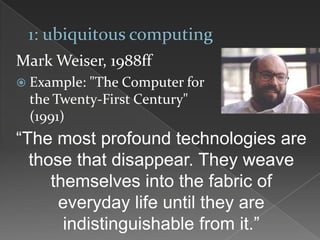
Mark Weiser, 1988ff
 Example: "The Computer for
the Twenty-First Century"
(1991)
“The most profound technologies are
those that disappear. They weave
themselves into the fabric of
everyday life until they are
indistinguishable from it.”
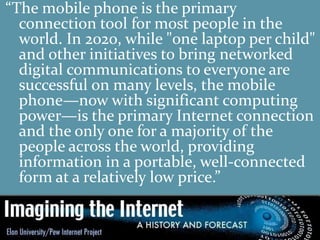
“The mobile phone is the primary
connection tool for most people in the
world. In 2020, while "one laptop per child"
and other initiatives to bring networked
digital communications to everyone are
successful on many levels, the mobile
phone—now with significant computing
power—is the primary Internet connection
and the only one for a majority of the
people across the world, providing
information in a portable, well-connected
form at a relatively low price.”
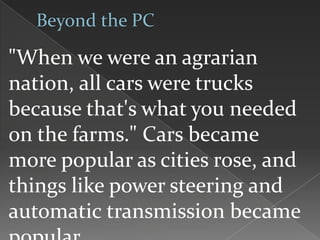
"When we were an agrarian
nation, all cars were trucks
because that's what you needed
on the farms." Cars became
more popular as cities rose, and
things like power steering and
automatic transmission became
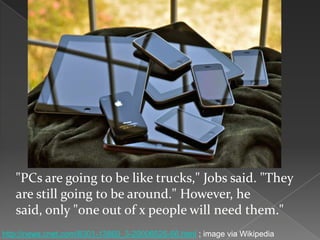
"PCs are going to be like trucks," Jobs said. "They
are still going to be around." However, he
said, only "one out of x people will need them."
http://news.cnet.com/8301-13860_3-20006526-56.html ; image via Wikipedia
Gartner: end of the
mouse
Touch screen (iOS)
Handhelds (Wii)
Nothing (Kinect)
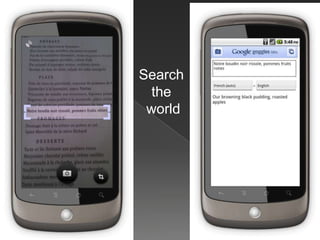
Search
the
world
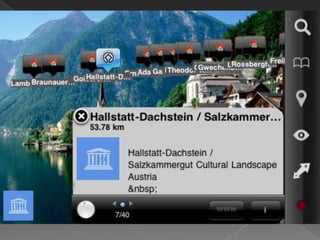
Multimedia lives here
Ecosystems
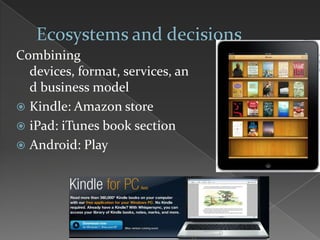
Combining
devices, format, services, an
d business model
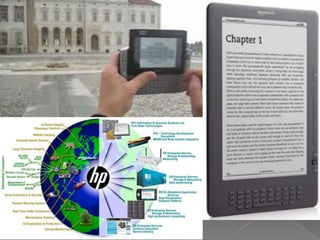
 Kindle: Amazon store
 iPad: iTunes book section
 Android: Play
Laminating the
world digitally
Media
consumption
Interface
transformation
Media
capture
Social
connection
Web
2.0, amped
Microcontent increases
Social participation
increases
From consumer to user to
prosumer
Accelerando!
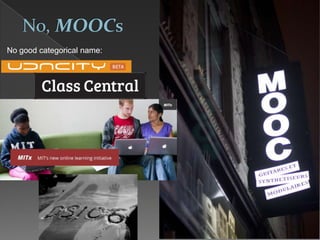
No good categorical name:
…which sometimes
indicates the future
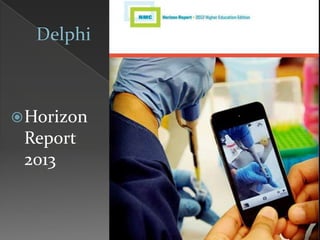
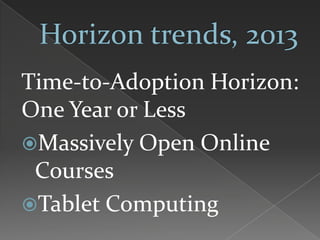
Horizon
Report
2013
Time-to-Adoption Horizon:
One Year or Less
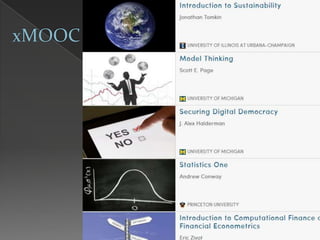
Massively Open Online
Courses
Tablet Computing
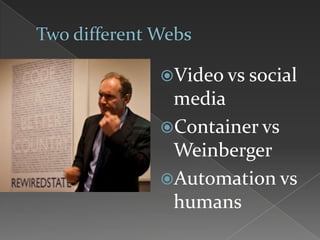
Video vs social
media
Container vs
Weinberger
Automation vs
humans
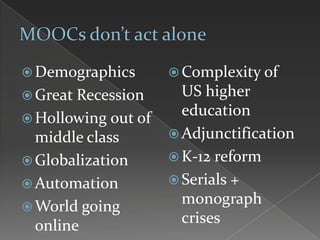
 Demographics
 Great Recession
 Hollowing out of
middle class
 Globalization
 Automation
 World going
online
 Complexity of
US higher
education
 Adjunctification
 K-12 reform
 Serials +
monograph
crises
Mobile apps
Persistent DRM
Social media’s triumph
Interface transformations
Global cyberwar and surveillance
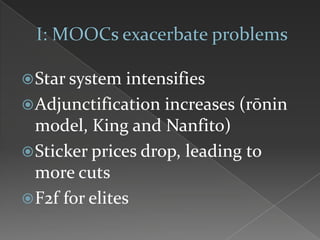
Star system intensifies
Adjunctification increases (rōnin
model, King and Nanfito)
Sticker prices drop, leading to
more cuts
F2f for elites
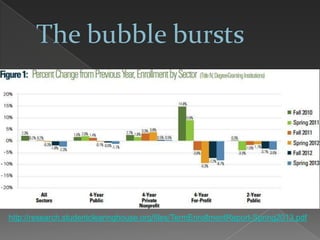
http://research.studentclearinghouse.org/files/TermEnrollmentReport-Spring2013.pdf
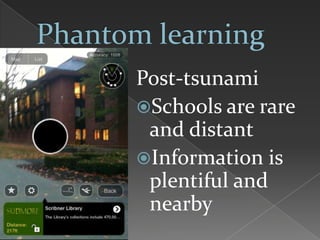
Post-tsunami
Schools are rare
and distant
Information is
plentiful and
nearby
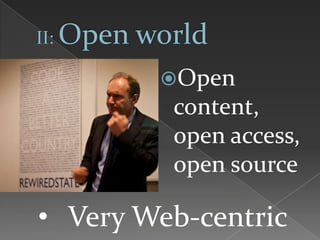
Open
content,
open access,
open source
• Very Web-centric
Global conversations
increase, filter bubble pops
More access, more
information
Lots of creativity
Industries collapse
Authorship mysterious
Some low quality tech
(videoconf.)
Some higher costs
More malware + less privacy
Information prices drop
Faculty creativity, flexibility
grow
IT “ “ “
Academic content
unleashed on the world
Tech challenges
Outsourcing and offshoring
PLE beats LMS
Crowdsourcing faculty work
Information literacy central
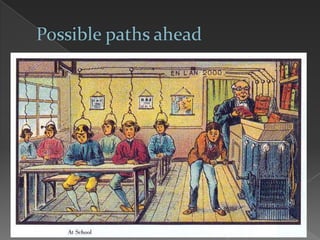
http://www.flickr.com/photos/thales/2782129254/
MOOC provider goes bust
Media buzz reverses
Economic growth returns to US
(energy, medical, nanotech vs
world)
17-22-year-old residential niche
revitalized (K-12 failure)
Full-time faculty stabilize (AAUP-
ALA strike)
Higher education landscape:
Supplemental rather than
transformative tech
Logistical instead of pedagogical
tech
Academics include tech in old
structures (classes, publication
Bryan Alexander
http://bryanalexander.org
Bryan on Twitter
http://twitter.com/BryanAlexander

MOOCs and ubiquitous computing