Collective Scientific Expertise (ESCo) at the French National Institute for Agricultural Research (INRA)   a tool for decision making and public debate Dominique FOURNIER, Inra, Montpellier, France  &  Claire SABBAGH, Inra, Paris, France   Scientific and Technical Information and Rural Development IAALD XIIIth World Congress, Montpellier, France, 26-29 April 2010
Collective scientific expertise (ESCo) : definition  Scientific assessment on societal debate or controversy At the request of authorities or ministries Several scientific experts are involved Based on « published » scientific knowledge ( ≠ « expert opinion » based on personal advices) State of art with a multidisciplinary point of views and a critical analysis of scientific knowledge Outcomes of expertise are intended to be integrated in a decision making process
Collective Scientific Expertise (ESCo) at INRA, France Since 2002, the French National Institute for Agricultural Research (INRA) conducts collective scientific expertise at  the request of French ministry for Agriculture or French ministry for Ecology ESCo unit (INRA, Paris) with 4 permanent people Since 2006 and the French Research Law n°2006-450, scientific expertise is one of the researchers’ missions In 2010, the French national charter of scientific expertise was published by the French Ministry of Higher Education & Research :  excellence, plurality, transparency, impartiality   6 ESCo conducted since 2002 http ://www.inra.fr/l_institut/expertise   http://www.international.inra.fr/the_institute/scientific_expertise
ESCo at INRA : main actors ESCo unit (INRA, Paris, France)  coordinate scientific assessments for INRA manage the project in the respect of deadlines (i.e. 12 months) Experts’ group : 20 pers. chosen on the basis of their scientific excellence absence of conflict of interest wide range of disciplines : from life sciences to social sciences Information professionals : 2 – 4 pers. guarantee the quality of the ESCo process mainly based on scientific informations  one insures the information methodological process  others are specialized on the subject of the expertise and know perfectly the specialized information sources
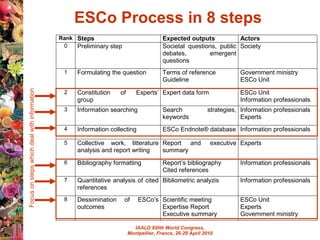
ESCo Process in 8 steps Focus on steps which deal with information
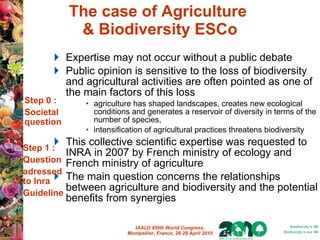
The case of Agriculture  & Biodiversity ESCo Expertise may not occur without a public debate  Public opinion is sensitive to the loss of biodiversity and agricultural activities are often pointed as one of the main factors of this loss agriculture has shaped landscapes, creates new ecological conditions and generates a reservoir of diversity in terms of the number of species,  intensification of agricultural practices threatens biodiversity This collective scientific expertise was requested to INRA in 2007 by French ministry of ecology and French ministry of agriculture   The main question concerns the relationships between agriculture and biodiversity and the potential benefits from synergies Step 0 : Societal question Step 1 : Question adressed to Inra Guideline
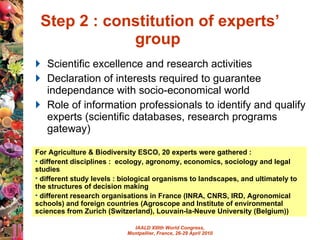
Step 2 : constitution of experts’ group  Scientific excellence and research activities Declaration of interests required to guarantee independance with socio-economical world  Role of information professionals to identify and qualify experts (scientific databases, research programs gateway) For Agriculture & Biodiversity ESCO, 20 experts were gathered : different disciplines :  ecology, agronomy, economics, sociology and legal studies different study levels : biological organisms to landscapes, and ultimately to the structures of decision making different research organisations in France (INRA, CNRS, IRD, Agronomical schools) and foreign countries (Agroscope and Institute of environmental sciences from Zurich (Switzerland), Louvain-la-Neuve University (Belgium))
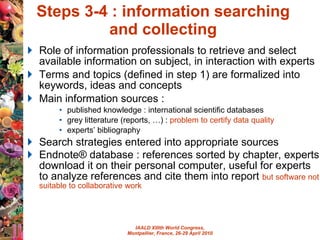
Steps 3-4 : information searching  and collecting  Role of information professionals to retrieve and select available information on subject, in interaction with experts Terms and topics (defined in step 1) are formalized into keywords, ideas and concepts Main information sources :  published knowledge : international scientific databases grey litterature (reports, …) :  problem to certify data quality experts’ bibliography Search strategies entered into appropriate sources Endnote® database : references sorted by chapter, experts download it on their personal computer, useful for experts to analyze references and cite them into report  but software not suitable to collaborative work
Steps 5 : experts’ analysis and writing based on ESCo database  Role of experts to  analyze all the ESCo database references,  identify useful elements and compile them  in order to determine the established knowledge, highlight uncertainties   Collaborative workspace (Silverpeas ®) to share documents and data Several meetings to share different point of views Problems :  experts not enough available,  need to clarify and justify experts’ reference choice
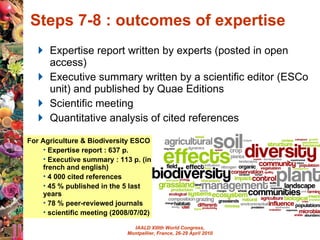
Steps 7-8 : outcomes of expertise  Expertise report written by experts (posted in open access) Executive summary written by a scientific editor (ESCo unit) and published by Quae Editions Scientific meeting Quantitative analysis of cited references For Agriculture & Biodiversity ESCO :  Expertise report : 637 p. Executive summary : 113 p. (in french and english)  4 000 cited references  45 % published in the 5 last years 78 % peer-reviewed journals scientific meeting (2008/07/02)
Consequences of ESCo  Agriculture & Biodiversity ESCo brought elements and data  for national, european and international agricultural policies  discussions concerning biodiversity in the framework of the French Environment Round Table (Grenelle) and  French environmental certification scheme (Co-construction of environmental performance indicators)  creation of the  the French Resarch foundation for Biodiversity Agriculture & Biodiversity ESCo pointed out the emergence of multidisciplinary papers which associate ecologists, agronomes and economics    benefit synergies, new research field Outcomes of expertise are intended to be integrated in a decision making process under the responsibility of the Ministry which raised the question ESCo  report does not provide specific advice or recommendations nor formally attempts to analyze future trends ESCo report may point out needed researches
Conclusion  Collective scientific expertise is an emergent activity conducted at INRA which contributes to renew dialogue and society Three new expertises are planned in 2010… This activity asks for many human resources which is gathered during the project time. New persons will be employed for this activity Credibility of expertise is necessary for its better integration in a decision-making process ESCo Unit continually develops guides and methods to enhance the quality process
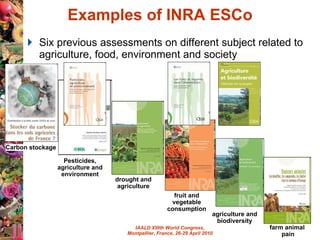
Examples of INRA ESCo Six previous assessments on different subject related to agriculture, food, environment and society  Carbon stockage Pesticides, agriculture and environment drought and agriculture fruit and vegetable consumption agriculture and biodiversity farm animal  pain
Thanks for your attention Any questions ? [email_address]   http://www.inra.fr/l_institut/ expertise http://www.international.inra.fr/the_institute/scientific_expertise

Collective scientific expertise at INRA : A tool for decision making and dialogue between science and society

  • 1.
    Collective Scientific Expertise(ESCo) at the French National Institute for Agricultural Research (INRA) a tool for decision making and public debate Dominique FOURNIER, Inra, Montpellier, France & Claire SABBAGH, Inra, Paris, France Scientific and Technical Information and Rural Development IAALD XIIIth World Congress, Montpellier, France, 26-29 April 2010
  • 2.
    Collective scientific expertise(ESCo) : definition Scientific assessment on societal debate or controversy At the request of authorities or ministries Several scientific experts are involved Based on « published » scientific knowledge ( ≠ « expert opinion » based on personal advices) State of art with a multidisciplinary point of views and a critical analysis of scientific knowledge Outcomes of expertise are intended to be integrated in a decision making process
  • 3.
    Collective Scientific Expertise(ESCo) at INRA, France Since 2002, the French National Institute for Agricultural Research (INRA) conducts collective scientific expertise at the request of French ministry for Agriculture or French ministry for Ecology ESCo unit (INRA, Paris) with 4 permanent people Since 2006 and the French Research Law n°2006-450, scientific expertise is one of the researchers’ missions In 2010, the French national charter of scientific expertise was published by the French Ministry of Higher Education & Research : excellence, plurality, transparency, impartiality 6 ESCo conducted since 2002 http ://www.inra.fr/l_institut/expertise http://www.international.inra.fr/the_institute/scientific_expertise
  • 4.
    ESCo at INRA: main actors ESCo unit (INRA, Paris, France) coordinate scientific assessments for INRA manage the project in the respect of deadlines (i.e. 12 months) Experts’ group : 20 pers. chosen on the basis of their scientific excellence absence of conflict of interest wide range of disciplines : from life sciences to social sciences Information professionals : 2 – 4 pers. guarantee the quality of the ESCo process mainly based on scientific informations one insures the information methodological process others are specialized on the subject of the expertise and know perfectly the specialized information sources
  • 5.
    ESCo Process in8 steps Focus on steps which deal with information
  • 6.
    The case ofAgriculture & Biodiversity ESCo Expertise may not occur without a public debate Public opinion is sensitive to the loss of biodiversity and agricultural activities are often pointed as one of the main factors of this loss agriculture has shaped landscapes, creates new ecological conditions and generates a reservoir of diversity in terms of the number of species, intensification of agricultural practices threatens biodiversity This collective scientific expertise was requested to INRA in 2007 by French ministry of ecology and French ministry of agriculture The main question concerns the relationships between agriculture and biodiversity and the potential benefits from synergies Step 0 : Societal question Step 1 : Question adressed to Inra Guideline
  • 7.
    Step 2 :constitution of experts’ group Scientific excellence and research activities Declaration of interests required to guarantee independance with socio-economical world Role of information professionals to identify and qualify experts (scientific databases, research programs gateway) For Agriculture & Biodiversity ESCO, 20 experts were gathered : different disciplines : ecology, agronomy, economics, sociology and legal studies different study levels : biological organisms to landscapes, and ultimately to the structures of decision making different research organisations in France (INRA, CNRS, IRD, Agronomical schools) and foreign countries (Agroscope and Institute of environmental sciences from Zurich (Switzerland), Louvain-la-Neuve University (Belgium))
  • 8.
    Steps 3-4 :information searching and collecting Role of information professionals to retrieve and select available information on subject, in interaction with experts Terms and topics (defined in step 1) are formalized into keywords, ideas and concepts Main information sources : published knowledge : international scientific databases grey litterature (reports, …) : problem to certify data quality experts’ bibliography Search strategies entered into appropriate sources Endnote® database : references sorted by chapter, experts download it on their personal computer, useful for experts to analyze references and cite them into report but software not suitable to collaborative work
  • 9.
    Steps 5 :experts’ analysis and writing based on ESCo database Role of experts to analyze all the ESCo database references, identify useful elements and compile them in order to determine the established knowledge, highlight uncertainties Collaborative workspace (Silverpeas ®) to share documents and data Several meetings to share different point of views Problems : experts not enough available, need to clarify and justify experts’ reference choice
  • 10.
    Steps 7-8 :outcomes of expertise Expertise report written by experts (posted in open access) Executive summary written by a scientific editor (ESCo unit) and published by Quae Editions Scientific meeting Quantitative analysis of cited references For Agriculture & Biodiversity ESCO : Expertise report : 637 p. Executive summary : 113 p. (in french and english) 4 000 cited references 45 % published in the 5 last years 78 % peer-reviewed journals scientific meeting (2008/07/02)
  • 11.
    Consequences of ESCo Agriculture & Biodiversity ESCo brought elements and data for national, european and international agricultural policies discussions concerning biodiversity in the framework of the French Environment Round Table (Grenelle) and French environmental certification scheme (Co-construction of environmental performance indicators) creation of the the French Resarch foundation for Biodiversity Agriculture & Biodiversity ESCo pointed out the emergence of multidisciplinary papers which associate ecologists, agronomes and economics  benefit synergies, new research field Outcomes of expertise are intended to be integrated in a decision making process under the responsibility of the Ministry which raised the question ESCo report does not provide specific advice or recommendations nor formally attempts to analyze future trends ESCo report may point out needed researches
  • 12.
    Conclusion Collectivescientific expertise is an emergent activity conducted at INRA which contributes to renew dialogue and society Three new expertises are planned in 2010… This activity asks for many human resources which is gathered during the project time. New persons will be employed for this activity Credibility of expertise is necessary for its better integration in a decision-making process ESCo Unit continually develops guides and methods to enhance the quality process
  • 13.
    Examples of INRAESCo Six previous assessments on different subject related to agriculture, food, environment and society Carbon stockage Pesticides, agriculture and environment drought and agriculture fruit and vegetable consumption agriculture and biodiversity farm animal pain
  • 14.
    Thanks for yourattention Any questions ? [email_address] http://www.inra.fr/l_institut/ expertise http://www.international.inra.fr/the_institute/scientific_expertise