By: Logan AND Crue
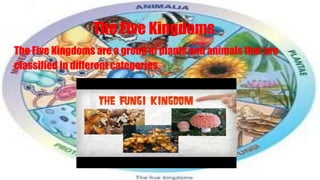
The Five Kingdoms
The Five Kingdoms are a group of plants and animals that are
classified in different categories.
The kingdom Plantae includes all land plants, mosses,
flowering plants, ferns and so on. With an
excess of 250,000 plant species, the kingdom Plantae
is the second largest family of organisms.
The Animal Kingdom consists of reptiles, amphibians,
mammals, invertebrates, birds, and fish .
1. All organisms are multicellular and eukaryotic .
2. Animals have sense organs to help them react to their
environment .
3. All members of the animal kingdom are “heterotrophs”
Meaning they are consumers and can not produce their
own food.
The Protista, or Protoctista, are a kingdom of simple
eukaryotic organisms, usually composed of a single cell
or a colony of similar cells. Protists live in water, in moist
terrestrial habitats, and as parasites and other
symbionts in the bodies of multicellular eukaroytes.
Fungi absorb nutrients from plant or animal
matter around them, which may be living or
dead. They produce long, slender threads
called hyphae that spread through their
food. The hyphae release enzymes that
break down the food into substances that
the fungi can easily absorb.
1. They are singled celled.
2. They have been on Earth for billions of years.
3. Have no nucleus.
4. About 1,800 species still exist.
THANKS FOR
WATCHING

The Five Kingdoms

  • 1.
  • 2.
    The Five Kingdoms TheFive Kingdoms are a group of plants and animals that are classified in different categories.
  • 3.
    The kingdom Plantaeincludes all land plants, mosses, flowering plants, ferns and so on. With an excess of 250,000 plant species, the kingdom Plantae is the second largest family of organisms.
  • 4.
    The Animal Kingdomconsists of reptiles, amphibians, mammals, invertebrates, birds, and fish . 1. All organisms are multicellular and eukaryotic . 2. Animals have sense organs to help them react to their environment . 3. All members of the animal kingdom are “heterotrophs” Meaning they are consumers and can not produce their own food.
  • 5.
    The Protista, orProtoctista, are a kingdom of simple eukaryotic organisms, usually composed of a single cell or a colony of similar cells. Protists live in water, in moist terrestrial habitats, and as parasites and other symbionts in the bodies of multicellular eukaroytes.
  • 6.
    Fungi absorb nutrientsfrom plant or animal matter around them, which may be living or dead. They produce long, slender threads called hyphae that spread through their food. The hyphae release enzymes that break down the food into substances that the fungi can easily absorb.
  • 7.
    1. They aresingled celled. 2. They have been on Earth for billions of years. 3. Have no nucleus. 4. About 1,800 species still exist.
  • 8.