
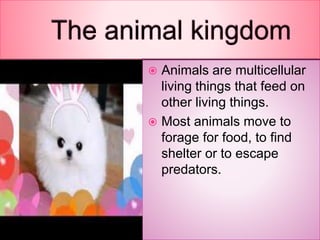
 Animals are multicellular
living things that feed on
other living things.
 Most animals move to
forage for food, to find
shelter or to escape
predators.
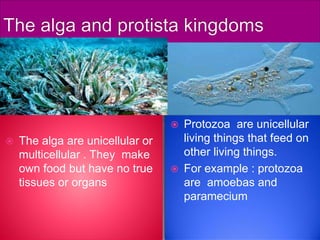
 The alga are unicellular or
multicellular . They make
own food but have no true
tissues or organs
 Protozoa are unicellular
living things that feed on
other living things.
 For example : protozoa
are amoebas and
paramecium
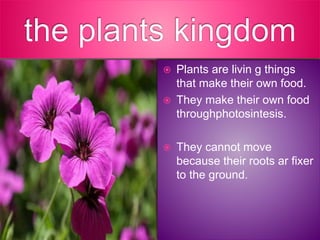
 Plants are livin g things
that make their own food.
 They make their own food
throughphotosintesis.
 They cannot move
because their roots ar fixer
to the ground.
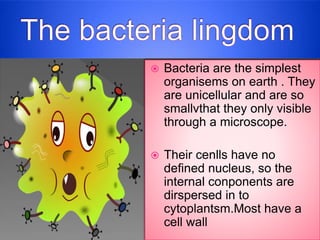
 Bacteria are the simplest
organisems on earth . They
are unicellular and are so
smallvthat they only visible
through a microscope.
 Their cenlls have no
defined nucleus, so the
internal conponents are
dirspersed in to
cytoplantsm.Most have a
cell wall
The five kingdoms   science alex y andrea

The five kingdoms science alex y andrea

  • 1.
  • 3.
     Animals aremulticellular living things that feed on other living things.  Most animals move to forage for food, to find shelter or to escape predators.
  • 4.
     The algaare unicellular or multicellular . They make own food but have no true tissues or organs  Protozoa are unicellular living things that feed on other living things.  For example : protozoa are amoebas and paramecium
  • 5.
     Plants arelivin g things that make their own food.  They make their own food throughphotosintesis.  They cannot move because their roots ar fixer to the ground.
  • 6.
     Bacteria arethe simplest organisems on earth . They are unicellular and are so smallvthat they only visible through a microscope.  Their cenlls have no defined nucleus, so the internal conponents are dirspersed in to cytoplantsm.Most have a cell wall