US Health Policy  What is the cause of the rising cost of health care in the US? How does health policy influence economic policy?
Health Care in the US In 2004, 16.8% (48.3 million people)  Americans did not have health insurance.  35% of young adults between the age 19 to 24 were at the greatest risk of being uninsured was.  Since 2000, health insurance premium have increased by 73%.  The US is one of the few wealthy industrialized democratic nations without nationalized healthcare.
Types of Systems Primarily Private US Primarily Public UK, Sweden, and Italy Hybrid  Canada, France, Germany
The US Healthcare System Paul Krugman says that the rising cost is due to “our crazy quilt healthcare system, which has a lot to do with the fact that so much of that system is private rather than public…...”
Oxymoron Integrating market mechanisms with reduce cost and increases efficiency. Prices will be pushed down because consumers will be looking for the best service at the lowest price.  Failure of the market!
Alternative Opinions on the Cause of the Rising Cost Humans by nature are freeloaders With low co-pays, people have no idea the high fees that are paid by insurance companies. People don’t shop for the lowest prices People see physicians for minor issues
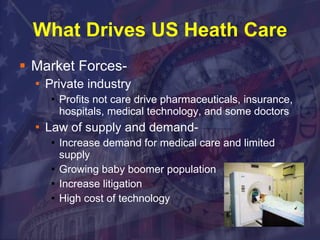
What Drives US Heath Care Market Forces- Private industry Profits not care drive pharmaceuticals, insurance, hospitals, medical technology, and some doctors Law of supply and demand- Increase demand for medical care and limited supply Growing baby boomer population Increase litigation High cost of technology
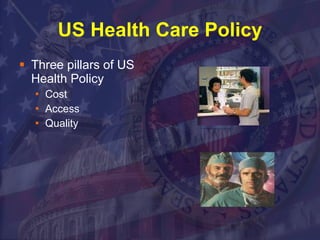
US Health Care Policy Three pillars of US Health Policy Cost Access Quality
Major Actors: Health Care Purchasers Federal Government  Congress President Judiciary Bureaucracy State and Local Government  Industries and Firms   Individuals
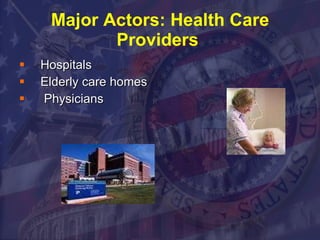
Major Actors: Health Care Providers  Hospitals Elderly care homes  Physicians
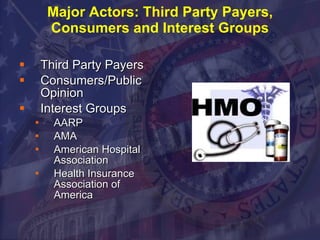
Major Actors: Third Party Payers, Consumers and Interest Groups Third Party Payers Consumers/Public Opinion Interest Groups AARP AMA American Hospital Association Health Insurance Association of America
Existing Government Programs Medicaid- State and federal program to subsidize health care for the poor To qualify, must exhaust financial assets  The poor make up 75% of the participants, but they receive little more than a quarter of the health funds.   Often provides long term nursing home care VHA- Medical, hospitalization, and nursing care provided to any in current service or retirement
Existing Government Programs Medicare (entitlement program: both employer and employee pay 2.9%)- Created by LBJ in 1965 Designed to offer support for the elderly (age 65 ) regardless to income Seniors and disabled comprise of  10% of the participant, but  consume 28% of the govt. health funds. Mixed system were payments are public, but services are provided by the private sector
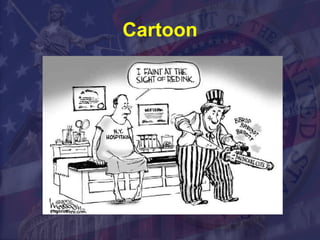
Cartoon
Arguments Against Nationalized Health Care  Reduces medical advances and innovation Private enterprise is more efficient
Bush’s Health Care Policy More market forces- Health savings account (HAS) and high deductible health policy  Special account to deposit money to pay for current and future medical expenses Money can be deposited to a the HSA before tax is paid on it The money can be used tax-free for medical expenses medical insurance deductible  co-insurance (the amount after which the insurance begins to pay, but less than the amount at which they pay 100% of expenses
Quiz How does health policy influence economic policy?

Health Policy

  • 1.
    US Health Policy What is the cause of the rising cost of health care in the US? How does health policy influence economic policy?
  • 2.
    Health Care inthe US In 2004, 16.8% (48.3 million people) Americans did not have health insurance. 35% of young adults between the age 19 to 24 were at the greatest risk of being uninsured was. Since 2000, health insurance premium have increased by 73%. The US is one of the few wealthy industrialized democratic nations without nationalized healthcare.
  • 3.
    Types of SystemsPrimarily Private US Primarily Public UK, Sweden, and Italy Hybrid Canada, France, Germany
  • 4.
    The US HealthcareSystem Paul Krugman says that the rising cost is due to “our crazy quilt healthcare system, which has a lot to do with the fact that so much of that system is private rather than public…...”
  • 5.
    Oxymoron Integrating marketmechanisms with reduce cost and increases efficiency. Prices will be pushed down because consumers will be looking for the best service at the lowest price. Failure of the market!
  • 6.
    Alternative Opinions onthe Cause of the Rising Cost Humans by nature are freeloaders With low co-pays, people have no idea the high fees that are paid by insurance companies. People don’t shop for the lowest prices People see physicians for minor issues
  • 7.
    What Drives USHeath Care Market Forces- Private industry Profits not care drive pharmaceuticals, insurance, hospitals, medical technology, and some doctors Law of supply and demand- Increase demand for medical care and limited supply Growing baby boomer population Increase litigation High cost of technology
  • 8.
    US Health CarePolicy Three pillars of US Health Policy Cost Access Quality
  • 9.
    Major Actors: HealthCare Purchasers Federal Government Congress President Judiciary Bureaucracy State and Local Government Industries and Firms Individuals
  • 10.
    Major Actors: HealthCare Providers Hospitals Elderly care homes Physicians
  • 11.
    Major Actors: ThirdParty Payers, Consumers and Interest Groups Third Party Payers Consumers/Public Opinion Interest Groups AARP AMA American Hospital Association Health Insurance Association of America
  • 12.
    Existing Government ProgramsMedicaid- State and federal program to subsidize health care for the poor To qualify, must exhaust financial assets The poor make up 75% of the participants, but they receive little more than a quarter of the health funds. Often provides long term nursing home care VHA- Medical, hospitalization, and nursing care provided to any in current service or retirement
  • 13.
    Existing Government ProgramsMedicare (entitlement program: both employer and employee pay 2.9%)- Created by LBJ in 1965 Designed to offer support for the elderly (age 65 ) regardless to income Seniors and disabled comprise of 10% of the participant, but consume 28% of the govt. health funds. Mixed system were payments are public, but services are provided by the private sector
  • 14.
  • 15.
    Arguments Against NationalizedHealth Care Reduces medical advances and innovation Private enterprise is more efficient
  • 16.
    Bush’s Health CarePolicy More market forces- Health savings account (HAS) and high deductible health policy Special account to deposit money to pay for current and future medical expenses Money can be deposited to a the HSA before tax is paid on it The money can be used tax-free for medical expenses medical insurance deductible co-insurance (the amount after which the insurance begins to pay, but less than the amount at which they pay 100% of expenses
  • 17.
    Quiz How doeshealth policy influence economic policy?