Political Parties
Presidential election Results
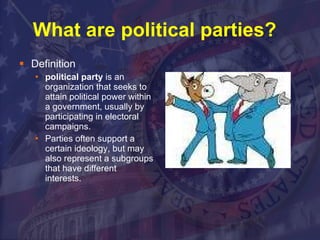
What are political parties?  Definition political party  is an organization that seeks to attain political power within a government, usually by participating in electoral campaigns. Parties often support a certain ideology, but may also represent a subgroups that have different interests.
Impact of Institutions on Party Structure. One party, Two party, or Multiparty System Contingent on:  Majoritarian or Proportional Representation  History Constitutions Grand Coalition
Theory: Lipset and Rokkan Theory on Political Cleavages Parties that were formed in the aftermath of political, religious, and economic revolutions are frozen. State vs. Church Worker vs. Owner Land vs. Industry Center vs. Periphery (Fed vs. State) These have and will continue to exist in the political arena despite new issues and challenges.
The Constitution Says nothing about political parties. Why? Founding fathers felt parties were wicked and corrupt. Did not want parties to control politics. Did not want to pervade the entire country.
Major US Political Parties Republican Party-  Considered the more socially conservative and economically neoliberal.  Laissez-Faire Economics Party Chairman- Ken Mehlman Democratic Party- Considered more socially liberal and economically interventionist. Party Chairman- Howard Dean
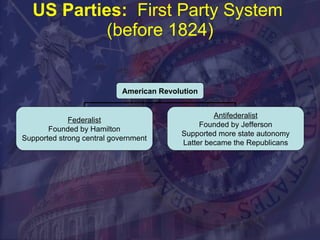
US Parties:  First Party System  (before 1824) American Revolution Federalist Founded by Hamilton Supported strong central government Antifederalist Founded by Jefferson Supported more state autonomy Latter became the Republicans
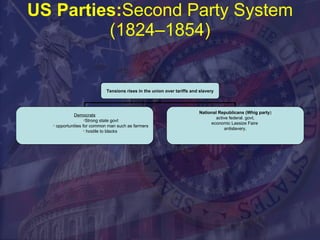
US Parties: Second Party System (1824–1854) Tensions rises in the union over tariffs and slavery Democrats Strong state govt opportunities for common man such as farmers hostile to blacks  National Republicans (Whig party ) active federal. govt, economic Lassize Faire  antislavery,
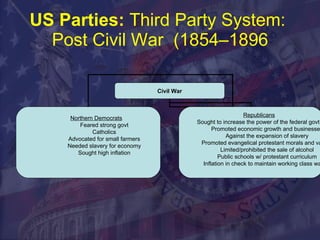
US Parties:  Third Party System:  Post Civil War  (1854–1896 Civil War Northern Democrats Feared strong govt Catholics Advocated for small farmers Needed slavery for economy Sought high inflation Republicans Sought to increase the power of the federal govt. Promoted economic growth and businesses Against the expansion of slavery Promoted evangelical protestant morals and values Limited/prohibited the sale of alcohol Public schools w/ protestant curriculum Inflation in check to maintain working class wages
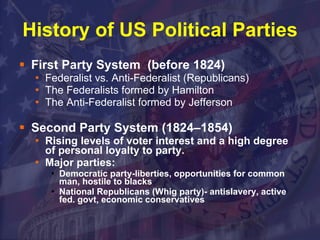
History of US Political Parties First Party System  (before 1824) Federalist vs. Anti-Federalist (Republicans) The Federalists formed by Hamilton  The Anti-Federalist formed by Jefferson Second Party System (1824–1854) Rising levels of voter interest and a high degree of personal loyalty to party. Major parties:  Democratic party-liberties, opportunities for common man, hostile to blacks  National Republicans (Whig party)- antislavery, active fed. govt, economic conservatives
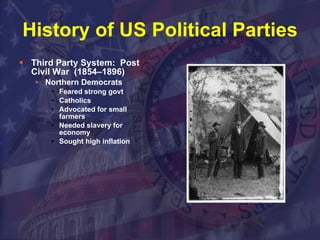
History of US Political Parties Third Party System:  Post Civil War  (1854–1896) Northern Democrats Feared strong govt Catholics Advocated for small farmers Needed slavery for economy Sought high inflation
History of US Political Parties Republicans Promoted economic growth and businesses Against the expansion of slavery Promoted evangelical protestant morals and values Limited/prohibited the sale of alcohol Public schools w/ protestant curriculum Inflation in check to maintain working class wages
History of US Political Parties Fourth Party System/ Progressive Era (1896–1932) Conservative and progressive Republicans split 1912  Bull-Moose Party Democrats realign under radical policies.  Govt involvement in the economy
History of US Political Parties New Deal/Fifth Party System (1932–1964) New Deal Coalition united both African Americans and whites that didn’t like blacks. Both sought relief from the Great Depression 60’s Democrats split Republican block- economic and social conservatives in the south African Americans switched to the Democrats
Purpose of Political  Parties To mobilize the public in an organization Organize and run elections Recruit Candidates (strategy: TO WIN) Presenting alternative policies Accepting responsibility for the operation of govt. (advocating party agenda) Acting as opposition to party in power.
Parties: Party Structure  National Level Pres. controls  National Convention Party Chairperson National Committee State level Governor controls State party chairperson Party Boss Local Level (Grassroots) County Committee County Chairperson District Leaders Precinct or ward captains Party Workers
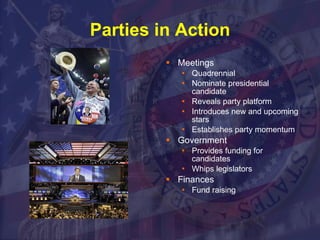
Parties in Action Meetings Quadrennial Nominate presidential candidate Reveals party platform Introduces new and upcoming stars Establishes party momentum Government Provides funding for candidates Whips legislators  Finances Fund raising
Accountability to the Voters Presidential and Parliamentary Systems Viable third parties
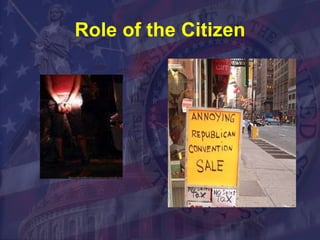
Role of the Citizen

Political Parties (Notes)

  • 1.
  • 2.
  • 3.
    What are politicalparties? Definition political party is an organization that seeks to attain political power within a government, usually by participating in electoral campaigns. Parties often support a certain ideology, but may also represent a subgroups that have different interests.
  • 4.
    Impact of Institutionson Party Structure. One party, Two party, or Multiparty System Contingent on: Majoritarian or Proportional Representation History Constitutions Grand Coalition
  • 5.
    Theory: Lipset andRokkan Theory on Political Cleavages Parties that were formed in the aftermath of political, religious, and economic revolutions are frozen. State vs. Church Worker vs. Owner Land vs. Industry Center vs. Periphery (Fed vs. State) These have and will continue to exist in the political arena despite new issues and challenges.
  • 6.
    The Constitution Saysnothing about political parties. Why? Founding fathers felt parties were wicked and corrupt. Did not want parties to control politics. Did not want to pervade the entire country.
  • 7.
    Major US PoliticalParties Republican Party- Considered the more socially conservative and economically neoliberal. Laissez-Faire Economics Party Chairman- Ken Mehlman Democratic Party- Considered more socially liberal and economically interventionist. Party Chairman- Howard Dean
  • 8.
    US Parties: First Party System (before 1824) American Revolution Federalist Founded by Hamilton Supported strong central government Antifederalist Founded by Jefferson Supported more state autonomy Latter became the Republicans
  • 9.
    US Parties: SecondParty System (1824–1854) Tensions rises in the union over tariffs and slavery Democrats Strong state govt opportunities for common man such as farmers hostile to blacks National Republicans (Whig party ) active federal. govt, economic Lassize Faire antislavery,
  • 10.
    US Parties: Third Party System: Post Civil War (1854–1896 Civil War Northern Democrats Feared strong govt Catholics Advocated for small farmers Needed slavery for economy Sought high inflation Republicans Sought to increase the power of the federal govt. Promoted economic growth and businesses Against the expansion of slavery Promoted evangelical protestant morals and values Limited/prohibited the sale of alcohol Public schools w/ protestant curriculum Inflation in check to maintain working class wages
  • 11.
    History of USPolitical Parties First Party System (before 1824) Federalist vs. Anti-Federalist (Republicans) The Federalists formed by Hamilton The Anti-Federalist formed by Jefferson Second Party System (1824–1854) Rising levels of voter interest and a high degree of personal loyalty to party. Major parties: Democratic party-liberties, opportunities for common man, hostile to blacks National Republicans (Whig party)- antislavery, active fed. govt, economic conservatives
  • 12.
    History of USPolitical Parties Third Party System: Post Civil War (1854–1896) Northern Democrats Feared strong govt Catholics Advocated for small farmers Needed slavery for economy Sought high inflation
  • 13.
    History of USPolitical Parties Republicans Promoted economic growth and businesses Against the expansion of slavery Promoted evangelical protestant morals and values Limited/prohibited the sale of alcohol Public schools w/ protestant curriculum Inflation in check to maintain working class wages
  • 14.
    History of USPolitical Parties Fourth Party System/ Progressive Era (1896–1932) Conservative and progressive Republicans split 1912 Bull-Moose Party Democrats realign under radical policies. Govt involvement in the economy
  • 15.
    History of USPolitical Parties New Deal/Fifth Party System (1932–1964) New Deal Coalition united both African Americans and whites that didn’t like blacks. Both sought relief from the Great Depression 60’s Democrats split Republican block- economic and social conservatives in the south African Americans switched to the Democrats
  • 16.
    Purpose of Political Parties To mobilize the public in an organization Organize and run elections Recruit Candidates (strategy: TO WIN) Presenting alternative policies Accepting responsibility for the operation of govt. (advocating party agenda) Acting as opposition to party in power.
  • 17.
    Parties: Party Structure National Level Pres. controls National Convention Party Chairperson National Committee State level Governor controls State party chairperson Party Boss Local Level (Grassroots) County Committee County Chairperson District Leaders Precinct or ward captains Party Workers
  • 18.
    Parties in ActionMeetings Quadrennial Nominate presidential candidate Reveals party platform Introduces new and upcoming stars Establishes party momentum Government Provides funding for candidates Whips legislators Finances Fund raising
  • 19.
    Accountability to theVoters Presidential and Parliamentary Systems Viable third parties
  • 20.
    Role of theCitizen