The Presidency

  The Executive Branch
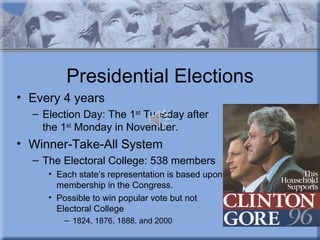
Presidential Elections
• Every 4 years
  – Election Day: The 1st Tuesday after
    the 1st Monday in November.
• Winner-Take-All System
  – The Electoral College: 538 members
     • Each state’s representation is based upon
       membership in the Congress.
     • Possible to win popular vote but not
       Electoral College
        – 1824, 1876, 1888, and 2000
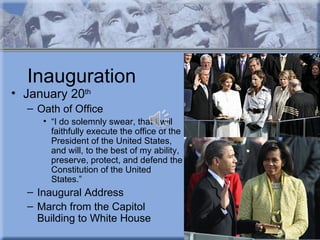
Inauguration
• January 20th
  – Oath of Office
     • “I do solemnly swear, that I will
       faithfully execute the office of the
       President of the United States,
       and will, to the best of my ability,
       preserve, protect, and defend the
       Constitution of the United
       States.”
  – Inaugural Address
  – March from the Capitol
    Building to White House
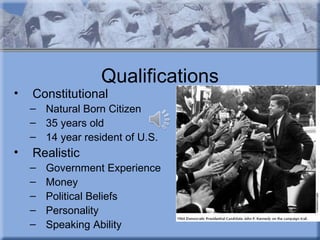
Qualifications
•   Constitutional
    – Natural Born Citizen
    – 35 years old
    – 14 year resident of U.S.
•   Realistic
    –   Government Experience
    –   Money
    –   Political Beliefs
    –   Personality
    –   Speaking Ability
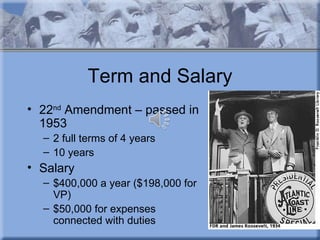
Term and Salary
• 22nd Amendment – passed in
  1953
  – 2 full terms of 4 years
  – 10 years
• Salary
  – $400,000 a year ($198,000 for
    VP)
  – $50,000 for expenses
    connected with duties
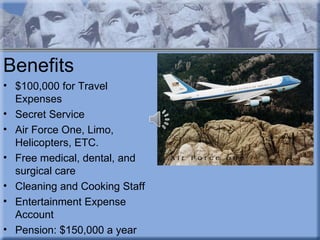
Benefits
• $100,000 for Travel
  Expenses
• Secret Service
• Air Force One, Limo,
  Helicopters, ETC.
• Free medical, dental, and
  surgical care
• Cleaning and Cooking Staff
• Entertainment Expense
  Account
• Pension: $150,000 a year
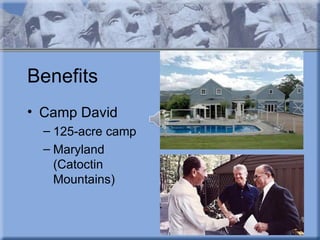
Benefits
• Camp David
  – 125-acre camp
  – Maryland
    (Catoctin
    Mountains)
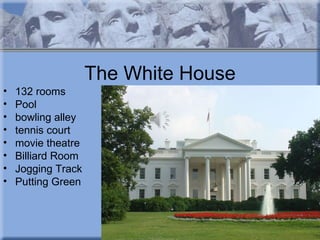
The White House
•   132 rooms
•   Pool
•   bowling alley
•   tennis court
•   movie theatre
•   Billiard Room
•   Jogging Track
•   Putting Green
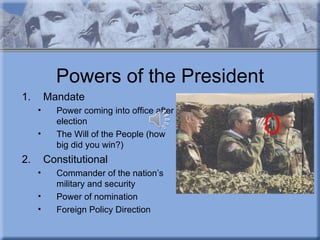
Powers of the President
1.       Mandate
     •     Power coming into office after
           election
     •     The Will of the People (how
           big did you win?)
2.       Constitutional
     •     Commander of the nation’s
           military and security
     •     Power of nomination
     •     Foreign Policy Direction
Powers of the President
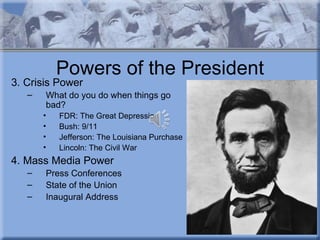
3. Crisis Power
   –   What do you do when things go
       bad?
       •   FDR: The Great Depression
       •   Bush: 9/11
       •   Jefferson: The Louisiana Purchase
       •   Lincoln: The Civil War
4. Mass Media Power
   –   Press Conferences
   –   State of the Union
   –   Inaugural Address
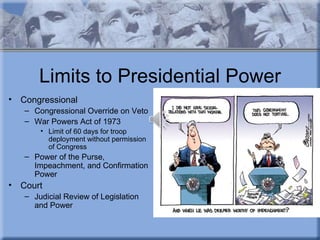
Limits to Presidential Power
•   Congressional
    – Congressional Override on Veto
    – War Powers Act of 1973
        • Limit of 60 days for troop
          deployment without permission
          of Congress
    – Power of the Purse,
      Impeachment, and Confirmation
      Power
•   Court
    – Judicial Review of Legislation
      and Power
Roles of the Presidency
1. Head of State
  •   Ceremonial Leader – Host
      other leaders
2. Chief Legislator
  •   Presidential Plan for Better
      America
      •   State of the Union
3. Chief Politician
  •   Leader of Political Party
Roles of the Presidency
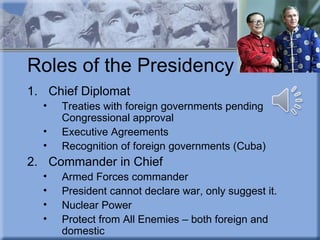
1. Chief Diplomat
  •   Treaties with foreign governments pending
      Congressional approval
  •   Executive Agreements
  •   Recognition of foreign governments (Cuba)
2. Commander in Chief
  •   Armed Forces commander
  •   President cannot declare war, only suggest it.
  •   Nuclear Power
  •   Protect from All Enemies – both foreign and
      domestic
Roles of the Presidency
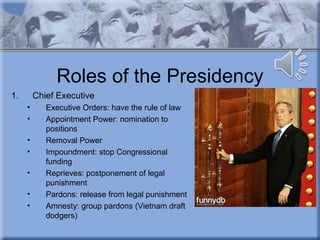
1.       Chief Executive
     •      Executive Orders: have the rule of law
     •      Appointment Power: nomination to
            positions
     •      Removal Power
     •      Impoundment: stop Congressional
            funding
     •      Reprieves: postponement of legal
            punishment
     •      Pardons: release from legal punishment
     •      Amnesty: group pardons (Vietnam draft
            dodgers)
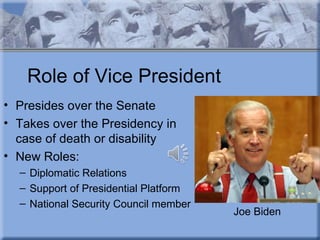
Role of Vice President
• Presides over the Senate
• Takes over the Presidency in
  case of death or disability
• New Roles:
  – Diplomatic Relations
  – Support of Presidential Platform
  – National Security Council member
                                       Joe Biden
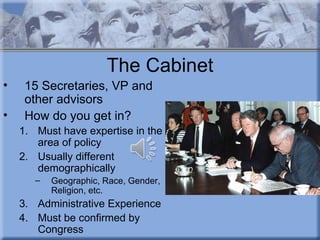
The Cabinet
•    15 Secretaries, VP and
     other advisors
•    How do you get in?
    1. Must have expertise in the
       area of policy
    2. Usually different
       demographically
       –   Geographic, Race, Gender,
           Religion, etc.
    3. Administrative Experience
    4. Must be confirmed by
       Congress
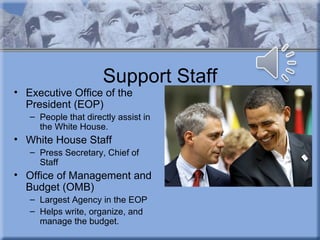
Support Staff
• Executive Office of the
  President (EOP)
   – People that directly assist in
     the White House.
• White House Staff
   – Press Secretary, Chief of
     Staff
• Office of Management and
  Budget (OMB)
   – Largest Agency in the EOP
   – Helps write, organize, and
     manage the budget.
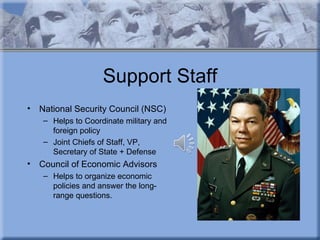
Support Staff
•   National Security Council (NSC)
    – Helps to Coordinate military and
      foreign policy
    – Joint Chiefs of Staff, VP,
      Secretary of State + Defense
•   Council of Economic Advisors
    – Helps to organize economic
      policies and answer the long-
      range questions.
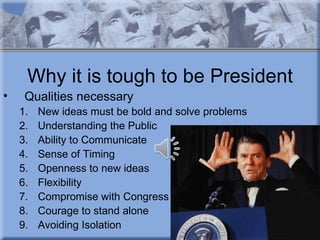
Why it is tough to be President
•    Qualities necessary
    1.   New ideas must be bold and solve problems
    2.   Understanding the Public
    3.   Ability to Communicate
    4.   Sense of Timing
    5.   Openness to new ideas
    6.   Flexibility
    7.   Compromise with Congress
    8.   Courage to stand alone
    9.   Avoiding Isolation

The Presidency

  • 1.
    The Presidency The Executive Branch
  • 2.
    Presidential Elections • Every4 years – Election Day: The 1st Tuesday after the 1st Monday in November. • Winner-Take-All System – The Electoral College: 538 members • Each state’s representation is based upon membership in the Congress. • Possible to win popular vote but not Electoral College – 1824, 1876, 1888, and 2000
  • 3.
    Inauguration • January 20th – Oath of Office • “I do solemnly swear, that I will faithfully execute the office of the President of the United States, and will, to the best of my ability, preserve, protect, and defend the Constitution of the United States.” – Inaugural Address – March from the Capitol Building to White House
  • 4.
    Qualifications • Constitutional – Natural Born Citizen – 35 years old – 14 year resident of U.S. • Realistic – Government Experience – Money – Political Beliefs – Personality – Speaking Ability
  • 5.
    Term and Salary •22nd Amendment – passed in 1953 – 2 full terms of 4 years – 10 years • Salary – $400,000 a year ($198,000 for VP) – $50,000 for expenses connected with duties
  • 6.
    Benefits • $100,000 forTravel Expenses • Secret Service • Air Force One, Limo, Helicopters, ETC. • Free medical, dental, and surgical care • Cleaning and Cooking Staff • Entertainment Expense Account • Pension: $150,000 a year
  • 7.
    Benefits • Camp David – 125-acre camp – Maryland (Catoctin Mountains)
  • 8.
    The White House • 132 rooms • Pool • bowling alley • tennis court • movie theatre • Billiard Room • Jogging Track • Putting Green
  • 9.
    Powers of thePresident 1. Mandate • Power coming into office after election • The Will of the People (how big did you win?) 2. Constitutional • Commander of the nation’s military and security • Power of nomination • Foreign Policy Direction
  • 10.
    Powers of thePresident 3. Crisis Power – What do you do when things go bad? • FDR: The Great Depression • Bush: 9/11 • Jefferson: The Louisiana Purchase • Lincoln: The Civil War 4. Mass Media Power – Press Conferences – State of the Union – Inaugural Address
  • 11.
    Limits to PresidentialPower • Congressional – Congressional Override on Veto – War Powers Act of 1973 • Limit of 60 days for troop deployment without permission of Congress – Power of the Purse, Impeachment, and Confirmation Power • Court – Judicial Review of Legislation and Power
  • 12.
    Roles of thePresidency 1. Head of State • Ceremonial Leader – Host other leaders 2. Chief Legislator • Presidential Plan for Better America • State of the Union 3. Chief Politician • Leader of Political Party
  • 13.
    Roles of thePresidency 1. Chief Diplomat • Treaties with foreign governments pending Congressional approval • Executive Agreements • Recognition of foreign governments (Cuba) 2. Commander in Chief • Armed Forces commander • President cannot declare war, only suggest it. • Nuclear Power • Protect from All Enemies – both foreign and domestic
  • 14.
    Roles of thePresidency 1. Chief Executive • Executive Orders: have the rule of law • Appointment Power: nomination to positions • Removal Power • Impoundment: stop Congressional funding • Reprieves: postponement of legal punishment • Pardons: release from legal punishment • Amnesty: group pardons (Vietnam draft dodgers)
  • 15.
    Role of VicePresident • Presides over the Senate • Takes over the Presidency in case of death or disability • New Roles: – Diplomatic Relations – Support of Presidential Platform – National Security Council member Joe Biden
  • 16.
    The Cabinet • 15 Secretaries, VP and other advisors • How do you get in? 1. Must have expertise in the area of policy 2. Usually different demographically – Geographic, Race, Gender, Religion, etc. 3. Administrative Experience 4. Must be confirmed by Congress
  • 17.
    Support Staff • ExecutiveOffice of the President (EOP) – People that directly assist in the White House. • White House Staff – Press Secretary, Chief of Staff • Office of Management and Budget (OMB) – Largest Agency in the EOP – Helps write, organize, and manage the budget.
  • 18.
    Support Staff • National Security Council (NSC) – Helps to Coordinate military and foreign policy – Joint Chiefs of Staff, VP, Secretary of State + Defense • Council of Economic Advisors – Helps to organize economic policies and answer the long- range questions.
  • 19.
    Why it istough to be President • Qualities necessary 1. New ideas must be bold and solve problems 2. Understanding the Public 3. Ability to Communicate 4. Sense of Timing 5. Openness to new ideas 6. Flexibility 7. Compromise with Congress 8. Courage to stand alone 9. Avoiding Isolation