The Evolving World of Workers’
Compensation
May 19, 2015
Ken Haffey, Skoda Minotti
Mark Clendenin, Bureau of
Workers’ Compensation
2
AGENDA
• About BWC
• BWC Board of Directors
• BWC – What We’ve Accomplished
• BWC Updates and Overview of Prospective Billing
• Prospective Billing for Private Employers
• Destination Excellence
• Other States’ Coverage Project Update
• Q&A
3
BWC – SIZE
• 1,800 employees
• 250, 000 policy handlers
• Collect $2 billion in premiums
• Pay about $2 billion claims per year
• $25 billion in investable assets (depending on the day)
• 97,000 new claims per year
• Over one million active claims
4
BWC – SIZE
• If BWC was a private single-line carrier,
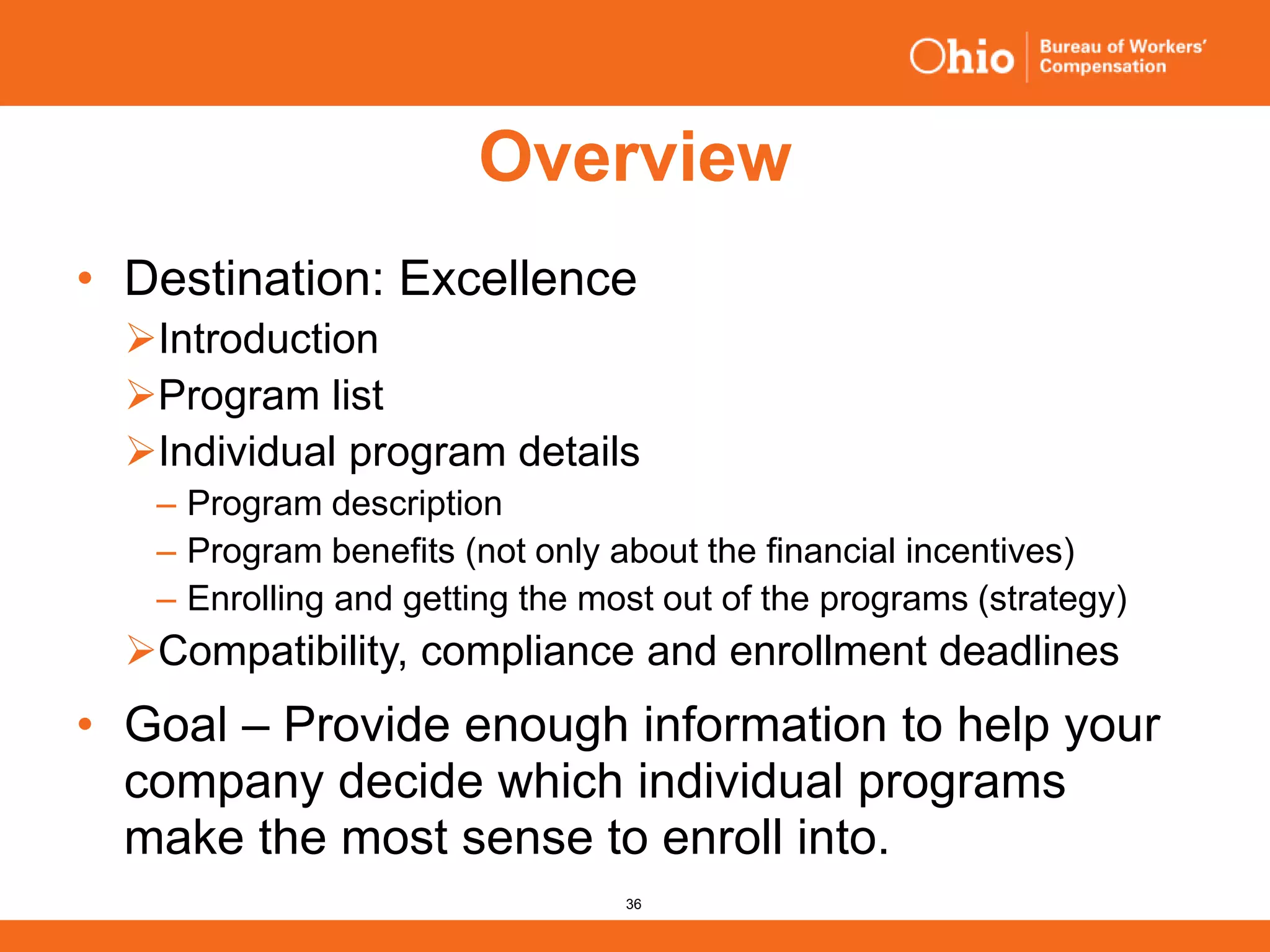
it would be the fifth or sixth largest
workers’ comp carrier in the
United States
• If BWC was a private company, it would
be a member of the New York
Stock Exchange
5
BOARD COMPOSITION
• Governor appoints 11 members; Senate confirms these
members. By law:
 Two investment experts
 One certified public accountant
 One actuary
 Three business representatives
 Two union representatives
 One injured worker representative and one representing the public
• Staggered three-year terms
6
BOARD OF DIRECTORS
• Current structure established in 2007
• Has a fiduciary responsibility to the State Insurance Fund
• Sets investment policy, premium and assessment rates, fee
schedules and overall operating policies
• Five committees:
 Committees required by law
– Actuarial
– Audit
– Investment
 Additional committees
– Governance
– Medical Services & Safety
7
BOARD OF DIRECTORS
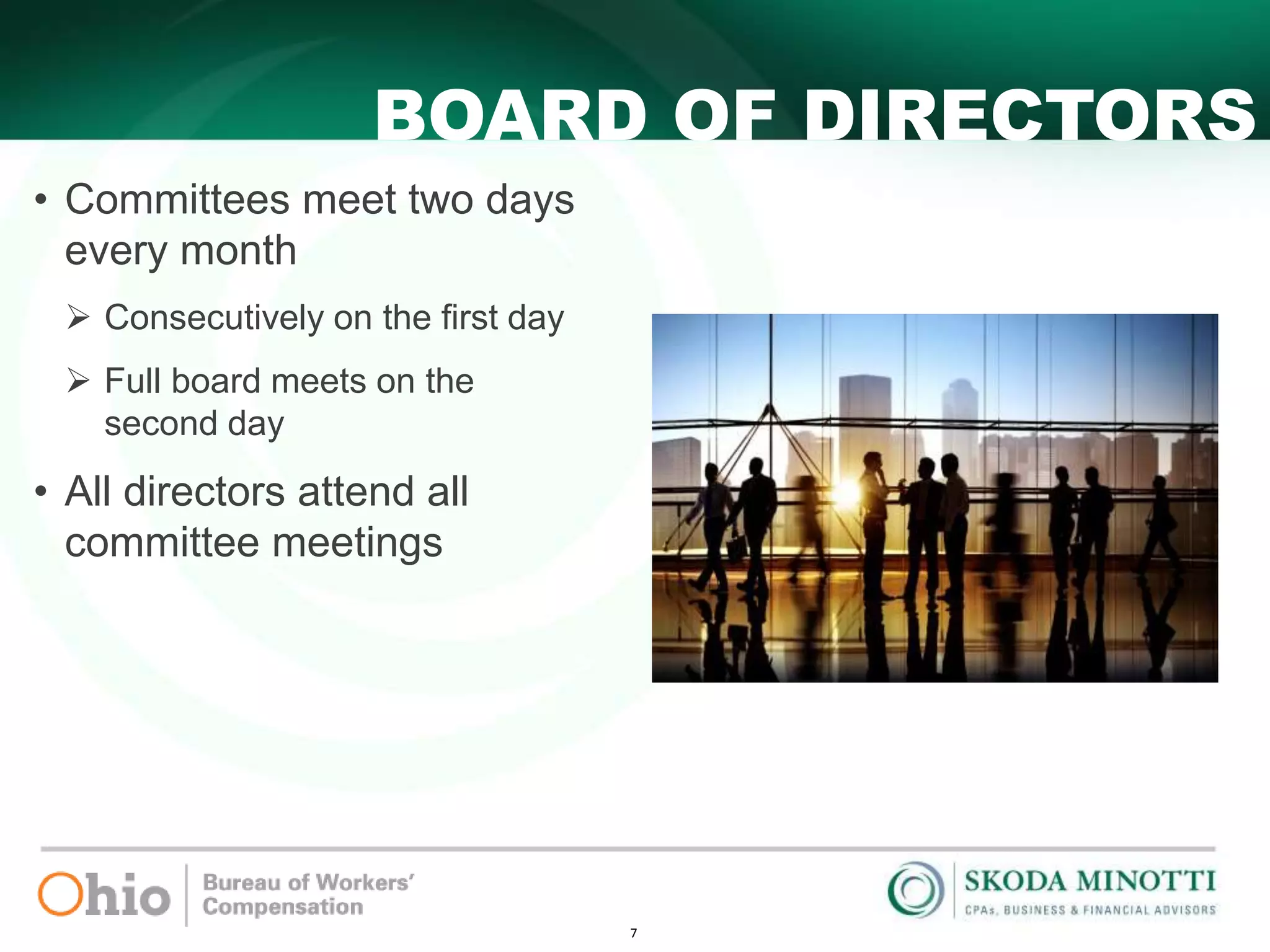
• Committees meet two days
every month
 Consecutively on the first day
 Full board meets on the
second day
• All directors attend all
committee meetings
8
WHAT WE’VE ACCOMPLISHED
Employer / Actuarial / Financial – Since 2011
• PA employer rates have declined 21.4 percent
• PEC rates are at lowest level in 30 years
• The Investment Division has generated $2 billion in rebates
• BWC’s budget is down 15 percent
• We’ve improved our image toward becoming a partner,
rather than a barrier to economic growth
9
WHAT WE’VE ACCOMPLISHED
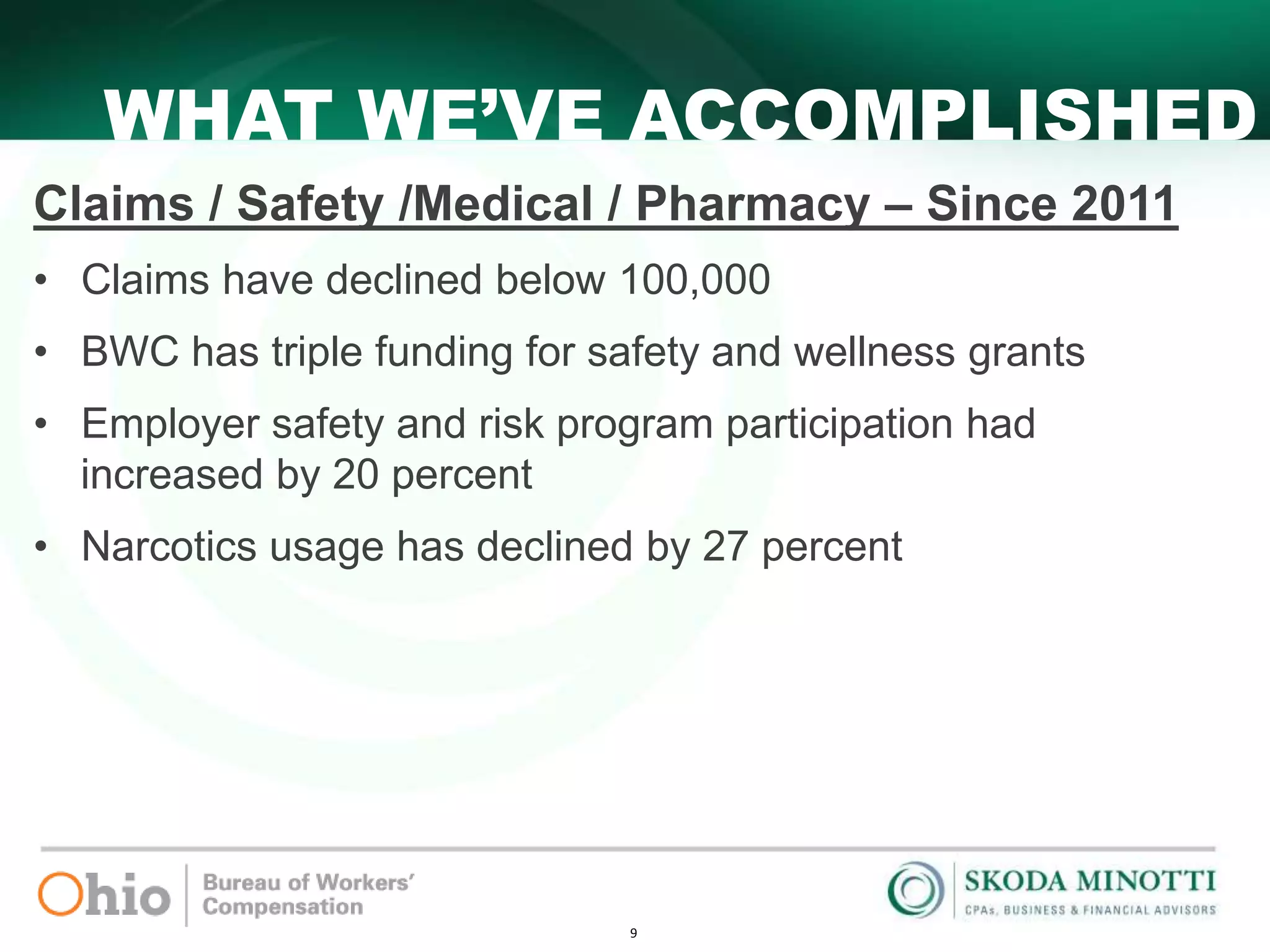
Claims / Safety /Medical / Pharmacy – Since 2011
• Claims have declined below 100,000
• BWC has triple funding for safety and wellness grants
• Employer safety and risk program participation had
increased by 20 percent
• Narcotics usage has declined by 27 percent
10
BWC Updates and Overview
of
Prospective Billing
11
Regional Connection
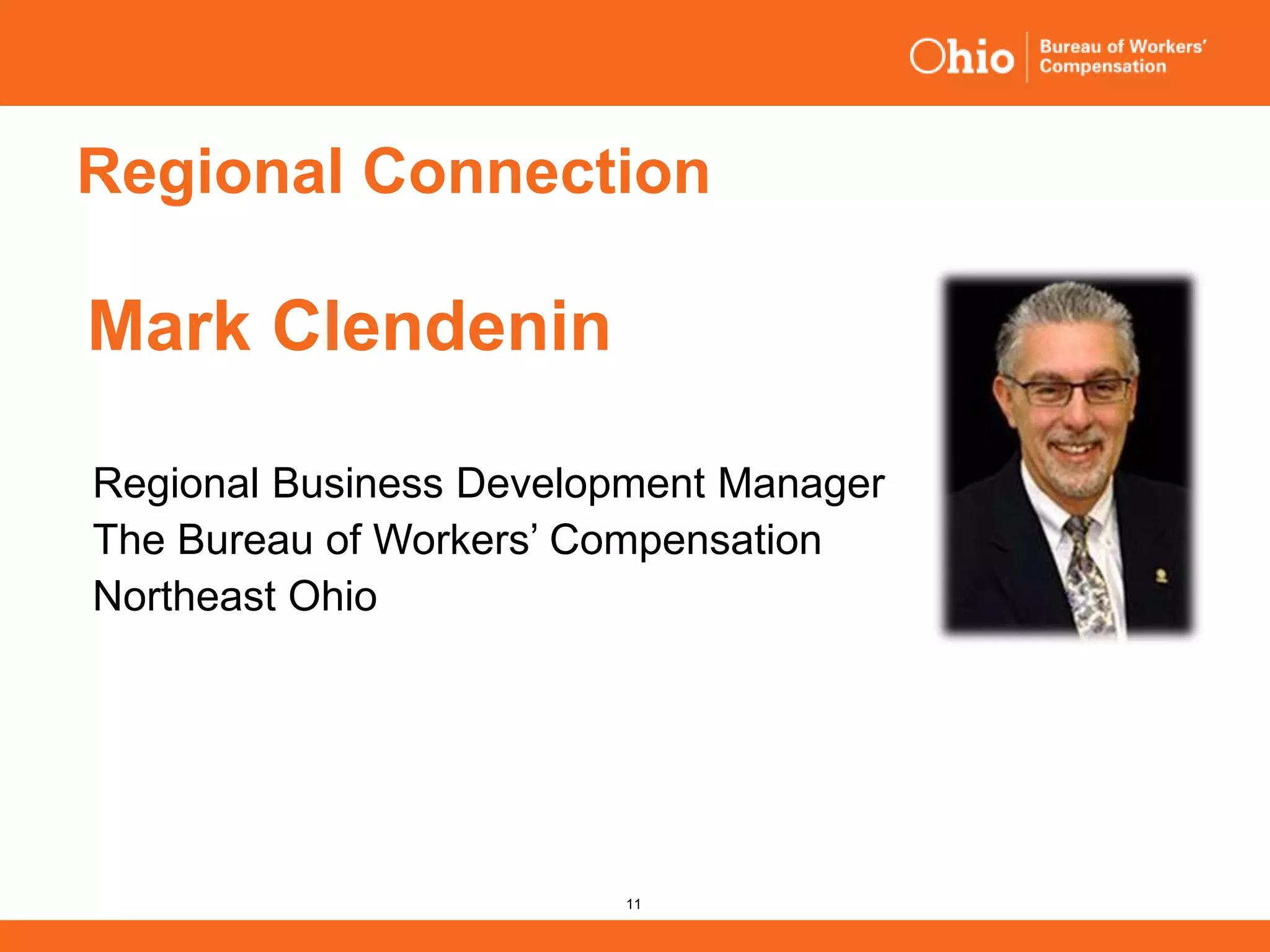
Regional Business Development Manager
The Bureau of Workers’ Compensation
Northeast Ohio
Mark Clendenin
12
A BWC Ohio Partnership
• While making significant progress, there’s still
more work to be done.
• BWC is an active partner in helping transform
Ohio for growth.
• Our mandate from the Governor has been
straight-forward: Improve Ohio’s workers’
compensation system so that it is no longer a
barrier to economic growth.
13
Stakeholders Involvement
• Through discussion and partnerships we have:
Made progress helping injured workers return to work
with proper care
Streamlined internal business processes
Kept rates stable
14
15
Private Employer Rate Cuts
• BWC has approved rate cuts in three of the past
four years.
• Another rate cut of 10.8% will take effect July 1,
2015.
• At that time, rates will be down 21.4% from just
five years ago.
16
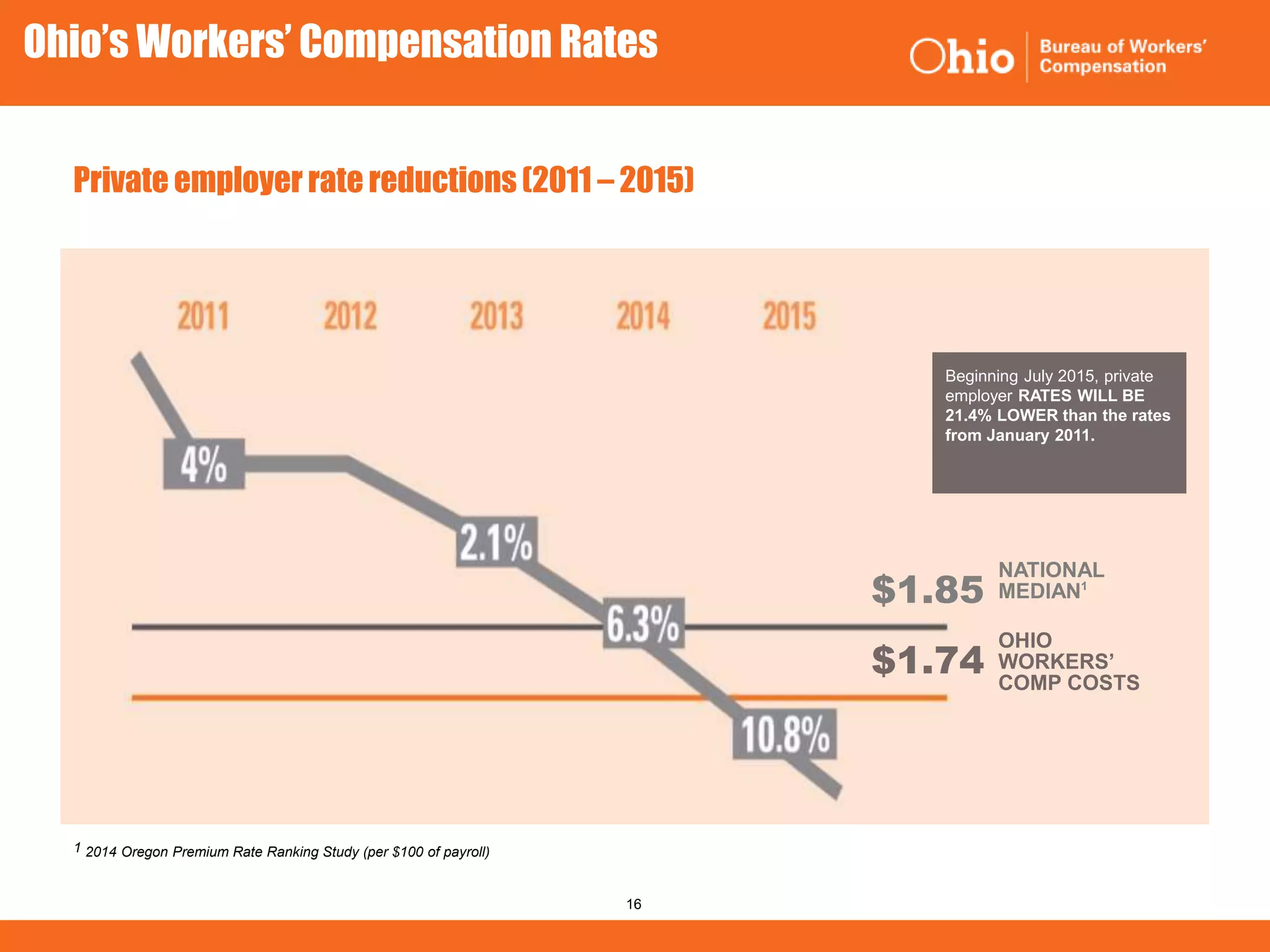
Ohio’s Workers’ Compensation Rates
Beginning July 2015, private
employer RATES WILL BE
21.4% LOWER than the rates
from January 2011.
NATIONAL
MEDIAN1
OHIO
WORKERS’
COMP COSTS
$1.85
$1.74
1 2014 Oregon Premium Rate Ranking Study (per $100 of payroll)
Private employer rate reductions(2011 – 2015)
17
Recent Rebates to Employers
• In 2013 and 2014, BWC returned $2 billion in
rebates to Ohio employers.
• BWC to provide $1.2 billion transition credit to
Ohio employers to ease the transition to a
prospective billing system.
18
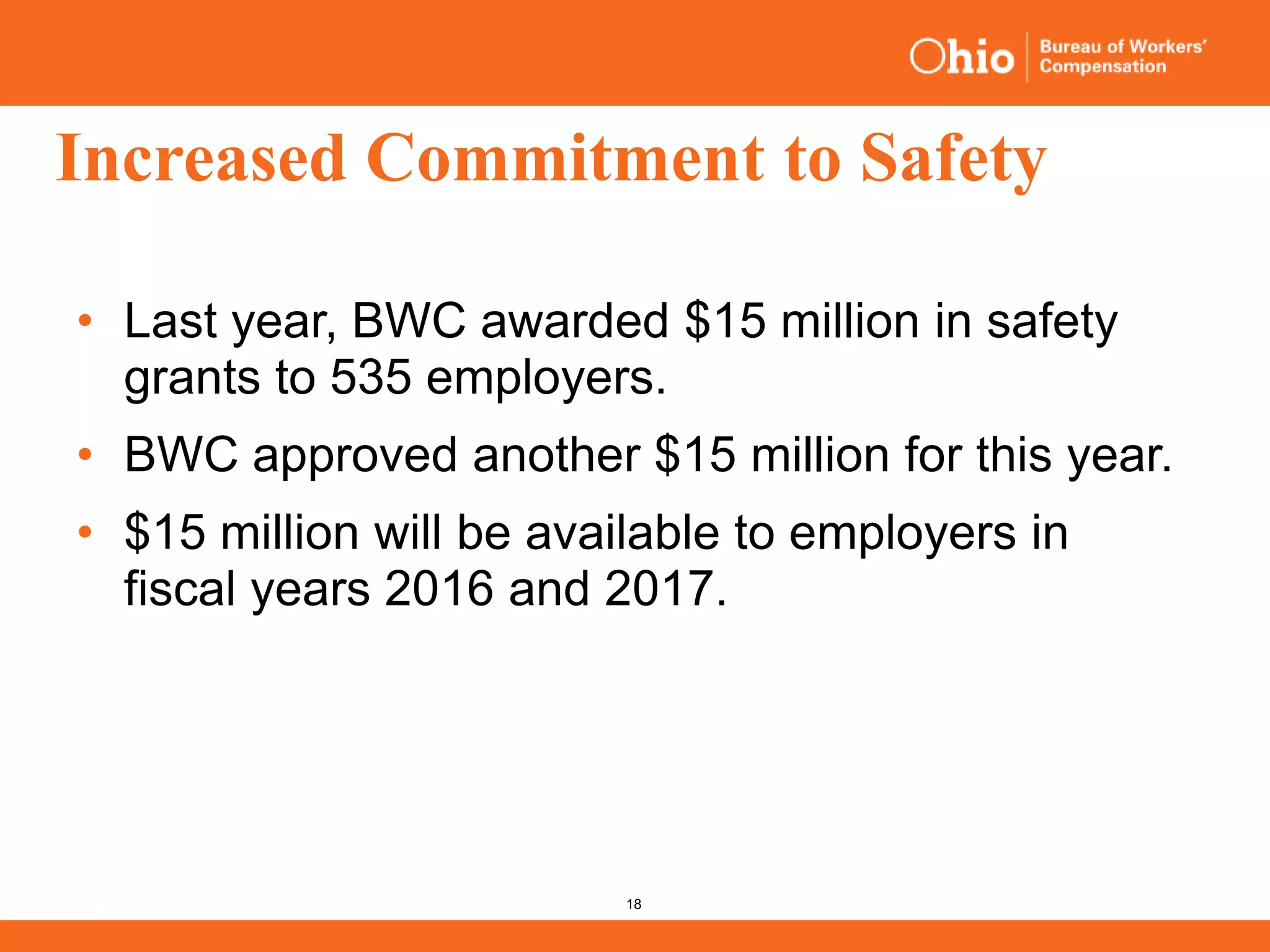
Increased Commitment to Safety
• Last year, BWC awarded $15 million in safety
grants to 535 employers.
• BWC approved another $15 million for this year.
• $15 million will be available to employers in
fiscal years 2016 and 2017.
19
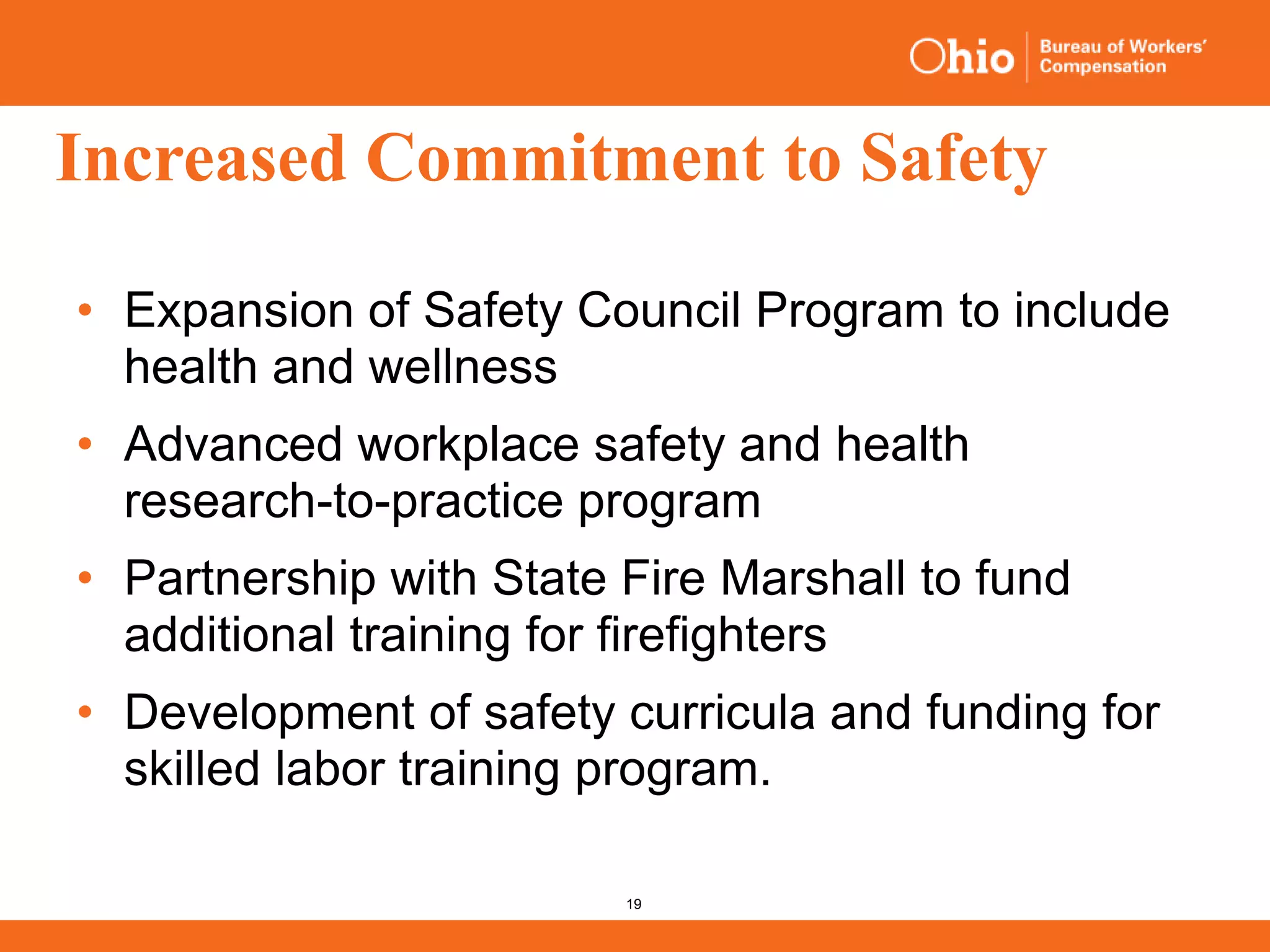
Increased Commitment to Safety
• Expansion of Safety Council Program to include
health and wellness
• Advanced workplace safety and health
research-to-practice program
• Partnership with State Fire Marshall to fund
additional training for firefighters
• Development of safety curricula and funding for
skilled labor training program.
20
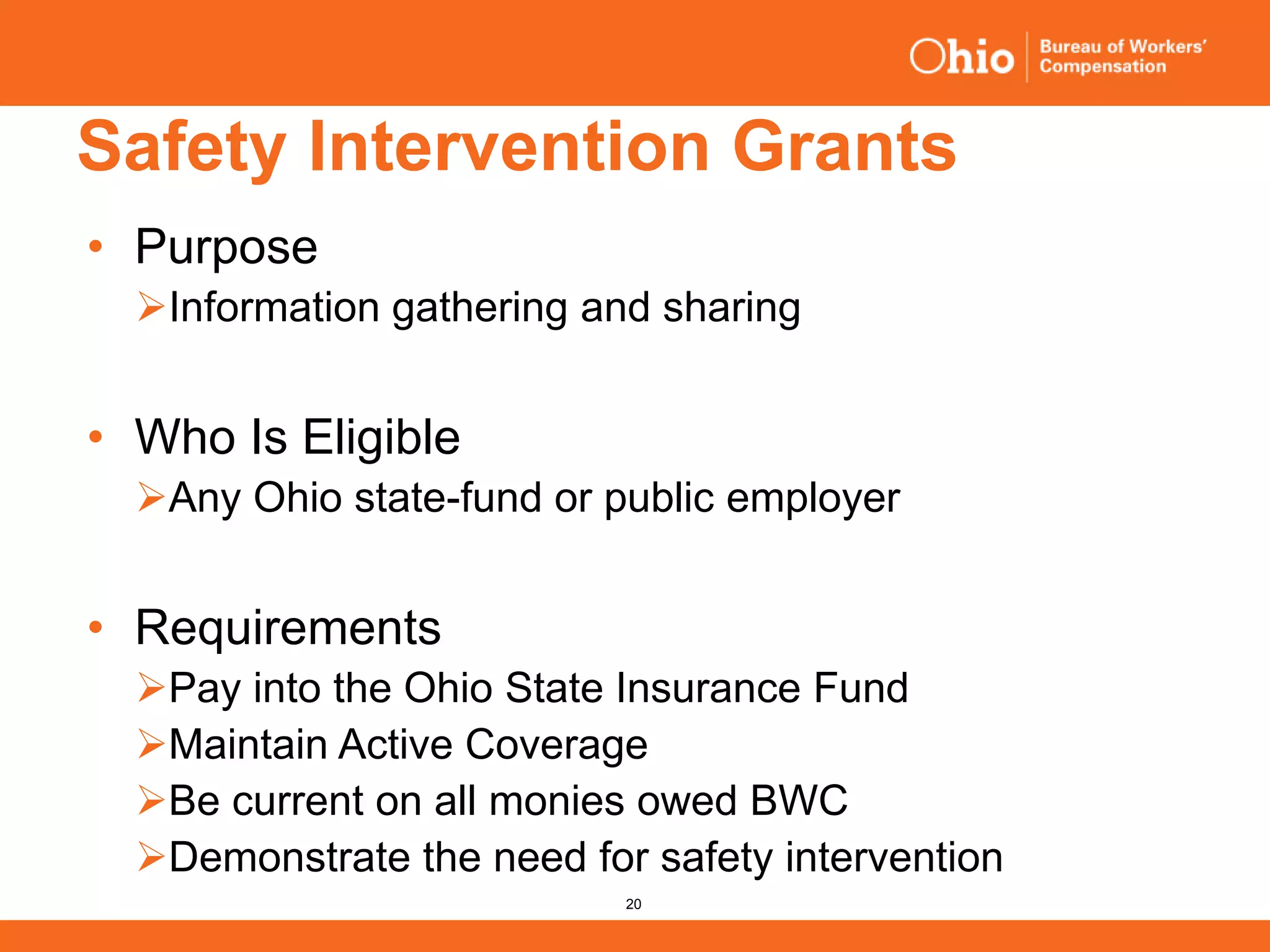
Safety Intervention Grants
• Purpose
Information gathering and sharing
• Who Is Eligible
Any Ohio state-fund or public employer
• Requirements
Pay into the Ohio State Insurance Fund
Maintain Active Coverage
Be current on all monies owed BWC
Demonstrate the need for safety intervention
21
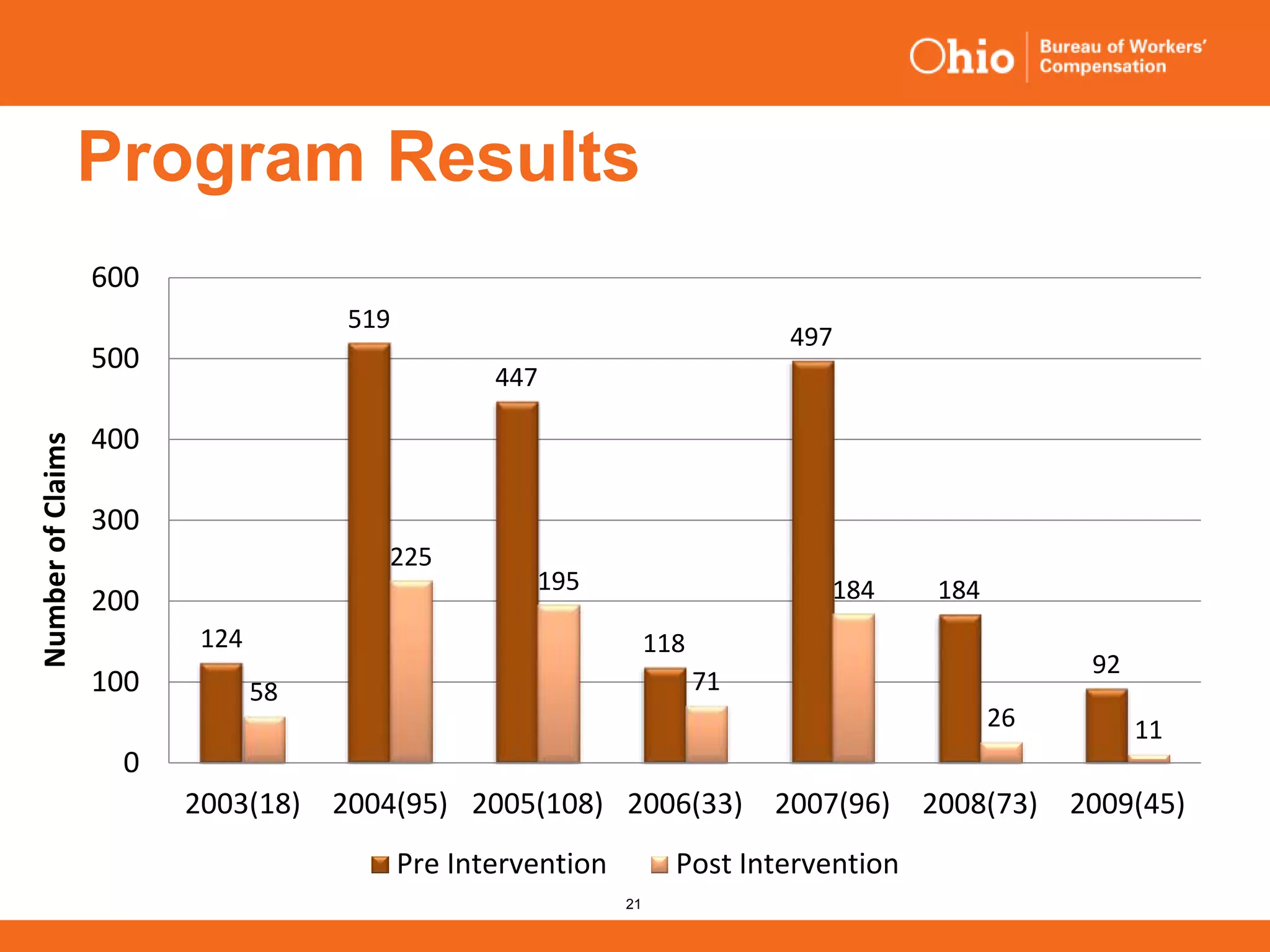
124
519
447
118
497
184
92
58
225
195
71
184
26 11
0
100
200
300
400
500
600
2003(18) 2004(95) 2005(108) 2006(33) 2007(96) 2008(73) 2009(45)
NumberofClaims
Pre Intervention Post Intervention
Program Results
22
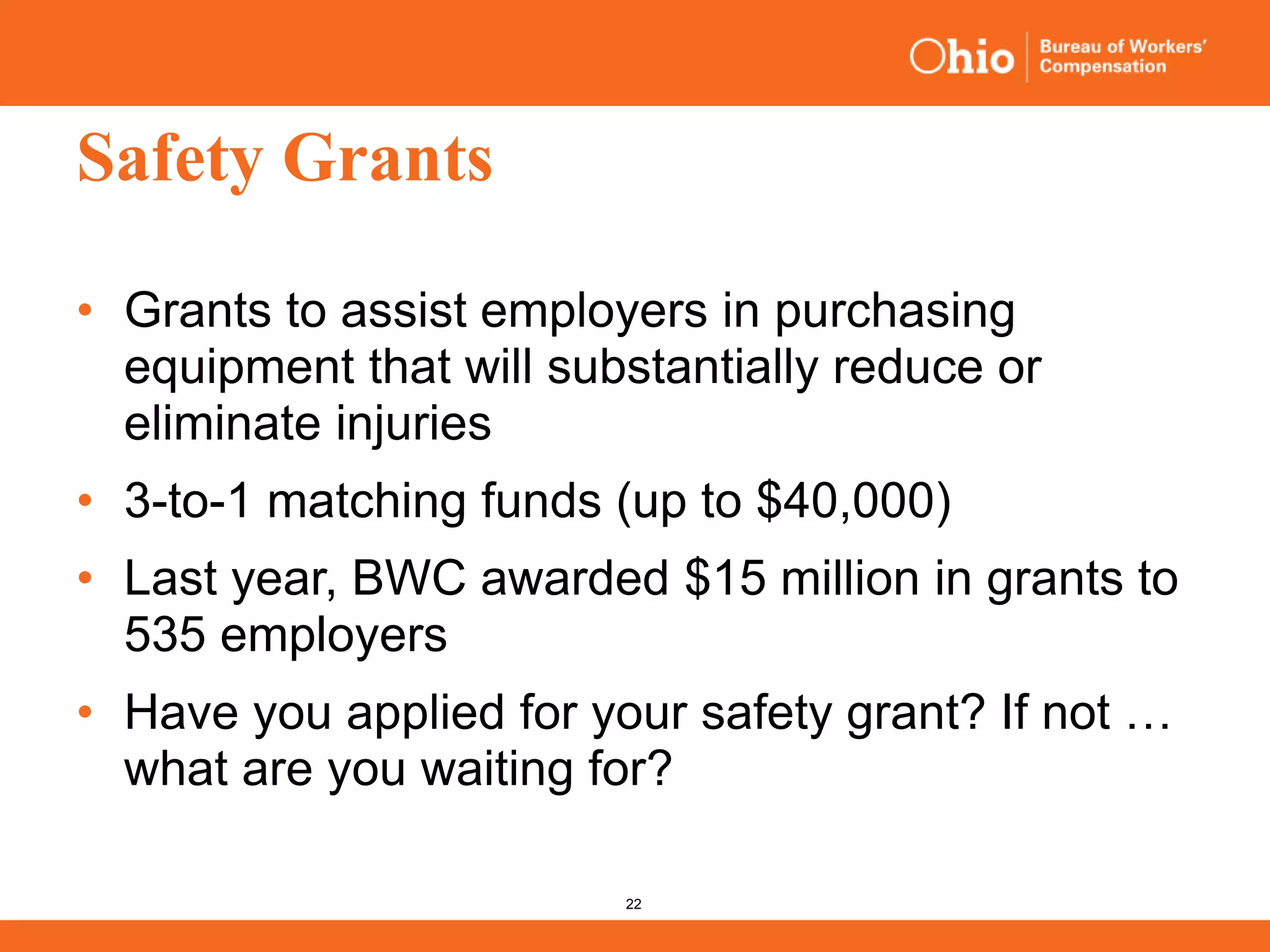
Safety Grants
• Grants to assist employers in purchasing
equipment that will substantially reduce or
eliminate injuries
• 3-to-1 matching funds (up to $40,000)
• Last year, BWC awarded $15 million in grants to
535 employers
• Have you applied for your safety grant? If not …
what are you waiting for?
23
Prospective Billing for
Private Employers
24
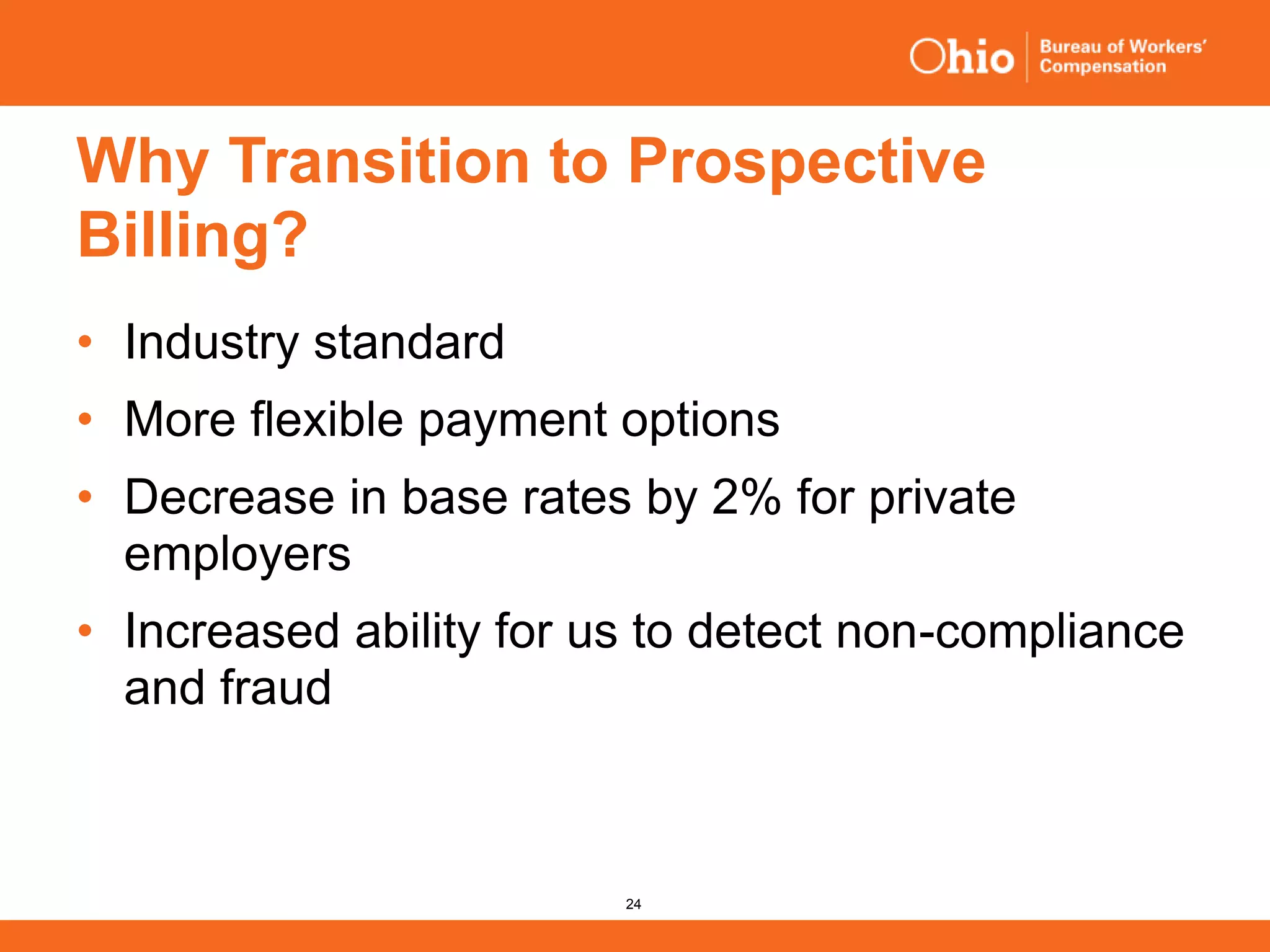
Why Transition to Prospective
Billing?
• Industry standard
• More flexible payment options
• Decrease in base rates by 2% for private
employers
• Increased ability for us to detect non-compliance
and fraud
25
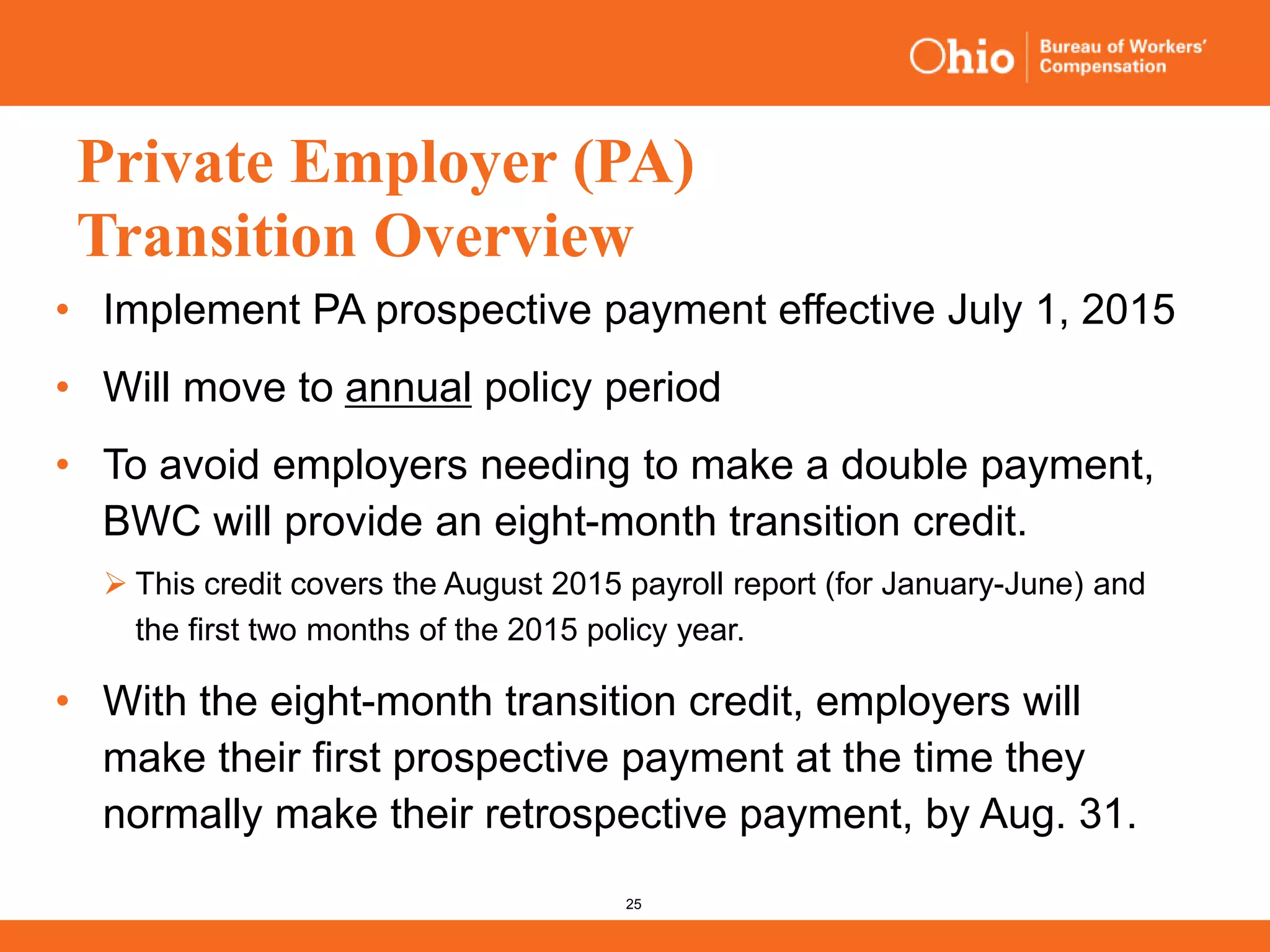
Private Employer (PA)
Transition Overview
• Implement PA prospective payment effective July 1, 2015
• Will move to annual policy period
• To avoid employers needing to make a double payment,
BWC will provide an eight-month transition credit.
 This credit covers the August 2015 payroll report (for January-June) and
the first two months of the 2015 policy year.
• With the eight-month transition credit, employers will
make their first prospective payment at the time they
normally make their retrospective payment, by Aug. 31.
26
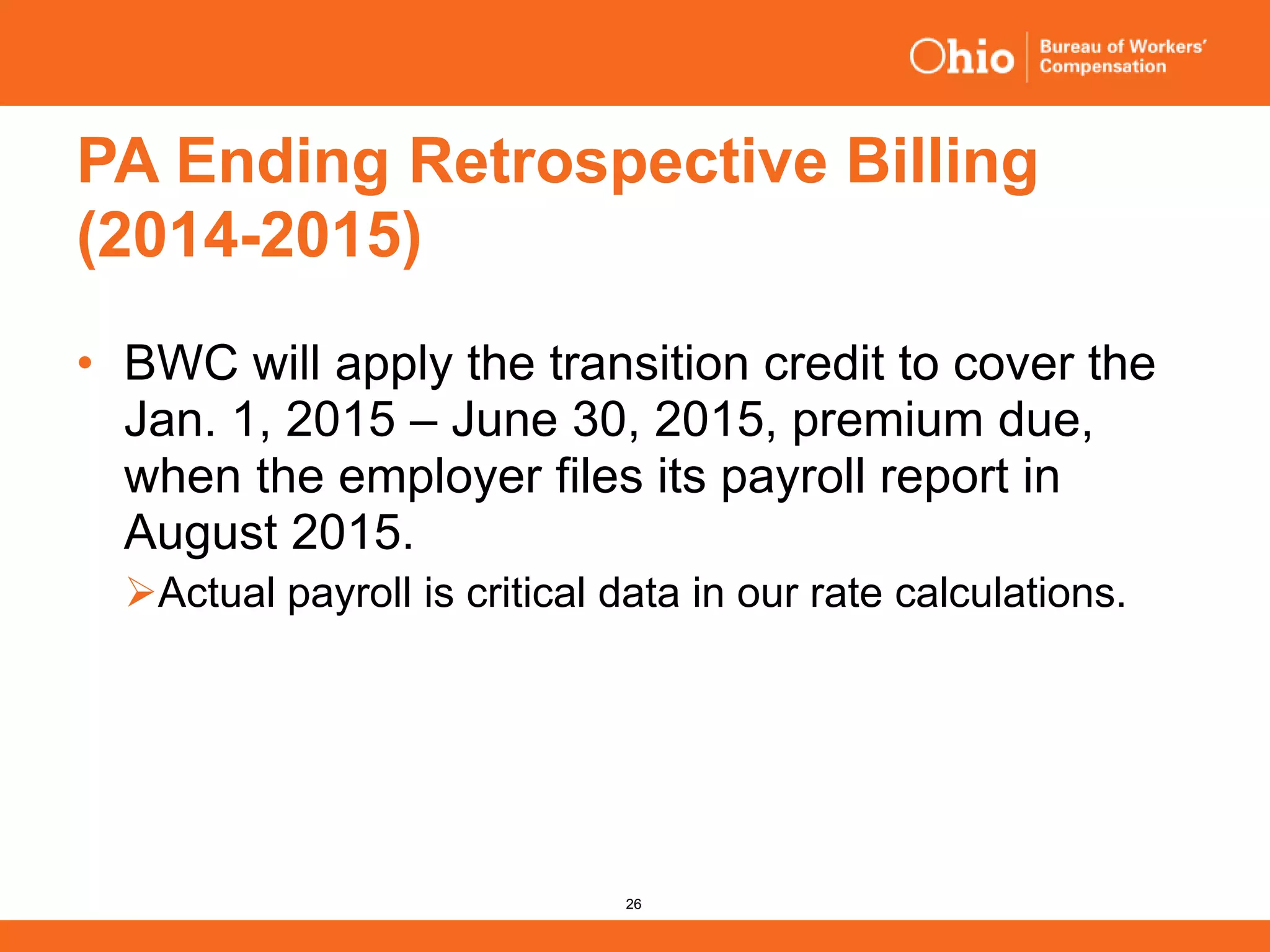
PA Ending Retrospective Billing
(2014-2015)
• BWC will apply the transition credit to cover the
Jan. 1, 2015 – June 30, 2015, premium due,
when the employer files its payroll report in
August 2015.
Actual payroll is critical data in our rate calculations.
27
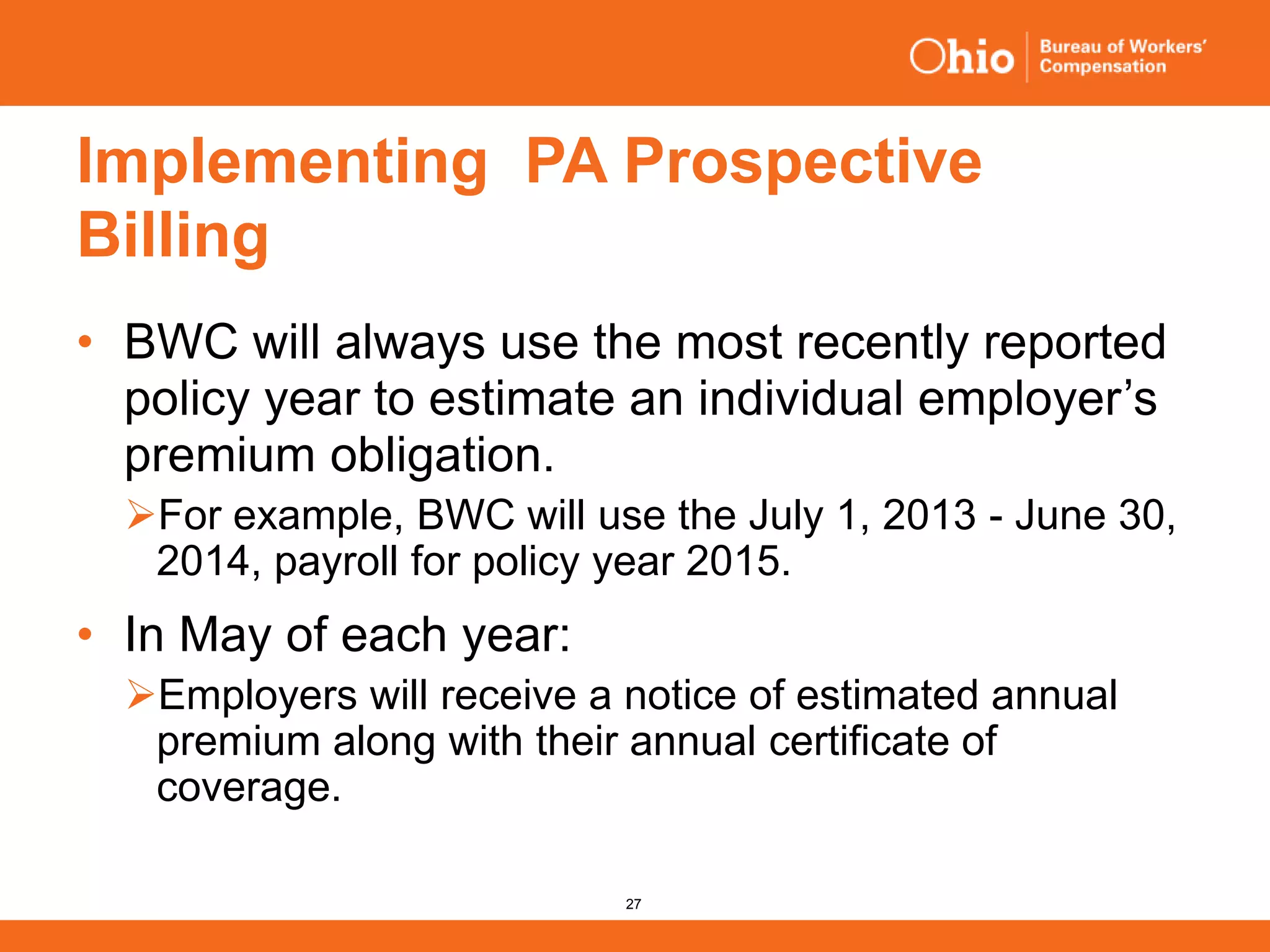
Implementing PA Prospective
Billing
• BWC will always use the most recently reported
policy year to estimate an individual employer’s
premium obligation.
For example, BWC will use the July 1, 2013 - June 30,
2014, payroll for policy year 2015.
• In May of each year:
Employers will receive a notice of estimated annual
premium along with their annual certificate of
coverage.
28
Notice of Estimated Annual Premium
Sample: Notice of Estimated Annual Premium
29
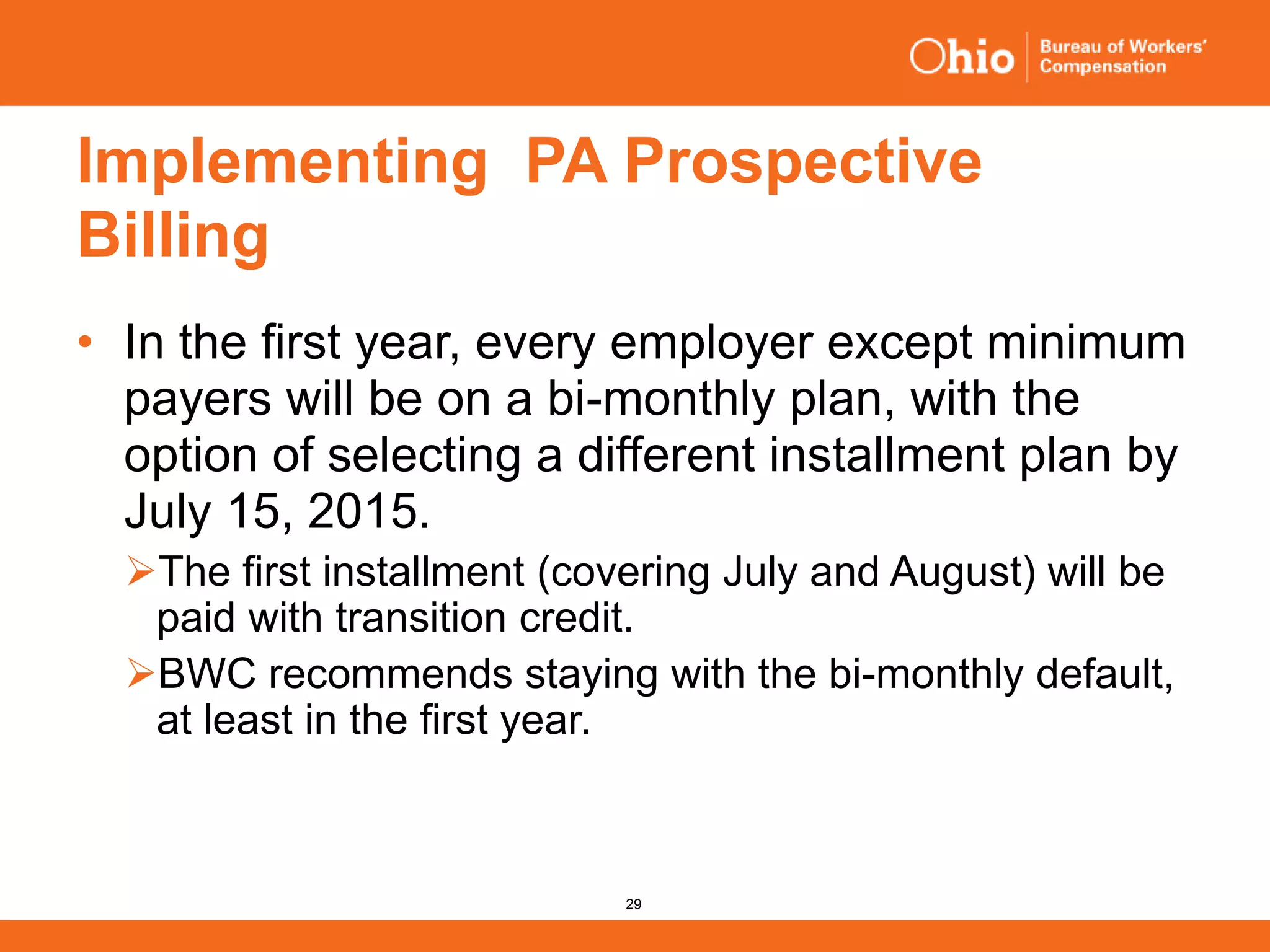
Implementing PA Prospective
Billing
• In the first year, every employer except minimum
payers will be on a bi-monthly plan, with the
option of selecting a different installment plan by
July 15, 2015.
The first installment (covering July and August) will be
paid with transition credit.
BWC recommends staying with the bi-monthly default,
at least in the first year.
30
Installment Options
Annual (1);
Semi-annual (2);
Quarterly (4);
Bi-monthly (6);
Monthly (12).
• Minimum payers will not receive installment
options.
• Minimum premium increasing to $120 due by
June 30 each year.
31
Implementing PA Prospective
Billing (First Year Only)
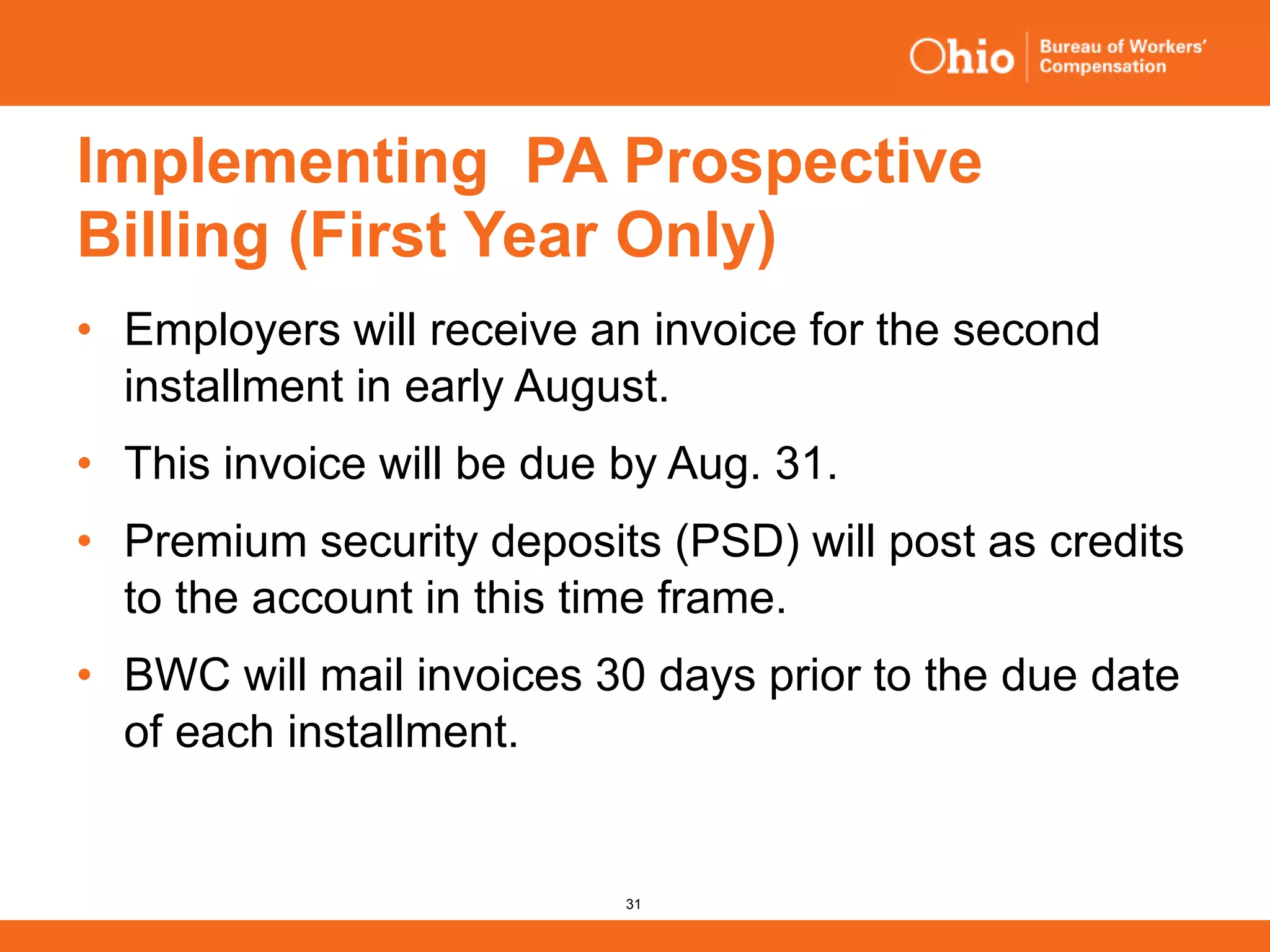
• Employers will receive an invoice for the second
installment in early August.
• This invoice will be due by Aug. 31.
• Premium security deposits (PSD) will post as credits
to the account in this time frame.
• BWC will mail invoices 30 days prior to the due date
of each installment.
32
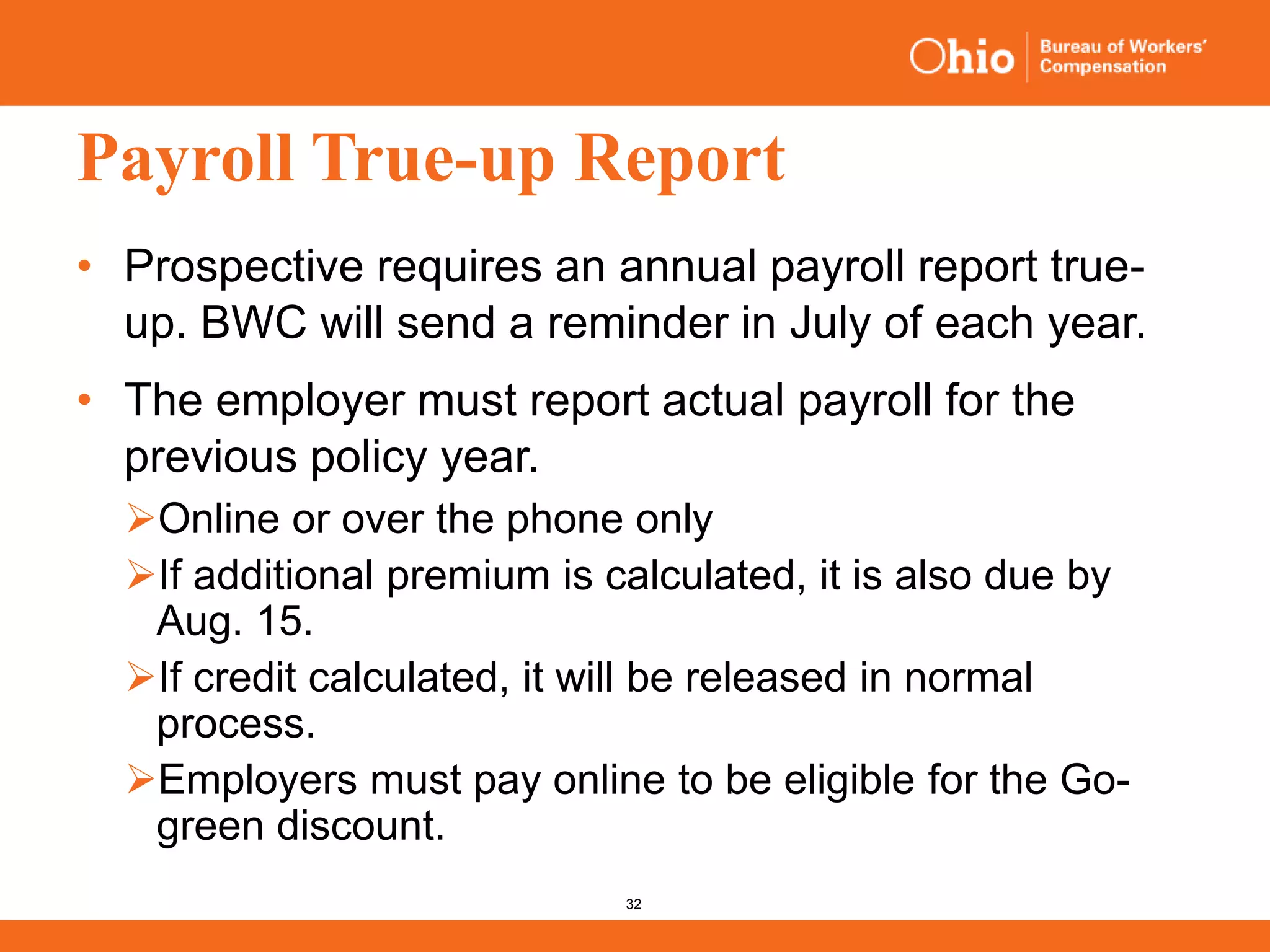
Payroll True-up Report
• Prospective requires an annual payroll report true-
up. BWC will send a reminder in July of each year.
• The employer must report actual payroll for the
previous policy year.
Online or over the phone only
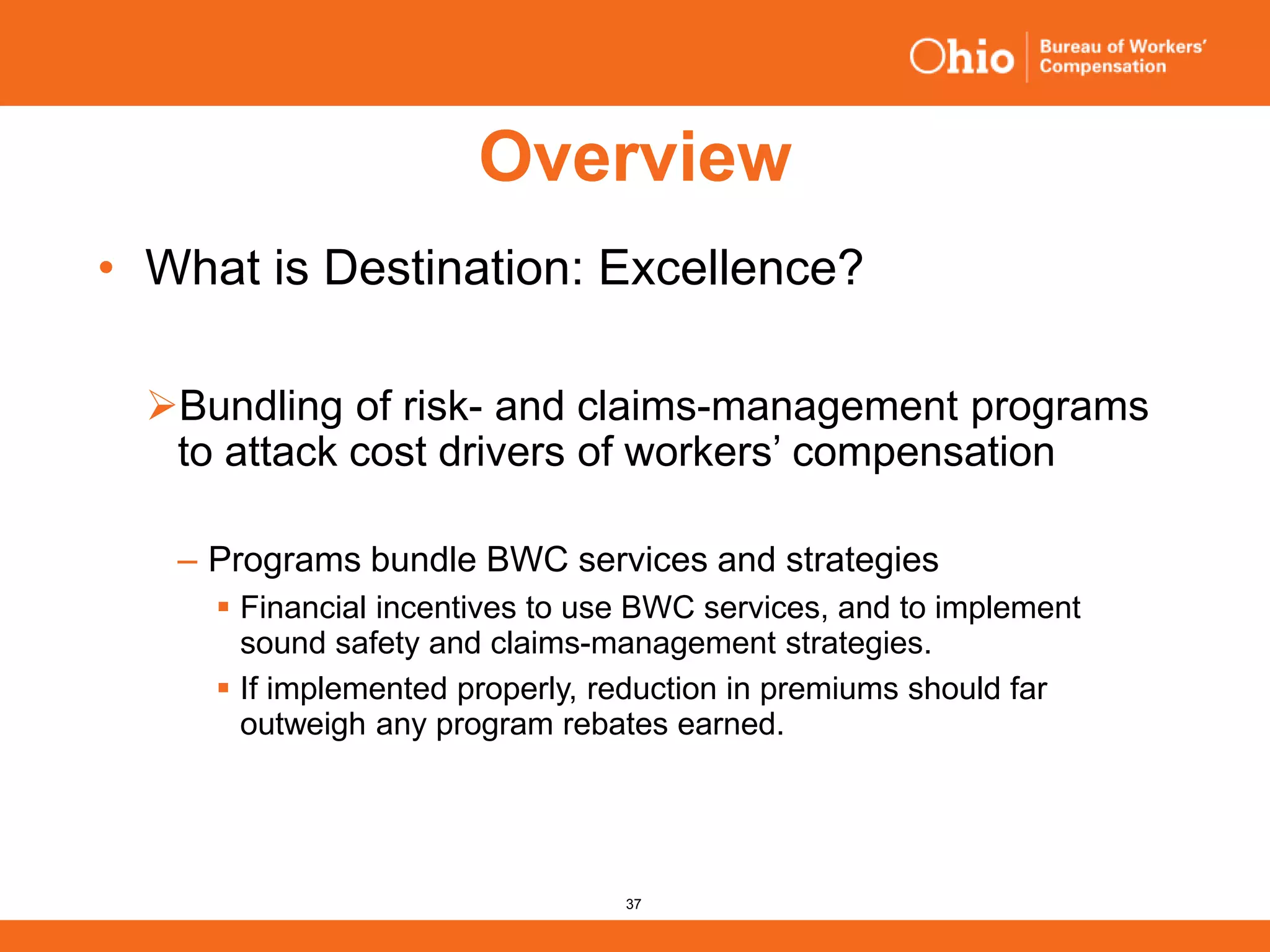
If additional premium is calculated, it is also due by
Aug. 15.
If credit calculated, it will be released in normal
process.
Employers must pay online to be eligible for the Go-
green discount.
33
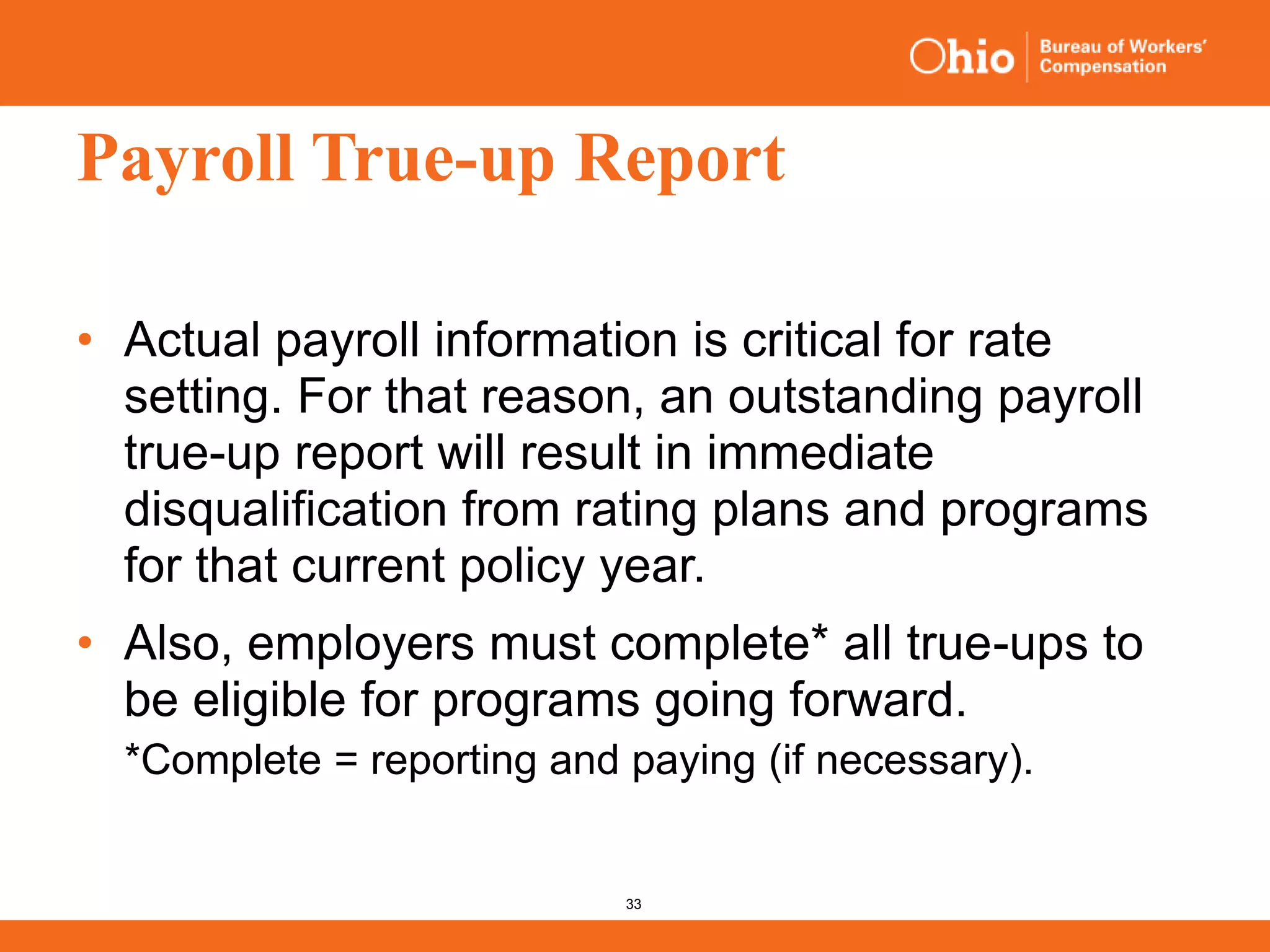
Payroll True-up Report
• Actual payroll information is critical for rate
setting. For that reason, an outstanding payroll
true-up report will result in immediate
disqualification from rating plans and programs
for that current policy year.
• Also, employers must complete* all true-ups to
be eligible for programs going forward.
*Complete = reporting and paying (if necessary).
34
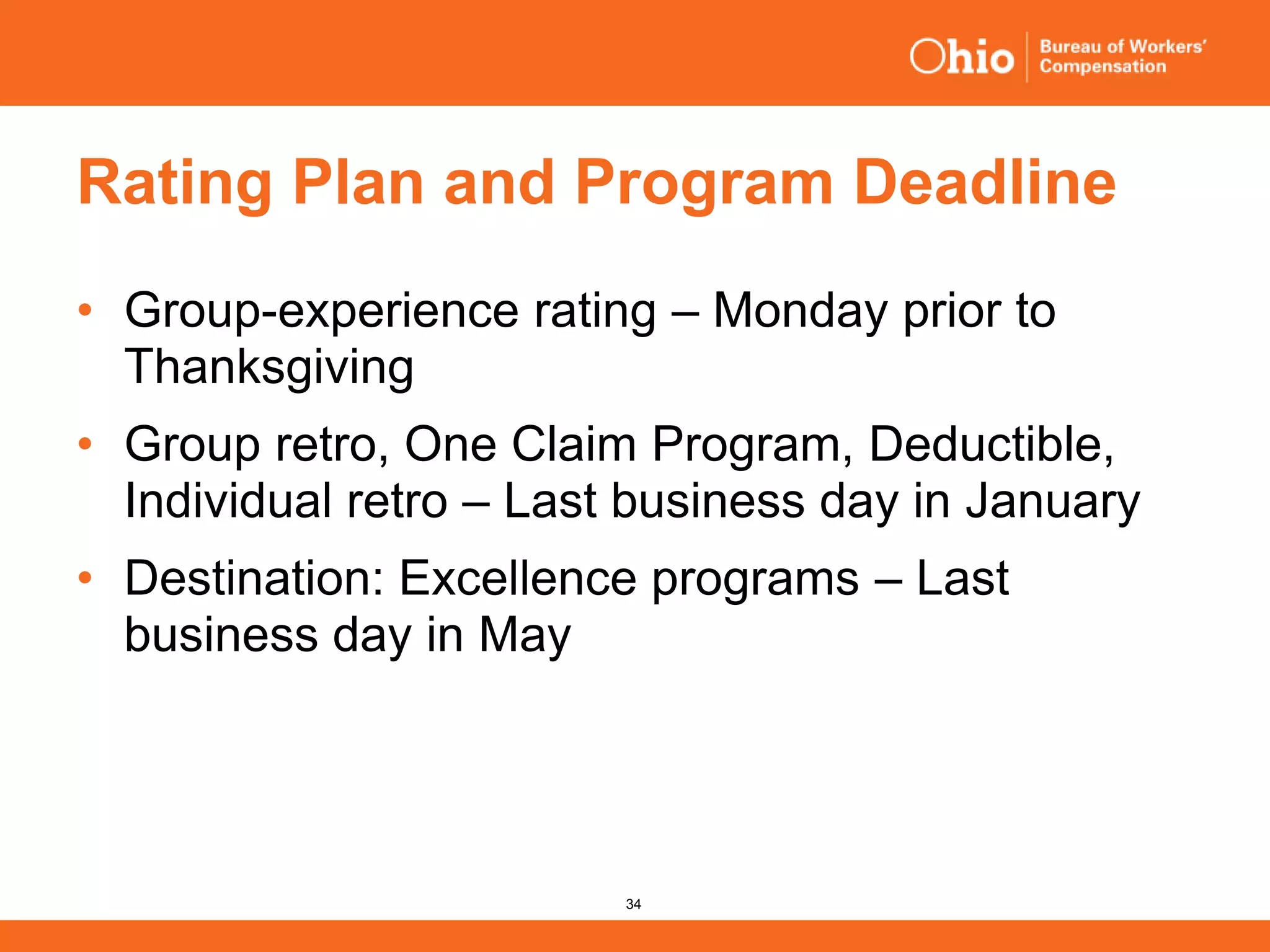
Rating Plan and Program Deadline
• Group-experience rating – Monday prior to
Thanksgiving
• Group retro, One Claim Program, Deductible,
Individual retro – Last business day in January
• Destination: Excellence programs – Last
business day in May
35
Destination:
EXCELLENCE
Introduction and overview
36
Overview
• Destination: Excellence
Introduction
Program list
Individual program details
‒ Program description
‒ Program benefits (not only about the financial incentives)
‒ Enrolling and getting the most out of the programs (strategy)
Compatibility, compliance and enrollment deadlines
• Goal – Provide enough information to help your
company decide which individual programs
make the most sense to enroll into.
37
Overview
• What is Destination: Excellence?
Bundling of risk- and claims-management programs
to attack cost drivers of workers’ compensation
‒ Programs bundle BWC services and strategies
 Financial incentives to use BWC services, and to implement
sound safety and claims-management strategies.
 If implemented properly, reduction in premiums should far
outweigh any program rebates earned.
38
Introduction
• Why BWC created Destination: Excellence
To reduce costs, so that we can lower premiums rates,
to make Ohio more competitive for jobs
‒ Safety programs to prevent accidents
‒ Return-to-work programs to help injured workers transition back
to work
‒ Savings programs to reduce BWC administrative costs
Lower costs  lower rates = Destination: Excellence
39
Destination: Excellence - Eligibility
• Current on all undisputed premiums
• Active status as of application deadline
• No cumulative lapses greater than 40 days in
the last 12 months
40
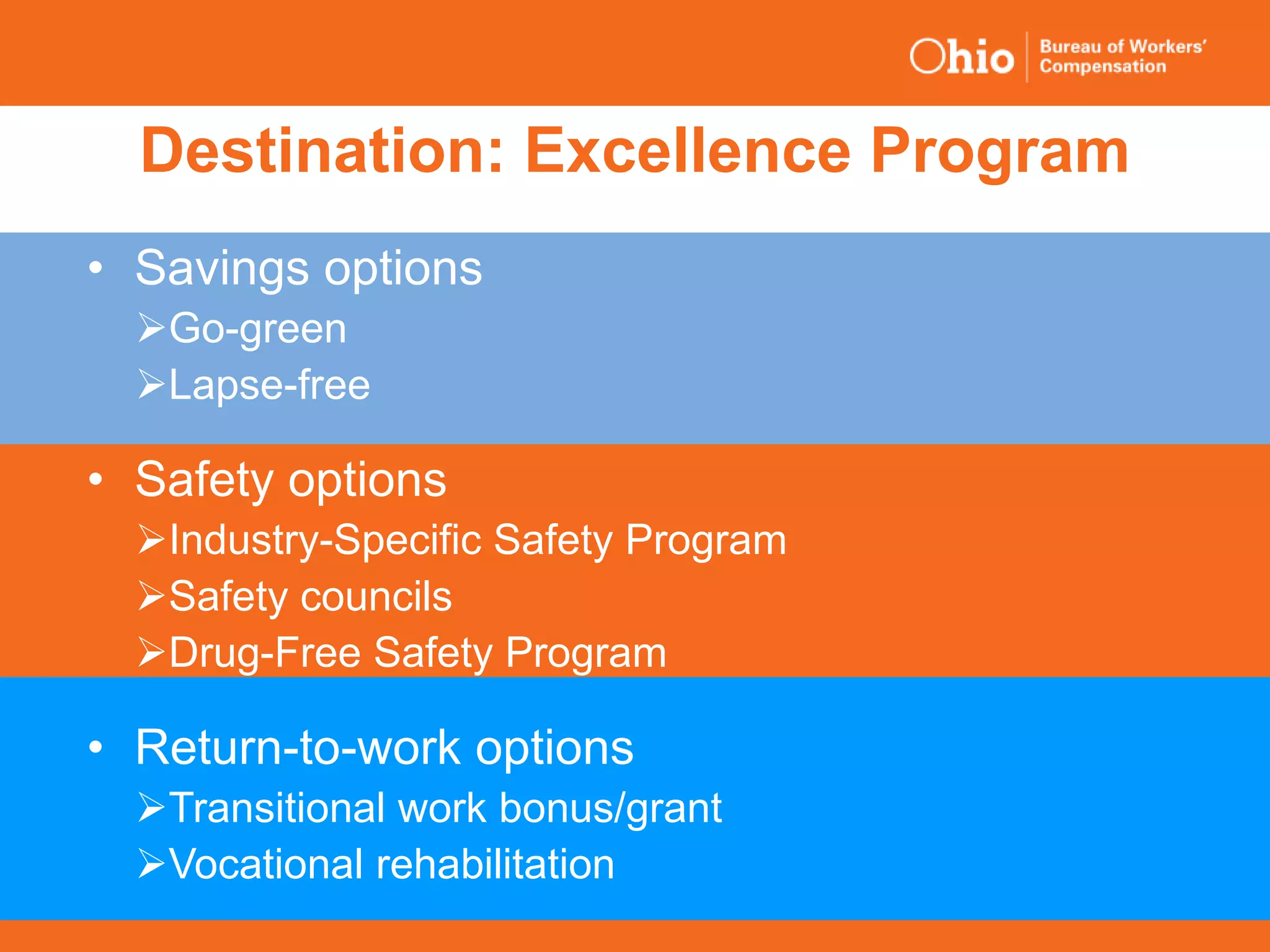
Destination: Excellence Program
• Savings options
Go-green
Lapse-free
• Safety options
Industry-Specific Safety Program
Safety councils
Drug-Free Safety Program
• Return-to-work options
Transitional work bonus/grant
Vocational rehabilitation
41
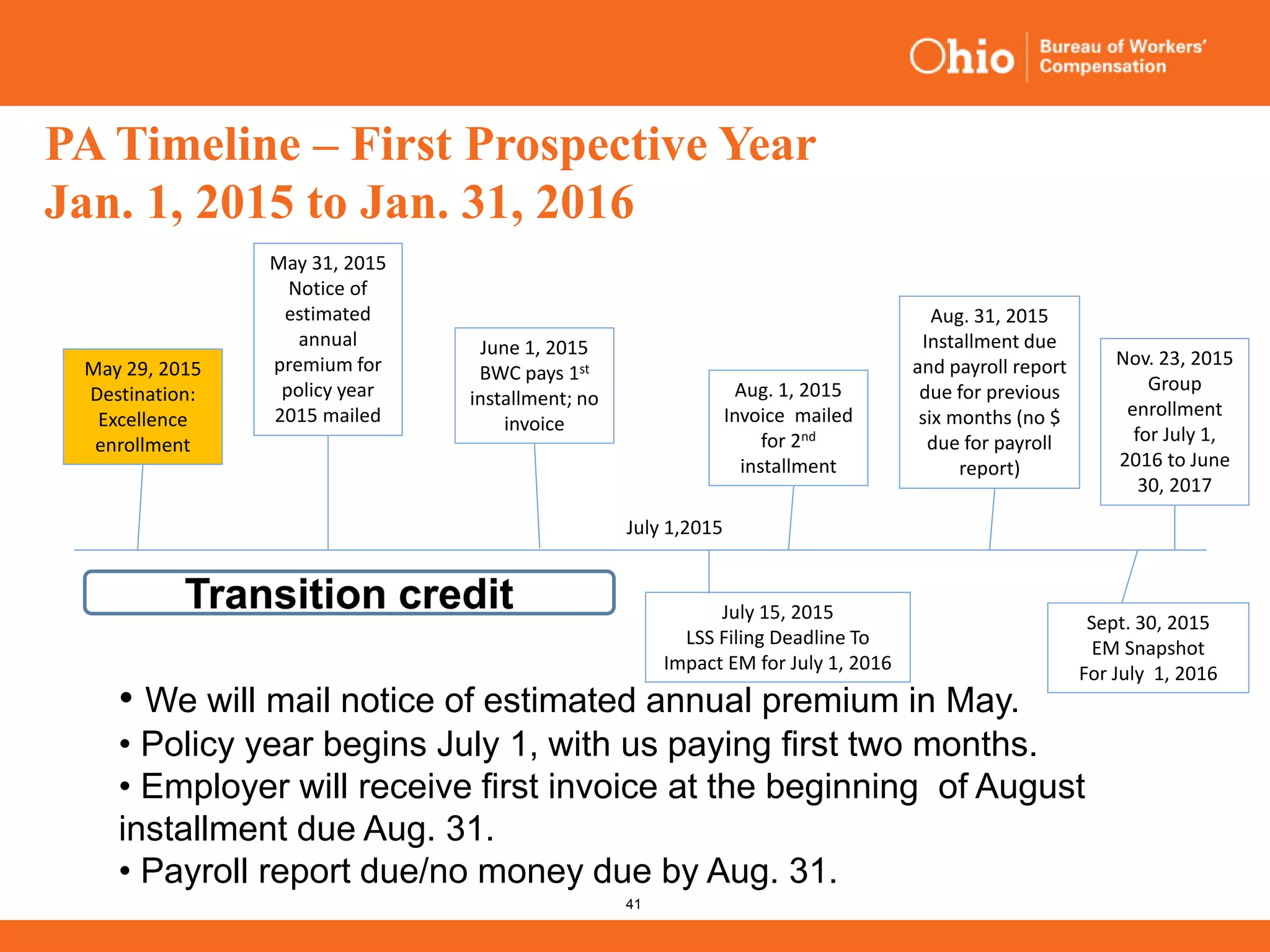
• We will mail notice of estimated annual premium in May.
• Policy year begins July 1, with us paying first two months.
• Employer will receive first invoice at the beginning of August
installment due Aug. 31.
• Payroll report due/no money due by Aug. 31.
PA Timeline – First Prospective Year
Jan. 1, 2015 to Jan. 31, 2016
May 29, 2015
Destination:
Excellence
enrollment
May 31, 2015
Notice of
estimated
annual
premium for
policy year
2015 mailed
Nov. 23, 2015
Group
enrollment
for July 1,
2016 to June
30, 2017
July 1,2015
Transition credit
Aug. 1, 2015
Invoice mailed
for 2nd
installment
June 1, 2015
BWC pays 1st
installment; no
invoice
Aug. 31, 2015
Installment due
and payroll report
due for previous
six months (no $
due for payroll
report)
Sept. 30, 2015
EM Snapshot
For July 1, 2016
July 15, 2015
LSS Filing Deadline To
Impact EM for July 1, 2016
42
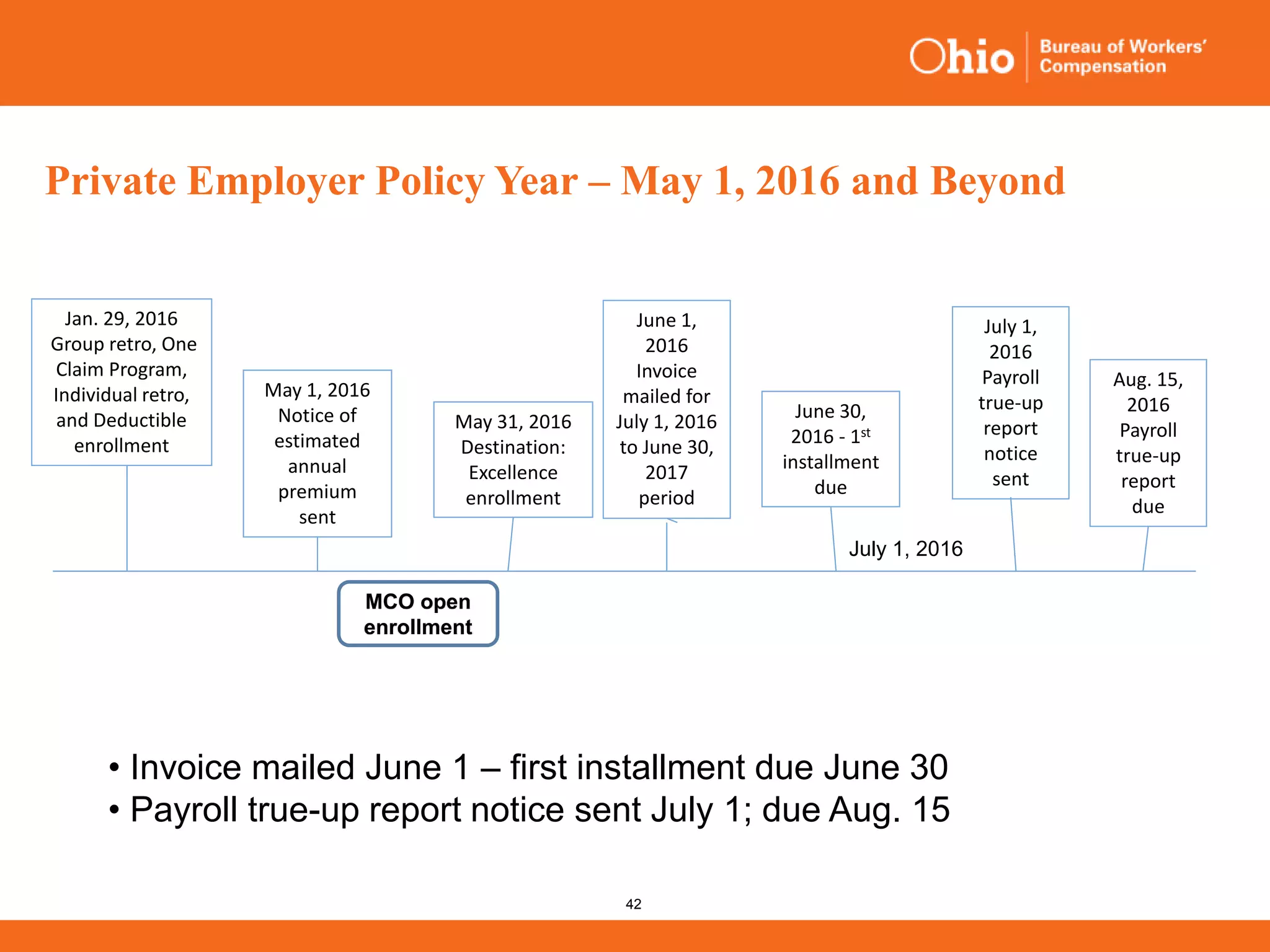
July 1, 2016
• Invoice mailed June 1 – first installment due June 30
• Payroll true-up report notice sent July 1; due Aug. 15
Private Employer Policy Year – May 1, 2016 and Beyond
July 1,
2016
Payroll
true-up
report
notice
sent
Aug. 15,
2016
Payroll
true-up
report
due
June 1,
2016
Invoice
mailed for
July 1, 2016
to June 30,
2017
period
May 1, 2016
Notice of
estimated
annual
premium
sent
May 31, 2016
Destination:
Excellence
enrollment
Jan. 29, 2016
Group retro, One
Claim Program,
Individual retro,
and Deductible
enrollment
June 30,
2016 - 1st
installment
due
MCO open
enrollment
43
Lapsing Coverage
• BWC will lapse any employer who does not pay
their installment on time.
• BWC will not lapse an employer who does not
true-up.
BWC will estimate the true-up by adding an additional
10% to the premium due and bill the employer.
If the employer still does not report their true-up, then
BWC will certify it to the Ohio Attorney General’s office
for collections.
44
Web Resources
For more information, visit www.bwc.ohio.gov
• Overview document (with key dates)
• Frequently asked questions document
• Webinars
45
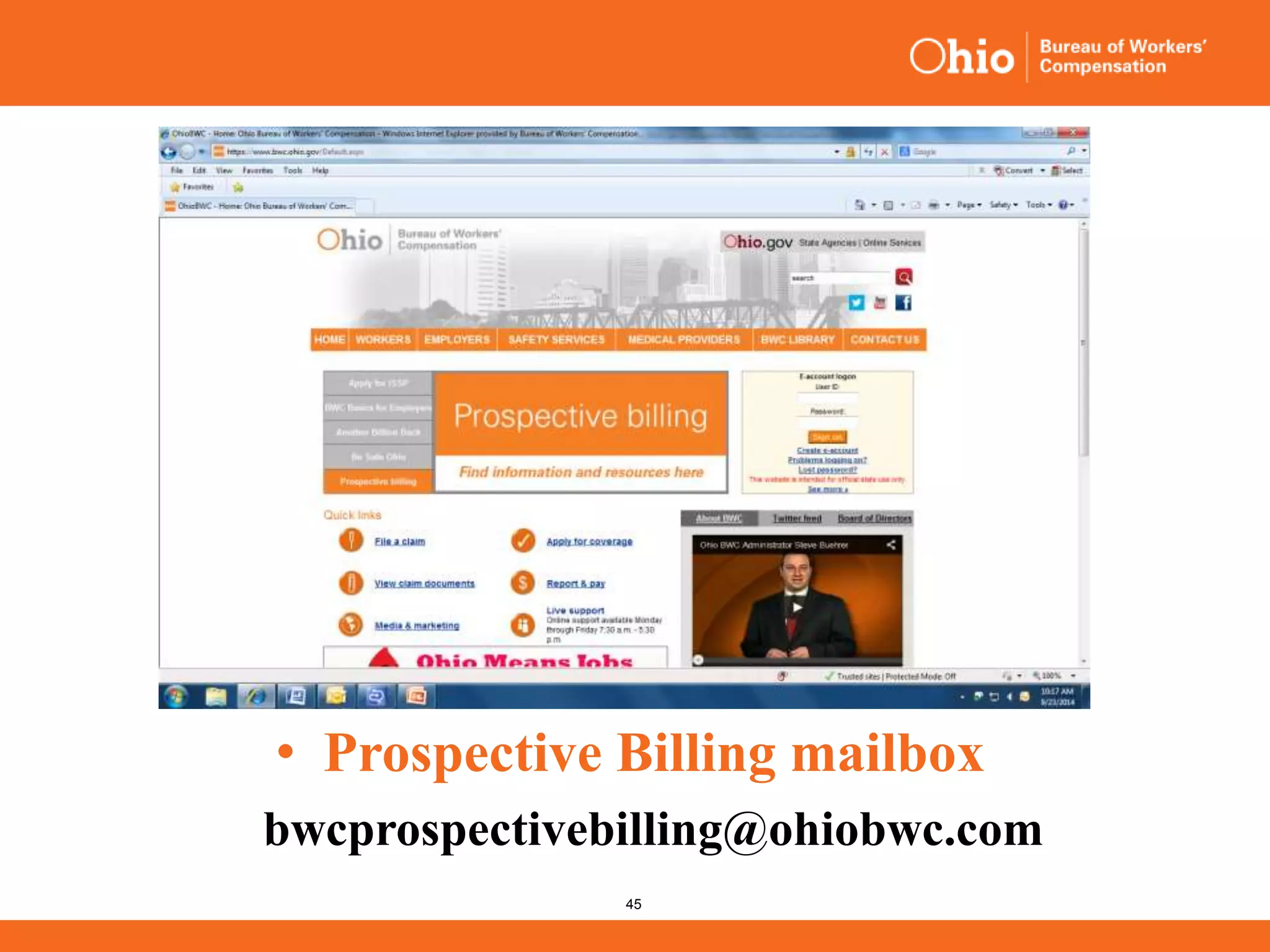
• Prospective Billing mailbox
bwcprospectivebilling@ohiobwc.com
46
What you Learned
Q: What was the final retro premium due date?
A: Private: February 2015
Q: Prospective Premium Implementation Date?
A: July 1st 2015-Private
Q: What is the initial payment plan set to?
A: Private: Bi-monthly
Q: Will my policy lapse if I don’t complete the True-Up?
A: No, but you will be removed from all programs
47
In Fiscal Year 2013, approximately 17,000 claimants missed more than seven
days of work.
 Of these 17,000 lost-time claims, nearly 50 percent missed more than 45
days of work and approximately 32 percent missed more than 100 days.
 The average cost per lost-time claim was 30-40 times greater than the
average cost of a medical-only claim.
 Nearly one in five lost-time claimants was physically dependent on opiates.
 Total lost productivity was nearly 2 million days.
The Current State of BWC’s
Healthcare Delivery System
48
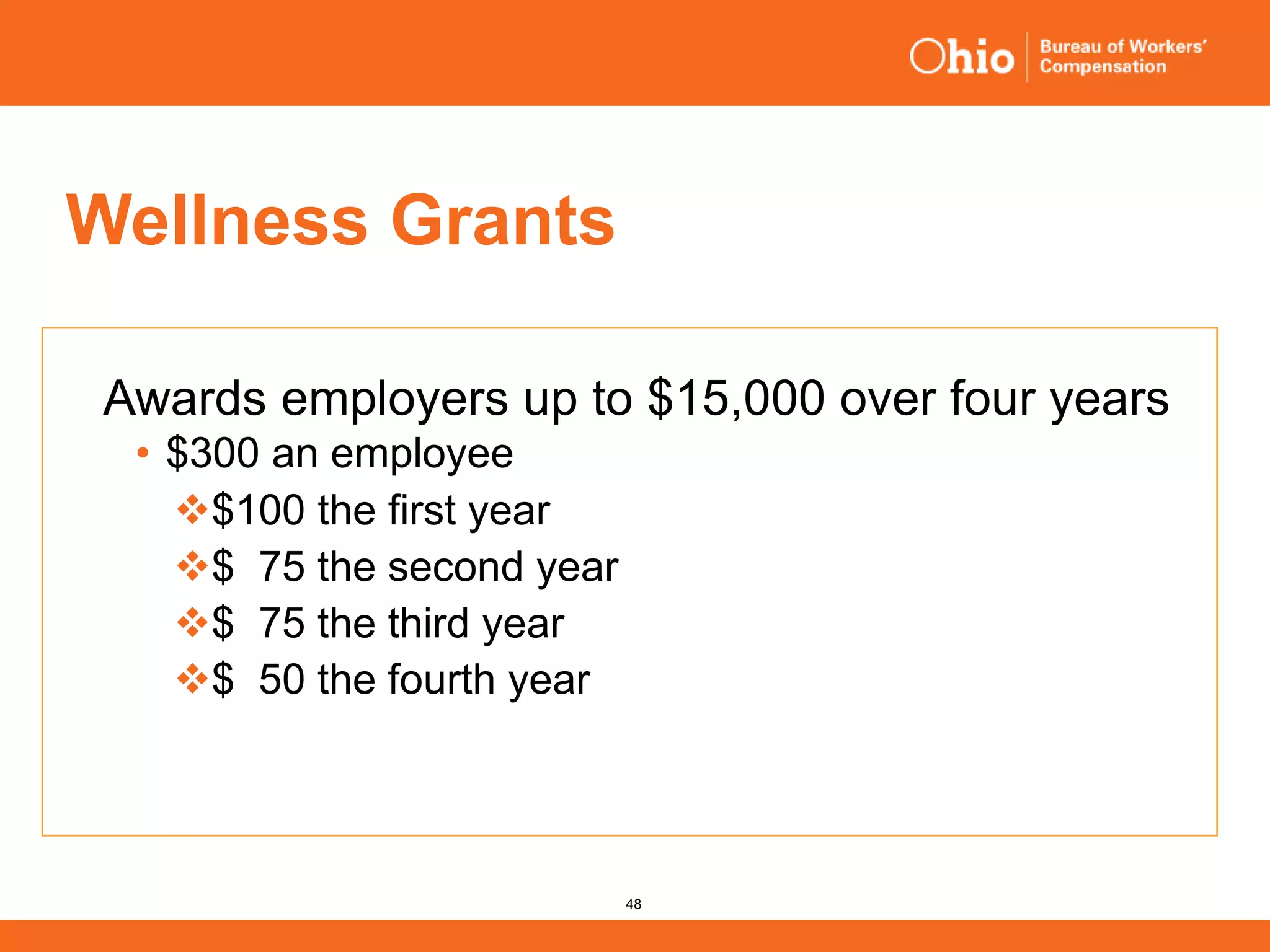
Wellness Grants
Awards employers up to $15,000 over four years
• $300 an employee
$100 the first year
$ 75 the second year
$ 75 the third year
$ 50 the fourth year
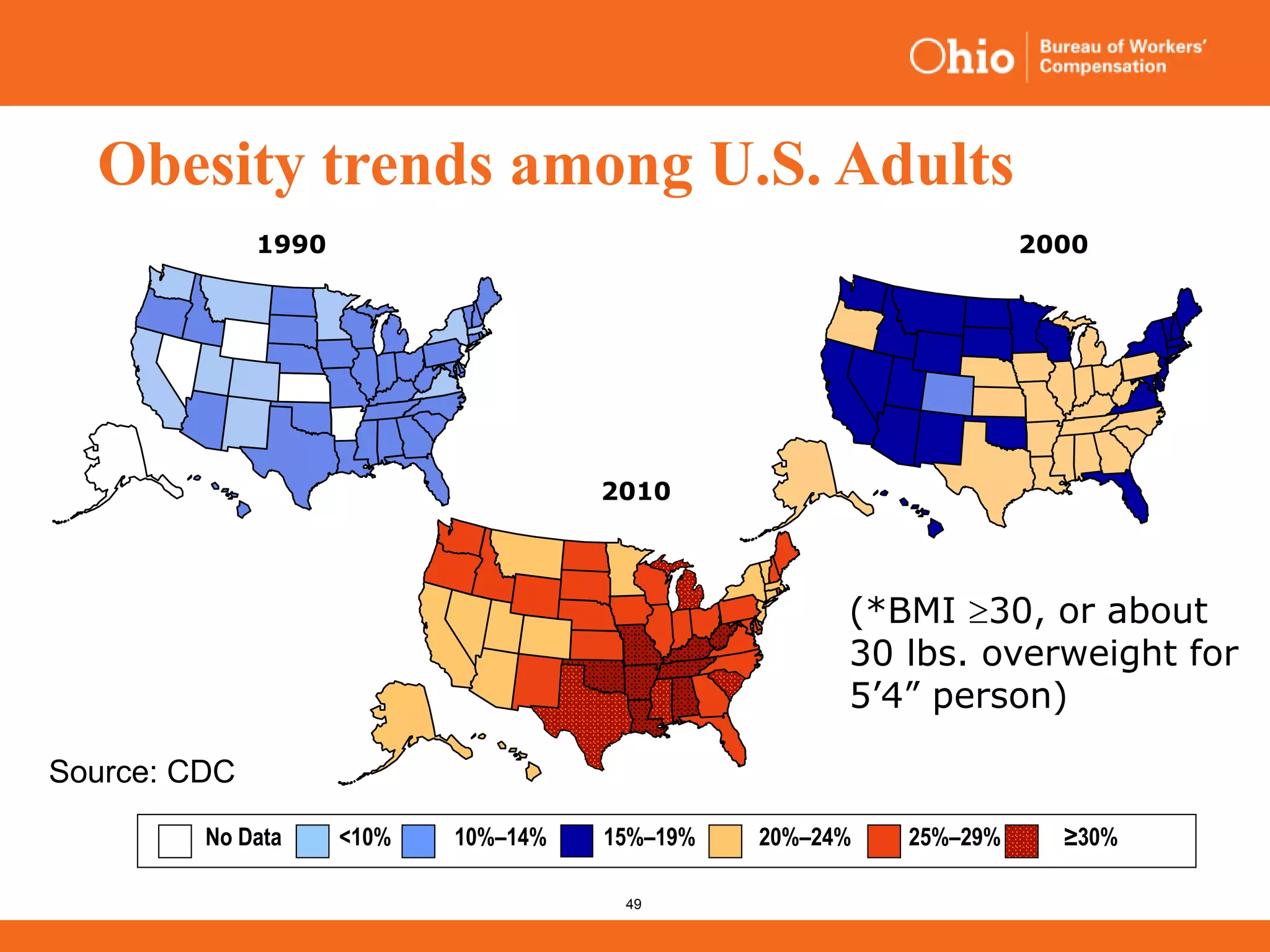
49
2000
Obesity trends among U.S. Adults
(*BMI 30, or about
30 lbs. overweight for
5’4” person)
2010
1990
No Data <10% 10%–14% 15%–19% 20%–24% 25%–29% ≥30%
Source: CDC
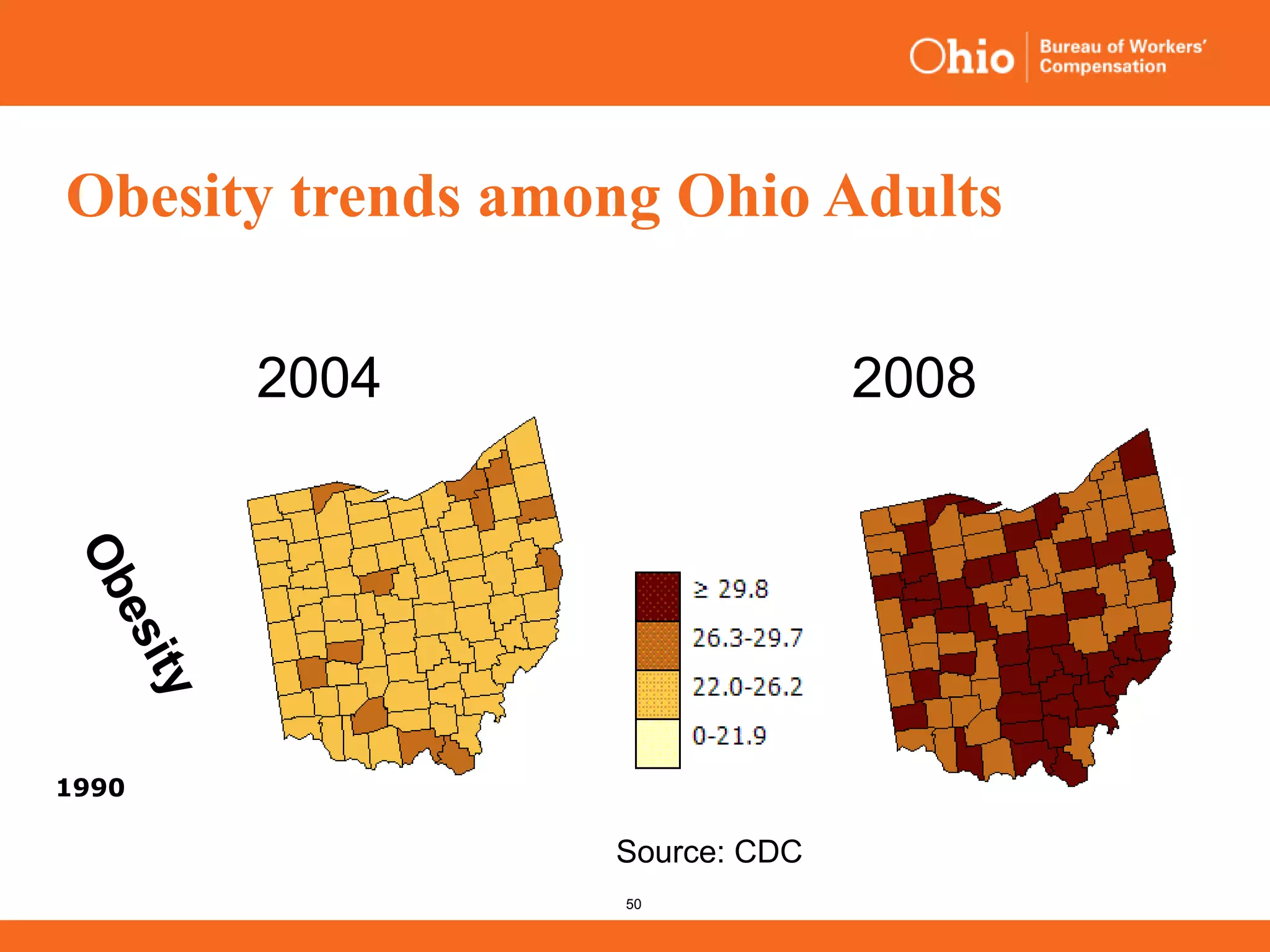
50
1990
Source: CDC
2004 2008
Obesity trends among Ohio Adults
51
Source: CDC
2004 2008
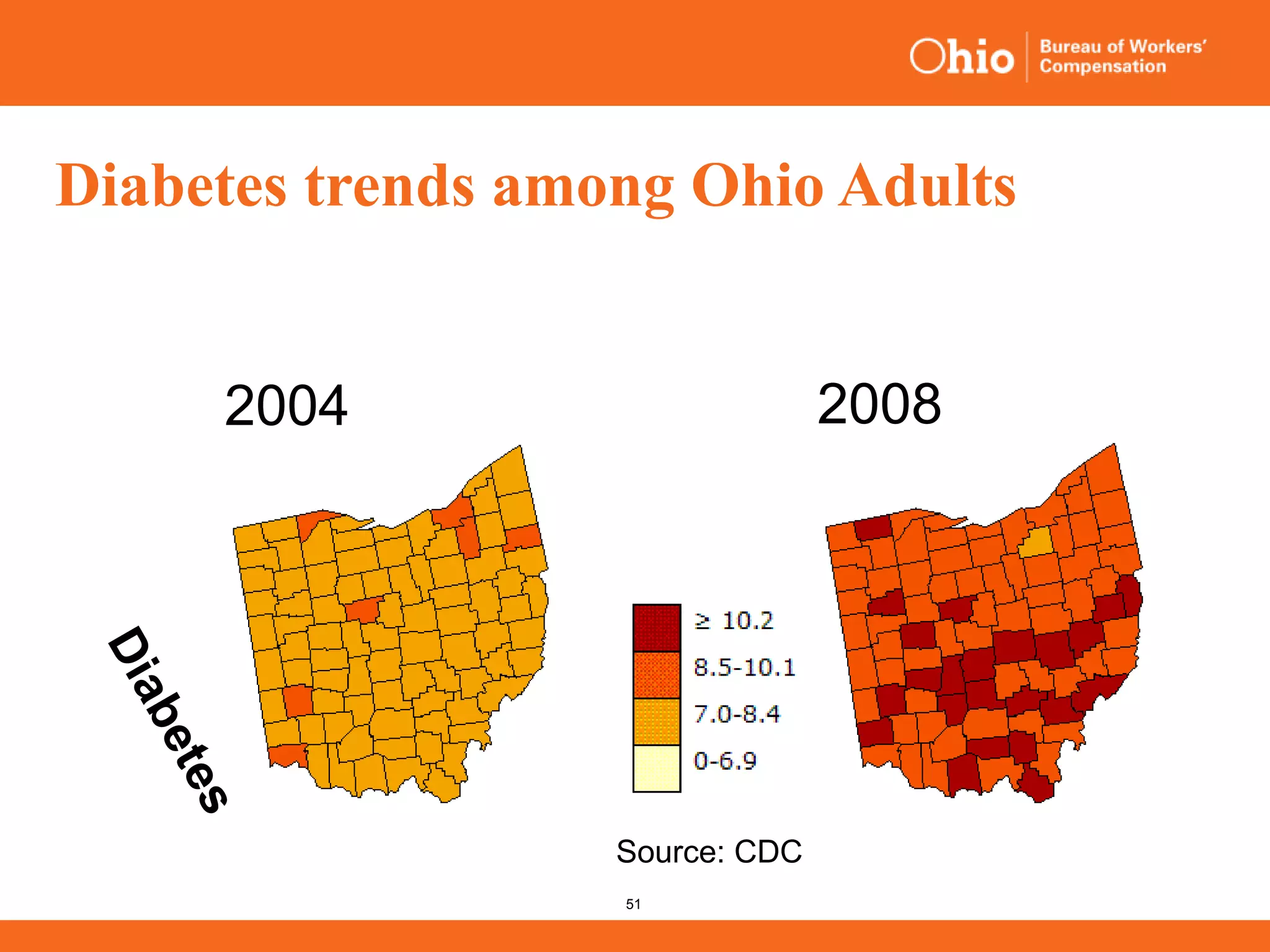
Diabetes trends among Ohio Adults
52
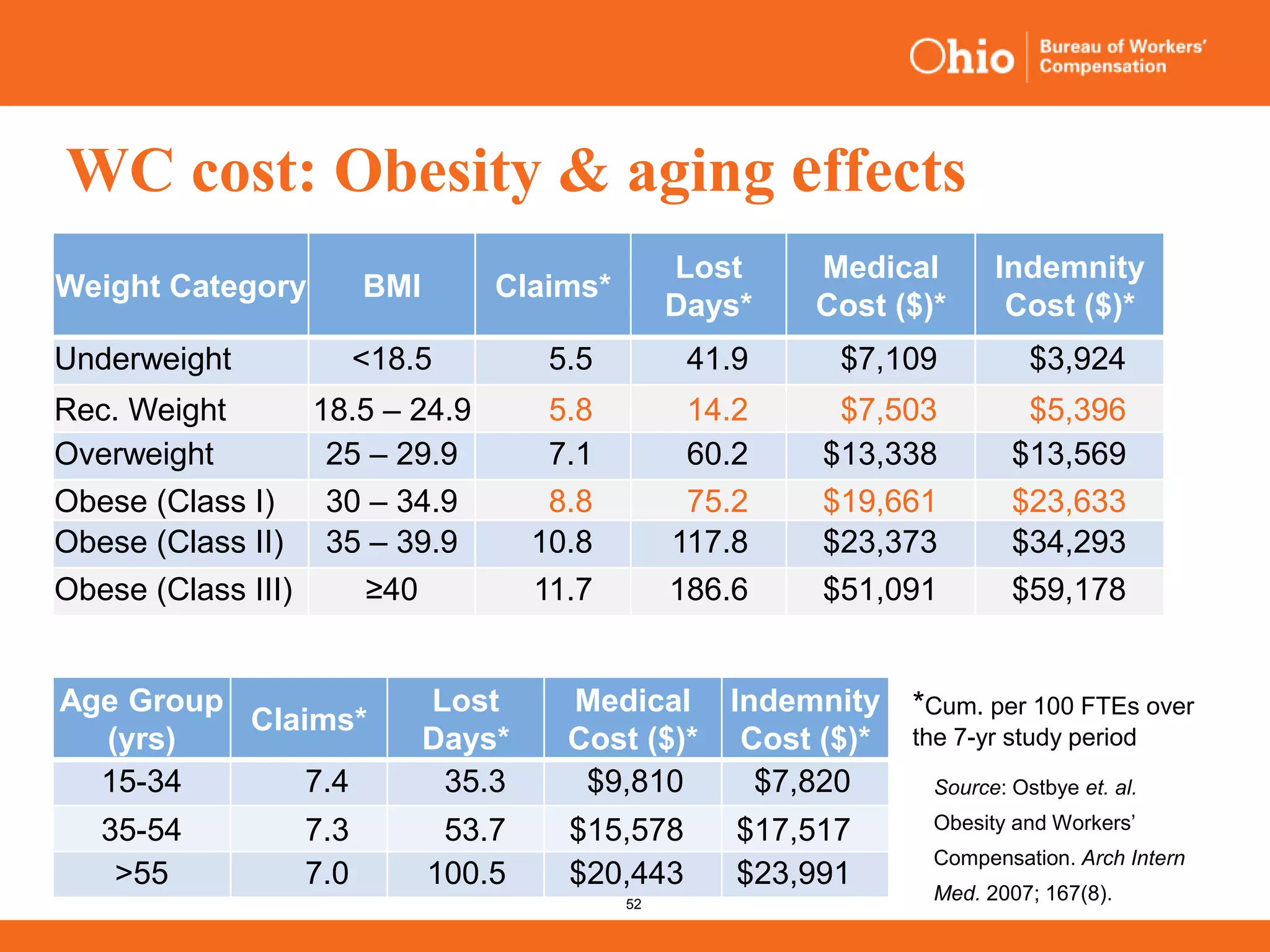
WC cost: Obesity & aging effects
Weight Category BMI Claims*
Lost
Days*
Medical
Cost ($)*
Indemnity
Cost ($)*
Underweight <18.5 5.5 41.9 $7,109 $3,924
Rec. Weight 18.5 – 24.9 5.8 14.2 $7,503 $5,396
Overweight 25 – 29.9 7.1 60.2 $13,338 $13,569
Obese (Class I) 30 – 34.9 8.8 75.2 $19,661 $23,633
Obese (Class II) 35 – 39.9 10.8 117.8 $23,373 $34,293
Obese (Class III) ≥40 11.7 186.6 $51,091 $59,178
Source: Ostbye et. al.
Obesity and Workers’
Compensation. Arch Intern
Med. 2007; 167(8).
Age Group
(yrs)
Claims*
Lost
Days*
Medical
Cost ($)*
Indemnity
Cost ($)*
15-34 7.4 35.3 $9,810 $7,820
35-54 7.3 53.7 $15,578 $17,517
>55 7.0 100.5 $20,443 $23,991
*Cum. per 100 FTEs over
the 7-yr study period
53
Other States’ Coverage
Project Update
54
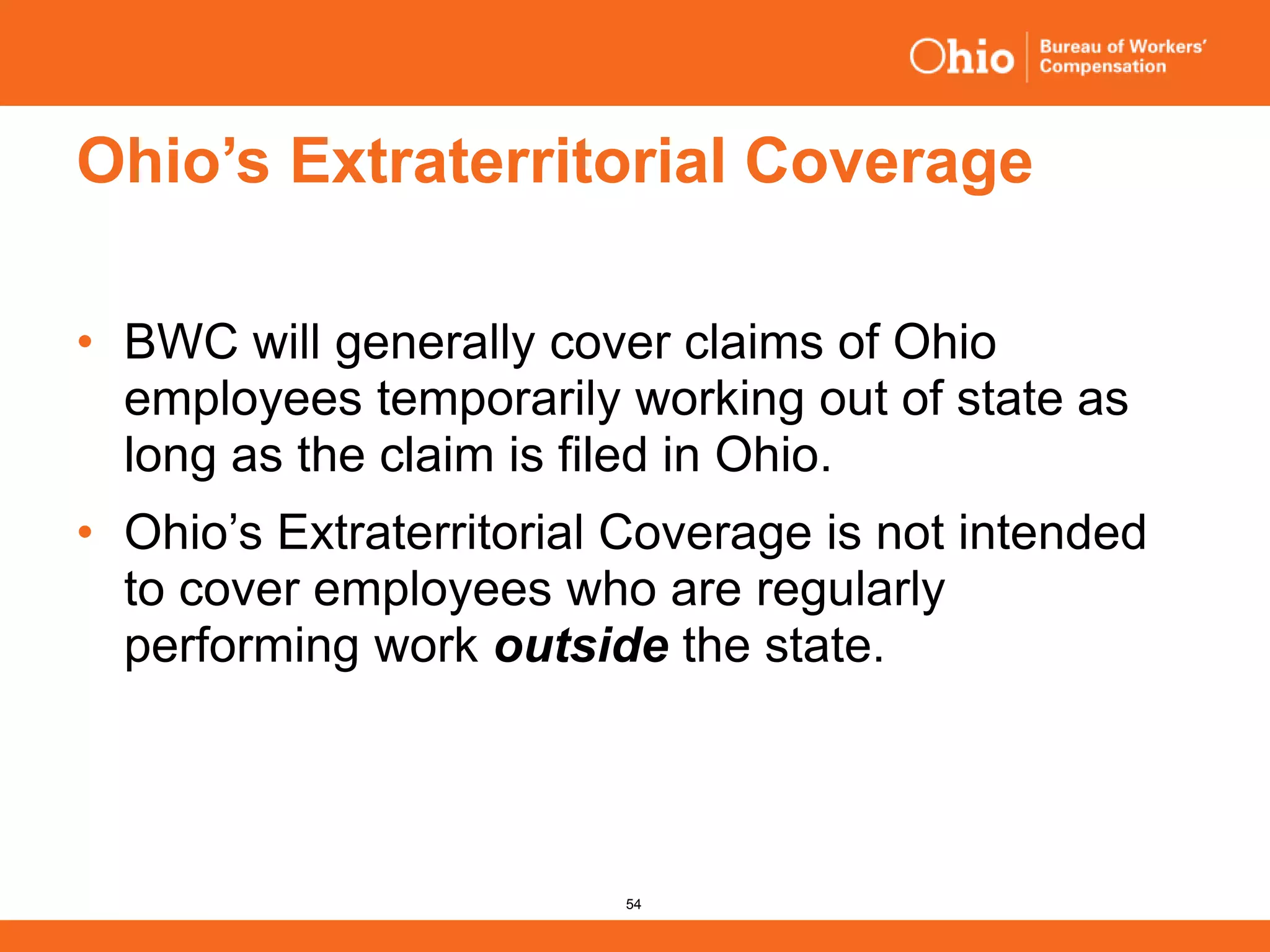
Ohio’s Extraterritorial Coverage
• BWC will generally cover claims of Ohio
employees temporarily working out of state as
long as the claim is filed in Ohio.
• Ohio’s Extraterritorial Coverage is not intended
to cover employees who are regularly
performing work outside the state.
55
Jurisdictional Risk to Employers
• BWC cannot respond to claims filed in other
states.
• Some states require coverage (other than
BWC’s coverage) for any work in the state,
no matter how brief.
56
House Bill 493,
130th General Assembly
• This bill grants BWC the authority to contract
with an insurer licensed in other states to
provide coverage to eligible Ohio employers
for out-of-state exposures.
57
Exposure Types
• Limited Other-States’ Coverage — For Ohio
employers who have employees temporarily
working outside the state
• Other-States’ Coverage — For Ohio employers
who have regular or full-time employees
working outside the state
58
How would it work?
• Employer would apply directly to BWC
• BWC would determine eligibility
Employer in good standing
EM under 2
80% payroll in Ohio
• Vendor will issue a policy to cover out-of-state
exposures
• Vendor will respond to any claims filed out of
state
59
RFP Process
• Currently in drafting process
• RFP issued — April 28, 2015
60
QUESTIONS?
Ken Haffey
CPA, CVA, CGMA
Partner
Skoda Minotti
440-449-6800
khaffey@skodaminotti.com
Mark Clendenin
NE Regional Business Development Manager
Bureau of Workers’ Compensation
330-312-4713
Mark.Clendenin@ohiobwc.com

The Evolving World of Workers' Compensation

  • 1.
    The Evolving Worldof Workers’ Compensation May 19, 2015 Ken Haffey, Skoda Minotti Mark Clendenin, Bureau of Workers’ Compensation
  • 2.
    2 AGENDA • About BWC •BWC Board of Directors • BWC – What We’ve Accomplished • BWC Updates and Overview of Prospective Billing • Prospective Billing for Private Employers • Destination Excellence • Other States’ Coverage Project Update • Q&A
  • 3.
    3 BWC – SIZE •1,800 employees • 250, 000 policy handlers • Collect $2 billion in premiums • Pay about $2 billion claims per year • $25 billion in investable assets (depending on the day) • 97,000 new claims per year • Over one million active claims
  • 4.
    4 BWC – SIZE •If BWC was a private single-line carrier, it would be the fifth or sixth largest workers’ comp carrier in the United States • If BWC was a private company, it would be a member of the New York Stock Exchange
  • 5.
    5 BOARD COMPOSITION • Governorappoints 11 members; Senate confirms these members. By law:  Two investment experts  One certified public accountant  One actuary  Three business representatives  Two union representatives  One injured worker representative and one representing the public • Staggered three-year terms
  • 6.
    6 BOARD OF DIRECTORS •Current structure established in 2007 • Has a fiduciary responsibility to the State Insurance Fund • Sets investment policy, premium and assessment rates, fee schedules and overall operating policies • Five committees:  Committees required by law – Actuarial – Audit – Investment  Additional committees – Governance – Medical Services & Safety
  • 7.
    7 BOARD OF DIRECTORS •Committees meet two days every month  Consecutively on the first day  Full board meets on the second day • All directors attend all committee meetings
  • 8.
    8 WHAT WE’VE ACCOMPLISHED Employer/ Actuarial / Financial – Since 2011 • PA employer rates have declined 21.4 percent • PEC rates are at lowest level in 30 years • The Investment Division has generated $2 billion in rebates • BWC’s budget is down 15 percent • We’ve improved our image toward becoming a partner, rather than a barrier to economic growth
  • 9.
    9 WHAT WE’VE ACCOMPLISHED Claims/ Safety /Medical / Pharmacy – Since 2011 • Claims have declined below 100,000 • BWC has triple funding for safety and wellness grants • Employer safety and risk program participation had increased by 20 percent • Narcotics usage has declined by 27 percent
  • 10.
    10 BWC Updates andOverview of Prospective Billing
  • 11.
    11 Regional Connection Regional BusinessDevelopment Manager The Bureau of Workers’ Compensation Northeast Ohio Mark Clendenin
  • 12.
    12 A BWC OhioPartnership • While making significant progress, there’s still more work to be done. • BWC is an active partner in helping transform Ohio for growth. • Our mandate from the Governor has been straight-forward: Improve Ohio’s workers’ compensation system so that it is no longer a barrier to economic growth.
  • 13.
    13 Stakeholders Involvement • Throughdiscussion and partnerships we have: Made progress helping injured workers return to work with proper care Streamlined internal business processes Kept rates stable
  • 14.
  • 15.
    15 Private Employer RateCuts • BWC has approved rate cuts in three of the past four years. • Another rate cut of 10.8% will take effect July 1, 2015. • At that time, rates will be down 21.4% from just five years ago.
  • 16.
    16 Ohio’s Workers’ CompensationRates Beginning July 2015, private employer RATES WILL BE 21.4% LOWER than the rates from January 2011. NATIONAL MEDIAN1 OHIO WORKERS’ COMP COSTS $1.85 $1.74 1 2014 Oregon Premium Rate Ranking Study (per $100 of payroll) Private employer rate reductions(2011 – 2015)
  • 17.
    17 Recent Rebates toEmployers • In 2013 and 2014, BWC returned $2 billion in rebates to Ohio employers. • BWC to provide $1.2 billion transition credit to Ohio employers to ease the transition to a prospective billing system.
  • 18.
    18 Increased Commitment toSafety • Last year, BWC awarded $15 million in safety grants to 535 employers. • BWC approved another $15 million for this year. • $15 million will be available to employers in fiscal years 2016 and 2017.
  • 19.
    19 Increased Commitment toSafety • Expansion of Safety Council Program to include health and wellness • Advanced workplace safety and health research-to-practice program • Partnership with State Fire Marshall to fund additional training for firefighters • Development of safety curricula and funding for skilled labor training program.
  • 20.
    20 Safety Intervention Grants •Purpose Information gathering and sharing • Who Is Eligible Any Ohio state-fund or public employer • Requirements Pay into the Ohio State Insurance Fund Maintain Active Coverage Be current on all monies owed BWC Demonstrate the need for safety intervention
  • 21.
    21 124 519 447 118 497 184 92 58 225 195 71 184 26 11 0 100 200 300 400 500 600 2003(18) 2004(95)2005(108) 2006(33) 2007(96) 2008(73) 2009(45) NumberofClaims Pre Intervention Post Intervention Program Results
  • 22.
    22 Safety Grants • Grantsto assist employers in purchasing equipment that will substantially reduce or eliminate injuries • 3-to-1 matching funds (up to $40,000) • Last year, BWC awarded $15 million in grants to 535 employers • Have you applied for your safety grant? If not … what are you waiting for?
  • 23.
  • 24.
    24 Why Transition toProspective Billing? • Industry standard • More flexible payment options • Decrease in base rates by 2% for private employers • Increased ability for us to detect non-compliance and fraud
  • 25.
    25 Private Employer (PA) TransitionOverview • Implement PA prospective payment effective July 1, 2015 • Will move to annual policy period • To avoid employers needing to make a double payment, BWC will provide an eight-month transition credit.  This credit covers the August 2015 payroll report (for January-June) and the first two months of the 2015 policy year. • With the eight-month transition credit, employers will make their first prospective payment at the time they normally make their retrospective payment, by Aug. 31.
  • 26.
    26 PA Ending RetrospectiveBilling (2014-2015) • BWC will apply the transition credit to cover the Jan. 1, 2015 – June 30, 2015, premium due, when the employer files its payroll report in August 2015. Actual payroll is critical data in our rate calculations.
  • 27.
    27 Implementing PA Prospective Billing •BWC will always use the most recently reported policy year to estimate an individual employer’s premium obligation. For example, BWC will use the July 1, 2013 - June 30, 2014, payroll for policy year 2015. • In May of each year: Employers will receive a notice of estimated annual premium along with their annual certificate of coverage.
  • 28.
    28 Notice of EstimatedAnnual Premium Sample: Notice of Estimated Annual Premium
  • 29.
    29 Implementing PA Prospective Billing •In the first year, every employer except minimum payers will be on a bi-monthly plan, with the option of selecting a different installment plan by July 15, 2015. The first installment (covering July and August) will be paid with transition credit. BWC recommends staying with the bi-monthly default, at least in the first year.
  • 30.
    30 Installment Options Annual (1); Semi-annual(2); Quarterly (4); Bi-monthly (6); Monthly (12). • Minimum payers will not receive installment options. • Minimum premium increasing to $120 due by June 30 each year.
  • 31.
    31 Implementing PA Prospective Billing(First Year Only) • Employers will receive an invoice for the second installment in early August. • This invoice will be due by Aug. 31. • Premium security deposits (PSD) will post as credits to the account in this time frame. • BWC will mail invoices 30 days prior to the due date of each installment.
  • 32.
    32 Payroll True-up Report •Prospective requires an annual payroll report true- up. BWC will send a reminder in July of each year. • The employer must report actual payroll for the previous policy year. Online or over the phone only If additional premium is calculated, it is also due by Aug. 15. If credit calculated, it will be released in normal process. Employers must pay online to be eligible for the Go- green discount.
  • 33.
    33 Payroll True-up Report •Actual payroll information is critical for rate setting. For that reason, an outstanding payroll true-up report will result in immediate disqualification from rating plans and programs for that current policy year. • Also, employers must complete* all true-ups to be eligible for programs going forward. *Complete = reporting and paying (if necessary).
  • 34.
    34 Rating Plan andProgram Deadline • Group-experience rating – Monday prior to Thanksgiving • Group retro, One Claim Program, Deductible, Individual retro – Last business day in January • Destination: Excellence programs – Last business day in May
  • 35.
  • 36.
    36 Overview • Destination: Excellence Introduction Programlist Individual program details ‒ Program description ‒ Program benefits (not only about the financial incentives) ‒ Enrolling and getting the most out of the programs (strategy) Compatibility, compliance and enrollment deadlines • Goal – Provide enough information to help your company decide which individual programs make the most sense to enroll into.
  • 37.
    37 Overview • What isDestination: Excellence? Bundling of risk- and claims-management programs to attack cost drivers of workers’ compensation ‒ Programs bundle BWC services and strategies  Financial incentives to use BWC services, and to implement sound safety and claims-management strategies.  If implemented properly, reduction in premiums should far outweigh any program rebates earned.
  • 38.
    38 Introduction • Why BWCcreated Destination: Excellence To reduce costs, so that we can lower premiums rates, to make Ohio more competitive for jobs ‒ Safety programs to prevent accidents ‒ Return-to-work programs to help injured workers transition back to work ‒ Savings programs to reduce BWC administrative costs Lower costs  lower rates = Destination: Excellence
  • 39.
    39 Destination: Excellence -Eligibility • Current on all undisputed premiums • Active status as of application deadline • No cumulative lapses greater than 40 days in the last 12 months
  • 40.
    40 Destination: Excellence Program •Savings options Go-green Lapse-free • Safety options Industry-Specific Safety Program Safety councils Drug-Free Safety Program • Return-to-work options Transitional work bonus/grant Vocational rehabilitation
  • 41.
    41 • We willmail notice of estimated annual premium in May. • Policy year begins July 1, with us paying first two months. • Employer will receive first invoice at the beginning of August installment due Aug. 31. • Payroll report due/no money due by Aug. 31. PA Timeline – First Prospective Year Jan. 1, 2015 to Jan. 31, 2016 May 29, 2015 Destination: Excellence enrollment May 31, 2015 Notice of estimated annual premium for policy year 2015 mailed Nov. 23, 2015 Group enrollment for July 1, 2016 to June 30, 2017 July 1,2015 Transition credit Aug. 1, 2015 Invoice mailed for 2nd installment June 1, 2015 BWC pays 1st installment; no invoice Aug. 31, 2015 Installment due and payroll report due for previous six months (no $ due for payroll report) Sept. 30, 2015 EM Snapshot For July 1, 2016 July 15, 2015 LSS Filing Deadline To Impact EM for July 1, 2016
  • 42.
    42 July 1, 2016 •Invoice mailed June 1 – first installment due June 30 • Payroll true-up report notice sent July 1; due Aug. 15 Private Employer Policy Year – May 1, 2016 and Beyond July 1, 2016 Payroll true-up report notice sent Aug. 15, 2016 Payroll true-up report due June 1, 2016 Invoice mailed for July 1, 2016 to June 30, 2017 period May 1, 2016 Notice of estimated annual premium sent May 31, 2016 Destination: Excellence enrollment Jan. 29, 2016 Group retro, One Claim Program, Individual retro, and Deductible enrollment June 30, 2016 - 1st installment due MCO open enrollment
  • 43.
    43 Lapsing Coverage • BWCwill lapse any employer who does not pay their installment on time. • BWC will not lapse an employer who does not true-up. BWC will estimate the true-up by adding an additional 10% to the premium due and bill the employer. If the employer still does not report their true-up, then BWC will certify it to the Ohio Attorney General’s office for collections.
  • 44.
    44 Web Resources For moreinformation, visit www.bwc.ohio.gov • Overview document (with key dates) • Frequently asked questions document • Webinars
  • 45.
    45 • Prospective Billingmailbox bwcprospectivebilling@ohiobwc.com
  • 46.
    46 What you Learned Q:What was the final retro premium due date? A: Private: February 2015 Q: Prospective Premium Implementation Date? A: July 1st 2015-Private Q: What is the initial payment plan set to? A: Private: Bi-monthly Q: Will my policy lapse if I don’t complete the True-Up? A: No, but you will be removed from all programs
  • 47.
    47 In Fiscal Year2013, approximately 17,000 claimants missed more than seven days of work.  Of these 17,000 lost-time claims, nearly 50 percent missed more than 45 days of work and approximately 32 percent missed more than 100 days.  The average cost per lost-time claim was 30-40 times greater than the average cost of a medical-only claim.  Nearly one in five lost-time claimants was physically dependent on opiates.  Total lost productivity was nearly 2 million days. The Current State of BWC’s Healthcare Delivery System
  • 48.
    48 Wellness Grants Awards employersup to $15,000 over four years • $300 an employee $100 the first year $ 75 the second year $ 75 the third year $ 50 the fourth year
  • 49.
    49 2000 Obesity trends amongU.S. Adults (*BMI 30, or about 30 lbs. overweight for 5’4” person) 2010 1990 No Data <10% 10%–14% 15%–19% 20%–24% 25%–29% ≥30% Source: CDC
  • 50.
    50 1990 Source: CDC 2004 2008 Obesitytrends among Ohio Adults
  • 51.
    51 Source: CDC 2004 2008 Diabetestrends among Ohio Adults
  • 52.
    52 WC cost: Obesity& aging effects Weight Category BMI Claims* Lost Days* Medical Cost ($)* Indemnity Cost ($)* Underweight <18.5 5.5 41.9 $7,109 $3,924 Rec. Weight 18.5 – 24.9 5.8 14.2 $7,503 $5,396 Overweight 25 – 29.9 7.1 60.2 $13,338 $13,569 Obese (Class I) 30 – 34.9 8.8 75.2 $19,661 $23,633 Obese (Class II) 35 – 39.9 10.8 117.8 $23,373 $34,293 Obese (Class III) ≥40 11.7 186.6 $51,091 $59,178 Source: Ostbye et. al. Obesity and Workers’ Compensation. Arch Intern Med. 2007; 167(8). Age Group (yrs) Claims* Lost Days* Medical Cost ($)* Indemnity Cost ($)* 15-34 7.4 35.3 $9,810 $7,820 35-54 7.3 53.7 $15,578 $17,517 >55 7.0 100.5 $20,443 $23,991 *Cum. per 100 FTEs over the 7-yr study period
  • 53.
  • 54.
    54 Ohio’s Extraterritorial Coverage •BWC will generally cover claims of Ohio employees temporarily working out of state as long as the claim is filed in Ohio. • Ohio’s Extraterritorial Coverage is not intended to cover employees who are regularly performing work outside the state.
  • 55.
    55 Jurisdictional Risk toEmployers • BWC cannot respond to claims filed in other states. • Some states require coverage (other than BWC’s coverage) for any work in the state, no matter how brief.
  • 56.
    56 House Bill 493, 130thGeneral Assembly • This bill grants BWC the authority to contract with an insurer licensed in other states to provide coverage to eligible Ohio employers for out-of-state exposures.
  • 57.
    57 Exposure Types • LimitedOther-States’ Coverage — For Ohio employers who have employees temporarily working outside the state • Other-States’ Coverage — For Ohio employers who have regular or full-time employees working outside the state
  • 58.
    58 How would itwork? • Employer would apply directly to BWC • BWC would determine eligibility Employer in good standing EM under 2 80% payroll in Ohio • Vendor will issue a policy to cover out-of-state exposures • Vendor will respond to any claims filed out of state
  • 59.
    59 RFP Process • Currentlyin drafting process • RFP issued — April 28, 2015
  • 60.
    60 QUESTIONS? Ken Haffey CPA, CVA,CGMA Partner Skoda Minotti 440-449-6800 khaffey@skodaminotti.com Mark Clendenin NE Regional Business Development Manager Bureau of Workers’ Compensation 330-312-4713 Mark.Clendenin@ohiobwc.com

Editor's Notes

  • #11 BWC is moving in this direction because it is good business.  Prospective Billing is an industry best practice and a change we’ve wanted to make for over 20 years.  Normally to make this kind of switch, a double payment would need to be made but as BWC has been fiscally responsible and good stewards of our fund, we are able to cover the cost of a transition credit so no employer will be double billed because of this change.”
  • #12 Mark Clendenin is the Northeast Ohio Regional Business Development Manager for The Ohio Bureau of Workers’ Compensation. He serves as an ambassador for the CEO/Administrator Steve Buehrer, working with employers that could substantially benefit from BWC’s safety and claims management services. Mr. Clendenin has more than 25 years of experience in both the public and private sectors. His background encompasses nearly every aspect of the industry, including risk management, public and private accounting, manufacturing, construction, financial services, and teaching. Some of the companies that he has worked with include Nationwide Insurance, Coopers and Lybrand, Apple Growth Partners, Sterling Jewelers, The Home Depot, and Lincoln Financial Group. He has been a guest speaker throughout Northeast Ohio to groups that include The Ohio Society of CPA’s, The Ohio Mayor’s Conference, Rotary International, Chamber of Commerce, Safety Councils, The Ohio Safety Congress, and other civic and professional organizations. Mark is an active member in a number of organizations, including Rotary International, The Chamber of Commerce, Habitat for Humanity, and the Walsh University Alumni Board, and maintains involvement several other civic organizations. Mark holds a Bachelor of Arts in accounting from Walsh University, and advanced degree work at Kent State University, is a licensed teacher in the State of Ohio, as well as a registered representative with FINRA, and licensed with The State of Ohio in life, health, and annuities. Once chided early in his career for not understanding how business works, Mark had made it his mission to “understand how business works” and he works passionately through collaboration with decision makers to identify workable solutions to business concerns.
  • #13 We’ve taken that mandate seriously. Since the beginning of 2011, we have made great progress in helping injured workers and businesses.
  • #14 There’s not an employer in Ohio who is going to celebrate when they pay their workers’ compensation premium We hope though, that they will recognize the valuable coverage they are getting for the premiums they pay.
  • #19 3-to-1 matching grants (up to $40,000) Helps employers purchase equipment to reduce workplace injuries
  • #21 The purpose of the Safety Intervention Grant$ Program is to gather information about the effectiveness of safety interventions so that BWC may share the results with Ohio employers. The program is available to any Ohio state-fund or public employer who wishes to purchase equipment to substantially reduce or eliminate injuries and illnesses associated with a particular task or operation. The program is designed to work and partner with Ohio employers to establish safety intervention best practices for accident and injury prevention. To participate in the program an employer must pay into the Ohio State Insurance Fund, maintain active coverage, be current on all monies owed BWC and demonstrate the need for a safety intervention. With the safety intervention grant, private and public employers are eligible for a 3-to-1 matching grant totaling $53,334 ($13,334 from the employer and $40,000 from BWC). The employer will benefit through a substantial reduction or elimination of workplace injuries and illnesses, and their related costs. In return, the employer will submit to BWC quarterly data reports and a case study one year after the date of the intervention. BWC will use this information to determine the effectiveness of the intervention and share successes with other employers.
  • #22 Explain slides…. Safety does not need a grant to have this type of an impact on improving safety in the workplace. Creating a safer work environment in your business can help reduce the frequency or likelihood of an accident. Motivation for improving safety also comes in the form of dollars…. To help encourage safety in the work place we have put together some financial incentives to those who work on proactiviely managing the risk.
  • #24 BWC is moving in this direction because it is good business.  Prospective Billing is an industry best practice and a change we’ve wanted to make for over 20 years.  Normally to make this kind of switch, a double payment would need to be made but as BWC has been fiscally responsible and good stewards of our fund, we are able to cover the cost of a transition credit so no employer will be double billed because of this change.”
  • #25 Rate decrease is due to the time value of money – discount rate is currently 4%
  • #26 Annual to give more stable rates to employers and to link it up with other types of insurance
  • #27 If the employer fails to file the last payroll report (in August of 2015) this payroll report will be estimated and billed - failure to report at that time will result in it being handed over to the AG’s office. Please note, if the employer does come forward and report, they will not owe the premium, but they will owe the penalties.  
  • #28 If the employer does not agree with the BWC estimate, there will be a process for the employer to contact BWC for a change. Employer will not be able to make this change on-line initially. There is no penalty if their estimate is low as long as when they true-up, they pay. Annual Certificate will state that it does not guarantee coverage, coverage is based upon premium payment
  • #29 If the employer does not agree with the BWC estimate, there will be a process for the employer to contact BWC for a change. Employer will not be able to make this change on-line initially. There is no penalty if their estimate is low as long as when they true-up, they pay. Annual Certificate will state that it does not guarantee coverage, coverage is based upon premium payment
  • #30 If the employer does not agree with the BWC estimate, there will be a process for the employer to contact BWC for a change Annual Certificate will state that it does not guarantee coverage, coverage is based upon premium payment
  • #31 No installment fees
  • #32 For 2015- 7/1/13-6/30/14
  • #33 **Online is the preferred option- if the employer chooses not to utilize the online application, they will not be eligible for the go green discount (even if all other premium was paid online. Because their premium is based on an estimate, it is necessary for our customers to give us actual figures, so BWC can reconcile the difference. Employer will be encouraged to report large changes to lessen true-up amount at end of policy year (manual code changes, large shifts in payroll)
  • #34 Not the year they fail to true up for but the one they are in this year. Rebates from a previous year will not be release, they will be held if employer doesn’t true-up
  • #35 If the last business day falls on a weekend, the next business day will apply
  • #39  Safety programs to prevent accident Return to work programs to help injured workers transition back to work Savings programs to reduce BWC administrative costs
  • #41 Savings – lower administrative costs Pay online and pay on-time Safety – make your workplace safer Education, training and consulting Strategy of drug testing Strategy of using best practices for safety Return to work – claims management Strategy of transitional work Services of vocational rehabilitation
  • #44 BWC will not lapse them due to lack of true-up because they will have already begun paying for the current policy year based on what BWC estimated, the actual payroll is still crucial. As a reminder: lack of true-up will result in the employer being removed from their programs
  • #45 Our goal is to make sure this change does not take anyone by surprise
  • #47 For public – dual premium payments begin in Jan of 2016
  • #49 Employers wanting to improve the health and wellness of their workers can benefit from the Workplace Wellness Grant Program (WWGP). The grant provides funding to assist employers in establishing training and programs to reduce health risk factors specific to their employees. If an employer only has one of these tools, then it does not have an existing wellness program and is eligible to apply for the workplace wellness grant. If the employer has both tools listed above, we consider that an existing wellness program and the employer is not eligible to receive a workplace wellness grant. So, why is wellness so important?
  • #50 Slide #2: Obesity Trends among U.S. Adults Obesity has become a major health epidemic in the United States. About 30-33% of all U.S. adults are considered obese. Obesity rates have risen dramatically in all states since 1990, and if this trend continues, in 2020 obesity rates among US adults can reach up to 40% or more. Similarly, About 33% of US children are overweight or obese, with over 16% being obese. Obesity is linked to other preventable chronic conditions such as diabetes, high cholesterol, hypertension, and arthritis, as well as heart diseases.
  • #51 Trends among Ohio Adults The percentage of adults in Ohio who are considered obese has risen steadily over the past 15 years from 17% in 1995 to about 30% in 2010. About 65% of Ohio adults are overweight or obese.
  • #52 Trends among Ohio Adults Obesity is highly correlated with diabetes. This correlation is evidenced by the trends observed in all counties in Ohio between 2004 and 2008. As obesity rates increased so did the diabetes rates. Diabetes rates among adults in Ohio reached an all time high of 10% in 2010. Diabetes prolongs treatment and recuperation time from illnesses and injuries.
  • #53 These trends have resulted in significantly increasing the cost of workers’ compensation and healthcare benefits to employers. Ostbye’s, et. al. 2007 research study of the effects of obesity and aging along with other health risk factors on WC cost is probably the most comprehensive study in this area. The study evaluated WC claims among the population of Duke University employees over the years 1997-2004. As can be observed in the top table provided in the slide, Ostbye’s study showed significant increases in the frequency of claims, lost workdays, medical claims costs and indemnity claims costs as the BMI increased. Also, as can be observed in the bottom table provided in the slide, Ostbye’s study showed significant increase in lost work days, medical claims costs and indemnity claims costs as age increased. Ostbye’s study showed, according to the obesity class, the cost of a claim can range between 2.1 and 8.5 times that of a worker with healthy weight. Notice the difference between the two highlighted lines - $12, 899 recommended weight vs $43,294 obese.