www.hanrickcurran.com.au
2011-2012 Budget Update 12 May
2011
2014 Pre & Post Update
21 May 2013
2experience. new thinking
House Keeping Matters
 Mobile phones – off / silent
 An email will arrive after this session with:
 Copies of all slides
 Tax Planning checklist
 Brief Feedback Survey
 We welcome questions during the presentation, presenters
will be available afterwards
 Thank you for coming, please check if you‟re on a Lucky
Chair!
www.hanrickcurran.com.au
2014 Pre Financial Year End &
Post Federal Budget Update
Jamie Towers, Tax Partner
May 2014
4experience. new thinking
Budget Insights
 Budget Summary
 Individuals
 Business
 Charities
 Recap on changes announced during
2014/14 and previously
 Tax Planning
5experience. new thinking
Budget Summary
 2012/13 final budget outcome - $1.5
Billion surplus - $18.8 Billion deficit
 Mid Year Economic Outlook = $47 Billion
deficit for 2013-14
 Now Predicted Deficit for 2013/14 year =
$49.9 Billion
6experience. new thinking
7experience. new thinking
Budget Summary 2014/15
 Deficit of $29.8 Billion
 Large Infrastructure spend
 Broken promises on „no new taxes‟ and
various expenditure cuts
 Fiscally responsible, but
ill-targeted?
8experience. new thinking
Budget Summary 2014/15
Key Questions for 2014 / 15
 Which proposals will pass through Senate
and when?
 Will the MRRT be repealed?
 Is Mr Hockey prepping for an increase in
GST next year / next election?
9experience. new thinking
Individuals
 2% Budget Deficit Tax (temporary budget
repair levy) – applies to individual‟s
incomes above $180,000
 Medicare levy to increase to 2% (from
1.5%)
 Dependent Spouse tax offset and Mature
Age Worker tax offset abolished
 All apply from 1/7/2014
10experience. new thinking
Individuals
 FBT Rate to increase in line with Levy
increases
 47% from 1 April 2014(previously 46.5%)
 49% from 1 April 2015
 Limited window tax arbitrage (1/7/14 – 31
March 15) 2%
11experience. new thinking
Individuals
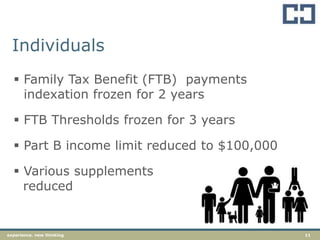
 Family Tax Benefit (FTB) payments
indexation frozen for 2 years
 FTB Thresholds frozen for 3 years
 Part B income limit reduced to $100,000
 Various supplements
reduced
12experience. new thinking
Individuals
 HELP (HECS) repayment threshold reduced
to $50,638 from 1/7/2016
 Indexation abolished – replaced with
interest linked to Federal Gov‟t 10 year
bond rate (capped at 6%)
13experience. new thinking
Individuals
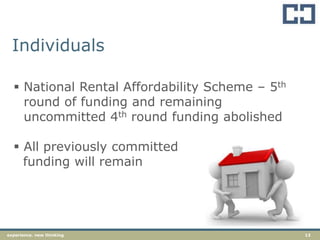
 National Rental Affordability Scheme – 5th
round of funding and remaining
uncommitted 4th round funding abolished
 All previously committed
funding will remain
14experience. new thinking
Individuals
 Pension Age to rise to age 70
 48 year old in 2014 will need to wait until
they are 70 to retire
15experience. new thinking
Business
 Very few changes for business
 R & D incentives reduced by 1.5%
 Managed Investment trusts scheme
deferred
16experience. new thinking
Business
 Superannuation Guarantee – increased to
9.5% from 1/7/14 then frozen until 2018
 Rises to 12% by 2022
 Government Restart program – incentives
for hiring older workers – up to $10,000
 Entrepreneurs Infrastructure Program
17experience. new thinking
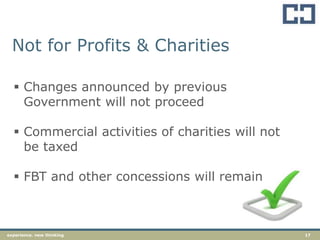
Not for Profits & Charities
 Changes announced by previous
Government will not proceed
 Commercial activities of charities will not
be taxed
 FBT and other concessions will remain
18experience. new thinking
Previously announced changes
 At time of election – 96 announced but
unlegislated measures to change the tax
system. Some going back to 2001.
 14 December – 55 will not proceed, rest
will proceed – some with amendments
19experience. new thinking
Previously announced changes
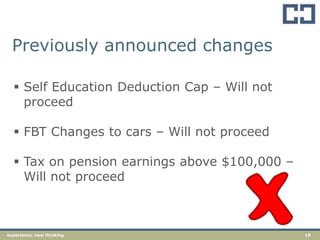
 Self Education Deduction Cap – Will not
proceed
 FBT Changes to cars – Will not proceed
 Tax on pension earnings above $100,000 –
Will not proceed
20experience. new thinking
Previously announced changes
 Dividend washing „loophole‟ closed – ATO
believes it is avoidance and treasury have
issued draft legislation to stop it
 Managed Investment Trusts – (originally a
2009/10 budget measure) – deferred
another year
21experience. new thinking
Previously announced changes
 Government‟s Minerals Resource Rent Tax
(MRRT) repeal bill also proposed to repeal:
 Small Business $6,500 + $5,000 car
instant write-off
 Company loss carry back rules
 Bill not passed by Senate
 Proposed to be re-introduced in July after
Senate change
22experience. new thinking
Pre 30 June Tax Planning
 After 30/6/2014 – additional
2.5% in “levies”
 Reality – top marginal tax rate = 49%
 Bring forward expenses to get the tax
benefit now at 46.5% or defer 12 months
to get a higher benefit at 49%?
 Depends on cost of funding
23experience. new thinking
Pre 30 June Tax Planning
 Assuming tax planning for 2014
 Defer invoicing
 Bring forward expenditure
 Write-off any bad debts
 Pay superannuation contributions
pre-30 June
24experience. new thinking
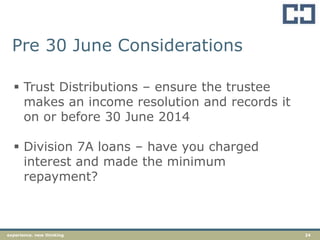
Pre 30 June Considerations
 Trust Distributions – ensure the trustee
makes an income resolution and records it
on or before 30 June 2014
 Division 7A loans – have you charged
interest and made the minimum
repayment?
www.hanrickcurran.com.au
Federal Budget 2014/2015
Superannuation Update
By Chris Campbell - Partner
May 2014
26experience. new thinking
Superannuation Guarantee
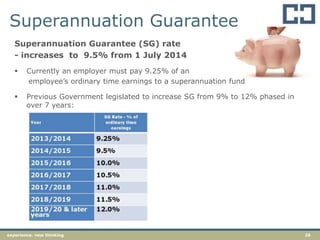
Superannuation Guarantee (SG) rate
- increases to 9.5% from 1 July 2014
 Currently an employer must pay 9.25% of an
employee‟s ordinary time earnings to a superannuation fund
 Previous Government legislated to increase SG from 9% to 12% phased in
over 7 years:
27experience. new thinking
Superannuation Guarantee
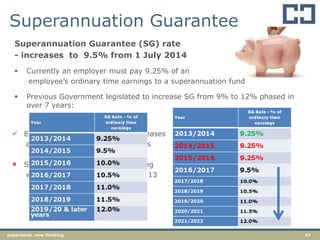
Superannuation Guarantee (SG) rate
- increases to 9.5% from 1 July 2014
 Currently an employer must pay 9.25% of an
employee‟s ordinary time earnings to a superannuation fund
 Previous Government legislated to increase SG from 9% to 12% phased in
over 7 years:
 Election promise to freeze SG increases
at 9.25% for next 2 financial years
 Senate rejected this proposal, along
with Mining Tax abolition Bill in 2013
28experience. new thinking
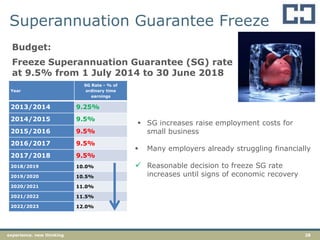
Superannuation Guarantee Freeze
Budget:
Freeze Superannuation Guarantee (SG) rate
at 9.5% from 1 July 2014 to 30 June 2018
 SG increases raise employment costs for
small business
 Many employers already struggling financially
 Reasonable decision to freeze SG rate
increases until signs of economic recovery
Year
SG Rate - % of
ordinary time
earnings
2013/2014 9.25%
2014/2015 9.5%
2015/2016 9.5%
2016/2017 9.5%
2017/2018 9.5%
2018/2019 10.0%
2019/2020 10.5%
2020/2021 11.0%
2021/2022 11.5%
2022/2023 12.0%
29experience. new thinking
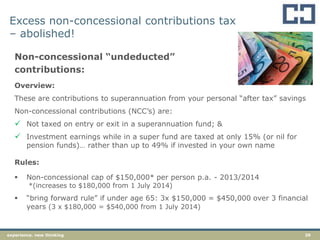
Excess non-concessional contributions tax
– abolished!
Non-concessional “undeducted”
contributions:
Overview:
These are contributions to superannuation from your personal “after tax” savings
Non-concessional contributions (NCC‟s) are:
 Not taxed on entry or exit in a superannuation fund; &
 Investment earnings while in a super fund are taxed at only 15% (or nil for
pension funds)… rather than up to 49% if invested in your own name
Rules:
 Non-concessional cap of $150,000* per person p.a. - 2013/2014
*(increases to $180,000 from 1 July 2014)
 “bring forward rule” if under age 65: 3x $150,000 = $450,000 over 3 financial
years (3 x $180,000 = $540,000 from 1 July 2014)
30experience. new thinking
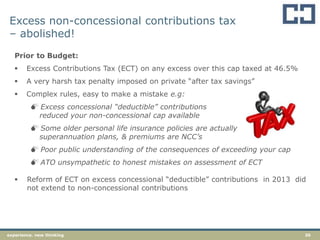
Excess non-concessional contributions tax
– abolished!
Prior to Budget:
 Excess Contributions Tax (ECT) on any excess over this cap taxed at 46.5%
 A very harsh tax penalty imposed on private “after tax savings”
 Complex rules, easy to make a mistake e.g:
 Excess concessional “deductible” contributions
reduced your non-concessional cap available
 Some older personal life insurance policies are actually
superannuation plans, & premiums are NCC’s
 Poor public understanding of the consequences of exceeding your cap
 ATO unsympathetic to honest mistakes on assessment of ECT
 Reform of ECT on excess concessional “deductible” contributions in 2013 did
not extend to non-concessional contributions
31experience. new thinking
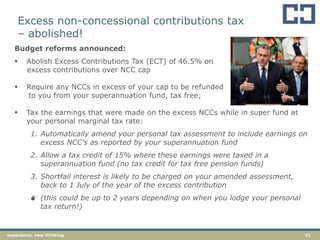
Excess non-concessional contributions tax
– abolished!
Budget reforms announced:
 Abolish Excess Contributions Tax (ECT) of 46.5% on
excess contributions over NCC cap
 Require any NCCs in excess of your cap to be refunded
to you from your superannuation fund, tax free;
 Tax the earnings that were made on the excess NCCs while in super fund at
your personal marginal tax rate:
1. Automatically amend your personal tax assessment to include earnings on
excess NCC’s as reported by your superannuation fund
2. Allow a tax credit of 15% where these earnings were taxed in a
superannuation fund (no tax credit for tax free pension funds)
3. Shortfall interest is likely to be charged on your amended assessment,
back to 1 July of the year of the excess contribution
 (this could be up to 2 years depending on when you lodge your personal
tax return!)
32experience. new thinking
Other Superannuation measures
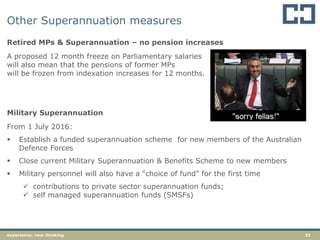
Retired MPs & Superannuation – no pension increases
A proposed 12 month freeze on Parliamentary salaries
will also mean that the pensions of former MPs
will be frozen from indexation increases for 12 months.
Military Superannuation
From 1 July 2016:
 Establish a funded superannuation scheme for new members of the Australian
Defence Forces
 Close current Military Superannuation & Benefits Scheme to new members
 Military personnel will also have a “choice of fund” for the first time
 contributions to private sector superannuation funds;
 self managed superannuation funds (SMSFs)
33experience. new thinking
Other Superannuation measures
Seniors Health Care Card eligibility
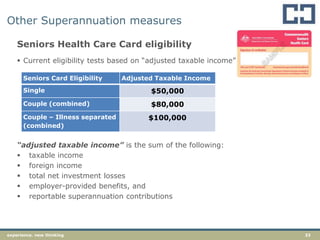
 Current eligibility tests based on “adjusted taxable income”
“adjusted taxable income” is the sum of the following:
 taxable income
 foreign income
 total net investment losses
 employer-provided benefits, and
 reportable superannuation contributions
Seniors Card Eligibility Adjusted Taxable Income
Single $50,000
Couple (combined) $80,000
Couple – Illness separated
(combined)
$100,000
34experience. new thinking
Other Superannuation measures
Budget changes:
Seniors Health Care Card eligibility
– expanded income test
“adjusted taxable income” to also include:
 untaxed superannuation income
e.g. tax free superannuation pensions paid
to those over age 60
 Test similar to deeming rules that apply to superannuation pensions for age
pension purposes
 Grandfathering of superannuation pensions in place before 1 January 2015
 Indexation income limits by CPI
35experience. new thinking
“The Budget is just the beginning of
an ongoing economic repair process”
Future changes to superannuation?
• Risk of future tax changes to superannuation?
• Superannuation tax concessions are seen as an
“expense” against income tax the Government
would otherwise collect. Are they affordable?
• National Committee of Audit 2014 recommendations:
• Delay access to super benefits by increasing preservation age to 5 years
below the Age Pension age:
• age 62 by 2027; then
• 65 years by 2053; then
• 70 years? ( in line with age pension)
Note: Currently super can be accessed by fully retiring or “transition to
retirement” from age 55, rising to age 60 over 5 years
commencing from 1 July 2016
36experience. new thinking
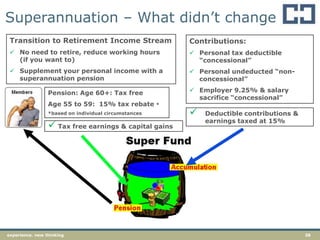
Superannuation – What didn‟t change
Taxation of superannuation funds:
Accumulation Funds:
 interest & other investment earnings taxed @ 15%
 Capital gains taxed at 10%*
*(15% - 1/3rd discount after 12 months)
 Franking credits on dividends refunded
(30% company tax – 15% = 15% tax refund)
Pension Funds:
 Tax free interest & other investment earnings
 Tax free capital gains
 Tax free dividends & franking credits refunded
(30% company tax – nil super earnings tax = 30% tax refund
37experience. new thinking
Financial Year Age 60 & Over Age 50 to 59 Under age 50
2013/2014 $35,000 $25,000 $25,000
2014/2015 $35,000 $35,000 $30,000
2013/2014
If you were at least age 59 on 30 June 2013, your cap is increased
for the year ending on 30 June 2014 from $25,000 to $35,000. For
all others it is $25,000.
Superannuation – What didn‟t change
Concessional Contributions
2014/2015
If you will be at least age 49 on 30 June 2014, your cap will be
$35,000 for the year ending 30 June 2015.
For all others the concessional cap will increase from $25,000 to
$30,000 for 2014/2015.
38experience. new thinking
Contributions:
 Personal tax deductible
“concessional”
 Personal undeducted “non-
concessional”
 Employer 9.25% & salary
sacrifice “concessional”
 Deductible contributions &
earnings taxed at 15%
Transition to Retirement Income Stream
 No need to retire, reduce working hours
(if you want to)
 Supplement your personal income with a
superannuation pension
Superannuation – What didn‟t change
Pension: Age 60+: Tax free
Age 55 to 59: 15% tax rebate *
*based on individual circumstances
 Tax free earnings & capital gains
39experience. new thinking
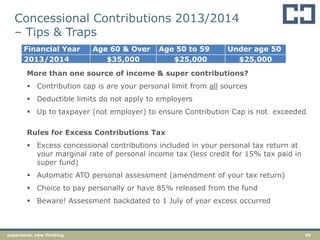
Financial Year Age 60 & Over Age 50 to 59 Under age 50
2013/2014 $35,000 $25,000 $25,000
More than one source of income & super contributions?
 Contribution cap is are your personal limit from all sources
 Deductible limits do not apply to employers
 Up to taxpayer (not employer) to ensure Contribution Cap is not exceeded
Rules for Excess Contributions Tax
 Excess concessional contributions included in your personal tax return at
your marginal rate of personal income tax (less credit for 15% tax paid in
super fund)
 Automatic ATO personal assessment (amendment of your tax return)
 Choice to pay personally or have 85% released from the fund
 Beware! Assessment backdated to 1 July of year excess occurred
Concessional Contributions 2013/2014
– Tips & Traps
40experience. new thinking
Super Contribution Tax Deductions
ATO Tax Ruling TR 2010/1:
When is a super contribution considered to have been made?
Cheque?
 When the cheque is “in the hands of the trustee of the super fund”. Even if
not banked e.g. by 30 June, is still “made” unless cheque is subsequently
dishonored (Note: ATO says in TR 2010/1 if cheque dated on or before 30 June in an
income year, must be banked within “a few business days”)
Electronic funds transfer?
 Only when credited to receiving fund‟s bank a/c, NOT when
transferred from the contributors account. Beware internet
transfers between different banks which may be next
“working” day
Concessional Contributions 2013/2014
– Tips & Traps
41experience. new thinking
Disclaimer
This document contains information in summary form and is therefore intended for general guidance only. It is
not intended to be a substitute for detailed research or the exercise of professional judgement. It does not
purport to be comprehensive or to render professional advice. The reader should not act on the basis of any
matter contained in this publication without first obtaining specific professional advice.
We believe that the statements made by us in this document are accurate but no warranty of accuracy or
reliability is given. Our conclusions are based on interpretations of accounting standards and other relevant
professional pronouncements and legislation current as at the date of this document. Should the interpretations,
accounting standards, other relevant professional pronouncements or legislation change, our conclusions may not
be valid. We are under no obligation to update the matters considered in this document after its publication.
These notes specifically contain factual information concerning the taxation and compliance implications of certain
superannuation matters. The notes are intended as a guide only and may not apply to circumstances of particular
individuals. Do not act on the contents of these notes without first obtaining specific advice from a qualified tax or
legal professional about your particular circumstances.
Hanrick Curran Group, its associates and the presenter hereby disclaim any responsibility for persons relying in
whole or in part on these notes or the information presented at this seminar.
The Corporations Act 2001 deems superannuation funds, self managed superannuation funds (SMSFs) and
pensions to be “financial products” and may consider a recommendation to contribute to a fund, increase or
decrease contributions, establish or join a SMSF, or to commence a superannuation pension to be financial
product advice as defined by that Act. We are not licensed to give such advice. You should consider taking advice
from an AFS License holder before making a decision on any financial product.
© Hanrick Curran, June 2014
All rights reserved
Thank you
www.hanrickcurran.com.au

2014 Post Budget Presentation

  • 1.
    www.hanrickcurran.com.au 2011-2012 Budget Update12 May 2011 2014 Pre & Post Update 21 May 2013
  • 2.
    2experience. new thinking HouseKeeping Matters  Mobile phones – off / silent  An email will arrive after this session with:  Copies of all slides  Tax Planning checklist  Brief Feedback Survey  We welcome questions during the presentation, presenters will be available afterwards  Thank you for coming, please check if you‟re on a Lucky Chair!
  • 3.
    www.hanrickcurran.com.au 2014 Pre FinancialYear End & Post Federal Budget Update Jamie Towers, Tax Partner May 2014
  • 4.
    4experience. new thinking BudgetInsights  Budget Summary  Individuals  Business  Charities  Recap on changes announced during 2014/14 and previously  Tax Planning
  • 5.
    5experience. new thinking BudgetSummary  2012/13 final budget outcome - $1.5 Billion surplus - $18.8 Billion deficit  Mid Year Economic Outlook = $47 Billion deficit for 2013-14  Now Predicted Deficit for 2013/14 year = $49.9 Billion
  • 6.
  • 7.
    7experience. new thinking BudgetSummary 2014/15  Deficit of $29.8 Billion  Large Infrastructure spend  Broken promises on „no new taxes‟ and various expenditure cuts  Fiscally responsible, but ill-targeted?
  • 8.
    8experience. new thinking BudgetSummary 2014/15 Key Questions for 2014 / 15  Which proposals will pass through Senate and when?  Will the MRRT be repealed?  Is Mr Hockey prepping for an increase in GST next year / next election?
  • 9.
    9experience. new thinking Individuals 2% Budget Deficit Tax (temporary budget repair levy) – applies to individual‟s incomes above $180,000  Medicare levy to increase to 2% (from 1.5%)  Dependent Spouse tax offset and Mature Age Worker tax offset abolished  All apply from 1/7/2014
  • 10.
    10experience. new thinking Individuals FBT Rate to increase in line with Levy increases  47% from 1 April 2014(previously 46.5%)  49% from 1 April 2015  Limited window tax arbitrage (1/7/14 – 31 March 15) 2%
  • 11.
    11experience. new thinking Individuals Family Tax Benefit (FTB) payments indexation frozen for 2 years  FTB Thresholds frozen for 3 years  Part B income limit reduced to $100,000  Various supplements reduced
  • 12.
    12experience. new thinking Individuals HELP (HECS) repayment threshold reduced to $50,638 from 1/7/2016  Indexation abolished – replaced with interest linked to Federal Gov‟t 10 year bond rate (capped at 6%)
  • 13.
    13experience. new thinking Individuals National Rental Affordability Scheme – 5th round of funding and remaining uncommitted 4th round funding abolished  All previously committed funding will remain
  • 14.
    14experience. new thinking Individuals Pension Age to rise to age 70  48 year old in 2014 will need to wait until they are 70 to retire
  • 15.
    15experience. new thinking Business Very few changes for business  R & D incentives reduced by 1.5%  Managed Investment trusts scheme deferred
  • 16.
    16experience. new thinking Business Superannuation Guarantee – increased to 9.5% from 1/7/14 then frozen until 2018  Rises to 12% by 2022  Government Restart program – incentives for hiring older workers – up to $10,000  Entrepreneurs Infrastructure Program
  • 17.
    17experience. new thinking Notfor Profits & Charities  Changes announced by previous Government will not proceed  Commercial activities of charities will not be taxed  FBT and other concessions will remain
  • 18.
    18experience. new thinking Previouslyannounced changes  At time of election – 96 announced but unlegislated measures to change the tax system. Some going back to 2001.  14 December – 55 will not proceed, rest will proceed – some with amendments
  • 19.
    19experience. new thinking Previouslyannounced changes  Self Education Deduction Cap – Will not proceed  FBT Changes to cars – Will not proceed  Tax on pension earnings above $100,000 – Will not proceed
  • 20.
    20experience. new thinking Previouslyannounced changes  Dividend washing „loophole‟ closed – ATO believes it is avoidance and treasury have issued draft legislation to stop it  Managed Investment Trusts – (originally a 2009/10 budget measure) – deferred another year
  • 21.
    21experience. new thinking Previouslyannounced changes  Government‟s Minerals Resource Rent Tax (MRRT) repeal bill also proposed to repeal:  Small Business $6,500 + $5,000 car instant write-off  Company loss carry back rules  Bill not passed by Senate  Proposed to be re-introduced in July after Senate change
  • 22.
    22experience. new thinking Pre30 June Tax Planning  After 30/6/2014 – additional 2.5% in “levies”  Reality – top marginal tax rate = 49%  Bring forward expenses to get the tax benefit now at 46.5% or defer 12 months to get a higher benefit at 49%?  Depends on cost of funding
  • 23.
    23experience. new thinking Pre30 June Tax Planning  Assuming tax planning for 2014  Defer invoicing  Bring forward expenditure  Write-off any bad debts  Pay superannuation contributions pre-30 June
  • 24.
    24experience. new thinking Pre30 June Considerations  Trust Distributions – ensure the trustee makes an income resolution and records it on or before 30 June 2014  Division 7A loans – have you charged interest and made the minimum repayment?
  • 25.
    www.hanrickcurran.com.au Federal Budget 2014/2015 SuperannuationUpdate By Chris Campbell - Partner May 2014
  • 26.
    26experience. new thinking SuperannuationGuarantee Superannuation Guarantee (SG) rate - increases to 9.5% from 1 July 2014  Currently an employer must pay 9.25% of an employee‟s ordinary time earnings to a superannuation fund  Previous Government legislated to increase SG from 9% to 12% phased in over 7 years:
  • 27.
    27experience. new thinking SuperannuationGuarantee Superannuation Guarantee (SG) rate - increases to 9.5% from 1 July 2014  Currently an employer must pay 9.25% of an employee‟s ordinary time earnings to a superannuation fund  Previous Government legislated to increase SG from 9% to 12% phased in over 7 years:  Election promise to freeze SG increases at 9.25% for next 2 financial years  Senate rejected this proposal, along with Mining Tax abolition Bill in 2013
  • 28.
    28experience. new thinking SuperannuationGuarantee Freeze Budget: Freeze Superannuation Guarantee (SG) rate at 9.5% from 1 July 2014 to 30 June 2018  SG increases raise employment costs for small business  Many employers already struggling financially  Reasonable decision to freeze SG rate increases until signs of economic recovery Year SG Rate - % of ordinary time earnings 2013/2014 9.25% 2014/2015 9.5% 2015/2016 9.5% 2016/2017 9.5% 2017/2018 9.5% 2018/2019 10.0% 2019/2020 10.5% 2020/2021 11.0% 2021/2022 11.5% 2022/2023 12.0%
  • 29.
    29experience. new thinking Excessnon-concessional contributions tax – abolished! Non-concessional “undeducted” contributions: Overview: These are contributions to superannuation from your personal “after tax” savings Non-concessional contributions (NCC‟s) are:  Not taxed on entry or exit in a superannuation fund; &  Investment earnings while in a super fund are taxed at only 15% (or nil for pension funds)… rather than up to 49% if invested in your own name Rules:  Non-concessional cap of $150,000* per person p.a. - 2013/2014 *(increases to $180,000 from 1 July 2014)  “bring forward rule” if under age 65: 3x $150,000 = $450,000 over 3 financial years (3 x $180,000 = $540,000 from 1 July 2014)
  • 30.
    30experience. new thinking Excessnon-concessional contributions tax – abolished! Prior to Budget:  Excess Contributions Tax (ECT) on any excess over this cap taxed at 46.5%  A very harsh tax penalty imposed on private “after tax savings”  Complex rules, easy to make a mistake e.g:  Excess concessional “deductible” contributions reduced your non-concessional cap available  Some older personal life insurance policies are actually superannuation plans, & premiums are NCC’s  Poor public understanding of the consequences of exceeding your cap  ATO unsympathetic to honest mistakes on assessment of ECT  Reform of ECT on excess concessional “deductible” contributions in 2013 did not extend to non-concessional contributions
  • 31.
    31experience. new thinking Excessnon-concessional contributions tax – abolished! Budget reforms announced:  Abolish Excess Contributions Tax (ECT) of 46.5% on excess contributions over NCC cap  Require any NCCs in excess of your cap to be refunded to you from your superannuation fund, tax free;  Tax the earnings that were made on the excess NCCs while in super fund at your personal marginal tax rate: 1. Automatically amend your personal tax assessment to include earnings on excess NCC’s as reported by your superannuation fund 2. Allow a tax credit of 15% where these earnings were taxed in a superannuation fund (no tax credit for tax free pension funds) 3. Shortfall interest is likely to be charged on your amended assessment, back to 1 July of the year of the excess contribution  (this could be up to 2 years depending on when you lodge your personal tax return!)
  • 32.
    32experience. new thinking OtherSuperannuation measures Retired MPs & Superannuation – no pension increases A proposed 12 month freeze on Parliamentary salaries will also mean that the pensions of former MPs will be frozen from indexation increases for 12 months. Military Superannuation From 1 July 2016:  Establish a funded superannuation scheme for new members of the Australian Defence Forces  Close current Military Superannuation & Benefits Scheme to new members  Military personnel will also have a “choice of fund” for the first time  contributions to private sector superannuation funds;  self managed superannuation funds (SMSFs)
  • 33.
    33experience. new thinking OtherSuperannuation measures Seniors Health Care Card eligibility  Current eligibility tests based on “adjusted taxable income” “adjusted taxable income” is the sum of the following:  taxable income  foreign income  total net investment losses  employer-provided benefits, and  reportable superannuation contributions Seniors Card Eligibility Adjusted Taxable Income Single $50,000 Couple (combined) $80,000 Couple – Illness separated (combined) $100,000
  • 34.
    34experience. new thinking OtherSuperannuation measures Budget changes: Seniors Health Care Card eligibility – expanded income test “adjusted taxable income” to also include:  untaxed superannuation income e.g. tax free superannuation pensions paid to those over age 60  Test similar to deeming rules that apply to superannuation pensions for age pension purposes  Grandfathering of superannuation pensions in place before 1 January 2015  Indexation income limits by CPI
  • 35.
    35experience. new thinking “TheBudget is just the beginning of an ongoing economic repair process” Future changes to superannuation? • Risk of future tax changes to superannuation? • Superannuation tax concessions are seen as an “expense” against income tax the Government would otherwise collect. Are they affordable? • National Committee of Audit 2014 recommendations: • Delay access to super benefits by increasing preservation age to 5 years below the Age Pension age: • age 62 by 2027; then • 65 years by 2053; then • 70 years? ( in line with age pension) Note: Currently super can be accessed by fully retiring or “transition to retirement” from age 55, rising to age 60 over 5 years commencing from 1 July 2016
  • 36.
    36experience. new thinking Superannuation– What didn‟t change Taxation of superannuation funds: Accumulation Funds:  interest & other investment earnings taxed @ 15%  Capital gains taxed at 10%* *(15% - 1/3rd discount after 12 months)  Franking credits on dividends refunded (30% company tax – 15% = 15% tax refund) Pension Funds:  Tax free interest & other investment earnings  Tax free capital gains  Tax free dividends & franking credits refunded (30% company tax – nil super earnings tax = 30% tax refund
  • 37.
    37experience. new thinking FinancialYear Age 60 & Over Age 50 to 59 Under age 50 2013/2014 $35,000 $25,000 $25,000 2014/2015 $35,000 $35,000 $30,000 2013/2014 If you were at least age 59 on 30 June 2013, your cap is increased for the year ending on 30 June 2014 from $25,000 to $35,000. For all others it is $25,000. Superannuation – What didn‟t change Concessional Contributions 2014/2015 If you will be at least age 49 on 30 June 2014, your cap will be $35,000 for the year ending 30 June 2015. For all others the concessional cap will increase from $25,000 to $30,000 for 2014/2015.
  • 38.
    38experience. new thinking Contributions: Personal tax deductible “concessional”  Personal undeducted “non- concessional”  Employer 9.25% & salary sacrifice “concessional”  Deductible contributions & earnings taxed at 15% Transition to Retirement Income Stream  No need to retire, reduce working hours (if you want to)  Supplement your personal income with a superannuation pension Superannuation – What didn‟t change Pension: Age 60+: Tax free Age 55 to 59: 15% tax rebate * *based on individual circumstances  Tax free earnings & capital gains
  • 39.
    39experience. new thinking FinancialYear Age 60 & Over Age 50 to 59 Under age 50 2013/2014 $35,000 $25,000 $25,000 More than one source of income & super contributions?  Contribution cap is are your personal limit from all sources  Deductible limits do not apply to employers  Up to taxpayer (not employer) to ensure Contribution Cap is not exceeded Rules for Excess Contributions Tax  Excess concessional contributions included in your personal tax return at your marginal rate of personal income tax (less credit for 15% tax paid in super fund)  Automatic ATO personal assessment (amendment of your tax return)  Choice to pay personally or have 85% released from the fund  Beware! Assessment backdated to 1 July of year excess occurred Concessional Contributions 2013/2014 – Tips & Traps
  • 40.
    40experience. new thinking SuperContribution Tax Deductions ATO Tax Ruling TR 2010/1: When is a super contribution considered to have been made? Cheque?  When the cheque is “in the hands of the trustee of the super fund”. Even if not banked e.g. by 30 June, is still “made” unless cheque is subsequently dishonored (Note: ATO says in TR 2010/1 if cheque dated on or before 30 June in an income year, must be banked within “a few business days”) Electronic funds transfer?  Only when credited to receiving fund‟s bank a/c, NOT when transferred from the contributors account. Beware internet transfers between different banks which may be next “working” day Concessional Contributions 2013/2014 – Tips & Traps
  • 41.
    41experience. new thinking Disclaimer Thisdocument contains information in summary form and is therefore intended for general guidance only. It is not intended to be a substitute for detailed research or the exercise of professional judgement. It does not purport to be comprehensive or to render professional advice. The reader should not act on the basis of any matter contained in this publication without first obtaining specific professional advice. We believe that the statements made by us in this document are accurate but no warranty of accuracy or reliability is given. Our conclusions are based on interpretations of accounting standards and other relevant professional pronouncements and legislation current as at the date of this document. Should the interpretations, accounting standards, other relevant professional pronouncements or legislation change, our conclusions may not be valid. We are under no obligation to update the matters considered in this document after its publication. These notes specifically contain factual information concerning the taxation and compliance implications of certain superannuation matters. The notes are intended as a guide only and may not apply to circumstances of particular individuals. Do not act on the contents of these notes without first obtaining specific advice from a qualified tax or legal professional about your particular circumstances. Hanrick Curran Group, its associates and the presenter hereby disclaim any responsibility for persons relying in whole or in part on these notes or the information presented at this seminar. The Corporations Act 2001 deems superannuation funds, self managed superannuation funds (SMSFs) and pensions to be “financial products” and may consider a recommendation to contribute to a fund, increase or decrease contributions, establish or join a SMSF, or to commence a superannuation pension to be financial product advice as defined by that Act. We are not licensed to give such advice. You should consider taking advice from an AFS License holder before making a decision on any financial product. © Hanrick Curran, June 2014 All rights reserved
  • 42.

Editor's Notes

  • #6 Multi Billion on infrastructureNew taxes – 2% budget deficit tax; cuts to FTB equivalent to a tax hike: John HowardCuts to Gonski school funding from 2017/8 - $30Bn savingUnregulated / uncapped uni feesProposed 1.5% company tax cut (next year?) with 1.5% bib business levy for parental leave scheme
  • #7 Multi Billion on infrastructureNew taxes – 2% budget deficit tax; cuts to FTB equivalent to a tax hike: John HowardCuts to Gonski school funding from 2017/8 - $30Bn savingUnregulated / uncapped uni feesProposed 1.5% company tax cut (next year?) with 1.5% bib business levy for parental leave scheme
  • #8 Multi Billion on infrastructureNew taxes – 2% budget deficit tax; cuts to FTB equivalent to a tax hike: John HowardCuts to Gonski school funding from 2017/8 - $30Bn savingUnregulated / uncapped uni feesProposed 1.5% company tax cut (next year?) with 1.5% bib business levy for parental leave scheme
  • #9 Multi Billion on infrastructureNew taxes – 2% budget deficit tax; cuts to FTB equivalent to a tax hike: John HowardCuts to Gonski school funding from 2017/8 - $30Bn savingUnregulated / uncapped uni feesProposed 1.5% company tax cut (next year?) with 1.5% bib business levy for parental leave scheme
  • #15 The minimum income threshhold reduces by around 10%.
  • #16 The minimum income threshhold reduces by around 10%.
  • #17 The minimum income threshhold reduces by around 10%.
  • #18 The minimum income threshhold reduces by around 10%.
  • #19 The minimum income threshold reduces by around 10%.
  • #20 The minimum income threshhold reduces by around 10%.
  • #21 The minimum income threshhold reduces by around 10%.
  • #22 The minimum income threshhold reduces by around 10%.
  • #23 The minimum income threshhold reduces by around 10%.
  • #24 The minimum income threshhold reduces by around 10%.