z
z
Affecting the HR Profession in Ohio
Presented by Tony Fiore
Director, Government Affairs
Ohio SHRM State Council
Tuscora SHRM
April 19, 2017
z
Advocacy/Politics
Why Advocate? 2016 HR Recap
Employment/Labor Law
Unemployment Compensation
Federal Appointments/Issues
Healthcare and Workplace Flexibility
z
z
Advocacy/Politics
z
2018 Election
+ Ballot Issues
+ All statewide offices
+ Governor/Lt. Gov.
+ Attorney General
+ Secretary of State
+ Auditor
+ Treasurer
+ 1 U.S. Senate Seat
+ All 16 U.S. House Seats
+ 2 Supreme Court seats
+ 99 Ohio House Seats
+ 17 Ohio Senate Seats
z
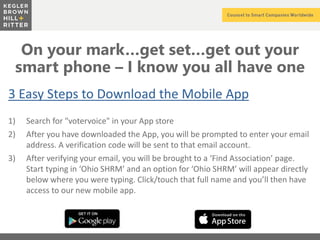
On your mark…get set…get out your
smart phone – I know you all have one
3 Easy Steps to Download the Mobile App
1) Search for "votervoice" in your App store
2) After you have downloaded the App, you will be prompted to enter your email
address. A verification code will be sent to that email account.
3) After verifying your email, you will be brought to a ‘Find Association’ page.
Start typing in ‘Ohio SHRM’ and an option for ‘Ohio SHRM’ will appear directly
below where you were typing. Click/touch that full name and you’ll then have
access to our new mobile app.
z
Educate
+Employers must educate employees on who the
candidates are and what their positions are on
certain issues
+Do you currently provide information to
employees on how certain laws will positively or
negatively impact your company?
z
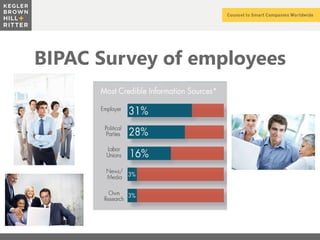
BIPAC Survey of employees
z
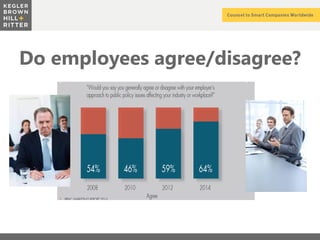
Do employees agree/disagree?
z
z
Thomas Jefferson
“America is not
governed by the
majority, but by a
majority of those who
participate.”
z
z
Why Advocate?
2016 HR Recap
z
The new laws passed in 2016
affect:
+Concealed handguns on employer’s property
+Drugs in the workplace (medical marijuana)
+Health care mandates
+Minimum wage, mandatory paid sick leave or predictive
scheduling laws at the local level
+Taxes on business
+Unemployment compensation debt and employer taxes
+Workers’ compensation
z
Concealed handguns on
employer’s property
+ SB 199 (Uecker-Gardner) Effective 3/21/17 - The bill: (1) prohibits a business
entity from having a policy that prohibits a concealed handgun licensee from
transporting or storing a firearm in the person's motor vehicle; and (2) modifies
the prohibition against carrying a concealed handgun onto institutions of higher
education, day care facilities, aircraft, certain government facilities, public areas of
airport terminals, and school safety zones.
+ What does this mean for your business? When the concealed carry law was
enacted over a decade ago state law provided employers with complete control
over its private property, including a parking lot. This new law means your
workplace policy prohibiting employees who have a concealed carry permit from
keeping such handguns in their locked motor vehicle is no longer permitted under
state law. But, the law also provides some level of immunity for business owners
for damage, injuries or death resulting from such concealed weapons. This is an
issue with wide-ranging impacts, especially for employers with businesses in
multiple states.
z
Drugs in the workplace
(medical marijuana)
+ HB 523 (Huffman) Effective 9/8/16 – The bill: (1) permits a patient, on the recommendation of a
physician, to use medical marijuana to treat a qualifying medical condition; (2) specifies that the act
does not require an employer to permit or accommodate an employee's use, possession, or
distribution of medical marijuana; (3) specifies that the act does not prohibit an employer from
establishing and enforcing certain workplace drug policies; (4) considers a person who has been fired
for using medical marijuana to have been fired for just cause and ineligible for unemployment benefits
in certain circumstances; and (5) maintains the rebuttable presumption that an employee is ineligible
for workers' compensation if the proximate cause of the employee's injury was being under the
influence of marijuana.
+ What does this mean for your business? While Ohio joined over half the states in “legalizing” medical
marijuana, employers have every right to maintain a drug-free work environment. The new law affords
employers even more protection by making employees ineligible for unemployment and workers’
compensation benefits if terminated for violating an employer’s drug-free workplace policy or causing
injury to themselves due to being under the influence of medical marijuana. At the time of this
publication marijuana remains illegal under federal law; furthermore, there are OSHA rules in effect
regarding when employers are allowed to drug test employees that need to be taken into
consideration.
z
Health care mandates
+ HB 463 (Dever) – The bill: (1) requires health plan issuers to provide coverage for
autism spectrum disorder; (2) requires the Superintendent of Insurance to
conduct an actuarial study on the costs of health care mandates under Ohio law
that apply to non-ERISA individual and group health insurance plans; and (3)
states the intent of the General Assembly to implement a two-year moratorium
on new health care mandates and to develop potential tax credits that offset
additional employer costs associated with health care mandates.
+
+ What does this mean for your business? In a perfect world, all health care
treatments, services and procedures would be free for everyone. But, additional
mandated coverage comes at a cost. This bill adds autism spectrum disorder to
the list of benefit mandates covered under Ohio health care plans. The bill also
requires the Ohio Department of Insurance to conduct an actuarial study of the
costs of all such mandates that will help employers identify cost drivers in the
system. In addition, the legislature has expressed an intent not to pass any
additional mandates during the 132nd General Assembly (2017-18).
z
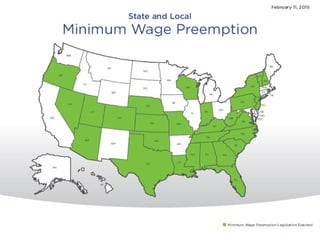
Minimum wage, mandatory paid sick leave or
predictive scheduling laws at the local level
+ SB 331 (Peterson) Effective 3/21/17 - The bill: (1) prohibits political
subdivisions from establishing minimum wage rates different from
the rate required by state law; and (2) generally grants private
employers exclusive authority to establish policies concerning hours
and location of work, scheduling, and fringe benefits, unless an
exception applies.
+
+ What does this mean for your business? Like other surrounding
states, HR professionals are not going to have to worry about local
governments enacting minimum wage, paid sick leave or predictive
scheduling laws around the state. You will only need to keep up with
state and federal laws that apply to these areas of employment law.
z
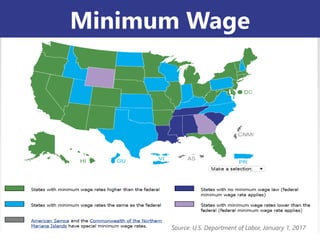
Minimum Wage
Source: U.S. Department of Labor, January 1, 2017
z
z
Taxes on business
+HB 64 (Smith) Effective 6/30/15– This bill is the state’s main
operating budget. The legislature passed a $1.2 billion tax cut
without shifting the tax burden to businesses subject to the
Commercial Activity Tax (CAT) or taxing services that currently
are not taxable.
+
+HB 390 (Schafer-Retherford) Effective 9/26/16 – This bill
repealed the authority of counties to impose a utility service
tax on businesses. This local tax could have been up to 3
percent of a business’s electric, natural gas and
telecommunications bills.
z
Unemployment Compensation
+ HB 390 (Schafer-Retherford) Effective 9/26/16 – The bill: (1) requires a
one-time loan to be made from unclaimed funds to the Unemployment
Compensation Fund to pay for unemployment benefits; (2) requires the
Director of Job and Family Services to use the amount transferred from
unclaimed funds to eliminate the balance of amounts advanced to the
state from the federal government; and (3) requires each experience-rated
contributory employer to pay an increased contribution rate for
contributions due in 2017 in order to repay the loan from unclaimed funds.
+
+ What does this mean for your business? Repayment of the outstanding UI
debt means your federal unemployment tax will be reduced from a high of
$147 per employee to the lowest amount employers are required to pay
each year which is $42 per employee in 2017. Employers will be required
to pay a one-time surcharge of $54 per employee in 2017 to repay the
unclaimed funds account that was used by the state to repay the
outstanding debt.
z
Unemployment Compensation (cont.)
+ SB 235 (Beagle-Coley) Effective 3/28/17 – The bill: (1) raises, for a
two-year period, the taxable wage base used for the payment of
unemployment contributions from $9,000 to $9,500; (2) eliminates
the unemployment contribution rate increase for paying principal on
federal advances; and (3) freezes, for calendar years 2018 and 2019,
the maximum weekly unemployment benefit amounts at the
amounts in effect on the act's effective date.
+
+ What does this mean for your business? The minor increase in the
taxable wage base will require employers to pay a little more in the
future to help rebuild Ohio’s Unemployment Compensation Trust
Fund to a position of strength and solvency to better weather the
next economic downturn. But, the three provisions passed in this bill
were only a small gesture from business and labor groups to work
toward a more comprehensive UI reform package by April 1, 2017.
z
Workers’ Compensation
+ HB 207 (Henne-McColley) Effective 8/31/16 – The bill: (1) requires workers'
compensation claims to be charged to the Surplus Fund Account instead of a state
fund employer's experience in certain circumstances when a claim is based on a
motor vehicle accident involving a third party; and (2) eliminates the minimum
number of employees required for a private sector employer or board of county
commissioners to obtain self-insuring status under the Workers' Compensation
Law.
+
+ What does this mean for your business? In the past, if your employee was injured
on the job due to a third party being at fault, the claim still landed on your
experience rating, in many cases making it ineligible to qualify for significant
premium savings under programs such as group rating. This bill established a fund
to bear the expense of such claims while BWC subrogates the claim (recovers the
damages caused by the third party). In addition, this bill eliminated the 500-
employee threshold needed to apply for and be granted self-insured status for
workers’ compensation insurance in Ohio. That means smaller, state-funded
businesses that are financially stable will now have the opportunity to apply for
self-insurance.
z
z
State Employment/Labor Law
z
HB 2 -
Employment Law Uniformity Act
+ Genaro overturned.
+ Only personal liability would remain under (I) and (J) for employee to
employee retaliation and aiding/abeting
+ 2 year statute of limitations for admin and civil claim filing
+ Administrative exhaustion – right to sue letter issued by commission (like EEOC)
+ Ellerth/Faragher hostile work environment sexual harassment affirmative defense
codified
+ Prevention of multiple age discrimination claims filed under various sections
+ Tort caps apply in civil cases (we couldn’t get buy in for CRA of 1991 caps)
+ NOTE: If you attend the 2017 Ohio SHRM Employment Law + Legislative
Conference you will hear directly from the bill sponsor, Rep. Bill Seitz
z
HB 2 legislative intent
+ “The General Assembly declares its intent in enacting section
4112.054 of the Revised Code pursuant to this act that
employers will be encouraged to implement meaningful anti-
discrimination policies and foster a work environment that is fair
and tolerant. The General Assembly further declares its intent
that human resource professionals should have the first
opportunity to resolve personnel complaints and rectify
detrimental workplace behavior before such issues result in
costly litigation.”
z
Why should you care?
+ Uniformity means less duplication of similar state and federal
law seeking the same outcome – reduce and/or eliminate
discrimination
+ Eliminating personal liability for managers and supervisors
while retaining liability on the employer promotes good
management practices without fear of being named personally
in a lawsuit
+ You should know earlier when/if an allegation of discrimination
is filed
+ You should have the first opportunity to eliminate a
discriminatory practice within the workplace – not after you
receive notice that was filed with the OCRC or court
z
z
Unemployment Compensation
z
z
What is happening nationally?
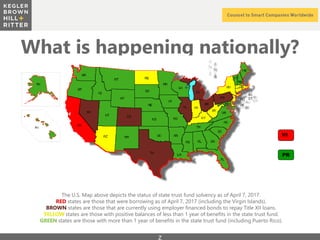
The U.S. Map above depicts the status of state trust fund solvency as of April 7, 2017.
RED states are those that were borrowing as of April 7, 2017 (including the Virgin Islands).
BROWN states are those that are currently using employer financed bonds to repay Title XII loans.
YELLOW states are those with positive balances of less than 1 year of benefits in the state trust fund.
GREEN states are those with more than 1 year of benefits in the state trust fund (including Puerto Rico).
PR
VI
z
Solvency of Ohio’s UI Trust Fund
-$3,000,000,000
-$2,000,000,000
-$1,000,000,000
$0
$1,000,000,000
$2,000,000,000
$3,000,000,000
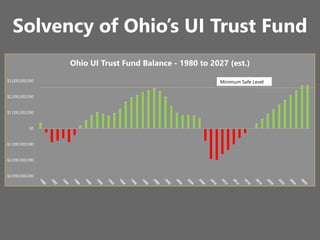
Ohio UI Trust Fund Balance - 1980 to 2027 (est.)
Minimum Safe Level
z
How do we return to the
lowest FUTA tax?
+Repay Federal loan balance
+Don’t borrow in the future
+Rebuild state UI Trust Fund
+Comprehensive UI Reform
+ Revenue (Taxes)
+ Expenses (Benefits)
+ Integrity (Fraud, Waste, Abuse, Misclassification, Overpayments)
+ Reemployment (connections with the workforce)
+ Job creation (more people working = more tax revenue without
raising existing taxes on employers)
z
Why should you care?
+ Loan balance repaid; only pay $42 per employee for FUTA rather than $126
+ HB 394/HB 620 reforms would have helped rebalance the checkbook for
future economic downturns
+ Ohio employers fully fund the state unemployment system for claimants
out of work through no fault of their own.
+ If the state does not find the right mix of comprehensive reforms to the UI
system to rebuild the state’s trust fund to a position of strength and
solvency during relatively good times, Ohio employers will bear the cost of
even higher federal taxes during the next economic downturn.
+ Self-imposed deadline by Speaker Rosenberger was April 1, 2017 – pushed
back to “this year”
+ Tell your House and Senate member to finalize a plan to lower your UI
taxes!
z
z
Federal appointments/issues
Healthcare/Workplace Flexibility
z
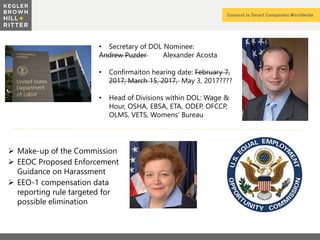
• Secretary of DOL Nominee:
Andrew Puzder Alexander Acosta
• Confirmaiton hearing date: February 7,
2017; March 15, 2017, May 3, 2017????
• Head of Divisions within DOL: Wage &
Hour, OSHA, EBSA, ETA, ODEP, OFCCP,
OLMS, VETS, Womens’ Bureau
 Make-up of the Commission
 EEOC Proposed Enforcement
Guidance on Harassment
 EEO-1 compensation data
reporting rule targeted for
possible elimination
z
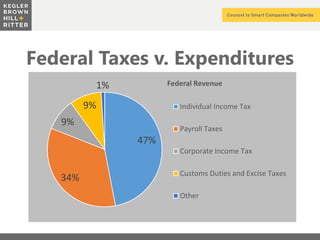
Federal Taxes v. Expenditures
47%
34%
9%
9%
1% Federal Revenue
Individual Income Tax
Payroll Taxes
Corporate Income Tax
Customs Duties and Excise Taxes
Other
z
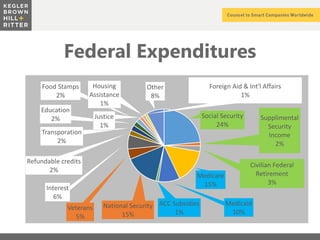
Federal Expenditures
Social Security
24%
Supplimental
Security
Income
2%
Civilian Federal
Retirement
3%
Medicare
15%
Medicaid
10%
ACC Subsidies
1%
National Security
15%
Veterans
5%
Interest
6%
Refundable credits
2%
Transporation
2%
Education
2%
Food Stamps
2%
Justice
1%
Housing
Assistance
1%
Foreign Aid & Int'l Affairs
1%
Other
8%
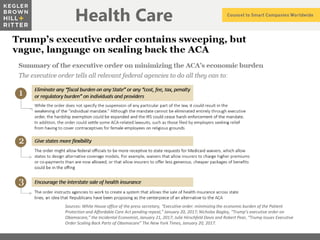
zHealth Care
Sources: White House office of the press secretary, “Executive order: minimizing the economic burden of the Patient
Protection and Affordable Care Act pending repeal,” January 20, 2017; Nicholas Bagley, “Trump’s executive order on
Obamacare,” the Incidental Economist, January 21, 2017; Julie Hirschfeld Davis and Robert Pear, “Trump Issues Executive
Order Scaling Back Parts of Obamacare” The New York Times, January 20, 2017.
z
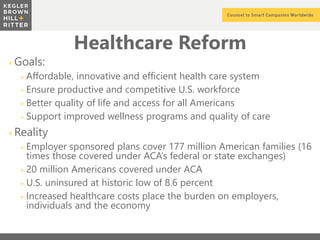
Healthcare Reform
+Goals:
+ Affordable, innovative and efficient health care system
+ Ensure productive and competitive U.S. workforce
+ Better quality of life and access for all Americans
+ Support improved wellness programs and quality of care
+Reality
+ Employer sponsored plans cover 177 million American families (16
times those covered under ACA’s federal or state exchanges)
+ 20 million Americans covered under ACA
+ U.S. uninsured at historic low of 8.6 percent
+ Increased healthcare costs place the burden on employers,
individuals and the economy
z
Employer Responses to ACA
+ Although more individuals are covered…
+ Employers continue to experience increased costs
+ Expanded regulatory requirements
+ Reduced flexibility in managing employer-sponsored plans
+ Compliance with ACA has led to employers
+ Opting to eliminate coverage for part-time workers
+ Restructure staffing models to reduce mandated coverage requirements
+ Reducing health care benefits
+ Shifting more costs to employees
+ Turning to other strategies – HSAs or Private exchanges
z
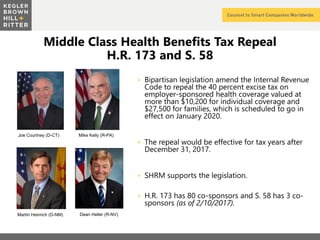
Middle Class Health Benefits Tax Repeal
H.R. 173 and S. 58
 Bipartisan legislation amend the Internal Revenue
Code to repeal the 40 percent excise tax on
employer-sponsored health coverage valued at
more than $10,200 for individual coverage and
$27,500 for families, which is scheduled to go in
effect on January 2020.
 The repeal would be effective for tax years after
December 31, 2017.
 SHRM supports the legislation.
 H.R. 173 has 80 co-sponsors and S. 58 has 3 co-
sponsors (as of 2/10/2017).
Joe Courtney (D-CT) Mike Kelly (R-PA)
Martin Heinrich (D-NM) Dean Heller (R-NV)
z
H.R. 173/S.58
Middle Class Health Benefits Tax Repeal Act
+SHRM supports repeal of ACA’s 40 percent excise tax
on high-value health plans
+Ohio Co-sponsors (bipartisan support)
+ Marcia L. Fudge (D-OH-11)
+ Bob Gibbs (R-OH-7)
+ David P. Joyce (R-OH-14)
+ Tim Ryan (D-OH-13)
z
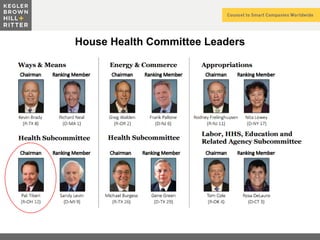
House Health Committee Leaders
z
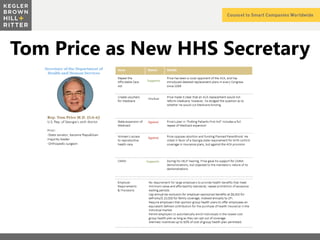
Tom Price as New HHS Secretary
z
Workplace Flexibility
+ Unpaid Leave
+ FMLA - 12 weeks unpaid
+ Paid-time off
+ Local, state and federal lawmakers continue pursuing mandatory paid time off
proposals
+ State paid sick leave laws
+ AZ, CA, CT, MA, OR, VT and WA + 30 jurisdictions
+ CA, NJ, NY and RI – paid leave insurance laws
+ Voluntary Employer Paid-Time Off is Working
+ 99 percent of employers with 50 or more employees provide some form of
voluntary paid-time off (sick, vacation, paid time off)
+ Voluntary programs help flexibility for employers/employees
+ Growing number of employers offer flexible work arrangements – compressed
workweeks, telecommuting and flexible schedules
z
Workplace Flexibility
+Federal proposals
+ Healthy Families Act – require 56 hours paid-time off/year
+ DOL – Pres. Obama’s EO – federal contractors – 1 hour of
paid-time off accrued for every 30 worked up to 56 hours
+ Family and Medical Insurance Leave Act (H.R. 947/S.336) –
partial wage replacement funded through payroll tax for
eligible under FMLA
+ Tax credit approach – incentivizing more employers to
provide paid-time off
z
SHRM Approach
+ Rep. Mimi Walters (R-CA)
+ Expand paid leave and workplace flexibility opportunities for
all employees
+ Employers choose to opt in to the proposal by offering a
minimum threshold of paid leave and flexible work option
+ Automatically satisfy all state and local requirements and is
preempted by ERISA
+ Provides flexibility for employers and employees with one
set of requirements rather than a patchwork of state and
local conflicting government mandates
z
2017 Ohio SHRM Employment Law +
Legislative Conference
May 3, 2017
7:30-4:45p.m.
Sheraton Downtown Columbus
http://www.ohioshrm.org/2017LEGCONF.CFM
z
Thank You!
Tony “The Tiger” Fiore
Of Counsel
Kegler Brown Hill + Ritter
afiore@keglerbrown.com
keglerbrown.com/fiore
614.462.5428
@TonyFioreEsq
Director, Government Affairs
Ohio State Council of SHRM

Top 5 Issues Affecting HR Professionals in Ohio

  • 1.
    z z Affecting the HRProfession in Ohio Presented by Tony Fiore Director, Government Affairs Ohio SHRM State Council Tuscora SHRM April 19, 2017
  • 2.
    z Advocacy/Politics Why Advocate? 2016HR Recap Employment/Labor Law Unemployment Compensation Federal Appointments/Issues Healthcare and Workplace Flexibility
  • 3.
  • 4.
    z 2018 Election + BallotIssues + All statewide offices + Governor/Lt. Gov. + Attorney General + Secretary of State + Auditor + Treasurer + 1 U.S. Senate Seat + All 16 U.S. House Seats + 2 Supreme Court seats + 99 Ohio House Seats + 17 Ohio Senate Seats
  • 5.
    z On your mark…getset…get out your smart phone – I know you all have one 3 Easy Steps to Download the Mobile App 1) Search for "votervoice" in your App store 2) After you have downloaded the App, you will be prompted to enter your email address. A verification code will be sent to that email account. 3) After verifying your email, you will be brought to a ‘Find Association’ page. Start typing in ‘Ohio SHRM’ and an option for ‘Ohio SHRM’ will appear directly below where you were typing. Click/touch that full name and you’ll then have access to our new mobile app.
  • 6.
    z Educate +Employers must educateemployees on who the candidates are and what their positions are on certain issues +Do you currently provide information to employees on how certain laws will positively or negatively impact your company?
  • 7.
  • 8.
  • 9.
    z z Thomas Jefferson “America isnot governed by the majority, but by a majority of those who participate.”
  • 10.
  • 11.
    z The new lawspassed in 2016 affect: +Concealed handguns on employer’s property +Drugs in the workplace (medical marijuana) +Health care mandates +Minimum wage, mandatory paid sick leave or predictive scheduling laws at the local level +Taxes on business +Unemployment compensation debt and employer taxes +Workers’ compensation
  • 12.
    z Concealed handguns on employer’sproperty + SB 199 (Uecker-Gardner) Effective 3/21/17 - The bill: (1) prohibits a business entity from having a policy that prohibits a concealed handgun licensee from transporting or storing a firearm in the person's motor vehicle; and (2) modifies the prohibition against carrying a concealed handgun onto institutions of higher education, day care facilities, aircraft, certain government facilities, public areas of airport terminals, and school safety zones. + What does this mean for your business? When the concealed carry law was enacted over a decade ago state law provided employers with complete control over its private property, including a parking lot. This new law means your workplace policy prohibiting employees who have a concealed carry permit from keeping such handguns in their locked motor vehicle is no longer permitted under state law. But, the law also provides some level of immunity for business owners for damage, injuries or death resulting from such concealed weapons. This is an issue with wide-ranging impacts, especially for employers with businesses in multiple states.
  • 13.
    z Drugs in theworkplace (medical marijuana) + HB 523 (Huffman) Effective 9/8/16 – The bill: (1) permits a patient, on the recommendation of a physician, to use medical marijuana to treat a qualifying medical condition; (2) specifies that the act does not require an employer to permit or accommodate an employee's use, possession, or distribution of medical marijuana; (3) specifies that the act does not prohibit an employer from establishing and enforcing certain workplace drug policies; (4) considers a person who has been fired for using medical marijuana to have been fired for just cause and ineligible for unemployment benefits in certain circumstances; and (5) maintains the rebuttable presumption that an employee is ineligible for workers' compensation if the proximate cause of the employee's injury was being under the influence of marijuana. + What does this mean for your business? While Ohio joined over half the states in “legalizing” medical marijuana, employers have every right to maintain a drug-free work environment. The new law affords employers even more protection by making employees ineligible for unemployment and workers’ compensation benefits if terminated for violating an employer’s drug-free workplace policy or causing injury to themselves due to being under the influence of medical marijuana. At the time of this publication marijuana remains illegal under federal law; furthermore, there are OSHA rules in effect regarding when employers are allowed to drug test employees that need to be taken into consideration.
  • 14.
    z Health care mandates +HB 463 (Dever) – The bill: (1) requires health plan issuers to provide coverage for autism spectrum disorder; (2) requires the Superintendent of Insurance to conduct an actuarial study on the costs of health care mandates under Ohio law that apply to non-ERISA individual and group health insurance plans; and (3) states the intent of the General Assembly to implement a two-year moratorium on new health care mandates and to develop potential tax credits that offset additional employer costs associated with health care mandates. + + What does this mean for your business? In a perfect world, all health care treatments, services and procedures would be free for everyone. But, additional mandated coverage comes at a cost. This bill adds autism spectrum disorder to the list of benefit mandates covered under Ohio health care plans. The bill also requires the Ohio Department of Insurance to conduct an actuarial study of the costs of all such mandates that will help employers identify cost drivers in the system. In addition, the legislature has expressed an intent not to pass any additional mandates during the 132nd General Assembly (2017-18).
  • 15.
    z Minimum wage, mandatorypaid sick leave or predictive scheduling laws at the local level + SB 331 (Peterson) Effective 3/21/17 - The bill: (1) prohibits political subdivisions from establishing minimum wage rates different from the rate required by state law; and (2) generally grants private employers exclusive authority to establish policies concerning hours and location of work, scheduling, and fringe benefits, unless an exception applies. + + What does this mean for your business? Like other surrounding states, HR professionals are not going to have to worry about local governments enacting minimum wage, paid sick leave or predictive scheduling laws around the state. You will only need to keep up with state and federal laws that apply to these areas of employment law.
  • 16.
    z Minimum Wage Source: U.S.Department of Labor, January 1, 2017
  • 17.
  • 18.
    z Taxes on business +HB64 (Smith) Effective 6/30/15– This bill is the state’s main operating budget. The legislature passed a $1.2 billion tax cut without shifting the tax burden to businesses subject to the Commercial Activity Tax (CAT) or taxing services that currently are not taxable. + +HB 390 (Schafer-Retherford) Effective 9/26/16 – This bill repealed the authority of counties to impose a utility service tax on businesses. This local tax could have been up to 3 percent of a business’s electric, natural gas and telecommunications bills.
  • 19.
    z Unemployment Compensation + HB390 (Schafer-Retherford) Effective 9/26/16 – The bill: (1) requires a one-time loan to be made from unclaimed funds to the Unemployment Compensation Fund to pay for unemployment benefits; (2) requires the Director of Job and Family Services to use the amount transferred from unclaimed funds to eliminate the balance of amounts advanced to the state from the federal government; and (3) requires each experience-rated contributory employer to pay an increased contribution rate for contributions due in 2017 in order to repay the loan from unclaimed funds. + + What does this mean for your business? Repayment of the outstanding UI debt means your federal unemployment tax will be reduced from a high of $147 per employee to the lowest amount employers are required to pay each year which is $42 per employee in 2017. Employers will be required to pay a one-time surcharge of $54 per employee in 2017 to repay the unclaimed funds account that was used by the state to repay the outstanding debt.
  • 20.
    z Unemployment Compensation (cont.) +SB 235 (Beagle-Coley) Effective 3/28/17 – The bill: (1) raises, for a two-year period, the taxable wage base used for the payment of unemployment contributions from $9,000 to $9,500; (2) eliminates the unemployment contribution rate increase for paying principal on federal advances; and (3) freezes, for calendar years 2018 and 2019, the maximum weekly unemployment benefit amounts at the amounts in effect on the act's effective date. + + What does this mean for your business? The minor increase in the taxable wage base will require employers to pay a little more in the future to help rebuild Ohio’s Unemployment Compensation Trust Fund to a position of strength and solvency to better weather the next economic downturn. But, the three provisions passed in this bill were only a small gesture from business and labor groups to work toward a more comprehensive UI reform package by April 1, 2017.
  • 21.
    z Workers’ Compensation + HB207 (Henne-McColley) Effective 8/31/16 – The bill: (1) requires workers' compensation claims to be charged to the Surplus Fund Account instead of a state fund employer's experience in certain circumstances when a claim is based on a motor vehicle accident involving a third party; and (2) eliminates the minimum number of employees required for a private sector employer or board of county commissioners to obtain self-insuring status under the Workers' Compensation Law. + + What does this mean for your business? In the past, if your employee was injured on the job due to a third party being at fault, the claim still landed on your experience rating, in many cases making it ineligible to qualify for significant premium savings under programs such as group rating. This bill established a fund to bear the expense of such claims while BWC subrogates the claim (recovers the damages caused by the third party). In addition, this bill eliminated the 500- employee threshold needed to apply for and be granted self-insured status for workers’ compensation insurance in Ohio. That means smaller, state-funded businesses that are financially stable will now have the opportunity to apply for self-insurance.
  • 22.
  • 23.
    z HB 2 - EmploymentLaw Uniformity Act + Genaro overturned. + Only personal liability would remain under (I) and (J) for employee to employee retaliation and aiding/abeting + 2 year statute of limitations for admin and civil claim filing + Administrative exhaustion – right to sue letter issued by commission (like EEOC) + Ellerth/Faragher hostile work environment sexual harassment affirmative defense codified + Prevention of multiple age discrimination claims filed under various sections + Tort caps apply in civil cases (we couldn’t get buy in for CRA of 1991 caps) + NOTE: If you attend the 2017 Ohio SHRM Employment Law + Legislative Conference you will hear directly from the bill sponsor, Rep. Bill Seitz
  • 24.
    z HB 2 legislativeintent + “The General Assembly declares its intent in enacting section 4112.054 of the Revised Code pursuant to this act that employers will be encouraged to implement meaningful anti- discrimination policies and foster a work environment that is fair and tolerant. The General Assembly further declares its intent that human resource professionals should have the first opportunity to resolve personnel complaints and rectify detrimental workplace behavior before such issues result in costly litigation.”
  • 25.
    z Why should youcare? + Uniformity means less duplication of similar state and federal law seeking the same outcome – reduce and/or eliminate discrimination + Eliminating personal liability for managers and supervisors while retaining liability on the employer promotes good management practices without fear of being named personally in a lawsuit + You should know earlier when/if an allegation of discrimination is filed + You should have the first opportunity to eliminate a discriminatory practice within the workplace – not after you receive notice that was filed with the OCRC or court
  • 26.
  • 27.
    z z What is happeningnationally? The U.S. Map above depicts the status of state trust fund solvency as of April 7, 2017. RED states are those that were borrowing as of April 7, 2017 (including the Virgin Islands). BROWN states are those that are currently using employer financed bonds to repay Title XII loans. YELLOW states are those with positive balances of less than 1 year of benefits in the state trust fund. GREEN states are those with more than 1 year of benefits in the state trust fund (including Puerto Rico). PR VI
  • 28.
    z Solvency of Ohio’sUI Trust Fund -$3,000,000,000 -$2,000,000,000 -$1,000,000,000 $0 $1,000,000,000 $2,000,000,000 $3,000,000,000 Ohio UI Trust Fund Balance - 1980 to 2027 (est.) Minimum Safe Level
  • 29.
    z How do wereturn to the lowest FUTA tax? +Repay Federal loan balance +Don’t borrow in the future +Rebuild state UI Trust Fund +Comprehensive UI Reform + Revenue (Taxes) + Expenses (Benefits) + Integrity (Fraud, Waste, Abuse, Misclassification, Overpayments) + Reemployment (connections with the workforce) + Job creation (more people working = more tax revenue without raising existing taxes on employers)
  • 30.
    z Why should youcare? + Loan balance repaid; only pay $42 per employee for FUTA rather than $126 + HB 394/HB 620 reforms would have helped rebalance the checkbook for future economic downturns + Ohio employers fully fund the state unemployment system for claimants out of work through no fault of their own. + If the state does not find the right mix of comprehensive reforms to the UI system to rebuild the state’s trust fund to a position of strength and solvency during relatively good times, Ohio employers will bear the cost of even higher federal taxes during the next economic downturn. + Self-imposed deadline by Speaker Rosenberger was April 1, 2017 – pushed back to “this year” + Tell your House and Senate member to finalize a plan to lower your UI taxes!
  • 31.
  • 32.
    z • Secretary ofDOL Nominee: Andrew Puzder Alexander Acosta • Confirmaiton hearing date: February 7, 2017; March 15, 2017, May 3, 2017???? • Head of Divisions within DOL: Wage & Hour, OSHA, EBSA, ETA, ODEP, OFCCP, OLMS, VETS, Womens’ Bureau  Make-up of the Commission  EEOC Proposed Enforcement Guidance on Harassment  EEO-1 compensation data reporting rule targeted for possible elimination
  • 33.
    z Federal Taxes v.Expenditures 47% 34% 9% 9% 1% Federal Revenue Individual Income Tax Payroll Taxes Corporate Income Tax Customs Duties and Excise Taxes Other
  • 34.
    z Federal Expenditures Social Security 24% Supplimental Security Income 2% CivilianFederal Retirement 3% Medicare 15% Medicaid 10% ACC Subsidies 1% National Security 15% Veterans 5% Interest 6% Refundable credits 2% Transporation 2% Education 2% Food Stamps 2% Justice 1% Housing Assistance 1% Foreign Aid & Int'l Affairs 1% Other 8%
  • 35.
    zHealth Care Sources: WhiteHouse office of the press secretary, “Executive order: minimizing the economic burden of the Patient Protection and Affordable Care Act pending repeal,” January 20, 2017; Nicholas Bagley, “Trump’s executive order on Obamacare,” the Incidental Economist, January 21, 2017; Julie Hirschfeld Davis and Robert Pear, “Trump Issues Executive Order Scaling Back Parts of Obamacare” The New York Times, January 20, 2017.
  • 36.
    z Healthcare Reform +Goals: + Affordable,innovative and efficient health care system + Ensure productive and competitive U.S. workforce + Better quality of life and access for all Americans + Support improved wellness programs and quality of care +Reality + Employer sponsored plans cover 177 million American families (16 times those covered under ACA’s federal or state exchanges) + 20 million Americans covered under ACA + U.S. uninsured at historic low of 8.6 percent + Increased healthcare costs place the burden on employers, individuals and the economy
  • 37.
    z Employer Responses toACA + Although more individuals are covered… + Employers continue to experience increased costs + Expanded regulatory requirements + Reduced flexibility in managing employer-sponsored plans + Compliance with ACA has led to employers + Opting to eliminate coverage for part-time workers + Restructure staffing models to reduce mandated coverage requirements + Reducing health care benefits + Shifting more costs to employees + Turning to other strategies – HSAs or Private exchanges
  • 38.
    z Middle Class HealthBenefits Tax Repeal H.R. 173 and S. 58  Bipartisan legislation amend the Internal Revenue Code to repeal the 40 percent excise tax on employer-sponsored health coverage valued at more than $10,200 for individual coverage and $27,500 for families, which is scheduled to go in effect on January 2020.  The repeal would be effective for tax years after December 31, 2017.  SHRM supports the legislation.  H.R. 173 has 80 co-sponsors and S. 58 has 3 co- sponsors (as of 2/10/2017). Joe Courtney (D-CT) Mike Kelly (R-PA) Martin Heinrich (D-NM) Dean Heller (R-NV)
  • 39.
    z H.R. 173/S.58 Middle ClassHealth Benefits Tax Repeal Act +SHRM supports repeal of ACA’s 40 percent excise tax on high-value health plans +Ohio Co-sponsors (bipartisan support) + Marcia L. Fudge (D-OH-11) + Bob Gibbs (R-OH-7) + David P. Joyce (R-OH-14) + Tim Ryan (D-OH-13)
  • 40.
  • 41.
    z Tom Price asNew HHS Secretary
  • 42.
    z Workplace Flexibility + UnpaidLeave + FMLA - 12 weeks unpaid + Paid-time off + Local, state and federal lawmakers continue pursuing mandatory paid time off proposals + State paid sick leave laws + AZ, CA, CT, MA, OR, VT and WA + 30 jurisdictions + CA, NJ, NY and RI – paid leave insurance laws + Voluntary Employer Paid-Time Off is Working + 99 percent of employers with 50 or more employees provide some form of voluntary paid-time off (sick, vacation, paid time off) + Voluntary programs help flexibility for employers/employees + Growing number of employers offer flexible work arrangements – compressed workweeks, telecommuting and flexible schedules
  • 43.
    z Workplace Flexibility +Federal proposals +Healthy Families Act – require 56 hours paid-time off/year + DOL – Pres. Obama’s EO – federal contractors – 1 hour of paid-time off accrued for every 30 worked up to 56 hours + Family and Medical Insurance Leave Act (H.R. 947/S.336) – partial wage replacement funded through payroll tax for eligible under FMLA + Tax credit approach – incentivizing more employers to provide paid-time off
  • 44.
    z SHRM Approach + Rep.Mimi Walters (R-CA) + Expand paid leave and workplace flexibility opportunities for all employees + Employers choose to opt in to the proposal by offering a minimum threshold of paid leave and flexible work option + Automatically satisfy all state and local requirements and is preempted by ERISA + Provides flexibility for employers and employees with one set of requirements rather than a patchwork of state and local conflicting government mandates
  • 45.
    z 2017 Ohio SHRMEmployment Law + Legislative Conference May 3, 2017 7:30-4:45p.m. Sheraton Downtown Columbus http://www.ohioshrm.org/2017LEGCONF.CFM
  • 46.
    z Thank You! Tony “TheTiger” Fiore Of Counsel Kegler Brown Hill + Ritter afiore@keglerbrown.com keglerbrown.com/fiore 614.462.5428 @TonyFioreEsq Director, Government Affairs Ohio State Council of SHRM