©2018 The Payroll Advisor
1
Paying Overtime Under the
FLSA: Part 2
Presented on Wednesday, December 5, 2018
Program sponsor
Housekeeping
Questions Speaker
Today’s
topic
How to earn credit
Stay on the webinar,
online for the full 60
minutes
Be watching using your
unique URL
Program codes delivered
by email, to registered
email, approximately 30
days following today’s
session
Housekeeping
Questions Speaker
Today’s
topic
©2018 The Payroll Advisor 6
Our Focus For Today
©2018 The Payroll Advisor 7
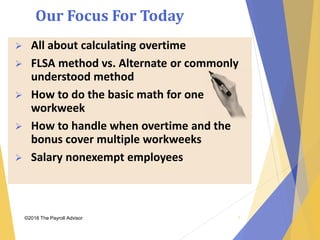
 All about calculating overtime
 FLSA method vs. Alternate or commonly
understood method
 How to do the basic math for one
workweek
 How to handle when overtime and the
bonus cover multiple workweeks
 Salary nonexempt employees
Let’s Review Our Definition of
Overtime
©2018 The Payroll Advisor
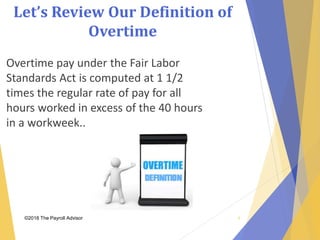
Overtime pay under the Fair Labor
Standards Act is computed at 1 1/2
times the regular rate of pay for all
hours worked in excess of the 40 hours
in a workweek..
8
Let’s Review the Term Regular
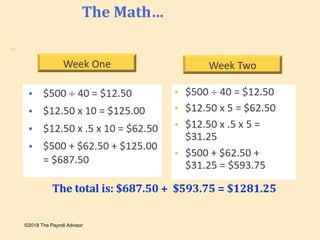
Rate of Pay…
©2018 The Payroll Advisor
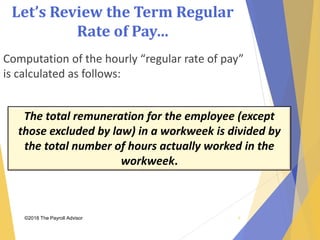
Computation of the hourly “regular rate of pay”
is calculated as follows:
The total remuneration for the employee (except
those excluded by law) in a workweek is divided by
the total number of hours actually worked in the
workweek.
9
Doing the Math…Following the
Steps
©2018 The Payroll Advisor 10
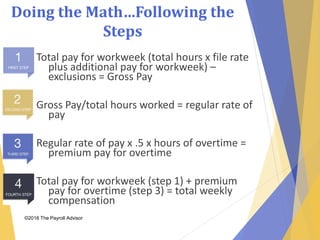
Total pay for workweek (total hours x file rate
plus additional pay for workweek) –
exclusions = Gross Pay
Gross Pay/total hours worked = regular rate of
pay
Regular rate of pay x .5 x hours of overtime =
premium pay for overtime
Total pay for workweek (step 1) + premium
pay for overtime (step 3) = total weekly
compensation
Can We Go Back to Step # 3 For a
Minute?
©2017 The Payroll Advisor
11
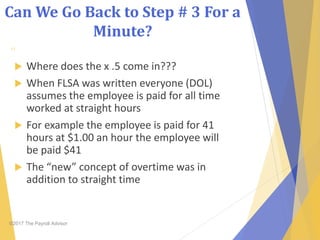
 Where does the x .5 come in???
 When FLSA was written everyone (DOL)
assumes the employee is paid for all time
worked at straight hours
 For example the employee is paid for 41
hours at $1.00 an hour the employee will
be paid $41
 The “new” concept of overtime was in
addition to straight time
Can We Go Back to Step # 3?
©2017 The Payroll Advisor
12
 Overtime was a premium added to straight
time
 The employer is expected to calculate all
the straight time first then use that to
calculate the overtime premium
 Hence .5 at the regular rate…the 1 of 1 ½
was already paid with the straight time
 All that is owed is the ½
Now an Example with
Numbers…
©2018 The Payroll Advisor 13
Example Information:
 Employee is paid an hourly
rate of $15.00
 Works 44 hours in the
workweek
 First the common method
 Then the FLSA method
The Proper or FLSA Method…
©2018 The Payroll Advisor 14
44 x $15.00 = $660.00
$660.00 ÷ 44 = $15.00
$15.00 x .5 = $7.50
4 x $7.50 = $30.00
$660.00 + $30.00 = $690.00
So what is the difference between the proper
method and the commonly understood
method of calculating overtime?
Commonly Used or Alternative
Method
©2018 The Payroll Advisor 15
40 x $15.00 = $600.00
$15.00 x 1.5 = 22.50
4 x $22.50 = $90.00
$600.00 + $90.00 = $690.00
This uses the time and a half method that most
computers use and is acceptable if the employee
does not have any additional wages that trigger
the required method—No difference. FLSA would
accept both
The Proper or FLSA Method…
©2017 The Payroll Advisor
16
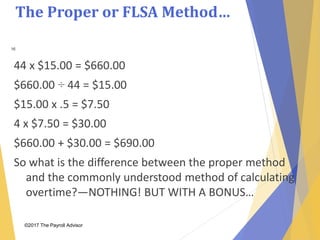
44 x $15.00 = $660.00
$660.00 ÷ 44 = $15.00
$15.00 x .5 = $7.50
4 x $7.50 = $30.00
$660.00 + $30.00 = $690.00
So what is the difference between the proper method
and the commonly understood method of calculating
overtime?—NOTHING! BUT WITH A BONUS…
Example With Bonus
©2018 The Payroll Advisor 17
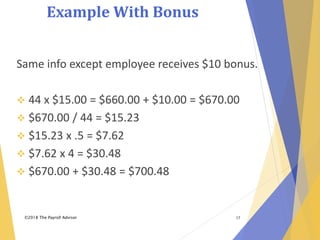
Same info except employee receives $10 bonus.
 44 x $15.00 = $660.00 + $10.00 = $670.00
 $670.00 / 44 = $15.23
 $15.23 x .5 = $7.62
 $7.62 x 4 = $30.48
 $670.00 + $30.48 = $700.48
Notice the Difference…
©2018 The Payroll Advisor 18
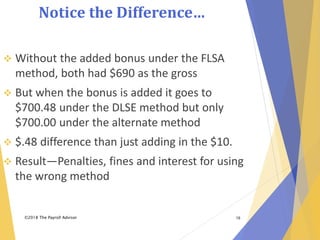
 Without the added bonus under the FLSA
method, both had $690 as the gross
 But when the bonus is added it goes to
$700.48 under the DLSE method but only
$700.00 under the alternate method
 $.48 difference than just adding in the $10.
 Result—Penalties, fines and interest for using
the wrong method
Let’s Do Another Example
©2018 The Payroll Advisor
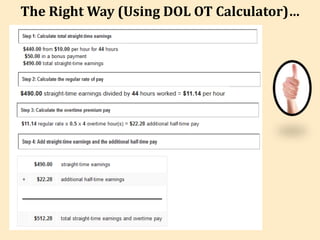
A warehouse worker worked 44 hours last
week. In additional to his regular wage of
$10.00 an hour, he was paid $50.00 for
completing a job on time and on budget.
19
©2018 The Payroll Advisor 20
The Right Way (Using DOL OT Calculator)…
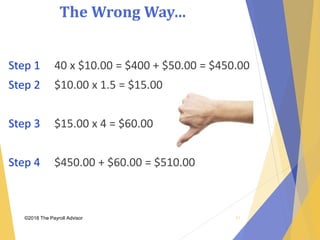
The Wrong Way…
©2018 The Payroll Advisor
Step 1 40 x $10.00 = $400 + $50.00 = $450.00
Step 2 $10.00 x 1.5 = $15.00
Step 3 $15.00 x 4 = $60.00
Step 4 $450.00 + $60.00 = $510.00
21
Let’s compare…
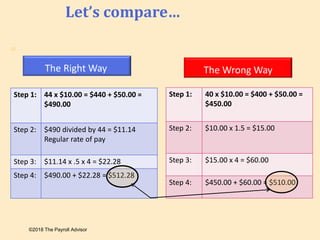
Step 1: 44 x $10.00 = $440 + $50.00 =
$490.00
Step 2: $490 divided by 44 = $11.14
Regular rate of pay
Step 3: $11.14 x .5 x 4 = $22.28
Step 4: $490.00 + $22.28 = $512.28
Step 1: 40 x $10.00 = $400 + $50.00 =
$450.00
Step 2: $10.00 x 1.5 = $15.00
Step 3: $15.00 x 4 = $60.00
Step 4: $450.00 + $60.00 = $510.00
©2018 The Payroll Advisor
The Right Way The Wrong Way
22
MT
WY
ID
WA
OR
NV
UT
CA
AZ
ND
SD
NE
CO
NM
TX
OK
KS
AR
LA
MO
IA
MN
WI
IL IN
KY
TN
MS AL GA
FL
SC
NC
VA
WV
OH
MI
NY
PA
MD
DE
NJ
CT
RI
MA
ME
VT
NH
AK
HI
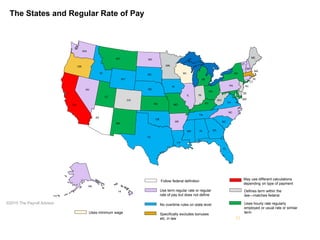
Follow federal definition
The States and Regular Rate of Pay
©2015 The Payroll Advisor
23
Use term regular rate or regular
rate of pay but does not define
May use different calculations
depending on type of payment
Defines term within the
law—matches federal
No overtime rules on state level Uses hourly rate regularly
employed or usual rate or similar
term
Specifically excludes bonuses
etc. in law
Uses minimum wage
But What if More than
One Work Week Is Involved?
©2018 The Payroll Advisor
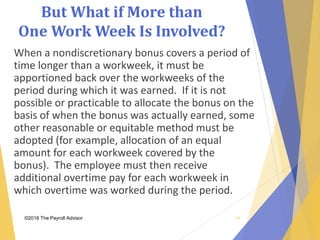
When a nondiscretionary bonus covers a period of
time longer than a workweek, it must be
apportioned back over the workweeks of the
period during which it was earned. If it is not
possible or practicable to allocate the bonus on the
basis of when the bonus was actually earned, some
other reasonable or equitable method must be
adopted (for example, allocation of an equal
amount for each workweek covered by the
bonus). The employee must then receive
additional overtime pay for each workweek in
which overtime was worked during the period.
24
Let’s Do Some Math
On This One
©2018 The Payroll Advisor
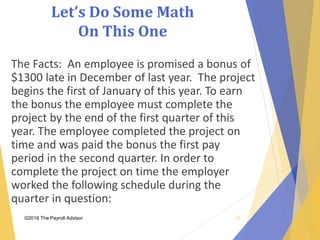
The Facts: An employee is promised a bonus of
$1300 late in December of last year. The project
begins the first of January of this year. To earn
the bonus the employee must complete the
project by the end of the first quarter of this
year. The employee completed the project on
time and was paid the bonus the first pay
period in the second quarter. In order to
complete the project on time the employer
worked the following schedule during the
quarter in question:
25
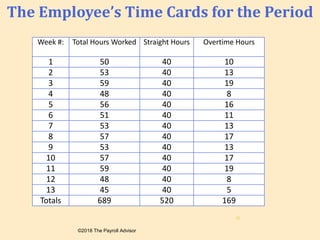
Week #: Total Hours Worked Straight Hours Overtime Hours
1 50 40 10
2 53 40 13
3 59 40 19
4 48 40 8
5 56 40 16
6 51 40 11
7 53 40 13
8 57 40 17
9 53 40 13
10 57 40 17
11 59 40 19
12 48 40 8
13 45 40 5
Totals 689 520 169
The Employee’s Time Cards for the Period
©2018 The Payroll Advisor
26
The Methods We Can Use…
©2018 The Payroll Advisor
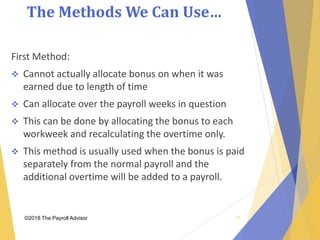
First Method:
 Cannot actually allocate bonus on when it was
earned due to length of time
 Can allocate over the payroll weeks in question
 This can be done by allocating the bonus to each
workweek and recalculating the overtime only.
 This method is usually used when the bonus is paid
separately from the normal payroll and the
additional overtime will be added to a payroll.
27
Example
©2018 The Payroll Advisor
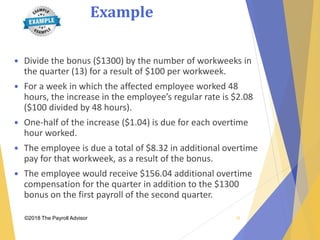
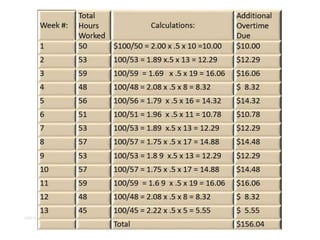
 Divide the bonus ($1300) by the number of workweeks in
the quarter (13) for a result of $100 per workweek.
 For a week in which the affected employee worked 48
hours, the increase in the employee’s regular rate is $2.08
($100 divided by 48 hours).
 One-half of the increase ($1.04) is due for each overtime
hour worked.
 The employee is due a total of $8.32 in additional overtime
pay for that workweek, as a result of the bonus.
 The employee would receive $156.04 additional overtime
compensation for the quarter in addition to the $1300
bonus on the first payroll of the second quarter.
28
©2018 The Payroll Advisor 29
Second Method…
©2018 The Payroll Advisor
 It can be done by recalculating
the gross for each workweek.
 This method is used when the
additional overtime will be
combined with the bonus
payment or all are added to the
payroll.
30
Example:
©2018 The Payroll Advisor
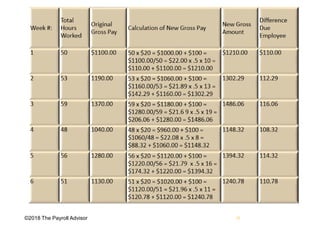
Employee is paid $20 per hour. Original gross pay
included only straight time and overtime hours no
additional payments were made. In this example
the payroll department would recalculate the
gross payroll for each pay week in question to
include the $100 per week bonus. The employee
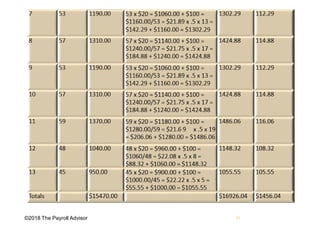
would then be due $1456.04 additional
compensation. This is the additional overtime plus
the bonus.
31
©2018 The Payroll Advisor 32
©2018 The Payroll Advisor 33
Third Method…
©2018 The Payroll Advisor
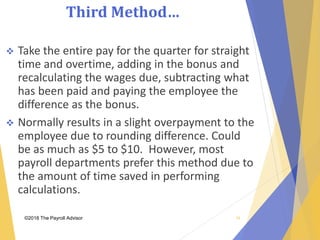
 Take the entire pay for the quarter for straight
time and overtime, adding in the bonus and
recalculating the wages due, subtracting what
has been paid and paying the employee the
difference as the bonus.
 Normally results in a slight overpayment to the
employee due to rounding difference. Could
be as much as $5 to $10. However, most
payroll departments prefer this method due to
the amount of time saved in performing
calculations.
34
Example
©2018 The Payroll Advisor
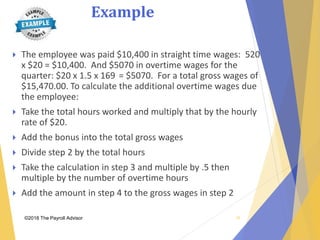
 The employee was paid $10,400 in straight time wages: 520
x $20 = $10,400. And $5070 in overtime wages for the
quarter: $20 x 1.5 x 169 = $5070. For a total gross wages of
$15,470.00. To calculate the additional overtime wages due
the employee:
 Take the total hours worked and multiply that by the hourly
rate of $20.
 Add the bonus into the total gross wages
 Divide step 2 by the total hours
 Take the calculation in step 3 and multiple by .5 then
multiple by the number of overtime hours
 Add the amount in step 4 to the gross wages in step 2
35
Here is the Math…
©2018 The Payroll Advisor
 Step 1: 689 x 20 = $13,780.00
 Step 2: $13,780.00 + $1,300.00 = $15,080.00
 Step 3: $15,080.00/689 = $21.89
 Step 4: $21.89 x .5 x 169 = $1,849 .71
 Step 5: $1,849 .71 + $15,080.00 = $16,929.71
Step 5 is the new amount due the employee including the
bonus of $1,300.
Now minus the original gross already paid of $15,470.00 and
that results in a payment of $1,459.71.
$1,300 of the payment is the original bonus and $159 .71 is
for the additional overtime due.
36
Why the Difference in this
Method?
©2018 The Payroll Advisor
As noted above this overtime due
figure is slightly higher than the other
2 due to rounding. So in this example
the employee would receive an
additional $3.67 in overtime wages.
However, common practice is to use
this method to save time in the
payroll department.
37
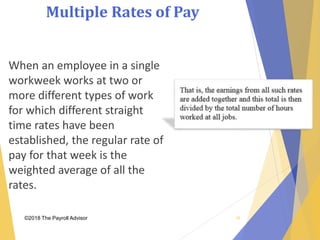
Multiple Rates of Pay
©2018 The Payroll Advisor
When an employee in a single
workweek works at two or
more different types of work
for which different straight
time rates have been
established, the regular rate of
pay for that week is the
weighted average of all the
rates.
38
Example
©2018 The Payroll Advisor
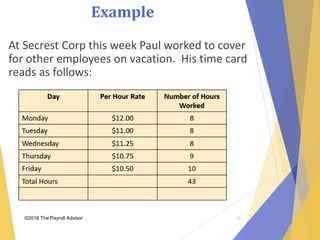
At Secrest Corp this week Paul worked to cover
for other employees on vacation. His time card
reads as follows:
39
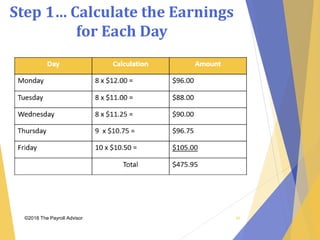
Step 1… Calculate the Earnings
for Each Day
©2018 The Payroll Advisor 40
Then…
©2018 The Payroll Advisor
Step 2: Divide the total earnings by the total hours
worked to determine the regular rate of pay
$475.75 divided by 43 = $11.06 (regular rate of pay)
Step 3: Determine the premium pay for overtime by
multiplying the regular rate of pay by .5 (or divide
by 2) then multiplying that amount by the
number of overtime hours
$11.06 x .5 x 3 = $16.59
41
Finally Step 4…
©2018 The Payroll Advisor
Determine the total weekly
compensation by adding the total
earnings (step 1) and the premium
pay (step 3)
$475.75 + $16.59 = $492.34
total weekly compensation
42
Weekly Salary Basis
©2018 The Payroll Advisor
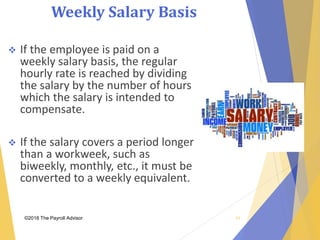
 If the employee is paid on a
weekly salary basis, the regular
hourly rate is reached by dividing
the salary by the number of hours
which the salary is intended to
compensate.
 If the salary covers a period longer
than a workweek, such as
biweekly, monthly, etc., it must be
converted to a weekly equivalent.
43
Fixed Work Weeks
©2018 The Payroll Advisor
Where employees are paid a salary for a fixed
workweek, (salary intended to cover only a specified
number of hours per week, i.e. 37 1/2 or 40) total
earnings are divided by the number of "fixed" hours
rather than the number of hours worked.
Example: Joe is hired at a salary of $500 per week.
It is understood that this salary is compensation for
a regular workweek of 35 hours or $14.29 per hour.
When overtime is worked Joe is entitled to receive
$14.29 for each of the first 40 hours and $21.44
(time and one half) for each hour thereafter.
44
Biweekly Payroll Example Fixed
Work Week
©2018 The Payroll Advisor
Sylvia is hired at a weekly salary
of $500 a week. The salary is
based on a fixed workweek of 40
hours. She worked 50 hours her
first week and 45 hours her
second week of a biweekly
payroll
45
The Math…
©2018 The Payroll Advisor
46
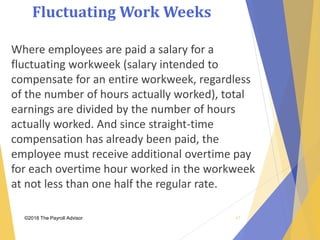
Fluctuating Work Weeks
©2018 The Payroll Advisor
Where employees are paid a salary for a
fluctuating workweek (salary intended to
compensate for an entire workweek, regardless
of the number of hours actually worked), total
earnings are divided by the number of hours
actually worked. And since straight-time
compensation has already been paid, the
employee must receive additional overtime pay
for each overtime hour worked in the workweek
at not less than one half the regular rate.
47
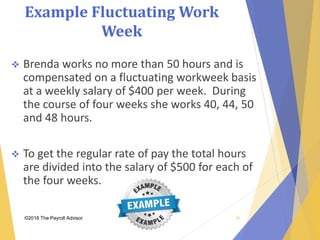
Example Fluctuating Work
Week
©2018 The Payroll Advisor
 Brenda works no more than 50 hours and is
compensated on a fluctuating workweek basis
at a weekly salary of $400 per week. During
the course of four weeks she works 40, 44, 50
and 48 hours.
 To get the regular rate of pay the total hours
are divided into the salary of $500 for each of
the four weeks.
48
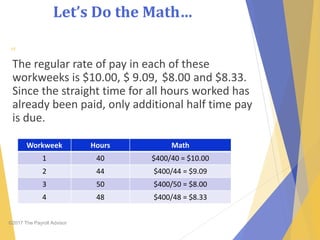
Let’s Do the Math…
©2017 The Payroll Advisor
The regular rate of pay in each of these
workweeks is $10.00, $ 9.09, $8.00 and $8.33.
Since the straight time for all hours worked has
already been paid, only additional half time pay
is due.
49
Workweek Hours Math
1 40 $400/40 = $10.00
2 44 $400/44 = $9.09
3 50 $400/50 = $8.00
4 48 $400/48 = $8.33
Let’s Do the Math…
©2018 The Payroll Advisor
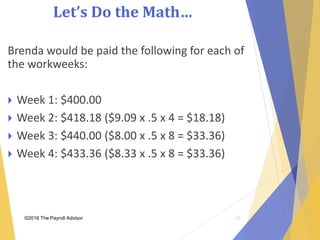
Brenda would be paid the following for each of
the workweeks:
 Week 1: $400.00
 Week 2: $418.18 ($9.09 x .5 x 4 = $18.18)
 Week 3: $440.00 ($8.00 x .5 x 8 = $33.36)
 Week 4: $433.36 ($8.33 x .5 x 8 = $33.36)
50
Deductions
©2018 The Payroll Advisor
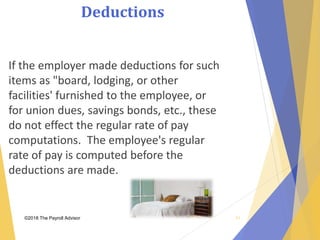
If the employer made deductions for such
items as "board, lodging, or other
facilities' furnished to the employee, or
for union dues, savings bonds, etc., these
do not effect the regular rate of pay
computations. The employee's regular
rate of pay is computed before the
deductions are made.
51
Non-Cash Payments
©2018 The Payroll Advisor
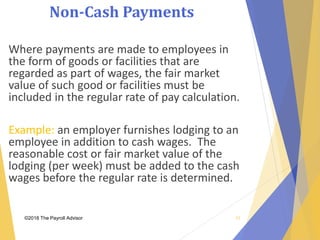
Where payments are made to employees in
the form of goods or facilities that are
regarded as part of wages, the fair market
value of such good or facilities must be
included in the regular rate of pay calculation.
Example: an employer furnishes lodging to an
employee in addition to cash wages. The
reasonable cost or fair market value of the
lodging (per week) must be added to the cash
wages before the regular rate is determined.
52
Additional Resources
©2018 The Payroll Advisor
 www.dol.gov
 Overtime calculator:
http://www.dol.gov/elaws/otcalculator.htm
 Hours worked:
http://www.dol.gov/elaws/esa/flsa/hoursworked/default.asp
53
Are There Any Questions?
©2018 The Payroll Advisor 54
Ascentis
can help
Payroll
HR &
Benefits
Talent
Management
Recruiting &
Onboarding
Time &
Attendance
Payroll Software
› Process payroll in real-time
with flexibility, control and
100% accuracy.
› Synchronized systems and
instantaneous auditing can
reduce processing time by
30%.
Learn more
Request an assessment of your organization’s overtime payroll strategy.
How to earn credit
Stay on the webinar,
online for the full 60
minutes
Be watching using your
unique URL
Program codes delivered
by email, to registered
email, approximately 30
days following today’s
session
Share with your colleagues
Contact Us
webinars@ascentis.com
www.ascentis.com
800.229.2713

Payroll Webinar: Paying Overtime Under the FLSA: Part 2

  • 1.
    ©2018 The PayrollAdvisor 1 Paying Overtime Under the FLSA: Part 2 Presented on Wednesday, December 5, 2018
  • 2.
  • 3.
  • 4.
    How to earncredit Stay on the webinar, online for the full 60 minutes Be watching using your unique URL Program codes delivered by email, to registered email, approximately 30 days following today’s session
  • 5.
  • 6.
  • 7.
    Our Focus ForToday ©2018 The Payroll Advisor 7  All about calculating overtime  FLSA method vs. Alternate or commonly understood method  How to do the basic math for one workweek  How to handle when overtime and the bonus cover multiple workweeks  Salary nonexempt employees
  • 8.
    Let’s Review OurDefinition of Overtime ©2018 The Payroll Advisor Overtime pay under the Fair Labor Standards Act is computed at 1 1/2 times the regular rate of pay for all hours worked in excess of the 40 hours in a workweek.. 8
  • 9.
    Let’s Review theTerm Regular Rate of Pay… ©2018 The Payroll Advisor Computation of the hourly “regular rate of pay” is calculated as follows: The total remuneration for the employee (except those excluded by law) in a workweek is divided by the total number of hours actually worked in the workweek. 9
  • 10.
    Doing the Math…Followingthe Steps ©2018 The Payroll Advisor 10 Total pay for workweek (total hours x file rate plus additional pay for workweek) – exclusions = Gross Pay Gross Pay/total hours worked = regular rate of pay Regular rate of pay x .5 x hours of overtime = premium pay for overtime Total pay for workweek (step 1) + premium pay for overtime (step 3) = total weekly compensation
  • 11.
    Can We GoBack to Step # 3 For a Minute? ©2017 The Payroll Advisor 11  Where does the x .5 come in???  When FLSA was written everyone (DOL) assumes the employee is paid for all time worked at straight hours  For example the employee is paid for 41 hours at $1.00 an hour the employee will be paid $41  The “new” concept of overtime was in addition to straight time
  • 12.
    Can We GoBack to Step # 3? ©2017 The Payroll Advisor 12  Overtime was a premium added to straight time  The employer is expected to calculate all the straight time first then use that to calculate the overtime premium  Hence .5 at the regular rate…the 1 of 1 ½ was already paid with the straight time  All that is owed is the ½
  • 13.
    Now an Examplewith Numbers… ©2018 The Payroll Advisor 13 Example Information:  Employee is paid an hourly rate of $15.00  Works 44 hours in the workweek  First the common method  Then the FLSA method
  • 14.
    The Proper orFLSA Method… ©2018 The Payroll Advisor 14 44 x $15.00 = $660.00 $660.00 ÷ 44 = $15.00 $15.00 x .5 = $7.50 4 x $7.50 = $30.00 $660.00 + $30.00 = $690.00 So what is the difference between the proper method and the commonly understood method of calculating overtime?
  • 15.
    Commonly Used orAlternative Method ©2018 The Payroll Advisor 15 40 x $15.00 = $600.00 $15.00 x 1.5 = 22.50 4 x $22.50 = $90.00 $600.00 + $90.00 = $690.00 This uses the time and a half method that most computers use and is acceptable if the employee does not have any additional wages that trigger the required method—No difference. FLSA would accept both
  • 16.
    The Proper orFLSA Method… ©2017 The Payroll Advisor 16 44 x $15.00 = $660.00 $660.00 ÷ 44 = $15.00 $15.00 x .5 = $7.50 4 x $7.50 = $30.00 $660.00 + $30.00 = $690.00 So what is the difference between the proper method and the commonly understood method of calculating overtime?—NOTHING! BUT WITH A BONUS…
  • 17.
    Example With Bonus ©2018The Payroll Advisor 17 Same info except employee receives $10 bonus.  44 x $15.00 = $660.00 + $10.00 = $670.00  $670.00 / 44 = $15.23  $15.23 x .5 = $7.62  $7.62 x 4 = $30.48  $670.00 + $30.48 = $700.48
  • 18.
    Notice the Difference… ©2018The Payroll Advisor 18  Without the added bonus under the FLSA method, both had $690 as the gross  But when the bonus is added it goes to $700.48 under the DLSE method but only $700.00 under the alternate method  $.48 difference than just adding in the $10.  Result—Penalties, fines and interest for using the wrong method
  • 19.
    Let’s Do AnotherExample ©2018 The Payroll Advisor A warehouse worker worked 44 hours last week. In additional to his regular wage of $10.00 an hour, he was paid $50.00 for completing a job on time and on budget. 19
  • 20.
    ©2018 The PayrollAdvisor 20 The Right Way (Using DOL OT Calculator)…
  • 21.
    The Wrong Way… ©2018The Payroll Advisor Step 1 40 x $10.00 = $400 + $50.00 = $450.00 Step 2 $10.00 x 1.5 = $15.00 Step 3 $15.00 x 4 = $60.00 Step 4 $450.00 + $60.00 = $510.00 21
  • 22.
    Let’s compare… Step 1:44 x $10.00 = $440 + $50.00 = $490.00 Step 2: $490 divided by 44 = $11.14 Regular rate of pay Step 3: $11.14 x .5 x 4 = $22.28 Step 4: $490.00 + $22.28 = $512.28 Step 1: 40 x $10.00 = $400 + $50.00 = $450.00 Step 2: $10.00 x 1.5 = $15.00 Step 3: $15.00 x 4 = $60.00 Step 4: $450.00 + $60.00 = $510.00 ©2018 The Payroll Advisor The Right Way The Wrong Way 22
  • 23.
    MT WY ID WA OR NV UT CA AZ ND SD NE CO NM TX OK KS AR LA MO IA MN WI IL IN KY TN MS ALGA FL SC NC VA WV OH MI NY PA MD DE NJ CT RI MA ME VT NH AK HI Follow federal definition The States and Regular Rate of Pay ©2015 The Payroll Advisor 23 Use term regular rate or regular rate of pay but does not define May use different calculations depending on type of payment Defines term within the law—matches federal No overtime rules on state level Uses hourly rate regularly employed or usual rate or similar term Specifically excludes bonuses etc. in law Uses minimum wage
  • 24.
    But What ifMore than One Work Week Is Involved? ©2018 The Payroll Advisor When a nondiscretionary bonus covers a period of time longer than a workweek, it must be apportioned back over the workweeks of the period during which it was earned. If it is not possible or practicable to allocate the bonus on the basis of when the bonus was actually earned, some other reasonable or equitable method must be adopted (for example, allocation of an equal amount for each workweek covered by the bonus). The employee must then receive additional overtime pay for each workweek in which overtime was worked during the period. 24
  • 25.
    Let’s Do SomeMath On This One ©2018 The Payroll Advisor The Facts: An employee is promised a bonus of $1300 late in December of last year. The project begins the first of January of this year. To earn the bonus the employee must complete the project by the end of the first quarter of this year. The employee completed the project on time and was paid the bonus the first pay period in the second quarter. In order to complete the project on time the employer worked the following schedule during the quarter in question: 25
  • 26.
    Week #: TotalHours Worked Straight Hours Overtime Hours 1 50 40 10 2 53 40 13 3 59 40 19 4 48 40 8 5 56 40 16 6 51 40 11 7 53 40 13 8 57 40 17 9 53 40 13 10 57 40 17 11 59 40 19 12 48 40 8 13 45 40 5 Totals 689 520 169 The Employee’s Time Cards for the Period ©2018 The Payroll Advisor 26
  • 27.
    The Methods WeCan Use… ©2018 The Payroll Advisor First Method:  Cannot actually allocate bonus on when it was earned due to length of time  Can allocate over the payroll weeks in question  This can be done by allocating the bonus to each workweek and recalculating the overtime only.  This method is usually used when the bonus is paid separately from the normal payroll and the additional overtime will be added to a payroll. 27
  • 28.
    Example ©2018 The PayrollAdvisor  Divide the bonus ($1300) by the number of workweeks in the quarter (13) for a result of $100 per workweek.  For a week in which the affected employee worked 48 hours, the increase in the employee’s regular rate is $2.08 ($100 divided by 48 hours).  One-half of the increase ($1.04) is due for each overtime hour worked.  The employee is due a total of $8.32 in additional overtime pay for that workweek, as a result of the bonus.  The employee would receive $156.04 additional overtime compensation for the quarter in addition to the $1300 bonus on the first payroll of the second quarter. 28
  • 29.
  • 30.
    Second Method… ©2018 ThePayroll Advisor  It can be done by recalculating the gross for each workweek.  This method is used when the additional overtime will be combined with the bonus payment or all are added to the payroll. 30
  • 31.
    Example: ©2018 The PayrollAdvisor Employee is paid $20 per hour. Original gross pay included only straight time and overtime hours no additional payments were made. In this example the payroll department would recalculate the gross payroll for each pay week in question to include the $100 per week bonus. The employee would then be due $1456.04 additional compensation. This is the additional overtime plus the bonus. 31
  • 32.
  • 33.
  • 34.
    Third Method… ©2018 ThePayroll Advisor  Take the entire pay for the quarter for straight time and overtime, adding in the bonus and recalculating the wages due, subtracting what has been paid and paying the employee the difference as the bonus.  Normally results in a slight overpayment to the employee due to rounding difference. Could be as much as $5 to $10. However, most payroll departments prefer this method due to the amount of time saved in performing calculations. 34
  • 35.
    Example ©2018 The PayrollAdvisor  The employee was paid $10,400 in straight time wages: 520 x $20 = $10,400. And $5070 in overtime wages for the quarter: $20 x 1.5 x 169 = $5070. For a total gross wages of $15,470.00. To calculate the additional overtime wages due the employee:  Take the total hours worked and multiply that by the hourly rate of $20.  Add the bonus into the total gross wages  Divide step 2 by the total hours  Take the calculation in step 3 and multiple by .5 then multiple by the number of overtime hours  Add the amount in step 4 to the gross wages in step 2 35
  • 36.
    Here is theMath… ©2018 The Payroll Advisor  Step 1: 689 x 20 = $13,780.00  Step 2: $13,780.00 + $1,300.00 = $15,080.00  Step 3: $15,080.00/689 = $21.89  Step 4: $21.89 x .5 x 169 = $1,849 .71  Step 5: $1,849 .71 + $15,080.00 = $16,929.71 Step 5 is the new amount due the employee including the bonus of $1,300. Now minus the original gross already paid of $15,470.00 and that results in a payment of $1,459.71. $1,300 of the payment is the original bonus and $159 .71 is for the additional overtime due. 36
  • 37.
    Why the Differencein this Method? ©2018 The Payroll Advisor As noted above this overtime due figure is slightly higher than the other 2 due to rounding. So in this example the employee would receive an additional $3.67 in overtime wages. However, common practice is to use this method to save time in the payroll department. 37
  • 38.
    Multiple Rates ofPay ©2018 The Payroll Advisor When an employee in a single workweek works at two or more different types of work for which different straight time rates have been established, the regular rate of pay for that week is the weighted average of all the rates. 38
  • 39.
    Example ©2018 The PayrollAdvisor At Secrest Corp this week Paul worked to cover for other employees on vacation. His time card reads as follows: 39
  • 40.
    Step 1… Calculatethe Earnings for Each Day ©2018 The Payroll Advisor 40
  • 41.
    Then… ©2018 The PayrollAdvisor Step 2: Divide the total earnings by the total hours worked to determine the regular rate of pay $475.75 divided by 43 = $11.06 (regular rate of pay) Step 3: Determine the premium pay for overtime by multiplying the regular rate of pay by .5 (or divide by 2) then multiplying that amount by the number of overtime hours $11.06 x .5 x 3 = $16.59 41
  • 42.
    Finally Step 4… ©2018The Payroll Advisor Determine the total weekly compensation by adding the total earnings (step 1) and the premium pay (step 3) $475.75 + $16.59 = $492.34 total weekly compensation 42
  • 43.
    Weekly Salary Basis ©2018The Payroll Advisor  If the employee is paid on a weekly salary basis, the regular hourly rate is reached by dividing the salary by the number of hours which the salary is intended to compensate.  If the salary covers a period longer than a workweek, such as biweekly, monthly, etc., it must be converted to a weekly equivalent. 43
  • 44.
    Fixed Work Weeks ©2018The Payroll Advisor Where employees are paid a salary for a fixed workweek, (salary intended to cover only a specified number of hours per week, i.e. 37 1/2 or 40) total earnings are divided by the number of "fixed" hours rather than the number of hours worked. Example: Joe is hired at a salary of $500 per week. It is understood that this salary is compensation for a regular workweek of 35 hours or $14.29 per hour. When overtime is worked Joe is entitled to receive $14.29 for each of the first 40 hours and $21.44 (time and one half) for each hour thereafter. 44
  • 45.
    Biweekly Payroll ExampleFixed Work Week ©2018 The Payroll Advisor Sylvia is hired at a weekly salary of $500 a week. The salary is based on a fixed workweek of 40 hours. She worked 50 hours her first week and 45 hours her second week of a biweekly payroll 45
  • 46.
    The Math… ©2018 ThePayroll Advisor 46
  • 47.
    Fluctuating Work Weeks ©2018The Payroll Advisor Where employees are paid a salary for a fluctuating workweek (salary intended to compensate for an entire workweek, regardless of the number of hours actually worked), total earnings are divided by the number of hours actually worked. And since straight-time compensation has already been paid, the employee must receive additional overtime pay for each overtime hour worked in the workweek at not less than one half the regular rate. 47
  • 48.
    Example Fluctuating Work Week ©2018The Payroll Advisor  Brenda works no more than 50 hours and is compensated on a fluctuating workweek basis at a weekly salary of $400 per week. During the course of four weeks she works 40, 44, 50 and 48 hours.  To get the regular rate of pay the total hours are divided into the salary of $500 for each of the four weeks. 48
  • 49.
    Let’s Do theMath… ©2017 The Payroll Advisor The regular rate of pay in each of these workweeks is $10.00, $ 9.09, $8.00 and $8.33. Since the straight time for all hours worked has already been paid, only additional half time pay is due. 49 Workweek Hours Math 1 40 $400/40 = $10.00 2 44 $400/44 = $9.09 3 50 $400/50 = $8.00 4 48 $400/48 = $8.33
  • 50.
    Let’s Do theMath… ©2018 The Payroll Advisor Brenda would be paid the following for each of the workweeks:  Week 1: $400.00  Week 2: $418.18 ($9.09 x .5 x 4 = $18.18)  Week 3: $440.00 ($8.00 x .5 x 8 = $33.36)  Week 4: $433.36 ($8.33 x .5 x 8 = $33.36) 50
  • 51.
    Deductions ©2018 The PayrollAdvisor If the employer made deductions for such items as "board, lodging, or other facilities' furnished to the employee, or for union dues, savings bonds, etc., these do not effect the regular rate of pay computations. The employee's regular rate of pay is computed before the deductions are made. 51
  • 52.
    Non-Cash Payments ©2018 ThePayroll Advisor Where payments are made to employees in the form of goods or facilities that are regarded as part of wages, the fair market value of such good or facilities must be included in the regular rate of pay calculation. Example: an employer furnishes lodging to an employee in addition to cash wages. The reasonable cost or fair market value of the lodging (per week) must be added to the cash wages before the regular rate is determined. 52
  • 53.
    Additional Resources ©2018 ThePayroll Advisor  www.dol.gov  Overtime calculator: http://www.dol.gov/elaws/otcalculator.htm  Hours worked: http://www.dol.gov/elaws/esa/flsa/hoursworked/default.asp 53
  • 54.
    Are There AnyQuestions? ©2018 The Payroll Advisor 54
  • 55.
    Ascentis can help Payroll HR & Benefits Talent Management Recruiting& Onboarding Time & Attendance Payroll Software › Process payroll in real-time with flexibility, control and 100% accuracy. › Synchronized systems and instantaneous auditing can reduce processing time by 30%.
  • 56.
    Learn more Request anassessment of your organization’s overtime payroll strategy.
  • 57.
    How to earncredit Stay on the webinar, online for the full 60 minutes Be watching using your unique URL Program codes delivered by email, to registered email, approximately 30 days following today’s session
  • 58.
    Share with yourcolleagues
  • 59.