1
Entity Relationship Diagram
ER
2
1976 proposed by Peter Chen
ER diagram is widely used in database design
Represent conceptual level of a database system
Describe things and their relationships in high level
Basic Concepts
3
Entity set – an abstraction of similar things, e.g. cars,
students
An entity set contains many entities
Attributes: common properties of the entities in a entity sets
Relationship – specify the relations among entities from two
or more entity sets
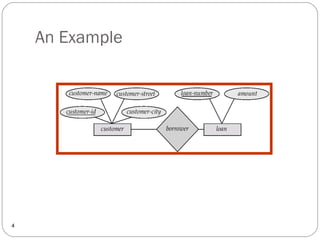
An Example
4
Relationship
5
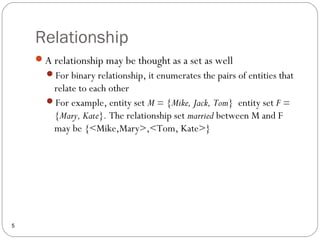
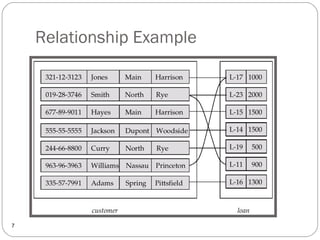
A relationship may be thought as a set as well
For binary relationship, it enumerates the pairs of entities that
relate to each other
For example, entity set M = {Mike, Jack, Tom} entity set F =
{Mary, Kate}. The relationship set married between M and F
may be {<Mike,Mary>,<Tom, Kate>}
Relationship
6
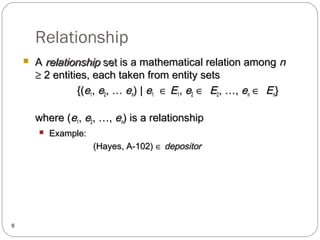
 AA relationshiprelationship setset is a mathematical relation amongis a mathematical relation among nn
≥≥ 2 entities, each taken from entity sets2 entities, each taken from entity sets
{({(ee11,, ee22, …, … eenn) |) | ee11 ∈∈ EE11,, ee22 ∈∈ EE22, …,, …, eenn ∈∈ EEnn}}
where (where (ee11,, ee22, …,, …, eenn) is a relationship) is a relationship
 Example:Example:
(Hayes, A-102)(Hayes, A-102) ∈∈ depositordepositor
Relationship Example
7
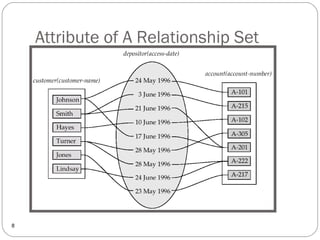
Attribute of A Relationship Set
8
Relationship
9
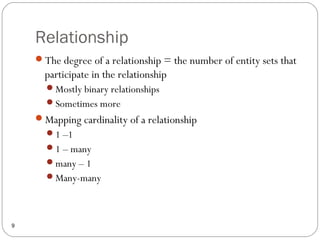
The degree of a relationship = the number of entity sets that
participate in the relationship
Mostly binary relationships
Sometimes more
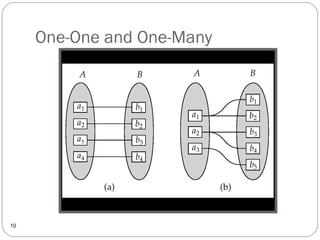
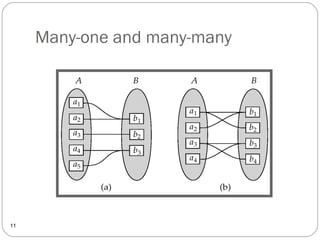
Mapping cardinality of a relationship
1 –1
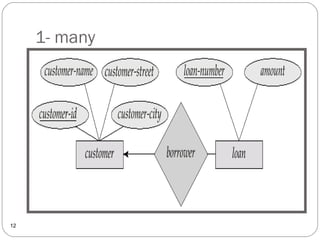
1 – many
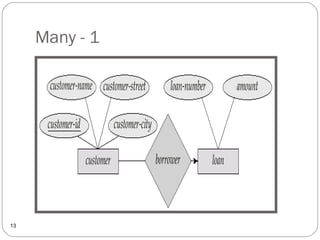
many – 1
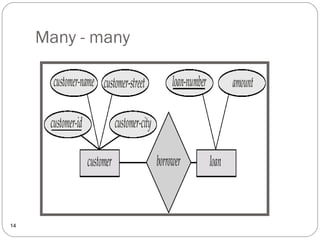
Many-many
One-One and One-Many
10
Many-one and many-many
11
1- many
12
Many - 1
13
Many - many
14
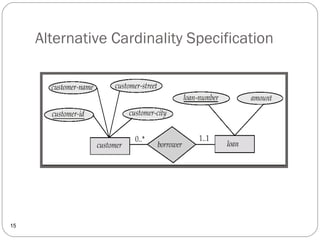
Alternative Cardinality Specification
15
Note on Mapping Cardinality
16
Both many and 1 include 0
Meaning some entity may not participate in the relationship
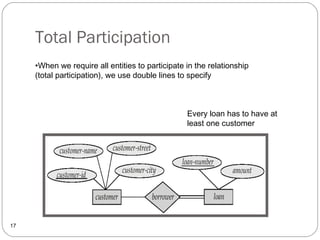
Total Participation
17
•When we require all entities to participate in the relationship
(total participation), we use double lines to specify
Every loan has to have at
least one customer
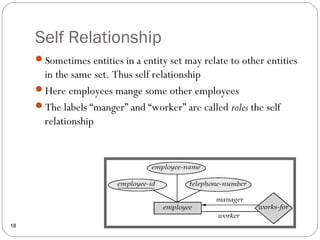
Self Relationship
18
Sometimes entities in a entity set may relate to other entities
in the same set. Thus self relationship
Here employees mange some other employees
The labels “manger” and “worker” are called roles the self
relationship
More examples on self-relationship
19
People to people
Parent – children
Manager – employee
Husband – wife
Word to word
Root – synonym
Attributes
20
Both entity sets and relationships can have attributes
Attributes may be
Composite
Multi-valued (double ellipse)
Derive (dashed ellipse)
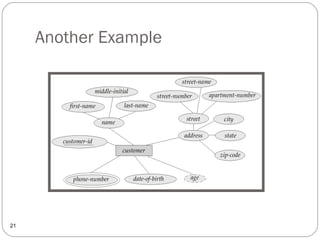
Another Example
21
Keys
22
A super key of an entity set is a set of one or more attributes
whose values uniquely determine each entity.
A candidate key of an entity set is a minimal super key
Although several candidate keys may exist, one of the
candidate keys is selected to be the primary key.
Key Examples
23
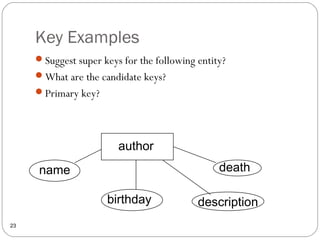
Suggest super keys for the following entity?
What are the candidate keys?
Primary key?
author
name
birthday
death
description
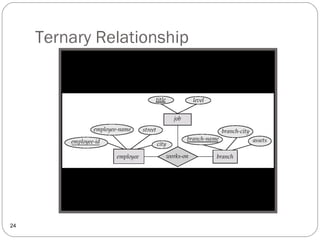
Ternary Relationship
24
Can We Decompose a Ternary
Relationship?
25
Some relationships that appear to be non-binary may be
better represented using binary relationships
E.g. A ternary relationship parents, relating a child to his/her
father and mother, is best replaced by two binary relationships,
father and mother
Using two binary relationships allows partial information (e.g. only
mother being know)
But there are some relationships that are naturally non-binary
E.g. works-on, why?
Converting Ternary to binary
26
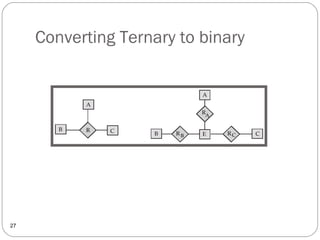
 In general, any non-binary relationship can be represented using binary
relationships by creating an artificial entity set.
 Replace R between entity sets A, B and C by an entity set E, and three relationship
sets:
1. RA, relating E and A 2.RB, relating E and B
3. RC, relating E and C
 Create a special identifying attribute for E
 Add any attributes of R to E
 For each relationship (ai , bi , ci) in R, create
1. a new entity ei in the entity set E 2. add (ei , ai) to RA
3. add (ei , bi ) to RB 4. add (ei , ci) to RC
Converting Ternary to binary
27
Design an ER Diagram
28
Design a database for an on-line reservation system for
microscopes in material science lab
There are two types of users: microscope administrators and
microscope end users
Each microscope is located in a specific lab
Each request is assigned to an administrator who can
authorize or deny the request
Using of some microscope requires the presence of an
administrator
Time is divided into 1 hour slots. Each reservation can only
take one or more time slots
Weak Entity Set
29
Some entity sets in real world naturally depend on some
other entity set
They can be uniquely identified only if combined with another
entity set
Example:
section1, section2, … become unique only if you put them
into a context, e.g. csce4350
Weak Entity Set Notations
30
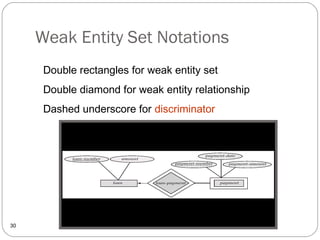
Double rectangles for weak entity set
Double diamond for weak entity relationship
Dashed underscore for discriminator
Specialization
31
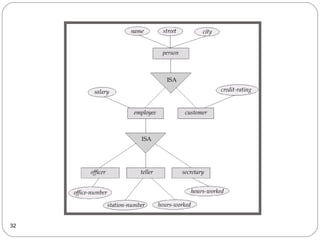
A lower-level entity set inherits all the attributes and
relationship participation of the higher-level entity set to
which it is linked.
A lower-level entity set may have additional attributes and
participate in additional relationships
32
Specification
33
Disjoint
Completeness constraint (use double lines)
total : an entity must belong to one of the lower-level entity
sets
partial: an entity need not belong to one of the lower-level
entity sets
Design Considerations
34
Use of entity sets vs. attributes
Whether we want to keep additional information
Use of entity sets vs. relationship sets
Actions among entities are usually represented by relationships
Binary versus n-ary relationship sets
N-nary relationships are usually more natural for actions among
entity sets
Weak entity set vs. strong entity set
Generalization
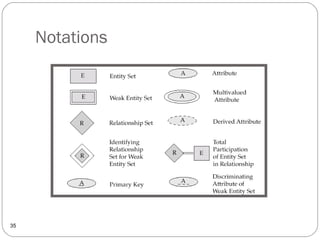
Notations
35
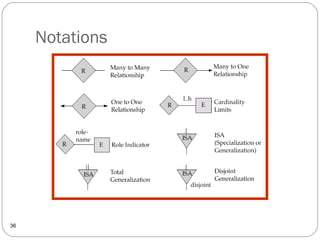
Notations
36
ER Practice Again
37
Design an ER diagram for an online music store. The
database will contain at least the following concepts: songs,
artists, bands, albums, and genres.
State your design assumptions you make to support design
decisions. Be sure your assumptions are reasonable.
Best Practice Guide for ER Design
38
Use of entity sets vs. attributes
Use of entity sets vs. relationship sets
Binary versus n-ary relationship sets
Weak entity set vs. strong entity set
Choose the natural one
Generalization
If specialized entities need to keep additional information and
participate in additional relationships
ER for Banking Enterprise
39
Description handhout
Read ER Diagrams
40
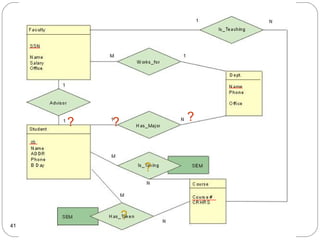
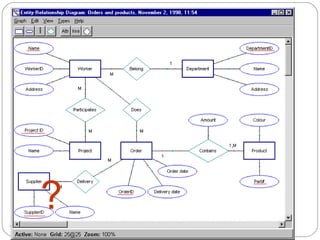
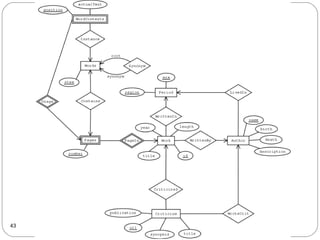
Following are some ER diagrams grabbed from the web
Read to understand/criticize
41
? ? ?
?
?
42
?
43

Entity relationship diagram

  • 1.
  • 2.
    ER 2 1976 proposed byPeter Chen ER diagram is widely used in database design Represent conceptual level of a database system Describe things and their relationships in high level
  • 3.
    Basic Concepts 3 Entity set– an abstraction of similar things, e.g. cars, students An entity set contains many entities Attributes: common properties of the entities in a entity sets Relationship – specify the relations among entities from two or more entity sets
  • 4.
  • 5.
    Relationship 5 A relationship maybe thought as a set as well For binary relationship, it enumerates the pairs of entities that relate to each other For example, entity set M = {Mike, Jack, Tom} entity set F = {Mary, Kate}. The relationship set married between M and F may be {<Mike,Mary>,<Tom, Kate>}
  • 6.
    Relationship 6  AA relationshiprelationshipsetset is a mathematical relation amongis a mathematical relation among nn ≥≥ 2 entities, each taken from entity sets2 entities, each taken from entity sets {({(ee11,, ee22, …, … eenn) |) | ee11 ∈∈ EE11,, ee22 ∈∈ EE22, …,, …, eenn ∈∈ EEnn}} where (where (ee11,, ee22, …,, …, eenn) is a relationship) is a relationship  Example:Example: (Hayes, A-102)(Hayes, A-102) ∈∈ depositordepositor
  • 7.
  • 8.
    Attribute of ARelationship Set 8
  • 9.
    Relationship 9 The degree ofa relationship = the number of entity sets that participate in the relationship Mostly binary relationships Sometimes more Mapping cardinality of a relationship 1 –1 1 – many many – 1 Many-many
  • 10.
  • 11.
  • 12.
  • 13.
  • 14.
  • 15.
  • 16.
    Note on MappingCardinality 16 Both many and 1 include 0 Meaning some entity may not participate in the relationship
  • 17.
    Total Participation 17 •When werequire all entities to participate in the relationship (total participation), we use double lines to specify Every loan has to have at least one customer
  • 18.
    Self Relationship 18 Sometimes entitiesin a entity set may relate to other entities in the same set. Thus self relationship Here employees mange some other employees The labels “manger” and “worker” are called roles the self relationship
  • 19.
    More examples onself-relationship 19 People to people Parent – children Manager – employee Husband – wife Word to word Root – synonym
  • 20.
    Attributes 20 Both entity setsand relationships can have attributes Attributes may be Composite Multi-valued (double ellipse) Derive (dashed ellipse)
  • 21.
  • 22.
    Keys 22 A super keyof an entity set is a set of one or more attributes whose values uniquely determine each entity. A candidate key of an entity set is a minimal super key Although several candidate keys may exist, one of the candidate keys is selected to be the primary key.
  • 23.
    Key Examples 23 Suggest superkeys for the following entity? What are the candidate keys? Primary key? author name birthday death description
  • 24.
  • 25.
    Can We Decomposea Ternary Relationship? 25 Some relationships that appear to be non-binary may be better represented using binary relationships E.g. A ternary relationship parents, relating a child to his/her father and mother, is best replaced by two binary relationships, father and mother Using two binary relationships allows partial information (e.g. only mother being know) But there are some relationships that are naturally non-binary E.g. works-on, why?
  • 26.
    Converting Ternary tobinary 26  In general, any non-binary relationship can be represented using binary relationships by creating an artificial entity set.  Replace R between entity sets A, B and C by an entity set E, and three relationship sets: 1. RA, relating E and A 2.RB, relating E and B 3. RC, relating E and C  Create a special identifying attribute for E  Add any attributes of R to E  For each relationship (ai , bi , ci) in R, create 1. a new entity ei in the entity set E 2. add (ei , ai) to RA 3. add (ei , bi ) to RB 4. add (ei , ci) to RC
  • 27.
  • 28.
    Design an ERDiagram 28 Design a database for an on-line reservation system for microscopes in material science lab There are two types of users: microscope administrators and microscope end users Each microscope is located in a specific lab Each request is assigned to an administrator who can authorize or deny the request Using of some microscope requires the presence of an administrator Time is divided into 1 hour slots. Each reservation can only take one or more time slots
  • 29.
    Weak Entity Set 29 Someentity sets in real world naturally depend on some other entity set They can be uniquely identified only if combined with another entity set Example: section1, section2, … become unique only if you put them into a context, e.g. csce4350
  • 30.
    Weak Entity SetNotations 30 Double rectangles for weak entity set Double diamond for weak entity relationship Dashed underscore for discriminator
  • 31.
    Specialization 31 A lower-level entityset inherits all the attributes and relationship participation of the higher-level entity set to which it is linked. A lower-level entity set may have additional attributes and participate in additional relationships
  • 32.
  • 33.
    Specification 33 Disjoint Completeness constraint (usedouble lines) total : an entity must belong to one of the lower-level entity sets partial: an entity need not belong to one of the lower-level entity sets
  • 34.
    Design Considerations 34 Use ofentity sets vs. attributes Whether we want to keep additional information Use of entity sets vs. relationship sets Actions among entities are usually represented by relationships Binary versus n-ary relationship sets N-nary relationships are usually more natural for actions among entity sets Weak entity set vs. strong entity set Generalization
  • 35.
  • 36.
  • 37.
    ER Practice Again 37 Designan ER diagram for an online music store. The database will contain at least the following concepts: songs, artists, bands, albums, and genres. State your design assumptions you make to support design decisions. Be sure your assumptions are reasonable.
  • 38.
    Best Practice Guidefor ER Design 38 Use of entity sets vs. attributes Use of entity sets vs. relationship sets Binary versus n-ary relationship sets Weak entity set vs. strong entity set Choose the natural one Generalization If specialized entities need to keep additional information and participate in additional relationships
  • 39.
    ER for BankingEnterprise 39 Description handhout
  • 40.
    Read ER Diagrams 40 Followingare some ER diagrams grabbed from the web Read to understand/criticize
  • 41.
  • 42.
  • 43.