The document discusses several problems with the Philippine educational system, including a decline in education quality, poor performance on national and international assessments, lack of affordability resulting in high dropout rates among disadvantaged students, low budget allocation to education relative to other ASEAN countries, and a mismatch between the skills taught and actual job requirements. Specific issues covered include outdated textbooks, lack of research in higher education, high pupil-teacher ratios, difficulties disciplining and engaging male students, and over-reliance on rote memorization teaching methods.
Present Date
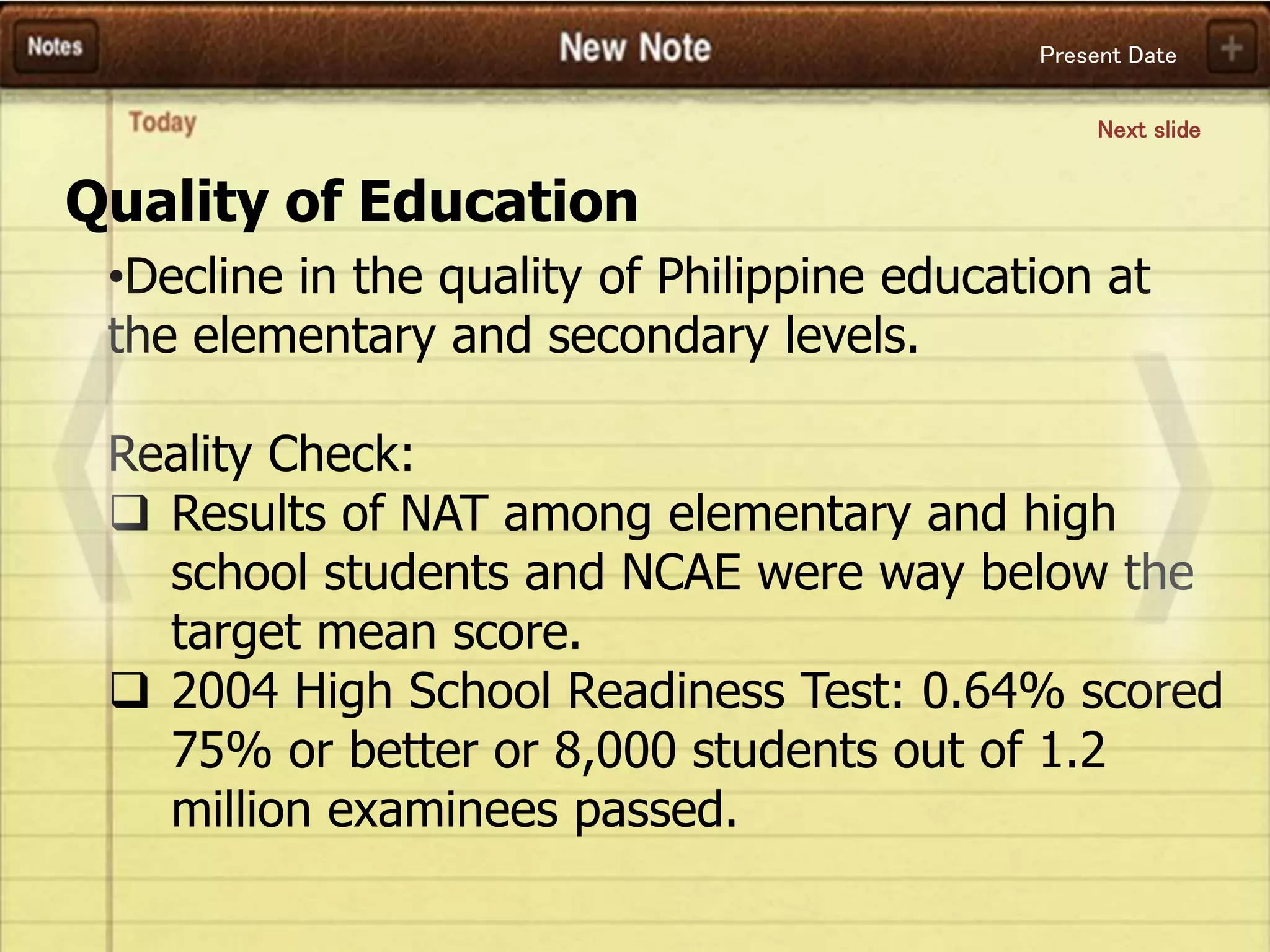
•Decline inthe quality of Philippine education at
the elementary and secondary levels.
Reality Check:
Results of NAT among elementary and high
school students and NCAE were way below the
target mean score.
2004 High School Readiness Test: 0.64% scored
75% or better or 8,000 students out of 1.2
million examinees passed.
Quality of Education
Next slide
7.
Present Date
Quality ofEducation (con’t)
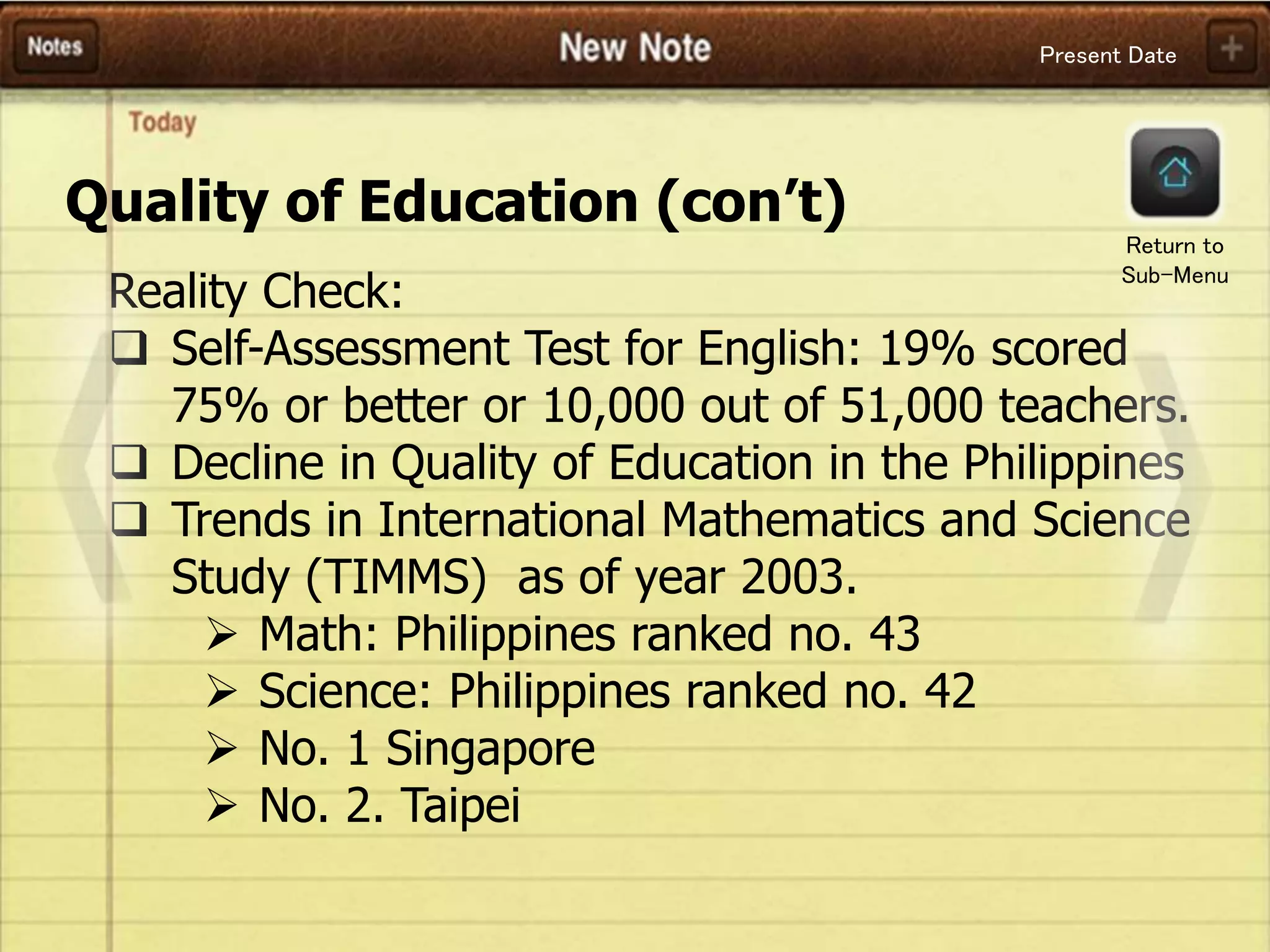
Reality Check:
Self-Assessment Test for English: 19% scored
75% or better or 10,000 out of 51,000 teachers.
Decline in Quality of Education in the Philippines
Trends in International Mathematics and Science
Study (TIMMS) as of year 2003.
Math: Philippines ranked no. 43
Science: Philippines ranked no. 42
No. 1 Singapore
No. 2. Taipei
Return to
Sub-Menu
8.
Present Date
Affordability ofEducation
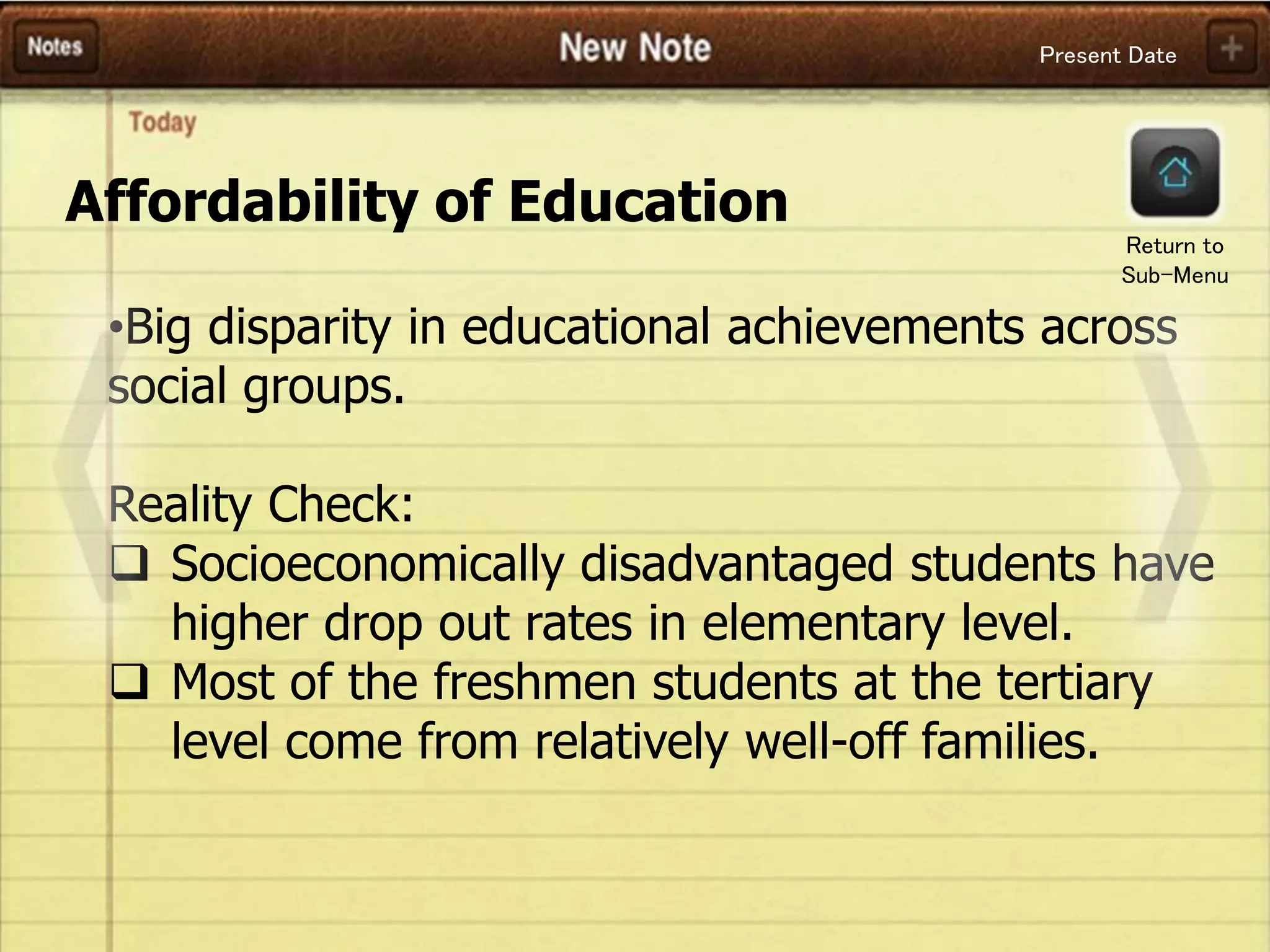
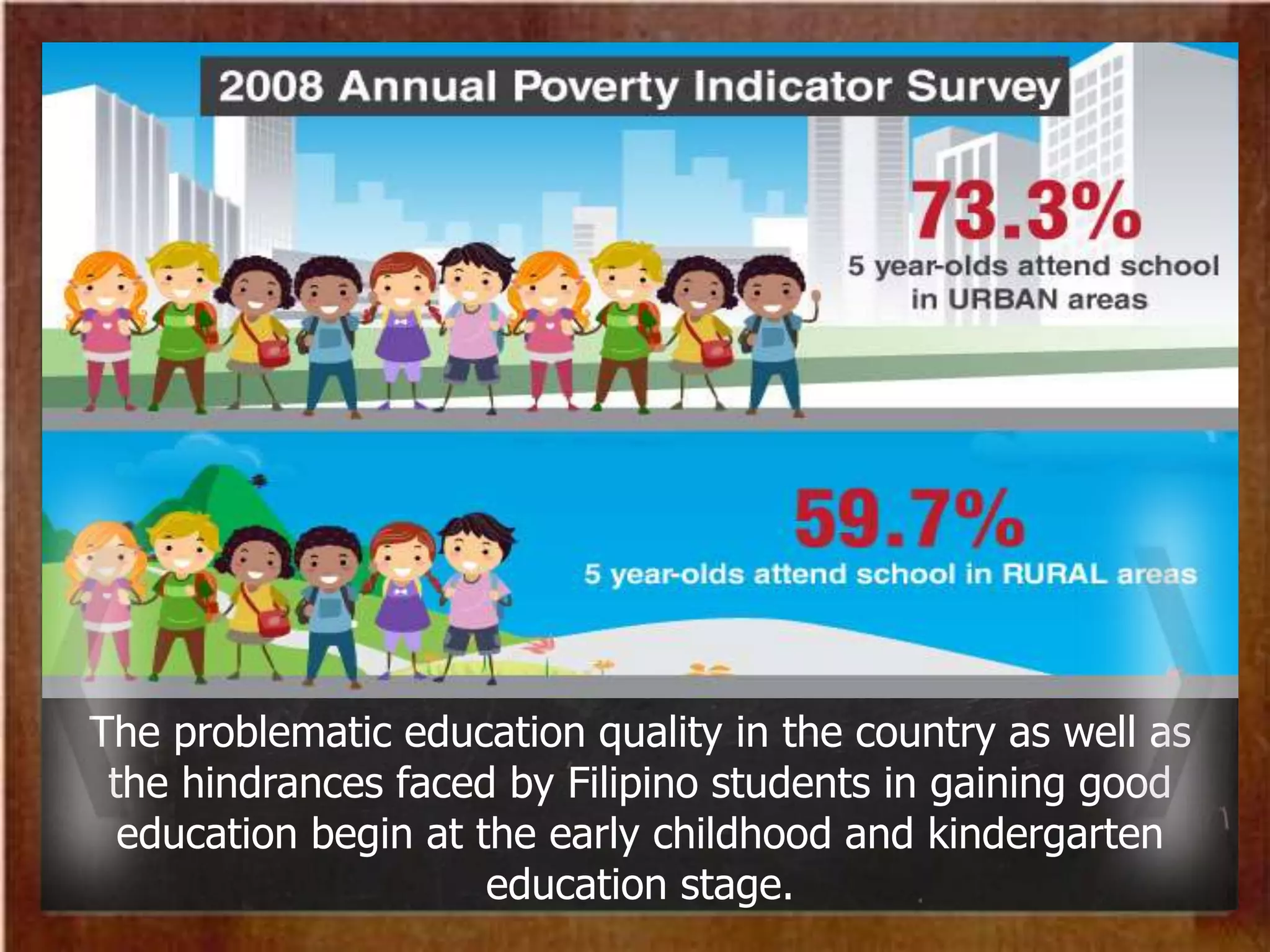
•Big disparity in educational achievements across
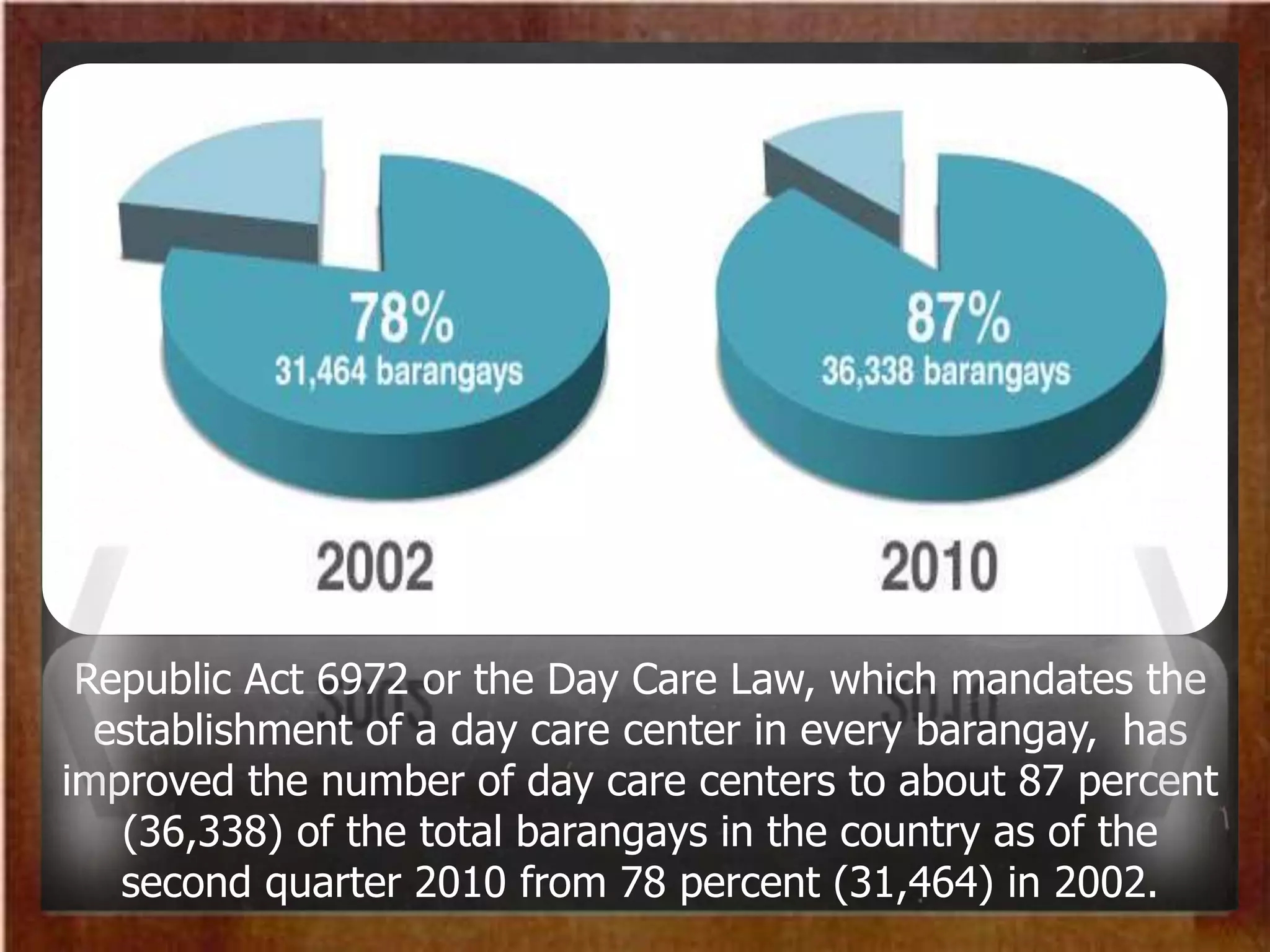
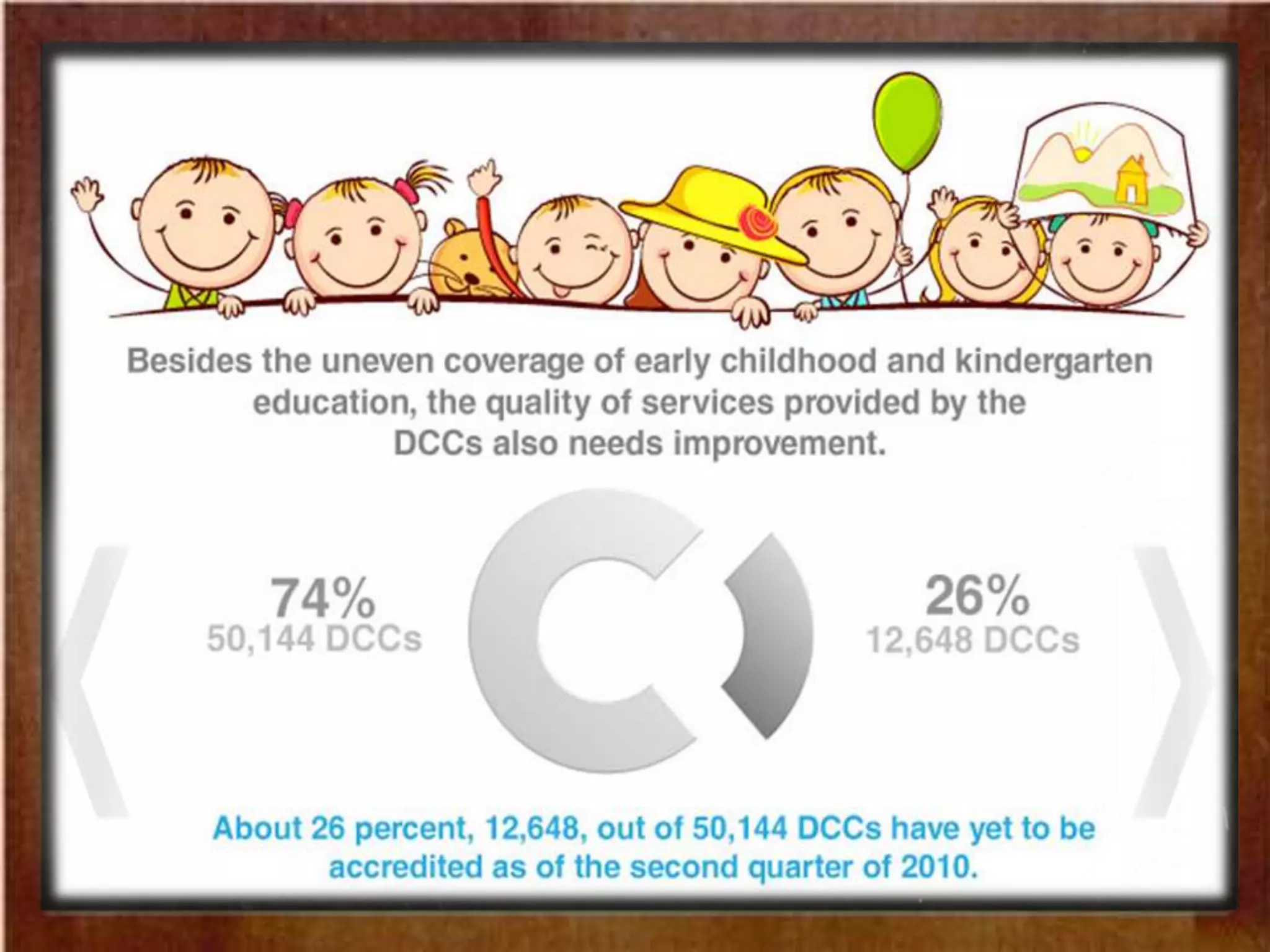
social groups.
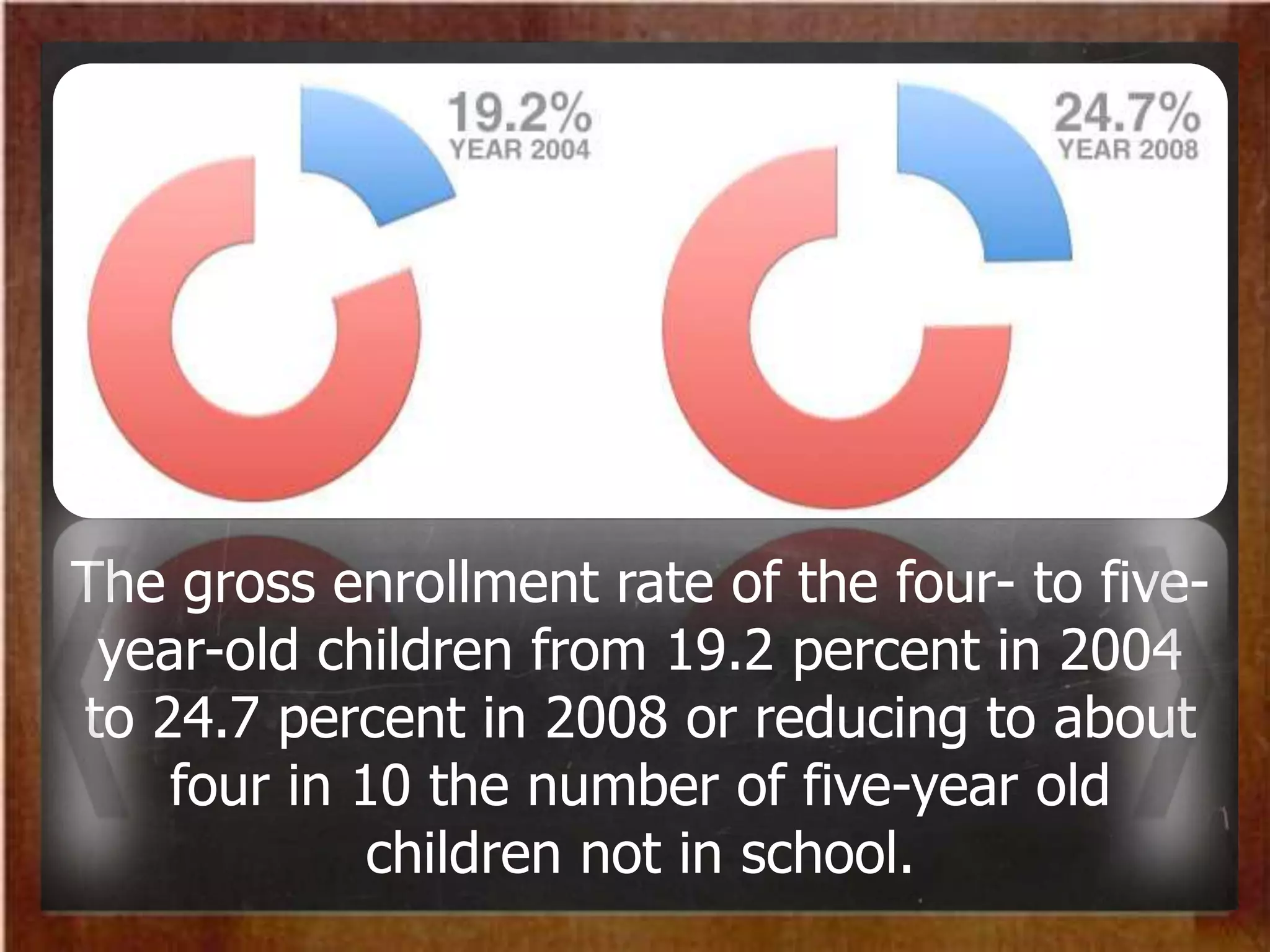
Reality Check:
Socioeconomically disadvantaged students have
higher drop out rates in elementary level.
Most of the freshmen students at the tertiary
level come from relatively well-off families.
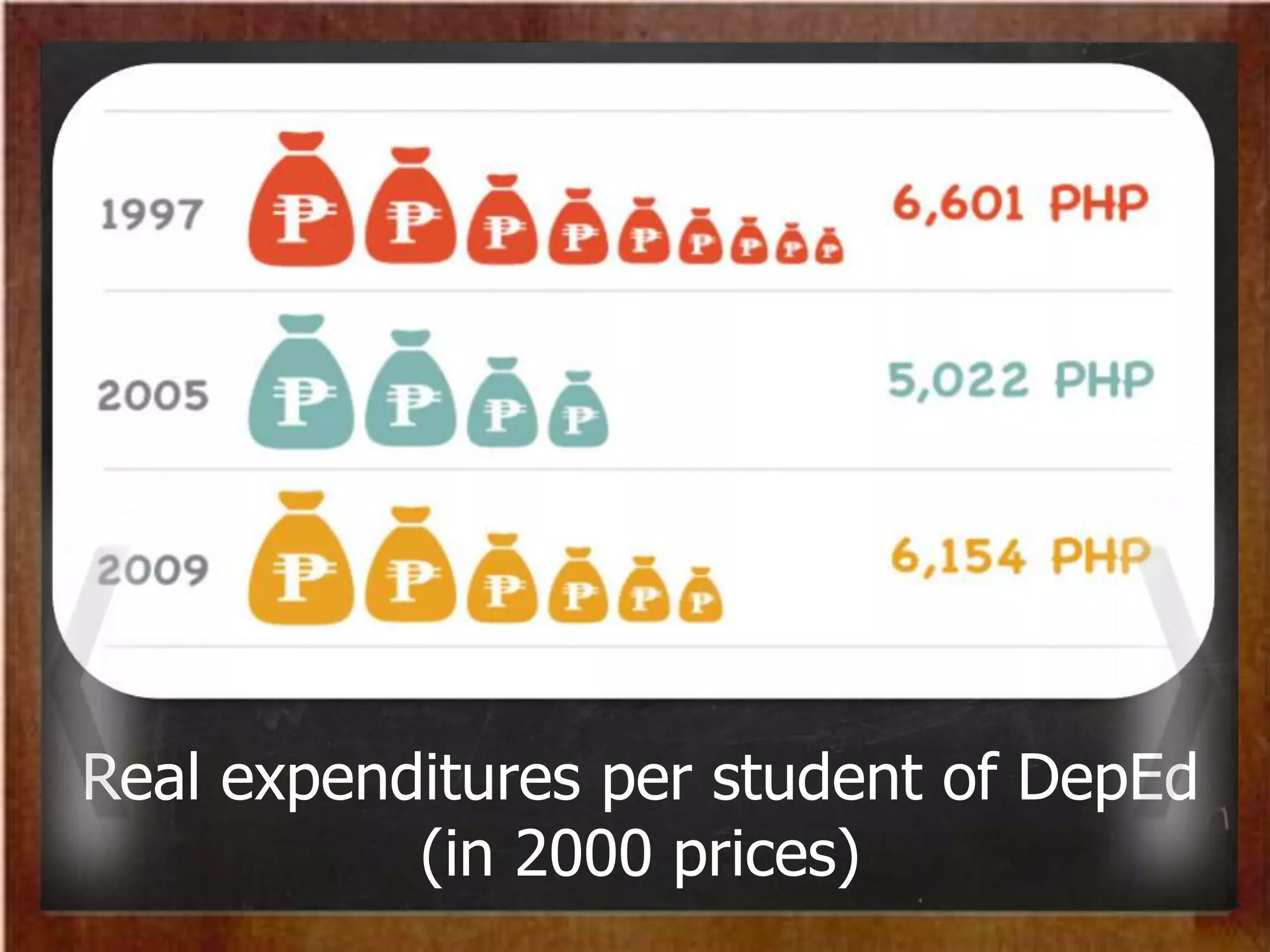
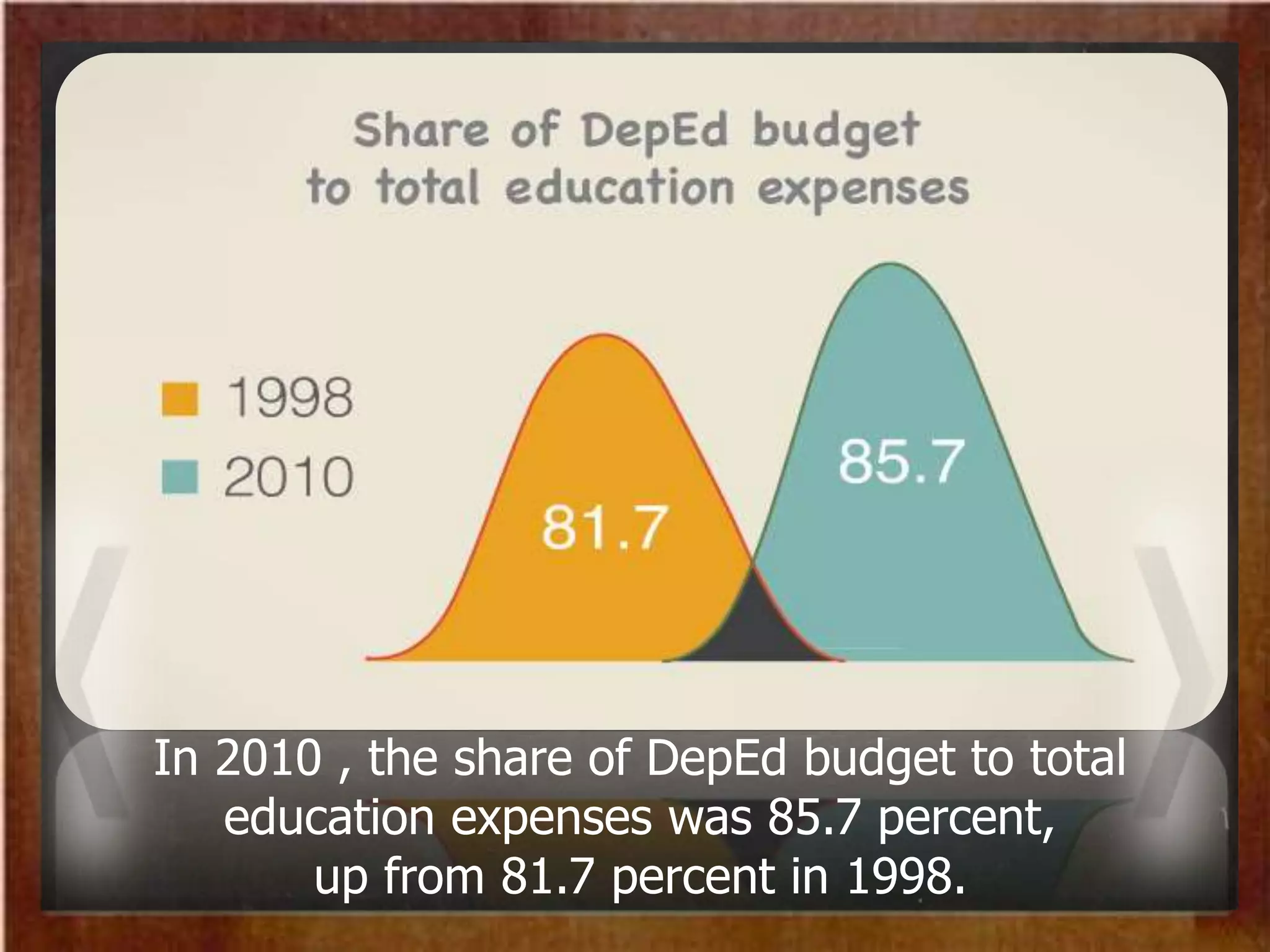
Return to
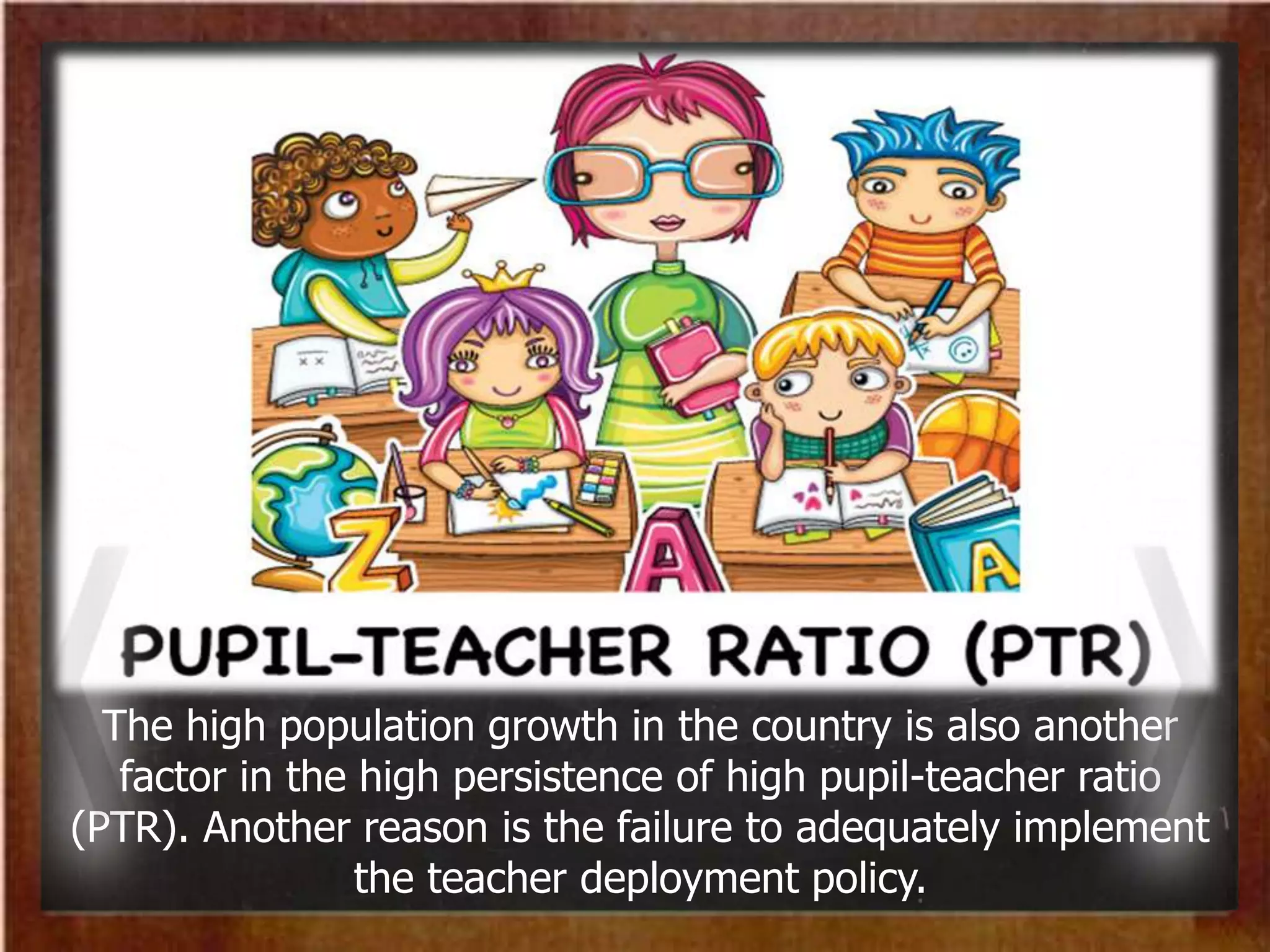
Sub-Menu
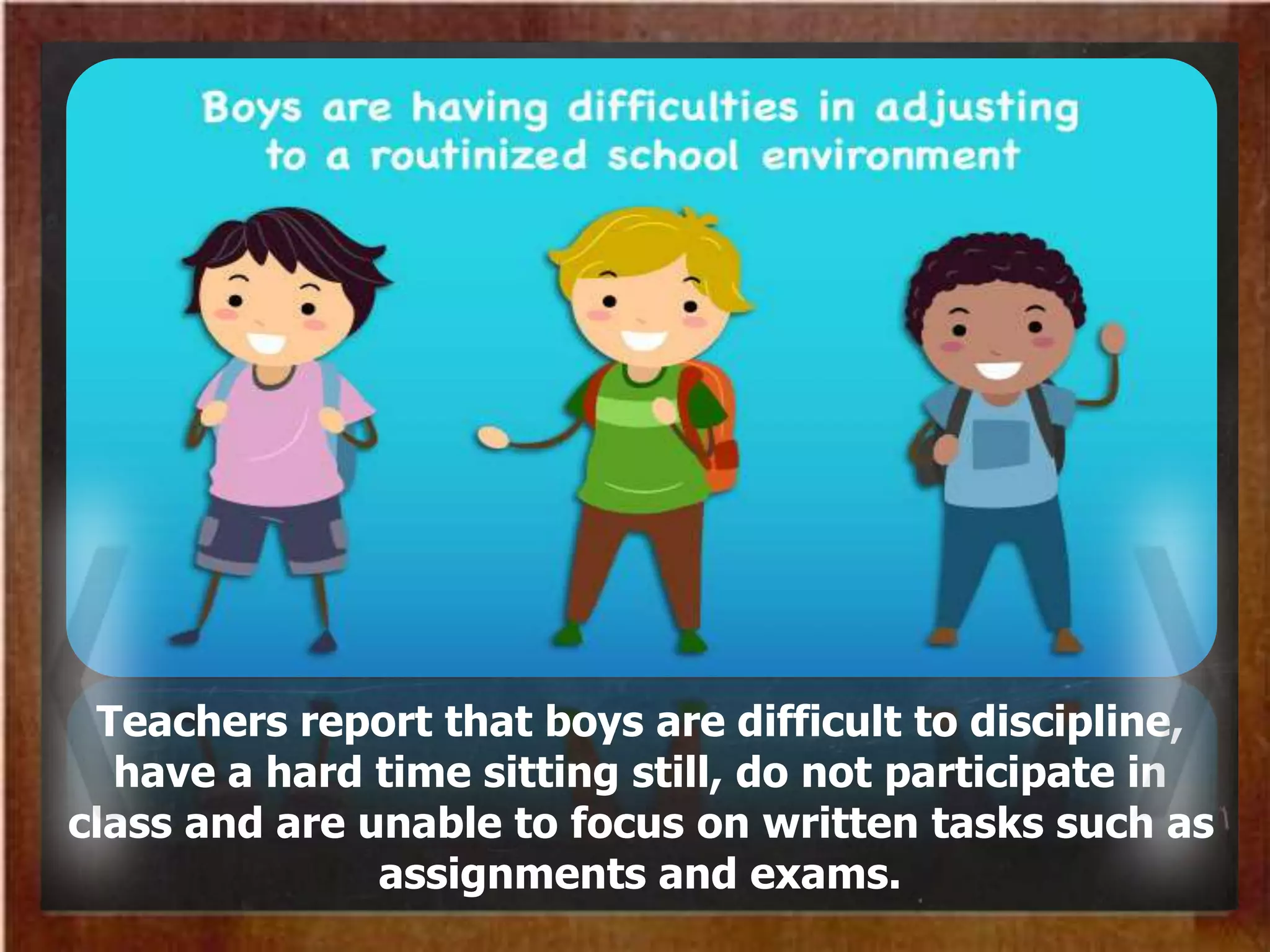
9.
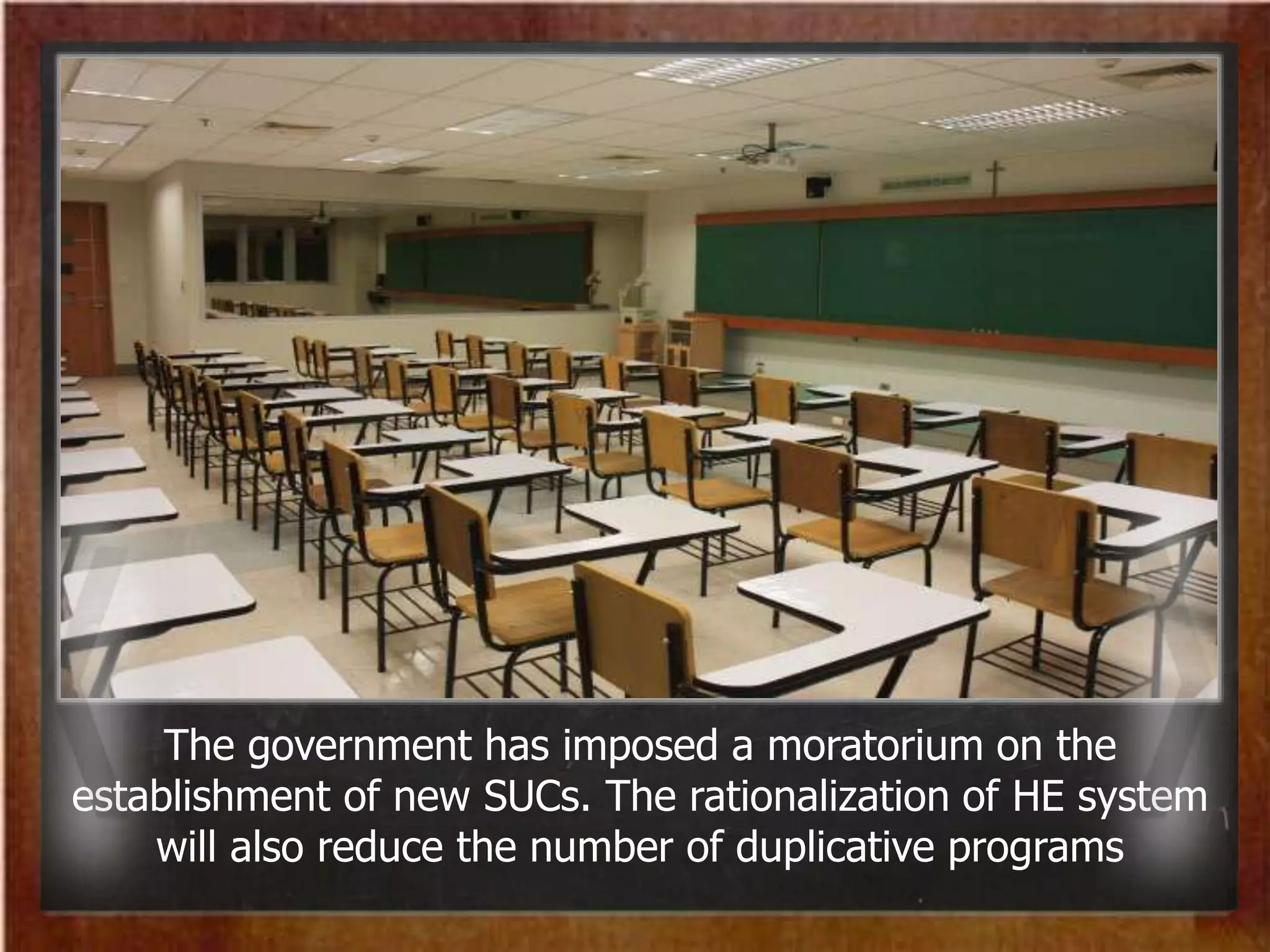
Present Date
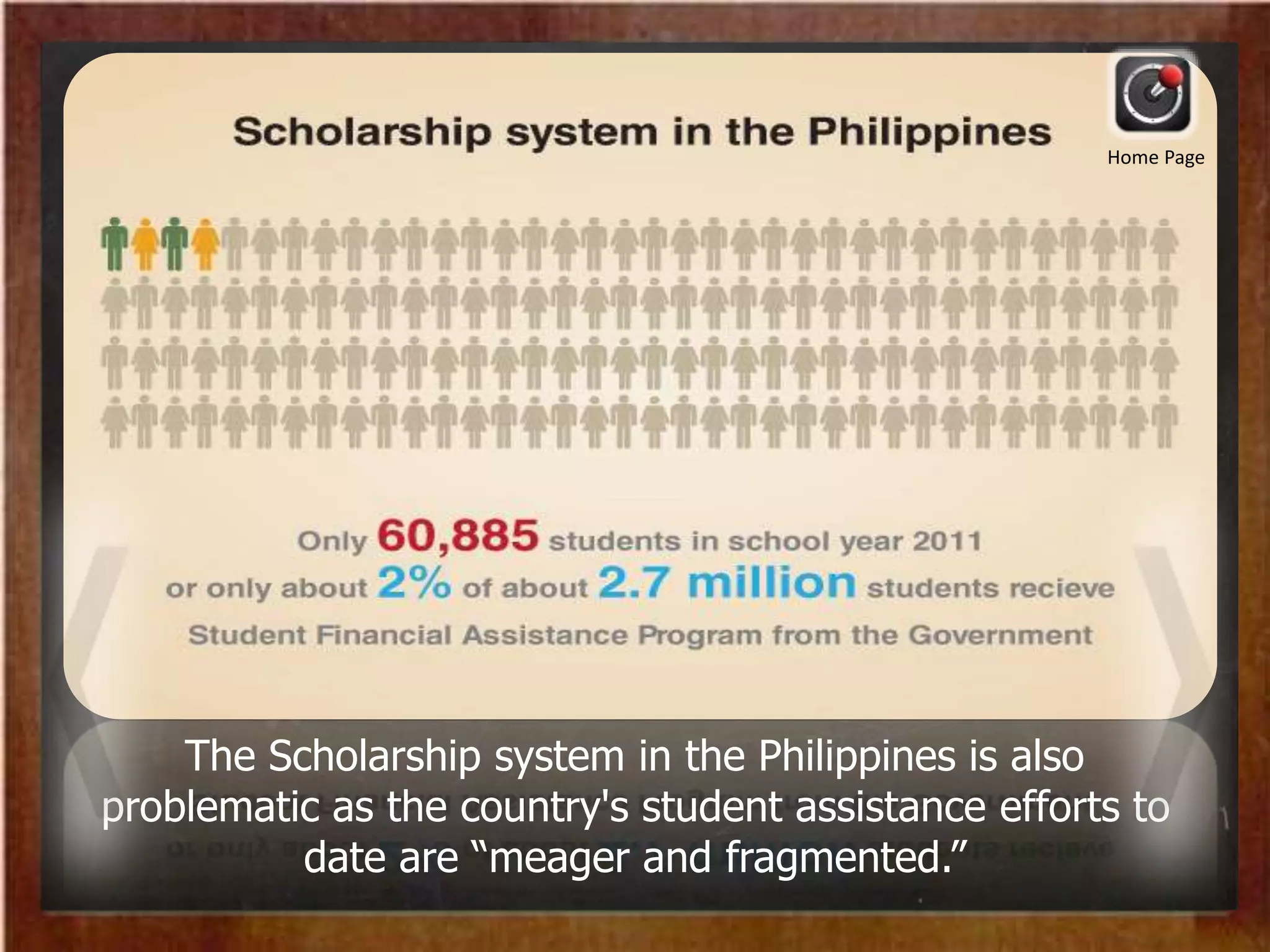
Budget forEducation
•The Philippine Constitution has mandated the
government to allocate the highest proportion of
its budget to education.
Reality Check:
Philippines still has one of the lowest budget
allocations to education among
the ASEAN countries.
Return to
Sub-Menu
10.
Present Date
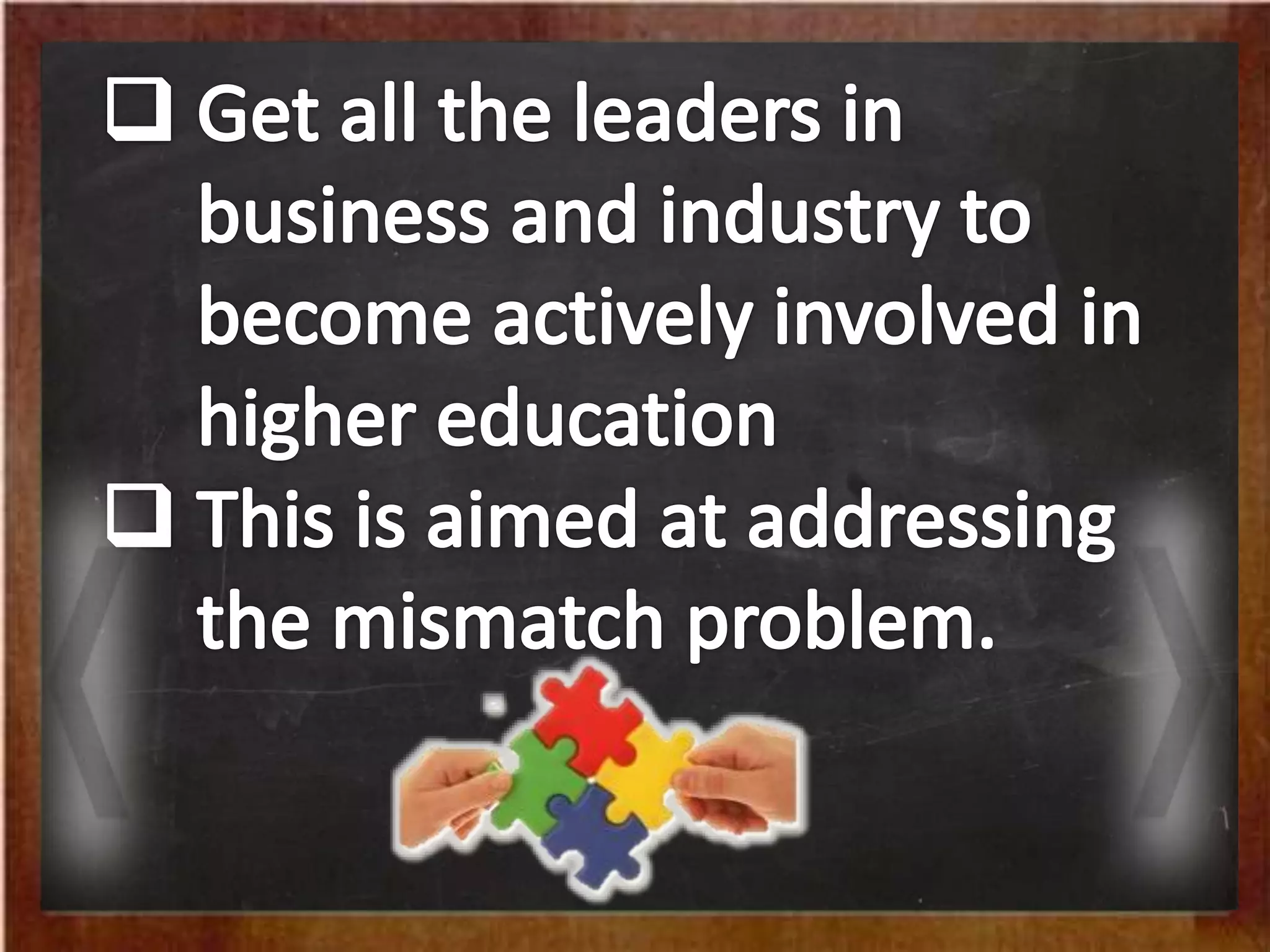
Mismatch:
• Thereis a large proportion of "mismatch"
between training and actual jobs.
• This is the major problem at the tertiary
level and it is also the cause of the
existence of a large group of educated
unemployed or underemployed.
Home Page
11.
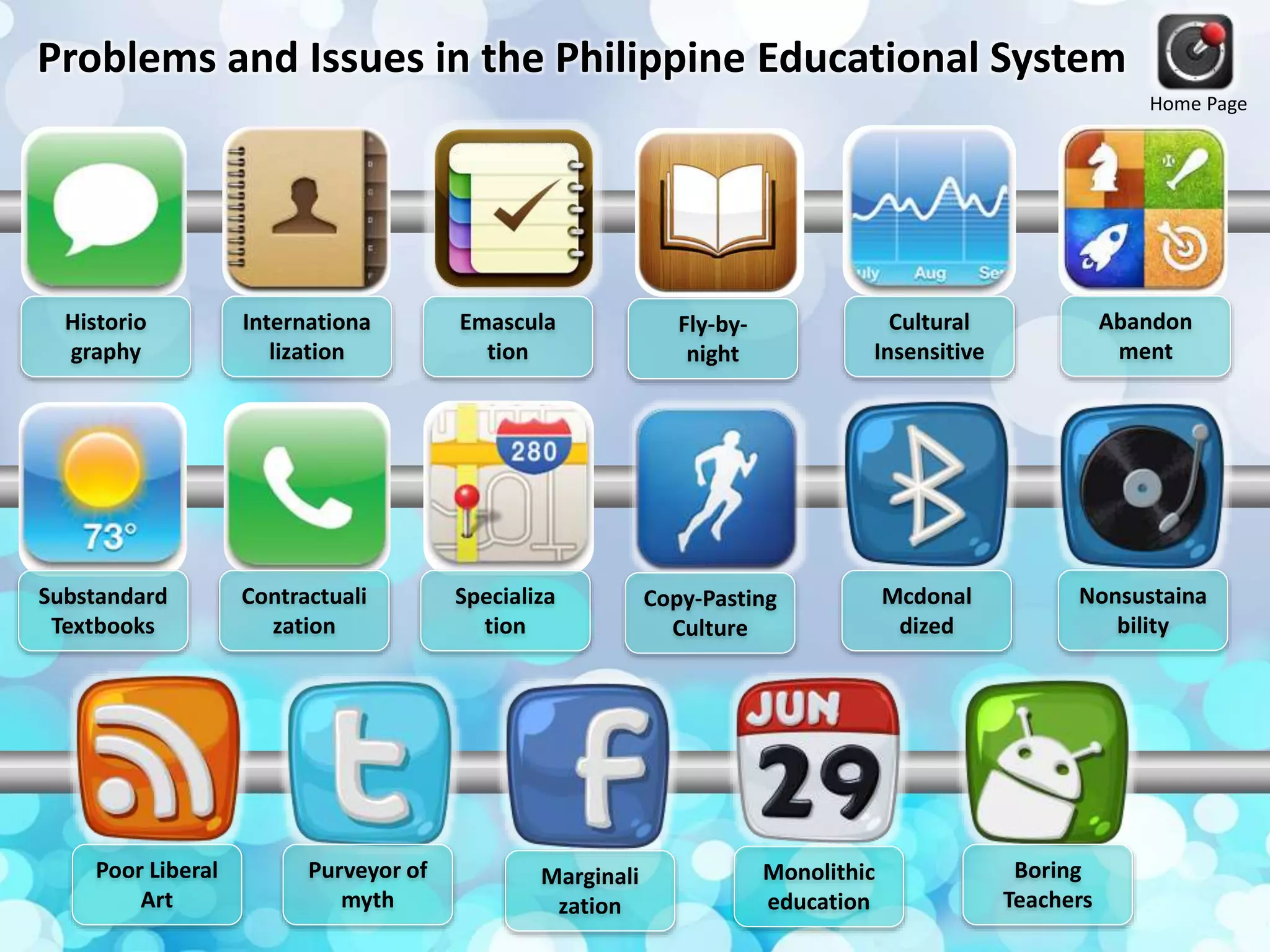
Historio
graphy
Problems and Issuesin the Philippine Educational System
Home Page
Internationa
lization
Emascula
tion
Fly-by-
night
Cultural
Insensitive
Abandon
ment
Substandard
Textbooks
Contractuali
zation
Specializa
tion
Copy-Pasting
Culture
Mcdonal
dized
Nonsustaina
bility
Poor Liberal
Art
Purveyor of
myth
Marginali
zation
Monolithic
education
Boring
Teachers
12.
Giving heavier premiumto the
history of the colonizers in the
Philippines, and not to the history of
Filipinos.
Teaching of History subjects from the
elementary to tertiary levels and will
most likely perpetuate in the next
generations to come.
The history of the Filipino people and the
colonial history of the Philippines are two
different topics altogether.
Sub-Menu
13.
To be skillfulin arithmetic and
computer literacy, fluent in foreign
languages (specifically English and
Nihonggo)
Docile in order to serve as workers of
the transnational businesses of the
advanced, capitalist countries.
Call center phenomenon in the
Philippines, India and other
developing states.
Sub-Menu
14.
Victimized by theover-worked and
under-paid policy of the system of
the past and present dispensations.
Leads to the emasculation and
demoralization of their ranks.
Explains why the teaching profession is not
attracting the best and the brightest from the
crop of students anymore.
Sub-Menu
15.
Teachers, more oftenthan not, are
victimized by the over-worked and under-
paid policy of the system of the past and
present dispensations.
This leads to the emasculation and
demoralization of their ranks. This
probably explains why the teaching
profession is not attracting the best and
the brightest from the crop of students
anymore.
Sub-Menu
16.
The proliferation offly-by-
night educational institutions
is counter-productive.
Produces a pool of half-
baked, unprepared, and
incompetent graduates.
Sub-Menu
17.
Women, the common
taoand the indigenous
people are almost
historically excluded
from the Philippine
historiography in favor
of the men, heroes
from Luzon and the
power elite.
Sub-Menu
18.
The state—in anincremental
fashion—is abandoning its role to
subsidize public education
particularly in the tertiary level.
This comes in the form of
matriculation, laboratory and
miscellaneous fee increases in order
to force state colleges and
universities (SCUs) to generate their
own sources of fund.
Sub-Menu
19.
Some textbooks whichare already
circulation are both poorly written
and haphazardly edited.
Take the case of the Asya: Noon at
Ngayon with an identified total
number of more than 400 historical
errors.
This is a classic case of profit-
centeredness without regard to social
accountability.
Sub-Menu
20.
In the nameof profit, owners and
administrators of several private schools
commonly practice contractualization
among their faculty members.
Contractual employees unlike their
regular/tenured counterparts are not
entitled to fringe benefits which
consequently reduces the over-all cost
of their business operation.
Job insecurity demeans the ranks of the
faculty members.
Sub-Menu
21.
Some colleges anduniversities, even for high
schools, encourage their faculty pool to be
generalists (under the guise of
multidisciplinary approach to learning) in
order to be able to handle various subjects
all at once.
But some faculty members have turned out
to be objects of mockery and have lost their
self-esteem since some of them were
pushed to handle Technical Writing, General
Psychology, Filipino, and Algebra at the
same time.
Sub-Menu
22.
Over-dependence to thecyberspace has
dramatically reduced the capability of
students (even teachers) to undertake
research.
‘Copy-pasting’ has even turned into a
norm among some students whenever
they are tasked to submit a research
paper or even a film review.
Plagiarism has already transformed into
a more sophisticated form in the context
of today’s electronic age.
Sub-Menu
23.
The system, methodology,and even
content of education in the Philippines
are mere haphazard transplantation
from the West.
It is therefore Eurocentric, culturally
insensitive, and non-reflective of the
local milieu.
This is based on the xenocentric (foreign-
centered) premise that other culture or
system is far more superior than one’s
own.
Sub-Menu
24.
Teachers, administrators and
publishersare all left in limbo
whenever the DepEd would come up
with another totally different
directive from what it used to have in
a rather very sudden interval.
The case of the grading system,
timeframe allotted to various
subjects, MAKABAYAN program,
readiness test, and learning
competencies (LC).
Sub-Menu
25.
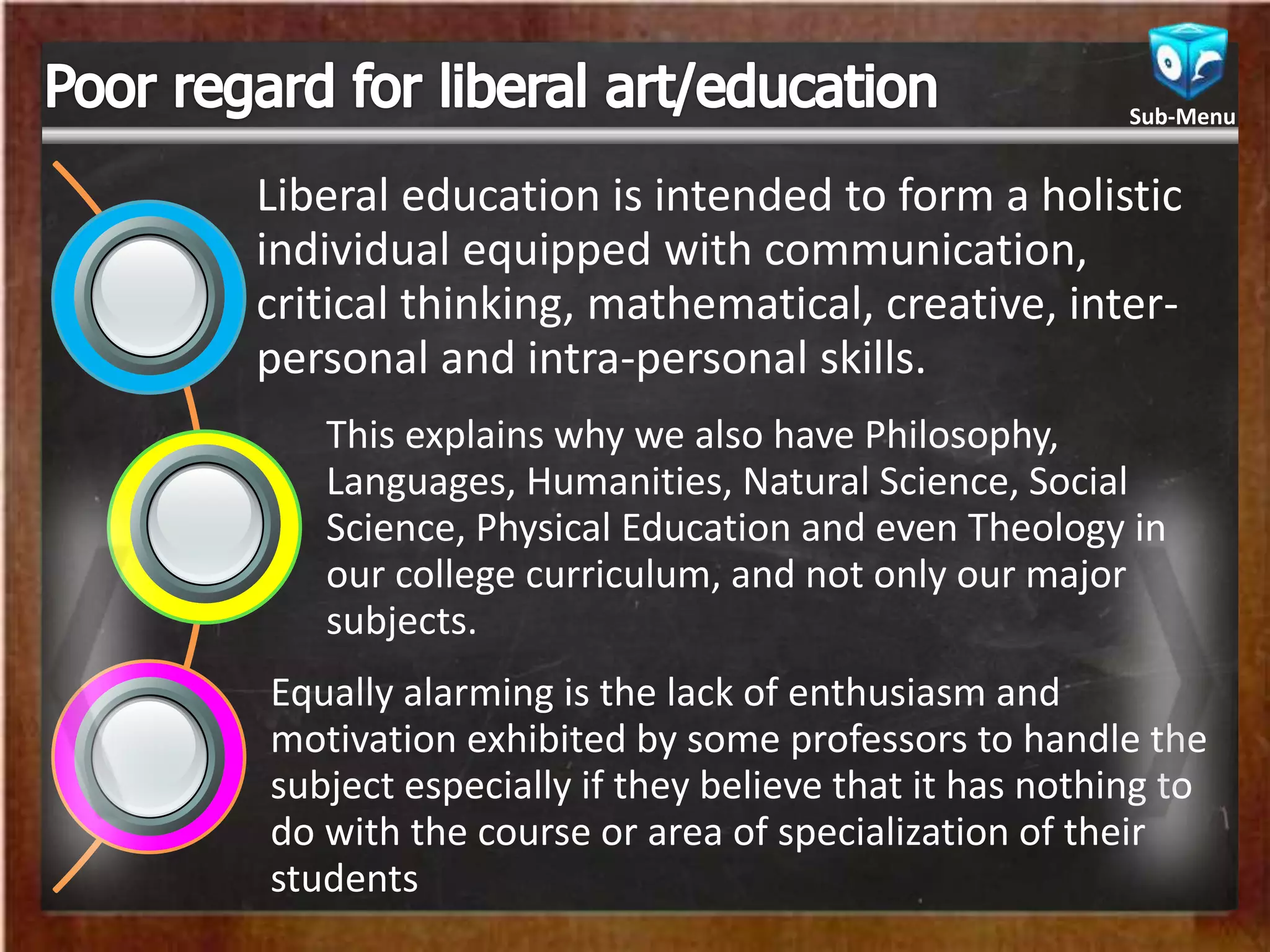
Liberal education isintended to form a holistic
individual equipped with communication,
critical thinking, mathematical, creative, inter-
personal and intra-personal skills.
This explains why we also have Philosophy,
Languages, Humanities, Natural Science, Social
Science, Physical Education and even Theology in
our college curriculum, and not only our major
subjects.
Equally alarming is the lack of enthusiasm and
motivation exhibited by some professors to handle the
subject especially if they believe that it has nothing to
do with the course or area of specialization of their
students
Sub-Menu
26.
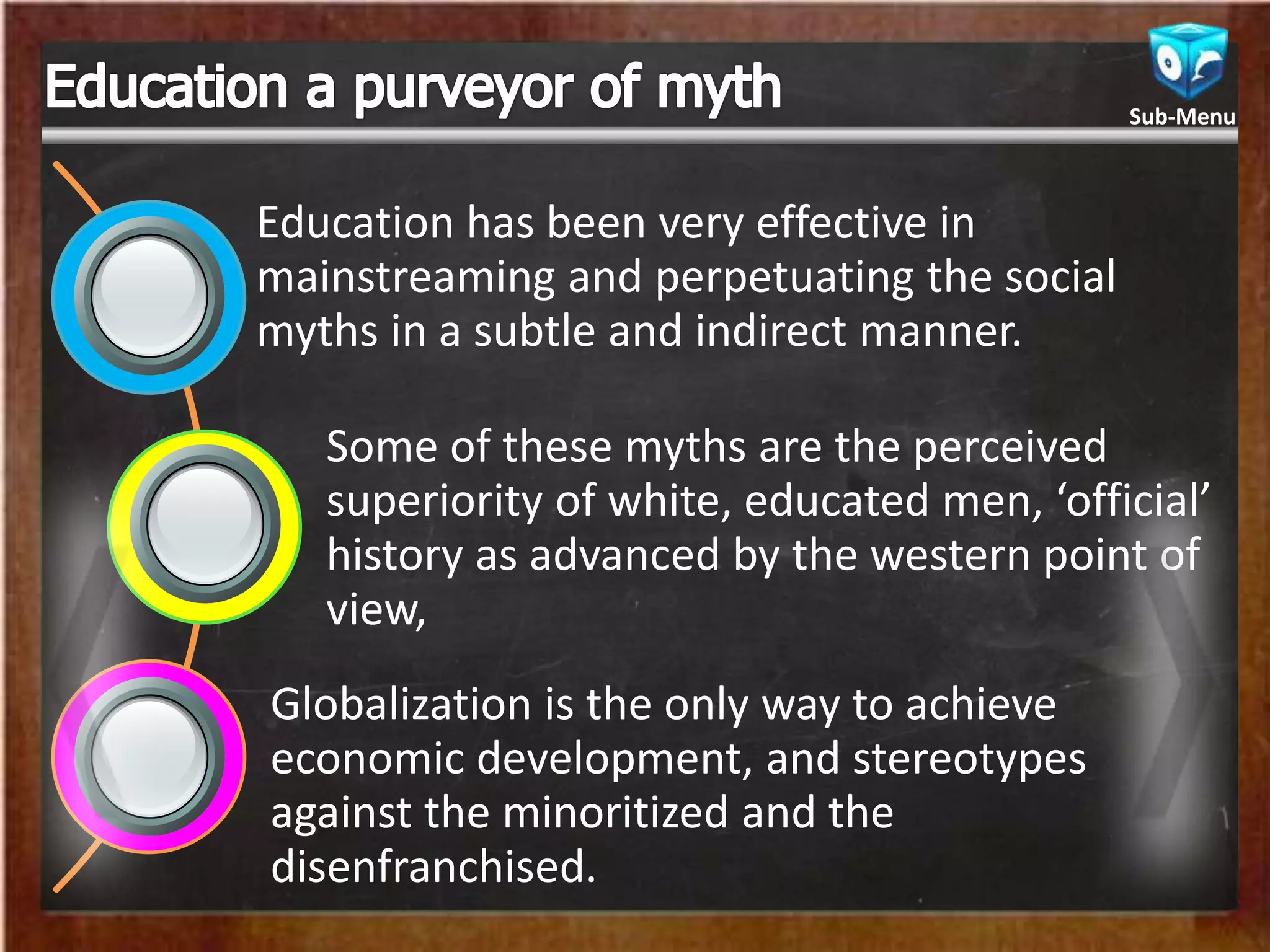
Education has beenvery effective in
mainstreaming and perpetuating the social
myths in a subtle and indirect manner.
Some of these myths are the perceived
superiority of white, educated men, ‘official’
history as advanced by the western point of
view,
Globalization is the only way to achieve
economic development, and stereotypes
against the minoritized and the
disenfranchised.
Sub-Menu
27.
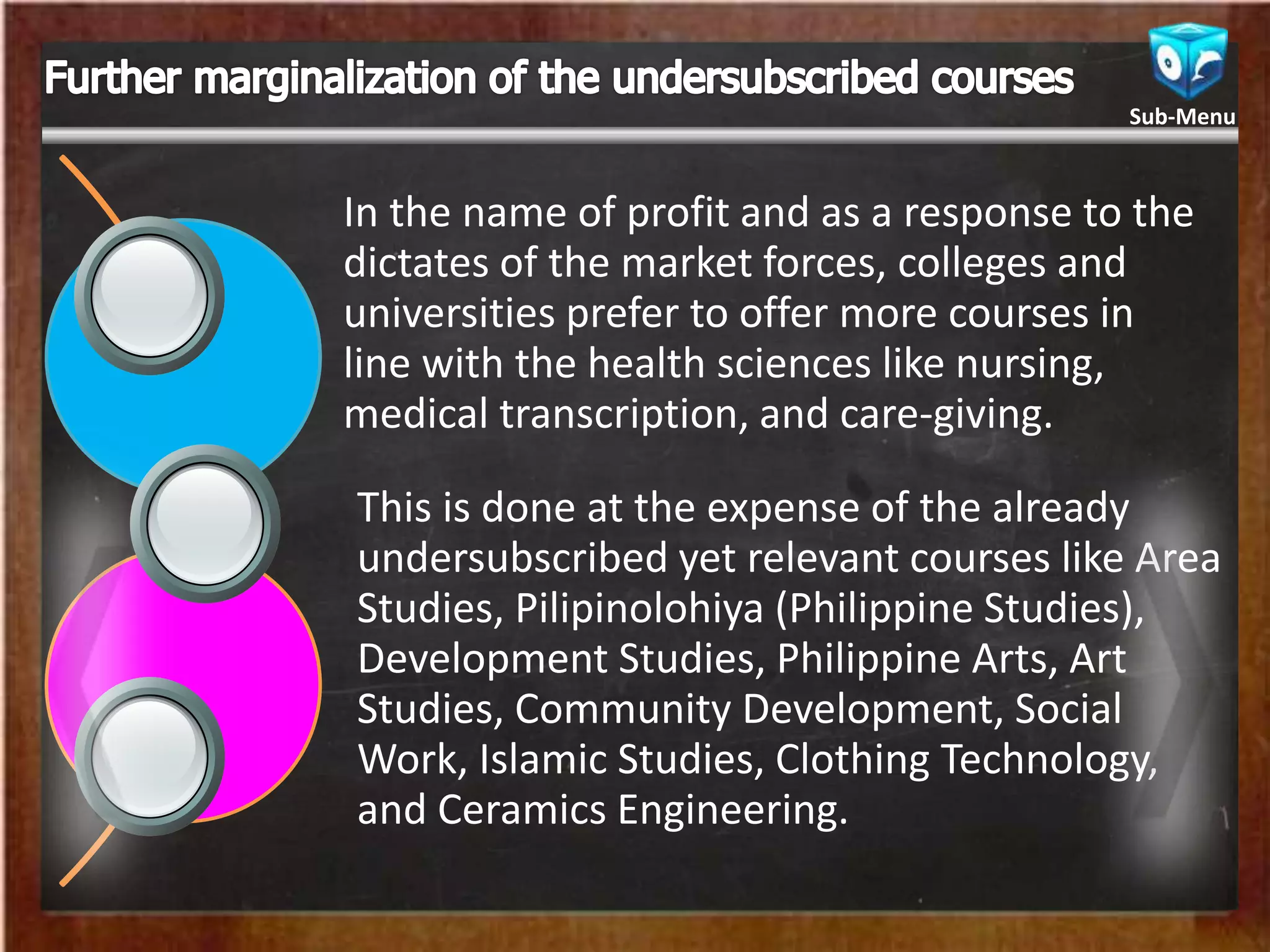
In the nameof profit and as a response to the
dictates of the market forces, colleges and
universities prefer to offer more courses in
line with the health sciences like nursing,
medical transcription, and care-giving.
This is done at the expense of the already
undersubscribed yet relevant courses like Area
Studies, Pilipinolohiya (Philippine Studies),
Development Studies, Philippine Arts, Art
Studies, Community Development, Social
Work, Islamic Studies, Clothing Technology,
and Ceramics Engineering.
Sub-Menu
28.
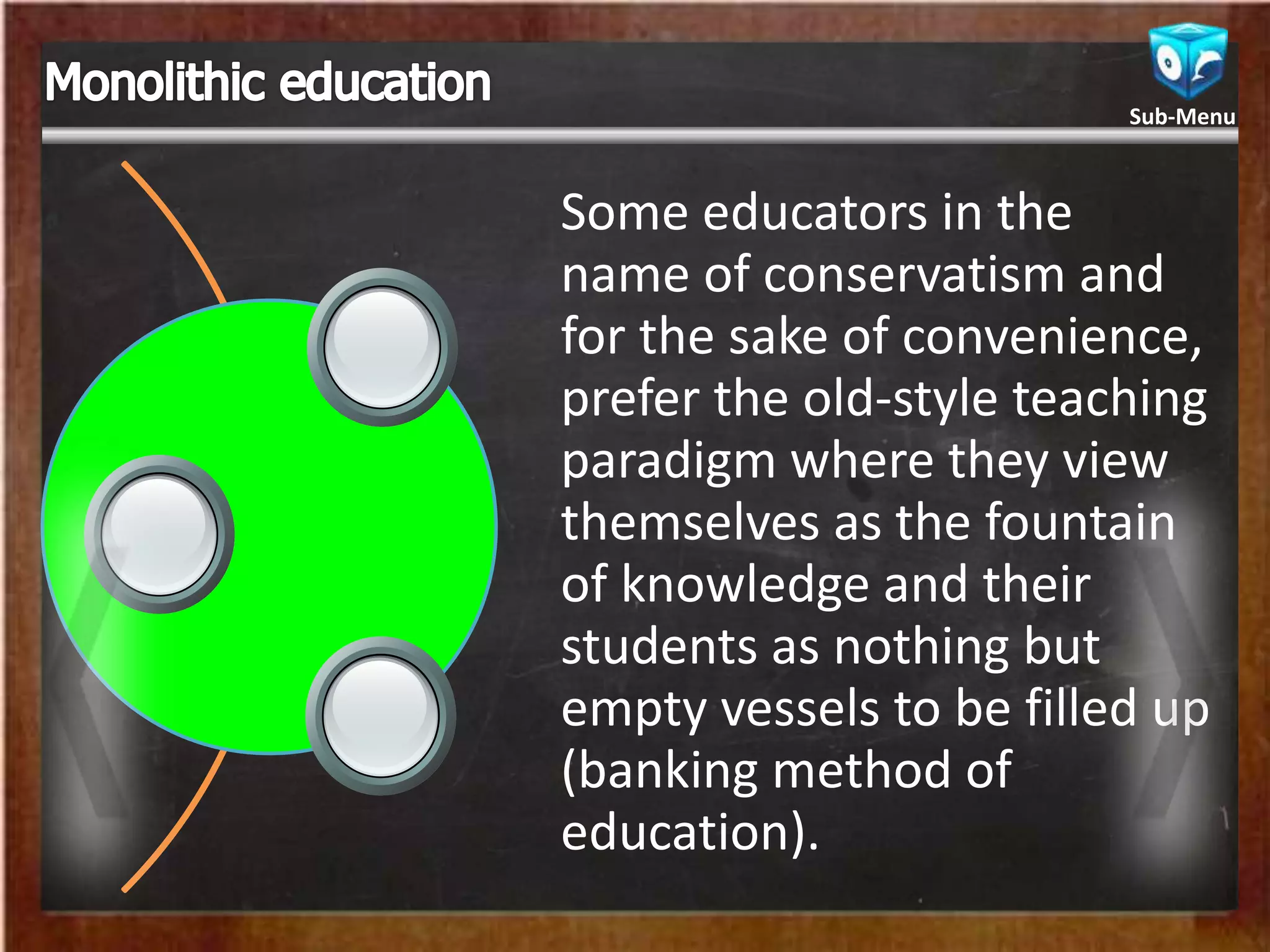
Some educators inthe
name of conservatism and
for the sake of convenience,
prefer the old-style teaching
paradigm where they view
themselves as the fountain
of knowledge and their
students as nothing but
empty vessels to be filled up
(banking method of
education).
Sub-Menu
29.
There are noboring
subjects, only boring
teachers. But at least
we should recognize
them because they
still serve a purpose.
They serve as bad
examples.
Home Page
30.
Facts and Figureson
Philippine Education
Problems, Issues
and Concerns
31.
The problematic educationquality in the country as well as
the hindrances faced by Filipino students in gaining good
education begin at the early childhood and kindergarten
education stage.
32.
Republic Act 6972or the Day Care Law, which mandates the
establishment of a day care center in every barangay, has
improved the number of day care centers to about 87 percent
(36,338) of the total barangays in the country as of the
second quarter 2010 from 78 percent (31,464) in 2002.
33.
The gross enrollmentrate of the four- to five-
year-old children from 19.2 percent in 2004
to 24.7 percent in 2008 or reducing to about
four in 10 the number of five-year old
children not in school.
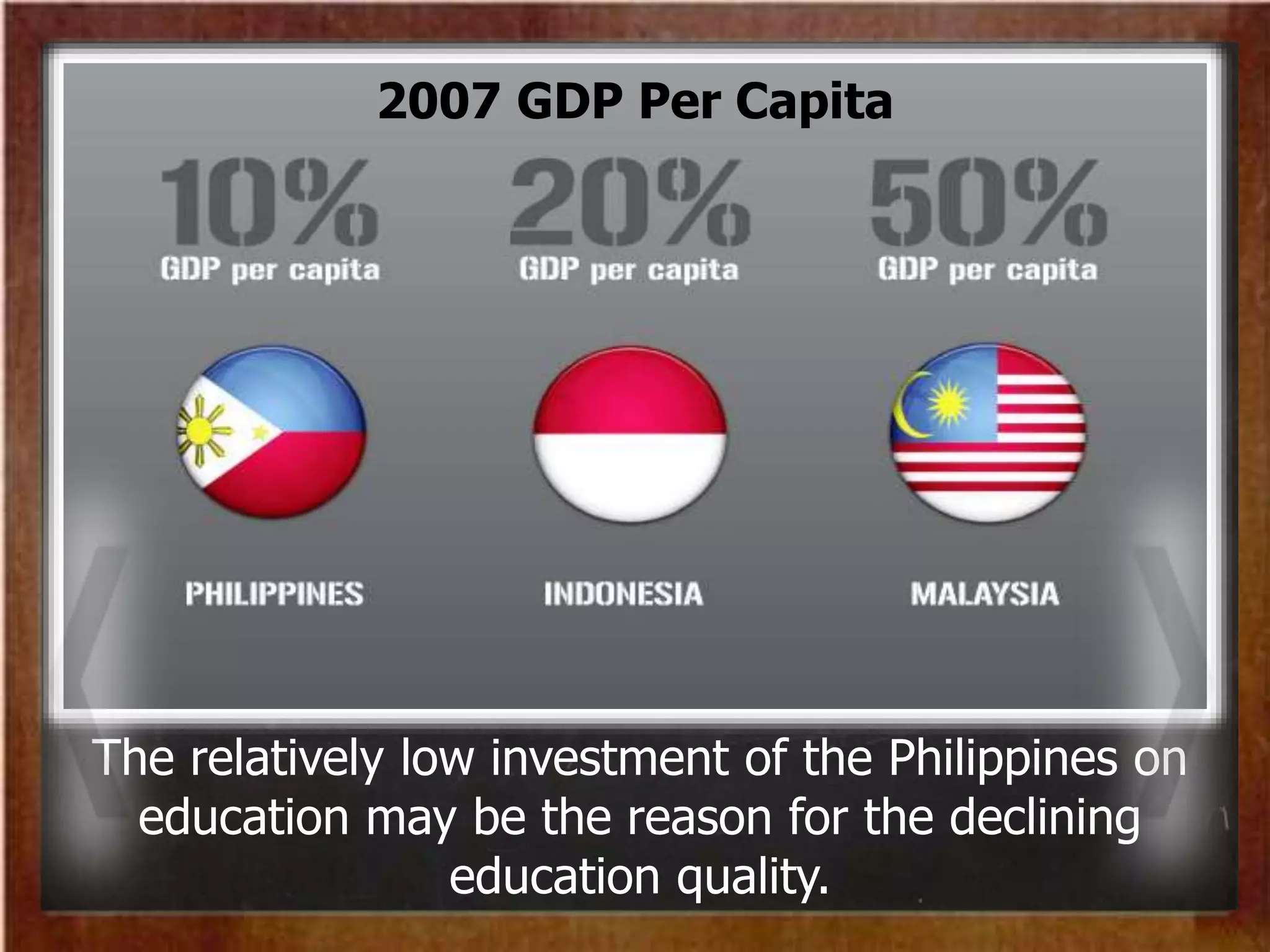
The relatively lowinvestment of the Philippines on
education may be the reason for the declining
education quality.
2007 GDP Per Capita
37.
The lack ofresearch in HEIs is also seen as another
factor in the low quality of tertiary education in the
Philippines.
38.
In 2010 ,the share of DepEd budget to total
education expenses was 85.7 percent,
up from 81.7 percent in 1998.
39.
The high populationgrowth in the country is also another
factor in the high persistence of high pupil-teacher ratio
(PTR). Another reason is the failure to adequately implement
the teacher deployment policy.
40.
Teachers report thatboys are difficult to discipline,
have a hard time sitting still, do not participate in
class and are unable to focus on written tasks such as
assignments and exams.
41.
The government hasimposed a moratorium on the
establishment of new SUCs. The rationalization of HE system
will also reduce the number of duplicative programs
42.
The Scholarship systemin the Philippines is also
problematic as the country's student assistance efforts to
date are “meager and fragmented.”
Home Page
Present Date
Burgonio,T. Congress adds P4B to budget of DepEd. Philippine Daily Inquirer. June
5, 2006, p. 1.
Del Mundo, F. State of RP Education. 2nd of a series. Philippine Daily Inquirer, p.
A22.
Cheryl M. Arcibal . Updated May 25, 2012. http://www.philstar.com/school-special
Osorio, E. When our teachers say goodbye. Philippine Daily Inquirer. June 4, 2006,
p. 28.
Philippine Daily Inquirer. Editorial. Same old problems. June 6, 2006.
Robles, J. Ground zero. Standard Today. Une 5, 2006, p. 6.
Secretary Lapus outlines the state of Philippine Education. educnews. December
2006, p. 1.
Prof. John N. Ponsaran. Notes About the Problems and Issues in the Philippine
Educational System: A Critical Discourse.
Tubeza, P. Challenge to big business: Put more cash in school plans. Philippine Daily
Inquirer. July 30, 2006, p. 7.
Tubeza, P. Gov’t needs P120B a year to save public school system. Philippine Daily
Inquirer, p. 11.
Sources: Home Page
51.
Issues in PhilippineEducation
End of Report
NEXT >>
PREVIOUS <<
THAT’S ALL THANK YOU
&
GOD BLESS
Log out
James L. Paglinawan