Curriculum designers needto enhance the
curriculum and propose curricular innovations to
respond to the changing educational landscape in
the country as well as in other parts of the globe.
It is most necessary that as a future curricularist
and a teacher, you should be familiar with what
is happening and will happen in our curriculum.
There is no substitute for being READY and
INFORMED.
Take off
3.
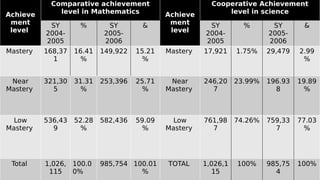
Curriculum designers needto
enhance the recommended curriculum
and propose curricular innovations to
respond to the changing landscape in
education regionally and globally. Are
you aware of some curricular reforms
in the Philippines and other countries?
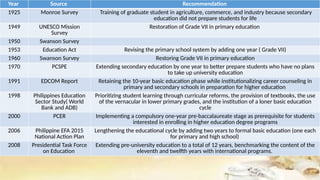
Content focus
4.
Republic Act 10533,otherwise known as
the Enhanced Basic Education Act of
2013, is the latest educational reform in
Philippine Education signed into law by
President Benigno Aquino III last May 15,
2013. It is an act enhancing the
Philippine Basic Education system by
strengthening its curriculum and
increasing the number of years for basic
education appropriating funds therefore
and for other purposes.
5.
The Enhanced BasicEducation Act of 2013
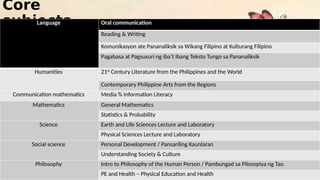
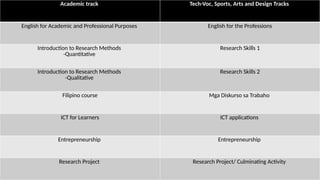
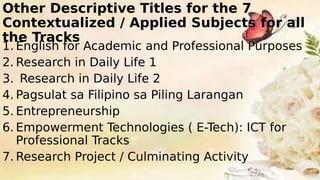
popularly known as K to 12 includes one (1)
year of kindergarten education, six (6)
years of elementary education, and six (6)
years of secondary education. This six-year
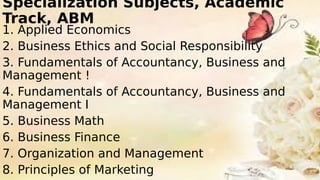
secondary education includes four (4) years
of junior high school and two (2) years of
senior high school. With K to 12, the
existing 10 years of basic education is
increased to 12 years with Kindergarten
education as a prerequisite to entry in
6.
Why K to12?
K to 12 makes the Philippine
education system at par with the
international standard of 12-year basic
education thereby contributing to a
better educated society capable of
pursuing productive employment,
entrepreneurship, or higher education
studies.
7.
After going throughkindergarten,
elementary, junior high and a specialized
senior high school program, every K to 12
graduate is ready to go into different paths -
higher education, middle level skills
development, employment, or
entrepreneurship. The K to 12 graduates are
also expected to be equipped with 21 century
skills like information, media and technology
skills, learning and innovation skills, effective
communication skills, and life and career skills.
8.
When K to12 was launched in 2012,
many Filipinos were apprehensive
because of the addition of two (2)
more years in secondary schooling.
Some said, the additional two years
are added burden for the average
Filipino family.
9.
Others said, theK to 12 program is
doomed to fail since it does not address
the basic problems in education like lack
of classrooms, chairs, books, teachers,
quality teaching and many more. Amidst
criticisms, the Department of Education
pushed for the K to 12 implementation.
What could be the reasons?
10.
1. Mastery ofbasic
competencies
curriculum is
insufficient due to
congested curriculum.
11.
Achieve
ment
level
Comparative achievement
level inMathematics Achieve
ment
level
Cooperative Achievement
level in science
SY
2004-
2005
% SY
2005-
2006
& SY
2004-
2005
% SY
2005-
2006
&
Mastery 168,37
1
16.41
%
149,922 15.21
%
Mastery 17,921 1.75% 29,479 2.99
%
Near
Mastery
321,30
5
31.31
%
253,396 25.71
%
Near
Mastery
246,20
7
23.99% 196.93
8
19.89
%
Low
Mastery
536,43
9
52.28
%
582,436 59.09
%
Low
Mastery
761,98
7
74.26% 759,33
7
77.03
%
Total 1,026,
115
100.0
0%
985,754 100.01
%
TOTAL 1,026,1
15
100% 985,75
4
100%
12.
In international examinations,the
Philippines performed poorly as
revealed in 2003 TIMSS (Trends in
International Mathematics and
Science) scores. In Grade IV Science
and Math, the Philippines ranked 23
out of 25 participating countries.
13.
In High SchoolII Science, the
Philippines ranked 43 out of 46 and in
Math ranked 34 out of 38. Even with
the science high schools participating
in the Advanced Mathematics
category in 2008 TIMMS, the
country's ranking did not improve. In
fact, it ranked the lowest (10) among
ten participating countries.
14.
One of thefactors that contribute to the
low performance in achievement tests is the
congested basic education curriculum. What
other countries teach in twelve (12) years
the Philippines teach only in ten (10) years.
The ten (10) years would not be enough to
master the competencies. Adding two years
would make possible the decongestion of
the curriculum for comprehensive
acquisition of basic competencies and the
21" century skills.
15.
2. The Philippinesis
the only remaining
country in Asia with a
10 - year basic
education program.
16.
The Philippines isthe only country in
Asia that has a ten-year basic education
program. The short duration of the basic
education program also puts millions of
overseas Filipino workers, especially the
professionals, and those who intend to
study abroad at a disadvantage.
Graduates of Philippine schools are not
automatically recognized as professionals
outside the country due to the lack of two
years in basic education.
17.
Bologna Accord imposestwelve (12)
years of education for university
admission and practice of profession in
European countries. Washington
Accord prescribes twelve (12) years
basic education as an entry to
recognition of engineering
professionals.
18.
By the way,the recommendation to
improve and to lengthen the short basic
education in the Philippines has been
given since 1925. As one of the most well
studied reforms, recommendations of
either adding or restoring 7th grade or
adding an extra year to basic education
have been put forward. (See Table 5).
19.
Year Source Recommendation
1925Monroe Survey Training of graduate student in agriculture, commerce, and industry because secondary
education did not prepare students for life
1949 UNESCO Mission
Survey
Restoration of Grade VII in primary education
1950 Swanson Survey
1953 Education Act Revising the primary school system by adding one year ( Grade VII)
1960 Swanson Survey Restoring Grade VII in primary education
1970 PCSPE Extending secondary education by one year to better prepare students who have no plans
to take up university education
1991 EDCOM Report Retaining the 10-year basic education phase while institutionalizing career counseling in
primary and secondary schools in preparation for higher education
1998 Philippines Education
Sector Study( World
Bank and ADB)
Prioritizing student learning through curricular reforms, the provision of textbooks, the use
of the vernacular in lower primary grades, and the institution of a loner basic education
cycle
2000 PCER Implementing a compulsory one-year pre-baccalaureate stage as prerequisite for students
interested in enrolling in higher education degree programs
2006 Philippine EFA 2015
National Action Plan
Lengthening the educational cycle by adding two years to formal basic education (one each
for primary and high school)
2008 Presidential Task Force
on Education
Extending pre-university education to a total of 12 years, benchmarking the content of the
eleventh and twelfth years with international programs.
20.
One frequently askedquestion raised
during the advocacy period for the K to
12 Curriculum was this: "Filipino
students can do in ten (10) years what
students in foreign countries do in
twelve (12) years. A number of our
Filipino graduates who went through
ten years of basic education excel in
studies as well as in their place of work
abroad, so why add two years more?"
21.
This may betrue. But for as long as
the international standard is twelve
years of basic education that will
remain to be the standard and will
apply to all including brilliant and
exceptional Filipino students and
graduates.
22.
In fact, thereare cases where our
Filipino scholars with Master's degrees
who have to enroll in additional
Master's subjects before being allowed
to pursue their doctorate degrees
applied for. Why the additional
Master's subjects?
23.
The reason givenis the short, ten-year
basic education in the Philippines. In
other words, the Philippines has no
choice but to comply with the twelve-
year basic education. In the first place,
this has been a consistent
recommendation of past surveys done
on the Philippine educational system.
24.
Employability of Filipinohigh school graduates
The K to 12 Curriculum prepares the
students for the world of work, middie level
skills development, entrepreneurship and
college education. As early as Grade 7 and
Grade 8, the student is made to explore at
least 8 subjects in the four (4) of Technology
and areas Livelihood Education (TLE)
namely: Home Economics, ICT, Industrial
Arts and Agriculture and Fishery Arts.
25.
In Grade 10and Grade 12, the student is
supposed to have obtained a National
Certificate (NC) Level 1 and NC Level II
from TESDA. NCI and NC II make a Grade
12 graduate employable.
The short duration of basic education in
the Philippines resulted to 15 year old
graduates who are not legally employable.
With the implementation of the K to 12,
the graduates of senior high is 18 years
26.
The K to12 Curriculum
Section 5 of the Enhanced Basic
Education Act of 2013, stipulates
the following curricular standards
which the curriculum developers
adhered to in crafting the K to 12
curriculum:
27.
(a) The curriculumshall be learner-centered,
inclusive and developmentally appropriate,
(b) The curriculum shall be relevant,
responsive and research- based;
(c) The curriculum shall be culture-sensitive;
(d) The curriculum shall be contextualized
and global:
(e) The curriculum shall use pedagogical
approaches that are constructivist, inquiry-
based, reflective, collaborative and
integrative;
28.
(f) The curriculumshall adhere to the principles
and framework of Mother Tongue-Based
Multilingual Education (MTB-MLE) which starts
from where the learners are and from what they
already knew proceeding from the known to the
unknown: instructional materials and capable
teachers to implement the MTB-MLE curriculum
shall be available;
(g) The curriculum shall use the spiral
progression approach to ensure mastery of
knowledge and skills after each level; and
29.
(h) The curriculumshall be flexible
enough to enable and allow schools
to localize, indigenize and enhance
the same based on their respective
educational and social contexts. The
production and development of
locally produced teaching materials
shall be encouraged and approval of
these materials shall devolve to the
regional and division education
units.
30.
Core Curriculum
The SeniorHigh School Curriculum
There are four tracks in Senior High
School. These are Academic Irack, Tech
Voc track, Sports and Arts and Design
Track. The academic track has four
strands namely 1) Science, Technology,
Engineering and Math (STEM) 2)
Humanities and Social Sciences (HUMSS),
31.
3)Accounting, Business and
Management(ABM) and 4) General
Academic Strand (GAS). This means
that at Grade 11, a student chooses
which track to pursue and if he/she
chooses the academic he/she must also
choose which strand. If a student
intends to go to college after Grade 12,
then he/she must take the academic
track.
32.
The college programwhich he/she wants
to enroll in determines which strand to
take - STEM, HUMSS or ABM. If a Senior
High School student wants to pursue Tech
Voc courses in Technical Education Skills
Development Authority (TESDA), he/she
takes the Tech Voc track. He/She who is
interested in Arts and Design will pursue
the Arts and Design track. The Sports
track will be for any sports-minded Senior
High School student.
33.
The Senior HighSchool Curriculum has
a total of thirty-one subjects. The
thirty-one subjects are grouped into
fifteen (15) core subjects, seven (7)
contextualized/applied subjects and
nine (9) specialization subjects.
34.
Core
subjects
Language Oral communication
Reading& Writing
Komunikasyon ate Pananaliksik sa Wikang Filipino at Kulturang Filipino
Pagabasa at Pagsusuri ng iba’t ibang Teksto Tungo sa Pananaliksik
Humanities 21st
Century Literature from the Philippines and the World
Contemporary Philippine Arts from the Regions
Communication mathematics Media % Information Literacy
Mathematics General Mathematics
Statistics & Probability
Science Earth and Life Sciences Lecture and Laboratory
Physical Sciences Lecture and Laboratory
Social science Personal Development / Pansariling Kaunlaran
Understanding Society & Culture
Philosophy Intro to Philosophy of the Human Person / Pambungad sa Pilosopiya ng Tao
PE and Health – Physical Education and Health
35.
Academic track Tech-Voc,Sports, Arts and Design Tracks
English for Academic and Professional Purposes English for the Professions
Introduction to Research Methods
-Quantitative
Research Skills 1
Introduction to Research Methods
-Qualitative
Research Skills 2
Filipino course Mga Diskurso sa Trabaho
ICT for Learners ICT applications
Entrepreneurship Entrepreneurship
Research Project Research Project/ Culminating Activity
36.
Other Descriptive Titlesfor the 7
Contextualized / Applied Subjects for all
the Tracks
1. English for Academic and Professional Purposes
2. Research in Daily Life 1
3. Research in Daily Life 2
4. Pagsulat sa Filipino sa Piling Larangan
5. Entrepreneurship
6. Empowerment Technologies ( E-Tech): ICT for
Professional Tracks
7. Research Project / Culminating Activity
37.
Specialization Subjects, Academic
Track,ABM
1. Applied Economics
2. Business Ethics and Social Responsibility
3. Fundamentals of Accountancy, Business and
Management !
4. Fundamentals of Accountancy, Business and
Management I
5. Business Math
6. Business Finance
7. Organization and Management
8. Principles of Marketing
38.
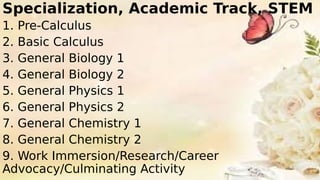
Specialization, Academic Track,STEM
1. Pre-Calculus
2. Basic Calculus
3. General Biology 1
4. General Biology 2
5. General Physics 1
6. General Physics 2
7. General Chemistry 1
8. General Chemistry 2
9. Work Immersion/Research/Career
Advocacy/Culminating Activity
39.
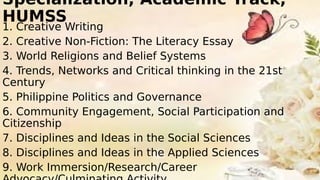
Specialization, Academic Track,
HUMSS
1.Creative Writing
2. Creative Non-Fiction: The Literacy Essay
3. World Religions and Belief Systems
4. Trends, Networks and Critical thinking in the 21st
Century
5. Philippine Politics and Governance
6. Community Engagement, Social Participation and
Citizenship
7. Disciplines and Ideas in the Social Sciences
8. Disciplines and Ideas in the Applied Sciences
9. Work Immersion/Research/Career
40.
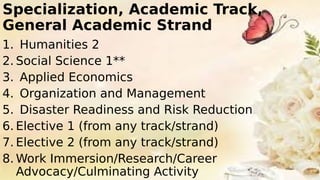
Specialization, Academic Track,
GeneralAcademic Strand
1. Humanities 2
2. Social Science 1**
3. Applied Economics
4. Organization and Management
5. Disaster Readiness and Risk Reduction
6. Elective 1 (from any track/strand)
7. Elective 2 (from any track/strand)
8. Work Immersion/Research/Career
Advocacy/Culminating Activity
41.
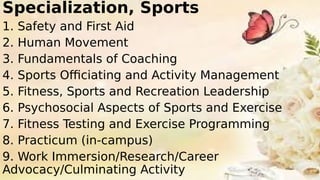
Specialization, Sports
1. Safetyand First Aid
2. Human Movement
3. Fundamentals of Coaching
4. Sports Officiating and Activity Management
5. Fitness, Sports and Recreation Leadership
6. Psychosocial Aspects of Sports and Exercise
7. Fitness Testing and Exercise Programming
8. Practicum (in-campus)
9. Work Immersion/Research/Career
Advocacy/Culminating Activity
42.
Specialization, Arts andDesign
1. Introduction to Applied Arts and Design Production
2. Introduction to Performing Arts
3. Understanding Elements and Principles of the Different
Arts
4. Work Environment in Various Arts Fields
5. Developing Filipino Identity in the Arts
6. Leadership and Management in Different Arts Fields.
7.&8 Apprenticeship and Exploration of Different Arts
Fields(Production and Performing: Music, Dance and
Theater)
9. Apprenticeship and Exploration of Different Arts Design
Production (Media Arts, Visual Arts and Literary Arts)