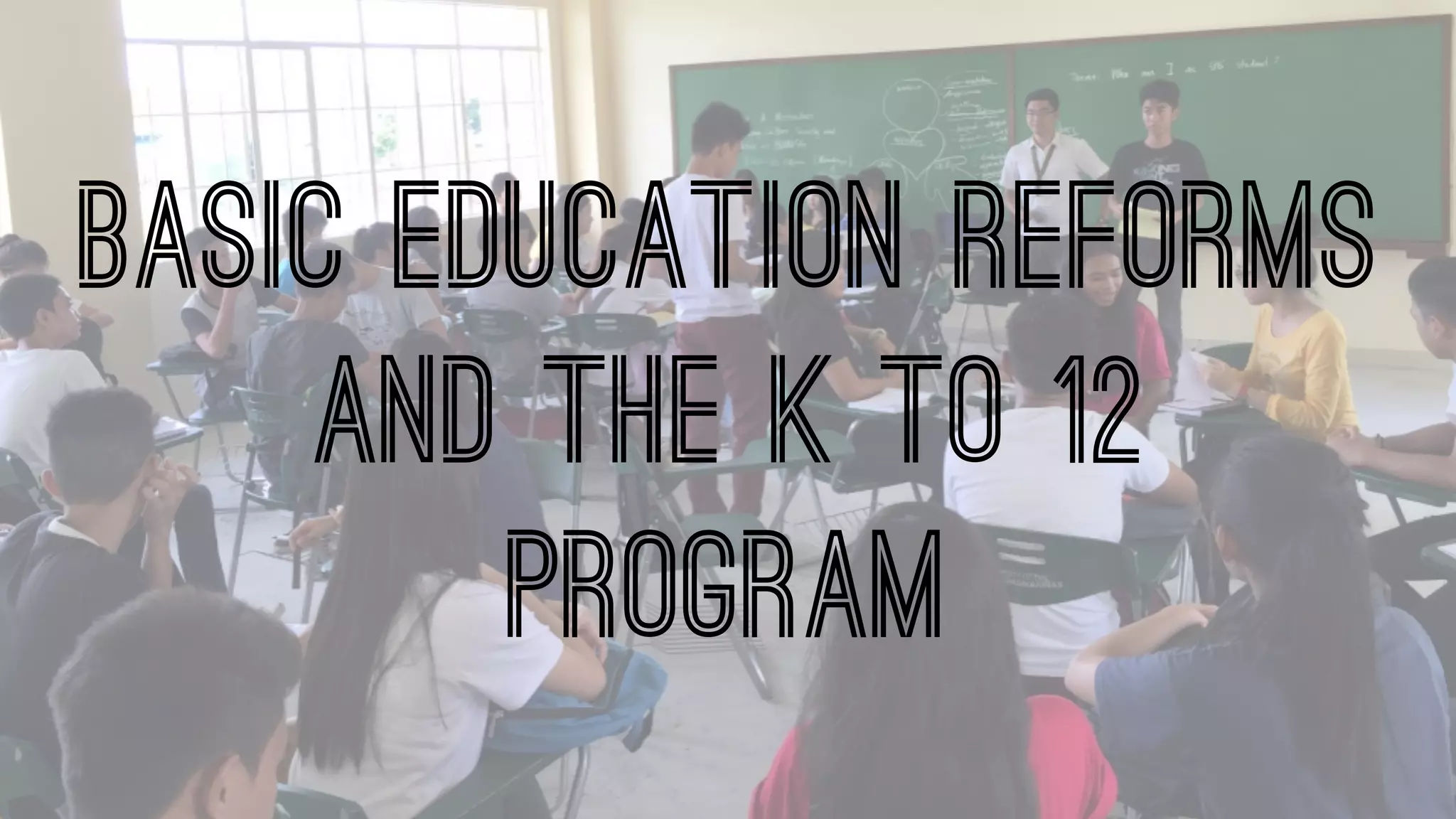
basic education Reforms
and the k to 12
program
“Ensure inclusive and
quality education for
all and promote
lifelong learning.”
2
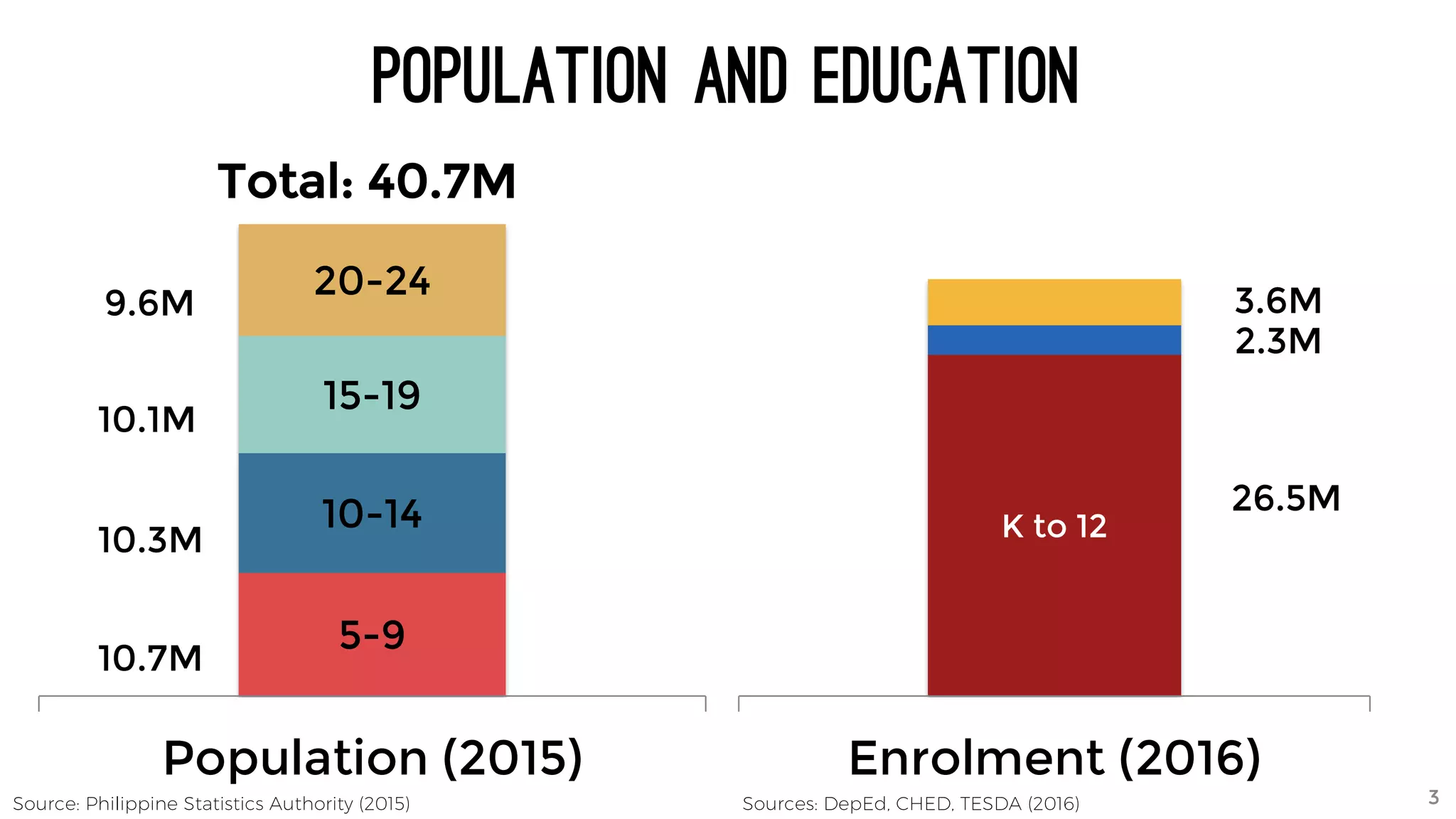
5-9
10-14
15-19
20-24
Population (2015)
K to 12
Enrolment (2016)
10.7M
10.3M
10.1M
9.6M
Total: 40.7M
26.5M
2.3M
3.6M
Population and education
Source: Philippine Statistics Authority (2015) Sources: DepEd, CHED, TESDA (2016) 3
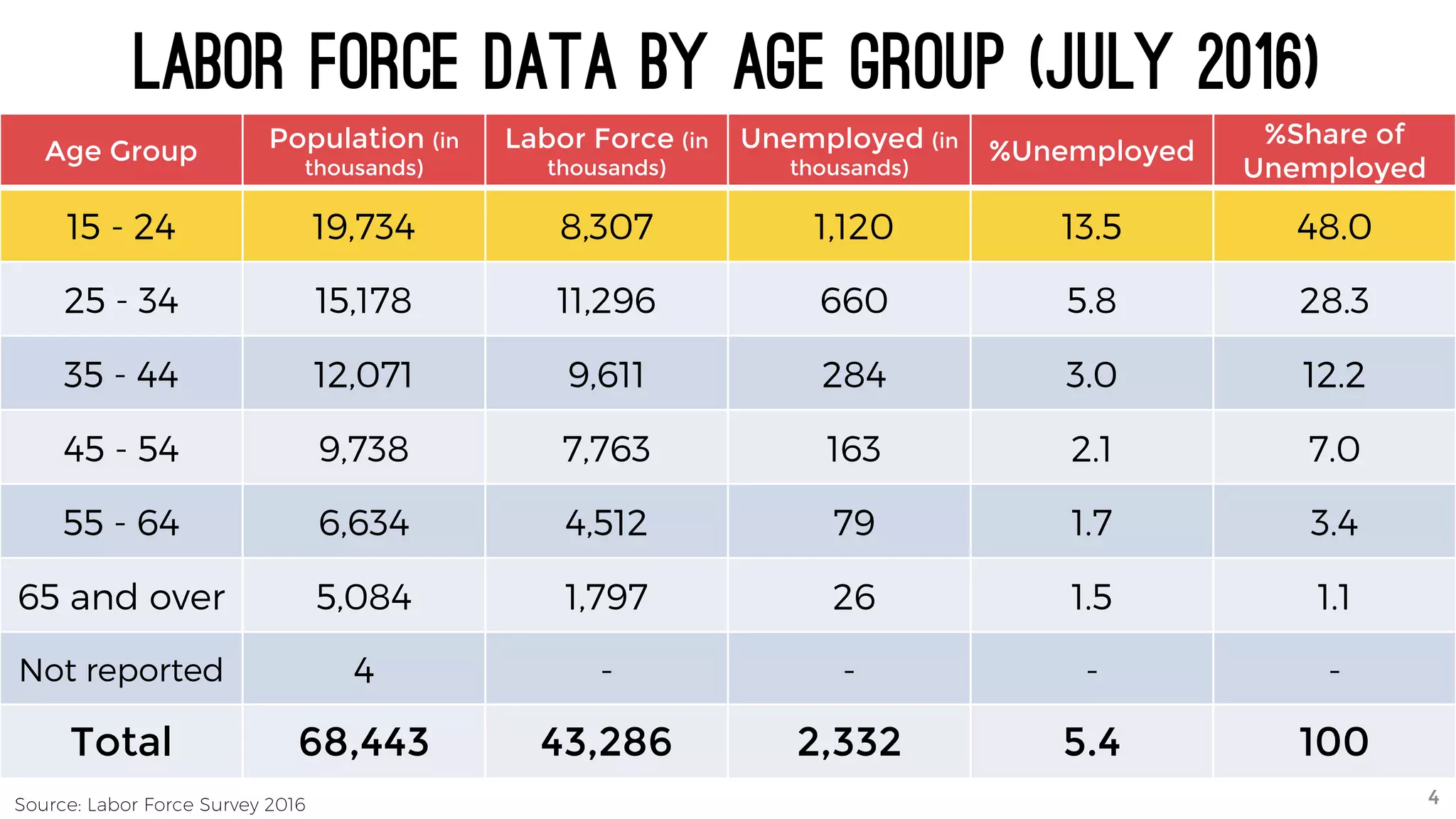
Age Group Population (in
thousands)
Labor Force (in
thousands)
Unemployed (in
thousands)
%Unemployed
%Share of
Unemployed
15 - 24 19,734 8,307 1,120 13.5 48.0
25 - 34 15,178 11,296 660 5.8 28.3
35 - 44 12,071 9,611 284 3.0 12.2
45 - 54 9,738 7,763 163 2.1 7.0
55 - 64 6,634 4,512 79 1.7 3.4
65 and over 5,084 1,797 26 1.5 1.1
Not reported 4 - - - -
Total 68,443 43,286 2,332 5.4 100
Labor force data by age group (july 2016)
Source: Labor Force Survey 2016 4
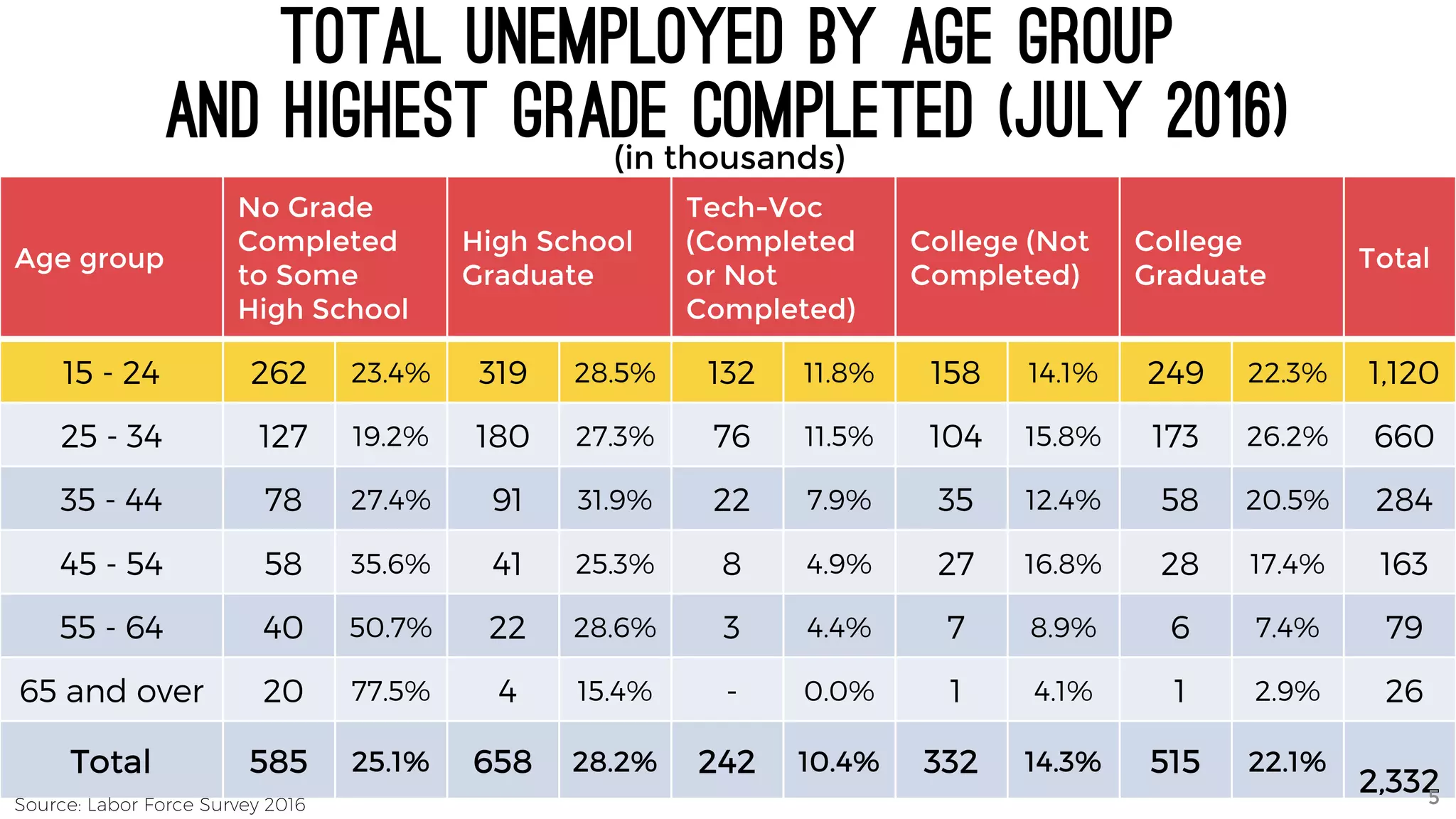
Age group
No Grade
Completed
to Some
High School
High School
Graduate
Tech-Voc
(Completed
or Not
Completed)
College (Not
Completed)
College
Graduate
Total
15 - 24 262 23.4% 319 28.5% 132 11.8% 158 14.1% 249 22.3% 1,120
25 - 34 127 19.2% 180 27.3% 76 11.5% 104 15.8% 173 26.2% 660
35 - 44 78 27.4% 91 31.9% 22 7.9% 35 12.4% 58 20.5% 284
45 - 54 58 35.6% 41 25.3% 8 4.9% 27 16.8% 28 17.4% 163
55 - 64 40 50.7% 22 28.6% 3 4.4% 7 8.9% 6 7.4% 79
65 and over 20 77.5% 4 15.4% - 0.0% 1 4.1% 1 2.9% 26
Total 585 25.1% 658 28.2% 242 10.4% 332 14.3% 515 22.1%
2,332
Total unemployed by age group
AND highest grade completed (july 2016)(in thousands)
5Source: Labor Force Survey 2016
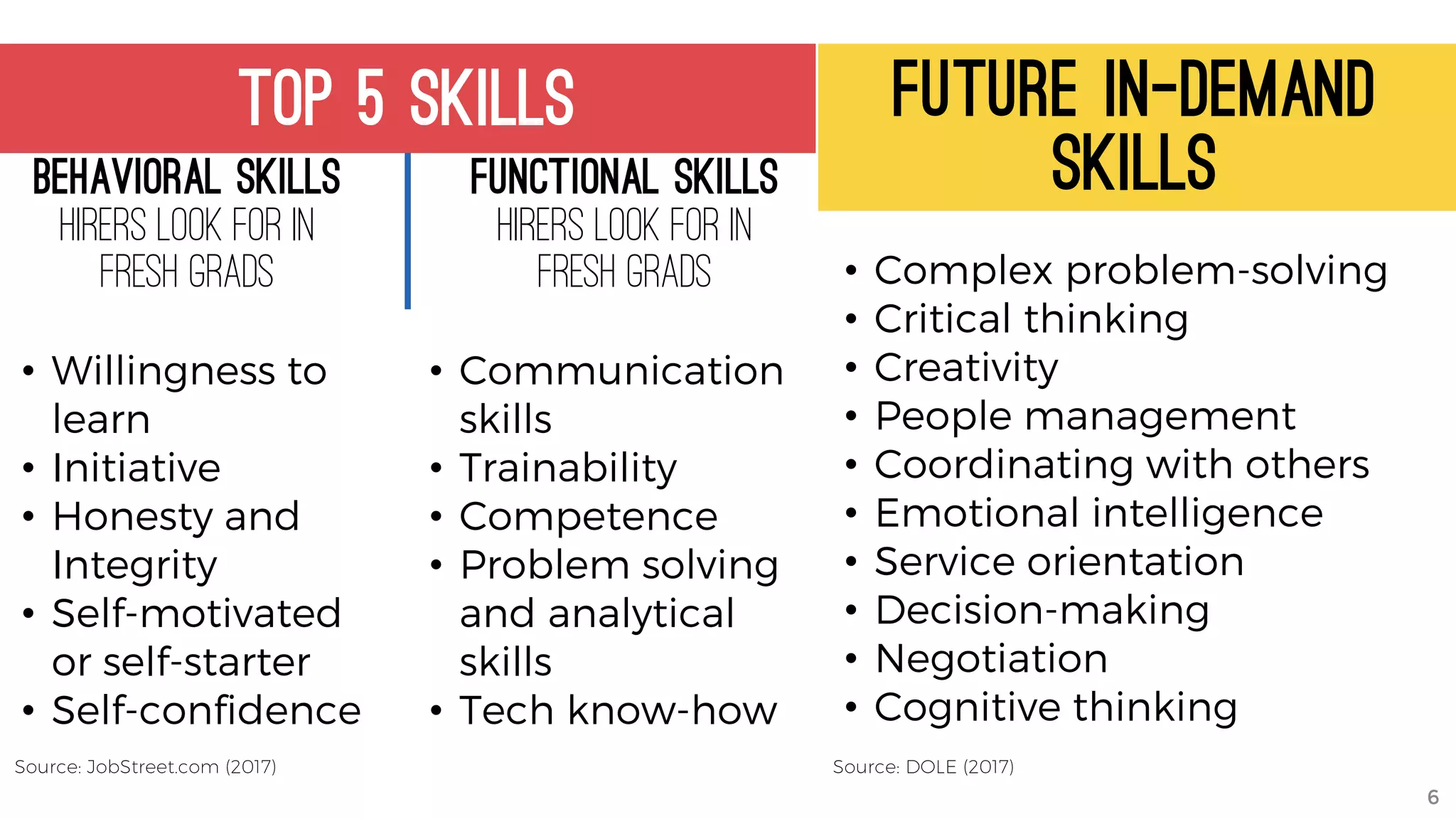
Top 5 skills
Behavioral Skills
hirers look for in
Fresh Grads
functional Skills
hirers look for in
Fresh Grads
• Willingness to
learn
• Initiative
• Honesty and
Integrity
• Self-motivated
or self-starter
• Self-confidence
• Communication
skills
• Trainability
• Competence
• Problem solving
and analytical
skills
• Tech know-how
Future in-demand
skills
• Complex problem-solving
• Critical thinking
• Creativity
• People management
• Coordinating with others
• Emotional intelligence
• Service orientation
• Decision-making
• Negotiation
• Cognitive thinking
Source: JobStreet.com (2017) Source: DOLE (2017)
6
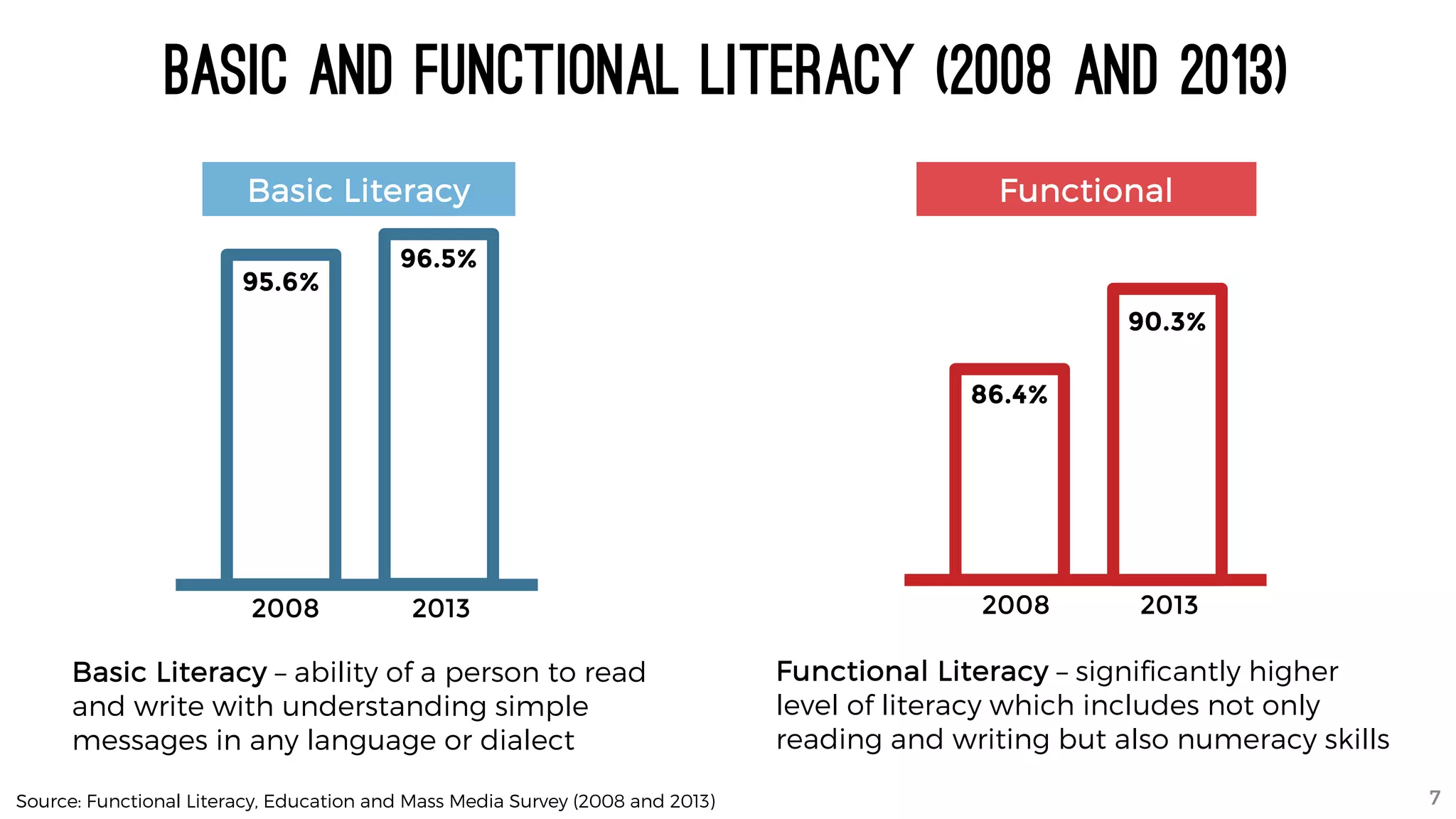
Basic and Functional Literacy (2008 and 2013)
86.4%
90.3%
95.6%
96.5%
Functional
Literacy
20132008 20132008
Basic Literacy
Basic Literacy – ability of a person to read
and write with understanding simple
messages in any language or dialect
Functional Literacy – significantly higher
level of literacy which includes not only
reading and writing but also numeracy skills
7Source: Functional Literacy, Education and Mass Media Survey (2008 and 2013)
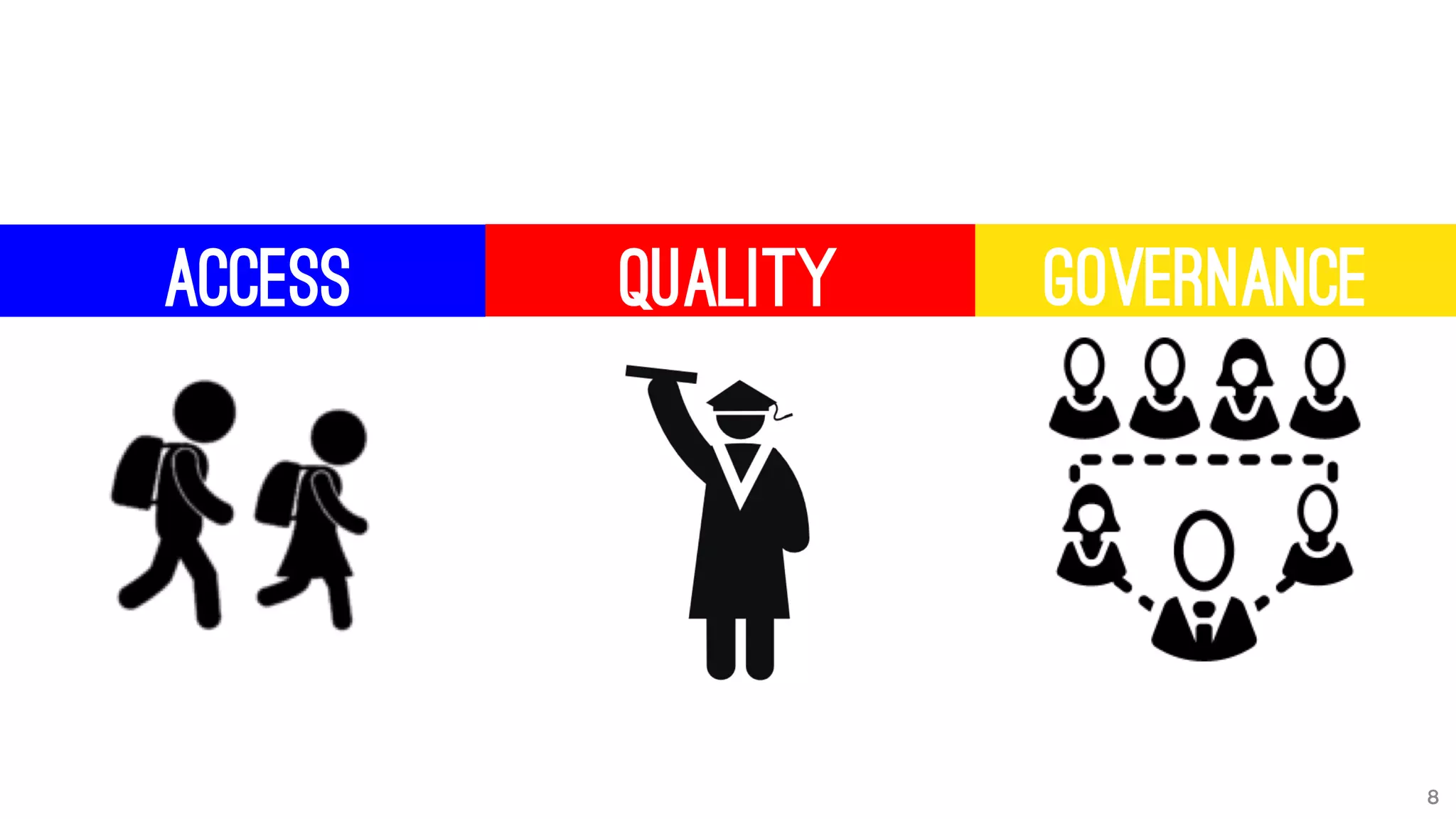
Access Quality governance
8
Access governance
Are Filipinos able to
complete basic
education?
9
quality governanceAre Filipinos equipped
with essential
knowledge, skills, and
values?
10
governance Are we able to create
an efficient and
effective system that is
responsive to learners’
needs?
11
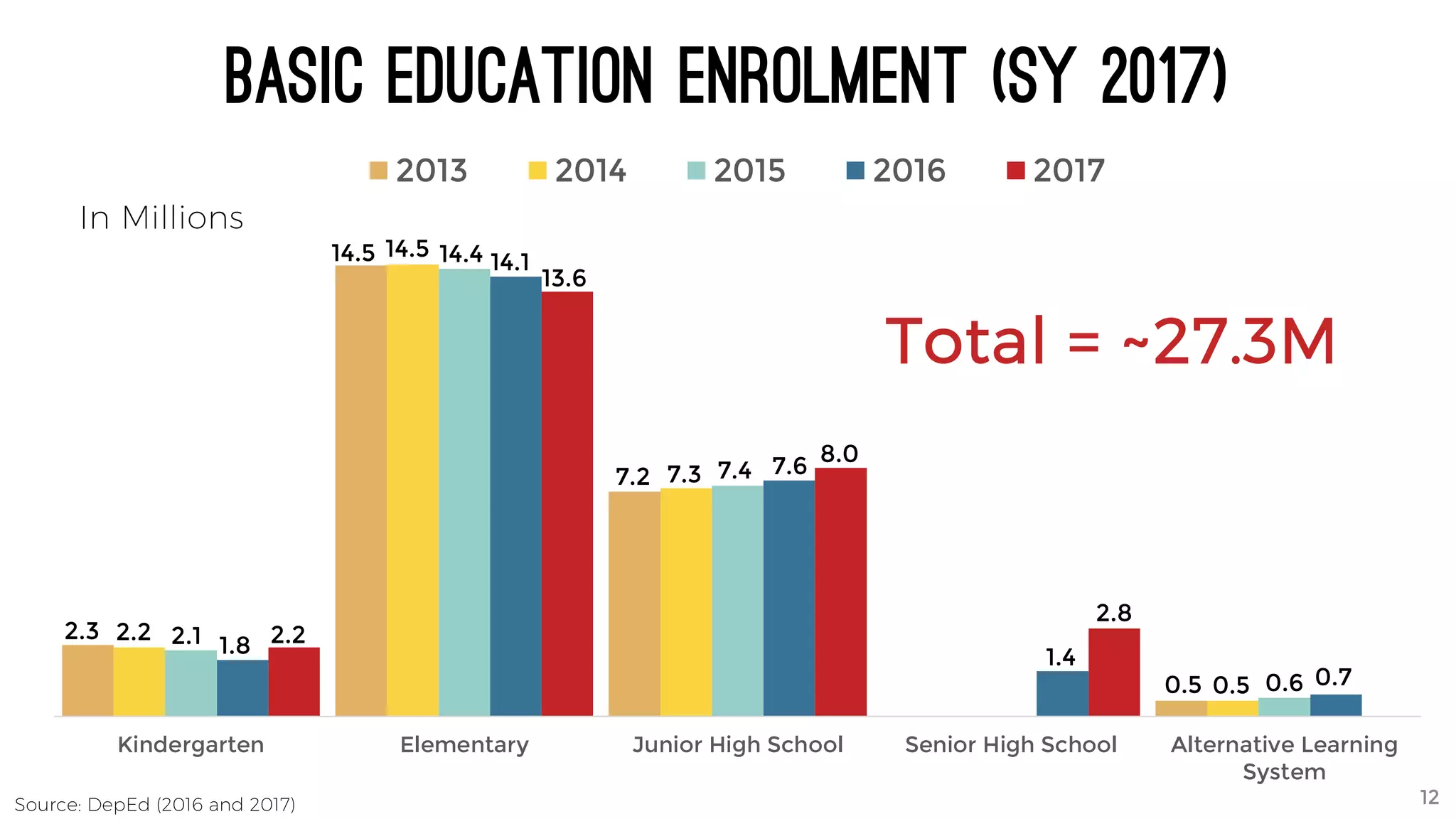
Basic Education Enrolment (SY 2017)
Kindergarten Elementary Junior High School Senior High School Alternative Learning
System
2013 2014 2015 2016 2017
2.3 2.2 2.1 1.8 2.2
14.5 14.5 14.4 14.1
13.6
7.2 7.3 7.4 7.6 8.0
1.4
2.8
0.5 0.5 0.6 0.7
Total = ~27.3M
In Millions
Source: DepEd (2016 and 2017) 12
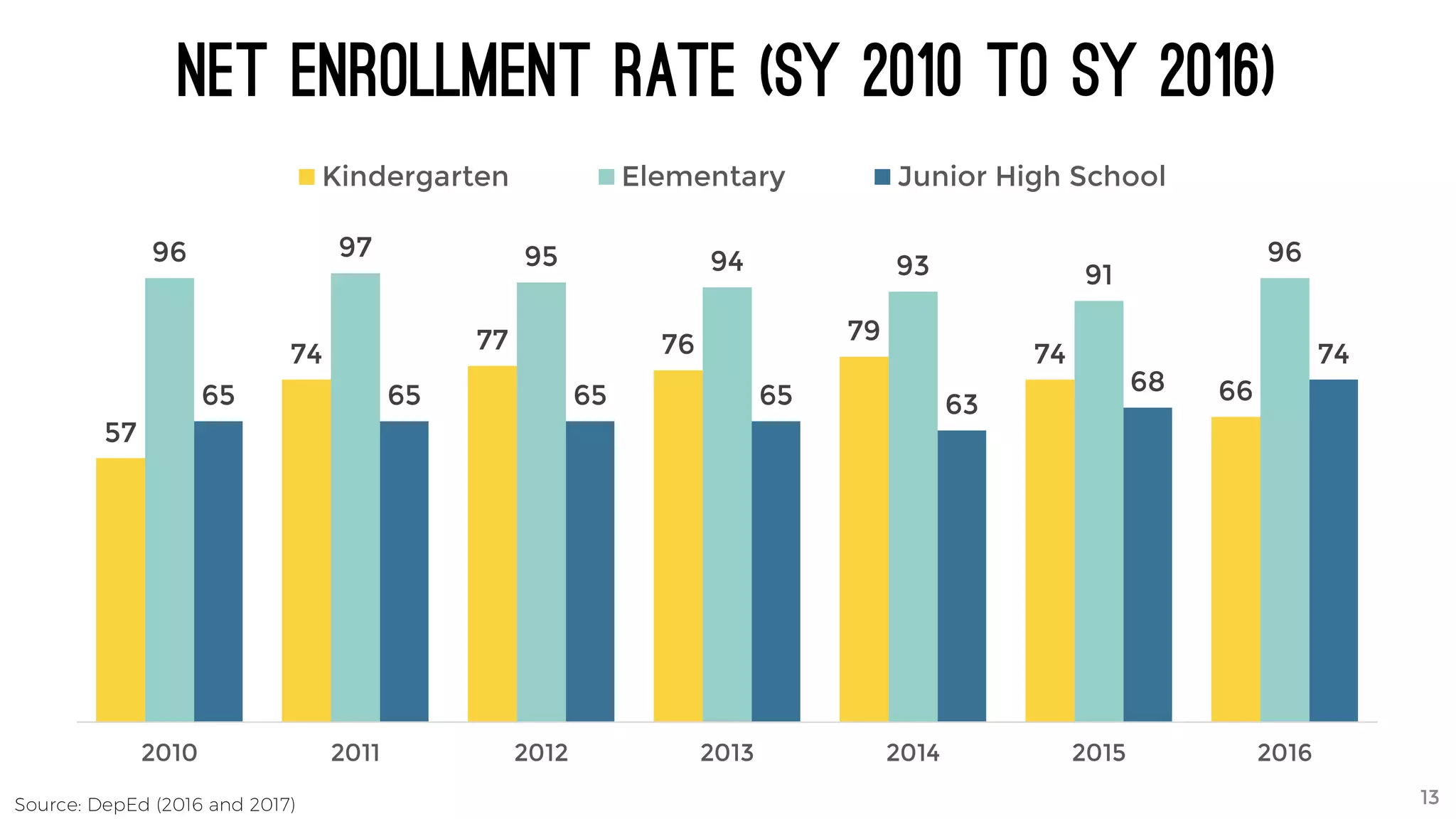
Net Enrollment Rate (SY 2010 to SY 2016)
13
57
74 77 76 79
74
66
96 97 95 94 93 91
96
65 65 65 65 63
68
74
2010 2011 2012 2013 2014 2015 2016
Kindergarten Elementary Junior High School
Source: DepEd (2016 and 2017)
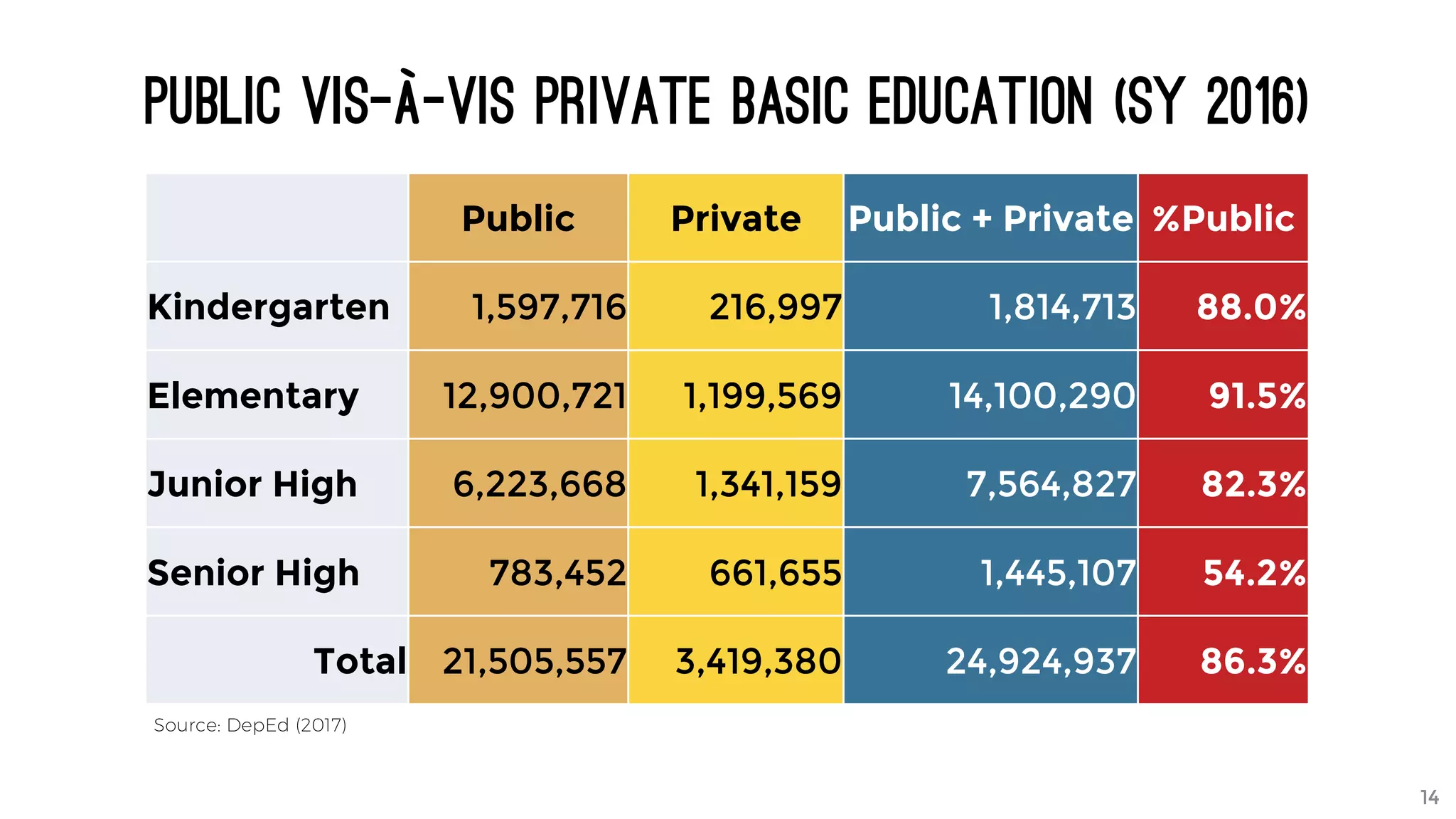
Public vis-à-vis Private Basic Education (SY 2016)
14
Public Private Public + Private %Public
Kindergarten 1,597,716 216,997 1,814,713 88.0%
Elementary 12,900,721 1,199,569 14,100,290 91.5%
Junior High 6,223,668 1,341,159 7,564,827 82.3%
Senior High 783,452 661,655 1,445,107 54.2%
Total 21,505,557 3,419,380 24,924,937 86.3%
Source: DepEd (2017)
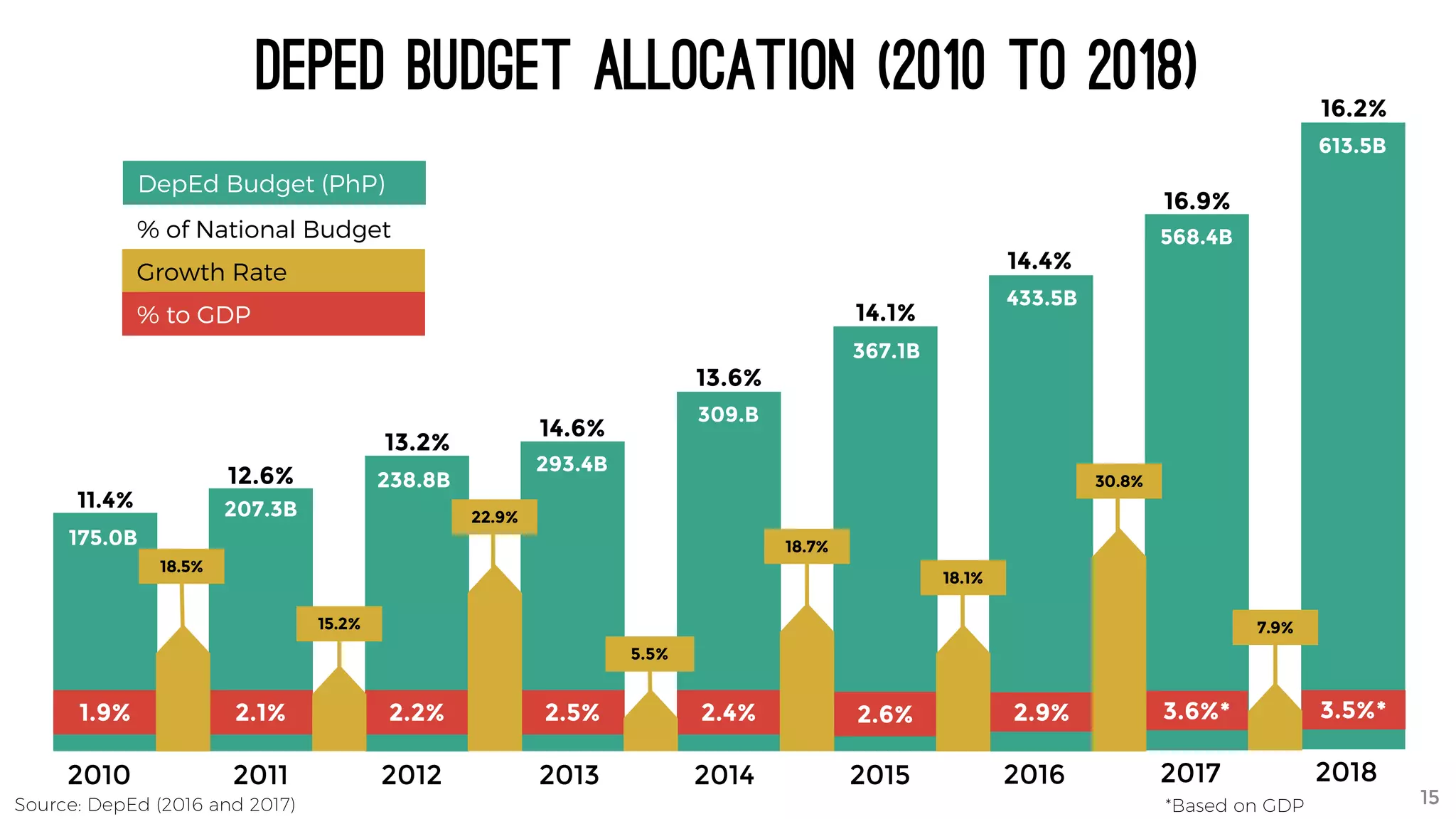
DepEd Budget Allocation (2010 to 2018)
DepEd Budget (PhP)
% of National Budget
Growth Rate
% to GDP
11.4%
12.6%
13.2%
14.6%
13.6%
14.1%
2010 2011 2012 2013 2014 2015
175.0B
207.3B
238.8B
293.4B
309.B
367.1B
18.5%
15.2%
22.9%
5.5%
18.7%
2.9%1.9% 2.1% 2.2% 2.5% 2.4%
14.4%
433.5B
18.1%
2.6%
2016
3.6%*
16.9%
568.4B
30.8%
2017
3.5%*
16.2%
613.5B
7.9%
2018
Source: DepEd (2016 and 2017) *Based on GDP 15
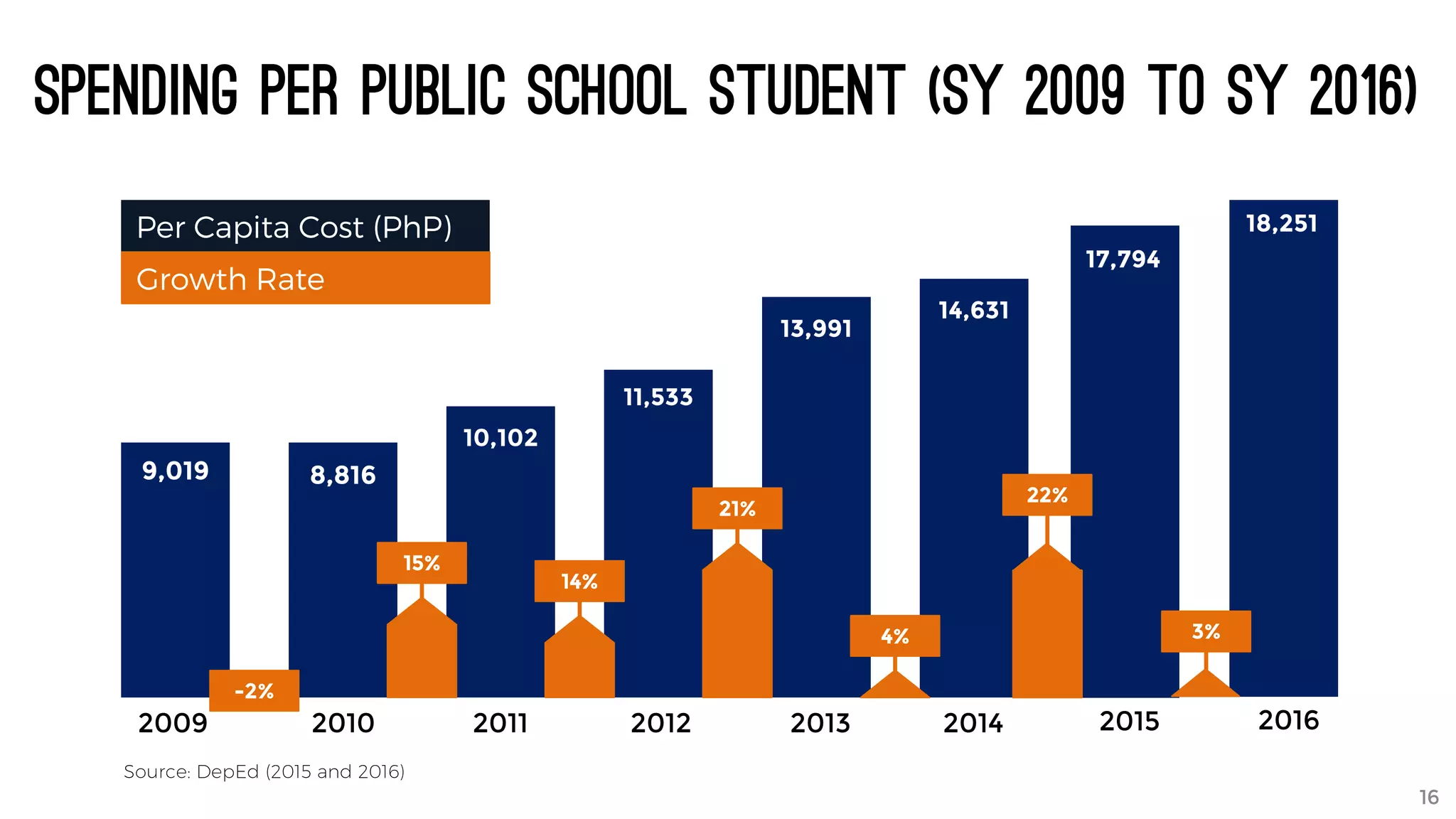
Spending per Public School Student (SY 2009 to SY 2016)
9,019 8,816
10,102
11,533
13,991
14,631
Per Capita Cost (PhP)
Growth Rate
-2%
15%
14%
21%
4%
201420132012201120102009
22%
17,794
2015
3%
18,251
2016
Source: DepEd (2015 and 2016)
16
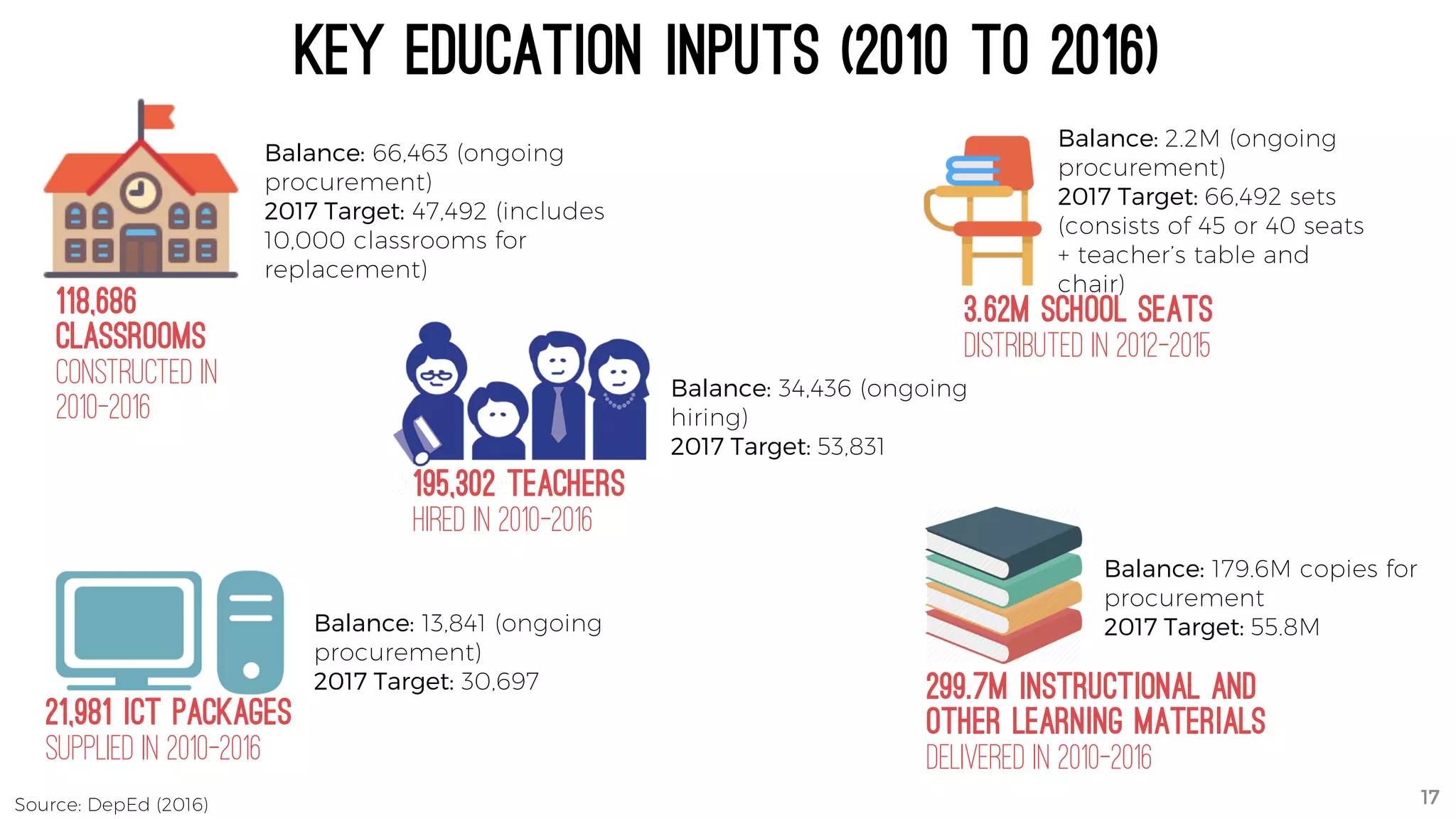
Key Education Inputs (2010 to 2016)
Balance: 66,463 (ongoing
procurement)
2017 Target: 47,492 (includes
10,000 classrooms for
replacement)
Balance: 2.2M (ongoing
procurement)
2017 Target: 66,492 sets
(consists of 45 or 40 seats
+ teacher’s table and
chair)
Balance: 34,436 (ongoing
hiring)
2017 Target: 53,831
Balance: 13,841 (ongoing
procurement)
2017 Target: 30,697
Balance: 179.6M copies for
procurement
2017 Target: 55.8M
118,686
classrooms
constructed in
2010-2016
3.62M school seats
distributed in 2012-2015
195,302 teachers
hired in 2010-2016
21,981 ICT PACKAGES
supplied in 2010-2016
299.7m instructional and
other learning materials
delivered in 2010-2016
Source: DepEd (2016) 17
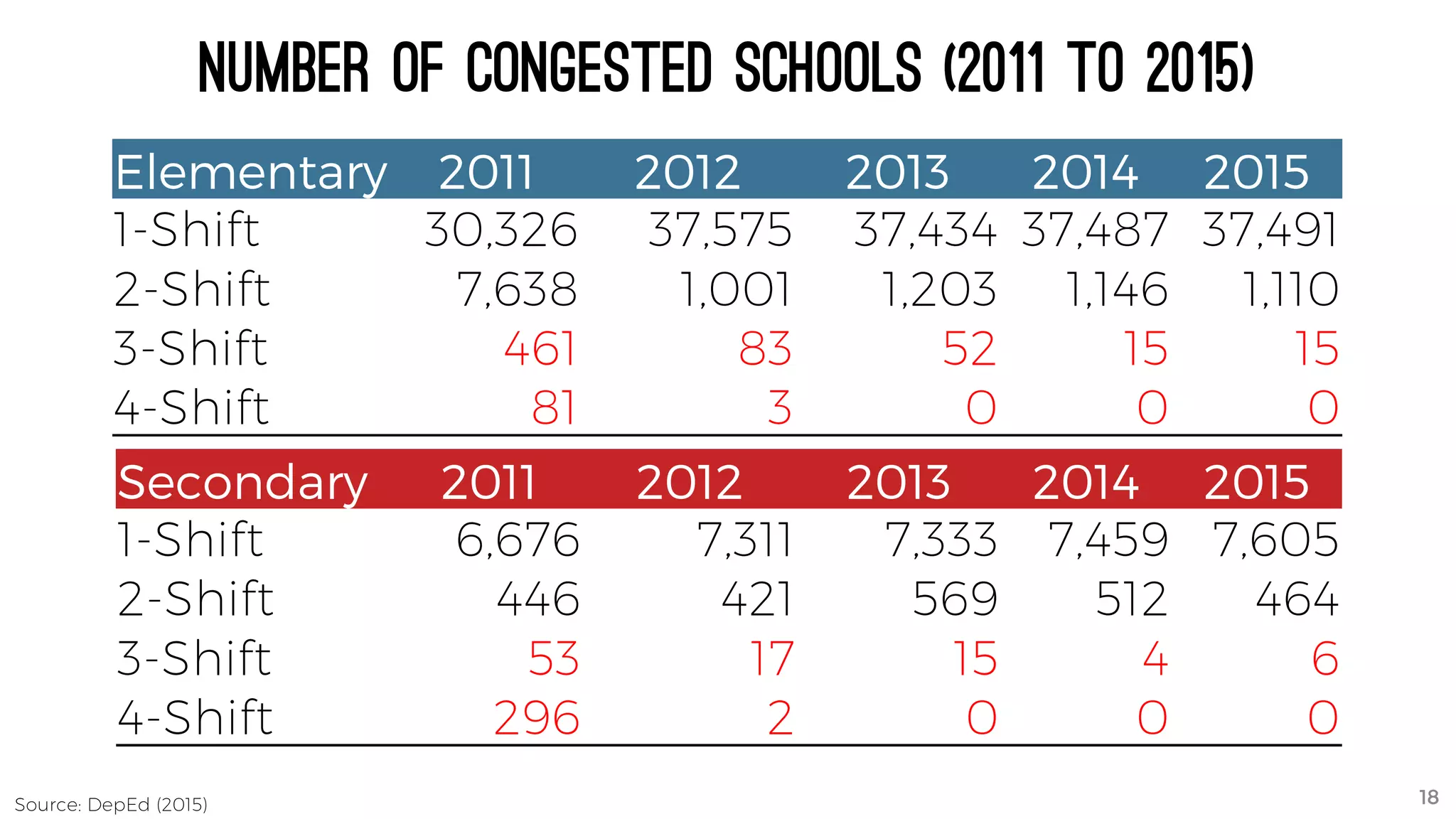
Number of Congested Schools (2011 to 2015)
Elementary 2011 2012 2013 2014 2015
1-Shift 30,326 37,575 37,434 37,487 37,491
2-Shift 7,638 1,001 1,203 1,146 1,110
3-Shift 461 83 52 15 15
4-Shift 81 3 0 0 0
Secondary 2011 2012 2013 2014 2015
1-Shift 6,676 7,311 7,333 7,459 7,605
2-Shift 446 421 569 512 464
3-Shift 53 17 15 4 6
4-Shift 296 2 0 0 0
Source: DepEd (2015) 18
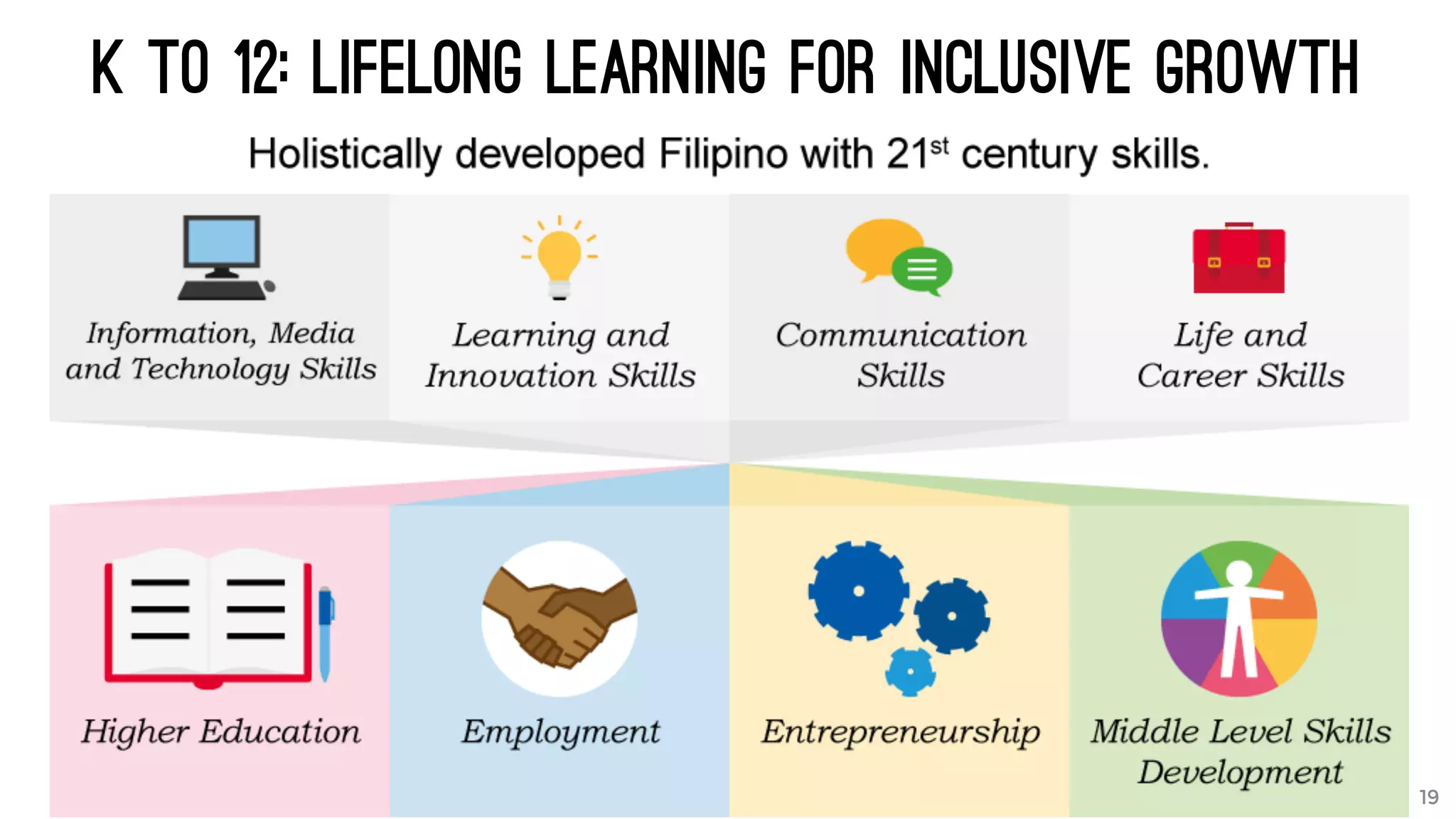
K to 12: Lifelong Learning for Inclusive Growth
19
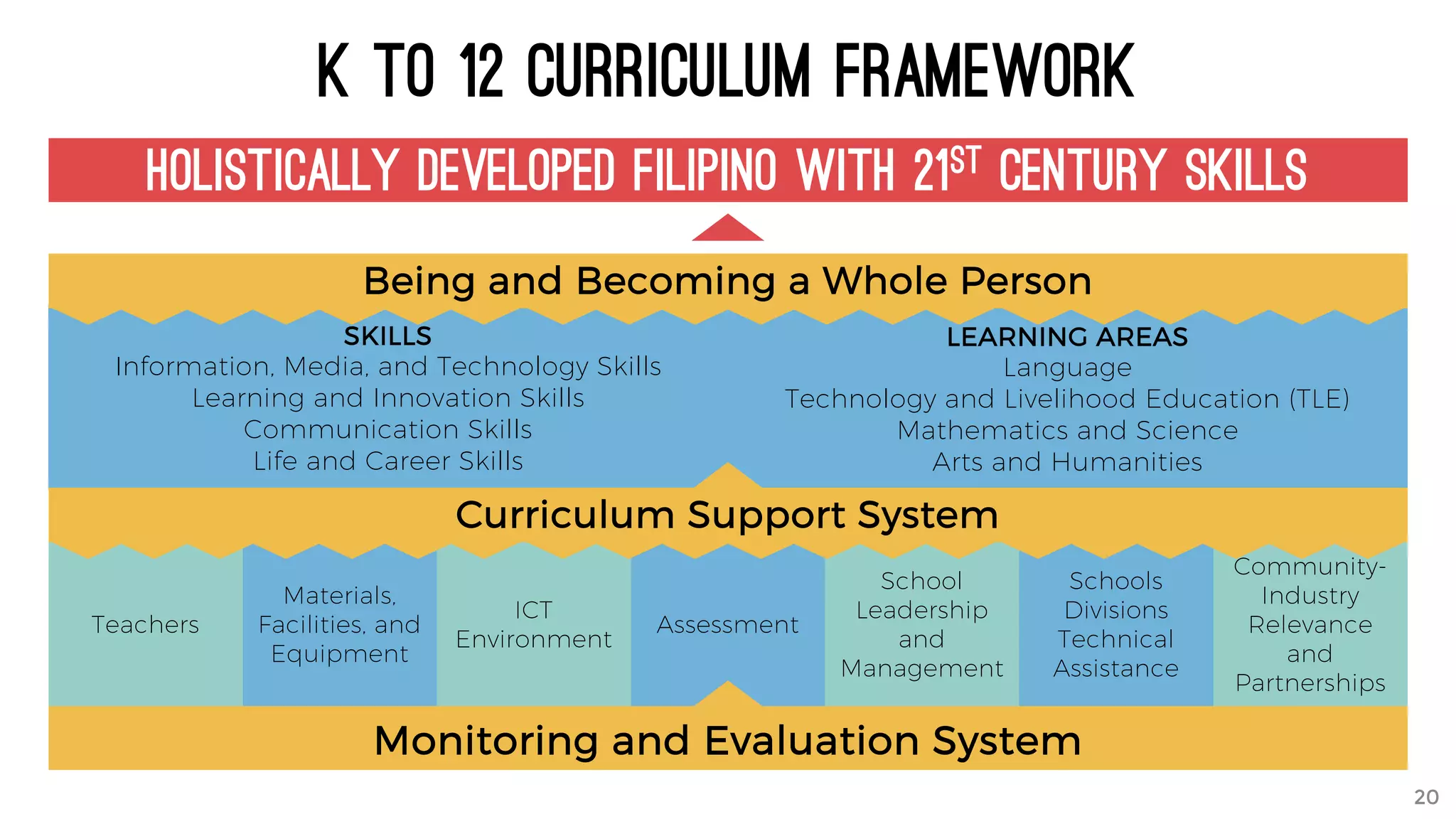
SKILLS
Information, Media, and Technology Skills
Learning and Innovation Skills
Communication Skills
Life and Career Skills
LEARNING AREAS
Language
Technology and Livelihood Education (TLE)
Mathematics and Science
Arts and Humanities
Materials,
Facilities, and
Equipment
ICT
Environment
Assessment
School
Leadership
and
Management
Schools
Divisions
Technical
Assistance
Community-
Industry
Relevance
and
Partnerships
Teachers
K to 12 Curriculum Framework
Monitoring and Evaluation System
Curriculum Support System
Holistically Developed Filipino with 21st Century Skills
Being and Becoming a Whole Person
20
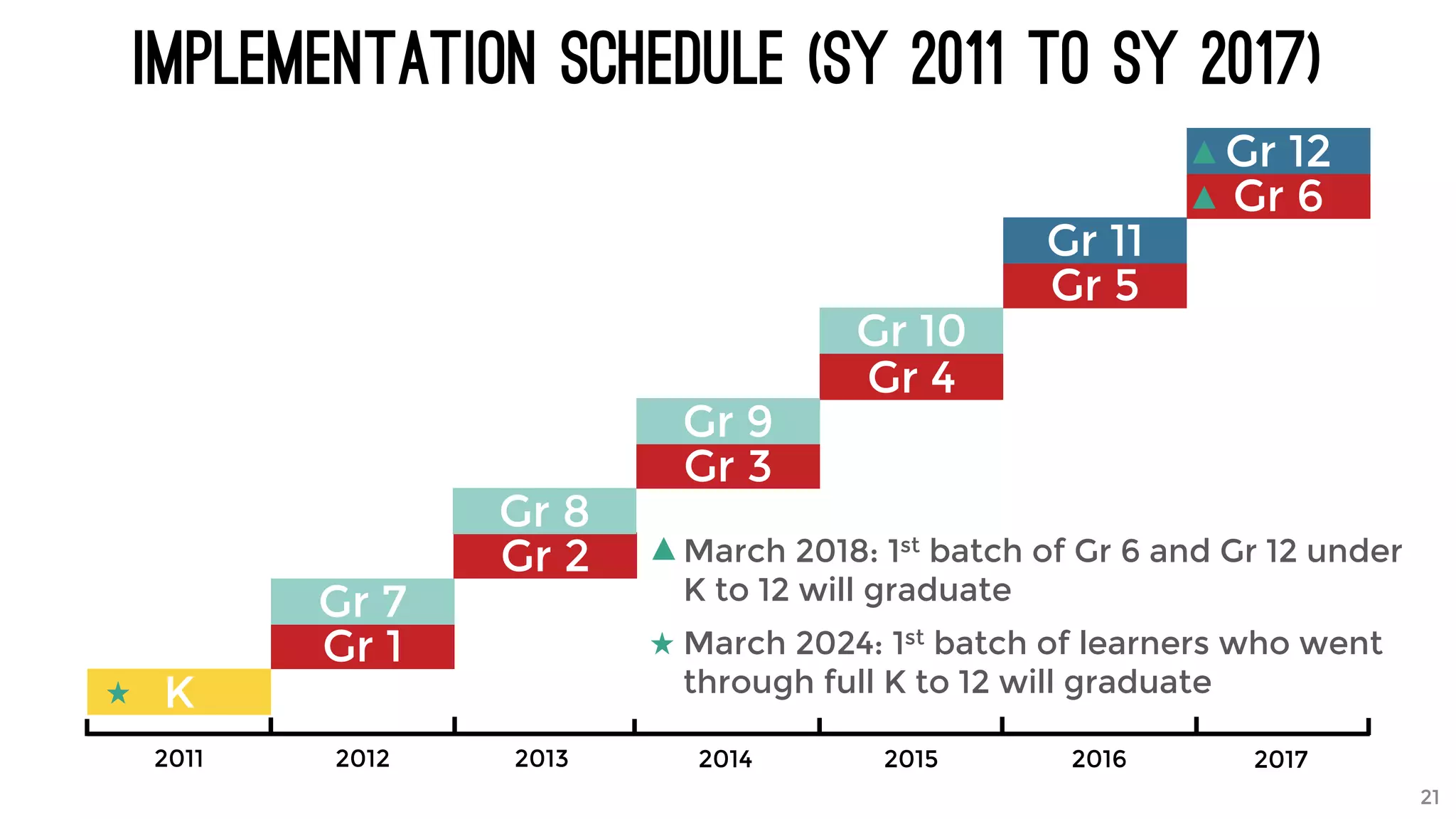
Implementation Schedule (SY 2011 to SY 2017)
K
Gr 1
Gr 2
Gr 3
Gr 4
Gr 5
Gr 6
Gr 7
Gr 8
Gr 9
Gr 10
Gr 11
Gr 12
2011 2012 2013 2014 2015 2016 2017
March 2018: 1st batch of Gr 6 and Gr 12 under
K to 12 will graduate
March 2024: 1st batch of learners who went
through full K to 12 will graduate
21
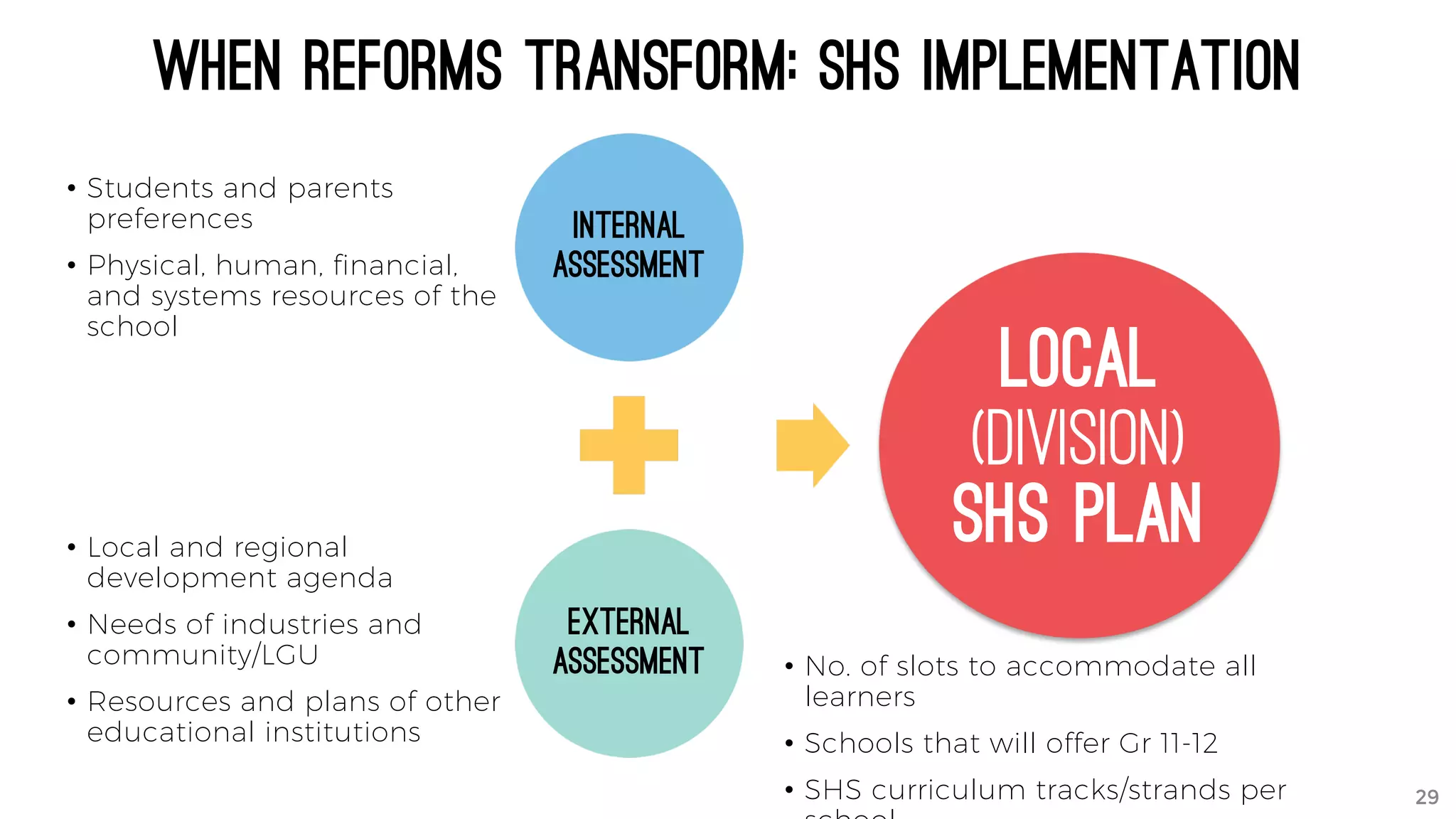
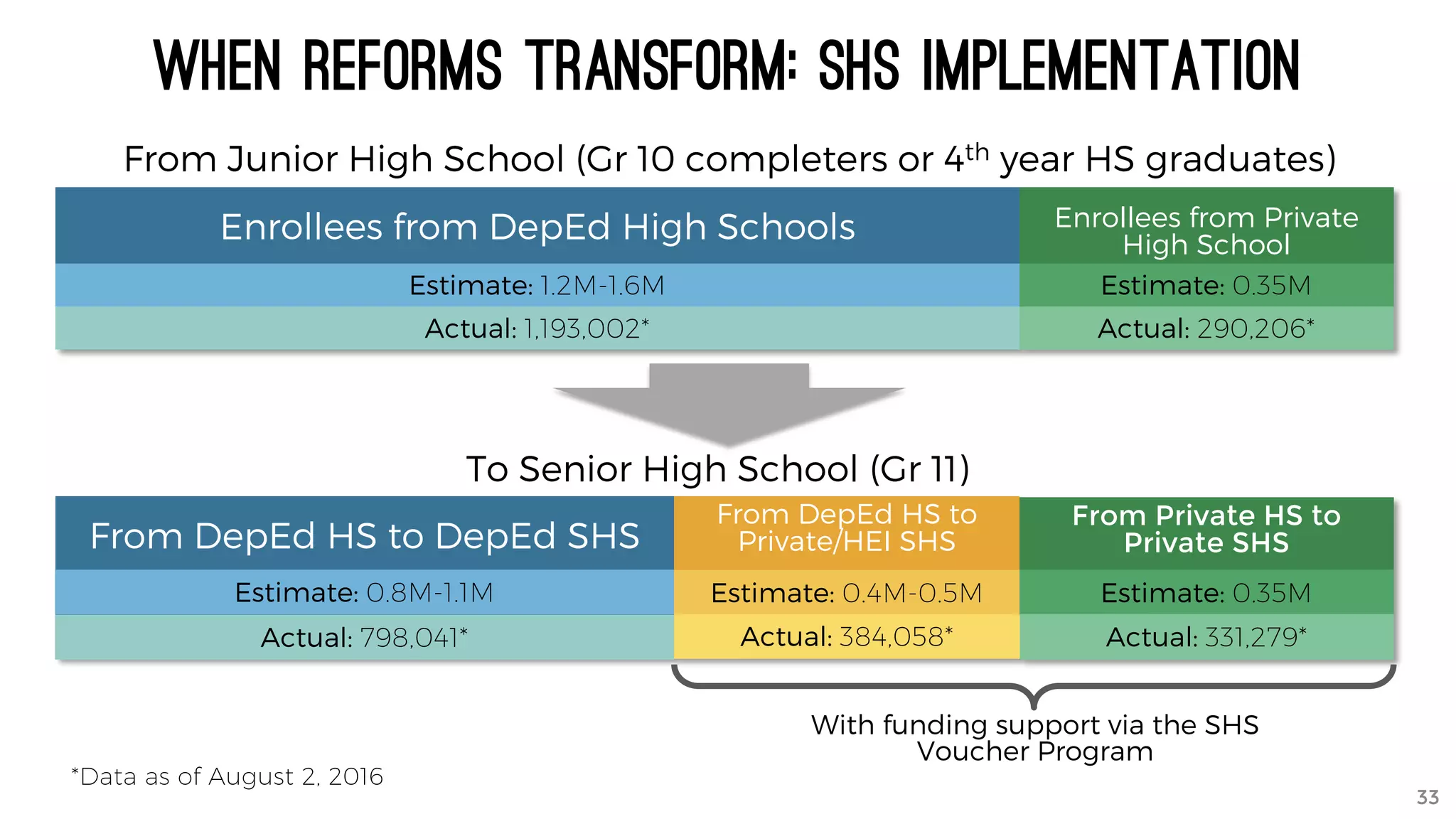
When reforms transform: shs implementation
Internal
Assessment
External
Assessment
Local
(Division)
SHS Plan
29
• Students and parents
preferences
• Physical, human, financial,
and systems resources of the
school
• Local and regional
development agenda
• Needs of industries and
community/LGU
• Resources and plans of other
educational institutions
• No. of slots to accommodate all
learners
• Schools that will offer Gr 11-12
• SHS curriculum tracks/strands per 29
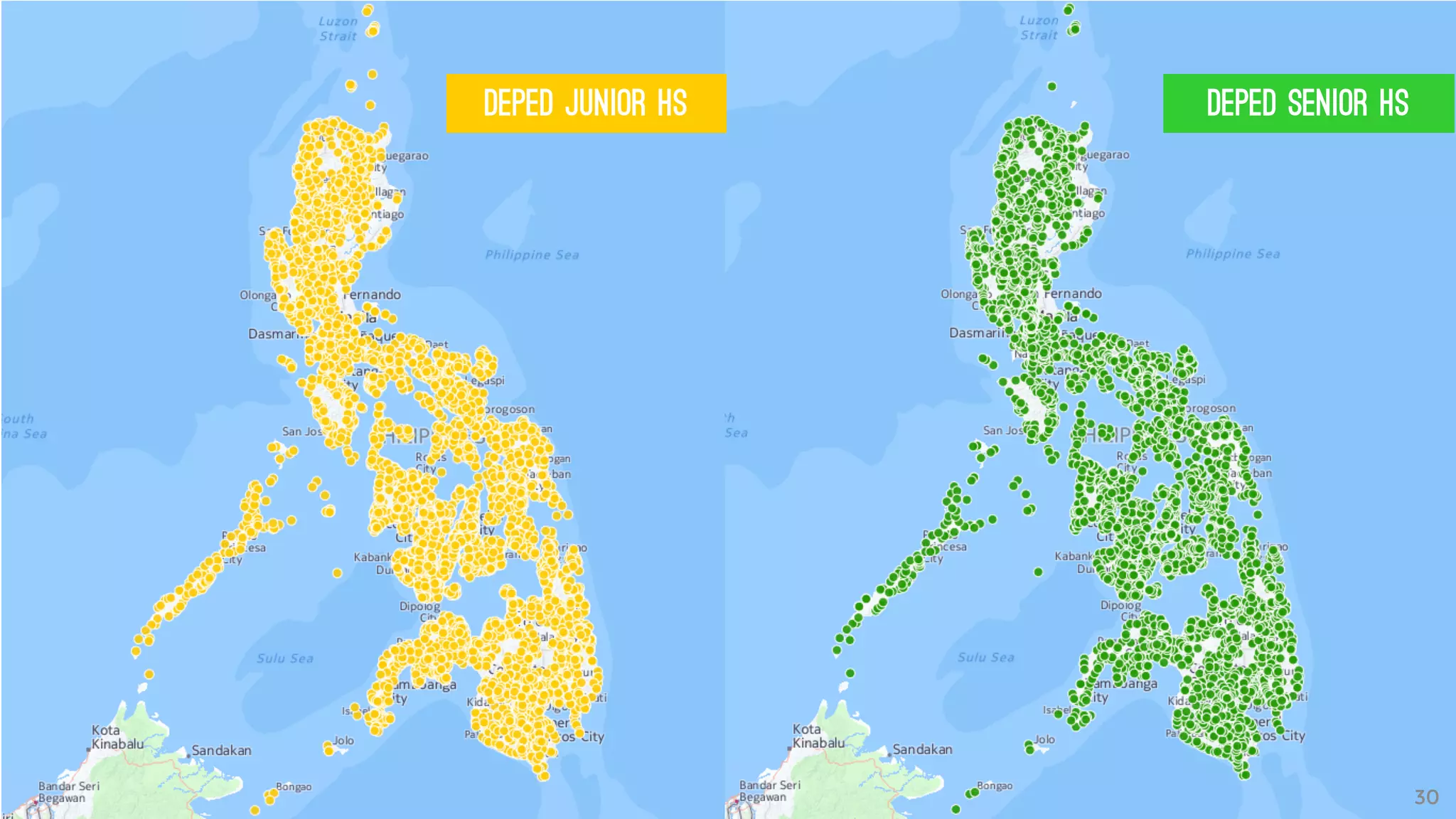
DepEd Junior HS DepEd Senior HS
30
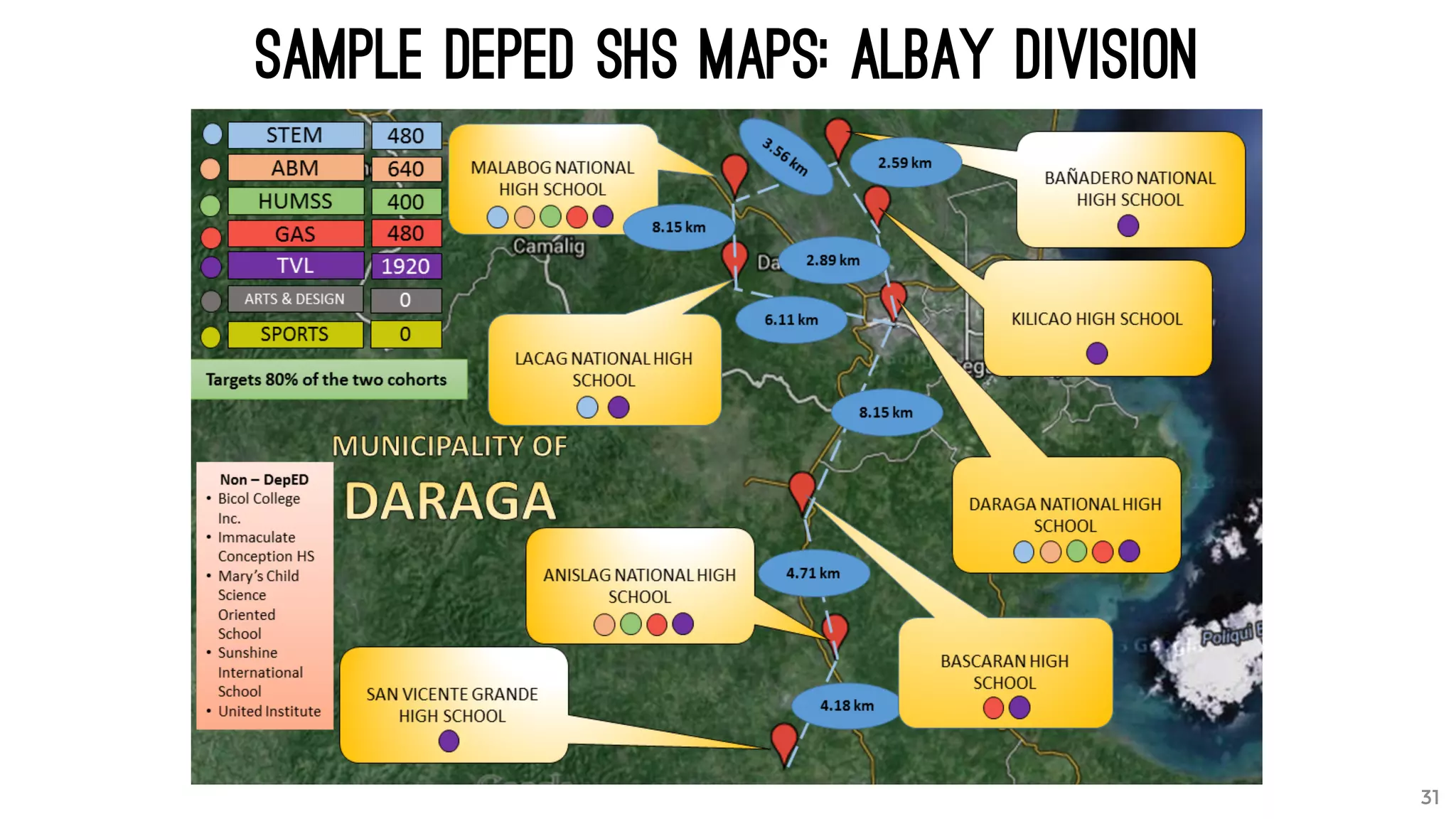
Sample DepEd SHS Maps: Albay Division
31 31
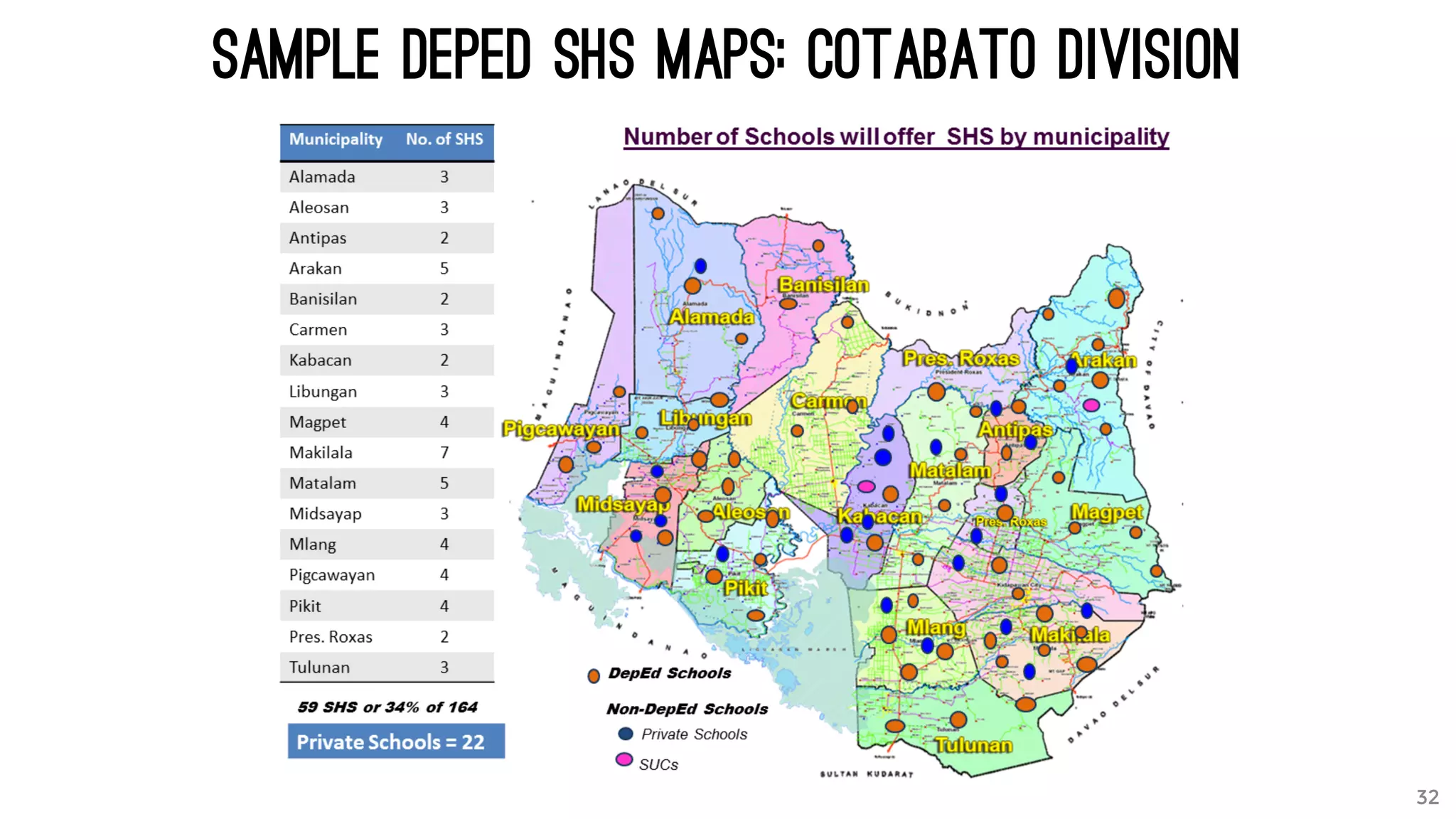
Sample DepEd SHS Maps: Cotabato Division
32 32
Enrollees from DepEd High Schools Enrollees from Private
High School
From DepEd HS to DepEd SHS
From DepEd HS to
Private/HEI SHS
From Junior High School (Gr 10 completers or 4th year HS graduates)
To Senior High School (Gr 11)
33
*Data as of August 2, 2016
From Private HS to
Private SHS
With funding support via the SHS
Voucher Program
When reforms transform: shs implementation
Estimate: 1.2M-1.6M
Actual: 1,193,002*
Estimate: 0.35M
Actual: 290,206*
Estimate: 0.8M-1.1M
Actual: 798,041*
Estimate: 0.4M-0.5M
Actual: 384,058*
Estimate: 0.35M
Actual: 331,279*
33
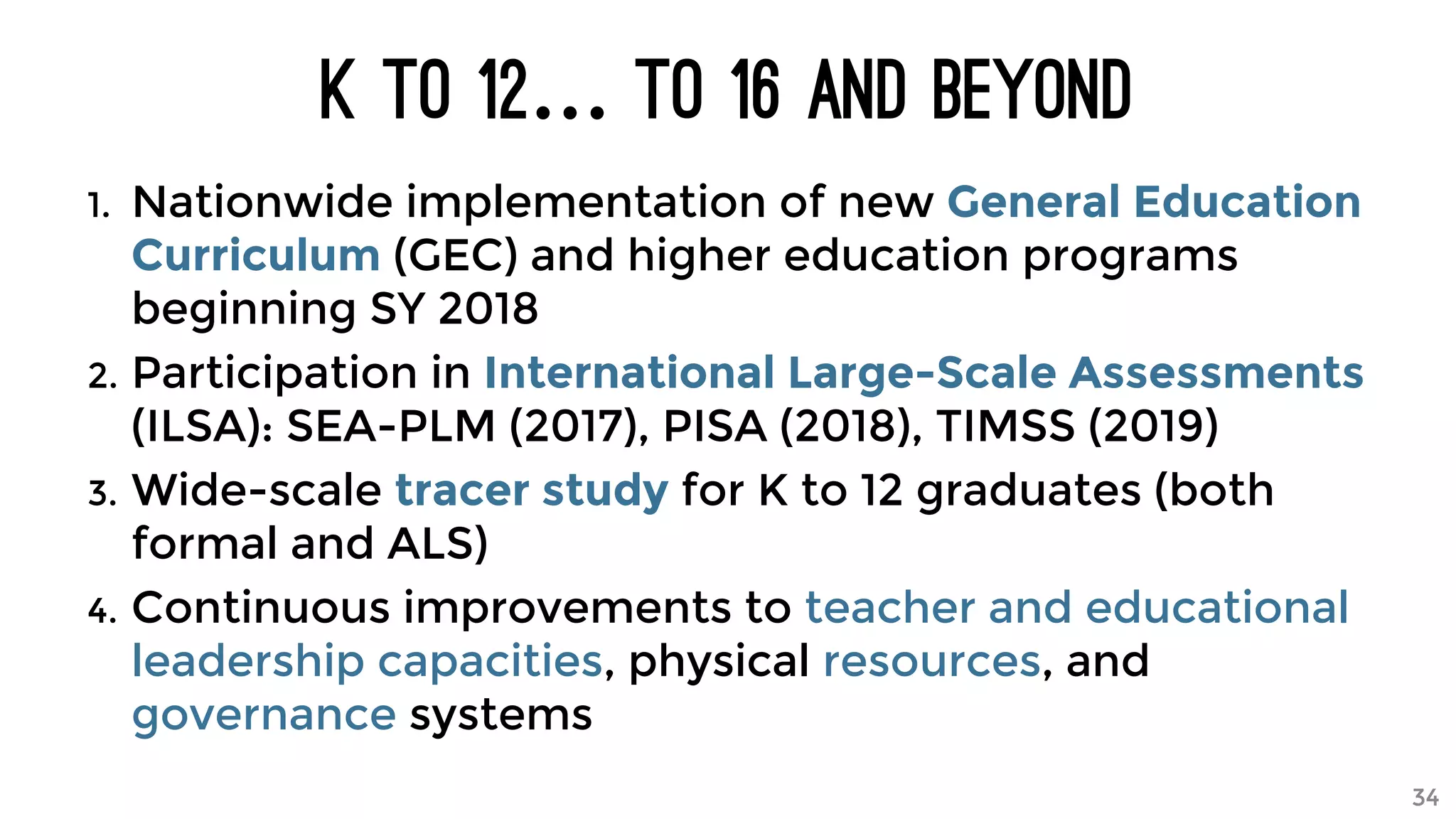
K to 12… to 16 and Beyond
1. Nationwide implementation of new General Education
Curriculum (GEC) and higher education programs
beginning SY 2018
2. Participation in International Large-Scale Assessments
(ILSA): SEA-PLM (2017), PISA (2018), TIMSS (2019)
3. Wide-scale tracer study for K to 12 graduates (both
formal and ALS)
4. Continuous improvements to teacher and educational
leadership capacities, physical resources, and
governance systems
34

Basic Education Reforms and the K to 12 Program in the Philippines

  • 1.
    basic education Reforms andthe k to 12 program
  • 2.
    “Ensure inclusive and qualityeducation for all and promote lifelong learning.” 2
  • 3.
    5-9 10-14 15-19 20-24 Population (2015) K to12 Enrolment (2016) 10.7M 10.3M 10.1M 9.6M Total: 40.7M 26.5M 2.3M 3.6M Population and education Source: Philippine Statistics Authority (2015) Sources: DepEd, CHED, TESDA (2016) 3
  • 4.
    Age Group Population(in thousands) Labor Force (in thousands) Unemployed (in thousands) %Unemployed %Share of Unemployed 15 - 24 19,734 8,307 1,120 13.5 48.0 25 - 34 15,178 11,296 660 5.8 28.3 35 - 44 12,071 9,611 284 3.0 12.2 45 - 54 9,738 7,763 163 2.1 7.0 55 - 64 6,634 4,512 79 1.7 3.4 65 and over 5,084 1,797 26 1.5 1.1 Not reported 4 - - - - Total 68,443 43,286 2,332 5.4 100 Labor force data by age group (july 2016) Source: Labor Force Survey 2016 4
  • 5.
    Age group No Grade Completed toSome High School High School Graduate Tech-Voc (Completed or Not Completed) College (Not Completed) College Graduate Total 15 - 24 262 23.4% 319 28.5% 132 11.8% 158 14.1% 249 22.3% 1,120 25 - 34 127 19.2% 180 27.3% 76 11.5% 104 15.8% 173 26.2% 660 35 - 44 78 27.4% 91 31.9% 22 7.9% 35 12.4% 58 20.5% 284 45 - 54 58 35.6% 41 25.3% 8 4.9% 27 16.8% 28 17.4% 163 55 - 64 40 50.7% 22 28.6% 3 4.4% 7 8.9% 6 7.4% 79 65 and over 20 77.5% 4 15.4% - 0.0% 1 4.1% 1 2.9% 26 Total 585 25.1% 658 28.2% 242 10.4% 332 14.3% 515 22.1% 2,332 Total unemployed by age group AND highest grade completed (july 2016)(in thousands) 5Source: Labor Force Survey 2016
  • 6.
    Top 5 skills BehavioralSkills hirers look for in Fresh Grads functional Skills hirers look for in Fresh Grads • Willingness to learn • Initiative • Honesty and Integrity • Self-motivated or self-starter • Self-confidence • Communication skills • Trainability • Competence • Problem solving and analytical skills • Tech know-how Future in-demand skills • Complex problem-solving • Critical thinking • Creativity • People management • Coordinating with others • Emotional intelligence • Service orientation • Decision-making • Negotiation • Cognitive thinking Source: JobStreet.com (2017) Source: DOLE (2017) 6
  • 7.
    Basic and FunctionalLiteracy (2008 and 2013) 86.4% 90.3% 95.6% 96.5% Functional Literacy 20132008 20132008 Basic Literacy Basic Literacy – ability of a person to read and write with understanding simple messages in any language or dialect Functional Literacy – significantly higher level of literacy which includes not only reading and writing but also numeracy skills 7Source: Functional Literacy, Education and Mass Media Survey (2008 and 2013)
  • 8.
  • 9.
    Access governance Are Filipinosable to complete basic education? 9
  • 10.
    quality governanceAre Filipinosequipped with essential knowledge, skills, and values? 10
  • 11.
    governance Are weable to create an efficient and effective system that is responsive to learners’ needs? 11
  • 12.
    Basic Education Enrolment(SY 2017) Kindergarten Elementary Junior High School Senior High School Alternative Learning System 2013 2014 2015 2016 2017 2.3 2.2 2.1 1.8 2.2 14.5 14.5 14.4 14.1 13.6 7.2 7.3 7.4 7.6 8.0 1.4 2.8 0.5 0.5 0.6 0.7 Total = ~27.3M In Millions Source: DepEd (2016 and 2017) 12
  • 13.
    Net Enrollment Rate(SY 2010 to SY 2016) 13 57 74 77 76 79 74 66 96 97 95 94 93 91 96 65 65 65 65 63 68 74 2010 2011 2012 2013 2014 2015 2016 Kindergarten Elementary Junior High School Source: DepEd (2016 and 2017)
  • 14.
    Public vis-à-vis PrivateBasic Education (SY 2016) 14 Public Private Public + Private %Public Kindergarten 1,597,716 216,997 1,814,713 88.0% Elementary 12,900,721 1,199,569 14,100,290 91.5% Junior High 6,223,668 1,341,159 7,564,827 82.3% Senior High 783,452 661,655 1,445,107 54.2% Total 21,505,557 3,419,380 24,924,937 86.3% Source: DepEd (2017)
  • 15.
    DepEd Budget Allocation(2010 to 2018) DepEd Budget (PhP) % of National Budget Growth Rate % to GDP 11.4% 12.6% 13.2% 14.6% 13.6% 14.1% 2010 2011 2012 2013 2014 2015 175.0B 207.3B 238.8B 293.4B 309.B 367.1B 18.5% 15.2% 22.9% 5.5% 18.7% 2.9%1.9% 2.1% 2.2% 2.5% 2.4% 14.4% 433.5B 18.1% 2.6% 2016 3.6%* 16.9% 568.4B 30.8% 2017 3.5%* 16.2% 613.5B 7.9% 2018 Source: DepEd (2016 and 2017) *Based on GDP 15
  • 16.
    Spending per PublicSchool Student (SY 2009 to SY 2016) 9,019 8,816 10,102 11,533 13,991 14,631 Per Capita Cost (PhP) Growth Rate -2% 15% 14% 21% 4% 201420132012201120102009 22% 17,794 2015 3% 18,251 2016 Source: DepEd (2015 and 2016) 16
  • 17.
    Key Education Inputs(2010 to 2016) Balance: 66,463 (ongoing procurement) 2017 Target: 47,492 (includes 10,000 classrooms for replacement) Balance: 2.2M (ongoing procurement) 2017 Target: 66,492 sets (consists of 45 or 40 seats + teacher’s table and chair) Balance: 34,436 (ongoing hiring) 2017 Target: 53,831 Balance: 13,841 (ongoing procurement) 2017 Target: 30,697 Balance: 179.6M copies for procurement 2017 Target: 55.8M 118,686 classrooms constructed in 2010-2016 3.62M school seats distributed in 2012-2015 195,302 teachers hired in 2010-2016 21,981 ICT PACKAGES supplied in 2010-2016 299.7m instructional and other learning materials delivered in 2010-2016 Source: DepEd (2016) 17
  • 18.
    Number of CongestedSchools (2011 to 2015) Elementary 2011 2012 2013 2014 2015 1-Shift 30,326 37,575 37,434 37,487 37,491 2-Shift 7,638 1,001 1,203 1,146 1,110 3-Shift 461 83 52 15 15 4-Shift 81 3 0 0 0 Secondary 2011 2012 2013 2014 2015 1-Shift 6,676 7,311 7,333 7,459 7,605 2-Shift 446 421 569 512 464 3-Shift 53 17 15 4 6 4-Shift 296 2 0 0 0 Source: DepEd (2015) 18
  • 19.
    K to 12:Lifelong Learning for Inclusive Growth 19
  • 20.
    SKILLS Information, Media, andTechnology Skills Learning and Innovation Skills Communication Skills Life and Career Skills LEARNING AREAS Language Technology and Livelihood Education (TLE) Mathematics and Science Arts and Humanities Materials, Facilities, and Equipment ICT Environment Assessment School Leadership and Management Schools Divisions Technical Assistance Community- Industry Relevance and Partnerships Teachers K to 12 Curriculum Framework Monitoring and Evaluation System Curriculum Support System Holistically Developed Filipino with 21st Century Skills Being and Becoming a Whole Person 20
  • 21.
    Implementation Schedule (SY2011 to SY 2017) K Gr 1 Gr 2 Gr 3 Gr 4 Gr 5 Gr 6 Gr 7 Gr 8 Gr 9 Gr 10 Gr 11 Gr 12 2011 2012 2013 2014 2015 2016 2017 March 2018: 1st batch of Gr 6 and Gr 12 under K to 12 will graduate March 2024: 1st batch of learners who went through full K to 12 will graduate 21
  • 29.
    When reforms transform:shs implementation Internal Assessment External Assessment Local (Division) SHS Plan 29 • Students and parents preferences • Physical, human, financial, and systems resources of the school • Local and regional development agenda • Needs of industries and community/LGU • Resources and plans of other educational institutions • No. of slots to accommodate all learners • Schools that will offer Gr 11-12 • SHS curriculum tracks/strands per 29
  • 30.
    DepEd Junior HSDepEd Senior HS 30
  • 31.
    Sample DepEd SHSMaps: Albay Division 31 31
  • 32.
    Sample DepEd SHSMaps: Cotabato Division 32 32
  • 33.
    Enrollees from DepEdHigh Schools Enrollees from Private High School From DepEd HS to DepEd SHS From DepEd HS to Private/HEI SHS From Junior High School (Gr 10 completers or 4th year HS graduates) To Senior High School (Gr 11) 33 *Data as of August 2, 2016 From Private HS to Private SHS With funding support via the SHS Voucher Program When reforms transform: shs implementation Estimate: 1.2M-1.6M Actual: 1,193,002* Estimate: 0.35M Actual: 290,206* Estimate: 0.8M-1.1M Actual: 798,041* Estimate: 0.4M-0.5M Actual: 384,058* Estimate: 0.35M Actual: 331,279* 33
  • 34.
    K to 12…to 16 and Beyond 1. Nationwide implementation of new General Education Curriculum (GEC) and higher education programs beginning SY 2018 2. Participation in International Large-Scale Assessments (ILSA): SEA-PLM (2017), PISA (2018), TIMSS (2019) 3. Wide-scale tracer study for K to 12 graduates (both formal and ALS) 4. Continuous improvements to teacher and educational leadership capacities, physical resources, and governance systems 34