
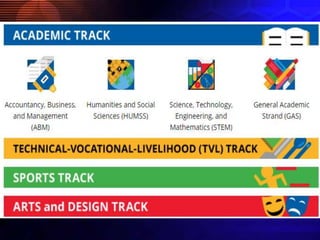
BASIC
EDUCATION
PROGRAM
A report by: Tr. Anna Andres
Why do we need to change
our curriculum?
“A curriculum needs to be updated
regularly, not only to incorporate
new knowledge but also to adapt
to changing environmental, social,
technological and global contexts.”
-- Dr. Allan Bernardo
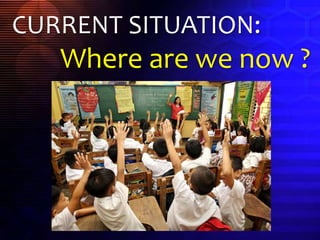
CURRENT SITUATION:
Where are we now ?
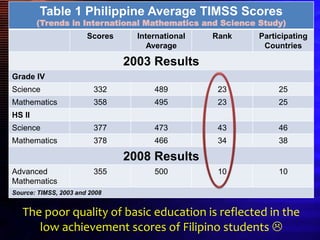
Table 1 Philippine Average TIMSS Scores
(Trends in International Mathematics and Science Study)
Scores International
Average
Rank Participating
Countries
2003 Results
Grade IV
Science 332 489 23 25
Mathematics 358 495 23 25
HS II
Science 377 473 43 46
Mathematics 378 466 34 38
2008 Results
Advanced
Mathematics
355 500 10 10
Source: TIMSS, 2003 and 2008
The poor quality of basic education is reflected in the
low achievement scores of Filipino students 
K-12BasicEducationProgram
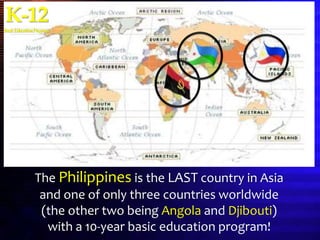
The Philippines is the LAST country in Asia
and one of only three countries worldwide
(the other two being Angola and Djibouti)
with a 10-year basic education program!
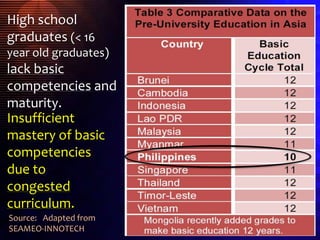
Source: Adapted from
SEAMEO-INNOTECH
High school
graduates (< 16
year old graduates)
lack basic
competencies and
maturity.
Insufficient
mastery of basic
competencies
due to
congested
curriculum.
Our graduates are not automatically
recognized as professionals abroad.
Other countries view the 10-year education
cycle as insufficient.
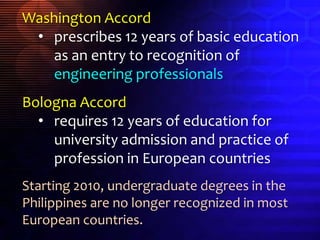
Washington Accord
• prescribes 12 years of basic education
as an entry to recognition of
engineering professionals
Bologna Accord
• requires 12 years of education for
university admission and practice of
profession in European countries
Starting 2010, undergraduate degrees in the
Philippines are no longer recognized in most
European countries.
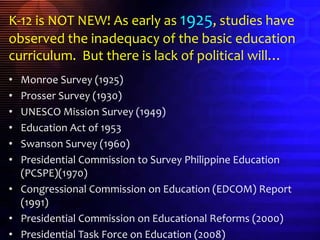
K-12 is NOT NEW! As early as 1925, studies have
observed the inadequacy of the basic education
curriculum. But there is lack of political will…
• Monroe Survey (1925)
• Prosser Survey (1930)
• UNESCO Mission Survey (1949)
• Education Act of 1953
• Swanson Survey (1960)
• Presidential Commission to Survey Philippine Education
(PCSPE)(1970)
• Congressional Commission on Education (EDCOM) Report
(1991)
• Presidential Commission on Educational Reforms (2000)
• Presidential Task Force on Education (2008)
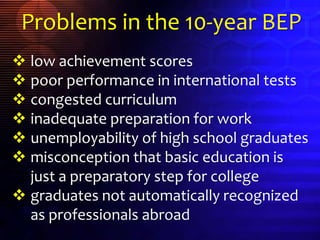
 low achievement scores
 poor performance in international tests
 congested curriculum
 inadequate preparation for work
 unemployability of high school graduates
 misconception that basic education is
just a preparatory step for college
 graduates not automatically recognized
as professionals abroad
Problems in the 10-year BEP
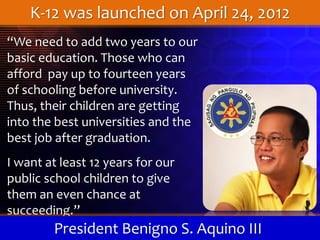
“We need to add two years to our
basic education. Those who can
afford pay up to fourteen years
of schooling before university.
Thus, their children are getting
into the best universities and the
best job after graduation.
I want at least 12 years for our
public school children to give
them an even chance at
succeeding.”
President Benigno S. Aquino III
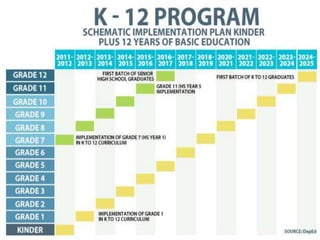
K-12 was launched on April 24, 2012
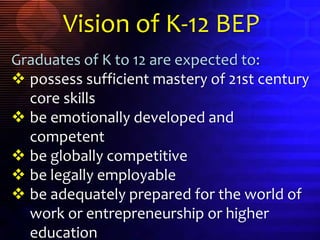
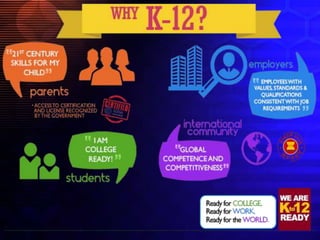
Graduates of K to 12 are expected to:
 possess sufficient mastery of 21st century
core skills
 be emotionally developed and
competent
 be globally competitive
 be legally employable
 be adequately prepared for the world of
work or entrepreneurship or higher
education
Vision of K-12 BEP
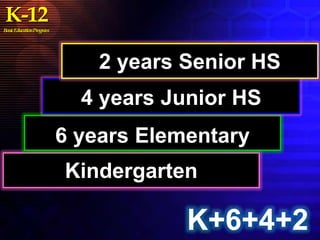
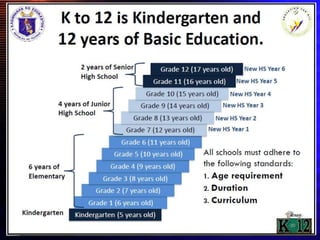
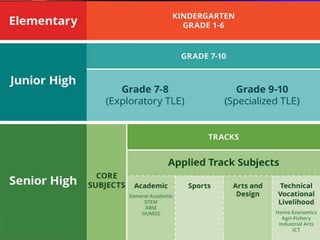
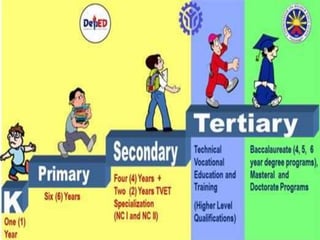
Kindergarten
K-12BasicEducationProgram
6 years Elementary
4 years Junior HS
2 years Senior HS
K+6+4+2
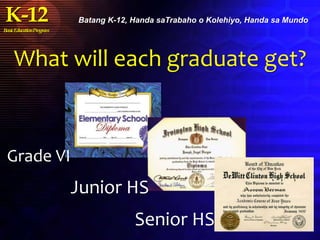
What will each graduate get?
Grade VI
Junior HS
Senior HS
Batang K-12, Handa saTrabaho o Kolehiyo, Handa sa MundoK-12BasicEducationProgram
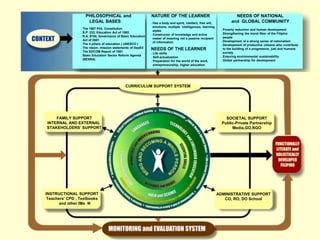
PHILOSOPHICAL and
LEGAL BASES
. The 1987 Phil. Constitution
. B.P. 232, Education Act of 1982
. R.A. 9155, Governance of Basic Education
Act of 2001
. The 4 pillars of education ( UNESCO )
. The vision- mission statements of DepEd
. The EDCOM Report of 1991
. Basic Education Sector Reform Agenda
(BESRA)
NATURE OF THE LEARNER
. Has a body and spirit, intellect, free will,
emotions, multiple intelligences, learning
styles
. Constructor of knowledge and active
maker of meaning not a passive recipient
of information
NEEDS OF THE LEARNER
. Life skills
. Self-actualization
. Preparation for the world of the work,
entrepreneurship, higher education
NEEDS OF NATIONAL
and GLOBAL COMMUNITY
. Poverty reduction and human development
. Strengthening the moral fiber of the Filipino
people
. Development of a strong sense of nationalism
. Development of productive citizens who contribute
to the building of a progressive, just and humane
society
. Ensuring environmental sustainability
. Global partnership for development
CURRICULUM SUPPORT SYSTEM
FAMILY SUPPORT
INTERNAL AND EXTERNAL
STAKEHOLDERS’ SUPPORT
SOCIETAL SUPPORT
Public-Private Partnership
Media,GO,NGO
INSTRUCTIONAL SUPPORT
Teachers’ CPD , Textbooks
and other IMs
ADMINISTRATIVE SUPPORT
CO, RO, DO School
Guiding
Principles and
Features of K-12
Curriculum
K-12
CURRICULU
M
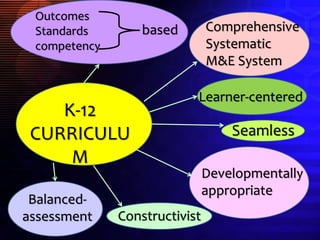
Outcomes
Standards
competency
based Comprehensive
Systematic
M&E System
Learner-centered
Seamless
Developmentally
appropriate
Constructivist
Balanced-
assessment
K-12
CURRICULU
M
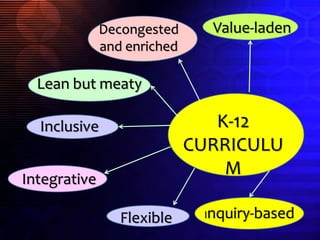
Inquiry-basedFlexible
Integrative
Inclusive
Lean but meaty
Decongested
and enriched
Value-laden
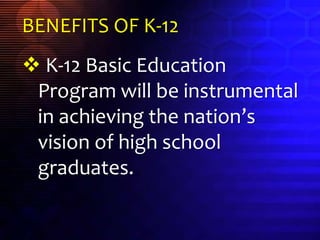
BENEFITS OF K-12
 K-12 Basic Education
Program will be instrumental
in achieving the nation’s
vision of high school
graduates.
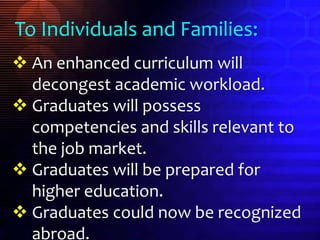
 An enhanced curriculum will
decongest academic workload.
 Graduates will possess
competencies and skills relevant to
the job market.
 Graduates will be prepared for
higher education.
 Graduates could now be recognized
abroad.
To Individuals and Families:
 The economy will experience
accelerated growth in the long run.
 The Philippine education system will
be at par with international
standards.
 A better educated society provides a
sound foundation for long-term
socio-economic development.
For the Society and the Economy:
Philippine K-12 Basic Education Program Report

Philippine K-12 Basic Education Program Report

  • 1.
  • 2.
    Why do weneed to change our curriculum? “A curriculum needs to be updated regularly, not only to incorporate new knowledge but also to adapt to changing environmental, social, technological and global contexts.” -- Dr. Allan Bernardo
  • 3.
  • 4.
    Table 1 PhilippineAverage TIMSS Scores (Trends in International Mathematics and Science Study) Scores International Average Rank Participating Countries 2003 Results Grade IV Science 332 489 23 25 Mathematics 358 495 23 25 HS II Science 377 473 43 46 Mathematics 378 466 34 38 2008 Results Advanced Mathematics 355 500 10 10 Source: TIMSS, 2003 and 2008 The poor quality of basic education is reflected in the low achievement scores of Filipino students 
  • 5.
    K-12BasicEducationProgram The Philippines isthe LAST country in Asia and one of only three countries worldwide (the other two being Angola and Djibouti) with a 10-year basic education program!
  • 6.
    Source: Adapted from SEAMEO-INNOTECH Highschool graduates (< 16 year old graduates) lack basic competencies and maturity. Insufficient mastery of basic competencies due to congested curriculum.
  • 7.
    Our graduates arenot automatically recognized as professionals abroad. Other countries view the 10-year education cycle as insufficient.
  • 8.
    Washington Accord • prescribes12 years of basic education as an entry to recognition of engineering professionals Bologna Accord • requires 12 years of education for university admission and practice of profession in European countries Starting 2010, undergraduate degrees in the Philippines are no longer recognized in most European countries.
  • 9.
    K-12 is NOTNEW! As early as 1925, studies have observed the inadequacy of the basic education curriculum. But there is lack of political will… • Monroe Survey (1925) • Prosser Survey (1930) • UNESCO Mission Survey (1949) • Education Act of 1953 • Swanson Survey (1960) • Presidential Commission to Survey Philippine Education (PCSPE)(1970) • Congressional Commission on Education (EDCOM) Report (1991) • Presidential Commission on Educational Reforms (2000) • Presidential Task Force on Education (2008)
  • 10.
     low achievementscores  poor performance in international tests  congested curriculum  inadequate preparation for work  unemployability of high school graduates  misconception that basic education is just a preparatory step for college  graduates not automatically recognized as professionals abroad Problems in the 10-year BEP
  • 11.
    “We need toadd two years to our basic education. Those who can afford pay up to fourteen years of schooling before university. Thus, their children are getting into the best universities and the best job after graduation. I want at least 12 years for our public school children to give them an even chance at succeeding.” President Benigno S. Aquino III K-12 was launched on April 24, 2012
  • 12.
    Graduates of Kto 12 are expected to:  possess sufficient mastery of 21st century core skills  be emotionally developed and competent  be globally competitive  be legally employable  be adequately prepared for the world of work or entrepreneurship or higher education Vision of K-12 BEP
  • 13.
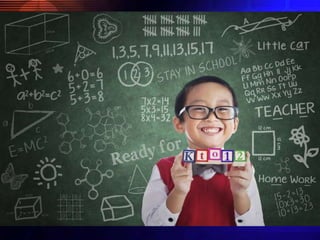
    Kindergarten K-12BasicEducationProgram 6 years Elementary 4years Junior HS 2 years Senior HS K+6+4+2
  • 16.
    What will eachgraduate get? Grade VI Junior HS Senior HS Batang K-12, Handa saTrabaho o Kolehiyo, Handa sa MundoK-12BasicEducationProgram
  • 23.
    PHILOSOPHICAL and LEGAL BASES .The 1987 Phil. Constitution . B.P. 232, Education Act of 1982 . R.A. 9155, Governance of Basic Education Act of 2001 . The 4 pillars of education ( UNESCO ) . The vision- mission statements of DepEd . The EDCOM Report of 1991 . Basic Education Sector Reform Agenda (BESRA) NATURE OF THE LEARNER . Has a body and spirit, intellect, free will, emotions, multiple intelligences, learning styles . Constructor of knowledge and active maker of meaning not a passive recipient of information NEEDS OF THE LEARNER . Life skills . Self-actualization . Preparation for the world of the work, entrepreneurship, higher education NEEDS OF NATIONAL and GLOBAL COMMUNITY . Poverty reduction and human development . Strengthening the moral fiber of the Filipino people . Development of a strong sense of nationalism . Development of productive citizens who contribute to the building of a progressive, just and humane society . Ensuring environmental sustainability . Global partnership for development CURRICULUM SUPPORT SYSTEM FAMILY SUPPORT INTERNAL AND EXTERNAL STAKEHOLDERS’ SUPPORT SOCIETAL SUPPORT Public-Private Partnership Media,GO,NGO INSTRUCTIONAL SUPPORT Teachers’ CPD , Textbooks and other IMs ADMINISTRATIVE SUPPORT CO, RO, DO School
  • 24.
  • 25.
  • 26.
  • 27.
    BENEFITS OF K-12 K-12 Basic Education Program will be instrumental in achieving the nation’s vision of high school graduates.
  • 28.
     An enhancedcurriculum will decongest academic workload.  Graduates will possess competencies and skills relevant to the job market.  Graduates will be prepared for higher education.  Graduates could now be recognized abroad. To Individuals and Families:
  • 29.
     The economywill experience accelerated growth in the long run.  The Philippine education system will be at par with international standards.  A better educated society provides a sound foundation for long-term socio-economic development. For the Society and the Economy: