Setting of Acetabular Component Alignment
Guides
between the Supine and
Lateral Positions for
Total Hip Arthroplasty, Update
Sherif Mohammed El-Aidy
Lecturer of orthopedic surgery and traumatology
Faculty of medicine
Zagazig university
Optimizing The Acetabular Component Position of Total Hip Arthroplasty
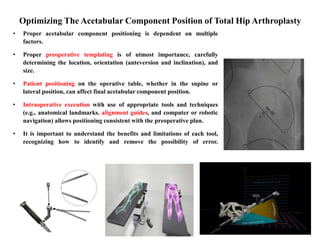
• Proper acetabular component positioning is dependent on multiple
factors.
• Proper preoperative templating is of utmost importance, carefully
determining the location, orientation (anteversion and inclination), and
size.
• Patient positioning on the operative table, whether in the supine or
lateral position, can affect final acetabular component position.
• Intraoperative execution with use of appropriate tools and techniques
(e.g., anatomical landmarks, alignment guides, and computer or robotic
navigation) allows positioning consistent with the preoperative plan.
• It is important to understand the benefits and limitations of each tool,
recognizing how to identify and remove the possibility of error.
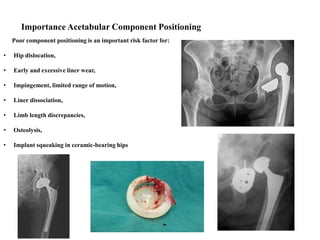
Importance Acetabular Component Positioning
Poor component positioning is an important risk factor for:
• Hip dislocation,
• Early and excessive liner wear,
• Impingement, limited range of motion,
• Liner dissociation,
• Limb length discrepancies,
• Osteolysis,
• Implant squeaking in ceramic-bearing hips
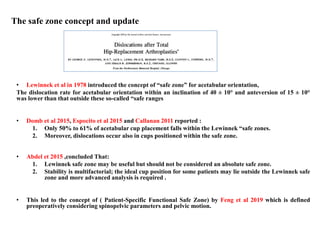
The safe zone concept and update
• Lewinnek et al in 1978 introduced the concept of “safe zone” for acetabular orientation,
The dislocation rate for acetabular orientation within an inclination of 40 ± 10° and anteversion of 15 ± 10°
was lower than that outside these so-called “safe ranges
• Domb et al 2015, Espocito et al 2015 and Callanan 2011 reported :
1. Only 50% to 61% of acetabular cup placement falls within the Lewinnek “safe zones.
2. Moreover, dislocations occur also in cups positioned within the safe zone.
• Abdel et 2015 ,concluded That:
1. Lewinnek safe zone may be useful but should not be considered an absolute safe zone.
2. Stability is multifactorial; the ideal cup position for some patients may lie outside the Lewinnek safe
zone and more advanced analysis is required .
• This led to the concept of ( Patient-Specific Functional Safe Zone) by Feng et al 2019 which is defined
preoperatively considering spinopelvic parameters and pelvic motion.
Murray Definitions
• Orientation can be assessed anatomically (CT scan),
radiographically and by direct operative observation.
• The above mentioned methods yields different measurements
due to different spatial arrangement
• The Acetabular axis : passes through the centre of the socket
and is perpendicular to the plane of the socket face
• Mathematical connection is done through equations and
Nomogram
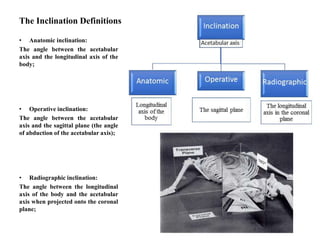
The Inclination Definitions
• Anatomic inclination:
The angle between the acetabular
axis and the longitudinal axis of the
body;
• Operative inclination:
The angle between the acetabular
axis and the sagittal plane (the angle
of abduction of the acetabular axis);
• Radiographic inclination:
The angle between the longitudinal
axis of the body and the acetabular
axis when projected onto the coronal
plane;
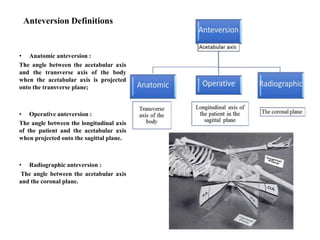
Anteversion Definitions
• Anatomic anteversion :
The angle between the acetabular axis
and the transverse axis of the body
when the acetabular axis is projected
onto the transverse plane;
• Operative anteversion :
The angle between the longitudinal axis
of the patient and the acetabular axis
when projected onto the sagittal plane.
• Radiographic anteversion :
The angle between the acetabular axis
and the coronal plane.
Patient Positioning Lateral Versus Supine
• The position of the patient on the operative table is integral to optimum acetabular positioning,
particularly with freehand placement or the assistance of an alignment guide.
• In lateral position :The patients’ trunks are positioned along the longitudinal axis of the table using a
positioner that held the sacral bone and bilateral anterior superior iliac spines.(the sagittal plane of the
pelvis should be parallel with the floor while the coronal and transverse planes should be parallel with
the walls of the room. )
• In supine position: The pelvis should be fixed with a positioner on the contralateral side (arrow).
• It is not clear which position is superior in THA ,but Changes in pelvic obliquity will directly impact
acetabular inclination. Meanwhile, changes in pelvic tilt or rotation will impact perceived inclination and
anteversion, respectively.
Patient Positioning Lateral Versus Supine
 Takada et al 2019 :
• Studied (29 supine VS 31 lateral ) THAs
• Higher accuracy of inclination was provided
by supine position than by lateral position.
• There was no significant difference between
both groups in terms of cup anteversion.
 McGoldrick et al 2021 :
• Investigated (100 THAs supine), anterior
approach, VS (100 lateral decubitus), direct
lateral or posterior approach.
• The anterior approach in supine position
results are more accurate .
 Kishimura et al 2019 :
• Analysed (84 lateral, VS 58 supineTHAs)
• The supine position has a higher risk of
outliers of cup alignment compared with the
lateral position.
Methods of setting the acetabular component
(Freehand via Anatomical landmarks)
 Sotereanos et al 2006 , used Intraoperative Pelvic Landmarks:
• (point A): the lowest point of the acetabular sulcus of the ischium.
• (point B) : the prominence of the superior pelvic ramus,
• (point C): the most superior point of the acetabular rim.
• In 617 THAs , the rate of dislocation was less than 1%.
 Transverse acetabular ligament (TAL) Archbold et al 2006:
 Successfully identified (TAL) intraoperatively 99.7% of 1,000 THAs.
 Only 0.6% of the hips dislocating after 8 to 41 months of follow-up.
Methods of setting the acetabular component
lateral position Alignment guides
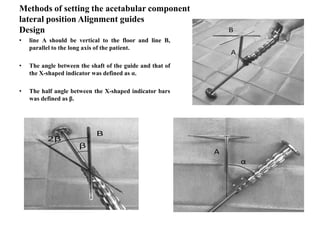
Design
• line A should be vertical to the floor and line B,
parallel to the long axis of the patient.
• The angle between the shaft of the guide and that of
the X-shaped indicator was defined as α.
• The half angle between the X-shaped indicator bars
was defined as β.
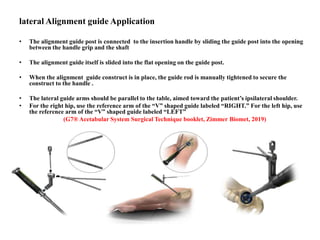
lateral Alignment guide Application
• The alignment guide post is connected to the insertion handle by sliding the guide post into the opening
between the handle grip and the shaft
• The alignment guide itself is slided into the flat opening on the guide post.
• When the alignment guide construct is in place, the guide rod is manually tightened to secure the
construct to the handle .
• The lateral guide arms should be parallel to the table, aimed toward the patient’s ipsilateral shoulder.
• For the right hip, use the reference arm of the “V” shaped guide labeled “RIGHT.” For the left hip, use
the reference arm of the “V” shaped guide labeled “LEFT”
(G7® Acetabular System Surgical Technique booklet, Zimmer Biomet, 2019)
Supine Position Alignment Guides , Design
• line C should be vertical to the floor and line D, parallel to
the long axis of the patient.
• The angle between the shaft of the guide and that of the X-
shaped indicator was defined as γ.
• The half angle between the X-shaped indicator bars was
defned as δ.
Supine Alignment Guide Application
• Assembly proceeds in the same manner as lateral guides.
• When positioning the acetabular shell, the supine alignment guide arms should be parallel to the table,
aligned with the patient’s spinal column
• For the right hip, use the reference arm of the “V” shaped guide labeled “RIGHT.” For the left hip, use
the reference arm of the “V” shaped guide labeled “LEFT”
•
(G7® Acetabular System Surgical Technique booklet, Zimmer Biomet,2019)
•
Update, Are The Alignment Guides Accurate Regarding The Design?
• Minoda et al, 2021 compared the accuracy
between acetabular component alignment guides
for the lateral position and those for the supine
position.
• Thirteen alignment guides for the lateral position
and 10 for the supine position were investigated.
• All the lateral position alignment guides indicated
cup alignment in operative definition.
• The supine position alignment guides indicated
cup alignment in radiographic defnition.
• The angles of each alignment guide (α, β, γ, and δ)
were directly measured using a transparent
protractor .
The lateral position
alignment guide
The supine position
alignment guide
esigned
according to
easurement
pe Inc
pe
Rad Inc
Rad
sing urra ’s formulas
Rad Inc
Rad
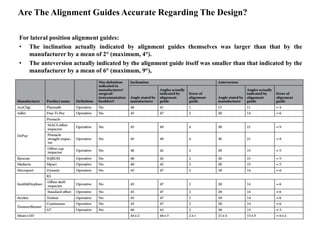
Are The Alignment Guides Accurate Regarding The Design?
For lateral position alignment guides:
• The inclination actually indicated by alignment guides themselves was larger than that by the
manufacturer by a mean of 2° (maximum, 4°).
• The anteversion actually indicated by the alignment guide itself was smaller than that indicated by the
manufacturer by a mean of 6° (maximum, 9°),
•
Are The Alignment Guides Accurate Regarding The Design?
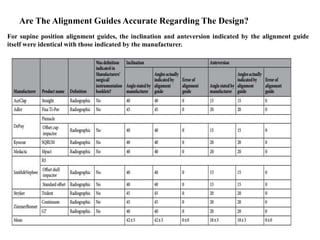
For supine position alignment guides, the inclination and anteversion indicated by the alignment guide
itself were identical with those indicated by the manufacturer.
Are The Alignment Guides Accurate Regarding The Design?
Minoda et al 2021 concluded that:
1. lateral position alignment guides for the acetabular component:
• They are a risk factor for errors in orientation, especially in anteversion .
• They would not eliminate orientation errors, even if pelvic motion was controlled.
• The error could be resol ed b “reducing” inclination and “adding” ante ersion with consideration of
the error of the alignment guide.
• To eliminate this error, they should be redesigned with the radiographic defnition.
2. The supine position alignment guides designed with the radiographic definition are not factors
in the incidence of errors in acetabular component orientation.
Are The Alignment Guides Accurate Regarding Clinical Practice?
 Digioia et al 2002
• studied (82 THAs) in the lateral position .
• With the mechanical guide, 58 were placed outside of desired anteversion of 20° ± 10°. Only 1 cup was
placed outside of desired abduction of 45° ± 10°.
• A computer-assisted navigation system was used to measure alignment and to monitor the orientation
of the pelvis during surgery.
Are The Alignment Guides Accurate Regarding Clinical Practice?
 Nam et al.2013,
• Retrospectively compared the success rate of acetabular component positioning with use of computer
navigation versus mechanical guides.
• When computer navigation was utilized, 91% of acetabular components fell within the safe zone of
orientation versus only 70% of components when mechanical guides were used in the lateral
position.
Are The Alignment Guides Accurate Regarding Clinical Practice?
 Yoshitani et al. 2018
• Investigated the acetabular component orientation in 181 THAs using the lateral position.
• The alignment of the cup was evaluated by an anteroposterior radiograph of the pelvis 1 week after surgery.
• They used lateral position alignment guides, which were set at 40° for inclination and 20° for anteversion,.
However, the average of the postoperative inclination was 41° and anteversion was 14°.
• There were no postoperative hip dislocations in This investigation.
Take Home Message
• Setting the acetabular component of the total hip arthroplasty is challenging multifactorial
mission.
• Lewinnek safe zone is evolving into Patient-Specific Functional Safe Zone
• Definitions of orientation (inclination and anteversion) are critical for successful positioning of
the acetabular component.
• Patient position and stabilization to the operative table can alter the outcome of the THA.
• The lateral position alignment guides are a risk factor for errors in orientation and need to be
redesigned with the radiographic definition.
• The lateral position alignment guides accuracy is questionable by design and so in clinical
practice.
• The supine position alignment guides designed with the radiographic definition are not factors in
the incidence of errors in acetabular component orientation.
THANK YOU

Acetabular component alignment guide in total hip replacement

  • 1.
    Setting of AcetabularComponent Alignment Guides between the Supine and Lateral Positions for Total Hip Arthroplasty, Update Sherif Mohammed El-Aidy Lecturer of orthopedic surgery and traumatology Faculty of medicine Zagazig university
  • 2.
    Optimizing The AcetabularComponent Position of Total Hip Arthroplasty • Proper acetabular component positioning is dependent on multiple factors. • Proper preoperative templating is of utmost importance, carefully determining the location, orientation (anteversion and inclination), and size. • Patient positioning on the operative table, whether in the supine or lateral position, can affect final acetabular component position. • Intraoperative execution with use of appropriate tools and techniques (e.g., anatomical landmarks, alignment guides, and computer or robotic navigation) allows positioning consistent with the preoperative plan. • It is important to understand the benefits and limitations of each tool, recognizing how to identify and remove the possibility of error.
  • 3.
    Importance Acetabular ComponentPositioning Poor component positioning is an important risk factor for: • Hip dislocation, • Early and excessive liner wear, • Impingement, limited range of motion, • Liner dissociation, • Limb length discrepancies, • Osteolysis, • Implant squeaking in ceramic-bearing hips
  • 4.
    The safe zoneconcept and update • Lewinnek et al in 1978 introduced the concept of “safe zone” for acetabular orientation, The dislocation rate for acetabular orientation within an inclination of 40 ± 10° and anteversion of 15 ± 10° was lower than that outside these so-called “safe ranges • Domb et al 2015, Espocito et al 2015 and Callanan 2011 reported : 1. Only 50% to 61% of acetabular cup placement falls within the Lewinnek “safe zones. 2. Moreover, dislocations occur also in cups positioned within the safe zone. • Abdel et 2015 ,concluded That: 1. Lewinnek safe zone may be useful but should not be considered an absolute safe zone. 2. Stability is multifactorial; the ideal cup position for some patients may lie outside the Lewinnek safe zone and more advanced analysis is required . • This led to the concept of ( Patient-Specific Functional Safe Zone) by Feng et al 2019 which is defined preoperatively considering spinopelvic parameters and pelvic motion.
  • 5.
    Murray Definitions • Orientationcan be assessed anatomically (CT scan), radiographically and by direct operative observation. • The above mentioned methods yields different measurements due to different spatial arrangement • The Acetabular axis : passes through the centre of the socket and is perpendicular to the plane of the socket face • Mathematical connection is done through equations and Nomogram
  • 6.
    The Inclination Definitions •Anatomic inclination: The angle between the acetabular axis and the longitudinal axis of the body; • Operative inclination: The angle between the acetabular axis and the sagittal plane (the angle of abduction of the acetabular axis); • Radiographic inclination: The angle between the longitudinal axis of the body and the acetabular axis when projected onto the coronal plane;
  • 7.
    Anteversion Definitions • Anatomicanteversion : The angle between the acetabular axis and the transverse axis of the body when the acetabular axis is projected onto the transverse plane; • Operative anteversion : The angle between the longitudinal axis of the patient and the acetabular axis when projected onto the sagittal plane. • Radiographic anteversion : The angle between the acetabular axis and the coronal plane.
  • 8.
    Patient Positioning LateralVersus Supine • The position of the patient on the operative table is integral to optimum acetabular positioning, particularly with freehand placement or the assistance of an alignment guide. • In lateral position :The patients’ trunks are positioned along the longitudinal axis of the table using a positioner that held the sacral bone and bilateral anterior superior iliac spines.(the sagittal plane of the pelvis should be parallel with the floor while the coronal and transverse planes should be parallel with the walls of the room. ) • In supine position: The pelvis should be fixed with a positioner on the contralateral side (arrow). • It is not clear which position is superior in THA ,but Changes in pelvic obliquity will directly impact acetabular inclination. Meanwhile, changes in pelvic tilt or rotation will impact perceived inclination and anteversion, respectively.
  • 9.
    Patient Positioning LateralVersus Supine  Takada et al 2019 : • Studied (29 supine VS 31 lateral ) THAs • Higher accuracy of inclination was provided by supine position than by lateral position. • There was no significant difference between both groups in terms of cup anteversion.  McGoldrick et al 2021 : • Investigated (100 THAs supine), anterior approach, VS (100 lateral decubitus), direct lateral or posterior approach. • The anterior approach in supine position results are more accurate .  Kishimura et al 2019 : • Analysed (84 lateral, VS 58 supineTHAs) • The supine position has a higher risk of outliers of cup alignment compared with the lateral position.
  • 10.
    Methods of settingthe acetabular component (Freehand via Anatomical landmarks)  Sotereanos et al 2006 , used Intraoperative Pelvic Landmarks: • (point A): the lowest point of the acetabular sulcus of the ischium. • (point B) : the prominence of the superior pelvic ramus, • (point C): the most superior point of the acetabular rim. • In 617 THAs , the rate of dislocation was less than 1%.  Transverse acetabular ligament (TAL) Archbold et al 2006:  Successfully identified (TAL) intraoperatively 99.7% of 1,000 THAs.  Only 0.6% of the hips dislocating after 8 to 41 months of follow-up.
  • 11.
    Methods of settingthe acetabular component lateral position Alignment guides Design • line A should be vertical to the floor and line B, parallel to the long axis of the patient. • The angle between the shaft of the guide and that of the X-shaped indicator was defined as α. • The half angle between the X-shaped indicator bars was defined as β.
  • 12.
    lateral Alignment guideApplication • The alignment guide post is connected to the insertion handle by sliding the guide post into the opening between the handle grip and the shaft • The alignment guide itself is slided into the flat opening on the guide post. • When the alignment guide construct is in place, the guide rod is manually tightened to secure the construct to the handle . • The lateral guide arms should be parallel to the table, aimed toward the patient’s ipsilateral shoulder. • For the right hip, use the reference arm of the “V” shaped guide labeled “RIGHT.” For the left hip, use the reference arm of the “V” shaped guide labeled “LEFT” (G7® Acetabular System Surgical Technique booklet, Zimmer Biomet, 2019)
  • 13.
    Supine Position AlignmentGuides , Design • line C should be vertical to the floor and line D, parallel to the long axis of the patient. • The angle between the shaft of the guide and that of the X- shaped indicator was defined as γ. • The half angle between the X-shaped indicator bars was defned as δ.
  • 14.
    Supine Alignment GuideApplication • Assembly proceeds in the same manner as lateral guides. • When positioning the acetabular shell, the supine alignment guide arms should be parallel to the table, aligned with the patient’s spinal column • For the right hip, use the reference arm of the “V” shaped guide labeled “RIGHT.” For the left hip, use the reference arm of the “V” shaped guide labeled “LEFT” • (G7® Acetabular System Surgical Technique booklet, Zimmer Biomet,2019) •
  • 15.
    Update, Are TheAlignment Guides Accurate Regarding The Design? • Minoda et al, 2021 compared the accuracy between acetabular component alignment guides for the lateral position and those for the supine position. • Thirteen alignment guides for the lateral position and 10 for the supine position were investigated. • All the lateral position alignment guides indicated cup alignment in operative definition. • The supine position alignment guides indicated cup alignment in radiographic defnition. • The angles of each alignment guide (α, β, γ, and δ) were directly measured using a transparent protractor . The lateral position alignment guide The supine position alignment guide esigned according to easurement pe Inc pe Rad Inc Rad sing urra ’s formulas Rad Inc Rad
  • 16.
    Are The AlignmentGuides Accurate Regarding The Design? For lateral position alignment guides: • The inclination actually indicated by alignment guides themselves was larger than that by the manufacturer by a mean of 2° (maximum, 4°). • The anteversion actually indicated by the alignment guide itself was smaller than that indicated by the manufacturer by a mean of 6° (maximum, 9°), •
  • 17.
    Are The AlignmentGuides Accurate Regarding The Design? For supine position alignment guides, the inclination and anteversion indicated by the alignment guide itself were identical with those indicated by the manufacturer.
  • 18.
    Are The AlignmentGuides Accurate Regarding The Design? Minoda et al 2021 concluded that: 1. lateral position alignment guides for the acetabular component: • They are a risk factor for errors in orientation, especially in anteversion . • They would not eliminate orientation errors, even if pelvic motion was controlled. • The error could be resol ed b “reducing” inclination and “adding” ante ersion with consideration of the error of the alignment guide. • To eliminate this error, they should be redesigned with the radiographic defnition. 2. The supine position alignment guides designed with the radiographic definition are not factors in the incidence of errors in acetabular component orientation.
  • 19.
    Are The AlignmentGuides Accurate Regarding Clinical Practice?  Digioia et al 2002 • studied (82 THAs) in the lateral position . • With the mechanical guide, 58 were placed outside of desired anteversion of 20° ± 10°. Only 1 cup was placed outside of desired abduction of 45° ± 10°. • A computer-assisted navigation system was used to measure alignment and to monitor the orientation of the pelvis during surgery.
  • 20.
    Are The AlignmentGuides Accurate Regarding Clinical Practice?  Nam et al.2013, • Retrospectively compared the success rate of acetabular component positioning with use of computer navigation versus mechanical guides. • When computer navigation was utilized, 91% of acetabular components fell within the safe zone of orientation versus only 70% of components when mechanical guides were used in the lateral position.
  • 21.
    Are The AlignmentGuides Accurate Regarding Clinical Practice?  Yoshitani et al. 2018 • Investigated the acetabular component orientation in 181 THAs using the lateral position. • The alignment of the cup was evaluated by an anteroposterior radiograph of the pelvis 1 week after surgery. • They used lateral position alignment guides, which were set at 40° for inclination and 20° for anteversion,. However, the average of the postoperative inclination was 41° and anteversion was 14°. • There were no postoperative hip dislocations in This investigation.
  • 22.
    Take Home Message •Setting the acetabular component of the total hip arthroplasty is challenging multifactorial mission. • Lewinnek safe zone is evolving into Patient-Specific Functional Safe Zone • Definitions of orientation (inclination and anteversion) are critical for successful positioning of the acetabular component. • Patient position and stabilization to the operative table can alter the outcome of the THA. • The lateral position alignment guides are a risk factor for errors in orientation and need to be redesigned with the radiographic definition. • The lateral position alignment guides accuracy is questionable by design and so in clinical practice. • The supine position alignment guides designed with the radiographic definition are not factors in the incidence of errors in acetabular component orientation.
  • 23.