JAMESON N. ESTRADA
PANGASINAN STATE UNIVERSITY
CONTEMPORARY WORLD
WORKBOOK
www.psuecon.neolms.com
ASIA
EUROPE
NORTH
AMERICA
AMERICA
SOUTH
AFRICA
O
CEANIA
Republic of the Philippines
LINGAYEN CAMPUS
Lingayen, Pangasinan
The GE 5 course introduces students to the contemporary world issues by examining the multifaceted
phenomenon of globalization. Using the various disciplines of the social sciences, it examines the economic,
social, political, technological, and other transformations that have created an increasing awareness of the
interconnectedness of peoples and places around the globe. To this end, the course provides an overview of
the various debates in global governance, development, and sustainability. Beyond exposing the student to
the world outside the Philippines, it seeks to inculcate a sense of global citizenship and global ethical
responsibility. This course also includes mandatory topics on population education in the context of population
and demography.
This workbook is intended for use by the students of BS Hospitality Management taking up the subject
Contemporary World with the objective of providing them with a comprehensive understanding about
microeconomics. Likewise, it has been designed as an instrument for learning development and assessment,
providing students with a practical approach to applying the knowledge learned in the lectures. Each worksheet
covers exercises that is built upon the lessons of all the chapters with the following course outcomes:
1. Understand the nature and scope of the contemporary world.
2. Develop an understanding, analysis and appreciation of how peoples and places in the world are
interconnected.
3. Assess and analyze the dynamics and functioning of the global economy.
4. Develop an awareness and analysis on how countries trade with one another.
5. Examine how market integration works and the existence of Multinational Corporations
6. Describe the emergence of global governance in the case of international organizations like the
United Nations
7. Assess how different regions in the worlds confront the challenges of globalization and regionalism
8. Comprehend the socio-economic differences of the Global South and Global North
9. Appreciate the relevance of media in cultural globalization
10. Examine the religions of the world in the context of globalization and its relationship to relationship
to global peace and conflict.
11. Understand the attributes of global cities and analyze how they serve as engines of globalization.
12. Analyze the determinants and consequences of population changes and assess how they affect global
population
13. Analyze the various factors underlying the global movements of people.
14. Articulate models of global sustainable development.
15. Analyze how global food security exists.
16. Appreciate the roles and responsibilities of a global citizen.
Bear in mind that it takes sustained effort – and some dedicated patience – to study and learn the
subject. But, it is assured that the effort is well worth it. It is hoped this modest work helps you. So, the
best of luck as you begin your journey in answering the workbook exercises!
PREFACE 2
v
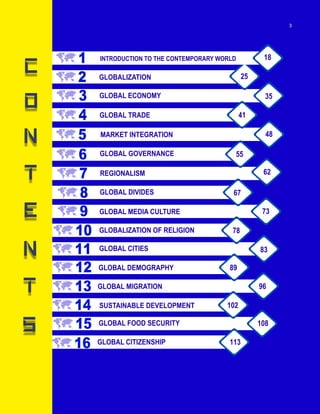
1
2
3
4
5
6
7
8
9
10
11
12
13
14
15
16
INTRODUCTION TO THE CONTEMPORARY WORLD
GLOBALIZATION
GLOBAL ECONOMY
GLOBAL TRADE
MARKET INTEGRATION
GLOBAL GOVERNANCE
REGIONALISM
GLOBAL DIVIDES
GLOBAL MEDIA CULTURE
GLOBALIZATION OF RELIGION
GLOBAL CITIES
GLOBAL DEMOGRAPHY
GLOBAL MIGRATION
SUSTAINABLE DEVELOPMENT
GLOBAL FOOD SECURITY
GLOBAL CITIZENSHIP
18
25
35
41
48
55
62
67
73
78
83
89
96
102
113
108
3
BACHELOR OF SCIENCE IN HOSPITALITY MANAGEMENT
COURSE SYLLABUS
2nd
Semester, S.Y 2019 – 2020
COURSE INFORMATION
COURSE CODE GE5
COURSE TITLE CONTEMPORARY WORLD
COURSE TYPE Lecture
CREDIT UNITS 3 units
TIME FRAME 3 hours / week (54 Hours)
PREREQUISITE None
VISION, MISSION, GOALS AND OUTCOMES
UNIVERSITY VISION To become an ASEAN Premier State University by 2020
UNIVERSITY MISSION The Pangasinan State University, through instruction, research, extension and production, commits to
develop highly principled, morally upright, innovative and globally competent individuals capable of
meeting the needs of industry, public service and civil society.
UNIVERSITY
STRATEGIC GOALS
1. Excellent student learning and career development
2. Strong research culture and technology transfer
3. Good governance
4. Sustainable social responsibilities
5. Quality human resources management and development
6. Efficient management of assets and finances
7. Responsive to Globalization and Diversity
8. Customer-focused
UNIVERSITY
OUTCOMES
The Pangasinan State University Institutional Learning Outcomes (PSU ILO) are the qualities that
PSUnians must possess.
These outcomes are anchored on the following core values: Accountability and Transparency,
Credibility and Integrity, Competence and Commitment to Achieve, Excellence in Service Delivery,
Social and Environmental Responsiveness, and Spirituality – (ACCESS). Anchored on these core
values, the PSU graduates are able to:
1. Demonstrate through institutional mechanisms, systems, policies, and processes which are reflective
of transparency, equity, participatory decision making, and accountability;
2. Engage in relevant, comprehensive and sustainable development initiatives through multiple
perspectives in decisions and actions that build personal and professional credibility and integrity.
3. Set challenging goals and tasks with determination and sense of urgency which provide continuous
improvement and producing quality outputs leading to inclusive growth;
4. Exhibit life-long learning and global competency proficiency in communication skills,
inter/interpersonal skills, entrepreneurial skills, innovative mindset, research and production initiatives
and capability in meeting the industry requirements of local, ASEAN and international human capital
market through relevant and comprehensive programs;
5. Display, socially and environmentally responsive organizational culture, which ensures higher
productivity among the university constituents and elevate the welfare of the multi-sectoral
communities and;
Republic of the Philippines
PANGASINAN STATE UNIVERSITY
LINGAYEN CAMPUS
4
6. Practice spiritual values and morally upright behavior which promote and inspire greater harmony to
project a credible public image.
PROGRAM OUTCOMES
Graduate Attributes BS Hospitality Management Program Outcomes Performance Indicators
Graduates of the BSHM
programs are professionals who
are:
Holistic
Demonstrate determination and embody traits and
values of hospitality management professional
Engage and secure student’s interest on
values formation to achieve pro-active
professional towards various competency
industry standards.
Optimistic Shows positive attitude in expecting best outcome
from any given situation
Maintain a positive disposition in spite of
customer complaints and challenging
situations in the workplace.
Skillful Exhibits competence to accomplish good work and
experience the effective and efficient outcome
Apply related theories and techniques that
will fit in their own chosen expertise.
Passionate Have tireless exertions and willingness to take the
risks of being committed to their purpose to
succeed.
• Deliver energetic and heartfelt
service to the clients. Add guidelines
• Show willingness to follow and
implement school policies
• Maintain a feeling of great intensity
towards a particular person or activity
capable of handling, powerful
emotions with regards to different
situations
Innovative Create and use new ideas or methods in particular
interest in the creative and multicultural aspects of
the hospitality industry.
• Deliver accurate & updated content
knowledge using appropriate
methodologies and strategies
• Demonstrate ability to implement
instructional plan
• Uses assessment results in terms of
achievement and progressive
indicators
Trustworthy Practice integrity in response to the needs and
aspirations of the hospitality industry.
• Use the hospitality industry as a
laboratory for learning and as a
network to publicize school events
and achievements.
• Maintains stature and behavior that
upholds the dignity of teaching
Authentic Apply genuine practical learning skills reflective to
the best practices in the real-life learning
experiences in the industry
Exhibit true and accurate best professional
practices in terms of knowledge, skills,
attitudes and values
Bold Stand our prominently through recognition and
acceptance of a diverse hospitality industry
standards
Absorb and assert distinct hospitality
industry standards in workplace
performance.
Life Long Learner Promote learning beyond traditional schooling,
which shows flexibility, diversity and availability in
different times and places
Allocate time for skills and professional
development thru participation in trainings,
seminars, attending skills and knowledge
competition, keep oneself abreast with the
latest trends and practices in the
hospitality industry
Excellent Show mastery in every phase of the learning
process and provide proficiency in upgrading the
hospitality core values at all times
Perform a wide variety of contemporary
techniques and approaches to deliver
valuable quality services to the customers
and guests without supervision
5
COURSE DESCRIPTION
This course introduces students to the contemporary world by examining the multifaceted phenomenon of globalization. Using the
various disciplines of the social sciences, it examines the economic, social, political, technological, and other transformations that have
created an increasing awareness of the interconnectedness of peoples and places around the globe. To this end, the course provides
an overview of the various debates in global governance, development, and sustainability. Beyond exposing the student to the world
outside the Philippines, it seeks to inculcate a sense of global citizenship and global ethical responsibility. This course includes
mandatory topics on population education in the context of population and demography.
COURSE OUTCOMES
The course demonstrates a comprehensive understanding of the contemporary world. Specifically, at the end of the course, students
are expected to
1. Understand the nature and scope of the contemporary world.
2. Develop an understanding, analysis and appreciation of how peoples and places in the world are interconnected.
3. Assess and analyze the dynamics and functioning of the global economy.
4. Develop an awareness and analysis on how countries trade with one another.
5. Examine how market integration works and the existence of Multinational Corporations
6. Describe the emergence of global governance in the case of international organizations like the United Nations
7. Assess how different regions in the worlds confront the challenges of globalization and regionalism
8. Comprehend the socio-economic differences of the Global South and Global North
9. Appreciate the relevance of media in cultural globalization
10. Examine the religions of the world in the context of globalization and its relationship to relationship to global peace and
conflict.
11. Understand the attributes of global cities and analyze how they serve as engines of globalization.
12. Analyze the determinants and consequences of population changes and assess how they affect global population
13. Analyze the various factors underlying the global movements of people.
14. Articulate models of global sustainable development.
15. Analyze how global food security exists.
16. Appreciate the roles and responsibilities of a global citizen.
COURSE LEARNING PLAN
Course
Outcome
Learning Outcomes Topics No.
of
Hrs.
Teaching
and
Learning
Activities
Resource
Materials
Assess
ment
▪ State the vision, mission, goals
and core values of the
University
▪ Enumerate and explain the
objectives and learning
outcomes of the program
▪ Describe the course information
▪ Explain the description of the
course
▪ Examine the outline /plan of the
course
▪ Comment on the requirements
and policies of the course
COURSE ORIENTATION
1. Vision, Mission
on, Goals, Guiding
Philosophy and Core Values
of the University
2. Program Outcomes
3. Course Information
4. Course Description
5. Course Outcomes
6. Course Outline
7. Course Requirements and
Course Polices
8. Course References and
Supplemental Readings
1 Lecture/
Discussion
▪ Syllabus
▪ Glass board,
marker and
eraser
▪ Laptop and
LED
Projector for
PowerPoint
Slides
▪ Course
Website at
www.psueco
n.com
▪ E-learning
(LMS) site
▪ Quiz
6
▪ List the references and
supplemental readings to be
used in the course
CO1 ▪ Define Contemporary World
▪ Outline the different fields
social sciences in the study of
Contemporary World
▪ Determine some issues
affecting the contemporary
world
▪ Understand the geography the
world (Continents and
countries).
CHAPTER 1 –
INTRODUCTION TO
CONTEMPORARY WORLD
1. Defining Contemporary
World
2. Importance of
Contemporary World
Subject
3. Academic Disciplines of
Social Sciences
4. Contemporary World
Issues and Problems
5. Seven Continents of the
World
6. The World Map
3 ▪ Lecture/Di
scussion
▪ Problem
Solving
▪ Web-
based
Instruction
▪ E-Learning
(LMS)
▪ Books and
E-books
▪ Worktext
▪ Glass board,
marker and
eraser
▪ Laptop and
LED
Projector for
PowerPoint
Slides
▪ Course
Website
available at
www.psueco
n.com
▪ E-learning
(LMS) site at
www.psuecon.
neolms.com
▪ Exercis
es
▪ Recitat
ion
▪ Assign
ment
▪ Written
Quiz
CO2 ▪ Explain the etymology and
usage of globalization
▪ Summarize the varying
definitions globalization
▪ Identify the underlying
philosophies of the varying
definitions of globalization.
▪ Outline some concepts and
elements of globalization
▪ Compare and contrast the
aspects/dimensions of
globalization
▪ Measure and interpret the level
of globalization of different
countries
▪ Explains the drivers of
globalization
▪ Argue on propositions and
debates supporting or
opposing globalization
▪ Examine the costs and benefits
of globalization
CHAPTER 2 –
GLOBALIZATION
1. Etymology and Usage of
Globalization
2. Definition of Globalization
3. Philosophies underlying
Globalization
4. Elements and Components
of Globalization
5. Dimensions of
Globalization
▪ Economic
Globalization
▪ Political Globalization
▪ Cultural Globalization
▪ Environmental
globalization
6. Measuring Globalization-
KOF Globalization Index
7. Drivers of Globalization
8. Arguments for and against
Globalization
9. Benefits and Costs of
Globalization
5 ▪ Lecture/Di
scussion
▪ Problem
Solving
▪ Web-
based
Instruction
▪ E-Learning
(LMS)
▪ Books and
E-books
▪ Worktext
▪ Glass board,
marker and
eraser
▪ Laptop and
LED
Projector for
PowerPoint
Slides
▪ Scientific
Calculator
▪ Course
Website
available at
www.psueco
n.com
▪ E-learning
(LMS) site at
www.psuecon.
neolms.com
▪ Exercis
es
▪ Recitat
ion
▪ Assign
ment
▪ Written
Quiz
CO3 ▪ Explain what is meant by
global economy
▪ Distinguish national economy
from the global economy
▪ Estimate the value of the
world economy
▪ Classify economy by country
groups
CHAPTER 3 – GLOBAL
ECONOMY
1. Definition and Scope of
Global Economy
2. National Economy versus
Global Economy
3. Value of the World
Economy
3 ▪ Lecture/Di
scussion
▪ Problem
Solving
▪ Web-
based
Instruction
▪ E-Learning
(LMS)
▪ Books and
E-books
▪ Worktext
▪ Glass board,
marker and
eraser
▪ Laptop and
LED
Projector for
▪ Exercis
es
▪ Recitat
ion
▪ Assign
ment
▪ Written
Quiz
7
▪ Describe and interpret the
different economic indicators
of the global economy
▪ Explain the economic goals of
every economy
▪ Describe the three sectors of
the economy
▪ Explain the various types of
economy or economic system
▪ Assess the current state or
condition of the global
economies particularly the
major economies of the world
4. World Economy by
Country Groups
5. Economic Indicators of
the Global Economy
6. Economic Goals of the
Global Economy
7. Sectors of the Economy
8. Types of Economy
9. Largest Economies of the
World
PowerPoint
Slides
▪ Scientific
Calculator
▪ Course
Website
available at
www.psueco
n.com
▪ E-learning
(LMS) site at
www.psuecon.
neolms.com
CO4 ▪ Explain what is meant by
global trade.
▪ Estimate the value of the
international trade.
▪ Distinguish between
domestic trade and
international trade.
▪ Describe the types of
international trade.
▪ Explain how trade balance is
achieved.
▪ Explain the economic basis
of trade.
▪ Identify the various
commodities traded by
countries and top exporters
of traded commodities.
▪ Identify the top exporting
and importing countries in
the global trade.
▪ Describe some facts of
international trade.
▪ Compare and contrast
absolute advantage and
comparative advantage.
▪ Identify the different
restrictions to trade,
▪ Explain the different
arguments for protectionism
CHAPTER 4: GLOBAL
TRADE
1. Meaning of Global Trade
2. The Value of Global Trade
3. Domestic Trade versus
International Trade
4. Closed Economy and
Open Economy
5. Types of International
Trade
▪ Export Trade
▪ Import Trade
▪ Entrepot Trade
▪ Inter-industry Trade
versus Intra-industry
Trade
6. Trade balance
7. Economic Basis of Trade
8. Types of Commodities
Traded
9. World Top Exporters and
Importers of Traded
Commodities
10. Cost and Benefits of
Trade
11.Absolute Advantage
versus Comparative
Advantage
12. Trade Barriers
▪ Tariff
▪ Quota
▪ Embargo
▪ Export Subsidy
13.Arguments of
Protectionism
4 ▪ Lecture/Di
scussion
▪ Problem
Solving
▪ Web-
based
Instruction
▪ E-Learning
(LMS)
▪ Books and
E-books
▪ Worktext
▪ Glass board,
marker and
eraser
▪ Laptop and
LED
Projector for
PowerPoint
Slides
▪ Course
Website
available at
www.psueco
n.com
▪ E-learning
(LMS) site at
www.psuecon.
neolms.com
▪ Exercis
es
▪ Recitat
ion
▪ Assign
ment
▪ Written
Quiz
CO5 ▪ Understand what is meant by
market integration.
▪ Describe the changing nature
of the global market.
CHAPTER 5 – MARKET
INTEGRATION
1. Definition of Market
Integration
3 ▪ Lecture/Di
scussion
▪ Problem
Solving
▪ Books and
E-books
▪ Worktext
▪ Exercis
es
▪ Recitat
ion
▪ Assign
ment
8
▪ Identify the categories of a
global market.
▪ Identify the players who make
up the global market.
▪ Distinguish between
globalization of markets and
globalization of production
▪ Explain the concept of
multinational corporation.
▪ Describe the characteristics
of MNCs
▪ Examine the reasons why
companies become MNCs.
▪ Describe the characteristics
of multinational corporations.
▪ Explain the advantages and
disadvantages of
multinational corporations.
▪ Identify the problems faced by
MNCs in the global market.
▪ Identify major multinational
corporations included in the
Forbes Global 500.
▪ Identify the different
Philippine MNCs.
▪ Narrate a story of global
market integration in the
twentieth century
2. Global Market
3. Three Categories of the
Global Markets
4. Players/Stakeholders in
the Global Market
5. Globalization of Markets
and Globalization of
Production
6. Definition of Multinational
Corporation
7. Characteristics of
Multinational Corporations
8. Reasons why Companies
become MNCs
9. Advantages and
Disadvantages of
Multinational Corporations
10.Problems Faced by
Multinational Corporations
in the Global Market
11.Multinational Corporations
in the Global Market
12.The Fortune Global 500
13.Philippine Multinational
Corporations
▪ Web-
based
Instruction
▪ E-Learning
(LMS)
▪ Glass board,
marker and
eraser
▪ Laptop and
LED
Projector for
PowerPoint
Slides
▪ Course
Website
available at
www.psueco
n.com
▪ E-learning
(LMS) site at
www.psuecon.
neolms.com
▪ Written
Quiz
CO6
▪ Explain the effects of
globalization on governments
▪ Determine the nature and
scope global governance
▪ Discuss the criticisms of
global governance
▪ Identify and describe the
types of international
organizations
▪ Identify the various forms of
intergovernmental
organization
▪ Identify the nature, roles,
organs and agencies of the
United Nations
▪ Examine the roles of World
Bank, IMF, and WTO in
fostering global governance
and globalization
▪ Explain the functions, powers
and limitations of international
NGOs
▪ Identify major international
NGOs
▪ Identify the challenges of
global governance in the
twenty-first century
CHAPTER 6 – GLOBAL
GOVERNANCE
1. Effects of Globalization
on Governments
2. Nature and Scope of
Global Governance
3. Criticisms of Global
Governance
4. International
Organizations
5. International
Organizations
6. Types of International
Organizations
7. Types of
Intergovernmental
Organizations
8. The United Nations
▪ Six Main Bodies
▪ Programmes and
Specialized Agencies
9. The World Bank
10. The International
Monetary Fund
11. The World Trade
Organization
3 ▪ Lecture/Di
scussion
▪ Problem
Solving
▪ Web-
based
Instruction
▪ E-Learning
(LMS)
▪ Books and
E-books
▪ Worktext
▪ Glass board,
marker and
eraser
▪ Laptop and
LED
Projector for
PowerPoint
Slides
▪ Scientific
Calculator
▪ Course
Website
available at
www.psueco
n.com
▪ E-learning
(LMS) site at
www.psuecon.
neolms.com
▪ Exercis
es
▪ Recitat
ion
▪ Assign
ment
▪ Written
Quiz
9
▪ Explain the relevance of the
state amid globalization
12. International
Nongovernmental
Organizations
▪ Functions and Roles of
INGOs
▪ Power and Limits of
INGOs
▪ Examples of INGOs
CO7 ▪ Differentiate between
regionalization and
globalization
▪ Distinguish between old
regionalism and new
regionalism
▪ Explain the two approaches
to regional integration
▪ Identify the types and
functions of regional
integration
▪ Explain the costs and
benefits of regional
integration
▪ Outline the economic and
political motives of regional
integration
▪ Identify the different regional
organizations or regional
economic areas of
cooperation
▪ Describe some major
regional organizations
including ASEAN, APEC,
EU, COMESA, NAFTA, and
MERCOSUR
▪ Explain how Asian
regionalism benefits Asia
and the World.
▪ Identify the factors leading to
a greater integration of the
Asian region
▪ Analyze how different Asian
states confront the
challenges of globalization
and regionalization.
CHAPTER 7: REGIONALISM
1. Regionalism versus
Globalization
2. New Regionalism versus
Old Regionalism
3. Approaches to Regional
Integration
4. costs and benefits of
regional integration
5. The Concept of Regional
Integration
6. economic and political
motives of regional
integration
7. Regional Organizations
▪ Asia
▪ Europe
▪ Africa
▪ South and North
America
8. ASEAN, APEC, EU,
COMESA, NAFTA, and
MERCOSUR
9. Benefits of Asian
Integration to Asia and
the World
10.Factors affecting Greater
Integration of the Asian
region
3 ▪ Lecture/Di
scussion
▪ Problem
Solving
▪ Web-
based
Instruction
▪ E-Learning
(LMS)
▪ Books and
E-books
▪ Worktext
▪ Glass board,
marker and
eraser
▪ Laptop and
LED
Projector for
PowerPoint
Slides
▪ Scientific
Calculator
▪ Course
Website
available at
www.psueco
n.com
▪ E-learning
(LMS) site at
www.psuecon.
neolms.com
▪ Exercis
es
▪ Recitat
ion
▪ Assign
ment
▪ Written
Quiz
CO8
▪ Determine via map the
North-South Divide (The
Brant Line)
▪ Define Global South and
Global North
CHAPTER 8 – GLOBAL
DIVIDES
1. North-South Divide (The
Brant Line)
2. Global South Defined
3. Global North Defined
4. Countries in the Global
North and Global South
3 ▪ Lecture/Di
scussion
▪ Problem
Solving
▪ Web-
based
Instruction
▪ E-Learning
(LMS)
▪ Books and
E-books
▪ Worktext
▪ Glass board,
marker and
eraser
▪ Laptop and
LED
Projector for
▪ Exercis
es
▪ Recitat
ion
▪ Assign
ment
▪ Written
Quiz
10
▪ Identify the countries
belonged to Global South
and Global North
▪ Compare and contrast the
socio-economic
characteristics of Global
South and Global North
▪ Describe the First World,
Second World, and the Third
World
▪ Examine the differences
between South Korea and
North Kore
5. Socio-economic
Characteristics of the
Global South and Global
North
6. Socio-economic
Characteristics of Global
North
7. First World, Second
World, and the Third
World
8. South Korea versus
North Korea
PowerPoint
Slides
▪ Scientific
Calculator
▪ Course
Website
available at
www.psueco
n.com
▪ E-learning
(LMS) site at
www.psuecon.
neolms.com
CO9 ▪ Describe culture globalization
▪ Explain what is meant by
culture
▪ Outline the
elements/components of
culture
▪ Differentiate cultural
convergence from cultural
divergence
▪ Explain the concept of global
media
▪ Identify the various forms of
mass media
▪ Explain how IT and Internet
drive global integration
▪ Estimate the Inclusive Internet
Index (III) of different countries
▪ Examine the nature and scope
of social media
▪ Outline the benefits and costs
of social media
CHAPTER 9: GLOBAL
MEDIA CULTURE
1. Culture Globalization
2. Culture Defined
3. Elements/Components of
Culture
4. Cultural Convergence
versus Cultural
Divergence
5. Global Media Defined
6. Forms/Platforms of Mass
Media
7. Use of Information
Technology and Internet
8. The Inclusive Internet
Index (III)
9. Nature and Scope of
Social Media
10.Benefits and Costs of
Social Media
3 ▪ Lecture/Di
scussion
▪ Problem
Solving
▪ Web-
based
Instruction
▪ E-Learning
(LMS)
▪ Books and
E-books
▪ Worktext
▪ Glass board,
marker and
eraser
▪ Laptop and
LED
Projector for
PowerPoint
Slides
▪ Scientific
Calculator
▪ Course
Website
available at
www.psueco
n.com
▪ E-learning
(LMS) site at
www.psuecon.
neolms.com
▪ Exercis
es
▪ Recitat
ion
▪ Assign
ment
▪ Written
Quiz
CO10 ▪ Explain what is meant by
religion
▪ Identify the religions of the
world and describe their
religious beliefs and practices
▪ Identify the religion of every
region in the world
▪ Determine the Religious
Diversity Index of different
countries
▪ Explain the effects of
globalization on religious
diversity
▪ Define the concept of global
peace
▪ Explain how peace manifests
through its pillars
▪ Distinguish between negative
and positive peace
CHAPTER 10:
GLOBALIZATION OF
RELIGION
1. Meaning of Religion
2. Religions of the World
▪ Christianity
▪ Islam
▪ Hinduism
▪ Buddhism
▪ Folk Religion
▪ Irreligion
3. Religion in every Region
4. The Religious Diversity
Index
5. Effects of Globalization
on Religion Diversity
6. Concept of Global Peace
7. Pillars of Peace
8. Negative Peace versus
Positive Peace
9. Conflict Defined
3 ▪ Lecture/Di
scussion
▪ Problem
Solving
▪ Web-
based
Instruction
▪ E-Learning
(LMS)
▪ Books and
E-books
▪ Worktext
▪ Glass board,
marker and
eraser
▪ Laptop and
LED
Projector for
PowerPoint
Slides
▪ Scientific
Calculator
▪ Course
Website
available at
www.psueco
n.com
▪ E-learning
(LMS) site at
www.psuecon.
neolms.com
▪ Exercis
es
▪ Recitat
ion
▪ Assign
ment
▪ Written
Quiz
11
▪ Define what is meant by
conflict
▪ Examine how religious conflict
affect the integrated world
10.Religious Conflict in the
World
CO11 ▪ Define global city.
▪ Compare and contrast urban
and rural area
▪ Characterize a global city
▪ Analyze how cities serve as
engines of globalization
▪ Identify the different cities in
the global world
▪ Analyze how global cities are
classified and ranked
CHAPTER 11 – GLOBAL
CITIES
1. Global City Defined
2. Rural Area versus Urban
area
3. Characteristics of a Global
City
4. Global City as an Engine
of Globalization
5. Different Cities in the
World
6. Classification of Global
Cities
7. Ranking Global Cities
▪ Global Power City
Index
▪ Global Cities
Index
3 ▪ Lecture/Di
scussion
▪ Problem
Solving
▪ Web-
based
Instruction
▪ E-Learning
(LMS)
▪ Books and
E-books
▪ Worktext
▪ Glass board,
marker and
eraser
▪ Laptop and
LED
Projector for
PowerPoint
Slides
▪ Course
Website
available at
www.psueco
n.com
▪ E-learning
(LMS) site at
www.psuecon.
neolms.com
▪ Exercis
es
▪ Recitat
ion
▪ Assign
ment
▪ Written
Quiz
CO12 ▪ Describe global demography
▪ Define demography and the
concept of population
▪ Explain the structure and
dynamics of Demography
▪ Define population size
▪ Analyze how population growth
is measured and determine the
population size and growth of
countries in the world
▪ Describe the levels of
demographic transition
▪ Analyze the population
processes including fertility,
mortality, life expectancy and
morbidity
▪ Outline the factors affecting the
population processes
▪ Explain the concept of
population distribution though
urbanization and population
density
▪ Analyze the population
structure including sex ratio,
age structure, median age and
age-dependency ratio, and
population pyramid
▪ Describe the Malthusian
Theory of Population
▪ Argue on the positive and
negative effects of population
growth
CHAPTER 12 – GLOBAL
DEMOGRAPHY
1. Define Global
Demography
2. The Concept of
Demography and
Population
3. The Structure and
Dynamics of Demography
4. Population Size
5. Population growth or
decline
▪ Population of
Countries
▪ Measuring
Population Growth
▪ Demographic
Transition
6. Population Processes
▪ Fertility
▪ Mortality
▪ Life Expectancy
▪ Morbidity
7. Factors Affecting
Population Processes
8. Population Distribution
▪ Urbanization
▪ Population
Density
9. Population structure
▪ Sex Ratio
▪ Age Structure
▪ Median Age
▪ Age-
Dependency
Ratio
4 ▪ Lecture/Di
scussion
▪ Problem
Solving
▪ Debate
▪ Case
Analysis
▪ Web-
based
Instruction
▪ E-Learning
(LMS)
▪ Books and
E-books
▪ Worktext
▪ Glass board,
marker and
eraser
▪ Laptop and
LED
Projector for
PowerPoint
Slides
▪ Scientific
Calculator
▪ Course
Website
available at
www.psueco
n.com
▪ E-learning
(LMS) site at
www.psuecon.
neolms.com
▪ Exercis
es
▪ Recitat
ion
▪ Assign
ment
▪ Written
Quiz
12
▪ The Population
Pyramid
10.Population
Characteristics
▪ Household and
Families
▪ Race and
Ethnicity
11.The Malthusian Theory of
Population
12.Positive and Negative
Effects of Population
Growth
CO13 ▪ Define global migration
▪ Define what is meant by
human migration
▪ Outline and describe each
type of migration according to
political boundaries, area of
origin and destination,
movement patters, and by
decision-making approach
▪ Analyze how migration is
measured using migration
rate, immigration rate,
migration efficiency, gross
migration, and migration
efficiency ratio.
▪ Identify the causes of
migration
▪ Describe different migration
facts and associate these
facts to Ravenstein’s laws of
migration
▪ Outline the top immigration
destinations and migration
corridors
▪ Examine the effects of
migration by looking at
remittances of brain drain
CHAPTER 13 – GLOBAL
MIGRATION
1. Global Migration Defined
2. The Concept of Human
Migration
3. Types of Migration
▪ Internal and
International Migration
▪ Emigration and
Immigration
▪ Step, Circular and
Chain Migration
▪ Voluntary and
Involuntary Migration
4. Measuring Migration
▪ Migration Rate
▪ Immigration Rate
▪ Net Migration Rate
▪ Migration Efficiency
▪ Gross Migration
▪ Migration Efficiency
Ratio
5. Causes of Migration
▪ Economic, Socio-
Political and
Ecological Factors
▪ Push Factors of Pull
Factors of Immigration
6. Key Facts about Human
Migration
7. Ravenstein's Laws of
Migration
8. Emigration and
Immigration Destinations
9. Migration Corridors
10.Effects of Migration
▪ Remittances
▪ Brain Drain
4 ▪ Lecture/Di
scussion
▪ Problem
Solving
▪ Web-
based
Instruction
▪ E-Learning
(LMS)
▪ Books and
E-books
▪ Worktext
▪ Glass board,
marker and
eraser
▪ Laptop and
LED
Projector for
PowerPoint
Slides
▪ Scientific
Calculator
▪ Course
Website
available at
www.psueco
n.com
▪ E-learning
(LMS) site at
www.psuecon.
neolms.com
CO14 ▪ Define sustainable
development
▪ Define economic development
▪ Distinguish between economic
growth and economic
development
▪ Outline the criteria and
indicators of economic
development
CHAPTER 14 –
SUSTAINABLE
DEVELOPMENT
1. Sustainable Development
Defined
2. The Concept of Economic
Development
3 ▪ Lecture/Di
scussion
▪ Problem
Solving
▪ Web-
based
Instruction
▪ E-Learning
(LMS)
▪ Books and
E-books
▪ Worktext
▪ Glass board,
marker and
eraser
▪ Laptop and
LED
Projector for
13
▪ Identify the developed and
less-developed countries
▪ Measure economic
development through Human
Development Index
▪ Compare the HDI of different
countries
▪ Outline the Millennium
Development Goals (MDGs)
▪ Identify the 17 Sustainable
Development Goals
▪ Outline the global indicator
targets of 17 SDGs
3. Economic Growth versus
Economic Development
4. Indicators/Criteria of
Economic Development
5. The Developed and Less-
developed Countries
6. Measuring Economic
Development: Human
Development Index
7. Comparing Human
Development Index of
Different Countries
8. Millennium Development
Goals
9. 17 Sustainable
Development Goals
10.Global Indicator Targets
of 17 SDGs
PowerPoint
Slides
▪ Scientific
Calculator
▪ Course
Website
available at
www.psueco
n.com
▪ E-learning
(LMS) site at
www.psuecon.
neolms.com
CO15 ▪ Define global food security
▪ Identify and describe the four
dimensions of food security
including availability, access,
utilization, and stability
▪ Characterize the food security
and insecurity of households
▪ Measure global food security
using Global Food Security
Index
▪ Determine the performance of
countries on food security
▪ Examine the interrelationship
of food security to hunger,
malnutrition, and poverty
▪ Argue on the effects of global
food insecurity
CHAPTER 15 – GLOBAL
FOOD SECURITY
1. Global Food Security
Defined
2. Dimensions of Food
Security
▪ Availability
▪ Access
▪ Utilization
▪ Stability
3. Food Security in
Households
4. The Global Food Security
Index
5. Performance of Countries
on Food Security
6. Interrelationship of Food
Security to Hunger,
Malnutrition and Poverty
7. Effects of Global Food
Insecurity
3 ▪ Lecture/Di
scussion
▪ Problem
Solving
▪ Web-
based
Instruction
▪ E-Learning
(LMS)
▪ Books and
E-books
▪ Worktext
▪ Glass board,
marker and
eraser
▪ Laptop and
LED
Projector for
PowerPoint
Slides
▪ Scientific
Calculator
▪ Course
Website
available at
www.psueco
n.com
▪ E-learning
(LMS) site at
www.psuecon.
neolms.com
CO16 ▪ Define global citizenship
▪ Explain the dimension of global
citizenship
▪ Explain the concept of citizen
and citizenship
▪ Characterize a global citizen
▪ Identify the duties and
responsibilities of a global
citizen
▪ Describe global citizenship
education
▪ Examine the approaches of
global citizenship education
▪ Appreciate the importance of
global citizenship education
CHAPTER 16 – GLOBAL
CITIZENSHIP
1. Global Citizenship
Defined
2. Dimension of Global
Citizenship
3. The Concept of Citizen
and Citizenship
4. Who is a Global Citizen?
5. Characteristics of a
Global Citizen
6. Duties and
Responsibilities of a
Global Citizen
7. Global Citizenship
Education
8. Approaches to Global
Citizenship Education
3 ▪ Lecture/Di
scussion
▪ Problem
Solving
▪ Web-
based
Instruction
▪ E-Learning
(LMS)
▪ Books and
E-books
▪ Worktext
▪ Glass board,
marker and
eraser
▪ Laptop and
LED
Projector for
PowerPoint
Slides
▪ Scientific
Calculator
▪ Course
Website
available at
www.psueco
n.com
▪ E-learning
(LMS) site at
14
9. Importance of Global
Citizenship Education
www.psuecon.
neolms.com
COURSE REQUIREMENTS
1. Pass final and midterm exams, quizzes and worksheet exercises.
2. At least 80% class attendance rate.
3. Submission of all homework assignments.
4. Submission of a research paper/term paper.
5. Involvement and Performance on Educational Games (GLOBAL Trading Game and SDGs Board Game)
6. Registration and subscription in the course webpage at www.psuecon.com
7. Enrolment to the E-learning system at www.psuecon.neolms.com
A. LECTURES
Three-hour lecture will be spent each week. You are encouraged to actively ask questions at any time and answer questions
during class lectures. For each lecture, there will be provided powerpoint slides covering the main points, which will be published
on the course web page. Should there be queries you wish to raise in lectures, whether about the course organization or about
materials covered, you are welcome to come to see me during office hours or email me.
B. COURSE WEBSITE ACCESS
A course website is maintained which will be used round the year to communicate all the course resources to you including
syllabus, homework, class notes, worktext exercises, lecture slides, online tests and links to suggested reading materials. You are
encouraged to register or subscribe to gain full access to all the website materials. You should also frequently access the course
web site to find updated course information and materials. The site is available at www.psuecon.com.
C. E-LEARNING ENROLMENT
You are required to create an account and enroll the course in the E-learning system which can be accessed at
www.psuecon.neolms.com. This is the portal for the sending of your softcopy assignment and term papers. Here you can download
and access course resources, take online quiz and exam, read class announcement, post queries and comments, etc.
CLASS POLICIES
A. ABSENCES AND TARDINESS
Every student is required to attend his classes regularly and punctually. Absence or persistent tardiness for more than 20% of the
total number of class meetings during the entire course shall be sufficient reason for disqualifying a student from taking final
examination or for dropping the student without credit. A student who is late for class for at least 10 minutes will be marked as
absent. A student will incur an absence for every 3 times that he is tardy.
B. MAKE-UP EXAM
Every student is required to attend the final exam, midterm exam, and at least five quizzes. If he is absent on days when tests are
scheduled, he should notify me in advance and bring documentation of the excuse upon returning to class. Unexcused absences
from exams will result in a zero grade. Make–up exams will be arranged only under extraordinary circumstances. Acceptable or
valid reasons for missing an exam include religious observances, athletic trips, illness and urgent circumstances beyond your
control. Makeups must occur within one week of the regularly scheduled exam or quiz, otherwise a zero score will be given.
C. HOMEWORK POLICY
There will be 6 homework assignments (3 for midterm and 3 for final). Each assignment is worth 30 points. These assignments
will be posted on the course website and are mostly due on Mondays in the beginning of class. Any assignment can be late for up
to 1 day without penalty. Late homework for two to three days loses 10 points. After 4 days, zero credit is given for late
assignments.
15
D. ACADEMIC HONESTY
All students are expected to be academically honest. Cheating, plagiarisms, lying, theft and other forms of unethical behavior will
not be tolerated. Any student suspected or found guilty of academic dishonesty in this course will be handled according to the
procedures set out in the PSU Student Handbook.
GRADING SYSTEM
The grades for this course will be based on midterm and final exams, quizzes, worksheet exercises, recitation, homework and a term
paper. The course grade will be determined as follows:
Examination 40%
Quizzes / Exercises 30%
Recitation 10%
Homework 10%
Term Paper
/Project/Game
10%
TOTAL 100%
COURSE REFERENCES AND SUPPLEMENTAL READINGS
Books
Aldama, Prince Kennex R. The Contemporary World First Edition.Rex Bookstore, Inc. 2018.
Steger, Manfred B., Paul Battersby, and Joseph M. Siracusa, eds. 2014.The SAGE Handbook of Globalization. Two volumes.
Thousand Oaks: SAGE Publications.
Claudio, Lisandro, et.al. The Contemporary World.C&E Publishing Bookstore.
Other Readings:
Aguilar, Filomeno V. 2012. “Differentiating Sedimented from Modular Transnationalism: The View from East Asia.” Asian and
Pacific Migration Journal 21(2): 149–171.
Bello, Walden F. 2006. “The Multiple Crises of Global Capitalism.” In Deglobalization: Ideas for a New World Economy, pp. 1-31.
Quezon City: Ateneo de Manila University Press.
Castles, Stephen. 2000. “International Migration at the Beginning of the Twenty-First Century: Global Trends and Issues.”
International Social Science Journal 52 (165): 269–281.
Carter, April. 2001. “Global Civil Society: Acting as Global Citizens” in The Political Theory of Global Citizenship, pp. 147-176 London:
Routledge.
Connell, Raewyn. 2007. “Dependency, Autonomy and Culture. In Southern Theory: The Global Dynamics of Knowledge in Social
Science, pp. 139-163. Cambridge, UK: Polity Press.
Hobsbawm, Eric J. 1996. “The Future of the State.” Development and Change 27(2): 267–278.
Lee, Ronald. 2003. “The Demographic Transition: Three Centuries of Fundamental Change.” Journal of Economic Perspectives
17(4): 167–190.
Lesthaeghe, Ron. 2010. “The Unfolding Story of the Second Demographic Transition.” Population and Development Review 36(2):
211–251.
Livi-Bacci, Massiomo. 205. “What We Can and Cannot Learn from the History of World Population. Population Studies: A Journal of
Demography 69(S1): S21–S28.
Mazower, Mark. 2006. “An International Civilization? Empire, Internationalism and the Crisis of the Mid-Twentieth
Century.”International Affairs 82(3): 553–566.
McMichael, Philip. 2009.“A Food Regime Analysis of the World Food Crisis.”Agriculture and Human Values 26(4): 281-295.
Sassen, Saskia. 2005. “The Global City: Introducing a Concept.” Brown Journal of World AffairsXI(2): 27-43.
Shiraishi, Takashi. 2006. “The Third Wave: Southeast Asia and Middle-Class Formation in the Making of a Region.” In Beyond
Japan: The Dynamics of East Asian Regionalism, edited by Peter Katzenstein and Takashi Shiraishi, pp. 237–271. Ithaca,NY: Cornell
University Press.
Steger, Manfred B. 2005. “Ideologies of Globalization.” Journal of Political Ideologies 10(1): 11–30.
Wallerstein, Immanuel. 2004. “The Modern World-System as a Capitalist World Economy: Production, Surplus-Value, and
Polarization.” In World-SystemsAnalysis: An Introduction, pp. 23-41. Durham and London: Duke University Press.
Films:
“The Corporation” directed by Mark Achbar and Jennifer Abbott
“The Price of Sugar” directed by Bill Haney
“The Rise of ISIS,” PBS Frontline (http://www.pbs.org/wgbh/frontline/film/rise-of-isis/)
Online References
16
https://kof.ethz.ch/en/forecasts-and-indicators/indicators/kof-globalisation-index.html
https://www.lboro.ac.uk/gawc/world2018t.html.
https://www.kearney.com/global-cities/2019.
INSTRUCTOR’S CONTACT INFORMATION
NAME JAMESON N. ESTRADA
OFFICE ECOBEL Office
MOBILE NUMBER 0945-5970162
EMAIL jameson.n.estrada@gmail.com
WEBSITE www.psuecon.com
CONSULTATION HOURS 9:00 – 11:00 (MWF)
PREPARED BY:
JAMESON N. ESTRADA
Instructor I
Checked by:
SYLVESTER M. VICTORIO
Chairperson, Department of
ROSARIO DL. VALENCIRINA, Ed.D
Dean, College of Education
Approved by:
LORNA G. URBIZTONDO, PhD
Campus Executive Director, PSU Lingayen
17
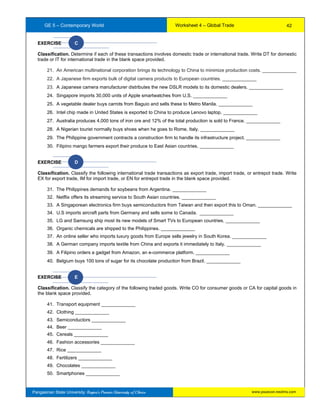
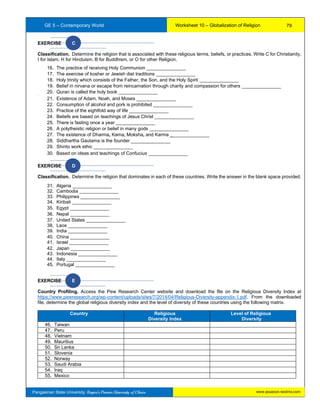
GE 5 – Contemporary World Worksheet 1 – Introduction to the Contemporary World
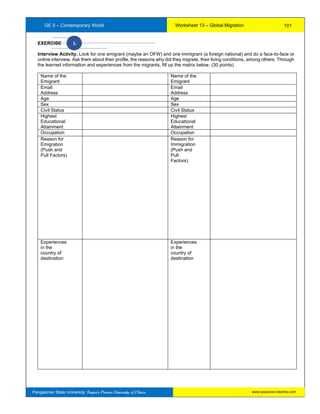
www.psuecon.neolms.comPangasinan State University: Region’s Premier University of Choice
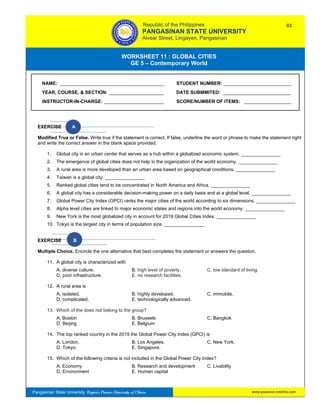
WORKSHEET 1 : INTRODUCTION TO THE CONTEMPORARY WORLD
GE 5 – Contemporary World
Intro
EXERCISE A
Modified True or False. Write true if the statement is correct. If false, underline the word or phrase to make the statement
right and write the correct answer in the blank space provided.
1. Contemporary world deals with circumstances, problems, and issues of the ancient world. _______________
2. In the contemporary world, global economy is tackled peace and conflicts are not ________________
3. Contemporary world does not take into account the process of globalization. ________________
4. The study of economics in the contemporary world helps people understand the choices societies make regarding
consumption and production. ________________
5. Geography is the study of population changes and trends. ________________
6. International relations deals on the relationships between countries, including the roles of other organizations.
________________
7. Income inequality is not a contemporary world issue. ________________
8. North America includes 33 countries led by the United States as the largest economy in the world. ____________
9. Africa is the world’s largest continent both by land area and population. ________________
10. India has a greater land area than Canada. ________________
EXERCISE B
Multiple Choice. Encircle the one alternative that best completes the statement or answers the question.
11. All of the following are topics covered in the Contemporary World course, except
A. labor migration. B. international trade. C. world religion.
D. media culture. E. solar eclipse.
12. What is the importance of studying the Contemporary World course?
A. Exposure to world problems and issues that all countries face
B. Awareness of peoples and places around the globe and the consequences of human actions on societies
C. Understanding the role the people must play in society and of their responsibilities as citizens
D. Avenue to participate in social debates, thus increasing their critical judgment
E. All of the above
13. Which is most likely a contemporary world issue?
A. Household consumption B. Leisure services C. Apple products
C. Maternal health D. Rice production
14. The understanding of the organization of power within societies and the formation of power relations is most likely
associated with the study of
A. Sociology. B. Economics. C. Political science.
D. History. E. Management science.
NAME: ________________________________________ STUDENT NUMBER: __________________________
YEAR, COURSE, & SECTION: _____________________ DATE SUBMMITED: __________________________
INSTRUCTOR-IN-CHARGE: _______________________ SCORE/NUMBER OF ITEMS: __________________
Republic of the Philippines
PANGASINAN STATE UNIVERSITY
Alvear Street, Lingayen, Pangasinan
18
GE 5 – Contemporary World Worksheet 1 – Introduction to the Contemporary World
Pangasinan State University: Region’s Premier University of Choice
15. According to the 2017 World Economic Forum's Global Shapers Survey, what is the most pressing issue affecting the
world today?
A. Lack of economic opportunity B. Poverty C. Large scale conflict
D. Destruction of nature E. Food security
EXERCISE C
Classification. Determine what academic discipline of social science is most likely associated with the following. Write the
answer in the blank space provided.
21. The factors affecting the volatility of foreign exchange and stock markets ________________
22. The historical evolution of the European Union ________________
23. The strategic locations of business centers among cities in Southeast Asia ________________
24. The form of government in Iran ________________
25. Biological and material remains of a new species of ancient human found in Luzon ________________
26. The increasing trend of the population growth in India ________________
27. Migration policies of United Kingdom ________________
28. Economic issues of Nigeria, a developing country ________________
29. The growing demand of Korean language learning in the Philippines ________________
30. Societal disorder in every city in China ________________
31. The effects of anxiety and sleep disorders on the productivity of Japanese workers
32. The characteristics of family and community groups in North Korea ________________
33. The demand for domestically produced goods of Colombia ________________
34. Marketing strategies employed by western multinational corporations ________________
35. The changing weather and season pattern of Eastern countries ________________
EXERCISE D
Classification. Determine whether the following is considered a contemporary world issue/concern or not. Write Yes if it is
and explain why. Otherwise, write No.
36. Rise of multinational corporations __________________
37. Increase in price of rice in a public market __________________
38. Population explosion among Southeast Asian nations __________________
39. The impacts of global warming __________________
40. Stock market trading in New York stock exchange __________________
41. Utilization of advanced robots and internet of things (IIoT) __________________
42. Changes in international trade policies __________________
43. Financial constraint of a small group of households __________________
44. Regional integration in Asia __________________
45. Political conflict between Iran the United States of America __________________
46. The consequences of brain drain on the country of origin __________________
47. Violence against immigrants and minority communities __________________
48. Prevalence of global diseases like HIV infection __________________
49. Use of artificial intelligence in cybersecurity __________________
50. Bankruptcy of a domestic firm__________________
19
www.psuecon.neolms.com
GE 5 – Contemporary World Worksheet 1 – Introduction to the Contemporary World
Pangasinan State University: Region’s Premier University of Choice
EXERCISE E
Matching Type. Match column A with the correct answer in column B. Write the letter of the correct answer in the space
provided.
51. Environment __________________ A. Cultural differences
52. Global economy __________________ B. Diseases
53. Global demography __________________ C. Widespread infectious diseases
54. Migration __________________ D. Underemployment
55. Natural resources __________________ E. Global warming
56. Healthcare __________________ F. Corruption
57. Media __________________ G. Terrorism
58. Culture __________________ H. Banking crisis
59. Religion __________________ I. Poverty
60. International trade __________________ J. Cyber insecurity
61. Global governance __________________ K. High inflation rate
62. Employment __________________ L. Refugee crises
63. Food security __________________ M. Import and export restrictions
64. Education __________________ N. Famine
65. Inequality __________________ O. Sexual harassment
66. Peace and security __________________ P. High illiteracy rate
67. Global finance __________________ Q. Fast population growth
68. Economic development __________________ R. Religious conflict
69. Gender equality __________________ S. Piracy
70. Information technology __________________ T. Overconsumption
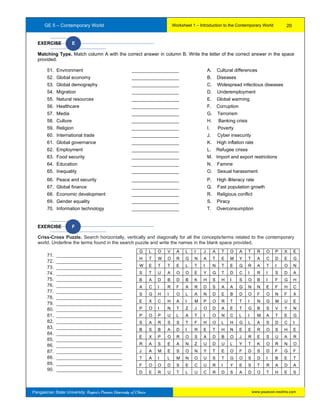
EXERCISE F
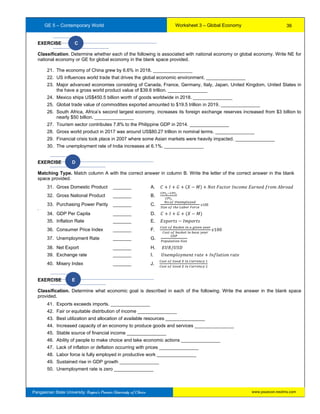
Criss-Cross Puzzle. Search horizontally, vertically and diagonally for all the concepts/terms related to the contemporary
world. Underline the terms found in the search puzzle and write the names in the blank space provided.
71. _________________________
72. _________________________
73. _________________________1
74. _________________________
75. _________________________
76. _________________________
77. _________________________
78. _________________________
79. _________________________
80. _________________________
81. _________________________
82. _________________________
83. _________________________
84. _________________________
85. _________________________
86. _________________________
87. _________________________
88. _________________________
89. _________________________
90. _________________________
G L O V A L I J A T O A T R O P X E
H T W O R G N A T E M Y T A C D E G
W E T T E L T I N T E G R A T I O N
S T U A O O E Y G T D C I R I S D A
B A D B D B K H S H I S O B I F G H
A C I R F A R D S A A G N N E F H C
S G H I O L A N D E B D O F O N F X
E X C H A I M P O R T T I N G M U E
P O I N T Z J O D A E T G B S V Y N
P O P U L A T I O N C L I M A T E G
S A R S S T F H O L H G L A S D C I
B S B A D I R E T H N E E R O S H E
E X P O R O S A D B O J R E S U A R
R A S E A N Z U D U L Y T K O R N O
J A M E S O N Y T E O F D S D F G F
T A I L M N O U S T G O S D I B E T
F O O D S E C U R I Y E S T R A D A
D E R U T L U C R D S A D O T H E S
20
www.psuecon.neolms.com
GE 5 – Contemporary World Worksheet 1 – Introduction to the Contemporary World
Pangasinan State University: Region’s Premier University of Choice
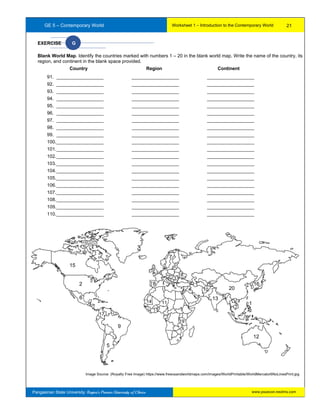
Image Source: (Royalty Free Image) https://www.freeusandworldmaps.com/images/WorldPrintable/WorldMercator6NoLinesPrint.jpg
EXERCISE G
Blank World Map. Identify the countries marked with numbers 1 – 20 in the blank world map. Write the name of the country, its
region, and continent in the blank space provided.
Country Region Continent
91. __________________ __________________ __________________
92. __________________ __________________ __________________
93. __________________ __________________ __________________
94. __________________ __________________ __________________
95. __________________ __________________ __________________
96. __________________ __________________ __________________
97. __________________ __________________ __________________
98. __________________ __________________ __________________
99. __________________ __________________ __________________
100.__________________ __________________ __________________
101.__________________ __________________ __________________
102.__________________ __________________ __________________
103.__________________ __________________ __________________
104.__________________ __________________ __________________
105.__________________ __________________ __________________
106.__________________ __________________ __________________
107.__________________ __________________ __________________
108.__________________ __________________ __________________
109.__________________ __________________ __________________
110.__________________ __________________ __________________
12
9
15
12
13
14
5
116
17
18
19
10
11
3
4
11
1
116
17
18
120
2
9
21
www.psuecon.neolms.com
GE 5 – Contemporary World Worksheet 1 – Introduction to the Contemporary World
Pangasinan State University: Region’s Premier University of Choice
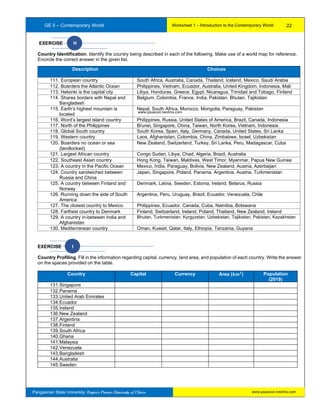
EXERCISE H
Country Identification. Identify the country being described in each of the following. Make use of a world map for reference.
Encircle the correct answer in the given list.
EXERCISE I
Country Profiling. Fill in the information regarding capital, currency, land area, and population of each country. Write the answer
on the spaces provided on the table.
Country Capital Currency Area (𝒌𝒎 𝟐
) Population
(2019)
131.Singapore
132.Panama
133.United Arab Emirates
134.Ecuador
135.Ireland
136.New Zealand
137.Argentina
138.Finland
139.South Africa
140.Ghana
141.Malaysia
142.Venezuela
143.Bangladesh
144.Australia
145.Sweden
Description Choices
111. European country South Africa, Australia, Canada, Thailand, Iceland, Mexico, Saudi Arabia
112. Boarders the Atlantic Ocean Philippines, Vietnam, Ecuador, Australia, United Kingdom, Indonesia, Mali
113. Helsinki is the capital city Libya, Honduras, Greece, Egypt, Nicaragua, Trinidad and Tobago, Finland
114. Shares borders with Nepal and
Bangladesh
Belgium, Colombia, France, India, Pakistan, Bhutan, Tajikistan
115. Earth’s highest mountain is
located
Nepal, South Africa, Morocco, Mongolia, Paraguay, Pakistan
116. Word’s largest island country Philippines, Russia, United States of America, Brazil, Canada, Indonesia
117. North of the Philippines Brunei, Singapore, China, Taiwan, North Korea, Vietnam, Indonesia
118. Global South country South Korea, Spain, Italy, Germany, Canada, United States, Sri Lanka
119. Western country Laos, Afghanistan, Colombia, China, Zimbabwe, Israel, Uzbekistan
120. Boarders no ocean or sea
(landlocked)
New Zealand, Switzerland, Turkey, Sri Lanka, Peru, Madagascar, Cuba
121. Largest African country Congo Sudan, Libya, Chad, Algeria, Brazil, Australia
122. Southeast Asian country Hong Kong, Taiwan, Maldives, West Timor, Myanmar, Papua New Guinea
123. A country in the Pacific Ocean Mexico, India, Paraguay, Bolivia, New Zealand, Austria, Azerbaijan
124. Country sandwiched between
Russia and China
Japan, Singapore, Poland, Panama, Argentina, Austria, Turkmenistan
125. A country between Finland and
Norway
Denmark, Latvia, Sweden, Estonia, Ireland, Belarus, Russia
126. Running down the side of South
America
Argentina, Peru, Uruguay, Brazil, Ecuador, Venezuela, Chile
127. The closest country to Mexico Philippines, Ecuador, Canada, Cuba, Namibia, Botswana
128. Farthest country to Denmark Finland, Switzerland, Ireland, Poland, Thailand, New Zealand, Ireland
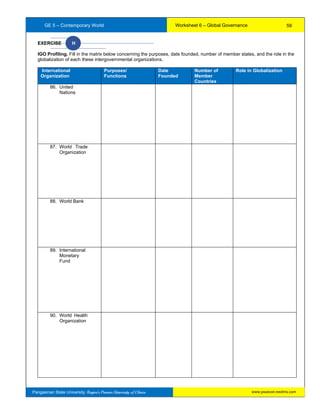
129. A country in-between India and
Afghanistan
Bhutan, Turkmenistan, Kyrgyzstan, Uzbekistan, Tajikistan, Pakistan, Kazakhstan
130. Mediterranean country Oman, Kuwait, Qatar, Italy, Ethiopia, Tanzania, Guyana
22
www.psuecon.neolms.com
GE 5 – Contemporary World Worksheet 1 – Introduction to the Contemporary World
Pangasinan State University: Region’s Premier University of Choice
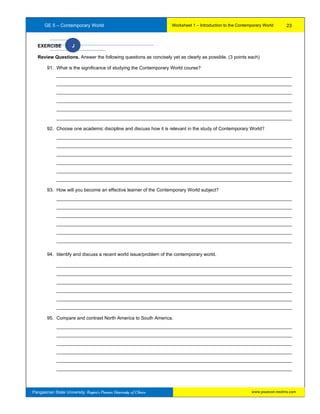
EXERCISE J
Review Questions. Answer the following questions as concisely yet as clearly as possible. (3 points each)
91. What is the significance of studying the Contemporary World course?
__________________________________________________________________________________________
__________________________________________________________________________________________
__________________________________________________________________________________________
__________________________________________________________________________________________
__________________________________________________________________________________________
__________________________________________________________________________________________
92. Choose one academic discipline and discuss how it is relevant in the study of Contemporary World?
__________________________________________________________________________________________
__________________________________________________________________________________________
__________________________________________________________________________________________
__________________________________________________________________________________________
__________________________________________________________________________________________
__________________________________________________________________________________________
93. How will you become an effective learner of the Contemporary World subject?
__________________________________________________________________________________________
__________________________________________________________________________________________
__________________________________________________________________________________________
__________________________________________________________________________________________
__________________________________________________________________________________________
__________________________________________________________________________________________
94. Identify and discuss a recent world issue/problem of the contemporary world.
__________________________________________________________________________________________
__________________________________________________________________________________________
__________________________________________________________________________________________
__________________________________________________________________________________________
__________________________________________________________________________________________
__________________________________________________________________________________________
95. Compare and contrast North America to South America.
__________________________________________________________________________________________
__________________________________________________________________________________________
__________________________________________________________________________________________
__________________________________________________________________________________________
__________________________________________________________________________________________
__________________________________________________________________________________________
23
www.psuecon.neolms.com
GE 5 – Contemporary World Worksheet 1 – Introduction to the Contemporary World
Pangasinan State University: Region’s Premier University of Choice
EXERCISE K
Creative Work. Cut out pictures of various contemporary world issues or problems in newspapers, magazines, or other
sources. Use the cut pictures to create collage art. Eventually, interpret the artwork. (30 points)
24
www.psuecon.neolms.com
GE 5 – Contemporary World Worksheet 2 – Globalization
Pangasinan State University: Region’s Premier University of Choice
WORKSHEET 2 : GLOBALIZATION
GE 5 – Contemporary World
Intro
s
EXERCISE A
Modified True or False. Write true if the statement is correct. If false, underline the word or phrase to make the statement
right and write the correct answer in the blank space provided.
1. Globalization is a trend toward greater economic, cultural, political, and technological interdependence among
national institutions and economies. _____________
2. The contemporary world is shifting toward a less integrated and interdependent global economy. _____________
3. Theodore Elvis is credited with coining and popularizing the term globalization. _____________
4. The use of cargo ships is one market driver of globalization. _____________
5. Cultural globalization is the integration of economies through trade and investment. _____________
6. Global organizations such as UN, EU, and ASEAN are associated with economic globalization. _____________
7. More globalized countries have faster economic growth and less poverty than less or non-globalized countries.
_____________
8. The KOF Index of Globalization measures four important dimensions of globalization. _____________
9. There is strong negative correlation between globalization and economic growth. _____________
10. The least-global nations are found in Africa, East Asia, South Asia. _____________
EXERCISE B
Multiple Choice. Encircle the one alternative that best completes the statement or answers the question.
11. Which of these characterizes globalization?
A. nationalization B. decreased international trade C. increasing interdependence
D. country separation E. decompressed time and space
12. Globalization signifies a growing integration of all of the following except
A. markets. B. economy. C. war.
D. culture. E. communications.
13. There is a rapid increase in the level of globalization mainly because of
A. foreign currency. B. global transportation. C. migration.
D. political ideology. E. media.
14. Economic globalization is characterized by the
A. cross-cultural flow of knowledge and values. B. rise of small and medium enterprises.
B. change in political governance and systems. D. rapid development of emerging economies.
E. international trade and investment flows.
15. The internationally coordinated initiatives and practices concerning environmental protection is closely linked to
A. economic globalization. B. political globalization. C. cultural globalization.
D. environmental globalization. E. technological globalization.
NAME: ________________________________________ STUDENT NUMBER: __________________________
YEAR, COURSE, & SECTION: _____________________ DATE SUBMMITED: __________________________
INSTRUCTOR-IN-CHARGE: _______________________ SCORE/NUMBER OF ITEMS: __________________
Republic of the Philippines
PANGASINAN STATE UNIVERSITY
Alvear Street, Lingayen, Pangasinan
25
www.psuecon.neolms.com
GE 5 – Contemporary World Worksheet 2 – Globalization
Pangasinan State University: Region’s Premier University of Choice
16. What does a political scientist perceive about globalization?
A. The impact of globalization on jobs and standards of living.
B. The opportunity to source commodities from lower-cost locations
C. The power of governments relative to that of multinational companies
D. The influence of globalization on the culture of a group of people
E. The effect of globalization on international migration
17. The most globalized country in the 2017 KOF’s Index of Globalization is
A. Singapore. B. Canada. C. Finland.
D. Switzerland. E. South Korea.
18. Which of the following is an instrument of cultural globalization?
A. Media B. Trade C. Environment
D. Technology E. Law
19. Which of these is not a benefit of globalization?
A. Increase international trade B. Greater product variety C. Increased productivity
D. Innovation E. Offshoring
20. Supporters of globalization assert that globalization
A. advances the economies of developing nations. B. exploits workers in developing nations.
C. eliminates jobs in developed nations. D. erodes standards of living.
E. lowers wages in developed nations.
EXERCISE C
Identification. Identify the person credited to each of these varying definitions of globalization by selecting the answer in the
following box. Write the answer in the blank space provided.
Martin Albrow David Ricardo Anthony Giddens Paul Krugman
Paul James Arthur Laffer Augusto Comte Roland Robertson
Eric Beerkens Robert Melton Max Weber Immanuel Wallerstein
David Harvey Erving Goffman James Carlsmith Takis Fotopoulos
Anthony Giddens John Maynard Keynes Joseph Stiglitz Thomas Larsson
21. Globalization is the process of world shrinkage, of distances getting shorter, things moving closer. _______________
22. Globalization should be reduced to trade, investment and financial statistics. These constitute ‘objective' or ‘real'
globalization, and all the rest is myth or fantasy. __________________
23. Globalization pertains to all those processes by which the people of the world are incorporated into a single world
society. __________________
24. Globalization can be defined as the intensification of worldwide social relations which link distant localities in such a
way that local happenings are shaped. __________________
25. Globalization is defined as economic globalization describing the opening and deregulation of commodity, capital, and
labor markets that led toward present neoliberal globalization. __________________
26. Globalization is described as the compression of the world and the intensification of the consciousness of the world
as a whole. __________________
27. Globalization is the extension of social relations across world-space, defining that world-space in terms of the
historically variable ways that it has been practiced and socially understood through changing world-time.
__________________
28. Globalization is the compression of time and space. __________________
29. Globalization represents the triumph of a capitalist world economy tied together by a global division of labor.
__________________
30. Globalization is the world-wide interconnectedness between nation-states in which basic social arrangements become
disembedded from their spatial context. __________________
26
www.psuecon.neolms.com
GE 5 – Contemporary World Worksheet 2 – Globalization
Pangasinan State University: Region’s Premier University of Choice
EXERCISE D
Classification. Determine the dimension of globalization manifested in each of these cases. Write E for economic, P for
political, C for cultural, or EN for environmental in the blank space provided.
31. Starbucks purchases unroasted coffee from more than 30 countries. ________________
32. The UNEP and Greenpeace convene to find ways to reduce the emissions of harmful gases ________________
33. The US dollar currency depreciates because the US economy slows down. ________________
34. Indians subscribe to music streaming services such as Spotify and Apple Music. ________________
35. Coca-Cola’s marketing rivalry with Pepsi intensifies. ________________
36. A series of International Tropical Timber Agreement treaties took place. ________________
37. United Nations is created to maintain international peace and security. ________________
38. An Earth Summit is held to address an environmental issue linked to global climate change. ________________
39. USA sells mobile technologies to both developed and developing countries. ________________
40. Political actions by non-governmental organizations are encouraged by some countries. ________________
41. The “Parasite” Korean movie is shown in over 100 countries. ________________
42. A trade war between China and U.S.A takes place. ________________
43. Stock market trading in New York stock exchange affects Tokyo and Manila ________________
44. Japanese language courses are offered to many major universities throughout the world. ________________
45. U.S. businesses are subcontracting work to Chinese companies. ________________
46. Brazil raises $1 billion dollars for the crisis mobilization brought by Amazon fires. ________________
47. UN intervenes to the aggressive anti-drugs campaign of the Philippine administration. ________________
48. ASEAN leaders meet to tackle the emergence of the concept of global governance. ________________
49. Chinese foods like siomai is available in many European and American countries. ________________
50. McDonald’s, a U.S multinational corporation, opens up and operates new restaurants in Asia. ________________
EXERCISE E
Classification. Classify the dimension of the following players or stakeholders of globalization. Write E for economic, P for
political, C for cultural, or EN for environmental in the blank space provided.
51. Multinational corporations __________________
52. Innovators __________________
53. International NGOs __________________
54. Consumers __________________
55. United Nations __________________
56. Ethnic groups __________________
57. International NGOs ________________
58. Banking institutions ________________
59. Civil society groups ________________
60. Environmentalists ________________
61. Importers ________________
62. Social media influencers ________________
63. Environmental groups ________________
64. National governments ________________
65. Charitable institutions________________
27
www.psuecon.neolms.com
GE 5 – Contemporary World Worksheet 2 – Globalization
Pangasinan State University: Region’s Premier University of Choice
EXERCISE F
Classification. Classify what dimension of globalization these global activities are likely associated with. Put a checkmark
(∕) on the appropriate space. Provide a brief explanation in your answer in the blank space provided.
Activity
Dimension of Globalization Explanation
Economic Political Cultural Environmental
66. Trending of Senorita
Song by Shawn
Mendez and Camila
Cabello
67. Creation of the World
Health Organization
68. Efforts made by the
government to
Australia’s deadly
wildfires
69. Franchises made by
Jollibee Corporation
throughout the world
70. Exportation of
German cars like
Mercedes-Benz
71. Influence of
Picasso’s artworks to
other visual artists
72. Contributions of Bill
and Melinda Gates
Foundation on
enhancing healthcare
worldwide
73. Environmental
initiatives to address
the problem of global
warming
74. The spread of online
shopping such as
Alibaba, Amazon,
and Lazada
75. Political conflict
between South Korea
and North Korea
28
www.psuecon.neolms.com
GE 5 – Contemporary World Worksheet 2 – Globalization
Pangasinan State University: Region’s Premier University of Choice
EXERCISE G
Crossword Puzzle. Fill the white squares with letters forming words or terms by identifying each of the statements below.
1 2 3 4 5 6
7 8 9
10
11 12
13 14
15 16 17
18 19
20 21 22 23
24 25 26
27
28 29 30 31 32
33
34 35 36 37 38 39
40 41 42
43
44 45 46
ACROSS
76. (1) Increased interconnectedness and interdependence of peoples and countries.
77. (5) Development of standard policies and agreements in areas such as trade and environment
78. (7) The third-largest country in South America
79. (8) Capital and largest metropolis is Warsaw
80. (9) __, __, __, __, __ phobia, fear of globalization
81. (10) A country in Africa bordered by Ghana, Benin, and Burkina Faso
82. (11) International Swaps and Derivatives Association, a trade organization
83. (12) __, __, __, __, __, __, Y: The area of economic activities such as production, distribution, trade, and consumption
84. (13) The shortened version of advertisements
85. (16) One aspect of globalization that deals with the level of political cooperation that exists among different countries
86. (18) Domestically-produced goods and services which are sold abroad
87. (21) A landlocked country in West Africa with an area of 1.24 million square kilometers
88. (22) Part of the earth's surface occupied by continents, countries, and islands
89. (24) Multinational corporation concentrated on e-commerce and cloud computing
90. (25) Most economically important bean in the world trade primarily produced by the United States
91. (27) __, __, __, __, A, __, __: A European country with the fourth-highest ratio of tertiary degree holders in the world
92. (28) Second-most populous country and the sixth-largest economy in the world
93. (31) __, __, __, __, __, A: The most densely populated city proper in the world
94. (33) Commodity consumed in the world with global production of about 6 million tons
95. (34) County’s official currency is Naira
96. (38) Alcoholic drink exported by Italy or Spain
97. (40) Index of globalization which measures the economic, social, and political dimensions of globalization
98. (43) American shedding-type card game that is played internationally
99. (44) The official currency of South Korea
100.(45) Code of the official currency of Australia
101.(46) A dimension of globalization involving the sharing of ideas, information, and values
29
www.psuecon.neolms.com
GE 5 – Contemporary World Worksheet 2 – Globalization
Pangasinan State University: Region’s Premier University of Choice
DOWN
102.(1) Sum of the market values of all final goods and services produced in the economy during a period
103.(2) The country that pioneers the concept of gross national happiness
104.(3) __, __, __, __, __, T: Goods and services purchased abroad and brought into a country
105.(4) Commercial exchanges between companies and individuals that cross borders
106.(5) Country on Southeast Asia
107.(6) An international organization which deals with the global rules of trade between nations
108.(9) Relating to the whole world or worldwide
109.(11) Bringing together or uniting things like economies, cultures, and religions
110.(14) The largest country in Europe by area
111.(15) One example of cultural globalization related to a genre of classical music
112.(17) Residential migration of persons to an area of destination
113.(19) General development or change in an event or issue in the world
114.(20) Top tourist destination country in the world
115.(23) Association of Southeast Asian Nations
116.(26) The country bordering Saudi Arabia to the north and the Red Sea to the east
117.(30) __, __, __ Materials: Goods that are bought and sold on commodities exchanges worldwide
118.(32) Agency created to promote international monetary cooperation by regulating fixed exchange rates
119.(35) __, __, __, __, TH: Process of increasing the level of production in the economy
120.(36) Acid __, __, __, __: Environmental issue, which is a result of air pollution.
121.(37) Most populous continent
122.(39) Abbreviation for the globalization term, “International.”
123.(41) __, __, __, O: Currency of 19 member states of the European Union
124.(42) Address of a page on the World Wide Web
125.(43) A global political organization dedicated to international peace and stability
EXERCISE H
Classification. Determine the effect of the following cases on globalization. Write IG if there is an increase in the level of
globalization and DG if there is a decrease in the level of globalization. Identify also the aspect of globalization that determines
the change in the level of globalization. Write the answer in the blank space provided.
126.McDonald’s builds new business locations in African countries. __________________
127.The number of tourist arrivals in European countries falls. __________________
128.The volume of world exports falls. __________________
129.The number of non-governmental organizations (NGOs) increases. __________________
130.Average transnationality index for the top 100 multinational corporations falls. __________________
131.Competition in the global market for consumer electronics products increases. __________________
132.Foreign direct investment of developed countries to India and China falls significantly. __________________
133.Developments in Information Technology continue like the implementation of 5G networks. __________________
134.The use of electronic payments systems becomes prevalent worldwide. __________________
135.Global credit markets grow rapidly due to the development of complex financial products. __________________
136.The number of foreign workers in developed countries rises. __________________
137.The human capital of Americans greatly improves. __________________
138.The number of minutes spent on cross-border telephone and smartphone calls falls. __________________
139.The UN peacekeeping missions increase. __________________
140.Memberships of less-developed countries to international organizations increase. __________________
30
www.psuecon.neolms.com
GE 5 – Contemporary World Worksheet 2 – Globalization
Pangasinan State University: Region’s Premier University of Choice
EXERCISE I
Country Profiling. Visit the KOF Index of Globalization website at https://kof.ethz.ch/en/forecasts-and-
indicators/indicators/kof-globalisation-index.html and fill in the KOF index of globalization of 10 countries in the matrix. Also,
discuss some implications briefly on their level of globalization.
Country
Dimension KOF Index of
Globalization
Overall
Globalization
Index
Discussion
Economic Social Political
141. Philippines
142. Switzerland
143. Netherlands
144. Ireland
145. Indonesia
146. Afghanistan
147. South Africa
148. Japan
149. Germany
150. Malaysia
31
www.psuecon.neolms.com
GE 5 – Contemporary World Worksheet 2 – Globalization
Pangasinan State University: Region’s Premier University of Choice
EXERCISE J
Classification. Determine the driver of globalization involved in each of these cases. Write T for Technological, P for Political,
M for Market, CS for Cost, or CM for Competitive in the blank space provided.
151.Saturation of different markets in a domestic economy _____________
152.Increase in foreign direct investment (FDI) among emerging economies _____________
153.Offshoring activities in the global supply chain _____________
154.Use of commercial jet aircraft in international trade _____________
155.Advancement of cellular network technology from 2G to 4G_____________
156.Creation of World Trade Organization _____________
157.Reduction in trade barriers_____________
158.Rapid global presence of multinational enterprises _____________
159.Access of different online shopping platforms _____________
160.Opportunity to build global scale economies_____________
EXERCISE K
Classification. Determine whether the following is considered a benefit or cost of globalization. Write BG for benefit of
globalization or CB for cost of globalization in the blank space provided.
161.Increased access to foreign media and culture _____________
162.Disease transfer _____________
163.Greater employment opportunities_____________
164.Lower prices for goods and services _____________
165.Loss of cultural identity_____________
166.Increased income inequality _____________
167.Improved standard of living across the globe _____________
168.Adverse effect on environment _____________
169.Spread of creativity and innovation _____________
170.Exploitation of developing nations _____________
EXERCISE L
Classification. Determine if the following arguments are for or against globalization. Write FG if it’s for globalization or AG if
it’s against globalization in the blank space provided.
181.Globalization increases wealth and efficiency in all nations. ____________
182.Globalization strengthens the power and dominance of MNCs. _____________
183.Globalization lowers wages in developed nations. _____________
184.Globalizations widens access to goods and services. _____________
185.Globalization increases cultural awareness. _____________
186.Globalization destroys infant industries _____________
187.Globalization creates more jobs in developing countries. _____________
188.Globalization eliminates jobs in developed nations. _____________
189.Globalization is a social disaster. _____________
190.Globalization broadens the gap between rich and poor countries. _____________
32
www.psuecon.neolms.com
GE 5 – Contemporary World Worksheet 2 – Globalization
Pangasinan State University: Region’s Premier University of Choice
EXERCISE M
Review Questions. Answer the following questions as concisely yet as clearly as possible. (3 points each)
191.How globalization affects students like you today?
__________________________________________________________________________________________
__________________________________________________________________________________________
__________________________________________________________________________________________
__________________________________________________________________________________________
__________________________________________________________________________________________
__________________________________________________________________________________________
192.What do you think is the most relevant dimension of globalization? Explain why.
__________________________________________________________________________________________
__________________________________________________________________________________________
__________________________________________________________________________________________
__________________________________________________________________________________________
__________________________________________________________________________________________
__________________________________________________________________________________________
193.What effect will advancement in technology have on globalization?
__________________________________________________________________________________________
__________________________________________________________________________________________
__________________________________________________________________________________________
__________________________________________________________________________________________
__________________________________________________________________________________________
__________________________________________________________________________________________
194. Why are European countries more globalized than Asian countries?
__________________________________________________________________________________________
__________________________________________________________________________________________
__________________________________________________________________________________________
__________________________________________________________________________________________
__________________________________________________________________________________________
__________________________________________________________________________________________
195.Explain one primary argument in favor of globalization
__________________________________________________________________________________________
__________________________________________________________________________________________
__________________________________________________________________________________________
__________________________________________________________________________________________
__________________________________________________________________________________________
__________________________________________________________________________________________
33
www.psuecon.neolms.com
GE 5 – Contemporary World Worksheet 2 – Globalization
Pangasinan State University: Region’s Premier University of Choice
EXERCISE N
Graphic Organizer. Choose a country and draw its flag in the center rectangle below. Create a graphic organizer about the
success story or challenges of this country as a globalizer. Also, Interpret the concept map. Use the space provided below.
(30 points)
34
www.psuecon.neolms.com
GE 5 – Contemporary World Worksheet 3 – Global Economy
Pangasinan State University: Region’s Premier University of Choice
WORKSHEET 3 : GLOBAL ECONOMY
GE 5 – Contemporary World
Intro
EXERCISE A
Modified True or False. Write true if the statement is correct. If false, underline the word or phrase to make the statement right
and write the correct answer in the blank space provided.
1. Global economy is the interconnected worldwide economic activities that take place among countries. ____________
2. The Gross World Product (GWP) is the collective gross national product of all the countries in the world. ____________
3. The economy of France is larger than India. _______________
4. GNP represents the market value of all final goods produced within a country in a given period. ______________
5. An expansion in GDP indicates a slowdown in a country's economy. _______________
6. Misery index is measured by adding unemployment rate to the annual growth rate. _______________
7. Economic equity is achieved by increasing the economy’s ability to produce. _______________
8. Secondary sector encompasses all economic activities associated with agriculture. _______________
9. Command economy is characterized by private ownership of economic resources. _______________
10. One driving force behind the growth of China’s economy is worker inefficiency. _______________
EXERCISE B
Multiple Choice. Encircle the one alternative that best completes the statement or answers the question.
11. Currently, the global economy is roughly valued at
A. 160 trillion U.S dollars B. 50 trillion U.S dollars. C. 290 trillion U.S dollars.
D. 86 trillion U.S dollars. E. 900 billion U.S dollars.
12. Which of the following country groups has the largest share of the world economy in terms of nominal GDP?
A. Sub-Saharan Africa B. Latin America C. Middle East and Central Asia
D. Emerging and developing Asia E. Emerging and developing Europe
13. Which of these is not an economic indicator of in assessing the state of an economy?
A. Unemployment rate B. Inflation rate C. Net migration
D. Gross Domestic Product E. Net export
14. Assume that the size of the labor force is 60 million, and 55 million workers are employed. Based on this, the
unemployment rate is
A. 89.22%. B. 8.33%. C. 11.88%.
D. 15.66%. E. 9.55%.
15. The economic goal that is concerned with the absence of inflation is
A. price stability. B. economic efficiency. C. full employment.
D. balance of trade. E. economic growth.
NAME: ________________________________________ STUDENT NUMBER: __________________________
YEAR, COURSE, & SECTION: _____________________ DATE SUBMMITED: __________________________
INSTRUCTOR-IN-CHARGE: _______________________ SCORE/NUMBER OF ITEMS: __________________
Republic of the Philippines
PANGASINAN STATE UNIVERSITY
Alvear Street, Lingayen, Pangasinan
35
www.psuecon.neolms.com
GE 5 – Contemporary World Worksheet 3 – Global Economy
Pangasinan State University: Region’s Premier University of Choice
EXERCISE C
Classification. Determine whether each of the following is associated with national economy or global economy. Write NE for
national economy or GE for global economy in the blank space provided.
21. The economy of China grew by 6.6% in 2018. _______________
22. US influences world trade that drives the global economic environment. _______________
23. Major advanced economies consisting of Canada, France, Germany, Italy, Japan, United Kingdom, United States in
the have a gross world product value of $39.6 trillion. _______________
24. Mexico ships US$450.5 billion worth of goods worldwide in 2018. _______________
25. Global trade value of commodities exported amounted to $19.5 trillion in 2019. _______________
26. South Africa, Africa’s second largest economy, increases its foreign exchange reserves increased from $3 billion to
nearly $50 billion. _______________
27. Tourism sector contributes 7.8% to the Philippine GDP in 2014. _______________
28. Gross world product in 2017 was around US$80.27 trillion in nominal terms. _______________
29. Financial crisis took place in 2007 where some Asian markets were heavily impacted. _______________
30. The unemployment rate of India increases at 6.1%. _______________
EXERCISE D
Matching Type. Match column A with the correct answer in column B. Write the letter of the correct answer in the blank
space provided.
31. Gross Domestic Product _______ A. 𝐶 + 𝐼 + 𝐺 + (𝑋 − 𝑀) + 𝑁𝑒𝑡 𝐹𝑎𝑐𝑡𝑜𝑟 𝐼𝑛𝑐𝑜𝑚𝑒 𝐸𝑎𝑟𝑛𝑒𝑑 𝑓𝑟𝑜𝑚 𝐴𝑏𝑟𝑜𝑎𝑑
32. Gross National Product _______ B.
𝐶𝑃𝐼2−𝐶𝑃𝐼1
𝐶𝑃𝐼1
33. Purchasing Power Parity _______ C.
𝑁𝑜.𝑜𝑓 𝑈𝑛𝑒𝑚𝑝𝑙𝑜𝑦𝑒𝑑
𝑆𝑖𝑧𝑒 𝑜𝑓 𝑡ℎ𝑒 𝐿𝑎𝑏𝑜𝑟 𝐹𝑜𝑟𝑐𝑒
x100
x
34. GDP Per Capita _______ D. 𝐶 + 𝐼 + 𝐺 + (𝑋 − 𝑀)
35. Inflation Rate _______ E. 𝐸𝑥𝑝𝑜𝑟𝑡𝑠 − 𝐼𝑚𝑝𝑜𝑟𝑡𝑠
36. Consumer Price Index _______ F.
𝐶𝑜𝑠𝑡 𝑜𝑓 𝐵𝑎𝑠𝑘𝑒𝑡 𝑖𝑛 𝑎 𝑔𝑖𝑣𝑒𝑛 𝑦𝑒𝑎𝑟
𝐶𝑜𝑠𝑡 𝑜𝑓 𝑏𝑎𝑠𝑘𝑒𝑡 𝑖𝑛 𝑏𝑎𝑠𝑒 𝑦𝑒𝑎𝑟
𝑥100
37. Unemployment Rate _______ G.
𝐺𝐷𝑃
𝑃𝑜𝑝𝑢𝑙𝑎𝑡𝑖𝑜𝑛 𝑆𝑖𝑧𝑒
38. Net Export _______ H. 𝐸𝑈𝑅/𝑈𝑆𝐷
39. Exchange rate _______ I. 𝑈𝑛𝑒𝑚𝑝𝑙𝑜𝑦𝑚𝑒𝑛𝑡 𝑟𝑎𝑡𝑒 + 𝐼𝑛𝑓𝑙𝑎𝑡𝑖𝑜𝑛 𝑟𝑎𝑡𝑒
40. Misery Index _______ J.
𝐶𝑜𝑠𝑡 𝑜𝑓 𝐺𝑜𝑜𝑑 𝑋 𝑖𝑛 𝐶𝑢𝑟𝑟𝑒𝑛𝑐𝑦 1
𝐶𝑜𝑠𝑡 𝑜𝑓 𝐺𝑜𝑜𝑑 𝑋 𝑖𝑛 𝐶𝑢𝑟𝑟𝑒𝑛𝑐𝑦 2
EXERCISE E
Classification. Determine what economic goal is described in each of the following. Write the answer in the blank space
provided.
41. Exports exceeds imports. _______________
42. Fair or equitable distribution of income _______________
43. Best utilization and allocation of available resources _______________
44. Increased capacity of an economy to produce goods and services _______________
45. Stable source of financial income _______________
46. Ability of people to make choice and take economic actions _______________
47. Lack of inflation or deflation occurring with prices _______________
48. Labor force is fully employed in productive work _______________
49. Sustained rise in GDP growth _______________
50. Unemployment rate is zero _______________
36
www.psuecon.neolms.com
GE 5 – Contemporary World Worksheet 3 – Global Economy
Pangasinan State University: Region’s Premier University of Choice
EXERCISE F
Classification. Classify what sector of the economy does each of the following belong. Write P for primary sector, S for
secondary sector, or T for tertiary sector in the blank space provided.
51. Public administration _____________
52. Transportation _____________
53. Forestry _____________
54. Real estate _____________
55. Fishing _____________
56. Construction _____________
57. Agribusiness _____________
58. Financial intermediation _____________
59. Mining and quarrying _____________
60. Manufacturing _____________
EXERCISE G
Classification. Identify what type of economic system is described in each of the following. Write MA for market economy, CO
for command economy, MI for mixed economy, or TR for traditional economy.
61. Private individuals own most, if not all, the resources and control their use. ______________
62. Society produces what best ensures its survival. ______________
63. People are largely free to do what they want with the resources at their disposal. ______________
64. Government makes all economic decisions. _____________
65. People make economic decisions based on customs and beliefs. _______________
66. Private economic freedom mixed with a degree of government regulation of markets. ______________
67. Prices of goods and services are determined in a free price system. ______________
68. There is public ownership of resources and centralized planning. ______________
69. Major industries are owned by the state while the minor industries belong to the private sector. _____________
70. There is no free competition because the government is the only seller. ______________
EXERCISE H
Country Profiling. Research on the economic profile of the following countries. Fill in the matrix by indicating the 2019 data
on GDP, GDP per capita, unemployment rate, inflation rate, and net export value of these countries. Discuss their economic
performance briefly in general based on the indicators.
Country Economic Indicator (2019) Economic Performance
71. South Korea GDP (nominal): _____________
GDP Per Capita: ____________
Unemployment Rate: ________
Inflation Rate: ______________
Value of Net Exports: ________
72. Finland GDP (nominal): _____________
GDP Per Capita: ____________
Unemployment Rate: ________
Inflation Rate: ______________
Value of Net Exports: ________
37
www.psuecon.neolms.com
GE 5 – Contemporary World Worksheet 3 – Global Economy
Pangasinan State University: Region’s Premier University of Choice
73. United Arab
Emirates
GDP (nominal): _____________
GDP Per Capita: ____________
Unemployment Rate: ________
Inflation Rate: ______________
Value of Net Exports: ________
74. Venezuela GDP (nominal): _____________
GDP Per Capita: ____________
Unemployment Rate: ________
Inflation Rate: ______________
Value of Net Exports: ________
75. Canada GDP (nominal): _____________
GDP Per Capita: ____________
Unemployment Rate: ________
Inflation Rate: ______________
Value of Net Exports: ________
76. Philippines GDP (nominal): _____________
GDP Per Capita: ____________
Unemployment Rate: ________
Inflation Rate: ______________
Value of Net Exports: ________
77. Angola GDP (nominal): _____________
GDP Per Capita: ____________
Unemployment Rate: ________
Inflation Rate: ______________
Value of Net Exports: ________
78. Belgium GDP (nominal): _____________
GDP Per Capita: ____________
Unemployment Rate: ________
Inflation Rate: ______________
Value of Net Exports: ________
79. Panama GDP (nominal): _____________
GDP Per Capita: ____________
Unemployment Rate: ________
Inflation Rate: ______________
Value of Net Exports: ________
80. New
Zealand
GDP (nominal): _____________
GDP Per Capita: ____________
Unemployment Rate: ________
Inflation Rate: ______________
Value of Net Exports: ________
38
www.psuecon.neolms.com
GE 5 – Contemporary World Worksheet 3 – Global Economy
Pangasinan State University: Region’s Premier University of Choice
EXERCISE I
Review Questions. Answer the following questions as concisely yet as clearly as possible. (3 points each)
81. Explain how does globalization influence the global economy?
__________________________________________________________________________________________
__________________________________________________________________________________________
__________________________________________________________________________________________
__________________________________________________________________________________________
__________________________________________________________________________________________
__________________________________________________________________________________________
82. Compare and contrast national economy to global economy.
__________________________________________________________________________________________
__________________________________________________________________________________________
__________________________________________________________________________________________
__________________________________________________________________________________________
__________________________________________________________________________________________
__________________________________________________________________________________________
83. Explain how the global economy is measured.
__________________________________________________________________________________________
__________________________________________________________________________________________
__________________________________________________________________________________________
__________________________________________________________________________________________
__________________________________________________________________________________________
__________________________________________________________________________________________
84. Why are economic goals important to the economy?
__________________________________________________________________________________________
__________________________________________________________________________________________
__________________________________________________________________________________________
__________________________________________________________________________________________
__________________________________________________________________________________________
__________________________________________________________________________________________
85. Why does U.S have larger economy than other countries?
__________________________________________________________________________________________
__________________________________________________________________________________________
__________________________________________________________________________________________
__________________________________________________________________________________________
__________________________________________________________________________________________
__________________________________________________________________________________________
39
www.psuecon.neolms.com
GE 5 – Contemporary World Worksheet 3 – Global Economy
Pangasinan State University: Region’s Premier University of Choice
EXERCISE J
Creative Work. Compose a poem about global economy containing a minimum of 4 stanzas. Each stanza will compose of
4 or 5 lines. Write your poem in the blank space provided below. (30 points)
________________________________ (Poem Title)
_________________________________________________________________________________________
_________________________________________________________________________________________
_________________________________________________________________________________________
_________________________________________________________________________________________
_________________________________________________________________________________________
_________________________________________________________________________________________
_________________________________________________________________________________________
_________________________________________________________________________________________
_________________________________________________________________________________________
_________________________________________________________________________________________
_________________________________________________________________________________________
_________________________________________________________________________________________
_________________________________________________________________________________________
_________________________________________________________________________________________
_________________________________________________________________________________________
_________________________________________________________________________________________
_________________________________________________________________________________________
_________________________________________________________________________________________
_________________________________________________________________________________________
_________________________________________________________________________________________
_________________________________________________________________________________________
_________________________________________________________________________________________
_________________________________________________________________________________________
_________________________________________________________________________________________
_________________________________________________________________________________________
40
www.psuecon.neolms.com
GE 5 – Contemporary World Worksheet 4 – Global Trade
Pangasinan State University: Region’s Premier University of Choice
WORKSHEET 4 : GLOBAL TRADE
GE 5 – Contemporary World
Intro
EXERCISE A
Modified True or False. Write true if the statement is correct. If false, underline the word or phrase to make the statement
right and write the correct answer in the blank space provided.
1. Global trade represents the import and export of goods and services across international boundaries. _____________
2. Interpot trade takes place when a country imports goods with the intention of exporting it to another country.
_____________
3. Imports are sales on domestically produced goods and services. _____________
4. Autarkic economy is a closed economy because it does not trade with other countries. _____________
5. Net export is the difference between the value of a country’s exports and the value of its imports. _____________
6. In absolute advantage, a nation will specialize in what it can produce at a lower opportunity cost than any other nation.
_____________
7. International trade flows largely between less developed countries. _____________
8. International trade has generally helped developing countries but hurt developed countries. _____________
9. Petroleum products are world’s top traded commodities in 2018. _____________
10. Tariffs are limits on the quantity or value of goods imported and exported. _____________
EXERCISE B
Multiple Choice. Encircle the one alternative that best completes the statement or answers the question.
11. A bus company that buys new vehicles from Japan is an example of
A. export trade. B. re-export trade. C. financial trade.
D. import trade. E. domestic trade.
12. Which of the following is an example of traded services?
A. Tourism B. Automobiles C. Textile
D. Electronic equipment E. Household appliances
13. The value of exports for August 2018 in the Philippines amounted to $6.16 billion, and the value of imports amounted
to $9.68 billion. Based on the data, the Philippines experiences
A. positive net export. B. budget deficit. C. trade deficit.
D. trade surplus. E. consumer surplus
.
14. Which of the following countries has a comparative advantage in producing watches?
A. France B. Taiwan C. Columbia
D. Italy E. Switzerland
15. Which of the following is one disadvantage of international trade?
A. Greater variety of goods. B. Rise in the standard of living. C. Employment generation
D. Exhaustion of natural resources E. Increase in efficiency and innovation
NAME: ________________________________________ STUDENT NUMBER: __________________________
YEAR, COURSE, & SECTION: _____________________ DATE SUBMMITED: __________________________
INSTRUCTOR-IN-CHARGE: _______________________ SCORE/NUMBER OF ITEMS: __________________
Republic of the Philippines
PANGASINAN STATE UNIVERSITY
Alvear Street, Lingayen, Pangasinan
41
www.psuecon.neolms.com
GE 5 – Contemporary World Worksheet 4 – Global Trade
Pangasinan State University: Region’s Premier University of Choice
EXERCISE C
Classification. Determine if each of these transactions involves domestic trade or international trade. Write DT for domestic
trade or IT for international trade in the blank space provided.
21. An American multinational corporation brings its technology to China to minimize production costs. _____________
22. A Japanese firm exports bulk of digital camera products to European countries. _____________
23. A Japanese camera manufacturer distributes the new DSLR models to its domestic dealers. _____________
24. Singapore imports 30,000 units of Apple smartwatches from U.S. _____________
25. A vegetable dealer buys carrots from Baguio and sells these to Metro Manila. _____________
26. Intel chip made in United States is exported to China to produce Lenovo laptop. _____________
27. Australia produces 4,000 tons of iron ore and 12% of the total production is sold to France. _____________
28. A Nigerian tourist normally buys shoes when he goes to Rome, Italy. _____________
29. The Philippine government contracts a construction firm to handle its infrastructure project. _____________
30. Filipino mango farmers export their produce to East Asian countries. _____________
EXERCISE D
Classification. Classify the following international trade transactions as export trade, import trade, or entrepot trade. Write
EX for export trade, IM for import trade, or EN for entrepot trade in the blank space provided.
31. The Philippines demands for soybeans from Argentina. _____________
32. Netflix offers its streaming service to South Asian countries. _____________
33. A Singaporean electronics firm buys semiconductors from Taiwan and then export this to Oman. _____________
34. U.S imports aircraft parts from Germany and sells some to Canada. _____________
35. LG and Samsung ship most its new models of Smart TVs to European countries. _____________
36. Organic chemicals are shipped to the Philippines. _____________
37. An online seller who imports luxury goods from Europe sells jewelry in South Korea. _____________
38. A German company imports textile from China and exports it immediately to Italy. _____________
39. A Filipino orders a gadget from Amazon, an e-commerce platform. _____________
40. Belgium buys 100 tons of sugar for its chocolate production from Brazil. _____________
EXERCISE E
Classification. Classify the category of the following traded goods. Write CO for consumer goods or CA for capital goods in
the blank space provided.
41. Transport equipment _____________
42. Clothing _____________
43. Semiconductors _____________
44. Beer _____________
45. Cereals _____________
46. Fashion accessories _____________
47. Rice _____________
48. Fertilizers _____________
49. Chocolates _____________
50. Smartphones _____________
42
www.psuecon.neolms.com
GE 5 – Contemporary World Worksheet 4 – Global Trade
Pangasinan State University: Region’s Premier University of Choice
EXERCISE F
Classification. Classify the following industries as capital–intensive or labor-intensive. Write CI for capital-intensive or LI for
labor-intensive in the blank space provided.
51. Farm production _____________
52. Oil production and refining _____________
53. Electric power plants _____________
54. Telecommunications _____________
55. Electronics assembly plant _____________
56. Mining _____________
57. Aircraft and spacecraft _____________
58. Toys and sporting equipment _____________
59. Apparel production _____________
60. Textile production _____________
EXERCISE G
Classification. Determine whether each of the following deals with inter-industry trade or intra-industry trade. Write Inter for
inter-industry trade or Intra for intra-international trade in the blank space provided.
61. United States either exports or imports milk products. _____________
62. Japan manufactures and exports Mitsubishi vehicles and imports Ford vehicles made in USA. _____________
63. Germany trades aircrafts and aluminum for textiles and shoes to China. _____________
64. Russia exports 2.2 million tons of apples and imports 0.2 million of China apples. _____________
65. Singapore imports finished manufactured items from China and exports raw materials to India. _____________
66. France tends to export sophisticated manufactured products and import resource-intensive goods. _____________
67. Thailand trades fast-moving consumer goods for capital goods with the Netherlands. _____________
68. South Korea sells 254 million smartphones and buys 120 million of them abroad. _____________
69. Philippines exports pharmaceutical products to Thailand and imports the same from Vietnam. _____________
70. Some domestically produced computers in Taiwan are exported to the Philippines, and some coconuts domestically
produced in the Philippines are sold to Taiwan. _____________
EXERCISE H
Classification. Determine what will happen to Philippine next exports in each of the following cases. Write IN for increase in
net exports or DN for decrease in net exports in the blank space provided.
71. The Philippines encounters a severe recession. _____________
72. Filipinos become patriotic in buying local products. _____________
73. Prices of goods produced in China increase faster than prices of goods produced in the Philippines. _____________
74. The incomes of consumers dramatically increase. _____________
75. Some local consumers prefer to buy new gadget models made from South Korea. _____________
76. The cost of transporting exported goods to U.S falls. _____________
77. The country completely prohibits international trade with China. _____________
78. Local producers pay higher tariff for the exportation of locally produced goods. _____________
79. The government pays domestic manufacturers a cash subsidy for every jeep they produce and sell. _____________
80. The Philippine peso depreciates relative to U.S dollar. _____________
43
www.psuecon.neolms.com
GE 5 – Contemporary World Worksheet 4 – Global Trade
Pangasinan State University: Region’s Premier University of Choice
EXERCISE I
Marching Type. Match each country with its product having an absolute or comparative advantage. Write the letter of the
correct answer in the blank space provided.
81. New Zealand _______________ A. Pineapples
82. Brazil _______________ B. Gold
83. South Korea _______________ C. Automobiles
84. Switzerland _______________ D. Tomatoes
85. Costa Rica _______________ E. Petroleum
86. Saudi Arabia _______________ F. Ships
87. Japan _______________ G. Lumber
88. France _______________ H. Wine
89. United States _______________ I. Smartphones
90. China _______________ J. Computer software
91. Germany _______________ K. Milk
92. Mexico _______________ L. Sugar
93. Canada _______________ M. Financial services
94. India _______________ N. Digital cameras
95. United Kingdom _______________ O. Rice
96. Chile _______________ P. Human blood
97. Netherlands _______________ Q. Wheat
98. Russia _______________ R. Potatoes
99. Ireland _______________ S. Grapes
100.Thailand _______________ T. Rubber
EXERCISE J
Classification. Classify the trade barrier in each of these cases. Write TA for tariff, IQ for import quota, ES for export subsidy,
or EM for embargo in the blank space provided.
101.The government of Singapore imposes a 25% tax on consumer electronics goods imported from U.S. ___________
102.Canada imposes a limit on the quantity of apples to be imported from China. _____________
103.New Zealand limits the number of milk products that will be exported from Australia. _____________
104.The Philippine government pays farmers a subsidy to increase their exports on agricultural products. _____________
105.The Chinese government decides to allow no more than 150,000 foreign cars to be imported. _____________
106.France bans imports of genetically modified foods by imposing health, safety and regulation barriers. _____________
107.The French government imposes a 25% tax on imported cosmetics goods. _____________
108.The German government provides car manufacturers 500 euro-incentive for every car they produce. _____________
109.Thailand announces it will only accept 300,000 pounds of imported tuna. _____________
110.Importing beef from China is banned because of a suspected mad-cow disease. _____________
EXERCISE K
Currency Conversion. Suppose the following table shows the currencies of ten countries with corresponding Philippine peso
equivalent. Use the exchange rates in the table to calculate how much it would cost in Philippine pesos and currency specified
to make the various purchases below.
Country Currency Philippine Peso
Equivalent
United States Dollar (USD) 49.45
United Kingdom Pound (GBP) 61.21
Japan Yen (JPY) 0.42
Singapore Dollar (SGD) 35.11
Bahrain Dinar (BHD) 133.44
Germany Euro (EUR) 52.85
Canada Dollar (CAD) 37.55
Switzerland Franc (CHF) 49.64
Thailand Baht (THB) 1.43
South Korea Won (KRW) 0.04
44
www.psuecon.neolms.com
GE 5 – Contemporary World Worksheet 4 – Global Trade
Pangasinan State University: Region’s Premier University of Choice
111.A Windows 10 operating system priced at $109 dollars _____________
112.A Yamaha motorcycle priced at 740 thousand yen _____________
113.A British fiction book priced at 9.75 pounds _____________
114.A Mercedes-Benz car from Germany priced at 18,998 euros _____________
115.A Canadian polo shirt sold at $109 _____________
116.A Samsung smartphone valued at 525,000 wons _____________
117.A Nestle milk product that cost 26 franc _____________
118.A Thai bag that is worth 3,204 bahts _____________
119. A bottle of coconut oil priced at Ᵽ350 is sold in South Korea _____________
120.A wood furniture priced at Ᵽ8,760 is sold in the United States _____________
EXERCISE L
Classification. Determine whether each of the following cases would cause the Philippine peso to appreciate or depreciate
relative to U.S dollar. Write A if the Philippine peso appreciates and D if it depreciates. Write the answer in the blank space
provided.
121.The country increases tariffs on U.S goods. _____________
122.The demand for Philippine peso in foreign exchange market falls. _____________
123.The Philippines economy becomes stronger. _____________
124.The Philippine government encourages U.S. firms to increase their foreign investment. _____________
125.The Philippines implements a lower-interest-rate monetary policy. _____________
126.The U.S experiences a severe inflation. _____________
127.The Philippine inflation rate rises relative to the U.S. inflation rate. _____________
128.Philippine products become trendier to U.S. consumers. _____________
129.Philippine incomes increase with no change in U.S income. _____________
130.The country is in the state of political instability. _____________
EXERCISE M
Problem Analysis. Use the following information in the table to answer the questions below.
Country Mangoes
(millions of tons)
Pineapples
(millions of tons)
India 18 1.5
Philippines 6 3
131.Which country has absolute advantage in producing mangoes? ______________
132.Which has comparative advantage in producing pineapples? ______________
133.What is the opportunity cost for each country producing mangoes? ______________
134.What is the opportunity cost for each country producing pineapples? ______________
135.If these two countries were to engage in trade, which country should produce mangoes and which should produce
pineapples and why? ______________
45
www.psuecon.neolms.com
GE 5 – Contemporary World Worksheet 4 – Global Trade
Pangasinan State University: Region’s Premier University of Choice
EXERCISE N
Review Questions. Answer the following questions as concisely yet as clearly as possible. (3 points each)
136.How does global trade affect the world economy?
__________________________________________________________________________________________
__________________________________________________________________________________________
__________________________________________________________________________________________
__________________________________________________________________________________________
__________________________________________________________________________________________
__________________________________________________________________________________________
137. Why does the Philippines trade with other countries?
__________________________________________________________________________________________
__________________________________________________________________________________________
__________________________________________________________________________________________
__________________________________________________________________________________________
__________________________________________________________________________________________
__________________________________________________________________________________________
138.Discuss the benefits of free trade between countries.
__________________________________________________________________________________________
__________________________________________________________________________________________
__________________________________________________________________________________________
__________________________________________________________________________________________
__________________________________________________________________________________________
__________________________________________________________________________________________
139. Why is China the largest exporter in the global trade?
__________________________________________________________________________________________
__________________________________________________________________________________________
__________________________________________________________________________________________
__________________________________________________________________________________________
__________________________________________________________________________________________
__________________________________________________________________________________________
140.Explain why there are government restrictions on international trade.
__________________________________________________________________________________________
__________________________________________________________________________________________
__________________________________________________________________________________________
__________________________________________________________________________________________
__________________________________________________________________________________________
__________________________________________________________________________________________
46
www.psuecon.neolms.com
GE 5 – Contemporary World Worksheet 4 – Global Trade
Pangasinan State University: Region’s Premier University of Choice
EXERCISE O
Research Work. Research on the global trade profile and characteristics of one country. Indicate relevant information,
including trade balance (exports and imports), traded commodities, trading partners, trade barriers, among others. Use the
following sheet for your answer. Where noted, add your longer responses on the back or another sheet of paper. (30 points)
47
www.psuecon.neolms.com
GE 5 – Contemporary World Worksheet 5 – Market Integration
Pangasinan State University: Region’s Premier University of Choice
WORKSHEET 5 : MARKET INTEGRATION
GE 5 – Contemporary World
Intro
EXERCISE A
Modified True or False. Write true if the statement is correct. If false, underline the word or phrase to make the statement
right and write the correct answer in the blank space provided.
1. Market integration generally refers to how two or more markets can trade or have business with each other.
_____________
2. The economies of China and India are classified as emerging markets. _____________
3. A US shoe brand cannot be produced in other country. _____________
4. A multinational corporation (MNC) is a business that has direct investments abroad in multiple countries.
_____________
5. Businesses of MNCs are overwhelmingly concentrated in the developing countries. _____________
6. A country becomes more globalized when MNCs increase. _____________
7. Automobile makers like Honda, Volkswagen and Ford are regarded as multinational enterprises. _____________
8. Foreign indirect investments are investments made by one firm into another located in another country.
_____________
9. The globalization of production deals with the convergence in buyer preferences in markets around the world.
_____________
10. Importing and exporting goods and services is one worldwide activity of a multinational corporation. _____________
EXERCISE B
Multiple Choice. Encircle the one alternative that best completes the statement or answers the question.
11. What category of the market includes the world’s established consumer markets?
A. Emerging market B. Traditional market C. Planned market
D. Developed market E. Developing market
12. Which is a key player in the global market?
A. Consumers B. Multinational Corporation C. NGOs
D. Social media E. Financial institution
13. What can be an alternative term used for multinational corporations?
A. Multinational enterprise B. Global company C. Transnational corporation
D. International companies E. Intergovernmental organization
NAME: ________________________________________ STUDENT NUMBER: __________________________
YEAR, COURSE, & SECTION: _____________________ DATE SUBMMITED: __________________________
INSTRUCTOR-IN-CHARGE: _______________________ SCORE/NUMBER OF ITEMS: __________________
Republic of the Philippines
PANGASINAN STATE UNIVERSITY
Alvear Street, Lingayen, Pangasinan
48
www.psuecon.neolms.com
GE 5 – Contemporary World Worksheet 5 – Market Integration
Pangasinan State University: Region’s Premier University of Choice
14. A domestic firm becomes a MNC when it
A. exports a domestic good abroad.
B. imports a domestic good abroad.
C. makes a foreign direct investment.
D. sells sophisticated technology in the international market.
E. hires domestic and foreign workers.
15. What is the world’s largest multinational corporation by revenue?
A. Apple B. Toyota C. Walmart
D. Shell E. Amazon
EXERCISE C
Classification. Determine if each of these transactions involves a domestic market or global market. Write DT for domestic
trade or IT for international trade in the blank space provided.
16. An Italian company that makes and sells wine into its home market. _____________
17. A Swiss company that manufactures watches for export to Asian countries. _____________
18. A pharmaceutical company manufactures legal drugs for domestic consumption. _____________
19. A multinational company brings its product for sale in UK’s domestic market. _____________
20. A company offers its music streaming services to emerging markets in Asia. _____________
21. Digital camera manufacturers like Canon and Nikon sell their products outside Japan. _____________
22. Coca Cola products are sold and bought in North American countries. _____________
23. Google services are availed in more than 150 countries. _____________
24. San Miguel Corporation sells some if its products to Southeast Asian countries. _____________
25. Security Bank supplies its financial services to mass affluent Filipino-Chinese people. _____________
EXERCISE D
Classification. Classify the following countries as developed market, emerging market, or traditional market. Write DM for
developed market, EM for emerging market, or TM for traditional market in the blank space provided.
26. United States _____________
27. Tajikistan _____________
28. Japan _____________
29. Philippines _____________
30. Namibia _____________
31. India _____________
32. China _____________
33. South Korea _____________
34. Germany _____________
35. Indonesia _____________
36. Colombia _____________
37. France _____________
38. Brazil _____________
39. Bhutan _____________
40. Netherlands _____________
49
www.psuecon.neolms.com
GE 5 – Contemporary World Worksheet 5 – Market Integration
Pangasinan State University: Region’s Premier University of Choice
EXERCISE E
Classification. Classify the following companies as a national corporation or multinational corporation. Write NC for national
corporation or MNC for multinational corporation in the blank space provided.
41. Ayala Corporation _____________
42. Meralco _____________
43. General Electric _____________
44. The Coca-Cola Company _____________
45. Globe Telecom _____________
46. San Miguel Corporation _____________
47. Mercury Drug Corporation _____________
48. Amazon _____________
49. Alaska Milk Corporation _____________
50. Kentucky Fried Chicken _____________
51. Kimberly-Clark _____________
52. ABS-CBN _____________
53. JG Summit Holdings_____________
54. Starbucks _____________
55. LG _____________
EXERCISE F
Marching Type. Match each industry/sector with the associated multinational corporation. Write the letter of the correct
answer in the blank space provided.
56. Shoe production _______________ A. Intel
57. Financial services _______________ B. Nike
58. Fast food _______________ C. Whirlpool
59. Consumer goods _______________ D. HSBC
60. Aircraft _______________ E. Toyota
61. Automobile _______________ F. Sony
62. Semiconductors _______________ G. Kroger
63. Consumer electronics _______________ H. Johnson and Johnson
64. Food processing _______________ I. Netflix
65. E-commerce _______________ J. WPP
66. Pharmaceuticals _______________ K. McDonald’s
67. Medical supplies _______________ L. Microsoft
68. Oil operation _______________ M. Amcor
69. Containers and packaging _______________ N. ExxonMobil
70. Food retail _______________ O. Unilever
71. Movie streaming service _______________ P. Boeing
72. Home appliance _______________ Q. Nestle
73. Advertising _______________ R. Alibaba
74. Construction equipment _______________ S. Pfizer
75. Software _______________ T. Mitsubishi
50
www.psuecon.neolms.com
GE 5 – Contemporary World Worksheet 5 – Market Integration
Pangasinan State University: Region’s Premier University of Choice
EXERCISE G
Identification. Identify the home base country of each of the following multinational corporations. Encircle the correct answer
in the given list.
EXERCISE H
Multinational Corporation Profiling. Research on the following multinational corporations and fill in the matrix containing
products/services, industry belonged, home base country, revenue, profit, and the number of employees.
Multinational Corporation Choices
76. Bayer South Africa, Australia, Canada, Thailand, Iceland, Mexico, Saudi Arabia
77. Hyundai India, China, Japan, South Korea, Taiwan, Germany, Israel
78. Nestle Finland, Ireland, Switzerland, Netherlands, Iceland, Thailand
79. Canon Philippines, Russia, United States, Brazil, Canada, Japan
80. Gucci Brunei, Singapore, Spain, Italy, Germany, Columbia, Mexico
81. Chanel France, Luxemburg, Venezuela, Spain, Sweden, Portugal, Zimbabwe
82. Fonterra Australia, United States, Switzerland, Israel, Panama, New Zealand
83. Volkswagen New Zealand, Switzerland, Turkey, Sri Lanka, Peru, Madagascar, Cuba
84. Spotify United Kingdom, Netherlands, Denmark, Sweden, South Africa, Poland
85. Asus Paraguay, Bolivia, New Zealand, Austria, Azerbaijan, Belgium, Taiwan
86. Jollibee Japan, Singapore, Austria, Philippines, Vietnam, Malaysia, Mexico
87. ExpressVPN Denmark, Latvia, Estonia, Ireland, Belarus, Russia, British Virgin Island
88. Philips Belgium, Canada, Japan, Netherlands, Taiwan, Germany, United States
89. Huawei Ireland, Puerto Rico, China, Taiwan, Hong Kong, United Arab Emirates, Togo
90. IBM United Kingdom, Singapore, Romania, Mongolia, Hungary, United States, Iraq
Multinational
Corporation
Products/
Services
Industry Home Base
Country
Revenue
(US Dollars)
Profit
(US Dollars)
Number of
Employees
91. Toyota
92. Walmart
93. Apple
94. Saudi
Aramco
95. Amazon
96. Alphabet
97. Chevron
98. Foxconn
99. Samsung
Electronics
100.Bank of
China
51
www.psuecon.neolms.com
GE 5 – Contemporary World Worksheet 5 – Market Integration
Pangasinan State University: Region’s Premier University of Choice
EXERCISE I
Product Profiling. Identify five countries where the commodity is marketed (for the globalization of market) and identify the
country of origin of the inputs used in the production of the commodity (for the globalization of production). Write the answer
in the blank space provided.
Product/Service Globalization of
Market
Globalization of
Production
101.Starbucks coffee
102.Apple IPhone
103.Toblerone chocolate
104.Netflix
105.Kleenex facial tissue
106.Ford vehicle
107.Pampers Diaper
108.Colgate toothpaste
109.Johnnie Walker whisky
110.Louis Vuitton bag
52
www.psuecon.neolms.com
GE 5 – Contemporary World Worksheet 5 – Market Integration
Pangasinan State University: Region’s Premier University of Choice
EXERCISE J
Review Questions. Answer the following questions as concisely yet as clearly as possible. (3 points each)
111.Discuss how markets are being integrated.
__________________________________________________________________________________________
__________________________________________________________________________________________
__________________________________________________________________________________________
__________________________________________________________________________________________
__________________________________________________________________________________________
__________________________________________________________________________________________
112. Compare and contrast the globalization of market with that of the globalization of production.
__________________________________________________________________________________________
__________________________________________________________________________________________
__________________________________________________________________________________________
__________________________________________________________________________________________
__________________________________________________________________________________________
__________________________________________________________________________________________
113.Explain how firms become a multinational corporation?
__________________________________________________________________________________________
__________________________________________________________________________________________
__________________________________________________________________________________________
__________________________________________________________________________________________
__________________________________________________________________________________________
__________________________________________________________________________________________
114.Give an example of a well-known global company and discuss how it has gone through the process of globalization.
__________________________________________________________________________________________
__________________________________________________________________________________________
__________________________________________________________________________________________
__________________________________________________________________________________________
__________________________________________________________________________________________
__________________________________________________________________________________________
115.Explain the roles of multinational corporations in the contemporary world.
__________________________________________________________________________________________
__________________________________________________________________________________________
__________________________________________________________________________________________
__________________________________________________________________________________________
__________________________________________________________________________________________
__________________________________________________________________________________________
53
www.psuecon.neolms.com
GE 5 – Contemporary World Worksheet 5 – Market Integration
Pangasinan State University: Region’s Premier University of Choice
EXERCISE K
Marketing Work. Attach or paste a product package/labeling below and identify all the parts or elements present in the
packaging, including trademark, country of origin, product description, ingredients, health marks, etc. List down the answer
in the blank space provided. (30 points)
54
www.psuecon.neolms.com
GE 5 – Contemporary World Worksheet 6 – Global Governance
Pangasinan State University: Region’s Premier University of Choice
WORKSHEET 6 : GLOBAL GOVERNANCE
GE 5 – Contemporary World
Intro
EXERCISE A
Modified True or False. Write true if the statement is correct. If false, underline the word or phrase to make the statement right
and write the correct answer in the blank space provided.
1. Global governance takes place without UN and other intergovernmental organizations. _______________
2. The US state is the world’s largest intergovernmental organization. _______________
3. There are 196 current members of the United Nations. _______________
4. UNESCO is the UN’s specialized agency that catalyzes environmental action and awareness worldwide. ___________
5. Greenpeace is an example of intergovernmental organization. _______________
6. UN Security Council consists of 12 member states. _______________
7. Ban Ki-moon is the current Secretary-General of the United Nations. _______________
8. International NGOs are generally private and voluntary organizations. _______________
9. IMF's purpose is to ensure the stability of the national monetary system. _______________
10. International Trade Organization deals with the global rules of trade between nations. _______________
EXERCISE B
Multiple Choice. Encircle the one alternative that best completes the statement or answers the question.
11. Global governance
A. is the partiality of institutions, policies, and initiatives of all the states in the world.
B. is a process in which global affairs are managed by international organizations.
C. makes up national, regional, and international organizations.
D. pertains to the roles of multinational corporations.
E. is a type of governance taking place at different levels of public and private enterprises.
12. Which of these is not considered as an intergovernmental organization?
A. World Health Organization
B. International Monetary Fund
C. Food and Agriculture Organization
D. Apple Corporation
E. Association of Southeast Asian Nations
13. Which of the following is not associated with the United Nations?
A. ILO B. WHO C. FAO
D. UNHRC E. APEC
NAME: ________________________________________ STUDENT NUMBER: __________________________
YEAR, COURSE, & SECTION: _____________________ DATE SUBMMITED: __________________________
INSTRUCTOR-IN-CHARGE: _______________________ SCORE/NUMBER OF ITEMS: __________________
Republic of the Philippines
PANGASINAN STATE UNIVERSITY
Alvear Street, Lingayen, Pangasinan
55
www.psuecon.neolms.com
GE 5 – Contemporary World Worksheet 6 – Global Governance
Pangasinan State University: Region’s Premier University of Choice
14. Which of the following is not a permanent member of the UN Security Council?
A. China B. France C. UK
D. USA E. India
15. What UN organization is responsible for the planning and development of international air transport?
A. Intergovernmental Organization for International Carriage by Rail
B. Organization for Cooperation of Railways
C. International Maritime Organization
D. International Civil Aviation Organization
E. International Transport Forum
16. Which of these is a regional organization?
A. EU B. GATT C. WTO
D. IMF E. World Bank
17. The global economic and social affairs are the concerns of
A. UN Security Council. B. UN Socio-Economic Society.
C. International Court of Justice. D. UN Economic and Social Council.
E. UN Financial and Economic Affairs.
18. Which of these international organizations provides developmental assistance to middle-income and low-income
countries?
A. World Bank B. United Nations C. WTO
D. European Union E. International Money Bank
19. The World Bank has how many current members?
A. 189 B. 193 C. 196
D. 56 E. 157
20. Which of the following was replaced by the World Trade Organization?
A. GATT B. World Bank C. SEATO
D. Bretton Woods System E. European Union
EXERCISE C
Classification. Classify the following organizations as intergovernmental organization or international non-governmental
organization. Write IGO for intergovernmental organization or INGO for international non-governmental organization in the blank
space provided.
21. World Wildlife Fund _______________
22. Association of Southeast Asian Nations _______________
23. World Organization of the Scout Movement _______________
24. Red Cross _______________
25. Organization of the Petroleum Exporting Countries _______________
26. Wikimedia Foundation _______________
27. World Vision International _______________
28. Organization for Economic Co-operation and Development _______________
29. World Health Organization _______________
30. Organization of Islamic Cooperation _______________
56
www.psuecon.neolms.com
GE 5 – Contemporary World Worksheet 6 – Global Governance
Pangasinan State University: Region’s Premier University of Choice
EXERCISE D
Classification. Classify what main body of the United Nations these roles/functions are assigned. Write GA for General
Assembly, SC for Security Council, ESC for Economic and Social Council, SE for Secretariat, ICJ for International Court of
Justice, or TC for Trusteeship Council. Write the answer in the blank space provided.
31. Takes the lead in determining the existence of a threat to the peace or act of aggression _______________
32. Serves as the main policymaking body of all the UN member states _______________
33. Assists in promoting international economic and social cooperation and development _______________
34. Decides certain resolutions for international security issues_______________
35. Elects the UN Secretary-General _______________
36. Supports the other UN bodies administratively _______________
37. Coordinates cooperation between the UN's numerous specialized agencies _______________
38. Carries out the daily duties of the UN and work on international peacekeeping missions _______________
39. Decides disputes between states that recognize its jurisdiction _______________
40. Manages colonial possessions that were former League of Nations mandates _______________
EXERCISE E
Matching Type. Match column A with the correct answer in column B. Write the letter of the correct answer in the blank
space provided.
41. Global organization ________________ A. International Civil Aviation Organization
42. Trade organization ________________ B. International Human Rights Commission
43. Financial organization ________________ C. Asia Pacific Economic Cooperation
44. Agricultural research organization ________________ D. International Organization for Migration
45. Fisheries organization ________________ E. Asian Institute of Technology
46. Humanitarian organization ________________ F. Asian Development Bank
47. Migration organization ________________ G. North East Atlantic Fisheries Commission
48. Environmental organization ________________ H. International Renewable Energy Agency
49. Maritime organization ________________ I. International Rice Research Institute
50. Religious organization ________________ J. United Nations
51. Health organization ________________ K. World Health Organization
52. Energy organization ________________ L. International Union for Conservation of Nature
53. Transport Organization ________________ M. Organization of Islamic Cooperation
54. Educational Organization ________________ N. International Council for the Exploration of the Sea
55. Regional Organization ________________ O. European Free Trade Association
EXERCISE F
Identification. Identify the programme or specialized agency attached to the United Nations. Choose the answer in the
following box and write it in the blank space provided.
FAO
ILOICAO
O
IMO
UNCDF
UNWTOUNHRC
UNICEP
UNDP
UNEP
UNESCO
UNHSP
UNIDOUNISDR
UNDCP
UPUWHO
WIPO WFP
WMO ITU
57
www.psuecon.neolms.com
GE 5 – Contemporary World Worksheet 6 – Global Governance
Pangasinan State University: Region’s Premier University of Choice
56. International public health _______________
57. Global temperatures and extreme weather events _______________
58. Sustainable and universally accessible tourism _______________
59. Food security _______________
60. Disaster risk reduction _______________
61. International collaboration in culture and education _______________
62. Global labor standards _______________
63. Information and communication technologies _______________
64. Developmental aid to children worldwide _______________
65. Food and agriculture statistics _______________
66. Global development network _______________
67. Urban development settlements _______________
68. Intellectual property protection _______________
69. Human rights protection _______________
70. Environmentally sound policies and practices _______________
EXERCISE G
Acronym. Give the name of each acronym. Write the answer in the blank space provided.
71. UNICEF ____________________________________________________________________
72. UNWHO ____________________________________________________________________
73. UNISDR ____________________________________________________________________
74. UNESCO ____________________________________________________________________
75. UNHRC ____________________________________________________________________
76. ILO ____________________________________________________________________
77. UNEP ____________________________________________________________________
78. UNHSP ____________________________________________________________________
79. UNHRC ____________________________________________________________________
80. OPEC ____________________________________________________________________
81. ICAO ____________________________________________________________________
82. UPU ____________________________________________________________________
83. ITU ____________________________________________________________________
84. NATO ____________________________________________________________________
85. OECD ____________________________________________________________________
58
www.psuecon.neolms.com
GE 5 – Contemporary World Worksheet 6 – Global Governance
Pangasinan State University: Region’s Premier University of Choice
EXERCISE H
IGO Profiling. Fill in the matrix below concerning the purposes, date founded, number of member states, and the role in the
globalization of each these intergovernmental organizations.
International
Organization
Purposes/
Functions
Date
Founded
Number of
Member
Countries
Role in Globalization
86. United
Nations
87. World Trade
Organization
88. World Bank
89. International
Monetary
Fund
90. World Health
Organization
59
www.psuecon.neolms.com
GE 5 – Contemporary World Worksheet 6 – Global Governance
Pangasinan State University: Region’s Premier University of Choice
EXERCISE I
Review Questions. Answer the following questions as concisely yet as clearly as possible. (3 points each)
91. Discuss the importance of global governance in the contemporary world.
__________________________________________________________________________________________
__________________________________________________________________________________________
__________________________________________________________________________________________
__________________________________________________________________________________________
__________________________________________________________________________________________
__________________________________________________________________________________________
92. How did the international community create the United Nations?
__________________________________________________________________________________________
__________________________________________________________________________________________
__________________________________________________________________________________________
__________________________________________________________________________________________
__________________________________________________________________________________________
__________________________________________________________________________________________
93. Choose one international organization and discuss its contribution to global governance.
__________________________________________________________________________________________
__________________________________________________________________________________________
__________________________________________________________________________________________
__________________________________________________________________________________________
__________________________________________________________________________________________
__________________________________________________________________________________________
94. Explain the power and functions of international NGOs.
__________________________________________________________________________________________
__________________________________________________________________________________________
__________________________________________________________________________________________
__________________________________________________________________________________________
__________________________________________________________________________________________
__________________________________________________________________________________________
95. Compare and contrast the roles of the World Bank and IMF in fostering globalization.
__________________________________________________________________________________________
__________________________________________________________________________________________
__________________________________________________________________________________________
__________________________________________________________________________________________
__________________________________________________________________________________________
__________________________________________________________________________________________
60
www.psuecon.neolms.com
GE 5 – Contemporary World Worksheet 6 – Global Governance
Pangasinan State University: Region’s Premier University of Choice
EXERCISE J
Organizational Work. Suppose you will establish a non-government organization (NGO), and you are tasked to give and
formulate a name, vision, mission, and goals for that organization. You will also create an organization logo. Use the matrix
below for your answers. (30 points)
Name of Non-Government
Organization (NGO)
Vision
Mission
Goals/Objectives
Organization’s Logo
Significance of the
Organization’s Logo
61
www.psuecon.neolms.com
GE 5 – Contemporary World Worksheet 7 – Regionalism
Pangasinan State University: Region’s Premier University of Choice
WORKSHEET 7 : REGIONALISM
GE 5 – Contemporary World
Intro
EXERCISE A
Modified True or False. Write true if the statement is correct. If false, underline the word or phrase to make the statement right
and write the correct answer in the blank space provided.
1. Regionalism is a disagreement between two or more countries to reduce barriers to trade. _______________
2. In new regionalism, only few goods and services can be traded by member countries. _______________
3. The level of integration of a free trade area is the highest. _______________
4. Member countries usually adopt common economic policies in custom unions. _______________
5. ASEAN is an example of an economic union. _______________
6. Loss of independence of national economic policies is one benefit of regional regionalism. _______________
7. NAPTA member states include Canada, Brazil and the USA. _______________
8. Strengthening national security goals is one economic motive regional integration. _______________
9. European Union is the world's largest regional trade organization. _______________
10. Increased regional integration may result to fast economic growth. _______________
EXERCISE B
Multiple Choice. Encircle the one alternative that best completes the statement or answers the question.
11. This pertains to the structures and processes that are working toward greater integration within a region in terms of
economic, political, and other kind of linkages.
A. Globalization B. Regionalization C. Regionalism
D. Global integration E. Internationalization
12. What type of regional integration exists when country members eliminate tariffs among themselves but keep their own
tariffs against the rest of the world?
A. Free trade area B. Custom union C. Common market
D. Economic union E. Monetary union
13. Which country is not a member of the ASEAN?
A. Singapore B. Thailand C. Philippines
D. New Zealand E. Indonesia
14. Which international trade organization shares a standard monetary policy and currency?
A. ASEAN B. EU C. NAFTA
D. AU E. OPEC
15. It is a regional economic forum with the primary goal of promoting free trade and sustainable development in the Pacific
Rim economies.
A. WTO B. NATO C. NAFTA
D. ASEAN E. APEC
NAME: ________________________________________ STUDENT NUMBER: __________________________
YEAR, COURSE, & SECTION: _____________________ DATE SUBMMITED: __________________________
INSTRUCTOR-IN-CHARGE: _______________________ SCORE/NUMBER OF ITEMS: __________________
Republic of the Philippines
PANGASINAN STATE UNIVERSITY
Alvear Street, Lingayen, Pangasinan
62
www.psuecon.neolms.com
GE 5 – Contemporary World Worksheet 7 – Regionalism
Pangasinan State University: Region’s Premier University of Choice
EXERCISE C
Classification. Determine if the following is most likely associated with globalization or regionalism. Write G for Globalization or
R for regionalism in the blank space provided.
16. Role of World Trade Organization for negotiating trade agreements. _______________
17. Meetings of ASEAN leaders to tackle economic and political issues.
18. Functions of the United Nations to maintain international peace and security. _______________
19. Creation of a free trade area among European countries. _______________
20. Exportation of Apple consumer electronics products to Asian countries. _______________
21. Effect of some UNEP’s environmental initiatives at the regional level. _______________
22. Strengthening of trade integration in the Asia-Pacific region. _______________
23. Impact of a deadly global disease on the global economy. _______________
24. Profits made by a multinational corporation worldwide. _______________
25. Use of euro as official currency of European member states. _______________
EXERCISE D
Classification. Determine if the following is covered by old regionalism or new regionalism. Write OG for old regionalism or NR
for new regionalism in the blank space provided.
26. Closely linked to globalization _______________
27. Import substitution _______________
28. More open, allowing trade with countries from outside distinct region _______________
29. Specific in its objectives on security or economic cooperation _______________
30. Planned and political allocation of resources _______________
31. Industrial goods are primarily traded _______________
32. Full economic or deep integration _______________
33. Involvement on non-state actors _______________
34. Private-sector driven world economy _______________
35. Growing economic interdependence of goods and services _______________
D
EXERCISE E
Classification. Classify the type or model of the economic integration of these regional organizations. Write Free Trade Area,
Customs Union, Common Market, or Economic Union in the black space provided.
36. European Union _______________
37. European Free Trade Association _______________
38. ASEAN _______________
39. NAFTA _______________
40. MERCOSUR _______________
41. COMESA _______________
42. Gulf Cooperation Council _______________
43. European Economic Community _______________
44. African Union _______________
45. SACU _______________
63
www.psuecon.neolms.com
GE 5 – Contemporary World Worksheet 7 – Regionalism
Pangasinan State University: Region’s Premier University of Choice
EXERCISE F
Acronym. Give the name of each acronym. Write the answer in the blank space provided.
46. EEU ____________________________________________________________________
47. OPEC ____________________________________________________________________
48. COMESA ____________________________________________________________________
49. EFTA ____________________________________________________________________
50. ECCAS ____________________________________________________________________
51. ECOWAS ____________________________________________________________________
52. SAFTA ____________________________________________________________________
53. USMCA ____________________________________________________________________
54. APEC ____________________________________________________________________
55. SAARC ____________________________________________________________________
EXERCISE G
Matching Type. Match column A with the correct answer in column B. Write the letter of the correct answer in the blank
space provided.
56. ASEAN ________________ A. Vietnam, Singapore, Myanmar
57. APEC ________________ B. Canada, Mexico, United States
58. NAFTA ________________ C. Finland, France, Germany
59. EFTA ________________ D. Congo, Sudan, Zimbabwe
60. EU ________________ E. Bahrain, Qatar, Yemen
61. Arab League ________________ F. Bahamas, Dominican Republic, Panama
62. COMESA ________________ G. North East Atlantic Fisheries Commission
63. SAFTA ________________ H. India, Bangladesh, Pakistan
64. ECO ________________ I. Iceland, Norway, Switzerland
65. ACS ________________ J. Australia, South Korea, Indonesia
66. OPEC ________________ K. Nigeria, Saudi Arabia, United Arab Emirates
67. EEU ________________ L. Belarus, Kazakhstan, Venezuela
68. NATO ________________ M. United Kingdom, Belgium, Canada
69. Pacific Alliance ________________ N. Colombia, Mexico, Peru
70. ECCAS ________________ O. Cameroon, Chad, Guinea
EXERCISE H
Classification. Identify the regional organizations each of the countries belongs. Provide two or more answers, if applicable.
Write the answer in the blank space provided.
71. Philippines ________________________________
72. Canada ________________________________
73. Brazil ________________________________
74. Egypt ________________________________
75. Greece ________________________________
76. Australia ________________________________
77. Switzerland ________________________________
78. Guinea ________________________________
79. Argentina ________________________________
80. Bahrain ________________________________
64
www.psuecon.neolms.com
GE 5 – Contemporary World Worksheet 7 – Regionalism
Pangasinan State University: Region’s Premier University of Choice
EXERCISE I
Regional Organization Profiling. Complete the matrix by indicating the year founded, member countries, objectives, level of
integration, and the economic policies of the following regional trade organizations.
Regional
Organization
Year
Founded
Member
Countries
Objectives/
Purposes
Level of
Integration
Economic
Policies
81. ASEAN
82. EU
83. NAFTA
84. APEC
85. COMESA
65
www.psuecon.neolms.com
GE 5 – Contemporary World Worksheet 7 – Regionalism
Pangasinan State University: Region’s Premier University of Choice
EXERCISE J
Review Questions. Answer the following questions as concisely yet as clearly as possible. (3 points each)
86. Distinguish between regionalization and globalization.
__________________________________________________________________________________________
__________________________________________________________________________________________
__________________________________________________________________________________________
__________________________________________________________________________________________
__________________________________________________________________________________________
__________________________________________________________________________________________
87. Discuss the benefits of regional integration.
__________________________________________________________________________________________
__________________________________________________________________________________________
__________________________________________________________________________________________
__________________________________________________________________________________________
__________________________________________________________________________________________
__________________________________________________________________________________________
88. Explain how economic union as a type of regional integration works.
__________________________________________________________________________________________
__________________________________________________________________________________________
__________________________________________________________________________________________
__________________________________________________________________________________________
__________________________________________________________________________________________
__________________________________________________________________________________________
89. Give two reasons why there is greater integration in Asian region.
__________________________________________________________________________________________
__________________________________________________________________________________________
__________________________________________________________________________________________
__________________________________________________________________________________________
__________________________________________________________________________________________
__________________________________________________________________________________________
90. Discuss how the Philippines confront the challenges of regionalism.
__________________________________________________________________________________________
__________________________________________________________________________________________
__________________________________________________________________________________________
__________________________________________________________________________________________
__________________________________________________________________________________________
__________________________________________________________________________________________
66
www.psuecon.neolms.com
GE 5 – Contemporary World Worksheet 7 – Regionalism
Pangasinan State University: Region’s Premier University of Choice
EXERCISE K
Think like a Regionalist. As an advocate of regionalism, assume you will come up with a hypothetical regional organization.
How will you do it? Use the following information below and feel free to add information, if necessary. (30 points)
Name of Organization
Member Countries
Type/Level of Regional Integration
General Purpose
Specific Objectives
Some Policies (Economic, Political, etc.) to be
Implemented
67
www.psuecon.neolms.com
GE 5 – Contemporary World Worksheet 8 – Global Divides
Pangasinan State University: Region’s Premier University of Choice
WORKSHEET 8 : GLOBAL DIVIDES
GE 5 – Contemporary World
Intro
EXERCISE A
Modified True or False. Write true if the statement is correct. If false, underline the word or phrase to make the statement right
and write the correct answer in the blank space provided.
1. The West-East Divide is used to depict the socio-economic differences of countries. _______________
2. Richer countries are mostly located in the Southern Hemisphere. _______________
3. In North-South divide, the South is largely representing Western World. _______________
4. First World countries have relatively low GDP and high population. _______________
5. All member states of the European Union are part of the Global North. _______________
6. Global South is comprised of countries with developing economies. _______________
7. Third World is associated with developed countries of Asia, Africa, and Latin America_______________
8. Countries in Europe have higher standard of living than countries in Asia. _______________
9. India is a part of the Global South. _______________
10. North Korea has higher level of economic development than South Korea. _______________
EXERCISE B
Multiple Choice. Encircle the one alternative that best completes the statement or answers the question.
11. The Brandt Line is an imaginary depiction of the North-South divide between their
A. economies. B. population. C. level of globalization.
D. climate differences. E. cultural differences.
12. Which of these describes the North-South Divide?
A. An increasingly integrated world between the Third World and First World
B. A drastic difference in the economic development for both the North and South
C. A similar standard of living exists between the Global North and Global South
D. An alignment of countries between US and USSR
E. A geographical demarcation between the Southern and Northern hemispheres
13. The Global North is also called
A. Less-Developed World. B. Eastern World. C. Third World.
D. Undeveloped World. E. First World.
14. Which of the following regions does not make up the Global South?
A. Africa B. Latin America C. Developing Asia
D. North America E. Middle East
NAME: ________________________________________ STUDENT NUMBER: __________________________
YEAR, COURSE, & SECTION: _____________________ DATE SUBMMITED: __________________________
INSTRUCTOR-IN-CHARGE: _______________________ SCORE/NUMBER OF ITEMS: __________________
Republic of the Philippines
PANGASINAN STATE UNIVERSITY
Alvear Street, Lingayen, Pangasinan
68
www.psuecon.neolms.com
GE 5 – Contemporary World Worksheet 8 – Global Divides
Pangasinan State University: Region’s Premier University of Choice
15. Which of the following characterizes the Global North?
A. High literacy rate B. Unskilled labor force C. Low incidence of poverty
D. High unemployment rate E. Low per capita income
EXERCISE C
Classification. Classify the following countries if they are part of the Global North or Global South. Write GN for Global North
or GS for Global South in the blank space provided.
16. Ghana _______________
17. New Zealand _______________
18. Indonesia _______________
19. Japan _______________
20. Australia _______________
21. Turkmenistan
22. Canada _______________
23. South Korea _______________
24. Botswana _______________
25. Netherlands _______________
26. Argentina _______________
27. Malaysia _______________
28. Chile _______________
29. India _______________
30. Bangladesh _______________
EXERCISE D
Classification. Determine if the following characteristics are associated with Global North or Global South. Write GN for Global
North or GS for Global South in the blank space provided.
31. Low population growth rate _______________
32. High GDP per capita _______________
33. Advanced public transportation _______________
34. Wider income inequalities _______________
35. High incidence of poverty _______________
36. High level of employment _______________
37. High rate of saving and capital formation _______________
38. Low level of education _______________
39. Low corruption _______________
40. Fragile democracies _______________
41. Heavily dependent on primary sector exports _______________
42. Poor infrastructure _______________
43. High costs of living _______________
44. Export of technologically advanced manufactured products _______________
45. Traditional and inefficient methods of production _______________
69
www.psuecon.neolms.com
GE 5 – Contemporary World Worksheet 8 – Global Divides
Pangasinan State University: Region’s Premier University of Choice
EXERCISE E
Global Divide Profiling. Fill in the following matrix by researching the differences between Global North and Global South in
terms of their socio-economic characteristics.
Socio-economic Characteristics Global South Global North
46. Number of Countries
47. Land Area
48. Population
49. GDP
50. GDP Per Capita
51. Exports (Value)
52. Imports (Value)
53. Life expectancy
54. Globalization Index
55. Human Development Index
EXERCISE F
Country Profiling. Fill in the matrix by comparing or contrasting two countries (South Korea and North Korea) in account for
their economy, culture, education, information technology, and religion. You may visit this site for reference:
https://www.indexmundi.com/factbook/compare/south-korea.north-korea
Characteristics/
Indicators
South Korea North Korea
56. Economy
57. Demographics
58. Government
59. Religion
60. Education
70
www.psuecon.neolms.com
GE 5 – Contemporary World Worksheet 8 – Global Divides
Pangasinan State University: Region’s Premier University of Choice
EXERCISE G
Review Questions. Answer the following questions as concisely yet as clearly as possible. (3 points each)
61. Discuss how the Brandt Line provided a way of dividing all of the countries in the world.
__________________________________________________________________________________________
__________________________________________________________________________________________
__________________________________________________________________________________________
__________________________________________________________________________________________
__________________________________________________________________________________________
__________________________________________________________________________________________
62. Describe the socio-economic differences of Global South and Global North.
__________________________________________________________________________________________
__________________________________________________________________________________________
__________________________________________________________________________________________
__________________________________________________________________________________________
__________________________________________________________________________________________
__________________________________________________________________________________________
63. Why are countries in the Global North wealthier than countries in the Global South?
__________________________________________________________________________________________
__________________________________________________________________________________________
__________________________________________________________________________________________
__________________________________________________________________________________________
__________________________________________________________________________________________
__________________________________________________________________________________________
64. Identify a Third World country and discuss its level of economic development.
__________________________________________________________________________________________
__________________________________________________________________________________________
__________________________________________________________________________________________
__________________________________________________________________________________________
__________________________________________________________________________________________
__________________________________________________________________________________________
65. How does the North-South global divide play an important role in globalization?
__________________________________________________________________________________________
__________________________________________________________________________________________
__________________________________________________________________________________________
__________________________________________________________________________________________
__________________________________________________________________________________________
__________________________________________________________________________________________
71
www.psuecon.neolms.com
GE 5 – Contemporary World Worksheet 8 – Global Divides
Pangasinan State University: Region’s Premier University of Choice
EXERCISE H
Concept Map. Choose one Global North country and one Global South country. Draw a concept map on the socio-economic
difference between these two countries. Interpret the concept map. Use the space provided below. (30 points)
72
www.psuecon.neolms.com
GE 5 – Contemporary World Worksheet 9 – Global Media Culture
Pangasinan State University: Region’s Premier University of Choice
WORKSHEET 9: GLOBAL MEDIA CULTURE
GE 5 – Contemporary World
Intro
EXERCISE A
Modified True or False. Write true if the statement is correct. If false, underline the word or phrase to make the statement right
and write the correct answer in the blank space provided.
1. Global media culture represents the relationship between the media, culture, and religion. _______________
2. Cultural convergence is the decreasing similarities between cultures. _______________
3. Global media is the mass communication on a global scale. _______________
4. Digital media is a print form of information which is provided to the larger audience. _______________
5. TV adverts are examples of transit media. _______________
6. Internet access is increasing globally particularly in the developing world. _______________
7. The spread of mobile devices is a negative trend. _______________
8. Facebook.com is the most visited domain name in the Internet. _______________
9. The increase of fake news is one benefit of social media. _______________
10. Less than 10% of the world's Internet subscribers are Asians. _______________
EXERCISE B
Multiple Choice. Encircle the one alternative that best completes the statement or answers the question.
11. What media platform covers news headlines, series, and documentaries?
A. Radio B. Book C. Television
D. Periodicals E. Magazine
12. Which of the following is not a form of social media?
A. Social review sites B. Image sharing websites. C. Video streaming sites.
D. Community blogs E. Sharing economy networks
13. What is the domain of the Inclusive Internet Index that measures the capacity to access the Internet, including skills,
cultural acceptance, and supporting policy?
A. Availability B. Accessibility C. Affordability
D. Relevance E. Readiness
14. Which country has the largest number of internet users where Facebook and Google websites are blocked?
A. India B. China C. United States
D. Brazil E. Philippines
15. What is the positive role of media in the current COVID-19 pandemic?
s
A. Complicate political differences B. Encourage black propaganda C. Increase celebrity popularity
D. Grow business opportunities E. Disseminate information
NAME: ________________________________________ STUDENT NUMBER: __________________________
YEAR, COURSE, & SECTION: _____________________ DATE SUBMMITED: __________________________
INSTRUCTOR-IN-CHARGE: _______________________ SCORE/NUMBER OF ITEMS: __________________
Republic of the Philippines
PANGASINAN STATE UNIVERSITY
Alvear Street, Lingayen, Pangasinan
73
www.psuecon.neolms.com
GE 5 – Contemporary World Worksheet 9 – Global Media Culture
Pangasinan State University: Region’s Premier University of Choice
sEXERCISE C
Classification. Determine the type of culture each of these represents. Write MC for material culture or NMC for non-material
culture in the blank space provided.
16. Capitalist economy _______________
17. Television _______________
18. Religion _______________
19. Building _______________
20. Literature _______________
21. Book _______________
22. Customs _______________
23. Internet _______________
24. Mass media _______________
25. Values _______________
EXERCISE D
Classification. Determine the type of cultural change that is represented in each of the following. Write CC for cultural
convergence or CD for cultural divergence in the blank space provided.
26. The introduction of new cultural elements when Spain invades the Philippines _______________
27. The fall of Eastern European communist governments in 1990_______________
28. The popularity of Japanese food in the United States _______________
29. The use of the English language in India and other parts of Asia _______________
30. The shift of form of government in South American countries _______________
31. The celebration of Christmas in the month of December by Christian people _______________
32. The global competition in the Olympics game _______________
33. The use of Facebook social media platform in sharing marketing ideas _______________
34. The influence of Islam dividing the country into Hindu and Muslim _______________
35. The division of Roman Empire to Western and Eastern regions _______________
EXERCISE E
Classification. Determine the type of mass media each of these belongs. Write TDM for Traditional Media, PM for Print Media,
BM for Broadcasting Media, O for Outdoor Media, TNM for Transit Media, or DM for Digital Media in the blank space provided.
36. E-book _______________
37. Newspaper _______________
38. Storytelling _______________
39. Journals _______________
40. Vlogging _______________
41. Comics _______________
42. Poster _______________
43. Bus advertising _______________
44. Computer animation _______________
45. Website _______________
46. Virtual world reality _______________
47. Television _______________
48. Magazine _______________
49. Discussion forum _______________
50. Electronic mail _______________
74
www.psuecon.neolms.com
GE 5 – Contemporary World Worksheet 9 – Global Media Culture
Pangasinan State University: Region’s Premier University of Choice
EXERCISE F
Classification. Determine what is not associated with the following global media platforms. Encircle the correct answer on the
list of choices in the matrix.
Global Media Platforms Choices
51. Social networking site Facebook, Twitter, LinkedIn, Shopee, Baidu
52. Internet browser Goggle Chrome, Microsoft Edge, Safari, Yahoo, Mozilla Firefox
53. Music streaming Spotify, Deezer, Amazon Music, Apple Music, Pinterest
54. Internet radio TuneIn, AccuRadio, Pandora, iHeartRadio, Yes FM
55. Digital video game Minecraft, Assassin’s Creed, Monopoly, Super Mario, Call of Duty
56. Video streaming Netflix, Hulu, Viber, YouTube, Vimeo
57. Book publishing McMillan, McGraw-Hill, International Bookstore, Pearson, Cengage
58. Image sharing site Instagram, Flickr, Star Circle, Google Photos, Photobucket
59. Website wikipedia.org, amazon.com, google.com, fesbok.com, yahoo.com
60. E-mail Gmail, Yahoo, Snapchat, Zoho, Outlook
61. Blogging WordPress, Twitter, Joomla, Blogger, Tumblr
62. Magazine Forbes, The Economist, Liwayway, Readers Digest, National Geographic
63. Television channel ABS-CBN, BCC World, NBC, YouTube, GMA Network
64. E-commerce Amazon, Lazada, eBay, Alibaba, PayPal
65. News Fox, CNN, BCC, Manila Bulletin, GMA News
EXERCISE G
Country Profiling. Access the website of The Economist Intelligence Unit at https://theinclusiveinternet.eiu.com/simulator and
indicate the Inclusive Internet Index (III) of these countries along with four domains, including availability, affordability, relevance,
and readiness in the matrix below.
Country Overall Internet
Index
Availability
Domain
Affordability
Domain
Relevance
Domain
Readiness
Domain
66. Sweden
67. South Korea
68. China
69. India
70. France
71. Uganda
72. United Arab
Emirates
73. Saudi Arabia
74. New Zealand
75. United States
EXERCISE H
Social Media Platform Profiling. Research on the profile of the following top social media platforms. You may access the
website of Our World in Data at https://ourworldindata.org/grapher/users-by-social-media-platform?time=2018 for some
references.
Online Social
Media Platforms
Company
Name
Country
of Origin
Date
Launched
URL Alexa Rank
(2020)
Average No. of Active
Monthly Users (2019)
76. Facebook
77. YouTube
78. Instagram
79. WeChat
80. Tumblr
81. TikTok
82. Weibo
83. Google+
84. Reddit
85. Twitter
75
www.psuecon.neolms.com
GE 5 – Contemporary World Worksheet 9 – Global Media Culture
Pangasinan State University: Region’s Premier University of Choice
EXERCISE I
Review Questions. Answer the following questions as concisely yet as clearly as possible. (3 points each)
86. Explain the role of media in the context of globalization.
__________________________________________________________________________________________
__________________________________________________________________________________________
__________________________________________________________________________________________
__________________________________________________________________________________________
__________________________________________________________________________________________
__________________________________________________________________________________________
87. Identify one form of mass media and explain how it works.
__________________________________________________________________________________________
__________________________________________________________________________________________
__________________________________________________________________________________________
__________________________________________________________________________________________
__________________________________________________________________________________________
__________________________________________________________________________________________
88. Discuss the concept of cultural convergence on media by giving an example.
__________________________________________________________________________________________
__________________________________________________________________________________________
__________________________________________________________________________________________
__________________________________________________________________________________________
__________________________________________________________________________________________
__________________________________________________________________________________________
89. The contemporary society has access now on a massive amount of information. Why?
__________________________________________________________________________________________
__________________________________________________________________________________________
__________________________________________________________________________________________
__________________________________________________________________________________________
__________________________________________________________________________________________
__________________________________________________________________________________________
90. Do you believe social media is mostly beneficial or mostly risky? Explain.
__________________________________________________________________________________________
__________________________________________________________________________________________
__________________________________________________________________________________________
__________________________________________________________________________________________
__________________________________________________________________________________________
__________________________________________________________________________________________
76
www.psuecon.neolms.com
GE 5 – Contemporary World Worksheet 9 – Global Media Culture
Pangasinan State University: Region’s Premier University of Choice
EXERCISE J
Creative Work. Prepare a five to ten-minute information video about global media. Then, create a YouTube channel or use
an existing channel to upload the prepared video. Use the matrix below to share and indicate the video information for
checking purposes. (40 points)
YouTube Channel Name
YouTube Video Name
YouTube Video URL
Video Script/Narration
_________________________________________________________________________________________
_________________________________________________________________________________________
_________________________________________________________________________________________
_________________________________________________________________________________________
_________________________________________________________________________________________
_________________________________________________________________________________________
_________________________________________________________________________________________
_________________________________________________________________________________________
_________________________________________________________________________________________
_________________________________________________________________________________________
_________________________________________________________________________________________
_________________________________________________________________________________________
_________________________________________________________________________________________
_________________________________________________________________________________________
_________________________________________________________________________________________
_________________________________________________________________________________________
_________________________________________________________________________________________
_________________________________________________________________________________________
_________________________________________________________________________________________
_________________________________________________________________________________________
_________________________________________________________________________________________
_________________________________________________________________________________________
77
www.psuecon.neolms.com
GE 5 – Contemporary World Worksheet 10 – Globalization of Religion
Pangasinan State University: Region’s Premier University of Choice
WORKSHEET 10 : GLOBALIZATION OF RELIGION
GE 5 – Contemporary World
Intro
EXERCISE A
Modified True or False. Write true if the statement is correct. If false, underline the word or phrase to make the statement right
and write the correct answer on the blank provided for after the item.
1. Globalization of religion involves the cultural differences in religious beliefs and practices of the interconnected world.
_______________
2. Religion is defined as a unified system of beliefs and practices relative to sacred things. _______________
3. Christianity is the fastest-growing religion in the world. _______________
4. People in Saudi Arabia read bible. _______________
5. No nations have one religion being practiced _______________
6. Religion affects what kinds of goods and services will be demanded by Christian or Muslim consumers.
_______________
7. Iceland is the most peaceful country in 2019. _______________
8. Global Peace Index (GPI) measures the relative position of nations' and regions' peacefulness. _______________
9. The use of nuclear and heavy weapons is within the safety and security domain of the Global Peace Index.
10. Peace is positive if there of absence of violence or fear of violence. _______________
EXERCISE B
Multiple Choice. Encircle the one alternative that best completes the statement or answers the question.
11. Which of this is the largest religious group in the world with more than 2 billion adherents?
A. Christians B. Muslims C. Buddhists
D. Hindi E. Judaist
12. India is home to more than 90 percent of the followers of which religion?
A. Christianity B. Islam C. Buddhism
D. Hinduism E. Folk religion
13. Which of these countries has the most diverse religion in the world?
A. South Africa B. Singapore C. Switzerland
D. South Korea E. Somalia
14. Which of these is not one of the eight pillars of peace?
A. Good relations with neighbors B. Free flow of information C. High levels of education
D. Low levels of corruption E. High standard of living
15. How can an ordinary Filipino citizen achieve peace?
A. Make decisions when you are outraged. B. Be a basher by hurting some people online
C. Learn to love and forgive people D. Waste scarce resources
E. Keep a negative attitude toward others.
NAME: ________________________________________ STUDENT NUMBER: __________________________
YEAR, COURSE, & SECTION: _____________________ DATE SUBMMITED: __________________________
INSTRUCTOR-IN-CHARGE: _______________________ SCORE/NUMBER OF ITEMS: __________________
Republic of the Philippines
PANGASINAN STATE UNIVERSITY
Alvear Street, Lingayen, Pangasinan
78
www.psuecon.neolms.com
GE 5 – Contemporary World Worksheet 10 – Globalization of Religion
www.psuecon.neolms.comPangasinan State University: Region’s Premier University of Choice
EXERCISE C
Classification. Determine the religion that is associated with these religious terms, beliefs, or practices. Write C for Christianity,
I for Islam, H for Hinduism, B for Buddhism, or O for other Religion.
16. The practice of receiving Holy Communion _______________
17. The exercise of kosher or Jewish diet traditions _______________
18. Holy trinity which consists of the Father, the Son, and the Holy Spirit _______________
19. Belief in nirvana or escape from reincarnation through charity and compassion for others _______________
20. Quran is called the holy book _______________1
21. Existence of Adam, Noah, and Moses _______________
22. Consumption of alcohol and pork is prohibited _______________
23. Practice of the eightfold way of life _______________
24. Beliefs are based on teachings of Jesus Christ _______________
25. There is fasting once a year _______________
26. A polytheistic religion or belief in many gods _______________
27. The existence of Dharma, Kama, Moksha, and Karma _______________
28. Siddhartha Gautama is the founder _______________
29. Shinto work ethic _______________
30. Based on ideas and teachings of Confucius _______________
EXERCISE D
Classification. Determine the religion that dominates in each of these countries. Write the answer in the blank space provided.
31. Algeria _______________
32. Cambodia _______________
33. Philippines _______________
34. Kiribati _______________
35. Egypt _______________
36. Nepal _______________
37. United States _______________
38. Laos _______________
39. India _______________
40. China _______________
41. Israel _______________
42. Japan _______________
43. Indonesia _______________
44. Italy _______________
45. Portugal _______________
EXERCISE E
Country Profiling. Access the Pew Research Center website and download the file on the Religious Diversity Index at
https://www.pewresearch.org/wp-content/uploads/sites/7/2014/04/Religious-Diversity-appendix-1.pdf. From the downloaded
file, determine the global religious diversity index and the level of diversity of these countries using the following matrix.
Country Religious
Diversity Index
Level of Religious
Diversity
46. Taiwan
47. Peru
48. Vietnam
49. Mauritius
50. Sri Lanka
51. Slovenia
52. Norway
53. Saudi Arabia
54. Iraq
55. Mexico
79
GE 5 – Contemporary World Worksheet 10 – Globalization of Religion
www.psuecon.neolms.comPangasinan State University: Region’s Premier University of Choice
EXERCISE F
Classification. Determine if each of the following manifests peace or conflict. Put a checkmark (/) in the Peace column (indicate
whether it’s negative or positive peace) or put a wrong mark (X) in the Conflict column in the blank space provided.
EXERCISE G
Classification. Determine if the following countries is peaceful or least peaceful in the blank space provided. Write P for peaceful
or LP for least peaceful in the blank space provided.
71. Russia _______________
72. New Zealand _______________
73. Mongolia _______________
74. Chile _______________
75. Pakistan _______________
76. Afghanistan _______________
77. Japan _______________
78. Denmark _______________
79. Qatar _______________
80. Poland _______________
EXERCISE H
Country Profiling. Visit the Institute for Economics and Peace website and download the Global Peace Index 2019 report at
http://visionofhumanity.org/app/uploads/2019/06/GPI-2019-web003.pdf. Based on the downloaded file, determine the global
peace index with its domain breakdown of these countries using the following matrix.
Country Overall Global
Peace Index
Safety and
Security Domain
Ongoing Conflict
Domain
Militarization Domain
81. Hungary
82. Philippines
83. Azerbaijan
84. North Korea
85. Lebanon
86. Nicaragua
87. Slovenia
88. Austria
89. Laos
90. Canada
Indicators Peace Conflict
Negative Positive
56. Presence of hostile actions
57. Equitable distribution of resources
58. Absence of violence and fear
59. Political instability
60. Likelihood of violent demonstrations
61. Low incidence of terrorism
62. High incidence of homicide rate
63. Sound business environment
64. A plethora of peacekeeping initiatives
65. Social cohesion
66. Acceptance of the rights of others
67. Occurrence of religious war
68. High death rate from external conflict
69. Effective governance
70. Presence of social justice
80
GE 5 – Contemporary World Worksheet 10 – Globalization of Religion
www.psuecon.neolms.comPangasinan State University: Region’s Premier University of Choice
EXERCISE I
Review Questions. Answer the following questions as concisely yet as clearly as possible. (3 points each)
91. How is a religion associated with globalization?
__________________________________________________________________________________________
__________________________________________________________________________________________
__________________________________________________________________________________________
__________________________________________________________________________________________
__________________________________________________________________________________________
__________________________________________________________________________________________
92. Contrast the religious practices of Christians and Muslims.
__________________________________________________________________________________________
__________________________________________________________________________________________
__________________________________________________________________________________________
__________________________________________________________________________________________
__________________________________________________________________________________________
__________________________________________________________________________________________
93. Is there freedom of religion among Arabic countries? Explain how.
__________________________________________________________________________________________
__________________________________________________________________________________________
__________________________________________________________________________________________
__________________________________________________________________________________________
__________________________________________________________________________________________
__________________________________________________________________________________________
94. Discuss the influence of religion on global peace or conflict.
__________________________________________________________________________________________
__________________________________________________________________________________________
__________________________________________________________________________________________
__________________________________________________________________________________________
__________________________________________________________________________________________
__________________________________________________________________________________________
95. How can we achieve global peace?
__________________________________________________________________________________________
__________________________________________________________________________________________
__________________________________________________________________________________________
__________________________________________________________________________________________
__________________________________________________________________________________________
__________________________________________________________________________________________
81
GE 5 – Contemporary World Worksheet 10 – Globalization of Religion
www.psuecon.neolms.comPangasinan State University: Region’s Premier University of Choice
EXERCISE J
Creative Work. Create a painting with a subject related to religion, peace, or conflict. Use watercolor, acrylics, or linseed oil
as the medium and Oslo paper as the support base. Attach the artwork here. Describe and interpret the painting using the
blank space below. (30 points)
Artwork Title
Subject
Medium Used
Interpretation
82
GE 5 – Contemporary World Worksheet 11 – Global Cities
Pangasinan State University: Region’s Premier University of Choice
WORKSHEET 11 : GLOBAL CITIES
GE 5 – Contemporary World
Intro
EXERCISE A
Modified True or False. Write true if the statement is correct. If false, underline the word or phrase to make the statement right
and write the correct answer in the blank space provided.
1. Global city is an urban center that serves as a hub within a globalized economic system. _______________
2. The emergence of global cities does not help in the organization of the world economy. _______________
3. A rural area is more developed than an urban area based on geographical conditions. _______________
4. Taiwan is a global city. _______________
5. Ranked global cities tend to be concentrated in North America and Africa. _______________
6. A global city has a considerable decision-making power on a daily basis and at a global level. _______________
7. Global Power City Index (GPCI) ranks the major cities of the world according to six dimensions. _______________
8. Alpha level cities are linked to major economic states and regions into the world economy. _______________
9. New York is the most globalized city in account for 2019 Global Cities Index. _______________
10. Tokyo is the largest city in terms of population size. _______________
EXERCISE B
Multiple Choice. Encircle the one alternative that best completes the statement or answers the question.
11. A global city is characterized with
A. diverse culture. B. high level of poverty. C. low standard of living.
D. poor infrastructure. E. no research facilities.
12. A rural area is
A. isolated. B. highly developed. C. immobile.
D. complicated. E. technologically advanced.
13. Which of the does not belong to the group?
A. Boston B. Brussels C. Bangkok
D. Beijing E. Belgium
14. The top ranked country in the 2019 the Global Power City Index (GPCI) is
A. London. B. Los Angeles. C. New York.
D. Tokyo. E. Singapore.
15. Which of the following criteria is not included in the Global Power City Index?
A. Economy B. Research and development C. Livability
D. Environment E. Human capital
NAME: ________________________________________ STUDENT NUMBER: __________________________
YEAR, COURSE, & SECTION: _____________________ DATE SUBMMITED: __________________________
INSTRUCTOR-IN-CHARGE: _______________________ SCORE/NUMBER OF ITEMS: __________________
Republic of the Philippines
PANGASINAN STATE UNIVERSITY
Alvear Street, Lingayen, Pangasinan
83
www.psuecon.neolms.com
GE 5 – Contemporary World Worksheet 11 – Global Cities
Pangasinan State University: Region’s Premier University of Choice
EXERCISE C
Classification. Classify the following characteristics is associated with an urban area or rural area. Write UA for urban area or
RU for rural area in the blank space provided.
16. Densely populated _______________
17. Agriculture is the predominant source of livelihood _______________
18. Communities are homogenous in nature _______________
19. Greater isolation from nature _______________
20. Fast rate of change because of modern technology _______________
21. There is high level of industrialization _______________
22. Cultural heterogeneity _______________
23. Simple and relaxed life _______________
24. Sparsely populated _______________
25. Cities and metropolitan areas_______________
EXERCISE D
Classification. Determine if each of the following characterizes a global city. Put a check mark (/) in the Yes column if it’s a
characteristic, or put a wrong mark (X) if otherwise in the blank space provided.
Characteristics/ Indicators Yes No
26. Presence of a stock exchange and major financial institutions
27. Existence of multinational corporation headquarters
28. Domination of the trade and economy of a large surrounding area
29. Absence of media and communications outlets
30. High-quality educational institutions
31. Obsolete a communications infrastructure
32. Limited participation in international events and world affairs
33. High percentage of residents employed in the services sector
34. Fairly small population
35. Poor legal and medical facilities
EXERCISE E
Matching Type. Match column A with the correct answer in column B. Write the letter of the correct answer in the blank
space provided.
36. London ________________ A. Japan
37. San Francisco ________________ B. United Kingdom
38. Copenhagen ________________ C. India
39. Stockholm ________________ D. Philippines
40. Nairobi ________________ E. Denmark
41. Barcelona ________________ F. South Korea
42. Manila ________________ G. Brazil
43. Toronto ________________ H. United States
44. Sydney ________________ I. France
45. Seoul ________________ J. Argentina
46. Paris ________________ K. Spain
47. Buenos Aires ________________ L. Kenya
48. San Paulo ________________ M. Sweden
49. Mumbai ________________ N. Australia
50. Japan ________________ O. Canada
84
www.psuecon.neolms.com
GE 5 – Contemporary World Worksheet 11 – Global Cities
Pangasinan State University: Region’s Premier University of Choice
EXERCISE E
Classification. Classify the level of the following global cities as alpha level, beta level, or gamma level. Write AL for alpha level,
BL for beta level, or GL for gamma level in the black space provided. You may visit this site for additional reference,
https://www.lboro.ac.uk/gawc/world2018t.html.
51. New York _______________
52. Calcutta _______________
53. Manila _______________
54. Jakarta _______________
55. Abu Dhabi _______________
56. Athens _______________
57. Ankara _______________
58. Jeddah _______________
59. Ottawa _______________
60. Beirut _______________
61. Ankara _______________
62. Rome _______________
63. Prague _______________
64. Harare _______________
65. Melbourne _______________
EXERCISE F
City Profiling. Complete the following matrix by indicating the country, land area, population, GDP, literacy rate, and Global City
Index of these global cities.
Global City Country Land Area Population GDP Literacy
Rate
Global City
Index
66. Paris
67. Beijing
68. New Delhi
69. Mexico
70. Abuja
85
www.psuecon.neolms.com
GE 5 – Contemporary World Worksheet 11 – Global Cities
Pangasinan State University: Region’s Premier University of Choice
EXERCISE G
Global Cities Index Profiling. Visit the website https://www.kearney.com/global-cities/2019. With reference to the source,
determine the Global City Index of the following global cities along with five dimensions, covering business activity, human
capital, informational exchange, cultural exchange, and political engagement.
Global City Business
Activity
Human
Capital
Informational
exchange
Cultural
exchange
Political
engagement
71. New York
72. Singapore
73. Tokyo
74. Berlin
75. Vienna
86
www.psuecon.neolms.com
GE 5 – Contemporary World Worksheet 11 – Global Cities
Pangasinan State University: Region’s Premier University of Choice
EXERCISE H
Review Questions. Answer the following questions as concisely yet as clearly as possible. (3 points each)
76. Give four attributes of a global city.
__________________________________________________________________________________________
__________________________________________________________________________________________
__________________________________________________________________________________________
__________________________________________________________________________________________
__________________________________________________________________________________________
__________________________________________________________________________________________
77. Why are global cities considered “strategic sites” to manage and guide the global economy?
__________________________________________________________________________________________
__________________________________________________________________________________________
__________________________________________________________________________________________
__________________________________________________________________________________________
__________________________________________________________________________________________
__________________________________________________________________________________________
78. Differentiate Global Power City Index from Global Cities Index as a measure for Global City rankings.
__________________________________________________________________________________________
__________________________________________________________________________________________
__________________________________________________________________________________________
__________________________________________________________________________________________
__________________________________________________________________________________________
__________________________________________________________________________________________
79. How do global cities affect globalization?
__________________________________________________________________________________________
__________________________________________________________________________________________
__________________________________________________________________________________________
__________________________________________________________________________________________
__________________________________________________________________________________________
__________________________________________________________________________________________
80. What is the importance of globalization to Manila as a global city?
__________________________________________________________________________________________
__________________________________________________________________________________________
__________________________________________________________________________________________
__________________________________________________________________________________________
__________________________________________________________________________________________
__________________________________________________________________________________________
87
www.psuecon.neolms.com
GE 5 – Contemporary World Worksheet 11 – Global Cities
Pangasinan State University: Region’s Premier University of Choice
EXERCISE I
Creative Work. Sketch and draw aesthetically on the surface sheet below your idea of a global city. Use a pencil and crayon
as the medium. Interpret also the drawing using the black space provided. (30 points)
88
www.psuecon.neolms.com
GE 5 – Contemporary World Worksheet 12 – Global Demography
Pangasinan State University: Region’s Premier University of Choice
WORKSHEET 12 : GLOBAL DEMOGRAPHY
GE 5 – Contemporary World
Intro
EXERCISE A
Modified True or False. Write true if the statement is correct. If false, underline the word or phrase to make the statement
correct and write the correct answer in the blank provided.
1. Global demography studies the dynamics of global cities. _____________
2. Geographers seek to determine the levels and trends in population size and its components. ________________
3. Since the 1960s, the human population growth rate has decreased. _____________
4. Population size refers to the number of individuals per unit area at a given time. _____________
5. The fourth stage of demographic transition is characterized by a low birth rate and a high death rate. _____________
6. According to WHO, average life expectancy in 2016 of the global population is 72 years. _____________
7. Sex ratio is the ratio of married individuals to single individuals in a given population. _____________
8. Fertility is to birth rate while morbidity is to death rate. _____________
9. The age group 25 – 54 years is called mature working age. _____________
10. Malthusian theory of population growth argues that population grows arithmetically. _____________
EXERCISE B
Multiple Choice. Encircle the one alternative that best completes the statement or answers the question.
11. The population’s growth rate of a country is determined by births, deaths, and
A. life expectancy. B. push and pull factors. C. immigration and emigration.
D. labor force participation. E. mortality and morbidity.
12. Suppose the population of a barangay is 1,000 individuals and has a birthrate of 80 people per year. Each year, 55 a
die, and 25 leave the population to look for new territory, but 40 people arrive from other territories to join the population.
What is the area’s annual population growth rate per thousand individuals?
A. 55% B. 0.8% C. 12%
D. 4% E. 1.5%
13. What is the population density of Singapore if its geographical area is 721.5 𝑘𝑚2
and 2019 population is 5,804,337?
A. 8,055 B. 7,980 C. 10,455
D. 3,870 E. 43,650
14. Which of these regions in the world has most likely the highest population?
A. Southern Africa B. Central America C. Central Asia
D. South Asia E. Southeast Asia
15. Which of these is a positive effect of overpopulation?
A. Depletion of natural resources B. Increased labor force C. High unemployment rate
D. Species extension E. Environmental degradation
NAME: ________________________________________ STUDENT NUMBER: __________________________
YEAR, COURSE, & SECTION: _____________________ DATE SUBMMITED: __________________________
INSTRUCTOR-IN-CHARGE: _______________________ SCORE/NUMBER OF ITEMS: __________________
Republic of the Philippines
PANGASINAN STATE UNIVERSITY
Alvear Street, Lingayen, Pangasinan
89
www.psuecon.neolms.com
GE 5 – Contemporary World Worksheet 12 – Global Demography
Pangasinan State University: Region’s Premier University of Choice
EXERCISE C
Classification. Determine if the following demographic variables are associated with structure or dynamics of demography.
Write DS for demographic structure or DD demographic dynamics in the blank space provided.
16. Age composition _____________
17. Fertility rate _____________
18. Ethnic group membership _____________
19. Crude birth rate _____________
20. Life expectancy _____________
21. Immigration polices _____________
22. Morbidity rate _____________
23. Educational attainment _____________
24. Sex ratio _____________
25. Urban growth _____________
EXERCISE D
Classification. Determine the determinant of population associated with the following demographic facts. Write Population
Size, Population growth, Population processes, Population characteristics, or Population structure in the blank space provided.
26. The Philippine population is equivalent to 1.4% of the total world population. _____________
27. The population density of Bangladesh is 1,146 people per square kilometer. _____________
28. In 2000, the population in Nigeria is 124 million. _____________
29. The literacy rate in Australia is 99%. _____________
30. The population of Japan had declined since 2010. _____________
31. The number of households in Seoul is 3.98 million in 2019. _____________
32. The population under age 15 in a developed country is 25%. _____________
33. The life expectancy in Germany for male is 78.7. _____________
34. Non-communicable diseases (NCDs) caused 71% of deaths globally in 2018. _____________
35. The population living in urban areas in India sharply rises in 2019. _____________
EXERCISE E
Classification. Determine the stage of demographic transition characterized by each of the following. Write Stage I, Stage II,
Stage III, or Stage IV in the blank space provided.
36. High birth rate and high death rate _____________
37. Low population growth compensated by compensated by high death rate _____________
38. High birth rate with a falling death rate _____________
39. Population starts to grow rapidly as birth rates remain high _____________
40. Declining birth rate combined by relatively low death rate _____________
41. Population growth rate decelerates _____________
42. Low birth and low death rate _____________
43. Stationary population growth _____________
44. Low population growth associated with both low birth rate and death rate _____________
45. Early stage of demographic transition _____________
90
www.psuecon.neolms.com
GE 5 – Contemporary World Worksheet 12 – Global Demography
Pangasinan State University: Region’s Premier University of Choice
EXERCISE F
Marching Type. Match each country with its population size. Write the letter of the correct answer in the blank space provided.
46. China _______________ A. 1.36 billion
47. Mexico _______________ B. 163.5 million
48. Bangladesh _______________ C. 329.06 million
49. Indonesia _______________ D. 270.62 million
50. Nigeria _______________ E. 4.78 million
51. Italy _______________ F. 127.6 million
52. India _______________ G. 1.43 billion
53. Singapore _______________ H. 60.55 million
54. United States _______________ I. 200.96
55. Monaco _______________ J. 38,964 thousand
56. New Zealand _______________ K. 52.57 million
57. Kenya _______________ L. 46.74
58. Russia _______________ M. 31.94
59. Spain _______________ N. 145.87
60. Malaysia` _______________ O. 5.80 million
EXERCISE G
Graph Interpretation. The two graphs below depict the population pyramid between the Philippines and Japan in 2019. Use
these graphs to answer the following:
61. What does the x-axis indicate on the graph? ____________
62. What sex group is on the left of the population pyramid? ____________
63. What is the population size of the Philippines? ____________
64. What age group has the highest composition in Philippine population? ____________
65. What is the population size of 70 -74 age group in Japan? ____________
66. What is the population size of those 5 – 9 years old in the Philippines? ____________
67. Which country suggests an ageing population? ____________
68. What country has both high level of birth and death rates? ____________
69. What is the sex ratio of 55 – 59 age group in Japan population? ____________
70. Which country has higher life expectancy? ____________
Source: https://www.populationpyramid.net/ Source: https://www.populationpyramid.net/
91
www.psuecon.neolms.com
GE 5 – Contemporary World Worksheet 12 – Global Demography
Pangasinan State University: Region’s Premier University of Choice
EXERCISE H
Classification. Determine the possible effect of the following cases on the population growth in the Philippines. Write IP if
there is an increase in population and DP if there is a decrease in population. Write the answer in the blank space provided.
71. Spread of global disease called Covid-19 leads to high death rates. _____________
72. Reproductive Health Law is strictly implemented to guarantee fertility control. _____________
73. Aging population rapidly increases. _____________
74. Nutritional status of status greatly improves. _____________
75. Poverty incidence among population rises. _____________
76. Potent drug is discovered that can reduce the prevalence of diseases. _____________
77. The number of immigrants rises. _____________
78. Talented and better-educated people move to other countries. _____________
79. Environmental problems on pollution and climate change worsen. _____________
80. The government implements a three-child policy. _____________
EXERCISE I
Problem Solving. Calculate each demographic measure using the following hypothetical demographic data of Country X in
2019. Write the answer and solution in the blank space provided.
81. Population growth __________________
82. Population change __________________
83. Crude birth rate __________________
84. Crude death rate __________________
85. Sex ratio __________________
86. Population density __________________
87. Percent urban __________________
88. Immigration rate __________________
89. Emigration rate __________________
90. Average household size __________________
Demographic Variable Number
Land area 100,000 𝑘𝑚2
Population size 16,000,000
Number of births 220,000
Number of deaths 180,000
Number of immigrants 80,000
Number of emigrants 95,000
Number of people living in urban 9,000,200
Number of males 7,800,000
Number of females 8,200,000
Number of households 3,200,000
92
www.psuecon.neolms.com
GE 5 – Contemporary World Worksheet 12 – Global Demography
Pangasinan State University: Region’s Premier University of Choice
EXERCISE J
Country Demographic Profiling. Research on the demographic profile of these countries and fill in the missing information
relative to their population size, population density, fertility rate, mortality rate, life expectancy, and population growth trend
using the following matrix.
Country Population
Size
Population
Density
Fertility
Rate
Mortality
Rate
Life
Expectancy
Population
growth trend
91.Brazil
92.Russia
93.Singapore
94.India
95.France
96.Afghanistan
97.Netherland
98.New Zealand
99.Algeria
100. South Africa
93
www.psuecon.neolms.com
GE 5 – Contemporary World Worksheet 12 – Global Demography
Pangasinan State University: Region’s Premier University of Choice
EXERCISE K
Review Questions. Answer the following questions as concisely yet as clearly as possible. (3 points each)
101.How does the study of demography help people and countries?
__________________________________________________________________________________________
__________________________________________________________________________________________
__________________________________________________________________________________________
__________________________________________________________________________________________
__________________________________________________________________________________________
__________________________________________________________________________________________
102. Discuss two factors related to population processes.
__________________________________________________________________________________________
__________________________________________________________________________________________
__________________________________________________________________________________________
__________________________________________________________________________________________
__________________________________________________________________________________________
__________________________________________________________________________________________
103.Explain how changes in population affect the globalized world.
__________________________________________________________________________________________
__________________________________________________________________________________________
__________________________________________________________________________________________
__________________________________________________________________________________________
__________________________________________________________________________________________
__________________________________________________________________________________________
104.Discuss the negative impact of population explosion.
__________________________________________________________________________________________
__________________________________________________________________________________________
__________________________________________________________________________________________
__________________________________________________________________________________________
__________________________________________________________________________________________
__________________________________________________________________________________________
105.Predict how the world's population will look beyond 2050.
__________________________________________________________________________________________
__________________________________________________________________________________________
__________________________________________________________________________________________
__________________________________________________________________________________________
__________________________________________________________________________________________
__________________________________________________________________________________________
94
www.psuecon.neolms.com
GE 5 – Contemporary World Worksheet 12 – Global Demography
Pangasinan State University: Region’s Premier University of Choice
EXERCISE L
Research Work. Do a simple research on the demographic profiling of your barangay. Try to acquire the data needed from
your municipal or barangay office, as necessary as possible. Fill in the required information using the following instrument.
Name of Your Barangay: __________________
Source of Data: _________________________
Date conducted: _________________________
Demographic
Variables
Indicator Frequency Percentage
Population Characteristics
Age 0 – 14 years (children)
15 – 24 years (early working age)
25 – 54 years (prime working age)
55 – 64 years (mature working age)
65 years and over (elderly)
Sex Male
Female
Civil Status Single
Married
Annulled
Highest Educational
Attainment
Elementary Graduate
High School Graduate
College Graduate
Monthly Average
Household Income
Ҏ10,000 and below
Ҏ10,001 – Ҏ20,000
Ҏ20,001 – Ҏ50,000
Ҏ50,001 – Ҏ75, 000
Ҏ75,001 or above
Religion Roman Catholic
Non-Roman Catholic
Population Dynamics
Land Area
Population size
Population density
Number of Household
Birth rate
Death rate
Life expectancy
95
www.psuecon.neolms.com
GE 5 – Contemporary World Worksheet 13 – Global Migration
Pangasinan State University: Region’s Premier University of Choice
WORKSHEET 13 : GLOBAL MIGRATION
GE 5 – Contemporary World
Intro
EXERCISE A
Modified True or False. Write true if the statement is correct. If false, underline the word or phrase to make the statement
right and write the correct answer in the blank space provided.
1. Migration is the movement of people between regions or countries. _____________
2. The area of destination is the area or community where the migration began. _____________
3. Migration increases a population if people are moving out. _____________
4. In step migration, a migrant goes back to his area of origin at some time after his initial movement. _____________
5. Global diseases and conflict are regarded as pull factors of migration. _____________
6. Global migration basically takes place from developed countries to developing ones. _____________
7. In the Philippines, immigration currently comes mainly from US, China, and Japan. _____________
8. The top migration corridor is China-United States. _____________
9. The effect of migration on the world economy is largely positive. _____________
10. Approximately 31% of the international migrants worldwide reside in Africa. _____________
EXERCISE B
Multiple Choice. Encircle the one alternative that best completes the statement or answers the question.
11. If someone migrates from Japan to the United Kingdom, what would he be considered in the country of destination?
A. An emigrant. B. An immigrant C. A prime mover
D. A refugee E. An asylum seeker
12. Remittances form a substantial part of the economy of some countries. Which of these countries is the top recipient of
remittances?
A. China B. United States of America C. Philippines
D. India E. Vietnam
13. Suppose the number of emigrants in Country A is 1.4 million, and the size of the population is 66 million. What is the
emigration rate?
A. 21% B. 2.1% C. 0.21%
D. 210% E. 0.021%
14. Which of these is a socio-political factor of migration?
A. Rural poverty B. High standard of living C. Climate change
D. Warfare E. Famine
15. The top immigration destination in Europe is
A. United Kingdom. B. Italy. C. France.
D. Germany. E. Finland.
NAME: ________________________________________ STUDENT NUMBER: __________________________
YEAR, COURSE, & SECTION: _____________________ DATE SUBMMITED: __________________________
INSTRUCTOR-IN-CHARGE: _______________________ SCORE/NUMBER OF ITEMS: __________________
Republic of the Philippines
PANGASINAN STATE UNIVERSITY
Alvear Street, Lingayen, Pangasinan
96
www.psuecon.neolms.com
GE 5 – Contemporary World Worksheet 13 – Global Migration
Pangasinan State University: Region’s Premier University of Choice
EXERCISE C
Classification. Determine the type of migration by political boundaries, area of origin & destination, movement patterns, and
decision-making approach using the following matrix of choices. Write the necessary and applicable answer in the blank space
provided.
Political
Boundaries
Area of Origin &
Destination
Movement
Patterns
Decision-making
Approach
Internal Emigration Circular Voluntary
International Immigration Chain Involuntary
Migration Activity Political
Boundaries
Area of
Origin &
Destination
Movement
Patterns
Decision-
making
Approach
16. A Filipino moves from Pangasinan to Davao City.
17. An American moves voluntarily to the Philippines to live with
his fiancée.
18. A Filipino goes to the United Kingdom to work as a
caregiver.
19. OFWs are forced to leave Libya because of political conflict
and go back to the Philippines.
20. A Filipino green cardholder decides to sponsor a family
member for immigration to the US to live there permanently.
21. A group of Chinese workers goes to the Philippines for a
seasonal job in a casino.
22. Some Filipinos move temporarily to South Korea during the
summer season to take a vacation leave.
23. A group of Filipinos initiate a small settlement and will go to
a larger settlement in Australia over the years.
24. A Japanese goes to the Philippines in order to study the
English language.
25. A Filipino moves to Hong Kong for a high-paying job and
returns to the country after three years.
EXERCISE D
Classification. Determine if the following factors affecting migration is a push factor or pull factor. Indicate also if the cause is
economic, socio-political, or environmental. Write your answer by putting a checkmark (/) in the blank space of the matrix.
Factors/Causes
Factors affecting Migration Causes of Migration
Push Pull Economic Socio-Political Environmental
26. Highly-developed economy
27. Unsustainable livelihood
28. Better chances of marrying
29. Natural disasters
30. Industrial innovation
31. Rural poverty
32. Inadequate infrastructure
33. Abundance of natural
resources
34. Lack of job opportunities
35. Poor healthcare
36. Attractive climate
37. Family reunification
38. Overpopulation
39. Active religious persecution
40. Political stability
97
www.psuecon.neolms.com
GE 5 – Contemporary World Worksheet 13 – Global Migration
Pangasinan State University: Region’s Premier University of Choice
EXERCISE E
Identification. Identify if each of these statements describes one of the Ravenstein's Laws of Migration. Put a checkmark (/)
if it is one, or put a wrong (x) mark, if otherwise.
41. Rural residents are more migratory than urban residents. _____________
42. Long-distance migrants normally move to rural areas. _____________
43. Most migrants are adults. _____________
44. Most migrants move a long distance. _____________
45. Females migrate more than males in long distances. _____________
46. Migration occurs in steps. _____________
47. Large cities grow more by migration than by birth rate. _____________
48. Migration is mostly caused by socio-political factors. _____________
49. Each migration generates a movement in the opposite direction. _____________
50. Migration is negatively associated with economic development. _____________
EXERCISE F
Marching Type. Match each country with its net migration rate in 2018. Write the letter of the correct answer in the blank
space provided. You may visit this site https://www.indexmundi.com/g/r.aspx?v=27 for further reference.
51. Syria _______________ A. 0
52. Singapore _______________ B. – 4.5
53. New Zealand _______________ C. 57
54. Bahrain _______________ D. 11.6
55. United States _______________ E. – 40.3
56. Colombia _______________ F. 5.3
57. Lebanon _______________ G. – 0.6
58. Turkey _______________ H. 3.8
59. Sweden _______________ I. 2.2
60. India _______________ J. 12.7
EXERCISE G
Classification. Determine if the following country has a positive or negative net migration. Write PM for positive net migration
or NM for negative net migration in the space provided.
61. Nigeria _____________
62. Spain _____________
63. Monaco _____________
64. Iran _____________
65. Mexico _____________
66. Norway _____________
67. Puerto Rico _____________
68. Indonesia _____________
69. Israel _____________
70. Czech Republic _____________
98
www.psuecon.neolms.com
GE 5 – Contemporary World Worksheet 13 – Global Migration
Pangasinan State University: Region’s Premier University of Choice
EXERCISE H
Problem Solving. Calculate below each migration measure using the following hypothetical demographic data. Write your
solution and answer in the blank space provided.
Migration Variable Number
Population Size 56,000,448
Number of Immigrants 6,555,035
Number of Emigrants 3,102,400
71. Emigration Rate __________________
72. Immigration Rate __________________
73. Net Migration Rate __________________
74. Gross Migration Rate __________________
75. Migration Efficiency Ratio __________________
EXERCISE I
Classification. Determine the possible effect of the following cases on the net migration rate in the Philippines. Write IM if
there is an increase in net migration rate DM if there is a decrease in net migration rate. Write the answer in the blank space
provided.
76. The remittances received from OFWs significantly increase. _____________
77. Some Europeans move to the Philippines for vacation because of great tropical climate. _____________
78. The working conditions in the Philippines improve. _____________
79. The number of migrants in the country declines. _____________
80. Highly trained professionals from Africa migrate to the Philippines.
81. Employment rate in the country sharply rises. _____________
82. The government sends Filipino scholars to study abroad. _____________
83. There’s a rise on communal violence as a result of religious intolerance. _____________
84. The food and water insecurity worsens in the country. _____________
85. The number of US immigrants rises in the country because of improved migration policies. _____________
EXERCISE J
Country Profiling. Research on the migration profile of these countries and fill in the missing information in relation to the
number of migrants, number of immigrants, net migration rate, and remittances.
Country Number of
Emigrants
Number of
Immigrants
Net Migration
Rate
Remittances
(in Billion US
$)
86.Philippines
87.Luxemburg
88.Germany
89.Kuwait
90.Ireland
91.Ecuador
92.Netherland
93.Australia
94.Kenya
95.Vietnam
99
www.psuecon.neolms.com
GE 5 – Contemporary World Worksheet 13 – Global Migration
Pangasinan State University: Region’s Premier University of Choice
EXERCISE K
Review Questions. Answer the following questions as concisely yet as clearly as possible. (3 points each)
96. Why is migration a global phenomenon?
__________________________________________________________________________________________
__________________________________________________________________________________________
__________________________________________________________________________________________
__________________________________________________________________________________________
__________________________________________________________________________________________
__________________________________________________________________________________________
97. What are the economic contributions of migration to the destination countries?
__________________________________________________________________________________________
__________________________________________________________________________________________
__________________________________________________________________________________________
__________________________________________________________________________________________
__________________________________________________________________________________________
__________________________________________________________________________________________
98. Why do people emigrate?
__________________________________________________________________________________________
__________________________________________________________________________________________
__________________________________________________________________________________________
__________________________________________________________________________________________
__________________________________________________________________________________________
__________________________________________________________________________________________
99. Outline some current facts about global migration.
__________________________________________________________________________________________
__________________________________________________________________________________________
__________________________________________________________________________________________
__________________________________________________________________________________________
__________________________________________________________________________________________
__________________________________________________________________________________________
100. Explain the effects of brain drain in the Philippines.
__________________________________________________________________________________________
__________________________________________________________________________________________
__________________________________________________________________________________________
__________________________________________________________________________________________
__________________________________________________________________________________________
__________________________________________________________________________________________
100
www.psuecon.neolms.com
GE 5 – Contemporary World Worksheet 13 – Global Migration
Pangasinan State University: Region’s Premier University of Choice
EXERCISE L
Interview Activity. Look for one emigrant (maybe an OFW) and one immigrant (a foreign national) and do a face-to-face or
online interview. Ask them about their profile, the reasons why did they migrate, their living conditions, among others. Through
the learned information and experiences from the migrants, fill up the matrix below. (30 points)
Name of the
Emigrant
Name of the
Emigrant
Email
Address
Email
Address
Age Age
Sex Sex
Civil Status Civil Status
Highest
Educational
Attainment
Highest
Educational
Attainment
Occupation Occupation
Reason for
Emigration
(Push and
Pull Factors)
Reason for
Immigration
(Push and
Pull
Factors)
Experiences
in the
country of
destination
Experiences
in the
country of
destination
101
www.psuecon.neolms.com
GE 5 – Contemporary World Worksheet 14 – Sustainable Development
Pangasinan State University: Region’s Premier University of Choice
WORKSHEET 14 : SUSTAINABLE DEVELOPMENT
GE 5 – Contemporary World
Intro
EXERCISE A
Modified True or False. Write true if the statement is correct. If false, underline the word or phrase to make the statement
right and write the correct answer in the blank space provided.
1. Sustainable development is meeting the needs of the present and compromising the ability of future generations to
meet their own needs. ___________
2. According to Michael Todaro, development is a multi-dimensional process. ___________
3. HDI is a measure that is used to rank countries based on human development. ___________
4. Economic growth is an ingredient of economic development. ___________
5. The top nation on this list is Norway with a score of 0.953. ___________
6. In Human Development Index, a decent standard of living is measured by GDP per capita. ___________
7. Ireland is a developing country. ___________
8. Least developed countries have the lowest Human Development Index ratings. ___________
9. SDGs make up 20 universal goals. ___________
10. Ensuring healthy lives or promoting well-being for all ages is a concern of SDG 1. ___________
EXERCISE B
Multiple Choice. Encircle the one alternative that best completes the statement or answers the question.
11. Access to education is to literacy rate as long and healthy life is to
A. migration. B. life expectancy. C. morbidity
D. sustainability. E. GDP per capita.
12. The HDI of Brazil is 0.76 in 2019. Based on this, Brazil has
A. very high human development. B. high human development. C. medium human development.
D. low human development. E. very low human development.
13. How much is the GDP per capita of a country with a real GDP of 800 million U.S dollars and a population size of 2
million individuals?
A. 1.6 billion dollars B. 900 U.S dollars C. 600 U.S dollars
D. 180 U.S dollars E. 400 U.S dollars
14. Which Sustainable Development Goals (SDGs) are associated with environmental sustainability?
A. Goal 1, Goal 2, and Goal 3 B. Goal 13, Goal 14, and Goal 15 C. Goal 10, Goal 11, and Goal 12
D. Goal 6, Goal 7, and Goal 8 E. Goal 6, Goal 16, and Goal 17
15. What represents the collective long-term vision and set of life goals and goals of the Filipino people for themselves
and the country in the next 25 years?
A. AmBisyon Natin 2040 B. We Win as One 2040 C. Pilipinas Arangkada 2050
D. Sustainable Philippines 2030 E. Philippine Development Plan 2040
NAME: ________________________________________ STUDENT NUMBER: __________________________
YEAR, COURSE, & SECTION: _____________________ DATE SUBMMITED: __________________________
INSTRUCTOR-IN-CHARGE: _______________________ SCORE/NUMBER OF ITEMS: __________________
Republic of the Philippines
PANGASINAN STATE UNIVERSITY
Alvear Street, Lingayen, Pangasinan
102
www.psuecon.neolms.com
GE 5 – Contemporary World Worksheet 14 – Sustainable Development
Pangasinan State University: Region’s Premier University of Choice
EXERCISE C
Classification. Classify the following indicators or criteria that define a developed country or less-developed country. Write DC
for developed country and LC for less-developed country. Write your answer on the blank provided for after the item.
16. High Gross Domestic Product (GDP) ___________
17. Lower life expectancy ___________
18. Uneducated workers ___________
19. Very high Human Development Index rating ___________
20. Absolute poverty ___________
21. High adult illiteracy ___________
22. Advanced technology ___________
23. Strong capital investment from foreign countries ___________
24. Low per capita income ___________
25. Widespread industrial development ___________
EXERCISE D
Classification. Classify the following countries as developed or less-developed country. Write DC for developed country or
DC for less-developed country. Write your answer in the blank space provided.
26. Germany ___________
27. Morocco ___________
28. Nepal ___________
29. Singapore ___________
30. Mozambique ___________
31. Canada ___________
32. Japan ___________
33. Netherlands ___________
34. Australia ___________
35. Somalia ___________
EXERCISE E
Classification. Determine the effect of the following hypothetical cases on economic development of the Philippines. Write IE if
there is an increase in economic development and DE if there is a decrease and development. Write the answer in the blanks
pace provided.
36. The government advances technological knowledge and innovation. ___________
37. Highly skilled labor force is hired in the economy. ___________
38. The government spends on highly developed infrastructure. ___________
39. Foreign direct investments dramatically decrease. ___________
40. The Philippine Gross Domestic Product (GDP) sustainably falls. ___________
41. The government spends on highly developed infrastructure. ___________
42. The country experiences political instability. ___________
43. A favorable business climate encourages multinational corporations to invest more in the country. ___________
44. The life expectancy becomes lower. ___________
45. The level of industrialization in the country improves. ___________
103
www.psuecon.neolms.com
GE 5 – Contemporary World Worksheet 14 – Sustainable Development
Pangasinan State University: Region’s Premier University of Choice
EXERCISE F
Classification. Determine the HDI level (very high human development, high human development, medium human
development, or low human development) of the following countries. Write the answer in the blank space provided.
46. Sweden (0.95) ___________
47. Egypt (0.70) ___________
48. Pakistan (0.56) ___________
49. Finland (0.92) ___________
50. Thailand (0.76) ___________
51. Niger (0.38) ___________
52. Yemen (0.46) ___________
53. Mexico (0.78) ___________
54. India (0.65) ___________
55. Argentina (0.83) ___________
EXERCISE G
Country Profiling. Access the website of the United Nations Development Programme (UNDP) at
http://hdr.undp.org/en/content/2019-human-development-index-ranking and fill in the data on the Human Development Index
(HDI) of selected countries in the matrix below.
Country HDI Value Life
Expectancy
Expected Years
of Schooling
Mean Years of
Schooling
GDP per
Capita
56. Switzerland
57. Philippines
58. Paraguay
59. Central African Republic
60. Cambodia
61. Afghanistan
62. China
63. Saudi Arabia
64. Spain
65. Panama
EXERCISE H
Matching Type. Match each Sustainable Development Goal (SDG) with its corresponding description. Write the letter of
the correct answer in the blank space provided.
66. SDG 1 _______________ A. Zero hunger
67. SDG 2 _______________ B. Gender equality
68. SDG 3 _______________ C. Industry, innovation and infrastructure
69. SDG 4 _______________ D. End poverty
70. SDG 5 _______________ E. Life below water
71. SDG 6 _______________ F. Peace, justice and strong institutions
72. SDG 7 _______________ G. Quality Education
73. SDG 8 _______________ H. Good health and well-being
74. SDG 9 _______________ I. Climate action
75. SDG 10 _______________ J. Sustainable cities and communities
76. SDG 11 _______________ K. Decent work and economic growth
77. SDG 12 _______________ L. Reduce inequalities
78. SDG 13 _______________ M. Partnerships with the goals
79. SDG 14 _______________ N. Life on land
80. SDG 15 _______________ O. Responsible consumption and production
81. SDG 16 _______________ P. Affordable and clean energy
82. SDG 17 _______________ Q. Clean water and sanitation
104
www.psuecon.neolms.com
GE 5 – Contemporary World Worksheet 14 – Sustainable Development
Pangasinan State University: Region’s Premier University of Choice
EXERCISE I
Classification. Determine what Sustainable Development Goal (SDG) is associated with these global indicator targets. You
may download the file in this link: https://sustainabledevelopment.un.org/content/documents/11803Official-List-of-Proposed-
SDG-Indicators.pdf for extra reference. Write the answer in the blank space provided.
83. Ensure that all men and women have equal rights to economic resources. _____________
84. Implement integrated water resources management at all levels. _____________
85. Strengthen efforts to protect and safeguard the world’s cultural and natural heritage. _____________
86. Eliminate all forms of violence against all women and girls in the public and private spheres. _____________
87. Ensure that all learners acquire the knowledge and skills needed to promote sustainable development.
_____________
88. Significantly reduce all forms of violence and related death rates everywhere. _____________
89. Achieve the sustainable management and efficient use of natural resources. _____________
90. Ensure sustainable food production systems and implement resilient agricultural practices. _____________
91. Double the global rate of improvement in energy efficiency. _____________
92. Improve the regulation and monitoring of global financial markets and institutions. _____________
93. Enhance scientific research and the technological capabilities of industrial sectors in all countries. ____________
94. Reduce by one third premature mortality from non-communicable diseases. _____________
95. Mobilize additional financial resources for developing countries from multiple sources. _____________
EXERCISE J
Country Profiling. Download the Sustainable Development Report 2019 at https://sdgindex.org/reports/sustainable-
development-report-2019/ and fill in the ranking and SDG Index Score of these selected countries in the matrix below.
Country Ranking Global Index Score
96. Denmark
97. Philippines
98. Japan
99. Argentina
100.Jamaica
101.Kazakhstan
102.Japan
103.El Salvador
104.Timor-Leste
105.United Kingdom
EXERCISE K
Classification. Determine the area of the following targets in AmBisyon Natin 2040. Write SR for strongly rooted, C for
comfortable or S for secure in the blank space provided.
106.Family is together. _____________
107.Free from hunger and poverty. _____________
108.Secure home ownership. _____________
109.Comfortable retirement. _____________
110.Long and healthy life. _____________
111.Work-life balance. _____________
112.Enough resources for day-to-day needs. _____________
113.Good transport facilities. _____________
114.More time with friends. _____________
115.Travel and vacation. _____________
105
www.psuecon.neolms.com
GE 5 – Contemporary World Worksheet 14 – Sustainable Development
Pangasinan State University: Region’s Premier University of Choice
EXERCISE L
Review Questions. Answer the following questions as concisely yet as clearly as possible. (3 points each)
116. What distinguish economic growth from economic development?
_________________________________________________________________________________________
_________________________________________________________________________________________
_________________________________________________________________________________________
_________________________________________________________________________________________
_________________________________________________________________________________________
_________________________________________________________________________________________
117. How economic development is measured?
_________________________________________________________________________________________
_________________________________________________________________________________________
_________________________________________________________________________________________
_________________________________________________________________________________________
_________________________________________________________________________________________
_________________________________________________________________________________________
118. Characterize a least developed country.
_________________________________________________________________________________________
_________________________________________________________________________________________
_________________________________________________________________________________________
_________________________________________________________________________________________
_________________________________________________________________________________________
_________________________________________________________________________________________
119. Compare and contrast two countries with different level of Human Development Index (HDI).
_________________________________________________________________________________________
_________________________________________________________________________________________
_________________________________________________________________________________________
_________________________________________________________________________________________
_________________________________________________________________________________________
_________________________________________________________________________________________
120.As a student, what is your role is the realization of Sustainable Development Goals (SGDs)?
_________________________________________________________________________________________
_________________________________________________________________________________________
_________________________________________________________________________________________
_________________________________________________________________________________________
_________________________________________________________________________________________
_________________________________________________________________________________________
106
www.psuecon.neolms.com
GE 5 – Contemporary World Worksheet 14 – Sustainable Development
Pangasinan State University: Region’s Premier University of Choice
EXERCISE M
Creative Activity. Choose three countries: a developed, a developing, and least develop one. With the use of a blank map
below, color the three countries with different hues, one for each country. Discuss how each selected country works on the
realization or attainment of the Sustainable Development Goals (SDGs). (30 points)
Developed Country ______________________
Developing Country ______________________
Least Developed Country ______________________
Image source: https://upload.wikimedia.org/wikipedia/commons/e/e4/World_Map_Blank_-_with_blue_sea.svg
107
www.psuecon.neolms.com
GE 5 – Contemporary World Worksheet 15 – Global Food Security
Pangasinan State University: Region’s Premier University of Choice
WORKSHEET 15 : GLOBAL FOOD SECURITY
GE 5 – Contemporary World
Intro
EXERCISE A
Modified True or False. Write true if the statement is correct. If false, underline the word or phrase to make the statement right
and write the correct answer in the blank space provided.
1. Global food security exists when people in the world do not have adequate access to food. _______________
2. The prevalence of hunger in the world in the recent years has declined. _______________
3. Food access is a dimension that addresses the supply side of food security. _______________
4. Singapore is the most food secure country in the world. _______________
5. A household that acquires food through charitable assistance is an indication of food security. _______________
6. Global Food Security Index measures the food security of countries using four dimensions. _______________
7. Global food prices are falling worldwide. _______________
8. High-income households are normally food secure. _______________
9. Malnutrition refers to a personal, physical sensation of discomfort. _______________
10. The relationship between food insecurity and poverty is positive. _______________
EXERCISE B
Multiple Choice. Encircle the one alternative that best completes the statement or answers the question.
11. A food-insecure person is most likely
A. happy. B. lonely. C. healthy.
D. empty. E. hungry.
12. What component of food security that addresses the food supply determined by the level of food production?
A. Food availability B. Food administration C. Food stability
D. Food utilization E. Food access
13. Which of the following is not a positive impact on food security?
A. Economic growth B. Trade opportunities C. Improved health and healthcare
D. Poverty reduction E. Decreased life expectancy
14. What level of food security suggests that households have consistent access to the food needed for a healthy life?
A. Very high food security B. Low food security C. High food security
D. Marginal food security E. Normal food security
15. Which of these world regions has the highest percentage of people suffering from food insecurity?
A. Latin America B. Caribbean C. Asia and the Pacific
D. Europe E. Africa
NAME: ________________________________________ STUDENT NUMBER: __________________________
YEAR, COURSE, & SECTION: _____________________ DATE SUBMMITED: __________________________
INSTRUCTOR-IN-CHARGE: _______________________ SCORE/NUMBER OF ITEMS: __________________
Republic of the Philippines
PANGASINAN STATE UNIVERSITY
Alvear Street, Lingayen, Pangasinan
108
www.psuecon.neolms.com
GE 5 – Contemporary World Worksheet 15 – Global Food Security
Pangasinan State University: Region’s Premier University of Choice
EXERCISE C
Classification. Determine what dimension of food security is associated with each of these indicators. Put a checkmark (/)
under the correct column (Availability, Access, Utilization, or Stability) in the matrix below.
EXERCISE D
Classification. Determine what dimension of food security is involved in the following cases. Write Availability, Access,
Utilization, or Stability in the blank space provided.
31. Food prices in the global market fall. _______________
32. Food wastes are minimized. _______________
33. Level of agricultural production doubles. _______________
34. Appropriate quantity of quality foods is acquired. _______________
35. Agricultural import tariffs increase. _______________
36. Proper feeding activities are practiced. _______________
37. National standards for many foods significantly improve. _______________
38. School-feeding programs are strongly implemented. _______________
39. Healthcare services are constantly accessed. _______________
40. Food access survey and FGD are conducted. _______________
EXERCISE E
Classification. Determine if the following cases for a household are considered as food secure or food insecure. Write FS for
food secure and FI for food insecure in the blank space provided.
41. A household has no problem in buying adequate food. __________
42. Some household members live in fear of starvation. __________
43. A household can take meals regularly, but they are unhealthy. __________
44. A household affords to eat balanced meals. __________
45. The normal eating patterns of a household are not substantially disrupted. __________
46. Food intake of a household is reduced because of the budget constraint. __________
47. Food buys by the household mother does not last for a regular week. __________
48. A household eats nutritious meals three time a day. __________
49. A household has a problem in food access, but the quantity & quality of their food intake are not reduced. __________
50. Adult members of a household cut the size of their meals sometimes. __________
Indicators Availability Access Utilization Stability
16. Supply sources
17. Food preparation
18. Food production and trade
19. Food aid or assistance
20. Income generation
21. Nutrition knowledge
22. Health and sanitation services
23. Food processing
24. Food markets
25. Food distribution within households
26. Infrastructure capacity
27. Import capacity
28. Feeding practices
29. Weather variability
30. Stability of market prices
109
www.psuecon.neolms.com
GE 5 – Contemporary World Worksheet 15 – Global Food Security
Pangasinan State University: Region’s Premier University of Choice
Poverty
Food insecurity
Poor physical
and cognititve
development
Low
productivity
EXERCISE F
Country Profiling. Access the Economist Intelligence Unit website at https://foodsecurityindex.eiu.com/Index and fill in the data
on the Global Food Security Index (HDI) of selected countries in the matrix below.
Country Global
ranking
GFI Overall
Score
Affordability Availability Quality and
Safety
51. Ireland
52. Qatar
53. Chile
54. Czech Republic
55. Nicaragua
56. Venezuela
57. Zambia
58. Kazakhstan
59. United States
60. Japan
EXERCISE G
Classification. Classify the level of performance on global food security of the following countries. Write BP for best
performance, GP for good performance, MP for moderate performance, or NI for needs improvement in the blank space
provided.
61. France _______________
62. South Africa _______________
63. Chad _______________
64. Ukraine _______________
65. Egypt _______________
66. Peru _______________
67. Thailand _______________
68. Philippines _______________
69. Yemen _______________
70. Australia _______________
EXERCISE H
Graphic Organizer. Explain the cycle on the right side about the interrelationship of food insecurity with other phenomena.
Write the answer on the blank space provided below.
71 - 75
110
www.psuecon.neolms.com
GE 5 – Contemporary World Worksheet 15 – Global Food Security
Pangasinan State University: Region’s Premier University of Choice
EXERCISE I
Review Questions. Answer the following questions as concisely yet as clearly as possible. (3 points each)
76. What is the relevance of global food security to the contemporary world?
__________________________________________________________________________________________
__________________________________________________________________________________________
__________________________________________________________________________________________
__________________________________________________________________________________________
__________________________________________________________________________________________
__________________________________________________________________________________________
77. What is the impact of rising food prices on global food security?
__________________________________________________________________________________________
__________________________________________________________________________________________
__________________________________________________________________________________________
__________________________________________________________________________________________
__________________________________________________________________________________________
__________________________________________________________________________________________
78. What can the government do to improve food security?
__________________________________________________________________________________________
__________________________________________________________________________________________
__________________________________________________________________________________________
__________________________________________________________________________________________
__________________________________________________________________________________________
__________________________________________________________________________________________
79. In the Philippines, do we experience food insecurity? How.
__________________________________________________________________________________________
__________________________________________________________________________________________
__________________________________________________________________________________________
__________________________________________________________________________________________
__________________________________________________________________________________________
__________________________________________________________________________________________
80. As a student, what can you do to address the problem of food security?
__________________________________________________________________________________________
__________________________________________________________________________________________
__________________________________________________________________________________________
__________________________________________________________________________________________
__________________________________________________________________________________________
__________________________________________________________________________________________
111
www.psuecon.neolms.com
GE 5 – Contemporary World Worksheet 15 – Global Food Security
Pangasinan State University: Region’s Premier University of Choice
EXERCISE J
Creative Work. Draw a cartoon using any drawing media about the concept of global food security. Attach a sketch paper
for the drawing. Interpret the artwork as evidenced from the cartoon using the blank space below. Refer to the following
examples for reference. (30 points)
Image 2 source: https://challengedkidsinternational.files.wordpress.com/2012/07/color-obesity-famine.jpg?w=530&h=410
Image 1 source https://www.cartoonmovement.com/depot/cartoons/2012/02/23/global_food_security__pavel_constantin.jpeg
112
www.psuecon.neolms.com
GE 5 – Contemporary World Worksheet 16 – Global Citizenship
Pangasinan State University: Region’s Premier University of Choice
WORKSHEET 16 : GLOBAL CITIZENSHIP
GE 5 – Contemporary World
Intro
EXERCISE A
Modified True or False. Write true if the statement is correct. If false, underline the word or phrase to make the statement right
and write the correct answer in the blank space provided.
1. Global citizenship refers to the awareness of global interconnectedness and contribution of people to the global society.
_______________
2. Citizens are constituent elements of a nation state. _______________
3. Global citizenship helps young people to build their own understanding of world events. _______________
4. The formal dimension of global citizenship focuses on citizens’ contributions to society. _______________
5. Global citizens have competences if they have the ability to engage in social interaction with people from different
contexts _______________
6. Global citizens are unable to recognize global issues and problems. _______________
7. According to Noddings, unity and cooperation are the basic features of global citizens. _______________
8. Global Citizenship Education recognizes the relevance of education in understanding and resolving global issues.
_______________
9. NCDO emphasizes that global dimension of citizenship is manifested in behavior. _______________
10. When a person develops a sense of global citizenship, he learns to respect key universal values. _______________
EXERCISE B
Multiple Choice. Encircle the one alternative that best completes the statement or answers the question.
11. A global citizen is someone who is not
A. responsible. B. proactive. C. intolerant.
D. knowledgeable. E. respectful.
12. Who are considered global citizens?
A. Filipino citizens B. Business people in the world C. Officials of the United Nations
D. Wealthy citizens of developing countries E. All citizens in the world
13. Which of the following is an example of civic responsibility?
A. Voting for the right political candidate B. Planting trees every year C. Bullying underprivileged people
D. Appreciating other countries’ culture E. Patronizing locally produced goods
14. The fundamental value stipulated in the United Nations Millennium Declaration from which suggests that no individual
and no nation must be denied the opportunity to benefit from development is referred to as
A. Freedom B. Solidarity C. Equality
D. Tolerance E. Responsibility
15. Which of the following is considered one value in global citizenship education?
A. Creative thinking B. Sustainable development C. Open-mindedness
D. Human rights understanding E. Verbal communication
NAME: ________________________________________ STUDENT NUMBER: __________________________
YEAR, COURSE, & SECTION: _____________________ DATE SUBMMITED: __________________________
INSTRUCTOR-IN-CHARGE: _______________________ SCORE/NUMBER OF ITEMS: __________________
Republic of the Philippines
PANGASINAN STATE UNIVERSITY
Alvear Street, Lingayen, Pangasinan
113
www.psuecon.neolms.com
GE 5 – Contemporary World Worksheet 16 – Global Citizenship
Pangasinan State University: Region’s Premier University of Choice
EXERCISE C
Classification. Identify the nationality of each of these countries. Encircle the correct answer on the list of choices in the matrix.
Country Choices
16. Philippines Pilipino, Tagalog, Filipino, Philippineans, Manila
17. Germany Greek, Germs, German, Germanian, Berlin
18. Thailand Taiwanese, Thailander, Thai, Baht, Thailese
19. Denmark Denmaker, Denmarkans, Danish, Dens, Demarcation
20. Spain Espana, Spinard, Spainer, Spanish, Spa
21. France French, European, Francian, Francisco, Francer
22. Poland Plunder, Polandese, Polish, Warsaw, Polandy
23. Greece Greecian, Greco, Greek, Greecenian, Athenian
24. New Zealand New Zeak, Australian, New Zealander, Zealandese, New Zelandia
25. Ireland Irelander, Irish, Irelandese, Irelandia, Irenian
26. Afghanistan Afghanistanese, Afghanister, Afghanian, Afghan, Afghanese
27. Somalia Somali, Somalian, Somise, Somalise, Somal
28. United States Canadian, Mexican, Arabian, American, Statian, Stater
29. Brunei Bruneian, Javanese, Bruneise, Brune, Bruneite
30. Chile Chili, Chillan, Chileans, Chiler, Chileder
EXERCISE D
Classification. Determine what dimension of global citizenship is involved in the following. Write FG for formal global citizenship
or MG for moral global citizenship in the blank space provided.
31. Participation in local and national election _______________
32. Entitlement to social security benefits _______________
33. Respect of life and dignity of every human person _______________
34. Right to life, freedom and security _______________
35. Involvement on fostering peace and security in national and global communities _______________
36. Paying taxes on time _______________
37. Access to education and health services _______________
38. Collaboration with other people to help impoverished households _______________
39. Recognition of global issues and concerns _______________
40. Responsibility for managing worldwide economic and social development _______________
EXERCISE E
Classification. Determine what part of global citizenship is involved in the following. Write CR for civic responsibility, CA for
cultural awareness, E for environment, or GE for global economy in the blank space provided.
41. Understanding the causes of the global recession _______________
42. Donating food and clothing to the homeless _______________
43. Becoming aware of different time zones _______________
44. Performing community services _______________
45. Learning some languages in Asia _______________
46. Analyzing how flow of goods and services takes place between countries _______________
47. Practicing the 3Rs (reduce, reuse, and recycle) for waste minimization _______________
48. Planting tress every year _______________
49. Patronizing locally-produced products _______________
50. Celebrating traditional holidays and festivals _______________
114
www.psuecon.neolms.com
GE 5 – Contemporary World Worksheet 16 – Global Citizenship
Pangasinan State University: Region’s Premier University of Choice
EXERCISE F
Classification. Determine if each item positively characterizes a global citizen. Put a checkmark (/) in the Yes column (if it
characterizes a global citizen) or put a wrong mark (X) if otherwise in the blank space provided.
EXERCISE G
Classification. Determine what approach of global citizenship education is involved in the following. Write K for knowledge, C
for competencies, or V for values in the blank space provided.
66. Critical thinking and problem solving _______________
67. the ability to engage in social interaction _______________
68. Human diversity and cross-cultural understanding _______________
69. Multilingualism _______________
70. Knowledge on economic and political processes _______________
71. Sense of identity _______________
72. Empathy and respect for others _______________
73. Conflict resolution _______________
74. Concern for the environment _______________
75. Curiosity about the world _______________
EXERCISE H
Country Profiling. Access the website of the Quality Nationality Index (QNI) and download the report on QNI Global Rankings
at https://www.nationalityindex.com/qni-rankings. Indicate the Nationality Index and the level of quality of these selected world’s
nationalities in the matrix.
Country Quality Nationality Index Value Level of Quality
76. France
77. United States
78. Japan
79. Malaysia
80. Philippines
81. Benin
82. Yemen
83. Israel
84. Nicaragua
85. Hungary
Indicators Yes No
51. He is unaware of his rights and responsibilities as a citizen.
52. He behaves ethically in all situations.
53. He is unable to collaborate or cooperate with others.
54. He understands how the world works.
55. He finds ways to address global challenges.
56. He uses his knowledge about global issues to abuse others.
57. He does not respect and value diversity.
58. He is patriotic to his country but despises other countries.
59. He contributes actively to the community.
60. He is unwilling to act to make the world a sustainable place.
61. He does know his duties and rights very well
62. He is delighted by social injustice.
63. He is irresponsible for his actions.
64. He refuses to learn about other people’s culture
65. He destroys the beauty of nature or environment.
115
www.psuecon.neolms.com
GE 5 – Contemporary World Worksheet 16 – Global Citizenship
Pangasinan State University: Region’s Premier University of Choice
EXERCISE I
Review Questions. Answer the following questions as concisely yet as clearly as possible. (3 points each)
86. In your own words, what is meant by global citizenship?
__________________________________________________________________________________________
__________________________________________________________________________________________
__________________________________________________________________________________________
__________________________________________________________________________________________
__________________________________________________________________________________________
__________________________________________________________________________________________
87. What is the relevance of global citizenship to the contemporary world?
__________________________________________________________________________________________
__________________________________________________________________________________________
__________________________________________________________________________________________
__________________________________________________________________________________________
__________________________________________________________________________________________
__________________________________________________________________________________________
88. How would you be an effective global citizen?
__________________________________________________________________________________________
__________________________________________________________________________________________
__________________________________________________________________________________________
__________________________________________________________________________________________
__________________________________________________________________________________________
__________________________________________________________________________________________
89. Explain the importance of education to global citizenship.
__________________________________________________________________________________________
__________________________________________________________________________________________
__________________________________________________________________________________________
__________________________________________________________________________________________
__________________________________________________________________________________________
__________________________________________________________________________________________
90. As a student, how will you contribute to the development of your community or society?
__________________________________________________________________________________________
__________________________________________________________________________________________
__________________________________________________________________________________________
__________________________________________________________________________________________
__________________________________________________________________________________________
__________________________________________________________________________________________
116
www.psuecon.neolms.com
GE 5 – Contemporary World Worksheet 16 – Global Citizenship
Pangasinan State University: Region’s Premier University of Choice
EXERCISE J
You got the opportunity to receive a budget of 100 million pesos, and this will all be used for the implementation of a project
or endeavor to address one of the contemporary world issues. Develop an action plan detailing how will the Ҏ100 million
pesos be spent. For your reference and guidance, use the action plan template below. (30 points)
Name of the Project
Description of the Project
Objectives/Goals
Action Steps Time Frame
Resources Needed/Budget Allocated
117
www.psuecon.neolms.com
BA Economics Program
Lingayen Campus
PANGASINAN STATE UNIVERSITY
©
Free Download of this Workbook and other materials
Visit www.psuecon.neolms.com or scan this QR code
ASIA
EUROPE
NORTH
AMERICA
AMERICA
SOUTH
AFRICA
O
CEANIA

The Contemporary World Workbook

  • 1.
    JAMESON N. ESTRADA PANGASINANSTATE UNIVERSITY PANGASINAN STATE UNIVERSITY CONTEMPORARY WORLD WORKBOOK www.psuecon.neolms.com ASIA EUROPE NORTH AMERICA AMERICA SOUTH AFRICA O CEANIA Republic of the Philippines LINGAYEN CAMPUS Lingayen, Pangasinan
  • 2.
    The GE 5course introduces students to the contemporary world issues by examining the multifaceted phenomenon of globalization. Using the various disciplines of the social sciences, it examines the economic, social, political, technological, and other transformations that have created an increasing awareness of the interconnectedness of peoples and places around the globe. To this end, the course provides an overview of the various debates in global governance, development, and sustainability. Beyond exposing the student to the world outside the Philippines, it seeks to inculcate a sense of global citizenship and global ethical responsibility. This course also includes mandatory topics on population education in the context of population and demography. This workbook is intended for use by the students of BS Hospitality Management taking up the subject Contemporary World with the objective of providing them with a comprehensive understanding about microeconomics. Likewise, it has been designed as an instrument for learning development and assessment, providing students with a practical approach to applying the knowledge learned in the lectures. Each worksheet covers exercises that is built upon the lessons of all the chapters with the following course outcomes: 1. Understand the nature and scope of the contemporary world. 2. Develop an understanding, analysis and appreciation of how peoples and places in the world are interconnected. 3. Assess and analyze the dynamics and functioning of the global economy. 4. Develop an awareness and analysis on how countries trade with one another. 5. Examine how market integration works and the existence of Multinational Corporations 6. Describe the emergence of global governance in the case of international organizations like the United Nations 7. Assess how different regions in the worlds confront the challenges of globalization and regionalism 8. Comprehend the socio-economic differences of the Global South and Global North 9. Appreciate the relevance of media in cultural globalization 10. Examine the religions of the world in the context of globalization and its relationship to relationship to global peace and conflict. 11. Understand the attributes of global cities and analyze how they serve as engines of globalization. 12. Analyze the determinants and consequences of population changes and assess how they affect global population 13. Analyze the various factors underlying the global movements of people. 14. Articulate models of global sustainable development. 15. Analyze how global food security exists. 16. Appreciate the roles and responsibilities of a global citizen. Bear in mind that it takes sustained effort – and some dedicated patience – to study and learn the subject. But, it is assured that the effort is well worth it. It is hoped this modest work helps you. So, the best of luck as you begin your journey in answering the workbook exercises! PREFACE 2
  • 3.
    v 1 2 3 4 5 6 7 8 9 10 11 12 13 14 15 16 INTRODUCTION TO THECONTEMPORARY WORLD GLOBALIZATION GLOBAL ECONOMY GLOBAL TRADE MARKET INTEGRATION GLOBAL GOVERNANCE REGIONALISM GLOBAL DIVIDES GLOBAL MEDIA CULTURE GLOBALIZATION OF RELIGION GLOBAL CITIES GLOBAL DEMOGRAPHY GLOBAL MIGRATION SUSTAINABLE DEVELOPMENT GLOBAL FOOD SECURITY GLOBAL CITIZENSHIP 18 25 35 41 48 55 62 67 73 78 83 89 96 102 113 108 3
  • 4.
    BACHELOR OF SCIENCEIN HOSPITALITY MANAGEMENT COURSE SYLLABUS 2nd Semester, S.Y 2019 – 2020 COURSE INFORMATION COURSE CODE GE5 COURSE TITLE CONTEMPORARY WORLD COURSE TYPE Lecture CREDIT UNITS 3 units TIME FRAME 3 hours / week (54 Hours) PREREQUISITE None VISION, MISSION, GOALS AND OUTCOMES UNIVERSITY VISION To become an ASEAN Premier State University by 2020 UNIVERSITY MISSION The Pangasinan State University, through instruction, research, extension and production, commits to develop highly principled, morally upright, innovative and globally competent individuals capable of meeting the needs of industry, public service and civil society. UNIVERSITY STRATEGIC GOALS 1. Excellent student learning and career development 2. Strong research culture and technology transfer 3. Good governance 4. Sustainable social responsibilities 5. Quality human resources management and development 6. Efficient management of assets and finances 7. Responsive to Globalization and Diversity 8. Customer-focused UNIVERSITY OUTCOMES The Pangasinan State University Institutional Learning Outcomes (PSU ILO) are the qualities that PSUnians must possess. These outcomes are anchored on the following core values: Accountability and Transparency, Credibility and Integrity, Competence and Commitment to Achieve, Excellence in Service Delivery, Social and Environmental Responsiveness, and Spirituality – (ACCESS). Anchored on these core values, the PSU graduates are able to: 1. Demonstrate through institutional mechanisms, systems, policies, and processes which are reflective of transparency, equity, participatory decision making, and accountability; 2. Engage in relevant, comprehensive and sustainable development initiatives through multiple perspectives in decisions and actions that build personal and professional credibility and integrity. 3. Set challenging goals and tasks with determination and sense of urgency which provide continuous improvement and producing quality outputs leading to inclusive growth; 4. Exhibit life-long learning and global competency proficiency in communication skills, inter/interpersonal skills, entrepreneurial skills, innovative mindset, research and production initiatives and capability in meeting the industry requirements of local, ASEAN and international human capital market through relevant and comprehensive programs; 5. Display, socially and environmentally responsive organizational culture, which ensures higher productivity among the university constituents and elevate the welfare of the multi-sectoral communities and; Republic of the Philippines PANGASINAN STATE UNIVERSITY LINGAYEN CAMPUS 4
  • 5.
    6. Practice spiritualvalues and morally upright behavior which promote and inspire greater harmony to project a credible public image. PROGRAM OUTCOMES Graduate Attributes BS Hospitality Management Program Outcomes Performance Indicators Graduates of the BSHM programs are professionals who are: Holistic Demonstrate determination and embody traits and values of hospitality management professional Engage and secure student’s interest on values formation to achieve pro-active professional towards various competency industry standards. Optimistic Shows positive attitude in expecting best outcome from any given situation Maintain a positive disposition in spite of customer complaints and challenging situations in the workplace. Skillful Exhibits competence to accomplish good work and experience the effective and efficient outcome Apply related theories and techniques that will fit in their own chosen expertise. Passionate Have tireless exertions and willingness to take the risks of being committed to their purpose to succeed. • Deliver energetic and heartfelt service to the clients. Add guidelines • Show willingness to follow and implement school policies • Maintain a feeling of great intensity towards a particular person or activity capable of handling, powerful emotions with regards to different situations Innovative Create and use new ideas or methods in particular interest in the creative and multicultural aspects of the hospitality industry. • Deliver accurate & updated content knowledge using appropriate methodologies and strategies • Demonstrate ability to implement instructional plan • Uses assessment results in terms of achievement and progressive indicators Trustworthy Practice integrity in response to the needs and aspirations of the hospitality industry. • Use the hospitality industry as a laboratory for learning and as a network to publicize school events and achievements. • Maintains stature and behavior that upholds the dignity of teaching Authentic Apply genuine practical learning skills reflective to the best practices in the real-life learning experiences in the industry Exhibit true and accurate best professional practices in terms of knowledge, skills, attitudes and values Bold Stand our prominently through recognition and acceptance of a diverse hospitality industry standards Absorb and assert distinct hospitality industry standards in workplace performance. Life Long Learner Promote learning beyond traditional schooling, which shows flexibility, diversity and availability in different times and places Allocate time for skills and professional development thru participation in trainings, seminars, attending skills and knowledge competition, keep oneself abreast with the latest trends and practices in the hospitality industry Excellent Show mastery in every phase of the learning process and provide proficiency in upgrading the hospitality core values at all times Perform a wide variety of contemporary techniques and approaches to deliver valuable quality services to the customers and guests without supervision 5
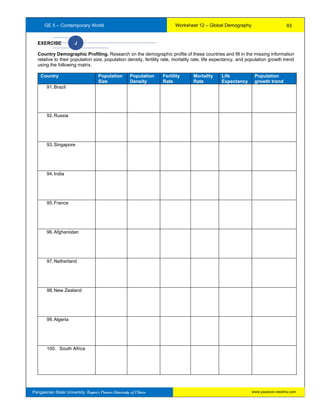
  • 6.
    COURSE DESCRIPTION This courseintroduces students to the contemporary world by examining the multifaceted phenomenon of globalization. Using the various disciplines of the social sciences, it examines the economic, social, political, technological, and other transformations that have created an increasing awareness of the interconnectedness of peoples and places around the globe. To this end, the course provides an overview of the various debates in global governance, development, and sustainability. Beyond exposing the student to the world outside the Philippines, it seeks to inculcate a sense of global citizenship and global ethical responsibility. This course includes mandatory topics on population education in the context of population and demography. COURSE OUTCOMES The course demonstrates a comprehensive understanding of the contemporary world. Specifically, at the end of the course, students are expected to 1. Understand the nature and scope of the contemporary world. 2. Develop an understanding, analysis and appreciation of how peoples and places in the world are interconnected. 3. Assess and analyze the dynamics and functioning of the global economy. 4. Develop an awareness and analysis on how countries trade with one another. 5. Examine how market integration works and the existence of Multinational Corporations 6. Describe the emergence of global governance in the case of international organizations like the United Nations 7. Assess how different regions in the worlds confront the challenges of globalization and regionalism 8. Comprehend the socio-economic differences of the Global South and Global North 9. Appreciate the relevance of media in cultural globalization 10. Examine the religions of the world in the context of globalization and its relationship to relationship to global peace and conflict. 11. Understand the attributes of global cities and analyze how they serve as engines of globalization. 12. Analyze the determinants and consequences of population changes and assess how they affect global population 13. Analyze the various factors underlying the global movements of people. 14. Articulate models of global sustainable development. 15. Analyze how global food security exists. 16. Appreciate the roles and responsibilities of a global citizen. COURSE LEARNING PLAN Course Outcome Learning Outcomes Topics No. of Hrs. Teaching and Learning Activities Resource Materials Assess ment ▪ State the vision, mission, goals and core values of the University ▪ Enumerate and explain the objectives and learning outcomes of the program ▪ Describe the course information ▪ Explain the description of the course ▪ Examine the outline /plan of the course ▪ Comment on the requirements and policies of the course COURSE ORIENTATION 1. Vision, Mission on, Goals, Guiding Philosophy and Core Values of the University 2. Program Outcomes 3. Course Information 4. Course Description 5. Course Outcomes 6. Course Outline 7. Course Requirements and Course Polices 8. Course References and Supplemental Readings 1 Lecture/ Discussion ▪ Syllabus ▪ Glass board, marker and eraser ▪ Laptop and LED Projector for PowerPoint Slides ▪ Course Website at www.psueco n.com ▪ E-learning (LMS) site ▪ Quiz 6
  • 7.
    ▪ List thereferences and supplemental readings to be used in the course CO1 ▪ Define Contemporary World ▪ Outline the different fields social sciences in the study of Contemporary World ▪ Determine some issues affecting the contemporary world ▪ Understand the geography the world (Continents and countries). CHAPTER 1 – INTRODUCTION TO CONTEMPORARY WORLD 1. Defining Contemporary World 2. Importance of Contemporary World Subject 3. Academic Disciplines of Social Sciences 4. Contemporary World Issues and Problems 5. Seven Continents of the World 6. The World Map 3 ▪ Lecture/Di scussion ▪ Problem Solving ▪ Web- based Instruction ▪ E-Learning (LMS) ▪ Books and E-books ▪ Worktext ▪ Glass board, marker and eraser ▪ Laptop and LED Projector for PowerPoint Slides ▪ Course Website available at www.psueco n.com ▪ E-learning (LMS) site at www.psuecon. neolms.com ▪ Exercis es ▪ Recitat ion ▪ Assign ment ▪ Written Quiz CO2 ▪ Explain the etymology and usage of globalization ▪ Summarize the varying definitions globalization ▪ Identify the underlying philosophies of the varying definitions of globalization. ▪ Outline some concepts and elements of globalization ▪ Compare and contrast the aspects/dimensions of globalization ▪ Measure and interpret the level of globalization of different countries ▪ Explains the drivers of globalization ▪ Argue on propositions and debates supporting or opposing globalization ▪ Examine the costs and benefits of globalization CHAPTER 2 – GLOBALIZATION 1. Etymology and Usage of Globalization 2. Definition of Globalization 3. Philosophies underlying Globalization 4. Elements and Components of Globalization 5. Dimensions of Globalization ▪ Economic Globalization ▪ Political Globalization ▪ Cultural Globalization ▪ Environmental globalization 6. Measuring Globalization- KOF Globalization Index 7. Drivers of Globalization 8. Arguments for and against Globalization 9. Benefits and Costs of Globalization 5 ▪ Lecture/Di scussion ▪ Problem Solving ▪ Web- based Instruction ▪ E-Learning (LMS) ▪ Books and E-books ▪ Worktext ▪ Glass board, marker and eraser ▪ Laptop and LED Projector for PowerPoint Slides ▪ Scientific Calculator ▪ Course Website available at www.psueco n.com ▪ E-learning (LMS) site at www.psuecon. neolms.com ▪ Exercis es ▪ Recitat ion ▪ Assign ment ▪ Written Quiz CO3 ▪ Explain what is meant by global economy ▪ Distinguish national economy from the global economy ▪ Estimate the value of the world economy ▪ Classify economy by country groups CHAPTER 3 – GLOBAL ECONOMY 1. Definition and Scope of Global Economy 2. National Economy versus Global Economy 3. Value of the World Economy 3 ▪ Lecture/Di scussion ▪ Problem Solving ▪ Web- based Instruction ▪ E-Learning (LMS) ▪ Books and E-books ▪ Worktext ▪ Glass board, marker and eraser ▪ Laptop and LED Projector for ▪ Exercis es ▪ Recitat ion ▪ Assign ment ▪ Written Quiz 7
  • 8.
    ▪ Describe andinterpret the different economic indicators of the global economy ▪ Explain the economic goals of every economy ▪ Describe the three sectors of the economy ▪ Explain the various types of economy or economic system ▪ Assess the current state or condition of the global economies particularly the major economies of the world 4. World Economy by Country Groups 5. Economic Indicators of the Global Economy 6. Economic Goals of the Global Economy 7. Sectors of the Economy 8. Types of Economy 9. Largest Economies of the World PowerPoint Slides ▪ Scientific Calculator ▪ Course Website available at www.psueco n.com ▪ E-learning (LMS) site at www.psuecon. neolms.com CO4 ▪ Explain what is meant by global trade. ▪ Estimate the value of the international trade. ▪ Distinguish between domestic trade and international trade. ▪ Describe the types of international trade. ▪ Explain how trade balance is achieved. ▪ Explain the economic basis of trade. ▪ Identify the various commodities traded by countries and top exporters of traded commodities. ▪ Identify the top exporting and importing countries in the global trade. ▪ Describe some facts of international trade. ▪ Compare and contrast absolute advantage and comparative advantage. ▪ Identify the different restrictions to trade, ▪ Explain the different arguments for protectionism CHAPTER 4: GLOBAL TRADE 1. Meaning of Global Trade 2. The Value of Global Trade 3. Domestic Trade versus International Trade 4. Closed Economy and Open Economy 5. Types of International Trade ▪ Export Trade ▪ Import Trade ▪ Entrepot Trade ▪ Inter-industry Trade versus Intra-industry Trade 6. Trade balance 7. Economic Basis of Trade 8. Types of Commodities Traded 9. World Top Exporters and Importers of Traded Commodities 10. Cost and Benefits of Trade 11.Absolute Advantage versus Comparative Advantage 12. Trade Barriers ▪ Tariff ▪ Quota ▪ Embargo ▪ Export Subsidy 13.Arguments of Protectionism 4 ▪ Lecture/Di scussion ▪ Problem Solving ▪ Web- based Instruction ▪ E-Learning (LMS) ▪ Books and E-books ▪ Worktext ▪ Glass board, marker and eraser ▪ Laptop and LED Projector for PowerPoint Slides ▪ Course Website available at www.psueco n.com ▪ E-learning (LMS) site at www.psuecon. neolms.com ▪ Exercis es ▪ Recitat ion ▪ Assign ment ▪ Written Quiz CO5 ▪ Understand what is meant by market integration. ▪ Describe the changing nature of the global market. CHAPTER 5 – MARKET INTEGRATION 1. Definition of Market Integration 3 ▪ Lecture/Di scussion ▪ Problem Solving ▪ Books and E-books ▪ Worktext ▪ Exercis es ▪ Recitat ion ▪ Assign ment 8
  • 9.
    ▪ Identify thecategories of a global market. ▪ Identify the players who make up the global market. ▪ Distinguish between globalization of markets and globalization of production ▪ Explain the concept of multinational corporation. ▪ Describe the characteristics of MNCs ▪ Examine the reasons why companies become MNCs. ▪ Describe the characteristics of multinational corporations. ▪ Explain the advantages and disadvantages of multinational corporations. ▪ Identify the problems faced by MNCs in the global market. ▪ Identify major multinational corporations included in the Forbes Global 500. ▪ Identify the different Philippine MNCs. ▪ Narrate a story of global market integration in the twentieth century 2. Global Market 3. Three Categories of the Global Markets 4. Players/Stakeholders in the Global Market 5. Globalization of Markets and Globalization of Production 6. Definition of Multinational Corporation 7. Characteristics of Multinational Corporations 8. Reasons why Companies become MNCs 9. Advantages and Disadvantages of Multinational Corporations 10.Problems Faced by Multinational Corporations in the Global Market 11.Multinational Corporations in the Global Market 12.The Fortune Global 500 13.Philippine Multinational Corporations ▪ Web- based Instruction ▪ E-Learning (LMS) ▪ Glass board, marker and eraser ▪ Laptop and LED Projector for PowerPoint Slides ▪ Course Website available at www.psueco n.com ▪ E-learning (LMS) site at www.psuecon. neolms.com ▪ Written Quiz CO6 ▪ Explain the effects of globalization on governments ▪ Determine the nature and scope global governance ▪ Discuss the criticisms of global governance ▪ Identify and describe the types of international organizations ▪ Identify the various forms of intergovernmental organization ▪ Identify the nature, roles, organs and agencies of the United Nations ▪ Examine the roles of World Bank, IMF, and WTO in fostering global governance and globalization ▪ Explain the functions, powers and limitations of international NGOs ▪ Identify major international NGOs ▪ Identify the challenges of global governance in the twenty-first century CHAPTER 6 – GLOBAL GOVERNANCE 1. Effects of Globalization on Governments 2. Nature and Scope of Global Governance 3. Criticisms of Global Governance 4. International Organizations 5. International Organizations 6. Types of International Organizations 7. Types of Intergovernmental Organizations 8. The United Nations ▪ Six Main Bodies ▪ Programmes and Specialized Agencies 9. The World Bank 10. The International Monetary Fund 11. The World Trade Organization 3 ▪ Lecture/Di scussion ▪ Problem Solving ▪ Web- based Instruction ▪ E-Learning (LMS) ▪ Books and E-books ▪ Worktext ▪ Glass board, marker and eraser ▪ Laptop and LED Projector for PowerPoint Slides ▪ Scientific Calculator ▪ Course Website available at www.psueco n.com ▪ E-learning (LMS) site at www.psuecon. neolms.com ▪ Exercis es ▪ Recitat ion ▪ Assign ment ▪ Written Quiz 9
  • 10.
    ▪ Explain therelevance of the state amid globalization 12. International Nongovernmental Organizations ▪ Functions and Roles of INGOs ▪ Power and Limits of INGOs ▪ Examples of INGOs CO7 ▪ Differentiate between regionalization and globalization ▪ Distinguish between old regionalism and new regionalism ▪ Explain the two approaches to regional integration ▪ Identify the types and functions of regional integration ▪ Explain the costs and benefits of regional integration ▪ Outline the economic and political motives of regional integration ▪ Identify the different regional organizations or regional economic areas of cooperation ▪ Describe some major regional organizations including ASEAN, APEC, EU, COMESA, NAFTA, and MERCOSUR ▪ Explain how Asian regionalism benefits Asia and the World. ▪ Identify the factors leading to a greater integration of the Asian region ▪ Analyze how different Asian states confront the challenges of globalization and regionalization. CHAPTER 7: REGIONALISM 1. Regionalism versus Globalization 2. New Regionalism versus Old Regionalism 3. Approaches to Regional Integration 4. costs and benefits of regional integration 5. The Concept of Regional Integration 6. economic and political motives of regional integration 7. Regional Organizations ▪ Asia ▪ Europe ▪ Africa ▪ South and North America 8. ASEAN, APEC, EU, COMESA, NAFTA, and MERCOSUR 9. Benefits of Asian Integration to Asia and the World 10.Factors affecting Greater Integration of the Asian region 3 ▪ Lecture/Di scussion ▪ Problem Solving ▪ Web- based Instruction ▪ E-Learning (LMS) ▪ Books and E-books ▪ Worktext ▪ Glass board, marker and eraser ▪ Laptop and LED Projector for PowerPoint Slides ▪ Scientific Calculator ▪ Course Website available at www.psueco n.com ▪ E-learning (LMS) site at www.psuecon. neolms.com ▪ Exercis es ▪ Recitat ion ▪ Assign ment ▪ Written Quiz CO8 ▪ Determine via map the North-South Divide (The Brant Line) ▪ Define Global South and Global North CHAPTER 8 – GLOBAL DIVIDES 1. North-South Divide (The Brant Line) 2. Global South Defined 3. Global North Defined 4. Countries in the Global North and Global South 3 ▪ Lecture/Di scussion ▪ Problem Solving ▪ Web- based Instruction ▪ E-Learning (LMS) ▪ Books and E-books ▪ Worktext ▪ Glass board, marker and eraser ▪ Laptop and LED Projector for ▪ Exercis es ▪ Recitat ion ▪ Assign ment ▪ Written Quiz 10
  • 11.
    ▪ Identify thecountries belonged to Global South and Global North ▪ Compare and contrast the socio-economic characteristics of Global South and Global North ▪ Describe the First World, Second World, and the Third World ▪ Examine the differences between South Korea and North Kore 5. Socio-economic Characteristics of the Global South and Global North 6. Socio-economic Characteristics of Global North 7. First World, Second World, and the Third World 8. South Korea versus North Korea PowerPoint Slides ▪ Scientific Calculator ▪ Course Website available at www.psueco n.com ▪ E-learning (LMS) site at www.psuecon. neolms.com CO9 ▪ Describe culture globalization ▪ Explain what is meant by culture ▪ Outline the elements/components of culture ▪ Differentiate cultural convergence from cultural divergence ▪ Explain the concept of global media ▪ Identify the various forms of mass media ▪ Explain how IT and Internet drive global integration ▪ Estimate the Inclusive Internet Index (III) of different countries ▪ Examine the nature and scope of social media ▪ Outline the benefits and costs of social media CHAPTER 9: GLOBAL MEDIA CULTURE 1. Culture Globalization 2. Culture Defined 3. Elements/Components of Culture 4. Cultural Convergence versus Cultural Divergence 5. Global Media Defined 6. Forms/Platforms of Mass Media 7. Use of Information Technology and Internet 8. The Inclusive Internet Index (III) 9. Nature and Scope of Social Media 10.Benefits and Costs of Social Media 3 ▪ Lecture/Di scussion ▪ Problem Solving ▪ Web- based Instruction ▪ E-Learning (LMS) ▪ Books and E-books ▪ Worktext ▪ Glass board, marker and eraser ▪ Laptop and LED Projector for PowerPoint Slides ▪ Scientific Calculator ▪ Course Website available at www.psueco n.com ▪ E-learning (LMS) site at www.psuecon. neolms.com ▪ Exercis es ▪ Recitat ion ▪ Assign ment ▪ Written Quiz CO10 ▪ Explain what is meant by religion ▪ Identify the religions of the world and describe their religious beliefs and practices ▪ Identify the religion of every region in the world ▪ Determine the Religious Diversity Index of different countries ▪ Explain the effects of globalization on religious diversity ▪ Define the concept of global peace ▪ Explain how peace manifests through its pillars ▪ Distinguish between negative and positive peace CHAPTER 10: GLOBALIZATION OF RELIGION 1. Meaning of Religion 2. Religions of the World ▪ Christianity ▪ Islam ▪ Hinduism ▪ Buddhism ▪ Folk Religion ▪ Irreligion 3. Religion in every Region 4. The Religious Diversity Index 5. Effects of Globalization on Religion Diversity 6. Concept of Global Peace 7. Pillars of Peace 8. Negative Peace versus Positive Peace 9. Conflict Defined 3 ▪ Lecture/Di scussion ▪ Problem Solving ▪ Web- based Instruction ▪ E-Learning (LMS) ▪ Books and E-books ▪ Worktext ▪ Glass board, marker and eraser ▪ Laptop and LED Projector for PowerPoint Slides ▪ Scientific Calculator ▪ Course Website available at www.psueco n.com ▪ E-learning (LMS) site at www.psuecon. neolms.com ▪ Exercis es ▪ Recitat ion ▪ Assign ment ▪ Written Quiz 11
  • 12.
    ▪ Define whatis meant by conflict ▪ Examine how religious conflict affect the integrated world 10.Religious Conflict in the World CO11 ▪ Define global city. ▪ Compare and contrast urban and rural area ▪ Characterize a global city ▪ Analyze how cities serve as engines of globalization ▪ Identify the different cities in the global world ▪ Analyze how global cities are classified and ranked CHAPTER 11 – GLOBAL CITIES 1. Global City Defined 2. Rural Area versus Urban area 3. Characteristics of a Global City 4. Global City as an Engine of Globalization 5. Different Cities in the World 6. Classification of Global Cities 7. Ranking Global Cities ▪ Global Power City Index ▪ Global Cities Index 3 ▪ Lecture/Di scussion ▪ Problem Solving ▪ Web- based Instruction ▪ E-Learning (LMS) ▪ Books and E-books ▪ Worktext ▪ Glass board, marker and eraser ▪ Laptop and LED Projector for PowerPoint Slides ▪ Course Website available at www.psueco n.com ▪ E-learning (LMS) site at www.psuecon. neolms.com ▪ Exercis es ▪ Recitat ion ▪ Assign ment ▪ Written Quiz CO12 ▪ Describe global demography ▪ Define demography and the concept of population ▪ Explain the structure and dynamics of Demography ▪ Define population size ▪ Analyze how population growth is measured and determine the population size and growth of countries in the world ▪ Describe the levels of demographic transition ▪ Analyze the population processes including fertility, mortality, life expectancy and morbidity ▪ Outline the factors affecting the population processes ▪ Explain the concept of population distribution though urbanization and population density ▪ Analyze the population structure including sex ratio, age structure, median age and age-dependency ratio, and population pyramid ▪ Describe the Malthusian Theory of Population ▪ Argue on the positive and negative effects of population growth CHAPTER 12 – GLOBAL DEMOGRAPHY 1. Define Global Demography 2. The Concept of Demography and Population 3. The Structure and Dynamics of Demography 4. Population Size 5. Population growth or decline ▪ Population of Countries ▪ Measuring Population Growth ▪ Demographic Transition 6. Population Processes ▪ Fertility ▪ Mortality ▪ Life Expectancy ▪ Morbidity 7. Factors Affecting Population Processes 8. Population Distribution ▪ Urbanization ▪ Population Density 9. Population structure ▪ Sex Ratio ▪ Age Structure ▪ Median Age ▪ Age- Dependency Ratio 4 ▪ Lecture/Di scussion ▪ Problem Solving ▪ Debate ▪ Case Analysis ▪ Web- based Instruction ▪ E-Learning (LMS) ▪ Books and E-books ▪ Worktext ▪ Glass board, marker and eraser ▪ Laptop and LED Projector for PowerPoint Slides ▪ Scientific Calculator ▪ Course Website available at www.psueco n.com ▪ E-learning (LMS) site at www.psuecon. neolms.com ▪ Exercis es ▪ Recitat ion ▪ Assign ment ▪ Written Quiz 12
  • 13.
    ▪ The Population Pyramid 10.Population Characteristics ▪Household and Families ▪ Race and Ethnicity 11.The Malthusian Theory of Population 12.Positive and Negative Effects of Population Growth CO13 ▪ Define global migration ▪ Define what is meant by human migration ▪ Outline and describe each type of migration according to political boundaries, area of origin and destination, movement patters, and by decision-making approach ▪ Analyze how migration is measured using migration rate, immigration rate, migration efficiency, gross migration, and migration efficiency ratio. ▪ Identify the causes of migration ▪ Describe different migration facts and associate these facts to Ravenstein’s laws of migration ▪ Outline the top immigration destinations and migration corridors ▪ Examine the effects of migration by looking at remittances of brain drain CHAPTER 13 – GLOBAL MIGRATION 1. Global Migration Defined 2. The Concept of Human Migration 3. Types of Migration ▪ Internal and International Migration ▪ Emigration and Immigration ▪ Step, Circular and Chain Migration ▪ Voluntary and Involuntary Migration 4. Measuring Migration ▪ Migration Rate ▪ Immigration Rate ▪ Net Migration Rate ▪ Migration Efficiency ▪ Gross Migration ▪ Migration Efficiency Ratio 5. Causes of Migration ▪ Economic, Socio- Political and Ecological Factors ▪ Push Factors of Pull Factors of Immigration 6. Key Facts about Human Migration 7. Ravenstein's Laws of Migration 8. Emigration and Immigration Destinations 9. Migration Corridors 10.Effects of Migration ▪ Remittances ▪ Brain Drain 4 ▪ Lecture/Di scussion ▪ Problem Solving ▪ Web- based Instruction ▪ E-Learning (LMS) ▪ Books and E-books ▪ Worktext ▪ Glass board, marker and eraser ▪ Laptop and LED Projector for PowerPoint Slides ▪ Scientific Calculator ▪ Course Website available at www.psueco n.com ▪ E-learning (LMS) site at www.psuecon. neolms.com CO14 ▪ Define sustainable development ▪ Define economic development ▪ Distinguish between economic growth and economic development ▪ Outline the criteria and indicators of economic development CHAPTER 14 – SUSTAINABLE DEVELOPMENT 1. Sustainable Development Defined 2. The Concept of Economic Development 3 ▪ Lecture/Di scussion ▪ Problem Solving ▪ Web- based Instruction ▪ E-Learning (LMS) ▪ Books and E-books ▪ Worktext ▪ Glass board, marker and eraser ▪ Laptop and LED Projector for 13
  • 14.
    ▪ Identify thedeveloped and less-developed countries ▪ Measure economic development through Human Development Index ▪ Compare the HDI of different countries ▪ Outline the Millennium Development Goals (MDGs) ▪ Identify the 17 Sustainable Development Goals ▪ Outline the global indicator targets of 17 SDGs 3. Economic Growth versus Economic Development 4. Indicators/Criteria of Economic Development 5. The Developed and Less- developed Countries 6. Measuring Economic Development: Human Development Index 7. Comparing Human Development Index of Different Countries 8. Millennium Development Goals 9. 17 Sustainable Development Goals 10.Global Indicator Targets of 17 SDGs PowerPoint Slides ▪ Scientific Calculator ▪ Course Website available at www.psueco n.com ▪ E-learning (LMS) site at www.psuecon. neolms.com CO15 ▪ Define global food security ▪ Identify and describe the four dimensions of food security including availability, access, utilization, and stability ▪ Characterize the food security and insecurity of households ▪ Measure global food security using Global Food Security Index ▪ Determine the performance of countries on food security ▪ Examine the interrelationship of food security to hunger, malnutrition, and poverty ▪ Argue on the effects of global food insecurity CHAPTER 15 – GLOBAL FOOD SECURITY 1. Global Food Security Defined 2. Dimensions of Food Security ▪ Availability ▪ Access ▪ Utilization ▪ Stability 3. Food Security in Households 4. The Global Food Security Index 5. Performance of Countries on Food Security 6. Interrelationship of Food Security to Hunger, Malnutrition and Poverty 7. Effects of Global Food Insecurity 3 ▪ Lecture/Di scussion ▪ Problem Solving ▪ Web- based Instruction ▪ E-Learning (LMS) ▪ Books and E-books ▪ Worktext ▪ Glass board, marker and eraser ▪ Laptop and LED Projector for PowerPoint Slides ▪ Scientific Calculator ▪ Course Website available at www.psueco n.com ▪ E-learning (LMS) site at www.psuecon. neolms.com CO16 ▪ Define global citizenship ▪ Explain the dimension of global citizenship ▪ Explain the concept of citizen and citizenship ▪ Characterize a global citizen ▪ Identify the duties and responsibilities of a global citizen ▪ Describe global citizenship education ▪ Examine the approaches of global citizenship education ▪ Appreciate the importance of global citizenship education CHAPTER 16 – GLOBAL CITIZENSHIP 1. Global Citizenship Defined 2. Dimension of Global Citizenship 3. The Concept of Citizen and Citizenship 4. Who is a Global Citizen? 5. Characteristics of a Global Citizen 6. Duties and Responsibilities of a Global Citizen 7. Global Citizenship Education 8. Approaches to Global Citizenship Education 3 ▪ Lecture/Di scussion ▪ Problem Solving ▪ Web- based Instruction ▪ E-Learning (LMS) ▪ Books and E-books ▪ Worktext ▪ Glass board, marker and eraser ▪ Laptop and LED Projector for PowerPoint Slides ▪ Scientific Calculator ▪ Course Website available at www.psueco n.com ▪ E-learning (LMS) site at 14
  • 15.
    9. Importance ofGlobal Citizenship Education www.psuecon. neolms.com COURSE REQUIREMENTS 1. Pass final and midterm exams, quizzes and worksheet exercises. 2. At least 80% class attendance rate. 3. Submission of all homework assignments. 4. Submission of a research paper/term paper. 5. Involvement and Performance on Educational Games (GLOBAL Trading Game and SDGs Board Game) 6. Registration and subscription in the course webpage at www.psuecon.com 7. Enrolment to the E-learning system at www.psuecon.neolms.com A. LECTURES Three-hour lecture will be spent each week. You are encouraged to actively ask questions at any time and answer questions during class lectures. For each lecture, there will be provided powerpoint slides covering the main points, which will be published on the course web page. Should there be queries you wish to raise in lectures, whether about the course organization or about materials covered, you are welcome to come to see me during office hours or email me. B. COURSE WEBSITE ACCESS A course website is maintained which will be used round the year to communicate all the course resources to you including syllabus, homework, class notes, worktext exercises, lecture slides, online tests and links to suggested reading materials. You are encouraged to register or subscribe to gain full access to all the website materials. You should also frequently access the course web site to find updated course information and materials. The site is available at www.psuecon.com. C. E-LEARNING ENROLMENT You are required to create an account and enroll the course in the E-learning system which can be accessed at www.psuecon.neolms.com. This is the portal for the sending of your softcopy assignment and term papers. Here you can download and access course resources, take online quiz and exam, read class announcement, post queries and comments, etc. CLASS POLICIES A. ABSENCES AND TARDINESS Every student is required to attend his classes regularly and punctually. Absence or persistent tardiness for more than 20% of the total number of class meetings during the entire course shall be sufficient reason for disqualifying a student from taking final examination or for dropping the student without credit. A student who is late for class for at least 10 minutes will be marked as absent. A student will incur an absence for every 3 times that he is tardy. B. MAKE-UP EXAM Every student is required to attend the final exam, midterm exam, and at least five quizzes. If he is absent on days when tests are scheduled, he should notify me in advance and bring documentation of the excuse upon returning to class. Unexcused absences from exams will result in a zero grade. Make–up exams will be arranged only under extraordinary circumstances. Acceptable or valid reasons for missing an exam include religious observances, athletic trips, illness and urgent circumstances beyond your control. Makeups must occur within one week of the regularly scheduled exam or quiz, otherwise a zero score will be given. C. HOMEWORK POLICY There will be 6 homework assignments (3 for midterm and 3 for final). Each assignment is worth 30 points. These assignments will be posted on the course website and are mostly due on Mondays in the beginning of class. Any assignment can be late for up to 1 day without penalty. Late homework for two to three days loses 10 points. After 4 days, zero credit is given for late assignments. 15
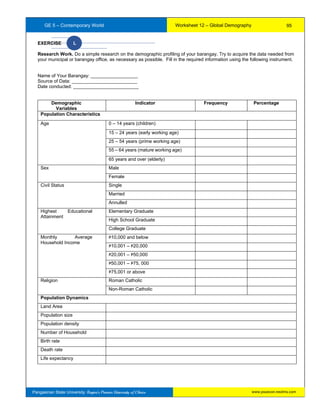
  • 16.
    D. ACADEMIC HONESTY Allstudents are expected to be academically honest. Cheating, plagiarisms, lying, theft and other forms of unethical behavior will not be tolerated. Any student suspected or found guilty of academic dishonesty in this course will be handled according to the procedures set out in the PSU Student Handbook. GRADING SYSTEM The grades for this course will be based on midterm and final exams, quizzes, worksheet exercises, recitation, homework and a term paper. The course grade will be determined as follows: Examination 40% Quizzes / Exercises 30% Recitation 10% Homework 10% Term Paper /Project/Game 10% TOTAL 100% COURSE REFERENCES AND SUPPLEMENTAL READINGS Books Aldama, Prince Kennex R. The Contemporary World First Edition.Rex Bookstore, Inc. 2018. Steger, Manfred B., Paul Battersby, and Joseph M. Siracusa, eds. 2014.The SAGE Handbook of Globalization. Two volumes. Thousand Oaks: SAGE Publications. Claudio, Lisandro, et.al. The Contemporary World.C&E Publishing Bookstore. Other Readings: Aguilar, Filomeno V. 2012. “Differentiating Sedimented from Modular Transnationalism: The View from East Asia.” Asian and Pacific Migration Journal 21(2): 149–171. Bello, Walden F. 2006. “The Multiple Crises of Global Capitalism.” In Deglobalization: Ideas for a New World Economy, pp. 1-31. Quezon City: Ateneo de Manila University Press. Castles, Stephen. 2000. “International Migration at the Beginning of the Twenty-First Century: Global Trends and Issues.” International Social Science Journal 52 (165): 269–281. Carter, April. 2001. “Global Civil Society: Acting as Global Citizens” in The Political Theory of Global Citizenship, pp. 147-176 London: Routledge. Connell, Raewyn. 2007. “Dependency, Autonomy and Culture. In Southern Theory: The Global Dynamics of Knowledge in Social Science, pp. 139-163. Cambridge, UK: Polity Press. Hobsbawm, Eric J. 1996. “The Future of the State.” Development and Change 27(2): 267–278. Lee, Ronald. 2003. “The Demographic Transition: Three Centuries of Fundamental Change.” Journal of Economic Perspectives 17(4): 167–190. Lesthaeghe, Ron. 2010. “The Unfolding Story of the Second Demographic Transition.” Population and Development Review 36(2): 211–251. Livi-Bacci, Massiomo. 205. “What We Can and Cannot Learn from the History of World Population. Population Studies: A Journal of Demography 69(S1): S21–S28. Mazower, Mark. 2006. “An International Civilization? Empire, Internationalism and the Crisis of the Mid-Twentieth Century.”International Affairs 82(3): 553–566. McMichael, Philip. 2009.“A Food Regime Analysis of the World Food Crisis.”Agriculture and Human Values 26(4): 281-295. Sassen, Saskia. 2005. “The Global City: Introducing a Concept.” Brown Journal of World AffairsXI(2): 27-43. Shiraishi, Takashi. 2006. “The Third Wave: Southeast Asia and Middle-Class Formation in the Making of a Region.” In Beyond Japan: The Dynamics of East Asian Regionalism, edited by Peter Katzenstein and Takashi Shiraishi, pp. 237–271. Ithaca,NY: Cornell University Press. Steger, Manfred B. 2005. “Ideologies of Globalization.” Journal of Political Ideologies 10(1): 11–30. Wallerstein, Immanuel. 2004. “The Modern World-System as a Capitalist World Economy: Production, Surplus-Value, and Polarization.” In World-SystemsAnalysis: An Introduction, pp. 23-41. Durham and London: Duke University Press. Films: “The Corporation” directed by Mark Achbar and Jennifer Abbott “The Price of Sugar” directed by Bill Haney “The Rise of ISIS,” PBS Frontline (http://www.pbs.org/wgbh/frontline/film/rise-of-isis/) Online References 16
  • 17.
    https://kof.ethz.ch/en/forecasts-and-indicators/indicators/kof-globalisation-index.html https://www.lboro.ac.uk/gawc/world2018t.html. https://www.kearney.com/global-cities/2019. INSTRUCTOR’S CONTACT INFORMATION NAMEJAMESON N. ESTRADA OFFICE ECOBEL Office MOBILE NUMBER 0945-5970162 EMAIL jameson.n.estrada@gmail.com WEBSITE www.psuecon.com CONSULTATION HOURS 9:00 – 11:00 (MWF) PREPARED BY: JAMESON N. ESTRADA Instructor I Checked by: SYLVESTER M. VICTORIO Chairperson, Department of ROSARIO DL. VALENCIRINA, Ed.D Dean, College of Education Approved by: LORNA G. URBIZTONDO, PhD Campus Executive Director, PSU Lingayen 17
  • 18.
    GE 5 –Contemporary World Worksheet 1 – Introduction to the Contemporary World www.psuecon.neolms.comPangasinan State University: Region’s Premier University of Choice WORKSHEET 1 : INTRODUCTION TO THE CONTEMPORARY WORLD GE 5 – Contemporary World Intro EXERCISE A Modified True or False. Write true if the statement is correct. If false, underline the word or phrase to make the statement right and write the correct answer in the blank space provided. 1. Contemporary world deals with circumstances, problems, and issues of the ancient world. _______________ 2. In the contemporary world, global economy is tackled peace and conflicts are not ________________ 3. Contemporary world does not take into account the process of globalization. ________________ 4. The study of economics in the contemporary world helps people understand the choices societies make regarding consumption and production. ________________ 5. Geography is the study of population changes and trends. ________________ 6. International relations deals on the relationships between countries, including the roles of other organizations. ________________ 7. Income inequality is not a contemporary world issue. ________________ 8. North America includes 33 countries led by the United States as the largest economy in the world. ____________ 9. Africa is the world’s largest continent both by land area and population. ________________ 10. India has a greater land area than Canada. ________________ EXERCISE B Multiple Choice. Encircle the one alternative that best completes the statement or answers the question. 11. All of the following are topics covered in the Contemporary World course, except A. labor migration. B. international trade. C. world religion. D. media culture. E. solar eclipse. 12. What is the importance of studying the Contemporary World course? A. Exposure to world problems and issues that all countries face B. Awareness of peoples and places around the globe and the consequences of human actions on societies C. Understanding the role the people must play in society and of their responsibilities as citizens D. Avenue to participate in social debates, thus increasing their critical judgment E. All of the above 13. Which is most likely a contemporary world issue? A. Household consumption B. Leisure services C. Apple products C. Maternal health D. Rice production 14. The understanding of the organization of power within societies and the formation of power relations is most likely associated with the study of A. Sociology. B. Economics. C. Political science. D. History. E. Management science. NAME: ________________________________________ STUDENT NUMBER: __________________________ YEAR, COURSE, & SECTION: _____________________ DATE SUBMMITED: __________________________ INSTRUCTOR-IN-CHARGE: _______________________ SCORE/NUMBER OF ITEMS: __________________ Republic of the Philippines PANGASINAN STATE UNIVERSITY Alvear Street, Lingayen, Pangasinan 18
  • 19.
    GE 5 –Contemporary World Worksheet 1 – Introduction to the Contemporary World Pangasinan State University: Region’s Premier University of Choice 15. According to the 2017 World Economic Forum's Global Shapers Survey, what is the most pressing issue affecting the world today? A. Lack of economic opportunity B. Poverty C. Large scale conflict D. Destruction of nature E. Food security EXERCISE C Classification. Determine what academic discipline of social science is most likely associated with the following. Write the answer in the blank space provided. 21. The factors affecting the volatility of foreign exchange and stock markets ________________ 22. The historical evolution of the European Union ________________ 23. The strategic locations of business centers among cities in Southeast Asia ________________ 24. The form of government in Iran ________________ 25. Biological and material remains of a new species of ancient human found in Luzon ________________ 26. The increasing trend of the population growth in India ________________ 27. Migration policies of United Kingdom ________________ 28. Economic issues of Nigeria, a developing country ________________ 29. The growing demand of Korean language learning in the Philippines ________________ 30. Societal disorder in every city in China ________________ 31. The effects of anxiety and sleep disorders on the productivity of Japanese workers 32. The characteristics of family and community groups in North Korea ________________ 33. The demand for domestically produced goods of Colombia ________________ 34. Marketing strategies employed by western multinational corporations ________________ 35. The changing weather and season pattern of Eastern countries ________________ EXERCISE D Classification. Determine whether the following is considered a contemporary world issue/concern or not. Write Yes if it is and explain why. Otherwise, write No. 36. Rise of multinational corporations __________________ 37. Increase in price of rice in a public market __________________ 38. Population explosion among Southeast Asian nations __________________ 39. The impacts of global warming __________________ 40. Stock market trading in New York stock exchange __________________ 41. Utilization of advanced robots and internet of things (IIoT) __________________ 42. Changes in international trade policies __________________ 43. Financial constraint of a small group of households __________________ 44. Regional integration in Asia __________________ 45. Political conflict between Iran the United States of America __________________ 46. The consequences of brain drain on the country of origin __________________ 47. Violence against immigrants and minority communities __________________ 48. Prevalence of global diseases like HIV infection __________________ 49. Use of artificial intelligence in cybersecurity __________________ 50. Bankruptcy of a domestic firm__________________ 19 www.psuecon.neolms.com
  • 20.
    GE 5 –Contemporary World Worksheet 1 – Introduction to the Contemporary World Pangasinan State University: Region’s Premier University of Choice EXERCISE E Matching Type. Match column A with the correct answer in column B. Write the letter of the correct answer in the space provided. 51. Environment __________________ A. Cultural differences 52. Global economy __________________ B. Diseases 53. Global demography __________________ C. Widespread infectious diseases 54. Migration __________________ D. Underemployment 55. Natural resources __________________ E. Global warming 56. Healthcare __________________ F. Corruption 57. Media __________________ G. Terrorism 58. Culture __________________ H. Banking crisis 59. Religion __________________ I. Poverty 60. International trade __________________ J. Cyber insecurity 61. Global governance __________________ K. High inflation rate 62. Employment __________________ L. Refugee crises 63. Food security __________________ M. Import and export restrictions 64. Education __________________ N. Famine 65. Inequality __________________ O. Sexual harassment 66. Peace and security __________________ P. High illiteracy rate 67. Global finance __________________ Q. Fast population growth 68. Economic development __________________ R. Religious conflict 69. Gender equality __________________ S. Piracy 70. Information technology __________________ T. Overconsumption EXERCISE F Criss-Cross Puzzle. Search horizontally, vertically and diagonally for all the concepts/terms related to the contemporary world. Underline the terms found in the search puzzle and write the names in the blank space provided. 71. _________________________ 72. _________________________ 73. _________________________1 74. _________________________ 75. _________________________ 76. _________________________ 77. _________________________ 78. _________________________ 79. _________________________ 80. _________________________ 81. _________________________ 82. _________________________ 83. _________________________ 84. _________________________ 85. _________________________ 86. _________________________ 87. _________________________ 88. _________________________ 89. _________________________ 90. _________________________ G L O V A L I J A T O A T R O P X E H T W O R G N A T E M Y T A C D E G W E T T E L T I N T E G R A T I O N S T U A O O E Y G T D C I R I S D A B A D B D B K H S H I S O B I F G H A C I R F A R D S A A G N N E F H C S G H I O L A N D E B D O F O N F X E X C H A I M P O R T T I N G M U E P O I N T Z J O D A E T G B S V Y N P O P U L A T I O N C L I M A T E G S A R S S T F H O L H G L A S D C I B S B A D I R E T H N E E R O S H E E X P O R O S A D B O J R E S U A R R A S E A N Z U D U L Y T K O R N O J A M E S O N Y T E O F D S D F G F T A I L M N O U S T G O S D I B E T F O O D S E C U R I Y E S T R A D A D E R U T L U C R D S A D O T H E S 20 www.psuecon.neolms.com
  • 21.
    GE 5 –Contemporary World Worksheet 1 – Introduction to the Contemporary World Pangasinan State University: Region’s Premier University of Choice Image Source: (Royalty Free Image) https://www.freeusandworldmaps.com/images/WorldPrintable/WorldMercator6NoLinesPrint.jpg EXERCISE G Blank World Map. Identify the countries marked with numbers 1 – 20 in the blank world map. Write the name of the country, its region, and continent in the blank space provided. Country Region Continent 91. __________________ __________________ __________________ 92. __________________ __________________ __________________ 93. __________________ __________________ __________________ 94. __________________ __________________ __________________ 95. __________________ __________________ __________________ 96. __________________ __________________ __________________ 97. __________________ __________________ __________________ 98. __________________ __________________ __________________ 99. __________________ __________________ __________________ 100.__________________ __________________ __________________ 101.__________________ __________________ __________________ 102.__________________ __________________ __________________ 103.__________________ __________________ __________________ 104.__________________ __________________ __________________ 105.__________________ __________________ __________________ 106.__________________ __________________ __________________ 107.__________________ __________________ __________________ 108.__________________ __________________ __________________ 109.__________________ __________________ __________________ 110.__________________ __________________ __________________ 12 9 15 12 13 14 5 116 17 18 19 10 11 3 4 11 1 116 17 18 120 2 9 21 www.psuecon.neolms.com
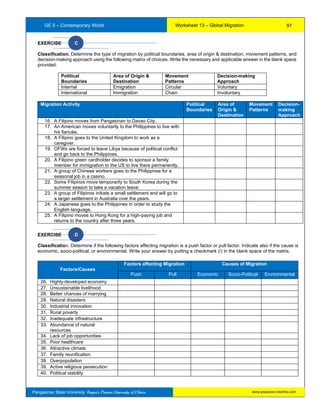
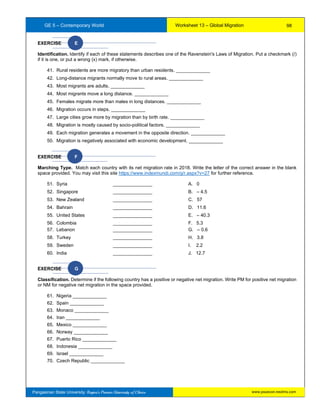
  • 22.
    GE 5 –Contemporary World Worksheet 1 – Introduction to the Contemporary World Pangasinan State University: Region’s Premier University of Choice EXERCISE H Country Identification. Identify the country being described in each of the following. Make use of a world map for reference. Encircle the correct answer in the given list. EXERCISE I Country Profiling. Fill in the information regarding capital, currency, land area, and population of each country. Write the answer on the spaces provided on the table. Country Capital Currency Area (𝒌𝒎 𝟐 ) Population (2019) 131.Singapore 132.Panama 133.United Arab Emirates 134.Ecuador 135.Ireland 136.New Zealand 137.Argentina 138.Finland 139.South Africa 140.Ghana 141.Malaysia 142.Venezuela 143.Bangladesh 144.Australia 145.Sweden Description Choices 111. European country South Africa, Australia, Canada, Thailand, Iceland, Mexico, Saudi Arabia 112. Boarders the Atlantic Ocean Philippines, Vietnam, Ecuador, Australia, United Kingdom, Indonesia, Mali 113. Helsinki is the capital city Libya, Honduras, Greece, Egypt, Nicaragua, Trinidad and Tobago, Finland 114. Shares borders with Nepal and Bangladesh Belgium, Colombia, France, India, Pakistan, Bhutan, Tajikistan 115. Earth’s highest mountain is located Nepal, South Africa, Morocco, Mongolia, Paraguay, Pakistan 116. Word’s largest island country Philippines, Russia, United States of America, Brazil, Canada, Indonesia 117. North of the Philippines Brunei, Singapore, China, Taiwan, North Korea, Vietnam, Indonesia 118. Global South country South Korea, Spain, Italy, Germany, Canada, United States, Sri Lanka 119. Western country Laos, Afghanistan, Colombia, China, Zimbabwe, Israel, Uzbekistan 120. Boarders no ocean or sea (landlocked) New Zealand, Switzerland, Turkey, Sri Lanka, Peru, Madagascar, Cuba 121. Largest African country Congo Sudan, Libya, Chad, Algeria, Brazil, Australia 122. Southeast Asian country Hong Kong, Taiwan, Maldives, West Timor, Myanmar, Papua New Guinea 123. A country in the Pacific Ocean Mexico, India, Paraguay, Bolivia, New Zealand, Austria, Azerbaijan 124. Country sandwiched between Russia and China Japan, Singapore, Poland, Panama, Argentina, Austria, Turkmenistan 125. A country between Finland and Norway Denmark, Latvia, Sweden, Estonia, Ireland, Belarus, Russia 126. Running down the side of South America Argentina, Peru, Uruguay, Brazil, Ecuador, Venezuela, Chile 127. The closest country to Mexico Philippines, Ecuador, Canada, Cuba, Namibia, Botswana 128. Farthest country to Denmark Finland, Switzerland, Ireland, Poland, Thailand, New Zealand, Ireland 129. A country in-between India and Afghanistan Bhutan, Turkmenistan, Kyrgyzstan, Uzbekistan, Tajikistan, Pakistan, Kazakhstan 130. Mediterranean country Oman, Kuwait, Qatar, Italy, Ethiopia, Tanzania, Guyana 22 www.psuecon.neolms.com www.psuecon.neolms.com
  • 23.
    GE 5 –Contemporary World Worksheet 1 – Introduction to the Contemporary World Pangasinan State University: Region’s Premier University of Choice EXERCISE J Review Questions. Answer the following questions as concisely yet as clearly as possible. (3 points each) 91. What is the significance of studying the Contemporary World course? __________________________________________________________________________________________ __________________________________________________________________________________________ __________________________________________________________________________________________ __________________________________________________________________________________________ __________________________________________________________________________________________ __________________________________________________________________________________________ 92. Choose one academic discipline and discuss how it is relevant in the study of Contemporary World? __________________________________________________________________________________________ __________________________________________________________________________________________ __________________________________________________________________________________________ __________________________________________________________________________________________ __________________________________________________________________________________________ __________________________________________________________________________________________ 93. How will you become an effective learner of the Contemporary World subject? __________________________________________________________________________________________ __________________________________________________________________________________________ __________________________________________________________________________________________ __________________________________________________________________________________________ __________________________________________________________________________________________ __________________________________________________________________________________________ 94. Identify and discuss a recent world issue/problem of the contemporary world. __________________________________________________________________________________________ __________________________________________________________________________________________ __________________________________________________________________________________________ __________________________________________________________________________________________ __________________________________________________________________________________________ __________________________________________________________________________________________ 95. Compare and contrast North America to South America. __________________________________________________________________________________________ __________________________________________________________________________________________ __________________________________________________________________________________________ __________________________________________________________________________________________ __________________________________________________________________________________________ __________________________________________________________________________________________ 23 www.psuecon.neolms.com
  • 24.
    GE 5 –Contemporary World Worksheet 1 – Introduction to the Contemporary World Pangasinan State University: Region’s Premier University of Choice EXERCISE K Creative Work. Cut out pictures of various contemporary world issues or problems in newspapers, magazines, or other sources. Use the cut pictures to create collage art. Eventually, interpret the artwork. (30 points) 24 www.psuecon.neolms.com
  • 25.
    GE 5 –Contemporary World Worksheet 2 – Globalization Pangasinan State University: Region’s Premier University of Choice WORKSHEET 2 : GLOBALIZATION GE 5 – Contemporary World Intro s EXERCISE A Modified True or False. Write true if the statement is correct. If false, underline the word or phrase to make the statement right and write the correct answer in the blank space provided. 1. Globalization is a trend toward greater economic, cultural, political, and technological interdependence among national institutions and economies. _____________ 2. The contemporary world is shifting toward a less integrated and interdependent global economy. _____________ 3. Theodore Elvis is credited with coining and popularizing the term globalization. _____________ 4. The use of cargo ships is one market driver of globalization. _____________ 5. Cultural globalization is the integration of economies through trade and investment. _____________ 6. Global organizations such as UN, EU, and ASEAN are associated with economic globalization. _____________ 7. More globalized countries have faster economic growth and less poverty than less or non-globalized countries. _____________ 8. The KOF Index of Globalization measures four important dimensions of globalization. _____________ 9. There is strong negative correlation between globalization and economic growth. _____________ 10. The least-global nations are found in Africa, East Asia, South Asia. _____________ EXERCISE B Multiple Choice. Encircle the one alternative that best completes the statement or answers the question. 11. Which of these characterizes globalization? A. nationalization B. decreased international trade C. increasing interdependence D. country separation E. decompressed time and space 12. Globalization signifies a growing integration of all of the following except A. markets. B. economy. C. war. D. culture. E. communications. 13. There is a rapid increase in the level of globalization mainly because of A. foreign currency. B. global transportation. C. migration. D. political ideology. E. media. 14. Economic globalization is characterized by the A. cross-cultural flow of knowledge and values. B. rise of small and medium enterprises. B. change in political governance and systems. D. rapid development of emerging economies. E. international trade and investment flows. 15. The internationally coordinated initiatives and practices concerning environmental protection is closely linked to A. economic globalization. B. political globalization. C. cultural globalization. D. environmental globalization. E. technological globalization. NAME: ________________________________________ STUDENT NUMBER: __________________________ YEAR, COURSE, & SECTION: _____________________ DATE SUBMMITED: __________________________ INSTRUCTOR-IN-CHARGE: _______________________ SCORE/NUMBER OF ITEMS: __________________ Republic of the Philippines PANGASINAN STATE UNIVERSITY Alvear Street, Lingayen, Pangasinan 25 www.psuecon.neolms.com
  • 26.
    GE 5 –Contemporary World Worksheet 2 – Globalization Pangasinan State University: Region’s Premier University of Choice 16. What does a political scientist perceive about globalization? A. The impact of globalization on jobs and standards of living. B. The opportunity to source commodities from lower-cost locations C. The power of governments relative to that of multinational companies D. The influence of globalization on the culture of a group of people E. The effect of globalization on international migration 17. The most globalized country in the 2017 KOF’s Index of Globalization is A. Singapore. B. Canada. C. Finland. D. Switzerland. E. South Korea. 18. Which of the following is an instrument of cultural globalization? A. Media B. Trade C. Environment D. Technology E. Law 19. Which of these is not a benefit of globalization? A. Increase international trade B. Greater product variety C. Increased productivity D. Innovation E. Offshoring 20. Supporters of globalization assert that globalization A. advances the economies of developing nations. B. exploits workers in developing nations. C. eliminates jobs in developed nations. D. erodes standards of living. E. lowers wages in developed nations. EXERCISE C Identification. Identify the person credited to each of these varying definitions of globalization by selecting the answer in the following box. Write the answer in the blank space provided. Martin Albrow David Ricardo Anthony Giddens Paul Krugman Paul James Arthur Laffer Augusto Comte Roland Robertson Eric Beerkens Robert Melton Max Weber Immanuel Wallerstein David Harvey Erving Goffman James Carlsmith Takis Fotopoulos Anthony Giddens John Maynard Keynes Joseph Stiglitz Thomas Larsson 21. Globalization is the process of world shrinkage, of distances getting shorter, things moving closer. _______________ 22. Globalization should be reduced to trade, investment and financial statistics. These constitute ‘objective' or ‘real' globalization, and all the rest is myth or fantasy. __________________ 23. Globalization pertains to all those processes by which the people of the world are incorporated into a single world society. __________________ 24. Globalization can be defined as the intensification of worldwide social relations which link distant localities in such a way that local happenings are shaped. __________________ 25. Globalization is defined as economic globalization describing the opening and deregulation of commodity, capital, and labor markets that led toward present neoliberal globalization. __________________ 26. Globalization is described as the compression of the world and the intensification of the consciousness of the world as a whole. __________________ 27. Globalization is the extension of social relations across world-space, defining that world-space in terms of the historically variable ways that it has been practiced and socially understood through changing world-time. __________________ 28. Globalization is the compression of time and space. __________________ 29. Globalization represents the triumph of a capitalist world economy tied together by a global division of labor. __________________ 30. Globalization is the world-wide interconnectedness between nation-states in which basic social arrangements become disembedded from their spatial context. __________________ 26 www.psuecon.neolms.com
  • 27.
    GE 5 –Contemporary World Worksheet 2 – Globalization Pangasinan State University: Region’s Premier University of Choice EXERCISE D Classification. Determine the dimension of globalization manifested in each of these cases. Write E for economic, P for political, C for cultural, or EN for environmental in the blank space provided. 31. Starbucks purchases unroasted coffee from more than 30 countries. ________________ 32. The UNEP and Greenpeace convene to find ways to reduce the emissions of harmful gases ________________ 33. The US dollar currency depreciates because the US economy slows down. ________________ 34. Indians subscribe to music streaming services such as Spotify and Apple Music. ________________ 35. Coca-Cola’s marketing rivalry with Pepsi intensifies. ________________ 36. A series of International Tropical Timber Agreement treaties took place. ________________ 37. United Nations is created to maintain international peace and security. ________________ 38. An Earth Summit is held to address an environmental issue linked to global climate change. ________________ 39. USA sells mobile technologies to both developed and developing countries. ________________ 40. Political actions by non-governmental organizations are encouraged by some countries. ________________ 41. The “Parasite” Korean movie is shown in over 100 countries. ________________ 42. A trade war between China and U.S.A takes place. ________________ 43. Stock market trading in New York stock exchange affects Tokyo and Manila ________________ 44. Japanese language courses are offered to many major universities throughout the world. ________________ 45. U.S. businesses are subcontracting work to Chinese companies. ________________ 46. Brazil raises $1 billion dollars for the crisis mobilization brought by Amazon fires. ________________ 47. UN intervenes to the aggressive anti-drugs campaign of the Philippine administration. ________________ 48. ASEAN leaders meet to tackle the emergence of the concept of global governance. ________________ 49. Chinese foods like siomai is available in many European and American countries. ________________ 50. McDonald’s, a U.S multinational corporation, opens up and operates new restaurants in Asia. ________________ EXERCISE E Classification. Classify the dimension of the following players or stakeholders of globalization. Write E for economic, P for political, C for cultural, or EN for environmental in the blank space provided. 51. Multinational corporations __________________ 52. Innovators __________________ 53. International NGOs __________________ 54. Consumers __________________ 55. United Nations __________________ 56. Ethnic groups __________________ 57. International NGOs ________________ 58. Banking institutions ________________ 59. Civil society groups ________________ 60. Environmentalists ________________ 61. Importers ________________ 62. Social media influencers ________________ 63. Environmental groups ________________ 64. National governments ________________ 65. Charitable institutions________________ 27 www.psuecon.neolms.com
  • 28.
    GE 5 –Contemporary World Worksheet 2 – Globalization Pangasinan State University: Region’s Premier University of Choice EXERCISE F Classification. Classify what dimension of globalization these global activities are likely associated with. Put a checkmark (∕) on the appropriate space. Provide a brief explanation in your answer in the blank space provided. Activity Dimension of Globalization Explanation Economic Political Cultural Environmental 66. Trending of Senorita Song by Shawn Mendez and Camila Cabello 67. Creation of the World Health Organization 68. Efforts made by the government to Australia’s deadly wildfires 69. Franchises made by Jollibee Corporation throughout the world 70. Exportation of German cars like Mercedes-Benz 71. Influence of Picasso’s artworks to other visual artists 72. Contributions of Bill and Melinda Gates Foundation on enhancing healthcare worldwide 73. Environmental initiatives to address the problem of global warming 74. The spread of online shopping such as Alibaba, Amazon, and Lazada 75. Political conflict between South Korea and North Korea 28 www.psuecon.neolms.com
  • 29.
    GE 5 –Contemporary World Worksheet 2 – Globalization Pangasinan State University: Region’s Premier University of Choice EXERCISE G Crossword Puzzle. Fill the white squares with letters forming words or terms by identifying each of the statements below. 1 2 3 4 5 6 7 8 9 10 11 12 13 14 15 16 17 18 19 20 21 22 23 24 25 26 27 28 29 30 31 32 33 34 35 36 37 38 39 40 41 42 43 44 45 46 ACROSS 76. (1) Increased interconnectedness and interdependence of peoples and countries. 77. (5) Development of standard policies and agreements in areas such as trade and environment 78. (7) The third-largest country in South America 79. (8) Capital and largest metropolis is Warsaw 80. (9) __, __, __, __, __ phobia, fear of globalization 81. (10) A country in Africa bordered by Ghana, Benin, and Burkina Faso 82. (11) International Swaps and Derivatives Association, a trade organization 83. (12) __, __, __, __, __, __, Y: The area of economic activities such as production, distribution, trade, and consumption 84. (13) The shortened version of advertisements 85. (16) One aspect of globalization that deals with the level of political cooperation that exists among different countries 86. (18) Domestically-produced goods and services which are sold abroad 87. (21) A landlocked country in West Africa with an area of 1.24 million square kilometers 88. (22) Part of the earth's surface occupied by continents, countries, and islands 89. (24) Multinational corporation concentrated on e-commerce and cloud computing 90. (25) Most economically important bean in the world trade primarily produced by the United States 91. (27) __, __, __, __, A, __, __: A European country with the fourth-highest ratio of tertiary degree holders in the world 92. (28) Second-most populous country and the sixth-largest economy in the world 93. (31) __, __, __, __, __, A: The most densely populated city proper in the world 94. (33) Commodity consumed in the world with global production of about 6 million tons 95. (34) County’s official currency is Naira 96. (38) Alcoholic drink exported by Italy or Spain 97. (40) Index of globalization which measures the economic, social, and political dimensions of globalization 98. (43) American shedding-type card game that is played internationally 99. (44) The official currency of South Korea 100.(45) Code of the official currency of Australia 101.(46) A dimension of globalization involving the sharing of ideas, information, and values 29 www.psuecon.neolms.com
  • 30.
    GE 5 –Contemporary World Worksheet 2 – Globalization Pangasinan State University: Region’s Premier University of Choice DOWN 102.(1) Sum of the market values of all final goods and services produced in the economy during a period 103.(2) The country that pioneers the concept of gross national happiness 104.(3) __, __, __, __, __, T: Goods and services purchased abroad and brought into a country 105.(4) Commercial exchanges between companies and individuals that cross borders 106.(5) Country on Southeast Asia 107.(6) An international organization which deals with the global rules of trade between nations 108.(9) Relating to the whole world or worldwide 109.(11) Bringing together or uniting things like economies, cultures, and religions 110.(14) The largest country in Europe by area 111.(15) One example of cultural globalization related to a genre of classical music 112.(17) Residential migration of persons to an area of destination 113.(19) General development or change in an event or issue in the world 114.(20) Top tourist destination country in the world 115.(23) Association of Southeast Asian Nations 116.(26) The country bordering Saudi Arabia to the north and the Red Sea to the east 117.(30) __, __, __ Materials: Goods that are bought and sold on commodities exchanges worldwide 118.(32) Agency created to promote international monetary cooperation by regulating fixed exchange rates 119.(35) __, __, __, __, TH: Process of increasing the level of production in the economy 120.(36) Acid __, __, __, __: Environmental issue, which is a result of air pollution. 121.(37) Most populous continent 122.(39) Abbreviation for the globalization term, “International.” 123.(41) __, __, __, O: Currency of 19 member states of the European Union 124.(42) Address of a page on the World Wide Web 125.(43) A global political organization dedicated to international peace and stability EXERCISE H Classification. Determine the effect of the following cases on globalization. Write IG if there is an increase in the level of globalization and DG if there is a decrease in the level of globalization. Identify also the aspect of globalization that determines the change in the level of globalization. Write the answer in the blank space provided. 126.McDonald’s builds new business locations in African countries. __________________ 127.The number of tourist arrivals in European countries falls. __________________ 128.The volume of world exports falls. __________________ 129.The number of non-governmental organizations (NGOs) increases. __________________ 130.Average transnationality index for the top 100 multinational corporations falls. __________________ 131.Competition in the global market for consumer electronics products increases. __________________ 132.Foreign direct investment of developed countries to India and China falls significantly. __________________ 133.Developments in Information Technology continue like the implementation of 5G networks. __________________ 134.The use of electronic payments systems becomes prevalent worldwide. __________________ 135.Global credit markets grow rapidly due to the development of complex financial products. __________________ 136.The number of foreign workers in developed countries rises. __________________ 137.The human capital of Americans greatly improves. __________________ 138.The number of minutes spent on cross-border telephone and smartphone calls falls. __________________ 139.The UN peacekeeping missions increase. __________________ 140.Memberships of less-developed countries to international organizations increase. __________________ 30 www.psuecon.neolms.com
  • 31.
    GE 5 –Contemporary World Worksheet 2 – Globalization Pangasinan State University: Region’s Premier University of Choice EXERCISE I Country Profiling. Visit the KOF Index of Globalization website at https://kof.ethz.ch/en/forecasts-and- indicators/indicators/kof-globalisation-index.html and fill in the KOF index of globalization of 10 countries in the matrix. Also, discuss some implications briefly on their level of globalization. Country Dimension KOF Index of Globalization Overall Globalization Index Discussion Economic Social Political 141. Philippines 142. Switzerland 143. Netherlands 144. Ireland 145. Indonesia 146. Afghanistan 147. South Africa 148. Japan 149. Germany 150. Malaysia 31 www.psuecon.neolms.com
  • 32.
    GE 5 –Contemporary World Worksheet 2 – Globalization Pangasinan State University: Region’s Premier University of Choice EXERCISE J Classification. Determine the driver of globalization involved in each of these cases. Write T for Technological, P for Political, M for Market, CS for Cost, or CM for Competitive in the blank space provided. 151.Saturation of different markets in a domestic economy _____________ 152.Increase in foreign direct investment (FDI) among emerging economies _____________ 153.Offshoring activities in the global supply chain _____________ 154.Use of commercial jet aircraft in international trade _____________ 155.Advancement of cellular network technology from 2G to 4G_____________ 156.Creation of World Trade Organization _____________ 157.Reduction in trade barriers_____________ 158.Rapid global presence of multinational enterprises _____________ 159.Access of different online shopping platforms _____________ 160.Opportunity to build global scale economies_____________ EXERCISE K Classification. Determine whether the following is considered a benefit or cost of globalization. Write BG for benefit of globalization or CB for cost of globalization in the blank space provided. 161.Increased access to foreign media and culture _____________ 162.Disease transfer _____________ 163.Greater employment opportunities_____________ 164.Lower prices for goods and services _____________ 165.Loss of cultural identity_____________ 166.Increased income inequality _____________ 167.Improved standard of living across the globe _____________ 168.Adverse effect on environment _____________ 169.Spread of creativity and innovation _____________ 170.Exploitation of developing nations _____________ EXERCISE L Classification. Determine if the following arguments are for or against globalization. Write FG if it’s for globalization or AG if it’s against globalization in the blank space provided. 181.Globalization increases wealth and efficiency in all nations. ____________ 182.Globalization strengthens the power and dominance of MNCs. _____________ 183.Globalization lowers wages in developed nations. _____________ 184.Globalizations widens access to goods and services. _____________ 185.Globalization increases cultural awareness. _____________ 186.Globalization destroys infant industries _____________ 187.Globalization creates more jobs in developing countries. _____________ 188.Globalization eliminates jobs in developed nations. _____________ 189.Globalization is a social disaster. _____________ 190.Globalization broadens the gap between rich and poor countries. _____________ 32 www.psuecon.neolms.com
  • 33.
    GE 5 –Contemporary World Worksheet 2 – Globalization Pangasinan State University: Region’s Premier University of Choice EXERCISE M Review Questions. Answer the following questions as concisely yet as clearly as possible. (3 points each) 191.How globalization affects students like you today? __________________________________________________________________________________________ __________________________________________________________________________________________ __________________________________________________________________________________________ __________________________________________________________________________________________ __________________________________________________________________________________________ __________________________________________________________________________________________ 192.What do you think is the most relevant dimension of globalization? Explain why. __________________________________________________________________________________________ __________________________________________________________________________________________ __________________________________________________________________________________________ __________________________________________________________________________________________ __________________________________________________________________________________________ __________________________________________________________________________________________ 193.What effect will advancement in technology have on globalization? __________________________________________________________________________________________ __________________________________________________________________________________________ __________________________________________________________________________________________ __________________________________________________________________________________________ __________________________________________________________________________________________ __________________________________________________________________________________________ 194. Why are European countries more globalized than Asian countries? __________________________________________________________________________________________ __________________________________________________________________________________________ __________________________________________________________________________________________ __________________________________________________________________________________________ __________________________________________________________________________________________ __________________________________________________________________________________________ 195.Explain one primary argument in favor of globalization __________________________________________________________________________________________ __________________________________________________________________________________________ __________________________________________________________________________________________ __________________________________________________________________________________________ __________________________________________________________________________________________ __________________________________________________________________________________________ 33 www.psuecon.neolms.com
  • 34.
    GE 5 –Contemporary World Worksheet 2 – Globalization Pangasinan State University: Region’s Premier University of Choice EXERCISE N Graphic Organizer. Choose a country and draw its flag in the center rectangle below. Create a graphic organizer about the success story or challenges of this country as a globalizer. Also, Interpret the concept map. Use the space provided below. (30 points) 34 www.psuecon.neolms.com
  • 35.
    GE 5 –Contemporary World Worksheet 3 – Global Economy Pangasinan State University: Region’s Premier University of Choice WORKSHEET 3 : GLOBAL ECONOMY GE 5 – Contemporary World Intro EXERCISE A Modified True or False. Write true if the statement is correct. If false, underline the word or phrase to make the statement right and write the correct answer in the blank space provided. 1. Global economy is the interconnected worldwide economic activities that take place among countries. ____________ 2. The Gross World Product (GWP) is the collective gross national product of all the countries in the world. ____________ 3. The economy of France is larger than India. _______________ 4. GNP represents the market value of all final goods produced within a country in a given period. ______________ 5. An expansion in GDP indicates a slowdown in a country's economy. _______________ 6. Misery index is measured by adding unemployment rate to the annual growth rate. _______________ 7. Economic equity is achieved by increasing the economy’s ability to produce. _______________ 8. Secondary sector encompasses all economic activities associated with agriculture. _______________ 9. Command economy is characterized by private ownership of economic resources. _______________ 10. One driving force behind the growth of China’s economy is worker inefficiency. _______________ EXERCISE B Multiple Choice. Encircle the one alternative that best completes the statement or answers the question. 11. Currently, the global economy is roughly valued at A. 160 trillion U.S dollars B. 50 trillion U.S dollars. C. 290 trillion U.S dollars. D. 86 trillion U.S dollars. E. 900 billion U.S dollars. 12. Which of the following country groups has the largest share of the world economy in terms of nominal GDP? A. Sub-Saharan Africa B. Latin America C. Middle East and Central Asia D. Emerging and developing Asia E. Emerging and developing Europe 13. Which of these is not an economic indicator of in assessing the state of an economy? A. Unemployment rate B. Inflation rate C. Net migration D. Gross Domestic Product E. Net export 14. Assume that the size of the labor force is 60 million, and 55 million workers are employed. Based on this, the unemployment rate is A. 89.22%. B. 8.33%. C. 11.88%. D. 15.66%. E. 9.55%. 15. The economic goal that is concerned with the absence of inflation is A. price stability. B. economic efficiency. C. full employment. D. balance of trade. E. economic growth. NAME: ________________________________________ STUDENT NUMBER: __________________________ YEAR, COURSE, & SECTION: _____________________ DATE SUBMMITED: __________________________ INSTRUCTOR-IN-CHARGE: _______________________ SCORE/NUMBER OF ITEMS: __________________ Republic of the Philippines PANGASINAN STATE UNIVERSITY Alvear Street, Lingayen, Pangasinan 35 www.psuecon.neolms.com
  • 36.
    GE 5 –Contemporary World Worksheet 3 – Global Economy Pangasinan State University: Region’s Premier University of Choice EXERCISE C Classification. Determine whether each of the following is associated with national economy or global economy. Write NE for national economy or GE for global economy in the blank space provided. 21. The economy of China grew by 6.6% in 2018. _______________ 22. US influences world trade that drives the global economic environment. _______________ 23. Major advanced economies consisting of Canada, France, Germany, Italy, Japan, United Kingdom, United States in the have a gross world product value of $39.6 trillion. _______________ 24. Mexico ships US$450.5 billion worth of goods worldwide in 2018. _______________ 25. Global trade value of commodities exported amounted to $19.5 trillion in 2019. _______________ 26. South Africa, Africa’s second largest economy, increases its foreign exchange reserves increased from $3 billion to nearly $50 billion. _______________ 27. Tourism sector contributes 7.8% to the Philippine GDP in 2014. _______________ 28. Gross world product in 2017 was around US$80.27 trillion in nominal terms. _______________ 29. Financial crisis took place in 2007 where some Asian markets were heavily impacted. _______________ 30. The unemployment rate of India increases at 6.1%. _______________ EXERCISE D Matching Type. Match column A with the correct answer in column B. Write the letter of the correct answer in the blank space provided. 31. Gross Domestic Product _______ A. 𝐶 + 𝐼 + 𝐺 + (𝑋 − 𝑀) + 𝑁𝑒𝑡 𝐹𝑎𝑐𝑡𝑜𝑟 𝐼𝑛𝑐𝑜𝑚𝑒 𝐸𝑎𝑟𝑛𝑒𝑑 𝑓𝑟𝑜𝑚 𝐴𝑏𝑟𝑜𝑎𝑑 32. Gross National Product _______ B. 𝐶𝑃𝐼2−𝐶𝑃𝐼1 𝐶𝑃𝐼1 33. Purchasing Power Parity _______ C. 𝑁𝑜.𝑜𝑓 𝑈𝑛𝑒𝑚𝑝𝑙𝑜𝑦𝑒𝑑 𝑆𝑖𝑧𝑒 𝑜𝑓 𝑡ℎ𝑒 𝐿𝑎𝑏𝑜𝑟 𝐹𝑜𝑟𝑐𝑒 x100 x 34. GDP Per Capita _______ D. 𝐶 + 𝐼 + 𝐺 + (𝑋 − 𝑀) 35. Inflation Rate _______ E. 𝐸𝑥𝑝𝑜𝑟𝑡𝑠 − 𝐼𝑚𝑝𝑜𝑟𝑡𝑠 36. Consumer Price Index _______ F. 𝐶𝑜𝑠𝑡 𝑜𝑓 𝐵𝑎𝑠𝑘𝑒𝑡 𝑖𝑛 𝑎 𝑔𝑖𝑣𝑒𝑛 𝑦𝑒𝑎𝑟 𝐶𝑜𝑠𝑡 𝑜𝑓 𝑏𝑎𝑠𝑘𝑒𝑡 𝑖𝑛 𝑏𝑎𝑠𝑒 𝑦𝑒𝑎𝑟 𝑥100 37. Unemployment Rate _______ G. 𝐺𝐷𝑃 𝑃𝑜𝑝𝑢𝑙𝑎𝑡𝑖𝑜𝑛 𝑆𝑖𝑧𝑒 38. Net Export _______ H. 𝐸𝑈𝑅/𝑈𝑆𝐷 39. Exchange rate _______ I. 𝑈𝑛𝑒𝑚𝑝𝑙𝑜𝑦𝑚𝑒𝑛𝑡 𝑟𝑎𝑡𝑒 + 𝐼𝑛𝑓𝑙𝑎𝑡𝑖𝑜𝑛 𝑟𝑎𝑡𝑒 40. Misery Index _______ J. 𝐶𝑜𝑠𝑡 𝑜𝑓 𝐺𝑜𝑜𝑑 𝑋 𝑖𝑛 𝐶𝑢𝑟𝑟𝑒𝑛𝑐𝑦 1 𝐶𝑜𝑠𝑡 𝑜𝑓 𝐺𝑜𝑜𝑑 𝑋 𝑖𝑛 𝐶𝑢𝑟𝑟𝑒𝑛𝑐𝑦 2 EXERCISE E Classification. Determine what economic goal is described in each of the following. Write the answer in the blank space provided. 41. Exports exceeds imports. _______________ 42. Fair or equitable distribution of income _______________ 43. Best utilization and allocation of available resources _______________ 44. Increased capacity of an economy to produce goods and services _______________ 45. Stable source of financial income _______________ 46. Ability of people to make choice and take economic actions _______________ 47. Lack of inflation or deflation occurring with prices _______________ 48. Labor force is fully employed in productive work _______________ 49. Sustained rise in GDP growth _______________ 50. Unemployment rate is zero _______________ 36 www.psuecon.neolms.com
  • 37.
    GE 5 –Contemporary World Worksheet 3 – Global Economy Pangasinan State University: Region’s Premier University of Choice EXERCISE F Classification. Classify what sector of the economy does each of the following belong. Write P for primary sector, S for secondary sector, or T for tertiary sector in the blank space provided. 51. Public administration _____________ 52. Transportation _____________ 53. Forestry _____________ 54. Real estate _____________ 55. Fishing _____________ 56. Construction _____________ 57. Agribusiness _____________ 58. Financial intermediation _____________ 59. Mining and quarrying _____________ 60. Manufacturing _____________ EXERCISE G Classification. Identify what type of economic system is described in each of the following. Write MA for market economy, CO for command economy, MI for mixed economy, or TR for traditional economy. 61. Private individuals own most, if not all, the resources and control their use. ______________ 62. Society produces what best ensures its survival. ______________ 63. People are largely free to do what they want with the resources at their disposal. ______________ 64. Government makes all economic decisions. _____________ 65. People make economic decisions based on customs and beliefs. _______________ 66. Private economic freedom mixed with a degree of government regulation of markets. ______________ 67. Prices of goods and services are determined in a free price system. ______________ 68. There is public ownership of resources and centralized planning. ______________ 69. Major industries are owned by the state while the minor industries belong to the private sector. _____________ 70. There is no free competition because the government is the only seller. ______________ EXERCISE H Country Profiling. Research on the economic profile of the following countries. Fill in the matrix by indicating the 2019 data on GDP, GDP per capita, unemployment rate, inflation rate, and net export value of these countries. Discuss their economic performance briefly in general based on the indicators. Country Economic Indicator (2019) Economic Performance 71. South Korea GDP (nominal): _____________ GDP Per Capita: ____________ Unemployment Rate: ________ Inflation Rate: ______________ Value of Net Exports: ________ 72. Finland GDP (nominal): _____________ GDP Per Capita: ____________ Unemployment Rate: ________ Inflation Rate: ______________ Value of Net Exports: ________ 37 www.psuecon.neolms.com
  • 38.
    GE 5 –Contemporary World Worksheet 3 – Global Economy Pangasinan State University: Region’s Premier University of Choice 73. United Arab Emirates GDP (nominal): _____________ GDP Per Capita: ____________ Unemployment Rate: ________ Inflation Rate: ______________ Value of Net Exports: ________ 74. Venezuela GDP (nominal): _____________ GDP Per Capita: ____________ Unemployment Rate: ________ Inflation Rate: ______________ Value of Net Exports: ________ 75. Canada GDP (nominal): _____________ GDP Per Capita: ____________ Unemployment Rate: ________ Inflation Rate: ______________ Value of Net Exports: ________ 76. Philippines GDP (nominal): _____________ GDP Per Capita: ____________ Unemployment Rate: ________ Inflation Rate: ______________ Value of Net Exports: ________ 77. Angola GDP (nominal): _____________ GDP Per Capita: ____________ Unemployment Rate: ________ Inflation Rate: ______________ Value of Net Exports: ________ 78. Belgium GDP (nominal): _____________ GDP Per Capita: ____________ Unemployment Rate: ________ Inflation Rate: ______________ Value of Net Exports: ________ 79. Panama GDP (nominal): _____________ GDP Per Capita: ____________ Unemployment Rate: ________ Inflation Rate: ______________ Value of Net Exports: ________ 80. New Zealand GDP (nominal): _____________ GDP Per Capita: ____________ Unemployment Rate: ________ Inflation Rate: ______________ Value of Net Exports: ________ 38 www.psuecon.neolms.com
  • 39.
    GE 5 –Contemporary World Worksheet 3 – Global Economy Pangasinan State University: Region’s Premier University of Choice EXERCISE I Review Questions. Answer the following questions as concisely yet as clearly as possible. (3 points each) 81. Explain how does globalization influence the global economy? __________________________________________________________________________________________ __________________________________________________________________________________________ __________________________________________________________________________________________ __________________________________________________________________________________________ __________________________________________________________________________________________ __________________________________________________________________________________________ 82. Compare and contrast national economy to global economy. __________________________________________________________________________________________ __________________________________________________________________________________________ __________________________________________________________________________________________ __________________________________________________________________________________________ __________________________________________________________________________________________ __________________________________________________________________________________________ 83. Explain how the global economy is measured. __________________________________________________________________________________________ __________________________________________________________________________________________ __________________________________________________________________________________________ __________________________________________________________________________________________ __________________________________________________________________________________________ __________________________________________________________________________________________ 84. Why are economic goals important to the economy? __________________________________________________________________________________________ __________________________________________________________________________________________ __________________________________________________________________________________________ __________________________________________________________________________________________ __________________________________________________________________________________________ __________________________________________________________________________________________ 85. Why does U.S have larger economy than other countries? __________________________________________________________________________________________ __________________________________________________________________________________________ __________________________________________________________________________________________ __________________________________________________________________________________________ __________________________________________________________________________________________ __________________________________________________________________________________________ 39 www.psuecon.neolms.com
  • 40.
    GE 5 –Contemporary World Worksheet 3 – Global Economy Pangasinan State University: Region’s Premier University of Choice EXERCISE J Creative Work. Compose a poem about global economy containing a minimum of 4 stanzas. Each stanza will compose of 4 or 5 lines. Write your poem in the blank space provided below. (30 points) ________________________________ (Poem Title) _________________________________________________________________________________________ _________________________________________________________________________________________ _________________________________________________________________________________________ _________________________________________________________________________________________ _________________________________________________________________________________________ _________________________________________________________________________________________ _________________________________________________________________________________________ _________________________________________________________________________________________ _________________________________________________________________________________________ _________________________________________________________________________________________ _________________________________________________________________________________________ _________________________________________________________________________________________ _________________________________________________________________________________________ _________________________________________________________________________________________ _________________________________________________________________________________________ _________________________________________________________________________________________ _________________________________________________________________________________________ _________________________________________________________________________________________ _________________________________________________________________________________________ _________________________________________________________________________________________ _________________________________________________________________________________________ _________________________________________________________________________________________ _________________________________________________________________________________________ _________________________________________________________________________________________ _________________________________________________________________________________________ 40 www.psuecon.neolms.com
  • 41.
    GE 5 –Contemporary World Worksheet 4 – Global Trade Pangasinan State University: Region’s Premier University of Choice WORKSHEET 4 : GLOBAL TRADE GE 5 – Contemporary World Intro EXERCISE A Modified True or False. Write true if the statement is correct. If false, underline the word or phrase to make the statement right and write the correct answer in the blank space provided. 1. Global trade represents the import and export of goods and services across international boundaries. _____________ 2. Interpot trade takes place when a country imports goods with the intention of exporting it to another country. _____________ 3. Imports are sales on domestically produced goods and services. _____________ 4. Autarkic economy is a closed economy because it does not trade with other countries. _____________ 5. Net export is the difference between the value of a country’s exports and the value of its imports. _____________ 6. In absolute advantage, a nation will specialize in what it can produce at a lower opportunity cost than any other nation. _____________ 7. International trade flows largely between less developed countries. _____________ 8. International trade has generally helped developing countries but hurt developed countries. _____________ 9. Petroleum products are world’s top traded commodities in 2018. _____________ 10. Tariffs are limits on the quantity or value of goods imported and exported. _____________ EXERCISE B Multiple Choice. Encircle the one alternative that best completes the statement or answers the question. 11. A bus company that buys new vehicles from Japan is an example of A. export trade. B. re-export trade. C. financial trade. D. import trade. E. domestic trade. 12. Which of the following is an example of traded services? A. Tourism B. Automobiles C. Textile D. Electronic equipment E. Household appliances 13. The value of exports for August 2018 in the Philippines amounted to $6.16 billion, and the value of imports amounted to $9.68 billion. Based on the data, the Philippines experiences A. positive net export. B. budget deficit. C. trade deficit. D. trade surplus. E. consumer surplus . 14. Which of the following countries has a comparative advantage in producing watches? A. France B. Taiwan C. Columbia D. Italy E. Switzerland 15. Which of the following is one disadvantage of international trade? A. Greater variety of goods. B. Rise in the standard of living. C. Employment generation D. Exhaustion of natural resources E. Increase in efficiency and innovation NAME: ________________________________________ STUDENT NUMBER: __________________________ YEAR, COURSE, & SECTION: _____________________ DATE SUBMMITED: __________________________ INSTRUCTOR-IN-CHARGE: _______________________ SCORE/NUMBER OF ITEMS: __________________ Republic of the Philippines PANGASINAN STATE UNIVERSITY Alvear Street, Lingayen, Pangasinan 41 www.psuecon.neolms.com
  • 42.
    GE 5 –Contemporary World Worksheet 4 – Global Trade Pangasinan State University: Region’s Premier University of Choice EXERCISE C Classification. Determine if each of these transactions involves domestic trade or international trade. Write DT for domestic trade or IT for international trade in the blank space provided. 21. An American multinational corporation brings its technology to China to minimize production costs. _____________ 22. A Japanese firm exports bulk of digital camera products to European countries. _____________ 23. A Japanese camera manufacturer distributes the new DSLR models to its domestic dealers. _____________ 24. Singapore imports 30,000 units of Apple smartwatches from U.S. _____________ 25. A vegetable dealer buys carrots from Baguio and sells these to Metro Manila. _____________ 26. Intel chip made in United States is exported to China to produce Lenovo laptop. _____________ 27. Australia produces 4,000 tons of iron ore and 12% of the total production is sold to France. _____________ 28. A Nigerian tourist normally buys shoes when he goes to Rome, Italy. _____________ 29. The Philippine government contracts a construction firm to handle its infrastructure project. _____________ 30. Filipino mango farmers export their produce to East Asian countries. _____________ EXERCISE D Classification. Classify the following international trade transactions as export trade, import trade, or entrepot trade. Write EX for export trade, IM for import trade, or EN for entrepot trade in the blank space provided. 31. The Philippines demands for soybeans from Argentina. _____________ 32. Netflix offers its streaming service to South Asian countries. _____________ 33. A Singaporean electronics firm buys semiconductors from Taiwan and then export this to Oman. _____________ 34. U.S imports aircraft parts from Germany and sells some to Canada. _____________ 35. LG and Samsung ship most its new models of Smart TVs to European countries. _____________ 36. Organic chemicals are shipped to the Philippines. _____________ 37. An online seller who imports luxury goods from Europe sells jewelry in South Korea. _____________ 38. A German company imports textile from China and exports it immediately to Italy. _____________ 39. A Filipino orders a gadget from Amazon, an e-commerce platform. _____________ 40. Belgium buys 100 tons of sugar for its chocolate production from Brazil. _____________ EXERCISE E Classification. Classify the category of the following traded goods. Write CO for consumer goods or CA for capital goods in the blank space provided. 41. Transport equipment _____________ 42. Clothing _____________ 43. Semiconductors _____________ 44. Beer _____________ 45. Cereals _____________ 46. Fashion accessories _____________ 47. Rice _____________ 48. Fertilizers _____________ 49. Chocolates _____________ 50. Smartphones _____________ 42 www.psuecon.neolms.com
  • 43.
    GE 5 –Contemporary World Worksheet 4 – Global Trade Pangasinan State University: Region’s Premier University of Choice EXERCISE F Classification. Classify the following industries as capital–intensive or labor-intensive. Write CI for capital-intensive or LI for labor-intensive in the blank space provided. 51. Farm production _____________ 52. Oil production and refining _____________ 53. Electric power plants _____________ 54. Telecommunications _____________ 55. Electronics assembly plant _____________ 56. Mining _____________ 57. Aircraft and spacecraft _____________ 58. Toys and sporting equipment _____________ 59. Apparel production _____________ 60. Textile production _____________ EXERCISE G Classification. Determine whether each of the following deals with inter-industry trade or intra-industry trade. Write Inter for inter-industry trade or Intra for intra-international trade in the blank space provided. 61. United States either exports or imports milk products. _____________ 62. Japan manufactures and exports Mitsubishi vehicles and imports Ford vehicles made in USA. _____________ 63. Germany trades aircrafts and aluminum for textiles and shoes to China. _____________ 64. Russia exports 2.2 million tons of apples and imports 0.2 million of China apples. _____________ 65. Singapore imports finished manufactured items from China and exports raw materials to India. _____________ 66. France tends to export sophisticated manufactured products and import resource-intensive goods. _____________ 67. Thailand trades fast-moving consumer goods for capital goods with the Netherlands. _____________ 68. South Korea sells 254 million smartphones and buys 120 million of them abroad. _____________ 69. Philippines exports pharmaceutical products to Thailand and imports the same from Vietnam. _____________ 70. Some domestically produced computers in Taiwan are exported to the Philippines, and some coconuts domestically produced in the Philippines are sold to Taiwan. _____________ EXERCISE H Classification. Determine what will happen to Philippine next exports in each of the following cases. Write IN for increase in net exports or DN for decrease in net exports in the blank space provided. 71. The Philippines encounters a severe recession. _____________ 72. Filipinos become patriotic in buying local products. _____________ 73. Prices of goods produced in China increase faster than prices of goods produced in the Philippines. _____________ 74. The incomes of consumers dramatically increase. _____________ 75. Some local consumers prefer to buy new gadget models made from South Korea. _____________ 76. The cost of transporting exported goods to U.S falls. _____________ 77. The country completely prohibits international trade with China. _____________ 78. Local producers pay higher tariff for the exportation of locally produced goods. _____________ 79. The government pays domestic manufacturers a cash subsidy for every jeep they produce and sell. _____________ 80. The Philippine peso depreciates relative to U.S dollar. _____________ 43 www.psuecon.neolms.com
  • 44.
    GE 5 –Contemporary World Worksheet 4 – Global Trade Pangasinan State University: Region’s Premier University of Choice EXERCISE I Marching Type. Match each country with its product having an absolute or comparative advantage. Write the letter of the correct answer in the blank space provided. 81. New Zealand _______________ A. Pineapples 82. Brazil _______________ B. Gold 83. South Korea _______________ C. Automobiles 84. Switzerland _______________ D. Tomatoes 85. Costa Rica _______________ E. Petroleum 86. Saudi Arabia _______________ F. Ships 87. Japan _______________ G. Lumber 88. France _______________ H. Wine 89. United States _______________ I. Smartphones 90. China _______________ J. Computer software 91. Germany _______________ K. Milk 92. Mexico _______________ L. Sugar 93. Canada _______________ M. Financial services 94. India _______________ N. Digital cameras 95. United Kingdom _______________ O. Rice 96. Chile _______________ P. Human blood 97. Netherlands _______________ Q. Wheat 98. Russia _______________ R. Potatoes 99. Ireland _______________ S. Grapes 100.Thailand _______________ T. Rubber EXERCISE J Classification. Classify the trade barrier in each of these cases. Write TA for tariff, IQ for import quota, ES for export subsidy, or EM for embargo in the blank space provided. 101.The government of Singapore imposes a 25% tax on consumer electronics goods imported from U.S. ___________ 102.Canada imposes a limit on the quantity of apples to be imported from China. _____________ 103.New Zealand limits the number of milk products that will be exported from Australia. _____________ 104.The Philippine government pays farmers a subsidy to increase their exports on agricultural products. _____________ 105.The Chinese government decides to allow no more than 150,000 foreign cars to be imported. _____________ 106.France bans imports of genetically modified foods by imposing health, safety and regulation barriers. _____________ 107.The French government imposes a 25% tax on imported cosmetics goods. _____________ 108.The German government provides car manufacturers 500 euro-incentive for every car they produce. _____________ 109.Thailand announces it will only accept 300,000 pounds of imported tuna. _____________ 110.Importing beef from China is banned because of a suspected mad-cow disease. _____________ EXERCISE K Currency Conversion. Suppose the following table shows the currencies of ten countries with corresponding Philippine peso equivalent. Use the exchange rates in the table to calculate how much it would cost in Philippine pesos and currency specified to make the various purchases below. Country Currency Philippine Peso Equivalent United States Dollar (USD) 49.45 United Kingdom Pound (GBP) 61.21 Japan Yen (JPY) 0.42 Singapore Dollar (SGD) 35.11 Bahrain Dinar (BHD) 133.44 Germany Euro (EUR) 52.85 Canada Dollar (CAD) 37.55 Switzerland Franc (CHF) 49.64 Thailand Baht (THB) 1.43 South Korea Won (KRW) 0.04 44 www.psuecon.neolms.com
  • 45.
    GE 5 –Contemporary World Worksheet 4 – Global Trade Pangasinan State University: Region’s Premier University of Choice 111.A Windows 10 operating system priced at $109 dollars _____________ 112.A Yamaha motorcycle priced at 740 thousand yen _____________ 113.A British fiction book priced at 9.75 pounds _____________ 114.A Mercedes-Benz car from Germany priced at 18,998 euros _____________ 115.A Canadian polo shirt sold at $109 _____________ 116.A Samsung smartphone valued at 525,000 wons _____________ 117.A Nestle milk product that cost 26 franc _____________ 118.A Thai bag that is worth 3,204 bahts _____________ 119. A bottle of coconut oil priced at Ᵽ350 is sold in South Korea _____________ 120.A wood furniture priced at Ᵽ8,760 is sold in the United States _____________ EXERCISE L Classification. Determine whether each of the following cases would cause the Philippine peso to appreciate or depreciate relative to U.S dollar. Write A if the Philippine peso appreciates and D if it depreciates. Write the answer in the blank space provided. 121.The country increases tariffs on U.S goods. _____________ 122.The demand for Philippine peso in foreign exchange market falls. _____________ 123.The Philippines economy becomes stronger. _____________ 124.The Philippine government encourages U.S. firms to increase their foreign investment. _____________ 125.The Philippines implements a lower-interest-rate monetary policy. _____________ 126.The U.S experiences a severe inflation. _____________ 127.The Philippine inflation rate rises relative to the U.S. inflation rate. _____________ 128.Philippine products become trendier to U.S. consumers. _____________ 129.Philippine incomes increase with no change in U.S income. _____________ 130.The country is in the state of political instability. _____________ EXERCISE M Problem Analysis. Use the following information in the table to answer the questions below. Country Mangoes (millions of tons) Pineapples (millions of tons) India 18 1.5 Philippines 6 3 131.Which country has absolute advantage in producing mangoes? ______________ 132.Which has comparative advantage in producing pineapples? ______________ 133.What is the opportunity cost for each country producing mangoes? ______________ 134.What is the opportunity cost for each country producing pineapples? ______________ 135.If these two countries were to engage in trade, which country should produce mangoes and which should produce pineapples and why? ______________ 45 www.psuecon.neolms.com
  • 46.
    GE 5 –Contemporary World Worksheet 4 – Global Trade Pangasinan State University: Region’s Premier University of Choice EXERCISE N Review Questions. Answer the following questions as concisely yet as clearly as possible. (3 points each) 136.How does global trade affect the world economy? __________________________________________________________________________________________ __________________________________________________________________________________________ __________________________________________________________________________________________ __________________________________________________________________________________________ __________________________________________________________________________________________ __________________________________________________________________________________________ 137. Why does the Philippines trade with other countries? __________________________________________________________________________________________ __________________________________________________________________________________________ __________________________________________________________________________________________ __________________________________________________________________________________________ __________________________________________________________________________________________ __________________________________________________________________________________________ 138.Discuss the benefits of free trade between countries. __________________________________________________________________________________________ __________________________________________________________________________________________ __________________________________________________________________________________________ __________________________________________________________________________________________ __________________________________________________________________________________________ __________________________________________________________________________________________ 139. Why is China the largest exporter in the global trade? __________________________________________________________________________________________ __________________________________________________________________________________________ __________________________________________________________________________________________ __________________________________________________________________________________________ __________________________________________________________________________________________ __________________________________________________________________________________________ 140.Explain why there are government restrictions on international trade. __________________________________________________________________________________________ __________________________________________________________________________________________ __________________________________________________________________________________________ __________________________________________________________________________________________ __________________________________________________________________________________________ __________________________________________________________________________________________ 46 www.psuecon.neolms.com
  • 47.
    GE 5 –Contemporary World Worksheet 4 – Global Trade Pangasinan State University: Region’s Premier University of Choice EXERCISE O Research Work. Research on the global trade profile and characteristics of one country. Indicate relevant information, including trade balance (exports and imports), traded commodities, trading partners, trade barriers, among others. Use the following sheet for your answer. Where noted, add your longer responses on the back or another sheet of paper. (30 points) 47 www.psuecon.neolms.com
  • 48.
    GE 5 –Contemporary World Worksheet 5 – Market Integration Pangasinan State University: Region’s Premier University of Choice WORKSHEET 5 : MARKET INTEGRATION GE 5 – Contemporary World Intro EXERCISE A Modified True or False. Write true if the statement is correct. If false, underline the word or phrase to make the statement right and write the correct answer in the blank space provided. 1. Market integration generally refers to how two or more markets can trade or have business with each other. _____________ 2. The economies of China and India are classified as emerging markets. _____________ 3. A US shoe brand cannot be produced in other country. _____________ 4. A multinational corporation (MNC) is a business that has direct investments abroad in multiple countries. _____________ 5. Businesses of MNCs are overwhelmingly concentrated in the developing countries. _____________ 6. A country becomes more globalized when MNCs increase. _____________ 7. Automobile makers like Honda, Volkswagen and Ford are regarded as multinational enterprises. _____________ 8. Foreign indirect investments are investments made by one firm into another located in another country. _____________ 9. The globalization of production deals with the convergence in buyer preferences in markets around the world. _____________ 10. Importing and exporting goods and services is one worldwide activity of a multinational corporation. _____________ EXERCISE B Multiple Choice. Encircle the one alternative that best completes the statement or answers the question. 11. What category of the market includes the world’s established consumer markets? A. Emerging market B. Traditional market C. Planned market D. Developed market E. Developing market 12. Which is a key player in the global market? A. Consumers B. Multinational Corporation C. NGOs D. Social media E. Financial institution 13. What can be an alternative term used for multinational corporations? A. Multinational enterprise B. Global company C. Transnational corporation D. International companies E. Intergovernmental organization NAME: ________________________________________ STUDENT NUMBER: __________________________ YEAR, COURSE, & SECTION: _____________________ DATE SUBMMITED: __________________________ INSTRUCTOR-IN-CHARGE: _______________________ SCORE/NUMBER OF ITEMS: __________________ Republic of the Philippines PANGASINAN STATE UNIVERSITY Alvear Street, Lingayen, Pangasinan 48 www.psuecon.neolms.com
  • 49.
    GE 5 –Contemporary World Worksheet 5 – Market Integration Pangasinan State University: Region’s Premier University of Choice 14. A domestic firm becomes a MNC when it A. exports a domestic good abroad. B. imports a domestic good abroad. C. makes a foreign direct investment. D. sells sophisticated technology in the international market. E. hires domestic and foreign workers. 15. What is the world’s largest multinational corporation by revenue? A. Apple B. Toyota C. Walmart D. Shell E. Amazon EXERCISE C Classification. Determine if each of these transactions involves a domestic market or global market. Write DT for domestic trade or IT for international trade in the blank space provided. 16. An Italian company that makes and sells wine into its home market. _____________ 17. A Swiss company that manufactures watches for export to Asian countries. _____________ 18. A pharmaceutical company manufactures legal drugs for domestic consumption. _____________ 19. A multinational company brings its product for sale in UK’s domestic market. _____________ 20. A company offers its music streaming services to emerging markets in Asia. _____________ 21. Digital camera manufacturers like Canon and Nikon sell their products outside Japan. _____________ 22. Coca Cola products are sold and bought in North American countries. _____________ 23. Google services are availed in more than 150 countries. _____________ 24. San Miguel Corporation sells some if its products to Southeast Asian countries. _____________ 25. Security Bank supplies its financial services to mass affluent Filipino-Chinese people. _____________ EXERCISE D Classification. Classify the following countries as developed market, emerging market, or traditional market. Write DM for developed market, EM for emerging market, or TM for traditional market in the blank space provided. 26. United States _____________ 27. Tajikistan _____________ 28. Japan _____________ 29. Philippines _____________ 30. Namibia _____________ 31. India _____________ 32. China _____________ 33. South Korea _____________ 34. Germany _____________ 35. Indonesia _____________ 36. Colombia _____________ 37. France _____________ 38. Brazil _____________ 39. Bhutan _____________ 40. Netherlands _____________ 49 www.psuecon.neolms.com
  • 50.
    GE 5 –Contemporary World Worksheet 5 – Market Integration Pangasinan State University: Region’s Premier University of Choice EXERCISE E Classification. Classify the following companies as a national corporation or multinational corporation. Write NC for national corporation or MNC for multinational corporation in the blank space provided. 41. Ayala Corporation _____________ 42. Meralco _____________ 43. General Electric _____________ 44. The Coca-Cola Company _____________ 45. Globe Telecom _____________ 46. San Miguel Corporation _____________ 47. Mercury Drug Corporation _____________ 48. Amazon _____________ 49. Alaska Milk Corporation _____________ 50. Kentucky Fried Chicken _____________ 51. Kimberly-Clark _____________ 52. ABS-CBN _____________ 53. JG Summit Holdings_____________ 54. Starbucks _____________ 55. LG _____________ EXERCISE F Marching Type. Match each industry/sector with the associated multinational corporation. Write the letter of the correct answer in the blank space provided. 56. Shoe production _______________ A. Intel 57. Financial services _______________ B. Nike 58. Fast food _______________ C. Whirlpool 59. Consumer goods _______________ D. HSBC 60. Aircraft _______________ E. Toyota 61. Automobile _______________ F. Sony 62. Semiconductors _______________ G. Kroger 63. Consumer electronics _______________ H. Johnson and Johnson 64. Food processing _______________ I. Netflix 65. E-commerce _______________ J. WPP 66. Pharmaceuticals _______________ K. McDonald’s 67. Medical supplies _______________ L. Microsoft 68. Oil operation _______________ M. Amcor 69. Containers and packaging _______________ N. ExxonMobil 70. Food retail _______________ O. Unilever 71. Movie streaming service _______________ P. Boeing 72. Home appliance _______________ Q. Nestle 73. Advertising _______________ R. Alibaba 74. Construction equipment _______________ S. Pfizer 75. Software _______________ T. Mitsubishi 50 www.psuecon.neolms.com
  • 51.
    GE 5 –Contemporary World Worksheet 5 – Market Integration Pangasinan State University: Region’s Premier University of Choice EXERCISE G Identification. Identify the home base country of each of the following multinational corporations. Encircle the correct answer in the given list. EXERCISE H Multinational Corporation Profiling. Research on the following multinational corporations and fill in the matrix containing products/services, industry belonged, home base country, revenue, profit, and the number of employees. Multinational Corporation Choices 76. Bayer South Africa, Australia, Canada, Thailand, Iceland, Mexico, Saudi Arabia 77. Hyundai India, China, Japan, South Korea, Taiwan, Germany, Israel 78. Nestle Finland, Ireland, Switzerland, Netherlands, Iceland, Thailand 79. Canon Philippines, Russia, United States, Brazil, Canada, Japan 80. Gucci Brunei, Singapore, Spain, Italy, Germany, Columbia, Mexico 81. Chanel France, Luxemburg, Venezuela, Spain, Sweden, Portugal, Zimbabwe 82. Fonterra Australia, United States, Switzerland, Israel, Panama, New Zealand 83. Volkswagen New Zealand, Switzerland, Turkey, Sri Lanka, Peru, Madagascar, Cuba 84. Spotify United Kingdom, Netherlands, Denmark, Sweden, South Africa, Poland 85. Asus Paraguay, Bolivia, New Zealand, Austria, Azerbaijan, Belgium, Taiwan 86. Jollibee Japan, Singapore, Austria, Philippines, Vietnam, Malaysia, Mexico 87. ExpressVPN Denmark, Latvia, Estonia, Ireland, Belarus, Russia, British Virgin Island 88. Philips Belgium, Canada, Japan, Netherlands, Taiwan, Germany, United States 89. Huawei Ireland, Puerto Rico, China, Taiwan, Hong Kong, United Arab Emirates, Togo 90. IBM United Kingdom, Singapore, Romania, Mongolia, Hungary, United States, Iraq Multinational Corporation Products/ Services Industry Home Base Country Revenue (US Dollars) Profit (US Dollars) Number of Employees 91. Toyota 92. Walmart 93. Apple 94. Saudi Aramco 95. Amazon 96. Alphabet 97. Chevron 98. Foxconn 99. Samsung Electronics 100.Bank of China 51 www.psuecon.neolms.com
  • 52.
    GE 5 –Contemporary World Worksheet 5 – Market Integration Pangasinan State University: Region’s Premier University of Choice EXERCISE I Product Profiling. Identify five countries where the commodity is marketed (for the globalization of market) and identify the country of origin of the inputs used in the production of the commodity (for the globalization of production). Write the answer in the blank space provided. Product/Service Globalization of Market Globalization of Production 101.Starbucks coffee 102.Apple IPhone 103.Toblerone chocolate 104.Netflix 105.Kleenex facial tissue 106.Ford vehicle 107.Pampers Diaper 108.Colgate toothpaste 109.Johnnie Walker whisky 110.Louis Vuitton bag 52 www.psuecon.neolms.com
  • 53.
    GE 5 –Contemporary World Worksheet 5 – Market Integration Pangasinan State University: Region’s Premier University of Choice EXERCISE J Review Questions. Answer the following questions as concisely yet as clearly as possible. (3 points each) 111.Discuss how markets are being integrated. __________________________________________________________________________________________ __________________________________________________________________________________________ __________________________________________________________________________________________ __________________________________________________________________________________________ __________________________________________________________________________________________ __________________________________________________________________________________________ 112. Compare and contrast the globalization of market with that of the globalization of production. __________________________________________________________________________________________ __________________________________________________________________________________________ __________________________________________________________________________________________ __________________________________________________________________________________________ __________________________________________________________________________________________ __________________________________________________________________________________________ 113.Explain how firms become a multinational corporation? __________________________________________________________________________________________ __________________________________________________________________________________________ __________________________________________________________________________________________ __________________________________________________________________________________________ __________________________________________________________________________________________ __________________________________________________________________________________________ 114.Give an example of a well-known global company and discuss how it has gone through the process of globalization. __________________________________________________________________________________________ __________________________________________________________________________________________ __________________________________________________________________________________________ __________________________________________________________________________________________ __________________________________________________________________________________________ __________________________________________________________________________________________ 115.Explain the roles of multinational corporations in the contemporary world. __________________________________________________________________________________________ __________________________________________________________________________________________ __________________________________________________________________________________________ __________________________________________________________________________________________ __________________________________________________________________________________________ __________________________________________________________________________________________ 53 www.psuecon.neolms.com
  • 54.
    GE 5 –Contemporary World Worksheet 5 – Market Integration Pangasinan State University: Region’s Premier University of Choice EXERCISE K Marketing Work. Attach or paste a product package/labeling below and identify all the parts or elements present in the packaging, including trademark, country of origin, product description, ingredients, health marks, etc. List down the answer in the blank space provided. (30 points) 54 www.psuecon.neolms.com
  • 55.
    GE 5 –Contemporary World Worksheet 6 – Global Governance Pangasinan State University: Region’s Premier University of Choice WORKSHEET 6 : GLOBAL GOVERNANCE GE 5 – Contemporary World Intro EXERCISE A Modified True or False. Write true if the statement is correct. If false, underline the word or phrase to make the statement right and write the correct answer in the blank space provided. 1. Global governance takes place without UN and other intergovernmental organizations. _______________ 2. The US state is the world’s largest intergovernmental organization. _______________ 3. There are 196 current members of the United Nations. _______________ 4. UNESCO is the UN’s specialized agency that catalyzes environmental action and awareness worldwide. ___________ 5. Greenpeace is an example of intergovernmental organization. _______________ 6. UN Security Council consists of 12 member states. _______________ 7. Ban Ki-moon is the current Secretary-General of the United Nations. _______________ 8. International NGOs are generally private and voluntary organizations. _______________ 9. IMF's purpose is to ensure the stability of the national monetary system. _______________ 10. International Trade Organization deals with the global rules of trade between nations. _______________ EXERCISE B Multiple Choice. Encircle the one alternative that best completes the statement or answers the question. 11. Global governance A. is the partiality of institutions, policies, and initiatives of all the states in the world. B. is a process in which global affairs are managed by international organizations. C. makes up national, regional, and international organizations. D. pertains to the roles of multinational corporations. E. is a type of governance taking place at different levels of public and private enterprises. 12. Which of these is not considered as an intergovernmental organization? A. World Health Organization B. International Monetary Fund C. Food and Agriculture Organization D. Apple Corporation E. Association of Southeast Asian Nations 13. Which of the following is not associated with the United Nations? A. ILO B. WHO C. FAO D. UNHRC E. APEC NAME: ________________________________________ STUDENT NUMBER: __________________________ YEAR, COURSE, & SECTION: _____________________ DATE SUBMMITED: __________________________ INSTRUCTOR-IN-CHARGE: _______________________ SCORE/NUMBER OF ITEMS: __________________ Republic of the Philippines PANGASINAN STATE UNIVERSITY Alvear Street, Lingayen, Pangasinan 55 www.psuecon.neolms.com
  • 56.
    GE 5 –Contemporary World Worksheet 6 – Global Governance Pangasinan State University: Region’s Premier University of Choice 14. Which of the following is not a permanent member of the UN Security Council? A. China B. France C. UK D. USA E. India 15. What UN organization is responsible for the planning and development of international air transport? A. Intergovernmental Organization for International Carriage by Rail B. Organization for Cooperation of Railways C. International Maritime Organization D. International Civil Aviation Organization E. International Transport Forum 16. Which of these is a regional organization? A. EU B. GATT C. WTO D. IMF E. World Bank 17. The global economic and social affairs are the concerns of A. UN Security Council. B. UN Socio-Economic Society. C. International Court of Justice. D. UN Economic and Social Council. E. UN Financial and Economic Affairs. 18. Which of these international organizations provides developmental assistance to middle-income and low-income countries? A. World Bank B. United Nations C. WTO D. European Union E. International Money Bank 19. The World Bank has how many current members? A. 189 B. 193 C. 196 D. 56 E. 157 20. Which of the following was replaced by the World Trade Organization? A. GATT B. World Bank C. SEATO D. Bretton Woods System E. European Union EXERCISE C Classification. Classify the following organizations as intergovernmental organization or international non-governmental organization. Write IGO for intergovernmental organization or INGO for international non-governmental organization in the blank space provided. 21. World Wildlife Fund _______________ 22. Association of Southeast Asian Nations _______________ 23. World Organization of the Scout Movement _______________ 24. Red Cross _______________ 25. Organization of the Petroleum Exporting Countries _______________ 26. Wikimedia Foundation _______________ 27. World Vision International _______________ 28. Organization for Economic Co-operation and Development _______________ 29. World Health Organization _______________ 30. Organization of Islamic Cooperation _______________ 56 www.psuecon.neolms.com
  • 57.
    GE 5 –Contemporary World Worksheet 6 – Global Governance Pangasinan State University: Region’s Premier University of Choice EXERCISE D Classification. Classify what main body of the United Nations these roles/functions are assigned. Write GA for General Assembly, SC for Security Council, ESC for Economic and Social Council, SE for Secretariat, ICJ for International Court of Justice, or TC for Trusteeship Council. Write the answer in the blank space provided. 31. Takes the lead in determining the existence of a threat to the peace or act of aggression _______________ 32. Serves as the main policymaking body of all the UN member states _______________ 33. Assists in promoting international economic and social cooperation and development _______________ 34. Decides certain resolutions for international security issues_______________ 35. Elects the UN Secretary-General _______________ 36. Supports the other UN bodies administratively _______________ 37. Coordinates cooperation between the UN's numerous specialized agencies _______________ 38. Carries out the daily duties of the UN and work on international peacekeeping missions _______________ 39. Decides disputes between states that recognize its jurisdiction _______________ 40. Manages colonial possessions that were former League of Nations mandates _______________ EXERCISE E Matching Type. Match column A with the correct answer in column B. Write the letter of the correct answer in the blank space provided. 41. Global organization ________________ A. International Civil Aviation Organization 42. Trade organization ________________ B. International Human Rights Commission 43. Financial organization ________________ C. Asia Pacific Economic Cooperation 44. Agricultural research organization ________________ D. International Organization for Migration 45. Fisheries organization ________________ E. Asian Institute of Technology 46. Humanitarian organization ________________ F. Asian Development Bank 47. Migration organization ________________ G. North East Atlantic Fisheries Commission 48. Environmental organization ________________ H. International Renewable Energy Agency 49. Maritime organization ________________ I. International Rice Research Institute 50. Religious organization ________________ J. United Nations 51. Health organization ________________ K. World Health Organization 52. Energy organization ________________ L. International Union for Conservation of Nature 53. Transport Organization ________________ M. Organization of Islamic Cooperation 54. Educational Organization ________________ N. International Council for the Exploration of the Sea 55. Regional Organization ________________ O. European Free Trade Association EXERCISE F Identification. Identify the programme or specialized agency attached to the United Nations. Choose the answer in the following box and write it in the blank space provided. FAO ILOICAO O IMO UNCDF UNWTOUNHRC UNICEP UNDP UNEP UNESCO UNHSP UNIDOUNISDR UNDCP UPUWHO WIPO WFP WMO ITU 57 www.psuecon.neolms.com
  • 58.
    GE 5 –Contemporary World Worksheet 6 – Global Governance Pangasinan State University: Region’s Premier University of Choice 56. International public health _______________ 57. Global temperatures and extreme weather events _______________ 58. Sustainable and universally accessible tourism _______________ 59. Food security _______________ 60. Disaster risk reduction _______________ 61. International collaboration in culture and education _______________ 62. Global labor standards _______________ 63. Information and communication technologies _______________ 64. Developmental aid to children worldwide _______________ 65. Food and agriculture statistics _______________ 66. Global development network _______________ 67. Urban development settlements _______________ 68. Intellectual property protection _______________ 69. Human rights protection _______________ 70. Environmentally sound policies and practices _______________ EXERCISE G Acronym. Give the name of each acronym. Write the answer in the blank space provided. 71. UNICEF ____________________________________________________________________ 72. UNWHO ____________________________________________________________________ 73. UNISDR ____________________________________________________________________ 74. UNESCO ____________________________________________________________________ 75. UNHRC ____________________________________________________________________ 76. ILO ____________________________________________________________________ 77. UNEP ____________________________________________________________________ 78. UNHSP ____________________________________________________________________ 79. UNHRC ____________________________________________________________________ 80. OPEC ____________________________________________________________________ 81. ICAO ____________________________________________________________________ 82. UPU ____________________________________________________________________ 83. ITU ____________________________________________________________________ 84. NATO ____________________________________________________________________ 85. OECD ____________________________________________________________________ 58 www.psuecon.neolms.com
  • 59.
    GE 5 –Contemporary World Worksheet 6 – Global Governance Pangasinan State University: Region’s Premier University of Choice EXERCISE H IGO Profiling. Fill in the matrix below concerning the purposes, date founded, number of member states, and the role in the globalization of each these intergovernmental organizations. International Organization Purposes/ Functions Date Founded Number of Member Countries Role in Globalization 86. United Nations 87. World Trade Organization 88. World Bank 89. International Monetary Fund 90. World Health Organization 59 www.psuecon.neolms.com
  • 60.
    GE 5 –Contemporary World Worksheet 6 – Global Governance Pangasinan State University: Region’s Premier University of Choice EXERCISE I Review Questions. Answer the following questions as concisely yet as clearly as possible. (3 points each) 91. Discuss the importance of global governance in the contemporary world. __________________________________________________________________________________________ __________________________________________________________________________________________ __________________________________________________________________________________________ __________________________________________________________________________________________ __________________________________________________________________________________________ __________________________________________________________________________________________ 92. How did the international community create the United Nations? __________________________________________________________________________________________ __________________________________________________________________________________________ __________________________________________________________________________________________ __________________________________________________________________________________________ __________________________________________________________________________________________ __________________________________________________________________________________________ 93. Choose one international organization and discuss its contribution to global governance. __________________________________________________________________________________________ __________________________________________________________________________________________ __________________________________________________________________________________________ __________________________________________________________________________________________ __________________________________________________________________________________________ __________________________________________________________________________________________ 94. Explain the power and functions of international NGOs. __________________________________________________________________________________________ __________________________________________________________________________________________ __________________________________________________________________________________________ __________________________________________________________________________________________ __________________________________________________________________________________________ __________________________________________________________________________________________ 95. Compare and contrast the roles of the World Bank and IMF in fostering globalization. __________________________________________________________________________________________ __________________________________________________________________________________________ __________________________________________________________________________________________ __________________________________________________________________________________________ __________________________________________________________________________________________ __________________________________________________________________________________________ 60 www.psuecon.neolms.com
  • 61.
    GE 5 –Contemporary World Worksheet 6 – Global Governance Pangasinan State University: Region’s Premier University of Choice EXERCISE J Organizational Work. Suppose you will establish a non-government organization (NGO), and you are tasked to give and formulate a name, vision, mission, and goals for that organization. You will also create an organization logo. Use the matrix below for your answers. (30 points) Name of Non-Government Organization (NGO) Vision Mission Goals/Objectives Organization’s Logo Significance of the Organization’s Logo 61 www.psuecon.neolms.com
  • 62.
    GE 5 –Contemporary World Worksheet 7 – Regionalism Pangasinan State University: Region’s Premier University of Choice WORKSHEET 7 : REGIONALISM GE 5 – Contemporary World Intro EXERCISE A Modified True or False. Write true if the statement is correct. If false, underline the word or phrase to make the statement right and write the correct answer in the blank space provided. 1. Regionalism is a disagreement between two or more countries to reduce barriers to trade. _______________ 2. In new regionalism, only few goods and services can be traded by member countries. _______________ 3. The level of integration of a free trade area is the highest. _______________ 4. Member countries usually adopt common economic policies in custom unions. _______________ 5. ASEAN is an example of an economic union. _______________ 6. Loss of independence of national economic policies is one benefit of regional regionalism. _______________ 7. NAPTA member states include Canada, Brazil and the USA. _______________ 8. Strengthening national security goals is one economic motive regional integration. _______________ 9. European Union is the world's largest regional trade organization. _______________ 10. Increased regional integration may result to fast economic growth. _______________ EXERCISE B Multiple Choice. Encircle the one alternative that best completes the statement or answers the question. 11. This pertains to the structures and processes that are working toward greater integration within a region in terms of economic, political, and other kind of linkages. A. Globalization B. Regionalization C. Regionalism D. Global integration E. Internationalization 12. What type of regional integration exists when country members eliminate tariffs among themselves but keep their own tariffs against the rest of the world? A. Free trade area B. Custom union C. Common market D. Economic union E. Monetary union 13. Which country is not a member of the ASEAN? A. Singapore B. Thailand C. Philippines D. New Zealand E. Indonesia 14. Which international trade organization shares a standard monetary policy and currency? A. ASEAN B. EU C. NAFTA D. AU E. OPEC 15. It is a regional economic forum with the primary goal of promoting free trade and sustainable development in the Pacific Rim economies. A. WTO B. NATO C. NAFTA D. ASEAN E. APEC NAME: ________________________________________ STUDENT NUMBER: __________________________ YEAR, COURSE, & SECTION: _____________________ DATE SUBMMITED: __________________________ INSTRUCTOR-IN-CHARGE: _______________________ SCORE/NUMBER OF ITEMS: __________________ Republic of the Philippines PANGASINAN STATE UNIVERSITY Alvear Street, Lingayen, Pangasinan 62 www.psuecon.neolms.com
  • 63.
    GE 5 –Contemporary World Worksheet 7 – Regionalism Pangasinan State University: Region’s Premier University of Choice EXERCISE C Classification. Determine if the following is most likely associated with globalization or regionalism. Write G for Globalization or R for regionalism in the blank space provided. 16. Role of World Trade Organization for negotiating trade agreements. _______________ 17. Meetings of ASEAN leaders to tackle economic and political issues. 18. Functions of the United Nations to maintain international peace and security. _______________ 19. Creation of a free trade area among European countries. _______________ 20. Exportation of Apple consumer electronics products to Asian countries. _______________ 21. Effect of some UNEP’s environmental initiatives at the regional level. _______________ 22. Strengthening of trade integration in the Asia-Pacific region. _______________ 23. Impact of a deadly global disease on the global economy. _______________ 24. Profits made by a multinational corporation worldwide. _______________ 25. Use of euro as official currency of European member states. _______________ EXERCISE D Classification. Determine if the following is covered by old regionalism or new regionalism. Write OG for old regionalism or NR for new regionalism in the blank space provided. 26. Closely linked to globalization _______________ 27. Import substitution _______________ 28. More open, allowing trade with countries from outside distinct region _______________ 29. Specific in its objectives on security or economic cooperation _______________ 30. Planned and political allocation of resources _______________ 31. Industrial goods are primarily traded _______________ 32. Full economic or deep integration _______________ 33. Involvement on non-state actors _______________ 34. Private-sector driven world economy _______________ 35. Growing economic interdependence of goods and services _______________ D EXERCISE E Classification. Classify the type or model of the economic integration of these regional organizations. Write Free Trade Area, Customs Union, Common Market, or Economic Union in the black space provided. 36. European Union _______________ 37. European Free Trade Association _______________ 38. ASEAN _______________ 39. NAFTA _______________ 40. MERCOSUR _______________ 41. COMESA _______________ 42. Gulf Cooperation Council _______________ 43. European Economic Community _______________ 44. African Union _______________ 45. SACU _______________ 63 www.psuecon.neolms.com
  • 64.
    GE 5 –Contemporary World Worksheet 7 – Regionalism Pangasinan State University: Region’s Premier University of Choice EXERCISE F Acronym. Give the name of each acronym. Write the answer in the blank space provided. 46. EEU ____________________________________________________________________ 47. OPEC ____________________________________________________________________ 48. COMESA ____________________________________________________________________ 49. EFTA ____________________________________________________________________ 50. ECCAS ____________________________________________________________________ 51. ECOWAS ____________________________________________________________________ 52. SAFTA ____________________________________________________________________ 53. USMCA ____________________________________________________________________ 54. APEC ____________________________________________________________________ 55. SAARC ____________________________________________________________________ EXERCISE G Matching Type. Match column A with the correct answer in column B. Write the letter of the correct answer in the blank space provided. 56. ASEAN ________________ A. Vietnam, Singapore, Myanmar 57. APEC ________________ B. Canada, Mexico, United States 58. NAFTA ________________ C. Finland, France, Germany 59. EFTA ________________ D. Congo, Sudan, Zimbabwe 60. EU ________________ E. Bahrain, Qatar, Yemen 61. Arab League ________________ F. Bahamas, Dominican Republic, Panama 62. COMESA ________________ G. North East Atlantic Fisheries Commission 63. SAFTA ________________ H. India, Bangladesh, Pakistan 64. ECO ________________ I. Iceland, Norway, Switzerland 65. ACS ________________ J. Australia, South Korea, Indonesia 66. OPEC ________________ K. Nigeria, Saudi Arabia, United Arab Emirates 67. EEU ________________ L. Belarus, Kazakhstan, Venezuela 68. NATO ________________ M. United Kingdom, Belgium, Canada 69. Pacific Alliance ________________ N. Colombia, Mexico, Peru 70. ECCAS ________________ O. Cameroon, Chad, Guinea EXERCISE H Classification. Identify the regional organizations each of the countries belongs. Provide two or more answers, if applicable. Write the answer in the blank space provided. 71. Philippines ________________________________ 72. Canada ________________________________ 73. Brazil ________________________________ 74. Egypt ________________________________ 75. Greece ________________________________ 76. Australia ________________________________ 77. Switzerland ________________________________ 78. Guinea ________________________________ 79. Argentina ________________________________ 80. Bahrain ________________________________ 64 www.psuecon.neolms.com
  • 65.
    GE 5 –Contemporary World Worksheet 7 – Regionalism Pangasinan State University: Region’s Premier University of Choice EXERCISE I Regional Organization Profiling. Complete the matrix by indicating the year founded, member countries, objectives, level of integration, and the economic policies of the following regional trade organizations. Regional Organization Year Founded Member Countries Objectives/ Purposes Level of Integration Economic Policies 81. ASEAN 82. EU 83. NAFTA 84. APEC 85. COMESA 65 www.psuecon.neolms.com
  • 66.
    GE 5 –Contemporary World Worksheet 7 – Regionalism Pangasinan State University: Region’s Premier University of Choice EXERCISE J Review Questions. Answer the following questions as concisely yet as clearly as possible. (3 points each) 86. Distinguish between regionalization and globalization. __________________________________________________________________________________________ __________________________________________________________________________________________ __________________________________________________________________________________________ __________________________________________________________________________________________ __________________________________________________________________________________________ __________________________________________________________________________________________ 87. Discuss the benefits of regional integration. __________________________________________________________________________________________ __________________________________________________________________________________________ __________________________________________________________________________________________ __________________________________________________________________________________________ __________________________________________________________________________________________ __________________________________________________________________________________________ 88. Explain how economic union as a type of regional integration works. __________________________________________________________________________________________ __________________________________________________________________________________________ __________________________________________________________________________________________ __________________________________________________________________________________________ __________________________________________________________________________________________ __________________________________________________________________________________________ 89. Give two reasons why there is greater integration in Asian region. __________________________________________________________________________________________ __________________________________________________________________________________________ __________________________________________________________________________________________ __________________________________________________________________________________________ __________________________________________________________________________________________ __________________________________________________________________________________________ 90. Discuss how the Philippines confront the challenges of regionalism. __________________________________________________________________________________________ __________________________________________________________________________________________ __________________________________________________________________________________________ __________________________________________________________________________________________ __________________________________________________________________________________________ __________________________________________________________________________________________ 66 www.psuecon.neolms.com
  • 67.
    GE 5 –Contemporary World Worksheet 7 – Regionalism Pangasinan State University: Region’s Premier University of Choice EXERCISE K Think like a Regionalist. As an advocate of regionalism, assume you will come up with a hypothetical regional organization. How will you do it? Use the following information below and feel free to add information, if necessary. (30 points) Name of Organization Member Countries Type/Level of Regional Integration General Purpose Specific Objectives Some Policies (Economic, Political, etc.) to be Implemented 67 www.psuecon.neolms.com
  • 68.
    GE 5 –Contemporary World Worksheet 8 – Global Divides Pangasinan State University: Region’s Premier University of Choice WORKSHEET 8 : GLOBAL DIVIDES GE 5 – Contemporary World Intro EXERCISE A Modified True or False. Write true if the statement is correct. If false, underline the word or phrase to make the statement right and write the correct answer in the blank space provided. 1. The West-East Divide is used to depict the socio-economic differences of countries. _______________ 2. Richer countries are mostly located in the Southern Hemisphere. _______________ 3. In North-South divide, the South is largely representing Western World. _______________ 4. First World countries have relatively low GDP and high population. _______________ 5. All member states of the European Union are part of the Global North. _______________ 6. Global South is comprised of countries with developing economies. _______________ 7. Third World is associated with developed countries of Asia, Africa, and Latin America_______________ 8. Countries in Europe have higher standard of living than countries in Asia. _______________ 9. India is a part of the Global South. _______________ 10. North Korea has higher level of economic development than South Korea. _______________ EXERCISE B Multiple Choice. Encircle the one alternative that best completes the statement or answers the question. 11. The Brandt Line is an imaginary depiction of the North-South divide between their A. economies. B. population. C. level of globalization. D. climate differences. E. cultural differences. 12. Which of these describes the North-South Divide? A. An increasingly integrated world between the Third World and First World B. A drastic difference in the economic development for both the North and South C. A similar standard of living exists between the Global North and Global South D. An alignment of countries between US and USSR E. A geographical demarcation between the Southern and Northern hemispheres 13. The Global North is also called A. Less-Developed World. B. Eastern World. C. Third World. D. Undeveloped World. E. First World. 14. Which of the following regions does not make up the Global South? A. Africa B. Latin America C. Developing Asia D. North America E. Middle East NAME: ________________________________________ STUDENT NUMBER: __________________________ YEAR, COURSE, & SECTION: _____________________ DATE SUBMMITED: __________________________ INSTRUCTOR-IN-CHARGE: _______________________ SCORE/NUMBER OF ITEMS: __________________ Republic of the Philippines PANGASINAN STATE UNIVERSITY Alvear Street, Lingayen, Pangasinan 68 www.psuecon.neolms.com
  • 69.
    GE 5 –Contemporary World Worksheet 8 – Global Divides Pangasinan State University: Region’s Premier University of Choice 15. Which of the following characterizes the Global North? A. High literacy rate B. Unskilled labor force C. Low incidence of poverty D. High unemployment rate E. Low per capita income EXERCISE C Classification. Classify the following countries if they are part of the Global North or Global South. Write GN for Global North or GS for Global South in the blank space provided. 16. Ghana _______________ 17. New Zealand _______________ 18. Indonesia _______________ 19. Japan _______________ 20. Australia _______________ 21. Turkmenistan 22. Canada _______________ 23. South Korea _______________ 24. Botswana _______________ 25. Netherlands _______________ 26. Argentina _______________ 27. Malaysia _______________ 28. Chile _______________ 29. India _______________ 30. Bangladesh _______________ EXERCISE D Classification. Determine if the following characteristics are associated with Global North or Global South. Write GN for Global North or GS for Global South in the blank space provided. 31. Low population growth rate _______________ 32. High GDP per capita _______________ 33. Advanced public transportation _______________ 34. Wider income inequalities _______________ 35. High incidence of poverty _______________ 36. High level of employment _______________ 37. High rate of saving and capital formation _______________ 38. Low level of education _______________ 39. Low corruption _______________ 40. Fragile democracies _______________ 41. Heavily dependent on primary sector exports _______________ 42. Poor infrastructure _______________ 43. High costs of living _______________ 44. Export of technologically advanced manufactured products _______________ 45. Traditional and inefficient methods of production _______________ 69 www.psuecon.neolms.com
  • 70.
    GE 5 –Contemporary World Worksheet 8 – Global Divides Pangasinan State University: Region’s Premier University of Choice EXERCISE E Global Divide Profiling. Fill in the following matrix by researching the differences between Global North and Global South in terms of their socio-economic characteristics. Socio-economic Characteristics Global South Global North 46. Number of Countries 47. Land Area 48. Population 49. GDP 50. GDP Per Capita 51. Exports (Value) 52. Imports (Value) 53. Life expectancy 54. Globalization Index 55. Human Development Index EXERCISE F Country Profiling. Fill in the matrix by comparing or contrasting two countries (South Korea and North Korea) in account for their economy, culture, education, information technology, and religion. You may visit this site for reference: https://www.indexmundi.com/factbook/compare/south-korea.north-korea Characteristics/ Indicators South Korea North Korea 56. Economy 57. Demographics 58. Government 59. Religion 60. Education 70 www.psuecon.neolms.com
  • 71.
    GE 5 –Contemporary World Worksheet 8 – Global Divides Pangasinan State University: Region’s Premier University of Choice EXERCISE G Review Questions. Answer the following questions as concisely yet as clearly as possible. (3 points each) 61. Discuss how the Brandt Line provided a way of dividing all of the countries in the world. __________________________________________________________________________________________ __________________________________________________________________________________________ __________________________________________________________________________________________ __________________________________________________________________________________________ __________________________________________________________________________________________ __________________________________________________________________________________________ 62. Describe the socio-economic differences of Global South and Global North. __________________________________________________________________________________________ __________________________________________________________________________________________ __________________________________________________________________________________________ __________________________________________________________________________________________ __________________________________________________________________________________________ __________________________________________________________________________________________ 63. Why are countries in the Global North wealthier than countries in the Global South? __________________________________________________________________________________________ __________________________________________________________________________________________ __________________________________________________________________________________________ __________________________________________________________________________________________ __________________________________________________________________________________________ __________________________________________________________________________________________ 64. Identify a Third World country and discuss its level of economic development. __________________________________________________________________________________________ __________________________________________________________________________________________ __________________________________________________________________________________________ __________________________________________________________________________________________ __________________________________________________________________________________________ __________________________________________________________________________________________ 65. How does the North-South global divide play an important role in globalization? __________________________________________________________________________________________ __________________________________________________________________________________________ __________________________________________________________________________________________ __________________________________________________________________________________________ __________________________________________________________________________________________ __________________________________________________________________________________________ 71 www.psuecon.neolms.com
  • 72.
    GE 5 –Contemporary World Worksheet 8 – Global Divides Pangasinan State University: Region’s Premier University of Choice EXERCISE H Concept Map. Choose one Global North country and one Global South country. Draw a concept map on the socio-economic difference between these two countries. Interpret the concept map. Use the space provided below. (30 points) 72 www.psuecon.neolms.com
  • 73.
    GE 5 –Contemporary World Worksheet 9 – Global Media Culture Pangasinan State University: Region’s Premier University of Choice WORKSHEET 9: GLOBAL MEDIA CULTURE GE 5 – Contemporary World Intro EXERCISE A Modified True or False. Write true if the statement is correct. If false, underline the word or phrase to make the statement right and write the correct answer in the blank space provided. 1. Global media culture represents the relationship between the media, culture, and religion. _______________ 2. Cultural convergence is the decreasing similarities between cultures. _______________ 3. Global media is the mass communication on a global scale. _______________ 4. Digital media is a print form of information which is provided to the larger audience. _______________ 5. TV adverts are examples of transit media. _______________ 6. Internet access is increasing globally particularly in the developing world. _______________ 7. The spread of mobile devices is a negative trend. _______________ 8. Facebook.com is the most visited domain name in the Internet. _______________ 9. The increase of fake news is one benefit of social media. _______________ 10. Less than 10% of the world's Internet subscribers are Asians. _______________ EXERCISE B Multiple Choice. Encircle the one alternative that best completes the statement or answers the question. 11. What media platform covers news headlines, series, and documentaries? A. Radio B. Book C. Television D. Periodicals E. Magazine 12. Which of the following is not a form of social media? A. Social review sites B. Image sharing websites. C. Video streaming sites. D. Community blogs E. Sharing economy networks 13. What is the domain of the Inclusive Internet Index that measures the capacity to access the Internet, including skills, cultural acceptance, and supporting policy? A. Availability B. Accessibility C. Affordability D. Relevance E. Readiness 14. Which country has the largest number of internet users where Facebook and Google websites are blocked? A. India B. China C. United States D. Brazil E. Philippines 15. What is the positive role of media in the current COVID-19 pandemic? s A. Complicate political differences B. Encourage black propaganda C. Increase celebrity popularity D. Grow business opportunities E. Disseminate information NAME: ________________________________________ STUDENT NUMBER: __________________________ YEAR, COURSE, & SECTION: _____________________ DATE SUBMMITED: __________________________ INSTRUCTOR-IN-CHARGE: _______________________ SCORE/NUMBER OF ITEMS: __________________ Republic of the Philippines PANGASINAN STATE UNIVERSITY Alvear Street, Lingayen, Pangasinan 73 www.psuecon.neolms.com
  • 74.
    GE 5 –Contemporary World Worksheet 9 – Global Media Culture Pangasinan State University: Region’s Premier University of Choice sEXERCISE C Classification. Determine the type of culture each of these represents. Write MC for material culture or NMC for non-material culture in the blank space provided. 16. Capitalist economy _______________ 17. Television _______________ 18. Religion _______________ 19. Building _______________ 20. Literature _______________ 21. Book _______________ 22. Customs _______________ 23. Internet _______________ 24. Mass media _______________ 25. Values _______________ EXERCISE D Classification. Determine the type of cultural change that is represented in each of the following. Write CC for cultural convergence or CD for cultural divergence in the blank space provided. 26. The introduction of new cultural elements when Spain invades the Philippines _______________ 27. The fall of Eastern European communist governments in 1990_______________ 28. The popularity of Japanese food in the United States _______________ 29. The use of the English language in India and other parts of Asia _______________ 30. The shift of form of government in South American countries _______________ 31. The celebration of Christmas in the month of December by Christian people _______________ 32. The global competition in the Olympics game _______________ 33. The use of Facebook social media platform in sharing marketing ideas _______________ 34. The influence of Islam dividing the country into Hindu and Muslim _______________ 35. The division of Roman Empire to Western and Eastern regions _______________ EXERCISE E Classification. Determine the type of mass media each of these belongs. Write TDM for Traditional Media, PM for Print Media, BM for Broadcasting Media, O for Outdoor Media, TNM for Transit Media, or DM for Digital Media in the blank space provided. 36. E-book _______________ 37. Newspaper _______________ 38. Storytelling _______________ 39. Journals _______________ 40. Vlogging _______________ 41. Comics _______________ 42. Poster _______________ 43. Bus advertising _______________ 44. Computer animation _______________ 45. Website _______________ 46. Virtual world reality _______________ 47. Television _______________ 48. Magazine _______________ 49. Discussion forum _______________ 50. Electronic mail _______________ 74 www.psuecon.neolms.com
  • 75.
    GE 5 –Contemporary World Worksheet 9 – Global Media Culture Pangasinan State University: Region’s Premier University of Choice EXERCISE F Classification. Determine what is not associated with the following global media platforms. Encircle the correct answer on the list of choices in the matrix. Global Media Platforms Choices 51. Social networking site Facebook, Twitter, LinkedIn, Shopee, Baidu 52. Internet browser Goggle Chrome, Microsoft Edge, Safari, Yahoo, Mozilla Firefox 53. Music streaming Spotify, Deezer, Amazon Music, Apple Music, Pinterest 54. Internet radio TuneIn, AccuRadio, Pandora, iHeartRadio, Yes FM 55. Digital video game Minecraft, Assassin’s Creed, Monopoly, Super Mario, Call of Duty 56. Video streaming Netflix, Hulu, Viber, YouTube, Vimeo 57. Book publishing McMillan, McGraw-Hill, International Bookstore, Pearson, Cengage 58. Image sharing site Instagram, Flickr, Star Circle, Google Photos, Photobucket 59. Website wikipedia.org, amazon.com, google.com, fesbok.com, yahoo.com 60. E-mail Gmail, Yahoo, Snapchat, Zoho, Outlook 61. Blogging WordPress, Twitter, Joomla, Blogger, Tumblr 62. Magazine Forbes, The Economist, Liwayway, Readers Digest, National Geographic 63. Television channel ABS-CBN, BCC World, NBC, YouTube, GMA Network 64. E-commerce Amazon, Lazada, eBay, Alibaba, PayPal 65. News Fox, CNN, BCC, Manila Bulletin, GMA News EXERCISE G Country Profiling. Access the website of The Economist Intelligence Unit at https://theinclusiveinternet.eiu.com/simulator and indicate the Inclusive Internet Index (III) of these countries along with four domains, including availability, affordability, relevance, and readiness in the matrix below. Country Overall Internet Index Availability Domain Affordability Domain Relevance Domain Readiness Domain 66. Sweden 67. South Korea 68. China 69. India 70. France 71. Uganda 72. United Arab Emirates 73. Saudi Arabia 74. New Zealand 75. United States EXERCISE H Social Media Platform Profiling. Research on the profile of the following top social media platforms. You may access the website of Our World in Data at https://ourworldindata.org/grapher/users-by-social-media-platform?time=2018 for some references. Online Social Media Platforms Company Name Country of Origin Date Launched URL Alexa Rank (2020) Average No. of Active Monthly Users (2019) 76. Facebook 77. YouTube 78. Instagram 79. WeChat 80. Tumblr 81. TikTok 82. Weibo 83. Google+ 84. Reddit 85. Twitter 75 www.psuecon.neolms.com
  • 76.
    GE 5 –Contemporary World Worksheet 9 – Global Media Culture Pangasinan State University: Region’s Premier University of Choice EXERCISE I Review Questions. Answer the following questions as concisely yet as clearly as possible. (3 points each) 86. Explain the role of media in the context of globalization. __________________________________________________________________________________________ __________________________________________________________________________________________ __________________________________________________________________________________________ __________________________________________________________________________________________ __________________________________________________________________________________________ __________________________________________________________________________________________ 87. Identify one form of mass media and explain how it works. __________________________________________________________________________________________ __________________________________________________________________________________________ __________________________________________________________________________________________ __________________________________________________________________________________________ __________________________________________________________________________________________ __________________________________________________________________________________________ 88. Discuss the concept of cultural convergence on media by giving an example. __________________________________________________________________________________________ __________________________________________________________________________________________ __________________________________________________________________________________________ __________________________________________________________________________________________ __________________________________________________________________________________________ __________________________________________________________________________________________ 89. The contemporary society has access now on a massive amount of information. Why? __________________________________________________________________________________________ __________________________________________________________________________________________ __________________________________________________________________________________________ __________________________________________________________________________________________ __________________________________________________________________________________________ __________________________________________________________________________________________ 90. Do you believe social media is mostly beneficial or mostly risky? Explain. __________________________________________________________________________________________ __________________________________________________________________________________________ __________________________________________________________________________________________ __________________________________________________________________________________________ __________________________________________________________________________________________ __________________________________________________________________________________________ 76 www.psuecon.neolms.com
  • 77.
    GE 5 –Contemporary World Worksheet 9 – Global Media Culture Pangasinan State University: Region’s Premier University of Choice EXERCISE J Creative Work. Prepare a five to ten-minute information video about global media. Then, create a YouTube channel or use an existing channel to upload the prepared video. Use the matrix below to share and indicate the video information for checking purposes. (40 points) YouTube Channel Name YouTube Video Name YouTube Video URL Video Script/Narration _________________________________________________________________________________________ _________________________________________________________________________________________ _________________________________________________________________________________________ _________________________________________________________________________________________ _________________________________________________________________________________________ _________________________________________________________________________________________ _________________________________________________________________________________________ _________________________________________________________________________________________ _________________________________________________________________________________________ _________________________________________________________________________________________ _________________________________________________________________________________________ _________________________________________________________________________________________ _________________________________________________________________________________________ _________________________________________________________________________________________ _________________________________________________________________________________________ _________________________________________________________________________________________ _________________________________________________________________________________________ _________________________________________________________________________________________ _________________________________________________________________________________________ _________________________________________________________________________________________ _________________________________________________________________________________________ _________________________________________________________________________________________ 77 www.psuecon.neolms.com
  • 78.
    GE 5 –Contemporary World Worksheet 10 – Globalization of Religion Pangasinan State University: Region’s Premier University of Choice WORKSHEET 10 : GLOBALIZATION OF RELIGION GE 5 – Contemporary World Intro EXERCISE A Modified True or False. Write true if the statement is correct. If false, underline the word or phrase to make the statement right and write the correct answer on the blank provided for after the item. 1. Globalization of religion involves the cultural differences in religious beliefs and practices of the interconnected world. _______________ 2. Religion is defined as a unified system of beliefs and practices relative to sacred things. _______________ 3. Christianity is the fastest-growing religion in the world. _______________ 4. People in Saudi Arabia read bible. _______________ 5. No nations have one religion being practiced _______________ 6. Religion affects what kinds of goods and services will be demanded by Christian or Muslim consumers. _______________ 7. Iceland is the most peaceful country in 2019. _______________ 8. Global Peace Index (GPI) measures the relative position of nations' and regions' peacefulness. _______________ 9. The use of nuclear and heavy weapons is within the safety and security domain of the Global Peace Index. 10. Peace is positive if there of absence of violence or fear of violence. _______________ EXERCISE B Multiple Choice. Encircle the one alternative that best completes the statement or answers the question. 11. Which of this is the largest religious group in the world with more than 2 billion adherents? A. Christians B. Muslims C. Buddhists D. Hindi E. Judaist 12. India is home to more than 90 percent of the followers of which religion? A. Christianity B. Islam C. Buddhism D. Hinduism E. Folk religion 13. Which of these countries has the most diverse religion in the world? A. South Africa B. Singapore C. Switzerland D. South Korea E. Somalia 14. Which of these is not one of the eight pillars of peace? A. Good relations with neighbors B. Free flow of information C. High levels of education D. Low levels of corruption E. High standard of living 15. How can an ordinary Filipino citizen achieve peace? A. Make decisions when you are outraged. B. Be a basher by hurting some people online C. Learn to love and forgive people D. Waste scarce resources E. Keep a negative attitude toward others. NAME: ________________________________________ STUDENT NUMBER: __________________________ YEAR, COURSE, & SECTION: _____________________ DATE SUBMMITED: __________________________ INSTRUCTOR-IN-CHARGE: _______________________ SCORE/NUMBER OF ITEMS: __________________ Republic of the Philippines PANGASINAN STATE UNIVERSITY Alvear Street, Lingayen, Pangasinan 78 www.psuecon.neolms.com
  • 79.
    GE 5 –Contemporary World Worksheet 10 – Globalization of Religion www.psuecon.neolms.comPangasinan State University: Region’s Premier University of Choice EXERCISE C Classification. Determine the religion that is associated with these religious terms, beliefs, or practices. Write C for Christianity, I for Islam, H for Hinduism, B for Buddhism, or O for other Religion. 16. The practice of receiving Holy Communion _______________ 17. The exercise of kosher or Jewish diet traditions _______________ 18. Holy trinity which consists of the Father, the Son, and the Holy Spirit _______________ 19. Belief in nirvana or escape from reincarnation through charity and compassion for others _______________ 20. Quran is called the holy book _______________1 21. Existence of Adam, Noah, and Moses _______________ 22. Consumption of alcohol and pork is prohibited _______________ 23. Practice of the eightfold way of life _______________ 24. Beliefs are based on teachings of Jesus Christ _______________ 25. There is fasting once a year _______________ 26. A polytheistic religion or belief in many gods _______________ 27. The existence of Dharma, Kama, Moksha, and Karma _______________ 28. Siddhartha Gautama is the founder _______________ 29. Shinto work ethic _______________ 30. Based on ideas and teachings of Confucius _______________ EXERCISE D Classification. Determine the religion that dominates in each of these countries. Write the answer in the blank space provided. 31. Algeria _______________ 32. Cambodia _______________ 33. Philippines _______________ 34. Kiribati _______________ 35. Egypt _______________ 36. Nepal _______________ 37. United States _______________ 38. Laos _______________ 39. India _______________ 40. China _______________ 41. Israel _______________ 42. Japan _______________ 43. Indonesia _______________ 44. Italy _______________ 45. Portugal _______________ EXERCISE E Country Profiling. Access the Pew Research Center website and download the file on the Religious Diversity Index at https://www.pewresearch.org/wp-content/uploads/sites/7/2014/04/Religious-Diversity-appendix-1.pdf. From the downloaded file, determine the global religious diversity index and the level of diversity of these countries using the following matrix. Country Religious Diversity Index Level of Religious Diversity 46. Taiwan 47. Peru 48. Vietnam 49. Mauritius 50. Sri Lanka 51. Slovenia 52. Norway 53. Saudi Arabia 54. Iraq 55. Mexico 79
  • 80.
    GE 5 –Contemporary World Worksheet 10 – Globalization of Religion www.psuecon.neolms.comPangasinan State University: Region’s Premier University of Choice EXERCISE F Classification. Determine if each of the following manifests peace or conflict. Put a checkmark (/) in the Peace column (indicate whether it’s negative or positive peace) or put a wrong mark (X) in the Conflict column in the blank space provided. EXERCISE G Classification. Determine if the following countries is peaceful or least peaceful in the blank space provided. Write P for peaceful or LP for least peaceful in the blank space provided. 71. Russia _______________ 72. New Zealand _______________ 73. Mongolia _______________ 74. Chile _______________ 75. Pakistan _______________ 76. Afghanistan _______________ 77. Japan _______________ 78. Denmark _______________ 79. Qatar _______________ 80. Poland _______________ EXERCISE H Country Profiling. Visit the Institute for Economics and Peace website and download the Global Peace Index 2019 report at http://visionofhumanity.org/app/uploads/2019/06/GPI-2019-web003.pdf. Based on the downloaded file, determine the global peace index with its domain breakdown of these countries using the following matrix. Country Overall Global Peace Index Safety and Security Domain Ongoing Conflict Domain Militarization Domain 81. Hungary 82. Philippines 83. Azerbaijan 84. North Korea 85. Lebanon 86. Nicaragua 87. Slovenia 88. Austria 89. Laos 90. Canada Indicators Peace Conflict Negative Positive 56. Presence of hostile actions 57. Equitable distribution of resources 58. Absence of violence and fear 59. Political instability 60. Likelihood of violent demonstrations 61. Low incidence of terrorism 62. High incidence of homicide rate 63. Sound business environment 64. A plethora of peacekeeping initiatives 65. Social cohesion 66. Acceptance of the rights of others 67. Occurrence of religious war 68. High death rate from external conflict 69. Effective governance 70. Presence of social justice 80
  • 81.
    GE 5 –Contemporary World Worksheet 10 – Globalization of Religion www.psuecon.neolms.comPangasinan State University: Region’s Premier University of Choice EXERCISE I Review Questions. Answer the following questions as concisely yet as clearly as possible. (3 points each) 91. How is a religion associated with globalization? __________________________________________________________________________________________ __________________________________________________________________________________________ __________________________________________________________________________________________ __________________________________________________________________________________________ __________________________________________________________________________________________ __________________________________________________________________________________________ 92. Contrast the religious practices of Christians and Muslims. __________________________________________________________________________________________ __________________________________________________________________________________________ __________________________________________________________________________________________ __________________________________________________________________________________________ __________________________________________________________________________________________ __________________________________________________________________________________________ 93. Is there freedom of religion among Arabic countries? Explain how. __________________________________________________________________________________________ __________________________________________________________________________________________ __________________________________________________________________________________________ __________________________________________________________________________________________ __________________________________________________________________________________________ __________________________________________________________________________________________ 94. Discuss the influence of religion on global peace or conflict. __________________________________________________________________________________________ __________________________________________________________________________________________ __________________________________________________________________________________________ __________________________________________________________________________________________ __________________________________________________________________________________________ __________________________________________________________________________________________ 95. How can we achieve global peace? __________________________________________________________________________________________ __________________________________________________________________________________________ __________________________________________________________________________________________ __________________________________________________________________________________________ __________________________________________________________________________________________ __________________________________________________________________________________________ 81
  • 82.
    GE 5 –Contemporary World Worksheet 10 – Globalization of Religion www.psuecon.neolms.comPangasinan State University: Region’s Premier University of Choice EXERCISE J Creative Work. Create a painting with a subject related to religion, peace, or conflict. Use watercolor, acrylics, or linseed oil as the medium and Oslo paper as the support base. Attach the artwork here. Describe and interpret the painting using the blank space below. (30 points) Artwork Title Subject Medium Used Interpretation 82
  • 83.
    GE 5 –Contemporary World Worksheet 11 – Global Cities Pangasinan State University: Region’s Premier University of Choice WORKSHEET 11 : GLOBAL CITIES GE 5 – Contemporary World Intro EXERCISE A Modified True or False. Write true if the statement is correct. If false, underline the word or phrase to make the statement right and write the correct answer in the blank space provided. 1. Global city is an urban center that serves as a hub within a globalized economic system. _______________ 2. The emergence of global cities does not help in the organization of the world economy. _______________ 3. A rural area is more developed than an urban area based on geographical conditions. _______________ 4. Taiwan is a global city. _______________ 5. Ranked global cities tend to be concentrated in North America and Africa. _______________ 6. A global city has a considerable decision-making power on a daily basis and at a global level. _______________ 7. Global Power City Index (GPCI) ranks the major cities of the world according to six dimensions. _______________ 8. Alpha level cities are linked to major economic states and regions into the world economy. _______________ 9. New York is the most globalized city in account for 2019 Global Cities Index. _______________ 10. Tokyo is the largest city in terms of population size. _______________ EXERCISE B Multiple Choice. Encircle the one alternative that best completes the statement or answers the question. 11. A global city is characterized with A. diverse culture. B. high level of poverty. C. low standard of living. D. poor infrastructure. E. no research facilities. 12. A rural area is A. isolated. B. highly developed. C. immobile. D. complicated. E. technologically advanced. 13. Which of the does not belong to the group? A. Boston B. Brussels C. Bangkok D. Beijing E. Belgium 14. The top ranked country in the 2019 the Global Power City Index (GPCI) is A. London. B. Los Angeles. C. New York. D. Tokyo. E. Singapore. 15. Which of the following criteria is not included in the Global Power City Index? A. Economy B. Research and development C. Livability D. Environment E. Human capital NAME: ________________________________________ STUDENT NUMBER: __________________________ YEAR, COURSE, & SECTION: _____________________ DATE SUBMMITED: __________________________ INSTRUCTOR-IN-CHARGE: _______________________ SCORE/NUMBER OF ITEMS: __________________ Republic of the Philippines PANGASINAN STATE UNIVERSITY Alvear Street, Lingayen, Pangasinan 83 www.psuecon.neolms.com
  • 84.
    GE 5 –Contemporary World Worksheet 11 – Global Cities Pangasinan State University: Region’s Premier University of Choice EXERCISE C Classification. Classify the following characteristics is associated with an urban area or rural area. Write UA for urban area or RU for rural area in the blank space provided. 16. Densely populated _______________ 17. Agriculture is the predominant source of livelihood _______________ 18. Communities are homogenous in nature _______________ 19. Greater isolation from nature _______________ 20. Fast rate of change because of modern technology _______________ 21. There is high level of industrialization _______________ 22. Cultural heterogeneity _______________ 23. Simple and relaxed life _______________ 24. Sparsely populated _______________ 25. Cities and metropolitan areas_______________ EXERCISE D Classification. Determine if each of the following characterizes a global city. Put a check mark (/) in the Yes column if it’s a characteristic, or put a wrong mark (X) if otherwise in the blank space provided. Characteristics/ Indicators Yes No 26. Presence of a stock exchange and major financial institutions 27. Existence of multinational corporation headquarters 28. Domination of the trade and economy of a large surrounding area 29. Absence of media and communications outlets 30. High-quality educational institutions 31. Obsolete a communications infrastructure 32. Limited participation in international events and world affairs 33. High percentage of residents employed in the services sector 34. Fairly small population 35. Poor legal and medical facilities EXERCISE E Matching Type. Match column A with the correct answer in column B. Write the letter of the correct answer in the blank space provided. 36. London ________________ A. Japan 37. San Francisco ________________ B. United Kingdom 38. Copenhagen ________________ C. India 39. Stockholm ________________ D. Philippines 40. Nairobi ________________ E. Denmark 41. Barcelona ________________ F. South Korea 42. Manila ________________ G. Brazil 43. Toronto ________________ H. United States 44. Sydney ________________ I. France 45. Seoul ________________ J. Argentina 46. Paris ________________ K. Spain 47. Buenos Aires ________________ L. Kenya 48. San Paulo ________________ M. Sweden 49. Mumbai ________________ N. Australia 50. Japan ________________ O. Canada 84 www.psuecon.neolms.com
  • 85.
    GE 5 –Contemporary World Worksheet 11 – Global Cities Pangasinan State University: Region’s Premier University of Choice EXERCISE E Classification. Classify the level of the following global cities as alpha level, beta level, or gamma level. Write AL for alpha level, BL for beta level, or GL for gamma level in the black space provided. You may visit this site for additional reference, https://www.lboro.ac.uk/gawc/world2018t.html. 51. New York _______________ 52. Calcutta _______________ 53. Manila _______________ 54. Jakarta _______________ 55. Abu Dhabi _______________ 56. Athens _______________ 57. Ankara _______________ 58. Jeddah _______________ 59. Ottawa _______________ 60. Beirut _______________ 61. Ankara _______________ 62. Rome _______________ 63. Prague _______________ 64. Harare _______________ 65. Melbourne _______________ EXERCISE F City Profiling. Complete the following matrix by indicating the country, land area, population, GDP, literacy rate, and Global City Index of these global cities. Global City Country Land Area Population GDP Literacy Rate Global City Index 66. Paris 67. Beijing 68. New Delhi 69. Mexico 70. Abuja 85 www.psuecon.neolms.com
  • 86.
    GE 5 –Contemporary World Worksheet 11 – Global Cities Pangasinan State University: Region’s Premier University of Choice EXERCISE G Global Cities Index Profiling. Visit the website https://www.kearney.com/global-cities/2019. With reference to the source, determine the Global City Index of the following global cities along with five dimensions, covering business activity, human capital, informational exchange, cultural exchange, and political engagement. Global City Business Activity Human Capital Informational exchange Cultural exchange Political engagement 71. New York 72. Singapore 73. Tokyo 74. Berlin 75. Vienna 86 www.psuecon.neolms.com
  • 87.
    GE 5 –Contemporary World Worksheet 11 – Global Cities Pangasinan State University: Region’s Premier University of Choice EXERCISE H Review Questions. Answer the following questions as concisely yet as clearly as possible. (3 points each) 76. Give four attributes of a global city. __________________________________________________________________________________________ __________________________________________________________________________________________ __________________________________________________________________________________________ __________________________________________________________________________________________ __________________________________________________________________________________________ __________________________________________________________________________________________ 77. Why are global cities considered “strategic sites” to manage and guide the global economy? __________________________________________________________________________________________ __________________________________________________________________________________________ __________________________________________________________________________________________ __________________________________________________________________________________________ __________________________________________________________________________________________ __________________________________________________________________________________________ 78. Differentiate Global Power City Index from Global Cities Index as a measure for Global City rankings. __________________________________________________________________________________________ __________________________________________________________________________________________ __________________________________________________________________________________________ __________________________________________________________________________________________ __________________________________________________________________________________________ __________________________________________________________________________________________ 79. How do global cities affect globalization? __________________________________________________________________________________________ __________________________________________________________________________________________ __________________________________________________________________________________________ __________________________________________________________________________________________ __________________________________________________________________________________________ __________________________________________________________________________________________ 80. What is the importance of globalization to Manila as a global city? __________________________________________________________________________________________ __________________________________________________________________________________________ __________________________________________________________________________________________ __________________________________________________________________________________________ __________________________________________________________________________________________ __________________________________________________________________________________________ 87 www.psuecon.neolms.com
  • 88.
    GE 5 –Contemporary World Worksheet 11 – Global Cities Pangasinan State University: Region’s Premier University of Choice EXERCISE I Creative Work. Sketch and draw aesthetically on the surface sheet below your idea of a global city. Use a pencil and crayon as the medium. Interpret also the drawing using the black space provided. (30 points) 88 www.psuecon.neolms.com
  • 89.
    GE 5 –Contemporary World Worksheet 12 – Global Demography Pangasinan State University: Region’s Premier University of Choice WORKSHEET 12 : GLOBAL DEMOGRAPHY GE 5 – Contemporary World Intro EXERCISE A Modified True or False. Write true if the statement is correct. If false, underline the word or phrase to make the statement correct and write the correct answer in the blank provided. 1. Global demography studies the dynamics of global cities. _____________ 2. Geographers seek to determine the levels and trends in population size and its components. ________________ 3. Since the 1960s, the human population growth rate has decreased. _____________ 4. Population size refers to the number of individuals per unit area at a given time. _____________ 5. The fourth stage of demographic transition is characterized by a low birth rate and a high death rate. _____________ 6. According to WHO, average life expectancy in 2016 of the global population is 72 years. _____________ 7. Sex ratio is the ratio of married individuals to single individuals in a given population. _____________ 8. Fertility is to birth rate while morbidity is to death rate. _____________ 9. The age group 25 – 54 years is called mature working age. _____________ 10. Malthusian theory of population growth argues that population grows arithmetically. _____________ EXERCISE B Multiple Choice. Encircle the one alternative that best completes the statement or answers the question. 11. The population’s growth rate of a country is determined by births, deaths, and A. life expectancy. B. push and pull factors. C. immigration and emigration. D. labor force participation. E. mortality and morbidity. 12. Suppose the population of a barangay is 1,000 individuals and has a birthrate of 80 people per year. Each year, 55 a die, and 25 leave the population to look for new territory, but 40 people arrive from other territories to join the population. What is the area’s annual population growth rate per thousand individuals? A. 55% B. 0.8% C. 12% D. 4% E. 1.5% 13. What is the population density of Singapore if its geographical area is 721.5 𝑘𝑚2 and 2019 population is 5,804,337? A. 8,055 B. 7,980 C. 10,455 D. 3,870 E. 43,650 14. Which of these regions in the world has most likely the highest population? A. Southern Africa B. Central America C. Central Asia D. South Asia E. Southeast Asia 15. Which of these is a positive effect of overpopulation? A. Depletion of natural resources B. Increased labor force C. High unemployment rate D. Species extension E. Environmental degradation NAME: ________________________________________ STUDENT NUMBER: __________________________ YEAR, COURSE, & SECTION: _____________________ DATE SUBMMITED: __________________________ INSTRUCTOR-IN-CHARGE: _______________________ SCORE/NUMBER OF ITEMS: __________________ Republic of the Philippines PANGASINAN STATE UNIVERSITY Alvear Street, Lingayen, Pangasinan 89 www.psuecon.neolms.com
  • 90.
    GE 5 –Contemporary World Worksheet 12 – Global Demography Pangasinan State University: Region’s Premier University of Choice EXERCISE C Classification. Determine if the following demographic variables are associated with structure or dynamics of demography. Write DS for demographic structure or DD demographic dynamics in the blank space provided. 16. Age composition _____________ 17. Fertility rate _____________ 18. Ethnic group membership _____________ 19. Crude birth rate _____________ 20. Life expectancy _____________ 21. Immigration polices _____________ 22. Morbidity rate _____________ 23. Educational attainment _____________ 24. Sex ratio _____________ 25. Urban growth _____________ EXERCISE D Classification. Determine the determinant of population associated with the following demographic facts. Write Population Size, Population growth, Population processes, Population characteristics, or Population structure in the blank space provided. 26. The Philippine population is equivalent to 1.4% of the total world population. _____________ 27. The population density of Bangladesh is 1,146 people per square kilometer. _____________ 28. In 2000, the population in Nigeria is 124 million. _____________ 29. The literacy rate in Australia is 99%. _____________ 30. The population of Japan had declined since 2010. _____________ 31. The number of households in Seoul is 3.98 million in 2019. _____________ 32. The population under age 15 in a developed country is 25%. _____________ 33. The life expectancy in Germany for male is 78.7. _____________ 34. Non-communicable diseases (NCDs) caused 71% of deaths globally in 2018. _____________ 35. The population living in urban areas in India sharply rises in 2019. _____________ EXERCISE E Classification. Determine the stage of demographic transition characterized by each of the following. Write Stage I, Stage II, Stage III, or Stage IV in the blank space provided. 36. High birth rate and high death rate _____________ 37. Low population growth compensated by compensated by high death rate _____________ 38. High birth rate with a falling death rate _____________ 39. Population starts to grow rapidly as birth rates remain high _____________ 40. Declining birth rate combined by relatively low death rate _____________ 41. Population growth rate decelerates _____________ 42. Low birth and low death rate _____________ 43. Stationary population growth _____________ 44. Low population growth associated with both low birth rate and death rate _____________ 45. Early stage of demographic transition _____________ 90 www.psuecon.neolms.com
  • 91.
    GE 5 –Contemporary World Worksheet 12 – Global Demography Pangasinan State University: Region’s Premier University of Choice EXERCISE F Marching Type. Match each country with its population size. Write the letter of the correct answer in the blank space provided. 46. China _______________ A. 1.36 billion 47. Mexico _______________ B. 163.5 million 48. Bangladesh _______________ C. 329.06 million 49. Indonesia _______________ D. 270.62 million 50. Nigeria _______________ E. 4.78 million 51. Italy _______________ F. 127.6 million 52. India _______________ G. 1.43 billion 53. Singapore _______________ H. 60.55 million 54. United States _______________ I. 200.96 55. Monaco _______________ J. 38,964 thousand 56. New Zealand _______________ K. 52.57 million 57. Kenya _______________ L. 46.74 58. Russia _______________ M. 31.94 59. Spain _______________ N. 145.87 60. Malaysia` _______________ O. 5.80 million EXERCISE G Graph Interpretation. The two graphs below depict the population pyramid between the Philippines and Japan in 2019. Use these graphs to answer the following: 61. What does the x-axis indicate on the graph? ____________ 62. What sex group is on the left of the population pyramid? ____________ 63. What is the population size of the Philippines? ____________ 64. What age group has the highest composition in Philippine population? ____________ 65. What is the population size of 70 -74 age group in Japan? ____________ 66. What is the population size of those 5 – 9 years old in the Philippines? ____________ 67. Which country suggests an ageing population? ____________ 68. What country has both high level of birth and death rates? ____________ 69. What is the sex ratio of 55 – 59 age group in Japan population? ____________ 70. Which country has higher life expectancy? ____________ Source: https://www.populationpyramid.net/ Source: https://www.populationpyramid.net/ 91 www.psuecon.neolms.com
  • 92.
    GE 5 –Contemporary World Worksheet 12 – Global Demography Pangasinan State University: Region’s Premier University of Choice EXERCISE H Classification. Determine the possible effect of the following cases on the population growth in the Philippines. Write IP if there is an increase in population and DP if there is a decrease in population. Write the answer in the blank space provided. 71. Spread of global disease called Covid-19 leads to high death rates. _____________ 72. Reproductive Health Law is strictly implemented to guarantee fertility control. _____________ 73. Aging population rapidly increases. _____________ 74. Nutritional status of status greatly improves. _____________ 75. Poverty incidence among population rises. _____________ 76. Potent drug is discovered that can reduce the prevalence of diseases. _____________ 77. The number of immigrants rises. _____________ 78. Talented and better-educated people move to other countries. _____________ 79. Environmental problems on pollution and climate change worsen. _____________ 80. The government implements a three-child policy. _____________ EXERCISE I Problem Solving. Calculate each demographic measure using the following hypothetical demographic data of Country X in 2019. Write the answer and solution in the blank space provided. 81. Population growth __________________ 82. Population change __________________ 83. Crude birth rate __________________ 84. Crude death rate __________________ 85. Sex ratio __________________ 86. Population density __________________ 87. Percent urban __________________ 88. Immigration rate __________________ 89. Emigration rate __________________ 90. Average household size __________________ Demographic Variable Number Land area 100,000 𝑘𝑚2 Population size 16,000,000 Number of births 220,000 Number of deaths 180,000 Number of immigrants 80,000 Number of emigrants 95,000 Number of people living in urban 9,000,200 Number of males 7,800,000 Number of females 8,200,000 Number of households 3,200,000 92 www.psuecon.neolms.com
  • 93.
    GE 5 –Contemporary World Worksheet 12 – Global Demography Pangasinan State University: Region’s Premier University of Choice EXERCISE J Country Demographic Profiling. Research on the demographic profile of these countries and fill in the missing information relative to their population size, population density, fertility rate, mortality rate, life expectancy, and population growth trend using the following matrix. Country Population Size Population Density Fertility Rate Mortality Rate Life Expectancy Population growth trend 91.Brazil 92.Russia 93.Singapore 94.India 95.France 96.Afghanistan 97.Netherland 98.New Zealand 99.Algeria 100. South Africa 93 www.psuecon.neolms.com
  • 94.
    GE 5 –Contemporary World Worksheet 12 – Global Demography Pangasinan State University: Region’s Premier University of Choice EXERCISE K Review Questions. Answer the following questions as concisely yet as clearly as possible. (3 points each) 101.How does the study of demography help people and countries? __________________________________________________________________________________________ __________________________________________________________________________________________ __________________________________________________________________________________________ __________________________________________________________________________________________ __________________________________________________________________________________________ __________________________________________________________________________________________ 102. Discuss two factors related to population processes. __________________________________________________________________________________________ __________________________________________________________________________________________ __________________________________________________________________________________________ __________________________________________________________________________________________ __________________________________________________________________________________________ __________________________________________________________________________________________ 103.Explain how changes in population affect the globalized world. __________________________________________________________________________________________ __________________________________________________________________________________________ __________________________________________________________________________________________ __________________________________________________________________________________________ __________________________________________________________________________________________ __________________________________________________________________________________________ 104.Discuss the negative impact of population explosion. __________________________________________________________________________________________ __________________________________________________________________________________________ __________________________________________________________________________________________ __________________________________________________________________________________________ __________________________________________________________________________________________ __________________________________________________________________________________________ 105.Predict how the world's population will look beyond 2050. __________________________________________________________________________________________ __________________________________________________________________________________________ __________________________________________________________________________________________ __________________________________________________________________________________________ __________________________________________________________________________________________ __________________________________________________________________________________________ 94 www.psuecon.neolms.com
  • 95.
    GE 5 –Contemporary World Worksheet 12 – Global Demography Pangasinan State University: Region’s Premier University of Choice EXERCISE L Research Work. Do a simple research on the demographic profiling of your barangay. Try to acquire the data needed from your municipal or barangay office, as necessary as possible. Fill in the required information using the following instrument. Name of Your Barangay: __________________ Source of Data: _________________________ Date conducted: _________________________ Demographic Variables Indicator Frequency Percentage Population Characteristics Age 0 – 14 years (children) 15 – 24 years (early working age) 25 – 54 years (prime working age) 55 – 64 years (mature working age) 65 years and over (elderly) Sex Male Female Civil Status Single Married Annulled Highest Educational Attainment Elementary Graduate High School Graduate College Graduate Monthly Average Household Income Ҏ10,000 and below Ҏ10,001 – Ҏ20,000 Ҏ20,001 – Ҏ50,000 Ҏ50,001 – Ҏ75, 000 Ҏ75,001 or above Religion Roman Catholic Non-Roman Catholic Population Dynamics Land Area Population size Population density Number of Household Birth rate Death rate Life expectancy 95 www.psuecon.neolms.com
  • 96.
    GE 5 –Contemporary World Worksheet 13 – Global Migration Pangasinan State University: Region’s Premier University of Choice WORKSHEET 13 : GLOBAL MIGRATION GE 5 – Contemporary World Intro EXERCISE A Modified True or False. Write true if the statement is correct. If false, underline the word or phrase to make the statement right and write the correct answer in the blank space provided. 1. Migration is the movement of people between regions or countries. _____________ 2. The area of destination is the area or community where the migration began. _____________ 3. Migration increases a population if people are moving out. _____________ 4. In step migration, a migrant goes back to his area of origin at some time after his initial movement. _____________ 5. Global diseases and conflict are regarded as pull factors of migration. _____________ 6. Global migration basically takes place from developed countries to developing ones. _____________ 7. In the Philippines, immigration currently comes mainly from US, China, and Japan. _____________ 8. The top migration corridor is China-United States. _____________ 9. The effect of migration on the world economy is largely positive. _____________ 10. Approximately 31% of the international migrants worldwide reside in Africa. _____________ EXERCISE B Multiple Choice. Encircle the one alternative that best completes the statement or answers the question. 11. If someone migrates from Japan to the United Kingdom, what would he be considered in the country of destination? A. An emigrant. B. An immigrant C. A prime mover D. A refugee E. An asylum seeker 12. Remittances form a substantial part of the economy of some countries. Which of these countries is the top recipient of remittances? A. China B. United States of America C. Philippines D. India E. Vietnam 13. Suppose the number of emigrants in Country A is 1.4 million, and the size of the population is 66 million. What is the emigration rate? A. 21% B. 2.1% C. 0.21% D. 210% E. 0.021% 14. Which of these is a socio-political factor of migration? A. Rural poverty B. High standard of living C. Climate change D. Warfare E. Famine 15. The top immigration destination in Europe is A. United Kingdom. B. Italy. C. France. D. Germany. E. Finland. NAME: ________________________________________ STUDENT NUMBER: __________________________ YEAR, COURSE, & SECTION: _____________________ DATE SUBMMITED: __________________________ INSTRUCTOR-IN-CHARGE: _______________________ SCORE/NUMBER OF ITEMS: __________________ Republic of the Philippines PANGASINAN STATE UNIVERSITY Alvear Street, Lingayen, Pangasinan 96 www.psuecon.neolms.com
  • 97.
    GE 5 –Contemporary World Worksheet 13 – Global Migration Pangasinan State University: Region’s Premier University of Choice EXERCISE C Classification. Determine the type of migration by political boundaries, area of origin & destination, movement patterns, and decision-making approach using the following matrix of choices. Write the necessary and applicable answer in the blank space provided. Political Boundaries Area of Origin & Destination Movement Patterns Decision-making Approach Internal Emigration Circular Voluntary International Immigration Chain Involuntary Migration Activity Political Boundaries Area of Origin & Destination Movement Patterns Decision- making Approach 16. A Filipino moves from Pangasinan to Davao City. 17. An American moves voluntarily to the Philippines to live with his fiancée. 18. A Filipino goes to the United Kingdom to work as a caregiver. 19. OFWs are forced to leave Libya because of political conflict and go back to the Philippines. 20. A Filipino green cardholder decides to sponsor a family member for immigration to the US to live there permanently. 21. A group of Chinese workers goes to the Philippines for a seasonal job in a casino. 22. Some Filipinos move temporarily to South Korea during the summer season to take a vacation leave. 23. A group of Filipinos initiate a small settlement and will go to a larger settlement in Australia over the years. 24. A Japanese goes to the Philippines in order to study the English language. 25. A Filipino moves to Hong Kong for a high-paying job and returns to the country after three years. EXERCISE D Classification. Determine if the following factors affecting migration is a push factor or pull factor. Indicate also if the cause is economic, socio-political, or environmental. Write your answer by putting a checkmark (/) in the blank space of the matrix. Factors/Causes Factors affecting Migration Causes of Migration Push Pull Economic Socio-Political Environmental 26. Highly-developed economy 27. Unsustainable livelihood 28. Better chances of marrying 29. Natural disasters 30. Industrial innovation 31. Rural poverty 32. Inadequate infrastructure 33. Abundance of natural resources 34. Lack of job opportunities 35. Poor healthcare 36. Attractive climate 37. Family reunification 38. Overpopulation 39. Active religious persecution 40. Political stability 97 www.psuecon.neolms.com
  • 98.
    GE 5 –Contemporary World Worksheet 13 – Global Migration Pangasinan State University: Region’s Premier University of Choice EXERCISE E Identification. Identify if each of these statements describes one of the Ravenstein's Laws of Migration. Put a checkmark (/) if it is one, or put a wrong (x) mark, if otherwise. 41. Rural residents are more migratory than urban residents. _____________ 42. Long-distance migrants normally move to rural areas. _____________ 43. Most migrants are adults. _____________ 44. Most migrants move a long distance. _____________ 45. Females migrate more than males in long distances. _____________ 46. Migration occurs in steps. _____________ 47. Large cities grow more by migration than by birth rate. _____________ 48. Migration is mostly caused by socio-political factors. _____________ 49. Each migration generates a movement in the opposite direction. _____________ 50. Migration is negatively associated with economic development. _____________ EXERCISE F Marching Type. Match each country with its net migration rate in 2018. Write the letter of the correct answer in the blank space provided. You may visit this site https://www.indexmundi.com/g/r.aspx?v=27 for further reference. 51. Syria _______________ A. 0 52. Singapore _______________ B. – 4.5 53. New Zealand _______________ C. 57 54. Bahrain _______________ D. 11.6 55. United States _______________ E. – 40.3 56. Colombia _______________ F. 5.3 57. Lebanon _______________ G. – 0.6 58. Turkey _______________ H. 3.8 59. Sweden _______________ I. 2.2 60. India _______________ J. 12.7 EXERCISE G Classification. Determine if the following country has a positive or negative net migration. Write PM for positive net migration or NM for negative net migration in the space provided. 61. Nigeria _____________ 62. Spain _____________ 63. Monaco _____________ 64. Iran _____________ 65. Mexico _____________ 66. Norway _____________ 67. Puerto Rico _____________ 68. Indonesia _____________ 69. Israel _____________ 70. Czech Republic _____________ 98 www.psuecon.neolms.com
  • 99.
    GE 5 –Contemporary World Worksheet 13 – Global Migration Pangasinan State University: Region’s Premier University of Choice EXERCISE H Problem Solving. Calculate below each migration measure using the following hypothetical demographic data. Write your solution and answer in the blank space provided. Migration Variable Number Population Size 56,000,448 Number of Immigrants 6,555,035 Number of Emigrants 3,102,400 71. Emigration Rate __________________ 72. Immigration Rate __________________ 73. Net Migration Rate __________________ 74. Gross Migration Rate __________________ 75. Migration Efficiency Ratio __________________ EXERCISE I Classification. Determine the possible effect of the following cases on the net migration rate in the Philippines. Write IM if there is an increase in net migration rate DM if there is a decrease in net migration rate. Write the answer in the blank space provided. 76. The remittances received from OFWs significantly increase. _____________ 77. Some Europeans move to the Philippines for vacation because of great tropical climate. _____________ 78. The working conditions in the Philippines improve. _____________ 79. The number of migrants in the country declines. _____________ 80. Highly trained professionals from Africa migrate to the Philippines. 81. Employment rate in the country sharply rises. _____________ 82. The government sends Filipino scholars to study abroad. _____________ 83. There’s a rise on communal violence as a result of religious intolerance. _____________ 84. The food and water insecurity worsens in the country. _____________ 85. The number of US immigrants rises in the country because of improved migration policies. _____________ EXERCISE J Country Profiling. Research on the migration profile of these countries and fill in the missing information in relation to the number of migrants, number of immigrants, net migration rate, and remittances. Country Number of Emigrants Number of Immigrants Net Migration Rate Remittances (in Billion US $) 86.Philippines 87.Luxemburg 88.Germany 89.Kuwait 90.Ireland 91.Ecuador 92.Netherland 93.Australia 94.Kenya 95.Vietnam 99 www.psuecon.neolms.com
  • 100.
    GE 5 –Contemporary World Worksheet 13 – Global Migration Pangasinan State University: Region’s Premier University of Choice EXERCISE K Review Questions. Answer the following questions as concisely yet as clearly as possible. (3 points each) 96. Why is migration a global phenomenon? __________________________________________________________________________________________ __________________________________________________________________________________________ __________________________________________________________________________________________ __________________________________________________________________________________________ __________________________________________________________________________________________ __________________________________________________________________________________________ 97. What are the economic contributions of migration to the destination countries? __________________________________________________________________________________________ __________________________________________________________________________________________ __________________________________________________________________________________________ __________________________________________________________________________________________ __________________________________________________________________________________________ __________________________________________________________________________________________ 98. Why do people emigrate? __________________________________________________________________________________________ __________________________________________________________________________________________ __________________________________________________________________________________________ __________________________________________________________________________________________ __________________________________________________________________________________________ __________________________________________________________________________________________ 99. Outline some current facts about global migration. __________________________________________________________________________________________ __________________________________________________________________________________________ __________________________________________________________________________________________ __________________________________________________________________________________________ __________________________________________________________________________________________ __________________________________________________________________________________________ 100. Explain the effects of brain drain in the Philippines. __________________________________________________________________________________________ __________________________________________________________________________________________ __________________________________________________________________________________________ __________________________________________________________________________________________ __________________________________________________________________________________________ __________________________________________________________________________________________ 100 www.psuecon.neolms.com
  • 101.
    GE 5 –Contemporary World Worksheet 13 – Global Migration Pangasinan State University: Region’s Premier University of Choice EXERCISE L Interview Activity. Look for one emigrant (maybe an OFW) and one immigrant (a foreign national) and do a face-to-face or online interview. Ask them about their profile, the reasons why did they migrate, their living conditions, among others. Through the learned information and experiences from the migrants, fill up the matrix below. (30 points) Name of the Emigrant Name of the Emigrant Email Address Email Address Age Age Sex Sex Civil Status Civil Status Highest Educational Attainment Highest Educational Attainment Occupation Occupation Reason for Emigration (Push and Pull Factors) Reason for Immigration (Push and Pull Factors) Experiences in the country of destination Experiences in the country of destination 101 www.psuecon.neolms.com
  • 102.
    GE 5 –Contemporary World Worksheet 14 – Sustainable Development Pangasinan State University: Region’s Premier University of Choice WORKSHEET 14 : SUSTAINABLE DEVELOPMENT GE 5 – Contemporary World Intro EXERCISE A Modified True or False. Write true if the statement is correct. If false, underline the word or phrase to make the statement right and write the correct answer in the blank space provided. 1. Sustainable development is meeting the needs of the present and compromising the ability of future generations to meet their own needs. ___________ 2. According to Michael Todaro, development is a multi-dimensional process. ___________ 3. HDI is a measure that is used to rank countries based on human development. ___________ 4. Economic growth is an ingredient of economic development. ___________ 5. The top nation on this list is Norway with a score of 0.953. ___________ 6. In Human Development Index, a decent standard of living is measured by GDP per capita. ___________ 7. Ireland is a developing country. ___________ 8. Least developed countries have the lowest Human Development Index ratings. ___________ 9. SDGs make up 20 universal goals. ___________ 10. Ensuring healthy lives or promoting well-being for all ages is a concern of SDG 1. ___________ EXERCISE B Multiple Choice. Encircle the one alternative that best completes the statement or answers the question. 11. Access to education is to literacy rate as long and healthy life is to A. migration. B. life expectancy. C. morbidity D. sustainability. E. GDP per capita. 12. The HDI of Brazil is 0.76 in 2019. Based on this, Brazil has A. very high human development. B. high human development. C. medium human development. D. low human development. E. very low human development. 13. How much is the GDP per capita of a country with a real GDP of 800 million U.S dollars and a population size of 2 million individuals? A. 1.6 billion dollars B. 900 U.S dollars C. 600 U.S dollars D. 180 U.S dollars E. 400 U.S dollars 14. Which Sustainable Development Goals (SDGs) are associated with environmental sustainability? A. Goal 1, Goal 2, and Goal 3 B. Goal 13, Goal 14, and Goal 15 C. Goal 10, Goal 11, and Goal 12 D. Goal 6, Goal 7, and Goal 8 E. Goal 6, Goal 16, and Goal 17 15. What represents the collective long-term vision and set of life goals and goals of the Filipino people for themselves and the country in the next 25 years? A. AmBisyon Natin 2040 B. We Win as One 2040 C. Pilipinas Arangkada 2050 D. Sustainable Philippines 2030 E. Philippine Development Plan 2040 NAME: ________________________________________ STUDENT NUMBER: __________________________ YEAR, COURSE, & SECTION: _____________________ DATE SUBMMITED: __________________________ INSTRUCTOR-IN-CHARGE: _______________________ SCORE/NUMBER OF ITEMS: __________________ Republic of the Philippines PANGASINAN STATE UNIVERSITY Alvear Street, Lingayen, Pangasinan 102 www.psuecon.neolms.com
  • 103.
    GE 5 –Contemporary World Worksheet 14 – Sustainable Development Pangasinan State University: Region’s Premier University of Choice EXERCISE C Classification. Classify the following indicators or criteria that define a developed country or less-developed country. Write DC for developed country and LC for less-developed country. Write your answer on the blank provided for after the item. 16. High Gross Domestic Product (GDP) ___________ 17. Lower life expectancy ___________ 18. Uneducated workers ___________ 19. Very high Human Development Index rating ___________ 20. Absolute poverty ___________ 21. High adult illiteracy ___________ 22. Advanced technology ___________ 23. Strong capital investment from foreign countries ___________ 24. Low per capita income ___________ 25. Widespread industrial development ___________ EXERCISE D Classification. Classify the following countries as developed or less-developed country. Write DC for developed country or DC for less-developed country. Write your answer in the blank space provided. 26. Germany ___________ 27. Morocco ___________ 28. Nepal ___________ 29. Singapore ___________ 30. Mozambique ___________ 31. Canada ___________ 32. Japan ___________ 33. Netherlands ___________ 34. Australia ___________ 35. Somalia ___________ EXERCISE E Classification. Determine the effect of the following hypothetical cases on economic development of the Philippines. Write IE if there is an increase in economic development and DE if there is a decrease and development. Write the answer in the blanks pace provided. 36. The government advances technological knowledge and innovation. ___________ 37. Highly skilled labor force is hired in the economy. ___________ 38. The government spends on highly developed infrastructure. ___________ 39. Foreign direct investments dramatically decrease. ___________ 40. The Philippine Gross Domestic Product (GDP) sustainably falls. ___________ 41. The government spends on highly developed infrastructure. ___________ 42. The country experiences political instability. ___________ 43. A favorable business climate encourages multinational corporations to invest more in the country. ___________ 44. The life expectancy becomes lower. ___________ 45. The level of industrialization in the country improves. ___________ 103 www.psuecon.neolms.com
  • 104.
    GE 5 –Contemporary World Worksheet 14 – Sustainable Development Pangasinan State University: Region’s Premier University of Choice EXERCISE F Classification. Determine the HDI level (very high human development, high human development, medium human development, or low human development) of the following countries. Write the answer in the blank space provided. 46. Sweden (0.95) ___________ 47. Egypt (0.70) ___________ 48. Pakistan (0.56) ___________ 49. Finland (0.92) ___________ 50. Thailand (0.76) ___________ 51. Niger (0.38) ___________ 52. Yemen (0.46) ___________ 53. Mexico (0.78) ___________ 54. India (0.65) ___________ 55. Argentina (0.83) ___________ EXERCISE G Country Profiling. Access the website of the United Nations Development Programme (UNDP) at http://hdr.undp.org/en/content/2019-human-development-index-ranking and fill in the data on the Human Development Index (HDI) of selected countries in the matrix below. Country HDI Value Life Expectancy Expected Years of Schooling Mean Years of Schooling GDP per Capita 56. Switzerland 57. Philippines 58. Paraguay 59. Central African Republic 60. Cambodia 61. Afghanistan 62. China 63. Saudi Arabia 64. Spain 65. Panama EXERCISE H Matching Type. Match each Sustainable Development Goal (SDG) with its corresponding description. Write the letter of the correct answer in the blank space provided. 66. SDG 1 _______________ A. Zero hunger 67. SDG 2 _______________ B. Gender equality 68. SDG 3 _______________ C. Industry, innovation and infrastructure 69. SDG 4 _______________ D. End poverty 70. SDG 5 _______________ E. Life below water 71. SDG 6 _______________ F. Peace, justice and strong institutions 72. SDG 7 _______________ G. Quality Education 73. SDG 8 _______________ H. Good health and well-being 74. SDG 9 _______________ I. Climate action 75. SDG 10 _______________ J. Sustainable cities and communities 76. SDG 11 _______________ K. Decent work and economic growth 77. SDG 12 _______________ L. Reduce inequalities 78. SDG 13 _______________ M. Partnerships with the goals 79. SDG 14 _______________ N. Life on land 80. SDG 15 _______________ O. Responsible consumption and production 81. SDG 16 _______________ P. Affordable and clean energy 82. SDG 17 _______________ Q. Clean water and sanitation 104 www.psuecon.neolms.com
  • 105.
    GE 5 –Contemporary World Worksheet 14 – Sustainable Development Pangasinan State University: Region’s Premier University of Choice EXERCISE I Classification. Determine what Sustainable Development Goal (SDG) is associated with these global indicator targets. You may download the file in this link: https://sustainabledevelopment.un.org/content/documents/11803Official-List-of-Proposed- SDG-Indicators.pdf for extra reference. Write the answer in the blank space provided. 83. Ensure that all men and women have equal rights to economic resources. _____________ 84. Implement integrated water resources management at all levels. _____________ 85. Strengthen efforts to protect and safeguard the world’s cultural and natural heritage. _____________ 86. Eliminate all forms of violence against all women and girls in the public and private spheres. _____________ 87. Ensure that all learners acquire the knowledge and skills needed to promote sustainable development. _____________ 88. Significantly reduce all forms of violence and related death rates everywhere. _____________ 89. Achieve the sustainable management and efficient use of natural resources. _____________ 90. Ensure sustainable food production systems and implement resilient agricultural practices. _____________ 91. Double the global rate of improvement in energy efficiency. _____________ 92. Improve the regulation and monitoring of global financial markets and institutions. _____________ 93. Enhance scientific research and the technological capabilities of industrial sectors in all countries. ____________ 94. Reduce by one third premature mortality from non-communicable diseases. _____________ 95. Mobilize additional financial resources for developing countries from multiple sources. _____________ EXERCISE J Country Profiling. Download the Sustainable Development Report 2019 at https://sdgindex.org/reports/sustainable- development-report-2019/ and fill in the ranking and SDG Index Score of these selected countries in the matrix below. Country Ranking Global Index Score 96. Denmark 97. Philippines 98. Japan 99. Argentina 100.Jamaica 101.Kazakhstan 102.Japan 103.El Salvador 104.Timor-Leste 105.United Kingdom EXERCISE K Classification. Determine the area of the following targets in AmBisyon Natin 2040. Write SR for strongly rooted, C for comfortable or S for secure in the blank space provided. 106.Family is together. _____________ 107.Free from hunger and poverty. _____________ 108.Secure home ownership. _____________ 109.Comfortable retirement. _____________ 110.Long and healthy life. _____________ 111.Work-life balance. _____________ 112.Enough resources for day-to-day needs. _____________ 113.Good transport facilities. _____________ 114.More time with friends. _____________ 115.Travel and vacation. _____________ 105 www.psuecon.neolms.com
  • 106.
    GE 5 –Contemporary World Worksheet 14 – Sustainable Development Pangasinan State University: Region’s Premier University of Choice EXERCISE L Review Questions. Answer the following questions as concisely yet as clearly as possible. (3 points each) 116. What distinguish economic growth from economic development? _________________________________________________________________________________________ _________________________________________________________________________________________ _________________________________________________________________________________________ _________________________________________________________________________________________ _________________________________________________________________________________________ _________________________________________________________________________________________ 117. How economic development is measured? _________________________________________________________________________________________ _________________________________________________________________________________________ _________________________________________________________________________________________ _________________________________________________________________________________________ _________________________________________________________________________________________ _________________________________________________________________________________________ 118. Characterize a least developed country. _________________________________________________________________________________________ _________________________________________________________________________________________ _________________________________________________________________________________________ _________________________________________________________________________________________ _________________________________________________________________________________________ _________________________________________________________________________________________ 119. Compare and contrast two countries with different level of Human Development Index (HDI). _________________________________________________________________________________________ _________________________________________________________________________________________ _________________________________________________________________________________________ _________________________________________________________________________________________ _________________________________________________________________________________________ _________________________________________________________________________________________ 120.As a student, what is your role is the realization of Sustainable Development Goals (SGDs)? _________________________________________________________________________________________ _________________________________________________________________________________________ _________________________________________________________________________________________ _________________________________________________________________________________________ _________________________________________________________________________________________ _________________________________________________________________________________________ 106 www.psuecon.neolms.com
  • 107.
    GE 5 –Contemporary World Worksheet 14 – Sustainable Development Pangasinan State University: Region’s Premier University of Choice EXERCISE M Creative Activity. Choose three countries: a developed, a developing, and least develop one. With the use of a blank map below, color the three countries with different hues, one for each country. Discuss how each selected country works on the realization or attainment of the Sustainable Development Goals (SDGs). (30 points) Developed Country ______________________ Developing Country ______________________ Least Developed Country ______________________ Image source: https://upload.wikimedia.org/wikipedia/commons/e/e4/World_Map_Blank_-_with_blue_sea.svg 107 www.psuecon.neolms.com
  • 108.
    GE 5 –Contemporary World Worksheet 15 – Global Food Security Pangasinan State University: Region’s Premier University of Choice WORKSHEET 15 : GLOBAL FOOD SECURITY GE 5 – Contemporary World Intro EXERCISE A Modified True or False. Write true if the statement is correct. If false, underline the word or phrase to make the statement right and write the correct answer in the blank space provided. 1. Global food security exists when people in the world do not have adequate access to food. _______________ 2. The prevalence of hunger in the world in the recent years has declined. _______________ 3. Food access is a dimension that addresses the supply side of food security. _______________ 4. Singapore is the most food secure country in the world. _______________ 5. A household that acquires food through charitable assistance is an indication of food security. _______________ 6. Global Food Security Index measures the food security of countries using four dimensions. _______________ 7. Global food prices are falling worldwide. _______________ 8. High-income households are normally food secure. _______________ 9. Malnutrition refers to a personal, physical sensation of discomfort. _______________ 10. The relationship between food insecurity and poverty is positive. _______________ EXERCISE B Multiple Choice. Encircle the one alternative that best completes the statement or answers the question. 11. A food-insecure person is most likely A. happy. B. lonely. C. healthy. D. empty. E. hungry. 12. What component of food security that addresses the food supply determined by the level of food production? A. Food availability B. Food administration C. Food stability D. Food utilization E. Food access 13. Which of the following is not a positive impact on food security? A. Economic growth B. Trade opportunities C. Improved health and healthcare D. Poverty reduction E. Decreased life expectancy 14. What level of food security suggests that households have consistent access to the food needed for a healthy life? A. Very high food security B. Low food security C. High food security D. Marginal food security E. Normal food security 15. Which of these world regions has the highest percentage of people suffering from food insecurity? A. Latin America B. Caribbean C. Asia and the Pacific D. Europe E. Africa NAME: ________________________________________ STUDENT NUMBER: __________________________ YEAR, COURSE, & SECTION: _____________________ DATE SUBMMITED: __________________________ INSTRUCTOR-IN-CHARGE: _______________________ SCORE/NUMBER OF ITEMS: __________________ Republic of the Philippines PANGASINAN STATE UNIVERSITY Alvear Street, Lingayen, Pangasinan 108 www.psuecon.neolms.com
  • 109.
    GE 5 –Contemporary World Worksheet 15 – Global Food Security Pangasinan State University: Region’s Premier University of Choice EXERCISE C Classification. Determine what dimension of food security is associated with each of these indicators. Put a checkmark (/) under the correct column (Availability, Access, Utilization, or Stability) in the matrix below. EXERCISE D Classification. Determine what dimension of food security is involved in the following cases. Write Availability, Access, Utilization, or Stability in the blank space provided. 31. Food prices in the global market fall. _______________ 32. Food wastes are minimized. _______________ 33. Level of agricultural production doubles. _______________ 34. Appropriate quantity of quality foods is acquired. _______________ 35. Agricultural import tariffs increase. _______________ 36. Proper feeding activities are practiced. _______________ 37. National standards for many foods significantly improve. _______________ 38. School-feeding programs are strongly implemented. _______________ 39. Healthcare services are constantly accessed. _______________ 40. Food access survey and FGD are conducted. _______________ EXERCISE E Classification. Determine if the following cases for a household are considered as food secure or food insecure. Write FS for food secure and FI for food insecure in the blank space provided. 41. A household has no problem in buying adequate food. __________ 42. Some household members live in fear of starvation. __________ 43. A household can take meals regularly, but they are unhealthy. __________ 44. A household affords to eat balanced meals. __________ 45. The normal eating patterns of a household are not substantially disrupted. __________ 46. Food intake of a household is reduced because of the budget constraint. __________ 47. Food buys by the household mother does not last for a regular week. __________ 48. A household eats nutritious meals three time a day. __________ 49. A household has a problem in food access, but the quantity & quality of their food intake are not reduced. __________ 50. Adult members of a household cut the size of their meals sometimes. __________ Indicators Availability Access Utilization Stability 16. Supply sources 17. Food preparation 18. Food production and trade 19. Food aid or assistance 20. Income generation 21. Nutrition knowledge 22. Health and sanitation services 23. Food processing 24. Food markets 25. Food distribution within households 26. Infrastructure capacity 27. Import capacity 28. Feeding practices 29. Weather variability 30. Stability of market prices 109 www.psuecon.neolms.com
  • 110.
    GE 5 –Contemporary World Worksheet 15 – Global Food Security Pangasinan State University: Region’s Premier University of Choice Poverty Food insecurity Poor physical and cognititve development Low productivity EXERCISE F Country Profiling. Access the Economist Intelligence Unit website at https://foodsecurityindex.eiu.com/Index and fill in the data on the Global Food Security Index (HDI) of selected countries in the matrix below. Country Global ranking GFI Overall Score Affordability Availability Quality and Safety 51. Ireland 52. Qatar 53. Chile 54. Czech Republic 55. Nicaragua 56. Venezuela 57. Zambia 58. Kazakhstan 59. United States 60. Japan EXERCISE G Classification. Classify the level of performance on global food security of the following countries. Write BP for best performance, GP for good performance, MP for moderate performance, or NI for needs improvement in the blank space provided. 61. France _______________ 62. South Africa _______________ 63. Chad _______________ 64. Ukraine _______________ 65. Egypt _______________ 66. Peru _______________ 67. Thailand _______________ 68. Philippines _______________ 69. Yemen _______________ 70. Australia _______________ EXERCISE H Graphic Organizer. Explain the cycle on the right side about the interrelationship of food insecurity with other phenomena. Write the answer on the blank space provided below. 71 - 75 110 www.psuecon.neolms.com
  • 111.
    GE 5 –Contemporary World Worksheet 15 – Global Food Security Pangasinan State University: Region’s Premier University of Choice EXERCISE I Review Questions. Answer the following questions as concisely yet as clearly as possible. (3 points each) 76. What is the relevance of global food security to the contemporary world? __________________________________________________________________________________________ __________________________________________________________________________________________ __________________________________________________________________________________________ __________________________________________________________________________________________ __________________________________________________________________________________________ __________________________________________________________________________________________ 77. What is the impact of rising food prices on global food security? __________________________________________________________________________________________ __________________________________________________________________________________________ __________________________________________________________________________________________ __________________________________________________________________________________________ __________________________________________________________________________________________ __________________________________________________________________________________________ 78. What can the government do to improve food security? __________________________________________________________________________________________ __________________________________________________________________________________________ __________________________________________________________________________________________ __________________________________________________________________________________________ __________________________________________________________________________________________ __________________________________________________________________________________________ 79. In the Philippines, do we experience food insecurity? How. __________________________________________________________________________________________ __________________________________________________________________________________________ __________________________________________________________________________________________ __________________________________________________________________________________________ __________________________________________________________________________________________ __________________________________________________________________________________________ 80. As a student, what can you do to address the problem of food security? __________________________________________________________________________________________ __________________________________________________________________________________________ __________________________________________________________________________________________ __________________________________________________________________________________________ __________________________________________________________________________________________ __________________________________________________________________________________________ 111 www.psuecon.neolms.com
  • 112.
    GE 5 –Contemporary World Worksheet 15 – Global Food Security Pangasinan State University: Region’s Premier University of Choice EXERCISE J Creative Work. Draw a cartoon using any drawing media about the concept of global food security. Attach a sketch paper for the drawing. Interpret the artwork as evidenced from the cartoon using the blank space below. Refer to the following examples for reference. (30 points) Image 2 source: https://challengedkidsinternational.files.wordpress.com/2012/07/color-obesity-famine.jpg?w=530&h=410 Image 1 source https://www.cartoonmovement.com/depot/cartoons/2012/02/23/global_food_security__pavel_constantin.jpeg 112 www.psuecon.neolms.com
  • 113.
    GE 5 –Contemporary World Worksheet 16 – Global Citizenship Pangasinan State University: Region’s Premier University of Choice WORKSHEET 16 : GLOBAL CITIZENSHIP GE 5 – Contemporary World Intro EXERCISE A Modified True or False. Write true if the statement is correct. If false, underline the word or phrase to make the statement right and write the correct answer in the blank space provided. 1. Global citizenship refers to the awareness of global interconnectedness and contribution of people to the global society. _______________ 2. Citizens are constituent elements of a nation state. _______________ 3. Global citizenship helps young people to build their own understanding of world events. _______________ 4. The formal dimension of global citizenship focuses on citizens’ contributions to society. _______________ 5. Global citizens have competences if they have the ability to engage in social interaction with people from different contexts _______________ 6. Global citizens are unable to recognize global issues and problems. _______________ 7. According to Noddings, unity and cooperation are the basic features of global citizens. _______________ 8. Global Citizenship Education recognizes the relevance of education in understanding and resolving global issues. _______________ 9. NCDO emphasizes that global dimension of citizenship is manifested in behavior. _______________ 10. When a person develops a sense of global citizenship, he learns to respect key universal values. _______________ EXERCISE B Multiple Choice. Encircle the one alternative that best completes the statement or answers the question. 11. A global citizen is someone who is not A. responsible. B. proactive. C. intolerant. D. knowledgeable. E. respectful. 12. Who are considered global citizens? A. Filipino citizens B. Business people in the world C. Officials of the United Nations D. Wealthy citizens of developing countries E. All citizens in the world 13. Which of the following is an example of civic responsibility? A. Voting for the right political candidate B. Planting trees every year C. Bullying underprivileged people D. Appreciating other countries’ culture E. Patronizing locally produced goods 14. The fundamental value stipulated in the United Nations Millennium Declaration from which suggests that no individual and no nation must be denied the opportunity to benefit from development is referred to as A. Freedom B. Solidarity C. Equality D. Tolerance E. Responsibility 15. Which of the following is considered one value in global citizenship education? A. Creative thinking B. Sustainable development C. Open-mindedness D. Human rights understanding E. Verbal communication NAME: ________________________________________ STUDENT NUMBER: __________________________ YEAR, COURSE, & SECTION: _____________________ DATE SUBMMITED: __________________________ INSTRUCTOR-IN-CHARGE: _______________________ SCORE/NUMBER OF ITEMS: __________________ Republic of the Philippines PANGASINAN STATE UNIVERSITY Alvear Street, Lingayen, Pangasinan 113 www.psuecon.neolms.com
  • 114.
    GE 5 –Contemporary World Worksheet 16 – Global Citizenship Pangasinan State University: Region’s Premier University of Choice EXERCISE C Classification. Identify the nationality of each of these countries. Encircle the correct answer on the list of choices in the matrix. Country Choices 16. Philippines Pilipino, Tagalog, Filipino, Philippineans, Manila 17. Germany Greek, Germs, German, Germanian, Berlin 18. Thailand Taiwanese, Thailander, Thai, Baht, Thailese 19. Denmark Denmaker, Denmarkans, Danish, Dens, Demarcation 20. Spain Espana, Spinard, Spainer, Spanish, Spa 21. France French, European, Francian, Francisco, Francer 22. Poland Plunder, Polandese, Polish, Warsaw, Polandy 23. Greece Greecian, Greco, Greek, Greecenian, Athenian 24. New Zealand New Zeak, Australian, New Zealander, Zealandese, New Zelandia 25. Ireland Irelander, Irish, Irelandese, Irelandia, Irenian 26. Afghanistan Afghanistanese, Afghanister, Afghanian, Afghan, Afghanese 27. Somalia Somali, Somalian, Somise, Somalise, Somal 28. United States Canadian, Mexican, Arabian, American, Statian, Stater 29. Brunei Bruneian, Javanese, Bruneise, Brune, Bruneite 30. Chile Chili, Chillan, Chileans, Chiler, Chileder EXERCISE D Classification. Determine what dimension of global citizenship is involved in the following. Write FG for formal global citizenship or MG for moral global citizenship in the blank space provided. 31. Participation in local and national election _______________ 32. Entitlement to social security benefits _______________ 33. Respect of life and dignity of every human person _______________ 34. Right to life, freedom and security _______________ 35. Involvement on fostering peace and security in national and global communities _______________ 36. Paying taxes on time _______________ 37. Access to education and health services _______________ 38. Collaboration with other people to help impoverished households _______________ 39. Recognition of global issues and concerns _______________ 40. Responsibility for managing worldwide economic and social development _______________ EXERCISE E Classification. Determine what part of global citizenship is involved in the following. Write CR for civic responsibility, CA for cultural awareness, E for environment, or GE for global economy in the blank space provided. 41. Understanding the causes of the global recession _______________ 42. Donating food and clothing to the homeless _______________ 43. Becoming aware of different time zones _______________ 44. Performing community services _______________ 45. Learning some languages in Asia _______________ 46. Analyzing how flow of goods and services takes place between countries _______________ 47. Practicing the 3Rs (reduce, reuse, and recycle) for waste minimization _______________ 48. Planting tress every year _______________ 49. Patronizing locally-produced products _______________ 50. Celebrating traditional holidays and festivals _______________ 114 www.psuecon.neolms.com
  • 115.
    GE 5 –Contemporary World Worksheet 16 – Global Citizenship Pangasinan State University: Region’s Premier University of Choice EXERCISE F Classification. Determine if each item positively characterizes a global citizen. Put a checkmark (/) in the Yes column (if it characterizes a global citizen) or put a wrong mark (X) if otherwise in the blank space provided. EXERCISE G Classification. Determine what approach of global citizenship education is involved in the following. Write K for knowledge, C for competencies, or V for values in the blank space provided. 66. Critical thinking and problem solving _______________ 67. the ability to engage in social interaction _______________ 68. Human diversity and cross-cultural understanding _______________ 69. Multilingualism _______________ 70. Knowledge on economic and political processes _______________ 71. Sense of identity _______________ 72. Empathy and respect for others _______________ 73. Conflict resolution _______________ 74. Concern for the environment _______________ 75. Curiosity about the world _______________ EXERCISE H Country Profiling. Access the website of the Quality Nationality Index (QNI) and download the report on QNI Global Rankings at https://www.nationalityindex.com/qni-rankings. Indicate the Nationality Index and the level of quality of these selected world’s nationalities in the matrix. Country Quality Nationality Index Value Level of Quality 76. France 77. United States 78. Japan 79. Malaysia 80. Philippines 81. Benin 82. Yemen 83. Israel 84. Nicaragua 85. Hungary Indicators Yes No 51. He is unaware of his rights and responsibilities as a citizen. 52. He behaves ethically in all situations. 53. He is unable to collaborate or cooperate with others. 54. He understands how the world works. 55. He finds ways to address global challenges. 56. He uses his knowledge about global issues to abuse others. 57. He does not respect and value diversity. 58. He is patriotic to his country but despises other countries. 59. He contributes actively to the community. 60. He is unwilling to act to make the world a sustainable place. 61. He does know his duties and rights very well 62. He is delighted by social injustice. 63. He is irresponsible for his actions. 64. He refuses to learn about other people’s culture 65. He destroys the beauty of nature or environment. 115 www.psuecon.neolms.com
  • 116.
    GE 5 –Contemporary World Worksheet 16 – Global Citizenship Pangasinan State University: Region’s Premier University of Choice EXERCISE I Review Questions. Answer the following questions as concisely yet as clearly as possible. (3 points each) 86. In your own words, what is meant by global citizenship? __________________________________________________________________________________________ __________________________________________________________________________________________ __________________________________________________________________________________________ __________________________________________________________________________________________ __________________________________________________________________________________________ __________________________________________________________________________________________ 87. What is the relevance of global citizenship to the contemporary world? __________________________________________________________________________________________ __________________________________________________________________________________________ __________________________________________________________________________________________ __________________________________________________________________________________________ __________________________________________________________________________________________ __________________________________________________________________________________________ 88. How would you be an effective global citizen? __________________________________________________________________________________________ __________________________________________________________________________________________ __________________________________________________________________________________________ __________________________________________________________________________________________ __________________________________________________________________________________________ __________________________________________________________________________________________ 89. Explain the importance of education to global citizenship. __________________________________________________________________________________________ __________________________________________________________________________________________ __________________________________________________________________________________________ __________________________________________________________________________________________ __________________________________________________________________________________________ __________________________________________________________________________________________ 90. As a student, how will you contribute to the development of your community or society? __________________________________________________________________________________________ __________________________________________________________________________________________ __________________________________________________________________________________________ __________________________________________________________________________________________ __________________________________________________________________________________________ __________________________________________________________________________________________ 116 www.psuecon.neolms.com
  • 117.
    GE 5 –Contemporary World Worksheet 16 – Global Citizenship Pangasinan State University: Region’s Premier University of Choice EXERCISE J You got the opportunity to receive a budget of 100 million pesos, and this will all be used for the implementation of a project or endeavor to address one of the contemporary world issues. Develop an action plan detailing how will the Ҏ100 million pesos be spent. For your reference and guidance, use the action plan template below. (30 points) Name of the Project Description of the Project Objectives/Goals Action Steps Time Frame Resources Needed/Budget Allocated 117 www.psuecon.neolms.com
  • 118.
    BA Economics Program LingayenCampus PANGASINAN STATE UNIVERSITY © Free Download of this Workbook and other materials Visit www.psuecon.neolms.com or scan this QR code ASIA EUROPE NORTH AMERICA AMERICA SOUTH AFRICA O CEANIA