Lyceum of SouthernLuzon,
Inc. Guess the Gibberish
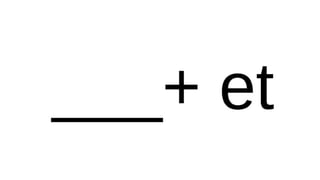
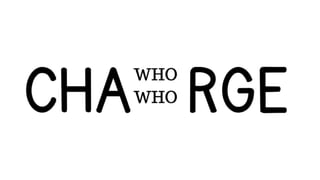
1. Read the random words that will
appear on your screen.
2. Speak aloud until you guess the right
phrase based on the given words.
35.
Lyceum of SouthernLuzon,
Inc. Guess the Gibberish
GLOW BULL EYE SAY SHUN
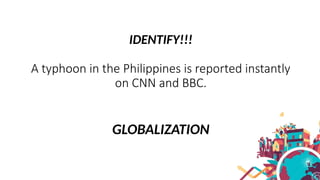
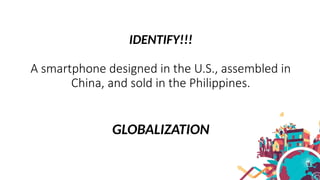
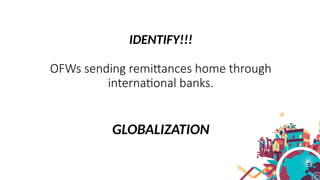
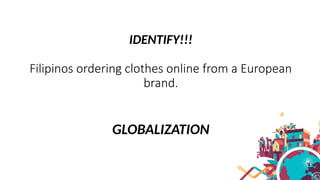
GLOBALIZATION
36.
Lyceum of SouthernLuzon,
Inc. Guess the Gibberish
INK HER NECK TED NESS
INTERCONNECTED
37.
Lyceum of SouthernLuzon,
Inc. Guess the Gibberish
GLOW BULL SIEVE HEN SHIP
GLOBAL CITIZENSHIP
38.
Lyceum of SouthernLuzon,
Inc. Guess the Gibberish
SUE STAIN A BULL DUH VEIL UP MINT
SUSTAINABLE DEVELOPMENT
39.
Lyceum of SouthernLuzon,
Inc. Guess the Gibberish
EEK A NOMMICK INNER DEEP END
DENSE
ECONOMIC INTERDEPENDENCE
40.
Lyceum of SouthernLuzon,
Inc. Guess the Gibberish
CULL CHURL GLOW BULL EYE SAY
SHUN
CULTURAL GLOBALIZATION
41.
Lyceum of SouthernLuzon,
Inc. Guess the Gibberish
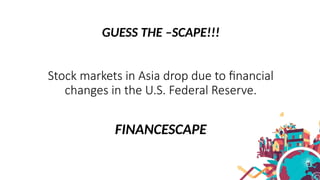
FAN EYE ANTS CAPE
FINANCESCAPE
42.
Lyceum of SouthernLuzon,
Inc. Guess the Gibberish
PALL LIT TICK CALL GLOW BULL EYE
SAY SHUN
POLITICAL GLOBALIZATION
43.
Lyceum of SouthernLuzon,
Inc. Guess the Gibberish
WORST URN EYES SAY SHUN
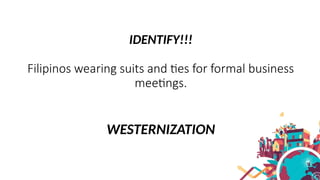
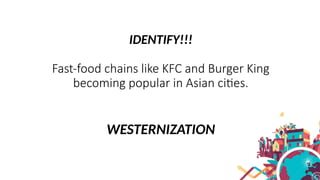
WESTERNIZATION
44.
Lyceum of SouthernLuzon,
Inc. Guess the Gibberish
IN HER NASH OWN ALL EYE SAY
SHUN
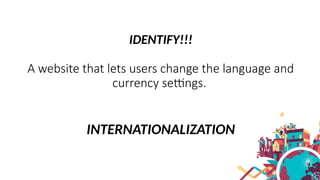
INTERNATIONALIZATION
45.
Lyceum of SouthernLuzon,
Inc. Guess the Gibberish
CORE PURR IT GIANTZ
CORPORATE GIANTS
46.
Lyceum of SouthernLuzon,
Inc. Guess the Gibberish
GLOW BULL SIGH BURR THREATS
GLOBAL CYBER THREATS
48.
Introduction to ContemporaryWorld
Definition of Terms:
a. contemporary
- living or occurring at the same
time; belonging to or occurring in the
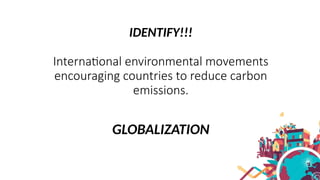
present
49.
Introduction to ContemporaryWorld
Definition of Terms:
b. contemporary world
- the circumstances and ideas of
the present age
50.
Introduction to ContemporaryWorld
Definition of Terms:
c. globalization
- from the word globalize-
emergence of an international network
of economic systems
51.
Introduction to ContemporaryWorld
Definition of Terms:
c. globalization
- the process of interaction and
integration among the people,
companies, governments of different
nations
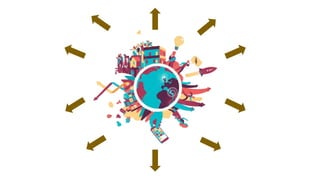
CONTEMPORARY WORLD
There arecircumstances and ideas of the
present age where it deals with problems
and issues related to environment,
population, wealth and power, tensions,
and conflicts.
54.
Why study CONTEMPORARYWORLD?
1. To be aware of contemporary world problems
and issues that all societies must be
concerned.
2. To develop competencies and construct
knowledge about problems and issues and
become aware of roles and responsibilities
as citizens.
55.
CONTEMPORARY WORLD
This courseintroduces students to the
contemporary world by examining the multifaceted
phenomenon of globalization.
Using the various disciplines of social
sciences, it examines the economic, political,
technological, and other transformations that
have created an increasing awareness of the
interconnectedness of people and places around
the globe.
56.
CONTEMPORARY WORLD
To thisend, the course provides an overview
of the various debates in global governance,
development, and sustainability.
Beyond exposing the students to the world
outside the Philippines, it seeks to inculcate a
sense of global citizenship and global ethical
responsibility.
57.
LEARNING OUTCOMES:
A. Competencies
1.Distinguish different interpretations of and
approaches to globalization
2. Describe the emergence of global economic,
political, and cultural systems
3. Analyze the various contemporary drivers of
globalization
4. Understand the issues controlling the
nation state
58.
LEARNING OUTCOMES:
B. Skills
1.Analyze contemporary events in the
context of globalization
2. Analyze global issues in relation to Filipino
and the Philippines
3. Write a term paper with proper citations on
a topic related to globalization
59.
LEARNING OUTCOMES:
C. Values
1.Articulate personal positions on various
global issues
2. Identify the ethical implications of global
citizenship
60.
COURSE OUTLINE
Weeks 1-2:- Introduction to Globalization
- Defining Globalization
- The Structures of Globalization
- The Global Economy
61.
COURSE OUTLINE
Weeks 3-5:The Globalization of World Economics
- International Trading Systems
- The Bretton Woods System
- Economic Globalization Today
62.
COURSE OUTLINE
Weeks 3-5:A History of Global Politics: Creating an
International Order
- The Attributes of Today’s Global System
- Internationalism
63.
COURSE OUTLINE
Weeks 3-5:The United Nations and Contemporary
Global Governance
- What is an International Organization?
- The United Nations
- Challenges of the United Nations
64.
COURSE OUTLINE
Weeks 3-5:A World of Regions
- Countries, Regions, and Globalization
- Non- State Regionalism
- Contemporary Challenges to
Regionalism
COURSE OUTLINE
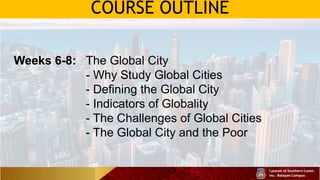
Weeks 6-8:The Global City
- Why Study Global Cities
- Defining the Global City
- Indicators of Globality
- The Challenges of Global Cities
- The Global City and the Poor
67.
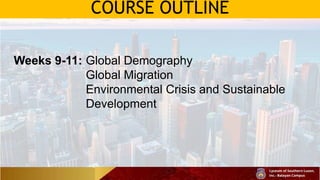
COURSE OUTLINE
Weeks 9-11:Global Demography
Global Migration
Environmental Crisis and Sustainable
Development
Key Concepts ofContemporary World
Globalization
The process that connects countries
through trade, communication, culture,
and technology.
75.
Key Concepts ofContemporary World
Global Governance and
International Relations
Countries are interconnected, so
they need cooperation to solve global
problems.
76.
Key Concepts ofContemporary World
Sustainable Development and
the Environment
Global issues like climate change,
pollution, and resource depletion affect
everyone.
77.
Key Concepts ofContemporary World
Economic Interdependence
• Economies today are linked through
trade and technology.
• A crisis in one country can affect the
world.
78.
Key Concepts ofContemporary World
Cultural Globalization
Cultures mix. Cultures of different
countries influence each other through
travel, media, and migration.
79.
Key Concepts ofContemporary World
Global Challenges
Issues like poverty, terrorism,
pandemics, and cyber threats require
international solutions.
CONTEMPORARY WORLD
This courseintroduces students to the
contemporary world by examining the multifaceted
phenomenon of globalization.
Using the various disciplines of social sciences, it
examines the economic, political, technological,
and other transformations that have created an
increasing awareness of the interconnectedness of
people and places around the globe.
Key Concepts ofContemporary World
Globalization
The process that connects countries
through trade, communication, culture,
and technology.
92.
Key Concepts ofContemporary World
Global Governance and
International Relations
Countries are interconnected, so
they need cooperation to solve global
problems.
93.
Key Concepts ofContemporary World
Sustainable Development and
the Environment
Global issues like climate change,
pollution, and resource depletion affect
everyone.
94.
Key Concepts ofContemporary World
Economic Interdependence
• Economies today are linked through
trade and technology.
• A crisis in one country can affect the
world.
95.
Key Concepts ofContemporary World
Cultural Globalization
Cultures mix. Cultures of different
countries influence each other through
travel, media, and migration.
96.
Key Concepts ofContemporary World
Global Challenges
Issues like poverty, terrorism,
pandemics, and cyber threats require
international solutions.
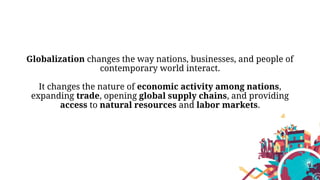
Globalization changes theway nations, businesses, and people of
contemporary world interact.
It changes the nature of economic activity among nations,
expanding trade, opening global supply chains, and providing
access to natural resources and labor markets.
101.
Have you triedto listen to songs in Apple,
Spotify, or Youtube Music?
GLOBALIZATION
It is theincreased interconnectedness and
interdependence of people and countries,
through opening of international borders to
increasingly fast flows of goods, services,
finance, people, and ideas, and the changes in
institutions and policies of national and
international levels that facilitates or promote
such flows.
109.
GLOBALIZATION
• Increasing interactionof people, states, or countries
through the growth of international flow of money, ideas,
and culture.
• Focuses on economic process of integration that has
social and cultural aspects.
• Interconnectedness of people and business across
world that eventually leads to global, political, and
economic integration.
110.
GLOBALIZATION
• It isthe free movement of goods, services, and
people across the world in a seamless and integrated
manner.
• Liberalization of countries of their impact protocols
and welcome foreign investment into sectors that are
the mainstays of the economy.
• Refers to the countries acting like magnets attracting
global capital by opening up their economies to
multinational corporations.
111.
GLOBALIZATION
“Globalization is theintensification of worldwide
social relations which link distant localities in such a way
that local happenings are shaped by events occurring many
miles away and vice versa.”
– Anthony Giddens (The Consequence of Modernity)
Example: A war in another country can raise fuel prices
in the Philippines.
112.
GLOBALIZATION
“Globalization is aprocess by which the people of the world
are incorporated into a single world society.”
- Martin Albrow and Elizabeth King
Example: Social media lets people from different
countries share ideas and trends instantly.
NETWORKING
It plays apivotal role in establishing relationship
between nations in the world to the introduction of
new normal Globalization.
Networking. The action or process of interacting
with others to exchange information and develop
professional and social contacts.
The story showshow globalization operates at multiple,
intersecting levels:
1. The spread of Filipino TV in Malaysia (proliferation of
pop culture)
2. Gio and Latiff’s participation in an international
competition about international politics
3. Gio and Latiff’s communication through Facebook
4. Unexpected meet-up in Singapore--- a hub for global
commerce
119.
Is the effectof globalization equal to
everybody? Why or why not?
120.
The best scholarlydefinition of globalization is
provided by Manfred Steger:
“The expansion and intensification of social
relations and consciousness across world time
and across world- space.”
121.
Expansion- refers toboth creation of new social
networks and the multiplication of existing
connections that cut across traditional political,
economic, cultural, and geographic boundaries.
Social media
Non- governmental organizations (NGOs)
Story: Gio was able to join a Model UN
competition because his university was
part of an international network.
122.
Intensification- refers tothe expansion,
stretching, and acceleration of these networks.
Not only are global connections multiplying, but they
are also becoming more closely knit and
expanding their reach.
Strong financial market between New
York and London. With the advent of
electronic trading, the volume of the trade
increases exponentially, as traders can
now trade more at higher speeds.
123.
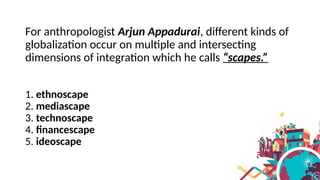
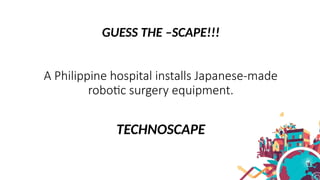
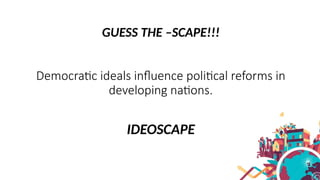
For anthropologist ArjunAppadurai, different kinds of
globalization occur on multiple and intersecting
dimensions of integration which he calls “scapes.”
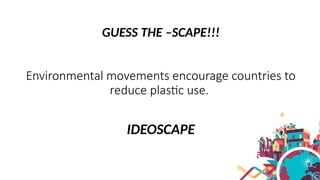
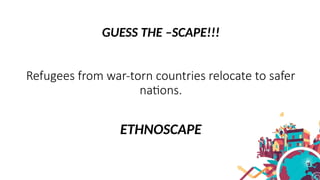
1. ethnoscape
2. mediascape
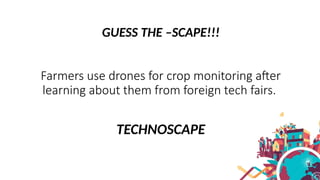
3. technoscape
4. financescape
5. ideoscape
124.
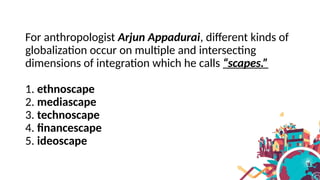
For anthropologist ArjunAppadurai, different kinds of
globalization occur on multiple and intersecting
dimensions of integration which he calls “scapes.”
1. ethnoscape
2. mediascape
3. technoscape
4. financescape
5. ideoscape
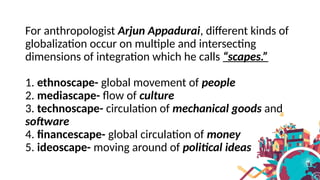
For anthropologist ArjunAppadurai, different kinds of
globalization occur on multiple and intersecting
dimensions of integration which he calls “scapes.”
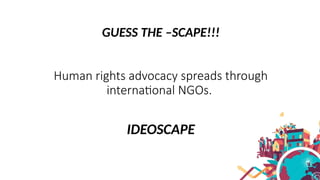
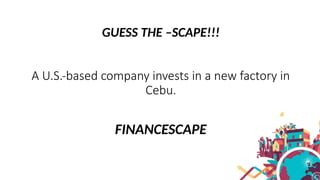
1. ethnoscape- global movement of people
2. mediascape- flow of culture
3. technoscape- circulation of mechanical goods and
software
4. financescape- global circulation of money
5. ideoscape- moving around of political ideas
1. Read therandom words that will
appear on your screen.
Lyceum of Southern Luzon, Inc. | 2024
Practical Research 2
Guess the Gibberish Mechanics
2. Speak aloud until you guess the right
phrase based on the given words.
GLOBALIZATION
Speed up ofmovements and exchanges of
human resources, goods and services capital,
technologies and cultural practices between
countries in the world.
170.
GLOBALIZATION
EXAMPLES
Automobile manufacturing makesuse of spare
parts from different countries and is fully assembled
in one country.
Computer parts and accessories are manufactured
in a foreign country and are sold in another country.
171.
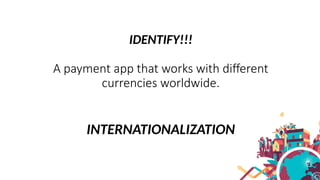
INTERNATIONALIZATION
Designing a productin a way that it may
readily be consumed across multiple
countries.
It often requires modifying products to
conform to the technical and cultural
needs of a given country.
172.
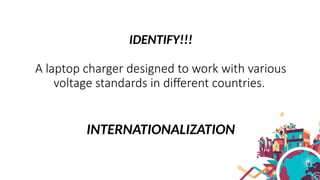
INTERNATIONALIZATION
EXAMPLE
Cultural barriers. InIndia, many Hindus do not
eat beef. To internationalize, McDonald’s must
focus on chicken, fish, and other non- beef
menu items that better conform to local custom
and culture.
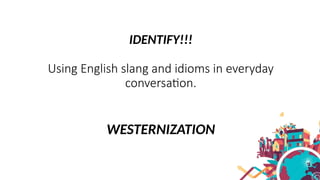
173.
WESTERNIZATION
Process whereby societiescome under or
adopt western culture in areas such as
industry, technology, politics, economics,
lifestyle, law, norms, mores, customs and
traditions.
174.
WESTERNIZATION
EXAMPLE
Democracy, fast food,and American pop
culture.
Westernization in the Philippines. Major
festivities which commemorate the patron
saints of the town and regional districts.
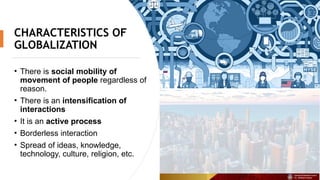
CHARACTERISTICS OF
GLOBALIZATION
• Thereis social mobility of
movement of people regardless of
reason.
• There is an intensification of
interactions
• It is an active process
• Borderless interaction
• Spread of ideas, knowledge,
technology, culture, religion, etc.
192.
Characteristics of Globalization
Thereis social mobility of movement of
people regardless of reason.
A nurse from the Philippines migrating to Canada
for work.
193.
Characteristics of Globalization
Thereis an intensification of interactions
Students from different countries collaborating
online for a university project.
CHARACTERISTICS OF GLOBALIZATION
1.Creation and Multiplication of connections
2. Expansion and Stretching of connections
3. Intensification and Acceleration of connections
4. Consciousness and Awareness of connections
Held and McGrew (2002)
199.
CHARACTERISTICS OF GLOBALIZATION
1.Creation and Multiplication of connections:
Development and increasing social network and cultural
activities that led to the breaking of traditional norms
and practices in the political, economic and cultural
realisms of most communities.
Held and McGrew (2002)
200.
CHARACTERISTICS OF GLOBALIZATION
1.Creation and Multiplication of connections:
Breaking Traditional Norms.
Global connections change local politics,
economy, and culture.
Example: K-pop influencing Filipino music and fashion.
Held and McGrew (2002)
201.
CHARACTERISTICS OF GLOBALIZATION
2.Expansion and Stretching of connections:
Social operations and corrections on how the financial
markets and trading operate around the globe that
brought expansions throughout the world.
Examples: The operations of Economic
Organizations like of WTO, ASEAN Economic
Community, World Economic Forum and European
Union
Held and McGrew (2002)
202.
CHARACTERISTICS OF GLOBALIZATION
2.Expansion and Stretching of connections:
Global Economic Governance.
Rules and organizations guide world trade and
markets.
Example: WTO setting fair trade policies among
countries.
Held and McGrew (2002)
203.
CHARACTERISTICS OF GLOBALIZATION
3.Intensification and Acceleration of connections:
Human activities where it describes how the process of
world and individual connection works.
The fourth Industrial Revolution is a concrete
example where digital machines ARE widely used in
reaching every global event.
Held and McGrew (2002)
204.
CHARACTERISTICS OF GLOBALIZATION
3.Intensification and Acceleration of connections:
Global Connectivity in the Digital Age.
Technology links people and events
worldwide.
Example: Attending an online class with students from
different countries.
Held and McGrew (2002)
205.
CHARACTERISTICS OF GLOBALIZATION
4.Consciousness and Awareness of connections:
The people as the primary actors of globalization is
very important on how they impact the growing
outcomes and markers in globalization specially the
implications of their actions to the norms and practices of
borderless world.
Held and McGrew (2002)
206.
CHARACTERISTICS OF GLOBALIZATION
4.Consciousness and Awareness of connections:
Human Agency in Globalization.
People’s actions shape globalization’s effects.
Example: Influencers spreading international trends on
TikTok.
Held and McGrew (2002)
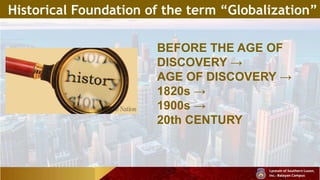
Historical Foundation ofthe term “Globalization”
BEFORE THE AGE OF
DISCOVERY →
AGE OF DISCOVERY →
1820s →
1900s →
20th CENTURY
217.
Historical Foundation ofthe term “Globalization”
• 1897, Charles Russel coined the term CORPORATE
GIANTS, referring to a large national trust and other large
enterprises of the time
• 1930, the word “Globalize” as a noun appeared in a
publication entitled “Towards New Education’ where it
denoted a holistic view of human experience
• Late 1970s- Globalization was coined
• Early 1981- Globalization was used as an economic sense
• 2013, the globalization was used to define “borderless
society”
• 2017, Globalization was often used in the academe
• 2018, Globalization was now used in all disciplines
218.
Historical Foundation ofthe term “Globalization”
• 1897- Charles Russel coined the term
CORPORATE GIANTS
• 1930- the word “Globalize” as a noun
appeared in a publication entitled “Towards
New Education” where it denoted a
holistic view of human experience
219.
Historical Foundation ofthe term “Globalization”
• Late 1970s- Globalization was coined
• Early 1981- Globalization was used in an
economic sense
• 2013- the globalization was used to define
“borderless society”
• 2017- Globalization was often used in the
academe
• 2018- Globalization is now used in all
disciplines
INDICATORS of Globalization
•Interdependence of countries in social
aspects
- During a pandemic, countries share
medical teams and health protocols to help
each other manage outbreaks.
246.
INDICATORS of Globalization
•Advancement of science and
technology
- Engineers from different nations
collaborate online to design a new electric car
model using advanced simulation software.
247.
INDICATORS of Globalization
•Environmental issues across borders
- Air pollution from factories in one
country drifts into neighboring nations,
leading to joint agreements to reduce
emissions.
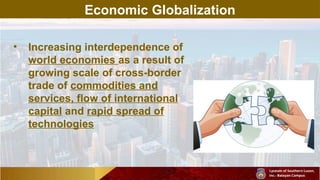
Economic Globalization
• Increasinginterdependence of
world economies as a result of
growing scale of cross-border
trade of commodities and
services, flow of international
capital and rapid spread of
technologies
250.
Cultural Globalization
• Transmissionof ideas, meanings, and
values around the world in such a way
as to extend and intensify social
relations.
• This process is marked by the common
consumption of cultures that have been
diffused by the internet, popular culture
media, and international travel.
Philosophies in StudyingGlobalization
Philosophy
- It is an activity people undertake
when they seek to understand
fundamental truths about themselves,
the world they live in, and their
relationships to the world and each
other.
254.
Philosophies in StudyingGlobalization
Philosophy
- It is an activity people undertake when
they seek to understand fundamental
truths about themselves, the world they
live in, and their relationships to the
world and each other.
255.
Philosophies in StudyingGlobalization
Philosophy
When climate change became a pressing global issue,
leaders, scientists, and citizens from different countries engaged
in discussions about humanity’s moral responsibility to the
planet. They explored ethical questions such as “Do we have the
right to exploit natural resources without limits?” and “What
obligations do wealthier nations have toward poorer ones in
addressing global environmental problems?”
257.
Philosophies in StudyingGlobalization
Capitalism
- It is the dominant economic
framework and system in many parts of
the world today.
258.
Philosophies in StudyingGlobalization
Capitalism
- Capitalism is an economic system
where businesses, trade, and industries
are owned by private individuals or
companies, not the government, and
goods/services are produced for profit.
259.
Philosophies in StudyingGlobalization
Capitalism
- It is primarily premised on the
profit motive.”
- It promotes claim that seeking
profit is the basic aim of any
individual or entity in this world.
261.
Philosophies in StudyingGlobalization
The World Systems Theory
- It is an approach to world history and
social change that suggests that there is a
world economic system in which some
countries benefit while others are
exploited.
262.
Philosophies in StudyingGlobalization
The World Systems Theory
- The world systems theory is
established on a three-level hierarchy
consisting of core, periphery, and semi-
periphery areas.
263.
Philosophies in StudyingGlobalization
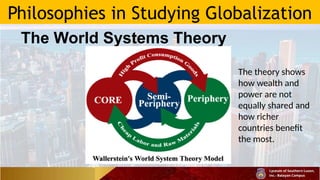
The World Systems Theory
The theory shows
how wealth and
power are not
equally shared and
how richer
countries benefit
the most.
264.
Philosophies in StudyingGlobalization
(Economic) Liberalism
- Neoliberalism’s adherents further build
on the profit motive by asserting that
for capitalism to thrive, markets should be
free from government intervention.
265.
Philosophies in StudyingGlobalization
(Economic) Liberalism
- It claims that free markets and free
trade will set free the creative potential
and the entrepreneurial spirit which is
built spontaneous order of any human
society.
266.
Philosophies in StudyingGlobalization
Cultural Relativism vs. Universalism
- Cultural relativism argues that all cultures
are equal and should be respected within
their own contexts.
- Universalism, on the other hand, suggests
that certain values, like human rights, should
be universally applied.
267.
Philosophies in StudyingGlobalization
Globalism vs. Globalization
- Globalization refers to the
multidimensional social processes that
intensify global connections, while
globalism endows those processes with
certain norms and values.
REASONS for Globalization
•Rapid shrinking of time and distance across the
globe. One can easily cross the bridge to the other
side of the market place due to advance tools of
technology.
• Companies and institutions go global to find
political and economic stability which is relatively
good in other countries than the country of origin.
280.
REASONS for Globalization
•To get technological and managerial know-how
of other countries due to their advancement in
science, technology, education, health, and other
fields of discipline.
• To be close to raw materials and to markets for
their finished products which are not available in
the country of origin.
281.
REASONS for Globalization
•The creation of World Trade Organization (WTO)
had made it possible in stimulating increased
cross- border trade.
Aim: To help producers of goods and services
protect and manage their services.
282.
STAGE of Globalization
•Stage 1. The first stage is the arm’s
length service activity of an essentially
domestic company/ institution which
moves into new market overseas by
linking up with local dealers and
distributors. (Partnership)
• Stage 2. The company/ institution takes
over these activities on its own.
283.
STAGE of Globalization
•Stage 3. The domestic- based company
begins to carry out its own
manufacturing marketing and sales in
key foreign markets. (Implementing)
• Stage 4. The company/ institution
moves to a full insider position in these
markets and supported by a complete
business system including Research
and Development and engineering.
284.
STAGE of Globalization
•Stage 5. The company/ institution
moves towards a genuinely global
mode of operation. Global localization
happens wherein the company
institution serves as local customers in
markets around the globe responding
to their needs.
285.
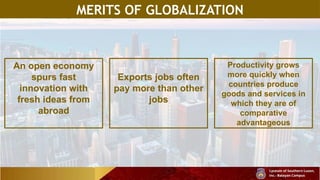
MERITS OF GLOBALIZATION
Anopen economy
spurs fast
innovation with
fresh ideas from
abroad
Exports jobs often
pay more than other
jobs
Productivity grows
more quickly when
countries produce
goods and services in
which they are of
comparative
advantageous
286.
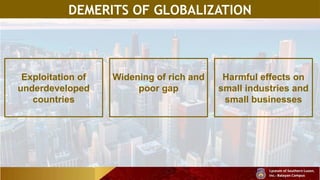
DEMERITS OF GLOBALIZATION
Exploitationof
underdeveloped
countries
Widening of rich and
poor gap
Harmful effects on
small industries and
small businesses
Editor's Notes
#3 I have this tendency to speak fast so please tell me or raise your hand if that happens. TYSM. BUT disclaimer: I am working on it naman na
#4 I have this tendency to speak fast so please tell me or raise your hand if that happens. TYSM. BUT disclaimer: I am working on it naman na
#8 I have this tendency to speak fast so please tell me or raise your hand if that happens. TYSM. BUT disclaimer: I am working on it naman na
#11 SILENCE. Treat everyone with kindness. Listen when someone is speaking. Value differences and opinions
ACKNOWLEDGING EO’S OPINIONS/ LISTENING ATTENTIVELY
#12 Take ownership of ur actions, tasks, and learning. Bring your materials, meet deadlines, and stay focused.
There is a fine line between acceptable and unacceptable deadlines.
#13 Be truthful in schoolwork and relationships. Academic integrity is non-negotiable.
means being honest, not cheating, and respecting others. Academic integrity means doing your own work and not copying or using unfair help.
If you're taking a test, you don’t look at someone else's paper or use your phone to find answers. In a relationship, you’re honest with your feelings and actions.
Non-negotiable means something that is not open to change, discussion, or compromise.
Example:
If academic integrity is non-negotiable, it means cheating is never allowed—no exceptions.
#14 Be truthful in schoolwork and relationships. Academic integrity is non-negotiable.
means being honest, not cheating, and respecting others. Academic integrity means doing your own work and not copying or using unfair help.
If you're taking a test, you don’t look at someone else's paper or use your phone to find answers. In a relationship, you’re honest with your feelings and actions.
Non-negotiable means something that is not open to change, discussion, or compromise.
Example:
If academic integrity is non-negotiable, it means cheating is never allowed—no exceptions.
#15 Engage actively in class discussions, group work and activities. Your voice matters!
#17 Journal prompt, question on the board, or games. It's a quick warm-up activity that often involves questions, problems, or tasks related to the upcoming lesson or a review of past material.
#18 Journal prompt, question on the board, or games
#19 Journal prompt, question on the board, or games QUIZ AS WELL
#20 To help you stay prepared abd productive, you’ll need…
#22 To help you stay prepared abd productive, you’ll need…
#23 Attendance is required; inform the instructor if absent.
#24 DO NOT SLOUCH, STAY SNAPPY. treating others with respect and helping create a safe, focused environment for everyone.
Example:
You don’t call classmates names, make fun of them, or interrupt the teacher during lessons. Instead, you listen, support others, and follow classroom rules.
#25 DO NOT SLOUCH, STAY SNAPPY. treating others with respect and helping create a safe, focused environment for everyone.
Example:
You don’t call classmates names, make fun of them, or interrupt the teacher during lessons. Instead, you listen, support others, and follow classroom rules.
#26 staying focused on tasks and not using phones or devices without permission.
Example:
During class, you work on your assignment instead of texting or playing games on your phone unless the
#27 means creating a positive, friendly, and respectful atmosphere where everyone feels welcome and motivated.
Example:
You encourage classmates, participate actively, share ideas kindly, and avoid gossip or negativity.
#28 means creating a positive, friendly, and respectful atmosphere where everyone feels welcome and motivated.
Example:
You encourage classmates, participate actively, share ideas kindly, and avoid gossip or negativity.
#29 means creating a positive, friendly, and respectful atmosphere where everyone feels welcome and motivated.
Example:
You encourage classmates, participate actively, share ideas kindly, and avoid gossip or negativity.
#51 A process driven by international trade and investments by information technology
#52 The Contemporary World studies current global situations.
Sources of soc and pol changes include population growth, culture and technology, the natural environment, and social conflict.
Population Growth – Overcrowded cities lead to new housing policies.
Culture and Technology – Social media sparks political protests.
Natural Environment – Typhoon damage leads to disaster laws.
Social Conflict – Strikes push for labor law reforms.- Workers demanding fair wages
#53 The Contemporary World studies current global situations.
Short Example:
Environment: Climate change causing stronger typhoons.
Population: Overcrowded cities leading to housing shortages.
Wealth and Power: Big companies dominating global markets.
Tensions and Conflicts: Territorial disputes between countries. West PH Sea
#54 To understand how global events affect our daily lives.
To develop critical thinking and informed opinions on global issues.
To prepare for careers in an interconnected, competitive world.
To become responsible global citizens who care about social and environmental issues
#55 This course helps students understand globalization and how the world is connected. It looks at how economy, politics, technology, and society affect each other in today’s world.
Short Example:
Social media (technology) spreads trends worldwide, affecting culture and politics.
#56 It encourages students to think as global citizens who are responsible for helping solve world problems.
Short Example:
Learning about climate change and how Filipino actions can support global environmental efforts.
#71 This course helps students understand globalization and how the world is connected. It looks at how economy, politics, technology, and society affect each other in today’s world.
Short Example:
Social media (technology) spreads trends worldwide, affecting culture and politics.
#74 Positive effects: Easier access to information, products, and opportunities.
Negative effects: Inequality, cultural loss, and economic dependence.
#75 Organizations: United Nations (UN), World Trade Organization (WTO), ASEAN, European Union (EU).
The UN responds to global crises like pandemics or conflicts.
#76 Sustainable Development Goals (SDGs) encourage countries to act for a better future.
Example: International agreements to reduce carbon emissions.
#77 GLOBAL FINANCIAL CRISIS- oil produced/ mid east countries. PH- mineral products
Example: Smartphones are made using parts from many countries.
Example: Smartphones are made using parts from many countries.
#78 Positive: Promotes understanding and diversity.
Negative: Risk of losing local traditions.
Example: K-pop and Hollywood movies are popular worldwide.
#82 This course helps students understand globalization and how the world is connected. It looks at how economy, politics, technology, and society affect each other in today’s world.
Short Example:
Social media (technology) spreads trends worldwide, affecting culture and politics.
#85 Misinformation – False information shared without intent to deceive (usually by mistake).
Disinformation – False information shared on purpose to mislead others.
#91 Positive effects: Easier access to information, products, and opportunities.
Negative effects: Inequality, cultural loss, and economic dependence.
#92 Organizations: United Nations (UN), World Trade Organization (WTO), ASEAN, European Union (EU).
The UN responds to global crises like pandemics or conflicts.
#93 Sustainable Development Goals (SDGs) encourage countries to act for a better future.
Example: International agreements to reduce carbon emissions.
#94 GLOBAL FINANCIAL CRISIS- oil produced/ mid east countries. PH- mineral products
Example: Smartphones are made using parts from many countries.
Example: Smartphones are made using parts from many countries.
#95 Positive: Promotes understanding and diversity.
Negative: Risk of losing local traditions.
Example: K-pop and Hollywood movies are popular worldwide.
#98 Last week, we have shared w one another our knowledge about the contemporary world and globalization--- and some of u already know something abt it and that’s nice to hear.
#100 Globalization changes how countries, businesses, and people connect. It increases trade, links supply chains worldwide, and gives access to resources and workers from different countries.
A supply chain is the step-by-step system that moves a product from where it’s made to the customer.
Importation happens when a country brings in goods or materials from another country as part of the supply chain. PH importing machinery from china
Exportation happens when a country sends goods or materials to another country as part of the supply chain.- agricultural products
#106 you’re experiencing globalization. These products and services come from different parts of the world and are shared across many countries, showing how connected our world has become."
#108 DATI, THERE WAS LIMITED MODE OF TRANSPO, BUT NOW, MODERNITY CHANGES EVERYTHING. VERY ACCESSIBLE- SHINKANSEN
Goods – Buying Japanese sushi in a Philippine mall.
Services – Using an Australian-based customer service for your online order.
Finance – Sending money from the Philippines to family in Canada through online banking.- investment
People – Overseas Filipino Workers (OFWs) working in different countries.-
Ideas – Learning Korean language and culture through K-dramas and K-pop.
Changes- The Philippines updates its trade policies to follow World Trade Organization (WTO) rules, allowing easier import and export of goods with other countries.
#109 it’s about linking economies of different countries, which also affects people’s culture and social life.
Example: Buying Starbucks coffee (economic) while also adopting Western coffee-drinking culture (social and cultural). US, SEATTLE WASHINGTON
Kapeng barako- exploring and tasting diff types of coffee
#110 when countries reduce trade barriers and open their economy to foreign investments. TS tech, BPO
Example: The Philippines allowing foreign companies to invest in its energy and telecom industries to boost growth.
ECON LIB- reduction of govt control sa businesses
MNC- a company that does a business in selected few countries around the world
#111 Globalization means people and places far apart are connected, so events in one place can affect what happens in another.
A drought in another country raises the price of imported rice in the Philippines.- Vietnam, thailand
A new technology invented in the U.S. changes how Filipinos communicate (e.g., smartphones).
GLOBAL VILLAGE
#112 Globalization is the process of bringing all people together into one global community.
International sports events like the Olympics unite people from all over the world.
Students join online classes with classmates from different countries.
GLOBAL VILLAGE- Marshall MCLuhan
#114 Networking is connecting and interacting with people to share information, build relationships, and create opportunities.
Example: Attending a business seminar and meeting people who might become your future clients or partners.
#119 IT VARIES BY COUNTRY. DEVELOPED COUNTRIES MAY PROFIT MORE, BUT DEVELOPING COUNTRIES MIGHT FACE UNEQUAL GROWTH, CULTURAL SHIFTS AND JOB LOSSES. BECAUSE THEY’RE COMPETING WITH THE HUGE COMPS,.
#120 STAY-GER. Globalization is the growing and deepening connections between people around the world, and the awareness that we are all linked, no matter where or when we live.
Example: Social media making people instantly aware of events happening in other countries, like natural disasters or viral trends.
Manfred B. Steger is a political scientist and scholar best known for his work on globalization studies.
#121 Expansion means creating new social connections and increasing existing ones that go beyond old political, economic, cultural, and geographic limits.
Example: The rise of international online gaming communities where players from different countries interact daily.
#122 Ecommerce or "electronic commerce" is the trading of goods and services online.
Intensification means global connections are not just increasing, but they are also becoming stronger, faster, and more widespread.
Example: News about an event in another country can now spread worldwide in seconds through social media.
Expansion – Making more connections across countries and cultures.
Intensification – Making those connections faster, stronger, and closer.
#123 1. ethnoscape- global movement of people- migration to Canada job
2. mediascape- flow of culture thru media (main means of masscomm)- Youtube livestreams
3. technoscape- circulation of mechanical goods and software- electric buses in china introduced in the PH
4. financescape- global circulation of money- cyptocurrency connects investors
5. ideoscape- moving around of political ideas- global campaigns promote gender equality
#124 1. ethnoscape- global movement of people
2. mediascape- flow of culture
3. technoscape- circulation of mechanical goods and software
4. financescape- global circulation of money
5. ideoscape- moving around of political ideas
#146 How?
a. Through experience and observations of what goes around us
b. By conducting an ocular survey in the community
c. Do some preliminary interviews to help identify an existing problem
#169 Expansion and intensification of economic, political and social relations and consciousness across the world.
#170 Dell, sources components for its computers from various suppliers worldwide.
#171 A smartphone with multiple language options built in.
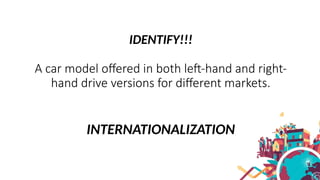
Cars – Toyota designing vehicles with both left-hand and right-hand drive versions for different countries.
Websites – Online stores like Amazon allowing customers to change currency and shipping destinations.
Electronics – Laptops with power adapters that work in multiple voltage standards worldwide.
Games – Video games offering subtitles and voice-overs in multiple languages.
#172 A smartphone with multiple language options built in.
Cars – Toyota designing vehicles with both left-hand and right-hand drive versions for different countries.
Websites – Online stores like Amazon allowing customers to change currency and shipping destinations.
Electronics – Laptops with power adapters that work in multiple voltage standards worldwide.
Games – Video games offering subtitles and voice-overs in multiple languages.
#174 Wearing jeans, T-shirts, and sneakers as everyday fashion.
Celebrating Valentine’s Day with flowers and chocolates.
Eating in Western fast-food chains like McDonald’s or KFC.
Using English as the main language in business and education.
Watching Hollywood movies and adopting Western slang.
Drinking coffee at Starbucks as part of social culture.
Following Western-style democracy and government systems.
#192 reflects how globalization allows people to move across borders for employment and better opportunities.
#193 shows how globalization increases communication and cooperation across borders.
#194 —such as fast-food chains offering region-specific menus—
shows globalization as an ongoing, dynamic process.
#195 shows how globalization removes barriers to trade and communication.
A smartphone with multiple language options built in.
Cars – Toyota designing vehicles with both left-hand and right-hand drive versions for different countries.
Websites – Online stores like Amazon allowing customers to change currency and shipping destinations.
Electronics – Laptops with power adapters that work in multiple voltage standards worldwide.
Games – Video games offering subtitles and voice-overs in multiple languages.
#196 demonstrates how media can spread cultural trends worldwide through the internet.
#197 There is social mobility of movement of people regardless of reason.
There is an intensification of interactions
It is an active process
Borderless interaction
Spread of ideas, knowledge, technology, culture, religion, etc.
#199 The rise of social media platforms like Facebook and TikTok allowing people from different countries to share ideas, trends, and lifestyles, which influences local politics, business, and culture—often challenging traditional customs and norms.
#200 often challenging traditional customs and norms.
#201 The World Trade Organization (WTO) setting rules for international trade, making it easier for countries to buy and sell goods across borders.
The ASEAN Economic Community promoting free flow of goods, services, and investments among Southeast Asian countries.
#202 The World Trade Organization (WTO) setting rules for international trade, making it easier for countries to buy and sell goods across borders.
The ASEAN Economic Community promoting free flow of goods, services, and investments among Southeast Asian countries.
#203 FIR- period of rapid technological advancement (characterized by fusion of physical, digital n biological spheres)
how human activities link people and events worldwide through technology.
Example: In the Fourth Industrial Revolution, tools like artificial intelligence, smartphones, and the internet allow people to join international meetings, watch live global events, and share information instantly across the world.
#204 Industrualization- development of industreis in a country or region on a wide scale
Example: In the Fourth Industrial Revolution, tools like artificial intelligence, smartphones, and the internet allow people to join international meetings, watch live global events, and share information instantly across the world.
#205 the idea that people drive globalization through their actions, decisions, and interactions.
Example: Social media influencers promoting global fashion trends that quickly spread across countries, influencing local styles and even shifting cultural norms in a borderless online world.
#206 Example: Social media influencers promoting global fashion trends that quickly spread across countries, influencing local styles and even shifting cultural norms in a borderless online world.
#210 Mechanics: DIVIDE THE CLASS INTO FOUR GROUPS
1. The class will be divided into groups. (The number of groups will depend on the population of the students).
2. The teacher will pick a category from a small box, and then she will also then again pick a letter from another box.
3. The students will be tasked to think of three words or phrases that are related with the category that the teacher would pick and it should start with the letter that she would also pull from the box.
4. The students are given limited time to think and write the words or phrases to the best of their abilities.
5. Once the given time is up, the representative/ secretary of the group should raise their pen and paper.
#218 CORPORATE GIANTS, referring to a large national trust and other large enterprises of the time
A National Trust is a non-governmental organization dedicated to preserving and protecting places of historical interest, natural beauty, and cultural heritage.
#219 COINED- t is often credited to Theodore Levitt, a Harvard Business School professor, who used it in his 1983 Harvard Business Review article “The Globalization of Markets”—
BORDERLESS- seamless movement of goods, services, capital, and information across traditional boundaries, effectively creating a "borderless society" in some regards
ECON- the study of how society uses its limited sources
#245 1. Interdependence of Countries in Social Aspects
Situation: During a pandemic, countries share medical teams and health protocols to help each other manage outbreaks.
2. Advancement of Science and Technology
Situation: Engineers from different nations collaborate online to design a new electric car model using advanced simulation software.
3. Environmental Issues Across Borders
Situation: Air pollution from factories in one country drifts into neighboring nations, leading to joint agreements to reduce emissions.
4. Economic Globalization
Situation: Coffee beans grown in Brazil are roasted in Italy and sold in cafés around the world.
5. Cultural Globalization
Situation: A Korean drama becomes popular in Latin America, influencing local fashion trends.
6. Political Globalization
Situation: Nations join together in the United Nations to set international laws on human rights and trade.
#246 1. Interdependence of Countries in Social Aspects
Situation: During a pandemic, countries share medical teams and health protocols to help each other manage outbreaks.
2. Advancement of Science and Technology
Situation: Engineers from different nations collaborate online to design a new electric car model using advanced simulation software.
3. Environmental Issues Across Borders
Situation: Air pollution from factories in one country drifts into neighboring nations, leading to joint agreements to reduce emissions.
4. Economic Globalization
Situation: Coffee beans grown in Brazil are roasted in Italy and sold in cafés around the world.
5. Cultural Globalization
Situation: A Korean drama becomes popular in Latin America, influencing local fashion trends.
6. Political Globalization
Situation: Nations join together in the United Nations to set international laws on human rights and trade.
#247 1. Interdependence of Countries in Social Aspects
Situation: During a pandemic, countries share medical teams and health protocols to help each other manage outbreaks.
2. Advancement of Science and Technology
Situation: Engineers from different nations collaborate online to design a new electric car model using advanced simulation software.
3. Environmental Issues Across Borders
Situation: Air pollution from factories in one country drifts into neighboring nations, leading to joint agreements to reduce emissions.
4. Economic Globalization
Situation: Coffee beans grown in Brazil are roasted in Italy and sold in cafés around the world.
5. Cultural Globalization
Situation: A Korean drama becomes popular in Latin America, influencing local fashion trends.
6. Political Globalization
Situation: Nations join together in the United Nations to set international laws on human rights and trade.
#248 1. Interdependence of Countries in Social Aspects
Situation: During a pandemic, countries share medical teams and health protocols to help each other manage outbreaks.
2. Advancement of Science and Technology
Situation: Engineers from different nations collaborate online to design a new electric car model using advanced simulation software.
3. Environmental Issues Across Borders
Situation: Air pollution from factories in one country drifts into neighboring nations, leading to joint agreements to reduce emissions.
4. Economic Globalization
Situation: Coffee beans grown in Brazil are roasted in Italy and sold in cafés around the world.
5. Cultural Globalization
Situation: A Korean drama becomes popular in Latin America, influencing local fashion trends.
6. Political Globalization
Situation: Nations join together in the United Nations to set international laws on human rights and trade.
#249 4. Economic Globalization
Situation: Coffee beans grown in Brazil are roasted in Italy and sold in cafés around the world.
Global Supply Chains – A laptop is designed in the U.S., its parts are made in Japan and Taiwan, assembled in China, and sold worldwide.
Foreign Direct Investment (FDI) – A Japanese car manufacturer builds a factory in Thailand, creating jobs and boosting local industry.
Global Trade Agreements – Member countries of ASEAN reduce tariffs to encourage cross-border trade.
Outsourcing and Offshoring – A U.S. software company hires IT specialists in India for customer support services.
#250 5. Cultural Globalization
Situation: A Korean drama becomes popular in Latin America, influencing local fashion trends.
6. Political Globalization
Situation: Nations join together in the United Nations to set international laws on human rights and trade.
#251 6. Political Globalization
Situation: Nations join together in the United Nations to set international laws on human rights and trade.
#253 Philosophy is the study of life, knowledge, and what is right or wrong.
Relation to Globalization:
Philosophy helps us think about the effects of globalization and decide what is fair or ethical in a connected world.
Example:
Asking “Is it fair for rich countries to use cheap labor from poor countries?” is a philosophical question about globalization.
#254 Philosophy is the study of life, knowledge, and what is right or wrong.
Relation to Globalization:
Philosophy helps us think about the effects of globalization and decide what is fair or ethical in a connected world.
Example:
Asking “Is it fair for rich countries to use cheap labor from poor countries?” is a philosophical question about globalization.
#255 This philosophical reflection guides global cooperation and policies.
#257 Capitalism is an economic system where businesses, trade, and industries are owned by private individuals or companies, not the government, and goods/services are produced for profit.
Relation to Globalization:
Capitalism drives globalization by encouraging international trade, investment, and competition, which connect economies worldwide.
#258
Capitalism drives globalization by encouraging international trade, investment, and competition, which connect economies worldwide.
#259 Capitalism is an economic system where businesses and resources are owned by private individuals instead of the government, and people can earn profit by selling goods or services.
Relation to Globalization:
Capitalism drives globalization because companies trade, invest, and expand worldwide to earn more profit.
Example:
Fast-food chains like McDonald’s or Starbucks open branches in many countries, showing how capitalism spreads through globalization.
Apple designs iPhones in the U.S., manufactures them in China, and sells them globally.
Global fast-food chains like McDonald’s expand into many countries to earn profit.
Clothing brands outsource production to countries with cheaper labor to sell worldwide.
#261 Was developed by sociologist Immanuel Wallerstein.
#262 Was developed by sociologist Immanuel Wallerstein.
#263 The core countries dominate and exploit the peripheral countries for labour and raw materials.
Core countries – rich, powerful, and developed (e.g., U.S., Japan, Germany). They control trade and technology.
Semi-periphery countries – developing nations that are in-between (e.g., Brazil, India, Mexico).
Periphery countries – poorer, less developed countries (e.g., many in Africa and parts of Asia) that provide raw materials and cheap labor.
#264 Neoliberalism believes that for capitalism to succeed, business and markets should run without much government control, so companies can focus on making profits freely.
#265 free markets and trade will naturally encourage creativity and entrepreneurship, because people are free to act, create, and do business without too many rules.
#266 In some cultures, arranged marriage is normal and respected (cultural relativism), but others believe everyone should have the right to choose their partner (universalism).
#267 For example, globalism might promote a particular vision of a globalized world, while globalization simply describes the increasing interconnectedness.
Endows- provides/ gives
#272 Sushi from Japan sold in malls in the Philippines
Starbucks coffee (US brand) using beans from Brazil and Ethiopia
McDonald’s menu adapted to Indian market (no beef burgers)
Korean samgyupsal restaurants in Manila
Italian pasta made with wheat imported from Canada
#273 iPhones designed in the US, assembled in China, and sold worldwide
TikTok (Chinese app) trending globally
Samsung phones (South Korea) used in Africa, Europe, and the Americas
Zoom video calls connecting people from multiple countries in real time
AI language translators breaking language barriers in international business
#274 K-pop concerts in the US, Philippines, and Europe
Netflix streaming Korean dramas to Latin America
Hollywood films earning more in foreign markets than in the US
Anime from Japan with English subtitles or dubbing
FIFA World Cup watched live by millions worldwide
#275 International exchange programs for students
Online courses from Harvard or Oxford accessed in the Philippines
Model United Nations competitions with participants from different continents
English language teaching centers run by native speakers in non-English countries
Overseas universities opening campuses abroad (e.g., NYU Abu Dhabi)
#276 ASEAN summits for regional cooperation
United Nations addressing global issues like climate change
Global protests inspired by events in another country (#MeToo, #BlackLivesMatter)
Countries imposing sanctions on another nation after political conflict
World Health Organization coordinating global pandemic responses