DR.MGM
BSMMU
• The common cold is a viral illness in which the
 Prominent nasal symptoms => rhinorrhea and nasal
  obstruction;
 Mild or absent systemic symptoms = >
  headache, myalgia, and fever.


      Self-limited
Correct termed Rhino-sinusitis
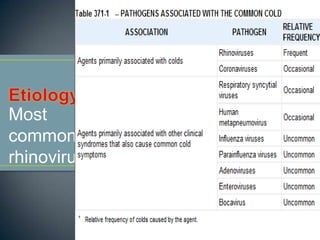
Most
common
rhinovirus
Reflecting the seasonal prevalence
• Early fall until the late spring, (RHINOVIRUS ) .
• Late fall and late spring (IV , PIV , RSV ).


• The incidence :
• Young children have an average of 6-8 colds per
  year, but 10-15% of children have at least 12 infections
  per year.
• The incidence of illness decreases with age, with 2 to 3
  illnesses per year by adulthood.
• Mannose-binding lectin deficiency with impaired innate
  immunity may be associated with an increased incidence
  of colds in children.
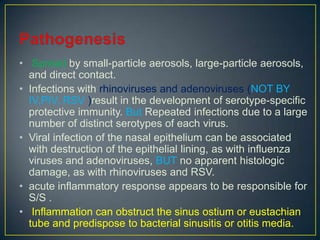
• Spread by small-particle aerosols, large-particle aerosols,
  and direct contact.
• Infections with rhinoviruses and adenoviruses (NOT BY
  IV,PIV, RSV )result in the development of serotype-specific
  protective immunity. But Repeated infections due to a large
  number of distinct serotypes of each virus.
• Viral infection of the nasal epithelium can be associated
  with destruction of the epithelial lining, as with influenza
  viruses and adenoviruses, BUT no apparent histologic
  damage, as with rhinoviruses and RSV.
• acute inflammatory response appears to be responsible for
  S/S .
• Inflammation can obstruct the sinus ostium or eustachian
  tube and predispose to bacterial sinusitis or otitis media.
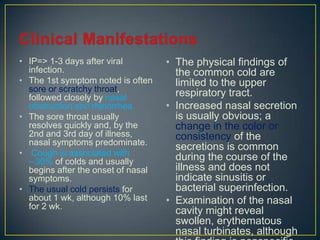
• IP=> 1-3 days after viral         • The physical findings of
  infection.                          the common cold are
• The 1st symptom noted is often      limited to the upper
  sore or scratchy throat,            respiratory tract.
  followed closely by nasal
  obstruction and rhinorrhea.       • Increased nasal secretion
• The sore throat usually             is usually obvious; a
  resolves quickly and, by the        change in the color or
  2nd and 3rd day of illness,         consistency of the
  nasal symptoms predominate.
                                      secretions is common
• Cough is associated with            during the course of the
  ∼30% of colds and usually
  begins after the onset of nasal     illness and does not
  symptoms.                           indicate sinusitis or
• The usual cold persists for         bacterial superinfection.
  about 1 wk, although 10% last     • Examination of the nasal
  for 2 wk.
                                      cavity might reveal
                                      swollen, erythematous
                                      nasal turbinates, although
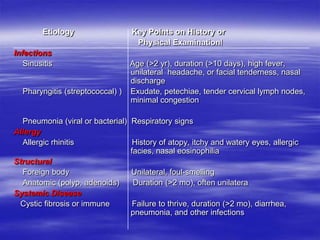
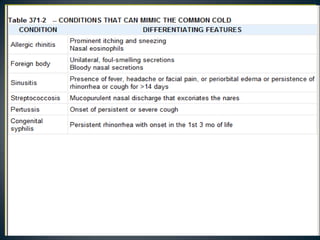
Etiology                  Key Points on History or
                                   Physical ExaminationI
Infections
   Sinusitis                      Age (>2 yr), duration (>10 days), high fever,
                                  unilateral headache, or facial tenderness, nasal
                                  discharge
  Pharyngitis (streptococcal) )   Exudate, petechiae, tender cervical lymph nodes,
                                  minimal congestion

  Pneumonia (viral or bacterial) Respiratory signs
Allergy
  Allergic rhinitis               History of atopy, itchy and watery eyes, allergic
                                 facies, nasal eosinophilia
Structural
  Foreign body                   Unilateral, foul-smelling
  Anatomic (polyp, adenoids)      Duration (>2 mo), often unilatera
Systemic Disease
 Cystic fibrosis or immune        Failure to thrive, duration (>2 mo), diarrhea,
                                 pneumonia, and other infections
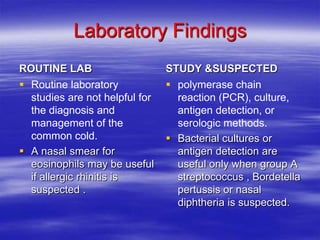
Laboratory Findings
ROUTINE LAB                     STUDY &SUSPECTED
 Routine laboratory             polymerase chain
  studies are not helpful for     reaction (PCR), culture,
  the diagnosis and               antigen detection, or
  management of the               serologic methods.
  common cold.                   Bacterial cultures or
 A nasal smear for               antigen detection are
  eosinophils may be useful       useful only when group A
  if allergic rhinitis is         streptococcus , Bordetella
  suspected .                     pertussis or nasal
                                  diphtheria is suspected.
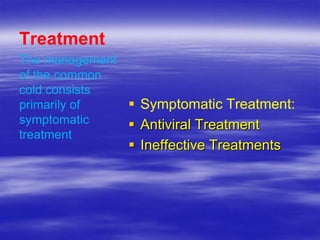
Treatment
The management
of the common
cold consists
primarily of    Symptomatic Treatment:
symptomatic     Antiviral Treatment
treatment
                Ineffective Treatments
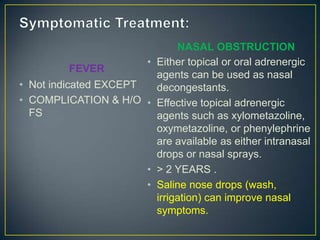
NASAL OBSTRUCTION
                     •   Either topical or oral adrenergic
           FEVER
                         agents can be used as nasal
• Not indicated EXCEPT   decongestants.
• COMPLICATION & H/O •   Effective topical adrenergic
  FS                     agents such as xylometazoline,
                         oxymetazoline, or phenylephrine
                         are available as either intranasal
                         drops or nasal sprays.
                     •   > 2 YEARS .
                     •   Saline nose drops (wash,
                         irrigation) can improve nasal
                         symptoms.
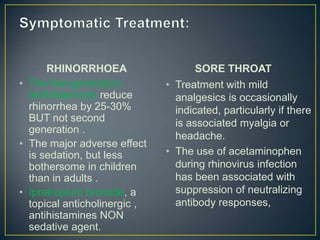
RHINORRHOEA                    SORE THROAT
• The first-generation        • Treatment with mild
  antihistamines reduce         analgesics is occasionally
  rhinorrhea by 25-30%          indicated, particularly if there
  BUT not second                is associated myalgia or
  generation .
                                headache.
• The major adverse effect
  is sedation, but less       • The use of acetaminophen
  bothersome in children        during rhinovirus infection
  than in adults .              has been associated with
• Ipratropium bromide, a        suppression of neutralizing
  topical anticholinergic ,     antibody responses,
  antihistamines NON
  sedative agent.
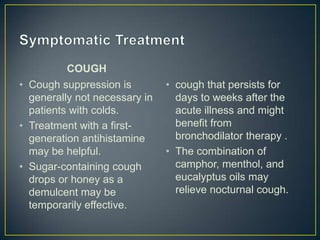
COUGH
• Cough suppression is         • cough that persists for
  generally not necessary in     days to weeks after the
  patients with colds.           acute illness and might
• Treatment with a first-        benefit from
  generation antihistamine       bronchodilator therapy .
  may be helpful.              • The combination of
• Sugar-containing cough         camphor, menthol, and
  drops or honey as a            eucalyptus oils may
  demulcent may be               relieve nocturnal cough.
  temporarily effective.
• Vitamin C, guaifenesin, and inhalation of warm,
  humidified air .
• Zinc,
• Echinacea
• Specific antiviral therapy has no role in the treatment of
  the common cold.
• Antibacterial therapy is of no benefit in the treatment of
  the common cold.
• OTITIS MEDIA ,
• SINUSITIS ,
• Exacerbation of asthma
Important consequence of the
common cold
• is the inappropriate use of antibiotics for these illnesses
  and the associated contribution to the problem of
  increasing antibiotic resistance of pathogenic respiratory
  bacteria
• Chemoprophylaxis or       • Handwashing is
  immunoprophylaxis is        commonly
  generally not available     recommended for
  for the common cold         prevention of colds

The common cold=mgm=n

  • 1.
  • 2.
    • The commoncold is a viral illness in which the  Prominent nasal symptoms => rhinorrhea and nasal obstruction;  Mild or absent systemic symptoms = > headache, myalgia, and fever. Self-limited Correct termed Rhino-sinusitis
  • 3.
  • 4.
    Reflecting the seasonalprevalence • Early fall until the late spring, (RHINOVIRUS ) . • Late fall and late spring (IV , PIV , RSV ). • The incidence : • Young children have an average of 6-8 colds per year, but 10-15% of children have at least 12 infections per year. • The incidence of illness decreases with age, with 2 to 3 illnesses per year by adulthood. • Mannose-binding lectin deficiency with impaired innate immunity may be associated with an increased incidence of colds in children.
  • 5.
    • Spread bysmall-particle aerosols, large-particle aerosols, and direct contact. • Infections with rhinoviruses and adenoviruses (NOT BY IV,PIV, RSV )result in the development of serotype-specific protective immunity. But Repeated infections due to a large number of distinct serotypes of each virus. • Viral infection of the nasal epithelium can be associated with destruction of the epithelial lining, as with influenza viruses and adenoviruses, BUT no apparent histologic damage, as with rhinoviruses and RSV. • acute inflammatory response appears to be responsible for S/S . • Inflammation can obstruct the sinus ostium or eustachian tube and predispose to bacterial sinusitis or otitis media.
  • 6.
    • IP=> 1-3days after viral • The physical findings of infection. the common cold are • The 1st symptom noted is often limited to the upper sore or scratchy throat, respiratory tract. followed closely by nasal obstruction and rhinorrhea. • Increased nasal secretion • The sore throat usually is usually obvious; a resolves quickly and, by the change in the color or 2nd and 3rd day of illness, consistency of the nasal symptoms predominate. secretions is common • Cough is associated with during the course of the ∼30% of colds and usually begins after the onset of nasal illness and does not symptoms. indicate sinusitis or • The usual cold persists for bacterial superinfection. about 1 wk, although 10% last • Examination of the nasal for 2 wk. cavity might reveal swollen, erythematous nasal turbinates, although
  • 8.
    Etiology Key Points on History or Physical ExaminationI Infections Sinusitis Age (>2 yr), duration (>10 days), high fever, unilateral headache, or facial tenderness, nasal discharge Pharyngitis (streptococcal) ) Exudate, petechiae, tender cervical lymph nodes, minimal congestion Pneumonia (viral or bacterial) Respiratory signs Allergy Allergic rhinitis History of atopy, itchy and watery eyes, allergic facies, nasal eosinophilia Structural Foreign body Unilateral, foul-smelling Anatomic (polyp, adenoids) Duration (>2 mo), often unilatera Systemic Disease Cystic fibrosis or immune Failure to thrive, duration (>2 mo), diarrhea, pneumonia, and other infections
  • 10.
    Laboratory Findings ROUTINE LAB STUDY &SUSPECTED  Routine laboratory  polymerase chain studies are not helpful for reaction (PCR), culture, the diagnosis and antigen detection, or management of the serologic methods. common cold.  Bacterial cultures or  A nasal smear for antigen detection are eosinophils may be useful useful only when group A if allergic rhinitis is streptococcus , Bordetella suspected . pertussis or nasal diphtheria is suspected.
  • 11.
    Treatment The management of thecommon cold consists primarily of  Symptomatic Treatment: symptomatic  Antiviral Treatment treatment  Ineffective Treatments
  • 12.
    NASAL OBSTRUCTION • Either topical or oral adrenergic FEVER agents can be used as nasal • Not indicated EXCEPT decongestants. • COMPLICATION & H/O • Effective topical adrenergic FS agents such as xylometazoline, oxymetazoline, or phenylephrine are available as either intranasal drops or nasal sprays. • > 2 YEARS . • Saline nose drops (wash, irrigation) can improve nasal symptoms.
  • 13.
    RHINORRHOEA SORE THROAT • The first-generation • Treatment with mild antihistamines reduce analgesics is occasionally rhinorrhea by 25-30% indicated, particularly if there BUT not second is associated myalgia or generation . headache. • The major adverse effect is sedation, but less • The use of acetaminophen bothersome in children during rhinovirus infection than in adults . has been associated with • Ipratropium bromide, a suppression of neutralizing topical anticholinergic , antibody responses, antihistamines NON sedative agent.
  • 14.
    COUGH • Cough suppressionis • cough that persists for generally not necessary in days to weeks after the patients with colds. acute illness and might • Treatment with a first- benefit from generation antihistamine bronchodilator therapy . may be helpful. • The combination of • Sugar-containing cough camphor, menthol, and drops or honey as a eucalyptus oils may demulcent may be relieve nocturnal cough. temporarily effective.
  • 15.
    • Vitamin C,guaifenesin, and inhalation of warm, humidified air . • Zinc, • Echinacea
  • 16.
    • Specific antiviraltherapy has no role in the treatment of the common cold. • Antibacterial therapy is of no benefit in the treatment of the common cold.
  • 17.
    • OTITIS MEDIA, • SINUSITIS , • Exacerbation of asthma
  • 18.
    Important consequence ofthe common cold • is the inappropriate use of antibiotics for these illnesses and the associated contribution to the problem of increasing antibiotic resistance of pathogenic respiratory bacteria
  • 19.
    • Chemoprophylaxis or • Handwashing is immunoprophylaxis is commonly generally not available recommended for for the common cold prevention of colds