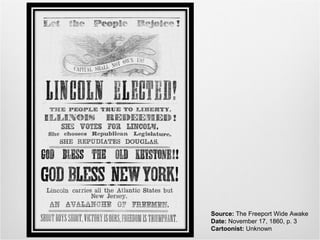
Source: The Freeport Wide Awake
Date: November 17, 1860, p. 3
Cartoonist: Unknown
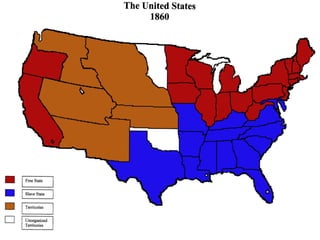
SecessionSecession
ď‚™ South Carolina
 After Lincoln’s election there was a special convention
ď‚™ The convention voted unanimously to secede
ď‚™ Official on Dec. 20, 1860, before Lincoln even took office
ď‚™ By February 1, 1861, six more states joined SC
ď‚™ Mississippi: Jan. 9, 1861
ď‚™ Florida: Jan. 10, 1861
ď‚™ Alabama: Jan. 11, 1861
ď‚™ Georgia: Jan. 19, 1861
ď‚™ Louisiana: Jan. 26, 1861
ď‚™ Texas: Feb. 1, 1861
Attempt at CompromiseAttempt at Compromise
ď‚™ Congress tried to get the Southern representatives back
to discuss a compromise
ď‚™ Southern states refused to talk and seized all federal
property in their states
ď‚™ A few pieces of federal property remained in the union
ď‚™ Fort Sumter in Charleston Harbor, South Carolina
ď‚™ Fort Pickens in Pensacola Harbor, Florida
ď‚™ A couple of islands off the coast of Florida
Lincoln’s Inaugural AddressLincoln’s Inaugural Address
ď‚™ March 4, 1861
ď‚™ If you were preparing your inaugural address, what
policy would you choose and why?
ď‚™ Abandon the Forts Under Your Control?
ď‚™ Reclaim the Forts Taken by Southern States?
ď‚™ Hold Only Those Forts Still in Federal Hands?
ď‚™ Or Choose Some Other Course of Action?
Lincoln’s Inaugural AddressLincoln’s Inaugural Address
ď‚™ "The power confided to me, will be used to hold, occupy, and
possess the property and places belonging to the Government.“
 “…there will be no invasion, no using of force against or among
the people anywhere."
ď‚™ He said nothing about reclaiming property now under
Confederate control
ď‚™ He explicitly offered reassurances to the South that slavery was
safe in its present limits and that he would enforce the fugitive
slave law
ď‚™ Resistance to the federal government constituted rebellion
Crittenden’s CompromiseCrittenden’s Compromise
ď‚™ Proposed by Kentucky Senator John J. Crittenden
ď‚™ Proposed constitutional amendments
ď‚™ Guarantee slavery where it already existed
ď‚™ Extend the Missouri Compromise to California
ď‚™ Lincoln told Congressmen to stay strong
ď‚™ The compromise was defeated
Peace AttemptPeace Attempt
ď‚™ Virginia, a slave state still in the union, hosted a peace
conference
ď‚™ 21 delegates attended
ď‚™ Mostly Northern and border states
ď‚™ NO delegates from the secession states
ď‚™ Resolved nothing
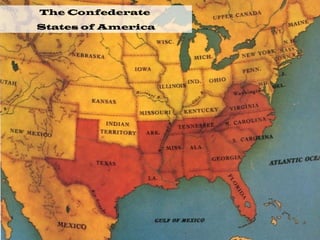
The ConfederacyThe Confederacy
ď‚™ Delegates from secession states met in Montgomery,
Alabama
ď‚™ They declared themselves a new country
ď‚™ The Confederate States of America was formed
ď‚™ A constitution was drafted that guaranteed the right to
slavery
ď‚™ Jefferson Davis was chosen as president
Fort SumterFort Sumter
ď‚™ Lincoln vowed to protect all federal property in the south
ď‚™ Davis vowed to take Fort Sumter before its defenses could
be strengthened
ď‚™ Davis demanded the fort surrender by April 12, 1861, they
did not
ď‚™ Confederate forces fired cannons at the fort for 34 hours
before it surrendered
ď‚™ The Civil War had begun
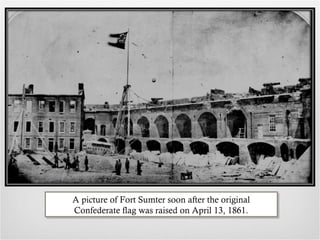
A picture of Fort Sumter soon after the original
Confederate flag was raised on April 13, 1861.
A picture of Fort Sumter soon after the original
Confederate flag was raised on April 13, 1861.
The Rest of the SouthThe Rest of the South
SecedesSecedes
ď‚™ Upper south slave states felt they had no choice but to
join the Confederacy
ď‚™ Virginia on April 17, 1861
 Robert E. Lee is appointed as Commander of Virginia’s
Army
ď‚™ Gained fame as a brilliant military leader in the U.S.
Marine Corps
ď‚™ Arkansas, N. Carolina, and Tennessee by early June,
1861
The Confederate
States of America
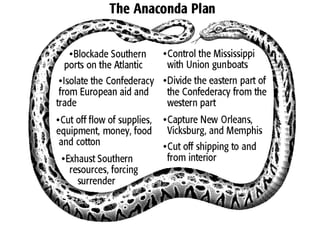
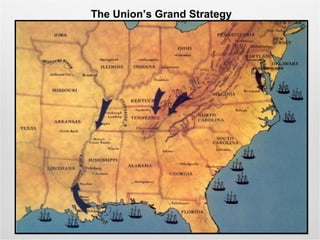
The Union’s Grand Strategy
Lincoln Strikes FirstLincoln Strikes First
ď‚™ Lincoln was under pressure to attack quickly
ď‚™ Most northerners felt that a quick attack would make
the south realize their mistake and force them to
compromise
ď‚™ General P.G.T. Beauregard was gathering
Confederate troops 25 miles south of Washington
D.C., near Manassas Junction, VA
ď‚™ A strategic railroad center in northern Virginia
ď‚™ Lincoln approved an attack on these forces
ď‚™ Lincoln hoped a victory would bring an end to the war
First Battle of Bull RunFirst Battle of Bull Run
ď‚™ July 21, 1861
ď‚™ Union forces pushed the Confederates across a stream called Bull Run
ď‚™ A large force of Confederate reinforcements lead by General Thomas J.
Jackson arrived from Virginia
 Jackson’s men gave a morale boost to the Confederates and they stopped
retreating
 One Confederate commander yelled, “There is Jackson standing like a
stone wall!”
 From then on, the general was known as “Stonewall” Jackson
ď‚™ Union troops retreated when Confederate reinforcements arrived
ď‚™ The first battle of the war was over and the South had won
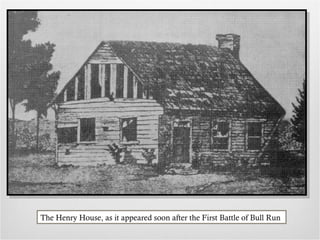
The Henry House, as it appeared soon after the First Battle of Bull Run
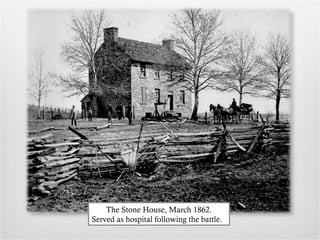
The Stone House, March 1862.
Served as hospital following the battle.
Results of Bull RunResults of Bull Run
ď‚™ Lincoln initially thought that a force of 75,000 men
would be needed for a period of three months
ď‚™ After Bull Run, Lincoln approved the enlistment of
500,000 men for three years
ď‚™ Both the north and the south instituted a draft to raise
the necessary troops
Naval WarNaval War
 Lincoln’s goal was to blockade all Southern ports
ď‚™ By the spring of 1862, all but two Confederate ports
were sealed off
 The South used “blockade runners”
ď‚™ Small fast ships that smuggled goods
ď‚™ The Confederacy used warships operating out of
foreign ports to attack Northern merchant ships
War in the WestWar in the West
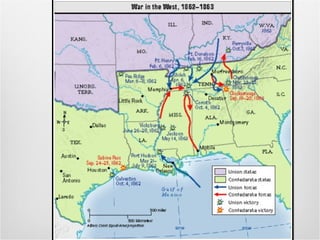
ď‚™ Union General Ulysses S. Grant began a campaign to
seize control of the Cumberland and Tennessee Rivers
ď‚™ Control would give Union forces a river route into
Confederate territory
ď‚™ Grant seized Fort Henry and Fort Donelson giving him
control of all of Kentucky and Western Tennessee
War in the WestWar in the West
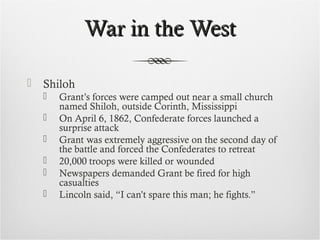
ď‚™ Shiloh
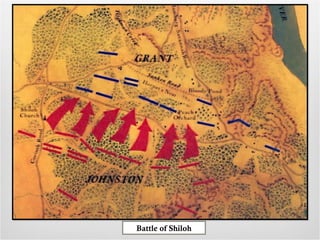
 Grant’s forces were camped out near a small church
named Shiloh, outside Corinth, Mississippi
ď‚™ On April 6, 1862, Confederate forces launched a
surprise attack
ď‚™ Grant was extremely aggressive on the second day of
the battle and forced the Confederates to retreat
ď‚™ 20,000 troops were killed or wounded
ď‚™ Newspapers demanded Grant be fired for high
casualties
 Lincoln said, “I can’t spare this man; he fights.”
Battle of Shiloh
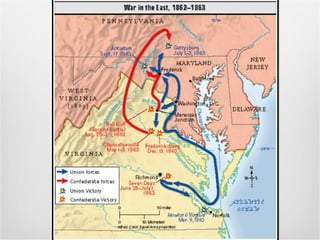
War in the EastWar in the East
ď‚™ Eastern Union forces were lead by General
George B. McClellan
 Took over after General Irwin McDowell’s defeat at Bull Run
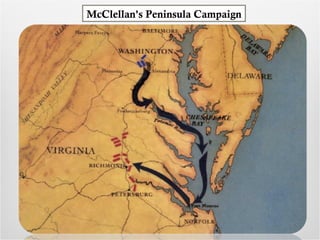
ď‚™ Peninsula Campaign
ď‚™ McClellan took his forces up the James River, southeast of
Yorktown, Virginia
ď‚™ McClellan made some tactical errors and lost a battle outside of
Richmond
ď‚™ The Confederate commander was wounded in the fighting and
was replaced by General Robert E. Lee
McClellan's Peninsula Campaign
War in the EastWar in the East
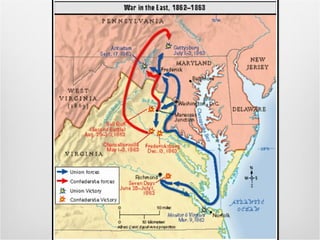
 Seven Day’s Battle
ď‚™ McClellan was attacked by Lee on the
Peninsula
ď‚™ Lee forced McClellan to retreat all the way to
the sea
ď‚™ Lincoln ordered McClellan to evacuate the
peninsula and return to Washington
ď‚™ Over 30,000 casualties in the seven days of
fighting
The Second Battle of Bull RunThe Second Battle of Bull Run
ď‚™ Lee attacked the Union forces defending Washington D.C.
ď‚™ The majority of the fighting took place at the same Bull Run
creek
ď‚™ Again, Confederate forces prevailed and Lee had entered
Union territory
ď‚™ Confederate forces were only 20 miles from D.C.
AntietamAntietam
ď‚™ Lee thought that only an invasion would convince the north
to recognize the Confederacy’s independence
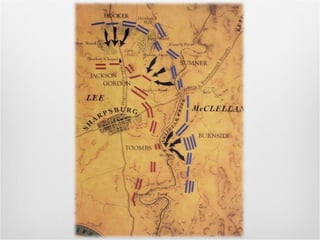
 Lee’s troops congregated near Sharpsville, Maryland
 McClellan’s troops gathered near Antietam Creek, east of
Lee
ď‚™ McClellan attacked on Sept. 17, 1862
ď‚™ The bloodiest day in American History
ď‚™ 8,000 dead
ď‚™ 23,000 wounded
AntietamAntietam
 Lee’s retreat made Britain rethink its recognition
of the Confederacy
ď‚™ McClellan could have chased Lee and destroyed
his entire army, but was too cautious
 Lincoln was disappointed with McClellan’s performance
and fired him
ď‚™ General Ambrose Burnside replaced McClellan
ď‚™ Antietam convinced Lincoln to end slavery
Battlefield PhotographsBattlefield Photographs
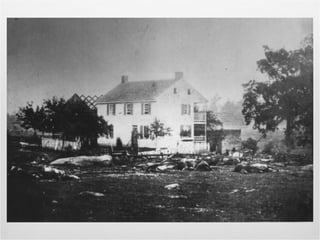
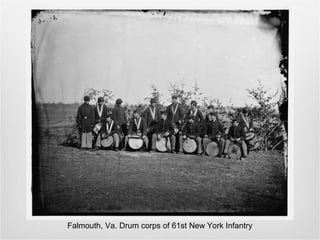
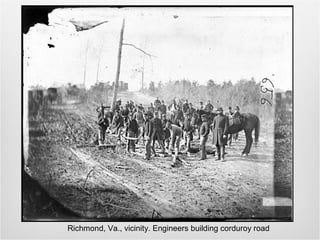
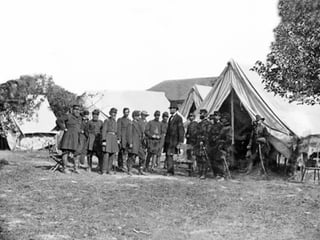
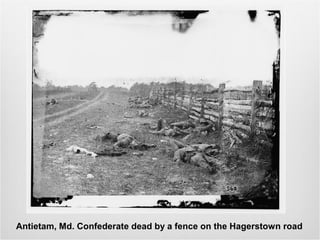
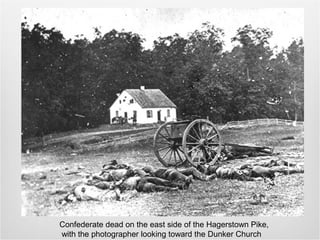
ď‚™ Alexander Gardner took 70 photographs of the
battlefield starting just two days after the battle. This
was the first time an American battlefield had ever
been photographed before the dead had been buried.
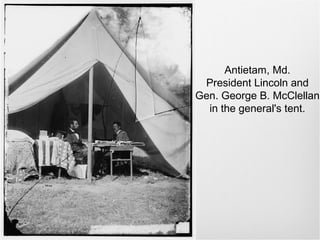
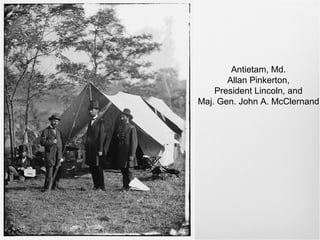
Gardner returned in early October when President
Lincoln visited General George McClellan and the
Army of the Potomac and took another series of
images. Gardner, 41 years old at the time of the battle,
was employed by Mathew Brady who owned of a
photography gallery in Washington, D.C. during the
Civil War.
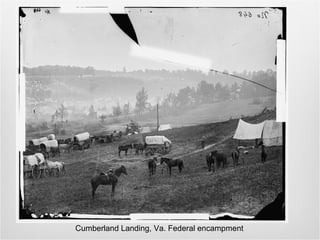
Cumberland Landing, Va. Federal encampment
Falmouth, Va. Drum corps of 61st New York Infantry
Richmond, Va., vicinity. Engineers building corduroy road
Antietam, Md.
President Lincoln and
Gen. George B. McClellan
in the general's tent.
Antietam, Md.
Allan Pinkerton,
President Lincoln, and
Maj. Gen. John A. McClernand
Antietam, Md. Confederate dead by a fence on the Hagerstown road
Confederate dead on the east side of the Hagerstown Pike,
with the photographer looking toward the Dunker Church
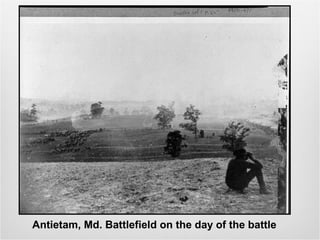
Antietam, Md. Battlefield on the day of the battle
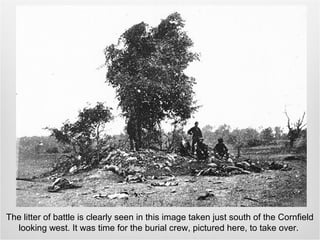
The litter of battle is clearly seen in this image taken just south of the Cornfield
looking west. It was time for the burial crew, pictured here, to take over.
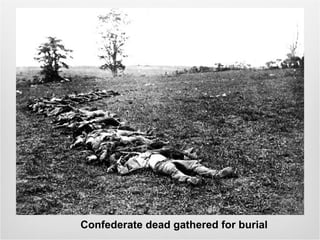
Confederate dead gathered for burial
EmancipationEmancipation
ď‚™ Northerners called for and end to slavery
ď‚™ To punish the South
 To make the soldier’s sacrifice worthwhile
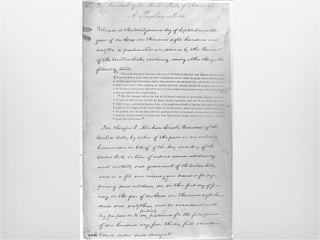
ď‚™ Lincoln issued a Proclamation on September 22, 1862
ď‚™ All slavery would be abolished in states at war with the
Union after January 1, 1863
ď‚™ Did not free slaves in the border states
ď‚™ Used as a threat to the Confederate States
ď‚™ Transformed the entire purpose of the war
VicksburgVicksburg
ď‚™ The last major Confederate stronghold on the Mississippi River
ď‚™ "See what a lot of land these fellows hold, of which Vicksburg is
the key, the war can never be brought to a close until that key is in
our pocket." -Lincoln
ď‚™ A victory here could cut the south in two
ď‚™ Attack from the north was not possible
ď‚™ Forests and swamps prevented it
ď‚™ Grant planned to cross the Mississippi River, march south, re-
cross and attack the city from the south
ď‚™ Once Grant had re-crossed the river, he marched his troops 180
miles in 17 days
ď‚™ 5 battles were fought on the way back to Vicksburg
ď‚™ 7,200 Confederate casualties
VicksburgVicksburg (cont.)(cont.)
ď‚™ May, 1863: Grant launched two major attacks on
Vicksburg
 City’s defenses pushed both attacks back
ď‚™ Grant suffered high casualties
ď‚™ Grant decided that the only way to defeat Vicksburg
was to put it under siege
ď‚™ Cut off all food supplies into the city
ď‚™ Constant artillery bombardment
ď‚™ On July 4, 1863, the Confederates surrendered
Vicksburg
ď‚™ The Confederacy was cut in two and its eventual
defeat was inevitable
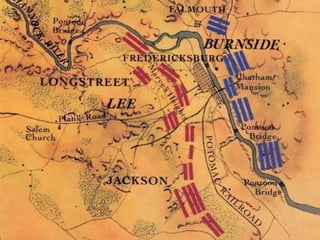
Fredericksburg and ChancellorsvilleFredericksburg and Chancellorsville
ď‚™ Lincoln ordered Burnside to push into the south and
destroy Lee’s army
 On December 13, 1862 Burnside attacked Lee’s army
outside Fredericksburg, Virginia
 Lee’s army was entrenched in the woods
ď‚™ Union troops suffered over 12,000 casualties, twice as
many as the Confederates
ď‚™ Lincoln was upset, he fired Burnside and replaced him
with General Joseph Hooker
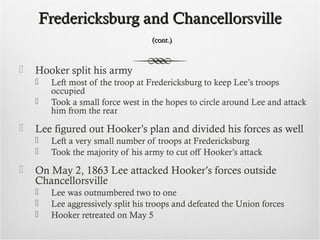
Fredericksburg and ChancellorsvilleFredericksburg and Chancellorsville
(cont.)(cont.)
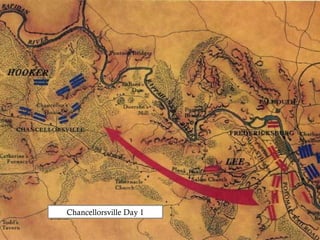
ď‚™ Hooker split his army
 Left most of the troop at Fredericksburg to keep Lee’s troops
occupied
ď‚™ Took a small force west in the hopes to circle around Lee and attack
him from the rear
 Lee figured out Hooker’s plan and divided his forces as well
ď‚™ Left a very small number of troops at Fredericksburg
 Took the majority of his army to cut off Hooker’s attack
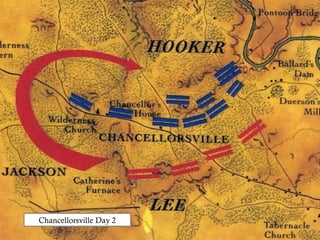
 On May 2, 1863 Lee attacked Hooker’s forces outside
Chancellorsville
ď‚™ Lee was outnumbered two to one
ď‚™ Lee aggressively split his troops and defeated the Union forces
ď‚™ Hooker retreated on May 5
Chancellorsville Day 1
Chancellorsville Day 2
GettysburgGettysburg
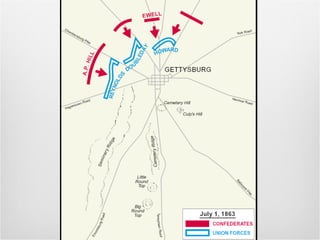
ď‚™ Lee made one last attempt to invade the north
ď‚™ In June 1863, Lee moved his forces into Virginia and pillaged the
countryside
 Hooker was unable to stop Lee’s advanced and Lincoln fired him
ď‚™ Replaced with General George Meade
ď‚™ Lee sent troops into the town of Gettysburg, Pennsylvania in search of
shoes for the troops
ď‚™ When the Confederates entered the town, they encountered Union
Calvary
ď‚™ A small division of Confederated pushed the Union forces out of the
city and into the surrounding hills
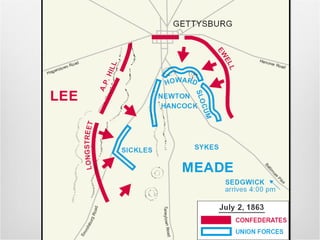
ď‚™ Both sides sent the largest army they could muster to Gettysburg
GettysburgGettysburg (cont.)(cont.)
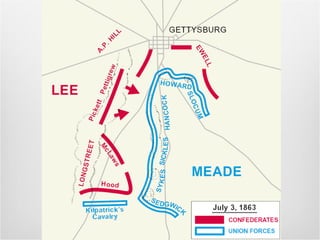
ď‚™ A pivotal battle
ď‚™ Involved more than 160,000 combatants from both sides
ď‚™ Three days of fighting, July 1-3, 1863
ď‚™ 51,000 casualties, the greatest number of any Civil War
battle
ď‚™ The South's last attempt at a full-scale invasion of the North
GettysburgGettysburg (cont.)(cont.)
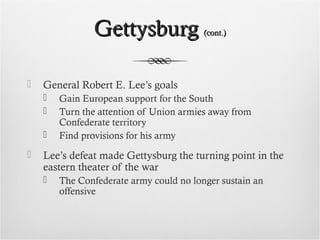
 General Robert E. Lee’s goals
ď‚™ Gain European support for the South
ď‚™ Turn the attention of Union armies away from
Confederate territory
ď‚™ Find provisions for his army
 Lee’s defeat made Gettysburg the turning point in the
eastern theater of the war
ď‚™ The Confederate army could no longer sustain an
offensive
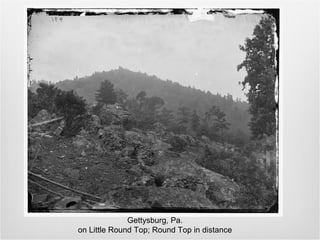
Gettysburg, Pa.
on Little Round Top; Round Top in distance
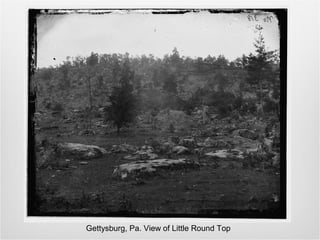
Gettysburg, Pa. View of Little Round Top
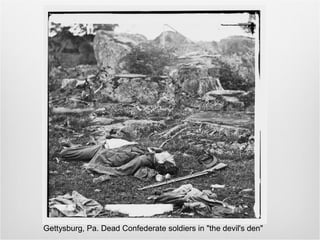
Gettysburg, Pa. Dead Confederate soldiers in "the devil's den"
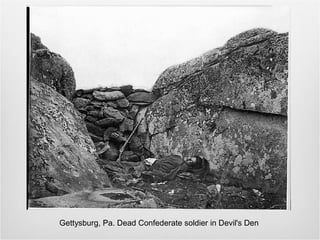
Gettysburg, Pa. Dead Confederate soldier in Devil's Den
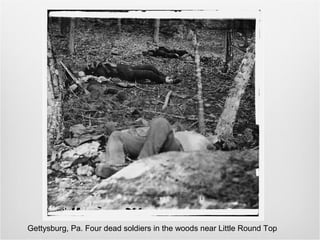
Gettysburg, Pa. Four dead soldiers in the woods near Little Round Top
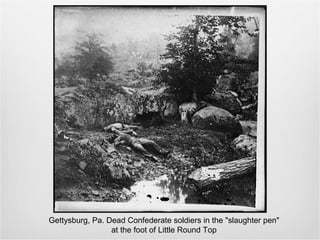
Gettysburg, Pa. Dead Confederate soldiers in the "slaughter pen"
at the foot of Little Round Top
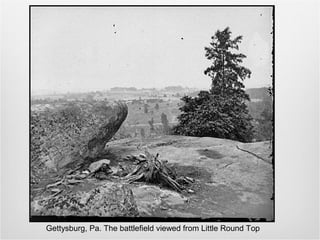
Gettysburg, Pa. The battlefield viewed from Little Round Top
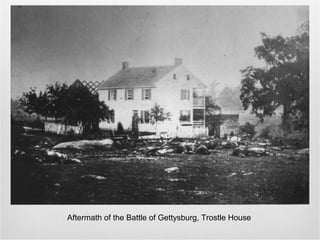
Aftermath of the Battle of Gettysburg, Trostle House
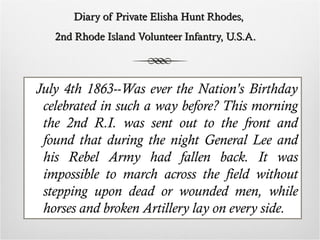
Diary of Private Elisha Hunt Rhodes,Diary of Private Elisha Hunt Rhodes,
2nd Rhode Island Volunteer Infantry, U.S.A.2nd Rhode Island Volunteer Infantry, U.S.A.
July 4th 1863--Was ever the Nation's Birthday
celebrated in such a way before? This morning
the 2nd R.I. was sent out to the front and
found that during the night General Lee and
his Rebel Army had fallen back. It was
impossible to march across the field without
stepping upon dead or wounded men, while
horses and broken Artillery lay on every side.
Grant vs. LeeGrant vs. Lee
ď‚™ President Lincoln rewarded Ulysses S.
Grant’s success in the west with overall
command of all Union forces in the spring of
1864
ď‚™ Grant promised to march south and attack
Lee’s forces whenever and wherever he could
ď‚™ Warfare now continued without pause for re-
supply and reinforcements
Sherman’s March to the SeaSherman’s March to the Sea
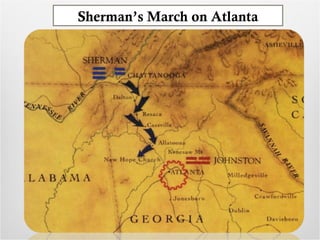
ď‚™ General Sherman marched his troops from Atlanta,
Georgia to Savannah on the coast
ď‚™ He destroyed everything in his path
 His goal was to “make old and young, rich and poor,
feel the hand of war”
ď‚™ Felt that all people in the south should be punished for
the war
ď‚™ If all people in the south were demoralized, they would
call for an end to the war
Sherman’s March on Atlanta
You cannot qualify war in harsher terms
than I will. War is cruelty, and you
cannot refine it; and those who brought
war into our country deserve all the
curses and maledictions a people can
pour out.
--William Tecumseh Sherman
Letter to the city of Atlanta, 1864
Election of 1864Election of 1864
ď‚™ Democrats nominated George McClellan
ď‚™ Lincoln won 55% of the vote
ď‚™ Interpreted it as a mandate to end slavery
 On January 13, 1865, with Lincoln’s help, the
thirteenth amendment to the Constitution was passed
by Congress
ď‚™ Banned slavery in the United States
SurrenderSurrender
 Lee’s forces were surrounded near the Appomattox
Courthouse in Virginia
 “There is nothing left for me to do but go and see General
Grant, and I would rather die a thousand deaths.” –General
Robert E. Lee
ď‚™ Lee surrendered at the courthouse on April 9, 1865
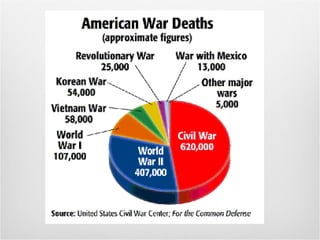
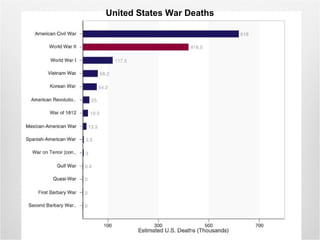
United States War Deaths
Lincoln is AssassinatedLincoln is Assassinated
 Lincoln’s plans to incorporate African Americans into
the new Southern governments made him many
enemies
 On April 14, 1865, Lincoln went to the Ford’s Theater
with his wife
ď‚™ During the third act of the play, John Wilkes Booth
snuck up behind Lincoln and shot him in the head
Aftermath of the WarAftermath of the War
ď‚™ The south was economically devastated
ď‚™ Bringing the southern states back into the Union will
be a challenge
ď‚™ What will be the status of the millions of freed slaves?
 The post Civil War era is known as “Reconstruction”
The Civil War

The Civil War

  • 2.
    Source: The FreeportWide Awake Date: November 17, 1860, p. 3 Cartoonist: Unknown
  • 3.
    SecessionSecession  South Carolina After Lincoln’s election there was a special convention  The convention voted unanimously to secede  Official on Dec. 20, 1860, before Lincoln even took office  By February 1, 1861, six more states joined SC  Mississippi: Jan. 9, 1861  Florida: Jan. 10, 1861  Alabama: Jan. 11, 1861  Georgia: Jan. 19, 1861  Louisiana: Jan. 26, 1861  Texas: Feb. 1, 1861
  • 4.
    Attempt at CompromiseAttemptat Compromise ď‚™ Congress tried to get the Southern representatives back to discuss a compromise ď‚™ Southern states refused to talk and seized all federal property in their states ď‚™ A few pieces of federal property remained in the union ď‚™ Fort Sumter in Charleston Harbor, South Carolina ď‚™ Fort Pickens in Pensacola Harbor, Florida ď‚™ A couple of islands off the coast of Florida
  • 5.
    Lincoln’s Inaugural AddressLincoln’sInaugural Address  March 4, 1861  If you were preparing your inaugural address, what policy would you choose and why?  Abandon the Forts Under Your Control?  Reclaim the Forts Taken by Southern States?  Hold Only Those Forts Still in Federal Hands?  Or Choose Some Other Course of Action?
  • 6.
    Lincoln’s Inaugural AddressLincoln’sInaugural Address  "The power confided to me, will be used to hold, occupy, and possess the property and places belonging to the Government.“  “…there will be no invasion, no using of force against or among the people anywhere."  He said nothing about reclaiming property now under Confederate control  He explicitly offered reassurances to the South that slavery was safe in its present limits and that he would enforce the fugitive slave law  Resistance to the federal government constituted rebellion
  • 7.
    Crittenden’s CompromiseCrittenden’s Compromise Proposed by Kentucky Senator John J. Crittenden  Proposed constitutional amendments  Guarantee slavery where it already existed  Extend the Missouri Compromise to California  Lincoln told Congressmen to stay strong  The compromise was defeated
  • 8.
    Peace AttemptPeace Attempt ď‚™Virginia, a slave state still in the union, hosted a peace conference ď‚™ 21 delegates attended ď‚™ Mostly Northern and border states ď‚™ NO delegates from the secession states ď‚™ Resolved nothing
  • 9.
    The ConfederacyThe Confederacy ď‚™Delegates from secession states met in Montgomery, Alabama ď‚™ They declared themselves a new country ď‚™ The Confederate States of America was formed ď‚™ A constitution was drafted that guaranteed the right to slavery ď‚™ Jefferson Davis was chosen as president
  • 10.
    Fort SumterFort Sumter ď‚™Lincoln vowed to protect all federal property in the south ď‚™ Davis vowed to take Fort Sumter before its defenses could be strengthened ď‚™ Davis demanded the fort surrender by April 12, 1861, they did not ď‚™ Confederate forces fired cannons at the fort for 34 hours before it surrendered ď‚™ The Civil War had begun
  • 11.
    A picture ofFort Sumter soon after the original Confederate flag was raised on April 13, 1861. A picture of Fort Sumter soon after the original Confederate flag was raised on April 13, 1861.
  • 12.
    The Rest ofthe SouthThe Rest of the South SecedesSecedes  Upper south slave states felt they had no choice but to join the Confederacy  Virginia on April 17, 1861  Robert E. Lee is appointed as Commander of Virginia’s Army  Gained fame as a brilliant military leader in the U.S. Marine Corps  Arkansas, N. Carolina, and Tennessee by early June, 1861
  • 13.
  • 17.
  • 18.
    Lincoln Strikes FirstLincolnStrikes First ď‚™ Lincoln was under pressure to attack quickly ď‚™ Most northerners felt that a quick attack would make the south realize their mistake and force them to compromise ď‚™ General P.G.T. Beauregard was gathering Confederate troops 25 miles south of Washington D.C., near Manassas Junction, VA ď‚™ A strategic railroad center in northern Virginia ď‚™ Lincoln approved an attack on these forces ď‚™ Lincoln hoped a victory would bring an end to the war
  • 19.
    First Battle ofBull RunFirst Battle of Bull Run  July 21, 1861  Union forces pushed the Confederates across a stream called Bull Run  A large force of Confederate reinforcements lead by General Thomas J. Jackson arrived from Virginia  Jackson’s men gave a morale boost to the Confederates and they stopped retreating  One Confederate commander yelled, “There is Jackson standing like a stone wall!”  From then on, the general was known as “Stonewall” Jackson  Union troops retreated when Confederate reinforcements arrived  The first battle of the war was over and the South had won
  • 20.
    The Henry House,as it appeared soon after the First Battle of Bull Run
  • 21.
    The Stone House,March 1862. Served as hospital following the battle.
  • 22.
    Results of BullRunResults of Bull Run ď‚™ Lincoln initially thought that a force of 75,000 men would be needed for a period of three months ď‚™ After Bull Run, Lincoln approved the enlistment of 500,000 men for three years ď‚™ Both the north and the south instituted a draft to raise the necessary troops
  • 24.
    Naval WarNaval War Lincoln’s goal was to blockade all Southern ports  By the spring of 1862, all but two Confederate ports were sealed off  The South used “blockade runners”  Small fast ships that smuggled goods  The Confederacy used warships operating out of foreign ports to attack Northern merchant ships
  • 25.
    War in theWestWar in the West ď‚™ Union General Ulysses S. Grant began a campaign to seize control of the Cumberland and Tennessee Rivers ď‚™ Control would give Union forces a river route into Confederate territory ď‚™ Grant seized Fort Henry and Fort Donelson giving him control of all of Kentucky and Western Tennessee
  • 26.
    War in theWestWar in the West  Shiloh  Grant’s forces were camped out near a small church named Shiloh, outside Corinth, Mississippi  On April 6, 1862, Confederate forces launched a surprise attack  Grant was extremely aggressive on the second day of the battle and forced the Confederates to retreat  20,000 troops were killed or wounded  Newspapers demanded Grant be fired for high casualties  Lincoln said, “I can’t spare this man; he fights.”
  • 27.
  • 29.
    War in theEastWar in the East  Eastern Union forces were lead by General George B. McClellan  Took over after General Irwin McDowell’s defeat at Bull Run  Peninsula Campaign  McClellan took his forces up the James River, southeast of Yorktown, Virginia  McClellan made some tactical errors and lost a battle outside of Richmond  The Confederate commander was wounded in the fighting and was replaced by General Robert E. Lee
  • 30.
  • 31.
    War in theEastWar in the East  Seven Day’s Battle  McClellan was attacked by Lee on the Peninsula  Lee forced McClellan to retreat all the way to the sea  Lincoln ordered McClellan to evacuate the peninsula and return to Washington  Over 30,000 casualties in the seven days of fighting
  • 33.
    The Second Battleof Bull RunThe Second Battle of Bull Run ď‚™ Lee attacked the Union forces defending Washington D.C. ď‚™ The majority of the fighting took place at the same Bull Run creek ď‚™ Again, Confederate forces prevailed and Lee had entered Union territory ď‚™ Confederate forces were only 20 miles from D.C.
  • 35.
    AntietamAntietam  Lee thoughtthat only an invasion would convince the north to recognize the Confederacy’s independence  Lee’s troops congregated near Sharpsville, Maryland  McClellan’s troops gathered near Antietam Creek, east of Lee  McClellan attacked on Sept. 17, 1862  The bloodiest day in American History  8,000 dead  23,000 wounded
  • 36.
    AntietamAntietam  Lee’s retreatmade Britain rethink its recognition of the Confederacy  McClellan could have chased Lee and destroyed his entire army, but was too cautious  Lincoln was disappointed with McClellan’s performance and fired him  General Ambrose Burnside replaced McClellan  Antietam convinced Lincoln to end slavery
  • 39.
    Battlefield PhotographsBattlefield Photographs ď‚™Alexander Gardner took 70 photographs of the battlefield starting just two days after the battle. This was the first time an American battlefield had ever been photographed before the dead had been buried. Gardner returned in early October when President Lincoln visited General George McClellan and the Army of the Potomac and took another series of images. Gardner, 41 years old at the time of the battle, was employed by Mathew Brady who owned of a photography gallery in Washington, D.C. during the Civil War.
  • 41.
    Cumberland Landing, Va.Federal encampment
  • 42.
    Falmouth, Va. Drumcorps of 61st New York Infantry
  • 43.
    Richmond, Va., vicinity.Engineers building corduroy road
  • 44.
    Antietam, Md. President Lincolnand Gen. George B. McClellan in the general's tent.
  • 45.
    Antietam, Md. Allan Pinkerton, PresidentLincoln, and Maj. Gen. John A. McClernand
  • 48.
    Antietam, Md. Confederatedead by a fence on the Hagerstown road
  • 49.
    Confederate dead onthe east side of the Hagerstown Pike, with the photographer looking toward the Dunker Church
  • 50.
    Antietam, Md. Battlefieldon the day of the battle
  • 51.
    The litter ofbattle is clearly seen in this image taken just south of the Cornfield looking west. It was time for the burial crew, pictured here, to take over.
  • 52.
  • 53.
    EmancipationEmancipation  Northerners calledfor and end to slavery  To punish the South  To make the soldier’s sacrifice worthwhile  Lincoln issued a Proclamation on September 22, 1862  All slavery would be abolished in states at war with the Union after January 1, 1863  Did not free slaves in the border states  Used as a threat to the Confederate States  Transformed the entire purpose of the war
  • 55.
    VicksburgVicksburg ď‚™ The lastmajor Confederate stronghold on the Mississippi River ď‚™ "See what a lot of land these fellows hold, of which Vicksburg is the key, the war can never be brought to a close until that key is in our pocket." -Lincoln ď‚™ A victory here could cut the south in two ď‚™ Attack from the north was not possible ď‚™ Forests and swamps prevented it ď‚™ Grant planned to cross the Mississippi River, march south, re- cross and attack the city from the south ď‚™ Once Grant had re-crossed the river, he marched his troops 180 miles in 17 days ď‚™ 5 battles were fought on the way back to Vicksburg ď‚™ 7,200 Confederate casualties
  • 56.
    VicksburgVicksburg (cont.)(cont.)  May,1863: Grant launched two major attacks on Vicksburg  City’s defenses pushed both attacks back  Grant suffered high casualties  Grant decided that the only way to defeat Vicksburg was to put it under siege  Cut off all food supplies into the city  Constant artillery bombardment  On July 4, 1863, the Confederates surrendered Vicksburg  The Confederacy was cut in two and its eventual defeat was inevitable
  • 57.
    Fredericksburg and ChancellorsvilleFredericksburgand Chancellorsville  Lincoln ordered Burnside to push into the south and destroy Lee’s army  On December 13, 1862 Burnside attacked Lee’s army outside Fredericksburg, Virginia  Lee’s army was entrenched in the woods  Union troops suffered over 12,000 casualties, twice as many as the Confederates  Lincoln was upset, he fired Burnside and replaced him with General Joseph Hooker
  • 59.
    Fredericksburg and ChancellorsvilleFredericksburgand Chancellorsville (cont.)(cont.)  Hooker split his army  Left most of the troop at Fredericksburg to keep Lee’s troops occupied  Took a small force west in the hopes to circle around Lee and attack him from the rear  Lee figured out Hooker’s plan and divided his forces as well  Left a very small number of troops at Fredericksburg  Took the majority of his army to cut off Hooker’s attack  On May 2, 1863 Lee attacked Hooker’s forces outside Chancellorsville  Lee was outnumbered two to one  Lee aggressively split his troops and defeated the Union forces  Hooker retreated on May 5
  • 60.
  • 61.
  • 62.
    GettysburgGettysburg  Lee madeone last attempt to invade the north  In June 1863, Lee moved his forces into Virginia and pillaged the countryside  Hooker was unable to stop Lee’s advanced and Lincoln fired him  Replaced with General George Meade  Lee sent troops into the town of Gettysburg, Pennsylvania in search of shoes for the troops  When the Confederates entered the town, they encountered Union Calvary  A small division of Confederated pushed the Union forces out of the city and into the surrounding hills  Both sides sent the largest army they could muster to Gettysburg
  • 65.
    GettysburgGettysburg (cont.)(cont.) ď‚™ Apivotal battle ď‚™ Involved more than 160,000 combatants from both sides ď‚™ Three days of fighting, July 1-3, 1863 ď‚™ 51,000 casualties, the greatest number of any Civil War battle ď‚™ The South's last attempt at a full-scale invasion of the North
  • 66.
    GettysburgGettysburg (cont.)(cont.)  GeneralRobert E. Lee’s goals  Gain European support for the South  Turn the attention of Union armies away from Confederate territory  Find provisions for his army  Lee’s defeat made Gettysburg the turning point in the eastern theater of the war  The Confederate army could no longer sustain an offensive
  • 68.
    Gettysburg, Pa. on LittleRound Top; Round Top in distance
  • 69.
    Gettysburg, Pa. Viewof Little Round Top
  • 70.
    Gettysburg, Pa. DeadConfederate soldiers in "the devil's den"
  • 71.
    Gettysburg, Pa. DeadConfederate soldier in Devil's Den
  • 72.
    Gettysburg, Pa. Fourdead soldiers in the woods near Little Round Top
  • 73.
    Gettysburg, Pa. DeadConfederate soldiers in the "slaughter pen" at the foot of Little Round Top
  • 74.
    Gettysburg, Pa. Thebattlefield viewed from Little Round Top
  • 75.
    Aftermath of theBattle of Gettysburg, Trostle House
  • 76.
    Diary of PrivateElisha Hunt Rhodes,Diary of Private Elisha Hunt Rhodes, 2nd Rhode Island Volunteer Infantry, U.S.A.2nd Rhode Island Volunteer Infantry, U.S.A. July 4th 1863--Was ever the Nation's Birthday celebrated in such a way before? This morning the 2nd R.I. was sent out to the front and found that during the night General Lee and his Rebel Army had fallen back. It was impossible to march across the field without stepping upon dead or wounded men, while horses and broken Artillery lay on every side.
  • 78.
    Grant vs. LeeGrantvs. Lee  President Lincoln rewarded Ulysses S. Grant’s success in the west with overall command of all Union forces in the spring of 1864  Grant promised to march south and attack Lee’s forces whenever and wherever he could  Warfare now continued without pause for re- supply and reinforcements
  • 79.
    Sherman’s March tothe SeaSherman’s March to the Sea  General Sherman marched his troops from Atlanta, Georgia to Savannah on the coast  He destroyed everything in his path  His goal was to “make old and young, rich and poor, feel the hand of war”  Felt that all people in the south should be punished for the war  If all people in the south were demoralized, they would call for an end to the war
  • 80.
  • 81.
    You cannot qualifywar in harsher terms than I will. War is cruelty, and you cannot refine it; and those who brought war into our country deserve all the curses and maledictions a people can pour out. --William Tecumseh Sherman Letter to the city of Atlanta, 1864
  • 83.
    Election of 1864Electionof 1864  Democrats nominated George McClellan  Lincoln won 55% of the vote  Interpreted it as a mandate to end slavery  On January 13, 1865, with Lincoln’s help, the thirteenth amendment to the Constitution was passed by Congress  Banned slavery in the United States
  • 84.
    SurrenderSurrender  Lee’s forceswere surrounded near the Appomattox Courthouse in Virginia  “There is nothing left for me to do but go and see General Grant, and I would rather die a thousand deaths.” –General Robert E. Lee  Lee surrendered at the courthouse on April 9, 1865
  • 86.
  • 87.
    Lincoln is AssassinatedLincolnis Assassinated  Lincoln’s plans to incorporate African Americans into the new Southern governments made him many enemies  On April 14, 1865, Lincoln went to the Ford’s Theater with his wife  During the third act of the play, John Wilkes Booth snuck up behind Lincoln and shot him in the head
  • 88.
    Aftermath of theWarAftermath of the War  The south was economically devastated  Bringing the southern states back into the Union will be a challenge  What will be the status of the millions of freed slaves?  The post Civil War era is known as “Reconstruction”