Historical Background The framers of the Constitution disagreed on how to elect a president—congressional selection or direct popular election. The electoral college was a compromise, combining features of both approaches.
State Electoral Votes Each state is entitled to as many electoral votes as the sum of its representation in the U.S. House and Senate Texas: 32 House members plus 2 senators = 34 electoral votes Arkansas: 4 House members plus 2 senators = 6 electoral votes Total: 435 House members plus 100 senators plus 3 electors for the District of Columbia = 538 electoral votes
Selection of Electors Each state determines the manner of selection All but two states use a winner-take-all statewide election system If Candidate A gets the most votes in a state, Candidate A gets the whole slate of electors. Maine and Nebraska award electors based on the statewide vote and the vote in each of the state’s congressional districts.
The Real Election In December, the electors gather in their respective state capitols to cast ballots for president and vice president.  In January, Congress convenes, opens the ballots received from each state, and announces the official outcome.
What if no one receives a majority? To win, a candidate needs a majority, that is, 270 electoral votes. If no candidate has a majority, the House selects the president from among the three presidential candidates with the most electoral votes.  Each state delegation has one vote.  This last happened in 1824 when Congress chose John Quincy Adams over Andrew Jackson and William Crawford. The Senate selects the vice president from the top two vice-presidential candidates.
Popular Vote vs. the Electoral Vote In a close race, the popular vote winner may not win the electoral college.  One candidate may win states by lopsided margins while the other wins states by narrow margins.  Electoral vote winners who lost the popular vote Bush over Gore in 2000 Benjamin Harrison over Grover Cleveland in 1888 Rutherford B. Hayes over Samuel Tilden in 1876
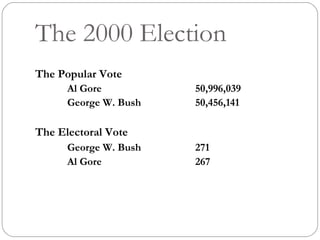
The 2000 Election   The Popular Vote Al Gore 50,996,039 George W. Bush  50,456,141 The Electoral Vote George W. Bush 271 Al Gore 267
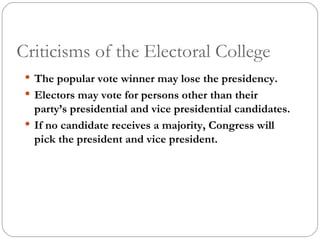
Criticisms of the Electoral College The popular vote winner may lose the presidency. Electors may vote for persons other than their party’s presidential and vice presidential candidates. If no candidate receives a majority, Congress will pick the president and vice president.
Review Question North Carolina has 13 U.S. representatives.  How many electoral votes does the state have?
Answer North Carolina has 15 electoral votes.  The formula is the number of U.S. senators, which is two for each state, plus the number of U.S. representatives.  Two plus 13 equals 15.
Review Question Does it matter whether a candidate carries a state by a few votes or a lot of votes?
Answer No.  A candidate receives all of a state’s electoral votes whether the candidate carries the state by one vote or a million votes.  In every state except Nebraska and Maine, the race is winner take all.
Discussion Question How does the electoral college impact candidate strategy in presidential election campaigns?
Discussion Question Do you favor or oppose replacing the electoral college with a different system for selecting a president?  If you support reform, what sort of system would you prefer?

Electoral College

  • 1.
  • 2.
    Historical Background Theframers of the Constitution disagreed on how to elect a president—congressional selection or direct popular election. The electoral college was a compromise, combining features of both approaches.
  • 3.
    State Electoral VotesEach state is entitled to as many electoral votes as the sum of its representation in the U.S. House and Senate Texas: 32 House members plus 2 senators = 34 electoral votes Arkansas: 4 House members plus 2 senators = 6 electoral votes Total: 435 House members plus 100 senators plus 3 electors for the District of Columbia = 538 electoral votes
  • 4.
    Selection of ElectorsEach state determines the manner of selection All but two states use a winner-take-all statewide election system If Candidate A gets the most votes in a state, Candidate A gets the whole slate of electors. Maine and Nebraska award electors based on the statewide vote and the vote in each of the state’s congressional districts.
  • 5.
    The Real ElectionIn December, the electors gather in their respective state capitols to cast ballots for president and vice president. In January, Congress convenes, opens the ballots received from each state, and announces the official outcome.
  • 6.
    What if noone receives a majority? To win, a candidate needs a majority, that is, 270 electoral votes. If no candidate has a majority, the House selects the president from among the three presidential candidates with the most electoral votes. Each state delegation has one vote. This last happened in 1824 when Congress chose John Quincy Adams over Andrew Jackson and William Crawford. The Senate selects the vice president from the top two vice-presidential candidates.
  • 7.
    Popular Vote vs.the Electoral Vote In a close race, the popular vote winner may not win the electoral college. One candidate may win states by lopsided margins while the other wins states by narrow margins. Electoral vote winners who lost the popular vote Bush over Gore in 2000 Benjamin Harrison over Grover Cleveland in 1888 Rutherford B. Hayes over Samuel Tilden in 1876
  • 8.
    The 2000 Election The Popular Vote Al Gore 50,996,039 George W. Bush 50,456,141 The Electoral Vote George W. Bush 271 Al Gore 267
  • 9.
    Criticisms of theElectoral College The popular vote winner may lose the presidency. Electors may vote for persons other than their party’s presidential and vice presidential candidates. If no candidate receives a majority, Congress will pick the president and vice president.
  • 10.
    Review Question NorthCarolina has 13 U.S. representatives. How many electoral votes does the state have?
  • 11.
    Answer North Carolinahas 15 electoral votes. The formula is the number of U.S. senators, which is two for each state, plus the number of U.S. representatives. Two plus 13 equals 15.
  • 12.
    Review Question Doesit matter whether a candidate carries a state by a few votes or a lot of votes?
  • 13.
    Answer No. A candidate receives all of a state’s electoral votes whether the candidate carries the state by one vote or a million votes. In every state except Nebraska and Maine, the race is winner take all.
  • 14.
    Discussion Question Howdoes the electoral college impact candidate strategy in presidential election campaigns?
  • 15.
    Discussion Question Doyou favor or oppose replacing the electoral college with a different system for selecting a president? If you support reform, what sort of system would you prefer?