THE BUSINESS CYCLE
 BY:
SRAVAN DM-13-092
MANASA DARA DM-13-127
NIKITHA.P DM-13-107
YELLARI DM-13-090
VIJAY BOLLA DM-13-101
WHAT IS A BUSINESS CYCLE ?
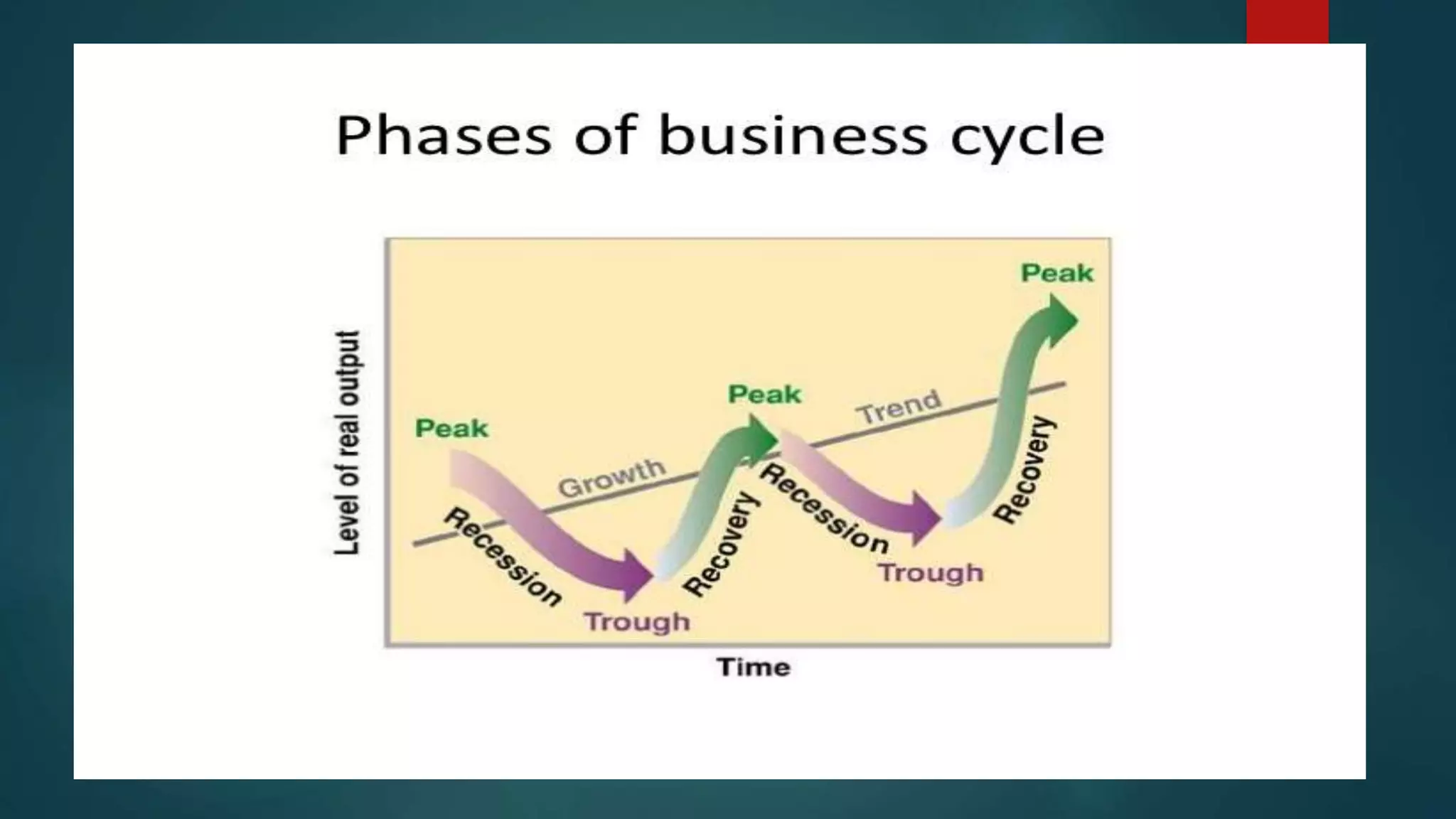
 A business cycle refers to periods of expansion
and contraction. A peak is the high point
following a period of economic expansion. A
trough is the low point following a period of
economic decline.
CHARACTERISTICS OF BUSINESS CYCLE
 Occurs periodically
 International in character
 Process is cumulative
 Cycles will be similar but not identical
BUSINESS CYCLE
In this lesson, students will be able to identify
characteristics of the business cycle. Students will be
able to identify and/or define the following terms:
Business cycle
Expansion
Peak
Contraction
Trough
FOUR PHASES OF BUSINESS CYCLE
 Economic Boom
 Recession – two or more consecutive quarters of
decline in the GDP.
 Depression – A severe recession.
 Recovery – When the economy stabilizes and starts
to grow. This leads to an Economic Boom.
BOOM
 The business outlook is extremely optimistic.
 The important features of prosperity are:
 a high level of output, trade, employment and
income,
a high level of effective demand and high marginal
efficiency of capital,
a large expansion of bank credit, and
a rising trend in prices, profits and interest rates.
RECESSION
 During recessions, many macro economic indicators
vary in a similar way.
 Production, as measured by gross domestic
product(GDP), employment, investment pending,
capacity utilization, household incomes, business
profits, and inflation all fall.
 While bankruptcies and the unemployment rate rise.
DEPRESSION
 The phase of depression economic activity is at its
low. Wages, cost, price are very low.
 There is a massive unemployment leading to a fall in
the aggregate income of the people.
 This brings down the purchasing power of the
community.
 General demand falls faster than production.
 The piled – up stock are sold at very high rates of
discount leading to heavy loss to the firms.
RECOVERY
 The raising price of an asset
 Increased economic activity during a business cycle,
resulting in growth in the gross domestic product.
 Collection of all or a portion of a debt previously
considered uncollectible.
 Valuable materials remaining after processing.
 Proceeds from the sale of an asset that represent
depreciation that has already been taken
THEORIES OF BUSINESS CYCLE
 Keynesian Theory
Fluctuations in aggregate demand cause the
economy to come to short run equilibrium at levels that
are different from the full employment rate of output.
These fluctuations express themselves as the
observed business cycles.
THEORIES OF BUSINESS CYCLE
 Real business cycle theory…….
Economic crisis and fluctuations cannot stem
from a monetary shock, only from an external shock,
such as an innovation.
HOW WE MEASURE BUSINESS CYCLE ?
 The business cycle is the periodic but irregular up-
and-down movements in economic activity,
measured by fluctuations in Real GDP and other
macroeconomic variables.
QUESTIONS ???
The business cycle

The business cycle

  • 1.
    THE BUSINESS CYCLE BY: SRAVAN DM-13-092 MANASA DARA DM-13-127 NIKITHA.P DM-13-107 YELLARI DM-13-090 VIJAY BOLLA DM-13-101
  • 2.
    WHAT IS ABUSINESS CYCLE ?  A business cycle refers to periods of expansion and contraction. A peak is the high point following a period of economic expansion. A trough is the low point following a period of economic decline.
  • 3.
    CHARACTERISTICS OF BUSINESSCYCLE  Occurs periodically  International in character  Process is cumulative  Cycles will be similar but not identical
  • 4.
    BUSINESS CYCLE In thislesson, students will be able to identify characteristics of the business cycle. Students will be able to identify and/or define the following terms: Business cycle Expansion Peak Contraction Trough
  • 5.
    FOUR PHASES OFBUSINESS CYCLE  Economic Boom  Recession – two or more consecutive quarters of decline in the GDP.  Depression – A severe recession.  Recovery – When the economy stabilizes and starts to grow. This leads to an Economic Boom.
  • 7.
    BOOM  The businessoutlook is extremely optimistic.  The important features of prosperity are:  a high level of output, trade, employment and income, a high level of effective demand and high marginal efficiency of capital, a large expansion of bank credit, and a rising trend in prices, profits and interest rates.
  • 8.
    RECESSION  During recessions,many macro economic indicators vary in a similar way.  Production, as measured by gross domestic product(GDP), employment, investment pending, capacity utilization, household incomes, business profits, and inflation all fall.  While bankruptcies and the unemployment rate rise.
  • 9.
    DEPRESSION  The phaseof depression economic activity is at its low. Wages, cost, price are very low.  There is a massive unemployment leading to a fall in the aggregate income of the people.  This brings down the purchasing power of the community.  General demand falls faster than production.  The piled – up stock are sold at very high rates of discount leading to heavy loss to the firms.
  • 10.
    RECOVERY  The raisingprice of an asset  Increased economic activity during a business cycle, resulting in growth in the gross domestic product.  Collection of all or a portion of a debt previously considered uncollectible.  Valuable materials remaining after processing.  Proceeds from the sale of an asset that represent depreciation that has already been taken
  • 11.
    THEORIES OF BUSINESSCYCLE  Keynesian Theory Fluctuations in aggregate demand cause the economy to come to short run equilibrium at levels that are different from the full employment rate of output. These fluctuations express themselves as the observed business cycles.
  • 12.
    THEORIES OF BUSINESSCYCLE  Real business cycle theory……. Economic crisis and fluctuations cannot stem from a monetary shock, only from an external shock, such as an innovation.
  • 13.
    HOW WE MEASUREBUSINESS CYCLE ?  The business cycle is the periodic but irregular up- and-down movements in economic activity, measured by fluctuations in Real GDP and other macroeconomic variables.
  • 14.