BUSINESS CYCLE
UNDER THE GUIDENCE FROM
SUNDAR B N
Assit.Prof.& Co-ordinator of M.com
GFGC Women’s college
Holenarasipura
Presented by
LATHA M
1 st M.com
contents
 Meaning & Definition
 Fluctuations or stages of the Business cycle
 Reference
2
MEANING AND DEFINITION :
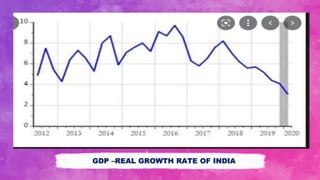
 A Business cycle a cycle of fluctuations in the “Gross
Domestic Product” (GDP) around its long term natural
growth rate.
 It explains the expansion and contraction in economic
activity that an economy experiences over time.
DEFINITION
 The business cycle is a term used by economists to
describe the increase and decrease /downward and upward
fluctuations of the productivity level of the economy
,along with its natural growth rate over along period.
 Business cycle is also called “Trade cycle” and “Economic
cycle”.
5
GDP –REAL GROWTH RATE OF INDIA
FLUCTUATIONS OF BUSINESS CYCLE
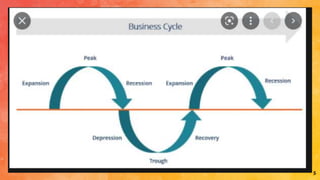
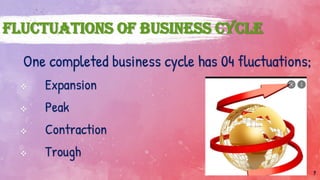
One completed business cycle has 04 fluctuations;
 Expansion
 Peak
 Contraction
 Trough
7
01.EXPANSION
 The first stage in the business cycle is Expansion.
 In this stage there is an increase in positive economic indicators
such as employment ,income ,output, wages, profits demand and
supply of goods and services, Debtors are generally paying their
debts on time. The velocity of the money supply is high, and
investment is high. this process continues as long as economic
conditions are favourable for expansion.
8
02.PEAK
 The economy then reaches a saturation point, or peak.
 It is the second stage of the business cycle, the maximum limit of
growth is attained.
 The economic indicators do not grow further and are at their
highest. Prices are at their peak. This stage marks the reversal
point in the trend of economic growth. consumers tend to
restructure their budgets at this point.
03.RECESSION
 The recession is the stage that follows the peak phase.
 The demand for goods and services starts declining rapidly and
steadily in this phase. producers do not notice the decrease in
demand instantly and go on producing, which creates a situation
of excess supply in the market .prices tend to fall. All positive
economic indicators such as income, output, wages,
etc….,consequently start to fall.
04.DEPRESSION
 Depression is the most fearful stage of a economic
cycle.
 There is a commensurate rise in unemployment .the
growth in the economy continue to decline ,and as
this falls below the steady growth line ,the stage is
called depression.
O5.TROUGH
 In the depression stage ,the economy’s growth rate becomes
negative .There is further decline until the prices of factors, as
well as the demand and supply of good and services ,reach their
lowest point. The economy eventually reaches the trough. It is
the negative saturation point for an economy .There is extensive
depletion of national income and expenditure.
12
06.RECOVERY
 After this stage, the economy comes to the stage of recovery.In
this phase , there is a turnaround from the trough and the
economy starts recovering from the negative growth rate.
Demand starts to pick up due to the lowest prices and
consequently , supply starts reacting too. The economy develops
a positive attitude towards investment and employment and
production starts increasing.
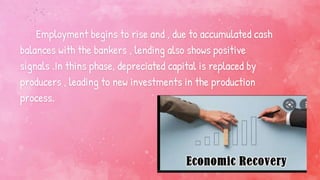
Employment begins to rise and , due to accumulated cash
balances with the bankers , lending also shows positive
signals .In thins phase, depreciated capital is replaced by
producers , leading to new investments in the production
process.
REFERENCE:
✔ https://corporatefinanceinstitute.com/resources/knowledge/econ
omics/business-cycle/
✔ https://www.slideshare.net/anuragnvs/phases-of-bisiness-cycle
✔ https://www.thebalance.com/what-is-the-business-cycle-3305912
15
16

Business cycle

  • 1.
    BUSINESS CYCLE UNDER THEGUIDENCE FROM SUNDAR B N Assit.Prof.& Co-ordinator of M.com GFGC Women’s college Holenarasipura Presented by LATHA M 1 st M.com
  • 2.
    contents  Meaning &Definition  Fluctuations or stages of the Business cycle  Reference 2
  • 3.
    MEANING AND DEFINITION:  A Business cycle a cycle of fluctuations in the “Gross Domestic Product” (GDP) around its long term natural growth rate.  It explains the expansion and contraction in economic activity that an economy experiences over time.
  • 4.
    DEFINITION  The businesscycle is a term used by economists to describe the increase and decrease /downward and upward fluctuations of the productivity level of the economy ,along with its natural growth rate over along period.  Business cycle is also called “Trade cycle” and “Economic cycle”.
  • 5.
  • 6.
    GDP –REAL GROWTHRATE OF INDIA
  • 7.
    FLUCTUATIONS OF BUSINESSCYCLE One completed business cycle has 04 fluctuations;  Expansion  Peak  Contraction  Trough 7
  • 8.
    01.EXPANSION  The firststage in the business cycle is Expansion.  In this stage there is an increase in positive economic indicators such as employment ,income ,output, wages, profits demand and supply of goods and services, Debtors are generally paying their debts on time. The velocity of the money supply is high, and investment is high. this process continues as long as economic conditions are favourable for expansion. 8
  • 9.
    02.PEAK  The economythen reaches a saturation point, or peak.  It is the second stage of the business cycle, the maximum limit of growth is attained.  The economic indicators do not grow further and are at their highest. Prices are at their peak. This stage marks the reversal point in the trend of economic growth. consumers tend to restructure their budgets at this point.
  • 10.
    03.RECESSION  The recessionis the stage that follows the peak phase.  The demand for goods and services starts declining rapidly and steadily in this phase. producers do not notice the decrease in demand instantly and go on producing, which creates a situation of excess supply in the market .prices tend to fall. All positive economic indicators such as income, output, wages, etc….,consequently start to fall.
  • 11.
    04.DEPRESSION  Depression isthe most fearful stage of a economic cycle.  There is a commensurate rise in unemployment .the growth in the economy continue to decline ,and as this falls below the steady growth line ,the stage is called depression.
  • 12.
    O5.TROUGH  In thedepression stage ,the economy’s growth rate becomes negative .There is further decline until the prices of factors, as well as the demand and supply of good and services ,reach their lowest point. The economy eventually reaches the trough. It is the negative saturation point for an economy .There is extensive depletion of national income and expenditure. 12
  • 13.
    06.RECOVERY  After thisstage, the economy comes to the stage of recovery.In this phase , there is a turnaround from the trough and the economy starts recovering from the negative growth rate. Demand starts to pick up due to the lowest prices and consequently , supply starts reacting too. The economy develops a positive attitude towards investment and employment and production starts increasing.
  • 14.
    Employment begins torise and , due to accumulated cash balances with the bankers , lending also shows positive signals .In thins phase, depreciated capital is replaced by producers , leading to new investments in the production process.
  • 15.
  • 16.