

BUS 4010
Introduction to Public Administration

 Daniel – Majed – Mazen – Mohammed – Zainah


             October 19, 2011
   Introduction & history
   Function
   Rulemaking
   Bureaucratic “Red Tape”
   Politics
   Advantages & disadvantages
   Conclusion
   Questions
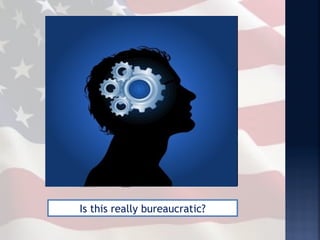
Lines of customersdelay
IsSheets stacked waiting
   this really bureaucratic?
   Angry voices on desks
   The Characteristics

   Hierarchical authority structure

   Task specialization

   Extensive rules

   Clear goals

   Merit principle

   Impersonality
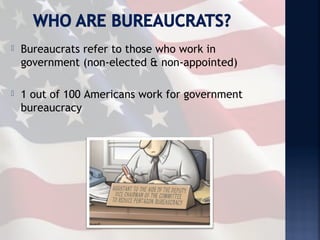
   Bureaucrats refer to those who work in
    government (non-elected & non-appointed)

   1 out of 100 Americans work for government
    bureaucracy
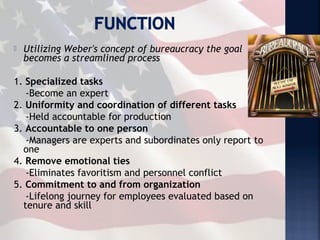
   Utilizing Weber's concept of bureaucracy the goal
    becomes a streamlined process

1. Specialized tasks
    -Become an expert
2. Uniformity and coordination of different tasks
    -Held accountable for production
3. Accountable to one person
    -Managers are experts and subordinates only report to
   one
4. Remove emotional ties
    -Eliminates favoritism and personnel conflict
5. Commitment to and from organization
    -Lifelong journey for employees evaluated based on
   tenure and skill
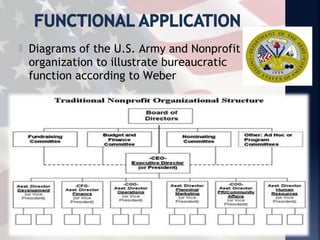
   Diagrams of the U.S. Army and Nonprofit
    organization to illustrate bureaucratic
    function according to Weber
   The Process of Rulemaking

   Negotiated Rulemaking

   Administrative Adjudication

   Deregulation vs. Reregulation
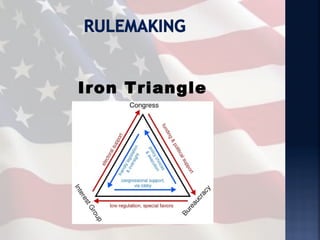
Iron Triangle
   Bureaucratic politics explained the public policy
    decisions.

   Describe the needs of each bureau.

   The Conservatives beliefs.

   The Liberals beliefs.
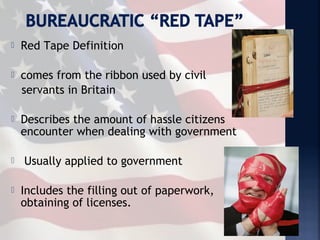
   Red Tape Definition

   comes from the ribbon used by civil
    servants in Britain

   Describes the amount of hassle citizens
    encounter when dealing with government

   Usually applied to government

   Includes the filling out of paperwork,
    obtaining of licenses.
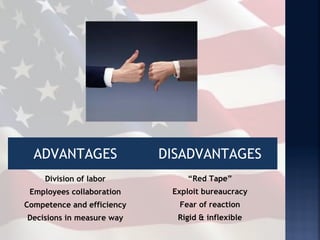
ADVANTAGES                DISADVANTAGES
     Division of labor          “Red Tape”
 Employees collaboration     Exploit bureaucracy
Competence and efficiency     Fear of reaction
Decisions in measure way      Rigid & inflexible
   James D. Thompson


   Warren Bennis
   Provost, C., & Teske, P. (2009). President George W. Bush's influence over
    bureaucracy and policy: Extraordinary times, extraordinary powers (pp. 12-
    14). New York, NY: Palgrave Macmillan.
   Shapiro, S. (2002). Speed bumps and roadblocks: Procedural controls and
    regulatory change. Journal of Public Administration Research & Theory,
    12(1), 29. Retrieved from EBSCOhost.
   Shapiro, S. (2006). Politics and regulatory policy analysis. Regulation, 29(2),
    40-45. Retrieved from EBSCOhost.
   Wilson, J. Q. (1991). Bureaucracy: What government agencies do and why
    they do it (pp. 344-345). Palo Alto, CA: Basic Books.
   Yackee, J., & Yackee, S. (2009). Divided government and US federal
    rulemaking. Regulation & Governance, 3(2), 128-144.
   Harrison, B. C. (2009). American democracy now. New York: McGraw-Hill.
   Ethics of Bureaucracy. (n.d.). Vics Home Page. Retrieved October 10, 2011,
    from
    http://www.vicnapier.com/MyArticles/OrgDevPapers/ethics_of_bureaucracy.
    htm
   Henry, J.(n.d.). The Grinding Square Wheels Of Bureaucracy, Retrieved
    October 15,2011 from Data Lite: http://www.datalite.org/grinding-wheels-
    bureaucracy.html
   Johnson, P. (2005). Bureaucratic Politics. Retrieved October 14,2011 from A
    Glossary of Political Economy Terms:
    http://www.auburn.edu/~johnspm/gloss/bureaucratic_politics
   http://www.rose-hulman.edu/~casey1/Bureaucracy.pdf
Bureaucracy

Bureaucracy

  • 1.
    BUS 4010 Introduction toPublic Administration Daniel – Majed – Mazen – Mohammed – Zainah October 19, 2011
  • 2.
    Introduction & history  Function  Rulemaking  Bureaucratic “Red Tape”  Politics  Advantages & disadvantages  Conclusion  Questions
  • 3.
    Lines of customersdelay IsSheetsstacked waiting this really bureaucratic? Angry voices on desks
  • 5.
    The Characteristics  Hierarchical authority structure  Task specialization  Extensive rules  Clear goals  Merit principle  Impersonality
  • 6.
    Bureaucrats refer to those who work in government (non-elected & non-appointed)  1 out of 100 Americans work for government bureaucracy
  • 8.
    Utilizing Weber's concept of bureaucracy the goal becomes a streamlined process 1. Specialized tasks     -Become an expert 2. Uniformity and coordination of different tasks     -Held accountable for production 3. Accountable to one person     -Managers are experts and subordinates only report to one 4. Remove emotional ties     -Eliminates favoritism and personnel conflict 5. Commitment to and from organization     -Lifelong journey for employees evaluated based on tenure and skill
  • 9.
    Diagrams of the U.S. Army and Nonprofit organization to illustrate bureaucratic function according to Weber
  • 10.
    The Process of Rulemaking  Negotiated Rulemaking  Administrative Adjudication  Deregulation vs. Reregulation
  • 11.
  • 13.
    Bureaucratic politics explained the public policy decisions.  Describe the needs of each bureau.  The Conservatives beliefs.  The Liberals beliefs.
  • 14.
    Red Tape Definition  comes from the ribbon used by civil servants in Britain  Describes the amount of hassle citizens encounter when dealing with government  Usually applied to government  Includes the filling out of paperwork, obtaining of licenses.
  • 15.
    ADVANTAGES DISADVANTAGES Division of labor “Red Tape” Employees collaboration Exploit bureaucracy Competence and efficiency Fear of reaction Decisions in measure way Rigid & inflexible
  • 16.
    James D. Thompson  Warren Bennis
  • 18.
    Provost, C., & Teske, P. (2009). President George W. Bush's influence over bureaucracy and policy: Extraordinary times, extraordinary powers (pp. 12- 14). New York, NY: Palgrave Macmillan.  Shapiro, S. (2002). Speed bumps and roadblocks: Procedural controls and regulatory change. Journal of Public Administration Research & Theory, 12(1), 29. Retrieved from EBSCOhost.  Shapiro, S. (2006). Politics and regulatory policy analysis. Regulation, 29(2), 40-45. Retrieved from EBSCOhost.  Wilson, J. Q. (1991). Bureaucracy: What government agencies do and why they do it (pp. 344-345). Palo Alto, CA: Basic Books.  Yackee, J., & Yackee, S. (2009). Divided government and US federal rulemaking. Regulation & Governance, 3(2), 128-144.  Harrison, B. C. (2009). American democracy now. New York: McGraw-Hill.  Ethics of Bureaucracy. (n.d.). Vics Home Page. Retrieved October 10, 2011, from http://www.vicnapier.com/MyArticles/OrgDevPapers/ethics_of_bureaucracy. htm  Henry, J.(n.d.). The Grinding Square Wheels Of Bureaucracy, Retrieved October 15,2011 from Data Lite: http://www.datalite.org/grinding-wheels- bureaucracy.html  Johnson, P. (2005). Bureaucratic Politics. Retrieved October 14,2011 from A Glossary of Political Economy Terms: http://www.auburn.edu/~johnspm/gloss/bureaucratic_politics  http://www.rose-hulman.edu/~casey1/Bureaucracy.pdf