

The Basics of Thread Rolling
Tools, Tips & Design Considerations
PMPA NTC | April 12, 2016 | Grand Rapids, MI
What is thread rolling?
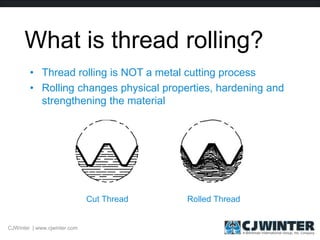
• Thread rolling is NOT a metal cutting process
• Rolling changes physical properties, hardening and
strengthening the material
Cut Thread Rolled Thread
CJWinter | www.cjwinter.com
What are the benefits?
• Lower costs
• Increased production
• Faster lead times
• Superior quality and accuracy:
• Stronger threads
• Improved finish
• More accurate profile
CJWinter | www.cjwinter.com
Where to start:
 Material Selection & Properties
Design Considerations
Correct Tooling
Speeds & Feeds
Accurate Gaging
Common Issues & Troubleshooting
CJWinter | www.cjwinter.com
The Formability Index
• The softer the material, the easier it is to roll
threads
• Harder materials result shorter die life
• Some hard-to-roll material, such as stainless
steel, produces excellent thread finish with a
compromised tool life
CJWinter | www.cjwinter.com
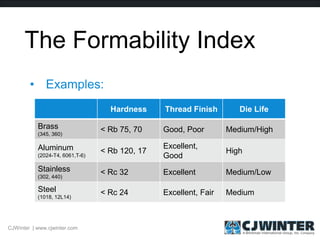
The Formability Index
Hardness Thread Finish Die Life
Brass
(345, 360)
< Rb 75, 70 Good, Poor Medium/High
Aluminum
(2024-T4, 6061,T-6)
< Rb 120, 17
Excellent,
Good
High
Stainless
(302, 440)
< Rc 32 Excellent Medium/Low
Steel
(1018, 12L14)
< Rc 24 Excellent, Fair Medium
• Examples:
CJWinter | www.cjwinter.com
Important material factors
Different materials have different forming
characteristics
o In steel, sulfur creates flakes and slivers
o In aluminum, Bismuth creates flakes and slivers
o Sulfur, Bismuth, and Lead aid in the machining process, but
hinder the thread finish when cold forming.
o A tradeoff exists between machining speed and thread
finish. Sulfur and Lead allow for high speeds and feeds in
machining, but the thread finish can suffer.
CJWinter | www.cjwinter.com
 Material Selection & Properties
 Design Considerations
Correct Tooling
Speeds & Feeds
Accurate Gaging
Common Issues & Troubleshooting
CJWinter | www.cjwinter.com
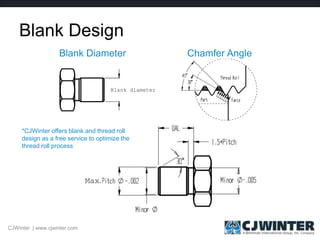
Blank Design
Blank Diameter Chamfer Angle
CJWinter | www.cjwinter.com
Max.
*CJWinter offers blank and thread roll
design as a free service to optimize the
thread roll process
Blank diameter
Blank Diameter Properties
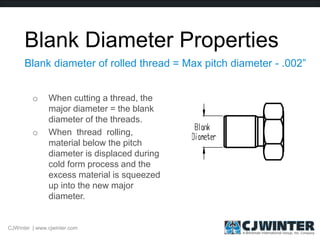
o When cutting a thread, the
major diameter = the blank
diameter of the threads.
o When thread rolling,
material below the pitch
diameter is displaced during
cold form process and the
excess material is squeezed
up into the new major
diameter.
Blank diameter of rolled thread = Max pitch diameter - .002”
CJWinter | www.cjwinter.com
Blank Diameter Properties
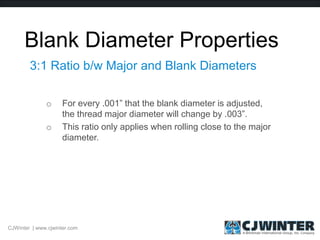
o For every .001” that the blank diameter is adjusted,
the thread major diameter will change by .003”.
o This ratio only applies when rolling close to the major
diameter.
3:1 Ratio b/w Major and Blank Diameters
CJWinter | www.cjwinter.com
Chamfer Angle
o A 30° chamfer will give an
approximate 45° angle after
rolling.
o When rolling harder
materials a lower chamfer
angle [25-28°] is preferred
so thread roll life is not
compromised.
Recommended Angle: 30° from the axis of the part
CJWinter | www.cjwinter.com
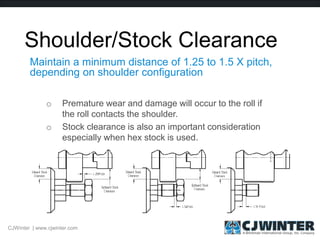
Shoulder/Stock Clearance
o Premature wear and damage will occur to the roll if
the roll contacts the shoulder.
o Stock clearance is also an important consideration
especially when hex stock is used.
Maintain a minimum distance of 1.25 to 1.5 X pitch,
depending on shoulder configuration
CJWinter | www.cjwinter.com
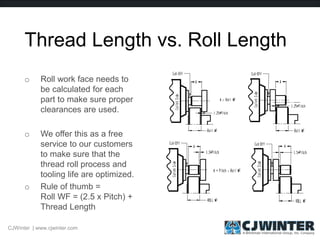
Thread Length vs. Roll Length
o Roll work face needs to
be calculated for each
part to make sure proper
clearances are used.
o We offer this as a free
service to our customers
to make sure that the
thread roll process and
tooling life are optimized.
o Rule of thumb =
Roll WF = (2.5 x Pitch) +
Thread Length
CJWinter | www.cjwinter.com
 Material Selection & Properties
 Design Considerations
 Correct Tooling
Speeds & Feeds
Accurate Gaging
Common Issues & Troubleshooting
CJWinter | www.cjwinter.com
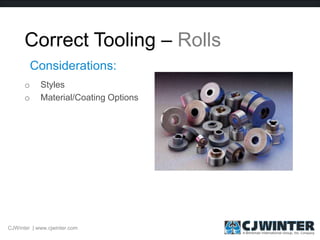
Correct Tooling – Rolls
o Styles
o Material/Coating Options
Considerations:
CJWinter | www.cjwinter.com
Correct Tooling – Rolls
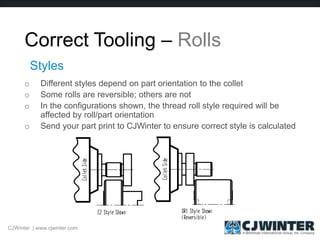
o Different styles depend on part orientation to the collet
o Some rolls are reversible; others are not
o In the configurations shown, the thread roll style required will be
affected by roll/part orientation
o Send your part print to CJWinter to ensure correct style is calculated
Styles
CJWinter | www.cjwinter.com
Correct Tooling – Rolls
Options
Heat Treating Special Materials Coatings
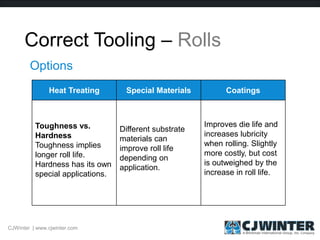
Toughness vs.
Hardness
Toughness implies
longer roll life.
Hardness has its own
special applications.
Different substrate
materials can
improve roll life
depending on
application.
Improves die life and
increases lubricity
when rolling. Slightly
more costly, but cost
is outweighed by the
increase in roll life.
CJWinter | www.cjwinter.com
Relationship of Roll to Blank
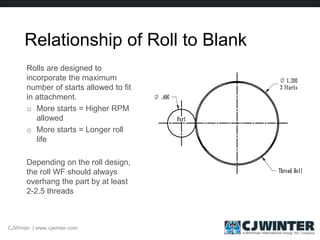
Rolls are designed to
incorporate the maximum
number of starts allowed to fit
in attachment.
o More starts = Higher RPM
allowed
o More starts = Longer roll
life
Depending on the roll design,
the roll WF should always
overhang the part by at least
2-2.5 threads
CJWinter | www.cjwinter.com
Correct Tooling
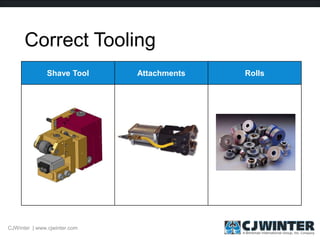
Shave Tool Attachments Rolls
CJWinter | www.cjwinter.com
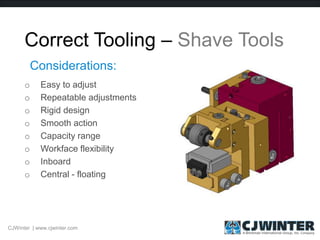
Correct Tooling – Shave Tools
o Easy to adjust
o Repeatable adjustments
o Rigid design
o Smooth action
o Capacity range
o Workface flexibility
o Inboard
o Central - floating
Considerations:
CJWinter | www.cjwinter.com
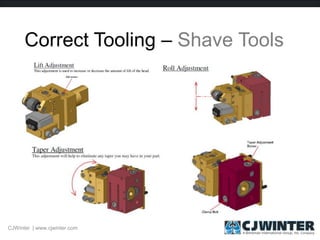
Correct Tooling – Shave Tools
CJWinter | www.cjwinter.com
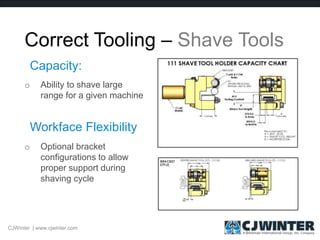
Correct Tooling – Shave Tools
Capacity:
o Ability to shave large
range for a given machine
o Optional bracket
configurations to allow
proper support during
shaving cycle
Workface Flexibility
CJWinter | www.cjwinter.com
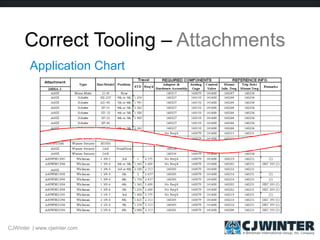
Correct Tooling – Attachments
o Radial Pinch
o Axial End Rolling
o Tangential Attachments
o Axial Rotary Transfer
o Applications
Considerations:
CJWinter | www.cjwinter.com
Correct Tooling – Attachments
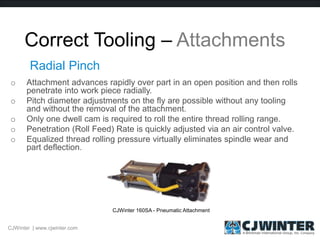
o Attachment advances rapidly over part in an open position and then rolls
penetrate into work piece radially.
o Pitch diameter adjustments on the fly are possible without any tooling
and without the removal of the attachment.
o Only one dwell cam is required to roll the entire thread rolling range.
o Penetration (Roll Feed) Rate is quickly adjusted via an air control valve.
o Equalized thread rolling pressure virtually eliminates spindle wear and
part deflection.
Radial Pinch
CJWinter 160SA - Pneumatic Attachment
CJWinter | www.cjwinter.com
Correct Tooling – Attachments
o Attachment traverses
axially from tail stock /
end, working spindles into
workpiece centerline
o Allows forming of parts
that are longer than the
roll width if required.
Axial End Rolling
CJWinter 189,190, & 191 Series End Rolling Attachments
[ER Series]
CJWinter | www.cjwinter.com
Correct Tooling – Attachments
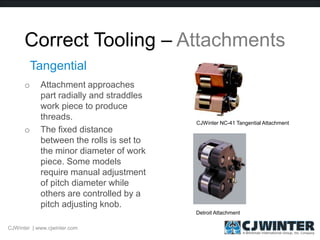
o Attachment approaches
part radially and straddles
work piece to produce
threads.
o The fixed distance
between the rolls is set to
the minor diameter of work
piece. Some models
require manual adjustment
of pitch diameter while
others are controlled by a
pitch adjusting knob.
Tangential
CJWinter NC-41 Tangential Attachment
Detroit Attachment
CJWinter | www.cjwinter.com
Correct Tooling – Attachments
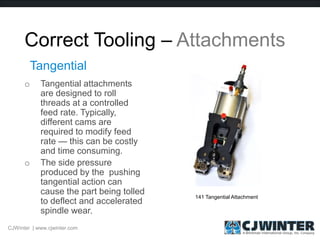
o Tangential attachments
are designed to roll
threads at a controlled
feed rate. Typically,
different cams are
required to modify feed
rate — this can be costly
and time consuming.
o The side pressure
produced by the pushing
tangential action can
cause the part being tolled
to deflect and accelerated
spindle wear.
Tangential
141 Tangential Attachment
CJWinter | www.cjwinter.com
Correct Tooling – Attachments
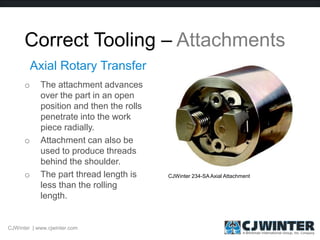
o The attachment advances
over the part in an open
position and then the rolls
penetrate into the work
piece radially.
o Attachment can also be
used to produce threads
behind the shoulder.
o The part thread length is
less than the rolling
length.
Axial Rotary Transfer
CJWinter 234-SAAxial Attachment
CJWinter | www.cjwinter.com
Correct Tooling – Attachments
Application Chart
CJWinter | www.cjwinter.com
 Material Selection & Properties
 Design Considerations
 Correct Tooling
 Speeds & Feeds
Accurate Gaging
Common Issues & Troubleshooting
CJWinter | www.cjwinter.com
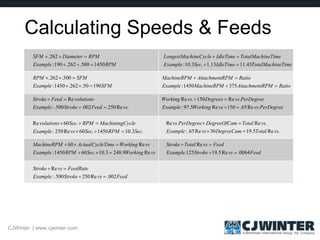
Speeds & Feeds
o Thread rolling tends to be the fastest operation
o Faster is usually better
o Rule of thumb:
o Part RPM: ~ 300 RPM per start of roll
o Typically does not constrain the cycle time
* See Appendix for handy Speed & Feed calculations
CJWinter | www.cjwinter.com
 Material Selection & Properties
 Design Considerations
 Correct Tooling
 Speeds & Feeds
 Accurate Gaging
 Common Issues & Troubleshooting
CJWinter | www.cjwinter.com
Accurate Gaging
o Go / No-Go Ring gages
o Micrometers / Pitch
micrometers
o Tri Roll [Johnson Gage]
o Functional Segments
o Pitch Diameter Rolls
o Pipe Threads
o 6 Step
o 1L, 2L Ring Gages
Types
“To yield useful repeatable data, it is critical to align inspection methods to part geometry
based on customer requirements, part geometry, and GD&T”
CJWinter | www.cjwinter.com
Gaging
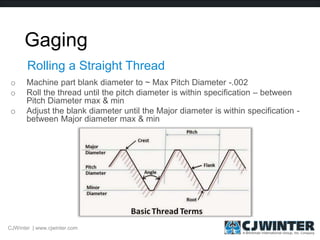
o Machine part blank diameter to ~ Max Pitch Diameter -.002
o Roll the thread until the pitch diameter is within specification – between
Pitch Diameter max & min
o Adjust the blank diameter until the Major diameter is within specification -
between Major diameter max & min
Rolling a Straight Thread
CJWinter | www.cjwinter.com
Gaging
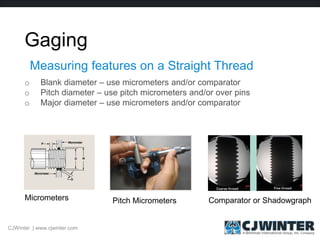
o Blank diameter – use micrometers and/or comparator
o Pitch diameter – use pitch micrometers and/or over pins
o Major diameter – use micrometers and/or comparator
Measuring features on a Straight Thread
Micrometers Pitch Micrometers Comparator or Shadowgraph
CJWinter | www.cjwinter.com
Gaging
o Machine part blank diameter to specifications outlined in chart
o Included angle of blank is 1°47’.
o Verify blank diameter at location Y [column “Y” and “B.D.@Y”]
o Roll the thread until the pitch diameter gages within the L1 & L2 gage
specifications.
o Adjust the blank diameter, until the Major diameter gages within 6 – Step gage
specifications - if required
Rolling on a Tapered Pipe Thread
CJWinter | www.cjwinter.com
Gaging
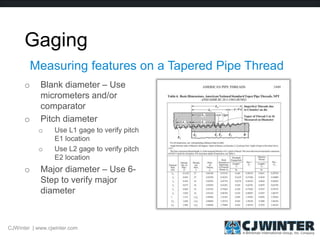
o Blank diameter – Use
micrometers and/or
comparator
o Pitch diameter
o Use L1 gage to verify pitch
E1 location
o Use L2 gage to verify pitch
E2 location
o Major diameter – Use 6-
Step to verify major
diameter
Measuring features on a Tapered Pipe Thread
CJWinter | www.cjwinter.com
Gaging
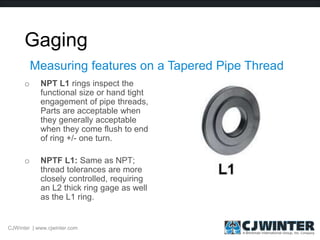
o NPT L1 rings inspect the
functional size or hand tight
engagement of pipe threads,
Parts are acceptable when
they generally acceptable
when they come flush to end
of ring +/- one turn.
o NPTF L1: Same as NPT;
thread tolerances are more
closely controlled, requiring
an L2 thick ring gage as well
as the L1 ring.
Measuring features on a Tapered Pipe Thread
CJWinter | www.cjwinter.com
Gaging
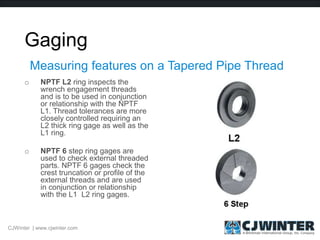
o NPTF L2 ring inspects the
wrench engagement threads
and is to be used in conjunction
or relationship with the NPTF
L1. Thread tolerances are more
closely controlled requiring an
L2 thick ring gage as well as the
L1 ring.
o NPTF 6 step ring gages are
used to check external threaded
parts. NPTF 6 gages check the
crest truncation or profile of the
external threads and are used
in conjunction or relationship
with the L1 L2 ring gages.
Measuring features on a Tapered Pipe Thread
CJWinter | www.cjwinter.com
 Material Selection & Properties
 Design Considerations
 Correct Tooling
 Speeds & Feeds
 Accurate Gaging
 Common Issues & Troubleshooting
CJWinter | www.cjwinter.com
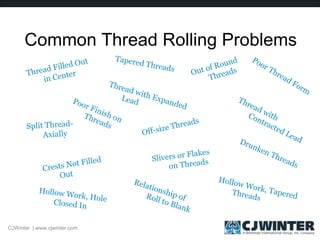
Common Thread Rolling Problems
CJWinter | www.cjwinter.com
Top 10 Common Issues
1. Slivers/Flakes in Threads
2. Incorrect Pitch/Lead
3. Mismatched Helix Angle
4. Different Rolling Conditions
5. Hollow Work, Closed Hole,
or Out of Round Conditions
6. Thread Filled out in Center,
but Not End
7. Poor Finish
8. Poor Thread Form
9. Crests Not Filled Out
10. Scuffed Crests
CJWinter | www.cjwinter.com
Common Issue #1: Slivers/Flakes in Threads
o Are rolls in match?
 Resynchronize
o Is the centerline of rolls
parallel with work
centerline?
 Check slide for alignment
o Is cross slide adapter worn
or loose?
 Check slide gib and
springs; tighten adapter if
used
o Are rolls overfilled?
 Reduce blank diameter
o Is roll diameter correct?
o Is material adaptable to cold
working?
 Check with material supplier/
customer
 Change material if possible
o Does blank have a rough finish?
 Regrind tooling
o Is stock seamy?
 Not suitable for thread rolling
o Do rolls slip on work?
 Feed rate is too slow; increase
penetration rate
CJWinter | www.cjwinter.com
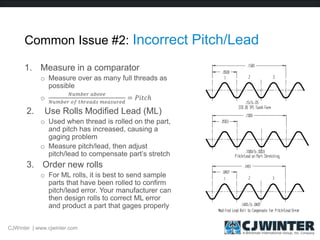
Common Issue #2: Incorrect Pitch/Lead
1. Measure in a comparator
o Measure over as many full threads as
possible
o
𝑁𝑢𝑚𝑏𝑒𝑟 𝑎𝑏𝑜𝑣𝑒
𝑁𝑢𝑚𝑏𝑒𝑟 𝑜𝑓 𝑡ℎ𝑟𝑒𝑎𝑑𝑠 𝑚𝑒𝑎𝑠𝑢𝑟𝑒𝑑
= 𝑃𝑖𝑡𝑐ℎ
2. Use Rolls Modified Lead (ML)
o Used when thread is rolled on the part,
and pitch has increased, causing a
gaging problem
o Measure pitch/lead, then adjust
pitch/lead to compensate part’s stretch
3. Order new rolls
o For ML rolls, it is best to send sample
parts that have been rolled to confirm
pitch/lead error. Your manufacturer can
then design rolls to correct ML error
and product a part that gages properly
CJWinter | www.cjwinter.com
Common Issue #3: Mismatched Helix Angle
What happens when the roll contacts the blank?
• “Screw jacking” – If kept on part for too long,
attachments/rolls get pulled into collet.
Optimize rolling time. Enter and exit as fast as
possible. Allow thread to form properly and fully,
then remove. The longer the roll remains in contact
with the part, the greater the chance of problems
developing.
CJWinter | www.cjwinter.com
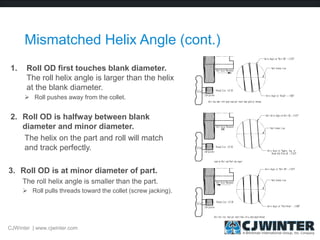
Mismatched Helix Angle (cont.)
1. Roll OD first touches blank diameter.
The roll helix angle is larger than the helix
at the blank diameter.
 Roll pushes away from the collet.
2. Roll OD is halfway between blank
diameter and minor diameter.
The helix on the part and roll will match
and track perfectly.
3. Roll OD is at minor diameter of part.
The roll helix angle is smaller than the part.
 Roll pulls threads toward the collet (screw jacking).
CJWinter | www.cjwinter.com
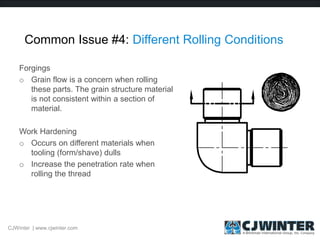
Common Issue #4: Different Rolling Conditions
Forgings
o Grain flow is a concern when rolling
these parts. The grain structure material
is not consistent within a section of
material.
Work Hardening
o Occurs on different materials when
tooling (form/shave) dulls
o Increase the penetration rate when
rolling the thread
CJWinter | www.cjwinter.com
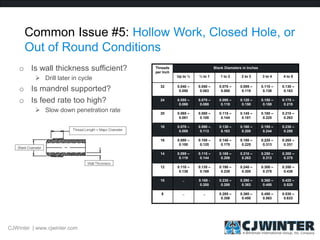
Common Issue #5: Hollow Work, Closed Hole, or
Out of Round Conditions
o Is wall thickness sufficient?
 Drill later in cycle
o Is mandrel supported?
o Is feed rate too high?
 Slow down penetration rate
Threads
per Inch
Blank Diameters in Inches
Up to ½ ½ to 1 1 to 2 2 to 3 3 to 4 4 to 5
32 0.040 –
0.050
0.050 –
0.063
0.070 –
0.088
0.095 –
0.119
0.110 –
0.138
0.130 –
0.163
24 0.055 –
0.069
0.070 –
0.088
0.095 –
0.119
0.120 –
0.150
0.150 –
0.188
0.175 –
0.219
20 0.065 –
0.081
0.080 –
0.100
0.115 –
0.144
0.145 –
0.181
0.180 –
0.225
0.210 –
0.263
18 0.070 –
0.088
0.090 –
0.113
0.130 –
0.163
0.160 –
0.200
0.195 –
0.244
0.230 –
0.288
16 0.080 –
0.100
0.100 –
0.125
0.140 –
0.175
0.180 –
0.225
0.220 –
0.313
0.265 –
0.331
14 0.095 –
0.119
0.115 –
0.144
0.165 –
0.206
0.210 –
0.263
0.250 –
0.313
0.300 –
0.375
12 0.110 –
0.138
0.135 –
0.169
0.190 –
0.238
0.240 –
0.300
0.300 –
0.375
0.350 –
0.438
10 .. 0.160 -
0.200
0.230 –
0.288
0.290 –
0.363
0.360 –
0.450
0.420 –
0.525
8 .. .. 0.285 –
0.356
0.360 –
0.450
0.450 –
0.563
0.530 –
0.633
CJWinter | www.cjwinter.com
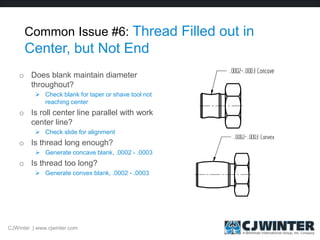
Common Issue #6: Thread Filled out in
Center, but Not End
o Does blank maintain diameter
throughout?
 Check blank for taper or shave tool not
reaching center
o Is roll center line parallel with work
center line?
 Check slide for alignment
o Is thread long enough?
 Generate concave blank, .0002 - .0003
o Is thread too long?
 Generate convex blank, .0002 - .0003
CJWinter | www.cjwinter.com
Common Issue #7: Poor Finish
o Are rolls overfilled?
 Check if blank diameter is oversized
o Are rolls synchronized?
 Resynchronize thread rolls
o Has material accumulated in threads?
 If material cannot be removed, replace rolls
o Is material ductile enough for cold working?
 Change material if possible
o Are there chips from other operations?
 Ensure a good jet of clean oil is reaching rolling position
o Are rolls worn or broken?
 Replace rolls
CJWinter | www.cjwinter.com
Common Issue #8: Poor Thread Form
o Is work bending during rolling?
 Support part during rolling
o Does rolls’ timing match?
 Resynchronize rolls
o Are there too many work revolutions?
 Increase roll penetration
 Most coming thread rolling issues are due to rolling too slow
o Is centerline of rolls parallel with center line?
 Check slide for alignment
 Check attachment/mounting hardware
CJWinter | www.cjwinter.com
Common Issue #9: Crests Not Filled Out
o Is blank too small?
 Increase blank diameter
o Is thread on roll too deep?
 Replace with rolls of correct depth
 *Note: Special truncated rolls are available if burnish crest or round crest
on the part is required.
*Many users do not consider crests a serious problem, and allow thread
forms to be produced with crests not completely filled out — avoiding
roll overload and prolonging roll life.
CJWinter | www.cjwinter.com
Common Issue #10: Scuffed Crests
o Is the attachment retracting too slowly?
 Increase speed of roll retraction
o Are rolls and gear train binding?
 Check gear train, remove any foreign matter
o Is the rolling set off the center line of work?
 Reset slide with gage
o Are materials accumulating in threads?
 Check coolant flowing on rolling position and make sure a good jet of
clean oil is flushing and lubricating this position properly.
CJWinter | www.cjwinter.com
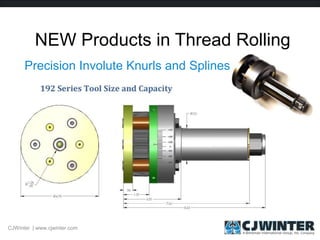
NEW Products in Thread Rolling
Precision Involute Knurls and Splines
CJWinter | www.cjwinter.com
NEW Products in Thread Rolling
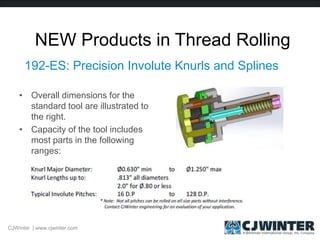
192-ES: Precision Involute Knurls and Splines
• Overall dimensions for the
standard tool are illustrated to
the right.
• Capacity of the tool includes
most parts in the following
ranges:
CJWinter | www.cjwinter.com
NEW Products in Thread Rolling
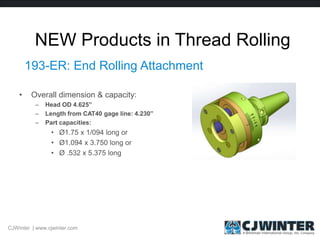
193-ER: End Rolling Attachment
• Overall dimension & capacity:
– Head OD 4.625”
– Length from CAT40 gage line: 4.230”
– Part capacities:
• Ø1.75 x 1/094 long or
• Ø1.094 x 3.750 long or
• Ø .532 x 5.375 long
CJWinter | www.cjwinter.com
NEW Products in Thread Rolling
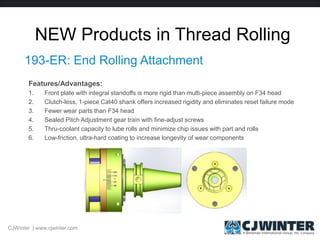
193-ER: End Rolling Attachment
CJWinter | www.cjwinter.com
Features/Advantages:
1. Front plate with integral standoffs is more rigid than multi-piece assembly on F34 head
2. Clutch-less, 1-piece Cat40 shank offers increased rigidity and eliminates reset failure mode
3. Fewer wear parts than F34 head
4. Sealed Pitch Adjustment gear train with fine-adjust screws
5. Thru-coolant capacity to lube rolls and minimize chip issues with part and rolls
6. Low-friction, ultra-hard coating to increase longevity of wear components
Questions?
Visit us at www.cjwinter.com
Contact:
Lib Pietrantoni
Sales Engineer
lpietrantoni@brinkmanproducts.com
Paul Allart
Product Engineer
allart@brinkmanproducts.com
CJWinter | www.cjwinter.com
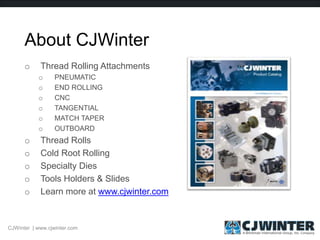
About CJWinter
o Thread Rolling Attachments
o PNEUMATIC
o END ROLLING
o CNC
o TANGENTIAL
o MATCH TAPER
o OUTBOARD
o Thread Rolls
o Cold Root Rolling
o Specialty Dies
o Tools Holders & Slides
o Learn more at www.cjwinter.com
CJWinter | www.cjwinter.com
NEW Developments in Thread Rolling
 On Non-leaded Brass (ECO
BRASS). We have been able
to roll threads with 16 TPI
[1.5] or finer with good
success.
 A process for coarser threads
is still under-development.
CJWinter | www.cjwinter.com
Lead-Free Brass
• 1/8 – 27 run on a 1” ACME
• 4th and 6th position
Photo A
NEW Developments in Thread Rolling
 We used a radial pneumatic attachment
– This pneumatic attachment will allow
for very fast and precise adjustment
of both the penetration rate and pitch
diameter. We have learned that this is
critical for rolling no lead brass.
 The radial approach allows
displacement of material in more even /
balanced material flow than using a
tangential attachment. Radial method
seems to work better for no lead
applications.
 The Pneumatic attachment allows for
the independent setting of the rate of
flow- independent of cam.
CJWinter | www.cjwinter.com
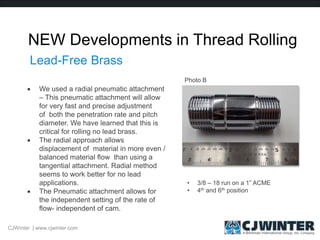
Lead-Free Brass
• 3/8 – 18 run on a 1” ACME
• 4th and 6th position
Photo B
NEW Developments in Thread Rolling
 Standard Thread Rolls should work
fine. If you have to have a full
thread and experience flaking on
the top of the thread, try using
thread rolls designed for burnishing
crests.
 Good cutting oil can also make a
big difference. You need a good
mineral base oil with extreme
pressure additives. A good mineral
base oil with extreme pressure
additives is what has worked for us.
CJWinter | www.cjwinter.com
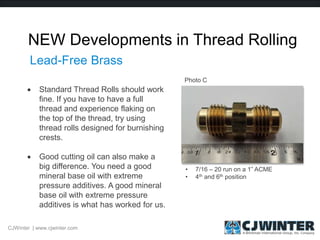
Lead-Free Brass
• 7/16 – 20 run on a 1” ACME
• 4th and 6th position
Photo C
NEW Developments in Thread Rolling
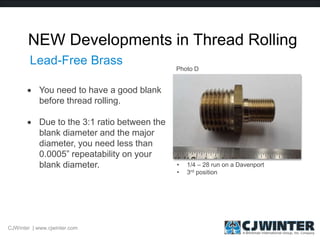
 You need to have a good blank
before thread rolling.
 Due to the 3:1 ratio between the
blank diameter and the major
diameter, you need less than
0.0005” repeatability on your
blank diameter.
CJWinter | www.cjwinter.com
Lead-Free Brass
• 1/4 – 28 run on a Davenport
• 3rd position
Photo D
Acknowledgements
Thanks to our Chase team for
their hard work and feedback
on these developments:
• Tommie Clair
• Thaddeus Scranton
• Thomas Christie
CJWinter | www.cjwinter.com
Appendix
CJWinter | www.cjwinter.com
Additional Thread Rolling Issues
CJWinter | www.cjwinter.com
Common Issue #11: Hollow Work in
Tapered Threads
o Is wall thickness uneven or insufficient?
 Drill later in cycle
o Is mandrel offering enough support where needed?
 Check mandrel for size with hole
o Is high feed rate causing rapid penetration?
 Slow penetration rate
o Does taper of rolls compensate for tendency of work to taper?
 Use correct rolls for job
CJWinter | www.cjwinter.com
Common Issue #12: Drunken Threads
o Do rolls match?
 Resynchronize rolls
o Is roll centerline set off from centerline of work?
 Check slide for alignment
o Are rolls inaccurate?
 Replace rolls
o Is work bending during rolling?
 Support part during rolling operation or slow penetration rate
 Check centerline of rolls to part
CJWinter | www.cjwinter.com
Common Issue #13: Split Thread Axially
o Is stock seamy?
 Change stock
o Are there marks from shave tool or hollow mill?
 Regrind tooling
o Is tubing material welded?
 Use seamless tubing material
CJWinter | www.cjwinter.com
Common Issue #14: Offsize Threads
Are any of the following oversized?
o Blanks
 Reduce blank diameter
o Pitch diameter
 If major diameter is correct size, oversize the blanks
 If major diameter is undersize, increase roll penetration
o Major diameter
 If pitch diameter is correct size, reduce blank diameter
If pitch diameter and major diameter are both undersize, increase
the blank diameter.
CJWinter | www.cjwinter.com
Common Issue #15: Undersize Threads
Are any of the following undersized?
o Blanks
 Increase blank diameter
o Pitch diameter
 If major diameter is oversize, reduce roll penetration
 If major diameter is correct size, increase blank diameter
o Major diameter
 Increase blank diameter
CJWinter | www.cjwinter.com
Common Issue #16: Off-of-Round Threads
o Is blank out of round?
 Shave tool is not reaching center, or not cleaning up rough form diameter
o Is roll centerline set off from centerline of work?
 Check slide for alignment
o Is feed rate too high?
 Reduce penetration rate
o Are there insufficient work revolutions?
 Reduce penetration rate
o Is material ductile enough for cold working?
 Change material, check with supplier
o Is the attachment off the centerline of work?
 Reset the cross slide with gage
CJWinter | www.cjwinter.com
Common Issue #17: Tapered Threads
o If pitch diameter is straight, major diameter is tapered and not
filled out on small end:
 Straighten blank
o If pitch diameter and major diameter are both tapered in the
same way:
 Straighten blank
 Taper adjust roll pins
o If pitch diameter and major diameter are tapered in opposite
directions and thread is not filled out on end:
 Support part during rolling. Part deflecting out of contact with center of
rolls
CJWinter | www.cjwinter.com
Common Issue #18: Thread with Expanded Lead
o For expanded lead in rolls:
 Use correct rolls (Modified Lead)
o For extruding material on short length of blank:
 Use longer blank; remove excess in another position
CJWinter | www.cjwinter.com
Other Thread Rolling Problems
Get answers on CJWinter.com’s
troubleshooting guide
CJWinter | www.cjwinter.com
RPMExample
RPMDiameterSFM
1450500.262.190:
262.


SFMExample
SFMRPM
19050.262.1450:
500.262.


.Re250002.500.:
Re
vsFeedStrokeExample
volutionsFeedStroke


.3.101450.60Re250:
.60Re
SecRPMSecvsExample
ycleMachiningCRPMSecvolutions


vsWorkingSecRPMExample
vsWorkingeTimeActualCyclMachineRPM
Re9.2483.10.601450:
Re60


FeedvsStrokeExample
FeedRatevsStroke
002.Re250500.:
Re


neTimeTotalMachiIdleTimeSecExample
neTimeTotalMachiIdleTimehineCycleLongestMac
43.1113.1.3.10: 

RatioRPMAttachmentMachineRPMExample
RatioRPMAttachmentMachineRPM


3751450:
PerDegreevsvsWorkingExample
PerDegreevsDegreesvsWorking
.Re65.150Re5.97:
.Re150.Re


.Re5.1930Re65.:
.Re.Re
vsTotalDegreeCamvsExample
vsTotalmDegreeOfCaPerDegreevs


FeedvsStrokeExample
FeedvsTotalStroke
0064.Re5.19125.
Re


Calculating Speeds & Feeds
CJWinter | www.cjwinter.com
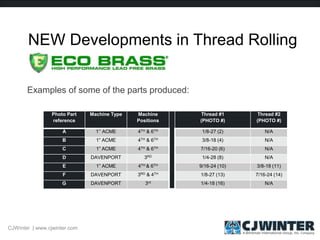
NEW Developments in Thread Rolling
Examples of some of the parts produced:
Photo Part
reference
Machine Type Machine
Positions
Thread #1
(PHOTO #)
Thread #2
(PHOTO #)
A 1’’ ACME 4TH & 6TH 1/8-27 (2) N/A
B 1” ACME 4TH & 6TH 3/8-18 (4) N/A
C 1” ACME 4TH & 6TH 7/16-20 (6) N/A
D DAVENPORT 3RD 1/4-28 (8) N/A
E 1” ACME 4TH & 6TH 9/16-24 (10) 3/8-18 (11)
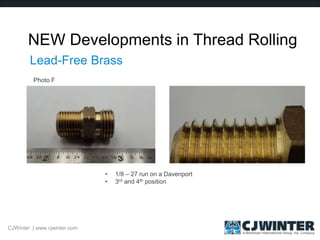
F DAVENPORT 3RD & 4TH 1/8-27 (13) 7/16-24 (14)
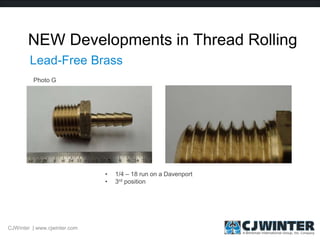
G DAVENPORT 3rd 1/4-18 (16) N/A
CJWinter | www.cjwinter.com
NEW Developments in Thread Rolling
CJWinter | www.cjwinter.com
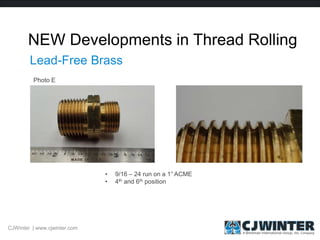
Lead-Free Brass
• 9/16 – 24 run on a 1” ACME
• 4th and 6th position
Photo E
NEW Developments in Thread Rolling
CJWinter | www.cjwinter.com
Lead-Free Brass
• 1/8 – 27 run on a Davenport
• 3rd and 4th position
Photo F
NEW Developments in Thread Rolling
CJWinter | www.cjwinter.com
Lead-Free Brass
• 1/4 – 18 run on a Davenport
• 3rd position
Photo G

The Basics of Thread Rolling

  • 1.
    The Basics ofThread Rolling Tools, Tips & Design Considerations PMPA NTC | April 12, 2016 | Grand Rapids, MI
  • 2.
    What is threadrolling? • Thread rolling is NOT a metal cutting process • Rolling changes physical properties, hardening and strengthening the material Cut Thread Rolled Thread CJWinter | www.cjwinter.com
  • 3.
    What are thebenefits? • Lower costs • Increased production • Faster lead times • Superior quality and accuracy: • Stronger threads • Improved finish • More accurate profile CJWinter | www.cjwinter.com
  • 4.
    Where to start: Material Selection & Properties Design Considerations Correct Tooling Speeds & Feeds Accurate Gaging Common Issues & Troubleshooting CJWinter | www.cjwinter.com
  • 5.
    The Formability Index •The softer the material, the easier it is to roll threads • Harder materials result shorter die life • Some hard-to-roll material, such as stainless steel, produces excellent thread finish with a compromised tool life CJWinter | www.cjwinter.com
  • 6.
    The Formability Index HardnessThread Finish Die Life Brass (345, 360) < Rb 75, 70 Good, Poor Medium/High Aluminum (2024-T4, 6061,T-6) < Rb 120, 17 Excellent, Good High Stainless (302, 440) < Rc 32 Excellent Medium/Low Steel (1018, 12L14) < Rc 24 Excellent, Fair Medium • Examples: CJWinter | www.cjwinter.com
  • 7.
    Important material factors Differentmaterials have different forming characteristics o In steel, sulfur creates flakes and slivers o In aluminum, Bismuth creates flakes and slivers o Sulfur, Bismuth, and Lead aid in the machining process, but hinder the thread finish when cold forming. o A tradeoff exists between machining speed and thread finish. Sulfur and Lead allow for high speeds and feeds in machining, but the thread finish can suffer. CJWinter | www.cjwinter.com
  • 8.
     Material Selection& Properties  Design Considerations Correct Tooling Speeds & Feeds Accurate Gaging Common Issues & Troubleshooting CJWinter | www.cjwinter.com
  • 9.
    Blank Design Blank DiameterChamfer Angle CJWinter | www.cjwinter.com Max. *CJWinter offers blank and thread roll design as a free service to optimize the thread roll process Blank diameter
  • 10.
    Blank Diameter Properties oWhen cutting a thread, the major diameter = the blank diameter of the threads. o When thread rolling, material below the pitch diameter is displaced during cold form process and the excess material is squeezed up into the new major diameter. Blank diameter of rolled thread = Max pitch diameter - .002” CJWinter | www.cjwinter.com
  • 11.
    Blank Diameter Properties oFor every .001” that the blank diameter is adjusted, the thread major diameter will change by .003”. o This ratio only applies when rolling close to the major diameter. 3:1 Ratio b/w Major and Blank Diameters CJWinter | www.cjwinter.com
  • 12.
    Chamfer Angle o A30° chamfer will give an approximate 45° angle after rolling. o When rolling harder materials a lower chamfer angle [25-28°] is preferred so thread roll life is not compromised. Recommended Angle: 30° from the axis of the part CJWinter | www.cjwinter.com
  • 13.
    Shoulder/Stock Clearance o Prematurewear and damage will occur to the roll if the roll contacts the shoulder. o Stock clearance is also an important consideration especially when hex stock is used. Maintain a minimum distance of 1.25 to 1.5 X pitch, depending on shoulder configuration CJWinter | www.cjwinter.com
  • 14.
    Thread Length vs.Roll Length o Roll work face needs to be calculated for each part to make sure proper clearances are used. o We offer this as a free service to our customers to make sure that the thread roll process and tooling life are optimized. o Rule of thumb = Roll WF = (2.5 x Pitch) + Thread Length CJWinter | www.cjwinter.com
  • 15.
     Material Selection& Properties  Design Considerations  Correct Tooling Speeds & Feeds Accurate Gaging Common Issues & Troubleshooting CJWinter | www.cjwinter.com
  • 16.
    Correct Tooling –Rolls o Styles o Material/Coating Options Considerations: CJWinter | www.cjwinter.com
  • 17.
    Correct Tooling –Rolls o Different styles depend on part orientation to the collet o Some rolls are reversible; others are not o In the configurations shown, the thread roll style required will be affected by roll/part orientation o Send your part print to CJWinter to ensure correct style is calculated Styles CJWinter | www.cjwinter.com
  • 18.
    Correct Tooling –Rolls Options Heat Treating Special Materials Coatings Toughness vs. Hardness Toughness implies longer roll life. Hardness has its own special applications. Different substrate materials can improve roll life depending on application. Improves die life and increases lubricity when rolling. Slightly more costly, but cost is outweighed by the increase in roll life. CJWinter | www.cjwinter.com
  • 19.
    Relationship of Rollto Blank Rolls are designed to incorporate the maximum number of starts allowed to fit in attachment. o More starts = Higher RPM allowed o More starts = Longer roll life Depending on the roll design, the roll WF should always overhang the part by at least 2-2.5 threads CJWinter | www.cjwinter.com
  • 20.
    Correct Tooling Shave ToolAttachments Rolls CJWinter | www.cjwinter.com
  • 21.
    Correct Tooling –Shave Tools o Easy to adjust o Repeatable adjustments o Rigid design o Smooth action o Capacity range o Workface flexibility o Inboard o Central - floating Considerations: CJWinter | www.cjwinter.com
  • 22.
    Correct Tooling –Shave Tools CJWinter | www.cjwinter.com
  • 23.
    Correct Tooling –Shave Tools Capacity: o Ability to shave large range for a given machine o Optional bracket configurations to allow proper support during shaving cycle Workface Flexibility CJWinter | www.cjwinter.com
  • 24.
    Correct Tooling –Attachments o Radial Pinch o Axial End Rolling o Tangential Attachments o Axial Rotary Transfer o Applications Considerations: CJWinter | www.cjwinter.com
  • 25.
    Correct Tooling –Attachments o Attachment advances rapidly over part in an open position and then rolls penetrate into work piece radially. o Pitch diameter adjustments on the fly are possible without any tooling and without the removal of the attachment. o Only one dwell cam is required to roll the entire thread rolling range. o Penetration (Roll Feed) Rate is quickly adjusted via an air control valve. o Equalized thread rolling pressure virtually eliminates spindle wear and part deflection. Radial Pinch CJWinter 160SA - Pneumatic Attachment CJWinter | www.cjwinter.com
  • 26.
    Correct Tooling –Attachments o Attachment traverses axially from tail stock / end, working spindles into workpiece centerline o Allows forming of parts that are longer than the roll width if required. Axial End Rolling CJWinter 189,190, & 191 Series End Rolling Attachments [ER Series] CJWinter | www.cjwinter.com
  • 27.
    Correct Tooling –Attachments o Attachment approaches part radially and straddles work piece to produce threads. o The fixed distance between the rolls is set to the minor diameter of work piece. Some models require manual adjustment of pitch diameter while others are controlled by a pitch adjusting knob. Tangential CJWinter NC-41 Tangential Attachment Detroit Attachment CJWinter | www.cjwinter.com
  • 28.
    Correct Tooling –Attachments o Tangential attachments are designed to roll threads at a controlled feed rate. Typically, different cams are required to modify feed rate — this can be costly and time consuming. o The side pressure produced by the pushing tangential action can cause the part being tolled to deflect and accelerated spindle wear. Tangential 141 Tangential Attachment CJWinter | www.cjwinter.com
  • 29.
    Correct Tooling –Attachments o The attachment advances over the part in an open position and then the rolls penetrate into the work piece radially. o Attachment can also be used to produce threads behind the shoulder. o The part thread length is less than the rolling length. Axial Rotary Transfer CJWinter 234-SAAxial Attachment CJWinter | www.cjwinter.com
  • 30.
    Correct Tooling –Attachments Application Chart CJWinter | www.cjwinter.com
  • 31.
     Material Selection& Properties  Design Considerations  Correct Tooling  Speeds & Feeds Accurate Gaging Common Issues & Troubleshooting CJWinter | www.cjwinter.com
  • 32.
    Speeds & Feeds oThread rolling tends to be the fastest operation o Faster is usually better o Rule of thumb: o Part RPM: ~ 300 RPM per start of roll o Typically does not constrain the cycle time * See Appendix for handy Speed & Feed calculations CJWinter | www.cjwinter.com
  • 33.
     Material Selection& Properties  Design Considerations  Correct Tooling  Speeds & Feeds  Accurate Gaging  Common Issues & Troubleshooting CJWinter | www.cjwinter.com
  • 34.
    Accurate Gaging o Go/ No-Go Ring gages o Micrometers / Pitch micrometers o Tri Roll [Johnson Gage] o Functional Segments o Pitch Diameter Rolls o Pipe Threads o 6 Step o 1L, 2L Ring Gages Types “To yield useful repeatable data, it is critical to align inspection methods to part geometry based on customer requirements, part geometry, and GD&T” CJWinter | www.cjwinter.com
  • 35.
    Gaging o Machine partblank diameter to ~ Max Pitch Diameter -.002 o Roll the thread until the pitch diameter is within specification – between Pitch Diameter max & min o Adjust the blank diameter until the Major diameter is within specification - between Major diameter max & min Rolling a Straight Thread CJWinter | www.cjwinter.com
  • 36.
    Gaging o Blank diameter– use micrometers and/or comparator o Pitch diameter – use pitch micrometers and/or over pins o Major diameter – use micrometers and/or comparator Measuring features on a Straight Thread Micrometers Pitch Micrometers Comparator or Shadowgraph CJWinter | www.cjwinter.com
  • 37.
    Gaging o Machine partblank diameter to specifications outlined in chart o Included angle of blank is 1°47’. o Verify blank diameter at location Y [column “Y” and “B.D.@Y”] o Roll the thread until the pitch diameter gages within the L1 & L2 gage specifications. o Adjust the blank diameter, until the Major diameter gages within 6 – Step gage specifications - if required Rolling on a Tapered Pipe Thread CJWinter | www.cjwinter.com
  • 38.
    Gaging o Blank diameter– Use micrometers and/or comparator o Pitch diameter o Use L1 gage to verify pitch E1 location o Use L2 gage to verify pitch E2 location o Major diameter – Use 6- Step to verify major diameter Measuring features on a Tapered Pipe Thread CJWinter | www.cjwinter.com
  • 39.
    Gaging o NPT L1rings inspect the functional size or hand tight engagement of pipe threads, Parts are acceptable when they generally acceptable when they come flush to end of ring +/- one turn. o NPTF L1: Same as NPT; thread tolerances are more closely controlled, requiring an L2 thick ring gage as well as the L1 ring. Measuring features on a Tapered Pipe Thread CJWinter | www.cjwinter.com
  • 40.
    Gaging o NPTF L2ring inspects the wrench engagement threads and is to be used in conjunction or relationship with the NPTF L1. Thread tolerances are more closely controlled requiring an L2 thick ring gage as well as the L1 ring. o NPTF 6 step ring gages are used to check external threaded parts. NPTF 6 gages check the crest truncation or profile of the external threads and are used in conjunction or relationship with the L1 L2 ring gages. Measuring features on a Tapered Pipe Thread CJWinter | www.cjwinter.com
  • 41.
     Material Selection& Properties  Design Considerations  Correct Tooling  Speeds & Feeds  Accurate Gaging  Common Issues & Troubleshooting CJWinter | www.cjwinter.com
  • 42.
    Common Thread RollingProblems CJWinter | www.cjwinter.com
  • 43.
    Top 10 CommonIssues 1. Slivers/Flakes in Threads 2. Incorrect Pitch/Lead 3. Mismatched Helix Angle 4. Different Rolling Conditions 5. Hollow Work, Closed Hole, or Out of Round Conditions 6. Thread Filled out in Center, but Not End 7. Poor Finish 8. Poor Thread Form 9. Crests Not Filled Out 10. Scuffed Crests CJWinter | www.cjwinter.com
  • 44.
    Common Issue #1:Slivers/Flakes in Threads o Are rolls in match?  Resynchronize o Is the centerline of rolls parallel with work centerline?  Check slide for alignment o Is cross slide adapter worn or loose?  Check slide gib and springs; tighten adapter if used o Are rolls overfilled?  Reduce blank diameter o Is roll diameter correct? o Is material adaptable to cold working?  Check with material supplier/ customer  Change material if possible o Does blank have a rough finish?  Regrind tooling o Is stock seamy?  Not suitable for thread rolling o Do rolls slip on work?  Feed rate is too slow; increase penetration rate CJWinter | www.cjwinter.com
  • 45.
    Common Issue #2:Incorrect Pitch/Lead 1. Measure in a comparator o Measure over as many full threads as possible o 𝑁𝑢𝑚𝑏𝑒𝑟 𝑎𝑏𝑜𝑣𝑒 𝑁𝑢𝑚𝑏𝑒𝑟 𝑜𝑓 𝑡ℎ𝑟𝑒𝑎𝑑𝑠 𝑚𝑒𝑎𝑠𝑢𝑟𝑒𝑑 = 𝑃𝑖𝑡𝑐ℎ 2. Use Rolls Modified Lead (ML) o Used when thread is rolled on the part, and pitch has increased, causing a gaging problem o Measure pitch/lead, then adjust pitch/lead to compensate part’s stretch 3. Order new rolls o For ML rolls, it is best to send sample parts that have been rolled to confirm pitch/lead error. Your manufacturer can then design rolls to correct ML error and product a part that gages properly CJWinter | www.cjwinter.com
  • 46.
    Common Issue #3:Mismatched Helix Angle What happens when the roll contacts the blank? • “Screw jacking” – If kept on part for too long, attachments/rolls get pulled into collet. Optimize rolling time. Enter and exit as fast as possible. Allow thread to form properly and fully, then remove. The longer the roll remains in contact with the part, the greater the chance of problems developing. CJWinter | www.cjwinter.com
  • 47.
    Mismatched Helix Angle(cont.) 1. Roll OD first touches blank diameter. The roll helix angle is larger than the helix at the blank diameter.  Roll pushes away from the collet. 2. Roll OD is halfway between blank diameter and minor diameter. The helix on the part and roll will match and track perfectly. 3. Roll OD is at minor diameter of part. The roll helix angle is smaller than the part.  Roll pulls threads toward the collet (screw jacking). CJWinter | www.cjwinter.com
  • 48.
    Common Issue #4:Different Rolling Conditions Forgings o Grain flow is a concern when rolling these parts. The grain structure material is not consistent within a section of material. Work Hardening o Occurs on different materials when tooling (form/shave) dulls o Increase the penetration rate when rolling the thread CJWinter | www.cjwinter.com
  • 49.
    Common Issue #5:Hollow Work, Closed Hole, or Out of Round Conditions o Is wall thickness sufficient?  Drill later in cycle o Is mandrel supported? o Is feed rate too high?  Slow down penetration rate Threads per Inch Blank Diameters in Inches Up to ½ ½ to 1 1 to 2 2 to 3 3 to 4 4 to 5 32 0.040 – 0.050 0.050 – 0.063 0.070 – 0.088 0.095 – 0.119 0.110 – 0.138 0.130 – 0.163 24 0.055 – 0.069 0.070 – 0.088 0.095 – 0.119 0.120 – 0.150 0.150 – 0.188 0.175 – 0.219 20 0.065 – 0.081 0.080 – 0.100 0.115 – 0.144 0.145 – 0.181 0.180 – 0.225 0.210 – 0.263 18 0.070 – 0.088 0.090 – 0.113 0.130 – 0.163 0.160 – 0.200 0.195 – 0.244 0.230 – 0.288 16 0.080 – 0.100 0.100 – 0.125 0.140 – 0.175 0.180 – 0.225 0.220 – 0.313 0.265 – 0.331 14 0.095 – 0.119 0.115 – 0.144 0.165 – 0.206 0.210 – 0.263 0.250 – 0.313 0.300 – 0.375 12 0.110 – 0.138 0.135 – 0.169 0.190 – 0.238 0.240 – 0.300 0.300 – 0.375 0.350 – 0.438 10 .. 0.160 - 0.200 0.230 – 0.288 0.290 – 0.363 0.360 – 0.450 0.420 – 0.525 8 .. .. 0.285 – 0.356 0.360 – 0.450 0.450 – 0.563 0.530 – 0.633 CJWinter | www.cjwinter.com
  • 50.
    Common Issue #6:Thread Filled out in Center, but Not End o Does blank maintain diameter throughout?  Check blank for taper or shave tool not reaching center o Is roll center line parallel with work center line?  Check slide for alignment o Is thread long enough?  Generate concave blank, .0002 - .0003 o Is thread too long?  Generate convex blank, .0002 - .0003 CJWinter | www.cjwinter.com
  • 51.
    Common Issue #7:Poor Finish o Are rolls overfilled?  Check if blank diameter is oversized o Are rolls synchronized?  Resynchronize thread rolls o Has material accumulated in threads?  If material cannot be removed, replace rolls o Is material ductile enough for cold working?  Change material if possible o Are there chips from other operations?  Ensure a good jet of clean oil is reaching rolling position o Are rolls worn or broken?  Replace rolls CJWinter | www.cjwinter.com
  • 52.
    Common Issue #8:Poor Thread Form o Is work bending during rolling?  Support part during rolling o Does rolls’ timing match?  Resynchronize rolls o Are there too many work revolutions?  Increase roll penetration  Most coming thread rolling issues are due to rolling too slow o Is centerline of rolls parallel with center line?  Check slide for alignment  Check attachment/mounting hardware CJWinter | www.cjwinter.com
  • 53.
    Common Issue #9:Crests Not Filled Out o Is blank too small?  Increase blank diameter o Is thread on roll too deep?  Replace with rolls of correct depth  *Note: Special truncated rolls are available if burnish crest or round crest on the part is required. *Many users do not consider crests a serious problem, and allow thread forms to be produced with crests not completely filled out — avoiding roll overload and prolonging roll life. CJWinter | www.cjwinter.com
  • 54.
    Common Issue #10:Scuffed Crests o Is the attachment retracting too slowly?  Increase speed of roll retraction o Are rolls and gear train binding?  Check gear train, remove any foreign matter o Is the rolling set off the center line of work?  Reset slide with gage o Are materials accumulating in threads?  Check coolant flowing on rolling position and make sure a good jet of clean oil is flushing and lubricating this position properly. CJWinter | www.cjwinter.com
  • 55.
    NEW Products inThread Rolling Precision Involute Knurls and Splines CJWinter | www.cjwinter.com
  • 56.
    NEW Products inThread Rolling 192-ES: Precision Involute Knurls and Splines • Overall dimensions for the standard tool are illustrated to the right. • Capacity of the tool includes most parts in the following ranges: CJWinter | www.cjwinter.com
  • 57.
    NEW Products inThread Rolling 193-ER: End Rolling Attachment • Overall dimension & capacity: – Head OD 4.625” – Length from CAT40 gage line: 4.230” – Part capacities: • Ø1.75 x 1/094 long or • Ø1.094 x 3.750 long or • Ø .532 x 5.375 long CJWinter | www.cjwinter.com
  • 58.
    NEW Products inThread Rolling 193-ER: End Rolling Attachment CJWinter | www.cjwinter.com Features/Advantages: 1. Front plate with integral standoffs is more rigid than multi-piece assembly on F34 head 2. Clutch-less, 1-piece Cat40 shank offers increased rigidity and eliminates reset failure mode 3. Fewer wear parts than F34 head 4. Sealed Pitch Adjustment gear train with fine-adjust screws 5. Thru-coolant capacity to lube rolls and minimize chip issues with part and rolls 6. Low-friction, ultra-hard coating to increase longevity of wear components
  • 59.
    Questions? Visit us atwww.cjwinter.com Contact: Lib Pietrantoni Sales Engineer lpietrantoni@brinkmanproducts.com Paul Allart Product Engineer allart@brinkmanproducts.com CJWinter | www.cjwinter.com
  • 60.
  • 61.
    About CJWinter o ThreadRolling Attachments o PNEUMATIC o END ROLLING o CNC o TANGENTIAL o MATCH TAPER o OUTBOARD o Thread Rolls o Cold Root Rolling o Specialty Dies o Tools Holders & Slides o Learn more at www.cjwinter.com CJWinter | www.cjwinter.com
  • 62.
    NEW Developments inThread Rolling  On Non-leaded Brass (ECO BRASS). We have been able to roll threads with 16 TPI [1.5] or finer with good success.  A process for coarser threads is still under-development. CJWinter | www.cjwinter.com Lead-Free Brass • 1/8 – 27 run on a 1” ACME • 4th and 6th position Photo A
  • 63.
    NEW Developments inThread Rolling  We used a radial pneumatic attachment – This pneumatic attachment will allow for very fast and precise adjustment of both the penetration rate and pitch diameter. We have learned that this is critical for rolling no lead brass.  The radial approach allows displacement of material in more even / balanced material flow than using a tangential attachment. Radial method seems to work better for no lead applications.  The Pneumatic attachment allows for the independent setting of the rate of flow- independent of cam. CJWinter | www.cjwinter.com Lead-Free Brass • 3/8 – 18 run on a 1” ACME • 4th and 6th position Photo B
  • 64.
    NEW Developments inThread Rolling  Standard Thread Rolls should work fine. If you have to have a full thread and experience flaking on the top of the thread, try using thread rolls designed for burnishing crests.  Good cutting oil can also make a big difference. You need a good mineral base oil with extreme pressure additives. A good mineral base oil with extreme pressure additives is what has worked for us. CJWinter | www.cjwinter.com Lead-Free Brass • 7/16 – 20 run on a 1” ACME • 4th and 6th position Photo C
  • 65.
    NEW Developments inThread Rolling  You need to have a good blank before thread rolling.  Due to the 3:1 ratio between the blank diameter and the major diameter, you need less than 0.0005” repeatability on your blank diameter. CJWinter | www.cjwinter.com Lead-Free Brass • 1/4 – 28 run on a Davenport • 3rd position Photo D
  • 66.
    Acknowledgements Thanks to ourChase team for their hard work and feedback on these developments: • Tommie Clair • Thaddeus Scranton • Thomas Christie CJWinter | www.cjwinter.com
  • 67.
  • 68.
    Additional Thread RollingIssues CJWinter | www.cjwinter.com
  • 69.
    Common Issue #11:Hollow Work in Tapered Threads o Is wall thickness uneven or insufficient?  Drill later in cycle o Is mandrel offering enough support where needed?  Check mandrel for size with hole o Is high feed rate causing rapid penetration?  Slow penetration rate o Does taper of rolls compensate for tendency of work to taper?  Use correct rolls for job CJWinter | www.cjwinter.com
  • 70.
    Common Issue #12:Drunken Threads o Do rolls match?  Resynchronize rolls o Is roll centerline set off from centerline of work?  Check slide for alignment o Are rolls inaccurate?  Replace rolls o Is work bending during rolling?  Support part during rolling operation or slow penetration rate  Check centerline of rolls to part CJWinter | www.cjwinter.com
  • 71.
    Common Issue #13:Split Thread Axially o Is stock seamy?  Change stock o Are there marks from shave tool or hollow mill?  Regrind tooling o Is tubing material welded?  Use seamless tubing material CJWinter | www.cjwinter.com
  • 72.
    Common Issue #14:Offsize Threads Are any of the following oversized? o Blanks  Reduce blank diameter o Pitch diameter  If major diameter is correct size, oversize the blanks  If major diameter is undersize, increase roll penetration o Major diameter  If pitch diameter is correct size, reduce blank diameter If pitch diameter and major diameter are both undersize, increase the blank diameter. CJWinter | www.cjwinter.com
  • 73.
    Common Issue #15:Undersize Threads Are any of the following undersized? o Blanks  Increase blank diameter o Pitch diameter  If major diameter is oversize, reduce roll penetration  If major diameter is correct size, increase blank diameter o Major diameter  Increase blank diameter CJWinter | www.cjwinter.com
  • 74.
    Common Issue #16:Off-of-Round Threads o Is blank out of round?  Shave tool is not reaching center, or not cleaning up rough form diameter o Is roll centerline set off from centerline of work?  Check slide for alignment o Is feed rate too high?  Reduce penetration rate o Are there insufficient work revolutions?  Reduce penetration rate o Is material ductile enough for cold working?  Change material, check with supplier o Is the attachment off the centerline of work?  Reset the cross slide with gage CJWinter | www.cjwinter.com
  • 75.
    Common Issue #17:Tapered Threads o If pitch diameter is straight, major diameter is tapered and not filled out on small end:  Straighten blank o If pitch diameter and major diameter are both tapered in the same way:  Straighten blank  Taper adjust roll pins o If pitch diameter and major diameter are tapered in opposite directions and thread is not filled out on end:  Support part during rolling. Part deflecting out of contact with center of rolls CJWinter | www.cjwinter.com
  • 76.
    Common Issue #18:Thread with Expanded Lead o For expanded lead in rolls:  Use correct rolls (Modified Lead) o For extruding material on short length of blank:  Use longer blank; remove excess in another position CJWinter | www.cjwinter.com
  • 77.
    Other Thread RollingProblems Get answers on CJWinter.com’s troubleshooting guide CJWinter | www.cjwinter.com
  • 78.
    RPMExample RPMDiameterSFM 1450500.262.190: 262.   SFMExample SFMRPM 19050.262.1450: 500.262.   .Re250002.500.: Re vsFeedStrokeExample volutionsFeedStroke   .3.101450.60Re250: .60Re SecRPMSecvsExample ycleMachiningCRPMSecvolutions   vsWorkingSecRPMExample vsWorkingeTimeActualCyclMachineRPM Re9.2483.10.601450: Re60   FeedvsStrokeExample FeedRatevsStroke 002.Re250500.: Re   neTimeTotalMachiIdleTimeSecExample neTimeTotalMachiIdleTimehineCycleLongestMac 43.1113.1.3.10:   RatioRPMAttachmentMachineRPMExample RatioRPMAttachmentMachineRPM   3751450: PerDegreevsvsWorkingExample PerDegreevsDegreesvsWorking .Re65.150Re5.97: .Re150.Re   .Re5.1930Re65.: .Re.Re vsTotalDegreeCamvsExample vsTotalmDegreeOfCaPerDegreevs   FeedvsStrokeExample FeedvsTotalStroke 0064.Re5.19125. Re   Calculating Speeds& Feeds CJWinter | www.cjwinter.com
  • 79.
    NEW Developments inThread Rolling Examples of some of the parts produced: Photo Part reference Machine Type Machine Positions Thread #1 (PHOTO #) Thread #2 (PHOTO #) A 1’’ ACME 4TH & 6TH 1/8-27 (2) N/A B 1” ACME 4TH & 6TH 3/8-18 (4) N/A C 1” ACME 4TH & 6TH 7/16-20 (6) N/A D DAVENPORT 3RD 1/4-28 (8) N/A E 1” ACME 4TH & 6TH 9/16-24 (10) 3/8-18 (11) F DAVENPORT 3RD & 4TH 1/8-27 (13) 7/16-24 (14) G DAVENPORT 3rd 1/4-18 (16) N/A CJWinter | www.cjwinter.com
  • 80.
    NEW Developments inThread Rolling CJWinter | www.cjwinter.com Lead-Free Brass • 9/16 – 24 run on a 1” ACME • 4th and 6th position Photo E
  • 81.
    NEW Developments inThread Rolling CJWinter | www.cjwinter.com Lead-Free Brass • 1/8 – 27 run on a Davenport • 3rd and 4th position Photo F
  • 82.
    NEW Developments inThread Rolling CJWinter | www.cjwinter.com Lead-Free Brass • 1/4 – 18 run on a Davenport • 3rd position Photo G