What is
MATTER?
Anything that has mass and
occupies space is called
matter. A matter is made up
of tiny particles called atoms
What is an
ATOM?
A particle of matter that
uniquely defines a chemical
element.Consists of a central
nucleus that is surrounded by
one or more negatively
charged electrons.
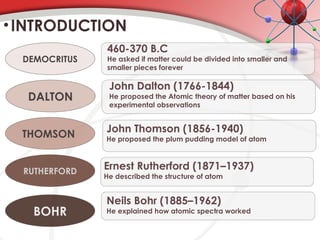
•INTRODUCTION
460-370 B.C
He asked if matter could be divided into smaller and
smaller pieces forever
Ernest Rutherford (1871–1937)
He described the structure of atom
Neils Bohr (1885–1962)
He explained how atomic spectra worked
DEMOCRITUS
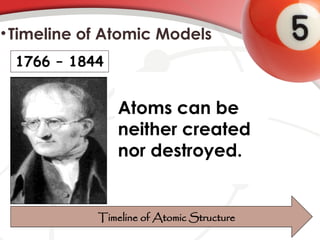
John Dalton (1766-1844)
He proposed the Atomic theory of matter based on his
experimental observations
DALTON
BOHR
THOMSON
RUTHERFORD
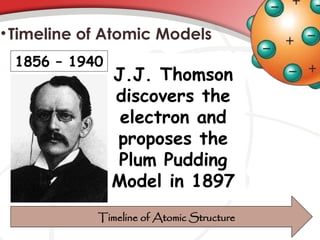
John Thomson (1856-1940)
He proposed the plum pudding model of atom
•Timeline of Atomic Models
Timeline of Atomic Structure
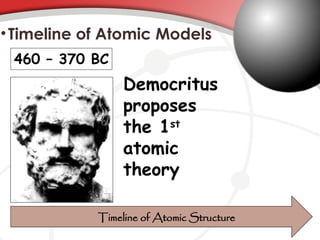
460 – 370 BC
Democritus
proposes
the 1st
atomic
theory
•Timeline of Atomic Models
Timeline of Atomic Structure
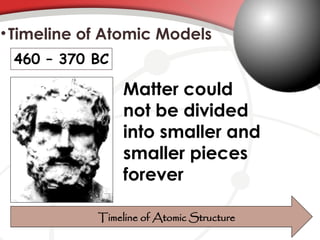
460 – 370 BC
Matter could
not be divided
into smaller and
smaller pieces
forever
•Timeline of Atomic Models
Timeline of Atomic Structure
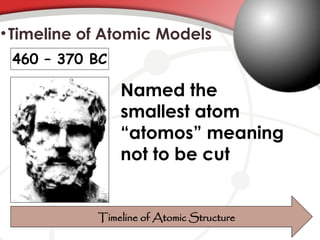
460 – 370 BC
Named the
smallest atom
“atomos” meaning
not to be cut
•Timeline of Atomic Models
Timeline of Atomic Structure
460 – 370 BC
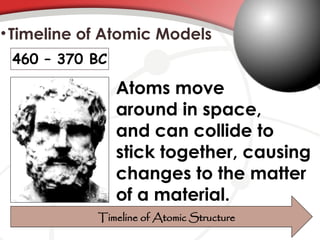
Atoms move
around in space,
and can collide to
stick together, causing
changes to the matter
of a material.
•Timeline of Atomic Models
Timeline of Atomic Structure
460 – 370 BC
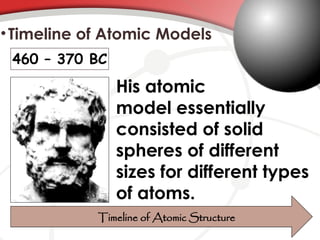
His atomic
model essentially
consisted of solid
spheres of different
sizes for different types
of atoms.
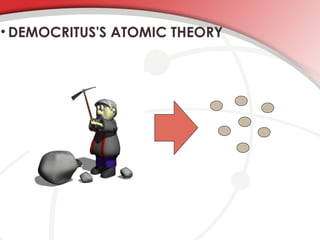
• DEMOCRITUS'S ATOMIC THEORY
•Timeline of Atomic Models
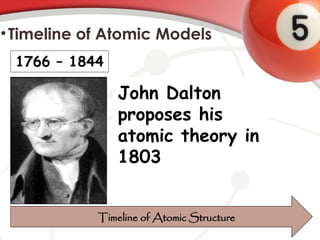
John Dalton
proposes his
atomic theory in
1803
Timeline of Atomic Structure
1766 – 1844
•Timeline of Atomic Models
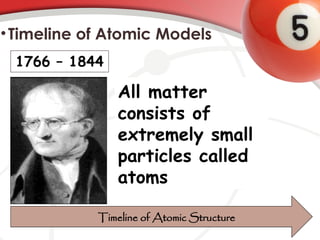
All matter
consists of
extremely small
particles called
atoms
Timeline of Atomic Structure
1766 – 1844
•Timeline of Atomic Models
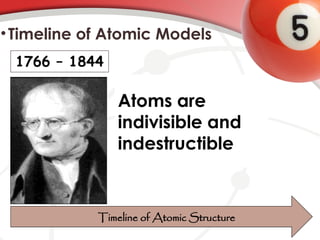
Atoms are
indivisible and
indestructible
Timeline of Atomic Structure
1766 – 1844
•Timeline of Atomic Models
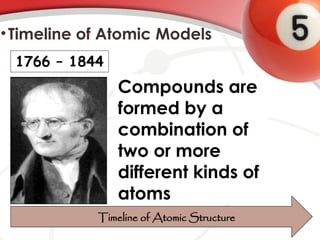
Compounds are
formed by a
combination of
two or more
different kinds of
atoms
Timeline of Atomic Structure
1766 – 1844
•Timeline of Atomic Models
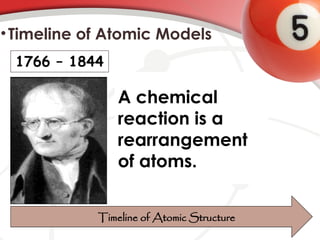
A chemical
reaction is a
rearrangement
of atoms.
Timeline of Atomic Structure
1766 – 1844
•Timeline of Atomic Models
Atoms can be
neither created
nor destroyed.
Timeline of Atomic Structure
1766 – 1844
•Timeline of Atomic Models
J.J. Thomson
discovers the
electron and
proposes the
Plum Pudding
Model in 1897
1856 – 1940
Timeline of Atomic Structure
•Timeline of Atomic Models
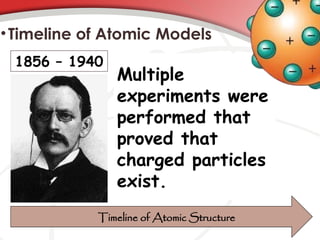
Multiple
experiments were
performed that
proved that
charged particles
exist.
1856 – 1940
Timeline of Atomic Structure
•Timeline of Atomic Models
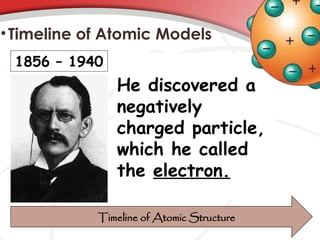
He discovered a
negatively
charged particle,
which he called
the electron.
1856 – 1940
Timeline of Atomic Structure
•Timeline of Atomic Models
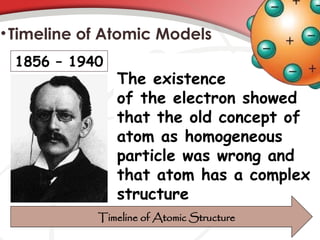
The existence
of the electron showed
that the old concept of
atom as homogeneous
particle was wrong and
that atom has a complex
structure
1856 – 1940
Timeline of Atomic Structure
•Timeline of Atomic Models
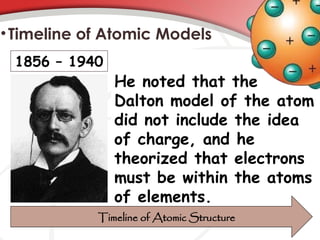
He noted that the
Dalton model of the atom
did not include the idea
of charge, and he
theorized that electrons
must be within the atoms
of elements.
1856 – 1940
Timeline of Atomic Structure
•Timeline of Atomic Models
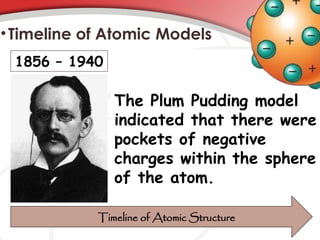
The Plum Pudding model
indicated that there were
pockets of negative
charges within the sphere
of the atom.
1856 – 1940
Timeline of Atomic Structure
•Timeline of Atomic Models
1871 – 1937
Timeline of Atomic Structure
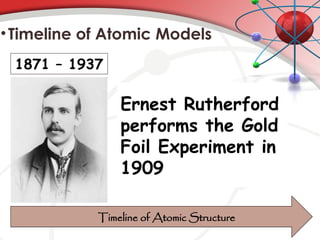
Ernest Rutherford
performs the Gold
Foil Experiment in
1909
•Timeline of Atomic Models
1871 – 1937
Timeline of Atomic Structure
Performed alpha
particle experiments
that led to the
overturning of
Thomson’s model.
•Timeline of Atomic Models
1871 – 1937
Timeline of Atomic Structure
They aimed
alpha particles at a
thin sheet of gold
foil and recorded
the location of the
alpha particle with a
fluorescent screen.
•Timeline of Atomic Models
1871 – 1937
Timeline of Atomic Structure
Majority of the
alpha particles
passed through the
gold foil as if the
foil was not there
•Timeline of Atomic Models
1871 – 1937
Timeline of Atomic Structure
They also found
that small number of
these alpha particles
deflected with some
of the alpha particles
even bouncing back
along the initial path
•Timeline of Atomic Models
1871 – 1937
Timeline of Atomic Structure
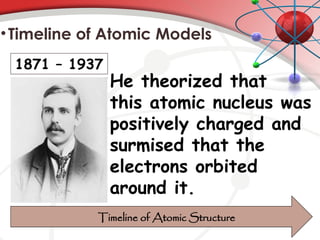
He theorized that
this atomic nucleus was
positively charged and
surmised that the
electrons orbited
around it.
•Timeline of Atomic Models
1871 – 1937
Timeline of Atomic Structure
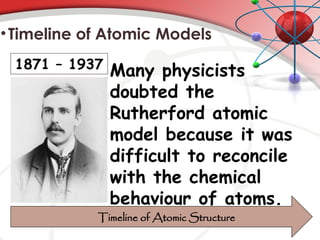
Many physicists
doubted the
Rutherford atomic
model because it was
difficult to reconcile
with the chemical
behaviour of atoms.
•Timeline of Atomic Models
1871 – 1937
Timeline of Atomic Structure
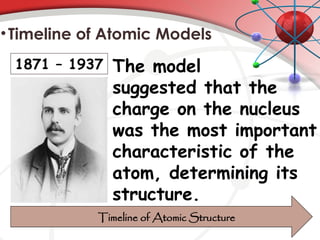
The model
suggested that the
charge on the nucleus
was the most important
characteristic of the
atom, determining its
structure.
•Timeline of Atomic Models
Timeline of Atomic Structure
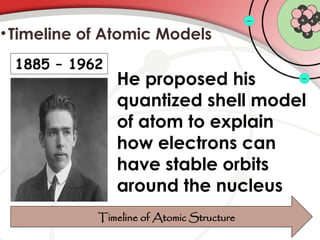
1885 – 1962
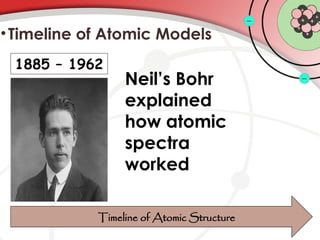
Neil’s Bohr
explained
how atomic
spectra
worked
•Timeline of Atomic Models
Timeline of Atomic Structure
1885 – 1962
He proposed his
quantized shell model
of atom to explain
how electrons can
have stable orbits
around the nucleus
•Timeline of Atomic Models
Timeline of Atomic Structure
1885 – 1962
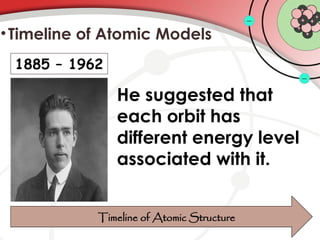
He suggested that
each orbit has
different energy level
associated with it.
•Timeline of Atomic Models
Timeline of Atomic Structure
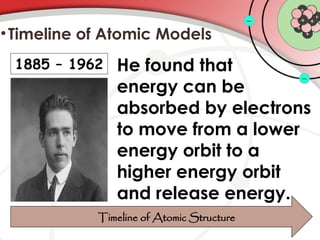
1885 – 1962 He found that
energy can be
absorbed by electrons
to move from a lower
energy orbit to a
higher energy orbit
and release energy.
• The Greek philosopher Democritus began the search for a
description of matter more than 2400 years ago. He asked:
• Could matter be divided into smaller and smaller pieces
forever, or was there a limit to the number of times a piece of
matter could be divided?
• His theory: Matter could not be divided into smaller and
smaller pieces forever, eventually the smallest possible piece
would be obtained. This piece would be indivisible. He
named the smallest piece of matter “atomos,” meaning
“not to be cut.”To Democritus, atoms were small, hard
particles that were all made of the same material but were
different shapes and sizes. Atoms were infinite in number,
always moving and capable of joining together.
• DEMOCRITUS'S ATOMIC THEORY
He proposed the Atomic theory of matter based on his
experimental observations. The main postulates of Dalton’s
atomic theory are as follows.
To Dalton :
All matter is made of atoms. Atoms are indivisible and =>
indestructible.
All atoms of a given element are identical in mass and
properties.
Compounds are formed by a combination of two or more
different kinds of atoms
A chemical reaction is a rearrangement of atoms.
Atoms can be neither created nor destroyed.
He also calculated the atomic weight of various elements
• DALTON'S ATOMIC THEORY
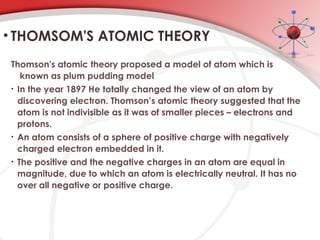
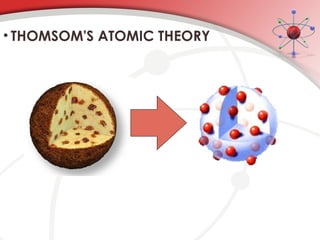
Thomson's atomic theory proposed a model of atom which is
known as plum pudding model
• In the year 1897 He totally changed the view of an atom by
discovering electron. Thomson’s atomic theory suggested that the
atom is not indivisible as it was of smaller pieces – electrons and
protons.
• An atom consists of a sphere of positive charge with negatively
charged electron embedded in it.
• The positive and the negative charges in an atom are equal in
magnitude, due to which an atom is electrically neutral. It has no
over all negative or positive charge.
• THOMSOM'S ATOMIC THEORY
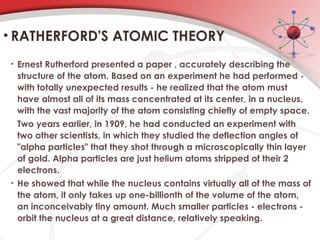
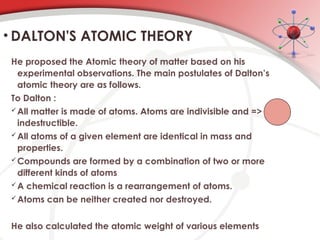
• Ernest Rutherford presented a paper , accurately describing the
structure of the atom. Based on an experiment he had performed -
with totally unexpected results - he realized that the atom must
have almost all of its mass concentrated at its center, in a nucleus,
with the vast majority of the atom consisting chiefly of empty space.
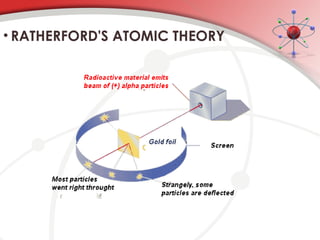
Two years earlier, in 1909, he had conducted an experiment with
two other scientists, in which they studied the deflection angles of
"alpha particles" that they shot through a microscopically thin layer
of gold. Alpha particles are just helium atoms stripped of their 2
electrons.
• He showed that while the nucleus contains virtually all of the mass of
the atom, it only takes up one-billionth of the volume of the atom,
an inconceivably tiny amount. Much smaller particles - electrons -
orbit the nucleus at a great distance, relatively speaking.
• RATHERFORD'S ATOMIC THEORY
• BOHR'S ATOMIC THEORY
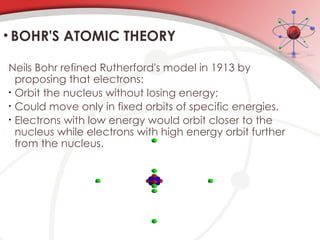
Neils Bohr refined Rutherford's model in 1913 by
proposing that electrons:
• Orbit the nucleus without losing energy;
• Could move only in fixed orbits of specific energies.
• Electrons with low energy would orbit closer to the
nucleus while electrons with high energy orbit further
from the nucleus.
• QUIZ # 1: SCIENTIFIC MODEL
A. Fill in the Blanks.
1. The atomic model has changed over
time as scientists discovered new
___________.
2. The nucleus is made up of ___________
and ___________.
3. Electrons are found in regions around the
nucleus called ___________.
4. An atom is mostly empty ___________.
5. The atomic number of an element is the
number of ___________ in its nucleus.
B. Make a diagram of a simple atom and
label the nucleus, protons, neutrons and
electrons.
Thank you   

2. Atomic Models (History) for grade 7.pptx

  • 1.
  • 2.
    Anything that hasmass and occupies space is called matter. A matter is made up of tiny particles called atoms
  • 3.
  • 4.
    A particle ofmatter that uniquely defines a chemical element.Consists of a central nucleus that is surrounded by one or more negatively charged electrons.
  • 5.
    •INTRODUCTION 460-370 B.C He askedif matter could be divided into smaller and smaller pieces forever Ernest Rutherford (1871–1937) He described the structure of atom Neils Bohr (1885–1962) He explained how atomic spectra worked DEMOCRITUS John Dalton (1766-1844) He proposed the Atomic theory of matter based on his experimental observations DALTON BOHR THOMSON RUTHERFORD John Thomson (1856-1940) He proposed the plum pudding model of atom
  • 6.
    •Timeline of AtomicModels Timeline of Atomic Structure 460 – 370 BC Democritus proposes the 1st atomic theory
  • 7.
    •Timeline of AtomicModels Timeline of Atomic Structure 460 – 370 BC Matter could not be divided into smaller and smaller pieces forever
  • 8.
    •Timeline of AtomicModels Timeline of Atomic Structure 460 – 370 BC Named the smallest atom “atomos” meaning not to be cut
  • 9.
    •Timeline of AtomicModels Timeline of Atomic Structure 460 – 370 BC Atoms move around in space, and can collide to stick together, causing changes to the matter of a material.
  • 10.
    •Timeline of AtomicModels Timeline of Atomic Structure 460 – 370 BC His atomic model essentially consisted of solid spheres of different sizes for different types of atoms.
  • 11.
  • 12.
    •Timeline of AtomicModels John Dalton proposes his atomic theory in 1803 Timeline of Atomic Structure 1766 – 1844
  • 13.
    •Timeline of AtomicModels All matter consists of extremely small particles called atoms Timeline of Atomic Structure 1766 – 1844
  • 14.
    •Timeline of AtomicModels Atoms are indivisible and indestructible Timeline of Atomic Structure 1766 – 1844
  • 15.
    •Timeline of AtomicModels Compounds are formed by a combination of two or more different kinds of atoms Timeline of Atomic Structure 1766 – 1844
  • 16.
    •Timeline of AtomicModels A chemical reaction is a rearrangement of atoms. Timeline of Atomic Structure 1766 – 1844
  • 17.
    •Timeline of AtomicModels Atoms can be neither created nor destroyed. Timeline of Atomic Structure 1766 – 1844
  • 18.
    •Timeline of AtomicModels J.J. Thomson discovers the electron and proposes the Plum Pudding Model in 1897 1856 – 1940 Timeline of Atomic Structure
  • 19.
    •Timeline of AtomicModels Multiple experiments were performed that proved that charged particles exist. 1856 – 1940 Timeline of Atomic Structure
  • 20.
    •Timeline of AtomicModels He discovered a negatively charged particle, which he called the electron. 1856 – 1940 Timeline of Atomic Structure
  • 21.
    •Timeline of AtomicModels The existence of the electron showed that the old concept of atom as homogeneous particle was wrong and that atom has a complex structure 1856 – 1940 Timeline of Atomic Structure
  • 22.
    •Timeline of AtomicModels He noted that the Dalton model of the atom did not include the idea of charge, and he theorized that electrons must be within the atoms of elements. 1856 – 1940 Timeline of Atomic Structure
  • 23.
    •Timeline of AtomicModels The Plum Pudding model indicated that there were pockets of negative charges within the sphere of the atom. 1856 – 1940 Timeline of Atomic Structure
  • 24.
    •Timeline of AtomicModels 1871 – 1937 Timeline of Atomic Structure Ernest Rutherford performs the Gold Foil Experiment in 1909
  • 25.
    •Timeline of AtomicModels 1871 – 1937 Timeline of Atomic Structure Performed alpha particle experiments that led to the overturning of Thomson’s model.
  • 26.
    •Timeline of AtomicModels 1871 – 1937 Timeline of Atomic Structure They aimed alpha particles at a thin sheet of gold foil and recorded the location of the alpha particle with a fluorescent screen.
  • 27.
    •Timeline of AtomicModels 1871 – 1937 Timeline of Atomic Structure Majority of the alpha particles passed through the gold foil as if the foil was not there
  • 28.
    •Timeline of AtomicModels 1871 – 1937 Timeline of Atomic Structure They also found that small number of these alpha particles deflected with some of the alpha particles even bouncing back along the initial path
  • 29.
    •Timeline of AtomicModels 1871 – 1937 Timeline of Atomic Structure He theorized that this atomic nucleus was positively charged and surmised that the electrons orbited around it.
  • 30.
    •Timeline of AtomicModels 1871 – 1937 Timeline of Atomic Structure Many physicists doubted the Rutherford atomic model because it was difficult to reconcile with the chemical behaviour of atoms.
  • 31.
    •Timeline of AtomicModels 1871 – 1937 Timeline of Atomic Structure The model suggested that the charge on the nucleus was the most important characteristic of the atom, determining its structure.
  • 32.
    •Timeline of AtomicModels Timeline of Atomic Structure 1885 – 1962 Neil’s Bohr explained how atomic spectra worked
  • 33.
    •Timeline of AtomicModels Timeline of Atomic Structure 1885 – 1962 He proposed his quantized shell model of atom to explain how electrons can have stable orbits around the nucleus
  • 34.
    •Timeline of AtomicModels Timeline of Atomic Structure 1885 – 1962 He suggested that each orbit has different energy level associated with it.
  • 35.
    •Timeline of AtomicModels Timeline of Atomic Structure 1885 – 1962 He found that energy can be absorbed by electrons to move from a lower energy orbit to a higher energy orbit and release energy.
  • 36.
    • The Greekphilosopher Democritus began the search for a description of matter more than 2400 years ago. He asked: • Could matter be divided into smaller and smaller pieces forever, or was there a limit to the number of times a piece of matter could be divided? • His theory: Matter could not be divided into smaller and smaller pieces forever, eventually the smallest possible piece would be obtained. This piece would be indivisible. He named the smallest piece of matter “atomos,” meaning “not to be cut.”To Democritus, atoms were small, hard particles that were all made of the same material but were different shapes and sizes. Atoms were infinite in number, always moving and capable of joining together. • DEMOCRITUS'S ATOMIC THEORY
  • 37.
    He proposed theAtomic theory of matter based on his experimental observations. The main postulates of Dalton’s atomic theory are as follows. To Dalton : All matter is made of atoms. Atoms are indivisible and => indestructible. All atoms of a given element are identical in mass and properties. Compounds are formed by a combination of two or more different kinds of atoms A chemical reaction is a rearrangement of atoms. Atoms can be neither created nor destroyed. He also calculated the atomic weight of various elements • DALTON'S ATOMIC THEORY
  • 38.
    Thomson's atomic theoryproposed a model of atom which is known as plum pudding model • In the year 1897 He totally changed the view of an atom by discovering electron. Thomson’s atomic theory suggested that the atom is not indivisible as it was of smaller pieces – electrons and protons. • An atom consists of a sphere of positive charge with negatively charged electron embedded in it. • The positive and the negative charges in an atom are equal in magnitude, due to which an atom is electrically neutral. It has no over all negative or positive charge. • THOMSOM'S ATOMIC THEORY
  • 39.
  • 40.
    • Ernest Rutherfordpresented a paper , accurately describing the structure of the atom. Based on an experiment he had performed - with totally unexpected results - he realized that the atom must have almost all of its mass concentrated at its center, in a nucleus, with the vast majority of the atom consisting chiefly of empty space. Two years earlier, in 1909, he had conducted an experiment with two other scientists, in which they studied the deflection angles of "alpha particles" that they shot through a microscopically thin layer of gold. Alpha particles are just helium atoms stripped of their 2 electrons. • He showed that while the nucleus contains virtually all of the mass of the atom, it only takes up one-billionth of the volume of the atom, an inconceivably tiny amount. Much smaller particles - electrons - orbit the nucleus at a great distance, relatively speaking. • RATHERFORD'S ATOMIC THEORY
  • 41.
  • 42.
    • BOHR'S ATOMICTHEORY Neils Bohr refined Rutherford's model in 1913 by proposing that electrons: • Orbit the nucleus without losing energy; • Could move only in fixed orbits of specific energies. • Electrons with low energy would orbit closer to the nucleus while electrons with high energy orbit further from the nucleus.
  • 43.
    • QUIZ #1: SCIENTIFIC MODEL A. Fill in the Blanks. 1. The atomic model has changed over time as scientists discovered new ___________. 2. The nucleus is made up of ___________ and ___________. 3. Electrons are found in regions around the nucleus called ___________. 4. An atom is mostly empty ___________. 5. The atomic number of an element is the number of ___________ in its nucleus. B. Make a diagram of a simple atom and label the nucleus, protons, neutrons and electrons.
  • 44.