Communities of Practice… Benefits to AADE’s SPGs & Chapters? Leadership Development Series AADE Annual Meeting -- Los Angeles, CA August 8, 2006 Nancy D’Hondt RPh, CDE Margie Lawlor, MS, CDE
“ Communities of Practice” … A peer-driven approach connecting people and knowledge through meaningful conversations of what works in practice.
A Theoretical Model A learning theory conceptualized by Jean Lave and Etienne Wenger proposing  the idea that  Learning is social and comes largely from our experience of participating in daily life  A process of engagement in a 'community of practice'. 
According to Wenger… CoP defines itself along 3 dimensions: What it is about   Joint enterprise  as understood and continually renegotiated by its members. How it functions  Mutual engagement that bind members together What capability it has produced   Shared repertoire  of communal resources (routines, artefacts, vocabulary, styles, etc.) developed over time ( http://www.infed.org/biblio/communities_of_practice.htm )
Communities of Practice  (CoPs) Groups of people who share a passion for something they do, and learn how to do it better as they interact with other members of the community Develop a shared collection of resources to support work in a specific field
3 Elements The domain The community The Practice Domain Community Practice
Domain (Defines the issues) Members have …  Identity  defined by a shared area of interest Commitment   to domain Shared competence
Community   (People who care about the domain) Members… Participate  in joint activities & discussions Help  each other Share  information Build relationships  so that hey learn from each other
Practice  (Shared ideas, tools, info., goals) Members are … Practitioners Develop a shared repertoire of resources Experiences Stories Tools Ways of addressing recurring problems
Key Features of CoPs Communication: Managed by making connections Shared Domain of Practice, knowledge and resources Focus on value, mutual exchange and learning Crosses operational, functional and organizational boundaries Defined by people, not tasks
What CoPs Do Facilitate collaboration/communication Develop/Identify Subject Matter Experts  Filter out incorrect information by peer groups Capture knowledge (intellectual capital)  Prevent re-inventing the wheel by sharing knowledge and experiences Share successful (best) practices Decrease learning curve Increase organizational learning
Benefits of a CoPs Access to knowledge and experience  Build relationships with those who have expertise in a particular domain Develop best practices through discussions and sharing of ideas Learn how others have solved problems, instead of reinventing the wheel  Keep up-to-date at the time and pace of the individual member Develop a community spirit.
 
Growing CoPs “… you cannot force a plant to grow by pulling its leaves… what you can do is create the infrastructure in which it can prosper.” - Etienne Wenger, 1999
AADE & Communities of Practice What Would a CoP Offer to AADE SPGs & Chapters?
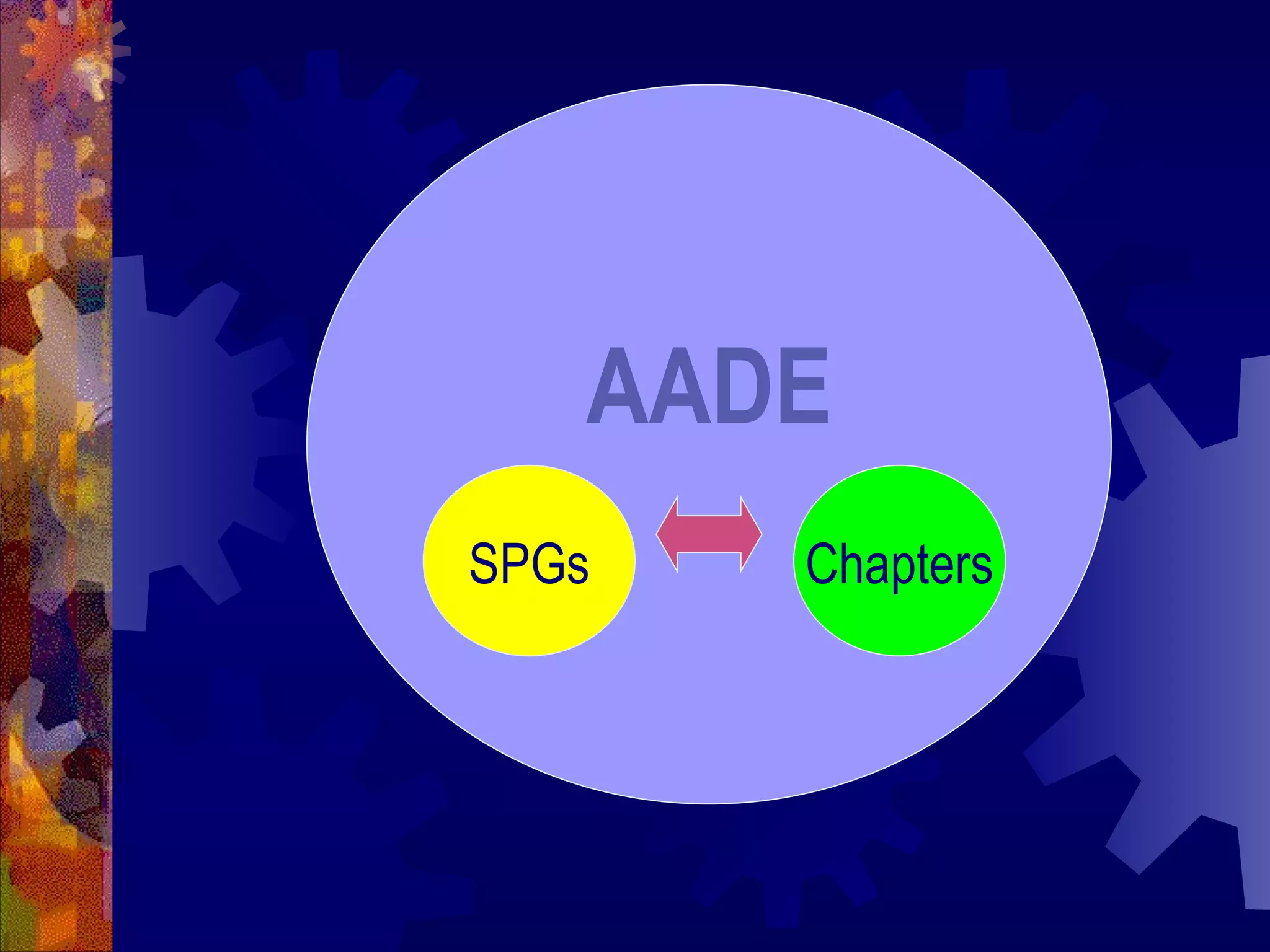
AADE Chapters SPGs
Organizational Benefits Increased Productivity & Performance Through enhanced professional relationships and trusted knowledge. Stronger Organizational Communication The creation of a sharing environment between trusted peers facilitates   stronger organizational communication, increased organizational use of best practices, contributing to stronger overall excellence & professionalism.
Organizational Benefits Intellectual property of experts within AADE will enable our leadership to have information to efficiently make critical decisions and respond quickly Stability Communities of practice foster knowledge generation and professional development contributing to stability within the organization
Organizational Benefits Knowledge ecology Broaden & enrich the knowledge domain.  Build the intellectual capital of AADE and decrease the learning curve of members…Advance the profession! Leadership development Community councils will prepare future leaders. Advance strategic goals All these organizational benefits will serve to advance AADE’s Strategic Plan
Learning Curve Leveraging New Knowledge Normal Learning Curve - - - - -  L E A R N I N G  - - - - - - - - - -  T I M E - - - - - - -  Improving the Way We Learn
 
What will the CoP provide to AADE SPGs & Chapters? Focus -- passion for quality Trusted environment Member connection through conversation Innovation and creativity Committment to the profession & organization Capability to share horizontally and/or vertically across the organization Knowledge is social… Relationships power communities and enable knowledge transfer
What Value Does a CoP Offer to AADE SPGs & Chapters? Connections Membership reaches across the Organization Former, future and current members “ Others” who provide value and knowledge to the community Content Resource for useful, “practice” knowledge Provided in context Rich conversation and knowledge transfer
What Value  (con’t) Community Professional focus with a positive voice Trust and sense of community Familiar and “friendly” face
 
 
Barriers SPG’s may feel threatened—especially large or strong groups Individuality lost  Financials Lack of buy-in from stakeholders “ Tweeners”—may be important to more than one community
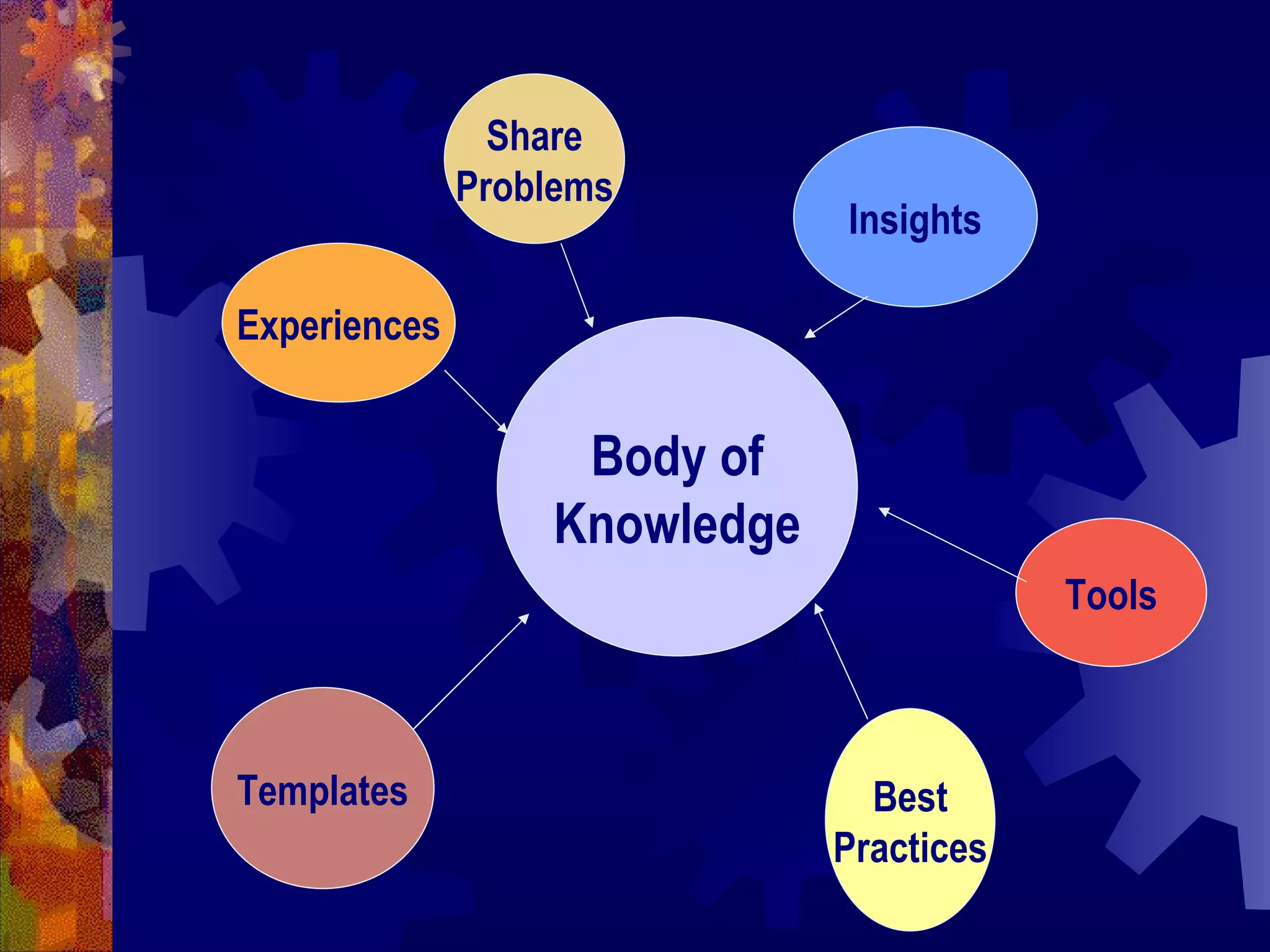
Body of Knowledge Experiences Templates Insights Tools Best Practices Share Problems
 
SPG & Chapter Hurdles Geography Leadership Consistency Time Work groups Communication
Summary Communities are the people end of the knowledge spectrum Utilize the untapped potential to enrich education and learning Knowledge is social…Relationships power communities and enable knowledge transfer
 
COP : CPC & SPG Applications How would you align the Communities of Practice? Setting? Discipline? Geography? … ? Chapters: Can you visualize the Chapter Community of Practice model? CPC? AADE? Other Chapters Other? SPGs: How do you visualize the leadership model within the “SPG” communities of practice? What does the SPG look like –  Council? Officers?  # of members? Etc….

The Art of Learning Togeather

  • 1.
    Communities of Practice…Benefits to AADE’s SPGs & Chapters? Leadership Development Series AADE Annual Meeting -- Los Angeles, CA August 8, 2006 Nancy D’Hondt RPh, CDE Margie Lawlor, MS, CDE
  • 2.
    “ Communities ofPractice” … A peer-driven approach connecting people and knowledge through meaningful conversations of what works in practice.
  • 3.
    A Theoretical ModelA learning theory conceptualized by Jean Lave and Etienne Wenger proposing the idea that Learning is social and comes largely from our experience of participating in daily life A process of engagement in a 'community of practice'. 
  • 4.
    According to Wenger…CoP defines itself along 3 dimensions: What it is about Joint enterprise as understood and continually renegotiated by its members. How it functions Mutual engagement that bind members together What capability it has produced Shared repertoire of communal resources (routines, artefacts, vocabulary, styles, etc.) developed over time ( http://www.infed.org/biblio/communities_of_practice.htm )
  • 5.
    Communities of Practice (CoPs) Groups of people who share a passion for something they do, and learn how to do it better as they interact with other members of the community Develop a shared collection of resources to support work in a specific field
  • 6.
    3 Elements Thedomain The community The Practice Domain Community Practice
  • 7.
    Domain (Defines theissues) Members have … Identity defined by a shared area of interest Commitment to domain Shared competence
  • 8.
    Community (People who care about the domain) Members… Participate in joint activities & discussions Help each other Share information Build relationships so that hey learn from each other
  • 9.
    Practice (Sharedideas, tools, info., goals) Members are … Practitioners Develop a shared repertoire of resources Experiences Stories Tools Ways of addressing recurring problems
  • 10.
    Key Features ofCoPs Communication: Managed by making connections Shared Domain of Practice, knowledge and resources Focus on value, mutual exchange and learning Crosses operational, functional and organizational boundaries Defined by people, not tasks
  • 11.
    What CoPs DoFacilitate collaboration/communication Develop/Identify Subject Matter Experts Filter out incorrect information by peer groups Capture knowledge (intellectual capital) Prevent re-inventing the wheel by sharing knowledge and experiences Share successful (best) practices Decrease learning curve Increase organizational learning
  • 12.
    Benefits of aCoPs Access to knowledge and experience Build relationships with those who have expertise in a particular domain Develop best practices through discussions and sharing of ideas Learn how others have solved problems, instead of reinventing the wheel Keep up-to-date at the time and pace of the individual member Develop a community spirit.
  • 13.
  • 14.
    Growing CoPs “…you cannot force a plant to grow by pulling its leaves… what you can do is create the infrastructure in which it can prosper.” - Etienne Wenger, 1999
  • 15.
    AADE & Communitiesof Practice What Would a CoP Offer to AADE SPGs & Chapters?
  • 16.
  • 17.
    Organizational Benefits IncreasedProductivity & Performance Through enhanced professional relationships and trusted knowledge. Stronger Organizational Communication The creation of a sharing environment between trusted peers facilitates stronger organizational communication, increased organizational use of best practices, contributing to stronger overall excellence & professionalism.
  • 18.
    Organizational Benefits Intellectualproperty of experts within AADE will enable our leadership to have information to efficiently make critical decisions and respond quickly Stability Communities of practice foster knowledge generation and professional development contributing to stability within the organization
  • 19.
    Organizational Benefits Knowledgeecology Broaden & enrich the knowledge domain. Build the intellectual capital of AADE and decrease the learning curve of members…Advance the profession! Leadership development Community councils will prepare future leaders. Advance strategic goals All these organizational benefits will serve to advance AADE’s Strategic Plan
  • 20.
    Learning Curve LeveragingNew Knowledge Normal Learning Curve - - - - - L E A R N I N G - - - - - - - - - - T I M E - - - - - - - Improving the Way We Learn
  • 21.
  • 22.
    What will theCoP provide to AADE SPGs & Chapters? Focus -- passion for quality Trusted environment Member connection through conversation Innovation and creativity Committment to the profession & organization Capability to share horizontally and/or vertically across the organization Knowledge is social… Relationships power communities and enable knowledge transfer
  • 23.
    What Value Doesa CoP Offer to AADE SPGs & Chapters? Connections Membership reaches across the Organization Former, future and current members “ Others” who provide value and knowledge to the community Content Resource for useful, “practice” knowledge Provided in context Rich conversation and knowledge transfer
  • 24.
    What Value (con’t) Community Professional focus with a positive voice Trust and sense of community Familiar and “friendly” face
  • 25.
  • 26.
  • 27.
    Barriers SPG’s mayfeel threatened—especially large or strong groups Individuality lost Financials Lack of buy-in from stakeholders “ Tweeners”—may be important to more than one community
  • 28.
    Body of KnowledgeExperiences Templates Insights Tools Best Practices Share Problems
  • 29.
  • 30.
    SPG & ChapterHurdles Geography Leadership Consistency Time Work groups Communication
  • 31.
    Summary Communities arethe people end of the knowledge spectrum Utilize the untapped potential to enrich education and learning Knowledge is social…Relationships power communities and enable knowledge transfer
  • 32.
  • 33.
    COP : CPC& SPG Applications How would you align the Communities of Practice? Setting? Discipline? Geography? … ? Chapters: Can you visualize the Chapter Community of Practice model? CPC? AADE? Other Chapters Other? SPGs: How do you visualize the leadership model within the “SPG” communities of practice? What does the SPG look like – Council? Officers? # of members? Etc….